IndIcaTorA PUBLICATION OF THE COCHISE COLLEGE CENTER FOR ECONOMIC RESEARCH
Local cost of living remains below
national average
According to the ACCRA Cost of Living Index, the cost of living in Cochise
County was 2.4 percent lower than the national average in the first quarter of
2010.This suggests a decline in the local cost of living relative to the rest of
the nation. In 2009, Cochise County’s cost of living was only 0.8 percent below
the national average.
The Council for Community and Economic Research in Arlington,VA
administers the Cost of Living Index, which measures relative price levels for
consumer goods and services in participating areas.The index includes
separate weighted sub-indices for grocery items, housing, utilities,
transportation, health care, and miscellaneous goods and services.The report
provides comparative data for 308 urban areas in all 50 states.
The cost of living in Cochise County in the first quarter was 0.8 percent
higher than in Tucson.This is a widening of the gap from last year, when local
costs were only 0.1 percent higher than in Tucson.The primary reason for the
widening of the gap was relative increases in the local cost of groceries,
utilities, and miscellaneous goods and services, and relative declines in the
cost of groceries, housing, utilities, and miscellaneous goods and services
in Tucson.
In the first quarter, the cost of living in Cochise County was 1.9
percent below that of Phoenix—a reversal of the trend from last
year. In 2009, the local cost of living was 0.8 percent higher than
in Phoenix.
The reason for the decrease in the cost of living in Cochise
County from last year, relative to the national average, was
relative decreases in the cost of housing, transportation, and health
care.These were partially offset by relative increases in the local cost of
grocery items, utilities, and miscellaneous goods and services.
Grocery items in Cochise County, which were 0.3 percent above the
national average in 2009, increased to 0.5 percent above the national average
in the first quarter of 2010. Housing costs, which include home prices and
rental rates, decreased from 2009 to the first quarter of 2010, relative to
national averages. In 2009, the cost of housing in Cochise County was 4.1
percent above the national average. In the first quarter of this year, local
housing costs dropped to 1.4 percent below the national average.
INSIDE:
COST OF LIVING
•
ECONOMICS 101
•
NATION DEBT FACTS/MYTH
•
BENSON OUTLOOK
T H E
■
SUMMER 2010
Mark your calendars for
the upcoming luncheons
Make plans to attend the
CER’s economic outlook
luncheons.
Douglas
September 16, 2010
Bisbee
December 2010
Sierra Vista
April 2011
Benson
June 2011
RESERVE YOUR SEAT!
To register, use the enclosed
registration form;
register online at
www.cochise.edu/cer;
email cer@cochise.edu;
or call
(520) 515-5486
Visa®, MasterCard®, Discover®,
or American Express®
accepted.
By Robert Carreira,Ph.D.
Director, Center for
Economic Research
IN THE FIRST
QUARTER, THE COST OF
LIVING IN COCHISE
COUNTY WAS 1.9 PERCENT
BELOW THAT OF PHOENIX—A
REVERSAL OF THE TREND FROM
LAST YEAR. IN 2009, THE
LOCAL COST OF LIVING WAS
0.8 PERCENT HIGHER
THAN IN PHOENIX.
SUMMER 2010
2
CENTER FOR ECONOMIC RESEARCH
T H E
In the first quarter, the local cost of utilities was 2.9 percent below the
national average, up from 5.7 percent below the national average last year.
Transportation costs, which include gasoline and automobile maintenance,
were 0.6 percent below the national average in the first quarter. Last year, local
transportation costs were 2.6 percent above the national average.
Health care costs in Cochise County were 9.5 percent below the national
average in the first quarter, compared to only 2.6 percent below the national
average in 2009.The cost of miscellaneous goods and services in Cochise
County was 4.1 percent below the national average, up from 5.3 percent
below the national average last year.
Statewide, there were seven places participating in the ACCRA Cost of
Living Index in the first quarter of 2010. In addition to Cochise County, other
participating areas were Flagstaff, Lake Havasu City, Phoenix, Prescott-Prescott
Valley,Tucson, and Yuma. Of these, only Tucson had an
overall cost of living that was lower than Cochise
County.The highest cost of living in Arizona
was in Flagstaff, which was 16.9 percent
above the national average.
ACCRA Cost of Living Index data for
Cochise County are listed under the
Sierra Vista-Douglas Micropolitan
Area, which is a statistical
designation for all of Cochise
County. Sierra Vista and Douglas are
included in the title since they are
the principal cities that meet the
criteria for establishing Cochise County
as a micropolitan statistical area.To qualify
as a micropolitan statistical area, a location
must be economically integrated and have at least
one urban area with a population of at least 10,000, but less
than 50,000.
The ACCRA Cost of Living Index data for Cochise County are collected by
the Cochise College Center for Economic Research and submitted to the
Council for Community and Economic Research for inclusion in the index.
Cochise County’s participation is sponsored by the Sierra Vista Economic
Development Foundation, which covers the cost of data collection.
CONTINUED
LOCAL COST OF
LIVING
REMAINS
BELOW
NATIONAL
AVERAGE
On Apr. 13, CER director Robert
Carreira attended the Arizona Ru-
ral Development Council’s Rural
Roundtable/Workshop in Willcox.
On Apr.22,the CER hosted the sec-
ond installment of the 2010 Sierra
Vista Economic Outlook Luncheon
at the new student union building
on the Cochise College Sierra Vista
Campus. A reduction in seating ca-
pacity at the Windemere Hotel and
Conference Center led to this year’s
event being held on two separate
dates in April to accommodate all
attendees.
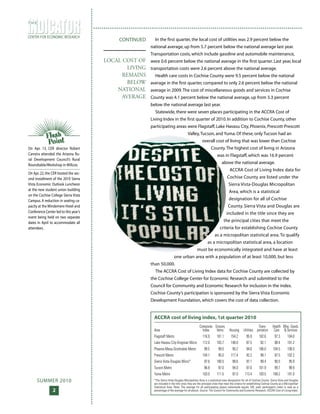
Composite Grocery Trans- Health Misc. Goods
Area Index Items Housing Utilities portation Care & Services
Flagstaff Metro 116.9 101.1 154.2 95.9 102.6 97.3 104.0
Lake Havasu City-Kingman Micro 112.0 103.7 146.0 87.5 92.1 98.4 101.2
Phoenix-Mesa-Scottsdale Metro 99.5 99.0 90.2 94.6 106.0 104.5 106.5
Prescott Metro 104.1 95.0 117.4 92.2 99.1 97.5 102.2
Sierra Vista-Douglas Micro* 97.6 100.5 98.6 97.1 99.4 90.5 95.9
Tucson Metro 96.8 97.0 94.0 87.6 101.9 99.7 99.9
Yuma Metro 103.0 111.5 97.0 113.4 103.5 108.2 101.0
*The Sierra Vista-Douglas Micropolitan Area is a statistical area designation for all of Cochise County. Sierra Vista and Douglas
are included in the title since they are the principal cities that meet the criteria for establishing Cochise County as a Micropolitan
Statistical Area. Note: The average for all participating places nationwide equals 100; each participant’s index is read as a
percentage of the average for all places. Source: The Council for Community and Economic Research, ACCRA Cost of Living Index.
ACCRA cost of living index, 1st quarter 2010
SUMMER 2010
3
CENTER FOR ECONOMIC RESEARCH
T H E
On April 29, CER director Robert
Carreira appeared as a guest on the
‘Open House’ talk radio show on
KTAN 1420 AM, hosted by Kate
Hotz. Topics included the state of
housing and real estate markets at
the local, state, and national levels,
and the future direction of the
economy.
On May 7, CER director Robert Car-
reira hosted‘The Friday Report’talk
radio show on KTAN 1420 AM. Dr.
Carreira’s guest was Chuck Po-
tucek, Sierra Vista city manager.
Topics included the city budget,
the impact of the state budget cri-
sis on city finances, and the im-
pacts of Proposition 100 and Sen-
ate Bill 1070 on the city.
Glenn Nichols
City Manager
City of Benson
Benson “team” looking to the future
Benson is a city that continues to work to be ready for its future. All city
employees continue to provide excellent service to the residents of the city,
the surrounding community, and the many visitors. All the areas of
city government are looking at ways to provide even better
customer service.
The city continues to be fiscally responsible. Again,
Capital Improvement Plans (CIP) are on hold with the
timelines pushed back.Through the budget process
we continue to work not to layoff or furlough
employees. Many departments are doing more with
less and many department heads have taken on
additional duties to save money.We continue to look
for funding opportunities to improve the infrastructure
of the city.
The city continues to position itself to handle the requests
for services from groups and individuals.The staff has
streamlined the process of providing consistent information to those
interested in being a part of the City of Benson.We continue to look at ways
to improve the city through creative ideas that get the most from available
funding.
On behalf of our mayor, council, and staff, we welcome all to visit our city
and see our many great attractions!
Benson Economic Outlook
By Robert Carreira, Ph.D.
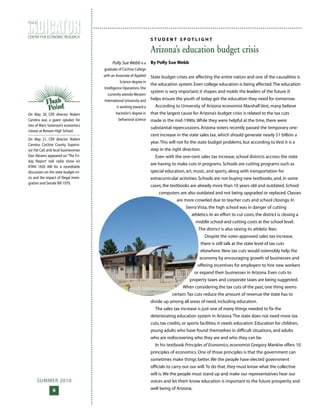
On Jun. 10, the Cochise College Center for Economic Research hosted the 13th
Annual Benson Economic Outlook Luncheon at the new multipurpose facility
at the Benson Unified School District.The following is a condensed version of
the economic outlook presentation.
The big question these days is whether the recession is over.The answer is
yes—just not officially. A recession doesn’t officially begin or end until so
SUMMER 2010
4
CENTER FOR ECONOMIC RESEARCH
T H E
Find out why more
and more people
are visiting the CER
website.
Visit our website at
www.cochise.edu/cer
to find statistics on the
local economy;
information on upcoming
events; sponsorship
information; CER
economic outlook
publications; PowerPoint
slides from CER
presentations; special
studies; press releases; the
Cochise County Economic
Update, a compilation of
links to online newspaper
stories of economic
interest from across
Cochise County; the CER’s
quarterly newsletter, The
Indicator; and links to
websites relevant to the
local, state, and national
economy.
CONTINUED
BENSON
ECONOMIC
OUTLOOK
designated by the National Bureau of Economic Research. But by the major
indicators, the recession ended in the third quarter of 2009.
A recession is a decline in economic activity, or Gross Domestic Product,
which is the value of all goods and services produced in the economy. GDP
was down in 5 of 6 quarters from the beginning of 2008 through the first half
of 2009, but was up 2.2 percent in the third quarter, 5.6 percent in the fourth
quarter, and 3 percent in the first quarter of this year. Much of the recent
growth, however, was due largely to government stimulus efforts, so the big
question is whether it’ll sustain once those efforts are withdrawn.
Most indicators point to an economy in recovery. Construction and new
and existing home sales have generally been up.There’s been some instability
caused by the timing of the homebuyer tax credits, which were initially set to
expire in November last year then were extended through April. But things
have generally been up.
Consumer spending has been up and retail sales were up for 7 straight
months from October through April.The stock market has generally been up,
but there has been some instability with the Euro crises and some other
global factors. But it’s certainly stronger than we’ve seen over the past couple
of years. Delinquent debt and home foreclosures seem to have stabilized.
Even employment is now beginning to show signs of stabilization. New
unemployment claims are down. More people are quitting their jobs than
being laid off and in April the number of new job openings was the highest in
16 months.
Locally, countywide retail sales were up 4.7 percent in the first quarter of
this year, after adjusting for inflation. Monthly retail sales growth was mostly
negative last year but began to turn around in the fourth quarter. For the year,
retail sales were down 3.2 percent last year after
declining 1.3 and 6.5 percent, respectively, in
2007 and 2008.
In Benson, unadjusted retail sales tax
revenue was up 4.2 percent in the first
quarter of this year. Revenue was
down 4.8 percent last year.
In the first quarter of 2010,
accommodation sales, which
include hotel, motel, and other
temporary lodging stays of less
than 30 days, were up 8.8 percent
in Benson and 3.2 percent
countywide. Sales were down 5.5
percent last year in Benson and 9
percent countywide.
Although retail and accommodation seem
to be on a path of recovery, the same is not true of
restaurant and bar sales. In the first quarter of this year, sales
were down 1.9 percent in Benson and 5.3 percent countywide, continuing a
downward trend that began in the closing months of last year.
Based on recent trends we can expect to see growth in retail and
accommodation sales at both the county and city level this year.The recent
downward trend in local restaurant and bar sales should change later this
SUMMER 2010
5
CENTER FOR ECONOMIC RESEARCH
T H E
year as consumer confidence improves.
Since the recession began, unemployment at the state and national levels
has increased much more sharply than at the county level. Cochise County
has had the lowest unemployment rate of Arizona’s 15 counties since May of
last year.
National unemployment has generally leveled off and currently sits at 9.9
percent. Arizona’s unemployment rate declined somewhat in the second half
of last year, but saw an uptick from January to February and now sits at 9.5
percent. Cochise County saw a severe uptick in February, with the
unemployment rate jumping from 7.3 to 8.3 percent, but since then has come
down somewhat and currently sits at 8 percent.
Although the recession began in December 2007, Cochise County didn’t
begin losing jobs until January 2009. If recent trends continue, job losses will
persist through June, with job growth in the second half of the year.
At the county level, new residential construction
seems to be on a path of recovery. Although
new home permits countywide were down
11.6 percent last year, compared to
2008, the decline was isolated to the
first half of the year. Permits in the
first half of 2009 were down 43.8
percent compared to the first half
of 2008. In the second half of the
year, permits were up 60 percent
compared to the same period of
2008. In the first 4 months of 2010,
permits were up nearly 60 percent
from the same period last year.
In Benson, there was a spike in new
construction in 2006 with 104 new home permits
issued as progress began on planned developments in the city. Construction
activity has been up and down since then, but has remained well above the
pre-2006 levels. In the first 5 months of this year there were 25 permits issued,
up from 18 in the same period of last year.
Existing home sales countywide were down 1.9 percent last year and were
down 29 percent in the first quarter of this year (compared to the first quarter
last year). In Benson, sales were also down 1.9 percent last year, but in the first
quarter of this year they were up 16.7 percent.
The local area saw significant home price increases from 2004 through
2007, but since then prices have come down moderately. In the first quarter of
2010, the countywide median home price of $173,172 was still 24 percent
higher than in 2004. In the Benson area the median price was $146,563 in the
first quarter, about 83 percent higher than in 2004.
Existing home sales seem to have bottomed out at both the city and
county levels and appear to be on a path of recovery in Benson. Sales levels
continue to crawl along the bottom of the cycle at the county level. Home
prices should continue to hold, though another moderate decline can’t be
ruled out. Locally, we’re not likely to see the same steep drops that the rest of
the state and much of the nation have seen, with the worst of the downturn
seemingly behind us.
CONTINUED
BENSON
ECONOMIC
OUTLOOK
On May 14, CER director Robert
Carreira appeared as a guest on
‘The Friday Report’ talk radio show
on KTAN 1420 AM, hosted by Pat
Call. Topics included Proposition
100 and Senate Bill 1070.
On May 19, CER director Robert
Carreira attended the Leadership
Sierra Vista 2009-2010 graduation
ceremony held at the Rendezvous
in Sierra Vista.
Contact the Center for
Economic Research:
Cochise College
Center for Economic Research
901 North Colombo Ave.
Sierra Vista,AZ 85635
Phone 520-515-5486
Fax 520-515-5343
www.cochise.edu/cer
cer@cochise.edu
SUMMER 2010
6
CENTER FOR ECONOMIC RESEARCH
T H E
On May 20, CER director Robert
Carreira was a guest speaker for
two of Marv Sorenson’s economics
classes at Benson High School.
On May 21, CER director Robert
Carreira, Cochise County Supervi-
sor Pat Call, and local businessman
Dan Abrams appeared on ‘The Fri-
day Report’ talk radio show on
KTAN 1420 AM for a roundtable
discussion on the state budget cri-
sis and the impact of illegal immi-
gration and Senate Bill 1070.
S T U D E N T S P O T L I G H T
Arizona’s education budget crisis
By Polly Sue Webb
State budget crises are affecting the entire nation and one of the causalities is
the education system. Even college education is being affected.The education
system is very important; it shapes and molds the leaders of the future. It
helps ensure the youth of today get the education they need for tomorrow.
According to University of Arizona economist Marshall Vest, many believe
that the largest cause for Arizona’s budget crisis is related to the tax cuts
made in the mid-1990s.While they were helpful at the time, there were
substantial repercussions. Arizona voters recently passed the temporary one-
cent increase in the state sales tax, which should generate nearly $1 billion a
year.This will not fix the state budget problems, but according to Vest it is a
step in the right direction.
Even with the one-cent sales tax increase, school districts accross the state
are having to make cuts in programs. Schools are cutting programs such as
special education, art, music, and sports, along with transportation for
extracurricular activities. Schools are not buying new textbooks, and, in some
cases, the textbooks are already more than 10 years old and outdated. School
computers are also outdated and not being upgraded or replaced. Classes
are more crowded due to teacher cuts and school closings. In
Sierra Vista, the high school was in danger of cutting
athletics. In an effort to cut costs, the district is closing a
middle school and cutting costs at the school level.
The district is also raising its athletic fees.
Despite the voter-approved sales tax increase,
there is still talk at the state level of tax cuts
elsewhere. New tax cuts would ostensibly help the
economy by encouraging growth of businesses and
offering incentives for employers to hire new workers
or expand their businesses in Arizona. Even cuts to
property taxes and corporate taxes are being suggested.
When considering the tax cuts of the past, one thing seems
certain:Tax cuts reduce the amount of revenue the state has to
divide up among all areas of need, including education.
The sales tax increase is just one of many things needed to fix the
deteriorating education system in Arizona.The state does not need more tax
cuts, tax credits, or sports facilities; it needs education. Education for children,
young adults who have found themselves in difficult situations, and adults
who are rediscovering who they are and who they can be.
In his textbook Principles of Economics, economist Gregory Mankiw offers 10
principles of economics. One of those principles is that the government can
sometimes make things better.We the people have elected government
officials to carry out our will.To do that, they must know what the collective
will is.We the people must stand up and make our representatives hear our
voices and let them know education is important to the future prosperity and
well being of Arizona.
Polly Sue Webb is a
graduate of Cochise College
with an Associate of Applied
Science degree in
Intelligence Operations.She
currently attends Western
International University and
is working toward a
bachelor’s degree in
behavioral science
SUMMER 2010
7
CENTER FOR ECONOMIC RESEARCH
T H E
New construction up, home sales down
By Robert Carreira, Ph.D.
New home permits in Cochise County were up 12 percent in the first quarter
of 2010, compared to the fourth quarter of 2009. From January through
March, there were 112 new home permits issued countywide, with reporting
for all areas except Tombstone and Huachuca City. This was up from 100
permits in the fourth quarter. Permits in the first quarter of this year were 62.3
percent higher than in the first quarter of last year.
In Sierra Vista, which represents the largest share of
the countywide new construction market, there
were 57 permits issued in the first quarter, up
1.2 percent from the fourth quarter and up
137.5 percent compared to the first
quarter of 2009.
While new home permits increased,
sales of existing homes in Cochise
County were down in the first quarter.
From January through March, 252 homes
were sold countywide, down 29 percent
from 355 in the fourth quarter. Sales in the first
quarter were up 0.8 percent compared to the first
quarter of last year. Sales data are from the Southeast
Arizona Multiple Listing Service and the Tucson Area MLS.
The median price of a home sold in Cochise County in the first quarter was
$173,172, up 5 percent from $165,000 in the fourth quarter.The median price
in the first quarter was down 1 percent from $175,000 in the first quarter of
last year.
Homes that sold in Cochise County in the first quarter were on the market
for 155 days, up from 137 days in the fourth quarter and 150 days in the first
quarter of last year. Homes sold for 95.1 percent of the asking price in the first
quarter, down from 95.5 percent in the fourth quarter but up from 94.5
percent in the first quarter of 2009.
Foreclosed homes accounted for 29.7 percent of sales countywide in the
first quarter, up from 20.5 percent in the fourth quarter and 27.4 percent in
the first quarter of last year. As of the second week of May, 7.8 percent of
active listings were foreclosures.
First quarter home sales in Southwest Cochise County, which includes Sierra
Vista, Huachuca City,Tombstone,Whetstone, Hereford, Palominas, and
surrounding areas, totaled 180, down 30.8 percent from the fourth quarter.
Sales were down 0.6 percent compared to the first quarter of last year.The
median price in Southwest Cochise County in the first quarter was $191,322,
up 3.7 percent from $184,519 in the fourth quarter, but down 0.6 percent
from $192,500 in the first quarter of last year. Southwest Cochise County
accounts for more than 70 percent of all home sales countywide.
Home sales in Southeast Cochise County, which includes Douglas, Bisbee,
Apache, Bisbee Junction, Double Adobe, Elfrida, McNeal, Naco, and
surrounding areas, totaled 37 in the first quarter, down from 41 in the fourth
quarter but up from 35 in the first quarter of 2009.The median price in
On June 10, the CER hosted the
2010 Benson Economic Outlook
Luncheon at the new multipurpose
facility at the Benson Unified
School District.
On June 10, CER director Robert
Carreira spoke about the state of
the economy and job creation at
the Cochise County Workforce De-
velopment board retreat inTucson.
SUMMER 2010
8
CENTER FOR ECONOMIC RESEARCH
T H E
National debt facts and myths
By Robert Carreira, Ph.D.
Four years ago the national debt was $8.3 trillion.Today, as a result of
increased government spending and a decline in tax revenue tied to the
economic downturn—it’s $12.9 trillion.That’s a 55 percent increase; over
the same time period, inflation was 8 percent.
The national debt is the cumulative amount by which government
spending exceeds revenue.When the government spends more
than it takes in during a single year—that’s a budget deficit.The
total of all the annual budget deficits is the national debt.
When government spending exceeds revenues, it must borrow the
difference. It does this by selling treasury securities (government bonds,
bills, and notes). If you’ve ever owned a U.S. savings bond, you’ve owned a
piece of the national debt.
CER Services
The CER provides
economic and demographic
information,analysis,and
forecasting to help
community leaders in the
public,private,and nonprofit
sectors make informed
decisions.The CER hosts
economic outlook
luncheons each year in
Benson,Bisbee,Douglas,and
Sierra Vista.The center also
produces four major
publications annually as part
of its Cochise County
Economic Outlook
Publication Series:Benson
Economic Outlook,Bisbee
Economic Outlook,Douglas
Economic Outlook,and Sierra
Vista Economic Outlook.The
CER director serves on
community projects,
committees,and task forces,
providing technical
expertise in economic and
demographic research
methodology.The CER also
prepares weekly press
releases that are published
in newspapers countywide
providing insight into
economic issues affecting
Cochise County.The CER’s
website
(www.cochise.edu/cer)
provides economic news,
information,analyses,
forecasts,and studies.In
addition,the CER is a state
data center affiliate,
receiving and disseminating
U.S.Census Bureau data to
users at no charge or on a
cost-recovery or
reimbursable basis.Follow
the CER on Facebook by
typing‘Cochise College
Center for Economic
Research’into the Facebook
search box.
Southeast Cochise County in the first quarter was $110,000, up 25 percent
from $88,000 in the fourth quarter and 24.5 percent from $88,350 in the first
quarter of last year. Although the median price was up 25 percent, the
average price per square foot was up only 6.7 percent from the fourth quarter,
suggesting much of the increase in the median price was due to larger homes
being sold.The average price per square foot in the first quarter was down 4
percent from the first quarter of 2009, another reflection of larger homes
being sold in the first quarter of this year, driving up the median price.
In the first quarter of this year, home sales in Northwest
Cochise County, which includes Benson, Cascabel, Dragoon,
Pomerene, St. David, and surrounding areas, totaled 25,
down from 38 in the fourth quarter but up from 23 in
the first quarter of 2009.The median price in
Northwest Cochise County in the first quarter was
$146,563, up 29.3 percent from $88,000 in the
fourth quarter but down 4 percent from $152,600
in the first quarter of last year. Although the
median price was up 29.3 percent, the average price
per square foot was up only 17.2 percent from the
fourth quarter, suggesting much of the increase in the
median price was due to larger homes being sold.The
average price per square foot in the first quarter was up 6.3
percent from the first quarter of 2009, suggesting the decline in median
price was due to larger homes being sold in the first quarter of 2009.
There were 10 homes sold in the first quarter in Northeast Cochise County,
which includes Willcox, Bowie, Cochise, Dos Cabezas, Kansas Settlement,
Paradise, Pearce, Portal, San Simon, Sunizona, Sunsites, and surrounding areas.
Sales include only those homes that were listed on SAMLS or TAMLS. Sales
were down from 16 in the fourth quarter and 11 in the first quarter of 2009.
Due to the small number of homes and the wide price range, median prices
are not calculated for this area. In the first quarter, prices ranged from $27,000
to $215,000. In the fourth quarter, prices ranged from $15,000 to $795,000.
CONTINUED
NEW
CONSTRUCTION
UP, HOME SALES
DOWN
FOUR YEARS AGO
THE NATIONAL DEBT
WAS $8.3 TRILLION.
TODAY…IT’S 12.9 TRILLION.
THAT’S A 55 PERCENT
INCREASE; OVER THE SAME
TIME PERIOD, INFLATION
WAS 8 PERCENT.
SUMMER 2010
9
CENTER FOR ECONOMIC RESEARCH
T H E
On June 11, CER director Robert
Carreira hosted ‘The Friday Report’
talk radio show on KTAN 1420 AM.
Dr.Carreira’s guest was Dr.J.D.Rot-
tweiler, president of Cochise Col-
lege. Topics included the role of
community colleges in dealing
with recessions and unemploy-
ment, the Cochise College budget,
and the impact of Proposition 100.
On June 17, CER director Robert
Carreira participated in the Bisbee
Community Partnership Panel
hosted by Freeport McMoRan.
On June 18, CER director Robert
Carreira participated in the Cochise
County Board of Supervisors’“Mak-
ing Cochise County Small Business
Friendly”task force.
CONTINUED
NATIONAL
DEBT FACTS
AND MYTHS
Whenever people, governments, or institutions buy (or invest) in
government securities, they are funding the national debt. Put another way,
they are lending money to the national government.
Currently, about 70 percent of the national debt is owned by U.S. entities
and 30 percent is owned by foreign entities, including foreign governments,
banks, and individuals. Foreign ownership of the U.S. national debt is up from
about 25 percent 4 years ago.
About 43 percent of the national debt is owned by the Federal Reserve and
other federal government agencies, 2 percent is owned by banks and other
depository institutions, 2 percent is in U.S. savings bonds, 4 percent is in public
and private pension funds, 2 percent is owned by insurance companies, 5
percent is in mutual funds, 4 percent is owned by state and local
governments, and 9 percent is owned by other investors.
One of the myths surrounding the national debt is that it risks bankrupting
the nation. About 70 percent of the debt is owned by U.S. entities—this is
debt we owe to ourselves.Theoretically we could raise taxes in the morning
and use the proceeds to pay off all the treasury bills, bonds, and notes in the
afternoon. If we did that, the purchasing power in the U.S. economy would not
change—but the national debt would be 70 percent lower.There probably
wouldn’t be much support for such action since investors are fond of their
government securities as they are generally viewed as safe and secure
investments.
Although we could raise taxes to pay off the national debt, there
is no need to.This is because the national debt is easily
and typically refinanced.
Another common concern is that the national
debt will overburden future generations.This is
also a myth. Recall that the U.S. owes most of
the national debt to itself.Thus, while the
debt reflects a liability to the U.S., it also
represents an asset in the bills, bonds, and
notes held by investors.While the liabilities
are passed along to future generations, so are
the assets. Moreover, the roads, highways,
libraries, and other infrastructure financed through
the national debt are also passed along to future
generations.
There are some legitimate concerns about the national debt. One is it
redistributes wealth from low-income to wealthy individuals.The majority of
U.S. securities are held by wealthy individuals, yet the taxes paid to service the
debt are paid by all taxpayers.
There’s also what economists refer to as the crowding-out effect.When the
government borrows, there’s less money left over for private businesses to
borrow. As the government and private businesses compete to borrow a
limited supply of money this drives up interest rates.The higher rates could
price some business investment out of the market. Since businesses rely on
borrowed funds to finance research and development, there’s a danger that
excessive government borrowing will have adverse impacts on the nation’s
economic growth.
For those who are opposed to government borrowing, there are limited
Center for Economic
Research Staff
Robert Carreira, Ph.D.
Director
Iris Routhieaux
Information Specialist
Roy Bever
Administrative Assistant,Sr.
SUMMER 2010
10
CENTER FOR ECONOMIC RESEARCH
T H E
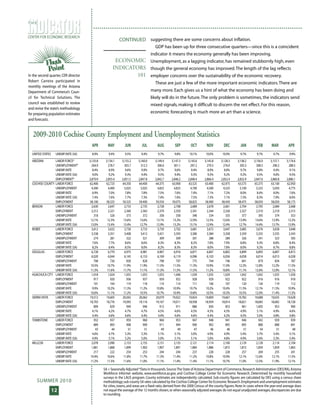
Economic indicators 101
By Robert Carreira, Ph.D.
Economists like to talk about how the economy is doing and what the future
might hold.To do this, we rely on economic indicators. Indicators are
categorized as leading, lagging, or coincident.
Leading indicators change before the general economy changes and give
us an indication of the direction the economy is moving. A good example is
the stock market. Investors buy stocks when they feel confident the economy
is going to do well in the future. Buying stocks drives up their prices, so when
we see the major indices (Dow Jones Industrial Average, the Standard and
Poor’s 500, and the Nasdaq Composite) increase, this tells us investors are
confident about the future direction of the economy.When the stock indices
fall, this tells us investors are concerned about the future direction of the
economy.
A related leading indicator is the price, along with the yield, of U.S.Treasury
securities (treasury bonds, bills, and notes). If investors are concerned about
the future of the economy, instead of putting money into the stock market
they put it into treasuries, which are safer.When treasury prices drop, or yields
increase, it’s an indicator investors feel good about the future direction of the
economy, because they’re putting money into stocks instead of treasuries.
Conversely, if treasury prices rise and yields fall, investors are concerned about
the future direction of the economy.
Are you a CER
sponsor?
If you have not made your
tax-deductible
contribution to the CER,
and wish to do so, please
contact our office, or use
the enclosed form to
sponsor.
PLATINUM
$5,000
GOLD
$2,000
SILVER
$1,000
BRONZE
$500
INDIVIDUAL
$100
FRIEND OF THE CER
UNDER $100
To find out more about
becoming a CER sponsor
and the benefits
associated with each level
of sponsorship,
please contact us or refer
to the enclosed
sponsorship form.
As an auxiliary department
of Cochise College, the CER
is charged with raising its
own operating budget,
independent of the
college’s budget, through
sponsorships, gifts,
donations, contract
research, and other
sources.
THANKYOUTO ALLWHO
HAVE SUPPORTEDTHE CER.
alternatives. One is to cut government spending.The problem with that is
deciding what to cut since every government program is someone’s favorite.
The other option is to raise taxes.
For those who oppose foreign ownership of the national debt, there are
likewise limited alternatives. One is to do without the services that money
buys. Another is to increase taxes and a third is to increase domestic savings
so U.S. rather than foreign entities purchase the government securities.
Whatever your view, if you’d like to help contribute to paying off the national
debt beyond what you pay in taxes, you can go to www.pay.gov and make a
donation!
CONTINUED
NATIONAL
DEBT FACTS
AND MYTHS
SUMMER 2010
11
CENTER FOR ECONOMIC RESEARCH
T H E
Other leading indicators include the prices of oil and gold. An increase in
the price of oil tells us investors are confident about the economy—since oil is
an input to production. If the price of oil falls, that tells us investors are
concerned about future economic activity.The price of oil is affected by many
other factors, such as storms and crises in the Middle East, so it’s important to
not read changes in the price of oil simply as a reflection of its status as a
leading indicator.
When investors are concerned about inflation, they often direct their
investment funds toward gold. So changes in the price of gold are a good
indicator of future inflation. If gold prices are up, it means investors are
concerned about inflation and the value of the dollar. If prices are down,
they’re less concerned.
Another popular leading indicator is
consumer confidence. An increase in
consumer confidence is often
followed by an increase in
consumer spending.
While a leading indicator tells
us what the economy might do
in the future, a lagging indicator
tells us what the economy has
already done. It doesn’t change
until after the economy changes.
A good example is the
unemployment rate, along with job
gains or losses.When the economy does
poorly, it might take some time before
people begin losing their jobs.That’s because
employers wait and see if the downturn is just a short-term fluctuation, or
whether it will become a recession.They naturally don’t want to begin laying
off workers for what might end up being simply a bad couple of months of
economic activity.When the economy is improving, employers don’t begin
hiring workers until they’re sure the economy is on firm footing. So the
employment data tend to lag behind general economic conditions.
The third type of indicator is a coincident indicator.This is an indicator that
changes with the economy.The best example is gross domestic product,
which is the value of all goods and services produced in the economy. If the
economy is doing well and economic activity is increasing, GDP rises.When
the economy’s doing poorly, GDP falls.
Although GDP is a coincident indicator, meaning it changes with the
economy, there is a lag between when GDP changes and when we find out it
has changed.That’s because GDP is calculated quarterly and released some
time after the period it covers.This lag does not, however, make it a lagging
indicator because the actual changes occur when the economy changes (we
just don’t find out it changed until sometime later).
Economists can use these indicators to tell what the economy has been
doing, is doing, and will be doing. For example, the stock market has generally
been up in recent months, notwithstanding periodic fluctuations.Treasury
prices have generally been down, and the price of oil has generally been up,
pointing to an improving economy.The price of gold has been up and down,
CONTINUED
ECONOMIC
INDICATORS
101
On June 21, CER director Robert
Carreira spoke to the Douglas
Chamber of Commerce about the
role of the CER, how chamber
members can provide input to the
CER’s annual Douglas Economic
Outlook publication, and the state
of the local, state, and national
economy.
On June 22, CER director Robert
Carreira participated in the Center
for the Future of Arizona’s ‘The Ari-
zona We Want’ town meeting in
Sierra Vista.
On June 23, CER director Robert
Carreira met with Robert Shepard,
executive director of the Sierra
Vista Economic Development
Foundation, to discuss partnership
opportunities between the CER
and EDF.
SUMMER 2010
12
CENTER FOR ECONOMIC RESEARCH
T H E
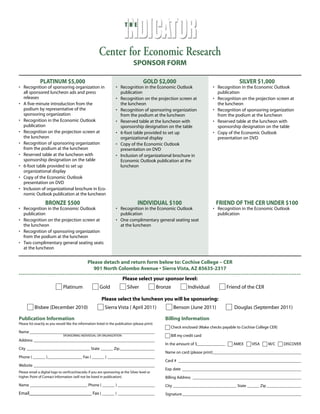
APR MAY JUN JUL AUG SEP OCT NOV DEC JAN FEB MAR APR
UNITED STATES UNEMP.RATE (SA) 8.9% 9.4% 9.5% 9.4% 9.7% 9.8% 10.1% 10.0% 10.0% 9.7% 9.7% 9.7% 9.9%
ARIZONA LABOR FORCE* 3,135.8 3,134.1 3,155.2 3,160.0 3,149.4 3,147.3 3,145.6 3,145.8 3,128.3 3,138.2 3,156.0 3,157.1 3,174.6
UNEMPLOYMENT* 264.9 278.7 303.7 312.3 306.6 301.1 297.2 279.3 276.0 305.3 308.5 296.3 288.5
UNEMP.RATE 8.4% 8.9% 9.6% 9.9% 9.7% 9.6% 9.4% 8.9% 8.8% 9.7% 9.8% 9.4% 9.1%
UNEMP.RATE (SA) 9.0% 9.2% 9.3% 9.4% 9.5% 9.4% 9.3% 9.3% 9.2% 9.2% 9.5% 9.6% 9.5%
EMPLOYMENT* 2,870.9 2,855.4 2,851.5 2,847.8 2,842.7 2,846.2 2,848.4 2,866.4 2,852.4 2,832.9 2,847.6 2,860.8 2,886.1
COCHISE COUNTY LABOR FORCE 62,400 62,725 64,350 64,400 64,375 63,900 63,525 63,400 62,975 63,575 63,375 63,100 62,950
UNEMPLOYMENT 4,300 4,400 5,025 5,025 4,825 4,825 4,700 4,500 4,525 5,100 5,325 5,050 4,775
UNEMP.RATE 6.9% 7.0% 7.8% 7.8% 7.5% 7.6% 7.4% 7.1% 7.2% 8.0% 8.4% 8.0% 7.6%
UNEMP.RATE (SA) 7.4% 7.6% 7.7% 7.3% 7.4% 7.6% 7.5% 7.3% 7.1% 7.3% 8.3% 7.9% 8.0%
EMPLOYMENT 58,100 58,325 59,325 59,400 59,550 59,075 58,825 58,900 58,450 58,475 58,050 58,050 58,175
BENSON LABOR FORCE 2,630 2,647 2,733 2,735 2,728 2,708 2,689 2,678 2,661 2,704 2,705 2,684 2,668
EMPLOYMENT 2,312 2,321 2,360 2,363 2,370 2,350 2,341 2,344 2,326 2,327 2,310 2,310 2,315
UNEMPLOYMENT 318 326 373 372 358 358 348 334 335 377 395 374 353
UNEMP.RATE 12.1% 12.3% 13.6% 13.6% 13.1% 13.2% 12.9% 12.5% 12.6% 13.9% 14.6% 13.9% 13.2%
UNEMP.RATE (SA) 13.0% 13.4% 13.4% 12.7% 12.9% 13.2% 13.1% 12.9% 12.4% 12.7% 14.4% 13.7% 13.9%
BISBEE LABOR FORCE 3,612 3,632 3,730 3,733 3,730 3,702 3,681 3,672 3,647 3,685 3,676 3,658 3,648
EMPLOYMENT 3,338 3,351 3,408 3,412 3,421 3,393 3,380 3,384 3,358 3,359 3,335 3,335 3,343
UNEMPLOYMENT 274 281 322 321 309 309 301 288 289 326 341 323 305
UNEMP.RATE 7.6% 7.7% 8.6% 8.6% 8.3% 8.3% 8.2% 7.8% 7.9% 8.8% 9.3% 8.8% 8.4%
UNEMP.RATE (SA) 8.2% 8.4% 8.5% 8.0% 8.2% 8.3% 8.3% 8.0% 7.8% 8.0% 9.2% 8.7% 8.8%
DOUGLAS LABOR FORCE 6,728 6,770 6,975 6,981 6,967 6,916 6,871 6,847 6,802 6,899 6,893 6,847 6,815
EMPLOYMENT 6,020 6,044 6,145 6,153 6,169 6,119 6,096 6,103 6,056 6,058 6,014 6,013 6,028
UNEMPLOYMENT 708 726 830 828 798 797 775 744 746 841 879 834 787
UNEMP.RATE 10.5% 10.7% 11.9% 11.9% 11.5% 11.5% 11.3% 10.9% 11.0% 12.2% 12.8% 12.2% 11.5%
UNEMP.RATE (SA) 11.3% 11.6% 11.7% 11.1% 11.3% 11.5% 11.5% 11.2% 10.8% 11.1% 12.6% 12.0% 12.1%
HUACHUCA CITY LABOR FORCE 1,018 1,024 1,055 1,055 1,053 1,046 1,039 1,035 1,029 1,042 1,042 1,035 1,030
EMPLOYMENT 917 920 936 937 939 932 928 929 922 922 916 916 918
UNEMPLOYMENT 101 104 119 118 114 114 111 106 107 120 126 119 112
UNEMP.RATE 9.9% 10.2% 11.3% 11.2% 10.8% 10.9% 10.7% 10.2% 10.4% 11.5% 12.1% 11.5% 10.9%
UNEMP.RATE (SA) 10.6% 11.1% 11.2% 10.5% 10.7% 10.9% 10.8% 10.5% 10.3% 10.5% 12.0% 11.4% 11.5%
SIERRA VISTA LABOR FORCE 19,512 19,605 20,042 20,062 20,079 19,922 19,824 19,809 19,667 19,782 19,688 19,635 19,628
EMPLOYMENT 18,703 18,776 19,093 19,116 19,167 19,011 18,938 18,959 18,814 18,821 18,683 18,682 18,728
UNEMPLOYMENT 809 829 949 946 912 911 886 850 853 961 1,005 953 900
UNEMP.RATE 4.1% 4.2% 4.7% 4.7% 4.5% 4.6% 4.5% 4.3% 4.3% 4.9% 5.1% 4.9% 4.6%
UNEMP.RATE (SA) 4.4% 4.6% 4.6% 4.4% 4.4% 4.6% 4.6% 4.4% 4.2% 4.5% 5.0% 4.8% 4.8%
TOMBSTONE LABOR FORCE 932 937 959 960 960 953 947 948 941 946 942 939 939
EMPLOYMENT 889 893 908 909 911 904 900 902 895 895 888 888 891
UNEMPLOYMENT 43 44 51 51 49 49 47 46 46 51 54 51 48
UNEMP.RATE 4.6% 4.7% 5.3% 5.3% 5.1% 5.1% 5.0% 4.9% 4.9% 5.4% 5.7% 5.4% 5.1%
UNEMP.RATE (SA) 4.9% 5.1% 5.2% 5.0% 5.0% 5.1% 5.1% 5.0% 4.8% 4.9% 5.6% 5.3% 5.4%
WILLCOX LABOR FORCE 2,078 2,090 2,153 2,155 2,151 2,135 2,121 2,114 2,100 2,129 2,128 2,114 2,104
EMPLOYMENT 1,861 1,868 1,899 1,902 1,907 1,891 1,884 1,886 1,872 1,872 1,859 1,859 1,863
UNEMPLOYMENT 217 222 254 253 244 244 237 228 228 257 269 255 241
UNEMP.RATE 10.4% 10.6% 11.8% 11.7% 11.3% 11.4% 11.2% 10.8% 10.9% 12.1% 12.6% 12.1% 11.5%
UNEMP.RATE (SA) 11.2% 11.5% 11.6% 11.0% 11.1% 11.4% 11.4% 11.1% 10.7% 11.0% 12.5% 11.9% 12.1%
SA = Seasonally Adjusted *Data in thousands.Source:The State of Arizona Department of Commerce,Research Administration (DES/RA),Arizona
Workforce Informer website, www.workforce.az.gov, and Cochise College Center for Economic Research. Determined by monthly household
surveys in the LAUS program. County estimates are independently calculated. Sub-county figures are calculated by DES using a census share
methodology;sub-county SA rates calculated by the Cochise College Center for Economic Research.Employment and unemployment estimates
for cities,towns,and areas are a fixed ratio,derived from the 2000 Census of the county figures.Note:In cases where the year-end average does
not equal the average of the 12 months shown,or when seasonally adjusted averages do not equal unadjusted averages,discrepancies are due
to rounding.
2009-2010 Cochise County Employment and Unemployment Statistics
suggesting there are some concerns about inflation.
GDP has been up for three consecutive quarters—since this is a coincident
indicator it means the economy generally has been improving.
Unemployment, as a lagging indicator, has remained stubbornly high, even
though the general economy has improved.The length of the lag reflects
employer concerns over the sustainability of the economic recovery.
These are just a few of the more important economic indicators.There are
many more. Each gives us a hint of what the economy has been doing and
likely will do in the future.The only problem is sometimes, the indicators send
mixed signals, making it difficult to discern the net effect. For this reason,
economic forecasting is much more an art than a science.
CONTINUED
ECONOMIC
INDICATORS
101In the second quarter, CER director
Robert Carreira participated in
monthly meetings of the Arizona
Department of Commerce’s Coun-
cil for Technical Solutions. The
council was established to review
and revise the state’s methodology
for preparing population estimates
and forecasts.
DOUGLAS ECONOMIC OUTLOOK LUNCHEON 2010 REGISTRATION FORM
Name: Point of contact,if different:
Business Name:
Mailing Address: City: State: Zip:
Telephone:
Email:
Reserve seat(s) at $45 a seat $
Reserve table(s) for six $225 $
Total $
Please bill my credit card: AMEX VISA M/C DISCOVER
NAME ON CARD (PLEASE PRINT)
CARD# EXPIRATION
BILLING ADDRESS FOR CARD ZIP
SIGNATURE
COCHISE COLLEGE
economic
outlook
luncheon
2010
• An Economic Overview of Douglas
• Thursday, September16, 11:30 a.m., Doors open at 11 a.m.
• Cochise College, Douglas Campus Student Union
4190 West Highway 80, Douglas, AZ
The Cochise College Center for Economic Research will host an economic outlook
luncheon for business and community leaders, students, and members of the general
public. The program will provide an overview of the national, state, and local economy,
with a focus on the economy of Douglas.Attendees will receive a copy of the 2010 Douglas
Economic Outlook, published by the Center for Economic Research. The publication
provides a review and forecast of the local economy. Certificates for two hours of
Continuing Professional Education will be offered in each of the
following areas: accounting, financial planning, and real estate.
Speakers:
Robert Carreira, Ph.D., Director of the Center for Economic
Research, will provide a review of the past year’s economy and a
forecast for the coming year.
Curtis Shook, Douglas City Manager,will give a presentation on
current and planned projects within the city.
Cost is $45 per person, or $225 for a table seating six.
Pre-registration and pre-payment are required.
Reservations are accepted by mail,email at cer@cochise.edu,or fax
at (520) 515-5343. For Visa®, MasterCard®, Discover®, or Ameri-
can Express® payments use form below,or call (520) 515-5486.All
meals are vegetarian; please indicate if there are any other special
dietary restrictions or accommodations necessary.
DEADLINE FOR RESERVATIONS: SEPTEMBER 9, 2010
CochiseCollegeCenterforEconomicResearch
15th AnnualDouglasEconomicOutlookLuncheon DOUGLAS
ROBERT CARREIRA, Ph.D.
CURTIS SHOOK
Anyone needing an accommodation in order
to attend should contact the Disability Services
Office,(520) 417-4023 at least 72 hours in advance.
Make checks payable to:
Cochise College CER
Please mail registration form with payment to:
Cochise College Center for Economic Research
901 N.Colombo Ave.
Sierra Vista,Arizona 85635
T H E
Center for Economic Research
SPONSOR FORM
PLATINUM $5,000
• Recognition of sponsoring organization in
all sponsored luncheon ads and press
releases
• A five-minute introduction from the
podium by representative of the
sponsoring organization
• Recognition in the Economic Outlook
publication
• Recognition on the projection screen at
the luncheon
• Recognition of sponsoring organization
from the podium at the luncheon
• Reserved table at the luncheon with
sponsorship designation on the table
• 6-foot table provided to set up
organizational display
• Copy of the Economic Outlook
presentation on DVD
• Inclusion of organizational brochure in Eco-
nomic Outlook publication at the luncheon
GOLD $2,000
• Recognition in the Economic Outlook
publication
• Recognition on the projection screen at
the luncheon
• Recognition of sponsoring organization
from the podium at the luncheon
• Reserved table at the luncheon with
sponsorship designation on the table
• 6-foot table provided to set up
organizational display
• Copy of the Economic Outlook
presentation on DVD
• Inclusion of organizational brochure in
Economic Outlook publication at the
luncheon
SILVER $1,000
• Recognition in the Economic Outlook
publication
• Recognition on the projection screen at
the luncheon
• Recognition of sponsoring organization
from the podium at the luncheon
• Reserved table at the luncheon with
sponsorship designation on the table
• Copy of the Economic Outlook
presentation on DVD
BRONZE $500
• Recognition in the Economic Outlook
publication
• Recognition on the projection screen at
the luncheon
• Recognition of sponsoring organization
from the podium at the luncheon
• Two complimentary general seating seats
at the luncheon
INDIVIDUAL $100
• Recognition in the Economic Outlook
publication
• One complimentary general seating seat
at the luncheon
FRIEND OF THE CER UNDER $100
• Recognition in the Economic Outlook
publication
Please detach and return form below to: Cochise College – CER
901 North Colombo Avenue • Sierra Vista, AZ 85635-2317
Please select your sponsor level:
Platinum Gold Silver Bronze Individual Friend of the CER
Please select the luncheon you will be sponsoring:
Bisbee (December 2010) Sierra Vista ( April 2011) Benson (June 2011) Douglas (September 2011)
Publication Information
Please list exactly as you would like the information listed in the publication (please print)
Name _____________________________________________________________
Address ___________________________________________________________
City _______________________________ State ______ Zip_________________
Phone ( ______ )_________________ Fax ( ______ ) _______________________
Website ___________________________________________________________
Please email a digital logo to cer@cochise.edu if you are sponsoring at the Silver level or
higher. Point of Contact Information (will not be listed in publication)
Name ____________________________ Phone ( ______ ) __________________
Email___________________________ Fax ( ______ ) __________________
Billing Information
Check enclosed (Make checks payable to Cochise College CER)
Bill my credit card
In the amount of $______________ AMEX VISA M/C DISCOVER
Name on card (please print)___________________________________________
Card # ____________________________________________________________
Exp. date __________________________________________________________
Billing Address _____________________________________________________
City _______________________________ State ______ Zip_________________
Signature__________________________________________________________
SPONSORING INDIVIDUAL OR ORGANIZATION

Summer Indicator

  • 1.
    IndIcaTorA PUBLICATION OFTHE COCHISE COLLEGE CENTER FOR ECONOMIC RESEARCH Local cost of living remains below national average According to the ACCRA Cost of Living Index, the cost of living in Cochise County was 2.4 percent lower than the national average in the first quarter of 2010.This suggests a decline in the local cost of living relative to the rest of the nation. In 2009, Cochise County’s cost of living was only 0.8 percent below the national average. The Council for Community and Economic Research in Arlington,VA administers the Cost of Living Index, which measures relative price levels for consumer goods and services in participating areas.The index includes separate weighted sub-indices for grocery items, housing, utilities, transportation, health care, and miscellaneous goods and services.The report provides comparative data for 308 urban areas in all 50 states. The cost of living in Cochise County in the first quarter was 0.8 percent higher than in Tucson.This is a widening of the gap from last year, when local costs were only 0.1 percent higher than in Tucson.The primary reason for the widening of the gap was relative increases in the local cost of groceries, utilities, and miscellaneous goods and services, and relative declines in the cost of groceries, housing, utilities, and miscellaneous goods and services in Tucson. In the first quarter, the cost of living in Cochise County was 1.9 percent below that of Phoenix—a reversal of the trend from last year. In 2009, the local cost of living was 0.8 percent higher than in Phoenix. The reason for the decrease in the cost of living in Cochise County from last year, relative to the national average, was relative decreases in the cost of housing, transportation, and health care.These were partially offset by relative increases in the local cost of grocery items, utilities, and miscellaneous goods and services. Grocery items in Cochise County, which were 0.3 percent above the national average in 2009, increased to 0.5 percent above the national average in the first quarter of 2010. Housing costs, which include home prices and rental rates, decreased from 2009 to the first quarter of 2010, relative to national averages. In 2009, the cost of housing in Cochise County was 4.1 percent above the national average. In the first quarter of this year, local housing costs dropped to 1.4 percent below the national average. INSIDE: COST OF LIVING • ECONOMICS 101 • NATION DEBT FACTS/MYTH • BENSON OUTLOOK T H E ■ SUMMER 2010 Mark your calendars for the upcoming luncheons Make plans to attend the CER’s economic outlook luncheons. Douglas September 16, 2010 Bisbee December 2010 Sierra Vista April 2011 Benson June 2011 RESERVE YOUR SEAT! To register, use the enclosed registration form; register online at www.cochise.edu/cer; email cer@cochise.edu; or call (520) 515-5486 Visa®, MasterCard®, Discover®, or American Express® accepted. By Robert Carreira,Ph.D. Director, Center for Economic Research IN THE FIRST QUARTER, THE COST OF LIVING IN COCHISE COUNTY WAS 1.9 PERCENT BELOW THAT OF PHOENIX—A REVERSAL OF THE TREND FROM LAST YEAR. IN 2009, THE LOCAL COST OF LIVING WAS 0.8 PERCENT HIGHER THAN IN PHOENIX.
  • 2.
    SUMMER 2010 2 CENTER FORECONOMIC RESEARCH T H E In the first quarter, the local cost of utilities was 2.9 percent below the national average, up from 5.7 percent below the national average last year. Transportation costs, which include gasoline and automobile maintenance, were 0.6 percent below the national average in the first quarter. Last year, local transportation costs were 2.6 percent above the national average. Health care costs in Cochise County were 9.5 percent below the national average in the first quarter, compared to only 2.6 percent below the national average in 2009.The cost of miscellaneous goods and services in Cochise County was 4.1 percent below the national average, up from 5.3 percent below the national average last year. Statewide, there were seven places participating in the ACCRA Cost of Living Index in the first quarter of 2010. In addition to Cochise County, other participating areas were Flagstaff, Lake Havasu City, Phoenix, Prescott-Prescott Valley,Tucson, and Yuma. Of these, only Tucson had an overall cost of living that was lower than Cochise County.The highest cost of living in Arizona was in Flagstaff, which was 16.9 percent above the national average. ACCRA Cost of Living Index data for Cochise County are listed under the Sierra Vista-Douglas Micropolitan Area, which is a statistical designation for all of Cochise County. Sierra Vista and Douglas are included in the title since they are the principal cities that meet the criteria for establishing Cochise County as a micropolitan statistical area.To qualify as a micropolitan statistical area, a location must be economically integrated and have at least one urban area with a population of at least 10,000, but less than 50,000. The ACCRA Cost of Living Index data for Cochise County are collected by the Cochise College Center for Economic Research and submitted to the Council for Community and Economic Research for inclusion in the index. Cochise County’s participation is sponsored by the Sierra Vista Economic Development Foundation, which covers the cost of data collection. CONTINUED LOCAL COST OF LIVING REMAINS BELOW NATIONAL AVERAGE On Apr. 13, CER director Robert Carreira attended the Arizona Ru- ral Development Council’s Rural Roundtable/Workshop in Willcox. On Apr.22,the CER hosted the sec- ond installment of the 2010 Sierra Vista Economic Outlook Luncheon at the new student union building on the Cochise College Sierra Vista Campus. A reduction in seating ca- pacity at the Windemere Hotel and Conference Center led to this year’s event being held on two separate dates in April to accommodate all attendees. Composite Grocery Trans- Health Misc. Goods Area Index Items Housing Utilities portation Care & Services Flagstaff Metro 116.9 101.1 154.2 95.9 102.6 97.3 104.0 Lake Havasu City-Kingman Micro 112.0 103.7 146.0 87.5 92.1 98.4 101.2 Phoenix-Mesa-Scottsdale Metro 99.5 99.0 90.2 94.6 106.0 104.5 106.5 Prescott Metro 104.1 95.0 117.4 92.2 99.1 97.5 102.2 Sierra Vista-Douglas Micro* 97.6 100.5 98.6 97.1 99.4 90.5 95.9 Tucson Metro 96.8 97.0 94.0 87.6 101.9 99.7 99.9 Yuma Metro 103.0 111.5 97.0 113.4 103.5 108.2 101.0 *The Sierra Vista-Douglas Micropolitan Area is a statistical area designation for all of Cochise County. Sierra Vista and Douglas are included in the title since they are the principal cities that meet the criteria for establishing Cochise County as a Micropolitan Statistical Area. Note: The average for all participating places nationwide equals 100; each participant’s index is read as a percentage of the average for all places. Source: The Council for Community and Economic Research, ACCRA Cost of Living Index. ACCRA cost of living index, 1st quarter 2010
  • 3.
    SUMMER 2010 3 CENTER FORECONOMIC RESEARCH T H E On April 29, CER director Robert Carreira appeared as a guest on the ‘Open House’ talk radio show on KTAN 1420 AM, hosted by Kate Hotz. Topics included the state of housing and real estate markets at the local, state, and national levels, and the future direction of the economy. On May 7, CER director Robert Car- reira hosted‘The Friday Report’talk radio show on KTAN 1420 AM. Dr. Carreira’s guest was Chuck Po- tucek, Sierra Vista city manager. Topics included the city budget, the impact of the state budget cri- sis on city finances, and the im- pacts of Proposition 100 and Sen- ate Bill 1070 on the city. Glenn Nichols City Manager City of Benson Benson “team” looking to the future Benson is a city that continues to work to be ready for its future. All city employees continue to provide excellent service to the residents of the city, the surrounding community, and the many visitors. All the areas of city government are looking at ways to provide even better customer service. The city continues to be fiscally responsible. Again, Capital Improvement Plans (CIP) are on hold with the timelines pushed back.Through the budget process we continue to work not to layoff or furlough employees. Many departments are doing more with less and many department heads have taken on additional duties to save money.We continue to look for funding opportunities to improve the infrastructure of the city. The city continues to position itself to handle the requests for services from groups and individuals.The staff has streamlined the process of providing consistent information to those interested in being a part of the City of Benson.We continue to look at ways to improve the city through creative ideas that get the most from available funding. On behalf of our mayor, council, and staff, we welcome all to visit our city and see our many great attractions! Benson Economic Outlook By Robert Carreira, Ph.D. On Jun. 10, the Cochise College Center for Economic Research hosted the 13th Annual Benson Economic Outlook Luncheon at the new multipurpose facility at the Benson Unified School District.The following is a condensed version of the economic outlook presentation. The big question these days is whether the recession is over.The answer is yes—just not officially. A recession doesn’t officially begin or end until so
  • 4.
    SUMMER 2010 4 CENTER FORECONOMIC RESEARCH T H E Find out why more and more people are visiting the CER website. Visit our website at www.cochise.edu/cer to find statistics on the local economy; information on upcoming events; sponsorship information; CER economic outlook publications; PowerPoint slides from CER presentations; special studies; press releases; the Cochise County Economic Update, a compilation of links to online newspaper stories of economic interest from across Cochise County; the CER’s quarterly newsletter, The Indicator; and links to websites relevant to the local, state, and national economy. CONTINUED BENSON ECONOMIC OUTLOOK designated by the National Bureau of Economic Research. But by the major indicators, the recession ended in the third quarter of 2009. A recession is a decline in economic activity, or Gross Domestic Product, which is the value of all goods and services produced in the economy. GDP was down in 5 of 6 quarters from the beginning of 2008 through the first half of 2009, but was up 2.2 percent in the third quarter, 5.6 percent in the fourth quarter, and 3 percent in the first quarter of this year. Much of the recent growth, however, was due largely to government stimulus efforts, so the big question is whether it’ll sustain once those efforts are withdrawn. Most indicators point to an economy in recovery. Construction and new and existing home sales have generally been up.There’s been some instability caused by the timing of the homebuyer tax credits, which were initially set to expire in November last year then were extended through April. But things have generally been up. Consumer spending has been up and retail sales were up for 7 straight months from October through April.The stock market has generally been up, but there has been some instability with the Euro crises and some other global factors. But it’s certainly stronger than we’ve seen over the past couple of years. Delinquent debt and home foreclosures seem to have stabilized. Even employment is now beginning to show signs of stabilization. New unemployment claims are down. More people are quitting their jobs than being laid off and in April the number of new job openings was the highest in 16 months. Locally, countywide retail sales were up 4.7 percent in the first quarter of this year, after adjusting for inflation. Monthly retail sales growth was mostly negative last year but began to turn around in the fourth quarter. For the year, retail sales were down 3.2 percent last year after declining 1.3 and 6.5 percent, respectively, in 2007 and 2008. In Benson, unadjusted retail sales tax revenue was up 4.2 percent in the first quarter of this year. Revenue was down 4.8 percent last year. In the first quarter of 2010, accommodation sales, which include hotel, motel, and other temporary lodging stays of less than 30 days, were up 8.8 percent in Benson and 3.2 percent countywide. Sales were down 5.5 percent last year in Benson and 9 percent countywide. Although retail and accommodation seem to be on a path of recovery, the same is not true of restaurant and bar sales. In the first quarter of this year, sales were down 1.9 percent in Benson and 5.3 percent countywide, continuing a downward trend that began in the closing months of last year. Based on recent trends we can expect to see growth in retail and accommodation sales at both the county and city level this year.The recent downward trend in local restaurant and bar sales should change later this
  • 5.
    SUMMER 2010 5 CENTER FORECONOMIC RESEARCH T H E year as consumer confidence improves. Since the recession began, unemployment at the state and national levels has increased much more sharply than at the county level. Cochise County has had the lowest unemployment rate of Arizona’s 15 counties since May of last year. National unemployment has generally leveled off and currently sits at 9.9 percent. Arizona’s unemployment rate declined somewhat in the second half of last year, but saw an uptick from January to February and now sits at 9.5 percent. Cochise County saw a severe uptick in February, with the unemployment rate jumping from 7.3 to 8.3 percent, but since then has come down somewhat and currently sits at 8 percent. Although the recession began in December 2007, Cochise County didn’t begin losing jobs until January 2009. If recent trends continue, job losses will persist through June, with job growth in the second half of the year. At the county level, new residential construction seems to be on a path of recovery. Although new home permits countywide were down 11.6 percent last year, compared to 2008, the decline was isolated to the first half of the year. Permits in the first half of 2009 were down 43.8 percent compared to the first half of 2008. In the second half of the year, permits were up 60 percent compared to the same period of 2008. In the first 4 months of 2010, permits were up nearly 60 percent from the same period last year. In Benson, there was a spike in new construction in 2006 with 104 new home permits issued as progress began on planned developments in the city. Construction activity has been up and down since then, but has remained well above the pre-2006 levels. In the first 5 months of this year there were 25 permits issued, up from 18 in the same period of last year. Existing home sales countywide were down 1.9 percent last year and were down 29 percent in the first quarter of this year (compared to the first quarter last year). In Benson, sales were also down 1.9 percent last year, but in the first quarter of this year they were up 16.7 percent. The local area saw significant home price increases from 2004 through 2007, but since then prices have come down moderately. In the first quarter of 2010, the countywide median home price of $173,172 was still 24 percent higher than in 2004. In the Benson area the median price was $146,563 in the first quarter, about 83 percent higher than in 2004. Existing home sales seem to have bottomed out at both the city and county levels and appear to be on a path of recovery in Benson. Sales levels continue to crawl along the bottom of the cycle at the county level. Home prices should continue to hold, though another moderate decline can’t be ruled out. Locally, we’re not likely to see the same steep drops that the rest of the state and much of the nation have seen, with the worst of the downturn seemingly behind us. CONTINUED BENSON ECONOMIC OUTLOOK On May 14, CER director Robert Carreira appeared as a guest on ‘The Friday Report’ talk radio show on KTAN 1420 AM, hosted by Pat Call. Topics included Proposition 100 and Senate Bill 1070. On May 19, CER director Robert Carreira attended the Leadership Sierra Vista 2009-2010 graduation ceremony held at the Rendezvous in Sierra Vista. Contact the Center for Economic Research: Cochise College Center for Economic Research 901 North Colombo Ave. Sierra Vista,AZ 85635 Phone 520-515-5486 Fax 520-515-5343 www.cochise.edu/cer cer@cochise.edu
  • 6.
    SUMMER 2010 6 CENTER FORECONOMIC RESEARCH T H E On May 20, CER director Robert Carreira was a guest speaker for two of Marv Sorenson’s economics classes at Benson High School. On May 21, CER director Robert Carreira, Cochise County Supervi- sor Pat Call, and local businessman Dan Abrams appeared on ‘The Fri- day Report’ talk radio show on KTAN 1420 AM for a roundtable discussion on the state budget cri- sis and the impact of illegal immi- gration and Senate Bill 1070. S T U D E N T S P O T L I G H T Arizona’s education budget crisis By Polly Sue Webb State budget crises are affecting the entire nation and one of the causalities is the education system. Even college education is being affected.The education system is very important; it shapes and molds the leaders of the future. It helps ensure the youth of today get the education they need for tomorrow. According to University of Arizona economist Marshall Vest, many believe that the largest cause for Arizona’s budget crisis is related to the tax cuts made in the mid-1990s.While they were helpful at the time, there were substantial repercussions. Arizona voters recently passed the temporary one- cent increase in the state sales tax, which should generate nearly $1 billion a year.This will not fix the state budget problems, but according to Vest it is a step in the right direction. Even with the one-cent sales tax increase, school districts accross the state are having to make cuts in programs. Schools are cutting programs such as special education, art, music, and sports, along with transportation for extracurricular activities. Schools are not buying new textbooks, and, in some cases, the textbooks are already more than 10 years old and outdated. School computers are also outdated and not being upgraded or replaced. Classes are more crowded due to teacher cuts and school closings. In Sierra Vista, the high school was in danger of cutting athletics. In an effort to cut costs, the district is closing a middle school and cutting costs at the school level. The district is also raising its athletic fees. Despite the voter-approved sales tax increase, there is still talk at the state level of tax cuts elsewhere. New tax cuts would ostensibly help the economy by encouraging growth of businesses and offering incentives for employers to hire new workers or expand their businesses in Arizona. Even cuts to property taxes and corporate taxes are being suggested. When considering the tax cuts of the past, one thing seems certain:Tax cuts reduce the amount of revenue the state has to divide up among all areas of need, including education. The sales tax increase is just one of many things needed to fix the deteriorating education system in Arizona.The state does not need more tax cuts, tax credits, or sports facilities; it needs education. Education for children, young adults who have found themselves in difficult situations, and adults who are rediscovering who they are and who they can be. In his textbook Principles of Economics, economist Gregory Mankiw offers 10 principles of economics. One of those principles is that the government can sometimes make things better.We the people have elected government officials to carry out our will.To do that, they must know what the collective will is.We the people must stand up and make our representatives hear our voices and let them know education is important to the future prosperity and well being of Arizona. Polly Sue Webb is a graduate of Cochise College with an Associate of Applied Science degree in Intelligence Operations.She currently attends Western International University and is working toward a bachelor’s degree in behavioral science
  • 7.
    SUMMER 2010 7 CENTER FORECONOMIC RESEARCH T H E New construction up, home sales down By Robert Carreira, Ph.D. New home permits in Cochise County were up 12 percent in the first quarter of 2010, compared to the fourth quarter of 2009. From January through March, there were 112 new home permits issued countywide, with reporting for all areas except Tombstone and Huachuca City. This was up from 100 permits in the fourth quarter. Permits in the first quarter of this year were 62.3 percent higher than in the first quarter of last year. In Sierra Vista, which represents the largest share of the countywide new construction market, there were 57 permits issued in the first quarter, up 1.2 percent from the fourth quarter and up 137.5 percent compared to the first quarter of 2009. While new home permits increased, sales of existing homes in Cochise County were down in the first quarter. From January through March, 252 homes were sold countywide, down 29 percent from 355 in the fourth quarter. Sales in the first quarter were up 0.8 percent compared to the first quarter of last year. Sales data are from the Southeast Arizona Multiple Listing Service and the Tucson Area MLS. The median price of a home sold in Cochise County in the first quarter was $173,172, up 5 percent from $165,000 in the fourth quarter.The median price in the first quarter was down 1 percent from $175,000 in the first quarter of last year. Homes that sold in Cochise County in the first quarter were on the market for 155 days, up from 137 days in the fourth quarter and 150 days in the first quarter of last year. Homes sold for 95.1 percent of the asking price in the first quarter, down from 95.5 percent in the fourth quarter but up from 94.5 percent in the first quarter of 2009. Foreclosed homes accounted for 29.7 percent of sales countywide in the first quarter, up from 20.5 percent in the fourth quarter and 27.4 percent in the first quarter of last year. As of the second week of May, 7.8 percent of active listings were foreclosures. First quarter home sales in Southwest Cochise County, which includes Sierra Vista, Huachuca City,Tombstone,Whetstone, Hereford, Palominas, and surrounding areas, totaled 180, down 30.8 percent from the fourth quarter. Sales were down 0.6 percent compared to the first quarter of last year.The median price in Southwest Cochise County in the first quarter was $191,322, up 3.7 percent from $184,519 in the fourth quarter, but down 0.6 percent from $192,500 in the first quarter of last year. Southwest Cochise County accounts for more than 70 percent of all home sales countywide. Home sales in Southeast Cochise County, which includes Douglas, Bisbee, Apache, Bisbee Junction, Double Adobe, Elfrida, McNeal, Naco, and surrounding areas, totaled 37 in the first quarter, down from 41 in the fourth quarter but up from 35 in the first quarter of 2009.The median price in On June 10, the CER hosted the 2010 Benson Economic Outlook Luncheon at the new multipurpose facility at the Benson Unified School District. On June 10, CER director Robert Carreira spoke about the state of the economy and job creation at the Cochise County Workforce De- velopment board retreat inTucson.
  • 8.
    SUMMER 2010 8 CENTER FORECONOMIC RESEARCH T H E National debt facts and myths By Robert Carreira, Ph.D. Four years ago the national debt was $8.3 trillion.Today, as a result of increased government spending and a decline in tax revenue tied to the economic downturn—it’s $12.9 trillion.That’s a 55 percent increase; over the same time period, inflation was 8 percent. The national debt is the cumulative amount by which government spending exceeds revenue.When the government spends more than it takes in during a single year—that’s a budget deficit.The total of all the annual budget deficits is the national debt. When government spending exceeds revenues, it must borrow the difference. It does this by selling treasury securities (government bonds, bills, and notes). If you’ve ever owned a U.S. savings bond, you’ve owned a piece of the national debt. CER Services The CER provides economic and demographic information,analysis,and forecasting to help community leaders in the public,private,and nonprofit sectors make informed decisions.The CER hosts economic outlook luncheons each year in Benson,Bisbee,Douglas,and Sierra Vista.The center also produces four major publications annually as part of its Cochise County Economic Outlook Publication Series:Benson Economic Outlook,Bisbee Economic Outlook,Douglas Economic Outlook,and Sierra Vista Economic Outlook.The CER director serves on community projects, committees,and task forces, providing technical expertise in economic and demographic research methodology.The CER also prepares weekly press releases that are published in newspapers countywide providing insight into economic issues affecting Cochise County.The CER’s website (www.cochise.edu/cer) provides economic news, information,analyses, forecasts,and studies.In addition,the CER is a state data center affiliate, receiving and disseminating U.S.Census Bureau data to users at no charge or on a cost-recovery or reimbursable basis.Follow the CER on Facebook by typing‘Cochise College Center for Economic Research’into the Facebook search box. Southeast Cochise County in the first quarter was $110,000, up 25 percent from $88,000 in the fourth quarter and 24.5 percent from $88,350 in the first quarter of last year. Although the median price was up 25 percent, the average price per square foot was up only 6.7 percent from the fourth quarter, suggesting much of the increase in the median price was due to larger homes being sold.The average price per square foot in the first quarter was down 4 percent from the first quarter of 2009, another reflection of larger homes being sold in the first quarter of this year, driving up the median price. In the first quarter of this year, home sales in Northwest Cochise County, which includes Benson, Cascabel, Dragoon, Pomerene, St. David, and surrounding areas, totaled 25, down from 38 in the fourth quarter but up from 23 in the first quarter of 2009.The median price in Northwest Cochise County in the first quarter was $146,563, up 29.3 percent from $88,000 in the fourth quarter but down 4 percent from $152,600 in the first quarter of last year. Although the median price was up 29.3 percent, the average price per square foot was up only 17.2 percent from the fourth quarter, suggesting much of the increase in the median price was due to larger homes being sold.The average price per square foot in the first quarter was up 6.3 percent from the first quarter of 2009, suggesting the decline in median price was due to larger homes being sold in the first quarter of 2009. There were 10 homes sold in the first quarter in Northeast Cochise County, which includes Willcox, Bowie, Cochise, Dos Cabezas, Kansas Settlement, Paradise, Pearce, Portal, San Simon, Sunizona, Sunsites, and surrounding areas. Sales include only those homes that were listed on SAMLS or TAMLS. Sales were down from 16 in the fourth quarter and 11 in the first quarter of 2009. Due to the small number of homes and the wide price range, median prices are not calculated for this area. In the first quarter, prices ranged from $27,000 to $215,000. In the fourth quarter, prices ranged from $15,000 to $795,000. CONTINUED NEW CONSTRUCTION UP, HOME SALES DOWN FOUR YEARS AGO THE NATIONAL DEBT WAS $8.3 TRILLION. TODAY…IT’S 12.9 TRILLION. THAT’S A 55 PERCENT INCREASE; OVER THE SAME TIME PERIOD, INFLATION WAS 8 PERCENT.
  • 9.
    SUMMER 2010 9 CENTER FORECONOMIC RESEARCH T H E On June 11, CER director Robert Carreira hosted ‘The Friday Report’ talk radio show on KTAN 1420 AM. Dr.Carreira’s guest was Dr.J.D.Rot- tweiler, president of Cochise Col- lege. Topics included the role of community colleges in dealing with recessions and unemploy- ment, the Cochise College budget, and the impact of Proposition 100. On June 17, CER director Robert Carreira participated in the Bisbee Community Partnership Panel hosted by Freeport McMoRan. On June 18, CER director Robert Carreira participated in the Cochise County Board of Supervisors’“Mak- ing Cochise County Small Business Friendly”task force. CONTINUED NATIONAL DEBT FACTS AND MYTHS Whenever people, governments, or institutions buy (or invest) in government securities, they are funding the national debt. Put another way, they are lending money to the national government. Currently, about 70 percent of the national debt is owned by U.S. entities and 30 percent is owned by foreign entities, including foreign governments, banks, and individuals. Foreign ownership of the U.S. national debt is up from about 25 percent 4 years ago. About 43 percent of the national debt is owned by the Federal Reserve and other federal government agencies, 2 percent is owned by banks and other depository institutions, 2 percent is in U.S. savings bonds, 4 percent is in public and private pension funds, 2 percent is owned by insurance companies, 5 percent is in mutual funds, 4 percent is owned by state and local governments, and 9 percent is owned by other investors. One of the myths surrounding the national debt is that it risks bankrupting the nation. About 70 percent of the debt is owned by U.S. entities—this is debt we owe to ourselves.Theoretically we could raise taxes in the morning and use the proceeds to pay off all the treasury bills, bonds, and notes in the afternoon. If we did that, the purchasing power in the U.S. economy would not change—but the national debt would be 70 percent lower.There probably wouldn’t be much support for such action since investors are fond of their government securities as they are generally viewed as safe and secure investments. Although we could raise taxes to pay off the national debt, there is no need to.This is because the national debt is easily and typically refinanced. Another common concern is that the national debt will overburden future generations.This is also a myth. Recall that the U.S. owes most of the national debt to itself.Thus, while the debt reflects a liability to the U.S., it also represents an asset in the bills, bonds, and notes held by investors.While the liabilities are passed along to future generations, so are the assets. Moreover, the roads, highways, libraries, and other infrastructure financed through the national debt are also passed along to future generations. There are some legitimate concerns about the national debt. One is it redistributes wealth from low-income to wealthy individuals.The majority of U.S. securities are held by wealthy individuals, yet the taxes paid to service the debt are paid by all taxpayers. There’s also what economists refer to as the crowding-out effect.When the government borrows, there’s less money left over for private businesses to borrow. As the government and private businesses compete to borrow a limited supply of money this drives up interest rates.The higher rates could price some business investment out of the market. Since businesses rely on borrowed funds to finance research and development, there’s a danger that excessive government borrowing will have adverse impacts on the nation’s economic growth. For those who are opposed to government borrowing, there are limited Center for Economic Research Staff Robert Carreira, Ph.D. Director Iris Routhieaux Information Specialist Roy Bever Administrative Assistant,Sr.
  • 10.
    SUMMER 2010 10 CENTER FORECONOMIC RESEARCH T H E Economic indicators 101 By Robert Carreira, Ph.D. Economists like to talk about how the economy is doing and what the future might hold.To do this, we rely on economic indicators. Indicators are categorized as leading, lagging, or coincident. Leading indicators change before the general economy changes and give us an indication of the direction the economy is moving. A good example is the stock market. Investors buy stocks when they feel confident the economy is going to do well in the future. Buying stocks drives up their prices, so when we see the major indices (Dow Jones Industrial Average, the Standard and Poor’s 500, and the Nasdaq Composite) increase, this tells us investors are confident about the future direction of the economy.When the stock indices fall, this tells us investors are concerned about the future direction of the economy. A related leading indicator is the price, along with the yield, of U.S.Treasury securities (treasury bonds, bills, and notes). If investors are concerned about the future of the economy, instead of putting money into the stock market they put it into treasuries, which are safer.When treasury prices drop, or yields increase, it’s an indicator investors feel good about the future direction of the economy, because they’re putting money into stocks instead of treasuries. Conversely, if treasury prices rise and yields fall, investors are concerned about the future direction of the economy. Are you a CER sponsor? If you have not made your tax-deductible contribution to the CER, and wish to do so, please contact our office, or use the enclosed form to sponsor. PLATINUM $5,000 GOLD $2,000 SILVER $1,000 BRONZE $500 INDIVIDUAL $100 FRIEND OF THE CER UNDER $100 To find out more about becoming a CER sponsor and the benefits associated with each level of sponsorship, please contact us or refer to the enclosed sponsorship form. As an auxiliary department of Cochise College, the CER is charged with raising its own operating budget, independent of the college’s budget, through sponsorships, gifts, donations, contract research, and other sources. THANKYOUTO ALLWHO HAVE SUPPORTEDTHE CER. alternatives. One is to cut government spending.The problem with that is deciding what to cut since every government program is someone’s favorite. The other option is to raise taxes. For those who oppose foreign ownership of the national debt, there are likewise limited alternatives. One is to do without the services that money buys. Another is to increase taxes and a third is to increase domestic savings so U.S. rather than foreign entities purchase the government securities. Whatever your view, if you’d like to help contribute to paying off the national debt beyond what you pay in taxes, you can go to www.pay.gov and make a donation! CONTINUED NATIONAL DEBT FACTS AND MYTHS
  • 11.
    SUMMER 2010 11 CENTER FORECONOMIC RESEARCH T H E Other leading indicators include the prices of oil and gold. An increase in the price of oil tells us investors are confident about the economy—since oil is an input to production. If the price of oil falls, that tells us investors are concerned about future economic activity.The price of oil is affected by many other factors, such as storms and crises in the Middle East, so it’s important to not read changes in the price of oil simply as a reflection of its status as a leading indicator. When investors are concerned about inflation, they often direct their investment funds toward gold. So changes in the price of gold are a good indicator of future inflation. If gold prices are up, it means investors are concerned about inflation and the value of the dollar. If prices are down, they’re less concerned. Another popular leading indicator is consumer confidence. An increase in consumer confidence is often followed by an increase in consumer spending. While a leading indicator tells us what the economy might do in the future, a lagging indicator tells us what the economy has already done. It doesn’t change until after the economy changes. A good example is the unemployment rate, along with job gains or losses.When the economy does poorly, it might take some time before people begin losing their jobs.That’s because employers wait and see if the downturn is just a short-term fluctuation, or whether it will become a recession.They naturally don’t want to begin laying off workers for what might end up being simply a bad couple of months of economic activity.When the economy is improving, employers don’t begin hiring workers until they’re sure the economy is on firm footing. So the employment data tend to lag behind general economic conditions. The third type of indicator is a coincident indicator.This is an indicator that changes with the economy.The best example is gross domestic product, which is the value of all goods and services produced in the economy. If the economy is doing well and economic activity is increasing, GDP rises.When the economy’s doing poorly, GDP falls. Although GDP is a coincident indicator, meaning it changes with the economy, there is a lag between when GDP changes and when we find out it has changed.That’s because GDP is calculated quarterly and released some time after the period it covers.This lag does not, however, make it a lagging indicator because the actual changes occur when the economy changes (we just don’t find out it changed until sometime later). Economists can use these indicators to tell what the economy has been doing, is doing, and will be doing. For example, the stock market has generally been up in recent months, notwithstanding periodic fluctuations.Treasury prices have generally been down, and the price of oil has generally been up, pointing to an improving economy.The price of gold has been up and down, CONTINUED ECONOMIC INDICATORS 101 On June 21, CER director Robert Carreira spoke to the Douglas Chamber of Commerce about the role of the CER, how chamber members can provide input to the CER’s annual Douglas Economic Outlook publication, and the state of the local, state, and national economy. On June 22, CER director Robert Carreira participated in the Center for the Future of Arizona’s ‘The Ari- zona We Want’ town meeting in Sierra Vista. On June 23, CER director Robert Carreira met with Robert Shepard, executive director of the Sierra Vista Economic Development Foundation, to discuss partnership opportunities between the CER and EDF.
  • 12.
    SUMMER 2010 12 CENTER FORECONOMIC RESEARCH T H E APR MAY JUN JUL AUG SEP OCT NOV DEC JAN FEB MAR APR UNITED STATES UNEMP.RATE (SA) 8.9% 9.4% 9.5% 9.4% 9.7% 9.8% 10.1% 10.0% 10.0% 9.7% 9.7% 9.7% 9.9% ARIZONA LABOR FORCE* 3,135.8 3,134.1 3,155.2 3,160.0 3,149.4 3,147.3 3,145.6 3,145.8 3,128.3 3,138.2 3,156.0 3,157.1 3,174.6 UNEMPLOYMENT* 264.9 278.7 303.7 312.3 306.6 301.1 297.2 279.3 276.0 305.3 308.5 296.3 288.5 UNEMP.RATE 8.4% 8.9% 9.6% 9.9% 9.7% 9.6% 9.4% 8.9% 8.8% 9.7% 9.8% 9.4% 9.1% UNEMP.RATE (SA) 9.0% 9.2% 9.3% 9.4% 9.5% 9.4% 9.3% 9.3% 9.2% 9.2% 9.5% 9.6% 9.5% EMPLOYMENT* 2,870.9 2,855.4 2,851.5 2,847.8 2,842.7 2,846.2 2,848.4 2,866.4 2,852.4 2,832.9 2,847.6 2,860.8 2,886.1 COCHISE COUNTY LABOR FORCE 62,400 62,725 64,350 64,400 64,375 63,900 63,525 63,400 62,975 63,575 63,375 63,100 62,950 UNEMPLOYMENT 4,300 4,400 5,025 5,025 4,825 4,825 4,700 4,500 4,525 5,100 5,325 5,050 4,775 UNEMP.RATE 6.9% 7.0% 7.8% 7.8% 7.5% 7.6% 7.4% 7.1% 7.2% 8.0% 8.4% 8.0% 7.6% UNEMP.RATE (SA) 7.4% 7.6% 7.7% 7.3% 7.4% 7.6% 7.5% 7.3% 7.1% 7.3% 8.3% 7.9% 8.0% EMPLOYMENT 58,100 58,325 59,325 59,400 59,550 59,075 58,825 58,900 58,450 58,475 58,050 58,050 58,175 BENSON LABOR FORCE 2,630 2,647 2,733 2,735 2,728 2,708 2,689 2,678 2,661 2,704 2,705 2,684 2,668 EMPLOYMENT 2,312 2,321 2,360 2,363 2,370 2,350 2,341 2,344 2,326 2,327 2,310 2,310 2,315 UNEMPLOYMENT 318 326 373 372 358 358 348 334 335 377 395 374 353 UNEMP.RATE 12.1% 12.3% 13.6% 13.6% 13.1% 13.2% 12.9% 12.5% 12.6% 13.9% 14.6% 13.9% 13.2% UNEMP.RATE (SA) 13.0% 13.4% 13.4% 12.7% 12.9% 13.2% 13.1% 12.9% 12.4% 12.7% 14.4% 13.7% 13.9% BISBEE LABOR FORCE 3,612 3,632 3,730 3,733 3,730 3,702 3,681 3,672 3,647 3,685 3,676 3,658 3,648 EMPLOYMENT 3,338 3,351 3,408 3,412 3,421 3,393 3,380 3,384 3,358 3,359 3,335 3,335 3,343 UNEMPLOYMENT 274 281 322 321 309 309 301 288 289 326 341 323 305 UNEMP.RATE 7.6% 7.7% 8.6% 8.6% 8.3% 8.3% 8.2% 7.8% 7.9% 8.8% 9.3% 8.8% 8.4% UNEMP.RATE (SA) 8.2% 8.4% 8.5% 8.0% 8.2% 8.3% 8.3% 8.0% 7.8% 8.0% 9.2% 8.7% 8.8% DOUGLAS LABOR FORCE 6,728 6,770 6,975 6,981 6,967 6,916 6,871 6,847 6,802 6,899 6,893 6,847 6,815 EMPLOYMENT 6,020 6,044 6,145 6,153 6,169 6,119 6,096 6,103 6,056 6,058 6,014 6,013 6,028 UNEMPLOYMENT 708 726 830 828 798 797 775 744 746 841 879 834 787 UNEMP.RATE 10.5% 10.7% 11.9% 11.9% 11.5% 11.5% 11.3% 10.9% 11.0% 12.2% 12.8% 12.2% 11.5% UNEMP.RATE (SA) 11.3% 11.6% 11.7% 11.1% 11.3% 11.5% 11.5% 11.2% 10.8% 11.1% 12.6% 12.0% 12.1% HUACHUCA CITY LABOR FORCE 1,018 1,024 1,055 1,055 1,053 1,046 1,039 1,035 1,029 1,042 1,042 1,035 1,030 EMPLOYMENT 917 920 936 937 939 932 928 929 922 922 916 916 918 UNEMPLOYMENT 101 104 119 118 114 114 111 106 107 120 126 119 112 UNEMP.RATE 9.9% 10.2% 11.3% 11.2% 10.8% 10.9% 10.7% 10.2% 10.4% 11.5% 12.1% 11.5% 10.9% UNEMP.RATE (SA) 10.6% 11.1% 11.2% 10.5% 10.7% 10.9% 10.8% 10.5% 10.3% 10.5% 12.0% 11.4% 11.5% SIERRA VISTA LABOR FORCE 19,512 19,605 20,042 20,062 20,079 19,922 19,824 19,809 19,667 19,782 19,688 19,635 19,628 EMPLOYMENT 18,703 18,776 19,093 19,116 19,167 19,011 18,938 18,959 18,814 18,821 18,683 18,682 18,728 UNEMPLOYMENT 809 829 949 946 912 911 886 850 853 961 1,005 953 900 UNEMP.RATE 4.1% 4.2% 4.7% 4.7% 4.5% 4.6% 4.5% 4.3% 4.3% 4.9% 5.1% 4.9% 4.6% UNEMP.RATE (SA) 4.4% 4.6% 4.6% 4.4% 4.4% 4.6% 4.6% 4.4% 4.2% 4.5% 5.0% 4.8% 4.8% TOMBSTONE LABOR FORCE 932 937 959 960 960 953 947 948 941 946 942 939 939 EMPLOYMENT 889 893 908 909 911 904 900 902 895 895 888 888 891 UNEMPLOYMENT 43 44 51 51 49 49 47 46 46 51 54 51 48 UNEMP.RATE 4.6% 4.7% 5.3% 5.3% 5.1% 5.1% 5.0% 4.9% 4.9% 5.4% 5.7% 5.4% 5.1% UNEMP.RATE (SA) 4.9% 5.1% 5.2% 5.0% 5.0% 5.1% 5.1% 5.0% 4.8% 4.9% 5.6% 5.3% 5.4% WILLCOX LABOR FORCE 2,078 2,090 2,153 2,155 2,151 2,135 2,121 2,114 2,100 2,129 2,128 2,114 2,104 EMPLOYMENT 1,861 1,868 1,899 1,902 1,907 1,891 1,884 1,886 1,872 1,872 1,859 1,859 1,863 UNEMPLOYMENT 217 222 254 253 244 244 237 228 228 257 269 255 241 UNEMP.RATE 10.4% 10.6% 11.8% 11.7% 11.3% 11.4% 11.2% 10.8% 10.9% 12.1% 12.6% 12.1% 11.5% UNEMP.RATE (SA) 11.2% 11.5% 11.6% 11.0% 11.1% 11.4% 11.4% 11.1% 10.7% 11.0% 12.5% 11.9% 12.1% SA = Seasonally Adjusted *Data in thousands.Source:The State of Arizona Department of Commerce,Research Administration (DES/RA),Arizona Workforce Informer website, www.workforce.az.gov, and Cochise College Center for Economic Research. Determined by monthly household surveys in the LAUS program. County estimates are independently calculated. Sub-county figures are calculated by DES using a census share methodology;sub-county SA rates calculated by the Cochise College Center for Economic Research.Employment and unemployment estimates for cities,towns,and areas are a fixed ratio,derived from the 2000 Census of the county figures.Note:In cases where the year-end average does not equal the average of the 12 months shown,or when seasonally adjusted averages do not equal unadjusted averages,discrepancies are due to rounding. 2009-2010 Cochise County Employment and Unemployment Statistics suggesting there are some concerns about inflation. GDP has been up for three consecutive quarters—since this is a coincident indicator it means the economy generally has been improving. Unemployment, as a lagging indicator, has remained stubbornly high, even though the general economy has improved.The length of the lag reflects employer concerns over the sustainability of the economic recovery. These are just a few of the more important economic indicators.There are many more. Each gives us a hint of what the economy has been doing and likely will do in the future.The only problem is sometimes, the indicators send mixed signals, making it difficult to discern the net effect. For this reason, economic forecasting is much more an art than a science. CONTINUED ECONOMIC INDICATORS 101In the second quarter, CER director Robert Carreira participated in monthly meetings of the Arizona Department of Commerce’s Coun- cil for Technical Solutions. The council was established to review and revise the state’s methodology for preparing population estimates and forecasts.
  • 13.
    DOUGLAS ECONOMIC OUTLOOKLUNCHEON 2010 REGISTRATION FORM Name: Point of contact,if different: Business Name: Mailing Address: City: State: Zip: Telephone: Email: Reserve seat(s) at $45 a seat $ Reserve table(s) for six $225 $ Total $ Please bill my credit card: AMEX VISA M/C DISCOVER NAME ON CARD (PLEASE PRINT) CARD# EXPIRATION BILLING ADDRESS FOR CARD ZIP SIGNATURE COCHISE COLLEGE economic outlook luncheon 2010 • An Economic Overview of Douglas • Thursday, September16, 11:30 a.m., Doors open at 11 a.m. • Cochise College, Douglas Campus Student Union 4190 West Highway 80, Douglas, AZ The Cochise College Center for Economic Research will host an economic outlook luncheon for business and community leaders, students, and members of the general public. The program will provide an overview of the national, state, and local economy, with a focus on the economy of Douglas.Attendees will receive a copy of the 2010 Douglas Economic Outlook, published by the Center for Economic Research. The publication provides a review and forecast of the local economy. Certificates for two hours of Continuing Professional Education will be offered in each of the following areas: accounting, financial planning, and real estate. Speakers: Robert Carreira, Ph.D., Director of the Center for Economic Research, will provide a review of the past year’s economy and a forecast for the coming year. Curtis Shook, Douglas City Manager,will give a presentation on current and planned projects within the city. Cost is $45 per person, or $225 for a table seating six. Pre-registration and pre-payment are required. Reservations are accepted by mail,email at cer@cochise.edu,or fax at (520) 515-5343. For Visa®, MasterCard®, Discover®, or Ameri- can Express® payments use form below,or call (520) 515-5486.All meals are vegetarian; please indicate if there are any other special dietary restrictions or accommodations necessary. DEADLINE FOR RESERVATIONS: SEPTEMBER 9, 2010 CochiseCollegeCenterforEconomicResearch 15th AnnualDouglasEconomicOutlookLuncheon DOUGLAS ROBERT CARREIRA, Ph.D. CURTIS SHOOK Anyone needing an accommodation in order to attend should contact the Disability Services Office,(520) 417-4023 at least 72 hours in advance. Make checks payable to: Cochise College CER Please mail registration form with payment to: Cochise College Center for Economic Research 901 N.Colombo Ave. Sierra Vista,Arizona 85635
  • 14.
    T H E Centerfor Economic Research SPONSOR FORM PLATINUM $5,000 • Recognition of sponsoring organization in all sponsored luncheon ads and press releases • A five-minute introduction from the podium by representative of the sponsoring organization • Recognition in the Economic Outlook publication • Recognition on the projection screen at the luncheon • Recognition of sponsoring organization from the podium at the luncheon • Reserved table at the luncheon with sponsorship designation on the table • 6-foot table provided to set up organizational display • Copy of the Economic Outlook presentation on DVD • Inclusion of organizational brochure in Eco- nomic Outlook publication at the luncheon GOLD $2,000 • Recognition in the Economic Outlook publication • Recognition on the projection screen at the luncheon • Recognition of sponsoring organization from the podium at the luncheon • Reserved table at the luncheon with sponsorship designation on the table • 6-foot table provided to set up organizational display • Copy of the Economic Outlook presentation on DVD • Inclusion of organizational brochure in Economic Outlook publication at the luncheon SILVER $1,000 • Recognition in the Economic Outlook publication • Recognition on the projection screen at the luncheon • Recognition of sponsoring organization from the podium at the luncheon • Reserved table at the luncheon with sponsorship designation on the table • Copy of the Economic Outlook presentation on DVD BRONZE $500 • Recognition in the Economic Outlook publication • Recognition on the projection screen at the luncheon • Recognition of sponsoring organization from the podium at the luncheon • Two complimentary general seating seats at the luncheon INDIVIDUAL $100 • Recognition in the Economic Outlook publication • One complimentary general seating seat at the luncheon FRIEND OF THE CER UNDER $100 • Recognition in the Economic Outlook publication Please detach and return form below to: Cochise College – CER 901 North Colombo Avenue • Sierra Vista, AZ 85635-2317 Please select your sponsor level: Platinum Gold Silver Bronze Individual Friend of the CER Please select the luncheon you will be sponsoring: Bisbee (December 2010) Sierra Vista ( April 2011) Benson (June 2011) Douglas (September 2011) Publication Information Please list exactly as you would like the information listed in the publication (please print) Name _____________________________________________________________ Address ___________________________________________________________ City _______________________________ State ______ Zip_________________ Phone ( ______ )_________________ Fax ( ______ ) _______________________ Website ___________________________________________________________ Please email a digital logo to cer@cochise.edu if you are sponsoring at the Silver level or higher. Point of Contact Information (will not be listed in publication) Name ____________________________ Phone ( ______ ) __________________ Email___________________________ Fax ( ______ ) __________________ Billing Information Check enclosed (Make checks payable to Cochise College CER) Bill my credit card In the amount of $______________ AMEX VISA M/C DISCOVER Name on card (please print)___________________________________________ Card # ____________________________________________________________ Exp. date __________________________________________________________ Billing Address _____________________________________________________ City _______________________________ State ______ Zip_________________ Signature__________________________________________________________ SPONSORING INDIVIDUAL OR ORGANIZATION