CITY OF COLWOOD ECONOMIC DEVELOPMENT STRATEGY 1 
City of Colwood 
Economic Development Strategy 
September 2014 
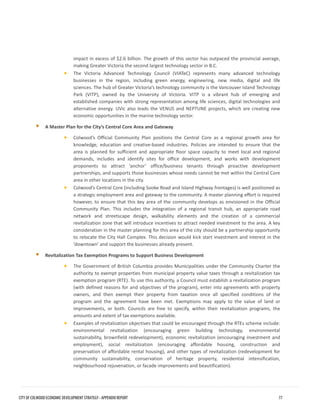
Fisgard Lighthouse in Colwood
2 CITY OF COLWOOD ECONOMIC DEVELOPMENT STRATEGY 
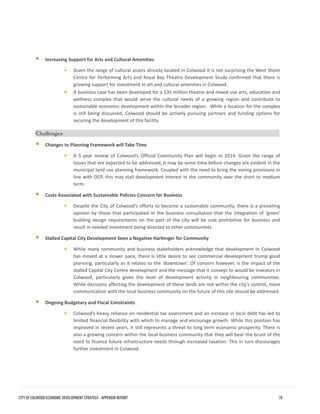
The Lagoon neighbourhood in Colwood.
CITY OF COLWOOD ECONOMIC DEVELOPMENT STRATEGY 3 
City of Colwood 
Economic Development Strategy 
September 2014 
Prepared by Millier Dickinson Blais 
for the City of Colwood 
Table of Contents 
Introduction 
Sustainable Economic Development 4 
Objectives & Outcomes 6 
Approach & Methodology 8 
Financial & Budgetary Implications 9 
Strategic Planning Process 10 
Situational Analysis 12 
Stakeholder Consultation 14 
PEST Analysis 16 
SWOC Analysis 18 
Alignment with other plans 20 
Best Practice Review 22 
The Context for Economic Development 24 
Strategic Priorities 26 
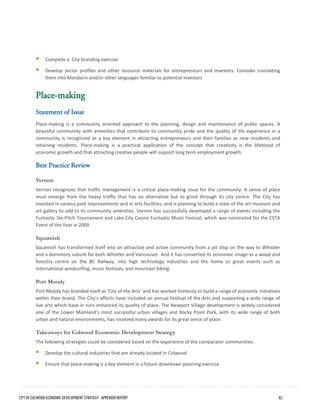
A formula for success 32 
3 Strategic Actions to Stimulate Change 34 
An Economic Development 
Strategic Plan for Colwood 36 
A vision for success 37 
Goals, Objectives & Actions 38 
Implementation 46
4 CITY OF COLWOOD ECONOMIC DEVELOPMENT STRATEGY 
Sustainable Economic Development 
Colwood population 
projected to grow 108% 
by 2038 
2011: 16,093 
2038: 33,553 
Royal Roads University in Colwood 
The City of Colwood is forecasted to grow from an estimated 16,093 
people in 2011 to 33,553 people by 2038. In fact, Colwood is anticipated 
to absorb approximately 31% of the projected population and account 
for 26.6% of employment growth directed at the Capital Region’s West 
Shore over the next 25 years. There are a number of considerations for 
the City in managing this growth, not the least of which is how it will 
leverage an expanding regional economy for its growing population, 
while at the same time attracting high-value, knowledge-intensive jobs, 
investment and related activities within the City itself. 
An Economic Development Strategic Plan provides the City with an 
opportunity to define the character and trajectory of this growth, as 
opposed to letting the growth define what the City will become. As 
such, the approach to economic development for Colwood is premised 
on respect for and protection of the City’s history and heritage, as well 
as recognition of the City’s future. Colwood is in a fortunate position at 
this time of being able to define its growth as a community based on the 
principles of environmental stewardship and quality of place. This idea 
is premised on the notion that high-value business and jobs will follow 
INTRODUCTION
CITY OF COLWOOD ECONOMIC DEVELOPMENT STRATEGY 5 
Bold and strategic 
decisions are needed 
about the future of both 
the community and the 
local economy. 
where people want to live, and that the City has a unique opportunity to 
differentiate itself from its regional neighbours and partners by focusing 
on the elements that will attract these newcomers. 
Indeed, considering both the current context and the growth that the 
City will be facing, economic development for the City will have to be 
premised on strategic planning (in a broad sense), asset management 
and sustainability of its existing resources – financial, social, cultural, 
and environmental. By acting strategically at this juncture, there is an 
opportunity to take a comprehensive and integrated approach to growth 
that will avoid the ‘we wish we had done...’ question many municipalities 
are now faced with. 
Colwood’s unique natural setting and range of cultural assets has long 
been a draw for residents and visitors alike, and a contributing factor 
to the quality of life that Colwood offers. But past success may no 
longer be an indicator of future performance. With a highly integrated 
regional economy, growing levels of commuter traffic congestion, and 
the absence of a vibrant waterfront or a downtown that function as 
centerpieces for the City’s cultural, commercial, educational, recreational 
and residential growth agenda, Colwood is at a crossroads. Bold 
and strategic decisions are needed to secure the future of both the 
community and the local economy. 
Japanese gardens at Hatley Castle, Royal Roads University
6 CITY OF COLWOOD ECONOMIC DEVELOPMENT STRATEGY 
Objectives & Outcomes 
Capitalize on emerging 
opportunities, while 
at the same time 
developing customized 
solutions to tackle the 
larger issues. 
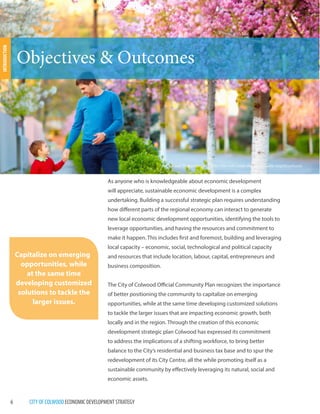
The Colwood Transportation Master Plan will create vibrant walkable neighbourhoods 
As anyone who is knowledgeable about economic development 
will appreciate, sustainable economic development is a complex 
undertaking. Building a successful strategic plan requires understanding 
how different parts of the regional economy can interact to generate 
new local economic development opportunities, identifying the tools to 
leverage opportunities, and having the resources and commitment to 
make it happen. This includes first and foremost, building and leveraging 
local capacity – economic, social, technological and political capacity 
and resources that include location, labour, capital, entrepreneurs and 
business composition. 
The City of Colwood Official Community Plan recognizes the importance 
of better positioning the community to capitalize on emerging 
opportunities, while at the same time developing customized solutions 
to tackle the larger issues that are impacting economic growth, both 
locally and in the region. Through the creation of this economic 
development strategic plan Colwood has expressed its commitment 
to address the implications of a shifting workforce, to bring better 
balance to the City’s residential and business tax base and to spur the 
redevelopment of its City Centre, all the while promoting itself as a 
sustainable community by effectively leveraging its natural, social and 
economic assets. 
INTRODUCTION
CITY OF COLWOOD ECONOMIC DEVELOPMENT STRATEGY 7 
Immediate, medium 
and long term actions 
will build upon the vision 
articulated in the Official 
Community Plan. 
The preparation of a five year Economic Development Strategic Plan for 
the City is the first step towards: 
• Developing sustainable jobs well matched to local employment 
needs and opportunities; 
• Supporting Colwood’s profile as a community with an attractive 
economic climate welcoming to new business opportunities; 
• Building on local assets, resources, heritage and innovation; and 
• Increasing the municipal tax base. 
The primary outcome of this strategic planning process is to provide 
the City of Colwood with a forward-looking Strategic Plan for economic 
development with immediate, medium and long term actions that build 
on the vision of the City articulated in the Official Community Plan. The 
Strategic Plan also reflects the overall direction and intent of Colwood’s 
Transportation Master Plan, and provides solutions to Colwood’s 
economic challenges within the context of sustainable economic 
development and change management. 
Cyclists on the Galloping Goose Regional Trail that runs through Colwood
8 CITY OF COLWOOD ECONOMIC DEVELOPMENT STRATEGY 
Approach & Methodology 
Understand current 
economic performance 
and leverage quality 
of place for future 
economic growth. 
Kayaking on Vancouver Island. 
A critical component to the development of any sustainable economic 
development strategic plan, regardless of the size of the community, is 
an understanding of a community’s performance against a range of local 
and regional socio-economic indicators. Combined with an analysis of 
current and emerging business investment trends, this information is 
used to inform a discussion of the city’s current economic performance 
and quality of place experience and the degree to which this can be 
leveraged for future economic growth. 
These results, together with stakeholder consultation efforts conducted 
in the spring of 2014 and a PESTLED (political, economic, social, 
technological, legal, environmental and demographic) and SWOC 
assessment (strengths, weaknesses, opportunities, challenges) were then 
prepared to provide further indication of Colwood’s ability and capacity 
to support business investment and the city’s value proposition for the 
attraction of business, investment and residents to the community. 
Section 2 of this report summarizes some of the key findings derived 
from this process. The appendices to this report contain a more detailed 
understanding of the issues and forces that are shaping economic 
growth in Colwood. 
INTRODUCTION
CITY OF COLWOOD ECONOMIC DEVELOPMENT STRATEGY 9 
Direct investments in economic development will be the foundation to long term sustainability and resilience. 
Financial & Budgetary Implications 
The Colwood Economic Development Strategic Plan is intended as a high level plan focused on the growth and diversification of the local economy over the long term. It does not include specific financial cost estimates for individual projects or actions. Costing will be done through the development of an overarching Implementation Plan and annual business plans that articulate the resources required to move the plan forward. 
It must be noted that while direct investments in economic development may create fiscal pressures for the City in the short term, it will be the foundation to long term sustainability and resilience in the local economy. 
Figure 1 illustrates the Strategic Planning Process for the Economic Development Strategic Plan. 
Notes about data 
In completing this report, Millier Dickinson Blais has made use of available 2006 and 2011 population Census and National Household Survey information for City of Colwood and the Province of British Columbia, as well as 2008 and 2013 business pattern data obtained from Statistics Canada.
10 CITY OF COLWOOD ECONOMIC DEVELOPMENT STRATEGY 
Strategic Planning Process 
Sailboat heading out in the Strait of Juan de Fuca
CITY OF COLWOOD ECONOMIC DEVELOPMENT STRATEGY 11 
The strategy development process began in March of 2014 with a review of background documents to establish the policy and planning context in which the economic development strategic plan is created and implemented. This included a review of such documents as the City’s Official Community Plan, the Capital Region District Strategic Plan 2012-2014, Capital Region District’s Regional Growth Strategy and Transportation Plan and the Greater Victoria Development Authority’s 2014 Business Plan, as well as other relevant staff reports and other economic development programming and initiatives underway in the region. 
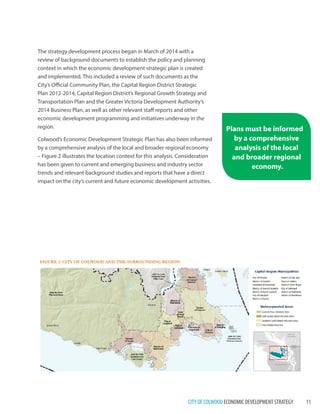
Colwood’s Economic Development Strategic Plan has also been informed by a comprehensive analysis of the local and broader regional economy – Figure 2 illustrates the location context for this analysis. Consideration has been given to current and emerging business and industry sector trends and relevant background studies and reports that have a direct impact on the city’s current and future economic development activities. 
Plans must be informed by a comprehensive analysis of the local and broader regional economy.
12 CITY OF COLWOOD ECONOMIC DEVELOPMENT STRATEGY 
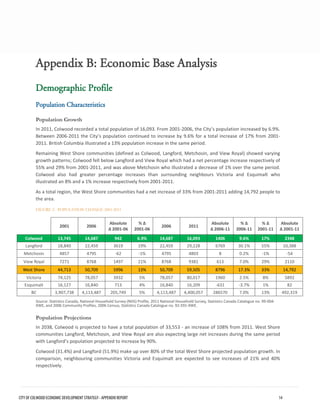
Population growth 
Situational analysis of Colwood highlights the rapid rate of growth that 
has been experienced across the West Shore communities, including 
Colwood, over the past decade. From 2006 to 2011 Colwood attracted 
over 2,000 new residents to the community. The Capital Regional District 
projects continued growth across the West Shore, particularly for the 
communities of Colwood and Langford. By 2038, Colwood is projected to 
see an additional 17,460 new residents in the community. 
Employment Levels 
The Capital Regional District also projects that Colwood’s employment 
levels will increase by 83.7%. The City is projected to absorb 
approximately a quarter of the total available jobs in the West Shore 
region by 2038. In total, both Colwood and Langford will comprise 80% 
of the projected population growth in the West Shore and 75% of the 
total employment growth. 
Workforce 
Despite the small size of the community, Colwood’s workforce is growing 
due in part to the city’s location in the West Shore and proximity to 
Situational Analysis 
STRATEGIC PLANNING 
Colwood’s employment 
levels will increase by 
83.7% by 2038. 
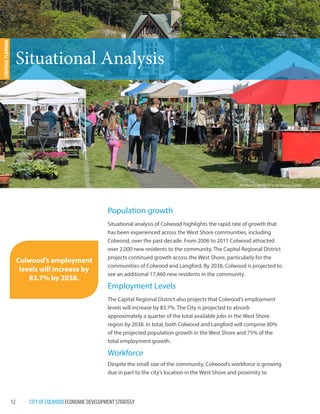
Mother’s Day Paint In at Hatley Castle
CITY OF COLWOOD ECONOMIC DEVELOPMENT STRATEGY 13 
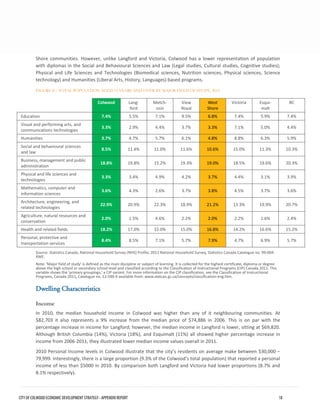
the Capital. The workforce is also highly educated with the majority of 
workers holding management occupations in sales and service; business 
and finance and education, law and social, community and government 
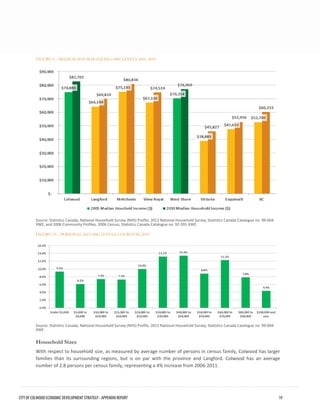
services. This has resulted in Colwood’s residents having a higher median 
household income than neighbouring communities. 
Local Business 
The situational analysis has also revealed that the City is home to 
more than 800 local and home based businesses. While many of these 
businesses have followed the population growth that has occurred in 
the West Shore in recent years, there are positive signs that Colwood 
is also attracting a greater number of professional, scientific and 
technical service firms including a growing number of knowledge based 
businesses. 
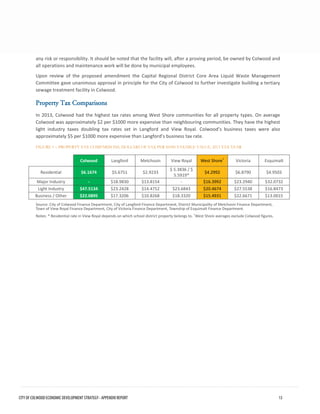
Tax Rates 
Despite the opportunities to attract more business growth and 
investment to Colwood, the City is at a competitive disadvantage when 
it comes to property tax rates for both residential and light industry/ 
business categories and this has had the effect of deterring or stalling 
needed investment. The situation is further complicated by the fact that 
there is a limited inventory of land available for both commercial/office 
and industrial purposes. 
Redevelopment 
This suggests that the City will have to rely in large part on the 
redevelopment of its City Centre and Neighbourhood Centres and Mixed 
Employment areas along Island Highway and Sooke Road in order to 
achieve the employment levels (and associated densities) established in 
the Regional Growth Plan. A more detailed summary of the Situational 
Analysis and Commercial and Industrial Land Analysis can be found in 
Appendix B and C. 
The findings from the situational analysis, stakeholder consultation 
process and PESTLED/SWOC are the basis for the goals, objectives and 
actions contained in the Economic Development Strategic Plan. The plan 
also assumes that Colwood will play a more positive role in developing 
the local and regional economy and provide the fiscal stability to support 
a vibrant sustainable lifestyle for all its residents. 
Colwood is attracting 
a greater number of 
professional, scientific 
and technical service 
firms including a 
growing number of 
knowledge based 
businesses.
14 CITY OF COLWOOD ECONOMIC DEVELOPMENT STRATEGY 
The opinions of residents, local and regional community leaders, and 
members of Colwood’s business community help to ground the data 
and findings that underpin the Strategic Plan in the local reality of living 
and operating in the community. For this reason a comprehensive 
consultation and stakeholder engagement process was conducted. This 
effort has included internal strategic planning and visioning discussions, 
as well as one-on-one interviews, with City Council, senior municipal 
staff, key business representatives, First Nations representatives and 
economic development stakeholders. 
This process was overseen by a Strategic Plan Working Group comprised 
of members of Council and senior staff from the City of Colwood 
and West Shore Chamber of Commerce. This effort has been further 
complemented by a broader public outreach effort, consisting of 
an online community survey. At each stage in the process primary 
consideration was given to identifying the City’s key opportunities for 
growth, as well as ideas for the implementation and execution of these 
opportunities. 
In addition, the consulting team engaged grade ten business students 
at Belmont High School in a youth focus group; conducted an 
Stakeholder Consultation 
STRATEGIC PLANNING 
A comprehensive 
consultation and 
stakeholder engagement 
process was conducted. 
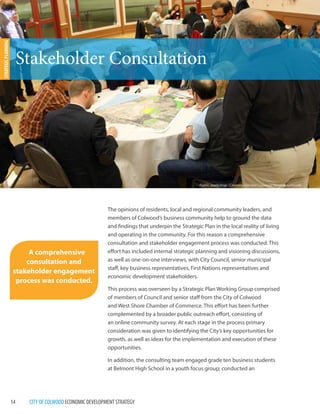
Public workshop : Creating Vibrant Colwood Neighbourhoods
CITY OF COLWOOD ECONOMIC DEVELOPMENT STRATEGY 15 
economic development themed university-led student workshop that discussed economic development opportunities across the region; and participated in a joint community forum with the Transportation Master Plan. The findings from these efforts have been used to formulate the Economic Development Strategic Plan as it pursues an aggressive and sustainable economic growth agenda. 
Key priorities that emerged from the consultation process include: 
• 
Strong civic and community leadership is required to build therelationships with economic development partners, the businesscommunity and area municipalities. 
• 
Economic development needs to be positioned as a core service forthe City if Colwood is to capitalize on its economic growth potential. 
• 
More effort needs to be directed at investment readiness including avision and plan for the ‘core’ as the focus for future investment. 
• 
A strong planning framework and fiscal plan is essential to gainingthe confidence of the local and regional business community. 
• 
Improved and increased programming for business recruitment andexpansion is required including greater support for small businessand entrepreneurs. 
• 
Further enhancements to Colwood’s quality of place are needed. 
• 
Marketing and investment attraction efforts must improve anddovetail with West Shore Chamber of Commerce and Greater VictoriaDevelopment Agency initiatives. 
A detailed Consultation Summary can be found in Appendix D. 
The findings from these efforts have been used to formulate an aggresive and sustainable plan.
16 CITY OF COLWOOD ECONOMIC DEVELOPMENT STRATEGY 
Defining the PEST(LED) 
A PEST (Political, Economic, Social, and Technical) analysis gives an 
overview of the external macro environmental factors that Colwood 
needs to take into consideration as part of the economic development 
strategic planning process. This analysis has been expanded further to 
include Legal, Environmental and Demographic (LED) factors. 
For the purposes of this report the PEST(LED) is characterized as: 
• Political: what are the key political drivers? 
• Economic: what are the most important economic factors? 
• Social: what are the main societal and cultural aspects? 
• Technological: what are the current technology imperatives, 
changes and innovations? 
• Legal: what current and impending legislation may affect the city? 
• Environmental: what are the ecological and environmental 
considerations locally and further afield? 
• Demographic: what primary demographic issues impact growth? 
The following highlights the elements considered most relevant in the 
context of an economic development strategy: 
PEST Analysis 
STRATEGIC PLANNING 
Clearly defining all the 
factors that may 
influence Colwood’s 
economic development. 
Aerial view of Colwood’s Esquimalt Lagoon and surrounding neighbourhoods
CITY OF COLWOOD ECONOMIC DEVELOPMENT STRATEGY 17 
Political Factors 
• Province expanding BC Trade and Investment Offices 
• Greater Victoria Development Agency to enhance region’s foreign 
direct investment programming 
Economic Factors 
• Federal funding for west coast shipping and marine operations will 
expand Seaspan operations on Vancouver Island 
• A stronger economic outlook predicted for the region 
• Entrepreneurs and small-medium based enterprises will be key 
considerations in the region’s future growth 
• Post-secondary institutions contribute to a dynamic learning and 
business environment 
• Niche resort development identified as a significant investment 
opportunity for British Columbia’s tourism sector 
Social Factors 
• Workforce attraction efforts to offset skilled worker shortages 
• Place-making is widely recognized as a key economic driver 
• Diminishing investments in social infrastructure hamper access to 
economic opportunities for many residents of the Island 
Technological Factors 
• A strong innovation agenda contributes to a region’s 
competitiveness 
Legal Factors 
• Better deployment of existing planning tools – Business 
Revitalization Zones, Business Improvement Areas and Inter-municipal 
Coordination of Regulations 
Environmental Factors 
• Sustainable growth and development a growing imperative 
Demographic Factors 
• Province’s Labour Market Strategy reveals an aging workforce 
• Positive rates of employment growth predicted for the region 
• Lack of affordable housing limits the ability of younger families to 
live in Colwood 
A stronger economic 
outlook is predicted for 
the region.
18 CITY OF COLWOOD ECONOMIC DEVELOPMENT STRATEGY 
The SWOC (Strengths, Weaknesses, Opportunities, and Challenges) 
analysis reflects on the information and insight that has been gathered 
and provides further indication of Colwood’s ability and capacity to 
support the attraction, retention and expansion of business investment. 
Defining the SWOC 
For the purposes of this report a SWOC is characterized as: 
• Strengths (Positive, Internal): Positive attributes or assets currently 
present in Colwood, particularly in comparison to the CRD 
• Weaknesses (Negative, Internal): Local issues or characteristics that 
limit the current or future growth opportunities for the City 
• Opportunities (Positive, Internal and External): Areas where the 
City can remedy its weaknesses (e.g. learning from others, provincial 
/ regional assistance, strategic initiatives, aggressive marketing or 
promotion, targeted investment, etc.) 
• Challenges (Negative, Internal and External): trends that threaten 
Colwood’s future and attractiveness to new residents and 
investment, from local weaknesses, global changes or shifts in 
consumer demand. 
SWOC Analysis 
STRATEGIC PLANNING 
Strengths 
Weaknesses 
Opportunities 
Challenges 
Families enjoy the Colwood waterfront at Esquimalt Lagoon
CITY OF COLWOOD ECONOMIC DEVELOPMENT STRATEGY 19 
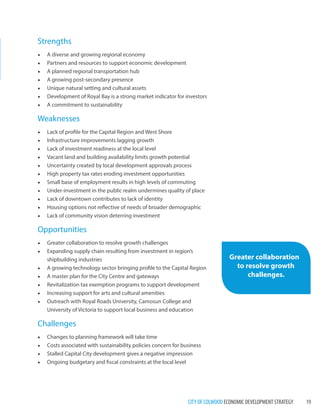
Strengths 
• A diverse and growing regional economy 
• Partners and resources to support economic development 
• A planned regional transportation hub 
• A growing post-secondary presence 
• Unique natural setting and cultural assets 
• Development of Royal Bay is a strong market indicator for investors 
• A commitment to sustainability 
Weaknesses 
• Lack of profile for the Capital Region and West Shore 
• Infrastructure improvements lagging growth 
• Lack of investment readiness at the local level 
• Vacant land and building availability limits growth potential 
• Uncertainty created by local development approvals process 
• High property tax rates eroding investment opportunities 
• Small base of employment results in high levels of commuting 
• Under-investment in the public realm undermines quality of place 
• Lack of downtown contributes to lack of identity 
• Housing options not reflective of needs of broader demographic 
• Lack of community vision deterring investment 
Opportunities 
• Greater collaboration to resolve growth challenges 
• Expanding supply chain resulting from investment in region’s 
shipbuilding industries 
• A growing technology sector bringing profile to the Capital Region 
• A master plan for the City Centre and gateways 
• Revitalization tax exemption programs to support development 
• Increasing support for arts and cultural amenities 
• Outreach with Royal Roads University, Camosun College and 
University of Victoria to support local business and education 
Challenges 
• Changes to planning framework will take time 
• Costs associated with sustainability policies concern for business 
• Stalled Capital City development gives a negative impression 
• Ongoing budgetary and fiscal constraints at the local level 
Greater collaboration 
to resolve growth 
challenges.
20 CITY OF COLWOOD ECONOMIC DEVELOPMENT STRATEGY 
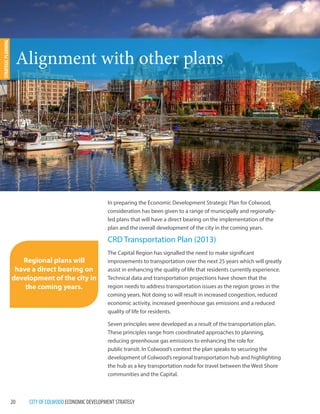
In preparing the Economic Development Strategic Plan for Colwood, 
consideration has been given to a range of municipally and regionally-led 
plans that will have a direct bearing on the implementation of the 
plan and the overall development of the city in the coming years. 
CRD Transportation Plan (2013) 
The Capital Region has signalled the need to make significant 
improvements to transportation over the next 25 years which will greatly 
assist in enhancing the quality of life that residents currently experience. 
Technical data and transportation projections have shown that the 
region needs to address transportation issues as the region grows in the 
coming years. Not doing so will result in increased congestion, reduced 
economic activity, increased greenhouse gas emissions and a reduced 
quality of life for residents. 
Seven principles were developed as a result of the transportation plan. 
These principles range from coordinated approaches to planning, 
reducing greenhouse gas emissions to enhancing the role for 
public transit. In Colwood’s context the plan speaks to securing the 
development of Colwood’s regional transportation hub and highlighting 
the hub as a key transportation node for travel between the West Shore 
communities and the Capital. 
Alignment with other plans 
STRATEGIC PLANNING 
Regional plans will 
have a direct bearing on 
development of the city in 
the coming years. 
Victoria Inner Harbour
CITY OF COLWOOD ECONOMIC DEVELOPMENT STRATEGY 21 
Colwood Official Community Plan 
The Official Community Plan provides the rationale and logic for how and where development and land use changes occur in the city of Colwood. It also embraces sustainability as a framework for community planning and development. 
To make progress on community sustainability, the Official Community Plan applied eight fundamental sustainable goals that are to be applied to all aspects of community planning and development. These goals are: 
1. 
Maximize the ecological value of natural areas. Where development occurs, maintain ecosystem values. 
2. 
Develop or enhance environments that enable healthy choices in all areas of living that are safe, secure and welcoming for all. 
3. 
Ensure healthy housing and food is available for all. 
4. 
Ensure healthy recreational, educational, emotional, spiritual, artistic and cultural opportunities for all. 
5. 
Ensure community planning and design celebrates the community’s unique history and natural setting and embraces diversity. 
6. 
Enhance economic vitality and opportunity. Ensure local employment and business opportunities. 
7. 
Promote energy-use choices that reduce greenhouse gas emissions and contribute to clean air. Plan for climate change adaptation. 
8. 
Promote efficient use and re-use of water and other resources. Reduce the consumption of non-renewable resources in favour of renewable resources. 
Colwood Transportation Master Plan (2014) 
Coinciding with the development of the City’s Economic Development Strategic Plan is development of Colwood’s Transportation Master Plan. The Master Plan looks to improve how community members and visitors travel in and through the city using all modes of transportation. Colwood’s transportation networks are intended to become a platform for building vibrant neighbourhoods, creating enjoyable streetscapes and trails, and that support the economic development of Colwood. A full review of these and other plans can be found in Appendix A. 
The OCP provides the rationale for development and land use changes.
22 CITY OF COLWOOD ECONOMIC DEVELOPMENT STRATEGY 
The best practice review is a high level scan of actions undertaken in 
other jurisdictions that address issues raised in the situational analysis, 
stakeholder engagement and assessment of strengths, weaknesses, 
opportunities and threats. Communities were selected based on size and 
growth patterns, access to a larger metropolitan area, high quality of life 
experience and similar regulatory environment. 
Consideration has been given to the framework of their economic 
development strategies or programming as well as local land use policy. 
The topics researched in the review were: 
• Business retention and attraction 
• Place-making 
• Waterfront and Downtown development 
• Revitalization zones 
• Regional economic development 
The communities considered for a best practice review included: City of 
Vernon, BC; District of Squamish, BC; and the City of Port Moody, BC. 
Best Practice Review 
STRATEGIC PLANNING 
A high level scan of 
actions taken in other 
jurisdictions. 
Waterfront park in Edmonds, Washington
CITY OF COLWOOD ECONOMIC DEVELOPMENT STRATEGY 23 
Vernon 
Vernon’s Economic Development Strategy stresses the need to build firm 
relationships with existing businesses and employers, and to establish 
mechanisms to ‘feel the pulse’ of business and to improved business 
practices. 
Networking opportunities are being enhanced and the City is partnering 
with other organizations in order to deliver on them. Initiatives include 
the development of an Investment Guide, and a Business Visitation 
program where established business leaders spend time with new 
business owners to share ideas and provide support. 
Squamish 
Squamish has appointed an Economic Development Officer and charged 
that position with developing a range programs and services. The City 
has conducted a Business Retention and Expansion survey, established 
regular networking events, promoted a Buy Local program and a 
Business Incubator program. 
In addition, they support a youth entrepreneur program that 
encourages young people to stay in Squamish and develop their 
ideas into businesses. Squamish city hall has reviewed and improved 
their Development Approvals processes, and created a development 
incentives program involving tax advantages. 
Port Moody 
Port Moody is also undertaking many of the initiatives noted in Vernon 
and Squamish. In particular they have reviewed their bylaws to ensure 
that they are supportive of small, home-based businesses and reviewed 
available lands to ensure there is sufficient property available for both 
internal growth and new development. 
A complete review of best practices can be found in Appendix F.
24 CITY OF COLWOOD ECONOMIC DEVELOPMENT STRATEGY 
Context for Economic Development 
Hatley Castle, home to Royal Raads University in Colwood
CITY OF COLWOOD ECONOMIC DEVELOPMENT STRATEGY 25 
Without question, the City of Colwood has benefited from a strong regional economy, its proximity to the Capital and its unparalleled oceanfront location. These attributes will continue to afford positive benefits for residents of the community including access to employment, cultural amenities, and a wide range of recreational pursuits. 
The City’s efforts to advance community sustainability have also garnered the community with a strong reputation in the region that should be more effectively leveraged to attract like-minded residents and businesses. 
Municipal initiatives such as Solar Colwood; the stewardship of the city’s public parks; and the recent decision regarding Colwood’s proposal to build an innovative sewer treatment facility using leading edge technology that will minimize the impact on the environment underpin this reputation. As the City moves forward with its sustainability agenda, it must proceed carefully and collaboratively with the business community, as many businesses continue to perceive there to be a high financial cost to going ‘green’. 
Colwood’s success as a community however, has not resulted in a strong local economy. A high level of taxation coupled with the availability of vacant employment land has created an imbalance in property assessment ratios and led many to describe Colwood as a bedroom community. Many of those consulted throughout the development of the Economic Development Strategic Plan recognize the need to take bold steps to address the redevelopment of Colwood’s City Centre and its major corridors, and to capitalize on the potential offered by the City’s waterfront area if the city is develop as a complete community. 
Improvements to local and regional transportation infrastructure is also essential including increased walkability, the need for local trails that integrate with the regional trail system and the planned investment in regional transit. 
The discussion that follows summarizes the major themes and strategic priorities that emerged from the strategic planning process. 
Many of those consulted throughout the development of the plan recognize the need to take bold steps.
26 CITY OF COLWOOD ECONOMIC DEVELOPMENT STRATEGY 
Strong civic and community leadership is required to 
build the relationships with economic development 
partners, business community area municipalities and 
First Nations. The West Shore municipalities including Colwood 
have a role to play in the management of long term growth across 
the region and the advancement of shared economic development 
opportunities. 
Issues identified earlier, such as infrastructure limitations, workforce 
sustainability, investment readiness, economic sustainability and 
land availability are common across the region. While the Capital 
Regional District is tasked with tackling the larger growth management 
challenges, greater impact may be achieved if the municipalities, 
business community and regional economic development partners 
within the region collaborate to develop ideas and actions that capitalize 
on the investment and economic development potential. 
Colwood’s Official Community Plan review provides an opportunity to 
re-emphasize the need for regional collaboration around issues such 
as transportation and sustainable development (e.g. shared service 
agreements which would assist in reducing costs and improving 
Strategic Priorities 
STRATEGIC PLANNING 
Collaborate to develop 
ideas and actions 
that capitalize on 
investment and economic 
development potential 
Colwood middle school students and local First Nations celebrate Royal Bay Secondary School groundbreaking
CITY OF COLWOOD ECONOMIC DEVELOPMENT STRATEGY 27 
efficiencies) but there are a wide range of local issues that require leadership and vision to move forward. Relationships need to be fostered at both the political and staff level to ensure effective solutions to the region’s growth challenges. 
Economic development needs to be a core service for the City of Colwood if Colwood is to capitalize on the economic growth potential in the region. At present, Colwood does not have an Economic Development Officer to support its investment attraction and business retention efforts and has not allocated resources for any related programming or activities. 
In economic development as in business, an unknown opportunity is a missed opportunity. 
With an increasingly competitive and rapidly evolving regional business environment, current information on business and industry trends and strong relationships with local businesses and regional economic development partners can inform investment attraction and business recruitment efforts. An economic developer officer, particularly in smaller communities can also be expected to champion a wide array of community based initiatives that go to support a community’s long term sustainability (e.g. local food initiatives, farmers markets, community improvement programming, festivals and event planning, cultural planning etc.) 
There are a range of stakeholders in the region already delivering economic development and related services across the region. As well, several of the local municipalities have either dedicated economic development staff, or staff in other departments with economic development functions. Where possible the city needs to identify and clarify where it can add value to local initiatives, but also where a broader more regional approach to an economic development opportunity or issue is required (e.g. investment attraction). Many of the stakeholders expressed a desire for collaboration and cooperation if it enabled them to leverage the knowledge and experience of the larger economic development community. 
Colwood is attracting a greater number of professional, scientific and technical service firms including a growing number of knowledge based businesses.
28 CITY OF COLWOOD ECONOMIC DEVELOPMENT STRATEGY 
More effort needs to be directed at investment readiness, including a vision and plan for the ‘core’ as the focus for future investment. Investment readiness is the ability or capacityof a community to support projects and activities that would attract or grow new business investment or jobs in a city. Businesses relocate, or open a new location when business needs or conditions motivate a change in location or expansion; for example, when a business expands beyond the capacity of a particular site or market. How a community responds to these opportunities often determines the success of attracting this investment. 
To be investment ready a municipality must first understand its competitive position (costs, land, buildings, workforce and land use and zoning,) and the investment or businesses that it is looking to attract. This informs the development of a strong value proposition that is then reflected in website content, key messaging, marketing material etc. Often this includes business and lifestyle factors and financial incentives that will appeal to prospective investors or businesses. 
Colwood has a limited inventory of vacant commercial and industrial lands with which to attract investors, suggesting that much of the business recruitment and investment attraction will rely on redevelopment potential. Though there are some infill opportunities, particularly in the commercial land supply, there are limited designated and zoned properties available over the shorter term. This limits the types of commercial/industrial activity that the City can accommodate. 
The City’s focus on community sustainability also implies the desire for higher employment densities (high value, knowledge based jobs) that could reduce the amount of commuting currently taking place. Given these factors Colwood’s ‘City Centre’ needs to be more effectively positioned as a regional commercial core for knowledge, education and creative-based industries. A bolder vision of an urban core that includes strong public realm elements, housing, entertainment, live-work opportunities and mixed use development is essential. 
The Official Community Plan’s policies are intended to ensure that the ‘core’ is planned for sufficient and appropriate floor space capacity to meet local and regional demands, includes and identifies sites for office development, works with development proponents to attract ‘anchor’ office/business tenants through proactive development partnerships, and supports those businesses whose needs cannot be met within the ‘core’ area in other locations in the city. 
How a community responds to opportunities often determines the success of attracting investment.
CITY OF COLWOOD ECONOMIC DEVELOPMENT STRATEGY 29 
A downtown revitalization strategy (with flexible zoning - e.g. ‘Kings Regeneration’ Toronto) is required to ensure that this key area of the community develops as envisioned in the Official Community Plan. This includes the integration of a regional transit hub, an appropriate road and trail network, as well as the use of revitalization tax incentives to attract needed investment to the area. A key element in the revitalization planning should be the relocation of the Colwood’s City Hall to the downtown as part of a new mixed use development. This could be accomplished in conjunction with a development partner thus providing the needed kick start to investment in the ‘core’. 
A strong planning framework and fiscal plan is essential to instill confidence in the local and regional business community. Many of the businesses consulted as part of the strategic planning process expressed a lack of confidence in Colwood’s development approvals process and a belief that historically, the City has not been supportive of or responsive to the needs of business. Input suggests that Colwood’s development approvals process has impeded rather than enabled good development with the most prevalent concerns being the lack of integration between the Planning Department and other city departments, the timeliness with which applications were processed and the perceived ‘eleventh hour’ requests for changes to development plans. The complicated nature of the City’s zoning bylaw was also seen as hampering development in the City Centre, as was the City’s property tax levels for commercial/office development. The lack of consistency on the part of Council in its handling of development applications was also thought to be impacting Colwood’s competitiveness relative to other communities in the West Shore. 
Weaknesses related to bureaucracy and city policy, whether real or perceived, need to be addressed to ensure that Colwood can continue to attract new investment and support and enable the development of existing businesses. Colwood must also address the property tax burden for non-residential properties and businesses. Consideration should be given to an examination of the financial tools available to the community including a property tax freeze for non-residential development, pre-zoning of land, revitalization tax exemptions or the waiving of development fees. It should be noted that the City’s current efforts have been recognized and applauded by the development community. 
Develop a strong planning framework and fiscal plan to instill confidence.
30 CITY OF COLWOOD ECONOMIC DEVELOPMENT STRATEGY 
Programming for business development expansion is required including greater support for small business and entrepreneurs. Business retention and expansion programming(BR+E) is a valuable tool that provides information about emerging strengths and challenges facing the local economy and more specifically, the local business community. Given the economic impact and job creation attributed to existing business, this type of economic development programming must be factored into a city’s economic development effort. 
In Colwood, significant changes in the business community have been observed in recent years, including a growing number of professional service firms and an increasing number of sole proprietor or home based businesses. In this regard, BR+E surveys can help to inform the City’s understanding and response to the needs of a particular sector or sub-sector, and in some instances it may also help to retain business investment and employment in the area. Participants in the consultation phase of this project have suggested that not enough is being done to retain and grow the businesses already present in the city. 
An effective BR+E program however, is not a one-off exercise. Municipal and economic development staff must ensure that regular and thorough interviews are conducted with the local business community (e.g. top 25 businesses/enterprises), in order to be properly informed as the needs of those businesses or sectors and to provide relevant business support services. Further, data gathered through BR+E programs can inform the success of larger regional economic development programming (e.g. workforce attraction initiatives) and support investment attraction activities by identifying local supply chain opportunities. 
Enhancements to Colwood’s quality of place experience are needed The need for focused attention on enhancing thequality of place, vibrancy and aesthetic appeal of Colwood was a common theme in the consultation process and a key consideration in the attraction of residents, visitors and business investment. There was general consensus that the city needs to do more to foster and promote high quality development in key areas of the city that combines commercial, residential, and cultural development opportunities. This includes providing a stronger public realm environment that is more pedestrian oriented (e.g. trails, bike paths, sidewalks, plantings, and parks), as well as enhanced streetscaping along the City’s key corridors. 
Support for small businesses to retain and attract new business activity.
CITY OF COLWOOD ECONOMIC DEVELOPMENT STRATEGY 31 
Particular attention also needs to be directed at creating a City Centre that accommodates retail, office, recreation, residential and arts and cultural activities etc. It was suggested that a more holistic approach to land use and infrastructure planning in the downtown was necessary rather than the piecemeal approach that is currently underway. In this regard it would be appropriate to include the Mixed Use Employment Area along Island Highway as part of the City Centre discussion. 
The City’s Transportation Master Plan places an emphasis on building strong neighbourhoods through the creation of vibrant streets and trails, while the Official Community Plan promotes thoughtful urban design as one of the community’s most powerful tools to advance quality of place. 
Successful ‘placemaking’ brings partners from the public, private, non-profit, and community sectors together to strategically shape the physical and social character of a neighbourhood, core or city. Placemaking can be used to enhance a community’s quality of place by animating public and private spaces (e.g. public art, festivals and events programming, community gardens and local food initiatives), rejuvenating structures and streetscapes (e.g. façade improvements and streetscaping), improving local business viability (e.g. business recruitment, upper storey housing) and public safety (e.g. increased pedestrian activity). 
Marketing and investment attraction efforts must improve and dovetail with West Shore Chamber and GVDA initiatives There is a growing trend towards branding of a community’s economic development effort to more effectively market the City to business, industry or future residents/employees. The City needs to devise an economic development marketing strategy that more effectively engages and informs business and industry on local economic development activities and programming, and profiling the current range of business and investment activity in the City. Colwood has some excellent local business stories to tell, together with the economic opportunities associated with Royal Roads University, Department of National Defence, and the investment underway by Seaspan Marine Corporation. To do this effectively at the provincial or national level, the City will need to work with organizations like the West Shore Chamber of Commerce, the Greater Victoria Development Agency and the Victoria Advanced Technology Council (VIATeC). If Colwood is to attract the residents, visitors and business investment it wants and needs, it must embrace more comprehensive communication techniques and technologies that will resonate with this larger audience. 
Engage and inform business and industry on local economic development activities.
32 CITY OF COLWOOD ECONOMIC DEVELOPMENT STRATEGY 
The Economic Development Strategic Plan and actions contained in this 
report represents the first step in the business planning process that that 
will establish the economic development priorities for the City, articulate 
the resources required to move forward with the plan’s implementation 
and foster a collaborative and cooperative approach to sustainable 
growth. 
The creation and implementation of the Strategic Plan however, cannot 
be done in a vacuum. It is not possible for one municipality, region, 
province or country to make a decision regarding its economic fate that 
does not impact (or get impacted by) the decisions of its neighbours. 
While “innovate or die” is a common mantra of both corporations 
and communities seeking to get an edge in the global economy, 
municipalities today are better served under the principle of “cooperate 
or die”. Indeed, the degree to which communities can work together and 
leverage their economies of scale in the attraction of investment – either 
through formal organizations or informal mechanisms – increasingly 
determines the degree of their success. 
A formula for success 
STRATEGIC PLANNING 
The degree to which 
communities can work 
together increasingly 
determines the degree of 
their success. 
Royal Bay Development site in Colwood
CITY OF COLWOOD ECONOMIC DEVELOPMENT STRATEGY 33 
Regional cooperation and collaboration is often seen as a sign of the growing ‘sophistication’ of economic development programming both by senior levels of government and private sector investors. 
As a city of 16,093, Colwood has a limited asset base in terms of clusters of employment or industrial activity; similarly there is a limited concentration of cultural activity aside from notable ‘flagship’ heritage sites such as Hatley Castle and Fort Rodd Hill. By population, Colwood comprises only 10.3% of Greater Victoria region and 27% of the population of the West Shore. Though the City has many advantages inherent in its natural heritage and proximity to the Capital, the current lack of available high quality employment land and buildings or a central core or downtown means that competition with larger and better- resourced neighbours will rarely be in its favour. 
As such, the City needs to determine opportunities for regional collaboration and cooperation that show a high likelihood of return and reward and be prepared to contribute to those efforts. There are a number of regional assets in a state of growth or change that represent a potential opportunity or ‘fit’ for Colwood, including Royal Roads University and the Victoria Shipyards. 
In addition, many of the ‘high-priority’ or ‘high-value’ initiatives that are, or have been, in the City’s crosshairs – such as the creation of a regional transportation hub at Colwood Corners and the resolution of the City’s sewage treatment needs – while largely dependent on the support, advocacy and/or decisions of the regional and provincial governments represent a significant step forward in the community’s desire for sustainability. 
A strong relationship with regional economic development partners such as the Greater Victoria Development Agency, the Victoria Advanced Technology Council (VIATech) and the West Shore Chamber of Commerce will also better enable the City to market to and attract national and international investors, secure economic development funding from upper levels of government and draw attention to the city’s desire to create a sustainable and vibrant community. This regional collaboration, when done as a complement to local economic development efforts, can direct new opportunities to the City that would otherwise be unavailable.
34 CITY OF COLWOOD ECONOMIC DEVELOPMENT STRATEGY 
Ongoing change is a positive sign of a healthy community. In order for 
Colwood to be successful - economically, aesthetically and in terms of 
its quality of life - it must promote itself as, and become, a community 
that includes and supports businesses, culture, social activities and 
community events, with a focus on new residential and commercial 
development opportunities. 
Experience in other jurisdictions across Canada suggests that the 
successful implementation of an economic development strategy 
requires that the municipality focus their activities into three basic 
categories. In a general sense, starting and sustaining the successful 
evolution of Colwood will require that public sector partners lead the 
way. The private sector will respond only when a clear and substantial 
level of commitment is established by the public sector. 
3 stragetic actions to stimulate change 
STRATEGIC PLANNING 
Ongoing change is a 
positive sign of a 
healthy community. 
Latoria Walk development in Colwood
CITY OF COLWOOD ECONOMIC DEVELOPMENT STRATEGY 35 
1. Establish the environment for change 
Establishing the environment for change begins by having a clearly stated and supported “vision” for the future. Public sector investment in streetscapes, water’s edge promenades, new park space and trails, as well as the downtown sends an important message of commitment to the development industry. A supportive administrative structure including appropriate land use policies and zoning helps remove confusion, and establishes the environment for change. 
2. Reduce the risk of development 
Reducing the inherent risks of the planning approvals process is also necessary because the development industry is typically conservative, and averse to risk. The public sector needs to promote and champion private sector investment and redevelopment (both residential and commercial) that achieves the vision established for the community. 
As-of-right planning approvals, created and promoted by the public sector (including the preparation of sub area plans, introduction of revitalization zones or the pre-zoning of development sites), will reduce the time and risk of the planning approvals process, and will be seen as a key redevelopment incentive. The municipality must ensure political will and administrative support for this effort (e.g. MOU’s with the landowners). 
3. Reduce the costs of private sector development 
Reducing the costs of private development is required because in many instances, existing planning and fiscal policy makes redevelopment too costly. Indirect cost savings should be promoted within some areas of the City of Colwood including reduced parking and parkland standards, as appropriate. More direct financial incentives can include tax exemptions, direct grants or loans for appropriate forms of development, as well as façade and landscape improvement grant programs.
36 CITY OF COLWOOD ECONOMIC DEVELOPMENT STRATEGY 
An Economic Development 
Strategic Plan for Colwood 
Wale Road in Colwood
CITY OF COLWOOD ECONOMIC DEVELOPMENT STRATEGY 37 
Vision 
Vision statements present an image of future success, based on what is attainable in reality – it should also be built on the strengths, opportunities and capacity of a community. The City of Colwood Official Community Plan established a vision for the community: 
“Our sustainable community, nestled in a rich network of hills, creeks, lakes and the sea, is defined by attractive, compact and complete centres connected by multi-modal transportation corridors. 
Our sustainable community is welcoming and inclusive for all and is planned and designed to support the needs of a diverse and changing population.”1 
Building on this vision and the input received throughout the strategic plan development process, the following vision statement has emerged to inform the development of the Economic Development Strategic plan. 
“Our sustainable community is innovative and forward thinking in its approach to economic development reflecting both the needs of our business community and our desire for a balanced and sustainable approach to growth.” 
Setting out goals 
The City of Colwood Economic Development Strategic Plan is underpinned by three high level goals, intended to anchor and qualify all strategic initiatives or ensuing actions on the part of the City over the next five years. The goals support the City’s overarching vision as stated in the Community Official Plan as well as the desired outcomes of the economic development planning process. 
It should be noted that the list of actions is a prioritized starting point based on community input and research at a point in time. It is by no means an exhaustive or comprehensive list of all the potential actions for the City of Colwood. New actions will emerge throughout the lifespan of the Strategic Plan. It will be critical for effective implementation to continually assess how these new actions contribute to overall success. 
A vision statement presents an image of future success.
38 CITY OF COLWOOD ECONOMIC DEVELOPMENT STRATEGY 
For the purposes of the Colwood Economic Development Strategic Plan 
the goals, objectives and actions are defined as follows: 
• goals: the vision and desired outcomes that emerged from the 
strategic planning process and a view of the aspirations of the City’s 
citizens and stakeholders 
• objectives: how these goals are to be achieved and what must 
be accomplished in the next five years 
• actions: direct the City and its stakeholders to those essential 
issues or opportunities that must be addressed over the length of 
the plan. 
Objective: to demonstrate leadership in advocating for 
and support collaborative economic development as a 
way to advance local priorities 
Actions: 
1. Position economic development as a core service for Colwood 
through the hiring of a full time economic development manager to 
oversee the implementation of the Economic Development Strategic 
Plan. 
Goals, Objectives & Actions 
Goal One: 
Foster 
partnerships 
that advance 
economic 
sustainability 
Perimeter Park in Colwood 
STRATEGIC PLANNING
CITY OF COLWOOD ECONOMIC DEVELOPMENT STRATEGY 39 
• 
The economic development manager will build the necessary relationships with economic development partners, the regional business community and area municipalities. 
• 
The economic development manager will prepare an annual business plan that details all actions planned for the fiscal year (with relevant performance metrics) and provide an annual report on the achievements in implementing the efforts of the previous year. The economic development manager will provide bi-annual progress updates to both municipal council and the community at large. 
• 
The economic development manager will engage economic development partners (GVDA, Industry Associations, Chamber of Commerce, RRU, DND, First Nations, Coastal Collective, border municipalities etc.) on a consistent and ongoing basis to gain an understanding of programming and partnership opportunities available to Colwood. 
• 
The economic development manager will assist with the creation of working groups around specific projects or initiatives, when required. 
• 
The economic development manager should take the lead on assisting potential investors and area businesses to navigate the development approval process and assist in navigating the programming and funding offered by the City, province or the federal government. 
2. Prepare and maintain a Community Profile and Business Investment Profile (e.g. www.airdrie.ca) that can be leveraged by GVDA and the West Shore Chamber of Commerce in their efforts to attract future residents and workers, businesses and prospective regional, national and international investors to the region. 
3. Initiate a crowdsourcing initiative for the City of Colwood to raise money for small businesses and solicit input on community development projects. Work with Royal Roads University, Camosun College, VIATeC, UVic and area high schools to identify projects that will facilitate economic activity, social innovation, support local entrepreneurs and start-ups and foster community pride.
40 CITY OF COLWOOD ECONOMIC DEVELOPMENT STRATEGY 
4.Give consideration to the creation of a Community Investment Fundthat will foster partnerships with not for profit organizations andneighbourhood associations in nurturing, enhancing and celebratingColwood’s unique cultural, artistic and recreational attributes. 
• 
The policy should apply to eligible not for profit organizationsrequesting monies from the city to host festivals and events and/ or eligible neighbourhood associations requesting funds forneighbourhood capacity building initiatives; 
• 
The policy should build local capacity in the community byenhancing the unique arts, cultural and recreational aspects ofColwood through events, festivals and neighbourhood projects; and 
• 
The policy should enable social connections between variousgroups in the community and contribute to Colwood’s sense ofidentity, place and community. 
5.Work with the West Shore Chamber of Commerce, the CoastalCollective and surrounding municipalities to complete a WestShore Cultural Asset Mapping exercise that will further nurture thedevelopment of the region’s cultural and cultural tourism sectorsand increase public awareness and participation in availableprogramming and activities and improve the long term sustainabilityof the assets themselves. This includes improving upon Colwood’scurrent community green map. 
6.Develop a Sustainability Roundtable Series with Royal RoadsUniversity that invites local residents and the businesses toparticipate in conversations about sustainability, community-mindedcommerce, place-making, local food, creativity and education4. 
7.Engage VIATeC and Royal Roads University in discussions around theopportunity and feasibility of locating a satellite business incubatorthat would serve business start-ups and provide entrepreneurialprogramming for the West Shore communities. 
• 
Revisit and revise the Memorandum of Understanding betweenRoyal Roads University and the City to confirm opportunities forongoing collaboration and cooperation.
CITY OF COLWOOD ECONOMIC DEVELOPMENT STRATEGY 41 
8. Partner with First Nations in discussions on economic development opportunities, such as the opportunity to locate a Cultural Centre in the City of Colwood. 
9. Engage the Department of National Defence in a discussion of the forthcoming Master Plan for the DND lands within Colwood. 
• 
Pursue opportunities for the divesture of lands along Sooke Road as part of the City’s efforts to draw investment to the corridor. 
• 
Determine the recreational needs of DND’s service personnel in Colwood and Esquimalt and the opportunities for a shared use arrangement as a way to ensure the long term viability of the Juan De Fuca Recreation Centre. 
Objective: to balance the need for growth with the community`s unique cultural, heritage and environmental values 
Actions 
10. Prepare a Downtown Revitalization Plan for the City of Colwood that will foster the development of a well-functioning and vibrant commercial area and residential neighbourhood. The plan should implement a simplified planning policy regime (OCP and Zoning) that outlines the desire for a compatible mix of uses, building heights, urban form, street network, open spaces, parking and parkland requirements and potential revitalization incentives. The City Centre land use policies and zoning should be expanded to include the Mixed Use Employment Area along Island Highway given its premier gateway location in the City. 
• 
Confirm the feasibility of relocating Colwood’s City Hall to the City Centre as part of a larger mixed used development opportunity that would kick-start investment in the area. 
• 
Issue a formal Expression of Interest to solicit partners in the development of a mixed used building that incorporates City Hall in conjunction with retail and additional office space. 
Goal Two: 
Create an 
attractive 
and liveable oceanfront community
42 CITY OF COLWOOD ECONOMIC DEVELOPMENT STRATEGY 
11. Secure the commitment and financing for the construction of aRegional Transit Hub in Colwood’s City Centre as part of the City’sefforts to establish a downtown that functions as a civic, recreationaland employment centre for the City and region. 
• 
Give consideration to pre-zoning for the desired types/formsof development in the City Centre in advance of development. applications. Zoning should be inclusive and simple based on thedesire to regenerate/revitalize the area. 
• 
Introduce a revitalization tax exemption policy geared to theattraction of mixed use development in the City Centre. 
12. Undertake public realm improvements to Sooke Road betweenGoldstream and Veterans Memorial Parkway commensurate with itsrole as a major urban corridor for Colwood: 
• 
Street edge improvements (e.g. landscaped strips with trees, shrubs, planters, street furniture) that reinforce it as pedestrianspace; and 
• 
Traffic calming through the introduction of sidewalks and bikelanes. 
13. Complete a comprehensive Waterfront Plan (and proforma) thatarticulates the community’s vision for all the lands within itsjurisdiction. This would include the lands owned by DND, thosemanaged by RRU, and those currently under development planningin Royal Bay. As the last stretch of undeveloped and under- developed waterfront in the region, the Plan should outline theplanned roles and functions of this ‘Waterfront Precinct’, how it willbe connected to the City’s neighbourhoods, how it will be accessedand used by residents and visitors and how it will contribute to theCity’s sustainability goals. This land has great economic potential toadd to the City’s public realm, and to showcase its environmental, recreation and tourism values and opportunities. Specific actionswould include: 
• 
Pursue opportunities to strengthen the post-secondary presence. 
• 
Pursue opportunities to secure a performing arts centre/culturalcentre to the waterfront area. 
• 
Work with the Coast Cultural Cooperative to enhance theopportunities for cultural tourism
CITY OF COLWOOD ECONOMIC DEVELOPMENT STRATEGY 43 
• Having completed the Waterfront Plan, initiate discussions 
with area MLAs and MPs to secure financial support for the 
redevelopment of Colwood’s waterfront and proposed public 
realm improvements. 
14. Provide further enhancements to Colwood`s quality of place 
experience as a means to differentiate the community in its efforts to 
attract future residents, visitors and investment to the City. Specific 
actions should include: 
• Gateway and way finder signage. 
• Improved public access to the water’s edge and public use of 
waterfront amenities. Provide gathering spaces that will draw 
residents and tourists, host community events and support 
festivals and events in the community. 
• Improvements to the City’s trail system and bike paths as a 
way of enhancing mobility in Colwood and strengthen the 
relationship between residents of all ages and the city they live 
in. Identify opportunities to provide connections to regional trail 
and a bike path through Royal Roads University/DND lands. 
• Identify opportunities to more effectively link the City’s 
waterfront with the City Centre by supporting improved access 
to the waterfront areas (e.g. trails, bike paths, public transit). 
15. Advocate for the development of a regional Cultural Plan and 
Cultural Asset Inventory to support the further development of the 
arts, culture, recreation and place based cultural tourism. 
• Create a searchable database and asset map of tourism and 
cultural resources in the West Shore. 
16. Provide a continuum of housing options to accommodate the 
broadest demographic and improve overall levels of affordability 
including opportunities for live-work and senior housing. 
Coast Collective Art Centre at Pendray House in Colwood
44 CITY OF COLWOOD ECONOMIC DEVELOPMENT STRATEGY 
Objective: To enhance the City’s competitive advantage for attracting and retaining local jobs and business investment opportunities 
Actions 
17. Add a state of the art and innovative economic developmentcomponent to the City’s website (e.g. http://www.squamish.ca/ business-and-development/economic-development) as a wayto distinguish Colwood from other west shore communities andhighlight the City’s vision for economic development. 
• 
Prepare a community investment profile that illustrates thecharacteristics of the City as it relates to key socio economicindicators, community sustainability initiatives, plannedinvestment and key employment sectors in the region. Includeprofiles of innovative local companies in each sector. 
• 
Leverage the site to communicate accurate and up to dateinformation to residents and the development/investmentcommunity on the progress or status of major developmentinitiatives (e.g. Royal Bay development, City Centre development, downtown revitalizations efforts etc.) 
18. Maintain an inventory of available serviced and un-servicedcommercial and industrial land and buildings, and make theinformation available on the City’s website. The followinginformation should be included at a minimum: 
• 
parcel size 
• 
privately or municipally owned 
• 
contact information 
• 
zoning and servicing information 
19. Facilitate regular meetings between the City’s EconomicDevelopment and the city’s development/investment community, as a way to ensure an understanding of issues and challengesfacing developers/investors in the City and discuss opportunities toimprove the overall investment climate. 
20.Consider the introduction of a Development Review Teamapproach modeled by other high functioning communities as a 
Goal Three: 
Provide a supportive environment for business and investment
CITY OF COLWOOD ECONOMIC DEVELOPMENT STRATEGY 45 
way to expedite the development approvals process. As part of this effort the City should communicate its intent to the development community. 
21. Introduce revitalization tax exemptions for Colwood’s City Centre and Neighbourhood Centres as a way to increase commercial/office investment in these areas. 
22. Launch a Business Retention and Expansion Program with local businesses and the area Chamber of Commerce, (including home- based businesses) to determine the ongoing needs of businesses and build a network of stakeholders in the community that can assist in the implementation of the short-term actions in the strategy. 
• 
Work with the West Shore Chamber of Commerce to promote and deliver small business seminars geared to e-marketing, website development, business networking, workforce planning and marketing and succession planning. Connect small businesses with senior business leaders in the region who can act as mentors and coaches. 
23. Develop a Business Guide to Planning and Building Services that outlines services and processes of the city departments to assist with new investment and business expansion opportunities. 
24. Work with Royal Roads University to leverage and promote their entrepreneurship oriented applied research programs and initiatives for local businesses. 
25. Foster an entrepreneurial spirit among students and youth (18-30 years) in Colwood. 
• 
Examine and catalog existing programs and opportunities that currently support youth entrepreneurship in the region. Promote existing services. 
• 
In partnership with RRU, develop/expand youth entrepreneurship opportunities to identify and
46 CITY OF COLWOOD ECONOMIC DEVELOPMENT STRATEGY 
At present there is no budget for the delivery of Colwood’s Economic 
Development Strategic Plan. We anticipate that the implementation 
of this plan will require the services of a full time senior economic 
development manager together with administrative support. The City 
has already created a marketing and communications position which 
should work closely with the economic development manager. 
The recommended actions also suggest that additional expenditures 
beyond salaries and benefits will be required to implement proposed 
actions in the coming years. Given the time lines required to achieve 
successful outcomes in economic development, consideration should 
begin as to the necessary financial commitment to ensure the effective 
implementation of the Strategic Plan. This should include the availability 
and sustainability of external funding/grants derived from other 
government sources. 
Given the ongoing efforts of the Greater Victoria Development 
Agency, VIATeC, Tourism Victoria, Victoria Arts Council etc. as it relates 
to a number of action plan recommendations – tourism, marketing, 
investment attraction, and sector development, it will be essential that 
Colwood look to capitalize and leverage the larger regional efforts to 
drive economic growth and investment. 
A detailed implementation plan is available in Appendix G. 
Implementation 
Commitment is required 
to ensure the effective 
implementation of 
the plan. 
Royal Bay Secondary School under construction in Colwood 
STRATEGIC PLANNING
CITY OF COLWOOD ECONOMIC DEVELOPMENT STRATEGY 47
CITY OF COLWOOD ECONOMIC DEVELOPMENT STRATEGY 1 
Appendix Report Colwood Economic Development Strategy 
September 2014
Contents 
APPENDIX A: CITY FRAMEWORK REVIEW ....................................................................................................... 1 
REGIONAL CONTEXT 1 
COLWOOD CONTEXT 5 
APPENDIX B: ECONOMIC BASE ANALYSIS ..................................................................................................... 12 
DEMOGRAPHIC PROFILE 12 
OCCUPATIONAL PROFILE 21 
LABOUR FLOW CHARACTERISTICS 26 
BUSINESS PROFILE 27 
APPENDIX C: COMMERCIAL AND INDUSTRIAL LAND ANALYSIS ..................................................................... 32 
OFFICIAL COMMUNITY PLAN POLICIES 32 
LAND USE BYLAW POLICIES 33 
LAND BASE OBSERVATIONS 35 
APPENDIX D: CONSULTATION SUMMARY .................................................................................................... 37 
SUMMARY OF COMMUNITY ENGAGEMENT 37 
SURVEY RESULTS 43 
APPENDIX E: PEST(LED) AND SWOC ANALYSIS ............................................................................................. 62 
PESTLED ANALYSIS 62 
SWOC ANALYSIS 68 
APPENDIX F: BEST PRACTICE REVIEW ........................................................................................................... 77 
APPENDIX G: DETAILED IMPLEMENTATION PLAN ......................................................................................... 85 
CITY OF COLWOOD ECONOMIC DEVELOPMENT STRATEGY - APPENDIX REPORT 2
Appendix A: City Framework Review 
Regional Context 
Capital Regional Strategic Plan (2012-2014) 
The 2012-2014 Strategic Plan builds on the 2009-2011 Plan by taking into account broader global trends. It reiterates a pragmatic view that considers social, economic, environmental costs and benefits in all decisions. 
Regional Cooperation: To achieve greater confidence in regional governance, the plan looks to arrive at anunderstanding of shared interests, increase engagement with First Nations communities, and bettercommunicate with citizens, agencies, and governments. 
Regional Transportation and Planning: The goal is to increase the quality of life while decreasing greenhousegas emissions. A regional system making better use of integrated land-use systems means developing mostly inurban areas with access to multiple modes of transportation. 
Regional Housing: Housing must support the population, especially vulnerable and aging households: meaningaccessible, diverse and affordable. 
Healthy Region: Increase collaboration among all levels of government to ensure regional support for healthycommunities. Increase access to the nature, open space, shorelines. Support regional arts and culture, andinvest in healthcare infrastructure. There is a strong desire for healthier, more livable communities. 
Regional Infrastructure: Responding to global climate change by investing in water, waste and resourcemanagement infrastructure. 
Regional Environmental Stewardship: Inclusive and engaging all residents in the development and delivery ofenvironmental policies, programs, and initiatives. As well as promoting land-use that supports healthy andproductive ecosystems. 
CRD Industrial Land Use Inventory and Assessment (2009) 
In 2008, the CRD Regional Planning Division initiated an Industrial Land Study to examine the supply and demand characteristics of industrial land in the region. 
Supply: Colwood has 28.3 acres of Total Industrial Land. 
West Shore Region: Colwood, Highlands, Juan de Fuca, Langford, Metchosin and Sooke contain 34% of theregional industrial land (685 acres); with 83% of the region’s vacant industrial land. 
Type: Vast majority of industrial land in Colwood is General Industrial (27.1 of 28.3 acres). Colwood has noHeavy Industrial, Extraction Industrial, or Marine Industrial, with little Light Industrial. 
Demand: Additional 79 acres of land is needed over the next 30 years, but no additional industrial expansionhas been designated except for a gravel pit in Central Saanich. 
CITY OF COLWOOD ECONOMIC DEVELOPMENT STRATEGY - APPENDIX REPORT 3
Area Concerns: 
•Lack of storage or warehouse space to support higher populations. 
•Quality of existing, available land industrial supply is low. 
•OCP commitment to industrial intensification may not be appropriate. 
•A shift in industrial land perception is needed: transition to more high-tech. manufacturing withminimal off-site effects. 
A Context for Change Management in the Capital Region District Future Population, Labour Force, Employment and Housing in the Capital Regional District (2009) 
Population Change: Projected increase in population from 364,000 in 2008 to 390,000 in 2016 to 475,000 by2038. In the past three decades the CRD grew by 54%; future growth will be much slower. CRD has an olderpopulation than Canada’s average. Aging presents many challenges and opportunities. 
Labour Force Change: Prime working age group will see very slow growth over the next three decades, growing at an average annual growth rate of just 0.3%. 
Employment Change: Projection shows economic growth in the province slowing toward 1.5% by 2020, and1% by 2038. Total employment in the region would grow from 198,452 jobs in 2009 to 238,000 in 2038. 
Housing Change: While the region’s housing stock will remain predominantly ground oriented over the comingyears, continued population growth and change will support shifts towards other forms of housing. Anexpected 62,836 new housing units are expected to accommodate the region’s future population. Theapartment segment will see growth of 50%, and ground oriented accommodation will grow at 34%. Even by2038, ground oriented accommodation will continue to outweigh apartments 66% to 33%. 
Sub-Area [West Shore] Projections: West Shore sub-area will see the most significant change over the courseof the projection period. West Shore is expected to grow by 88% (adding 57,000 new residents) comparedwith the CRD growing 33%. 
Strategic Considerations: West Shore’s age group is between 42 to 46 compared with 55 to 59 in the Peninsulasub-area. The West Shore has effectively become a place to put down roots and build a family. Many newhouseholds are beginning in the West Shore, while the Peninsula area of the CRD is experiencing a householdsize decline. 
CRD Regional Transportation Plan (2013) 
The Capital Region has an opportunity to make significant improvements to transportation over the next 25 years which will greatly assist in maintaining the high quality of life that residents currently experience. Technical data and transportation projections show that we need to effectively address transportation issues as our region grows in the coming years. Not doing so will result in increased congestion, reduced economic activity, increased greenhouse gas emissions and a reduced quality of life. 
Principle 1: Take Coordinated and engaged approach to planning 
•Formation of a Transportation Advisory Committee (TAC) which will be made up ofrepresentatives from all municipalities, EAs, Ministry of Transportation and Infrastructure, and BCTransit. 
CITY OF COLWOOD ECONOMIC DEVELOPMENT STRATEGY - APPENDIX REPORT 4
Principle 2: Prioritize strategic investments that serve regional mobility needs 
•Continuation of the regional gas tax funding program, and can provide funds for significanttransportation projects based on recommendations from the TAC. 
Principle 3: Reduce greenhouse gas emissions and prepare for changes 
•All long term transportation planning efforts help to reduce GHG emissions. Focusing on land useand transportation planning will aid in sustainable transport choices, reduce trip distances, improve efficiency and mobility, reduce congestion, and support active transportation. 
Principle 4: Integrate transportation and land use planning 
•By directing growth towards existing urban areas, these areas will realize sufficient trip densitiesto warrant more efficient transit service. Higher density and mixed-use developments also reducetrip lengths and, in turn, promote walking and cycling. Integrated planning also helps introducepedestrian and active transportation elements into communities. 
Principle 5: Capitalize on the potential for alternatives to driving alone 
•Active transportation has a high comparative rank in the CRD, however, there remains potentialto shift auto trips to other modes. In 2011 61% of weekday trips in the CRD which were shorterthan 5km were taken by automobile. 
Principle 6: Enhance role for public transit 
•Currently transit trips account for 6% of total travel market in the CRD, however a target of 12% has been set by 2030. This target was established by the Provincial Transit Plan, and adopted bythe CRD and BC Transit. 
•Proposed rapid and frequent transit networks will make transit more efficient and provideadditional capacity. 
Principle 7: Maximize efficiency of existing transportation corridors for multiple modes 
•Population and employment growth throughout the region will largely have to make do withexisting roadway capacity. 
•Strategic investment in capacity improvement and travel demand management will befundamental to accommodating future demand. 
Greater Victoria Development Authority Business Plan (2014) 
The following key business plan items will guide the Greater Victoria Development Authority’s actions for the upcoming year. They recognize these items as key regional actions that will impact the development of the regional economy. 
Business Retention and Expansion: Discover key determinants of retention for 40 export-oriented companiesin the Greater Victoria region. 20 of which are foreign-owned/high-risk. 
In-Bound & Out-bound trade: Work with 80 in-bound investors per year to facilitate opportunities andtransactions. Work with 45 small export companies over three years to expand international market reach. 
CITY OF COLWOOD ECONOMIC DEVELOPMENT STRATEGY - APPENDIX REPORT 5
Business Creation: Work with 30 start-up & small-business entrepreneurs per year to ensure that they havethe information, connections, and resources with which to start, expand, or fail fast and try again. 
Regional Competitiveness: Ensure that the region is constantly moving towards meeting the needs ofeconomy (capital markets, innovation programs, infrastructure, business climate, Human Resources system, access to markets, quality of life). 
Regional Communications and Stakeholder Engagement: GVDA is a leader in the region in monitoring andreporting on the state of the economy, the importance of the economy, and how interventions in the localeconomy will create resiliency and jobs. Appear in media 40 times per year, host two large events per year, produce 6 published articles per year in Business Matters magazine, produce & publish Major InfrastructureList, present to Mayors/Councils as required, and advise the CRD Regional Sustainability Strategy. 
Greater Victoria Development Agency Foreign Direct Investment Program (2014) 
The program valued at $1,558,500 was designed by the GVDA Board with input from stakeholders with the intent of both strengthening the local inputs that serve as the foundation to FDI attraction and retention, and also initiating and improving FDI attraction and retention activities over a three-year time period. 
The program contains five (5) key components: 
1.Internationalization of Small & Medium-Sized Enterprises (SMEs) $93,000 over 3 years 
2.Air Route Development $375,000 over 3 years 
3.International Education Partnerships $200,000 over 3 years 
4.In-Bound and Out-Bound Trade Activities $97,500 over 3 years 
5.Marketing and FDI Attraction $638,000 over 3 years 
Each component will be delivered in partnerships with local stakeholders and businesses and matching funding contributions totaling $898,000 (over three years) from Western Economic Diversification Canada (WD) an agency of the Government of Canada. Local partners will contribute up to $660,000 towards the project over three years. 
Internationalization of Small & Medium-Sized Enterprises (SMEs) 
The Greater Victoria region has hundreds of SMEs that export products and services abroad. Many are in the US market aggressively and/or have traction in Asia, South America, and other areas. However, as a region, Greater Victoria stakeholders do not clearly understand who these companies are, where they are currently exporting, and what needs these companies have to growth. A three-year plan will be initiated to assess capacity, determine gaps, and implement specific actions to fill those gaps which will leads to millions of dollars in increased export activities in the Capital Region. 
Air Route Development 
As an island with many economic sectors that rely on international connectivity (high-tech, film, tourism, advanced manufacturing, agribusiness, aviation, ocean-sciences, education, etc.), establishment and expansion of key air routes are essential. The direct daily flight to San Francisco established several years ago is now paramount to the burgeoning tech-sector. Now it is time to expand US connections into Los Angeles and explore future scenarios that will enable the region’s long-term goal of establishing US-Customs Pre-Clearance at Victoria International Airport. This three-year plan will result in a direct connection to Los Angeles, and better understanding of future market potential. CITY OF COLWOOD ECONOMIC DEVELOPMENT STRATEGY - APPENDIX REPORT 6
International Education Partnerships 
Greater Victoria has significant potential not only as an international education destination, but also a provider of highly competent strategic educational programming within overseas markets. The region also boasts many world- class research intiaitives that have potential to attract international talent, investment, and private-sector commercialization opportunities. The three-year plan will involve packaging these opportunities into a cohesive marketing collateral as well as designing an effective plan to communicate the opportunity to markets abroad. Growth in international student numbers, international education contracts, and linkages to private investment are expected. 
In-bound and Out-bound Trade Activities 
Each year, there exists potential for hundreds of in-bound trade groups that could be aligned to opportunities in Greater Victoria market. Attracting these groups and effectively hosting them once they arrive can have high return on investment. Additionally, international trade relationships can be fostered by local stakeholders partaking in international trade conferences and trade missions abroad. 
Marketing and FDI Attraction 
Designing a cohesive opportunity story for Greater Victoria is essential to the future ability of the region to attract investment, business interest, and talented workforce. The region battles perceptions of being a “government- town” or a “tourism-town” and only through effective marketing will be region overcome these perceptions to the advantage of local municipalities, tax payers, and businesses. The three-year plan will inventory the local assets (opportunities) and determine how best to communicate these through effective mediums and within a set budget. Significant increases in in-bound investment is expected from these activities. 
Colwood Context Official Community Plan Community Sustainability Goals: 
Maximize the ecological value of natural areas. Where development occurs, maintain ecosystem values. 
Develop or enhance environments that enable healthy choices in all areas of living that are safe, secure andwelcoming for all. 
Ensure healthy housing and food is available for all. 
Ensure healthy recreational, educational, emotional, spiritual, artistic and cultural opportunities for all. 
Ensure community planning and design celebrates the community’s unique history and natural setting andembraces diversity. 
Enhance economic vitality and opportunity. Ensure local employment and business opportunities. 
Promote energy-use choices that reduce greenhouse gas emissions and contribute to clean air. Plan for climatechange adaptation. 
CITY OF COLWOOD ECONOMIC DEVELOPMENT STRATEGY - APPENDIX REPORT 7
Promote efficient use and re-use of water and other resources. Reduce the consumption of non-renewableresources in favour of renewable resources. 
Sustainable City Vision: Our sustainable community, nestled in a rich network of hills, creeks, lakes and thesea, is defined by attractive, compact and complete centres connected by multi-modal transportationcorridors. Our sustainable community is welcoming and inclusive for all and is planned and designed tosupport the needs of a diverse and changing population. 
Community Objectives: 
Our Natural Setting and Open Spaces 
•Develop an interconnected network of parks and open spaces that support biodiversity andrecreational uses that promote healthier lifestyles. 
Our Built Environment 
•Create dense, compact, and complete centres that are walkable at all scales. 
Our Healthy Community 
•We will account for the needs of all members of the community with emphasis on children, youth, seniors and low income families. 
Our Housing 
•A range of housing choices along the housing continuum accommodate the needs of all incomesand ages in all parts of the community. 
Our Multi-Modal Transportation System 
•The transportation strategies are closely bound with the growth management and land usestrategies. The transportation system needs will be closely allied with the achievement of: 
Economic Development: Good quality high paying jobs in Colwood will tend to reducethe need to commute to areas east of the Colwood interchange (downtown Victoria andthe Saanich Peninsula); 
Compact Complete Centres: Dense mixed use (residential, office, light industrial, retail, recreation, entertainment) nodes which promote the use of transit (bus, commuter rail, light rail), cycling and walking; 
Integrated Transportation Systems: A transportation system that is integrated into thecommunity in an aesthetically pleasing and complementary manner. 
Our Sustainable Buildings 
•We must require improved energy efficiency and/or use of renewable energy in buildings as aminimum due to commitments to climate protection (BC Climate Action Charter). 
Our Local Economy and Jobs 
•Encourage existing businesses to stay and grow in and welcome new businesses into thecommunity. 
Our Food System 
CITY OF COLWOOD ECONOMIC DEVELOPMENT STRATEGY - APPENDIX REPORT 8
•Making progress on a vibrant and robust food system will require a vigilant focus on localizing allaspects of the food production, processing and distribution system. 
Our Community Infrastructure 
•Integrated, green infrastructure systems will address community sustainability goals when andwhere feasible. 
Regional and Inter-Jurisdictional Cooperation 
•Work proactively with other jurisdictions to ensure the long term prosperity of the community. 
This OCP elevates the importance and need for supporting expanded local economic development as a critical component for creating a sustainable community. Creating jobs locally is part of the solution to current and future transportation challenges in the West Shore in that it will reduce commuting trips. Creating local jobs is therefore a key strategy for reducing common air contaminants and greenhouse gas emissions that result from transportation activities. Recent economic development trends and positive market conditions for additional commercial and industrial development are creating the supportive conditions for achieving municipal economic development objectives. 
Economic Development Challenges and Opportunities 
Further development of the city’s jobs-labour force ratio through encouragement of new jobs and businessesin the community 
Quality of life in a community attracts new businesses. 
Strong demand exists for commercial, industrial, and office land with diminishing land resources anddesignated areas for these uses in the region 
Increased property tax revenues and more local jobs are much needed to make progress towards sustainability 
In the last few decades, the community has been a bedroom community for Victoria. However, the City ismaturing and has the opportunity to be seen as a more complete community with important regionalemployment centres 
Economic Development Objectives 
Objective 10.1 Retain and encourage the growth of existing businesses and attract targeted new businesses tolocate in the planning area. 
•Policy 10.1.1 Work with local business associations to support expansion of local and regionalserving businesses located in the community. 
•Policy 10.1.2 Periodically review the business enabling environment to ensure the city remains aregionally (and provincially) competitive, attractive business destination. 
•Policy 10.1.3 Permit home-based business in all parts of the community in all dwelling units. 
•Policy 10.1.4 Explore or encourage the development of a home-based business support centre tosupport of promote home-based businesses. 
•Policy 10.1.5 Develop a West Shore Economic Development Strategy with local businessassociations and other communities in the West Shore. 
CITY OF COLWOOD ECONOMIC DEVELOPMENT STRATEGY - APPENDIX REPORT 9
Objective 10.2 Promote the City Centre as a regional growth area for knowledge, education and creative-basedindustries. 
•Policy 10.2.1 Ensure sufficient and appropriate floor space capacity to meet local and regionaldemands for the planning period. 
•Policy 10.2.2 Direct new office development to the city centre where practical and feasible. 
•Policy 10.2.3 Expand existing live-work zoning in areas in and around centres. 
•Policy 10.2.4 Identify sites for office development and work with development proponents toattract ‘anchor’ office/business tenants through proactive development partnerships. 
•Policy 10.2.5 Support those businesses whose needs cannot be met within the city centre inother locations in the city. 
Objective 10.3 Improve the ratio between the resident labour force and jobs 
•Policy 10.3.1 Establish a progressive jobs-labour force target and revaluate floor area capacitiesbased on this target to ensure an adequate, long-term supply of employment lands. 
•Policy 10.3.2 Prioritize and lobby for job-rich industry types such as government or businessoffice uses. 
•Policy 10.3.3 Work with and support West Shore Economic Development Association and othercommunity stakeholders in the Learning Commons initiative – an innovative education initiativewith potential community economic benefits, including new business attraction and clusteringpossibilities. 
Objective 10.4 Work closely with other communities in the West Shore to promote economic development 
•Policy 10.4.1 Work with local business groups such as West Shore Economic DevelopmentAssociation and West Shore Chamber of Commerce and other West Shore communities(Metchosin, View Royal, Highlands, Langford) to develop a powerful brand strategy that defines astrong vision for the western communities that clearly defines or describes ‘who we are’, ‘wherewe are going’, and ‘what we want’. 
•Policy 10.4.2 Work cooperatively with other communities in the West Shore to jointly developland use and economic development strategies that are synergistic and complementary. 
•Policy 10.4.3 Work with other communities and community partners to continue promoting anddeveloping the West Shore as a regional sport tourism, tourism and recreation destination. 
Objective 10.5 Promote economic activity in all sectors of the community. 
•Policy 10.5.1 Support and strengthen arts and cultural activities such as festivals andperformances that support economic development objectives. 
•Policy 10.5.2 Increase the contribution of the arts to economic development (e.g. support forproposed Robert Bateman Centre at RRU) by developing an arts tourism strategy, arts educationand training, arts exports, new media and other digital technologies, and creative services. 
•Policy 10.5.3 Support the development of non-profit organizations in the community recognizingthey are employers and have access to funding (e.g. from senior governments) that bring newresources to the community. 
CITY OF COLWOOD ECONOMIC DEVELOPMENT STRATEGY - APPENDIX REPORT 10
Royal Bay Development (2014) 
Approved in 1998, the Royal Bay Development represents the largest development application in Colwood’s history. The approved development plan is set to bring forth homes to 7000 residents living in 2800 units. In addition to the housing units, there will be a 7.5 km path and a 1.8 km waterfront park. 
Approved and adopted by the City of Colwood. 
•Single Family 945 Units 
•Townhomes/Duplexes 553 Units 
•Apartments 808 Units 
•Retail +/- 800,000 sq.ft 
•Royal Bay Secondary School 
As of 2014 grading on the site is now complete and the first phase of building is underway with just over 90 residential lots planned for the area along Ryder Hesjedal Way, which will be the road leading to the new Royal Bay Secondary School (also under development). 
West Shore Centre for the Performing Arts and Royal Bay Theatre Development Study (2013) 
The Schick Shiner report paints a detailed picture of the business case in support of a $35 million theatre and mixed-use arts, education and wellness complex that would serve the cultural needs of a growing community and diversify sustainable economic development within the region. 
Core facilities would include: 
•650 seat theatre, with seating on two levels, and fully equipped with state-of-the-art technicalequipment; 
•240 seat black box theatre/multi-purpose space, equipped with lighting grid and other facilitiesrequired to support small performances; 
•Dance/theatre studios with high ceilings, natural light, sprung floors and the appropriateacoustics and acoustical separation between spaces; 
•The potential for boutique retail and office spaces; 
•Restaurant and event catering operation; 
•Coffee house; 
•Gallery/gift shop; 
•Community house/resource information centre; and 
•Exhibition space for community heritage/archive displays. 
Capital costs and projected economic impact 
•Est. $35 million - Capital cost in today's dollars (excluding the cost of land). 
•Est. $16 million - Construction job creation. 
•Est. $3.2 million - Annual economic spin-offs. 
The report recommends that the City of Colwood take the following next strategic steps toward making this community infrastructure project a reality: CITY OF COLWOOD ECONOMIC DEVELOPMENT STRATEGY - APPENDIX REPORT 11
Formally establish the project among the municipal strategic planning priorities and determine the scope ofwork required for the project Start Up Year 1 (including fundraising milestones required to triggerarchitectural, engineering and other professional services); 
Provide sufficient seed funding in the 2013 budget year to enable the establishment of a Colwood LegacyFund via the Victoria Foundation, thereby empowering the capital project with charitable tax status. 
Provide sufficient seed funding in the 2013 budget year to contract consulting services required to fullyengage other West Shore municipal and First Nations governments, further develop the building plan, enable grant-writing, community fundraising and volunteer development. 
To date no action has been taken forward regarding the development of a West Shore Performing Arts Centre, however ongoing communications and dialogue continue to support the report recommendations. 
Colwood’s Amendment to the Capital Regional District Core Area Liquid Waste Management Plan (2014) 
The City of Colwood is asking the Capital Regional District for support to request an amendment to the CRD Core Area Liquid Waste Management Plan (CALWMP) that will allow for the construction of a resource recovery and sewage treatment facility in Colwood earlier than identified in the CRD plan (currently about 2030) to the financial benefit of the other CALWMP members. 
Colwood understands that treatment of sewage in the region is important for the environment, and that the current system (primary only) is inadequate. It supports sewage treatment that maximizes recovery of resources, ensures no harmful materials are discharged into the ocean (preferably no discharge at all), and minimizes environmental impacts including carbon emissions. 
In pursuit of these goals, Colwood aims to construct a resource recovery and sewage treatment facility that will treat all of Colwood’s sewage to tertiary standards (or better) and recover both energy and water. 
The tertiary treatment will remove more of every class and type of pollutant than secondary treatment does. Colwood is planning for a facility that will treat water to near potable standard and eliminate the need for ocean discharge. Colwood’s facility would be targeted to begin treating sewage and selling recovered resources by 2016, treating sewage in an environmentally responsible way 2–4 years before the main plant will be in operation. 
The proposed location in Colwood’s town centre will maximize recovery and reuse of energy and water to supply nearby facilities. Recycled water from wastewater treatment could be used for toilet flushing, irrigation and other low public contact uses, reducing the need for potable water by up to 40% in buildings that use it. Recycled heat from the treatment process will be provided to buildings through a district energy sharing system in Colwood’s business core. This will reduce energy requirements by up to 60% in buildings that use it. Particular targets are the Juan de Fuca Recreation Centre and Royal Roads University. 
Only about 25% of Colwood’s existing residents are on sewers. As the community grows and additional sewers are constructed, the energy sharing benefits can be extended to more businesses and residences. 
The City of Colwood will assume all costs and revenues associated with the finance, design, construction, operation, maintenance, and future upgrading of the wastewater treatment plant in Colwood. Colwood will use its own resources to prepare the amendment and undertake public consultation including all supporting documents, consultants’ reports, environmental studies etc. as required to obtain the Minister’s approval. Colwood will, through a legal agreement, guarantee complete control of the quality of the facility outputs, relieving the CRD of CITY OF COLWOOD ECONOMIC DEVELOPMENT STRATEGY - APPENDIX REPORT 12
any risk or responsibility. It should be noted that the facility will, after a proving period, be owned by Colwood and all operations and maintenance work will be done by municipal employees. 
Upon review of the proposed amendment the Capital Regional District Core Area Liquid Waste Management Committee gave unanimous approval in principle for the City of Colwood to further investigate building a tertiary sewage treatment facility in Colwood. 
Property Tax Comparisons 
In 2013, Colwood had the highest tax rates among West Shore communities for all property types. On average Colwood was approximately $2 per $1000 more expensive than neighbouring communities. They have the highest light industry taxes doubling tax rates set in Langford and View Royal. Colwood’s business taxes were also approximately $5 per $1000 more expensive than Langford’s business tax rate. 
FIGURE 1 – PROPERTY TAX COMPARISONS, DOLLARS OF TAX PER $1000 TAXABLE VALUE, 2013 TAX YEAR 
Colwood 
Langford 
Metchosin 
View Royal 
West Shore+ 
Victoria 
Esquimalt 
Residential 
$6.1674 
$5.6751 
$2.9233 
$ 5.3836 / $ 5.5919* 
$4.2992 
$6.8790 
$4.9503 
Major Industry 
- 
$18.9830 
$13.8154 
- 
$16.3992 
$23.2940 
$32.0732 
Light Industry 
$47.5134 
$23.2428 
$14.4752 
$23.6843 
$20.4674 
$27.5538 
$16.8473 
Business / Other 
$22.0895 
$17.3206 
$10.8268 
$18.3320 
$15.4931 
$22.6671 
$13.0015 
Source: City of Colwood Finance Department, City of Langford Finance Department, District Municipality of Metchosin Finance Department, Town of View Royal Finance Department, City of Victoria Finance Department, Township of Esquimalt Finance Department. 
Notes: * Residential rate in View Royal depends on which school district property belongs to. +West Shore averages exclude Colwood figures. CITY OF COLWOOD ECONOMIC DEVELOPMENT STRATEGY - APPENDIX REPORT 13
Appendix B: Economic Base Analysis 
Demographic Profile 
Population Characteristics 
Population Growth 
In 2011, Colwood recorded a total population of 16,093. From 2001-2006, the City’s population increased by 6.9%. Between 2006-2011 the City’s population continued to increase by 9.6% for a total increase of 17% from 2001- 2011. British Columbia illustrated a 13% population increase in the same period. 
Remaining West Shore communities (defined as Colwood, Langford, Metchosin, and View Royal) showed varying growth patterns; Colwood fell below Langford and View Royal which had a net percentage increase respectively of 55% and 29% from 2001-2011, and was above Metchosin who illustrated a decrease of 1% over the same period. Colwood also had greater percentage increases than surrounding neighbours Victoria and Esquimalt who illustrated an 8% and a 1% increase respectively from 2001-2011. 
As a total region, the West Shore communities had a net increase of 33% from 2001-2011 adding 14,792 people to the area. 
FIGURE 2 - POPULATION CHANGE 2001-2011 
2001 
2006 
Absolute Δ 2001-06 
% Δ 2001-06 
2006 
2011 
Absolute Δ 2006-11 
% Δ 2006-11 
% Δ 2001-11 
Absolute Δ 2001-11 
Colwood 
13,745 
14,687 
942 
6.9% 
14,687 
16,093 
1406 
9.6% 
17% 
2348 
Langford 
18,840 
22,459 
3619 
19% 
22,459 
29,228 
6769 
30.1% 
55% 
10,388 
Metchosin 
4857 
4795 
-62 
-1% 
4795 
4803 
8 
0.2% 
-1% 
-54 
View Royal 
7271 
8768 
1497 
21% 
8768 
9381 
613 
7.0% 
29% 
2110 
West Shore 
44,713 
50,709 
5996 
13% 
50,709 
59,505 
8796 
17.3% 
33% 
14,792 
Victoria 
74,125 
78,057 
3932 
5% 
78,057 
80,017 
1960 
2.5% 
8% 
5892 
Esquimalt 
16,127 
16,840 
713 
4% 
16,840 
16,209 
-631 
-3.7% 
1% 
82 
BC 
3,907,738 
4,113,487 
205,749 
5% 
4,113,487 
4,400,057 
286570 
7.0% 
13% 
492,319 
Source: Statistics Canada, National Household Survey (NHS) Profile, 2011 National Household Survey, Statistics Canada Catalogue no. 99-004- XWE, and 2006 Community Profiles, 2006 Census, Statistics Canada Catalogue no. 92-591-XWE. 
Population Projections 
In 2038, Colwood is projected to have a total population of 33,553 - an increase of 108% from 2011. West Shore communities Langford, Metchosin, and View Royal are also expecting large net increases during the same period with Langford’s population projected to increase by 90%. 
Colwood (31.4%) and Langford (51.9%) make up over 80% of the total West Shore projected population growth. In comparison, neighbouring communities Victoria and Esquimalt are expected to see increases of 21% and 40% respectively. CITY OF COLWOOD ECONOMIC DEVELOPMENT STRATEGY - APPENDIX REPORT 14
FIGURE 3 - POPULATION PROJECTIONS 2011-2038 
2011 
Projected2038 
Absolute Δ 2011-38 
% Δ 2011-38 
Share of Sub-Area 
Colwood 
16,093 
33,553 
17,460 
108% 
31.4% 
Langford 
29,228 
55,554 
26,326 
90% 
51.9% 
Metchosin 
4803 
5993 
1190 
25% 
5.6% 
View Royal 
9381 
11853 
2472 
26% 
11.1% 
West Shore 
59,505 
106,953 
47,448 
80% 
Victoria 
80,017 
96,816 
16,799 
21% 
Esquimalt 
16,209 
22,671 
6462 
40% 
Source: Capital Regional District, Changing People in a Changing Region, 2009, adapted with Statistics Canada, National Household Survey (NHS) Profile, 2011 Census, Statistics Canada Catalogue no. 99-004-XWE. 
Population by Age 
In 2011, Colwood’s largest age cohorts were 35 to 39 years, 40 to 44, 45 to 49, and 50 to 54, accounting for 35.9% of the city’s population. 
As of 2011, the median age in Colwood was 40.1 years, which was on par with the median age in British Columbia and Victoria. In contrast, it was higher than Langford (37.5 years) and lower than Metchosin (48.5%), View Royal (44.1 years) and Esquimalt (41.9 years). 
FIGURE 4 - POPULATION PYRAMID COLWOOD, 2006-2011 
Source: Statistics Canada, National Household Survey (NHS) Profile, 2011 National Household Survey, Statistics Canada Catalogue no. 99-004- XWE, and 2006 Community Profiles, 2006 Census, Statistics Canada Catalogue no. 92-591-XWE. CITY OF COLWOOD ECONOMIC DEVELOPMENT STRATEGY - APPENDIX REPORT 15
From 2010-2011, Colwood welcomed 695 new migrants into its borders. This accounted for approximately 25% of the total new migrant population into West Shore communities. Similar percentages were captured when mobility status was examined from 2006-2011 with Colwood accounting for a slightly larger percentage (approximately 29%) of the total new migrants to West Shore communities. The total migrant population during the five year period is greater than natural population growth suggesting that these migrants live in Colwood only for a period of time. Also noteworthy is the amount of external migrants (immigrants) that have moved into Colwood. While the number is generally low for West Shore and non-existent in the British Columbia outlook, immigrants that do choose to settle in the West Shore prefer Langford over Colwood. 
FIGURE 5 – MOBILITY STATUS 1 YEAR AGO 
Non-movers 
Non-Migrants 
Total Migrants 
Intraprovincial migrants 
Interprovincial migrants 
External migrants 
Colwood 
13,845 
1,275 
695 
390 
245 
60 
Langford 
23,255 
3,535 
1,785 
1,095 
500 
190 
Metchosin 
4,030 
315 
110 
35 
60 
15 
View Royal 
8,125 
765 
260 
160 
80 
20 
West Shore 
49,255 
5,890 
2,850 
1,680 
885 
285 
Victoria 
58,055 
10,800 
6,430 
3,500 
1,865 
1,065 
Esquimalt 
12,820 
1,895 
1,035 
430 
480 
125 
BC 
3,665,455 
347,840 
268,810 
167,280 
45,105 
56,425 
Source: Statistics Canada, National Household Survey (NHS) Profile, 2011 National Household Survey, Statistics Canada Catalogue no. 99-004- XWE. 
Note: Refers to the status of a person with regard to the place of residence on the reference day, May 10, 2011, in relation to the place of residence on the same date one year earlier. 
FIGURE 6 – MOBILITY STATUS 5 YEARS AGO 
Non-movers 
Non-Migrants 
Total Migrants 
Intraprovincial migrants 
Interprovincial migrants 
External migrants 
Colwood 
8,635 
3,475 
2,920 
1,540 
1,220 
160 
Langford 
11,930 
9,645 
5,455 
3,050 
1,850 
555 
Metchosin 
2,905 
875 
545 
360 
125 
60 
View Royal 
4,905 
2,505 
1,330 
730 
440 
160 
West Shore 
28,375 
16,500 
10,250 
5,680 
3,635 
935 
Victoria 
31,640 
22,900 
18,560 
8,530 
6,430 
3,600 
Esquimalt 
7,395 
4,630 
3,200 
1,405 
1,440 
355 
BC 
2,349,525 
888,335 
866,335 
486,835 
166,450 
213,050 
Source: Statistics Canada, National Household Survey (NHS) Profile, 2011 National Household Survey, Statistics Canada Catalogue no. 99-004- XWE. 
Note: Refers to the status of a person with regard to the place of residence on the reference day, May 10, 2011, in relation to the place of residence on the same date five years earlier. 
Note for Figure 5 and Figure 6. Persons who have not moved are referred to as non-movers and persons who have moved from one residence to another are referred to as movers. Movers include non-migrants and migrants. Non-migrants are persons who did move but remained in the same city, town, township, village or Indian reserve. Migrants include internal migrants who moved to a different city, town, township, village or Indian reserve within Canada. External migrants include persons who lived outside Canada at the earlier reference date. CITY OF COLWOOD ECONOMIC DEVELOPMENT STRATEGY - APPENDIX REPORT 16
Education Characteristics 
Educational Attainment 
As of 2011, Colwood has the lowest proportion of its population with a university certificate; diploma or degree (55.2%) when compared to the province (63.5%) and West Shore communities (62.6%). However, while Colwood was significantly lower than Victoria (73.6%), it was only slightly lower than both Esquimalt (57.8%) and the West Shore communities of Langford (56.3%), Metchosin (55.8%), and View Royal (62.6%). 
FIGURE 7 – TOTAL POPULATION AGED 25-64 YEARS BY HIGHEST CERTIFICATE, DIPLOMA OR DEGREE, 2011 
Source: Statistics Canada, National Household Survey (NHS) Profile, 2011 National Household Survey, Statistics Canada Catalogue no. 99-004- XWE. 
Field of Study 
As of 2011, Colwood’s population was predominantly educated in three major fields of study; Architecture, Engineering and Related Technologies (22.9% of the total population with a higher certificate, diploma or degree above the high school or secondary school diploma), Business, Management and Public Administration (18.8%) and Health and Related Fields (18.2%). These trends are similar to the totals representing the province and West CITY OF COLWOOD ECONOMIC DEVELOPMENT STRATEGY - APPENDIX REPORT 17
Shore communities. However, unlike Langford and Victoria, Colwood has a lower representation of population with diplomas in the Social and Behavioural Sciences and Law (Legal studies, Cultural studies, Cognitive studies); Physical and Life Sciences and Technologies (Biomedical sciences, Nutrition sciences, Physical sciences, Science technology) and Humanities (Liberal Arts, History, Languages) based programs. 
FIGURE 8 – TOTAL POPULATION AGED 15 YEARS AND OVER BY MAJOR FIELD OF STUDY, 2011 
Colwood 
Lang- ford 
Metch- osin 
View Royal 
West Shore 
Victoria 
Esqui- malt 
BC 
Education 
7.4% 
5.5% 
7.1% 
9.5% 
6.8% 
7.4% 
5.9% 
7.4% 
Visual and performing arts, and communications technologies 
3.3% 
2.9% 
4.4% 
3.7% 
3.3% 
7.1% 
5.0% 
4.4% 
Humanities 
3.7% 
4.7% 
5.7% 
6.1% 
4.8% 
8.8% 
6.3% 
5.9% 
Social and behavioural sciences and law 
8.5% 
11.4% 
11.0% 
11.6% 
10.6% 
15.0% 
11.3% 
10.3% 
Business, management and public administration 
18.8% 
19.8% 
15.2% 
19.3% 
19.0% 
18.5% 
19.6% 
20.3% 
Physical and life sciences and technologies 
3.3% 
3.4% 
4.9% 
4.2% 
3.7% 
4.4% 
3.1% 
3.9% 
Mathematics, computer and information sciences 
3.6% 
4.3% 
2.6% 
3.7% 
3.8% 
4.5% 
3.7% 
3.6% 
Architecture, engineering, and related technologies 
22.9% 
20.9% 
22.3% 
18.9% 
21.2% 
13.3% 
19.9% 
20.7% 
Agriculture, natural resources and conservation 
2.0% 
1.5% 
4.6% 
2.2% 
2.0% 
2.2% 
1.6% 
2.4% 
Health and related fields 
18.2% 
17.0% 
15.0% 
15.0% 
16.8% 
14.2% 
16.6% 
15.2% 
Personal, protective and transportation services 
8.4% 
8.5% 
7.1% 
5.7% 
7.9% 
4.7% 
6.9% 
5.7% 
Source: Statistics Canada, National Household Survey (NHS) Profile, 2011 National Household Survey, Statistics Canada Catalogue no. 99-004- XWE. 
Note: 'Major field of study' is defined as the main discipline or subject of learning. It is collected for the highest certificate, diploma or degree above the high school or secondary school level and classified according to the Classification of Instructional Programs (CIP) Canada 2011. This variable shows the 'primary groupings,' a CIP variant. For more information on the CIP classification, see the Classification of Instructional Programs, Canada 2011, Catalogue no. 12-590-X available from: www.statcan.gc.ca/concepts/classification-eng.htm. 
Dwelling Characteristics 
Income 
In 2010, the median household income in Colwood was higher than any of it neighbouring communities. At $82,703 it also represents a 9% increase from the median price of $74,886 in 2006. This is on par with the percentage increase in income for Langford; however, the median income in Langford is lower, sitting at $69,820. Although British Columbia (14%), Victoria (18%), and Esquimalt (11%) all showed higher percentage increase in income from 2006-2011, they illustrated lower median income values overall in 2011. 
2010 Personal Income levels in Colwood illustrate that the city’s residents on average make between $30,000 – 79,999. Interestingly, there is a large proportion (9.3% of the Colwood’s total population) that reported a personal income of less than $5000 in 2010. By comparison both Langford and Victoria had lower proportions (8.7% and 8.1% respectively). CITY OF COLWOOD ECONOMIC DEVELOPMENT STRATEGY - APPENDIX REPORT 18
FIGURE 9 – MEDIUM HOUSEHOLD INCOME LEVELS 2005, 2010 
Source: Statistics Canada, National Household Survey (NHS) Profile, 2011 National Household Survey, Statistics Canada Catalogue no. 99-004- XWE, and 2006 Community Profiles, 2006 Census, Statistics Canada Catalogue no. 92-591-XWE. 
FIGURE 10 – PERSONAL INCOME LEVELS, COLWOOD, 2010 
Source: Statistics Canada, National Household Survey (NHS) Profile, 2011 National Household Survey, Statistics Canada Catalogue no. 99-004- XWE. 
Household Sizes 
With respect to household size, as measured by average number of persons in census family, Colwood has larger families than its surrounding regions, but is on par with the province and Langford. Colwood has an average number of 2.8 persons per census family, representing a 4% increase from 2006-2011. 
CITY OF COLWOOD ECONOMIC DEVELOPMENT STRATEGY - APPENDIX REPORT 19
In contrast, Victoria has seen a decrease of 4% from 2006-2011 with the average number of persons per census family decreasing from 2.6 to 2.5 persons. Additionally, Esquimalt has seen a 30% increase during this time period, with the average number of persons per census family increasing from 2 to 2.6 persons. Langford has seen an 8% increase between this time period, doubling Colwood’s increase. This data is consistent with the trends observed in the review of background reports. 
FIGURE 11 – AVERAGE HOUSEHOLD SIZE 2006 AND 2011 
Source: Statistics Canada, National Household Survey (NHS) Profile, 2011 National Household Survey, Statistics Canada Catalogue no. 99-004- XWE, and 2006 Community Profiles, 2006 Census, Statistics Canada Catalogue no. 92-591-XWE. 
Colwood has a higher number of households containing a couple (with and without children) than its neighboring regions and the province. At 31%, Colwood also has a significantly larger number of households containing a couple without children; compared with Victoria (10%), British Columbia (25%), and Langford (27%). However, Colwood has a lower number of one-person households, occupying 19% of all household types compared to Langford (24%), Victoria (49%), and British Columbia (28%). 
Dwelling Values 
In 2011, the average value of dwellings in Colwood was $520,875, representing a 20.2% increase in value from the 2006 average of $415,643. Overall, the percentage change across all regions ranged from a 19-23% increase in average value of dwellings. Esquimalt had the lowest housing values, sitting at an average value of $473,389, representing an 18.5% increase. While Victoria and Langford saw very similar increases in housing values with a percentage change of 19.9%, average prices were lower than Colwood’s at $508,533 and $480,495 respectively. 
FIGURE 12 – AVERAGE VALUE OF OWNED DWELLINGS ($), 2006, 2011 
Colwood 
Langford 
Metchosin 
View Royal 
West Shore 
Victoria 
Esquimalt 
BC 
2006 
$415,643 
$384,938 
$629,368 
$460,288 
$472,559 
$407,131 
$385,806 
$418,703 
2011 
$520,875 
$480,495 
$733,885 
$543,820 
$569,769 
$508,533 
$473,389 
$543,635 
% Δ 2006-11 
20.2% 
19.9% 
14.2% 
15.4% 
17.1% 
19.9% 
18.5% 
23.0% 
Source: Statistics Canada, National Household Survey (NHS) Profile, 2011 National Household Survey, Statistics Canada Catalogue no. 99-004- XWE, and 2006 Community Profiles, 2006 Census, Statistics Canada Catalogue no. 92-591-XWE. 
Note: Value of dwelling - Refers to the dollar amount expected by the owner if the dwelling were to be sold. CITY OF COLWOOD ECONOMIC DEVELOPMENT STRATEGY - APPENDIX REPORT 20
Dwelling Types and Starts 
Colwood has higher rates of single detached homes than compared to its neighboring regions and the province, accounting for 55.5% of all dwellings. In contrast, it has the second lowest percentage of apartment buildings (8.3%), when compared to neighbouring West Shore communities Langford (17.7%) and View Royal (12.2%). However, from 2006-2011 Colwood did increase its stock in Apartment buildings that have five or more storeys, along with Apartment Duplexes. 
FIGURE 13 – PROPORTION OF DWELLING TYPES, 2011 
Source: Source: Statistics Canada, National Household Survey (NHS) Profile, 2011 National Household Survey, Statistics Canada Catalogue no. 99-004-XWE. 
FIGURE 14 – PROPORTION OF DWELLING TYPES IN COLWOOD, 2006, 2011 
Source: Statistics Canada, National Household Survey (NHS) Profile, 2011 National Household Survey, Statistics Canada Catalogue no. 99-004- XWE, and 2006 Community Profiles, 2006 Census, Statistics Canada Catalogue no. 92-591-XWE. CITY OF COLWOOD ECONOMIC DEVELOPMENT STRATEGY - APPENDIX REPORT 21
Canada Mortgage and Housing Corporation’s latest release (January 2014) on the housing market overview for the Victoria CMA illustrated that Colwood had a total of 118 units under construction as of December 2013 (~75% of these are condominium based units). In 2012, Colwood had 36 units under construction. Comparatively, Langford had a total of 278 units (down from 206 in 2012) under construction. Approximately, 40% of the 2013 Langford units are single family homes. 
FIGURE 15 – HOUSING ACTIVITY SUMMARY VICTORIA CMA, UNDER CONSTRUCTION, DECEMBER 2012, 2013 
Ownership 
Rental 
Total 
Freehold 
Condominium 
Single 
Semi 
Row, Apt. Other 
Single 
Row and Semi 
Apt. and Other 
Single, Semi, and Row 
Apt. and Other 
Colwood 
December 2013 
20 
2 
0 
1 
6 
88 
0 
1 
118 
December 2012 
11 
2 
0 
0 
6 
12 
0 
5 
36 
Langford 
December 2013 
104 
14 
0 
1 
25 
29 
3 
102 
278 
December 2012 
97 
2 
4 
0 
6 
151 
11 
35 
306 
Metchosin 
December 2013 
6 
0 
0 
0 
0 
0 
0 
1 
7 
December 2012 
9 
0 
0 
0 
0 
0 
0 
1 
10 
View Royal 
December 2013 
22 
0 
0 
0 
8 
0 
0 
0 
30 
December 2012 
29 
0 
0 
0 
10 
48 
0 
0 
87 
West Shore 
December 2013 
152 
16 
4 
2 
39 
117 
3 
104 
437 
December 2012 
146 
4 
4 
0 
22 
211 
11 
41 
439 
Victoria City 
December 2013 
24 
18 
0 
0 
19 
684 
5 
210 
960 
December 2012 
15 
44 
0 
1 
19 
496 
4 
190 
769 
Source: CMHC, Starts and Completions Survey, Market Absorption Survey, Housing Now Victoria CMA, January 2014. 
Ownership Characteristics 
In 2011, 78.3% of the total private households owned their homes. This is comparable to other West Shore communities who all had over 70% ownership proportions. The closer the community to Victoria the higher their renter proportion rates became (Esquimalt showcased a 50.6% rental rate while Victoria’s private households were predominantly under rental ownership). 
In 2006, Colwood’s proportion of rental households to the total dwellings was at 24% - a total lower than 2011 rates. CITY OF COLWOOD ECONOMIC DEVELOPMENT STRATEGY - APPENDIX REPORT 22
FIGURE 16 – TOTAL PERCENTAGE OF PRIVATE HOUSEHOLDS BY TENURE, 2011 
Source: Source: Statistics Canada, National Household Survey (NHS) Profile, 2011 National Household Survey, Statistics Canada Catalogue no. 99-004-XWE. 
Occupational Profile 
Labour Force Characteristics 
Regional Labour Force by Industry 
With respect to labour force by industry, Colwood’s labour force is for the most part reflective of its west shore neighbours. Its Public Administration sector occupied the largest proportion of labour force by industry (21.4%), followed by Health Care and Social Assistance (14.5%), and Retail Trade (13%). 
Colwood has seen a few significant shifts in labor force composition from 2006-2011. The most notable has been a 41.1% increase in the total labour force within the Health Care and Social Assistance industry (an added 360 total workers). The largest significant decreases came in the Information and Cultural Industries sector - with a total decrease of 40 workers from 2006 levels (-20.5% growth rate) - and the Other Services sector1 – with a total decrease of 45 workers from 2006 levels (-12.9%). Overall, six industries in Colwood have grown – four of which represent more than 55% of the total labour force share (a total of 4915 workers) while nine industries presented a decrease in labour force growth with two industries showing no growth during the 2006-2011 period. 
The regional labour force share while similar to Colwood and the West Shore community has a significant increase in representation of workers from the Professional, Scientific and Technical Services industries. This suggests that communities outside of the West Shore but within the Capital Regional District has a greater representation of labourers in the Professional, Scientific and Technical Services industry. Interestingly, the Province also represents a greater share of Professional, Scientific and Technical Services labourers when compared to the West Shore region. The West Shore region has a larger Health Care and Social Assistance industry representation of labourers largely contributed to the presence of the View Royal Hospital adjacent to the Colwood community and within the West Shore region. 
1 Other Services includes Repair and Maintenance industries (i.e. Automotive, Electrical), Personal and Laundry Services, Religious, Grant-Making, Civic, and Professional and Similar Organizations, and Private Household services. CITY OF COLWOOD ECONOMIC DEVELOPMENT STRATEGY - APPENDIX REPORT 23
Figure 17 illustrates the share of labour force by industry for Colwood, the West Shore community, Capital Regional District and the province. 
FIGURE 17 –SHARE OF LABOUR FORCE BY INDUSTRY, 2011 
Source: Statistics Canada, National Household Survey (NHS) Profile, 2011 National Household Survey, Statistics Canada Catalogue no. 99-004- XWE, and 2006 Community Profiles, 2006 Census, Statistics Canada Catalogue no. 92-591-XWE. 
NAIC Categories: 11 - Agriculture, Forestry, Fishing and Hunting, 21 - Mining, Quarrying, and Oil and Gas Extraction, 22 – Utilities, 23 – Construction, 31-33 – Manufacturing, 41 - Wholesale Trade. 44-45 - Retail Trade, 48-49 - Transportation and Warehousing, 51 - Information and Cultural Industries, 52 - Finance and Insurance, 53- Real Estate and Rental and Leasing, 54 - Professional, Scientific and Technical Services, 56 - Administrative and Support, Waste Management and Remediation Services, 61 - Educational Services, 62 - Health Care and Social Assistance, 71 - Arts, Entertainment and Recreation, 72 - Accommodation and Food Services, 81 - Other Services (except Public Administration), 91 - Public Administration 
In order to determine the level and degree of industrial specialization that has developed in Colwood, the West Shore and the Capital Region, location quotients (LQs) have been calculated to measure the relative concentration of labour force activity by major industry sector. 
Location Quotients are a commonly used tool in regional economic analysis. They assess the concentration of economic activities within a smaller area relative to the overarching region in which it resides. Understanding that Colwood is within a highly competitive regional economy, LQs have been calculated to compare Colwood and West Shore’s labour force concentrations relative to the Capital Region, to provide an understanding of the areas in which Colwood and West Shore imposes a competitive advantage over the rest of the region. Similarly, LQs have also been calculated to compare Capital Region and the province to understand which of the areas in which the Capital Region specializes in. 
A location quotient greater than 1.0 for a given sector indicates a local concentration of economic activity as compared to the overarching region and may be an indication of competitive advantage with respect to the attraction of that industry sector. Location Quotients equal to 1.0 for a given sector suggest that the study area has the same concentration of economic activity as the overarching comparator. Finally, a location quotient of less than 1.0 suggests that the place in question does not have a strong competitive advantage in that sector. CITY OF COLWOOD ECONOMIC DEVELOPMENT STRATEGY - APPENDIX REPORT 24
The analysis (Figure 18) has concluded that the Capital Region does not represent a high concentration of Manufacturing, Utilities, Agricultural and Mining labourers when compared to the province. It does however, have a larger concentration of Health Care and Public Administration labourers largely due to the presence of provincial administrations and departments surrounding the capital city of British Columbia, Victoria. 
When comparing the West Shore labour force concentration against the Capital Region, it can be seen that the West Shore has a high concentration of construction and utilities labourers. West Shore’s lowest concentration of labourers when compared to the Capital Region is within the Educational Services industry. 
Colwood’s highest concentration of labour force when compared to the Capital Region lies in its Utilities and Construction industries. The Public Administration industry also has a high concentration of labour force when compared to the region. Colwood has a low concentration of labourers in the Educational Services and Arts, Entertainment and Recreation industries despite the presence of recreational amenities and educational institutions such as Royal Roads University. 
FIGURE 18 – LABOUR FORCE BY INDUSTRY, LOCATION QUOTIENTS, 2011, RANKED FROM HIGHEST TO LOWEST LQ 
Industry 
VS CAPITAL REGION 
VS BC 
Colwood 
Metchosin 
Langford 
View Royal 
West Shore 
Capital Region 
91 – Public Administration 
1.46 
1.34 
1.12 
1.14 
1.23 
2.34 
62 – Health Care and Social Assistance 
1.06 
0.88 
0.96 
0.87 
0.97 
1.26 
61 – Educational Services 
0.66 
1.03 
0.58 
0.92 
0.69 
1.12 
54 – Professional, Scientific and Technical Services 
0.70 
0.84 
0.71 
0.96 
0.76 
1.07 
72 – Accommodation and Food Services 
0.70 
0.57 
0.84 
0.89 
0.79 
1.02 
44-45 – Retail Trade 
1.13 
0.76 
1.24 
1.04 
1.14 
1.01 
71 – Arts, Entertainment and Recreation 
0.54 
1.39 
0.94 
0.79 
0.84 
1.01 
53 – Real Estate and Rental and Leasing 
0.58 
0.26 
0.91 
0.72 
0.75 
0.98 
56 – Administrative and Support, Waste Management and Remediation Services 
0.91 
0.88 
0.84 
1.05 
0.89 
0.92 
23 - Construction 
1.27 
1.89 
1.36 
1.08 
1.33 
0.87 
81 – Other Services 
0.99 
1.01 
1.12 
0.95 
1.05 
0.87 
52 – Finance and Insurance 
1.13 
0.62 
1.15 
1.13 
1.10 
0.83 
51 – Information and Cultural Industries 
0.93 
0.31 
0.77 
0.91 
0.80 
0.72 
48-49 – Transportation and Warehousing 
1.02 
1.21 
1.18 
1.05 
1.12 
0.69 
41 – Wholesale Trade 
0.88 
0.80 
1.11 
1.01 
1.01 
0.65 
31-33 - Manufacturing 
1.05 
0.97 
1.00 
1.31 
1.06 
0.49 
22 - Utilities 
1.41 
0.00 
1.22 
1.98 
1.29 
0.43 
11 – Agriculture, Forestry, Fishing and Hunting 
0.23 
3.50 
0.84 
0.78 
0.87 
0.29 
21 – Mining, Quarrying and Oil and Gas Extraction 
0.00 
0.00 
1.32 
0.00 
0.67 
0.15 
Source: Statistics Canada. National Household Survey, Catalogue Number 99-012-X2011052, 2011. 
Note: Over 1.25 = High Concentration; Under 0.75 = Low Concentration 
When compared to its West Shore neighbours (Figure 19), Colwood’s labour force does not presently have any significant concentrations of labourers. Interestingly, the three neighbours each have their own specialized trait. Metchosin has a higher concentration of Agricultural labourers, Langford has a higher concentration of Arts, Entertainment and Recreation labourers, and View Royal has a higher concentration of Manufacturing labourers. CITY OF COLWOOD ECONOMIC DEVELOPMENT STRATEGY - APPENDIX REPORT 25
FIGURE 19 - LABOUR FORCE BY INDUSTRY, LOCATION QUOTIENTS, 2011, COLWOOD VS WEST SHORE COMMUNITIES, RANKED FROM HIGHEST TO LOWEST LQ 
Colwood 
Metchosin 
Langford 
View Royal 
91 Public administration 
1.19 
1.09 
0.91 
0.93 
51 Information and cultural industries 
1.16 
0.39 
0.97 
1.13 
22 Utilities 
1.09 
0.00 
0.94 
1.53 
62 Health care and social assistance 
1.09 
0.91 
1.00 
0.90 
52 Finance and insurance 
1.03 
0.56 
1.04 
1.03 
56 Administrative and support, waste management and remediation services 
1.02 
0.99 
0.94 
1.18 
31-33 Manufacturing 
0.99 
0.91 
0.95 
1.23 
44-45 Retail trade 
0.98 
0.66 
1.09 
0.91 
61 Educational services 
0.96 
1.50 
0.84 
1.35 
23 Construction 
0.95 
1.41 
1.02 
0.81 
81 Other services (except public administration) 
0.94 
0.96 
1.07 
0.90 
54 Professional, scientific and technical services 
0.93 
1.10 
0.94 
1.27 
48-49 Transportation and warehousing 
0.91 
1.08 
1.05 
0.94 
72 Accommodation and food services 
0.89 
0.72 
1.06 
1.13 
41 Wholesale trade 
0.87 
0.80 
1.10 
1.00 
53 Real estate and rental and leasing 
0.78 
0.35 
1.22 
0.97 
71 Arts, entertainment and recreation 
0.64 
1.65 
1.11 
0.94 
11 Agriculture, forestry, fishing and hunting 
0.27 
4.03 
0.96 
0.90 
21 Mining, quarrying, and oil and gas extraction 
0.00 
0.00 
1.97 
0.00 
Source: Statistics Canada. National Household Survey, Catalogue Number 99-012-X2011052, 2011. 
Note: Over 1.25 = High Concentration; Under 0.75 = Low Concentration 
Labour Force by Occupation 
As of 2011, the largest occupational category, as measured by employed workers over the age of 15 in Colwood was sales and service occupations (22.1%). This was followed by Business, Finance and Administration occupations. Occupations in Education, Law and Social, Community and Government Services were the third largest. Both the remaining West Shore communities and Capital Region had a similar outlook to Colwood’s occupational breakdown. 
From 2006-2011, Colwood’s employed labor force in occupations in Education, Law and Social, Community and Government Services increased by over 200%, while Health occupations have grown by 35.6%, and Management occupations have grown by nearly 20.7% respectively. 
However, occupations in Trades, Transport and Equipment Operators and Related occupations declined by 58%. Similarly, occupations in Art, Culture, Recreation and Sport have declined by 43%, and occupations in Processing, Manufacturing and Utilities have declined by 18%. CITY OF COLWOOD ECONOMIC DEVELOPMENT STRATEGY - APPENDIX REPORT 26
FIGURE 20 – LABOUR FORCE BY OCCUPATION, 2011 
Source: Statistics Canada, National Household Survey (NHS) Profile, 2011 National Household Survey, Statistics Canada Catalogue no. 99-004- XWE. 
Note: West Shore calculations exclude Colwood results. 
Unemployment Rates 
As of 2011, Colwood’s total labor force was 8980, of which 8540 were employed. Since 2006, the City’s total labor force has expanded by 745 or by 9%. In 2011, Colwood’s unemployment rate was at 4.9%, which was below the provincial rate of 7.8%, and all but one of its West Shore community neighbours. Victoria and Esquimalt had unemployment rates of 7.3% and 6.7% respectively. 
FIGURE 21 – UNEMPLOYMENT RATES, 2011 
Colwood 
Langford 
Metchosin 
View Royal 
West Shore 
Victoria 
Esquimalt 
BC 
2011 
4.9% 
5.8% 
6.3% 
4.5% 
5.4% 
7.3% 
6.7% 
7.8% 
Source: Statistics Canada, National Household Survey (NHS) Profile, 2011 National Household Survey, Statistics Canada Catalogue no. 99-004- XWE. 
Employment Projections 
In 2038, Colwood is projected to have a total employment level of 9556 - an increase of 83.7% during the period of 2008-2038. West Shore communities Langford, Metchosin, and View Royal are also expecting net increases during the same period with Langford’s employment levels projected to increase by 66.5%. 
Both Colwood (26.6%) and Langford (52.6%) make up over 75% of the total West Shore projected employment growth. In comparison, neighbouring communities Victoria and Esquimalt are expected to see increases of 5.7% and 24% respectively. CITY OF COLWOOD ECONOMIC DEVELOPMENT STRATEGY - APPENDIX REPORT 27
FIGURE 22 – EMPLOYMENT PROJECTIONS 2008-2038 
2008 
Projected2038 
Absolute Δ 2008- 38 
% Δ 2008-38 
Share of Sub-Area 
Colwood 
5201 
9556 
4355 
83.7% 
26.6% 
Langford 
11,325 
18,858 
7533 
66.5% 
52.6% 
Metchosin 
1087 
1384 
297 
27.3% 
3.9% 
View Royal 
4742 
6076 
1334 
28.1% 
16.9% 
West Shore 
22355 
35874 
13519 
60.5% 
Victoria 
86,721 
91,652 
4931 
5.7% 
Esquimalt 
12,681 
15,722 
3041 
24.0% 
Source: Capital Regional District, Changing People in a Changing Region, 2009. 
Labour Flow Characteristics 
Place of Work 
In 2011, 5.9% of the total employed population in Colwood aged 15 years and over worked at home. This is comparable to surrounding cities whose proportion of population working at home averaged between 5.4%-7.9% - with the exception of Metchosin which represents 14.9%. 
16.2% of the total employed population in Colwood had no fixed workplace address reflective of the large concentration of construction labourers. Next to Metchosin, Colwood had the highest proportion when compared to its neighbouring communities. 
FIGURE 23 – PLACE OF WORK, WORKED AT HOME VS NO FIXED WORKPLACE ADDRESS, 2011 
Source: Statistics Canada, National Household Survey (NHS) Profile, 2011 National Household Survey, Statistics Canada Catalogue no. 99-004- XWE. CITY OF COLWOOD ECONOMIC DEVELOPMENT STRATEGY - APPENDIX REPORT 28
Mode of Transportation to Work 
In 2011, 7.3% of the total employed population aged 15 years and over travelled to work using Public Transit. This is comparable to Langford (6.4%). Figure 24 illustrated a trend that the closer a community was to Victoria the higher their proportion of people travelled by public transit to work. The trend stood true when the opposite – people who travelled to work by Car, Truck or Van – was higher in communities furthest away from Victoria. 
FIGURE 24 – MODE OF TRANSPORTATION, PUBLIC TRANSIT VS CAR, TRUCK OR VAN AS A DRIVER, 2011 
Source: Statistics Canada, National Household Survey (NHS) Profile, 2011 National Household Survey, Statistics Canada Catalogue no. 99-004- XWE. 
Business Profile 
Business Characteristics 
As of March 2014, the City of Colwood had 449 business licenses with 10 licenses awaiting the approval process2. 
Businesses Patterns Assessment 
The business patterns assessment revealed that as of December 2013, Colwood had a total of 807 businesses. Of these businesses, the following industries illustrated the highest proportion of business establishments in Colwood: 
•Construction (186 businesses, 23% of total) 
•Professional, Scientific, and Technical Services (121 businesses, 15% of total) 
•Real Estate and Rental and Leasing (84 businesses, 10.4% of total) 
•Other Services – except public administration (63 businesses, 7.8% of total) 
Notably, when the indeterminate category (self-employed) is removed, the four sectors with the highest business establishment proportions remain consistent with only Real Estate and Rental and Leasing falling off the list, replaced by Health Care and Social Assistance. 
•Construction (89 businesses, 25.1% of total) 
2 City of Colwood Planning Department, March 2014 CITY OF COLWOOD ECONOMIC DEVELOPMENT STRATEGY - APPENDIX REPORT 29
•Professional, Scientific, and Technical Services (46 businesses, 13.4% of total) 
•Other services – except public administration (36 businesses, 10.5% of total) 
•Health Care and Social Assistance (33 businesses, 9.6%) 
When compared to neighbouring community Langford, Colwood illustrates a larger portion of Professional, Scientific, and Technical Services establishments. However, Langford has a greater portion of Retail Trade establishments limiting Colwood’s Retail Trade industry to 54 establishments as of December 2013. 
FIGURE 25 – BUSINESS ESTABLISHMENTS BY INDUSTRY, DECEMBER 2008, DECEMBER 2013 
Colwood 
Langford 
Victoria 
2008 
2013 
% Δ 
Share 
2013 
Share 
2013 
Share 
11 Agriculture, Forestry, Fishing and Hunting 
11 
14 
27.3% 
1.7% 
27 
1.3% 
82 
0.7% 
21 Mining, Quarrying, and Oil and Gas Extraction 
2 
2 
0.0% 
0.2% 
1 
0.0% 
19 
0.2% 
22 Utilities 
0 
1 
100.0% 
0.1% 
4 
0.2% 
7 
0.1% 
23 Construction 
143 
186 
30.1% 
23.0% 
447 
21.2% 
870 
7.8% 
31-33 Manufacturing 
13 
13 
0.0% 
1.6% 
58 
2.8% 
240 
2.2% 
41 Wholesale Trade 
18 
21 
16.7% 
2.6% 
70 
3.3% 
258 
2.3% 
44-45 Retail Trade 
46 
54 
17.4% 
6.7% 
222 
10.6% 
1194 
10.7% 
48-49 Transportation and Warehousing 
42 
31 
-26.2% 
3.8% 
91 
4.3% 
202 
1.8% 
51 Information and Cultural Industries 
11 
11 
0.0% 
1.4% 
22 
1.0% 
187 
1.7% 
52 Finance and Insurance 
25 
34 
36.0% 
4.2% 
83 
3.9% 
756 
6.8% 
53 Real Estate and Rental and Leasing 
64 
84 
31.3% 
10.4% 
233 
11.1% 
1484 
13.4% 
54 Professional, Scientific and Technical Services 
92 
121 
31.5% 
15.0% 
248 
11.8% 
1848 
16.6% 
55 Management of Companies and Enterprises 
30 
27 
-10.0% 
3.3% 
40 
1.9% 
354 
3.2% 
56 Administrative and Support, Waste Management and Remediation Services 
43 
44 
2.3% 
5.5% 
114 
5.4% 
378 
3.4% 
61 Educational Services 
15 
19 
26.7% 
2.4% 
27 
1.3% 
166 
1.5% 
62 Health Care and Social Assistance 
41 
48 
17.1% 
5.9% 
111 
5.3% 
1180 
10.6% 
71 Arts, Entertainment and Recreation 
7 
14 
100.0% 
1.7% 
32 
1.5% 
204 
1.8% 
72 Accommodation and Food Services 
19 
18 
-5.3% 
2.2% 
74 
3.5% 
626 
5.6% 
81 Other Services (except Public Administration) 
52 
63 
21.2% 
7.8% 
198 
9.4% 
987 
8.9% 
91 Public Administration 
2 
2 
0.0% 
0.2% 
2 
0.1% 
66 
0.6% 
Total Businesses 
676 
807 
19.4% 
2104 
11,108 
Source: Business Patterns Data, December 2008 and December 2013. 
The sectors that have experienced the highest rate of growth (exclusive of the self-employed, and those industries with 25 or fewer establishments) include: 
•Professional, Scientific, and Technical Services (31.5%) 
•Real Estate and Rental and Leasing (31.3%) 
•Construction (30.1%) 
•Other Services – except public administration (21.2%) 
•Overall between 2008 and 2013, Colwood added 131 firms. 
CITY OF COLWOOD ECONOMIC DEVELOPMENT STRATEGY - APPENDIX REPORT 30
Overall, business establishments in Colwood are characterized by small companies and enterprises that employ less than 10 people. In 2013, excluding the businesses consisting of the self-employed, there were 343 businesses or 27.1% of the subtotal that employ 1-4 people. An additional 62 businesses, or 7.7% of the subtotal, employ 5-9 people. The four industries with the highest number of establishments employing fewer than 10 people were: 
•Construction (63 businesses) 
•Professional, Scientific, and Technical Services (42 businesses) 
•Other services – except public administration (33 businesses) 
•Health Care and Social Assistance (24 businesses) 
FIGURE 26 – BUSINESS ESTABLISHMENT SIZE BY INDUSTRY, DECEMBER 2013. COLWOOD 
Industry (NAICS) 
Total 
Ind. 
Sub. 
1 - 4 
5 - 9 
10 - 19 
20- 49 
50- 99 
100- 199 
200- 499 
500 + 
11 Agriculture, Forestry, Fishing 
14 
11 
3 
3 
0 
0 
0 
0 
0 
0 
0 
21 Mining, Quarrying, and Oil and Gas 
2 
1 
1 
1 
0 
0 
0 
0 
0 
0 
0 
22 Utilities 
1 
1 
0 
0 
0 
0 
0 
0 
0 
0 
0 
23 Construction 
186 
100 
86 
54 
19 
9 
1 
2 
1 
0 
0 
31-33 Manufacturing 
13 
9 
4 
3 
0 
1 
0 
0 
0 
0 
0 
41 Wholesale Trade 
21 
11 
10 
7 
2 
1 
0 
0 
0 
0 
0 
44-45 Retail Trade 
54 
27 
27 
10 
6 
6 
4 
1 
0 
0 
0 
48-49 Transportation and Warehousing 
31 
23 
8 
6 
1 
0 
1 
0 
0 
0 
0 
51 Information and Cultural Industries 
11 
9 
2 
2 
0 
0 
0 
0 
0 
0 
0 
52 Finance and Insurance 
34 
21 
13 
6 
3 
2 
2 
0 
0 
0 
0 
53 Real Estate and Rental and Leasing 
84 
70 
14 
12 
1 
1 
0 
0 
0 
0 
0 
54 Professional, Scientific and Tech 
121 
75 
46 
38 
4 
1 
3 
0 
0 
0 
0 
55 Management of Companies 
27 
24 
3 
3 
0 
0 
0 
0 
0 
0 
0 
56 Administrative and Support 
44 
22 
22 
16 
5 
1 
0 
0 
0 
0 
0 
61 Educational Services 
19 
10 
9 
6 
1 
0 
1 
0 
0 
1 
0 
62 Health Care and Social Assistance 
48 
15 
33 
17 
7 
5 
3 
1 
0 
0 
0 
71 Arts, Entertainment and Recreation 
14 
5 
9 
4 
4 
0 
0 
1 
0 
0 
0 
72 Accommodation and Food Services 
18 
3 
15 
3 
3 
7 
2 
0 
0 
0 
0 
81 Other Services 
63 
27 
36 
28 
5 
3 
0 
0 
0 
0 
0 
91 Public Administration 
2 
0 
2 
0 
1 
0 
0 
0 
1 
0 
0 
Total Economy 
807 
464 
343 
219 
62 
37 
17 
5 
2 
1 
0 
Source: Business Patterns Data, December 2013. 
Businesses Patterns Location Quotients 
Business Patterns data analyzed through Location Quotient (LQs) in theory represents the export base of the participating city and or region (both in terms of products or services). Businesses that make up this export base may have chosen to locate in the community due to certain local or regional competitive advantage. These competitive advantages can be used to attract additional investment, in the same or complimentary industries. CITY OF COLWOOD ECONOMIC DEVELOPMENT STRATEGY - APPENDIX REPORT 31
The LQs measure the concentration of business activity within a smaller area relative to the overarching region in which it resides. Once again, understanding that Colwood is within a highly competitive regional economy, LQs have been calculated to compare Colwood’s business concentrations relative to the Capital Region, to provide an understanding of the areas in which Colwood imposes a competitive advantage over the rest of the region. Similarly, LQs have also been calculated to compare the Capital Region and the province to understand which of the areas are most advantageous to pursue. 
The analysis has concluded that Colwood in the Capital Region economy does include significant concentrations in a few industries. Colwood’s Construction, Utilities and Educational Services industries represent the greatest concentration of business activity when compared to the remainder of the region. However, when comparing other business activity in other industries, Colwood has a low concentration of businesses participating in key knowledge based industries (Professional, Scientific and Technical Services, Finance and Insurance, Health Care and Social Assistance), Manufacturing industries and Accommodation and Food Services industry. Despite Colwood having a large number of Professional, Scientific and Technical Service businesses in its community, the city is still quite away from reaching an average number of firms compared to the remainder of the region. 
FIGURE 27 – BUSINESS PATTERNS BY INDUSTRY, LOCATION QUOTIENTS, 2013 
Industry 
VS CAPITAL REGION 
VS BC 
Colwood 
Metchosin 
Langford 
View Royal 
West Shore 
Capital Region 
91 – Public Administration 
0.29 
0.34 
0.11 
0.18 
0.18 
3.70 
62 – Health Care and Social Assistance 
0.69 
0.58 
0.61 
1.03 
0.69 
1.45 
54 – Professional, Scientific and Technical Services 
0.89 
0.89 
0.70 
0.96 
0.80 
1.26 
61 – Educational Services 
1.58 
1.59 
0.86 
1.03 
1.10 
1.25 
53 – Real Estate and Rental and Leasing 
0.79 
0.81 
0.84 
0.83 
0.82 
1.08 
81 – Other Services 
0.98 
0.74 
1.18 
0.98 
1.07 
1.08 
44-45 – Retail Trade 
0.82 
0.50 
1.29 
1.54 
1.17 
1.05 
71 – Arts, Entertainment and Recreation 
1.00 
1.53 
0.88 
0.71 
0.93 
1.05 
52 – Finance and Insurance 
0.71 
0.20 
0.67 
0.60 
0.62 
1.04 
56 – Administrative Support and Waste Management and Remediation 
1.36 
1.54 
1.35 
1.15 
1.34 
0.94 
72 – Accommodation and Food Services 
0.56 
0.52 
0.89 
1.36 
0.87 
0.94 
23 - Construction 
1.85 
2.15 
1.70 
1.09 
1.67 
0.91 
51 – Information and Cultural Industries 
0.96 
0.62 
0.73 
0.65 
0.76 
0.85 
31-33 - Manufacturing 
0.69 
1.52 
1.19 
0.93 
1.07 
0.78 
22 - Utilities 
1.52 
0.00 
2.33 
1.88 
1.88 
0.77 
41 – Wholesale Trade 
1.01 
0.69 
1.29 
1.13 
1.15 
0.66 
48-49 – Transportation and Warehousing 
1.30 
0.90 
1.46 
1.25 
1.34 
0.57 
11 - Agriculture, Forestry, Fishing and Hunting 
0.98 
3.66 
0.72 
0.87 
1.06 
0.43 
21- Mining, Quarrying, and Oil and Gas Extraction 
1.32 
0.00 
0.25 
0.82 
0.55 
0.24 
Source: Business Patterns Data, December 2013. 
Note: Over 1.25 = High Concentration; Under 0.75 = Low Concentration 
When compared to its West Shore neighbours, Colwood’s business representation is strong in a few industries. Interestingly, Colwood has the highest concentration of business activity involved in Information and Cultural Industries – even though it has a low concentration of labourers within that industry. Similar to its concentration strength against the region, Colwood has a healthy business concentration of Educational Services, Mining, and 
CITY OF COLWOOD ECONOMIC DEVELOPMENT STRATEGY - APPENDIX REPORT 32
Public Administration businesses when compared to its neighbours. Colwood has one of the lowest concentration of retail trade activity when compared to its neighbours. Limitations on zoning and land availability can be a direct cause to the lower activity. Overall, Colwood has a healthy representation of most industries. 
Notable concentration spreads elsewhere in the West Shore include Langford’s seemingly balanced representation of each industry type, Metchosin’s dominant Agricultural industry strength (including Manufacturing as well as Arts, Entertainment and Recreation), and View Royal’s Health Care and Social Assistance sector which is a likely strong sector due to the presence of the Hospital. 
FIGURE 28 – BUSINESS PATTERNS BY INDUSTRY, LOCATION QUOTIENTS, 2013, WEST SHORE VS COLWOOD 
Colwood 
Metchosin 
Langford 
View Royal 
21 Mining, quarrying, and oil and gas extraction 
2.42 
0.00 
0.46 
1.50 
91 Public administration 
1.61 
1.92 
0.62 
1.00 
61 Educational services 
1.43 
1.44 
0.78 
0.94 
51 Information and cultural industries 
1.27 
0.82 
0.97 
0.86 
52 Finance and insurance 
1.14 
0.32 
1.07 
0.96 
23 Construction 
1.11 
1.29 
1.02 
0.65 
54 Professional, scientific and technical services 
1.11 
1.12 
0.88 
1.20 
71 Arts, entertainment and recreation 
1.07 
1.64 
0.94 
0.76 
56 Administrative and support, waste management and remediation services 
1.02 
1.16 
1.01 
0.86 
62 Health care and social assistance 
0.99 
0.84 
0.88 
1.50 
48-49 Transportation and warehousing 
0.97 
0.67 
1.09 
0.93 
53 Real estate and rental and leasing 
0.96 
0.98 
1.02 
1.00 
11 Agriculture, forestry, fishing and hunting 
0.93 
3.47 
0.69 
0.82 
81 Other services (except public administration) 
0.92 
0.69 
1.11 
0.92 
41 Wholesale trade 
0.87 
0.60 
1.12 
0.98 
22 Utilities 
0.81 
0.00 
1.24 
1.00 
44-45 Retail trade 
0.70 
0.43 
1.11 
1.32 
31-33 Manufacturing 
0.65 
1.42 
1.11 
0.87 
72 Accommodation and food services 
0.65 
0.60 
1.02 
1.57 
Source: Business Patterns Data, December 2013. 
Note: Over 1.25 = High Concentration; Under 0.75 = Low Concentration CITY OF COLWOOD ECONOMIC DEVELOPMENT STRATEGY - APPENDIX REPORT 33
Appendix C: Commercial and Industrial Land 
Analysis 
Having reviewed the City’s industry composition an assessment of the City’s commercial and industrial land base and vacant land supply can identify the issues and opportunities associated with sustainable growth of business and investment in the City. The following section provides an evaluation of developed and vacant (to the extent possible) commercial and industrial areas to determine if any changes, additions, or modifications are needed to policy or approaches to achieve the City’s economic development objectives. 
Official Community Plan Policies 
The Official Community Plan (OCP) sets the framework for land use and development in the community. Section Three of the OCP offers the land use framework required to create a sustainable city, including objectives and policies related to designated land uses in the City. The Mixed-use Employment Centres and the Business – Light Industrial designations have the most relevance for commercial and industrial development. From an employment land perspective, the Mixed-use Employment Centre designation includes the following policies to direct industrial and commercial land development: 
Policy 3.7.1: Ensure a long term supply of employment lands in centres is maintained. 
Policy 3.7.2: Ensure choices about land use and density do not preclude the long term role of the centre as anemployment area. 
The Business – Light Industrial designation of the OCP contains policies under a similar objective, namely ensuring the provision of employment lands over the longer term: 
Policy 3.15.1: Develop and maintain an inventory of commercial and industrial floor space and remainingcapacity to ensure that an adequate supply of employment lands is maintained. 
Policy 3.15.2: Promote high intensity business and light industrial development. 
Overall, there are approximately 183 hectares (451 acres) of land designated as Mixed-use Employment Centre or Business – Light Industrial, with the majority of that land falling into the Business – Light Industrial designation (95 hectares or 235 acres). The majority of that land falls within the CFB Esquimalt – Colwood unit area. For the Mixed- use Employment area designation, a notable portion (32 hectares or 80 acres) of land falls within the campus of Royal Roads University. Though much of this land is vacant, it is unlikely that commercial or industrial development will occur in these areas over the short or medium term. The largest vacant parcel of designated employment land is in the Veteran’s Memorial Parkway/Sooke Road area. Approximately 55 hectares of land (136 acres) are designated for Mixed-use Employment Uses, with the majority of that land vacant. 
Section 10 of the OCP outlines an overall strategy of encouraging existing businesses to stay and grow in, and welcome new businesses into, the community. One of the key strategies underneath that overall land use strategy includes ensuring a short and long term supply of employment lands to accommodate that investment. Several policies influence the provision of those employment lands: CITY OF COLWOOD ECONOMIC DEVELOPMENT STRATEGY - APPENDIX REPORT 34
Policy 10.2.1: Ensure sufficient and appropriate floor space capacity to meet local and regional demands forthe planning period. 
Policy 10.2.2: Direct new office development to the city centre where practical and feasible. 
Policy 10.2.4: Identify sites for office development and work with development proponents to attract anchoroffice/business tenants through proactive development partnerships. 
Policy 10.2.5: Support those businesses whose needs cannot be met within the city centre in other locations inthe city. 
Policy 10.3.1: Establish a progressive jobs-labour force target and revaluate floor area capacities based on thistarget to ensure adequate, long-term supply of employment lands. 
Policy 10.4.2: Work cooperatively with other communities in the West Shore to jointly develop land use andeconomic development strategies that are synergistic and complementary. 
From an industrial and commercial development perspective, the OCP directs the City to maintain an adequate supply of industrial and commercial lands to accommodate and encourage employment growth, as well as re- evaluate that supply on an ongoing basis and work with adjacent municipalities to ensure land use planning coordination. 
Land Use Bylaw Policies 
Commercial Land Supply 
Division Seven of the Land Use Bylaw sets out the regulations for commercial development in the City. Commercial development is permitted within 13 specific commercial districts, ranging from locally-oriented neighbourhood commercial uses to mixed-use commercial areas: 
Neighbourhood Commercial (C1) Zone, which permits small retail and personal services establishments, offices, and restaurants. 
Community Commercial (C2) Zone, which permits a slightly wider range of commercial uses, including animalhospitals, nurseries/greenhouses, gas stations, hotels, licensed establishments, public assembly andentertainment uses, day cares, and shopping centres 
District Commercial (C3) Zone, which permits a similar range of uses as the C2 zone, but does not includeprovisions for as many non-commercial uses (e.g. dwelling units, daycares), while adding additional usesrecognizing its function as a commercial centre (e.g. public transportation depots). 
Apartment Commercial (C4) Zone, which permits a limited range of commercial uses (e.g. offices, personalservices, restaurants, retail stores) with apartment dwellings on upper floors. 
Mixed Commercial (C5) Zone, which permits a similar range of commercial uses to the District Commercial (C3) Zone, while integrating uses like automotive sales, drive-in businesses, and business colleges/trade schools. 
Commercial Tank Farm (C6) Commercial, which permits card lock fuel stations, tank farms, and commercialoffices related to those uses. 
CITY OF COLWOOD ECONOMIC DEVELOPMENT STRATEGY - APPENDIX REPORT 35
Mixed Commercial/Residential (C7) Zone, which permits a wide range of commercial, institutional, recreational, light industrial, and residential (limited to apartment dwellings) uses. 
Towncentre Mixed Use (C8) Zone, which permits a similar range of commercial, institutional, and residentialuses as the C8 zone, in addition to more specific uses characteristic of a town centre (e.g. live/work studios) orhigher density housing (e.g. attached housing). 
Towncentre Mixed Use A (C8A) Zone, which permits a similar range if uses to the C8 Zone, with the exceptionof attached housing. 
Service Commercial (CS1) Zone, which permits a wide range of commercial uses, with an emphasis on morecommercial or retail service uses than other commercial districts (e.g. car washes, automobile repair, contractor offices). 
Highway Commercial (CS2) Zone, which permits a range of commercial uses focused on the regionalpopulation, which require a high level of access. 
Tourist Commercial – Motel (CT1) Zone, which primarily permits motels and camp-sites, as well as limitedrecreation uses and one-family dwellings/secondary suites. 
Service Commercial 3 (CS3) Zone, which permits similar commercial uses as other highway commercialdistricts, but a slightly wider range of retail sales stores and storage uses. 
Overall, a number of these zoning districts have the potential to accommodate more export-oriented or knowledge-based employment characteristics of economic development objectives. They also accommodate a wide range of more population-oriented uses, which may in turn increase competition for existing lands. 
The City has 24.4 hectares (60.3 acres) of zoned commercial land, with the majority of that inventory sitting in the Community Commercial (C2) Zone (8.9 hectares or 21.9 acres) and District Commercial (C3) Zone (6.0 hectares or 14.8 acres). Virtually all of that zoned commercial land sits within the Mixed Use Employment Centre and City Centre designations within the OCP. 
The remaining commercial lands in the City are spread among six other commercial districts: 
•1.0 hectares (2.5 acres) in C1 
•3.3 hectares (8.2 acres) in C4 
•0.8 hectares (2.1 acres) in C5 
•0.9 hectares (2.3 acres) in C6 
•2.6 hectares (6.3 acres) in C7 
•0.9 hectares (2.2 acres) in C8A 
The amount of vacant land within that inventory is fairly limited. The majority of parcels zoned commercial are fully absorbed, while a limited number of commercial parcels in the City Centre area appear to have vacant areas, particularly along Sooke Road and Wale Road. As such, there may be limited opportunities for infill development. 
In terms of infrastructure access, the majority of sites zoned for commercial purposes reside along the Sooke Road/Island Highway Corridor. This provides the properties with high visibility, access to major inter-city thorough fares and highways, and access to bus rapid transit (BRT) and local transit routes. Further, the majority of commercially-zoned lands have access to regional water and sanitary services. CITY OF COLWOOD ECONOMIC DEVELOPMENT STRATEGY - APPENDIX REPORT 36
Industrial Land Supply 
Division Eight of the Land Use Bylaw sets out the regulations for industrial development in the City of Colwood. This includes provisions for industrial land and development in three specific districts: 
Light Industrial (M1) Zone, which permits coffee shops; light industrial uses that do not create nuisances (e.g. trade contractors); repair of household furnishings; sale, rental, and repair of tools and small equipment; repair of automobiles, trucks, boats, or farm machinery; and wholesale and storage buildings. 
General Industrial (M2) Zone, which permits industrial uses; gasoline service stations coffee shops; gravelprocessing; and sale, rental of automobiles, trucks, boats, or building supplies. 
Royal Bay Industrial (M3) Zone, which permits mining and quarrying and gravel processing. 
Presently, the City has approximately 11.5 hectares (28.3 acres) of zoned industrial land (designated Mixed Use Employment Centre); a figure that is unchanged from the amount of land inventoried in the CRD Industrial Land Use Inventory and Assessment, completed by the Capital Region District in 2009. At that time, Colwood accounted for only 4% of total industrial land in the West Shore area (i.e. Colwood, Highlands, Juan de Fuca, Langford, Metchosin, and Sooke), with areas like Highlands, Juan de Fuca, Sooke, and Langford holding higher shares of the West Shore’s supply. Within that inventory approximately 0.5 hectares (1.2 acres) are zoned light industrial (M1), with the balance of industrial land zoned general industrial (M2). 
In terms of vacant industrial lands, the approximately 11 hectares at Veteran’s Memorial Parkway and Allandale Road remains largely vacant, while the smaller light industrial parcels along Highway 1A (Island Highway) are largely absorbed (though a small inaccessible portion of those lands remains vacant). This is in contrast to the rest of the West Shore, which held the majority of vacant land across the Capital Region District based on the 2009 study. As a result of that supply, the West Shore was expected to accommodate an additional 2,144 industrial employees over the 2008 to 2038 period, translating to a land demand of roughly 116 acres (46.9 hectares). That said, the report suggested that industrial development was expected to experience slower growth rates than other sector, due to larger land requirements and constrained supply. 
In terms of infrastructure, vacant industrial site at Veteran’s Memorial Parkway is well serviced. The site has access to the Capital Region water system, as well as access to the regional wastewater system through secondary mains. In terms of transportation, the site is bisected by Veteran’s Memorial Parkway (a limited access road), and has quick access to Sooke Road (Highway 14) and Island Highway. Further, the connections to those main transportation routes link the area to local public transit routes. 
Land Base Observations 
Overall, the City appears to have a limited supply of vacant commercial and industrial lands. Though there are some infill opportunities, particularly in the commercial land supply, there are limited designated and zoned properties that would be available over the shorter term. The exception to this is the large general industrial area in the Sooke Road and Veteran’s Memorial Parkway area, which is designated and zoned, and has access to regional water and sewer systems. This parcel represents the most immediate supply of greenfield employment land in the municipality. 
Larger scale vacant lands and infill opportunities in the community are well positioned to accommodate a range of industrial and commercial investment. However, the same qualities that make those parcels attractive for more industrial and knowledge-based employment make them attractive from a commercial and population-related CITY OF COLWOOD ECONOMIC DEVELOPMENT STRATEGY - APPENDIX REPORT 37
development perspective as well (e.g. retail uses, institutional uses). The limited supply of vacant lands complicates the issue further. It increases the competition for lands among sectors or uses that align with economic development objectives and more locally-oriented or non-employment projects which may provide developers or landowners with a higher or more immediate return on investment, or lower risks. A more comprehensive assessment of current and potential employment lands (i.e. industrial and commercial) is needed to ensure that the community has the land resources needed (both infill and greenfield) to support the growth of the economy, and enable higher jobs and labour force ratios. CITY OF COLWOOD ECONOMIC DEVELOPMENT STRATEGY - APPENDIX REPORT 38
Appendix D: Consultation Summary 
Summary of Community Engagement 
The opinions of residents, local and regional community leaders, and members of Colwood’s business community ground other data and findings in the local reality of economic development in the community, from the perspective of those who live it every day. To gather this information, over 50 Individuals were canvassed for their view of Colwood’s economy through individual interviews. In addition, a class of Grade ten business students at Belmont High School participated in a youth focus group, and a joint forum was held, to gather the thoughts of Colwood residents on the Economic Development Strategy. 
The interviews and focus groups gathered feedback on the following questions. For each question, the responses of community members have been summarized with attention to the frequency of each comment. 
How would you describe the business climate in Colwood? 
Community members observed that growth in Colwood is moving at a slower pace than the adjoining community of Langford, and that development in Colwood tends to be focused on residential development. The stalled development planned for Colwood Corners was described as discouraging, both to community members and to the development community. Proposals such as the Royal Bay development are good, but many are cautious about the true potential of these proposals based on past experience. 
The local and regional business community feel that the demand for development has been low for multi-family, office, and retail development, causing an overall slow pace of development. However, some of these issues were associated with the broader economy and business owners expect the climate will improve, particularly with increased activity in the Greater Victoria area. Perceived inconsistencies in municipal service delivery and leadership decisions, as well as a lack of public support for development have discouraged developers from working in Colwood in the past. Other business owners identified that bylaws are not tailored to the needs of the city and fault unexpected requests for costly changes to project plans as reasons for project failure. 
Several stakeholders reported that the relationship between the municipality and the business community is however improving. Colwood’s development processes were identified as better than many other communities in the region, aside from Langford. Colwood is currently not a member of the Urban Development Institute. 
Please consider your long term vision for Colwood. What will Colwood be known for 5, 10 years from now? 
A significant number of stakeholders expressed a desire for a more diverse economy with a better balance between commercial, industrial and residential development, and a more positive business environment, with a clear commercial core, low taxes and available land appropriately zoned for development. Employment opportunities that provide a range of options and wages that support families were also a shared vision for the community. 
In the future, stakeholders would also like to see the benefit of strong relationships with post-secondary education institutions (Royal Roads University, Camosun College and University of Victoria) CITY OF COLWOOD ECONOMIC DEVELOPMENT STRATEGY - APPENDIX REPORT 39
Residents and business and community leaders would like to raise the profile of Colwood, through brave community leadership, showing agility, and responding proactively to emerging issues. They want to capture the beauty of Colwood’s natural surroundings extending its public spaces, with vibrant central community gatherings, unique neighbourhoods and beautification initiatives. Residents would like to see the community as a tourism destination adding to current attractions such as the Hatley National Historic Site. 
What do you consider to be Colwood’s most important assets? 
Colwood’s natural amenities were frequently identified as its greatest asset, including properties with waterfront proximity, views of the ocean, Royal Bay and the Lagoon beach, Department of National Defense Lands, Royal Colwood and Olympic View golf courses, as well as its parks, playgrounds and trails more generally. 
Colwood’s residential development was also noted as an important asset as it benefits from the reputation of the west coast of British Columbia as a beautiful place to retire combined with its relative affordability and proximity to Victoria. The already mentioned natural amenities as well as recreational centre are also attractive to residents. Many of these residents commute to work in other communities and could be a source of workers for local companies instead. 
Strong sustainability planning in Colwood is recognized as a strong asset, with the potential to attract residents and businesses with similar values. Specifically, initiatives such as Solar Colwood, natural care of public parks, and the Official Community Plan underpin the city’s reputation. 
Royal Roads University is a growing post-secondary institution with a focus on applied research that is already supporting the knowledge based economy and the community of Colwood in a number of ways. Noted supporting programs and initiatives by the University include its extensive international homestay program in Colwood (400 international students), entrepreneurship oriented applied research initiatives, municipal infrastructure research initiatives, and the attraction of a Canada Research Chair within the Center for Livelihood and the Economy. Graduates of Royal Roads University are perceived to be the greatest asset to the city as they are a potential source of employees and entrepreneurs for the community. 
Colwood has a reputation as an artistic community with tourism potential. Some related assets include great venues for concerts and community events such as ‘Rock the Shores’, institutions such as the Emily Carr West Shore Community Arts Centre and the Coast Collective Arts Center, and the Fisgard lighthouse. 
Colwood benefits from regional and sub-regional amenities such as transit, water supply, and sewage systems. Softer benefits such as recreational opportunities in adjacent areas also contribute to Colwood’s attractiveness. 
What are the primary issues impacting economic growth in the community? 
Those interviewed felt that Colwood’s greatest challenge is defining a clear, shared vision for the future of the community, a community brand, and a greater sense of community pride. Stakeholders described council did not have a shared agenda or vision for policies on investment attraction. 
Stakeholders suggested that a sense of place is lacking in the community. This could be improved by establishing local food initiatives, integrating existing trails into a community wide trails system, greater densification, and the realization of pending hotel developments. The potential loss of the breakwater was a concern as this is an important place to many residents. 
Another commonly mentioned issue was the need for greater commercial development. A number of barriers, such as a poor relationship between the municipality and the business community, the lack of a commercial core, and the lack of available lands. Some identified a disconnect between the attractiveness of Colwood’s natural CITY OF COLWOOD ECONOMIC DEVELOPMENT STRATEGY - APPENDIX REPORT 40
areas and its commercial offerings, leading to the loss of potential visitor spending in the community. Many stores close at 5pm, for example. Colwood Corners was frequently mentioned as an area where greater commercial development activity should be encouraged. Although discussions are underway regarding potential new developments, past projects have stalled to the great discouragement of the community. 
Competition from Langford is a concern due to the increasing concentration of retail big box stores, and growing commercial real estate activity with access to major transportation corridors. Stakeholders suggested that Langford is more aggressive in its development efforts, waiving building permit fees and offering ‘tax holidays’ to developers. Land in Colwood is also reported to be held by a small number of landholders, who may not be interested in putting land on the market for development. 
The Coast Collective Arts Centre was identified as a key community asset, yet financial sustainability and facility/program expansion is limited by revenues. Colwood does provide a grant to support the centre, but the amount varies annually. 
The small size of the community and the relative strength of its non-residential tax base create financial capacity constraints and stakeholders noted that it can be difficult for Colwood to take action on economic development initiatives. Stakeholders expressed concern that sufficient resources may not be dedicated to the implementation of recommendations arising from the study. This capacity constraint also impairs the communities’ ability to respond to investment opportunities. 
With respect to the local labour force, stakeholders noted that youth were not well prepared to enter the workforce. Royal Roads University is reported to have challenges hosting students, and building residences to keep students in and around Colwood. 
What are the three greatest opportunities to stimulate economic growth and business investment in Colwood in the coming 3-5 years? 
Stakeholders identified the following areas as opportunities to attract business investment: 
•Waterfront development 
•Technology sector, increasing connections with success in Victoria and the Victoria AdvancedTechnology Council 
•Green technology businesses and initiatives 
•Defense related manufacturing, housing, and warehouse space 
•Commercial development including niche retail and commercial businesses (coffee shops, boutique retail, restaurants), neighbourhood commercial development 
•Tourism asset development, including more festivals and events like “Rock the Shore” and theFisgard lighthouse 
•BC Transit investment 
•Ship building and its spinoffs 
•Urban agriculture and local food initiatives, production of value-added agricultural products 
•Home based businesses 
•Energy sector (Liquid Natural Gas) 
•Government office development 
•Film and music industry 
•Colwood’s reputation as an artistic community 
CITY OF COLWOOD ECONOMIC DEVELOPMENT STRATEGY - APPENDIX REPORT 41
•Realize the potential development opportunities of Royal Bay, Pacific Landing and ColwoodCorners 
Infrastructure and community development initiatives that stakeholders feel will increase businessinvestment include: 
•Public realm place making i.e. landscaping, bike lanes, streetscape in general, communitysignage, public square, improved walkability 
•Recreational trails systems 
•Transportation hub 
•Road capacity and quality 
•Senior’s care facility 
•Municipal sewer services 
•Fibre optic cable infrastructure 
•Housing, including student residences and single family master planned communities 
•Regional transit system 
•Regional Sustainability Strategy 
•Health facilities such as hospitals and more health services such as dentists, acupuncturists, fitness centre 
•Arts and culture, including the proposed Havenwood at Pacific Landing development involvingthe Coast Collective Arts Center (estimated economic impact of one million dollars) 
•Training centre for glass art, or the arts in general 
•Camosun College interest in an international school for tourism including a teaching hotel 
•Proposed Royal Bay theater 
Suggested business and labor force development projects include: 
•Joint initiatives with Royal Roads University and Camosun College, potential for increasedinteraction with businesses and capitalizing on focus on applied research 
•Entrepreneurial post-secondary students become Colwood business leaders through a businesspark or incubator located near these institutions 
•Small tax breaks or incentives to entrepreneurs, including downtown 
•Job placements, practicums and internships to support youth employment 
•Partnerships between secondary schools and post-secondary programming to allow students tostart for credit programming before graduating from high school 
How do you see sustainability being reflected in the economic development strategy? 
Stakeholders were split in responding to this question. Most support the principle of sustainability while others were cautious about any potential to increase the costs of doing business and further slow commercial development. An approach that rewards positive action was recommended as opposed to the implementation of stringent sustainability guidelines. 
Colwood’s reputation as a sustainable community is seen as an asset economic development that could attract residents and businesses. Therefore, communicating Colwood’s current sustainability initiatives was recommended. CITY OF COLWOOD ECONOMIC DEVELOPMENT STRATEGY - APPENDIX REPORT 42
The remaining comments are grouped within the related pillar of sustainability, social, cultural, environmental or economic. 
Social sustainability: Target population sustainability with more balanced demographic, increase the non- profit sector, address the availability of social services in the community (mental health, immigration, poverty), and establish more of a sense of community in Colwood 
Cultural sustainability: Engage neighbouring First Nation communities (Becher Bay, Songhees, and Esquimalt) in economic development opportunities and developments on traditional territory: The Sooke Band also hasconnections to the city through the Solar Colwood project 
Environmental sustainability: Green Sewage treatment, vehicle charging stations, control invasive species inpark ecosystems, formalize current city practice of managing lands without pesticides, and support the use ofalternate energy sources by businesses and residents 
Economic sustainability: Create ways for developers to contribute to sustainability initiatives, establishsustainable design guidelines, and reduce development charges based on sustainability measures. 
Where should Colwood focus its resources in the next 18 months? 
The immediate actions for business development include several high level initiatives such as a stronger vision for the community, a brand and marketing strategy for investment attraction, and a master planning exercise to identify a commercial core, an entertainment hub and overall planning strategy for the community, including transportation and servicing. 
Investment attraction initiatives suggested by stakeholders include a staff position for economic development, a Development Fast Reaction Team, and more incentives for business such as financial incentives, an inventory of available properties, and the expansion of revitalization tax to other locations and research and marketing support. A number of stakeholders suggested streamlining the development process by reviewing municipal bylaws for barriers to economic development, ensuring appropriate zoning, improving consistency of the approvals process (particularly standardizing treatment between municipal departments), and targeting minimal backlog of approvals. Another suggested business development measure was to improve municipal understanding of the principles of investment readiness and increase accessibility of political leaders and staff to the development community. 
Several urgent development issues that stakeholders suggested resolving quickly include communicating future plans for sewer development, including tax implications, with the development community and dealing with the incomplete Colwood Corners development. 
Partnership development was suggested as a good first step, by reaching out to Langford to discuss shared service agreements and further coordinated planning in areas such as transit, adjusting shared boundaries, and/or opposing rural sprawl, developing a MOU to cover issues related to economic development with neighbouring First Nation communities, creating partnerships in the tech sector such as Victoria Advanced Technology Centre, working with Royal Roads on implementing the economic development strategy. 
Economic Development and Transportation Master Plan 
In small groups, and with the aid of a base map, comments were made about the business development potential of the nine transportation nodes that have been identified in the Transportation Master Plan. The nine nodes are as follows: CITY OF COLWOOD ECONOMIC DEVELOPMENT STRATEGY - APPENDIX REPORT 43
Regional Centres 
•Colwood Corners 
•Allandale 
•Royal Bay 
Urban Centres 
•Kelly 
•Latoria 
Neighbourhood Centres 
•Jacklin 
•Wishart 
•Lagoon Hill 
•Waterside 
Resident’s view of the needs and opportunities of each location are summarized as follows: 
Colwood Corners 
•Parks, restaurants, bookstores 
•Assisted living/retirement housing 
•Bowling alley 
•Medical services 
•Grocery shopping 
•High-tech, environmental research connected with Royal Roads University, Camosun Collegeand/or the Department of National Defense 
•Roads improvement to encourage businesses to locate, or create secondary road system throughthis area 
•Pedestrian-friendly city center, perhaps moving businesses onto street frontages with parkingbehind 
•Inventory of facilities we have available – person to play matchmaker role such as with films andconcerts – and to support transit planning 
•Commercial developments with residential on top 
•Government offices in city center, businesses, medical – but no manufacturing downtown 
•Rapid transit stop right at City Center 
•Services related to assisted living 
•City Hall relocation 
Kelly Rd/Sooke Rd node 
•Big businesses and employment areas 
•Transit access to encourage an alternative to driving 
•Local shops, cultural areas, arts centre, hotel and tourism 
•Medical facilities 
•Cultural center or arts center. 
CITY OF COLWOOD ECONOMIC DEVELOPMENT STRATEGY - APPENDIX REPORT 44
•Big box stores not welcome 
•Walkability improvements 
•Galloping Goose Trail extension to Royal Bay to access coffee, hotel, shops, view 
Lagoon Hill 
•Grocery needs to maintained here 
•Pub and/or social gathering place 
•Home-based businesses 
•Residential density increase to support commercial development 
•Commercial lands, increase zoned areas 
•Pedestrian crossing from Dunsmuir School across Metchosin Road. 
•Traffic calming on Metchosin Road and traffic signal at Laguna Road for pedestrians 
•Transit access to commercial area 
Waterside 
•Pub, grocery store, other commercial services 
•Mobile food vendors on ‘the spit’ 
•Mixed housing for seniors 
•Transit service 
•Coffee shop 
•Sidewalks 
Royal Bay 
•Safe walking route to school 
•High density residential but not high rise developments, such as ‘Seaside Village, West Vancouveror Lonsdale Quay 
•Waterfront restaurant 
•Boardwalk/promenade tied into pedestrian commercial, bars, restaurants, etc. 
Latoria 
•Restaurant/bakery/coffee shop 
•Personal services (salon/tanning, etc) 
•Medical offices 
•Pub and liquor store 
Survey Results 
In addition to individual interviews with stakeholders, a community survey was created to capture additional opinions of residents, local and regional community leaders, and members of the business community. The survey was distributed through Colwood’s social media channels and featured on print and web news channels. In addition, Colwood’s partner associations assisted in distributing the survey broadly across the region to capture CITY OF COLWOOD ECONOMIC DEVELOPMENT STRATEGY - APPENDIX REPORT 45
insight from both external and internal stakeholders. The survey had a successful response rate with over 150 stakeholders providing input into the questions provided below. 
The survey was designed in three parts. Part one focused on community member responses – these questions were focused on topics such as sense of place, quality of services, advantageous assets, opportunities, sustainability and municipal roles. Part two focused on Colwood businesses – these questions were directed at Colwood businesses and were focused on topics such as sustainable business decisions, Colwood’s business climate, growth factors, satisfactory levels towards the region and Colwood. Part three focused on external businesses – these questions were directed at businesses located outside of Colwood’s borders. These questions were focused on topics such as Colwood’s perceived business climate, growth factors, and intentions for expansion. 
Responses to the community survey can be found below in the appropriate sections. The responses are the aggregated views and perceptions of the respondents who filled out the community survey and not reflective of our perceptions. 
Survey Question #1 - Where do you live? 
Survey Question #2 - Where do you work? 
Survey Question #3 - How old are you? CITY OF COLWOOD ECONOMIC DEVELOPMENT STRATEGY - APPENDIX REPORT 46
Community Responses 
Survey Question #4 - Please indicates to what level you agree or disagree with the following statements: 
Note: the comments have been summarized and broken down by key terminology across all three questions. 
1.Colwood is an excellent place to live 
Agreed said…. 
•Safe 
•Natural beauty 
•Affordable 
•Larger lot sizes 
•Convenience (to Victoria) 
Disagreed said… 
•Lacks beautification of public realm 
•‘Colwood Strip’ is unattractive (used car lots, stalled developments) 
•Not walkable or bikeable 
•Perception of high taxes 
•Stalled developments 
2.Colwood is an excellent place to raise children 
Agreed said… 
•Family friendly 
•Good schools 
•Safe 
•Quiet 
•Recreational opportunities 
3.Colwood is welcome to newcomers 
Agreed said… 
CITY OF COLWOOD ECONOMIC DEVELOPMENT STRATEGY - APPENDIX REPORT 47
•Friendly 
•Safe 
•Natural beauty and many recreation options 
Disagreed say… 
•Newcomers and visitors may be unaware of all the recreational opportunities, and naturalheritage the town has to offer 
•Lack of signage and way finding for residents and newcomers 
•Lack of ‘downtown’ 
•Not walkable 
•Lack of tourism market 
Survey Question #5 - Rate the quality of services in Colwood 
Not at all Satisfied 
Not Satisfied 
Indifferent 
Satisfied 
Very Satisfied 
Retail shopping environment 
25.7% 
36.5% 
28.4% 
8.1% 
1.4% 
Healthcare services 
8.2% 
21.9% 
37.0% 
21.9% 
11.0% 
Education 
2.7% 
12.3% 
28.8% 
38.4% 
17.8% 
Housing Choices 
5.6% 
22.2% 
34.7% 
30.6% 
6.9% 
Recreation facilities and services 
1.4% 
8.1% 
16.2% 
41.9% 
32.4% 
Public library 
0.0% 
5.5% 
21.9% 
43.8% 
28.8% 
Community festivals and events 
5.4% 
24.3% 
48.6% 
14.9% 
6.8% 
Waste management 
11.4% 
25.7% 
38.6% 
10.0% 
14.3% 
Transportation infrastructure 
17.3% 
33.3% 
34.7% 
8.0% 
6.7% 
Police services 
4.1% 
8.1% 
47.3% 
23.0% 
17.6% 
Planning and development 
17.6% 
32.4% 
24.3% 
18.9% 
6.8% 
Employment services 
6.8% 
39.7% 
37.0% 
9.6% 
6.8% 
Survey Question #6 - What 3 distinctive assets or advantages does Colwood have on which to build a strong sustainable economy? 
Respondents provided a variety of examples: 
•BC Transit Western Exchange 
•Cobourg Peninsula 
•Colwood Corners 
•Dedicated politicians 
•Excellent harbor potential 
•Exceptional views 
•Fort Rodd/Hill Fisgard Lighthouse and RRU 
•Geography/Climate 
•Good future high schools 
CITY OF COLWOOD ECONOMIC DEVELOPMENT STRATEGY - APPENDIX REPORT 48
•JDF Recreational Center 
•Liveability 
•Located in the CRD to reach markets 
•Manageable size 
•Nature 
•Opportunity for new development to be built at high environmental standards to build thegreenest city in Canada 
•Opportunity to build based on local business owners (long term investment) 
•Parks – space for events, exercise, general enjoyment 
•Proximity to Victoria 
•Relatively undeveloped – residents could influence how Colwood looks and feels 
•Room for growth 
•Royal Bay 
•Royal Roads University 
•Sense of community 
•The Lagoon 
•Vacant land ripe for development 
Survey Question #7 - What do you consider to be Colwood’s 3 greatest opportunities for economic growth in the next 5 years? 
Respondents provided a variety of examples: 
•Capital City Centre 
•Development of a technology business hub 
•Development of festivals, concerts, cultural events that attract people 
•Colwood Corners and Wale Rd 
•Further development of recreational spaces 
•Harness population growth 
•High-density housing 
•Leverage visibility through the city’s successes to target strategic industrial investment 
•Make Colwood a place for the growing senior population and families caring for their older familymembers. Smaller community hubs that provides needed and comfort services 
•Mixed use, walkable neighbourhoods with a percentage of housing dedicated to low incomefamilies 
•Partnerships with RRU and DND 
•Residences for international students 
•Residential development 
•Retail stores 
•Royal Bay 
•Strong investment relationships 
•Support of small businesses 
CITY OF COLWOOD ECONOMIC DEVELOPMENT STRATEGY - APPENDIX REPORT 49
Survey Question #8 - Indicate to what level you agree or disagree with the following statements 
Survey Question #9 - Factors relating to the future growth of Colwood 
Not at all Important 
Not Important 
Indifferent 
Important 
Very Important 
Downtown revitalization 
6.8% 
1.4% 
13.7% 
23.3% 
54.8% 
Conservation of heritage buildings and historical assets 
8.1% 
10.8% 
27.0% 
27.0% 
27.0% 
Enhanced arts and cultural amenities 
2.8% 
9.7% 
29.2% 
25.0% 
33.3% 
Greater collaboration with the Capital Regional District 
20.8% 
11.1% 
29.2% 
16.7% 
22.2% 
Promotion and marketing of Colwood and its assets to people who would live and invest in the community 
2.7% 
8.1% 
25.7% 
25.7% 
37.8% 
Enhanced tourism amenities 
4.1% 
4.1% 
17.8% 
38.4% 
35.6% 
Support for small business 
0.0% 
0.0% 
11.0% 
26.0% 
63.0% 
Stronger partnerships with post-secondary institutions 
0.0% 
1.4% 
13.9% 
33.3% 
51.4% 
Broad range of housing options 
1.4% 
2.8% 
26.8% 
26.8% 
42.3% 
Quality of life 
0.0% 
1.4% 
15.7% 
27.1% 
55.7% 
Increased industrial land development opportunities 
12.5% 
19.4% 
26.4% 
22.2% 
19.4% 
Increased commercial shopping opportunities 
4.1% 
2.7% 
27.0% 
29.7% 
36.5% 
Survey Question #10 - In your view, what is the role of sustainability principles in the economic development strategy? 
Note: Responses from this question were themed into the following categories: 
Economy/Businesses 
•An affordable commercial tax base to develop jobs and encourage growth 
•Collaboration with neighboring municipalities to ensure complementary growth 
•Creation of a living and working environment through a broad sector of employment opportunityto minimize travelling to another municipality for work 
•Jobs and business opportunities should be the underpinning of strategy 
•Smaller investments 
•Sustainable plans will need to consider industrial and retail in order to broaden the tax base tocreate amenities 
CITY OF COLWOOD ECONOMIC DEVELOPMENT STRATEGY - APPENDIX REPORT 50
•Encourage small business by supporting their ventures and not limiting their growth due to strictpolicies – we need the tax base and the atmosphere of an entrepreneurial community 
Environment 
•Become a leader in sustainable initiatives 
•Colwood has demonstrated commitment to sustainability principles and therefore shouldcontinue to emphasize this in its strategy to attract green businesses, incentivize existing greenbusinesses to expand and invest and work within a broader regional context to position 
•Economic development needs to run parallel to environmental sustainability, addressing climatechange to support social and cultural values in an economically beneficial manner 
•Full cost accounting, with an economy that includes social enterprise, wellbeing, and theproduction of products and services that support a low carbon economy 
Developments 
•Colwood has had little success with sustainable developments resulting in a lot of stoppedresidential/commercial projects while Langford continues to build and grow 
•Creation of sustainable, environmentally friendly, green developments 
•Keep projects manageable; work to better what Colwood has rather than rapid expansion 
Survey Question #11 – What role and actions should the City of Colwood take to build and support a strong and sustainable economy? 
Add better and more professional looking information to the web site about starting and maintainingbusinesses in Colwood, e.g. land use areas, home based businesses, existing commercial centers, futurecommercial centers, advertising 
Advertise Colwood for industrial development, corporate offices, and tourism 
Allow robust business and planning approvals including any type of affordable housing that is compatible tothe housing needs of the new employment opportunities 
Attract viable residential developers 
Branding and continue to build our brand and awareness 
By creating an environment which attracts excellent developers who in turn will attract/build for smallbusinesses to serve the community 
City government has a lead role to play, but should also take the lead role in regional engagement with CRDand the Greater Victoria Development Agency (the stakeholder driven economic development office thatadvises the CRD on RSS). City government should facilitate development by working with the regional players(once the unique offering becomes clearer as a result of the economic development strategy) to attractinvestment and businesses that align to this. The City should also contribute on a per capita basis to regionaleconomic development, but also attach deliverables to this contribution to achieve ROI on behalf of citizens 
Collaborate with adjoining municipalities with a common mission 
CITY OF COLWOOD ECONOMIC DEVELOPMENT STRATEGY - APPENDIX REPORT 51
Colwood needs to articulate and promote a cohesive community vision that everyone living here (of all ages) can understand and enthusiastically embrace; a series of projects that the community can rally behind and feelpride in when they are completed 
Colwood should begin placing sewers to all areas in an effort to attract developers and business owners to thearea while carefully planning out large areas of green space. 
Colwood should lead and act on developing strong partnerships with its neighboring municipalities and beginto acknowledge the interdependence with service and support 
Consider working with Royal Roads University to put welcome and trail maps signs at each gate entrance. Thisis an amazing highlight of our community and we should sign it and let visitors and residents know they arewelcome and welcome to enjoy and explore 
Create a service hub for home based businesses, and the smaller businesses to provide support for theirsuccess 
Create an advantage to having a Colwood business licence - e.g. you get promoted on the City website("support our local businesses") 
Ensure City Hall processes support responsible development 
Find an easily measured measure of success (e.g. # of business licences) and report on this each year 
Find champions 
Focus on our strengths and do what works for us 
Focus on what we've got. Work within the context of the region as a whole 
Hire an economic development officer 
Identify available space for light industrial, commercial, retail 
Incentives for businesses to be sustainable, or adopt sustainability principles in their operations. Everythingfrom fair labour practices to recycling 
Make improvements in infrastructure of roads, sidewalks etc. to make a visually more appealing city to attractpotential residents and businesses 
Make it very quick and simple to get a business licence (online) 
Make sure politicians and staff are on the same page. Just because Colwood politicians say they are open forbusiness does not mean they are 
More integrated partnerships with Royal Roads University, offering up the community as an extendedclassroom. 
Promote zoning diversity 
Protect heritage and parks so that Colwood can become known as a tourist destination and market it as such 
CITY OF COLWOOD ECONOMIC DEVELOPMENT STRATEGY - APPENDIX REPORT 52
Prudent internal financial management and operations focused on essential services, policy and vision toguide business and development, strategic partnerships with royal roads and provincial government toleverage benefits 
Reach out to community leader, builders, and influencers in our region - not just our community 
Revitalization grants. Open up secondary road network to allow traffic to flow. And obtain increases indevelopable lands 
Support small businesses, welcome new businesses and give them reason to come, listen to people who live inthe community, better sidewalks, more streetlights, better bus service 
Take pride in the community. Spend tax dollars on making our City an attractive and beautiful place. Webelieve that beautification will attract more residents and commercial investment 
Welcome non-profits who support residents to live well by giving land tax breaks; don't make them prove howmany Colwood residents they serve in order to get the tax break 
Work closely with the WS Chamber of Commerce, community and neighbouring municipalities. 
Colwood Businesses Responses 
Survey Question #CB1 How many people does your business employ from Colwood? 
Survey Question #CB2 What is the primary reason for locating your business in Colwood? 
Other responses include: 
Next to Esquimalt Harbour 
Best value at the time of decision 
CITY OF COLWOOD ECONOMIC DEVELOPMENT STRATEGY - APPENDIX REPORT 53
Survey Question #CB3 - In what industry does your business operate? 
Other responses include: 
Government – Military 
Automotive Garages / Retail 
Survey Question #CB4 - Do you consider sustainability in making business decisions? 
Respondents provided the following explanations: 
•All plans are put through a rigorous sustainability testing matrix 
•Conscious of products used in construction, recycling/waste diversion from each project, how theproject fits into the landscape and surrounding community 
•Energy efficiency, recycling 
•Following corporate social responsibility principles 
•Green purchasing decisions, minimizing waste, zero emissions travel 
•Investments are made following SHARE ethical investing 
•Moving to cloud computing, lean process improvement 
CITY OF COLWOOD ECONOMIC DEVELOPMENT STRATEGY - APPENDIX REPORT 54
Survey Question #CB5 - Indicate to what level you agree or disagree with the following statement: Colwood is a good place for a business to locate. 
Respondents provided the following views: 
Agreed said…. 
•Abundant room for expansion 
•Access to main artery transport routes 
•Good population base for specific industries and the right type of clients (owners occupied singlefamily dwellings) 
•Great potential 
•Location and a lot of potential due to lack of competition 
•Proximity to RRU 
•Strong support from locals 
•There is no big box stores that detract from the community 
Disagreed said… 
•Central to Western Communities, but hasn’t been business-friendly in terms of taxation 
•Colwood Corners and Wale Road completely detract from any beautification works in thecommunity 
•Commercial and residential property taxes are higher in Colwood than Langford 
•Factors in rent and disposable income and the time it takes to transport goods and services inand out are of concern 
•Issue with chief building inspector, no chain of command to deal with – lack of trust in terms ofdealing with conflicts in the city 
•Lack of enterprising energy that can excite entrepreneurs 
•Look at Langford models 
•Need more population growth, and more space for businesses to locate. 
•Neighbouring market place is only 2-5 minute drive (Langford) 
•Perfect for a home-based business, not as advantageous for a business that depends on visibilityand passing traffic 
•Property taxes and land value need to align with other communities to be competitive 
•Resolution on sewer issue will be paramount. Cost for services without question of theireconomic value or return is unacceptable 
CITY OF COLWOOD ECONOMIC DEVELOPMENT STRATEGY - APPENDIX REPORT 55
•Smaller projects could have been more successful than bigger once, too many projects havefallen through 
Survey Question #CB6 - Please rate the following criteria to indicate the level of importance each one has, in ensuring the growth of your business. 
Not at all Important 
Not Important 
Indifferent 
Important 
Very Important 
Availability of land or buildings (e.g. Office, Retail, Industrial) 
16.7% 
8.3% 
8.3% 
41.7% 
25.0% 
Availability of labour 
8.3% 
16.7% 
25.0% 
16.7% 
33.3% 
Availability of skilled labour 
8.3% 
25.0% 
16.7% 
16.7% 
33.3% 
Access to quality post-secondary education, skills development and training 
25.0% 
16.7% 
16.7% 
16.7% 
25.0% 
Availability and quality of high speed telecommunications 
8.3% 
0.0% 
0.0% 
33.3% 
58.3% 
Affordable energy costs 
9.1% 
9.1% 
36.4% 
9.1% 
36.4% 
Access to business services 
0.0% 
8.3% 
41.7% 
33.3% 
16.7% 
Access to financing 
33.3% 
8.3% 
8.3% 
8.3% 
41.7% 
Efficient development environment (for expansion approvals, new development, etc.) 
0.0% 
8.3% 
8.3% 
8.3% 
75.0% 
Proximity to supply and / or market chains 
16.7% 
16.7% 
16.7% 
25.0% 
25.0% 
Access to municipal servicing and transportation infrastructure 
0.0% 
16.7% 
8.3% 
33.3% 
41.7% 
Survey Question #CB7 - Please rate the following criteria to indicate the level of your satisfaction with the Capital Regional District as a place to operate a business. 
Not at all Satisfied 
Not Satisfied 
Indifferent 
Satisfied 
Very Satisfied 
Availability of labour 
0.0% 
18.2% 
72.7% 
9.1% 
0.0% 
Availability of skilled labour 
0.0% 
9.1% 
90.9% 
0.0% 
0.0% 
Access to quality post-secondary education, skills development and training 
0.0% 
0.0% 
63.6% 
36.4% 
0.0% 
Affordable energy costs 
9.1% 
9.1% 
63.6% 
18.2% 
0.0% 
Access to financing 
9.1% 
9.1% 
54.5% 
27.3% 
0.0% 
Proximity to supply and / or market chains 
0.0% 
9.1% 
63.6% 
27.3% 
0.0% CITY OF COLWOOD ECONOMIC DEVELOPMENT STRATEGY - APPENDIX REPORT 56
Survey Question #CB8 - Please rate the following to indicate the level of your satisfaction with Colwood as a place to operate a business. 
Not at all Satisfied 
Not Satisfied 
Indifferent 
Satisfied 
Very Satisfied 
Access to quality secondary education (K-12 schools) 
0.0% 
18.2% 
54.5% 
27.3% 
0.0% 
Availability of land or buildings (e.g. office, retail, industrial) 
18.2% 
27.3% 
54.5% 
0.0% 
0.0% 
Availability and quality of high speed telecommunications 
0.0% 
9.1% 
63.6% 
18.2% 
9.1% 
Access to business services 
0.0% 
18.2% 
72.7% 
9.1% 
0.0% 
Efficient development environment (for expansion approvals, new development, etc.) 
27.3% 
18.2% 
54.5% 
0.0% 
0.0% 
Access to municipal servicing and transportation infrastructure (water, sewer, road network, transit network) 
27.3% 
9.1% 
54.5% 
9.1% 
0.0% 
Survey Question #CB9 - How do you expect your company to perform in the next 2 years compared to the last 2 years? 
Survey Question #CB10 - Do you have plans to upgrade/expand in Colwood. If yes, when are you planning to upgrade/expand your operation? 
When are you planning to upgrade/expand… 
•Current year 
•Feb 2019 
•Always looking for opportunities 
Survey Question #CB11 - How could Colwood utilize sustainability objectives in achieving economic development goals? 
Create district energy loop from waste water treatment 
Creation of walkable / bikeable neighbourhoods with local retail opportunities 
Long term planning 
CITY OF COLWOOD ECONOMIC DEVELOPMENT STRATEGY - APPENDIX REPORT 57
Refer to Langford model 
Revitalization of Colwood corners 
Support high energy efficient buildings to reduce operating costs and GHG emissions 
Would like us to look at Leduc, Alberta – a community wellness index in planning and deliberations – potentialapproach to municipal management to attract sustainable investment that Colwood needs 
Survey Question #CB12 - What do you consider to be the three greatest opportunities for Colwood to stimulate economic growth and business investment in the next 5 years? 
Colwood Corners Development 
Create a more focused core 
DND ship building 
Heavy promotion of the expansion of office and light industrial type development 
Higher density housing projects 
New secondary school attracting residents 
Revitalize downtown 
Royal Bay Residential 
Royal Roads University 
Sewers allowing greater commercial densities (more tax, no more land required) 
Support development of the hotel, work with key partners – DND, RRU, Parks Canada 
Technology park development 
Tourism 
Wale Rd Development 
CITY OF COLWOOD ECONOMIC DEVELOPMENT STRATEGY - APPENDIX REPORT 58
Other Businesses Responses 
Survey Question #OB1 - In what industry does your business operate? 
Other responses include: 
•Software Development 
Survey Question #OB2 - Do you consider sustainability in making business decisions? 
Respondents provided the following explanations: 
•Energy efficiency, recycling 
•Follow corporate social responsibility principles 
•Moving to cloud computing, moving toward lean process improvement which reducesinefficiencies. 
•The products used in construction, the recycling/waste diversion from each project, and how theproject fits into the landscape and surrounding community. 
Survey Question #OB3- Indicate to what level you agree or disagree with the following statement: Colwood is a good place for a business to locate. 
Respondents provided the following views: CITY OF COLWOOD ECONOMIC DEVELOPMENT STRATEGY - APPENDIX REPORT 59
Agreed said…. 
•Colwood has excellent location and potential to become a shining star Municipality in the nextdecade 
•Good for residential, retail.....and industry would have access to employees. 
•It's actually a very broad question that assumes all businesses are in the same category whenthey're not. Some really "talent-driven" companies (like gaming and iOS developmentcompanies) prefer the bustling environment of downtown Victoria (some have even said UVic'stech-park in Saanich is too far removed from all the coffee shops, restaurants, cycle lanes, transit, and other likeminded people are). That said, Colwood offers advantages that some businesseswill find incredibly powerful. The access to main artery transport routes, abundant room forexpansion, and while still within close proximity of the urban core will likely be apparent. Also, the proximity to RRU may be important to some businesses too. 
•No big box stores which "dumb down" the community. 
•Strong support from locals 
Disagreed said… 
•Commercial and residential property taxes are higher in Colwood than in Langford. It factors inrent and disposable income the time it takes to transport goods and services in and out is ofconcern. The neighbouring market place in Langford is only 2 - 5 minute drive - Convenience. 
•The mess at Colwood Corners and Wale Road completely detract from any beautification worksin the community. Why on earth would I want to set up a business storefront near any of thoselocations? Location, location, location is always something that needs to be considered especiallywhen trying to attract new clients. 
•Too many projects have fallen through to get a sense that it is a great place to locate a business. Smaller projects could have been more successful than always going for the biggest! 
Survey Question #OB4 - Please rate the following criteria to indicate the level of importance each one has, in ensuring the growth of your business. CITY OF COLWOOD ECONOMIC DEVELOPMENT STRATEGY - APPENDIX REPORT 60
Not at all Important 
Not Important 
Indifferent 
Important 
Very Important 
Availability of land or buildings (e.g. Office, Retail, Industrial) 
0.0% 
0.0% 
7.7% 
38.5% 
53.8% 
Availability of labour 
7.7% 
0.0% 
7.7% 
61.5% 
23.1% 
Availability of skilled labour 
8.3% 
0.0% 
0.0% 
41.7% 
50.0% 
Access to quality post-secondary education, skills development and training 
7.7% 
15.4% 
0.0% 
46.2% 
30.8% 
Availability and quality of high speed telecommunications 
0.0% 
0.0% 
7.7% 
30.8% 
61.5% 
Affordable energy costs 
0.0% 
0.0% 
46.2% 
15.4% 
38.5% 
Access to business services 
0.0% 
0.0% 
7.70% 
53.8% 
38.5% 
Access to financing 
0.0% 
7.7% 
23.1% 
15.4% 
53.8% 
Efficient development environment (for expansion approvals, new development, etc.) 
0.0% 
7.7% 
7.7% 
30.8% 
53.8% 
Proximity to supply and / or market chains 
7.7% 
7.7% 
7.7% 
46.2% 
30.8% 
Access to municipal servicing and transportation infrastructure 
0.0% 
0.0% 
15.4% 
23.1% 
61.5% 
Survey Question #OB5 - Please rate the following criteria to indicate the level of your satisfaction with the Capital Regional District as a place to operate a business. 
Not at all Satisfied 
Not Satisfied 
Indifferent 
Satisfied 
Very Satisfied 
Availability of labour 
0.0% 
9.1% 
27.3% 
36.4% 
27.3% 
Availability of skilled labour 
0.0% 
0.0% 
27.3% 
36.4% 
36.4% 
Access to quality post-secondary education, skills development and training 
0.0% 
0.0% 
18.2% 
45.5% 
36.4% 
Affordable energy costs 
0.0% 
10.0% 
30.0% 
30.0% 
30.0% 
Access to financing 
9.1% 
0.0% 
9.1% 
45.5% 
36.4% 
Survey Question #OB6 - How do you expect your company to perform in the next 2 years compared to the last 2 years? 
Survey Question #OB7 - Do you have plans to upgrade/expand in Colwood. If yes, when are you planning to upgrade/expand your operation? CITY OF COLWOOD ECONOMIC DEVELOPMENT STRATEGY - APPENDIX REPORT 61
Survey Question #OB8 - What do you consider to be the three greatest opportunities for Colwood to stimulate economic growth and business investment in the next 5 years? 
Create a central core - re-capture Colwood Corners 
Determine Colwood’s "Unique Value Proposition" within a broader regional context and then work with theregion's economic development office to attract investment and businesses that align to the value proposition. Do not try to be everything to everyone. The region is not growing fast enough - either population wise oreconomically - to support 100's of thousands of retail space and broad infrastructure upgrades. Any qualitybusiness person will tell you: "if you have 5 different target markets, you have NO target market". You cannotbe all things to all people. Determine what you are, what you offer and work within the "big picture" of BC'ssecond largest metropolitan region--a place that can attract world-class companies and world-class talent--toachieve your goals 
Developing the waterfront and harbour potentials 
Finish the projects that have been started and do not make it so hard for developers to grow 
Get some office space tenants from the government 
There are really only two areas for commercial operations and both of them stare at unfinished development. Financially preapprove potential developers. I also see the unfairness of who pays for sewer as a real detractorto wanting to set up a business in Colwood. Many communities demand all properties to pay for sewerwhether they are hooked up or not yet in Colwood there is a fear to do this. I also think that revitalizationexemptions should be looked at. These encourage local development but, again, you do not need to give awayrevenue but maybe provide 2-3 year exemptions to persuade businesses to build in Colwood. 
Maintain consistency with council and staff, providing consistent direction on their vision for Colwood 
Open up sewer areas, open up road networks, pre zone land 
Welcoming attitude to growth at city hall 
Work with Royal Roads University, students and faculty 
Survey Question #OB9 - How could Colwood utilize sustainability objectives in achieving economic development goals? 
Build green industry opportunities 
By establishing long term revenue streams through residential and business development. Once a home orbusiness is in place that revenue stream is there as long as the building is 
Encourage, lower cost energy sources such a geothermal by encouraging that growth with reduced DCC's. Build secondary roads to reduce the travel time required to get services, products and staff to markets, andopen up developable lands. pre zone lands 
CITY OF COLWOOD ECONOMIC DEVELOPMENT STRATEGY - APPENDIX REPORT 62
Ensure planning department includes live, work, play, learn in all developments. Build communities 
Langford has emphasized big-box development - Colwood could balance that with small business development 
Make it clear that you are open for businesses that have sustainability at the core of their mission - whetherthat is certification, or business practices - or the old fashioned Better Business Bureau type sticker - let peopleknow that when they do business in Colwood, they are doing business with the good guys - here for the longterm and working in the community, for the community 
Resource recovery 
To complement affordable housing with economic and industry opportunities 
CITY OF COLWOOD ECONOMIC DEVELOPMENT STRATEGY - APPENDIX REPORT 63
Appendix E: PEST(LED) and SWOC 
Analysis 
The starting point for Colwood’s Economic Development Strategy was a comprehensive analysis of the local, regional and broader provincial economy. This resulted in the preparation of a base analysis report that discussed the city’s recent performance against a select range of demographic and economic indicators considered relevant to the development of the economic development plan, combined with an analysis of current and emerging business and industry investment trends occurring at the local and regional level. 
In addition this background research, over fifty one-on-one interviews and several small group discussions were conducted by Millier Dickinson Blais and Yates, Thorn & Associates between March and May 2014. An electronic survey directed to the community at large and Colwood’s business community was also administered in cooperation with the City of Colwood and several of the city’s economic development partners. As of April 2014, input and information has been obtained from more than 200 business and community leaders in the city and region. A detailed summary of the consultation program is provided in the appendices to the Final Report. 
In addition to the foregoing, consideration has also been given to Colwood’s current competitive position relative to a range of internal and external factors. 
PESTLED Analysis 
A PEST (Political, Economic, Social, and Technical) analysis gives an overview of the different external macro environmental factors that the City of Colwood needs to take into consideration as part of the economic development strategic planning process. This analysis has been expanded further to include Legal, Environmental and Demographic factors. 
Defining the PEST(LED) 
For the purposes of this report the PEST(LED) can be characterized in the following manner: 
Political – what are the key political drivers? 
Economic – what are the most important economic factors? 
Social – what are the main societal and cultural aspects? 
Technological – what are the current technology imperatives, changes and innovations? 
Legal – what current and impending legislation may affect the city? 
Environmental – what are the ecological and environmental considerations locally and further afield? 
Demographic - what is the primary demographic issues impacting growth? 
The following discussion highlights those elements considered most relevant in the context of an economic development strategy. CITY OF COLWOOD ECONOMIC DEVELOPMENT STRATEGY - APPENDIX REPORT 64
Political 
Province expanding BC Trade and Investment offices 
•Ministry of International Trade plans to place increased focus on attracting investment into BC aswell as to help bring BC’s products to the world. As part of this renewed mandate, BC is growingtheir “Trade and Investment” offices worldwide (they now have 11 locations in Europe, Asia, andUSA). Every year the managers from these offices visit the Greater Victoria region to learn aboutthe local economy and meet with some of the region’s export firms. While historically, thesemeetings have been hosted in or by Victoria, greater participation by the region’s areamunicipalities is essential to advancing the understanding of local economic development andinvestment opportunities. 
GVDA to enhance region’s FDI programming 
•GVDA has launched a $1.6-million project over the next three years that will support localbusiness access to global markets allowing them to more sell products and services abroad. Theprogram will support international trade that will grow the region’s economy by selling more toother countries and in turn creating more local jobs. Greater Victoria’s economic exportingsectors including: tourism, technology, advanced manufacturing, film production, and marineindustries will benefit significantly from this work. GVDA will be actively looking to engage areabusinesses and municipalities in this effort. 
Economic 
Federal funding for west coast shipping and marine operations will expand Seaspan operations onVancouver Island 
•Victoria Shipyards Limited (VSL) currently employs more than 850 people, including a skilledworkforce that is forecast to grow to 1,000 tradespeople in 2014. More than 2,000 new jobs areexpected through 2020. One of the region’s largest employers, VSL is investing in equipment, people and processes for the National Shipbuilding Procurement Strategy (NSPS), creating jobsand investment across the island through work with the Frigate Life Extension (FELEX) programand Victoria In-Service Support Contract (VISSC) programs. VSL also has an extensiveapprenticeship training program underway and has created numerous partnerships withVancouver Island-based educational institutions that will assist in creating a sustainable andcompetitive marine industry across the Greater Victoria region. 
A stronger economic outlook predicted for Greater Victoria region in 2014 
•After a weak 2013, the Greater Victoria region’s economy is expected to be bolstered somewhatby the planned infrastructure projects at the Department of National Defence and the continuedinvestment in the region’s shipping and marine operations. While tourism in the region has yet toreturn to 2007-2008 levels, the sector is showing signs of recovery with an improving USeconomy and increasing levels of Canadian and Asian tourism, a primary market for tourismspending. The significant growth in the number of international students, new tax credits for thefilm industry and improved retail performance suggest that the economy will grow by 1.8 percentin 2014 compared to a contraction in the economy in 2013. Give the profile of Vancouver relativeto the Island, area municipalities and the region need to be more effective in communicating the 
CITY OF COLWOOD ECONOMIC DEVELOPMENT STRATEGY - APPENDIX REPORT 65
strength of the local market to the investment community through better and more up to date community and industry profiles. 
Entrepreneurs and SMEs will be key consideration in the region’s future growth 
•The reality of the broader regional and provincial economy is that high-value employment inknowledge-based industries will drive greater value and economic spinoffs than anotherhighway-adjacent warehousing operation or big box retail operation. Increasingly, these high- value jobs – and the economic growth that accompanies them – are created by entrepreneursand fast-growing small and medium-sized enterprises (SMEs). The Organization for Economic Co- operation and Development (OECD) has noted that “entrepreneurship is important for economicgrowth, productivity, innovation and employment [and] is believed to offer ways to help to meetnew economic, social and environmental challenges”3. Determining ways to provide support tosmall businesses, new companies and entrepreneurs through partnerships or collaboration orconsideration of existing land use framework can be the most efficient and effective means ofdriving economic growth. 
Post-secondary institutions contribute to a dynamic learning and business environment. 
•The Greater Victoria region is home to three significant post-secondary institutions that serve toattract students, research and development activities and business investment to areacommunities. With more than 40,000 students (including international and Aboriginal students) and research investment that exceeds $100 million annually, these institutions offer a unique andprogressive learning experience that includes instruction at an undergraduate, graduate anddoctoral degrees, certificates and diplomas and are instrumental to driving the region’sinnovation and research agenda. The combined economic impact in the Greater Victoria regiongoes beyond just the direct and indirect spending to include opportunities to engage with localbusiness and industry, local employment through cooperative education placements, thedevelopment of innovative technology and research that is unique to Canada and the creation ofgraduates with a strong connection to the region and a desire to create their own businesses andstart-ups. 
Niche resort development identified as a significant investment opportunity for British Columbia’s tourismsector 
•Known around the world as an outstanding tourism destination, British Columbia and byextension the Greater Victoria region is renowned as an outstanding visitor destination. In thisregard, the Province has identified niche resort development as one of most significantinvestment opportunities in British Columbia’s tourism sector. This is based on a range ofcompetitive advantages that includes diverse landscapes and experiences, world class tourismproduct, accessibility to international visitors and opportunities for Aboriginal cultural tourism. While opportunities on the mainland are likely to dominate this discussion, the Island sharesmany of the same competitive advantages that could attract investment to the region. 
3 Organization for Economic Cooperation and Development (OECD). 2009. “The Importance of Entrepreneurship”. Accessed at <www.oecd.org/dataoecd/44/50/44069838.pdf> CITY OF COLWOOD ECONOMIC DEVELOPMENT STRATEGY - APPENDIX REPORT 66
Social 
Workforce attraction efforts will be needed to offset skilled worker shortages 
•While British Columbia and Vancouver Island in particular will continue to be an attractivedestination to persons from other provinces and countries, the increased competition for skilledworkers suggests that skill shortages are likely given the draw of Alberta and Saskatchewan. Provincial and regional economies will continue to struggle because they will not have or be ableto attract the workforce to take full advantage of economic opportunities. British Columbia’s2010 Skills for Growth Report suggests that 36 percent of job openings over the next decade willneed to be filled by skilled workers from outside British Columbia including skilled immigrants. While historically, the Greater Victoria region has not been a destination for immigrants, this willneed to change. Communities across the region can play an important role to play in welcomingand integrating newcomers and ensuring that the Island is an attractive location for workers, investors and entrepreneurs from across the country and around the world. 
Place-making has grown to international movement 
•Attracting skilled and talented people to a community is a concern for any community. Keepingthose who do arrive is another. Because the demand for talented people outstrips supply, thesehighly skilled workers can essentially choose where to live and where to work. When it comes tochoosing where to locate, knowledge workers have definite shopping lists, -- and cities andregions (and businesses) that seek to attract them do well to know what they want. Cultural andeconomic diversity, the thoughtful integration of economic, social and environmentalconsiderations into mainstream policy debate, a connected and engaged business andinvestment community, as well as access to a high standard of living and quality of life experienceare all factors in location decisions. Across the globe, communities are putting effort intoleveraging arts and culture through place-making initiatives. As the Greater Victoria regioncompetes with other cities for people, more attention needs to be directed to growing andsupporting the region’s arts and culture community and building communities andneighbourhoods that provide a focus (places) for social and economic activity. 
•This will involve creating squares, plazas, parks, streets and waterfronts that will attract peoplebecause they are pleasurable or interesting4. While communities are planned, designed andregulated for a variety of all manner of reasons – public health, safety, efficiency and economythis leaves little time for communities to evolve and even less of a margin for error. However, theopportunities associated with engaging the community in the development and use of its publicspaces are significant. It helps to build civic engagement and local pride while at the same timecontributes to the fostering of a vibrant local and business community. 
Diminishing investments in social infrastructure hamper access to economic opportunities for manyresidents of the Island 
•While most families in Colwood are able to find work, afford the high price of housing and raisetheir families in a fashion commensurate with ‘the Canadian Dream’, there are a number of socialand economic groups locally and regionally who struggle with employment, income and 
4 http://www.pps.org/reference/what_is_placemaking/ CITY OF COLWOOD ECONOMIC DEVELOPMENT STRATEGY - APPENDIX REPORT 67
education. The lack of social infrastructure limits the economic opportunities that can be accessed by groups such as youth and single parent families. These trends are well documented in the annual reports of the Victoria Foundation whose most recent report notes: 
Youth unemployment has doubled since 2008 when it was 5.5%. While it peaked at2011, in 2013 it was still at 10.9%. 
30.8% of single parent families live below the Low Income Cut Off. This is well above theprovincial average of 21.8%, and is up from 26.1% in 2007. 
•The implications of these trends for the community and region are significant. For instance 37% of youth in the Victoria Vital Signs survey5 indicated that they don’t feel connected to their community. Areas highlighted in the report for action included finding more job opportunities for new graduates, more ‘teen-friendly’ employers, better life skills education in high schools, and more leadership and mentoring programs. 
Technological 
A Strong innovation agenda contributes to a region’s competitiveness 
•Canada in general is seen as weak in research and development, innovation and competitiveness, especially as it relates to accessing the financing and incentives to innovate and improve, andencourage the capacity of local firms and entrepreneurs. There is a general lack of venturecapital and angel financing to support business development, or at least a lack of critical mass ofthose resources. The sources of private equity are not being effectively leveraged, and there is alack of well-resourced public organizations offering incentives or support to emerging and highgrowth areas of the economy. Part of this is attributed to an aversion to risk in the investmentcommunity, or a reluctance to invest in businesses outside of a ‘comfort zone’. The lack ofresources coupled with the predominance of small and medium sized businesses in manycommunities can make it difficult to compete and thus raise the level of prosperity. Withoutassisting small businesses and entrepreneurs in particular – financing, innovation, andcompetitiveness - the province and the Greater Victoria region will not be able to realize it fulleconomic growth opportunities. 
Legal 
Better deployment of existing planning tools – Business Revitalization Zones 
•The BC Community Charter offers BC municipalities a variety of ways to encourage and achieve arange of economic, social and environmental objectives. While BC Municipalities are somewhatrestricted in the range of financial tools at their disposal, their ability to vary the levels ofproperty taxation offers some fiscal flexibility that can be used to encourage economicdevelopment. While rates for various classes of property can be kept low, this generally appliesacross the municipality. However under section 226 of the Community Charter, Councils canadopt a Community Revitalization Bylaw which allows tax exemptions for up to 10 years forspecific properties or types of properties. This exemption can only apply to the municipal portionof the tax notice, not to school or other portions. 
5 http://www.victoriafoundation.bc.ca/vital-signs/victoria/2013/victorias-vital-signs-2013 CITY OF COLWOOD ECONOMIC DEVELOPMENT STRATEGY - APPENDIX REPORT 68
Better deployment of existing planning tools – Business Improvement Areas 
•For property owners and tenants, a Business Improvement Area is an effective way to increasesales and profits and to organize and finance programs that would not be available to individualbusinesses by any other means. For Municipal Councils, a BIA provides a highly motivated sectorof the community with the means to improve their businesses and stimulate the local economy. Section 215 of the Community Charter provides municipalities the broad power to provide forbusiness investment and promotion schemes in defined geographical areas within themunicipally and recover cost based on parcel or property value tax and/or based on anyparameters set out in municipal bylaw. Essentially Business Improvement Areas (BIA) supportcommunity beautification, promotion, cleanliness and safety. A BIA is a self-help tool for thebusiness community to agree to be taxed within a particular geographic area to raise the funds tobe used to promote business. 
Better deployment of existing planning tools – Inter-Municipal Coordination of Regulations 
•Business licence regulations are already coordinated across the region, and the potential existsfor harmonization of other licences and regulations. 
Environmental 
Sustainable growth and development a growing imperative for cities and regions 
•An agenda of sustainability and environmental responsibility is increasingly synonymous witheconomic opportunity for cities. Clean technologies that improve energy efficiency, conserveresources, and improve existing industrial processes are emerging as engines of innovation andwealth creation for regional economies. The implementation of these technologies within cities, in terms of sustainable construction, use of resources, and waste disposal practices are alsobecoming a growing imperative. Cities and regions that can differentiate on the basis of theseprinciples can also attract workers and business investment, which increasingly cite effectiveenvironmental stewardship as a core consideration for their business. While every city is uniqueand operates under a different set of economic, environmental and social conditions, it isnonetheless apparent that city and community leaders will need to develop responses to theseissues if they are to prosper and grow in a global economy. 
Demographic 
Province’s Labour Market Strategy reveals an aging workforce 
•Like other Canadian provinces, British Columbia’s workforce is aging. The first wave of babyboomers has hit retirement age and the number of workers expected to retire each year togetherwith the implications of a rapidly shifting knowledge and innovation economy, places pressure onthe province to have the workforce with the experience and skills needed to sustain its economicgrowth in the coming years. Over the next decade, there will be an estimated 1.1 million jobopenings in the province. However, only 650,000 young people will emerge from the province’sschool system over the same period to fill those jobs. Given the continuing popularity of theGreater Victoria region for early retirees and seniors, coupled with the small population base, 
CITY OF COLWOOD ECONOMIC DEVELOPMENT STRATEGY - APPENDIX REPORT 69
there is even greater need to attract and retain a young and educated workforce if the region is to avoid economic stagnation. 
 Positive rate of employment growth predicted for Capital Region District 
• Vancouver Island/Coast is forecast to have about 152,600 job openings between 2010 and 20206. This accounts for approximately 15 per cent of the total job openings in the province over this 10 year period. A recent BC labour market report for the Vancouver Island Coastal region also suggests that four out of five of these openings will be due to the replacement of retiring workers or deaths. The remaining 20 per cent of the openings represent new jobs being created as a result of economic growth in the region. 
• Employment growth in the Vancouver Island/Coast region is expected to be driven by increased employment in the Utilities sector followed by Health Care and Social Assistance, Transportation and Warehousing, and Other Services industries. In contrast employment in Finance, Insurance, Real Estate and Leasing industry is expected to decline by an average rate of 0.2 per cent between 2010 and 2020. Other industries in the service-producing sector post positive employment growth ranging from 0.5 per cent to 1.5 per cent on the average. This includes Professional Scientific and Technical Service industries. 
 Lack of affordable housing limits the ability of younger families to live in Colwood 
• Colwood is an attractive community but its high house prices, together with often high costs of commuting to work, are a challenge for young families. In 2012, the average house price according to the Victoria Real Estate Board was a little over $480,000. The 2011 median total family income (Victoria CMA) was $79,350. This six or seven fold ratio is clearly a challenge for many families and limits the city’s ability to capitalize on the growth that is occurring across the region and West Shore in particular. 
SWOC Analysis 
The SWOC (Strengths, Weaknesses, Opportunities, and Challenges) analysis that follows reflects on the information and insight that has been gathered and provides further indication of Colwood’s ability and capacity to support the attraction, retention and expansion of business investment. 
Defining the SWOC 
For the purposes of this report a SWOC is characterized in the following terms: 
 Strengths (Positive, Internal): Positive attributes or assets currently present in Colwood, particular in comparison to the Capital Regional District 
 Weaknesses (Negative, Internal): Local issues or characteristics that limit the current or future growth opportunities for the City 
6 http://www.workbc.ca/WorkBC/media/WorkBC/Documents/Region_PDF/Vancouver_Island_Coast_Final.pdf CITY OF COLWOOD ECONOMIC DEVELOPMENT STRATEGY - APPENDIX REPORT 70
 Opportunities (Positive, Internal and External): Areas where the City can remedy its weaknesses (e.g. learning from others, provincial / regional assistance, strategic initiatives, aggressive marketing or promotion, targeted investment, etc.) 
 Challenges (Negative, Internal and External): trends that threaten Colwood’s future and attractiveness to new residents and investment, from local weaknesses, global changes or shifts in consumer demand. 
The SWOC analysis also provides insight into the challenges and opportunities for Colwood with an emphasis on those factors impacting the economic development of the city. 
Strengths 
 A Diverse and Growing Regional Economy 
• Located 20 minutes from Victoria, Colwood benefits from the employment growth that is occurring in the broader metropolitan region – technology, manufacturing, health care, and professional services sectors. While historically this has meant increased population growth for Colwood and not higher levels of employment, there are an increasing number of businesses, services and population based infrastructure investment that have moved out from Victoria with the population. Recent business patterns data suggests that professional, scientific and technical service firms now comprise a significant number of local businesses 
• The fluidity of Colwood’s workforce reinforces the fact that Colwood is part of a larger regional economy. The workforce is well educated and comprises a significant number of high income earners in management and senior management positions, however many of these workers are employed in other parts of the region. While it is unlikely that all of this employment could be captured or accommodated in Colwood, there are significant opportunities to attract businesses and investment based on the skills and capacity of the local workforce. 
 Partners and Resources to Support Economic Development 
• The West Shore Chamber of Commerce provides the catalyst for local business leaders and professionals to impact dynamic, positive changes in local communities. The Chamber regularly promotes business and economic growth opportunities across the West Shore, advocates on behalf of local businesses, and actively participates in marketing of Colwood to potential investors. The chamber represents the collective voice of more than 500 businesses and is committed to collaborative economic development as a way to ensure strong economic growth across the region. 
• The Greater Victoria Development Agency (GVDA) is the capital region’s lead economic development agency. It has a mandate to market the region’s competitive advantages, positive business climate and superior lifestyle across Canada and around the world. The organization works closely with BC businesses, partner agencies like the Technology Council, educational institutions like Royal Roads University, as well as communities and all levels of government. GVRDA has recently launched a Foreign Direct Investment program that is intended to improve the region’s business attraction and retention activities over the next three years and will be actively trying to engage local communities in this effort. 
• Venture Connect began as a response to the challenge that over the next 20 years, there will be unparalleled shortfalls of both business owners and employees resulting in potential closure of large numbers of small businesses throughout the province. Currently Venture Connect is a CITY OF COLWOOD ECONOMIC DEVELOPMENT STRATEGY - APPENDIX REPORT 71
corporation; a subsidiary of 6 Community Futures offices and is governed by a 12 member Board of Directors. In 2013 Venture Connect established partnerships with a number of Community Futures to expand service delivery to the entire province. Venture Connect offers a full suite of services to assist businesses in succession planning and other small business needs. While they are fee for service, they none the less are a resource that can be leveraged by the municipality and its partners. 
An Emerging Regional Transportation Hub 
•The current Capital Region District Regional Transportation Plan supports Colwood as a RegionalTransportation Hub for the West Shore communities. Transportation principles in both Colwood’sOfficial Community Plan and the Regional Transportation Plan support directing growth towardsexisting regional hubs and realizing higher trip densities to warrant more efficient transit service. This investment will in turn support higher density and mixed-use developments (e.g. office, retail and residential). The timely development of this infrastructure will provide the catalyst forthe further development of Colwood’s commercial core – or downtown. 
A Growing Post-Secondary Presence 
•Royal Roads University is a significant asset to the city and the West Shore in a number of ways. Its focus on applied research supports the growth of the region’s knowledge based economy, while its entrepreneurship oriented applied research initiatives, and municipal infrastructureresearch initiatives supports both local sustainability and economic diversification efforts. Theattraction of a Canada Research Chair at the Center for Livelihoods and Ecology provides furtherprofile for the city of Colwood and the West Shore as it will lead to research investment, theattraction of national and international students as well as teaching professionals to the region. The University provides several direct benefits to the City as well - an international homestayprogram that integrates more than 400 students a year into the local community, venues forconferences and large events, and an extensive heritage garden and publically accessible trailsystem. In addition the University has expressed interest in the development of an incubator / innovation centre that will encourage entrepreneurial development and commercializationefforts, as well as opportunities to create student housing, particularly at the graduate and postdoctorate level. 
Unique Natural Setting and Cultural Assets 
•Colwood’s unique natural setting and cultural assets is a draw for residents and visitors alike anda significant factor in the city’s overall quality of life experience. This includes oceanfront viewsand access, botanical gardens, national historic sites, an extensive trail system, a well-developedpublic park system, several high quality golf courses and the Juan de Fuca Recreation Centre. 
•Colwood also has a strong reputation as an artistic community that attracts a significant numberof visitors and tourists to the community. The city has great venues for concerts and communityevents such as ‘Rock the Shores’, and institutions such as the Coast Collective Arts Center and theproposed Emily Carr West Shore Community Arts Centre will support the growth of the WestShore’s arts and cultural community through programming. 
CITY OF COLWOOD ECONOMIC DEVELOPMENT STRATEGY - APPENDIX REPORT 72
Royal Bay Development is a Strong Market Indicator for Investors and Businesses 
•Royal Bay is Colwood’s largest development application to date. The development approvals thatare underway will have the impact of transforming the residential landscape and shoreline ofColwood, as well as people’s perception of the local business climate. While predominantlyresidential, there is a new high school currently being constructed, retail and commercial activity, public spaces and improved access to the City’s waterfront. 
A Commitment to Sustainability 
•Colwood’s Official Community Plan policies reflect Colwood’s commitment to develop completeneighbourhoods as part of a sustainable future. Colwood’s Sustainable City Vision expresses itsdesire to be a welcoming and inclusive community that is planned and designed to support theneeds of a diverse and changing population. This includes the development of complete andcompact centres served by multi-modal transportation corridors. 
•Colwood has successfully implemented a number of sustainable community initiatives thatcontribute to the city’s profile as a ‘green’ community. The Solar Colwood initiative is helpinglocal residents and businesses save energy and reduce greenhouse gasses through solar energyand energy efficient upgrades such as solar hot water systems, electric vehicle charging stations, and energy assessments. Colwood’s recent proposal for an innovative, green sewage treatmentsystem as a response to regional plant requirements further demonstrates Colwood’s desire to beboth fiscally and environmentally responsibility for its economic growth. 
Weaknesses 
Lack of Profile for the Capital Region and West Shore 
•While several of the West Shore communities have developed local profiles, the capital regionrequires a strong regional marketing effort, backed up by comprehensive local profiles thatshowcase local investment opportunities. Current marketing efforts are hampered by a lack ofappreciation for the dynamics of a regional economy (e.g. investment and labour flows) at thelocal level, and the heightened level of competition between the area municipalities. 
•Colwood is not seen as having a compelling vision for the community that can be leveraged bythe region’s marketing and promotion efforts. The city has not actively participated in theregional dialogue to attract investment and investors to the region and the absence of acompelling case for investors to consider Colwood has contributed to a reactive rather thanproactive economic development effort on the part of the municipality. 
Infrastructure Improvements Lagging Growth 
•Colwood and the West Shore are projected to grow significantly in the next 20 years. This growthis expected to have impacts on local and regional infrastructure, not the least of which will be thelevel of traffic congestion on local and regional roads. Several of Colwood’s roads are alreadyperceived to be at the tipping point based on the level of commuter traffic that originates withand passes through Colwood. Investment in regional transportation infrastructure includingpublic transit is required, but consideration must also be given to attracting businesses andemployment in proximity to where people live. 
CITY OF COLWOOD ECONOMIC DEVELOPMENT STRATEGY - APPENDIX REPORT 73
Lack of Investment Readiness at the Local Level 
•While the size of a community is not necessarily a limiting factor in investment attraction, Colwood’s lack of serviced employment land coupled with the perceived challenges associatedwith city’s zoning provisions may limit the municipality’s ability to attract higher orderemployment or office-oriented employment uses. The absence of a comprehensive communityinvestment profile and the lack of political and business leaders to champion Colwood are alsoimpacting the city’s ability to attract business investment. Colwood currently does not have anEconomic Development Officer to engage the business community and regional economicdevelopment partners on a regular basis and has not allocated resources to the attraction andretention of business investment. 
Vacant Land Availability Limits Growth Potential 
•In order to remain competitive, a community must maintain an inventory of availabledevelopment sites across a range of zoning classifications, including different parcel sizes andconfigurations. The City has a limited supply of vacant commercial and industrial lands. Thoughthere are some infill opportunities, particularly in the commercial land supply, there are limiteddesignated and zoned properties that would be available over the shorter term. Larger scalevacant lands and infill opportunities in the community are well positioned to accommodate arange of industrial and commercial investment. However, the same qualities that make thoseparcels attractive for more industrial and knowledge-based employment make them attractivefrom a commercial and population-related development perspective as well (e.g. retail uses, institutional uses). The limited supply of vacant lands increases the competition for lands amongsectors or uses that align with economic development objectives and more locally-oriented ornon-employment projects which may provide developers or landowners with a higher or moreimmediate return on investment, or lower risks. 
Uncertainty Created by Local Development Approvals Process 
•Stakeholder input suggests that Colwood’s development approvals process is impeding ratherthan enabling good development. The most prevalent issues were the lack of integrationbetween the Planning Department and other city departments, the timeliness with whichapplications were dealt with, the perceived 11th hour requests for changes to developmentplans, the complicated nature of the City`s zoning bylaw requiring more amendments thannecessary, and the lack of consistency on the part of Council in its handling of developmentapprovals. 
•Colwood needs to address the perception that the development approvals process moves tooslowly if it is to have a competitive business climate to attract new business investment. This isespecially critical in an economy that moves quickly and where investors may have locationoptions other than Colwood. 
High Property Tax Rates Eroding Investment Opportunities 
•Colwood, like many small communities in the shadow of a larger metropolitan area faceschallenges in providing for the upfront investment necessary to accommodate future populationand employment growth. The community is relatively small, with a base population ofapproximately 17,000 people and infrastructure development costs spread over a small number 
CITY OF COLWOOD ECONOMIC DEVELOPMENT STRATEGY - APPENDIX REPORT 74
of households, business and enterprises. This has contributed to tax rates that are seen as uncompetitive by comparison to surrounding municipalities, particularly as it relates to the attraction and retention of business investment. 
•Colwood has the highest property tax rates among all of the West Shore communities across allproperty types. This fact significantly limits investment attraction opportunities and impacts thecity’s ability to retain existing businesses. With a limited inventory of available properties coupledwith the higher tax rate, Colwood is at a significant competitive disadvantage compared to othercommunities in the West Shore. This is particularly problematic given the city’s desire to bringbetter balance to its ratio of residential/non-residential tax assessment. 
Small Base of Employment 
•There are 807 firms in the township with over 57 percent of these businesses home based or soleproprietor enterprises. Of those businesses with employees, almost 64 percent employ less than5 people. In the absence of large scale business and industrial development opportunities, thesefindings suggest that the city will continue to be dependent on small business and entrepreneursto create employment opportunities in the community. Without the proactive targeting ofbusiness investment opportunities, the nature of local businesses may also limit Colwood’seconomic growth potential, as there are a significant number of firms concentrated in sectors likeconstruction, other services, and health care. 
Under-investment in the Public Realm Undermining the City’s Quality of Place 
•While Colwood has a significant number of assets contributing to its unique quality of placeexperience and tourism potential (Esquimalt Lagoon and Beach, Fort Rodd Hill and FisguardLighthouse National Historic Park, Hatley Castle, Royal Colwood Golf Course, Galloping GooseTrail, etc.) there is a prevailing opinion that the city has under-invested in the public realmelements of the community and that this has created a negative impression of the community. More needs to be done to link the local trail network to the regional trail system, provide apedestrian friendly environment and improved streetscaping along main roads such as SookeRoad, provide dedicated bicycle lanes and ensure public access is retained along the oceanfront. The lack of a compelling vision for Colwood Corners (Colwood’s downtown) that includes a focalpoint for the community, such as a public square that could host festivals and major communityevents was also seen as undermining the city’s quality of place and may be deterring visitors, new residents and business investment. 
Lack of Downtown Contributes to Lack of Identity 
•A downtown or traditional central core area is the most visible indicator of community pride, along with its economic and social health. It is either an asset or a liability in the effort to recruitnew residents, new business investment, retirees, tourists, and others to the community and tokeep them in a community over time. While there are a variety of factors contributing to the lackof a defined downtown or central core area in Colwood, it is nonetheless a significant factor inthe lack of civic identity that many participants cited during the consultation. 
Housing Options Not Reflective of Needs of Broader Demographic 
•The city’s housing inventory is dominated by single family homes; many of them classified aslarge lot homes. Limited new development and the appeal of these larger homes have combined 
CITY OF COLWOOD ECONOMIC DEVELOPMENT STRATEGY - APPENDIX REPORT 75
to increase the cost of housing in the city relative to surrounding communities. If the City’s intent is to appeal to a broad demographic (e.g. younger families and young professionals), then more must be done to provide for an adequate choice of housing options at various price points in proximity to community services and amenities. It is worth noting that the younger age cohorts (18-35), most commonly referred to as Gen Y are also more likely to consider rental accommodation instead of single family homes. 
Lack of Community Vision Deterring Investment 
•Many respondents that participated in the community consultation felt that the council andadministration at the City of Colwood had until recently been largely unresponsive to the needsof the business and investment community. Stakeholders commented that the City had lost focusin recent years, lacked strategic vision and leadership for how the community should develop, had taken too narrow an approach on development opportunities and implementeddevelopment policies that limited the city’s affordability and overall competiveness. 
Opportunities 
Collaborating to Resolve Growth Challenges 
•The West Shore municipalities including Colwood have a role to play in the management of longterm growth across the region. Issues identified earlier, such as infrastructure limitations, financial sustainability, investment readiness, economic sustainability and land availability arecommon across the region. While the Capital Regional District is tasked with tackling thesegrowth management challenges, greater impact may be achieved if the municipalities within theregion collaborate to develop ideas and actions related to resolving long term growth issues. Colwood’s Official Community Plan review provides an opportunity to re-emphasize the need forregional collaboration around issues such as transportation and sustainable development (e.g. shared service agreements could assist in reducing costs and improving efficiencies). Collaboration needs to be fostered at both the political and staff level to ensure effectivesolutions to the region’s growth challenges. 
Expanding Supply Chain Resulting from Investment in Region’s Shipbuilding Industries 
•The National Shipbuilding Procurement Strategy (NSPS) is a Government of Canada programoperated by the Department of Public Works and Government Services. The NSPS program wascharged with selecting two Canadian shipyards to rebuild the fleets of the Royal Canadian Navyand the Canadian Coast Guard through two separate packages of work (the projects), valued at$33 billion. On October 19, 2011 Seaspan Marine Corp. (Victoria) was awarded an $8 billion workpackage for non-combat vessels. The outcome of this investment will see a significant increase inship building, maintenance and related supply chain activities across the region over the next 15years related to the Royal Canadian Navy, Canadian Coast Guard and hopefully B.C. Ferries fleets. 
A Growing Technology Sector Defining the Capital Region 
•The Advanced Technology sector in Greater Victoria has become a leading economic generatorfor the region, exceeding $1.95 billion in annual revenues. Over the past two decades, the sectorhas grown to over 900 companies, employing more than 13,000 people, for a total economic 
CITY OF COLWOOD ECONOMIC DEVELOPMENT STRATEGY - APPENDIX REPORT 76
impact in excess of $2.6 billion. The growth of this sector has outpaced the provincial average, making Greater Victoria the second largest technology sector in B.C. 
•The Victoria Advanced Technology Council (VIATeC) represents many advanced technologybusinesses in the region, including green energy, engineering, new media, digital and lifesciences. The hub of Greater Victoria’s technology community is the Vancouver Island TechnologyPark (VITP), owned by the University of Victoria. VITP is a vibrant hub of emerging andestablished companies with strong representation among life sciences, digital technologies andalternative energy. UVic also leads the VENUS and NEPTUNE projects, which are creating neweconomic opportunities in the marine technology sector. 
A Master Plan for the City’s Central Core Area and Gateway 
•Colwood’s Official Community Plan positions the Central Core as a regional growth area forknowledge, education and creative-based industries. Policies are intended to ensure that thearea is planned for sufficient and appropriate floor space capacity to meet local and regionaldemands, includes and identify sites for office development, and works with developmentproponents to attract ‘anchor’ office/business tenants through proactive developmentpartnerships, and supports those businesses whose needs cannot be met within the Central Corearea in other locations in the city. 
•Colwood’s Central Core (including Sooke Road and Island Highway frontages) is well positioned asa strategic employment area and gateway to the community. A master planning effort is requiredhowever, to ensure that this key area of the community develops as envisioned in the OfficialCommunity Plan. This includes the integration of a regional transit hub, an appropriate roadnetwork and streetscape design, walkability elements and the creation of a commercialrevitalization zone that will introduce incentives to attract needed investment to the area. A keyconsideration in the master planning for this area of the city should be a partnership opportunityto relocate the City Hall Complex. This decision would kick start investment and interest in the‘downtown’ and support the businesses already present. 
Revitalization Tax Exemption Programs to Support Business Development 
•The Government of British Columbia provides Municipalities under the Community Charter theauthority to exempt properties from municipal property value taxes through a revitalization taxexemption program (RTE). To use this authority, a Council must establish a revitalization program(with defined reasons for and objectives of the program), enter into agreements with propertyowners, and then exempt their property from taxation once all specified conditions of theprogram and the agreement have been met. Exemptions may apply to the value of land orimprovements, or both. Councils are free to specify, within their revitalization programs, theamounts and extent of tax exemptions available. 
•Examples of revitalization objectives that could be encouraged through the RTEs scheme include: environmental revitalization (encouraging green building technology, environmentalsustainability, brownfield redevelopment), economic revitalization (encouraging investment andemployment), social revitalization (encouraging affordable housing, construction andpreservation of affordable rental housing), and other types of revitalization (redevelopment forcommunity sustainability, conservation of heritage property, residential intensification, neighbourhood rejuvenation, or facade improvements and beautification). 
CITY OF COLWOOD ECONOMIC DEVELOPMENT STRATEGY - APPENDIX REPORT 77
Increasing Support for Arts and Cultural Amenities 
•Given the range of cultural assets already located in Colwood it is not surprising the West ShoreCentre for Performing Arts and Royal Bay Theatre Development Study confirmed that there isgrowing support for investment in art and cultural amenities in Colwood. 
•A business case has been developed for a $35 million theatre and mixed-use arts, education andwellness complex that would serve the cultural needs of a growing region and contribute tosustainable economic development within the broader region. While a location for the complexis still being discussed, Colwood should be actively pursuing partners and funding options forsecuring the development of this facility. 
Challenges 
Changes to Planning Framework will Take Time 
•A 5 year review of Colwood’s Official Community Plan will begin in 2014. Given the range ofissues that are expected to be addressed, it may be some time before changes are evident in themunicipal land use planning framework. Coupled with the need to bring the zoning provisions inline with OCP, this may stall development interest in the community over the short to mediumterm. 
Costs Associated with Sustainable Policies Concern for Business 
•Despite the City of Colwood’s efforts to become a sustainable community, there is a prevailingopinion by those that participated in the business consultation that the integration of ‘green’building design requirements on the part of the city will be cost prohibitive for business andresult in needed investment being directed to other communities. 
Stalled Capital City Development Seen a Negative Harbinger for Community 
•While many community and business stakeholders acknowledge that development in Colwoodhas moved at a slower pace, there is little desire to see commercial development trump goodplanning, particularly as it relates to the ‘downtown’. Of concern however, is the impact of thestalled Capital City Centre development and the message that it conveys to would be investors inColwood, particularly given the level of development activity in neighbouring communities. While decisions affecting the development of these lands are not within the city’s control, morecommunication with the local business community on the future of this site should be addressed. 
Ongoing Budgetary and Fiscal Constraints 
•Colwood’s heavy reliance on residential tax assessment and an increase in local debt has led tolimited financial flexibility with which to manage and encourage growth. While this position hasimproved in recent years, it still represents a threat to long term economic prosperity. There isalso a growing concern within the local business community that they will bear the brunt of theneed to finance future infrastructure needs through increased taxation. This in turn discouragesfurther investment in Colwood. 
CITY OF COLWOOD ECONOMIC DEVELOPMENT STRATEGY - APPENDIX REPORT 78
Appendix F: Best Practice Review 
In developing an economic development strategic action plan, successful strategies can often be learned, in part, from the experience of other similar communities. The best practice review is a high level scan of actions undertaken in other jurisdictions that address economic development issues raised in the background review, stakeholder engagement, and assessment of strengths, weaknesses, opportunities and challenges. 
The types of economic development initiatives researched include: 
Business retention and attraction 
Communications and marketing 
Place-making 
Waterfront development 
Downtown redevelopment 
Revitalization zones 
Regional economic development 
The review analyzes each type of initiative with a statement of issue, then explores approaches to the issue by the best practice city, including consideration of partners and funding, and concludes with possible takeaways for the Colwood Economic Development Strategy. 
Comparator Communities 
Comparator communities were selected based on size and growth patterns, access to a larger metropolitan area, high quality of life experience and similar regulatory environment. Consideration has also been given to the framework of each community’s economic development strategies or programming as well as local land use policy. The cities considered for a best practice review include: 
Vernon7 
Squamish8 
Port Moody9 
7 Image: Vernon BC, Ernest Hawkes, CC-BY-2.0 
8 Image: Squamish Valley Music Festival, John Biehler, CC-BY-SA 2.0 
9 Image: Sunset @ Port Moody, Jerome Decq, CC-BY-2.0 CITY OF COLWOOD ECONOMIC DEVELOPMENT STRATEGY - APPENDIX REPORT 79
Community 
Population 
Population growth (2006-2011) 
Closest metropolitan area 
(driving distance) 
Vernon 
38,150 
6% 
Vancouver 5hours 
Squamish 
17,158 
15% 
Vancouver 45min 
Port Moody 
32,975 
20% 
Vancouver 40min 
Colwood 
16,000 
10% 
Victoria 20min 
Business retention and attraction (BR+E) 
Statement of Issue 
A significant percentage of employment growth comes from new positions developed by the existing business community. Hence finding ways to retain existing businesses and support business development is critical to long- term employment growth. Business retention and attraction programs (BR+E) are designed to encourage business growth. This often requires building strong relationships with existing businesses and listening to their needs, then adjusting policies and creating programs to address them. The BR+E support systems that communities develop are also elements of a broader economic development program designed to attract new industries. 
Best Practice Review 
Vernon 
Vernon’s Economic Development Strategy stresses the need to build firm relationships with existing businesses and employers, and to establish mechanisms to ‘feel the pulse’ of business and to improved business practices. Networking opportunities are being enhanced and the City is partnering with other organizations in order to deliver on them. Initiatives include the development of an Investment Guide, and a Business Visitation program where established business leaders spend time with new business owners to share ideas and provide support. 
Squamish 
Squamish has appointed an Economic Development Officer and charged that position with developing a range programs and services. The City has conducted a Business Retention and Expansion survey, established regular networking events, promoted a Buy Local program and a Business Incubator program. In addition, they support a youth entrepreneur program that encourages young people to stay in Squamish and develop their ideas into businesses. Squamish city hall has reviewed and improved their Development Approvals processes, and created a development incentives program involving tax advantages. 
Port Moody 
Port Moody is also undertaking many of the initiatives noted in Vernon and Squamish. In particular they have reviewed their bylaws to ensure that they are supportive of small, home-based businesses and reviewed available lands to ensure there is sufficient property available for both internal growth and new development. 
Takeaways for Colwood Economic Development Strategy 
The following strategies could be considered based on the experience of the comparator communities: 
Hire an Economic Development Officer is essential to establishing a strong relationship with the local businesscommunity 
CITY OF COLWOOD ECONOMIC DEVELOPMENT STRATEGY - APPENDIX REPORT 80
Strengthen relationships with the business community through business visitation, and partnerships with localand regional business organizations 
Review bylaws to ensure that they are consistent with economic development objectives 
Use a development incentives approach to encourage businesses to meet City economic developmentobjectives 
Communications and marketing 
Statement of Issue 
Getting the message out that a community is ‘open for business’ is seen by most municipalities as being a critical role of a successful economic development department. The internet has become the cornerstone of this effort, through a variety of websites and internet marketing initiatives. Equally important is the capacity within City Hall or partner organizations to keep the positive information and stories flowing. 
Best Practice Review 
Vernon 
Vernon has a stand-alone economic development website, separate from the City website, and regularly updates their communications materials, including investment sector profiles, as well as communicating issues and initiatives to the business community through the website. The city also has a focus, within communications, on developing economic development leadership to cultivate the business leaders of tomorrow. Council’s Economic Development Committee has a Marketing Sub-Committee. The department also works through partner organizations to leverage and build on their marketing activities. 
Squamish 
Squamish has a strong brand that reflects both business and quality of life opportunities in the community: the Outdoor Recreation Capital of Canada. They also produce many reports in Mandarin, recognizing the investment power of the Chinese community. 
Port Moody 
Port Moody has an Economic Development Commission and promotes economic development and tourism as key pillars of their strategic planning, together with sustainability goals. The City has created a Sustainability Division with their Development Services Department; sustainability goals include economic development objectives such as financial sustainability and an increasing tax base. Port Moody uses their website to distribute a quarterly economic profile to potential business investors. 
Takeaways for Colwood Economic Development Strategy 
The following strategies could be considered based on the experience of the comparator communities: 
Establish a stand-alone economic development website 
Identify partner organizations and encourage joint economic development marketing programs 
CITY OF COLWOOD ECONOMIC DEVELOPMENT STRATEGY - APPENDIX REPORT 81
Complete a City branding exercise 
Develop sector profiles and other resource materials for entrepreneurs and investors. Consider translatingthem into Mandarin and/or other languages familiar to potential investors 
Place-making 
Statement of Issue 
Place-making is a community oriented approach to the planning, design and maintenance of public spaces. A beautiful community with amenities that contribute to community pride and the quality of life experience in a community is recognized as a key element in attracting entrepreneurs and their families as new residents and retaining residents. Place-making is a practical application of the concept that creativity is the lifeblood of economic growth and that attracting creative people will support long term employment growth. 
Best Practice Review 
Vernon 
Vernon recognizes that traffic management is a critical place-making issue for the community. A sense of place must emerge from the heavy traffic that has no alternative but to grind through its city centre. The City has invested in various park improvements and in arts facilities, and is planning to build a state of the art museum and art gallery to add to its community amenities. Vernon has successfully developed a range of events including the Funtastic Slo-Pitch Tournament and Lake City Casino Funtastic Music Festival, which was nominated for the CSTA Event of the Year in 2009. 
Squamish 
Squamish has transformed itself into an attractive and active community from a pit stop on the way to Whistler and a dormitory suburb for both Whistler and Vancouver. And it has converted its economic image as a wood and forestry centre on the BC Railway, into high technology industries and the home to great events such as international windsurfing, music festivals, and mountain biking. 
Port Moody 
Port Moody has branded itself as ‘City of the Arts’ and has worked tirelessly to build a range of economic initiatives within their brand. The City’s efforts have included an annual Festival of the Arts and supporting a wide range of live arts which have in turn enhanced its quality of place. The Newport Village development is widely considered one of the Lower Mainland’s most successful urban villages and Rocky Point Park, with its wide range of both urban and natural environments, has received many awards for its great sense of place. 
Takeaways for Colwood Economic Development Strategy 
The following strategies could be considered based on the experience of the comparator communities: 
Develop the cultural industries that are already located in Colwood 
Ensure that place-making is a key element in a future downtown planning exercise 
CITY OF COLWOOD ECONOMIC DEVELOPMENT STRATEGY - APPENDIX REPORT 82
Develop an events strategy targeting all kinds of events - arts, culture, sports, festivals 
Consider how parks and trails can be improved to increase sense of place and be effectively leveraged toattract new residents and visitors 
Waterfront development 
Statement of Issue 
Often strongly linked to place-making, a community’s waterfront is recognized as critical to various aspects of economic development. Historically, waterfronts were associated with marine industries, docks, and shipping. These uses often involved heavy industry and many of the waterfronts in Canadian cities today contain high levels of pollution from poor waste management practices that were part and parcel of industrial management at one time. 
However the re-emergence of waterfronts as people-places has characterized the land use planning of many major cities in the past 40 years: from Vancouver, to Victoria, Toronto to Boston and Shanghai. This trend has brought residential, commercial and public realm improvements to many waterfronts; however, in any time when global trade has also grown, waterfronts must also continue to accommodate large and expanding port facilities. 
Best Practice Review 
Vernon 
Vernon’s waterfront is lakeshore and the city was developed a distance away from the lake. The lakeshore is therefore largely untouched by industry and comprises parkland and residential development. Vernon’s current plans for its lakeshore include increased residential density and the expansion of tourism oriented land uses. The City is achieving this through a Waterfront Plan and improving accessibility by transit from the City Centre. 
Squamish 
Squamish has, over the past 20 years, reclaimed its waterfront from heavy industry. The City has invested heavily in brownfield remediation and now has over 100 acres of land ready for development. It has recently appointed a developer to manage the associated development processes and established the Squamish Oceanfront Development Corporation to manage the overall development. 
Port Moody 
Port Moody has more waterfront per capital than any other B.C. community. The most accessible areas, close to the City Centre, are dedicated parkland, while farther along the Burrard Inlets northern shore and up the Indian Arm, the waterfront is prime residential development. The Loco Oil refinery used to occupy a significant portion of waterfront, but it closed in 2001 and the owners, Imperial Oil, are planning a major residential development. 
Takeaways for Colwood Economic Development Strategy 
The following strategies could be considered based on the experience of the comparator communities: 
Develop a comprehensive waterfront master plan 
CITY OF COLWOOD ECONOMIC DEVELOPMENT STRATEGY - APPENDIX REPORT 83
Ensure Royal Bay development maximizes community values in its waterfront development, as well asensuring that its commercial development integrates with Colwood’s economic development planning 
Work with Department of National Defense to maximize marine industry development on their lands 
Downtown redevelopment 
Statement Of Issue 
As with place-making, creating and maintaining a vibrant, attractive downtown is very much a part of economic development planning. Downtowns often contain independent businesses that add character to the community and attract and retain residents. The downtown core is a natural community gathering place, when the appropriate public areas are developed to facilitate events and public gatherings. For these reasons the downtown can be the heart of a community, and an important asset for both business and resident attraction. 
Best Practice Review 
Vernon 
Vernon’s Official Community Plan (OCP) and Downtown Neighbourhood Plan promote increased commercial and residential development in the downtown. The plans also promote improved access to parking and improved pedestrian and bicycling linkages within the city. A public market is proposed as is improving the attractiveness of the accommodations district. 
Squamish 
Squamish has established a Business Improvement Area for their downtown and have completed several iterations of downtown revitalization planning. 
Port Moody 
Port Moody has established a growth plan that effectively changes its downtown from a commuter strip on St John’s Street to a new commercial, public administration and high-rise residential area. City Hall has been relocated adjacent to a major recreation complex and waterfront park. The new City Hall is co-located with a municipal library and theatre (which doubles as Council Chambers). The City Hall development is also next to the new residential district of Newport Village. 
Takeaways for Colwood Economic Development Strategy 
The following strategies could be considered based on the experience of the comparator communities: 
Develop a Downtown Plan for the Colwood Corners area 
Consider relocating City Hall using city lands for leverage to attract a co-developer 
Consider establishing a Business Improvement Area 
Ensure the link with rapid transit plays a central role in the Downtown Plan 
CITY OF COLWOOD ECONOMIC DEVELOPMENT STRATEGY - APPENDIX REPORT 84
Revitalization zones 
Statement of Issue 
The BC Community Charter offers BC municipalities a variety of ways to encourage and achieve a range of economic, social and environmental objectives. While BC municipalities are somewhat restricted in the range of financial tools at their disposal, their ability to vary levels of property taxation offers some fiscal flexibility that can be used to encourage economic development. While rates for various classes of property can be kept low, this generally applies across the municipality. However, under section 226 of the Community Charter, Councils can adopt a Community Revitalization Bylaw which allows tax exemptions for up to 10 years for specific properties or types of properties. This exemption can only apply to the municipal portion of the tax notice, not to school or other portions. 
Best Practice Review 
Vernon 
Vernon has established a revitalization zone in order to incentivize City Centre development. They have also adopted Council resolutions/bylaws which allow for both building permit fees and development cost charges to be reduced or waived for developments that meet a range of City-stated criteria. In addition, some parcels of City owned land have been identified for use in moving economic development related initiatives forward. 
Squamish 
Squamish has established an Investment Incentive Program which encourages commercial development in the downtown core and industrial development in the Squamish Industrial Park. Grants are also available for Façade Improvement for businesses in the downtown. 
Port Moody 
Port Moody has established a Heritage Revitalization Tax Exemption Bylaw (2011) for the older part of its downtown, but has not extended tax exemptions to either non-heritage land uses or to the newer areas of Port Moody. The City’s new OCP does establish a new policy for density bonusing that allows landowners to develop at a higher density in return for provision of community amenities like parks and recreation facilities, arts and cultural facilities and public art. 
Takeaways for Colwood Economic Development Strategy 
The following strategies could be considered based on the experience of the comparator communities: 
Consider extending the current Hotel oriented Revitalizing bylaw to cover all aspects of the City’s economicdevelopment vision 
Use density bonusing to strengthen the community space in the downtown core and elsewhere in Colwood 
CITY OF COLWOOD ECONOMIC DEVELOPMENT STRATEGY - APPENDIX REPORT 85
Regional economic development 
Statement of Issue 
In BC, all Official Community Plans (OCP) must conform to the policies and projections that have been jointly agreed in the Regional Context Statement; this document is currently under revision in the Capital Region and will be known as the Regional Sustainability Strategy once it is adopted. In addition, the Region is responsible for many services such as water and sewer, overall transportation planning, and regional parks. 
Best Practice Review 
Vernon 
Vernon is in the North Okanagan Regional District (NORD). The City and some adjacent municipalities have established various mechanisms in addition to NORD to develop and deliver services. 
Squamish 
Squamish is in the Squamish Lillooet Regional District. This is a very large and very rural and mountainous area. Generally the regional district provides relatively few services to Squamish. 
Port Moody 
Port Moody is part of Metro Vancouver, which provides a wide range of regional services. In particular, transit is a regional function and collaboration on rapid transit over the past 30 years will bring an expanded ALRT to the City by 2016. The City’s new OCP is a reflection of this development which will make the City more accessible to the rest of the region and allow the City to attract employment to the areas around the new transit stations. 
Takeaways for Colwood Economic Development Strategy 
The following strategies could be considered based on the experience of the comparator communities: 
Ensure that Colwood supports the vision of the CRD’s Regional Sustainability Strategy 
Advocate for the creation of a regional transit hub in the City of Colwood 
Maximize and recognize the benefits that come from regional services including marketing, businessdevelopment and access to funding sources 
CITY OF COLWOOD ECONOMIC DEVELOPMENT STRATEGY - APPENDIX REPORT 86
Appendix G: Detailed Implementation Plan 
Goals/Objectives/Actions 
Timing 
(Immediate 0-18m, Near 18m-2yr, Long 3-5yr) 
Potential Partners 
Resource Requirement 
Immd. 
Near 
Long 
Goal 1: Foster partnerships that advance our economic sustainability 
Objective: To demonstrate leadership in advocating for and supporting collaborative economic development as a way to advance local economic development priorities 
1.Position economic development as a core service forColwood through the hiring of a full time economicdevelopment manager to oversee the implementation ofthe Economic Development Strategic Plan. 
The economic development manager will build the necessaryrelationships with economic development partners, theregional business community and area municipalities. 
Ongoing 
The economic development manager will prepare an annualbusiness plan that details all actions planned for the fiscalyear (with relevant performance metrics) and provide anannual report on the achievements in implementing theefforts of the previous year. The economic developmentmanager will provide bi-annual progress updates to bothmunicipal council and the community at large. 
Ongoing 
The economic development manager will engage economicdevelopment partners (GVDA, Industry Associations, Chamber of Commerce, RRU, DND, First Nations, CoastalCollective, border municipalities etc.) on a consistent andongoing basis to gain an understanding of programming andpartnership opportunities available to Colwood. 
Ongoing 
The economic development manager will assist with thecreation of working groups around specific projects orinitiatives, when required. 
Ongoing 
The economic development manager should take the lead onassisting potential investors and area businesses to navigatethe development approval process and assist in navigatingthe programming and funding offered by the City, province orthe federal government. 
Ongoing CITY OF COLWOOD ECONOMIC DEVELOPMENT STRATEGY - APPENDIX REPORT 87
Goals/Objectives/Actions 
Timing 
(Immediate 0-18m, Near 18m-2yr, Long 3-5yr) 
Potential Partners 
Resource Requirement 
Immd. 
Near 
Long 
2.Prepare and maintain a Community Profile and BusinessInvestment Profile (e.g. www.airdrie.ca) that can beleveraged by GVDA and the West Shore Chamber ofCommerce in their efforts to attract future residents andworkers, businesses and prospective regional, national andinternational investors to the region. 
3.Initiate a crowdsourcing initiative for the City of Colwood toraise money for small businesses and solicit input oncommunity development projects. Work with Royal RoadsUniversity, Camosun College, VIATeC, UVic and area highschools to identify projects that will facilitate economicactivity, social innovation, support local entrepreneurs andstart-ups and foster community pride. 
4.Give consideration to the creation of a CommunityInvestment Fund that will foster partnerships with not forprofit organizations and neighbourhood associations innurturing, enhancing and celebrating Colwood’s uniquecultural, artistic and recreational attributes. 
The policy should apply to eligible not for profit organizationsrequesting monies from the city to host festivals and eventsand/or eligible neighbourhood associations requesting fundsfor neighbourhood capacity building initiatives. 
Ongoing 
The policy should build local capacity in the community byenhancing the unique arts, cultural and recreational aspectsof Colwood through events, festivals and neighbourhoodprojects. 
Ongoing 
The policy should enable social connections between variousgroups in the community and contribute to Colwood’s senseof identity, place and community. 
Ongoing 
5.Work with the West Shore Chamber of Commerce, theCoastal Collective and surrounding municipalities tocomplete a West Shore Cultural Asset Mapping exercise thatwill further nurture the development of the region’s culturaland cultural tourism sectors and increase public awarenessand participation in available programming and activitiesand improve the long term sustainability of the assetsthemselves. 
CITY OF COLWOOD ECONOMIC DEVELOPMENT STRATEGY - APPENDIX REPORT 88
Goals/Objectives/Actions 
Timing 
(Immediate 0-18m, Near 18m-2yr, Long 3-5yr) 
Potential Partners 
Resource Requirement 
Immd. 
Near 
Long 
6.Develop a Sustainability Roundtable Series with RoyalRoads University that invites local residents and thebusinesses to participate in conversations aboutsustainability, community-minded commerce, place-making, local food, creativity and education 
Immediate and Ongoing 
7.Engage VIATeC and Royal Roads University in discussionsaround the opportunity and feasibility of locating a satellitebusiness incubator that would serve business start-ups andprovide entrepreneurial programming for the West Shorecommunities. 
8.Revisit and revise the Memorandum of Understandingbetween Royal Roads University and the City to confirmopportunities for ongoing collaboration and cooperation. 
9.Partner with First Nations in discussions on economicdevelopment opportunities, such as the opportunity tolocate a Cultural Centre in the City of Colwood. 
10.Engage the Department of National Defence in a discussionof the forthcoming Master Plan for the DND lands withinColwood. 
Pursue opportunities for the divesture of lands along SookeRoad as part of the City’s efforts to draw investment to thecorridor. 
Determine the recreational needs of DND’s service personnelin Colwood and Esquimalt and the opportunities for a shareduse arrangement as a way to ensure the long term viability ofthe Juan De Fuca Recreation Centre 
Performance Measures 
Change in the numbers of entrepreneurs in the community 
Presence of community endowments and philanthropic giving 
Increased business and resident engagement – number of businesses/households, number of people 
Private and public contributions accessed or leveraged through initiatives 
Local regional partnerships – number of partnerships, size of partnerships, type of partnerships 
Community engagement- quality of ideas generated or implemented 
CITY OF COLWOOD ECONOMIC DEVELOPMENT STRATEGY - APPENDIX REPORT 89
Goals/Objectives/Actions 
Timing 
(Immediate 0-18m, Near 18m-2yr, Long 3-5yr) 
Potential Partners 
Resource Requirement 
Immd. 
Near 
Long 
Goal 2: Create an attractive and liveable oceanfront community 
Objectives: To balance the need for growth with the community's unique cultural, heritage and environmental values 
11.Prepare a Downtown Revitalization Plan for the City ofColwood that will foster the development of a well- functioning and vibrant commercial area and residentialneighbourhood. The plan should implement a simplifiedplanning policy regime (OCP and Zoning) that outlines thedesire for a compatible mix of uses, building heights, urbanform, street network, open spaces, parking and parklandrequirements and potential revitalization incentives. TheCity Centre land use policies and zoning should be expandedto include the Mixed Use Employment Area along IslandHighway given its premier gateway location in the City. 
Confirm the feasibility of relocating Colwood’s City Hall to theCity Centre as part of a larger mixed used developmentopportunity that would kick-start investment in the area. 
Issue a formal Expression of Interest to solicit partners in thedevelopment of a mixed used building that incorporates CityHall in conjunction with retail and additional office space. 
Secure the commitment and financing for the construction ofa Regional Transit Hub in Colwood’s City Centre as part of theCity’s efforts to establish a downtown that functions as acivic, recreational and employment centre for the City andregion. 
Give consideration to pre-zoning for the desired types/formsof development in the City Centre in advance of developmentapplications. Zoning should be inclusive and simple based onthe desire to regenerate/revitalize the area. 
Introduce a revitalization tax exemption policy geared to theattraction of mixed use development in the City Centre. 
12.Undertake public realm improvements to Sooke Roadbetween Goldstream and Veterans Memorial Parkwaycommensurate with its role as a major urban corridor forColwood. Improvements should include: 
CITY OF COLWOOD ECONOMIC DEVELOPMENT STRATEGY - APPENDIX REPORT 90
Goals/Objectives/Actions 
Timing 
(Immediate 0-18m, Near 18m-2yr, Long 3-5yr) 
Potential Partners 
Resource Requirement 
Immd. 
Near 
Long 
Street edge improvements (e.g. landscaped strips with trees, shrubs, planters, street furniture) that reinforce it aspedestrian space. 
Traffic calming through the introduction of sidewalks and bikelanes. 
13.Complete a comprehensive Waterfront Plan (and proforma) that articulates the community’s vision for all the landswithin its jurisdiction. This would include the lands ownedby DND, those managed by RRU, and those currently underdevelopment planning in Royal Bay. As the last stretch ofundeveloped and under-developed waterfront in theregion, the Plan should outline the planned roles andfunctions of this ‘Waterfront Precinct’, how it will beconnected to the City’s neighbourhoods, how it will beaccessed and used by residents and visitors and how it willcontribute to the City’s sustainability goals. This land hasgreat economic potential to add to the City's public realm, and to showcase its environmental, recreation and tourismvalues and opportunities. Specific actions would include: 
Pursue opportunities to strengthen the post-secondarypresence. 
Pursue opportunities to secure a performing artscentre/cultural centre to the waterfront area. 
Work with the Coast Cultural Cooperative to enhance theopportunities for cultural tourism 
Having completed the Waterfront Plan, initiate discussionswith area MLAs and MPs to secure financial support for theredevelopment of Colwood’s waterfront and proposed publicrealm improvements. 
14.Provide further enhancements to Colwood`s quality of placeexperience as a means to differentiate the community in itsefforts to attract future residents, visitors and investment tothe City. Specific actions should include: 
Immediate and Ongoing 
Gateway and way finder signage. 
CITY OF COLWOOD ECONOMIC DEVELOPMENT STRATEGY - APPENDIX REPORT 91
Goals/Objectives/Actions 
Timing 
(Immediate 0-18m, Near 18m-2yr, Long 3-5yr) 
Potential Partners 
Resource Requirement 
Immd. 
Near 
Long 
Improved public access to the water’s edge and public use ofwaterfront amenities. Provide gathering spaces that will drawresidents and tourists, host community events and supportfestivals and events in the community. 
Improvements to the City’s trail system and bike paths as away of enhancing mobility in Colwood and strengthen therelationship between residents of all ages and the city theylive in. Identify opportunities to provide connections toregional trail and a bike path through Royal RoadsUniversity/DND lands. 
Identify opportunities to more effectively link the City’swaterfront with the City Centre by supporting improvedaccess to the waterfront areas (e.g. trails, bike paths, publictransit). 
15.Advocate for the development of a regional Cultural Planand Cultural Asset Inventory to support the furtherdevelopment of the arts, culture, recreation and placebased cultural tourism in the West Shore. 
Create a searchable database and asset map of tourism andcultural resources in the West Shore 
16.Provide a continuum of housing options to accommodatethe broadest demographic and improve overall levels ofaffordability including opportunities for live-work andsenior housing. 
Performance Measures 
Improved quality of life elements (parks, recreation, oceanfront access) 
Increased local ownership 
Housing availability 
Number of tourists/visitors 
Sustained Development 
Ranking of the community in leading indicator reports 
Increased give-back to communities 
CITY OF COLWOOD ECONOMIC DEVELOPMENT STRATEGY - APPENDIX REPORT 92
Goals/Objectives/Actions 
Timing 
(Immediate 0-18m, Near 18m-2yr, Long 3-5yr) 
Potential Partners 
Resource Requirement 
Immd. 
Near 
Long 
Goal 3: Provide a supportive environment for business and investment 
Objective: To enhance the City’s competitive advantage for attracting and retaining local jobs and business investment opportunities 
17.Add a state of the art and innovative economicdevelopment component to the City’s website (e.g. http://www.squamish.ca/business-and- development/economic-development) as a way todistinguish Colwood from other west shore communitiesand highlight the City’s vision for economic development. 
Prepare a community investment profile that illustrates thecharacteristics of the City as it relates to key socio economicindicators, community sustainability initiatives, plannedinvestment and key employment sectors in the region. Include profiles of innovative local companies in each sector. 
Leverage the site to communicate accurate and up to dateinformation to residents and the development/investmentcommunity on the progress or status of major developmentinitiatives 
Ongoing 
18.Maintain an inventory of available serviced and un-servicedcommercial and industrial land and buildings, and make theinformation available on the City’s website. The followinginformation should be included at a minimum: 
parcel size; privately or municipally owned; contactinformation; zoning and servicing information 
19.Facilitate regular meetings between the City staff and thecity’s development/investment community, as a way toensure an understanding of issues and challenges facingdevelopers/investors in Colwood and discuss opportunitiesto improve the overall investment climate. 
Ongoing 
20.Consider the introduction of a Development Review Teamapproach modeled by other high functioning communitiesas a way to expedite the development approvals process. As part of this effort the City should communicate its intentto the development community. 
CITY OF COLWOOD ECONOMIC DEVELOPMENT STRATEGY - APPENDIX REPORT 93
Goals/Objectives/Actions 
Timing 
(Immediate 0-18m, Near 18m-2yr, Long 3-5yr) 
Potential Partners 
Resource Requirement 
Immd. 
Near 
Long 
21.Introduce revitalization tax exemptions for Colwood’s CityCentre and Neighbourhood Centres as a way to increasecommercial/office investment in these areas. 
22.Launch a Business Retention and Expansion Program withlocal businesses and the area Chamber of Commerce, (including home-based businesses) to determine theongoing needs of businesses and build a network ofstakeholders in the community that can assist in theimplementation of the short-term actions in the strategy. 
Work with the West Shore Chamber of Commerce topromote and deliver small business seminars geared to e- marketing, website development, business networking, workforce planning and marketing and succession planning. Connect small businesses with senior business leaders in theregion who can act as mentors and coaches. 
23.Develop a Business Guide to Planning and Building Servicesthat outlines services and processes of the city departmentsto assist with new investment and business expansionopportunities. 
24.Work with Royal Roads University to leverage and promotetheir entrepreneurship oriented applied research programsand initiatives for local businesses. 
Immediate and Ongoing 
Examine and catalog existing programs and opportunitiesthat currently support youth entrepreneurship in the region. Promote existing services. 
In partnership with RRU, develop/expand youthentrepreneurship opportunities to identify and advancesupport activities and training needs for students and youthconsidering starting a small business 
Performance Measures 
Total number of businesses assisted 
Number of economic development inquiries received 
Total amount of investment 
CITY OF COLWOOD ECONOMIC DEVELOPMENT STRATEGY - APPENDIX REPORT 94
48 DRAFT CITY OF COLWOOD ECONOMIC DEVELOPMENT STRATEGY 
CITY OF COLWOOD 
3300 Wishart Road | Colwood, BC | V9C 1R1 
www.Colwood.ca CityofColwood 
250-478-5999

Colwood economic-development-strategy-final

  • 1.
    CITY OF COLWOODECONOMIC DEVELOPMENT STRATEGY 1 City of Colwood Economic Development Strategy September 2014 Fisgard Lighthouse in Colwood
  • 2.
    2 CITY OFCOLWOOD ECONOMIC DEVELOPMENT STRATEGY The Lagoon neighbourhood in Colwood.
  • 3.
    CITY OF COLWOODECONOMIC DEVELOPMENT STRATEGY 3 City of Colwood Economic Development Strategy September 2014 Prepared by Millier Dickinson Blais for the City of Colwood Table of Contents Introduction Sustainable Economic Development 4 Objectives & Outcomes 6 Approach & Methodology 8 Financial & Budgetary Implications 9 Strategic Planning Process 10 Situational Analysis 12 Stakeholder Consultation 14 PEST Analysis 16 SWOC Analysis 18 Alignment with other plans 20 Best Practice Review 22 The Context for Economic Development 24 Strategic Priorities 26 A formula for success 32 3 Strategic Actions to Stimulate Change 34 An Economic Development Strategic Plan for Colwood 36 A vision for success 37 Goals, Objectives & Actions 38 Implementation 46
  • 4.
    4 CITY OFCOLWOOD ECONOMIC DEVELOPMENT STRATEGY Sustainable Economic Development Colwood population projected to grow 108% by 2038 2011: 16,093 2038: 33,553 Royal Roads University in Colwood The City of Colwood is forecasted to grow from an estimated 16,093 people in 2011 to 33,553 people by 2038. In fact, Colwood is anticipated to absorb approximately 31% of the projected population and account for 26.6% of employment growth directed at the Capital Region’s West Shore over the next 25 years. There are a number of considerations for the City in managing this growth, not the least of which is how it will leverage an expanding regional economy for its growing population, while at the same time attracting high-value, knowledge-intensive jobs, investment and related activities within the City itself. An Economic Development Strategic Plan provides the City with an opportunity to define the character and trajectory of this growth, as opposed to letting the growth define what the City will become. As such, the approach to economic development for Colwood is premised on respect for and protection of the City’s history and heritage, as well as recognition of the City’s future. Colwood is in a fortunate position at this time of being able to define its growth as a community based on the principles of environmental stewardship and quality of place. This idea is premised on the notion that high-value business and jobs will follow INTRODUCTION
  • 5.
    CITY OF COLWOODECONOMIC DEVELOPMENT STRATEGY 5 Bold and strategic decisions are needed about the future of both the community and the local economy. where people want to live, and that the City has a unique opportunity to differentiate itself from its regional neighbours and partners by focusing on the elements that will attract these newcomers. Indeed, considering both the current context and the growth that the City will be facing, economic development for the City will have to be premised on strategic planning (in a broad sense), asset management and sustainability of its existing resources – financial, social, cultural, and environmental. By acting strategically at this juncture, there is an opportunity to take a comprehensive and integrated approach to growth that will avoid the ‘we wish we had done...’ question many municipalities are now faced with. Colwood’s unique natural setting and range of cultural assets has long been a draw for residents and visitors alike, and a contributing factor to the quality of life that Colwood offers. But past success may no longer be an indicator of future performance. With a highly integrated regional economy, growing levels of commuter traffic congestion, and the absence of a vibrant waterfront or a downtown that function as centerpieces for the City’s cultural, commercial, educational, recreational and residential growth agenda, Colwood is at a crossroads. Bold and strategic decisions are needed to secure the future of both the community and the local economy. Japanese gardens at Hatley Castle, Royal Roads University
  • 6.
    6 CITY OFCOLWOOD ECONOMIC DEVELOPMENT STRATEGY Objectives & Outcomes Capitalize on emerging opportunities, while at the same time developing customized solutions to tackle the larger issues. The Colwood Transportation Master Plan will create vibrant walkable neighbourhoods As anyone who is knowledgeable about economic development will appreciate, sustainable economic development is a complex undertaking. Building a successful strategic plan requires understanding how different parts of the regional economy can interact to generate new local economic development opportunities, identifying the tools to leverage opportunities, and having the resources and commitment to make it happen. This includes first and foremost, building and leveraging local capacity – economic, social, technological and political capacity and resources that include location, labour, capital, entrepreneurs and business composition. The City of Colwood Official Community Plan recognizes the importance of better positioning the community to capitalize on emerging opportunities, while at the same time developing customized solutions to tackle the larger issues that are impacting economic growth, both locally and in the region. Through the creation of this economic development strategic plan Colwood has expressed its commitment to address the implications of a shifting workforce, to bring better balance to the City’s residential and business tax base and to spur the redevelopment of its City Centre, all the while promoting itself as a sustainable community by effectively leveraging its natural, social and economic assets. INTRODUCTION
  • 7.
    CITY OF COLWOODECONOMIC DEVELOPMENT STRATEGY 7 Immediate, medium and long term actions will build upon the vision articulated in the Official Community Plan. The preparation of a five year Economic Development Strategic Plan for the City is the first step towards: • Developing sustainable jobs well matched to local employment needs and opportunities; • Supporting Colwood’s profile as a community with an attractive economic climate welcoming to new business opportunities; • Building on local assets, resources, heritage and innovation; and • Increasing the municipal tax base. The primary outcome of this strategic planning process is to provide the City of Colwood with a forward-looking Strategic Plan for economic development with immediate, medium and long term actions that build on the vision of the City articulated in the Official Community Plan. The Strategic Plan also reflects the overall direction and intent of Colwood’s Transportation Master Plan, and provides solutions to Colwood’s economic challenges within the context of sustainable economic development and change management. Cyclists on the Galloping Goose Regional Trail that runs through Colwood
  • 8.
    8 CITY OFCOLWOOD ECONOMIC DEVELOPMENT STRATEGY Approach & Methodology Understand current economic performance and leverage quality of place for future economic growth. Kayaking on Vancouver Island. A critical component to the development of any sustainable economic development strategic plan, regardless of the size of the community, is an understanding of a community’s performance against a range of local and regional socio-economic indicators. Combined with an analysis of current and emerging business investment trends, this information is used to inform a discussion of the city’s current economic performance and quality of place experience and the degree to which this can be leveraged for future economic growth. These results, together with stakeholder consultation efforts conducted in the spring of 2014 and a PESTLED (political, economic, social, technological, legal, environmental and demographic) and SWOC assessment (strengths, weaknesses, opportunities, challenges) were then prepared to provide further indication of Colwood’s ability and capacity to support business investment and the city’s value proposition for the attraction of business, investment and residents to the community. Section 2 of this report summarizes some of the key findings derived from this process. The appendices to this report contain a more detailed understanding of the issues and forces that are shaping economic growth in Colwood. INTRODUCTION
  • 9.
    CITY OF COLWOODECONOMIC DEVELOPMENT STRATEGY 9 Direct investments in economic development will be the foundation to long term sustainability and resilience. Financial & Budgetary Implications The Colwood Economic Development Strategic Plan is intended as a high level plan focused on the growth and diversification of the local economy over the long term. It does not include specific financial cost estimates for individual projects or actions. Costing will be done through the development of an overarching Implementation Plan and annual business plans that articulate the resources required to move the plan forward. It must be noted that while direct investments in economic development may create fiscal pressures for the City in the short term, it will be the foundation to long term sustainability and resilience in the local economy. Figure 1 illustrates the Strategic Planning Process for the Economic Development Strategic Plan. Notes about data In completing this report, Millier Dickinson Blais has made use of available 2006 and 2011 population Census and National Household Survey information for City of Colwood and the Province of British Columbia, as well as 2008 and 2013 business pattern data obtained from Statistics Canada.
  • 10.
    10 CITY OFCOLWOOD ECONOMIC DEVELOPMENT STRATEGY Strategic Planning Process Sailboat heading out in the Strait of Juan de Fuca
  • 11.
    CITY OF COLWOODECONOMIC DEVELOPMENT STRATEGY 11 The strategy development process began in March of 2014 with a review of background documents to establish the policy and planning context in which the economic development strategic plan is created and implemented. This included a review of such documents as the City’s Official Community Plan, the Capital Region District Strategic Plan 2012-2014, Capital Region District’s Regional Growth Strategy and Transportation Plan and the Greater Victoria Development Authority’s 2014 Business Plan, as well as other relevant staff reports and other economic development programming and initiatives underway in the region. Colwood’s Economic Development Strategic Plan has also been informed by a comprehensive analysis of the local and broader regional economy – Figure 2 illustrates the location context for this analysis. Consideration has been given to current and emerging business and industry sector trends and relevant background studies and reports that have a direct impact on the city’s current and future economic development activities. Plans must be informed by a comprehensive analysis of the local and broader regional economy.
  • 12.
    12 CITY OFCOLWOOD ECONOMIC DEVELOPMENT STRATEGY Population growth Situational analysis of Colwood highlights the rapid rate of growth that has been experienced across the West Shore communities, including Colwood, over the past decade. From 2006 to 2011 Colwood attracted over 2,000 new residents to the community. The Capital Regional District projects continued growth across the West Shore, particularly for the communities of Colwood and Langford. By 2038, Colwood is projected to see an additional 17,460 new residents in the community. Employment Levels The Capital Regional District also projects that Colwood’s employment levels will increase by 83.7%. The City is projected to absorb approximately a quarter of the total available jobs in the West Shore region by 2038. In total, both Colwood and Langford will comprise 80% of the projected population growth in the West Shore and 75% of the total employment growth. Workforce Despite the small size of the community, Colwood’s workforce is growing due in part to the city’s location in the West Shore and proximity to Situational Analysis STRATEGIC PLANNING Colwood’s employment levels will increase by 83.7% by 2038. Mother’s Day Paint In at Hatley Castle
  • 13.
    CITY OF COLWOODECONOMIC DEVELOPMENT STRATEGY 13 the Capital. The workforce is also highly educated with the majority of workers holding management occupations in sales and service; business and finance and education, law and social, community and government services. This has resulted in Colwood’s residents having a higher median household income than neighbouring communities. Local Business The situational analysis has also revealed that the City is home to more than 800 local and home based businesses. While many of these businesses have followed the population growth that has occurred in the West Shore in recent years, there are positive signs that Colwood is also attracting a greater number of professional, scientific and technical service firms including a growing number of knowledge based businesses. Tax Rates Despite the opportunities to attract more business growth and investment to Colwood, the City is at a competitive disadvantage when it comes to property tax rates for both residential and light industry/ business categories and this has had the effect of deterring or stalling needed investment. The situation is further complicated by the fact that there is a limited inventory of land available for both commercial/office and industrial purposes. Redevelopment This suggests that the City will have to rely in large part on the redevelopment of its City Centre and Neighbourhood Centres and Mixed Employment areas along Island Highway and Sooke Road in order to achieve the employment levels (and associated densities) established in the Regional Growth Plan. A more detailed summary of the Situational Analysis and Commercial and Industrial Land Analysis can be found in Appendix B and C. The findings from the situational analysis, stakeholder consultation process and PESTLED/SWOC are the basis for the goals, objectives and actions contained in the Economic Development Strategic Plan. The plan also assumes that Colwood will play a more positive role in developing the local and regional economy and provide the fiscal stability to support a vibrant sustainable lifestyle for all its residents. Colwood is attracting a greater number of professional, scientific and technical service firms including a growing number of knowledge based businesses.
  • 14.
    14 CITY OFCOLWOOD ECONOMIC DEVELOPMENT STRATEGY The opinions of residents, local and regional community leaders, and members of Colwood’s business community help to ground the data and findings that underpin the Strategic Plan in the local reality of living and operating in the community. For this reason a comprehensive consultation and stakeholder engagement process was conducted. This effort has included internal strategic planning and visioning discussions, as well as one-on-one interviews, with City Council, senior municipal staff, key business representatives, First Nations representatives and economic development stakeholders. This process was overseen by a Strategic Plan Working Group comprised of members of Council and senior staff from the City of Colwood and West Shore Chamber of Commerce. This effort has been further complemented by a broader public outreach effort, consisting of an online community survey. At each stage in the process primary consideration was given to identifying the City’s key opportunities for growth, as well as ideas for the implementation and execution of these opportunities. In addition, the consulting team engaged grade ten business students at Belmont High School in a youth focus group; conducted an Stakeholder Consultation STRATEGIC PLANNING A comprehensive consultation and stakeholder engagement process was conducted. Public workshop : Creating Vibrant Colwood Neighbourhoods
  • 15.
    CITY OF COLWOODECONOMIC DEVELOPMENT STRATEGY 15 economic development themed university-led student workshop that discussed economic development opportunities across the region; and participated in a joint community forum with the Transportation Master Plan. The findings from these efforts have been used to formulate the Economic Development Strategic Plan as it pursues an aggressive and sustainable economic growth agenda. Key priorities that emerged from the consultation process include: • Strong civic and community leadership is required to build therelationships with economic development partners, the businesscommunity and area municipalities. • Economic development needs to be positioned as a core service forthe City if Colwood is to capitalize on its economic growth potential. • More effort needs to be directed at investment readiness including avision and plan for the ‘core’ as the focus for future investment. • A strong planning framework and fiscal plan is essential to gainingthe confidence of the local and regional business community. • Improved and increased programming for business recruitment andexpansion is required including greater support for small businessand entrepreneurs. • Further enhancements to Colwood’s quality of place are needed. • Marketing and investment attraction efforts must improve anddovetail with West Shore Chamber of Commerce and Greater VictoriaDevelopment Agency initiatives. A detailed Consultation Summary can be found in Appendix D. The findings from these efforts have been used to formulate an aggresive and sustainable plan.
  • 16.
    16 CITY OFCOLWOOD ECONOMIC DEVELOPMENT STRATEGY Defining the PEST(LED) A PEST (Political, Economic, Social, and Technical) analysis gives an overview of the external macro environmental factors that Colwood needs to take into consideration as part of the economic development strategic planning process. This analysis has been expanded further to include Legal, Environmental and Demographic (LED) factors. For the purposes of this report the PEST(LED) is characterized as: • Political: what are the key political drivers? • Economic: what are the most important economic factors? • Social: what are the main societal and cultural aspects? • Technological: what are the current technology imperatives, changes and innovations? • Legal: what current and impending legislation may affect the city? • Environmental: what are the ecological and environmental considerations locally and further afield? • Demographic: what primary demographic issues impact growth? The following highlights the elements considered most relevant in the context of an economic development strategy: PEST Analysis STRATEGIC PLANNING Clearly defining all the factors that may influence Colwood’s economic development. Aerial view of Colwood’s Esquimalt Lagoon and surrounding neighbourhoods
  • 17.
    CITY OF COLWOODECONOMIC DEVELOPMENT STRATEGY 17 Political Factors • Province expanding BC Trade and Investment Offices • Greater Victoria Development Agency to enhance region’s foreign direct investment programming Economic Factors • Federal funding for west coast shipping and marine operations will expand Seaspan operations on Vancouver Island • A stronger economic outlook predicted for the region • Entrepreneurs and small-medium based enterprises will be key considerations in the region’s future growth • Post-secondary institutions contribute to a dynamic learning and business environment • Niche resort development identified as a significant investment opportunity for British Columbia’s tourism sector Social Factors • Workforce attraction efforts to offset skilled worker shortages • Place-making is widely recognized as a key economic driver • Diminishing investments in social infrastructure hamper access to economic opportunities for many residents of the Island Technological Factors • A strong innovation agenda contributes to a region’s competitiveness Legal Factors • Better deployment of existing planning tools – Business Revitalization Zones, Business Improvement Areas and Inter-municipal Coordination of Regulations Environmental Factors • Sustainable growth and development a growing imperative Demographic Factors • Province’s Labour Market Strategy reveals an aging workforce • Positive rates of employment growth predicted for the region • Lack of affordable housing limits the ability of younger families to live in Colwood A stronger economic outlook is predicted for the region.
  • 18.
    18 CITY OFCOLWOOD ECONOMIC DEVELOPMENT STRATEGY The SWOC (Strengths, Weaknesses, Opportunities, and Challenges) analysis reflects on the information and insight that has been gathered and provides further indication of Colwood’s ability and capacity to support the attraction, retention and expansion of business investment. Defining the SWOC For the purposes of this report a SWOC is characterized as: • Strengths (Positive, Internal): Positive attributes or assets currently present in Colwood, particularly in comparison to the CRD • Weaknesses (Negative, Internal): Local issues or characteristics that limit the current or future growth opportunities for the City • Opportunities (Positive, Internal and External): Areas where the City can remedy its weaknesses (e.g. learning from others, provincial / regional assistance, strategic initiatives, aggressive marketing or promotion, targeted investment, etc.) • Challenges (Negative, Internal and External): trends that threaten Colwood’s future and attractiveness to new residents and investment, from local weaknesses, global changes or shifts in consumer demand. SWOC Analysis STRATEGIC PLANNING Strengths Weaknesses Opportunities Challenges Families enjoy the Colwood waterfront at Esquimalt Lagoon
  • 19.
    CITY OF COLWOODECONOMIC DEVELOPMENT STRATEGY 19 Strengths • A diverse and growing regional economy • Partners and resources to support economic development • A planned regional transportation hub • A growing post-secondary presence • Unique natural setting and cultural assets • Development of Royal Bay is a strong market indicator for investors • A commitment to sustainability Weaknesses • Lack of profile for the Capital Region and West Shore • Infrastructure improvements lagging growth • Lack of investment readiness at the local level • Vacant land and building availability limits growth potential • Uncertainty created by local development approvals process • High property tax rates eroding investment opportunities • Small base of employment results in high levels of commuting • Under-investment in the public realm undermines quality of place • Lack of downtown contributes to lack of identity • Housing options not reflective of needs of broader demographic • Lack of community vision deterring investment Opportunities • Greater collaboration to resolve growth challenges • Expanding supply chain resulting from investment in region’s shipbuilding industries • A growing technology sector bringing profile to the Capital Region • A master plan for the City Centre and gateways • Revitalization tax exemption programs to support development • Increasing support for arts and cultural amenities • Outreach with Royal Roads University, Camosun College and University of Victoria to support local business and education Challenges • Changes to planning framework will take time • Costs associated with sustainability policies concern for business • Stalled Capital City development gives a negative impression • Ongoing budgetary and fiscal constraints at the local level Greater collaboration to resolve growth challenges.
  • 20.
    20 CITY OFCOLWOOD ECONOMIC DEVELOPMENT STRATEGY In preparing the Economic Development Strategic Plan for Colwood, consideration has been given to a range of municipally and regionally-led plans that will have a direct bearing on the implementation of the plan and the overall development of the city in the coming years. CRD Transportation Plan (2013) The Capital Region has signalled the need to make significant improvements to transportation over the next 25 years which will greatly assist in enhancing the quality of life that residents currently experience. Technical data and transportation projections have shown that the region needs to address transportation issues as the region grows in the coming years. Not doing so will result in increased congestion, reduced economic activity, increased greenhouse gas emissions and a reduced quality of life for residents. Seven principles were developed as a result of the transportation plan. These principles range from coordinated approaches to planning, reducing greenhouse gas emissions to enhancing the role for public transit. In Colwood’s context the plan speaks to securing the development of Colwood’s regional transportation hub and highlighting the hub as a key transportation node for travel between the West Shore communities and the Capital. Alignment with other plans STRATEGIC PLANNING Regional plans will have a direct bearing on development of the city in the coming years. Victoria Inner Harbour
  • 21.
    CITY OF COLWOODECONOMIC DEVELOPMENT STRATEGY 21 Colwood Official Community Plan The Official Community Plan provides the rationale and logic for how and where development and land use changes occur in the city of Colwood. It also embraces sustainability as a framework for community planning and development. To make progress on community sustainability, the Official Community Plan applied eight fundamental sustainable goals that are to be applied to all aspects of community planning and development. These goals are: 1. Maximize the ecological value of natural areas. Where development occurs, maintain ecosystem values. 2. Develop or enhance environments that enable healthy choices in all areas of living that are safe, secure and welcoming for all. 3. Ensure healthy housing and food is available for all. 4. Ensure healthy recreational, educational, emotional, spiritual, artistic and cultural opportunities for all. 5. Ensure community planning and design celebrates the community’s unique history and natural setting and embraces diversity. 6. Enhance economic vitality and opportunity. Ensure local employment and business opportunities. 7. Promote energy-use choices that reduce greenhouse gas emissions and contribute to clean air. Plan for climate change adaptation. 8. Promote efficient use and re-use of water and other resources. Reduce the consumption of non-renewable resources in favour of renewable resources. Colwood Transportation Master Plan (2014) Coinciding with the development of the City’s Economic Development Strategic Plan is development of Colwood’s Transportation Master Plan. The Master Plan looks to improve how community members and visitors travel in and through the city using all modes of transportation. Colwood’s transportation networks are intended to become a platform for building vibrant neighbourhoods, creating enjoyable streetscapes and trails, and that support the economic development of Colwood. A full review of these and other plans can be found in Appendix A. The OCP provides the rationale for development and land use changes.
  • 22.
    22 CITY OFCOLWOOD ECONOMIC DEVELOPMENT STRATEGY The best practice review is a high level scan of actions undertaken in other jurisdictions that address issues raised in the situational analysis, stakeholder engagement and assessment of strengths, weaknesses, opportunities and threats. Communities were selected based on size and growth patterns, access to a larger metropolitan area, high quality of life experience and similar regulatory environment. Consideration has been given to the framework of their economic development strategies or programming as well as local land use policy. The topics researched in the review were: • Business retention and attraction • Place-making • Waterfront and Downtown development • Revitalization zones • Regional economic development The communities considered for a best practice review included: City of Vernon, BC; District of Squamish, BC; and the City of Port Moody, BC. Best Practice Review STRATEGIC PLANNING A high level scan of actions taken in other jurisdictions. Waterfront park in Edmonds, Washington
  • 23.
    CITY OF COLWOODECONOMIC DEVELOPMENT STRATEGY 23 Vernon Vernon’s Economic Development Strategy stresses the need to build firm relationships with existing businesses and employers, and to establish mechanisms to ‘feel the pulse’ of business and to improved business practices. Networking opportunities are being enhanced and the City is partnering with other organizations in order to deliver on them. Initiatives include the development of an Investment Guide, and a Business Visitation program where established business leaders spend time with new business owners to share ideas and provide support. Squamish Squamish has appointed an Economic Development Officer and charged that position with developing a range programs and services. The City has conducted a Business Retention and Expansion survey, established regular networking events, promoted a Buy Local program and a Business Incubator program. In addition, they support a youth entrepreneur program that encourages young people to stay in Squamish and develop their ideas into businesses. Squamish city hall has reviewed and improved their Development Approvals processes, and created a development incentives program involving tax advantages. Port Moody Port Moody is also undertaking many of the initiatives noted in Vernon and Squamish. In particular they have reviewed their bylaws to ensure that they are supportive of small, home-based businesses and reviewed available lands to ensure there is sufficient property available for both internal growth and new development. A complete review of best practices can be found in Appendix F.
  • 24.
    24 CITY OFCOLWOOD ECONOMIC DEVELOPMENT STRATEGY Context for Economic Development Hatley Castle, home to Royal Raads University in Colwood
  • 25.
    CITY OF COLWOODECONOMIC DEVELOPMENT STRATEGY 25 Without question, the City of Colwood has benefited from a strong regional economy, its proximity to the Capital and its unparalleled oceanfront location. These attributes will continue to afford positive benefits for residents of the community including access to employment, cultural amenities, and a wide range of recreational pursuits. The City’s efforts to advance community sustainability have also garnered the community with a strong reputation in the region that should be more effectively leveraged to attract like-minded residents and businesses. Municipal initiatives such as Solar Colwood; the stewardship of the city’s public parks; and the recent decision regarding Colwood’s proposal to build an innovative sewer treatment facility using leading edge technology that will minimize the impact on the environment underpin this reputation. As the City moves forward with its sustainability agenda, it must proceed carefully and collaboratively with the business community, as many businesses continue to perceive there to be a high financial cost to going ‘green’. Colwood’s success as a community however, has not resulted in a strong local economy. A high level of taxation coupled with the availability of vacant employment land has created an imbalance in property assessment ratios and led many to describe Colwood as a bedroom community. Many of those consulted throughout the development of the Economic Development Strategic Plan recognize the need to take bold steps to address the redevelopment of Colwood’s City Centre and its major corridors, and to capitalize on the potential offered by the City’s waterfront area if the city is develop as a complete community. Improvements to local and regional transportation infrastructure is also essential including increased walkability, the need for local trails that integrate with the regional trail system and the planned investment in regional transit. The discussion that follows summarizes the major themes and strategic priorities that emerged from the strategic planning process. Many of those consulted throughout the development of the plan recognize the need to take bold steps.
  • 26.
    26 CITY OFCOLWOOD ECONOMIC DEVELOPMENT STRATEGY Strong civic and community leadership is required to build the relationships with economic development partners, business community area municipalities and First Nations. The West Shore municipalities including Colwood have a role to play in the management of long term growth across the region and the advancement of shared economic development opportunities. Issues identified earlier, such as infrastructure limitations, workforce sustainability, investment readiness, economic sustainability and land availability are common across the region. While the Capital Regional District is tasked with tackling the larger growth management challenges, greater impact may be achieved if the municipalities, business community and regional economic development partners within the region collaborate to develop ideas and actions that capitalize on the investment and economic development potential. Colwood’s Official Community Plan review provides an opportunity to re-emphasize the need for regional collaboration around issues such as transportation and sustainable development (e.g. shared service agreements which would assist in reducing costs and improving Strategic Priorities STRATEGIC PLANNING Collaborate to develop ideas and actions that capitalize on investment and economic development potential Colwood middle school students and local First Nations celebrate Royal Bay Secondary School groundbreaking
  • 27.
    CITY OF COLWOODECONOMIC DEVELOPMENT STRATEGY 27 efficiencies) but there are a wide range of local issues that require leadership and vision to move forward. Relationships need to be fostered at both the political and staff level to ensure effective solutions to the region’s growth challenges. Economic development needs to be a core service for the City of Colwood if Colwood is to capitalize on the economic growth potential in the region. At present, Colwood does not have an Economic Development Officer to support its investment attraction and business retention efforts and has not allocated resources for any related programming or activities. In economic development as in business, an unknown opportunity is a missed opportunity. With an increasingly competitive and rapidly evolving regional business environment, current information on business and industry trends and strong relationships with local businesses and regional economic development partners can inform investment attraction and business recruitment efforts. An economic developer officer, particularly in smaller communities can also be expected to champion a wide array of community based initiatives that go to support a community’s long term sustainability (e.g. local food initiatives, farmers markets, community improvement programming, festivals and event planning, cultural planning etc.) There are a range of stakeholders in the region already delivering economic development and related services across the region. As well, several of the local municipalities have either dedicated economic development staff, or staff in other departments with economic development functions. Where possible the city needs to identify and clarify where it can add value to local initiatives, but also where a broader more regional approach to an economic development opportunity or issue is required (e.g. investment attraction). Many of the stakeholders expressed a desire for collaboration and cooperation if it enabled them to leverage the knowledge and experience of the larger economic development community. Colwood is attracting a greater number of professional, scientific and technical service firms including a growing number of knowledge based businesses.
  • 28.
    28 CITY OFCOLWOOD ECONOMIC DEVELOPMENT STRATEGY More effort needs to be directed at investment readiness, including a vision and plan for the ‘core’ as the focus for future investment. Investment readiness is the ability or capacityof a community to support projects and activities that would attract or grow new business investment or jobs in a city. Businesses relocate, or open a new location when business needs or conditions motivate a change in location or expansion; for example, when a business expands beyond the capacity of a particular site or market. How a community responds to these opportunities often determines the success of attracting this investment. To be investment ready a municipality must first understand its competitive position (costs, land, buildings, workforce and land use and zoning,) and the investment or businesses that it is looking to attract. This informs the development of a strong value proposition that is then reflected in website content, key messaging, marketing material etc. Often this includes business and lifestyle factors and financial incentives that will appeal to prospective investors or businesses. Colwood has a limited inventory of vacant commercial and industrial lands with which to attract investors, suggesting that much of the business recruitment and investment attraction will rely on redevelopment potential. Though there are some infill opportunities, particularly in the commercial land supply, there are limited designated and zoned properties available over the shorter term. This limits the types of commercial/industrial activity that the City can accommodate. The City’s focus on community sustainability also implies the desire for higher employment densities (high value, knowledge based jobs) that could reduce the amount of commuting currently taking place. Given these factors Colwood’s ‘City Centre’ needs to be more effectively positioned as a regional commercial core for knowledge, education and creative-based industries. A bolder vision of an urban core that includes strong public realm elements, housing, entertainment, live-work opportunities and mixed use development is essential. The Official Community Plan’s policies are intended to ensure that the ‘core’ is planned for sufficient and appropriate floor space capacity to meet local and regional demands, includes and identifies sites for office development, works with development proponents to attract ‘anchor’ office/business tenants through proactive development partnerships, and supports those businesses whose needs cannot be met within the ‘core’ area in other locations in the city. How a community responds to opportunities often determines the success of attracting investment.
  • 29.
    CITY OF COLWOODECONOMIC DEVELOPMENT STRATEGY 29 A downtown revitalization strategy (with flexible zoning - e.g. ‘Kings Regeneration’ Toronto) is required to ensure that this key area of the community develops as envisioned in the Official Community Plan. This includes the integration of a regional transit hub, an appropriate road and trail network, as well as the use of revitalization tax incentives to attract needed investment to the area. A key element in the revitalization planning should be the relocation of the Colwood’s City Hall to the downtown as part of a new mixed use development. This could be accomplished in conjunction with a development partner thus providing the needed kick start to investment in the ‘core’. A strong planning framework and fiscal plan is essential to instill confidence in the local and regional business community. Many of the businesses consulted as part of the strategic planning process expressed a lack of confidence in Colwood’s development approvals process and a belief that historically, the City has not been supportive of or responsive to the needs of business. Input suggests that Colwood’s development approvals process has impeded rather than enabled good development with the most prevalent concerns being the lack of integration between the Planning Department and other city departments, the timeliness with which applications were processed and the perceived ‘eleventh hour’ requests for changes to development plans. The complicated nature of the City’s zoning bylaw was also seen as hampering development in the City Centre, as was the City’s property tax levels for commercial/office development. The lack of consistency on the part of Council in its handling of development applications was also thought to be impacting Colwood’s competitiveness relative to other communities in the West Shore. Weaknesses related to bureaucracy and city policy, whether real or perceived, need to be addressed to ensure that Colwood can continue to attract new investment and support and enable the development of existing businesses. Colwood must also address the property tax burden for non-residential properties and businesses. Consideration should be given to an examination of the financial tools available to the community including a property tax freeze for non-residential development, pre-zoning of land, revitalization tax exemptions or the waiving of development fees. It should be noted that the City’s current efforts have been recognized and applauded by the development community. Develop a strong planning framework and fiscal plan to instill confidence.
  • 30.
    30 CITY OFCOLWOOD ECONOMIC DEVELOPMENT STRATEGY Programming for business development expansion is required including greater support for small business and entrepreneurs. Business retention and expansion programming(BR+E) is a valuable tool that provides information about emerging strengths and challenges facing the local economy and more specifically, the local business community. Given the economic impact and job creation attributed to existing business, this type of economic development programming must be factored into a city’s economic development effort. In Colwood, significant changes in the business community have been observed in recent years, including a growing number of professional service firms and an increasing number of sole proprietor or home based businesses. In this regard, BR+E surveys can help to inform the City’s understanding and response to the needs of a particular sector or sub-sector, and in some instances it may also help to retain business investment and employment in the area. Participants in the consultation phase of this project have suggested that not enough is being done to retain and grow the businesses already present in the city. An effective BR+E program however, is not a one-off exercise. Municipal and economic development staff must ensure that regular and thorough interviews are conducted with the local business community (e.g. top 25 businesses/enterprises), in order to be properly informed as the needs of those businesses or sectors and to provide relevant business support services. Further, data gathered through BR+E programs can inform the success of larger regional economic development programming (e.g. workforce attraction initiatives) and support investment attraction activities by identifying local supply chain opportunities. Enhancements to Colwood’s quality of place experience are needed The need for focused attention on enhancing thequality of place, vibrancy and aesthetic appeal of Colwood was a common theme in the consultation process and a key consideration in the attraction of residents, visitors and business investment. There was general consensus that the city needs to do more to foster and promote high quality development in key areas of the city that combines commercial, residential, and cultural development opportunities. This includes providing a stronger public realm environment that is more pedestrian oriented (e.g. trails, bike paths, sidewalks, plantings, and parks), as well as enhanced streetscaping along the City’s key corridors. Support for small businesses to retain and attract new business activity.
  • 31.
    CITY OF COLWOODECONOMIC DEVELOPMENT STRATEGY 31 Particular attention also needs to be directed at creating a City Centre that accommodates retail, office, recreation, residential and arts and cultural activities etc. It was suggested that a more holistic approach to land use and infrastructure planning in the downtown was necessary rather than the piecemeal approach that is currently underway. In this regard it would be appropriate to include the Mixed Use Employment Area along Island Highway as part of the City Centre discussion. The City’s Transportation Master Plan places an emphasis on building strong neighbourhoods through the creation of vibrant streets and trails, while the Official Community Plan promotes thoughtful urban design as one of the community’s most powerful tools to advance quality of place. Successful ‘placemaking’ brings partners from the public, private, non-profit, and community sectors together to strategically shape the physical and social character of a neighbourhood, core or city. Placemaking can be used to enhance a community’s quality of place by animating public and private spaces (e.g. public art, festivals and events programming, community gardens and local food initiatives), rejuvenating structures and streetscapes (e.g. façade improvements and streetscaping), improving local business viability (e.g. business recruitment, upper storey housing) and public safety (e.g. increased pedestrian activity). Marketing and investment attraction efforts must improve and dovetail with West Shore Chamber and GVDA initiatives There is a growing trend towards branding of a community’s economic development effort to more effectively market the City to business, industry or future residents/employees. The City needs to devise an economic development marketing strategy that more effectively engages and informs business and industry on local economic development activities and programming, and profiling the current range of business and investment activity in the City. Colwood has some excellent local business stories to tell, together with the economic opportunities associated with Royal Roads University, Department of National Defence, and the investment underway by Seaspan Marine Corporation. To do this effectively at the provincial or national level, the City will need to work with organizations like the West Shore Chamber of Commerce, the Greater Victoria Development Agency and the Victoria Advanced Technology Council (VIATeC). If Colwood is to attract the residents, visitors and business investment it wants and needs, it must embrace more comprehensive communication techniques and technologies that will resonate with this larger audience. Engage and inform business and industry on local economic development activities.
  • 32.
    32 CITY OFCOLWOOD ECONOMIC DEVELOPMENT STRATEGY The Economic Development Strategic Plan and actions contained in this report represents the first step in the business planning process that that will establish the economic development priorities for the City, articulate the resources required to move forward with the plan’s implementation and foster a collaborative and cooperative approach to sustainable growth. The creation and implementation of the Strategic Plan however, cannot be done in a vacuum. It is not possible for one municipality, region, province or country to make a decision regarding its economic fate that does not impact (or get impacted by) the decisions of its neighbours. While “innovate or die” is a common mantra of both corporations and communities seeking to get an edge in the global economy, municipalities today are better served under the principle of “cooperate or die”. Indeed, the degree to which communities can work together and leverage their economies of scale in the attraction of investment – either through formal organizations or informal mechanisms – increasingly determines the degree of their success. A formula for success STRATEGIC PLANNING The degree to which communities can work together increasingly determines the degree of their success. Royal Bay Development site in Colwood
  • 33.
    CITY OF COLWOODECONOMIC DEVELOPMENT STRATEGY 33 Regional cooperation and collaboration is often seen as a sign of the growing ‘sophistication’ of economic development programming both by senior levels of government and private sector investors. As a city of 16,093, Colwood has a limited asset base in terms of clusters of employment or industrial activity; similarly there is a limited concentration of cultural activity aside from notable ‘flagship’ heritage sites such as Hatley Castle and Fort Rodd Hill. By population, Colwood comprises only 10.3% of Greater Victoria region and 27% of the population of the West Shore. Though the City has many advantages inherent in its natural heritage and proximity to the Capital, the current lack of available high quality employment land and buildings or a central core or downtown means that competition with larger and better- resourced neighbours will rarely be in its favour. As such, the City needs to determine opportunities for regional collaboration and cooperation that show a high likelihood of return and reward and be prepared to contribute to those efforts. There are a number of regional assets in a state of growth or change that represent a potential opportunity or ‘fit’ for Colwood, including Royal Roads University and the Victoria Shipyards. In addition, many of the ‘high-priority’ or ‘high-value’ initiatives that are, or have been, in the City’s crosshairs – such as the creation of a regional transportation hub at Colwood Corners and the resolution of the City’s sewage treatment needs – while largely dependent on the support, advocacy and/or decisions of the regional and provincial governments represent a significant step forward in the community’s desire for sustainability. A strong relationship with regional economic development partners such as the Greater Victoria Development Agency, the Victoria Advanced Technology Council (VIATech) and the West Shore Chamber of Commerce will also better enable the City to market to and attract national and international investors, secure economic development funding from upper levels of government and draw attention to the city’s desire to create a sustainable and vibrant community. This regional collaboration, when done as a complement to local economic development efforts, can direct new opportunities to the City that would otherwise be unavailable.
  • 34.
    34 CITY OFCOLWOOD ECONOMIC DEVELOPMENT STRATEGY Ongoing change is a positive sign of a healthy community. In order for Colwood to be successful - economically, aesthetically and in terms of its quality of life - it must promote itself as, and become, a community that includes and supports businesses, culture, social activities and community events, with a focus on new residential and commercial development opportunities. Experience in other jurisdictions across Canada suggests that the successful implementation of an economic development strategy requires that the municipality focus their activities into three basic categories. In a general sense, starting and sustaining the successful evolution of Colwood will require that public sector partners lead the way. The private sector will respond only when a clear and substantial level of commitment is established by the public sector. 3 stragetic actions to stimulate change STRATEGIC PLANNING Ongoing change is a positive sign of a healthy community. Latoria Walk development in Colwood
  • 35.
    CITY OF COLWOODECONOMIC DEVELOPMENT STRATEGY 35 1. Establish the environment for change Establishing the environment for change begins by having a clearly stated and supported “vision” for the future. Public sector investment in streetscapes, water’s edge promenades, new park space and trails, as well as the downtown sends an important message of commitment to the development industry. A supportive administrative structure including appropriate land use policies and zoning helps remove confusion, and establishes the environment for change. 2. Reduce the risk of development Reducing the inherent risks of the planning approvals process is also necessary because the development industry is typically conservative, and averse to risk. The public sector needs to promote and champion private sector investment and redevelopment (both residential and commercial) that achieves the vision established for the community. As-of-right planning approvals, created and promoted by the public sector (including the preparation of sub area plans, introduction of revitalization zones or the pre-zoning of development sites), will reduce the time and risk of the planning approvals process, and will be seen as a key redevelopment incentive. The municipality must ensure political will and administrative support for this effort (e.g. MOU’s with the landowners). 3. Reduce the costs of private sector development Reducing the costs of private development is required because in many instances, existing planning and fiscal policy makes redevelopment too costly. Indirect cost savings should be promoted within some areas of the City of Colwood including reduced parking and parkland standards, as appropriate. More direct financial incentives can include tax exemptions, direct grants or loans for appropriate forms of development, as well as façade and landscape improvement grant programs.
  • 36.
    36 CITY OFCOLWOOD ECONOMIC DEVELOPMENT STRATEGY An Economic Development Strategic Plan for Colwood Wale Road in Colwood
  • 37.
    CITY OF COLWOODECONOMIC DEVELOPMENT STRATEGY 37 Vision Vision statements present an image of future success, based on what is attainable in reality – it should also be built on the strengths, opportunities and capacity of a community. The City of Colwood Official Community Plan established a vision for the community: “Our sustainable community, nestled in a rich network of hills, creeks, lakes and the sea, is defined by attractive, compact and complete centres connected by multi-modal transportation corridors. Our sustainable community is welcoming and inclusive for all and is planned and designed to support the needs of a diverse and changing population.”1 Building on this vision and the input received throughout the strategic plan development process, the following vision statement has emerged to inform the development of the Economic Development Strategic plan. “Our sustainable community is innovative and forward thinking in its approach to economic development reflecting both the needs of our business community and our desire for a balanced and sustainable approach to growth.” Setting out goals The City of Colwood Economic Development Strategic Plan is underpinned by three high level goals, intended to anchor and qualify all strategic initiatives or ensuing actions on the part of the City over the next five years. The goals support the City’s overarching vision as stated in the Community Official Plan as well as the desired outcomes of the economic development planning process. It should be noted that the list of actions is a prioritized starting point based on community input and research at a point in time. It is by no means an exhaustive or comprehensive list of all the potential actions for the City of Colwood. New actions will emerge throughout the lifespan of the Strategic Plan. It will be critical for effective implementation to continually assess how these new actions contribute to overall success. A vision statement presents an image of future success.
  • 38.
    38 CITY OFCOLWOOD ECONOMIC DEVELOPMENT STRATEGY For the purposes of the Colwood Economic Development Strategic Plan the goals, objectives and actions are defined as follows: • goals: the vision and desired outcomes that emerged from the strategic planning process and a view of the aspirations of the City’s citizens and stakeholders • objectives: how these goals are to be achieved and what must be accomplished in the next five years • actions: direct the City and its stakeholders to those essential issues or opportunities that must be addressed over the length of the plan. Objective: to demonstrate leadership in advocating for and support collaborative economic development as a way to advance local priorities Actions: 1. Position economic development as a core service for Colwood through the hiring of a full time economic development manager to oversee the implementation of the Economic Development Strategic Plan. Goals, Objectives & Actions Goal One: Foster partnerships that advance economic sustainability Perimeter Park in Colwood STRATEGIC PLANNING
  • 39.
    CITY OF COLWOODECONOMIC DEVELOPMENT STRATEGY 39 • The economic development manager will build the necessary relationships with economic development partners, the regional business community and area municipalities. • The economic development manager will prepare an annual business plan that details all actions planned for the fiscal year (with relevant performance metrics) and provide an annual report on the achievements in implementing the efforts of the previous year. The economic development manager will provide bi-annual progress updates to both municipal council and the community at large. • The economic development manager will engage economic development partners (GVDA, Industry Associations, Chamber of Commerce, RRU, DND, First Nations, Coastal Collective, border municipalities etc.) on a consistent and ongoing basis to gain an understanding of programming and partnership opportunities available to Colwood. • The economic development manager will assist with the creation of working groups around specific projects or initiatives, when required. • The economic development manager should take the lead on assisting potential investors and area businesses to navigate the development approval process and assist in navigating the programming and funding offered by the City, province or the federal government. 2. Prepare and maintain a Community Profile and Business Investment Profile (e.g. www.airdrie.ca) that can be leveraged by GVDA and the West Shore Chamber of Commerce in their efforts to attract future residents and workers, businesses and prospective regional, national and international investors to the region. 3. Initiate a crowdsourcing initiative for the City of Colwood to raise money for small businesses and solicit input on community development projects. Work with Royal Roads University, Camosun College, VIATeC, UVic and area high schools to identify projects that will facilitate economic activity, social innovation, support local entrepreneurs and start-ups and foster community pride.
  • 40.
    40 CITY OFCOLWOOD ECONOMIC DEVELOPMENT STRATEGY 4.Give consideration to the creation of a Community Investment Fundthat will foster partnerships with not for profit organizations andneighbourhood associations in nurturing, enhancing and celebratingColwood’s unique cultural, artistic and recreational attributes. • The policy should apply to eligible not for profit organizationsrequesting monies from the city to host festivals and events and/ or eligible neighbourhood associations requesting funds forneighbourhood capacity building initiatives; • The policy should build local capacity in the community byenhancing the unique arts, cultural and recreational aspects ofColwood through events, festivals and neighbourhood projects; and • The policy should enable social connections between variousgroups in the community and contribute to Colwood’s sense ofidentity, place and community. 5.Work with the West Shore Chamber of Commerce, the CoastalCollective and surrounding municipalities to complete a WestShore Cultural Asset Mapping exercise that will further nurture thedevelopment of the region’s cultural and cultural tourism sectorsand increase public awareness and participation in availableprogramming and activities and improve the long term sustainabilityof the assets themselves. This includes improving upon Colwood’scurrent community green map. 6.Develop a Sustainability Roundtable Series with Royal RoadsUniversity that invites local residents and the businesses toparticipate in conversations about sustainability, community-mindedcommerce, place-making, local food, creativity and education4. 7.Engage VIATeC and Royal Roads University in discussions around theopportunity and feasibility of locating a satellite business incubatorthat would serve business start-ups and provide entrepreneurialprogramming for the West Shore communities. • Revisit and revise the Memorandum of Understanding betweenRoyal Roads University and the City to confirm opportunities forongoing collaboration and cooperation.
  • 41.
    CITY OF COLWOODECONOMIC DEVELOPMENT STRATEGY 41 8. Partner with First Nations in discussions on economic development opportunities, such as the opportunity to locate a Cultural Centre in the City of Colwood. 9. Engage the Department of National Defence in a discussion of the forthcoming Master Plan for the DND lands within Colwood. • Pursue opportunities for the divesture of lands along Sooke Road as part of the City’s efforts to draw investment to the corridor. • Determine the recreational needs of DND’s service personnel in Colwood and Esquimalt and the opportunities for a shared use arrangement as a way to ensure the long term viability of the Juan De Fuca Recreation Centre. Objective: to balance the need for growth with the community`s unique cultural, heritage and environmental values Actions 10. Prepare a Downtown Revitalization Plan for the City of Colwood that will foster the development of a well-functioning and vibrant commercial area and residential neighbourhood. The plan should implement a simplified planning policy regime (OCP and Zoning) that outlines the desire for a compatible mix of uses, building heights, urban form, street network, open spaces, parking and parkland requirements and potential revitalization incentives. The City Centre land use policies and zoning should be expanded to include the Mixed Use Employment Area along Island Highway given its premier gateway location in the City. • Confirm the feasibility of relocating Colwood’s City Hall to the City Centre as part of a larger mixed used development opportunity that would kick-start investment in the area. • Issue a formal Expression of Interest to solicit partners in the development of a mixed used building that incorporates City Hall in conjunction with retail and additional office space. Goal Two: Create an attractive and liveable oceanfront community
  • 42.
    42 CITY OFCOLWOOD ECONOMIC DEVELOPMENT STRATEGY 11. Secure the commitment and financing for the construction of aRegional Transit Hub in Colwood’s City Centre as part of the City’sefforts to establish a downtown that functions as a civic, recreationaland employment centre for the City and region. • Give consideration to pre-zoning for the desired types/formsof development in the City Centre in advance of development. applications. Zoning should be inclusive and simple based on thedesire to regenerate/revitalize the area. • Introduce a revitalization tax exemption policy geared to theattraction of mixed use development in the City Centre. 12. Undertake public realm improvements to Sooke Road betweenGoldstream and Veterans Memorial Parkway commensurate with itsrole as a major urban corridor for Colwood: • Street edge improvements (e.g. landscaped strips with trees, shrubs, planters, street furniture) that reinforce it as pedestrianspace; and • Traffic calming through the introduction of sidewalks and bikelanes. 13. Complete a comprehensive Waterfront Plan (and proforma) thatarticulates the community’s vision for all the lands within itsjurisdiction. This would include the lands owned by DND, thosemanaged by RRU, and those currently under development planningin Royal Bay. As the last stretch of undeveloped and under- developed waterfront in the region, the Plan should outline theplanned roles and functions of this ‘Waterfront Precinct’, how it willbe connected to the City’s neighbourhoods, how it will be accessedand used by residents and visitors and how it will contribute to theCity’s sustainability goals. This land has great economic potential toadd to the City’s public realm, and to showcase its environmental, recreation and tourism values and opportunities. Specific actionswould include: • Pursue opportunities to strengthen the post-secondary presence. • Pursue opportunities to secure a performing arts centre/culturalcentre to the waterfront area. • Work with the Coast Cultural Cooperative to enhance theopportunities for cultural tourism
  • 43.
    CITY OF COLWOODECONOMIC DEVELOPMENT STRATEGY 43 • Having completed the Waterfront Plan, initiate discussions with area MLAs and MPs to secure financial support for the redevelopment of Colwood’s waterfront and proposed public realm improvements. 14. Provide further enhancements to Colwood`s quality of place experience as a means to differentiate the community in its efforts to attract future residents, visitors and investment to the City. Specific actions should include: • Gateway and way finder signage. • Improved public access to the water’s edge and public use of waterfront amenities. Provide gathering spaces that will draw residents and tourists, host community events and support festivals and events in the community. • Improvements to the City’s trail system and bike paths as a way of enhancing mobility in Colwood and strengthen the relationship between residents of all ages and the city they live in. Identify opportunities to provide connections to regional trail and a bike path through Royal Roads University/DND lands. • Identify opportunities to more effectively link the City’s waterfront with the City Centre by supporting improved access to the waterfront areas (e.g. trails, bike paths, public transit). 15. Advocate for the development of a regional Cultural Plan and Cultural Asset Inventory to support the further development of the arts, culture, recreation and place based cultural tourism. • Create a searchable database and asset map of tourism and cultural resources in the West Shore. 16. Provide a continuum of housing options to accommodate the broadest demographic and improve overall levels of affordability including opportunities for live-work and senior housing. Coast Collective Art Centre at Pendray House in Colwood
  • 44.
    44 CITY OFCOLWOOD ECONOMIC DEVELOPMENT STRATEGY Objective: To enhance the City’s competitive advantage for attracting and retaining local jobs and business investment opportunities Actions 17. Add a state of the art and innovative economic developmentcomponent to the City’s website (e.g. http://www.squamish.ca/ business-and-development/economic-development) as a wayto distinguish Colwood from other west shore communities andhighlight the City’s vision for economic development. • Prepare a community investment profile that illustrates thecharacteristics of the City as it relates to key socio economicindicators, community sustainability initiatives, plannedinvestment and key employment sectors in the region. Includeprofiles of innovative local companies in each sector. • Leverage the site to communicate accurate and up to dateinformation to residents and the development/investmentcommunity on the progress or status of major developmentinitiatives (e.g. Royal Bay development, City Centre development, downtown revitalizations efforts etc.) 18. Maintain an inventory of available serviced and un-servicedcommercial and industrial land and buildings, and make theinformation available on the City’s website. The followinginformation should be included at a minimum: • parcel size • privately or municipally owned • contact information • zoning and servicing information 19. Facilitate regular meetings between the City’s EconomicDevelopment and the city’s development/investment community, as a way to ensure an understanding of issues and challengesfacing developers/investors in the City and discuss opportunities toimprove the overall investment climate. 20.Consider the introduction of a Development Review Teamapproach modeled by other high functioning communities as a Goal Three: Provide a supportive environment for business and investment
  • 45.
    CITY OF COLWOODECONOMIC DEVELOPMENT STRATEGY 45 way to expedite the development approvals process. As part of this effort the City should communicate its intent to the development community. 21. Introduce revitalization tax exemptions for Colwood’s City Centre and Neighbourhood Centres as a way to increase commercial/office investment in these areas. 22. Launch a Business Retention and Expansion Program with local businesses and the area Chamber of Commerce, (including home- based businesses) to determine the ongoing needs of businesses and build a network of stakeholders in the community that can assist in the implementation of the short-term actions in the strategy. • Work with the West Shore Chamber of Commerce to promote and deliver small business seminars geared to e-marketing, website development, business networking, workforce planning and marketing and succession planning. Connect small businesses with senior business leaders in the region who can act as mentors and coaches. 23. Develop a Business Guide to Planning and Building Services that outlines services and processes of the city departments to assist with new investment and business expansion opportunities. 24. Work with Royal Roads University to leverage and promote their entrepreneurship oriented applied research programs and initiatives for local businesses. 25. Foster an entrepreneurial spirit among students and youth (18-30 years) in Colwood. • Examine and catalog existing programs and opportunities that currently support youth entrepreneurship in the region. Promote existing services. • In partnership with RRU, develop/expand youth entrepreneurship opportunities to identify and
  • 46.
    46 CITY OFCOLWOOD ECONOMIC DEVELOPMENT STRATEGY At present there is no budget for the delivery of Colwood’s Economic Development Strategic Plan. We anticipate that the implementation of this plan will require the services of a full time senior economic development manager together with administrative support. The City has already created a marketing and communications position which should work closely with the economic development manager. The recommended actions also suggest that additional expenditures beyond salaries and benefits will be required to implement proposed actions in the coming years. Given the time lines required to achieve successful outcomes in economic development, consideration should begin as to the necessary financial commitment to ensure the effective implementation of the Strategic Plan. This should include the availability and sustainability of external funding/grants derived from other government sources. Given the ongoing efforts of the Greater Victoria Development Agency, VIATeC, Tourism Victoria, Victoria Arts Council etc. as it relates to a number of action plan recommendations – tourism, marketing, investment attraction, and sector development, it will be essential that Colwood look to capitalize and leverage the larger regional efforts to drive economic growth and investment. A detailed implementation plan is available in Appendix G. Implementation Commitment is required to ensure the effective implementation of the plan. Royal Bay Secondary School under construction in Colwood STRATEGIC PLANNING
  • 47.
    CITY OF COLWOODECONOMIC DEVELOPMENT STRATEGY 47
  • 48.
    CITY OF COLWOODECONOMIC DEVELOPMENT STRATEGY 1 Appendix Report Colwood Economic Development Strategy September 2014
  • 49.
    Contents APPENDIX A:CITY FRAMEWORK REVIEW ....................................................................................................... 1 REGIONAL CONTEXT 1 COLWOOD CONTEXT 5 APPENDIX B: ECONOMIC BASE ANALYSIS ..................................................................................................... 12 DEMOGRAPHIC PROFILE 12 OCCUPATIONAL PROFILE 21 LABOUR FLOW CHARACTERISTICS 26 BUSINESS PROFILE 27 APPENDIX C: COMMERCIAL AND INDUSTRIAL LAND ANALYSIS ..................................................................... 32 OFFICIAL COMMUNITY PLAN POLICIES 32 LAND USE BYLAW POLICIES 33 LAND BASE OBSERVATIONS 35 APPENDIX D: CONSULTATION SUMMARY .................................................................................................... 37 SUMMARY OF COMMUNITY ENGAGEMENT 37 SURVEY RESULTS 43 APPENDIX E: PEST(LED) AND SWOC ANALYSIS ............................................................................................. 62 PESTLED ANALYSIS 62 SWOC ANALYSIS 68 APPENDIX F: BEST PRACTICE REVIEW ........................................................................................................... 77 APPENDIX G: DETAILED IMPLEMENTATION PLAN ......................................................................................... 85 CITY OF COLWOOD ECONOMIC DEVELOPMENT STRATEGY - APPENDIX REPORT 2
  • 50.
    Appendix A: CityFramework Review Regional Context Capital Regional Strategic Plan (2012-2014) The 2012-2014 Strategic Plan builds on the 2009-2011 Plan by taking into account broader global trends. It reiterates a pragmatic view that considers social, economic, environmental costs and benefits in all decisions. Regional Cooperation: To achieve greater confidence in regional governance, the plan looks to arrive at anunderstanding of shared interests, increase engagement with First Nations communities, and bettercommunicate with citizens, agencies, and governments. Regional Transportation and Planning: The goal is to increase the quality of life while decreasing greenhousegas emissions. A regional system making better use of integrated land-use systems means developing mostly inurban areas with access to multiple modes of transportation. Regional Housing: Housing must support the population, especially vulnerable and aging households: meaningaccessible, diverse and affordable. Healthy Region: Increase collaboration among all levels of government to ensure regional support for healthycommunities. Increase access to the nature, open space, shorelines. Support regional arts and culture, andinvest in healthcare infrastructure. There is a strong desire for healthier, more livable communities. Regional Infrastructure: Responding to global climate change by investing in water, waste and resourcemanagement infrastructure. Regional Environmental Stewardship: Inclusive and engaging all residents in the development and delivery ofenvironmental policies, programs, and initiatives. As well as promoting land-use that supports healthy andproductive ecosystems. CRD Industrial Land Use Inventory and Assessment (2009) In 2008, the CRD Regional Planning Division initiated an Industrial Land Study to examine the supply and demand characteristics of industrial land in the region. Supply: Colwood has 28.3 acres of Total Industrial Land. West Shore Region: Colwood, Highlands, Juan de Fuca, Langford, Metchosin and Sooke contain 34% of theregional industrial land (685 acres); with 83% of the region’s vacant industrial land. Type: Vast majority of industrial land in Colwood is General Industrial (27.1 of 28.3 acres). Colwood has noHeavy Industrial, Extraction Industrial, or Marine Industrial, with little Light Industrial. Demand: Additional 79 acres of land is needed over the next 30 years, but no additional industrial expansionhas been designated except for a gravel pit in Central Saanich. CITY OF COLWOOD ECONOMIC DEVELOPMENT STRATEGY - APPENDIX REPORT 3
  • 51.
    Area Concerns: •Lackof storage or warehouse space to support higher populations. •Quality of existing, available land industrial supply is low. •OCP commitment to industrial intensification may not be appropriate. •A shift in industrial land perception is needed: transition to more high-tech. manufacturing withminimal off-site effects. A Context for Change Management in the Capital Region District Future Population, Labour Force, Employment and Housing in the Capital Regional District (2009) Population Change: Projected increase in population from 364,000 in 2008 to 390,000 in 2016 to 475,000 by2038. In the past three decades the CRD grew by 54%; future growth will be much slower. CRD has an olderpopulation than Canada’s average. Aging presents many challenges and opportunities. Labour Force Change: Prime working age group will see very slow growth over the next three decades, growing at an average annual growth rate of just 0.3%. Employment Change: Projection shows economic growth in the province slowing toward 1.5% by 2020, and1% by 2038. Total employment in the region would grow from 198,452 jobs in 2009 to 238,000 in 2038. Housing Change: While the region’s housing stock will remain predominantly ground oriented over the comingyears, continued population growth and change will support shifts towards other forms of housing. Anexpected 62,836 new housing units are expected to accommodate the region’s future population. Theapartment segment will see growth of 50%, and ground oriented accommodation will grow at 34%. Even by2038, ground oriented accommodation will continue to outweigh apartments 66% to 33%. Sub-Area [West Shore] Projections: West Shore sub-area will see the most significant change over the courseof the projection period. West Shore is expected to grow by 88% (adding 57,000 new residents) comparedwith the CRD growing 33%. Strategic Considerations: West Shore’s age group is between 42 to 46 compared with 55 to 59 in the Peninsulasub-area. The West Shore has effectively become a place to put down roots and build a family. Many newhouseholds are beginning in the West Shore, while the Peninsula area of the CRD is experiencing a householdsize decline. CRD Regional Transportation Plan (2013) The Capital Region has an opportunity to make significant improvements to transportation over the next 25 years which will greatly assist in maintaining the high quality of life that residents currently experience. Technical data and transportation projections show that we need to effectively address transportation issues as our region grows in the coming years. Not doing so will result in increased congestion, reduced economic activity, increased greenhouse gas emissions and a reduced quality of life. Principle 1: Take Coordinated and engaged approach to planning •Formation of a Transportation Advisory Committee (TAC) which will be made up ofrepresentatives from all municipalities, EAs, Ministry of Transportation and Infrastructure, and BCTransit. CITY OF COLWOOD ECONOMIC DEVELOPMENT STRATEGY - APPENDIX REPORT 4
  • 52.
    Principle 2: Prioritizestrategic investments that serve regional mobility needs •Continuation of the regional gas tax funding program, and can provide funds for significanttransportation projects based on recommendations from the TAC. Principle 3: Reduce greenhouse gas emissions and prepare for changes •All long term transportation planning efforts help to reduce GHG emissions. Focusing on land useand transportation planning will aid in sustainable transport choices, reduce trip distances, improve efficiency and mobility, reduce congestion, and support active transportation. Principle 4: Integrate transportation and land use planning •By directing growth towards existing urban areas, these areas will realize sufficient trip densitiesto warrant more efficient transit service. Higher density and mixed-use developments also reducetrip lengths and, in turn, promote walking and cycling. Integrated planning also helps introducepedestrian and active transportation elements into communities. Principle 5: Capitalize on the potential for alternatives to driving alone •Active transportation has a high comparative rank in the CRD, however, there remains potentialto shift auto trips to other modes. In 2011 61% of weekday trips in the CRD which were shorterthan 5km were taken by automobile. Principle 6: Enhance role for public transit •Currently transit trips account for 6% of total travel market in the CRD, however a target of 12% has been set by 2030. This target was established by the Provincial Transit Plan, and adopted bythe CRD and BC Transit. •Proposed rapid and frequent transit networks will make transit more efficient and provideadditional capacity. Principle 7: Maximize efficiency of existing transportation corridors for multiple modes •Population and employment growth throughout the region will largely have to make do withexisting roadway capacity. •Strategic investment in capacity improvement and travel demand management will befundamental to accommodating future demand. Greater Victoria Development Authority Business Plan (2014) The following key business plan items will guide the Greater Victoria Development Authority’s actions for the upcoming year. They recognize these items as key regional actions that will impact the development of the regional economy. Business Retention and Expansion: Discover key determinants of retention for 40 export-oriented companiesin the Greater Victoria region. 20 of which are foreign-owned/high-risk. In-Bound & Out-bound trade: Work with 80 in-bound investors per year to facilitate opportunities andtransactions. Work with 45 small export companies over three years to expand international market reach. CITY OF COLWOOD ECONOMIC DEVELOPMENT STRATEGY - APPENDIX REPORT 5
  • 53.
    Business Creation: Workwith 30 start-up & small-business entrepreneurs per year to ensure that they havethe information, connections, and resources with which to start, expand, or fail fast and try again. Regional Competitiveness: Ensure that the region is constantly moving towards meeting the needs ofeconomy (capital markets, innovation programs, infrastructure, business climate, Human Resources system, access to markets, quality of life). Regional Communications and Stakeholder Engagement: GVDA is a leader in the region in monitoring andreporting on the state of the economy, the importance of the economy, and how interventions in the localeconomy will create resiliency and jobs. Appear in media 40 times per year, host two large events per year, produce 6 published articles per year in Business Matters magazine, produce & publish Major InfrastructureList, present to Mayors/Councils as required, and advise the CRD Regional Sustainability Strategy. Greater Victoria Development Agency Foreign Direct Investment Program (2014) The program valued at $1,558,500 was designed by the GVDA Board with input from stakeholders with the intent of both strengthening the local inputs that serve as the foundation to FDI attraction and retention, and also initiating and improving FDI attraction and retention activities over a three-year time period. The program contains five (5) key components: 1.Internationalization of Small & Medium-Sized Enterprises (SMEs) $93,000 over 3 years 2.Air Route Development $375,000 over 3 years 3.International Education Partnerships $200,000 over 3 years 4.In-Bound and Out-Bound Trade Activities $97,500 over 3 years 5.Marketing and FDI Attraction $638,000 over 3 years Each component will be delivered in partnerships with local stakeholders and businesses and matching funding contributions totaling $898,000 (over three years) from Western Economic Diversification Canada (WD) an agency of the Government of Canada. Local partners will contribute up to $660,000 towards the project over three years. Internationalization of Small & Medium-Sized Enterprises (SMEs) The Greater Victoria region has hundreds of SMEs that export products and services abroad. Many are in the US market aggressively and/or have traction in Asia, South America, and other areas. However, as a region, Greater Victoria stakeholders do not clearly understand who these companies are, where they are currently exporting, and what needs these companies have to growth. A three-year plan will be initiated to assess capacity, determine gaps, and implement specific actions to fill those gaps which will leads to millions of dollars in increased export activities in the Capital Region. Air Route Development As an island with many economic sectors that rely on international connectivity (high-tech, film, tourism, advanced manufacturing, agribusiness, aviation, ocean-sciences, education, etc.), establishment and expansion of key air routes are essential. The direct daily flight to San Francisco established several years ago is now paramount to the burgeoning tech-sector. Now it is time to expand US connections into Los Angeles and explore future scenarios that will enable the region’s long-term goal of establishing US-Customs Pre-Clearance at Victoria International Airport. This three-year plan will result in a direct connection to Los Angeles, and better understanding of future market potential. CITY OF COLWOOD ECONOMIC DEVELOPMENT STRATEGY - APPENDIX REPORT 6
  • 54.
    International Education Partnerships Greater Victoria has significant potential not only as an international education destination, but also a provider of highly competent strategic educational programming within overseas markets. The region also boasts many world- class research intiaitives that have potential to attract international talent, investment, and private-sector commercialization opportunities. The three-year plan will involve packaging these opportunities into a cohesive marketing collateral as well as designing an effective plan to communicate the opportunity to markets abroad. Growth in international student numbers, international education contracts, and linkages to private investment are expected. In-bound and Out-bound Trade Activities Each year, there exists potential for hundreds of in-bound trade groups that could be aligned to opportunities in Greater Victoria market. Attracting these groups and effectively hosting them once they arrive can have high return on investment. Additionally, international trade relationships can be fostered by local stakeholders partaking in international trade conferences and trade missions abroad. Marketing and FDI Attraction Designing a cohesive opportunity story for Greater Victoria is essential to the future ability of the region to attract investment, business interest, and talented workforce. The region battles perceptions of being a “government- town” or a “tourism-town” and only through effective marketing will be region overcome these perceptions to the advantage of local municipalities, tax payers, and businesses. The three-year plan will inventory the local assets (opportunities) and determine how best to communicate these through effective mediums and within a set budget. Significant increases in in-bound investment is expected from these activities. Colwood Context Official Community Plan Community Sustainability Goals: Maximize the ecological value of natural areas. Where development occurs, maintain ecosystem values. Develop or enhance environments that enable healthy choices in all areas of living that are safe, secure andwelcoming for all. Ensure healthy housing and food is available for all. Ensure healthy recreational, educational, emotional, spiritual, artistic and cultural opportunities for all. Ensure community planning and design celebrates the community’s unique history and natural setting andembraces diversity. Enhance economic vitality and opportunity. Ensure local employment and business opportunities. Promote energy-use choices that reduce greenhouse gas emissions and contribute to clean air. Plan for climatechange adaptation. CITY OF COLWOOD ECONOMIC DEVELOPMENT STRATEGY - APPENDIX REPORT 7
  • 55.
    Promote efficient useand re-use of water and other resources. Reduce the consumption of non-renewableresources in favour of renewable resources. Sustainable City Vision: Our sustainable community, nestled in a rich network of hills, creeks, lakes and thesea, is defined by attractive, compact and complete centres connected by multi-modal transportationcorridors. Our sustainable community is welcoming and inclusive for all and is planned and designed tosupport the needs of a diverse and changing population. Community Objectives: Our Natural Setting and Open Spaces •Develop an interconnected network of parks and open spaces that support biodiversity andrecreational uses that promote healthier lifestyles. Our Built Environment •Create dense, compact, and complete centres that are walkable at all scales. Our Healthy Community •We will account for the needs of all members of the community with emphasis on children, youth, seniors and low income families. Our Housing •A range of housing choices along the housing continuum accommodate the needs of all incomesand ages in all parts of the community. Our Multi-Modal Transportation System •The transportation strategies are closely bound with the growth management and land usestrategies. The transportation system needs will be closely allied with the achievement of: Economic Development: Good quality high paying jobs in Colwood will tend to reducethe need to commute to areas east of the Colwood interchange (downtown Victoria andthe Saanich Peninsula); Compact Complete Centres: Dense mixed use (residential, office, light industrial, retail, recreation, entertainment) nodes which promote the use of transit (bus, commuter rail, light rail), cycling and walking; Integrated Transportation Systems: A transportation system that is integrated into thecommunity in an aesthetically pleasing and complementary manner. Our Sustainable Buildings •We must require improved energy efficiency and/or use of renewable energy in buildings as aminimum due to commitments to climate protection (BC Climate Action Charter). Our Local Economy and Jobs •Encourage existing businesses to stay and grow in and welcome new businesses into thecommunity. Our Food System CITY OF COLWOOD ECONOMIC DEVELOPMENT STRATEGY - APPENDIX REPORT 8
  • 56.
    •Making progress ona vibrant and robust food system will require a vigilant focus on localizing allaspects of the food production, processing and distribution system. Our Community Infrastructure •Integrated, green infrastructure systems will address community sustainability goals when andwhere feasible. Regional and Inter-Jurisdictional Cooperation •Work proactively with other jurisdictions to ensure the long term prosperity of the community. This OCP elevates the importance and need for supporting expanded local economic development as a critical component for creating a sustainable community. Creating jobs locally is part of the solution to current and future transportation challenges in the West Shore in that it will reduce commuting trips. Creating local jobs is therefore a key strategy for reducing common air contaminants and greenhouse gas emissions that result from transportation activities. Recent economic development trends and positive market conditions for additional commercial and industrial development are creating the supportive conditions for achieving municipal economic development objectives. Economic Development Challenges and Opportunities Further development of the city’s jobs-labour force ratio through encouragement of new jobs and businessesin the community Quality of life in a community attracts new businesses. Strong demand exists for commercial, industrial, and office land with diminishing land resources anddesignated areas for these uses in the region Increased property tax revenues and more local jobs are much needed to make progress towards sustainability In the last few decades, the community has been a bedroom community for Victoria. However, the City ismaturing and has the opportunity to be seen as a more complete community with important regionalemployment centres Economic Development Objectives Objective 10.1 Retain and encourage the growth of existing businesses and attract targeted new businesses tolocate in the planning area. •Policy 10.1.1 Work with local business associations to support expansion of local and regionalserving businesses located in the community. •Policy 10.1.2 Periodically review the business enabling environment to ensure the city remains aregionally (and provincially) competitive, attractive business destination. •Policy 10.1.3 Permit home-based business in all parts of the community in all dwelling units. •Policy 10.1.4 Explore or encourage the development of a home-based business support centre tosupport of promote home-based businesses. •Policy 10.1.5 Develop a West Shore Economic Development Strategy with local businessassociations and other communities in the West Shore. CITY OF COLWOOD ECONOMIC DEVELOPMENT STRATEGY - APPENDIX REPORT 9
  • 57.
    Objective 10.2 Promotethe City Centre as a regional growth area for knowledge, education and creative-basedindustries. •Policy 10.2.1 Ensure sufficient and appropriate floor space capacity to meet local and regionaldemands for the planning period. •Policy 10.2.2 Direct new office development to the city centre where practical and feasible. •Policy 10.2.3 Expand existing live-work zoning in areas in and around centres. •Policy 10.2.4 Identify sites for office development and work with development proponents toattract ‘anchor’ office/business tenants through proactive development partnerships. •Policy 10.2.5 Support those businesses whose needs cannot be met within the city centre inother locations in the city. Objective 10.3 Improve the ratio between the resident labour force and jobs •Policy 10.3.1 Establish a progressive jobs-labour force target and revaluate floor area capacitiesbased on this target to ensure an adequate, long-term supply of employment lands. •Policy 10.3.2 Prioritize and lobby for job-rich industry types such as government or businessoffice uses. •Policy 10.3.3 Work with and support West Shore Economic Development Association and othercommunity stakeholders in the Learning Commons initiative – an innovative education initiativewith potential community economic benefits, including new business attraction and clusteringpossibilities. Objective 10.4 Work closely with other communities in the West Shore to promote economic development •Policy 10.4.1 Work with local business groups such as West Shore Economic DevelopmentAssociation and West Shore Chamber of Commerce and other West Shore communities(Metchosin, View Royal, Highlands, Langford) to develop a powerful brand strategy that defines astrong vision for the western communities that clearly defines or describes ‘who we are’, ‘wherewe are going’, and ‘what we want’. •Policy 10.4.2 Work cooperatively with other communities in the West Shore to jointly developland use and economic development strategies that are synergistic and complementary. •Policy 10.4.3 Work with other communities and community partners to continue promoting anddeveloping the West Shore as a regional sport tourism, tourism and recreation destination. Objective 10.5 Promote economic activity in all sectors of the community. •Policy 10.5.1 Support and strengthen arts and cultural activities such as festivals andperformances that support economic development objectives. •Policy 10.5.2 Increase the contribution of the arts to economic development (e.g. support forproposed Robert Bateman Centre at RRU) by developing an arts tourism strategy, arts educationand training, arts exports, new media and other digital technologies, and creative services. •Policy 10.5.3 Support the development of non-profit organizations in the community recognizingthey are employers and have access to funding (e.g. from senior governments) that bring newresources to the community. CITY OF COLWOOD ECONOMIC DEVELOPMENT STRATEGY - APPENDIX REPORT 10
  • 58.
    Royal Bay Development(2014) Approved in 1998, the Royal Bay Development represents the largest development application in Colwood’s history. The approved development plan is set to bring forth homes to 7000 residents living in 2800 units. In addition to the housing units, there will be a 7.5 km path and a 1.8 km waterfront park. Approved and adopted by the City of Colwood. •Single Family 945 Units •Townhomes/Duplexes 553 Units •Apartments 808 Units •Retail +/- 800,000 sq.ft •Royal Bay Secondary School As of 2014 grading on the site is now complete and the first phase of building is underway with just over 90 residential lots planned for the area along Ryder Hesjedal Way, which will be the road leading to the new Royal Bay Secondary School (also under development). West Shore Centre for the Performing Arts and Royal Bay Theatre Development Study (2013) The Schick Shiner report paints a detailed picture of the business case in support of a $35 million theatre and mixed-use arts, education and wellness complex that would serve the cultural needs of a growing community and diversify sustainable economic development within the region. Core facilities would include: •650 seat theatre, with seating on two levels, and fully equipped with state-of-the-art technicalequipment; •240 seat black box theatre/multi-purpose space, equipped with lighting grid and other facilitiesrequired to support small performances; •Dance/theatre studios with high ceilings, natural light, sprung floors and the appropriateacoustics and acoustical separation between spaces; •The potential for boutique retail and office spaces; •Restaurant and event catering operation; •Coffee house; •Gallery/gift shop; •Community house/resource information centre; and •Exhibition space for community heritage/archive displays. Capital costs and projected economic impact •Est. $35 million - Capital cost in today's dollars (excluding the cost of land). •Est. $16 million - Construction job creation. •Est. $3.2 million - Annual economic spin-offs. The report recommends that the City of Colwood take the following next strategic steps toward making this community infrastructure project a reality: CITY OF COLWOOD ECONOMIC DEVELOPMENT STRATEGY - APPENDIX REPORT 11
  • 59.
    Formally establish theproject among the municipal strategic planning priorities and determine the scope ofwork required for the project Start Up Year 1 (including fundraising milestones required to triggerarchitectural, engineering and other professional services); Provide sufficient seed funding in the 2013 budget year to enable the establishment of a Colwood LegacyFund via the Victoria Foundation, thereby empowering the capital project with charitable tax status. Provide sufficient seed funding in the 2013 budget year to contract consulting services required to fullyengage other West Shore municipal and First Nations governments, further develop the building plan, enable grant-writing, community fundraising and volunteer development. To date no action has been taken forward regarding the development of a West Shore Performing Arts Centre, however ongoing communications and dialogue continue to support the report recommendations. Colwood’s Amendment to the Capital Regional District Core Area Liquid Waste Management Plan (2014) The City of Colwood is asking the Capital Regional District for support to request an amendment to the CRD Core Area Liquid Waste Management Plan (CALWMP) that will allow for the construction of a resource recovery and sewage treatment facility in Colwood earlier than identified in the CRD plan (currently about 2030) to the financial benefit of the other CALWMP members. Colwood understands that treatment of sewage in the region is important for the environment, and that the current system (primary only) is inadequate. It supports sewage treatment that maximizes recovery of resources, ensures no harmful materials are discharged into the ocean (preferably no discharge at all), and minimizes environmental impacts including carbon emissions. In pursuit of these goals, Colwood aims to construct a resource recovery and sewage treatment facility that will treat all of Colwood’s sewage to tertiary standards (or better) and recover both energy and water. The tertiary treatment will remove more of every class and type of pollutant than secondary treatment does. Colwood is planning for a facility that will treat water to near potable standard and eliminate the need for ocean discharge. Colwood’s facility would be targeted to begin treating sewage and selling recovered resources by 2016, treating sewage in an environmentally responsible way 2–4 years before the main plant will be in operation. The proposed location in Colwood’s town centre will maximize recovery and reuse of energy and water to supply nearby facilities. Recycled water from wastewater treatment could be used for toilet flushing, irrigation and other low public contact uses, reducing the need for potable water by up to 40% in buildings that use it. Recycled heat from the treatment process will be provided to buildings through a district energy sharing system in Colwood’s business core. This will reduce energy requirements by up to 60% in buildings that use it. Particular targets are the Juan de Fuca Recreation Centre and Royal Roads University. Only about 25% of Colwood’s existing residents are on sewers. As the community grows and additional sewers are constructed, the energy sharing benefits can be extended to more businesses and residences. The City of Colwood will assume all costs and revenues associated with the finance, design, construction, operation, maintenance, and future upgrading of the wastewater treatment plant in Colwood. Colwood will use its own resources to prepare the amendment and undertake public consultation including all supporting documents, consultants’ reports, environmental studies etc. as required to obtain the Minister’s approval. Colwood will, through a legal agreement, guarantee complete control of the quality of the facility outputs, relieving the CRD of CITY OF COLWOOD ECONOMIC DEVELOPMENT STRATEGY - APPENDIX REPORT 12
  • 60.
    any risk orresponsibility. It should be noted that the facility will, after a proving period, be owned by Colwood and all operations and maintenance work will be done by municipal employees. Upon review of the proposed amendment the Capital Regional District Core Area Liquid Waste Management Committee gave unanimous approval in principle for the City of Colwood to further investigate building a tertiary sewage treatment facility in Colwood. Property Tax Comparisons In 2013, Colwood had the highest tax rates among West Shore communities for all property types. On average Colwood was approximately $2 per $1000 more expensive than neighbouring communities. They have the highest light industry taxes doubling tax rates set in Langford and View Royal. Colwood’s business taxes were also approximately $5 per $1000 more expensive than Langford’s business tax rate. FIGURE 1 – PROPERTY TAX COMPARISONS, DOLLARS OF TAX PER $1000 TAXABLE VALUE, 2013 TAX YEAR Colwood Langford Metchosin View Royal West Shore+ Victoria Esquimalt Residential $6.1674 $5.6751 $2.9233 $ 5.3836 / $ 5.5919* $4.2992 $6.8790 $4.9503 Major Industry - $18.9830 $13.8154 - $16.3992 $23.2940 $32.0732 Light Industry $47.5134 $23.2428 $14.4752 $23.6843 $20.4674 $27.5538 $16.8473 Business / Other $22.0895 $17.3206 $10.8268 $18.3320 $15.4931 $22.6671 $13.0015 Source: City of Colwood Finance Department, City of Langford Finance Department, District Municipality of Metchosin Finance Department, Town of View Royal Finance Department, City of Victoria Finance Department, Township of Esquimalt Finance Department. Notes: * Residential rate in View Royal depends on which school district property belongs to. +West Shore averages exclude Colwood figures. CITY OF COLWOOD ECONOMIC DEVELOPMENT STRATEGY - APPENDIX REPORT 13
  • 61.
    Appendix B: EconomicBase Analysis Demographic Profile Population Characteristics Population Growth In 2011, Colwood recorded a total population of 16,093. From 2001-2006, the City’s population increased by 6.9%. Between 2006-2011 the City’s population continued to increase by 9.6% for a total increase of 17% from 2001- 2011. British Columbia illustrated a 13% population increase in the same period. Remaining West Shore communities (defined as Colwood, Langford, Metchosin, and View Royal) showed varying growth patterns; Colwood fell below Langford and View Royal which had a net percentage increase respectively of 55% and 29% from 2001-2011, and was above Metchosin who illustrated a decrease of 1% over the same period. Colwood also had greater percentage increases than surrounding neighbours Victoria and Esquimalt who illustrated an 8% and a 1% increase respectively from 2001-2011. As a total region, the West Shore communities had a net increase of 33% from 2001-2011 adding 14,792 people to the area. FIGURE 2 - POPULATION CHANGE 2001-2011 2001 2006 Absolute Δ 2001-06 % Δ 2001-06 2006 2011 Absolute Δ 2006-11 % Δ 2006-11 % Δ 2001-11 Absolute Δ 2001-11 Colwood 13,745 14,687 942 6.9% 14,687 16,093 1406 9.6% 17% 2348 Langford 18,840 22,459 3619 19% 22,459 29,228 6769 30.1% 55% 10,388 Metchosin 4857 4795 -62 -1% 4795 4803 8 0.2% -1% -54 View Royal 7271 8768 1497 21% 8768 9381 613 7.0% 29% 2110 West Shore 44,713 50,709 5996 13% 50,709 59,505 8796 17.3% 33% 14,792 Victoria 74,125 78,057 3932 5% 78,057 80,017 1960 2.5% 8% 5892 Esquimalt 16,127 16,840 713 4% 16,840 16,209 -631 -3.7% 1% 82 BC 3,907,738 4,113,487 205,749 5% 4,113,487 4,400,057 286570 7.0% 13% 492,319 Source: Statistics Canada, National Household Survey (NHS) Profile, 2011 National Household Survey, Statistics Canada Catalogue no. 99-004- XWE, and 2006 Community Profiles, 2006 Census, Statistics Canada Catalogue no. 92-591-XWE. Population Projections In 2038, Colwood is projected to have a total population of 33,553 - an increase of 108% from 2011. West Shore communities Langford, Metchosin, and View Royal are also expecting large net increases during the same period with Langford’s population projected to increase by 90%. Colwood (31.4%) and Langford (51.9%) make up over 80% of the total West Shore projected population growth. In comparison, neighbouring communities Victoria and Esquimalt are expected to see increases of 21% and 40% respectively. CITY OF COLWOOD ECONOMIC DEVELOPMENT STRATEGY - APPENDIX REPORT 14
  • 62.
    FIGURE 3 -POPULATION PROJECTIONS 2011-2038 2011 Projected2038 Absolute Δ 2011-38 % Δ 2011-38 Share of Sub-Area Colwood 16,093 33,553 17,460 108% 31.4% Langford 29,228 55,554 26,326 90% 51.9% Metchosin 4803 5993 1190 25% 5.6% View Royal 9381 11853 2472 26% 11.1% West Shore 59,505 106,953 47,448 80% Victoria 80,017 96,816 16,799 21% Esquimalt 16,209 22,671 6462 40% Source: Capital Regional District, Changing People in a Changing Region, 2009, adapted with Statistics Canada, National Household Survey (NHS) Profile, 2011 Census, Statistics Canada Catalogue no. 99-004-XWE. Population by Age In 2011, Colwood’s largest age cohorts were 35 to 39 years, 40 to 44, 45 to 49, and 50 to 54, accounting for 35.9% of the city’s population. As of 2011, the median age in Colwood was 40.1 years, which was on par with the median age in British Columbia and Victoria. In contrast, it was higher than Langford (37.5 years) and lower than Metchosin (48.5%), View Royal (44.1 years) and Esquimalt (41.9 years). FIGURE 4 - POPULATION PYRAMID COLWOOD, 2006-2011 Source: Statistics Canada, National Household Survey (NHS) Profile, 2011 National Household Survey, Statistics Canada Catalogue no. 99-004- XWE, and 2006 Community Profiles, 2006 Census, Statistics Canada Catalogue no. 92-591-XWE. CITY OF COLWOOD ECONOMIC DEVELOPMENT STRATEGY - APPENDIX REPORT 15
  • 63.
    From 2010-2011, Colwoodwelcomed 695 new migrants into its borders. This accounted for approximately 25% of the total new migrant population into West Shore communities. Similar percentages were captured when mobility status was examined from 2006-2011 with Colwood accounting for a slightly larger percentage (approximately 29%) of the total new migrants to West Shore communities. The total migrant population during the five year period is greater than natural population growth suggesting that these migrants live in Colwood only for a period of time. Also noteworthy is the amount of external migrants (immigrants) that have moved into Colwood. While the number is generally low for West Shore and non-existent in the British Columbia outlook, immigrants that do choose to settle in the West Shore prefer Langford over Colwood. FIGURE 5 – MOBILITY STATUS 1 YEAR AGO Non-movers Non-Migrants Total Migrants Intraprovincial migrants Interprovincial migrants External migrants Colwood 13,845 1,275 695 390 245 60 Langford 23,255 3,535 1,785 1,095 500 190 Metchosin 4,030 315 110 35 60 15 View Royal 8,125 765 260 160 80 20 West Shore 49,255 5,890 2,850 1,680 885 285 Victoria 58,055 10,800 6,430 3,500 1,865 1,065 Esquimalt 12,820 1,895 1,035 430 480 125 BC 3,665,455 347,840 268,810 167,280 45,105 56,425 Source: Statistics Canada, National Household Survey (NHS) Profile, 2011 National Household Survey, Statistics Canada Catalogue no. 99-004- XWE. Note: Refers to the status of a person with regard to the place of residence on the reference day, May 10, 2011, in relation to the place of residence on the same date one year earlier. FIGURE 6 – MOBILITY STATUS 5 YEARS AGO Non-movers Non-Migrants Total Migrants Intraprovincial migrants Interprovincial migrants External migrants Colwood 8,635 3,475 2,920 1,540 1,220 160 Langford 11,930 9,645 5,455 3,050 1,850 555 Metchosin 2,905 875 545 360 125 60 View Royal 4,905 2,505 1,330 730 440 160 West Shore 28,375 16,500 10,250 5,680 3,635 935 Victoria 31,640 22,900 18,560 8,530 6,430 3,600 Esquimalt 7,395 4,630 3,200 1,405 1,440 355 BC 2,349,525 888,335 866,335 486,835 166,450 213,050 Source: Statistics Canada, National Household Survey (NHS) Profile, 2011 National Household Survey, Statistics Canada Catalogue no. 99-004- XWE. Note: Refers to the status of a person with regard to the place of residence on the reference day, May 10, 2011, in relation to the place of residence on the same date five years earlier. Note for Figure 5 and Figure 6. Persons who have not moved are referred to as non-movers and persons who have moved from one residence to another are referred to as movers. Movers include non-migrants and migrants. Non-migrants are persons who did move but remained in the same city, town, township, village or Indian reserve. Migrants include internal migrants who moved to a different city, town, township, village or Indian reserve within Canada. External migrants include persons who lived outside Canada at the earlier reference date. CITY OF COLWOOD ECONOMIC DEVELOPMENT STRATEGY - APPENDIX REPORT 16
  • 64.
    Education Characteristics EducationalAttainment As of 2011, Colwood has the lowest proportion of its population with a university certificate; diploma or degree (55.2%) when compared to the province (63.5%) and West Shore communities (62.6%). However, while Colwood was significantly lower than Victoria (73.6%), it was only slightly lower than both Esquimalt (57.8%) and the West Shore communities of Langford (56.3%), Metchosin (55.8%), and View Royal (62.6%). FIGURE 7 – TOTAL POPULATION AGED 25-64 YEARS BY HIGHEST CERTIFICATE, DIPLOMA OR DEGREE, 2011 Source: Statistics Canada, National Household Survey (NHS) Profile, 2011 National Household Survey, Statistics Canada Catalogue no. 99-004- XWE. Field of Study As of 2011, Colwood’s population was predominantly educated in three major fields of study; Architecture, Engineering and Related Technologies (22.9% of the total population with a higher certificate, diploma or degree above the high school or secondary school diploma), Business, Management and Public Administration (18.8%) and Health and Related Fields (18.2%). These trends are similar to the totals representing the province and West CITY OF COLWOOD ECONOMIC DEVELOPMENT STRATEGY - APPENDIX REPORT 17
  • 65.
    Shore communities. However,unlike Langford and Victoria, Colwood has a lower representation of population with diplomas in the Social and Behavioural Sciences and Law (Legal studies, Cultural studies, Cognitive studies); Physical and Life Sciences and Technologies (Biomedical sciences, Nutrition sciences, Physical sciences, Science technology) and Humanities (Liberal Arts, History, Languages) based programs. FIGURE 8 – TOTAL POPULATION AGED 15 YEARS AND OVER BY MAJOR FIELD OF STUDY, 2011 Colwood Lang- ford Metch- osin View Royal West Shore Victoria Esqui- malt BC Education 7.4% 5.5% 7.1% 9.5% 6.8% 7.4% 5.9% 7.4% Visual and performing arts, and communications technologies 3.3% 2.9% 4.4% 3.7% 3.3% 7.1% 5.0% 4.4% Humanities 3.7% 4.7% 5.7% 6.1% 4.8% 8.8% 6.3% 5.9% Social and behavioural sciences and law 8.5% 11.4% 11.0% 11.6% 10.6% 15.0% 11.3% 10.3% Business, management and public administration 18.8% 19.8% 15.2% 19.3% 19.0% 18.5% 19.6% 20.3% Physical and life sciences and technologies 3.3% 3.4% 4.9% 4.2% 3.7% 4.4% 3.1% 3.9% Mathematics, computer and information sciences 3.6% 4.3% 2.6% 3.7% 3.8% 4.5% 3.7% 3.6% Architecture, engineering, and related technologies 22.9% 20.9% 22.3% 18.9% 21.2% 13.3% 19.9% 20.7% Agriculture, natural resources and conservation 2.0% 1.5% 4.6% 2.2% 2.0% 2.2% 1.6% 2.4% Health and related fields 18.2% 17.0% 15.0% 15.0% 16.8% 14.2% 16.6% 15.2% Personal, protective and transportation services 8.4% 8.5% 7.1% 5.7% 7.9% 4.7% 6.9% 5.7% Source: Statistics Canada, National Household Survey (NHS) Profile, 2011 National Household Survey, Statistics Canada Catalogue no. 99-004- XWE. Note: 'Major field of study' is defined as the main discipline or subject of learning. It is collected for the highest certificate, diploma or degree above the high school or secondary school level and classified according to the Classification of Instructional Programs (CIP) Canada 2011. This variable shows the 'primary groupings,' a CIP variant. For more information on the CIP classification, see the Classification of Instructional Programs, Canada 2011, Catalogue no. 12-590-X available from: www.statcan.gc.ca/concepts/classification-eng.htm. Dwelling Characteristics Income In 2010, the median household income in Colwood was higher than any of it neighbouring communities. At $82,703 it also represents a 9% increase from the median price of $74,886 in 2006. This is on par with the percentage increase in income for Langford; however, the median income in Langford is lower, sitting at $69,820. Although British Columbia (14%), Victoria (18%), and Esquimalt (11%) all showed higher percentage increase in income from 2006-2011, they illustrated lower median income values overall in 2011. 2010 Personal Income levels in Colwood illustrate that the city’s residents on average make between $30,000 – 79,999. Interestingly, there is a large proportion (9.3% of the Colwood’s total population) that reported a personal income of less than $5000 in 2010. By comparison both Langford and Victoria had lower proportions (8.7% and 8.1% respectively). CITY OF COLWOOD ECONOMIC DEVELOPMENT STRATEGY - APPENDIX REPORT 18
  • 66.
    FIGURE 9 –MEDIUM HOUSEHOLD INCOME LEVELS 2005, 2010 Source: Statistics Canada, National Household Survey (NHS) Profile, 2011 National Household Survey, Statistics Canada Catalogue no. 99-004- XWE, and 2006 Community Profiles, 2006 Census, Statistics Canada Catalogue no. 92-591-XWE. FIGURE 10 – PERSONAL INCOME LEVELS, COLWOOD, 2010 Source: Statistics Canada, National Household Survey (NHS) Profile, 2011 National Household Survey, Statistics Canada Catalogue no. 99-004- XWE. Household Sizes With respect to household size, as measured by average number of persons in census family, Colwood has larger families than its surrounding regions, but is on par with the province and Langford. Colwood has an average number of 2.8 persons per census family, representing a 4% increase from 2006-2011. CITY OF COLWOOD ECONOMIC DEVELOPMENT STRATEGY - APPENDIX REPORT 19
  • 67.
    In contrast, Victoriahas seen a decrease of 4% from 2006-2011 with the average number of persons per census family decreasing from 2.6 to 2.5 persons. Additionally, Esquimalt has seen a 30% increase during this time period, with the average number of persons per census family increasing from 2 to 2.6 persons. Langford has seen an 8% increase between this time period, doubling Colwood’s increase. This data is consistent with the trends observed in the review of background reports. FIGURE 11 – AVERAGE HOUSEHOLD SIZE 2006 AND 2011 Source: Statistics Canada, National Household Survey (NHS) Profile, 2011 National Household Survey, Statistics Canada Catalogue no. 99-004- XWE, and 2006 Community Profiles, 2006 Census, Statistics Canada Catalogue no. 92-591-XWE. Colwood has a higher number of households containing a couple (with and without children) than its neighboring regions and the province. At 31%, Colwood also has a significantly larger number of households containing a couple without children; compared with Victoria (10%), British Columbia (25%), and Langford (27%). However, Colwood has a lower number of one-person households, occupying 19% of all household types compared to Langford (24%), Victoria (49%), and British Columbia (28%). Dwelling Values In 2011, the average value of dwellings in Colwood was $520,875, representing a 20.2% increase in value from the 2006 average of $415,643. Overall, the percentage change across all regions ranged from a 19-23% increase in average value of dwellings. Esquimalt had the lowest housing values, sitting at an average value of $473,389, representing an 18.5% increase. While Victoria and Langford saw very similar increases in housing values with a percentage change of 19.9%, average prices were lower than Colwood’s at $508,533 and $480,495 respectively. FIGURE 12 – AVERAGE VALUE OF OWNED DWELLINGS ($), 2006, 2011 Colwood Langford Metchosin View Royal West Shore Victoria Esquimalt BC 2006 $415,643 $384,938 $629,368 $460,288 $472,559 $407,131 $385,806 $418,703 2011 $520,875 $480,495 $733,885 $543,820 $569,769 $508,533 $473,389 $543,635 % Δ 2006-11 20.2% 19.9% 14.2% 15.4% 17.1% 19.9% 18.5% 23.0% Source: Statistics Canada, National Household Survey (NHS) Profile, 2011 National Household Survey, Statistics Canada Catalogue no. 99-004- XWE, and 2006 Community Profiles, 2006 Census, Statistics Canada Catalogue no. 92-591-XWE. Note: Value of dwelling - Refers to the dollar amount expected by the owner if the dwelling were to be sold. CITY OF COLWOOD ECONOMIC DEVELOPMENT STRATEGY - APPENDIX REPORT 20
  • 68.
    Dwelling Types andStarts Colwood has higher rates of single detached homes than compared to its neighboring regions and the province, accounting for 55.5% of all dwellings. In contrast, it has the second lowest percentage of apartment buildings (8.3%), when compared to neighbouring West Shore communities Langford (17.7%) and View Royal (12.2%). However, from 2006-2011 Colwood did increase its stock in Apartment buildings that have five or more storeys, along with Apartment Duplexes. FIGURE 13 – PROPORTION OF DWELLING TYPES, 2011 Source: Source: Statistics Canada, National Household Survey (NHS) Profile, 2011 National Household Survey, Statistics Canada Catalogue no. 99-004-XWE. FIGURE 14 – PROPORTION OF DWELLING TYPES IN COLWOOD, 2006, 2011 Source: Statistics Canada, National Household Survey (NHS) Profile, 2011 National Household Survey, Statistics Canada Catalogue no. 99-004- XWE, and 2006 Community Profiles, 2006 Census, Statistics Canada Catalogue no. 92-591-XWE. CITY OF COLWOOD ECONOMIC DEVELOPMENT STRATEGY - APPENDIX REPORT 21
  • 69.
    Canada Mortgage andHousing Corporation’s latest release (January 2014) on the housing market overview for the Victoria CMA illustrated that Colwood had a total of 118 units under construction as of December 2013 (~75% of these are condominium based units). In 2012, Colwood had 36 units under construction. Comparatively, Langford had a total of 278 units (down from 206 in 2012) under construction. Approximately, 40% of the 2013 Langford units are single family homes. FIGURE 15 – HOUSING ACTIVITY SUMMARY VICTORIA CMA, UNDER CONSTRUCTION, DECEMBER 2012, 2013 Ownership Rental Total Freehold Condominium Single Semi Row, Apt. Other Single Row and Semi Apt. and Other Single, Semi, and Row Apt. and Other Colwood December 2013 20 2 0 1 6 88 0 1 118 December 2012 11 2 0 0 6 12 0 5 36 Langford December 2013 104 14 0 1 25 29 3 102 278 December 2012 97 2 4 0 6 151 11 35 306 Metchosin December 2013 6 0 0 0 0 0 0 1 7 December 2012 9 0 0 0 0 0 0 1 10 View Royal December 2013 22 0 0 0 8 0 0 0 30 December 2012 29 0 0 0 10 48 0 0 87 West Shore December 2013 152 16 4 2 39 117 3 104 437 December 2012 146 4 4 0 22 211 11 41 439 Victoria City December 2013 24 18 0 0 19 684 5 210 960 December 2012 15 44 0 1 19 496 4 190 769 Source: CMHC, Starts and Completions Survey, Market Absorption Survey, Housing Now Victoria CMA, January 2014. Ownership Characteristics In 2011, 78.3% of the total private households owned their homes. This is comparable to other West Shore communities who all had over 70% ownership proportions. The closer the community to Victoria the higher their renter proportion rates became (Esquimalt showcased a 50.6% rental rate while Victoria’s private households were predominantly under rental ownership). In 2006, Colwood’s proportion of rental households to the total dwellings was at 24% - a total lower than 2011 rates. CITY OF COLWOOD ECONOMIC DEVELOPMENT STRATEGY - APPENDIX REPORT 22
  • 70.
    FIGURE 16 –TOTAL PERCENTAGE OF PRIVATE HOUSEHOLDS BY TENURE, 2011 Source: Source: Statistics Canada, National Household Survey (NHS) Profile, 2011 National Household Survey, Statistics Canada Catalogue no. 99-004-XWE. Occupational Profile Labour Force Characteristics Regional Labour Force by Industry With respect to labour force by industry, Colwood’s labour force is for the most part reflective of its west shore neighbours. Its Public Administration sector occupied the largest proportion of labour force by industry (21.4%), followed by Health Care and Social Assistance (14.5%), and Retail Trade (13%). Colwood has seen a few significant shifts in labor force composition from 2006-2011. The most notable has been a 41.1% increase in the total labour force within the Health Care and Social Assistance industry (an added 360 total workers). The largest significant decreases came in the Information and Cultural Industries sector - with a total decrease of 40 workers from 2006 levels (-20.5% growth rate) - and the Other Services sector1 – with a total decrease of 45 workers from 2006 levels (-12.9%). Overall, six industries in Colwood have grown – four of which represent more than 55% of the total labour force share (a total of 4915 workers) while nine industries presented a decrease in labour force growth with two industries showing no growth during the 2006-2011 period. The regional labour force share while similar to Colwood and the West Shore community has a significant increase in representation of workers from the Professional, Scientific and Technical Services industries. This suggests that communities outside of the West Shore but within the Capital Regional District has a greater representation of labourers in the Professional, Scientific and Technical Services industry. Interestingly, the Province also represents a greater share of Professional, Scientific and Technical Services labourers when compared to the West Shore region. The West Shore region has a larger Health Care and Social Assistance industry representation of labourers largely contributed to the presence of the View Royal Hospital adjacent to the Colwood community and within the West Shore region. 1 Other Services includes Repair and Maintenance industries (i.e. Automotive, Electrical), Personal and Laundry Services, Religious, Grant-Making, Civic, and Professional and Similar Organizations, and Private Household services. CITY OF COLWOOD ECONOMIC DEVELOPMENT STRATEGY - APPENDIX REPORT 23
  • 71.
    Figure 17 illustratesthe share of labour force by industry for Colwood, the West Shore community, Capital Regional District and the province. FIGURE 17 –SHARE OF LABOUR FORCE BY INDUSTRY, 2011 Source: Statistics Canada, National Household Survey (NHS) Profile, 2011 National Household Survey, Statistics Canada Catalogue no. 99-004- XWE, and 2006 Community Profiles, 2006 Census, Statistics Canada Catalogue no. 92-591-XWE. NAIC Categories: 11 - Agriculture, Forestry, Fishing and Hunting, 21 - Mining, Quarrying, and Oil and Gas Extraction, 22 – Utilities, 23 – Construction, 31-33 – Manufacturing, 41 - Wholesale Trade. 44-45 - Retail Trade, 48-49 - Transportation and Warehousing, 51 - Information and Cultural Industries, 52 - Finance and Insurance, 53- Real Estate and Rental and Leasing, 54 - Professional, Scientific and Technical Services, 56 - Administrative and Support, Waste Management and Remediation Services, 61 - Educational Services, 62 - Health Care and Social Assistance, 71 - Arts, Entertainment and Recreation, 72 - Accommodation and Food Services, 81 - Other Services (except Public Administration), 91 - Public Administration In order to determine the level and degree of industrial specialization that has developed in Colwood, the West Shore and the Capital Region, location quotients (LQs) have been calculated to measure the relative concentration of labour force activity by major industry sector. Location Quotients are a commonly used tool in regional economic analysis. They assess the concentration of economic activities within a smaller area relative to the overarching region in which it resides. Understanding that Colwood is within a highly competitive regional economy, LQs have been calculated to compare Colwood and West Shore’s labour force concentrations relative to the Capital Region, to provide an understanding of the areas in which Colwood and West Shore imposes a competitive advantage over the rest of the region. Similarly, LQs have also been calculated to compare Capital Region and the province to understand which of the areas in which the Capital Region specializes in. A location quotient greater than 1.0 for a given sector indicates a local concentration of economic activity as compared to the overarching region and may be an indication of competitive advantage with respect to the attraction of that industry sector. Location Quotients equal to 1.0 for a given sector suggest that the study area has the same concentration of economic activity as the overarching comparator. Finally, a location quotient of less than 1.0 suggests that the place in question does not have a strong competitive advantage in that sector. CITY OF COLWOOD ECONOMIC DEVELOPMENT STRATEGY - APPENDIX REPORT 24
  • 72.
    The analysis (Figure18) has concluded that the Capital Region does not represent a high concentration of Manufacturing, Utilities, Agricultural and Mining labourers when compared to the province. It does however, have a larger concentration of Health Care and Public Administration labourers largely due to the presence of provincial administrations and departments surrounding the capital city of British Columbia, Victoria. When comparing the West Shore labour force concentration against the Capital Region, it can be seen that the West Shore has a high concentration of construction and utilities labourers. West Shore’s lowest concentration of labourers when compared to the Capital Region is within the Educational Services industry. Colwood’s highest concentration of labour force when compared to the Capital Region lies in its Utilities and Construction industries. The Public Administration industry also has a high concentration of labour force when compared to the region. Colwood has a low concentration of labourers in the Educational Services and Arts, Entertainment and Recreation industries despite the presence of recreational amenities and educational institutions such as Royal Roads University. FIGURE 18 – LABOUR FORCE BY INDUSTRY, LOCATION QUOTIENTS, 2011, RANKED FROM HIGHEST TO LOWEST LQ Industry VS CAPITAL REGION VS BC Colwood Metchosin Langford View Royal West Shore Capital Region 91 – Public Administration 1.46 1.34 1.12 1.14 1.23 2.34 62 – Health Care and Social Assistance 1.06 0.88 0.96 0.87 0.97 1.26 61 – Educational Services 0.66 1.03 0.58 0.92 0.69 1.12 54 – Professional, Scientific and Technical Services 0.70 0.84 0.71 0.96 0.76 1.07 72 – Accommodation and Food Services 0.70 0.57 0.84 0.89 0.79 1.02 44-45 – Retail Trade 1.13 0.76 1.24 1.04 1.14 1.01 71 – Arts, Entertainment and Recreation 0.54 1.39 0.94 0.79 0.84 1.01 53 – Real Estate and Rental and Leasing 0.58 0.26 0.91 0.72 0.75 0.98 56 – Administrative and Support, Waste Management and Remediation Services 0.91 0.88 0.84 1.05 0.89 0.92 23 - Construction 1.27 1.89 1.36 1.08 1.33 0.87 81 – Other Services 0.99 1.01 1.12 0.95 1.05 0.87 52 – Finance and Insurance 1.13 0.62 1.15 1.13 1.10 0.83 51 – Information and Cultural Industries 0.93 0.31 0.77 0.91 0.80 0.72 48-49 – Transportation and Warehousing 1.02 1.21 1.18 1.05 1.12 0.69 41 – Wholesale Trade 0.88 0.80 1.11 1.01 1.01 0.65 31-33 - Manufacturing 1.05 0.97 1.00 1.31 1.06 0.49 22 - Utilities 1.41 0.00 1.22 1.98 1.29 0.43 11 – Agriculture, Forestry, Fishing and Hunting 0.23 3.50 0.84 0.78 0.87 0.29 21 – Mining, Quarrying and Oil and Gas Extraction 0.00 0.00 1.32 0.00 0.67 0.15 Source: Statistics Canada. National Household Survey, Catalogue Number 99-012-X2011052, 2011. Note: Over 1.25 = High Concentration; Under 0.75 = Low Concentration When compared to its West Shore neighbours (Figure 19), Colwood’s labour force does not presently have any significant concentrations of labourers. Interestingly, the three neighbours each have their own specialized trait. Metchosin has a higher concentration of Agricultural labourers, Langford has a higher concentration of Arts, Entertainment and Recreation labourers, and View Royal has a higher concentration of Manufacturing labourers. CITY OF COLWOOD ECONOMIC DEVELOPMENT STRATEGY - APPENDIX REPORT 25
  • 73.
    FIGURE 19 -LABOUR FORCE BY INDUSTRY, LOCATION QUOTIENTS, 2011, COLWOOD VS WEST SHORE COMMUNITIES, RANKED FROM HIGHEST TO LOWEST LQ Colwood Metchosin Langford View Royal 91 Public administration 1.19 1.09 0.91 0.93 51 Information and cultural industries 1.16 0.39 0.97 1.13 22 Utilities 1.09 0.00 0.94 1.53 62 Health care and social assistance 1.09 0.91 1.00 0.90 52 Finance and insurance 1.03 0.56 1.04 1.03 56 Administrative and support, waste management and remediation services 1.02 0.99 0.94 1.18 31-33 Manufacturing 0.99 0.91 0.95 1.23 44-45 Retail trade 0.98 0.66 1.09 0.91 61 Educational services 0.96 1.50 0.84 1.35 23 Construction 0.95 1.41 1.02 0.81 81 Other services (except public administration) 0.94 0.96 1.07 0.90 54 Professional, scientific and technical services 0.93 1.10 0.94 1.27 48-49 Transportation and warehousing 0.91 1.08 1.05 0.94 72 Accommodation and food services 0.89 0.72 1.06 1.13 41 Wholesale trade 0.87 0.80 1.10 1.00 53 Real estate and rental and leasing 0.78 0.35 1.22 0.97 71 Arts, entertainment and recreation 0.64 1.65 1.11 0.94 11 Agriculture, forestry, fishing and hunting 0.27 4.03 0.96 0.90 21 Mining, quarrying, and oil and gas extraction 0.00 0.00 1.97 0.00 Source: Statistics Canada. National Household Survey, Catalogue Number 99-012-X2011052, 2011. Note: Over 1.25 = High Concentration; Under 0.75 = Low Concentration Labour Force by Occupation As of 2011, the largest occupational category, as measured by employed workers over the age of 15 in Colwood was sales and service occupations (22.1%). This was followed by Business, Finance and Administration occupations. Occupations in Education, Law and Social, Community and Government Services were the third largest. Both the remaining West Shore communities and Capital Region had a similar outlook to Colwood’s occupational breakdown. From 2006-2011, Colwood’s employed labor force in occupations in Education, Law and Social, Community and Government Services increased by over 200%, while Health occupations have grown by 35.6%, and Management occupations have grown by nearly 20.7% respectively. However, occupations in Trades, Transport and Equipment Operators and Related occupations declined by 58%. Similarly, occupations in Art, Culture, Recreation and Sport have declined by 43%, and occupations in Processing, Manufacturing and Utilities have declined by 18%. CITY OF COLWOOD ECONOMIC DEVELOPMENT STRATEGY - APPENDIX REPORT 26
  • 74.
    FIGURE 20 –LABOUR FORCE BY OCCUPATION, 2011 Source: Statistics Canada, National Household Survey (NHS) Profile, 2011 National Household Survey, Statistics Canada Catalogue no. 99-004- XWE. Note: West Shore calculations exclude Colwood results. Unemployment Rates As of 2011, Colwood’s total labor force was 8980, of which 8540 were employed. Since 2006, the City’s total labor force has expanded by 745 or by 9%. In 2011, Colwood’s unemployment rate was at 4.9%, which was below the provincial rate of 7.8%, and all but one of its West Shore community neighbours. Victoria and Esquimalt had unemployment rates of 7.3% and 6.7% respectively. FIGURE 21 – UNEMPLOYMENT RATES, 2011 Colwood Langford Metchosin View Royal West Shore Victoria Esquimalt BC 2011 4.9% 5.8% 6.3% 4.5% 5.4% 7.3% 6.7% 7.8% Source: Statistics Canada, National Household Survey (NHS) Profile, 2011 National Household Survey, Statistics Canada Catalogue no. 99-004- XWE. Employment Projections In 2038, Colwood is projected to have a total employment level of 9556 - an increase of 83.7% during the period of 2008-2038. West Shore communities Langford, Metchosin, and View Royal are also expecting net increases during the same period with Langford’s employment levels projected to increase by 66.5%. Both Colwood (26.6%) and Langford (52.6%) make up over 75% of the total West Shore projected employment growth. In comparison, neighbouring communities Victoria and Esquimalt are expected to see increases of 5.7% and 24% respectively. CITY OF COLWOOD ECONOMIC DEVELOPMENT STRATEGY - APPENDIX REPORT 27
  • 75.
    FIGURE 22 –EMPLOYMENT PROJECTIONS 2008-2038 2008 Projected2038 Absolute Δ 2008- 38 % Δ 2008-38 Share of Sub-Area Colwood 5201 9556 4355 83.7% 26.6% Langford 11,325 18,858 7533 66.5% 52.6% Metchosin 1087 1384 297 27.3% 3.9% View Royal 4742 6076 1334 28.1% 16.9% West Shore 22355 35874 13519 60.5% Victoria 86,721 91,652 4931 5.7% Esquimalt 12,681 15,722 3041 24.0% Source: Capital Regional District, Changing People in a Changing Region, 2009. Labour Flow Characteristics Place of Work In 2011, 5.9% of the total employed population in Colwood aged 15 years and over worked at home. This is comparable to surrounding cities whose proportion of population working at home averaged between 5.4%-7.9% - with the exception of Metchosin which represents 14.9%. 16.2% of the total employed population in Colwood had no fixed workplace address reflective of the large concentration of construction labourers. Next to Metchosin, Colwood had the highest proportion when compared to its neighbouring communities. FIGURE 23 – PLACE OF WORK, WORKED AT HOME VS NO FIXED WORKPLACE ADDRESS, 2011 Source: Statistics Canada, National Household Survey (NHS) Profile, 2011 National Household Survey, Statistics Canada Catalogue no. 99-004- XWE. CITY OF COLWOOD ECONOMIC DEVELOPMENT STRATEGY - APPENDIX REPORT 28
  • 76.
    Mode of Transportationto Work In 2011, 7.3% of the total employed population aged 15 years and over travelled to work using Public Transit. This is comparable to Langford (6.4%). Figure 24 illustrated a trend that the closer a community was to Victoria the higher their proportion of people travelled by public transit to work. The trend stood true when the opposite – people who travelled to work by Car, Truck or Van – was higher in communities furthest away from Victoria. FIGURE 24 – MODE OF TRANSPORTATION, PUBLIC TRANSIT VS CAR, TRUCK OR VAN AS A DRIVER, 2011 Source: Statistics Canada, National Household Survey (NHS) Profile, 2011 National Household Survey, Statistics Canada Catalogue no. 99-004- XWE. Business Profile Business Characteristics As of March 2014, the City of Colwood had 449 business licenses with 10 licenses awaiting the approval process2. Businesses Patterns Assessment The business patterns assessment revealed that as of December 2013, Colwood had a total of 807 businesses. Of these businesses, the following industries illustrated the highest proportion of business establishments in Colwood: •Construction (186 businesses, 23% of total) •Professional, Scientific, and Technical Services (121 businesses, 15% of total) •Real Estate and Rental and Leasing (84 businesses, 10.4% of total) •Other Services – except public administration (63 businesses, 7.8% of total) Notably, when the indeterminate category (self-employed) is removed, the four sectors with the highest business establishment proportions remain consistent with only Real Estate and Rental and Leasing falling off the list, replaced by Health Care and Social Assistance. •Construction (89 businesses, 25.1% of total) 2 City of Colwood Planning Department, March 2014 CITY OF COLWOOD ECONOMIC DEVELOPMENT STRATEGY - APPENDIX REPORT 29
  • 77.
    •Professional, Scientific, andTechnical Services (46 businesses, 13.4% of total) •Other services – except public administration (36 businesses, 10.5% of total) •Health Care and Social Assistance (33 businesses, 9.6%) When compared to neighbouring community Langford, Colwood illustrates a larger portion of Professional, Scientific, and Technical Services establishments. However, Langford has a greater portion of Retail Trade establishments limiting Colwood’s Retail Trade industry to 54 establishments as of December 2013. FIGURE 25 – BUSINESS ESTABLISHMENTS BY INDUSTRY, DECEMBER 2008, DECEMBER 2013 Colwood Langford Victoria 2008 2013 % Δ Share 2013 Share 2013 Share 11 Agriculture, Forestry, Fishing and Hunting 11 14 27.3% 1.7% 27 1.3% 82 0.7% 21 Mining, Quarrying, and Oil and Gas Extraction 2 2 0.0% 0.2% 1 0.0% 19 0.2% 22 Utilities 0 1 100.0% 0.1% 4 0.2% 7 0.1% 23 Construction 143 186 30.1% 23.0% 447 21.2% 870 7.8% 31-33 Manufacturing 13 13 0.0% 1.6% 58 2.8% 240 2.2% 41 Wholesale Trade 18 21 16.7% 2.6% 70 3.3% 258 2.3% 44-45 Retail Trade 46 54 17.4% 6.7% 222 10.6% 1194 10.7% 48-49 Transportation and Warehousing 42 31 -26.2% 3.8% 91 4.3% 202 1.8% 51 Information and Cultural Industries 11 11 0.0% 1.4% 22 1.0% 187 1.7% 52 Finance and Insurance 25 34 36.0% 4.2% 83 3.9% 756 6.8% 53 Real Estate and Rental and Leasing 64 84 31.3% 10.4% 233 11.1% 1484 13.4% 54 Professional, Scientific and Technical Services 92 121 31.5% 15.0% 248 11.8% 1848 16.6% 55 Management of Companies and Enterprises 30 27 -10.0% 3.3% 40 1.9% 354 3.2% 56 Administrative and Support, Waste Management and Remediation Services 43 44 2.3% 5.5% 114 5.4% 378 3.4% 61 Educational Services 15 19 26.7% 2.4% 27 1.3% 166 1.5% 62 Health Care and Social Assistance 41 48 17.1% 5.9% 111 5.3% 1180 10.6% 71 Arts, Entertainment and Recreation 7 14 100.0% 1.7% 32 1.5% 204 1.8% 72 Accommodation and Food Services 19 18 -5.3% 2.2% 74 3.5% 626 5.6% 81 Other Services (except Public Administration) 52 63 21.2% 7.8% 198 9.4% 987 8.9% 91 Public Administration 2 2 0.0% 0.2% 2 0.1% 66 0.6% Total Businesses 676 807 19.4% 2104 11,108 Source: Business Patterns Data, December 2008 and December 2013. The sectors that have experienced the highest rate of growth (exclusive of the self-employed, and those industries with 25 or fewer establishments) include: •Professional, Scientific, and Technical Services (31.5%) •Real Estate and Rental and Leasing (31.3%) •Construction (30.1%) •Other Services – except public administration (21.2%) •Overall between 2008 and 2013, Colwood added 131 firms. CITY OF COLWOOD ECONOMIC DEVELOPMENT STRATEGY - APPENDIX REPORT 30
  • 78.
    Overall, business establishmentsin Colwood are characterized by small companies and enterprises that employ less than 10 people. In 2013, excluding the businesses consisting of the self-employed, there were 343 businesses or 27.1% of the subtotal that employ 1-4 people. An additional 62 businesses, or 7.7% of the subtotal, employ 5-9 people. The four industries with the highest number of establishments employing fewer than 10 people were: •Construction (63 businesses) •Professional, Scientific, and Technical Services (42 businesses) •Other services – except public administration (33 businesses) •Health Care and Social Assistance (24 businesses) FIGURE 26 – BUSINESS ESTABLISHMENT SIZE BY INDUSTRY, DECEMBER 2013. COLWOOD Industry (NAICS) Total Ind. Sub. 1 - 4 5 - 9 10 - 19 20- 49 50- 99 100- 199 200- 499 500 + 11 Agriculture, Forestry, Fishing 14 11 3 3 0 0 0 0 0 0 0 21 Mining, Quarrying, and Oil and Gas 2 1 1 1 0 0 0 0 0 0 0 22 Utilities 1 1 0 0 0 0 0 0 0 0 0 23 Construction 186 100 86 54 19 9 1 2 1 0 0 31-33 Manufacturing 13 9 4 3 0 1 0 0 0 0 0 41 Wholesale Trade 21 11 10 7 2 1 0 0 0 0 0 44-45 Retail Trade 54 27 27 10 6 6 4 1 0 0 0 48-49 Transportation and Warehousing 31 23 8 6 1 0 1 0 0 0 0 51 Information and Cultural Industries 11 9 2 2 0 0 0 0 0 0 0 52 Finance and Insurance 34 21 13 6 3 2 2 0 0 0 0 53 Real Estate and Rental and Leasing 84 70 14 12 1 1 0 0 0 0 0 54 Professional, Scientific and Tech 121 75 46 38 4 1 3 0 0 0 0 55 Management of Companies 27 24 3 3 0 0 0 0 0 0 0 56 Administrative and Support 44 22 22 16 5 1 0 0 0 0 0 61 Educational Services 19 10 9 6 1 0 1 0 0 1 0 62 Health Care and Social Assistance 48 15 33 17 7 5 3 1 0 0 0 71 Arts, Entertainment and Recreation 14 5 9 4 4 0 0 1 0 0 0 72 Accommodation and Food Services 18 3 15 3 3 7 2 0 0 0 0 81 Other Services 63 27 36 28 5 3 0 0 0 0 0 91 Public Administration 2 0 2 0 1 0 0 0 1 0 0 Total Economy 807 464 343 219 62 37 17 5 2 1 0 Source: Business Patterns Data, December 2013. Businesses Patterns Location Quotients Business Patterns data analyzed through Location Quotient (LQs) in theory represents the export base of the participating city and or region (both in terms of products or services). Businesses that make up this export base may have chosen to locate in the community due to certain local or regional competitive advantage. These competitive advantages can be used to attract additional investment, in the same or complimentary industries. CITY OF COLWOOD ECONOMIC DEVELOPMENT STRATEGY - APPENDIX REPORT 31
  • 79.
    The LQs measurethe concentration of business activity within a smaller area relative to the overarching region in which it resides. Once again, understanding that Colwood is within a highly competitive regional economy, LQs have been calculated to compare Colwood’s business concentrations relative to the Capital Region, to provide an understanding of the areas in which Colwood imposes a competitive advantage over the rest of the region. Similarly, LQs have also been calculated to compare the Capital Region and the province to understand which of the areas are most advantageous to pursue. The analysis has concluded that Colwood in the Capital Region economy does include significant concentrations in a few industries. Colwood’s Construction, Utilities and Educational Services industries represent the greatest concentration of business activity when compared to the remainder of the region. However, when comparing other business activity in other industries, Colwood has a low concentration of businesses participating in key knowledge based industries (Professional, Scientific and Technical Services, Finance and Insurance, Health Care and Social Assistance), Manufacturing industries and Accommodation and Food Services industry. Despite Colwood having a large number of Professional, Scientific and Technical Service businesses in its community, the city is still quite away from reaching an average number of firms compared to the remainder of the region. FIGURE 27 – BUSINESS PATTERNS BY INDUSTRY, LOCATION QUOTIENTS, 2013 Industry VS CAPITAL REGION VS BC Colwood Metchosin Langford View Royal West Shore Capital Region 91 – Public Administration 0.29 0.34 0.11 0.18 0.18 3.70 62 – Health Care and Social Assistance 0.69 0.58 0.61 1.03 0.69 1.45 54 – Professional, Scientific and Technical Services 0.89 0.89 0.70 0.96 0.80 1.26 61 – Educational Services 1.58 1.59 0.86 1.03 1.10 1.25 53 – Real Estate and Rental and Leasing 0.79 0.81 0.84 0.83 0.82 1.08 81 – Other Services 0.98 0.74 1.18 0.98 1.07 1.08 44-45 – Retail Trade 0.82 0.50 1.29 1.54 1.17 1.05 71 – Arts, Entertainment and Recreation 1.00 1.53 0.88 0.71 0.93 1.05 52 – Finance and Insurance 0.71 0.20 0.67 0.60 0.62 1.04 56 – Administrative Support and Waste Management and Remediation 1.36 1.54 1.35 1.15 1.34 0.94 72 – Accommodation and Food Services 0.56 0.52 0.89 1.36 0.87 0.94 23 - Construction 1.85 2.15 1.70 1.09 1.67 0.91 51 – Information and Cultural Industries 0.96 0.62 0.73 0.65 0.76 0.85 31-33 - Manufacturing 0.69 1.52 1.19 0.93 1.07 0.78 22 - Utilities 1.52 0.00 2.33 1.88 1.88 0.77 41 – Wholesale Trade 1.01 0.69 1.29 1.13 1.15 0.66 48-49 – Transportation and Warehousing 1.30 0.90 1.46 1.25 1.34 0.57 11 - Agriculture, Forestry, Fishing and Hunting 0.98 3.66 0.72 0.87 1.06 0.43 21- Mining, Quarrying, and Oil and Gas Extraction 1.32 0.00 0.25 0.82 0.55 0.24 Source: Business Patterns Data, December 2013. Note: Over 1.25 = High Concentration; Under 0.75 = Low Concentration When compared to its West Shore neighbours, Colwood’s business representation is strong in a few industries. Interestingly, Colwood has the highest concentration of business activity involved in Information and Cultural Industries – even though it has a low concentration of labourers within that industry. Similar to its concentration strength against the region, Colwood has a healthy business concentration of Educational Services, Mining, and CITY OF COLWOOD ECONOMIC DEVELOPMENT STRATEGY - APPENDIX REPORT 32
  • 80.
    Public Administration businesseswhen compared to its neighbours. Colwood has one of the lowest concentration of retail trade activity when compared to its neighbours. Limitations on zoning and land availability can be a direct cause to the lower activity. Overall, Colwood has a healthy representation of most industries. Notable concentration spreads elsewhere in the West Shore include Langford’s seemingly balanced representation of each industry type, Metchosin’s dominant Agricultural industry strength (including Manufacturing as well as Arts, Entertainment and Recreation), and View Royal’s Health Care and Social Assistance sector which is a likely strong sector due to the presence of the Hospital. FIGURE 28 – BUSINESS PATTERNS BY INDUSTRY, LOCATION QUOTIENTS, 2013, WEST SHORE VS COLWOOD Colwood Metchosin Langford View Royal 21 Mining, quarrying, and oil and gas extraction 2.42 0.00 0.46 1.50 91 Public administration 1.61 1.92 0.62 1.00 61 Educational services 1.43 1.44 0.78 0.94 51 Information and cultural industries 1.27 0.82 0.97 0.86 52 Finance and insurance 1.14 0.32 1.07 0.96 23 Construction 1.11 1.29 1.02 0.65 54 Professional, scientific and technical services 1.11 1.12 0.88 1.20 71 Arts, entertainment and recreation 1.07 1.64 0.94 0.76 56 Administrative and support, waste management and remediation services 1.02 1.16 1.01 0.86 62 Health care and social assistance 0.99 0.84 0.88 1.50 48-49 Transportation and warehousing 0.97 0.67 1.09 0.93 53 Real estate and rental and leasing 0.96 0.98 1.02 1.00 11 Agriculture, forestry, fishing and hunting 0.93 3.47 0.69 0.82 81 Other services (except public administration) 0.92 0.69 1.11 0.92 41 Wholesale trade 0.87 0.60 1.12 0.98 22 Utilities 0.81 0.00 1.24 1.00 44-45 Retail trade 0.70 0.43 1.11 1.32 31-33 Manufacturing 0.65 1.42 1.11 0.87 72 Accommodation and food services 0.65 0.60 1.02 1.57 Source: Business Patterns Data, December 2013. Note: Over 1.25 = High Concentration; Under 0.75 = Low Concentration CITY OF COLWOOD ECONOMIC DEVELOPMENT STRATEGY - APPENDIX REPORT 33
  • 81.
    Appendix C: Commercialand Industrial Land Analysis Having reviewed the City’s industry composition an assessment of the City’s commercial and industrial land base and vacant land supply can identify the issues and opportunities associated with sustainable growth of business and investment in the City. The following section provides an evaluation of developed and vacant (to the extent possible) commercial and industrial areas to determine if any changes, additions, or modifications are needed to policy or approaches to achieve the City’s economic development objectives. Official Community Plan Policies The Official Community Plan (OCP) sets the framework for land use and development in the community. Section Three of the OCP offers the land use framework required to create a sustainable city, including objectives and policies related to designated land uses in the City. The Mixed-use Employment Centres and the Business – Light Industrial designations have the most relevance for commercial and industrial development. From an employment land perspective, the Mixed-use Employment Centre designation includes the following policies to direct industrial and commercial land development: Policy 3.7.1: Ensure a long term supply of employment lands in centres is maintained. Policy 3.7.2: Ensure choices about land use and density do not preclude the long term role of the centre as anemployment area. The Business – Light Industrial designation of the OCP contains policies under a similar objective, namely ensuring the provision of employment lands over the longer term: Policy 3.15.1: Develop and maintain an inventory of commercial and industrial floor space and remainingcapacity to ensure that an adequate supply of employment lands is maintained. Policy 3.15.2: Promote high intensity business and light industrial development. Overall, there are approximately 183 hectares (451 acres) of land designated as Mixed-use Employment Centre or Business – Light Industrial, with the majority of that land falling into the Business – Light Industrial designation (95 hectares or 235 acres). The majority of that land falls within the CFB Esquimalt – Colwood unit area. For the Mixed- use Employment area designation, a notable portion (32 hectares or 80 acres) of land falls within the campus of Royal Roads University. Though much of this land is vacant, it is unlikely that commercial or industrial development will occur in these areas over the short or medium term. The largest vacant parcel of designated employment land is in the Veteran’s Memorial Parkway/Sooke Road area. Approximately 55 hectares of land (136 acres) are designated for Mixed-use Employment Uses, with the majority of that land vacant. Section 10 of the OCP outlines an overall strategy of encouraging existing businesses to stay and grow in, and welcome new businesses into, the community. One of the key strategies underneath that overall land use strategy includes ensuring a short and long term supply of employment lands to accommodate that investment. Several policies influence the provision of those employment lands: CITY OF COLWOOD ECONOMIC DEVELOPMENT STRATEGY - APPENDIX REPORT 34
  • 82.
    Policy 10.2.1: Ensuresufficient and appropriate floor space capacity to meet local and regional demands forthe planning period. Policy 10.2.2: Direct new office development to the city centre where practical and feasible. Policy 10.2.4: Identify sites for office development and work with development proponents to attract anchoroffice/business tenants through proactive development partnerships. Policy 10.2.5: Support those businesses whose needs cannot be met within the city centre in other locations inthe city. Policy 10.3.1: Establish a progressive jobs-labour force target and revaluate floor area capacities based on thistarget to ensure adequate, long-term supply of employment lands. Policy 10.4.2: Work cooperatively with other communities in the West Shore to jointly develop land use andeconomic development strategies that are synergistic and complementary. From an industrial and commercial development perspective, the OCP directs the City to maintain an adequate supply of industrial and commercial lands to accommodate and encourage employment growth, as well as re- evaluate that supply on an ongoing basis and work with adjacent municipalities to ensure land use planning coordination. Land Use Bylaw Policies Commercial Land Supply Division Seven of the Land Use Bylaw sets out the regulations for commercial development in the City. Commercial development is permitted within 13 specific commercial districts, ranging from locally-oriented neighbourhood commercial uses to mixed-use commercial areas: Neighbourhood Commercial (C1) Zone, which permits small retail and personal services establishments, offices, and restaurants. Community Commercial (C2) Zone, which permits a slightly wider range of commercial uses, including animalhospitals, nurseries/greenhouses, gas stations, hotels, licensed establishments, public assembly andentertainment uses, day cares, and shopping centres District Commercial (C3) Zone, which permits a similar range of uses as the C2 zone, but does not includeprovisions for as many non-commercial uses (e.g. dwelling units, daycares), while adding additional usesrecognizing its function as a commercial centre (e.g. public transportation depots). Apartment Commercial (C4) Zone, which permits a limited range of commercial uses (e.g. offices, personalservices, restaurants, retail stores) with apartment dwellings on upper floors. Mixed Commercial (C5) Zone, which permits a similar range of commercial uses to the District Commercial (C3) Zone, while integrating uses like automotive sales, drive-in businesses, and business colleges/trade schools. Commercial Tank Farm (C6) Commercial, which permits card lock fuel stations, tank farms, and commercialoffices related to those uses. CITY OF COLWOOD ECONOMIC DEVELOPMENT STRATEGY - APPENDIX REPORT 35
  • 83.
    Mixed Commercial/Residential (C7)Zone, which permits a wide range of commercial, institutional, recreational, light industrial, and residential (limited to apartment dwellings) uses. Towncentre Mixed Use (C8) Zone, which permits a similar range of commercial, institutional, and residentialuses as the C8 zone, in addition to more specific uses characteristic of a town centre (e.g. live/work studios) orhigher density housing (e.g. attached housing). Towncentre Mixed Use A (C8A) Zone, which permits a similar range if uses to the C8 Zone, with the exceptionof attached housing. Service Commercial (CS1) Zone, which permits a wide range of commercial uses, with an emphasis on morecommercial or retail service uses than other commercial districts (e.g. car washes, automobile repair, contractor offices). Highway Commercial (CS2) Zone, which permits a range of commercial uses focused on the regionalpopulation, which require a high level of access. Tourist Commercial – Motel (CT1) Zone, which primarily permits motels and camp-sites, as well as limitedrecreation uses and one-family dwellings/secondary suites. Service Commercial 3 (CS3) Zone, which permits similar commercial uses as other highway commercialdistricts, but a slightly wider range of retail sales stores and storage uses. Overall, a number of these zoning districts have the potential to accommodate more export-oriented or knowledge-based employment characteristics of economic development objectives. They also accommodate a wide range of more population-oriented uses, which may in turn increase competition for existing lands. The City has 24.4 hectares (60.3 acres) of zoned commercial land, with the majority of that inventory sitting in the Community Commercial (C2) Zone (8.9 hectares or 21.9 acres) and District Commercial (C3) Zone (6.0 hectares or 14.8 acres). Virtually all of that zoned commercial land sits within the Mixed Use Employment Centre and City Centre designations within the OCP. The remaining commercial lands in the City are spread among six other commercial districts: •1.0 hectares (2.5 acres) in C1 •3.3 hectares (8.2 acres) in C4 •0.8 hectares (2.1 acres) in C5 •0.9 hectares (2.3 acres) in C6 •2.6 hectares (6.3 acres) in C7 •0.9 hectares (2.2 acres) in C8A The amount of vacant land within that inventory is fairly limited. The majority of parcels zoned commercial are fully absorbed, while a limited number of commercial parcels in the City Centre area appear to have vacant areas, particularly along Sooke Road and Wale Road. As such, there may be limited opportunities for infill development. In terms of infrastructure access, the majority of sites zoned for commercial purposes reside along the Sooke Road/Island Highway Corridor. This provides the properties with high visibility, access to major inter-city thorough fares and highways, and access to bus rapid transit (BRT) and local transit routes. Further, the majority of commercially-zoned lands have access to regional water and sanitary services. CITY OF COLWOOD ECONOMIC DEVELOPMENT STRATEGY - APPENDIX REPORT 36
  • 84.
    Industrial Land Supply Division Eight of the Land Use Bylaw sets out the regulations for industrial development in the City of Colwood. This includes provisions for industrial land and development in three specific districts: Light Industrial (M1) Zone, which permits coffee shops; light industrial uses that do not create nuisances (e.g. trade contractors); repair of household furnishings; sale, rental, and repair of tools and small equipment; repair of automobiles, trucks, boats, or farm machinery; and wholesale and storage buildings. General Industrial (M2) Zone, which permits industrial uses; gasoline service stations coffee shops; gravelprocessing; and sale, rental of automobiles, trucks, boats, or building supplies. Royal Bay Industrial (M3) Zone, which permits mining and quarrying and gravel processing. Presently, the City has approximately 11.5 hectares (28.3 acres) of zoned industrial land (designated Mixed Use Employment Centre); a figure that is unchanged from the amount of land inventoried in the CRD Industrial Land Use Inventory and Assessment, completed by the Capital Region District in 2009. At that time, Colwood accounted for only 4% of total industrial land in the West Shore area (i.e. Colwood, Highlands, Juan de Fuca, Langford, Metchosin, and Sooke), with areas like Highlands, Juan de Fuca, Sooke, and Langford holding higher shares of the West Shore’s supply. Within that inventory approximately 0.5 hectares (1.2 acres) are zoned light industrial (M1), with the balance of industrial land zoned general industrial (M2). In terms of vacant industrial lands, the approximately 11 hectares at Veteran’s Memorial Parkway and Allandale Road remains largely vacant, while the smaller light industrial parcels along Highway 1A (Island Highway) are largely absorbed (though a small inaccessible portion of those lands remains vacant). This is in contrast to the rest of the West Shore, which held the majority of vacant land across the Capital Region District based on the 2009 study. As a result of that supply, the West Shore was expected to accommodate an additional 2,144 industrial employees over the 2008 to 2038 period, translating to a land demand of roughly 116 acres (46.9 hectares). That said, the report suggested that industrial development was expected to experience slower growth rates than other sector, due to larger land requirements and constrained supply. In terms of infrastructure, vacant industrial site at Veteran’s Memorial Parkway is well serviced. The site has access to the Capital Region water system, as well as access to the regional wastewater system through secondary mains. In terms of transportation, the site is bisected by Veteran’s Memorial Parkway (a limited access road), and has quick access to Sooke Road (Highway 14) and Island Highway. Further, the connections to those main transportation routes link the area to local public transit routes. Land Base Observations Overall, the City appears to have a limited supply of vacant commercial and industrial lands. Though there are some infill opportunities, particularly in the commercial land supply, there are limited designated and zoned properties that would be available over the shorter term. The exception to this is the large general industrial area in the Sooke Road and Veteran’s Memorial Parkway area, which is designated and zoned, and has access to regional water and sewer systems. This parcel represents the most immediate supply of greenfield employment land in the municipality. Larger scale vacant lands and infill opportunities in the community are well positioned to accommodate a range of industrial and commercial investment. However, the same qualities that make those parcels attractive for more industrial and knowledge-based employment make them attractive from a commercial and population-related CITY OF COLWOOD ECONOMIC DEVELOPMENT STRATEGY - APPENDIX REPORT 37
  • 85.
    development perspective aswell (e.g. retail uses, institutional uses). The limited supply of vacant lands complicates the issue further. It increases the competition for lands among sectors or uses that align with economic development objectives and more locally-oriented or non-employment projects which may provide developers or landowners with a higher or more immediate return on investment, or lower risks. A more comprehensive assessment of current and potential employment lands (i.e. industrial and commercial) is needed to ensure that the community has the land resources needed (both infill and greenfield) to support the growth of the economy, and enable higher jobs and labour force ratios. CITY OF COLWOOD ECONOMIC DEVELOPMENT STRATEGY - APPENDIX REPORT 38
  • 86.
    Appendix D: ConsultationSummary Summary of Community Engagement The opinions of residents, local and regional community leaders, and members of Colwood’s business community ground other data and findings in the local reality of economic development in the community, from the perspective of those who live it every day. To gather this information, over 50 Individuals were canvassed for their view of Colwood’s economy through individual interviews. In addition, a class of Grade ten business students at Belmont High School participated in a youth focus group, and a joint forum was held, to gather the thoughts of Colwood residents on the Economic Development Strategy. The interviews and focus groups gathered feedback on the following questions. For each question, the responses of community members have been summarized with attention to the frequency of each comment. How would you describe the business climate in Colwood? Community members observed that growth in Colwood is moving at a slower pace than the adjoining community of Langford, and that development in Colwood tends to be focused on residential development. The stalled development planned for Colwood Corners was described as discouraging, both to community members and to the development community. Proposals such as the Royal Bay development are good, but many are cautious about the true potential of these proposals based on past experience. The local and regional business community feel that the demand for development has been low for multi-family, office, and retail development, causing an overall slow pace of development. However, some of these issues were associated with the broader economy and business owners expect the climate will improve, particularly with increased activity in the Greater Victoria area. Perceived inconsistencies in municipal service delivery and leadership decisions, as well as a lack of public support for development have discouraged developers from working in Colwood in the past. Other business owners identified that bylaws are not tailored to the needs of the city and fault unexpected requests for costly changes to project plans as reasons for project failure. Several stakeholders reported that the relationship between the municipality and the business community is however improving. Colwood’s development processes were identified as better than many other communities in the region, aside from Langford. Colwood is currently not a member of the Urban Development Institute. Please consider your long term vision for Colwood. What will Colwood be known for 5, 10 years from now? A significant number of stakeholders expressed a desire for a more diverse economy with a better balance between commercial, industrial and residential development, and a more positive business environment, with a clear commercial core, low taxes and available land appropriately zoned for development. Employment opportunities that provide a range of options and wages that support families were also a shared vision for the community. In the future, stakeholders would also like to see the benefit of strong relationships with post-secondary education institutions (Royal Roads University, Camosun College and University of Victoria) CITY OF COLWOOD ECONOMIC DEVELOPMENT STRATEGY - APPENDIX REPORT 39
  • 87.
    Residents and businessand community leaders would like to raise the profile of Colwood, through brave community leadership, showing agility, and responding proactively to emerging issues. They want to capture the beauty of Colwood’s natural surroundings extending its public spaces, with vibrant central community gatherings, unique neighbourhoods and beautification initiatives. Residents would like to see the community as a tourism destination adding to current attractions such as the Hatley National Historic Site. What do you consider to be Colwood’s most important assets? Colwood’s natural amenities were frequently identified as its greatest asset, including properties with waterfront proximity, views of the ocean, Royal Bay and the Lagoon beach, Department of National Defense Lands, Royal Colwood and Olympic View golf courses, as well as its parks, playgrounds and trails more generally. Colwood’s residential development was also noted as an important asset as it benefits from the reputation of the west coast of British Columbia as a beautiful place to retire combined with its relative affordability and proximity to Victoria. The already mentioned natural amenities as well as recreational centre are also attractive to residents. Many of these residents commute to work in other communities and could be a source of workers for local companies instead. Strong sustainability planning in Colwood is recognized as a strong asset, with the potential to attract residents and businesses with similar values. Specifically, initiatives such as Solar Colwood, natural care of public parks, and the Official Community Plan underpin the city’s reputation. Royal Roads University is a growing post-secondary institution with a focus on applied research that is already supporting the knowledge based economy and the community of Colwood in a number of ways. Noted supporting programs and initiatives by the University include its extensive international homestay program in Colwood (400 international students), entrepreneurship oriented applied research initiatives, municipal infrastructure research initiatives, and the attraction of a Canada Research Chair within the Center for Livelihood and the Economy. Graduates of Royal Roads University are perceived to be the greatest asset to the city as they are a potential source of employees and entrepreneurs for the community. Colwood has a reputation as an artistic community with tourism potential. Some related assets include great venues for concerts and community events such as ‘Rock the Shores’, institutions such as the Emily Carr West Shore Community Arts Centre and the Coast Collective Arts Center, and the Fisgard lighthouse. Colwood benefits from regional and sub-regional amenities such as transit, water supply, and sewage systems. Softer benefits such as recreational opportunities in adjacent areas also contribute to Colwood’s attractiveness. What are the primary issues impacting economic growth in the community? Those interviewed felt that Colwood’s greatest challenge is defining a clear, shared vision for the future of the community, a community brand, and a greater sense of community pride. Stakeholders described council did not have a shared agenda or vision for policies on investment attraction. Stakeholders suggested that a sense of place is lacking in the community. This could be improved by establishing local food initiatives, integrating existing trails into a community wide trails system, greater densification, and the realization of pending hotel developments. The potential loss of the breakwater was a concern as this is an important place to many residents. Another commonly mentioned issue was the need for greater commercial development. A number of barriers, such as a poor relationship between the municipality and the business community, the lack of a commercial core, and the lack of available lands. Some identified a disconnect between the attractiveness of Colwood’s natural CITY OF COLWOOD ECONOMIC DEVELOPMENT STRATEGY - APPENDIX REPORT 40
  • 88.
    areas and itscommercial offerings, leading to the loss of potential visitor spending in the community. Many stores close at 5pm, for example. Colwood Corners was frequently mentioned as an area where greater commercial development activity should be encouraged. Although discussions are underway regarding potential new developments, past projects have stalled to the great discouragement of the community. Competition from Langford is a concern due to the increasing concentration of retail big box stores, and growing commercial real estate activity with access to major transportation corridors. Stakeholders suggested that Langford is more aggressive in its development efforts, waiving building permit fees and offering ‘tax holidays’ to developers. Land in Colwood is also reported to be held by a small number of landholders, who may not be interested in putting land on the market for development. The Coast Collective Arts Centre was identified as a key community asset, yet financial sustainability and facility/program expansion is limited by revenues. Colwood does provide a grant to support the centre, but the amount varies annually. The small size of the community and the relative strength of its non-residential tax base create financial capacity constraints and stakeholders noted that it can be difficult for Colwood to take action on economic development initiatives. Stakeholders expressed concern that sufficient resources may not be dedicated to the implementation of recommendations arising from the study. This capacity constraint also impairs the communities’ ability to respond to investment opportunities. With respect to the local labour force, stakeholders noted that youth were not well prepared to enter the workforce. Royal Roads University is reported to have challenges hosting students, and building residences to keep students in and around Colwood. What are the three greatest opportunities to stimulate economic growth and business investment in Colwood in the coming 3-5 years? Stakeholders identified the following areas as opportunities to attract business investment: •Waterfront development •Technology sector, increasing connections with success in Victoria and the Victoria AdvancedTechnology Council •Green technology businesses and initiatives •Defense related manufacturing, housing, and warehouse space •Commercial development including niche retail and commercial businesses (coffee shops, boutique retail, restaurants), neighbourhood commercial development •Tourism asset development, including more festivals and events like “Rock the Shore” and theFisgard lighthouse •BC Transit investment •Ship building and its spinoffs •Urban agriculture and local food initiatives, production of value-added agricultural products •Home based businesses •Energy sector (Liquid Natural Gas) •Government office development •Film and music industry •Colwood’s reputation as an artistic community CITY OF COLWOOD ECONOMIC DEVELOPMENT STRATEGY - APPENDIX REPORT 41
  • 89.
    •Realize the potentialdevelopment opportunities of Royal Bay, Pacific Landing and ColwoodCorners Infrastructure and community development initiatives that stakeholders feel will increase businessinvestment include: •Public realm place making i.e. landscaping, bike lanes, streetscape in general, communitysignage, public square, improved walkability •Recreational trails systems •Transportation hub •Road capacity and quality •Senior’s care facility •Municipal sewer services •Fibre optic cable infrastructure •Housing, including student residences and single family master planned communities •Regional transit system •Regional Sustainability Strategy •Health facilities such as hospitals and more health services such as dentists, acupuncturists, fitness centre •Arts and culture, including the proposed Havenwood at Pacific Landing development involvingthe Coast Collective Arts Center (estimated economic impact of one million dollars) •Training centre for glass art, or the arts in general •Camosun College interest in an international school for tourism including a teaching hotel •Proposed Royal Bay theater Suggested business and labor force development projects include: •Joint initiatives with Royal Roads University and Camosun College, potential for increasedinteraction with businesses and capitalizing on focus on applied research •Entrepreneurial post-secondary students become Colwood business leaders through a businesspark or incubator located near these institutions •Small tax breaks or incentives to entrepreneurs, including downtown •Job placements, practicums and internships to support youth employment •Partnerships between secondary schools and post-secondary programming to allow students tostart for credit programming before graduating from high school How do you see sustainability being reflected in the economic development strategy? Stakeholders were split in responding to this question. Most support the principle of sustainability while others were cautious about any potential to increase the costs of doing business and further slow commercial development. An approach that rewards positive action was recommended as opposed to the implementation of stringent sustainability guidelines. Colwood’s reputation as a sustainable community is seen as an asset economic development that could attract residents and businesses. Therefore, communicating Colwood’s current sustainability initiatives was recommended. CITY OF COLWOOD ECONOMIC DEVELOPMENT STRATEGY - APPENDIX REPORT 42
  • 90.
    The remaining commentsare grouped within the related pillar of sustainability, social, cultural, environmental or economic. Social sustainability: Target population sustainability with more balanced demographic, increase the non- profit sector, address the availability of social services in the community (mental health, immigration, poverty), and establish more of a sense of community in Colwood Cultural sustainability: Engage neighbouring First Nation communities (Becher Bay, Songhees, and Esquimalt) in economic development opportunities and developments on traditional territory: The Sooke Band also hasconnections to the city through the Solar Colwood project Environmental sustainability: Green Sewage treatment, vehicle charging stations, control invasive species inpark ecosystems, formalize current city practice of managing lands without pesticides, and support the use ofalternate energy sources by businesses and residents Economic sustainability: Create ways for developers to contribute to sustainability initiatives, establishsustainable design guidelines, and reduce development charges based on sustainability measures. Where should Colwood focus its resources in the next 18 months? The immediate actions for business development include several high level initiatives such as a stronger vision for the community, a brand and marketing strategy for investment attraction, and a master planning exercise to identify a commercial core, an entertainment hub and overall planning strategy for the community, including transportation and servicing. Investment attraction initiatives suggested by stakeholders include a staff position for economic development, a Development Fast Reaction Team, and more incentives for business such as financial incentives, an inventory of available properties, and the expansion of revitalization tax to other locations and research and marketing support. A number of stakeholders suggested streamlining the development process by reviewing municipal bylaws for barriers to economic development, ensuring appropriate zoning, improving consistency of the approvals process (particularly standardizing treatment between municipal departments), and targeting minimal backlog of approvals. Another suggested business development measure was to improve municipal understanding of the principles of investment readiness and increase accessibility of political leaders and staff to the development community. Several urgent development issues that stakeholders suggested resolving quickly include communicating future plans for sewer development, including tax implications, with the development community and dealing with the incomplete Colwood Corners development. Partnership development was suggested as a good first step, by reaching out to Langford to discuss shared service agreements and further coordinated planning in areas such as transit, adjusting shared boundaries, and/or opposing rural sprawl, developing a MOU to cover issues related to economic development with neighbouring First Nation communities, creating partnerships in the tech sector such as Victoria Advanced Technology Centre, working with Royal Roads on implementing the economic development strategy. Economic Development and Transportation Master Plan In small groups, and with the aid of a base map, comments were made about the business development potential of the nine transportation nodes that have been identified in the Transportation Master Plan. The nine nodes are as follows: CITY OF COLWOOD ECONOMIC DEVELOPMENT STRATEGY - APPENDIX REPORT 43
  • 91.
    Regional Centres •ColwoodCorners •Allandale •Royal Bay Urban Centres •Kelly •Latoria Neighbourhood Centres •Jacklin •Wishart •Lagoon Hill •Waterside Resident’s view of the needs and opportunities of each location are summarized as follows: Colwood Corners •Parks, restaurants, bookstores •Assisted living/retirement housing •Bowling alley •Medical services •Grocery shopping •High-tech, environmental research connected with Royal Roads University, Camosun Collegeand/or the Department of National Defense •Roads improvement to encourage businesses to locate, or create secondary road system throughthis area •Pedestrian-friendly city center, perhaps moving businesses onto street frontages with parkingbehind •Inventory of facilities we have available – person to play matchmaker role such as with films andconcerts – and to support transit planning •Commercial developments with residential on top •Government offices in city center, businesses, medical – but no manufacturing downtown •Rapid transit stop right at City Center •Services related to assisted living •City Hall relocation Kelly Rd/Sooke Rd node •Big businesses and employment areas •Transit access to encourage an alternative to driving •Local shops, cultural areas, arts centre, hotel and tourism •Medical facilities •Cultural center or arts center. CITY OF COLWOOD ECONOMIC DEVELOPMENT STRATEGY - APPENDIX REPORT 44
  • 92.
    •Big box storesnot welcome •Walkability improvements •Galloping Goose Trail extension to Royal Bay to access coffee, hotel, shops, view Lagoon Hill •Grocery needs to maintained here •Pub and/or social gathering place •Home-based businesses •Residential density increase to support commercial development •Commercial lands, increase zoned areas •Pedestrian crossing from Dunsmuir School across Metchosin Road. •Traffic calming on Metchosin Road and traffic signal at Laguna Road for pedestrians •Transit access to commercial area Waterside •Pub, grocery store, other commercial services •Mobile food vendors on ‘the spit’ •Mixed housing for seniors •Transit service •Coffee shop •Sidewalks Royal Bay •Safe walking route to school •High density residential but not high rise developments, such as ‘Seaside Village, West Vancouveror Lonsdale Quay •Waterfront restaurant •Boardwalk/promenade tied into pedestrian commercial, bars, restaurants, etc. Latoria •Restaurant/bakery/coffee shop •Personal services (salon/tanning, etc) •Medical offices •Pub and liquor store Survey Results In addition to individual interviews with stakeholders, a community survey was created to capture additional opinions of residents, local and regional community leaders, and members of the business community. The survey was distributed through Colwood’s social media channels and featured on print and web news channels. In addition, Colwood’s partner associations assisted in distributing the survey broadly across the region to capture CITY OF COLWOOD ECONOMIC DEVELOPMENT STRATEGY - APPENDIX REPORT 45
  • 93.
    insight from bothexternal and internal stakeholders. The survey had a successful response rate with over 150 stakeholders providing input into the questions provided below. The survey was designed in three parts. Part one focused on community member responses – these questions were focused on topics such as sense of place, quality of services, advantageous assets, opportunities, sustainability and municipal roles. Part two focused on Colwood businesses – these questions were directed at Colwood businesses and were focused on topics such as sustainable business decisions, Colwood’s business climate, growth factors, satisfactory levels towards the region and Colwood. Part three focused on external businesses – these questions were directed at businesses located outside of Colwood’s borders. These questions were focused on topics such as Colwood’s perceived business climate, growth factors, and intentions for expansion. Responses to the community survey can be found below in the appropriate sections. The responses are the aggregated views and perceptions of the respondents who filled out the community survey and not reflective of our perceptions. Survey Question #1 - Where do you live? Survey Question #2 - Where do you work? Survey Question #3 - How old are you? CITY OF COLWOOD ECONOMIC DEVELOPMENT STRATEGY - APPENDIX REPORT 46
  • 94.
    Community Responses SurveyQuestion #4 - Please indicates to what level you agree or disagree with the following statements: Note: the comments have been summarized and broken down by key terminology across all three questions. 1.Colwood is an excellent place to live Agreed said…. •Safe •Natural beauty •Affordable •Larger lot sizes •Convenience (to Victoria) Disagreed said… •Lacks beautification of public realm •‘Colwood Strip’ is unattractive (used car lots, stalled developments) •Not walkable or bikeable •Perception of high taxes •Stalled developments 2.Colwood is an excellent place to raise children Agreed said… •Family friendly •Good schools •Safe •Quiet •Recreational opportunities 3.Colwood is welcome to newcomers Agreed said… CITY OF COLWOOD ECONOMIC DEVELOPMENT STRATEGY - APPENDIX REPORT 47
  • 95.
    •Friendly •Safe •Naturalbeauty and many recreation options Disagreed say… •Newcomers and visitors may be unaware of all the recreational opportunities, and naturalheritage the town has to offer •Lack of signage and way finding for residents and newcomers •Lack of ‘downtown’ •Not walkable •Lack of tourism market Survey Question #5 - Rate the quality of services in Colwood Not at all Satisfied Not Satisfied Indifferent Satisfied Very Satisfied Retail shopping environment 25.7% 36.5% 28.4% 8.1% 1.4% Healthcare services 8.2% 21.9% 37.0% 21.9% 11.0% Education 2.7% 12.3% 28.8% 38.4% 17.8% Housing Choices 5.6% 22.2% 34.7% 30.6% 6.9% Recreation facilities and services 1.4% 8.1% 16.2% 41.9% 32.4% Public library 0.0% 5.5% 21.9% 43.8% 28.8% Community festivals and events 5.4% 24.3% 48.6% 14.9% 6.8% Waste management 11.4% 25.7% 38.6% 10.0% 14.3% Transportation infrastructure 17.3% 33.3% 34.7% 8.0% 6.7% Police services 4.1% 8.1% 47.3% 23.0% 17.6% Planning and development 17.6% 32.4% 24.3% 18.9% 6.8% Employment services 6.8% 39.7% 37.0% 9.6% 6.8% Survey Question #6 - What 3 distinctive assets or advantages does Colwood have on which to build a strong sustainable economy? Respondents provided a variety of examples: •BC Transit Western Exchange •Cobourg Peninsula •Colwood Corners •Dedicated politicians •Excellent harbor potential •Exceptional views •Fort Rodd/Hill Fisgard Lighthouse and RRU •Geography/Climate •Good future high schools CITY OF COLWOOD ECONOMIC DEVELOPMENT STRATEGY - APPENDIX REPORT 48
  • 96.
    •JDF Recreational Center •Liveability •Located in the CRD to reach markets •Manageable size •Nature •Opportunity for new development to be built at high environmental standards to build thegreenest city in Canada •Opportunity to build based on local business owners (long term investment) •Parks – space for events, exercise, general enjoyment •Proximity to Victoria •Relatively undeveloped – residents could influence how Colwood looks and feels •Room for growth •Royal Bay •Royal Roads University •Sense of community •The Lagoon •Vacant land ripe for development Survey Question #7 - What do you consider to be Colwood’s 3 greatest opportunities for economic growth in the next 5 years? Respondents provided a variety of examples: •Capital City Centre •Development of a technology business hub •Development of festivals, concerts, cultural events that attract people •Colwood Corners and Wale Rd •Further development of recreational spaces •Harness population growth •High-density housing •Leverage visibility through the city’s successes to target strategic industrial investment •Make Colwood a place for the growing senior population and families caring for their older familymembers. Smaller community hubs that provides needed and comfort services •Mixed use, walkable neighbourhoods with a percentage of housing dedicated to low incomefamilies •Partnerships with RRU and DND •Residences for international students •Residential development •Retail stores •Royal Bay •Strong investment relationships •Support of small businesses CITY OF COLWOOD ECONOMIC DEVELOPMENT STRATEGY - APPENDIX REPORT 49
  • 97.
    Survey Question #8- Indicate to what level you agree or disagree with the following statements Survey Question #9 - Factors relating to the future growth of Colwood Not at all Important Not Important Indifferent Important Very Important Downtown revitalization 6.8% 1.4% 13.7% 23.3% 54.8% Conservation of heritage buildings and historical assets 8.1% 10.8% 27.0% 27.0% 27.0% Enhanced arts and cultural amenities 2.8% 9.7% 29.2% 25.0% 33.3% Greater collaboration with the Capital Regional District 20.8% 11.1% 29.2% 16.7% 22.2% Promotion and marketing of Colwood and its assets to people who would live and invest in the community 2.7% 8.1% 25.7% 25.7% 37.8% Enhanced tourism amenities 4.1% 4.1% 17.8% 38.4% 35.6% Support for small business 0.0% 0.0% 11.0% 26.0% 63.0% Stronger partnerships with post-secondary institutions 0.0% 1.4% 13.9% 33.3% 51.4% Broad range of housing options 1.4% 2.8% 26.8% 26.8% 42.3% Quality of life 0.0% 1.4% 15.7% 27.1% 55.7% Increased industrial land development opportunities 12.5% 19.4% 26.4% 22.2% 19.4% Increased commercial shopping opportunities 4.1% 2.7% 27.0% 29.7% 36.5% Survey Question #10 - In your view, what is the role of sustainability principles in the economic development strategy? Note: Responses from this question were themed into the following categories: Economy/Businesses •An affordable commercial tax base to develop jobs and encourage growth •Collaboration with neighboring municipalities to ensure complementary growth •Creation of a living and working environment through a broad sector of employment opportunityto minimize travelling to another municipality for work •Jobs and business opportunities should be the underpinning of strategy •Smaller investments •Sustainable plans will need to consider industrial and retail in order to broaden the tax base tocreate amenities CITY OF COLWOOD ECONOMIC DEVELOPMENT STRATEGY - APPENDIX REPORT 50
  • 98.
    •Encourage small businessby supporting their ventures and not limiting their growth due to strictpolicies – we need the tax base and the atmosphere of an entrepreneurial community Environment •Become a leader in sustainable initiatives •Colwood has demonstrated commitment to sustainability principles and therefore shouldcontinue to emphasize this in its strategy to attract green businesses, incentivize existing greenbusinesses to expand and invest and work within a broader regional context to position •Economic development needs to run parallel to environmental sustainability, addressing climatechange to support social and cultural values in an economically beneficial manner •Full cost accounting, with an economy that includes social enterprise, wellbeing, and theproduction of products and services that support a low carbon economy Developments •Colwood has had little success with sustainable developments resulting in a lot of stoppedresidential/commercial projects while Langford continues to build and grow •Creation of sustainable, environmentally friendly, green developments •Keep projects manageable; work to better what Colwood has rather than rapid expansion Survey Question #11 – What role and actions should the City of Colwood take to build and support a strong and sustainable economy? Add better and more professional looking information to the web site about starting and maintainingbusinesses in Colwood, e.g. land use areas, home based businesses, existing commercial centers, futurecommercial centers, advertising Advertise Colwood for industrial development, corporate offices, and tourism Allow robust business and planning approvals including any type of affordable housing that is compatible tothe housing needs of the new employment opportunities Attract viable residential developers Branding and continue to build our brand and awareness By creating an environment which attracts excellent developers who in turn will attract/build for smallbusinesses to serve the community City government has a lead role to play, but should also take the lead role in regional engagement with CRDand the Greater Victoria Development Agency (the stakeholder driven economic development office thatadvises the CRD on RSS). City government should facilitate development by working with the regional players(once the unique offering becomes clearer as a result of the economic development strategy) to attractinvestment and businesses that align to this. The City should also contribute on a per capita basis to regionaleconomic development, but also attach deliverables to this contribution to achieve ROI on behalf of citizens Collaborate with adjoining municipalities with a common mission CITY OF COLWOOD ECONOMIC DEVELOPMENT STRATEGY - APPENDIX REPORT 51
  • 99.
    Colwood needs toarticulate and promote a cohesive community vision that everyone living here (of all ages) can understand and enthusiastically embrace; a series of projects that the community can rally behind and feelpride in when they are completed Colwood should begin placing sewers to all areas in an effort to attract developers and business owners to thearea while carefully planning out large areas of green space. Colwood should lead and act on developing strong partnerships with its neighboring municipalities and beginto acknowledge the interdependence with service and support Consider working with Royal Roads University to put welcome and trail maps signs at each gate entrance. Thisis an amazing highlight of our community and we should sign it and let visitors and residents know they arewelcome and welcome to enjoy and explore Create a service hub for home based businesses, and the smaller businesses to provide support for theirsuccess Create an advantage to having a Colwood business licence - e.g. you get promoted on the City website("support our local businesses") Ensure City Hall processes support responsible development Find an easily measured measure of success (e.g. # of business licences) and report on this each year Find champions Focus on our strengths and do what works for us Focus on what we've got. Work within the context of the region as a whole Hire an economic development officer Identify available space for light industrial, commercial, retail Incentives for businesses to be sustainable, or adopt sustainability principles in their operations. Everythingfrom fair labour practices to recycling Make improvements in infrastructure of roads, sidewalks etc. to make a visually more appealing city to attractpotential residents and businesses Make it very quick and simple to get a business licence (online) Make sure politicians and staff are on the same page. Just because Colwood politicians say they are open forbusiness does not mean they are More integrated partnerships with Royal Roads University, offering up the community as an extendedclassroom. Promote zoning diversity Protect heritage and parks so that Colwood can become known as a tourist destination and market it as such CITY OF COLWOOD ECONOMIC DEVELOPMENT STRATEGY - APPENDIX REPORT 52
  • 100.
    Prudent internal financialmanagement and operations focused on essential services, policy and vision toguide business and development, strategic partnerships with royal roads and provincial government toleverage benefits Reach out to community leader, builders, and influencers in our region - not just our community Revitalization grants. Open up secondary road network to allow traffic to flow. And obtain increases indevelopable lands Support small businesses, welcome new businesses and give them reason to come, listen to people who live inthe community, better sidewalks, more streetlights, better bus service Take pride in the community. Spend tax dollars on making our City an attractive and beautiful place. Webelieve that beautification will attract more residents and commercial investment Welcome non-profits who support residents to live well by giving land tax breaks; don't make them prove howmany Colwood residents they serve in order to get the tax break Work closely with the WS Chamber of Commerce, community and neighbouring municipalities. Colwood Businesses Responses Survey Question #CB1 How many people does your business employ from Colwood? Survey Question #CB2 What is the primary reason for locating your business in Colwood? Other responses include: Next to Esquimalt Harbour Best value at the time of decision CITY OF COLWOOD ECONOMIC DEVELOPMENT STRATEGY - APPENDIX REPORT 53
  • 101.
    Survey Question #CB3- In what industry does your business operate? Other responses include: Government – Military Automotive Garages / Retail Survey Question #CB4 - Do you consider sustainability in making business decisions? Respondents provided the following explanations: •All plans are put through a rigorous sustainability testing matrix •Conscious of products used in construction, recycling/waste diversion from each project, how theproject fits into the landscape and surrounding community •Energy efficiency, recycling •Following corporate social responsibility principles •Green purchasing decisions, minimizing waste, zero emissions travel •Investments are made following SHARE ethical investing •Moving to cloud computing, lean process improvement CITY OF COLWOOD ECONOMIC DEVELOPMENT STRATEGY - APPENDIX REPORT 54
  • 102.
    Survey Question #CB5- Indicate to what level you agree or disagree with the following statement: Colwood is a good place for a business to locate. Respondents provided the following views: Agreed said…. •Abundant room for expansion •Access to main artery transport routes •Good population base for specific industries and the right type of clients (owners occupied singlefamily dwellings) •Great potential •Location and a lot of potential due to lack of competition •Proximity to RRU •Strong support from locals •There is no big box stores that detract from the community Disagreed said… •Central to Western Communities, but hasn’t been business-friendly in terms of taxation •Colwood Corners and Wale Road completely detract from any beautification works in thecommunity •Commercial and residential property taxes are higher in Colwood than Langford •Factors in rent and disposable income and the time it takes to transport goods and services inand out are of concern •Issue with chief building inspector, no chain of command to deal with – lack of trust in terms ofdealing with conflicts in the city •Lack of enterprising energy that can excite entrepreneurs •Look at Langford models •Need more population growth, and more space for businesses to locate. •Neighbouring market place is only 2-5 minute drive (Langford) •Perfect for a home-based business, not as advantageous for a business that depends on visibilityand passing traffic •Property taxes and land value need to align with other communities to be competitive •Resolution on sewer issue will be paramount. Cost for services without question of theireconomic value or return is unacceptable CITY OF COLWOOD ECONOMIC DEVELOPMENT STRATEGY - APPENDIX REPORT 55
  • 103.
    •Smaller projects couldhave been more successful than bigger once, too many projects havefallen through Survey Question #CB6 - Please rate the following criteria to indicate the level of importance each one has, in ensuring the growth of your business. Not at all Important Not Important Indifferent Important Very Important Availability of land or buildings (e.g. Office, Retail, Industrial) 16.7% 8.3% 8.3% 41.7% 25.0% Availability of labour 8.3% 16.7% 25.0% 16.7% 33.3% Availability of skilled labour 8.3% 25.0% 16.7% 16.7% 33.3% Access to quality post-secondary education, skills development and training 25.0% 16.7% 16.7% 16.7% 25.0% Availability and quality of high speed telecommunications 8.3% 0.0% 0.0% 33.3% 58.3% Affordable energy costs 9.1% 9.1% 36.4% 9.1% 36.4% Access to business services 0.0% 8.3% 41.7% 33.3% 16.7% Access to financing 33.3% 8.3% 8.3% 8.3% 41.7% Efficient development environment (for expansion approvals, new development, etc.) 0.0% 8.3% 8.3% 8.3% 75.0% Proximity to supply and / or market chains 16.7% 16.7% 16.7% 25.0% 25.0% Access to municipal servicing and transportation infrastructure 0.0% 16.7% 8.3% 33.3% 41.7% Survey Question #CB7 - Please rate the following criteria to indicate the level of your satisfaction with the Capital Regional District as a place to operate a business. Not at all Satisfied Not Satisfied Indifferent Satisfied Very Satisfied Availability of labour 0.0% 18.2% 72.7% 9.1% 0.0% Availability of skilled labour 0.0% 9.1% 90.9% 0.0% 0.0% Access to quality post-secondary education, skills development and training 0.0% 0.0% 63.6% 36.4% 0.0% Affordable energy costs 9.1% 9.1% 63.6% 18.2% 0.0% Access to financing 9.1% 9.1% 54.5% 27.3% 0.0% Proximity to supply and / or market chains 0.0% 9.1% 63.6% 27.3% 0.0% CITY OF COLWOOD ECONOMIC DEVELOPMENT STRATEGY - APPENDIX REPORT 56
  • 104.
    Survey Question #CB8- Please rate the following to indicate the level of your satisfaction with Colwood as a place to operate a business. Not at all Satisfied Not Satisfied Indifferent Satisfied Very Satisfied Access to quality secondary education (K-12 schools) 0.0% 18.2% 54.5% 27.3% 0.0% Availability of land or buildings (e.g. office, retail, industrial) 18.2% 27.3% 54.5% 0.0% 0.0% Availability and quality of high speed telecommunications 0.0% 9.1% 63.6% 18.2% 9.1% Access to business services 0.0% 18.2% 72.7% 9.1% 0.0% Efficient development environment (for expansion approvals, new development, etc.) 27.3% 18.2% 54.5% 0.0% 0.0% Access to municipal servicing and transportation infrastructure (water, sewer, road network, transit network) 27.3% 9.1% 54.5% 9.1% 0.0% Survey Question #CB9 - How do you expect your company to perform in the next 2 years compared to the last 2 years? Survey Question #CB10 - Do you have plans to upgrade/expand in Colwood. If yes, when are you planning to upgrade/expand your operation? When are you planning to upgrade/expand… •Current year •Feb 2019 •Always looking for opportunities Survey Question #CB11 - How could Colwood utilize sustainability objectives in achieving economic development goals? Create district energy loop from waste water treatment Creation of walkable / bikeable neighbourhoods with local retail opportunities Long term planning CITY OF COLWOOD ECONOMIC DEVELOPMENT STRATEGY - APPENDIX REPORT 57
  • 105.
    Refer to Langfordmodel Revitalization of Colwood corners Support high energy efficient buildings to reduce operating costs and GHG emissions Would like us to look at Leduc, Alberta – a community wellness index in planning and deliberations – potentialapproach to municipal management to attract sustainable investment that Colwood needs Survey Question #CB12 - What do you consider to be the three greatest opportunities for Colwood to stimulate economic growth and business investment in the next 5 years? Colwood Corners Development Create a more focused core DND ship building Heavy promotion of the expansion of office and light industrial type development Higher density housing projects New secondary school attracting residents Revitalize downtown Royal Bay Residential Royal Roads University Sewers allowing greater commercial densities (more tax, no more land required) Support development of the hotel, work with key partners – DND, RRU, Parks Canada Technology park development Tourism Wale Rd Development CITY OF COLWOOD ECONOMIC DEVELOPMENT STRATEGY - APPENDIX REPORT 58
  • 106.
    Other Businesses Responses Survey Question #OB1 - In what industry does your business operate? Other responses include: •Software Development Survey Question #OB2 - Do you consider sustainability in making business decisions? Respondents provided the following explanations: •Energy efficiency, recycling •Follow corporate social responsibility principles •Moving to cloud computing, moving toward lean process improvement which reducesinefficiencies. •The products used in construction, the recycling/waste diversion from each project, and how theproject fits into the landscape and surrounding community. Survey Question #OB3- Indicate to what level you agree or disagree with the following statement: Colwood is a good place for a business to locate. Respondents provided the following views: CITY OF COLWOOD ECONOMIC DEVELOPMENT STRATEGY - APPENDIX REPORT 59
  • 107.
    Agreed said…. •Colwoodhas excellent location and potential to become a shining star Municipality in the nextdecade •Good for residential, retail.....and industry would have access to employees. •It's actually a very broad question that assumes all businesses are in the same category whenthey're not. Some really "talent-driven" companies (like gaming and iOS developmentcompanies) prefer the bustling environment of downtown Victoria (some have even said UVic'stech-park in Saanich is too far removed from all the coffee shops, restaurants, cycle lanes, transit, and other likeminded people are). That said, Colwood offers advantages that some businesseswill find incredibly powerful. The access to main artery transport routes, abundant room forexpansion, and while still within close proximity of the urban core will likely be apparent. Also, the proximity to RRU may be important to some businesses too. •No big box stores which "dumb down" the community. •Strong support from locals Disagreed said… •Commercial and residential property taxes are higher in Colwood than in Langford. It factors inrent and disposable income the time it takes to transport goods and services in and out is ofconcern. The neighbouring market place in Langford is only 2 - 5 minute drive - Convenience. •The mess at Colwood Corners and Wale Road completely detract from any beautification worksin the community. Why on earth would I want to set up a business storefront near any of thoselocations? Location, location, location is always something that needs to be considered especiallywhen trying to attract new clients. •Too many projects have fallen through to get a sense that it is a great place to locate a business. Smaller projects could have been more successful than always going for the biggest! Survey Question #OB4 - Please rate the following criteria to indicate the level of importance each one has, in ensuring the growth of your business. CITY OF COLWOOD ECONOMIC DEVELOPMENT STRATEGY - APPENDIX REPORT 60
  • 108.
    Not at allImportant Not Important Indifferent Important Very Important Availability of land or buildings (e.g. Office, Retail, Industrial) 0.0% 0.0% 7.7% 38.5% 53.8% Availability of labour 7.7% 0.0% 7.7% 61.5% 23.1% Availability of skilled labour 8.3% 0.0% 0.0% 41.7% 50.0% Access to quality post-secondary education, skills development and training 7.7% 15.4% 0.0% 46.2% 30.8% Availability and quality of high speed telecommunications 0.0% 0.0% 7.7% 30.8% 61.5% Affordable energy costs 0.0% 0.0% 46.2% 15.4% 38.5% Access to business services 0.0% 0.0% 7.70% 53.8% 38.5% Access to financing 0.0% 7.7% 23.1% 15.4% 53.8% Efficient development environment (for expansion approvals, new development, etc.) 0.0% 7.7% 7.7% 30.8% 53.8% Proximity to supply and / or market chains 7.7% 7.7% 7.7% 46.2% 30.8% Access to municipal servicing and transportation infrastructure 0.0% 0.0% 15.4% 23.1% 61.5% Survey Question #OB5 - Please rate the following criteria to indicate the level of your satisfaction with the Capital Regional District as a place to operate a business. Not at all Satisfied Not Satisfied Indifferent Satisfied Very Satisfied Availability of labour 0.0% 9.1% 27.3% 36.4% 27.3% Availability of skilled labour 0.0% 0.0% 27.3% 36.4% 36.4% Access to quality post-secondary education, skills development and training 0.0% 0.0% 18.2% 45.5% 36.4% Affordable energy costs 0.0% 10.0% 30.0% 30.0% 30.0% Access to financing 9.1% 0.0% 9.1% 45.5% 36.4% Survey Question #OB6 - How do you expect your company to perform in the next 2 years compared to the last 2 years? Survey Question #OB7 - Do you have plans to upgrade/expand in Colwood. If yes, when are you planning to upgrade/expand your operation? CITY OF COLWOOD ECONOMIC DEVELOPMENT STRATEGY - APPENDIX REPORT 61
  • 109.
    Survey Question #OB8- What do you consider to be the three greatest opportunities for Colwood to stimulate economic growth and business investment in the next 5 years? Create a central core - re-capture Colwood Corners Determine Colwood’s "Unique Value Proposition" within a broader regional context and then work with theregion's economic development office to attract investment and businesses that align to the value proposition. Do not try to be everything to everyone. The region is not growing fast enough - either population wise oreconomically - to support 100's of thousands of retail space and broad infrastructure upgrades. Any qualitybusiness person will tell you: "if you have 5 different target markets, you have NO target market". You cannotbe all things to all people. Determine what you are, what you offer and work within the "big picture" of BC'ssecond largest metropolitan region--a place that can attract world-class companies and world-class talent--toachieve your goals Developing the waterfront and harbour potentials Finish the projects that have been started and do not make it so hard for developers to grow Get some office space tenants from the government There are really only two areas for commercial operations and both of them stare at unfinished development. Financially preapprove potential developers. I also see the unfairness of who pays for sewer as a real detractorto wanting to set up a business in Colwood. Many communities demand all properties to pay for sewerwhether they are hooked up or not yet in Colwood there is a fear to do this. I also think that revitalizationexemptions should be looked at. These encourage local development but, again, you do not need to give awayrevenue but maybe provide 2-3 year exemptions to persuade businesses to build in Colwood. Maintain consistency with council and staff, providing consistent direction on their vision for Colwood Open up sewer areas, open up road networks, pre zone land Welcoming attitude to growth at city hall Work with Royal Roads University, students and faculty Survey Question #OB9 - How could Colwood utilize sustainability objectives in achieving economic development goals? Build green industry opportunities By establishing long term revenue streams through residential and business development. Once a home orbusiness is in place that revenue stream is there as long as the building is Encourage, lower cost energy sources such a geothermal by encouraging that growth with reduced DCC's. Build secondary roads to reduce the travel time required to get services, products and staff to markets, andopen up developable lands. pre zone lands CITY OF COLWOOD ECONOMIC DEVELOPMENT STRATEGY - APPENDIX REPORT 62
  • 110.
    Ensure planning departmentincludes live, work, play, learn in all developments. Build communities Langford has emphasized big-box development - Colwood could balance that with small business development Make it clear that you are open for businesses that have sustainability at the core of their mission - whetherthat is certification, or business practices - or the old fashioned Better Business Bureau type sticker - let peopleknow that when they do business in Colwood, they are doing business with the good guys - here for the longterm and working in the community, for the community Resource recovery To complement affordable housing with economic and industry opportunities CITY OF COLWOOD ECONOMIC DEVELOPMENT STRATEGY - APPENDIX REPORT 63
  • 111.
    Appendix E: PEST(LED)and SWOC Analysis The starting point for Colwood’s Economic Development Strategy was a comprehensive analysis of the local, regional and broader provincial economy. This resulted in the preparation of a base analysis report that discussed the city’s recent performance against a select range of demographic and economic indicators considered relevant to the development of the economic development plan, combined with an analysis of current and emerging business and industry investment trends occurring at the local and regional level. In addition this background research, over fifty one-on-one interviews and several small group discussions were conducted by Millier Dickinson Blais and Yates, Thorn & Associates between March and May 2014. An electronic survey directed to the community at large and Colwood’s business community was also administered in cooperation with the City of Colwood and several of the city’s economic development partners. As of April 2014, input and information has been obtained from more than 200 business and community leaders in the city and region. A detailed summary of the consultation program is provided in the appendices to the Final Report. In addition to the foregoing, consideration has also been given to Colwood’s current competitive position relative to a range of internal and external factors. PESTLED Analysis A PEST (Political, Economic, Social, and Technical) analysis gives an overview of the different external macro environmental factors that the City of Colwood needs to take into consideration as part of the economic development strategic planning process. This analysis has been expanded further to include Legal, Environmental and Demographic factors. Defining the PEST(LED) For the purposes of this report the PEST(LED) can be characterized in the following manner: Political – what are the key political drivers? Economic – what are the most important economic factors? Social – what are the main societal and cultural aspects? Technological – what are the current technology imperatives, changes and innovations? Legal – what current and impending legislation may affect the city? Environmental – what are the ecological and environmental considerations locally and further afield? Demographic - what is the primary demographic issues impacting growth? The following discussion highlights those elements considered most relevant in the context of an economic development strategy. CITY OF COLWOOD ECONOMIC DEVELOPMENT STRATEGY - APPENDIX REPORT 64
  • 112.
    Political Province expandingBC Trade and Investment offices •Ministry of International Trade plans to place increased focus on attracting investment into BC aswell as to help bring BC’s products to the world. As part of this renewed mandate, BC is growingtheir “Trade and Investment” offices worldwide (they now have 11 locations in Europe, Asia, andUSA). Every year the managers from these offices visit the Greater Victoria region to learn aboutthe local economy and meet with some of the region’s export firms. While historically, thesemeetings have been hosted in or by Victoria, greater participation by the region’s areamunicipalities is essential to advancing the understanding of local economic development andinvestment opportunities. GVDA to enhance region’s FDI programming •GVDA has launched a $1.6-million project over the next three years that will support localbusiness access to global markets allowing them to more sell products and services abroad. Theprogram will support international trade that will grow the region’s economy by selling more toother countries and in turn creating more local jobs. Greater Victoria’s economic exportingsectors including: tourism, technology, advanced manufacturing, film production, and marineindustries will benefit significantly from this work. GVDA will be actively looking to engage areabusinesses and municipalities in this effort. Economic Federal funding for west coast shipping and marine operations will expand Seaspan operations onVancouver Island •Victoria Shipyards Limited (VSL) currently employs more than 850 people, including a skilledworkforce that is forecast to grow to 1,000 tradespeople in 2014. More than 2,000 new jobs areexpected through 2020. One of the region’s largest employers, VSL is investing in equipment, people and processes for the National Shipbuilding Procurement Strategy (NSPS), creating jobsand investment across the island through work with the Frigate Life Extension (FELEX) programand Victoria In-Service Support Contract (VISSC) programs. VSL also has an extensiveapprenticeship training program underway and has created numerous partnerships withVancouver Island-based educational institutions that will assist in creating a sustainable andcompetitive marine industry across the Greater Victoria region. A stronger economic outlook predicted for Greater Victoria region in 2014 •After a weak 2013, the Greater Victoria region’s economy is expected to be bolstered somewhatby the planned infrastructure projects at the Department of National Defence and the continuedinvestment in the region’s shipping and marine operations. While tourism in the region has yet toreturn to 2007-2008 levels, the sector is showing signs of recovery with an improving USeconomy and increasing levels of Canadian and Asian tourism, a primary market for tourismspending. The significant growth in the number of international students, new tax credits for thefilm industry and improved retail performance suggest that the economy will grow by 1.8 percentin 2014 compared to a contraction in the economy in 2013. Give the profile of Vancouver relativeto the Island, area municipalities and the region need to be more effective in communicating the CITY OF COLWOOD ECONOMIC DEVELOPMENT STRATEGY - APPENDIX REPORT 65
  • 113.
    strength of thelocal market to the investment community through better and more up to date community and industry profiles. Entrepreneurs and SMEs will be key consideration in the region’s future growth •The reality of the broader regional and provincial economy is that high-value employment inknowledge-based industries will drive greater value and economic spinoffs than anotherhighway-adjacent warehousing operation or big box retail operation. Increasingly, these high- value jobs – and the economic growth that accompanies them – are created by entrepreneursand fast-growing small and medium-sized enterprises (SMEs). The Organization for Economic Co- operation and Development (OECD) has noted that “entrepreneurship is important for economicgrowth, productivity, innovation and employment [and] is believed to offer ways to help to meetnew economic, social and environmental challenges”3. Determining ways to provide support tosmall businesses, new companies and entrepreneurs through partnerships or collaboration orconsideration of existing land use framework can be the most efficient and effective means ofdriving economic growth. Post-secondary institutions contribute to a dynamic learning and business environment. •The Greater Victoria region is home to three significant post-secondary institutions that serve toattract students, research and development activities and business investment to areacommunities. With more than 40,000 students (including international and Aboriginal students) and research investment that exceeds $100 million annually, these institutions offer a unique andprogressive learning experience that includes instruction at an undergraduate, graduate anddoctoral degrees, certificates and diplomas and are instrumental to driving the region’sinnovation and research agenda. The combined economic impact in the Greater Victoria regiongoes beyond just the direct and indirect spending to include opportunities to engage with localbusiness and industry, local employment through cooperative education placements, thedevelopment of innovative technology and research that is unique to Canada and the creation ofgraduates with a strong connection to the region and a desire to create their own businesses andstart-ups. Niche resort development identified as a significant investment opportunity for British Columbia’s tourismsector •Known around the world as an outstanding tourism destination, British Columbia and byextension the Greater Victoria region is renowned as an outstanding visitor destination. In thisregard, the Province has identified niche resort development as one of most significantinvestment opportunities in British Columbia’s tourism sector. This is based on a range ofcompetitive advantages that includes diverse landscapes and experiences, world class tourismproduct, accessibility to international visitors and opportunities for Aboriginal cultural tourism. While opportunities on the mainland are likely to dominate this discussion, the Island sharesmany of the same competitive advantages that could attract investment to the region. 3 Organization for Economic Cooperation and Development (OECD). 2009. “The Importance of Entrepreneurship”. Accessed at <www.oecd.org/dataoecd/44/50/44069838.pdf> CITY OF COLWOOD ECONOMIC DEVELOPMENT STRATEGY - APPENDIX REPORT 66
  • 114.
    Social Workforce attractionefforts will be needed to offset skilled worker shortages •While British Columbia and Vancouver Island in particular will continue to be an attractivedestination to persons from other provinces and countries, the increased competition for skilledworkers suggests that skill shortages are likely given the draw of Alberta and Saskatchewan. Provincial and regional economies will continue to struggle because they will not have or be ableto attract the workforce to take full advantage of economic opportunities. British Columbia’s2010 Skills for Growth Report suggests that 36 percent of job openings over the next decade willneed to be filled by skilled workers from outside British Columbia including skilled immigrants. While historically, the Greater Victoria region has not been a destination for immigrants, this willneed to change. Communities across the region can play an important role to play in welcomingand integrating newcomers and ensuring that the Island is an attractive location for workers, investors and entrepreneurs from across the country and around the world. Place-making has grown to international movement •Attracting skilled and talented people to a community is a concern for any community. Keepingthose who do arrive is another. Because the demand for talented people outstrips supply, thesehighly skilled workers can essentially choose where to live and where to work. When it comes tochoosing where to locate, knowledge workers have definite shopping lists, -- and cities andregions (and businesses) that seek to attract them do well to know what they want. Cultural andeconomic diversity, the thoughtful integration of economic, social and environmentalconsiderations into mainstream policy debate, a connected and engaged business andinvestment community, as well as access to a high standard of living and quality of life experienceare all factors in location decisions. Across the globe, communities are putting effort intoleveraging arts and culture through place-making initiatives. As the Greater Victoria regioncompetes with other cities for people, more attention needs to be directed to growing andsupporting the region’s arts and culture community and building communities andneighbourhoods that provide a focus (places) for social and economic activity. •This will involve creating squares, plazas, parks, streets and waterfronts that will attract peoplebecause they are pleasurable or interesting4. While communities are planned, designed andregulated for a variety of all manner of reasons – public health, safety, efficiency and economythis leaves little time for communities to evolve and even less of a margin for error. However, theopportunities associated with engaging the community in the development and use of its publicspaces are significant. It helps to build civic engagement and local pride while at the same timecontributes to the fostering of a vibrant local and business community. Diminishing investments in social infrastructure hamper access to economic opportunities for manyresidents of the Island •While most families in Colwood are able to find work, afford the high price of housing and raisetheir families in a fashion commensurate with ‘the Canadian Dream’, there are a number of socialand economic groups locally and regionally who struggle with employment, income and 4 http://www.pps.org/reference/what_is_placemaking/ CITY OF COLWOOD ECONOMIC DEVELOPMENT STRATEGY - APPENDIX REPORT 67
  • 115.
    education. The lackof social infrastructure limits the economic opportunities that can be accessed by groups such as youth and single parent families. These trends are well documented in the annual reports of the Victoria Foundation whose most recent report notes: Youth unemployment has doubled since 2008 when it was 5.5%. While it peaked at2011, in 2013 it was still at 10.9%. 30.8% of single parent families live below the Low Income Cut Off. This is well above theprovincial average of 21.8%, and is up from 26.1% in 2007. •The implications of these trends for the community and region are significant. For instance 37% of youth in the Victoria Vital Signs survey5 indicated that they don’t feel connected to their community. Areas highlighted in the report for action included finding more job opportunities for new graduates, more ‘teen-friendly’ employers, better life skills education in high schools, and more leadership and mentoring programs. Technological A Strong innovation agenda contributes to a region’s competitiveness •Canada in general is seen as weak in research and development, innovation and competitiveness, especially as it relates to accessing the financing and incentives to innovate and improve, andencourage the capacity of local firms and entrepreneurs. There is a general lack of venturecapital and angel financing to support business development, or at least a lack of critical mass ofthose resources. The sources of private equity are not being effectively leveraged, and there is alack of well-resourced public organizations offering incentives or support to emerging and highgrowth areas of the economy. Part of this is attributed to an aversion to risk in the investmentcommunity, or a reluctance to invest in businesses outside of a ‘comfort zone’. The lack ofresources coupled with the predominance of small and medium sized businesses in manycommunities can make it difficult to compete and thus raise the level of prosperity. Withoutassisting small businesses and entrepreneurs in particular – financing, innovation, andcompetitiveness - the province and the Greater Victoria region will not be able to realize it fulleconomic growth opportunities. Legal Better deployment of existing planning tools – Business Revitalization Zones •The BC Community Charter offers BC municipalities a variety of ways to encourage and achieve arange of economic, social and environmental objectives. While BC Municipalities are somewhatrestricted in the range of financial tools at their disposal, their ability to vary the levels ofproperty taxation offers some fiscal flexibility that can be used to encourage economicdevelopment. While rates for various classes of property can be kept low, this generally appliesacross the municipality. However under section 226 of the Community Charter, Councils canadopt a Community Revitalization Bylaw which allows tax exemptions for up to 10 years forspecific properties or types of properties. This exemption can only apply to the municipal portionof the tax notice, not to school or other portions. 5 http://www.victoriafoundation.bc.ca/vital-signs/victoria/2013/victorias-vital-signs-2013 CITY OF COLWOOD ECONOMIC DEVELOPMENT STRATEGY - APPENDIX REPORT 68
  • 116.
    Better deployment ofexisting planning tools – Business Improvement Areas •For property owners and tenants, a Business Improvement Area is an effective way to increasesales and profits and to organize and finance programs that would not be available to individualbusinesses by any other means. For Municipal Councils, a BIA provides a highly motivated sectorof the community with the means to improve their businesses and stimulate the local economy. Section 215 of the Community Charter provides municipalities the broad power to provide forbusiness investment and promotion schemes in defined geographical areas within themunicipally and recover cost based on parcel or property value tax and/or based on anyparameters set out in municipal bylaw. Essentially Business Improvement Areas (BIA) supportcommunity beautification, promotion, cleanliness and safety. A BIA is a self-help tool for thebusiness community to agree to be taxed within a particular geographic area to raise the funds tobe used to promote business. Better deployment of existing planning tools – Inter-Municipal Coordination of Regulations •Business licence regulations are already coordinated across the region, and the potential existsfor harmonization of other licences and regulations. Environmental Sustainable growth and development a growing imperative for cities and regions •An agenda of sustainability and environmental responsibility is increasingly synonymous witheconomic opportunity for cities. Clean technologies that improve energy efficiency, conserveresources, and improve existing industrial processes are emerging as engines of innovation andwealth creation for regional economies. The implementation of these technologies within cities, in terms of sustainable construction, use of resources, and waste disposal practices are alsobecoming a growing imperative. Cities and regions that can differentiate on the basis of theseprinciples can also attract workers and business investment, which increasingly cite effectiveenvironmental stewardship as a core consideration for their business. While every city is uniqueand operates under a different set of economic, environmental and social conditions, it isnonetheless apparent that city and community leaders will need to develop responses to theseissues if they are to prosper and grow in a global economy. Demographic Province’s Labour Market Strategy reveals an aging workforce •Like other Canadian provinces, British Columbia’s workforce is aging. The first wave of babyboomers has hit retirement age and the number of workers expected to retire each year togetherwith the implications of a rapidly shifting knowledge and innovation economy, places pressure onthe province to have the workforce with the experience and skills needed to sustain its economicgrowth in the coming years. Over the next decade, there will be an estimated 1.1 million jobopenings in the province. However, only 650,000 young people will emerge from the province’sschool system over the same period to fill those jobs. Given the continuing popularity of theGreater Victoria region for early retirees and seniors, coupled with the small population base, CITY OF COLWOOD ECONOMIC DEVELOPMENT STRATEGY - APPENDIX REPORT 69
  • 117.
    there is evengreater need to attract and retain a young and educated workforce if the region is to avoid economic stagnation.  Positive rate of employment growth predicted for Capital Region District • Vancouver Island/Coast is forecast to have about 152,600 job openings between 2010 and 20206. This accounts for approximately 15 per cent of the total job openings in the province over this 10 year period. A recent BC labour market report for the Vancouver Island Coastal region also suggests that four out of five of these openings will be due to the replacement of retiring workers or deaths. The remaining 20 per cent of the openings represent new jobs being created as a result of economic growth in the region. • Employment growth in the Vancouver Island/Coast region is expected to be driven by increased employment in the Utilities sector followed by Health Care and Social Assistance, Transportation and Warehousing, and Other Services industries. In contrast employment in Finance, Insurance, Real Estate and Leasing industry is expected to decline by an average rate of 0.2 per cent between 2010 and 2020. Other industries in the service-producing sector post positive employment growth ranging from 0.5 per cent to 1.5 per cent on the average. This includes Professional Scientific and Technical Service industries.  Lack of affordable housing limits the ability of younger families to live in Colwood • Colwood is an attractive community but its high house prices, together with often high costs of commuting to work, are a challenge for young families. In 2012, the average house price according to the Victoria Real Estate Board was a little over $480,000. The 2011 median total family income (Victoria CMA) was $79,350. This six or seven fold ratio is clearly a challenge for many families and limits the city’s ability to capitalize on the growth that is occurring across the region and West Shore in particular. SWOC Analysis The SWOC (Strengths, Weaknesses, Opportunities, and Challenges) analysis that follows reflects on the information and insight that has been gathered and provides further indication of Colwood’s ability and capacity to support the attraction, retention and expansion of business investment. Defining the SWOC For the purposes of this report a SWOC is characterized in the following terms:  Strengths (Positive, Internal): Positive attributes or assets currently present in Colwood, particular in comparison to the Capital Regional District  Weaknesses (Negative, Internal): Local issues or characteristics that limit the current or future growth opportunities for the City 6 http://www.workbc.ca/WorkBC/media/WorkBC/Documents/Region_PDF/Vancouver_Island_Coast_Final.pdf CITY OF COLWOOD ECONOMIC DEVELOPMENT STRATEGY - APPENDIX REPORT 70
  • 118.
     Opportunities (Positive,Internal and External): Areas where the City can remedy its weaknesses (e.g. learning from others, provincial / regional assistance, strategic initiatives, aggressive marketing or promotion, targeted investment, etc.)  Challenges (Negative, Internal and External): trends that threaten Colwood’s future and attractiveness to new residents and investment, from local weaknesses, global changes or shifts in consumer demand. The SWOC analysis also provides insight into the challenges and opportunities for Colwood with an emphasis on those factors impacting the economic development of the city. Strengths  A Diverse and Growing Regional Economy • Located 20 minutes from Victoria, Colwood benefits from the employment growth that is occurring in the broader metropolitan region – technology, manufacturing, health care, and professional services sectors. While historically this has meant increased population growth for Colwood and not higher levels of employment, there are an increasing number of businesses, services and population based infrastructure investment that have moved out from Victoria with the population. Recent business patterns data suggests that professional, scientific and technical service firms now comprise a significant number of local businesses • The fluidity of Colwood’s workforce reinforces the fact that Colwood is part of a larger regional economy. The workforce is well educated and comprises a significant number of high income earners in management and senior management positions, however many of these workers are employed in other parts of the region. While it is unlikely that all of this employment could be captured or accommodated in Colwood, there are significant opportunities to attract businesses and investment based on the skills and capacity of the local workforce.  Partners and Resources to Support Economic Development • The West Shore Chamber of Commerce provides the catalyst for local business leaders and professionals to impact dynamic, positive changes in local communities. The Chamber regularly promotes business and economic growth opportunities across the West Shore, advocates on behalf of local businesses, and actively participates in marketing of Colwood to potential investors. The chamber represents the collective voice of more than 500 businesses and is committed to collaborative economic development as a way to ensure strong economic growth across the region. • The Greater Victoria Development Agency (GVDA) is the capital region’s lead economic development agency. It has a mandate to market the region’s competitive advantages, positive business climate and superior lifestyle across Canada and around the world. The organization works closely with BC businesses, partner agencies like the Technology Council, educational institutions like Royal Roads University, as well as communities and all levels of government. GVRDA has recently launched a Foreign Direct Investment program that is intended to improve the region’s business attraction and retention activities over the next three years and will be actively trying to engage local communities in this effort. • Venture Connect began as a response to the challenge that over the next 20 years, there will be unparalleled shortfalls of both business owners and employees resulting in potential closure of large numbers of small businesses throughout the province. Currently Venture Connect is a CITY OF COLWOOD ECONOMIC DEVELOPMENT STRATEGY - APPENDIX REPORT 71
  • 119.
    corporation; a subsidiaryof 6 Community Futures offices and is governed by a 12 member Board of Directors. In 2013 Venture Connect established partnerships with a number of Community Futures to expand service delivery to the entire province. Venture Connect offers a full suite of services to assist businesses in succession planning and other small business needs. While they are fee for service, they none the less are a resource that can be leveraged by the municipality and its partners. An Emerging Regional Transportation Hub •The current Capital Region District Regional Transportation Plan supports Colwood as a RegionalTransportation Hub for the West Shore communities. Transportation principles in both Colwood’sOfficial Community Plan and the Regional Transportation Plan support directing growth towardsexisting regional hubs and realizing higher trip densities to warrant more efficient transit service. This investment will in turn support higher density and mixed-use developments (e.g. office, retail and residential). The timely development of this infrastructure will provide the catalyst forthe further development of Colwood’s commercial core – or downtown. A Growing Post-Secondary Presence •Royal Roads University is a significant asset to the city and the West Shore in a number of ways. Its focus on applied research supports the growth of the region’s knowledge based economy, while its entrepreneurship oriented applied research initiatives, and municipal infrastructureresearch initiatives supports both local sustainability and economic diversification efforts. Theattraction of a Canada Research Chair at the Center for Livelihoods and Ecology provides furtherprofile for the city of Colwood and the West Shore as it will lead to research investment, theattraction of national and international students as well as teaching professionals to the region. The University provides several direct benefits to the City as well - an international homestayprogram that integrates more than 400 students a year into the local community, venues forconferences and large events, and an extensive heritage garden and publically accessible trailsystem. In addition the University has expressed interest in the development of an incubator / innovation centre that will encourage entrepreneurial development and commercializationefforts, as well as opportunities to create student housing, particularly at the graduate and postdoctorate level. Unique Natural Setting and Cultural Assets •Colwood’s unique natural setting and cultural assets is a draw for residents and visitors alike anda significant factor in the city’s overall quality of life experience. This includes oceanfront viewsand access, botanical gardens, national historic sites, an extensive trail system, a well-developedpublic park system, several high quality golf courses and the Juan de Fuca Recreation Centre. •Colwood also has a strong reputation as an artistic community that attracts a significant numberof visitors and tourists to the community. The city has great venues for concerts and communityevents such as ‘Rock the Shores’, and institutions such as the Coast Collective Arts Center and theproposed Emily Carr West Shore Community Arts Centre will support the growth of the WestShore’s arts and cultural community through programming. CITY OF COLWOOD ECONOMIC DEVELOPMENT STRATEGY - APPENDIX REPORT 72
  • 120.
    Royal Bay Developmentis a Strong Market Indicator for Investors and Businesses •Royal Bay is Colwood’s largest development application to date. The development approvals thatare underway will have the impact of transforming the residential landscape and shoreline ofColwood, as well as people’s perception of the local business climate. While predominantlyresidential, there is a new high school currently being constructed, retail and commercial activity, public spaces and improved access to the City’s waterfront. A Commitment to Sustainability •Colwood’s Official Community Plan policies reflect Colwood’s commitment to develop completeneighbourhoods as part of a sustainable future. Colwood’s Sustainable City Vision expresses itsdesire to be a welcoming and inclusive community that is planned and designed to support theneeds of a diverse and changing population. This includes the development of complete andcompact centres served by multi-modal transportation corridors. •Colwood has successfully implemented a number of sustainable community initiatives thatcontribute to the city’s profile as a ‘green’ community. The Solar Colwood initiative is helpinglocal residents and businesses save energy and reduce greenhouse gasses through solar energyand energy efficient upgrades such as solar hot water systems, electric vehicle charging stations, and energy assessments. Colwood’s recent proposal for an innovative, green sewage treatmentsystem as a response to regional plant requirements further demonstrates Colwood’s desire to beboth fiscally and environmentally responsibility for its economic growth. Weaknesses Lack of Profile for the Capital Region and West Shore •While several of the West Shore communities have developed local profiles, the capital regionrequires a strong regional marketing effort, backed up by comprehensive local profiles thatshowcase local investment opportunities. Current marketing efforts are hampered by a lack ofappreciation for the dynamics of a regional economy (e.g. investment and labour flows) at thelocal level, and the heightened level of competition between the area municipalities. •Colwood is not seen as having a compelling vision for the community that can be leveraged bythe region’s marketing and promotion efforts. The city has not actively participated in theregional dialogue to attract investment and investors to the region and the absence of acompelling case for investors to consider Colwood has contributed to a reactive rather thanproactive economic development effort on the part of the municipality. Infrastructure Improvements Lagging Growth •Colwood and the West Shore are projected to grow significantly in the next 20 years. This growthis expected to have impacts on local and regional infrastructure, not the least of which will be thelevel of traffic congestion on local and regional roads. Several of Colwood’s roads are alreadyperceived to be at the tipping point based on the level of commuter traffic that originates withand passes through Colwood. Investment in regional transportation infrastructure includingpublic transit is required, but consideration must also be given to attracting businesses andemployment in proximity to where people live. CITY OF COLWOOD ECONOMIC DEVELOPMENT STRATEGY - APPENDIX REPORT 73
  • 121.
    Lack of InvestmentReadiness at the Local Level •While the size of a community is not necessarily a limiting factor in investment attraction, Colwood’s lack of serviced employment land coupled with the perceived challenges associatedwith city’s zoning provisions may limit the municipality’s ability to attract higher orderemployment or office-oriented employment uses. The absence of a comprehensive communityinvestment profile and the lack of political and business leaders to champion Colwood are alsoimpacting the city’s ability to attract business investment. Colwood currently does not have anEconomic Development Officer to engage the business community and regional economicdevelopment partners on a regular basis and has not allocated resources to the attraction andretention of business investment. Vacant Land Availability Limits Growth Potential •In order to remain competitive, a community must maintain an inventory of availabledevelopment sites across a range of zoning classifications, including different parcel sizes andconfigurations. The City has a limited supply of vacant commercial and industrial lands. Thoughthere are some infill opportunities, particularly in the commercial land supply, there are limiteddesignated and zoned properties that would be available over the shorter term. Larger scalevacant lands and infill opportunities in the community are well positioned to accommodate arange of industrial and commercial investment. However, the same qualities that make thoseparcels attractive for more industrial and knowledge-based employment make them attractivefrom a commercial and population-related development perspective as well (e.g. retail uses, institutional uses). The limited supply of vacant lands increases the competition for lands amongsectors or uses that align with economic development objectives and more locally-oriented ornon-employment projects which may provide developers or landowners with a higher or moreimmediate return on investment, or lower risks. Uncertainty Created by Local Development Approvals Process •Stakeholder input suggests that Colwood’s development approvals process is impeding ratherthan enabling good development. The most prevalent issues were the lack of integrationbetween the Planning Department and other city departments, the timeliness with whichapplications were dealt with, the perceived 11th hour requests for changes to developmentplans, the complicated nature of the City`s zoning bylaw requiring more amendments thannecessary, and the lack of consistency on the part of Council in its handling of developmentapprovals. •Colwood needs to address the perception that the development approvals process moves tooslowly if it is to have a competitive business climate to attract new business investment. This isespecially critical in an economy that moves quickly and where investors may have locationoptions other than Colwood. High Property Tax Rates Eroding Investment Opportunities •Colwood, like many small communities in the shadow of a larger metropolitan area faceschallenges in providing for the upfront investment necessary to accommodate future populationand employment growth. The community is relatively small, with a base population ofapproximately 17,000 people and infrastructure development costs spread over a small number CITY OF COLWOOD ECONOMIC DEVELOPMENT STRATEGY - APPENDIX REPORT 74
  • 122.
    of households, businessand enterprises. This has contributed to tax rates that are seen as uncompetitive by comparison to surrounding municipalities, particularly as it relates to the attraction and retention of business investment. •Colwood has the highest property tax rates among all of the West Shore communities across allproperty types. This fact significantly limits investment attraction opportunities and impacts thecity’s ability to retain existing businesses. With a limited inventory of available properties coupledwith the higher tax rate, Colwood is at a significant competitive disadvantage compared to othercommunities in the West Shore. This is particularly problematic given the city’s desire to bringbetter balance to its ratio of residential/non-residential tax assessment. Small Base of Employment •There are 807 firms in the township with over 57 percent of these businesses home based or soleproprietor enterprises. Of those businesses with employees, almost 64 percent employ less than5 people. In the absence of large scale business and industrial development opportunities, thesefindings suggest that the city will continue to be dependent on small business and entrepreneursto create employment opportunities in the community. Without the proactive targeting ofbusiness investment opportunities, the nature of local businesses may also limit Colwood’seconomic growth potential, as there are a significant number of firms concentrated in sectors likeconstruction, other services, and health care. Under-investment in the Public Realm Undermining the City’s Quality of Place •While Colwood has a significant number of assets contributing to its unique quality of placeexperience and tourism potential (Esquimalt Lagoon and Beach, Fort Rodd Hill and FisguardLighthouse National Historic Park, Hatley Castle, Royal Colwood Golf Course, Galloping GooseTrail, etc.) there is a prevailing opinion that the city has under-invested in the public realmelements of the community and that this has created a negative impression of the community. More needs to be done to link the local trail network to the regional trail system, provide apedestrian friendly environment and improved streetscaping along main roads such as SookeRoad, provide dedicated bicycle lanes and ensure public access is retained along the oceanfront. The lack of a compelling vision for Colwood Corners (Colwood’s downtown) that includes a focalpoint for the community, such as a public square that could host festivals and major communityevents was also seen as undermining the city’s quality of place and may be deterring visitors, new residents and business investment. Lack of Downtown Contributes to Lack of Identity •A downtown or traditional central core area is the most visible indicator of community pride, along with its economic and social health. It is either an asset or a liability in the effort to recruitnew residents, new business investment, retirees, tourists, and others to the community and tokeep them in a community over time. While there are a variety of factors contributing to the lackof a defined downtown or central core area in Colwood, it is nonetheless a significant factor inthe lack of civic identity that many participants cited during the consultation. Housing Options Not Reflective of Needs of Broader Demographic •The city’s housing inventory is dominated by single family homes; many of them classified aslarge lot homes. Limited new development and the appeal of these larger homes have combined CITY OF COLWOOD ECONOMIC DEVELOPMENT STRATEGY - APPENDIX REPORT 75
  • 123.
    to increase thecost of housing in the city relative to surrounding communities. If the City’s intent is to appeal to a broad demographic (e.g. younger families and young professionals), then more must be done to provide for an adequate choice of housing options at various price points in proximity to community services and amenities. It is worth noting that the younger age cohorts (18-35), most commonly referred to as Gen Y are also more likely to consider rental accommodation instead of single family homes. Lack of Community Vision Deterring Investment •Many respondents that participated in the community consultation felt that the council andadministration at the City of Colwood had until recently been largely unresponsive to the needsof the business and investment community. Stakeholders commented that the City had lost focusin recent years, lacked strategic vision and leadership for how the community should develop, had taken too narrow an approach on development opportunities and implementeddevelopment policies that limited the city’s affordability and overall competiveness. Opportunities Collaborating to Resolve Growth Challenges •The West Shore municipalities including Colwood have a role to play in the management of longterm growth across the region. Issues identified earlier, such as infrastructure limitations, financial sustainability, investment readiness, economic sustainability and land availability arecommon across the region. While the Capital Regional District is tasked with tackling thesegrowth management challenges, greater impact may be achieved if the municipalities within theregion collaborate to develop ideas and actions related to resolving long term growth issues. Colwood’s Official Community Plan review provides an opportunity to re-emphasize the need forregional collaboration around issues such as transportation and sustainable development (e.g. shared service agreements could assist in reducing costs and improving efficiencies). Collaboration needs to be fostered at both the political and staff level to ensure effectivesolutions to the region’s growth challenges. Expanding Supply Chain Resulting from Investment in Region’s Shipbuilding Industries •The National Shipbuilding Procurement Strategy (NSPS) is a Government of Canada programoperated by the Department of Public Works and Government Services. The NSPS program wascharged with selecting two Canadian shipyards to rebuild the fleets of the Royal Canadian Navyand the Canadian Coast Guard through two separate packages of work (the projects), valued at$33 billion. On October 19, 2011 Seaspan Marine Corp. (Victoria) was awarded an $8 billion workpackage for non-combat vessels. The outcome of this investment will see a significant increase inship building, maintenance and related supply chain activities across the region over the next 15years related to the Royal Canadian Navy, Canadian Coast Guard and hopefully B.C. Ferries fleets. A Growing Technology Sector Defining the Capital Region •The Advanced Technology sector in Greater Victoria has become a leading economic generatorfor the region, exceeding $1.95 billion in annual revenues. Over the past two decades, the sectorhas grown to over 900 companies, employing more than 13,000 people, for a total economic CITY OF COLWOOD ECONOMIC DEVELOPMENT STRATEGY - APPENDIX REPORT 76
  • 124.
    impact in excessof $2.6 billion. The growth of this sector has outpaced the provincial average, making Greater Victoria the second largest technology sector in B.C. •The Victoria Advanced Technology Council (VIATeC) represents many advanced technologybusinesses in the region, including green energy, engineering, new media, digital and lifesciences. The hub of Greater Victoria’s technology community is the Vancouver Island TechnologyPark (VITP), owned by the University of Victoria. VITP is a vibrant hub of emerging andestablished companies with strong representation among life sciences, digital technologies andalternative energy. UVic also leads the VENUS and NEPTUNE projects, which are creating neweconomic opportunities in the marine technology sector. A Master Plan for the City’s Central Core Area and Gateway •Colwood’s Official Community Plan positions the Central Core as a regional growth area forknowledge, education and creative-based industries. Policies are intended to ensure that thearea is planned for sufficient and appropriate floor space capacity to meet local and regionaldemands, includes and identify sites for office development, and works with developmentproponents to attract ‘anchor’ office/business tenants through proactive developmentpartnerships, and supports those businesses whose needs cannot be met within the Central Corearea in other locations in the city. •Colwood’s Central Core (including Sooke Road and Island Highway frontages) is well positioned asa strategic employment area and gateway to the community. A master planning effort is requiredhowever, to ensure that this key area of the community develops as envisioned in the OfficialCommunity Plan. This includes the integration of a regional transit hub, an appropriate roadnetwork and streetscape design, walkability elements and the creation of a commercialrevitalization zone that will introduce incentives to attract needed investment to the area. A keyconsideration in the master planning for this area of the city should be a partnership opportunityto relocate the City Hall Complex. This decision would kick start investment and interest in the‘downtown’ and support the businesses already present. Revitalization Tax Exemption Programs to Support Business Development •The Government of British Columbia provides Municipalities under the Community Charter theauthority to exempt properties from municipal property value taxes through a revitalization taxexemption program (RTE). To use this authority, a Council must establish a revitalization program(with defined reasons for and objectives of the program), enter into agreements with propertyowners, and then exempt their property from taxation once all specified conditions of theprogram and the agreement have been met. Exemptions may apply to the value of land orimprovements, or both. Councils are free to specify, within their revitalization programs, theamounts and extent of tax exemptions available. •Examples of revitalization objectives that could be encouraged through the RTEs scheme include: environmental revitalization (encouraging green building technology, environmentalsustainability, brownfield redevelopment), economic revitalization (encouraging investment andemployment), social revitalization (encouraging affordable housing, construction andpreservation of affordable rental housing), and other types of revitalization (redevelopment forcommunity sustainability, conservation of heritage property, residential intensification, neighbourhood rejuvenation, or facade improvements and beautification). CITY OF COLWOOD ECONOMIC DEVELOPMENT STRATEGY - APPENDIX REPORT 77
  • 125.
    Increasing Support forArts and Cultural Amenities •Given the range of cultural assets already located in Colwood it is not surprising the West ShoreCentre for Performing Arts and Royal Bay Theatre Development Study confirmed that there isgrowing support for investment in art and cultural amenities in Colwood. •A business case has been developed for a $35 million theatre and mixed-use arts, education andwellness complex that would serve the cultural needs of a growing region and contribute tosustainable economic development within the broader region. While a location for the complexis still being discussed, Colwood should be actively pursuing partners and funding options forsecuring the development of this facility. Challenges Changes to Planning Framework will Take Time •A 5 year review of Colwood’s Official Community Plan will begin in 2014. Given the range ofissues that are expected to be addressed, it may be some time before changes are evident in themunicipal land use planning framework. Coupled with the need to bring the zoning provisions inline with OCP, this may stall development interest in the community over the short to mediumterm. Costs Associated with Sustainable Policies Concern for Business •Despite the City of Colwood’s efforts to become a sustainable community, there is a prevailingopinion by those that participated in the business consultation that the integration of ‘green’building design requirements on the part of the city will be cost prohibitive for business andresult in needed investment being directed to other communities. Stalled Capital City Development Seen a Negative Harbinger for Community •While many community and business stakeholders acknowledge that development in Colwoodhas moved at a slower pace, there is little desire to see commercial development trump goodplanning, particularly as it relates to the ‘downtown’. Of concern however, is the impact of thestalled Capital City Centre development and the message that it conveys to would be investors inColwood, particularly given the level of development activity in neighbouring communities. While decisions affecting the development of these lands are not within the city’s control, morecommunication with the local business community on the future of this site should be addressed. Ongoing Budgetary and Fiscal Constraints •Colwood’s heavy reliance on residential tax assessment and an increase in local debt has led tolimited financial flexibility with which to manage and encourage growth. While this position hasimproved in recent years, it still represents a threat to long term economic prosperity. There isalso a growing concern within the local business community that they will bear the brunt of theneed to finance future infrastructure needs through increased taxation. This in turn discouragesfurther investment in Colwood. CITY OF COLWOOD ECONOMIC DEVELOPMENT STRATEGY - APPENDIX REPORT 78
  • 126.
    Appendix F: BestPractice Review In developing an economic development strategic action plan, successful strategies can often be learned, in part, from the experience of other similar communities. The best practice review is a high level scan of actions undertaken in other jurisdictions that address economic development issues raised in the background review, stakeholder engagement, and assessment of strengths, weaknesses, opportunities and challenges. The types of economic development initiatives researched include: Business retention and attraction Communications and marketing Place-making Waterfront development Downtown redevelopment Revitalization zones Regional economic development The review analyzes each type of initiative with a statement of issue, then explores approaches to the issue by the best practice city, including consideration of partners and funding, and concludes with possible takeaways for the Colwood Economic Development Strategy. Comparator Communities Comparator communities were selected based on size and growth patterns, access to a larger metropolitan area, high quality of life experience and similar regulatory environment. Consideration has also been given to the framework of each community’s economic development strategies or programming as well as local land use policy. The cities considered for a best practice review include: Vernon7 Squamish8 Port Moody9 7 Image: Vernon BC, Ernest Hawkes, CC-BY-2.0 8 Image: Squamish Valley Music Festival, John Biehler, CC-BY-SA 2.0 9 Image: Sunset @ Port Moody, Jerome Decq, CC-BY-2.0 CITY OF COLWOOD ECONOMIC DEVELOPMENT STRATEGY - APPENDIX REPORT 79
  • 127.
    Community Population Populationgrowth (2006-2011) Closest metropolitan area (driving distance) Vernon 38,150 6% Vancouver 5hours Squamish 17,158 15% Vancouver 45min Port Moody 32,975 20% Vancouver 40min Colwood 16,000 10% Victoria 20min Business retention and attraction (BR+E) Statement of Issue A significant percentage of employment growth comes from new positions developed by the existing business community. Hence finding ways to retain existing businesses and support business development is critical to long- term employment growth. Business retention and attraction programs (BR+E) are designed to encourage business growth. This often requires building strong relationships with existing businesses and listening to their needs, then adjusting policies and creating programs to address them. The BR+E support systems that communities develop are also elements of a broader economic development program designed to attract new industries. Best Practice Review Vernon Vernon’s Economic Development Strategy stresses the need to build firm relationships with existing businesses and employers, and to establish mechanisms to ‘feel the pulse’ of business and to improved business practices. Networking opportunities are being enhanced and the City is partnering with other organizations in order to deliver on them. Initiatives include the development of an Investment Guide, and a Business Visitation program where established business leaders spend time with new business owners to share ideas and provide support. Squamish Squamish has appointed an Economic Development Officer and charged that position with developing a range programs and services. The City has conducted a Business Retention and Expansion survey, established regular networking events, promoted a Buy Local program and a Business Incubator program. In addition, they support a youth entrepreneur program that encourages young people to stay in Squamish and develop their ideas into businesses. Squamish city hall has reviewed and improved their Development Approvals processes, and created a development incentives program involving tax advantages. Port Moody Port Moody is also undertaking many of the initiatives noted in Vernon and Squamish. In particular they have reviewed their bylaws to ensure that they are supportive of small, home-based businesses and reviewed available lands to ensure there is sufficient property available for both internal growth and new development. Takeaways for Colwood Economic Development Strategy The following strategies could be considered based on the experience of the comparator communities: Hire an Economic Development Officer is essential to establishing a strong relationship with the local businesscommunity CITY OF COLWOOD ECONOMIC DEVELOPMENT STRATEGY - APPENDIX REPORT 80
  • 128.
    Strengthen relationships withthe business community through business visitation, and partnerships with localand regional business organizations Review bylaws to ensure that they are consistent with economic development objectives Use a development incentives approach to encourage businesses to meet City economic developmentobjectives Communications and marketing Statement of Issue Getting the message out that a community is ‘open for business’ is seen by most municipalities as being a critical role of a successful economic development department. The internet has become the cornerstone of this effort, through a variety of websites and internet marketing initiatives. Equally important is the capacity within City Hall or partner organizations to keep the positive information and stories flowing. Best Practice Review Vernon Vernon has a stand-alone economic development website, separate from the City website, and regularly updates their communications materials, including investment sector profiles, as well as communicating issues and initiatives to the business community through the website. The city also has a focus, within communications, on developing economic development leadership to cultivate the business leaders of tomorrow. Council’s Economic Development Committee has a Marketing Sub-Committee. The department also works through partner organizations to leverage and build on their marketing activities. Squamish Squamish has a strong brand that reflects both business and quality of life opportunities in the community: the Outdoor Recreation Capital of Canada. They also produce many reports in Mandarin, recognizing the investment power of the Chinese community. Port Moody Port Moody has an Economic Development Commission and promotes economic development and tourism as key pillars of their strategic planning, together with sustainability goals. The City has created a Sustainability Division with their Development Services Department; sustainability goals include economic development objectives such as financial sustainability and an increasing tax base. Port Moody uses their website to distribute a quarterly economic profile to potential business investors. Takeaways for Colwood Economic Development Strategy The following strategies could be considered based on the experience of the comparator communities: Establish a stand-alone economic development website Identify partner organizations and encourage joint economic development marketing programs CITY OF COLWOOD ECONOMIC DEVELOPMENT STRATEGY - APPENDIX REPORT 81
  • 129.
    Complete a Citybranding exercise Develop sector profiles and other resource materials for entrepreneurs and investors. Consider translatingthem into Mandarin and/or other languages familiar to potential investors Place-making Statement of Issue Place-making is a community oriented approach to the planning, design and maintenance of public spaces. A beautiful community with amenities that contribute to community pride and the quality of life experience in a community is recognized as a key element in attracting entrepreneurs and their families as new residents and retaining residents. Place-making is a practical application of the concept that creativity is the lifeblood of economic growth and that attracting creative people will support long term employment growth. Best Practice Review Vernon Vernon recognizes that traffic management is a critical place-making issue for the community. A sense of place must emerge from the heavy traffic that has no alternative but to grind through its city centre. The City has invested in various park improvements and in arts facilities, and is planning to build a state of the art museum and art gallery to add to its community amenities. Vernon has successfully developed a range of events including the Funtastic Slo-Pitch Tournament and Lake City Casino Funtastic Music Festival, which was nominated for the CSTA Event of the Year in 2009. Squamish Squamish has transformed itself into an attractive and active community from a pit stop on the way to Whistler and a dormitory suburb for both Whistler and Vancouver. And it has converted its economic image as a wood and forestry centre on the BC Railway, into high technology industries and the home to great events such as international windsurfing, music festivals, and mountain biking. Port Moody Port Moody has branded itself as ‘City of the Arts’ and has worked tirelessly to build a range of economic initiatives within their brand. The City’s efforts have included an annual Festival of the Arts and supporting a wide range of live arts which have in turn enhanced its quality of place. The Newport Village development is widely considered one of the Lower Mainland’s most successful urban villages and Rocky Point Park, with its wide range of both urban and natural environments, has received many awards for its great sense of place. Takeaways for Colwood Economic Development Strategy The following strategies could be considered based on the experience of the comparator communities: Develop the cultural industries that are already located in Colwood Ensure that place-making is a key element in a future downtown planning exercise CITY OF COLWOOD ECONOMIC DEVELOPMENT STRATEGY - APPENDIX REPORT 82
  • 130.
    Develop an eventsstrategy targeting all kinds of events - arts, culture, sports, festivals Consider how parks and trails can be improved to increase sense of place and be effectively leveraged toattract new residents and visitors Waterfront development Statement of Issue Often strongly linked to place-making, a community’s waterfront is recognized as critical to various aspects of economic development. Historically, waterfronts were associated with marine industries, docks, and shipping. These uses often involved heavy industry and many of the waterfronts in Canadian cities today contain high levels of pollution from poor waste management practices that were part and parcel of industrial management at one time. However the re-emergence of waterfronts as people-places has characterized the land use planning of many major cities in the past 40 years: from Vancouver, to Victoria, Toronto to Boston and Shanghai. This trend has brought residential, commercial and public realm improvements to many waterfronts; however, in any time when global trade has also grown, waterfronts must also continue to accommodate large and expanding port facilities. Best Practice Review Vernon Vernon’s waterfront is lakeshore and the city was developed a distance away from the lake. The lakeshore is therefore largely untouched by industry and comprises parkland and residential development. Vernon’s current plans for its lakeshore include increased residential density and the expansion of tourism oriented land uses. The City is achieving this through a Waterfront Plan and improving accessibility by transit from the City Centre. Squamish Squamish has, over the past 20 years, reclaimed its waterfront from heavy industry. The City has invested heavily in brownfield remediation and now has over 100 acres of land ready for development. It has recently appointed a developer to manage the associated development processes and established the Squamish Oceanfront Development Corporation to manage the overall development. Port Moody Port Moody has more waterfront per capital than any other B.C. community. The most accessible areas, close to the City Centre, are dedicated parkland, while farther along the Burrard Inlets northern shore and up the Indian Arm, the waterfront is prime residential development. The Loco Oil refinery used to occupy a significant portion of waterfront, but it closed in 2001 and the owners, Imperial Oil, are planning a major residential development. Takeaways for Colwood Economic Development Strategy The following strategies could be considered based on the experience of the comparator communities: Develop a comprehensive waterfront master plan CITY OF COLWOOD ECONOMIC DEVELOPMENT STRATEGY - APPENDIX REPORT 83
  • 131.
    Ensure Royal Baydevelopment maximizes community values in its waterfront development, as well asensuring that its commercial development integrates with Colwood’s economic development planning Work with Department of National Defense to maximize marine industry development on their lands Downtown redevelopment Statement Of Issue As with place-making, creating and maintaining a vibrant, attractive downtown is very much a part of economic development planning. Downtowns often contain independent businesses that add character to the community and attract and retain residents. The downtown core is a natural community gathering place, when the appropriate public areas are developed to facilitate events and public gatherings. For these reasons the downtown can be the heart of a community, and an important asset for both business and resident attraction. Best Practice Review Vernon Vernon’s Official Community Plan (OCP) and Downtown Neighbourhood Plan promote increased commercial and residential development in the downtown. The plans also promote improved access to parking and improved pedestrian and bicycling linkages within the city. A public market is proposed as is improving the attractiveness of the accommodations district. Squamish Squamish has established a Business Improvement Area for their downtown and have completed several iterations of downtown revitalization planning. Port Moody Port Moody has established a growth plan that effectively changes its downtown from a commuter strip on St John’s Street to a new commercial, public administration and high-rise residential area. City Hall has been relocated adjacent to a major recreation complex and waterfront park. The new City Hall is co-located with a municipal library and theatre (which doubles as Council Chambers). The City Hall development is also next to the new residential district of Newport Village. Takeaways for Colwood Economic Development Strategy The following strategies could be considered based on the experience of the comparator communities: Develop a Downtown Plan for the Colwood Corners area Consider relocating City Hall using city lands for leverage to attract a co-developer Consider establishing a Business Improvement Area Ensure the link with rapid transit plays a central role in the Downtown Plan CITY OF COLWOOD ECONOMIC DEVELOPMENT STRATEGY - APPENDIX REPORT 84
  • 132.
    Revitalization zones Statementof Issue The BC Community Charter offers BC municipalities a variety of ways to encourage and achieve a range of economic, social and environmental objectives. While BC municipalities are somewhat restricted in the range of financial tools at their disposal, their ability to vary levels of property taxation offers some fiscal flexibility that can be used to encourage economic development. While rates for various classes of property can be kept low, this generally applies across the municipality. However, under section 226 of the Community Charter, Councils can adopt a Community Revitalization Bylaw which allows tax exemptions for up to 10 years for specific properties or types of properties. This exemption can only apply to the municipal portion of the tax notice, not to school or other portions. Best Practice Review Vernon Vernon has established a revitalization zone in order to incentivize City Centre development. They have also adopted Council resolutions/bylaws which allow for both building permit fees and development cost charges to be reduced or waived for developments that meet a range of City-stated criteria. In addition, some parcels of City owned land have been identified for use in moving economic development related initiatives forward. Squamish Squamish has established an Investment Incentive Program which encourages commercial development in the downtown core and industrial development in the Squamish Industrial Park. Grants are also available for Façade Improvement for businesses in the downtown. Port Moody Port Moody has established a Heritage Revitalization Tax Exemption Bylaw (2011) for the older part of its downtown, but has not extended tax exemptions to either non-heritage land uses or to the newer areas of Port Moody. The City’s new OCP does establish a new policy for density bonusing that allows landowners to develop at a higher density in return for provision of community amenities like parks and recreation facilities, arts and cultural facilities and public art. Takeaways for Colwood Economic Development Strategy The following strategies could be considered based on the experience of the comparator communities: Consider extending the current Hotel oriented Revitalizing bylaw to cover all aspects of the City’s economicdevelopment vision Use density bonusing to strengthen the community space in the downtown core and elsewhere in Colwood CITY OF COLWOOD ECONOMIC DEVELOPMENT STRATEGY - APPENDIX REPORT 85
  • 133.
    Regional economic development Statement of Issue In BC, all Official Community Plans (OCP) must conform to the policies and projections that have been jointly agreed in the Regional Context Statement; this document is currently under revision in the Capital Region and will be known as the Regional Sustainability Strategy once it is adopted. In addition, the Region is responsible for many services such as water and sewer, overall transportation planning, and regional parks. Best Practice Review Vernon Vernon is in the North Okanagan Regional District (NORD). The City and some adjacent municipalities have established various mechanisms in addition to NORD to develop and deliver services. Squamish Squamish is in the Squamish Lillooet Regional District. This is a very large and very rural and mountainous area. Generally the regional district provides relatively few services to Squamish. Port Moody Port Moody is part of Metro Vancouver, which provides a wide range of regional services. In particular, transit is a regional function and collaboration on rapid transit over the past 30 years will bring an expanded ALRT to the City by 2016. The City’s new OCP is a reflection of this development which will make the City more accessible to the rest of the region and allow the City to attract employment to the areas around the new transit stations. Takeaways for Colwood Economic Development Strategy The following strategies could be considered based on the experience of the comparator communities: Ensure that Colwood supports the vision of the CRD’s Regional Sustainability Strategy Advocate for the creation of a regional transit hub in the City of Colwood Maximize and recognize the benefits that come from regional services including marketing, businessdevelopment and access to funding sources CITY OF COLWOOD ECONOMIC DEVELOPMENT STRATEGY - APPENDIX REPORT 86
  • 134.
    Appendix G: DetailedImplementation Plan Goals/Objectives/Actions Timing (Immediate 0-18m, Near 18m-2yr, Long 3-5yr) Potential Partners Resource Requirement Immd. Near Long Goal 1: Foster partnerships that advance our economic sustainability Objective: To demonstrate leadership in advocating for and supporting collaborative economic development as a way to advance local economic development priorities 1.Position economic development as a core service forColwood through the hiring of a full time economicdevelopment manager to oversee the implementation ofthe Economic Development Strategic Plan. The economic development manager will build the necessaryrelationships with economic development partners, theregional business community and area municipalities. Ongoing The economic development manager will prepare an annualbusiness plan that details all actions planned for the fiscalyear (with relevant performance metrics) and provide anannual report on the achievements in implementing theefforts of the previous year. The economic developmentmanager will provide bi-annual progress updates to bothmunicipal council and the community at large. Ongoing The economic development manager will engage economicdevelopment partners (GVDA, Industry Associations, Chamber of Commerce, RRU, DND, First Nations, CoastalCollective, border municipalities etc.) on a consistent andongoing basis to gain an understanding of programming andpartnership opportunities available to Colwood. Ongoing The economic development manager will assist with thecreation of working groups around specific projects orinitiatives, when required. Ongoing The economic development manager should take the lead onassisting potential investors and area businesses to navigatethe development approval process and assist in navigatingthe programming and funding offered by the City, province orthe federal government. Ongoing CITY OF COLWOOD ECONOMIC DEVELOPMENT STRATEGY - APPENDIX REPORT 87
  • 135.
    Goals/Objectives/Actions Timing (Immediate0-18m, Near 18m-2yr, Long 3-5yr) Potential Partners Resource Requirement Immd. Near Long 2.Prepare and maintain a Community Profile and BusinessInvestment Profile (e.g. www.airdrie.ca) that can beleveraged by GVDA and the West Shore Chamber ofCommerce in their efforts to attract future residents andworkers, businesses and prospective regional, national andinternational investors to the region. 3.Initiate a crowdsourcing initiative for the City of Colwood toraise money for small businesses and solicit input oncommunity development projects. Work with Royal RoadsUniversity, Camosun College, VIATeC, UVic and area highschools to identify projects that will facilitate economicactivity, social innovation, support local entrepreneurs andstart-ups and foster community pride. 4.Give consideration to the creation of a CommunityInvestment Fund that will foster partnerships with not forprofit organizations and neighbourhood associations innurturing, enhancing and celebrating Colwood’s uniquecultural, artistic and recreational attributes. The policy should apply to eligible not for profit organizationsrequesting monies from the city to host festivals and eventsand/or eligible neighbourhood associations requesting fundsfor neighbourhood capacity building initiatives. Ongoing The policy should build local capacity in the community byenhancing the unique arts, cultural and recreational aspectsof Colwood through events, festivals and neighbourhoodprojects. Ongoing The policy should enable social connections between variousgroups in the community and contribute to Colwood’s senseof identity, place and community. Ongoing 5.Work with the West Shore Chamber of Commerce, theCoastal Collective and surrounding municipalities tocomplete a West Shore Cultural Asset Mapping exercise thatwill further nurture the development of the region’s culturaland cultural tourism sectors and increase public awarenessand participation in available programming and activitiesand improve the long term sustainability of the assetsthemselves. CITY OF COLWOOD ECONOMIC DEVELOPMENT STRATEGY - APPENDIX REPORT 88
  • 136.
    Goals/Objectives/Actions Timing (Immediate0-18m, Near 18m-2yr, Long 3-5yr) Potential Partners Resource Requirement Immd. Near Long 6.Develop a Sustainability Roundtable Series with RoyalRoads University that invites local residents and thebusinesses to participate in conversations aboutsustainability, community-minded commerce, place-making, local food, creativity and education Immediate and Ongoing 7.Engage VIATeC and Royal Roads University in discussionsaround the opportunity and feasibility of locating a satellitebusiness incubator that would serve business start-ups andprovide entrepreneurial programming for the West Shorecommunities. 8.Revisit and revise the Memorandum of Understandingbetween Royal Roads University and the City to confirmopportunities for ongoing collaboration and cooperation. 9.Partner with First Nations in discussions on economicdevelopment opportunities, such as the opportunity tolocate a Cultural Centre in the City of Colwood. 10.Engage the Department of National Defence in a discussionof the forthcoming Master Plan for the DND lands withinColwood. Pursue opportunities for the divesture of lands along SookeRoad as part of the City’s efforts to draw investment to thecorridor. Determine the recreational needs of DND’s service personnelin Colwood and Esquimalt and the opportunities for a shareduse arrangement as a way to ensure the long term viability ofthe Juan De Fuca Recreation Centre Performance Measures Change in the numbers of entrepreneurs in the community Presence of community endowments and philanthropic giving Increased business and resident engagement – number of businesses/households, number of people Private and public contributions accessed or leveraged through initiatives Local regional partnerships – number of partnerships, size of partnerships, type of partnerships Community engagement- quality of ideas generated or implemented CITY OF COLWOOD ECONOMIC DEVELOPMENT STRATEGY - APPENDIX REPORT 89
  • 137.
    Goals/Objectives/Actions Timing (Immediate0-18m, Near 18m-2yr, Long 3-5yr) Potential Partners Resource Requirement Immd. Near Long Goal 2: Create an attractive and liveable oceanfront community Objectives: To balance the need for growth with the community's unique cultural, heritage and environmental values 11.Prepare a Downtown Revitalization Plan for the City ofColwood that will foster the development of a well- functioning and vibrant commercial area and residentialneighbourhood. The plan should implement a simplifiedplanning policy regime (OCP and Zoning) that outlines thedesire for a compatible mix of uses, building heights, urbanform, street network, open spaces, parking and parklandrequirements and potential revitalization incentives. TheCity Centre land use policies and zoning should be expandedto include the Mixed Use Employment Area along IslandHighway given its premier gateway location in the City. Confirm the feasibility of relocating Colwood’s City Hall to theCity Centre as part of a larger mixed used developmentopportunity that would kick-start investment in the area. Issue a formal Expression of Interest to solicit partners in thedevelopment of a mixed used building that incorporates CityHall in conjunction with retail and additional office space. Secure the commitment and financing for the construction ofa Regional Transit Hub in Colwood’s City Centre as part of theCity’s efforts to establish a downtown that functions as acivic, recreational and employment centre for the City andregion. Give consideration to pre-zoning for the desired types/formsof development in the City Centre in advance of developmentapplications. Zoning should be inclusive and simple based onthe desire to regenerate/revitalize the area. Introduce a revitalization tax exemption policy geared to theattraction of mixed use development in the City Centre. 12.Undertake public realm improvements to Sooke Roadbetween Goldstream and Veterans Memorial Parkwaycommensurate with its role as a major urban corridor forColwood. Improvements should include: CITY OF COLWOOD ECONOMIC DEVELOPMENT STRATEGY - APPENDIX REPORT 90
  • 138.
    Goals/Objectives/Actions Timing (Immediate0-18m, Near 18m-2yr, Long 3-5yr) Potential Partners Resource Requirement Immd. Near Long Street edge improvements (e.g. landscaped strips with trees, shrubs, planters, street furniture) that reinforce it aspedestrian space. Traffic calming through the introduction of sidewalks and bikelanes. 13.Complete a comprehensive Waterfront Plan (and proforma) that articulates the community’s vision for all the landswithin its jurisdiction. This would include the lands ownedby DND, those managed by RRU, and those currently underdevelopment planning in Royal Bay. As the last stretch ofundeveloped and under-developed waterfront in theregion, the Plan should outline the planned roles andfunctions of this ‘Waterfront Precinct’, how it will beconnected to the City’s neighbourhoods, how it will beaccessed and used by residents and visitors and how it willcontribute to the City’s sustainability goals. This land hasgreat economic potential to add to the City's public realm, and to showcase its environmental, recreation and tourismvalues and opportunities. Specific actions would include: Pursue opportunities to strengthen the post-secondarypresence. Pursue opportunities to secure a performing artscentre/cultural centre to the waterfront area. Work with the Coast Cultural Cooperative to enhance theopportunities for cultural tourism Having completed the Waterfront Plan, initiate discussionswith area MLAs and MPs to secure financial support for theredevelopment of Colwood’s waterfront and proposed publicrealm improvements. 14.Provide further enhancements to Colwood`s quality of placeexperience as a means to differentiate the community in itsefforts to attract future residents, visitors and investment tothe City. Specific actions should include: Immediate and Ongoing Gateway and way finder signage. CITY OF COLWOOD ECONOMIC DEVELOPMENT STRATEGY - APPENDIX REPORT 91
  • 139.
    Goals/Objectives/Actions Timing (Immediate0-18m, Near 18m-2yr, Long 3-5yr) Potential Partners Resource Requirement Immd. Near Long Improved public access to the water’s edge and public use ofwaterfront amenities. Provide gathering spaces that will drawresidents and tourists, host community events and supportfestivals and events in the community. Improvements to the City’s trail system and bike paths as away of enhancing mobility in Colwood and strengthen therelationship between residents of all ages and the city theylive in. Identify opportunities to provide connections toregional trail and a bike path through Royal RoadsUniversity/DND lands. Identify opportunities to more effectively link the City’swaterfront with the City Centre by supporting improvedaccess to the waterfront areas (e.g. trails, bike paths, publictransit). 15.Advocate for the development of a regional Cultural Planand Cultural Asset Inventory to support the furtherdevelopment of the arts, culture, recreation and placebased cultural tourism in the West Shore. Create a searchable database and asset map of tourism andcultural resources in the West Shore 16.Provide a continuum of housing options to accommodatethe broadest demographic and improve overall levels ofaffordability including opportunities for live-work andsenior housing. Performance Measures Improved quality of life elements (parks, recreation, oceanfront access) Increased local ownership Housing availability Number of tourists/visitors Sustained Development Ranking of the community in leading indicator reports Increased give-back to communities CITY OF COLWOOD ECONOMIC DEVELOPMENT STRATEGY - APPENDIX REPORT 92
  • 140.
    Goals/Objectives/Actions Timing (Immediate0-18m, Near 18m-2yr, Long 3-5yr) Potential Partners Resource Requirement Immd. Near Long Goal 3: Provide a supportive environment for business and investment Objective: To enhance the City’s competitive advantage for attracting and retaining local jobs and business investment opportunities 17.Add a state of the art and innovative economicdevelopment component to the City’s website (e.g. http://www.squamish.ca/business-and- development/economic-development) as a way todistinguish Colwood from other west shore communitiesand highlight the City’s vision for economic development. Prepare a community investment profile that illustrates thecharacteristics of the City as it relates to key socio economicindicators, community sustainability initiatives, plannedinvestment and key employment sectors in the region. Include profiles of innovative local companies in each sector. Leverage the site to communicate accurate and up to dateinformation to residents and the development/investmentcommunity on the progress or status of major developmentinitiatives Ongoing 18.Maintain an inventory of available serviced and un-servicedcommercial and industrial land and buildings, and make theinformation available on the City’s website. The followinginformation should be included at a minimum: parcel size; privately or municipally owned; contactinformation; zoning and servicing information 19.Facilitate regular meetings between the City staff and thecity’s development/investment community, as a way toensure an understanding of issues and challenges facingdevelopers/investors in Colwood and discuss opportunitiesto improve the overall investment climate. Ongoing 20.Consider the introduction of a Development Review Teamapproach modeled by other high functioning communitiesas a way to expedite the development approvals process. As part of this effort the City should communicate its intentto the development community. CITY OF COLWOOD ECONOMIC DEVELOPMENT STRATEGY - APPENDIX REPORT 93
  • 141.
    Goals/Objectives/Actions Timing (Immediate0-18m, Near 18m-2yr, Long 3-5yr) Potential Partners Resource Requirement Immd. Near Long 21.Introduce revitalization tax exemptions for Colwood’s CityCentre and Neighbourhood Centres as a way to increasecommercial/office investment in these areas. 22.Launch a Business Retention and Expansion Program withlocal businesses and the area Chamber of Commerce, (including home-based businesses) to determine theongoing needs of businesses and build a network ofstakeholders in the community that can assist in theimplementation of the short-term actions in the strategy. Work with the West Shore Chamber of Commerce topromote and deliver small business seminars geared to e- marketing, website development, business networking, workforce planning and marketing and succession planning. Connect small businesses with senior business leaders in theregion who can act as mentors and coaches. 23.Develop a Business Guide to Planning and Building Servicesthat outlines services and processes of the city departmentsto assist with new investment and business expansionopportunities. 24.Work with Royal Roads University to leverage and promotetheir entrepreneurship oriented applied research programsand initiatives for local businesses. Immediate and Ongoing Examine and catalog existing programs and opportunitiesthat currently support youth entrepreneurship in the region. Promote existing services. In partnership with RRU, develop/expand youthentrepreneurship opportunities to identify and advancesupport activities and training needs for students and youthconsidering starting a small business Performance Measures Total number of businesses assisted Number of economic development inquiries received Total amount of investment CITY OF COLWOOD ECONOMIC DEVELOPMENT STRATEGY - APPENDIX REPORT 94
  • 142.
    48 DRAFT CITYOF COLWOOD ECONOMIC DEVELOPMENT STRATEGY CITY OF COLWOOD 3300 Wishart Road | Colwood, BC | V9C 1R1 www.Colwood.ca CityofColwood 250-478-5999