SUMMARY WRITING
Notes in LINK
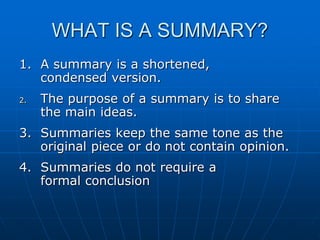
WHAT IS A SUMMARY?
1. A summary is a shortened,
condensed version.
2. The purpose of a summary is to share
the main ideas.
3. Summaries keep the same tone as the
original piece or do not contain opinion.
4. Summaries do not require a
formal conclusion
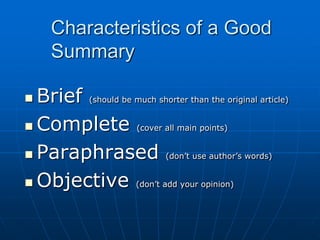
Characteristics of a Good
Summary
 Brief (should be much shorter than the original article)
 Complete (cover all main points)
 Paraphrased (don’t use author’s words)
 Objective (don’t add your opinion)
Steps in Writing a Summary:
Prewriting
 Read the article carefully, making
sure you understand the contents.
 Annotate (take notes) the article,
noting the thesis statement and the
major supporting details
 Using your annotations (notes),
create an outline that shows the
main organization of the article.
Steps in Writing a Summary:
Writing
 Begin with a sentence that includes
• author’s name
• title of the article
• thesis of the article
 According to Joe Smith in “Healthy Eating
for Life,” the foods we choose to eat
influence the length and quality of our lives.
 Joe Smith states in “Healthy Eating for Life”
that the foods we choose to eat influence
the length and quality of our lives.
Steps in Writing a Summary:
Writing
 Follow with sentences that
paraphrase major supporting points
• Paraphrase = state in your own words
 Enclose any directly quoted material
in quotation marks
 After the first sentence, refer to the
author by last name or as “the
author”
• Smith states a diet high in animal fats and sugars
can lead to obesity and cardiovascular problems.
How to Condense a Summary
 Omit examples
 Omit restatements
 Create lists to combine key points
from multiple sentences or
paragraphs
Steps in Writing a Summary:
Revising
 Compare the summary to the
original article to make sure you
have included all the important
points.
 Double check to make sure you have
paraphrased the material accurately.
 Proofread for complete sentences,
correct grammar, punctuation, and
spelling.
How to Plan Your Summary
Things to include:
I Identify the Item
- Book, story, article, chapter
- Title
- Author
V Summary Verb
F Main Idea
- Important details
I V F
(identify the item) (choose a verb) (finish the thought)
Topic Sentence:
Fact Outline (approximately 4-7) “J.O.T.”
___
____
____
____
Conclusion = Summaries do not require a conclusion.
Finally, write your summary following the fact outline.
b
summarize
summary
retell
important details
main ideas
SUTW-10-EL(U)
USE STRONG VERBS
 tells explains compares
lists shows defines acknowledges
evaluates classifies adds
defends assertsfeatures depicts
identifies entertains confirms names
considers offers judges contrasts
praises demonstrates provides recommends
endorses asks suggests entices
YOUR TURN: DIRECTIONS
 Read the following informational article.
 As you read, you may mark the article or
make notes.
 After reading the article, plan and write a
summary of what you have read USING the
organizer.
 You may reread or go back to the article at
any time.

Summary Writing.ppt on ways to write summary essays

  • 1.
  • 2.
    WHAT IS ASUMMARY? 1. A summary is a shortened, condensed version. 2. The purpose of a summary is to share the main ideas. 3. Summaries keep the same tone as the original piece or do not contain opinion. 4. Summaries do not require a formal conclusion
  • 3.
    Characteristics of aGood Summary  Brief (should be much shorter than the original article)  Complete (cover all main points)  Paraphrased (don’t use author’s words)  Objective (don’t add your opinion)
  • 4.
    Steps in Writinga Summary: Prewriting  Read the article carefully, making sure you understand the contents.  Annotate (take notes) the article, noting the thesis statement and the major supporting details  Using your annotations (notes), create an outline that shows the main organization of the article.
  • 5.
    Steps in Writinga Summary: Writing  Begin with a sentence that includes • author’s name • title of the article • thesis of the article  According to Joe Smith in “Healthy Eating for Life,” the foods we choose to eat influence the length and quality of our lives.  Joe Smith states in “Healthy Eating for Life” that the foods we choose to eat influence the length and quality of our lives.
  • 6.
    Steps in Writinga Summary: Writing  Follow with sentences that paraphrase major supporting points • Paraphrase = state in your own words  Enclose any directly quoted material in quotation marks  After the first sentence, refer to the author by last name or as “the author” • Smith states a diet high in animal fats and sugars can lead to obesity and cardiovascular problems.
  • 7.
    How to Condensea Summary  Omit examples  Omit restatements  Create lists to combine key points from multiple sentences or paragraphs
  • 8.
    Steps in Writinga Summary: Revising  Compare the summary to the original article to make sure you have included all the important points.  Double check to make sure you have paraphrased the material accurately.  Proofread for complete sentences, correct grammar, punctuation, and spelling.
  • 9.
    How to PlanYour Summary Things to include: I Identify the Item - Book, story, article, chapter - Title - Author V Summary Verb F Main Idea - Important details I V F (identify the item) (choose a verb) (finish the thought) Topic Sentence: Fact Outline (approximately 4-7) “J.O.T.” ___ ____ ____ ____ Conclusion = Summaries do not require a conclusion. Finally, write your summary following the fact outline. b summarize summary retell important details main ideas SUTW-10-EL(U)
  • 10.
    USE STRONG VERBS tells explains compares lists shows defines acknowledges evaluates classifies adds defends assertsfeatures depicts identifies entertains confirms names considers offers judges contrasts praises demonstrates provides recommends endorses asks suggests entices
  • 11.
    YOUR TURN: DIRECTIONS Read the following informational article.  As you read, you may mark the article or make notes.  After reading the article, plan and write a summary of what you have read USING the organizer.  You may reread or go back to the article at any time.