Day 1, Session 6
Russell Reed
Sue Lawrence
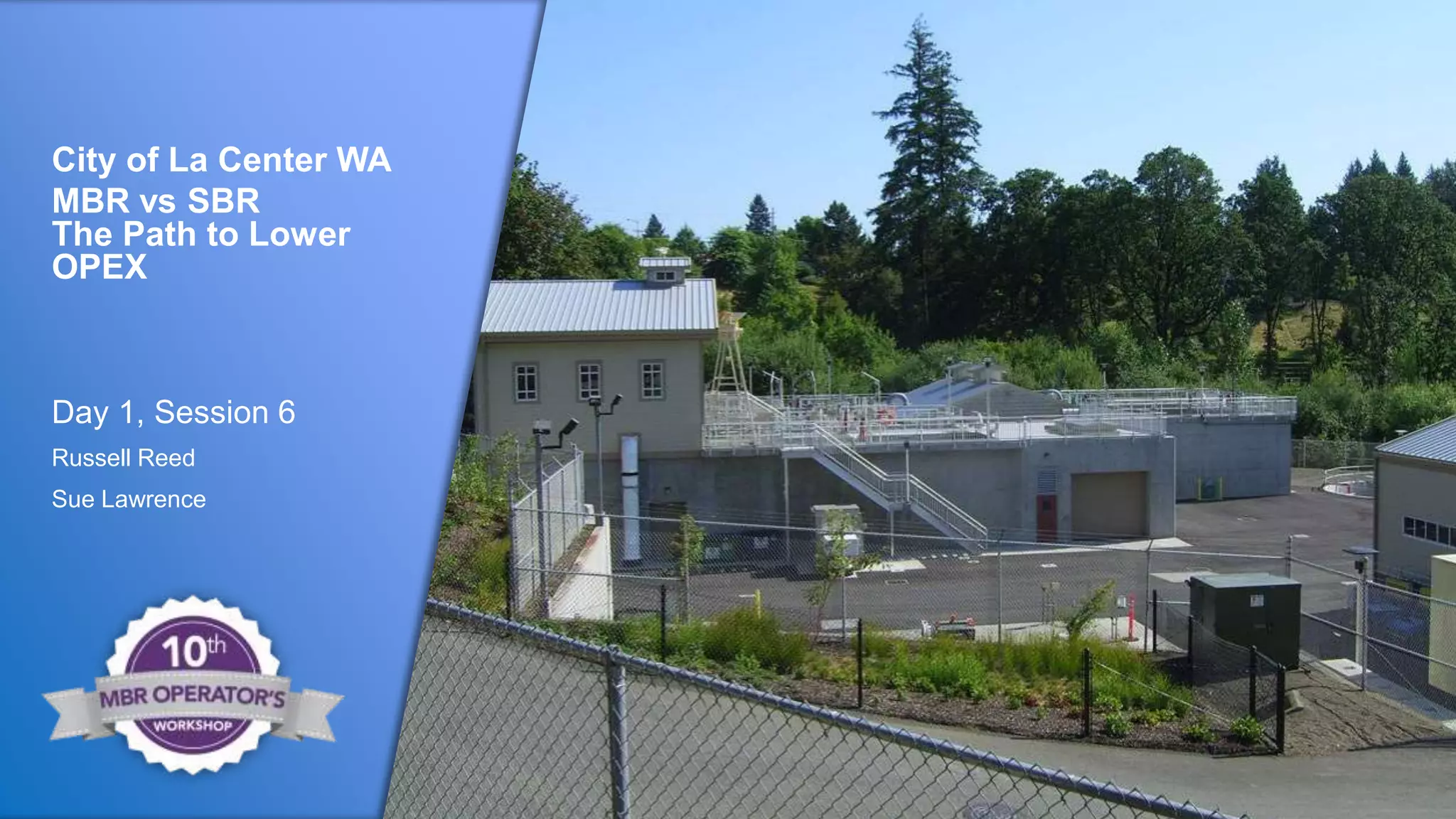
City of La Center WA
MBR vs SBR
The Path to Lower
OPEX
2 MBRcentral.com
Copyright© 2015 Ovivo Inc. All rights reserved.
2 ovivowater.com
Copyright© 2015 Ovivo Inc. All rights reserved.
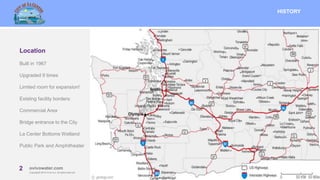
Location
HISTORY
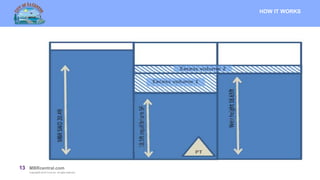
Built in 1967
Upgraded 9 times
Limited room for expansion!
Existing facility borders:
Commercial Area
Bridge entrance to the City
La Center Bottoms Wetland
Public Park and Amphitheater
3 MBRcentral.com
Copyright© 2015 Ovivo Inc. All rights reserved.
3 ovivowater.com
Copyright© 2015 Ovivo Inc. All rights reserved.
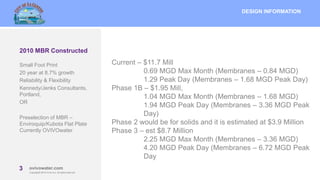
2010 MBR Constructed
DESIGN INFORMATION
Current – $11.7 Mill
0.69 MGD Max Month (Membranes – 0.84 MGD)
1.29 Peak Day (Membranes – 1.68 MGD Peak Day)
Phase 1B – $1.95 Mill,
1.04 MGD Max Month (Membranes – 1.68 MGD)
1.94 MGD Peak Day (Membranes – 3.36 MGD Peak
Day)
Phase 2 would be for solids and it is estimated at $3.9 Million
Phase 3 – est $8.7 Million
2.25 MGD Max Month (Membranes – 3.36 MGD)
4.20 MGD Peak Day (Membranes – 6.72 MGD Peak
Day
Small Foot Print
20 year at 8.7% growth
Reliability & Flexibility
Kennedy/Jenks Consultants,
Portland,
OR
Preselection of MBR –
Enviroquip/Kubota Flat Plate
Currently OVIVOwater
4 MBRcentral.com
Copyright© 2015 Ovivo Inc. All rights reserved.
4 MBRcentral.com
Copyright© 2015 Ovivo Inc. All rights reserved.
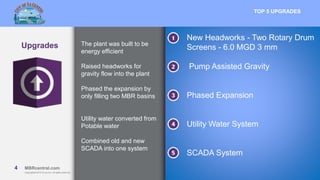
Upgrades
TOP 5 UPGRADES
The plant was built to be
energy efficient
Raised headworks for
gravity flow into the plant
Phased the expansion by
only filling two MBR basins
Utility water converted from
Potable water
Combined old and new
SCADA into one system
New Headworks - Two Rotary Drum
Screens - 6.0 MGD 3 mm
Pump Assisted Gravity
Phased Expansion
Utility Water System
SCADA System
5 MBRcentral.com
Copyright© 2015 Ovivo Inc. All rights reserved.
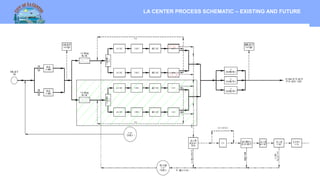
LA CENTER PROCESS SCHEMATIC – EXISTING AND FUTURE
6 ovivowater.com/mbr
Copyright© 2013 GLV Inc. All rights reserved.
T h e L a C e n t e r w a s t e w a t e r
T r e a t m e n t P l a n t
7 MBRcentral.com
Copyright© 2015 Ovivo Inc. All rights reserved.
7 ovivowater.com
Copyright© 2015 Ovivo Inc. All rights reserved.
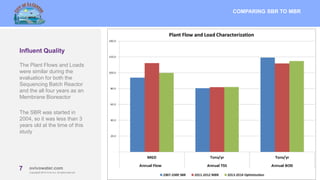
Influent Quality
COMPARING SBR TO MBR
The Plant Flows and Loads
were similar during the
evaluation for both the
Sequencing Batch Reactor
and the all four years as an
Membrane Bioreactor
The SBR was started in
2004, so it was less than 3
years old at the time of this
study
8 MBRcentral.com
Copyright© 2015 Ovivo Inc. All rights reserved.
8 MBRcentral.com
Copyright© 2015 Ovivo Inc. All rights reserved.
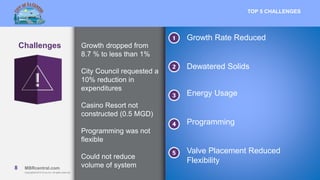
Challenges
TOP 5 CHALLENGES
Growth dropped from
8.7 % to less than 1%
City Council requested a
10% reduction in
expenditures
Casino Resort not
constructed (0.5 MGD)
Programming was not
flexible
Could not reduce
volume of system
Growth Rate Reduced
Dewatered Solids
Energy Usage
Programming
Valve Placement Reduced
Flexibility
9 MBRcentral.com
Copyright© 2015 Ovivo Inc. All rights reserved.
9 MBRcentral.com
Copyright© 2015 Ovivo Inc. All rights reserved.
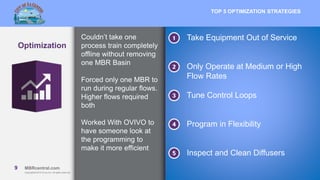
Optimization
TOP 5 OPTIMIZATION STRATEGIES
Couldn’t take one
process train completely
offline without removing
one MBR Basin
Forced only one MBR to
run during regular flows.
Higher flows required
both
Worked With OVIVO to
have someone look at
the programming to
make it more efficient
Take Equipment Out of Service
Only Operate at Medium or High
Flow Rates
Tune Control Loops
Program in Flexibility
Inspect and Clean Diffusers
10 MBRcentral.com
Copyright© 2015 Ovivo Inc. All rights reserved.
10 ovivowater.com
Copyright© 2015 Ovivo Inc. All rights reserved.
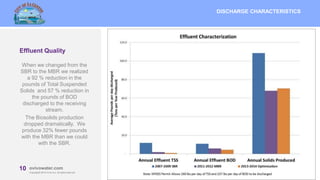
Effluent Quality
DISCHARGE CHARACTERISTICS
When we changed from the
SBR to the MBR we realized
a 92 % reduction in the
pounds of Total Suspended
Solids and 57 % reduction in
the pounds of BOD
discharged to the receiving
stream.
The Biosolids production
dropped dramatically. We
produce 32% fewer pounds
with the MBR than we could
with the SBR.
11 MBRcentral.com
Copyright© 2015 Ovivo Inc. All rights reserved.
11 ovivowater.com
Copyright© 2015 Ovivo Inc. All rights reserved.
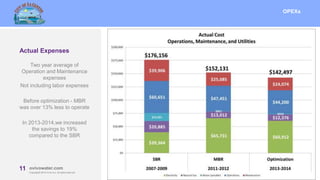
Actual Expenses
OPEXs
Two year average of
Operation and Maintenance
expenses
Not including labor expenses
Before optimization - MBR
was over 13% less to operate
In 2013-2014,we increased
the savings to 19%
compared to the SBR
12 MBRcentral.com
Copyright© 2015 Ovivo Inc. All rights reserved.
The standard flow-based control equation for permeate set
point:
– Fout = (Fin x Rf) x [Fm + (0.3 x Fc) x (Li-Le)/(Lh-Ll)]
• Fout = process train calculated flow set point
• Fin = time averaged influent flow divided by number of online trains
• Rf = [(Relax Freq – Relax Duration ) / Relax Freq ] -1
• Fm = meter correction factor, 0.85 to 2.0
• Fc = gain for level correction, 0.85 to 2.0
• Li = average or individual controlling basin level
• Le = desired equilibrium level
• Lh = high flow level set point
• Ll = low flow level set point
This was not intuitive to figure out how
changes in the settings would affect the
flow settings.
13 MBRcentral.com
Copyright© 2015 Ovivo Inc. All rights reserved.
HOW IT WORKS
14 MBRcentral.com
Copyright© 2015 Ovivo Inc. All rights reserved.
Program Change
Looks at incoming flow and at the difference in the basin level.
• If Li <= Lw, then dflow = ((Li - Le)* Vpa)/10
• If Li > Lw, then dflow = (((Lw - Le)* Vpa) + ((Li - Lw) * Vtot)/10 min)
𝐹𝑜𝑢𝑡 = ( 𝐹𝑖𝑛+(dflow*0.3))* 𝑅𝑓
Fout Calculated permeate flow set point in gpm
Fin Time averaged influent flow in gpm
Rf [(Relax freq – Relax duration) / Relax freq ] – 1 (1.11)
Li Average or individual controlling basin level, ft
Le Target Level, ft (Set by Operator)
Lw Weir Level, ft (Set by Operator)
Vpa Volume Aerated basins, gal/ft (Set by Operator)
Vtot Volume Aerated basins, gal/ft (Set by Operator)
15 MBRcentral.com
Copyright© 2015 Ovivo Inc. All rights reserved.
16 MBRcentral.com
Copyright© 2015 Ovivo Inc. All rights reserved.
16 ovivowater.com
Copyright© 2015 Ovivo Inc. All rights reserved.
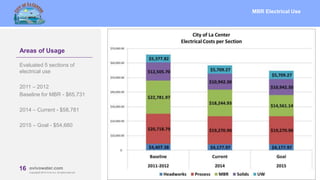
Areas of Usage
Evaluated 5 sections of
electrical use
2011 – 2012
Baseline for MBR - $65,731
2014 – Current - $58,781
2015 – Goal - $54,660
MBR Electrical Use
17 MBRcentral.com
Copyright© 2015 Ovivo Inc. All rights reserved.
17 ovivowater.com
Copyright© 2015 Ovivo Inc. All rights reserved.
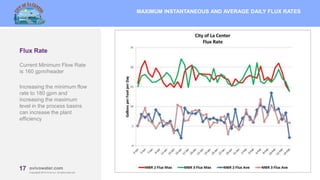
Flux Rate
Current Minimum Flow Rate
is 160 gpm/header
Increasing the minimum flow
rate to 180 gpm and
increasing the maximum
level in the process basins
can increase the plant
efficiency
MAXIMUM INSTANTANEOUS AND AVERAGE DAILY FLUX RATES
18 MBRcentral.com
Copyright© 2015 Ovivo Inc. All rights reserved.
18 ovivowater.com
Copyright© 2015 Ovivo Inc. All rights reserved.
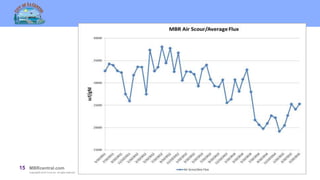
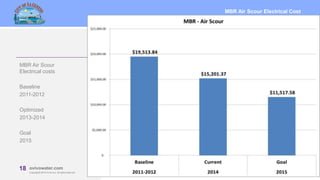
MBR Air Scour
Electrical costs
Baseline
2011-2012
Optimized
2013-2014
Goal
2015
MBR Air Scour Electrical Cost
Baseline, Current and Goal for MBR Air Scour electrical
19 MBRcentral.com
Copyright© 2015 Ovivo Inc. All rights reserved.
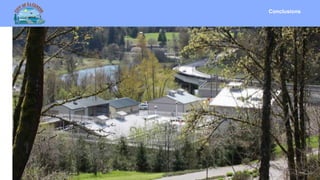
Conclusions
MBRcentral.com
Copyright© 2015 Ovivo Inc. All rights reserved.
Thank you!

Sue Lawrence:

  • 1.
    Day 1, Session6 Russell Reed Sue Lawrence City of La Center WA MBR vs SBR The Path to Lower OPEX
  • 2.
    2 MBRcentral.com Copyright© 2015Ovivo Inc. All rights reserved. 2 ovivowater.com Copyright© 2015 Ovivo Inc. All rights reserved. Location HISTORY Built in 1967 Upgraded 9 times Limited room for expansion! Existing facility borders: Commercial Area Bridge entrance to the City La Center Bottoms Wetland Public Park and Amphitheater
  • 3.
    3 MBRcentral.com Copyright© 2015Ovivo Inc. All rights reserved. 3 ovivowater.com Copyright© 2015 Ovivo Inc. All rights reserved. 2010 MBR Constructed DESIGN INFORMATION Current – $11.7 Mill 0.69 MGD Max Month (Membranes – 0.84 MGD) 1.29 Peak Day (Membranes – 1.68 MGD Peak Day) Phase 1B – $1.95 Mill, 1.04 MGD Max Month (Membranes – 1.68 MGD) 1.94 MGD Peak Day (Membranes – 3.36 MGD Peak Day) Phase 2 would be for solids and it is estimated at $3.9 Million Phase 3 – est $8.7 Million 2.25 MGD Max Month (Membranes – 3.36 MGD) 4.20 MGD Peak Day (Membranes – 6.72 MGD Peak Day Small Foot Print 20 year at 8.7% growth Reliability & Flexibility Kennedy/Jenks Consultants, Portland, OR Preselection of MBR – Enviroquip/Kubota Flat Plate Currently OVIVOwater
  • 4.
    4 MBRcentral.com Copyright© 2015Ovivo Inc. All rights reserved. 4 MBRcentral.com Copyright© 2015 Ovivo Inc. All rights reserved. Upgrades TOP 5 UPGRADES The plant was built to be energy efficient Raised headworks for gravity flow into the plant Phased the expansion by only filling two MBR basins Utility water converted from Potable water Combined old and new SCADA into one system New Headworks - Two Rotary Drum Screens - 6.0 MGD 3 mm Pump Assisted Gravity Phased Expansion Utility Water System SCADA System
  • 5.
    5 MBRcentral.com Copyright© 2015Ovivo Inc. All rights reserved. LA CENTER PROCESS SCHEMATIC – EXISTING AND FUTURE
  • 6.
    6 ovivowater.com/mbr Copyright© 2013GLV Inc. All rights reserved. T h e L a C e n t e r w a s t e w a t e r T r e a t m e n t P l a n t
  • 7.
    7 MBRcentral.com Copyright© 2015Ovivo Inc. All rights reserved. 7 ovivowater.com Copyright© 2015 Ovivo Inc. All rights reserved. Influent Quality COMPARING SBR TO MBR The Plant Flows and Loads were similar during the evaluation for both the Sequencing Batch Reactor and the all four years as an Membrane Bioreactor The SBR was started in 2004, so it was less than 3 years old at the time of this study
  • 8.
    8 MBRcentral.com Copyright© 2015Ovivo Inc. All rights reserved. 8 MBRcentral.com Copyright© 2015 Ovivo Inc. All rights reserved. Challenges TOP 5 CHALLENGES Growth dropped from 8.7 % to less than 1% City Council requested a 10% reduction in expenditures Casino Resort not constructed (0.5 MGD) Programming was not flexible Could not reduce volume of system Growth Rate Reduced Dewatered Solids Energy Usage Programming Valve Placement Reduced Flexibility
  • 9.
    9 MBRcentral.com Copyright© 2015Ovivo Inc. All rights reserved. 9 MBRcentral.com Copyright© 2015 Ovivo Inc. All rights reserved. Optimization TOP 5 OPTIMIZATION STRATEGIES Couldn’t take one process train completely offline without removing one MBR Basin Forced only one MBR to run during regular flows. Higher flows required both Worked With OVIVO to have someone look at the programming to make it more efficient Take Equipment Out of Service Only Operate at Medium or High Flow Rates Tune Control Loops Program in Flexibility Inspect and Clean Diffusers
  • 10.
    10 MBRcentral.com Copyright© 2015Ovivo Inc. All rights reserved. 10 ovivowater.com Copyright© 2015 Ovivo Inc. All rights reserved. Effluent Quality DISCHARGE CHARACTERISTICS When we changed from the SBR to the MBR we realized a 92 % reduction in the pounds of Total Suspended Solids and 57 % reduction in the pounds of BOD discharged to the receiving stream. The Biosolids production dropped dramatically. We produce 32% fewer pounds with the MBR than we could with the SBR.
  • 11.
    11 MBRcentral.com Copyright© 2015Ovivo Inc. All rights reserved. 11 ovivowater.com Copyright© 2015 Ovivo Inc. All rights reserved. Actual Expenses OPEXs Two year average of Operation and Maintenance expenses Not including labor expenses Before optimization - MBR was over 13% less to operate In 2013-2014,we increased the savings to 19% compared to the SBR
  • 12.
    12 MBRcentral.com Copyright© 2015Ovivo Inc. All rights reserved. The standard flow-based control equation for permeate set point: – Fout = (Fin x Rf) x [Fm + (0.3 x Fc) x (Li-Le)/(Lh-Ll)] • Fout = process train calculated flow set point • Fin = time averaged influent flow divided by number of online trains • Rf = [(Relax Freq – Relax Duration ) / Relax Freq ] -1 • Fm = meter correction factor, 0.85 to 2.0 • Fc = gain for level correction, 0.85 to 2.0 • Li = average or individual controlling basin level • Le = desired equilibrium level • Lh = high flow level set point • Ll = low flow level set point This was not intuitive to figure out how changes in the settings would affect the flow settings.
  • 13.
    13 MBRcentral.com Copyright© 2015Ovivo Inc. All rights reserved. HOW IT WORKS
  • 14.
    14 MBRcentral.com Copyright© 2015Ovivo Inc. All rights reserved. Program Change Looks at incoming flow and at the difference in the basin level. • If Li <= Lw, then dflow = ((Li - Le)* Vpa)/10 • If Li > Lw, then dflow = (((Lw - Le)* Vpa) + ((Li - Lw) * Vtot)/10 min) 𝐹𝑜𝑢𝑡 = ( 𝐹𝑖𝑛+(dflow*0.3))* 𝑅𝑓 Fout Calculated permeate flow set point in gpm Fin Time averaged influent flow in gpm Rf [(Relax freq – Relax duration) / Relax freq ] – 1 (1.11) Li Average or individual controlling basin level, ft Le Target Level, ft (Set by Operator) Lw Weir Level, ft (Set by Operator) Vpa Volume Aerated basins, gal/ft (Set by Operator) Vtot Volume Aerated basins, gal/ft (Set by Operator)
  • 15.
    15 MBRcentral.com Copyright© 2015Ovivo Inc. All rights reserved.
  • 16.
    16 MBRcentral.com Copyright© 2015Ovivo Inc. All rights reserved. 16 ovivowater.com Copyright© 2015 Ovivo Inc. All rights reserved. Areas of Usage Evaluated 5 sections of electrical use 2011 – 2012 Baseline for MBR - $65,731 2014 – Current - $58,781 2015 – Goal - $54,660 MBR Electrical Use
  • 17.
    17 MBRcentral.com Copyright© 2015Ovivo Inc. All rights reserved. 17 ovivowater.com Copyright© 2015 Ovivo Inc. All rights reserved. Flux Rate Current Minimum Flow Rate is 160 gpm/header Increasing the minimum flow rate to 180 gpm and increasing the maximum level in the process basins can increase the plant efficiency MAXIMUM INSTANTANEOUS AND AVERAGE DAILY FLUX RATES
  • 18.
    18 MBRcentral.com Copyright© 2015Ovivo Inc. All rights reserved. 18 ovivowater.com Copyright© 2015 Ovivo Inc. All rights reserved. MBR Air Scour Electrical costs Baseline 2011-2012 Optimized 2013-2014 Goal 2015 MBR Air Scour Electrical Cost Baseline, Current and Goal for MBR Air Scour electrical
  • 19.
    19 MBRcentral.com Copyright© 2015Ovivo Inc. All rights reserved. Conclusions
  • 20.
    MBRcentral.com Copyright© 2015 OvivoInc. All rights reserved. Thank you!

Editor's Notes

  • #3 In 2004, Clark Public Utilities built a Sequencing Batch Reactor to treat a peak day of 1.0 MGD. Expansion plans for the Site was a peak day of 2.0 MGD
  • #5 Built the headworks for gravity flow into the plant and process basins Not using membranes we didn’t need will extend the life and reduce the costs to replace the membranes
  • #6 The flow goes through fine screens in the headworks, parshall flume and into a channel splitting the flow into two trains, anoxic, swing , aerated. Feed forward design into the MBR and overflows into the channel and the recycle gravity flows to anoxic basins. Permeate is disinfected in inline UV and flows either to a storage tank for the utility water or out to the river. Solids are sent to an aerated storage tank, transferred to a day tank and then dewatered with a rotary fan press and dried in a batch dryer to meet class A EQ solids for use at Lewis River reforestation. Utility water is used for the press and dryer and recycled for treatment.
  • #8 Probably the most unique part is the growth in the city quit at the same time we were doing the construction of the upgraded treatment plant and it has continued for a few years which has allowed a good comparison between the two treatment systems. The flows and loads have not varied significantly. The flow in 2011-2012 in inflated by the recycle from the press and dryer initially being sent through the screens and influent flow meter. It is now discharged into the recycle channel downstream of the meter.
  • #9 Because we converted the SBR tanks to the process tanks we were limited in some flexibility. One problem is that we cannot isolate part of the process train without removing an MBR as well.
  • #10 The basins with the existing program would run both tanks at lower flow rates and not run one at high. Removing one tank and cleaning and storing the membranes seemed to be risky. It would reduce our ability to clean the operating MBR, not be available if we had a high flow event etc.
  • #11 The big change was in the tons of solids produced in the SBR compared to the MBR and the quality of the effluent discharged from the facility. We have seen an 88% reduction in pounds of TSS discharged and 53 % reduction in pounds of BOD. We are almost always below the detection limit on both the BOD and TSS in the effluent discharged.
  • #12 Operational costs were for items like polymer, lab supplies, cleaning chemicals Maintenance costs were parts, UV bulbs, outside personnel, electricians, mechanics, etc Utilities were water, natural gas, electricity We did not include the labor expenses in the evaluation as no changes were made in staffing and we have not had a significant change in overtime. One of the benefits of the MBR is we have reduced the time operators spend in the lab and have been able to increase the preventative maintenance and do more repairs ourselves rather than sending things out for repair. As you can see the Plant electrical use increased significantly. This was offset by the ability to reuse the effluent for the dewatering and drying units. This was a reduction in the purchase of over 7 MG per year of potable water. The use of natural gas dropped with the reduction in solids produced by the MBR. The SBR produced 0.9 lbs biosolids per pound BOD, while the MBR produces 0.6 lbs biosolids per pound of BOD
  • #13 We had two operational modes. One was a fill and permeate or level controlled. The other was a program that looked at incoming flow and allowed for some fluctuation in the basins to be able to cut off high peak flows. The flow based program, contained all sorts of correction factors which were difficult to fine tune. Both programs would allow the system to operate on one or both basins on a low flow setting ½ Q which prevented it from being energy efficient.
  • #14 Ovivo sent an integrator out to work with us on optimizing the control system to do what we were doing manually. Russell Reed came out and worked with us on a program that would allow the system to work with only one MBR online, maintain the basin levels, shut off one or both basins, and allow the operator to adjust setpoints to optimize the permeate flows and air scour. By using the volume of the tanks we had for equalization it would allows us to permeate at medium to high flows and then allow the basins to go itno intermittent mode until the basins filled back up.
  • #17 We started with energy efficiency because of the increased electrical costs. We looked at each section of the plant to see what each was costing and how to reduce it. So the 2011-2012 was the baseline. The 2014 was after we had redone the programming in the basin. And the 2015 is the goal for this year. Utilized the “Process Trends” to track where the most air was being used Looked for ways to reduce the usage Looked at electrical use of other equipment in the plant
  • #18 Current minimum flow rate is 160 gpm Next step is increase it to 180 gpm which will put the maximum flux at about 16.5 and the average should remain the same
  • #19 The baseline for 2011- 2012 for the MBR section of the plant. In 2014 after optimization the electrical cost for the Air Scour dropped by 22 %. I am predicting the cost to drop by more than 30 % for the 2011-2012 baseline in 2015. This can be accomplished by increasing the minimum flow setpoint to 180 gpm. This will put the instantaneous flux rate at 16.5, but it will maintain the same average daily flux as the plant will permeate for fewer minutes.
  • #20 An MBR plant can be optimized to be energy efficient. The cost to operate the City of La Center plant was 13.6% less than the SBR at the same flows and loads and after we went through an optimization project we increased the savings to 19% and expect to be able to realize additional savings. With optimization the operational costs were reduced to be 19 % less overall compared to the SBR plant the City had been running for 4 years. With further optimization the electrical costs could be reduced further with little or no impact on the MBR. Some additional treatment components added significant electrical costs, for example odor control, which is not directly related to the electrical cost of the MBR. Need to be able to look at apples to apples if possible when making comparisons.