Supporting LDCs to advance their National Adaptation Plans
Africa Regional Training Workshop (Anglophone)
UN Conference Centre, Addis Ababa, Ethiopia
14-17 April 2014
Experience and lessons learnt from Sudan’s
National Adaptation Plan (NAP)
Dr. El amin Sanjak
Director, Teaching Assistants and Training Administration
University of Khartoum
Element B: Preparatory elements
Experience from Sudan
Presentation outline
• Framework of Sudan’s NAP Preparation
Process
• Objective of the NAP in Sudan
• Main steps
• Lessons learnt for NAP
SupportingLDCs to advancetheir National AdaptationPlans
Africa RegionalTrainingWorkshop (Anglophone)
SupportingLDCs to advancetheir National AdaptationPlans
Africa RegionalTrainingWorkshop (Anglophone)
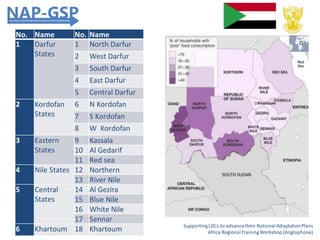
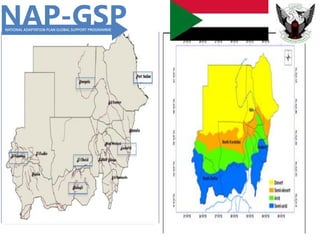
No. Name No. Name
1 Darfur
States
1 North Darfur
2 West Darfur
3 South Darfur
4 East Darfur
5 Central Darfur
2 Kordofan
States
6 N Kordofan
7 S Kordofan
8 W Kordofan
3 Eastern
States
9 Kassala
10 Al Gedarif
11 Red sea
4 Nile States 12 Northern
13 River Nile
5 Central
States
14 Al Gezira
15 Blue Nile
16 White Nile
17 Sennar
6 Khartoum 18 Khartoum
Objectives of Sudan's NAP
– To reduce vulnerability to climate
change by building adaptive capacity
and resilience among state- and
national-level institutions.
– To establish institutional arrangements
and development at state and federal
levels
– To promote the integration of climate
change adaptation perspectives into
existing and new policies, programmes
and activities
SupportingLDCs to advancetheir National AdaptationPlans
Africa RegionalTrainingWorkshop (Anglophone)
NAP in Sudan
Framework
• National Adaption Plan (NAP) project has been implemented in 2011 by
HCENR and supported by UNEP- Sudan.
• The NAP project consists of 7 themes that guided to develop the NAP:
– Theme 1: Vulnerability of Sudan’s Water Resources, Agriculture And
Public Health
– Theme 2: “Hotspot” mapping
– Theme 3: Coastal Zone Vulnerability to Climate Change
– Theme 4: Investment and Financial Flows for Adapting to Climate
Change
– Theme 5: Climatic –proofing projects and Programme
– Theme 6: Enhancing Local Development Projects
– Theme 7: Enhance Observational Systems
– National Planning Adaption Planning
SupportingLDCs to advancetheir National AdaptationPlans
Africa RegionalTrainingWorkshop (Anglophone)
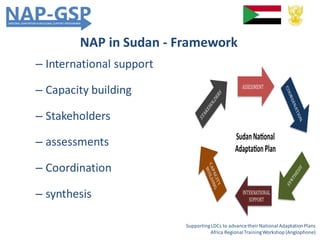
NAP in Sudan - Framework
– International support
– Capacity building
– Stakeholders
– assessments
– Coordination
– synthesis
SupportingLDCs to advancetheir National AdaptationPlans
Africa RegionalTrainingWorkshop (Anglophone)
Main Steps
1. Analyzing current climate and future climate change
scenarios.
2. Assessing climate vulnerabilities and identifying
adaptation options at the sector, subnational, national
and other appropriate levels.
3. Reviewing and appraising adaptation options
4. Compiling and communicating national adaptation
plans.
5. Integrating climate change adaptation into national
and subnational development and sectorial planning.
SupportingLDCs to advancetheir National AdaptationPlans
Africa RegionalTrainingWorkshop (Anglophone)
Sector- and State-Based V&A Assessments
SupportingLDCs to advancetheir National AdaptationPlans
Africa RegionalTrainingWorkshop (Anglophone)
Objective: Vulnerabilities to CC in the 3 sectors; Identify
medium and long-term adaptation strategies
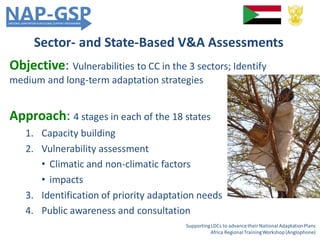
Approach: 4 stages in each of the 18 states
1. Capacity building
2. Vulnerability assessment
• Climatic and non-climatic factors
• impacts
3. Identification of priority adaptation needs
4. Public awareness and consultation
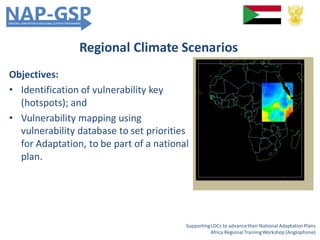
Regional Climate Scenarios
SupportingLDCs to advancetheir National AdaptationPlans
Africa RegionalTrainingWorkshop (Anglophone)
Objectives:
• Identification of vulnerability key
(hotspots); and
• Vulnerability mapping using
vulnerability database to set priorities
for Adaptation, to be part of a national
plan.
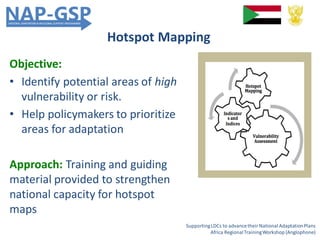
Hotspot Mapping
SupportingLDCs to advancetheir National AdaptationPlans
Africa RegionalTrainingWorkshop (Anglophone)
Objective:
• Identify potential areas of high
vulnerability or risk.
• Help policymakers to prioritize
areas for adaptation
Approach: Training and guiding
material provided to strengthen
national capacity for hotspot
maps
SupportingLDCs to advancetheir National AdaptationPlans
Africa RegionalTrainingWorkshop (Anglophone)
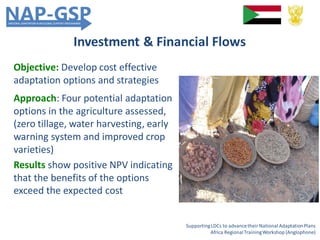
Objective: Develop cost effective
adaptation options and strategies
Approach: Four potential adaptation
options in the agriculture assessed,
(zero tillage, water harvesting, early
warning system and improved crop
varieties)
Results show positive NPV indicating
that the benefits of the options
exceed the expected cost
Investment & Financial Flows
SupportingLDCs to advancetheir National AdaptationPlans
Africa RegionalTrainingWorkshop (Anglophone)
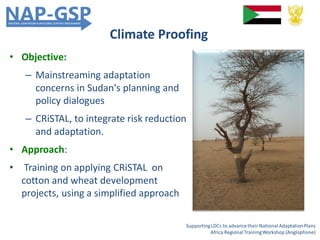
• Objective:
– Mainstreaming adaptation
concerns in Sudan's planning and
policy dialogues
– CRiSTAL, to integrate risk reduction
and adaptation.
• Approach:
• Training on applying CRiSTAL on
cotton and wheat development
projects, using a simplified approach
Climate Proofing
SupportingLDCs to advancetheir National AdaptationPlans
Africa RegionalTrainingWorkshop (Anglophone)
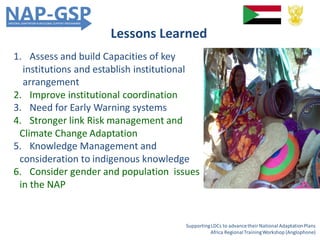
1. Assess and build Capacities of key
institutions and establish institutional
arrangement
2. Improve institutional coordination
3. Need for Early Warning systems
4. Stronger link Risk management and
Climate Change Adaptation
5. Knowledge Management and
consideration to indigenous knowledge
6. Consider gender and population issues
in the NAP
Lessons Learned
Thank You
SupportingLDCs to advancetheir National AdaptationPlans
Africa RegionalTrainingWorkshop (Anglophone)

Sudan - NAP Climate Change Adaptation Experiences

  • 1.
    Supporting LDCs toadvance their National Adaptation Plans Africa Regional Training Workshop (Anglophone) UN Conference Centre, Addis Ababa, Ethiopia 14-17 April 2014 Experience and lessons learnt from Sudan’s National Adaptation Plan (NAP) Dr. El amin Sanjak Director, Teaching Assistants and Training Administration University of Khartoum
  • 2.
    Element B: Preparatoryelements Experience from Sudan Presentation outline • Framework of Sudan’s NAP Preparation Process • Objective of the NAP in Sudan • Main steps • Lessons learnt for NAP SupportingLDCs to advancetheir National AdaptationPlans Africa RegionalTrainingWorkshop (Anglophone)
  • 3.
    SupportingLDCs to advancetheirNational AdaptationPlans Africa RegionalTrainingWorkshop (Anglophone) No. Name No. Name 1 Darfur States 1 North Darfur 2 West Darfur 3 South Darfur 4 East Darfur 5 Central Darfur 2 Kordofan States 6 N Kordofan 7 S Kordofan 8 W Kordofan 3 Eastern States 9 Kassala 10 Al Gedarif 11 Red sea 4 Nile States 12 Northern 13 River Nile 5 Central States 14 Al Gezira 15 Blue Nile 16 White Nile 17 Sennar 6 Khartoum 18 Khartoum
  • 4.
    Objectives of Sudan'sNAP – To reduce vulnerability to climate change by building adaptive capacity and resilience among state- and national-level institutions. – To establish institutional arrangements and development at state and federal levels – To promote the integration of climate change adaptation perspectives into existing and new policies, programmes and activities SupportingLDCs to advancetheir National AdaptationPlans Africa RegionalTrainingWorkshop (Anglophone)
  • 5.
    NAP in Sudan Framework •National Adaption Plan (NAP) project has been implemented in 2011 by HCENR and supported by UNEP- Sudan. • The NAP project consists of 7 themes that guided to develop the NAP: – Theme 1: Vulnerability of Sudan’s Water Resources, Agriculture And Public Health – Theme 2: “Hotspot” mapping – Theme 3: Coastal Zone Vulnerability to Climate Change – Theme 4: Investment and Financial Flows for Adapting to Climate Change – Theme 5: Climatic –proofing projects and Programme – Theme 6: Enhancing Local Development Projects – Theme 7: Enhance Observational Systems – National Planning Adaption Planning SupportingLDCs to advancetheir National AdaptationPlans Africa RegionalTrainingWorkshop (Anglophone)
  • 6.
    NAP in Sudan- Framework – International support – Capacity building – Stakeholders – assessments – Coordination – synthesis SupportingLDCs to advancetheir National AdaptationPlans Africa RegionalTrainingWorkshop (Anglophone)
  • 7.
    Main Steps 1. Analyzingcurrent climate and future climate change scenarios. 2. Assessing climate vulnerabilities and identifying adaptation options at the sector, subnational, national and other appropriate levels. 3. Reviewing and appraising adaptation options 4. Compiling and communicating national adaptation plans. 5. Integrating climate change adaptation into national and subnational development and sectorial planning. SupportingLDCs to advancetheir National AdaptationPlans Africa RegionalTrainingWorkshop (Anglophone)
  • 8.
    Sector- and State-BasedV&A Assessments SupportingLDCs to advancetheir National AdaptationPlans Africa RegionalTrainingWorkshop (Anglophone) Objective: Vulnerabilities to CC in the 3 sectors; Identify medium and long-term adaptation strategies Approach: 4 stages in each of the 18 states 1. Capacity building 2. Vulnerability assessment • Climatic and non-climatic factors • impacts 3. Identification of priority adaptation needs 4. Public awareness and consultation
  • 9.
    Regional Climate Scenarios SupportingLDCsto advancetheir National AdaptationPlans Africa RegionalTrainingWorkshop (Anglophone) Objectives: • Identification of vulnerability key (hotspots); and • Vulnerability mapping using vulnerability database to set priorities for Adaptation, to be part of a national plan.
  • 11.
    Hotspot Mapping SupportingLDCs toadvancetheir National AdaptationPlans Africa RegionalTrainingWorkshop (Anglophone) Objective: • Identify potential areas of high vulnerability or risk. • Help policymakers to prioritize areas for adaptation Approach: Training and guiding material provided to strengthen national capacity for hotspot maps
  • 12.
    SupportingLDCs to advancetheirNational AdaptationPlans Africa RegionalTrainingWorkshop (Anglophone) Objective: Develop cost effective adaptation options and strategies Approach: Four potential adaptation options in the agriculture assessed, (zero tillage, water harvesting, early warning system and improved crop varieties) Results show positive NPV indicating that the benefits of the options exceed the expected cost Investment & Financial Flows
  • 13.
    SupportingLDCs to advancetheirNational AdaptationPlans Africa RegionalTrainingWorkshop (Anglophone) • Objective: – Mainstreaming adaptation concerns in Sudan's planning and policy dialogues – CRiSTAL, to integrate risk reduction and adaptation. • Approach: • Training on applying CRiSTAL on cotton and wheat development projects, using a simplified approach Climate Proofing
  • 14.
    SupportingLDCs to advancetheirNational AdaptationPlans Africa RegionalTrainingWorkshop (Anglophone) 1. Assess and build Capacities of key institutions and establish institutional arrangement 2. Improve institutional coordination 3. Need for Early Warning systems 4. Stronger link Risk management and Climate Change Adaptation 5. Knowledge Management and consideration to indigenous knowledge 6. Consider gender and population issues in the NAP Lessons Learned
  • 15.
    Thank You SupportingLDCs toadvancetheir National AdaptationPlans Africa RegionalTrainingWorkshop (Anglophone)