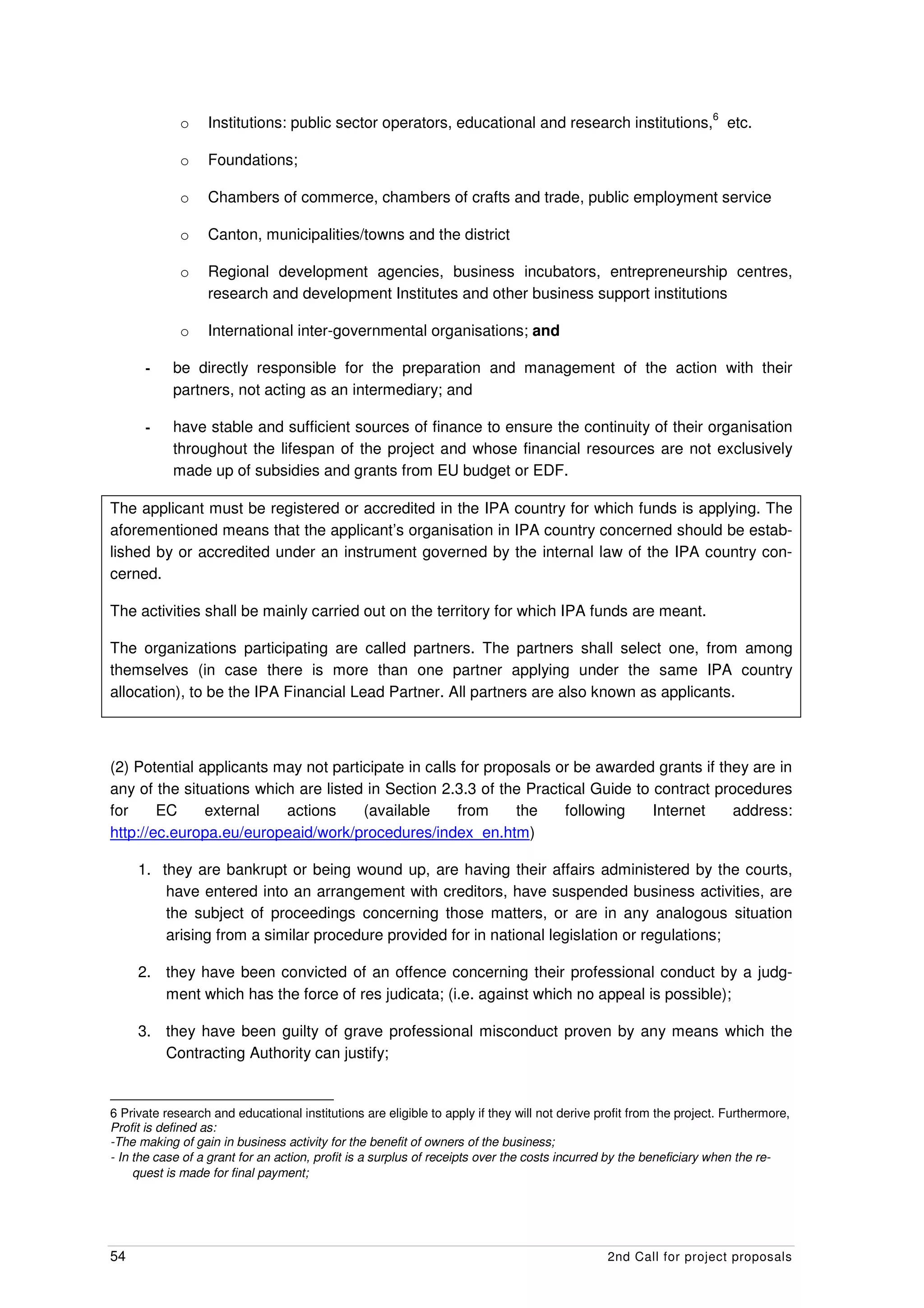
South East Europe (SEE)
               Programme Manual

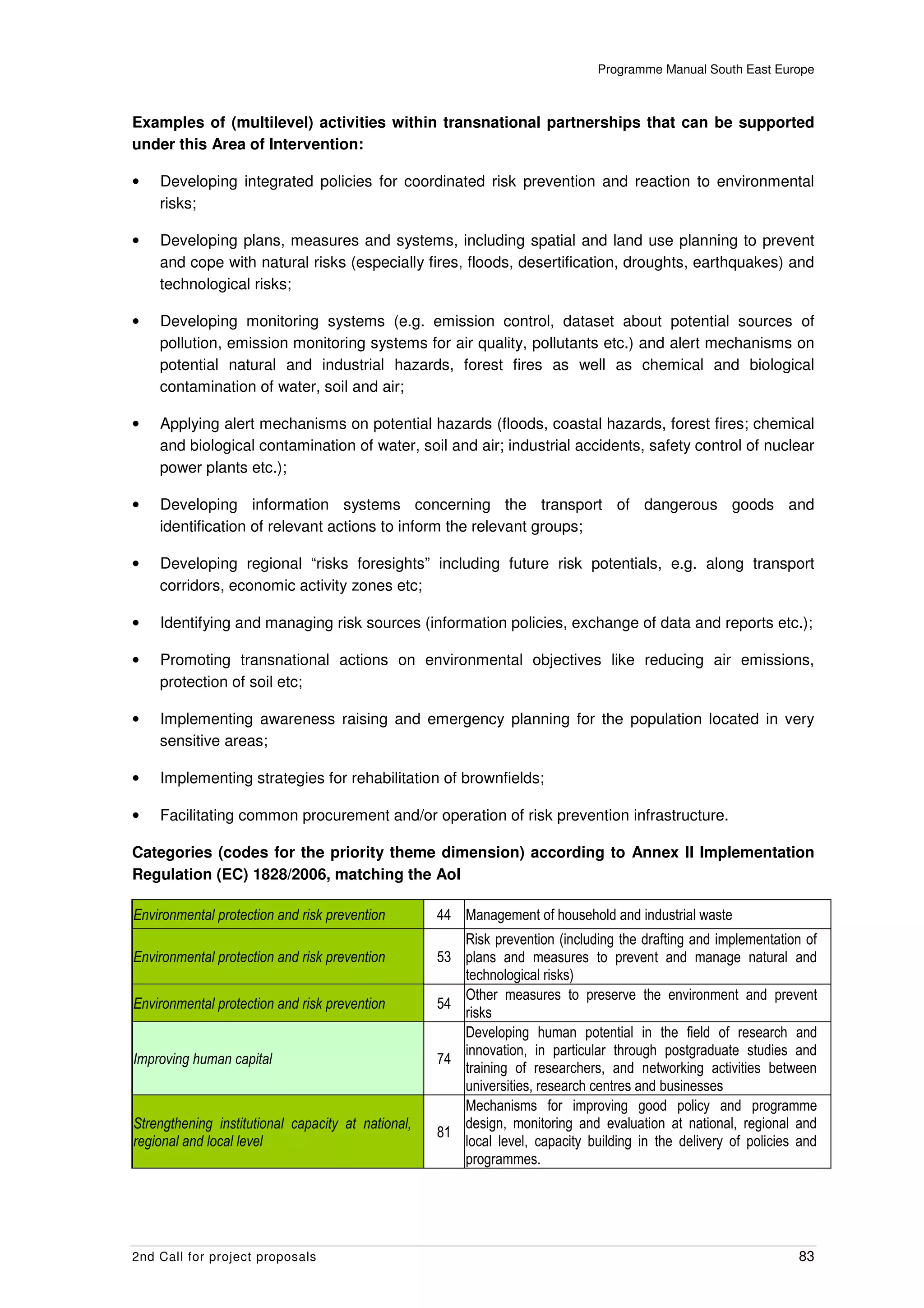
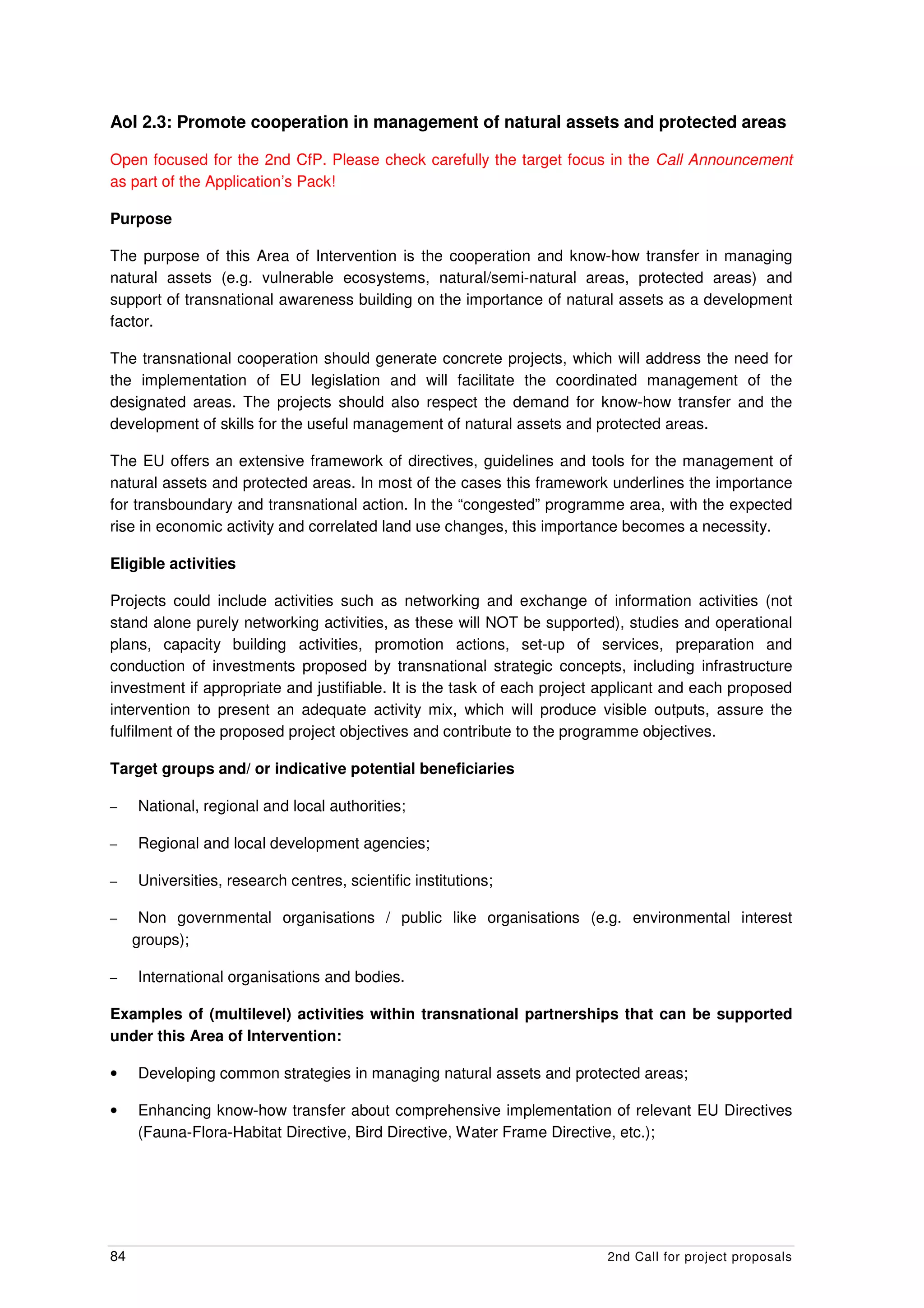
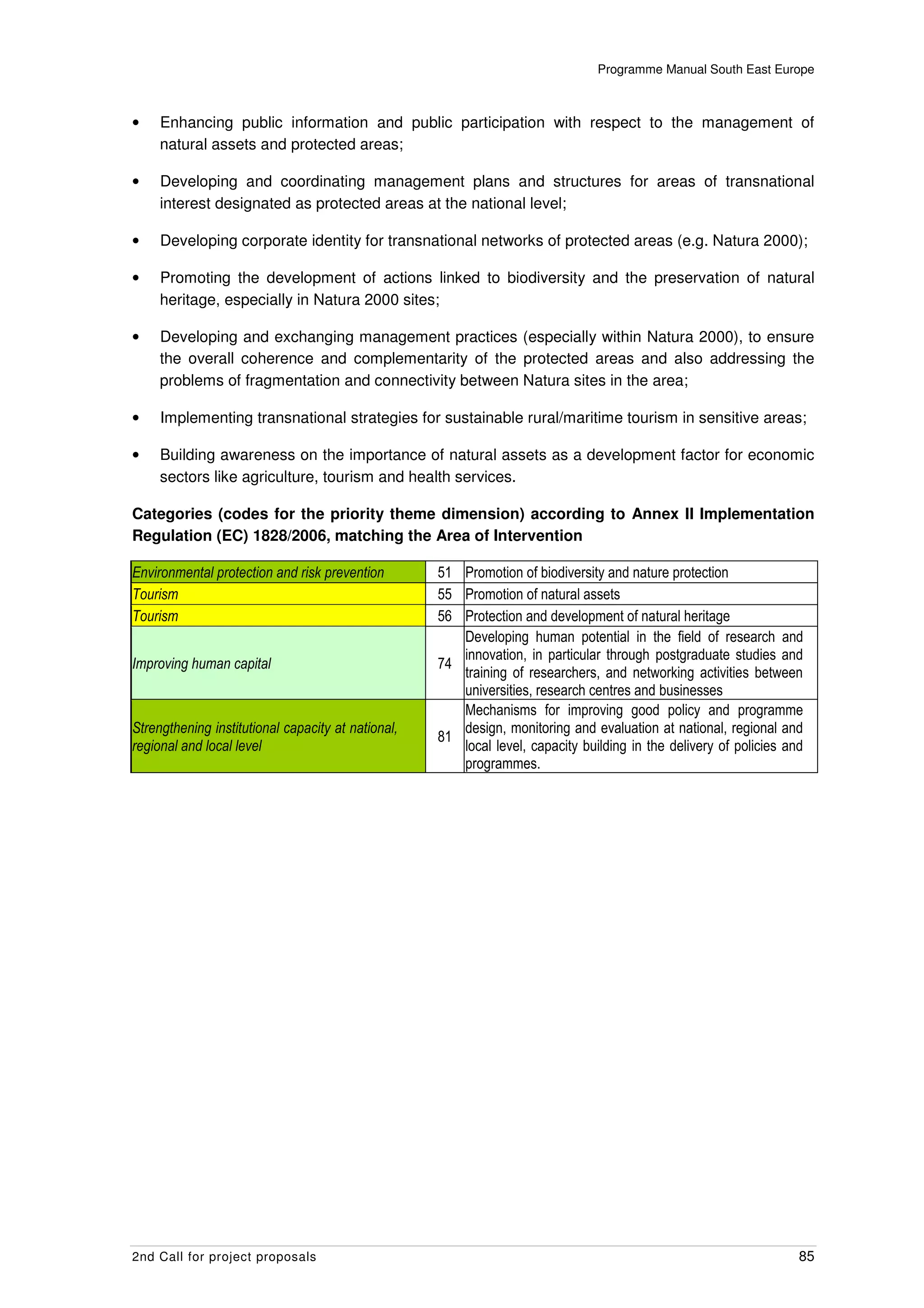
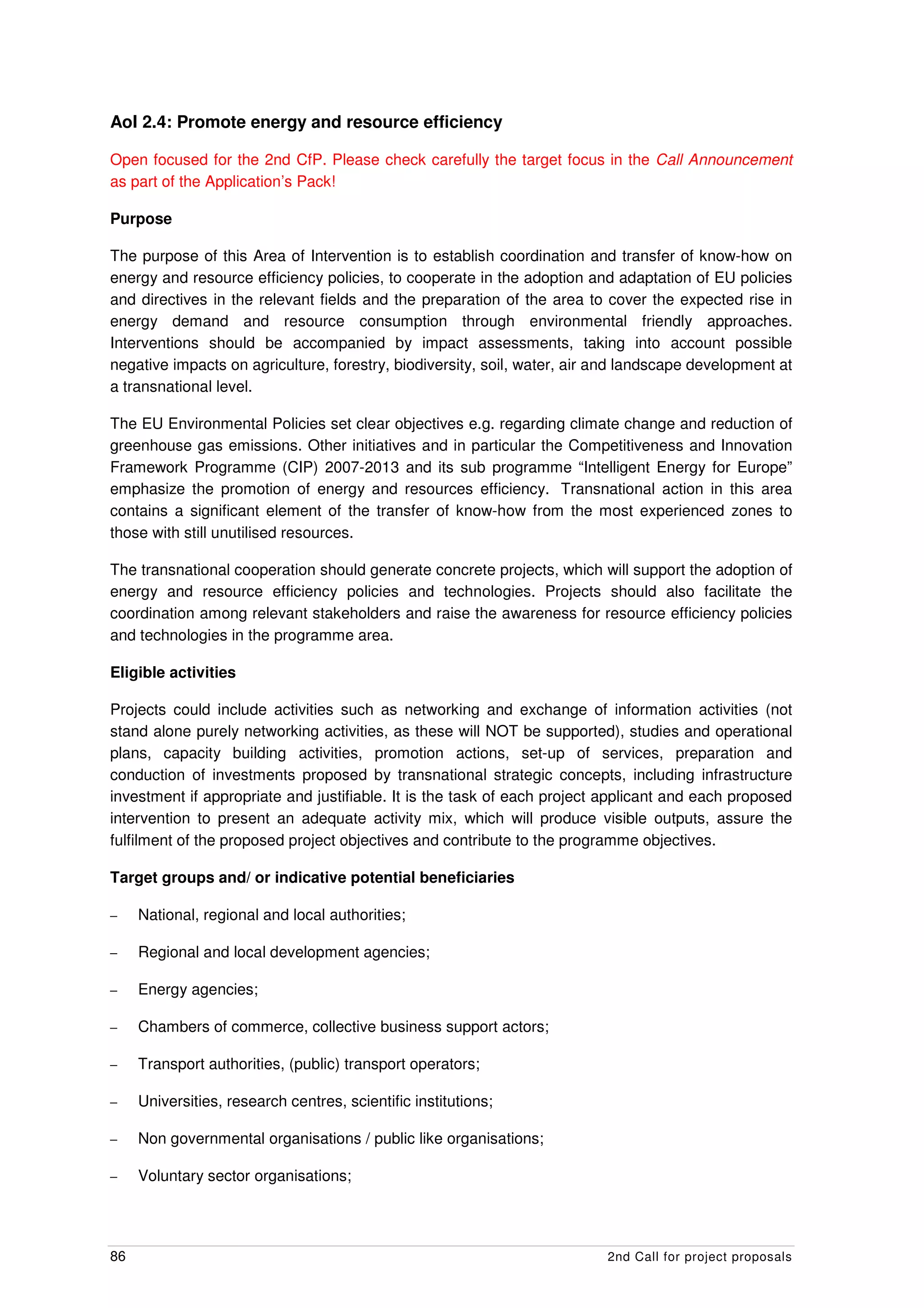
             Version 2.0 November 2009

            2nd Call for project proposals


European Territorial Co-operation 2007 – 2013
CONTENTS

Glossary                                                                                             4

List of acronyms                                                                                     7

1       Purpose and content of the SEE Programme Manual                                              9
1.1     Purpose                                                                                      9
1.2     What does the SEE Programme Manual not cover?                                               10

2       General Programme’s information                                                            11
2.1     Understanding the scope and purpose of transnational cooperation in South East
        Europe                                                                                      11
2.2     Programme’s Priority Axes and Areas of Intervention                                         11
2.3     Role of the different management bodies of the Programme                                    12
2.4     Contacts at Programme level                                                                 13
2.5     Programme area                                                                              14
2.6     Financing                                                                                   15
2.7     Legal Framework                                                                             15
      2.7.1 Structural Funds/ European Regional Development Fund (ERDF)                             15
      2.7.2 Instrument for Pre-accession Assistance (IPA) and European Neighbourhood
             and Partnership Instrument (ENPI)                                                      16
      2.7.3 Directive on public procurement                                                         17
      2.7.4 Horizontal policies of the European Union                                               17
      2.7.5 Competition                                                                             18

3       Project generation                                                                         20
3.1  Project generation                                                                             20
3.2  Partners and partnerships                                                                      20
   3.2.1 Eligibility of partners                                                                    20
   ERDF Funding                                                                                     20
   IPA Funding                                                                                      25
   3.2.2 Sort and role of partners                                                                  26
   3.2.3 Composition of the partnership                                                             28
   3.2.4 National contribution                                                                      29
3.3 Eligibility of project activities                                                               30

4       Eligibility of expenditures                                                                32
      4.1.1 General eligibility criteria                                                            32
      ERDF – Eligibility of Expenditure                                                             32
      IPA – Eligibility of Expenditure                                                              32
      4.1.2 Eligibility in time                                                                     32
      4.1.3 Eligible area                                                                           33
      4.1.4 Ineligible expenditures – ERDF                                                          34
      4.1.5 Common costs                                                                            35
      4.1.6 Project revenues                                                                        35
      4.1.7 Eligibility of expenditures by budget line                                              36
      4.1.8 Special eligibility rules                                                               43
      4.1.9 EC regulations relevant for the eligibility of expenditures – ERDF                      50


2                                                                        2nd Call for project proposals
Programme Manual South East Europe


   4.1.10 De-commitment Rule                                                                      50
4.2 Information and publicity requirements for projects                                           51

5       Relevant information concerning IPA participation                                        53
5.1     Eligibility of IPA Partners                                                               53
5.2     Public Procurement                                                                        55
5.3     National contribution                                                                     56
5.4     Eligibility of expenditure                                                                56
5.5     Project revenues                                                                          60

6       Development and application                                                              61
6.1     Project application: competitive and strategic calls                                      61
6.2     Competitive calls                                                                         61
      6.2.1 “Two Step” procedure                                                                  61

7       Assessment and selection                                                                 65
7.1     The selection procedures and selection criteria                                           65
7.2     The selection process within the “Two steps” procedure                                    65
      7.2.1 The “First Step”                                                                      65
      7.2.2 The “Second Step”                                                                     69
      7.2.3 Phase 3: Quality Check                                                                72

Annex 1: Presentation of the Priority Axes and corresponding Areas
    of Intervention                                                                              77
Priority Axis 1: Facilitation of innovation and entrepreneurship                                  78
    AoI 1.1: Develop technology and innovation networks in specific fields                        78
    AoI 1.2: Develop the enabling environment for innovative entrepreneurship                     78
    AoI 1.3: Enhance the framework conditions and pave the way for innovation                     78
Priority Axis 2: Protection and improvement of the environment                                    81
    AoI 2.1: Improve integrated water management and transnational flood risk
             prevention                                                                           81
    AoI 2.2: Improve prevention of environmental risks                                            82
    AoI 2.3: Promote cooperation in management of natural assets and protected areas              84
    AoI 2.4: Promote energy and resource efficiency                                               86
Priority Axis 3: Improvement of the accessibility                                                 89
    AoI 3.1: Improve coordination in promoting, planning and operation for primary and
             secondary transportation networks                                                    89
    AoI 3.2: Develop strategies to tackle the “digital divide”                                    91
    AoI 3.3: Improve framework conditions for multi-modal platforms                               93
Priority Axis 4: Development of transnational synergies for sustainable growth areas              95
    AoI 4.1: Tackle crucial problems affecting metropolitan areas and regional systems of
             settlements                                                                          96
    AoI 4.2: Promote a balanced pattern of attractive and accessible growth areas                 96
    AoI 4.3: Promote the use of cultural values for development                                   96

Annex 2: Common indicator set for monitoring and evaluation                                      98

Annex 3: SEE Contact Points                                                                    108

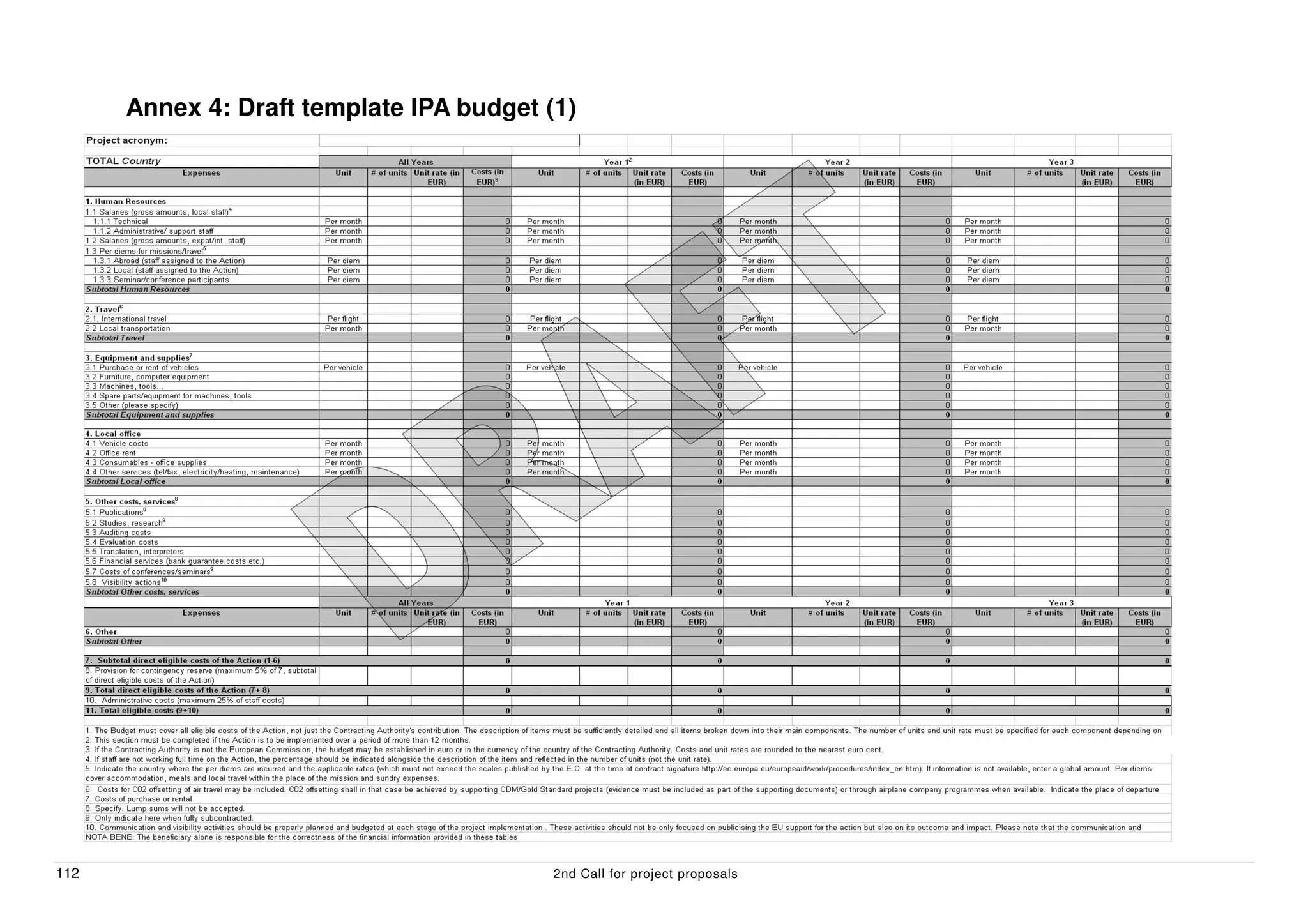
Annex 4: Draft template IPA budget                                                             112


2nd Call for project proposals                                                                     3
Glossary

Beneficiary

As indicated in art. 2 of the Reg. (EC) 1083/06, the beneficiary is an operator, body or firm, whether
public or private, responsible for initiating and/or implementing operations. In the context of aid
schemes under Article 87 of the Treaty, beneficiaries are public or private firms carrying out an
individual action and receiving public aid. Within the current document beneficiary is any ERDF /
IPA Partner.

Candidate countries

This status currently applies to Croatia, the former Yugoslav Republic of Macedonia and Turkey.

Control system

A system for validation of ERDF expenditures at a national level (it is the Member state
responsibility to set it up).

Controllers

Private or public bodies responsible for the ERDF control activities as designated by the Member
states.

De-commitment

In the SEE Programme 2007 – 2013, if the entire ERDF sum committed for the year N has not
                                                            st
been paid to the final beneficiaries and certified by the 31 December of the year N+3, the unspent
ERDF funds are deducted from the sums initially planned. This rule will be applied until 2010 whilst
from 2010 till 2013 the rule N+2 will be applied. In order to keep the programme financial
performance on schedule, de-commitment may be applied to the approved projects that do not
respect the spending timetable. Specific information can be found in section 4.1.10.

European Neighbourhood and Partnership Instrument (ENPI)

From 1 January 2007 onwards, as part of the reform of EC assistance instruments, the MEDA,
TACIS and various other programmes have been replaced by a single instrument – the ENPI. The
ENPI will provide grants for local development projects that target sustainable development and
link to EU policies and standards in countries that are direct neighbours of the enlarged EU (except
for candidate and potential candidate countries). This will involve both EU Member states and
partner countries. Eligible countries covered by the ENPI that belong to the SEE Programme 2007
– 2013 are the Ukraine and the Republic of Moldova.
European Regional Development Fund (ERDF)

The ERDF is one of the two Structural Funds and it is intended to help to reduce imbalances
between regions of the Community. The Fund grants financial assistance for development projects
in the EU regions. In terms of financial resources, the ERDF is by far the largest of the EU’s
Structural Funds.


4                                                                         2nd Call for project proposals
Programme Manual South East Europe


Grant Contract (for IPA partners)

It is the contract regarding the relations between the relevant Contracting Authority and the IPA
Financial Lead Partner. It determines the rights and responsibilities of the IPA Financial Lead
Partner and the relevant Contracting Authority, the scope of the activities to be carried out, terms of
IPA funding and the requirements for IPA reporting and financial control.

Instruments for Pre-Accession Assistance (IPA)

IPA aims at providing targeted assistance to countries which are candidates and potential
candidates for membership of the EU. IPA supersedes the previously existing pre-accession
instruments, i.e. Phare, ISPA, SAPARD, the Turkey pre-accession instrument, and CARDS, thus
uniting under a single legal basis all pre accession assistance. IPA countries participating in the
SEE Programme 2007 – 2013 are: Albania, Bosnia and Herzegovina, Croatia, the former Yugoslav
Republic of Macedonia, Montenegro and Serbia.

Partners

Any legal entity that commits itself to the implementation a project selected and approved under the
SEE Programme 2007 – 2013.

Partners can be distinguished by budget responsibility between:

    -     Financing Partners: directly financed by the Programme and with full responsibility on its
          budget share;

    -     Associated Strategic Partner (ASP): fully integrated in the project partnership but with no
          responsibility of its – eventual – budget share that is managed by an ERDF “sponsoring”
          partner.

For further details on partners please check also paragraph 3.2 and section 4.1.8 b) and c).

Partnership Agreement

The Partnership Agreement is a legal document signed by any project participant receiving funds
from the Programme directly or indirectly (Financing Partners, 10% PP, EU Associated and EU
Associated 20%), which contains a clear definition of the responsibilities among the partners and a
framework for efficient project implementation and governance. The Partnership Agreement allows
also the Lead Partner to extend the arrangements of the Subsidy Contract to the level of each
partner. It is the responsibility of the partnership to define the contents of the Partnership
Agreement as the Programme is providing only a template with the minimum mandatory
requirements.

Potential Candidate Countries

Albania, Bosnia and Herzegovina, Montenegro, Serbia, Kosovo under UNSCR 1244/99, are
potential candidates.

Project

The activity for which funding is being sought under a particular priority. Projects are also referred
to as “operations”.


2nd Call for project proposals                                                                        5
Subsidy Contract

It is the contract between the Joint Technical Secretariat (on behalf of the Managing Authority) and
the ERDF Lead Partner. It determines the rights and responsibilities of the Lead Partner and the
Managing Authority (MA), the scope of activities to be carried out, terms of ERDF funding, and the
requirements for ERDF reporting and financial control.

Verification

This is the process of control for ERDF project expenditures carried out by the national Controllers.
Verifications to be carried out shall cover administrative, financial, technical and physical aspects of
operations as appropriate. Verification shall include the following procedures: administrative
verification of each claim received by beneficiaries and on-the-spot verification.

Validation of expenditure

This is the result of verification.


6                                                                          2nd Call for project proposals
Programme Manual South East Europe


List of acronyms

AA                Audit Authority

AF                Application Form

AoI               Area of Intervention

ASP               Associated Strategic Partner

CADSES            Central European Adriatic Danubian South Eastern European Space

CARDS             Community Assistance for Reconstruction, Development and Stabilisation

CBC               Cross-border cooperation

CfP               Call for Proposals

EAP               Environmental Action Plan

EC                European Commission

EDF               European Development Fund

EEC               European Economic Community

EIA               Environment Impact Assessment

ENPI              European Neighbourhood and Partnership Instrument

EoI               Expression of Interest

ERA               European Research Area

ERDF              European Regional Development Fund

ESDP              European Spatial Development Perspective

ETC               European Territorial Cooperation

EU                European Union

GHG               Green House Gas

ICT               Information and Communication Technology

IPA               Instruments for Pre-Accession Assistance

ISPA              Instrument for Structural Policies for Pre-accession

JHA               Justice and Home Affairs

JTS               Joint Technical Secretariat

LA                Lead Applicant


2nd Call for project proposals                                                                           7
LP      Lead Partner

MA      Managing Authority

MC      Monitoring Committee

MoU     Memorandum of Understanding

MS      Member state

NC      National Coordination

OP      Operational Programme

PA      Partnership Agreement

PM      Programme Manual

PP      Project partner

PPP     Public Private Partnership

PRAG    Practical Guide to Contract Procedures for EC External Actions

R&D     Research and Development

R&TD    Research and Technology Development

SC      Subsidy Contract

SCP     SEE Contact Point

SEA     Strategic Environmental Assessment

SEE     South East Europe

SME     Small and Medium Enterprise

TA      Technical Assistance

TEN-T   Trans European Transport Network

TIA     Territorial Impact Assessment

ToR     Terms of Reference

UNSCR   United Nations Security Council Resolution

VAT     Value Added Tax


8                                                              2nd Call for project proposals
Programme Manual South East Europe


1 Purpose and content of the SEE Programme Manual


1.1    Purpose
This Programme Manual (PM) is aimed at providing further information on provisions laid down in
the Operational Programme (OP), South East Europe Programme 2007 – 2013. The SEE
                                                                            st
Programme 2007 – 2013 was adopted by the European Commission on 21 December 2007
(Commission decision CCI 2007CB163OP069).

The focus of the Programme Manual is to give guidance on all phases of project development and
application while the implementation phase is tackled separately in the SEE Implementation
Manual.

The SEE Transnational Cooperation Programme 2007 – 2013 is characterised by the integrated
use of Structural Funds (ERDF), the Instrument for Pre-accession Assistance (IPA) and the
European Neighbourhood and Partnership Instrument (ENPI – although not available for the 1st
and 2nd Call for Proposals). As a consequence, development and application provisions for the
projects have been, as far as possible, harmonised.

Whenever there are specific provisions set for the IPA / ENPI financed project partners these are
reflected separately in the respective chapters of this manual. When there is no reference to IPA /
ENPI this means that the requirements and procedures described under the respective chapter are
the same for all project partners regardless of their source of financing.

The table of contents of the SEE PM follows the project cycle.

The manual starts with a brief introduction to the general Programme objectives and legal
background. For more details on the objectives of the Programme as well as expected content of
the projects please refer to the Operational Programme, chapters 1 – 5. The OP can be
downloaded on the Programme website at www.southeast-europe.net. The main legal framework
is referred to in paragraph 2.7 Legal framework of this manual.

Chapter 3 of the Programme Manual starts with requirements and good practises in building of a
project as well as writing of project application.

Chapter 4 provides an overview on the costs that are considered eligible for the implementation of
the projects.

Chapter 5 gives in-deep information about the IPA sources use and participation.

Chapters 6 and 7 explain the procedure of application and selection of projects for financing.

The second version of the SEE PM has been approved by the Monitoring Committee on 25
September 2009.

The SEE PM is one of the main programme documents and a major component of the Application
Pack.

Please note that the present version of the manual includes the provisions and other
                                            nd
elements which are mainly relevant for the 2 call for proposals. The outlined rules and


2nd Call for project proposals                                                                       9
procedures (i.e. eligibility of partners, financial instruments, etc.) may change slightly for
the next calls for proposals.


1.2       What does the SEE Programme Manual not cover?

The SEE PM does not contain:

      -    the timeframe and other specific information on the call for proposals – these can be found
           in the call for proposals announcement and on the Programme’s website;

      -    the templates used to fill in the detail of your project proposal in order to participate in a call
           and be assessed for funding – these are the Expression of Interest (EoI) and the
           Application Form (AF);

      -    the practical information on how to fill in the documents for the calls for proposals (EoI and
           AF) – this piece of information can be found in the Applicants’ Guidelines;

      -    information on the obligations and duties of ERDF Lead Partners and MA throughout the
           implementation of the project – can be found in the draft Subsidy Contract;

      -    information on the obligations and duties of each project partner throughout the
           implementation of the project – can be found in the draft Partnership Agreement;

      -    any further relevant information at a national level – can be provided by the SEE Contact
           Points (SCP).

 All the above mentioned information/documents are available in the Application Pack for EoI
 and/or Application Pack for AF.

 Information on the management and implementation of approved projects are available in the
 SEE Implementation Manual and in the SEE Control Guidelines.


10                                                                              2nd Call for project proposals
Programme Manual South East Europe


2 General Programme’s information


2.1       Understanding the scope and purpose of transnational cooperation in
          South East Europe
The global objective of the SEE Programme 2007 – 2013 is the improvement of the territorial,
economic and social integration process and contribution to cohesion, stability and
competitiveness through the development of transnational partnerships and joint actions
on matters of strategic importance.

This global objective is supported by three specific objectives, which aim at:

      -    facilitating innovation, entrepreneurship, knowledge economy and information society by
           concrete cooperation action and visible results;

      -    improving the attractiveness of regions and cities, taking into account sustainable
           development, physical knowledge accessibility and environmental quality by integrated
           approaches and concrete cooperation action and visible result;

      -    fostering integration by supporting balanced capacities for transnational territorial
           cooperation at all levels.

The global and specific objectives of the SEE Programme 2007 – 2013 will be pursued through five
Priority Axes (Innovation, Environment, Accessibility, Sustainable Growth Areas and Technical
Assistance), which contribute differently to these objectives.

The SEE Programme 2007 – 2013 supports projects which have a clear transnational focus, high
quality partnerships and with appropriate transferable outputs/outcomes.

Applicants should be aware that the evolution of the transnational cooperation from the Community
Initiative (INTERREG) to the mainstream calls for an increase in the effectiveness of the operations
that will be co-financed. Plain networking exercises or stand-alone feasibility studies (i.e. without a
clear link to the financial instrument that will support the subject of the study) will be no longer be
taken into consideration.

It is important that projects demonstrate a clear need for transnational support and that the problem
to be tackled has a clear transnational impact. Operations supporting local, national or cross-border
actions only are recommended to apply for other instruments.


2.2       Programme’s Priority Axes and Areas of Intervention
Detailed descriptions of each Priority Axis and the areas of interventions complemented by a
number of practical project examples and indicative beneficiaries are to be found in the SEE OP
and in the Annex 1 of this SEE PM.

The Priority Axes should not be considered as discreet entities; they follow an integrated approach
and show many interfaces. In practice, applications may be closely aligned to one Area of
Intervention only or may offer relevance for more than one priority axis. In the latter case applicants


2nd Call for project proposals                                                                       11
have to consider which priority axis and Area of Intervention best matches the project’s focus and
apply under that Priority Axis/Area of Intervention only.


2.3       Role of the different management bodies of the Programme
Chapter 7 of the OP, the roles of the transnational and national bodies responsible for the
management and implementation of the SEE Programme 2007 – 2013 are outlined as follows:

      -    Monitoring Committee (MC)

The overall tasks of the Monitoring Committee are to ensure the quality, effectiveness and
accountability of the programme operations, and to select projects for funding.

      -    Managing Authority (MA)

The Managing Authority bears the overall legal responsibility for the management and
implementation of the SEE OP.

      -    Certifying Authority (CA)

The main tasks of the Certifying Authority are to draw up and submit to the Commission certified
statements of expenditure and applications for payment and receive payments from the
Commission.

      -    Audit Authority (AA)

The Audit Authority is responsible for the tasks set out by article 62 of the Reg. (EC) 1083/2006.
The Audit Authority is assisted by a Group of Auditors comprising of a representative from each of
the Member states participating in the Operational Programme. Candidate and Potential Candidate
Countries are not required to participate in the Groups of Auditors. However, they may send an
observer in order to gain experience in this field.

The Audit Authority and the auditors appointed in the Transnational Group of Auditors shall be
independent of the management and control system of the programme.

      -    Joint Technical Secretariat (JTS) :

The Joint Technical Secretariat is an internationally staffed management unit which is in charge of
the day to day management of the programme. It supports the Managing Authority, Monitoring
Committee and Audit Authority in programme coordination and implementation.

The Joint Technical Secretariat’s tasks are set out in section 7.1.5 of the OP.

      -    SEE Contact Points (SCP)

SEE Contact Points are formed and organised in each partner state, which facilitate the effective
representation the programme in each SEE Programme country and supports the development of
potential transnational projects.


12                                                                        2nd Call for project proposals
Programme Manual South East Europe


        -    National Coordination (NC)

  Each partner state establishes a National Committee or corresponding national procedures in
  accordance with its institutional structure. This facilitates the involvement of regional and local
  authorities, relevant sectoral authorities and institutions, non-governmental organisations and any
  other socio-economic and institutional partner considered relevant by the concerned partner state.
  NCs are not entitled to pre-select project applications, as project selection is reserved for the
  Monitoring Committee’s consideration.

        -    Contracting Authority for IPA

  The European Commission, acting for and on behalf of the beneficiary country, in the case of
  countries where IPA funds are managed under centralised approach. The National Authority
  (Operating Structure/Implementing Authority), in the case of countries where IPA funds are
  managed under decentralised approach. For the time being, among the participating
  candidate/potential candidate countries, only Croatia applies decentralized management of EU
  funds.


  2.4       Contacts at Programme level
In principle, the JTS gives support to potential partners of the SEE Operational Programme on all
transnational issues relevant to both the application and implementation phases.

The JTS can be contacted at the following address:

SEE Joint Technical Secretariat

VÁTI Kht.

H-1016 Budapest, Hungary

Gellérthegy utca 30-32


Email:      jts@southeast-europe.net

Phone: 0036 1 224 3180


Annex III contains a list of all National Contact Points for the SEE Programme (SCPs).


  2nd Call for project proposals                                                                    13
2.5     Programme area


The SEE Operational Programme supports transnational cooperation activities between partners in

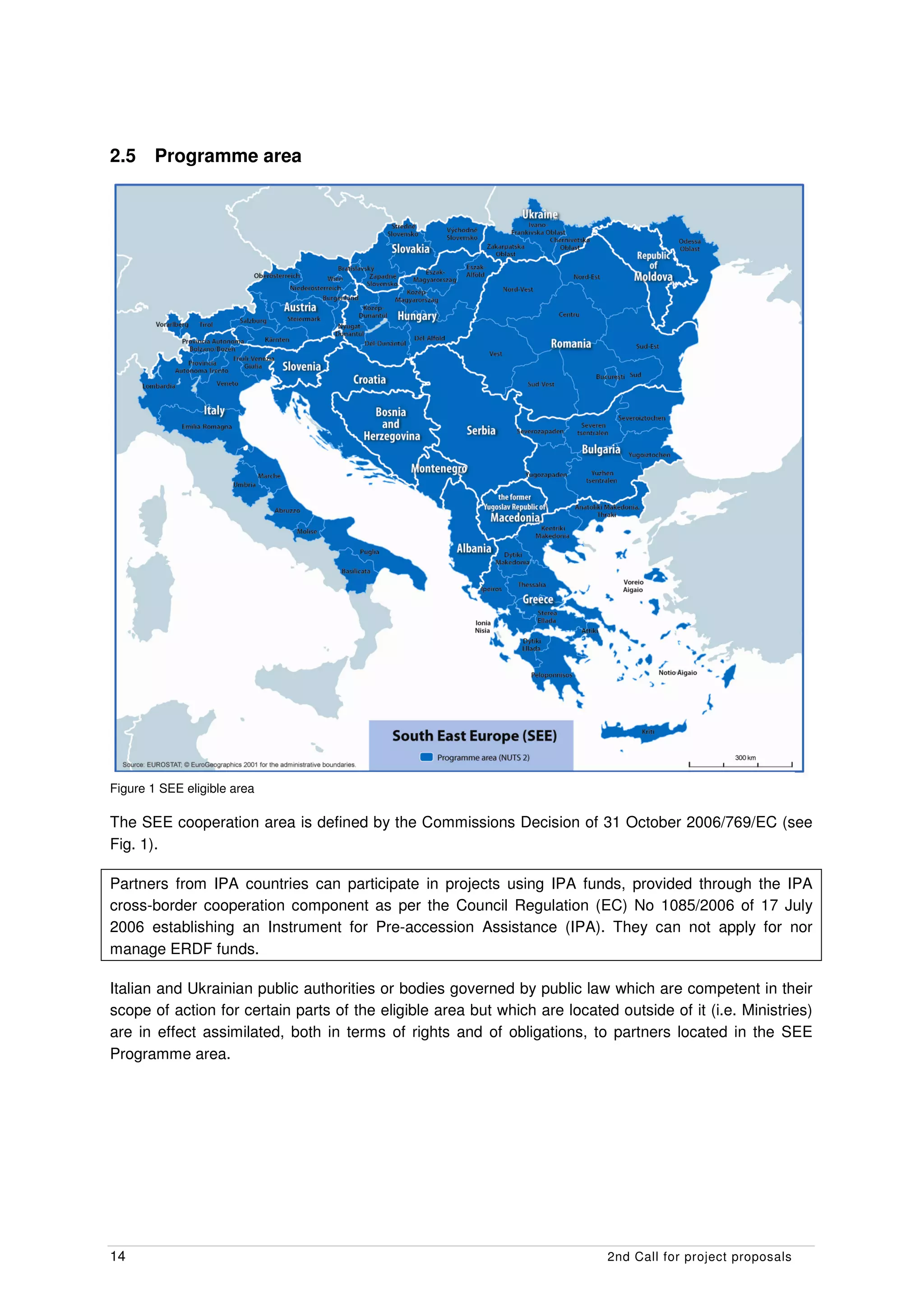
Figure 1 SEE eligible area

The SEE cooperation area is defined by the Commissions Decision of 31 October 2006/769/EC (see
Fig. 1).

Partners from IPA countries can participate in projects using IPA funds, provided through the IPA
cross-border cooperation component as per the Council Regulation (EC) No 1085/2006 of 17 July
2006 establishing an Instrument for Pre-accession Assistance (IPA). They can not apply for nor
manage ERDF funds.

Italian and Ukrainian public authorities or bodies governed by public law which are competent in their
scope of action for certain parts of the eligible area but which are located outside of it (i.e. Ministries)
are in effect assimilated, both in terms of rights and of obligations, to partners located in the SEE
Programme area.


14                                                                          2nd Call for project proposals
Programme Manual South East Europe


2.6       Financing
The total programme co-financing from ERDF amounts to 206 MEUR. The IPA contribution for the first
three years (2007–2009) has been of 10.5 MEUR in total.


2.7       Legal Framework
The SEE Programme 2007 – 2013 has been designed under the territorial cooperation objective of
the European Community, while integrating the objectives of the cross-border cooperation of the
Instrument for Pre-accession Assistance (IPA CBC) and European Neighbourhood and Partnership
Instrument (ENPI CBC). In practice this means that the programme combines financing instruments
from the EU structural funds/European Regional Development Fund (ERDF), as well as the
Instrument for Pre-accession Assistance (IPA) and the European Neighbourhood and Partnership
Instrument (ENPI). The programme shall first and foremost be administered according to the ERDF
structural funds rules. However, in most cases the IPA financed project partners are to follow the
relevant provisions of the IPA regulations, i.e. the aforementioned Council Regulation (EC) 1085/2006
and the Commission Regulation (EC) 718/2007 of 12 June of 2007. More details about the specific
requirements for IPA financed project partners are to be found under the respective chapter below.

In general, projects are guided by three layers of rules and requirements:

      1. EU legislation, as referred below, and corresponding national legislation;

      2. SEE OP;

      3. SEE PM, SEE Implementation Manual and other guidance documents to projects.


2.7.1      Structural Funds/ European Regional Development Fund (ERDF)

For project partners from the EU member states the following regulations apply:

      -    Council Regulation (EC) No 1083/2006 of 11 July 2006 laying down general provisions on the
           European Regional Development Fund, the European Social Fund and the Cohesion Fund
           and repealing Regulation (EC) No 1260/1999. The “General Regulation” gives general rules
           and requirements for all structural fund programmes;

      -    Regulation (EC) No 1080/2006 of the European Parliament and of the Council of 5 July 2006
           on the European Regional Development Fund and repealing Regulation (EC) No 1783/1999.
           The “ERDF Regulation” lays down specific provisions concerning ERDF co-financed
           programmes and projects. It defines especially the contents and other provisions for the
           Objective 3/ Territorial Cooperation Programmes, such as the SEE Programme 2007 - 2013;

      -    Commission Regulation (EC) No 1828/2006 of 8 December 2006 setting out rules for the
           implementation of Council Regulation (EC) No 1083/2006 laying down general provisions on
           the European Regional Development Fund, the European Social Fund and the Cohesion
           Fund and of Regulation (EC) No 1080/2006 of the European Parliament and of the Council on
           the European Regional Development Fund. The “Implementing Regulation” sets framework
           rules e.g. on information activities as well as audit and controls. It combines information for


2nd Call for project proposals                                                                        15
programme implementation which was scattered across several separate regulations in the
        previous programme period 2000 – 2006.

Reference to the respective articles of the regulations is given in this SEE PM where relevant.


2.7.2   Instrument for Pre-accession Assistance (IPA) and European Neighbourhood
        and Partnership Instrument (ENPI)

Sources for funding the participation of Western Balkans Project Partners may come from IPAs. To
ensure a properly working financial flow, close cooperation is necessary between the relevant
European Commission’s Directorates General, the Contracting Authorities of respective IPA countries,
the programme management bodies (MA, JTS), the Monitoring Committee and the relevant national
authorities. The IPA grant contracts will be concluded separately from the ERDF Subsidy Contract
with the relevant Contracting Authorities.

Sources for funding the participation of Ukraine and Moldova Project Partners may come from ENPI
                                       nd
(ENPI funds are not available for the 2 Call for Proposals).

IPA funds

IPA funds are provided for the participation of Project Partners from candidate and potential candidate
countries (i.e. Croatia, the former Yugoslav Republic of Macedonia, Albania, Bosnia and Herzegovina,
Montenegro and Serbia)

The SEE Programme 2007 – 2013 is an ERDF programme and assessment and selection criteria will
be set up according to the Structural Funds rules. Once awarded a grant, the IPA beneficiaries will
implement the activities according to IPA rules. The ERDF Lead Partner signs the Subsidy Contract
(on behalf of all Partners) with the SEE JTS (on behalf of the Managing Authority), while the IPA
Financial Lead Partner (in case there are more than one project partner from the same IPA country)
signs the contract with the respective Contracting Authority in its own country.


ENPI funds
                                                                           nd
ENPI funds (Republic of Moldova and Ukraine) are not available for the 2        call for proposals.


16                                                                       2nd Call for project proposals
Programme Manual South East Europe


2.7.3    Directive on public procurement

According to article 1 of Reg. (EC) 1083/2006 ERDF partners are required, during their procurements
related to the projects financed by the SEE, to respect the relevant Community and national public
procurement rules.

The procurement for IPA grants shall follow the provisions of article 121 of Reg. (EC) 718/2007 as well
as the rules and procedures for service, supply and works contracts financed from the general budget
of the European Communities for the purposes of cooperation with third countries adopted by the
Commission on 24 May 2007 (C(2007)2034). For more information on IPA procedures, please check
chapter 5 of this document.

2.7.4    Horizontal policies of the European Union

In addition to the regulations mentioned in the previous section, there are several horizontal policies
and principles that are promoted by all European Union financed programmes. These include e.g.
sustainable development, equal opportunities, partnership, additionality and competition (see also
chapter 4.3 of the SEE OP).

Sustainable development

Sustainable development means respecting the right of future generations to change the path of
development, i.e. to further access resources that are difficult to renew or non renewable and to
maintain the elementary natural preconditions for life. In addition to the environmental aspect,
sustainable development also covers economical, social and cultural aspects of sustainability. It is
thus closely linked to the general objective of the programme to make the SEE area a better place to
invest, work and live in.

Environment nevertheless remains the most important aspect of sustainable development. In case it
seems that a planned project might have significant adverse impact on the environment, an
environmental impact assessment must be carried out in accordance with the national legislation
before the project is implemented. In the AF applicants are asked to clarify whether the planned
project activities might have influence, either neutral or positive, to the environment and to present
how the project contributes to environmental objectives at EU, national and local level.

Integrated territorial development

Actions under the transnational cooperation programmes support integrated territorial development
(see Art. 3 (2c) of the Council Regulation (EC) No 1083/2006 and Art. 6 (2) of Regulation (EC) No
1080/2006). This means that the projects should take into account territorial conditions, such as
infrastructure, resources, settlements, economic, social, ecologic and cultural conditions, as well as
impacts on other sectors to the given territory in order to support balanced development. Policies
adopted at regional, national (National Strategic Reference Frameworks, Operational Programmes
under the Convergence and Competitiveness and Employment Objectives, etc.), SEE and European
level, such as European Spatial Development Perspective (ESDP) and Territorial Agenda of the
European Union adopted on 25th May 2007, TEN-T, Information Society 2010, ERA and R&D,
Intelligent Energy for Europe, etc. should also be considered.


2nd Call for project proposals                                                                     17
Equal opportunities

The Structural Fund programmes, including the SEE Programme 2007 – 2013, aim at ensuring equal
opportunities between men and women.

Another objective from the equality point of view is to prevent all kinds of discrimination, e.g. based on
sex, racial or ethnic origin, age or disability (see also Art. 16 of Council Regulation (EC) No
1083/2006).

Promotion of equal opportunities will be regarded, among other horizontal policies, as a positive factor
when the Monitoring Committee selects projects for funding. All applicants are asked to integrate
these issues in their projects, or at least, to consider the project’s influence on matters of equal
opportunities.

Projects that build structures (e.g. men and women equally presented in project planning, decision-
making or in the project target groups) or implement activities that aim at promoting equal
opportunities will describe these activities in the application form and their results in the progress
reports. Further information can be found in Annex 4 of the SEE Implementation Manual.

Partnership

Projects can fulfil the partnership principle by ensuring that different levels of administration as well as
different types of organisations participate in the project activities. This could be, for example,
participation of national, regional and local levels or, correspondingly, public authorities, economic and
social partners (such as SMEs, associations) and civil society (such as non-governmental
organisations, environmental partners) (see also Art. 11 of Council Regulation (EC) No 1083/2006 and
Art. 4 of Regulation (EC) No 1638/2006).

However, a broad partnership should not take place by involving too many partners in one project. A
large amount of partners often leads to a complicated management structure, contradictory targets
between project partners and, thus, difficulties to implement the project successfully.

Additionality

The principle of additionality means that EU financing shall not replace national public or equivalent
financing of similar activities (see also Art. 15 of Council Regulation (EC) No 1083/2006).

Projects selected for financing are expected to bring value added, something that would not have
been possible without the programme financing. In addition, organisations involved in the project
activities cannot replace their statutory tasks with the programme financing.


2.7.5   Competition

In order to ensure undistorted competition on the internal common market, the European Commission
laid down a set of rules, called state aid rules, to cover those operations that are related to a transfer
of State resources aiming at providing financial assistance, such as funds, loan guarantees, capital
injections, etc.

“(…)any aid granted by a Member state or through State resources in any form whatsoever which
distorts or threatens to distort competition by favouring certain undertakings or the production of


18                                                                          2nd Call for project proposals
Programme Manual South East Europe


certain goods shall, insofar as it affects trade between Member states, be incompatible with the
common market.”
                                                                                                                                  1
According to art. 87 and 88 of the Treaty, as well as art. 54 of Regulation (EC) 1080/2006 aid can
only be granted to applications that comply with state aid rules. The following criteria of the Treaty
must be met simultaneously in order to apply the regulation in case of activities that fall under this rule:

- shall be granted from State Resources;

- shall confer an advantage;

- shall be selective;

- shall have effect on trade and competition between Member states.

The most important state aid rules applicable in case of the present call are:

     -     Article 87. and 88 of EC Treaty

     -     Commission Regulation (EC) No 1998/2006 on the application of Articles 87 and 88 of the
           Treaty to de minimis aid (OJ L 379/5 15. 12. 2006);

     -     Commission Regulation (EC) No 800/2008 on declaring certain categories of aid compatible
           with the common market in application of Articles 87 and 88 of the Treaty (General block
           exemption Regulation) (OJ L 214/3. 2008. 9.8.)

     -     Commission Decision 2005/842/EC on the application of Article 86 (2) of the EC Treaty to
           State aid in the form of public service compensation granted to certain undertakings entrusted
           with the operation of services of general economic interest (OJ L 312/67 29. 11. 2005.)

Compliance with the competition rules

The analysis on the State Aid compliance will be performed by the State Aid expert of the Managing
Authority during the project evaluation and will be based on the examination of the Application Form
and the information provided by the partners (Lead Applicant and ERDF Project Partners) in the
“Declaration on the status in relation to the State Aid discipline”.

Community rules on State aid limit the grant, which may be provided from public funding to assist
projects involving public or private actors that do economic activities on the market.

Should project activities be State aid relevant, funding limitations deriving thereof will apply not only to
private companies but also to those public equivalent bodies acting as undertakings in the project.

The Applicants have to fill-in the above mentioned declaration on state aid to inform about the
compliance of the activities they intend to perform with the State aid discipline.

The Lead Partner and the ERDF Project Partners have to ensure that the planned activities are in
compliance with the competition legislation of their country. This should be clarified with the
responsible national authorities already during the project preparation phase.


1 Regulation (EC) No 1080/2006 of the European Parliament and of the Council on the European Regional Development Fund and repealing Regulation
  (EC) No 1783/1999 (OJ L 210 31. 07. 2006)


2nd Call for project proposals                                                                                                         19
3 Project generation
3.1     Project generation
The SEE Programme 2007 – 2013 provides useful tools and resources to potential applicants to
assist with project generation. The programme website, www.southeast-europe.net, hosts a
“Partner Search” section, where all potential applicants can upload their project ideas in order to
search for project partners and to facilitate collaboration between similar project ideas.

Transnational thematic workshops related to the programme’s priorities will be organised –
normally during the Annual Events – in order to steer and inform potential applicants on specific
programme needs. On a national level, information days and trainings will be organised by the
SCPs.

The aim of all the above mentioned support is to encourage the generation of high quality
projects.

Quality projects are generated and developed with the active contribution of partners and relevant
stakeholders. This sharing and collaboration helps to prevent unilateral behaviour and mitigates the
risks of operations being planned and drafted by the Lead Partner alone or even by an entity
external to the project altogether.

A bottom-up approach (applicants’ driven) in project generation is therefore important, coupled with
adequate support, including the provision of quality information from higher levels (i.e. programme
level structures).

Partners with previous experience in the subject matter of the project as well as previous
cooperation experience can add value to the development of a sound project.

A conceptually effective project should also contain sound financial planning that will carry the
project through to implementation. To this end, the financial capacity of partners is another key
criterion for successful project generation. In addition to that mentioned above, programmes which
include new Member states such as the SEE Programme 2007 – 2013, need to effectively manage
the transition from previous cooperation instruments to European Territorial Cooperation
Programmes.

Importantly, the SEE Programme 2007 – 2013 strives towards generating projects with a deep and
widespread impact along with strong political commitment.


3.2     Partners and partnerships

3.2.1    Eligibility of partners

ERDF Funding

According to Article 2 of Reg. (EC) 1083/2006, a wide range of actors such as public authorities,
public equivalent bodies and any legal body governed by public or private law can be beneficiaries
of ERDF and therefore are able to participate in the SEE Programme 2007 – 2013 as partners and
receive direct financial support.

The OP (chapter 5) provides, for each Area of Intervention, an indicative list of potential
beneficiaries.


20                                                                      2nd Call for project proposals
Programme Manual South East Europe


The following types of partners are eligible:

    -    Public bodies

    -    Bodies governed by public law

    -    Bodies governed by private law

Legal entities not falling in one of the three categories are welcome to participate in projects
additionally as Observers (see 3.2.2).

Public bodies

Public bodies are organizations which are founded and governed by public law. Their main purpose
is to fulfil the needs of the public.

Bodies governed by public law

The definition of a body governed by public law is the following according to Article 1 of Directive
2004/18/EC:

A "body governed by public law" means any body:

(a) established for the specific purpose of meeting needs in the general interest, not having an
industrial or commercial character;

(b) having legal personality; and

(c) financed, for the most part, by the state, regional or local authorities, or other bodies governed
by public law; or subject to management supervision by those bodies; or having an administrative,
managerial or supervisory board, more than half of whose members are appointed by the state,
regional or local authorities, or by other bodies governed by public law.


2nd Call for project proposals                                                                      21
What to do in case of uncertainty whether a legal entity is a “body governed by public law”?

In individual cases it might be difficult to ascertain whether a legal entity fulfils the criteria defining a “body
governed by public law”. In this respect it can be helpful to first consult Annex XI of Commission Decision
2008/963/EC1 amending the Annex III to Directive 2004/18/EC. For all EU Member states participating in
the SEE Programme 2007 – 2013, it sets out non-exhaustive lists of bodies and categories of bodies
governed by public law which fulfil the criteria in question. Moreover, lawyers specialised in public
procurement law, certified public accountants and national procurement authorities and national
programme’s representatives could give advice. They will also be familiar with the national jurisdiction on the
term “body governed by public law”. Contact details of SCPs are available at the programme’s website
www.southeast-europe.net.

Considering the case-law of the European Court of Justice the following can be noted to interpret the three
criteria of the term “body governed by public law” correctly on European level. In general, the European
Court of Justice held that the term must be interpreted in functional terms and broadly.

a 1)   established under     The term “needs in the general interest” is an autonomous concept of
       public or private     Community law. If a specific body is not listed in Annex XI of Commission
       law      for  the     Decision 2008/963/EC, its legal and factual situation must be determined in each
       specific purpose      individual case in order to assess whether or not it meets a need in the general
       of meeting needs      interest.
       in the general
       interest              Needs in the general interest are generally needs which are satisfied otherwise
                             than by the availability of goods and services in the marketplace and which, for
                             reasons associated with the general interest, the State chooses to provide itself
                             or over which it wishes to retain a decisive influence. Account must be taken of
                             relevant legal and factual circumstances, such as those prevailing when the
                             body concerned was formed and the conditions in which it carries on its activity.
                             However, the existence or absence of needs in the general interest not having
                             an industrial or commercial character must be appraised objectively, the legal
                             form of the provisions in which those needs are mentioned being immaterial in
                             that respect.

                             A body which was not established to satisfy specific needs in the general interest
                             not having an industrial or commercial character, but which has subsequently
                             taken responsibility for such needs, which it has since satisfied, fulfils that
                             condition provided that the assumption of responsibility for the satisfaction of
                             those needs can be established objectively. Activities of the body in question
                             linked to public policy can indicate that it meets needs in the general interest.

                             The condition that the body must have been established for the “specific”
                             purpose of meeting needs in the general interest, not having an industrial or
                             commercial character, does not mean that it should be entrusted only with
                             meeting such needs. It is immaterial that such an entity is free to carry out other
                             activities provided that it continues to attend to the needs which it is specifically
                             required to meet


22                                                                          2nd Call for project proposals
Programme Manual South East Europe


a 2)      (and) not having       This criterion is intended to clarify the meaning of the term “needs in the general
          an industrial or       interest”. That means that within the category of needs in the general interest
          commercial             there is a sub-category of needs which are not of an industrial or commercial
          character              character.

                                 If a body operates in normal market conditions, aims to make a profit, and bears
                                 the losses associated with the exercise of its activity, it is unlikely that the needs
                                 it aims to meet are not of an industrial or commercial nature.

                                 The status of a body governed by public law is not dependent on the relative
                                 importance, within that body's activity, of the meeting of needs in the general
                                 interest not having an industrial or commercial character

b)        having      legal      The question whether or not a body has legal personality is to be answered by
          personality            national law. An entity’s private law status does not constitute a criterion for
                                 precluding it from being classified as “body governed by public law” within the
                                 meaning of Directive 2004/18/EC

c) 1      financed, for the      Each of the alternative conditions set out in the “c” criterion (c1, c2, c3) reflects
          most part, by the      the close dependency of a body on the State, regional or local authorities or
          State, regional or     other bodies governed by public law. Whilst the way in which a particular body is
          local authorities,     financed may reveal whether it is closely dependent on another public authority,
          or other bodies        that criterion is not an absolute one. Not all payments made by a public authority
          governed        by     have the effect of creating or reinforcing a specific relationship of subordination
          public law             or dependency.

                                 Only payments which go to finance or support the activities of the body
                                 concerned without any specific consideration therefore may be described as
                                 public financing.

                                 The term “for the most part” means more than half. That necessarily implies that
                                 a body may also be financed in part in some other way without thereby losing its
                                 character as a body governed by public law. In order to determine correctly the
                                 percentage of public financing of a particular body account must be taken of all
                                 of its income, including that which results from a commercial activity.

                                 To decide whether a body is a “body governed by public law” the way in which it
                                 is financed must be calculated on the basis of the figures available at the
                                 beginning of the budgetary year, even if they are only provisional

c) 2      Or subject        to   The criterion “management supervision” must give rise to the dependence on the
          management             public authorities’ equivalent to the dependence which exists where one of the
          supervision       of   other alternative criteria (c1 or c3) is fulfilled. A mere review does not satisfy the
          those bodies           criterion of management supervision. That criterion is, however, satisfied where
                                 the public authorities supervise not only the annual accounts of the body
                                 concerned but also its conduct from the point of view of proper accounting,
                                 regularity, economy, efficiency and expediency and where those public
                                 authorities are authorised to inspect the business premises and facilities of that
                                 body and to report the results of those inspections to other public authorities


     2nd Call for project proposals                                                                         23
c) 3   or     having       an
       administrative,
       managerial          or
       supervisory     board,
       more than half of
       whose members are
       appointed by the
       State, regional or
       local authorities, or
       by    other     bodies
       governed by public
       law.


Bodies governed by private law

In the contest of this programme, “bodies governed by private law” means all organizations which
are founded by private law such as chambers of commerce, trade unions or non-governmental
organisations. They may receive ERDF funding if they fulfil the following criteria:

            a) they are established for the specific purpose of meeting needs in the general
               interest, not having an industrial or commercial character;

            b) they have legal personality;

            d) they make available the results of the project to the general public;

            e) they apply the principles of public procurement.

In order to foster the participation of key stakeholders, infrastructure and transport operators can
apply as partners within Priority 3 if they are established for the specific purpose of meeting needs
in the general interest (being not relevant the industrial and commercial character).


International organisations acting under international law are not eligible. However, international
organisations acting under the national law of any SEE EU Member state can be considered as
eligible for ERDF funding if they fulfill the criteria foreseen for the bodies governed by public or
private law.

Only legal entities listed in the Application Form eligible for funding may report their costs. In order
to ensure a proper audit trail the JTS/MA needs to know which organisations receive programme
funding and whether they are eligible according to the programme rules. Therefore, an “umbrella”
type of partnership structure, where one partner collects funding and represents other partners
without naming them is not possible.


24                                                                         2nd Call for project proposals
Programme Manual South East Europe


IPA Funding

The ERDF partners should carefully consult the potential IPA project partners on eligibility. In case
there is more than one IPA partner and one is ineligible the IPA contract for that country will not be
eligible, which might hinder the quality of the project. For more information on IPA procedures,
please check chapter 5 of this SEE PM.

Furthermore, in case more than two Financing Partners (either ERDF or IPA) are not eligible or are
rejected for formal reasons, the full proposal is considered as not eligible. Therefore, IPA
Partners’ eligibility should be carefully checked at a very early stage.


2nd Call for project proposals                                                                      25
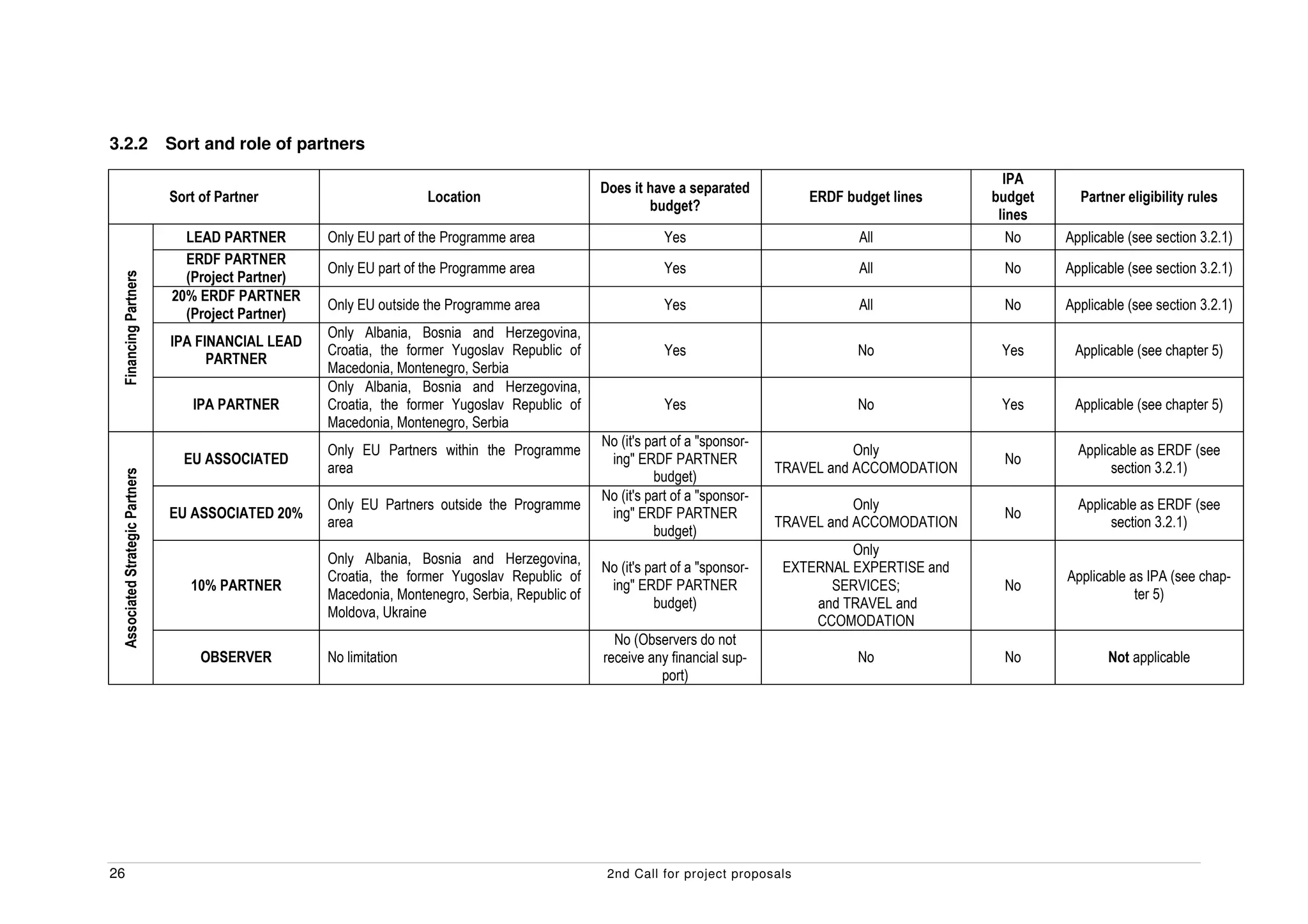
3.2.2                             Sort and role of partners

                                                                                                                                                                IPA
                                                                                                     Does it have a separated
                                  Sort of Partner                       Location                                                        ERDF budget lines     budget     Partner eligibility rules
                                                                                                             budget?
                                                                                                                                                               lines
                                    LEAD PARTNER        Only EU part of the Programme area                      Yes                            All               No    Applicable (see section 3.2.1)
                                    ERDF PARTNER
                                                        Only EU part of the Programme area                      Yes                            All             No      Applicable (see section 3.2.1)
  Financing Partners


                                    (Project Partner)
                                  20% ERDF PARTNER
                                                        Only EU outside the Programme area                      Yes                            All             No      Applicable (see section 3.2.1)
                                    (Project Partner)
                                                        Only Albania, Bosnia and Herzegovina,
                                  IPA FINANCIAL LEAD
                                                        Croatia, the former Yugoslav Republic of                Yes                            No              Yes      Applicable (see chapter 5)
                                        PARTNER
                                                        Macedonia, Montenegro, Serbia
                                                        Only Albania, Bosnia and Herzegovina,
                                     IPA PARTNER        Croatia, the former Yugoslav Republic of                Yes                            No              Yes      Applicable (see chapter 5)
                                                        Macedonia, Montenegro, Serbia
                                                                                                     No (it's part of a "sponsor-
                                                        Only EU Partners within the Programme                                                  Only                      Applicable as ERDF (see
                                    EU ASSOCIATED                                                     ing" ERDF PARTNER                                        No
                                                        area                                                                        TRAVEL and ACCOMODATION                    section 3.2.1)
  Associated Strategic Partners


                                                                                                               budget)
                                                                                                     No (it's part of a "sponsor-
                                                        Only EU Partners outside the Programme                                                 Only                      Applicable as ERDF (see
                                  EU ASSOCIATED 20%                                                   ing" ERDF PARTNER                                        No
                                                        area                                                                        TRAVEL and ACCOMODATION                    section 3.2.1)
                                                                                                               budget)
                                                                                                                                              Only
                                                        Only Albania, Bosnia and Herzegovina,
                                                                                                     No (it's part of a "sponsor-    EXTERNAL EXPERTISE and
                                                        Croatia, the former Yugoslav Republic of                                                                       Applicable as IPA (see chap-
                                     10% PARTNER                                                      ing" ERDF PARTNER                    SERVICES;           No
                                                        Macedonia, Montenegro, Serbia, Republic of                                                                                 ter 5)
                                                                                                               budget)                   and TRAVEL and
                                                        Moldova, Ukraine
                                                                                                                                         CCOMODATION
                                                                                                       No (Observers do not
                                       OBSERVER         No limitation                                receive any financial sup-                No              No             Not applicable
                                                                                                               port)


26                                                                                                    2nd Call for project proposals
Programme Manual South East Europe


Within the SEE Programme 2007 – 2013 two sorts of partners are identified:

    -   Financing partners: being directly financed by the Programme (by ERDF or IPA) and
        bearing full responsibility for their budget;

    -   Associated Strategic Partners: being not directly financed by the Programme but –
        eventually – “sponsored” by an ERDF Partner that is bearing the responsibility for their
        participation to the project. Associated Strategic Partners (ASP) in the SEE is an
        organisation whose participation is considered as crucial for the added value given to the
        partnership. As an example, ASP can potentially be a Ministry, which does not want to
        apply and contribute financially because of administrative burdens and financial reasons
        but it is interested to participate to a project for ensuring the political sustainability of
        delivered outputs and results.

    Among ASPs, the following can be further identified:

        EU Associated are actors located in an EU country of the Programme area, not
        contributing financially to the project. EU Associated partners can be only those bodies
        considered eligible following the rules defined in section 3.2.1. All expenditure incurred by
        these bodies shall be finally borne by any of the institutions acting as ERDF “sponsoring”
        partner in order to be considered as eligible. Expenditure is limited to reimbursement of
        travel and accommodation costs related mainly to their participation in project meetings.

        EU Associated 20% are actors located in an EU country outside the Programme area, not
        contributing financially to the project. EU Associated 20% partners can be only those
        bodies considered eligible following the rules defined in section 3.2.1. Expenditure incurred
        by these bodies shall be finally borne by any of the institutions acting as ERDF
        “sponsoring” partner in order to be considered as eligible. Expenditure is limited to
        reimbursement of travel and accommodation costs related mainly to their participation in
        project meetings. Further information is available in section 4.1.8 c).

        10% Partners are actors located in a candidate or potential candidate country inside the
        Programme area, not contributing financially to the project. 10% partners can be only those
        bodies considered eligible following the rules defined in section 4.1.8, b). Expenditure
        incurred by these bodies shall be finally borne by any of the institutions acting as ERDF
        “sponsoring” partner in order to be considered as eligible. Further information is available
        in section 4.1.8 b).

        Observers are actors invited by the project beneficiaries to take part in the project in an
        observant role or with advisory capacity and do not contribute to the implementation of the
        projects in terms of financial contributions. ASP Observers can potentially be also actors
        not fulfilling the partners’ eligibility rules as set by the SEE Programme 2007 – 2013.


Lead Partner principle

A Lead Partner (LP) should be nominated by the partners from amongst themselves. The Subsidy
Contract will be concluded between the JTS on behalf of the MA and the Lead Partner, being
formally the final beneficiary of the ERDF funding and the only direct link between the project
partnership and the programme.


2nd Call for project proposals                                                                     27
According to Reg. (EC) 1080/2006, article 20, the LP assumes the following responsibilities:

         -    it shall lay down the arrangements for its relations with the Project Partners participating in
              the project in a Partnership Agreement comprising, inter alia, provisions guaranteeing the
              sound financial management of the ERDF funds allocated to the project, including the
              arrangements for recovering amounts unduly paid;

         -    it shall be responsible for ensuring the implementation of the entire project;

         -    it shall ensure that the expenditure presented by the Project Partners has been incurred
              for the purpose of implementing the project and corresponds to the activities agreed
              between those Project Partners;

         -    it shall verify that the ERDF expenditure presented by the Project Partners participating in
              the project has been validated by the controllers;

         -    it shall be responsible for transferring the ERDF contribution to the Project Partners;

         -    the LP is always responsible for securing repayment of the ERDF contribution unduly paid
              to the project. The LP is obliged to secure repayments from the ERDF PPs concerned
              and repay the amount specified by the Managing Authority before the due date.

The LP is the contact institution for the Joint Technical Secretariat on behalf of the partnership.


3.2.3        Composition of the partnership

Each project has to involve at least three Financing partners (see 3.2.2) from three different
Countries of the programme area: the Lead Partner and at least two project partners. Out of these
project partners, at least one, the Lead Partner, has to be located on the territory of a Member state
of the Programme area (see also chapter 4.2 of OP).

The responsibilities of the project partners are listed below:

     -       carrying out activities planned in the approved AF and agreed in the Partnership
             Agreement;

     -       assuming responsibility of any irregularity in the expenditure which it has declared repaying
             the lead partner any amounts unduly paid in accordance of the partnership agreement
             signed between the lead partner and the respective project partner;

     -       carrying out information and communication measures for the public about the project
             activities.

The number of partners may considerably vary between the projects depending on the character of
the project. The project consortium should be comprised in a strategic manner and well adapted to
its purpose. A partnership that is too small might reduce the potential of the project while a
partnership which is very large might cause significant organisational, communication and co-
ordination problems and thus be cost ineffective.

Keeping this in mind, the applicant should always reflect on the optimal number and role of
partners to be involved. No maximum limit of partners is fixed. It is not the number of institutions
listed in the proposal that makes the project partnership ideal, but rather their expertise necessary


28                                                                              2nd Call for project proposals
Programme Manual South East Europe


to carry out the planned activities. The topics addressed by the project (e.g. common
environmental problems) determine the profile of the organisations that could be involved in the
project activities.

The composition of project partners should include:

    -   sufficient transnational representation;

    -   necessary sectoral expertise (horizontal composition of the partnership);

    -   necessary expertise at relevant administrative levels (vertical composition of the
        partnership);

    -   sufficient financial, technical and human resources to implement project activities.

In order to apply integrated territorial approach (see chapter 2.7.4) the project partnership should
not consist only of organisations from one sector (e. g. universities, ports, environmental
associations) but include relevant organisations from other sectors affected by the project as well.

The actions that require a transnational or integrated territorial approach (e.g. related to transport,
energy, civil protection or environmental pollution) should not be concentrated in only one country,
at one administrative level nor focused on only one economic sector but should demonstrate a
larger geographic or sector perspective.

Political commitment is often crucial for transferring the strategies worked out in the project into real
actions or investments. In addition, involvement of public authorities might facilitate the
implementation of project results. Otherwise there is a risk that e.g. the strategies developed by the
projects are not recognised by the respective decision-makers.

Project Partners should be involved already in the project drafting phase in order to incorporate
ideas from all partners and to ensure a high level of commitment to the project. In addition, during
the preparatory phase partners can test how the co-operation works before the implementation of
the project activities is started.

Involvement of permanent staff of the participating organisations helps the network to keep
operating after closing the actual project activities and ensures that the knowledge gained during
the project implementation stays in the organisation.


3.2.4    National contribution

Under the SEE Programme 2007 – 2013, projects are co-financed by ERDF and IPA. The co-
financing rate per partner is 85%. The remaining budget (15%) has to be covered by national
contribution, brought in by each project participant.

The ERDF PP’s national contribution can be covered by state contribution and/or own public
sources of the project participant and/or other public contribution (e.g. regional/local/other public
sources). State contribution has to be indicated in the AF only in case the Member state provides
by automatic or by specific calls national public contribution at state level for the project selected by
the Monitoring Committee, and therefore the amount covered by state contribution will be
reimbursed to the project partner.


2nd Call for project proposals                                                                        29
Each Member state applies a different system in providing state public contribution. Some apply an
automatic procedure for granting the funds (e.g. Hungary, Italy, Romania) whilst others envisage
specific calls (i.e. Slovenia). Others require the project partners to provide the co-financing
themselves. An overview on the national co-financing system of the SEE Partner states is available
on the Programme website. However, as more detailed information might be available at national
level, SCPs should be contacted in order to clarify the position.

As the programme follows the "public costs" principle, private sector expenditure can not generate
EU co-financing. In the case whereby ERDF private project participants join a partnership as
Project Partners, they have to prove that their national contribution will be provided by public
authorities only for the project purposes and that it is therefore ensured that the expenditure co-
financed by the ERDF are financed only by public funds. The regular public funds provided to
private bodies for their operation can not be considered as public contribution to the project.

For further information on how the Programme will ensure that each ERDF Partner has secured its
own public co-financing please check chapter 7.

The IPA project partner’s co-financing (15 % of the total eligible costs of the action) can come from
the partner’s own resources or from sources other than from the European Community budget or
the European Development Fund. For more information on IPA procedures, please check chapter
5 of this SEE PM.


3.3       Eligibility of project activities
Activities and related expenditures are eligible according to the eligibility rules set out in the
Operational Programme. However, in conjunction with these there are wider considerations for
project providers as the SEE Programme 2007 – 2013 is fully integrated within the European
Territorial Cooperation Objective of the EU’s Cohesion Policy which in turn is strongly linked to the
achievement of the Lisbon and Gothenburg objectives. This being the case projects should
carefully consider the following aims:

      -    contribution to sustainable territorial development

      -    leverage effect on investment, development perspectives and policy development

      -    facilitation of innovation, entrepreneurship, knowledge economy and information society by
           concrete cooperation action and visible results (creation of new products, services,
           development of new markets, improvement of human resources based on the principles of
           sustainability)

      -    contribution to integration by supporting balanced capacities for transnational territorial
           cooperation at all levels (systems building and governance)

The orientation on research, technology and innovation encompasses a significant entrepreneurial
development aspect. As a consequence, pure academic research activities cannot be supported
under this programme.

Projects could include activities such as studies and operational plans, capacity building activities,
promotion actions, set-up of services, preparation and development of investments proposed by
transnational strategic concepts, including infrastructure investment if appropriate and justifiable.


30                                                                         2nd Call for project proposals
Programme Manual South East Europe


Additional activities could include networking and exchange of information, though not as stand
alone activity, as purely networking activities will NOT be supported.

It is the task of each project applicant and each proposed intervention to present an adequate
activity mix, which will produce visible outputs, assure the fulfilment of the proposed project
objectives and contribute to the programme objectives.

The three dimensions of transferability and sustainability of the project’s results are an essential
element of the SEE Programme 2007 – 2013 and should be considered at a project level:

    -    Financial sustainability: securing one’s own resources or other sources of revenue for
         covering future operating and maintenance costs after the completion of the project;

    -    Institutional sustainability: identification of the structures that will take over after the end of
         the project

    -    Political sustainability: the impact of the project on the political choices, leading to improved
         legislation, codes of conduct, methods, etc.

The programme emphasises the importance of building upon past efforts and existing knowledge.
This being the case relevant and up-to-date knowledge, tools and partnerships which are
appropriate for the development, implementation and dissemination of planned outputs and results
are needed to build a solid ground for innovation and to avoid the duplication of efforts.
Furthermore, this will allow for existing disparities between regions and uneven development of
regions in the cooperation area to be effectively addressed. In this respect, the programme also
invites partnerships to reach out to relevant stakeholders and professionals in order to ensure
effective networking beyond the partnerships.


2nd Call for project proposals                                                                           31
4 Eligibility of expenditures
4.1.1       General eligibility criteria

ERDF – Eligibility of Expenditure

ERDF costs are generally eligible for funding if:

       -    they have been actually incurred and paid by the project beneficiaries, and they can be
            verified on the basis of original invoices or other accounting documents of equivalent
            nature;

       -    they are directly related to the project, necessary for the development starting and/or
            implementation of the project, and they are planned in the approved project budget;

       -    they have been incurred and paid within the eligibility period of the project;

       -    they have been incurred in the eligible area of the SEE Programme 2007 – 2013 (see also
            section 4.1.3. and 4.1.8.);

       -    they are in compliance with the principles of efficiency, economy and expediency;
                                                                                         2.
       -    they are in line with the relevant EC regulations and National legislation

In all cases, if there is national legislation regarding eligibility of expenditure, project beneficiaries
have to follow the national legislation of their country as well. National legislation applies also
whenever stricter than the corresponding EU legislation, and vice versa. The Project Partners are
responsible in clarifying which relevant national legislations of their country they may have to apply
when implementing the project.

IPA – Eligibility of Expenditure

For more information on IPA procedures, please check chapter 5 of this SEE PM


4.1.2       Eligibility in time

All expenditures are eligible for ERDF funding from the date of approval of the project by the
Monitoring Committee (“Second step”, in case of a “Two-step procedure”) to its end date, as
defined in the approved Application Form. Preparation costs (section 4.1.8.) and control costs
related to the Final progress report are exempted from this rule. Control costs related to the Final
Progress Report have to be paid within 60 days from the project end date at the latest.

The eligibility period of the project means that for ERDF partners all expenditures shall be incurred
and paid within this period.


2
    The relevant EC Regulations are listed in paragraph 3.4.9


32                                                                             2nd Call for project proposals
Programme Manual South East Europe


As concerns IPA, grants may, as a rule, only cover costs incurred after the date on which the grant
contract is signed. However, according to the provisions of PRAG, chapter 6 “Grants”, section 6.2.8
“Non-retroactivity”, a grant may be awarded for an action which has already begun only where the
applicant can demonstrate the need to start the action before the contract is signed (e.g.
participation at kick-off meetings, organized by the LP). In such cases, expenditure incurred,
following a request in writing by the IPA Country Lead Partner and the subsequent approval of the
relevant Contracting Authority, might be eligible

The costs must be incurred during the implementation of the action as specified in Article 2 of the
Special Conditions with the exception of costs relating to final reports, expenditure verification and
evaluation of the action, whatever the time of actual disbursement by the Beneficiary and/or its
partners.

The duration of the contract might be different than the ERDF one therefore IPA Partners should
always check with the respective SCP. The implementation deadline depends on the date when
respective IPA country signed the Financial Agreement for that yearly allocation.

Since the programme must be finalised by the end of 2015, all activities within the projects must be
completed before the end of 2014.

Projects must clearly indicate their intended duration when applying for funding. The maximum
duration is specified in each call for proposal.

When deciding the starting date of the project, partners should take into account the timeframe for
the selection process and any potential delays in the start-up phase, even if the programme seeks
for an early start of operations soon after approval, as the eligibility of expenditure between the
approval date and the starting date of the project is restricted only to certain necessary
administrative procedures for the contracting (i.e. travel and accommodation costs related to
conditions clearing and participation at the Lead Partner seminar).


4.1.3    Eligible area

As a general rule, eligible costs shall be incurred in the programme area defined by the SEE
Operational Programme (see section 1.3).

An exception to the general rule is the case of those public authorities or bodies governed by public
law which are competent in their scope of action for certain parts of the eligible area but which are
located outside of it (e.g., ministries). Italian and Ukrainian institutions falling under this definition
are in effect assimilated, both in terms of rights and of obligations, to partners located in the SEE
programme area.

In addition, travel and accommodation costs incurred within the EU but outside the programme
area are considered eligible.

IPA: Travel and accommodation costs incurred outside the programme area but inside the
European Union are eligible.


2nd Call for project proposals                                                                         33
4.1.4    Ineligible expenditures – ERDF

The following expenditure is considered as ineligible for ERDF funding. Please, keep in mind that
this list is not exhaustive, as additional ineligible expenditures might be included at national level.

     -   interest on debt (Article 7 of Regulation (EC) No 1080/2006);

     -   decommissioning of nuclear power stations (Article 7 of Regulation (EC) No 1080/2006);

     -   recoverable Value Added Tax (Article 7 of Regulation (EC) No 1080/2006);

     -   expenditures on housing (Article 7 of Regulation (EC) No 1080/2006);

     -   fines, financial penalties and expenditure on legal disputes (Article 49 of Regulation (EC)
         No 1828/2006);

     -   any forms of double financing of expenditures: expenditure which is already supported by a
         Community, or other international or national grant;

     -   unpaid partial amounts of invoices (e.g. discounts, rebates, etc.);

     -   subcontracting which adds to the cost of execution of the project without adding
         proportionate value to it;

     -   subcontracts with intermediaries or consultants in which the payment is defined as a
         percentage of the total cost of the project unless such payment is justified by the final
         beneficiary by reference to the actual value of the work or services provided;

     -   any expenditures invoiced further to third parties and not born by the LP or its partners;

     -   expenditures not directly associated with the Lead Partner or its partners;

     -   any costs incurred before or beyond the eligible period of the project (except preparation
         costs and control costs related to the Final Progress Report, see SEE Implementation
         Manual 8.1 for details);

     -   any costs of services, procurements or investments not directly related to the project and
         not approved in the Application Form;

     -   costs of settlement of interest payable, cost of credit overdrawing;

     -   currency exchange commissions and losses;

     -   commissions and dividends, profit payments;

     -   purchase of business shares;

     -   leasing;

     -   fringe benefits, rewards, redundancy payments;

     -   items for entertainment e.g. entrance fees, gifts, flowers, decoration materials, etc, if not
         necessary for the implementation of the project’s activities.


34                                                                         2nd Call for project proposals
Programme Manual South East Europe


4.1.5    Common costs

Costs associated with the project’s activities normally related to the project’s common management
and coordination and to common communication and dissemination activities can be shared
among ERDF Project Partners.

For each common activity, a responsible partner is to be selected. This partner is in charge of the
implementation or the subcontracting of the activity and following the relevant National Public
Procurement Law on behalf of the whole partnership.

Only expenditure of ERDF project partners under budget lines staff costs and/or external expertise
and services are eligible as common costs. Partners can choose between the following ways of
proceeding:

    1. Sub-contracting common activities („external expertise and services”)

        Common costs are advanced by the responsible partner to the sub-contractor.
        The involved PPs will transfer their shares to the responsible partner.

    2. Common activity implemented directly by the responsible partner (“staff costs”)

Common activities and related budgets are outlined in the approved Application Form with the
partners who are involved in the common activity, and indicate their share of the costs in the
related tables provided.

Partners should understand that the budget assigned to the common activities is not an additional
budget, but a part within the partners’ total budget.

The budget commitment of the partners and their responsibility within the common activities has to
be detailed in a specific section of the Partnership Agreement.

Procedures for the eligibility of common costs can be different in each Member state.
Partners will always have to ask their national Controller in the respect of the method
accepted for sharing costs before the submission of the Application Form.

The detailed rules for the management of common costs are described in 5.2.3. of the SEE
Implementation Manual.

Costs cannot be shared between ERDF and IPA Project Partners. For further information
applicants should contact the relevant Contracting Authority


4.1.6    Project revenues

In line with Article 55 of the of Council Regulation (EC) 1083/2006, if a project generates revenue,
the amount of net revenues must be deducted from the eligible costs in full or pro-rata depending
on whether it was generated entirely or partly by the co-financed project. Where it is objectively not
possible to estimate the revenue in advance, the revenue generated within five years of the
completion of a project shall be deducted from the expenditure declared to the Commission.

Where it is possible to objectively estimate the revenues in advance, projects should indicate the
amount of possible revenues in the Application Form. Project generated revenues have to be
reported regularly by the Project Partners in the progress reports and in the final report, and


2nd Call for project proposals                                                                      35
verified by the designated controllers at the partner level. The ERDF co-funding will be calculated
on the basis of the eligible expenditure reduced by the amount of net revenues.

Only the cash in-flows directly paid by users for the goods and/or services provided by the project,
such as charges borne directly by users for the use of infrastructure, sale or rent of land or
buildings, or payments for services has to be considered as project generated revenues. Project
generated revenues could as an example be conference participation fees, revenues from the
sales of publications or books, etc.

These rules shall be applied only to projects which are co-financed by the ERDF and the total cost
of which exceeds 1,000,000 Euro.

For more information on IPA project revenues please check chapter 5 of this document


4.1.7    Eligibility of expenditures by budget line

ERDF project expenditures are eligible under the following budget lines (IPA project expenditure
must be presented in standard external aid budget tables that are part of the Application Form):

                 1.       Staff costs

                 2.       Overheads

                 3.       Travel and accommodation costs

                 4.       External expertise and services

                 5.       Equipment

                 6.       Small scale investments

                 7.       Financial charges and guarantee costs


     1. Staff costs

The costs of the personnel executing tasks for the project management (project coordinator, project
manager, assistant, financial manager, etc.) and/or tasks for the project activities are eligible under
the following conditions:

-    members of the project team should be directly employed by the project beneficiaries’
     organisation on the basis of a regular work contract (or any similar type of contract according to
     the national rules) between themselves as employees and the project beneficiaries’
     organisation as employer. The employee could work full-time or part-time for the project. In
     instances where the beneficiary’s organisation does not have the adequate professionals to
     perform the tasks related to the project, they can employ/contract external experts for these
     tasks. These costs shall be budgeted under the cost category “external expertise and
     services”.

-    staff costs shall be calculated in hourly rates according to the following rules:


36                                                                           2nd Call for project proposals
Programme Manual South East Europe


              o    only monthly gross salaries based on payslips or other documentation of similar status
                   can be taken into consideration;
                                                    th    th
              o    As exception, only the 13 -14 month’s extra salaries included in the regular working
                   contract or in national legislation are eligible if they proportionally allocated to the
                   project in a transparent way and are considered eligible according to national eligibility
                   rules;

              o    social contribution charges shall be calculated according to the national legislation
                   concerned. No additional charges besides the social contribution charge can be
                   included in the hourly rate;

              o    fringe benefits, rewards/ bonuses over the monthly salaries are not eligible in order to
                   exclude ad-hoc additional payments over the monthly salaries and additional
                   payments not related to project specific tasks.

    -   staff costs must be supported by the following documents:

              o    work contracts which permits the identification of the employment relationship
                   between the project staff and the partner’s organisation;

              o    a clear assignment including information on the extent of involvement with the project;

              o    payslips, proofs of payment (e.g. bank statements), and calculation evidence for the
                   determination of the hourly rates of the project staff;

              o    timesheets which prove the overall working time and the time spent on carrying out
                   activities for the project (name of the employee, date, time and detailed description of
                   the activity); the timesheet must be signed by the project’s assigned employee and by
                   the employer.

        2. Overheads
                                                                                          3
Overheads can be allocated to the project according to two methods :

        a) overheads directly allocated to the project (real costs);

        b) overheads allocated proportionally to a project (flat rates based on average real costs).

Overhead costs cannot exceed 25 % of the staff costs of the project – as defined by the budget
line 1. – of the project. The same rule has to be applied at project partner level. The beneficiary
should decide on the most appropriate method which is suitable for the accounting of the
organisation’s overheads. The chosen method should remain the same during the whole
implementation period. A combination of the two methods is not allowed.

        a) overheads directly allocated to the project

This method can be applied if it is possible to allocate the overhead costs directly to the project and
are justified by receipted invoices or accounting documents having an equivalent probative value.


3
    The use of flat-rate method according to Article 1 (3) of the REGULATION (EC) No 397/2009 and the percentages of the
      flat rates in relation to the direct costs of an operation will be determined by the Member States in coordination with the
      MA/JTS


2nd Call for project proposals                                                                                                 37
Eligible costs for this method:

-    Office costs such as office rental fees, electricity, heating, water and service charges related
                                                          2
     solely to the project and corresponding to the m space used for project activities. Besides
     standard accounting material, a copy of the office rental contract/agreement is obligatory for
     eligibility.

-    Administrative costs such as phone calls, fax, internet, postage, copying, and office supplies
     related solely to the project.

     b) Overheads allocated proportionally to project

This method can be applied if it is impossible to allocate the overhead costs directly to the project.
The general conditions for the use of flat rates are the followings:

-    Proportionally distributed overhead costs must be attributable to the implementation of the
     project;

-    The calculation of overheads shall be properly documented and reviewed yearly. In the case of
     on the spot checks, the relevant accounting documents supporting the calculation method
     should be made available for the controllers at the partners’ premises.

-    The costs must be distributed according to the following methods depending on which can best
     reflect the type of cost:

          o   the ratio of the number of people working for the project / number of people working in
              the organisation or department

          o   the ratio of the number of hours worked on the project / number of hours worked in
              total in the organisation or department

          o   the ratio of the surface used by the personnel working for the project/surface of the
              organisation or department

Eligible costs for this method:

-    administrative service, book-keeping, salary administration, postal / telephone services,
     copying and centralized computer support;

-    office supplies;

-    office costs such as office rental fees, electricity, heating, water and service charges related
                                                          2
     solely to the project and corresponding to the m space used for project activities. Besides
     standard accounting material, a copy of the office rental contract/agreement is obligatory for
     eligibility.

     3. Travel and accommodation costs

Project related travel and accommodation costs and subsistence allowances (per diems) are
eligible costs under the following conditions:

-    travelling costs of the “project staff” – as defined by the budget line 1. – are eligible;

-    travelling costs of the Associated Strategic Partners (EU Associated, EU Associated 20%, 10%
     Partner) are eligible, where the invoice is addressed to the ERDF “sponsoring” Partner and it is


38                                                                             2nd Call for project proposals
Programme Manual South East Europe


    directly paid or reimbursed by the ERDF “sponsoring” Partner before submitting the
    expenditure for validation to the Controller;

-   travelling costs of external experts shall be included in the service contracts and budgeted
    under the external expertise and services budget line;

-   travels within the programme area and within the EU territory are eligible costs (see also
    section 4.1.8 for further details);

-   as a general rule the most economical way of transport should be used. Exceptions from this
    principle must be duly justified in each case;

-   per diems (travelling allowances) are eligible only for ERDF PPs “project staff” according to the
    national rules of the partner’s organisation. Per diems accounted for in the project include
    social contributions according to the relevant national rules;

-   accommodation costs can be accepted without reservation if they are in the middle price range.
    Higher price ranges must be duly justified in each case.

    4. External expertise and services

Services directly related to the project and ordered from an external party are eligible for the cost
categories listed below, under the following conditions:

-   the work of the external expert is essential to the project;

-   rates charged by the external expert are reasonable and are in relation to level of experience
    and expertise;

-   the selection of the external experts shall comply with the relevant National Public Procurement
    Law in force;

-   project partners cannot be contracted as an external expert or a subcontractor;

-   where allowed by national rules, additional contracts of external expertise nature signed with
    own staff of the partner institution must strictly apply transparent selection and, where
    applicable, public procurement procedures. Costs of such staff can be allocated to the budget
    line external expertise only. The same person already charged under staff costs can not be
    contracted under external expertise;

-   If applicable, the deliverables respect the information and publicity requirements of the SEE
    Programme 2007 – 2013 (see Annex 3 SEE Visual Identity Guidelines of the SEE
    Implementation Manual).

    a) External expertise

    a. professional expertise (e.g. studies, researches, etc.);

    b. experts for project management, assistant, financial manager, etc (in circumstances
       whereby the Lead Partner or the partner’s organisation does not have the adequate
       professionals to perform the tasks related to the project or for shared activities as specified
       in section 3.4.5);


2nd Call for project proposals                                                                      39
c. costs of technical and financial experts, accountancy and audit costs, if they are directly
        linked to the project and are necessary for its implementation, etc.

     b) Organisation of meetings and events

     a. expenses for organisation of conferences, seminars, meetings, workshops, project events
        directly related to the project and traceable from the approved Application Form;

     b. documentation of the participants (participant list) shall be provided in each cases of
        “catering expenses”;

     c. renting of premises and equipment for events;

     d. fees for experts/speakers invited to project event. In case an external expert can not
        receive a fee for participating in a project event as speaker (e.g. public administration), the
        contract/agreement with the external expert shall state that only travel costs and
        accommodation costs supported by invoices will be paid.

     e. interpretation at events;

     f.      printing of materials directly related to events, etc.

     c) Promotion costs

     a. costs of brochures and leaflets;

     b. press releases, inserts in newspapers;

     c. newsletters;

     d. the design and maintenance of web page for the project;

     e. other publication costs related to the project but not linked to specific events or seminars;
        etc.

     d) Other services

Other services concerning costs not linked to specific budget lines, but necessary for the
implementation of the project. Examples of eligible costs:

         -    translations of project documents not linked to specific budget lines;

         -    reproduction of project documents not linked to specific budget lines, etc;

     5. Equipment

Purchase of equipment is eligible under the following conditions:

     -       equipment is necessary for the project implementation and is foreseen in the approved
             Application Form;

     -       equipment should be exclusively used for the project implementation;

     -       suppliers should be selected according to the rules of the relevant National Public
             Procurement Law;


40                                                                             2nd Call for project proposals
Programme Manual South East Europe


    -    the full purchase price is only eligible in case that the total economic life and depreciation
         period are shorter than or equal to the project duration. In all other cases only depreciation
         costs shall be eligible.

The following costs can be eligible:

    -    special equipment necessary for the project implementation and foreseen in the
         Application Form (“content related equipment”), like laboratory equipment and special
         measurement equipment including transportation and installation costs of these
         equipments;

    -    office equipment (e.g. computers, laptops, office furniture, etc.) related to the project
         management can be eligible in duly justified cases and only if clearly indicated in the
         approved Application Form.

Depreciation costs:

According to art. 53 of Regulation (EC) 1828/2006, the depreciation expenditure of depreciable
assets directly used for a project, and incurred during the period of its co-financing, shall be
eligible, provided that the acquisition of the assets is not declared as eligible expenditure.

The invoice shall be submitted to and checked by the designated controller of the project partner
and shall be validated appropriately in order to avoid double financing. The relevant national rules
for the depreciation of assets shall be applied and the calculation of depreciation costs shall be
submitted to the controllers to verify the eligible depreciation cost.

Second hand equipment:

The purchase cost/depreciation cost of second hand equipment is eligible if the concerned Project
Partner can prove the followings:

    -    it can be certified that the equipment has not been previously purchased with the co-
         financing of public funds;

    -    the price of the equipment is in line with its market value and less than the price of similar
         new equipment;

    -    The depreciation costs of second hand equipment are only eligible if these costs have not
         been already completely amortized.

    -    the equipment has the technical characteristics necessary for the project.


    6. Small scale investments

The SEE Programme 2007 – 2013, as well as the other transnational cooperation programmes, is
not intended as an investment programme. This is largely due to its limited budget and its
cooperative nature.

Small scale investments are eligible where the transnational impact of the investment is
demonstrated and the activity is approved in the Application Form.


2nd Call for project proposals                                                                       41
Eligible investments either follow a transnational physical or functional link over the national border
(i.e. technical infrastructure improving innovation performance of a transnational network for
development of entrepreneurship and research; technical infrastructure improving the diffusion of
knowledge across the SEE; infrastructure and technical investments in ports, railway routes, inland
waterways and road junctions improving the operability of a transnational transport corridor, etc.) or
create a transferable practical solution through a case study in one area, which is jointly evaluated
by the project partners and transferred for testing in at least two other participating countries (new
broadly applicable technologies for the development of entrepreneurship; ICT solutions unlocking
accessibility of peripheral areas; solutions reducing land-based river pollution; solutions for efficient
production and using of bio-mass; solutions for energy saving in buildings; technical solutions
increasing the share of public transportation).

The programme does not finance investments that do not have transnational relevance.

The contractors of investments should be selected according to the rules of the National Public
Procurement Law in force.

The contractor cannot be a partner in the project.

The purchase of land is eligible in very exceptional and duly justified cases if it does not exceed
10 % of the total eligible costs for the ERDF Project partners of the project concerned, in line with
article 7 of Regulation (EC) 1080/2006.

     7. Financial charges and guarantee costs

Financial charges and guarantee costs are eligible costs according to article 49 of Regulation (EC)
1828/2006. The following charges and costs shall be eligible for a contribution from the ERDF:

     -   charges for transnational financial transactions;

     -   bank charges for opening and administering the account or accounts where the
         implementation of a project requires a separate account or accounts to be opened;

     -   the cost of guarantees provided by a bank or other financial institution to the extent to
         which the guarantees are required by national or Community legislation;

     -   legal consultancy fees, notarial fees if they are directly linked to the project and are
         necessary for its implementation.

As opening of a separate bank account for the project is requested by the SEE Programme 2007 –
2013 only for the Lead partners, the following costs are mainly relevant for the Lead partners:

     -   bank charges for opening and administering the separate bank account opened for the
         project;

     -   charges for transnational financial transactions i.e. transfer of ERDF contribution to Project
         partners.

In case the Partnership Agreement or national rules requires the opening of separate bank ac-
count, these costs are also eligible for Project Partners.


42                                                                          2nd Call for project proposals
Programme Manual South East Europe


In case of public bodies or bodies governed by public law where according to specific na-
tional/internal rules of the organisation it is not possible to open a separate EUR bank account or
sub-account, only the bank charges incurred to identify, track and report all financial transfers and
expenditure related to the project on the LP’s single EUR bank account are eligible.

Any other types of financial charges are ineligible.

For information on IPA eligibility of expenditure, please check section 5.4 of this SEE PM.


4.1.8    Special eligibility rules

Special eligibility rules apply additionally to the general rules for project expenditures for the
preparation costs, the expenditures incurred outside the EU territory or the programme area and
the in-kind contribution.

    a) Preparation costs

Costs that have been incurred for the preparation of the project are eligible costs for ERDF
Partners only in accordance with the following conditions:
                                                                                           st
    -    preparation costs can only be eligible if they were incurred on or after the 1 of January
         2007 and before the approval date of the Application Form (“Second step” in case of “Two
         Step” procedure) by the Monitoring Committee. Preparation costs shall be paid before the
         end date of the first reporting period;

    -    preparation costs should show direct connection to the approved project and should be
         included in the approved Application Form;

    -    costs for the preparation of the approved project cannot exceed 2% of the total eligible
         expenditures of the project or 40.000 EUR whichever is reached earlier.

Eligible costs for preparation are costs under the budget lines staff costs, travel and
accommodation costs and external expertise and services, as follows:

    -    external expertise costs and/ or staff costs for the preparation of the application
         documents;

    -    joint meetings for the preparation of the project;

    -    travels directly related to the joint meetings, including participation at the Lead Applicant’s
         seminar;

    -    preparatory studies, analysis and researches for activities to be carried on within the
         project.

Overheads, equipments, small scale investments, and financial charges and guarantee costs are
not eligible under preparation costs.

Preparation costs are not eligible for IPA funding.


2nd Call for project proposals                                                                        43
b) Expenditures according to the “10% ERDF flexibility rule”

Reg. (EC) 1080/2006, article 21, commas 3 and 4, states:

                                                 ERDF Regulation Article 21

    3.       In the context of cross border, transnational and interregional co-operation, the ERDF may finance
             expenditure incurred in implementing operations or parts of operations on the territory of countries
             outside the European Community up to a limit of 10% of the amount of its contribution to the operational
             programme concerned, where they are for the benefit of the regions of the Community.


    4.       Member states shall ensure the legality and regularity of these expenditures. The managing authority
             shall confirm the selection of operations outside the eligible areas as referred to under paragraphs 1, 2
             and 3.


As a general rule, the “10% ERDF flexibility” rule is available for all projects and is limited to 10% of
the ERDF budget of the project.

According to the aforementioned article, under the 10% ERDF flexibility rule expenditure incurred in
implementing project activities can be financed. Activities implemented outside the EU but within
the programme area by the ERDF Partners or for the involvement of the 10% Partners are eligible
as follows:

         a) ERDF LP or ERDF PP: in case of expenditure incurred for the implementation of specific
                                                                                                4
            activities of the project in countries outside the EU but part of the programme area ;

         b) 10% Partners: for the implementation of specific activities of the project for the involvement
            of the 10% Partner in countries outside the EU but part of the programme area, in case the
            given partner is not financed by IPA funds within the same project. The 10% Partner is not
            financed directly by ERDF funds.

Special conditions and eligible expenditures under the 10% ERDF flexibility rule:

         -     costs to be spent according to the 10% ERDF flexibility rule must be traceable from the
               approved Application Form;

         -     costs shall be clearly planned in the budget of the ERDF LP or ERDF PP and shall be
               paid and validated by the ERDF LP or ERDF PP;

         -     the need for the activities outside the EU or the involvement of 10% Partner for the
               implementation of the project and the achievements of its objectives has to be clearly
               demonstrated;

         -     the benefit of the EU territory has to be always demonstrated, in the description of the
               project proposal and during the implementation.


4
    Travel and accommodation costs can be considered eligible also outside the EU and outside the Programme area if
    clearly indicated in the Application Form and fulfil all the mentioned special conditions.


44                                                                                    2nd Call for project proposals
Programme Manual South East Europe


In case of the 10% Partner some further conditions apply:

    -    under the 10% ERDF flexibility rule, each ERDF LP or ERDF PP can sponsor the
         participation of non EU PPs of the programme area;

    -    all non EU PPs of the programme area, not financed by IPA funds of the SEE Programme
         2007 – 2013 for the project concerned can benefit form the 10% ERDF flexibility rule;

    -    costs shall be included in the budget of the ERDF LP or ERDF PP that provides the co-
         financing and is responsible for the validation of these costs;

    -    only expenditure related to cost categories travel and accommodation and external
         expertise and services are allowed;

    -    the overall financial responsibility lies within the ERDF LP; it is its responsibility to regulate
         the obligations of the “sponsoring” ERDF PP that has to provide the needed co-financing
         and to account and validate the costs incurred;

    -    responsibility of the ERDF “sponsoring” and the non EU “sponsored” PP towards the
         project and the programme are detailed in the Partnership Agreement;

    -    when subcontracting the procedure shall follow the rules of the ERDF “sponsoring” PP but
         contents of the Terms of Reference should be agreed with the non EU “sponsored” PP.
         Controller of the ERDF “sponsoring” PP shall be informed in advance;

    -    eligible expenditures are only those supported by an invoice clearly addressed to the
         “sponsoring” ERDF PP;

    -    the ownership of the outputs such as products delivered by the external expertise and
         services shall remain at the property of the responsible ERDF “sponsoring” partner.


2nd Call for project proposals                                                                          45
Subc ont ra ctor is s ele cte d by ER DF PP


                                                                                    Subcontractor
                                         Invoic e is paid

                                                               Inv oic e is
                                                                delive re d


                                                            Pr ope rt y of the output
                                                                                                        Benefit of the output

         ERDF PP (sponsor)


                           J oint de finition of the
                                     ToR


                                                                               10% PP


Eligible expenditures:

     -   travel and accommodation costs of the 10% Partners within or outside the Programme
         area (i.e. participation of Serbian PP to project meetings in Austria);

     -   costs of the organisation of joint meetings in non-EU countries within the programme area
         (i.e. organisation of a workshop in the Ukraine);

     -   costs for the implementation of specific activities of the project in non EU countries within
         the programme area (i.e. organisation and implementation of training activities in
         Montenegro).


46                                                                                  2nd Call for project proposals
Programme Manual South East Europe


     c) Expenditure according to the 20% ERDF flexibility rule

Reg. (EC) 1080/2006, article 21, commas 2 states:

                                          ERDF Regulation Article 21
                            Special conditions governing the location of operations

2.       In the context of transnational co-operation and in duly justified cases, the ERDF may finance
expenditure incurred by partners located outside the area participating in operations up to a limit of 20% of
the amount of its contribution to the operational programme concerned, where such expenditure is for the
benefit of the regions in the co-operation objective area.


EU partners located outside the programme area can be involved in the projects, and financed by
ERDF in two different ways, depending on the project structure:

     -   involvement of the partner as Financing Partner (20% ERDF Partner) with separate
         budget and related financial responsibility;

     -   involvement of the partner as strategic partner in the form of Associated Strategic Partner
         (so called EU Associated 20%), without separate budget but significant strategic role
         within the project.

The sum of the 20% ERDF partners’ budgets and the amounts planned for the EU Associated 20%
can not exceed the 20% of the ERDF project partners’ budget.


(1) Financing Partner: 20% ERDF Partner

     •   The partner from the EU territory but outside the programme area participates directly to
         the project with a separate budget.

     •   The same eligibility rules apply for the 20% ERDF partners as for the ERDF partners
         located in the Programme area.

     •   The same budget lines are eligible for the 20% ERDF partners.

     •   National public contribution (state contribution, other public or own public contribution) has
         to be provided by the 20% ERDF partner. Co-financing statement is requested in the
         application phase, as for all ERDF partners of the SEE programme 2007 – 2013.

     •   The expenditure of the 20% ERDF partner is verified by its controller outside the SEE
         Programme area.

     •   An official bilateral Agreement (“MoU”) has to be concluded between the Member state of
         the 20% ERDF partner and the SEE Programme 2007 – 2013, containing the same
         responsibilities as for the MSs of the SEE Programme 2007 – 2013.

     •   The designated controller of the MS shall appoint the controller to the project partner,
         which has to be communicated to the JTS.

     •   Coordination of audits out of the Programme area should be also regulated by the
         Agreement.


2nd Call for project proposals                                                                             47
Conditions for the involvement of 20% ERDF Partner

     1. Condition of the participation of the 20% ERDF Partner is that an Agreement (“MoU”) is
        concluded between the Member state where the partner is located and the programme
        management bodies (MA, CA, AA). This Agreement shall ensure that the MS’s control and
        audit procedures and the related legal system meet the requirements set up by SEE
        Programme 2007 – 2013. The MoU will be concluded between the MA and the respective
        national authorities after approval of the project.

     2. Involvement in the project of ERDF Partners located outside the Programme area but
        within the EU territory is possible only in specific cases, where such expenditure is for the
        benefit of the regions of the Programme area. This benefit should be clearly demonstrated
        and justified. Applicants will also need to demonstrate that the project cannot be
        implemented without the involvement of the 20% ERDF Partner due to geographical or
        thematic reasons.

Steps:

     1. The Lead Applicant has to attach to the Application Form a ”Data sheet on the MS
        Responsible bodies” of the potential 20% ERDF Partner (provided and signed by the
        potential 20% ERDF Partner itself), which contains information on its control system, and
        the data of all responsible bodies at national level involved in other transnational or
        interregional ETC programmes (responsible body for the verification report, second level
        auditor, responsible body for irregularities, repayments). If no data sheet is attached (or not
        complete) the participation of the concerned 20% ERDF Partner will be rejected (see also
        section 7.2.2).

     2. During the assessment of the proposal JTS will check whether the involvement of the 20%
        ERDF partner in the project proposal is for the “benefit of the regions in the co-operation
        objective area” and the “need for involvement”. If the participation is not fully justified (e.g.
        clear geographical link, thematic evidence), the JTS will propose to the MC to reject the
        participation of the concerned 20% ERDF partner (but not the full project proposal – see
        also section 7.2.2)

     3. In case the project is approved, MA/JTS contact the Member state concerned and sends
        them the Agreement for signing. The Agreement should be signed and received by the JTS
        within 30 days from the approval date of the project at the latest; otherwise the participation
        of the 20% ERDF Partner can be refused by the MA.

     4. Only after signature of the Agreement, the Subsidy Contract with the Lead Partner related
        to the participation of the concerned 20% ERDF partners can be concluded.


(2) EU Associated 20%

The expenditure of the Associated Strategic Partners from EU Member states outside of the
Programme area is eligible under the following conditions:

     •   Involvement in the project of ERDF partners located outside the Programme area but
         within the EU Territory is possible, where such it is for the benefit of the regions of the
         Programme area. This benefit should be clearly demonstrated and justified. In principle the
         involvement of the Associated Strategic Partner is possible if the project cannot be


48                                                                          2nd Call for project proposals
Programme Manual South East Europe


         implemented without involvement of the concerned partner due to geographical or thematic
         reasons. Cost and benefit of the involvement should be balanced.

    •    The Partner from the EU territory but outside the programme area contributes to the project
         without separate budget.

    •    The expenditure of an Associated Strategic Partner is included in the project budget of one
         ERDF “sponsoring partner” from the SEE Programme area.

    •    Only travel and accommodation costs are eligible.

    •    The project expenditure is verified by the controller of the “sponsoring” ERDF partner. The
         expenditure of the Strategic Associated Partner has to be distinguished under the 20%
         ERDF flexibility rule and summarized for each reporting period by the Lead Partners in the
         progress report.

    d) In kind contribution

In line with article 51 of Regulation (EC) 1828/2006, in-kind contributions shall be eligible
expenditure if they fulfil the following conditions:

a) they consist of the provision of land or real estate, equipment or raw materials, research or
professional work or unpaid voluntary work;

b) their value can be independently assessed and audited

    -    In the case of the provision of land or real estate, the value shall be certified by an
         independent qualified valuer or duly authorised official body;

    -    In the case of unpaid voluntary work, the value of that work shall be determined taking into
         account the time spent and the hourly and daily rates of remuneration for equivalent work.

Only public bodies and bodies governed by public law (in case they are financed by public funds)
are eligible for in kind contributions.

The in kind contribution can not be reimbursed from ERDF funds and state contributions, therefore
the amount of in kind contribution can not be higher than the own public contribution given in the
sources of funding table of the Application Form. This rule has to be applied at project partner level.

In any case, the rules of eligibility can be different in each Member state. In cases of uncertainty,
the partners will have to ask their national Controllers for clarification in the respect of national
eligibility rules.

In kind contributions are not eligible for IPA Project Partners. For more information please check
Section 5.4 of this SEE PM.


2nd Call for project proposals                                                                       49
4.1.9       EC regulations relevant for the eligibility of expenditures – ERDF

      Article 56 of Regulation (EC) No 1083/2006

      Article 7 of Regulation (EC) No 1080/2006

      Article 48-53 of Regulation (EC) No 1828/2006

      Article 13 of Regulation (EC) No 1080/2006

The following EC regulations should also be applied during the verification of expenditures:

      Article 2 (5) Regulation (EC) No 1083/2006, and Directive 2004/18/EC (Public procurement)

      Article 54 Regulation (EC) No 1083/2006, (State Aid)

      Article 9 Regulation (EC) No 1828/2006, (Publicity)

      Article 48 (2) Regulation (EC, Euratom) No 1605/2002, (Sound financial management)

      Article 16 Regulation (EC) No 1083/2006, (Equality between men and women and non-
      discrimination)

      Article 17 Regulation (EC) No 1083/2006, (Sustainable development)

      Article 54 Regulation (EC) No 1083/2006, (Double financing)
      Article 55 Regulation (EC) No 1083/2006, (Generation of revenue)
      Article 24 (d) Regulation (EC) No 1828/2006, (Legality and regularity of expenditure paid
      outside the Community)

All expenditure has to be in line with the EC regulations and the relevant national rules and
legislation. Please note that the list of regulations is not exhaustive and rules and regulations may
be amended during the programme implementation period.


4.1.10 De-commitment Rule

According to the Structural Funds Regulation, programmes may have funds de-committed by the
European Commission in case where the allocations set in the financial tables of the Operational
                                                                                         5
Programme are not translated into effective requests for payment within the set timeframe . Should
this loss of funds result from operations lagging behind their payment targets (based on the
spending forecast included in the final version of the approved Application Form), the programme
will be obliged to reduce the budget of these projects.

In order to avoid losing funds both at the project and at the programme level, it is important that:

      -     applicants carefully prepare a realistic spending forecast;

      -     approved operations are ready to start implementation quickly after approval;


5
    Four years for the allocations of the years 2007 to 2010 (n+3, being ‘n’ the year of commitment) and three years (n+2) for
    the allocations of the years 2011 to 2013.


50                                                                                          2nd Call for project proposals
Programme Manual South East Europe


      -    financial aspects are effectively monitored during implementation;

      -    partners ensure regular, timely and full reporting.


4.2       Information and publicity requirements for projects
In order to complement and strengthen the measures set up in the programme’s general
Communication Plan, an important role will be played by the projects themselves. Newsworthy
stories about projects need to reach a wide range of media and stakeholders, including
representatives from all levels of government, as well as the public. In order to achieve efficient
communication, commitment from all projects is necessary.

Project beneficiaries are asked to follow the Information and Publicity Measures for the
beneficiaries of ERDF funds mentioned in article 7, 8 and 9 of the Regulation (EC) No 1828/2006.
Projects shall inform the public about the assistance obtained from the ERDF and ensure that
those who take part in the operation have been informed of the funding source. These
requirements will be further explained in seminars for Lead Partners of approved projects, and
backed up by information on the programme website.

The regulations require that appropriate information and publicity (I&P) measures at a project and
programme level are enacted, as laid down in section 7.4 “Information and publicity” in the
Operational Programme.

Projects will be encouraged and supported by the JTS in setting up their own communication plans
and delivering their own publicity activities, in order to be able to act as true ambassadors of the
programme throughout the region and contribute to the strengthening of management and
knowledge within each project.

Projects should ensure that information is tailored to the needs of their specific target groups.
Communication measures envisaged at project level should take into account the nature, the size
and the capacity of the relevant project. Project teams are advised to appoint a member to be in
charge of communication and information activities which should assist in giving more impetus to
their communication measures. Projects are recommended to unite their forces and collaborate
whenever it is possible in organising their communication activities and thereby benefit from
economies of scale. Each Programme can set its own information and publicity requirements, in
addition to the ones included in the Regulation (EC) no. 1828/2006. These additional requirements
are included in the Subsidy Contract (SC) and in the Partnership Agreement (PA). They are not
meant as an additional burden for the projects, but as a means to enhance projects
communication, visibility and value. Good communication will work for the benefit of all the parties
involved. This will help the promotion of important results and outcomes, which will facilitate further
the sharing of knowledge and experience and future collaboration between projects. Thus, the LP
shall develop and implement a communication plan which includes the realisation of at least the
following mandatory outputs:

      -    creation and use a project logo;

      -    setting up of a project website (whereby the respective activities shall start before the
           submission of the first progress report) and keeping it online for a period of at least two
           years after project closure;

      -    publication and dissemination of at least one brochure presenting the project results;


2nd Call for project proposals                                                                        51
-   organisation of a public final event.

More information about information and publicity at both a programme and project level is available
in the Communication Guidelines for Projects (available for the implementation phase) as well as in
the Communication Plan of the SEE Programme 2007 – 2013.


52                                                                      2nd Call for project proposals
Programme Manual South East Europe


5 Relevant information concerning IPA participation
The SEE Programme 2007 – 2013 is the most complex territorial cooperation programme in
Europe. The SEE is an ERDF Programme but the countries benefiting from IPA funds (Albania,
Bosnia and Herzegovina, Croatia, former Yugoslav Republic of Macedonia, Montenegro and
Serbia) and ENPI funds (the Republic of Moldova, Ukraine) were invited to participate. Their
involvement confirms the EU political commitment to support the countries on their way to the EU.
The Programme applies ERDF rules for EU Member states and thus helps the IPA and ENPI
countries to get acquainted with structural funds’ rules which will be applicable upon their
accession to the EU.

The Programme is challenging for all parties – project partners, management structure of the
Programme, National Authorities and EC structures. The evaluation and selection is done
according to ERDF rules, based on the Call for proposals – Application Pack for the
implementation of the programme, prepared by the SEE JTS

To be eligible for financing by IPA, joint operations shall include beneficiaries from both Member
states and IPA countries. Applications for joint operations shall identify a Lead Partner located in a
Member state for the part of the joint operation taking place on the EU side with ERDF funds and
overall project coordination, and a financial Lead Partner in each of the participating
candidate/potential candidate country for the part of the joint operation taking place on the
candidate/potential candidate side with IPA funds. Applications must clearly distinguish between
activities – and their costs – taking place on the EU side with ERDF funds and those taking place
on the candidate/potential candidate side with IPA funds.

All applications will be submitted to the JTS which will carry out the assessment of project
proposals and the Monitoring Committee is responsible for selecting joint operations in accordance
with Structural Funds rules.

The Contracting Authority (the EC Delegation under the centralised implementation system or the
corresponding national Implementing Agency in case IPA funds are implemented in a decentralized
way) will issue the IPA grants to the national financial lead partners participating in the selected
joint operations (while the JTS – on behalf of the MA – will sign the ERDF Subsidy Contract with
the Lead Partners financially responsible for the part of the joint operations taking place on the EU
territory).

Where appropriate, the relevant rules and templates of the Practical Guide to contract procedures
for EC external actions (PRAG) apply to contracts awarded to IPA partners.

5.1       Eligibility of IPA Partners

(1) In order to be eligible for a grant, applicants must:

      -    be legal persons and

      -    be non profit making and

      -    be specify types of organisations such as:

             o   Associations: non-governmental organisations,         trade    unions,    employer's
                 associations, professional associations etc.


2nd Call for project proposals                                                                      53
6
             o    Institutions: public sector operators, educational and research institutions, etc.

             o    Foundations;

             o    Chambers of commerce, chambers of crafts and trade, public employment service

             o    Canton, municipalities/towns and the district

             o    Regional development agencies, business incubators, entrepreneurship centres,
                  research and development Institutes and other business support institutions

             o    International inter-governmental organisations; and

      -     be directly responsible for the preparation and management of the action with their
            partners, not acting as an intermediary; and

      -     have stable and sufficient sources of finance to ensure the continuity of their organisation
            throughout the lifespan of the project and whose financial resources are not exclusively
            made up of subsidies and grants from EU budget or EDF.

The applicant must be registered or accredited in the IPA country for which funds is applying. The
aforementioned means that the applicant’s organisation in IPA country concerned should be estab-
lished by or accredited under an instrument governed by the internal law of the IPA country con-
cerned.

The activities shall be mainly carried out on the territory for which IPA funds are meant.

The organizations participating are called partners. The partners shall select one, from among
themselves (in case there is more than one partner applying under the same IPA country
allocation), to be the IPA Financial Lead Partner. All partners are also known as applicants.


(2) Potential applicants may not participate in calls for proposals or be awarded grants if they are in
any of the situations which are listed in Section 2.3.3 of the Practical Guide to contract procedures
for     EC     external   actions     (available     from     the    following    Internet    address:
http://ec.europa.eu/europeaid/work/procedures/index_en.htm)

     1. they are bankrupt or being wound up, are having their affairs administered by the courts,
         have entered into an arrangement with creditors, have suspended business activities, are
         the subject of proceedings concerning those matters, or are in any analogous situation
         arising from a similar procedure provided for in national legislation or regulations;

     2. they have been convicted of an offence concerning their professional conduct by a judg-
        ment which has the force of res judicata; (i.e. against which no appeal is possible);

     3. they have been guilty of grave professional misconduct proven by any means which the
        Contracting Authority can justify;


6 Private research and educational institutions are eligible to apply if they will not derive profit from the project. Furthermore,
Profit is defined as:
-The making of gain in business activity for the benefit of owners of the business;
- In the case of a grant for an action, profit is a surplus of receipts over the costs incurred by the beneficiary when the re-
     quest is made for final payment;


54                                                                                             2nd Call for project proposals
Programme Manual South East Europe


      4. they have not fulfilled obligations relating to the payment of social security contributions or
         the payment of taxes in accordance with the legal provisions of the country in which they
         are established or with those of the country of the Contracting Authority or those of the
         country where the contract is to be performed;

      5. they have been the subject of a judgment which has the force of res judicata for fraud, cor-
         ruption, involvement in a criminal organization or any other illegal activity detrimental to the
         Communities' financial interests;

      6. they are currently subject to an administrative penalty referred to in Article 96(1) of the Fi-
         nancial Regulation.

      The cases referred to in point (5) applicable are the following:

      a. cases of fraud as referred to in Article 1 of the Convention on the protection of the Euro-
         pean Communities' financial interests drawn up by the Council Act of 26 July 1995;

      b. cases of corruption as referred to in Article 3 of the Convention on the fight against corrup-
         tion involving officials of the European Communities or officials of Member states of the
         European Union, drawn up by the Council Act of 26 May 1997;

      c.    cases of participation in a criminal organization, as defined in Article 2(1) of Joint Action
            98/733/JHA of the Council;

      d. cases of money laundering as defined in Article 1 of Council Directive 91/308/EEC.

Grant applicants and, if they are legal entities, persons who have powers of representation, deci-
sion-making or control over them, are informed that, should they be in one of the situations men-
tioned in:
- the Commission Decision (2008/969/EC, Euratom) of 16 December 2008 on the Early Warning
System (EWS) for the use of authorising officers of the Commission and the executive agencies
(0.1, L 344, 20.12.2008, p.125) or
- the Commission Regulation (2008/1302/EC, Euratom) of 17 December 2008 on the central exclu-
sion database — CED (OJ L 344, 20.12.2008, p,12), their personal details (name, given name if
natural person, address, legal form and name and given name of the persons with powers of rep-
resentation, decision-making or control, if legal person) may be registered in the EWS only or both
in the EWS and CED, and communicated to the persons and entities listed in the above-mentioned
Decision and Regulation, in relation to the award or the execution of a procurement contract or a
grant agreement or decision.


5.2        Public Procurement
If the implementation of an Action requires procurement by the IPA partner, the procurement for
IPA grants shall follow the provisions of Annex IV to the PRAG standard grant contract.

The external aid rules for public procurement are also available on the Internet address
http://ec.europa.eu/europeaid/work/procedures/implementation/practical_guide/index_en.htm

In case of missing or wrong application of procurement rules in the context of European
Community external actions, the Contracting Authority(ies) will reserve the right to reduce or cancel
the funds assigned to the project.


2nd Call for project proposals                                                                          55
Furthermore the IPA Partner should take note of the provision contained in Article 1 (General
Obligations) of the General Conditions applicable to European Community-financed grant contracts
for external actions (Annex II to the PRAG standard grant contract), which reads: “The Beneficiary
[…] may subcontract a limited portion of the Action. The bulk of the Action must, however, be
undertaken by the Beneficiary and, where applicable, his partners.”


5.3     National contribution
The co-financing rate for IPA contracts will be up to 85%, meaning that no grant may exceed 85 %
of the total eligible costs of the action. The balance (minimum 15%) must be financed from the
applicant's or partners' own resources, or from sources other than the European Community
budget or the European Development Fund.


5.4     Eligibility of expenditure
Only "eligible costs" can be taken into account for a grant. The categories of costs considered as
eligible and non-eligible are indicated below.

The eligible costs:

Eligible costs are costs actually incurred by the beneficiary of this grant which meet all the following
criteria:

•     They are incurred during the implementation of the action as specified in Article 2 of the Spe-
      cial Conditions with the exception of costs relating to final reports, expenditure verification and
      evaluation of the action, whatever the time of actual disbursement by the Beneficiary and/or its
      partners.

•     must be indicated in the estimated overall budget of the action,

•     must be necessary for the implementation of the action which is the subject of the grant,

•     they are identifiable and verifiable, in particular being recorded in the accounting records of the
      beneficiary and determined according to the applicable accounting standards of the country
      where the beneficiary is established and according to the usual cost accounting practices of
      the beneficiary,

•     must be reasonable, justified and comply with the requirements of sound financial manage-
      ment, in particular regarding economy and efficiency.


Eligible direct costs:

–     the cost of staff assigned to the Action, The costs should correspond to actual gross salaries
      and include social security charges and other remuneration-related costs, salaries and costs
      must not exceed those normally borne by the Beneficiary or its partners, as the case may be,
      unless it is justified by showing that it is essential to carry out the action


56                                                                           2nd Call for project proposals
Programme Manual South East Europe


–   travel and subsistence costs for staff and other persons taking part in the Action, provided they
    do not exceed those normally borne by the Beneficiary or its partners, as the case may be.
    This refers to partners’ participation in meetings, seminars, conferences and other similar ac-
    tivities, closely related to the project, taking place in the Programme area and, if applicable,
    outside the Programme area but inside the EU;

–   purchase costs of supplies and new equipment and rental costs for equipment and supplies
    specifically for the purposes of the Action, and costs of services, provided they correspond to
    market rates;

–   cost of consumables;

–   subcontracting expenditure;

–   costs deriving directly from the requirements of the Contract (dissemination of information,
    evaluation specific to the Action, audits, translation, reproduction, insurance, etc.)

–   value added taxes, if the following conditions are fulfilled:

        they are not recoverable by any means;

        it is established that they are borne by the final beneficiary; and

        they are clearly identified in the project proposal.

–   Charges for trans-national financial transactions;

–   where the implementation of an operation requires a separate account or accounts to be
    opened, the bank charges for opening and administering the accounts;

–   legal consultancy fees, notaries fees, costs of technical or financial experts, and accountancy
    or audit costs, if they are directly linked to the co-financed operation and are necessary for its
    implementation;

–   the cost of guarantees provided by a bank or other financial institutions, to the extent that the
    guarantees are required by national or Community legislation;

–   the purchase of land for an amount up to 10% of the total eligible costs of the Action.


Contingency reserve

A contingency reserve not exceeding 5% of the direct eligible costs may be included in the Budget
of the Action. It can only be used with the prior written authorisation of the Contracting Authority.


Eligible indirect costs (overheads)

Overheads provided they are based on real costs attributable to the implementation of the
operation concerned. Flat-rates based on average costs may not exceed 25% of those direct costs
of an operation that can affect the level of overheads. The calculation shall be properly documented
and periodically reviewed.


2nd Call for project proposals                                                                        57
Overheads include costs such as hiring or depreciation of buildings and plant, water, gas, electric-
ity, maintenance, insurance, supplies and petty office equipment, postage, administrative service,
book-keeping, salary administration, postal / telephone services, copying and centralized computer
support, IT, etc.

These costs are considered “indirect” costs since they are not directly linked to performance of the
action, but they can be identified and justified by the beneficiary using his accounting system as
having been incurred in connection with the eligible direct costs for the action. They may not in-
clude any eligible direct costs.

Moreover, it is possible that some costs can be considered either direct costs or indirect
costs, but in any case no cost can be taken into account twice, as a direct cost and an indi-
rect cost!
                                 7
How to apply overheads

There are two methods how to apply overheads. Please read carefully.

1) Overheads directly allocated to the project (real / direct costs)

If the office is established specifically for the purpose of the action, the corresponding costs should
be included under Heading 4 “Local office” of the budget.

2) Overheads allocated proportionally to project

If the applicant will make use of an already existing office that operates regardless of the action
proposed, but some of the resources of this office would be employed for the purpose of the action,
part of the costs of this office can be included in the overhead costs taking into account the propor-
tion of resources used for the purpose of the action compared to the total costs of the office.

This method of calculation is based on flat-rates. The level of the flat-rates cannot exceed 25% of
staff costs (sum of the budget lines 1.1 and 1.2. of the IPA budget)! The administrative costs
determined on a flat-rate basis will be included in the budget line 10 -"Administrative costs".

As said above, the applicant should decide which method to apply. The combination of two
methods is not allowed. In case overhead costs are directly allocated to the project (real/direct
costs) in section “4.Local office”, administrative costs can not be allocated proportionally to the
project (flat rates based on average real costs) in budget line “10.Administrative costs” of the
budget.

The threshold for the administrative costs has to be applied at partner level.

For consultations the draft version of the IPA budget template is annexed to the Programme Man-
ual. The final budget template will be available for the second step. This template is provisional,
subject to further adjustments as appropriate.


7
     Staff costs are considered as direct costs of an operation which can affect the level of overheads. Please note that -
     according to the Practical Guide-Grants Section, E3h_1 Special Conditions, E3h_2 General Conditions (annex II) Article
     9 - an amendment of the heading for administrative costs and an increase of the maximum grant referred to in Art. 3.2 of
     the Special Conditions are excluded.


58                                                                                         2nd Call for project proposals
Programme Manual South East Europe


Finally, please note that if the applicant is in receipt of an operating grant financed from the Com-
munity budget no indirect costs may be claimed within the proposed budget for the action.


Ineligible costs:

The following expenditure shall not be eligible for Community contribution under this programme:

          -    taxes, including value added taxes. Value added taxes may exceptionally be eligible,
               see direct eligible costs above;

          -    customs and import duties, or any other charges;

          -    purchase, rent or leasing of land and existing buildings, the purchase of land for an
               amount exceeding 10% of the eligible expenditure of the operation concerned;

          -    fines, financial penalties and expenses of litigation;

          -    operating costs;

          -    second hand equipment;

          -    bank charges, costs of guarantees and similar charges;

          -    conversion costs, charges and exchange losses associated with any of the
               component specific euro accounts, as well as other purely financial expenses;

          -    contributions in kind

          -    credits to third parties;

          -    interest on debt;

Civil servants or other public employees of the central, regional and local administrations may
participate under this call for proposals but they shall not receive fees for their contribution to the
action other than their salaries in the respective institution. The salaries of the civil servants or
other public employees of the central, regional and local administrations may be presented as co-
financing contribution of the applicant.

Contributions in kind

Contributions in kind are not considered actual expenditure and are not eligible costs. The
contributions in kind shall not be treated as co-financing by the Beneficiaries. The cost of staff
assigned to the Action is not a contribution in kind and may be considered as co-financing in the
Budget of the Action when paid by the Beneficiaries or their partners.

Contributions involving real estate shall be excluded from the calculation of the amount of co-
financing.

Eligibility in time and area

As concerns IPA, grants may, as a rule, only cover costs incurred after the date on which the grant
contract is signed. However, according to the provisions of PRAG, chapter 6 “Grants”, section 6.2.8


2nd Call for project proposals                                                                         59
“Non-retroactivity”, a grant may be awarded for an action which has already begun only where the
applicant can demonstrate the need to start the action before the contract is signed (e.g. participa-
tion at kick-off meetings, organized by the LP). In such cases, expenditure incurred, following a
request in writing by the IPA Country Lead Partner and the subsequent approval of the relevant
Contracting Authority might be eligible.

The costs must be incurred during the implementation of the action as specified in Article 2 of the
Special Conditions with the exception of costs relating to final reports, expenditure verification and
evaluation of the action, whatever the time of actual disbursement by the Beneficiary and/or its
partners.

The travel and accommodation costs are eligible if they occur outside the programme area but
inside the European Union.


5.5        Project revenues
The beneficiary accepts that the grant can under no circumstances result in a profit for himself and
that it must be limited to the amount required to balance income and expenditure for the Action.
Profit shall be defined as, in the case of a grant for an Action, a surplus of receipts over the costs of
the Action in question when the request is made for payment of the balance.

Receipts for the purpose of the IPA Regulation include revenue earned by an operation, during the
period of its co-financing, from sales, rentals, services, enrolment fees or other equivalent receipts
with the exception of:

      a. Receipts generated throughout the economic lifetime of the co-financed investments in the
         case of investment in firms;

      b. Receipts generated within the framework of a financial engineering measure, including
         venture capital and loan funds, guarantee funds, leasing;

      c.    Where applicable, contributions from the private sector to the co-financing of operations,
            which shall be shown alongside public contribution in the financial tables of the pro-
            gramme.

Receipts as defined in paragraph 2 of this section represent income which shall be deducted from
the amount of eligible expenditure for the operation concerned. No later than the closure of the
programme, such receipts shall be deducted from the relevant operation's eligible expenditure in
their entirety or pro-rata, depending on whether they were generated entirely or only in part by the
co-financed operation.


60                                                                          2nd Call for project proposals
Programme Manual South East Europe


6 Development and application
6.1       Project application: competitive and strategic calls
As mentioned in section 7.2 of the Operational Programme, different types of calls for project
proposals are envisaged for the implementation of the programme:

–     Competitive calls which are applied as standard procedure for the majority of projects, and

–     Strategic calls, which are applied only in certain cases.

Different application and selection provisions apply for each type of call, namely:

      -    Competitive open call for proposals: transnational partnerships from all eligible potential
           beneficiaries can submit proposals in line with one of the four Priority Axes of the
           programme. It should be noted that the support of the programme managing and
           coordinating bodies in the project generation process is limited;

      -    Targeted call for “strategic projects”: a top-down approach (which means that the project
           generation is intensively supported and supervised by programme authorities and only
           selected pre-defined areas of intervention and types of institutions are eligible to apply) is
           foreseen in order to strengthen and steer the integration process of the SEE territories and
           structures. This procedure should increase the support for the “strategic projects”
           generation and development processes.


6.2       Competitive calls

6.2.1      “Two Step” procedure

The open competitive call for proposals, according to paragraph 7.2 of the Operational Programme,
can follow one or two step application procedure. In case of “Two step” procedures, two are the
relevant phases:

      -    “First Step” is the submission of the Expression of Interest (EoI);

      -    “Second Step” is the submission of the completed Application Form (AF).

In the first step, applicants are requested to submit a EoI based on a reduced form. The EoI
presents the objectives of the project, the anticipated budget, the type of activities, their location
and the cooperation area covered as well as the planned outputs and results and the structure of
the partnership. An overview of the budget has to be provided as well.

Once filled in completely and accurately, the EoI can be uploaded onto the dedicated section of the
website. No additional documents will be accepted and/ or considered. Only electronic submission
is allowed and only the first version submitted will be taken in to account; any further version of the
same project proposal will not be considered as valid and will not be assessed. Once the e-version
of the document is submitted no changes are possible.

Once the deadline for submission has expired, the technical assessment of the EoI is carried out
by the JTS as indicated in chapter 7. The assessment results are then presented to the MC who
decides which EoI is to be invited to submit a full application.


2nd Call for project proposals                                                                          61
In very limited and specific cases, the applicants are provided with comments on their proposal and
furthermore might be asked to amend their proposal (e.g. extending the partnership, merging with
other project proposals, changing the geographical scope of the project, etc.). Applicants of
rejected proposals are informed about the reason for rejection upon request.

By way of general guidance, the programme recommends that project proposals are already at an
advanced stage on EoI submission: project partners already contacted and involved and the overall
structure well defined. Only project proposals matching a certain readiness, quality level and
                                                                   nd
responding to the selection criteria can be invited to enter the 2 step of the application procedure.
As meetings are inevitable tools for project preparation, costs of such preparatory events are
eligible in case of approval. For details on eligible preparatory costs please check section 4.1.8.

At the opening of the “Second Step”, the Application Pack will be available for download on the
programme website. Once completed, the form will have to be uploaded online before the
submission deadline.

Together with the Application Form, the applicant shall submit the following documents, both in the
electronic and paper version:

Joint documents:

     -   the Partnership Agreement signed and stamped by each partner (observers excluded) in
         original. The Partnership Agreement has to include in separate single pages the signature
         of each partner countersigned by the Lead Applicant;

     -   the Application Form including the LA Confirmation sheet signed and stamped by the Lead
         Applicant in original;

ERDF PP documents (to be filled in by ERDF partners only)

     -   the Declaration and co-financing statement signed and stamped by each ERDF partner
         (including the Lead Applicant and 20% ERDF, if any) in original;

     -   the State Aid declaration signed and stamped by each ERDF partner (including the Lead
         Applicant and 20% ERDF, if any) in original;

     -   the Data sheet on the Member state responsible body signed and stamped by each 20%
         ERDF partner (if any) in original.

IPA PP documents (to be filled in by IPA partners only)

     -   the IPA Declaration signed and stamped by IPA Financial Lead Partner in original

     -   the Legal Entity Sheets signed and stamped in original, accompanied by the justifying
         documents which are requested therein:

             •   a copy of the resolution, law, decree or decision establishing the entity in question,
                 in copy;

             •   or failing that, any other official document attesting to the establishment of the
                 entity by the National Authorities, in copy;

             •   an official VAT document (if applicable), in copy;


62                                                                         2nd Call for project proposals
Programme Manual South East Europe


    -    the Financial Identification Form signed and stamped in original;

    -    the IPA Budget in original;

    -    the statutes or articles of association of the IPA Partners, in copy; or, where the applicant
         and/or (a) partner(s), is a public body created by a law, a copy of the said law must be
         provided;

    -    the IPA Partner(s’) latest accounts (the profit and loss account and the balance sheet for
         the previous financial year for which the accounts have been closed), in copy. This
         obligation does not apply to public bodies (e.g. Ministries).

    In case the documents required in original are missing the IPA contract will be rejected
    automatically.

ASP documents (to be filled in by 10% Partners, Associated EU, Associated 20% and
observers – if participating)

    -    the ASP Declaration signed and stamped by each ASP in original (only in case of
         proposals including ASPs);

For the above mentioned documents, one original and one copy have to be sent to the JTS.

N.B.: Whenever any document is requested “in original” scan copy can not be accepted!

The electronic version of the Application Package has to be uploaded and delivered to the JTS until
the deadline. In case of differences the paper version is the binding one.

All packages that will not reach the JTS premises until the deadline will be rejected.

The address is:

SEE Joint Technical Secretariat

in VÁTI Kht.

Gellérthegy u. 30-32

H-1016 Budapest, Hungary

A shortlist ranking the proposals will be prepared which will serve as a basis for considering the
project decision by the MC. Rejected projects will be informed about the reasons for rejections
upon request. Applicants are free to resubmit their application in the following calls as appropriate.

Approved projects are expected to be ready-to-start after the approval.

All the detailed information on how to fill in the documents for the participation to the call are
available in the Applicants’ Guidelines. The information provided in there have to be considered
binding.

During the “Second Step” the AF will be evaluated by the JTS and external experts with the support
of SCPs. To better align the contents of the proposal and to check the compliance with the relevant
national and regional regulations, it is highly recommended that the applicants get in contact with
the SCP of their country.


2nd Call for project proposals                                                                       63
Figure 2: Application Steps

                              n
                              n
                              oii
                               t     sttnemelle niiam s’’llllac ehtt ffo noiittiiniiffeD
                                     s neme e n am s ac eh o no n eD
                              a
                              ar
                              a
                              a
                              p
                              p
                              e                  llac eht fo gninepO
                               r
                               r
                              P
                              P
                                               ttserettnII ffo noiisserpxE
                                                 sere n o no sserpxE
                              p
                              e
                              et
                              s tt             IIoE ehtt ffo noiittaull avE
                                                 oE eh o no au avE
                              1s
                              1
                                           no a vn dna no ce es-erP
                                           noiittattiivnii dna noiittcelles-erP               sh tn o m 7 dn uora


                                      mro no ac ppa eh o no ss mbuS
                                      mroff noiittaciillppa ehtt ffo noiissiimbuS
                               p
                               p
                               e
                               e
                               s
                               st
                                 d              FA eht fo noitaulavE
                               2n
                                                        noitceleS


Development of both the EoI and subsequently the AF is normally coordinated by the applicant.
Nevertheless, the proper involvement of project partners should be included and valued. A good
understanding of the content and project management arrangements included in the EoI by all
Project Partners is a key factor in a successful transnational project. Indeed this level of
cooperation is already expected at this stage.


64                                                                                         2nd Call for project proposals
Programme Manual South East Europe


7 Assessment and selection
7.1       The selection procedures and selection criteria
This paragraph illustrates clearly and transparently the project selection system. This system is
made public in order to make all stakeholders and project partners aware of the selection
procedures and criteria before preparing their applications. Hence they can develop high quality
proposals and assist the programme to reach its aims of realising high quality, result-oriented
transnational projects relevant to the programme area.

Regulation (EC) 1080/2006, article 19 provides a basic set of project selection criteria for all ERDF
funded territorial cooperation programmes. The SEE Operational Programme further specifies
project implementation principles (section 4.2) and project development and selection standards
(section 7.2). Hence the present SEE PM project selection criteria follow the same logic and
visualise to the applicant the principles they should take into account when developing their project
idea.

7.2       The selection process within the “Two steps” procedure

7.2.1      The “First Step”

The aim of the “First Step” is to allow the Programme bodies and applicants to focus on the quality
of the “partnership” and “contents” of the project proposals, reducing to the minimum the adminis-
trative burdens necessary for participating to the call. The overall procedure is based on a sense of
trust toward the Lead Applicant who is submitting the project proposal as most of the verification on
the documents is left to the “Second Step”.

In course of the selection process, during the “First Step”, two different sets of criteria are applied
to come to the decision of approving an application:

      -    the eligibility criteria;

      -    the quality criteria.

The eligibility check is aimed at confirming that a submitted proposal has been uploaded within
the set deadline and that the minimum requirements for proposals have met (e.g. the structure of
the transnational partnership, the general compatibility with the programme objectives and
principles, etc.). At this stage, eligibility criteria can be answered with a “Yes” or “No” and are not
open to interpretation. Proposals, which do not fulfil the eligibility criteria, are not progressed to the
next check phase.

The eligibility check is carried out by the JTS that is supported by the SCPs for the verification of
the eligibility of the Lead Applicant.


2nd Call for project proposals                                                                         65
Eligibility

               Eligibility check                       How to assess? Method                   Consequence     Who is
                                                                                                on failure    checking

                                                                                               Rejection of
1      Timely submission                     Electronic submission within the deadline                          JTS
                                                                                               the proposal
                                        Minimum three financing partners (ERDF/IPA)
       Project fulfils minimum require-                                                        Rejection of
                                        located within the SEE eligible area of three                           JTS
2      ments for transnational partner-                                                        the proposal
                                        different partner states, of which at least one
       ships
                                        shall be a Member state
       Project complies in general with      Project proposal addresses clearly one of the
       the Priority, the Area of Interven-   Priority Axes of the OP. The project complies     Rejection of
3      tion and the specifications in-       with the goals of the programme and AoI (fully                     JTS
                                                                                               the proposal
       cluded the Call for Proposals         open or focused according to the respective
       announcement                          Call for Proposals Announcement)
                                             Lead Applicant is eligible according to the
                                             eligibility rules set out in the OP, the SEE PM   Rejection of
4      Lead Applicant is eligible            and the respective Call for Proposals An-                        JTS/SCP
                                                                                               the proposal
                                             nouncement. Its eligibility is confirmed at na-
                                             tional level (SCP)


The quality check forms the basis for an assessment of the application with the aim of bringing the
projects into a certain ranking for selection. Quality criteria are supplementary grouped into two
categories: 1) Quality of the transnational partnership and 2) Quality of the content.

Each criteria group (“Partnership” and “Content”) is assessed on basis of sub-criteria with each
being scored from 0 (not present / missing) to 5 (very good). Due to the high relevance of the
budget, the weight of the score of sub-criteria 2.4 is doubled.


                                             Score             Significance
                                             0                 None
                                             1                 Very poor
                                             2                 Poor
                                             3                 Fair
                                             4                 Good
                                             5                 Very Good


In the following tables the sub-criteria to assess “partnership” and “content” are illustrated. The sub-
criteria are defined using a set of questions to be answered by the assessor. Due to the complex
requirements of transnational projects, these questions can not be answered with a “yes” or “no”
response, as in the phase on eligibility check. The assessor must assess to what extent the
questions are applicable to the specific proposal and if they are satisfactorily answered by the
applicant and then give an overall assessment score.


66                                                                                        2nd Call for project proposals
Programme Manual South East Europe


Quality

    Sub-criteria                             Questions with related guiding questions                               Score
                                                           PARTNERSHIP
 1.1 Composition      Is the partnership composition well justified and able to contribute in a bal-               5 points
 of transnational     anced manner to the implementation of the transnational co-operation project?
    partnership       Are types of territories/regions represented by the partners meaningful in respect to
                      the project topic?
                      Is the size of the partnership appropriate for the project topic and for implementing the
                      activities and achieving the objectives?
                      Is the partnership balanced and not overly dominated by one partner/country (in terms
                      of number of partners and budget)?
   1.2 Quality of     Do beneficiaries have the sufficient institutional and technical capacity to                 5 points
 transnational co-    achieve the projects aims?
     operation        Are key actors involved in the partnership and addressed in a meaningful way? Is
                      their involvement in relevant networks at national and European level bringing a fur-
                      ther value to their participation in the project?
                      Is the partnership representing the appropriate vertical and horizontal linkages in
                      relation to the project topic? Is the partners role well explained and in line with their
                      competences?
                      Are all partners involved in the transnational activities of the project in a balanced
                      way?
                      Maximum total score                                                                          10 points


    Sub-criteria                             Questions with related guiding questions                               Score
                                                             CONTENTS
 2.1 Project’s        To what extent is the project expected to provide a significant contribution to              5 points
 contribution to      the overall objectives of the programme?
 the overall objec-   Has the project a clear transnational dimension and transnational impact (no mere
 tives of the Pro-    addition of local actions)?
 gramme and to        Will the achievement of the project objectives (outcomes) clearly contribute to the
 EU principles, the   selected AoI and therefore the related Priority Axis? In case of Priority 2.2, 2.3 and 2.4
 Priority Axes and    is the proposal in line with the focus as defined in the call announcement and the SEE
 AoI                  PM?
                      Does the project implement priorities already agreed in different pa-
                      pers/strategies/international agreements?
                      Is there evidence that the project proposal is consistent with the EU and Programme
                      strategy? (Cohesion Policy)
 2.2 Quality of       Is the project’s conceptual approach and work plan well designed and realistic?              5 points
 work plan and
 description of       Is there a clear and logical link between the problems, objectives, resources, activities,
 activities           outputs and results?
                      Has the present situation (status quo) related to the project context been thoroughly
                      described and is the proposal addressing this situation? (status quo, should include
                      analysis of the present with a consideration of relevant linked past activities along with
                      planned future activities)
                      Are the described activities detailed (how, where, when and by whom they will be
                      undertaken) and relevant?


2nd Call for project proposals                                                                                        67
2.3 Concreteness   Are the projects deliverables clearly defined and are the assumptions on their                  5 points
 and usability of   use realistic?
 the projects de-   Do the outputs and the expected results are realistic, concrete, innovative and useful?
 liverables         Are the target groups/stakeholders clearly defined?
                    Does the project show adequate and realistic provisions for the uptake of deliverables
                    from the target groups/stakeholders?
                    Are the plans for sustainability and transferability of the project’s results clearly out-
                    lined and realistic?
 2.4 Value for      Does the amount of the grant being requested represent value for money?                         10 points
 money
                    Is the budget logically distributed between work packages?
                    Is the budget reasonable compared to the number of partners involved? Are the part-
                    ner’s budgets coherent with the role of partners in each WP?
 2.5 Synergies      Are there synergies and / or complementarities with other territorial cooperation               5 points
 with other poli-   projects or other EU funded policies and programmes?
 cies, programmes   Does the proposal have synergies with ongoing projects (if relevant) carried out under
 and projects       this or other EU-funded programmes?
                    Does the project make reasonable provisions for interaction with relevant actors,
                    institutions and/ or existing networks to ensure the coordination of activities with other
                    topic related projects and initiatives and to allow the highest visibility to the project and
                    Programme?
                    Is the capitalization of results specific and relevant or the innovative character of the
                    project in relation to past project clearly explained, avoiding risk of duplication of exist-
                    ing work?
                    Maximum total score                                                                             30 points


The overall score will be calculated as an average of the score related to the quality of partnership
(weighted 45%) and quality of contents (weighted 55%).

The decision of the Monitoring Committee is twofold:

     a) invitation to the second step: the proposal is considered matching a certain readiness
        and quality level and responding to the selection criteria. If the proposal is considered
        worth to be further developed under specific recommendations, these are included in the
        notification letter to the Lead Applicant;

     b) rejection: the proposal is considered not matching a certain readiness and quality level
        and responding to the selection criteria.

Applicants are informed of the results of each criteria check after the endorsement by the MC of the
JTS findings.


68                                                                                       2nd Call for project proposals
Programme Manual South East Europe


7.2.2    The “Second Step”

Formal check

The Formal Check aims at confirming to the applicant that their proposal has arrived within the set
deadline and that the Application Form is complete and conforms to the requirements. This check
will be carried out by the JTS.

The failure to meet the formal requirements leads to the rejection of the proposal or to the rejection
of the partner which document is related to. In case more than two financing partners (ERDF or
IPA) are rejected due to formal failure, the overall proposal is rejected. In case of failure related to
Lead Applicant’s documents, the proposal is rejected.

Tab. 1: 1. Phase Formal Check

        Formal criteria                   How to assess? Method            Consequence on        Who is checking?
                                                                               failure

Timely submission               Submission within deadline:                 Rejection of the           JTS
                                    - electronic version submitted by          proposal
                                       the deadline;
                                    - arrival of the package within the
                                       given deadline.
                                All the financing partners (ERDF and
Completeness of submitted joint                                             Rejection of the           JTS
documents        (Partnership IPA) and ASPs (observers excluded)               proposal
                                have signed and stamped the Partner-
Agreement)
                                ship Agreement according to the tem-
                                plate given by the programme
                                The LP has countersigned each page
                                                                            Rejection of the           JTS
                                containing the signatures of the PPs           proposal
                                  Stamps and signatures are in original
                                                                            Rejection of the           JTS
                                  (no scan copies). For the PP signature
                                                                               proposal
                                  pages, the page can be a fax (not a
                                  scan) but the LP countersignature has
                                  to be offered and stamped in original
                                  It is filled in all its parts
Completeness of submitted joint                                             Rejection of the           JTS
documents (Application Form)                                                   proposal
                                  The LP confirmation sheet is signed
                                                                            Rejection of the           JTS
                                  and stamped by the LP in original
                                                                               proposal
                                  It is in original (no scan)
Completeness of submitted                                                  Rejection of ERDF           JTS
ERDF partner documents (Dec-                                               partner (in case of
laration and co-financing                                                  LP rejection of the
statement)                                                                     proposal)
                                  It is stamped and signed
                                                                           Rejection of ERDF           JTS
                                                                           partner (in case of
                                                                           LP rejection of the
                                                                               proposal)
                                  It is in original (no scan)
Completeness of submitted                                                  Rejection of ERDF           JTS
ERDF partner documents (the                                                partner (in case of
State Aid declaration)                                                     LP rejection of the
                                                                               proposal)
                                  It is stamped and signed
                                                                           Rejection of ERDF           JTS
                                                                           partner (in case of
                                                                           LP rejection of the
                                                                               proposal)


2nd Call for project proposals                                                                                 69
Formal criteria            How to assess? Method        Consequence      Who is checking?
                                                                   on failure

                                    It is in original (no scan)
                                                                   Rejection of
Submission of the Data sheet on the                                20% ERDF               JTS
Member state responsible body                                        partner
signed and stamped by 20% ERDF It is stamped and signed            Rejection of
Partner                                                            20% ERDF               JTS
                                                                     partner
Submission of the IPA Declaration
                                                                  Rejection of
signed and stamped by IPA Financial Document submitted                                    JTS
                                                                  IPA contract
Lead Partner in original
Submission of the IPA Legal Entity
                                                                  Rejection of
Sheets signed and stamped in origi- Document submitted                                    JTS
                                                                  IPA contract
nal
Submission of the IPA Financial
                                                                  Rejection of
Identification Form signed and Document submitted                                         JTS
                                                                  IPA contract
stamped in original
Submission of the IPA Budget in Document submitted                Rejection of
                                                                                          JTS
original                                                          IPA contract
                                It is in original (no scan)
                                                                   Rejection of
Submission of the Associated Stra-                                                        JTS
                                                                      ASP
tegic Partner Declaration signed It is stamped and signed
and stamped in original                                            Rejection of
                                                                                          JTS
                                                                      ASP


Eligibility check

Eligibility criteria are of “knock-out nature” and should be clearly answered with a YES or NO as to
a large extent they are not subject to interpretation.

This phase will be carried out by the JTS and assisted by the SCPs. In case of IPA PPs the
eligibility check will be undertaken by SCPs.

The failure to meet the eligibility requirements leads to the rejection of the proposal or to the
rejection of the partner which eligibility problem is related to. In case more than two financing
partners (either ERDF or IPA) are not eligible or are rejected for other eligibility reasons, the full
proposal is considered as not eligible.


70                                                                                2nd Call for project proposals
Programme Manual South East Europe


Tab. 2: Eligibility Check
Eligibility criteria – proposal                          Description                             Consequence     Who is checking?
              level                                                                               on failure

Lead Applicant is the same as Lead Applicant is the same as in the EoI                           Rejection of          JTS
in the EoI                                                                                       the proposal
Financing             partners ERDF/IPA partners cooperate in at least two of the                Rejection of          JTS
(ERDF/IPA) cooperate jointly following ways: joint development, joint implementation,            the proposal
                               joint staffing and joint financing (according Art. 19 ERDF
                               Regulation).
                               o Joint development of the project: project and application
                                  should be jointly developed and agreed on by the
                                  partnership.
                               o Joint implementation: every partner should play an active
                                  role in the project implementation; activities are carried
                                  out and coordinated by all beneficiaries (not just run
                                  parallel).
                               o Joint staffing: there should be a joint core project staff to
                                  co-ordinate and manage activities and tasks.
                               o Joint financing: the joint project budget should show the
                                  commitment by each beneficiary to the joint project.
The proposal is not against       The horizontal policies on sustainable development and         Rejection of          JTS
horizontal policies               equal opportunities have been taken into consideration in a    the proposal
                                  neutral or positive way
The core original partnership     Not more than two financing partners (ERDF or IPA) are         Rejection of          JTS
is kept                           missing in comparison to the original EoI                      the proposal
The ERDF budget requested         Increase has to be limited up to 3% of the overall ERDF        Rejection of          JTS
is not radically increased than   budget requested (if not differently allowed by any MC         the proposal
the original in the EoI           recommendation)


 Eligibility criteria – partner                          Description                             Consequence Who is checking?
              level                                                                               on failure

Financing         partners        Financing partners (ERDF and IPA) and ASPs (observers Rejection of                  SCPs
(ERDF/IPA)   and    ASPs          excluded) of the project are eligible according to the ERDF Partner
(excluded observers) are          eligibility rules set out in the Operational Programme, the / IPA Contract /
eligible                          Programme Manual and the respective call for proposals            ASP
ERDF partners have secured        Own/national financial means are available and secured Rejection of                 SCPs
public co-financing               from public sources by the ERDF partners in the ERDF Partner
                                  appropriate forms (Signed declaration and co-financing
                                  Statement)
Requested IPA grant is within     The IPA requested grant is between the eligible minimum         Rejection of         JTS
the fixed thresholds              and maximum amounts as identified in the respective call       IPA Contract
                                  for proposals (if and where applicable)
The need for the involvement      The need for the involvement of 10% Partners for the           Rejection of          JTS
of    10%      Partner    is      implementation of the project and the achievements of its      10% Partner
demonstrated                      objectives is clearly demonstrated


2nd Call for project proposals                                                                                       71
Eligibility criteria – partner                Description                    Consequence       Who is checking?
              level                                                            on failure

In istance of 10% Partner         The benefit is demonstrated                 Rejection of             JTS
participation, the benefit for                                                10% Partner
the      EU      territory  is
demonstrated
The need for the involvement      The need for the involvement of 20%         Rejection of             JTS
of 20% (either ERDF or ASP)       (either ERDF or ASP) partner for the        20% Partner
Partner is demonstrated           implementation of the project and the
                                  achievements of its objectives is clearly
                                  demonstrated
In istance of 20% ERDF            The benefit is demonstrated                 Rejection of             JTS
Partner or EU Associated                                                      20% Partner
20% particiption, the benefit
of the Programme area is
demonstrated


7.2.3    Phase 3: Quality Check

The purpose of the quality criteria is to assess the quality of the eligible project proposals. Quality
criteria are closely linked to the nature and objectives of the SEE OP and are common to all Priority
Axes or Areas of Intervention. This phase will be conducted by the JTS under the supervision of
the Monitoring Committee according to the specifications of the SEE OP (sections 7.1.1 and 7.1.2).

The assessment is based on an assessment matrix with the following criteria groups:

     1. Quality of Transnational Partnership

     2. Quality of Content

Each criteria group (“Partnership” and “Content”) is assessed on basis of sub-criteria with each
being scored from 0 (not present / missing) to 5 (very good). Due to the high relevance of the
budget, the weight of the score of sub-criteria 2.5 is doubled.


                                           Score             Significance
                                           0                 None
                                           1                 Very poor
                                           2                 Poor
                                           3                 Fair
                                           4                 Good
                                           5                 Very Good


72                                                                                      2nd Call for project proposals
Programme Manual South East Europe


Tab. 3: Sub-criteria to assess the Quality of Transnational Partnerships (four sub-criteria)

    Sub-criteria                            Questions with related guiding questions                              Score
                                                          PARTNERSHIP
 1.1 Composition     Is the partnership composition well justified and able to contribute in a bal-              5 points
 of transnational    anced manner to the implementation of the transnational co-operation project?
    partnership      Are types of territories/regions represented by the partners meaningful in respect to
                     the project topic?
                     Is the size of the partnership appropriate for the project topic and for implementing the
                     activities and achieving the objectives?
                     Is the partnership balanced and not overly dominated by one partner/country (in terms
                     of number of partners and budget)?
   1.2 Quality of    Do beneficiaries have the sufficient institutional and technical capacity to                5 points
 transnational co-   achieve the projects aims?
     operation       Does the partnership have proven experience and competence in the thematic field
                     concerned (reference projects) to achieve the envisaged outputs and expected re-
                     sults?
                     Are key actors involved in the partnership or addressed in a meaningful way? The
                     response should include vertical and horizontal linkages as appropriate.
                     Is the role of the partners detailed, balanced and adequate for achieving the aims of
                     the proposal?
                     Are all partners involved in transnational activities in a balanced way according to the
                     project topic?
                     In instances of observer participation, is there a clear relevance to their involvement
                     vis a vis the project topic?
  1.3 Project man-   Is the transparency and efficiency of project management and coordination                   5 points
    agement and      secured?
    coordination     Are the project’s operational and management structures well organised and con-
                     trolled by the partnership?
                     Has the Lead Partner demonstrated that it will have sufficient resources to manage
                     and deliver the project (human resources, equipment, premises etc.)?
                     Does the application include details of risk management provision and plans for
                     change if required?
                     Is the Lead Partner experienced in complex project management and capable of
                     managing the transnational partnership? Has the project team of the Lead Partner
                     participated in at least one successful territorial cooperation project as a partner?
                     Is there evidence that partners have some experience in transnational partnership?
                     (does not need to be all partners)


2nd Call for project proposals                                                                                      73
1.4 Internal and    Are internal and external communication / dissemination and knowledge man-                   5 points
 external commu-      agement clearly addressed?
   nication / dis-    Are the communication activities coherently integrated in the overall project strategy?
    semination,       (e.g. clear communication plan outlining the main objectives, etc. ).
 know-ledge man-      Does the partnership ensure proper dissemination of information and knowledge
      agement         transfer between the partners? e.g.: provides measures to consolidate, categorise,
                      and disseminate existing research, expertise and best practices through peer-to-peer
                      learning, transfers and cooperation; promotes and uses tools for knowledge transfer
                      (intranets; common databases via the Internet)
                      Does the partnership plan to develop and consolidate networking resources? (e.g.: is
                      the partnership sufficiently embedded in relevant networks and associations in the
                      Partner states and internationally?)
                      Are the proposed information and dissemination activities able to achieve visibility
                      among relevant target groups? (E.g. the target groups relevant clearly defined and
                      cover the entire project area. The general approach towards each group is described
                      through relevant channels, tailored activities, etc.)
                      Does the project makes provisions for feedback mechanisms and evaluation meas-
                      ures for the communication activities?
                                                     Maximum total score                                           20 points


Tab. 4: Sub-criteria to assess the Quality of Content (six sub-criteria)
     Sub-criteria                            Questions with related guiding questions                               Score
                                                               CONTENTS
 2.1 Project’s        To what extent is the project expected to provide a significant contribution to              5 points
 contribution to      the overall objectives of the programme?
 the overall objec-   Has the project a clear transnational dimension and transnational impact (no mere
 tives of the pro-    addition of local actions)?
 gramme and to        Is the project clearly contributing to the territorial and/or economic and/or social inte-
 EU principles        gration process in the programme area through facilitation innovation, entrepreneur-
                      ship, knowledge economy and information society and / or to improve the attractive-
                      ness of regions and cities taking into account physical and knowledge accessibility
                      and environmental quality?
                      Is the project clearly contributing to the promotion of sustainable development?
                      Is the project clearly contributing to the promotion of equal opportunities and non-
                      discrimination?
 2.2 Project’s        To what extent is the project expected to provide a significant contribution to              5 points
 specific contribu-   Priority Axes and Areas of Intervention of the programme?
 tion to the Prior-   Will the achievement of the project objectives (outcomes) clearly contribute to the
 ity Axes and         selected AoI and therefore the related Priority Axis? In case of AoI 2.2, 2.3 and 2.4 is
 Areas of Interven-   the proposal in line with the focus as defined in the call announcement and the SEE
 tion of the pro-     PM?
 gramme               Has the present situation (status quo) related to the project context been thoroughly
                      described and is the proposal addressing this situation? (status quo, should include
                      analysis of the present with a consideration of relevant linked past activities along with
                      planned future activities)
                      Does the project implement priorities already agreed in different pa-
                      pers/strategies/international agreements?


74                                                                                       2nd Call for project proposals
Programme Manual South East Europe


 2.3 Quality of      Is the project’s conceptual approach and work plan well designed and realistic?               5 points
 work plan and       Is there a clear and logical link between the problems, objectives, resources, activities
 description of      outputs and results?
 activities
                     Are the described activities detailed (how, where, when and by whom they will be
                     undertaken) and relevant?
                     Does the project include balanced activities at appropriate levels (national, regional
                     and local), if relevant?
                     Is the time plan realistic and have any potential difficulties and delays been correctly
                     assessed?
 2.4 Concreteness    Are the projects deliverables clearly defined and are the assumptions on their                5 points
 and usability of    use realistic?
 the projects de-    Do the outputs and the expected results are realistic, concrete, innovative and useful?
 liverables
                     Are the target groups/stakeholders clearly defined?
                     Does the project show adequate and realistic provisions for the uptake of deliverables
                     from the target groups/stakeholders and does it include follow-up activities after deliv-
                     ery?
                     Are the indicators proposed appropriate to assess the progress of the project
                     Are the transferability and the three dimensions of sustainability of the project’s results
                     clearly outlined and realistic?
 2.5 Value for       Does the amount of the grant being requested represent value for money?                       10 points
 money
                     Is the budget allocated to each project activities justified and correctly quantified in
                     relation with the proposed project activities?
                     Is the budget logically distributed between work packages and budget lines? Is there
                     coherence between the budget allocated to budget lines and the activities of each
                     WP?
                     Are the partner’s budgets coherent with the role of partners in project activities for
                     each WP?
                     Are spending forecasts realistic and appropriately timed for the project?
                     Is the budget allocated to management and coordination tasks reasonable?
                     Is the budget allocated to external expertise reasonable?
                     If investments are foreseen, are these costs justified and consistent with the overall
                     aim of the proposal?
                     If equipment costs are budgeted, are these costs detailed in the application and con-
                     sistent with the overall aim of the proposal?
 2.6 Synergies       Are there synergies and / or complementarities with other territorial cooperation             5 points
 with other poli-    projects or other EU funded policies and programmes?
 cies, programmes    Does the proposal take into consideration the capitalisation of the results of previous
 and projects        INTERREG projects? Is it described in detailed and not just a simple listing?
                     Does the proposal have synergies with ongoing projects (if relevant) carried out under
                     this or other EU-funded programmes?
                     Does the project make reasonable provisions for interaction with relevant actors to
                     ensure the coordination of activities with other EU funded programmes and initiatives?
                     Is there sufficient reference to the innovative character of the project avoiding duplica-
                     tion of existing work?
                     Is there evidence that the SEE transnational cooperation programme is the most
                     appropriate one? Is there enough evidence of the value added stemming from the use
                     of SEE, both for addressing/tackling the issue and for the Programme area?
                     Maximum total score                                                                           35 points


2nd Call for project proposals                                                                                        75
The overall score will be calculated as an average of the score related to the quality of partnership
(weighted 45%) and quality of contents (weighted 55%).

Applications receiving a minimum 75% of average score between quality of transnational partner-
ship and the quality of content criteria will be recommended by the JTS for immediate selection by
the Monitoring Committee.

Applications receiving between 60% and 75% of average score between quality of transnational
partnership and the quality of content criteria will need further discussions and a final decision will
be taken by the Monitoring Committee.

Applications receiving less than 60% of average score between quality of transnational partnership
and the quality of content criteria will be recommended by the JTS for immediate rejection.

The decision of the Monitoring Committee is threefold:

     a) approval: the proposal is considered ready to start, fulfilling the requested quality level and
        responding to the selection criteria;

     b) approval under condition: the proposal is considered worth to be approved if the Lead
        Partner or one Project Partner satisfies specific conditions within a given deadline;

     c) rejection: the proposal is considered not matching a certain readiness and quality level
        and responding to the selection criteria.

In case of approval under condition the conditions are communicated to the LA in the letter inform-
ing on the decision of the MC and setting a deadline for conditions fulfilment.

In case one project proposal is approved but the IPA funding requested and available is exhausted
for one or more IPA Partners, the AF is approved under condition that the partnership revises the
envisaged project activities, the contribution of partners and the relevant parts of the project
budget:

     1) without requesting additional ERDF contribution;

     2) respecting the eligibility criterion “The core original partnership is kept” involving the Part-
        ners by mean of own financial support or as ASPs;

     3) ensuring the achievement of all expected outputs and results described in the approved
        AF.

Applicants are informed of the results of each criteria check after the endorsement by the MC of the
JTS findings.


76                                                                          2nd Call for project proposals
Programme Manual South East Europe


Annex 1: Presentation of the Priority                                                         Axes             and
corresponding Areas of Intervention
Summarized descriptions, based on the approved SEE OP, are elaborated for every Area of
Intervention of the four Priority Axes (Innovation, Environment, Accessibility, Sustainable Growth
Areas) in the SEE OP.

The purpose of the summarized description is to provide potential applicants with details in a
concise form about the respective Areas of Intervention, the Operational Objective pursued and
indications and suggestions for developing their project idea into a full fledged proposal.

The summarized description is completed by a number of practical project examples, which
illustrate the aforementioned elements of each Area of Intervention.

It should be noted that the EU co-financing rate for the four Priority Axes is 85%. Applicants should
also be aware that State Aid Rules should be respected in all cases.

Tab. 5: Priority Axes and Areas of Intervention (AoI)

Priority Axis 1        Priority Axis 2       Priority Axis 3          Priority Axis 4         Priority Axis 5
Facilitation   of      Protection   and      Improvement of           Development of          Technical assist-
innovation and         improvement of        the accessibility        transnational           ance to support
entrepreneurship       the environment                                synergies     for       implementation
                                                                      sustainable             and      capacity
                                                                      growth areas            building

AoI 1.1                AoI 2.1               AoI 3.1                  AoI 4.1                 AoI 5.1
Develop                Improve integrated    Improve co-ordina-       Tackle        crucial   Secure the core
technology        &    water management      tion in promoting,       problems affecting      management for the
innovation             and flood risk        planning and oper-       metropolitan areas      implementation of
networks          in   prevention            ation for primary &      and         regional    the programme
specific     fields    (CLOSED)              secondary trans-         systems            of
(CLOSED)                                     portation networks       settlements
                                                                      (CLOSED)
AoI 1.2                AoI 2.2               AoI 3.2                  AoI 4.2                 AoI 5.2
Develop        the     Improve prevention    Develop strategies       Promote a balan-        Implement
enabling               of environmental      to tackle the “digital   ced pattern of          accompanying
environment     for    risks      (OPEN      divide”                  attractive and acc-     activities (…)
innovative             FOCUSED)                                       essible      growth
entrepreneurship                                                      areas (CLOSED)
(CLOSED)
AoI 1.3                AoI 2.3               AoI 3.3                  AoI 4.3
Enhance      the       Promote         co-   Improve framework        Promote the use of
framework              operation        in   conditions for multi-    cultural values for
conditions  and        management       of   modal platforms          development
pave the way for       natural assets and
innovation             protected    areas
                       (OPEN FOCUSED)
                       AoI 2.4
                       Promote     energy
                       and       resource
                       efficiency (OPEN
                       FOCUSED)


2nd Call for project proposals                                                                                  77
Priority Axis 1: Facilitation of innovation and entrepreneurship
The specific objective of Priority Axis 1 is to facilitate innovation, entrepreneurship, the knowledge
economy and to enhance integration and economic relations in the cooperation area. Priority Axis 1
shall contribute specifically to the future development of South East Europe as a place of
innovation, contributing indirectly to the economic growth and employment in the technology sector.

This Priority Axis seeks in particular to achieve three operational objectives and will support
transnational partnerships and action that contribute to:

     1. Develop technology and innovation networks in specific fields (fostering networking
        and technological cooperation in specific technology fields e.g. advanced engineering,
        Information and Communication Technologies)

     2. Develop the enabling environment for innovative entrepreneurship (addressing
        structural deficits especially in the SME sector)

     3. Enhance the framework conditions and pave the way for innovation (strengthening
        the enabling innovation environment at the governance level and promotion of public
        awareness for innovation).

Potential Project Partners and stakeholders in the facilitation of innovation and entrepreneurship
are all national, regional, local decision-makers and bodies in the fields of education, research,
knowledge-transfer, technology, labour-market and regional development, such as local and
regional public authorities, regional development agencies, chambers of commerce, SMEs,
universities, tertiary education, associations, technology transfer institutions, R&TD facilities,
research institutions, regional international centres of R&TD excellence; regional innovation
agencies, incubator houses; education and training centres, labour market services, social
partners, employers’ associations, trade unions, as well as all population groups which are affected
by the Areas of Intervention concerned.

The Areas of Intervention (AoI) are defined in detail in the following descriptions.


AoI 1.1: Develop technology and innovation networks in specific fields
                   nd
Closed for the 2        CfP


AoI 1.2: Develop the enabling environment for innovative entrepreneurship
                   nd
Closed for the 2        CfP


AoI 1.3: Enhance the framework conditions and pave the way for innovation

Purpose

The purpose of this AoI is primarily to set up exchange and coordination mechanisms for research,
technology and innovation approaches and policies (governance aspect) and to increase public


78                                                                         2nd Call for project proposals
Programme Manual South East Europe


awareness on the importance of technological progress and innovation developed through
transnational actions in the area (awareness aspect).

The governance aspect

Strengthening the capacity of institutions and of the society for innovation is a critical component of
overall innovation performance. Missing or lacking (national) innovation strategies are a main
characteristic of the programme area’s innovation capacity. Whilst there has been in the best case,
attention focused on national and regional levels of innovation systems, the programme is also
seeking to encourage a “transnational innovation system” for South East Europe. Transnational
cooperation is considered to be a suitable means to develop the institutional framework to facilitate
and foster innovation and to create an innovation friendly environment by coordinated action in the
programme area (innovative milieu, new forms of institutional governance). This could be
developed by taking into account the experiences from existing good practice in “Regional
Innovation Strategies” from the EU’s Innovative Action Programmes.

The awareness aspect

A modern system of promoting innovation requires the understanding of a majority of citizens. The
image and success of technology locations also depends on the extent that the general social
climate for new developments is open minded. In a society, which positively faces the “new”,
innovative ideas will more easily become generally accepted; this will be attractive for researchers
and enterprises. As regards the long term impact of interventions, special attention should be paid
to young people, especially in conjunction with educational schemes.

Activities should support the image formation of South East Europe as a place of innovation and
growth, encourage young people to develop entrepreneurial spirit, mobilise existing institutions in
contacting and communicating with the population, wake enthusiasm for scientific education, tackle
information lacks in the area of technology and innovation, diminish fears concerning new
technologies. Special attention should be paid to gender issues to increase the participation of
women in technology and innovation.

Eligible activities

Projects could include activities such as networking and exchange of information activities (not
stand alone purely networking activities, as these will NOT be supported), studies and operational
plans, capacity building activities, promotion actions, set up of services, preparation and conduction
of investments proposed by transnational strategic concepts, including infrastructure investment if
appropriate and justifiable. It is the task of each project applicant and each proposed intervention to
present an adequate activity mix, which will produce visible outputs, assure the fulfilment of the
proposed project objectives and contribute to the programme objectives.

Target groups and/ or indicative potential beneficiaries

Preference should be given to:

–    Universities, higher education institutions, research centres, scientific institutions, colleges,
    tertiary education institutions

–   Regional and local development agencies focused on technology and innovation;

–   National, regional and local authorities;


2nd Call for project proposals                                                                       79
–    Chambers of commerce, collective business support actors;

–    Non governmental organisations / public like organisations

It is the task of each project applicant and each proposed intervention to present an adequate
partnership, which will produce visible outputs, assure the fulfilment of the proposed project
objectives and contribute to the programme objectives.

Examples of (multilevel) activities within transnational partnerships that can be supported
under this Area of Intervention:

•    Setting up exchange and coordination mechanisms for research, technology and innovation
     approaches and policies across South East Europe between key players of the innovation
     system (including exchange schemes);

•    Improving the common governance at regional and local level with respect to innovative
     entrepreneurship. Activities can support the development of “innovation management”,
     “innovation support” and “innovation governance” through analysis and monitoring of
     innovation performance and the development and coordination of innovation policy

•    Networking between regions sharing an interest in a specific economic field /sector, aimed at
     strengthening the economic profile of respective regions

•    Promoting the image formation of South East Europe as a place of innovation and growth.
     Actions should maximise the use of ICT where appropriate

•    Mobilising existing institutions (e.g. research institutes, education centres, media) in contacting
     and communicating with citizen to promote innovation. Actions should maximise the use of ICT
     where appropriate

•    Using ICT tools of the evolving information society to encouraging young people to develop
     entrepreneurial spirit and wake enthusiasm for scientific education (e.g. open labs for pupils
     accessible by ICT)

•    Taking the chance to explain and experiment with the potential of Environmental Technologies
     Innovation.

Categories (codes for the priority theme dimension) according to Annex II Implementation
Regulation (EC) 1828/2006, matching the AoI

                                                       Developing human potential in the field of research and
                                                       innovation, in particular through post-graduate studies and
Improving human capital                             74
                                                       training of researchers, and networking activities between
                                                       universities, research centres and businesses
                                                       Mechanisms for improving good policy and programme
Strengthening institutional capacity at national,      design, monitoring and evaluation at national, regional and
                                                    81
regional and local level                               local level, capacity building in the delivery of policies and
                                                       programmes.
                                                       Information and communication technologies (access,
Information society                                 11 security, interoperability, risk-prevention, research,
                                                       innovation, e-content, etc.)
                                                         Services and applications for the citizen (e-health, e-
Information society                                 13
                                                         government, e-learning, e-inclusion, etc.)


80                                                                                      2nd Call for project proposals
Programme Manual South East Europe


Priority Axis 2: Protection and improvement of the environment
The specific objective of Priority Axis 2 is to override the constraints imposed by national barriers,
to foresee future environmental threats and opportunities and to develop common transnational
action for the protection of nature and humans.

This Priority Axis seeks in particular to achieve four operational objectives and will support
transnational partnerships and action that:

     1. Improve integrated water management and flood risk prevention (development of
        transnational structures and systems/tools for an integrated management of water
        resources and flood risk prevention)

     2. Improve prevention of environmental and technological risks (development of
        transnational structures and systems/tools for environmental risk protection, and
        comprehensive policy development to reduce risks and impacts on human health,
        biodiversity and other environmental issues)

     3. Promote cooperation in the management of natural assets and protected areas
        (cooperation and know-how transfer in managing natural assets – e.g. vulnerable
        ecosystems, natural/semi natural areas, protected areas – and support of transnational
        awareness building on the importance of natural assets as a development factor)

     4. Promote energy and resource efficiency (establish coordination and transfer of know-
        how on energy and resource efficiency policies, to cooperate in the adoption and
        adaptation of EU policies and directives in the relevant fields and the preparation of the
        area to cover the expected rise in energy demand and resources consumption through
        environmental friendly approaches).
                                       th                             8
For the programme area, the 6 Environment Action Programme of the European Community
2002-2012 (6. EAP) and the derived seven thematic strategies (e.g. Thematic Strategy on Air,
Waste prevention and recycling, Marine Environment, Soil, Pesticides, Natural resources and
Urban Environment) offer a usable guideline for transnational action. Transnational action could
primarily serve to overcome the area fragmentation and to provide the framework for the adoption
and development of the required methods and structures.

Potential Project Partners and stakeholders in the protection and improvement of the environment
are national, regional, local decision makers and bodies in the field of the environment, natural
resources management, water management, environmental risk management and energy
efficiency. Such Project Partners and stakeholders could be local and regional authorities,
environmental interest groups, regional associations, regional innovation agencies, applied
environmental research institutes, associations, energy suppliers, SMEs, interest groups as well as
all population groups, which are affected by the Areas of Intervention concerned.

The corresponding Areas of Intervention (AoI) are defined in detail in the following description.

AoI 2.1: Improve integrated water management and transnational flood risk
prevention

Closed for the 2nd CfP

8
    http://ec.europa.eu/environment/


2nd Call for project proposals                                                                      81
AoI 2.2: Improve prevention of environmental risks

Open focused for the 2nd CfP. Please check carefully the target focus in the Call Announcement
as part of the Application’s Pack!

Purpose

The purpose of this AoI is the development of transnational structures and systems/tools for
environmental risk protection, and comprehensive policy development to reduce risks and impacts
on human health, biodiversity and other environmental issues.

South East Europe is an area affected by a large number of environmental risks. Some of them are
endemic (e.g. earthquakes, droughts, floods and forest fires), others are imposed or accelerated by
human activities (e.g. contamination, landslides, erosion) and others are inflicted by global factors
such as the climate change. In the programme area environmental risks take a variety of forms
ranging from droughts, earthquakes and fires in the Southern part to chemical spills and landslides
in the Northern part. Risks are expected to increase due to intensification of human activities and
due to accelerated global climate change.

Transnational action is considered to be necessary since even single environmental hot spots can
have a clear impact on a huge area and population.

The transnational cooperation should generate concrete projects, which will develop policies, plans
and systems for the joint prevention of environmental risks while facilitating the exchange of
information and coordination of activities in cases of emergency along with the rehabilitation of
affected areas and risk sources.

Eligible activities

Projects could include activities such as networking and exchange of information activities (not
stand alone purely networking activities, as these will NOT be supported), studies and operational
plans, capacity building activities, promotion actions, set-up of services, preparation and
conduction of investments proposed by transnational strategic concepts, including infrastructure
investment if appropriate and justifiable. It is the task of each project applicant and each proposed
intervention to present an adequate activity mix, which will produce visible outputs, assure the
fulfilment of the proposed project objectives and contribute to the programme objectives.

Target groups and/ or indicative potential beneficiaries

–    National, regional and local authorities;

–    Regional and local development agencies;

–    Universities, higher education institutions, research centres, scientific institutions;

–    Non governmental organisations / public like organisations;

–    Voluntary sector organisations;

–    International organisations and bodies.


82                                                                            2nd Call for project proposals
Programme Manual South East Europe


Examples of (multilevel) activities within transnational partnerships that can be supported
under this Area of Intervention:

•   Developing integrated policies for coordinated risk prevention and reaction to environmental
    risks;

•   Developing plans, measures and systems, including spatial and land use planning to prevent
    and cope with natural risks (especially fires, floods, desertification, droughts, earthquakes) and
    technological risks;

•   Developing monitoring systems (e.g. emission control, dataset about potential sources of
    pollution, emission monitoring systems for air quality, pollutants etc.) and alert mechanisms on
    potential natural and industrial hazards, forest fires as well as chemical and biological
    contamination of water, soil and air;

•   Applying alert mechanisms on potential hazards (floods, coastal hazards, forest fires; chemical
    and biological contamination of water, soil and air; industrial accidents, safety control of nuclear
    power plants etc.);

•   Developing information systems concerning the transport of dangerous goods and
    identification of relevant actions to inform the relevant groups;

•   Developing regional “risks foresights” including future risk potentials, e.g. along transport
    corridors, economic activity zones etc;

•   Identifying and managing risk sources (information policies, exchange of data and reports etc.);

•   Promoting transnational actions on environmental objectives like reducing air emissions,
    protection of soil etc;

•   Implementing awareness raising and emergency planning for the population located in very
    sensitive areas;

•   Implementing strategies for rehabilitation of brownfields;

•   Facilitating common procurement and/or operation of risk prevention infrastructure.

Categories (codes for the priority theme dimension) according to Annex II Implementation
Regulation (EC) 1828/2006, matching the AoI

Environmental protection and risk prevention        44 Management of household and industrial waste
                                                       Risk prevention (including the drafting and implementation of
Environmental protection and risk prevention        53 plans and measures to prevent and manage natural and
                                                       technological risks)
                                                       Other measures to preserve the environment and prevent
Environmental protection and risk prevention        54
                                                       risks
                                                       Developing human potential in the field of research and
                                                       innovation, in particular through postgraduate studies and
Improving human capital                             74
                                                       training of researchers, and networking activities between
                                                       universities, research centres and businesses
                                                       Mechanisms for improving good policy and programme
Strengthening institutional capacity at national,      design, monitoring and evaluation at national, regional and
                                                    81
regional and local level                               local level, capacity building in the delivery of policies and
                                                       programmes.


2nd Call for project proposals                                                                                   83
AoI 2.3: Promote cooperation in management of natural assets and protected areas

Open focused for the 2nd CfP. Please check carefully the target focus in the Call Announcement
as part of the Application’s Pack!

Purpose

The purpose of this Area of Intervention is the cooperation and know-how transfer in managing
natural assets (e.g. vulnerable ecosystems, natural/semi-natural areas, protected areas) and
support of transnational awareness building on the importance of natural assets as a development
factor.

The transnational cooperation should generate concrete projects, which will address the need for
the implementation of EU legislation and will facilitate the coordinated management of the
designated areas. The projects should also respect the demand for know-how transfer and the
development of skills for the useful management of natural assets and protected areas.

The EU offers an extensive framework of directives, guidelines and tools for the management of
natural assets and protected areas. In most of the cases this framework underlines the importance
for transboundary and transnational action. In the “congested” programme area, with the expected
rise in economic activity and correlated land use changes, this importance becomes a necessity.

Eligible activities

Projects could include activities such as networking and exchange of information activities (not
stand alone purely networking activities, as these will NOT be supported), studies and operational
plans, capacity building activities, promotion actions, set-up of services, preparation and
conduction of investments proposed by transnational strategic concepts, including infrastructure
investment if appropriate and justifiable. It is the task of each project applicant and each proposed
intervention to present an adequate activity mix, which will produce visible outputs, assure the
fulfilment of the proposed project objectives and contribute to the programme objectives.

Target groups and/ or indicative potential beneficiaries

–    National, regional and local authorities;

–    Regional and local development agencies;

–    Universities, research centres, scientific institutions;

–     Non governmental organisations / public like organisations (e.g. environmental interest
     groups);

–    International organisations and bodies.

Examples of (multilevel) activities within transnational partnerships that can be supported
under this Area of Intervention:

•    Developing common strategies in managing natural assets and protected areas;

•    Enhancing know-how transfer about comprehensive implementation of relevant EU Directives
     (Fauna-Flora-Habitat Directive, Bird Directive, Water Frame Directive, etc.);


84                                                                       2nd Call for project proposals
Programme Manual South East Europe


•    Enhancing public information and public participation with respect to the management of
     natural assets and protected areas;

•    Developing and coordinating management plans and structures for areas of transnational
     interest designated as protected areas at the national level;

•    Developing corporate identity for transnational networks of protected areas (e.g. Natura 2000);

•    Promoting the development of actions linked to biodiversity and the preservation of natural
     heritage, especially in Natura 2000 sites;

•    Developing and exchanging management practices (especially within Natura 2000), to ensure
     the overall coherence and complementarity of the protected areas and also addressing the
     problems of fragmentation and connectivity between Natura sites in the area;

•    Implementing transnational strategies for sustainable rural/maritime tourism in sensitive areas;

•    Building awareness on the importance of natural assets as a development factor for economic
     sectors like agriculture, tourism and health services.

Categories (codes for the priority theme dimension) according to Annex II Implementation
Regulation (EC) 1828/2006, matching the Area of Intervention

Environmental protection and risk prevention        51 Promotion of biodiversity and nature protection
Tourism                                             55 Promotion of natural assets
Tourism                                             56 Protection and development of natural heritage
                                                       Developing human potential in the field of research and
                                                       innovation, in particular through postgraduate studies and
Improving human capital                             74
                                                       training of researchers, and networking activities between
                                                       universities, research centres and businesses
                                                       Mechanisms for improving good policy and programme
Strengthening institutional capacity at national,      design, monitoring and evaluation at national, regional and
                                                    81
regional and local level                               local level, capacity building in the delivery of policies and
                                                       programmes.


2nd Call for project proposals                                                                                      85
AoI 2.4: Promote energy and resource efficiency

Open focused for the 2nd CfP. Please check carefully the target focus in the Call Announcement
as part of the Application’s Pack!

Purpose

The purpose of this Area of Intervention is to establish coordination and transfer of know-how on
energy and resource efficiency policies, to cooperate in the adoption and adaptation of EU policies
and directives in the relevant fields and the preparation of the area to cover the expected rise in
energy demand and resource consumption through environmental friendly approaches.
Interventions should be accompanied by impact assessments, taking into account possible
negative impacts on agriculture, forestry, biodiversity, soil, water, air and landscape development at
a transnational level.

The EU Environmental Policies set clear objectives e.g. regarding climate change and reduction of
greenhouse gas emissions. Other initiatives and in particular the Competitiveness and Innovation
Framework Programme (CIP) 2007-2013 and its sub programme “Intelligent Energy for Europe”
emphasize the promotion of energy and resources efficiency. Transnational action in this area
contains a significant element of the transfer of know-how from the most experienced zones to
those with still unutilised resources.

The transnational cooperation should generate concrete projects, which will support the adoption of
energy and resource efficiency policies and technologies. Projects should also facilitate the
coordination among relevant stakeholders and raise the awareness for resource efficiency policies
and technologies in the programme area.

Eligible activities

Projects could include activities such as networking and exchange of information activities (not
stand alone purely networking activities, as these will NOT be supported), studies and operational
plans, capacity building activities, promotion actions, set-up of services, preparation and
conduction of investments proposed by transnational strategic concepts, including infrastructure
investment if appropriate and justifiable. It is the task of each project applicant and each proposed
intervention to present an adequate activity mix, which will produce visible outputs, assure the
fulfilment of the proposed project objectives and contribute to the programme objectives.

Target groups and/ or indicative potential beneficiaries

–    National, regional and local authorities;

–    Regional and local development agencies;

–    Energy agencies;

–    Chambers of commerce, collective business support actors;

–    Transport authorities, (public) transport operators;

–    Universities, research centres, scientific institutions;

–    Non governmental organisations / public like organisations;

–    Voluntary sector organisations;


86                                                                        2nd Call for project proposals
Programme Manual South East Europe


–   Associations for renewable energies.

Examples of (multilevel) activities within transnational partnerships that can be supported
under this Area of Intervention:

•   Developing policies for sustainable energy supply and resource efficiency at a national or
    regional level, which help to implement the relevant EU guidelines and directives;

•   Setting up joint strategies for energy saving and energy efficiency;

•   Developing “resources consumption foresights” including future bottlenecks and problem
    areas;

•   Facilitating the coordination of energy providers, especially among renewable energy sources
    associations and regional and local authorities;

•   Coordinating the development of infrastructure for the utilisation of renewable energy sources
    and especially hydropower at a transnational level;

•   Supporting the development and use of fuel from renewable sources;

•   Supporting the awarding and promotion of energy and resource efficient technologies and
    actions;

•   Developing transnational policies for emission reduction to reduce greenhouse gas emissions;

•   Developing transnational strategies which support and co-ordinate sustainable exploitation
    schemes of renewable energy sources (hydropower, biomass, geothermic energy etc.);

•   Enhancing know-how transfer about comprehensive national strategies for sustainable waste
    management (avoiding – re-using – recycling);

•   Enhancing know-how transfer about comprehensive national strategies for sustainable fresh
    water management (efficient water use strategies and technologies);

•   Developing transnational networks on “green industries”, energy agencies, regional and local
    authorities;

•   Developing measures for reducing the volume of traffic and/or support environmentally
    friendlier means of transportation, especially public transport;

•   Promoting the development of sustainable waste management activities and the movement to
    a recycling society;

•   Stimulating energy efficiency and the development of renewable energies as well as better co-
    ordinated efficient energy management systems and promoting sustainable transport including
    information to industrial customers, service providers and citizens on issues such as how to
    reduce energy consumption.


2nd Call for project proposals                                                                      87
Categories (codes for the priority theme dimension) according to Annex II Implementation
Regulation (EC) 1828/2006, matching the Area of intervention

                                                         Assistance to SMEs for the promotion of environmentally-
                                                         friendly products and production processes (introduction of
Research and technological development
                                                    6    effective environment managing system, adoption and use of
(R&TD), innovation and entrepreneurship
                                                         pollution prevention technologies, integration of clean
                                                         technologies into firm)
Energy                                              39   Renewable energy: wind
Energy                                              40   Renewable energy: solar
Energy                                              41   Renewable energy: biomass
Energy                                              42   Renewable energy: hydroelectric, geothermal and other
Energy                                              43   Energy efficiency, co-generation, energy management
Environmental protection and risk prevention        44   Management of household and industrial waste
Environmental protection and risk prevention        45   Management and distribution of water (drinking water)
Environmental protection and risk prevention        46   Water treatment (waste water)
Environmental protection and risk prevention        47   Air quality
Environmental protection and risk prevention        48   Integrated prevention and pollution control
Environmental protection and risk prevention        49   Mitigation and adaptation to climate change
Environmental protection and risk prevention        50   Rehabilitation of industrial sites and contaminated land
Environmental protection and risk prevention        52   Promotion of clean urban transport
                                                         Mechanisms for improving good policy and programme
Strengthening institutional capacity at national,        design, monitoring and evaluation at national, regional and
                                                    81
regional and local level                                 local level, capacity building in the delivery of policies and
                                                         programmes.


88                                                                                    2nd Call for project proposals
Programme Manual South East Europe


Priority Axis 3: Improvement of the accessibility
The specific objective of Priority Axis 3 is to promote coordinated preparation for the development
of accessibility networks and the support of multi-modality.

This Priority Axis seeks in particular to achieve three operational objectives and will support
transnational partnerships and activity that contribute to:

1. Improve coordination in promoting, planning and operation for primary and secondary
   transportation networks (physical accessibility - provision of tools and space for coordinated
   promoting, planning and operation for primary and secondary transportation networks);

2. Develop strategies to tackle the “digital divide” (virtual accessibility - access to ICT
   networks and services - joint initiatives to lessen the “digital divide” among states and regions
   especially where market failure is evident or expected);

3. Improve framework conditions for multi-modal platforms (support of multi-modal platforms
   and the promotion of alternative transport means, e.g. rail and or sea compared to road – from
   the view of the public interest).

The programme is challenged with a large number of issues and areas and limited funds. The
transnational cooperation programme cannot substitute the existing programmes and plans.
However, it can provide a platform for co-ordination and agreement among states, as well as a
forum for negotiations with international financing institutions, donors etc.

Potential Project Partners and stakeholders in the improvement of the accessibility are national,
regional, local decision makers and bodies in the field of transport, logistics, transport safety and
ICT. Project Partners and stakeholders such as national, regional and local authorities; public
transport associations; transport operators; infrastructure operators; logistic centres; logistics
platforms; institutes for applied research in transport and mobility; regional associations; regional
innovation agencies; transport alliances; SMEs; interest groups; all population groups, which are
affected by the Priorities concerned.

The corresponding Areas of Intervention (AoI) are defined in detail in the following description.


AoI 3.1: Improve coordination in promoting, planning and operation for primary and
secondary transportation networks

Purpose

The purpose of this AoI is the provision of tools and space for coordinated promoting, planning and
operation for primary and secondary transportation networks. Interventions can be either for
regional and local bodies pushing their agenda in the central states or for a number of South East
European States towards the EU and other international institutions.

The programme cannot finance large infrastructure investments. However, significant financing cud
be expected towards mobilising stakeholders, conducting feasibility studies and action plans and
coordinating operations that are financed on other budgets.

Transnational action can support policy coordination among competent partners and transnational
networking of regionally anchored pilot projects.


2nd Call for project proposals                                                                      89
Regional interests and needs should be taken into consideration when planning high ranked and
secondary transportation networks. This is to ensure that the regions are actually profiting from the
transportation networks.

The transnational cooperation should generate concrete projects, which will contribute to the
creation and strengthening of networks for the coordinated development of transport connections
and corridors and the elaboration of concrete action and financing plans for network development.
The projects should also offer room for environmentally friendly transportation and the joint
management of networks.

Eligible activities

Projects could include activities such as networking and exchange of information activities (not
stand alone purely networking activities, as these will NOT be supported), studies and operational
plans, capacity building activities, promotion actions, set-up of services, preparation and
conduction of investments proposed by transnational strategic concepts, including infrastructure
investment if appropriate and justifiable. It is the task of each project applicant and each proposed
intervention to present an adequate activity mix, which will produce visible outputs, assure the
fulfilment of the proposed project objectives and contribute to the programme objectives.

Target groups and/ or indicative potential beneficiaries

–    National, regional and local authorities;

–    Transport authorities, (public) transport operator, infrastructure operator;

–    Regional and local development agencies;

–    Universities, higher education institutions, research centres, scientific institutions;

–    Non governmental organisations / public like organisations;

–    International organisations and bodies.

Examples of (multilevel) activities within transnational partnerships that can be supported
under this Area of Intervention:

•    Promoting policy coordination among competent partners and elaborating coordinated
     strategies for infrastructure investments, promoting complementarities between various types
     of investments and mobilising various financial instruments;

•    Developing joint action plans for the realisation of physical infrastructure financed by other
     programmes;

•    Promoting transnational environmental assessment (EIA-SEA) and transnational territorial
     impact assessments (TIA) in co-ordination with the realisation of physical infrastructure
     financed by other programmes;

•    Increasing the transparency of ongoing corridor related programmes and projects;

•    Elaborating public private partnership (PPP) schemes for parts of the transportation
     infrastructure;

•    Establishing joint transportation networks management bodies;


90                                                                            2nd Call for project proposals
Programme Manual South East Europe


•   Creating transnational facilities for maintenance and road pricing of physical infrastructure;

•   Fostering transnational public participation in consultations over infrastructure network
    development;

•   Strengthening coordinated development of regional airports;

•   Creating intelligent traffic information systems for agglomerations;

•   Developing solutions for the flexible public transport tackling the mobility needs;

•   Analysing and maximising the effects of changed/improved accessibility on regional/location
    development opportunities;

•   Tackling specific problems of peripheral and sensible regions (e.g. traffic in mountainous
    regions);

•   Improving access to international maritime and river ports to achieve future strategic advantage
    in global freight competition;

•   Joint promotional campaigns for maritime and river transport and raising awareness about its
    environmental and economic advantages.

Categories (codes for the priority theme dimension) according to Annex II Implementation
Regulation (EC) 1828/2006, matching the AoI

Transport                                     16   Railways
Transport                                     17   Railways (TEN-T)
Transport                                     19   Mobile rail assets (TEN-T)
Transport                                     20   Motorways
Transport                                     21   Motorways (TEN-T)
Transport                                     24   Cycle tracks
Transport                                     25   Urban transport
Transport                                     29   Airports
Transport                                     30   Ports
Transport                                     32   Inland waterways (TEN-T)


AoI 3.2: Develop strategies to tackle the “digital divide”

Purpose

In the concept of virtual accessibility, ICT solutions reduce the need for travel and transportation to
access services and information and the territories or ease the travelling. The “digital divide” is the
gap between those territories with regular, effective access to information and services via ICT, and
those without. Purpose of this AoI is the support of joint initiatives to lessen the “digital divide”
among states and regions especially where market failure is evident or expected.

Transnational cooperation should generate concrete projects which will contribute to the
accessibility of territories, information and services via ICT, as substitute for and supplementing
physical accessibility, for local and regional authorities and public services, through concepts of
public and private partnerships, the collaboration of public authorities and scientific institutions in


2nd Call for project proposals                                                                           91
the development of public services, the interoperability and the harmonisation of information
systems .

Eligible activities

Projects could include activities such as networking and development and exchange of information
activities (not stand alone purely networking activities, as these will NOT be supported), studies
and operational plans, capacity building activities, promotion actions, set-up of services,
preparation and conduction of investments proposed by transnational strategic concepts, including
infrastructure investment if appropriate and justifiable. It is the task of each project applicant and
each proposed intervention to present an adequate activity mix, which will produce visible outputs,
assure the fulfilment of the proposed project objectives and contribute to the programme
objectives.

Target groups and/ or indicative potential beneficiaries

–    National, regional and local authorities;

–    Regional and local development agencies;

–    Transport authorities, infrastructure operators;

–    Chambers of commerce, collective business support actors;

–    Universities, higher education institutions, research centres, scientific institutions;

–    Non governmental organisations / public like organisations;

–    Voluntary sector organisations.

Examples of (multilevel) activities within transnational partnerships that can be supported
under this Area of Intervention:

•    Fostering the use of advanced ICT to reduce the need to travel and to replace physical mobility
     through virtual exchanges;

•    Raising awareness of ICT opportunities in regions where development of the information
     society is lagging behind;

•    Developing public private partnerships for the development of accessibility solutions to and via
     ICT;

•    Enhancing the role of regional and local administrations in the implementation of the ICT
     solutions especially in remote areas;

•    Developing public services using e-government solutions and tools with the collaboration of
     public authorities and scientific institutions;

•    Establishing common standards in ICT development in relation to support services and training
     courses;

•    Promoting the interoperability of information systems e.g. in transport, business support or
     government.


92                                                                            2nd Call for project proposals
Programme Manual South East Europe


Categories (codes for the priority theme dimension) according to Annex II Implementation
Regulation (EC) 1828/2006, matching the AoI

                                                   Information and communication technologies (access,
Information society                             11 security, interoperability, risk-prevention, research,
                                                   innovation, e-content, etc.)
Information society                             12 Information and communication technologies (TEN-ICT)
                                                   Services and applications for the citizen (e-health, e-
Information society                             13
                                                   government, e-learning, e-inclusion, etc.)
Transport                                       28 Intelligent transport systems


AoI 3.3: Improve framework conditions for multi-modal platforms

Purpose

The purpose of this AoI is the support of multi-modal platforms and the promotion of alternative
transport means (e.g. rail and or sea compared to road) from the view of public interest point of
view. Multi-modal platforms can make existing transport more efficient and also stimulate the shift
to environmentally friendly systems. Activities should go beyond singular interests and show a real
cooperative character and offer mutual benefits.

The completion of the transportation networks, integration in the global market and rising
consumption patterns in the area place a heavy burden on the transportation network, which is
currently monopolised by road transport. Matters of operational efficiency, exploitation of the
available alternative routes and last but not least environmental concerns underline the need for
the promotion of multi-modal platforms. Transnational action is obviously an important issue due to
the economic interrelations and transport patterns between the regions and the impact of multi-
modality or lack thereof in large areas.

The transnational cooperation should generate concrete projects, which will contribute to the
development of multi-modal concepts and action plans, foster agreements for the promotion of
multi-modality and support the development of tools and systems for the facilitation of multi-modal
platforms.

Eligible activities

Projects could include activities such as networking and exchange of information activities (not
stand alone purely networking activities, as these will NOT be supported), studies and operational
plans, capacity building activities, promotion actions, set-up of services, preparation and
conduction of investments proposed by transnational strategic concepts, including infrastructure
investment if appropriate and justifiable. It is the task of each project applicant and each proposed
intervention to present an adequate activity mix, which will produce visible outputs, assure the
fulfilment of the proposed project objectives and contribute to the programme objectives.

Target groups and/ or indicative potential beneficiaries

–   National, regional and local authorities;

–   Regional and local development agencies;

–   Chambers of commerce, collective business support actors;

–   Transport authorities, infrastructure operators;


2nd Call for project proposals                                                                           93
–    Universities, higher education institutions, research centres, scientific institutions;

–    Non governmental organisations / public like organisations;

–    Voluntary sector organisations;

–    International organisations and bodies.

Examples of (multilevel) activities within transnational partnerships that can be supported
under this Area of Intervention:

•    Increasing the potential of inland waterway and maritime transport (short sea shipping and long
     distance maritime transport) by concepts and action plans for the development of multi-modal
     terminals and hubs and improved hinterland connections,

•    Supporting platforms for communication and coordination between regional and city authorities
     and private service providers and investors and their collective associations;

•    Developing concepts and agreements on multi-modal connections especially among
     agglomerations;

•    Developing multi-modal transport solutions and action plans (mainly over waterways and sea)
     aimed at relieving or bypassing bottlenecks and missing links along transnational land
     transport;

•    Improving interoperability and intermodality of passenger and freight transport on land, inland
     waterways, sea and air, including harmonisation of all forms of public transport across national
     borders and on transnational East-West and North-South corridors;

•    Creating research and innovation networks focusing on multi-modal transport solutions
     including new equipment, technological developments and management of logistic chains etc;

•    Developing transnational supply chain management structures including measures to improve
     the efficiency of multi-modal logistic chains (introduction of smart technologies, simplification of
     administration etc.);

•    Developing ICT tools and structures for better connection with multi-modal platforms including
     optimisation of train capacities, road haulage pricing, one-stop shops for transport transactions;

•    Developing networks of logistic centres and encouraging the exchange of experience in the
     field of management, provision of services, cooperation within and outside the programme
     area;

•    Supporting joint planning efforts to harmonise transport and logistical investments as well as
     coordinated logistical capacities and services;

•    Developing solutions to improve logistics of renewable energies.

Categories (codes for the priority theme dimension) according to Annex II Implementation
Regulation (EC) 1828/2006, matching the Area of Intervention

Transport                                       27 Multimodal transport (TEN-T)
Transport                                       28 Intelligent transport systems


94                                                                                 2nd Call for project proposals
Programme Manual South East Europe


Priority Axis 4: Development of transnational synergies for sustainable
growth areas
The specific objective of Priority Axis 4 is to develop and implement integrated strategies for
metropolitan areas and regional systems of settlements, work towards optimal polycentric
structures in the programme area and use cultural values for sustainable development. The Priority
Axis 4 shall contribute specifically to the future development of South East Europe as a place of
sustainable and polycentric development of metropolitan areas and regional settlement systems.

As the objective indicates, the priority of sustainable urban and regional settlement development
takes different forms of preventive measures AND development factors, showing a specific cross-
sectoral character strongly interlinking economic, environmental, social and governance issues.

This Priority Axis seeks in particular to achieve three operational objectives and will support
transnational partnerships and activities that:

•      Tackle crucial problems affecting metropolitan areas and regional systems of
       settlements (tackling the high concentration of economic, environmental, social and
                   9
       governance problems such as social segregation, growing poverty, lack of investments in
       certain areas, insufficient provision of public services, overburdening traffic capacities);

•      Promote a balanced pattern of attractive and accessible growth areas (further increase of
       coordinated strategic planning, co-ordinated marketing and lobbying, and functional division
       and complementarity to achieve competitiveness, (international) visibility and ensure a
       sufficient level of public services);

•      Promote the use of cultural values for development (further utilisation of the wide cultural
       diversity as a development factor and as an asset in global competition and to promote
       creativity, cultural identity and generate income and employment).

Transnational cooperation projects are tools to develop and in that sense apply integrated
strategies, sharing knowledge and best practices and implementing pilot projects. The
transnational level is the arena where more creative patterns and cooperation experiences can
interact.

Transnational cooperation projects shall complement the (small) URBACT programme, as an
instrument for exchange of experience and networking among cities.

Potential Project Partners and stakeholders in the development of transnational synergies for
sustainable growth areas are national, regional, local decision makers and bodies in the field of
urban and regional development, transport, housing, culture, tourism. Project Partners and
stakeholders such as local and regional authorities, SMEs, planning and applied research
institutions, development agencies, regional innovation agencies, interest groups, public transport
operators, housing cooperatives and housing corporations, cultural initiative groups, institutions
connected with health services sector, transnational organisations in the field of culture, as well as
all population groups which are affected by the Areas of Intervention concerned.

The corresponding Areas of Intervention (AoI) are defined in detail in the following description.


9
    The planning, influencing and conducting of the policy and affairs of an organisation


2nd Call for project proposals                                                                                         95
AoI 4.1: Tackle crucial problems affecting metropolitan areas and regional systems
of settlements

Closed for the 2nd CfP


AoI 4.2: Promote a balanced pattern of attractive and accessible growth areas

Closed for the 2nd CfP


AoI 4.3: Promote the use of cultural values for development

Purpose

The purpose of this AoI is the inclusion of cultural values as an integral part of the programme area
in the planning and development processes of urban centres, systems of settlements and
surrounding rural areas.

The programme area is rich in cultural values (from prehistoric times and beyond to the ancient
Greek civilization, Hellenistic times, the Roman and Byzantine Empires, the Ottoman Empire,
Habsburg Monarchy and Communist period) and tourism potential. Urban development cannot
take place in a “cultural vacuum” but should respect the cultural landscapes in which it is
embedded. Hence the mobilisation of cultural values in the urban development context presents an
opportunity for promoting local identities, bridging urban centres and rural periphery and making
South East European cities an attractive place to live and work.

Transnational action should support joint conservation and the utilisation of cultural values as a
development factor and a resource for sustainable tourisms.

Projects should make sure that the action undertaken contributes to developing the endogenous
potential and generates directly or indirectly income and jobs.

Eligible activities

Projects could include activities such as networking and exchange of information activities (not
stand alone purely networking activities, as these will NOT be supported), studies and operational
plans, capacity building activities, promotion actions, set-up of services, preparation and
conduction of investments proposed by transnational strategic concepts, including infrastructure
investment if appropriate and justifiable. It is the task of each project applicant and each proposed
intervention to present an adequate activity mix, which will produce visible outputs, assure the
fulfilment of the proposed project objectives and contribute to the programme objectives.

Target groups and/ or indicative potential beneficiaries

–    National, regional and local authorities;

–    Regional and local development agencies;

–    Chambers of commerce, collective business support actors, tourist associations;

–    Universities, higher education institutions, research centres, scientific institutions


96                                                                            2nd Call for project proposals
Programme Manual South East Europe


–   Non governmental organisations / public like organisations (e.g. cultural initiative group).

Examples of (multilevel) activities within transnational partnerships that can be supported
under this Area of Intervention:

•   Improving good policy, programme design and capacity building with respect to joint
    conservation and the utilisation of cultural values;

•   Enhancing joint promotion of historic places, joint labelling and communication strategies,
    development of transnational city marketing concepts for historical centres;

•   Transnational pooling of specific expertise, e.g. for better management of archaeological sites;

•   Coordinated approaches in cultural heritage conservation in combination with common
    professional training (database creation, mapping and monitoring the sites of cultural interest,
    restoring techniques, also utilizing ICT tools);

•   Promoting cultural tourism, e.g. through the developing of cultural routes;

•   Supporting education both in the field of traditional materials and cultural resources
    management;

•   Developing public private civil society partnerships for the restoration of prominent sites;

•   Improving the perception of heritage with the help of new media tools.


Categories (codes for the priority theme dimension) according to Annex II Implementation
Regulation (EC) 1828/2006, matching the AoI

Culture                                             58 Protection and preservation of the cultural heritage
Culture                                             59 Development of cultural infrastructure
Culture                                             60 Other assistance to improve cultural services
                                                       Mechanisms for improving good policy and programme
Strengthening institutional capacity at national,      design, monitoring and evaluation at national, regional and
                                                    81
regional and local level                               local level, capacity building in the delivery of policies and
                                                       programmes.
Tourism                                             57 Other assistance to improve tourist services


2nd Call for project proposals                                                                                      97
Annex 2: Common indicator set for monitoring and
evaluation
The legal bases to set out programme indicators include Article 38, 66 and 67, General Regulation
No 1083/2006; Article 12(4), ERDF Regulation No 1080/2006; and Article 11, Annex II and III,
Implementation Regulation No 1080/2006.

We can differentiate basically between three sets of indicators:

1. Specific Project Indicators defined by each individual project (e.g. monitored by individual
   activity reports) and

2. The set of Common Programme Indicators, which is individually defined by each programme
   serving as the common framework to progress control especially at output and result level

3. Obligatory data on operations according to Annex II and III of the Implementation Regulation
   No 1828/2006 (see the detailed list in Annex II: Categorisation of Funds assistance for 2007-
   2013 (including various codes) and Annex III: List of data on operations). These input
   indicators are mandatory, must be collected for each project and are a core part of the
   monitoring system providing information on the financial means and on the characteristics of
   projects. They shall not be further analysed within the Programme Manual.


Description of Common Programme Indicators

The common programme indicator system described herein consists of two sets: the output and
result indicator included in the Operational Programme (OP) and an additional set of indicators
developed in the Programme Manual to serve the needs for the programme’s visibility,
management and information.


The indicator set should help to answer the following questions:

–    Performance of the programme

–    Management and delivery of the programme

–    Approaching the impact of the programme


For each of these three focus levels (performance, management, impact) indicators are defined as
outlined in the following table.


98                                                                    2nd Call for project proposals
Programme Manual South East Europe


Tab. 1: Definition of indicators to monitor the implementation of the SEE Operational Programme

Focus level               Indicator type and scope                    Reference

Impact of the programme    Impact-indicators                           Not included in the Operational Programme.
                           Information on the (long term)              It is recommended to apply in-depth methods
                           achievement of the global programme         such as inquiries and case studies to fill this
                           objective                                   gap

Approaching the impact Result indicators – summarizing the               Result indicators on the project’s specific
of the programme       projects results in view of the                   contribution to the Priority Axes and Areas
                       programmes objectives                             of Intervention of the programme (ex-ante
                                                                         quantified)
                          Information on the contribution of each
                          project in achieving the programme             Specific result indicators for the
                          objectives                                     Environmental Monitoring

                                                                         Result indicators on the project’s
                                                                         contribution to cross-cutting objectives of
                                                                         the programme

Management and            Output and result indicators related to        Output and result indicators related to
delivery of the           Technical Assistance                           types of activity to reflect the
programme                                                                implementation of the Technical Assistance
                          Information on physical output and direct
                          products generated by TA

Performance of the        Output and result indicators at project        General output and result indicators at
programme                 level                                          project level related to types of activity (can
                                                                         be aggregated to show the programme’s
                          Information on physical output and direct
                                                                         performance)
                          products generated by specific project
                          activities

                          Input indicators (or Resource                  Obligatory data on operations according to
                          indicators)                                    Annex II and III, Regulation No 1828/2006

                          Information on means and resources             Profile of partners/partnerships involved
                          collected at project level for each
                                                                         Profile of types of activities and costs
                          component of a project)


The Common Programme Indicator set shall be recorded at the project level related to types of
activity in order to be able to flexibly connect and aggregate/cluster the entire set of indicators at
the programme level.

Therefore, all relevant indicators shall be included into the Application Form and into the reporting
system in order to monitor planned contributions and effectively delivered contributions.

Specific Project Indicators and Common Programme Indicators should form a “Monitoring Sheet”
following the Logical Framework principles. This “Monitoring Sheet” shall accompany projects, from
the ex-ante application to the ex-post final report, through the entire project lifetime. The JTS shall
be responsible for the maintenance of the “Monitoring Sheets”.

The common programme indicators may overlap with the specific project indicators, if applied by
the individual project to a feasible extent, e.g. the output indicators related to project activities.


2nd Call for project proposals                                                                                         99
In the following figure the systematic of the common programme indicators is outlined.

Fig. 1: Systematic of indicators

                  Output and result indicators at project level                                     RESULTS
                                                                                             summarizing the projects
 Input                 Activity            Output                 Result                        results in view of the
                                                                                              programme´s objectives
 Work package 1        Work package 1      Work package 1         Work package 1

 Costs                 Activity x          Output x               Result x

 Costs                 Activity x          Output x
                                                                                            1 contribution to Area of
 Costs                 Activity x          Output x               Result x                  Intervention X, e.g. to
                                                                                            established T&I networks
 Costs                 Activity x          Output x

 Costs                 Activity x          Output x               Result x
                                                                                            No of 2 contributions,
 Costs                 Activity x          Output x                                           these should be:
                                                                                            • Definable
 Work package 2        Work package 2      Work package 2         Work package 2            • Recordable in the
                                                                                              monitoring system
 Costs                 Activity x          Output x               Result x                    (quantitative and
 Costs                 Activity x          Output x                                           qualitative description)
                                                                                            • Evaluable
 Work package 3        Work package 3      Work package 3         Work package 3
                                                                                             1 contribution to Area of
 Costs                 Activity x          Output x               Result x                   Intervention X, e.g. to more
 Costs                 Activity x          Output x
                                                                                             effective provision of
                                                                                             business support
 Costs                 Activity x          Output x               Result x

 Costs                 Activity x          Output x

 Costs                 Activity x          Output x               Result x

 Costs                 Activity x          Output x


                               Collected in the monitoring data base


Three basic groups of indicators are defined based on the Working Papers of the European
Commission:

      1. Input indicators (or Resource indicators) provide information on the financial, human,
         material, organisational means used to implement the programme. It is very useful to
         collect data on the characteristics of projects for evaluation use. They classify each project
         by selected categories/codes. The categorisation allows the establishing of a link between
         resources and types of projects (clustering). Input indicators deliver a major part of the
         information necessary to administrate operations and are very useful for collecting data on
         the characteristics of partnerships for evaluation use. Input indicators should be
         continuously updated according to the project progress.

      2. Output indicators represent the physical output of the projects activity and serve at
         project level for monitoring the implementation of activities (types of activity), which are
         related to various work packages of projects.

      3. Result indicators represent at the project level direct products generated (by a bundle) of
         outputs. These results at project level can be summarised in view of the programme
         objectives in order to reflect the contribution of the projects to the specific objectives of the


100                                                                                2nd Call for project proposals
Programme Manual South East Europe


           programme. It is important to record the contributions in terms of valuable qualitative
           descriptions, because pure numbers of contributions are very limited in their value in
           explaining the impact of the programme. The Commission’s Working Paper 2 (page 10)
           encourages the Member states to concentrate their efforts on the improvement of result
           indicators.

Tab. 2: Input indicators

Issue               Indicators                                                                                     Data
                                                                                                                   collection
Type of co-         No of partnerships respecting only two of the following criteria: joint development, joint     Part of the
operation           implementation, joint staffing, joint financing of the project                                 Application
                    No of partnerships respecting only three of the following criteria: joint development,         Form, checked
                    joint implementation, joint staffing, joint financing of the project                           by JTS

                    No of partnerships respecting four of the following criteria: Joint development, joint
                    implementation, joint staffing, joint financing of the project
Geographic          Thematic cooperation with no specific geographic focus (Yes/No)10                              Part of the
focus               Functional geographic areas co-operation     (Yes/No)11                                        Application
                                                                                                                   Form, checked
                    No of project partners with a local geographic scope                                           by JTS
                    No of project partners with a regional geographic scope
                    No of project partners with a national geographic scope12
Type of             No of total project partners                                                                   Part of the
partnership         No of participating states                                                                     Application
                                                                                                                   Form, checked
                    No of partnerships including EU non member states                                              by JTS
                    No of multilevel partnerships (including at least 2 levels: national, regional, local level)
                    No of homogeneous partnerships (e.g. all partners are municipalities)
                    New partnership, i.e. over 50% partners cooperating for the first time (Yes/No)
                    To a large extent established partnership, i.e. over 50% of the partners have worked
                    together in a common project (e.g. in CADSES) (Yes/No)
Time-               No of temporary networks / partnerships established for the project life span                  Part of the
dimension of        No of permanent networks / partnerships intended longer than the project life span             Application
co-operation                                                                                                       Form and Final
                                                                                                                   report,
                                                                                                                   checked by
                                                                                                                   JTS
Indicator           No of project partners from national, regional and local authorities                           Part of the
reflecting          No of project partners from regional and local development agencies, regional                  Application
Partners            associations                                                                                   Form, checked
                                                                                                                   by JTS
                    No of project partners from chambers of commerce, collective business support actors
                    No of project partners from infrastructure providers and operators
                    No of project partners from research and technology (universities, research centres,
                    scientific institutions)
                    No of project partners from education and training centres, labour market services
                    No of project partners from non-governmental organisations / public like organisations

10
     Beneficiaries: Thematic cooperation without a concrete spatial character, e.g. cooperation on SME financing or Innova-
     tion capacity building that could be applied to “any” geographical area within the SE-Europe cooperation area.
11
     Beneficiaries: Thematic cooperation with connection to a functional region is organized around a node or focal point with
     the surrounding areas linked to that node, e.g. along Corridor X, in the basin of the Danube, coastal Adriatic regions etc.
12
     Beneficiaries: Related to partners’ scope of activities, e.g. ministries, national research institutes etc.


2nd Call for project proposals                                                                                             101
No of project partners from voluntary sector organisations
                 No of project partners from international organisations and bodies
                 No of project partners from other relevant public like organisations
                 No of project partners from the private sector, especially SMEs
                 No of “other” project partners
Type of costs    Allocation/expenditure on staff cost                                                    Derived from
occurring in     Allocation/expenditure on overheads                                                     the Application
projects                                                                                                 Form (planned)
                 Allocation/expenditure on travel and accommodation costs                                and of
                 Allocation/expenditure on external expertise and services                               Progress
                                                                                                         Reports
                 Allocation/expenditure on equipments
                                                                                                         (delivered),
                 Allocation/expenditure on small-scale Infrastructure Investments                        conducted by
                 Allocation/expenditure on financial charges and guarantee costs                         JTS

Type of          Allocation/expenditure on networking, dissemination and exchange of information
activity to be   activities                                                                      Derived from
implemented      Allocation/expenditure on studies and operational plans                         the Application
in projects                                                                                      Form (planned)
                 Allocation/expenditure on capacity building activities
                                                                                                 and of
                 Allocation/expenditure on promotion actions                                     Progress
                 Allocation/expenditure on set-up of services                                    Reports
                                                                                                 (delivered),
                 Allocation/expenditure on preparation and conduction of investments             conducted by
                 Allocation/expenditure on infrastructure investment                             JTS
                 Allocation/expenditure on administration
                 Allocation/expenditure on others


102                                                                                     2nd Call for project proposals
Programme Manual South East Europe


Tab. 3: General output and result indicators at project level related to types of activity (can be
aggregated to show in one table the programme’s performance)

Type of Activities       Output of the activity (physical output)               Result (benefits)
Networking,                 No of articles/appearances published in the            No of permanent information sources /
dissemination and           press and in other media (including online             channels in project (e.g. websites, regular
exchange of information     media, TV, radio)                                      publications)
activities                  No of press conferences                                No of individuals reached directly through
(Allocation/expenditure)    Average of hits per month on the project’s             dissemination outputs in the co-operation
                            website                                                area
                            No of publications produced (editions, specify:        No of administrative actors reached directly
                            e.g. folder, newsletter, brochure, report,             through dissemination outputs in the co-
                            guideline, handbook), No of copies                     operation area
                            disseminated                                           No of private sector actors reached directly
                            No of transnational events implemented, no of          through dissemination outputs in the co-
                            participants involved                                  operation area
                            No of national events implemented, no of               No of SME reached directly through
                            participants involved                                  dissemination outputs in the co-operation
                            No of regional events implemented, no of               area
                            participants involved                                  No of advanced tools and methodologies
                            No of study visits organised, no of participants       adopted to increase the projects visibility
                            involved                                               among experts and wider communities, the
                                                                                   public (additionally description necessary)
Studies and operational       No of studies produced                               No of common positions / agreements
plans                         No of guidelines produced                            formulated
(Allocation/expenditure)      No of management plans developed                     No of common methodologies adopted
                              No of joint action plans produced                    No of strategies adopted at governmental
                              No of databases created or improved                  level
                                                                                   No of innovative products developed
                                                                                   No of regional/local policies and instruments
                                                                                   improved or developed
                                                                                   No of common standards established (e.g.
                                                                                   through new guidelines)
                                                                                   No of new tools / instruments developed
                                                                                   No of impact studies on environmental
                                                                                   issues carried out (e.g. in pre-investment
                                                                                   projects)
                                                                                   No of pilot actions prepared (first
                                                                                   application)
                                                                                   No of pilot actions implemented (first
                                                                                   application)
Capacity building             No of training events, seminars organised,           No permanent exchange programmes
activities                    No of participants involved                          established
(Allocation/expenditure)      No of individuals that participated in exchange      No of staff members with increased capacity
                              schemes                                              (awareness / knowledge / skills)
                                                                                   No of advanced tools and methodologies
                                                                                   adopted to improve knowledge management
                                                                                   within the partnership (additionally
                                                                                   description necessary)
Promotion actions             No of promotion concepts                             No of regions proactively promoted
(Allocation/expenditure)      No of promotion actions
Set-up of services            No of services developed                             No of common management structures /
(Allocation/expenditure)                                                           systems established
                                                                                   No of individuals benefiting directly from
                                                                                   new / improved services


2nd Call for project proposals                                                                                        103
Preparation and                  No of small scale infrastructure projects            No of investment proposals developed (if
conduction of small                                                                   possible specify volume of investment)
scale infrastructure                                                                  No of private market reactions achieved
investments                                                                           (e.g. private activities mobilized)
(Allocation/expenditure)                                                              No of investment projects implemented
                                                                                      (specify volume of investment)
                                                                                      No of infrastructures of common interest
                                                                                      improved
Administration           No of person in charge for administration of                 No of successfully implemented projects13
(Allocation/expenditure) projects
                         No of project meetings held
Data collection: Indicators should be part of the Application Form (planned) and of the Progress
Reports (delivered), checked by JTS


Tab. 6: Result indicators on the project’s contribution to cross-cutting objectives of the programme

Cross-cutting programme objectives            Results
Equal opportunities and non-                     No of projects directly contributing positively to equal opportunities and non-
discrimination                                   discrimination
                                                 No of projects being neutral to equal opportunities and non-discrimination
Environment                                      No of projects with positive effects on sustainability and eco-compatibility
                                                 No of projects being neutral on sustainability and eco-compatibility
                                                 No of bio diversity areas maintained
Interaction and coordination with other          No projects achieving in fact synergies with Objective 1 and 2 Programmes
EU funded programmes                             No projects achieving in fact synergies with other Territorial Cooperation
                                                 Programmes
                                                 No projects achieving in fact synergies to other EU programmes (CIP, FP 7, etc.)


13
     Successful project implementation: Most of the project objectives and expected results have been achieved and the
      planned funds have been spent to a great extent


104                                                                                        2nd Call for project proposals
Programme Manual South East Europe


Tab. 7: Result indicators in view of the programme objectives

Focus           Indicators                                                                                 Data
                                                                                                           collection
Priority        Total no of contributions to facilitated innovation, entrepreneurship, knowledge
Axis 1          economy and enhanced integration and economic relations in the co-operation
                area
                Of this:
                No of contributions to established technology and innovation oriented networks in
                specific technology fields                                                            Part of the
                                                                                                      Application
                No of contributions to more effective provision of collective business and innovation Form
                support especially for SME                                                            (planned) and
                No of contributions to improved innovation governance and increased public            of Progress
                awareness with regard to innovation                                                   Reports
                                                                                                      (delivered),
Priority        Total no of contributions to protected and improved environment
                                                                                                      checked and
Axis 2          Of this:                                                                              summed up by
                No of contributions to improved integrated water management and flood risk prevention JTS
                structures and systems
                No of contributions to improved transnational risk prevention structures and systems       It is important
                No of contributions to co-ordinated activities on management schemes of natural            to record the
                assets and protected areas                                                                 contributions
                                                                                                           additionally in
                No of contributions to co-ordinated activities on energy and resource efficient            terms of
                technologies, services and policies                                                        valuable
Priority        Total no of contributions to the co-ordinated preparation of accessibility                 qualitative
                networks and supported multi-modality                                                      descriptions
Axis 3
                Of this:
                No of contributions to the co-ordinated promotion, planning and operation of primary
                and secondary transportation networks
                No of contributions to co-ordinated activities to lessen the digital divide among states
                and regions especially in the case of market failure
                No of contributions to co-ordinated activities for increased efficiency of existing
                transport and to the stimulated shift to environmentally friendly transportation systems
Priority        Total no of contributions to developed and implemented integrated strategies for
Axis 4          metropolitan areas and regional systems of settlements, work towards optimal
                polycentric structures in the area and used cultural values for sustainable
                development
                Of this:
                No of contributions to built up and disseminated strategies, skills and knowledge and
                pilot action for tackling crucial problems affecting metropolitan areas and regional
                systems of settlements
                No of contributions to the provision of partners with new tools for the formulation of
                their role and the formation of new partnerships for functional growth areas
                No of contributions to improved joint conservation and better utilisation of cultural
                values for development and sustainable tourism


2nd Call for project proposals                                                                                       105
Tab. 8: Specific result indicators for the Environmental Monitoring according to SEA “Guiding
Questions” to fulfil the SEA Directive requirements on environmental monitoring (2001/42/EC,
Article 10 Monitoring)

Issue           Indicators                                                                                     Data
                                                                                                               collection
Water           No of contributions influencing the surface and/or ground water quality in the sense of the    Part of the
                Water Framework Directive (“good ecological and chemical status”)                              Application
                No of contributions positively affecting the hydro-morphology of river systems                 Form
                                                                                                               (planned) and
                No of contributions promoting the sustainable use of water resources                           of Progress
Soil            No of contributions helping to protect soil attributes                                         Reports
                                                                                                               (delivered),
                No of contributions having positive effects on the state of contaminated sites
                                                                                                               checked by
                No of contributions promoting sustainable waste management with focus on avoiding waste        JTS
                dumping and reducing land filling
Air, Climate    No of contributions leading to reduction of air pollutants                                     It is important
                No of contributions improving the ambient air quality                                          to record the
                                                                                                               contributions
                No of contributions leading to reduction of green house gases (GHG)
                                                                                                               additionally in
                No of contributions increasing energy efficiency                                               terms of
                No of contributions changing positively the role of renewable energy sources                   valuable
                                                                                                               qualitative
                No of contributions leading to reduction of transport related emissions                        descriptions
Population,     No of contributions catalysing the reduction of the share of population exposed to noise
Human           No of contributions supporting endeavours to reduce environmental related health risks
Health
Fauna, Flora,   No of contributions supporting the EU objective to stop the loss of biodiversity
Biodiversity    No of contributions improving the quality and/or quantity of protected areas, especially the
                NATURA 2000 network
Landscape,      No of contributions influence the demand of land take for urban development
Cultural        No of contributions supporting conservation or reconstruction of valuable cultural landscape
Heritage        No of contributions facilitating protection of cultural heritage
                No of contributions supporting sustainable urban and regional development
                No of contributions enhancing protection against natural hazards


106                                                                                       2nd Call for project proposals
Programme Manual South East Europe


Tab. 9: Output and result indicators related to Technical Assistance

Type of Activities       Output of the activity (physical output)          Result (benefits)
Activities related to       No of dissemination events organised              No of permanent information sources /
public awareness            No of press releases produced                     channels in operation (e.g. websites, regular
                            No of brochures, newsletters disseminated         publications)
                            (editions and copies)                             No of individuals reached directly through
                            Average no of visits per month on the             dissemination outputs in the co-operation
                            programme’s website                               area
Activities related to       No of monitoring meetings held                    % allocated ERDF funds at programme level
coordinating the            No of meetings with national coordination held    per end of 2009
programme                   No of meeting with financial controlling group    % allocated ERDF funds at programme level
                            held                                              per end of 2013
                            No of meetings with SEE programme actors
                            held
Activities related to       No of information events carried out              No of applications approved and contracted
project generation          No of consulted applicants
                            No of Expression of Interests submitted
                            No of full applications submitted
                            No of strategic projects developed (top down
                            projects)
Activities related to       No of consulted project LPs                       No of successfully finalised projects
project implementation      No of reports received and treated
Data collection continuously by JTS


2nd Call for project proposals                                                                                  107
Annex 3: SEE Contact Points

  COUNTRY              NAME           ORGANISATION                     ADDRESS                        PHONE                   E-MAIL

                                 Ministry of European
                                                              Rruga Lek Dukagjini 3,
      Albania   Krisela BUFI     Integration, Regional                                       Tel. +355 692433423      krisela.bufi@mie.gov.al
                                 Cooperation Unit             Tirana


                                 Austrian Conference on       Ballhausplatz 1                Tel: +43 1 535 344 421
                Kathrin GRUBER                                                                                        gruber@oerok.gv.at
                                 Spatial Planning (ÖROK)      1014 Vienna                    Fax: +43 1 535 344 454


                Andrea RAINER    Austrian Conference on       Ballhausplatz 1                Tel: +43 1 535 344 421
      Austria                                                                                                         cerovska@oerok.gv.at
                CEROVSKA         Spatial Planning (ÖROK)      1014 Vienna                    Fax: +43 1 535 344 454


                                 Austrian Conference on       Ballhausplatz 1                Tel: +43 1 535 344 421
                Martina BACH                                                                                          bach@oerok.gv.at
                                 Spatial Planning (ÖROK)      1014 Vienna                    Fax: +43 1 535 344 454

                                 Directorate for European
 Bosnia and                      Integration, Sector for      Trg BiH 1                      Tel: +38 7 33 703 191
                Mersiha ZUBAN                                                                                         mzuban@dei.gov.ba
 Herzegovina                     Coordination of EU           71 000 Sarajevo                Fax: +38 7 33 703 198
                                 Assistance Programmes


108                                                         2nd Call for project proposals
Programme Manual South East Europe


                   Irina RANGELOVA                                                       Tel: +359 29 405 695     irangelova@mrrb.government.bg
                   Silviya           Ministry of Regional
                   ZHELYAZKOVA       Development and                                     Tel: +359 29 405 695     szhelyazkova@mrrb.government.bg
                                     Public Works,           Fax: +359 29 877 450
                                     Directorate General
   Bulgaria        Asia HRISTOVA     Programming of          17-19 Kiril i metodi str.   Tel: +359 29 405 694     ahristova@mrrb.government.bg
                                     Regional                1202, Sofia
                                     Development
                   Liza KAMENOVA                                                         Tel: +359 29 405 682     lkamenova@mrrb.government.bg


                   Stefan ATANASOV                                                       Tel: +359 29 405 682     satanasov@mrrb.government.bg

                                     Ministry of Regional
                                     Development, For-
                                     estry and Water
                                     Management,       Di-
                                     rectorate for Inte-
                                                                                         Tel: + 385 1 6391909
    Croatia        Andreja ANTOLIC   grated      Regional    Vlaška 106, Zagreb                                   andreja.antolic@mrrsvg.hr
                                                                                         Fax: +385 1 6391993
                                     Development, De-
                                     partment for Cross-
                                     border,      Interre-
                                     gional and Transna-
                                     tional Cooperation
                                     Ministry of
                                     Economy and
                   Rosanna                                   65 Georgikis Scholis Av.,   Tel: +30 23 10 469 639
    Greece                           Finance                                                                      rsemergian@mou.gr
                   SEMERDJIAN                                GR-57001 Thessaloniki       Fax: +30 23 10 469 602
                                     Managing Authority
                                     of CIP Interreg

                                     National Agency for                                 Tel: +36 1 224 3274
                                                             Gellérthegy u. 30-32
   Hungary         Béla HEGYESI      Regional                                            Fax: +36 1 224 3291      hegyesi@vati.hu
                                                             1016 Budapest
                                     Development                                         Mob: +36 30 475 8573


2nd Call for project proposals                                                             109
Emilia Romagna Region,
                                   Directorate General for the
                                   Territorial and Negotiated     Viale Aldo Moro 52              Tel: +39 051 645 0423
      Italy     Luca ROSSELLI                                                                                                 lrosselli@ervet.it
                                   Programming,                   40127 Bologna                   Fax: +39 051 645 0310
                                   Agreements, European
                                   and International Relations
    former
                                                                                                  Tel: +389 23 109 308
   Yugoslav                        Ministry of Local Self-        Dame Gruev 14
                Martina ANTIC                                                                     Fax: +389 23 106-303        martina.antic@mls.gov.mk
  Republic of                      Government                     1000 Skopje
  Macedonia

                                                                  Stefan cel Mare 180
                                   Ministry of Economy and
                Aurelia SARARI                                    MD 2033, Chisinau,              Fax: + 373 22 234 628       aurelia.sarari@jts.md
                                   Trade
                                                                  Moldova
  Republic of
   Moldova
                                                                  Stefan cel Mare 180
                                   Ministry of Economy and
                Mariana PUNTEA                                    MD 2033, Chisinau,              Tel/Fax: + 373 22 234 628   mariana.puntea@jts.md
                                   Trade
                                                                  Moldova


                                   Secretariat for European
                                                                  Slanka Dragojovica 2            Tel: +382 81 246 264
 Montenegro     Tijana LJILJANIC   Integrations GVR of                                                                        tijana.ljiljanic@gov.me
                                                                  81000 Podgorica                 Fax:+ 382 81 244 824
                                   Montenegro


110                                                              2nd Call for project proposals
Programme Manual South East Europe


                                      Ministry of Development,
                                      Public Works and            Libertatii Blv. No 12       Tel: +40 372 111 326
   Romania         Simona Ene         Housing, Directorate for    Sector 5,                   Fax: +40 372 111 431           simona.fintinariu@mdrl.ro
                                      International Territorial   Bucharest                   Mobile: +40 749 196 341
                                      Cooperation

                                      Ministry of Finance,
                                      Sector for Programming                                  Tel: +38111 3642-789
                                                                  20 Kneza Milosa St.,
    Serbia         Bojana MILICEVIC   and Management of EU                                                                   bojana.milicevic@mfin.gov.rs
                                                                  Belgrade                    Fax: +381111 3612 230
                                      funds and Development
                                      Assistance

                                                                  Nam. L. Stura 1             Tel. +421 2 5956 2191
                   Jana ROLINOVA      Ministry of Environment                                                                jana.rolinova@enviro.gov.sk
                                                                  812 35 Bratislava           Fax +421 2 5956 2110
   Slovakia
                   Zuzana FÁBEROVÁ                                Nam. L. Stura 1             Tel. +4212 5956 2432           zuzana.faberova@enviro.gov.sk
                                      Ministry of Environment
                                                                  812 35 Bratislava           Fax +4212 5956 2110
                                      Ministry of the
                                      Environment and Spatial
                                      Planning, Directorate for
                                                                  Dunajska 47, 1000           Tel: +386 1 478 7008
   Slovenia        Tomaž MIKLAVČIČ    European Affairs and                                                                   tomaz.miklavcic1@gov.si
                                                                  Ljubljana                   Fax: +386 1 478 7247
                                      Investments,
                                      International Relations
                                      Division
                                      Ministry of Economy,
                                      Deputy Director of the
                                                                  Grushevskoho str. 12/2,     Tel: +380 44 272 1898
   Ukraine         Olexiy ROZHKOV     Directorate for                                                                        ukraine-eu@mfert.gov.ua;
                                                                  Kyiv-8, 01008               Fax: +380 44 272 5375
                                      Cooperation with
                                      European Union of the


2nd Call for project proposals                                                              111
Annex 4: Draft template IPA budget (1)


112                                       2nd Call for project proposals
Programme Manual South East Europe


                             Draft template IPA budget (2)


The final budget template will be available for the second step. This template is provisional, subject to further adjustments as appropriate


2nd Call for project proposals                                                    113

Sud-Estul Europei-Ministerul Dezvoltarii Regionale si Turismului-Manualul programului-Apelul-II-2009

  • 1.
    South East Europe(SEE) Programme Manual Version 2.0 November 2009 2nd Call for project proposals European Territorial Co-operation 2007 – 2013
  • 2.
    CONTENTS Glossary 4 List of acronyms 7 1 Purpose and content of the SEE Programme Manual 9 1.1 Purpose 9 1.2 What does the SEE Programme Manual not cover? 10 2 General Programme’s information 11 2.1 Understanding the scope and purpose of transnational cooperation in South East Europe 11 2.2 Programme’s Priority Axes and Areas of Intervention 11 2.3 Role of the different management bodies of the Programme 12 2.4 Contacts at Programme level 13 2.5 Programme area 14 2.6 Financing 15 2.7 Legal Framework 15 2.7.1 Structural Funds/ European Regional Development Fund (ERDF) 15 2.7.2 Instrument for Pre-accession Assistance (IPA) and European Neighbourhood and Partnership Instrument (ENPI) 16 2.7.3 Directive on public procurement 17 2.7.4 Horizontal policies of the European Union 17 2.7.5 Competition 18 3 Project generation 20 3.1 Project generation 20 3.2 Partners and partnerships 20 3.2.1 Eligibility of partners 20 ERDF Funding 20 IPA Funding 25 3.2.2 Sort and role of partners 26 3.2.3 Composition of the partnership 28 3.2.4 National contribution 29 3.3 Eligibility of project activities 30 4 Eligibility of expenditures 32 4.1.1 General eligibility criteria 32 ERDF – Eligibility of Expenditure 32 IPA – Eligibility of Expenditure 32 4.1.2 Eligibility in time 32 4.1.3 Eligible area 33 4.1.4 Ineligible expenditures – ERDF 34 4.1.5 Common costs 35 4.1.6 Project revenues 35 4.1.7 Eligibility of expenditures by budget line 36 4.1.8 Special eligibility rules 43 4.1.9 EC regulations relevant for the eligibility of expenditures – ERDF 50 2 2nd Call for project proposals
  • 3.
    Programme Manual SouthEast Europe 4.1.10 De-commitment Rule 50 4.2 Information and publicity requirements for projects 51 5 Relevant information concerning IPA participation 53 5.1 Eligibility of IPA Partners 53 5.2 Public Procurement 55 5.3 National contribution 56 5.4 Eligibility of expenditure 56 5.5 Project revenues 60 6 Development and application 61 6.1 Project application: competitive and strategic calls 61 6.2 Competitive calls 61 6.2.1 “Two Step” procedure 61 7 Assessment and selection 65 7.1 The selection procedures and selection criteria 65 7.2 The selection process within the “Two steps” procedure 65 7.2.1 The “First Step” 65 7.2.2 The “Second Step” 69 7.2.3 Phase 3: Quality Check 72 Annex 1: Presentation of the Priority Axes and corresponding Areas of Intervention 77 Priority Axis 1: Facilitation of innovation and entrepreneurship 78 AoI 1.1: Develop technology and innovation networks in specific fields 78 AoI 1.2: Develop the enabling environment for innovative entrepreneurship 78 AoI 1.3: Enhance the framework conditions and pave the way for innovation 78 Priority Axis 2: Protection and improvement of the environment 81 AoI 2.1: Improve integrated water management and transnational flood risk prevention 81 AoI 2.2: Improve prevention of environmental risks 82 AoI 2.3: Promote cooperation in management of natural assets and protected areas 84 AoI 2.4: Promote energy and resource efficiency 86 Priority Axis 3: Improvement of the accessibility 89 AoI 3.1: Improve coordination in promoting, planning and operation for primary and secondary transportation networks 89 AoI 3.2: Develop strategies to tackle the “digital divide” 91 AoI 3.3: Improve framework conditions for multi-modal platforms 93 Priority Axis 4: Development of transnational synergies for sustainable growth areas 95 AoI 4.1: Tackle crucial problems affecting metropolitan areas and regional systems of settlements 96 AoI 4.2: Promote a balanced pattern of attractive and accessible growth areas 96 AoI 4.3: Promote the use of cultural values for development 96 Annex 2: Common indicator set for monitoring and evaluation 98 Annex 3: SEE Contact Points 108 Annex 4: Draft template IPA budget 112 2nd Call for project proposals 3
  • 4.
    Glossary Beneficiary As indicated inart. 2 of the Reg. (EC) 1083/06, the beneficiary is an operator, body or firm, whether public or private, responsible for initiating and/or implementing operations. In the context of aid schemes under Article 87 of the Treaty, beneficiaries are public or private firms carrying out an individual action and receiving public aid. Within the current document beneficiary is any ERDF / IPA Partner. Candidate countries This status currently applies to Croatia, the former Yugoslav Republic of Macedonia and Turkey. Control system A system for validation of ERDF expenditures at a national level (it is the Member state responsibility to set it up). Controllers Private or public bodies responsible for the ERDF control activities as designated by the Member states. De-commitment In the SEE Programme 2007 – 2013, if the entire ERDF sum committed for the year N has not st been paid to the final beneficiaries and certified by the 31 December of the year N+3, the unspent ERDF funds are deducted from the sums initially planned. This rule will be applied until 2010 whilst from 2010 till 2013 the rule N+2 will be applied. In order to keep the programme financial performance on schedule, de-commitment may be applied to the approved projects that do not respect the spending timetable. Specific information can be found in section 4.1.10. European Neighbourhood and Partnership Instrument (ENPI) From 1 January 2007 onwards, as part of the reform of EC assistance instruments, the MEDA, TACIS and various other programmes have been replaced by a single instrument – the ENPI. The ENPI will provide grants for local development projects that target sustainable development and link to EU policies and standards in countries that are direct neighbours of the enlarged EU (except for candidate and potential candidate countries). This will involve both EU Member states and partner countries. Eligible countries covered by the ENPI that belong to the SEE Programme 2007 – 2013 are the Ukraine and the Republic of Moldova. European Regional Development Fund (ERDF) The ERDF is one of the two Structural Funds and it is intended to help to reduce imbalances between regions of the Community. The Fund grants financial assistance for development projects in the EU regions. In terms of financial resources, the ERDF is by far the largest of the EU’s Structural Funds. 4 2nd Call for project proposals
  • 5.
    Programme Manual SouthEast Europe Grant Contract (for IPA partners) It is the contract regarding the relations between the relevant Contracting Authority and the IPA Financial Lead Partner. It determines the rights and responsibilities of the IPA Financial Lead Partner and the relevant Contracting Authority, the scope of the activities to be carried out, terms of IPA funding and the requirements for IPA reporting and financial control. Instruments for Pre-Accession Assistance (IPA) IPA aims at providing targeted assistance to countries which are candidates and potential candidates for membership of the EU. IPA supersedes the previously existing pre-accession instruments, i.e. Phare, ISPA, SAPARD, the Turkey pre-accession instrument, and CARDS, thus uniting under a single legal basis all pre accession assistance. IPA countries participating in the SEE Programme 2007 – 2013 are: Albania, Bosnia and Herzegovina, Croatia, the former Yugoslav Republic of Macedonia, Montenegro and Serbia. Partners Any legal entity that commits itself to the implementation a project selected and approved under the SEE Programme 2007 – 2013. Partners can be distinguished by budget responsibility between: - Financing Partners: directly financed by the Programme and with full responsibility on its budget share; - Associated Strategic Partner (ASP): fully integrated in the project partnership but with no responsibility of its – eventual – budget share that is managed by an ERDF “sponsoring” partner. For further details on partners please check also paragraph 3.2 and section 4.1.8 b) and c). Partnership Agreement The Partnership Agreement is a legal document signed by any project participant receiving funds from the Programme directly or indirectly (Financing Partners, 10% PP, EU Associated and EU Associated 20%), which contains a clear definition of the responsibilities among the partners and a framework for efficient project implementation and governance. The Partnership Agreement allows also the Lead Partner to extend the arrangements of the Subsidy Contract to the level of each partner. It is the responsibility of the partnership to define the contents of the Partnership Agreement as the Programme is providing only a template with the minimum mandatory requirements. Potential Candidate Countries Albania, Bosnia and Herzegovina, Montenegro, Serbia, Kosovo under UNSCR 1244/99, are potential candidates. Project The activity for which funding is being sought under a particular priority. Projects are also referred to as “operations”. 2nd Call for project proposals 5
  • 6.
    Subsidy Contract It isthe contract between the Joint Technical Secretariat (on behalf of the Managing Authority) and the ERDF Lead Partner. It determines the rights and responsibilities of the Lead Partner and the Managing Authority (MA), the scope of activities to be carried out, terms of ERDF funding, and the requirements for ERDF reporting and financial control. Verification This is the process of control for ERDF project expenditures carried out by the national Controllers. Verifications to be carried out shall cover administrative, financial, technical and physical aspects of operations as appropriate. Verification shall include the following procedures: administrative verification of each claim received by beneficiaries and on-the-spot verification. Validation of expenditure This is the result of verification. 6 2nd Call for project proposals
  • 7.
    Programme Manual SouthEast Europe List of acronyms AA Audit Authority AF Application Form AoI Area of Intervention ASP Associated Strategic Partner CADSES Central European Adriatic Danubian South Eastern European Space CARDS Community Assistance for Reconstruction, Development and Stabilisation CBC Cross-border cooperation CfP Call for Proposals EAP Environmental Action Plan EC European Commission EDF European Development Fund EEC European Economic Community EIA Environment Impact Assessment ENPI European Neighbourhood and Partnership Instrument EoI Expression of Interest ERA European Research Area ERDF European Regional Development Fund ESDP European Spatial Development Perspective ETC European Territorial Cooperation EU European Union GHG Green House Gas ICT Information and Communication Technology IPA Instruments for Pre-Accession Assistance ISPA Instrument for Structural Policies for Pre-accession JHA Justice and Home Affairs JTS Joint Technical Secretariat LA Lead Applicant 2nd Call for project proposals 7
  • 8.
    LP Lead Partner MA Managing Authority MC Monitoring Committee MoU Memorandum of Understanding MS Member state NC National Coordination OP Operational Programme PA Partnership Agreement PM Programme Manual PP Project partner PPP Public Private Partnership PRAG Practical Guide to Contract Procedures for EC External Actions R&D Research and Development R&TD Research and Technology Development SC Subsidy Contract SCP SEE Contact Point SEA Strategic Environmental Assessment SEE South East Europe SME Small and Medium Enterprise TA Technical Assistance TEN-T Trans European Transport Network TIA Territorial Impact Assessment ToR Terms of Reference UNSCR United Nations Security Council Resolution VAT Value Added Tax 8 2nd Call for project proposals
  • 9.
    Programme Manual SouthEast Europe 1 Purpose and content of the SEE Programme Manual 1.1 Purpose This Programme Manual (PM) is aimed at providing further information on provisions laid down in the Operational Programme (OP), South East Europe Programme 2007 – 2013. The SEE st Programme 2007 – 2013 was adopted by the European Commission on 21 December 2007 (Commission decision CCI 2007CB163OP069). The focus of the Programme Manual is to give guidance on all phases of project development and application while the implementation phase is tackled separately in the SEE Implementation Manual. The SEE Transnational Cooperation Programme 2007 – 2013 is characterised by the integrated use of Structural Funds (ERDF), the Instrument for Pre-accession Assistance (IPA) and the European Neighbourhood and Partnership Instrument (ENPI – although not available for the 1st and 2nd Call for Proposals). As a consequence, development and application provisions for the projects have been, as far as possible, harmonised. Whenever there are specific provisions set for the IPA / ENPI financed project partners these are reflected separately in the respective chapters of this manual. When there is no reference to IPA / ENPI this means that the requirements and procedures described under the respective chapter are the same for all project partners regardless of their source of financing. The table of contents of the SEE PM follows the project cycle. The manual starts with a brief introduction to the general Programme objectives and legal background. For more details on the objectives of the Programme as well as expected content of the projects please refer to the Operational Programme, chapters 1 – 5. The OP can be downloaded on the Programme website at www.southeast-europe.net. The main legal framework is referred to in paragraph 2.7 Legal framework of this manual. Chapter 3 of the Programme Manual starts with requirements and good practises in building of a project as well as writing of project application. Chapter 4 provides an overview on the costs that are considered eligible for the implementation of the projects. Chapter 5 gives in-deep information about the IPA sources use and participation. Chapters 6 and 7 explain the procedure of application and selection of projects for financing. The second version of the SEE PM has been approved by the Monitoring Committee on 25 September 2009. The SEE PM is one of the main programme documents and a major component of the Application Pack. Please note that the present version of the manual includes the provisions and other nd elements which are mainly relevant for the 2 call for proposals. The outlined rules and 2nd Call for project proposals 9
  • 10.
    procedures (i.e. eligibilityof partners, financial instruments, etc.) may change slightly for the next calls for proposals. 1.2 What does the SEE Programme Manual not cover? The SEE PM does not contain: - the timeframe and other specific information on the call for proposals – these can be found in the call for proposals announcement and on the Programme’s website; - the templates used to fill in the detail of your project proposal in order to participate in a call and be assessed for funding – these are the Expression of Interest (EoI) and the Application Form (AF); - the practical information on how to fill in the documents for the calls for proposals (EoI and AF) – this piece of information can be found in the Applicants’ Guidelines; - information on the obligations and duties of ERDF Lead Partners and MA throughout the implementation of the project – can be found in the draft Subsidy Contract; - information on the obligations and duties of each project partner throughout the implementation of the project – can be found in the draft Partnership Agreement; - any further relevant information at a national level – can be provided by the SEE Contact Points (SCP). All the above mentioned information/documents are available in the Application Pack for EoI and/or Application Pack for AF. Information on the management and implementation of approved projects are available in the SEE Implementation Manual and in the SEE Control Guidelines. 10 2nd Call for project proposals
  • 11.
    Programme Manual SouthEast Europe 2 General Programme’s information 2.1 Understanding the scope and purpose of transnational cooperation in South East Europe The global objective of the SEE Programme 2007 – 2013 is the improvement of the territorial, economic and social integration process and contribution to cohesion, stability and competitiveness through the development of transnational partnerships and joint actions on matters of strategic importance. This global objective is supported by three specific objectives, which aim at: - facilitating innovation, entrepreneurship, knowledge economy and information society by concrete cooperation action and visible results; - improving the attractiveness of regions and cities, taking into account sustainable development, physical knowledge accessibility and environmental quality by integrated approaches and concrete cooperation action and visible result; - fostering integration by supporting balanced capacities for transnational territorial cooperation at all levels. The global and specific objectives of the SEE Programme 2007 – 2013 will be pursued through five Priority Axes (Innovation, Environment, Accessibility, Sustainable Growth Areas and Technical Assistance), which contribute differently to these objectives. The SEE Programme 2007 – 2013 supports projects which have a clear transnational focus, high quality partnerships and with appropriate transferable outputs/outcomes. Applicants should be aware that the evolution of the transnational cooperation from the Community Initiative (INTERREG) to the mainstream calls for an increase in the effectiveness of the operations that will be co-financed. Plain networking exercises or stand-alone feasibility studies (i.e. without a clear link to the financial instrument that will support the subject of the study) will be no longer be taken into consideration. It is important that projects demonstrate a clear need for transnational support and that the problem to be tackled has a clear transnational impact. Operations supporting local, national or cross-border actions only are recommended to apply for other instruments. 2.2 Programme’s Priority Axes and Areas of Intervention Detailed descriptions of each Priority Axis and the areas of interventions complemented by a number of practical project examples and indicative beneficiaries are to be found in the SEE OP and in the Annex 1 of this SEE PM. The Priority Axes should not be considered as discreet entities; they follow an integrated approach and show many interfaces. In practice, applications may be closely aligned to one Area of Intervention only or may offer relevance for more than one priority axis. In the latter case applicants 2nd Call for project proposals 11
  • 12.
    have to considerwhich priority axis and Area of Intervention best matches the project’s focus and apply under that Priority Axis/Area of Intervention only. 2.3 Role of the different management bodies of the Programme Chapter 7 of the OP, the roles of the transnational and national bodies responsible for the management and implementation of the SEE Programme 2007 – 2013 are outlined as follows: - Monitoring Committee (MC) The overall tasks of the Monitoring Committee are to ensure the quality, effectiveness and accountability of the programme operations, and to select projects for funding. - Managing Authority (MA) The Managing Authority bears the overall legal responsibility for the management and implementation of the SEE OP. - Certifying Authority (CA) The main tasks of the Certifying Authority are to draw up and submit to the Commission certified statements of expenditure and applications for payment and receive payments from the Commission. - Audit Authority (AA) The Audit Authority is responsible for the tasks set out by article 62 of the Reg. (EC) 1083/2006. The Audit Authority is assisted by a Group of Auditors comprising of a representative from each of the Member states participating in the Operational Programme. Candidate and Potential Candidate Countries are not required to participate in the Groups of Auditors. However, they may send an observer in order to gain experience in this field. The Audit Authority and the auditors appointed in the Transnational Group of Auditors shall be independent of the management and control system of the programme. - Joint Technical Secretariat (JTS) : The Joint Technical Secretariat is an internationally staffed management unit which is in charge of the day to day management of the programme. It supports the Managing Authority, Monitoring Committee and Audit Authority in programme coordination and implementation. The Joint Technical Secretariat’s tasks are set out in section 7.1.5 of the OP. - SEE Contact Points (SCP) SEE Contact Points are formed and organised in each partner state, which facilitate the effective representation the programme in each SEE Programme country and supports the development of potential transnational projects. 12 2nd Call for project proposals
  • 13.
    Programme Manual SouthEast Europe - National Coordination (NC) Each partner state establishes a National Committee or corresponding national procedures in accordance with its institutional structure. This facilitates the involvement of regional and local authorities, relevant sectoral authorities and institutions, non-governmental organisations and any other socio-economic and institutional partner considered relevant by the concerned partner state. NCs are not entitled to pre-select project applications, as project selection is reserved for the Monitoring Committee’s consideration. - Contracting Authority for IPA The European Commission, acting for and on behalf of the beneficiary country, in the case of countries where IPA funds are managed under centralised approach. The National Authority (Operating Structure/Implementing Authority), in the case of countries where IPA funds are managed under decentralised approach. For the time being, among the participating candidate/potential candidate countries, only Croatia applies decentralized management of EU funds. 2.4 Contacts at Programme level In principle, the JTS gives support to potential partners of the SEE Operational Programme on all transnational issues relevant to both the application and implementation phases. The JTS can be contacted at the following address: SEE Joint Technical Secretariat VÁTI Kht. H-1016 Budapest, Hungary Gellérthegy utca 30-32 Email: jts@southeast-europe.net Phone: 0036 1 224 3180 Annex III contains a list of all National Contact Points for the SEE Programme (SCPs). 2nd Call for project proposals 13
  • 14.
    2.5 Programme area The SEE Operational Programme supports transnational cooperation activities between partners in Figure 1 SEE eligible area The SEE cooperation area is defined by the Commissions Decision of 31 October 2006/769/EC (see Fig. 1). Partners from IPA countries can participate in projects using IPA funds, provided through the IPA cross-border cooperation component as per the Council Regulation (EC) No 1085/2006 of 17 July 2006 establishing an Instrument for Pre-accession Assistance (IPA). They can not apply for nor manage ERDF funds. Italian and Ukrainian public authorities or bodies governed by public law which are competent in their scope of action for certain parts of the eligible area but which are located outside of it (i.e. Ministries) are in effect assimilated, both in terms of rights and of obligations, to partners located in the SEE Programme area. 14 2nd Call for project proposals
  • 15.
    Programme Manual SouthEast Europe 2.6 Financing The total programme co-financing from ERDF amounts to 206 MEUR. The IPA contribution for the first three years (2007–2009) has been of 10.5 MEUR in total. 2.7 Legal Framework The SEE Programme 2007 – 2013 has been designed under the territorial cooperation objective of the European Community, while integrating the objectives of the cross-border cooperation of the Instrument for Pre-accession Assistance (IPA CBC) and European Neighbourhood and Partnership Instrument (ENPI CBC). In practice this means that the programme combines financing instruments from the EU structural funds/European Regional Development Fund (ERDF), as well as the Instrument for Pre-accession Assistance (IPA) and the European Neighbourhood and Partnership Instrument (ENPI). The programme shall first and foremost be administered according to the ERDF structural funds rules. However, in most cases the IPA financed project partners are to follow the relevant provisions of the IPA regulations, i.e. the aforementioned Council Regulation (EC) 1085/2006 and the Commission Regulation (EC) 718/2007 of 12 June of 2007. More details about the specific requirements for IPA financed project partners are to be found under the respective chapter below. In general, projects are guided by three layers of rules and requirements: 1. EU legislation, as referred below, and corresponding national legislation; 2. SEE OP; 3. SEE PM, SEE Implementation Manual and other guidance documents to projects. 2.7.1 Structural Funds/ European Regional Development Fund (ERDF) For project partners from the EU member states the following regulations apply: - Council Regulation (EC) No 1083/2006 of 11 July 2006 laying down general provisions on the European Regional Development Fund, the European Social Fund and the Cohesion Fund and repealing Regulation (EC) No 1260/1999. The “General Regulation” gives general rules and requirements for all structural fund programmes; - Regulation (EC) No 1080/2006 of the European Parliament and of the Council of 5 July 2006 on the European Regional Development Fund and repealing Regulation (EC) No 1783/1999. The “ERDF Regulation” lays down specific provisions concerning ERDF co-financed programmes and projects. It defines especially the contents and other provisions for the Objective 3/ Territorial Cooperation Programmes, such as the SEE Programme 2007 - 2013; - Commission Regulation (EC) No 1828/2006 of 8 December 2006 setting out rules for the implementation of Council Regulation (EC) No 1083/2006 laying down general provisions on the European Regional Development Fund, the European Social Fund and the Cohesion Fund and of Regulation (EC) No 1080/2006 of the European Parliament and of the Council on the European Regional Development Fund. The “Implementing Regulation” sets framework rules e.g. on information activities as well as audit and controls. It combines information for 2nd Call for project proposals 15
  • 16.
    programme implementation whichwas scattered across several separate regulations in the previous programme period 2000 – 2006. Reference to the respective articles of the regulations is given in this SEE PM where relevant. 2.7.2 Instrument for Pre-accession Assistance (IPA) and European Neighbourhood and Partnership Instrument (ENPI) Sources for funding the participation of Western Balkans Project Partners may come from IPAs. To ensure a properly working financial flow, close cooperation is necessary between the relevant European Commission’s Directorates General, the Contracting Authorities of respective IPA countries, the programme management bodies (MA, JTS), the Monitoring Committee and the relevant national authorities. The IPA grant contracts will be concluded separately from the ERDF Subsidy Contract with the relevant Contracting Authorities. Sources for funding the participation of Ukraine and Moldova Project Partners may come from ENPI nd (ENPI funds are not available for the 2 Call for Proposals). IPA funds IPA funds are provided for the participation of Project Partners from candidate and potential candidate countries (i.e. Croatia, the former Yugoslav Republic of Macedonia, Albania, Bosnia and Herzegovina, Montenegro and Serbia) The SEE Programme 2007 – 2013 is an ERDF programme and assessment and selection criteria will be set up according to the Structural Funds rules. Once awarded a grant, the IPA beneficiaries will implement the activities according to IPA rules. The ERDF Lead Partner signs the Subsidy Contract (on behalf of all Partners) with the SEE JTS (on behalf of the Managing Authority), while the IPA Financial Lead Partner (in case there are more than one project partner from the same IPA country) signs the contract with the respective Contracting Authority in its own country. ENPI funds nd ENPI funds (Republic of Moldova and Ukraine) are not available for the 2 call for proposals. 16 2nd Call for project proposals
  • 17.
    Programme Manual SouthEast Europe 2.7.3 Directive on public procurement According to article 1 of Reg. (EC) 1083/2006 ERDF partners are required, during their procurements related to the projects financed by the SEE, to respect the relevant Community and national public procurement rules. The procurement for IPA grants shall follow the provisions of article 121 of Reg. (EC) 718/2007 as well as the rules and procedures for service, supply and works contracts financed from the general budget of the European Communities for the purposes of cooperation with third countries adopted by the Commission on 24 May 2007 (C(2007)2034). For more information on IPA procedures, please check chapter 5 of this document. 2.7.4 Horizontal policies of the European Union In addition to the regulations mentioned in the previous section, there are several horizontal policies and principles that are promoted by all European Union financed programmes. These include e.g. sustainable development, equal opportunities, partnership, additionality and competition (see also chapter 4.3 of the SEE OP). Sustainable development Sustainable development means respecting the right of future generations to change the path of development, i.e. to further access resources that are difficult to renew or non renewable and to maintain the elementary natural preconditions for life. In addition to the environmental aspect, sustainable development also covers economical, social and cultural aspects of sustainability. It is thus closely linked to the general objective of the programme to make the SEE area a better place to invest, work and live in. Environment nevertheless remains the most important aspect of sustainable development. In case it seems that a planned project might have significant adverse impact on the environment, an environmental impact assessment must be carried out in accordance with the national legislation before the project is implemented. In the AF applicants are asked to clarify whether the planned project activities might have influence, either neutral or positive, to the environment and to present how the project contributes to environmental objectives at EU, national and local level. Integrated territorial development Actions under the transnational cooperation programmes support integrated territorial development (see Art. 3 (2c) of the Council Regulation (EC) No 1083/2006 and Art. 6 (2) of Regulation (EC) No 1080/2006). This means that the projects should take into account territorial conditions, such as infrastructure, resources, settlements, economic, social, ecologic and cultural conditions, as well as impacts on other sectors to the given territory in order to support balanced development. Policies adopted at regional, national (National Strategic Reference Frameworks, Operational Programmes under the Convergence and Competitiveness and Employment Objectives, etc.), SEE and European level, such as European Spatial Development Perspective (ESDP) and Territorial Agenda of the European Union adopted on 25th May 2007, TEN-T, Information Society 2010, ERA and R&D, Intelligent Energy for Europe, etc. should also be considered. 2nd Call for project proposals 17
  • 18.
    Equal opportunities The StructuralFund programmes, including the SEE Programme 2007 – 2013, aim at ensuring equal opportunities between men and women. Another objective from the equality point of view is to prevent all kinds of discrimination, e.g. based on sex, racial or ethnic origin, age or disability (see also Art. 16 of Council Regulation (EC) No 1083/2006). Promotion of equal opportunities will be regarded, among other horizontal policies, as a positive factor when the Monitoring Committee selects projects for funding. All applicants are asked to integrate these issues in their projects, or at least, to consider the project’s influence on matters of equal opportunities. Projects that build structures (e.g. men and women equally presented in project planning, decision- making or in the project target groups) or implement activities that aim at promoting equal opportunities will describe these activities in the application form and their results in the progress reports. Further information can be found in Annex 4 of the SEE Implementation Manual. Partnership Projects can fulfil the partnership principle by ensuring that different levels of administration as well as different types of organisations participate in the project activities. This could be, for example, participation of national, regional and local levels or, correspondingly, public authorities, economic and social partners (such as SMEs, associations) and civil society (such as non-governmental organisations, environmental partners) (see also Art. 11 of Council Regulation (EC) No 1083/2006 and Art. 4 of Regulation (EC) No 1638/2006). However, a broad partnership should not take place by involving too many partners in one project. A large amount of partners often leads to a complicated management structure, contradictory targets between project partners and, thus, difficulties to implement the project successfully. Additionality The principle of additionality means that EU financing shall not replace national public or equivalent financing of similar activities (see also Art. 15 of Council Regulation (EC) No 1083/2006). Projects selected for financing are expected to bring value added, something that would not have been possible without the programme financing. In addition, organisations involved in the project activities cannot replace their statutory tasks with the programme financing. 2.7.5 Competition In order to ensure undistorted competition on the internal common market, the European Commission laid down a set of rules, called state aid rules, to cover those operations that are related to a transfer of State resources aiming at providing financial assistance, such as funds, loan guarantees, capital injections, etc. “(…)any aid granted by a Member state or through State resources in any form whatsoever which distorts or threatens to distort competition by favouring certain undertakings or the production of 18 2nd Call for project proposals
  • 19.
    Programme Manual SouthEast Europe certain goods shall, insofar as it affects trade between Member states, be incompatible with the common market.” 1 According to art. 87 and 88 of the Treaty, as well as art. 54 of Regulation (EC) 1080/2006 aid can only be granted to applications that comply with state aid rules. The following criteria of the Treaty must be met simultaneously in order to apply the regulation in case of activities that fall under this rule: - shall be granted from State Resources; - shall confer an advantage; - shall be selective; - shall have effect on trade and competition between Member states. The most important state aid rules applicable in case of the present call are: - Article 87. and 88 of EC Treaty - Commission Regulation (EC) No 1998/2006 on the application of Articles 87 and 88 of the Treaty to de minimis aid (OJ L 379/5 15. 12. 2006); - Commission Regulation (EC) No 800/2008 on declaring certain categories of aid compatible with the common market in application of Articles 87 and 88 of the Treaty (General block exemption Regulation) (OJ L 214/3. 2008. 9.8.) - Commission Decision 2005/842/EC on the application of Article 86 (2) of the EC Treaty to State aid in the form of public service compensation granted to certain undertakings entrusted with the operation of services of general economic interest (OJ L 312/67 29. 11. 2005.) Compliance with the competition rules The analysis on the State Aid compliance will be performed by the State Aid expert of the Managing Authority during the project evaluation and will be based on the examination of the Application Form and the information provided by the partners (Lead Applicant and ERDF Project Partners) in the “Declaration on the status in relation to the State Aid discipline”. Community rules on State aid limit the grant, which may be provided from public funding to assist projects involving public or private actors that do economic activities on the market. Should project activities be State aid relevant, funding limitations deriving thereof will apply not only to private companies but also to those public equivalent bodies acting as undertakings in the project. The Applicants have to fill-in the above mentioned declaration on state aid to inform about the compliance of the activities they intend to perform with the State aid discipline. The Lead Partner and the ERDF Project Partners have to ensure that the planned activities are in compliance with the competition legislation of their country. This should be clarified with the responsible national authorities already during the project preparation phase. 1 Regulation (EC) No 1080/2006 of the European Parliament and of the Council on the European Regional Development Fund and repealing Regulation (EC) No 1783/1999 (OJ L 210 31. 07. 2006) 2nd Call for project proposals 19
  • 20.
    3 Project generation 3.1 Project generation The SEE Programme 2007 – 2013 provides useful tools and resources to potential applicants to assist with project generation. The programme website, www.southeast-europe.net, hosts a “Partner Search” section, where all potential applicants can upload their project ideas in order to search for project partners and to facilitate collaboration between similar project ideas. Transnational thematic workshops related to the programme’s priorities will be organised – normally during the Annual Events – in order to steer and inform potential applicants on specific programme needs. On a national level, information days and trainings will be organised by the SCPs. The aim of all the above mentioned support is to encourage the generation of high quality projects. Quality projects are generated and developed with the active contribution of partners and relevant stakeholders. This sharing and collaboration helps to prevent unilateral behaviour and mitigates the risks of operations being planned and drafted by the Lead Partner alone or even by an entity external to the project altogether. A bottom-up approach (applicants’ driven) in project generation is therefore important, coupled with adequate support, including the provision of quality information from higher levels (i.e. programme level structures). Partners with previous experience in the subject matter of the project as well as previous cooperation experience can add value to the development of a sound project. A conceptually effective project should also contain sound financial planning that will carry the project through to implementation. To this end, the financial capacity of partners is another key criterion for successful project generation. In addition to that mentioned above, programmes which include new Member states such as the SEE Programme 2007 – 2013, need to effectively manage the transition from previous cooperation instruments to European Territorial Cooperation Programmes. Importantly, the SEE Programme 2007 – 2013 strives towards generating projects with a deep and widespread impact along with strong political commitment. 3.2 Partners and partnerships 3.2.1 Eligibility of partners ERDF Funding According to Article 2 of Reg. (EC) 1083/2006, a wide range of actors such as public authorities, public equivalent bodies and any legal body governed by public or private law can be beneficiaries of ERDF and therefore are able to participate in the SEE Programme 2007 – 2013 as partners and receive direct financial support. The OP (chapter 5) provides, for each Area of Intervention, an indicative list of potential beneficiaries. 20 2nd Call for project proposals
  • 21.
    Programme Manual SouthEast Europe The following types of partners are eligible: - Public bodies - Bodies governed by public law - Bodies governed by private law Legal entities not falling in one of the three categories are welcome to participate in projects additionally as Observers (see 3.2.2). Public bodies Public bodies are organizations which are founded and governed by public law. Their main purpose is to fulfil the needs of the public. Bodies governed by public law The definition of a body governed by public law is the following according to Article 1 of Directive 2004/18/EC: A "body governed by public law" means any body: (a) established for the specific purpose of meeting needs in the general interest, not having an industrial or commercial character; (b) having legal personality; and (c) financed, for the most part, by the state, regional or local authorities, or other bodies governed by public law; or subject to management supervision by those bodies; or having an administrative, managerial or supervisory board, more than half of whose members are appointed by the state, regional or local authorities, or by other bodies governed by public law. 2nd Call for project proposals 21
  • 22.
    What to doin case of uncertainty whether a legal entity is a “body governed by public law”? In individual cases it might be difficult to ascertain whether a legal entity fulfils the criteria defining a “body governed by public law”. In this respect it can be helpful to first consult Annex XI of Commission Decision 2008/963/EC1 amending the Annex III to Directive 2004/18/EC. For all EU Member states participating in the SEE Programme 2007 – 2013, it sets out non-exhaustive lists of bodies and categories of bodies governed by public law which fulfil the criteria in question. Moreover, lawyers specialised in public procurement law, certified public accountants and national procurement authorities and national programme’s representatives could give advice. They will also be familiar with the national jurisdiction on the term “body governed by public law”. Contact details of SCPs are available at the programme’s website www.southeast-europe.net. Considering the case-law of the European Court of Justice the following can be noted to interpret the three criteria of the term “body governed by public law” correctly on European level. In general, the European Court of Justice held that the term must be interpreted in functional terms and broadly. a 1) established under The term “needs in the general interest” is an autonomous concept of public or private Community law. If a specific body is not listed in Annex XI of Commission law for the Decision 2008/963/EC, its legal and factual situation must be determined in each specific purpose individual case in order to assess whether or not it meets a need in the general of meeting needs interest. in the general interest Needs in the general interest are generally needs which are satisfied otherwise than by the availability of goods and services in the marketplace and which, for reasons associated with the general interest, the State chooses to provide itself or over which it wishes to retain a decisive influence. Account must be taken of relevant legal and factual circumstances, such as those prevailing when the body concerned was formed and the conditions in which it carries on its activity. However, the existence or absence of needs in the general interest not having an industrial or commercial character must be appraised objectively, the legal form of the provisions in which those needs are mentioned being immaterial in that respect. A body which was not established to satisfy specific needs in the general interest not having an industrial or commercial character, but which has subsequently taken responsibility for such needs, which it has since satisfied, fulfils that condition provided that the assumption of responsibility for the satisfaction of those needs can be established objectively. Activities of the body in question linked to public policy can indicate that it meets needs in the general interest. The condition that the body must have been established for the “specific” purpose of meeting needs in the general interest, not having an industrial or commercial character, does not mean that it should be entrusted only with meeting such needs. It is immaterial that such an entity is free to carry out other activities provided that it continues to attend to the needs which it is specifically required to meet 22 2nd Call for project proposals
  • 23.
    Programme Manual SouthEast Europe a 2) (and) not having This criterion is intended to clarify the meaning of the term “needs in the general an industrial or interest”. That means that within the category of needs in the general interest commercial there is a sub-category of needs which are not of an industrial or commercial character character. If a body operates in normal market conditions, aims to make a profit, and bears the losses associated with the exercise of its activity, it is unlikely that the needs it aims to meet are not of an industrial or commercial nature. The status of a body governed by public law is not dependent on the relative importance, within that body's activity, of the meeting of needs in the general interest not having an industrial or commercial character b) having legal The question whether or not a body has legal personality is to be answered by personality national law. An entity’s private law status does not constitute a criterion for precluding it from being classified as “body governed by public law” within the meaning of Directive 2004/18/EC c) 1 financed, for the Each of the alternative conditions set out in the “c” criterion (c1, c2, c3) reflects most part, by the the close dependency of a body on the State, regional or local authorities or State, regional or other bodies governed by public law. Whilst the way in which a particular body is local authorities, financed may reveal whether it is closely dependent on another public authority, or other bodies that criterion is not an absolute one. Not all payments made by a public authority governed by have the effect of creating or reinforcing a specific relationship of subordination public law or dependency. Only payments which go to finance or support the activities of the body concerned without any specific consideration therefore may be described as public financing. The term “for the most part” means more than half. That necessarily implies that a body may also be financed in part in some other way without thereby losing its character as a body governed by public law. In order to determine correctly the percentage of public financing of a particular body account must be taken of all of its income, including that which results from a commercial activity. To decide whether a body is a “body governed by public law” the way in which it is financed must be calculated on the basis of the figures available at the beginning of the budgetary year, even if they are only provisional c) 2 Or subject to The criterion “management supervision” must give rise to the dependence on the management public authorities’ equivalent to the dependence which exists where one of the supervision of other alternative criteria (c1 or c3) is fulfilled. A mere review does not satisfy the those bodies criterion of management supervision. That criterion is, however, satisfied where the public authorities supervise not only the annual accounts of the body concerned but also its conduct from the point of view of proper accounting, regularity, economy, efficiency and expediency and where those public authorities are authorised to inspect the business premises and facilities of that body and to report the results of those inspections to other public authorities 2nd Call for project proposals 23
  • 24.
    c) 3 or having an administrative, managerial or supervisory board, more than half of whose members are appointed by the State, regional or local authorities, or by other bodies governed by public law. Bodies governed by private law In the contest of this programme, “bodies governed by private law” means all organizations which are founded by private law such as chambers of commerce, trade unions or non-governmental organisations. They may receive ERDF funding if they fulfil the following criteria: a) they are established for the specific purpose of meeting needs in the general interest, not having an industrial or commercial character; b) they have legal personality; d) they make available the results of the project to the general public; e) they apply the principles of public procurement. In order to foster the participation of key stakeholders, infrastructure and transport operators can apply as partners within Priority 3 if they are established for the specific purpose of meeting needs in the general interest (being not relevant the industrial and commercial character). International organisations acting under international law are not eligible. However, international organisations acting under the national law of any SEE EU Member state can be considered as eligible for ERDF funding if they fulfill the criteria foreseen for the bodies governed by public or private law. Only legal entities listed in the Application Form eligible for funding may report their costs. In order to ensure a proper audit trail the JTS/MA needs to know which organisations receive programme funding and whether they are eligible according to the programme rules. Therefore, an “umbrella” type of partnership structure, where one partner collects funding and represents other partners without naming them is not possible. 24 2nd Call for project proposals
  • 25.
    Programme Manual SouthEast Europe IPA Funding The ERDF partners should carefully consult the potential IPA project partners on eligibility. In case there is more than one IPA partner and one is ineligible the IPA contract for that country will not be eligible, which might hinder the quality of the project. For more information on IPA procedures, please check chapter 5 of this SEE PM. Furthermore, in case more than two Financing Partners (either ERDF or IPA) are not eligible or are rejected for formal reasons, the full proposal is considered as not eligible. Therefore, IPA Partners’ eligibility should be carefully checked at a very early stage. 2nd Call for project proposals 25
  • 26.
    3.2.2 Sort and role of partners IPA Does it have a separated Sort of Partner Location ERDF budget lines budget Partner eligibility rules budget? lines LEAD PARTNER Only EU part of the Programme area Yes All No Applicable (see section 3.2.1) ERDF PARTNER Only EU part of the Programme area Yes All No Applicable (see section 3.2.1) Financing Partners (Project Partner) 20% ERDF PARTNER Only EU outside the Programme area Yes All No Applicable (see section 3.2.1) (Project Partner) Only Albania, Bosnia and Herzegovina, IPA FINANCIAL LEAD Croatia, the former Yugoslav Republic of Yes No Yes Applicable (see chapter 5) PARTNER Macedonia, Montenegro, Serbia Only Albania, Bosnia and Herzegovina, IPA PARTNER Croatia, the former Yugoslav Republic of Yes No Yes Applicable (see chapter 5) Macedonia, Montenegro, Serbia No (it's part of a "sponsor- Only EU Partners within the Programme Only Applicable as ERDF (see EU ASSOCIATED ing" ERDF PARTNER No area TRAVEL and ACCOMODATION section 3.2.1) Associated Strategic Partners budget) No (it's part of a "sponsor- Only EU Partners outside the Programme Only Applicable as ERDF (see EU ASSOCIATED 20% ing" ERDF PARTNER No area TRAVEL and ACCOMODATION section 3.2.1) budget) Only Only Albania, Bosnia and Herzegovina, No (it's part of a "sponsor- EXTERNAL EXPERTISE and Croatia, the former Yugoslav Republic of Applicable as IPA (see chap- 10% PARTNER ing" ERDF PARTNER SERVICES; No Macedonia, Montenegro, Serbia, Republic of ter 5) budget) and TRAVEL and Moldova, Ukraine CCOMODATION No (Observers do not OBSERVER No limitation receive any financial sup- No No Not applicable port) 26 2nd Call for project proposals
  • 27.
    Programme Manual SouthEast Europe Within the SEE Programme 2007 – 2013 two sorts of partners are identified: - Financing partners: being directly financed by the Programme (by ERDF or IPA) and bearing full responsibility for their budget; - Associated Strategic Partners: being not directly financed by the Programme but – eventually – “sponsored” by an ERDF Partner that is bearing the responsibility for their participation to the project. Associated Strategic Partners (ASP) in the SEE is an organisation whose participation is considered as crucial for the added value given to the partnership. As an example, ASP can potentially be a Ministry, which does not want to apply and contribute financially because of administrative burdens and financial reasons but it is interested to participate to a project for ensuring the political sustainability of delivered outputs and results. Among ASPs, the following can be further identified: EU Associated are actors located in an EU country of the Programme area, not contributing financially to the project. EU Associated partners can be only those bodies considered eligible following the rules defined in section 3.2.1. All expenditure incurred by these bodies shall be finally borne by any of the institutions acting as ERDF “sponsoring” partner in order to be considered as eligible. Expenditure is limited to reimbursement of travel and accommodation costs related mainly to their participation in project meetings. EU Associated 20% are actors located in an EU country outside the Programme area, not contributing financially to the project. EU Associated 20% partners can be only those bodies considered eligible following the rules defined in section 3.2.1. Expenditure incurred by these bodies shall be finally borne by any of the institutions acting as ERDF “sponsoring” partner in order to be considered as eligible. Expenditure is limited to reimbursement of travel and accommodation costs related mainly to their participation in project meetings. Further information is available in section 4.1.8 c). 10% Partners are actors located in a candidate or potential candidate country inside the Programme area, not contributing financially to the project. 10% partners can be only those bodies considered eligible following the rules defined in section 4.1.8, b). Expenditure incurred by these bodies shall be finally borne by any of the institutions acting as ERDF “sponsoring” partner in order to be considered as eligible. Further information is available in section 4.1.8 b). Observers are actors invited by the project beneficiaries to take part in the project in an observant role or with advisory capacity and do not contribute to the implementation of the projects in terms of financial contributions. ASP Observers can potentially be also actors not fulfilling the partners’ eligibility rules as set by the SEE Programme 2007 – 2013. Lead Partner principle A Lead Partner (LP) should be nominated by the partners from amongst themselves. The Subsidy Contract will be concluded between the JTS on behalf of the MA and the Lead Partner, being formally the final beneficiary of the ERDF funding and the only direct link between the project partnership and the programme. 2nd Call for project proposals 27
  • 28.
    According to Reg.(EC) 1080/2006, article 20, the LP assumes the following responsibilities: - it shall lay down the arrangements for its relations with the Project Partners participating in the project in a Partnership Agreement comprising, inter alia, provisions guaranteeing the sound financial management of the ERDF funds allocated to the project, including the arrangements for recovering amounts unduly paid; - it shall be responsible for ensuring the implementation of the entire project; - it shall ensure that the expenditure presented by the Project Partners has been incurred for the purpose of implementing the project and corresponds to the activities agreed between those Project Partners; - it shall verify that the ERDF expenditure presented by the Project Partners participating in the project has been validated by the controllers; - it shall be responsible for transferring the ERDF contribution to the Project Partners; - the LP is always responsible for securing repayment of the ERDF contribution unduly paid to the project. The LP is obliged to secure repayments from the ERDF PPs concerned and repay the amount specified by the Managing Authority before the due date. The LP is the contact institution for the Joint Technical Secretariat on behalf of the partnership. 3.2.3 Composition of the partnership Each project has to involve at least three Financing partners (see 3.2.2) from three different Countries of the programme area: the Lead Partner and at least two project partners. Out of these project partners, at least one, the Lead Partner, has to be located on the territory of a Member state of the Programme area (see also chapter 4.2 of OP). The responsibilities of the project partners are listed below: - carrying out activities planned in the approved AF and agreed in the Partnership Agreement; - assuming responsibility of any irregularity in the expenditure which it has declared repaying the lead partner any amounts unduly paid in accordance of the partnership agreement signed between the lead partner and the respective project partner; - carrying out information and communication measures for the public about the project activities. The number of partners may considerably vary between the projects depending on the character of the project. The project consortium should be comprised in a strategic manner and well adapted to its purpose. A partnership that is too small might reduce the potential of the project while a partnership which is very large might cause significant organisational, communication and co- ordination problems and thus be cost ineffective. Keeping this in mind, the applicant should always reflect on the optimal number and role of partners to be involved. No maximum limit of partners is fixed. It is not the number of institutions listed in the proposal that makes the project partnership ideal, but rather their expertise necessary 28 2nd Call for project proposals
  • 29.
    Programme Manual SouthEast Europe to carry out the planned activities. The topics addressed by the project (e.g. common environmental problems) determine the profile of the organisations that could be involved in the project activities. The composition of project partners should include: - sufficient transnational representation; - necessary sectoral expertise (horizontal composition of the partnership); - necessary expertise at relevant administrative levels (vertical composition of the partnership); - sufficient financial, technical and human resources to implement project activities. In order to apply integrated territorial approach (see chapter 2.7.4) the project partnership should not consist only of organisations from one sector (e. g. universities, ports, environmental associations) but include relevant organisations from other sectors affected by the project as well. The actions that require a transnational or integrated territorial approach (e.g. related to transport, energy, civil protection or environmental pollution) should not be concentrated in only one country, at one administrative level nor focused on only one economic sector but should demonstrate a larger geographic or sector perspective. Political commitment is often crucial for transferring the strategies worked out in the project into real actions or investments. In addition, involvement of public authorities might facilitate the implementation of project results. Otherwise there is a risk that e.g. the strategies developed by the projects are not recognised by the respective decision-makers. Project Partners should be involved already in the project drafting phase in order to incorporate ideas from all partners and to ensure a high level of commitment to the project. In addition, during the preparatory phase partners can test how the co-operation works before the implementation of the project activities is started. Involvement of permanent staff of the participating organisations helps the network to keep operating after closing the actual project activities and ensures that the knowledge gained during the project implementation stays in the organisation. 3.2.4 National contribution Under the SEE Programme 2007 – 2013, projects are co-financed by ERDF and IPA. The co- financing rate per partner is 85%. The remaining budget (15%) has to be covered by national contribution, brought in by each project participant. The ERDF PP’s national contribution can be covered by state contribution and/or own public sources of the project participant and/or other public contribution (e.g. regional/local/other public sources). State contribution has to be indicated in the AF only in case the Member state provides by automatic or by specific calls national public contribution at state level for the project selected by the Monitoring Committee, and therefore the amount covered by state contribution will be reimbursed to the project partner. 2nd Call for project proposals 29
  • 30.
    Each Member stateapplies a different system in providing state public contribution. Some apply an automatic procedure for granting the funds (e.g. Hungary, Italy, Romania) whilst others envisage specific calls (i.e. Slovenia). Others require the project partners to provide the co-financing themselves. An overview on the national co-financing system of the SEE Partner states is available on the Programme website. However, as more detailed information might be available at national level, SCPs should be contacted in order to clarify the position. As the programme follows the "public costs" principle, private sector expenditure can not generate EU co-financing. In the case whereby ERDF private project participants join a partnership as Project Partners, they have to prove that their national contribution will be provided by public authorities only for the project purposes and that it is therefore ensured that the expenditure co- financed by the ERDF are financed only by public funds. The regular public funds provided to private bodies for their operation can not be considered as public contribution to the project. For further information on how the Programme will ensure that each ERDF Partner has secured its own public co-financing please check chapter 7. The IPA project partner’s co-financing (15 % of the total eligible costs of the action) can come from the partner’s own resources or from sources other than from the European Community budget or the European Development Fund. For more information on IPA procedures, please check chapter 5 of this SEE PM. 3.3 Eligibility of project activities Activities and related expenditures are eligible according to the eligibility rules set out in the Operational Programme. However, in conjunction with these there are wider considerations for project providers as the SEE Programme 2007 – 2013 is fully integrated within the European Territorial Cooperation Objective of the EU’s Cohesion Policy which in turn is strongly linked to the achievement of the Lisbon and Gothenburg objectives. This being the case projects should carefully consider the following aims: - contribution to sustainable territorial development - leverage effect on investment, development perspectives and policy development - facilitation of innovation, entrepreneurship, knowledge economy and information society by concrete cooperation action and visible results (creation of new products, services, development of new markets, improvement of human resources based on the principles of sustainability) - contribution to integration by supporting balanced capacities for transnational territorial cooperation at all levels (systems building and governance) The orientation on research, technology and innovation encompasses a significant entrepreneurial development aspect. As a consequence, pure academic research activities cannot be supported under this programme. Projects could include activities such as studies and operational plans, capacity building activities, promotion actions, set-up of services, preparation and development of investments proposed by transnational strategic concepts, including infrastructure investment if appropriate and justifiable. 30 2nd Call for project proposals
  • 31.
    Programme Manual SouthEast Europe Additional activities could include networking and exchange of information, though not as stand alone activity, as purely networking activities will NOT be supported. It is the task of each project applicant and each proposed intervention to present an adequate activity mix, which will produce visible outputs, assure the fulfilment of the proposed project objectives and contribute to the programme objectives. The three dimensions of transferability and sustainability of the project’s results are an essential element of the SEE Programme 2007 – 2013 and should be considered at a project level: - Financial sustainability: securing one’s own resources or other sources of revenue for covering future operating and maintenance costs after the completion of the project; - Institutional sustainability: identification of the structures that will take over after the end of the project - Political sustainability: the impact of the project on the political choices, leading to improved legislation, codes of conduct, methods, etc. The programme emphasises the importance of building upon past efforts and existing knowledge. This being the case relevant and up-to-date knowledge, tools and partnerships which are appropriate for the development, implementation and dissemination of planned outputs and results are needed to build a solid ground for innovation and to avoid the duplication of efforts. Furthermore, this will allow for existing disparities between regions and uneven development of regions in the cooperation area to be effectively addressed. In this respect, the programme also invites partnerships to reach out to relevant stakeholders and professionals in order to ensure effective networking beyond the partnerships. 2nd Call for project proposals 31
  • 32.
    4 Eligibility ofexpenditures 4.1.1 General eligibility criteria ERDF – Eligibility of Expenditure ERDF costs are generally eligible for funding if: - they have been actually incurred and paid by the project beneficiaries, and they can be verified on the basis of original invoices or other accounting documents of equivalent nature; - they are directly related to the project, necessary for the development starting and/or implementation of the project, and they are planned in the approved project budget; - they have been incurred and paid within the eligibility period of the project; - they have been incurred in the eligible area of the SEE Programme 2007 – 2013 (see also section 4.1.3. and 4.1.8.); - they are in compliance with the principles of efficiency, economy and expediency; 2. - they are in line with the relevant EC regulations and National legislation In all cases, if there is national legislation regarding eligibility of expenditure, project beneficiaries have to follow the national legislation of their country as well. National legislation applies also whenever stricter than the corresponding EU legislation, and vice versa. The Project Partners are responsible in clarifying which relevant national legislations of their country they may have to apply when implementing the project. IPA – Eligibility of Expenditure For more information on IPA procedures, please check chapter 5 of this SEE PM 4.1.2 Eligibility in time All expenditures are eligible for ERDF funding from the date of approval of the project by the Monitoring Committee (“Second step”, in case of a “Two-step procedure”) to its end date, as defined in the approved Application Form. Preparation costs (section 4.1.8.) and control costs related to the Final progress report are exempted from this rule. Control costs related to the Final Progress Report have to be paid within 60 days from the project end date at the latest. The eligibility period of the project means that for ERDF partners all expenditures shall be incurred and paid within this period. 2 The relevant EC Regulations are listed in paragraph 3.4.9 32 2nd Call for project proposals
  • 33.
    Programme Manual SouthEast Europe As concerns IPA, grants may, as a rule, only cover costs incurred after the date on which the grant contract is signed. However, according to the provisions of PRAG, chapter 6 “Grants”, section 6.2.8 “Non-retroactivity”, a grant may be awarded for an action which has already begun only where the applicant can demonstrate the need to start the action before the contract is signed (e.g. participation at kick-off meetings, organized by the LP). In such cases, expenditure incurred, following a request in writing by the IPA Country Lead Partner and the subsequent approval of the relevant Contracting Authority, might be eligible The costs must be incurred during the implementation of the action as specified in Article 2 of the Special Conditions with the exception of costs relating to final reports, expenditure verification and evaluation of the action, whatever the time of actual disbursement by the Beneficiary and/or its partners. The duration of the contract might be different than the ERDF one therefore IPA Partners should always check with the respective SCP. The implementation deadline depends on the date when respective IPA country signed the Financial Agreement for that yearly allocation. Since the programme must be finalised by the end of 2015, all activities within the projects must be completed before the end of 2014. Projects must clearly indicate their intended duration when applying for funding. The maximum duration is specified in each call for proposal. When deciding the starting date of the project, partners should take into account the timeframe for the selection process and any potential delays in the start-up phase, even if the programme seeks for an early start of operations soon after approval, as the eligibility of expenditure between the approval date and the starting date of the project is restricted only to certain necessary administrative procedures for the contracting (i.e. travel and accommodation costs related to conditions clearing and participation at the Lead Partner seminar). 4.1.3 Eligible area As a general rule, eligible costs shall be incurred in the programme area defined by the SEE Operational Programme (see section 1.3). An exception to the general rule is the case of those public authorities or bodies governed by public law which are competent in their scope of action for certain parts of the eligible area but which are located outside of it (e.g., ministries). Italian and Ukrainian institutions falling under this definition are in effect assimilated, both in terms of rights and of obligations, to partners located in the SEE programme area. In addition, travel and accommodation costs incurred within the EU but outside the programme area are considered eligible. IPA: Travel and accommodation costs incurred outside the programme area but inside the European Union are eligible. 2nd Call for project proposals 33
  • 34.
    4.1.4 Ineligible expenditures – ERDF The following expenditure is considered as ineligible for ERDF funding. Please, keep in mind that this list is not exhaustive, as additional ineligible expenditures might be included at national level. - interest on debt (Article 7 of Regulation (EC) No 1080/2006); - decommissioning of nuclear power stations (Article 7 of Regulation (EC) No 1080/2006); - recoverable Value Added Tax (Article 7 of Regulation (EC) No 1080/2006); - expenditures on housing (Article 7 of Regulation (EC) No 1080/2006); - fines, financial penalties and expenditure on legal disputes (Article 49 of Regulation (EC) No 1828/2006); - any forms of double financing of expenditures: expenditure which is already supported by a Community, or other international or national grant; - unpaid partial amounts of invoices (e.g. discounts, rebates, etc.); - subcontracting which adds to the cost of execution of the project without adding proportionate value to it; - subcontracts with intermediaries or consultants in which the payment is defined as a percentage of the total cost of the project unless such payment is justified by the final beneficiary by reference to the actual value of the work or services provided; - any expenditures invoiced further to third parties and not born by the LP or its partners; - expenditures not directly associated with the Lead Partner or its partners; - any costs incurred before or beyond the eligible period of the project (except preparation costs and control costs related to the Final Progress Report, see SEE Implementation Manual 8.1 for details); - any costs of services, procurements or investments not directly related to the project and not approved in the Application Form; - costs of settlement of interest payable, cost of credit overdrawing; - currency exchange commissions and losses; - commissions and dividends, profit payments; - purchase of business shares; - leasing; - fringe benefits, rewards, redundancy payments; - items for entertainment e.g. entrance fees, gifts, flowers, decoration materials, etc, if not necessary for the implementation of the project’s activities. 34 2nd Call for project proposals
  • 35.
    Programme Manual SouthEast Europe 4.1.5 Common costs Costs associated with the project’s activities normally related to the project’s common management and coordination and to common communication and dissemination activities can be shared among ERDF Project Partners. For each common activity, a responsible partner is to be selected. This partner is in charge of the implementation or the subcontracting of the activity and following the relevant National Public Procurement Law on behalf of the whole partnership. Only expenditure of ERDF project partners under budget lines staff costs and/or external expertise and services are eligible as common costs. Partners can choose between the following ways of proceeding: 1. Sub-contracting common activities („external expertise and services”) Common costs are advanced by the responsible partner to the sub-contractor. The involved PPs will transfer their shares to the responsible partner. 2. Common activity implemented directly by the responsible partner (“staff costs”) Common activities and related budgets are outlined in the approved Application Form with the partners who are involved in the common activity, and indicate their share of the costs in the related tables provided. Partners should understand that the budget assigned to the common activities is not an additional budget, but a part within the partners’ total budget. The budget commitment of the partners and their responsibility within the common activities has to be detailed in a specific section of the Partnership Agreement. Procedures for the eligibility of common costs can be different in each Member state. Partners will always have to ask their national Controller in the respect of the method accepted for sharing costs before the submission of the Application Form. The detailed rules for the management of common costs are described in 5.2.3. of the SEE Implementation Manual. Costs cannot be shared between ERDF and IPA Project Partners. For further information applicants should contact the relevant Contracting Authority 4.1.6 Project revenues In line with Article 55 of the of Council Regulation (EC) 1083/2006, if a project generates revenue, the amount of net revenues must be deducted from the eligible costs in full or pro-rata depending on whether it was generated entirely or partly by the co-financed project. Where it is objectively not possible to estimate the revenue in advance, the revenue generated within five years of the completion of a project shall be deducted from the expenditure declared to the Commission. Where it is possible to objectively estimate the revenues in advance, projects should indicate the amount of possible revenues in the Application Form. Project generated revenues have to be reported regularly by the Project Partners in the progress reports and in the final report, and 2nd Call for project proposals 35
  • 36.
    verified by thedesignated controllers at the partner level. The ERDF co-funding will be calculated on the basis of the eligible expenditure reduced by the amount of net revenues. Only the cash in-flows directly paid by users for the goods and/or services provided by the project, such as charges borne directly by users for the use of infrastructure, sale or rent of land or buildings, or payments for services has to be considered as project generated revenues. Project generated revenues could as an example be conference participation fees, revenues from the sales of publications or books, etc. These rules shall be applied only to projects which are co-financed by the ERDF and the total cost of which exceeds 1,000,000 Euro. For more information on IPA project revenues please check chapter 5 of this document 4.1.7 Eligibility of expenditures by budget line ERDF project expenditures are eligible under the following budget lines (IPA project expenditure must be presented in standard external aid budget tables that are part of the Application Form): 1. Staff costs 2. Overheads 3. Travel and accommodation costs 4. External expertise and services 5. Equipment 6. Small scale investments 7. Financial charges and guarantee costs 1. Staff costs The costs of the personnel executing tasks for the project management (project coordinator, project manager, assistant, financial manager, etc.) and/or tasks for the project activities are eligible under the following conditions: - members of the project team should be directly employed by the project beneficiaries’ organisation on the basis of a regular work contract (or any similar type of contract according to the national rules) between themselves as employees and the project beneficiaries’ organisation as employer. The employee could work full-time or part-time for the project. In instances where the beneficiary’s organisation does not have the adequate professionals to perform the tasks related to the project, they can employ/contract external experts for these tasks. These costs shall be budgeted under the cost category “external expertise and services”. - staff costs shall be calculated in hourly rates according to the following rules: 36 2nd Call for project proposals
  • 37.
    Programme Manual SouthEast Europe o only monthly gross salaries based on payslips or other documentation of similar status can be taken into consideration; th th o As exception, only the 13 -14 month’s extra salaries included in the regular working contract or in national legislation are eligible if they proportionally allocated to the project in a transparent way and are considered eligible according to national eligibility rules; o social contribution charges shall be calculated according to the national legislation concerned. No additional charges besides the social contribution charge can be included in the hourly rate; o fringe benefits, rewards/ bonuses over the monthly salaries are not eligible in order to exclude ad-hoc additional payments over the monthly salaries and additional payments not related to project specific tasks. - staff costs must be supported by the following documents: o work contracts which permits the identification of the employment relationship between the project staff and the partner’s organisation; o a clear assignment including information on the extent of involvement with the project; o payslips, proofs of payment (e.g. bank statements), and calculation evidence for the determination of the hourly rates of the project staff; o timesheets which prove the overall working time and the time spent on carrying out activities for the project (name of the employee, date, time and detailed description of the activity); the timesheet must be signed by the project’s assigned employee and by the employer. 2. Overheads 3 Overheads can be allocated to the project according to two methods : a) overheads directly allocated to the project (real costs); b) overheads allocated proportionally to a project (flat rates based on average real costs). Overhead costs cannot exceed 25 % of the staff costs of the project – as defined by the budget line 1. – of the project. The same rule has to be applied at project partner level. The beneficiary should decide on the most appropriate method which is suitable for the accounting of the organisation’s overheads. The chosen method should remain the same during the whole implementation period. A combination of the two methods is not allowed. a) overheads directly allocated to the project This method can be applied if it is possible to allocate the overhead costs directly to the project and are justified by receipted invoices or accounting documents having an equivalent probative value. 3 The use of flat-rate method according to Article 1 (3) of the REGULATION (EC) No 397/2009 and the percentages of the flat rates in relation to the direct costs of an operation will be determined by the Member States in coordination with the MA/JTS 2nd Call for project proposals 37
  • 38.
    Eligible costs forthis method: - Office costs such as office rental fees, electricity, heating, water and service charges related 2 solely to the project and corresponding to the m space used for project activities. Besides standard accounting material, a copy of the office rental contract/agreement is obligatory for eligibility. - Administrative costs such as phone calls, fax, internet, postage, copying, and office supplies related solely to the project. b) Overheads allocated proportionally to project This method can be applied if it is impossible to allocate the overhead costs directly to the project. The general conditions for the use of flat rates are the followings: - Proportionally distributed overhead costs must be attributable to the implementation of the project; - The calculation of overheads shall be properly documented and reviewed yearly. In the case of on the spot checks, the relevant accounting documents supporting the calculation method should be made available for the controllers at the partners’ premises. - The costs must be distributed according to the following methods depending on which can best reflect the type of cost: o the ratio of the number of people working for the project / number of people working in the organisation or department o the ratio of the number of hours worked on the project / number of hours worked in total in the organisation or department o the ratio of the surface used by the personnel working for the project/surface of the organisation or department Eligible costs for this method: - administrative service, book-keeping, salary administration, postal / telephone services, copying and centralized computer support; - office supplies; - office costs such as office rental fees, electricity, heating, water and service charges related 2 solely to the project and corresponding to the m space used for project activities. Besides standard accounting material, a copy of the office rental contract/agreement is obligatory for eligibility. 3. Travel and accommodation costs Project related travel and accommodation costs and subsistence allowances (per diems) are eligible costs under the following conditions: - travelling costs of the “project staff” – as defined by the budget line 1. – are eligible; - travelling costs of the Associated Strategic Partners (EU Associated, EU Associated 20%, 10% Partner) are eligible, where the invoice is addressed to the ERDF “sponsoring” Partner and it is 38 2nd Call for project proposals
  • 39.
    Programme Manual SouthEast Europe directly paid or reimbursed by the ERDF “sponsoring” Partner before submitting the expenditure for validation to the Controller; - travelling costs of external experts shall be included in the service contracts and budgeted under the external expertise and services budget line; - travels within the programme area and within the EU territory are eligible costs (see also section 4.1.8 for further details); - as a general rule the most economical way of transport should be used. Exceptions from this principle must be duly justified in each case; - per diems (travelling allowances) are eligible only for ERDF PPs “project staff” according to the national rules of the partner’s organisation. Per diems accounted for in the project include social contributions according to the relevant national rules; - accommodation costs can be accepted without reservation if they are in the middle price range. Higher price ranges must be duly justified in each case. 4. External expertise and services Services directly related to the project and ordered from an external party are eligible for the cost categories listed below, under the following conditions: - the work of the external expert is essential to the project; - rates charged by the external expert are reasonable and are in relation to level of experience and expertise; - the selection of the external experts shall comply with the relevant National Public Procurement Law in force; - project partners cannot be contracted as an external expert or a subcontractor; - where allowed by national rules, additional contracts of external expertise nature signed with own staff of the partner institution must strictly apply transparent selection and, where applicable, public procurement procedures. Costs of such staff can be allocated to the budget line external expertise only. The same person already charged under staff costs can not be contracted under external expertise; - If applicable, the deliverables respect the information and publicity requirements of the SEE Programme 2007 – 2013 (see Annex 3 SEE Visual Identity Guidelines of the SEE Implementation Manual). a) External expertise a. professional expertise (e.g. studies, researches, etc.); b. experts for project management, assistant, financial manager, etc (in circumstances whereby the Lead Partner or the partner’s organisation does not have the adequate professionals to perform the tasks related to the project or for shared activities as specified in section 3.4.5); 2nd Call for project proposals 39
  • 40.
    c. costs oftechnical and financial experts, accountancy and audit costs, if they are directly linked to the project and are necessary for its implementation, etc. b) Organisation of meetings and events a. expenses for organisation of conferences, seminars, meetings, workshops, project events directly related to the project and traceable from the approved Application Form; b. documentation of the participants (participant list) shall be provided in each cases of “catering expenses”; c. renting of premises and equipment for events; d. fees for experts/speakers invited to project event. In case an external expert can not receive a fee for participating in a project event as speaker (e.g. public administration), the contract/agreement with the external expert shall state that only travel costs and accommodation costs supported by invoices will be paid. e. interpretation at events; f. printing of materials directly related to events, etc. c) Promotion costs a. costs of brochures and leaflets; b. press releases, inserts in newspapers; c. newsletters; d. the design and maintenance of web page for the project; e. other publication costs related to the project but not linked to specific events or seminars; etc. d) Other services Other services concerning costs not linked to specific budget lines, but necessary for the implementation of the project. Examples of eligible costs: - translations of project documents not linked to specific budget lines; - reproduction of project documents not linked to specific budget lines, etc; 5. Equipment Purchase of equipment is eligible under the following conditions: - equipment is necessary for the project implementation and is foreseen in the approved Application Form; - equipment should be exclusively used for the project implementation; - suppliers should be selected according to the rules of the relevant National Public Procurement Law; 40 2nd Call for project proposals
  • 41.
    Programme Manual SouthEast Europe - the full purchase price is only eligible in case that the total economic life and depreciation period are shorter than or equal to the project duration. In all other cases only depreciation costs shall be eligible. The following costs can be eligible: - special equipment necessary for the project implementation and foreseen in the Application Form (“content related equipment”), like laboratory equipment and special measurement equipment including transportation and installation costs of these equipments; - office equipment (e.g. computers, laptops, office furniture, etc.) related to the project management can be eligible in duly justified cases and only if clearly indicated in the approved Application Form. Depreciation costs: According to art. 53 of Regulation (EC) 1828/2006, the depreciation expenditure of depreciable assets directly used for a project, and incurred during the period of its co-financing, shall be eligible, provided that the acquisition of the assets is not declared as eligible expenditure. The invoice shall be submitted to and checked by the designated controller of the project partner and shall be validated appropriately in order to avoid double financing. The relevant national rules for the depreciation of assets shall be applied and the calculation of depreciation costs shall be submitted to the controllers to verify the eligible depreciation cost. Second hand equipment: The purchase cost/depreciation cost of second hand equipment is eligible if the concerned Project Partner can prove the followings: - it can be certified that the equipment has not been previously purchased with the co- financing of public funds; - the price of the equipment is in line with its market value and less than the price of similar new equipment; - The depreciation costs of second hand equipment are only eligible if these costs have not been already completely amortized. - the equipment has the technical characteristics necessary for the project. 6. Small scale investments The SEE Programme 2007 – 2013, as well as the other transnational cooperation programmes, is not intended as an investment programme. This is largely due to its limited budget and its cooperative nature. Small scale investments are eligible where the transnational impact of the investment is demonstrated and the activity is approved in the Application Form. 2nd Call for project proposals 41
  • 42.
    Eligible investments eitherfollow a transnational physical or functional link over the national border (i.e. technical infrastructure improving innovation performance of a transnational network for development of entrepreneurship and research; technical infrastructure improving the diffusion of knowledge across the SEE; infrastructure and technical investments in ports, railway routes, inland waterways and road junctions improving the operability of a transnational transport corridor, etc.) or create a transferable practical solution through a case study in one area, which is jointly evaluated by the project partners and transferred for testing in at least two other participating countries (new broadly applicable technologies for the development of entrepreneurship; ICT solutions unlocking accessibility of peripheral areas; solutions reducing land-based river pollution; solutions for efficient production and using of bio-mass; solutions for energy saving in buildings; technical solutions increasing the share of public transportation). The programme does not finance investments that do not have transnational relevance. The contractors of investments should be selected according to the rules of the National Public Procurement Law in force. The contractor cannot be a partner in the project. The purchase of land is eligible in very exceptional and duly justified cases if it does not exceed 10 % of the total eligible costs for the ERDF Project partners of the project concerned, in line with article 7 of Regulation (EC) 1080/2006. 7. Financial charges and guarantee costs Financial charges and guarantee costs are eligible costs according to article 49 of Regulation (EC) 1828/2006. The following charges and costs shall be eligible for a contribution from the ERDF: - charges for transnational financial transactions; - bank charges for opening and administering the account or accounts where the implementation of a project requires a separate account or accounts to be opened; - the cost of guarantees provided by a bank or other financial institution to the extent to which the guarantees are required by national or Community legislation; - legal consultancy fees, notarial fees if they are directly linked to the project and are necessary for its implementation. As opening of a separate bank account for the project is requested by the SEE Programme 2007 – 2013 only for the Lead partners, the following costs are mainly relevant for the Lead partners: - bank charges for opening and administering the separate bank account opened for the project; - charges for transnational financial transactions i.e. transfer of ERDF contribution to Project partners. In case the Partnership Agreement or national rules requires the opening of separate bank ac- count, these costs are also eligible for Project Partners. 42 2nd Call for project proposals
  • 43.
    Programme Manual SouthEast Europe In case of public bodies or bodies governed by public law where according to specific na- tional/internal rules of the organisation it is not possible to open a separate EUR bank account or sub-account, only the bank charges incurred to identify, track and report all financial transfers and expenditure related to the project on the LP’s single EUR bank account are eligible. Any other types of financial charges are ineligible. For information on IPA eligibility of expenditure, please check section 5.4 of this SEE PM. 4.1.8 Special eligibility rules Special eligibility rules apply additionally to the general rules for project expenditures for the preparation costs, the expenditures incurred outside the EU territory or the programme area and the in-kind contribution. a) Preparation costs Costs that have been incurred for the preparation of the project are eligible costs for ERDF Partners only in accordance with the following conditions: st - preparation costs can only be eligible if they were incurred on or after the 1 of January 2007 and before the approval date of the Application Form (“Second step” in case of “Two Step” procedure) by the Monitoring Committee. Preparation costs shall be paid before the end date of the first reporting period; - preparation costs should show direct connection to the approved project and should be included in the approved Application Form; - costs for the preparation of the approved project cannot exceed 2% of the total eligible expenditures of the project or 40.000 EUR whichever is reached earlier. Eligible costs for preparation are costs under the budget lines staff costs, travel and accommodation costs and external expertise and services, as follows: - external expertise costs and/ or staff costs for the preparation of the application documents; - joint meetings for the preparation of the project; - travels directly related to the joint meetings, including participation at the Lead Applicant’s seminar; - preparatory studies, analysis and researches for activities to be carried on within the project. Overheads, equipments, small scale investments, and financial charges and guarantee costs are not eligible under preparation costs. Preparation costs are not eligible for IPA funding. 2nd Call for project proposals 43
  • 44.
    b) Expenditures accordingto the “10% ERDF flexibility rule” Reg. (EC) 1080/2006, article 21, commas 3 and 4, states: ERDF Regulation Article 21 3. In the context of cross border, transnational and interregional co-operation, the ERDF may finance expenditure incurred in implementing operations or parts of operations on the territory of countries outside the European Community up to a limit of 10% of the amount of its contribution to the operational programme concerned, where they are for the benefit of the regions of the Community. 4. Member states shall ensure the legality and regularity of these expenditures. The managing authority shall confirm the selection of operations outside the eligible areas as referred to under paragraphs 1, 2 and 3. As a general rule, the “10% ERDF flexibility” rule is available for all projects and is limited to 10% of the ERDF budget of the project. According to the aforementioned article, under the 10% ERDF flexibility rule expenditure incurred in implementing project activities can be financed. Activities implemented outside the EU but within the programme area by the ERDF Partners or for the involvement of the 10% Partners are eligible as follows: a) ERDF LP or ERDF PP: in case of expenditure incurred for the implementation of specific 4 activities of the project in countries outside the EU but part of the programme area ; b) 10% Partners: for the implementation of specific activities of the project for the involvement of the 10% Partner in countries outside the EU but part of the programme area, in case the given partner is not financed by IPA funds within the same project. The 10% Partner is not financed directly by ERDF funds. Special conditions and eligible expenditures under the 10% ERDF flexibility rule: - costs to be spent according to the 10% ERDF flexibility rule must be traceable from the approved Application Form; - costs shall be clearly planned in the budget of the ERDF LP or ERDF PP and shall be paid and validated by the ERDF LP or ERDF PP; - the need for the activities outside the EU or the involvement of 10% Partner for the implementation of the project and the achievements of its objectives has to be clearly demonstrated; - the benefit of the EU territory has to be always demonstrated, in the description of the project proposal and during the implementation. 4 Travel and accommodation costs can be considered eligible also outside the EU and outside the Programme area if clearly indicated in the Application Form and fulfil all the mentioned special conditions. 44 2nd Call for project proposals
  • 45.
    Programme Manual SouthEast Europe In case of the 10% Partner some further conditions apply: - under the 10% ERDF flexibility rule, each ERDF LP or ERDF PP can sponsor the participation of non EU PPs of the programme area; - all non EU PPs of the programme area, not financed by IPA funds of the SEE Programme 2007 – 2013 for the project concerned can benefit form the 10% ERDF flexibility rule; - costs shall be included in the budget of the ERDF LP or ERDF PP that provides the co- financing and is responsible for the validation of these costs; - only expenditure related to cost categories travel and accommodation and external expertise and services are allowed; - the overall financial responsibility lies within the ERDF LP; it is its responsibility to regulate the obligations of the “sponsoring” ERDF PP that has to provide the needed co-financing and to account and validate the costs incurred; - responsibility of the ERDF “sponsoring” and the non EU “sponsored” PP towards the project and the programme are detailed in the Partnership Agreement; - when subcontracting the procedure shall follow the rules of the ERDF “sponsoring” PP but contents of the Terms of Reference should be agreed with the non EU “sponsored” PP. Controller of the ERDF “sponsoring” PP shall be informed in advance; - eligible expenditures are only those supported by an invoice clearly addressed to the “sponsoring” ERDF PP; - the ownership of the outputs such as products delivered by the external expertise and services shall remain at the property of the responsible ERDF “sponsoring” partner. 2nd Call for project proposals 45
  • 46.
    Subc ont ractor is s ele cte d by ER DF PP Subcontractor Invoic e is paid Inv oic e is delive re d Pr ope rt y of the output Benefit of the output ERDF PP (sponsor) J oint de finition of the ToR 10% PP Eligible expenditures: - travel and accommodation costs of the 10% Partners within or outside the Programme area (i.e. participation of Serbian PP to project meetings in Austria); - costs of the organisation of joint meetings in non-EU countries within the programme area (i.e. organisation of a workshop in the Ukraine); - costs for the implementation of specific activities of the project in non EU countries within the programme area (i.e. organisation and implementation of training activities in Montenegro). 46 2nd Call for project proposals
  • 47.
    Programme Manual SouthEast Europe c) Expenditure according to the 20% ERDF flexibility rule Reg. (EC) 1080/2006, article 21, commas 2 states: ERDF Regulation Article 21 Special conditions governing the location of operations 2. In the context of transnational co-operation and in duly justified cases, the ERDF may finance expenditure incurred by partners located outside the area participating in operations up to a limit of 20% of the amount of its contribution to the operational programme concerned, where such expenditure is for the benefit of the regions in the co-operation objective area. EU partners located outside the programme area can be involved in the projects, and financed by ERDF in two different ways, depending on the project structure: - involvement of the partner as Financing Partner (20% ERDF Partner) with separate budget and related financial responsibility; - involvement of the partner as strategic partner in the form of Associated Strategic Partner (so called EU Associated 20%), without separate budget but significant strategic role within the project. The sum of the 20% ERDF partners’ budgets and the amounts planned for the EU Associated 20% can not exceed the 20% of the ERDF project partners’ budget. (1) Financing Partner: 20% ERDF Partner • The partner from the EU territory but outside the programme area participates directly to the project with a separate budget. • The same eligibility rules apply for the 20% ERDF partners as for the ERDF partners located in the Programme area. • The same budget lines are eligible for the 20% ERDF partners. • National public contribution (state contribution, other public or own public contribution) has to be provided by the 20% ERDF partner. Co-financing statement is requested in the application phase, as for all ERDF partners of the SEE programme 2007 – 2013. • The expenditure of the 20% ERDF partner is verified by its controller outside the SEE Programme area. • An official bilateral Agreement (“MoU”) has to be concluded between the Member state of the 20% ERDF partner and the SEE Programme 2007 – 2013, containing the same responsibilities as for the MSs of the SEE Programme 2007 – 2013. • The designated controller of the MS shall appoint the controller to the project partner, which has to be communicated to the JTS. • Coordination of audits out of the Programme area should be also regulated by the Agreement. 2nd Call for project proposals 47
  • 48.
    Conditions for theinvolvement of 20% ERDF Partner 1. Condition of the participation of the 20% ERDF Partner is that an Agreement (“MoU”) is concluded between the Member state where the partner is located and the programme management bodies (MA, CA, AA). This Agreement shall ensure that the MS’s control and audit procedures and the related legal system meet the requirements set up by SEE Programme 2007 – 2013. The MoU will be concluded between the MA and the respective national authorities after approval of the project. 2. Involvement in the project of ERDF Partners located outside the Programme area but within the EU territory is possible only in specific cases, where such expenditure is for the benefit of the regions of the Programme area. This benefit should be clearly demonstrated and justified. Applicants will also need to demonstrate that the project cannot be implemented without the involvement of the 20% ERDF Partner due to geographical or thematic reasons. Steps: 1. The Lead Applicant has to attach to the Application Form a ”Data sheet on the MS Responsible bodies” of the potential 20% ERDF Partner (provided and signed by the potential 20% ERDF Partner itself), which contains information on its control system, and the data of all responsible bodies at national level involved in other transnational or interregional ETC programmes (responsible body for the verification report, second level auditor, responsible body for irregularities, repayments). If no data sheet is attached (or not complete) the participation of the concerned 20% ERDF Partner will be rejected (see also section 7.2.2). 2. During the assessment of the proposal JTS will check whether the involvement of the 20% ERDF partner in the project proposal is for the “benefit of the regions in the co-operation objective area” and the “need for involvement”. If the participation is not fully justified (e.g. clear geographical link, thematic evidence), the JTS will propose to the MC to reject the participation of the concerned 20% ERDF partner (but not the full project proposal – see also section 7.2.2) 3. In case the project is approved, MA/JTS contact the Member state concerned and sends them the Agreement for signing. The Agreement should be signed and received by the JTS within 30 days from the approval date of the project at the latest; otherwise the participation of the 20% ERDF Partner can be refused by the MA. 4. Only after signature of the Agreement, the Subsidy Contract with the Lead Partner related to the participation of the concerned 20% ERDF partners can be concluded. (2) EU Associated 20% The expenditure of the Associated Strategic Partners from EU Member states outside of the Programme area is eligible under the following conditions: • Involvement in the project of ERDF partners located outside the Programme area but within the EU Territory is possible, where such it is for the benefit of the regions of the Programme area. This benefit should be clearly demonstrated and justified. In principle the involvement of the Associated Strategic Partner is possible if the project cannot be 48 2nd Call for project proposals
  • 49.
    Programme Manual SouthEast Europe implemented without involvement of the concerned partner due to geographical or thematic reasons. Cost and benefit of the involvement should be balanced. • The Partner from the EU territory but outside the programme area contributes to the project without separate budget. • The expenditure of an Associated Strategic Partner is included in the project budget of one ERDF “sponsoring partner” from the SEE Programme area. • Only travel and accommodation costs are eligible. • The project expenditure is verified by the controller of the “sponsoring” ERDF partner. The expenditure of the Strategic Associated Partner has to be distinguished under the 20% ERDF flexibility rule and summarized for each reporting period by the Lead Partners in the progress report. d) In kind contribution In line with article 51 of Regulation (EC) 1828/2006, in-kind contributions shall be eligible expenditure if they fulfil the following conditions: a) they consist of the provision of land or real estate, equipment or raw materials, research or professional work or unpaid voluntary work; b) their value can be independently assessed and audited - In the case of the provision of land or real estate, the value shall be certified by an independent qualified valuer or duly authorised official body; - In the case of unpaid voluntary work, the value of that work shall be determined taking into account the time spent and the hourly and daily rates of remuneration for equivalent work. Only public bodies and bodies governed by public law (in case they are financed by public funds) are eligible for in kind contributions. The in kind contribution can not be reimbursed from ERDF funds and state contributions, therefore the amount of in kind contribution can not be higher than the own public contribution given in the sources of funding table of the Application Form. This rule has to be applied at project partner level. In any case, the rules of eligibility can be different in each Member state. In cases of uncertainty, the partners will have to ask their national Controllers for clarification in the respect of national eligibility rules. In kind contributions are not eligible for IPA Project Partners. For more information please check Section 5.4 of this SEE PM. 2nd Call for project proposals 49
  • 50.
    4.1.9 EC regulations relevant for the eligibility of expenditures – ERDF Article 56 of Regulation (EC) No 1083/2006 Article 7 of Regulation (EC) No 1080/2006 Article 48-53 of Regulation (EC) No 1828/2006 Article 13 of Regulation (EC) No 1080/2006 The following EC regulations should also be applied during the verification of expenditures: Article 2 (5) Regulation (EC) No 1083/2006, and Directive 2004/18/EC (Public procurement) Article 54 Regulation (EC) No 1083/2006, (State Aid) Article 9 Regulation (EC) No 1828/2006, (Publicity) Article 48 (2) Regulation (EC, Euratom) No 1605/2002, (Sound financial management) Article 16 Regulation (EC) No 1083/2006, (Equality between men and women and non- discrimination) Article 17 Regulation (EC) No 1083/2006, (Sustainable development) Article 54 Regulation (EC) No 1083/2006, (Double financing) Article 55 Regulation (EC) No 1083/2006, (Generation of revenue) Article 24 (d) Regulation (EC) No 1828/2006, (Legality and regularity of expenditure paid outside the Community) All expenditure has to be in line with the EC regulations and the relevant national rules and legislation. Please note that the list of regulations is not exhaustive and rules and regulations may be amended during the programme implementation period. 4.1.10 De-commitment Rule According to the Structural Funds Regulation, programmes may have funds de-committed by the European Commission in case where the allocations set in the financial tables of the Operational 5 Programme are not translated into effective requests for payment within the set timeframe . Should this loss of funds result from operations lagging behind their payment targets (based on the spending forecast included in the final version of the approved Application Form), the programme will be obliged to reduce the budget of these projects. In order to avoid losing funds both at the project and at the programme level, it is important that: - applicants carefully prepare a realistic spending forecast; - approved operations are ready to start implementation quickly after approval; 5 Four years for the allocations of the years 2007 to 2010 (n+3, being ‘n’ the year of commitment) and three years (n+2) for the allocations of the years 2011 to 2013. 50 2nd Call for project proposals
  • 51.
    Programme Manual SouthEast Europe - financial aspects are effectively monitored during implementation; - partners ensure regular, timely and full reporting. 4.2 Information and publicity requirements for projects In order to complement and strengthen the measures set up in the programme’s general Communication Plan, an important role will be played by the projects themselves. Newsworthy stories about projects need to reach a wide range of media and stakeholders, including representatives from all levels of government, as well as the public. In order to achieve efficient communication, commitment from all projects is necessary. Project beneficiaries are asked to follow the Information and Publicity Measures for the beneficiaries of ERDF funds mentioned in article 7, 8 and 9 of the Regulation (EC) No 1828/2006. Projects shall inform the public about the assistance obtained from the ERDF and ensure that those who take part in the operation have been informed of the funding source. These requirements will be further explained in seminars for Lead Partners of approved projects, and backed up by information on the programme website. The regulations require that appropriate information and publicity (I&P) measures at a project and programme level are enacted, as laid down in section 7.4 “Information and publicity” in the Operational Programme. Projects will be encouraged and supported by the JTS in setting up their own communication plans and delivering their own publicity activities, in order to be able to act as true ambassadors of the programme throughout the region and contribute to the strengthening of management and knowledge within each project. Projects should ensure that information is tailored to the needs of their specific target groups. Communication measures envisaged at project level should take into account the nature, the size and the capacity of the relevant project. Project teams are advised to appoint a member to be in charge of communication and information activities which should assist in giving more impetus to their communication measures. Projects are recommended to unite their forces and collaborate whenever it is possible in organising their communication activities and thereby benefit from economies of scale. Each Programme can set its own information and publicity requirements, in addition to the ones included in the Regulation (EC) no. 1828/2006. These additional requirements are included in the Subsidy Contract (SC) and in the Partnership Agreement (PA). They are not meant as an additional burden for the projects, but as a means to enhance projects communication, visibility and value. Good communication will work for the benefit of all the parties involved. This will help the promotion of important results and outcomes, which will facilitate further the sharing of knowledge and experience and future collaboration between projects. Thus, the LP shall develop and implement a communication plan which includes the realisation of at least the following mandatory outputs: - creation and use a project logo; - setting up of a project website (whereby the respective activities shall start before the submission of the first progress report) and keeping it online for a period of at least two years after project closure; - publication and dissemination of at least one brochure presenting the project results; 2nd Call for project proposals 51
  • 52.
    - organisation of a public final event. More information about information and publicity at both a programme and project level is available in the Communication Guidelines for Projects (available for the implementation phase) as well as in the Communication Plan of the SEE Programme 2007 – 2013. 52 2nd Call for project proposals
  • 53.
    Programme Manual SouthEast Europe 5 Relevant information concerning IPA participation The SEE Programme 2007 – 2013 is the most complex territorial cooperation programme in Europe. The SEE is an ERDF Programme but the countries benefiting from IPA funds (Albania, Bosnia and Herzegovina, Croatia, former Yugoslav Republic of Macedonia, Montenegro and Serbia) and ENPI funds (the Republic of Moldova, Ukraine) were invited to participate. Their involvement confirms the EU political commitment to support the countries on their way to the EU. The Programme applies ERDF rules for EU Member states and thus helps the IPA and ENPI countries to get acquainted with structural funds’ rules which will be applicable upon their accession to the EU. The Programme is challenging for all parties – project partners, management structure of the Programme, National Authorities and EC structures. The evaluation and selection is done according to ERDF rules, based on the Call for proposals – Application Pack for the implementation of the programme, prepared by the SEE JTS To be eligible for financing by IPA, joint operations shall include beneficiaries from both Member states and IPA countries. Applications for joint operations shall identify a Lead Partner located in a Member state for the part of the joint operation taking place on the EU side with ERDF funds and overall project coordination, and a financial Lead Partner in each of the participating candidate/potential candidate country for the part of the joint operation taking place on the candidate/potential candidate side with IPA funds. Applications must clearly distinguish between activities – and their costs – taking place on the EU side with ERDF funds and those taking place on the candidate/potential candidate side with IPA funds. All applications will be submitted to the JTS which will carry out the assessment of project proposals and the Monitoring Committee is responsible for selecting joint operations in accordance with Structural Funds rules. The Contracting Authority (the EC Delegation under the centralised implementation system or the corresponding national Implementing Agency in case IPA funds are implemented in a decentralized way) will issue the IPA grants to the national financial lead partners participating in the selected joint operations (while the JTS – on behalf of the MA – will sign the ERDF Subsidy Contract with the Lead Partners financially responsible for the part of the joint operations taking place on the EU territory). Where appropriate, the relevant rules and templates of the Practical Guide to contract procedures for EC external actions (PRAG) apply to contracts awarded to IPA partners. 5.1 Eligibility of IPA Partners (1) In order to be eligible for a grant, applicants must: - be legal persons and - be non profit making and - be specify types of organisations such as: o Associations: non-governmental organisations, trade unions, employer's associations, professional associations etc. 2nd Call for project proposals 53
  • 54.
    6 o Institutions: public sector operators, educational and research institutions, etc. o Foundations; o Chambers of commerce, chambers of crafts and trade, public employment service o Canton, municipalities/towns and the district o Regional development agencies, business incubators, entrepreneurship centres, research and development Institutes and other business support institutions o International inter-governmental organisations; and - be directly responsible for the preparation and management of the action with their partners, not acting as an intermediary; and - have stable and sufficient sources of finance to ensure the continuity of their organisation throughout the lifespan of the project and whose financial resources are not exclusively made up of subsidies and grants from EU budget or EDF. The applicant must be registered or accredited in the IPA country for which funds is applying. The aforementioned means that the applicant’s organisation in IPA country concerned should be estab- lished by or accredited under an instrument governed by the internal law of the IPA country con- cerned. The activities shall be mainly carried out on the territory for which IPA funds are meant. The organizations participating are called partners. The partners shall select one, from among themselves (in case there is more than one partner applying under the same IPA country allocation), to be the IPA Financial Lead Partner. All partners are also known as applicants. (2) Potential applicants may not participate in calls for proposals or be awarded grants if they are in any of the situations which are listed in Section 2.3.3 of the Practical Guide to contract procedures for EC external actions (available from the following Internet address: http://ec.europa.eu/europeaid/work/procedures/index_en.htm) 1. they are bankrupt or being wound up, are having their affairs administered by the courts, have entered into an arrangement with creditors, have suspended business activities, are the subject of proceedings concerning those matters, or are in any analogous situation arising from a similar procedure provided for in national legislation or regulations; 2. they have been convicted of an offence concerning their professional conduct by a judg- ment which has the force of res judicata; (i.e. against which no appeal is possible); 3. they have been guilty of grave professional misconduct proven by any means which the Contracting Authority can justify; 6 Private research and educational institutions are eligible to apply if they will not derive profit from the project. Furthermore, Profit is defined as: -The making of gain in business activity for the benefit of owners of the business; - In the case of a grant for an action, profit is a surplus of receipts over the costs incurred by the beneficiary when the re- quest is made for final payment; 54 2nd Call for project proposals
  • 55.
    Programme Manual SouthEast Europe 4. they have not fulfilled obligations relating to the payment of social security contributions or the payment of taxes in accordance with the legal provisions of the country in which they are established or with those of the country of the Contracting Authority or those of the country where the contract is to be performed; 5. they have been the subject of a judgment which has the force of res judicata for fraud, cor- ruption, involvement in a criminal organization or any other illegal activity detrimental to the Communities' financial interests; 6. they are currently subject to an administrative penalty referred to in Article 96(1) of the Fi- nancial Regulation. The cases referred to in point (5) applicable are the following: a. cases of fraud as referred to in Article 1 of the Convention on the protection of the Euro- pean Communities' financial interests drawn up by the Council Act of 26 July 1995; b. cases of corruption as referred to in Article 3 of the Convention on the fight against corrup- tion involving officials of the European Communities or officials of Member states of the European Union, drawn up by the Council Act of 26 May 1997; c. cases of participation in a criminal organization, as defined in Article 2(1) of Joint Action 98/733/JHA of the Council; d. cases of money laundering as defined in Article 1 of Council Directive 91/308/EEC. Grant applicants and, if they are legal entities, persons who have powers of representation, deci- sion-making or control over them, are informed that, should they be in one of the situations men- tioned in: - the Commission Decision (2008/969/EC, Euratom) of 16 December 2008 on the Early Warning System (EWS) for the use of authorising officers of the Commission and the executive agencies (0.1, L 344, 20.12.2008, p.125) or - the Commission Regulation (2008/1302/EC, Euratom) of 17 December 2008 on the central exclu- sion database — CED (OJ L 344, 20.12.2008, p,12), their personal details (name, given name if natural person, address, legal form and name and given name of the persons with powers of rep- resentation, decision-making or control, if legal person) may be registered in the EWS only or both in the EWS and CED, and communicated to the persons and entities listed in the above-mentioned Decision and Regulation, in relation to the award or the execution of a procurement contract or a grant agreement or decision. 5.2 Public Procurement If the implementation of an Action requires procurement by the IPA partner, the procurement for IPA grants shall follow the provisions of Annex IV to the PRAG standard grant contract. The external aid rules for public procurement are also available on the Internet address http://ec.europa.eu/europeaid/work/procedures/implementation/practical_guide/index_en.htm In case of missing or wrong application of procurement rules in the context of European Community external actions, the Contracting Authority(ies) will reserve the right to reduce or cancel the funds assigned to the project. 2nd Call for project proposals 55
  • 56.
    Furthermore the IPAPartner should take note of the provision contained in Article 1 (General Obligations) of the General Conditions applicable to European Community-financed grant contracts for external actions (Annex II to the PRAG standard grant contract), which reads: “The Beneficiary […] may subcontract a limited portion of the Action. The bulk of the Action must, however, be undertaken by the Beneficiary and, where applicable, his partners.” 5.3 National contribution The co-financing rate for IPA contracts will be up to 85%, meaning that no grant may exceed 85 % of the total eligible costs of the action. The balance (minimum 15%) must be financed from the applicant's or partners' own resources, or from sources other than the European Community budget or the European Development Fund. 5.4 Eligibility of expenditure Only "eligible costs" can be taken into account for a grant. The categories of costs considered as eligible and non-eligible are indicated below. The eligible costs: Eligible costs are costs actually incurred by the beneficiary of this grant which meet all the following criteria: • They are incurred during the implementation of the action as specified in Article 2 of the Spe- cial Conditions with the exception of costs relating to final reports, expenditure verification and evaluation of the action, whatever the time of actual disbursement by the Beneficiary and/or its partners. • must be indicated in the estimated overall budget of the action, • must be necessary for the implementation of the action which is the subject of the grant, • they are identifiable and verifiable, in particular being recorded in the accounting records of the beneficiary and determined according to the applicable accounting standards of the country where the beneficiary is established and according to the usual cost accounting practices of the beneficiary, • must be reasonable, justified and comply with the requirements of sound financial manage- ment, in particular regarding economy and efficiency. Eligible direct costs: – the cost of staff assigned to the Action, The costs should correspond to actual gross salaries and include social security charges and other remuneration-related costs, salaries and costs must not exceed those normally borne by the Beneficiary or its partners, as the case may be, unless it is justified by showing that it is essential to carry out the action 56 2nd Call for project proposals
  • 57.
    Programme Manual SouthEast Europe – travel and subsistence costs for staff and other persons taking part in the Action, provided they do not exceed those normally borne by the Beneficiary or its partners, as the case may be. This refers to partners’ participation in meetings, seminars, conferences and other similar ac- tivities, closely related to the project, taking place in the Programme area and, if applicable, outside the Programme area but inside the EU; – purchase costs of supplies and new equipment and rental costs for equipment and supplies specifically for the purposes of the Action, and costs of services, provided they correspond to market rates; – cost of consumables; – subcontracting expenditure; – costs deriving directly from the requirements of the Contract (dissemination of information, evaluation specific to the Action, audits, translation, reproduction, insurance, etc.) – value added taxes, if the following conditions are fulfilled: they are not recoverable by any means; it is established that they are borne by the final beneficiary; and they are clearly identified in the project proposal. – Charges for trans-national financial transactions; – where the implementation of an operation requires a separate account or accounts to be opened, the bank charges for opening and administering the accounts; – legal consultancy fees, notaries fees, costs of technical or financial experts, and accountancy or audit costs, if they are directly linked to the co-financed operation and are necessary for its implementation; – the cost of guarantees provided by a bank or other financial institutions, to the extent that the guarantees are required by national or Community legislation; – the purchase of land for an amount up to 10% of the total eligible costs of the Action. Contingency reserve A contingency reserve not exceeding 5% of the direct eligible costs may be included in the Budget of the Action. It can only be used with the prior written authorisation of the Contracting Authority. Eligible indirect costs (overheads) Overheads provided they are based on real costs attributable to the implementation of the operation concerned. Flat-rates based on average costs may not exceed 25% of those direct costs of an operation that can affect the level of overheads. The calculation shall be properly documented and periodically reviewed. 2nd Call for project proposals 57
  • 58.
    Overheads include costssuch as hiring or depreciation of buildings and plant, water, gas, electric- ity, maintenance, insurance, supplies and petty office equipment, postage, administrative service, book-keeping, salary administration, postal / telephone services, copying and centralized computer support, IT, etc. These costs are considered “indirect” costs since they are not directly linked to performance of the action, but they can be identified and justified by the beneficiary using his accounting system as having been incurred in connection with the eligible direct costs for the action. They may not in- clude any eligible direct costs. Moreover, it is possible that some costs can be considered either direct costs or indirect costs, but in any case no cost can be taken into account twice, as a direct cost and an indi- rect cost! 7 How to apply overheads There are two methods how to apply overheads. Please read carefully. 1) Overheads directly allocated to the project (real / direct costs) If the office is established specifically for the purpose of the action, the corresponding costs should be included under Heading 4 “Local office” of the budget. 2) Overheads allocated proportionally to project If the applicant will make use of an already existing office that operates regardless of the action proposed, but some of the resources of this office would be employed for the purpose of the action, part of the costs of this office can be included in the overhead costs taking into account the propor- tion of resources used for the purpose of the action compared to the total costs of the office. This method of calculation is based on flat-rates. The level of the flat-rates cannot exceed 25% of staff costs (sum of the budget lines 1.1 and 1.2. of the IPA budget)! The administrative costs determined on a flat-rate basis will be included in the budget line 10 -"Administrative costs". As said above, the applicant should decide which method to apply. The combination of two methods is not allowed. In case overhead costs are directly allocated to the project (real/direct costs) in section “4.Local office”, administrative costs can not be allocated proportionally to the project (flat rates based on average real costs) in budget line “10.Administrative costs” of the budget. The threshold for the administrative costs has to be applied at partner level. For consultations the draft version of the IPA budget template is annexed to the Programme Man- ual. The final budget template will be available for the second step. This template is provisional, subject to further adjustments as appropriate. 7 Staff costs are considered as direct costs of an operation which can affect the level of overheads. Please note that - according to the Practical Guide-Grants Section, E3h_1 Special Conditions, E3h_2 General Conditions (annex II) Article 9 - an amendment of the heading for administrative costs and an increase of the maximum grant referred to in Art. 3.2 of the Special Conditions are excluded. 58 2nd Call for project proposals
  • 59.
    Programme Manual SouthEast Europe Finally, please note that if the applicant is in receipt of an operating grant financed from the Com- munity budget no indirect costs may be claimed within the proposed budget for the action. Ineligible costs: The following expenditure shall not be eligible for Community contribution under this programme: - taxes, including value added taxes. Value added taxes may exceptionally be eligible, see direct eligible costs above; - customs and import duties, or any other charges; - purchase, rent or leasing of land and existing buildings, the purchase of land for an amount exceeding 10% of the eligible expenditure of the operation concerned; - fines, financial penalties and expenses of litigation; - operating costs; - second hand equipment; - bank charges, costs of guarantees and similar charges; - conversion costs, charges and exchange losses associated with any of the component specific euro accounts, as well as other purely financial expenses; - contributions in kind - credits to third parties; - interest on debt; Civil servants or other public employees of the central, regional and local administrations may participate under this call for proposals but they shall not receive fees for their contribution to the action other than their salaries in the respective institution. The salaries of the civil servants or other public employees of the central, regional and local administrations may be presented as co- financing contribution of the applicant. Contributions in kind Contributions in kind are not considered actual expenditure and are not eligible costs. The contributions in kind shall not be treated as co-financing by the Beneficiaries. The cost of staff assigned to the Action is not a contribution in kind and may be considered as co-financing in the Budget of the Action when paid by the Beneficiaries or their partners. Contributions involving real estate shall be excluded from the calculation of the amount of co- financing. Eligibility in time and area As concerns IPA, grants may, as a rule, only cover costs incurred after the date on which the grant contract is signed. However, according to the provisions of PRAG, chapter 6 “Grants”, section 6.2.8 2nd Call for project proposals 59
  • 60.
    “Non-retroactivity”, a grantmay be awarded for an action which has already begun only where the applicant can demonstrate the need to start the action before the contract is signed (e.g. participa- tion at kick-off meetings, organized by the LP). In such cases, expenditure incurred, following a request in writing by the IPA Country Lead Partner and the subsequent approval of the relevant Contracting Authority might be eligible. The costs must be incurred during the implementation of the action as specified in Article 2 of the Special Conditions with the exception of costs relating to final reports, expenditure verification and evaluation of the action, whatever the time of actual disbursement by the Beneficiary and/or its partners. The travel and accommodation costs are eligible if they occur outside the programme area but inside the European Union. 5.5 Project revenues The beneficiary accepts that the grant can under no circumstances result in a profit for himself and that it must be limited to the amount required to balance income and expenditure for the Action. Profit shall be defined as, in the case of a grant for an Action, a surplus of receipts over the costs of the Action in question when the request is made for payment of the balance. Receipts for the purpose of the IPA Regulation include revenue earned by an operation, during the period of its co-financing, from sales, rentals, services, enrolment fees or other equivalent receipts with the exception of: a. Receipts generated throughout the economic lifetime of the co-financed investments in the case of investment in firms; b. Receipts generated within the framework of a financial engineering measure, including venture capital and loan funds, guarantee funds, leasing; c. Where applicable, contributions from the private sector to the co-financing of operations, which shall be shown alongside public contribution in the financial tables of the pro- gramme. Receipts as defined in paragraph 2 of this section represent income which shall be deducted from the amount of eligible expenditure for the operation concerned. No later than the closure of the programme, such receipts shall be deducted from the relevant operation's eligible expenditure in their entirety or pro-rata, depending on whether they were generated entirely or only in part by the co-financed operation. 60 2nd Call for project proposals
  • 61.
    Programme Manual SouthEast Europe 6 Development and application 6.1 Project application: competitive and strategic calls As mentioned in section 7.2 of the Operational Programme, different types of calls for project proposals are envisaged for the implementation of the programme: – Competitive calls which are applied as standard procedure for the majority of projects, and – Strategic calls, which are applied only in certain cases. Different application and selection provisions apply for each type of call, namely: - Competitive open call for proposals: transnational partnerships from all eligible potential beneficiaries can submit proposals in line with one of the four Priority Axes of the programme. It should be noted that the support of the programme managing and coordinating bodies in the project generation process is limited; - Targeted call for “strategic projects”: a top-down approach (which means that the project generation is intensively supported and supervised by programme authorities and only selected pre-defined areas of intervention and types of institutions are eligible to apply) is foreseen in order to strengthen and steer the integration process of the SEE territories and structures. This procedure should increase the support for the “strategic projects” generation and development processes. 6.2 Competitive calls 6.2.1 “Two Step” procedure The open competitive call for proposals, according to paragraph 7.2 of the Operational Programme, can follow one or two step application procedure. In case of “Two step” procedures, two are the relevant phases: - “First Step” is the submission of the Expression of Interest (EoI); - “Second Step” is the submission of the completed Application Form (AF). In the first step, applicants are requested to submit a EoI based on a reduced form. The EoI presents the objectives of the project, the anticipated budget, the type of activities, their location and the cooperation area covered as well as the planned outputs and results and the structure of the partnership. An overview of the budget has to be provided as well. Once filled in completely and accurately, the EoI can be uploaded onto the dedicated section of the website. No additional documents will be accepted and/ or considered. Only electronic submission is allowed and only the first version submitted will be taken in to account; any further version of the same project proposal will not be considered as valid and will not be assessed. Once the e-version of the document is submitted no changes are possible. Once the deadline for submission has expired, the technical assessment of the EoI is carried out by the JTS as indicated in chapter 7. The assessment results are then presented to the MC who decides which EoI is to be invited to submit a full application. 2nd Call for project proposals 61
  • 62.
    In very limitedand specific cases, the applicants are provided with comments on their proposal and furthermore might be asked to amend their proposal (e.g. extending the partnership, merging with other project proposals, changing the geographical scope of the project, etc.). Applicants of rejected proposals are informed about the reason for rejection upon request. By way of general guidance, the programme recommends that project proposals are already at an advanced stage on EoI submission: project partners already contacted and involved and the overall structure well defined. Only project proposals matching a certain readiness, quality level and nd responding to the selection criteria can be invited to enter the 2 step of the application procedure. As meetings are inevitable tools for project preparation, costs of such preparatory events are eligible in case of approval. For details on eligible preparatory costs please check section 4.1.8. At the opening of the “Second Step”, the Application Pack will be available for download on the programme website. Once completed, the form will have to be uploaded online before the submission deadline. Together with the Application Form, the applicant shall submit the following documents, both in the electronic and paper version: Joint documents: - the Partnership Agreement signed and stamped by each partner (observers excluded) in original. The Partnership Agreement has to include in separate single pages the signature of each partner countersigned by the Lead Applicant; - the Application Form including the LA Confirmation sheet signed and stamped by the Lead Applicant in original; ERDF PP documents (to be filled in by ERDF partners only) - the Declaration and co-financing statement signed and stamped by each ERDF partner (including the Lead Applicant and 20% ERDF, if any) in original; - the State Aid declaration signed and stamped by each ERDF partner (including the Lead Applicant and 20% ERDF, if any) in original; - the Data sheet on the Member state responsible body signed and stamped by each 20% ERDF partner (if any) in original. IPA PP documents (to be filled in by IPA partners only) - the IPA Declaration signed and stamped by IPA Financial Lead Partner in original - the Legal Entity Sheets signed and stamped in original, accompanied by the justifying documents which are requested therein: • a copy of the resolution, law, decree or decision establishing the entity in question, in copy; • or failing that, any other official document attesting to the establishment of the entity by the National Authorities, in copy; • an official VAT document (if applicable), in copy; 62 2nd Call for project proposals
  • 63.
    Programme Manual SouthEast Europe - the Financial Identification Form signed and stamped in original; - the IPA Budget in original; - the statutes or articles of association of the IPA Partners, in copy; or, where the applicant and/or (a) partner(s), is a public body created by a law, a copy of the said law must be provided; - the IPA Partner(s’) latest accounts (the profit and loss account and the balance sheet for the previous financial year for which the accounts have been closed), in copy. This obligation does not apply to public bodies (e.g. Ministries). In case the documents required in original are missing the IPA contract will be rejected automatically. ASP documents (to be filled in by 10% Partners, Associated EU, Associated 20% and observers – if participating) - the ASP Declaration signed and stamped by each ASP in original (only in case of proposals including ASPs); For the above mentioned documents, one original and one copy have to be sent to the JTS. N.B.: Whenever any document is requested “in original” scan copy can not be accepted! The electronic version of the Application Package has to be uploaded and delivered to the JTS until the deadline. In case of differences the paper version is the binding one. All packages that will not reach the JTS premises until the deadline will be rejected. The address is: SEE Joint Technical Secretariat in VÁTI Kht. Gellérthegy u. 30-32 H-1016 Budapest, Hungary A shortlist ranking the proposals will be prepared which will serve as a basis for considering the project decision by the MC. Rejected projects will be informed about the reasons for rejections upon request. Applicants are free to resubmit their application in the following calls as appropriate. Approved projects are expected to be ready-to-start after the approval. All the detailed information on how to fill in the documents for the participation to the call are available in the Applicants’ Guidelines. The information provided in there have to be considered binding. During the “Second Step” the AF will be evaluated by the JTS and external experts with the support of SCPs. To better align the contents of the proposal and to check the compliance with the relevant national and regional regulations, it is highly recommended that the applicants get in contact with the SCP of their country. 2nd Call for project proposals 63
  • 64.
    Figure 2: ApplicationSteps n n oii t sttnemelle niiam s’’llllac ehtt ffo noiittiiniiffeD s neme e n am s ac eh o no n eD a ar a a p p e llac eht fo gninepO r r P P ttserettnII ffo noiisserpxE sere n o no sserpxE p e et s tt IIoE ehtt ffo noiittaull avE oE eh o no au avE 1s 1 no a vn dna no ce es-erP noiittattiivnii dna noiittcelles-erP sh tn o m 7 dn uora mro no ac ppa eh o no ss mbuS mroff noiittaciillppa ehtt ffo noiissiimbuS p p e e s st d FA eht fo noitaulavE 2n noitceleS Development of both the EoI and subsequently the AF is normally coordinated by the applicant. Nevertheless, the proper involvement of project partners should be included and valued. A good understanding of the content and project management arrangements included in the EoI by all Project Partners is a key factor in a successful transnational project. Indeed this level of cooperation is already expected at this stage. 64 2nd Call for project proposals
  • 65.
    Programme Manual SouthEast Europe 7 Assessment and selection 7.1 The selection procedures and selection criteria This paragraph illustrates clearly and transparently the project selection system. This system is made public in order to make all stakeholders and project partners aware of the selection procedures and criteria before preparing their applications. Hence they can develop high quality proposals and assist the programme to reach its aims of realising high quality, result-oriented transnational projects relevant to the programme area. Regulation (EC) 1080/2006, article 19 provides a basic set of project selection criteria for all ERDF funded territorial cooperation programmes. The SEE Operational Programme further specifies project implementation principles (section 4.2) and project development and selection standards (section 7.2). Hence the present SEE PM project selection criteria follow the same logic and visualise to the applicant the principles they should take into account when developing their project idea. 7.2 The selection process within the “Two steps” procedure 7.2.1 The “First Step” The aim of the “First Step” is to allow the Programme bodies and applicants to focus on the quality of the “partnership” and “contents” of the project proposals, reducing to the minimum the adminis- trative burdens necessary for participating to the call. The overall procedure is based on a sense of trust toward the Lead Applicant who is submitting the project proposal as most of the verification on the documents is left to the “Second Step”. In course of the selection process, during the “First Step”, two different sets of criteria are applied to come to the decision of approving an application: - the eligibility criteria; - the quality criteria. The eligibility check is aimed at confirming that a submitted proposal has been uploaded within the set deadline and that the minimum requirements for proposals have met (e.g. the structure of the transnational partnership, the general compatibility with the programme objectives and principles, etc.). At this stage, eligibility criteria can be answered with a “Yes” or “No” and are not open to interpretation. Proposals, which do not fulfil the eligibility criteria, are not progressed to the next check phase. The eligibility check is carried out by the JTS that is supported by the SCPs for the verification of the eligibility of the Lead Applicant. 2nd Call for project proposals 65
  • 66.
    Eligibility Eligibility check How to assess? Method Consequence Who is on failure checking Rejection of 1 Timely submission Electronic submission within the deadline JTS the proposal Minimum three financing partners (ERDF/IPA) Project fulfils minimum require- Rejection of located within the SEE eligible area of three JTS 2 ments for transnational partner- the proposal different partner states, of which at least one ships shall be a Member state Project complies in general with Project proposal addresses clearly one of the the Priority, the Area of Interven- Priority Axes of the OP. The project complies Rejection of 3 tion and the specifications in- with the goals of the programme and AoI (fully JTS the proposal cluded the Call for Proposals open or focused according to the respective announcement Call for Proposals Announcement) Lead Applicant is eligible according to the eligibility rules set out in the OP, the SEE PM Rejection of 4 Lead Applicant is eligible and the respective Call for Proposals An- JTS/SCP the proposal nouncement. Its eligibility is confirmed at na- tional level (SCP) The quality check forms the basis for an assessment of the application with the aim of bringing the projects into a certain ranking for selection. Quality criteria are supplementary grouped into two categories: 1) Quality of the transnational partnership and 2) Quality of the content. Each criteria group (“Partnership” and “Content”) is assessed on basis of sub-criteria with each being scored from 0 (not present / missing) to 5 (very good). Due to the high relevance of the budget, the weight of the score of sub-criteria 2.4 is doubled. Score Significance 0 None 1 Very poor 2 Poor 3 Fair 4 Good 5 Very Good In the following tables the sub-criteria to assess “partnership” and “content” are illustrated. The sub- criteria are defined using a set of questions to be answered by the assessor. Due to the complex requirements of transnational projects, these questions can not be answered with a “yes” or “no” response, as in the phase on eligibility check. The assessor must assess to what extent the questions are applicable to the specific proposal and if they are satisfactorily answered by the applicant and then give an overall assessment score. 66 2nd Call for project proposals
  • 67.
    Programme Manual SouthEast Europe Quality Sub-criteria Questions with related guiding questions Score PARTNERSHIP 1.1 Composition Is the partnership composition well justified and able to contribute in a bal- 5 points of transnational anced manner to the implementation of the transnational co-operation project? partnership Are types of territories/regions represented by the partners meaningful in respect to the project topic? Is the size of the partnership appropriate for the project topic and for implementing the activities and achieving the objectives? Is the partnership balanced and not overly dominated by one partner/country (in terms of number of partners and budget)? 1.2 Quality of Do beneficiaries have the sufficient institutional and technical capacity to 5 points transnational co- achieve the projects aims? operation Are key actors involved in the partnership and addressed in a meaningful way? Is their involvement in relevant networks at national and European level bringing a fur- ther value to their participation in the project? Is the partnership representing the appropriate vertical and horizontal linkages in relation to the project topic? Is the partners role well explained and in line with their competences? Are all partners involved in the transnational activities of the project in a balanced way? Maximum total score 10 points Sub-criteria Questions with related guiding questions Score CONTENTS 2.1 Project’s To what extent is the project expected to provide a significant contribution to 5 points contribution to the overall objectives of the programme? the overall objec- Has the project a clear transnational dimension and transnational impact (no mere tives of the Pro- addition of local actions)? gramme and to Will the achievement of the project objectives (outcomes) clearly contribute to the EU principles, the selected AoI and therefore the related Priority Axis? In case of Priority 2.2, 2.3 and 2.4 Priority Axes and is the proposal in line with the focus as defined in the call announcement and the SEE AoI PM? Does the project implement priorities already agreed in different pa- pers/strategies/international agreements? Is there evidence that the project proposal is consistent with the EU and Programme strategy? (Cohesion Policy) 2.2 Quality of Is the project’s conceptual approach and work plan well designed and realistic? 5 points work plan and description of Is there a clear and logical link between the problems, objectives, resources, activities, activities outputs and results? Has the present situation (status quo) related to the project context been thoroughly described and is the proposal addressing this situation? (status quo, should include analysis of the present with a consideration of relevant linked past activities along with planned future activities) Are the described activities detailed (how, where, when and by whom they will be undertaken) and relevant? 2nd Call for project proposals 67
  • 68.
    2.3 Concreteness Are the projects deliverables clearly defined and are the assumptions on their 5 points and usability of use realistic? the projects de- Do the outputs and the expected results are realistic, concrete, innovative and useful? liverables Are the target groups/stakeholders clearly defined? Does the project show adequate and realistic provisions for the uptake of deliverables from the target groups/stakeholders? Are the plans for sustainability and transferability of the project’s results clearly out- lined and realistic? 2.4 Value for Does the amount of the grant being requested represent value for money? 10 points money Is the budget logically distributed between work packages? Is the budget reasonable compared to the number of partners involved? Are the part- ner’s budgets coherent with the role of partners in each WP? 2.5 Synergies Are there synergies and / or complementarities with other territorial cooperation 5 points with other poli- projects or other EU funded policies and programmes? cies, programmes Does the proposal have synergies with ongoing projects (if relevant) carried out under and projects this or other EU-funded programmes? Does the project make reasonable provisions for interaction with relevant actors, institutions and/ or existing networks to ensure the coordination of activities with other topic related projects and initiatives and to allow the highest visibility to the project and Programme? Is the capitalization of results specific and relevant or the innovative character of the project in relation to past project clearly explained, avoiding risk of duplication of exist- ing work? Maximum total score 30 points The overall score will be calculated as an average of the score related to the quality of partnership (weighted 45%) and quality of contents (weighted 55%). The decision of the Monitoring Committee is twofold: a) invitation to the second step: the proposal is considered matching a certain readiness and quality level and responding to the selection criteria. If the proposal is considered worth to be further developed under specific recommendations, these are included in the notification letter to the Lead Applicant; b) rejection: the proposal is considered not matching a certain readiness and quality level and responding to the selection criteria. Applicants are informed of the results of each criteria check after the endorsement by the MC of the JTS findings. 68 2nd Call for project proposals
  • 69.
    Programme Manual SouthEast Europe 7.2.2 The “Second Step” Formal check The Formal Check aims at confirming to the applicant that their proposal has arrived within the set deadline and that the Application Form is complete and conforms to the requirements. This check will be carried out by the JTS. The failure to meet the formal requirements leads to the rejection of the proposal or to the rejection of the partner which document is related to. In case more than two financing partners (ERDF or IPA) are rejected due to formal failure, the overall proposal is rejected. In case of failure related to Lead Applicant’s documents, the proposal is rejected. Tab. 1: 1. Phase Formal Check Formal criteria How to assess? Method Consequence on Who is checking? failure Timely submission Submission within deadline: Rejection of the JTS - electronic version submitted by proposal the deadline; - arrival of the package within the given deadline. All the financing partners (ERDF and Completeness of submitted joint Rejection of the JTS documents (Partnership IPA) and ASPs (observers excluded) proposal have signed and stamped the Partner- Agreement) ship Agreement according to the tem- plate given by the programme The LP has countersigned each page Rejection of the JTS containing the signatures of the PPs proposal Stamps and signatures are in original Rejection of the JTS (no scan copies). For the PP signature proposal pages, the page can be a fax (not a scan) but the LP countersignature has to be offered and stamped in original It is filled in all its parts Completeness of submitted joint Rejection of the JTS documents (Application Form) proposal The LP confirmation sheet is signed Rejection of the JTS and stamped by the LP in original proposal It is in original (no scan) Completeness of submitted Rejection of ERDF JTS ERDF partner documents (Dec- partner (in case of laration and co-financing LP rejection of the statement) proposal) It is stamped and signed Rejection of ERDF JTS partner (in case of LP rejection of the proposal) It is in original (no scan) Completeness of submitted Rejection of ERDF JTS ERDF partner documents (the partner (in case of State Aid declaration) LP rejection of the proposal) It is stamped and signed Rejection of ERDF JTS partner (in case of LP rejection of the proposal) 2nd Call for project proposals 69
  • 70.
    Formal criteria How to assess? Method Consequence Who is checking? on failure It is in original (no scan) Rejection of Submission of the Data sheet on the 20% ERDF JTS Member state responsible body partner signed and stamped by 20% ERDF It is stamped and signed Rejection of Partner 20% ERDF JTS partner Submission of the IPA Declaration Rejection of signed and stamped by IPA Financial Document submitted JTS IPA contract Lead Partner in original Submission of the IPA Legal Entity Rejection of Sheets signed and stamped in origi- Document submitted JTS IPA contract nal Submission of the IPA Financial Rejection of Identification Form signed and Document submitted JTS IPA contract stamped in original Submission of the IPA Budget in Document submitted Rejection of JTS original IPA contract It is in original (no scan) Rejection of Submission of the Associated Stra- JTS ASP tegic Partner Declaration signed It is stamped and signed and stamped in original Rejection of JTS ASP Eligibility check Eligibility criteria are of “knock-out nature” and should be clearly answered with a YES or NO as to a large extent they are not subject to interpretation. This phase will be carried out by the JTS and assisted by the SCPs. In case of IPA PPs the eligibility check will be undertaken by SCPs. The failure to meet the eligibility requirements leads to the rejection of the proposal or to the rejection of the partner which eligibility problem is related to. In case more than two financing partners (either ERDF or IPA) are not eligible or are rejected for other eligibility reasons, the full proposal is considered as not eligible. 70 2nd Call for project proposals
  • 71.
    Programme Manual SouthEast Europe Tab. 2: Eligibility Check Eligibility criteria – proposal Description Consequence Who is checking? level on failure Lead Applicant is the same as Lead Applicant is the same as in the EoI Rejection of JTS in the EoI the proposal Financing partners ERDF/IPA partners cooperate in at least two of the Rejection of JTS (ERDF/IPA) cooperate jointly following ways: joint development, joint implementation, the proposal joint staffing and joint financing (according Art. 19 ERDF Regulation). o Joint development of the project: project and application should be jointly developed and agreed on by the partnership. o Joint implementation: every partner should play an active role in the project implementation; activities are carried out and coordinated by all beneficiaries (not just run parallel). o Joint staffing: there should be a joint core project staff to co-ordinate and manage activities and tasks. o Joint financing: the joint project budget should show the commitment by each beneficiary to the joint project. The proposal is not against The horizontal policies on sustainable development and Rejection of JTS horizontal policies equal opportunities have been taken into consideration in a the proposal neutral or positive way The core original partnership Not more than two financing partners (ERDF or IPA) are Rejection of JTS is kept missing in comparison to the original EoI the proposal The ERDF budget requested Increase has to be limited up to 3% of the overall ERDF Rejection of JTS is not radically increased than budget requested (if not differently allowed by any MC the proposal the original in the EoI recommendation) Eligibility criteria – partner Description Consequence Who is checking? level on failure Financing partners Financing partners (ERDF and IPA) and ASPs (observers Rejection of SCPs (ERDF/IPA) and ASPs excluded) of the project are eligible according to the ERDF Partner (excluded observers) are eligibility rules set out in the Operational Programme, the / IPA Contract / eligible Programme Manual and the respective call for proposals ASP ERDF partners have secured Own/national financial means are available and secured Rejection of SCPs public co-financing from public sources by the ERDF partners in the ERDF Partner appropriate forms (Signed declaration and co-financing Statement) Requested IPA grant is within The IPA requested grant is between the eligible minimum Rejection of JTS the fixed thresholds and maximum amounts as identified in the respective call IPA Contract for proposals (if and where applicable) The need for the involvement The need for the involvement of 10% Partners for the Rejection of JTS of 10% Partner is implementation of the project and the achievements of its 10% Partner demonstrated objectives is clearly demonstrated 2nd Call for project proposals 71
  • 72.
    Eligibility criteria –partner Description Consequence Who is checking? level on failure In istance of 10% Partner The benefit is demonstrated Rejection of JTS participation, the benefit for 10% Partner the EU territory is demonstrated The need for the involvement The need for the involvement of 20% Rejection of JTS of 20% (either ERDF or ASP) (either ERDF or ASP) partner for the 20% Partner Partner is demonstrated implementation of the project and the achievements of its objectives is clearly demonstrated In istance of 20% ERDF The benefit is demonstrated Rejection of JTS Partner or EU Associated 20% Partner 20% particiption, the benefit of the Programme area is demonstrated 7.2.3 Phase 3: Quality Check The purpose of the quality criteria is to assess the quality of the eligible project proposals. Quality criteria are closely linked to the nature and objectives of the SEE OP and are common to all Priority Axes or Areas of Intervention. This phase will be conducted by the JTS under the supervision of the Monitoring Committee according to the specifications of the SEE OP (sections 7.1.1 and 7.1.2). The assessment is based on an assessment matrix with the following criteria groups: 1. Quality of Transnational Partnership 2. Quality of Content Each criteria group (“Partnership” and “Content”) is assessed on basis of sub-criteria with each being scored from 0 (not present / missing) to 5 (very good). Due to the high relevance of the budget, the weight of the score of sub-criteria 2.5 is doubled. Score Significance 0 None 1 Very poor 2 Poor 3 Fair 4 Good 5 Very Good 72 2nd Call for project proposals
  • 73.
    Programme Manual SouthEast Europe Tab. 3: Sub-criteria to assess the Quality of Transnational Partnerships (four sub-criteria) Sub-criteria Questions with related guiding questions Score PARTNERSHIP 1.1 Composition Is the partnership composition well justified and able to contribute in a bal- 5 points of transnational anced manner to the implementation of the transnational co-operation project? partnership Are types of territories/regions represented by the partners meaningful in respect to the project topic? Is the size of the partnership appropriate for the project topic and for implementing the activities and achieving the objectives? Is the partnership balanced and not overly dominated by one partner/country (in terms of number of partners and budget)? 1.2 Quality of Do beneficiaries have the sufficient institutional and technical capacity to 5 points transnational co- achieve the projects aims? operation Does the partnership have proven experience and competence in the thematic field concerned (reference projects) to achieve the envisaged outputs and expected re- sults? Are key actors involved in the partnership or addressed in a meaningful way? The response should include vertical and horizontal linkages as appropriate. Is the role of the partners detailed, balanced and adequate for achieving the aims of the proposal? Are all partners involved in transnational activities in a balanced way according to the project topic? In instances of observer participation, is there a clear relevance to their involvement vis a vis the project topic? 1.3 Project man- Is the transparency and efficiency of project management and coordination 5 points agement and secured? coordination Are the project’s operational and management structures well organised and con- trolled by the partnership? Has the Lead Partner demonstrated that it will have sufficient resources to manage and deliver the project (human resources, equipment, premises etc.)? Does the application include details of risk management provision and plans for change if required? Is the Lead Partner experienced in complex project management and capable of managing the transnational partnership? Has the project team of the Lead Partner participated in at least one successful territorial cooperation project as a partner? Is there evidence that partners have some experience in transnational partnership? (does not need to be all partners) 2nd Call for project proposals 73
  • 74.
    1.4 Internal and Are internal and external communication / dissemination and knowledge man- 5 points external commu- agement clearly addressed? nication / dis- Are the communication activities coherently integrated in the overall project strategy? semination, (e.g. clear communication plan outlining the main objectives, etc. ). know-ledge man- Does the partnership ensure proper dissemination of information and knowledge agement transfer between the partners? e.g.: provides measures to consolidate, categorise, and disseminate existing research, expertise and best practices through peer-to-peer learning, transfers and cooperation; promotes and uses tools for knowledge transfer (intranets; common databases via the Internet) Does the partnership plan to develop and consolidate networking resources? (e.g.: is the partnership sufficiently embedded in relevant networks and associations in the Partner states and internationally?) Are the proposed information and dissemination activities able to achieve visibility among relevant target groups? (E.g. the target groups relevant clearly defined and cover the entire project area. The general approach towards each group is described through relevant channels, tailored activities, etc.) Does the project makes provisions for feedback mechanisms and evaluation meas- ures for the communication activities? Maximum total score 20 points Tab. 4: Sub-criteria to assess the Quality of Content (six sub-criteria) Sub-criteria Questions with related guiding questions Score CONTENTS 2.1 Project’s To what extent is the project expected to provide a significant contribution to 5 points contribution to the overall objectives of the programme? the overall objec- Has the project a clear transnational dimension and transnational impact (no mere tives of the pro- addition of local actions)? gramme and to Is the project clearly contributing to the territorial and/or economic and/or social inte- EU principles gration process in the programme area through facilitation innovation, entrepreneur- ship, knowledge economy and information society and / or to improve the attractive- ness of regions and cities taking into account physical and knowledge accessibility and environmental quality? Is the project clearly contributing to the promotion of sustainable development? Is the project clearly contributing to the promotion of equal opportunities and non- discrimination? 2.2 Project’s To what extent is the project expected to provide a significant contribution to 5 points specific contribu- Priority Axes and Areas of Intervention of the programme? tion to the Prior- Will the achievement of the project objectives (outcomes) clearly contribute to the ity Axes and selected AoI and therefore the related Priority Axis? In case of AoI 2.2, 2.3 and 2.4 is Areas of Interven- the proposal in line with the focus as defined in the call announcement and the SEE tion of the pro- PM? gramme Has the present situation (status quo) related to the project context been thoroughly described and is the proposal addressing this situation? (status quo, should include analysis of the present with a consideration of relevant linked past activities along with planned future activities) Does the project implement priorities already agreed in different pa- pers/strategies/international agreements? 74 2nd Call for project proposals
  • 75.
    Programme Manual SouthEast Europe 2.3 Quality of Is the project’s conceptual approach and work plan well designed and realistic? 5 points work plan and Is there a clear and logical link between the problems, objectives, resources, activities description of outputs and results? activities Are the described activities detailed (how, where, when and by whom they will be undertaken) and relevant? Does the project include balanced activities at appropriate levels (national, regional and local), if relevant? Is the time plan realistic and have any potential difficulties and delays been correctly assessed? 2.4 Concreteness Are the projects deliverables clearly defined and are the assumptions on their 5 points and usability of use realistic? the projects de- Do the outputs and the expected results are realistic, concrete, innovative and useful? liverables Are the target groups/stakeholders clearly defined? Does the project show adequate and realistic provisions for the uptake of deliverables from the target groups/stakeholders and does it include follow-up activities after deliv- ery? Are the indicators proposed appropriate to assess the progress of the project Are the transferability and the three dimensions of sustainability of the project’s results clearly outlined and realistic? 2.5 Value for Does the amount of the grant being requested represent value for money? 10 points money Is the budget allocated to each project activities justified and correctly quantified in relation with the proposed project activities? Is the budget logically distributed between work packages and budget lines? Is there coherence between the budget allocated to budget lines and the activities of each WP? Are the partner’s budgets coherent with the role of partners in project activities for each WP? Are spending forecasts realistic and appropriately timed for the project? Is the budget allocated to management and coordination tasks reasonable? Is the budget allocated to external expertise reasonable? If investments are foreseen, are these costs justified and consistent with the overall aim of the proposal? If equipment costs are budgeted, are these costs detailed in the application and con- sistent with the overall aim of the proposal? 2.6 Synergies Are there synergies and / or complementarities with other territorial cooperation 5 points with other poli- projects or other EU funded policies and programmes? cies, programmes Does the proposal take into consideration the capitalisation of the results of previous and projects INTERREG projects? Is it described in detailed and not just a simple listing? Does the proposal have synergies with ongoing projects (if relevant) carried out under this or other EU-funded programmes? Does the project make reasonable provisions for interaction with relevant actors to ensure the coordination of activities with other EU funded programmes and initiatives? Is there sufficient reference to the innovative character of the project avoiding duplica- tion of existing work? Is there evidence that the SEE transnational cooperation programme is the most appropriate one? Is there enough evidence of the value added stemming from the use of SEE, both for addressing/tackling the issue and for the Programme area? Maximum total score 35 points 2nd Call for project proposals 75
  • 76.
    The overall scorewill be calculated as an average of the score related to the quality of partnership (weighted 45%) and quality of contents (weighted 55%). Applications receiving a minimum 75% of average score between quality of transnational partner- ship and the quality of content criteria will be recommended by the JTS for immediate selection by the Monitoring Committee. Applications receiving between 60% and 75% of average score between quality of transnational partnership and the quality of content criteria will need further discussions and a final decision will be taken by the Monitoring Committee. Applications receiving less than 60% of average score between quality of transnational partnership and the quality of content criteria will be recommended by the JTS for immediate rejection. The decision of the Monitoring Committee is threefold: a) approval: the proposal is considered ready to start, fulfilling the requested quality level and responding to the selection criteria; b) approval under condition: the proposal is considered worth to be approved if the Lead Partner or one Project Partner satisfies specific conditions within a given deadline; c) rejection: the proposal is considered not matching a certain readiness and quality level and responding to the selection criteria. In case of approval under condition the conditions are communicated to the LA in the letter inform- ing on the decision of the MC and setting a deadline for conditions fulfilment. In case one project proposal is approved but the IPA funding requested and available is exhausted for one or more IPA Partners, the AF is approved under condition that the partnership revises the envisaged project activities, the contribution of partners and the relevant parts of the project budget: 1) without requesting additional ERDF contribution; 2) respecting the eligibility criterion “The core original partnership is kept” involving the Part- ners by mean of own financial support or as ASPs; 3) ensuring the achievement of all expected outputs and results described in the approved AF. Applicants are informed of the results of each criteria check after the endorsement by the MC of the JTS findings. 76 2nd Call for project proposals
  • 77.
    Programme Manual SouthEast Europe Annex 1: Presentation of the Priority Axes and corresponding Areas of Intervention Summarized descriptions, based on the approved SEE OP, are elaborated for every Area of Intervention of the four Priority Axes (Innovation, Environment, Accessibility, Sustainable Growth Areas) in the SEE OP. The purpose of the summarized description is to provide potential applicants with details in a concise form about the respective Areas of Intervention, the Operational Objective pursued and indications and suggestions for developing their project idea into a full fledged proposal. The summarized description is completed by a number of practical project examples, which illustrate the aforementioned elements of each Area of Intervention. It should be noted that the EU co-financing rate for the four Priority Axes is 85%. Applicants should also be aware that State Aid Rules should be respected in all cases. Tab. 5: Priority Axes and Areas of Intervention (AoI) Priority Axis 1 Priority Axis 2 Priority Axis 3 Priority Axis 4 Priority Axis 5 Facilitation of Protection and Improvement of Development of Technical assist- innovation and improvement of the accessibility transnational ance to support entrepreneurship the environment synergies for implementation sustainable and capacity growth areas building AoI 1.1 AoI 2.1 AoI 3.1 AoI 4.1 AoI 5.1 Develop Improve integrated Improve co-ordina- Tackle crucial Secure the core technology & water management tion in promoting, problems affecting management for the innovation and flood risk planning and oper- metropolitan areas implementation of networks in prevention ation for primary & and regional the programme specific fields (CLOSED) secondary trans- systems of (CLOSED) portation networks settlements (CLOSED) AoI 1.2 AoI 2.2 AoI 3.2 AoI 4.2 AoI 5.2 Develop the Improve prevention Develop strategies Promote a balan- Implement enabling of environmental to tackle the “digital ced pattern of accompanying environment for risks (OPEN divide” attractive and acc- activities (…) innovative FOCUSED) essible growth entrepreneurship areas (CLOSED) (CLOSED) AoI 1.3 AoI 2.3 AoI 3.3 AoI 4.3 Enhance the Promote co- Improve framework Promote the use of framework operation in conditions for multi- cultural values for conditions and management of modal platforms development pave the way for natural assets and innovation protected areas (OPEN FOCUSED) AoI 2.4 Promote energy and resource efficiency (OPEN FOCUSED) 2nd Call for project proposals 77
  • 78.
    Priority Axis 1:Facilitation of innovation and entrepreneurship The specific objective of Priority Axis 1 is to facilitate innovation, entrepreneurship, the knowledge economy and to enhance integration and economic relations in the cooperation area. Priority Axis 1 shall contribute specifically to the future development of South East Europe as a place of innovation, contributing indirectly to the economic growth and employment in the technology sector. This Priority Axis seeks in particular to achieve three operational objectives and will support transnational partnerships and action that contribute to: 1. Develop technology and innovation networks in specific fields (fostering networking and technological cooperation in specific technology fields e.g. advanced engineering, Information and Communication Technologies) 2. Develop the enabling environment for innovative entrepreneurship (addressing structural deficits especially in the SME sector) 3. Enhance the framework conditions and pave the way for innovation (strengthening the enabling innovation environment at the governance level and promotion of public awareness for innovation). Potential Project Partners and stakeholders in the facilitation of innovation and entrepreneurship are all national, regional, local decision-makers and bodies in the fields of education, research, knowledge-transfer, technology, labour-market and regional development, such as local and regional public authorities, regional development agencies, chambers of commerce, SMEs, universities, tertiary education, associations, technology transfer institutions, R&TD facilities, research institutions, regional international centres of R&TD excellence; regional innovation agencies, incubator houses; education and training centres, labour market services, social partners, employers’ associations, trade unions, as well as all population groups which are affected by the Areas of Intervention concerned. The Areas of Intervention (AoI) are defined in detail in the following descriptions. AoI 1.1: Develop technology and innovation networks in specific fields nd Closed for the 2 CfP AoI 1.2: Develop the enabling environment for innovative entrepreneurship nd Closed for the 2 CfP AoI 1.3: Enhance the framework conditions and pave the way for innovation Purpose The purpose of this AoI is primarily to set up exchange and coordination mechanisms for research, technology and innovation approaches and policies (governance aspect) and to increase public 78 2nd Call for project proposals
  • 79.
    Programme Manual SouthEast Europe awareness on the importance of technological progress and innovation developed through transnational actions in the area (awareness aspect). The governance aspect Strengthening the capacity of institutions and of the society for innovation is a critical component of overall innovation performance. Missing or lacking (national) innovation strategies are a main characteristic of the programme area’s innovation capacity. Whilst there has been in the best case, attention focused on national and regional levels of innovation systems, the programme is also seeking to encourage a “transnational innovation system” for South East Europe. Transnational cooperation is considered to be a suitable means to develop the institutional framework to facilitate and foster innovation and to create an innovation friendly environment by coordinated action in the programme area (innovative milieu, new forms of institutional governance). This could be developed by taking into account the experiences from existing good practice in “Regional Innovation Strategies” from the EU’s Innovative Action Programmes. The awareness aspect A modern system of promoting innovation requires the understanding of a majority of citizens. The image and success of technology locations also depends on the extent that the general social climate for new developments is open minded. In a society, which positively faces the “new”, innovative ideas will more easily become generally accepted; this will be attractive for researchers and enterprises. As regards the long term impact of interventions, special attention should be paid to young people, especially in conjunction with educational schemes. Activities should support the image formation of South East Europe as a place of innovation and growth, encourage young people to develop entrepreneurial spirit, mobilise existing institutions in contacting and communicating with the population, wake enthusiasm for scientific education, tackle information lacks in the area of technology and innovation, diminish fears concerning new technologies. Special attention should be paid to gender issues to increase the participation of women in technology and innovation. Eligible activities Projects could include activities such as networking and exchange of information activities (not stand alone purely networking activities, as these will NOT be supported), studies and operational plans, capacity building activities, promotion actions, set up of services, preparation and conduction of investments proposed by transnational strategic concepts, including infrastructure investment if appropriate and justifiable. It is the task of each project applicant and each proposed intervention to present an adequate activity mix, which will produce visible outputs, assure the fulfilment of the proposed project objectives and contribute to the programme objectives. Target groups and/ or indicative potential beneficiaries Preference should be given to: – Universities, higher education institutions, research centres, scientific institutions, colleges, tertiary education institutions – Regional and local development agencies focused on technology and innovation; – National, regional and local authorities; 2nd Call for project proposals 79
  • 80.
    Chambers of commerce, collective business support actors; – Non governmental organisations / public like organisations It is the task of each project applicant and each proposed intervention to present an adequate partnership, which will produce visible outputs, assure the fulfilment of the proposed project objectives and contribute to the programme objectives. Examples of (multilevel) activities within transnational partnerships that can be supported under this Area of Intervention: • Setting up exchange and coordination mechanisms for research, technology and innovation approaches and policies across South East Europe between key players of the innovation system (including exchange schemes); • Improving the common governance at regional and local level with respect to innovative entrepreneurship. Activities can support the development of “innovation management”, “innovation support” and “innovation governance” through analysis and monitoring of innovation performance and the development and coordination of innovation policy • Networking between regions sharing an interest in a specific economic field /sector, aimed at strengthening the economic profile of respective regions • Promoting the image formation of South East Europe as a place of innovation and growth. Actions should maximise the use of ICT where appropriate • Mobilising existing institutions (e.g. research institutes, education centres, media) in contacting and communicating with citizen to promote innovation. Actions should maximise the use of ICT where appropriate • Using ICT tools of the evolving information society to encouraging young people to develop entrepreneurial spirit and wake enthusiasm for scientific education (e.g. open labs for pupils accessible by ICT) • Taking the chance to explain and experiment with the potential of Environmental Technologies Innovation. Categories (codes for the priority theme dimension) according to Annex II Implementation Regulation (EC) 1828/2006, matching the AoI Developing human potential in the field of research and innovation, in particular through post-graduate studies and Improving human capital 74 training of researchers, and networking activities between universities, research centres and businesses Mechanisms for improving good policy and programme Strengthening institutional capacity at national, design, monitoring and evaluation at national, regional and 81 regional and local level local level, capacity building in the delivery of policies and programmes. Information and communication technologies (access, Information society 11 security, interoperability, risk-prevention, research, innovation, e-content, etc.) Services and applications for the citizen (e-health, e- Information society 13 government, e-learning, e-inclusion, etc.) 80 2nd Call for project proposals
  • 81.
    Programme Manual SouthEast Europe Priority Axis 2: Protection and improvement of the environment The specific objective of Priority Axis 2 is to override the constraints imposed by national barriers, to foresee future environmental threats and opportunities and to develop common transnational action for the protection of nature and humans. This Priority Axis seeks in particular to achieve four operational objectives and will support transnational partnerships and action that: 1. Improve integrated water management and flood risk prevention (development of transnational structures and systems/tools for an integrated management of water resources and flood risk prevention) 2. Improve prevention of environmental and technological risks (development of transnational structures and systems/tools for environmental risk protection, and comprehensive policy development to reduce risks and impacts on human health, biodiversity and other environmental issues) 3. Promote cooperation in the management of natural assets and protected areas (cooperation and know-how transfer in managing natural assets – e.g. vulnerable ecosystems, natural/semi natural areas, protected areas – and support of transnational awareness building on the importance of natural assets as a development factor) 4. Promote energy and resource efficiency (establish coordination and transfer of know- how on energy and resource efficiency policies, to cooperate in the adoption and adaptation of EU policies and directives in the relevant fields and the preparation of the area to cover the expected rise in energy demand and resources consumption through environmental friendly approaches). th 8 For the programme area, the 6 Environment Action Programme of the European Community 2002-2012 (6. EAP) and the derived seven thematic strategies (e.g. Thematic Strategy on Air, Waste prevention and recycling, Marine Environment, Soil, Pesticides, Natural resources and Urban Environment) offer a usable guideline for transnational action. Transnational action could primarily serve to overcome the area fragmentation and to provide the framework for the adoption and development of the required methods and structures. Potential Project Partners and stakeholders in the protection and improvement of the environment are national, regional, local decision makers and bodies in the field of the environment, natural resources management, water management, environmental risk management and energy efficiency. Such Project Partners and stakeholders could be local and regional authorities, environmental interest groups, regional associations, regional innovation agencies, applied environmental research institutes, associations, energy suppliers, SMEs, interest groups as well as all population groups, which are affected by the Areas of Intervention concerned. The corresponding Areas of Intervention (AoI) are defined in detail in the following description. AoI 2.1: Improve integrated water management and transnational flood risk prevention Closed for the 2nd CfP 8 http://ec.europa.eu/environment/ 2nd Call for project proposals 81
  • 82.
    AoI 2.2: Improveprevention of environmental risks Open focused for the 2nd CfP. Please check carefully the target focus in the Call Announcement as part of the Application’s Pack! Purpose The purpose of this AoI is the development of transnational structures and systems/tools for environmental risk protection, and comprehensive policy development to reduce risks and impacts on human health, biodiversity and other environmental issues. South East Europe is an area affected by a large number of environmental risks. Some of them are endemic (e.g. earthquakes, droughts, floods and forest fires), others are imposed or accelerated by human activities (e.g. contamination, landslides, erosion) and others are inflicted by global factors such as the climate change. In the programme area environmental risks take a variety of forms ranging from droughts, earthquakes and fires in the Southern part to chemical spills and landslides in the Northern part. Risks are expected to increase due to intensification of human activities and due to accelerated global climate change. Transnational action is considered to be necessary since even single environmental hot spots can have a clear impact on a huge area and population. The transnational cooperation should generate concrete projects, which will develop policies, plans and systems for the joint prevention of environmental risks while facilitating the exchange of information and coordination of activities in cases of emergency along with the rehabilitation of affected areas and risk sources. Eligible activities Projects could include activities such as networking and exchange of information activities (not stand alone purely networking activities, as these will NOT be supported), studies and operational plans, capacity building activities, promotion actions, set-up of services, preparation and conduction of investments proposed by transnational strategic concepts, including infrastructure investment if appropriate and justifiable. It is the task of each project applicant and each proposed intervention to present an adequate activity mix, which will produce visible outputs, assure the fulfilment of the proposed project objectives and contribute to the programme objectives. Target groups and/ or indicative potential beneficiaries – National, regional and local authorities; – Regional and local development agencies; – Universities, higher education institutions, research centres, scientific institutions; – Non governmental organisations / public like organisations; – Voluntary sector organisations; – International organisations and bodies. 82 2nd Call for project proposals
  • 83.
    Programme Manual SouthEast Europe Examples of (multilevel) activities within transnational partnerships that can be supported under this Area of Intervention: • Developing integrated policies for coordinated risk prevention and reaction to environmental risks; • Developing plans, measures and systems, including spatial and land use planning to prevent and cope with natural risks (especially fires, floods, desertification, droughts, earthquakes) and technological risks; • Developing monitoring systems (e.g. emission control, dataset about potential sources of pollution, emission monitoring systems for air quality, pollutants etc.) and alert mechanisms on potential natural and industrial hazards, forest fires as well as chemical and biological contamination of water, soil and air; • Applying alert mechanisms on potential hazards (floods, coastal hazards, forest fires; chemical and biological contamination of water, soil and air; industrial accidents, safety control of nuclear power plants etc.); • Developing information systems concerning the transport of dangerous goods and identification of relevant actions to inform the relevant groups; • Developing regional “risks foresights” including future risk potentials, e.g. along transport corridors, economic activity zones etc; • Identifying and managing risk sources (information policies, exchange of data and reports etc.); • Promoting transnational actions on environmental objectives like reducing air emissions, protection of soil etc; • Implementing awareness raising and emergency planning for the population located in very sensitive areas; • Implementing strategies for rehabilitation of brownfields; • Facilitating common procurement and/or operation of risk prevention infrastructure. Categories (codes for the priority theme dimension) according to Annex II Implementation Regulation (EC) 1828/2006, matching the AoI Environmental protection and risk prevention 44 Management of household and industrial waste Risk prevention (including the drafting and implementation of Environmental protection and risk prevention 53 plans and measures to prevent and manage natural and technological risks) Other measures to preserve the environment and prevent Environmental protection and risk prevention 54 risks Developing human potential in the field of research and innovation, in particular through postgraduate studies and Improving human capital 74 training of researchers, and networking activities between universities, research centres and businesses Mechanisms for improving good policy and programme Strengthening institutional capacity at national, design, monitoring and evaluation at national, regional and 81 regional and local level local level, capacity building in the delivery of policies and programmes. 2nd Call for project proposals 83
  • 84.
    AoI 2.3: Promotecooperation in management of natural assets and protected areas Open focused for the 2nd CfP. Please check carefully the target focus in the Call Announcement as part of the Application’s Pack! Purpose The purpose of this Area of Intervention is the cooperation and know-how transfer in managing natural assets (e.g. vulnerable ecosystems, natural/semi-natural areas, protected areas) and support of transnational awareness building on the importance of natural assets as a development factor. The transnational cooperation should generate concrete projects, which will address the need for the implementation of EU legislation and will facilitate the coordinated management of the designated areas. The projects should also respect the demand for know-how transfer and the development of skills for the useful management of natural assets and protected areas. The EU offers an extensive framework of directives, guidelines and tools for the management of natural assets and protected areas. In most of the cases this framework underlines the importance for transboundary and transnational action. In the “congested” programme area, with the expected rise in economic activity and correlated land use changes, this importance becomes a necessity. Eligible activities Projects could include activities such as networking and exchange of information activities (not stand alone purely networking activities, as these will NOT be supported), studies and operational plans, capacity building activities, promotion actions, set-up of services, preparation and conduction of investments proposed by transnational strategic concepts, including infrastructure investment if appropriate and justifiable. It is the task of each project applicant and each proposed intervention to present an adequate activity mix, which will produce visible outputs, assure the fulfilment of the proposed project objectives and contribute to the programme objectives. Target groups and/ or indicative potential beneficiaries – National, regional and local authorities; – Regional and local development agencies; – Universities, research centres, scientific institutions; – Non governmental organisations / public like organisations (e.g. environmental interest groups); – International organisations and bodies. Examples of (multilevel) activities within transnational partnerships that can be supported under this Area of Intervention: • Developing common strategies in managing natural assets and protected areas; • Enhancing know-how transfer about comprehensive implementation of relevant EU Directives (Fauna-Flora-Habitat Directive, Bird Directive, Water Frame Directive, etc.); 84 2nd Call for project proposals
  • 85.
    Programme Manual SouthEast Europe • Enhancing public information and public participation with respect to the management of natural assets and protected areas; • Developing and coordinating management plans and structures for areas of transnational interest designated as protected areas at the national level; • Developing corporate identity for transnational networks of protected areas (e.g. Natura 2000); • Promoting the development of actions linked to biodiversity and the preservation of natural heritage, especially in Natura 2000 sites; • Developing and exchanging management practices (especially within Natura 2000), to ensure the overall coherence and complementarity of the protected areas and also addressing the problems of fragmentation and connectivity between Natura sites in the area; • Implementing transnational strategies for sustainable rural/maritime tourism in sensitive areas; • Building awareness on the importance of natural assets as a development factor for economic sectors like agriculture, tourism and health services. Categories (codes for the priority theme dimension) according to Annex II Implementation Regulation (EC) 1828/2006, matching the Area of Intervention Environmental protection and risk prevention 51 Promotion of biodiversity and nature protection Tourism 55 Promotion of natural assets Tourism 56 Protection and development of natural heritage Developing human potential in the field of research and innovation, in particular through postgraduate studies and Improving human capital 74 training of researchers, and networking activities between universities, research centres and businesses Mechanisms for improving good policy and programme Strengthening institutional capacity at national, design, monitoring and evaluation at national, regional and 81 regional and local level local level, capacity building in the delivery of policies and programmes. 2nd Call for project proposals 85
  • 86.
    AoI 2.4: Promoteenergy and resource efficiency Open focused for the 2nd CfP. Please check carefully the target focus in the Call Announcement as part of the Application’s Pack! Purpose The purpose of this Area of Intervention is to establish coordination and transfer of know-how on energy and resource efficiency policies, to cooperate in the adoption and adaptation of EU policies and directives in the relevant fields and the preparation of the area to cover the expected rise in energy demand and resource consumption through environmental friendly approaches. Interventions should be accompanied by impact assessments, taking into account possible negative impacts on agriculture, forestry, biodiversity, soil, water, air and landscape development at a transnational level. The EU Environmental Policies set clear objectives e.g. regarding climate change and reduction of greenhouse gas emissions. Other initiatives and in particular the Competitiveness and Innovation Framework Programme (CIP) 2007-2013 and its sub programme “Intelligent Energy for Europe” emphasize the promotion of energy and resources efficiency. Transnational action in this area contains a significant element of the transfer of know-how from the most experienced zones to those with still unutilised resources. The transnational cooperation should generate concrete projects, which will support the adoption of energy and resource efficiency policies and technologies. Projects should also facilitate the coordination among relevant stakeholders and raise the awareness for resource efficiency policies and technologies in the programme area. Eligible activities Projects could include activities such as networking and exchange of information activities (not stand alone purely networking activities, as these will NOT be supported), studies and operational plans, capacity building activities, promotion actions, set-up of services, preparation and conduction of investments proposed by transnational strategic concepts, including infrastructure investment if appropriate and justifiable. It is the task of each project applicant and each proposed intervention to present an adequate activity mix, which will produce visible outputs, assure the fulfilment of the proposed project objectives and contribute to the programme objectives. Target groups and/ or indicative potential beneficiaries – National, regional and local authorities; – Regional and local development agencies; – Energy agencies; – Chambers of commerce, collective business support actors; – Transport authorities, (public) transport operators; – Universities, research centres, scientific institutions; – Non governmental organisations / public like organisations; – Voluntary sector organisations; 86 2nd Call for project proposals
  • 87.
    Programme Manual SouthEast Europe – Associations for renewable energies. Examples of (multilevel) activities within transnational partnerships that can be supported under this Area of Intervention: • Developing policies for sustainable energy supply and resource efficiency at a national or regional level, which help to implement the relevant EU guidelines and directives; • Setting up joint strategies for energy saving and energy efficiency; • Developing “resources consumption foresights” including future bottlenecks and problem areas; • Facilitating the coordination of energy providers, especially among renewable energy sources associations and regional and local authorities; • Coordinating the development of infrastructure for the utilisation of renewable energy sources and especially hydropower at a transnational level; • Supporting the development and use of fuel from renewable sources; • Supporting the awarding and promotion of energy and resource efficient technologies and actions; • Developing transnational policies for emission reduction to reduce greenhouse gas emissions; • Developing transnational strategies which support and co-ordinate sustainable exploitation schemes of renewable energy sources (hydropower, biomass, geothermic energy etc.); • Enhancing know-how transfer about comprehensive national strategies for sustainable waste management (avoiding – re-using – recycling); • Enhancing know-how transfer about comprehensive national strategies for sustainable fresh water management (efficient water use strategies and technologies); • Developing transnational networks on “green industries”, energy agencies, regional and local authorities; • Developing measures for reducing the volume of traffic and/or support environmentally friendlier means of transportation, especially public transport; • Promoting the development of sustainable waste management activities and the movement to a recycling society; • Stimulating energy efficiency and the development of renewable energies as well as better co- ordinated efficient energy management systems and promoting sustainable transport including information to industrial customers, service providers and citizens on issues such as how to reduce energy consumption. 2nd Call for project proposals 87
  • 88.
    Categories (codes forthe priority theme dimension) according to Annex II Implementation Regulation (EC) 1828/2006, matching the Area of intervention Assistance to SMEs for the promotion of environmentally- friendly products and production processes (introduction of Research and technological development 6 effective environment managing system, adoption and use of (R&TD), innovation and entrepreneurship pollution prevention technologies, integration of clean technologies into firm) Energy 39 Renewable energy: wind Energy 40 Renewable energy: solar Energy 41 Renewable energy: biomass Energy 42 Renewable energy: hydroelectric, geothermal and other Energy 43 Energy efficiency, co-generation, energy management Environmental protection and risk prevention 44 Management of household and industrial waste Environmental protection and risk prevention 45 Management and distribution of water (drinking water) Environmental protection and risk prevention 46 Water treatment (waste water) Environmental protection and risk prevention 47 Air quality Environmental protection and risk prevention 48 Integrated prevention and pollution control Environmental protection and risk prevention 49 Mitigation and adaptation to climate change Environmental protection and risk prevention 50 Rehabilitation of industrial sites and contaminated land Environmental protection and risk prevention 52 Promotion of clean urban transport Mechanisms for improving good policy and programme Strengthening institutional capacity at national, design, monitoring and evaluation at national, regional and 81 regional and local level local level, capacity building in the delivery of policies and programmes. 88 2nd Call for project proposals
  • 89.
    Programme Manual SouthEast Europe Priority Axis 3: Improvement of the accessibility The specific objective of Priority Axis 3 is to promote coordinated preparation for the development of accessibility networks and the support of multi-modality. This Priority Axis seeks in particular to achieve three operational objectives and will support transnational partnerships and activity that contribute to: 1. Improve coordination in promoting, planning and operation for primary and secondary transportation networks (physical accessibility - provision of tools and space for coordinated promoting, planning and operation for primary and secondary transportation networks); 2. Develop strategies to tackle the “digital divide” (virtual accessibility - access to ICT networks and services - joint initiatives to lessen the “digital divide” among states and regions especially where market failure is evident or expected); 3. Improve framework conditions for multi-modal platforms (support of multi-modal platforms and the promotion of alternative transport means, e.g. rail and or sea compared to road – from the view of the public interest). The programme is challenged with a large number of issues and areas and limited funds. The transnational cooperation programme cannot substitute the existing programmes and plans. However, it can provide a platform for co-ordination and agreement among states, as well as a forum for negotiations with international financing institutions, donors etc. Potential Project Partners and stakeholders in the improvement of the accessibility are national, regional, local decision makers and bodies in the field of transport, logistics, transport safety and ICT. Project Partners and stakeholders such as national, regional and local authorities; public transport associations; transport operators; infrastructure operators; logistic centres; logistics platforms; institutes for applied research in transport and mobility; regional associations; regional innovation agencies; transport alliances; SMEs; interest groups; all population groups, which are affected by the Priorities concerned. The corresponding Areas of Intervention (AoI) are defined in detail in the following description. AoI 3.1: Improve coordination in promoting, planning and operation for primary and secondary transportation networks Purpose The purpose of this AoI is the provision of tools and space for coordinated promoting, planning and operation for primary and secondary transportation networks. Interventions can be either for regional and local bodies pushing their agenda in the central states or for a number of South East European States towards the EU and other international institutions. The programme cannot finance large infrastructure investments. However, significant financing cud be expected towards mobilising stakeholders, conducting feasibility studies and action plans and coordinating operations that are financed on other budgets. Transnational action can support policy coordination among competent partners and transnational networking of regionally anchored pilot projects. 2nd Call for project proposals 89
  • 90.
    Regional interests andneeds should be taken into consideration when planning high ranked and secondary transportation networks. This is to ensure that the regions are actually profiting from the transportation networks. The transnational cooperation should generate concrete projects, which will contribute to the creation and strengthening of networks for the coordinated development of transport connections and corridors and the elaboration of concrete action and financing plans for network development. The projects should also offer room for environmentally friendly transportation and the joint management of networks. Eligible activities Projects could include activities such as networking and exchange of information activities (not stand alone purely networking activities, as these will NOT be supported), studies and operational plans, capacity building activities, promotion actions, set-up of services, preparation and conduction of investments proposed by transnational strategic concepts, including infrastructure investment if appropriate and justifiable. It is the task of each project applicant and each proposed intervention to present an adequate activity mix, which will produce visible outputs, assure the fulfilment of the proposed project objectives and contribute to the programme objectives. Target groups and/ or indicative potential beneficiaries – National, regional and local authorities; – Transport authorities, (public) transport operator, infrastructure operator; – Regional and local development agencies; – Universities, higher education institutions, research centres, scientific institutions; – Non governmental organisations / public like organisations; – International organisations and bodies. Examples of (multilevel) activities within transnational partnerships that can be supported under this Area of Intervention: • Promoting policy coordination among competent partners and elaborating coordinated strategies for infrastructure investments, promoting complementarities between various types of investments and mobilising various financial instruments; • Developing joint action plans for the realisation of physical infrastructure financed by other programmes; • Promoting transnational environmental assessment (EIA-SEA) and transnational territorial impact assessments (TIA) in co-ordination with the realisation of physical infrastructure financed by other programmes; • Increasing the transparency of ongoing corridor related programmes and projects; • Elaborating public private partnership (PPP) schemes for parts of the transportation infrastructure; • Establishing joint transportation networks management bodies; 90 2nd Call for project proposals
  • 91.
    Programme Manual SouthEast Europe • Creating transnational facilities for maintenance and road pricing of physical infrastructure; • Fostering transnational public participation in consultations over infrastructure network development; • Strengthening coordinated development of regional airports; • Creating intelligent traffic information systems for agglomerations; • Developing solutions for the flexible public transport tackling the mobility needs; • Analysing and maximising the effects of changed/improved accessibility on regional/location development opportunities; • Tackling specific problems of peripheral and sensible regions (e.g. traffic in mountainous regions); • Improving access to international maritime and river ports to achieve future strategic advantage in global freight competition; • Joint promotional campaigns for maritime and river transport and raising awareness about its environmental and economic advantages. Categories (codes for the priority theme dimension) according to Annex II Implementation Regulation (EC) 1828/2006, matching the AoI Transport 16 Railways Transport 17 Railways (TEN-T) Transport 19 Mobile rail assets (TEN-T) Transport 20 Motorways Transport 21 Motorways (TEN-T) Transport 24 Cycle tracks Transport 25 Urban transport Transport 29 Airports Transport 30 Ports Transport 32 Inland waterways (TEN-T) AoI 3.2: Develop strategies to tackle the “digital divide” Purpose In the concept of virtual accessibility, ICT solutions reduce the need for travel and transportation to access services and information and the territories or ease the travelling. The “digital divide” is the gap between those territories with regular, effective access to information and services via ICT, and those without. Purpose of this AoI is the support of joint initiatives to lessen the “digital divide” among states and regions especially where market failure is evident or expected. Transnational cooperation should generate concrete projects which will contribute to the accessibility of territories, information and services via ICT, as substitute for and supplementing physical accessibility, for local and regional authorities and public services, through concepts of public and private partnerships, the collaboration of public authorities and scientific institutions in 2nd Call for project proposals 91
  • 92.
    the development ofpublic services, the interoperability and the harmonisation of information systems . Eligible activities Projects could include activities such as networking and development and exchange of information activities (not stand alone purely networking activities, as these will NOT be supported), studies and operational plans, capacity building activities, promotion actions, set-up of services, preparation and conduction of investments proposed by transnational strategic concepts, including infrastructure investment if appropriate and justifiable. It is the task of each project applicant and each proposed intervention to present an adequate activity mix, which will produce visible outputs, assure the fulfilment of the proposed project objectives and contribute to the programme objectives. Target groups and/ or indicative potential beneficiaries – National, regional and local authorities; – Regional and local development agencies; – Transport authorities, infrastructure operators; – Chambers of commerce, collective business support actors; – Universities, higher education institutions, research centres, scientific institutions; – Non governmental organisations / public like organisations; – Voluntary sector organisations. Examples of (multilevel) activities within transnational partnerships that can be supported under this Area of Intervention: • Fostering the use of advanced ICT to reduce the need to travel and to replace physical mobility through virtual exchanges; • Raising awareness of ICT opportunities in regions where development of the information society is lagging behind; • Developing public private partnerships for the development of accessibility solutions to and via ICT; • Enhancing the role of regional and local administrations in the implementation of the ICT solutions especially in remote areas; • Developing public services using e-government solutions and tools with the collaboration of public authorities and scientific institutions; • Establishing common standards in ICT development in relation to support services and training courses; • Promoting the interoperability of information systems e.g. in transport, business support or government. 92 2nd Call for project proposals
  • 93.
    Programme Manual SouthEast Europe Categories (codes for the priority theme dimension) according to Annex II Implementation Regulation (EC) 1828/2006, matching the AoI Information and communication technologies (access, Information society 11 security, interoperability, risk-prevention, research, innovation, e-content, etc.) Information society 12 Information and communication technologies (TEN-ICT) Services and applications for the citizen (e-health, e- Information society 13 government, e-learning, e-inclusion, etc.) Transport 28 Intelligent transport systems AoI 3.3: Improve framework conditions for multi-modal platforms Purpose The purpose of this AoI is the support of multi-modal platforms and the promotion of alternative transport means (e.g. rail and or sea compared to road) from the view of public interest point of view. Multi-modal platforms can make existing transport more efficient and also stimulate the shift to environmentally friendly systems. Activities should go beyond singular interests and show a real cooperative character and offer mutual benefits. The completion of the transportation networks, integration in the global market and rising consumption patterns in the area place a heavy burden on the transportation network, which is currently monopolised by road transport. Matters of operational efficiency, exploitation of the available alternative routes and last but not least environmental concerns underline the need for the promotion of multi-modal platforms. Transnational action is obviously an important issue due to the economic interrelations and transport patterns between the regions and the impact of multi- modality or lack thereof in large areas. The transnational cooperation should generate concrete projects, which will contribute to the development of multi-modal concepts and action plans, foster agreements for the promotion of multi-modality and support the development of tools and systems for the facilitation of multi-modal platforms. Eligible activities Projects could include activities such as networking and exchange of information activities (not stand alone purely networking activities, as these will NOT be supported), studies and operational plans, capacity building activities, promotion actions, set-up of services, preparation and conduction of investments proposed by transnational strategic concepts, including infrastructure investment if appropriate and justifiable. It is the task of each project applicant and each proposed intervention to present an adequate activity mix, which will produce visible outputs, assure the fulfilment of the proposed project objectives and contribute to the programme objectives. Target groups and/ or indicative potential beneficiaries – National, regional and local authorities; – Regional and local development agencies; – Chambers of commerce, collective business support actors; – Transport authorities, infrastructure operators; 2nd Call for project proposals 93
  • 94.
    Universities, higher education institutions, research centres, scientific institutions; – Non governmental organisations / public like organisations; – Voluntary sector organisations; – International organisations and bodies. Examples of (multilevel) activities within transnational partnerships that can be supported under this Area of Intervention: • Increasing the potential of inland waterway and maritime transport (short sea shipping and long distance maritime transport) by concepts and action plans for the development of multi-modal terminals and hubs and improved hinterland connections, • Supporting platforms for communication and coordination between regional and city authorities and private service providers and investors and their collective associations; • Developing concepts and agreements on multi-modal connections especially among agglomerations; • Developing multi-modal transport solutions and action plans (mainly over waterways and sea) aimed at relieving or bypassing bottlenecks and missing links along transnational land transport; • Improving interoperability and intermodality of passenger and freight transport on land, inland waterways, sea and air, including harmonisation of all forms of public transport across national borders and on transnational East-West and North-South corridors; • Creating research and innovation networks focusing on multi-modal transport solutions including new equipment, technological developments and management of logistic chains etc; • Developing transnational supply chain management structures including measures to improve the efficiency of multi-modal logistic chains (introduction of smart technologies, simplification of administration etc.); • Developing ICT tools and structures for better connection with multi-modal platforms including optimisation of train capacities, road haulage pricing, one-stop shops for transport transactions; • Developing networks of logistic centres and encouraging the exchange of experience in the field of management, provision of services, cooperation within and outside the programme area; • Supporting joint planning efforts to harmonise transport and logistical investments as well as coordinated logistical capacities and services; • Developing solutions to improve logistics of renewable energies. Categories (codes for the priority theme dimension) according to Annex II Implementation Regulation (EC) 1828/2006, matching the Area of Intervention Transport 27 Multimodal transport (TEN-T) Transport 28 Intelligent transport systems 94 2nd Call for project proposals
  • 95.
    Programme Manual SouthEast Europe Priority Axis 4: Development of transnational synergies for sustainable growth areas The specific objective of Priority Axis 4 is to develop and implement integrated strategies for metropolitan areas and regional systems of settlements, work towards optimal polycentric structures in the programme area and use cultural values for sustainable development. The Priority Axis 4 shall contribute specifically to the future development of South East Europe as a place of sustainable and polycentric development of metropolitan areas and regional settlement systems. As the objective indicates, the priority of sustainable urban and regional settlement development takes different forms of preventive measures AND development factors, showing a specific cross- sectoral character strongly interlinking economic, environmental, social and governance issues. This Priority Axis seeks in particular to achieve three operational objectives and will support transnational partnerships and activities that: • Tackle crucial problems affecting metropolitan areas and regional systems of settlements (tackling the high concentration of economic, environmental, social and 9 governance problems such as social segregation, growing poverty, lack of investments in certain areas, insufficient provision of public services, overburdening traffic capacities); • Promote a balanced pattern of attractive and accessible growth areas (further increase of coordinated strategic planning, co-ordinated marketing and lobbying, and functional division and complementarity to achieve competitiveness, (international) visibility and ensure a sufficient level of public services); • Promote the use of cultural values for development (further utilisation of the wide cultural diversity as a development factor and as an asset in global competition and to promote creativity, cultural identity and generate income and employment). Transnational cooperation projects are tools to develop and in that sense apply integrated strategies, sharing knowledge and best practices and implementing pilot projects. The transnational level is the arena where more creative patterns and cooperation experiences can interact. Transnational cooperation projects shall complement the (small) URBACT programme, as an instrument for exchange of experience and networking among cities. Potential Project Partners and stakeholders in the development of transnational synergies for sustainable growth areas are national, regional, local decision makers and bodies in the field of urban and regional development, transport, housing, culture, tourism. Project Partners and stakeholders such as local and regional authorities, SMEs, planning and applied research institutions, development agencies, regional innovation agencies, interest groups, public transport operators, housing cooperatives and housing corporations, cultural initiative groups, institutions connected with health services sector, transnational organisations in the field of culture, as well as all population groups which are affected by the Areas of Intervention concerned. The corresponding Areas of Intervention (AoI) are defined in detail in the following description. 9 The planning, influencing and conducting of the policy and affairs of an organisation 2nd Call for project proposals 95
  • 96.
    AoI 4.1: Tacklecrucial problems affecting metropolitan areas and regional systems of settlements Closed for the 2nd CfP AoI 4.2: Promote a balanced pattern of attractive and accessible growth areas Closed for the 2nd CfP AoI 4.3: Promote the use of cultural values for development Purpose The purpose of this AoI is the inclusion of cultural values as an integral part of the programme area in the planning and development processes of urban centres, systems of settlements and surrounding rural areas. The programme area is rich in cultural values (from prehistoric times and beyond to the ancient Greek civilization, Hellenistic times, the Roman and Byzantine Empires, the Ottoman Empire, Habsburg Monarchy and Communist period) and tourism potential. Urban development cannot take place in a “cultural vacuum” but should respect the cultural landscapes in which it is embedded. Hence the mobilisation of cultural values in the urban development context presents an opportunity for promoting local identities, bridging urban centres and rural periphery and making South East European cities an attractive place to live and work. Transnational action should support joint conservation and the utilisation of cultural values as a development factor and a resource for sustainable tourisms. Projects should make sure that the action undertaken contributes to developing the endogenous potential and generates directly or indirectly income and jobs. Eligible activities Projects could include activities such as networking and exchange of information activities (not stand alone purely networking activities, as these will NOT be supported), studies and operational plans, capacity building activities, promotion actions, set-up of services, preparation and conduction of investments proposed by transnational strategic concepts, including infrastructure investment if appropriate and justifiable. It is the task of each project applicant and each proposed intervention to present an adequate activity mix, which will produce visible outputs, assure the fulfilment of the proposed project objectives and contribute to the programme objectives. Target groups and/ or indicative potential beneficiaries – National, regional and local authorities; – Regional and local development agencies; – Chambers of commerce, collective business support actors, tourist associations; – Universities, higher education institutions, research centres, scientific institutions 96 2nd Call for project proposals
  • 97.
    Programme Manual SouthEast Europe – Non governmental organisations / public like organisations (e.g. cultural initiative group). Examples of (multilevel) activities within transnational partnerships that can be supported under this Area of Intervention: • Improving good policy, programme design and capacity building with respect to joint conservation and the utilisation of cultural values; • Enhancing joint promotion of historic places, joint labelling and communication strategies, development of transnational city marketing concepts for historical centres; • Transnational pooling of specific expertise, e.g. for better management of archaeological sites; • Coordinated approaches in cultural heritage conservation in combination with common professional training (database creation, mapping and monitoring the sites of cultural interest, restoring techniques, also utilizing ICT tools); • Promoting cultural tourism, e.g. through the developing of cultural routes; • Supporting education both in the field of traditional materials and cultural resources management; • Developing public private civil society partnerships for the restoration of prominent sites; • Improving the perception of heritage with the help of new media tools. Categories (codes for the priority theme dimension) according to Annex II Implementation Regulation (EC) 1828/2006, matching the AoI Culture 58 Protection and preservation of the cultural heritage Culture 59 Development of cultural infrastructure Culture 60 Other assistance to improve cultural services Mechanisms for improving good policy and programme Strengthening institutional capacity at national, design, monitoring and evaluation at national, regional and 81 regional and local level local level, capacity building in the delivery of policies and programmes. Tourism 57 Other assistance to improve tourist services 2nd Call for project proposals 97
  • 98.
    Annex 2: Commonindicator set for monitoring and evaluation The legal bases to set out programme indicators include Article 38, 66 and 67, General Regulation No 1083/2006; Article 12(4), ERDF Regulation No 1080/2006; and Article 11, Annex II and III, Implementation Regulation No 1080/2006. We can differentiate basically between three sets of indicators: 1. Specific Project Indicators defined by each individual project (e.g. monitored by individual activity reports) and 2. The set of Common Programme Indicators, which is individually defined by each programme serving as the common framework to progress control especially at output and result level 3. Obligatory data on operations according to Annex II and III of the Implementation Regulation No 1828/2006 (see the detailed list in Annex II: Categorisation of Funds assistance for 2007- 2013 (including various codes) and Annex III: List of data on operations). These input indicators are mandatory, must be collected for each project and are a core part of the monitoring system providing information on the financial means and on the characteristics of projects. They shall not be further analysed within the Programme Manual. Description of Common Programme Indicators The common programme indicator system described herein consists of two sets: the output and result indicator included in the Operational Programme (OP) and an additional set of indicators developed in the Programme Manual to serve the needs for the programme’s visibility, management and information. The indicator set should help to answer the following questions: – Performance of the programme – Management and delivery of the programme – Approaching the impact of the programme For each of these three focus levels (performance, management, impact) indicators are defined as outlined in the following table. 98 2nd Call for project proposals
  • 99.
    Programme Manual SouthEast Europe Tab. 1: Definition of indicators to monitor the implementation of the SEE Operational Programme Focus level Indicator type and scope Reference Impact of the programme Impact-indicators Not included in the Operational Programme. Information on the (long term) It is recommended to apply in-depth methods achievement of the global programme such as inquiries and case studies to fill this objective gap Approaching the impact Result indicators – summarizing the Result indicators on the project’s specific of the programme projects results in view of the contribution to the Priority Axes and Areas programmes objectives of Intervention of the programme (ex-ante quantified) Information on the contribution of each project in achieving the programme Specific result indicators for the objectives Environmental Monitoring Result indicators on the project’s contribution to cross-cutting objectives of the programme Management and Output and result indicators related to Output and result indicators related to delivery of the Technical Assistance types of activity to reflect the programme implementation of the Technical Assistance Information on physical output and direct products generated by TA Performance of the Output and result indicators at project General output and result indicators at programme level project level related to types of activity (can be aggregated to show the programme’s Information on physical output and direct performance) products generated by specific project activities Input indicators (or Resource Obligatory data on operations according to indicators) Annex II and III, Regulation No 1828/2006 Information on means and resources Profile of partners/partnerships involved collected at project level for each Profile of types of activities and costs component of a project) The Common Programme Indicator set shall be recorded at the project level related to types of activity in order to be able to flexibly connect and aggregate/cluster the entire set of indicators at the programme level. Therefore, all relevant indicators shall be included into the Application Form and into the reporting system in order to monitor planned contributions and effectively delivered contributions. Specific Project Indicators and Common Programme Indicators should form a “Monitoring Sheet” following the Logical Framework principles. This “Monitoring Sheet” shall accompany projects, from the ex-ante application to the ex-post final report, through the entire project lifetime. The JTS shall be responsible for the maintenance of the “Monitoring Sheets”. The common programme indicators may overlap with the specific project indicators, if applied by the individual project to a feasible extent, e.g. the output indicators related to project activities. 2nd Call for project proposals 99
  • 100.
    In the followingfigure the systematic of the common programme indicators is outlined. Fig. 1: Systematic of indicators Output and result indicators at project level RESULTS summarizing the projects Input Activity Output Result results in view of the programme´s objectives Work package 1 Work package 1 Work package 1 Work package 1 Costs Activity x Output x Result x Costs Activity x Output x 1 contribution to Area of Costs Activity x Output x Result x Intervention X, e.g. to established T&I networks Costs Activity x Output x Costs Activity x Output x Result x No of 2 contributions, Costs Activity x Output x these should be: • Definable Work package 2 Work package 2 Work package 2 Work package 2 • Recordable in the monitoring system Costs Activity x Output x Result x (quantitative and Costs Activity x Output x qualitative description) • Evaluable Work package 3 Work package 3 Work package 3 Work package 3 1 contribution to Area of Costs Activity x Output x Result x Intervention X, e.g. to more Costs Activity x Output x effective provision of business support Costs Activity x Output x Result x Costs Activity x Output x Costs Activity x Output x Result x Costs Activity x Output x Collected in the monitoring data base Three basic groups of indicators are defined based on the Working Papers of the European Commission: 1. Input indicators (or Resource indicators) provide information on the financial, human, material, organisational means used to implement the programme. It is very useful to collect data on the characteristics of projects for evaluation use. They classify each project by selected categories/codes. The categorisation allows the establishing of a link between resources and types of projects (clustering). Input indicators deliver a major part of the information necessary to administrate operations and are very useful for collecting data on the characteristics of partnerships for evaluation use. Input indicators should be continuously updated according to the project progress. 2. Output indicators represent the physical output of the projects activity and serve at project level for monitoring the implementation of activities (types of activity), which are related to various work packages of projects. 3. Result indicators represent at the project level direct products generated (by a bundle) of outputs. These results at project level can be summarised in view of the programme objectives in order to reflect the contribution of the projects to the specific objectives of the 100 2nd Call for project proposals
  • 101.
    Programme Manual SouthEast Europe programme. It is important to record the contributions in terms of valuable qualitative descriptions, because pure numbers of contributions are very limited in their value in explaining the impact of the programme. The Commission’s Working Paper 2 (page 10) encourages the Member states to concentrate their efforts on the improvement of result indicators. Tab. 2: Input indicators Issue Indicators Data collection Type of co- No of partnerships respecting only two of the following criteria: joint development, joint Part of the operation implementation, joint staffing, joint financing of the project Application No of partnerships respecting only three of the following criteria: joint development, Form, checked joint implementation, joint staffing, joint financing of the project by JTS No of partnerships respecting four of the following criteria: Joint development, joint implementation, joint staffing, joint financing of the project Geographic Thematic cooperation with no specific geographic focus (Yes/No)10 Part of the focus Functional geographic areas co-operation (Yes/No)11 Application Form, checked No of project partners with a local geographic scope by JTS No of project partners with a regional geographic scope No of project partners with a national geographic scope12 Type of No of total project partners Part of the partnership No of participating states Application Form, checked No of partnerships including EU non member states by JTS No of multilevel partnerships (including at least 2 levels: national, regional, local level) No of homogeneous partnerships (e.g. all partners are municipalities) New partnership, i.e. over 50% partners cooperating for the first time (Yes/No) To a large extent established partnership, i.e. over 50% of the partners have worked together in a common project (e.g. in CADSES) (Yes/No) Time- No of temporary networks / partnerships established for the project life span Part of the dimension of No of permanent networks / partnerships intended longer than the project life span Application co-operation Form and Final report, checked by JTS Indicator No of project partners from national, regional and local authorities Part of the reflecting No of project partners from regional and local development agencies, regional Application Partners associations Form, checked by JTS No of project partners from chambers of commerce, collective business support actors No of project partners from infrastructure providers and operators No of project partners from research and technology (universities, research centres, scientific institutions) No of project partners from education and training centres, labour market services No of project partners from non-governmental organisations / public like organisations 10 Beneficiaries: Thematic cooperation without a concrete spatial character, e.g. cooperation on SME financing or Innova- tion capacity building that could be applied to “any” geographical area within the SE-Europe cooperation area. 11 Beneficiaries: Thematic cooperation with connection to a functional region is organized around a node or focal point with the surrounding areas linked to that node, e.g. along Corridor X, in the basin of the Danube, coastal Adriatic regions etc. 12 Beneficiaries: Related to partners’ scope of activities, e.g. ministries, national research institutes etc. 2nd Call for project proposals 101
  • 102.
    No of projectpartners from voluntary sector organisations No of project partners from international organisations and bodies No of project partners from other relevant public like organisations No of project partners from the private sector, especially SMEs No of “other” project partners Type of costs Allocation/expenditure on staff cost Derived from occurring in Allocation/expenditure on overheads the Application projects Form (planned) Allocation/expenditure on travel and accommodation costs and of Allocation/expenditure on external expertise and services Progress Reports Allocation/expenditure on equipments (delivered), Allocation/expenditure on small-scale Infrastructure Investments conducted by Allocation/expenditure on financial charges and guarantee costs JTS Type of Allocation/expenditure on networking, dissemination and exchange of information activity to be activities Derived from implemented Allocation/expenditure on studies and operational plans the Application in projects Form (planned) Allocation/expenditure on capacity building activities and of Allocation/expenditure on promotion actions Progress Allocation/expenditure on set-up of services Reports (delivered), Allocation/expenditure on preparation and conduction of investments conducted by Allocation/expenditure on infrastructure investment JTS Allocation/expenditure on administration Allocation/expenditure on others 102 2nd Call for project proposals
  • 103.
    Programme Manual SouthEast Europe Tab. 3: General output and result indicators at project level related to types of activity (can be aggregated to show in one table the programme’s performance) Type of Activities Output of the activity (physical output) Result (benefits) Networking, No of articles/appearances published in the No of permanent information sources / dissemination and press and in other media (including online channels in project (e.g. websites, regular exchange of information media, TV, radio) publications) activities No of press conferences No of individuals reached directly through (Allocation/expenditure) Average of hits per month on the project’s dissemination outputs in the co-operation website area No of publications produced (editions, specify: No of administrative actors reached directly e.g. folder, newsletter, brochure, report, through dissemination outputs in the co- guideline, handbook), No of copies operation area disseminated No of private sector actors reached directly No of transnational events implemented, no of through dissemination outputs in the co- participants involved operation area No of national events implemented, no of No of SME reached directly through participants involved dissemination outputs in the co-operation No of regional events implemented, no of area participants involved No of advanced tools and methodologies No of study visits organised, no of participants adopted to increase the projects visibility involved among experts and wider communities, the public (additionally description necessary) Studies and operational No of studies produced No of common positions / agreements plans No of guidelines produced formulated (Allocation/expenditure) No of management plans developed No of common methodologies adopted No of joint action plans produced No of strategies adopted at governmental No of databases created or improved level No of innovative products developed No of regional/local policies and instruments improved or developed No of common standards established (e.g. through new guidelines) No of new tools / instruments developed No of impact studies on environmental issues carried out (e.g. in pre-investment projects) No of pilot actions prepared (first application) No of pilot actions implemented (first application) Capacity building No of training events, seminars organised, No permanent exchange programmes activities No of participants involved established (Allocation/expenditure) No of individuals that participated in exchange No of staff members with increased capacity schemes (awareness / knowledge / skills) No of advanced tools and methodologies adopted to improve knowledge management within the partnership (additionally description necessary) Promotion actions No of promotion concepts No of regions proactively promoted (Allocation/expenditure) No of promotion actions Set-up of services No of services developed No of common management structures / (Allocation/expenditure) systems established No of individuals benefiting directly from new / improved services 2nd Call for project proposals 103
  • 104.
    Preparation and No of small scale infrastructure projects No of investment proposals developed (if conduction of small possible specify volume of investment) scale infrastructure No of private market reactions achieved investments (e.g. private activities mobilized) (Allocation/expenditure) No of investment projects implemented (specify volume of investment) No of infrastructures of common interest improved Administration No of person in charge for administration of No of successfully implemented projects13 (Allocation/expenditure) projects No of project meetings held Data collection: Indicators should be part of the Application Form (planned) and of the Progress Reports (delivered), checked by JTS Tab. 6: Result indicators on the project’s contribution to cross-cutting objectives of the programme Cross-cutting programme objectives Results Equal opportunities and non- No of projects directly contributing positively to equal opportunities and non- discrimination discrimination No of projects being neutral to equal opportunities and non-discrimination Environment No of projects with positive effects on sustainability and eco-compatibility No of projects being neutral on sustainability and eco-compatibility No of bio diversity areas maintained Interaction and coordination with other No projects achieving in fact synergies with Objective 1 and 2 Programmes EU funded programmes No projects achieving in fact synergies with other Territorial Cooperation Programmes No projects achieving in fact synergies to other EU programmes (CIP, FP 7, etc.) 13 Successful project implementation: Most of the project objectives and expected results have been achieved and the planned funds have been spent to a great extent 104 2nd Call for project proposals
  • 105.
    Programme Manual SouthEast Europe Tab. 7: Result indicators in view of the programme objectives Focus Indicators Data collection Priority Total no of contributions to facilitated innovation, entrepreneurship, knowledge Axis 1 economy and enhanced integration and economic relations in the co-operation area Of this: No of contributions to established technology and innovation oriented networks in specific technology fields Part of the Application No of contributions to more effective provision of collective business and innovation Form support especially for SME (planned) and No of contributions to improved innovation governance and increased public of Progress awareness with regard to innovation Reports (delivered), Priority Total no of contributions to protected and improved environment checked and Axis 2 Of this: summed up by No of contributions to improved integrated water management and flood risk prevention JTS structures and systems No of contributions to improved transnational risk prevention structures and systems It is important No of contributions to co-ordinated activities on management schemes of natural to record the assets and protected areas contributions additionally in No of contributions to co-ordinated activities on energy and resource efficient terms of technologies, services and policies valuable Priority Total no of contributions to the co-ordinated preparation of accessibility qualitative networks and supported multi-modality descriptions Axis 3 Of this: No of contributions to the co-ordinated promotion, planning and operation of primary and secondary transportation networks No of contributions to co-ordinated activities to lessen the digital divide among states and regions especially in the case of market failure No of contributions to co-ordinated activities for increased efficiency of existing transport and to the stimulated shift to environmentally friendly transportation systems Priority Total no of contributions to developed and implemented integrated strategies for Axis 4 metropolitan areas and regional systems of settlements, work towards optimal polycentric structures in the area and used cultural values for sustainable development Of this: No of contributions to built up and disseminated strategies, skills and knowledge and pilot action for tackling crucial problems affecting metropolitan areas and regional systems of settlements No of contributions to the provision of partners with new tools for the formulation of their role and the formation of new partnerships for functional growth areas No of contributions to improved joint conservation and better utilisation of cultural values for development and sustainable tourism 2nd Call for project proposals 105
  • 106.
    Tab. 8: Specificresult indicators for the Environmental Monitoring according to SEA “Guiding Questions” to fulfil the SEA Directive requirements on environmental monitoring (2001/42/EC, Article 10 Monitoring) Issue Indicators Data collection Water No of contributions influencing the surface and/or ground water quality in the sense of the Part of the Water Framework Directive (“good ecological and chemical status”) Application No of contributions positively affecting the hydro-morphology of river systems Form (planned) and No of contributions promoting the sustainable use of water resources of Progress Soil No of contributions helping to protect soil attributes Reports (delivered), No of contributions having positive effects on the state of contaminated sites checked by No of contributions promoting sustainable waste management with focus on avoiding waste JTS dumping and reducing land filling Air, Climate No of contributions leading to reduction of air pollutants It is important No of contributions improving the ambient air quality to record the contributions No of contributions leading to reduction of green house gases (GHG) additionally in No of contributions increasing energy efficiency terms of No of contributions changing positively the role of renewable energy sources valuable qualitative No of contributions leading to reduction of transport related emissions descriptions Population, No of contributions catalysing the reduction of the share of population exposed to noise Human No of contributions supporting endeavours to reduce environmental related health risks Health Fauna, Flora, No of contributions supporting the EU objective to stop the loss of biodiversity Biodiversity No of contributions improving the quality and/or quantity of protected areas, especially the NATURA 2000 network Landscape, No of contributions influence the demand of land take for urban development Cultural No of contributions supporting conservation or reconstruction of valuable cultural landscape Heritage No of contributions facilitating protection of cultural heritage No of contributions supporting sustainable urban and regional development No of contributions enhancing protection against natural hazards 106 2nd Call for project proposals
  • 107.
    Programme Manual SouthEast Europe Tab. 9: Output and result indicators related to Technical Assistance Type of Activities Output of the activity (physical output) Result (benefits) Activities related to No of dissemination events organised No of permanent information sources / public awareness No of press releases produced channels in operation (e.g. websites, regular No of brochures, newsletters disseminated publications) (editions and copies) No of individuals reached directly through Average no of visits per month on the dissemination outputs in the co-operation programme’s website area Activities related to No of monitoring meetings held % allocated ERDF funds at programme level coordinating the No of meetings with national coordination held per end of 2009 programme No of meeting with financial controlling group % allocated ERDF funds at programme level held per end of 2013 No of meetings with SEE programme actors held Activities related to No of information events carried out No of applications approved and contracted project generation No of consulted applicants No of Expression of Interests submitted No of full applications submitted No of strategic projects developed (top down projects) Activities related to No of consulted project LPs No of successfully finalised projects project implementation No of reports received and treated Data collection continuously by JTS 2nd Call for project proposals 107
  • 108.
    Annex 3: SEEContact Points COUNTRY NAME ORGANISATION ADDRESS PHONE E-MAIL Ministry of European Rruga Lek Dukagjini 3, Albania Krisela BUFI Integration, Regional Tel. +355 692433423 krisela.bufi@mie.gov.al Cooperation Unit Tirana Austrian Conference on Ballhausplatz 1 Tel: +43 1 535 344 421 Kathrin GRUBER gruber@oerok.gv.at Spatial Planning (ÖROK) 1014 Vienna Fax: +43 1 535 344 454 Andrea RAINER Austrian Conference on Ballhausplatz 1 Tel: +43 1 535 344 421 Austria cerovska@oerok.gv.at CEROVSKA Spatial Planning (ÖROK) 1014 Vienna Fax: +43 1 535 344 454 Austrian Conference on Ballhausplatz 1 Tel: +43 1 535 344 421 Martina BACH bach@oerok.gv.at Spatial Planning (ÖROK) 1014 Vienna Fax: +43 1 535 344 454 Directorate for European Bosnia and Integration, Sector for Trg BiH 1 Tel: +38 7 33 703 191 Mersiha ZUBAN mzuban@dei.gov.ba Herzegovina Coordination of EU 71 000 Sarajevo Fax: +38 7 33 703 198 Assistance Programmes 108 2nd Call for project proposals
  • 109.
    Programme Manual SouthEast Europe Irina RANGELOVA Tel: +359 29 405 695 irangelova@mrrb.government.bg Silviya Ministry of Regional ZHELYAZKOVA Development and Tel: +359 29 405 695 szhelyazkova@mrrb.government.bg Public Works, Fax: +359 29 877 450 Directorate General Bulgaria Asia HRISTOVA Programming of 17-19 Kiril i metodi str. Tel: +359 29 405 694 ahristova@mrrb.government.bg Regional 1202, Sofia Development Liza KAMENOVA Tel: +359 29 405 682 lkamenova@mrrb.government.bg Stefan ATANASOV Tel: +359 29 405 682 satanasov@mrrb.government.bg Ministry of Regional Development, For- estry and Water Management, Di- rectorate for Inte- Tel: + 385 1 6391909 Croatia Andreja ANTOLIC grated Regional Vlaška 106, Zagreb andreja.antolic@mrrsvg.hr Fax: +385 1 6391993 Development, De- partment for Cross- border, Interre- gional and Transna- tional Cooperation Ministry of Economy and Rosanna 65 Georgikis Scholis Av., Tel: +30 23 10 469 639 Greece Finance rsemergian@mou.gr SEMERDJIAN GR-57001 Thessaloniki Fax: +30 23 10 469 602 Managing Authority of CIP Interreg National Agency for Tel: +36 1 224 3274 Gellérthegy u. 30-32 Hungary Béla HEGYESI Regional Fax: +36 1 224 3291 hegyesi@vati.hu 1016 Budapest Development Mob: +36 30 475 8573 2nd Call for project proposals 109
  • 110.
    Emilia Romagna Region, Directorate General for the Territorial and Negotiated Viale Aldo Moro 52 Tel: +39 051 645 0423 Italy Luca ROSSELLI lrosselli@ervet.it Programming, 40127 Bologna Fax: +39 051 645 0310 Agreements, European and International Relations former Tel: +389 23 109 308 Yugoslav Ministry of Local Self- Dame Gruev 14 Martina ANTIC Fax: +389 23 106-303 martina.antic@mls.gov.mk Republic of Government 1000 Skopje Macedonia Stefan cel Mare 180 Ministry of Economy and Aurelia SARARI MD 2033, Chisinau, Fax: + 373 22 234 628 aurelia.sarari@jts.md Trade Moldova Republic of Moldova Stefan cel Mare 180 Ministry of Economy and Mariana PUNTEA MD 2033, Chisinau, Tel/Fax: + 373 22 234 628 mariana.puntea@jts.md Trade Moldova Secretariat for European Slanka Dragojovica 2 Tel: +382 81 246 264 Montenegro Tijana LJILJANIC Integrations GVR of tijana.ljiljanic@gov.me 81000 Podgorica Fax:+ 382 81 244 824 Montenegro 110 2nd Call for project proposals
  • 111.
    Programme Manual SouthEast Europe Ministry of Development, Public Works and Libertatii Blv. No 12 Tel: +40 372 111 326 Romania Simona Ene Housing, Directorate for Sector 5, Fax: +40 372 111 431 simona.fintinariu@mdrl.ro International Territorial Bucharest Mobile: +40 749 196 341 Cooperation Ministry of Finance, Sector for Programming Tel: +38111 3642-789 20 Kneza Milosa St., Serbia Bojana MILICEVIC and Management of EU bojana.milicevic@mfin.gov.rs Belgrade Fax: +381111 3612 230 funds and Development Assistance Nam. L. Stura 1 Tel. +421 2 5956 2191 Jana ROLINOVA Ministry of Environment jana.rolinova@enviro.gov.sk 812 35 Bratislava Fax +421 2 5956 2110 Slovakia Zuzana FÁBEROVÁ Nam. L. Stura 1 Tel. +4212 5956 2432 zuzana.faberova@enviro.gov.sk Ministry of Environment 812 35 Bratislava Fax +4212 5956 2110 Ministry of the Environment and Spatial Planning, Directorate for Dunajska 47, 1000 Tel: +386 1 478 7008 Slovenia Tomaž MIKLAVČIČ European Affairs and tomaz.miklavcic1@gov.si Ljubljana Fax: +386 1 478 7247 Investments, International Relations Division Ministry of Economy, Deputy Director of the Grushevskoho str. 12/2, Tel: +380 44 272 1898 Ukraine Olexiy ROZHKOV Directorate for ukraine-eu@mfert.gov.ua; Kyiv-8, 01008 Fax: +380 44 272 5375 Cooperation with European Union of the 2nd Call for project proposals 111
  • 112.
    Annex 4: Drafttemplate IPA budget (1) 112 2nd Call for project proposals
  • 113.
    Programme Manual SouthEast Europe Draft template IPA budget (2) The final budget template will be available for the second step. This template is provisional, subject to further adjustments as appropriate 2nd Call for project proposals 113