… more than just a translation
Successful Content Localisation
Dominique Seppelt I Peak Ace Ag I @dominiquespplt
What does content localisation
mean?
pa.ag4
What does content localisation mean?
Adapt, don't just translate
 If a piece of content needs to be distributed on another
market, it has to be prepared accordingly
 It doesn't mean only translating it to another language!
 Instead the content has to be adapted to the new
market - in multiple ways
pa.ag5
What does content localisation mean?
Different aspects of adapting the content to the market and target audience
The localised content should be adapted to the framework conditions of the target market perfectly. Therefore, we need to
familiarise ourselves with the framework conditions as thoroughly as possible.
Language
cannot be translated 1:1
Topic
must be relevant to the target
market
Content
may have to be adapted to (socio-
political) circumstances
Design
is not perceived in the same
way everywhere (colour,
reading direction, font, etc.)
Media landscape
different criteria and
processes in editorial offices
User behaviour
is culture-specific
pa.ag6
Relevance and usage
Why content localisation is worthwhile?
Saving resources
 Finding ideas: An idea that is supposed to perform on several markets must be conceptualized internationally, which
makes scaling possible.
 Research: Data is researched for multiple markets directly.
 Design & development: The "framework" already exists and only needs to be adapted or filled with localised texts.
 Outreach: Outreach angles and strategies can be tested on a bigger scale. Learnings from other markets
And how do I implement such
projects?
pa.ag8
Two scenarios for the content localisation
Orientating the campaign to several
markets right from the start
 Considering the market conditions
already at the conception stage
 Native speakers are involved in the
idea development phase
Subsequent campaign localisation due
to success in the core market
 The final concept will be adapted to
another market
 However, it should be first tested
whether the campaign is suitable for
localisation
pa.ag9
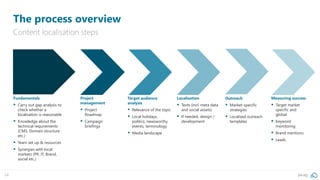
The process overview
Content localisation steps
Fundamentals
 Carry out gap analysis to
check whether a
localisation is reasonable
 Knowledge about the
technical requirements
(CMS, Domain structure
etc.)
 Team set up & resources
 Synergies with local
markets (PR, IT, Brand,
social etc.)
pa.ag10
Finding the right topic
A matrix helps in the research for suitable topics
 Evaluate different ideas about their potential in
different countries (based on keyword research &
content gaps).
 Look for overlaps.
 Content implementation only when there can be seen
potential for all the markets!
 Evaluate with pre outreach
Topic 1 Topic 2 Topic 3 Topic 4
DE
FR
NL
…
pa.ag11
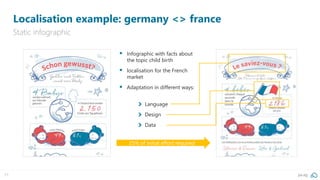
 Infographic with facts about
the topic child birth
 localisation for the French
market
 Adaptation in different ways:
Language
Design
Data
Localisation example: germany <> france
Static infographic
25% of initial effort required
pa.ag12
Localisation example: germany <> france
Interactive map
20% of initial effort required
 An interactive map with data
about living in Europa
 localisation for the French
market
 Texts had to be translated;
data and design could remain
unchanged
pa.ag13
Not all content formats can be localized efficiently...
 Data-based formats work very well when
the data can be easily shared or
replaced
 Expert articles are rather unsuitable if
the experts would need to changed (as
they are not relevant for the target
market). But it depends on the topic and
expert
Expert articlesData-based maps Infographics
pa.ag14
...and neither can all content
 Cross-national data is ideal – it can
theoretically be used easily
 Country-specific data on the other hand
needs to be replaced, so no saving
resources during research
 Country-speficic topics, which are not
relevant on an international scale, are
not suitable for localisation
Country-specific topicsCross-national data Country-specific data
pa.ag15
The process overview
Content localisation steps
Fundamentals
 Carry out gap analysis to
check whether a
localisation is reasonable
 Knowledge about the
technical requirements
(CMS, Domain structure
etc.)
 Team set up & resources
 Synergies with local
markets (PR, IT, Brand,
social etc.)
Project
management
 Project
Roadmap
 Campaign
briefings
pa.ag16
The process overview
Content localisation steps
Fundamentals
 Carry out gap analysis to
check whether a
localisation is reasonable
 Knowledge about the
technical requirements
(CMS, Domain structure
etc.)
 Team set up & resources
 Synergies with local
markets (PR, IT, Brand,
social etc.)
Target audience
analysis
 Relevance of the topic
 Local holidays,
politics, newsworthy
events, terminology
 Media landscape
Project
management
 Project
Roadmap
 Campaign
briefings
pa.ag17
Market analysis
As a reminder: What kind of information about the target market is needed?
Language
cannot be translated 1:1
Topic
must be relevant to the target
market
Content
may have to be adapted to (socio-
political) circumstances
Design
is not perceived in the same
way everywhere (colour,
reading direction, font, etc.)
Media landscape
different criteria and
processes in editorial offices
User behaviour
is culture-specific
A little reminder…
pa.ag18
Market analysis example: Content
Germany and France
Topics
Regional topics don't really work.
Text length
+ ca. 30 %
Addressing people
Formal "You" instead of "you"
Outreach
Shorter and more formal
Contact information
Imprint is often not to be found
Media landscape
Twitter is a popular
distribution channel
pa.ag19
Market analysis example: Webdesign and UX
Germany and China
Source: https://pa.ag/2Wh6j4r | https://pa.ag/2CFc6bm
Exemplary comparison between a Chinese (left) vs. German (right) job platform
pa.ag20
The process overview
Content localisation steps
Fundamentals
 Carry out gap analysis to
check whether a
localisation is reasonable
 Knowledge about the
technical requirements
(CMS, Domain structure
etc.)
 Team set up & resources
 Synergies with local
markets (PR, IT, Brand,
social etc.)
Target audience
analysis
 Relevance of the topic
 Local holidays,
politics, newsworthy
events, terminology
 Media landscape
Project
management
 Project
Roadmap
 Campaign
briefings
Localisation
 Texts (incl. meta data
and social assets)
 If needed, design /
development
pa.ag21
The process: detailed briefings and quality assurance
Content Marketing / Editorial Design / Development
Original texts/content
(Content + meta data)
localisation
Min. 1 proofreading & QADetailed brief &
detailled project plan
Localised texts (Content
+ meta data)
localisation
Quality AssuranceDetailed brief
pa.ag22
The process overview
Content localisation steps
Fundamentals
 Carry out gap analysis to
check whether a
localisation is reasonable
 Knowledge about the
technical requirements
(CMS, Domain structure
etc.)
 Team set up & resources
 Synergies with local
markets (PR, IT, Brand,
social etc.)
Target audience
analysis
 Relevance of the topic
 Local holidays,
politics, newsworthy
events, terminology
 Media landscape
Project
management
 Project
Roadmap
 Campaign
briefings
Localisation
 Texts (incl. meta data
and social assets)
 If needed, design /
development
Outreach
 Market-specific
strategies
 Localised outreach
templates
pa.ag23
Market analysis example: Outreach
Germany and Netherlands
Social media
Create content that is easily
sharable in social networks
LinkedIn
Have a convincing Linkedin
profile. Dutch editors like to check
who you are to evaluate how
trustworthy you are
Trust
It’s all about trust and a good
relationship with the contact
person
Make time for your dialogue
partner
Outreach calls can take up to 30
minutes
Contact information
Imprint is often not to be found
Be prepared
Editors are also very curious in
what you do, who you are and
what your company does
pa.ag24
The process overview
Content localisation steps
Fundamentals
 Carry out gap analysis to
check whether a
localisation is reasonable
 Knowledge about the
technical requirements
(CMS, Domain structure
etc.)
 Team set up & resources
 Synergies with local
markets (PR, IT, Brand,
social etc.)
Target audience
analysis
 Relevance of the topic
 Local holidays,
politics, newsworthy
events, terminology
 Media landscape
Project
management
 Project
Roadmap
 Campaign
briefings
Localisation
 Texts (incl. meta data
and social assets)
 If needed, design /
development
Outreach
 Market-specific
strategies
 Localised outreach
templates
Measuring success
 Target market
specific and
global
 Keyword
monitoring
 Brand mentions
 Leads
pa.ag25
Key takeaways
Review restrictions and demand in advance (technical, topics of
relevance, resources etc.)
Analyse the market, the target groups, the user behavior and
also the media landscape individually
Do not translate content, but adapt it to market circumstances
and localise
twitter.com/peakaceag
facebook.com/peakaceag
www.pa.ag
pa.ag26
Take your career to the next level: jobs.pa.ag
Any questions?
e-mail us > hi@pa.ag
@peakaceag
Dominique Seppelt
d.seppelt@pa.ag

Successful Content Localisation

  • 2.
    … more thanjust a translation Successful Content Localisation Dominique Seppelt I Peak Ace Ag I @dominiquespplt
  • 3.
    What does contentlocalisation mean?
  • 4.
    pa.ag4 What does contentlocalisation mean? Adapt, don't just translate  If a piece of content needs to be distributed on another market, it has to be prepared accordingly  It doesn't mean only translating it to another language!  Instead the content has to be adapted to the new market - in multiple ways
  • 5.
    pa.ag5 What does contentlocalisation mean? Different aspects of adapting the content to the market and target audience The localised content should be adapted to the framework conditions of the target market perfectly. Therefore, we need to familiarise ourselves with the framework conditions as thoroughly as possible. Language cannot be translated 1:1 Topic must be relevant to the target market Content may have to be adapted to (socio- political) circumstances Design is not perceived in the same way everywhere (colour, reading direction, font, etc.) Media landscape different criteria and processes in editorial offices User behaviour is culture-specific
  • 6.
    pa.ag6 Relevance and usage Whycontent localisation is worthwhile? Saving resources  Finding ideas: An idea that is supposed to perform on several markets must be conceptualized internationally, which makes scaling possible.  Research: Data is researched for multiple markets directly.  Design & development: The "framework" already exists and only needs to be adapted or filled with localised texts.  Outreach: Outreach angles and strategies can be tested on a bigger scale. Learnings from other markets
  • 7.
    And how doI implement such projects?
  • 8.
    pa.ag8 Two scenarios forthe content localisation Orientating the campaign to several markets right from the start  Considering the market conditions already at the conception stage  Native speakers are involved in the idea development phase Subsequent campaign localisation due to success in the core market  The final concept will be adapted to another market  However, it should be first tested whether the campaign is suitable for localisation
  • 9.
    pa.ag9 The process overview Contentlocalisation steps Fundamentals  Carry out gap analysis to check whether a localisation is reasonable  Knowledge about the technical requirements (CMS, Domain structure etc.)  Team set up & resources  Synergies with local markets (PR, IT, Brand, social etc.)
  • 10.
    pa.ag10 Finding the righttopic A matrix helps in the research for suitable topics  Evaluate different ideas about their potential in different countries (based on keyword research & content gaps).  Look for overlaps.  Content implementation only when there can be seen potential for all the markets!  Evaluate with pre outreach Topic 1 Topic 2 Topic 3 Topic 4 DE FR NL …
  • 11.
    pa.ag11  Infographic withfacts about the topic child birth  localisation for the French market  Adaptation in different ways: Language Design Data Localisation example: germany <> france Static infographic 25% of initial effort required
  • 12.
    pa.ag12 Localisation example: germany<> france Interactive map 20% of initial effort required  An interactive map with data about living in Europa  localisation for the French market  Texts had to be translated; data and design could remain unchanged
  • 13.
    pa.ag13 Not all contentformats can be localized efficiently...  Data-based formats work very well when the data can be easily shared or replaced  Expert articles are rather unsuitable if the experts would need to changed (as they are not relevant for the target market). But it depends on the topic and expert Expert articlesData-based maps Infographics
  • 14.
    pa.ag14 ...and neither canall content  Cross-national data is ideal – it can theoretically be used easily  Country-specific data on the other hand needs to be replaced, so no saving resources during research  Country-speficic topics, which are not relevant on an international scale, are not suitable for localisation Country-specific topicsCross-national data Country-specific data
  • 15.
    pa.ag15 The process overview Contentlocalisation steps Fundamentals  Carry out gap analysis to check whether a localisation is reasonable  Knowledge about the technical requirements (CMS, Domain structure etc.)  Team set up & resources  Synergies with local markets (PR, IT, Brand, social etc.) Project management  Project Roadmap  Campaign briefings
  • 16.
    pa.ag16 The process overview Contentlocalisation steps Fundamentals  Carry out gap analysis to check whether a localisation is reasonable  Knowledge about the technical requirements (CMS, Domain structure etc.)  Team set up & resources  Synergies with local markets (PR, IT, Brand, social etc.) Target audience analysis  Relevance of the topic  Local holidays, politics, newsworthy events, terminology  Media landscape Project management  Project Roadmap  Campaign briefings
  • 17.
    pa.ag17 Market analysis As areminder: What kind of information about the target market is needed? Language cannot be translated 1:1 Topic must be relevant to the target market Content may have to be adapted to (socio- political) circumstances Design is not perceived in the same way everywhere (colour, reading direction, font, etc.) Media landscape different criteria and processes in editorial offices User behaviour is culture-specific A little reminder…
  • 18.
    pa.ag18 Market analysis example:Content Germany and France Topics Regional topics don't really work. Text length + ca. 30 % Addressing people Formal "You" instead of "you" Outreach Shorter and more formal Contact information Imprint is often not to be found Media landscape Twitter is a popular distribution channel
  • 19.
    pa.ag19 Market analysis example:Webdesign and UX Germany and China Source: https://pa.ag/2Wh6j4r | https://pa.ag/2CFc6bm Exemplary comparison between a Chinese (left) vs. German (right) job platform
  • 20.
    pa.ag20 The process overview Contentlocalisation steps Fundamentals  Carry out gap analysis to check whether a localisation is reasonable  Knowledge about the technical requirements (CMS, Domain structure etc.)  Team set up & resources  Synergies with local markets (PR, IT, Brand, social etc.) Target audience analysis  Relevance of the topic  Local holidays, politics, newsworthy events, terminology  Media landscape Project management  Project Roadmap  Campaign briefings Localisation  Texts (incl. meta data and social assets)  If needed, design / development
  • 21.
    pa.ag21 The process: detailedbriefings and quality assurance Content Marketing / Editorial Design / Development Original texts/content (Content + meta data) localisation Min. 1 proofreading & QADetailed brief & detailled project plan Localised texts (Content + meta data) localisation Quality AssuranceDetailed brief
  • 22.
    pa.ag22 The process overview Contentlocalisation steps Fundamentals  Carry out gap analysis to check whether a localisation is reasonable  Knowledge about the technical requirements (CMS, Domain structure etc.)  Team set up & resources  Synergies with local markets (PR, IT, Brand, social etc.) Target audience analysis  Relevance of the topic  Local holidays, politics, newsworthy events, terminology  Media landscape Project management  Project Roadmap  Campaign briefings Localisation  Texts (incl. meta data and social assets)  If needed, design / development Outreach  Market-specific strategies  Localised outreach templates
  • 23.
    pa.ag23 Market analysis example:Outreach Germany and Netherlands Social media Create content that is easily sharable in social networks LinkedIn Have a convincing Linkedin profile. Dutch editors like to check who you are to evaluate how trustworthy you are Trust It’s all about trust and a good relationship with the contact person Make time for your dialogue partner Outreach calls can take up to 30 minutes Contact information Imprint is often not to be found Be prepared Editors are also very curious in what you do, who you are and what your company does
  • 24.
    pa.ag24 The process overview Contentlocalisation steps Fundamentals  Carry out gap analysis to check whether a localisation is reasonable  Knowledge about the technical requirements (CMS, Domain structure etc.)  Team set up & resources  Synergies with local markets (PR, IT, Brand, social etc.) Target audience analysis  Relevance of the topic  Local holidays, politics, newsworthy events, terminology  Media landscape Project management  Project Roadmap  Campaign briefings Localisation  Texts (incl. meta data and social assets)  If needed, design / development Outreach  Market-specific strategies  Localised outreach templates Measuring success  Target market specific and global  Keyword monitoring  Brand mentions  Leads
  • 25.
    pa.ag25 Key takeaways Review restrictionsand demand in advance (technical, topics of relevance, resources etc.) Analyse the market, the target groups, the user behavior and also the media landscape individually Do not translate content, but adapt it to market circumstances and localise
  • 26.
    twitter.com/peakaceag facebook.com/peakaceag www.pa.ag pa.ag26 Take your careerto the next level: jobs.pa.ag Any questions? e-mail us > hi@pa.ag @peakaceag Dominique Seppelt d.seppelt@pa.ag

Editor's Notes

  • #6 Different speeches Hot topics in Germany might not be relevant in France Content has to be adapted also accordingly User behaviour: Searchvolume, relevant Keywords Editorial Offices work differently (processes, timings, outreach canals) Design preferences also differ in each market
  • #18 Different speeches Hot topics in Germany might not be relevant in France Content has to be adapted also accordingly User behaviour: Searchvolume, relevant Keywords Editorial Offices work differently (processes, timings, outreach canals) Design preferences also differ in each market