Welcome to the 2024 Annual
Fall Gathering
Building Bright Beginnings:
Understanding Geneva's Youngest Learners
through Data and Stories
Hosted by
Success for Geneva's Children & Geneva 2030
EXAMPLES OF
EARLY DATA
REPORTS
OUR 10
GOALS
•Children are born healthy.
•Children have timely and appropriate preventive and primary
health care.
•Families and caregivers have sufficient economic resources to
meet their children’s basic needs.
•Children have safe, stable, and nurturing environments in their
homes, in the community, and in school.
•Families and caregivers possess and practice child-rearing skills
that promote optimal child development.
•Children with special needs receive timely and appropriate
services.
•Children have the opportunity to attend quality early childhood
and care programs.
•Children attend quality schools and succeed.
•The community and schools respect and foster diversity.
•Families exercise their voices and their votes in strengthening
the Geneva community.
Successforgenevaschildren.org
Geneva 2030's Mission
Ready to Learn
Every child enters school prepared for success.
Supported in School
Every child is engaged and succeeds academically.
Postsecondary Success
Every graduate attains a post secondary
credential or employment.
Driving Change through
Shared Data
1 Empowering Decisions
Data enables informed choices for families and leaders
support children’s learning needs early on.
2
Driving Collective Action
Shared data unites efforts to address challenges.
Informed communities are better equipped to champion
early education initiatives.
3 Encourages Early Intervention
Sharing insights through data helps identify children’s needs
sooner, closing support gaps and leading to more
effective intervention.
Early Childhood Development: Why We
Act
48% Children enter kindergarten unprepared 2023
NY State
25% Families struggle to access childcare &
developmental services
2023
NY State
40% Children had regular health check-ups 2023
NY State
25% Only 194 of 753 young children were enrolled in early
education
2022
Geneva
38% Geneva children under five live in poverty 2022
Geneva
Geneva 2030’s Birth to Kindergarten Action Team
Established in response to statistics like these,
the team collaborates with community partners to identify and address
gaps in early learning access and resources.
Action Steps to Create Change
Share your experience and expertise
Contribute unique perspectives and feedback on the data.
Sign up to do something small (QR codes on the back of the program!)
Engage & Collaborate
Forge partnerships to strengthen support networks. Use data to advocate
for resources our children need.
Identifying and Impact Gaps
Collaboratively assessing needs to better allocate resources. Use data to
support resources, policies, and impactful actions.
Embrace Improvement
Continuously refine your approaches to positively impact children’s
growth and development.
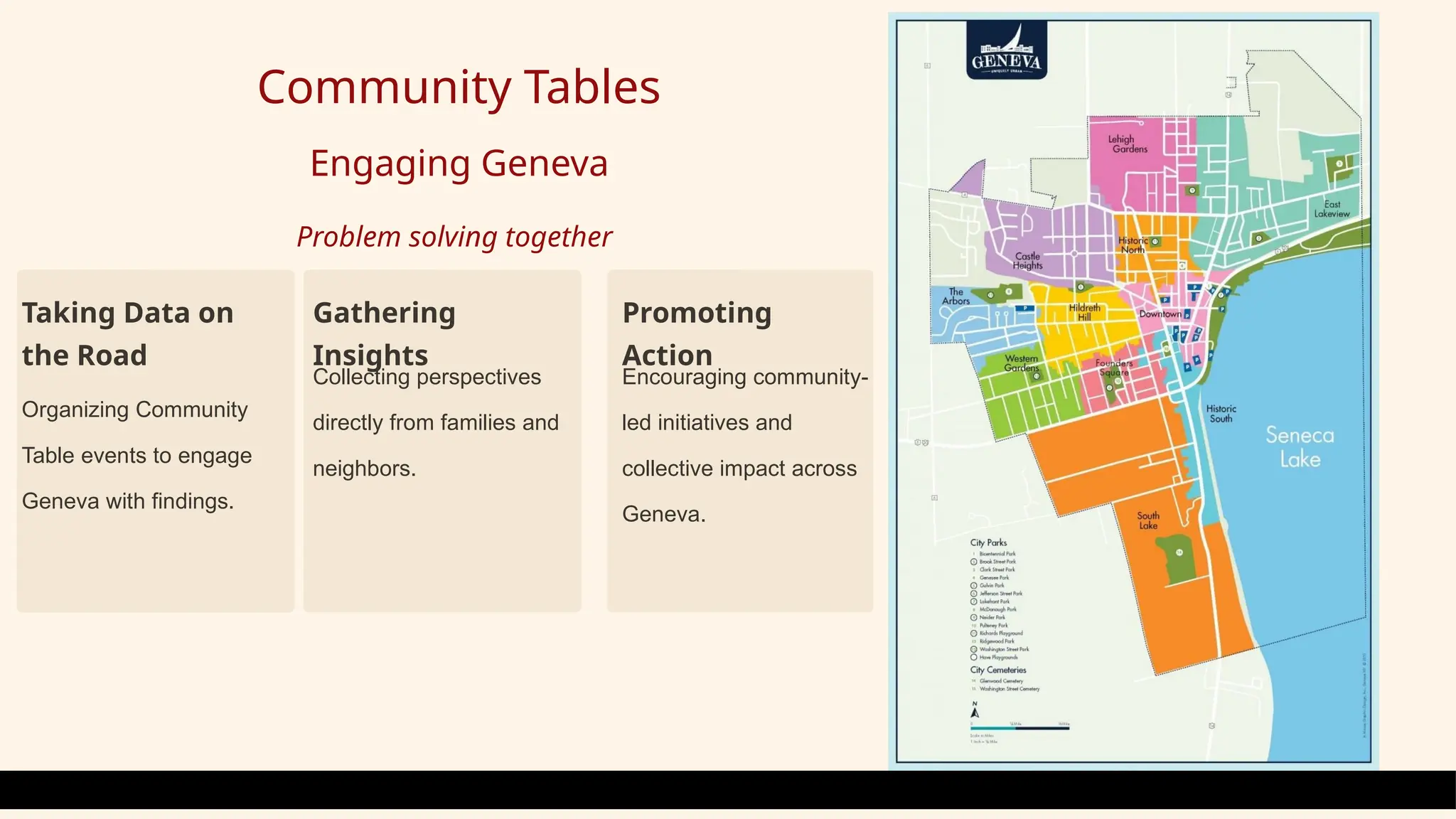
Community Tables
Engaging Geneva
Problem solving together
Taking Data on
the Road
Organizing Community
Table events to engage
Geneva with findings.
Gathering
Insights
Collecting perspectives
directly from families and
neighbors.
Promoting
Action
Encouraging community-
led initiatives and
collective impact across
Geneva.
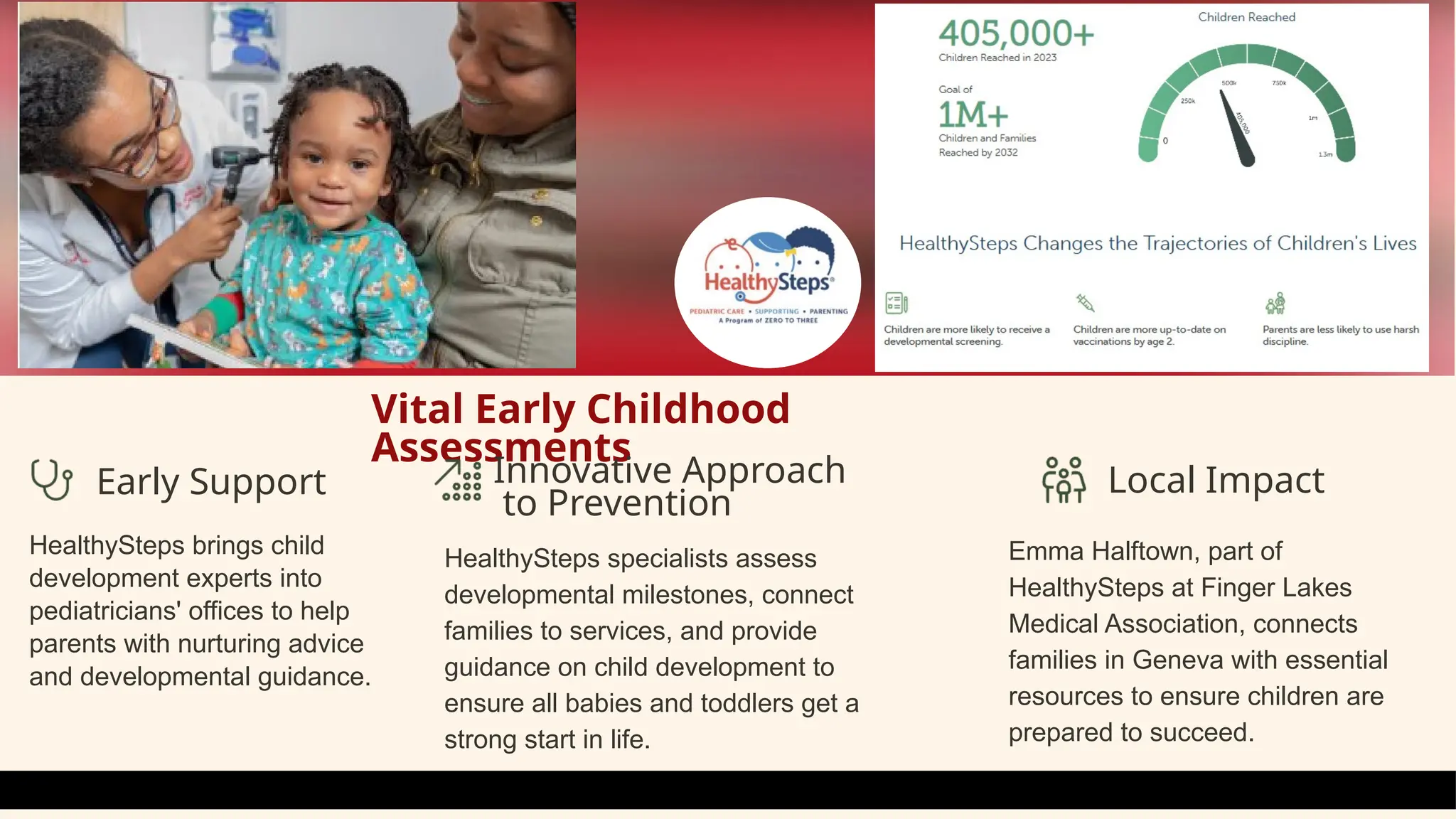
Vital Early Childhood
Assessments
HealthySteps brings child
development experts into
pediatricians' offices to help
parents with nurturing advice
and developmental guidance.
Innovative Approach
to Prevention
HealthySteps specialists assess
developmental milestones, connect
families to services, and provide
guidance on child development to
ensure all babies and toddlers get a
strong start in life.
Local Impact
Emma Halftown, part of
HealthySteps at Finger Lakes
Medical Association, connects
families in Geneva with essential
resources to ensure children are
prepared to succeed.
Early Support
Building Bright Beginnings
Understanding Our Assessments for Children Ages 0-
5
Julie Champion
Child and Family
Resources
Chasa Petroski
Ontario County Public
Health- Children with
Special Needs Program
Lorraine Knifley &
Betsy Dunham
Head Start and Universal
Pre-Kindergarten (UPK)
Tricia Budgar
GCSD West Street School
Kindergarten -2nd
Using ASQs to
understand our
children and guide
parents and
caregivers
Julie Champion
Executive Director
Child and Family Resources Inc.
Who is Child & Family Resources
and what is our commitment to
the community?
Our Mission
Child and Family Resources is dedicated to providing affordable, accessible
programs that enhance and support the education of parents, caregivers, and
child care providers, as well as encourage the highest quality of care and
positive learning experiences for young children.
Understanding our tools:
The Ages & Stages Questionnaire
● The ASQ is parent-centric and designed to be used hand in hand with parents to help guide
developmental goals and activities parents can do to support their child's growth.
● The ASQ's are available in Arabic, Chinese, English, French, Spanish, and Vietnamese
● The ASQ-3 has 21 questionnaires and scoring sheets at 2, 4, 6, 8, 9, 10, 12, 14, 16, 18, 20, 22, 24, 27,
30, 33, 36, 42, 48, 54, and 60 months of age
● The ASQ-SE has 9 questionnaires and scoring sheets at 2, 6, 12, 18, 24, 30, 36, 48, and 60 months of
age
● Each take just 10–15 minutes for parents to complete and 2–3 minutes for professionals to score
● The ASQ captures parents’ in-depth knowledge -They highlight a child’s strengths as well as concerns
● They teach parents about child development and their own child’s skills
● They highlight results that fall in a “monitoring zone,” to make it easier to keep track of children at risk
● They can be completed at home, in a waiting room, during a home visit, at a child care program or
as part of an in-person or phone interview.
A quick glance
at the ASQ.SE
2-
24 month
questionnaire
A quick
glance at
the ASQ 3-
48 month
questionnai
re
How are do we use the data from ASQs ?
● Each ASQ is scored and used for monitoring. For Healthy Families
it is reviewed by our liaison at the County Department of Health
● Strengths are celebrated with the parent
● If needs are identified, staff will support the parent by providing
access to information and activities that will assist them in moving
their child's development forward.
● If more intensive supports are needed, staff discuss the options for
other community resources, such as Early Intervention etc.
● If the parent wants a referral then a referral is made and support in
accessing is given as needed.
Sample of ASQ:SE Aggregate Results
We can also see aggregate results by Category: here
is a sample of the results by category for the ASQ-3
We can also collect and can access data on
the ASQ usage by county
The importance in the use of ASQs:
what this data brings to the table
● ASQs can be used to assess self-regulation, compliance, social-
communication, adaptive functioning, autonomy, affect, interaction
with people,communication, gross motor, fine motor, problem solving,
and personal-social skills
● The ASQ also serves as a healthy educator of developmental
milestones for parents and caregivers
● ASQs are a beneficial source of bringing parents and caregivers
into the conversation concerning their child's development and
facilitate guardianship education
● ASQs can also be accessed in an agregaited way that allows for
some community reflection
Stories of success
A Mom shared concerns that her child's speech could be delayed. In using the ASQ tool as guidance
with the Mom, the child scored low in both Social Emotional and Communication on the ASQ/ASQ-
SEs. As per Mom's request, a referral was made to the Early Intervention program in her county.
Mom and child now receive regular services from the EI program. The Family Support Specialist also
helps to provide the family with activities and books to support these goals as well as other
continued milestone and parenting supports. The next ASQ will be conducted at the child's 2-year
birthday and will help further guide interventions and celebrate successes achieved.
ASQs can be utilized as a resource and gateway to
providing further services with other resources in the
community such as Early Intervention services
Stories of success
While providing services to a family with an infant born 4 weeks prematurely, the 8- and 9-month ASQ tool used
scored below cut off in the area of gross motor development. While an EI service referral was offered, Mom and
Dad chose not to access the service and wanted to work with their child and our program staff for assistance and
support. Based on ASQ developmental guidance, our program purchased a water mat for the family, provided
curriculum and modeled activities for Mom and Dad to do with their child. Mom and Dad were diligent in their
efforts to build these skills. At the 12-month ASQ, tremendous growth was identified as the infant was crawling,
pulling himself to standing and starting to walk with assistance
ASQs can be utilized as a resource and gateway to guiding parents and
guardians through child development and working with children and
infants at home
Stories of success
● The Pyramid Model program is a proven system for helping
teachers and caregivers guide the social-emotional
development of young children while improving their ability
to learn and self-regulate challenging behavior.
● CFR is currently working with 3 home based child care
programs in implementing this long-term service model.
● Among other tools that look at environment and caregiver
interactions, this also includes the use of both ASQ SE and
ASQ-3 tools in conjunction with parents.
● As a result of ASQ use, the child care program individualizes
activities to support social emotional development and
several parents have requested additional Early
Intervention supports and services for their children that
can be provided on location at the child care site.
ASQs can be utilized in conjunction with the Pyramid Model in child care
settings in order to offer insight into individualized programming
Some closing thoughts and
considerations
Additional investments needed to support ASQ use and
further data collection
○ To provide the tools and staffed professional guidance in using
the tools with both families and child care programs
○ To create access to an ASQ online portal system for parents who
want to use the tool at any time and track their child’s progress
○ To gather aggregate data on Geneva’s children and their
developmental needs
Chasa Petroski
Understanding present
health screenings data
for young children
Ontario County Public Health-Children with
Special Needs Program
The Children with Special Needs Program is administered by
Ontario County Public Health. It encompasses:
● Early Intervention
● Preschool Special Education
The program focuses on children ages 0-21 who have, or are suspected of having, a serious or chronic
physical, developmental, behavioral, or emotional condition and who also require services of a type or
amount beyond that required by children generally.
Key activities for this program include:
● disseminating Child Health Plus information
● facilitating access to health care coverage for CSHCN's who are uninsured or under-insured
● reporting on contacts made to the Physically Handicapped Children's (PHCP) Program
● tracking information
Performance by all students in program:
Understanding Deca
● The Devereux Early Childhood Assessment (DECA) is a nationally
standardized assessment tool that helps identify social and emotional
strengths in children
● It can also be used as a pre and post assessment tool to measure
growth and improvement throughout the year
Green= strength
Red= area of need
blue= typical
Preschool SEL graphs from the DECA results as reported by teachers at the
beginning and end of the 23-24 school year
Preschool SEL graphs from the DECA results as reported by teachers at the
beginning and end of the 23-24 school year
Green= strength
Red= area of need
blue= typical
Geneva City School District
West Street School
Kindergarten - Grade 2
Safe and Supportive
Learning Environments
The district will increase
access to mental health
services, proactively focus
on social-emotional
learning, and strengthen
positive behaviors within
our schools.
Academic
Achievement
The district will provide
engaging learning
opportunities and
instructional supports
that foster academic
growth for every
student.
Equity & Inclusion
The district will ensure
every student feels
welcome in our schools,
sees their own
experiences reflected in
the curriculum, and has
equitable access to
engaging learning
opportunities.
03
01 02
GCSD District Priorities
Understanding the DESSA
Screener
The DESSA assess student behaviors around six areas
of social-emotional competence. The unique inclusion of
Optimistic Thinking comes from DESSA”s grounding in
resilience theory. The DESSA is entirely strength-based,
meaning it examines positive behaviors rather than
maladaptive behaviors.
Distribution of Student Assessment Scores Across Descriptive Ranges
Kindergarten Cohort
Kindergarten Fall DESSA
Competency Domains
Understanding i-Ready
Our diagnostic evaluation prepares and equips
teachers by delivering actionable data that
addresses the first part of the learning process
—knowing exactly where each student is. i-
Ready Diagnostic provides teachers with a
complete picture of student performance
relating to their grade level and national
norms. It also includes Lexile® and Quantile®
information for insights into reading and
mathematics performance.
i-Ready Diagnostic includes a
Growth Monitoring feature that
enables teachers to evaluate
progress (up to monthly) using
short (15-minute) adaptive
assessments and adjust their
lesson plan accordingly. Using
our diagnostic assessment
gives you a clearer picture of
how students are progressing
so educators can adjust their
lessons to help them achieve
their goals.
Diagnostic Assessments Progress Monitoring
Academic Data - Math
Academic Data - Math continued
Academic Data - Reading
Academic Data - Reading continued
President Rob Nye
Success_Geneva 2030 Fall Gathering 2024  .pptx

Success_Geneva 2030 Fall Gathering 2024 .pptx

  • 1.
    Welcome to the2024 Annual Fall Gathering Building Bright Beginnings: Understanding Geneva's Youngest Learners through Data and Stories Hosted by Success for Geneva's Children & Geneva 2030
  • 4.
  • 5.
    OUR 10 GOALS •Children areborn healthy. •Children have timely and appropriate preventive and primary health care. •Families and caregivers have sufficient economic resources to meet their children’s basic needs. •Children have safe, stable, and nurturing environments in their homes, in the community, and in school. •Families and caregivers possess and practice child-rearing skills that promote optimal child development. •Children with special needs receive timely and appropriate services. •Children have the opportunity to attend quality early childhood and care programs. •Children attend quality schools and succeed. •The community and schools respect and foster diversity. •Families exercise their voices and their votes in strengthening the Geneva community.
  • 7.
  • 11.
    Geneva 2030's Mission Readyto Learn Every child enters school prepared for success. Supported in School Every child is engaged and succeeds academically. Postsecondary Success Every graduate attains a post secondary credential or employment.
  • 12.
    Driving Change through SharedData 1 Empowering Decisions Data enables informed choices for families and leaders support children’s learning needs early on. 2 Driving Collective Action Shared data unites efforts to address challenges. Informed communities are better equipped to champion early education initiatives. 3 Encourages Early Intervention Sharing insights through data helps identify children’s needs sooner, closing support gaps and leading to more effective intervention.
  • 13.
    Early Childhood Development:Why We Act 48% Children enter kindergarten unprepared 2023 NY State 25% Families struggle to access childcare & developmental services 2023 NY State 40% Children had regular health check-ups 2023 NY State 25% Only 194 of 753 young children were enrolled in early education 2022 Geneva 38% Geneva children under five live in poverty 2022 Geneva Geneva 2030’s Birth to Kindergarten Action Team Established in response to statistics like these, the team collaborates with community partners to identify and address gaps in early learning access and resources.
  • 14.
    Action Steps toCreate Change Share your experience and expertise Contribute unique perspectives and feedback on the data. Sign up to do something small (QR codes on the back of the program!) Engage & Collaborate Forge partnerships to strengthen support networks. Use data to advocate for resources our children need. Identifying and Impact Gaps Collaboratively assessing needs to better allocate resources. Use data to support resources, policies, and impactful actions. Embrace Improvement Continuously refine your approaches to positively impact children’s growth and development.
  • 15.
    Community Tables Engaging Geneva Problemsolving together Taking Data on the Road Organizing Community Table events to engage Geneva with findings. Gathering Insights Collecting perspectives directly from families and neighbors. Promoting Action Encouraging community- led initiatives and collective impact across Geneva.
  • 16.
    Vital Early Childhood Assessments HealthyStepsbrings child development experts into pediatricians' offices to help parents with nurturing advice and developmental guidance. Innovative Approach to Prevention HealthySteps specialists assess developmental milestones, connect families to services, and provide guidance on child development to ensure all babies and toddlers get a strong start in life. Local Impact Emma Halftown, part of HealthySteps at Finger Lakes Medical Association, connects families in Geneva with essential resources to ensure children are prepared to succeed. Early Support
  • 17.
    Building Bright Beginnings UnderstandingOur Assessments for Children Ages 0- 5 Julie Champion Child and Family Resources Chasa Petroski Ontario County Public Health- Children with Special Needs Program Lorraine Knifley & Betsy Dunham Head Start and Universal Pre-Kindergarten (UPK) Tricia Budgar GCSD West Street School Kindergarten -2nd
  • 18.
    Using ASQs to understandour children and guide parents and caregivers Julie Champion Executive Director Child and Family Resources Inc.
  • 19.
    Who is Child& Family Resources and what is our commitment to the community? Our Mission Child and Family Resources is dedicated to providing affordable, accessible programs that enhance and support the education of parents, caregivers, and child care providers, as well as encourage the highest quality of care and positive learning experiences for young children.
  • 20.
    Understanding our tools: TheAges & Stages Questionnaire ● The ASQ is parent-centric and designed to be used hand in hand with parents to help guide developmental goals and activities parents can do to support their child's growth. ● The ASQ's are available in Arabic, Chinese, English, French, Spanish, and Vietnamese ● The ASQ-3 has 21 questionnaires and scoring sheets at 2, 4, 6, 8, 9, 10, 12, 14, 16, 18, 20, 22, 24, 27, 30, 33, 36, 42, 48, 54, and 60 months of age ● The ASQ-SE has 9 questionnaires and scoring sheets at 2, 6, 12, 18, 24, 30, 36, 48, and 60 months of age ● Each take just 10–15 minutes for parents to complete and 2–3 minutes for professionals to score ● The ASQ captures parents’ in-depth knowledge -They highlight a child’s strengths as well as concerns ● They teach parents about child development and their own child’s skills ● They highlight results that fall in a “monitoring zone,” to make it easier to keep track of children at risk ● They can be completed at home, in a waiting room, during a home visit, at a child care program or as part of an in-person or phone interview.
  • 21.
    A quick glance atthe ASQ.SE 2- 24 month questionnaire
  • 23.
    A quick glance at theASQ 3- 48 month questionnai re
  • 25.
    How are dowe use the data from ASQs ? ● Each ASQ is scored and used for monitoring. For Healthy Families it is reviewed by our liaison at the County Department of Health ● Strengths are celebrated with the parent ● If needs are identified, staff will support the parent by providing access to information and activities that will assist them in moving their child's development forward. ● If more intensive supports are needed, staff discuss the options for other community resources, such as Early Intervention etc. ● If the parent wants a referral then a referral is made and support in accessing is given as needed.
  • 26.
    Sample of ASQ:SEAggregate Results
  • 27.
    We can alsosee aggregate results by Category: here is a sample of the results by category for the ASQ-3
  • 28.
    We can alsocollect and can access data on the ASQ usage by county
  • 29.
    The importance inthe use of ASQs: what this data brings to the table ● ASQs can be used to assess self-regulation, compliance, social- communication, adaptive functioning, autonomy, affect, interaction with people,communication, gross motor, fine motor, problem solving, and personal-social skills ● The ASQ also serves as a healthy educator of developmental milestones for parents and caregivers ● ASQs are a beneficial source of bringing parents and caregivers into the conversation concerning their child's development and facilitate guardianship education ● ASQs can also be accessed in an agregaited way that allows for some community reflection
  • 30.
    Stories of success AMom shared concerns that her child's speech could be delayed. In using the ASQ tool as guidance with the Mom, the child scored low in both Social Emotional and Communication on the ASQ/ASQ- SEs. As per Mom's request, a referral was made to the Early Intervention program in her county. Mom and child now receive regular services from the EI program. The Family Support Specialist also helps to provide the family with activities and books to support these goals as well as other continued milestone and parenting supports. The next ASQ will be conducted at the child's 2-year birthday and will help further guide interventions and celebrate successes achieved. ASQs can be utilized as a resource and gateway to providing further services with other resources in the community such as Early Intervention services
  • 31.
    Stories of success Whileproviding services to a family with an infant born 4 weeks prematurely, the 8- and 9-month ASQ tool used scored below cut off in the area of gross motor development. While an EI service referral was offered, Mom and Dad chose not to access the service and wanted to work with their child and our program staff for assistance and support. Based on ASQ developmental guidance, our program purchased a water mat for the family, provided curriculum and modeled activities for Mom and Dad to do with their child. Mom and Dad were diligent in their efforts to build these skills. At the 12-month ASQ, tremendous growth was identified as the infant was crawling, pulling himself to standing and starting to walk with assistance ASQs can be utilized as a resource and gateway to guiding parents and guardians through child development and working with children and infants at home
  • 32.
    Stories of success ●The Pyramid Model program is a proven system for helping teachers and caregivers guide the social-emotional development of young children while improving their ability to learn and self-regulate challenging behavior. ● CFR is currently working with 3 home based child care programs in implementing this long-term service model. ● Among other tools that look at environment and caregiver interactions, this also includes the use of both ASQ SE and ASQ-3 tools in conjunction with parents. ● As a result of ASQ use, the child care program individualizes activities to support social emotional development and several parents have requested additional Early Intervention supports and services for their children that can be provided on location at the child care site. ASQs can be utilized in conjunction with the Pyramid Model in child care settings in order to offer insight into individualized programming
  • 33.
    Some closing thoughtsand considerations Additional investments needed to support ASQ use and further data collection ○ To provide the tools and staffed professional guidance in using the tools with both families and child care programs ○ To create access to an ASQ online portal system for parents who want to use the tool at any time and track their child’s progress ○ To gather aggregate data on Geneva’s children and their developmental needs
  • 34.
    Chasa Petroski Understanding present healthscreenings data for young children Ontario County Public Health-Children with Special Needs Program
  • 35.
    The Children withSpecial Needs Program is administered by Ontario County Public Health. It encompasses: ● Early Intervention ● Preschool Special Education The program focuses on children ages 0-21 who have, or are suspected of having, a serious or chronic physical, developmental, behavioral, or emotional condition and who also require services of a type or amount beyond that required by children generally. Key activities for this program include: ● disseminating Child Health Plus information ● facilitating access to health care coverage for CSHCN's who are uninsured or under-insured ● reporting on contacts made to the Physically Handicapped Children's (PHCP) Program ● tracking information
  • 60.
    Performance by allstudents in program:
  • 65.
    Understanding Deca ● TheDevereux Early Childhood Assessment (DECA) is a nationally standardized assessment tool that helps identify social and emotional strengths in children ● It can also be used as a pre and post assessment tool to measure growth and improvement throughout the year
  • 66.
    Green= strength Red= areaof need blue= typical Preschool SEL graphs from the DECA results as reported by teachers at the beginning and end of the 23-24 school year
  • 67.
    Preschool SEL graphsfrom the DECA results as reported by teachers at the beginning and end of the 23-24 school year Green= strength Red= area of need blue= typical
  • 68.
    Geneva City SchoolDistrict West Street School Kindergarten - Grade 2
  • 69.
    Safe and Supportive LearningEnvironments The district will increase access to mental health services, proactively focus on social-emotional learning, and strengthen positive behaviors within our schools. Academic Achievement The district will provide engaging learning opportunities and instructional supports that foster academic growth for every student. Equity & Inclusion The district will ensure every student feels welcome in our schools, sees their own experiences reflected in the curriculum, and has equitable access to engaging learning opportunities. 03 01 02 GCSD District Priorities
  • 70.
    Understanding the DESSA Screener TheDESSA assess student behaviors around six areas of social-emotional competence. The unique inclusion of Optimistic Thinking comes from DESSA”s grounding in resilience theory. The DESSA is entirely strength-based, meaning it examines positive behaviors rather than maladaptive behaviors.
  • 75.
    Distribution of StudentAssessment Scores Across Descriptive Ranges Kindergarten Cohort
  • 76.
  • 77.
    Understanding i-Ready Our diagnosticevaluation prepares and equips teachers by delivering actionable data that addresses the first part of the learning process —knowing exactly where each student is. i- Ready Diagnostic provides teachers with a complete picture of student performance relating to their grade level and national norms. It also includes Lexile® and Quantile® information for insights into reading and mathematics performance. i-Ready Diagnostic includes a Growth Monitoring feature that enables teachers to evaluate progress (up to monthly) using short (15-minute) adaptive assessments and adjust their lesson plan accordingly. Using our diagnostic assessment gives you a clearer picture of how students are progressing so educators can adjust their lessons to help them achieve their goals. Diagnostic Assessments Progress Monitoring
  • 78.
  • 79.
    Academic Data -Math continued
  • 80.
  • 81.
    Academic Data -Reading continued
  • 86.