Succeed Fast
The tortoise loses More than half “project kills” are due to a lack of strategic alignment Business needs changed: 30% Project was no longer a priority: 14% Project did not support the business strategy: 7%
Staying lean
Specification difficulties Creative Commons by Chucka_NC
Prince basics Business goal Specified deliverables
Product breakdown Website UX Content Design Moodboards Technology IA Hosting Code Specification Taxonomy Content strategy
Product backlog Deliverables Project objective
The stakeholder scrum
Prioritisation Benefit Difficulty Audience Pigs Next project phase Financial Requirement Requirement Requirement Requirement Requirement Requirement Requirement Requirement Requirement Budget Time Pigs / Chickens Skills Challenge Kill Implement Possible
Parallel workstreams Creative Commons - GaryJWood
Success informs strategy Creative Commons – ramkarthik
Moveable releases Feature 3 Feature 1 Feature 2 Release
In conclusion Identify pigs and chickens Establish priorities Watch out for moving goalposts Questions

Succeed Fast

Editor's Notes

  • #2 I provide consultancy on web content management and associated tools and processes. Provide consultancy on on project management with a couple of partners. Project manage 3 rd parties on behalf of clients. Implementation (design & build) with partners. Mostly for people with a lot of content: central government, media, investment finance Discuss techniques from two methodologies – Prince & Scrum – and how these can support web implementations and speed them up. Gauge audience familiarity with Prince & Scrum
  • #3 Sources: http://www.isaca.org/Template.cfm?Section=Press_Releases1&CONTENTID=42336&TEMPLATE=/ContentManagement/ContentDisplay.cfm http://blogs.zdnet.com/projectfailures/?p=1151 43% of IT projects are killed More than 20% of all projects fail because of lack of strategic alignment
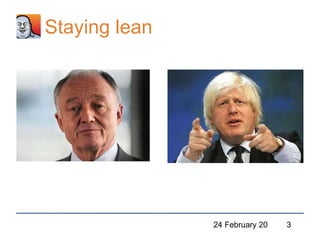
  • #4 PEST factors: political – economic - social - technological Met Police Ken wanted more police officers for London We built HR application Boris then decided recruitment was unnecessary Time spent on Work in Progress counts against likelihood of project success Especially true of consultative requirements and specification
  • #5 How do you reduce work in progress, particularly on specifications, without jeopardising project objectives? Like swimming turns - not enough detail, come up short, can't power into next phase - too much detail & pre-analysis, gone too far, whack ankles (change requests) Must specify most important features Don't waste time on details that may prove to be incorrect http://www.flickr.com/photos/chucka_nc/2650987077/
  • #6 Focus on objectives rather than specification details Prince = projects in controlled environments Waterfall means there should be no repetition Bad press – Prince2 should be re-branded as Prince 2.0 Has issues as a methodology but there's a core focus on managing cost Can also learn from product breakdown
  • #7 Commercial partnerships often get in the way - fixed price for services that cannot yet be known - lack of confidence in understanding objective lead to restrictive commercial models Home Office intranet got it completely wrong - too much stakeholder engagement Keeps focus on project objective, but if this changes, it leaves little room to manoeuvre
  • #8 Can invert pyramid – classic consultancy phrase You know you'll need those products, so get on and build them This allows you to keep focus on moving objective Issue is that some elements of your work will be flawed Places stress on getting features right, but you need to prioritise
  • #9 Chickens and pigs Set up bacon & eggs restaurant Chicken makes contribution Pig is completely committed Useful distinction to make Holds key to scope management Chickens may be people who have knowledge But sponsor, senior supplier, senior user all pigs Chicken http://www.flickr.com/photos/dungodung/216801940/ Pig http://www.flickr.com/photos/fleur-design/428341583/
  • #10 Continual Pareto Trying to encourage positive decisions and stakeholder buy-in Can satisfy just one group Based on project team’s (and supplier’s) input http://www.svpg.com/assessing-product-opportunities/ Scrums and sprints 1. Exactly what problem will this solve? (value proposition) 2. For whom do we solve that problem? (target market) 3. How big is the opportunity? (market size) 4. What alternatives are out there? (competitive landscape) 5. Why are we best suited to pursue this? (our differentiator) 6. Why now? (market window) 7. How will we get this product to market? (go-to-market strategy) 8. How will we measure success/make money from this product? (metrics/revenue strategy) 9. What factors are critical to success? (solution requirements) 10. Given the above, what’s the recommendation? (go or no-go)
  • #11 Tactical Brochureware sites via SaaS CMS across North America Focus on engagement Strategic eCommerce sites via integrated CMS in Europe Develop pattern library Still going to need to deliver tactical and strategic projects Can’t just ignore projects because they’re difficult global media company Social media tools easy to develop and proven benefit for this organisation Retail less well proven and requires complex platform integration and code re-use Don’t want to slow down development of strategic platform with social media distractions Don’t want to lose engagement because you’re focussing on the “big picture” http://www.flickr.com/photos/garyjwood/1252671586/
  • #12 Central government department some benefits are difficult to prove until you’ve done them produced user-focussed guidance documents that were tested compelled policy teams to review how guidance was written Need better integration of project teams http://www.flickr.com/photos/ramkarthik/4022566308/
  • #13 Met Police Went live with Specials rather than Police Officers Built release method before we built most of the features
  • #14 Both Prince2 & Scrum offer tools for speeding up project delivery Need to take on what suits your organisational culture