Subsumption
Architectures
Overview
● Reactive control
● Complete control space
● Action selection
● The subsumption architecture
Vertical vs. horizontal decomposition
SubsumptionArchitecture 2
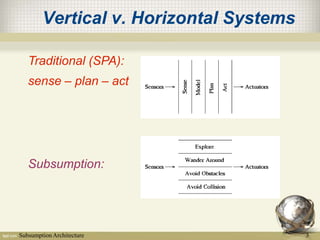
Vertical v. Horizontal Systems
Traditional (SPA):
sense – plan – act
Subsumption:
SubsumptionArchitecture 3
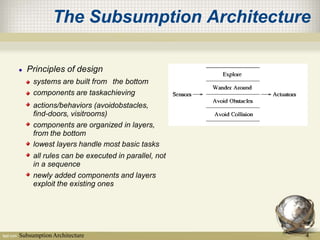
The Subsumption Architecture
● Principles of design
systems are built from the bottom
components are taskachieving
actions/behaviors (avoidobstacles,
find-doors, visitrooms)
components are organized in layers,
from the bottom
lowest layers handle most basic tasks
all rules can be executed in parallel, not
in a sequence
newly added components and layers
exploit the existing ones
SubsumptionArchitecture 4
Subsumption Layers
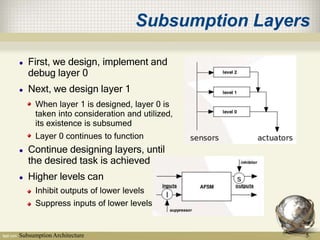
● First, we design, implement and
debug layer 0
● Next, we design layer 1
When layer 1 is designed, layer 0 is
taken into consideration and utilized,
its existence is subsumed
Layer 0 continues to function
● Continue designing layers, until
the desired task is achieved
● Higher levels can
Inhibit outputs of lower levels
Suppress inputs of lower levels
SubsumptionArchitecture 5
Subsumption Language and AFSMs
● The original Subsumption Architecture was
implemented using the Subsumption Language
● It was based on finite state machines (FSMs)
augmented with a very small amount of state
(AFSMs)
● AFSMs were implemented in Lisp
SubsumptionArchitecture 6
Subsumption Language and AFSMs
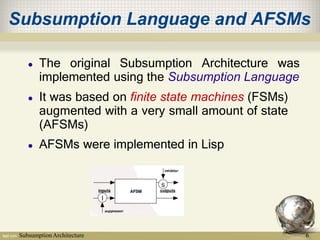
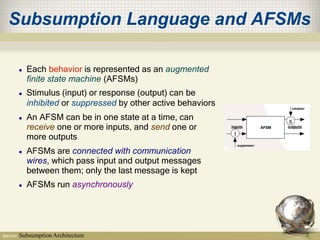
● Each behavior is represented as an augmented
finite state machine (AFSMs)
● Stimulus (input) or response (output) can be
inhibited or suppressed by other active behaviors
● An AFSM can be in one state at a time, can
receive one or more inputs, and send one or
more outputs
● AFSMs are connected with communication
wires, which pass input and output messages
between them; only the last message is kept
● AFSMs run asynchronously
SubsumptionArchitecture 7
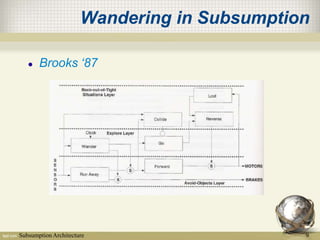
Networks of AFSMs
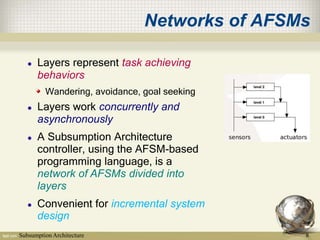
● Layers represent task achieving
behaviors
Wandering, avoidance, goal seeking
● Layers work concurrently and
asynchronously
● A Subsumption Architecture
controller, using the AFSM-based
programming language, is a
network of AFSMs divided into
layers
● Convenient for incremental system
design
SubsumptionArchitecture 8
Wandering in Subsumption
● Brooks ‘87
SubsumptionArchitecture 9
Layering in AFSM Networks
● Layers modularize the reactive system
● Bad design:
putting a lot of behaviors within a single layer
putting a large number of connections between the layers, so
that they are strongly coupled
● Strong coupling implies dependence between
modules, which violates the modularity of the system
● If modules are interdependent, they are not as robust
to failure
● In Subsumption, if higher layers fail, the lower ones
remain unaffected
SubsumptionArchitecture 10
Module Independence
● Subsumption has one-way independence
between layers
With upward independence, a higher layer can
always use a lower one by using suppression and
inhibition
● Two-way independence is not practical
No communication between layers is possible
● Do we always have to use these wires to
communicate between parts of the system?
SubsumptionArchitecture 11
Sequencing in Subsumption
SubsumptionArchitecture 12
● How can you sequence activities in
Subsumption?
● Coupling between layers need not be through
the system itself (i.e., not through explicit
communication wires)
● It could be through the world. How?
Communication through the World
● Collecting soda cans: Herbert
● Herbert’s capabilities
Move around without running into
obstacles
Detect soda cans using a camera and a
laser
An arm that could: extend, sense if there
is a can in the gripper, close the gripper,
tuck the arm in
SubsumptionArchitecture 13
Herbert
SubsumptionArchitecture 14
● Look for soda cans, when seeing one approach it
● When close, extend the arm toward the soda can
● If the gripper sensors detect something, close the
gripper
● If can is heavy, put it down, otherwise pick it up
● If gripper was closed, tuck the arm in and head home
● The robot did not keep internal state about what it had
just done and what it should do next: it just sensed!
More on Herbert
SubsumptionArchitecture 15
● There is no internal wire between the layers
thatachieve can finding, grabbing, arm tucking,
and going home
● However, the events are all executed in proper
sequence. Why?
● Because the relevant parts of the control system
interact and activate each other through sensing
the world
World as the Best Model
● This is a key principle of reactive systems &
Subsumption Architecture:
Use the world as its own best model!
● If the world can provide the information directly
(through sensing), it is best to get it that way,
than to store it internally in a representation
(which may be large, slow, expensive, and
outdated)
SubsumptionArchitecture 16
Subsumption System Design
SubsumptionArchitecture 17
● What makes a Subsumption Layer, what should
go where?
● There is no strict recipe, but some solutions are
better than others, and most are derived
empirically
● How exactly layers are split up depends on the
specifics of the robot, the environment, and the
task
Designing in Subsumption
SubsumptionArchitecture 18
● Qualitatively specify the overall behavior needed
for the task
● Decompose that into specific and independent
behaviors (layers)
● Determine behavior granularity
● Ground low-level behaviors in the robot’s
sensors and effectors
● Incrementally build, test, and add
Genghis (MIT)
● Walk over rough terrain and follow a
human (Brooks ’89)
Standup
● Control leg’s swing position and lift
Simple walk
Force balancing
● Force sensors provide information about the
ground profile
Leg lifting: step over obstacles
Obstacle avoidance (whiskers)
Pitch stabilization
Prowling
Steered prowling
SubsumptionArchitecture 19
The Nerd Herd (MIT)
● Foraging example (Matarić ’93)
R1 robots (IS robotics)
● Behaviors involved:
Wandering
Avoiding
Pickup
Homing
SubsumptionArchitecture 20
Tom and Jerry (MIT)
SubsumptionArchitecture 21
Pros and Cons
SubsumptionArchitecture 22
● Some critics consider the lack of detail about
designing layers to be a weakness of the
approach
● Others feel it is a strength, allowing for
innovation and creativity
● Subsumption has been used on a vast variety of
effective implemented robotic systems
● It was the first architecture to demonstrate many
working robots
Benefits of Subsumption
● Systems are designed incrementally
Avoid design problems due to the complexity of the task
Helps the design and debugging process
● Robustness
If higher levels fail, the lower ones continue unaffected
● Modularity
Each “competency” is included into a separate layer, thus
making the system manageable to design and maintain
Rules and layers can be reused on different robots and for
different tasks
SubsumptionArchitecture 23
Behavior-Based Control
● Reactive systems
too inflexible, use no representation, no adaptation or
learning
● Deliberative systems
Too slow and cumbersome
● Hybrid systems
Complex interactions among the hybrid components
● Behavior-based control involves the use of
“behaviors” as modules for control
SubsumptionArchitecture 24

subsumption.pptx

  • 1.
  • 2.
    Overview ● Reactive control ●Complete control space ● Action selection ● The subsumption architecture Vertical vs. horizontal decomposition SubsumptionArchitecture 2
  • 3.
    Vertical v. HorizontalSystems Traditional (SPA): sense – plan – act Subsumption: SubsumptionArchitecture 3
  • 4.
    The Subsumption Architecture ●Principles of design systems are built from the bottom components are taskachieving actions/behaviors (avoidobstacles, find-doors, visitrooms) components are organized in layers, from the bottom lowest layers handle most basic tasks all rules can be executed in parallel, not in a sequence newly added components and layers exploit the existing ones SubsumptionArchitecture 4
  • 5.
    Subsumption Layers ● First,we design, implement and debug layer 0 ● Next, we design layer 1 When layer 1 is designed, layer 0 is taken into consideration and utilized, its existence is subsumed Layer 0 continues to function ● Continue designing layers, until the desired task is achieved ● Higher levels can Inhibit outputs of lower levels Suppress inputs of lower levels SubsumptionArchitecture 5
  • 6.
    Subsumption Language andAFSMs ● The original Subsumption Architecture was implemented using the Subsumption Language ● It was based on finite state machines (FSMs) augmented with a very small amount of state (AFSMs) ● AFSMs were implemented in Lisp SubsumptionArchitecture 6
  • 7.
    Subsumption Language andAFSMs ● Each behavior is represented as an augmented finite state machine (AFSMs) ● Stimulus (input) or response (output) can be inhibited or suppressed by other active behaviors ● An AFSM can be in one state at a time, can receive one or more inputs, and send one or more outputs ● AFSMs are connected with communication wires, which pass input and output messages between them; only the last message is kept ● AFSMs run asynchronously SubsumptionArchitecture 7
  • 8.
    Networks of AFSMs ●Layers represent task achieving behaviors Wandering, avoidance, goal seeking ● Layers work concurrently and asynchronously ● A Subsumption Architecture controller, using the AFSM-based programming language, is a network of AFSMs divided into layers ● Convenient for incremental system design SubsumptionArchitecture 8
  • 9.
    Wandering in Subsumption ●Brooks ‘87 SubsumptionArchitecture 9
  • 10.
    Layering in AFSMNetworks ● Layers modularize the reactive system ● Bad design: putting a lot of behaviors within a single layer putting a large number of connections between the layers, so that they are strongly coupled ● Strong coupling implies dependence between modules, which violates the modularity of the system ● If modules are interdependent, they are not as robust to failure ● In Subsumption, if higher layers fail, the lower ones remain unaffected SubsumptionArchitecture 10
  • 11.
    Module Independence ● Subsumptionhas one-way independence between layers With upward independence, a higher layer can always use a lower one by using suppression and inhibition ● Two-way independence is not practical No communication between layers is possible ● Do we always have to use these wires to communicate between parts of the system? SubsumptionArchitecture 11
  • 12.
    Sequencing in Subsumption SubsumptionArchitecture12 ● How can you sequence activities in Subsumption? ● Coupling between layers need not be through the system itself (i.e., not through explicit communication wires) ● It could be through the world. How?
  • 13.
    Communication through theWorld ● Collecting soda cans: Herbert ● Herbert’s capabilities Move around without running into obstacles Detect soda cans using a camera and a laser An arm that could: extend, sense if there is a can in the gripper, close the gripper, tuck the arm in SubsumptionArchitecture 13
  • 14.
    Herbert SubsumptionArchitecture 14 ● Lookfor soda cans, when seeing one approach it ● When close, extend the arm toward the soda can ● If the gripper sensors detect something, close the gripper ● If can is heavy, put it down, otherwise pick it up ● If gripper was closed, tuck the arm in and head home ● The robot did not keep internal state about what it had just done and what it should do next: it just sensed!
  • 15.
    More on Herbert SubsumptionArchitecture15 ● There is no internal wire between the layers thatachieve can finding, grabbing, arm tucking, and going home ● However, the events are all executed in proper sequence. Why? ● Because the relevant parts of the control system interact and activate each other through sensing the world
  • 16.
    World as theBest Model ● This is a key principle of reactive systems & Subsumption Architecture: Use the world as its own best model! ● If the world can provide the information directly (through sensing), it is best to get it that way, than to store it internally in a representation (which may be large, slow, expensive, and outdated) SubsumptionArchitecture 16
  • 17.
    Subsumption System Design SubsumptionArchitecture17 ● What makes a Subsumption Layer, what should go where? ● There is no strict recipe, but some solutions are better than others, and most are derived empirically ● How exactly layers are split up depends on the specifics of the robot, the environment, and the task
  • 18.
    Designing in Subsumption SubsumptionArchitecture18 ● Qualitatively specify the overall behavior needed for the task ● Decompose that into specific and independent behaviors (layers) ● Determine behavior granularity ● Ground low-level behaviors in the robot’s sensors and effectors ● Incrementally build, test, and add
  • 19.
    Genghis (MIT) ● Walkover rough terrain and follow a human (Brooks ’89) Standup ● Control leg’s swing position and lift Simple walk Force balancing ● Force sensors provide information about the ground profile Leg lifting: step over obstacles Obstacle avoidance (whiskers) Pitch stabilization Prowling Steered prowling SubsumptionArchitecture 19
  • 20.
    The Nerd Herd(MIT) ● Foraging example (Matarić ’93) R1 robots (IS robotics) ● Behaviors involved: Wandering Avoiding Pickup Homing SubsumptionArchitecture 20
  • 21.
    Tom and Jerry(MIT) SubsumptionArchitecture 21
  • 22.
    Pros and Cons SubsumptionArchitecture22 ● Some critics consider the lack of detail about designing layers to be a weakness of the approach ● Others feel it is a strength, allowing for innovation and creativity ● Subsumption has been used on a vast variety of effective implemented robotic systems ● It was the first architecture to demonstrate many working robots
  • 23.
    Benefits of Subsumption ●Systems are designed incrementally Avoid design problems due to the complexity of the task Helps the design and debugging process ● Robustness If higher levels fail, the lower ones continue unaffected ● Modularity Each “competency” is included into a separate layer, thus making the system manageable to design and maintain Rules and layers can be reused on different robots and for different tasks SubsumptionArchitecture 23
  • 24.
    Behavior-Based Control ● Reactivesystems too inflexible, use no representation, no adaptation or learning ● Deliberative systems Too slow and cumbersome ● Hybrid systems Complex interactions among the hybrid components ● Behavior-based control involves the use of “behaviors” as modules for control SubsumptionArchitecture 24