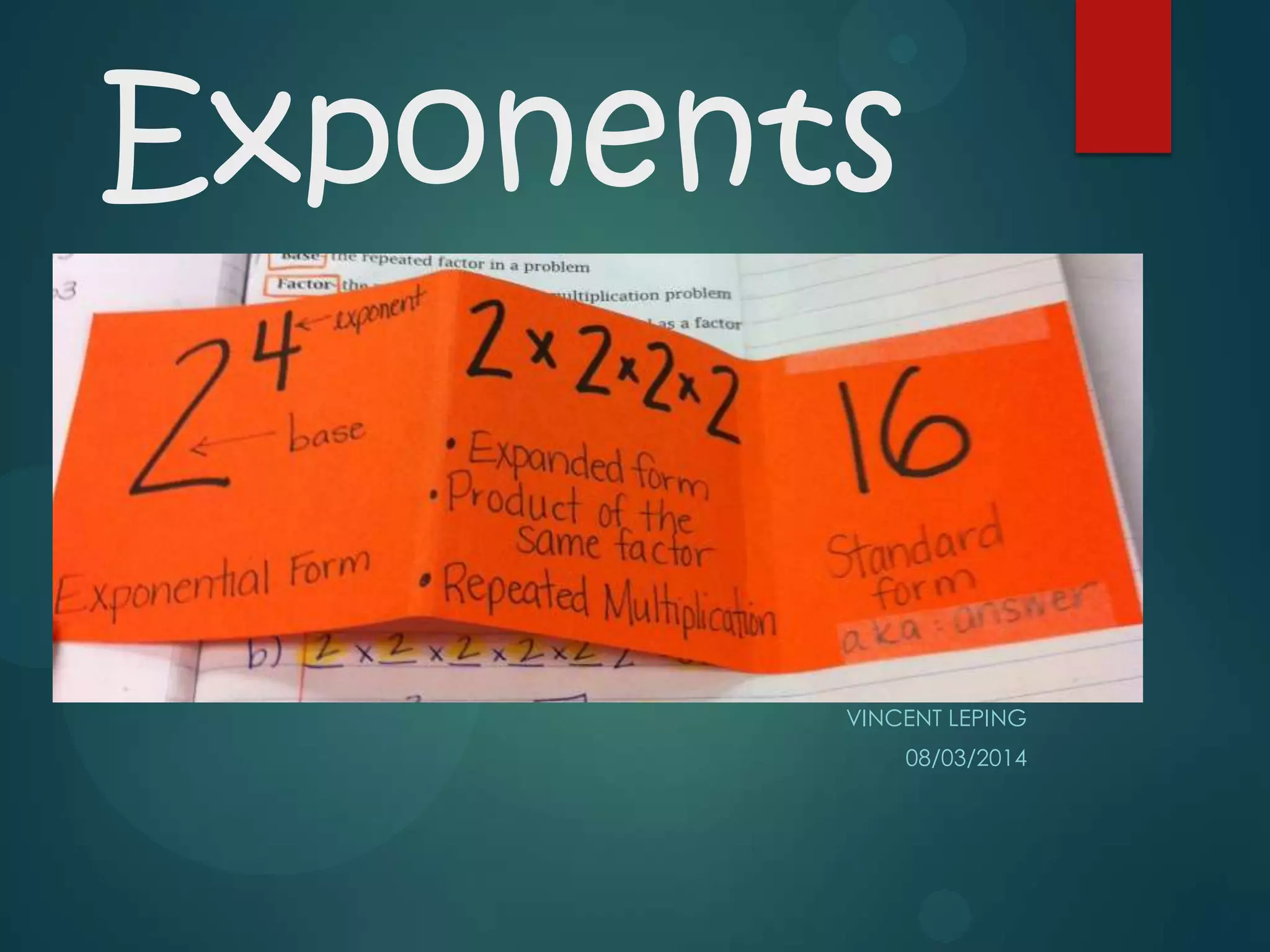
Exponents

VINCENT LEPING
08/03/2014
For Learning to Happen!
•Clear your desk of anything that may
distract you.
•Remove all other thoughts from your
mind.
•Pay close attention.
•Try all the examples.
•Ignore all other distractions.
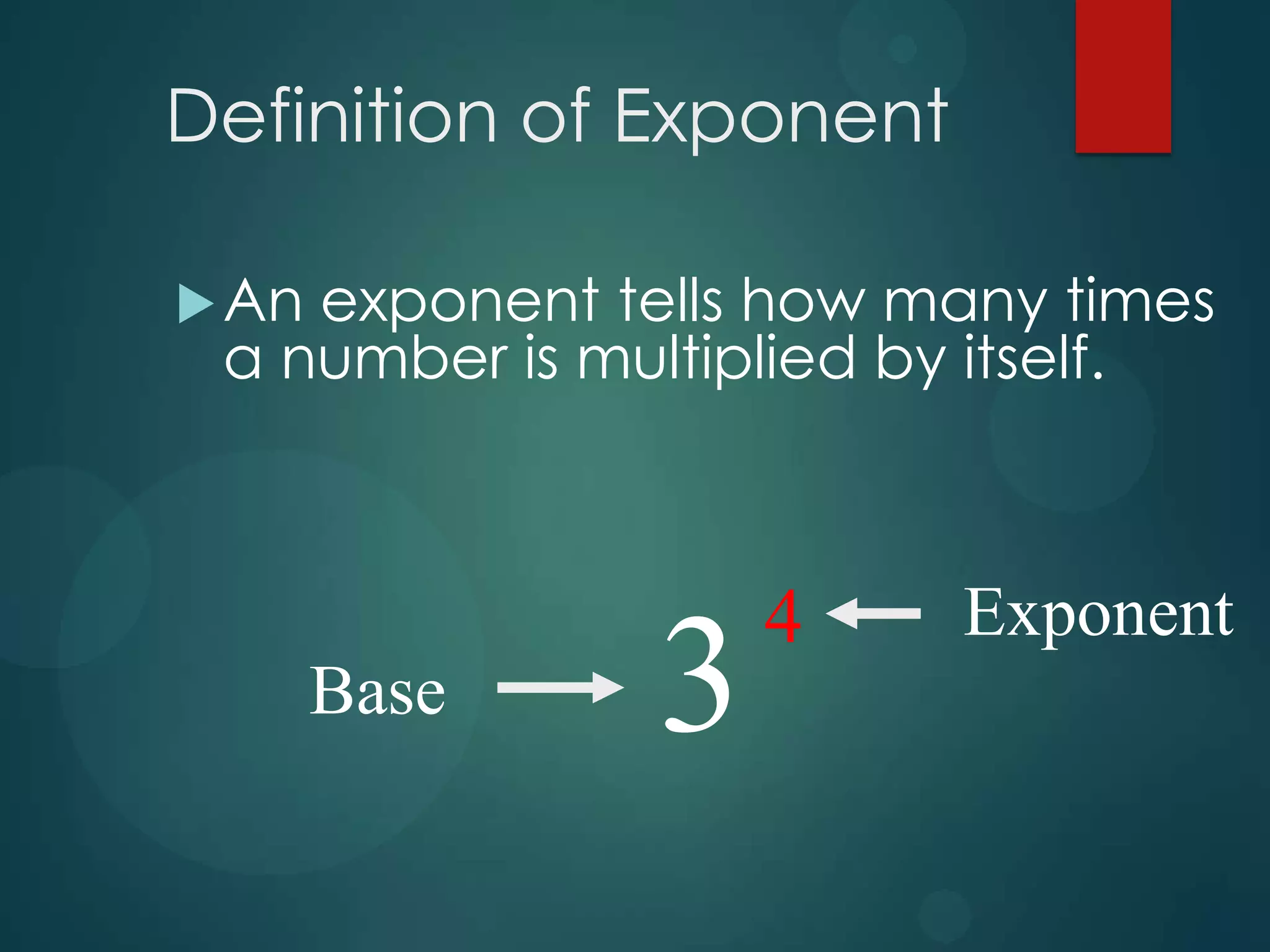
Definition of Exponent
 An

exponent tells how many times
a number is multiplied by itself.

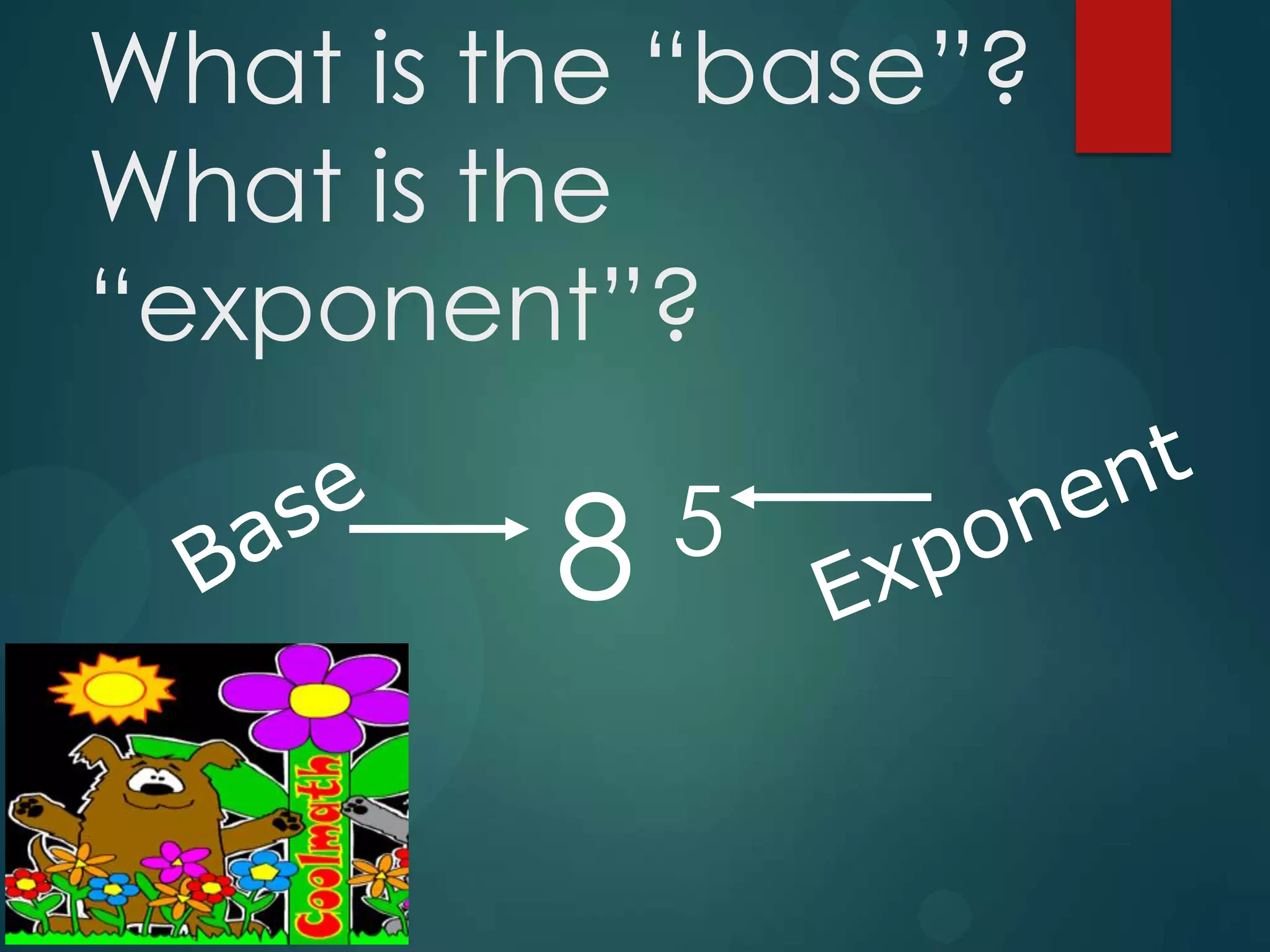
Base

3

4

Exponent
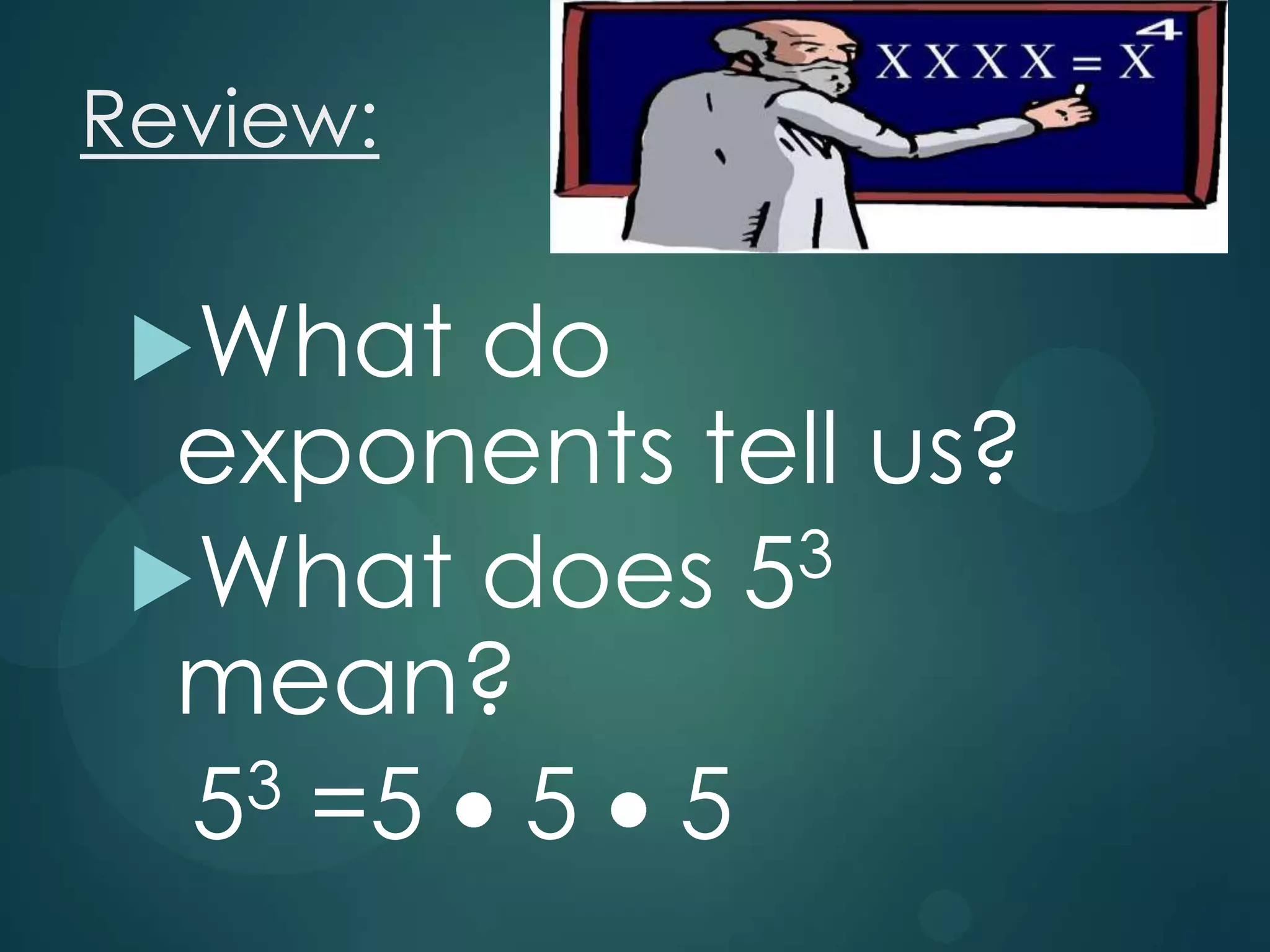
Review:
What

do
exponents tell us?
3
What does 5
mean?
3 =5
5
5 5
What is the “base”?
What is the
“exponent”?

8

5
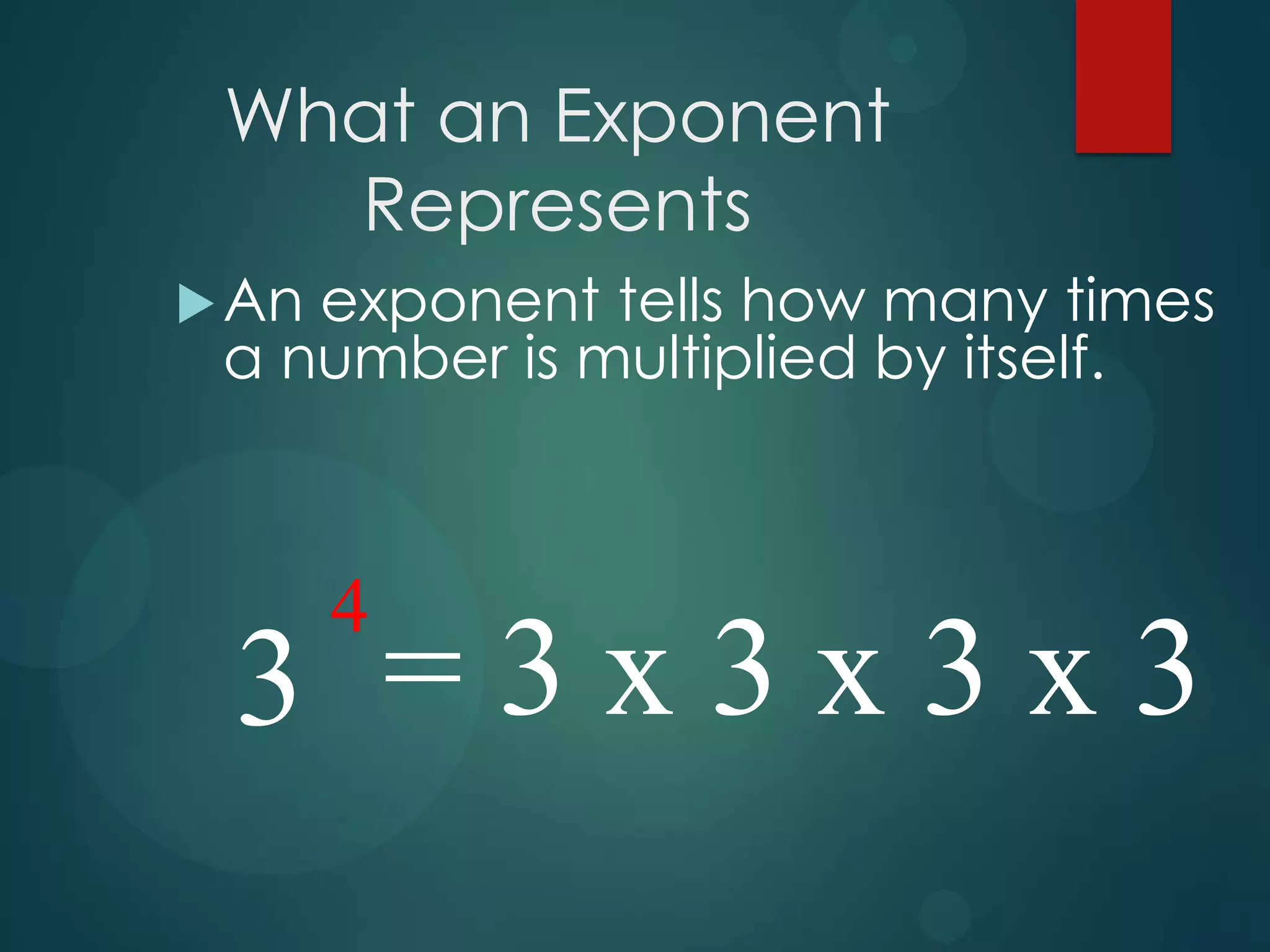
What an Exponent
Represents
 An

exponent tells how many times
a number is multiplied by itself.

4

3 =3x3x3x3
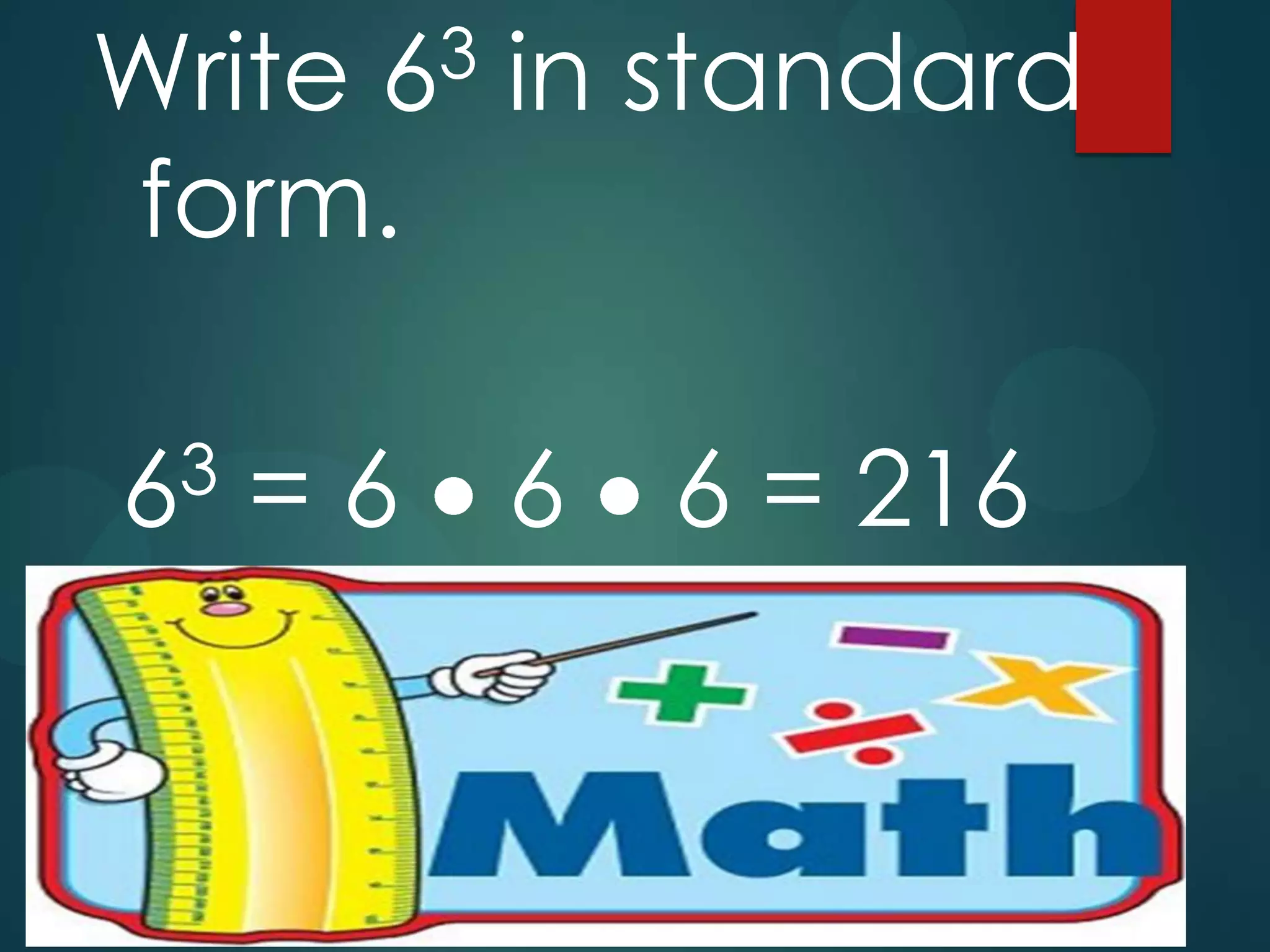
3
6

Write in standard
form.
3
6

=6

6

6 = 216
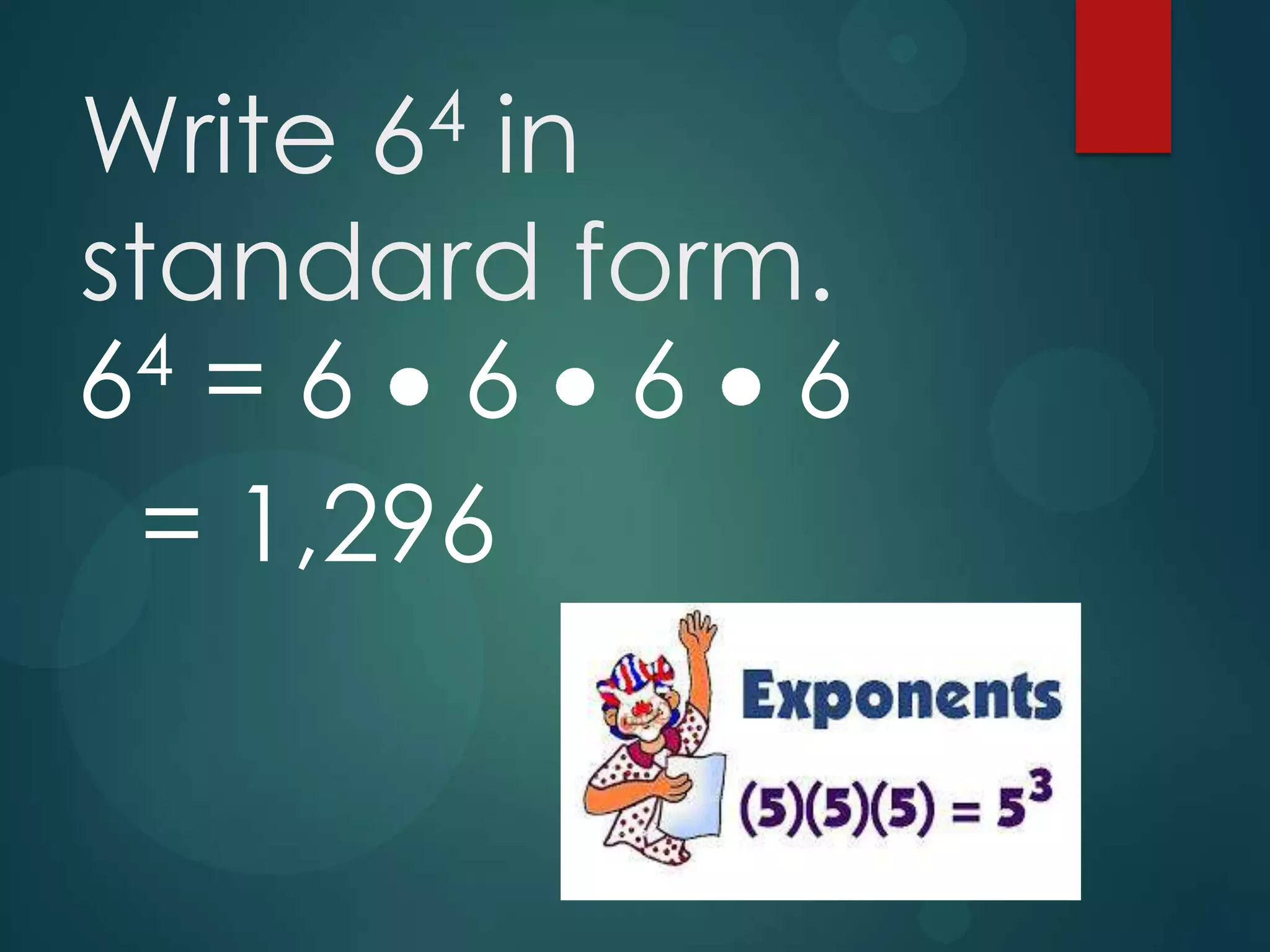
4
6

Write in
standard form.
4 = 6
6
6 6 6
= 1,296
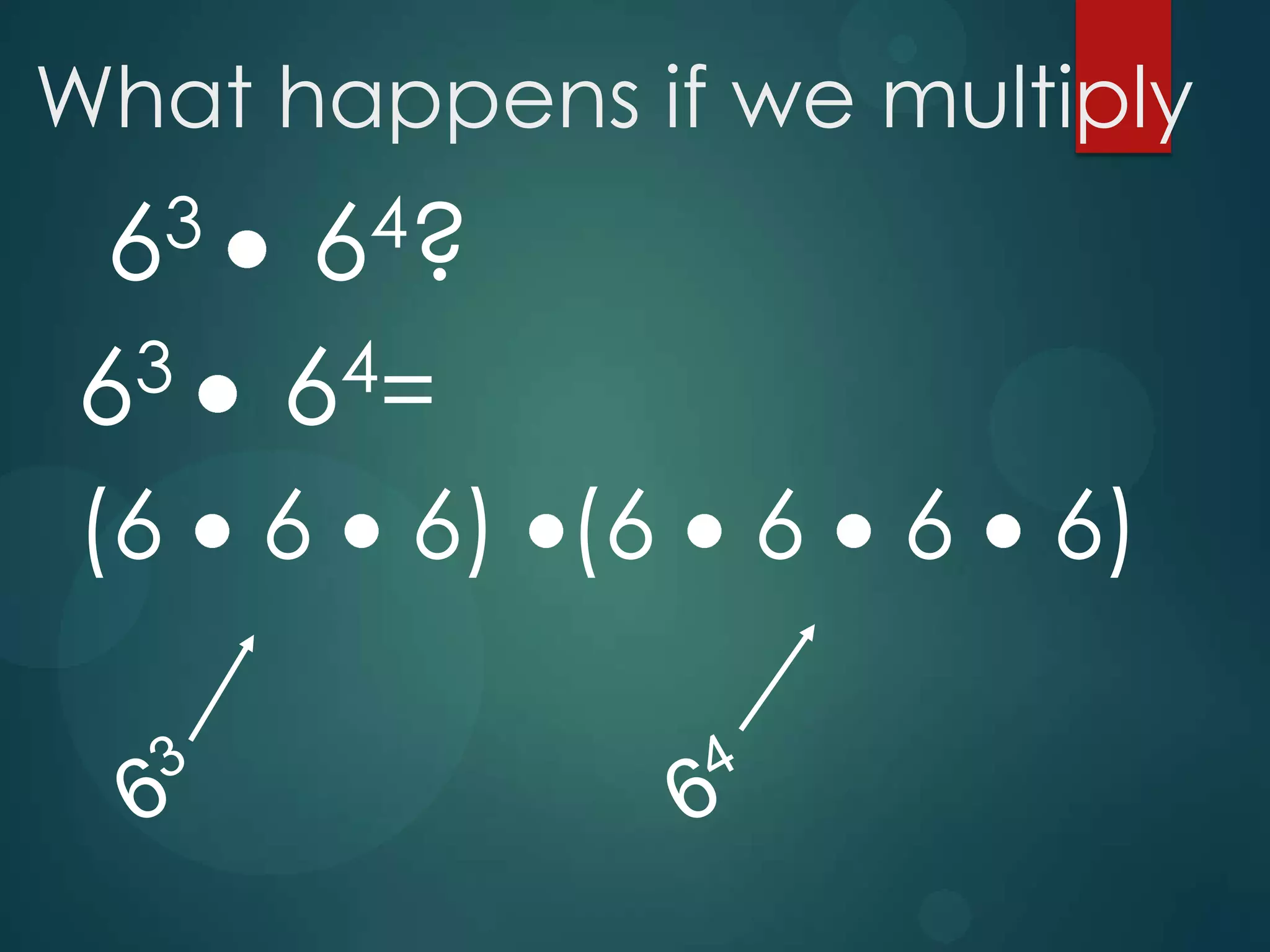
What happens if we multiply
3
6

4?
6

3
6

4=
6

(6

6

6) (6

6

6

6)
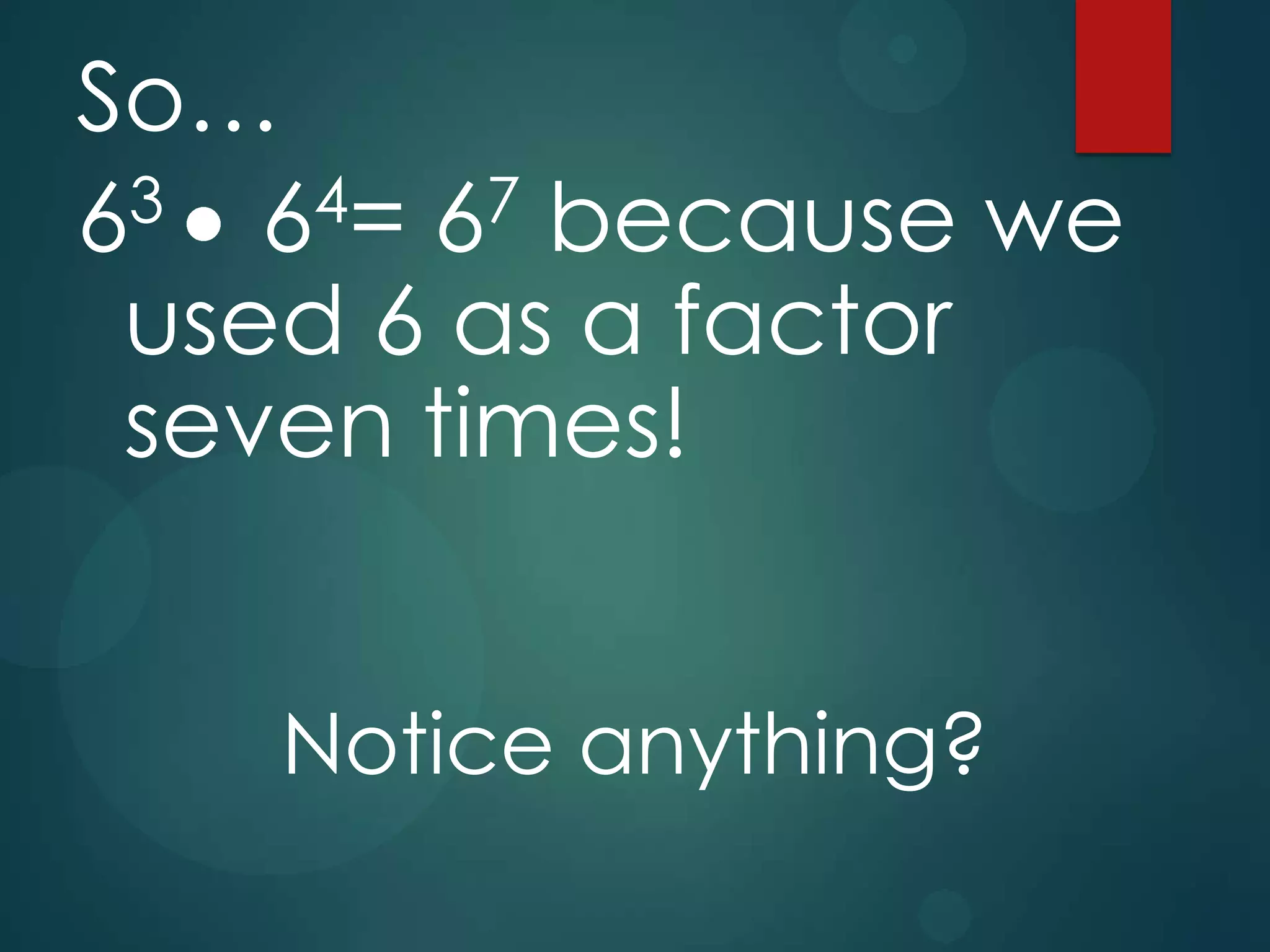
So…
3
4= 67 because we
6 6
used 6 as a factor
seven times!
Notice anything?
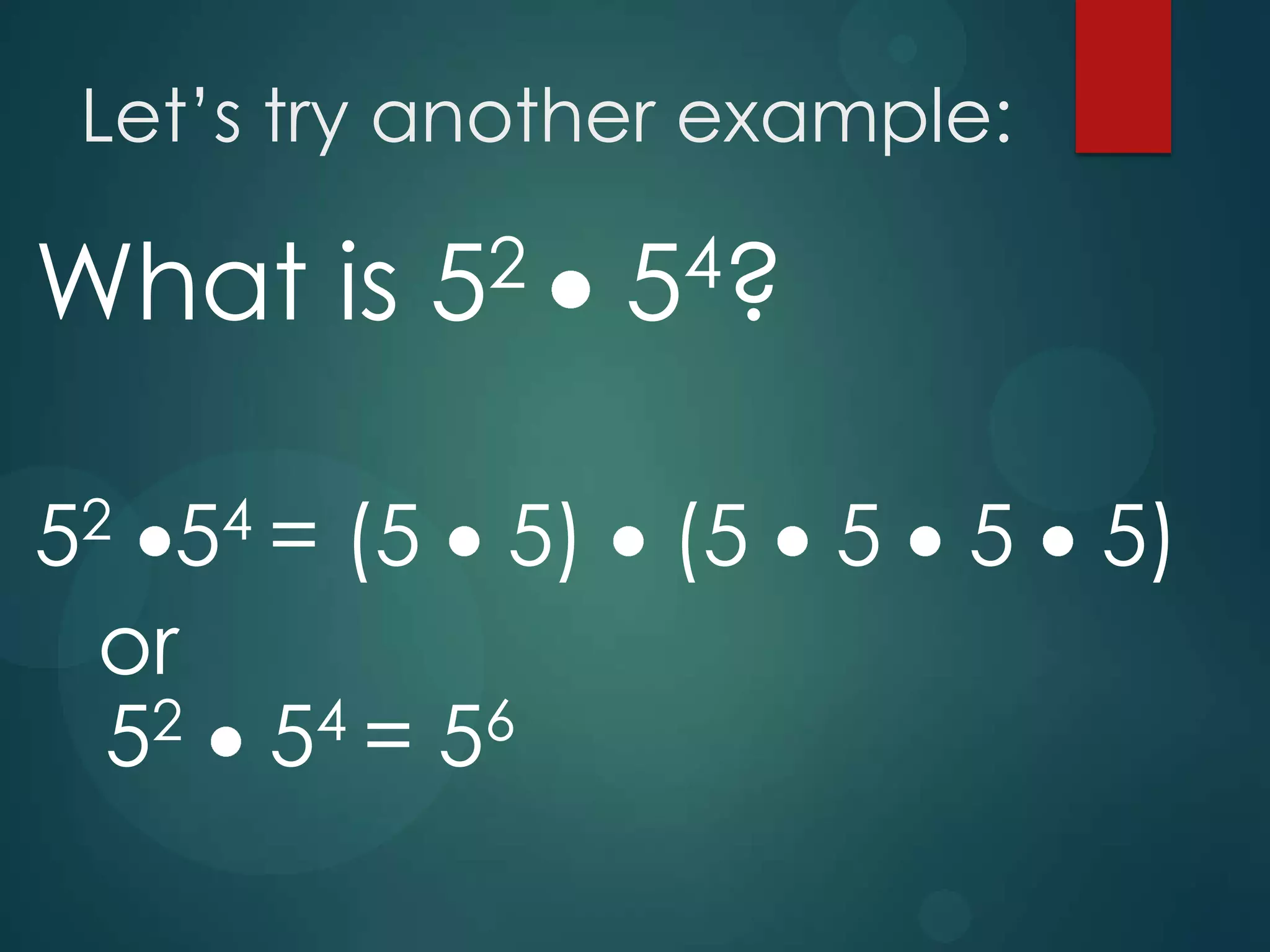
Let’s try another example:

What is
2
5

4=
5

or
2
5

(5

4=
5

2
5

5)
6
5

4?
5

(5

5

5

5)
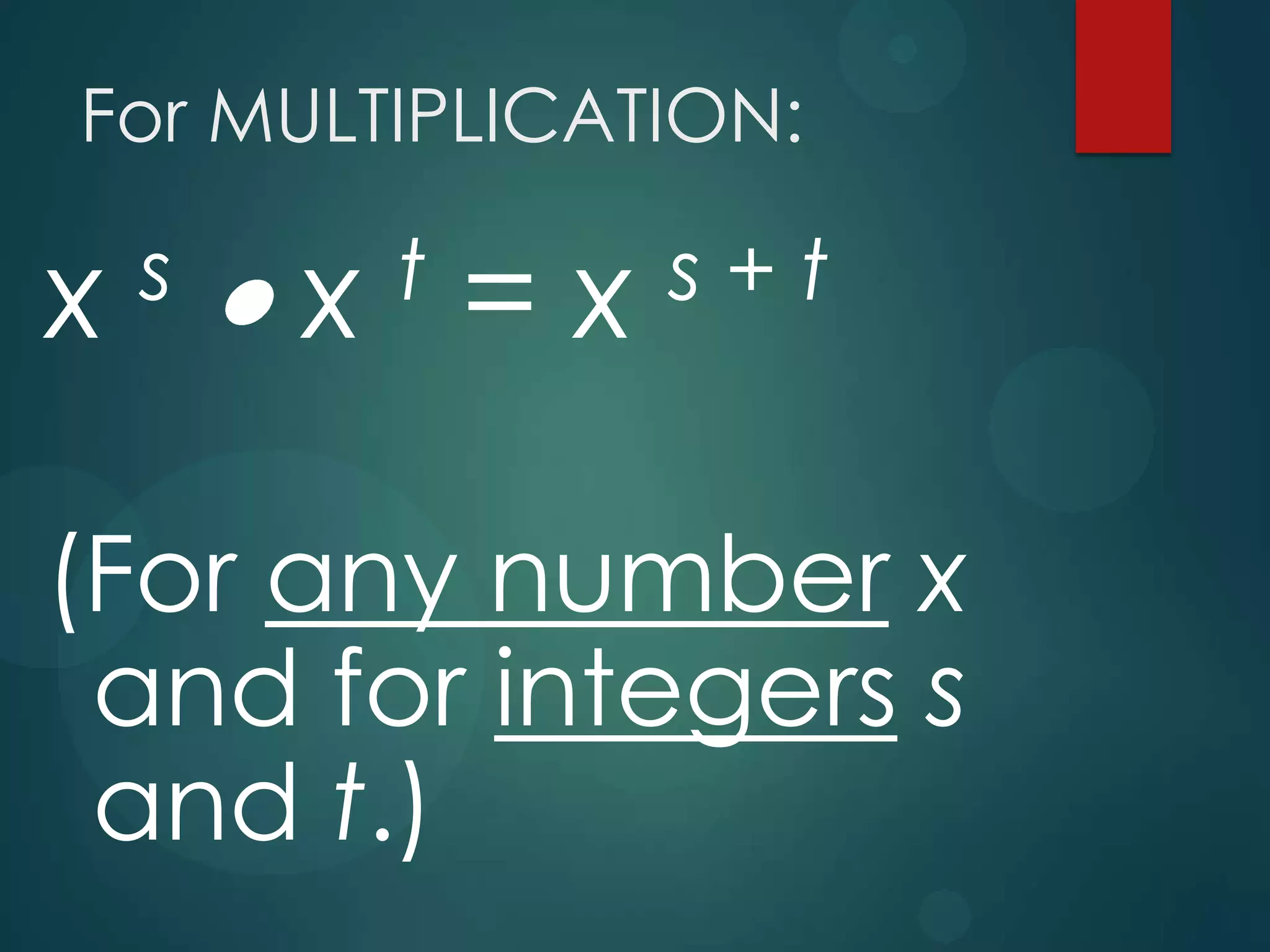
For MULTIPLICATION:

x

s

x =x
t

s+t

(For any number x
and for integers s
and t.)
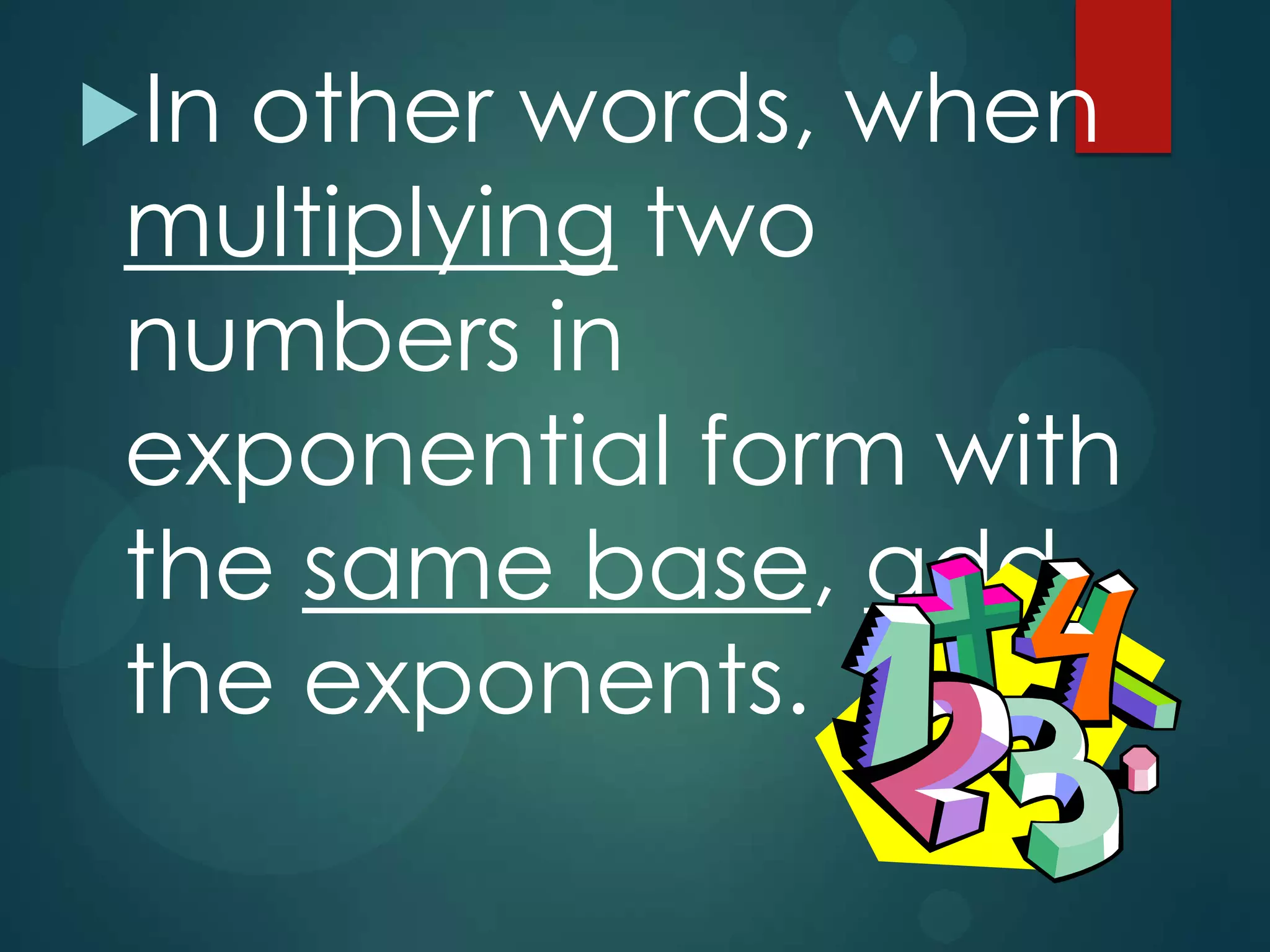
In

other words, when
multiplying two
numbers in
exponential form with
the same base, add
the exponents.
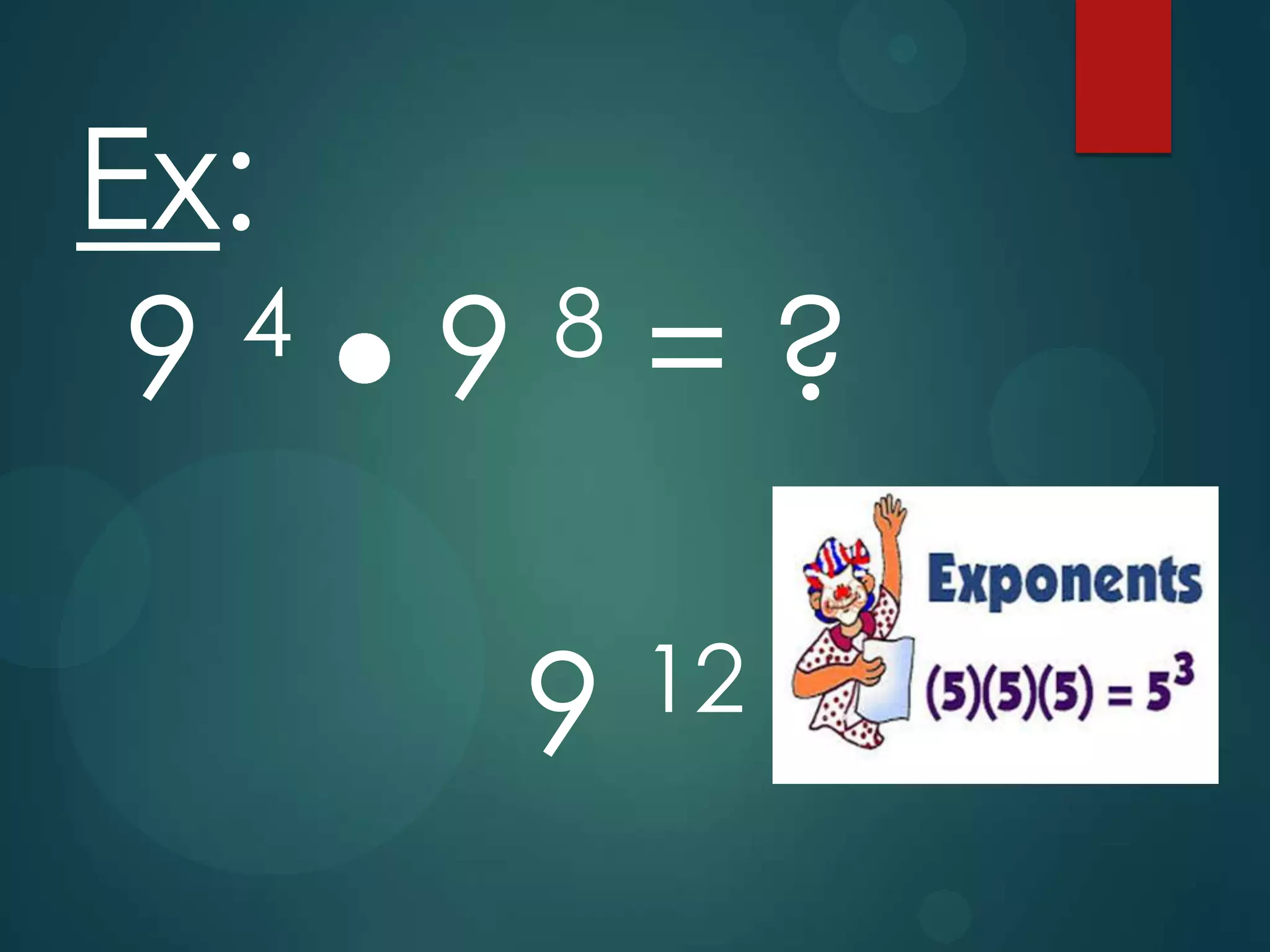
Ex:
4
9

9 =?
8

9

12
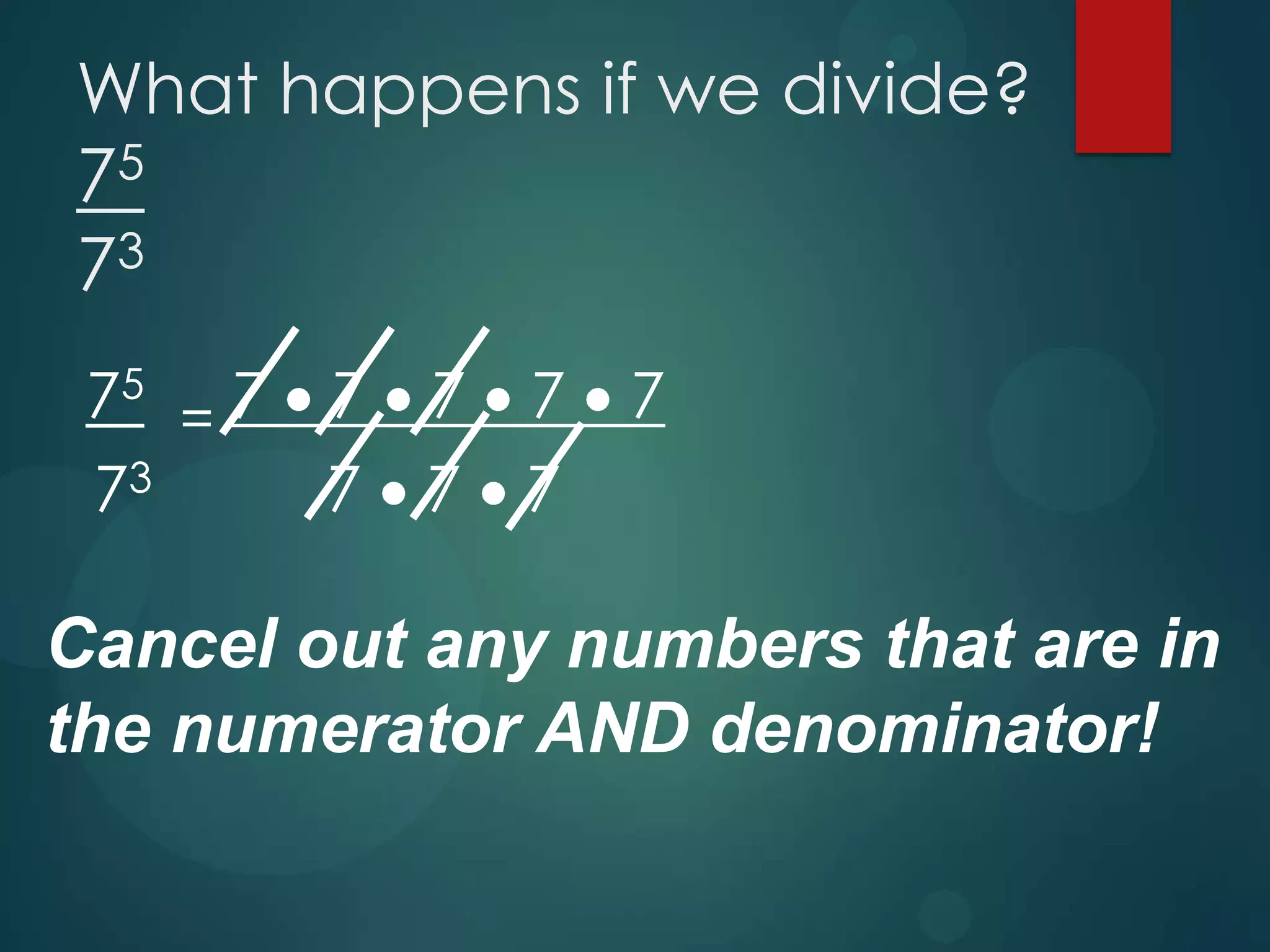
What happens if we divide?

75
73

75 = 7 7 7 7
73
7 7 7

7

Cancel out any numbers that are in
the numerator AND denominator!
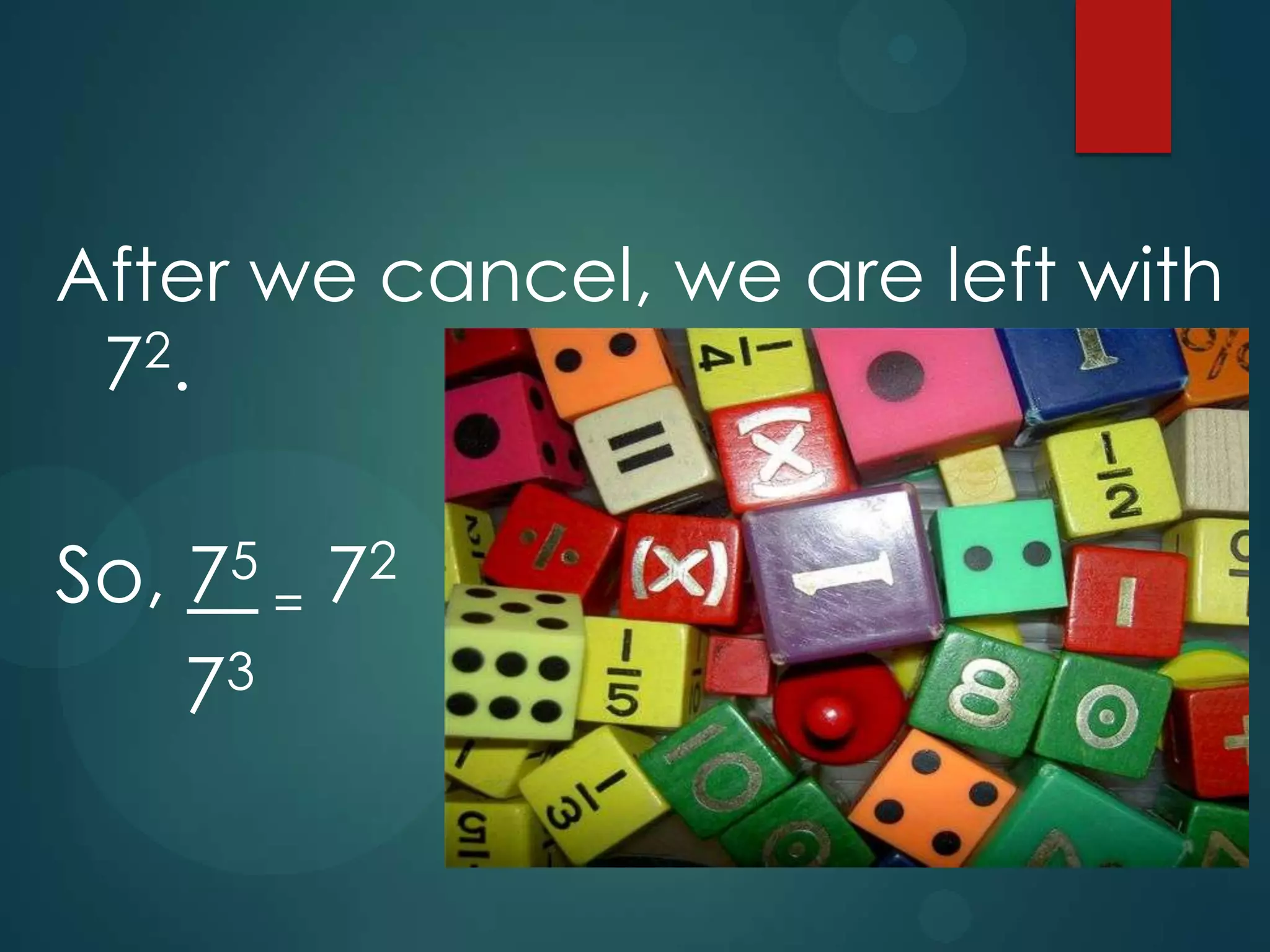
After we cancel, we are left with
72.

So, 75 = 72
3
7
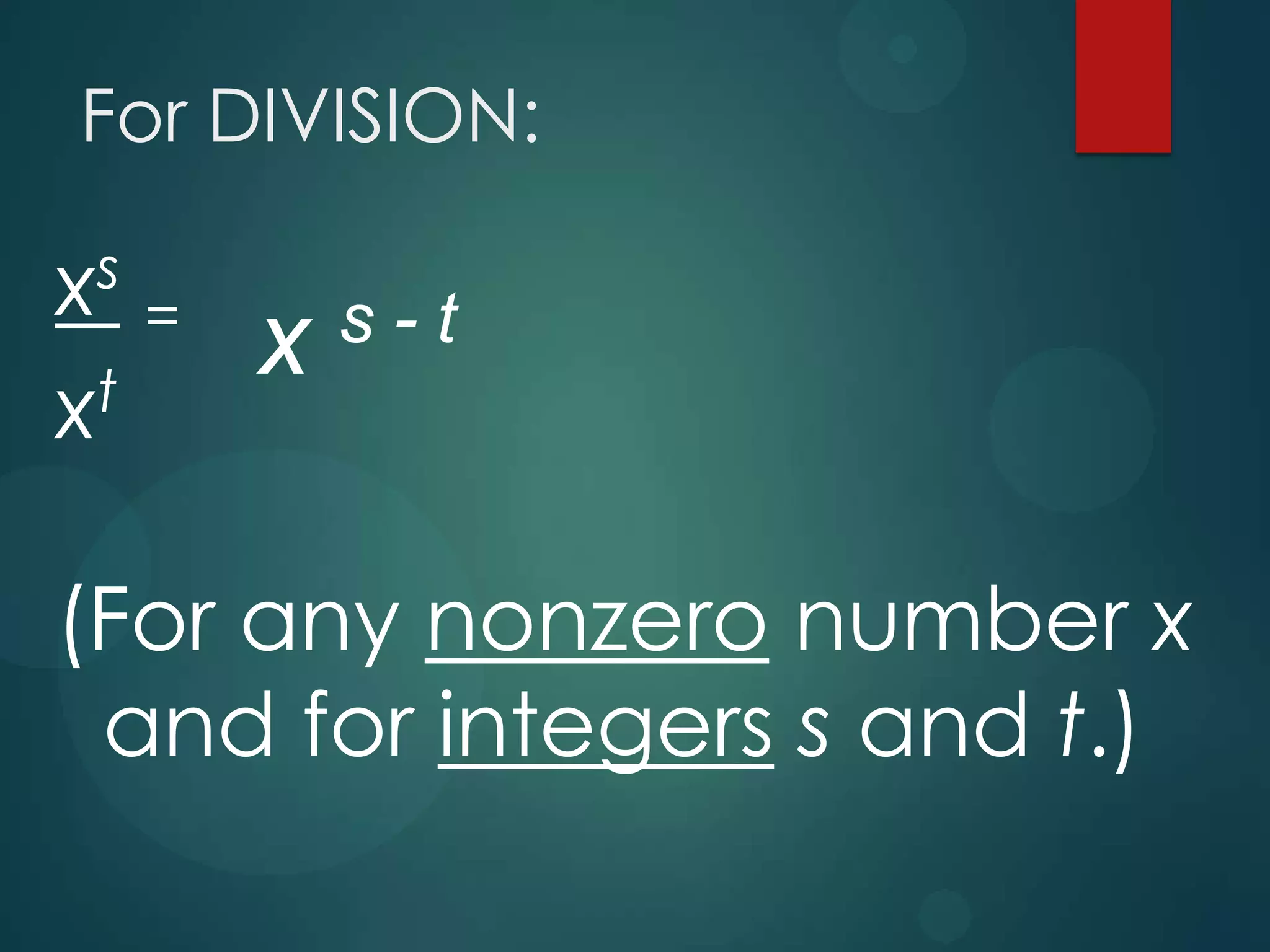
For DIVISION:
s
x
t
x

=

x

s-t

(For any nonzero number x
and for integers s and t.)
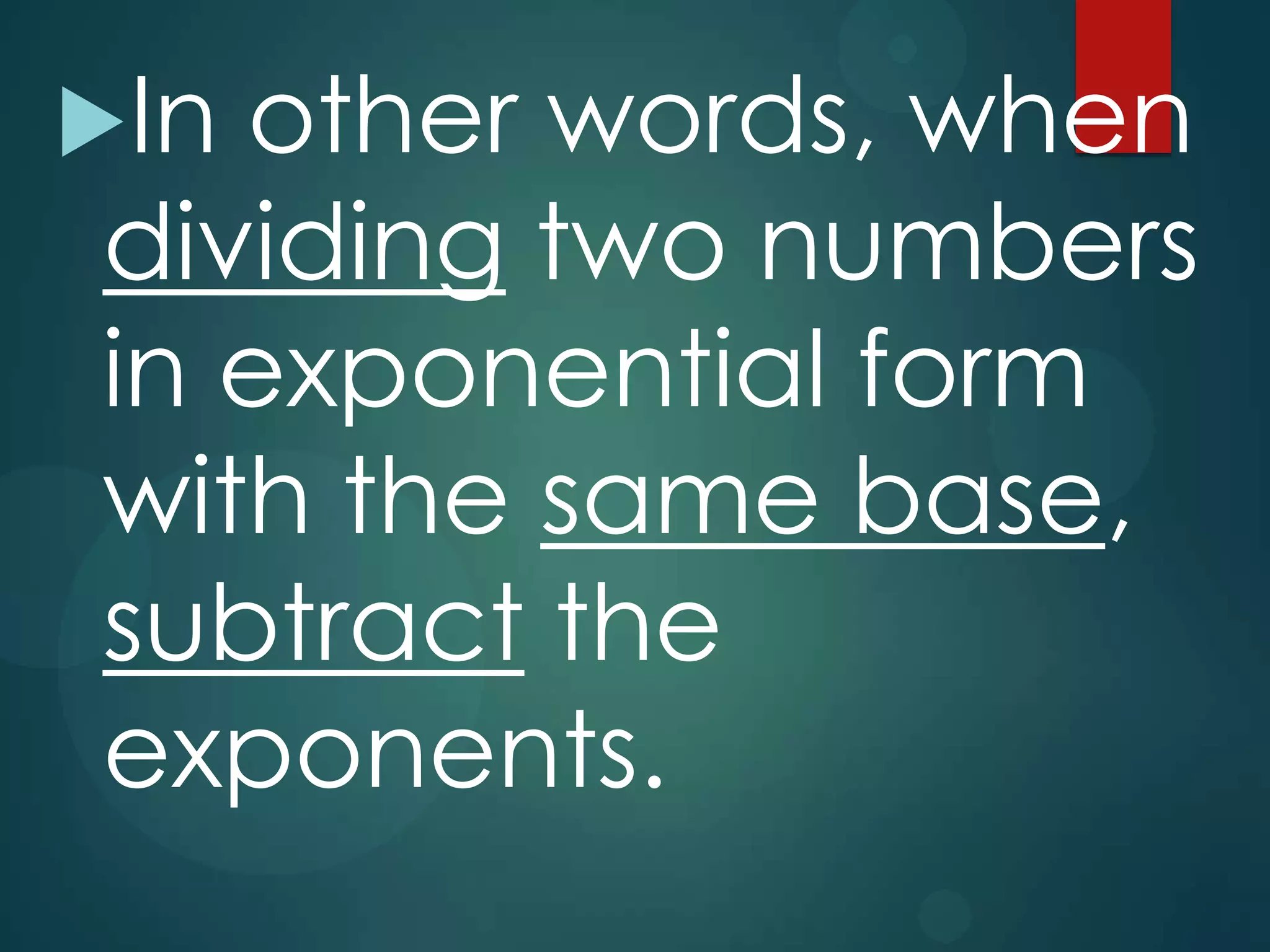
In

other words, when
dividing two numbers
in exponential form
with the same base,
subtract the
exponents.
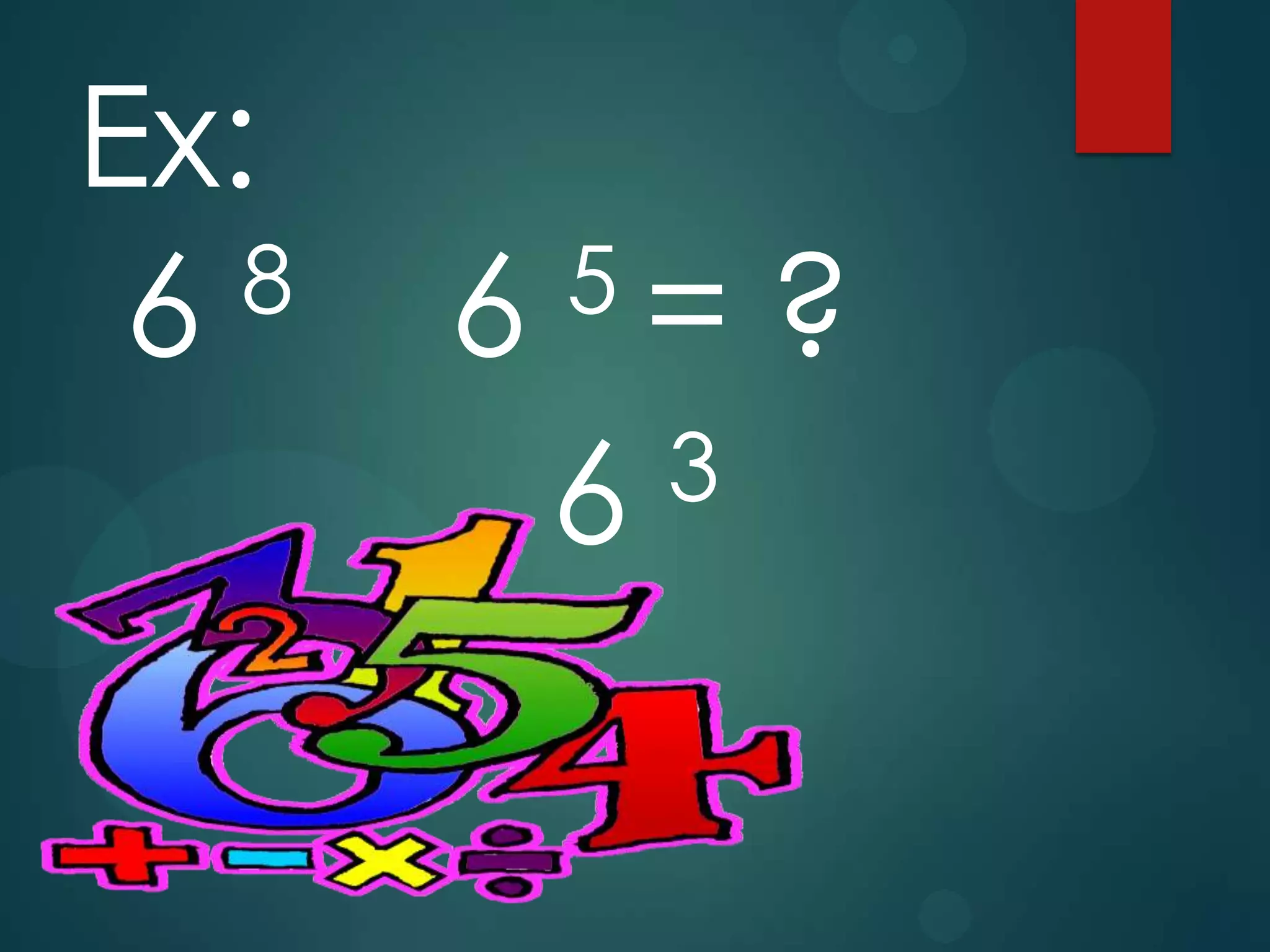
Ex:
8
6

6

5=

6

3

?
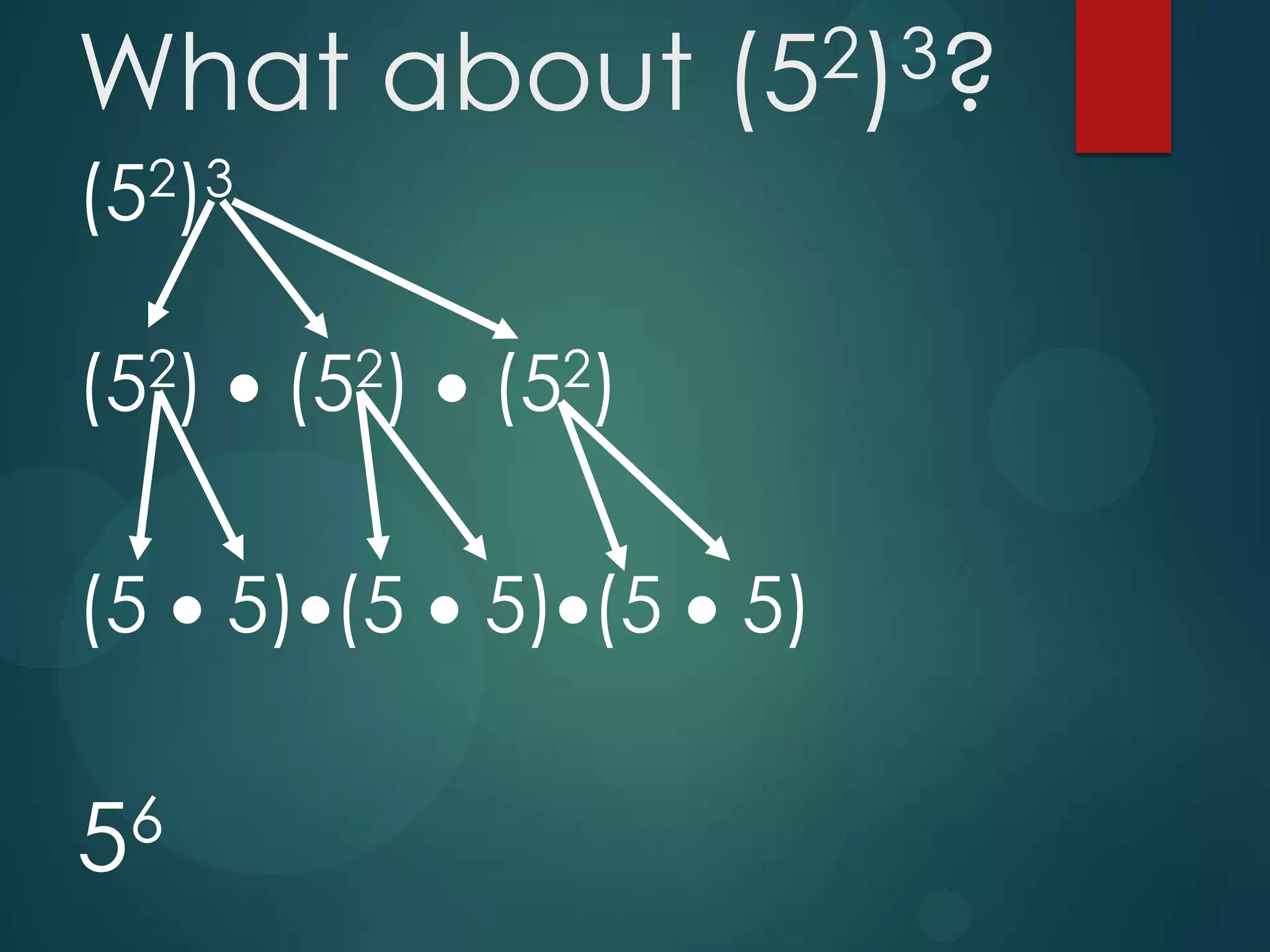
What about

2)3?
(5

2)3
(5

2)
(5

(5
6
5

2)
(5

5) (5

2)
(5

5) (5

5)
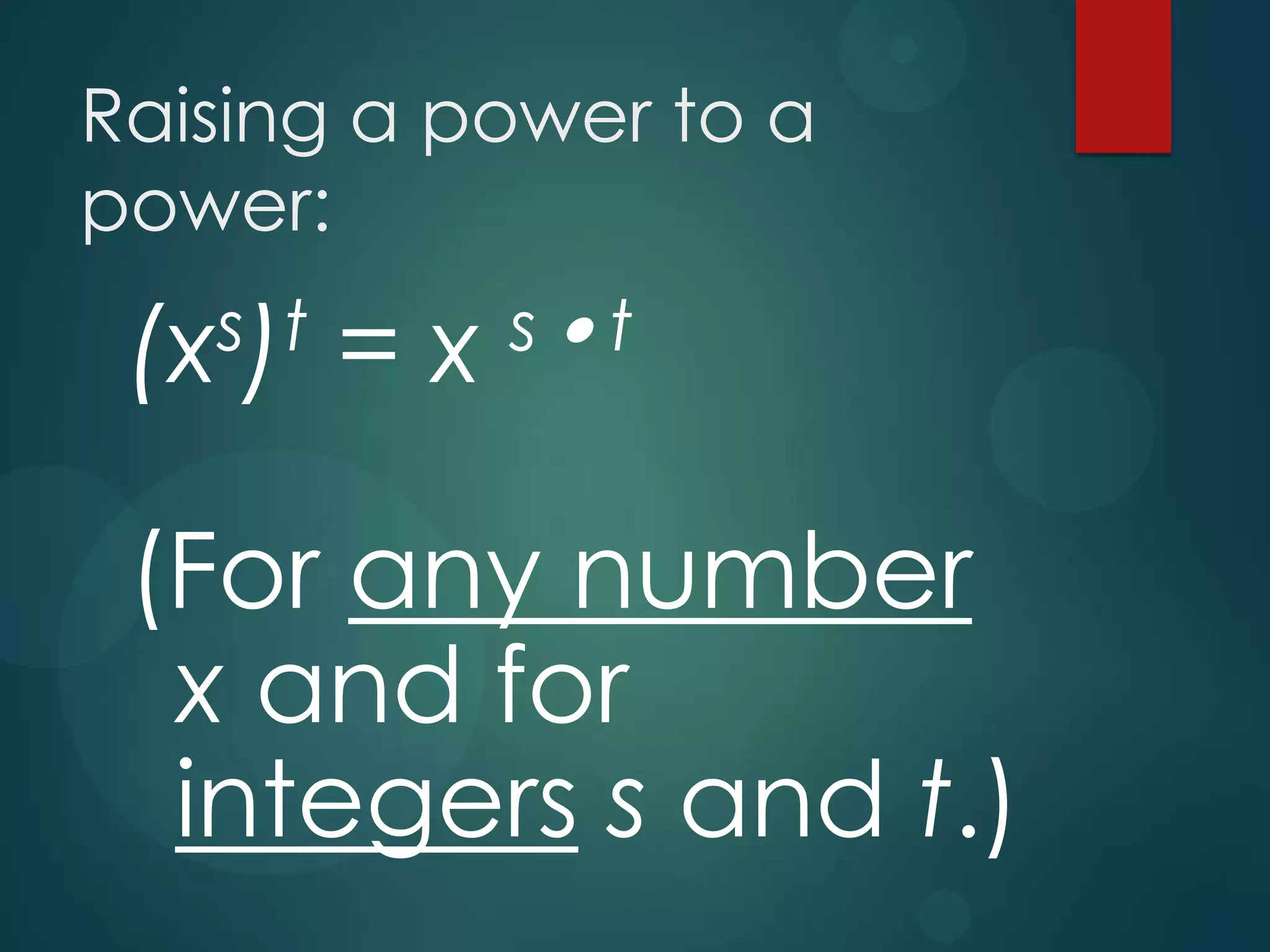
Raising a power to a
power:
s)t
(x

=x

s

t

(For any number
x and for
integers s and t.)
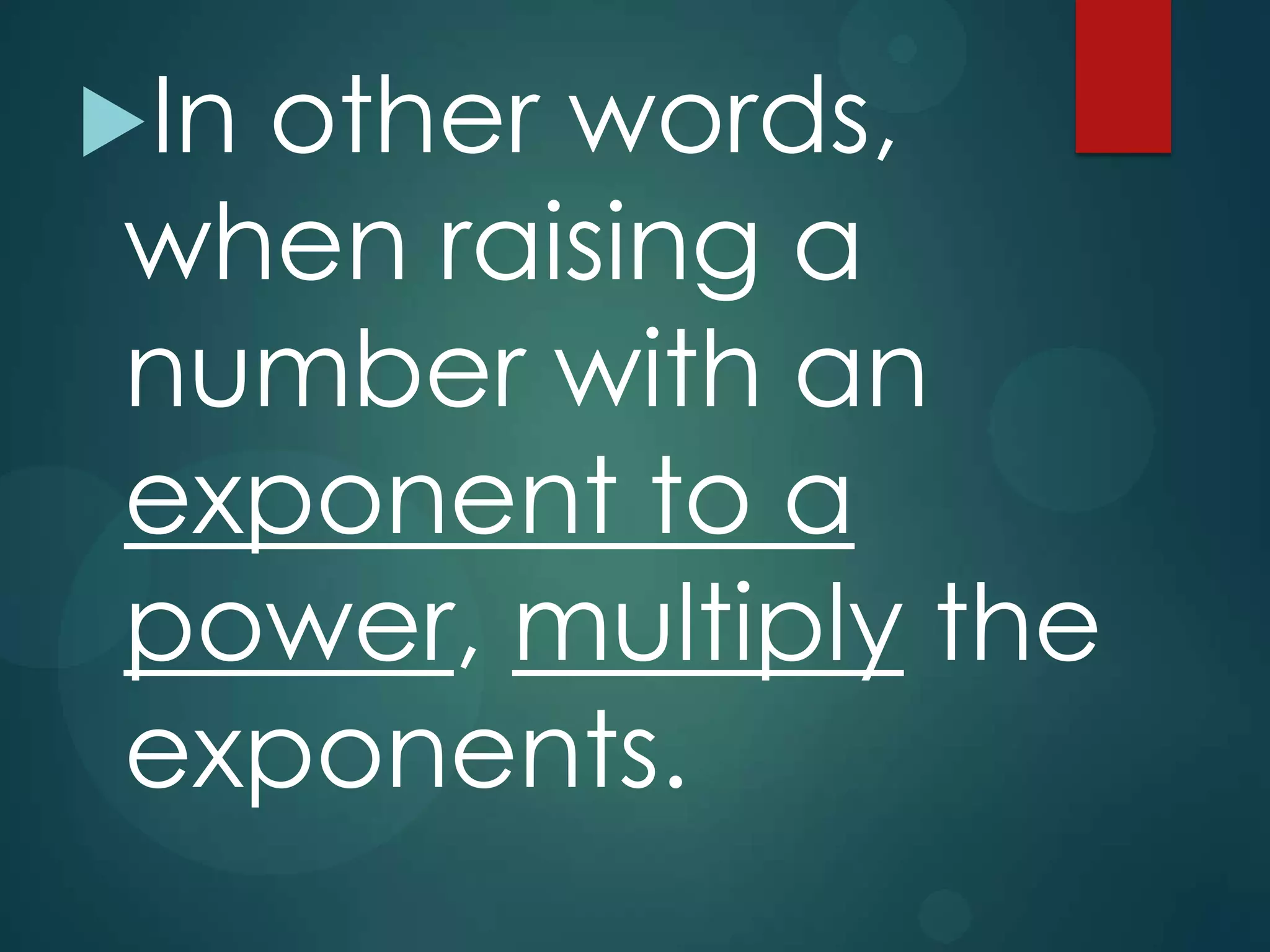
In

other words,
when raising a
number with an
exponent to a
power, multiply the
exponents.
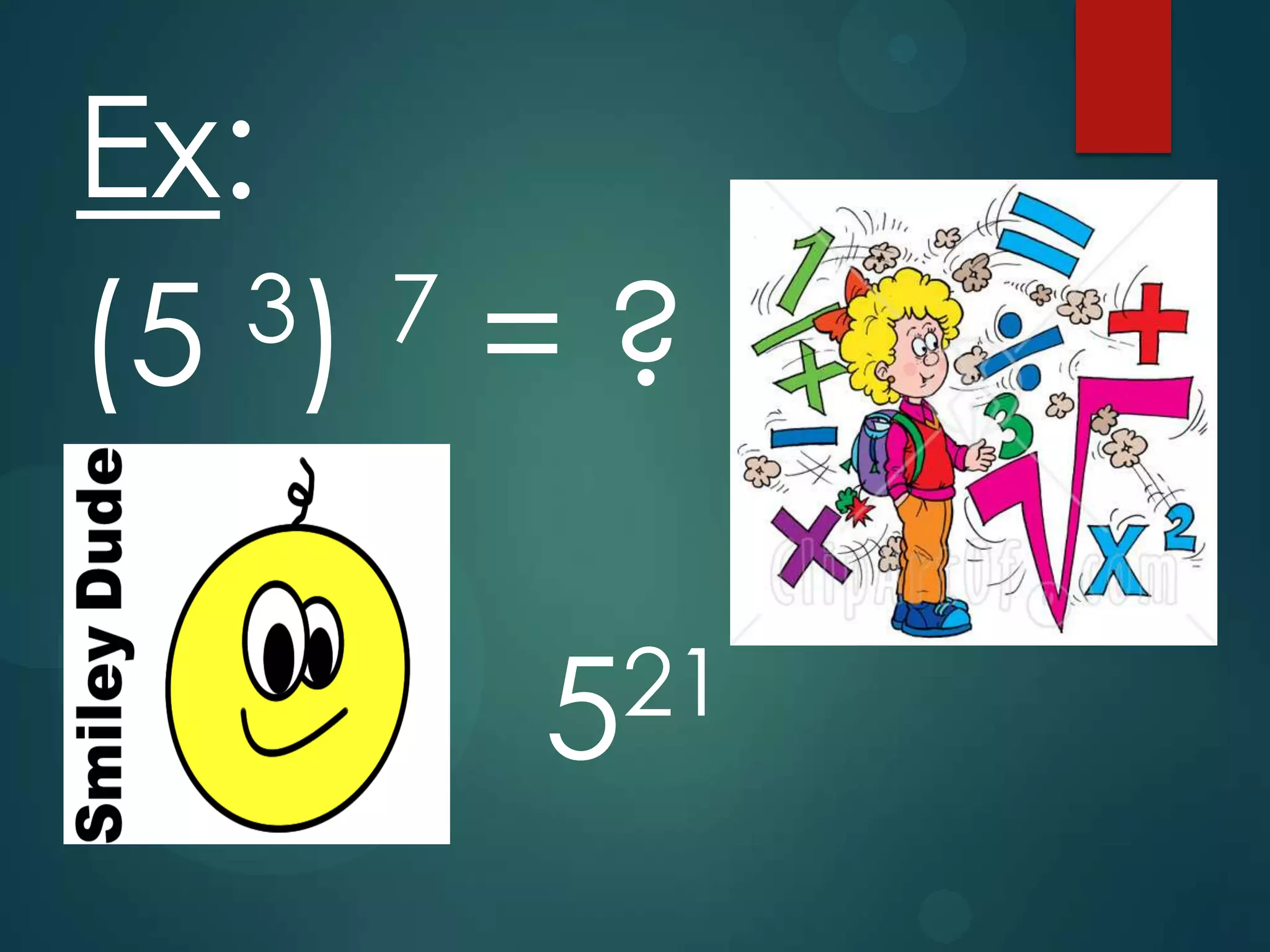
Ex:
3) 7 = ?
(5
21
5
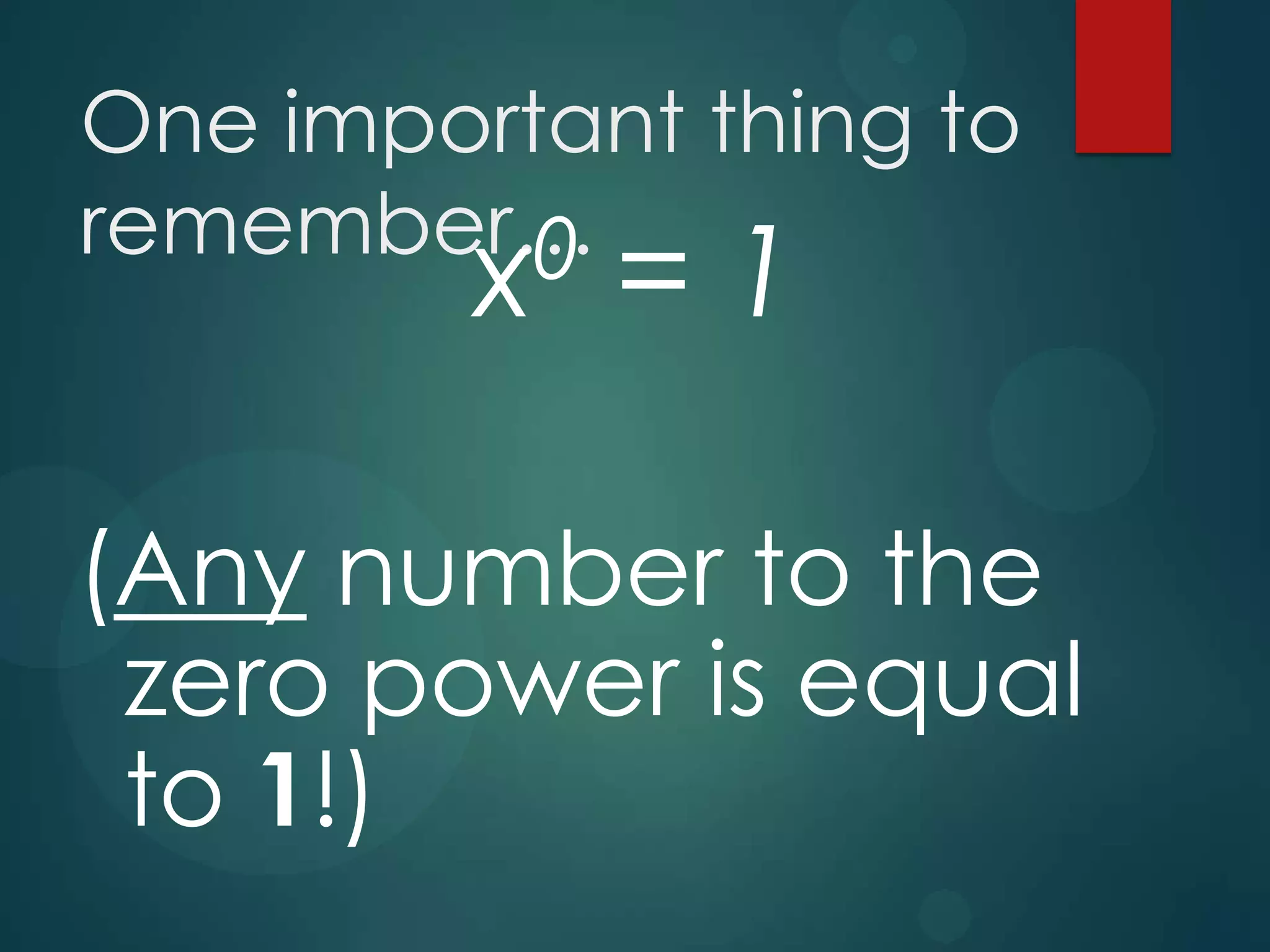
One important thing to
remember…
0 = 1
x

(Any number to the
zero power is equal
to 1!)
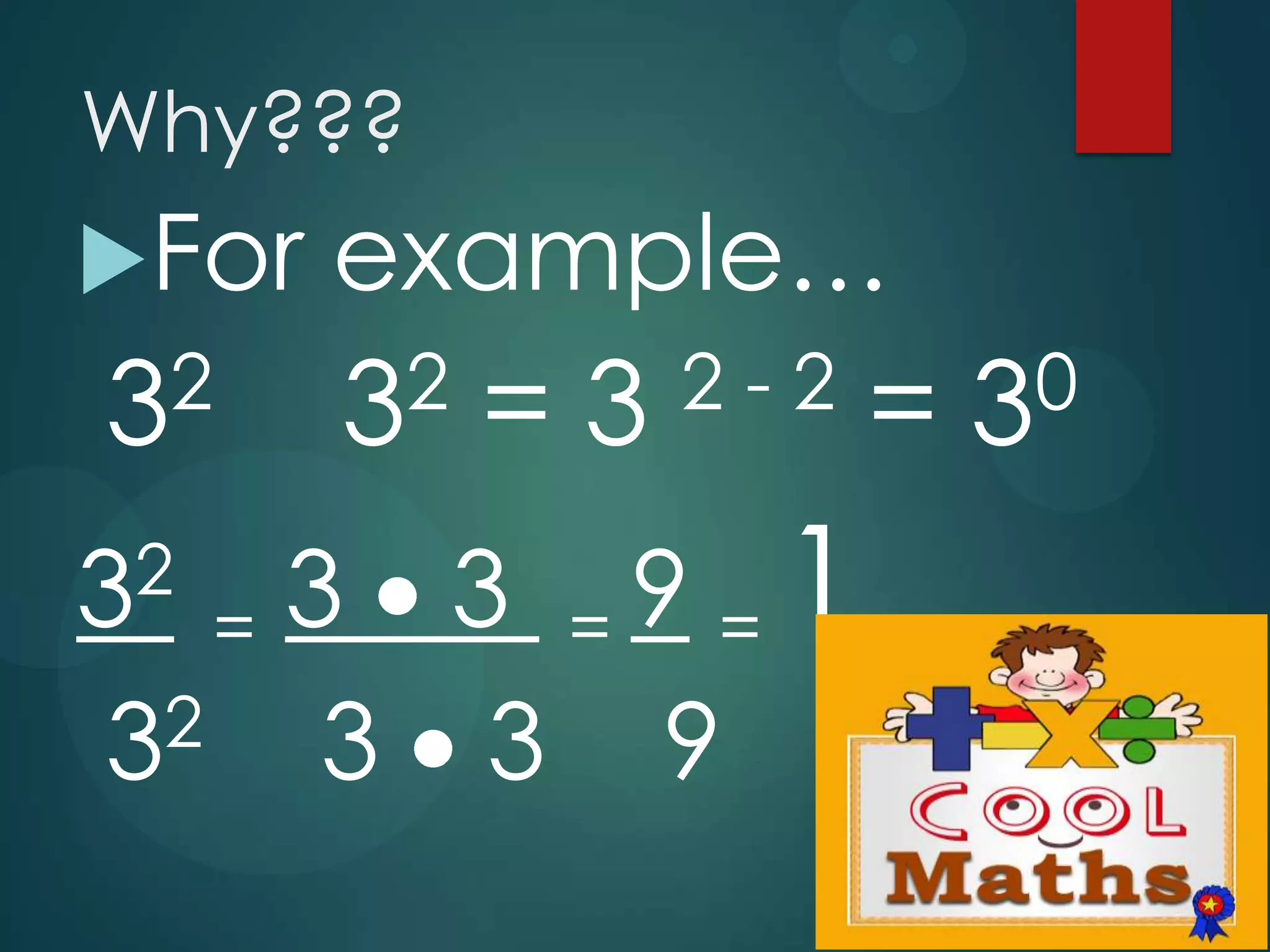
Why???
For
2
3

example…
2
3

=3

2-2

3 3 =9 =1
=
2
3 3 3 9

2
3

=

0
3
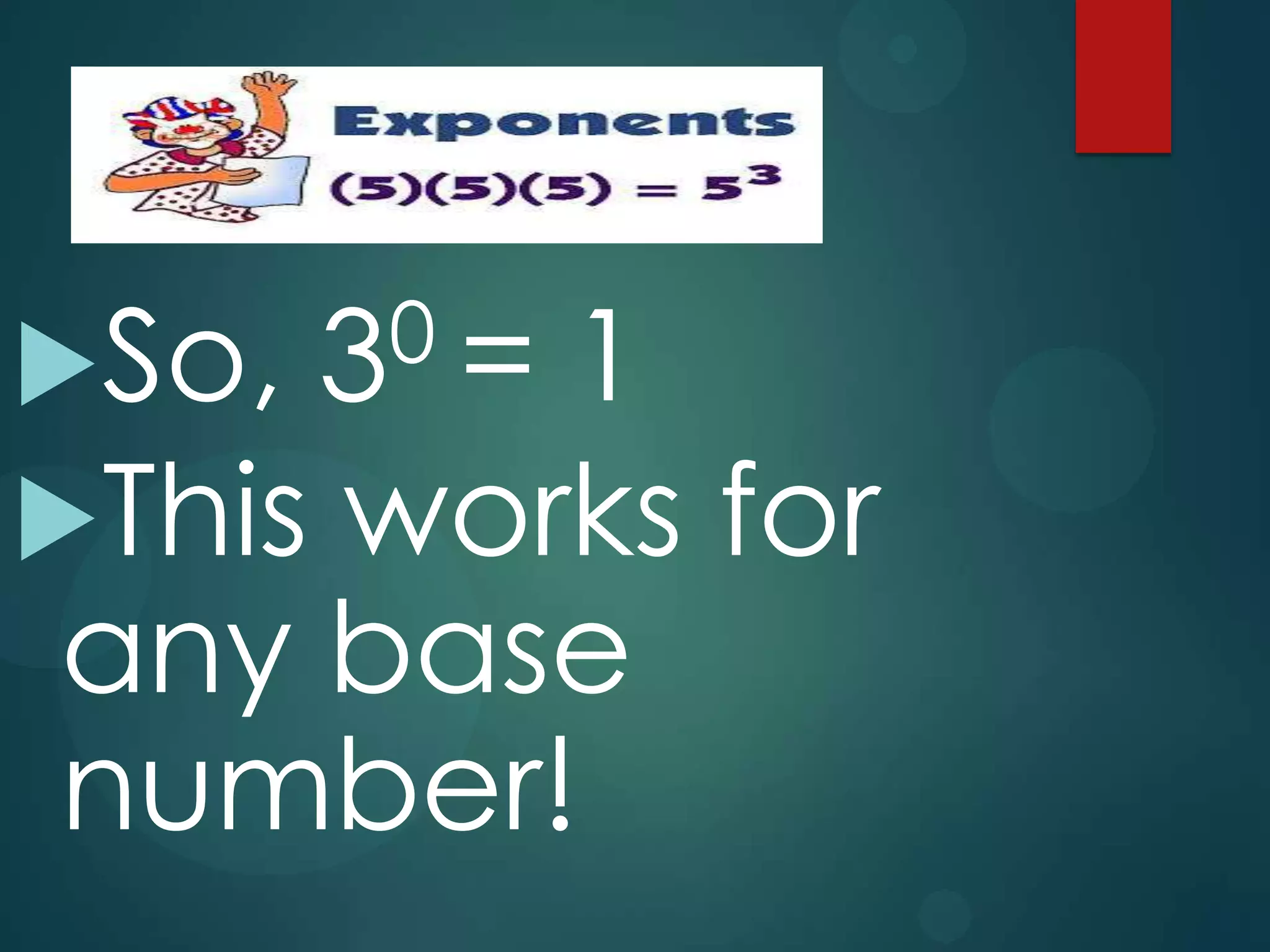
So,

0=
3

1
This works for
any base
number!
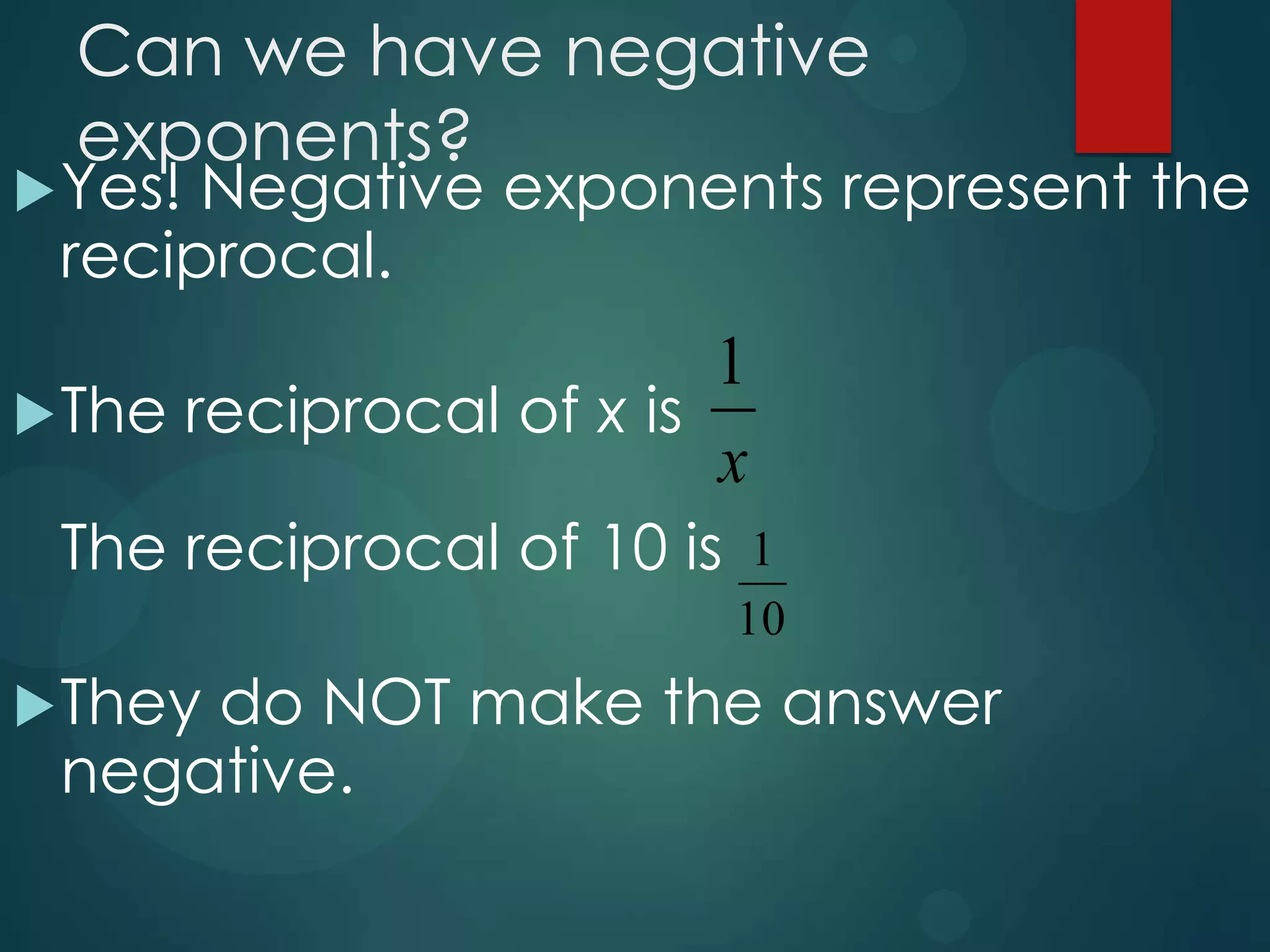
Can we have negative
exponents?

 Yes!

Negative exponents represent the
reciprocal.

1
 The reciprocal of x is
x
The reciprocal of 10 is
 They

1
10

do NOT make the answer
negative.
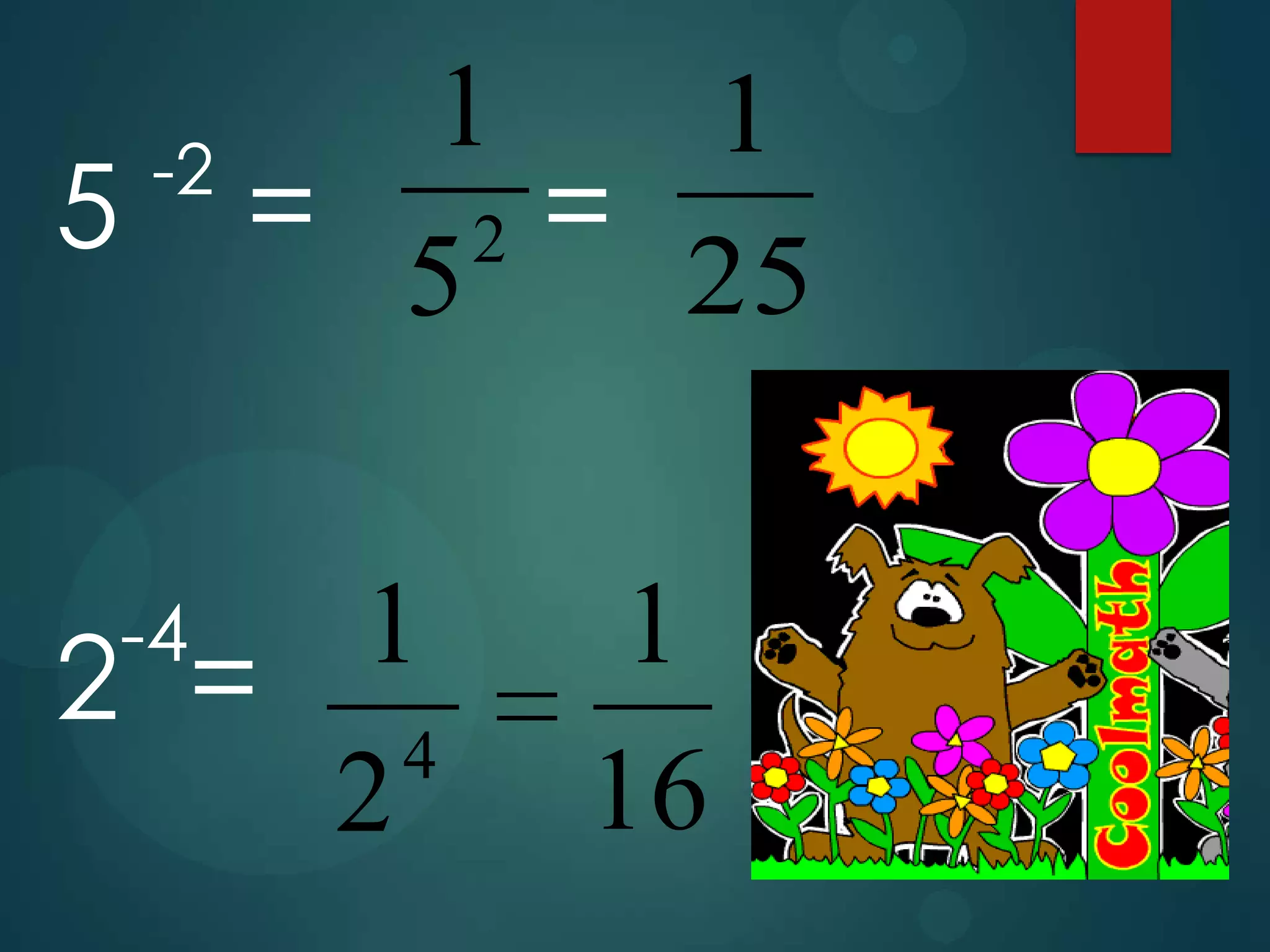
1
1
-2
5 = 2=
25
5
1
2 =
4
2
-4

1
16
REFERENCE LIST


Melnichenko, Y. (2008, September 14). Exponents.
Retrieved March 08, 2014, from
http://www.slideshare.net/yelena585/exponentspresentation



Yuskaitis, M. (2008, June 06). Exponents. Retrieved
March 08, 2014, from
http://www.slideshare.net/hiratufail/exponents1

exponents