SUBJUNCTIVE
   The subjunctive form of a verb is used in noun
    clauses following verbs or adjectives of urgency,
    obligation, or advisability. The subjunctive form
    is always the same as the base form, no matter
    what the time frame is.
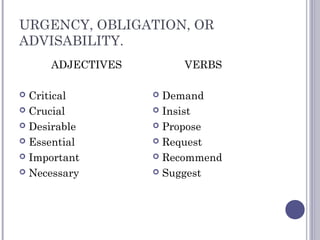
URGENCY, OBLIGATION, OR
ADVISABILITY.
     ADJECTIVES        VERBS

 Critical         Demand
 Crucial          Insist

 Desirable        Propose

 Essential        Request

 Important        Recommend

 Necessary        Suggest
REMEMBER
   Noun clauses following verbs and adjectives that don’t
    express urgency, obligation, or adversity don’t need the
    subjunctive.

        Psychologists agree that too much conflict is
    harmful to relationships.
        it’s true that he finds his current position very
    demanding.

   Infinitive and gerund phrases in place of the
    subjunctive.

Subjunctive 3°

  • 1.
  • 2.
    The subjunctive form of a verb is used in noun clauses following verbs or adjectives of urgency, obligation, or advisability. The subjunctive form is always the same as the base form, no matter what the time frame is.
  • 3.
    URGENCY, OBLIGATION, OR ADVISABILITY. ADJECTIVES VERBS  Critical  Demand  Crucial  Insist  Desirable  Propose  Essential  Request  Important  Recommend  Necessary  Suggest
  • 7.
    REMEMBER  Noun clauses following verbs and adjectives that don’t express urgency, obligation, or adversity don’t need the subjunctive. Psychologists agree that too much conflict is harmful to relationships. it’s true that he finds his current position very demanding.  Infinitive and gerund phrases in place of the subjunctive.