Do you remember the
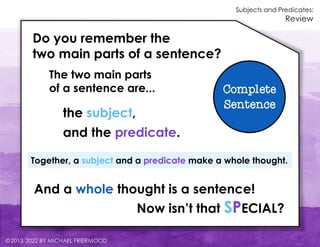
two main parts of a sentence?
The two main parts
of a sentence are...
And a whole thought is a sentence!
Together, a subject and a predicate make a whole thought.
the subject,
and the predicate.
Now isn’t that SPECIAL?
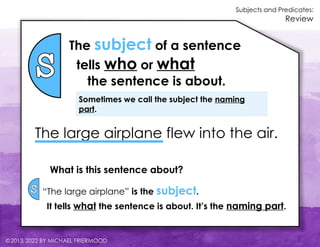
The subject of a sentence
tells who or what
the sentence is about.
Sometimes we call the subject the naming
part.
The large airplane flew into the air.
What is this sentence about?
“The large airplane” is the subject.
It tells what the sentence is about. It’s the naming part.
The predicate of a sentence
tells what the subject
does or did.
Sometimes we call the predicate the telling part.
What did “the large airplane” do?
“flew into the air” is the predicate.
It tells what the subject did. It’s the telling part.
The large airplane flew into the air.
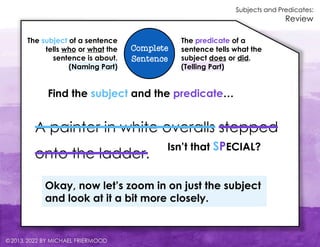
The subject of a sentence
tells who or what the
sentence is about.
(Naming Part)
The predicate of a
sentence tells what the
subject does or did.
(Telling Part)
Find the subject and the predicate…
A painter in white overalls stepped
onto the ladder.
Isn’t that SPECIAL?
Okay, now let’s zoom in on just the subject
and look at it a bit more closely.
A painter in white overalls stepped
onto the ladder.
A painter in white overalls
This is the whole subject.
Let’s call the whole subject the complete subject.
We can also narrow down the complete subject to just the
main noun that simply shows who or what the sentence is about.
NEWS FLASH *** NEWS FLASH *** NEWS FLASH
Let’s shake out the main noun that simply shows
who or what the sentence is about.
Let’s call the whole subject the complete subject.
painter
A painter in white overalls
painter
painter
A painter in white overalls
Let’s call the whole subject the complete subject.
We call the main noun the simple subject.
And the simple subject fits into the complete subject.
A painter in white overalls
painter
And the complete subject fits into the sentence!
Let’s call the whole subject the complete subject.
We call the main noun the simple subject.
And the simple subject fits into the complete subject.
And the complete subject fits into the sentence!
A painter in white overalls stepped
onto the ladder.
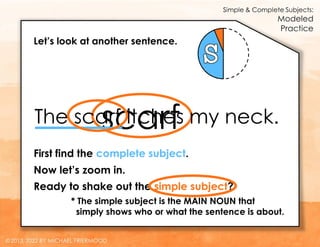
Let’s look at another sentence.
First find the complete subject.
Now let’s zoom in.
The scarf itches my neck.
scarf
The scarf
The scarf
The scarf
The scarf
The scarf
The scarf
scarf
scarf
The scarf
The scarf
Let’s look at another sentence.
First find the complete subject.
Now let’s zoom in.
Ready to shake out the simple subject?
* The simple subject is the MAIN NOUN that
simply shows who or what the sentence is about.
Let’s look at another sentence.
First find the complete subject.
Now let’s zoom in.
Ready to shake out the simple subject?
* The simple subject is the MAIN NOUN that
simply shows who or what the sentence is about.
scarf
The scarf itches my neck.
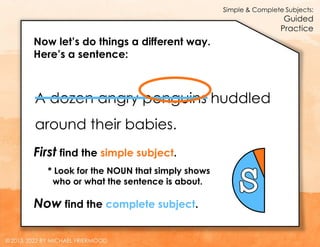
Now let’s do things a different way.
Here’s a sentence:
A dozen angry penguins huddled
around their babies.
First find the simple subject.
* Look for the NOUN that simply shows
who or what the sentence is about.
Now find the complete subject.
Here’s another one:
Johnny ate an ice cream
sandwich.
First find the simple subject.
* Look for the NOUN that simply shows
who or what the sentence is about.
Now find the complete subject.
Hmm... did that one trick you?
The complete subject is just one word,
and it’s the same as the simple subject.
Let’s do one more:
Wilma’s little brother pinched her
on the arm.
First find the simple subject.
Now find the complete subject.
When the bubble is floating
above any part of the
complete subject, raise
your hands.
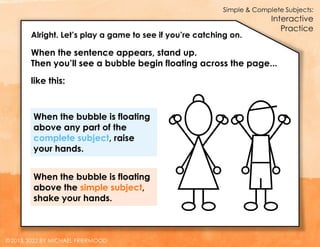
Alright. Let’s play a game to see if you’re catching on.
When the sentence appears, stand up.
Then you’ll see a bubble begin floating across the page...
like this:
like this:
When the bubble is floating
above any part of the
complete subject, raise
your hands.
When the bubble is floating
above the simple subject,
shake your hands.
Alright. Let’s play a game to see if you’re catching on.
When the sentence appears, stand up.
Then you’ll see a bubble begin floating across the page...
The wise old man whispered into the child’s ear.
Just a reminder...
The complete subject tells who or what the
sentence is about.
The simple subject is the main noun that
simply shows who or what the sentence is about.
Stand up! Here comes the bubble!
Let’s check. Did you raise your hands for...
And did you shake your hands for...
Almost the entire audience stood up.
Next one.
The complete subject tells who or what the
sentence is about.
The simple subject is the main noun that
simply shows who or what the sentence is about.
Stand up! Here comes the bubble!
Let’s check. Did you raise your hands for...
And did you shake your hands for...
The hairs on the back of my neck stood up.
Next one.
The complete subject tells who or what the
sentence is about.
The simple subject is the main noun that
simply shows who or what the sentence is about.
Stand up! Here comes the bubble!
Let’s check. Did you raise your hands for...
And did you shake your hands for...
Her breath steamed up the windows.
One more.
The complete subject tells who or what the
sentence is about.
The simple subject is the main noun that
simply shows who or what the sentence is about.
Stand up! Here comes the bubble!
Let’s check. Did you raise your hands for...
And did you shake your hands for...

Subject_&_Predicate_Explanation.pptx

  • 2.
    Do you rememberthe two main parts of a sentence? The two main parts of a sentence are... And a whole thought is a sentence! Together, a subject and a predicate make a whole thought. the subject, and the predicate. Now isn’t that SPECIAL?
  • 3.
    The subject ofa sentence tells who or what the sentence is about. Sometimes we call the subject the naming part. The large airplane flew into the air. What is this sentence about? “The large airplane” is the subject. It tells what the sentence is about. It’s the naming part.
  • 4.
    The predicate ofa sentence tells what the subject does or did. Sometimes we call the predicate the telling part. What did “the large airplane” do? “flew into the air” is the predicate. It tells what the subject did. It’s the telling part. The large airplane flew into the air.
  • 5.
    The subject ofa sentence tells who or what the sentence is about. (Naming Part) The predicate of a sentence tells what the subject does or did. (Telling Part) Find the subject and the predicate… A painter in white overalls stepped onto the ladder. Isn’t that SPECIAL? Okay, now let’s zoom in on just the subject and look at it a bit more closely.
  • 6.
    A painter inwhite overalls stepped onto the ladder. A painter in white overalls This is the whole subject. Let’s call the whole subject the complete subject. We can also narrow down the complete subject to just the main noun that simply shows who or what the sentence is about. NEWS FLASH *** NEWS FLASH *** NEWS FLASH
  • 7.
    Let’s shake outthe main noun that simply shows who or what the sentence is about. Let’s call the whole subject the complete subject. painter A painter in white overalls A painter in white overalls A painter in white overalls A painter in white overalls A painter in white overalls A painter in white overalls painter painter A painter in white overalls A painter in white overalls
  • 8.
    Let’s call thewhole subject the complete subject. We call the main noun the simple subject. And the simple subject fits into the complete subject. A painter in white overalls painter And the complete subject fits into the sentence!
  • 9.
    Let’s call thewhole subject the complete subject. We call the main noun the simple subject. And the simple subject fits into the complete subject. And the complete subject fits into the sentence! A painter in white overalls stepped onto the ladder.
  • 10.
    Let’s look atanother sentence. First find the complete subject. Now let’s zoom in. The scarf itches my neck.
  • 11.
    scarf The scarf The scarf Thescarf The scarf The scarf The scarf scarf scarf The scarf The scarf Let’s look at another sentence. First find the complete subject. Now let’s zoom in. Ready to shake out the simple subject? * The simple subject is the MAIN NOUN that simply shows who or what the sentence is about.
  • 12.
    Let’s look atanother sentence. First find the complete subject. Now let’s zoom in. Ready to shake out the simple subject? * The simple subject is the MAIN NOUN that simply shows who or what the sentence is about. scarf The scarf itches my neck.
  • 13.
    Now let’s dothings a different way. Here’s a sentence: A dozen angry penguins huddled around their babies. First find the simple subject. * Look for the NOUN that simply shows who or what the sentence is about. Now find the complete subject.
  • 14.
    Here’s another one: Johnnyate an ice cream sandwich. First find the simple subject. * Look for the NOUN that simply shows who or what the sentence is about. Now find the complete subject. Hmm... did that one trick you? The complete subject is just one word, and it’s the same as the simple subject.
  • 15.
    Let’s do onemore: Wilma’s little brother pinched her on the arm. First find the simple subject. Now find the complete subject.
  • 16.
    When the bubbleis floating above any part of the complete subject, raise your hands. Alright. Let’s play a game to see if you’re catching on. When the sentence appears, stand up. Then you’ll see a bubble begin floating across the page... like this:
  • 17.
    like this: When thebubble is floating above any part of the complete subject, raise your hands. When the bubble is floating above the simple subject, shake your hands. Alright. Let’s play a game to see if you’re catching on. When the sentence appears, stand up. Then you’ll see a bubble begin floating across the page...
  • 18.
    The wise oldman whispered into the child’s ear. Just a reminder... The complete subject tells who or what the sentence is about. The simple subject is the main noun that simply shows who or what the sentence is about. Stand up! Here comes the bubble! Let’s check. Did you raise your hands for... And did you shake your hands for...
  • 19.
    Almost the entireaudience stood up. Next one. The complete subject tells who or what the sentence is about. The simple subject is the main noun that simply shows who or what the sentence is about. Stand up! Here comes the bubble! Let’s check. Did you raise your hands for... And did you shake your hands for...
  • 20.
    The hairs onthe back of my neck stood up. Next one. The complete subject tells who or what the sentence is about. The simple subject is the main noun that simply shows who or what the sentence is about. Stand up! Here comes the bubble! Let’s check. Did you raise your hands for... And did you shake your hands for...
  • 21.
    Her breath steamedup the windows. One more. The complete subject tells who or what the sentence is about. The simple subject is the main noun that simply shows who or what the sentence is about. Stand up! Here comes the bubble! Let’s check. Did you raise your hands for... And did you shake your hands for...