SUBJECT AND PREDICATE
Every complete sentence contains
two parts: a subject and a predicate.
•The subject is what (or whom) the
sentence is about, while the predicate
tells something about the subject.
•Judy and her dog
run on the beach
every morning.
•
•Judy and her dog
run on the beach
every morning.
First find the verb and
then make a question
by placing ̏who?" or
``what?'' before it.
•
The answer is the
subject, Judy and
her dog.
•
•Let’s try one:
•We spilled popcorn on the floor.
•What is the verb of this
sentence?
•
We spilled popcorn on the floor.
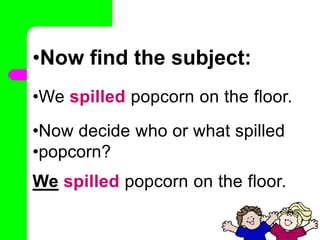
•Now find the subject:
•We spilled popcorn on the floor.
•Now decide who or what spilled
•popcorn?
•
We spilled popcorn on the floor.
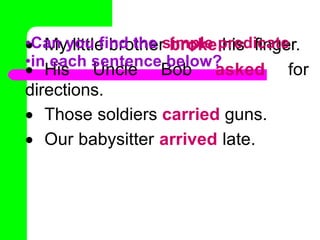
1. My little brother broke his
finger.
2. His Uncle Bob asked for
directions.
3. Those soldiers carried
guns.
4. Our babysitter arrived
late.
•Can you find the subject
in each sentence below?
•Can you find the
subject in each
sentence below?
 My little brother
broke his finger.
 His Uncle Bob
asked for directions.
 Those soldiers
carried guns.
 Our babysitter
•
•Can you find the
predicate in each
sentence below?
 My little brother
broke his finger.
 His Uncle Bob
asked for directions.
 Those soldiers
carried guns.
 Our babysitter
•
•Can you find the
predicate in each
sentence below?
•O My little brother
broke his finger.
•O His Uncle Bob
asked for directions.
•O Those soldiers
carried guns.
•O Our babysitter
arrived late.
•
Simple Subject
•Every subject is built
around one noun or
pronoun (or more). When
all other words are
removed the simple
subject is left.
•
•Simple Subject
•A piece of chocolate candy
would taste great.
The main word in the subject is the noun
“piece," with the other words of the subject
-- ̏a" and ̏of pepperoni pizza" – tell about
the noun. ``piece'' is the simple subject.
•
•Can you find the
simple subject
•in each sentence
below?
 My little brother broke
his finger.
 His Uncle Bob asked
for directions.
 Those soldiers
carried guns.
 Our babysitter
•
•Can you find the
simple subject
•in each sentence
below?
 My little brother
broke his finger.
 His Uncle Bob
asked for directions.
 Those soldiers
carried guns.
 Our babysitter
•
•Simple Predicate
•A simple predicate is
always the verb or verbs
that links up with the subject.
•
•Simple Predicate
•A piece of chocolate candy
•would taste great.
•The simple predicate is ̏would
•taste" -- in other words,
•the verb of the sentence.
•
1. My little brother broke his finger.
2. His Uncle Bob asked for
directions.
3. Those soldiers carried guns.
4. Our babysitter arrived late.
•Can you find the simple predicate
•in each sentence below?
 My little brother broke his finger.
 His Uncle Bob asked for
directions.
 Those soldiers carried guns.
 Our babysitter arrived late.
•Can you find the simple predicate
•in each sentence below?
•Compound
Subject
A sentence may have a
compound subject -- a
simple subject made up of
more than one noun or
pronouns
•
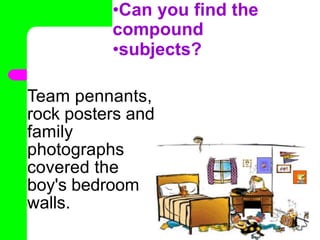
•Can you find the
compound
•subjects?
Team pennants,
rock posters and
family
photographs
covered the
boy's bedroom
walls.
•
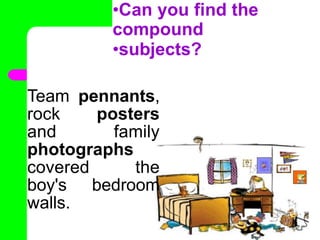
•Can you find the
compound
•subjects?
Team pennants,
rock posters
and family
photographs
covered the
boy's bedroom
walls.
•
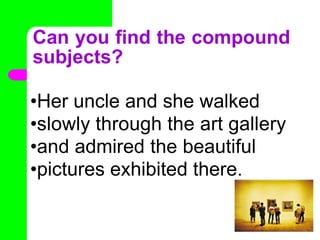
Can you find the compound
subjects?
•Her uncle and she walked
•slowly through the art gallery
•and admired the beautiful
•pictures exhibited there.
•
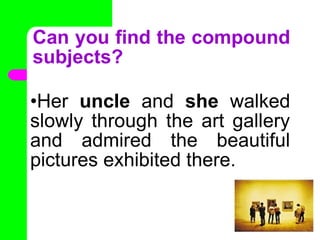
Can you find the compound
subjects?
•Her uncle and she walked
slowly through the art gallery
and admired the beautiful
pictures exhibited there.
•
Can you find the
compound subject in
each sentence below?
1. My little brother and my
cousin broke their fingers.
2. His Uncle Bob and Aunt
Betty asked for directions.
3. Those soldiers and agents
carried guns.
4. Our babysitter and her
friend arrived late.
•
Can you find the
compound subject in
each sentence below?
 My little brother and my
cousin broke their fingers.
 His Uncle Bob and Aunt
Betty asked for directions.
 Those soldiers and
agents carried guns.
 Our babysitter and her
friend arrived late.
•
Compound Predicate
A compound predicate, is more
than one verb relating to the same
subject.
•
•Can you find the
compound predicate?
•Mother mopped and
scrubbed the kitchen floor.
•
•Can you find the compound
•predicate?
•Mother mopped and scrubbed
the kitchen floor.
•
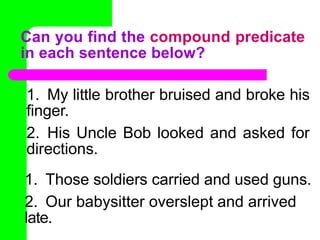
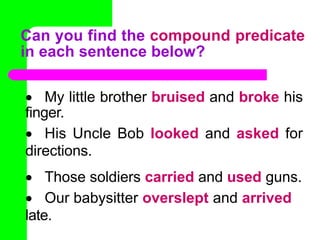
1. My little brother bruised and broke his
finger.
2. His Uncle Bob looked and asked for
directions.
1. Those soldiers carried and used guns.
2. Our babysitter overslept and arrived
late.
Can you find the compound predicate
in each sentence below?
 My little brother bruised and broke his
finger.
 His Uncle Bob looked and asked for
directions.
 Those soldiers carried and used guns.
 Our babysitter overslept and arrived
late.
Can you find the compound predicate
in each sentence below?
Directions: Separate the complete subject and the
complete predicate by a slanting line; then,
underline the simple subject once and the simple
predicate twice.
1. Innumerable changes / happen in the twinkling of
an eye.
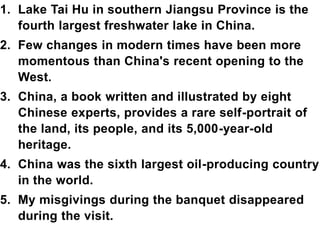
1. Lake Tai Hu in southern Jiangsu Province is the
fourth largest freshwater lake in China.
2. Few changes in modern times have been more
momentous than China's recent opening to the
West.
3. China, a book written and illustrated by eight
Chinese experts, provides a rare self-portrait of
the land, its people, and its 5,000-year-old
heritage.
4. China was the sixth largest oil-producing country
in the world.
5. My misgivings during the banquet disappeared
during the visit.
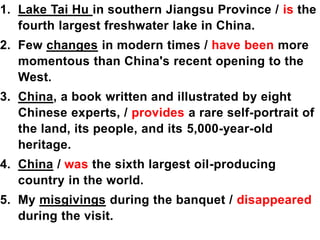
1. Lake Tai Hu in southern Jiangsu Province / is the
fourth largest freshwater lake in China.
2. Few changes in modern times / have been more
momentous than China's recent opening to the
West.
3. China, a book written and illustrated by eight
Chinese experts, / provides a rare self-portrait of
the land, its people, and its 5,000-year-old
heritage.
4. China / was the sixth largest oil-producing
country in the world.
5. My misgivings during the banquet / disappeared
during the visit.

subject and predicate.pptx

  • 1.
  • 2.
    Every complete sentencecontains two parts: a subject and a predicate. •The subject is what (or whom) the sentence is about, while the predicate tells something about the subject.
  • 3.
    •Judy and herdog run on the beach every morning. •
  • 4.
    •Judy and herdog run on the beach every morning. First find the verb and then make a question by placing ̏who?" or ``what?'' before it. • The answer is the subject, Judy and her dog.
  • 5.
    • •Let’s try one: •Wespilled popcorn on the floor. •What is the verb of this sentence? • We spilled popcorn on the floor.
  • 6.
    •Now find thesubject: •We spilled popcorn on the floor. •Now decide who or what spilled •popcorn? • We spilled popcorn on the floor.
  • 7.
    1. My littlebrother broke his finger. 2. His Uncle Bob asked for directions. 3. Those soldiers carried guns. 4. Our babysitter arrived late. •Can you find the subject in each sentence below?
  • 8.
    •Can you findthe subject in each sentence below?  My little brother broke his finger.  His Uncle Bob asked for directions.  Those soldiers carried guns.  Our babysitter •
  • 9.
    •Can you findthe predicate in each sentence below?  My little brother broke his finger.  His Uncle Bob asked for directions.  Those soldiers carried guns.  Our babysitter •
  • 10.
    •Can you findthe predicate in each sentence below? •O My little brother broke his finger. •O His Uncle Bob asked for directions. •O Those soldiers carried guns. •O Our babysitter arrived late. •
  • 11.
    Simple Subject •Every subjectis built around one noun or pronoun (or more). When all other words are removed the simple subject is left. •
  • 12.
    •Simple Subject •A pieceof chocolate candy would taste great. The main word in the subject is the noun “piece," with the other words of the subject -- ̏a" and ̏of pepperoni pizza" – tell about the noun. ``piece'' is the simple subject. •
  • 13.
    •Can you findthe simple subject •in each sentence below?  My little brother broke his finger.  His Uncle Bob asked for directions.  Those soldiers carried guns.  Our babysitter •
  • 14.
    •Can you findthe simple subject •in each sentence below?  My little brother broke his finger.  His Uncle Bob asked for directions.  Those soldiers carried guns.  Our babysitter •
  • 15.
    •Simple Predicate •A simplepredicate is always the verb or verbs that links up with the subject. •
  • 16.
    •Simple Predicate •A pieceof chocolate candy •would taste great. •The simple predicate is ̏would •taste" -- in other words, •the verb of the sentence. •
  • 17.
    1. My littlebrother broke his finger. 2. His Uncle Bob asked for directions. 3. Those soldiers carried guns. 4. Our babysitter arrived late. •Can you find the simple predicate •in each sentence below?
  • 18.
     My littlebrother broke his finger.  His Uncle Bob asked for directions.  Those soldiers carried guns.  Our babysitter arrived late. •Can you find the simple predicate •in each sentence below?
  • 19.
    •Compound Subject A sentence mayhave a compound subject -- a simple subject made up of more than one noun or pronouns •
  • 20.
    •Can you findthe compound •subjects? Team pennants, rock posters and family photographs covered the boy's bedroom walls. •
  • 21.
    •Can you findthe compound •subjects? Team pennants, rock posters and family photographs covered the boy's bedroom walls. •
  • 22.
    Can you findthe compound subjects? •Her uncle and she walked •slowly through the art gallery •and admired the beautiful •pictures exhibited there. •
  • 23.
    Can you findthe compound subjects? •Her uncle and she walked slowly through the art gallery and admired the beautiful pictures exhibited there. •
  • 24.
    Can you findthe compound subject in each sentence below? 1. My little brother and my cousin broke their fingers. 2. His Uncle Bob and Aunt Betty asked for directions. 3. Those soldiers and agents carried guns. 4. Our babysitter and her friend arrived late. •
  • 25.
    Can you findthe compound subject in each sentence below?  My little brother and my cousin broke their fingers.  His Uncle Bob and Aunt Betty asked for directions.  Those soldiers and agents carried guns.  Our babysitter and her friend arrived late. •
  • 26.
    Compound Predicate A compoundpredicate, is more than one verb relating to the same subject. •
  • 27.
    •Can you findthe compound predicate? •Mother mopped and scrubbed the kitchen floor. •
  • 28.
    •Can you findthe compound •predicate? •Mother mopped and scrubbed the kitchen floor. •
  • 29.
    1. My littlebrother bruised and broke his finger. 2. His Uncle Bob looked and asked for directions. 1. Those soldiers carried and used guns. 2. Our babysitter overslept and arrived late. Can you find the compound predicate in each sentence below?
  • 30.
     My littlebrother bruised and broke his finger.  His Uncle Bob looked and asked for directions.  Those soldiers carried and used guns.  Our babysitter overslept and arrived late. Can you find the compound predicate in each sentence below?
  • 31.
    Directions: Separate thecomplete subject and the complete predicate by a slanting line; then, underline the simple subject once and the simple predicate twice. 1. Innumerable changes / happen in the twinkling of an eye.
  • 32.
    1. Lake TaiHu in southern Jiangsu Province is the fourth largest freshwater lake in China. 2. Few changes in modern times have been more momentous than China's recent opening to the West. 3. China, a book written and illustrated by eight Chinese experts, provides a rare self-portrait of the land, its people, and its 5,000-year-old heritage. 4. China was the sixth largest oil-producing country in the world. 5. My misgivings during the banquet disappeared during the visit.
  • 33.
    1. Lake TaiHu in southern Jiangsu Province / is the fourth largest freshwater lake in China. 2. Few changes in modern times / have been more momentous than China's recent opening to the West. 3. China, a book written and illustrated by eight Chinese experts, / provides a rare self-portrait of the land, its people, and its 5,000-year-old heritage. 4. China / was the sixth largest oil-producing country in the world. 5. My misgivings during the banquet / disappeared during the visit.