Where inspiration begins Studying in the United Kingdom 9 October 2010
Studying in the United Kingdom Interested in studying in the UK?
Studying in the United Kingdom There are several things you may need to consider before making a decision. Here are some points you may want to look at:   Getting to know the UK Education System and finding out the entrance requirements and the application procedures. Choosing your level of study. Considering the different types of institutions and location. Deciding on a subject to undertake.
Studying in the United Kingdom The UK Education system
Studying in the United Kingdom The education options available in the UK Pre-university and career based courses Undergraduate courses Postgraduate courses
Studying in the United Kingdom Pre-university and Career-based Courses
Studying in the United Kingdom University International Foundation Year Foundation and Access Courses BTEC National Award, Certificate or Diploma Cache Diplomas OCR Nationals AS and A levels International Baccalaureate Cambridge Pre-U Diploma Pre-university and Career-based Courses
Studying in the United Kingdom University International Foundation Year University International Foundation Year courses help to bridge any gaps between qualifications you hold already and the ones you need to begin a degree course at a UK university, whether this is because you need to improve your English language skills, your academic qualifications or both.   You can find more information about International Foundation Year programmes, including how to apply on the UCAS website  www.ucas.com Pre-university and Career-based Courses
Studying in the United Kingdom Foundation and Access Courses If your current qualifications do not match those of the UK education system, or if  you have relevant work experience but no formal qualifications, you many need to take a foundation or access course before entering higher education, or a pre- master’s course before entering postgraduate education. Entry requirements are flexible but the student must be over 17 and have obtained high school matriculation. Courses last 1-2 years and can be shorter. Refer to  www.educationuk.org Pre-university and Career-based Courses
Studying in the United Kingdom Choosing subjects for Access and Foundation courses If you are not sure what subject you would like to study for your degree, you could  choose to do a general access or foundation course that focuses on study skills and  communication. However, the majority of courses focus on a particular subject and prepare you for a  degree in that area.  For example, you can do Access to Business, Access to  Nursing, Access to Teaching, Access to Performing Arts, Access to Computing,  Access to Engineering, Access to Law, or a Foundation in business, Foundation in  Engineering or Foundation in Art and Design. Pre-university and Career-based Courses
Studying in the United Kingdom BTEC National Award, Certificate or Diploma ( Business and Technology Education Council – new part of Edexcel ) Pre-university and Career-based Courses BTEC Nationals are one or two-year courses in career- related subjects such as  e-business, engineering, art and design, media, performing arts, agriculture, applied science, computing and health and social care. They are ideal for students hoping to progress to a career at supervisory or technician level, and also provide a foundation for higher education courses in the same subject area.  For more details see  www.edexcel.com
Studying in the United Kingdom CACHE Diplomas The Council for Awards in Children’s Care and Education administers CACHE Diplomas. They are specialist career qualifications and are also accepted for entry to higher education courses in areas such as early years education, teacher training and child nursing. Delivered through a combination of college-based learning and work experience. For more information see  www.cache.org.uk Pre-university and Career-based Courses
Studying in the United Kingdom OCR Nationals Introduced by the awarding body OCR in 2005, OCR Nationals are similar qualifications to BTECs and are offered at three levels: Certificate, Diploma and Extended Diploma. These are career-based further education qualification that helps students develop their personal skills in areas applicable to workplace.  The course lasts one year full time for a Certificate; two years full time for a Diploma or an Extended Diploma. For more information, see   http://orcnationals.com Pre-university and Career-based Courses
Studying in the United Kingdom AS- and A-levels (Highers / Advanced Highers in Scotland) (Advanced Supplementary level and Advanced Level) AS- and A-levels are the UK qualifications most widely accepted for entry to  university. They are available in subjects from the humanities, arts, sciences and  social sciences as well as in practical subjects such as engineering and leisure and  tourism.  You will study up to four subjects simultaneously over two years, taking AS-level  examinations at the end of your first year and A-level qualifications at the end of your  second.  Pre-university and Career-based Courses
Studying in the United Kingdom AS- and A-levels (Advanced Supplementary level and Advanced Level) An AS level qualification is the equivalent of 50 per cent of an A level. In both AS and A level course work accounts for between 20 and 30 per  cent of the marks, with  the remainder being assessed by examination.  For further information on these courses see   www.dfes.gov.uk /qualifications Pre-university and Career-based Courses
Studying in the United Kingdom International Baccalaureate Currently more than 100 school and colleges, both state and independent, provide an  opportunity for pupils to take the international Baccalaureate (IB) Diploma  Programme instead of A-levels. Whether taken in the UK or abroad, an International Baccalaureate Diploma is  considered an acceptable qualification for entry to degree courses at UK higher  education institutions.  For more information, visit:  www.ibo.org Pre-university and Career-based Courses
Studying in the United Kingdom Cambridge Pre-U Diploma This is a new qualification that is designed to develop students’ independent thinking  and learning skills. It has proved popular among independent schools and has also  been adopted by some state schools. Lasting two years, it is made up of three subjects chosen from a total of 26 on offer  plus an Independent Research Report and a Global Perspective Portfolio. Each  subject is the equivalent of an individual A-level subject. Each element can be taken  singly (leading a Pre-U Certificate) or together to achieve the full Diploma. For more information, visit:  www.cie.org.uk/qualifications/academic/uppersec/preu Pre-university and Career-based Courses
Studying in the United Kingdom Entrance requirements Pre-university and Career-based Courses
Studying in the United Kingdom You’ll find the exact entry requirements for each course explained clearly on the  course profiles on www.educationuk.org.  To give you a rough idea, the  sort of qualifications you’ll need are as follows: Pre-university and Career-based Courses Twelve years of school education or equivalent in your own country, plus IELTS 4.5-5.0 International Foundation Year Good general high school education equivalent to five GCSEs grades A–C, plus IELTS 4.5-5.0 AS/A-levels / IB / Cambridge Pre-U Good general high school education equivalent to four GCSEs grades A–C, plus IELTS 4.5-5.0 BTEC National Diploma/ OCR Nationals
Studying in the United Kingdom Undergraduate degree courses
Studying in the United Kingdom Higher National Certificate (HNC) or Diploma (HND) Foundation Degrees (FdA, FdSc etc) Certificate or Diploma of Higher Education (Cert/Dip HE)  Degrees Undergraduate Degree Courses
Studying in the United Kingdom Higher National Certificate (HNC) or Diploma (HND) Higher National Certificates and Diplomas are one- and two-year career-related  higher education courses, which are equivalent to the first stages of a degree.  They  are available in many areas including engineering, sports studies, art and design,  media and communications and music technology.  Successful completion will allow you to enter a career at junior management level  and from many courses you can ‘top-up’ to a degree by transferring into the second  or third year of the degree course.  For more information, visit:  www.edexcel.com Undergraduate Degree Courses
Studying in the United Kingdom Foundation degrees (FdA, FdSc etc) Foundation Degrees are two-year career-related higher education  courses, which  are equivalent to the first two years of a bachelor’s degree.  Successful students are  able to cite the letters FdA or FdSc after their name, depending on whether their  foundation degree is in an arts or science subject. Foundation degrees are available in many areas, including art and design, media and communications, engineering and hospitality management, and can be used as a good foundation for a career or as a basis from which you can progress on to a  degree course.  Undergraduate Degree Courses
Studying in the United Kingdom Difference between Foundation degree & Foundation courses Foundation degree is a separate qualification and is quite different from an access or  foundation course.  It is an employment-related higher education qualification  designed to meet skills shortages at higher technician level.  Courses last two years and are aligned with the first two years of a bachelor’s  degree.  You may need to take a foundation course before progressing to a  foundation degree. For more information on foundation degrees visit  www.foundationdegree.org.uk Undergraduate Degree Courses
Studying in the United Kingdom Certificates / Diplomas of Higher Education (Dip HE)  Certificates / Diplomas of Higher Education are university–level two-year courses  available in many humanities and social science subjects, such as education,  theology, communication studies and social work. They are ideal for students hoping  to progress to a career in these areas and also provide a foundation for higher education courses in the same subject area.   Successful completion of a Dip HE may allow students to transfer directly on to the  third year of a degree course and many institutions also offer specialised ‘top-up  degrees’ – one-year courses developed to convert Dip HEs into bachelor’s degrees. Though aimed at preparing students for particular careers, the teaching methods tend to be more academic than on HNDs or Foundation Degree programmes.  See www.ucas.com  for a list of courses available. Undergraduate Degree Courses
Studying in the United Kingdom Degrees  Degrees are the most popular undergraduate qualification in the UK.  They are  academic courses, usually studied over three years in England, Northern Ireland and Wales, or four years in Scotland (where the title master's degree may be awarded).  Some degree courses may be extended for a year to enable students to spend a year in industry (such as on engineering degrees) or overseas (such as on degrees in modern languages).  Degree courses in professional subjects, such as architecture, medicine, dentistry and veterinary sciences, can take between five and seven years to complete.  Undergraduate Degree Courses
Studying in the United Kingdom Entrance requirements The qualifications you need depend on the course you want to study.  You'll be  expected to have completed at least 13 years of education in your own country or the  UK, and to have taken pre-university qualifications equivalent to UK A-levels, Scottish Higher or National Diplomas.  If your qualifications don't match this, you can still study in the UK, you just to start  at an earlier level.  Undergraduate Degree Courses
Studying in the United Kingdom You’ll find the exact entry requirements for each course explained clearly on the course profiles on www.educationuk.org.  The following will give you an idea of the sort of qualifications you will need:  Undergraduate Degree Courses Qualifications equivalent to two or three UK A-levels, three or four Scottish Highers or a National Diploma; or an international foundation year. Plus IELTS 6.0-6.5 Degree Qualifications equivalent to one or two UK A-levels, two or three Scottish Highers or a National Diploma; or an international foundation year. Plus IELTS 5.5-6.0 Diploma of Higher Education Qualifications equivalent to one or two UK A-levels, one or two Scottish Highers or a National Diploma; or an international foundation year. Plus IELTS 5.5-6.0 Foundation Degree Qualifications equivalent to one or two UK A-levels, tow Scottish Highers or a Higher National Certificate or BTEC National Diploma or an international foundation year, plus IELTS 5.5-6.0  HND
Studying in the United Kingdom Postgraduate degree courses
Studying in the United Kingdom Pre-master's courses Postgraduate certificate or diploma (PG Cert/Dip) Taught master's (MA, MSc, LLM, MEd etc) Research master's (MRes, MPhil) Master of Business Administration (MBA) PhD by research New Route PhDs Professional Doctorate Postgraduate Courses
Studying in the United Kingdom Pre-master’s courses You may need to take a pre-master's course if your qualifications or English language skills don't quite match the standard required to begin a master's degree. Pre-master's courses can last from one term to a complete academic year and cover academic subject, study skills, cultural instruction and language training.  Many  Courses will guarantee progression onto a master's course at a particular university.  Pre-MBA courses can also give you the opportunity to develop workplace  experience. These can enable you to gain a good score in the Graduate Management  Admission Test (GMAT) Postgraduate Courses
Studying in the United Kingdom Postgraduate certificate or diploma (PG Cert/Dip) Postgraduate certificates and diplomas are ‘bridging’ courses at postgraduate level and are designed to give access to students who do not qualify for direct entry to Master’s courses.  They last one academic year and are offered in a huge variety of subjects, from education to management to network engineering.  These are often accepted as professional qualifications in their field.  You’ll find that some postgraduate diplomas are similar to a master’s degree, although you will not be required to write a dissertation. Postgraduate Courses
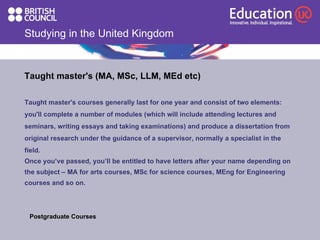
Studying in the United Kingdom Taught master's (MA, MSc, LLM, MEd etc) Taught master's courses generally last for one year and consist of two elements: you'll complete a number of modules (which will include attending lectures and seminars, writing essays and taking examinations) and produce a dissertation from original research under the guidance of a supervisor, normally a specialist in the field.  Once you’ve passed, you’ll be entitled to have letters after your name depending on the subject – MA for arts courses, MSc for science courses, MEng for Engineering courses and so on. Postgraduate Courses
Studying in the United Kingdom Research master's (MRes, MPhil) The MRes and MPhil are one to three years full time postgraduate courses and they consist of research into a single topic and the submission of a longer dissertation or thesis than for a taught Master’s.  These are especially suitable for students with a specific interest in a narrow area of academic study and a high level of prior academic achievement.  The MRes is specifically designed to give students training in research, as a preparation for a PhD or for a research-related career in industry.   Postgraduate Courses
Studying in the United Kingdom Master of Business Administration (MBA) An MBA is a specialist business taught master's course that will give you a real step up the managerial ladder. It's the best-known and most popular postgraduate qualification. The association of MBAs provides a list of accredited providers in England, Northern Ireland, Scotland and Wales.  Some of these are based in universities that offer a wide range of academic programmes, while others are specialist business colleges. Visit the Association of MBAs’ website at  www.mbaworld.com  for more details.   Postgraduate Courses
Studying in the United Kingdom New Route PhDs A PhD, also know as a doctorate, will take you three to four years to complete, during  which you'll be working on a single research project.  In you final year, you'll be  asked to present a thesis of approximately 100,000 words, which is based on an  original idea and explains the methods, results and conclusion of your original  research.  PhD by research New Route PhDs include taught elements as well as advanced research project and  give you the opportunity to undertake interdisciplinary study.  Postgraduate Courses
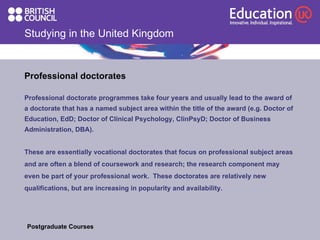
Studying in the United Kingdom Professional doctorates Professional doctorate programmes take four years and usually lead to the award of  a doctorate that has a named subject area within the title of the award (e.g. Doctor of  Education, EdD; Doctor of Clinical Psychology, ClinPsyD; Doctor of Business  Administration, DBA).  These are essentially vocational doctorates that focus on professional subject areas  and are often a blend of coursework and research; the research component may  even be part of your professional work.  These doctorates are relatively new  qualifications, but are increasing in popularity and availability.  Postgraduate Courses
Studying in the United Kingdom Entrance Requirements To begin a postgraduate course in the UK, you'll need to hold an undergraduate  degree from the UK or overseas.  This is the foundation from which you'll be able to  go on to a postgraduate certificate, postgraduate diploma or a master's degree and  then, afterwards, to a PhD.  You'll be expected to have obtained a first class Honours degree or good Upper  second Honours degree (2:1) or international equivalent in a directly related subject  and you'll also need to speak English to at least IELTS 6.5 level. Postgraduate Courses
Studying in the United Kingdom You'll find the exact entry requirements for each course explained clearly on the  course profiles on www.educationuk.org.  To give you a rough idea, the sort  of qualifications you'll need are as follows: Postgraduate Courses  master's degree, IELTS 6.5-7.0 PhD first degree, 2-3 year's business experience, IELTS 6.5-7.0 MBA first or upper second class undergraduate degree plus IELTS 7.0, or a pre-master's course Master's degree undergraduate degree plus IELTS 6.5-7.0 or a pre-master's course PG Cert/PG Dip undergraduate degree plus IELTS 5.0-5.5 Pre-master's
Studying in the United Kingdom Course fees
Studying in the United Kingdom Career-based and pre-university courses Career-based and pre-university study offers you great value for money.  Course  fees can vary considerably between institutions, but the figures below show  approximately what you’ll need to pay.  Costs for individual courses are given in the  course profiles on their institutions’ website .   Course fees £4,000 - £17,000 per year International Foundation Courses:  £4,000 - £6,000 per year BTECs and other vocational:  £4,000 - £17,000 per year AS- and A-levels:
Studying in the United Kingdom Course fees for undergraduate degree courses  The figures below show approximately what you'll need to pay, but it's worth bearing  in mind that course fees can vary considerably between institutions.  Costs for  individual courses are given in the course profiles on their institutions’ website.  Course fees £10,000 to £25,000 per year Clinical courses £7,500 to £22,000 per year Science courses £7,000 to £9,000 per year Arts courses £4,000 to £17,000 per year Foundation courses
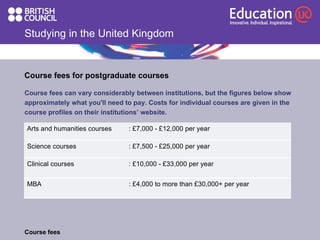
Studying in the United Kingdom Course fees for postgraduate courses  Course fees can vary considerably between institutions, but the figures below show  approximately what you'll need to pay. Costs for individual courses are given in the  course profiles on their institutions’ website. Course fees : £4,000 to more than £30,000+ per year  MBA : £10,000 - £33,000 per year  Clinical courses : £7,500 - £25,000 per year  Science courses : £7,000 - £12,000 per year Arts and humanities courses
Studying in the United Kingdom Entry Clearance
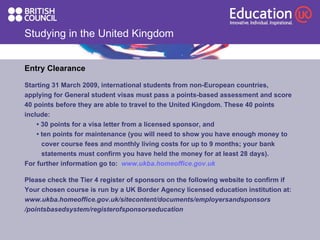
Studying in the United Kingdom Entry Clearance Starting 31 March 2009, international students from non-European countries,  applying for General student visas must pass a points-based assessment and score 40 points before they are able to travel to the United Kingdom. These 40 points include: •  30 points for a visa letter from a licensed sponsor, and •  ten points for maintenance (you will need to show you have enough money to  cover course fees and monthly living costs for up to 9 months; your bank  statements must confirm you have held the money for at least 28 days). For further information go to:  www.ukba.homeoffice.gov.uk Please check the Tier 4 register of sponsors on the following website to confirm if Your chosen course is run by a UK Border Agency licensed education institution at:   www.ukba.homeoffice.gov.uk/sitecontent/documents/employersandsponsors  /pointsbasedsystem/registerofsponsorseducation
Studying in the United Kingdom How many hours can you work in the UK? If you make your Tier 4 immigration application you can work up to: 20 hours a week if you are studying at degree level or foundation degree and  up to 10 hours a week if you are studying any other type of course or have immigration permission as a Tier 4 (Child) student during term-time.  You can work full-time during your holidays and on work placements. For further information about working while studying, please visit: www.ukcisa.org.uk for more details.
Studying in the United Kingdom ATAS Certificate On 1 November 2007 the UK government introduced the Academic Technology  Approval Scheme (ATAS). Having an ATAS clearance certificate is a mandatory  requirement for some postgraduate students who need entry clearance to study in  the UK. It will affect students who: •  plan to undertake postgraduate research in science, engineering or technology  disciplines •  plan to apply for a postgraduate taught master’s in materials science, materials  technology, aerospace engineering, mechanical engineering or physics (including nuclear physics). If you need an ATAS certificate and you don’t have one your entry clearance application will be refused. Current students already in the UK wishing to extend their visa also need to apply for an ATAS clearance if they are extending their visa in the subject areas listed. For further information and a more detailed list please visit  www.fco.gov.uk/atas

Studying in the UK

  • 1.
    Where inspiration beginsStudying in the United Kingdom 9 October 2010
  • 2.
    Studying in theUnited Kingdom Interested in studying in the UK?
  • 3.
    Studying in theUnited Kingdom There are several things you may need to consider before making a decision. Here are some points you may want to look at: Getting to know the UK Education System and finding out the entrance requirements and the application procedures. Choosing your level of study. Considering the different types of institutions and location. Deciding on a subject to undertake.
  • 4.
    Studying in theUnited Kingdom The UK Education system
  • 5.
    Studying in theUnited Kingdom The education options available in the UK Pre-university and career based courses Undergraduate courses Postgraduate courses
  • 6.
    Studying in theUnited Kingdom Pre-university and Career-based Courses
  • 7.
    Studying in theUnited Kingdom University International Foundation Year Foundation and Access Courses BTEC National Award, Certificate or Diploma Cache Diplomas OCR Nationals AS and A levels International Baccalaureate Cambridge Pre-U Diploma Pre-university and Career-based Courses
  • 8.
    Studying in theUnited Kingdom University International Foundation Year University International Foundation Year courses help to bridge any gaps between qualifications you hold already and the ones you need to begin a degree course at a UK university, whether this is because you need to improve your English language skills, your academic qualifications or both. You can find more information about International Foundation Year programmes, including how to apply on the UCAS website www.ucas.com Pre-university and Career-based Courses
  • 9.
    Studying in theUnited Kingdom Foundation and Access Courses If your current qualifications do not match those of the UK education system, or if you have relevant work experience but no formal qualifications, you many need to take a foundation or access course before entering higher education, or a pre- master’s course before entering postgraduate education. Entry requirements are flexible but the student must be over 17 and have obtained high school matriculation. Courses last 1-2 years and can be shorter. Refer to www.educationuk.org Pre-university and Career-based Courses
  • 10.
    Studying in theUnited Kingdom Choosing subjects for Access and Foundation courses If you are not sure what subject you would like to study for your degree, you could choose to do a general access or foundation course that focuses on study skills and communication. However, the majority of courses focus on a particular subject and prepare you for a degree in that area. For example, you can do Access to Business, Access to Nursing, Access to Teaching, Access to Performing Arts, Access to Computing, Access to Engineering, Access to Law, or a Foundation in business, Foundation in Engineering or Foundation in Art and Design. Pre-university and Career-based Courses
  • 11.
    Studying in theUnited Kingdom BTEC National Award, Certificate or Diploma ( Business and Technology Education Council – new part of Edexcel ) Pre-university and Career-based Courses BTEC Nationals are one or two-year courses in career- related subjects such as e-business, engineering, art and design, media, performing arts, agriculture, applied science, computing and health and social care. They are ideal for students hoping to progress to a career at supervisory or technician level, and also provide a foundation for higher education courses in the same subject area. For more details see www.edexcel.com
  • 12.
    Studying in theUnited Kingdom CACHE Diplomas The Council for Awards in Children’s Care and Education administers CACHE Diplomas. They are specialist career qualifications and are also accepted for entry to higher education courses in areas such as early years education, teacher training and child nursing. Delivered through a combination of college-based learning and work experience. For more information see www.cache.org.uk Pre-university and Career-based Courses
  • 13.
    Studying in theUnited Kingdom OCR Nationals Introduced by the awarding body OCR in 2005, OCR Nationals are similar qualifications to BTECs and are offered at three levels: Certificate, Diploma and Extended Diploma. These are career-based further education qualification that helps students develop their personal skills in areas applicable to workplace. The course lasts one year full time for a Certificate; two years full time for a Diploma or an Extended Diploma. For more information, see http://orcnationals.com Pre-university and Career-based Courses
  • 14.
    Studying in theUnited Kingdom AS- and A-levels (Highers / Advanced Highers in Scotland) (Advanced Supplementary level and Advanced Level) AS- and A-levels are the UK qualifications most widely accepted for entry to university. They are available in subjects from the humanities, arts, sciences and social sciences as well as in practical subjects such as engineering and leisure and tourism. You will study up to four subjects simultaneously over two years, taking AS-level examinations at the end of your first year and A-level qualifications at the end of your second. Pre-university and Career-based Courses
  • 15.
    Studying in theUnited Kingdom AS- and A-levels (Advanced Supplementary level and Advanced Level) An AS level qualification is the equivalent of 50 per cent of an A level. In both AS and A level course work accounts for between 20 and 30 per cent of the marks, with the remainder being assessed by examination. For further information on these courses see www.dfes.gov.uk /qualifications Pre-university and Career-based Courses
  • 16.
    Studying in theUnited Kingdom International Baccalaureate Currently more than 100 school and colleges, both state and independent, provide an opportunity for pupils to take the international Baccalaureate (IB) Diploma Programme instead of A-levels. Whether taken in the UK or abroad, an International Baccalaureate Diploma is considered an acceptable qualification for entry to degree courses at UK higher education institutions. For more information, visit: www.ibo.org Pre-university and Career-based Courses
  • 17.
    Studying in theUnited Kingdom Cambridge Pre-U Diploma This is a new qualification that is designed to develop students’ independent thinking and learning skills. It has proved popular among independent schools and has also been adopted by some state schools. Lasting two years, it is made up of three subjects chosen from a total of 26 on offer plus an Independent Research Report and a Global Perspective Portfolio. Each subject is the equivalent of an individual A-level subject. Each element can be taken singly (leading a Pre-U Certificate) or together to achieve the full Diploma. For more information, visit: www.cie.org.uk/qualifications/academic/uppersec/preu Pre-university and Career-based Courses
  • 18.
    Studying in theUnited Kingdom Entrance requirements Pre-university and Career-based Courses
  • 19.
    Studying in theUnited Kingdom You’ll find the exact entry requirements for each course explained clearly on the course profiles on www.educationuk.org. To give you a rough idea, the sort of qualifications you’ll need are as follows: Pre-university and Career-based Courses Twelve years of school education or equivalent in your own country, plus IELTS 4.5-5.0 International Foundation Year Good general high school education equivalent to five GCSEs grades A–C, plus IELTS 4.5-5.0 AS/A-levels / IB / Cambridge Pre-U Good general high school education equivalent to four GCSEs grades A–C, plus IELTS 4.5-5.0 BTEC National Diploma/ OCR Nationals
  • 20.
    Studying in theUnited Kingdom Undergraduate degree courses
  • 21.
    Studying in theUnited Kingdom Higher National Certificate (HNC) or Diploma (HND) Foundation Degrees (FdA, FdSc etc) Certificate or Diploma of Higher Education (Cert/Dip HE) Degrees Undergraduate Degree Courses
  • 22.
    Studying in theUnited Kingdom Higher National Certificate (HNC) or Diploma (HND) Higher National Certificates and Diplomas are one- and two-year career-related higher education courses, which are equivalent to the first stages of a degree. They are available in many areas including engineering, sports studies, art and design, media and communications and music technology. Successful completion will allow you to enter a career at junior management level and from many courses you can ‘top-up’ to a degree by transferring into the second or third year of the degree course. For more information, visit: www.edexcel.com Undergraduate Degree Courses
  • 23.
    Studying in theUnited Kingdom Foundation degrees (FdA, FdSc etc) Foundation Degrees are two-year career-related higher education courses, which are equivalent to the first two years of a bachelor’s degree. Successful students are able to cite the letters FdA or FdSc after their name, depending on whether their foundation degree is in an arts or science subject. Foundation degrees are available in many areas, including art and design, media and communications, engineering and hospitality management, and can be used as a good foundation for a career or as a basis from which you can progress on to a degree course. Undergraduate Degree Courses
  • 24.
    Studying in theUnited Kingdom Difference between Foundation degree & Foundation courses Foundation degree is a separate qualification and is quite different from an access or foundation course. It is an employment-related higher education qualification designed to meet skills shortages at higher technician level. Courses last two years and are aligned with the first two years of a bachelor’s degree. You may need to take a foundation course before progressing to a foundation degree. For more information on foundation degrees visit www.foundationdegree.org.uk Undergraduate Degree Courses
  • 25.
    Studying in theUnited Kingdom Certificates / Diplomas of Higher Education (Dip HE) Certificates / Diplomas of Higher Education are university–level two-year courses available in many humanities and social science subjects, such as education, theology, communication studies and social work. They are ideal for students hoping to progress to a career in these areas and also provide a foundation for higher education courses in the same subject area. Successful completion of a Dip HE may allow students to transfer directly on to the third year of a degree course and many institutions also offer specialised ‘top-up degrees’ – one-year courses developed to convert Dip HEs into bachelor’s degrees. Though aimed at preparing students for particular careers, the teaching methods tend to be more academic than on HNDs or Foundation Degree programmes. See www.ucas.com for a list of courses available. Undergraduate Degree Courses
  • 26.
    Studying in theUnited Kingdom Degrees Degrees are the most popular undergraduate qualification in the UK. They are academic courses, usually studied over three years in England, Northern Ireland and Wales, or four years in Scotland (where the title master's degree may be awarded). Some degree courses may be extended for a year to enable students to spend a year in industry (such as on engineering degrees) or overseas (such as on degrees in modern languages). Degree courses in professional subjects, such as architecture, medicine, dentistry and veterinary sciences, can take between five and seven years to complete. Undergraduate Degree Courses
  • 27.
    Studying in theUnited Kingdom Entrance requirements The qualifications you need depend on the course you want to study. You'll be expected to have completed at least 13 years of education in your own country or the UK, and to have taken pre-university qualifications equivalent to UK A-levels, Scottish Higher or National Diplomas. If your qualifications don't match this, you can still study in the UK, you just to start at an earlier level. Undergraduate Degree Courses
  • 28.
    Studying in theUnited Kingdom You’ll find the exact entry requirements for each course explained clearly on the course profiles on www.educationuk.org. The following will give you an idea of the sort of qualifications you will need: Undergraduate Degree Courses Qualifications equivalent to two or three UK A-levels, three or four Scottish Highers or a National Diploma; or an international foundation year. Plus IELTS 6.0-6.5 Degree Qualifications equivalent to one or two UK A-levels, two or three Scottish Highers or a National Diploma; or an international foundation year. Plus IELTS 5.5-6.0 Diploma of Higher Education Qualifications equivalent to one or two UK A-levels, one or two Scottish Highers or a National Diploma; or an international foundation year. Plus IELTS 5.5-6.0 Foundation Degree Qualifications equivalent to one or two UK A-levels, tow Scottish Highers or a Higher National Certificate or BTEC National Diploma or an international foundation year, plus IELTS 5.5-6.0 HND
  • 29.
    Studying in theUnited Kingdom Postgraduate degree courses
  • 30.
    Studying in theUnited Kingdom Pre-master's courses Postgraduate certificate or diploma (PG Cert/Dip) Taught master's (MA, MSc, LLM, MEd etc) Research master's (MRes, MPhil) Master of Business Administration (MBA) PhD by research New Route PhDs Professional Doctorate Postgraduate Courses
  • 31.
    Studying in theUnited Kingdom Pre-master’s courses You may need to take a pre-master's course if your qualifications or English language skills don't quite match the standard required to begin a master's degree. Pre-master's courses can last from one term to a complete academic year and cover academic subject, study skills, cultural instruction and language training. Many Courses will guarantee progression onto a master's course at a particular university. Pre-MBA courses can also give you the opportunity to develop workplace experience. These can enable you to gain a good score in the Graduate Management Admission Test (GMAT) Postgraduate Courses
  • 32.
    Studying in theUnited Kingdom Postgraduate certificate or diploma (PG Cert/Dip) Postgraduate certificates and diplomas are ‘bridging’ courses at postgraduate level and are designed to give access to students who do not qualify for direct entry to Master’s courses. They last one academic year and are offered in a huge variety of subjects, from education to management to network engineering. These are often accepted as professional qualifications in their field. You’ll find that some postgraduate diplomas are similar to a master’s degree, although you will not be required to write a dissertation. Postgraduate Courses
  • 33.
    Studying in theUnited Kingdom Taught master's (MA, MSc, LLM, MEd etc) Taught master's courses generally last for one year and consist of two elements: you'll complete a number of modules (which will include attending lectures and seminars, writing essays and taking examinations) and produce a dissertation from original research under the guidance of a supervisor, normally a specialist in the field. Once you’ve passed, you’ll be entitled to have letters after your name depending on the subject – MA for arts courses, MSc for science courses, MEng for Engineering courses and so on. Postgraduate Courses
  • 34.
    Studying in theUnited Kingdom Research master's (MRes, MPhil) The MRes and MPhil are one to three years full time postgraduate courses and they consist of research into a single topic and the submission of a longer dissertation or thesis than for a taught Master’s. These are especially suitable for students with a specific interest in a narrow area of academic study and a high level of prior academic achievement. The MRes is specifically designed to give students training in research, as a preparation for a PhD or for a research-related career in industry. Postgraduate Courses
  • 35.
    Studying in theUnited Kingdom Master of Business Administration (MBA) An MBA is a specialist business taught master's course that will give you a real step up the managerial ladder. It's the best-known and most popular postgraduate qualification. The association of MBAs provides a list of accredited providers in England, Northern Ireland, Scotland and Wales. Some of these are based in universities that offer a wide range of academic programmes, while others are specialist business colleges. Visit the Association of MBAs’ website at www.mbaworld.com for more details. Postgraduate Courses
  • 36.
    Studying in theUnited Kingdom New Route PhDs A PhD, also know as a doctorate, will take you three to four years to complete, during which you'll be working on a single research project. In you final year, you'll be asked to present a thesis of approximately 100,000 words, which is based on an original idea and explains the methods, results and conclusion of your original research. PhD by research New Route PhDs include taught elements as well as advanced research project and give you the opportunity to undertake interdisciplinary study. Postgraduate Courses
  • 37.
    Studying in theUnited Kingdom Professional doctorates Professional doctorate programmes take four years and usually lead to the award of a doctorate that has a named subject area within the title of the award (e.g. Doctor of Education, EdD; Doctor of Clinical Psychology, ClinPsyD; Doctor of Business Administration, DBA). These are essentially vocational doctorates that focus on professional subject areas and are often a blend of coursework and research; the research component may even be part of your professional work. These doctorates are relatively new qualifications, but are increasing in popularity and availability. Postgraduate Courses
  • 38.
    Studying in theUnited Kingdom Entrance Requirements To begin a postgraduate course in the UK, you'll need to hold an undergraduate degree from the UK or overseas. This is the foundation from which you'll be able to go on to a postgraduate certificate, postgraduate diploma or a master's degree and then, afterwards, to a PhD. You'll be expected to have obtained a first class Honours degree or good Upper second Honours degree (2:1) or international equivalent in a directly related subject and you'll also need to speak English to at least IELTS 6.5 level. Postgraduate Courses
  • 39.
    Studying in theUnited Kingdom You'll find the exact entry requirements for each course explained clearly on the course profiles on www.educationuk.org. To give you a rough idea, the sort of qualifications you'll need are as follows: Postgraduate Courses master's degree, IELTS 6.5-7.0 PhD first degree, 2-3 year's business experience, IELTS 6.5-7.0 MBA first or upper second class undergraduate degree plus IELTS 7.0, or a pre-master's course Master's degree undergraduate degree plus IELTS 6.5-7.0 or a pre-master's course PG Cert/PG Dip undergraduate degree plus IELTS 5.0-5.5 Pre-master's
  • 40.
    Studying in theUnited Kingdom Course fees
  • 41.
    Studying in theUnited Kingdom Career-based and pre-university courses Career-based and pre-university study offers you great value for money. Course fees can vary considerably between institutions, but the figures below show approximately what you’ll need to pay. Costs for individual courses are given in the course profiles on their institutions’ website . Course fees £4,000 - £17,000 per year International Foundation Courses: £4,000 - £6,000 per year BTECs and other vocational: £4,000 - £17,000 per year AS- and A-levels:
  • 42.
    Studying in theUnited Kingdom Course fees for undergraduate degree courses The figures below show approximately what you'll need to pay, but it's worth bearing in mind that course fees can vary considerably between institutions. Costs for individual courses are given in the course profiles on their institutions’ website. Course fees £10,000 to £25,000 per year Clinical courses £7,500 to £22,000 per year Science courses £7,000 to £9,000 per year Arts courses £4,000 to £17,000 per year Foundation courses
  • 43.
    Studying in theUnited Kingdom Course fees for postgraduate courses Course fees can vary considerably between institutions, but the figures below show approximately what you'll need to pay. Costs for individual courses are given in the course profiles on their institutions’ website. Course fees : £4,000 to more than £30,000+ per year MBA : £10,000 - £33,000 per year Clinical courses : £7,500 - £25,000 per year Science courses : £7,000 - £12,000 per year Arts and humanities courses
  • 44.
    Studying in theUnited Kingdom Entry Clearance
  • 45.
    Studying in theUnited Kingdom Entry Clearance Starting 31 March 2009, international students from non-European countries, applying for General student visas must pass a points-based assessment and score 40 points before they are able to travel to the United Kingdom. These 40 points include: • 30 points for a visa letter from a licensed sponsor, and • ten points for maintenance (you will need to show you have enough money to cover course fees and monthly living costs for up to 9 months; your bank statements must confirm you have held the money for at least 28 days). For further information go to: www.ukba.homeoffice.gov.uk Please check the Tier 4 register of sponsors on the following website to confirm if Your chosen course is run by a UK Border Agency licensed education institution at: www.ukba.homeoffice.gov.uk/sitecontent/documents/employersandsponsors /pointsbasedsystem/registerofsponsorseducation
  • 46.
    Studying in theUnited Kingdom How many hours can you work in the UK? If you make your Tier 4 immigration application you can work up to: 20 hours a week if you are studying at degree level or foundation degree and up to 10 hours a week if you are studying any other type of course or have immigration permission as a Tier 4 (Child) student during term-time. You can work full-time during your holidays and on work placements. For further information about working while studying, please visit: www.ukcisa.org.uk for more details.
  • 47.
    Studying in theUnited Kingdom ATAS Certificate On 1 November 2007 the UK government introduced the Academic Technology Approval Scheme (ATAS). Having an ATAS clearance certificate is a mandatory requirement for some postgraduate students who need entry clearance to study in the UK. It will affect students who: • plan to undertake postgraduate research in science, engineering or technology disciplines • plan to apply for a postgraduate taught master’s in materials science, materials technology, aerospace engineering, mechanical engineering or physics (including nuclear physics). If you need an ATAS certificate and you don’t have one your entry clearance application will be refused. Current students already in the UK wishing to extend their visa also need to apply for an ATAS clearance if they are extending their visa in the subject areas listed. For further information and a more detailed list please visit www.fco.gov.uk/atas