ISSN (e): 2250 – 3005 || Volume, 06 || Issue, 10|| October – 2016 ||
International Journal of Computational Engineering Research (IJCER)
www.ijceronline.com Open Access Journal Page 18
Study on M/M/2 Transient Queue with Feedback under
Catastrophic Effect
S. Shanmugasundaram1
, S.Chitra2
1,2
Department of Mathematics, Government Arts College, Salem – 636 007.
2
Department of Mathematics, Sengunthar College of Engineering, Thiruchengode, Namakkal - 637 205.
I. INTRODUCTION
In the year of 1909, queueing theory originated in telephony with the work of Erlang [2]. After his work many
authors to develop different types of queueing models, incorporating different arrival patterns, different service
time distributions and various service disciplines. In the year of 1963, Takacs [13] first introduced queues with
feedback mechanism which includes the possibility for a customer return to the counter for additional service. In
the year of 2000, Santhakumaran and Thangaraj [9] have studied a single server queue with impatient and
feedback customers. In the year of 2008, Santhakumaran and Shanmugasundaram [9] have focused to study a
Preparatory Work on Arrival Customers with a Single Server Feedback Queue
In queueing theory, the time independent solutions only derived for a long time. According to the theory and
applications of queueing theory time dependent solution is necessary. Parthasarathy [8] and Parthasarathy and
Sharafali [7] have discussed single and multiple server poisson queues of transient state solution in easiest
manner. Krishna Kumar and Arivudainambi [4] has proposed a transient state solution for the mean queue size
of M/M/1 queueing model when catastrophes occurred at the service station. Krishna Kumar and Pavai
Madheswari [6] have introduced transient solution of M/M/2 queue with catastrophes. Krishna Kumar and Pavai
Madheswari [5] have focussed to study transient solution of M/M/2 queue with heterogeneous servers subject to
catastrophes.Shanmugasundaram and Shanmugavadivu [11] have discussed a time dependent solution of single
server queue with Markovian arrival and Markovian service. Shanmugasundaram and Chitra [12] have
discussed time dependent solution of M/G2/1 retrial queue and feedback on Non Retrail customers with
catastrophes. Thangaraj and Vanitha [14] have studied transient solution of single server queue with feedback
using continued fraction method. Chandrasekaran and Saravanarajan [1] has proposed a transient and reliability
analysis of single server queue with feedback subject to catastrophes also discussed server failures and repairs.
In this paper we analyze the time dependent solution of M/M/2 feedback queue with catastrophes.
II. MODEL DESCRIPTION AND ANALYSIS
Fig1. Schematic flow of customer
ABSTRACT
In this paper we study the time dependent solution of feedback customer with two servers along with
catastrophic effect. We derive the asymptotic behavior of the queue length and the stationary
probability distributions. The numerical examples are also given to test the effectiveness of the queue
length under the catastropic conditions.
Keywords: Asymptotic behavior, Catastrophes, Departure Process, Feedback customer, Poisson
process, Stationary probability distribution, Transient probability.
Mathematical Subject Classification (2010):
Study on M/M/2 Transient Queue with Feedback under Catastrophic Effect
www.ijceronline.com Open Access Journal Page 19
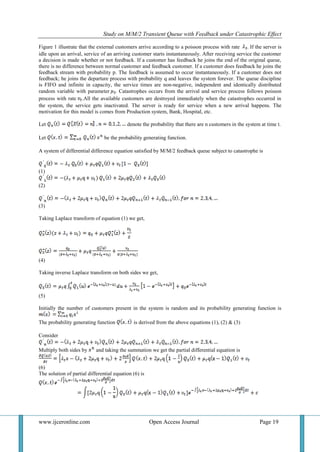
Figure 1 illustrate that the external customers arrive according to a poisson process with rate . If the server is
idle upon an arrival, service of an arriving customer starts instantaneously. After receiving service the customer
a decision is made whether or not feedback. If a customer has feedback he joins the end of the original queue,
there is no difference between normal customer and feedback customer. If a customer does feedback he joins the
feedback stream with probability p. The feedback is assumed to occur instantaneously. If a customer does not
feedback; he joins the departure process with probability q and leaves the system forever. The queue discipline
is FIFO and infinite in capacity, the service times are non-negative, independent and identically distributed
random variable with parameter . Catastrophes occurs from the arrival and service process follows poisson
process with rate .All the available customers are destroyed immediately when the catastrophes occurred in
the system, the service gets inactivated. The server is ready for service when a new arrival happens. The
motivation for this model is comes from Production system, Bank, Hospital, etc.
Let denote the probability that there are n customers in the system at time t.
Let be the probability generating function.
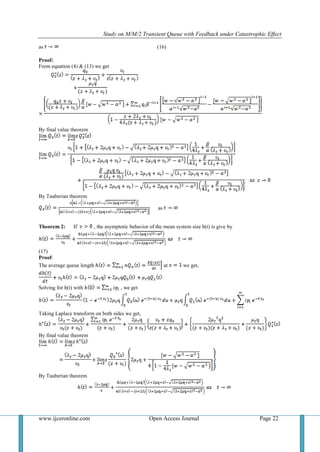
A system of differential difference equation satisfied by M/M/2 feedback queue subject to catastrophe is
(1)
(2)
(3)
Taking Laplace transform of equation (1) we get,
(4)
Taking inverse Laplace transform on both sides we get,
(5)
Initially the number of customers present in the system is random and its probability generating function is
The probability generating function is derived from the above equations (1), (2) & (3)
Consider
Multiply both sides by and taking the summation we get the partial differential equation is
(6)
The solution of partial differential equation (6) is
Study on M/M/2 Transient Queue with Feedback under Catastrophic Effect
www.ijceronline.com Open Access Journal Page 20
using the initial condition ,
Let and Then we get,
Equating on both sides we get,
Substitute equation (10) in (9) we get,
Let and taking Laplace transform on both side we get,
Study on M/M/2 Transient Queue with Feedback under Catastrophic Effect
www.ijceronline.com Open Access Journal Page 21
Substitute equation we get,
(13)
Where
Taking inverse Laplace transform on both side
(15)
Therefore we have the state probabilities of . Substituting equations (5) & (15) in equation (11)
we get the state probability .
III. ASYMPTOTIC BEHAVIOR OF AVERAGE QUEUE LENGTH
Theorem 1: If , the asymptotic behavior of the probability of the server being idle is
Study on M/M/2 Transient Queue with Feedback under Catastrophic Effect
www.ijceronline.com Open Access Journal Page 22
as (16)
Proof:
From equation (4) & (13) we get
By final value theorem
By Tauberian theorem
as
Theorem 2: If , the asymptotic behavior of the mean system size h(t) is give by
(17)
Proof:
The average queue length at we get,
Solving for h(t) with , we get
Taking Laplace transform on both sides we get,
By final value theorem
By Tauberian theorem
Study on M/M/2 Transient Queue with Feedback under Catastrophic Effect
www.ijceronline.com Open Access Journal Page 23
Particular case:
If then the equations (16) & (17) exactly coincides with the result of Krishna Kumar and Pavai
Madheswari [6].
IV. STATIONARY PROBABILITY DISTRIBUTION
The stationary probability distribution for the M/M/2 feedback queue with catastrophes is
Where
Proof:
(18)
By taking Laplace transform of equation (11) we get
Substitute equation (13) in (18) we get,
Multiply equation (19) by z and taking limit as we get,
By Tauberian theorem we get,
Study on M/M/2 Transient Queue with Feedback under Catastrophic Effect
www.ijceronline.com Open Access Journal Page 24
Thus the stationary probability distribution exists if and only if .
V. NUMERICAL ILLUSTRATIONS
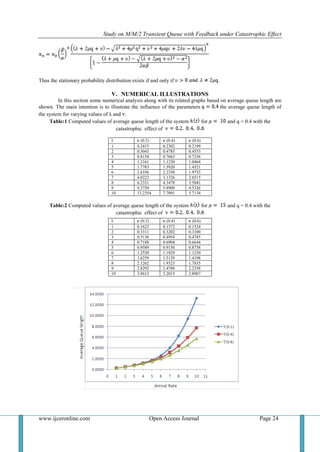
In this section some numerical analysis along with its related graphs based on average queue length are
shown. The main intention is to illustrate the influence of the parameters the average queue length of
the system for varying values of λ and .
Table:1 Computed values of average queue length of the system for and q = 0.4 with the
catastrophic effect of
Table:2 Computed values of average queue length of the system for and q = 0.4 with the
catastrophic effect of
λ (0.2) (0.4) (0.6)
1 0.2415 0.2302 0.2199
2 0.5043 0.4785 0.4553
3 0.8154 0.7663 0.7236
4 1.2161 1.1230 1.0464
5 1.7783 1.5920 1.4521
6 2.6356 2.2358 1.9753
7 4.0223 3.1326 2.6515
8 6.2331 4.3478 3.5041
9 9.3750 5.8909 4.5326
10 13.2354 7.7091 5.7134
λ (0.2) (0.4) (0.6)
1 0.1623 0.1572 0.1524
2 0.3311 0.3202 0.3100
3 0.5136 0.4954 0.4785
4 0.7188 0.6904 0.6644
5 0.9589 0.9150 0.8758
6 1.2520 1.1829 1.1230
7 1.6259 1.5129 1.4198
8 2.1262 1.9323 1.7835
9 2.8292 2.4788 2.2358
10 3.8613 3.2015 2.8007
Study on M/M/2 Transient Queue with Feedback under Catastrophic Effect
www.ijceronline.com Open Access Journal Page 25
VI. CONCLUSION
The asymptotic behavior of the system and stationary probability distributions are derived with catastrophic
effect and feedback. The numerical example illustrates that under asymptotic behavior when a customer does
the feedback, queue length increases with arrival rate on different catastrophic effect and on different service
rate.
REFERENCES
[1]. V.M. Chandrasekaran, M.C. Saravanarajan, Transient and Reliability analysis of M/M/1 feedback queue subject to
catastrophes,server failures and repairs, Volume 77 No. 5 (2012) pp: 605-625.
[2]. A.K. Erlong The theory of probabilities and telephone conversations, Nyt Jindsskriff Math, B 20, (1909), pp: 33-39
[3]. Gautam Choudhury and Madhu Chanda paul, A Two phase queueing system with Bernoulli feedback, International Journal of
Information and Management Sciences, Vol. 16, (2005) pp: 35-52.
[4]. B.Krishna Kumar, D. Arivudainambi Transient solution of an M/M/1queue with catastrophes, Computers and Mathematics with
Applications,40, (2000) ,pp: 1233-1240.
[5]. B.Krishna Kumar, S. Pavai Madheswari, Transient solution of an m/m/2 queue with heterogeneous servers subject to catastrophes,
Information and Management Sciences, Volume 18, Number 1,( 2007)pp. 63-80.
[6]. B.Krishna Kumar, S. Pavai Madheswari, Transient solution of an M/M/2 queue with catastrophes, Statistica, anno LXII, n 1, 2002.
[7]. Parthasarathy, P.R. and Sharafali, M, Transient solution to the many server Poisson queues. J. Appl. Prob., 26, (1989), pp:
584-594.
[8]. P.R. Parthasarathy , A transient solution to an M/M/1 queue, A Simple approach. (Adv Appl. Prob. 19, (1987) pp: 997-998)
[9]. A.Santhakumaran and V. Thangaraj, A single server queue with impatient and feedback customers, International Journal of
Information and Management Sciences 11. (2000) pp: 71-79.
[10]. A. Santhakumaran and S. Shanmugasundaram, Preparatory Work on Arrival Customers with a Single Server Feedback Queue ,
Journal of Information and Management Sciences, Vol 19, No 2, (2008) pp. 301-313.
[11]. S.Shanmugasundaram and A.Shanmugavadivu , A Study on Time Dependent Solution of Single Server Queue with Markovian
Arrival and Markovian Service, CiiT International Journal of Data Mining and Knowledge Engineering, Vol 3, No16, (2011)
pp:981-984.
[12]. Shanmugasundaram and S.chitra ,Time dependent solution of M/G2/1 retrial queue and feedback on Non Retrail customers with
catastrophes., Global Journal of Pure and Applied Mathematics, Vol 11, No 1(2015)pp:90-95.
[13]. L. Takacs, A single server queue with feedback, the Bell System Technical Journal 42, (1963) pp: 505-519.
[14]. V. Thangaraj, S. Vanitha, On the analysis of M/M/1 feedback queue with Catastrophes using continued fractions, International
Journal of Pure and Applied Mathematics, Vol 53 No 1(2009), 133-151.
[15]. G.N.Watson (1962) , A treaties on the theory of Bessel functions, Cambridge University Press,Cambridge.
[16]. D.A Widder (1946), The Laplace transform , Princeton University Press..

Study on M/M/2 Transient Queue with Feedback under Catastrophic Effect

  • 1.
    ISSN (e): 2250– 3005 || Volume, 06 || Issue, 10|| October – 2016 || International Journal of Computational Engineering Research (IJCER) www.ijceronline.com Open Access Journal Page 18 Study on M/M/2 Transient Queue with Feedback under Catastrophic Effect S. Shanmugasundaram1 , S.Chitra2 1,2 Department of Mathematics, Government Arts College, Salem – 636 007. 2 Department of Mathematics, Sengunthar College of Engineering, Thiruchengode, Namakkal - 637 205. I. INTRODUCTION In the year of 1909, queueing theory originated in telephony with the work of Erlang [2]. After his work many authors to develop different types of queueing models, incorporating different arrival patterns, different service time distributions and various service disciplines. In the year of 1963, Takacs [13] first introduced queues with feedback mechanism which includes the possibility for a customer return to the counter for additional service. In the year of 2000, Santhakumaran and Thangaraj [9] have studied a single server queue with impatient and feedback customers. In the year of 2008, Santhakumaran and Shanmugasundaram [9] have focused to study a Preparatory Work on Arrival Customers with a Single Server Feedback Queue In queueing theory, the time independent solutions only derived for a long time. According to the theory and applications of queueing theory time dependent solution is necessary. Parthasarathy [8] and Parthasarathy and Sharafali [7] have discussed single and multiple server poisson queues of transient state solution in easiest manner. Krishna Kumar and Arivudainambi [4] has proposed a transient state solution for the mean queue size of M/M/1 queueing model when catastrophes occurred at the service station. Krishna Kumar and Pavai Madheswari [6] have introduced transient solution of M/M/2 queue with catastrophes. Krishna Kumar and Pavai Madheswari [5] have focussed to study transient solution of M/M/2 queue with heterogeneous servers subject to catastrophes.Shanmugasundaram and Shanmugavadivu [11] have discussed a time dependent solution of single server queue with Markovian arrival and Markovian service. Shanmugasundaram and Chitra [12] have discussed time dependent solution of M/G2/1 retrial queue and feedback on Non Retrail customers with catastrophes. Thangaraj and Vanitha [14] have studied transient solution of single server queue with feedback using continued fraction method. Chandrasekaran and Saravanarajan [1] has proposed a transient and reliability analysis of single server queue with feedback subject to catastrophes also discussed server failures and repairs. In this paper we analyze the time dependent solution of M/M/2 feedback queue with catastrophes. II. MODEL DESCRIPTION AND ANALYSIS Fig1. Schematic flow of customer ABSTRACT In this paper we study the time dependent solution of feedback customer with two servers along with catastrophic effect. We derive the asymptotic behavior of the queue length and the stationary probability distributions. The numerical examples are also given to test the effectiveness of the queue length under the catastropic conditions. Keywords: Asymptotic behavior, Catastrophes, Departure Process, Feedback customer, Poisson process, Stationary probability distribution, Transient probability. Mathematical Subject Classification (2010):
  • 2.
    Study on M/M/2Transient Queue with Feedback under Catastrophic Effect www.ijceronline.com Open Access Journal Page 19 Figure 1 illustrate that the external customers arrive according to a poisson process with rate . If the server is idle upon an arrival, service of an arriving customer starts instantaneously. After receiving service the customer a decision is made whether or not feedback. If a customer has feedback he joins the end of the original queue, there is no difference between normal customer and feedback customer. If a customer does feedback he joins the feedback stream with probability p. The feedback is assumed to occur instantaneously. If a customer does not feedback; he joins the departure process with probability q and leaves the system forever. The queue discipline is FIFO and infinite in capacity, the service times are non-negative, independent and identically distributed random variable with parameter . Catastrophes occurs from the arrival and service process follows poisson process with rate .All the available customers are destroyed immediately when the catastrophes occurred in the system, the service gets inactivated. The server is ready for service when a new arrival happens. The motivation for this model is comes from Production system, Bank, Hospital, etc. Let denote the probability that there are n customers in the system at time t. Let be the probability generating function. A system of differential difference equation satisfied by M/M/2 feedback queue subject to catastrophe is (1) (2) (3) Taking Laplace transform of equation (1) we get, (4) Taking inverse Laplace transform on both sides we get, (5) Initially the number of customers present in the system is random and its probability generating function is The probability generating function is derived from the above equations (1), (2) & (3) Consider Multiply both sides by and taking the summation we get the partial differential equation is (6) The solution of partial differential equation (6) is
  • 3.
    Study on M/M/2Transient Queue with Feedback under Catastrophic Effect www.ijceronline.com Open Access Journal Page 20 using the initial condition , Let and Then we get, Equating on both sides we get, Substitute equation (10) in (9) we get, Let and taking Laplace transform on both side we get,
  • 4.
    Study on M/M/2Transient Queue with Feedback under Catastrophic Effect www.ijceronline.com Open Access Journal Page 21 Substitute equation we get, (13) Where Taking inverse Laplace transform on both side (15) Therefore we have the state probabilities of . Substituting equations (5) & (15) in equation (11) we get the state probability . III. ASYMPTOTIC BEHAVIOR OF AVERAGE QUEUE LENGTH Theorem 1: If , the asymptotic behavior of the probability of the server being idle is
  • 5.
    Study on M/M/2Transient Queue with Feedback under Catastrophic Effect www.ijceronline.com Open Access Journal Page 22 as (16) Proof: From equation (4) & (13) we get By final value theorem By Tauberian theorem as Theorem 2: If , the asymptotic behavior of the mean system size h(t) is give by (17) Proof: The average queue length at we get, Solving for h(t) with , we get Taking Laplace transform on both sides we get, By final value theorem By Tauberian theorem
  • 6.
    Study on M/M/2Transient Queue with Feedback under Catastrophic Effect www.ijceronline.com Open Access Journal Page 23 Particular case: If then the equations (16) & (17) exactly coincides with the result of Krishna Kumar and Pavai Madheswari [6]. IV. STATIONARY PROBABILITY DISTRIBUTION The stationary probability distribution for the M/M/2 feedback queue with catastrophes is Where Proof: (18) By taking Laplace transform of equation (11) we get Substitute equation (13) in (18) we get, Multiply equation (19) by z and taking limit as we get, By Tauberian theorem we get,
  • 7.
    Study on M/M/2Transient Queue with Feedback under Catastrophic Effect www.ijceronline.com Open Access Journal Page 24 Thus the stationary probability distribution exists if and only if . V. NUMERICAL ILLUSTRATIONS In this section some numerical analysis along with its related graphs based on average queue length are shown. The main intention is to illustrate the influence of the parameters the average queue length of the system for varying values of λ and . Table:1 Computed values of average queue length of the system for and q = 0.4 with the catastrophic effect of Table:2 Computed values of average queue length of the system for and q = 0.4 with the catastrophic effect of λ (0.2) (0.4) (0.6) 1 0.2415 0.2302 0.2199 2 0.5043 0.4785 0.4553 3 0.8154 0.7663 0.7236 4 1.2161 1.1230 1.0464 5 1.7783 1.5920 1.4521 6 2.6356 2.2358 1.9753 7 4.0223 3.1326 2.6515 8 6.2331 4.3478 3.5041 9 9.3750 5.8909 4.5326 10 13.2354 7.7091 5.7134 λ (0.2) (0.4) (0.6) 1 0.1623 0.1572 0.1524 2 0.3311 0.3202 0.3100 3 0.5136 0.4954 0.4785 4 0.7188 0.6904 0.6644 5 0.9589 0.9150 0.8758 6 1.2520 1.1829 1.1230 7 1.6259 1.5129 1.4198 8 2.1262 1.9323 1.7835 9 2.8292 2.4788 2.2358 10 3.8613 3.2015 2.8007
  • 8.
    Study on M/M/2Transient Queue with Feedback under Catastrophic Effect www.ijceronline.com Open Access Journal Page 25 VI. CONCLUSION The asymptotic behavior of the system and stationary probability distributions are derived with catastrophic effect and feedback. The numerical example illustrates that under asymptotic behavior when a customer does the feedback, queue length increases with arrival rate on different catastrophic effect and on different service rate. REFERENCES [1]. V.M. Chandrasekaran, M.C. Saravanarajan, Transient and Reliability analysis of M/M/1 feedback queue subject to catastrophes,server failures and repairs, Volume 77 No. 5 (2012) pp: 605-625. [2]. A.K. Erlong The theory of probabilities and telephone conversations, Nyt Jindsskriff Math, B 20, (1909), pp: 33-39 [3]. Gautam Choudhury and Madhu Chanda paul, A Two phase queueing system with Bernoulli feedback, International Journal of Information and Management Sciences, Vol. 16, (2005) pp: 35-52. [4]. B.Krishna Kumar, D. Arivudainambi Transient solution of an M/M/1queue with catastrophes, Computers and Mathematics with Applications,40, (2000) ,pp: 1233-1240. [5]. B.Krishna Kumar, S. Pavai Madheswari, Transient solution of an m/m/2 queue with heterogeneous servers subject to catastrophes, Information and Management Sciences, Volume 18, Number 1,( 2007)pp. 63-80. [6]. B.Krishna Kumar, S. Pavai Madheswari, Transient solution of an M/M/2 queue with catastrophes, Statistica, anno LXII, n 1, 2002. [7]. Parthasarathy, P.R. and Sharafali, M, Transient solution to the many server Poisson queues. J. Appl. Prob., 26, (1989), pp: 584-594. [8]. P.R. Parthasarathy , A transient solution to an M/M/1 queue, A Simple approach. (Adv Appl. Prob. 19, (1987) pp: 997-998) [9]. A.Santhakumaran and V. Thangaraj, A single server queue with impatient and feedback customers, International Journal of Information and Management Sciences 11. (2000) pp: 71-79. [10]. A. Santhakumaran and S. Shanmugasundaram, Preparatory Work on Arrival Customers with a Single Server Feedback Queue , Journal of Information and Management Sciences, Vol 19, No 2, (2008) pp. 301-313. [11]. S.Shanmugasundaram and A.Shanmugavadivu , A Study on Time Dependent Solution of Single Server Queue with Markovian Arrival and Markovian Service, CiiT International Journal of Data Mining and Knowledge Engineering, Vol 3, No16, (2011) pp:981-984. [12]. Shanmugasundaram and S.chitra ,Time dependent solution of M/G2/1 retrial queue and feedback on Non Retrail customers with catastrophes., Global Journal of Pure and Applied Mathematics, Vol 11, No 1(2015)pp:90-95. [13]. L. Takacs, A single server queue with feedback, the Bell System Technical Journal 42, (1963) pp: 505-519. [14]. V. Thangaraj, S. Vanitha, On the analysis of M/M/1 feedback queue with Catastrophes using continued fractions, International Journal of Pure and Applied Mathematics, Vol 53 No 1(2009), 133-151. [15]. G.N.Watson (1962) , A treaties on the theory of Bessel functions, Cambridge University Press,Cambridge. [16]. D.A Widder (1946), The Laplace transform , Princeton University Press..