Student Drug Testing William Allan Kritsonis, PhD
Vernonia School District v. Action The Student Athlete Drug Policy adopted by School District 47J in the town of Vernonia, Oregon, authorizes random urinalysis drug testing of students who participate in the District's school athletics programs. We granted certiorari to decide whether this violates the Fourth and Fourteenth Amendments to the United States Constitution.
Pottawatomie County et al. v. Earls In the case of the Board of Education of Independent School District No. 92 of Pottawatomie County et al. v. Earls et al., the U.S. Supreme Court upheld a drug-testing program for students involved in competitive extracurricular activities.
Bean v. Tulia I.S.D Tulia ISD has a policy of random drug testing for students participating in athletics and other extra-curricular activities for grades 7-12. Amos Bean, a student within the Tulia ISD, claimed that the drug-testing policy violated his rights under the U.S. and Texas constitutions. Under the U.S. District Court ruling, Bean is now required to pay the school’s taxable court costs. Alan Bean, father of Amos, is currently undecided on appealing the ruling.
Why drug test students Drugs have far more serious adverse effects on adolescents than on adults Some drugs can cause serious problems with memory and learning, as well as difficulty in thinking and problem solving may cause long-lasting damage to brain areas that are critical for thought and memory.
Effects of drug testing Prevent dropout rates  Provide a safer school env ironment Prevent violence
Risk of drug test Not 100% accurate More than one test may need to take place Students drug test must remain confidential
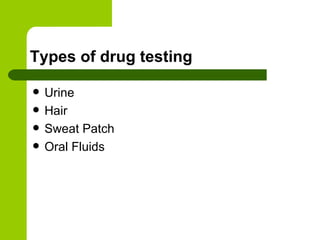
Types of drug testing Urine Hair Sweat Patch Oral Fluids
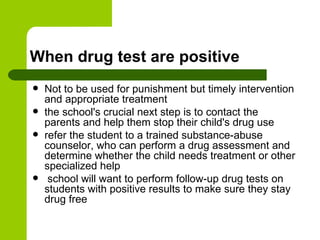
When drug test are positive Not to be used for punishment but timely intervention and appropriate treatment  the school's crucial next step is to contact the parents and help them stop their child's drug use  refer the student to a trained substance-abuse counselor, who can perform a drug assessment and determine whether the child needs treatment or other specialized help  school will want to perform follow-up drug tests on students with positive results to make sure they stay drug free
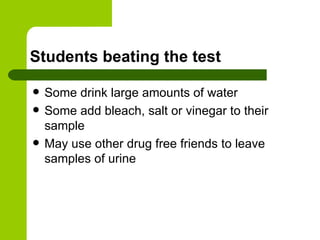
Students beating the test Some drink large amounts of water Some add bleach, salt or vinegar to their sample May use other drug free friends to leave samples of urine
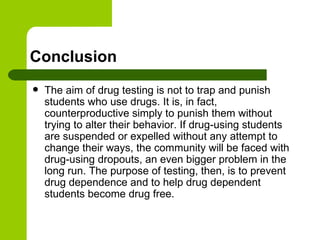
Conclusion The aim of drug testing is not to trap and punish students who use drugs. It is, in fact, counterproductive simply to punish them without trying to alter their behavior. If drug-using students are suspended or expelled without any attempt to change their ways, the community will be faced with drug-using dropouts, an even bigger problem in the long run. The purpose of testing, then, is to prevent drug dependence and to help drug dependent students become drug free.

Student Drug Testing 2

  • 1.
    Student Drug TestingWilliam Allan Kritsonis, PhD
  • 2.
    Vernonia School Districtv. Action The Student Athlete Drug Policy adopted by School District 47J in the town of Vernonia, Oregon, authorizes random urinalysis drug testing of students who participate in the District's school athletics programs. We granted certiorari to decide whether this violates the Fourth and Fourteenth Amendments to the United States Constitution.
  • 3.
    Pottawatomie County etal. v. Earls In the case of the Board of Education of Independent School District No. 92 of Pottawatomie County et al. v. Earls et al., the U.S. Supreme Court upheld a drug-testing program for students involved in competitive extracurricular activities.
  • 4.
    Bean v. TuliaI.S.D Tulia ISD has a policy of random drug testing for students participating in athletics and other extra-curricular activities for grades 7-12. Amos Bean, a student within the Tulia ISD, claimed that the drug-testing policy violated his rights under the U.S. and Texas constitutions. Under the U.S. District Court ruling, Bean is now required to pay the school’s taxable court costs. Alan Bean, father of Amos, is currently undecided on appealing the ruling.
  • 5.
    Why drug teststudents Drugs have far more serious adverse effects on adolescents than on adults Some drugs can cause serious problems with memory and learning, as well as difficulty in thinking and problem solving may cause long-lasting damage to brain areas that are critical for thought and memory.
  • 6.
    Effects of drugtesting Prevent dropout rates Provide a safer school env ironment Prevent violence
  • 7.
    Risk of drugtest Not 100% accurate More than one test may need to take place Students drug test must remain confidential
  • 8.
    Types of drugtesting Urine Hair Sweat Patch Oral Fluids
  • 9.
    When drug testare positive Not to be used for punishment but timely intervention and appropriate treatment the school's crucial next step is to contact the parents and help them stop their child's drug use refer the student to a trained substance-abuse counselor, who can perform a drug assessment and determine whether the child needs treatment or other specialized help school will want to perform follow-up drug tests on students with positive results to make sure they stay drug free
  • 10.
    Students beating thetest Some drink large amounts of water Some add bleach, salt or vinegar to their sample May use other drug free friends to leave samples of urine
  • 11.
    Conclusion The aimof drug testing is not to trap and punish students who use drugs. It is, in fact, counterproductive simply to punish them without trying to alter their behavior. If drug-using students are suspended or expelled without any attempt to change their ways, the community will be faced with drug-using dropouts, an even bigger problem in the long run. The purpose of testing, then, is to prevent drug dependence and to help drug dependent students become drug free.