International Research Journal of Engineering and Technology (IRJET) e-ISSN: 2395-0056
Volume: 10 Issue: 08 | Aug 2023 www.irjet.net p-ISSN: 2395-0072
© 2023, IRJET | Impact Factor value: 8.226 | ISO 9001:2008 Certified Journal | Page 347
Student Attendance Management Automation Using Face Recognition
Algorithm
Savitha M
Asst. Professor, Dept. of CSE, Vivekananda College of Engineering and Technology, Puttur, Karnataka, India
---------------------------------------------------------------------***---------------------------------------------------------------------
Abstract - Attendance management using Real-Time Face
Recognition is a real-world solution to day to day activities of
handling student attendance system. The system aims to
improve attendance management by eliminating the manual
process of entering attendance and reducing time and errors.
The proposed student attendance management automation
system uses the Haar cascading and Local Binary Pattern
Histogram algorithm. The system uses a camera to capture
the facial features of the students and applies the Haar
cascading algorithmto detect faces. The LBPH algorithm is
then applied to recognize the faces and mark attendance. The
system provides real-time attendance reports, and the
attendance details can be accessed by authorized personnel.
Key Words: Face Recognition, Attendance, LBPH
algorithm, Haar cascading algorithm, Camera, students.
1. INTRODUCTION
The paper considers the importance of automation in
attendancesystems,highlightingtheadvancementsthathave
taken place to improve efficiency. The focusofthepaperison
automated attendance systems, which have replaced the
traditional method ofattendancemarking.Thesesystemsare
based onbio-metric,smart-card,andweb-basedandareused
in different organizations. The traditional method of
attendance marking is time-consuming and can be
complicated when dealing with a large number of people.
Automation of attendance systems saves time, increases
accuracy, and can also be used for security purposes,
preventing fake attendance.
The proposed attendance management system, which is
based on biometrics (in this case, face recognition), consists
of several stages, including image acquisition, database
development, face detection, feature extraction, Face
Recognition, and Attendance Marking. The paper provides a
literature survey, a detailed description of the various stages
involved in the proposed model, the results obtained, and
conclusions drawn from the study.
2. LITERATURE SURVEY
[1] B. K. Mohamed and C. Raghu worked on Fingerprint
attendance system for classroom needs.
The system uses a portable fingerprint device that can be
passed among students to place their finger on the sensor
during lecture time without the instructor's intervention.
The system ensures a fool-proof method for marking
attendance.
[2] T. Lim, S. Sim, and M. Mansor worked on Rfid based
attendance system,” in Industrial Electronics& Applications.
The authors propose an RFID-based attendance system
where students carry an ID cardwithanembeddedRFIDtag.
Students have to place the card on the card reader to record
their attendance, and the system is connected to a computer
via RS232 to save the attendance in the database.
[3] S. Kadry and K. Smaili worked on A design and
implementation of a wireless iris recognition attendance
management system.
The authors propose an iris recognition system based on
Daugman's algorithm. The system captures iris images,
performs feature extraction, storesthedata,andmatchesthe
iris data to verify the identity ofindividuals.
[4] Roshan Tharanga, S. M. S. C. Samarakoon worked on
Smart attendance using real time face recognition.
The authors propose a real-timefacerecognitionsystemthat
is reliable, secure, and fast. The system uses face recognition
algorithms to detect and recognize faces, and it can be used
for attendance management in various settings.
3. PROPOSED SYSTEM
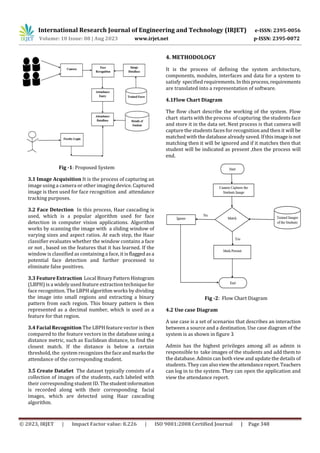
The proposed system of automated student attendance
system is shown in figure 1. The system captures the face of
students and stores it in the database for their attendance.
The face of the studentsshould be captured insucha manner
that all the feature of the student’s face needs tobe recorded
and analyzed with the existing record. Further, the
recognized image of thestudent isprovidedwithattendance,
else ignored.
International Research Journal of Engineering and Technology (IRJET) e-ISSN: 2395-0056
Volume: 10 Issue: 08 | Aug 2023 www.irjet.net p-ISSN: 2395-0072
© 2023, IRJET | Impact Factor value: 8.226 | ISO 9001:2008 Certified Journal | Page 348
Fig -1: Proposed System
3.1 Image Acquisition It is the process of capturing an
image using a camera or other imaging device. Captured
image is then used for face recognition and attendance
tracking purposes.
3.2 Face Detection In this process, Haar cascading is
used, which is a popular algorithm used for face
detection in computer vision applications. Algorithm
works by scanning the image with a sliding window of
varying sizes and aspect ratios. At each step, the Haar
classifier evaluates whether the window contains a face
or not , based on the features that it has learned. If the
window is classified as containing a face, it is flaggedasa
potential face detection and further processed to
eliminate false positives.
3.3 Feature Extraction Local BinaryPattern Histogram
(LBPH) is a widely used feature extraction technique for
face recognition. The LBPH algorithm works by dividing
the image into small regions and extracting a binary
pattern from each region. This binary pattern is then
represented as a decimal number, which is used as a
feature for that region.
3.4 Facial Recognition The LBPH feature vector is then
compared to the feature vectors in the database using a
distance metric, such as Euclidean distance, to find the
closest match. If the distance is below a certain
threshold, the system recognizes the face and marksthe
attendance of the corresponding student.
3.5 Create DataSet The dataset typically consists of a
collection of images of the students, each labeled with
their corresponding student ID. Thestudentinformation
is recorded along with their corresponding facial
images, which are detected using Haar cascading
algorithm.
4. METHODOLOGY
It is the process of defining the system architecture,
components, modules, interfaces and data for a system to
satisfy specified requirements.Inthisprocess, requirements
are translated into a representation of software.
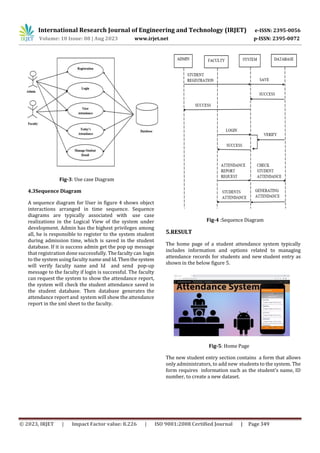
4.1Flow Chart Diagram
The flow chart describe the working of the system. Flow
chart starts with the process of capturing the students face
and store it in the data set. Next process is that camera will
capture the students faces for recognition and then it will be
matched with the database already saved. Ifthisimageisnot
matching then it will be ignored and if it matches then that
student will be indicated as present ,then the process will
end.
Fig -2: Flow Chart Diagram
4.2 Use case Diagram
A use case is a set of scenarios that describes an interaction
between a source and a destination. Use case diagram of the
system is as shown in figure 3
.
Admin has the highest privileges among all as admin is
responsible to take images of the students and add them to
the database. Admin can both view and update the details of
students. They can alsoview theattendancereport.Teachers
can log in to the system. They can open the application and
view the attendance report.
International Research Journal of Engineering and Technology (IRJET) e-ISSN: 2395-0056
Volume: 10 Issue: 08 | Aug 2023 www.irjet.net p-ISSN: 2395-0072
© 2023, IRJET | Impact Factor value: 8.226 | ISO 9001:2008 Certified Journal | Page 349
Fig-3: Use case Diagram
4.3Sequence Diagram
A sequence diagram for User in figure 4 shows object
interactions arranged in time sequence. Sequence
diagrams are typically associated with use case
realizations in the Logical View of the system under
development. Admin has the highest privileges among
all, he is responsible to register to the system student
during admission time, which is saved in the student
database. If it is success admin get the pop up message
that registration done successfully. The faculty can login
to the system using faculty name andId.Thenthesystem
will verify faculty name and Id and send pop-up
message to the faculty if login is successful. The faculty
can request the system to show the attendance report,
the system will check the student attendance saved in
the student database. Then database generates the
attendance report and system will show the attendance
report in the xml sheet to the faculty.
Fig-4 :Sequence Diagram
5.RESULT
The home page of a student attendance system typically
includes information and options related to managing
attendance records for students and new student entry as
shown in the below figure 5.
Fig-5: Home Page
The new student entry section contains a form that allows
only administrators, to add new students to the system. The
form requires information such as the student's name, ID
number, to create a new dataset.
International Research Journal of Engineering and Technology (IRJET) e-ISSN: 2395-0056
Volume: 10 Issue: 08 | Aug 2023 www.irjet.net p-ISSN: 2395-0072
© 2023, IRJET | Impact Factor value: 8.226 | ISO 9001:2008 Certified Journal | Page 350
Fig- 6: Enter New Student Details
The system would then display a live video feed of the
classroom or group, which would be captured by a camera
or multiple cameras placed strategically aroundtheroom.As
students enter the room and take their seats, the system
would use facial recognition technology to identify each
individual and match them with their name and attendance
record in the system.
Fig- 7:Face Recognition
The result page fora student attendance system may display
the name of the student who is present along with their ID,
the date, and time of the class or session. Each row in the list
format of the result page would represent the attendance
record for a single student, displaying the attendance status
for that particulardate and time. This information can be
used by teachers, administrators.
Fig- 8:Result
6. CONCLUSION
Automated studentattendancesystemusingface recognition
technology can offer several benefits for schools and
educational institutions. By automating the attendance
tracking process, such a system can save time and reduce
errors, while also improving the accuracy and reliability of
attendance records. Additionally, facial recognition
technology can provide a fast, efficient, and non-intrusive
way toidentify individuals and mark attendance, without
requiring physical contact or the use of traditional
attendance-taking methods.
REFERENCES
[1] B. K. MohamedandC.Raghu, “Fingerprintattendance
system for classroomneeds,” inIndia Conference(INDICON),
2012 Annual IEEE. IEEE, 2012,pp. 433–438.
[2] T. Lim, S. Sim, and M. Mansor, “Rfid basedattendance
system,” in Industrial Electronics&Applications,2009.ISIEA
2009. IEEE Symposium on, vol.2. IEEE, 2009, pp. 778–782.
[3] S. Kadry and K. Smaili, “A design and implementation
of a wireless iris recognition attendance management
system,” Information Technology and control, vol. 36, no. 3,
pp. 323–329, 2007.
[4] T. A. P. K. K. L. P. M. L. M. P. A. W. G. D. P. J. G..
RoshanTharanga, S. M. S. C. Samarakoon, “Smartattendance
using real time face recognition,” 2013.
[5] P. Viola and M. J. Jones, “Robust real-time face
detection,” International journal of computer vision, vol. 57,
no. 2, pp. 137– 154, 2004.
[6] W. Zhao, R. Chellappa, P. J. Phillips, and A.Rosenfeld,
“Face recognition: A literature survey,” Acm Computing
Surveys (CSUR), vol. 35, no. 4, pp. 399–458, 2003.
[7] T. Ahonen, A. Hadid, and M. Pietik¨ainen, “Face
recognition with local binary patterns,” in Computer Vision-
ECCV 2004. Springer, 2004, pp. 469–481.
[8] M. O. Faruqe and M. Al Mehedi Hasan, “Face
recognition using pca and svm,” in Anti- counterfeiting,
Security, and Identification in Communication, 2009. ASID
2009. 3rd International Conference on. IEEE, 2009, pp. 97–
10.

Student Attendance Management Automation Using Face Recognition Algorithm

  • 1.
    International Research Journalof Engineering and Technology (IRJET) e-ISSN: 2395-0056 Volume: 10 Issue: 08 | Aug 2023 www.irjet.net p-ISSN: 2395-0072 © 2023, IRJET | Impact Factor value: 8.226 | ISO 9001:2008 Certified Journal | Page 347 Student Attendance Management Automation Using Face Recognition Algorithm Savitha M Asst. Professor, Dept. of CSE, Vivekananda College of Engineering and Technology, Puttur, Karnataka, India ---------------------------------------------------------------------***--------------------------------------------------------------------- Abstract - Attendance management using Real-Time Face Recognition is a real-world solution to day to day activities of handling student attendance system. The system aims to improve attendance management by eliminating the manual process of entering attendance and reducing time and errors. The proposed student attendance management automation system uses the Haar cascading and Local Binary Pattern Histogram algorithm. The system uses a camera to capture the facial features of the students and applies the Haar cascading algorithmto detect faces. The LBPH algorithm is then applied to recognize the faces and mark attendance. The system provides real-time attendance reports, and the attendance details can be accessed by authorized personnel. Key Words: Face Recognition, Attendance, LBPH algorithm, Haar cascading algorithm, Camera, students. 1. INTRODUCTION The paper considers the importance of automation in attendancesystems,highlightingtheadvancementsthathave taken place to improve efficiency. The focusofthepaperison automated attendance systems, which have replaced the traditional method ofattendancemarking.Thesesystemsare based onbio-metric,smart-card,andweb-basedandareused in different organizations. The traditional method of attendance marking is time-consuming and can be complicated when dealing with a large number of people. Automation of attendance systems saves time, increases accuracy, and can also be used for security purposes, preventing fake attendance. The proposed attendance management system, which is based on biometrics (in this case, face recognition), consists of several stages, including image acquisition, database development, face detection, feature extraction, Face Recognition, and Attendance Marking. The paper provides a literature survey, a detailed description of the various stages involved in the proposed model, the results obtained, and conclusions drawn from the study. 2. LITERATURE SURVEY [1] B. K. Mohamed and C. Raghu worked on Fingerprint attendance system for classroom needs. The system uses a portable fingerprint device that can be passed among students to place their finger on the sensor during lecture time without the instructor's intervention. The system ensures a fool-proof method for marking attendance. [2] T. Lim, S. Sim, and M. Mansor worked on Rfid based attendance system,” in Industrial Electronics& Applications. The authors propose an RFID-based attendance system where students carry an ID cardwithanembeddedRFIDtag. Students have to place the card on the card reader to record their attendance, and the system is connected to a computer via RS232 to save the attendance in the database. [3] S. Kadry and K. Smaili worked on A design and implementation of a wireless iris recognition attendance management system. The authors propose an iris recognition system based on Daugman's algorithm. The system captures iris images, performs feature extraction, storesthedata,andmatchesthe iris data to verify the identity ofindividuals. [4] Roshan Tharanga, S. M. S. C. Samarakoon worked on Smart attendance using real time face recognition. The authors propose a real-timefacerecognitionsystemthat is reliable, secure, and fast. The system uses face recognition algorithms to detect and recognize faces, and it can be used for attendance management in various settings. 3. PROPOSED SYSTEM The proposed system of automated student attendance system is shown in figure 1. The system captures the face of students and stores it in the database for their attendance. The face of the studentsshould be captured insucha manner that all the feature of the student’s face needs tobe recorded and analyzed with the existing record. Further, the recognized image of thestudent isprovidedwithattendance, else ignored.
  • 2.
    International Research Journalof Engineering and Technology (IRJET) e-ISSN: 2395-0056 Volume: 10 Issue: 08 | Aug 2023 www.irjet.net p-ISSN: 2395-0072 © 2023, IRJET | Impact Factor value: 8.226 | ISO 9001:2008 Certified Journal | Page 348 Fig -1: Proposed System 3.1 Image Acquisition It is the process of capturing an image using a camera or other imaging device. Captured image is then used for face recognition and attendance tracking purposes. 3.2 Face Detection In this process, Haar cascading is used, which is a popular algorithm used for face detection in computer vision applications. Algorithm works by scanning the image with a sliding window of varying sizes and aspect ratios. At each step, the Haar classifier evaluates whether the window contains a face or not , based on the features that it has learned. If the window is classified as containing a face, it is flaggedasa potential face detection and further processed to eliminate false positives. 3.3 Feature Extraction Local BinaryPattern Histogram (LBPH) is a widely used feature extraction technique for face recognition. The LBPH algorithm works by dividing the image into small regions and extracting a binary pattern from each region. This binary pattern is then represented as a decimal number, which is used as a feature for that region. 3.4 Facial Recognition The LBPH feature vector is then compared to the feature vectors in the database using a distance metric, such as Euclidean distance, to find the closest match. If the distance is below a certain threshold, the system recognizes the face and marksthe attendance of the corresponding student. 3.5 Create DataSet The dataset typically consists of a collection of images of the students, each labeled with their corresponding student ID. Thestudentinformation is recorded along with their corresponding facial images, which are detected using Haar cascading algorithm. 4. METHODOLOGY It is the process of defining the system architecture, components, modules, interfaces and data for a system to satisfy specified requirements.Inthisprocess, requirements are translated into a representation of software. 4.1Flow Chart Diagram The flow chart describe the working of the system. Flow chart starts with the process of capturing the students face and store it in the data set. Next process is that camera will capture the students faces for recognition and then it will be matched with the database already saved. Ifthisimageisnot matching then it will be ignored and if it matches then that student will be indicated as present ,then the process will end. Fig -2: Flow Chart Diagram 4.2 Use case Diagram A use case is a set of scenarios that describes an interaction between a source and a destination. Use case diagram of the system is as shown in figure 3 . Admin has the highest privileges among all as admin is responsible to take images of the students and add them to the database. Admin can both view and update the details of students. They can alsoview theattendancereport.Teachers can log in to the system. They can open the application and view the attendance report.
  • 3.
    International Research Journalof Engineering and Technology (IRJET) e-ISSN: 2395-0056 Volume: 10 Issue: 08 | Aug 2023 www.irjet.net p-ISSN: 2395-0072 © 2023, IRJET | Impact Factor value: 8.226 | ISO 9001:2008 Certified Journal | Page 349 Fig-3: Use case Diagram 4.3Sequence Diagram A sequence diagram for User in figure 4 shows object interactions arranged in time sequence. Sequence diagrams are typically associated with use case realizations in the Logical View of the system under development. Admin has the highest privileges among all, he is responsible to register to the system student during admission time, which is saved in the student database. If it is success admin get the pop up message that registration done successfully. The faculty can login to the system using faculty name andId.Thenthesystem will verify faculty name and Id and send pop-up message to the faculty if login is successful. The faculty can request the system to show the attendance report, the system will check the student attendance saved in the student database. Then database generates the attendance report and system will show the attendance report in the xml sheet to the faculty. Fig-4 :Sequence Diagram 5.RESULT The home page of a student attendance system typically includes information and options related to managing attendance records for students and new student entry as shown in the below figure 5. Fig-5: Home Page The new student entry section contains a form that allows only administrators, to add new students to the system. The form requires information such as the student's name, ID number, to create a new dataset.
  • 4.
    International Research Journalof Engineering and Technology (IRJET) e-ISSN: 2395-0056 Volume: 10 Issue: 08 | Aug 2023 www.irjet.net p-ISSN: 2395-0072 © 2023, IRJET | Impact Factor value: 8.226 | ISO 9001:2008 Certified Journal | Page 350 Fig- 6: Enter New Student Details The system would then display a live video feed of the classroom or group, which would be captured by a camera or multiple cameras placed strategically aroundtheroom.As students enter the room and take their seats, the system would use facial recognition technology to identify each individual and match them with their name and attendance record in the system. Fig- 7:Face Recognition The result page fora student attendance system may display the name of the student who is present along with their ID, the date, and time of the class or session. Each row in the list format of the result page would represent the attendance record for a single student, displaying the attendance status for that particulardate and time. This information can be used by teachers, administrators. Fig- 8:Result 6. CONCLUSION Automated studentattendancesystemusingface recognition technology can offer several benefits for schools and educational institutions. By automating the attendance tracking process, such a system can save time and reduce errors, while also improving the accuracy and reliability of attendance records. Additionally, facial recognition technology can provide a fast, efficient, and non-intrusive way toidentify individuals and mark attendance, without requiring physical contact or the use of traditional attendance-taking methods. REFERENCES [1] B. K. MohamedandC.Raghu, “Fingerprintattendance system for classroomneeds,” inIndia Conference(INDICON), 2012 Annual IEEE. IEEE, 2012,pp. 433–438. [2] T. Lim, S. Sim, and M. Mansor, “Rfid basedattendance system,” in Industrial Electronics&Applications,2009.ISIEA 2009. IEEE Symposium on, vol.2. IEEE, 2009, pp. 778–782. [3] S. Kadry and K. Smaili, “A design and implementation of a wireless iris recognition attendance management system,” Information Technology and control, vol. 36, no. 3, pp. 323–329, 2007. [4] T. A. P. K. K. L. P. M. L. M. P. A. W. G. D. P. J. G.. RoshanTharanga, S. M. S. C. Samarakoon, “Smartattendance using real time face recognition,” 2013. [5] P. Viola and M. J. Jones, “Robust real-time face detection,” International journal of computer vision, vol. 57, no. 2, pp. 137– 154, 2004. [6] W. Zhao, R. Chellappa, P. J. Phillips, and A.Rosenfeld, “Face recognition: A literature survey,” Acm Computing Surveys (CSUR), vol. 35, no. 4, pp. 399–458, 2003. [7] T. Ahonen, A. Hadid, and M. Pietik¨ainen, “Face recognition with local binary patterns,” in Computer Vision- ECCV 2004. Springer, 2004, pp. 469–481. [8] M. O. Faruqe and M. Al Mehedi Hasan, “Face recognition using pca and svm,” in Anti- counterfeiting, Security, and Identification in Communication, 2009. ASID 2009. 3rd International Conference on. IEEE, 2009, pp. 97– 10.