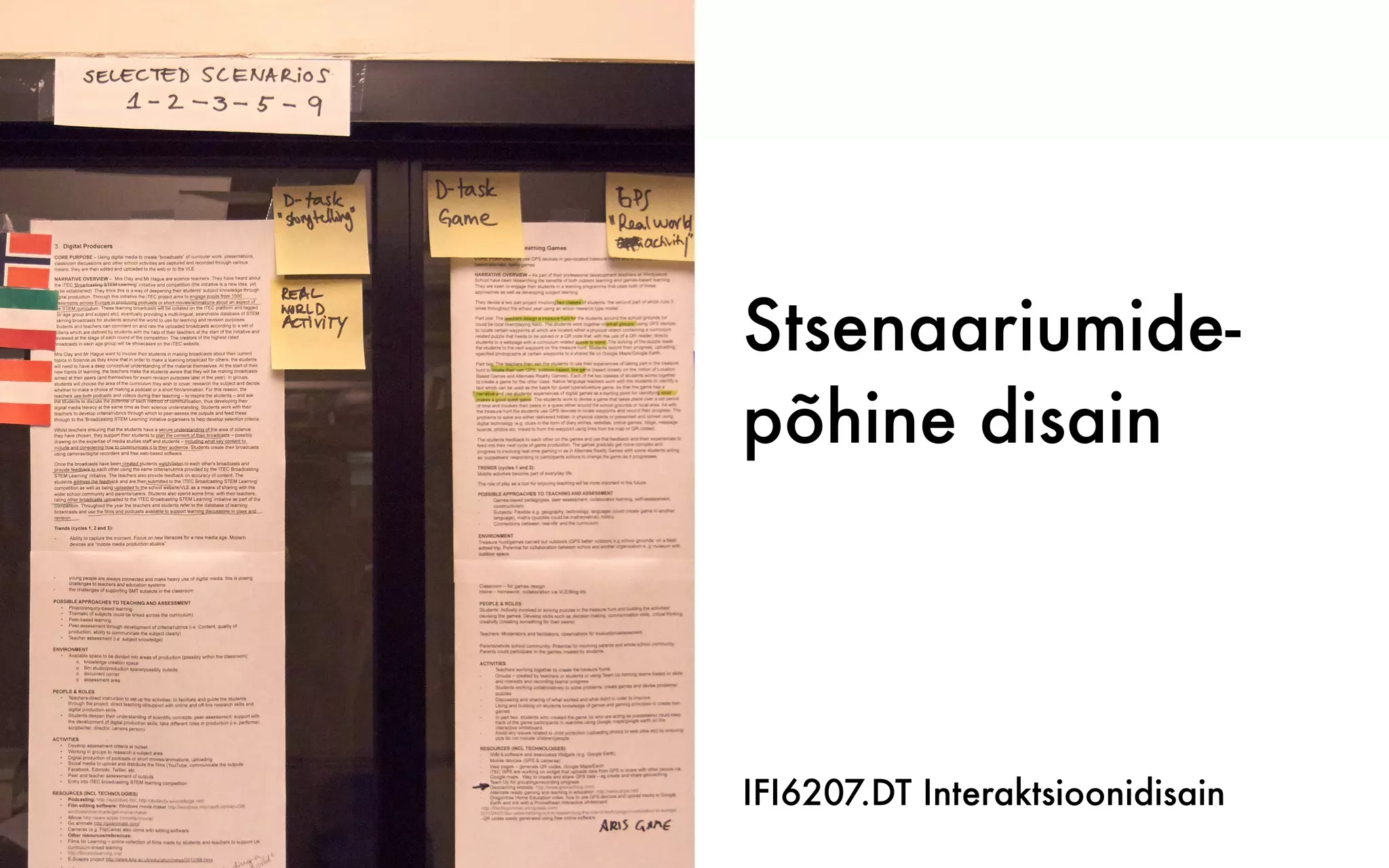
Stsenaariumide-
põhine disain
IFI6207.DT Interaktsioonidisain
Carroll, J. M. (2000). Making Use: Scenario-Based
Design of Human-Computer Interactions.
Cambridge, MA: The MIT Press.
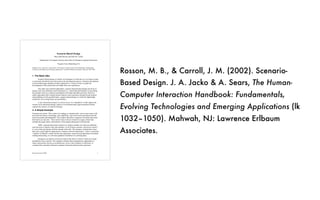
Rosson, M. B., & Carroll, J. M. (2002). Scenario-
Based Design. J. A. Jacko & A. Sears, The Human-
Computer Interaction Handbook: Fundamentals,
Evolving Technologies and Emerging Applications (lk
1032–1050). Mahwah, NJ: Lawrence Erlbaum
Associates.
Rosson & Carroll: SBD 1
Scenario-Based Design
Mary Beth Rosson and John M. Carroll
Department of Computer Science and Center for Human-Computer Interaction
Virginia Tech, Blacksburg VA
Chapter 53 in J. Jacko & A. Sears (Eds.), The Human-Computer Interaction Handbook: Fundamentals,
Evolving Technologies and Emerging Applications. Lawrence Erlbaum Associates, 2002, pp. 1032-1050.
1. The Basic Idea
Scenario-based design is a family of techniques in which the use of a future system
is concretely described at an early point in the development process. Narrative descriptions
of envisioned usage episodes are then employed in a variety of ways to guide the
development of the system that will enable these use experiences.
Like other user-centered approaches, scenario-based design changes the focus of
design work from defining system operations (i.e., functional specification) to describing
how people will use a system to accomplish work tasks and other activities. However,
unlike approaches that consider human behavior and experience through formal analysis
and modeling of well-specified tasks, scenario-based design is a relatively lightweight
method for envisioning future use possibilities.
A user interaction scenario is a sketch of use. It is intended to vividly capture the
essence of an interaction design, much as a two-dimensional, paper-and-pencil sketch
captures the essence of a physical design.
2. A Simple Example
Scenarios are stories. They consist of a setting, or situation state, one or more actors with
personal motivations, knowledge, and capabilities, and various tools and objects that the
actors encounter and manipulate. The scenario describes a sequence of actions and events
that lead to an outcome. These actions and events are related in a usage context that
includes the goals, plans, and reactions of the people taking part in the episode.
Table 1 presents three brief scenarios in which a member of a club uses different
network tools to interact with club members. In all of these scenarios, the person’s goal is
to visit a club and interact with her friends at the club. The scenarios contrast three ways
that such a goal might be supported by computer network technologies. Each is a potential
“solution” to Sharon’s needs, but the user experience varies from asynchronous text-based
reading and posting, to a real-time graphical simulation of a meeting place.
Designers can quickly construct scenarios like these in order to make envisioned
possibilities more concrete. The example contrasts three contemporary approaches to
online interactions, but not as an abstraction, not as a list of features or functions. It
contrasts three episodes of human-computer interaction and personal experience.
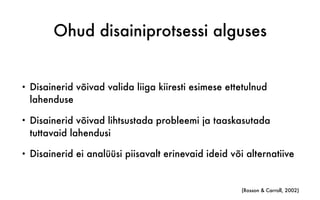
Ohud disainiprotsessi alguses
• Disainerid võivad valida liiga kiiresti esimese ettetulnud
lahenduse
• Disainerid võivad lihtsustada probleemi ja taaskasutada
tuttavaid lahendusi
• Disainerid ei analüüsi piisavalt erinevaid ideid või alternatiive
(Rosson & Carroll, 2002)
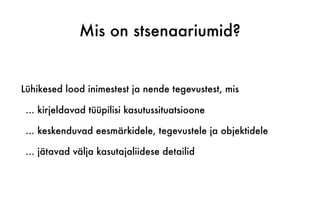
Mis on stsenaariumid?
Lühikesed lood inimestest ja nende tegevustest, mis
… kirjeldavad tüüpilisi kasutussituatsioone
… keskenduvad eesmärkidele, tegevustele ja objektidele
… jätavad välja kasutajaliidese detailid
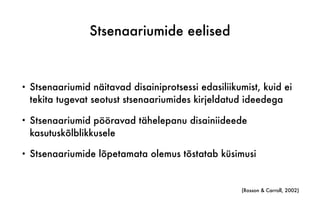
Stsenaariumide eelised
• Stsenaariumid näitavad disainiprotsessi edasiliikumist, kuid ei
tekita tugevat seotust stsenaariumides kirjeldatud ideedega
• Stsenaariumid pööravad tähelepanu disainiideede
kasutuskõlblikkusele
• Stsenaariumide lõpetamata olemus tõstatab küsimusi
(Rosson & Carroll, 2002)
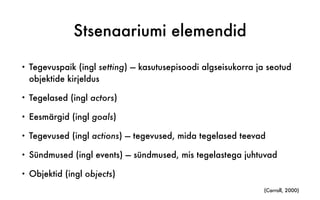
Stsenaariumi elemendid
• Tegevuspaik (ingl setting) — kasutusepisoodi algseisukorra ja seotud
objektide kirjeldus
• Tegelased (ingl actors)
• Eesmärgid (ingl goals)
• Tegevused (ingl actions) — tegevused, mida tegelased teevad
• Sündmused (ingl events) — sündmused, mis tegelastega juhtuvad
• Objektid (ingl objects)
(Carroll, 2000)
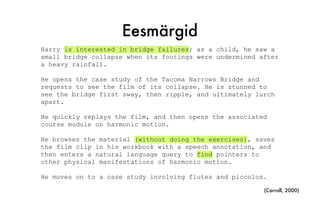
Eesmärgid
Harry is interested in bridge failures; as a child, he saw a
small bridge collapse when its footings were undermined after
a heavy rainfall.
He opens the case study of the Tacoma Narrows Bridge and
requests to see the film of its collapse. He is stunned to
see the bridge first sway, then ripple, and ultimately lurch
apart.
He quickly replays the film, and then opens the associated
course module on harmonic motion.
He browses the material (without doing the exercises), saves
the film clip in his workbook with a speech annotation, and
then enters a natural language query to find pointers to
other physical manifestations of harmonic motion.
He moves on to a case study involving flutes and piccolos.
(Carroll, 2000)
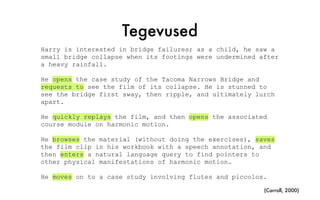
Tegevused
Harry is interested in bridge failures; as a child, he saw a
small bridge collapse when its footings were undermined after
a heavy rainfall.
He opens the case study of the Tacoma Narrows Bridge and
requests to see the film of its collapse. He is stunned to
see the bridge first sway, then ripple, and ultimately lurch
apart.
He quickly replays the film, and then opens the associated
course module on harmonic motion.
He browses the material (without doing the exercises), saves
the film clip in his workbook with a speech annotation, and
then enters a natural language query to find pointers to
other physical manifestations of harmonic motion.
He moves on to a case study involving flutes and piccolos.
(Carroll, 2000)
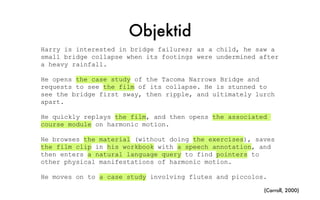
Objektid
Harry is interested in bridge failures; as a child, he saw a
small bridge collapse when its footings were undermined after
a heavy rainfall.
He opens the case study of the Tacoma Narrows Bridge and
requests to see the film of its collapse. He is stunned to
see the bridge first sway, then ripple, and ultimately lurch
apart.
He quickly replays the film, and then opens the associated
course module on harmonic motion.
He browses the material (without doing the exercises), saves
the film clip in his workbook with a speech annotation, and
then enters a natural language query to find pointers to
other physical manifestations of harmonic motion.
He moves on to a case study involving flutes and piccolos.
(Carroll, 2000)
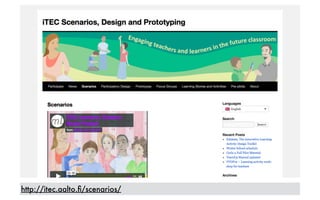
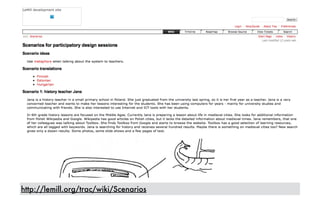
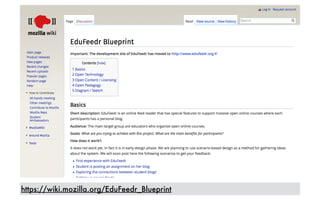
Näited
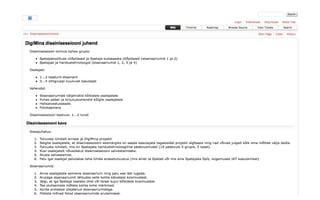
http://itec.aalto.fi/scenarios/
http://lemill.org/trac/wiki/Scenarios
https://wiki.mozilla.org/EduFeedr_Blueprint
Stsenaariumide hindamine
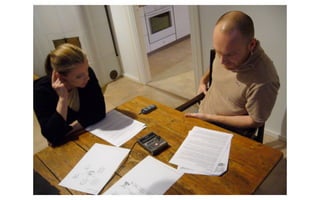
Osalusdisaini sessioonid
• 2...3 osalejat ja 1 disainer
• Struktureeritud disainisessioonid 3...4 stsenaariumiga
• Ettevalmistatud küsimused iga stsenaariumi kohta
• Kestab kuni 2 tundi
Näidisküsimused
• Milliseid mõtteid see stsenaarium sinus äratas?
• Kas kujutaksid ennast ette selle kasutaja rollis?
• Mida sa selle stsenaariumi juures muudaksid?
• …
Keda kutsuda disainisessioonile
• Persoonadele sarnanevad inimesed
• Kliendid, tootest huvitatud osapoolte esindajad
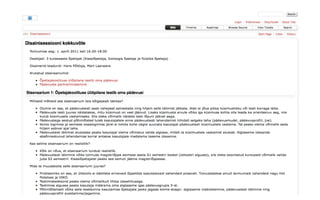
Disainiprotsessi kokkuvõtted
• Helisalvestusel või märkmetel põhinev kirjalik kokkuvõte
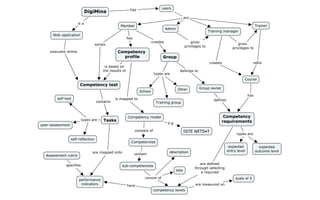
• Mõistekaart
Viited
• Carroll, J. M. (2000). Five reasons for scenario-based design. Interacting with
Computers, 13(1), 43–60. doi:10.1016/S0953-5438(00)00023-0
• Rosson, M. B., & Carroll, J. M. (2002). Scenario-Based Design. J. A. Jacko &
A. Sears (toim), The Human-Computer Interaction Handbook: Fundamentals,
Evolving Technologies and Emerging Applications (lk 1032–1050). Mahwah,
NJ: Lawrence Erlbaum Associates.
Fotod
• Hans Põldoja
• Teemu Leinonen, http://lemill.org/trac/attachment/wiki/DesignSessionResults/
finland-02.jpg
See materjal on avaldatud Creative Commons Autorile viitamine–Jagamine
samadel tingimustel 3.0 Eesti litsentsi alusel. Litsentsi terviktekstiga tutvumiseks
külastage aadressi http://creativecommons.org/licenses/by-sa/3.0/ee/
Hans Põldoja
hans.poldoja@tlu.ee
IFI6207.DT Interaktsioonidisain
https://ifi6207.wordpress.com
Digitehnoloogiate instituut
Tallinna Ülikool

Stsenaariumidepõhine disain

  • 1.
  • 2.
    Carroll, J. M.(2000). Making Use: Scenario-Based Design of Human-Computer Interactions. Cambridge, MA: The MIT Press.
  • 3.
    Rosson, M. B.,& Carroll, J. M. (2002). Scenario- Based Design. J. A. Jacko & A. Sears, The Human- Computer Interaction Handbook: Fundamentals, Evolving Technologies and Emerging Applications (lk 1032–1050). Mahwah, NJ: Lawrence Erlbaum Associates. Rosson & Carroll: SBD 1 Scenario-Based Design Mary Beth Rosson and John M. Carroll Department of Computer Science and Center for Human-Computer Interaction Virginia Tech, Blacksburg VA Chapter 53 in J. Jacko & A. Sears (Eds.), The Human-Computer Interaction Handbook: Fundamentals, Evolving Technologies and Emerging Applications. Lawrence Erlbaum Associates, 2002, pp. 1032-1050. 1. The Basic Idea Scenario-based design is a family of techniques in which the use of a future system is concretely described at an early point in the development process. Narrative descriptions of envisioned usage episodes are then employed in a variety of ways to guide the development of the system that will enable these use experiences. Like other user-centered approaches, scenario-based design changes the focus of design work from defining system operations (i.e., functional specification) to describing how people will use a system to accomplish work tasks and other activities. However, unlike approaches that consider human behavior and experience through formal analysis and modeling of well-specified tasks, scenario-based design is a relatively lightweight method for envisioning future use possibilities. A user interaction scenario is a sketch of use. It is intended to vividly capture the essence of an interaction design, much as a two-dimensional, paper-and-pencil sketch captures the essence of a physical design. 2. A Simple Example Scenarios are stories. They consist of a setting, or situation state, one or more actors with personal motivations, knowledge, and capabilities, and various tools and objects that the actors encounter and manipulate. The scenario describes a sequence of actions and events that lead to an outcome. These actions and events are related in a usage context that includes the goals, plans, and reactions of the people taking part in the episode. Table 1 presents three brief scenarios in which a member of a club uses different network tools to interact with club members. In all of these scenarios, the person’s goal is to visit a club and interact with her friends at the club. The scenarios contrast three ways that such a goal might be supported by computer network technologies. Each is a potential “solution” to Sharon’s needs, but the user experience varies from asynchronous text-based reading and posting, to a real-time graphical simulation of a meeting place. Designers can quickly construct scenarios like these in order to make envisioned possibilities more concrete. The example contrasts three contemporary approaches to online interactions, but not as an abstraction, not as a list of features or functions. It contrasts three episodes of human-computer interaction and personal experience.
  • 4.
    Ohud disainiprotsessi alguses •Disainerid võivad valida liiga kiiresti esimese ettetulnud lahenduse • Disainerid võivad lihtsustada probleemi ja taaskasutada tuttavaid lahendusi • Disainerid ei analüüsi piisavalt erinevaid ideid või alternatiive (Rosson & Carroll, 2002)
  • 5.
    Mis on stsenaariumid? Lühikesedlood inimestest ja nende tegevustest, mis … kirjeldavad tüüpilisi kasutussituatsioone … keskenduvad eesmärkidele, tegevustele ja objektidele … jätavad välja kasutajaliidese detailid
  • 6.
    Stsenaariumide eelised • Stsenaariumidnäitavad disainiprotsessi edasiliikumist, kuid ei tekita tugevat seotust stsenaariumides kirjeldatud ideedega • Stsenaariumid pööravad tähelepanu disainiideede kasutuskõlblikkusele • Stsenaariumide lõpetamata olemus tõstatab küsimusi (Rosson & Carroll, 2002)
  • 7.
    Stsenaariumi elemendid • Tegevuspaik(ingl setting) — kasutusepisoodi algseisukorra ja seotud objektide kirjeldus • Tegelased (ingl actors) • Eesmärgid (ingl goals) • Tegevused (ingl actions) — tegevused, mida tegelased teevad • Sündmused (ingl events) — sündmused, mis tegelastega juhtuvad • Objektid (ingl objects) (Carroll, 2000)
  • 8.
    Eesmärgid Harry is interestedin bridge failures; as a child, he saw a small bridge collapse when its footings were undermined after a heavy rainfall. He opens the case study of the Tacoma Narrows Bridge and requests to see the film of its collapse. He is stunned to see the bridge first sway, then ripple, and ultimately lurch apart. He quickly replays the film, and then opens the associated course module on harmonic motion. He browses the material (without doing the exercises), saves the film clip in his workbook with a speech annotation, and then enters a natural language query to find pointers to other physical manifestations of harmonic motion. He moves on to a case study involving flutes and piccolos. (Carroll, 2000)
  • 9.
    Tegevused Harry is interestedin bridge failures; as a child, he saw a small bridge collapse when its footings were undermined after a heavy rainfall. He opens the case study of the Tacoma Narrows Bridge and requests to see the film of its collapse. He is stunned to see the bridge first sway, then ripple, and ultimately lurch apart. He quickly replays the film, and then opens the associated course module on harmonic motion. He browses the material (without doing the exercises), saves the film clip in his workbook with a speech annotation, and then enters a natural language query to find pointers to other physical manifestations of harmonic motion. He moves on to a case study involving flutes and piccolos. (Carroll, 2000)
  • 10.
    Objektid Harry is interestedin bridge failures; as a child, he saw a small bridge collapse when its footings were undermined after a heavy rainfall. He opens the case study of the Tacoma Narrows Bridge and requests to see the film of its collapse. He is stunned to see the bridge first sway, then ripple, and ultimately lurch apart. He quickly replays the film, and then opens the associated course module on harmonic motion. He browses the material (without doing the exercises), saves the film clip in his workbook with a speech annotation, and then enters a natural language query to find pointers to other physical manifestations of harmonic motion. He moves on to a case study involving flutes and piccolos. (Carroll, 2000)
  • 11.
  • 12.
  • 13.
  • 14.
  • 15.
  • 16.
    Osalusdisaini sessioonid • 2...3osalejat ja 1 disainer • Struktureeritud disainisessioonid 3...4 stsenaariumiga • Ettevalmistatud küsimused iga stsenaariumi kohta • Kestab kuni 2 tundi
  • 18.
    Näidisküsimused • Milliseid mõtteidsee stsenaarium sinus äratas? • Kas kujutaksid ennast ette selle kasutaja rollis? • Mida sa selle stsenaariumi juures muudaksid? • …
  • 19.
    Keda kutsuda disainisessioonile •Persoonadele sarnanevad inimesed • Kliendid, tootest huvitatud osapoolte esindajad
  • 21.
    Disainiprotsessi kokkuvõtted • Helisalvestuselvõi märkmetel põhinev kirjalik kokkuvõte • Mõistekaart
  • 24.
    Viited • Carroll, J.M. (2000). Five reasons for scenario-based design. Interacting with Computers, 13(1), 43–60. doi:10.1016/S0953-5438(00)00023-0 • Rosson, M. B., & Carroll, J. M. (2002). Scenario-Based Design. J. A. Jacko & A. Sears (toim), The Human-Computer Interaction Handbook: Fundamentals, Evolving Technologies and Emerging Applications (lk 1032–1050). Mahwah, NJ: Lawrence Erlbaum Associates.
  • 25.
    Fotod • Hans Põldoja •Teemu Leinonen, http://lemill.org/trac/attachment/wiki/DesignSessionResults/ finland-02.jpg
  • 26.
    See materjal onavaldatud Creative Commons Autorile viitamine–Jagamine samadel tingimustel 3.0 Eesti litsentsi alusel. Litsentsi terviktekstiga tutvumiseks külastage aadressi http://creativecommons.org/licenses/by-sa/3.0/ee/ Hans Põldoja hans.poldoja@tlu.ee IFI6207.DT Interaktsioonidisain https://ifi6207.wordpress.com Digitehnoloogiate instituut Tallinna Ülikool