StructuringYour Business
Sandy Mark – Manager,Women’s Initiative
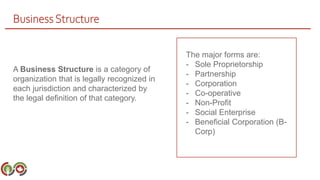
A Business Structure is a category of
organization that is legally recognized in
each jurisdiction and characterized by
the legal definition of that category.
BusinessStructure
The major forms are:
- Sole Proprietorship
- Partnership
- Corporation
- Co-operative
- Non-Profit
- Social Enterprise
- Beneficial Corporation (B-
Corp)
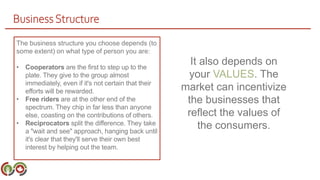
The business structure you choose depends (to
some extent) on what type of person you are:
• Cooperators are the first to step up to the
plate. They give to the group almost
immediately, even if it's not certain that their
efforts will be rewarded.
• Free riders are at the other end of the
spectrum. They chip in far less than anyone
else, coasting on the contributions of others.
• Reciprocators split the difference. They take
a "wait and see" approach, hanging back until
it's clear that they'll serve their own best
interest by helping out the team.
BusinessStructure
It also depends on
your VALUES. The
market can incentivize
the businesses that
reflect the values of
the consumers.
Sole Proprietorship
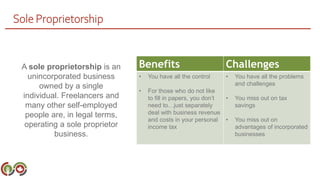
A sole proprietorship is an
unincorporated business
owned by a single
individual. Freelancers and
many other self-employed
people are, in legal terms,
operating a sole proprietor
business.
Benefits Challenges
• You have all the control
• For those who do not like
to fill in papers, you don’t
need to…just separately
deal with business revenue
and costs in your personal
income tax
• You have all the problems
and challenges
• You miss out on tax
savings
• You miss out on
advantages of incorporated
businesses
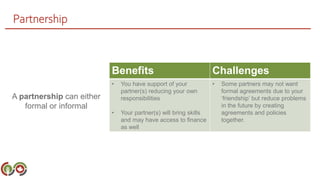
Partnership
Benefits Challenges
• You have support of your
partner(s) reducing your own
responsibilities
• Your partner(s) will bring skills
and may have access to finance
as well
• Some partners may not want
formal agreements due to your
‘friendship’ but reduce problems
in the future by creating
agreements and policies
together.
A partnership can either
formal or informal
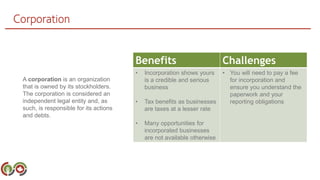
Corporation
A corporation is an organization
that is owned by its stockholders.
The corporation is considered an
independent legal entity and, as
such, is responsible for its actions
and debts.
Benefits Challenges
• Incorporation shows yours
is a credible and serious
business
• Tax benefits as businesses
are taxes at a lesser rate
• Many opportunities for
incorporated businesses
are not available otherwise
• You will need to pay a fee
for incorporation and
ensure you understand the
paperwork and your
reporting obligations
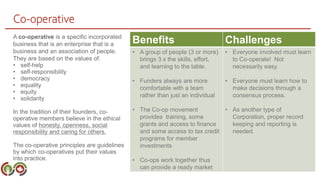
Co-operative
A co-operative is a specific incorporated
business that is an enterprise that is a
business and an association of people.
They are based on the values of:
• self-help
• self-responsibility
• democracy
• equality
• equity
• solidarity
In the tradition of their founders, co-
operative members believe in the ethical
values of honesty, openness, social
responsibility and caring for others.
The co-operative principles are guidelines
by which co-operatives put their values
into practice.
Benefits Challenges
• A group of people (3 or more)
brings 3 x the skills, effort,
and learning to the table.
• Funders always are more
comfortable with a team
rather than just an individual
• The Co-op movement
provides training, some
grants and access to finance
and some access to tax credit
programs for member
investments
• Co-ops work together thus
can provide a ready market
• Everyone involved must learn
to Co-operate! Not
necessarily easy.
• Everyone must learn how to
make decisions through a
consensus process.
• As another type of
Corporation, proper record
keeping and reporting is
needed.
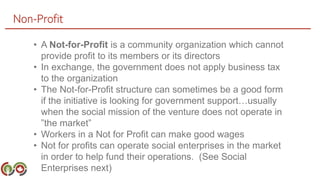
Non-Profit
• A Not-for-Profit is a community organization which cannot
provide profit to its members or its directors
• In exchange, the government does not apply business tax
to the organization
• The Not-for-Profit structure can sometimes be a good form
if the initiative is looking for government support…usually
when the social mission of the venture does not operate in
”the market”
• Workers in a Not for Profit can make good wages
• Not for profits can operate social enterprises in the market
in order to help fund their operations. (See Social
Enterprises next)
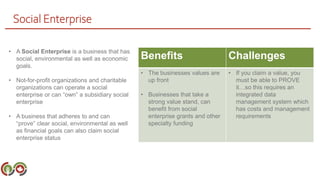
Social Enterprise
• A Social Enterprise is a business that has
social, environmental as well as economic
goals.
• Not-for-profit organizations and charitable
organizations can operate a social
enterprise or can “own” a subsidiary social
enterprise
• A business that adheres to and can
“prove” clear social, environmental as well
as financial goals can also claim social
enterprise status
Benefits Challenges
• The businesses values are
up front
• Businesses that take a
strong value stand, can
benefit from social
enterprise grants and other
specialty funding
• If you claim a value, you
must be able to PROVE
it…so this requires an
integrated data
management system which
has costs and management
requirements
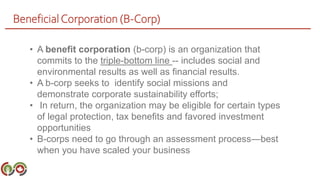
BeneficialCorporation (B-Corp)
• A benefit corporation (b-corp) is an organization that
commits to the triple-bottom line -- includes social and
environmental results as well as financial results.
• A b-corp seeks to identify social missions and
demonstrate corporate sustainability efforts;
• In return, the organization may be eligible for certain types
of legal protection, tax benefits and favored investment
opportunities
• B-corps need to go through an assessment process—best
when you have scaled your business

Structuring Your Business.pptx

  • 1.
    StructuringYour Business Sandy Mark– Manager,Women’s Initiative
  • 2.
    A Business Structureis a category of organization that is legally recognized in each jurisdiction and characterized by the legal definition of that category. BusinessStructure The major forms are: - Sole Proprietorship - Partnership - Corporation - Co-operative - Non-Profit - Social Enterprise - Beneficial Corporation (B- Corp)
  • 3.
    The business structureyou choose depends (to some extent) on what type of person you are: • Cooperators are the first to step up to the plate. They give to the group almost immediately, even if it's not certain that their efforts will be rewarded. • Free riders are at the other end of the spectrum. They chip in far less than anyone else, coasting on the contributions of others. • Reciprocators split the difference. They take a "wait and see" approach, hanging back until it's clear that they'll serve their own best interest by helping out the team. BusinessStructure It also depends on your VALUES. The market can incentivize the businesses that reflect the values of the consumers.
  • 4.
    Sole Proprietorship A soleproprietorship is an unincorporated business owned by a single individual. Freelancers and many other self-employed people are, in legal terms, operating a sole proprietor business. Benefits Challenges • You have all the control • For those who do not like to fill in papers, you don’t need to…just separately deal with business revenue and costs in your personal income tax • You have all the problems and challenges • You miss out on tax savings • You miss out on advantages of incorporated businesses
  • 5.
    Partnership Benefits Challenges • Youhave support of your partner(s) reducing your own responsibilities • Your partner(s) will bring skills and may have access to finance as well • Some partners may not want formal agreements due to your ‘friendship’ but reduce problems in the future by creating agreements and policies together. A partnership can either formal or informal
  • 6.
    Corporation A corporation isan organization that is owned by its stockholders. The corporation is considered an independent legal entity and, as such, is responsible for its actions and debts. Benefits Challenges • Incorporation shows yours is a credible and serious business • Tax benefits as businesses are taxes at a lesser rate • Many opportunities for incorporated businesses are not available otherwise • You will need to pay a fee for incorporation and ensure you understand the paperwork and your reporting obligations
  • 7.
    Co-operative A co-operative isa specific incorporated business that is an enterprise that is a business and an association of people. They are based on the values of: • self-help • self-responsibility • democracy • equality • equity • solidarity In the tradition of their founders, co- operative members believe in the ethical values of honesty, openness, social responsibility and caring for others. The co-operative principles are guidelines by which co-operatives put their values into practice. Benefits Challenges • A group of people (3 or more) brings 3 x the skills, effort, and learning to the table. • Funders always are more comfortable with a team rather than just an individual • The Co-op movement provides training, some grants and access to finance and some access to tax credit programs for member investments • Co-ops work together thus can provide a ready market • Everyone involved must learn to Co-operate! Not necessarily easy. • Everyone must learn how to make decisions through a consensus process. • As another type of Corporation, proper record keeping and reporting is needed.
  • 8.
    Non-Profit • A Not-for-Profitis a community organization which cannot provide profit to its members or its directors • In exchange, the government does not apply business tax to the organization • The Not-for-Profit structure can sometimes be a good form if the initiative is looking for government support…usually when the social mission of the venture does not operate in ”the market” • Workers in a Not for Profit can make good wages • Not for profits can operate social enterprises in the market in order to help fund their operations. (See Social Enterprises next)
  • 9.
    Social Enterprise • ASocial Enterprise is a business that has social, environmental as well as economic goals. • Not-for-profit organizations and charitable organizations can operate a social enterprise or can “own” a subsidiary social enterprise • A business that adheres to and can “prove” clear social, environmental as well as financial goals can also claim social enterprise status Benefits Challenges • The businesses values are up front • Businesses that take a strong value stand, can benefit from social enterprise grants and other specialty funding • If you claim a value, you must be able to PROVE it…so this requires an integrated data management system which has costs and management requirements
  • 10.
    BeneficialCorporation (B-Corp) • Abenefit corporation (b-corp) is an organization that commits to the triple-bottom line -- includes social and environmental results as well as financial results. • A b-corp seeks to identify social missions and demonstrate corporate sustainability efforts; • In return, the organization may be eligible for certain types of legal protection, tax benefits and favored investment opportunities • B-corps need to go through an assessment process—best when you have scaled your business