1
Structures
2
What is a Structure?
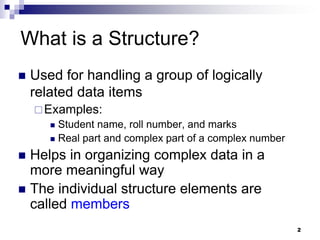
 Used for handling a group of logically
related data items
Examples:
 Student name, roll number, and marks
 Real part and complex part of a complex number
 Helps in organizing complex data in a
more meaningful way
 The individual structure elements are
called members
3
Defining a Structure
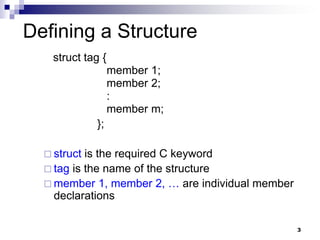
struct tag {
member 1;
member 2;
:
member m;
};
 struct is the required C keyword
 tag is the name of the structure
 member 1, member 2, … are individual member
declarations
4
Contd.
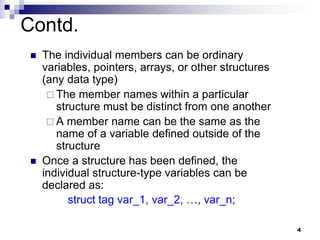
 The individual members can be ordinary
variables, pointers, arrays, or other structures
(any data type)
 The member names within a particular
structure must be distinct from one another
 A member name can be the same as the
name of a variable defined outside of the
structure
 Once a structure has been defined, the
individual structure-type variables can be
declared as:
struct tag var_1, var_2, …, var_n;
5
Example
 A structure definition
struct student {
char name[30];
int roll_number;
int total_marks;
char dob[10];
};
 Defining structure variables:
struct student a1, a2, a3;
A new data-type
6
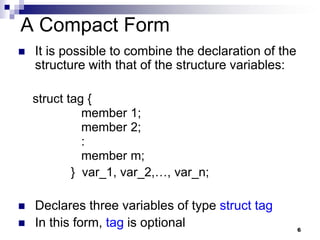
A Compact Form
 It is possible to combine the declaration of the
structure with that of the structure variables:
struct tag {
member 1;
member 2;
:
member m;
} var_1, var_2,…, var_n;
 Declares three variables of type struct tag
 In this form, tag is optional
7
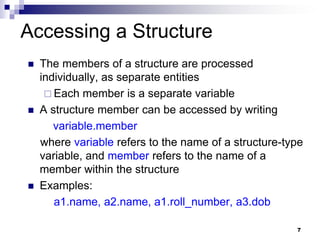
Accessing a Structure
 The members of a structure are processed
individually, as separate entities
 Each member is a separate variable
 A structure member can be accessed by writing
variable.member
where variable refers to the name of a structure-type
variable, and member refers to the name of a
member within the structure
 Examples:
a1.name, a2.name, a1.roll_number, a3.dob
8
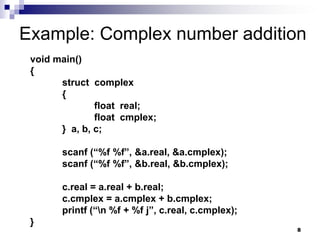
Example: Complex number addition
void main()
{
struct complex
{
float real;
float cmplex;
} a, b, c;
scanf (“%f %f”, &a.real, &a.cmplex);
scanf (“%f %f”, &b.real, &b.cmplex);
c.real = a.real + b.real;
c.cmplex = a.cmplex + b.cmplex;
printf (“n %f + %f j”, c.real, c.cmplex);
}
9
Operations on Structure
Variables
 Unlike arrays, a structure variable can be directly
assigned to another structure variable of the
same type
a1 = a2;
 All the individual members get assigned
 Two structure variables can not be compared
for equality or inequality
if (a1 == a2)…… this cannot be done
10
Arrays of Structures
 Once a structure has been defined, we can
declare an array of structures
struct student class[50];
The individual members can be accessed as:
class[i].name
class[5].roll_number
type name
11
Arrays within Structures
 A structure member can be an array
 The array element within the structure can
be accessed as:
a1.marks[2], a1.dob[3],…
struct student
{
char name[30];
int roll_number;
int marks[5];
char dob[10];
} a1, a2, a3;
12
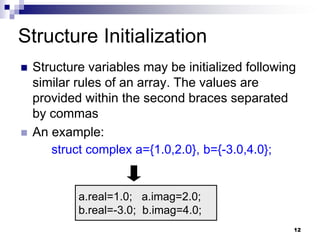
Structure Initialization
 Structure variables may be initialized following
similar rules of an array. The values are
provided within the second braces separated
by commas
 An example:
struct complex a={1.0,2.0}, b={-3.0,4.0};
a.real=1.0; a.imag=2.0;
b.real=-3.0; b.imag=4.0;
13
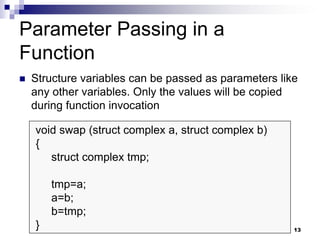
Parameter Passing in a
Function
 Structure variables can be passed as parameters like
any other variables. Only the values will be copied
during function invocation
void swap (struct complex a, struct complex b)
{
struct complex tmp;
tmp=a;
a=b;
b=tmp;
}
14
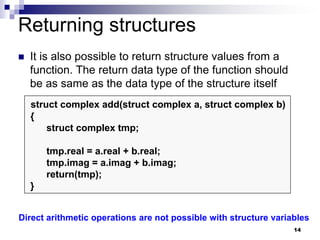
Returning structures
 It is also possible to return structure values from a
function. The return data type of the function should
be as same as the data type of the structure itself
struct complex add(struct complex a, struct complex b)
{
struct complex tmp;
tmp.real = a.real + b.real;
tmp.imag = a.imag + b.imag;
return(tmp);
}
Direct arithmetic operations are not possible with structure variables
15
Defining data type: using typedef
 One may define a structure data-type with a single
name
typedef struct newtype {
member-variable1;
member-variable2;
.
member-variableN;
} mytype;
 mytype is the name of the new data-type
 Also called an alias for struct newtype
 Writing the tag name newtype is optional, can be
skipped
 Naming follows rules of variable naming
16
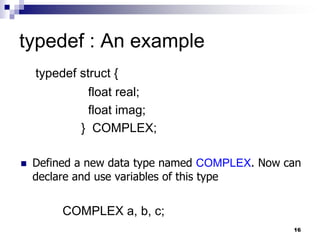
typedef : An example
typedef struct {
float real;
float imag;
} COMPLEX;
 Defined a new data type named COMPLEX. Now can
declare and use variables of this type
COMPLEX a, b, c;
17
 Note: typedef is not restricted to just structures,
can define new types from any existing type
 Example:
 typedef int INTEGER
 Defines a new type named INTEGER from the
known type int
 Can now define variables of type INTEGER which
will have all properties of the int type
INTEGER a, b, c;
18
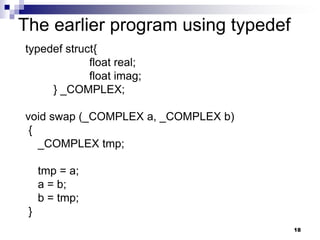
The earlier program using typedef
typedef struct{
float real;
float imag;
} _COMPLEX;
void swap (_COMPLEX a, _COMPLEX b)
{
_COMPLEX tmp;
tmp = a;
a = b;
b = tmp;
}
19
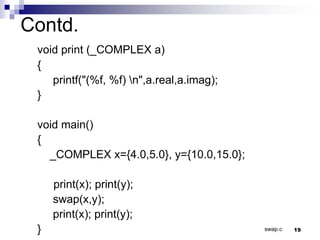
Contd.
void print (_COMPLEX a)
{
printf("(%f, %f) n",a.real,a.imag);
}
void main()
{
_COMPLEX x={4.0,5.0}, y={10.0,15.0};
print(x); print(y);
swap(x,y);
print(x); print(y);
} swap.c
20
 Output:
(4.000000, 5.000000)
(10.000000, 15.000000)
(4.000000, 5.000000)
(10.000000, 15.000000)
 x and y are not swapped! But that has got
nothing to do with structures specially. We
will see its reason shortly
Union
union Data
{
int i;
float f;
char str[20];
};
int main( )
{
union Data data;
data.i = 10;
data.f = 220.5;
strcpy( data.str, "C Programming");
printf( "data.i : %dn", data.i);
printf( "data.f : %fn", data.f);
printf( "data.str : %sn", data.str);
return 0;
}
21
data.i : 1917853763
data.f:122360580327794860452759994368.00000
data.str : C Programming
union Data
{
int i;
float f;
char str[20];
};
int main( )
{
union Data data;
data.i = 10;
printf( "data.i : %dn", data.i);
data.f = 220.5;
printf( "data.f : %fn", data.f);
strcpy( data.str, "C Programming");
printf( "data.str : %sn", data.str);
return 0;
} 22
data.i : 10
data.f : 220.500000
data.str : C Programming
Union

structures_v1.ppt

  • 1.
  • 2.
    2 What is aStructure?  Used for handling a group of logically related data items Examples:  Student name, roll number, and marks  Real part and complex part of a complex number  Helps in organizing complex data in a more meaningful way  The individual structure elements are called members
  • 3.
    3 Defining a Structure structtag { member 1; member 2; : member m; };  struct is the required C keyword  tag is the name of the structure  member 1, member 2, … are individual member declarations
  • 4.
    4 Contd.  The individualmembers can be ordinary variables, pointers, arrays, or other structures (any data type)  The member names within a particular structure must be distinct from one another  A member name can be the same as the name of a variable defined outside of the structure  Once a structure has been defined, the individual structure-type variables can be declared as: struct tag var_1, var_2, …, var_n;
  • 5.
    5 Example  A structuredefinition struct student { char name[30]; int roll_number; int total_marks; char dob[10]; };  Defining structure variables: struct student a1, a2, a3; A new data-type
  • 6.
    6 A Compact Form It is possible to combine the declaration of the structure with that of the structure variables: struct tag { member 1; member 2; : member m; } var_1, var_2,…, var_n;  Declares three variables of type struct tag  In this form, tag is optional
  • 7.
    7 Accessing a Structure The members of a structure are processed individually, as separate entities  Each member is a separate variable  A structure member can be accessed by writing variable.member where variable refers to the name of a structure-type variable, and member refers to the name of a member within the structure  Examples: a1.name, a2.name, a1.roll_number, a3.dob
  • 8.
    8 Example: Complex numberaddition void main() { struct complex { float real; float cmplex; } a, b, c; scanf (“%f %f”, &a.real, &a.cmplex); scanf (“%f %f”, &b.real, &b.cmplex); c.real = a.real + b.real; c.cmplex = a.cmplex + b.cmplex; printf (“n %f + %f j”, c.real, c.cmplex); }
  • 9.
    9 Operations on Structure Variables Unlike arrays, a structure variable can be directly assigned to another structure variable of the same type a1 = a2;  All the individual members get assigned  Two structure variables can not be compared for equality or inequality if (a1 == a2)…… this cannot be done
  • 10.
    10 Arrays of Structures Once a structure has been defined, we can declare an array of structures struct student class[50]; The individual members can be accessed as: class[i].name class[5].roll_number type name
  • 11.
    11 Arrays within Structures A structure member can be an array  The array element within the structure can be accessed as: a1.marks[2], a1.dob[3],… struct student { char name[30]; int roll_number; int marks[5]; char dob[10]; } a1, a2, a3;
  • 12.
    12 Structure Initialization  Structurevariables may be initialized following similar rules of an array. The values are provided within the second braces separated by commas  An example: struct complex a={1.0,2.0}, b={-3.0,4.0}; a.real=1.0; a.imag=2.0; b.real=-3.0; b.imag=4.0;
  • 13.
    13 Parameter Passing ina Function  Structure variables can be passed as parameters like any other variables. Only the values will be copied during function invocation void swap (struct complex a, struct complex b) { struct complex tmp; tmp=a; a=b; b=tmp; }
  • 14.
    14 Returning structures  Itis also possible to return structure values from a function. The return data type of the function should be as same as the data type of the structure itself struct complex add(struct complex a, struct complex b) { struct complex tmp; tmp.real = a.real + b.real; tmp.imag = a.imag + b.imag; return(tmp); } Direct arithmetic operations are not possible with structure variables
  • 15.
    15 Defining data type:using typedef  One may define a structure data-type with a single name typedef struct newtype { member-variable1; member-variable2; . member-variableN; } mytype;  mytype is the name of the new data-type  Also called an alias for struct newtype  Writing the tag name newtype is optional, can be skipped  Naming follows rules of variable naming
  • 16.
    16 typedef : Anexample typedef struct { float real; float imag; } COMPLEX;  Defined a new data type named COMPLEX. Now can declare and use variables of this type COMPLEX a, b, c;
  • 17.
    17  Note: typedefis not restricted to just structures, can define new types from any existing type  Example:  typedef int INTEGER  Defines a new type named INTEGER from the known type int  Can now define variables of type INTEGER which will have all properties of the int type INTEGER a, b, c;
  • 18.
    18 The earlier programusing typedef typedef struct{ float real; float imag; } _COMPLEX; void swap (_COMPLEX a, _COMPLEX b) { _COMPLEX tmp; tmp = a; a = b; b = tmp; }
  • 19.
    19 Contd. void print (_COMPLEXa) { printf("(%f, %f) n",a.real,a.imag); } void main() { _COMPLEX x={4.0,5.0}, y={10.0,15.0}; print(x); print(y); swap(x,y); print(x); print(y); } swap.c
  • 20.
    20  Output: (4.000000, 5.000000) (10.000000,15.000000) (4.000000, 5.000000) (10.000000, 15.000000)  x and y are not swapped! But that has got nothing to do with structures specially. We will see its reason shortly
  • 21.
    Union union Data { int i; floatf; char str[20]; }; int main( ) { union Data data; data.i = 10; data.f = 220.5; strcpy( data.str, "C Programming"); printf( "data.i : %dn", data.i); printf( "data.f : %fn", data.f); printf( "data.str : %sn", data.str); return 0; } 21 data.i : 1917853763 data.f:122360580327794860452759994368.00000 data.str : C Programming
  • 22.
    union Data { int i; floatf; char str[20]; }; int main( ) { union Data data; data.i = 10; printf( "data.i : %dn", data.i); data.f = 220.5; printf( "data.f : %fn", data.f); strcpy( data.str, "C Programming"); printf( "data.str : %sn", data.str); return 0; } 22 data.i : 10 data.f : 220.500000 data.str : C Programming Union