STRUCTURED PROBLEM SOLVING
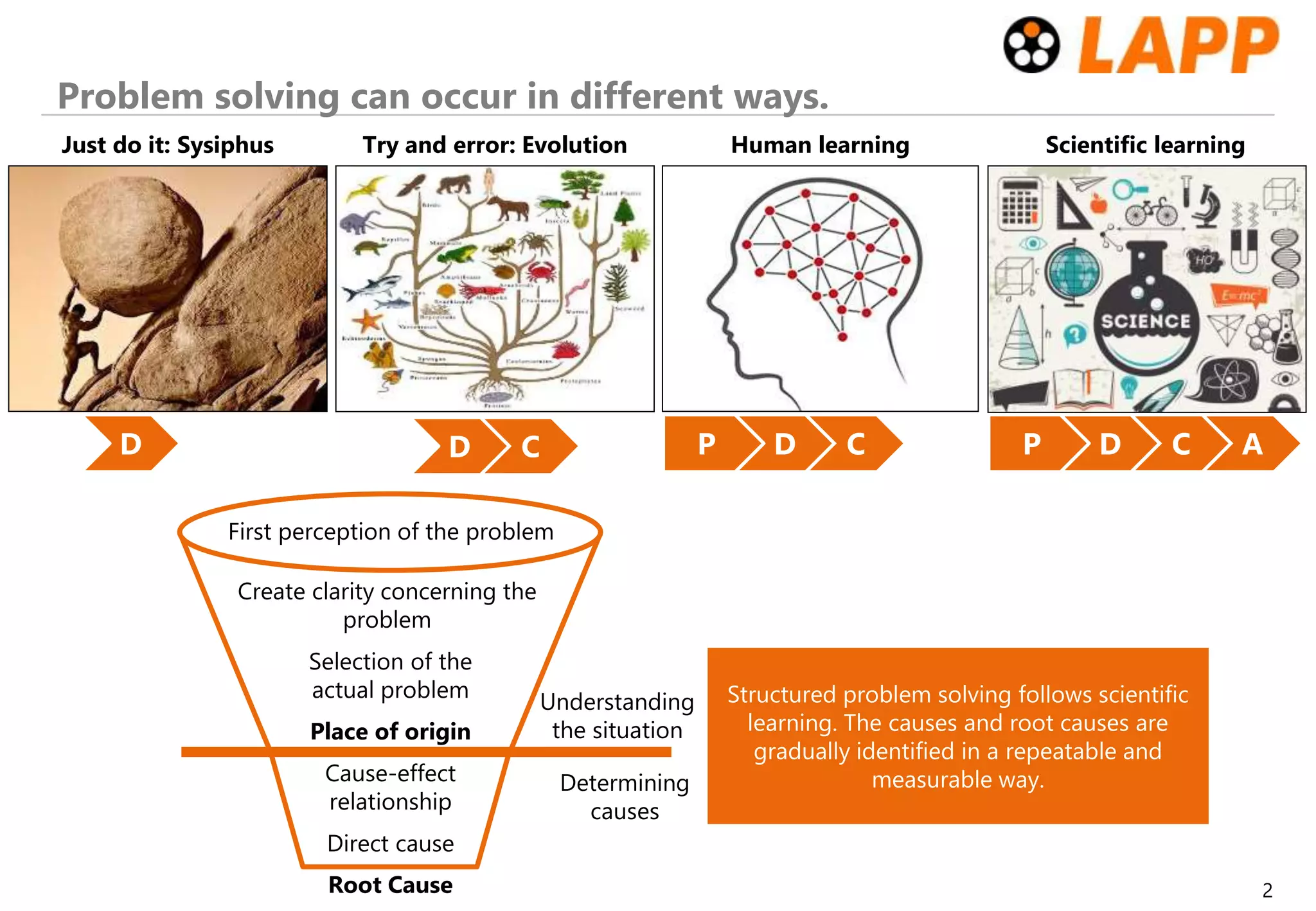
Problem solving can occur in different ways.
2
Just do it: Sysiphus
D
Try and error: Evolution
D C
Human learning
D
P C
Scientific learning
D
P C A
First perception of the problem
Create clarity concerning the
problem
Selection of the
actual problem
Place of origin
Cause-effect
relationship
Direct cause
Root Cause
Understanding
the situation
Determining
causes
Structured problem solving follows scientific
learning. The causes and root causes are
gradually identified in a repeatable and
measurable way.
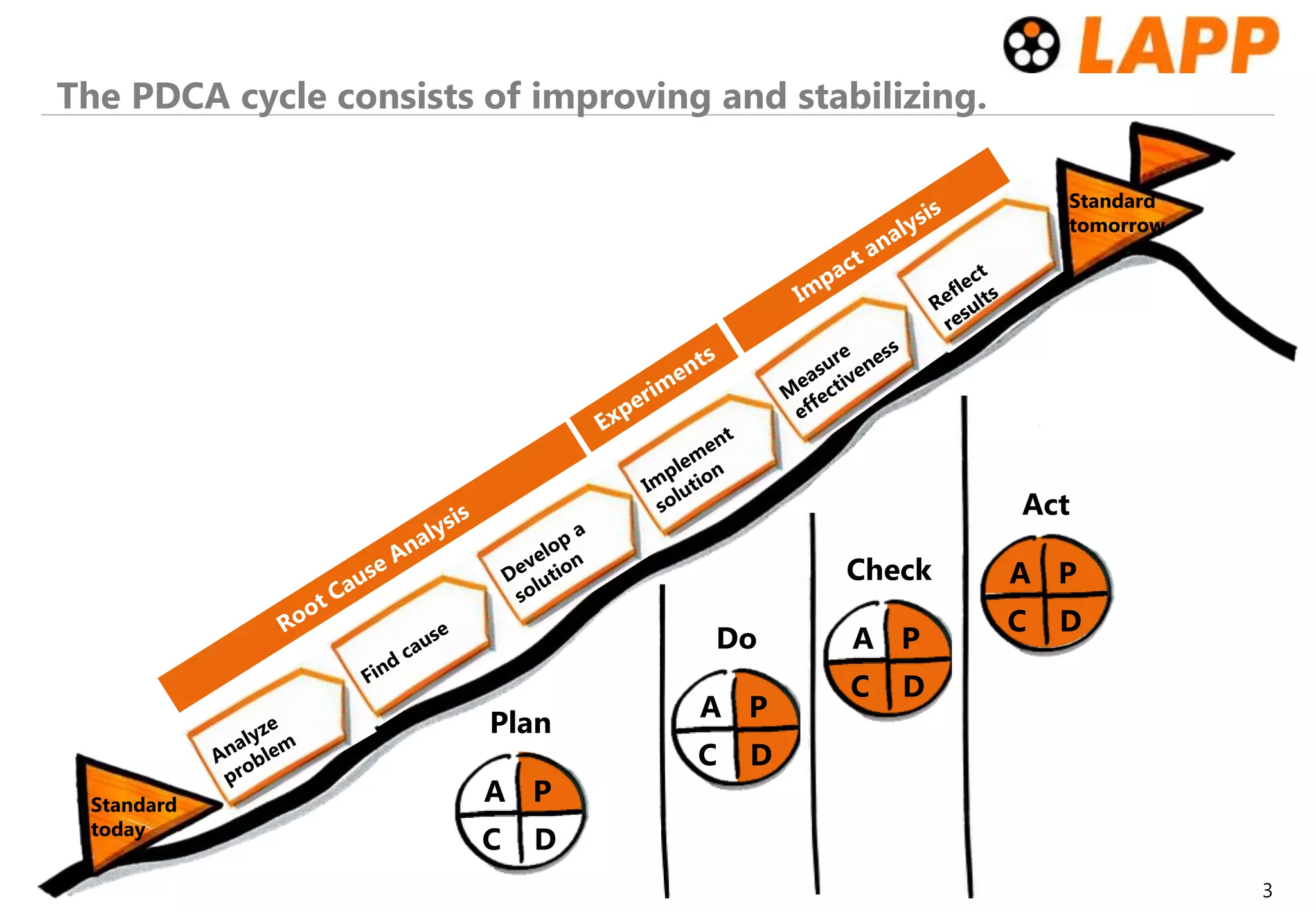
The PDCA cycle consists of improving and stabilizing.
3
Standard
today
Standard
tomorrow
Plan
P
D
C
A
Do
P
D
C
A
Check
P
D
C
A
Act
P
D
C
A
1. Analyze Problem:
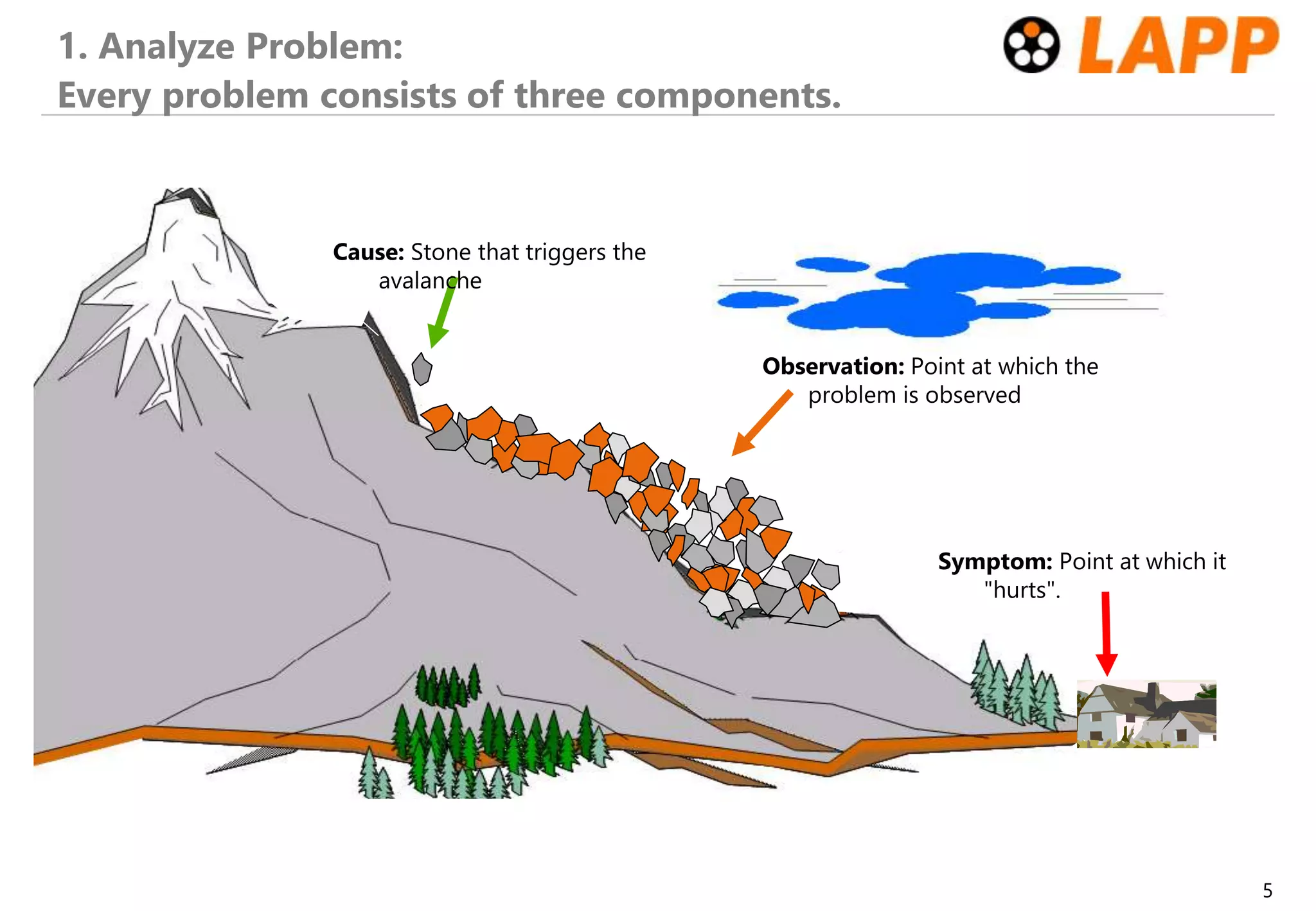
Every problem consists of three components.
5
Cause: Stone that triggers the
avalanche
Observation: Point at which the
problem is observed
Symptom: Point at which it
"hurts".
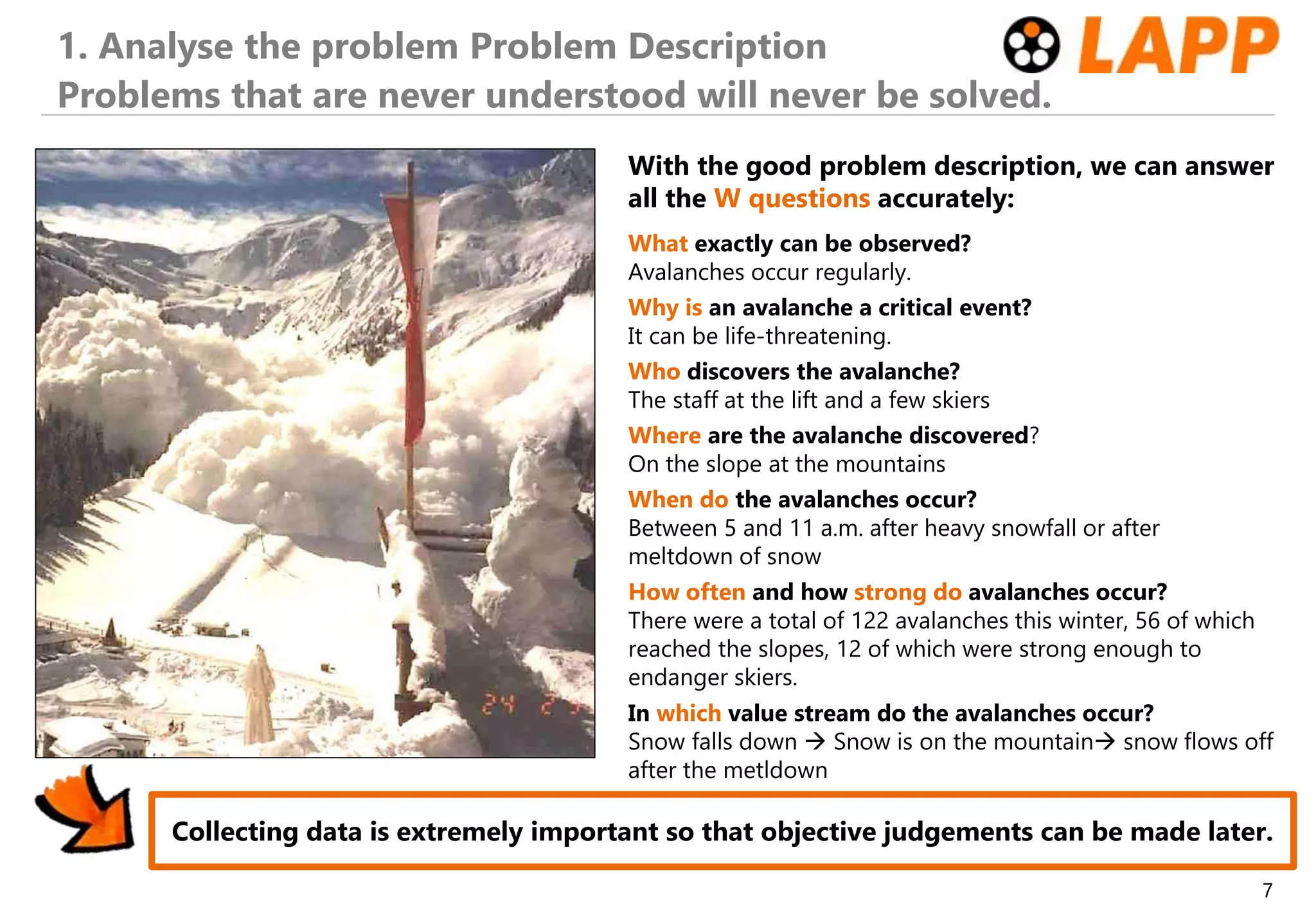
1. Analyse the problem Problem Description
Problems that are never understood will never be solved.
7
With the good problem description, we can answer
all the W questions accurately:
Where are the avalanche discovered?
On the slope at the mountains
Who discovers the avalanche?
The staff at the lift and a few skiers
What exactly can be observed?
Avalanches occur regularly.
When do the avalanches occur?
Between 5 and 11 a.m. after heavy snowfall or after
meltdown of snow
How often and how strong do avalanches occur?
There were a total of 122 avalanches this winter, 56 of which
reached the slopes, 12 of which were strong enough to
endanger skiers.
In which value stream do the avalanches occur?
Snow falls down  Snow is on the mountain snow flows off
after the metldown
Collecting data is extremely important so that objective judgements can be made later.
Why is an avalanche a critical event?
It can be life-threatening.
1. Analyze problem:
Find the real place of origin.
8
Peak of the
mountain
Error/ defect
is identified
Village
Ski school
Does the deviation occur
here as well?
yes
Ski slope
Does the deviation occur
here as well?
yes
Steep slope
Does the deviation
occur here as well?
no
Place of discovery
Place of origin
In order to eliminate a problem in the long term, we must implement measures that
eliminate the real cause of the problem.
To understand the true cause, we need to observe the process at the point of origin.
2. Find the cause: In root cause analysis the
focus is first expanded and then narrowed.
10
Start Expand focus Solution
Narrow focus
Cause-effect
diagram
Brainwriting
5xWhy
process mapping
Affinity diagram
Information sheet
Pareto chart
Correlation
diagram
Relation
diagram
Tree diagram
Histogram
This increases the probability of finding the best possible alternative
solution.
Expand focus: Cause - Effect diagram
18
The cause-effect diagram can be created in a few simple steps
1. Identify the main problem to be entered in the header (effect) of the diagram
2. Define categories for the causes and represent them in the herringbone structure of the diagram
3. Examples of categories are the 7M (man, machine, material, method, measuring equipment, environment and
management).
4. Brainstorming, carried out in a structured way on the categories, is used to gather possible causes that affect the
actual problem at the "Point of Cause"
5. The causes found are evaluated according to their influence on the "Point of Cause" as a pre-selection of the possible
"Direct Causes" (no influence, possible influence and direct influence).
6. Through further data analysis, the 5W method or expert interviews, the real direct core causes of the problem are
identified from the preliminary selection
Identification of possible causes of problems through structured problem solving
 Collection of possible causes that can bring about the problem at the "Point of Cause"
 Clear visualization of the causes and a systematic approach to brainstorming
 Reduction of complexity through structured management of the process and the environment
 Identification of influencing factors that have a direct impact on the actual problem
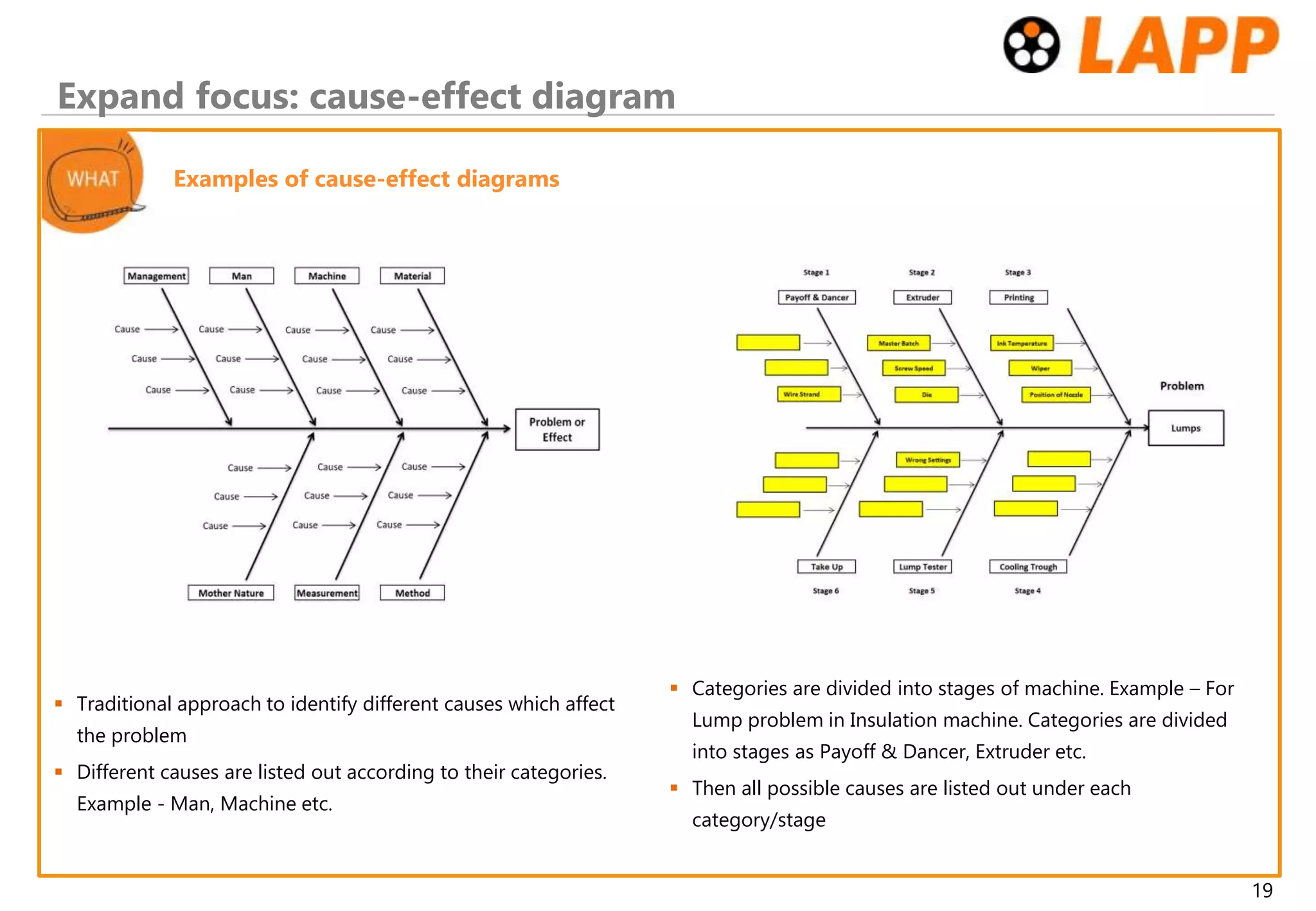
Expand focus: cause-effect diagram
19
 Traditional approach to identify different causes which affect
the problem
 Different causes are listed out according to their categories.
Example - Man, Machine etc.
 Categories are divided into stages of machine. Example – For
Lump problem in Insulation machine. Categories are divided
into stages as Payoff & Dancer, Extruder etc.
 Then all possible causes are listed out under each
category/stage
Examples of cause-effect diagrams
Expand focus: 5W - Method (5x Why)
24
The 5W method can be created in a few simple steps
1. Starting with the problem (effect) that occurred, "Why?" Asked for the supposed cause
2. Use the 1st step until the actual cause is found (this does not have to be literally five times)
3. If necessary, the group of interviewees must be expanded in the course of the questioning, since in the case of
complex contexts, corresponding experts are also needed who were not yet taken into account at the beginning
4. Once the cause has been clearly identified, an action must be taken to solve the problem
Determination of the actual cause of the problem and a sustainable problem solution
 Very simple and successful method to determine the cause of a problem
 Can be used without much training of the participants
 Selection of the core cause of the problem
Expand focus: 5W - Method (5x Why)
25
Problem: Dirty machine
"Why is the machine dirty?"
"Because oil is leaking from the filter."
"Why is oil leaking from the machine?"
"Because the filter meshes are dirty."
"Why are the filter meshes dirty?"
"Because they were not changed on time."
"Why are they not changed in a timely manner?"
"Because there is no maintenance plan."
"Why is there no maintenance plan?"
"Because nobody has taken care of it."
Measure
Introduce maintenance plan with fixed intervals
Problem: Malfunction of the main control
"Why did the machine stop?"
"Because the circuit board is defective."
"Why is the circuit board defective?"
"Because the circuit board is poorly cooled."
"Why is the circuit board poorly cooled?"
"Because there's not enough air."
"Why is there not enough air?"
"Because the air pressure is too low."
"Why is there not enough air pressure?"
"Because there's dust in the filter."
Measure
Clean or change filter monthly
Examples of the 5W method
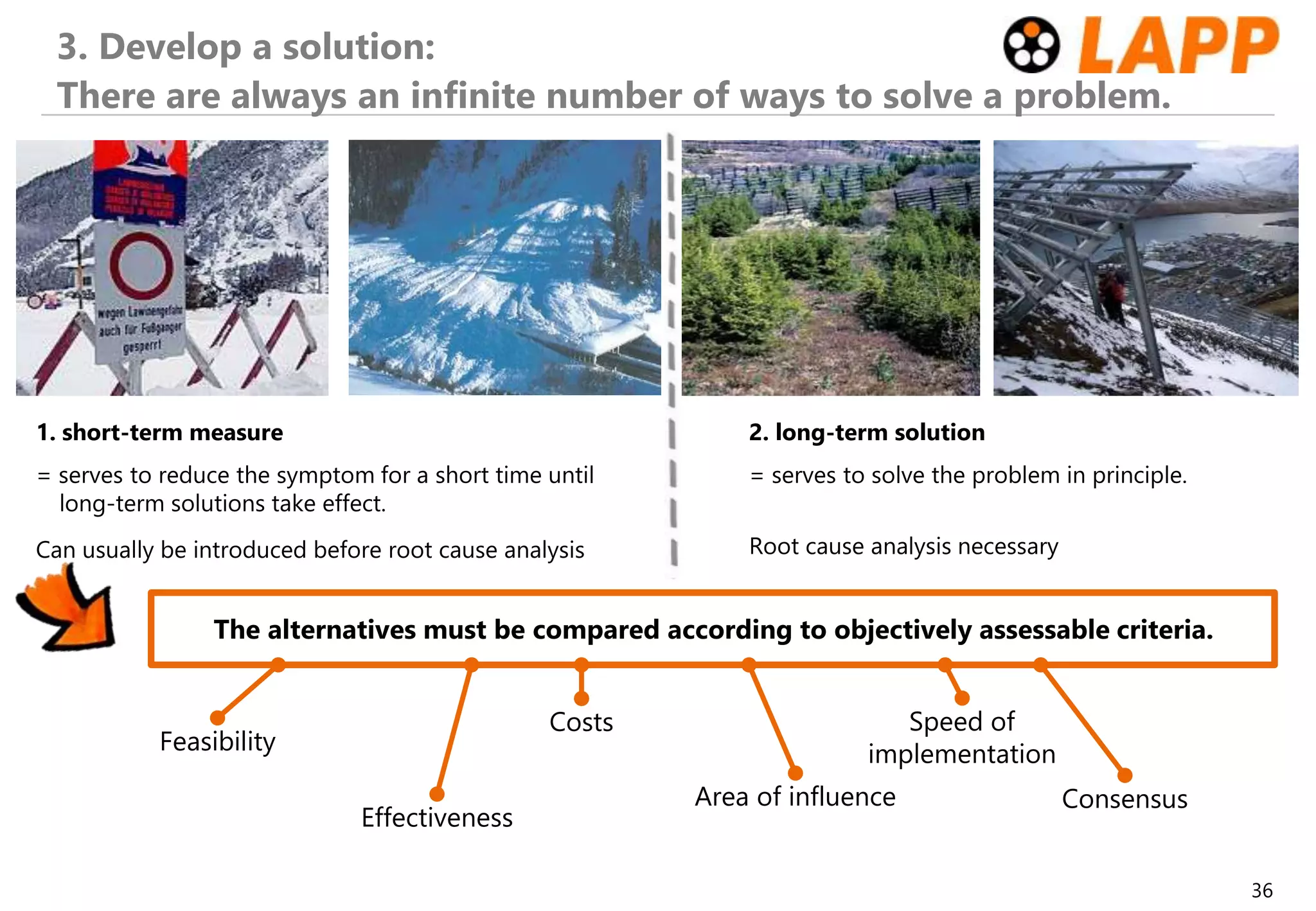
3. Develop a solution:
There are always an infinite number of ways to solve a problem.
36
1. short-term measure
= serves to reduce the symptom for a short time until
long-term solutions take effect.
Can usually be introduced before root cause analysis
2. long-term solution
= serves to solve the problem in principle.
Root cause analysis necessary
The alternatives must be compared according to objectively assessable criteria.
Feasibility
Effectiveness
Costs
Area of influence
Speed of
implementation
Consensus

Structured Problem Solving.pptx

  • 1.
  • 2.
    Problem solving canoccur in different ways. 2 Just do it: Sysiphus D Try and error: Evolution D C Human learning D P C Scientific learning D P C A First perception of the problem Create clarity concerning the problem Selection of the actual problem Place of origin Cause-effect relationship Direct cause Root Cause Understanding the situation Determining causes Structured problem solving follows scientific learning. The causes and root causes are gradually identified in a repeatable and measurable way.
  • 3.
    The PDCA cycleconsists of improving and stabilizing. 3 Standard today Standard tomorrow Plan P D C A Do P D C A Check P D C A Act P D C A
  • 4.
    1. Analyze Problem: Everyproblem consists of three components. 5 Cause: Stone that triggers the avalanche Observation: Point at which the problem is observed Symptom: Point at which it "hurts".
  • 5.
    1. Analyse theproblem Problem Description Problems that are never understood will never be solved. 7 With the good problem description, we can answer all the W questions accurately: Where are the avalanche discovered? On the slope at the mountains Who discovers the avalanche? The staff at the lift and a few skiers What exactly can be observed? Avalanches occur regularly. When do the avalanches occur? Between 5 and 11 a.m. after heavy snowfall or after meltdown of snow How often and how strong do avalanches occur? There were a total of 122 avalanches this winter, 56 of which reached the slopes, 12 of which were strong enough to endanger skiers. In which value stream do the avalanches occur? Snow falls down  Snow is on the mountain snow flows off after the metldown Collecting data is extremely important so that objective judgements can be made later. Why is an avalanche a critical event? It can be life-threatening.
  • 6.
    1. Analyze problem: Findthe real place of origin. 8 Peak of the mountain Error/ defect is identified Village Ski school Does the deviation occur here as well? yes Ski slope Does the deviation occur here as well? yes Steep slope Does the deviation occur here as well? no Place of discovery Place of origin In order to eliminate a problem in the long term, we must implement measures that eliminate the real cause of the problem. To understand the true cause, we need to observe the process at the point of origin.
  • 7.
    2. Find thecause: In root cause analysis the focus is first expanded and then narrowed. 10 Start Expand focus Solution Narrow focus Cause-effect diagram Brainwriting 5xWhy process mapping Affinity diagram Information sheet Pareto chart Correlation diagram Relation diagram Tree diagram Histogram This increases the probability of finding the best possible alternative solution.
  • 8.
    Expand focus: Cause- Effect diagram 18 The cause-effect diagram can be created in a few simple steps 1. Identify the main problem to be entered in the header (effect) of the diagram 2. Define categories for the causes and represent them in the herringbone structure of the diagram 3. Examples of categories are the 7M (man, machine, material, method, measuring equipment, environment and management). 4. Brainstorming, carried out in a structured way on the categories, is used to gather possible causes that affect the actual problem at the "Point of Cause" 5. The causes found are evaluated according to their influence on the "Point of Cause" as a pre-selection of the possible "Direct Causes" (no influence, possible influence and direct influence). 6. Through further data analysis, the 5W method or expert interviews, the real direct core causes of the problem are identified from the preliminary selection Identification of possible causes of problems through structured problem solving  Collection of possible causes that can bring about the problem at the "Point of Cause"  Clear visualization of the causes and a systematic approach to brainstorming  Reduction of complexity through structured management of the process and the environment  Identification of influencing factors that have a direct impact on the actual problem
  • 9.
    Expand focus: cause-effectdiagram 19  Traditional approach to identify different causes which affect the problem  Different causes are listed out according to their categories. Example - Man, Machine etc.  Categories are divided into stages of machine. Example – For Lump problem in Insulation machine. Categories are divided into stages as Payoff & Dancer, Extruder etc.  Then all possible causes are listed out under each category/stage Examples of cause-effect diagrams
  • 10.
    Expand focus: 5W- Method (5x Why) 24 The 5W method can be created in a few simple steps 1. Starting with the problem (effect) that occurred, "Why?" Asked for the supposed cause 2. Use the 1st step until the actual cause is found (this does not have to be literally five times) 3. If necessary, the group of interviewees must be expanded in the course of the questioning, since in the case of complex contexts, corresponding experts are also needed who were not yet taken into account at the beginning 4. Once the cause has been clearly identified, an action must be taken to solve the problem Determination of the actual cause of the problem and a sustainable problem solution  Very simple and successful method to determine the cause of a problem  Can be used without much training of the participants  Selection of the core cause of the problem
  • 11.
    Expand focus: 5W- Method (5x Why) 25 Problem: Dirty machine "Why is the machine dirty?" "Because oil is leaking from the filter." "Why is oil leaking from the machine?" "Because the filter meshes are dirty." "Why are the filter meshes dirty?" "Because they were not changed on time." "Why are they not changed in a timely manner?" "Because there is no maintenance plan." "Why is there no maintenance plan?" "Because nobody has taken care of it." Measure Introduce maintenance plan with fixed intervals Problem: Malfunction of the main control "Why did the machine stop?" "Because the circuit board is defective." "Why is the circuit board defective?" "Because the circuit board is poorly cooled." "Why is the circuit board poorly cooled?" "Because there's not enough air." "Why is there not enough air?" "Because the air pressure is too low." "Why is there not enough air pressure?" "Because there's dust in the filter." Measure Clean or change filter monthly Examples of the 5W method
  • 12.
    3. Develop asolution: There are always an infinite number of ways to solve a problem. 36 1. short-term measure = serves to reduce the symptom for a short time until long-term solutions take effect. Can usually be introduced before root cause analysis 2. long-term solution = serves to solve the problem in principle. Root cause analysis necessary The alternatives must be compared according to objectively assessable criteria. Feasibility Effectiveness Costs Area of influence Speed of implementation Consensus

Editor's Notes

  • #3 Scientific learning: search for unambiguous evidence, repeatable, measurable