


Structured Container Delivery
Oscar
Renalias
Accenture Container Lead
@oscarrenalias
github.com/accenture
oscar.renalias@accenture.com
www.linkedin.com/oscarrenalias
www.slideshare.net/oscarrenalias
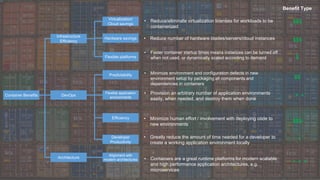
Container Benefits
Infrastructure
Efficiency
DevOps
Architecture
Virtualization/
Cloud savings
Hardware savings
Flexible platforms
Predictability
Flexible application
environments
Efficiency
Alignment with
modern architectures
Developer
Productivity
• Reduce/eliminate virtualization licenses for workloads to be
containerized
• Reduce number of hardware blades/servers/cloud instances
• Faster container startup times means instances can be turned off
when not used, or dynamically scaled according to demand
• Minimize environment and configuration defects in new
environment setup by packaging all components and
dependencies in containers
• Provision an arbitrary number of application environments
easily, when needed, and destroy them when done
• Minimize human effort / involvement with deploying code to
new environments
• Containers are a great runtime platforms for modern scalable
and high performance application architectures, e.g.
microservices
• Greatly reduce the amount of time needed for a developer to
create a working application environment locally
$$$
$$$
$
$$
$$$
⭐ ⭐ ⭐
⭐
⭐ ⭐
Benefit Type
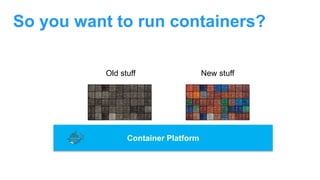
So you want to run containers?
Container Platform
Old stuff New stuff
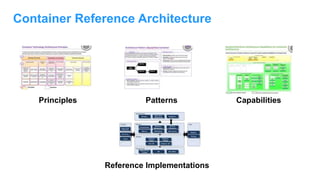
Container Reference Architecture
Principles Patterns Capabilities
Reference Implementations
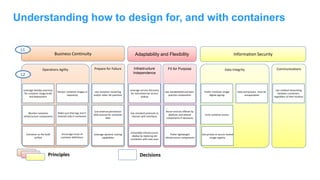
Understanding how to design for, and with containers
Business Continuity
Operations Agility Prepare for Failure Fit for Purpose
Adaptability and Flexibility
Infrastructure
Independence
Information Security
Leverage service discovery
for inter/external service
lookup
Use standard protocols to
interact with interfaces
Use standardized and best-
practice components
Reuse services offered by
platform and extend
components if necessary
Data Integrity Communications
Prefer container image
digital-signing
Use isolated networking
between containers,
regardless of their location
Prefer lightweight
infrastructure components
Use container clustering
and/or other HA practices
Use external persistence
data sources for container
data
Leverage DevOps practices
for container image build
and deployment
L1
Principles
L2
Decisions
Leverage dynamic routing
capabilities
Monitor container
infrastructure components
Limit container access
Use private or secure hosted
image registry
Container as the build
artifact
Immutable infrastructure,
deploy by replacing old
containers with new ones
Make sure that logs aren't
retained only in containers
Version container images in
repository
Encourage reuse of
container definitions
Data and process must be
encapsulated
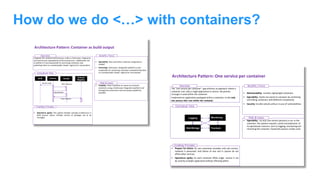
How do we do <…> with containers?
• Operations agility: This pattern handles complex architecture in
build process where multiple version of packages are to be
managed
Architecture Pattern: Container as build output
Conceptual View
Enabling Principles
• Usability: There should be no reason to not build
containers using a Continuous Integration platform and
leverage the automation and versioning capabilities
provided.
Risks & Issues
• Operability: Best used when continuos integrationis
needed
• Versioning: Continuous Integration platform is also
responsible for versioning containers and publishing them
to a private/public Docker registryfor consumption
Benefits / Force
Integrate the container build process withina Continuous Integration
tool and ensures repeatability of the build process. Additionally, the
CI platform is alsoresponsible for versioning containers and
publishing them to a private/public Docker registry for consumption.
Overview
SCM Jenkins Docker
Internal
Registry
Receive Code
Build Container
Tag Container
Push Container
• Prepare for failure: As one contaioner provides only one service,
isolation is preserved. And failure of one unit in system do not
affect other services.
• Operations agility: As each container offers single service it can
be used by multiple applicationwithout affecting others
Architecture Pattern: One service per container
Conceptual View
Enabling Principles
• Operability : As only one service (process) is run in the
container, this pattern requires careful consideration of
its operational concerns such as logging, monitoring and
restarting the container should the process inside crash.
Risks & Issues
• Maintainability: Smaller, lightweight containers
• Operability: Stacks are easier to compose by combining
and linking containers withdifferent components
• Security: Smaller attacksurface incase of vulnerabilities
Benefits / Force
The “one service per container” app enforces anapproach where a
container runs only a single applicationor service. No process
manager is used within the container.
Implement an application packaged withina container, as the only
one process that runs within the container.
Overview
Logging Monitoring
Data Storage Frontend
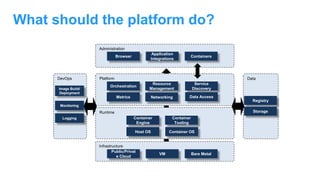
Infrastructure
Runtime
Platform
Administration
Public/Privat
e Cloud
VM Bare Metal
Host OS Container OS
Container
Engine
Container
Tooling
Browser
Application
Integrations
Containers
Data
Registry
Storage
Orchestration
Resource
Management
Service
Discovery
Data AccessNetworkingMetrics
DevOps
Image Build/
Deployment
Monitoring
Logging
What should the platform do?
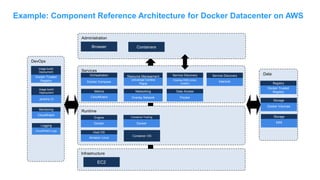
Example: Component Reference Architecture for Docker Datacenter on AWS
Infrastructure
Runtime
Services
Administration
Container OS
Orchestration Resource Management Service Discovery
Data Access
Browser Containers
Data
Metrics
DevOps
CloudWatch
Networking
Overlay Network Flocker
Docker Docker
Amazon Linux
Docker Compose
Universal Control
Plane
Overlay DNS (intra-
cluster)
EC2
Storage
Registry
Docker Trusted
Registry
Docker Volumes
Storage
EBS
Service Discovery
Interlock
Engine
Host OS
Container Tooling
Image build/
Deployment
Docker Trusted
Registry
Monitoring
CloudWatch
Logging
CloudWatch Logs
Image build/
Deployment
Jenkins CI
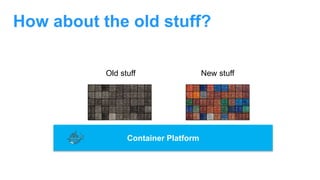
How about the old stuff?
Container Platform
Old stuff New stuff
Efficiently migrating
applications to containers
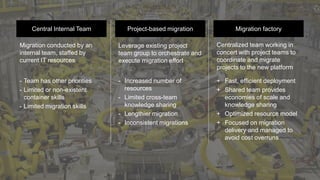
Central Internal Team Project-based migration Migration factory
Centralized team working in
concert with project teams to
coordinate and migrate
projects to the new platform
Leverage existing project
team group to orchestrate and
execute migration effort
+ Fast, efficient deployment
+ Shared team provides
economies of scale and
knowledge sharing
+ Optimized resource model
+ Focused on migration
delivery and managed to
avoid cost overruns
- Increased number of
resources
- Limited cross-team
knowledge sharing
- Lengthier migration
- Inconsistent migrations
- Team has other priorities
- Limited or non-existent
container skills
- Limited migration skills
Migration conducted by an
internal team, staffed by
current IT resources
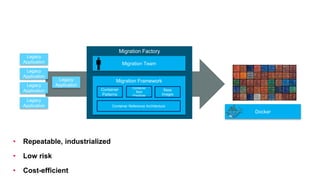
Migration Factory
Docker
Migration Team
Migration Framework
Container
Patterns
Container
Best
Practices
Base
Images
Container Reference Architecture
Legacy
Application
Legacy
Application
Legacy
Application
Legacy
Application
Legacy
Application
• Repeatable, industrialized
• Low risk
• Cost-efficient
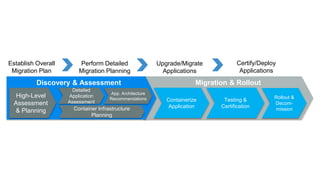
Migration & RolloutDiscovery & Assessment
High-Level
Assessment
& Planning
Detailed
Application
Assessment Testing &
Certification
Establish Overall
Migration Plan
Perform Detailed
Migration Planning
Upgrade/Migrate
Applications
App. Architecture
Recommendations
Certify/Deploy
Applications
Container Infrastructure
Planning
Rollout &
Decom-
mission
Containerize
Application
Thank you!

Structured Container Delivery by Oscar Renalias, Accenture

  • 1.
  • 2.
  • 4.
    Container Benefits Infrastructure Efficiency DevOps Architecture Virtualization/ Cloud savings Hardwaresavings Flexible platforms Predictability Flexible application environments Efficiency Alignment with modern architectures Developer Productivity • Reduce/eliminate virtualization licenses for workloads to be containerized • Reduce number of hardware blades/servers/cloud instances • Faster container startup times means instances can be turned off when not used, or dynamically scaled according to demand • Minimize environment and configuration defects in new environment setup by packaging all components and dependencies in containers • Provision an arbitrary number of application environments easily, when needed, and destroy them when done • Minimize human effort / involvement with deploying code to new environments • Containers are a great runtime platforms for modern scalable and high performance application architectures, e.g. microservices • Greatly reduce the amount of time needed for a developer to create a working application environment locally $$$ $$$ $ $$ $$$ ⭐ ⭐ ⭐ ⭐ ⭐ ⭐ Benefit Type
  • 5.
    So you wantto run containers? Container Platform Old stuff New stuff
  • 6.
    Container Reference Architecture PrinciplesPatterns Capabilities Reference Implementations
  • 7.
    Understanding how todesign for, and with containers Business Continuity Operations Agility Prepare for Failure Fit for Purpose Adaptability and Flexibility Infrastructure Independence Information Security Leverage service discovery for inter/external service lookup Use standard protocols to interact with interfaces Use standardized and best- practice components Reuse services offered by platform and extend components if necessary Data Integrity Communications Prefer container image digital-signing Use isolated networking between containers, regardless of their location Prefer lightweight infrastructure components Use container clustering and/or other HA practices Use external persistence data sources for container data Leverage DevOps practices for container image build and deployment L1 Principles L2 Decisions Leverage dynamic routing capabilities Monitor container infrastructure components Limit container access Use private or secure hosted image registry Container as the build artifact Immutable infrastructure, deploy by replacing old containers with new ones Make sure that logs aren't retained only in containers Version container images in repository Encourage reuse of container definitions Data and process must be encapsulated
  • 8.
    How do wedo <…> with containers? • Operations agility: This pattern handles complex architecture in build process where multiple version of packages are to be managed Architecture Pattern: Container as build output Conceptual View Enabling Principles • Usability: There should be no reason to not build containers using a Continuous Integration platform and leverage the automation and versioning capabilities provided. Risks & Issues • Operability: Best used when continuos integrationis needed • Versioning: Continuous Integration platform is also responsible for versioning containers and publishing them to a private/public Docker registryfor consumption Benefits / Force Integrate the container build process withina Continuous Integration tool and ensures repeatability of the build process. Additionally, the CI platform is alsoresponsible for versioning containers and publishing them to a private/public Docker registry for consumption. Overview SCM Jenkins Docker Internal Registry Receive Code Build Container Tag Container Push Container • Prepare for failure: As one contaioner provides only one service, isolation is preserved. And failure of one unit in system do not affect other services. • Operations agility: As each container offers single service it can be used by multiple applicationwithout affecting others Architecture Pattern: One service per container Conceptual View Enabling Principles • Operability : As only one service (process) is run in the container, this pattern requires careful consideration of its operational concerns such as logging, monitoring and restarting the container should the process inside crash. Risks & Issues • Maintainability: Smaller, lightweight containers • Operability: Stacks are easier to compose by combining and linking containers withdifferent components • Security: Smaller attacksurface incase of vulnerabilities Benefits / Force The “one service per container” app enforces anapproach where a container runs only a single applicationor service. No process manager is used within the container. Implement an application packaged withina container, as the only one process that runs within the container. Overview Logging Monitoring Data Storage Frontend
  • 9.
    Infrastructure Runtime Platform Administration Public/Privat e Cloud VM BareMetal Host OS Container OS Container Engine Container Tooling Browser Application Integrations Containers Data Registry Storage Orchestration Resource Management Service Discovery Data AccessNetworkingMetrics DevOps Image Build/ Deployment Monitoring Logging What should the platform do?
  • 10.
    Example: Component ReferenceArchitecture for Docker Datacenter on AWS Infrastructure Runtime Services Administration Container OS Orchestration Resource Management Service Discovery Data Access Browser Containers Data Metrics DevOps CloudWatch Networking Overlay Network Flocker Docker Docker Amazon Linux Docker Compose Universal Control Plane Overlay DNS (intra- cluster) EC2 Storage Registry Docker Trusted Registry Docker Volumes Storage EBS Service Discovery Interlock Engine Host OS Container Tooling Image build/ Deployment Docker Trusted Registry Monitoring CloudWatch Logging CloudWatch Logs Image build/ Deployment Jenkins CI
  • 11.
    How about theold stuff? Container Platform Old stuff New stuff
  • 12.
  • 13.
    Central Internal TeamProject-based migration Migration factory Centralized team working in concert with project teams to coordinate and migrate projects to the new platform Leverage existing project team group to orchestrate and execute migration effort + Fast, efficient deployment + Shared team provides economies of scale and knowledge sharing + Optimized resource model + Focused on migration delivery and managed to avoid cost overruns - Increased number of resources - Limited cross-team knowledge sharing - Lengthier migration - Inconsistent migrations - Team has other priorities - Limited or non-existent container skills - Limited migration skills Migration conducted by an internal team, staffed by current IT resources
  • 14.
    Migration Factory Docker Migration Team MigrationFramework Container Patterns Container Best Practices Base Images Container Reference Architecture Legacy Application Legacy Application Legacy Application Legacy Application Legacy Application • Repeatable, industrialized • Low risk • Cost-efficient
  • 15.
    Migration & RolloutDiscovery& Assessment High-Level Assessment & Planning Detailed Application Assessment Testing & Certification Establish Overall Migration Plan Perform Detailed Migration Planning Upgrade/Migrate Applications App. Architecture Recommendations Certify/Deploy Applications Container Infrastructure Planning Rollout & Decom- mission Containerize Application
  • 16.

Editor's Notes

  • #4 Containers everywhere. Clients are very interested and are can definitely see the business case.
  • #5 Containers have clear benefits, but how do we get there?
  • #6 So you want to run containers, but where do you start? We need a container platform. What should be in there? What capabilities do we need? What components should provide those capabilities? Once we have a platform, we can build stateless microservices, yay. But there’s a whole lot of legacy applications that could greatly benefit from running on containers, not least because of infrastructure cost and licensing savings.
  • #12 So you want to run containers, but where do you start? We need a container platform. What should be in there? What capabilities do we need? What components should provide those capabilities? Once we have a platform, we can build stateless microservices, yay. But there’s a whole lot of legacy applications that could greatly benefit from running on containers, not least because of infrastructure cost and licensing savings.