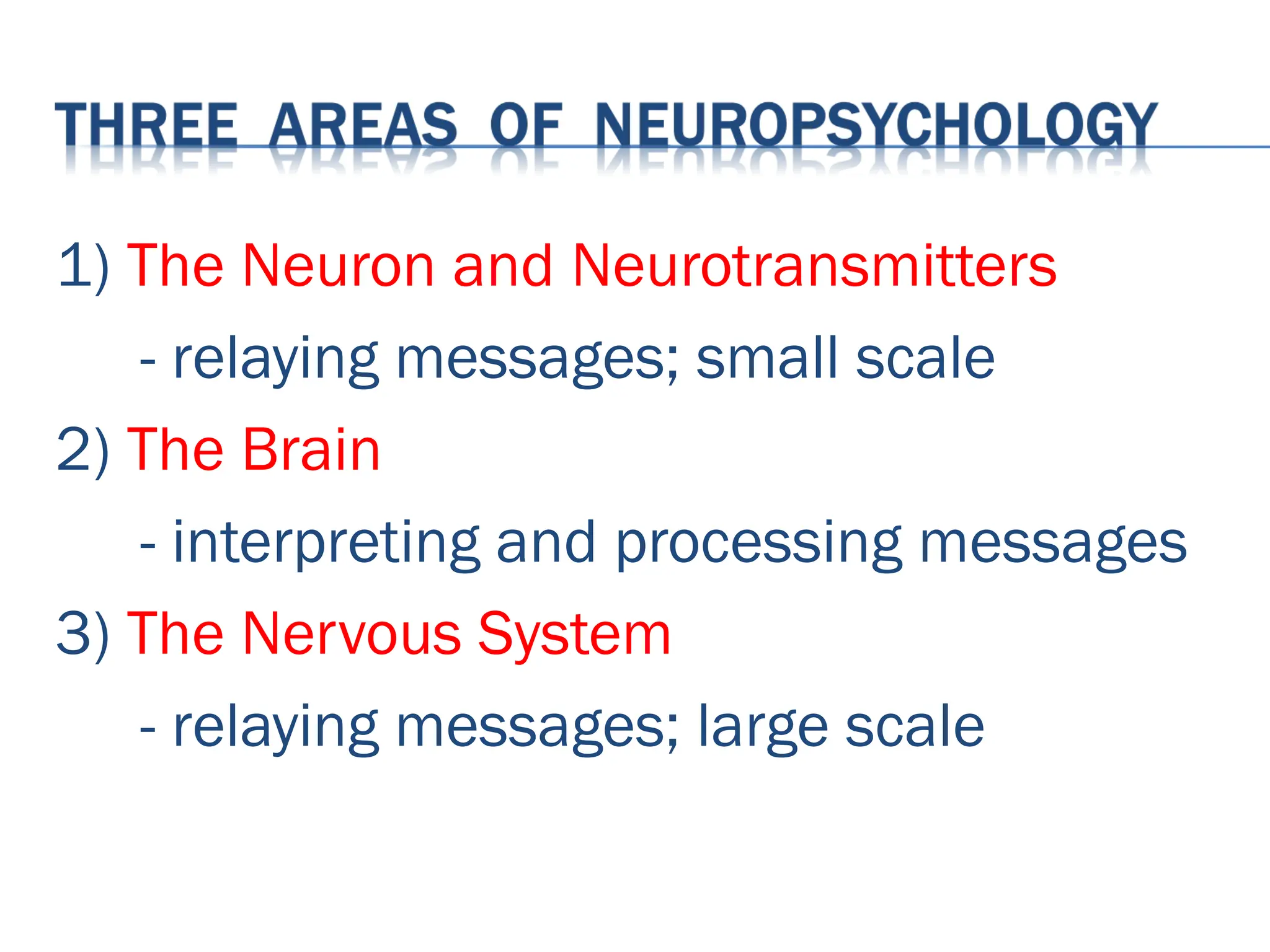
1) The Neuronand Neurotransmitters
- relaying messages; small scale
2) The Brain
- interpreting and processing messages
3) The Nervous System
- relaying messages; large scale
3.
The neuronis the basic building block of the
nervous system, which is the body’s primary
communication network.
The nervous system gathers and processes
information from the environment and allows
you to act on the environment.
The neuron’s basic task is to communicate with
in and with other neurons.
4.
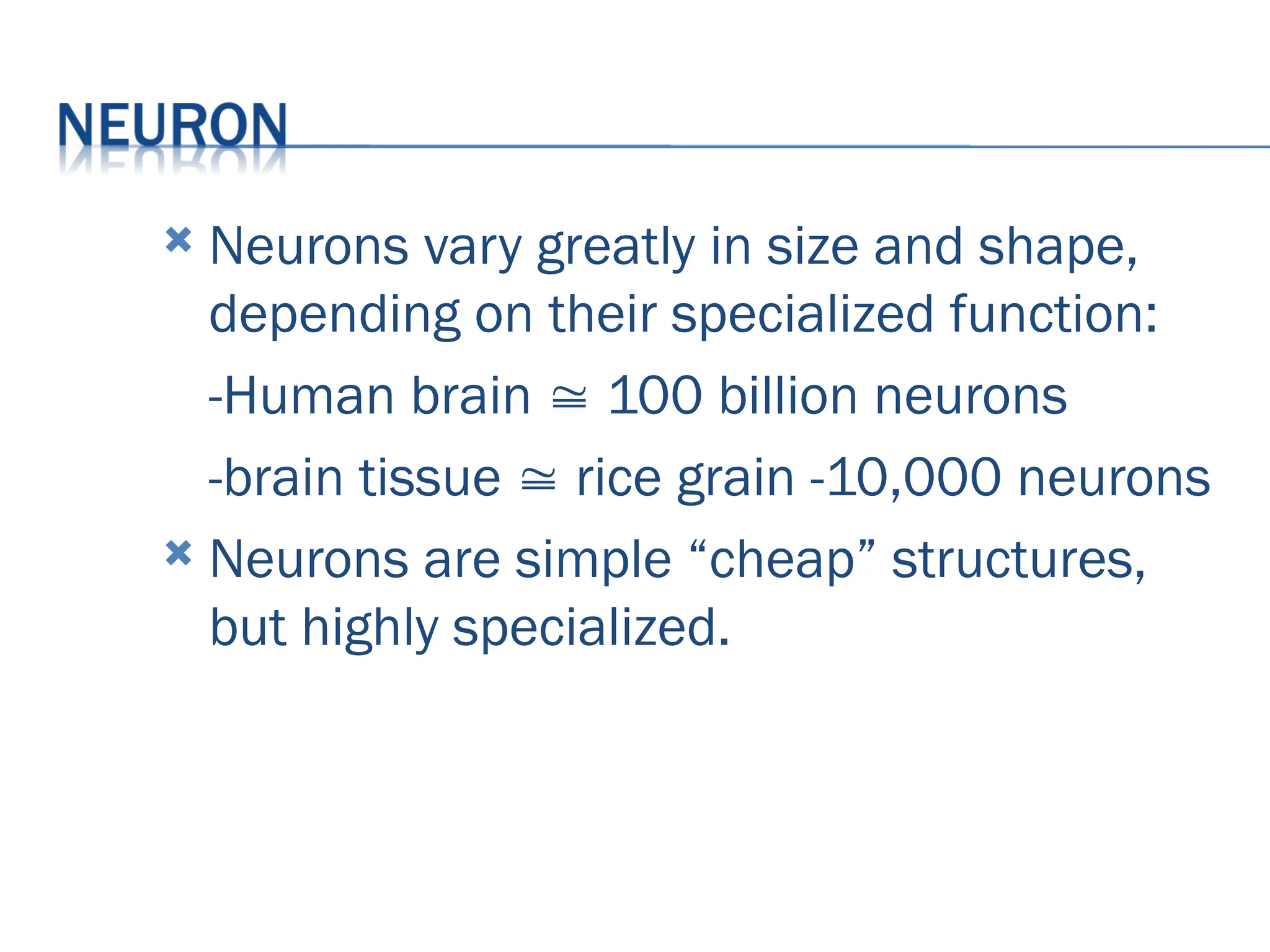
Neurons varygreatly in size and shape,
depending on their specialized function:
-Human brain 100 billion neurons
-brain tissue rice grain -10,000 neurons
Neurons are simple “cheap” structures,
but highly specialized.
6.
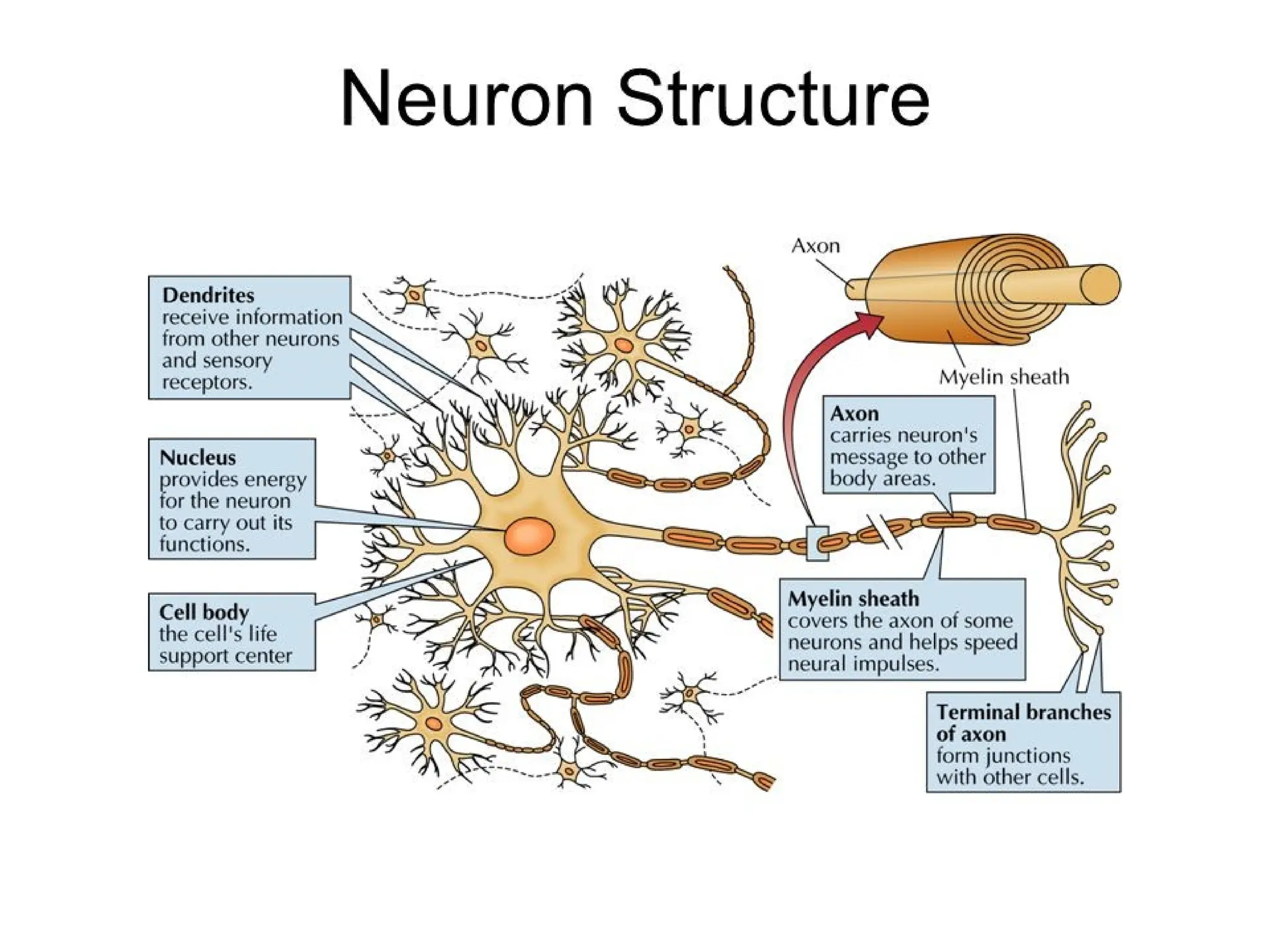
The neuronis comprised of three basic
components:
1. Dendrites
2. Cell body or soma
3. Nucleus
4. Axon
5. Myelin Sheath
6. Terminal branches
7. Terminal buttons
7.
Dentrites receiveinformation from other neurons
In Greek, dendrites mean branches, hence, they
are like extensive tree branches.
The more branches, the more information a neuron
can receive.
8.
The soma,or more commonly referred to as the cell
body, sums and subtracts the information it receives
from the dendrites.
It also contains the nucleus, which provides energy for
neurons to carry out their function.
9.
Contains GeneticMaterial (chromosomes)
including information for cell development and
synthesis of proteins, necessary for cell
maintenance and survival.
10.
The Axonsends messages to other neurons
and parts of body (ie. glands, muscles).
Unlike the dendrites, there is only one axon,
which varies in length (few thousandths of
inch to base of spine to big toe).
11.
To helptransmit the message or action potential down the
axon, “myelin sheath” insulates the axon.
Myelinated axons speed neuronal transmission by about
15 times.
Most neurons are myelinated, however, not all.
Myelinated axons are responsible for making our bodily
movements smooth.
If myelinated axons start to degenerate, then degenerative
diseases, such as multiple sclerosis or Parkinson’s disease
occurs, where movement is much more jagged
12.
Form Junctionswith other cells
7.
7. Terminal Buttons
Terminal Buttons
Are located at the end of terminal branches.
Responsible for sending the signals to other
neurons.
At the end of the terminal button is a gap called
synapses
synapses
13.
• Ifone neuron is signaling another neuron,
the first is called the presynaptic neuron, and
the second is called the postsynaptic neuron.
A presynaptic neuron can signal the dendrite,
cell body, or axon of a second neuron.
Synapses can be:
Chemical or Electrical
14.
Chemical synapsesare more common.
Chemical synapses involve the release of a
chemical called a neurotransmitter from the
axon’s terminal boutons.
The synaptic cleft is very small, and the
presynaptic and postsynaptic cells are held
close together by cell adhesion proteins.
15.
Electrical synapsesoccur in: – smooth muscle
and cardiac muscle, – between some neurons
of the brain, and – between glial cells (nerve
glue-keeps the whole CNS together, act as
house keeper and remove dead cells)
Cells are joined by gap junctions.
17.
In orderfor a neuron to fire it’s message, it
must reach “stimulus threshold.”
Stimulus threshold is the minimum amount of
information needed for the neuron to fire.
For example, your friend is talking in a low
voice, so low that you don’t even hear it.
Stimulus threshold is the lowest your friend
can talk to you so that you actually pick up
the sound, which is why the definition states
that it is the minimum amount of information.
18.
The firingof the message down the axon is
called “action potential.”
It occurs in an “all-or-none” process, which
means either the message is sent or not sent.
20.
Let’s goback to the example of your friend
whispering.
The louder your friend talks to you, the faster
the action potential (or message) will be sent to
the appropriate brain region so that it can
process this auditory information.
21.
Functional classification:–
Sensory neurons: conduct impulses from
sensory receptors to the CNS –
Motor neurons: conduct impulses from the
CNS to target organs (muscles or glands)
Association/interneurons: located completely
within the CNS and integrate functions of the
nervous system