What is Gender?
When you see an infant, how do you determine visually if the
baby is a boy or a girl? You might look for a bow or dress for a
girl or note the pink clothing. For elementary school children,
you would notice the style of a child's hair and way of dressing
to help you determine his or her sex. By middle and high school,
you would start to see physical characteristics and differences
including facial hair and voice changes for young men, breast
development in young women and differences in the two genders'
average heights.
The physical characteristics you start to see more prominently
in teenagers are determined primarily by our genes and the
resulting reproductive systems and hormones produced. These
genes determine our biological sex. Biological sex is whether we
are born male, female or in rarer cases, with biological
characteristics of both sexes.
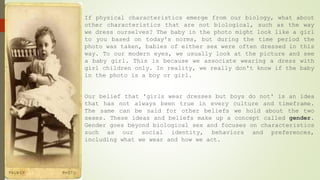
If physical characteristics emerge from our biology, what about
other characteristics that are not biological, such as the way
we dress ourselves? The baby in the photo might look like a girl
to you based on today's norms, but during the time period the
photo was taken, babies of either sex were often dressed in this
way. To our modern eyes, we usually look at the picture and see
a baby girl. This is because we associate wearing a dress with
girl children only. In reality, we really don't know if the baby
in the photo is a boy or girl.
Our belief that 'girls wear dresses but boys do not' is an idea
that has not always been true in every culture and timeframe.
The same can be said for other beliefs we hold about the two
sexes. These ideas and beliefs make up a concept called gender.
Gender goes beyond biological sex and focuses on characteristics
such as our social identity, behaviors and preferences,
including what we wear and how we act.
What is gender inequality?
Gender defines and differentiates what
women and men, and girls and boys, are
expected to be and do (their roles,
responsibilities, rights and
obligations).
While there are very distinct biological
differences between boys and girls and
these can create different needs and
capacities for each, these differences do
not in themselves lead to or justify
unequal social status or rights. The
distinct roles and behaviors that are
defined for boys and girls, and men and
women in a society may give rise to
gender inequalities, i.e. differences
between men and women that systematically
favor one group.
Gender can be a key
determinant of who does what,
who has what, who decides, who
has power, and even who gets
an education or not. In many
societies, boys are seen as
the ones who should be
educated, while girls are not.
UNICEF states that Gender equality means that women
and men, and girls and boys, enjoy the same rights,
resources, opportunities and protections. Gender
inequality arises when one group is seen in a society
as having more rights than the other. International
declarations such as CEDAW promote and defend women’s
rights, and therefore, today, gender equality
promoted as a fundamental condition for the full
enjoyment of human rights by women and men. This
right is recognized as a condition for growth and
development and global organizations promote gender
equality in their work.
Nevertheless, gender inequalities
persist in a wide range of areas.
Overcoming gender inequalities
requires profound transformations
in social structures and
relationships between men and
women.
Consequences of Gender Discrimination in
Education
 Discrimination results in a substantial gender gap in pay
towards women (75 cents for every dollar that men in
America when averaged across the population as a whole),
for the most part, being in low status, sex-stereotyped
occupations, which in part is due to gender differences in
majors. They also have to endure the main responsibilities
of domestic tasks, even though their labor force
participation has increased. Sex discrimination in high
school and college course-taking also results in women not
being prepared or qualified to pursue more prestigious,
high paying occupations. Sex discrimination in education
also results in women being more passive, quiet, and less
assertive, due to the effects of the hidden curriculum.
Classroom interactions can also have unseen
consequences. Because gender is something we learn,
day-to-day interactions shape our understandings of
how to do gender. Teachers and staff in an
elementary may reinforce certain gender roles
without thinking. Their communicative interactions
may also single out other students. For example, a
teacher may call on one or two students more than
the others. A gendered example would be a teacher
expecting a girl to be good at coloring or a boy to
be good at building. These types of interactions
restrict a student to the particular role assigned
to them.
Other consequences come in the form of what
is communicated as appropriate behaviors for
boys and girls in classes like physical
education. While a teacher may not purposely
try to communicate these differences, they
may tend to make comments based on gender
physical ability. For example, a male may be
told that he throws like a girl which
perpetuates him to become more masculine and
use brute force. A female, on the other hand,
might be told she is too masculine looking to
where she becomes more reserved and less
motivated.
gender.pptx
gender.pptx

gender.pptx

  • 1.
    What is Gender? Whenyou see an infant, how do you determine visually if the baby is a boy or a girl? You might look for a bow or dress for a girl or note the pink clothing. For elementary school children, you would notice the style of a child's hair and way of dressing to help you determine his or her sex. By middle and high school, you would start to see physical characteristics and differences including facial hair and voice changes for young men, breast development in young women and differences in the two genders' average heights. The physical characteristics you start to see more prominently in teenagers are determined primarily by our genes and the resulting reproductive systems and hormones produced. These genes determine our biological sex. Biological sex is whether we are born male, female or in rarer cases, with biological characteristics of both sexes.
  • 2.
    If physical characteristicsemerge from our biology, what about other characteristics that are not biological, such as the way we dress ourselves? The baby in the photo might look like a girl to you based on today's norms, but during the time period the photo was taken, babies of either sex were often dressed in this way. To our modern eyes, we usually look at the picture and see a baby girl. This is because we associate wearing a dress with girl children only. In reality, we really don't know if the baby in the photo is a boy or girl. Our belief that 'girls wear dresses but boys do not' is an idea that has not always been true in every culture and timeframe. The same can be said for other beliefs we hold about the two sexes. These ideas and beliefs make up a concept called gender. Gender goes beyond biological sex and focuses on characteristics such as our social identity, behaviors and preferences, including what we wear and how we act.
  • 3.
    What is genderinequality? Gender defines and differentiates what women and men, and girls and boys, are expected to be and do (their roles, responsibilities, rights and obligations).
  • 4.
    While there arevery distinct biological differences between boys and girls and these can create different needs and capacities for each, these differences do not in themselves lead to or justify unequal social status or rights. The distinct roles and behaviors that are defined for boys and girls, and men and women in a society may give rise to gender inequalities, i.e. differences between men and women that systematically favor one group.
  • 5.
    Gender can bea key determinant of who does what, who has what, who decides, who has power, and even who gets an education or not. In many societies, boys are seen as the ones who should be educated, while girls are not.
  • 6.
    UNICEF states thatGender equality means that women and men, and girls and boys, enjoy the same rights, resources, opportunities and protections. Gender inequality arises when one group is seen in a society as having more rights than the other. International declarations such as CEDAW promote and defend women’s rights, and therefore, today, gender equality promoted as a fundamental condition for the full enjoyment of human rights by women and men. This right is recognized as a condition for growth and development and global organizations promote gender equality in their work.
  • 7.
    Nevertheless, gender inequalities persistin a wide range of areas. Overcoming gender inequalities requires profound transformations in social structures and relationships between men and women.
  • 9.
    Consequences of GenderDiscrimination in Education  Discrimination results in a substantial gender gap in pay towards women (75 cents for every dollar that men in America when averaged across the population as a whole), for the most part, being in low status, sex-stereotyped occupations, which in part is due to gender differences in majors. They also have to endure the main responsibilities of domestic tasks, even though their labor force participation has increased. Sex discrimination in high school and college course-taking also results in women not being prepared or qualified to pursue more prestigious, high paying occupations. Sex discrimination in education also results in women being more passive, quiet, and less assertive, due to the effects of the hidden curriculum.
  • 10.
    Classroom interactions canalso have unseen consequences. Because gender is something we learn, day-to-day interactions shape our understandings of how to do gender. Teachers and staff in an elementary may reinforce certain gender roles without thinking. Their communicative interactions may also single out other students. For example, a teacher may call on one or two students more than the others. A gendered example would be a teacher expecting a girl to be good at coloring or a boy to be good at building. These types of interactions restrict a student to the particular role assigned to them.
  • 11.
    Other consequences comein the form of what is communicated as appropriate behaviors for boys and girls in classes like physical education. While a teacher may not purposely try to communicate these differences, they may tend to make comments based on gender physical ability. For example, a male may be told that he throws like a girl which perpetuates him to become more masculine and use brute force. A female, on the other hand, might be told she is too masculine looking to where she becomes more reserved and less motivated.