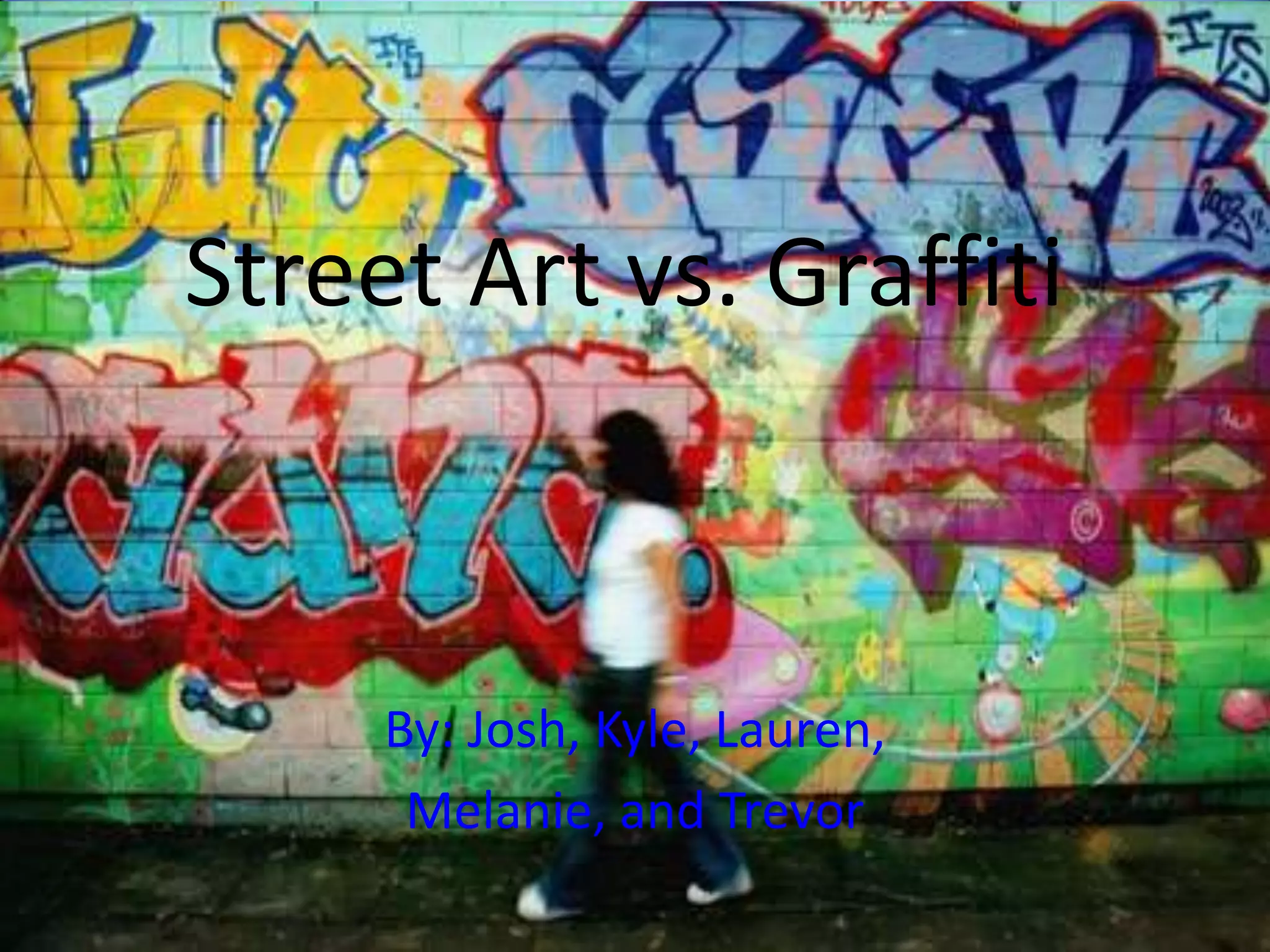
Street Art vs. Graffiti


     By: Josh, Kyle, Lauren,
      Melanie, and Trevor
Introduction
• Basic differences between Street Art and
  Graffiti
• A brief history of street art and graffiti
• How society views street art
• How the artists view their work
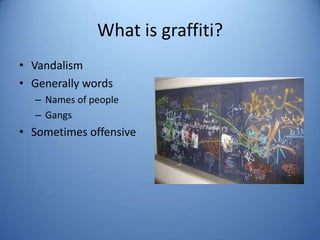
What is graffiti?
• Vandalism
• Generally words
  – Names of people
  – Gangs
• Sometimes offensive
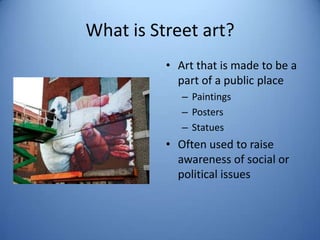
What is Street art?
          • Art that is made to be a
            part of a public place
             – Paintings
             – Posters
             – Statues
          • Often used to raise
            awareness of social or
            political issues
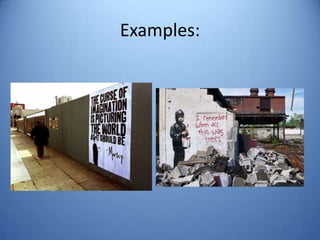
Examples:
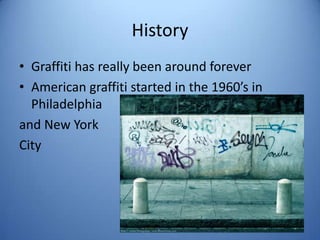
History
• Graffiti has really been around forever
• American graffiti started in the 1960’s in
  Philadelphia
and New York
City
Basic History
• New York City is the real birthplace of graffiti
• Gang art was the beginning but it soon
  transformed into something more individual
• Artists began “tagging” subway cars as a way
  of gaining notoriety
• Started off with simple names, but soon grew
  into big, fancy designs
• The goal was to show your dominance in the
  art
Basic History (Continued)


• At first, artists just wanted their name out
  there
• Soon they began developing masterpieces,
  or pieces, to further distinguish themselves
• Led to the development of different styles
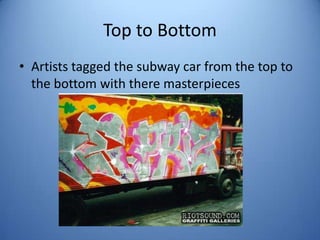
Top to Bottom
• Artists tagged the subway car from the top to
  the bottom with there masterpieces
Throw Up
• No not puke
• One of the original styles of tagging
• Characterized by
one color outline
and one color filler
Softie Letters
• Bubble letters
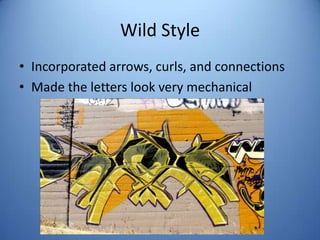
Wild Style
• Incorporated arrows, curls, and connections
• Made the letters look very mechanical
Metropolitan Transit Authority
• They did not appreciate the graffiti on their
  cars
• The government allotted more money to the
  anti graffiti division
• Led to the train yards being better monitored
  and harder to sneak into
• Cut down on the amount of graffiti and
  started cleaning cars off
• By 1986 most lines were running clean cars
• Artists began returning to the streets
• Today most artists paint on the streets but the
  few who believe the only true graffiti art is on
  subway cars continue their fight against the
  MTA
Society’s View
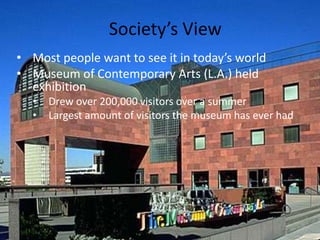
• Most people want to see it in today’s world
• Museum of Contemporary Arts (L.A.) held
  exhibition
  •   Drew over 200,000 visitors over a summer
  •   Largest amount of visitors the museum has ever had
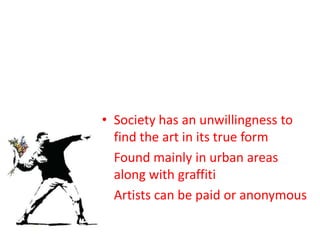
• Society has an unwillingness to
  find the art in its true form
• Found mainly in urban areas
  along with graffiti
• Artists can be paid or anonymous
• Can bring communities together
• Rough neighborhood banded
  together
• Gang members, children, parents
  and others helped paint mural
Artists’ Views
• Personal interviews with street and graffiti
  artists
• Asked them all the same questions:
  – Similarities/differences
  – Opinion on controversial aspects
     • Whether or not it’s illegal
     • Conflicts with society’s views
     • Conflicts between artists themselves
Artists’ Views
• Agreed on the technical side of street art and
  graffiti
  – Both are forms of public art
  – Graffiti has more rules
  – Graffiti is created on the spot, while street art
    begins in a studio
  – Both have legal and illegal components
Artists’ Views
• Differences found in the artist’s motivation
   – Graffiti
      • Exclusive and codified
      • Created for other graffiti artists in an attempt to make
        themselves well known
      • Destructive
   – Street art
      • Inclusive
      • Created for a larger audience
      • Aims to send a message without letting people know who
        the artist is
Artists’ Views
• Age affects an artist’s motivation
  – Graffiti is more popular for young people
     • Rebellion
     • Respect from peers
  – Many artists start with graffiti and become street
    artists later in life as they mature
Artists’ Views
• Others said there was no difference at all
  – Differences are just forced upon them by society
  – Everything has become too commercialized
  – Artists should be free to do what they want and it
    is up to society to accept that
Conclusion
• The basic differences that separate graffiti and
  street art
• A overview of the history of this art form
• How society views street art and the
  difference they see between graffiti and street
  art
• How artists see their work

Street art

  • 1.
    Street Art vs.Graffiti By: Josh, Kyle, Lauren, Melanie, and Trevor
  • 2.
    Introduction • Basic differencesbetween Street Art and Graffiti • A brief history of street art and graffiti • How society views street art • How the artists view their work
  • 3.
    What is graffiti? •Vandalism • Generally words – Names of people – Gangs • Sometimes offensive
  • 4.
    What is Streetart? • Art that is made to be a part of a public place – Paintings – Posters – Statues • Often used to raise awareness of social or political issues
  • 5.
  • 6.
    History • Graffiti hasreally been around forever • American graffiti started in the 1960’s in Philadelphia and New York City
  • 7.
    Basic History • NewYork City is the real birthplace of graffiti • Gang art was the beginning but it soon transformed into something more individual • Artists began “tagging” subway cars as a way of gaining notoriety • Started off with simple names, but soon grew into big, fancy designs • The goal was to show your dominance in the art
  • 8.
    Basic History (Continued) •At first, artists just wanted their name out there • Soon they began developing masterpieces, or pieces, to further distinguish themselves • Led to the development of different styles
  • 9.
    Top to Bottom •Artists tagged the subway car from the top to the bottom with there masterpieces
  • 10.
    Throw Up • Nonot puke • One of the original styles of tagging • Characterized by one color outline and one color filler
  • 11.
  • 12.
    Wild Style • Incorporatedarrows, curls, and connections • Made the letters look very mechanical
  • 13.
    Metropolitan Transit Authority •They did not appreciate the graffiti on their cars • The government allotted more money to the anti graffiti division • Led to the train yards being better monitored and harder to sneak into
  • 14.
    • Cut downon the amount of graffiti and started cleaning cars off • By 1986 most lines were running clean cars • Artists began returning to the streets • Today most artists paint on the streets but the few who believe the only true graffiti art is on subway cars continue their fight against the MTA
  • 15.
    Society’s View • Mostpeople want to see it in today’s world • Museum of Contemporary Arts (L.A.) held exhibition • Drew over 200,000 visitors over a summer • Largest amount of visitors the museum has ever had
  • 16.
    • Society hasan unwillingness to find the art in its true form • Found mainly in urban areas along with graffiti • Artists can be paid or anonymous
  • 17.
    • Can bringcommunities together • Rough neighborhood banded together • Gang members, children, parents and others helped paint mural
  • 18.
    Artists’ Views • Personalinterviews with street and graffiti artists • Asked them all the same questions: – Similarities/differences – Opinion on controversial aspects • Whether or not it’s illegal • Conflicts with society’s views • Conflicts between artists themselves
  • 19.
    Artists’ Views • Agreedon the technical side of street art and graffiti – Both are forms of public art – Graffiti has more rules – Graffiti is created on the spot, while street art begins in a studio – Both have legal and illegal components
  • 20.
    Artists’ Views • Differencesfound in the artist’s motivation – Graffiti • Exclusive and codified • Created for other graffiti artists in an attempt to make themselves well known • Destructive – Street art • Inclusive • Created for a larger audience • Aims to send a message without letting people know who the artist is
  • 21.
    Artists’ Views • Ageaffects an artist’s motivation – Graffiti is more popular for young people • Rebellion • Respect from peers – Many artists start with graffiti and become street artists later in life as they mature
  • 22.
    Artists’ Views • Otherssaid there was no difference at all – Differences are just forced upon them by society – Everything has become too commercialized – Artists should be free to do what they want and it is up to society to accept that
  • 23.
    Conclusion • The basicdifferences that separate graffiti and street art • A overview of the history of this art form • How society views street art and the difference they see between graffiti and street art • How artists see their work