Presented By:
Rafayel Ahmed
Farzana Nazneen
Waliul Islam
MIT-131037
MIT-131016
MIT-131018
company name
Business Analysis
 History
 Some Interesting Facts
 Mission, Vision
 Competitors
 Financial Facts
 Competitive advantage
 Key success Factors
company name
History
Raymond Kroc, founder and builder of McDonald's Corporation
was a milkshake machine salesman prior to meeting the two
brothers in 1954
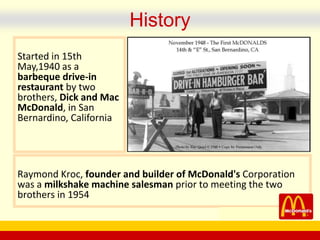
Started in 15th
May,1940 as a
barbeque drive-in
restaurant by two
brothers, Dick and Mac
McDonald, in San
Bernardino, California
company name
History
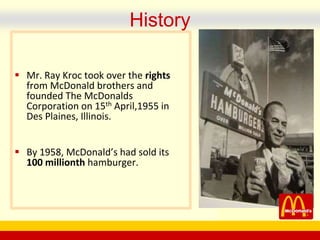
 Mr. Ray Kroc took over the rights
from McDonald brothers and
founded The McDonalds
Corporation on 15th April,1955 in
Des Plaines, Illinois.
 By 1958, McDonald’s had sold its
100 millionth hamburger.
company name
Some Interesting Facts
About McDonalds
 Currently McDonald's serves
around 69 million people
worldwide everyday.
 It currently employs around
4,00,000 employees
worldwide.
company name
Some Interesting Facts
About McDonalds
company name
Some Interesting Facts
About McDonalds
company name
McDonalds-Mission Statement
company name
Main Rivals
There are many competitors are eating their shares.
company name
McDonald's – Competitors
 The main things they have to compete with
each other are
1.Minimizing cost
2.Customer satisfaction
3.Healthy ingredients
4.Convenient locations
company name
Financial Analysis
-
5,000.00
10,000.00
15,000.00
20,000.00
25,000.00
30,000.00
2009-12 2010-12 2011-12 2012-12 2013-12 TTM
Revenue
-
1,000.00
2,000.00
3,000.00
4,000.00
5,000.00
6,000.00
2009-12 2010-12 2011-12 2012-12 2013-12 TTM
Net income
Revenue is presently at 28,106 million in 2013 compares to
22,745 million in 2009.
Net income is at 5,586 million compares to 4,551 in 2009.
company name
Financial Analysis
Profitability 2009-12 2010-12 2011-12 2012-12 2013-12 TTM
Tax Rate % 29.84 29.34 31.32 32.36 31.92 31.92
Net Margin % 20.01 20.55 20.38 19.82 19.87 19.87
Asset Turnover (Average) 0.78 0.77 0.83 0.81 0.78 0.78
Return on Assets % 15.51 15.9 16.94 15.98 15.51 15.51
Financial Leverage (Average) 2.15 2.19 2.29 2.31 2.29 2.34
Return on Equity % 33.2 34.51 37.92 36.82 35.69 35.69
Return on Invested Capital % 17.5 18.24 19.48 18.33 17.71 17.71
Interest Coverage 14.71 16.53 17.26 16.64 16.72 16.72
Return on Equity is at 35.69% which is a 2.5% increase from 2009
Return on invested capital is at the same level as it was in 2009
company name
McDonalds-Profitability with the
Retailing Industry
company name
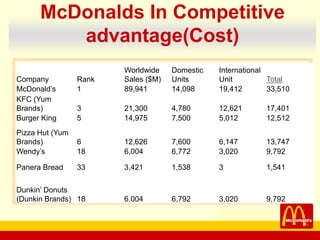
McDonalds In Competitive
advantage(Cost)
Company Rank
Worldwide
Sales ($M)
Domestic
Units
International
Unit Total
McDonald’s 1 89,941 14,098 19,412 33,510
KFC (Yum
Brands) 3 21,300 4,780 12,621 17,401
Burger King 5 14,975 7,500 5,012 12,512
Pizza Hut (Yum
Brands) 6 12,626 7,600 6,147 13,747
Wendy’s 18 6,004 6,772 3,020 9,792
Panera Bread 33 3,421 1,538 3 1,541
Dunkin’ Donuts
(Dunkin Brands) 18 6,004 6,792 3,020 9,792
company name
McDonald's – Competitive
advantage(Differentiate)
 Mc Café
Modern, relaxing mood
Free Wifi.
Attract new market segments
Variety of drinks
Satisfy hunger
company name
McDonald's–Key Success Factor
Customer Range
A key factor in the success of McDonald’s
is its ability to appeal to a wide range of
customers. For example, in June 1976
McDonald’s introduced a breakfast menu
to capture more customers
Nutrition
On the organization’s website,
McDonald’s states that part of its success
is due to its commitment to the well-
being of customers. In 2004, McDonald’s
established a global advisory council to
provide expert guidance on nutrition and
well-being.
company name
McDonald's–Key Success Factor
Availability
Restaurant locations are so prevalent in
suburban towns and cities that you are
never more then a few minutes away by car
or by foot
Affordability
McDonald’s has weathered economic
downturns because of the affordability of its
menu
.
company name
Environmental Analysis
 Porters Five Forces analysis
 Micro Environmental analysis
 Internal Environment
 Strength
 weakness
 External Environment
 Opportunities
 Theatres
 Macro Environment Analysis
 PESTEL
company name
McDonald's –Five Forces
company name
McDonald's –Five Forces
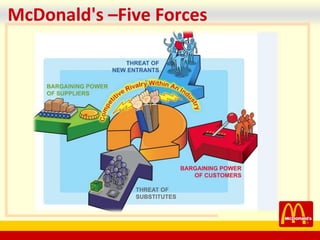
Threat of Competition HIGH
 Very similar products in the Fast Food industry
 High Competitors Advertising Capabilities
 Location of outlets are close
 EX: KFC, Chick-fil-A, Burger King,Sturbacks.
Threat of New Entrance Moderate
 Easy to enter, low setup cost
 Lack of ability to compete with MCD( cost efficiency,
customer awareness)
Threat of Substitutes Moderate
 Substitutable food
 Irreplaceable image
company name
McDonald's –Five Forces
Power of Suppliers LOW
 Worlds largest restaurant chain in sales
 High bargaining power over its suppliers(volume)
 Most of them owe MCD for their own existence
 Low power of suppliers—Lower the cost of raw
materials and High competitive price
Power of Buyers LOW
 Less chances of switching, high brand image through
differentiation and uniqueness
 Attractive price
 Buyer don’t have bargaining power(Low volume)
company name
McDonald's –SWOT Analysis
Internal Analysis
Strength
 Brand name
 Adapts to local markets
 Socially responsible with charities
 Safety and quality food
Weakness
 Management's failure to see
trends that do not fit
 High employee turnovers
 Price competition
 Controlling quality with franchised
operations
company name
McDonald's –SWOT Analysis
External Analysis
Opportunities
 Upscale restaurant
 Organic foods for the health conscious
 Going green
 Expanding to new parts of the globe
Threats
 Sued for unhealthy food many times
 Health concerns
 Competitors
 Contamination risks
 Geopolitical issues affect
company name
McDonald's –External Factor
Evaluation matrix( EFE )
company name
McDonald's –Macro environments
PESTEL Analysis
Political (Mild Threat (-1))
• Government regulations over wage
• Government regulation on labeling/packaging
Economic (Moderate Opportunity (+2))
• Inflation, Recession
• Exchange rate
• U.S. housing market crash/EU financial crisis
Social (Moderate Threat (-2))
• Employment opportunities
• Health conscious trends
• Norms , cultural practice
company name
McDonald's –Macro environments
PESTEL Analysis
Technological (Significant Opportunity (+5))
• Improvement by advanced technology, Social media outlets for
consumer
• Increasing comfort levels with technology
Environmental (Opportunity (+3))
• Forced not to harm the environment
• Lobbying for use of environmentally friendly material
Legal (Major Threat (-4))
• Advertisement regulations
• Health lawsuits
company name
Strategically Analysis
 Generic Building Block
 Corporate Level Strategies
 Business Level Strategies
 Functional Level Strategies
 Criticism and Recommendation
company name
McDonalds-The Generic Building
Blocks of Competitive Advantage
company name
Corporate Level Strategies (Globalization)
McDonald’s currently operates over 32000 stores
worldwide in 120 countries.
company name
Corporate Level Strategies (Branding)
company name
Corporate Level Strategies (Branding)
company name
Business Level Strategies (Target Market)
company name
App ki jamaneme Baap ki Jamane ki
Daam
$3.05 $3.50
Business Level Strategies (Marketing)
company name
Efficiency, Innovation and Renovation
Efficiency
New Look
Outdoor Kisds
Zone
Functional Level Strategies
company name
Norms and Cultural Practice
Functional Level Strategies
company name
Worker, Employees and Cook
Functional Level Strategies
company name
Criticism and Recommendation
-Ecological damage
-Selling unhealthy food, McDonalds=junk food?
-Contributing to suffering and exploitation of livestock.
-Speculating Business Practice
-Low Risk Mitigation strategies
-New Innovative menus
-Bigger ranged sectors
-More diversification and Acquisition
-Better service and employment (operational improvement)
-Better Corporate level/management level involvement
-More focus on subcontinent.
company name
Thanks!
You Want to Bite?

Strategy_of_McDonals.ppt

  • 1.
    Presented By: Rafayel Ahmed FarzanaNazneen Waliul Islam MIT-131037 MIT-131016 MIT-131018
  • 2.
    company name Business Analysis History  Some Interesting Facts  Mission, Vision  Competitors  Financial Facts  Competitive advantage  Key success Factors
  • 3.
    company name History Raymond Kroc,founder and builder of McDonald's Corporation was a milkshake machine salesman prior to meeting the two brothers in 1954 Started in 15th May,1940 as a barbeque drive-in restaurant by two brothers, Dick and Mac McDonald, in San Bernardino, California
  • 4.
    company name History  Mr.Ray Kroc took over the rights from McDonald brothers and founded The McDonalds Corporation on 15th April,1955 in Des Plaines, Illinois.  By 1958, McDonald’s had sold its 100 millionth hamburger.
  • 5.
    company name Some InterestingFacts About McDonalds  Currently McDonald's serves around 69 million people worldwide everyday.  It currently employs around 4,00,000 employees worldwide.
  • 6.
    company name Some InterestingFacts About McDonalds
  • 7.
    company name Some InterestingFacts About McDonalds
  • 8.
  • 9.
    company name Main Rivals Thereare many competitors are eating their shares.
  • 10.
    company name McDonald's –Competitors  The main things they have to compete with each other are 1.Minimizing cost 2.Customer satisfaction 3.Healthy ingredients 4.Convenient locations
  • 11.
    company name Financial Analysis - 5,000.00 10,000.00 15,000.00 20,000.00 25,000.00 30,000.00 2009-122010-12 2011-12 2012-12 2013-12 TTM Revenue - 1,000.00 2,000.00 3,000.00 4,000.00 5,000.00 6,000.00 2009-12 2010-12 2011-12 2012-12 2013-12 TTM Net income Revenue is presently at 28,106 million in 2013 compares to 22,745 million in 2009. Net income is at 5,586 million compares to 4,551 in 2009.
  • 12.
    company name Financial Analysis Profitability2009-12 2010-12 2011-12 2012-12 2013-12 TTM Tax Rate % 29.84 29.34 31.32 32.36 31.92 31.92 Net Margin % 20.01 20.55 20.38 19.82 19.87 19.87 Asset Turnover (Average) 0.78 0.77 0.83 0.81 0.78 0.78 Return on Assets % 15.51 15.9 16.94 15.98 15.51 15.51 Financial Leverage (Average) 2.15 2.19 2.29 2.31 2.29 2.34 Return on Equity % 33.2 34.51 37.92 36.82 35.69 35.69 Return on Invested Capital % 17.5 18.24 19.48 18.33 17.71 17.71 Interest Coverage 14.71 16.53 17.26 16.64 16.72 16.72 Return on Equity is at 35.69% which is a 2.5% increase from 2009 Return on invested capital is at the same level as it was in 2009
  • 13.
  • 14.
    company name McDonalds InCompetitive advantage(Cost) Company Rank Worldwide Sales ($M) Domestic Units International Unit Total McDonald’s 1 89,941 14,098 19,412 33,510 KFC (Yum Brands) 3 21,300 4,780 12,621 17,401 Burger King 5 14,975 7,500 5,012 12,512 Pizza Hut (Yum Brands) 6 12,626 7,600 6,147 13,747 Wendy’s 18 6,004 6,772 3,020 9,792 Panera Bread 33 3,421 1,538 3 1,541 Dunkin’ Donuts (Dunkin Brands) 18 6,004 6,792 3,020 9,792
  • 15.
    company name McDonald's –Competitive advantage(Differentiate)  Mc Café Modern, relaxing mood Free Wifi. Attract new market segments Variety of drinks Satisfy hunger
  • 16.
    company name McDonald's–Key SuccessFactor Customer Range A key factor in the success of McDonald’s is its ability to appeal to a wide range of customers. For example, in June 1976 McDonald’s introduced a breakfast menu to capture more customers Nutrition On the organization’s website, McDonald’s states that part of its success is due to its commitment to the well- being of customers. In 2004, McDonald’s established a global advisory council to provide expert guidance on nutrition and well-being.
  • 17.
    company name McDonald's–Key SuccessFactor Availability Restaurant locations are so prevalent in suburban towns and cities that you are never more then a few minutes away by car or by foot Affordability McDonald’s has weathered economic downturns because of the affordability of its menu .
  • 18.
    company name Environmental Analysis Porters Five Forces analysis  Micro Environmental analysis  Internal Environment  Strength  weakness  External Environment  Opportunities  Theatres  Macro Environment Analysis  PESTEL
  • 19.
  • 20.
    company name McDonald's –FiveForces Threat of Competition HIGH  Very similar products in the Fast Food industry  High Competitors Advertising Capabilities  Location of outlets are close  EX: KFC, Chick-fil-A, Burger King,Sturbacks. Threat of New Entrance Moderate  Easy to enter, low setup cost  Lack of ability to compete with MCD( cost efficiency, customer awareness) Threat of Substitutes Moderate  Substitutable food  Irreplaceable image
  • 21.
    company name McDonald's –FiveForces Power of Suppliers LOW  Worlds largest restaurant chain in sales  High bargaining power over its suppliers(volume)  Most of them owe MCD for their own existence  Low power of suppliers—Lower the cost of raw materials and High competitive price Power of Buyers LOW  Less chances of switching, high brand image through differentiation and uniqueness  Attractive price  Buyer don’t have bargaining power(Low volume)
  • 22.
    company name McDonald's –SWOTAnalysis Internal Analysis Strength  Brand name  Adapts to local markets  Socially responsible with charities  Safety and quality food Weakness  Management's failure to see trends that do not fit  High employee turnovers  Price competition  Controlling quality with franchised operations
  • 23.
    company name McDonald's –SWOTAnalysis External Analysis Opportunities  Upscale restaurant  Organic foods for the health conscious  Going green  Expanding to new parts of the globe Threats  Sued for unhealthy food many times  Health concerns  Competitors  Contamination risks  Geopolitical issues affect
  • 24.
    company name McDonald's –ExternalFactor Evaluation matrix( EFE )
  • 25.
    company name McDonald's –Macroenvironments PESTEL Analysis Political (Mild Threat (-1)) • Government regulations over wage • Government regulation on labeling/packaging Economic (Moderate Opportunity (+2)) • Inflation, Recession • Exchange rate • U.S. housing market crash/EU financial crisis Social (Moderate Threat (-2)) • Employment opportunities • Health conscious trends • Norms , cultural practice
  • 26.
    company name McDonald's –Macroenvironments PESTEL Analysis Technological (Significant Opportunity (+5)) • Improvement by advanced technology, Social media outlets for consumer • Increasing comfort levels with technology Environmental (Opportunity (+3)) • Forced not to harm the environment • Lobbying for use of environmentally friendly material Legal (Major Threat (-4)) • Advertisement regulations • Health lawsuits
  • 27.
    company name Strategically Analysis Generic Building Block  Corporate Level Strategies  Business Level Strategies  Functional Level Strategies  Criticism and Recommendation
  • 28.
    company name McDonalds-The GenericBuilding Blocks of Competitive Advantage
  • 29.
    company name Corporate LevelStrategies (Globalization) McDonald’s currently operates over 32000 stores worldwide in 120 countries.
  • 30.
    company name Corporate LevelStrategies (Branding)
  • 31.
    company name Corporate LevelStrategies (Branding)
  • 32.
    company name Business LevelStrategies (Target Market)
  • 33.
    company name App kijamaneme Baap ki Jamane ki Daam $3.05 $3.50 Business Level Strategies (Marketing)
  • 34.
    company name Efficiency, Innovationand Renovation Efficiency New Look Outdoor Kisds Zone Functional Level Strategies
  • 35.
    company name Norms andCultural Practice Functional Level Strategies
  • 36.
    company name Worker, Employeesand Cook Functional Level Strategies
  • 37.
    company name Criticism andRecommendation -Ecological damage -Selling unhealthy food, McDonalds=junk food? -Contributing to suffering and exploitation of livestock. -Speculating Business Practice -Low Risk Mitigation strategies -New Innovative menus -Bigger ranged sectors -More diversification and Acquisition -Better service and employment (operational improvement) -Better Corporate level/management level involvement -More focus on subcontinent.
  • 38.

Editor's Notes

  • #3 Started in 1940 as a bbq drive in restaurant by two brothers in San Bernadino, CA Raymond Kroc is the found and builder of the MCDonalds Corporation – he used to be a milkshake machine saleman prior to meeting the 2 brothers By 1958 McDonalds had already sold its 100 millionth hamburger Its restaurants are operated by either a franchise affiliate or corporation and revenues for rent come from royalties and fees paid by the franchisees and sales from their restaurants
  • #4 Started in 1940 as a bbq drive in restaurant by two brothers in San Bernadino, CA Raymond Kroc is the found and builder of the MCDonalds Corporation – he used to be a milkshake machine saleman prior to meeting the 2 brothers By 1958 McDonalds had already sold its 100 millionth hamburger Its restaurants are operated by either a franchise affiliate or corporation and revenues for rent come from royalties and fees paid by the franchisees and sales from their restaurants
  • #5 Started in 1940 as a bbq drive in restaurant by two brothers in San Bernadino, CA Raymond Kroc is the found and builder of the MCDonalds Corporation – he used to be a milkshake machine saleman prior to meeting the 2 brothers By 1958 McDonalds had already sold its 100 millionth hamburger Its restaurants are operated by either a franchise affiliate or corporation and revenues for rent come from royalties and fees paid by the franchisees and sales from their restaurants
  • #6 Started in 1940 as a bbq drive in restaurant by two brothers in San Bernadino, CA Raymond Kroc is the found and builder of the MCDonalds Corporation – he used to be a milkshake machine saleman prior to meeting the 2 brothers By 1958 McDonalds had already sold its 100 millionth hamburger Its restaurants are operated by either a franchise affiliate or corporation and revenues for rent come from royalties and fees paid by the franchisees and sales from their restaurants
  • #7 Started in 1940 as a bbq drive in restaurant by two brothers in San Bernadino, CA Raymond Kroc is the found and builder of the MCDonalds Corporation – he used to be a milkshake machine saleman prior to meeting the 2 brothers By 1958 McDonalds had already sold its 100 millionth hamburger Its restaurants are operated by either a franchise affiliate or corporation and revenues for rent come from royalties and fees paid by the franchisees and sales from their restaurants
  • #8 Started in 1940 as a bbq drive in restaurant by two brothers in San Bernadino, CA Raymond Kroc is the found and builder of the MCDonalds Corporation – he used to be a milkshake machine saleman prior to meeting the 2 brothers By 1958 McDonalds had already sold its 100 millionth hamburger Its restaurants are operated by either a franchise affiliate or corporation and revenues for rent come from royalties and fees paid by the franchisees and sales from their restaurants
  • #9 Started in 1940 as a bbq drive in restaurant by two brothers in San Bernadino, CA Raymond Kroc is the found and builder of the MCDonalds Corporation – he used to be a milkshake machine saleman prior to meeting the 2 brothers By 1958 McDonalds had already sold its 100 millionth hamburger Its restaurants are operated by either a franchise affiliate or corporation and revenues for rent come from royalties and fees paid by the franchisees and sales from their restaurants
  • #12 TTM – Trailing Twelve months Revenue is presently at 28,106 million compares to 22,745 million in 2009. Net income is at 5,586 million compares to 4,551 in 2009
  • #13 Return on Equity is at 35.69% which is a 2.5% increase from 2009 Return on invested capital is at the same level as it was in 2009 Asset turnover is also consistent at 0.78 Day sales in inventory which is # days on avg inventory is on hand is at 17.5 which is also a 1.6 pt increase Inventory turnover is at 140.2 which is a 12 pt increase from 2009 reflecting the number of times they sell their entire inventory
  • #14 Return on Equity is at 35.69% which is a 2.5% increase from 2009 Return on invested capital is at the same level as it was in 2009 Asset turnover is also consistent at 0.78 Day sales in inventory which is # days on avg inventory is on hand is at 17.5 which is also a 1.6 pt increase Inventory turnover is at 140.2 which is a 12 pt increase from 2009 reflecting the number of times they sell their entire inventory
  • #15 Return on Equity is at 35.69% which is a 2.5% increase from 2009 Return on invested capital is at the same level as it was in 2009 Asset turnover is also consistent at 0.78 Day sales in inventory which is # days on avg inventory is on hand is at 17.5 which is also a 1.6 pt increase Inventory turnover is at 140.2 which is a 12 pt increase from 2009 reflecting the number of times they sell their entire inventory
  • #16 McCafe is an excellent example of diversification. By starting McCafe, McDonald's is offering new products that were not available in traditional McDonald's stores. McCafe specializes in serving cafes, which attracts customers that usually don't come to McDonald's to eat fast food. The store has modern, and relaxing mood. This is important to attract new market segments, probably customers that go to café to take a sip of coffee, get some snack to satisfy hunger, and chat in a relaxing environment. Thus, McDonald's McCafe serves as an example performing diversification by developing both new products and new markets.
  • #21 Competition Restaurant industry is highly competitive industry. There are many small fast food businesses in the industry who fight with each other to improve their customer base; McDonalds is not an exception to this. Since its establishment in 1940, MCD has excelled in the sector. Nevertheless, to stay in the competition, it started with McCafé. This helped the company to stay in the business as a major fast food business. Another major step came out when McDonald started Breakfast to compete with the existing business serving breakfast. Hence, this industry is extremely competitive and the MDC should be up to date with customer taste & preferences. Ease of Entry Although it is hard to enter the restaurant business, it is hard to establish a distinct brand name. There is a high cost of entry in the market and there is \ high research and development costs.  Large established companies with strong brand identities such as McDonald’s do make it more difficult to enter and succeed within the marketplace; new entrants find that they are faced with price competition from existing chain restaurants. Substitutes There are many substitutes in this industry. Since there are a wide variety of products that people can choose, they could either be substituted by MDC Burgers, Beverages, dairy products, and others. Strength of Suppliers Power of suppliers within the fast food industry would be relatively small, unless the main ingredient of the product is not readily available. Strength of Buyers Relatively strength of buyers is low in this industry
  • #22 Competition Restaurant industry is highly competitive industry. There are many small fast food businesses in the industry who fight with each other to improve their customer base; McDonalds is not an exception to this. Since its establishment in 1940, MCD has excelled in the sector. Nevertheless, to stay in the competition, it started with McCafé. This helped the company to stay in the business as a major fast food business. Another major step came out when McDonald started Breakfast to compete with the existing business serving breakfast. Hence, this industry is extremely competitive and the MDC should be up to date with customer taste & preferences. Ease of Entry Although it is hard to enter the restaurant business, it is hard to establish a distinct brand name. There is a high cost of entry in the market and there is \ high research and development costs.  Large established companies with strong brand identities such as McDonald’s do make it more difficult to enter and succeed within the marketplace; new entrants find that they are faced with price competition from existing chain restaurants. Substitutes There are many substitutes in this industry. Since there are a wide variety of products that people can choose, they could either be substituted by MDC Burgers, Beverages, dairy products, and others. Strength of Suppliers Power of suppliers within the fast food industry would be relatively small, unless the main ingredient of the product is not readily available. Strength of Buyers Relatively strength of buyers is low in this industry
  • #26 .
  • #27 .
  • #28 .
  • #29 .
  • #31 Return on Equity is at 35.69% which is a 2.5% increase from 2009 Return on invested capital is at the same level as it was in 2009 Asset turnover is also consistent at 0.78 Day sales in inventory which is # days on avg inventory is on hand is at 17.5 which is also a 1.6 pt increase Inventory turnover is at 140.2 which is a 12 pt increase from 2009 reflecting the number of times they sell their entire inventory
  • #32 .
  • #33 .
  • #34 Return on Equity is at 35.69% which is a 2.5% increase from 2009 Return on invested capital is at the same level as it was in 2009 Asset turnover is also consistent at 0.78 Day sales in inventory which is # days on avg inventory is on hand is at 17.5 which is also a 1.6 pt increase Inventory turnover is at 140.2 which is a 12 pt increase from 2009 reflecting the number of times they sell their entire inventory
  • #35 .
  • #36 Return on Equity is at 35.69% which is a 2.5% increase from 2009 Return on invested capital is at the same level as it was in 2009 Asset turnover is also consistent at 0.78 Day sales in inventory which is # days on avg inventory is on hand is at 17.5 which is also a 1.6 pt increase Inventory turnover is at 140.2 which is a 12 pt increase from 2009 reflecting the number of times they sell their entire inventory
  • #37 Return on Equity is at 35.69% which is a 2.5% increase from 2009 Return on invested capital is at the same level as it was in 2009 Asset turnover is also consistent at 0.78 Day sales in inventory which is # days on avg inventory is on hand is at 17.5 which is also a 1.6 pt increase Inventory turnover is at 140.2 which is a 12 pt increase from 2009 reflecting the number of times they sell their entire inventory