Overview of Strategic Pricing

David S. Bauders
All Rights Reserved
david.bauders@strategicpricing.com
216.536.2800
www.strategicpricing.com
Copyright 2013 Strategic Pricing Associates, Inc.
Strategic Pricing Associates, Inc. Overview
• 
• 

SPA Was Founded in 1993
SPA has Broad, Deep Experience & Success in Pricing

• 

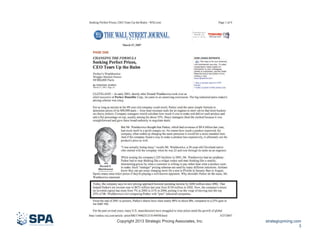
Led Parker Hannifin CEO’s worldwide pricing initiative over six years across 90
manufacturing units and 30 trading units: CEO attributed impact of over $800m

• 

Distributor/Dealers: ThermoFisher Scientific; Grainger; Wesco; OneSource;
Industrial Distribution Group; Finning; Boundtree Medical; Famous Supply; Valin

• 

Over 200 Manufacturers: ExxonMobil, GE, Rockwell Automation, Mitsubishi/
Caterpillar; American Standard, Sherwin Williams; ICI/Glidden; BASF; Pella; Dover;
Tyco; Akron Brass; Atkore

• 

Over 350 Industrial Distributor Businesses, with Strategic Partnerships

• 

Industrial; Electrical; Plumbing/HVAC/Building Products; Tools; Paper/Packaging;
Chemicals; Medical; Fluid Power; Equipment Dealers

• 

Partnerships with Parker Hannifin, ExxonMobil, Mitsubishi/Caterpillar, Rockwell
Automation, Pella, Activant

• 

Exclusive provider of pricing analytics to Epicor’s ERP platforms, such as Eclipse,
Prophet 21, Prelude; over 4200 distributors
Copyright 2013 Strategic Pricing Associates, Inc.

strategicpricing.com
2
Copyright 2013 Strategic Pricing Associates, Inc.

strategicpricing.com
3
Pricing Concepts

Copyright 2013 Strategic Pricing Associates, Inc.

strategicpricing.com
4
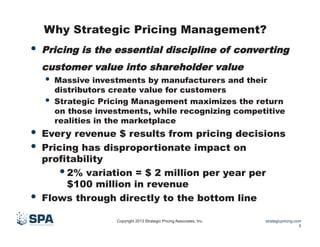
Why Strategic Pricing Management?

•  Pricing is the essential discipline of converting
customer value into shareholder value

•  Massive investments by manufacturers and their
• 

distributors create value for customers
Strategic Pricing Management maximizes the return
on those investments, while recognizing competitive
realities in the marketplace

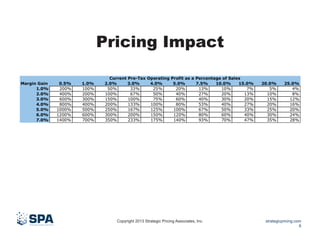
•  Every revenue $ results from pricing decisions
•  Pricing has disproportionate impact on

• 

profitability
• 2% variation = $ 2 million per year per
$100 million in revenue
Flows through directly to the bottom line
Copyright 2013 Strategic Pricing Associates, Inc.

strategicpricing.com
5
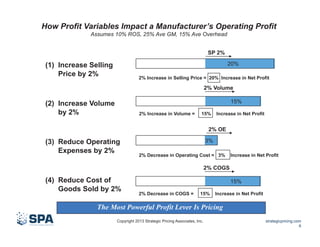
How Profit Variables Impact a Manufacturer’s Operating Profit
Assumes 10% ROS, 25% Ave GM, 15% Ave Overhead
SP 2%
20%

(1) Increase Selling
Price by 2%

2% Increase in Selling Price = 20% Increase in Net Profit

2% Volume
15%

(2) Increase Volume
by 2%

2% Increase in Volume =

15%

Increase in Net Profit

2% OE

(3) Reduce Operating
Expenses by 2%

3%
2% Decrease in Operating Cost = 3%

Increase in Net Profit

2% COGS

(4) Reduce Cost of
Goods Sold by 2%

15%
2% Decrease in COGS =

15%

Increase in Net Profit

The Most Powerful Profit Lever Is Pricing
Copyright 2013 Strategic Pricing Associates, Inc.

strategicpricing.com
6
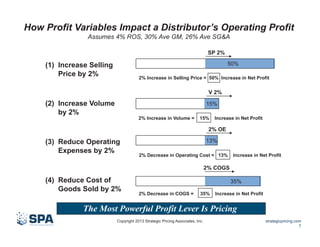
How Profit Variables Impact a Distributor’s Operating Profit
Assumes 4% ROS, 30% Ave GM, 26% Ave SG&A
SP 2%
50%

(1) Increase Selling
Price by 2%

2% Increase in Selling Price = 50% Increase in Net Profit

V 2%

(2) Increase Volume
by 2%

15%
2% Increase in Volume =

15%

Increase in Net Profit

2% OE

(3) Reduce Operating
Expenses by 2%

13%
2% Decrease in Operating Cost = 13%

Increase in Net Profit

2% COGS

(4) Reduce Cost of
Goods Sold by 2%

35%
2% Decrease in COGS =

35%

Increase in Net Profit

The Most Powerful Profit Lever Is Pricing
Copyright 2013 Strategic Pricing Associates, Inc.

strategicpricing.com
7
Pricing Impact

Copyright 2013 Strategic Pricing Associates, Inc.

strategicpricing.com
8
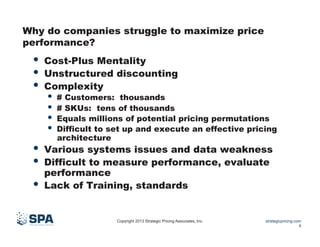
Why do companies struggle to maximize price
performance?

•  Cost-Plus Mentality
•  Unstructured discounting
•  Complexity

•  # Customers: thousands
•  # SKUs: tens of thousands
•  Equals millions of potential pricing permutations
•  Difficult to set up and execute an effective pricing
architecture

•  Various systems issues and data weakness
•  Difficult to measure performance, evaluate
• 

performance
Lack of Training, standards

Copyright 2013 Strategic Pricing Associates, Inc.

strategicpricing.com
9
Price Indexing:
Market Segmentation
• 
• 
• 
• 
• 
• 

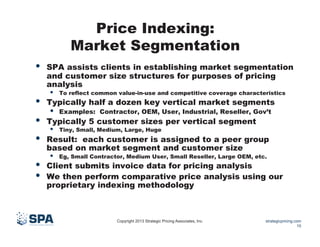
SPA assists clients in establishing market segmentation
and customer size structures for purposes of pricing
analysis

•  To reflect common value-in-use and competitive coverage characteristics
Typically half a dozen key vertical market segments

• 

Examples: Contractor, OEM, User, Industrial, Reseller, Gov’t

Typically 5 customer sizes per vertical segment

•  Tiny, Small, Medium, Large, Huge
Result: each customer is assigned to a peer group
based on market segment and customer size
•  Eg, Small Contractor, Medium User, Small Reseller, Large OEM, etc.
Client submits invoice data for pricing analysis
We then perform comparative price analysis using our
proprietary indexing methodology

Copyright 2013 Strategic Pricing Associates, Inc.

strategicpricing.com
10
Price Indexing
• 

Compare each customer’s price on any given
product or service to the prices paid by customers
in the same peer group

• 

• 

Peer groups reflect competitive coverage and general price
sensitivity

Indexing can be done at the individual product/
service (sku) level or at the customer’s basket level

Copyright 2013 Strategic Pricing Associates, Inc.

strategicpricing.com
11
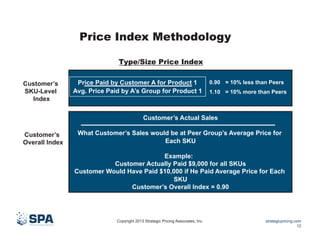
Price Index Methodology
Type/Size Price Index
Customer’s
SKU-Level
Index

Price Paid by Customer A for Product 1
Avg. Price Paid by A’s Group for Product 1

0.90 = 10% less than Peers
1.10 = 10% more than Peers

Customer’s Actual Sales
Customer’s
Overall Index

What Customer’s Sales would be at Peer Group’s Average Price for
Each SKU
Example:
Customer Actually Paid $9,000 for all SKUs
Customer Would Have Paid $10,000 if He Paid Average Price for Each
SKU
Customer’s Overall Index = 0.90

Copyright 2013 Strategic Pricing Associates, Inc.

strategicpricing.com
12
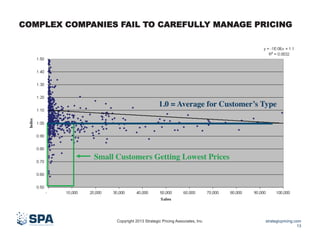
COMPLEX COMPANIES FAIL TO CAREFULLY MANAGE PRICING

1.0 = Average for Customer’s Type

Small Customers Getting Lowest Prices

Copyright 2013 Strategic Pricing Associates, Inc.

strategicpricing.com
13
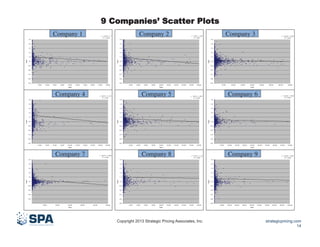
9 Companies’ Scatter Plots
Company 1

Company 2

Company 3

Company 4

Company 5

Company 6

Company 7

Company 8

Company 9

Copyright 2013 Strategic Pricing Associates, Inc.

strategicpricing.com
14
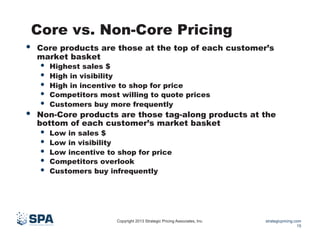
Core vs. Non-Core Pricing
• 

• 

Core products are those at the top of each customer’s
market basket

• 
• 
• 
• 
• 

Highest sales $
High in visibility
High in incentive to shop for price
Competitors most willing to quote prices
Customers buy more frequently

Non-Core products are those tag-along products at the
bottom of each customer’s market basket

• 
• 
• 
• 
• 

Low in sales $
Low in visibility
Low incentive to shop for price
Competitors overlook
Customers buy infrequently

Copyright 2013 Strategic Pricing Associates, Inc.

strategicpricing.com
15
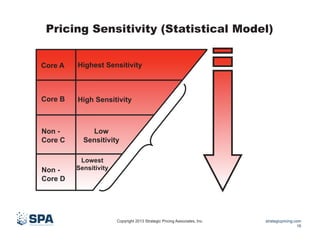
Pricing Sensitivity (Statistical Model)
Core A

Highest Sensitivity

Core B

High Sensitivity

Non Core C

Non Core D

Low
Sensitivity
Lowest
Sensitivity

Price
adjustments
limited to
bottom 50%
of customer
sales

Copyright 2013 Strategic Pricing Associates, Inc.

strategicpricing.com
16
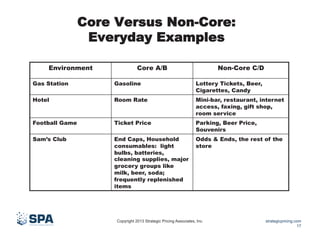
Core Versus Non-Core:
Everyday Examples
Environment

Core A/B

Non-Core C/D

Gas Station

Gasoline

Lottery Tickets, Beer,
Cigarettes, Candy

Hotel

Room Rate

Mini-bar, restaurant, internet
access, faxing, gift shop,
room service

Football Game

Ticket Price

Parking, Beer Price,
Souvenirs

Sam’s Club

End Caps, Household
consumables: light
bulbs, batteries,
cleaning supplies, major
grocery groups like
milk, beer, soda;
frequently replenished
items

Odds & Ends, the rest of the
store

Copyright 2013 Strategic Pricing Associates, Inc.

strategicpricing.com
17
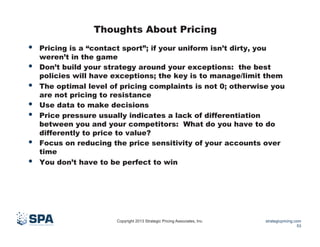
Thoughts About Pricing

• 
• 
• 
• 
• 
• 
• 

Pricing is a “contact sport”; if your uniform isn’t dirty, you
weren’t in the game
Don’t build your strategy around your exceptions: the best
policies will have exceptions; the key is to manage/limit them
The optimal level of pricing complaints is not 0; otherwise you
are not pricing to resistance
Use data to make decisions
Price pressure usually indicates a lack of differentiation
between you and your competitors: What do you have to do
differently to price to value?
Focus on reducing the price sensitivity of your accounts over
time
You don’t have to be perfect to win

Copyright 2013 Strategic Pricing Associates, Inc.

strategicpricing.com
53
Next Steps
• 
• 

Please visit the SPA website: www.strategicpricing.com
Take A Free Pricing Opportunity Profile :
www.strategicpricing.com/offer/profile/

• 
• 

Upcoming Free Events:
Webinars held several times per month; check SPA website

• 

SPA Strategy Seminars

• 

Full-day seminars, held several times per year in cities worldwide; check SPA
website

Copyright 2013 Strategic Pricing Associates, Inc.

strategicpricing.com
54
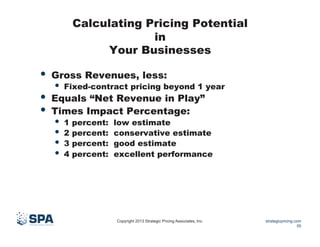
Calculating Pricing Potential
in
Your Businesses

•  Gross Revenues, less:

•  Fixed-contract pricing beyond 1 year

•  Equals “Net Revenue in Play”
•  Times Impact Percentage:
•  1 percent:
•  2 percent:
•  3 percent:
•  4 percent:

low estimate
conservative estimate
good estimate
excellent performance

Copyright 2013 Strategic Pricing Associates, Inc.

strategicpricing.com
55
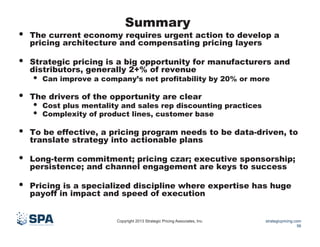
Summary
• 

The current economy requires urgent action to develop a
pricing architecture and compensating pricing layers

• 

Strategic pricing is a big opportunity for manufacturers and
distributors, generally 2+% of revenue

• 

• 

Can improve a company’s net profitability by 20% or more

The drivers of the opportunity are clear

• 
• 

Cost plus mentality and sales rep discounting practices
Complexity of product lines, customer base

• 

To be effective, a pricing program needs to be data-driven, to
translate strategy into actionable plans

• 

Long-term commitment; pricing czar; executive sponsorship;
persistence; and channel engagement are keys to success

• 

Pricing is a specialized discipline where expertise has huge
payoff in impact and speed of execution

Copyright 2013 Strategic Pricing Associates, Inc.

strategicpricing.com
56

Strategic Pricing Associates (SPA) Overview Jan-2014

  • 1.
    Overview of StrategicPricing David S. Bauders All Rights Reserved david.bauders@strategicpricing.com 216.536.2800 www.strategicpricing.com Copyright 2013 Strategic Pricing Associates, Inc.
  • 2.
    Strategic Pricing Associates,Inc. Overview •  •  SPA Was Founded in 1993 SPA has Broad, Deep Experience & Success in Pricing •  Led Parker Hannifin CEO’s worldwide pricing initiative over six years across 90 manufacturing units and 30 trading units: CEO attributed impact of over $800m •  Distributor/Dealers: ThermoFisher Scientific; Grainger; Wesco; OneSource; Industrial Distribution Group; Finning; Boundtree Medical; Famous Supply; Valin •  Over 200 Manufacturers: ExxonMobil, GE, Rockwell Automation, Mitsubishi/ Caterpillar; American Standard, Sherwin Williams; ICI/Glidden; BASF; Pella; Dover; Tyco; Akron Brass; Atkore •  Over 350 Industrial Distributor Businesses, with Strategic Partnerships •  Industrial; Electrical; Plumbing/HVAC/Building Products; Tools; Paper/Packaging; Chemicals; Medical; Fluid Power; Equipment Dealers •  Partnerships with Parker Hannifin, ExxonMobil, Mitsubishi/Caterpillar, Rockwell Automation, Pella, Activant •  Exclusive provider of pricing analytics to Epicor’s ERP platforms, such as Eclipse, Prophet 21, Prelude; over 4200 distributors Copyright 2013 Strategic Pricing Associates, Inc. strategicpricing.com 2
  • 3.
    Copyright 2013 StrategicPricing Associates, Inc. strategicpricing.com 3
  • 4.
    Pricing Concepts Copyright 2013Strategic Pricing Associates, Inc. strategicpricing.com 4
  • 5.
    Why Strategic PricingManagement? •  Pricing is the essential discipline of converting customer value into shareholder value •  Massive investments by manufacturers and their •  distributors create value for customers Strategic Pricing Management maximizes the return on those investments, while recognizing competitive realities in the marketplace •  Every revenue $ results from pricing decisions •  Pricing has disproportionate impact on •  profitability • 2% variation = $ 2 million per year per $100 million in revenue Flows through directly to the bottom line Copyright 2013 Strategic Pricing Associates, Inc. strategicpricing.com 5
  • 6.
    How Profit VariablesImpact a Manufacturer’s Operating Profit Assumes 10% ROS, 25% Ave GM, 15% Ave Overhead SP 2% 20% (1) Increase Selling Price by 2% 2% Increase in Selling Price = 20% Increase in Net Profit 2% Volume 15% (2) Increase Volume by 2% 2% Increase in Volume = 15% Increase in Net Profit 2% OE (3) Reduce Operating Expenses by 2% 3% 2% Decrease in Operating Cost = 3% Increase in Net Profit 2% COGS (4) Reduce Cost of Goods Sold by 2% 15% 2% Decrease in COGS = 15% Increase in Net Profit The Most Powerful Profit Lever Is Pricing Copyright 2013 Strategic Pricing Associates, Inc. strategicpricing.com 6
  • 7.
    How Profit VariablesImpact a Distributor’s Operating Profit Assumes 4% ROS, 30% Ave GM, 26% Ave SG&A SP 2% 50% (1) Increase Selling Price by 2% 2% Increase in Selling Price = 50% Increase in Net Profit V 2% (2) Increase Volume by 2% 15% 2% Increase in Volume = 15% Increase in Net Profit 2% OE (3) Reduce Operating Expenses by 2% 13% 2% Decrease in Operating Cost = 13% Increase in Net Profit 2% COGS (4) Reduce Cost of Goods Sold by 2% 35% 2% Decrease in COGS = 35% Increase in Net Profit The Most Powerful Profit Lever Is Pricing Copyright 2013 Strategic Pricing Associates, Inc. strategicpricing.com 7
  • 8.
    Pricing Impact Copyright 2013Strategic Pricing Associates, Inc. strategicpricing.com 8
  • 9.
    Why do companiesstruggle to maximize price performance? •  Cost-Plus Mentality •  Unstructured discounting •  Complexity •  # Customers: thousands •  # SKUs: tens of thousands •  Equals millions of potential pricing permutations •  Difficult to set up and execute an effective pricing architecture •  Various systems issues and data weakness •  Difficult to measure performance, evaluate •  performance Lack of Training, standards Copyright 2013 Strategic Pricing Associates, Inc. strategicpricing.com 9
  • 10.
    Price Indexing: Market Segmentation •  •  •  •  •  •  SPAassists clients in establishing market segmentation and customer size structures for purposes of pricing analysis •  To reflect common value-in-use and competitive coverage characteristics Typically half a dozen key vertical market segments •  Examples: Contractor, OEM, User, Industrial, Reseller, Gov’t Typically 5 customer sizes per vertical segment •  Tiny, Small, Medium, Large, Huge Result: each customer is assigned to a peer group based on market segment and customer size •  Eg, Small Contractor, Medium User, Small Reseller, Large OEM, etc. Client submits invoice data for pricing analysis We then perform comparative price analysis using our proprietary indexing methodology Copyright 2013 Strategic Pricing Associates, Inc. strategicpricing.com 10
  • 11.
    Price Indexing •  Compare eachcustomer’s price on any given product or service to the prices paid by customers in the same peer group •  •  Peer groups reflect competitive coverage and general price sensitivity Indexing can be done at the individual product/ service (sku) level or at the customer’s basket level Copyright 2013 Strategic Pricing Associates, Inc. strategicpricing.com 11
  • 12.
    Price Index Methodology Type/SizePrice Index Customer’s SKU-Level Index Price Paid by Customer A for Product 1 Avg. Price Paid by A’s Group for Product 1 0.90 = 10% less than Peers 1.10 = 10% more than Peers Customer’s Actual Sales Customer’s Overall Index What Customer’s Sales would be at Peer Group’s Average Price for Each SKU Example: Customer Actually Paid $9,000 for all SKUs Customer Would Have Paid $10,000 if He Paid Average Price for Each SKU Customer’s Overall Index = 0.90 Copyright 2013 Strategic Pricing Associates, Inc. strategicpricing.com 12
  • 13.
    COMPLEX COMPANIES FAILTO CAREFULLY MANAGE PRICING 1.0 = Average for Customer’s Type Small Customers Getting Lowest Prices Copyright 2013 Strategic Pricing Associates, Inc. strategicpricing.com 13
  • 14.
    9 Companies’ ScatterPlots Company 1 Company 2 Company 3 Company 4 Company 5 Company 6 Company 7 Company 8 Company 9 Copyright 2013 Strategic Pricing Associates, Inc. strategicpricing.com 14
  • 15.
    Core vs. Non-CorePricing •  •  Core products are those at the top of each customer’s market basket •  •  •  •  •  Highest sales $ High in visibility High in incentive to shop for price Competitors most willing to quote prices Customers buy more frequently Non-Core products are those tag-along products at the bottom of each customer’s market basket •  •  •  •  •  Low in sales $ Low in visibility Low incentive to shop for price Competitors overlook Customers buy infrequently Copyright 2013 Strategic Pricing Associates, Inc. strategicpricing.com 15
  • 16.
    Pricing Sensitivity (StatisticalModel) Core A Highest Sensitivity Core B High Sensitivity Non Core C Non Core D Low Sensitivity Lowest Sensitivity Price adjustments limited to bottom 50% of customer sales Copyright 2013 Strategic Pricing Associates, Inc. strategicpricing.com 16
  • 17.
    Core Versus Non-Core: EverydayExamples Environment Core A/B Non-Core C/D Gas Station Gasoline Lottery Tickets, Beer, Cigarettes, Candy Hotel Room Rate Mini-bar, restaurant, internet access, faxing, gift shop, room service Football Game Ticket Price Parking, Beer Price, Souvenirs Sam’s Club End Caps, Household consumables: light bulbs, batteries, cleaning supplies, major grocery groups like milk, beer, soda; frequently replenished items Odds & Ends, the rest of the store Copyright 2013 Strategic Pricing Associates, Inc. strategicpricing.com 17
  • 18.
    Thoughts About Pricing •  •  •  •  •  •  •  Pricingis a “contact sport”; if your uniform isn’t dirty, you weren’t in the game Don’t build your strategy around your exceptions: the best policies will have exceptions; the key is to manage/limit them The optimal level of pricing complaints is not 0; otherwise you are not pricing to resistance Use data to make decisions Price pressure usually indicates a lack of differentiation between you and your competitors: What do you have to do differently to price to value? Focus on reducing the price sensitivity of your accounts over time You don’t have to be perfect to win Copyright 2013 Strategic Pricing Associates, Inc. strategicpricing.com 53
  • 19.
    Next Steps •  •  Please visitthe SPA website: www.strategicpricing.com Take A Free Pricing Opportunity Profile : www.strategicpricing.com/offer/profile/ •  •  Upcoming Free Events: Webinars held several times per month; check SPA website •  SPA Strategy Seminars •  Full-day seminars, held several times per year in cities worldwide; check SPA website Copyright 2013 Strategic Pricing Associates, Inc. strategicpricing.com 54
  • 20.
    Calculating Pricing Potential in YourBusinesses •  Gross Revenues, less: •  Fixed-contract pricing beyond 1 year •  Equals “Net Revenue in Play” •  Times Impact Percentage: •  1 percent: •  2 percent: •  3 percent: •  4 percent: low estimate conservative estimate good estimate excellent performance Copyright 2013 Strategic Pricing Associates, Inc. strategicpricing.com 55
  • 21.
    Summary •  The current economyrequires urgent action to develop a pricing architecture and compensating pricing layers •  Strategic pricing is a big opportunity for manufacturers and distributors, generally 2+% of revenue •  •  Can improve a company’s net profitability by 20% or more The drivers of the opportunity are clear •  •  Cost plus mentality and sales rep discounting practices Complexity of product lines, customer base •  To be effective, a pricing program needs to be data-driven, to translate strategy into actionable plans •  Long-term commitment; pricing czar; executive sponsorship; persistence; and channel engagement are keys to success •  Pricing is a specialized discipline where expertise has huge payoff in impact and speed of execution Copyright 2013 Strategic Pricing Associates, Inc. strategicpricing.com 56