Chapter 1
The Nature of Strategic Management
1. Describe the strategic-management process.
2. Discuss the three stages of strategy
formulation, implementation, and evaluation
activities.
3. Explain the need for integrating analysis and
intuition in strategic management.
4. Define and give examples of key terms in
strategic management.
1-2
Learning Objectives
5. Illustrate the comprehensive strategic-
management model.
6. Describe the benefits of engaging in
strategic management.
7. Explain why some firms do no strategic
planning.
8. Describe the pitfalls in actually doing
strategic planning.
9. Discuss the connection between business
and military strategy.
1-3
Learning Objectives (cont.)
Strategic Management
the art and science of formulating,
implementing, and evaluating cross-
functional decisions that enable an
organization to achieve its objectives
1-4
Defining Strategic Management
❖Strategic management is used
synonymously with the term strategic
planning in this course.
❖Sometimes the term strategic
management is used to refer to strategy
formulation, implementation, and
evaluation, with strategic planning
referring only to strategy formulation.
1-5
Defining Strategic Management
❖A strategic plan is a company’s game
plan.
❖A strategic plan results from tough
managerial choices among numerous
good alternatives, and it signals
commitment to specific markets,
policies, procedures, and operations.
1-6
Defining Strategic Management
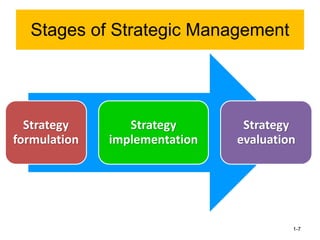
Strategy
formulation
Strategy
implementation
Strategy
evaluation
1-7
Stages of Strategic Management
1-8
Strategy Formulation
❖ developing a vision and mission
❖ identifying an organization’s external
opportunities and threats
❖ determining internal strengths and weaknesses
❖ establishing long-term objectives
❖ generating alternative strategies
❖ choosing particular strategies to pursue
Stages of Strategic Management
❖What new businesses to enter
❖What businesses to abandon
❖Whether to expand operations or diversify
❖Whether to enter international markets
❖Whether to merge or form a joint venture
❖How to avoid a hostile takeover
1-9
Strategy Formulation Decisions
Strategy Implementation
❖requires a firm to establish annual
objectives, devise policies, motivate
employees, and allocate resources so
that formulated strategies can be
executed
❖often called the action stage
1-10
Stages of Strategic Management
Strategy Evaluation
❖Determining which strategies are not
working well
❖Three fundamental activities:
❖reviewing external and internal factors that
are the bases for current strategies
❖measuring performance
❖taking corrective actions
1-11
Stages of Strategic Management
Competitive Advantage
❖any activity a firm does especially well
compared to activities done by rival firms,
or
❖any resource a firm possesses that rival
firms desire.
❖A firm must strive to achieve sustained
competitive advantage
1-12
Key Terms in Strategic
Management
Strategists
❖Individuals most responsible for the success
or failure of an organization
❖Help an organization gather, analyze, and
organize information
Vision and Mission Statements
❖A vision statement answers the question
“What do we want to become?”
❖A mission statement answers the question
“What is our business?”
1-13
Key Terms in Strategic
Management
External Opportunities and Threats
❖economic, social, cultural, demographic,
environmental, political, legal, governmental,
technological, and competitive trends and events
that could significantly benefit or harm an
organization
Internal Strengths and Internal Weaknesses
❖an organization’s controllable activities that are
performed especially well or poorly
❖determined relative to competitors
1-14
Key Terms in Strategic
Management
❖Availability of capital can no longer be
taken for granted.
❖Consumers expect green operations and
products.
❖Marketing is moving rapidly to the Internet.
❖Commodity food prices are increasing.
❖An oversupply of oil is driving oil and gas
prices down.
1-15
Some Opportunities and Threats
Long-Term Objectives
❖specific results that an organization
seeks to achieve in pursuing its basic
mission
❖long-term means more than one year
❖should be challenging, measurable,
consistent, reasonable, and clear
1-16
Key Terms in Strategic
Management
Strategies
❖the means by which long-term
objectives will be achieved
❖may include geographic expansion,
diversification, acquisition, product
development, market penetration,
retrenchment, divestiture, liquidation,
and joint ventures
1-17
Key Terms in Strategic
Management
Annual objectives
❖short-term milestones that organizations must
achieve to reach long-term objectives
❖should be measurable, quantitative, challenging,
realistic, consistent, and prioritized
❖should be established at the corporate, divisional,
and functional levels in a large organization
Policies
❖the means by which annual objectives will be
achieved
1-18
Key Terms in Strategic
Management
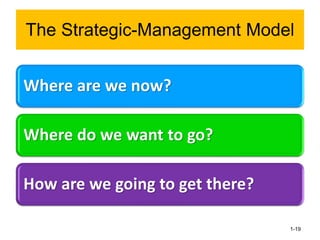
Where are we now?
Where do we want to go?
How are we going to get there?
1-19
The Strategic-Management Model
❖Strategic management allows an
organization to be more proactive than
reactive in shaping its own future;
❖It allows an organization to initiate and
influence (rather than just respond to)
activities—and thus to exert control over
its own destiny.
1-20
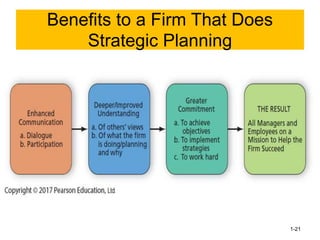
Benefits of Strategic Management
1-21
Benefits to a Firm That Does
Strategic Planning
❖Businesses using strategic-management
concepts show significant improvement in
sales, profitability, and productivity compared
to firms without systematic planning activities
❖High-performing firms tend to do systematic
planning to prepare for future fluctuations in
their external and internal environments
1-22
Financial Benefits
❖Enhanced awareness of external threats
❖Improved understanding of competitors’
strategies
❖Increased employee productivity
❖Reduced resistance to change
❖Clearer understanding of performance–
reward relationships
1-23
Nonfinancial Benefits
❖No formal training in strategic
management
❖No understanding of or appreciation for
the benefits of planning
❖No monetary rewards for doing planning
❖No punishment for not planning
❖Too busy “firefighting” (resolving internal
crises) to plan ahead
❖View planning as a waste of time, since no
product/service is made
1-24
Why Some Firms Do No Strategic
Planning
❖Laziness; effective planning takes time
and effort; time is money
❖Content with current success; failure to
realize that success today is no guarantee
for success tomorrow; even Apple Inc. is
an example
❖Overconfident
❖Prior bad experience with strategic
planning done sometime/somewhere
1-25
Why Some Firms Do No Strategic
Planning
❖ Using strategic planning to gain control over decisions
and resources
❖ Doing strategic planning only to satisfy accreditation or
regulatory requirements
❖ Too hastily moving from mission development to strategy
formulation
❖ Failing to communicate the plan to employees, who
continue working in the dark
❖ Top managers making many intuitive decisions that
conflict with the formal plan
❖ Top managers not actively supporting the strategic-
planning process
❖ Failing to use plans as a standard for measuring
performance
1-26
Pitfalls in Strategic Planning
❖Delegating planning to a “planner” rather than
involving all managers
❖Failing to involve key employees in all phases of
planning
❖Failing to create a collaborative climate
supportive of change
❖Viewing planning as unnecessary or unimportant
❖Becoming so engrossed in current problems that
insufficient or no planning is done
❖Being so formal in planning that flexibility and
creativity are stifled
1-27
Pitfalls in Strategic Planning
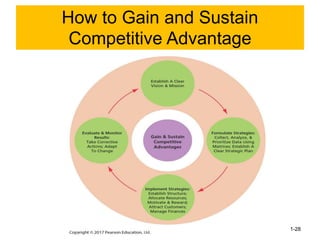
Copyright ©2017 Pearson Education, Limited 1-28
How to Gain and Sustain
Competitive Advantage
❖A fundamental difference between military
and business strategy is that business
strategy is formulated, implemented, and
evaluated with an assumption of competition,
whereas military strategy is based on an
assumption of conflict
❖Both business and military organizations
must adapt to change and constantly improve
to be successful
1-29
Comparing Business and
Military Strategy
❖War is a matter of vital importance to the
state: a matter of life or death, the road either
to survival or ruin. Hence, it is imperative that
it be studied thoroughly
❖Know your enemy and know yourself, and in
a hundred battles you will never be defeated
❖Skillful leaders do not let a strategy inhibit
creative counter-movement
1-30
Excerpts from Sun Tzu’s The Art of
War Writings

Chapter 1 Strategic Management Essentials.pdf

  • 1.
    Chapter 1 The Natureof Strategic Management
  • 2.
    1. Describe thestrategic-management process. 2. Discuss the three stages of strategy formulation, implementation, and evaluation activities. 3. Explain the need for integrating analysis and intuition in strategic management. 4. Define and give examples of key terms in strategic management. 1-2 Learning Objectives
  • 3.
    5. Illustrate thecomprehensive strategic- management model. 6. Describe the benefits of engaging in strategic management. 7. Explain why some firms do no strategic planning. 8. Describe the pitfalls in actually doing strategic planning. 9. Discuss the connection between business and military strategy. 1-3 Learning Objectives (cont.)
  • 4.
    Strategic Management the artand science of formulating, implementing, and evaluating cross- functional decisions that enable an organization to achieve its objectives 1-4 Defining Strategic Management
  • 5.
    ❖Strategic management isused synonymously with the term strategic planning in this course. ❖Sometimes the term strategic management is used to refer to strategy formulation, implementation, and evaluation, with strategic planning referring only to strategy formulation. 1-5 Defining Strategic Management
  • 6.
    ❖A strategic planis a company’s game plan. ❖A strategic plan results from tough managerial choices among numerous good alternatives, and it signals commitment to specific markets, policies, procedures, and operations. 1-6 Defining Strategic Management
  • 7.
  • 8.
    1-8 Strategy Formulation ❖ developinga vision and mission ❖ identifying an organization’s external opportunities and threats ❖ determining internal strengths and weaknesses ❖ establishing long-term objectives ❖ generating alternative strategies ❖ choosing particular strategies to pursue Stages of Strategic Management
  • 9.
    ❖What new businessesto enter ❖What businesses to abandon ❖Whether to expand operations or diversify ❖Whether to enter international markets ❖Whether to merge or form a joint venture ❖How to avoid a hostile takeover 1-9 Strategy Formulation Decisions
  • 10.
    Strategy Implementation ❖requires afirm to establish annual objectives, devise policies, motivate employees, and allocate resources so that formulated strategies can be executed ❖often called the action stage 1-10 Stages of Strategic Management
  • 11.
    Strategy Evaluation ❖Determining whichstrategies are not working well ❖Three fundamental activities: ❖reviewing external and internal factors that are the bases for current strategies ❖measuring performance ❖taking corrective actions 1-11 Stages of Strategic Management
  • 12.
    Competitive Advantage ❖any activitya firm does especially well compared to activities done by rival firms, or ❖any resource a firm possesses that rival firms desire. ❖A firm must strive to achieve sustained competitive advantage 1-12 Key Terms in Strategic Management
  • 13.
    Strategists ❖Individuals most responsiblefor the success or failure of an organization ❖Help an organization gather, analyze, and organize information Vision and Mission Statements ❖A vision statement answers the question “What do we want to become?” ❖A mission statement answers the question “What is our business?” 1-13 Key Terms in Strategic Management
  • 14.
    External Opportunities andThreats ❖economic, social, cultural, demographic, environmental, political, legal, governmental, technological, and competitive trends and events that could significantly benefit or harm an organization Internal Strengths and Internal Weaknesses ❖an organization’s controllable activities that are performed especially well or poorly ❖determined relative to competitors 1-14 Key Terms in Strategic Management
  • 15.
    ❖Availability of capitalcan no longer be taken for granted. ❖Consumers expect green operations and products. ❖Marketing is moving rapidly to the Internet. ❖Commodity food prices are increasing. ❖An oversupply of oil is driving oil and gas prices down. 1-15 Some Opportunities and Threats
  • 16.
    Long-Term Objectives ❖specific resultsthat an organization seeks to achieve in pursuing its basic mission ❖long-term means more than one year ❖should be challenging, measurable, consistent, reasonable, and clear 1-16 Key Terms in Strategic Management
  • 17.
    Strategies ❖the means bywhich long-term objectives will be achieved ❖may include geographic expansion, diversification, acquisition, product development, market penetration, retrenchment, divestiture, liquidation, and joint ventures 1-17 Key Terms in Strategic Management
  • 18.
    Annual objectives ❖short-term milestonesthat organizations must achieve to reach long-term objectives ❖should be measurable, quantitative, challenging, realistic, consistent, and prioritized ❖should be established at the corporate, divisional, and functional levels in a large organization Policies ❖the means by which annual objectives will be achieved 1-18 Key Terms in Strategic Management
  • 19.
    Where are wenow? Where do we want to go? How are we going to get there? 1-19 The Strategic-Management Model
  • 20.
    ❖Strategic management allowsan organization to be more proactive than reactive in shaping its own future; ❖It allows an organization to initiate and influence (rather than just respond to) activities—and thus to exert control over its own destiny. 1-20 Benefits of Strategic Management
  • 21.
    1-21 Benefits to aFirm That Does Strategic Planning
  • 22.
    ❖Businesses using strategic-management conceptsshow significant improvement in sales, profitability, and productivity compared to firms without systematic planning activities ❖High-performing firms tend to do systematic planning to prepare for future fluctuations in their external and internal environments 1-22 Financial Benefits
  • 23.
    ❖Enhanced awareness ofexternal threats ❖Improved understanding of competitors’ strategies ❖Increased employee productivity ❖Reduced resistance to change ❖Clearer understanding of performance– reward relationships 1-23 Nonfinancial Benefits
  • 24.
    ❖No formal trainingin strategic management ❖No understanding of or appreciation for the benefits of planning ❖No monetary rewards for doing planning ❖No punishment for not planning ❖Too busy “firefighting” (resolving internal crises) to plan ahead ❖View planning as a waste of time, since no product/service is made 1-24 Why Some Firms Do No Strategic Planning
  • 25.
    ❖Laziness; effective planningtakes time and effort; time is money ❖Content with current success; failure to realize that success today is no guarantee for success tomorrow; even Apple Inc. is an example ❖Overconfident ❖Prior bad experience with strategic planning done sometime/somewhere 1-25 Why Some Firms Do No Strategic Planning
  • 26.
    ❖ Using strategicplanning to gain control over decisions and resources ❖ Doing strategic planning only to satisfy accreditation or regulatory requirements ❖ Too hastily moving from mission development to strategy formulation ❖ Failing to communicate the plan to employees, who continue working in the dark ❖ Top managers making many intuitive decisions that conflict with the formal plan ❖ Top managers not actively supporting the strategic- planning process ❖ Failing to use plans as a standard for measuring performance 1-26 Pitfalls in Strategic Planning
  • 27.
    ❖Delegating planning toa “planner” rather than involving all managers ❖Failing to involve key employees in all phases of planning ❖Failing to create a collaborative climate supportive of change ❖Viewing planning as unnecessary or unimportant ❖Becoming so engrossed in current problems that insufficient or no planning is done ❖Being so formal in planning that flexibility and creativity are stifled 1-27 Pitfalls in Strategic Planning
  • 28.
    Copyright ©2017 PearsonEducation, Limited 1-28 How to Gain and Sustain Competitive Advantage
  • 29.
    ❖A fundamental differencebetween military and business strategy is that business strategy is formulated, implemented, and evaluated with an assumption of competition, whereas military strategy is based on an assumption of conflict ❖Both business and military organizations must adapt to change and constantly improve to be successful 1-29 Comparing Business and Military Strategy
  • 30.
    ❖War is amatter of vital importance to the state: a matter of life or death, the road either to survival or ruin. Hence, it is imperative that it be studied thoroughly ❖Know your enemy and know yourself, and in a hundred battles you will never be defeated ❖Skillful leaders do not let a strategy inhibit creative counter-movement 1-30 Excerpts from Sun Tzu’s The Art of War Writings