Strategic Management: Theory and
Practice
Functional Strategies
Contributors: By: John A. Parnell
Book Title: Strategic Management: Theory and Practice
Chapter Title: "Functional Strategies"
Pub. Date: 2014
Access Date: March 29, 2018
Publishing Company: SAGE Publications, Ltd
City: 55 City Road
Print ISBN: 9781452234984
Online ISBN: 9781506374598
DOI: http://dx.doi.org/10.4135/9781506374598.n8
Print pages: 218-245
©2014 SAGE Publications, Ltd. All Rights Reserved.
This PDF has been generated from SAGE Knowledge. Please
note that the pagination of
the online version will vary from the pagination of the print
book.
javascript:void(0);
http://dx.doi.org/10.4135/9781506374598.n8
Functional Strategies
Chapter Outline
Marketing
Pricing Strategies
Promotion Strategies
Product/Service Strategies
Place (Distribution) Strategies
Finance
Production
Quality Considerations
Research and Development
Purchasing
Human Resources
Human Capital and Knowledge Management
Knowledge and Competitive Advantage
Information Systems Management
SAGE SAGE Books
Contact SAGE Publications at http://www.sagepub.com.
SAGE Books - Functional StrategiesPage 2 of 37
http://www.sagepub.com
Functional Strategies and Industry Life Cycle
Summary
Key Terms
Review Questions and Exercises
Practice Quiz
Student Study Site
Notes
Corporate- and business-level strategies can only be successful
if they are supported by
strategies at the business unit's functional levels, such as
marketing, finance, production,
purchasing, human resources (HR), and information systems
(IS). Each functional area
should integrate its activities with those of the other functional
departments because a change
in one department can affect both the manner in which other
departments operate and the
overall performance of the business unit. The extent to which
all of the business unit's
functional strategies integrate can determine the effectiveness
of the unit's business- and
firm-level strategies. Although it has more of a day-to-day,
practical connotation, the term
tactics is often used to refer to strategic considerations at the
functional level.
Functional and business strategies can overlap in terms of
emphasis, but there are several
key distinctions between the two levels. Functional strategies
address a shorter time span and
are much more specific than business strategies because they
focus on strategy execution.
For example, if a business strategy has a 3-year horizon,
functional strategies or tactics may
be developed on a quarterly or semiannual basis. Moreover,
business strategies are usually
developed by top executives in the business unit while
functional strategies are typically
crafted by departmental managers who are responsible for
implementing them.
Functional or tactical strategies are formulated after the
corporate and business strategies
have already been established. However, considering the
capabilities of functional areas while
higher level strategies are being debated is a good idea. For
example, an airline considering
expansion through additional international routes should
consider factors such as the need
for additional personnel and the organization's ability to finance
additional airplanes before
settling on the expansion plan as the preferred strategic option.
U n f o r t u n a t e l y , m a n a g e r s i n e a c h f u n c t i o
n a l a r e a m a y n o t f u l l y a p p r e c i a t e t h e
interrelationships among the functions. Marketers who do not
understand production may
promise customers product features that the production
department cannot readily or
economically integrate into the product's design. Production
managers who do not
understand marketing may insist on production changes that
result in relatively minor cost
changes but fail to satisfy customer needs. For this reason,
managers in all functional areas
SAGE SAGE Books
Contact SAGE Publications at http://www.sagepub.com.
SAGE Books - Functional StrategiesPage 3 of 37
http://www.sagepub.com
should understand how the areas should integrate, and they
should work together to
formulate functional strategies that fit together and support the
corporate- and business-level
strategies.
This chapter examines functional strategies in the areas of
marketing, finance, production,
purchasing, HR, and IS. Although the relationships among
functional strategies are not
always clear, Table 8.1 summarizes the way functional
strategies typically integrate with the
business strategy using Porter's cost leadership and
differentiation strategies discussed in the
previous chapter.
Table 8.1 Integrating Business and Functional Strategies1.
This chapter is organized along functions. In practice, however,
many of the issues discussed
herein are cross-functional and therefore concern more than one
functional area. Production
warranties, for example, are a key concern for both the
production and marketing
SAGE SAGE Books
Contact SAGE Publications at http://www.sagepub.com.
SAGE Books - Functional StrategiesPage 4 of 37
http://www.sagepub.com
departments.
Marketing
The competitive strategy and the marketing functional strategy
are tightly intertwined.
Traditionally, marketing has been dissected into four
dimensions or “four Ps”: (1) price, (2)
promotion, (3) product/service, and (4) place (i.e., channels of
distribution). The particular
generic strategy adopted by the business unit influences how
these various dimensions are
planned and executed. The emphasis on marketing—most
notably the notion of customer
orientation—continues to gain prominence and places a high
level of importance on marketing
strategies that support the firm and business strategies.2. From
a competitive standpoint,
marketing is arguably the most critical of the functional
strategies and should be considered
early in the development of the business strategy.
Pricing Strategies
Business units that compete with the low-cost generic strategy
produce basic, relatively
undifferentiated outputs and often offer low prices. Wal-Mart,
for example, is known for its
highly effective high-volume, low-cost strategy. Even Internet
powerhouse Amazon.com has
sought to follow the Wal-Mart model, cutting prices whenever
possible in an effort to gain
economies of scale (introduced in Chapter 4 and discussed in
greater detail later in the
chapter) through high volume.3.
Motel 6 also incorporates such a strategy, offering clean and
comfortable, low-priced rooms.
Founded more than 40 years ago, Motel 6 minimizes costs by
offering few services, such as
restaurants or conference rooms. Its simple brand name, Motel
6, even conveys the
impression of economy services. Consistent with its no-frills
outputs, each Motel 6 offers
rooms at daily rates at or below other nearby chain motels.
Promotional efforts—primarily
radio spots with limited television and billboards—are
relatively limited and attempt to convey
to the traveling public that Motel 6 offers satisfactory economy
lodging.4.
Businesses that use the generic strategy of low-cost
differentiation must market quality
products and services that are distinguishable from the outputs
of their competitors.5. For
example, Hampton Inn offers larger rooms with better-quality
furnishings than Motel 6, along
with amenities such as a free breakfast buffet, a swimming pool,
and conference rooms. The
brand name Hampton Inn is intended to convey the impression
of quality and value. Average
to slightly above average prices are charged for rooms,
depending on the competitive
situation, and promotional efforts connote a differentiated
quality image.
Businesses emphasizing low prices, however, often find it
difficult to raise prices if it becomes
necessary. Fast-food restaurants with “dollar menus” in the
United States have experienced
declines in sales when they attempted to wean consumers from
low prices. Automakers rely
heavily on rebates to sell cars during economic downturns and
often experience similar
difficulties.6.
Business units that combine the focus strategy with the
differentiation or low-cost-
differentiation generic strategy tend to emphasize other factors
in their marketing strategies.
These businesses offer unique, high-quality products and
services to meet the specialized
needs of a relatively small market. Most bed-and-breakfast
establishments offer a limited
SAGE SAGE Books
Contact SAGE Publications at http://www.sagepub.com.
SAGE Books - Functional StrategiesPage 5 of 37
http://amazon.com
http://sk.sagepub.com/books/strategic-management-theory-and-
practice-fourth-edition/i1474.xml
http://www.sagepub.com
number of rooms to discriminating travelers who seek
accommodations with a local, home-
oriented flavor.
Pricing strategies can involve more than simply a price point
relative to the competition. Health
clubs, for example, typically promote memberships by the
month and offer discounts for
commitments of 1 or 2 years. Research suggests that many
consumers would actually save
money if they chose to pay on a per-visit basis or make a higher
monthly payment without a
long-term commitment because they never actually use the
facilities as much as they project
when they join. By offering unlimited usage for a period of
time, health clubs are perceived to
be more price competitive by consumers who may or may not
attain their fitness goals.7.
Promotion Strategies
From a marketing perspective, the Internet presently offers
opportunities for integration
among various media. Since the 2000s, Procter & Gamble
(P&G) has sponsored news stories
on topics such as health care, parenting, and nutrition, ending
each 90-second segment with
a referral to its website via the television station's site. For
example, a story on diaper rash
might conclude with a referral to the Pampers page.8.
The Internet enables many businesses to target potential
customers in an efficient manner.
For this reason, Internet-based and traditional businesses have
begun to use the Internet as a
significant part of their promotional campaigns. Following an
initial boom in Internet
advertising in the late 1990s, interest in web advertising waned
for several years. By the mid-
to late 2000s, however, the advent of broadband and new
advertising formats, including more
sophisticated animation, sparked a resurgence. Search-related
advertisements—those that
appear alongside search results at popular search sites—remain
quite popular.9.
SAGE SAGE Books
Contact SAGE Publications at http://www.sagepub.com.
SAGE Books - Functional StrategiesPage 6 of 37
http://www.sagepub.com
Product/Service Strategies
Product decisions are a key part of the marketing mix and can
be quite interesting. Consider
the following examples. Honda, Nissan, and other carmakers
began adding safety features in
many of their 2004 models to provide sport utility vehicle
(SUV) drivers, who place a high
value on safety, with alternatives in smaller vehicles.10. In the
early 2000s, restaurants such
as McDonald's and Starbucks had begun providing wireless
Internet access in many of their
restaurants to provide online access for customers with laptops.
Initially, 1 hour of access at
McDonald's was offered as an add-on to a value meal, but it is
now free and unrestricted at
most locations.11.
In the early 2000s, PepsiCo controlled three of the top five soft
drinks in the United States.
Market shares of two of the three—Pepsi and Mountain Dew—
declined, however, while Diet
Pepsi increased during this time. Although Diet Pepsi remained
third in revenues behind its
two siblings, PepsiCo announced in early 2005 that Diet Pepsi
would replace Pepsi as its new
flagship, a major shift in its marketing efforts.12. Since the
introduction of Coke Zero in 2005,
Coca-Cola has also shifted much of its attention away from its
flagship—Coca-Cola Classic—
to its low-calorie alternative.13. This heightened emphasis on
low-calorie beverages over the
past decade coincides with the increased concern for healthy
eating addressed in Chapter 4.
Minor shifts in the product/service strategy can augment a
business strategy. In 2012, Dollar
General launched about 40 Dollar General Market stores, larger
outlets that also include
various fresh and frozen foods. Although twice the size of a
traditional Dollar General, the
markets (about 16,000 square feet) are still much smaller than
typical supercenters (150,000
square feet or more), making them much easier for customers to
navigate. As chief executive
SAGE SAGE Books
Contact SAGE Publications at http://www.sagepub.com.
SAGE Books - Functional StrategiesPage 7 of 37
http://sk.sagepub.com/books/strategic-management-theory-and-
practice-fourth-edition/i1474.xml
http://www.sagepub.com
officer (CEO) Rick Dreiling put it, successful small grocery
stores do not offer everything but
concentrate on the essentials that comprise the majority of
larger supermarket sales. By
modifying its array of merchandise, Dollar General can be
positioned more effectively against
supercenters like Target and Wal-Mart.14.
Branding is a key part of the product strategy, especially in
product or service domains where
differentiation is difficult to establish. In 2011, Quill.com—an
online outlet owned by office
superstore Staples—struck a licensing deal with NBC's parent
company to launch the Dunder
Mifflin brand of paper, a takeoff on the hit television comedy
series The Office. With paper
sales declining by an estimated 3% each year, Quill is searching
for innovative branding
approaches to secure as much of the estimated $3 billion North
American copy paper market.
According to Quill's chief marketing officer, Sergio Pereira, the
Dunder Mifflin brand reflects
an effort to combat a “race to the bottom in the paper business.”
The move is an example of
reverse product placement; instead of placing branded products
in movies and situational
comedies, companies bring fictional but often well-known
brands to life.15.
Product design is also critical to all firms, regardless of the
strategies they employ. Although
design was traditionally associated with appearance, the concept
also includes such features
as designing a product for easy manufacturability so that fewer
parts have to be purchased or
improving the product's ability to perform its purpose.16.
Effective design now addresses
aesthetics as well as other consumer concerns, including such
factors as how a product
works, how it feels in the hand, how easy it is to assemble and
fix, and even what its
prospects are for recycling. Gaining a competitive advantage
through superior product design
involves all functional areas. A well-designed product is
attractive and easy to build, market,
use, and maintain; it is also driven by simplicity.
Customer service is also a critical marketing concern.
Developing and maintaining the quality
of customer service can be more challenging than enhancing
product quality because the
consumer perceives service value primarily at the time the
service is rendered (or not
rendered).17. All functional areas must work together to
provide the customer with product
and service value.18. For example, an online retailer must
fulfill several customer needs. First,
it must offer value to customers in their shopping. Carrying the
products that customers desire
at competitive prices means that the various functions must
communicate with one another
and cooperate closely. Next, it must make certain that its
employees are able to respond to
customer inquiries, either electronically or by telephone. This
capability requires effective
human resource management (HRM) training as well as IS
management. The e-tailer must
also ensure that it stocks sufficient quantities of the items that it
promotes, a common problem
for start-ups in the 1990s. This requires interaction among the
purchasing, inventory, IS, and
marketing functions. Finally, the company must provide the
clear, efficient, and secure means
for customers to complete the purchase process accurately and
quickly, requiring the close
cooperation of IS and HRM.
Product/service decisions are often difficult. Responding to
market share gains by discounters
such as Target, Federated Department Stores recently
redesigned its stores to promote self-
service while reducing the number of sales clerks. The large
retailer hopes that consumers
will perceive the more efficient layout as more convenient,
while enabling Federated to cut
costs.19. At the same time, Sak's Fifth Avenue, Macy's, and
Federated have introduced a
number of upscale private label products in an attempt to lower
prices while maintaining a
quality image.20.
SAGE SAGE Books
Contact SAGE Publications at http://www.sagepub.com.
SAGE Books - Functional StrategiesPage 8 of 37
http://quill.com
http://www.sagepub.com
The importance of service cannot be overemphasized. Southwest
Airlines’ frequent fliers
appreciate that company's commitment to superior service in a
friendly and professional but
sometimes comical, environment.21. Interestingly, surveys
typically suggest that more than
one-third of consumers choose businesses that charge high
prices but provide excellent
service over companies that offer low prices but mediocre
service.22.
Lackluster service is still a problem in certain industries,
however. Rising labor costs have
prompted a number of companies to integrate automated
telephone customer service systems
designed to answer questions and provide information without
the assistance of service
associates. The incessant reminders that “your call is very
important to us” and callers must
“press 9 for more options” have become a common irritant to
customers who expect a higher
level of service. Some websites even publish the sequence of
numbers necessary to navigate
each system and reach a real person without waiting to hear all
of the menu options.23.
Personal attention can be a key source of differentiation,
however. Personal attention involves
paying heed to details, addressing customers’ concerns,
answering technical questions, and
providing service after the sale. It can play an important
psychological role as well because
customers see how important quality is to the organization.24.
Balancing the needs for
economies of scale and personal service is a challenge as
elaborated in the discussion on
mass customization in Chapter 4.
Place (Distribution) Strategies
Low-cost businesses typically seek distribution channels that
meet the basic needs of the
target market while minimizing costs. In contrast, differentiated
businesses often select the
most appropriate means of distribution regardless of cost and
may even use the means of
distribution as a way of differentiating the business (see
Strategy at Work 8.1). For example,
cost leader Cici's distributes its pizza through low-priced
buffets and customer pickup at the
restaurant. Domino's has used “free” delivery—the cost of
which is built into the price—as an
effective means of differentiation over the years, although some
now add a small charge for
delivery.
SAGE SAGE Books
Contact SAGE Publications at http://www.sagepub.com.
SAGE Books - Functional StrategiesPage 9 of 37
http://sk.sagepub.com/books/strategic-management-theory-and-
practice-fourth-edition/i1474.xml
http://www.sagepub.com
Strategy at Work 8.1. The Importance of Distribution and
Production Capacity in E-Commerce
Success25.
Despite the early failures of many dot-com startups, some
Internet companies continue
to grow. These e-tailers understand that they are facing an
unprecedented challenge-
how to create an infrastructure that cost-effectively meets the
needs and complex
demands of today's sophisticated customer. To respond, many
are designing and
implementing multichannel distribution models to enhance
distribution and improve
SAGE SAGE Books
Contact SAGE Publications at http://www.sagepub.com.
SAGE Books - Functional StrategiesPage 10 of 37
http://www.sagepub.com
customer service.
Customers who shop on the Internet typically check their order
several times before
they receive it. This means that the distribution system should
be able to confirm order
receipt, notify the customer of shipping details, and provide
immediate notice of any
problems that may occur in the process.
For example, JCPenney.com has implemented a very effective
distribution system. Of
course, JCPenney.com does not depend solely on e-commerce
for its retail sales.
Other clothing merchants that have followed suit include
Gap.com, EddieBauer.com,
and BananaRepublic.com. BarnesandNoble.com has also
successfully integrated its
product inventories and distribution channels. Shipping costs
have been slashed, and
customers now have more options for pickups, purchases, and
returns.
A firm's distribution strategy can vary across locations because
of cultural, economic, or other
considerations and should be analyzed accordingly (see Case
Analysis 8.1). In large cities—
particularly those outside of the United States—even fast-food
giants like McDonald's and
KFC offer free or low-cost delivery. In places like Cairo and
Beijing, high real-estate prices,
crowded conditions, and fewer cars make large restaurants with
drive-thru service less
feasible. McDonald's first offered delivery in 1994 in Egypt;
today, delivery accounts for more
than 30% of total sales in that country. By 2012, 1,500 out of
8,800 restaurants in the
McDonald's Asia/ Pacific, Middle East, and Africa division
offered delivery as did more than
one-half of Yum's 3,500 KFC restaurants in China. As one
McDonald's executive put it, “If you
can't come to us, we'll come to you.”26.
Case Analysis 8.1 Step 12: What is the Organization's
Marketing Strategy?
Given the strong link between a business’ competitive strategy
and its marketing
functional strategy, this step can require a lot of research and
depth. What marketing
efforts are underway to support the current business-level
strategy? Are these efforts
successful? Why or why not? Provide examples of recent
promotional or public
relations campaigns that support your assessment.
An effective means of assessing the marketing strategy is to
analyze each of the four
Ps individually. Company websites and trade journals are
excellent sources for the
type of information that should be included in this section.
Finance
The financial strategy addresses factors related to managing
cash, raising capital, and
making investments. Because few businesses internally generate
the amount of cash
necessary to grow, most resort to other means of securing
financial resources. Different
means of securing funds will likely be considered and
prioritized depending on the corporate
and business strategies selected.27.
SAGE SAGE Books
Contact SAGE Publications at http://www.sagepub.com.
SAGE Books - Functional StrategiesPage 11 of 37
http://jcpenney.com
http://jcpenney.com
http://gap.com
http://eddiebauer.com
http://bananarepublic.com
http://barnesandnoble.com
http://www.sagepub.com
Low-cost businesses pursue financial strategies that are
intended to minimize their financial
costs. They place a great emphasis on keeping costs within the
limits of the funds they are
able to generate from operations. When borrowing becomes
necessary, they usually try to do
so when credit costs are relatively low even if they must defer
expansion plans.
In contrast, differentiated businesses are more likely to pursue
financial strategies that fund
initiatives such as quality improvements and product research
and development (R & D) even
when the cost of securing funds is relatively high. They may
sell common stock, incur debt, or
even seek venture capital regardless of the costs of doing so.
The greatest strategic priorities
are maintaining quality and enhancing differentiation, not
minimizing the cost of funds.
One can assess a firm's financial strategy, as well as its
performance, by examining its
financial ratios and comparing them to those of key competitors
or industry averages.
Comparing current ratios to those in the past is also relevant.
Table 8.2 provides a list of key
financial ratios that can help evaluate the financial position of
the organization (see Case
Analysis 8.2). Some additional ratios are industry specific,
however, and can be very
insightful. For example, many retailers calculate maintenance
expenditures per square foot of
floor space. Expenditures at Macy's, Wal-Mart, and others
chains are typically between $6
and $8 per square foot. When stores spend much less—Sears
spent less than $2 per square
foot between 2005 and 2011—it is often a reflection of a cash
shortage, deteriorating stores,
or both.28.
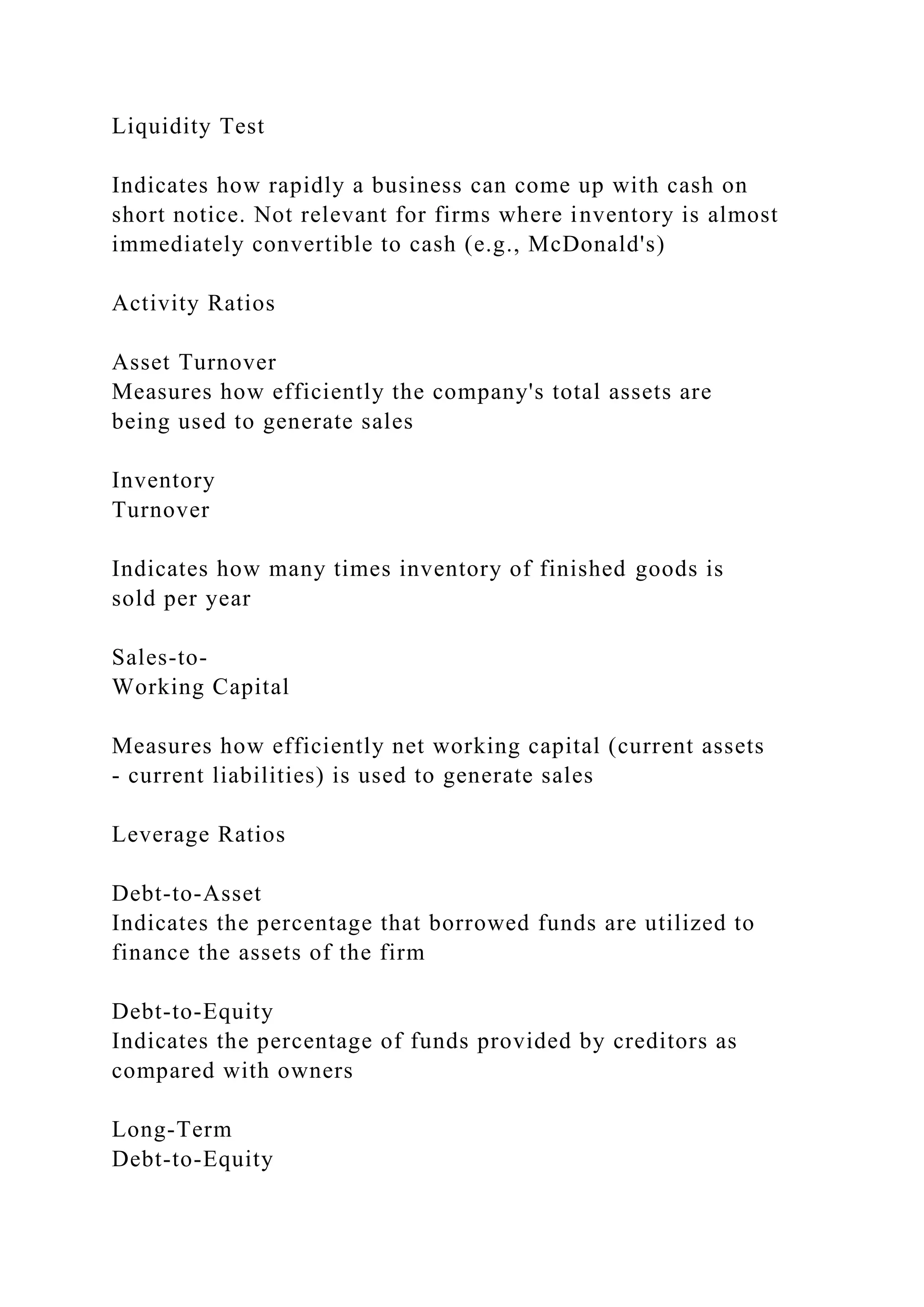
Table 8.2 Primer on Essential Financial Ratios
Ratio Formula What the Ratios Represent
Liquidity Ratios
Current Ratio
Indicates how much of the current liabilities the current
assets can cover; ordinarily 2:1 or better is desirable
Quick Ratio or
Acid Test or
Liquidity Test
Indicates how rapidly a business can come up with cash on
short notice. Not relevant for firms where inventory is almost
immediately convertible to cash (e.g., McDonald's)
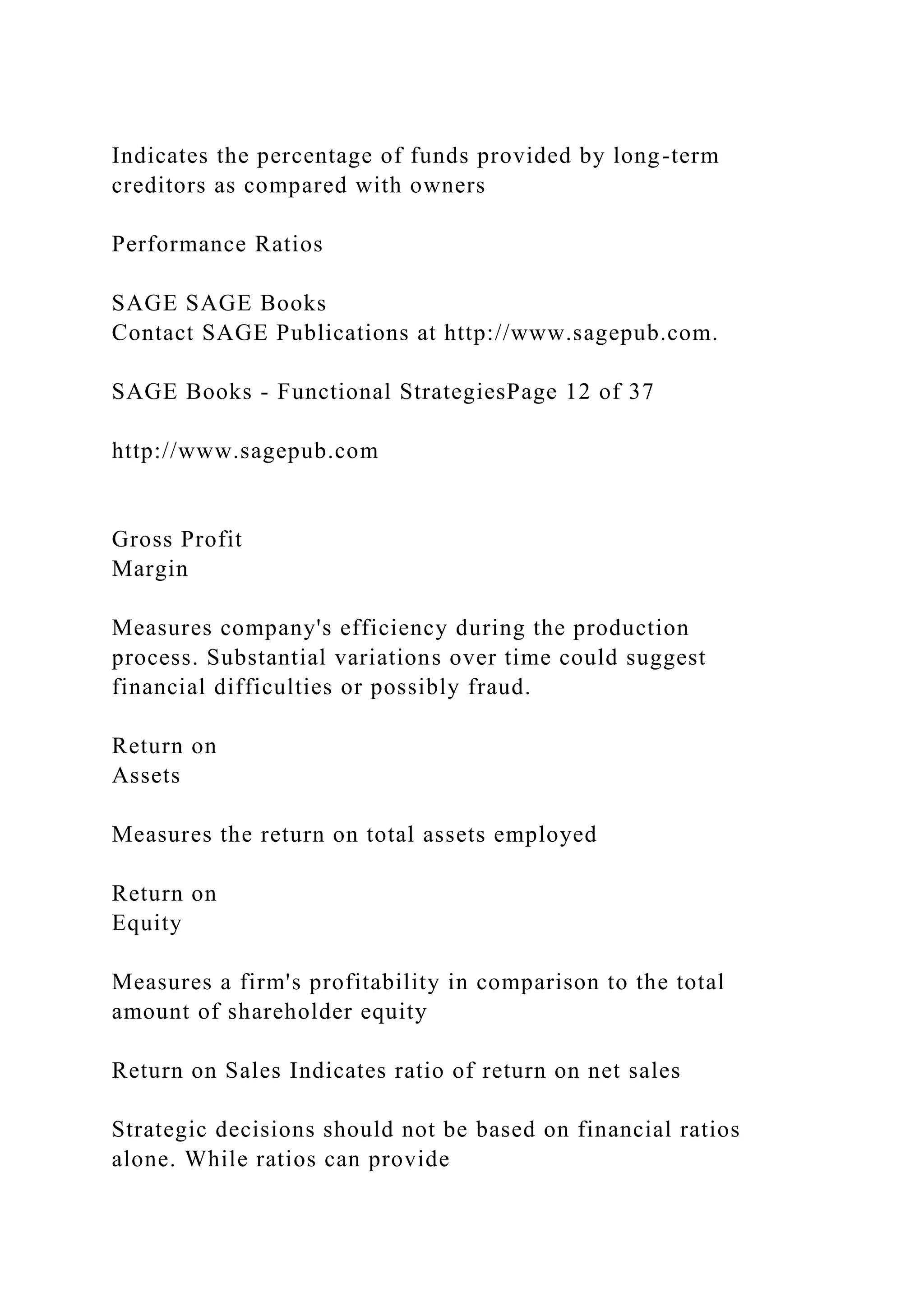
Activity Ratios
Asset Turnover
Measures how efficiently the company's total assets are
being used to generate sales
Inventory
Turnover
Indicates how many times inventory of finished goods is
sold per year
Sales-to-
Working Capital
Measures how efficiently net working capital (current assets
- current liabilities) is used to generate sales
Leverage Ratios
Debt-to-Asset
Indicates the percentage that borrowed funds are utilized to
finance the assets of the firm
Debt-to-Equity
Indicates the percentage of funds provided by creditors as
compared with owners
Long-Term
Debt-to-Equity
Indicates the percentage of funds provided by long-term
creditors as compared with owners
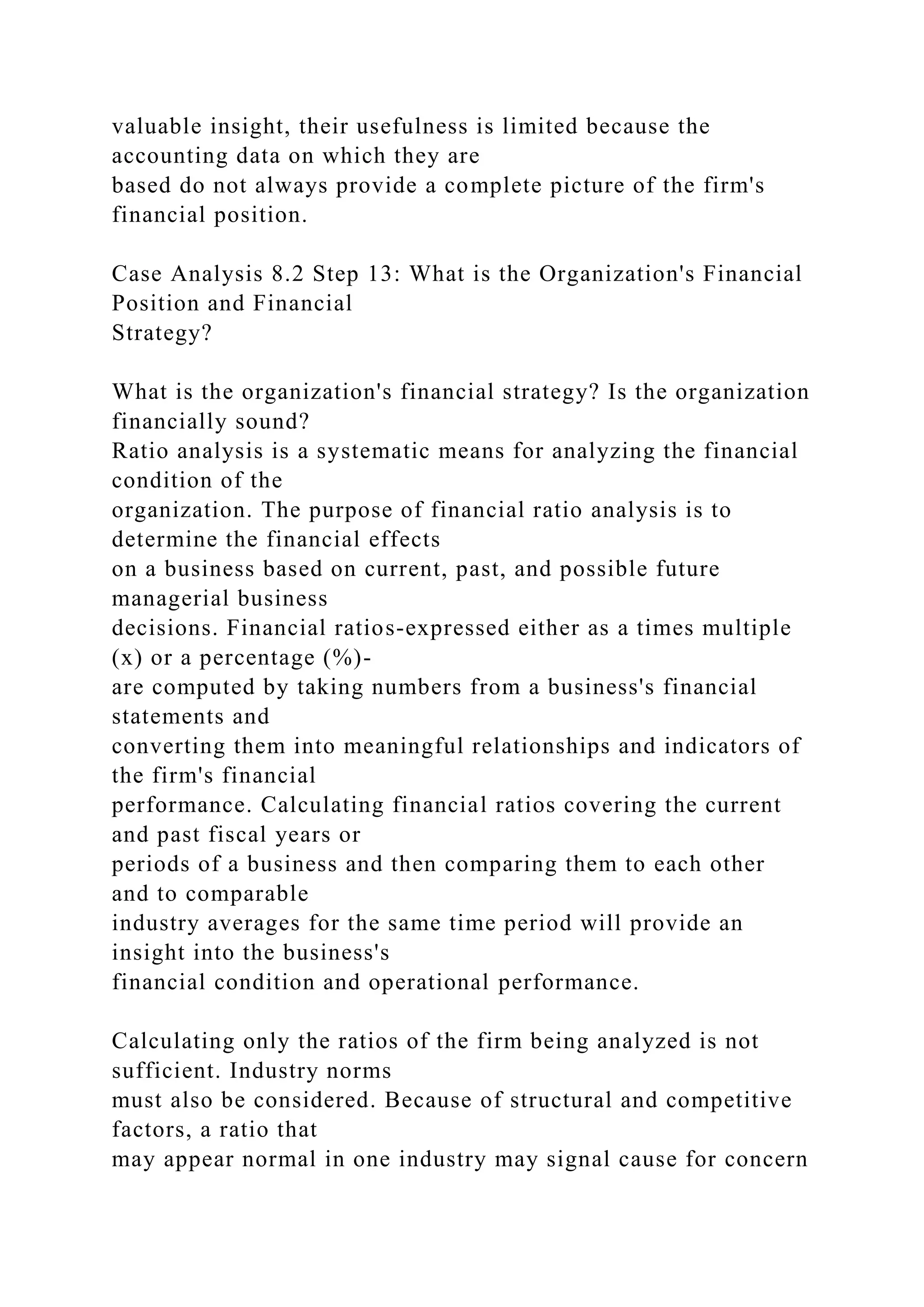
Performance Ratios
SAGE SAGE Books
Contact SAGE Publications at http://www.sagepub.com.
SAGE Books - Functional StrategiesPage 12 of 37
http://www.sagepub.com
Gross Profit
Margin
Measures company's efficiency during the production
process. Substantial variations over time could suggest
financial difficulties or possibly fraud.
Return on
Assets
Measures the return on total assets employed
Return on
Equity
Measures a firm's profitability in comparison to the total
amount of shareholder equity
Return on Sales Indicates ratio of return on net sales
Strategic decisions should not be based on financial ratios
alone. While ratios can provide
valuable insight, their usefulness is limited because the
accounting data on which they are
based do not always provide a complete picture of the firm's
financial position.
Case Analysis 8.2 Step 13: What is the Organization's Financial
Position and Financial
Strategy?
What is the organization's financial strategy? Is the organization
financially sound?
Ratio analysis is a systematic means for analyzing the financial
condition of the
organization. The purpose of financial ratio analysis is to
determine the financial effects
on a business based on current, past, and possible future
managerial business
decisions. Financial ratios-expressed either as a times multiple
(x) or a percentage (%)-
are computed by taking numbers from a business's financial
statements and
converting them into meaningful relationships and indicators of
the firm's financial
performance. Calculating financial ratios covering the current
and past fiscal years or
periods of a business and then comparing them to each other
and to comparable
industry averages for the same time period will provide an
insight into the business's
financial condition and operational performance.
Calculating only the ratios of the firm being analyzed is not
sufficient. Industry norms
must also be considered. Because of structural and competitive
factors, a ratio that
may appear normal in one industry may signal cause for concern
in another. Therefore,
each ratio should be compared to the industry norm (when
available) and augmented
by some analysis of its note-worthiness. For example, it is not
sufficient to note that the
Days of Inventory is 47.5 without also identifying the industry
norm and addressing
why an organization is above or below that norm. A thorough
ratio presentation is
appropriate, while focusing on the most critical ratios-those that
differ significantly from
years past or from the industry norm.
If the company competes in multiple industries, comparisons
should be made to the
averages for industries in which the firm operates.
Alternatively, when another company
or a set of companies with similar characteristics exists (e.g.,
PepsiCo and Coca-Cola),
direct company comparisons can also be made. The key is that a
company's
performance is compared to the most valid and reliable set(s) of
standards available
although comparing is easier with some firms than with others.
Sometimes unique characteristics of the company do not permit
the calculation of all of
the relevant ratios. For example, inventory turnover is irrelevant
for corporations that do
SAGE SAGE Books
Contact SAGE Publications at http://www.sagepub.com.
SAGE Books - Functional StrategiesPage 13 of 37
http://www.sagepub.com
not hold inventory. Such abnormalities should be clarified in
the report. A number of
websites provide detailed financial statements and ratios for
many traded companies.
Production
Similar in some respects to the product dimension of the
marketing strategy, the production or
operations strategy outlines how a business generates its goods
and services. Production/
operations management (POM) is crucial to both manufacturing
and service organizations.29.
In general, the production strategy difference between low-cost
businesses and differentiated
businesses is straightforward. Low-cost businesses develop
production systems that minimize
production costs—often by limiting customer options and
product features. In contrast,
differentiated businesses tend to develop systems that
emphasize product and service quality
and distinctiveness, even if production costs rise as a result.
Organizational size is also a key factor in production strategy
decisions. Generally speaking,
the range of production strategies at its disposal increases as an
organization grows. Large
business units can capitalize on a number of factors that
accompany their larger size. Each of
these factors is associated with the experience curve, the
reduction in per-unit costs that
occurs as an organization gains experience producing a product
or service.30.
Interestingly, each time a company's output doubles, production
costs decline by a specific
percentage, depending on the industry. The greater the
percentage, the greater the role size
plays in performance. For instance, with a sales volume of 1
million units, per-unit costs may
be $200 in a particular industry. With a doubling of volume to 2
million units, per-unit costs
may decline by 20%. Another doubling of volume to 4 million
units may lower per-unit costs
another 20%. The experience curve can be observed in a wide
range of manufacturing and
service industries, including automobiles, personal computers,
and airlines. Although the
precise percentages are not always known, the principle of the
curve can be accurately
applied to most production environments.
The experience curve is based on three underlying concepts: (1)
learning, (2) economies of
scale, and (3) capital-labor substitution possibilities.31.
Learning refers to the idea that
employees become more efficient when they perform the same
task many times. An increase
in volume fuels this process—also increasing expertise. This
reasoning can be applied to all
jobs— line and staff, managerial and nonmanagerial—at the
corporate, business unit, and
functional levels. Economies of scale—the reductions in per-
unit costs as volume increases—
can be great for businesses such as automobile manufacturers or
Internet service providers
(ISPs). Capital-labor substitution refers to an organization's
ability to substitute labor for
capital or vice versa as volume increases, depending on which
combination minimizes costs
and/or maximizes effectiveness. A number of American
manufacturers, for example, have
shifted their assembly operations across the Mexican border
where labor costs are much
lower.
Recent developments in production technology have modified
the traditional capital versus
labor dichotomy. A number of facilities have advanced to the
point that products are
manufactured while no workers are present—often during the
night. The role of the workers in
such facilities is not to produce the products but to prepare
them for delivery.32.
Low-cost businesses with large market shares tend to benefit the
most from the experience
SAGE SAGE Books
Contact SAGE Publications at http://www.sagepub.com.
SAGE Books - Functional StrategiesPage 14 of 37
http://www.sagepub.com
curve. Differentiated businesses often attempt to gain a similar
advantage by charging higher
than average prices, seeking to gain market share and ultimately
lower costs by offering
higher quality outputs. However, differentiators do not actively
capitalize on the opportunities
presented by low costs whereas managers of businesses that
compete with low-cost-
differentiation do.33.
Regardless of strategy, seeking to exploit the experience curve
can be risky. Increases in
volume often involve substantial investments in plant and
equipment and a commitment to the
prevailing technology. However, as technology changes and
renders the plant's production
processes obsolete, outdated capital equipment may have to be
discarded. Balancing current
investments in plant and equipment with the risk that current
technology may become dated
prompts a number of firms to invest in flexible manufacturing
systems that can be retooled
quickly to respond to market changes.
Enhancing efficiency in production is a key issue in restaurants,
textile plants, and even
airplane factories. In the mid-2000s, airplane producers Airbus
and Boeing launched
concerted efforts to simplify their production procedures and
reduce assembly time. Airplane
parts are now designed with a greater emphasis on how fast they
can be assembled.34.
Speed in developing, making, and distributing products and
services can be the source of a
significant competitive advantage.35. In fact, an application of
speed known as “time-based
strategy” is a top priority in many organizations.36. Companies
that can deliver quality
products in a timely fashion become problem-solvers for their
customers and are more likely
to prosper. Motorola, for instance, cut the time needed to
produce a cellular telephone from
14 hours to less than 2, while retail prices have fallen
dramatically. Speed is equally important
in customer service.
Quality Considerations
SAGE SAGE Books
Contact SAGE Publications at http://www.sagepub.com.
SAGE Books - Functional StrategiesPage 15 of 37
http://www.sagepub.com
1.
2.
3.
4.
5.
In the late 1970s and early 1980s, strategic managers became
interested in a concept
borrowed from the Japanese known as quality circles, whereby
managers and workers would
meet to discuss and implement production changes that
improved quality and efficiency. This
interest evolved in the late 1980s and early 1990s into a
heightening of interest in quality,
broadly known as total quality management (TQM).37.
Developed by W. Edwards Deming,
TQM refers to the totality of features and characteristics of a
product or service that bear on its
ability to satisfy customer needs. Historically, quality has been
viewed largely as a controlling
activity that takes place at or near the end of the production
process—an after-the-fact
measurement of production success that occurs in the “quality
control” department. However,
the notion that quality is measured after an output is produced
has eroded, and quality is now
seen as an essential ingredient of the product or service being
provided and a concern of all
members of the organization. Hence, from a production
standpoint, producing a quality
product lowers defects and minimizes rework time, thereby
increasing productivity. In addition,
making the operative employees responsible for quality
eliminates the need for inspection.38.
As an extension of the TQM philosophy, Six Sigma seeks to
increase profits by eliminating
variability in production, defects, and waste that undermine
customer loyalty. Six Sigma is a
systematic process that utilizes information and sophisticated
statistical tools to improve
production efficiency and quality. Practitioners receive training
and advance to various levels
of certification in Six Sigma concepts. Many companies began
adopting the approach in the
late 1990s and early 2000s and have reported substantial
savings.39.
Problems resulting in poor product or service quality can arise
even in the best-managed
businesses. Companies must guarantee an acceptable level of
quality to instill confidence
among buyers and avoid loss of business when such problems
occur. The concept of the
guarantee is both a quality and a marketing concern. Some
companies even offer unlimited
money-back guarantees.
In an effort to minimize short-term costs, however, many
companies ignore this competitive
advantage. Often, guarantees lapse after a very short period of
time or contain too many
exceptional conditions to be effective competitive weapons.
Managers must balance the costs
associated with a superior guarantee with its benefits and tailor
the package to the
organization's strategy. Nonetheless, it has been suggested that
the following five desirable
characteristics be included in service guarantees:40.
The guarantee should be unconditional with no exceptions.
It should be easily understood and written in simple language.
The guarantee should be meaningful by guaranteeing what is
important to the
customer and making it worth the customer's time and effort to
invoke the guarantee
should he or she be dissatisfied.
The guarantee should be convenient to invoke and not require
the customer to appeal
to several layers of bureaucracy.
The customer should be satisfied promptly without a lengthy
waiting period.
Changes in the competitive environment can even spark quality
decisions from competitors
within a given industry. For example, following the 9/11
terrorist attacks, many airlines
engaged in vigorous cost-cutting to help stop losses that were to
follow. Although a number of
airlines eliminated meals on domestic flights, Continental
actually took steps to improve cabin
comfort and retain quality meals on its flights. Hence, whereas
most airlines moved to address
critical short-term financial concerns, Continental perceived an
opportunity to emphasize
SAGE SAGE Books
Contact SAGE Publications at http://www.sagepub.com.
SAGE Books - Functional StrategiesPage 16 of 37
http://www.sagepub.com
quality and seek to develop long-term competitive
advantage.41. Since that time, however,
Continental has followed the lead of other airlines, eliminating
all complimentary food on
domestic flights in 2010.
Research and Development
Another function closely related to production is R & D.
Differentiated businesses often—but
not always—spend more on R & D than low-cost businesses.
However, differentiated and low-
cost businesses tend to pursue different types of R & D.
Product/service R&D refers to
efforts directed toward improvements or innovations in the
quality or uniqueness of a
company's outputs. For example, a number of carmakers are
competing vigorously in the
2000s to develop high-performing and cost-competitive vehicles
utilizing power sources other
than gasoline.42.
In contrast, process R&D seeks to reduce operational costs and
make them more efficient. R
& D is most important in rapidly changing industries where
production modifications are most
often required to remain competitive. Low-cost business units
tend to emphasize process R&D
to reduce their operations costs whereas differentiators tend to
place more importance on
product/service R & D to produce improved and innovative
outputs.
Product/service innovations can be risky. Once introduced, new
products or services may not
generate a level of demand sufficient to justify the R&D
investment. RJR Nabisco, for
example, has spent millions of dollars to develop and produce a
smokeless cigarette.
Although the new brands such as Premier and Eclipse were
introduced with considerable
fanfare, demand never materialized, and the product was
canceled after a short time.43.
Interestingly, Japanese companies often abandon their new
products as soon as they are
introduced to force themselves to develop new replacement
products immediately.44. U.S.
companies have responded by increasingly forming direct
research links with their domestic
competitors, asking their suppliers to participate in new-product
design programs, and taking
ownership positions in small start-up companies that have
promising technologies.45.
Purchasing
All organizations have a purchasing function. In manufacturing
firms, the purchasing
department procures raw materials and parts so that the
production department may process
them into finished products. At the retail level, company buyers
purchase items from
manufacturers for resale to the consumer. Buyers must identify
potential suppliers, evaluate
them, solicit bids and price quotes, negotiate prices and terms
of payment, place orders,
manage the order process, inspect incoming shipments, and pay
suppliers.
A business unit's purchasing strategy should be integrated with
its competitive strategy.
Generally speaking, low-cost businesses seek to purchase
materials and supplies of basic
quality at the lowest costs possible. Large organizations are
able to lower costs further
through their ability to demand quantity discounts. In addition,
buyers that are larger than
their suppliers and whose purchases represent a significant
percentage of their suppliers’
revenues may also possess considerable negotiating clout.
Small companies, however, can often attain low-cost purchasing
through other means, such
SAGE SAGE Books
Contact SAGE Publications at http://www.sagepub.com.
SAGE Books - Functional StrategiesPage 17 of 37
http://www.sagepub.com
as working with other small businesses in the same industry to
pool their purchasing
requirements. Because of large quantities, industry networks are
often able to wield as much
power as a single large business in demanding quantity
discounts and negotiating terms.
Low costs are not the only consideration in purchasing
activities. Rather, low-cost businesses
should seek the “best cost,” one that is as low as possible
consistent with basic quality
standards of the purchased good or service. A low price is
useless if the item breaks down in
the production process or fails to meet customer demands. On
the other hand, excessive
quality unnecessarily raises costs and prices. Because their
customers are willing to pay
higher prices, differentiators tend to emphasize the procurement
of high-quality inputs, even if
they cost more than alternative offerings. In these cases, the
quality of the parts or products
takes precedence over cost considerations although cost
minimization is always desirable.
Purchasing is the first step in the materials management
process. Indeed, purchasing also
i n c l u d e s t h e o p e r a t i o n o f s t o r a g e a n d w a r
e h o u s e f a c i l i t i e s a n d t h e c o n t r o l o f
inventory.46.Consequently, these related tasks can be
efficiently and effectively conducted
only if they are viewed as parts of a single operation, regardless
of the business strategy
employed.47. The just-in-time (JIT) inventory system
demonstrates the interrelationships.
JIT was popularized by Japanese manufacturers to reduce
logistics costs. Using this
technique, the purchasing manager asks suppliers to ship parts
at the precise time they are
needed in production to hold inventory, storage, and
warehousing costs to a minimum. As
such, JIT has reduced costs for a number of large firms.
Although American manufacturers have moved in the direction
of JIT, this approach has
worked particularly well in Japan where large manufacturers
wield considerable bargaining
power over their much smaller suppliers. Because JIT places
great delivery demands on
suppliers, it does not tend to work well when manufacturers do
not possess great bargaining
power, as is often the case in the United States. In addition, an
occasional late supplier can
cripple a firm's production process.48.
A JIT system also makes a company highly vulnerable to labor
strikes49. and ecological
disasters. Japanese manufacturing was crippled when a major
earthquake and tsunami hit
the island in 2011. While many of the problems in this
particular instance would have
occurred without a JIT system, a lack of inventory causes
production to cease immediately
when any supplier experiences difficulty.
Many large U.S. manufacturers seek a middle ground between
traditional inventory systems
and JIT. Most have reduced their number of suppliers from a
dozen or more to two or three to
control delivery times and quality.50. Companies are also
strengthening their relationships
with their suppliers and providing them with detailed knowledge
of their requirements and
specifications. By working together, buyers and suppliers can
improve the quality and lower
the costs of the purchased items51. (see Case Analysis 8.3).
Case Analysis 8.3 Step 14: What are the Organization's
Production and Purchasing
Strategies?
SAGE SAGE Books
Contact SAGE Publications at http://www.sagepub.com.
SAGE Books - Functional StrategiesPage 18 of 37
http://www.sagepub.com
What approaches to production that support the current
business-level strategy are in
effect? Are these efforts successful? Why or why not? How does
the firm's approach to
production and purchasing differ from that of its competitors?
Human Resources
The HRM functions include such activities as planning for
future HR needs, recruitment,
placement, compensation, evaluation, and employee
development. Strategic HRM seeks to
build a workforce that enables the organization to achieve its
goals.52. One of the major
detriments to effective HRM practices over the past two decades
was an unprecedented wave
of mergers and acquisitions. This massive restructuring of
American business has resulted in
widespread layoffs and disillusioned, formerly loyal employees.
Today, many workers no
longer anticipate or even desire lifelong employment with a
single firm.
Ineffective HR policies can be detrimental to a firm, not only
from a strategic perspective but
also from a cost standpoint. As part of a labor agreement
negotiated with the United Auto
Workers, General Motors (GM) maintains a “Jobs Bank” where
up to 400 employees show up
to work each day, do nothing, and earn wages and benefits that
often exceed $100,000
annually. Collective costs of such programs to GM, Ford, and
other manufacturers may be as
high as $2 billion each year.53. Such policies stifle productivity
in an era when global
competition demands that all of a firm's HR are working
efficiently.
Strategy aside, all organizations are challenged to develop
employee commitment to the
company and to the job. Fostering commitment and developing
a strong, competitive
workforce require the creation and maintenance of attractive
working conditions for employees
that may include providing customized benefits, child day care,
parental leave, and flexible
working hours, as well as such traditional needs as training and
development, job enrichment,
and promotional opportunities for advancement.
In response to the 9/11 terrorist attacks, a number of companies
have heightened efforts to
screen employees more closely. Many argue that such efforts
improve security at company
facilities whereas others cite examples of employees allegedly
losing jobs over traffic
violations or bounced checks. Nonetheless, today more than
ever, security is a key strategy
concern.54.
An organization's strategy may be affected by the increasing
diversity of the modern
workforce. Women, African Americans, Hispanic Americans,
Asian Americans, and persons
with disabilities have already transformed the traditional white,
male image of many American
corporations. As a result, managers must learn to help persons
from diverse backgrounds
and functional areas work effectively as team members. The
success of such cooperative
endeavors as cross-functional teams, quality circles, and JIT
systems requires a unity of
action that can be achieved only through the mutual respect and
understanding of one's
coworkers.
While one might expect low-cost businesses to spend less on
HR activities than their
differentiated counterparts, this is not always the case because
attracting the best from the
new workforce can support both strategies. Valuable HR may
enhance efficiency by lowering
absenteeism and turnover and/or promote differentiation via
their innovative ideas and
excellence in job performance.
SAGE SAGE Books
Contact SAGE Publications at http://www.sagepub.com.
SAGE Books - Functional StrategiesPage 19 of 37
http://www.sagepub.com
The role played by HR in an organization's strategic success is
difficult to understate—
especially in industries where turnover is historically high.
Consider the U.S. fast-food
industry, where it is not uncommon to experience turnover rates
as high as 200%, compared
to 10% to 15% at typical midsize and large organizations.
Starting wages at fast-food
companies generally hover around minimum wage. Some
organizations have attempted to
combat this problem by offering wages significantly higher than
the minimum, while others,
like Domino's Pizza, have taken a more comprehensive
approach. Domino's renamed its HR
department PeopleFirst and started focusing more on attracting,
training, and retaining
exceptional store managers. The firm estimates HR costs of
departing employees to be about
$2,500 for hourly workers and $20,000 for managers. Domino's
has experienced success with
the program, reducing turnover significantly in the mid-
2000s.55.
Another key dimension of the HR strategy is that of benefits—
specifically health care. Most
organizations are struggling with the desire to provide health
care as part of the compensation
package while minimizing employment costs. Some firms have
even resorted to terminating
disabled workers to cut costs.56. Needless to say, such
decisions have strategic, legal, and
ethical ramifications.
In a more narrow sense, a business unit's generic strategy can
also influence specific
components of its HR program. For example, a company's
reward system should be tied to
employee behavior that helps the business attain its goals.
Hence, low-cost business units
SAGE SAGE Books
Contact SAGE Publications at http://www.sagepub.com.
SAGE Books - Functional StrategiesPage 20 of 37
http://www.sagepub.com
should reward employees who help reduce operating costs,
differentiators should establish
reward systems that encourage output improvements or
innovations, and all businesses
should reward excellent customer service.
Human Capital and Knowledge Management
When organizations see their employees as expenses, they tend
to minimize the cost.
However, when they see their employees as investments, they
tend to maximize the value by
managing them more strategically. Following this logic,
strategic managers have recently
begun to assess the value of human capital—the sum of the
capabilities of individuals in an
organization—as a source of competitive advantage.57. A c c o
r d i n g t o t h e knowledge
management perspective, people and their skills and abilities
represent the only resource
that cannot readily be reproduced by a firm's competitors if it is
deemed to be a source of
competitive advantage.58. As such, high-performing firms must
leverage their human capital if
they are to remain successful over the long term.59. Human
capital can be developed through
organizational learning.60.
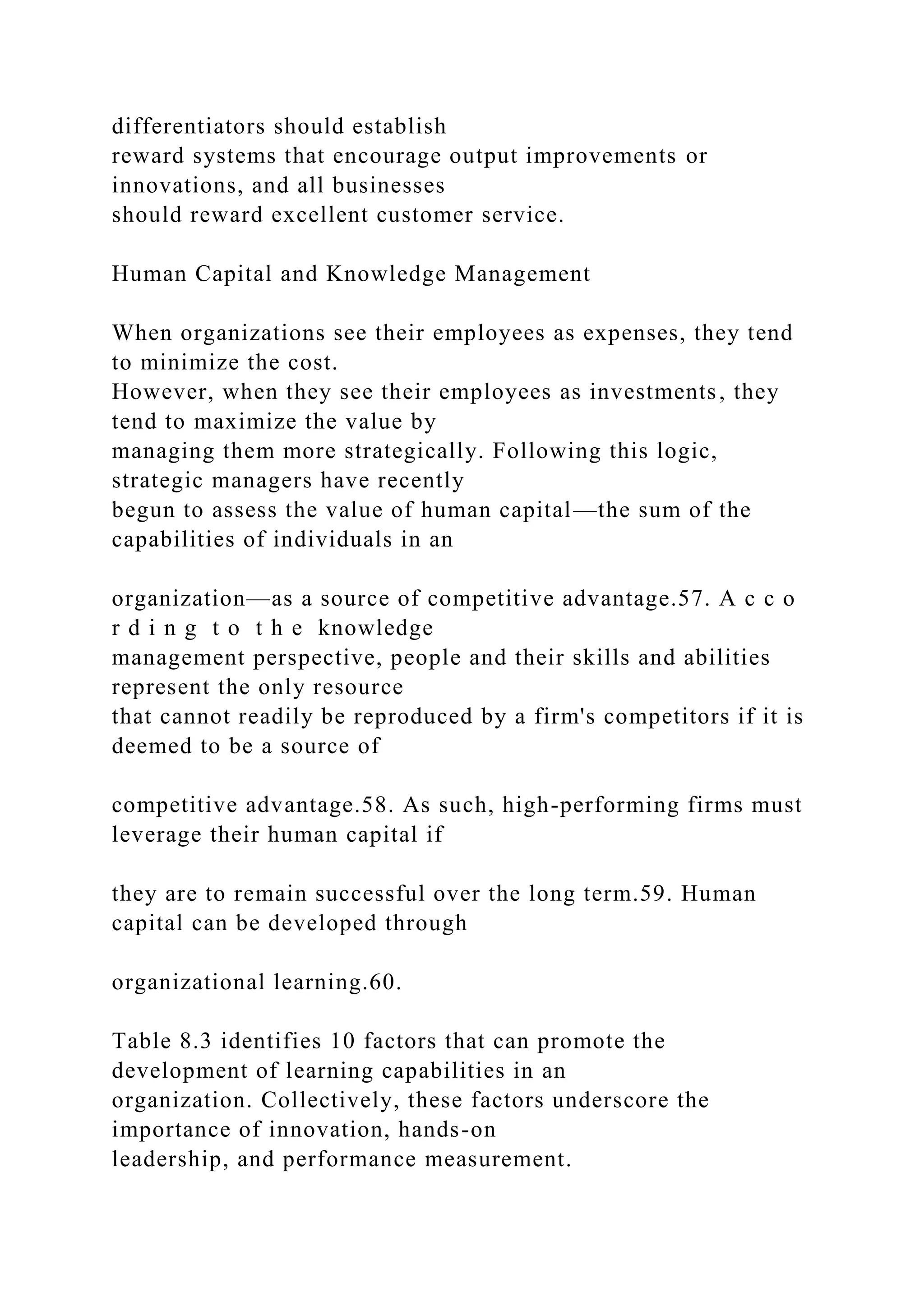
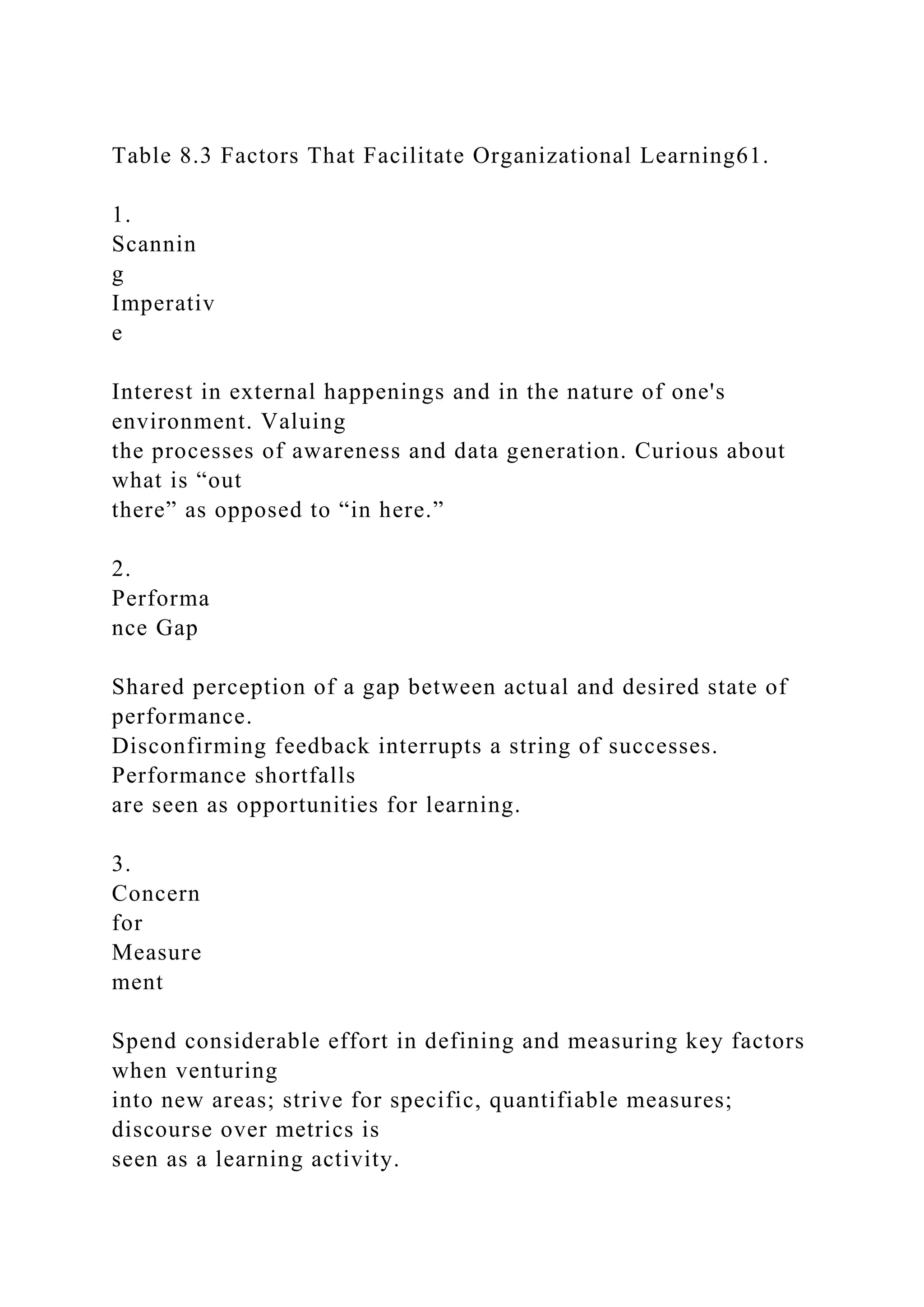
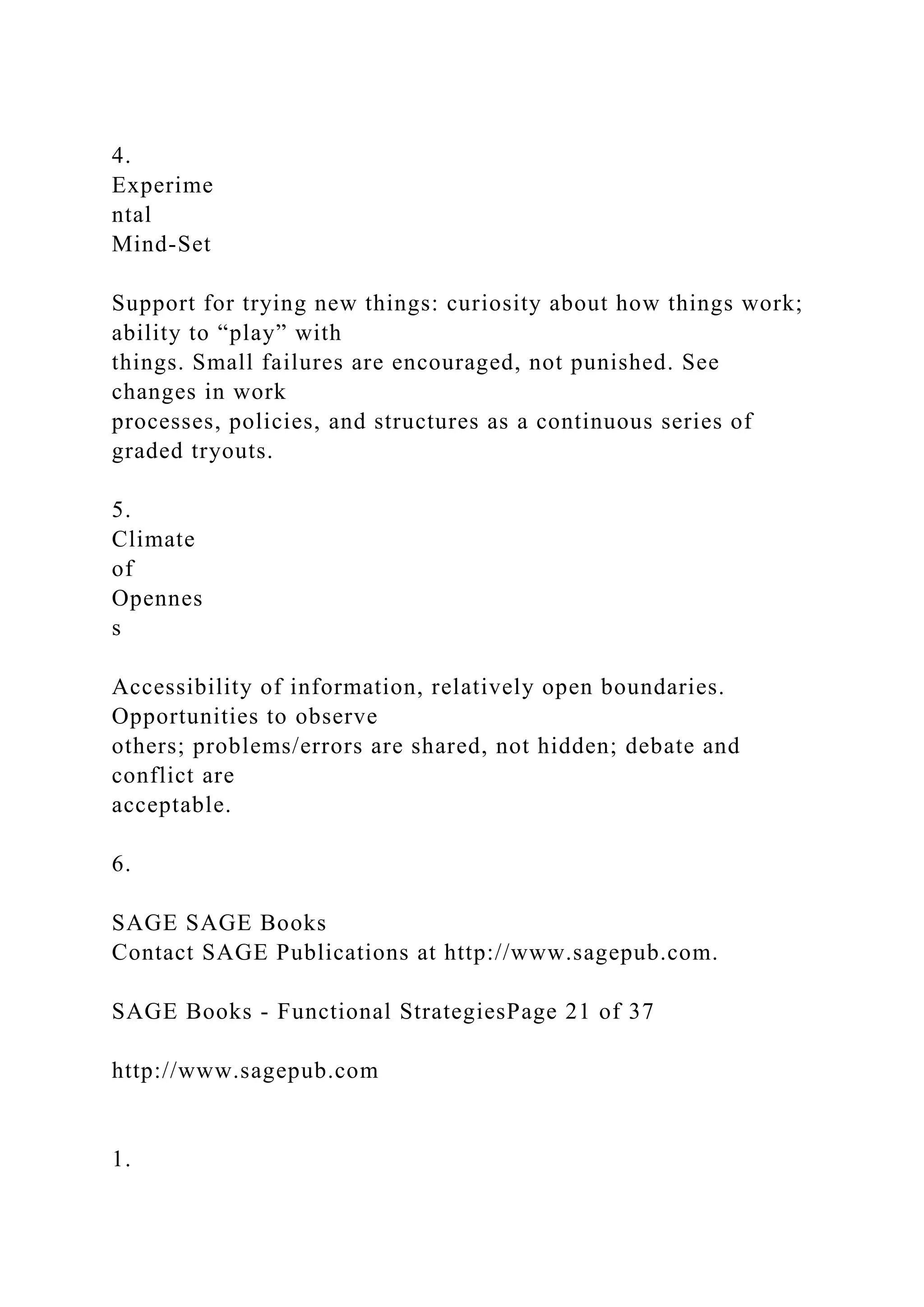
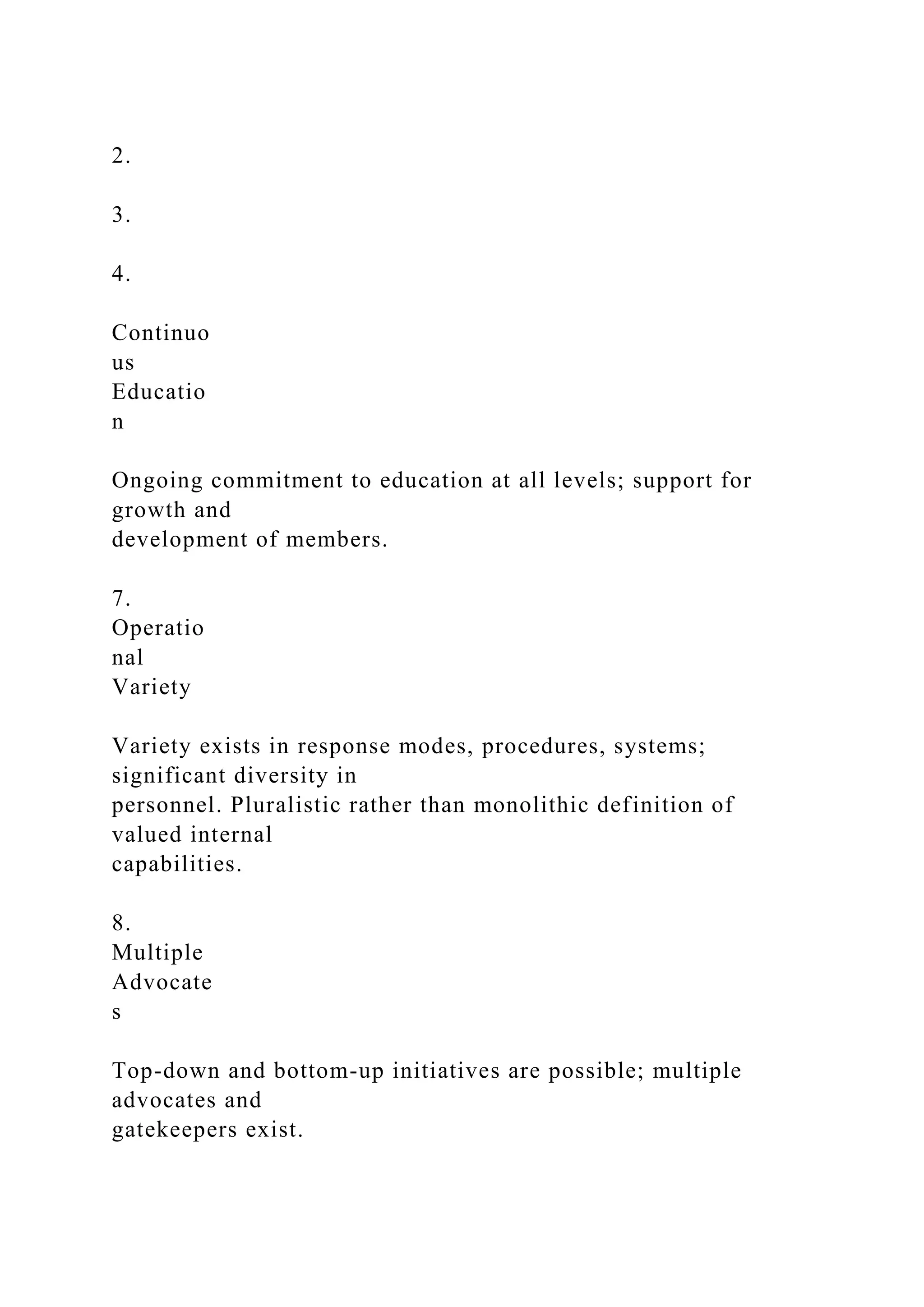
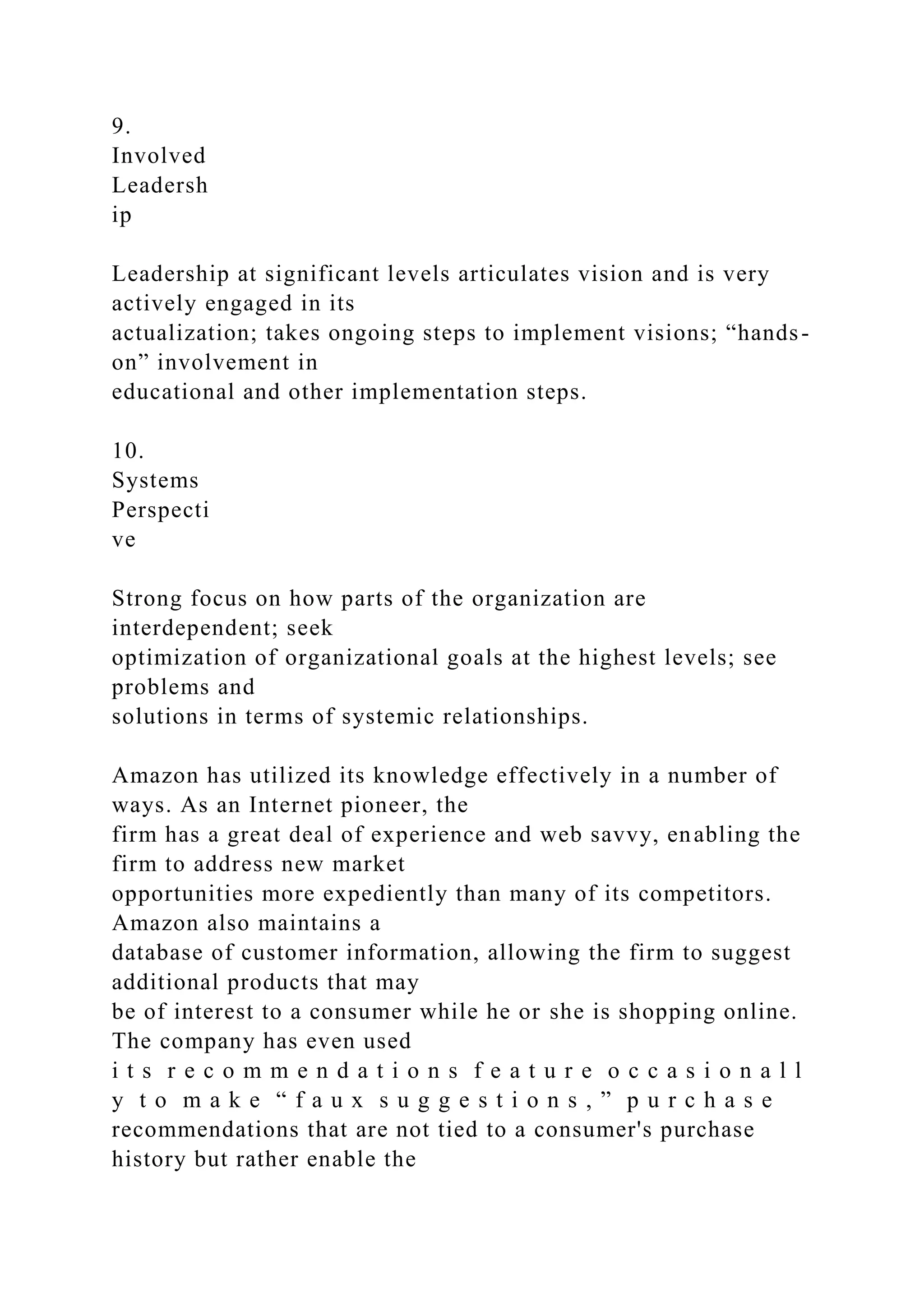
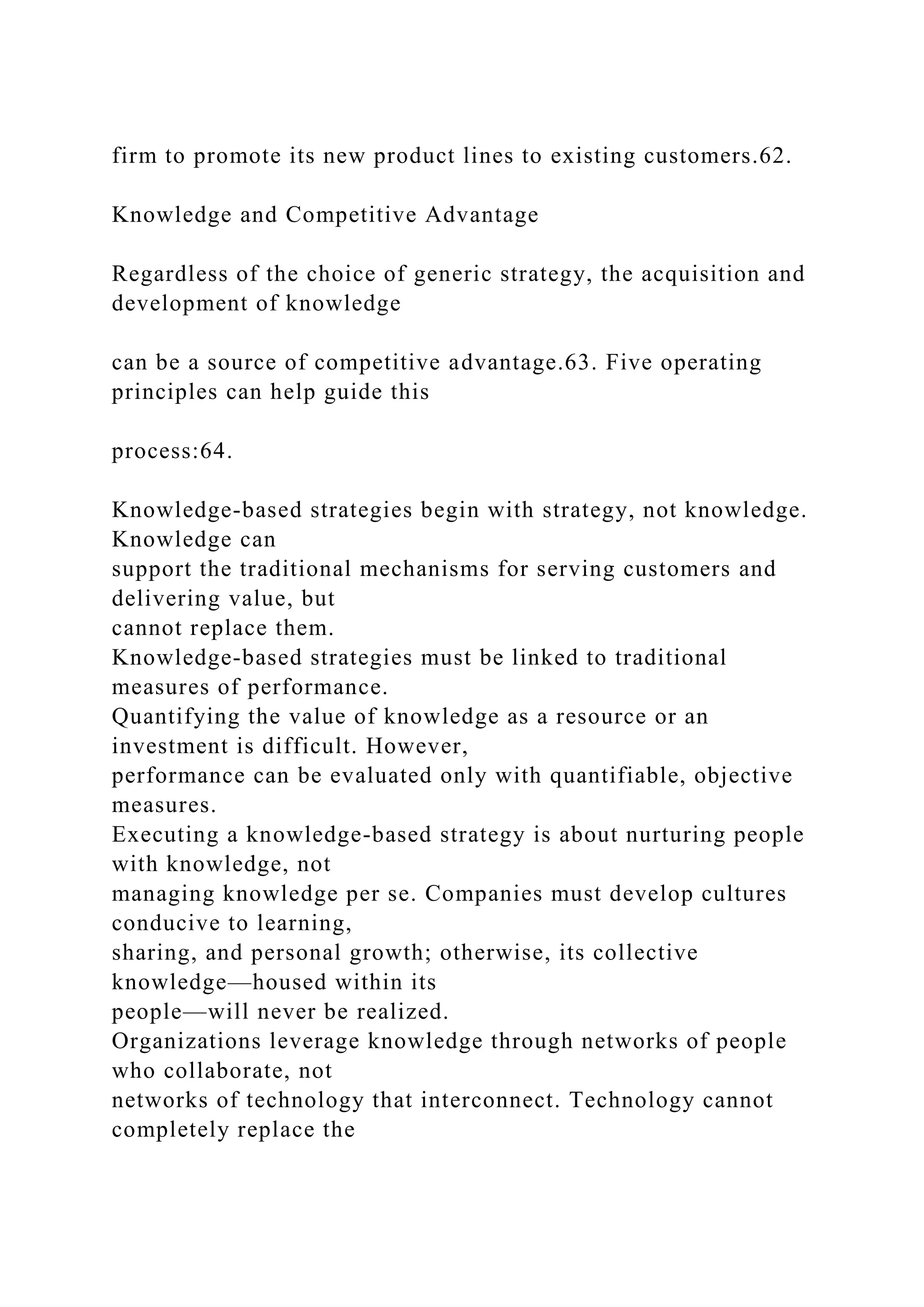
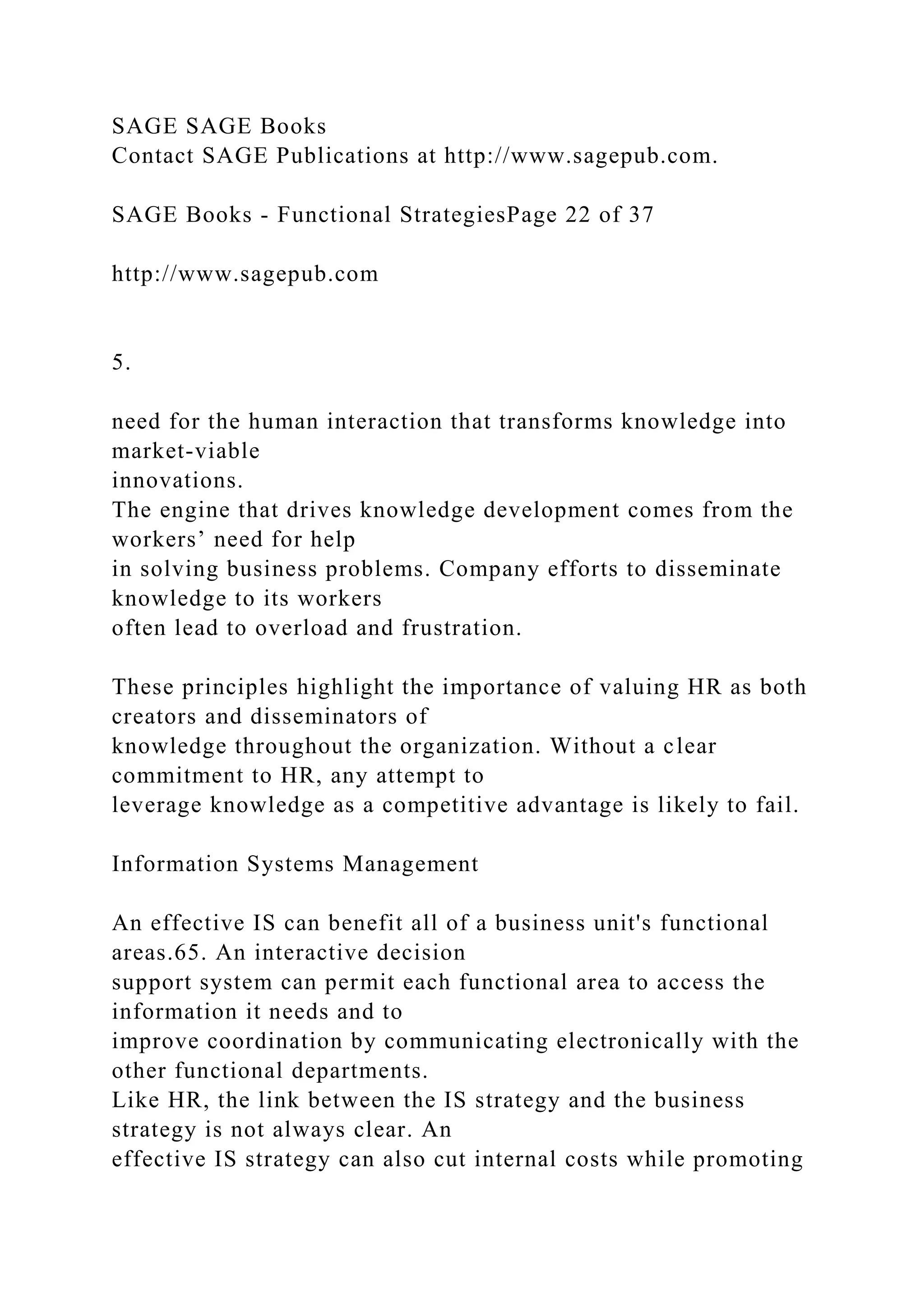
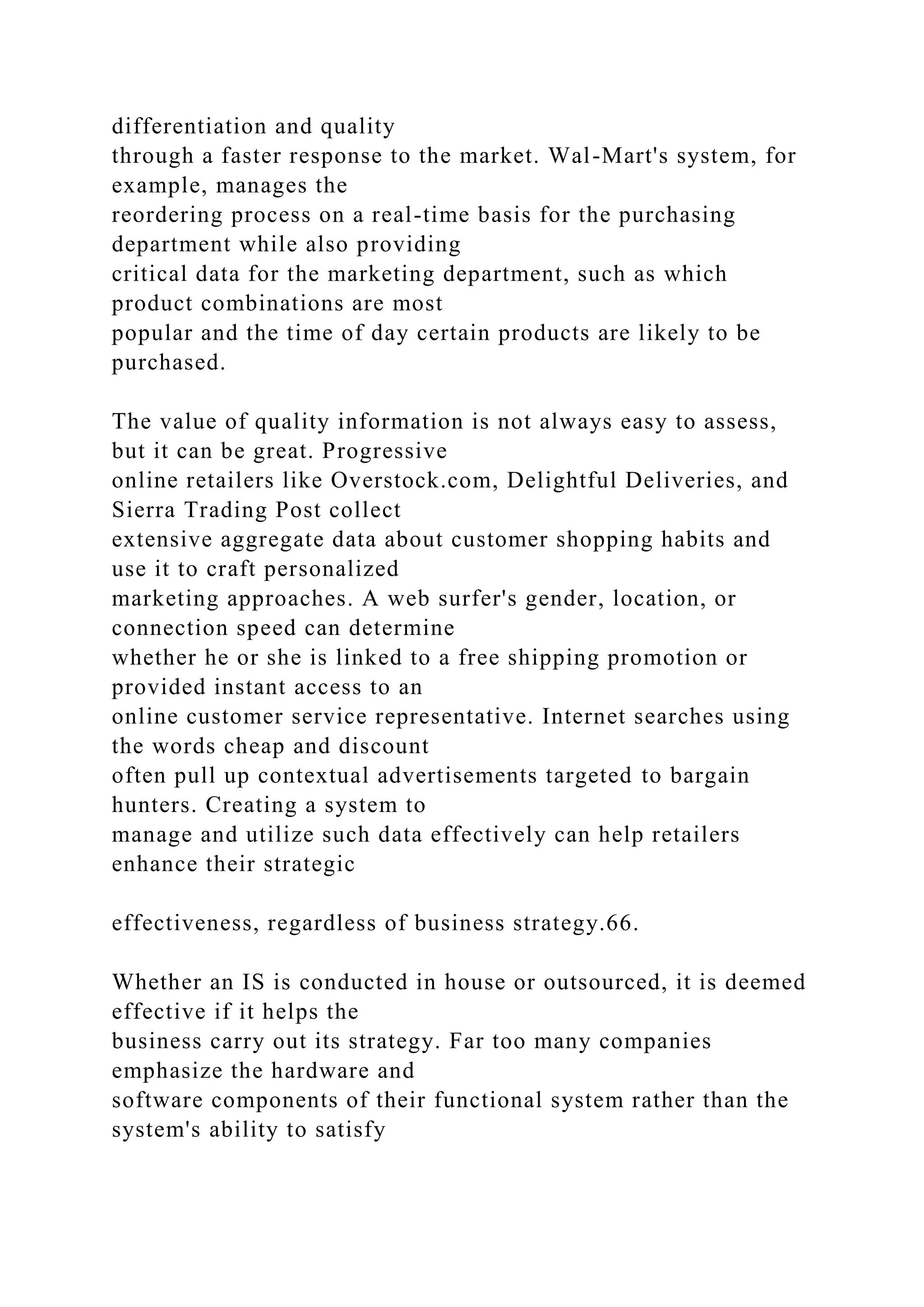
Table 8.3 identifies 10 factors that can promote the
development of learning capabilities in an
organization. Collectively, these factors underscore the
importance of innovation, hands-on
leadership, and performance measurement.
Table 8.3 Factors That Facilitate Organizational Learning61.
1.
Scannin
g
Imperativ
e
Interest in external happenings and in the nature of one's
environment. Valuing
the processes of awareness and data generation. Curious about
what is “out
there” as opposed to “in here.”
2.
Performa
nce Gap
Shared perception of a gap between actual and desired state of
performance.
Disconfirming feedback interrupts a string of successes.
Performance shortfalls
are seen as opportunities for learning.
3.
Concern
for
Measure
ment
Spend considerable effort in defining and measuring key factors
when venturing
into new areas; strive for specific, quantifiable measures;
discourse over metrics is
seen as a learning activity.
4.
Experime
ntal
Mind-Set
Support for trying new things: curiosity about how things work;
ability to “play” with
things. Small failures are encouraged, not punished. See
changes in work
processes, policies, and structures as a continuous series of
graded tryouts.
5.
Climate
of
Opennes
s
Accessibility of information, relatively open boundaries.
Opportunities to observe
others; problems/errors are shared, not hidden; debate and
conflict are
acceptable.
6.
SAGE SAGE Books
Contact SAGE Publications at http://www.sagepub.com.
SAGE Books - Functional StrategiesPage 21 of 37
http://www.sagepub.com
1.
2.
3.
4.
Continuo
us
Educatio
n
Ongoing commitment to education at all levels; support for
growth and
development of members.
7.
Operatio
nal
Variety
Variety exists in response modes, procedures, systems;
significant diversity in
personnel. Pluralistic rather than monolithic definition of
valued internal
capabilities.
8.
Multiple
Advocate
s
Top-down and bottom-up initiatives are possible; multiple
advocates and
gatekeepers exist.
9.
Involved
Leadersh
ip
Leadership at significant levels articulates vision and is very
actively engaged in its
actualization; takes ongoing steps to implement visions; “hands-
on” involvement in
educational and other implementation steps.
10.
Systems
Perspecti
ve
Strong focus on how parts of the organization are
interdependent; seek
optimization of organizational goals at the highest levels; see
problems and
solutions in terms of systemic relationships.
Amazon has utilized its knowledge effectively in a number of
ways. As an Internet pioneer, the
firm has a great deal of experience and web savvy, enabling the
firm to address new market
opportunities more expediently than many of its competitors.
Amazon also maintains a
database of customer information, allowing the firm to suggest
additional products that may
be of interest to a consumer while he or she is shopping online.
The company has even used
i t s r e c o m m e n d a t i o n s f e a t u r e o c c a s i o n a l l
y t o m a k e “ f a u x s u g g e s t i o n s , ” p u r c h a s e
recommendations that are not tied to a consumer's purchase
history but rather enable the
firm to promote its new product lines to existing customers.62.
Knowledge and Competitive Advantage
Regardless of the choice of generic strategy, the acquisition and
development of knowledge
can be a source of competitive advantage.63. Five operating
principles can help guide this
process:64.
Knowledge-based strategies begin with strategy, not knowledge.
Knowledge can
support the traditional mechanisms for serving customers and
delivering value, but
cannot replace them.
Knowledge-based strategies must be linked to traditional
measures of performance.
Quantifying the value of knowledge as a resource or an
investment is difficult. However,
performance can be evaluated only with quantifiable, objective
measures.
Executing a knowledge-based strategy is about nurturing people
with knowledge, not
managing knowledge per se. Companies must develop cultures
conducive to learning,
sharing, and personal growth; otherwise, its collective
knowledge—housed within its
people—will never be realized.
Organizations leverage knowledge through networks of people
who collaborate, not
networks of technology that interconnect. Technology cannot
completely replace the
SAGE SAGE Books
Contact SAGE Publications at http://www.sagepub.com.
SAGE Books - Functional StrategiesPage 22 of 37
http://www.sagepub.com
5.
need for the human interaction that transforms knowledge into
market-viable
innovations.
The engine that drives knowledge development comes from the
workers’ need for help
in solving business problems. Company efforts to disseminate
knowledge to its workers
often lead to overload and frustration.
These principles highlight the importance of valuing HR as both
creators and disseminators of
knowledge throughout the organization. Without a clear
commitment to HR, any attempt to
leverage knowledge as a competitive advantage is likely to fail.
Information Systems Management
An effective IS can benefit all of a business unit's functional
areas.65. An interactive decision
support system can permit each functional area to access the
information it needs and to
improve coordination by communicating electronically with the
other functional departments.
Like HR, the link between the IS strategy and the business
strategy is not always clear. An
effective IS strategy can also cut internal costs while promoting
differentiation and quality
through a faster response to the market. Wal-Mart's system, for
example, manages the
reordering process on a real-time basis for the purchasing
department while also providing
critical data for the marketing department, such as which
product combinations are most
popular and the time of day certain products are likely to be
purchased.
The value of quality information is not always easy to assess,
but it can be great. Progressive
online retailers like Overstock.com, Delightful Deliveries, and
Sierra Trading Post collect
extensive aggregate data about customer shopping habits and
use it to craft personalized
marketing approaches. A web surfer's gender, location, or
connection speed can determine
whether he or she is linked to a free shipping promotion or
provided instant access to an
online customer service representative. Internet searches using
the words cheap and discount
often pull up contextual advertisements targeted to bargain
hunters. Creating a system to
manage and utilize such data effectively can help retailers
enhance their strategic
effectiveness, regardless of business strategy.66.
Whether an IS is conducted in house or outsourced, it is deemed
effective if it helps the
business carry out its strategy. Far too many companies
emphasize the hardware and
software components of their functional system rather than the
system's ability to satisfy
customer needs.67. Today more than ever, the application of
Internet technology to serve
customers and support suppliers is typically a focal point of the
IS strategy (see Case
Analysis 8.4).
Case Analysis 8.4 Step 15: What Are the Current Strategies in
Other Functional Areas Such
as Human Resources and Information Systems?
What HR policies that support the current business-level
strategy are in effect? Are
these efforts successful? Why or why not? Is the organization
poised to meet HR
needs (i.e., changes in the workforce) in the future? How does
the firm's HR
department objectively compare to those of its competitors?
SAGE SAGE Books
Contact SAGE Publications at http://www.sagepub.com.
SAGE Books - Functional StrategiesPage 23 of 37
http://overstock.com
http://www.sagepub.com
What is the current state of the organization's IS? Is it
supporting the implementation of
the organization's business and corporate strategies? Why or
why not? Does the firm
have a competitive presence on the Internet? How does this
presence compare to
those of its competitors?
The company website can be a good source of information on
both HR and IS
strategies. Augmenting company information with outside
perspectives is essential
because firms tend to overstate their effectiveness in areas such
as product quality,
service excellence, and especially human resources. According
to their websites, most
firms hire only the best of the best and offer world-class
training and development
opportunities. It is important to evaluate such claims critically.
Functional Strategies and Industry Life Cycle
Although the alignment between functional and business
strategies is critical to success, the
appropriate functional strategies can also be linked to the
industry life cycle stage. As
industries develop, specific capabilities associated with several
functional areas typically
become more important. Moreover, the prominence of various
functions can change as
industries progress. The R&D function tends to play a
prominent rule in the introduction
stage, followed by marketing in the growth stage, production in
the maturity stage, and
finance in the decline stage. The HR function remains important
but not dominant in all
stages. These relationships are illustrated in Table 8.4.
Table 8.4 Functional Strategies and Industry Life Cycle
Summary
After corporate-level and business unit generic strategies are
developed, top executives must
align activities in the functional areas to ensure that the various
departments are well
coordinated and work together. Most notably, the functions of
marketing, finance, production,
purchasing, HR, and IS—including utilization of the Internet—
should be considered.
SAGE SAGE Books
Contact SAGE Publications at http://www.sagepub.com.
SAGE Books - Functional StrategiesPage 24 of 37
http://www.sagepub.com
1.
2.
3.
4.
5.
6.
In many instances, an organization's business strategy suggests
appropriate characteristics of
its functional strategies. Each organization should develop
integrated functional strategies
that support the uniqueness of its business and corporate
strategies.
Key Terms
Capital-Labor Substitution: An organization's ability to
substitute labor for capital or vice
versa as production increases.
Experience Curve: The reduction in per-unit costs that occur as
an organization gains
experience producing a product or service.
Functional Strategies: The strategies pursued by each functional
area of a business
unit, such as marketing, finance, or production.
Human Capital: The sum of the capabilities of individuals in an
organization.
Just-In-Time (JIT) Inventory System: An inventory system,
popularized by the Japanese,
in which suppliers deliver parts just at the time they are needed
by the buying
organization to use in its production process.
Knowledge Management: People and their skills and abilities
(i.e., knowledge capital)
represent the only resource that cannot readily be reproduced by
a firm's competitors.
Knowledge capital must be effectively leveraged if high-
performing firms are to remain as
such over the long term.
Learning: The increased efficiency that occurs when an
employee performs a task
repeatedly.
Process R & D: R & D activities that seek to reduce the costs of
operations and make
them more efficient.
Product/Service R & D: R & D activities directed toward
improvements or innovations in
the quality or uniqueness of a company's outputs.
Total Quality Management (TQM): A broad-based program
designed to improve product
and service quality and to increase customer satisfaction by
incorporating a holistic
commitment to quality as seen through the eyes of the customer.
Review Questions and Exercises
What are the relationships among corporate-level, business unit,
and functional
strategies?
Why and how should the four Ps of marketing be aligned to
support the organization's
business strategy?
What is the difference between product and process R&D? How
can each align with
business strategies?
Relate the concept of the experience curve to the production
operations of an
automobile assembly plant.
Explain the role of business process reengineering in various
functional strategies.
Explain the linkage that a JIT inventory system provides
between the purchasing and
production functions. What are the implications for quality?
Practice Quiz
True or False?
1. Because functional strategies should be designed to support
corporate and business
SAGE SAGE Books
Contact SAGE Publications at http://www.sagepub.com.
SAGE Books - Functional StrategiesPage 25 of 37
http://www.sagepub.com
A.
B.
C.
D.
A.
B.
C.
D.
A.
B.
C.
D.
A.
B.
C.
D.
strategies, they should not be considered until corporate and
business strategies have
been formulated.
2. The most appropriate means of securing funds likely depends
on the corporate and
business strategies being pursued.
3. The reduction in per-unit costs that occurs as an organization
gains experience
producing a product or service is known as economies of scale.
Economies of scale is one
of the contributing factors to the experience curve.
4. The purchasing department in a low-cost business should
always purchase raw
materials at the lowest possible cost.
5. The HR department in a low-cost business should always
attempt to hire managers and
workers at pay rates below those of their competitors.
6. A key characteristic of an effective IS is its ability to serve
and help integrate the other
functional areas of the business.
Multiple Choice
7.
Functional strategies should_______.
be integrated across the business unit
support the business strategy
support the corporate strategy
all of the above
8.
Which of the following is not part of the marketing strategy?
pricing
distribution
promotion
none of the above
9.
The experience curve is based on which of the following?
potential for capital-labor substitutions
economies of scale
organizational learning
all of the above
10.
Efforts directed toward improvements or innovations in the
quality or uniqueness of a
company's outputs is known as_______.
product R&D
process R&D
product innovation
structural reorganization
11.
Reducing operational costs by making the production process
more efficient is known
SAGE SAGE Books
Contact SAGE Publications at http://www.sagepub.com.
SAGE Books - Functional StrategiesPage 26 of 37
http://www.sagepub.com
A.
B.
C.
D.
A.
B.
C.
D.
as_______.
TQM
process R&D
product innovation
structural innovation
12.
Which of the following is not a characteristic of the JIT
approach to inventory?
JIT is difficult on suppliers.
JIT reduces inventory costs.
JIT is less risky than traditional inventory approaches.
JIT is popular in Japan.
Student Study Site
Visit the student study site at www.sagepub.com/parnell4e to
access these additional
materials:
Answers to Chapter 8 practice quiz questions
Web quizzes
SAGE journal articles
Web resources
eFlashcards
Notes
1. P. Wright, M. Kroll, and J. A. Parnell, Strategic
Management: Concepts (Upper Saddle
River, NJ: Prentice Hall, 1998).
2. D. Webb and C. Webster, “An Exploration of the Meaning
and Outcomes of a Customer-
Defined Market Orientation,” Journal of Business Research 48
(2000): 101-112.
3. N. Wingfield, “Amazon Takes Page from Wal-Mart to
Prosper on Web,” Wall Street Journal,
November 22, 2002, A1, A6.
4. M. Whitford, “Motel 6 Converts Hotels to Launch Extended
Stay Brand,” Hotel & Motel
Management, March 15, 1999, 36.
5. M. McCarthy, “Mazda Earmarks $30 Million to Ring in
Millenia,” Brandweek, March 7, 1994,
1, 6.
6. K. Lundegaard and S. Freeman, “Detroit's Challenge:
Weaning Buyers From Years Of
Deals,” Wall Street Journal, January 6, 2004, A1, A2; J. Grant,
“Carmakers ‘Poised to
Rebound’ This Year,” Financial Times, January 2, 2004, 1, 12.
7. R.E. Silverman, “Why You Waste So Much Money,” Wall
Street Journal, July 16, 2003, D1,
D2.
8. E. White, “P&G to Use Plugs in TV News Stories to Send
Viewers to Its Web Sites,” Wall
SAGE SAGE Books
Contact SAGE Publications at http://www.sagepub.com.
SAGE Books - Functional StrategiesPage 27 of 37
http://www.sagepub.com/parnell4e
http://www.sagepub.com
Street Journal, March 7, 2001, B1, B6.
9. M. Mangilindan, “Web Ads On the Rebound,” Wall Street
Journal, August 25, 2003, B1, B6.
10. T. Zaun, “Very Defensive Driving,” Wall Street Journal,
June 2, 2003, B1, B3.
11. J. Drucker and A. Latour, “New Value Meal: Big Mac,
Fries, Web Access,” Wall Street
Journal, July 8, 2003, D1, D5.
12. C. Terhune, “In Switch, Pepsi Makes Diet Cola Its New
Flagship,” Wall Street Journal,
March 16, 2005, B1, B2.
13. B. McKay, “Zero Is Coke's New Hero,” Wall Street Journal,
April 17, 2007, C1, C2.
14. A. Zimmerman, “A General-Store Race Is On,” Wall Street
Journal, April 30, 2012, B4.
15. S. Vranica, “Great Scott! Dunder Mifflin Morphs Into Real-
Life Brand of Copy Paper,” Wall
Street Journal, November 28, 2011, B1.
16. R . G . S c h r o e d e r , K . A . B a t e s , a n d M . A .
J u n t t i l a , “ A R e s o u r c e - B a s e d V i e w o f
Manufacturing Strategy and the Relationship to Manufacturing
Processes,” Strategic
Management Journal 23 (2002): 105-118.
17. A. G. Perkins, “Manufacturing: Maximizing Service,
Minimizing Inventory,” Harvard
Business Review 72, no. 2 (2000) 13-14.
18. J. Maas, “Customer Service: Extraordinary Results at
Southwest Airlines, Charles Schwab,
Lands’ End, American Express, Staples, and USAA,” Sloan
Management Review 40, no. 1
(1999): 105.
19. S. Branch, “Forget ‘May I Help You?’,” Wall Street Journal,
July 8, 2003, B1, B5.
20. S. Branch, “Going Private (Label),” Wall Street Journal,
June 12, 2003, B1, B3.
21. R. Suskind, “Humor Has Returned to Southwest Airlines
After 9/11 Hiatus,” Wall Street
Journal, January 13, 2003, A1, A6.
22. A. Bennett, “Many Consumers Expect Better Service and
Say They Are Willing to Pay for
It,” Wall Street Journal, November 12, 1990, B1.
23. S. Moore, “Press 9 for More Options,” Wall Street Journal,
May 4, 2012, A13.
24. L. Dube, L. M. Renaghan, and J. M. Miller, “Measuring
Customer Satisfaction for Strategic
Management,” Cornell Hotel and Restaurant Administration
Quarterly (February 1994): 39-47.
25. L. Enos, “DaimlerChrysler Forms E-Business Subsidiary,”
E-Commerce Times, October 9,
2000; D. Christensen, “Delivering the Promise of ‘E,’” World
Trade, 13, no. 12 (December
2000): 60-61; M. Mahoney, “And The Dot-Com Survivors
Are…” E-Commerce Times, February
2, 2001.
26. J. Jargon, “Asia Delivers for McDonald's,” Wall Street
Journal, December 13, 2011, B1-B2.
SAGE SAGE Books
Contact SAGE Publications at http://www.sagepub.com.
SAGE Books - Functional StrategiesPage 28 of 37
http://www.sagepub.com
27. P. R. Brown, “A Model for Effective Financial Analysis,”
Journal of Financial Statement
Analysis 3, no. 4 (1998): 60-63.
28. M. Bustillo, “Sears Suffers as It Skims on Stores,” Wall
Street Journal, November 17, 2011,
B1, B7.
29. M. Pagell, S. Melnyk, and R. Handfield, “Do Trade-offs
Exist in Operations Strategy?
Insights from the Stamping Die Industry,” Business Horizons
43, no. 3 (2000): 69-77.
30. See Boston Consulting Group, Perspectives on Experience
(Boston: The Boston
Consulting Group, 1976); G. Hall and S. Howell, “The
Experience Curve from an Economist's
Perspective,” Strategic Management Journal 6 (1985): 197-212.
31. L. E. Yelle, “The Learning Curve: Historical Review and
Comprehensive Survey,” Decision
Sciences 10 (1979): 302-328.
32. T. Aeppel, “In Lights-Out Factories Machines Still Make
Things Even When No One Is
There,” Wall Street Journal, November 19, 2002, B1, B11.
33. R. D. Buzzell and B. T. Gale, The PIMS Principles (New
York: Free Press, 1987), Ch. 6.
34. D. Michaels and J. L. Lunsford,” Streamlined Plane
Making,” Wall Street Journal, April 1,
2005, B1, B2.
35. K. Rollins, “Using Information to Speed Execution,”
Harvard Business Review 76, no. 2
(1998): 81.
36. B. Dumaine, “How Managers Can Succeed Through Speed,”
Fortune, February 13, 1989,
54.
37. E. Abrahamson and G. Fairchild, “Management Fashion:
Lifecycles, Triggers, and
Collective Learning Processes,” Administrative Science
Quarterly 44 (1999): 708-728.
38. D. F Kuratko, J. C. Goodale, and J. S. Hornsby, “Quality
Practices for Competitive
Advantage in Smaller Firms,” Journal of Small Business
Management 39 (2001): 293-311.
39. J. A. DeFeo, “Creating Strategic Change More Effectively
with a New Design for Six Sigma
Process,” Journal of Change Management 3, no. 1 (2002): 60-
80.
40. C. W. L. Hart, “The Power of Unconditional Service
Guarantees,” The McKinsey Quarterly
(Summer 1989): 75-76.
41. S. McCartney, “Continental Airlines Keeps Little Things,
and It Pays Off Big,” Wall Street
Journal, February 4, 2002, A1.
42. N. Shirouzu, “When Hybrid Cars Collide,” Wall Street
Journal, February 6, 2003, B1, B5.
43. J. Levine, “Smokeless Cigarette Goes on Sale but Nothing
Shows It's Safer for Smokers,”
CNN Interactive,www.cnn.com/HEALTH/9606/03/cigarette
(accessed November 28, 2011).
44. P. F. Drucker, “Japan: New Strategies for a New Reality,”
Wall Street Journal, October 2,
1991, A12.
SAGE SAGE Books
Contact SAGE Publications at http://www.sagepub.com.
SAGE Books - Functional StrategiesPage 29 of 37
http://www.cnn.com/HEALTH/9606/03/cigarette
http://www.sagepub.com
45. N. Anbarci, R. Lemke, and S. Roy, “Interfirm
Complementaries in R&D: Re-examination of
the Relative Importance of Joint Ventures,” International
Journal of Industrial Organization 20
(2002): 191-204.
46. T. H. Hendrick and F. G. Moore, Production/Operations
Management, 9th ed. (Homewood,
IL: Irwin, 1985), 336.
47. J. G. Miller and P. Gilmour, “Materials Managers: Who
Needs Them?” Harvard Business
Review 57, no. 4 (1979): 145.
48. S. P. Galante, “Distributors Bow to Demands of ‘Just-in-
Time’ Delivery,” Wall Street
Journal, June 30, 1986, B1; L. Beard and S. A. Butler,
“Introducing JIT Manufacturing: It's
Easier Than You Think,” Business Horizons 43, no. 5 (2000):
61-64.
49. J. Mitchell, “GM Saturn Ads Request Buyers to be Patient,”
Wall Street Journal,
September 25, 1992, B1.
50. J. Dreyfuss, “Shaping Up Your Suppliers,” Fortune, April
10, 1989, 116.
51. J. Browne, J. Harhen, and J. Shivnan, Production
Management Systems: A CIM
Perspective (Workingham, England: Addison-Wesley, 1988),
158-159.
52. A. A. Lado, “Strategic Human Resource Management,”
Academy of Management Review
25 (2000): 677-679; R. A. Shafer et al., “Crafting a Human
Resource Strategy to Foster
Organizational Agility: A Case Study,” Human Resource
Management 40 (2001): 197-212.
53. M. McCracken, “Detroit's Symbol of Dysfunction: Paying
Employees Not to Work,” Wall
Street Journal, March 1, 2006, A1, A12.
54. A. Davis, “Employers Dig Deep into Workers’ Pasts, Citing
Terrorism Fears,” Wall Street
Journal, March 12, 2002, A1.
55. E. White, “To Keep Employees, Domino's Decides It's Not
All About Pay,” Wall Street
Journal, February 27, 2005, A1, A9.
56. J. Pereira, “To Save on Health-Care Costs, Firms Fire
Disabled Workers,” Wall Street
Journal, July 14, 2003, A1, A7; T. Aeppel, “Skyrocketing
Health Costs Start to Pit Worker vs.
Worker,” Wall Street Journal, June 17, 2003, A1, A6.
57. A. S. Huff, “Changes in Organizational Knowledge
Production,” Academy of Management
Review 25 (2000): 288-293; T. H. Davenport et al., “Data to
Knowledge to Results: Building an
Analytic Capability,” California Management Review 43, no. 2
(2001): 117-138.
58. S. K. McElivy and B. Chakravarthy, “The Persistence of
Knowledge-Based Advantage: An
Empirical Test for Product Performance and Technological
Knowledge,” Strategic
Management Journal 23 (2002): 285-306.
59. C. Soo et al., “Knowledge Management: Philosophy,
Processes, and Pitfalls,” California
Management Review 44, no. 4 (2002): 129-150; J. Birkinshaw
and T. Sheehan, “Managing the
Knowledge Life Cycle,” MIT Sloan Management Review 44, no.
1 (2002): 85-93.
60. A. W. Sheldon, “Strategy Rules,” Fast Company (January
2001): 164-166.
SAGE SAGE Books
Contact SAGE Publications at http://www.sagepub.com.
SAGE Books - Functional StrategiesPage 30 of 37
http://www.sagepub.com
61. B. Moingeon and A. Edmondson, Organizational Learning
and Competitive Advantage
(Thousand Oaks, CA: Sage, 1996), 43. Reprinted by permission
of Sage Publications.
62. N. Wingfield and J. Pereira, “Amazon Issues ‘Faux’
Recommendation for Its Clothing,”
Wall Street Journal, December 4, 2002, B1, B3.
63. J. P Katz, “Blown to Bits: How the New Economics of
Information Transforms Strategy,”
Academy of Management Executive 14 (2000): 160-162; H.
Tsoukas and E. Vladimirou, “What
Is Organizational Knowledge?” Journal of Management Studies
38 (2001): 973-994.
64. B. Manville and N. Foote, “Strategy as if Knowledge
Mattered,” Fast Company (April
1996), p. 66.
65. R. Sabherwal and Y. E. Chan, “Alignment Between Business
and IS Strategies: A Study of
Prospectors, Analyzers, and Defenders,” Information Systems
Research 12 (2001): 11-33.
66. J. E. Vascallaro, “Online Retailers are Watching You,” Wall
Street Journal, November 28,
2006, D1, D3.
67. K. F. Pun and M. K. O. Lee, “A Proposed Management
Model for the Development of
Strategic Information Systems,” International Journal of
Technology Management 20 (2000):
304-325; P. Gottschalk, “Strategic Information Systems
Planning: The IT Strategy
Implementation Matrix,” European Journal of Information
Systems 8, no. 2 (1999): 107-118.
Strategy + Business Reading: The Power of the Post-Recession
Consumer
An analysis of attitudes and spending reveals a return to
traditional
values, driven by consumers searching for quality, affordability,
and
connection.
by John Gerzema and Michael D'Antonio
The wave of hyper-consumerism that propelled the U.S.
economy through the last
decades of the 20th century and into the first years of the 21st
century has passed.
Say good-bye to all the signs of easy wealth we knew from the
recent past:
McMansions, SUVs, and recreational shopping. Consumer
spending patterns are
changing as part of a trend that has been quietly gathering
strength over the past 10
years. Say hello to a lifestyle more focused on community,
connection, quality, and
creativity. People are returning to old-fashioned values to build
new lives of purpose
and connection. They also realize that how they spend their
money is a form of power,
and are moving from mindless consumption to mindful
consumption, increasingly
taking care to purchase goods and services from sellers that
meet their standards and
reflect their values.
This change in consumer attitudes—visible not only in the
United States but also in
other countries affected by the Great Recession—is not a fad or
whim. It is, in part, a
reaction to economic hard times. But it is also closely related to
the civic dissatisfaction
SAGE SAGE Books
Contact SAGE Publications at http://www.sagepub.com.
SAGE Books - Functional StrategiesPage 31 of 37
http://www.sagepub.com
that is rocking the political establishment, and additionally has
some roots in
environmental awareness and changing aspirations. That is why
this Spend Shift
movement, as we call it, is here to stay. It will create
opportunities for businesses that
heed its message, and penalize those that do not. (For another
perspective, see
“Values vs. Value,” by Timothy Devinney, Pat Auger, and
Giana M. Eckhardt, s+b,
Spring 2011.)
Our view of the Spend Shift is based on two years of gathering
and analyzing data,
and traveling around the U.S. to discover how the recession has
affected people's
lives. We started with Young & Rubicam's BrandAsset Valuator
(BAV), which is a poll of
consumer values, attitudes, and shopping behaviors that goes
back nearly 20 years.
(Although the data sample we focus on in this article is from the
U.S., we found that
there are similar dynamics in Europe and other industrialized
countries.) The BAV
holds data on more than 40,000 brands in more than 50
countries, and every quarter it
is supplemented with new results—on purchasing and social
attitudes — from 16,000
respondents in the U.S. alone. In all, we have queried more than
a million consumers
in 50 countries on some 70 brand metrics, which include the
general awareness
consumers have of a brand, the particular ways it makes them
feel, and many others.
(See “The Trouble with Brands,” by John Gerzema and Ed
Lebar, s+b, Summer 2009.)
The BAV data revealed that even before the recession took hold
in mid-2008, there
were dramatic shifts in what people expected in the consumer
marketplace and how
they defined and pursued what they considered the good life. As
a factor in decision
making, sheer desire for the goods themselves has been
declining sharply for the past
decade. More recently, the BAV surveys show sharp increases
in the number of
consumers who want positive relationships with marketplace
vendors and who focus
more on corporate behavior. Between 2005 and 2009, a growing
number of people
rejected status-driven values such as snobbishness and
exclusivity, and embraced
attributes related to bringing people closer together or making
the world a better place.
Among the once-prized brand attributes that declined in this
period were: “exclusive”
(down 60 percent), “arrogant” (down 41 percent), “sensuous”
(down 30 percent), and
“daring” (down 20 percent). On the opposite side of the scale,
the brand attributes
Americans found more important as they began to sense the
impending recession and
then suffered through the crisis were: “kindness and empathy”
(up 391 percent),
“friendly” (up 148 percent), “high quality” (up 124 percent),
and “socially responsible”
(up 63 percent).
The reference to “kindness” is not a typo. Between 2005 and
2009, U.S. consumers
expressed a nearly fourfold increase in their preference for
companies, brands, and
products that show kindness in both their operations and their
encounters with
customers. This desire for companies to be more empathetic
toward consumers is the
biggest shift in any attitude that we have ever seen during the
BAV survey's two-
decade history.
The BAV data told us that at the grass roots, people were well
ahead of the pundits,
corporations, and political leaders. Some of the most important
economic statistics
supporting this trend come from the U.S. Bureau of Economic
Analysis reports on
personal savings. The reports show that ordinary Americans
began raising their
deposits in savings accounts and other secure investments a full
two years before the
start of the recession. Even as unemployment surged past 10
percent, U.S. consumers
socked away more money every month. By the middle of 2009,
people were saving
SAGE SAGE Books
Contact SAGE Publications at http://www.sagepub.com.
SAGE Books - Functional StrategiesPage 32 of 37
http://www.sagepub.com
about 7 percent of their disposable income—a figure that hadn't
been seen since 1995.
We also know that people cut back on spending many months
before the recession
began. In fact, Americans reduced consumption so sharply that
in the middle of 2008,
it dropped below their disposable income and just kept falling.
This reversal of earlier
trends in saving and spending continued throughout all of 2009.
Without being
scolded, lectured, or led from above, U.S. consumers had
quietly changed their
behavior.
Regardless of companies’ size or their target market, they must
understand the
significance of the Spend Shift to compete in the post-recession
economy. From the
scores of interviews we conducted and thousands of data points
we accumulated, we
can identify a wide array of ways that the shift in attitudes,
values, expectations, and
behaviors will change the way we buy, sell, and live. We have
distilled our findings into
four defining principles that together offer a comprehensive
look at the origins and
impacts of the Spend Shift.
United by Change
The Spend Shift is a far-reaching and inclusive phenomenon
that can't be defined by
any particular demographic. According to our data, 55 percent
of all Americans are part
of this movement; in addition, about one-quarter of the U.S.
adult population embraces
many of the Spend Shift attitudes and characteristics (we call
them Fast Followers).
Although the word values tends to polarize U.S. citizens, the
Spend Shift is blind to
geography, education, age, and income.
Spend Shifters can be found across the nation: 17 percent are in
the Northeast, 23
percent are in the Midwest, 36 percent are in the South, and 24
percent are in the
West. Although we'll limit our discussion to what's happening
in the U.S., it is worth
noting that the BAV data shows that the Spend Shift is a global
trend. For example, we
found that 53 percent of French consumers are Spend Shifters,
as are 45 percent of
German and Italian consumers.
Members of the movement have varying education backgrounds:
23 percent have a
high school diploma, 21 percent have a college degree, and 11
percent have
completed postgraduate studies. Spend Shifters also represent
diverse income
brackets; for example, 28 percent earn less than US$40,000 a
year, but 18 percent
earn between $75,000 and $100,000. They represent
Republicans, Democrats, and
Independents (28, 31, and 41 percent, respectively). Millennials
(the generation born
between 1980 and 1995) lead the movement, with 58 percent of
22- to 28-year-olds
participating, yet nearly half of all seniors belong, too
(including 55 percent of adults
age 68 and above).
What unites all these Spend Shifters is a common sense of
optimism and newfound
purpose. As the shock of economic loss wears off for many
people, they are redefining
what it means to be successful and happy. They are living with
less and yet feeling
greater satisfaction. Seventy-eight percent of those surveyed
reported they are happier
with a more back-to-basics lifestyle. Eighty-eight percent
reported they buy less-
expensive brands than they used to.
SAGE SAGE Books
Contact SAGE Publications at http://www.sagepub.com.
SAGE Books - Functional StrategiesPage 33 of 37
http://www.sagepub.com
The New Thrift
Prior to the Great Recession, the American dream was defined
by largeness and
acquisition. Yet as a result of the crisis and its lingering
presence in the economy, more
than two-thirds of U.S. respondents to our survey now prefer a
pared-down lifestyle
with fewer possessions and less emphasis on displays of wealth.
(The figure rises to
77 percent among millennials.)
Consumer spending will no longer be able to grow faster than
personal income, as it
did during the 30 years leading up to the crisis. Greater savings
coupled with less
borrowing is not a value that is foreign to Americans. We would
argue this is not a “new
normal,” but an old one: If you look at historical savings rates
in the U.S., people have
on average saved 10 percent of their income going back as far
as six decades. It was
only in the mid-1980s that availability and promotion of
consumer credit, as well as
sustained economic growth, first encouraged ordinary people to
get out over their skis.
In only 20 years, average American households swung from
being net savers to being
net borrowers. Now, however, consumers are returning to
traditional values that have
long defined the U.S. ideal.
In the same vein, people want to do more on their own. In the
post-recession economy,
resourcefulness and self-sufficiency are viewed as virtues, and
excessive consumption
as a sign of weakness. In our surveys, 84 percent agreed with
the following statement:
“These days I feel more in control when I do things myself
instead of relying on others
to do them for me.” We examined the 2009 performance of a
basket of “retooling”
companies— those that are in the top 10 percent of our data on
being “helpful,”
“reliable,” “educational,” and “durable,” such as LeapFrog,
Weight Watchers,
Craftsman, and DeWalt, because they help people help
themselves. The performance
of these companies against all others is notable: They performed
249 percent better
than other companies when respondents were asked whether
they would recommend
these brands to a friend, 234 percent better when respondents
were asked if they used
the products regularly, and 210 percent better on whether the
products were worth a
premium price.
Instead of seeking status through acquisition, many people, we
discovered, are
s e e k i n g w a y s t o e x p e r i e n c e a s e n s e o f c o
m p e t e n c e , s e l f - s u f f i c i e n c y , a n d
accomplishment. Look, for example, at Etsy.com, a craft and
vintage item website that
serves as a retail and trading marketplace for millions.
Beginning in 2005, Etsy founder
Rob Kalin and his partners began developing an online place
where any artisan could
display work and sell to any buyer in the world. Within five
years, Etsy had 300,000
vendors—the majority were women in their 20s and 30s—the
site was visited by
millions of shoppers every month, and the company grew to be
worth an estimated
$300 million in 2010. Etsy's mission resonates in today's
marketplace: “to enable
people to make a living making things.” If you have an idea for
helping people learn
new skills and connect with others, your business has a good
chance of success.
Transparency Breeds Trust
Today the buying public is savvy about marketing, search, and
social media.
Companies serving these customers, who know more and expect
more, will need to
continuously listen, respond, and innovate. They are in for a
challenge: Our data
SAGE SAGE Books
Contact SAGE Publications at http://www.sagepub.com.
SAGE Books - Functional StrategiesPage 34 of 37
http://etsy.com
http://www.sagepub.com
shows that confidence in all types of big organizations,
including big government and
big business, has declined by nearly 50 percent in the past two
years. Consumer
confidence has dropped especially in the financial and
automotive sectors, but also in
retail, packaged goods, consumer electronics, and 20 other
product and service
categories.
Wary consumers are going beyond just reading labels to get the
best products and the
best deals. The most tech-savvy are using online services as
they stand in the
supermarket aisle to get instant access to information on prices
and on a company's
social or environmental record. GoodGuide, for example, a
California company that
tracks, tests, and publishes research on the basic “goodness” of
products people buy,
has reviewed more than 65,000 products and posted findings
online for consumers
since 1997. Shoppers are also relying on one another for
information, via Facebook,
Twitter, and online rankings.
Twentieth-century companies were in the information arbitrage
business. They knew
more about their product than customers did, and they used that
information
advantage to create profits. Today, however, customers have
equal (and sometimes
superior) access to data. As a result, transparency becomes all
the more crucial.
Today's stakeholders can see through a glossy cover-up. They
crave a true, authentic
story. They will be interested in how a company thinks and how
it makes decisions.
One company that has recognized this is Patagonia Inc., evident
by its launch of the
Footprint Chronicles in late 2007. This online feature reveals
how the manufacturing
and delivery of Patagonia's products affect the environment. A
visitor to the site can
click on any product and track its environmental and social
impact along its path to the
store. As a product crisscrosses the globe, pop-up videos
explain each stage of
production, from design creation to sewing to distribution,
giving statistics for each
item's energy consumption, distance traveled, carbon emissions,
and waste generated.
Although the Footprint Chronicles have demonstrated that some
Patagonia products
have negative environmental impacts that are nearly impossible
to upend, the
company's presentation of fact rather than message has helped
establish it as an
honest, trustworthy company. In today's marketplace, successful
companies will
p r a c t i c e c o m p l e t e t r a n s p a r e n c y , l e t t i n g
c u s t o m e r s s e e t h e i r s u p p l y c h a i n s ,
management strategies, and values.
Companies That Care
As we noted earlier, our data suggests that kindness and
empathy are now dominant
discriminators in commerce, and are valuable attributes of the
best companies. The
ability of a company to identify with its customers is now a
prerequisite for any brand in
the post-crisis age. Today, openness, humility, and
understanding are critical.
Generosity binds a company to its community and its
stakeholders.
The rising importance of generosity reflects the fact that the
post-crisis era will be
defined by inclusion rather than exclusion. The emphasis is on
being more human and
humane in transactions with others, and people will set these
same standards for the
businesses with which they deal. Spend Shifters are buying
artisanal food because
they trust companies that reveal how their food is produced and
handled. They
patronize cooperative small businesses because such businesses
use their profits to
SAGE SAGE Books
Contact SAGE Publications at http://www.sagepub.com.
SAGE Books - Functional StrategiesPage 35 of 37
http://www.sagepub.com
build up their local regions. Passionate customer groups will
also band together to
fund niche offerings that speak directly to the areas about which
they feel most
strongly. Because 71 percent of U.S. consumers are now
aligning their spending with
their values, businesses that practice in a new way will find a
vibrant marketplace.
Instead of selling shoes, such businesses sell empathy and
respect. For each pair of
Toms Shoes that a customer buys, for example, the company
sends a pair to a child in
the developing world. Instead of serving food, companies create
communities of hope.
Instead of making cars, they promise fairness, openness, and
shared discourse.
Consumers will be looking for signs that companies care about
their impact on
communities and are investing in making things better. Selling
to your customers will
require investing in your customers. Generosity opens up
networks, provides access to
talent pools, and creates future customers. The vanguard
companies understand that
showing kindness and humanity is now a competitive advantage.
Microsoft is a telling example. Although Apple's ads make it
seem as though all the
cool kids hate Microsoft and favor Apple, the two companies
aren't even close when it
comes to the sentiments of the public at large. In our BAV
survey, Microsoft always
scores high on measures of its reputation, exceeding Apple by a
wide margin. How
does Microsoft do it? Despite its massive size, Microsoft is still
widely associated with
the single personality of its founder, Bill Gates. He gives
Microsoft a human face and,
more important, his philanthropy gives the company a heart. In
February 2009,
Microsoft launched a program called Elevate America to
provide 2 million people with
free training in information technology to help them find jobs in
the postindustrial
economy. By August 2010, Elevate America was running in
more than 30 states and
serving 900,000 people.
When we talked to Akhtar Badshah, Microsoft's senior director
of global community
affairs, he told us that in its response to the recession,
Microsoft pursued three main
areas of focus: education, innovation, and jobs and economic
opportunity. Those
choices are good for Microsoft, because they create an
opportunity for the company to
demonstrate its strengths to current and future customers. The
key point is that
Microsoft uses both its money and its true areas of expertise to
maximize the good it
can do as a citizen corporation, showing how a company can be
charitable by
redeploying its existing assets and infrastructure as tools for
social and economic
development.
The Consumer Connection
The Conference Board's Consumer Confidence Index was at
50.2 in October 2010, up
from an all-time low of 25.3 in February 2009, but still far from
90, the indicator of a
stable economy. (In May 2000, it reached a high of 144.7.)
Although the growth of
consumer spending appears to be slowing, we believe that
people are simply
reallocating the way they spend—looking for a connection to
the creator of the product;
banding together to get better deals; and pushing service and
product creators to do
more, price better, and connect more deeply to their wants and
needs.
Even as people find themselves less rich, they are deploying
their dollars in a more
calculated and strategic way to influence institutions such as
corporations and
government. This desire to use money to express values stands
out in our BAV data,
SAGE SAGE Books
Contact SAGE Publications at http://www.sagepub.com.
SAGE Books - Functional StrategiesPage 36 of 37
http://www.sagepub.com
and was expressed by many of the people with whom we spoke.
Nearly two-thirds of
all the people who responded to the BAV felt they could affect
corporate behavior
through their purchasing habits, and the same proportion
avoided companies whose
values contradicted their own.
The most successful companies will respond to this shift by
adopting a business model
in which all three parties—the business, the customer, and the
community—win in
every transaction. Although the Spend Shift will dampen
domestic demand for some
products, the market for values-oriented goods and services
offers opportunities for
growth in what might otherwise be considered mature
categories. We examined the
performance of a group of companies and brands that scored in
the top 20 percent in
the BAV survey on the values we had noted were becoming
increasingly important—
self-reliance, adaptability, honesty, quality, and community.
And we found that in
aggregate they enjoyed nearly three times as much usage and
preference as brands
that did not represent these values.
We believe that the future face of capitalism will be defined by
delivering value and
values. Those that embrace this reality and adapt will find
extraordinary opportunities.
Those that ignore it will do so at their peril.
Reprint No. 11107
Author Profiles:
John Gerzema is president of Brand Asset Consulting, a Young
& Rubicam Brands
company. He is a pioneer in the use of data to identify social
change and to help
companies both anticipate and adapt to new consumer interests
and demands.
Gerzema oversees the BrandAsset Valuator, the world's largest
database of
consumer insights. Follow him on Twitter at
@johngerzema/Twitter.
Michael D'Antonio is a Pulitzer Prize-winning journalist based
in New York. He is
the author of more than a dozen books, including Forever Blue:
The True Story of
Walter O'Malley, Baseball's Most Controversial Owner, and the
Dodgers of Brooklyn
and Los Angeles (Riverhead Books, 2009).
http://dx.doi.org/10.4135/9781506374598.n8
SAGE SAGE Books
Contact SAGE Publications at http://www.sagepub.com.
SAGE Books - Functional StrategiesPage 37 of 37
http://dx.doi.org/10.4135/9781506374598.n8
http://www.sagepub.com
Strategic Management Concepts
Chapter 7
Business Unit Strategies
Parnell, Strategic Management: Theory and Practice. SAGE
Publications, Inc. © 2013
1
Chapter 7: Key Issues
Generic Strategies & Strategic Groups
Porter’s Generic Strategy Typology
Miles & Snow’s Generic Strategy Typology
Business Size & Strategy
Global Concerns
Parnell, Strategic Management: Theory and Practice. SAGE
Publications, Inc. © 2013
2
Introduction
Business Unit: An organizational entity with its own mission,
set of competitors, and industry.
Competitive Advantage: A state whereby a business’ successful
strategies cannot easily be duplicated by competitors.
Generic Strategies: A simple categorization of competitive
strategies available to businesses.
Strategic Group: Businesses employing the same generic
strategy.
Parnell, Strategic Management: Theory and Practice. SAGE
Publications, Inc. © 2013
3
7-1 Porter’s Generic Strategies
Michael Porter’s typology originally included four options: low
cost with focus, low cost without focus, differentiation with
focus, and differentiation without focus.
Table 7-1 (reproduced on the next slide) summarizes the generic
strategies presented in the text based on Porter’s typology.
Porter’s strategies are in red; those proposed by others are in
blue.
Parnell, Strategic Management: Theory and Practice. SAGE
Publications, Inc. © 2013
Porter’s Generic Strategy Typology
(Red strategies proposed by Porter, blue strategies added by
others)Emphasis on Entire Market or NicheEmphasis on Low
CostsEmphasis on DifferentiationEmphasis on Low Costs &
DifferentiationEmphasis on Various Factors Based on
MarketEntire MarketLow-Cost Strategy (proposed by
Porter)Differentiation Strategy (proposed by Porter)Low-Cost-
Differentiation Strategy (proposed by Porter)Multiple Strategies
(proposed by Porter)
NicheFocus-Low-Cost Strategy (proposed by Porter)Focus-
Differentiation Strategy (proposed by Porter)Focus-Low-
Cost/Differtiation Strategy (proposed by Porter)
Multiple Strategies (proposed by Porter)
Parnell, Strategic Management: Theory and Practice. SAGE
Publications, Inc. © 2013
5
7-1a Low-Cost (Cost Leadership) Strategy (without focus)
Produce basic, no-frills products and services for a mass market
of price-sensitive customers.
Often (but not always) build market share through low prices.
Low initial investment and low operating costs.
Often outsource to reduce costs.
Vulnerable to price competition.
Parnell, Strategic Management: Theory and Practice. SAGE
Publications, Inc. © 2013
6
7-1b Focus–Low-Cost Strategy
Emphasizes low costs while serving a narrow segment of the
market, producing no-frills products or services for price-
sensitive customers in a market niche.
Compete only in a niche where cost advantages relative to large
competitors can be enjoyed.
Vulnerable to price competition.
Example: Aldi minimizes costs and offers low prices, targeting
low-income consumers.
Parnell, Strategic Management: Theory and Practice. SAGE
Publications, Inc. © 2013
7
7-1c Differentiation Strategy (without focus)
Produce and market to the entire industry products or services
that are readily distinguished from those of their competitors.
Emphasize scientific breakthroughs, technology, and flexibility.
Differentiation can be based on the product’s physical
characteristics or other factors such as quality, marketing, or
service.
Examples include specialty clothing retailers.
Parnell, Strategic Management: Theory and Practice. SAGE
Publications, Inc. © 2013
8
7-1d Focus-Differentiation Strategy
Produce and market highly differentiated products or services
for the specialized needs of a market niche.
Customers in a niche might be willing to pay higher prices for
specialized products or services.
Parnell, Strategic Management: Theory and Practice. SAGE
Publications, Inc. © 2013
9
7-1e Low-Cost–Differentiation Strategy (without focus)
Emphasize both low costs and differentiation.
Combination Strategy Debate: According to Porter, low cost
and differentiation are not compatible in the long run, as efforts
to differentiate generally increase a business’ relative cost
position. Others argue that the two may be compatible,
although combining strategies is usually more difficult to
accomplish.
Parnell, Strategic Management: Theory and Practice. SAGE
Publications, Inc. © 2013
10
5 Ways a Business Can Pursue a Low-Cost–Differentiation
Strategy
#1: Commitment to Quality
Commitment to quality not only improves outputs but also
reduces costs involved in scrap, warranty, and service after the
sale.
Building quality into a product can reduce the costs of rework,
scrap, and servicing the product after the sale; the business
benefits from increased customer satisfaction and repeat sales,
which can improve economies of scale.
Parnell, Strategic Management: Theory and Practice. SAGE
Publications, Inc. © 2013
11
5 Ways a Business Can Pursue a Low-Cost–Differentiation
Strategy, 2
#2: Differentiation on the Basis of Low Costs
Many firms that achieve low-cost positions also lower their
prices because many of their competitors may not be able to
afford to match their price level.
Parnell, Strategic Management: Theory and Practice. SAGE
Publications, Inc. © 2013
12
5 Ways a Business Can Pursue a Low-Cost–Differentiation
Strategy, 3
#3: Process innovations
Process innovations increase the efficiency of operations and
distribution.
Although these improvements are normally thought of as
lowering costs, they can also enhance product or service
differentiation.
Parnell, Strategic Management: Theory and Practice. SAGE
Publications, Inc. © 2013
13
5 Ways a Business Can Pursue a Low-Cost–Differentiation
Strategy, 4
#4: Product Innovations
Product innovations are typically presumed to enhance
differentiation but can also lower costs.
Example: Adding filters to cigarettes not only helped
differentiate one brand from another, but it also reduced
production costs.
Parnell, Strategic Management: Theory and Practice. SAGE
Publications, Inc. © 2013
14
5 Ways a Business Can Pursue a Low-Cost–Differentiation
Strategy, 5
#5: Value innovations
Modify products, services, and activities in order to maximize
the value delivered to customers.
Differentiate products and services only when associated cost
hikes can be justified by increases in overall value and by
pursuing cost reductions that result in minimal, if any,
reductions in value.
Parnell, Strategic Management: Theory and Practice. SAGE
Publications, Inc. © 2013
15
7-1f Focus–Low-Cost/Differentiation Strategy
Produce highly differentiated products or services for the
specialized needs of a select group of customers while keeping
costs low.
This strategy combines all of the facets of low costs,
differentiation, and focus.
Parnell, Strategic Management: Theory and Practice. SAGE
Publications, Inc. © 2013
16
7-1g Multiple Strategies
Employ more than one strategy simultaneously, each tailored to
the needs of a distinct market or class of customers.
“Multiple strategies” is not synonymous with the “combination
strategy.” A common example in airlines offering both first-
class and coach seating.
Parnell, Strategic Management: Theory and Practice. SAGE
Publications, Inc. © 2013
17
7-2 The Miles and Snow
Strategy Framework
Four business strategy options:
Prospectors seek first mover advantages by introducing new
products and services.
Defenders seek stability and only compete in a predictable
segment of the market.
Analyzers represent a middle ground between prospectors and
defenders and emphasize flexibility and second mover
advantages.
Reactors lack consistency and perform poorly.
Parnell, Strategic Management: Theory and Practice. SAGE
Publications, Inc. © 2013
18
Case Analysis Step 10:
Business-Level Strategy
Apply both the Porter and Miles & Snow typologies.
Discuss the uniqueness of the strategy, including how it differs
from competitors that might employ the same generic strategy.
Provide details
Parnell, Strategic Management: Theory and Practice. SAGE
Publications, Inc. © 2013
19
7-3 Business Size and Strategy
Small businesses tend to enjoy the advantages of speed,
flexibility, and lower initial investment.
Large businesses tend to enjoy benefits associated with
economies of scale.
Mid-size businesses often (but not always) struggle in terms of
performance because they may lack either set of advantages.
Parnell, Strategic Management: Theory and Practice. SAGE
Publications, Inc. © 2013
20
Case Analysis Step 11: Business-Level Strategies of
Competitors
Utilize at least one of the generic strategy typologies (i.e.,
Porter or Miles & Snow) to describe the strategies of
competitors.
Draw a picture to illustrate the clustering of businesses in an
industry along several generic strategy approaches.
Parnell, Strategic Management: Theory and Practice. SAGE
Publications, Inc. © 2013
21
7-4 Assessing Strategies
Although the distinctions between generic business strategies
are readily made in theory, they are not always easy to assign in
practice.
Formulating an effective competitive strategy is almost
impossible without a clear understanding of the primary
competitors and their strategies
Parnell, Strategic Management: Theory and Practice. SAGE
Publications, Inc. © 2013
7-5 Global Concerns
Common advice: “Think globally, but act locally.”
Key question: Should a business vary its strategy considerably
from one country to another, or should consistency be
emphasized?
Parnell, Strategic Management: Theory and Practice. SAGE
Publications, Inc. © 2013
23

Strategic Management Theory andPracticeFunctional Strat.docx

  • 1.
    Strategic Management: Theoryand Practice Functional Strategies Contributors: By: John A. Parnell Book Title: Strategic Management: Theory and Practice Chapter Title: "Functional Strategies" Pub. Date: 2014 Access Date: March 29, 2018 Publishing Company: SAGE Publications, Ltd City: 55 City Road Print ISBN: 9781452234984 Online ISBN: 9781506374598 DOI: http://dx.doi.org/10.4135/9781506374598.n8 Print pages: 218-245 ©2014 SAGE Publications, Ltd. All Rights Reserved. This PDF has been generated from SAGE Knowledge. Please note that the pagination of
  • 2.
    the online versionwill vary from the pagination of the print book. javascript:void(0); http://dx.doi.org/10.4135/9781506374598.n8 Functional Strategies Chapter Outline Marketing Pricing Strategies Promotion Strategies Product/Service Strategies Place (Distribution) Strategies Finance Production Quality Considerations Research and Development Purchasing Human Resources Human Capital and Knowledge Management Knowledge and Competitive Advantage Information Systems Management
  • 3.
    SAGE SAGE Books ContactSAGE Publications at http://www.sagepub.com. SAGE Books - Functional StrategiesPage 2 of 37 http://www.sagepub.com Functional Strategies and Industry Life Cycle Summary Key Terms Review Questions and Exercises Practice Quiz Student Study Site Notes Corporate- and business-level strategies can only be successful if they are supported by strategies at the business unit's functional levels, such as marketing, finance, production, purchasing, human resources (HR), and information systems (IS). Each functional area should integrate its activities with those of the other functional departments because a change in one department can affect both the manner in which other departments operate and the overall performance of the business unit. The extent to which all of the business unit's functional strategies integrate can determine the effectiveness of the unit's business- and
  • 4.
    firm-level strategies. Althoughit has more of a day-to-day, practical connotation, the term tactics is often used to refer to strategic considerations at the functional level. Functional and business strategies can overlap in terms of emphasis, but there are several key distinctions between the two levels. Functional strategies address a shorter time span and are much more specific than business strategies because they focus on strategy execution. For example, if a business strategy has a 3-year horizon, functional strategies or tactics may be developed on a quarterly or semiannual basis. Moreover, business strategies are usually developed by top executives in the business unit while functional strategies are typically crafted by departmental managers who are responsible for implementing them. Functional or tactical strategies are formulated after the corporate and business strategies have already been established. However, considering the capabilities of functional areas while higher level strategies are being debated is a good idea. For example, an airline considering expansion through additional international routes should consider factors such as the need for additional personnel and the organization's ability to finance additional airplanes before settling on the expansion plan as the preferred strategic option. U n f o r t u n a t e l y , m a n a g e r s i n e a c h f u n c t i o n a l a r e a m a y n o t f u l l y a p p r e c i a t e t h e interrelationships among the functions. Marketers who do not understand production may
  • 5.
    promise customers productfeatures that the production department cannot readily or economically integrate into the product's design. Production managers who do not understand marketing may insist on production changes that result in relatively minor cost changes but fail to satisfy customer needs. For this reason, managers in all functional areas SAGE SAGE Books Contact SAGE Publications at http://www.sagepub.com. SAGE Books - Functional StrategiesPage 3 of 37 http://www.sagepub.com should understand how the areas should integrate, and they should work together to formulate functional strategies that fit together and support the corporate- and business-level strategies. This chapter examines functional strategies in the areas of marketing, finance, production, purchasing, HR, and IS. Although the relationships among functional strategies are not always clear, Table 8.1 summarizes the way functional strategies typically integrate with the business strategy using Porter's cost leadership and differentiation strategies discussed in the previous chapter. Table 8.1 Integrating Business and Functional Strategies1. This chapter is organized along functions. In practice, however,
  • 6.
    many of theissues discussed herein are cross-functional and therefore concern more than one functional area. Production warranties, for example, are a key concern for both the production and marketing SAGE SAGE Books Contact SAGE Publications at http://www.sagepub.com. SAGE Books - Functional StrategiesPage 4 of 37 http://www.sagepub.com departments. Marketing The competitive strategy and the marketing functional strategy are tightly intertwined. Traditionally, marketing has been dissected into four dimensions or “four Ps”: (1) price, (2) promotion, (3) product/service, and (4) place (i.e., channels of distribution). The particular generic strategy adopted by the business unit influences how these various dimensions are planned and executed. The emphasis on marketing—most notably the notion of customer orientation—continues to gain prominence and places a high level of importance on marketing strategies that support the firm and business strategies.2. From a competitive standpoint, marketing is arguably the most critical of the functional strategies and should be considered early in the development of the business strategy.
  • 7.
    Pricing Strategies Business unitsthat compete with the low-cost generic strategy produce basic, relatively undifferentiated outputs and often offer low prices. Wal-Mart, for example, is known for its highly effective high-volume, low-cost strategy. Even Internet powerhouse Amazon.com has sought to follow the Wal-Mart model, cutting prices whenever possible in an effort to gain economies of scale (introduced in Chapter 4 and discussed in greater detail later in the chapter) through high volume.3. Motel 6 also incorporates such a strategy, offering clean and comfortable, low-priced rooms. Founded more than 40 years ago, Motel 6 minimizes costs by offering few services, such as restaurants or conference rooms. Its simple brand name, Motel 6, even conveys the impression of economy services. Consistent with its no-frills outputs, each Motel 6 offers rooms at daily rates at or below other nearby chain motels. Promotional efforts—primarily radio spots with limited television and billboards—are relatively limited and attempt to convey to the traveling public that Motel 6 offers satisfactory economy lodging.4. Businesses that use the generic strategy of low-cost differentiation must market quality products and services that are distinguishable from the outputs
  • 8.
    of their competitors.5.For example, Hampton Inn offers larger rooms with better-quality furnishings than Motel 6, along with amenities such as a free breakfast buffet, a swimming pool, and conference rooms. The brand name Hampton Inn is intended to convey the impression of quality and value. Average to slightly above average prices are charged for rooms, depending on the competitive situation, and promotional efforts connote a differentiated quality image. Businesses emphasizing low prices, however, often find it difficult to raise prices if it becomes necessary. Fast-food restaurants with “dollar menus” in the United States have experienced declines in sales when they attempted to wean consumers from low prices. Automakers rely heavily on rebates to sell cars during economic downturns and often experience similar difficulties.6. Business units that combine the focus strategy with the differentiation or low-cost- differentiation generic strategy tend to emphasize other factors in their marketing strategies. These businesses offer unique, high-quality products and services to meet the specialized needs of a relatively small market. Most bed-and-breakfast establishments offer a limited SAGE SAGE Books Contact SAGE Publications at http://www.sagepub.com. SAGE Books - Functional StrategiesPage 5 of 37
  • 9.
    http://amazon.com http://sk.sagepub.com/books/strategic-management-theory-and- practice-fourth-edition/i1474.xml http://www.sagepub.com number of roomsto discriminating travelers who seek accommodations with a local, home- oriented flavor. Pricing strategies can involve more than simply a price point relative to the competition. Health clubs, for example, typically promote memberships by the month and offer discounts for commitments of 1 or 2 years. Research suggests that many consumers would actually save money if they chose to pay on a per-visit basis or make a higher monthly payment without a long-term commitment because they never actually use the facilities as much as they project when they join. By offering unlimited usage for a period of time, health clubs are perceived to be more price competitive by consumers who may or may not attain their fitness goals.7. Promotion Strategies From a marketing perspective, the Internet presently offers opportunities for integration among various media. Since the 2000s, Procter & Gamble (P&G) has sponsored news stories on topics such as health care, parenting, and nutrition, ending each 90-second segment with a referral to its website via the television station's site. For
  • 10.
    example, a storyon diaper rash might conclude with a referral to the Pampers page.8. The Internet enables many businesses to target potential customers in an efficient manner. For this reason, Internet-based and traditional businesses have begun to use the Internet as a significant part of their promotional campaigns. Following an initial boom in Internet advertising in the late 1990s, interest in web advertising waned for several years. By the mid- to late 2000s, however, the advent of broadband and new advertising formats, including more sophisticated animation, sparked a resurgence. Search-related advertisements—those that appear alongside search results at popular search sites—remain quite popular.9. SAGE SAGE Books Contact SAGE Publications at http://www.sagepub.com. SAGE Books - Functional StrategiesPage 6 of 37 http://www.sagepub.com Product/Service Strategies Product decisions are a key part of the marketing mix and can be quite interesting. Consider the following examples. Honda, Nissan, and other carmakers began adding safety features in many of their 2004 models to provide sport utility vehicle (SUV) drivers, who place a high
  • 11.
    value on safety,with alternatives in smaller vehicles.10. In the early 2000s, restaurants such as McDonald's and Starbucks had begun providing wireless Internet access in many of their restaurants to provide online access for customers with laptops. Initially, 1 hour of access at McDonald's was offered as an add-on to a value meal, but it is now free and unrestricted at most locations.11. In the early 2000s, PepsiCo controlled three of the top five soft drinks in the United States. Market shares of two of the three—Pepsi and Mountain Dew— declined, however, while Diet Pepsi increased during this time. Although Diet Pepsi remained third in revenues behind its two siblings, PepsiCo announced in early 2005 that Diet Pepsi would replace Pepsi as its new flagship, a major shift in its marketing efforts.12. Since the introduction of Coke Zero in 2005, Coca-Cola has also shifted much of its attention away from its flagship—Coca-Cola Classic— to its low-calorie alternative.13. This heightened emphasis on low-calorie beverages over the past decade coincides with the increased concern for healthy eating addressed in Chapter 4. Minor shifts in the product/service strategy can augment a business strategy. In 2012, Dollar General launched about 40 Dollar General Market stores, larger outlets that also include various fresh and frozen foods. Although twice the size of a
  • 12.
    traditional Dollar General,the markets (about 16,000 square feet) are still much smaller than typical supercenters (150,000 square feet or more), making them much easier for customers to navigate. As chief executive SAGE SAGE Books Contact SAGE Publications at http://www.sagepub.com. SAGE Books - Functional StrategiesPage 7 of 37 http://sk.sagepub.com/books/strategic-management-theory-and- practice-fourth-edition/i1474.xml http://www.sagepub.com officer (CEO) Rick Dreiling put it, successful small grocery stores do not offer everything but concentrate on the essentials that comprise the majority of larger supermarket sales. By modifying its array of merchandise, Dollar General can be positioned more effectively against supercenters like Target and Wal-Mart.14. Branding is a key part of the product strategy, especially in product or service domains where differentiation is difficult to establish. In 2011, Quill.com—an online outlet owned by office superstore Staples—struck a licensing deal with NBC's parent company to launch the Dunder Mifflin brand of paper, a takeoff on the hit television comedy series The Office. With paper sales declining by an estimated 3% each year, Quill is searching for innovative branding approaches to secure as much of the estimated $3 billion North
  • 13.
    American copy papermarket. According to Quill's chief marketing officer, Sergio Pereira, the Dunder Mifflin brand reflects an effort to combat a “race to the bottom in the paper business.” The move is an example of reverse product placement; instead of placing branded products in movies and situational comedies, companies bring fictional but often well-known brands to life.15. Product design is also critical to all firms, regardless of the strategies they employ. Although design was traditionally associated with appearance, the concept also includes such features as designing a product for easy manufacturability so that fewer parts have to be purchased or improving the product's ability to perform its purpose.16. Effective design now addresses aesthetics as well as other consumer concerns, including such factors as how a product works, how it feels in the hand, how easy it is to assemble and fix, and even what its prospects are for recycling. Gaining a competitive advantage through superior product design involves all functional areas. A well-designed product is attractive and easy to build, market, use, and maintain; it is also driven by simplicity. Customer service is also a critical marketing concern. Developing and maintaining the quality of customer service can be more challenging than enhancing product quality because the consumer perceives service value primarily at the time the service is rendered (or not
  • 14.
    rendered).17. All functionalareas must work together to provide the customer with product and service value.18. For example, an online retailer must fulfill several customer needs. First, it must offer value to customers in their shopping. Carrying the products that customers desire at competitive prices means that the various functions must communicate with one another and cooperate closely. Next, it must make certain that its employees are able to respond to customer inquiries, either electronically or by telephone. This capability requires effective human resource management (HRM) training as well as IS management. The e-tailer must also ensure that it stocks sufficient quantities of the items that it promotes, a common problem for start-ups in the 1990s. This requires interaction among the purchasing, inventory, IS, and marketing functions. Finally, the company must provide the clear, efficient, and secure means for customers to complete the purchase process accurately and quickly, requiring the close cooperation of IS and HRM. Product/service decisions are often difficult. Responding to market share gains by discounters such as Target, Federated Department Stores recently redesigned its stores to promote self- service while reducing the number of sales clerks. The large retailer hopes that consumers will perceive the more efficient layout as more convenient, while enabling Federated to cut costs.19. At the same time, Sak's Fifth Avenue, Macy's, and
  • 15.
    Federated have introduceda number of upscale private label products in an attempt to lower prices while maintaining a quality image.20. SAGE SAGE Books Contact SAGE Publications at http://www.sagepub.com. SAGE Books - Functional StrategiesPage 8 of 37 http://quill.com http://www.sagepub.com The importance of service cannot be overemphasized. Southwest Airlines’ frequent fliers appreciate that company's commitment to superior service in a friendly and professional but sometimes comical, environment.21. Interestingly, surveys typically suggest that more than one-third of consumers choose businesses that charge high prices but provide excellent service over companies that offer low prices but mediocre service.22. Lackluster service is still a problem in certain industries, however. Rising labor costs have prompted a number of companies to integrate automated telephone customer service systems designed to answer questions and provide information without the assistance of service associates. The incessant reminders that “your call is very important to us” and callers must
  • 16.
    “press 9 formore options” have become a common irritant to customers who expect a higher level of service. Some websites even publish the sequence of numbers necessary to navigate each system and reach a real person without waiting to hear all of the menu options.23. Personal attention can be a key source of differentiation, however. Personal attention involves paying heed to details, addressing customers’ concerns, answering technical questions, and providing service after the sale. It can play an important psychological role as well because customers see how important quality is to the organization.24. Balancing the needs for economies of scale and personal service is a challenge as elaborated in the discussion on mass customization in Chapter 4. Place (Distribution) Strategies Low-cost businesses typically seek distribution channels that meet the basic needs of the target market while minimizing costs. In contrast, differentiated businesses often select the most appropriate means of distribution regardless of cost and may even use the means of distribution as a way of differentiating the business (see Strategy at Work 8.1). For example, cost leader Cici's distributes its pizza through low-priced buffets and customer pickup at the restaurant. Domino's has used “free” delivery—the cost of which is built into the price—as an effective means of differentiation over the years, although some
  • 17.
    now add asmall charge for delivery. SAGE SAGE Books Contact SAGE Publications at http://www.sagepub.com. SAGE Books - Functional StrategiesPage 9 of 37 http://sk.sagepub.com/books/strategic-management-theory-and- practice-fourth-edition/i1474.xml http://www.sagepub.com Strategy at Work 8.1. The Importance of Distribution and Production Capacity in E-Commerce Success25. Despite the early failures of many dot-com startups, some Internet companies continue to grow. These e-tailers understand that they are facing an unprecedented challenge- how to create an infrastructure that cost-effectively meets the needs and complex demands of today's sophisticated customer. To respond, many are designing and implementing multichannel distribution models to enhance distribution and improve SAGE SAGE Books Contact SAGE Publications at http://www.sagepub.com. SAGE Books - Functional StrategiesPage 10 of 37 http://www.sagepub.com
  • 18.
    customer service. Customers whoshop on the Internet typically check their order several times before they receive it. This means that the distribution system should be able to confirm order receipt, notify the customer of shipping details, and provide immediate notice of any problems that may occur in the process. For example, JCPenney.com has implemented a very effective distribution system. Of course, JCPenney.com does not depend solely on e-commerce for its retail sales. Other clothing merchants that have followed suit include Gap.com, EddieBauer.com, and BananaRepublic.com. BarnesandNoble.com has also successfully integrated its product inventories and distribution channels. Shipping costs have been slashed, and customers now have more options for pickups, purchases, and returns. A firm's distribution strategy can vary across locations because of cultural, economic, or other considerations and should be analyzed accordingly (see Case Analysis 8.1). In large cities— particularly those outside of the United States—even fast-food giants like McDonald's and KFC offer free or low-cost delivery. In places like Cairo and Beijing, high real-estate prices, crowded conditions, and fewer cars make large restaurants with drive-thru service less feasible. McDonald's first offered delivery in 1994 in Egypt; today, delivery accounts for more
  • 19.
    than 30% oftotal sales in that country. By 2012, 1,500 out of 8,800 restaurants in the McDonald's Asia/ Pacific, Middle East, and Africa division offered delivery as did more than one-half of Yum's 3,500 KFC restaurants in China. As one McDonald's executive put it, “If you can't come to us, we'll come to you.”26. Case Analysis 8.1 Step 12: What is the Organization's Marketing Strategy? Given the strong link between a business’ competitive strategy and its marketing functional strategy, this step can require a lot of research and depth. What marketing efforts are underway to support the current business-level strategy? Are these efforts successful? Why or why not? Provide examples of recent promotional or public relations campaigns that support your assessment. An effective means of assessing the marketing strategy is to analyze each of the four Ps individually. Company websites and trade journals are excellent sources for the type of information that should be included in this section. Finance The financial strategy addresses factors related to managing cash, raising capital, and making investments. Because few businesses internally generate the amount of cash necessary to grow, most resort to other means of securing financial resources. Different
  • 20.
    means of securingfunds will likely be considered and prioritized depending on the corporate and business strategies selected.27. SAGE SAGE Books Contact SAGE Publications at http://www.sagepub.com. SAGE Books - Functional StrategiesPage 11 of 37 http://jcpenney.com http://jcpenney.com http://gap.com http://eddiebauer.com http://bananarepublic.com http://barnesandnoble.com http://www.sagepub.com Low-cost businesses pursue financial strategies that are intended to minimize their financial costs. They place a great emphasis on keeping costs within the limits of the funds they are able to generate from operations. When borrowing becomes necessary, they usually try to do so when credit costs are relatively low even if they must defer expansion plans. In contrast, differentiated businesses are more likely to pursue financial strategies that fund initiatives such as quality improvements and product research and development (R & D) even when the cost of securing funds is relatively high. They may sell common stock, incur debt, or even seek venture capital regardless of the costs of doing so. The greatest strategic priorities
  • 21.
    are maintaining qualityand enhancing differentiation, not minimizing the cost of funds. One can assess a firm's financial strategy, as well as its performance, by examining its financial ratios and comparing them to those of key competitors or industry averages. Comparing current ratios to those in the past is also relevant. Table 8.2 provides a list of key financial ratios that can help evaluate the financial position of the organization (see Case Analysis 8.2). Some additional ratios are industry specific, however, and can be very insightful. For example, many retailers calculate maintenance expenditures per square foot of floor space. Expenditures at Macy's, Wal-Mart, and others chains are typically between $6 and $8 per square foot. When stores spend much less—Sears spent less than $2 per square foot between 2005 and 2011—it is often a reflection of a cash shortage, deteriorating stores, or both.28. Table 8.2 Primer on Essential Financial Ratios Ratio Formula What the Ratios Represent Liquidity Ratios Current Ratio Indicates how much of the current liabilities the current assets can cover; ordinarily 2:1 or better is desirable Quick Ratio or Acid Test or
  • 22.
    Liquidity Test Indicates howrapidly a business can come up with cash on short notice. Not relevant for firms where inventory is almost immediately convertible to cash (e.g., McDonald's) Activity Ratios Asset Turnover Measures how efficiently the company's total assets are being used to generate sales Inventory Turnover Indicates how many times inventory of finished goods is sold per year Sales-to- Working Capital Measures how efficiently net working capital (current assets - current liabilities) is used to generate sales Leverage Ratios Debt-to-Asset Indicates the percentage that borrowed funds are utilized to finance the assets of the firm Debt-to-Equity Indicates the percentage of funds provided by creditors as compared with owners Long-Term Debt-to-Equity
  • 23.
    Indicates the percentageof funds provided by long-term creditors as compared with owners Performance Ratios SAGE SAGE Books Contact SAGE Publications at http://www.sagepub.com. SAGE Books - Functional StrategiesPage 12 of 37 http://www.sagepub.com Gross Profit Margin Measures company's efficiency during the production process. Substantial variations over time could suggest financial difficulties or possibly fraud. Return on Assets Measures the return on total assets employed Return on Equity Measures a firm's profitability in comparison to the total amount of shareholder equity Return on Sales Indicates ratio of return on net sales Strategic decisions should not be based on financial ratios alone. While ratios can provide
  • 24.
    valuable insight, theirusefulness is limited because the accounting data on which they are based do not always provide a complete picture of the firm's financial position. Case Analysis 8.2 Step 13: What is the Organization's Financial Position and Financial Strategy? What is the organization's financial strategy? Is the organization financially sound? Ratio analysis is a systematic means for analyzing the financial condition of the organization. The purpose of financial ratio analysis is to determine the financial effects on a business based on current, past, and possible future managerial business decisions. Financial ratios-expressed either as a times multiple (x) or a percentage (%)- are computed by taking numbers from a business's financial statements and converting them into meaningful relationships and indicators of the firm's financial performance. Calculating financial ratios covering the current and past fiscal years or periods of a business and then comparing them to each other and to comparable industry averages for the same time period will provide an insight into the business's financial condition and operational performance. Calculating only the ratios of the firm being analyzed is not sufficient. Industry norms must also be considered. Because of structural and competitive factors, a ratio that may appear normal in one industry may signal cause for concern
  • 25.
    in another. Therefore, eachratio should be compared to the industry norm (when available) and augmented by some analysis of its note-worthiness. For example, it is not sufficient to note that the Days of Inventory is 47.5 without also identifying the industry norm and addressing why an organization is above or below that norm. A thorough ratio presentation is appropriate, while focusing on the most critical ratios-those that differ significantly from years past or from the industry norm. If the company competes in multiple industries, comparisons should be made to the averages for industries in which the firm operates. Alternatively, when another company or a set of companies with similar characteristics exists (e.g., PepsiCo and Coca-Cola), direct company comparisons can also be made. The key is that a company's performance is compared to the most valid and reliable set(s) of standards available although comparing is easier with some firms than with others. Sometimes unique characteristics of the company do not permit the calculation of all of the relevant ratios. For example, inventory turnover is irrelevant for corporations that do SAGE SAGE Books Contact SAGE Publications at http://www.sagepub.com. SAGE Books - Functional StrategiesPage 13 of 37 http://www.sagepub.com
  • 26.
    not hold inventory.Such abnormalities should be clarified in the report. A number of websites provide detailed financial statements and ratios for many traded companies. Production Similar in some respects to the product dimension of the marketing strategy, the production or operations strategy outlines how a business generates its goods and services. Production/ operations management (POM) is crucial to both manufacturing and service organizations.29. In general, the production strategy difference between low-cost businesses and differentiated businesses is straightforward. Low-cost businesses develop production systems that minimize production costs—often by limiting customer options and product features. In contrast, differentiated businesses tend to develop systems that emphasize product and service quality and distinctiveness, even if production costs rise as a result. Organizational size is also a key factor in production strategy decisions. Generally speaking, the range of production strategies at its disposal increases as an organization grows. Large business units can capitalize on a number of factors that accompany their larger size. Each of these factors is associated with the experience curve, the reduction in per-unit costs that
  • 27.
    occurs as anorganization gains experience producing a product or service.30. Interestingly, each time a company's output doubles, production costs decline by a specific percentage, depending on the industry. The greater the percentage, the greater the role size plays in performance. For instance, with a sales volume of 1 million units, per-unit costs may be $200 in a particular industry. With a doubling of volume to 2 million units, per-unit costs may decline by 20%. Another doubling of volume to 4 million units may lower per-unit costs another 20%. The experience curve can be observed in a wide range of manufacturing and service industries, including automobiles, personal computers, and airlines. Although the precise percentages are not always known, the principle of the curve can be accurately applied to most production environments. The experience curve is based on three underlying concepts: (1) learning, (2) economies of scale, and (3) capital-labor substitution possibilities.31. Learning refers to the idea that employees become more efficient when they perform the same task many times. An increase in volume fuels this process—also increasing expertise. This reasoning can be applied to all jobs— line and staff, managerial and nonmanagerial—at the corporate, business unit, and functional levels. Economies of scale—the reductions in per- unit costs as volume increases— can be great for businesses such as automobile manufacturers or Internet service providers
  • 28.
    (ISPs). Capital-labor substitutionrefers to an organization's ability to substitute labor for capital or vice versa as volume increases, depending on which combination minimizes costs and/or maximizes effectiveness. A number of American manufacturers, for example, have shifted their assembly operations across the Mexican border where labor costs are much lower. Recent developments in production technology have modified the traditional capital versus labor dichotomy. A number of facilities have advanced to the point that products are manufactured while no workers are present—often during the night. The role of the workers in such facilities is not to produce the products but to prepare them for delivery.32. Low-cost businesses with large market shares tend to benefit the most from the experience SAGE SAGE Books Contact SAGE Publications at http://www.sagepub.com. SAGE Books - Functional StrategiesPage 14 of 37 http://www.sagepub.com curve. Differentiated businesses often attempt to gain a similar advantage by charging higher than average prices, seeking to gain market share and ultimately lower costs by offering higher quality outputs. However, differentiators do not actively
  • 29.
    capitalize on theopportunities presented by low costs whereas managers of businesses that compete with low-cost- differentiation do.33. Regardless of strategy, seeking to exploit the experience curve can be risky. Increases in volume often involve substantial investments in plant and equipment and a commitment to the prevailing technology. However, as technology changes and renders the plant's production processes obsolete, outdated capital equipment may have to be discarded. Balancing current investments in plant and equipment with the risk that current technology may become dated prompts a number of firms to invest in flexible manufacturing systems that can be retooled quickly to respond to market changes. Enhancing efficiency in production is a key issue in restaurants, textile plants, and even airplane factories. In the mid-2000s, airplane producers Airbus and Boeing launched concerted efforts to simplify their production procedures and reduce assembly time. Airplane parts are now designed with a greater emphasis on how fast they can be assembled.34. Speed in developing, making, and distributing products and services can be the source of a significant competitive advantage.35. In fact, an application of speed known as “time-based
  • 30.
    strategy” is atop priority in many organizations.36. Companies that can deliver quality products in a timely fashion become problem-solvers for their customers and are more likely to prosper. Motorola, for instance, cut the time needed to produce a cellular telephone from 14 hours to less than 2, while retail prices have fallen dramatically. Speed is equally important in customer service. Quality Considerations SAGE SAGE Books Contact SAGE Publications at http://www.sagepub.com. SAGE Books - Functional StrategiesPage 15 of 37 http://www.sagepub.com 1. 2. 3. 4. 5. In the late 1970s and early 1980s, strategic managers became interested in a concept borrowed from the Japanese known as quality circles, whereby managers and workers would meet to discuss and implement production changes that improved quality and efficiency. This interest evolved in the late 1980s and early 1990s into a heightening of interest in quality,
  • 31.
    broadly known astotal quality management (TQM).37. Developed by W. Edwards Deming, TQM refers to the totality of features and characteristics of a product or service that bear on its ability to satisfy customer needs. Historically, quality has been viewed largely as a controlling activity that takes place at or near the end of the production process—an after-the-fact measurement of production success that occurs in the “quality control” department. However, the notion that quality is measured after an output is produced has eroded, and quality is now seen as an essential ingredient of the product or service being provided and a concern of all members of the organization. Hence, from a production standpoint, producing a quality product lowers defects and minimizes rework time, thereby increasing productivity. In addition, making the operative employees responsible for quality eliminates the need for inspection.38. As an extension of the TQM philosophy, Six Sigma seeks to increase profits by eliminating variability in production, defects, and waste that undermine customer loyalty. Six Sigma is a systematic process that utilizes information and sophisticated statistical tools to improve production efficiency and quality. Practitioners receive training and advance to various levels of certification in Six Sigma concepts. Many companies began adopting the approach in the late 1990s and early 2000s and have reported substantial savings.39.
  • 32.
    Problems resulting inpoor product or service quality can arise even in the best-managed businesses. Companies must guarantee an acceptable level of quality to instill confidence among buyers and avoid loss of business when such problems occur. The concept of the guarantee is both a quality and a marketing concern. Some companies even offer unlimited money-back guarantees. In an effort to minimize short-term costs, however, many companies ignore this competitive advantage. Often, guarantees lapse after a very short period of time or contain too many exceptional conditions to be effective competitive weapons. Managers must balance the costs associated with a superior guarantee with its benefits and tailor the package to the organization's strategy. Nonetheless, it has been suggested that the following five desirable characteristics be included in service guarantees:40. The guarantee should be unconditional with no exceptions. It should be easily understood and written in simple language. The guarantee should be meaningful by guaranteeing what is important to the customer and making it worth the customer's time and effort to invoke the guarantee should he or she be dissatisfied. The guarantee should be convenient to invoke and not require the customer to appeal to several layers of bureaucracy. The customer should be satisfied promptly without a lengthy waiting period.
  • 33.
    Changes in thecompetitive environment can even spark quality decisions from competitors within a given industry. For example, following the 9/11 terrorist attacks, many airlines engaged in vigorous cost-cutting to help stop losses that were to follow. Although a number of airlines eliminated meals on domestic flights, Continental actually took steps to improve cabin comfort and retain quality meals on its flights. Hence, whereas most airlines moved to address critical short-term financial concerns, Continental perceived an opportunity to emphasize SAGE SAGE Books Contact SAGE Publications at http://www.sagepub.com. SAGE Books - Functional StrategiesPage 16 of 37 http://www.sagepub.com quality and seek to develop long-term competitive advantage.41. Since that time, however, Continental has followed the lead of other airlines, eliminating all complimentary food on domestic flights in 2010. Research and Development Another function closely related to production is R & D. Differentiated businesses often—but not always—spend more on R & D than low-cost businesses. However, differentiated and low- cost businesses tend to pursue different types of R & D. Product/service R&D refers to
  • 34.
    efforts directed towardimprovements or innovations in the quality or uniqueness of a company's outputs. For example, a number of carmakers are competing vigorously in the 2000s to develop high-performing and cost-competitive vehicles utilizing power sources other than gasoline.42. In contrast, process R&D seeks to reduce operational costs and make them more efficient. R & D is most important in rapidly changing industries where production modifications are most often required to remain competitive. Low-cost business units tend to emphasize process R&D to reduce their operations costs whereas differentiators tend to place more importance on product/service R & D to produce improved and innovative outputs. Product/service innovations can be risky. Once introduced, new products or services may not generate a level of demand sufficient to justify the R&D investment. RJR Nabisco, for example, has spent millions of dollars to develop and produce a smokeless cigarette. Although the new brands such as Premier and Eclipse were introduced with considerable fanfare, demand never materialized, and the product was canceled after a short time.43. Interestingly, Japanese companies often abandon their new products as soon as they are introduced to force themselves to develop new replacement
  • 35.
    products immediately.44. U.S. companieshave responded by increasingly forming direct research links with their domestic competitors, asking their suppliers to participate in new-product design programs, and taking ownership positions in small start-up companies that have promising technologies.45. Purchasing All organizations have a purchasing function. In manufacturing firms, the purchasing department procures raw materials and parts so that the production department may process them into finished products. At the retail level, company buyers purchase items from manufacturers for resale to the consumer. Buyers must identify potential suppliers, evaluate them, solicit bids and price quotes, negotiate prices and terms of payment, place orders, manage the order process, inspect incoming shipments, and pay suppliers. A business unit's purchasing strategy should be integrated with its competitive strategy. Generally speaking, low-cost businesses seek to purchase materials and supplies of basic quality at the lowest costs possible. Large organizations are able to lower costs further through their ability to demand quantity discounts. In addition, buyers that are larger than their suppliers and whose purchases represent a significant percentage of their suppliers’ revenues may also possess considerable negotiating clout.
  • 36.
    Small companies, however,can often attain low-cost purchasing through other means, such SAGE SAGE Books Contact SAGE Publications at http://www.sagepub.com. SAGE Books - Functional StrategiesPage 17 of 37 http://www.sagepub.com as working with other small businesses in the same industry to pool their purchasing requirements. Because of large quantities, industry networks are often able to wield as much power as a single large business in demanding quantity discounts and negotiating terms. Low costs are not the only consideration in purchasing activities. Rather, low-cost businesses should seek the “best cost,” one that is as low as possible consistent with basic quality standards of the purchased good or service. A low price is useless if the item breaks down in the production process or fails to meet customer demands. On the other hand, excessive quality unnecessarily raises costs and prices. Because their customers are willing to pay higher prices, differentiators tend to emphasize the procurement of high-quality inputs, even if they cost more than alternative offerings. In these cases, the quality of the parts or products takes precedence over cost considerations although cost minimization is always desirable. Purchasing is the first step in the materials management
  • 37.
    process. Indeed, purchasingalso i n c l u d e s t h e o p e r a t i o n o f s t o r a g e a n d w a r e h o u s e f a c i l i t i e s a n d t h e c o n t r o l o f inventory.46.Consequently, these related tasks can be efficiently and effectively conducted only if they are viewed as parts of a single operation, regardless of the business strategy employed.47. The just-in-time (JIT) inventory system demonstrates the interrelationships. JIT was popularized by Japanese manufacturers to reduce logistics costs. Using this technique, the purchasing manager asks suppliers to ship parts at the precise time they are needed in production to hold inventory, storage, and warehousing costs to a minimum. As such, JIT has reduced costs for a number of large firms. Although American manufacturers have moved in the direction of JIT, this approach has worked particularly well in Japan where large manufacturers wield considerable bargaining power over their much smaller suppliers. Because JIT places great delivery demands on suppliers, it does not tend to work well when manufacturers do not possess great bargaining power, as is often the case in the United States. In addition, an occasional late supplier can cripple a firm's production process.48. A JIT system also makes a company highly vulnerable to labor strikes49. and ecological disasters. Japanese manufacturing was crippled when a major earthquake and tsunami hit
  • 38.
    the island in2011. While many of the problems in this particular instance would have occurred without a JIT system, a lack of inventory causes production to cease immediately when any supplier experiences difficulty. Many large U.S. manufacturers seek a middle ground between traditional inventory systems and JIT. Most have reduced their number of suppliers from a dozen or more to two or three to control delivery times and quality.50. Companies are also strengthening their relationships with their suppliers and providing them with detailed knowledge of their requirements and specifications. By working together, buyers and suppliers can improve the quality and lower the costs of the purchased items51. (see Case Analysis 8.3). Case Analysis 8.3 Step 14: What are the Organization's Production and Purchasing Strategies? SAGE SAGE Books Contact SAGE Publications at http://www.sagepub.com. SAGE Books - Functional StrategiesPage 18 of 37 http://www.sagepub.com What approaches to production that support the current business-level strategy are in effect? Are these efforts successful? Why or why not? How does the firm's approach to
  • 39.
    production and purchasingdiffer from that of its competitors? Human Resources The HRM functions include such activities as planning for future HR needs, recruitment, placement, compensation, evaluation, and employee development. Strategic HRM seeks to build a workforce that enables the organization to achieve its goals.52. One of the major detriments to effective HRM practices over the past two decades was an unprecedented wave of mergers and acquisitions. This massive restructuring of American business has resulted in widespread layoffs and disillusioned, formerly loyal employees. Today, many workers no longer anticipate or even desire lifelong employment with a single firm. Ineffective HR policies can be detrimental to a firm, not only from a strategic perspective but also from a cost standpoint. As part of a labor agreement negotiated with the United Auto Workers, General Motors (GM) maintains a “Jobs Bank” where up to 400 employees show up to work each day, do nothing, and earn wages and benefits that often exceed $100,000 annually. Collective costs of such programs to GM, Ford, and other manufacturers may be as high as $2 billion each year.53. Such policies stifle productivity in an era when global competition demands that all of a firm's HR are working efficiently.
  • 40.
    Strategy aside, allorganizations are challenged to develop employee commitment to the company and to the job. Fostering commitment and developing a strong, competitive workforce require the creation and maintenance of attractive working conditions for employees that may include providing customized benefits, child day care, parental leave, and flexible working hours, as well as such traditional needs as training and development, job enrichment, and promotional opportunities for advancement. In response to the 9/11 terrorist attacks, a number of companies have heightened efforts to screen employees more closely. Many argue that such efforts improve security at company facilities whereas others cite examples of employees allegedly losing jobs over traffic violations or bounced checks. Nonetheless, today more than ever, security is a key strategy concern.54. An organization's strategy may be affected by the increasing diversity of the modern workforce. Women, African Americans, Hispanic Americans, Asian Americans, and persons with disabilities have already transformed the traditional white, male image of many American corporations. As a result, managers must learn to help persons from diverse backgrounds and functional areas work effectively as team members. The success of such cooperative endeavors as cross-functional teams, quality circles, and JIT systems requires a unity of action that can be achieved only through the mutual respect and
  • 41.
    understanding of one's coworkers. Whileone might expect low-cost businesses to spend less on HR activities than their differentiated counterparts, this is not always the case because attracting the best from the new workforce can support both strategies. Valuable HR may enhance efficiency by lowering absenteeism and turnover and/or promote differentiation via their innovative ideas and excellence in job performance. SAGE SAGE Books Contact SAGE Publications at http://www.sagepub.com. SAGE Books - Functional StrategiesPage 19 of 37 http://www.sagepub.com The role played by HR in an organization's strategic success is difficult to understate— especially in industries where turnover is historically high. Consider the U.S. fast-food industry, where it is not uncommon to experience turnover rates as high as 200%, compared to 10% to 15% at typical midsize and large organizations. Starting wages at fast-food companies generally hover around minimum wage. Some organizations have attempted to combat this problem by offering wages significantly higher than the minimum, while others, like Domino's Pizza, have taken a more comprehensive approach. Domino's renamed its HR department PeopleFirst and started focusing more on attracting,
  • 42.
    training, and retaining exceptionalstore managers. The firm estimates HR costs of departing employees to be about $2,500 for hourly workers and $20,000 for managers. Domino's has experienced success with the program, reducing turnover significantly in the mid- 2000s.55. Another key dimension of the HR strategy is that of benefits— specifically health care. Most organizations are struggling with the desire to provide health care as part of the compensation package while minimizing employment costs. Some firms have even resorted to terminating disabled workers to cut costs.56. Needless to say, such decisions have strategic, legal, and ethical ramifications. In a more narrow sense, a business unit's generic strategy can also influence specific components of its HR program. For example, a company's reward system should be tied to employee behavior that helps the business attain its goals. Hence, low-cost business units SAGE SAGE Books Contact SAGE Publications at http://www.sagepub.com. SAGE Books - Functional StrategiesPage 20 of 37 http://www.sagepub.com should reward employees who help reduce operating costs,
  • 43.
    differentiators should establish rewardsystems that encourage output improvements or innovations, and all businesses should reward excellent customer service. Human Capital and Knowledge Management When organizations see their employees as expenses, they tend to minimize the cost. However, when they see their employees as investments, they tend to maximize the value by managing them more strategically. Following this logic, strategic managers have recently begun to assess the value of human capital—the sum of the capabilities of individuals in an organization—as a source of competitive advantage.57. A c c o r d i n g t o t h e knowledge management perspective, people and their skills and abilities represent the only resource that cannot readily be reproduced by a firm's competitors if it is deemed to be a source of competitive advantage.58. As such, high-performing firms must leverage their human capital if they are to remain successful over the long term.59. Human capital can be developed through organizational learning.60. Table 8.3 identifies 10 factors that can promote the development of learning capabilities in an organization. Collectively, these factors underscore the importance of innovation, hands-on leadership, and performance measurement.
  • 44.
    Table 8.3 FactorsThat Facilitate Organizational Learning61. 1. Scannin g Imperativ e Interest in external happenings and in the nature of one's environment. Valuing the processes of awareness and data generation. Curious about what is “out there” as opposed to “in here.” 2. Performa nce Gap Shared perception of a gap between actual and desired state of performance. Disconfirming feedback interrupts a string of successes. Performance shortfalls are seen as opportunities for learning. 3. Concern for Measure ment Spend considerable effort in defining and measuring key factors when venturing into new areas; strive for specific, quantifiable measures; discourse over metrics is seen as a learning activity.
  • 45.
    4. Experime ntal Mind-Set Support for tryingnew things: curiosity about how things work; ability to “play” with things. Small failures are encouraged, not punished. See changes in work processes, policies, and structures as a continuous series of graded tryouts. 5. Climate of Opennes s Accessibility of information, relatively open boundaries. Opportunities to observe others; problems/errors are shared, not hidden; debate and conflict are acceptable. 6. SAGE SAGE Books Contact SAGE Publications at http://www.sagepub.com. SAGE Books - Functional StrategiesPage 21 of 37 http://www.sagepub.com 1.
  • 46.
    2. 3. 4. Continuo us Educatio n Ongoing commitment toeducation at all levels; support for growth and development of members. 7. Operatio nal Variety Variety exists in response modes, procedures, systems; significant diversity in personnel. Pluralistic rather than monolithic definition of valued internal capabilities. 8. Multiple Advocate s Top-down and bottom-up initiatives are possible; multiple advocates and gatekeepers exist.
  • 47.
    9. Involved Leadersh ip Leadership at significantlevels articulates vision and is very actively engaged in its actualization; takes ongoing steps to implement visions; “hands- on” involvement in educational and other implementation steps. 10. Systems Perspecti ve Strong focus on how parts of the organization are interdependent; seek optimization of organizational goals at the highest levels; see problems and solutions in terms of systemic relationships. Amazon has utilized its knowledge effectively in a number of ways. As an Internet pioneer, the firm has a great deal of experience and web savvy, enabling the firm to address new market opportunities more expediently than many of its competitors. Amazon also maintains a database of customer information, allowing the firm to suggest additional products that may be of interest to a consumer while he or she is shopping online. The company has even used i t s r e c o m m e n d a t i o n s f e a t u r e o c c a s i o n a l l y t o m a k e “ f a u x s u g g e s t i o n s , ” p u r c h a s e recommendations that are not tied to a consumer's purchase history but rather enable the
  • 48.
    firm to promoteits new product lines to existing customers.62. Knowledge and Competitive Advantage Regardless of the choice of generic strategy, the acquisition and development of knowledge can be a source of competitive advantage.63. Five operating principles can help guide this process:64. Knowledge-based strategies begin with strategy, not knowledge. Knowledge can support the traditional mechanisms for serving customers and delivering value, but cannot replace them. Knowledge-based strategies must be linked to traditional measures of performance. Quantifying the value of knowledge as a resource or an investment is difficult. However, performance can be evaluated only with quantifiable, objective measures. Executing a knowledge-based strategy is about nurturing people with knowledge, not managing knowledge per se. Companies must develop cultures conducive to learning, sharing, and personal growth; otherwise, its collective knowledge—housed within its people—will never be realized. Organizations leverage knowledge through networks of people who collaborate, not networks of technology that interconnect. Technology cannot completely replace the
  • 49.
    SAGE SAGE Books ContactSAGE Publications at http://www.sagepub.com. SAGE Books - Functional StrategiesPage 22 of 37 http://www.sagepub.com 5. need for the human interaction that transforms knowledge into market-viable innovations. The engine that drives knowledge development comes from the workers’ need for help in solving business problems. Company efforts to disseminate knowledge to its workers often lead to overload and frustration. These principles highlight the importance of valuing HR as both creators and disseminators of knowledge throughout the organization. Without a clear commitment to HR, any attempt to leverage knowledge as a competitive advantage is likely to fail. Information Systems Management An effective IS can benefit all of a business unit's functional areas.65. An interactive decision support system can permit each functional area to access the information it needs and to improve coordination by communicating electronically with the other functional departments. Like HR, the link between the IS strategy and the business strategy is not always clear. An effective IS strategy can also cut internal costs while promoting
  • 50.
    differentiation and quality througha faster response to the market. Wal-Mart's system, for example, manages the reordering process on a real-time basis for the purchasing department while also providing critical data for the marketing department, such as which product combinations are most popular and the time of day certain products are likely to be purchased. The value of quality information is not always easy to assess, but it can be great. Progressive online retailers like Overstock.com, Delightful Deliveries, and Sierra Trading Post collect extensive aggregate data about customer shopping habits and use it to craft personalized marketing approaches. A web surfer's gender, location, or connection speed can determine whether he or she is linked to a free shipping promotion or provided instant access to an online customer service representative. Internet searches using the words cheap and discount often pull up contextual advertisements targeted to bargain hunters. Creating a system to manage and utilize such data effectively can help retailers enhance their strategic effectiveness, regardless of business strategy.66. Whether an IS is conducted in house or outsourced, it is deemed effective if it helps the business carry out its strategy. Far too many companies emphasize the hardware and software components of their functional system rather than the system's ability to satisfy
  • 51.
    customer needs.67. Todaymore than ever, the application of Internet technology to serve customers and support suppliers is typically a focal point of the IS strategy (see Case Analysis 8.4). Case Analysis 8.4 Step 15: What Are the Current Strategies in Other Functional Areas Such as Human Resources and Information Systems? What HR policies that support the current business-level strategy are in effect? Are these efforts successful? Why or why not? Is the organization poised to meet HR needs (i.e., changes in the workforce) in the future? How does the firm's HR department objectively compare to those of its competitors? SAGE SAGE Books Contact SAGE Publications at http://www.sagepub.com. SAGE Books - Functional StrategiesPage 23 of 37 http://overstock.com http://www.sagepub.com What is the current state of the organization's IS? Is it supporting the implementation of the organization's business and corporate strategies? Why or why not? Does the firm have a competitive presence on the Internet? How does this presence compare to those of its competitors? The company website can be a good source of information on
  • 52.
    both HR andIS strategies. Augmenting company information with outside perspectives is essential because firms tend to overstate their effectiveness in areas such as product quality, service excellence, and especially human resources. According to their websites, most firms hire only the best of the best and offer world-class training and development opportunities. It is important to evaluate such claims critically. Functional Strategies and Industry Life Cycle Although the alignment between functional and business strategies is critical to success, the appropriate functional strategies can also be linked to the industry life cycle stage. As industries develop, specific capabilities associated with several functional areas typically become more important. Moreover, the prominence of various functions can change as industries progress. The R&D function tends to play a prominent rule in the introduction stage, followed by marketing in the growth stage, production in the maturity stage, and finance in the decline stage. The HR function remains important but not dominant in all stages. These relationships are illustrated in Table 8.4. Table 8.4 Functional Strategies and Industry Life Cycle Summary After corporate-level and business unit generic strategies are developed, top executives must align activities in the functional areas to ensure that the various
  • 53.
    departments are well coordinatedand work together. Most notably, the functions of marketing, finance, production, purchasing, HR, and IS—including utilization of the Internet— should be considered. SAGE SAGE Books Contact SAGE Publications at http://www.sagepub.com. SAGE Books - Functional StrategiesPage 24 of 37 http://www.sagepub.com 1. 2. 3. 4. 5. 6. In many instances, an organization's business strategy suggests appropriate characteristics of its functional strategies. Each organization should develop integrated functional strategies that support the uniqueness of its business and corporate strategies. Key Terms Capital-Labor Substitution: An organization's ability to substitute labor for capital or vice
  • 54.
    versa as productionincreases. Experience Curve: The reduction in per-unit costs that occur as an organization gains experience producing a product or service. Functional Strategies: The strategies pursued by each functional area of a business unit, such as marketing, finance, or production. Human Capital: The sum of the capabilities of individuals in an organization. Just-In-Time (JIT) Inventory System: An inventory system, popularized by the Japanese, in which suppliers deliver parts just at the time they are needed by the buying organization to use in its production process. Knowledge Management: People and their skills and abilities (i.e., knowledge capital) represent the only resource that cannot readily be reproduced by a firm's competitors. Knowledge capital must be effectively leveraged if high- performing firms are to remain as such over the long term. Learning: The increased efficiency that occurs when an employee performs a task repeatedly. Process R & D: R & D activities that seek to reduce the costs of operations and make them more efficient. Product/Service R & D: R & D activities directed toward improvements or innovations in the quality or uniqueness of a company's outputs. Total Quality Management (TQM): A broad-based program designed to improve product and service quality and to increase customer satisfaction by incorporating a holistic commitment to quality as seen through the eyes of the customer.
  • 55.
    Review Questions andExercises What are the relationships among corporate-level, business unit, and functional strategies? Why and how should the four Ps of marketing be aligned to support the organization's business strategy? What is the difference between product and process R&D? How can each align with business strategies? Relate the concept of the experience curve to the production operations of an automobile assembly plant. Explain the role of business process reengineering in various functional strategies. Explain the linkage that a JIT inventory system provides between the purchasing and production functions. What are the implications for quality? Practice Quiz True or False? 1. Because functional strategies should be designed to support corporate and business SAGE SAGE Books Contact SAGE Publications at http://www.sagepub.com. SAGE Books - Functional StrategiesPage 25 of 37 http://www.sagepub.com A.
  • 56.
    B. C. D. A. B. C. D. A. B. C. D. A. B. C. D. strategies, they shouldnot be considered until corporate and business strategies have been formulated. 2. The most appropriate means of securing funds likely depends on the corporate and business strategies being pursued. 3. The reduction in per-unit costs that occurs as an organization gains experience producing a product or service is known as economies of scale. Economies of scale is one of the contributing factors to the experience curve. 4. The purchasing department in a low-cost business should always purchase raw materials at the lowest possible cost. 5. The HR department in a low-cost business should always attempt to hire managers and workers at pay rates below those of their competitors.
  • 57.
    6. A keycharacteristic of an effective IS is its ability to serve and help integrate the other functional areas of the business. Multiple Choice 7. Functional strategies should_______. be integrated across the business unit support the business strategy support the corporate strategy all of the above 8. Which of the following is not part of the marketing strategy? pricing distribution promotion none of the above 9. The experience curve is based on which of the following? potential for capital-labor substitutions economies of scale organizational learning all of the above 10. Efforts directed toward improvements or innovations in the
  • 58.
    quality or uniquenessof a company's outputs is known as_______. product R&D process R&D product innovation structural reorganization 11. Reducing operational costs by making the production process more efficient is known SAGE SAGE Books Contact SAGE Publications at http://www.sagepub.com. SAGE Books - Functional StrategiesPage 26 of 37 http://www.sagepub.com A. B. C. D. A. B. C. D. as_______. TQM process R&D product innovation
  • 59.
    structural innovation 12. Which ofthe following is not a characteristic of the JIT approach to inventory? JIT is difficult on suppliers. JIT reduces inventory costs. JIT is less risky than traditional inventory approaches. JIT is popular in Japan. Student Study Site Visit the student study site at www.sagepub.com/parnell4e to access these additional materials: Answers to Chapter 8 practice quiz questions Web quizzes SAGE journal articles Web resources eFlashcards Notes 1. P. Wright, M. Kroll, and J. A. Parnell, Strategic Management: Concepts (Upper Saddle River, NJ: Prentice Hall, 1998). 2. D. Webb and C. Webster, “An Exploration of the Meaning and Outcomes of a Customer- Defined Market Orientation,” Journal of Business Research 48 (2000): 101-112. 3. N. Wingfield, “Amazon Takes Page from Wal-Mart to
  • 60.
    Prosper on Web,”Wall Street Journal, November 22, 2002, A1, A6. 4. M. Whitford, “Motel 6 Converts Hotels to Launch Extended Stay Brand,” Hotel & Motel Management, March 15, 1999, 36. 5. M. McCarthy, “Mazda Earmarks $30 Million to Ring in Millenia,” Brandweek, March 7, 1994, 1, 6. 6. K. Lundegaard and S. Freeman, “Detroit's Challenge: Weaning Buyers From Years Of Deals,” Wall Street Journal, January 6, 2004, A1, A2; J. Grant, “Carmakers ‘Poised to Rebound’ This Year,” Financial Times, January 2, 2004, 1, 12. 7. R.E. Silverman, “Why You Waste So Much Money,” Wall Street Journal, July 16, 2003, D1, D2. 8. E. White, “P&G to Use Plugs in TV News Stories to Send Viewers to Its Web Sites,” Wall SAGE SAGE Books Contact SAGE Publications at http://www.sagepub.com. SAGE Books - Functional StrategiesPage 27 of 37 http://www.sagepub.com/parnell4e http://www.sagepub.com Street Journal, March 7, 2001, B1, B6. 9. M. Mangilindan, “Web Ads On the Rebound,” Wall Street
  • 61.
    Journal, August 25,2003, B1, B6. 10. T. Zaun, “Very Defensive Driving,” Wall Street Journal, June 2, 2003, B1, B3. 11. J. Drucker and A. Latour, “New Value Meal: Big Mac, Fries, Web Access,” Wall Street Journal, July 8, 2003, D1, D5. 12. C. Terhune, “In Switch, Pepsi Makes Diet Cola Its New Flagship,” Wall Street Journal, March 16, 2005, B1, B2. 13. B. McKay, “Zero Is Coke's New Hero,” Wall Street Journal, April 17, 2007, C1, C2. 14. A. Zimmerman, “A General-Store Race Is On,” Wall Street Journal, April 30, 2012, B4. 15. S. Vranica, “Great Scott! Dunder Mifflin Morphs Into Real- Life Brand of Copy Paper,” Wall Street Journal, November 28, 2011, B1. 16. R . G . S c h r o e d e r , K . A . B a t e s , a n d M . A . J u n t t i l a , “ A R e s o u r c e - B a s e d V i e w o f Manufacturing Strategy and the Relationship to Manufacturing Processes,” Strategic Management Journal 23 (2002): 105-118. 17. A. G. Perkins, “Manufacturing: Maximizing Service, Minimizing Inventory,” Harvard Business Review 72, no. 2 (2000) 13-14. 18. J. Maas, “Customer Service: Extraordinary Results at Southwest Airlines, Charles Schwab, Lands’ End, American Express, Staples, and USAA,” Sloan
  • 62.
    Management Review 40,no. 1 (1999): 105. 19. S. Branch, “Forget ‘May I Help You?’,” Wall Street Journal, July 8, 2003, B1, B5. 20. S. Branch, “Going Private (Label),” Wall Street Journal, June 12, 2003, B1, B3. 21. R. Suskind, “Humor Has Returned to Southwest Airlines After 9/11 Hiatus,” Wall Street Journal, January 13, 2003, A1, A6. 22. A. Bennett, “Many Consumers Expect Better Service and Say They Are Willing to Pay for It,” Wall Street Journal, November 12, 1990, B1. 23. S. Moore, “Press 9 for More Options,” Wall Street Journal, May 4, 2012, A13. 24. L. Dube, L. M. Renaghan, and J. M. Miller, “Measuring Customer Satisfaction for Strategic Management,” Cornell Hotel and Restaurant Administration Quarterly (February 1994): 39-47. 25. L. Enos, “DaimlerChrysler Forms E-Business Subsidiary,” E-Commerce Times, October 9, 2000; D. Christensen, “Delivering the Promise of ‘E,’” World Trade, 13, no. 12 (December 2000): 60-61; M. Mahoney, “And The Dot-Com Survivors Are…” E-Commerce Times, February 2, 2001. 26. J. Jargon, “Asia Delivers for McDonald's,” Wall Street Journal, December 13, 2011, B1-B2.
  • 63.
    SAGE SAGE Books ContactSAGE Publications at http://www.sagepub.com. SAGE Books - Functional StrategiesPage 28 of 37 http://www.sagepub.com 27. P. R. Brown, “A Model for Effective Financial Analysis,” Journal of Financial Statement Analysis 3, no. 4 (1998): 60-63. 28. M. Bustillo, “Sears Suffers as It Skims on Stores,” Wall Street Journal, November 17, 2011, B1, B7. 29. M. Pagell, S. Melnyk, and R. Handfield, “Do Trade-offs Exist in Operations Strategy? Insights from the Stamping Die Industry,” Business Horizons 43, no. 3 (2000): 69-77. 30. See Boston Consulting Group, Perspectives on Experience (Boston: The Boston Consulting Group, 1976); G. Hall and S. Howell, “The Experience Curve from an Economist's Perspective,” Strategic Management Journal 6 (1985): 197-212. 31. L. E. Yelle, “The Learning Curve: Historical Review and Comprehensive Survey,” Decision Sciences 10 (1979): 302-328. 32. T. Aeppel, “In Lights-Out Factories Machines Still Make Things Even When No One Is There,” Wall Street Journal, November 19, 2002, B1, B11. 33. R. D. Buzzell and B. T. Gale, The PIMS Principles (New
  • 64.
    York: Free Press,1987), Ch. 6. 34. D. Michaels and J. L. Lunsford,” Streamlined Plane Making,” Wall Street Journal, April 1, 2005, B1, B2. 35. K. Rollins, “Using Information to Speed Execution,” Harvard Business Review 76, no. 2 (1998): 81. 36. B. Dumaine, “How Managers Can Succeed Through Speed,” Fortune, February 13, 1989, 54. 37. E. Abrahamson and G. Fairchild, “Management Fashion: Lifecycles, Triggers, and Collective Learning Processes,” Administrative Science Quarterly 44 (1999): 708-728. 38. D. F Kuratko, J. C. Goodale, and J. S. Hornsby, “Quality Practices for Competitive Advantage in Smaller Firms,” Journal of Small Business Management 39 (2001): 293-311. 39. J. A. DeFeo, “Creating Strategic Change More Effectively with a New Design for Six Sigma Process,” Journal of Change Management 3, no. 1 (2002): 60- 80. 40. C. W. L. Hart, “The Power of Unconditional Service Guarantees,” The McKinsey Quarterly (Summer 1989): 75-76. 41. S. McCartney, “Continental Airlines Keeps Little Things, and It Pays Off Big,” Wall Street Journal, February 4, 2002, A1.
  • 65.
    42. N. Shirouzu,“When Hybrid Cars Collide,” Wall Street Journal, February 6, 2003, B1, B5. 43. J. Levine, “Smokeless Cigarette Goes on Sale but Nothing Shows It's Safer for Smokers,” CNN Interactive,www.cnn.com/HEALTH/9606/03/cigarette (accessed November 28, 2011). 44. P. F. Drucker, “Japan: New Strategies for a New Reality,” Wall Street Journal, October 2, 1991, A12. SAGE SAGE Books Contact SAGE Publications at http://www.sagepub.com. SAGE Books - Functional StrategiesPage 29 of 37 http://www.cnn.com/HEALTH/9606/03/cigarette http://www.sagepub.com 45. N. Anbarci, R. Lemke, and S. Roy, “Interfirm Complementaries in R&D: Re-examination of the Relative Importance of Joint Ventures,” International Journal of Industrial Organization 20 (2002): 191-204. 46. T. H. Hendrick and F. G. Moore, Production/Operations Management, 9th ed. (Homewood, IL: Irwin, 1985), 336. 47. J. G. Miller and P. Gilmour, “Materials Managers: Who Needs Them?” Harvard Business Review 57, no. 4 (1979): 145.
  • 66.
    48. S. P.Galante, “Distributors Bow to Demands of ‘Just-in- Time’ Delivery,” Wall Street Journal, June 30, 1986, B1; L. Beard and S. A. Butler, “Introducing JIT Manufacturing: It's Easier Than You Think,” Business Horizons 43, no. 5 (2000): 61-64. 49. J. Mitchell, “GM Saturn Ads Request Buyers to be Patient,” Wall Street Journal, September 25, 1992, B1. 50. J. Dreyfuss, “Shaping Up Your Suppliers,” Fortune, April 10, 1989, 116. 51. J. Browne, J. Harhen, and J. Shivnan, Production Management Systems: A CIM Perspective (Workingham, England: Addison-Wesley, 1988), 158-159. 52. A. A. Lado, “Strategic Human Resource Management,” Academy of Management Review 25 (2000): 677-679; R. A. Shafer et al., “Crafting a Human Resource Strategy to Foster Organizational Agility: A Case Study,” Human Resource Management 40 (2001): 197-212. 53. M. McCracken, “Detroit's Symbol of Dysfunction: Paying Employees Not to Work,” Wall Street Journal, March 1, 2006, A1, A12. 54. A. Davis, “Employers Dig Deep into Workers’ Pasts, Citing Terrorism Fears,” Wall Street Journal, March 12, 2002, A1. 55. E. White, “To Keep Employees, Domino's Decides It's Not All About Pay,” Wall Street
  • 67.
    Journal, February 27,2005, A1, A9. 56. J. Pereira, “To Save on Health-Care Costs, Firms Fire Disabled Workers,” Wall Street Journal, July 14, 2003, A1, A7; T. Aeppel, “Skyrocketing Health Costs Start to Pit Worker vs. Worker,” Wall Street Journal, June 17, 2003, A1, A6. 57. A. S. Huff, “Changes in Organizational Knowledge Production,” Academy of Management Review 25 (2000): 288-293; T. H. Davenport et al., “Data to Knowledge to Results: Building an Analytic Capability,” California Management Review 43, no. 2 (2001): 117-138. 58. S. K. McElivy and B. Chakravarthy, “The Persistence of Knowledge-Based Advantage: An Empirical Test for Product Performance and Technological Knowledge,” Strategic Management Journal 23 (2002): 285-306. 59. C. Soo et al., “Knowledge Management: Philosophy, Processes, and Pitfalls,” California Management Review 44, no. 4 (2002): 129-150; J. Birkinshaw and T. Sheehan, “Managing the Knowledge Life Cycle,” MIT Sloan Management Review 44, no. 1 (2002): 85-93. 60. A. W. Sheldon, “Strategy Rules,” Fast Company (January 2001): 164-166. SAGE SAGE Books Contact SAGE Publications at http://www.sagepub.com. SAGE Books - Functional StrategiesPage 30 of 37
  • 68.
    http://www.sagepub.com 61. B. Moingeonand A. Edmondson, Organizational Learning and Competitive Advantage (Thousand Oaks, CA: Sage, 1996), 43. Reprinted by permission of Sage Publications. 62. N. Wingfield and J. Pereira, “Amazon Issues ‘Faux’ Recommendation for Its Clothing,” Wall Street Journal, December 4, 2002, B1, B3. 63. J. P Katz, “Blown to Bits: How the New Economics of Information Transforms Strategy,” Academy of Management Executive 14 (2000): 160-162; H. Tsoukas and E. Vladimirou, “What Is Organizational Knowledge?” Journal of Management Studies 38 (2001): 973-994. 64. B. Manville and N. Foote, “Strategy as if Knowledge Mattered,” Fast Company (April 1996), p. 66. 65. R. Sabherwal and Y. E. Chan, “Alignment Between Business and IS Strategies: A Study of Prospectors, Analyzers, and Defenders,” Information Systems Research 12 (2001): 11-33. 66. J. E. Vascallaro, “Online Retailers are Watching You,” Wall Street Journal, November 28, 2006, D1, D3. 67. K. F. Pun and M. K. O. Lee, “A Proposed Management Model for the Development of Strategic Information Systems,” International Journal of Technology Management 20 (2000):
  • 69.
    304-325; P. Gottschalk,“Strategic Information Systems Planning: The IT Strategy Implementation Matrix,” European Journal of Information Systems 8, no. 2 (1999): 107-118. Strategy + Business Reading: The Power of the Post-Recession Consumer An analysis of attitudes and spending reveals a return to traditional values, driven by consumers searching for quality, affordability, and connection. by John Gerzema and Michael D'Antonio The wave of hyper-consumerism that propelled the U.S. economy through the last decades of the 20th century and into the first years of the 21st century has passed. Say good-bye to all the signs of easy wealth we knew from the recent past: McMansions, SUVs, and recreational shopping. Consumer spending patterns are changing as part of a trend that has been quietly gathering strength over the past 10 years. Say hello to a lifestyle more focused on community, connection, quality, and creativity. People are returning to old-fashioned values to build new lives of purpose and connection. They also realize that how they spend their money is a form of power, and are moving from mindless consumption to mindful consumption, increasingly taking care to purchase goods and services from sellers that meet their standards and
  • 70.
    reflect their values. Thischange in consumer attitudes—visible not only in the United States but also in other countries affected by the Great Recession—is not a fad or whim. It is, in part, a reaction to economic hard times. But it is also closely related to the civic dissatisfaction SAGE SAGE Books Contact SAGE Publications at http://www.sagepub.com. SAGE Books - Functional StrategiesPage 31 of 37 http://www.sagepub.com that is rocking the political establishment, and additionally has some roots in environmental awareness and changing aspirations. That is why this Spend Shift movement, as we call it, is here to stay. It will create opportunities for businesses that heed its message, and penalize those that do not. (For another perspective, see “Values vs. Value,” by Timothy Devinney, Pat Auger, and Giana M. Eckhardt, s+b, Spring 2011.) Our view of the Spend Shift is based on two years of gathering and analyzing data, and traveling around the U.S. to discover how the recession has affected people's lives. We started with Young & Rubicam's BrandAsset Valuator (BAV), which is a poll of consumer values, attitudes, and shopping behaviors that goes
  • 71.
    back nearly 20years. (Although the data sample we focus on in this article is from the U.S., we found that there are similar dynamics in Europe and other industrialized countries.) The BAV holds data on more than 40,000 brands in more than 50 countries, and every quarter it is supplemented with new results—on purchasing and social attitudes — from 16,000 respondents in the U.S. alone. In all, we have queried more than a million consumers in 50 countries on some 70 brand metrics, which include the general awareness consumers have of a brand, the particular ways it makes them feel, and many others. (See “The Trouble with Brands,” by John Gerzema and Ed Lebar, s+b, Summer 2009.) The BAV data revealed that even before the recession took hold in mid-2008, there were dramatic shifts in what people expected in the consumer marketplace and how they defined and pursued what they considered the good life. As a factor in decision making, sheer desire for the goods themselves has been declining sharply for the past decade. More recently, the BAV surveys show sharp increases in the number of consumers who want positive relationships with marketplace vendors and who focus more on corporate behavior. Between 2005 and 2009, a growing number of people rejected status-driven values such as snobbishness and exclusivity, and embraced attributes related to bringing people closer together or making the world a better place.
  • 72.
    Among the once-prizedbrand attributes that declined in this period were: “exclusive” (down 60 percent), “arrogant” (down 41 percent), “sensuous” (down 30 percent), and “daring” (down 20 percent). On the opposite side of the scale, the brand attributes Americans found more important as they began to sense the impending recession and then suffered through the crisis were: “kindness and empathy” (up 391 percent), “friendly” (up 148 percent), “high quality” (up 124 percent), and “socially responsible” (up 63 percent). The reference to “kindness” is not a typo. Between 2005 and 2009, U.S. consumers expressed a nearly fourfold increase in their preference for companies, brands, and products that show kindness in both their operations and their encounters with customers. This desire for companies to be more empathetic toward consumers is the biggest shift in any attitude that we have ever seen during the BAV survey's two- decade history. The BAV data told us that at the grass roots, people were well ahead of the pundits, corporations, and political leaders. Some of the most important economic statistics supporting this trend come from the U.S. Bureau of Economic Analysis reports on personal savings. The reports show that ordinary Americans began raising their deposits in savings accounts and other secure investments a full two years before the
  • 73.
    start of therecession. Even as unemployment surged past 10 percent, U.S. consumers socked away more money every month. By the middle of 2009, people were saving SAGE SAGE Books Contact SAGE Publications at http://www.sagepub.com. SAGE Books - Functional StrategiesPage 32 of 37 http://www.sagepub.com about 7 percent of their disposable income—a figure that hadn't been seen since 1995. We also know that people cut back on spending many months before the recession began. In fact, Americans reduced consumption so sharply that in the middle of 2008, it dropped below their disposable income and just kept falling. This reversal of earlier trends in saving and spending continued throughout all of 2009. Without being scolded, lectured, or led from above, U.S. consumers had quietly changed their behavior. Regardless of companies’ size or their target market, they must understand the significance of the Spend Shift to compete in the post-recession economy. From the scores of interviews we conducted and thousands of data points we accumulated, we can identify a wide array of ways that the shift in attitudes, values, expectations, and behaviors will change the way we buy, sell, and live. We have
  • 74.
    distilled our findingsinto four defining principles that together offer a comprehensive look at the origins and impacts of the Spend Shift. United by Change The Spend Shift is a far-reaching and inclusive phenomenon that can't be defined by any particular demographic. According to our data, 55 percent of all Americans are part of this movement; in addition, about one-quarter of the U.S. adult population embraces many of the Spend Shift attitudes and characteristics (we call them Fast Followers). Although the word values tends to polarize U.S. citizens, the Spend Shift is blind to geography, education, age, and income. Spend Shifters can be found across the nation: 17 percent are in the Northeast, 23 percent are in the Midwest, 36 percent are in the South, and 24 percent are in the West. Although we'll limit our discussion to what's happening in the U.S., it is worth noting that the BAV data shows that the Spend Shift is a global trend. For example, we found that 53 percent of French consumers are Spend Shifters, as are 45 percent of German and Italian consumers. Members of the movement have varying education backgrounds: 23 percent have a high school diploma, 21 percent have a college degree, and 11 percent have completed postgraduate studies. Spend Shifters also represent
  • 75.
    diverse income brackets; forexample, 28 percent earn less than US$40,000 a year, but 18 percent earn between $75,000 and $100,000. They represent Republicans, Democrats, and Independents (28, 31, and 41 percent, respectively). Millennials (the generation born between 1980 and 1995) lead the movement, with 58 percent of 22- to 28-year-olds participating, yet nearly half of all seniors belong, too (including 55 percent of adults age 68 and above). What unites all these Spend Shifters is a common sense of optimism and newfound purpose. As the shock of economic loss wears off for many people, they are redefining what it means to be successful and happy. They are living with less and yet feeling greater satisfaction. Seventy-eight percent of those surveyed reported they are happier with a more back-to-basics lifestyle. Eighty-eight percent reported they buy less- expensive brands than they used to. SAGE SAGE Books Contact SAGE Publications at http://www.sagepub.com. SAGE Books - Functional StrategiesPage 33 of 37 http://www.sagepub.com The New Thrift Prior to the Great Recession, the American dream was defined
  • 76.
    by largeness and acquisition.Yet as a result of the crisis and its lingering presence in the economy, more than two-thirds of U.S. respondents to our survey now prefer a pared-down lifestyle with fewer possessions and less emphasis on displays of wealth. (The figure rises to 77 percent among millennials.) Consumer spending will no longer be able to grow faster than personal income, as it did during the 30 years leading up to the crisis. Greater savings coupled with less borrowing is not a value that is foreign to Americans. We would argue this is not a “new normal,” but an old one: If you look at historical savings rates in the U.S., people have on average saved 10 percent of their income going back as far as six decades. It was only in the mid-1980s that availability and promotion of consumer credit, as well as sustained economic growth, first encouraged ordinary people to get out over their skis. In only 20 years, average American households swung from being net savers to being net borrowers. Now, however, consumers are returning to traditional values that have long defined the U.S. ideal. In the same vein, people want to do more on their own. In the post-recession economy, resourcefulness and self-sufficiency are viewed as virtues, and excessive consumption as a sign of weakness. In our surveys, 84 percent agreed with the following statement: “These days I feel more in control when I do things myself
  • 77.
    instead of relyingon others to do them for me.” We examined the 2009 performance of a basket of “retooling” companies— those that are in the top 10 percent of our data on being “helpful,” “reliable,” “educational,” and “durable,” such as LeapFrog, Weight Watchers, Craftsman, and DeWalt, because they help people help themselves. The performance of these companies against all others is notable: They performed 249 percent better than other companies when respondents were asked whether they would recommend these brands to a friend, 234 percent better when respondents were asked if they used the products regularly, and 210 percent better on whether the products were worth a premium price. Instead of seeking status through acquisition, many people, we discovered, are s e e k i n g w a y s t o e x p e r i e n c e a s e n s e o f c o m p e t e n c e , s e l f - s u f f i c i e n c y , a n d accomplishment. Look, for example, at Etsy.com, a craft and vintage item website that serves as a retail and trading marketplace for millions. Beginning in 2005, Etsy founder Rob Kalin and his partners began developing an online place where any artisan could display work and sell to any buyer in the world. Within five years, Etsy had 300,000 vendors—the majority were women in their 20s and 30s—the site was visited by millions of shoppers every month, and the company grew to be worth an estimated $300 million in 2010. Etsy's mission resonates in today's
  • 78.
    marketplace: “to enable peopleto make a living making things.” If you have an idea for helping people learn new skills and connect with others, your business has a good chance of success. Transparency Breeds Trust Today the buying public is savvy about marketing, search, and social media. Companies serving these customers, who know more and expect more, will need to continuously listen, respond, and innovate. They are in for a challenge: Our data SAGE SAGE Books Contact SAGE Publications at http://www.sagepub.com. SAGE Books - Functional StrategiesPage 34 of 37 http://etsy.com http://www.sagepub.com shows that confidence in all types of big organizations, including big government and big business, has declined by nearly 50 percent in the past two years. Consumer confidence has dropped especially in the financial and automotive sectors, but also in retail, packaged goods, consumer electronics, and 20 other product and service categories. Wary consumers are going beyond just reading labels to get the best products and the

  • 79.
    best deals. Themost tech-savvy are using online services as they stand in the supermarket aisle to get instant access to information on prices and on a company's social or environmental record. GoodGuide, for example, a California company that tracks, tests, and publishes research on the basic “goodness” of products people buy, has reviewed more than 65,000 products and posted findings online for consumers since 1997. Shoppers are also relying on one another for information, via Facebook, Twitter, and online rankings. Twentieth-century companies were in the information arbitrage business. They knew more about their product than customers did, and they used that information advantage to create profits. Today, however, customers have equal (and sometimes superior) access to data. As a result, transparency becomes all the more crucial. Today's stakeholders can see through a glossy cover-up. They crave a true, authentic story. They will be interested in how a company thinks and how it makes decisions. One company that has recognized this is Patagonia Inc., evident by its launch of the Footprint Chronicles in late 2007. This online feature reveals how the manufacturing and delivery of Patagonia's products affect the environment. A visitor to the site can click on any product and track its environmental and social impact along its path to the store. As a product crisscrosses the globe, pop-up videos
  • 80.
    explain each stageof production, from design creation to sewing to distribution, giving statistics for each item's energy consumption, distance traveled, carbon emissions, and waste generated. Although the Footprint Chronicles have demonstrated that some Patagonia products have negative environmental impacts that are nearly impossible to upend, the company's presentation of fact rather than message has helped establish it as an honest, trustworthy company. In today's marketplace, successful companies will p r a c t i c e c o m p l e t e t r a n s p a r e n c y , l e t t i n g c u s t o m e r s s e e t h e i r s u p p l y c h a i n s , management strategies, and values. Companies That Care As we noted earlier, our data suggests that kindness and empathy are now dominant discriminators in commerce, and are valuable attributes of the best companies. The ability of a company to identify with its customers is now a prerequisite for any brand in the post-crisis age. Today, openness, humility, and understanding are critical. Generosity binds a company to its community and its stakeholders. The rising importance of generosity reflects the fact that the post-crisis era will be defined by inclusion rather than exclusion. The emphasis is on being more human and humane in transactions with others, and people will set these same standards for the
  • 81.
    businesses with whichthey deal. Spend Shifters are buying artisanal food because they trust companies that reveal how their food is produced and handled. They patronize cooperative small businesses because such businesses use their profits to SAGE SAGE Books Contact SAGE Publications at http://www.sagepub.com. SAGE Books - Functional StrategiesPage 35 of 37 http://www.sagepub.com build up their local regions. Passionate customer groups will also band together to fund niche offerings that speak directly to the areas about which they feel most strongly. Because 71 percent of U.S. consumers are now aligning their spending with their values, businesses that practice in a new way will find a vibrant marketplace. Instead of selling shoes, such businesses sell empathy and respect. For each pair of Toms Shoes that a customer buys, for example, the company sends a pair to a child in the developing world. Instead of serving food, companies create communities of hope. Instead of making cars, they promise fairness, openness, and shared discourse. Consumers will be looking for signs that companies care about their impact on communities and are investing in making things better. Selling to your customers will
  • 82.
    require investing inyour customers. Generosity opens up networks, provides access to talent pools, and creates future customers. The vanguard companies understand that showing kindness and humanity is now a competitive advantage. Microsoft is a telling example. Although Apple's ads make it seem as though all the cool kids hate Microsoft and favor Apple, the two companies aren't even close when it comes to the sentiments of the public at large. In our BAV survey, Microsoft always scores high on measures of its reputation, exceeding Apple by a wide margin. How does Microsoft do it? Despite its massive size, Microsoft is still widely associated with the single personality of its founder, Bill Gates. He gives Microsoft a human face and, more important, his philanthropy gives the company a heart. In February 2009, Microsoft launched a program called Elevate America to provide 2 million people with free training in information technology to help them find jobs in the postindustrial economy. By August 2010, Elevate America was running in more than 30 states and serving 900,000 people. When we talked to Akhtar Badshah, Microsoft's senior director of global community affairs, he told us that in its response to the recession, Microsoft pursued three main areas of focus: education, innovation, and jobs and economic opportunity. Those choices are good for Microsoft, because they create an opportunity for the company to
  • 83.
    demonstrate its strengthsto current and future customers. The key point is that Microsoft uses both its money and its true areas of expertise to maximize the good it can do as a citizen corporation, showing how a company can be charitable by redeploying its existing assets and infrastructure as tools for social and economic development. The Consumer Connection The Conference Board's Consumer Confidence Index was at 50.2 in October 2010, up from an all-time low of 25.3 in February 2009, but still far from 90, the indicator of a stable economy. (In May 2000, it reached a high of 144.7.) Although the growth of consumer spending appears to be slowing, we believe that people are simply reallocating the way they spend—looking for a connection to the creator of the product; banding together to get better deals; and pushing service and product creators to do more, price better, and connect more deeply to their wants and needs. Even as people find themselves less rich, they are deploying their dollars in a more calculated and strategic way to influence institutions such as corporations and government. This desire to use money to express values stands out in our BAV data, SAGE SAGE Books Contact SAGE Publications at http://www.sagepub.com.
  • 84.
    SAGE Books -Functional StrategiesPage 36 of 37 http://www.sagepub.com and was expressed by many of the people with whom we spoke. Nearly two-thirds of all the people who responded to the BAV felt they could affect corporate behavior through their purchasing habits, and the same proportion avoided companies whose values contradicted their own. The most successful companies will respond to this shift by adopting a business model in which all three parties—the business, the customer, and the community—win in every transaction. Although the Spend Shift will dampen domestic demand for some products, the market for values-oriented goods and services offers opportunities for growth in what might otherwise be considered mature categories. We examined the performance of a group of companies and brands that scored in the top 20 percent in the BAV survey on the values we had noted were becoming increasingly important— self-reliance, adaptability, honesty, quality, and community. And we found that in aggregate they enjoyed nearly three times as much usage and preference as brands that did not represent these values. We believe that the future face of capitalism will be defined by delivering value and
  • 85.
    values. Those thatembrace this reality and adapt will find extraordinary opportunities. Those that ignore it will do so at their peril. Reprint No. 11107 Author Profiles: John Gerzema is president of Brand Asset Consulting, a Young & Rubicam Brands company. He is a pioneer in the use of data to identify social change and to help companies both anticipate and adapt to new consumer interests and demands. Gerzema oversees the BrandAsset Valuator, the world's largest database of consumer insights. Follow him on Twitter at @johngerzema/Twitter. Michael D'Antonio is a Pulitzer Prize-winning journalist based in New York. He is the author of more than a dozen books, including Forever Blue: The True Story of Walter O'Malley, Baseball's Most Controversial Owner, and the Dodgers of Brooklyn and Los Angeles (Riverhead Books, 2009). http://dx.doi.org/10.4135/9781506374598.n8 SAGE SAGE Books Contact SAGE Publications at http://www.sagepub.com. SAGE Books - Functional StrategiesPage 37 of 37 http://dx.doi.org/10.4135/9781506374598.n8 http://www.sagepub.com
  • 86.
    Strategic Management Concepts Chapter7 Business Unit Strategies Parnell, Strategic Management: Theory and Practice. SAGE Publications, Inc. © 2013 1 Chapter 7: Key Issues Generic Strategies & Strategic Groups Porter’s Generic Strategy Typology Miles & Snow’s Generic Strategy Typology Business Size & Strategy Global Concerns Parnell, Strategic Management: Theory and Practice. SAGE Publications, Inc. © 2013 2
  • 87.
    Introduction Business Unit: Anorganizational entity with its own mission, set of competitors, and industry. Competitive Advantage: A state whereby a business’ successful strategies cannot easily be duplicated by competitors. Generic Strategies: A simple categorization of competitive strategies available to businesses. Strategic Group: Businesses employing the same generic strategy. Parnell, Strategic Management: Theory and Practice. SAGE Publications, Inc. © 2013 3 7-1 Porter’s Generic Strategies Michael Porter’s typology originally included four options: low cost with focus, low cost without focus, differentiation with focus, and differentiation without focus. Table 7-1 (reproduced on the next slide) summarizes the generic strategies presented in the text based on Porter’s typology. Porter’s strategies are in red; those proposed by others are in blue. Parnell, Strategic Management: Theory and Practice. SAGE Publications, Inc. © 2013 Porter’s Generic Strategy Typology (Red strategies proposed by Porter, blue strategies added by
  • 88.
    others)Emphasis on EntireMarket or NicheEmphasis on Low CostsEmphasis on DifferentiationEmphasis on Low Costs & DifferentiationEmphasis on Various Factors Based on MarketEntire MarketLow-Cost Strategy (proposed by Porter)Differentiation Strategy (proposed by Porter)Low-Cost- Differentiation Strategy (proposed by Porter)Multiple Strategies (proposed by Porter) NicheFocus-Low-Cost Strategy (proposed by Porter)Focus- Differentiation Strategy (proposed by Porter)Focus-Low- Cost/Differtiation Strategy (proposed by Porter) Multiple Strategies (proposed by Porter) Parnell, Strategic Management: Theory and Practice. SAGE Publications, Inc. © 2013 5 7-1a Low-Cost (Cost Leadership) Strategy (without focus) Produce basic, no-frills products and services for a mass market of price-sensitive customers. Often (but not always) build market share through low prices. Low initial investment and low operating costs. Often outsource to reduce costs. Vulnerable to price competition. Parnell, Strategic Management: Theory and Practice. SAGE Publications, Inc. © 2013
  • 89.
    6 7-1b Focus–Low-Cost Strategy Emphasizeslow costs while serving a narrow segment of the market, producing no-frills products or services for price- sensitive customers in a market niche. Compete only in a niche where cost advantages relative to large competitors can be enjoyed. Vulnerable to price competition. Example: Aldi minimizes costs and offers low prices, targeting low-income consumers. Parnell, Strategic Management: Theory and Practice. SAGE Publications, Inc. © 2013 7 7-1c Differentiation Strategy (without focus) Produce and market to the entire industry products or services that are readily distinguished from those of their competitors. Emphasize scientific breakthroughs, technology, and flexibility. Differentiation can be based on the product’s physical characteristics or other factors such as quality, marketing, or service. Examples include specialty clothing retailers. Parnell, Strategic Management: Theory and Practice. SAGE Publications, Inc. © 2013
  • 90.
    8 7-1d Focus-Differentiation Strategy Produceand market highly differentiated products or services for the specialized needs of a market niche. Customers in a niche might be willing to pay higher prices for specialized products or services. Parnell, Strategic Management: Theory and Practice. SAGE Publications, Inc. © 2013 9 7-1e Low-Cost–Differentiation Strategy (without focus) Emphasize both low costs and differentiation. Combination Strategy Debate: According to Porter, low cost and differentiation are not compatible in the long run, as efforts to differentiate generally increase a business’ relative cost position. Others argue that the two may be compatible, although combining strategies is usually more difficult to accomplish. Parnell, Strategic Management: Theory and Practice. SAGE Publications, Inc. © 2013 10
  • 91.
    5 Ways aBusiness Can Pursue a Low-Cost–Differentiation Strategy #1: Commitment to Quality Commitment to quality not only improves outputs but also reduces costs involved in scrap, warranty, and service after the sale. Building quality into a product can reduce the costs of rework, scrap, and servicing the product after the sale; the business benefits from increased customer satisfaction and repeat sales, which can improve economies of scale. Parnell, Strategic Management: Theory and Practice. SAGE Publications, Inc. © 2013 11 5 Ways a Business Can Pursue a Low-Cost–Differentiation Strategy, 2 #2: Differentiation on the Basis of Low Costs Many firms that achieve low-cost positions also lower their prices because many of their competitors may not be able to afford to match their price level. Parnell, Strategic Management: Theory and Practice. SAGE Publications, Inc. © 2013 12
  • 92.
    5 Ways aBusiness Can Pursue a Low-Cost–Differentiation Strategy, 3 #3: Process innovations Process innovations increase the efficiency of operations and distribution. Although these improvements are normally thought of as lowering costs, they can also enhance product or service differentiation. Parnell, Strategic Management: Theory and Practice. SAGE Publications, Inc. © 2013 13 5 Ways a Business Can Pursue a Low-Cost–Differentiation Strategy, 4 #4: Product Innovations Product innovations are typically presumed to enhance differentiation but can also lower costs. Example: Adding filters to cigarettes not only helped differentiate one brand from another, but it also reduced production costs. Parnell, Strategic Management: Theory and Practice. SAGE Publications, Inc. © 2013 14
  • 93.
    5 Ways aBusiness Can Pursue a Low-Cost–Differentiation Strategy, 5 #5: Value innovations Modify products, services, and activities in order to maximize the value delivered to customers. Differentiate products and services only when associated cost hikes can be justified by increases in overall value and by pursuing cost reductions that result in minimal, if any, reductions in value. Parnell, Strategic Management: Theory and Practice. SAGE Publications, Inc. © 2013 15 7-1f Focus–Low-Cost/Differentiation Strategy Produce highly differentiated products or services for the specialized needs of a select group of customers while keeping costs low. This strategy combines all of the facets of low costs, differentiation, and focus. Parnell, Strategic Management: Theory and Practice. SAGE Publications, Inc. © 2013 16
  • 94.
    7-1g Multiple Strategies Employmore than one strategy simultaneously, each tailored to the needs of a distinct market or class of customers. “Multiple strategies” is not synonymous with the “combination strategy.” A common example in airlines offering both first- class and coach seating. Parnell, Strategic Management: Theory and Practice. SAGE Publications, Inc. © 2013 17 7-2 The Miles and Snow Strategy Framework Four business strategy options: Prospectors seek first mover advantages by introducing new products and services. Defenders seek stability and only compete in a predictable segment of the market. Analyzers represent a middle ground between prospectors and defenders and emphasize flexibility and second mover advantages. Reactors lack consistency and perform poorly. Parnell, Strategic Management: Theory and Practice. SAGE Publications, Inc. © 2013 18
  • 95.
    Case Analysis Step10: Business-Level Strategy Apply both the Porter and Miles & Snow typologies. Discuss the uniqueness of the strategy, including how it differs from competitors that might employ the same generic strategy. Provide details Parnell, Strategic Management: Theory and Practice. SAGE Publications, Inc. © 2013 19 7-3 Business Size and Strategy Small businesses tend to enjoy the advantages of speed, flexibility, and lower initial investment. Large businesses tend to enjoy benefits associated with economies of scale. Mid-size businesses often (but not always) struggle in terms of performance because they may lack either set of advantages. Parnell, Strategic Management: Theory and Practice. SAGE Publications, Inc. © 2013 20 Case Analysis Step 11: Business-Level Strategies of
  • 96.
    Competitors Utilize at leastone of the generic strategy typologies (i.e., Porter or Miles & Snow) to describe the strategies of competitors. Draw a picture to illustrate the clustering of businesses in an industry along several generic strategy approaches. Parnell, Strategic Management: Theory and Practice. SAGE Publications, Inc. © 2013 21 7-4 Assessing Strategies Although the distinctions between generic business strategies are readily made in theory, they are not always easy to assign in practice. Formulating an effective competitive strategy is almost impossible without a clear understanding of the primary competitors and their strategies Parnell, Strategic Management: Theory and Practice. SAGE Publications, Inc. © 2013 7-5 Global Concerns Common advice: “Think globally, but act locally.” Key question: Should a business vary its strategy considerably from one country to another, or should consistency be emphasized? Parnell, Strategic Management: Theory and Practice. SAGE
  • 97.