STRATEGIC HUMAN RESOURCE
MANAGEMENT
Mohammad Ali Jaafar
Ph.D. Systems Mgmt.
Mohammad Ali Jaafar,
Ph.D Systems Mgmt.
DISCUSSION
What is meant by the term “Strategic Human
Resource Management” and how has it been
used to study the employment relationship?
Mohammad Ali Jaafar,
Ph.D Systems Mgmt.
HUMAN RESOURCE MANAGEMENT
“… human resource management (alternatively,
‘employee relations’ or ‘labor management’) includes
the firm’s work systems and its models of employment.
It embraces both individual and collective aspects of
people management. It is not restricted to any one
style or ideology. It engages the energies of both line
and specialist managers… and typically entails a blend
of messages for a variety of workforce groups.”
Purcell & Boxall (2003) P. 24
Mohammad Ali Jaafar,
Ph.D Systems Mgmt.
HUMAN RESOURCE MANAGEMENT
“HRM as a subject of study assumes that the interests of
employees and employers will coincide and is preoccupied
with the shared goal of organizational effectiveness that
marginalizes the interests of other stakeholders such as
employees. HRM is also predominantly focused on the
individual and seeks solutions to HR problems within the
firm, with an analytical focus on the motivations and
aspirations of individual employees.”
Bach (2005) P. 4
Mohammad Ali Jaafar,
Ph.D Systems Mgmt.
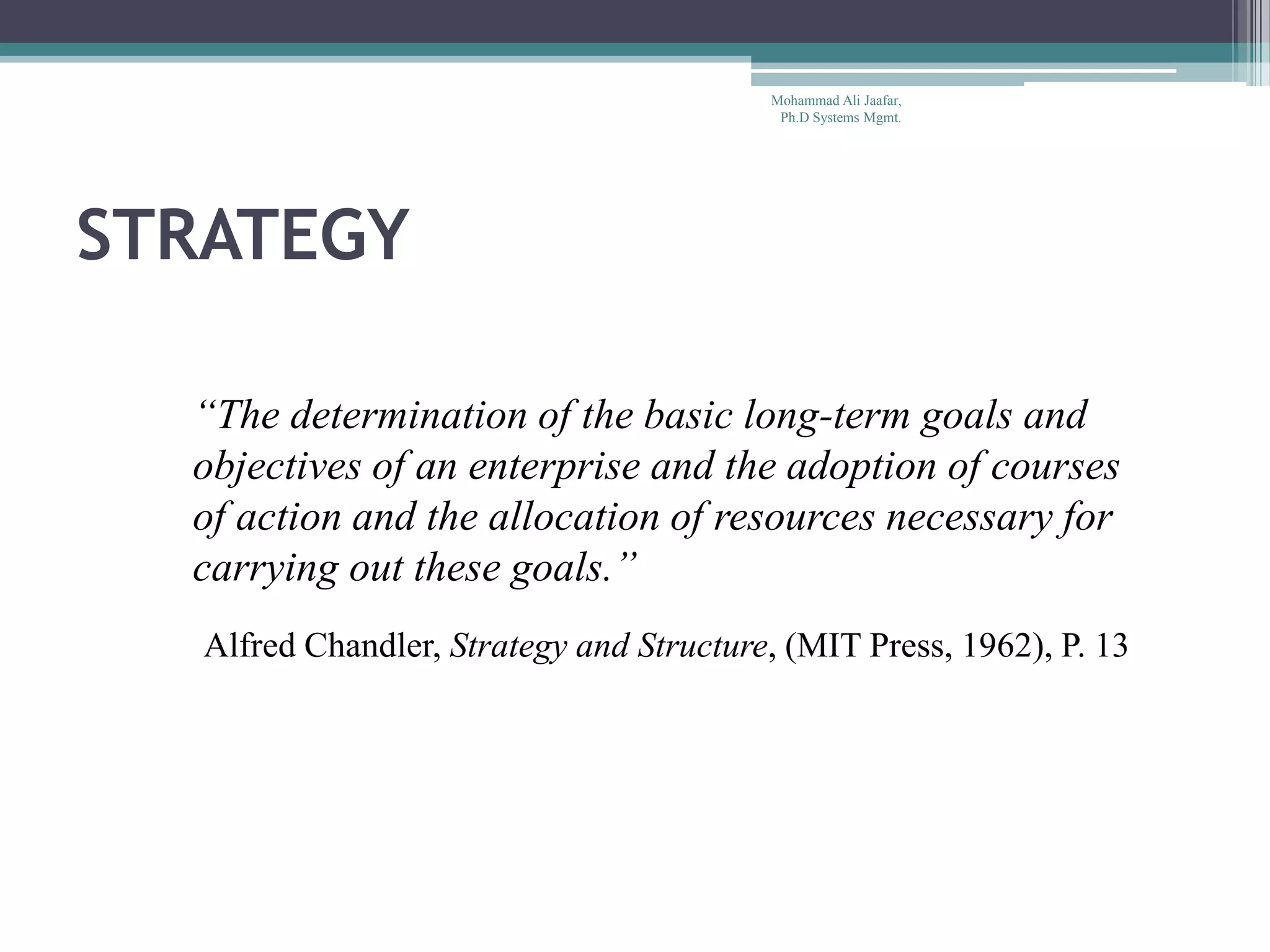
STRATEGY
“The determination of the basic long-term goals and
objectives of an enterprise and the adoption of courses
of action and the allocation of resources necessary for
carrying out these goals.”
Alfred Chandler, Strategy and Structure, (MIT Press, 1962), P. 13
Mohammad Ali Jaafar,
Ph.D Systems Mgmt.
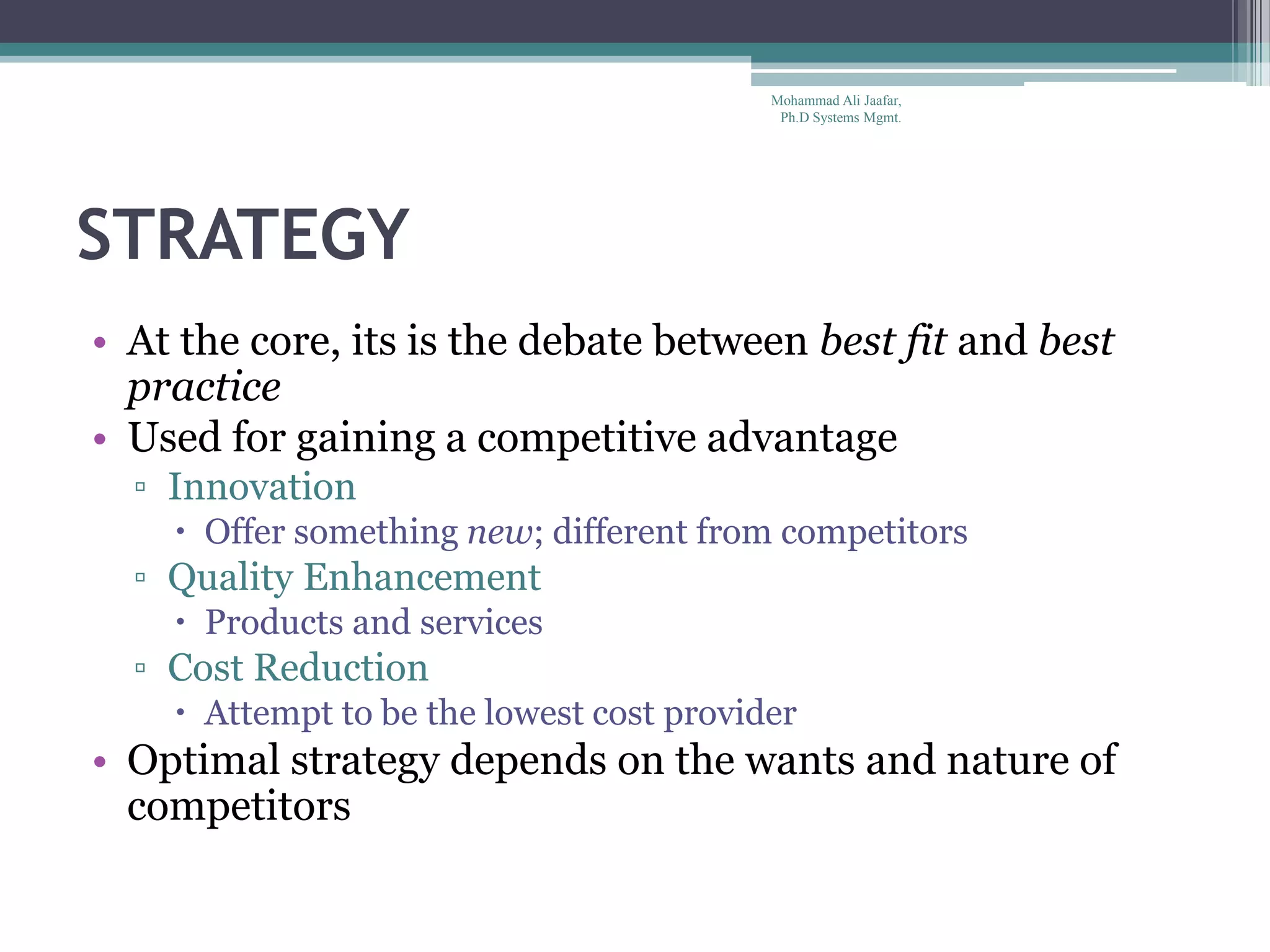
STRATEGY
• At the core, its is the debate between best fit and best
practice
• Used for gaining a competitive advantage
▫ Innovation
 Offer something new; different from competitors
▫ Quality Enhancement
 Products and services
▫ Cost Reduction
 Attempt to be the lowest cost provider
• Optimal strategy depends on the wants and nature of
competitors
Mohammad Ali Jaafar,
Ph.D Systems Mgmt.
TYPES OF STRATEGY
• Business
▫ Examines correspondence between each firm’s
competitive strategy and its system of high
performance work practices
• Operations
▫ An internal approach; connected to the work
organization inside a firm
• Resource View
▫ Views human resources as sources of sustained
competitive advantage
Mohammad Ali Jaafar,
Ph.D Systems Mgmt.
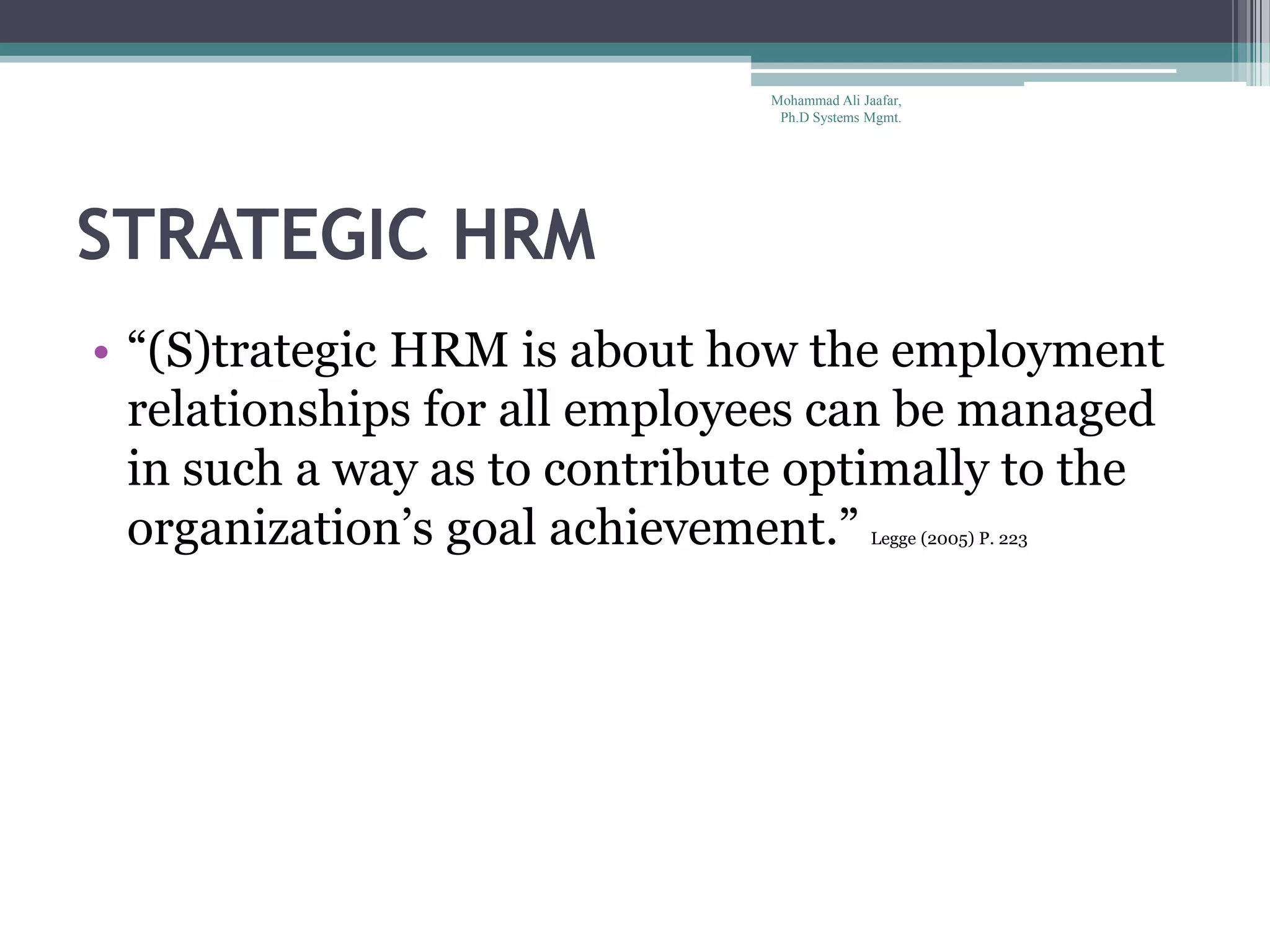
STRATEGIC HRM
• “(S)trategic HRM is about how the employment
relationships for all employees can be managed
in such a way as to contribute optimally to the
organization’s goal achievement.” Legge (2005) P. 223
Mohammad Ali Jaafar,
Ph.D Systems Mgmt.
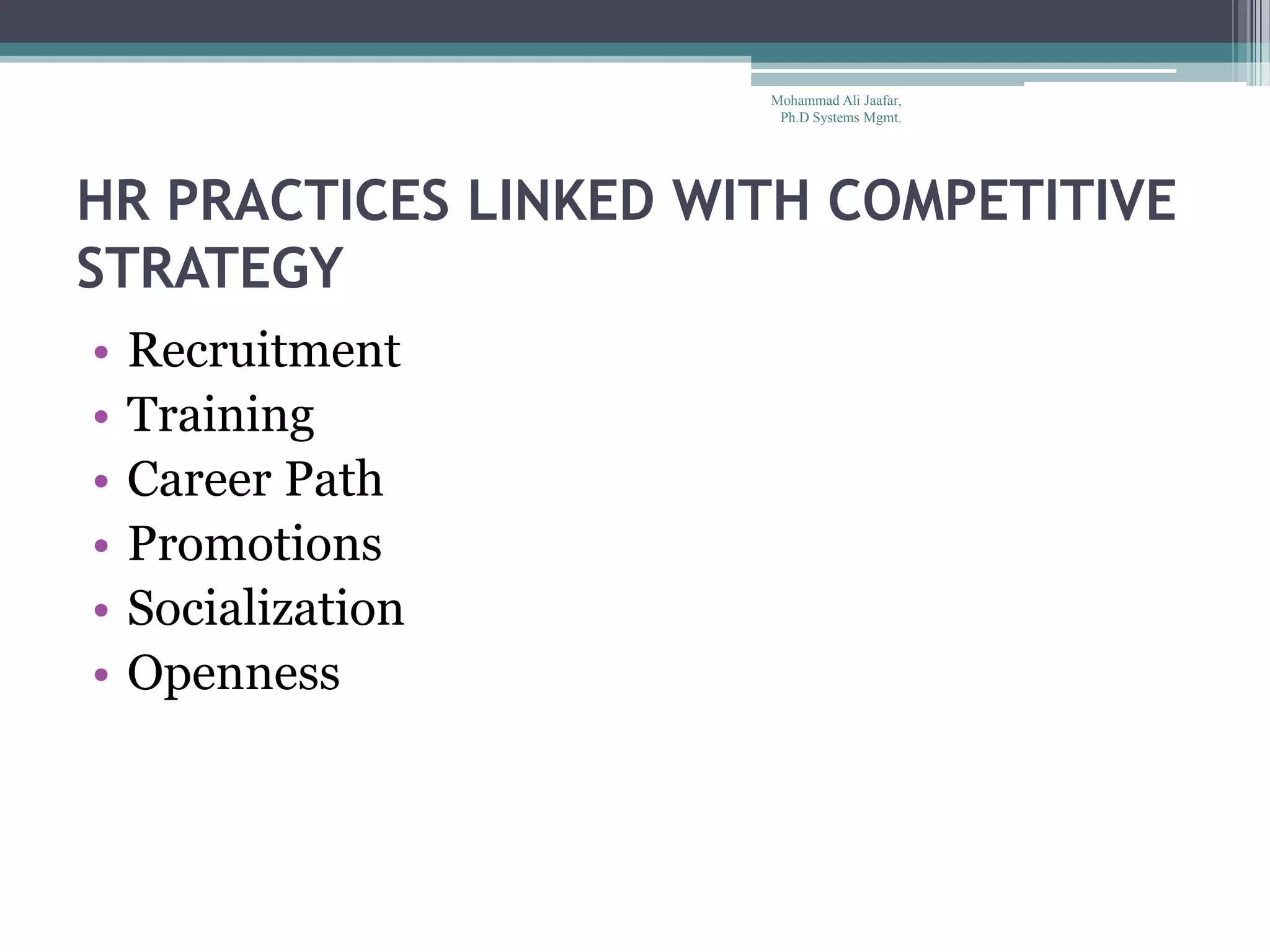
HR PRACTICES LINKED WITH COMPETITIVE
STRATEGY
• Recruitment
• Training
• Career Path
• Promotions
• Socialization
• Openness
Mohammad Ali Jaafar,
Ph.D Systems Mgmt.
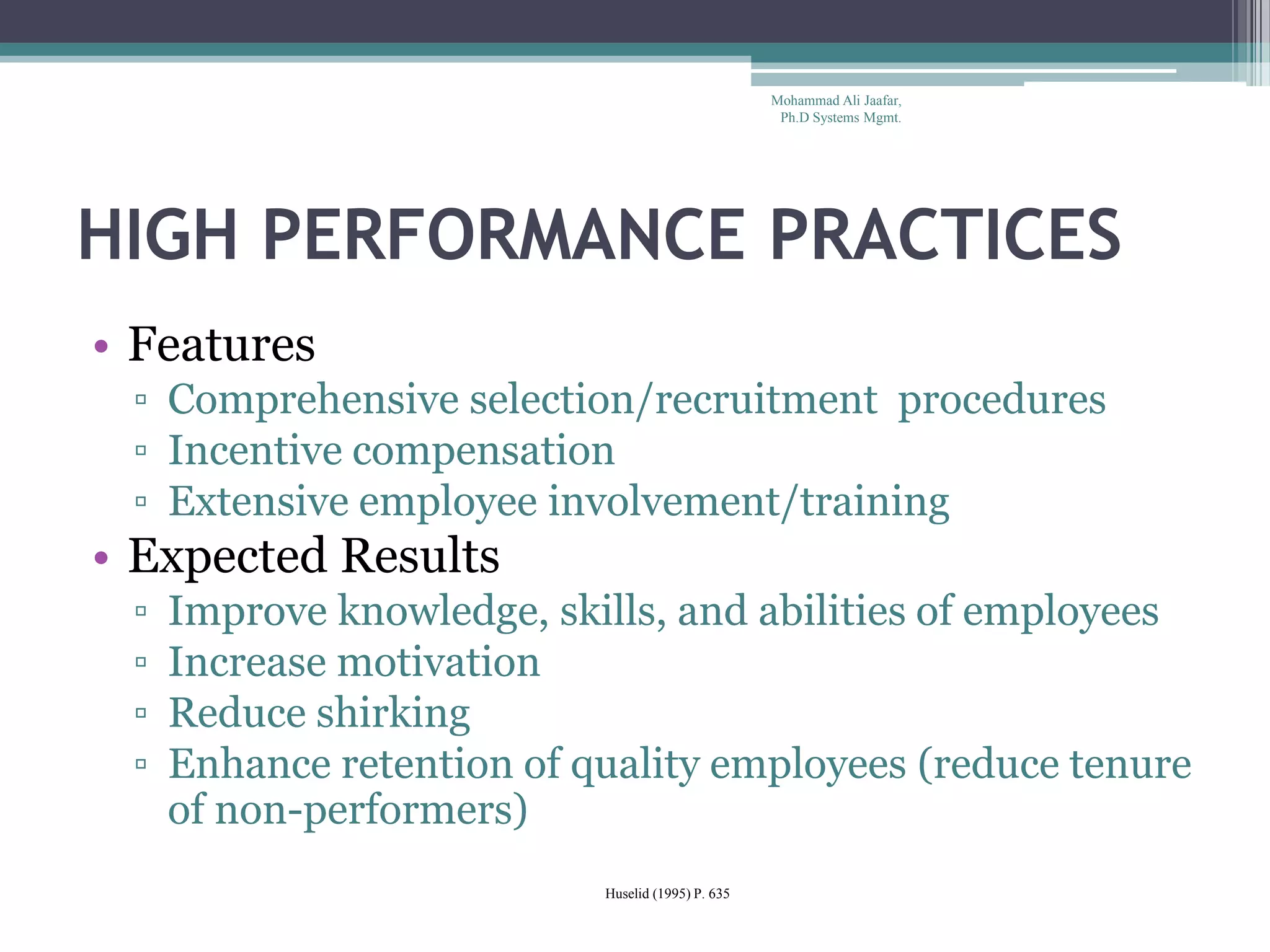
HIGH PERFORMANCE PRACTICES
• Features
▫ Comprehensive selection/recruitment procedures
▫ Incentive compensation
▫ Extensive employee involvement/training
• Expected Results
▫ Improve knowledge, skills, and abilities of employees
▫ Increase motivation
▫ Reduce shirking
▫ Enhance retention of quality employees (reduce tenure
of non-performers)
Huselid (1995) P. 635
Mohammad Ali Jaafar,
Ph.D Systems Mgmt.
HIGH COMMITMENT PRACTICES
• Unique to the High-Performance Paradigm
▫ Sophisticated selection and training
 Emphasis on values, human relations skills, and knowledge
skills
▫ Behavior-based appraisal
▫ Single status policies
▫ Contingent pay systems
• Traditional Personnel Practices
▫ Job security
▫ Above market pay and benefits
▫ Grievance systems
Godard (2004) P. 351
Mohammad Ali Jaafar,
Ph.D Systems Mgmt.
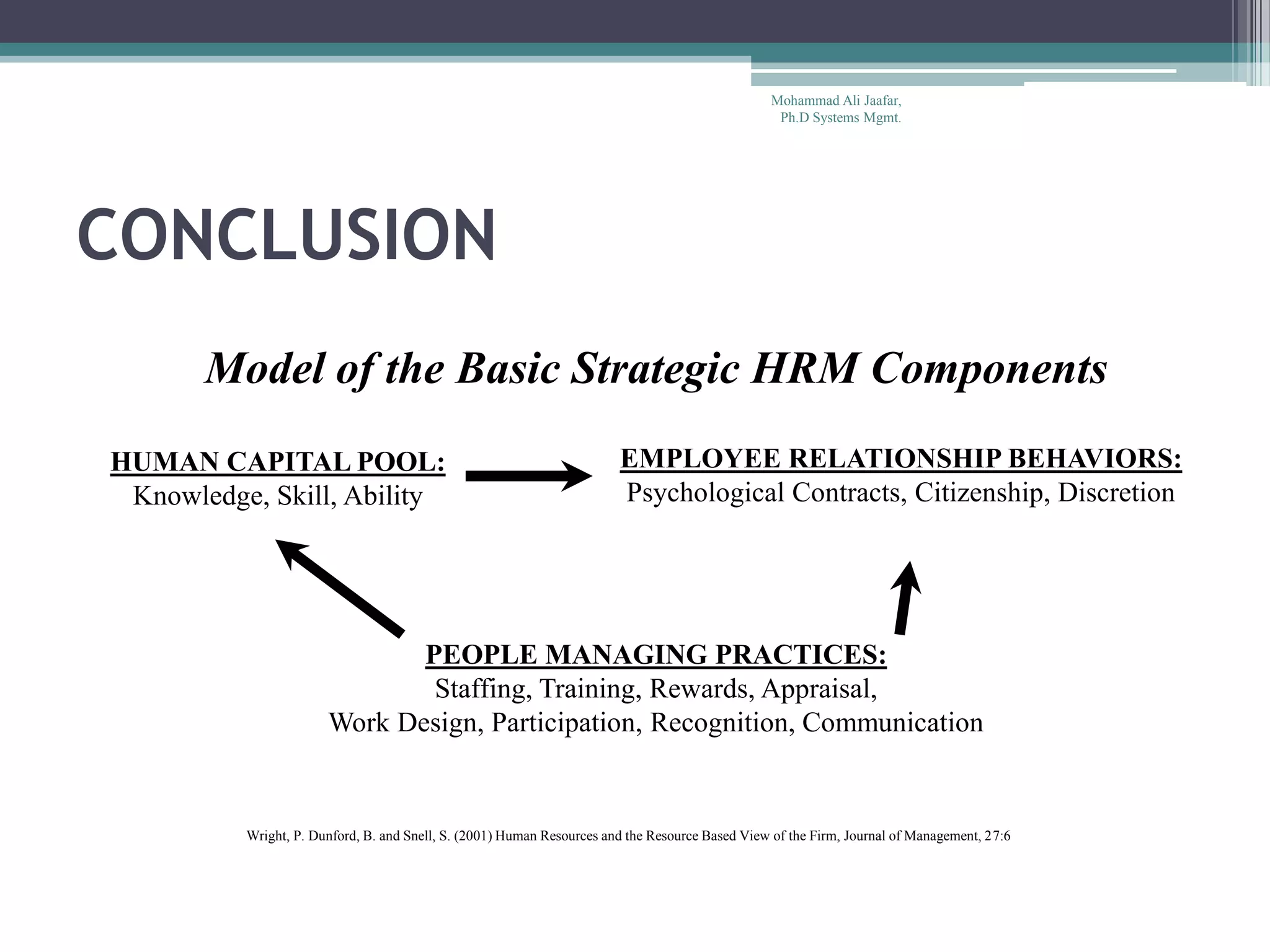
CONCLUSION
Model of the Basic Strategic HRM Components
HUMAN CAPITAL POOL:
Knowledge, Skill, Ability
EMPLOYEE RELATIONSHIP BEHAVIORS:
Psychological Contracts, Citizenship, Discretion
Wright, P. Dunford, B. and Snell, S. (2001) Human Resources and the Resource Based View of the Firm, Journal of Management, 27:6
PEOPLE MANAGING PRACTICES:
Staffing, Training, Rewards, Appraisal,
Work Design, Participation, Recognition, Communication
Mohammad Ali Jaafar,
Ph.D Systems Mgmt.
CONCLUSION
• Effectiveness can be increased by systematically
melding human resource practices with the
selected competitive strategy
• The success or failure of a firm is not likely to
turn entirely on its strategic human resource
management practices, but these practices are
likely to be critical
Mohammad Ali Jaafar,
Ph.D Systems Mgmt.

STRATEGIC HUMAN RESOURCE MANAGEMENT by MOHAMMAD ALI JAAFAR

  • 1.
    STRATEGIC HUMAN RESOURCE MANAGEMENT MohammadAli Jaafar Ph.D. Systems Mgmt. Mohammad Ali Jaafar, Ph.D Systems Mgmt.
  • 2.
    DISCUSSION What is meantby the term “Strategic Human Resource Management” and how has it been used to study the employment relationship? Mohammad Ali Jaafar, Ph.D Systems Mgmt.
  • 3.
    HUMAN RESOURCE MANAGEMENT “…human resource management (alternatively, ‘employee relations’ or ‘labor management’) includes the firm’s work systems and its models of employment. It embraces both individual and collective aspects of people management. It is not restricted to any one style or ideology. It engages the energies of both line and specialist managers… and typically entails a blend of messages for a variety of workforce groups.” Purcell & Boxall (2003) P. 24 Mohammad Ali Jaafar, Ph.D Systems Mgmt.
  • 4.
    HUMAN RESOURCE MANAGEMENT “HRMas a subject of study assumes that the interests of employees and employers will coincide and is preoccupied with the shared goal of organizational effectiveness that marginalizes the interests of other stakeholders such as employees. HRM is also predominantly focused on the individual and seeks solutions to HR problems within the firm, with an analytical focus on the motivations and aspirations of individual employees.” Bach (2005) P. 4 Mohammad Ali Jaafar, Ph.D Systems Mgmt.
  • 5.
    STRATEGY “The determination ofthe basic long-term goals and objectives of an enterprise and the adoption of courses of action and the allocation of resources necessary for carrying out these goals.” Alfred Chandler, Strategy and Structure, (MIT Press, 1962), P. 13 Mohammad Ali Jaafar, Ph.D Systems Mgmt.
  • 6.
    STRATEGY • At thecore, its is the debate between best fit and best practice • Used for gaining a competitive advantage ▫ Innovation  Offer something new; different from competitors ▫ Quality Enhancement  Products and services ▫ Cost Reduction  Attempt to be the lowest cost provider • Optimal strategy depends on the wants and nature of competitors Mohammad Ali Jaafar, Ph.D Systems Mgmt.
  • 7.
    TYPES OF STRATEGY •Business ▫ Examines correspondence between each firm’s competitive strategy and its system of high performance work practices • Operations ▫ An internal approach; connected to the work organization inside a firm • Resource View ▫ Views human resources as sources of sustained competitive advantage Mohammad Ali Jaafar, Ph.D Systems Mgmt.
  • 8.
    STRATEGIC HRM • “(S)trategicHRM is about how the employment relationships for all employees can be managed in such a way as to contribute optimally to the organization’s goal achievement.” Legge (2005) P. 223 Mohammad Ali Jaafar, Ph.D Systems Mgmt.
  • 9.
    HR PRACTICES LINKEDWITH COMPETITIVE STRATEGY • Recruitment • Training • Career Path • Promotions • Socialization • Openness Mohammad Ali Jaafar, Ph.D Systems Mgmt.
  • 10.
    HIGH PERFORMANCE PRACTICES •Features ▫ Comprehensive selection/recruitment procedures ▫ Incentive compensation ▫ Extensive employee involvement/training • Expected Results ▫ Improve knowledge, skills, and abilities of employees ▫ Increase motivation ▫ Reduce shirking ▫ Enhance retention of quality employees (reduce tenure of non-performers) Huselid (1995) P. 635 Mohammad Ali Jaafar, Ph.D Systems Mgmt.
  • 11.
    HIGH COMMITMENT PRACTICES •Unique to the High-Performance Paradigm ▫ Sophisticated selection and training  Emphasis on values, human relations skills, and knowledge skills ▫ Behavior-based appraisal ▫ Single status policies ▫ Contingent pay systems • Traditional Personnel Practices ▫ Job security ▫ Above market pay and benefits ▫ Grievance systems Godard (2004) P. 351 Mohammad Ali Jaafar, Ph.D Systems Mgmt.
  • 12.
    CONCLUSION Model of theBasic Strategic HRM Components HUMAN CAPITAL POOL: Knowledge, Skill, Ability EMPLOYEE RELATIONSHIP BEHAVIORS: Psychological Contracts, Citizenship, Discretion Wright, P. Dunford, B. and Snell, S. (2001) Human Resources and the Resource Based View of the Firm, Journal of Management, 27:6 PEOPLE MANAGING PRACTICES: Staffing, Training, Rewards, Appraisal, Work Design, Participation, Recognition, Communication Mohammad Ali Jaafar, Ph.D Systems Mgmt.
  • 13.
    CONCLUSION • Effectiveness canbe increased by systematically melding human resource practices with the selected competitive strategy • The success or failure of a firm is not likely to turn entirely on its strategic human resource management practices, but these practices are likely to be critical Mohammad Ali Jaafar, Ph.D Systems Mgmt.