1
EMBA 226 • College of Business Administration • California State University, Sacramento
Week 1
Week 1
Friday, July 21
Friday, July 21
• Introduction
Introduction
• Strategic grid, business model
Strategic grid, business model
• Opportunities and Threats: Porter’s Five Forces Model
Opportunities and Threats: Porter’s Five Forces Model
• Strategy and strategic planning
Strategy and strategic planning
• IT Doesn’t Matter Article
IT Doesn’t Matter Article
2
EMBA 226 • College of Business Administration • California State University, Sacramento
What This Class is About…
• Information technology (IT) has become a major driving
Information technology (IT) has become a major driving
force of today’s businesses. As an enabler (facilitator) and
integrator, IT has opened many strategic opportunities and
provided the means to seize competitive advantages in
marketplaces. The topics covered throughout this course
will emphasize IT’s prominent role in business strategy.
3
EMBA 226 • College of Business Administration • California State University, Sacramento
Introductions
Introductions
• What is your view on IT in business?
What is your view on IT in business?
4
EMBA 226 • College of Business Administration • California State University, Sacramento
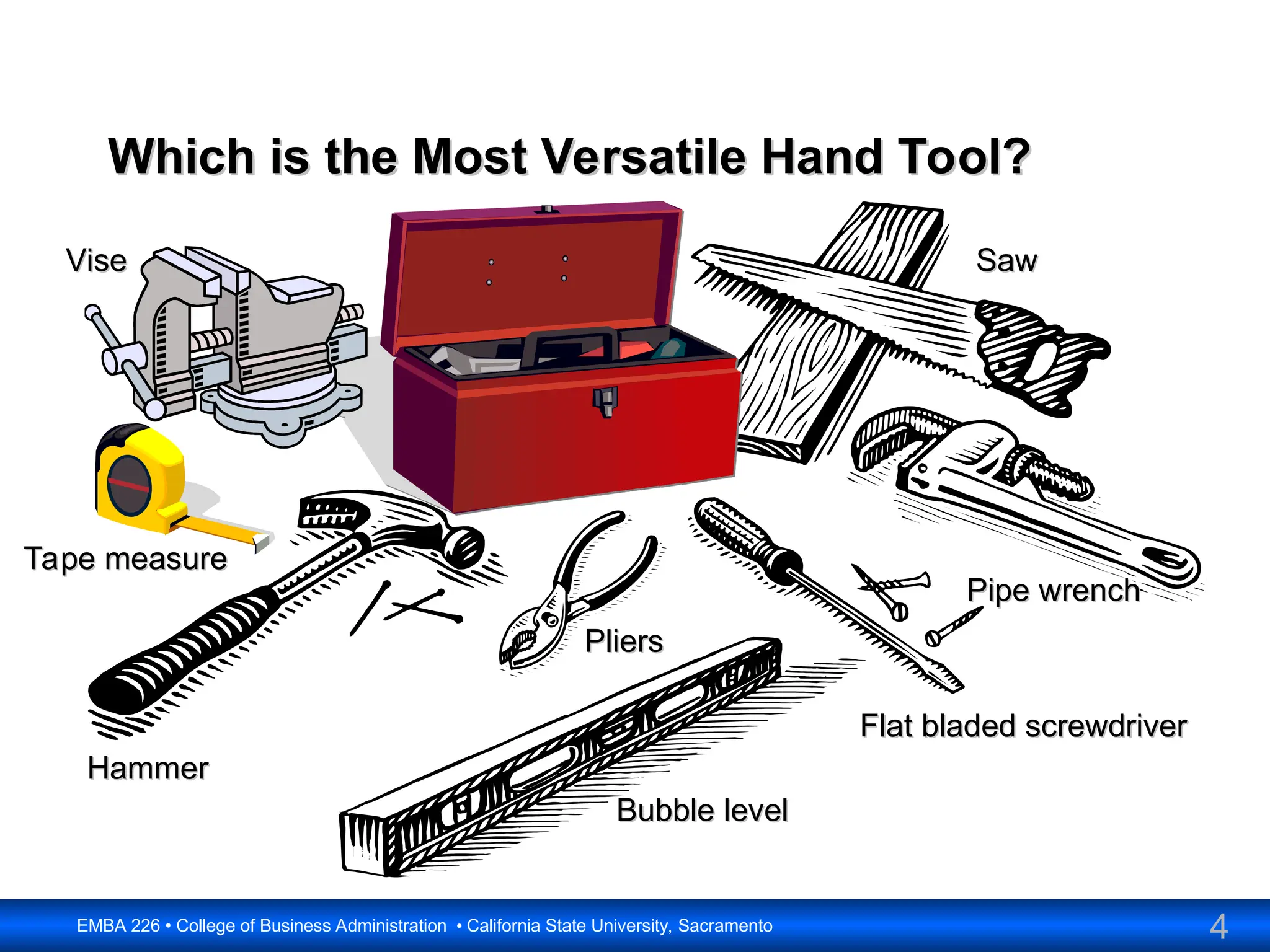
Which is the Most Versatile Hand Tool?
Vise
Vise
Hammer
Hammer
Pliers
Pliers
Saw
Saw
Pipe wrench
Pipe wrench
Flat bladed screwdriver
Bubble level
Bubble level
Tape measure
Tape measure
5
EMBA 226 • College of Business Administration • California State University, Sacramento
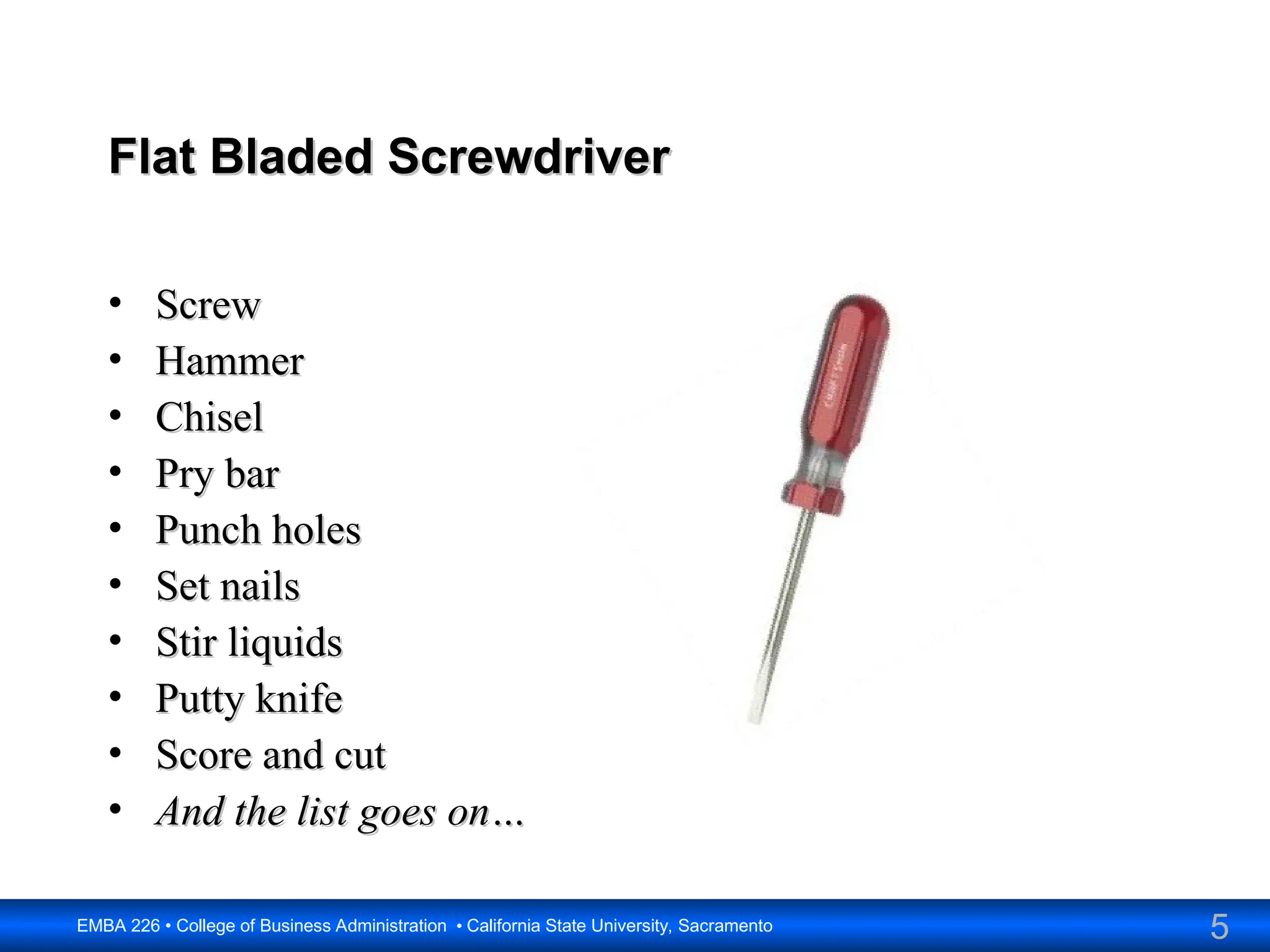
Flat Bladed Screwdriver
• Screw
Screw
• Hammer
Hammer
• Chisel
Chisel
• Pry bar
Pry bar
• Punch holes
Punch holes
• Set nails
Set nails
• Stir liquids
Stir liquids
• Putty knife
Putty knife
• Score and cut
Score and cut
• And the list goes on…
And the list goes on…
6
EMBA 226 • College of Business Administration • California State University, Sacramento
IT is Similar to a Flat Bladed Screwdriver
• IT provides the means for businesses to do something better!
IT provides the means for businesses to do something better!
– Leverages other resources
Leverages other resources
– Enables and enhances business processes –
Enables and enhances business processes – Facilitates
Facilitates
efficiency and effectiveness
– Seizes competitive advantages
Seizes competitive advantages
– Levels the playing field –
Levels the playing field – Small businesses can look and
Small businesses can look and
behave like big businesses
– Extends the business beyond its boundaries –
Extends the business beyond its boundaries – Strategic
Strategic
alliances, strategic outsourcing, supply chain management
– And the list goes on…
And the list goes on…
7
EMBA 226 • College of Business Administration • California State University, Sacramento
What You Should Take Away from This Class
1.
1. Place IT solutions in the strategic grid – Match the
Place IT solutions in the strategic grid – Match the
solution to the business
2.
2. Businesses do not adopt technology for technology’s sake
Businesses do not adopt technology for technology’s sake
3.
3. Focus on the business and not the technology
Focus on the business and not the technology
4.
4. IT leverages other resources and processes
IT leverages other resources and processes
5.
5. IT introduces organizational change
IT introduces organizational change
6.
6. IT integrates the enterprise
IT integrates the enterprise
7.
7. Knowledge is an organizational resource
Knowledge is an organizational resource
8
EMBA 226 • College of Business Administration • California State University, Sacramento
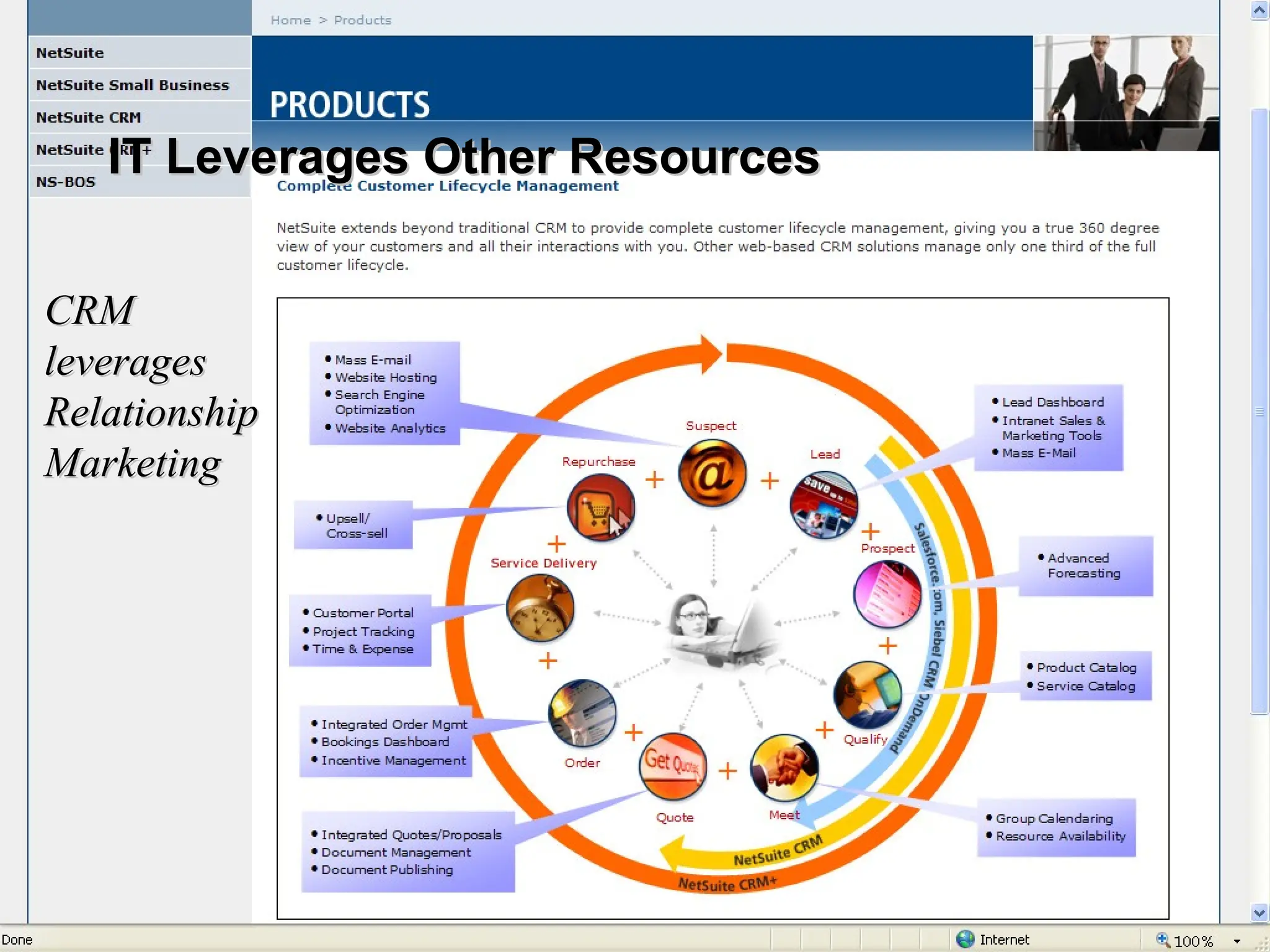
IT Leverages Other Resources
CRM
CRM
leverages
leverages
Relationship
Relationship
Marketing
Marketing
9
EMBA 226 • College of Business Administration • California State University, Sacramento
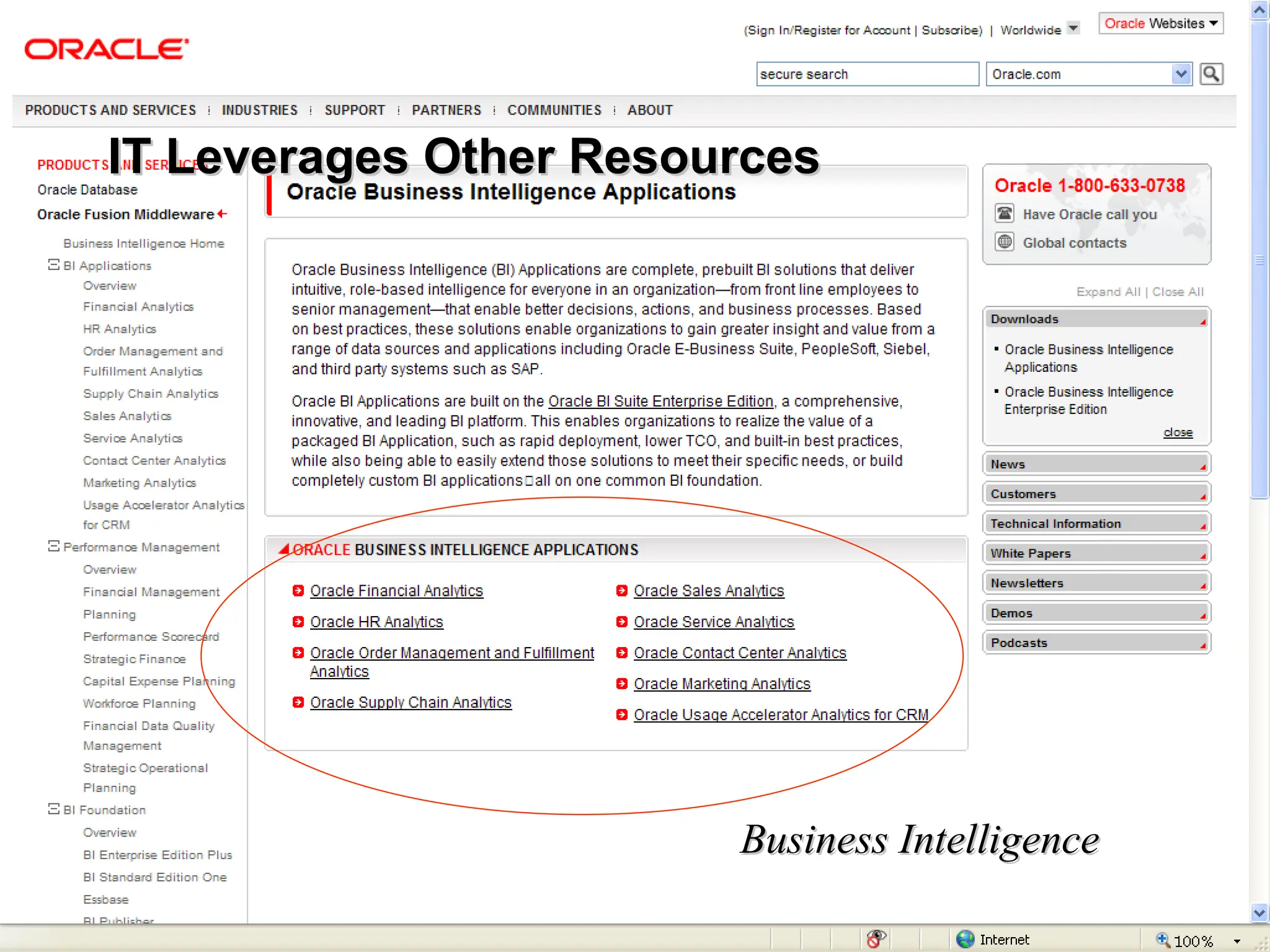
IT Leverages Other Resources
Business Intelligence
10
EMBA 226 • College of Business Administration • California State University, Sacramento
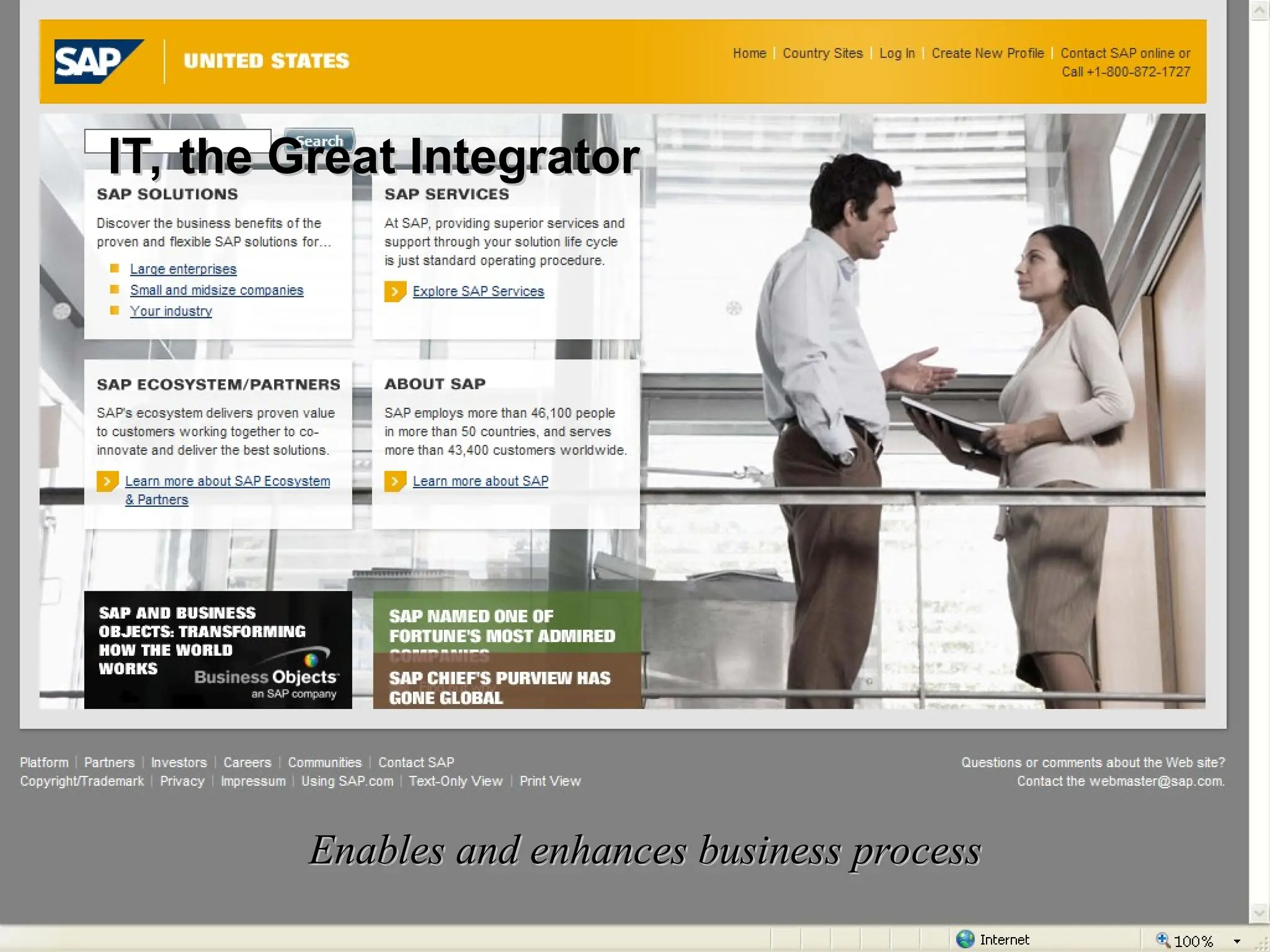
IT, the Great Integrator
Enables and enhances business process
11
EMBA 226 • College of Business Administration • California State University, Sacramento
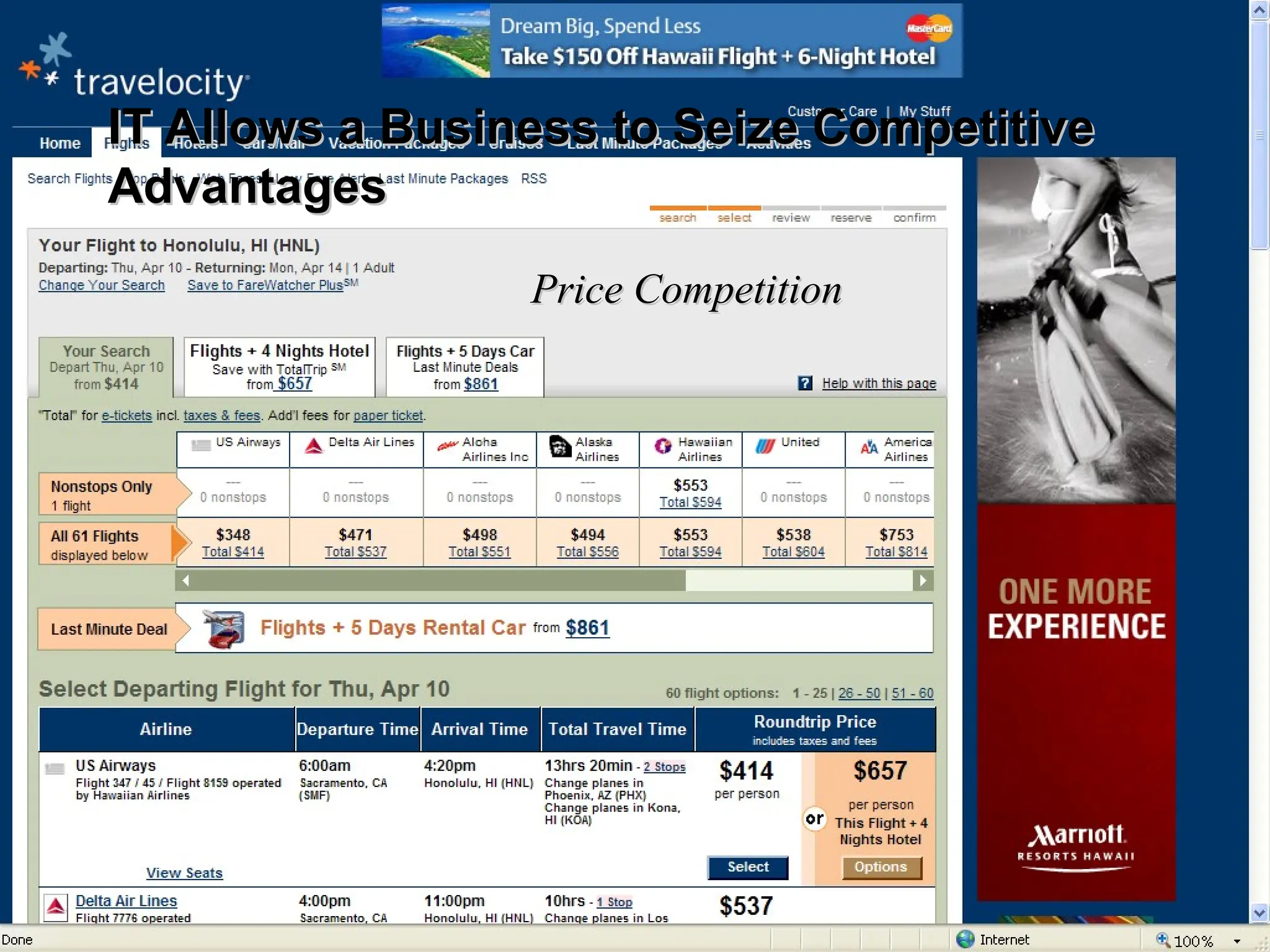
IT Allows a Business to Seize Competitive
Advantages
Advantages
Price Competition
Price Competition
12
EMBA 226 • College of Business Administration • California State University, Sacramento
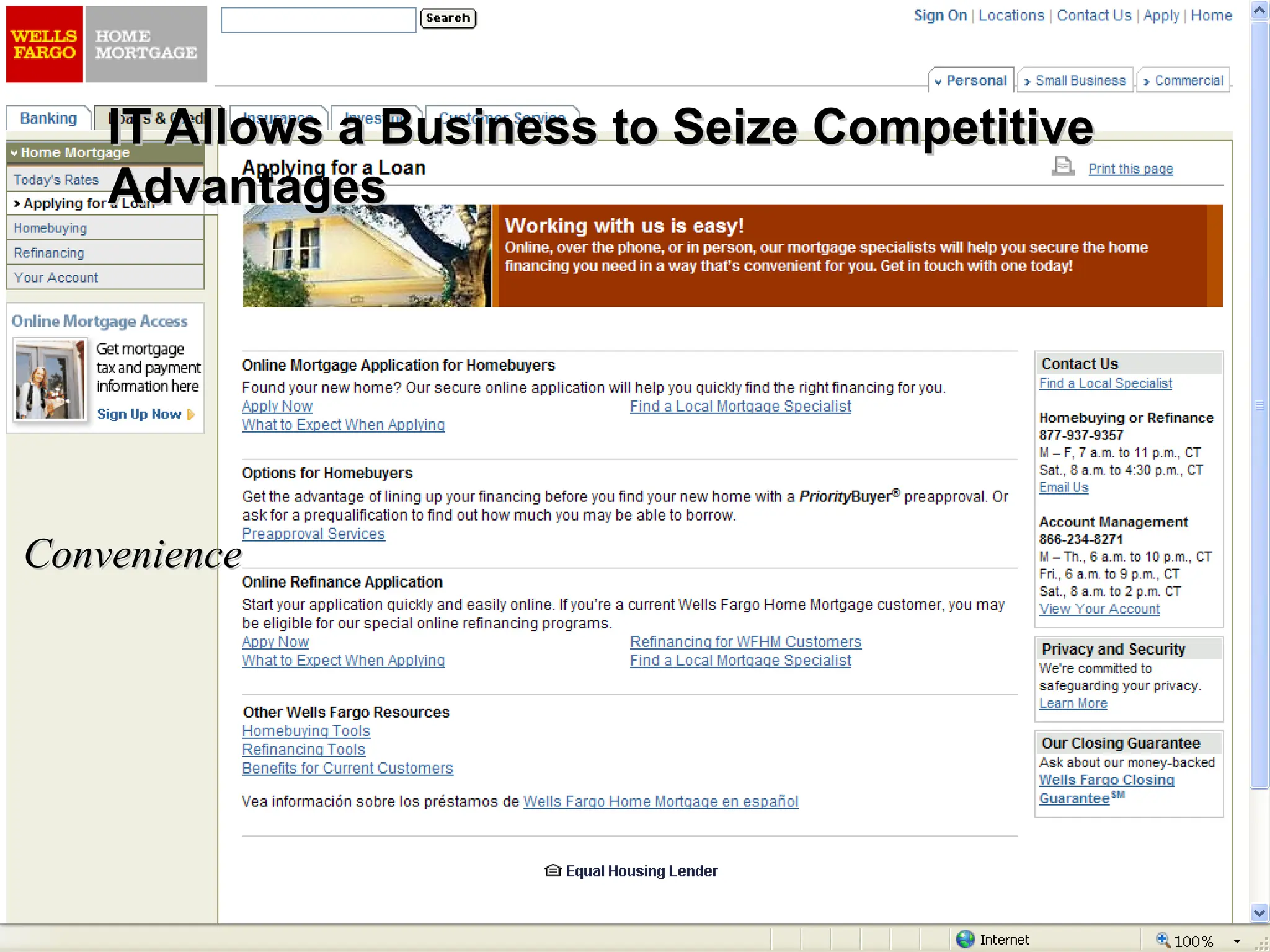
IT Allows a Business to Seize Competitive
Advantages
Advantages
Convenience
Convenience
13
EMBA 226 • College of Business Administration • California State University, Sacramento
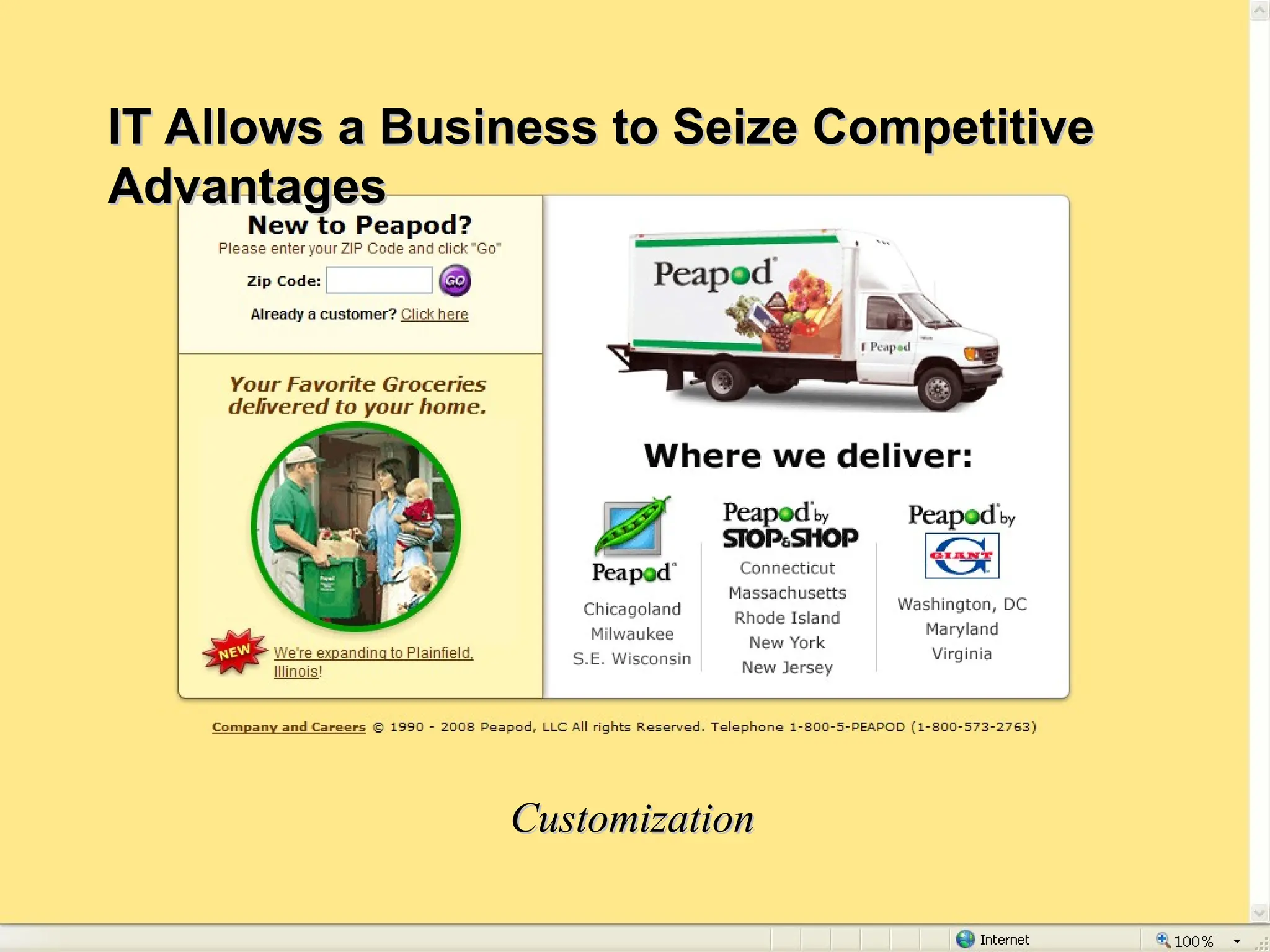
IT Allows a Business to Seize Competitive
Advantages
Advantages
Customization
Customization
14
EMBA 226 • College of Business Administration • California State University, Sacramento
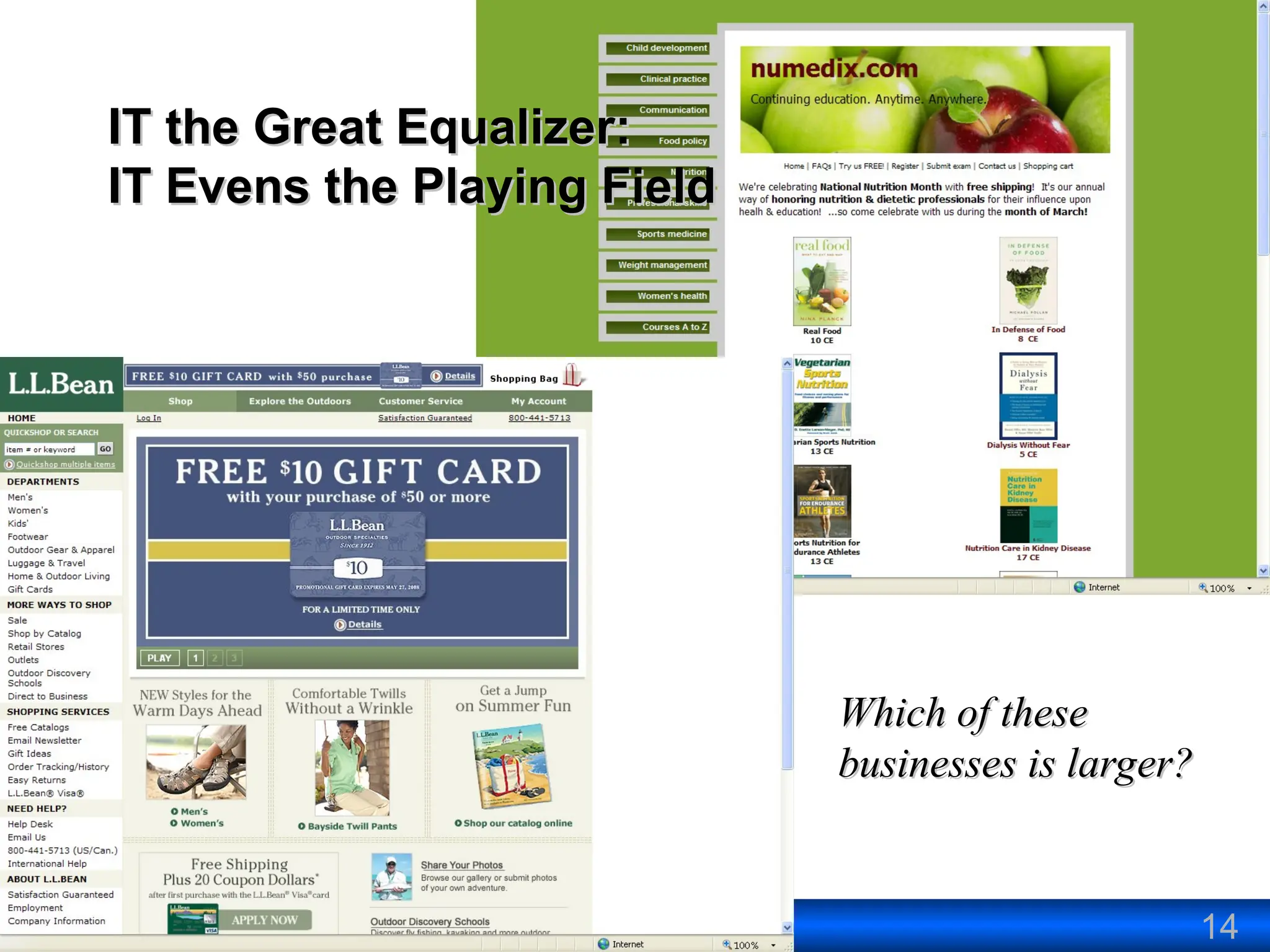
Which of these
Which of these
businesses is larger?
IT the Great Equalizer:
IT Evens the Playing Field
15
EMBA 226 • College of Business Administration • California State University, Sacramento
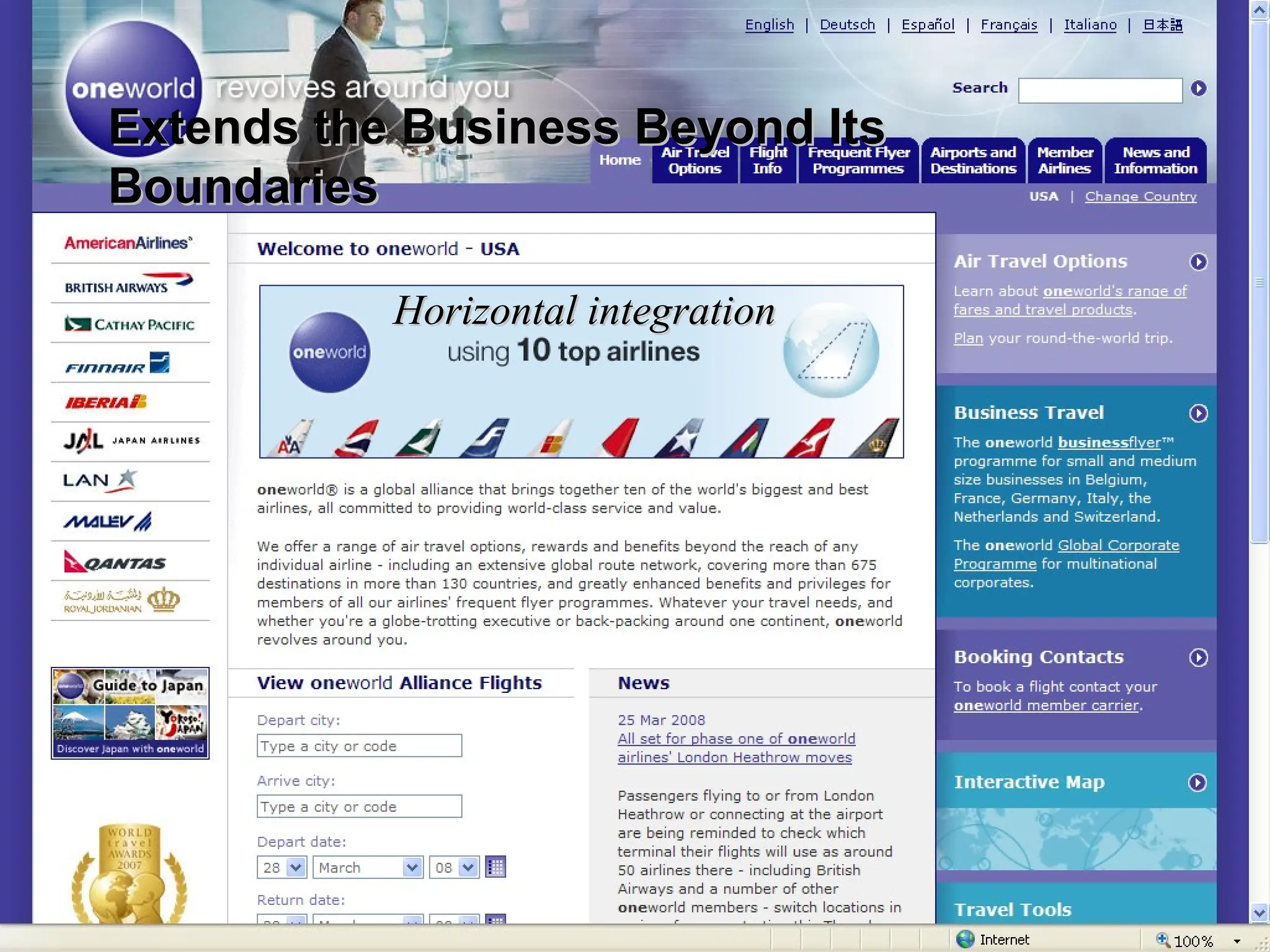
Extends the Business Beyond Its
Boundaries
Boundaries
Horizontal integration
16
EMBA 226 • College of Business Administration • California State University, Sacramento
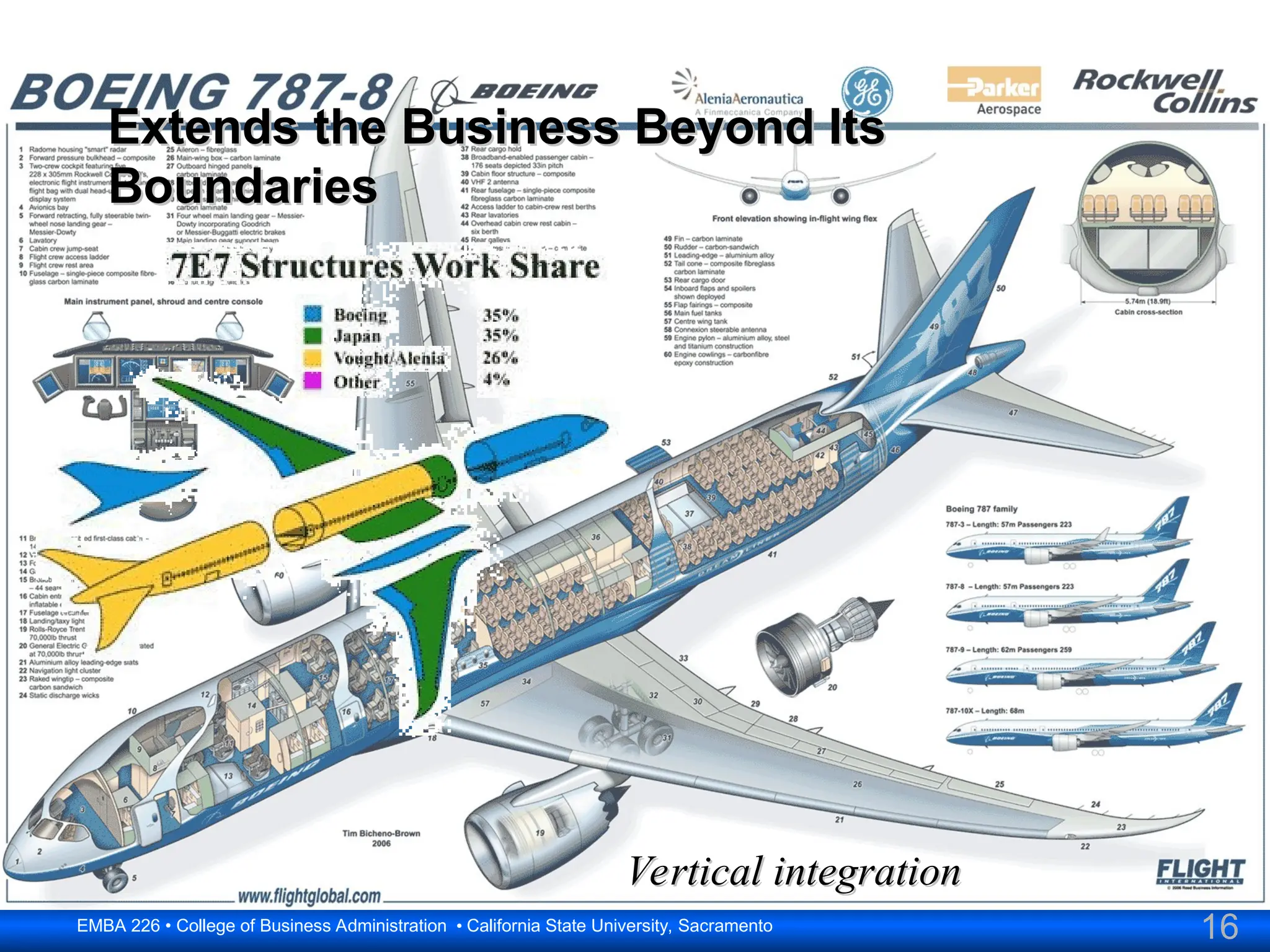
Extends the Business Beyond Its
Boundaries
Boundaries
Vertical integration
17
EMBA 226 • College of Business Administration • California State University, Sacramento
Supply Chain Management
Inter-Organizational IT
• Coordinating suppliers
Coordinating suppliers
– From EDI (electronic data interchange) to the Internet
From EDI (electronic data interchange) to the Internet
• Establishing close and tight relationships
Establishing close and tight relationships
– Loose integration – ad hoc and occasional
Loose integration – ad hoc and occasional
– Close integration – formal exchange of information between
Close integration – formal exchange of information between
businesses
businesses
– Tight integration – sharing a business processes (e.g., UPS)
Tight integration – sharing a business processes (e.g., UPS)
• Becoming a customer-centric value chain (virtual enterprise)
Becoming a customer-centric value chain (virtual enterprise)
– Risk sharing
Risk sharing
– Supply chain (
Supply chain (suppliers
suppliers) vs. demand chain (
) vs. demand chain (distributors and retailers
distributors and retailers)
)
18
EMBA 226 • College of Business Administration • California State University, Sacramento
Rules, Enabling, Business Models and
IT Adoption…
IT Adoption…
19
EMBA 226 • College of Business Administration • California State University, Sacramento
IT and Business: Two Golden Rules
• IT does not (directly) increase productivity
IT does not (directly) increase productivity
• Businesses do not adopt new technology for technology’s
Businesses do not adopt new technology for technology’s
sake
sake
– What value does it add to the business?
What value does it add to the business?
– How does it support the business’ strategy, goals and
How does it support the business’ strategy, goals and
objectives?
objectives?
– Can it be linked to competitive advantage?
Can it be linked to competitive advantage?
– What’s the bottom line?
What’s the bottom line?
20
EMBA 226 • College of Business Administration • California State University, Sacramento
IT and Business
IT and Business
Briefly…
Briefly…
• IT enables fundamental changes in the way work is done
IT enables fundamental changes in the way work is done
• IT enables the integration of business functions at all levels
IT enables the integration of business functions at all levels
within and between organizations
• IT causes shifts in the competitive climate of many
IT causes shifts in the competitive climate of many
industries (i.e.,
industries (i.e., breakthrough technology
breakthrough technology)
)
• IT presents new strategic opportunities for organizations
IT presents new strategic opportunities for organizations
that reassess their mission and goals
• Successful application of IT requires changes in
Successful application of IT requires changes in
management and organization structure
21
EMBA 226 • College of Business Administration • California State University, Sacramento
IT and Business
IT and Business (cont.)
(cont.)
• A major challenge exists for management to lead their
A major challenge exists for management to lead their
organizations through the transformation necessary to
prosper in the globally competitive environment
22
EMBA 226 • College of Business Administration • California State University, Sacramento
Business Model
Business Model
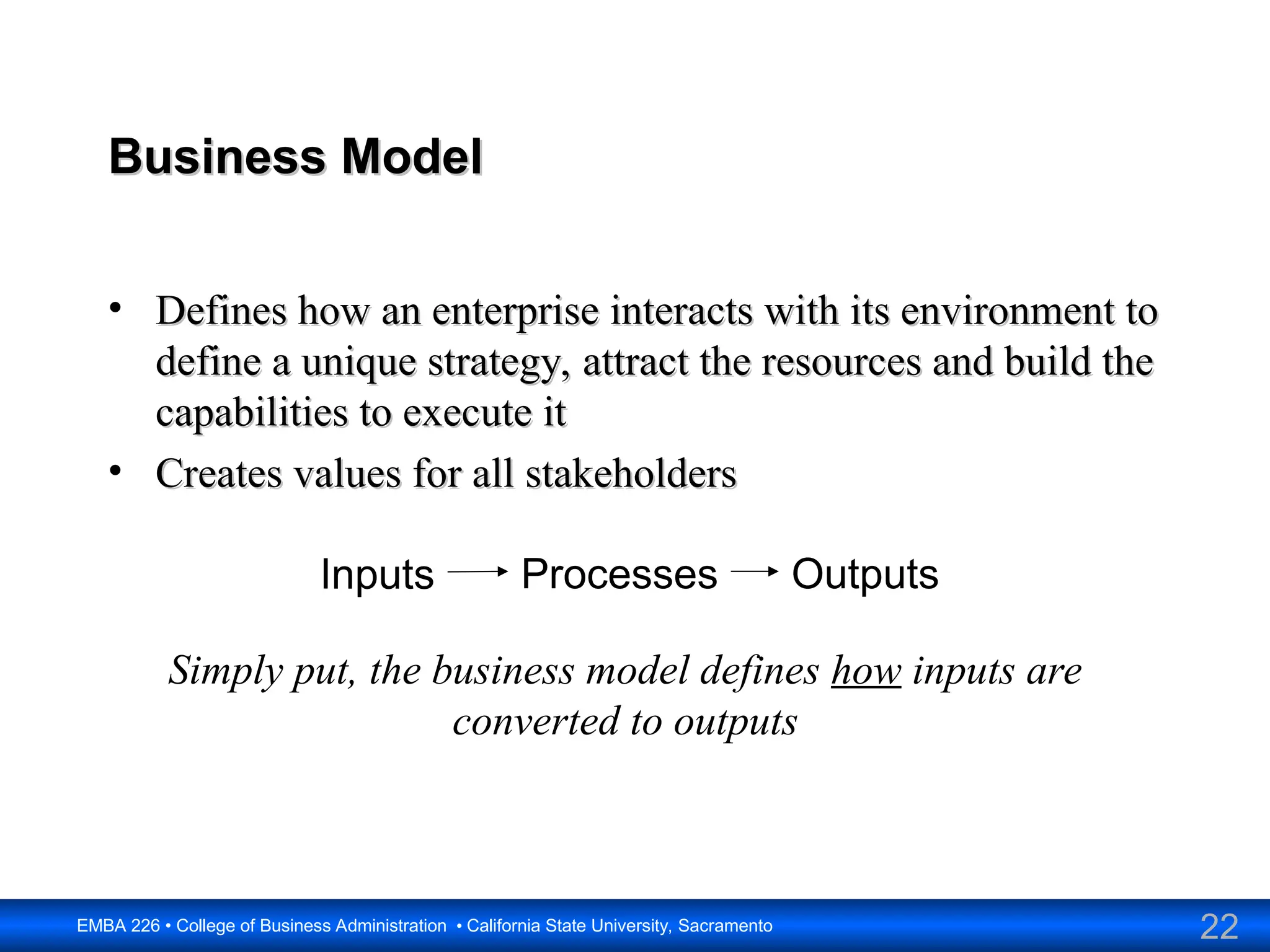
• Defines how an enterprise interacts with its environment to
Defines how an enterprise interacts with its environment to
define a unique strategy, attract the resources and build the
capabilities to execute it
• Creates values for all stakeholders
Creates values for all stakeholders
Inputs Processes Outputs
Simply put, the business model defines how inputs are
converted to outputs
23
EMBA 226 • College of Business Administration • California State University, Sacramento
IT and the Business
IT and the Business
• Adoption of IT must be within the capabilities of the
Adoption of IT must be within the capabilities of the
business
business
• There must be a clear vision of how technology will be
There must be a clear vision of how technology will be
used for a clear
used for a clear profitable
profitable gain
gain
• A proposed IT solution must take into account
A proposed IT solution must take into account
organizational factors
– Strategic grid
Strategic grid
24
EMBA 226 • College of Business Administration • California State University, Sacramento
Business Models and IT Adoption
For example…
For example… Two successful grocers taking two
Two successful grocers taking two
different approaches to business
25
EMBA 226 • College of Business Administration • California State University, Sacramento
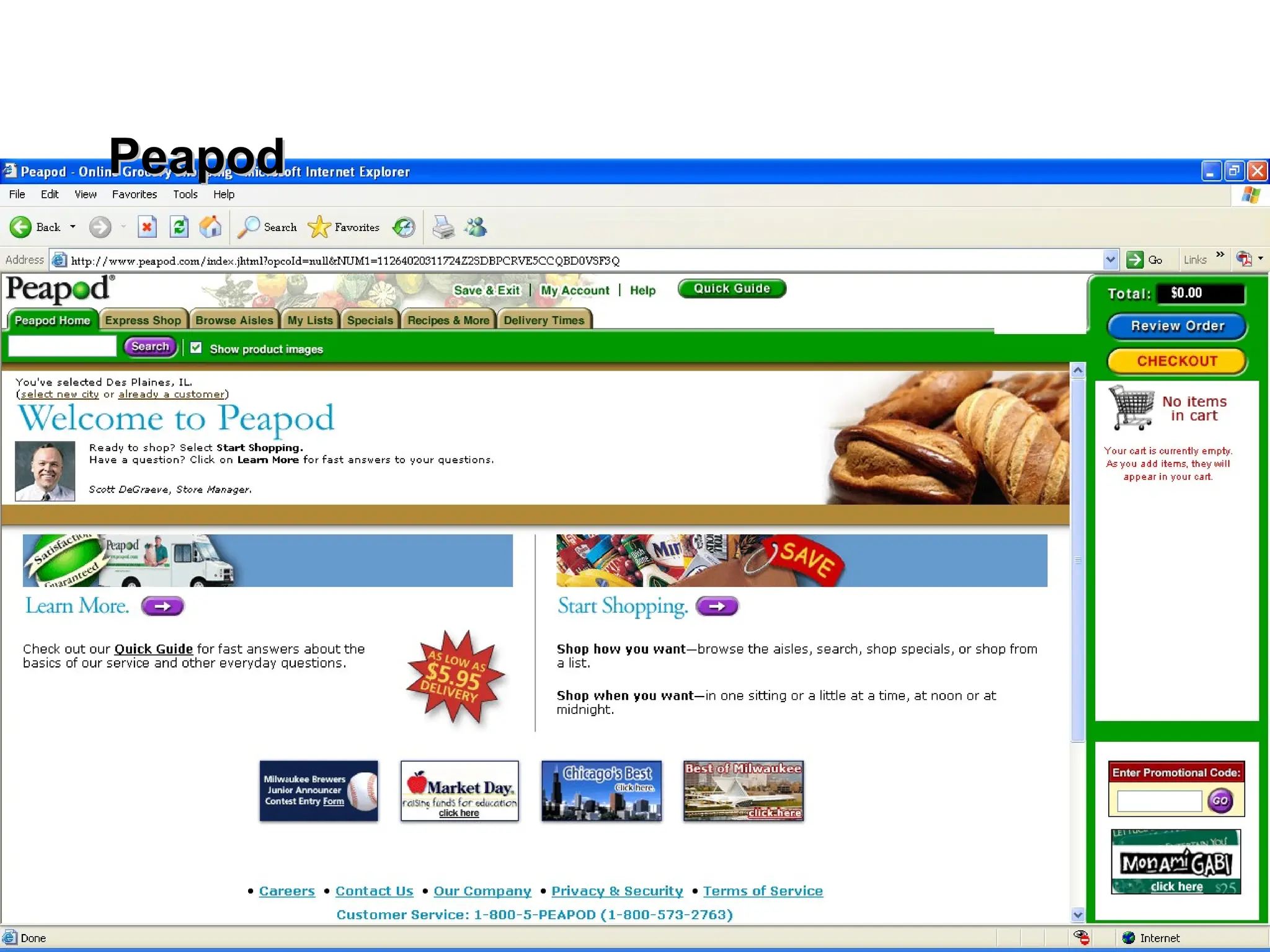
Peapod
Peapod
26
EMBA 226 • College of Business Administration • California State University, Sacramento
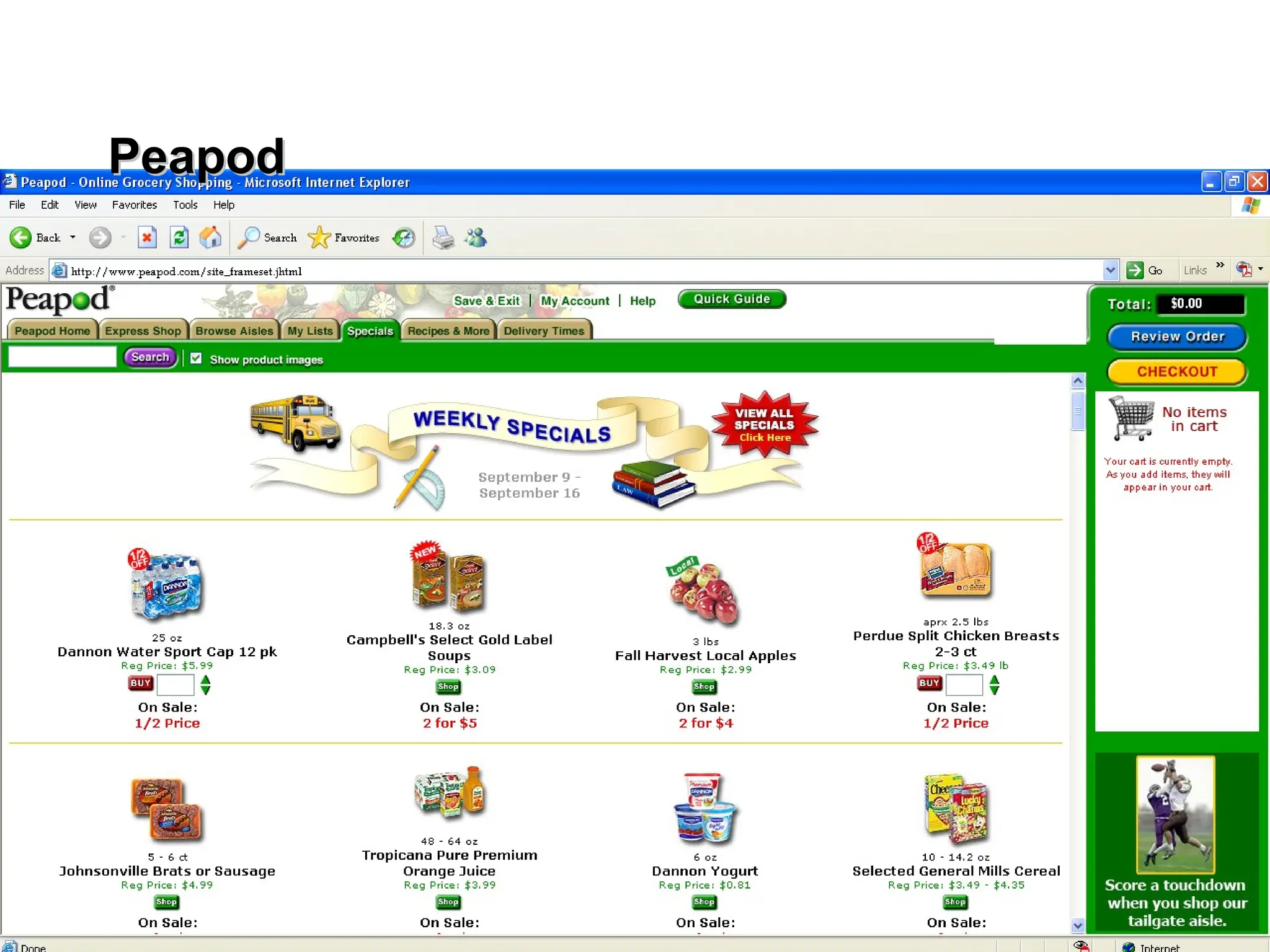
Peapod
Peapod
27
EMBA 226 • College of Business Administration • California State University, Sacramento
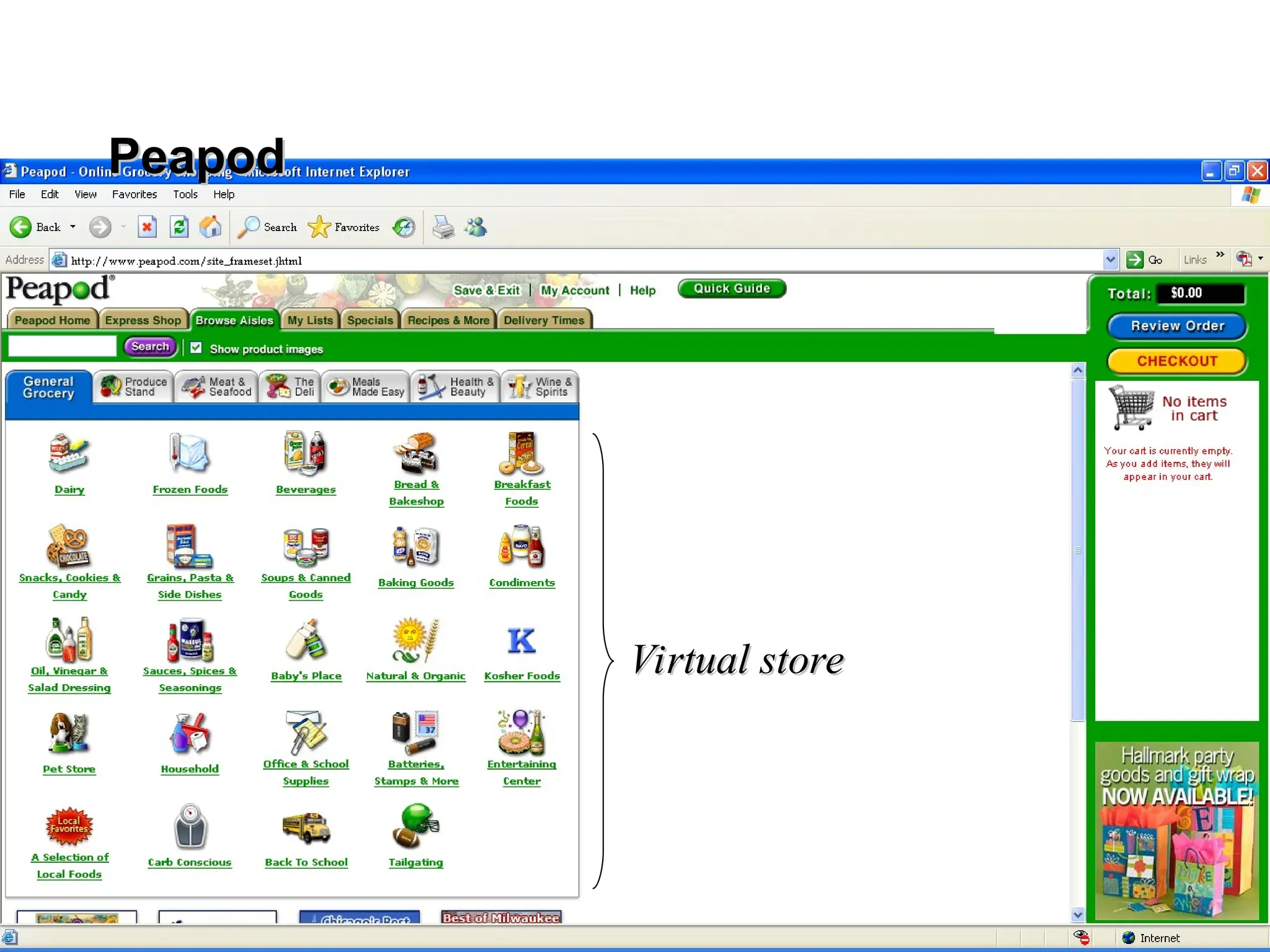
Virtual store
Virtual store
Peapod
Peapod
28
EMBA 226 • College of Business Administration • California State University, Sacramento
29
EMBA 226 • College of Business Administration • California State University, Sacramento
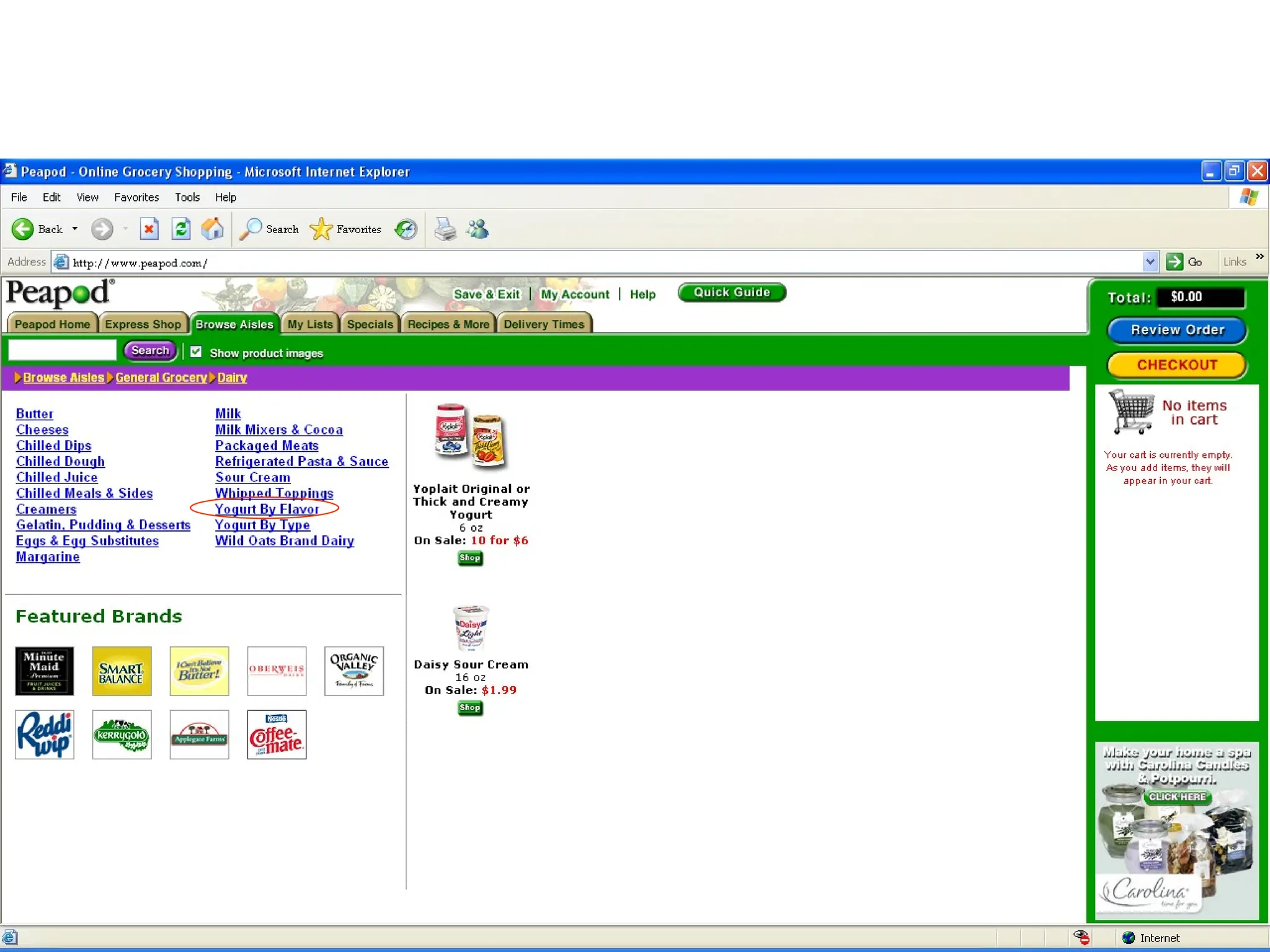
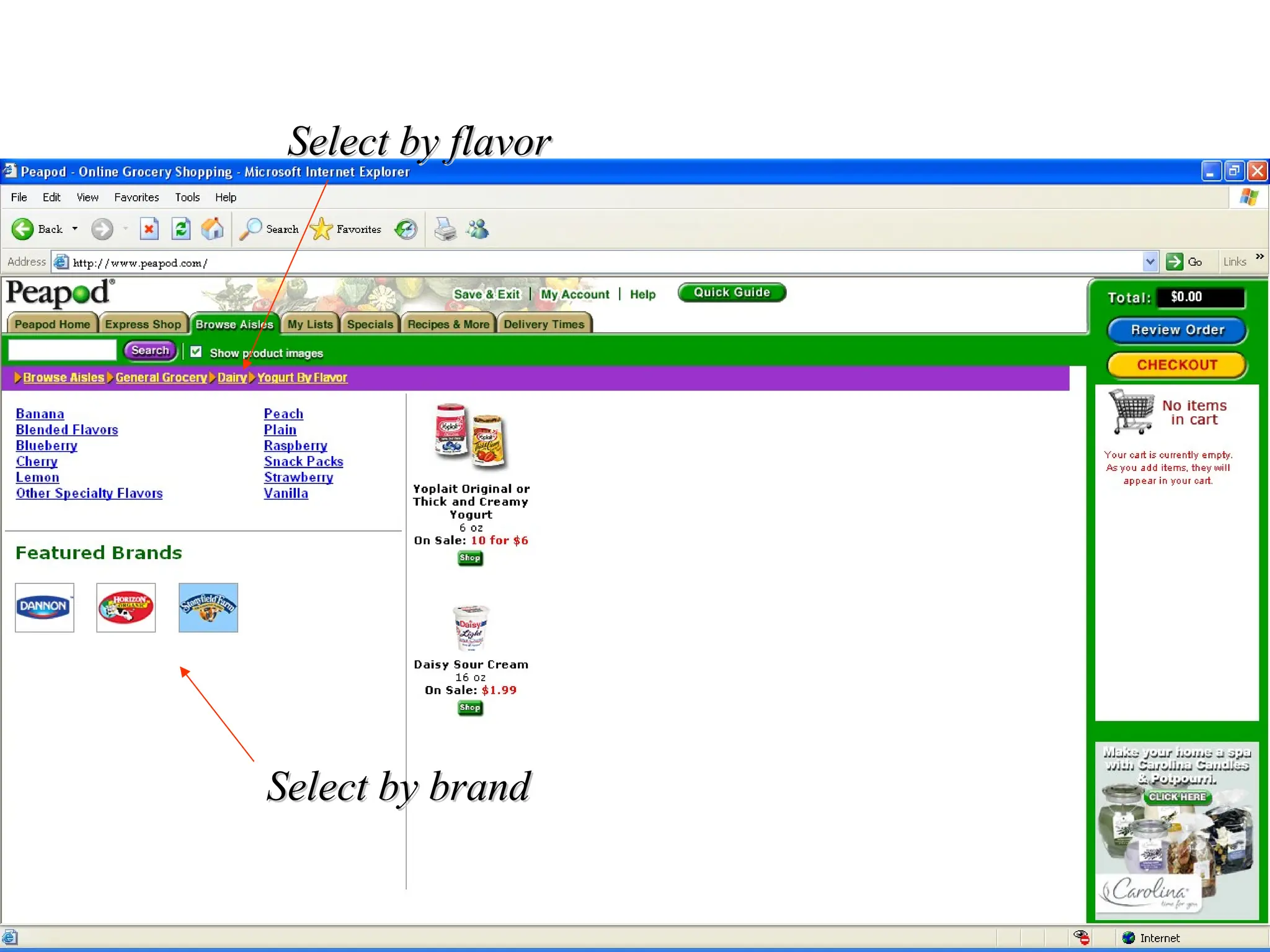
Select by flavor
Select by flavor
Select by brand
Select by brand
30
EMBA 226 • College of Business Administration • California State University, Sacramento
31
EMBA 226 • College of Business Administration • California State University, Sacramento
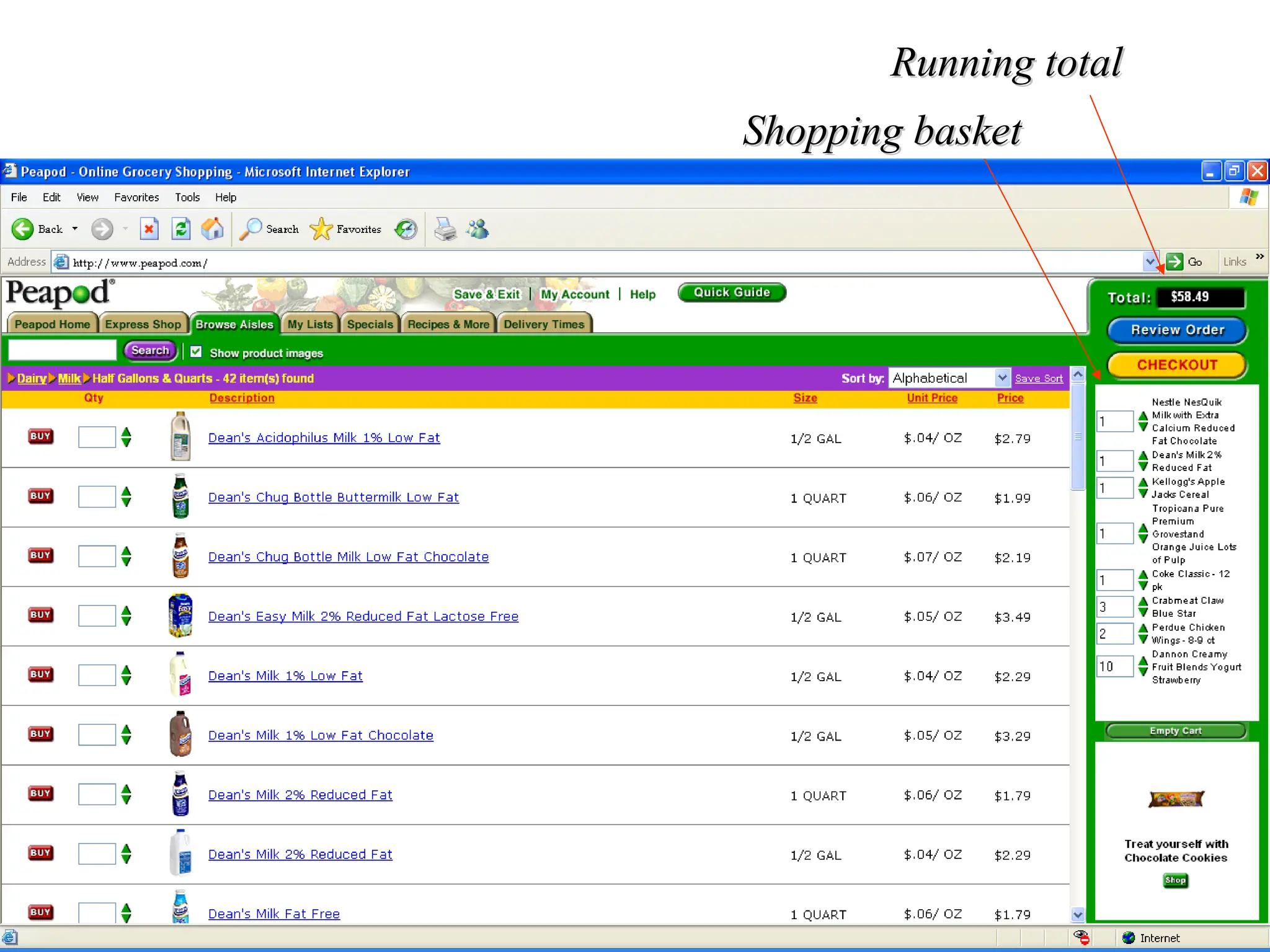
Shopping basket
Shopping basket
Running total
Running total
32
EMBA 226 • College of Business Administration • California State University, Sacramento
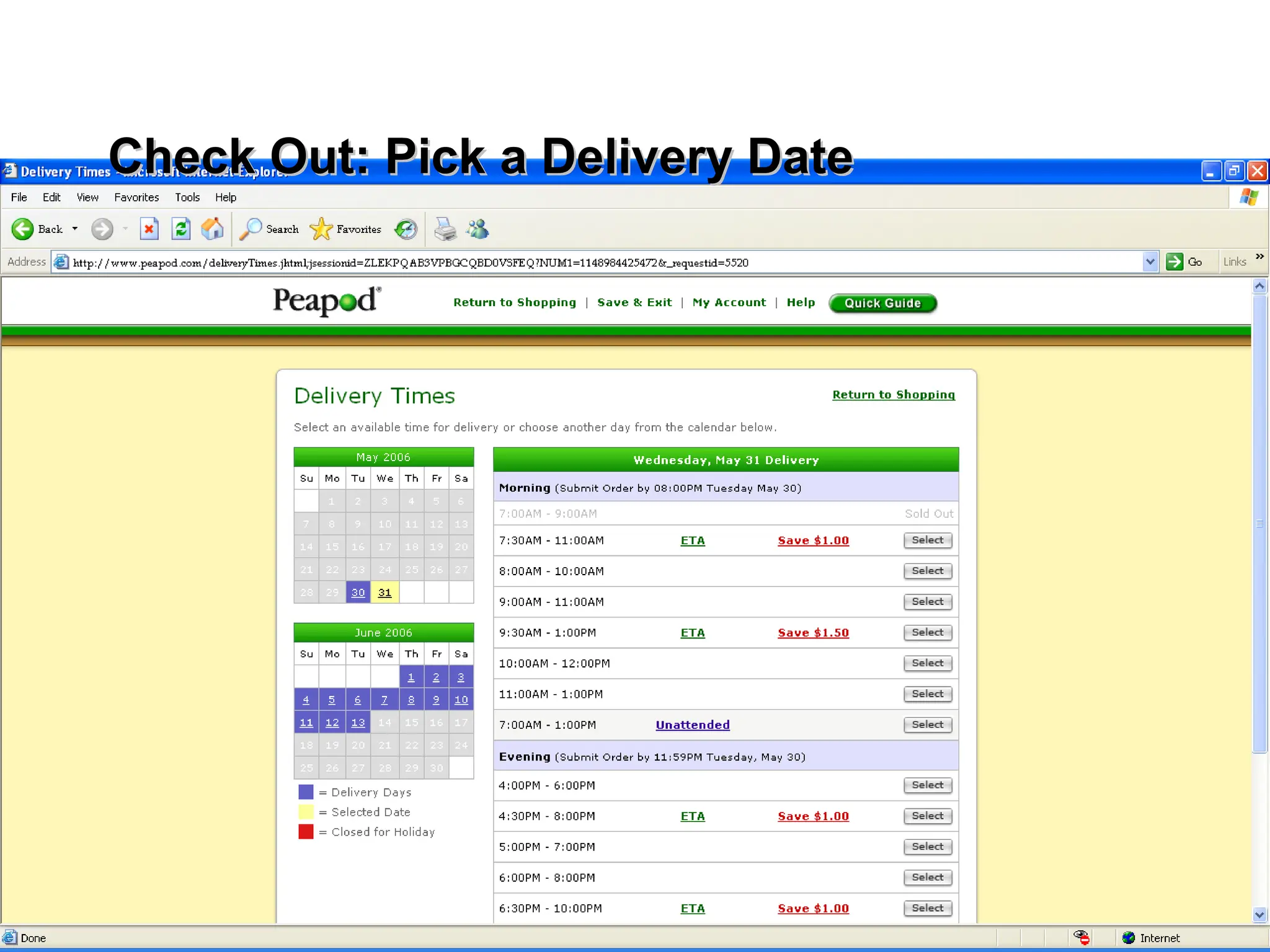
Check Out: Pick a Delivery Date
33
EMBA 226 • College of Business Administration • California State University, Sacramento
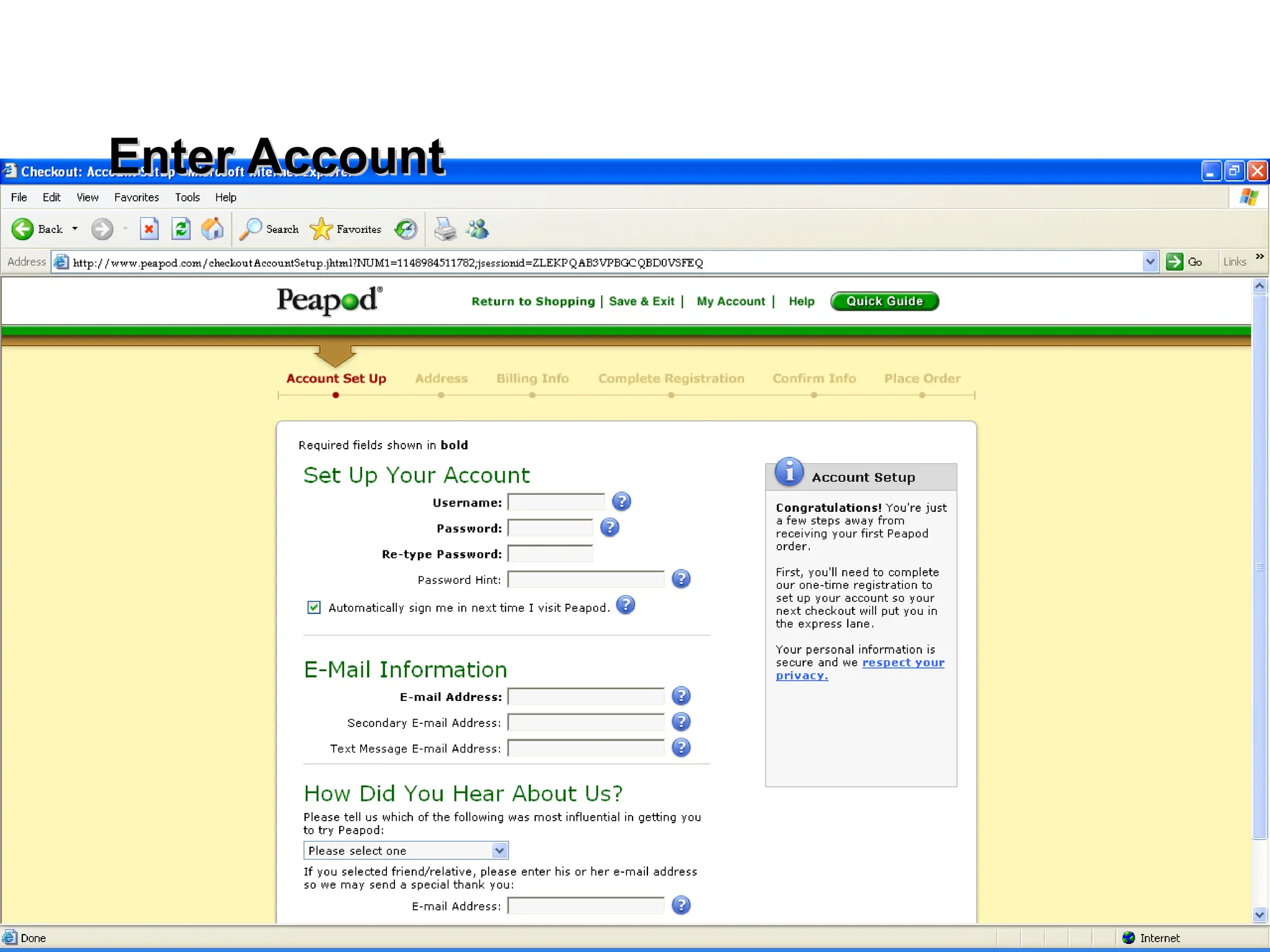
Enter Account
Enter Account
34
EMBA 226 • College of Business Administration • California State University, Sacramento
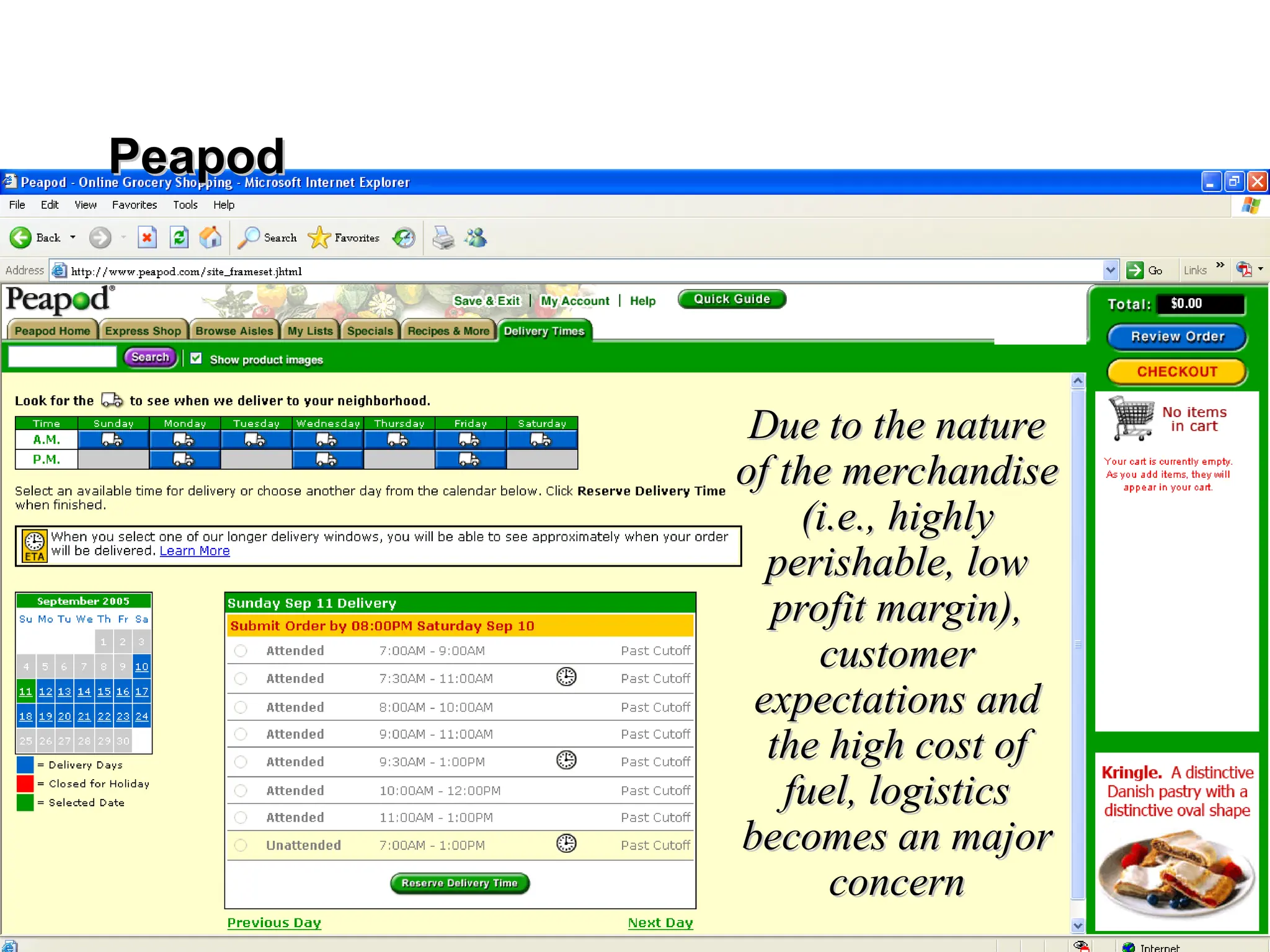
Due to the nature
Due to the nature
of the merchandise
of the merchandise
(i.e., highly
(i.e., highly
perishable, low
perishable, low
profit margin),
profit margin),
customer
customer
expectations and
expectations and
the high cost of
the high cost of
fuel, logistics
fuel, logistics
becomes an major
becomes an major
concern
concern
Peapod
Peapod
35
EMBA 226 • College of Business Administration • California State University, Sacramento
Peapod
Peapod
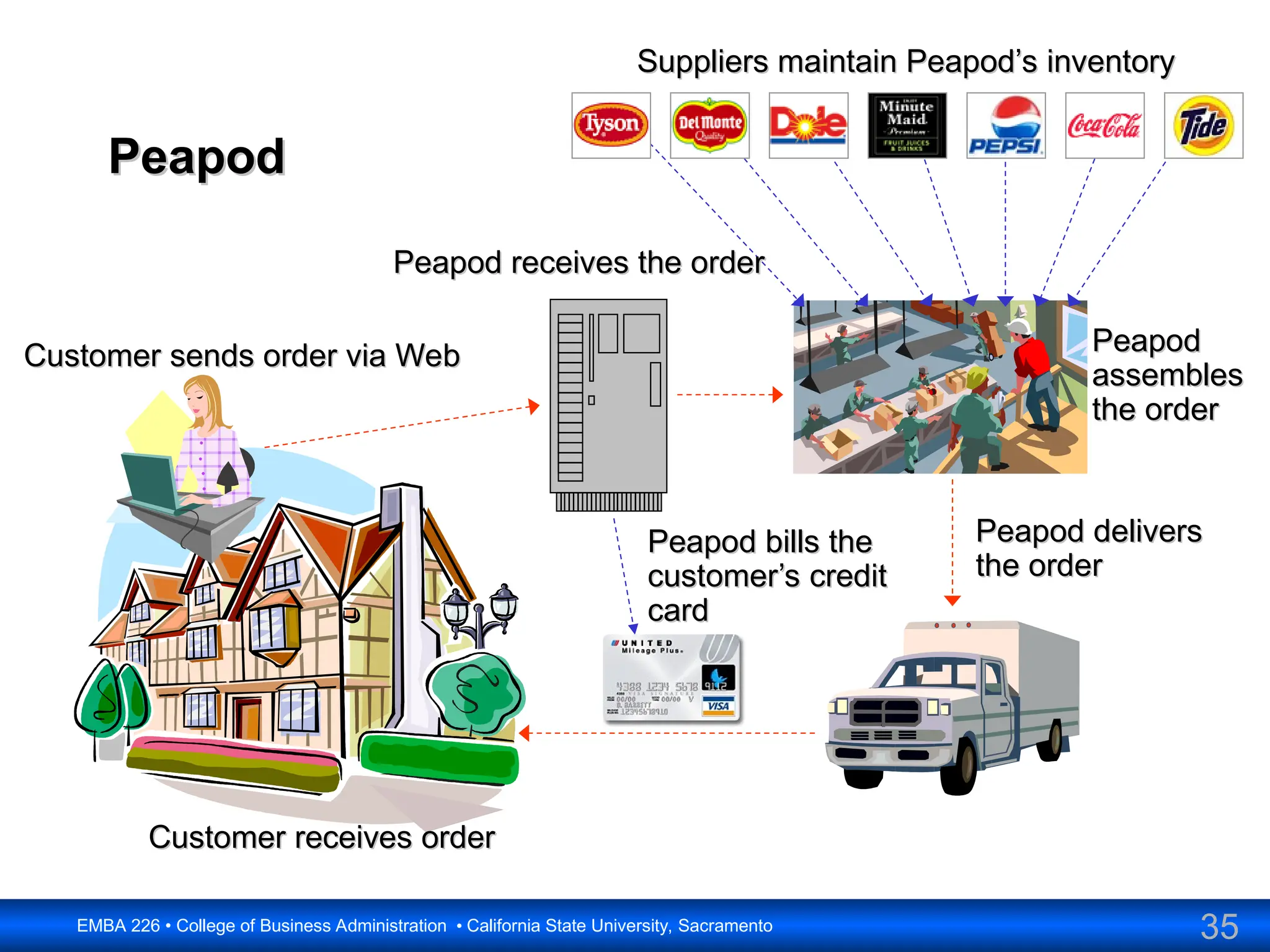
Customer sends order via Web
Peapod receives the order
Peapod
Peapod
assembles
assembles
the order
the order
Peapod delivers
Peapod delivers
the order
the order
Customer receives order
Suppliers maintain Peapod’s inventory
Peapod bills the
Peapod bills the
customer’s credit
customer’s credit
card
card
36
EMBA 226 • College of Business Administration • California State University, Sacramento
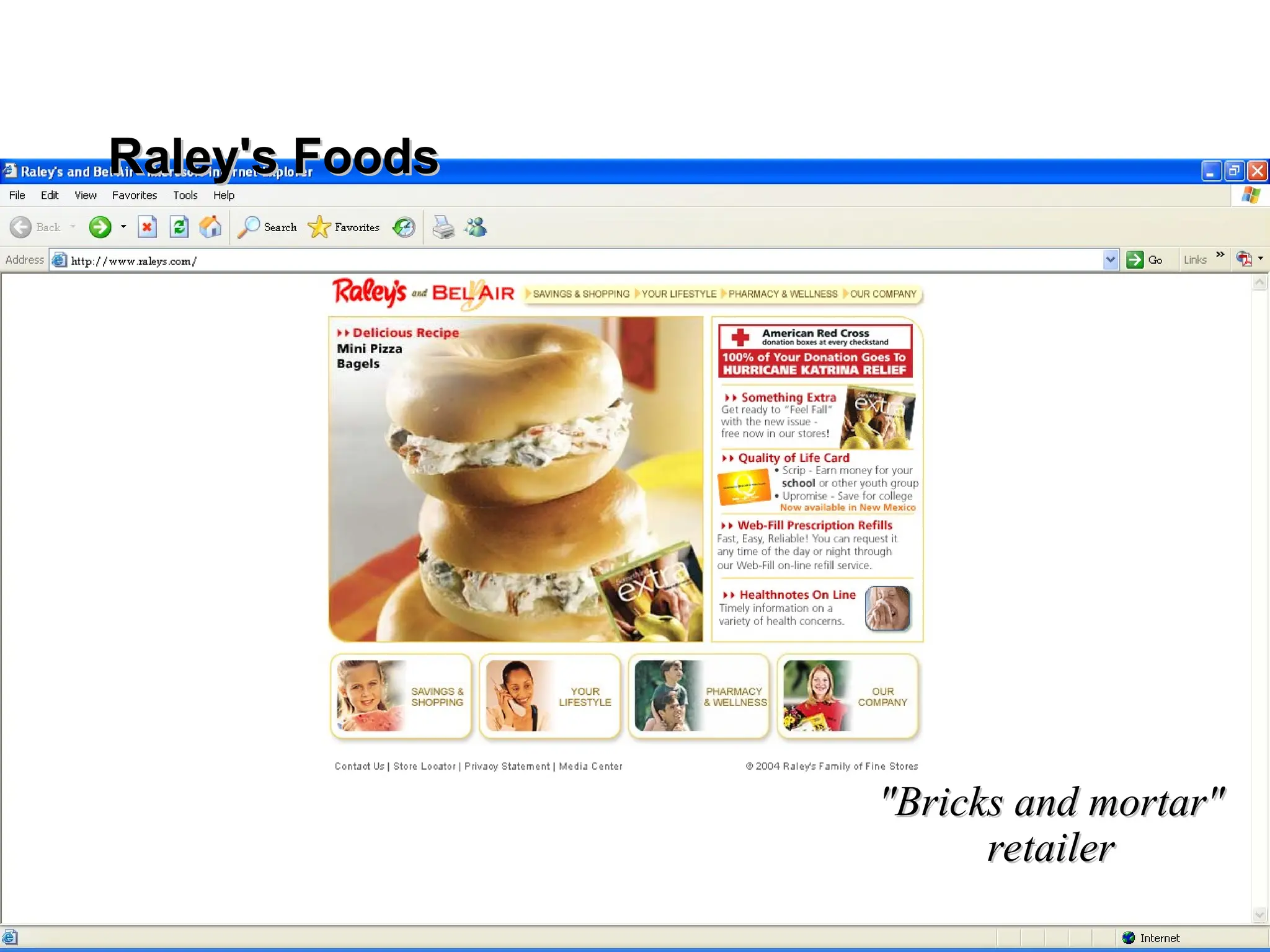
"Bricks and mortar"
"Bricks and mortar"
retailer
retailer
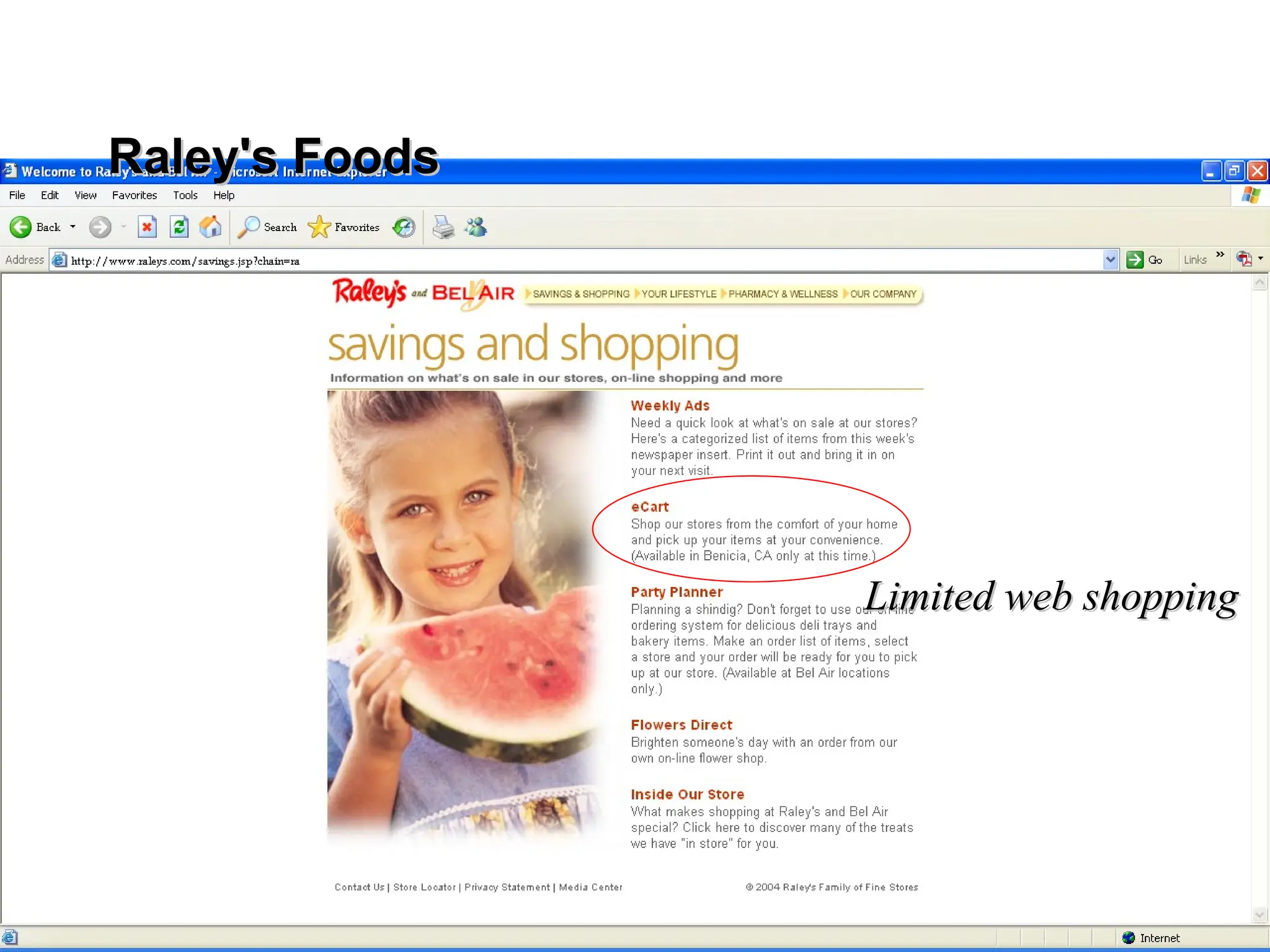
Raley's Foods
Raley's Foods
37
EMBA 226 • College of Business Administration • California State University, Sacramento
Limited web shopping
Raley's Foods
Raley's Foods
38
EMBA 226 • College of Business Administration • California State University, Sacramento
Business Model
Business Model
Discussion…
Discussion…
• Define the business model
Define the business model
• Identify the market segments, opportunities and threats
Identify the market segments, opportunities and threats
• What role does IT play in the business model?
What role does IT play in the business model?
• What is the effect of IT in the business model?
What is the effect of IT in the business model?
• How does IT impact the business?
How does IT impact the business?
39
EMBA 226 • College of Business Administration • California State University, Sacramento
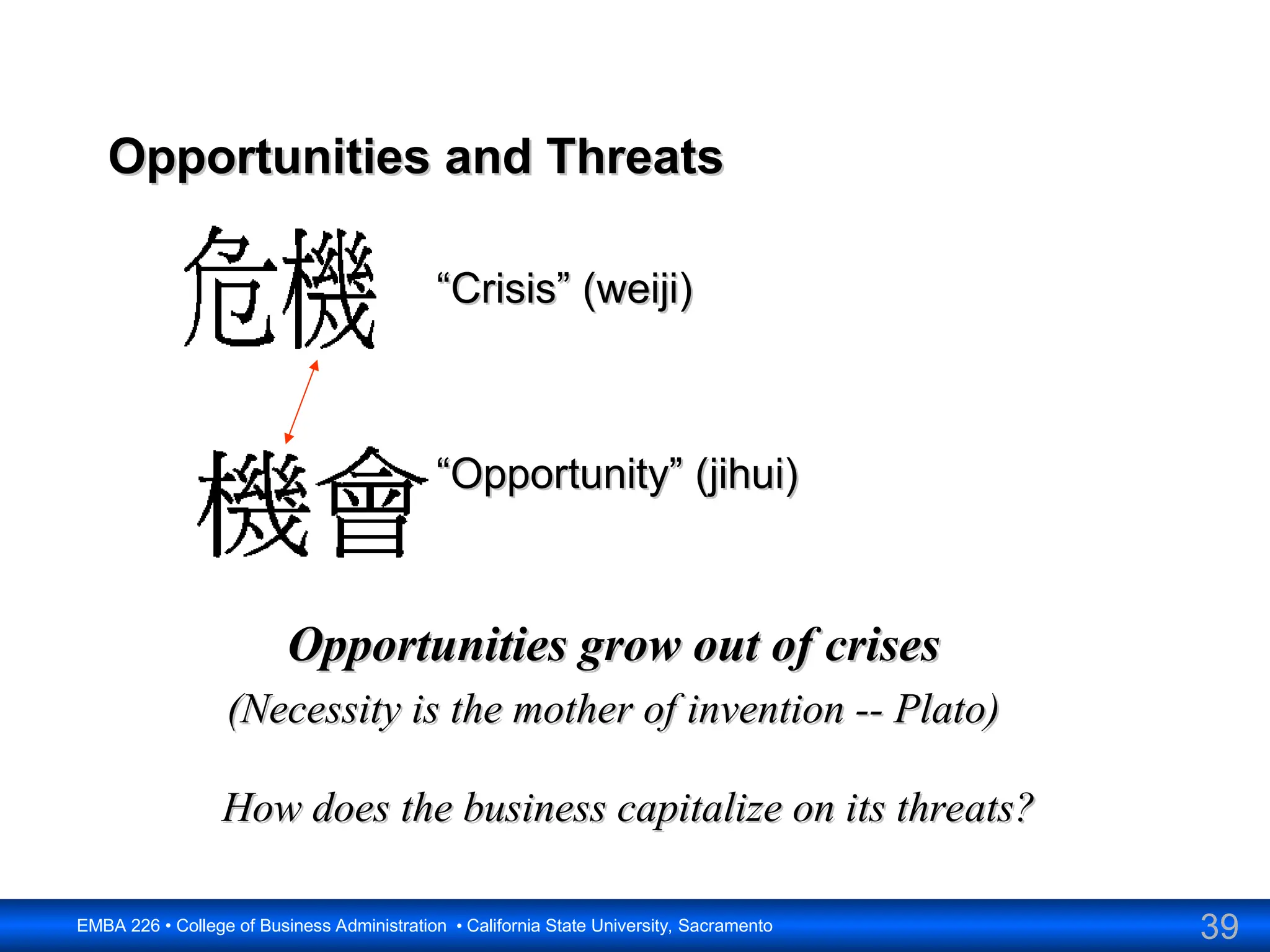
Opportunities and Threats
“
“Crisis” (weiji)
Crisis” (weiji)
“
“Opportunity” (jihui)
Opportunity” (jihui)
Opportunities grow out of crises
(Necessity is the mother of invention -- Plato)
How does the business capitalize on its threats?
40
EMBA 226 • College of Business Administration • California State University, Sacramento
Strategy and
Strategy and
Four Models and Frameworks
• Strategic Grid
Strategic Grid
• Porter’s Five Forces Model
Porter’s Five Forces Model
• Richard Nolan’s Stages Theory
Richard Nolan’s Stages Theory
• Strategic Alignment
Strategic Alignment
41
EMBA 226 • College of Business Administration • California State University, Sacramento
1. Strategic Grid
1. Strategic Grid
42
EMBA 226 • College of Business Administration • California State University, Sacramento
Strategic Grid
Strategic Grid
High
High
Low
Low
High
High
Low
Low
Impact on
Impact on
Existing
Existing
Business
Business
Operations
Operations
Impact on Strategy (future
competitive environment)
Factory
Factory
Operational IT
Operational IT
Support
Support
Basic elements
Basic elements
Turnaround
Turnaround
Gradual adoption
Gradual adoption
Strategic
Strategic
Strategic IT plan,
Strategic IT plan,
initiatives
initiatives
Management of IT depends on how the business views IT
IT has little relevance to existing or
future success
future success
Current IT important but future IT
developments are unlikely to
improve competitive advantage
Existing and future IT developments
critical to success
critical to success
Existing IT is unimportant but future
developments are crucial to survival
McFarlan and McKinney (1983)
43
EMBA 226 • College of Business Administration • California State University, Sacramento
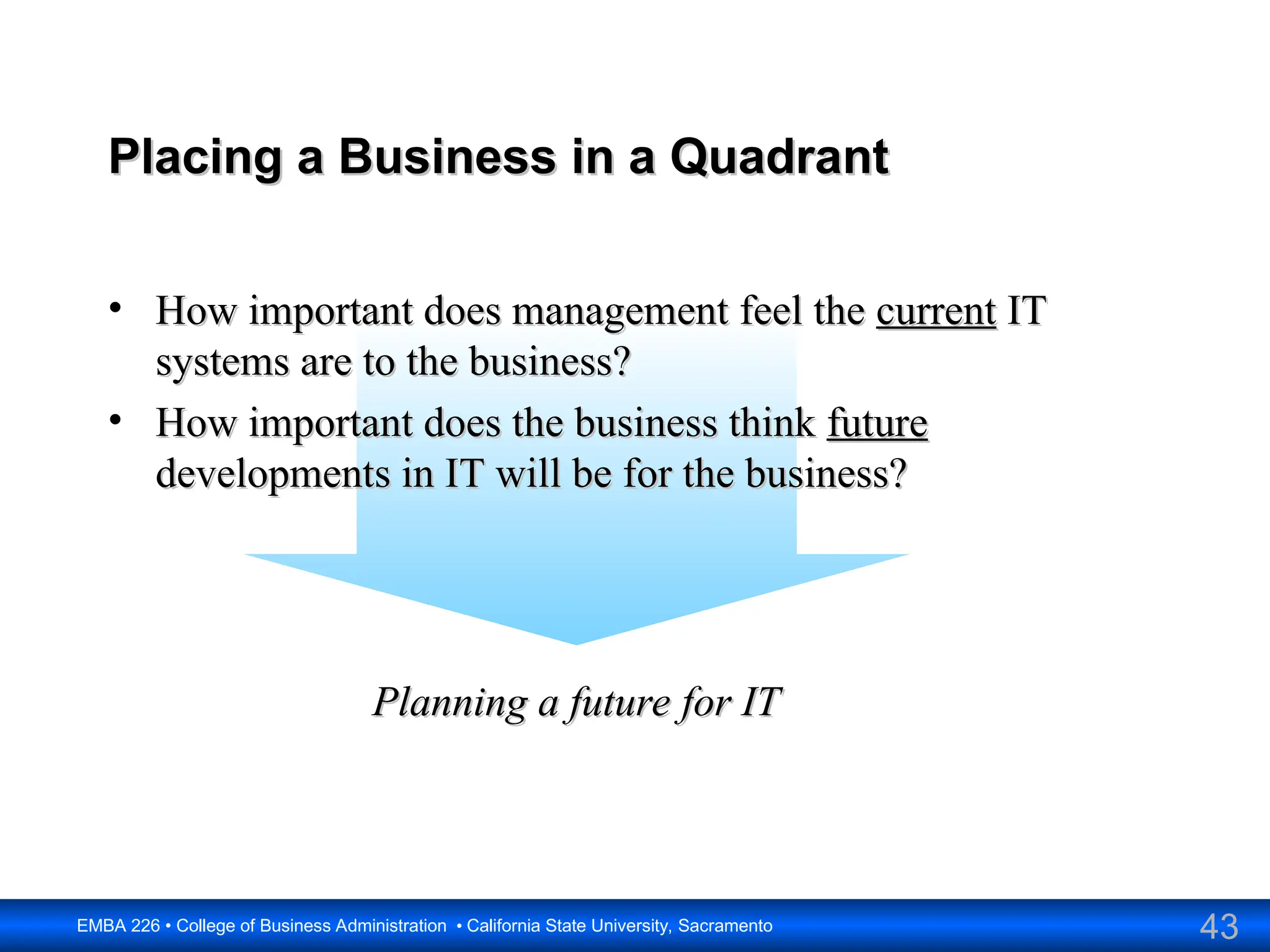
Placing a Business in a Quadrant
• How important does management feel the
How important does management feel the current
current IT
IT
systems are to the business?
• How important does the business think
How important does the business think future
future
developments in IT will be for the business?
Planning a future for IT
44
EMBA 226 • College of Business Administration • California State University, Sacramento
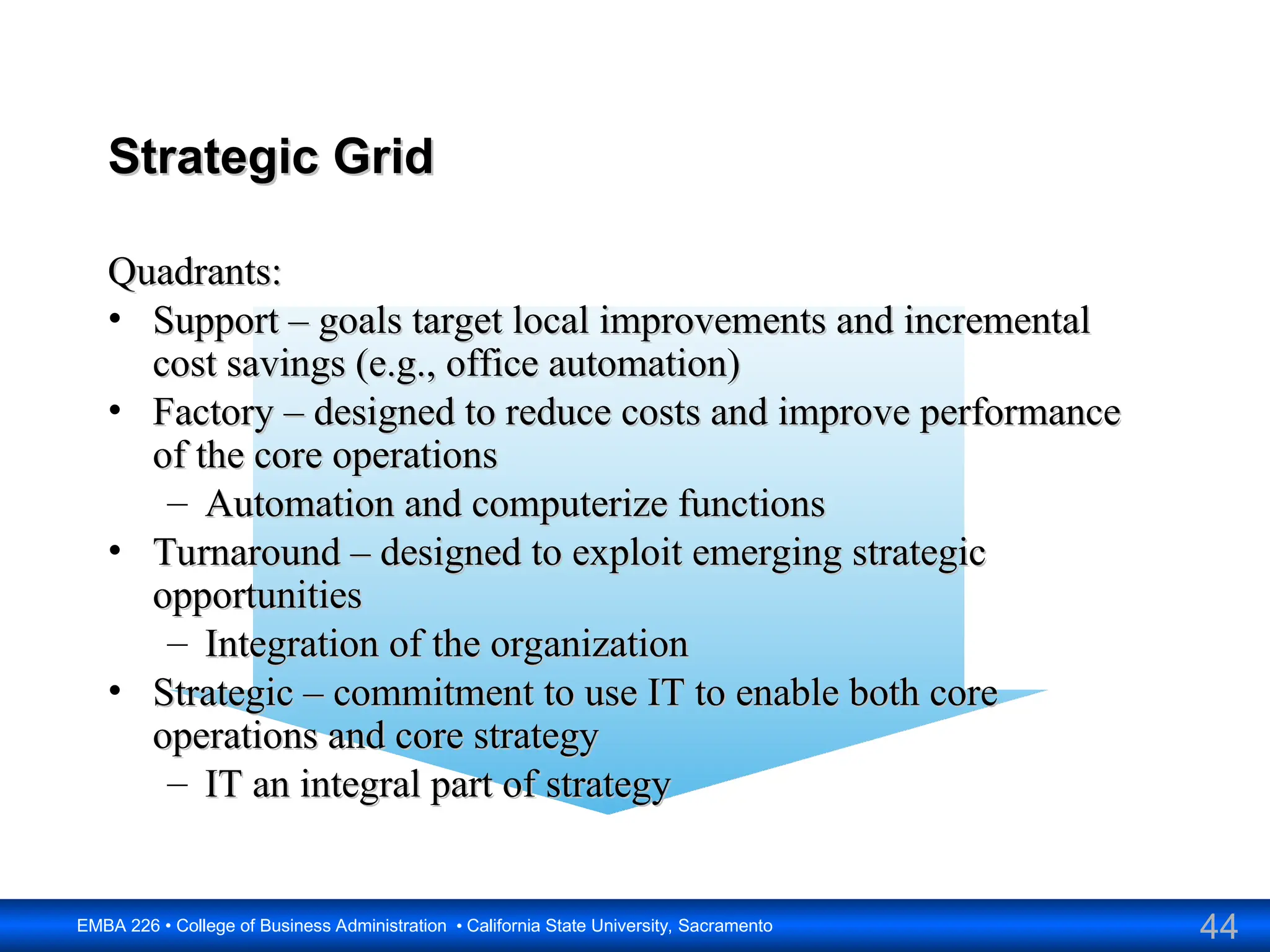
Strategic Grid
Strategic Grid
Quadrants:
Quadrants:
• Support – goals target local improvements and incremental
Support – goals target local improvements and incremental
cost savings (e.g., office automation)
• Factory – designed to reduce costs and improve performance
Factory – designed to reduce costs and improve performance
of the core operations
– Automation and computerize functions
Automation and computerize functions
• Turnaround – designed to exploit emerging strategic
Turnaround – designed to exploit emerging strategic
opportunities
opportunities
– Integration of the organization
Integration of the organization
• Strategic – commitment to use IT to enable both core
Strategic – commitment to use IT to enable both core
operations and core strategy
– IT an integral part of strategy
IT an integral part of strategy
45
EMBA 226 • College of Business Administration • California State University, Sacramento
2. Porter’s Five Forces Model
46
EMBA 226 • College of Business Administration • California State University, Sacramento
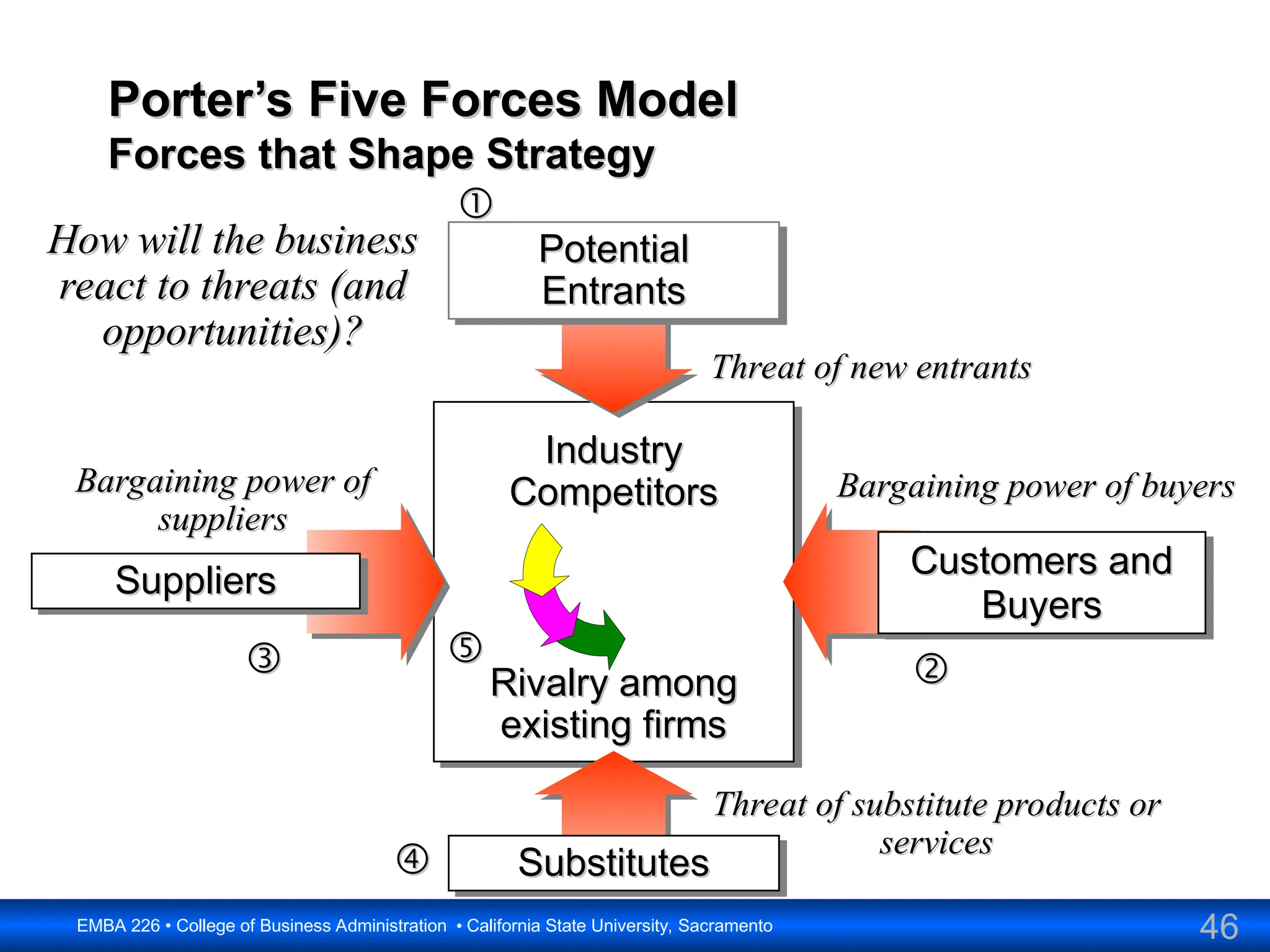
Porter’s Five Forces Model
Forces that Shape Strategy
Industry
Industry
Competitors
Competitors
Rivalry among
Rivalry among
existing firms
existing firms
Suppliers
Suppliers Customers and
Customers and
Buyers
Buyers
Potential
Potential
Entrants
Entrants
Substitutes
Substitutes
Bargaining power of buyers
Threat of substitute products or
services
services
Bargaining power of
Bargaining power of
suppliers
suppliers
Threat of new entrants










How will the business
react to threats (and
opportunities)?
opportunities)?
47
EMBA 226 • College of Business Administration • California State University, Sacramento
Contending Forces
Contending Forces
• The state of competition depends on the five forces
The state of competition depends on the five forces
• The collective strength of these forces determines the
The collective strength of these forces determines the
ultimate profit potential of an industry
– Strongest force or forces determine the profitability of
Strongest force or forces determine the profitability of
an industry and are of greatest importance in strategy
formulation
formulation
48
EMBA 226 • College of Business Administration • California State University, Sacramento
1. Threat of Entry
1. Threat of Entry
• New entrants bring new capacity, desire to gain market
New entrants bring new capacity, desire to gain market
share, and often substantial resources
• Barriers:
Barriers:
– Economies of scale
Economies of scale
– Product differentiation
Product differentiation
– Capital requirements
Capital requirements
– Cost disadvantages independent
Cost disadvantages independent
of size
of size
– Access to distribution channels
Access to distribution channels
– Government policy
Government policy
Seriousness of the
Seriousness of the
threat depends on the
barriers and the
barriers and the
reaction of the
reaction of the
incumbents
incumbents
49
EMBA 226 • College of Business Administration • California State University, Sacramento
Power of Buyers and Sellers
• Suppliers – Can exert bargaining power on participants by
Suppliers – Can exert bargaining power on participants by
raising prices or reducing the quality of the goods and
services
services
• Buyers – Can force down prices, demand higher quality or
Buyers – Can force down prices, demand higher quality or
more service, and play competitors against each other
50
EMBA 226 • College of Business Administration • California State University, Sacramento
2. Suppliers are powerful if…
• Dominated by a few companies
Dominated by a few companies
• Products is unique or well differentiated, or has built-up
Products is unique or well differentiated, or has built-up
switching costs
switching costs
• Not obligated to content with other products for sale to the
Not obligated to content with other products for sale to the
industry
industry
• Poses a credible threat of integrating forward into the
Poses a credible threat of integrating forward into the
industry’s business
industry’s business
• Industry is not an important customer (of the supplier
Industry is not an important customer (of the supplier
group)
group)
51
EMBA 226 • College of Business Administration • California State University, Sacramento
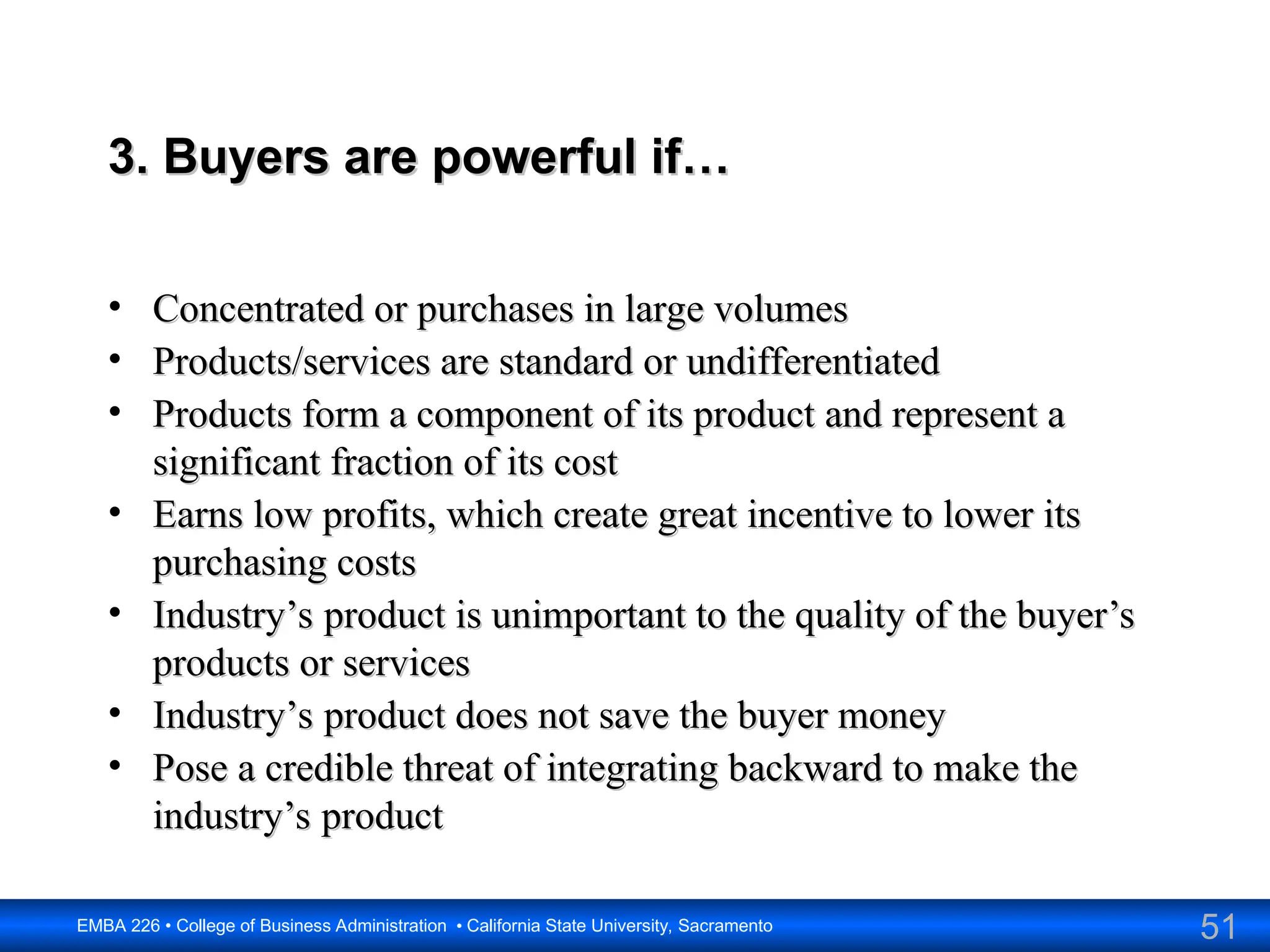
3. Buyers are powerful if…
• Concentrated or purchases in large volumes
Concentrated or purchases in large volumes
• Products/services are standard or undifferentiated
Products/services are standard or undifferentiated
• Products form a component of its product and represent a
Products form a component of its product and represent a
significant fraction of its cost
• Earns low profits, which create great incentive to lower its
Earns low profits, which create great incentive to lower its
purchasing costs
purchasing costs
• Industry’s product is unimportant to the quality of the buyer’s
Industry’s product is unimportant to the quality of the buyer’s
products or services
• Industry’s product does not save the buyer money
Industry’s product does not save the buyer money
• Pose a credible threat of integrating backward to make the
Pose a credible threat of integrating backward to make the
industry’s product
industry’s product
52
EMBA 226 • College of Business Administration • California State University, Sacramento
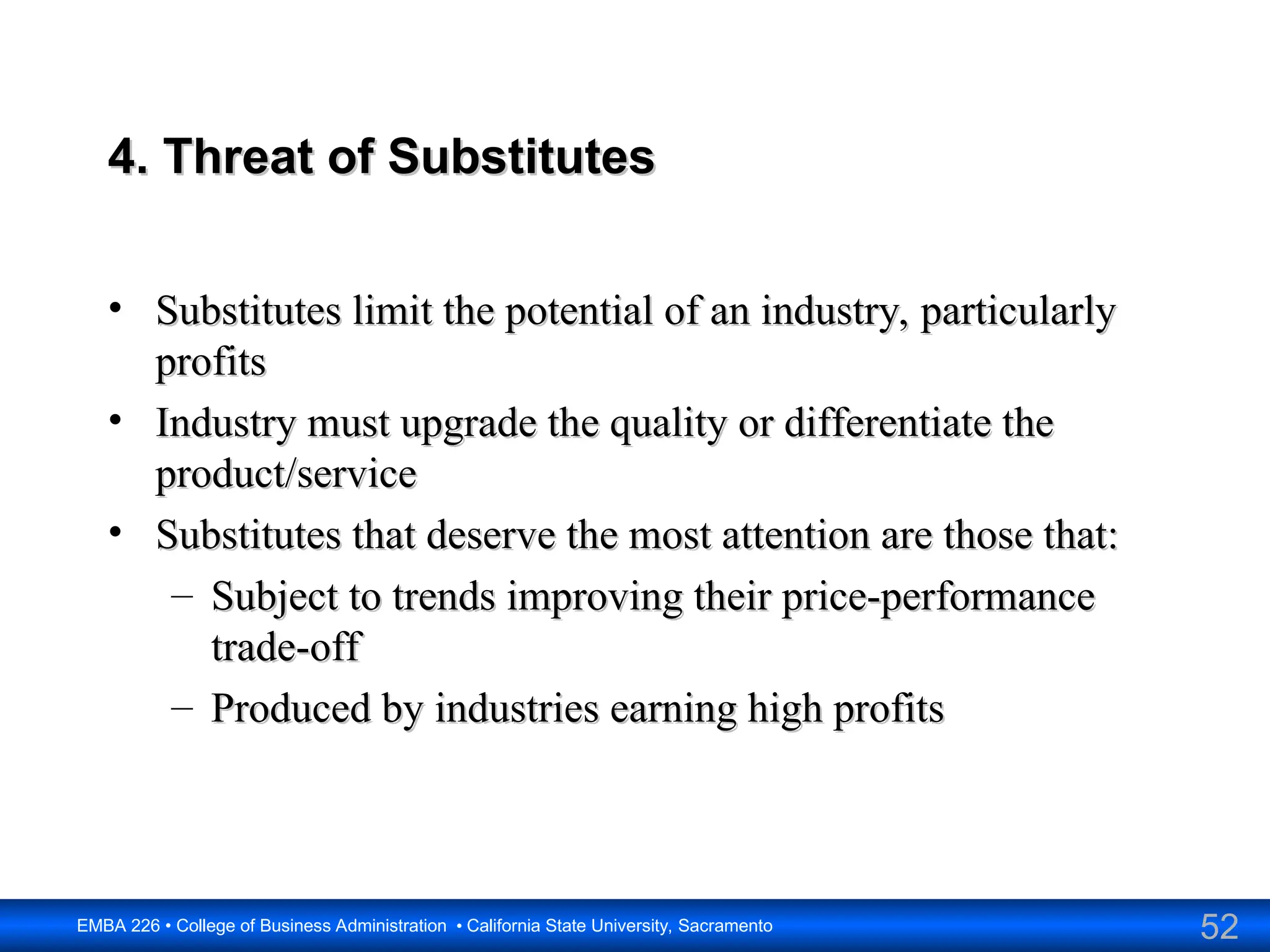
4. Threat of Substitutes
• Substitutes limit the potential of an industry, particularly
Substitutes limit the potential of an industry, particularly
profits
profits
• Industry must upgrade the quality or differentiate the
Industry must upgrade the quality or differentiate the
product/service
product/service
• Substitutes that deserve the most attention are those that:
Substitutes that deserve the most attention are those that:
– Subject to trends improving their price-performance
Subject to trends improving their price-performance
trade-off
trade-off
– Produced by industries earning high profits
Produced by industries earning high profits
53
EMBA 226 • College of Business Administration • California State University, Sacramento
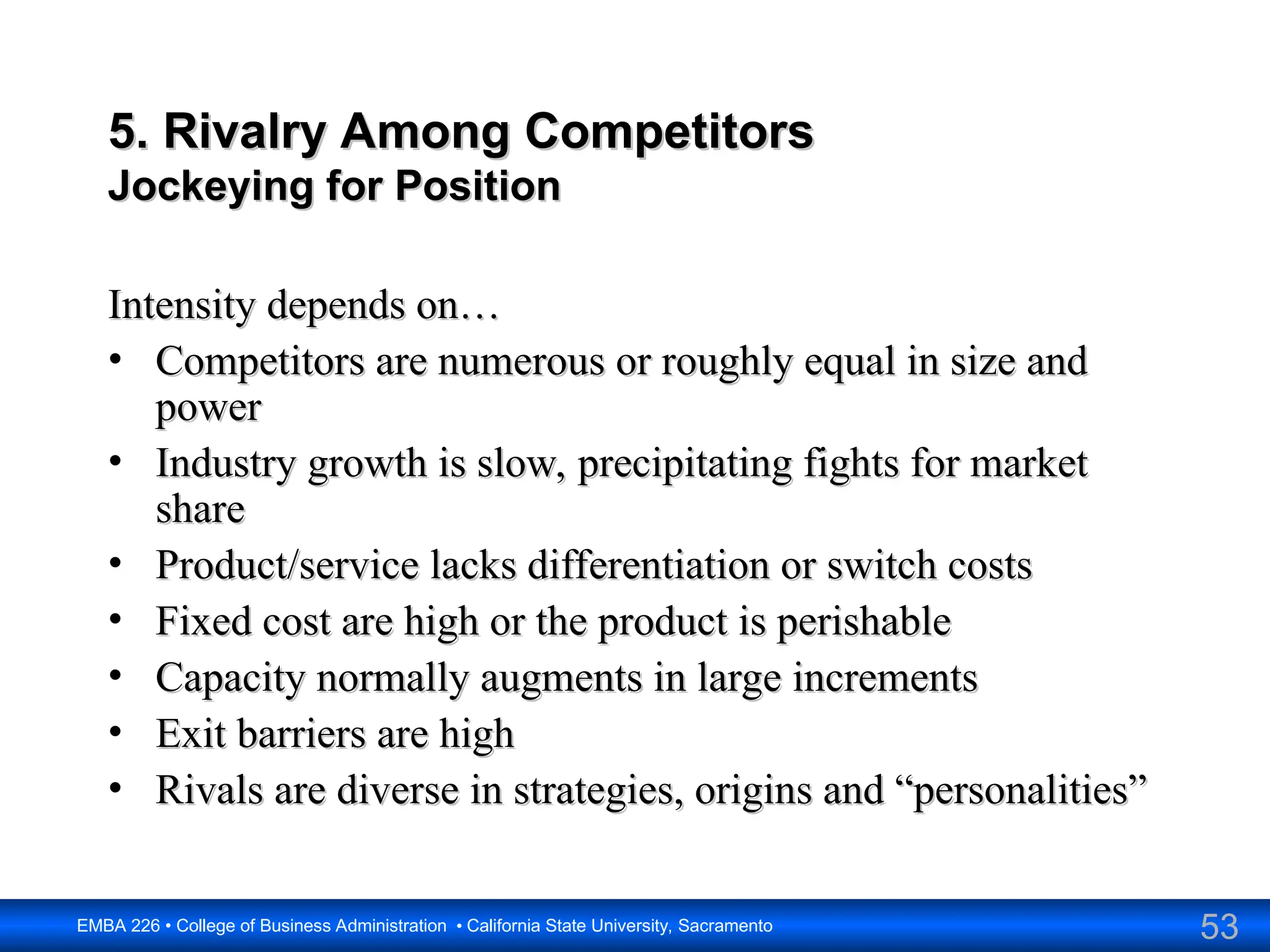
5. Rivalry Among Competitors
Jockeying for Position
Intensity depends on…
• Competitors are numerous or roughly equal in size and
Competitors are numerous or roughly equal in size and
power
power
• Industry growth is slow, precipitating fights for market
Industry growth is slow, precipitating fights for market
share
share
• Product/service lacks differentiation or switch costs
Product/service lacks differentiation or switch costs
• Fixed cost are high or the product is perishable
Fixed cost are high or the product is perishable
• Capacity normally augments in large increments
Capacity normally augments in large increments
• Exit barriers are high
Exit barriers are high
• Rivals are diverse in strategies, origins and “personalities”
Rivals are diverse in strategies, origins and “personalities”
54
EMBA 226 • College of Business Administration • California State University, Sacramento
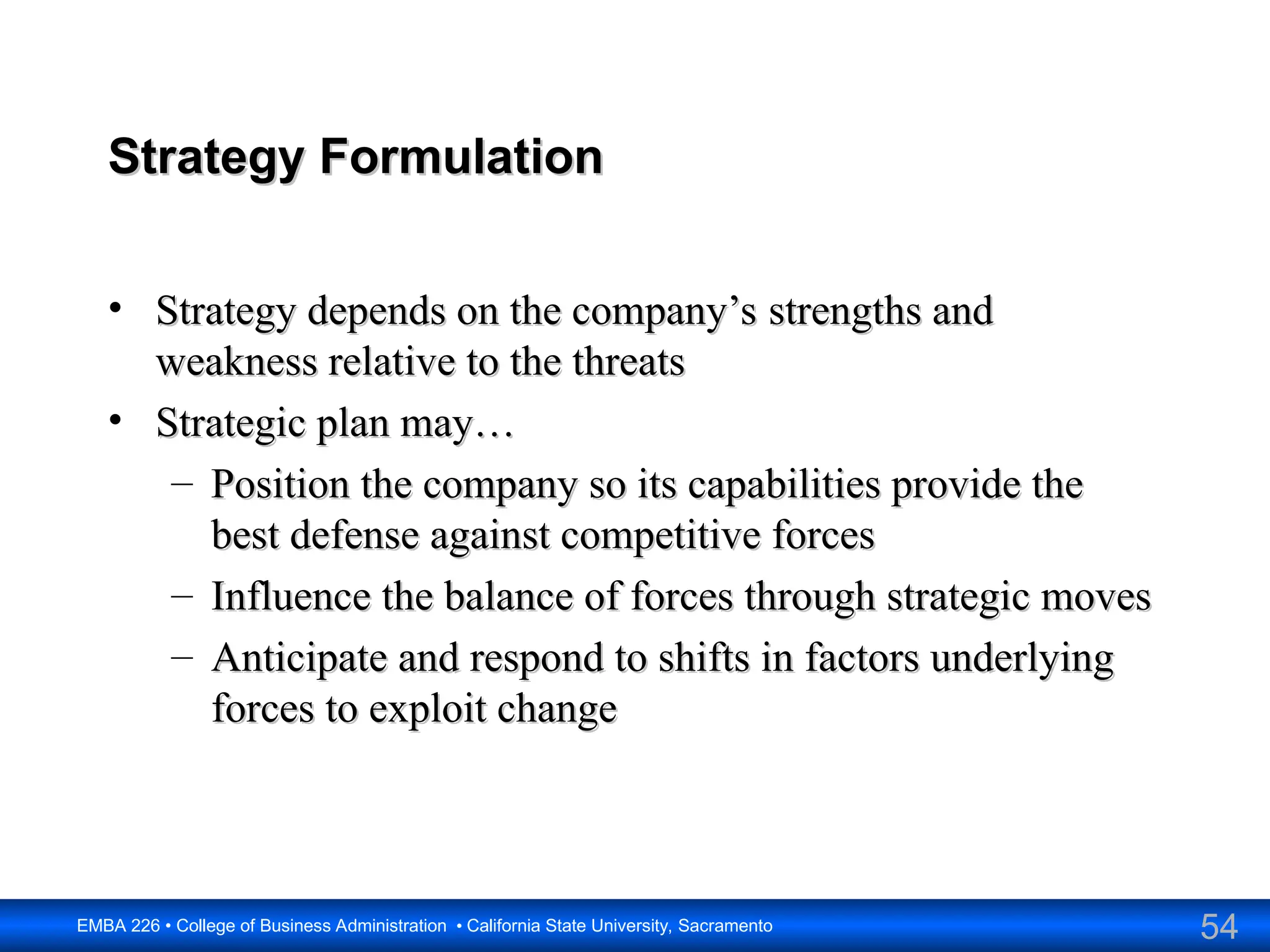
Strategy Formulation
• Strategy depends on the company’s strengths and
Strategy depends on the company’s strengths and
weakness relative to the threats
• Strategic plan may…
Strategic plan may…
– Position the company so its capabilities provide the
Position the company so its capabilities provide the
best defense against competitive forces
– Influence the balance of forces through strategic moves
Influence the balance of forces through strategic moves
– Anticipate and respond to shifts in factors underlying
Anticipate and respond to shifts in factors underlying
forces to exploit change
55
EMBA 226 • College of Business Administration • California State University, Sacramento
Approaches to Strategy
• Positioning the company so it is the least vulnerable to its
Positioning the company so it is the least vulnerable to its
competitive forces
competitive forces
• Taking the offensive and alter the market
Taking the offensive and alter the market
• Exploiting industry evolution (change)
Exploiting industry evolution (change)
How can IT make a difference?
56
EMBA 226 • College of Business Administration • California State University, Sacramento
• “
“How Competitive Forces Shape Strategy,” Michael E.
How Competitive Forces Shape Strategy,” Michael E.
Porter, Harvard Business Review, March-April 1979.
57
EMBA 226 • College of Business Administration • California State University, Sacramento
3. Nolan’s Stages Theory
58
EMBA 226 • College of Business Administration • California State University, Sacramento
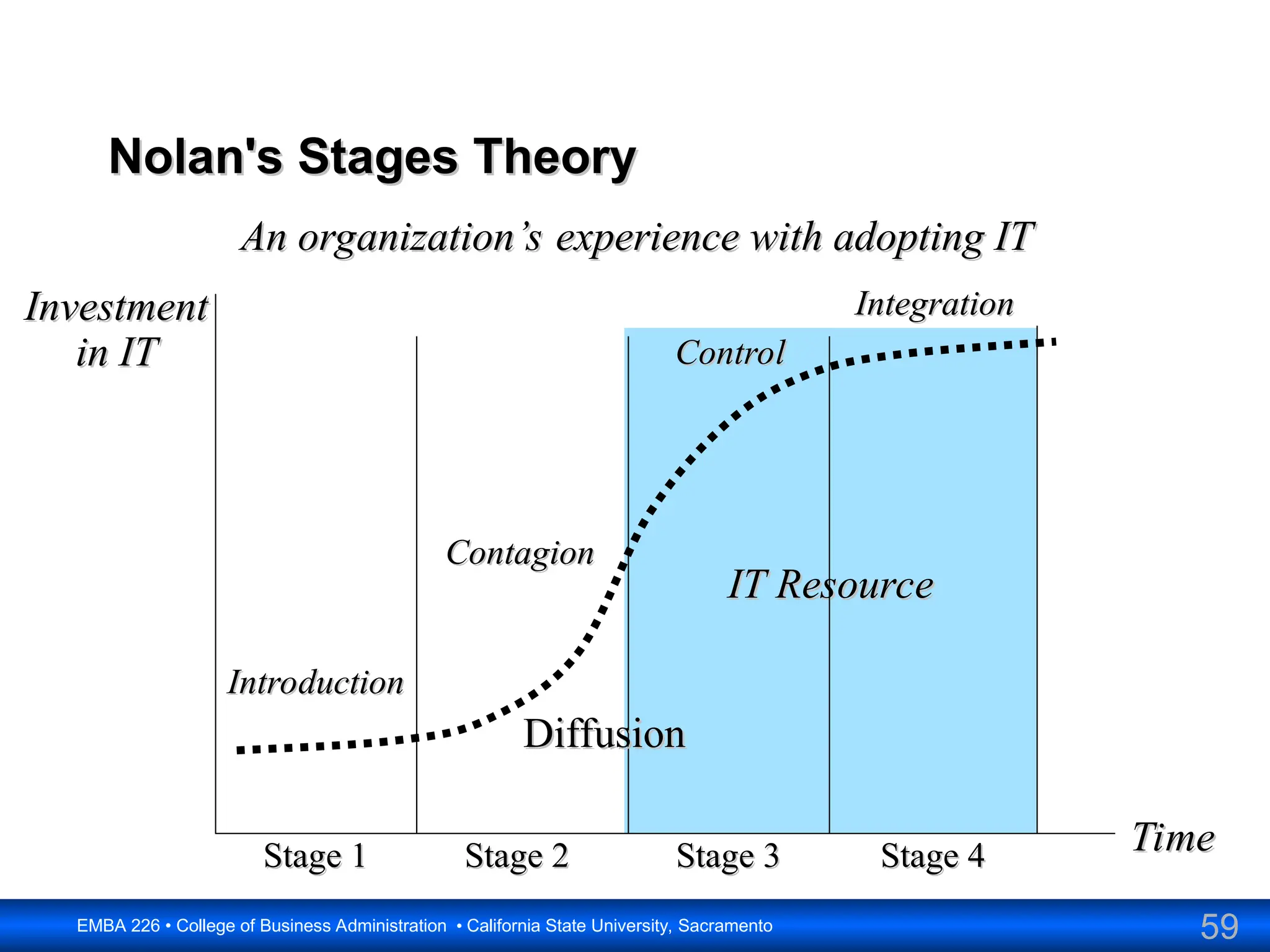
Nolan's Stage Theory
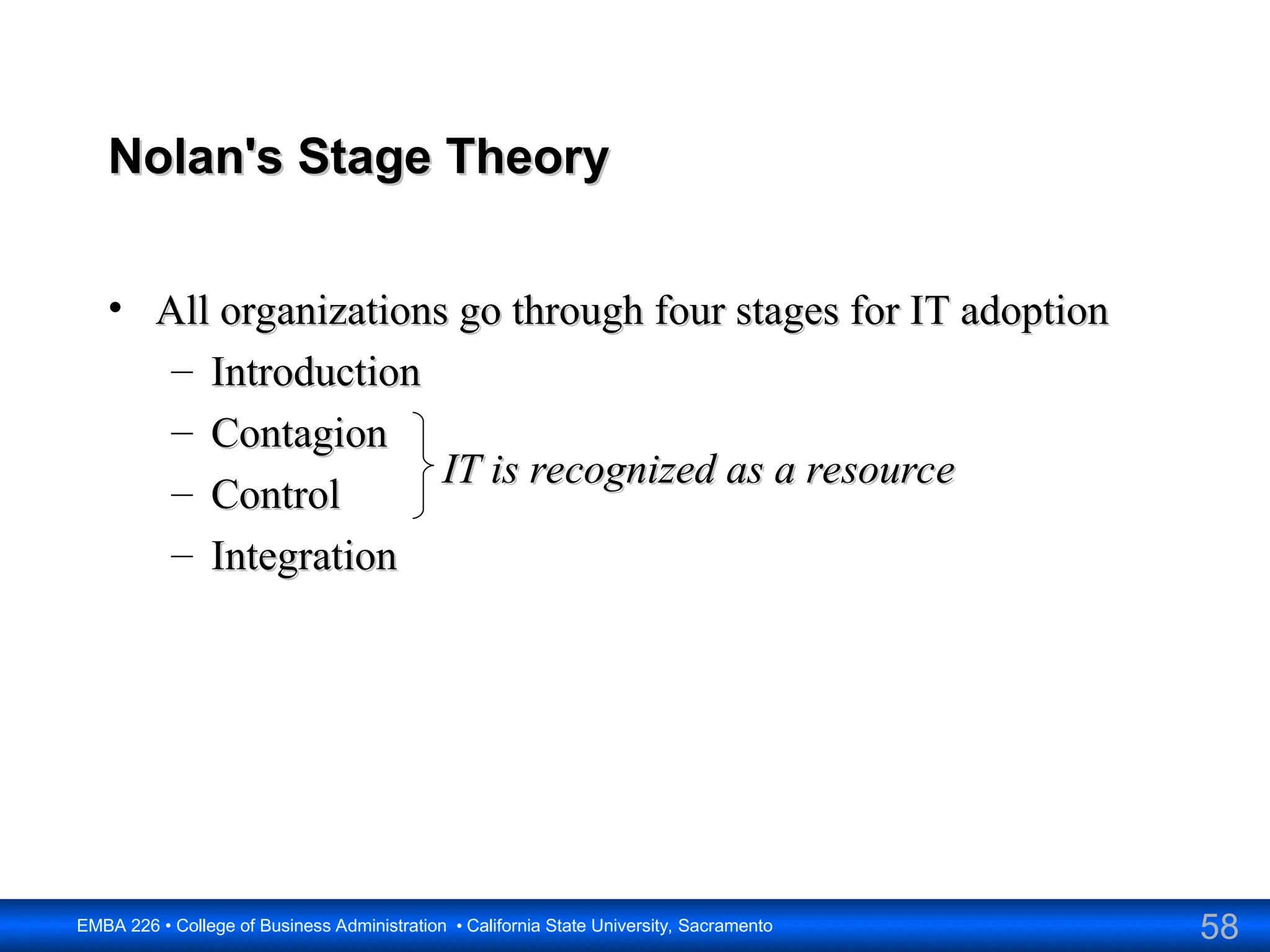
• All organizations go through four stages for IT adoption
All organizations go through four stages for IT adoption
– Introduction
Introduction
– Contagion
Contagion
– Control
Control
– Integration
Integration
IT is recognized as a resource
59
EMBA 226 • College of Business Administration • California State University, Sacramento
IT Resource
IT Resource
Nolan's Stages Theory
Introduction
Introduction
Contagion
Contagion
Control
Control
Integration
Integration
Time
Time
Investment
Investment
in IT
in IT
Stage 1
Stage 1 Stage 2
Stage 2 Stage 3
Stage 3 Stage 4
Stage 4
An organization’s experience with adopting IT
Diffusion
Diffusion
60
EMBA 226 • College of Business Administration • California State University, Sacramento
4. Strategic Alignment
61
EMBA 226 • College of Business Administration • California State University, Sacramento
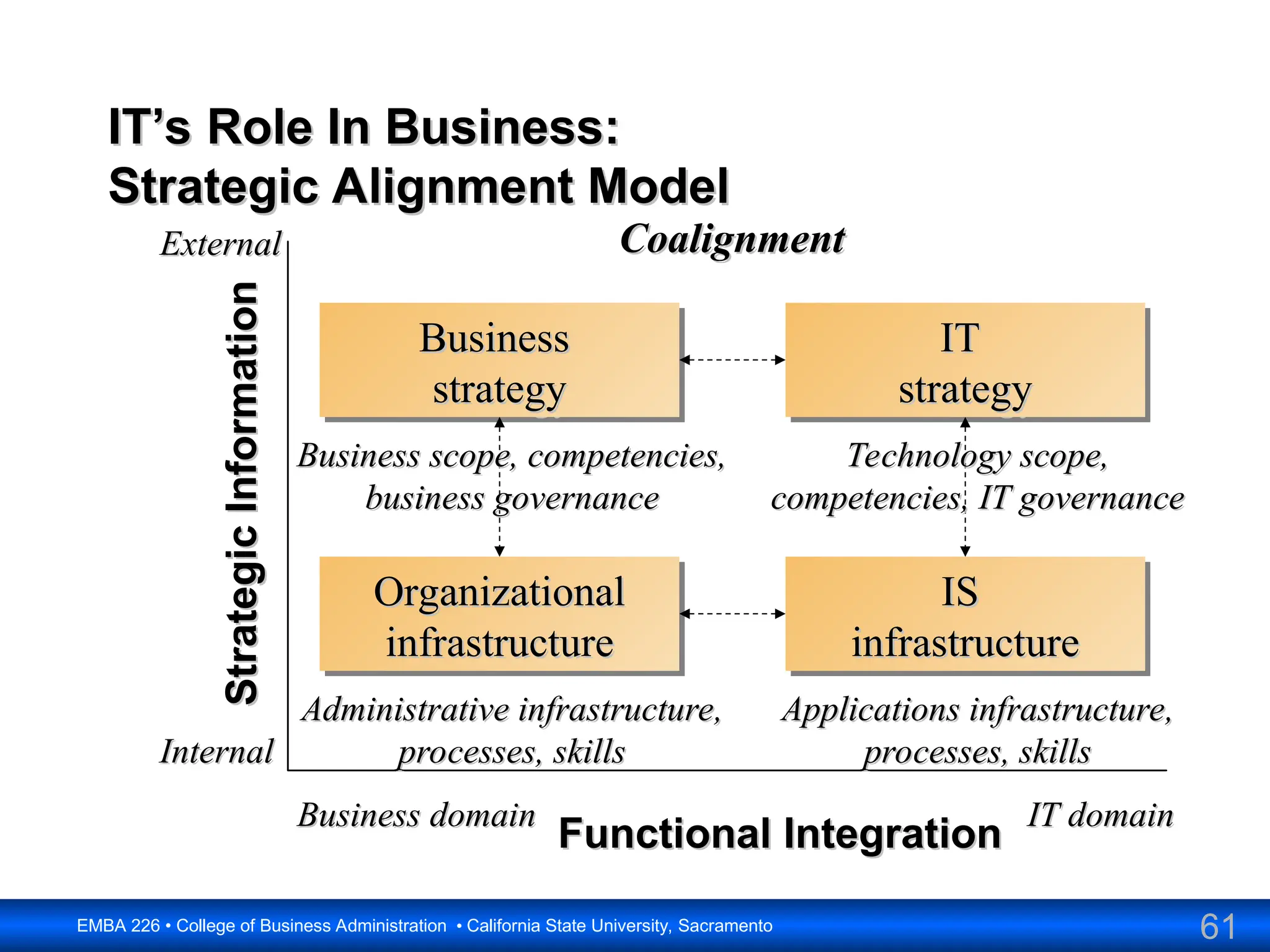
IT’s Role In Business:
Strategic Alignment Model
Strategic
Information
Strategic
Information
Functional Integration
Business domain
Business domain IT domain
IT domain
External
External
Internal
Internal
Business
Business
strategy
strategy
Organizational
Organizational
infrastructure
infrastructure
IT
IT
strategy
strategy
IS
IS
infrastructure
infrastructure
Administrative infrastructure,
processes, skills
processes, skills
Applications infrastructure,
processes, skills
processes, skills
Coalignment
Coalignment
Business scope, competencies,
business governance
business governance
Technology scope,
Technology scope,
competencies, IT governance
62
EMBA 226 • College of Business Administration • California State University, Sacramento
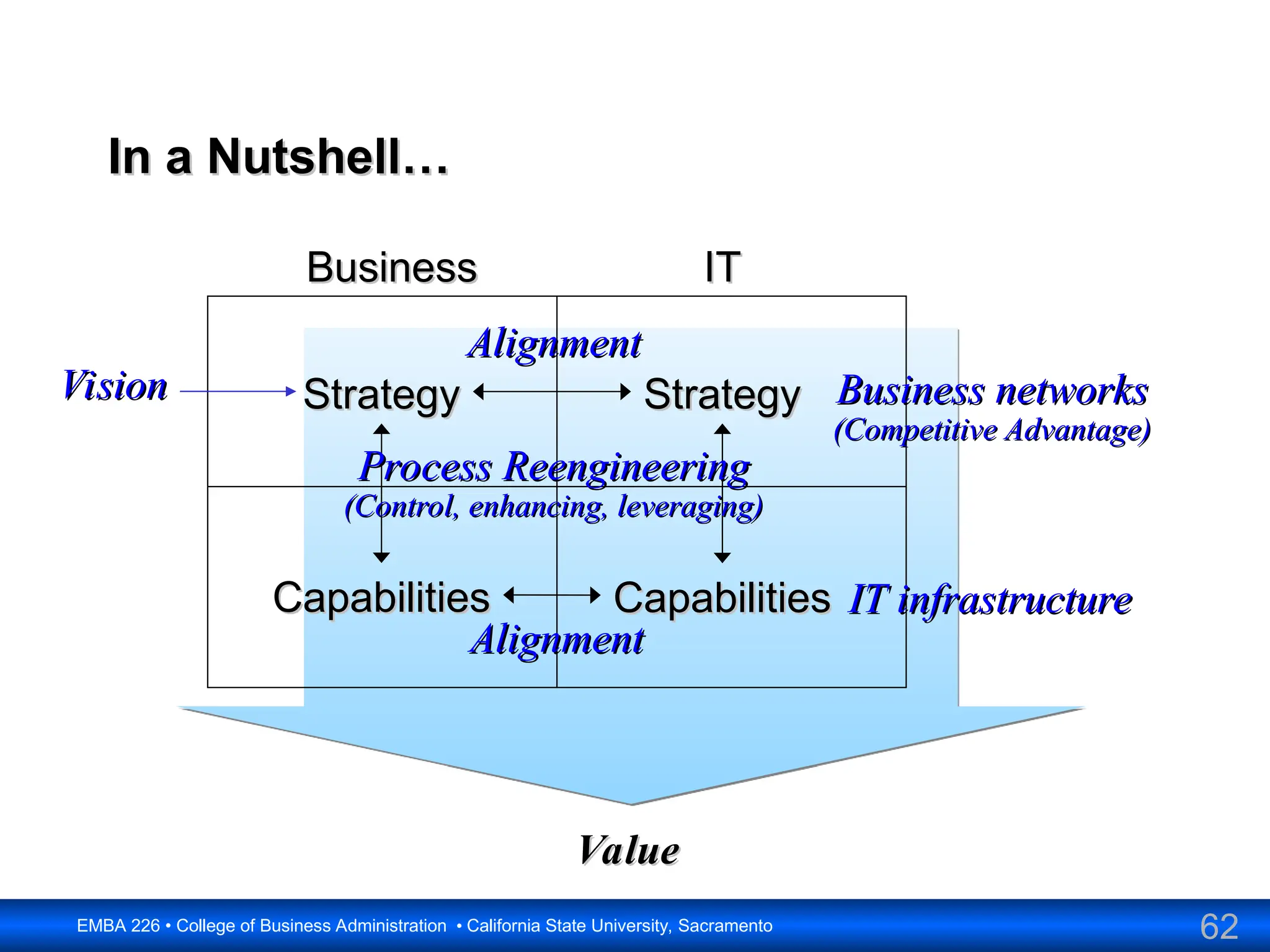
In a Nutshell…
In a Nutshell…
Business
Business IT
IT
Strategy
Strategy Strategy
Strategy
Capabilities
Capabilities Capabilities
Capabilities
Alignment
Alignment
Alignment
Alignment
IT infrastructure
IT infrastructure
Process Reengineering
(Control, enhancing, leveraging)
Business networks
Business networks
(Competitive Advantage)
Value
Value
Vision
Vision
63
EMBA 226 • College of Business Administration • California State University, Sacramento
A Few More Factors to Consider
IT Planning Dilemma
IT Planning Dilemma
Investments in IT
Investments in IT
64
EMBA 226 • College of Business Administration • California State University, Sacramento
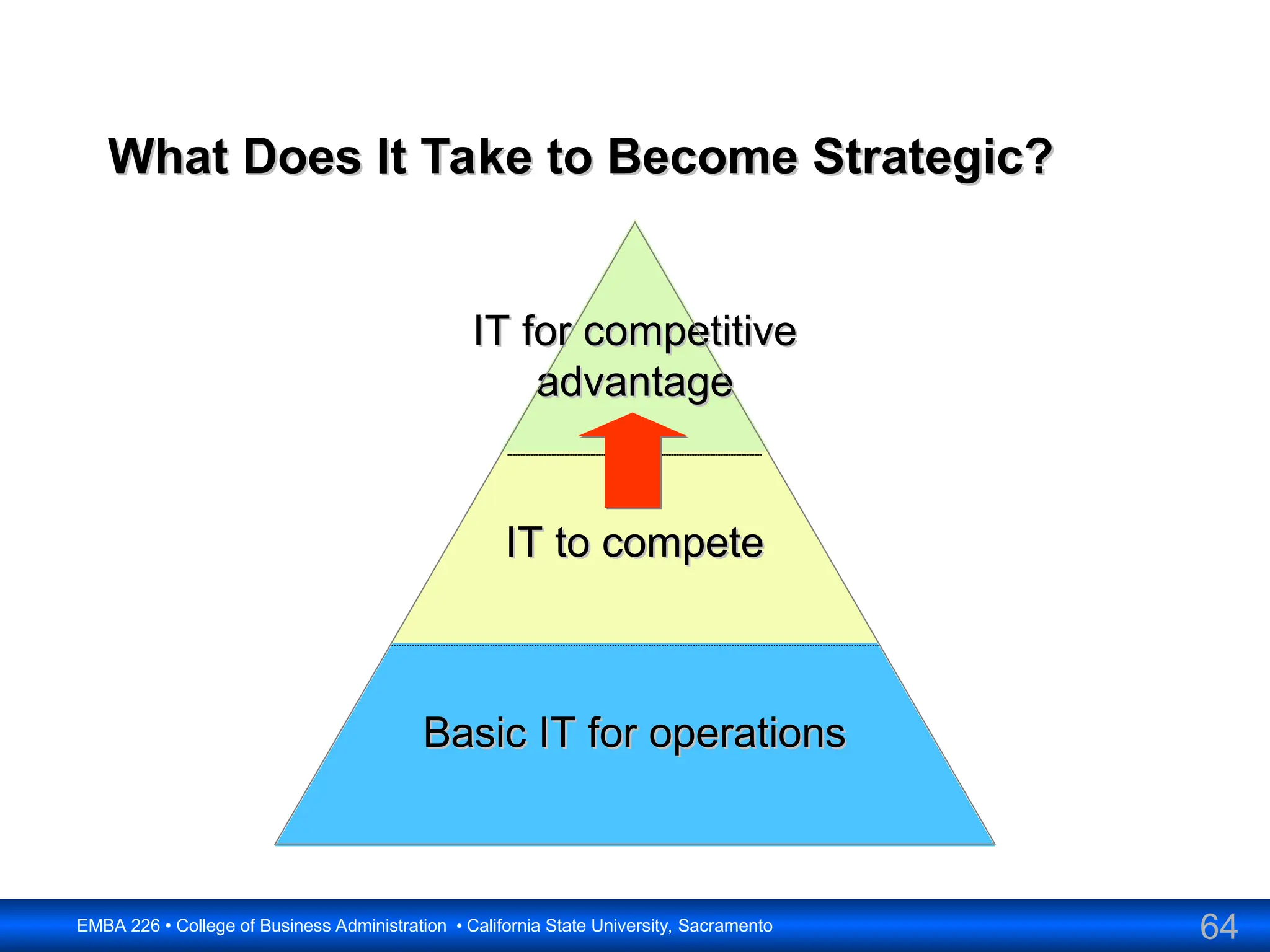
What Does It Take to Become Strategic?
Basic IT for operations
IT to compete
IT to compete
IT for competitive
IT for competitive
advantage
advantage
65
EMBA 226 • College of Business Administration • California State University, Sacramento
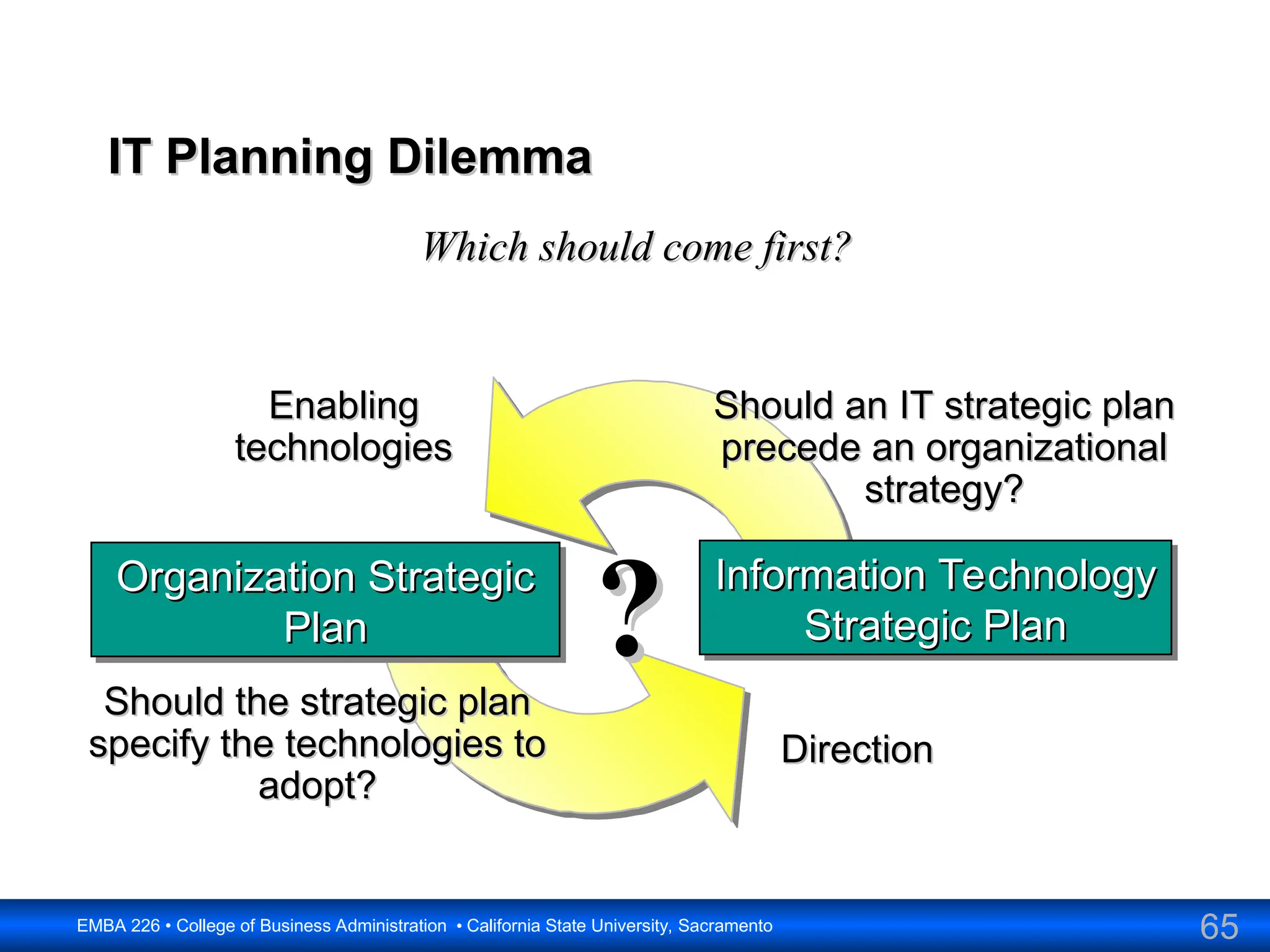
IT Planning Dilemma
IT Planning Dilemma
Organization Strategic
Plan
Plan
Information Technology
Strategic Plan
Strategic Plan
Should the strategic plan
specify the technologies to
adopt?
adopt?
Should an IT strategic plan
precede an organizational
strategy?
strategy?
?
?
Direction
Direction
Enabling
Enabling
technologies
technologies
Which should come first?
66
EMBA 226 • College of Business Administration • California State University, Sacramento
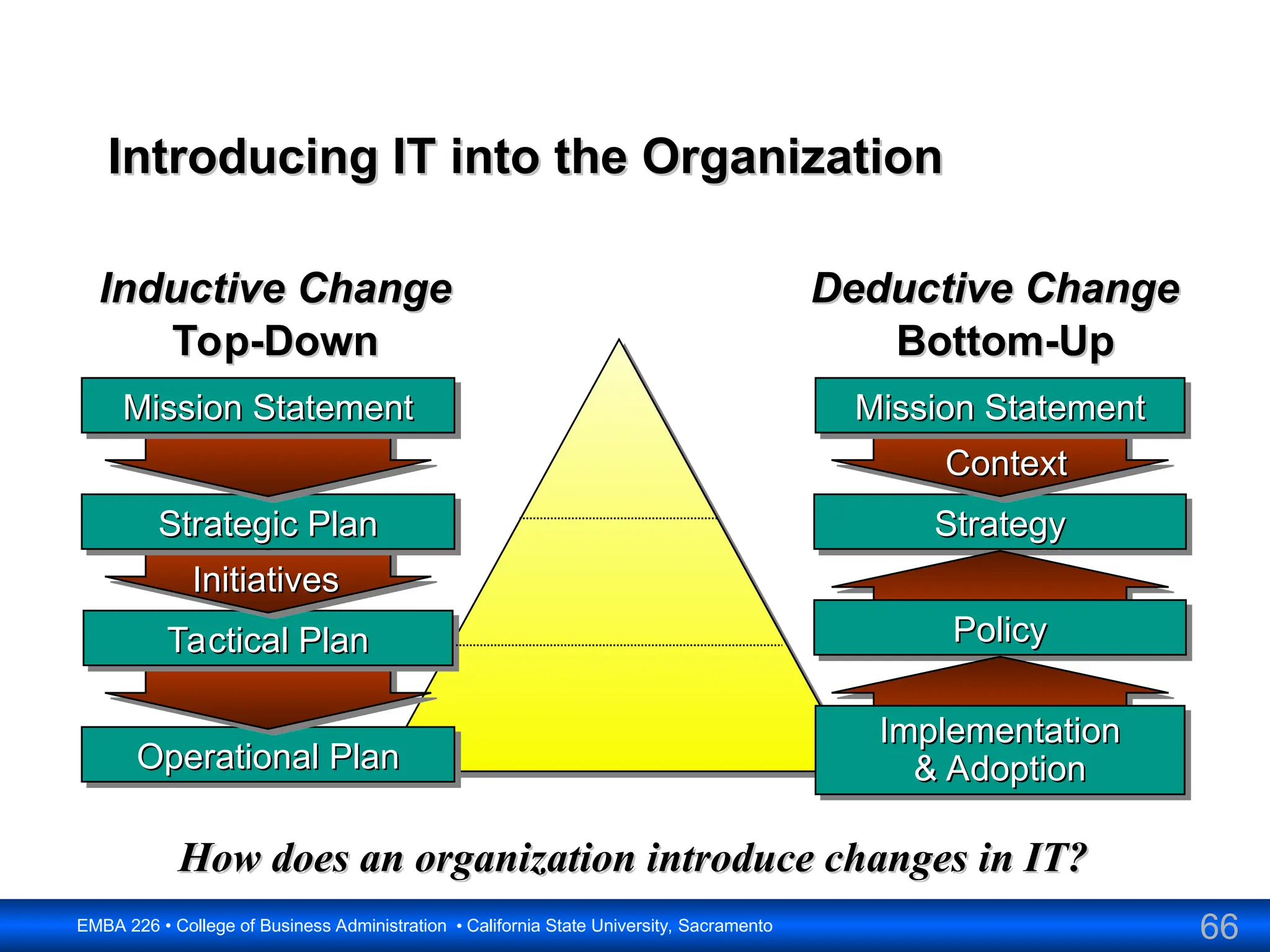
Introducing IT into the Organization
Operational Plan
Operational Plan
Tactical Plan
Tactical Plan
Strategic Plan
Strategic Plan
Mission Statement
Mission Statement
Strategy
Strategy
Policy
Policy
Implementation
Implementation
& Adoption
& Adoption
Top-Down
Top-Down Bottom-Up
Bottom-Up
Mission Statement
Mission Statement
Context
Context
Initiatives
Initiatives
Inductive Change
Inductive Change Deductive Change
Deductive Change
How does an organization introduce changes in IT?
67
EMBA 226 • College of Business Administration • California State University, Sacramento
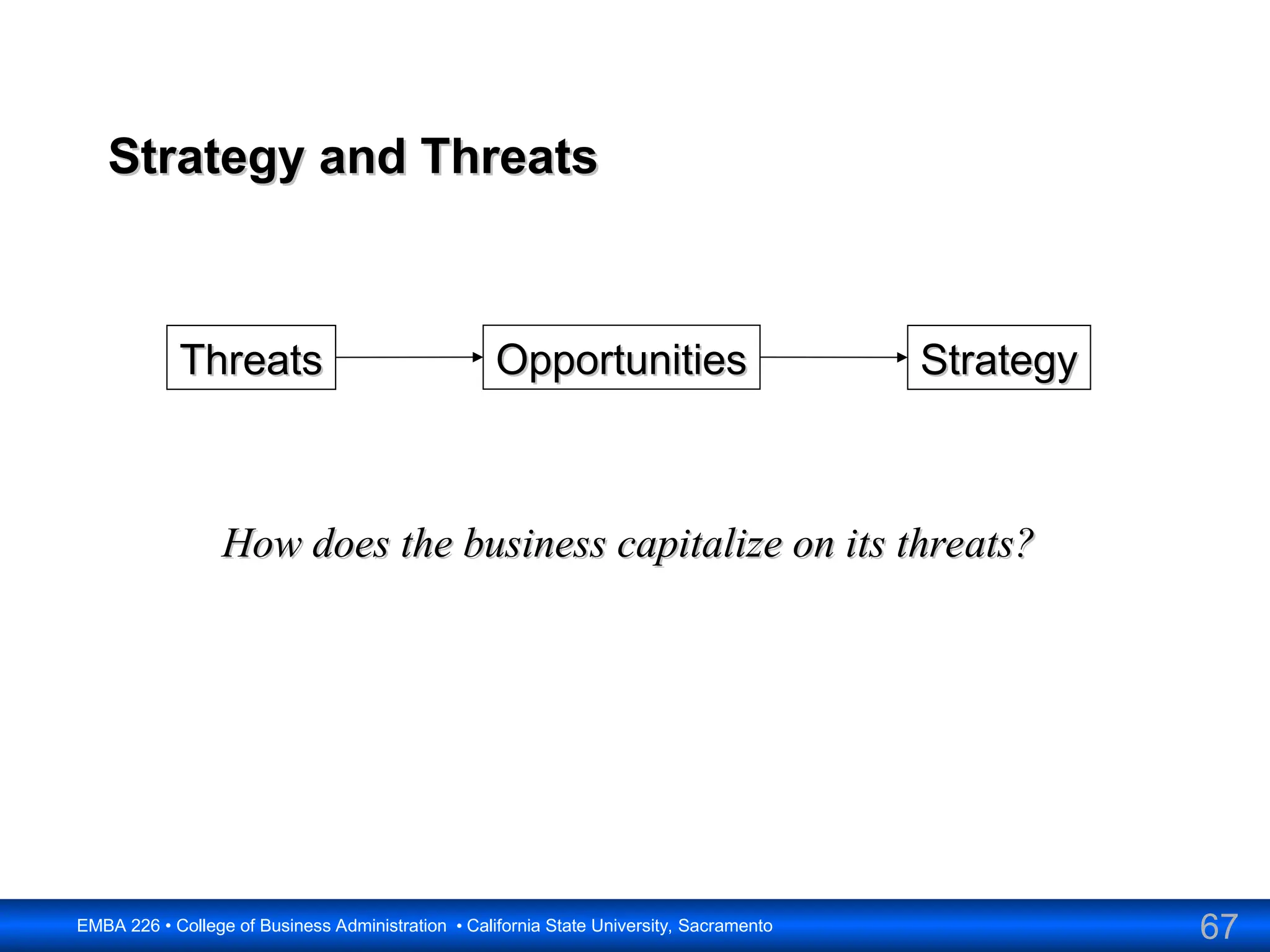
Strategy and Threats
Threats
Threats Opportunities
Opportunities Strategy
Strategy
How does the business capitalize on its threats?
68
EMBA 226 • College of Business Administration • California State University, Sacramento
What are strategy and strategic planning?
69
EMBA 226 • College of Business Administration • California State University, Sacramento
Strategy
Strategy
• “
“The essence of strategy formulation is coping with
The essence of strategy formulation is coping with
competition.”
competition.”
Michael Porter, 1979
70
EMBA 226 • College of Business Administration • California State University, Sacramento
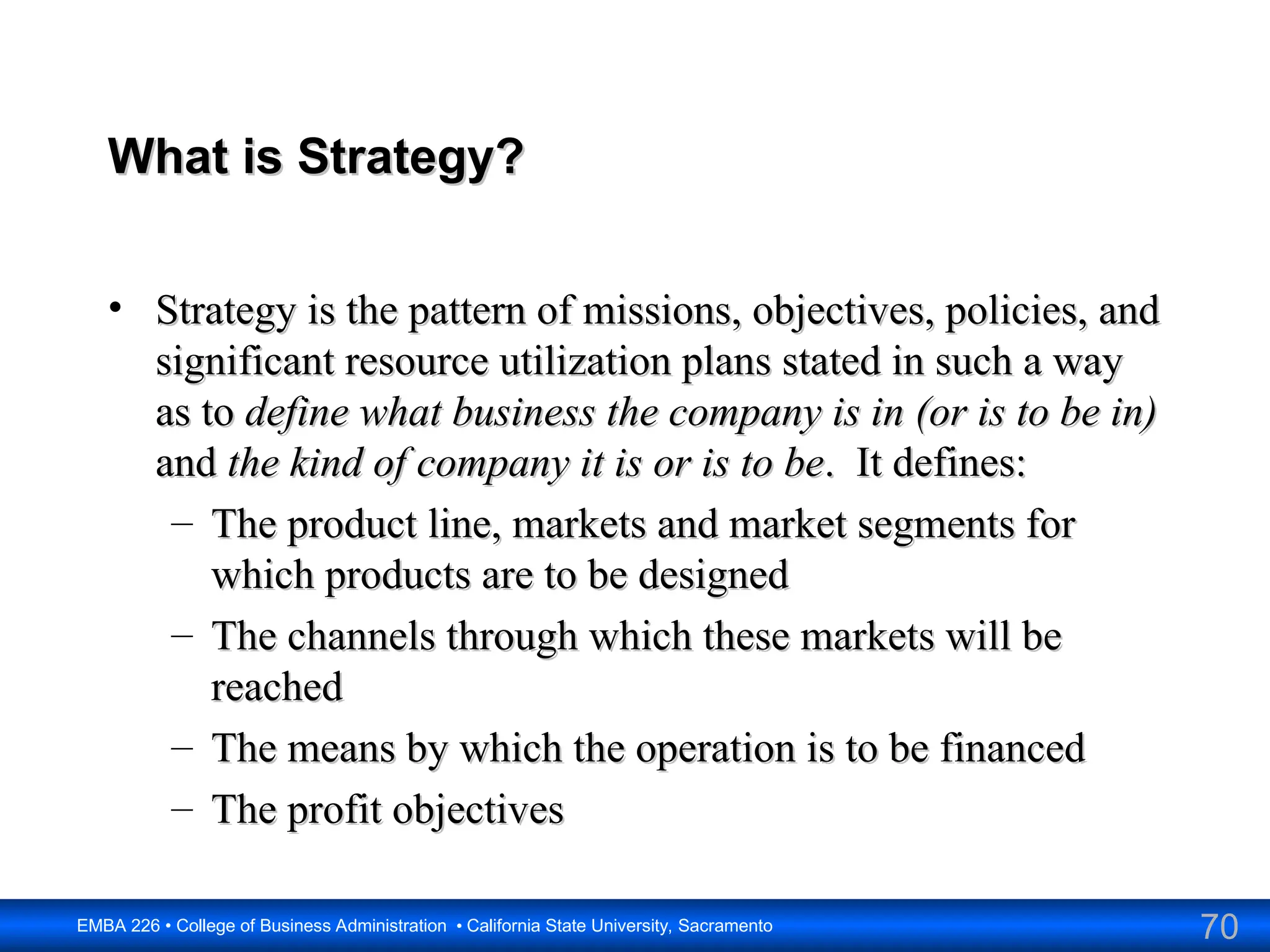
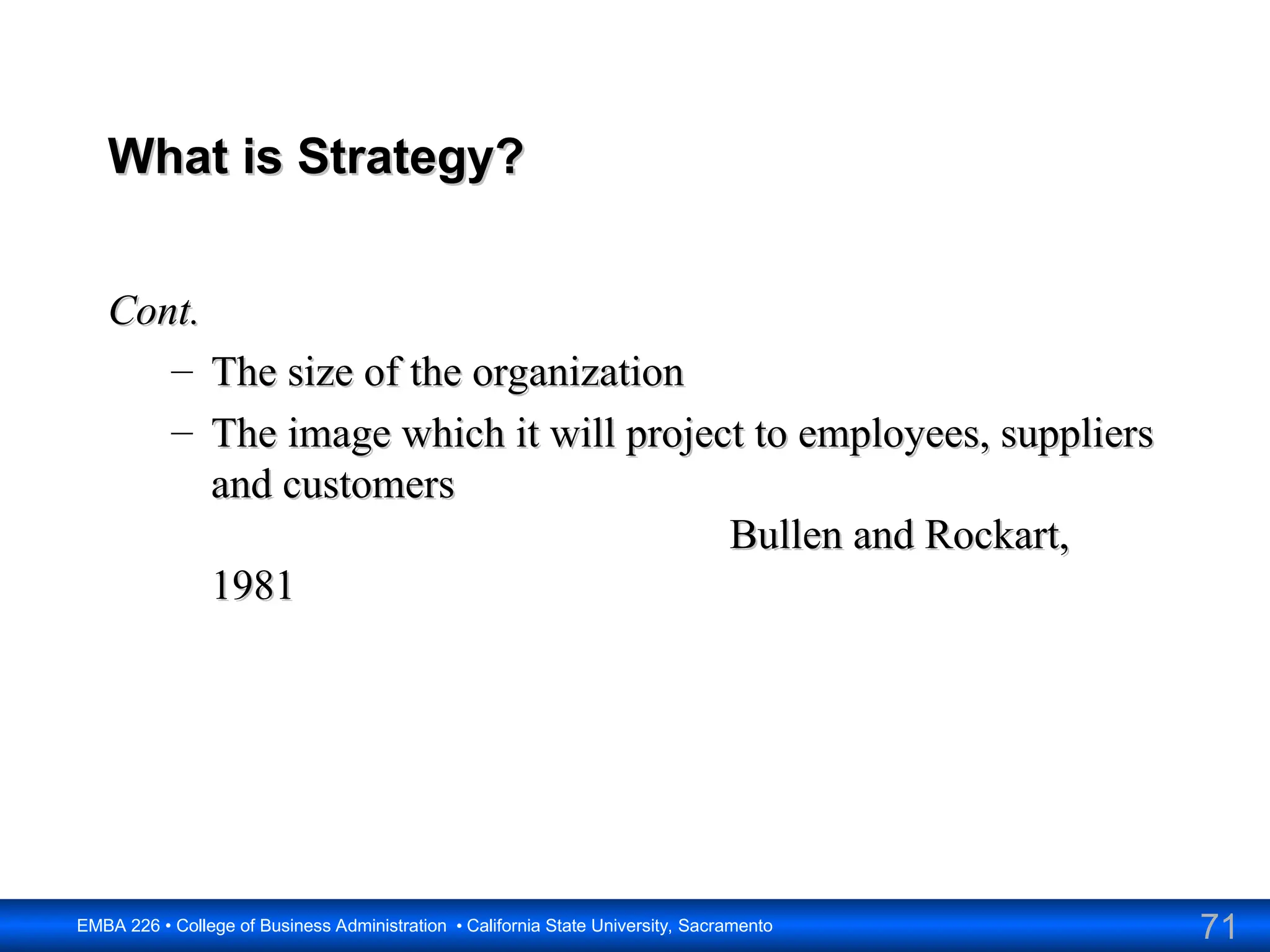
What is Strategy?
What is Strategy?
• Strategy is the pattern of missions, objectives, policies, and
Strategy is the pattern of missions, objectives, policies, and
significant resource utilization plans stated in such a way
as to
as to define what business the company is in
define what business the company is in (or is to be in)
(or is to be in)
and
and the kind of company it is or is to be
the kind of company it is or is to be. It defines:
. It defines:
– The product line, markets and market segments for
The product line, markets and market segments for
which products are to be designed
– The channels through which these markets will be
The channels through which these markets will be
reached
reached
– The means by which the operation is to be financed
The means by which the operation is to be financed
– The profit objectives
The profit objectives
71
EMBA 226 • College of Business Administration • California State University, Sacramento
What is Strategy?
What is Strategy?
Cont.
Cont.
– The size of the organization
The size of the organization
– The image which it will project to employees, suppliers
The image which it will project to employees, suppliers
and customers
and customers
Bullen and Rockart,
Bullen and Rockart,
1981
1981
72
EMBA 226 • College of Business Administration • California State University, Sacramento
What is Strategy?
What is Strategy?
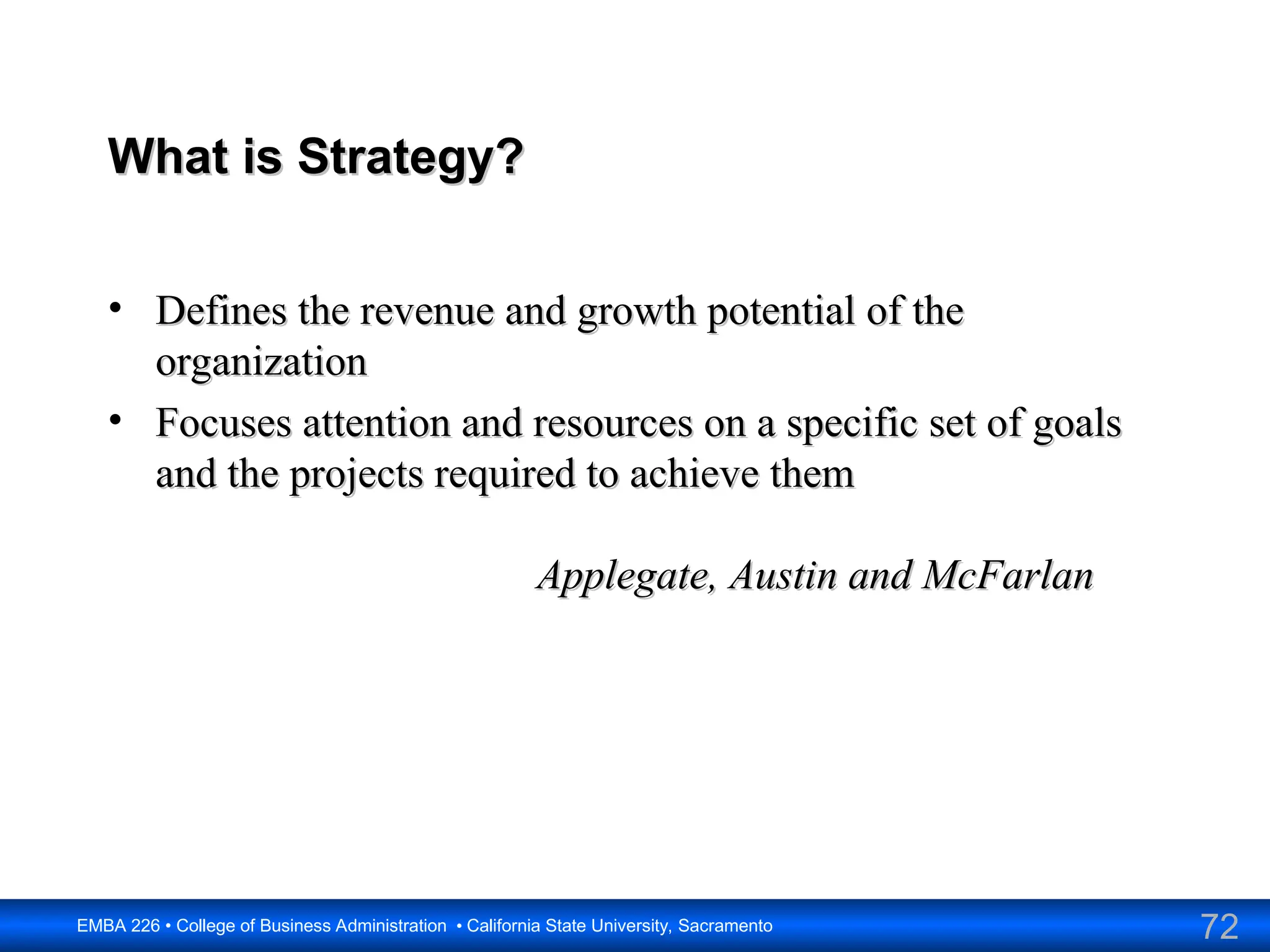
• Defines the revenue and growth potential of the
Defines the revenue and growth potential of the
organization
organization
• Focuses attention and resources on a specific set of goals
Focuses attention and resources on a specific set of goals
and the projects required to achieve them
Applegate, Austin and McFarlan
73
EMBA 226 • College of Business Administration • California State University, Sacramento
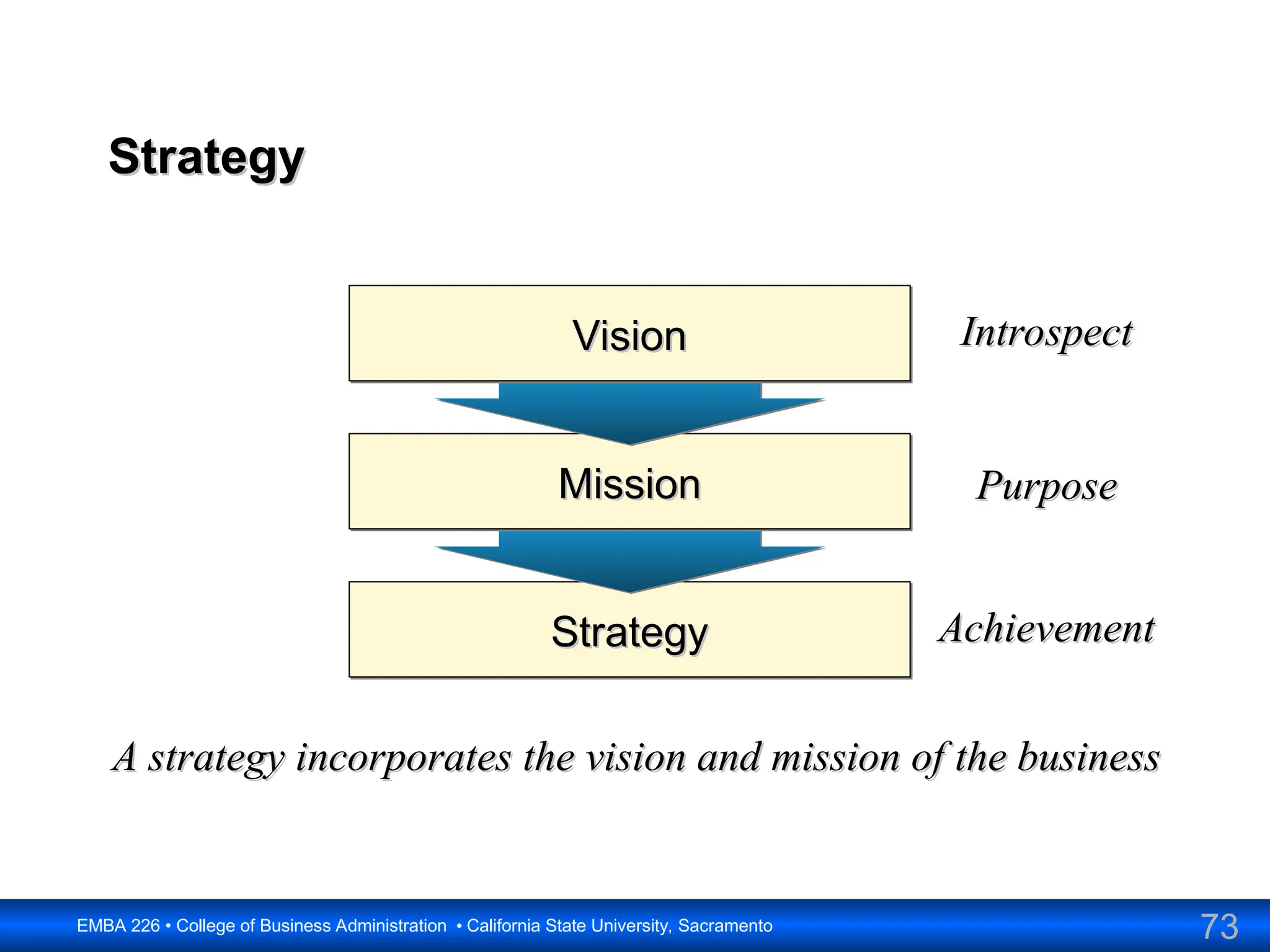
Strategy
Strategy
Strategy
Strategy
Mission
Mission
Vision
Vision
A strategy incorporates the vision and mission of the business
Purpose
Purpose
Introspect
Introspect
Achievement
Achievement
74
EMBA 226 • College of Business Administration • California State University, Sacramento
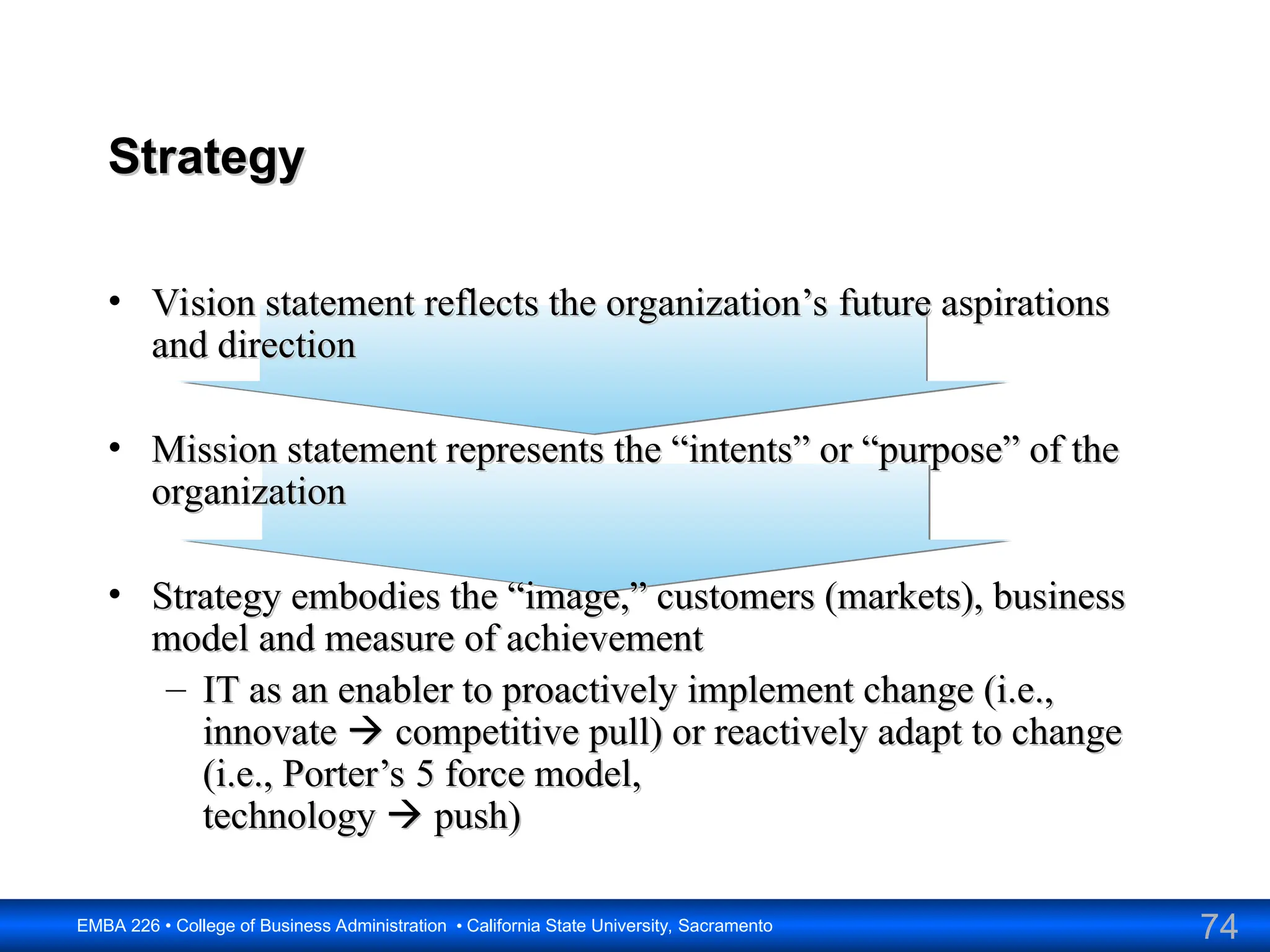
• Vision statement reflects the organization’s future aspirations
Vision statement reflects the organization’s future aspirations
and direction
and direction
• Mission statement represents the “intents” or “purpose” of the
Mission statement represents the “intents” or “purpose” of the
organization
organization
• Strategy embodies the “image,” customers (markets), business
Strategy embodies the “image,” customers (markets), business
model and measure of achievement
– IT as an enabler to proactively implement change (i.e.,
IT as an enabler to proactively implement change (i.e.,
innovate
innovate 
 competitive pull) or reactively adapt to change
competitive pull) or reactively adapt to change
(i.e., Porter’s 5 force model,
technology
technology 
 push)
push)
Strategy
Strategy
75
EMBA 226 • College of Business Administration • California State University, Sacramento
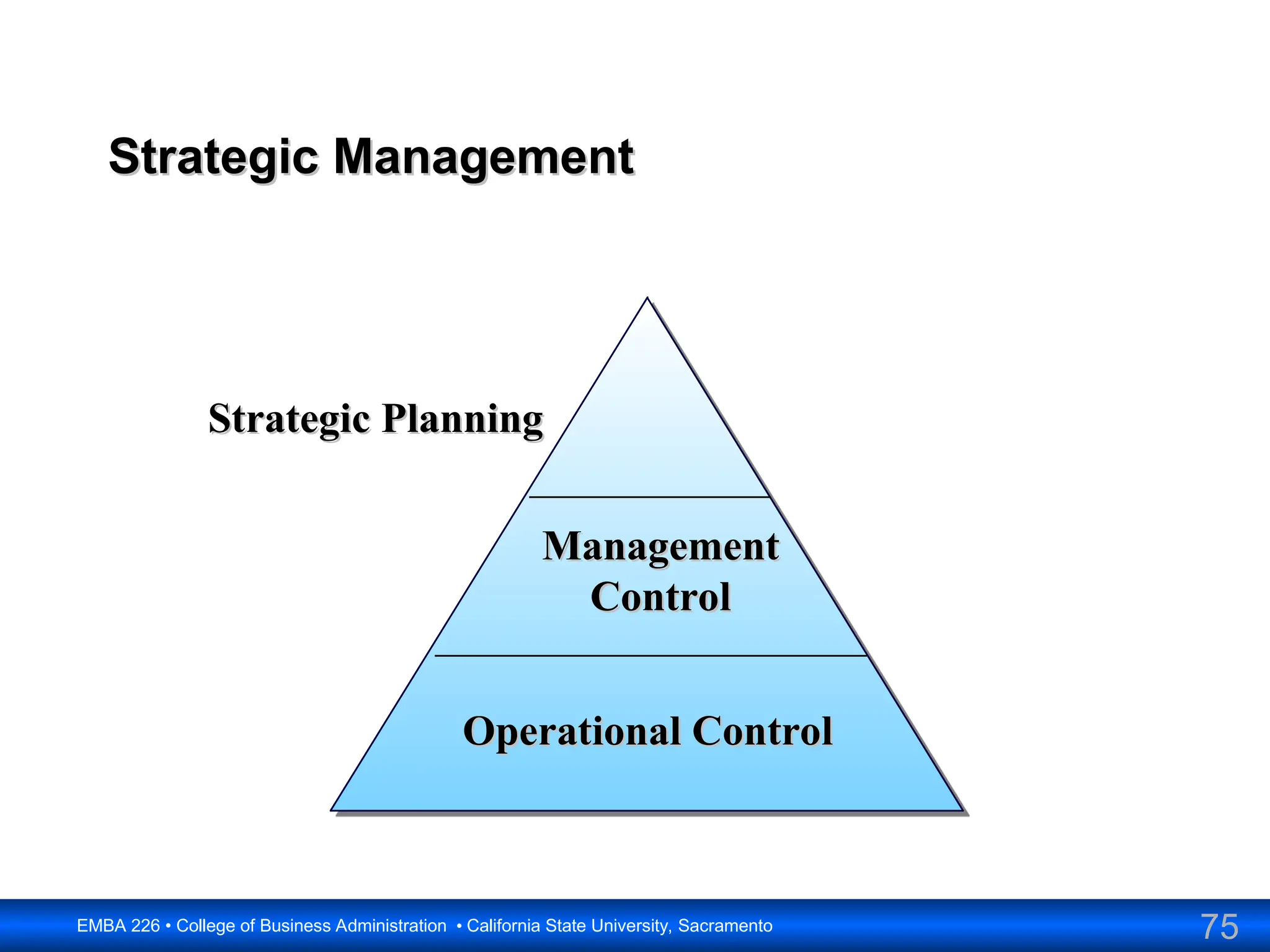
Strategic Management
Management
Management
Control
Control
Operational Control
Operational Control
Strategic Planning
Strategic Planning
76
EMBA 226 • College of Business Administration • California State University, Sacramento
Strategic Planning
Strategic Planning
Should…
Should…
• Be forward looking
Be forward looking
• Focus on external factors and opportunities, and their
Focus on external factors and opportunities, and their
impact on the business
• Specify the direction the business should take
Specify the direction the business should take
– Markets to pursue, image to project, business model
Markets to pursue, image to project, business model
• Be long-term
Be long-term
– Depending on the industry, 2 to 5 years
Depending on the industry, 2 to 5 years
• Formal vs. informal
Formal vs. informal
– Extent to which is documented and the frequency of
Extent to which is documented and the frequency of
planning
planning
77
EMBA 226 • College of Business Administration • California State University, Sacramento
Levels of Management
• Strategic Planning
Strategic Planning
– "Strategic planning is the process of deciding on objectives
"Strategic planning is the process of deciding on objectives
of the organization, on changes in these objectives, on the
resources used to attain these objectives, and on the policies
that are to govern the acquisition, use, and disposition of
these resources."
these resources."
• Management control
Management control
– "Management control is the process by which managers
"Management control is the process by which managers
assure that resources are obtained and used effectively and
efficiently in the accomplishment of the organization's
objectives."
objectives."
78
EMBA 226 • College of Business Administration • California State University, Sacramento
Levels of Management (Cont.)
• Operational control
Operational control
– "Operation control is the process of assuring that
"Operation control is the process of assuring that
specific tasks are carried out effectively and
efficiently."
efficiently."
Anthony, 1965
Anthony, 1965
79
EMBA 226 • College of Business Administration • California State University, Sacramento
Gaining a Competitive Advantage with IT
• IT alone is not a strategic differentiator
IT alone is not a strategic differentiator
– Enables the business to do things
Enables the business to do things
– Does not have a direct effect on productivity
Does not have a direct effect on productivity
• Must be coupled with other innovative processes
Must be coupled with other innovative processes
Lessons from IT practice…
• Value from IT comes only when it is paired with concurrent
Value from IT comes only when it is paired with concurrent
innovations in business practice
• IT's economic impact comes from incremental
IT's economic impact comes from incremental
improvements
improvements
• Strategic differentiation emerges over time
Strategic differentiation emerges over time
– Short-term
Short-term

Strategic grid, business development model.ppt

  • 1.
    1 EMBA 226 •College of Business Administration • California State University, Sacramento Week 1 Week 1 Friday, July 21 Friday, July 21 • Introduction Introduction • Strategic grid, business model Strategic grid, business model • Opportunities and Threats: Porter’s Five Forces Model Opportunities and Threats: Porter’s Five Forces Model • Strategy and strategic planning Strategy and strategic planning • IT Doesn’t Matter Article IT Doesn’t Matter Article
  • 2.
    2 EMBA 226 •College of Business Administration • California State University, Sacramento What This Class is About… What This Class is About… • Information technology (IT) has become a major driving Information technology (IT) has become a major driving force of today’s businesses. As an enabler (facilitator) and force of today’s businesses. As an enabler (facilitator) and integrator, IT has opened many strategic opportunities and integrator, IT has opened many strategic opportunities and provided the means to seize competitive advantages in provided the means to seize competitive advantages in marketplaces. The topics covered throughout this course marketplaces. The topics covered throughout this course will emphasize IT’s prominent role in business strategy. will emphasize IT’s prominent role in business strategy.
  • 3.
    3 EMBA 226 •College of Business Administration • California State University, Sacramento Introductions Introductions • What is your view on IT in business? What is your view on IT in business?
  • 4.
    4 EMBA 226 •College of Business Administration • California State University, Sacramento Which is the Most Versatile Hand Tool? Which is the Most Versatile Hand Tool? Vise Vise Hammer Hammer Pliers Pliers Saw Saw Pipe wrench Pipe wrench Flat bladed screwdriver Flat bladed screwdriver Bubble level Bubble level Tape measure Tape measure
  • 5.
    5 EMBA 226 •College of Business Administration • California State University, Sacramento Flat Bladed Screwdriver Flat Bladed Screwdriver • Screw Screw • Hammer Hammer • Chisel Chisel • Pry bar Pry bar • Punch holes Punch holes • Set nails Set nails • Stir liquids Stir liquids • Putty knife Putty knife • Score and cut Score and cut • And the list goes on… And the list goes on…
  • 6.
    6 EMBA 226 •College of Business Administration • California State University, Sacramento IT is Similar to a Flat Bladed Screwdriver IT is Similar to a Flat Bladed Screwdriver • IT provides the means for businesses to do something better! IT provides the means for businesses to do something better! – Leverages other resources Leverages other resources – Enables and enhances business processes – Enables and enhances business processes – Facilitates Facilitates efficiency and effectiveness efficiency and effectiveness – Seizes competitive advantages Seizes competitive advantages – Levels the playing field – Levels the playing field – Small businesses can look and Small businesses can look and behave like big businesses behave like big businesses – Extends the business beyond its boundaries – Extends the business beyond its boundaries – Strategic Strategic alliances, strategic outsourcing, supply chain management alliances, strategic outsourcing, supply chain management – And the list goes on… And the list goes on…
  • 7.
    7 EMBA 226 •College of Business Administration • California State University, Sacramento What You Should Take Away from This Class What You Should Take Away from This Class 1. 1. Place IT solutions in the strategic grid – Match the Place IT solutions in the strategic grid – Match the solution to the business solution to the business 2. 2. Businesses do not adopt technology for technology’s sake Businesses do not adopt technology for technology’s sake 3. 3. Focus on the business and not the technology Focus on the business and not the technology 4. 4. IT leverages other resources and processes IT leverages other resources and processes 5. 5. IT introduces organizational change IT introduces organizational change 6. 6. IT integrates the enterprise IT integrates the enterprise 7. 7. Knowledge is an organizational resource Knowledge is an organizational resource
  • 8.
    8 EMBA 226 •College of Business Administration • California State University, Sacramento IT Leverages Other Resources IT Leverages Other Resources CRM CRM leverages leverages Relationship Relationship Marketing Marketing
  • 9.
    9 EMBA 226 •College of Business Administration • California State University, Sacramento IT Leverages Other Resources IT Leverages Other Resources Business Intelligence Business Intelligence
  • 10.
    10 EMBA 226 •College of Business Administration • California State University, Sacramento IT, the Great Integrator IT, the Great Integrator Enables and enhances business process Enables and enhances business process
  • 11.
    11 EMBA 226 •College of Business Administration • California State University, Sacramento IT Allows a Business to Seize Competitive IT Allows a Business to Seize Competitive Advantages Advantages Price Competition Price Competition
  • 12.
    12 EMBA 226 •College of Business Administration • California State University, Sacramento IT Allows a Business to Seize Competitive IT Allows a Business to Seize Competitive Advantages Advantages Convenience Convenience
  • 13.
    13 EMBA 226 •College of Business Administration • California State University, Sacramento IT Allows a Business to Seize Competitive IT Allows a Business to Seize Competitive Advantages Advantages Customization Customization
  • 14.
    14 EMBA 226 •College of Business Administration • California State University, Sacramento Which of these Which of these businesses is larger? businesses is larger? IT the Great Equalizer: IT the Great Equalizer: IT Evens the Playing Field IT Evens the Playing Field
  • 15.
    15 EMBA 226 •College of Business Administration • California State University, Sacramento Extends the Business Beyond Its Extends the Business Beyond Its Boundaries Boundaries Horizontal integration Horizontal integration
  • 16.
    16 EMBA 226 •College of Business Administration • California State University, Sacramento Extends the Business Beyond Its Extends the Business Beyond Its Boundaries Boundaries Vertical integration Vertical integration
  • 17.
    17 EMBA 226 •College of Business Administration • California State University, Sacramento Supply Chain Management Supply Chain Management Inter-Organizational IT Inter-Organizational IT • Coordinating suppliers Coordinating suppliers – From EDI (electronic data interchange) to the Internet From EDI (electronic data interchange) to the Internet • Establishing close and tight relationships Establishing close and tight relationships – Loose integration – ad hoc and occasional Loose integration – ad hoc and occasional – Close integration – formal exchange of information between Close integration – formal exchange of information between businesses businesses – Tight integration – sharing a business processes (e.g., UPS) Tight integration – sharing a business processes (e.g., UPS) • Becoming a customer-centric value chain (virtual enterprise) Becoming a customer-centric value chain (virtual enterprise) – Risk sharing Risk sharing – Supply chain ( Supply chain (suppliers suppliers) vs. demand chain ( ) vs. demand chain (distributors and retailers distributors and retailers) )
  • 18.
    18 EMBA 226 •College of Business Administration • California State University, Sacramento Rules, Enabling, Business Models and Rules, Enabling, Business Models and IT Adoption… IT Adoption…
  • 19.
    19 EMBA 226 •College of Business Administration • California State University, Sacramento IT and Business: Two Golden Rules IT and Business: Two Golden Rules • IT does not (directly) increase productivity IT does not (directly) increase productivity • Businesses do not adopt new technology for technology’s Businesses do not adopt new technology for technology’s sake sake – What value does it add to the business? What value does it add to the business? – How does it support the business’ strategy, goals and How does it support the business’ strategy, goals and objectives? objectives? – Can it be linked to competitive advantage? Can it be linked to competitive advantage? – What’s the bottom line? What’s the bottom line?
  • 20.
    20 EMBA 226 •College of Business Administration • California State University, Sacramento IT and Business IT and Business Briefly… Briefly… • IT enables fundamental changes in the way work is done IT enables fundamental changes in the way work is done • IT enables the integration of business functions at all levels IT enables the integration of business functions at all levels within and between organizations within and between organizations • IT causes shifts in the competitive climate of many IT causes shifts in the competitive climate of many industries (i.e., industries (i.e., breakthrough technology breakthrough technology) ) • IT presents new strategic opportunities for organizations IT presents new strategic opportunities for organizations that reassess their mission and goals that reassess their mission and goals • Successful application of IT requires changes in Successful application of IT requires changes in management and organization structure management and organization structure
  • 21.
    21 EMBA 226 •College of Business Administration • California State University, Sacramento IT and Business IT and Business (cont.) (cont.) • A major challenge exists for management to lead their A major challenge exists for management to lead their organizations through the transformation necessary to organizations through the transformation necessary to prosper in the globally competitive environment prosper in the globally competitive environment
  • 22.
    22 EMBA 226 •College of Business Administration • California State University, Sacramento Business Model Business Model • Defines how an enterprise interacts with its environment to Defines how an enterprise interacts with its environment to define a unique strategy, attract the resources and build the define a unique strategy, attract the resources and build the capabilities to execute it capabilities to execute it • Creates values for all stakeholders Creates values for all stakeholders Inputs Processes Outputs Simply put, the business model defines how inputs are converted to outputs
  • 23.
    23 EMBA 226 •College of Business Administration • California State University, Sacramento IT and the Business IT and the Business • Adoption of IT must be within the capabilities of the Adoption of IT must be within the capabilities of the business business • There must be a clear vision of how technology will be There must be a clear vision of how technology will be used for a clear used for a clear profitable profitable gain gain • A proposed IT solution must take into account A proposed IT solution must take into account organizational factors organizational factors – Strategic grid Strategic grid
  • 24.
    24 EMBA 226 •College of Business Administration • California State University, Sacramento Business Models and IT Adoption Business Models and IT Adoption For example… For example… Two successful grocers taking two Two successful grocers taking two different approaches to business different approaches to business
  • 25.
    25 EMBA 226 •College of Business Administration • California State University, Sacramento Peapod Peapod
  • 26.
    26 EMBA 226 •College of Business Administration • California State University, Sacramento Peapod Peapod
  • 27.
    27 EMBA 226 •College of Business Administration • California State University, Sacramento Virtual store Virtual store Peapod Peapod
  • 28.
    28 EMBA 226 •College of Business Administration • California State University, Sacramento
  • 29.
    29 EMBA 226 •College of Business Administration • California State University, Sacramento Select by flavor Select by flavor Select by brand Select by brand
  • 30.
    30 EMBA 226 •College of Business Administration • California State University, Sacramento
  • 31.
    31 EMBA 226 •College of Business Administration • California State University, Sacramento Shopping basket Shopping basket Running total Running total
  • 32.
    32 EMBA 226 •College of Business Administration • California State University, Sacramento Check Out: Pick a Delivery Date Check Out: Pick a Delivery Date
  • 33.
    33 EMBA 226 •College of Business Administration • California State University, Sacramento Enter Account Enter Account
  • 34.
    34 EMBA 226 •College of Business Administration • California State University, Sacramento Due to the nature Due to the nature of the merchandise of the merchandise (i.e., highly (i.e., highly perishable, low perishable, low profit margin), profit margin), customer customer expectations and expectations and the high cost of the high cost of fuel, logistics fuel, logistics becomes an major becomes an major concern concern Peapod Peapod
  • 35.
    35 EMBA 226 •College of Business Administration • California State University, Sacramento Peapod Peapod Customer sends order via Web Customer sends order via Web Peapod receives the order Peapod receives the order Peapod Peapod assembles assembles the order the order Peapod delivers Peapod delivers the order the order Customer receives order Customer receives order Suppliers maintain Peapod’s inventory Suppliers maintain Peapod’s inventory Peapod bills the Peapod bills the customer’s credit customer’s credit card card
  • 36.
    36 EMBA 226 •College of Business Administration • California State University, Sacramento "Bricks and mortar" "Bricks and mortar" retailer retailer Raley's Foods Raley's Foods
  • 37.
    37 EMBA 226 •College of Business Administration • California State University, Sacramento Limited web shopping Limited web shopping Raley's Foods Raley's Foods
  • 38.
    38 EMBA 226 •College of Business Administration • California State University, Sacramento Business Model Business Model Discussion… Discussion… • Define the business model Define the business model • Identify the market segments, opportunities and threats Identify the market segments, opportunities and threats • What role does IT play in the business model? What role does IT play in the business model? • What is the effect of IT in the business model? What is the effect of IT in the business model? • How does IT impact the business? How does IT impact the business?
  • 39.
    39 EMBA 226 •College of Business Administration • California State University, Sacramento Opportunities and Threats Opportunities and Threats “ “Crisis” (weiji) Crisis” (weiji) “ “Opportunity” (jihui) Opportunity” (jihui) Opportunities grow out of crises Opportunities grow out of crises (Necessity is the mother of invention -- Plato) (Necessity is the mother of invention -- Plato) How does the business capitalize on its threats? How does the business capitalize on its threats?
  • 40.
    40 EMBA 226 •College of Business Administration • California State University, Sacramento Strategy and Strategy and Four Models and Frameworks Four Models and Frameworks • Strategic Grid Strategic Grid • Porter’s Five Forces Model Porter’s Five Forces Model • Richard Nolan’s Stages Theory Richard Nolan’s Stages Theory • Strategic Alignment Strategic Alignment
  • 41.
    41 EMBA 226 •College of Business Administration • California State University, Sacramento 1. Strategic Grid 1. Strategic Grid
  • 42.
    42 EMBA 226 •College of Business Administration • California State University, Sacramento Strategic Grid Strategic Grid High High Low Low High High Low Low Impact on Impact on Existing Existing Business Business Operations Operations Impact on Strategy (future Impact on Strategy (future competitive environment) competitive environment) Factory Factory Operational IT Operational IT Support Support Basic elements Basic elements Turnaround Turnaround Gradual adoption Gradual adoption Strategic Strategic Strategic IT plan, Strategic IT plan, initiatives initiatives Management of IT depends on how the business views IT Management of IT depends on how the business views IT IT has little relevance to existing or IT has little relevance to existing or future success future success Current IT important but future IT Current IT important but future IT developments are unlikely to developments are unlikely to improve competitive advantage improve competitive advantage Existing and future IT developments Existing and future IT developments critical to success critical to success Existing IT is unimportant but future Existing IT is unimportant but future developments are crucial to survival developments are crucial to survival McFarlan and McKinney (1983) McFarlan and McKinney (1983)
  • 43.
    43 EMBA 226 •College of Business Administration • California State University, Sacramento Placing a Business in a Quadrant Placing a Business in a Quadrant • How important does management feel the How important does management feel the current current IT IT systems are to the business? systems are to the business? • How important does the business think How important does the business think future future developments in IT will be for the business? developments in IT will be for the business? Planning a future for IT Planning a future for IT
  • 44.
    44 EMBA 226 •College of Business Administration • California State University, Sacramento Strategic Grid Strategic Grid Quadrants: Quadrants: • Support – goals target local improvements and incremental Support – goals target local improvements and incremental cost savings (e.g., office automation) cost savings (e.g., office automation) • Factory – designed to reduce costs and improve performance Factory – designed to reduce costs and improve performance of the core operations of the core operations – Automation and computerize functions Automation and computerize functions • Turnaround – designed to exploit emerging strategic Turnaround – designed to exploit emerging strategic opportunities opportunities – Integration of the organization Integration of the organization • Strategic – commitment to use IT to enable both core Strategic – commitment to use IT to enable both core operations and core strategy operations and core strategy – IT an integral part of strategy IT an integral part of strategy
  • 45.
    45 EMBA 226 •College of Business Administration • California State University, Sacramento 2. Porter’s Five Forces Model 2. Porter’s Five Forces Model
  • 46.
    46 EMBA 226 •College of Business Administration • California State University, Sacramento Porter’s Five Forces Model Porter’s Five Forces Model Forces that Shape Strategy Forces that Shape Strategy Industry Industry Competitors Competitors Rivalry among Rivalry among existing firms existing firms Suppliers Suppliers Customers and Customers and Buyers Buyers Potential Potential Entrants Entrants Substitutes Substitutes Bargaining power of buyers Bargaining power of buyers Threat of substitute products or Threat of substitute products or services services Bargaining power of Bargaining power of suppliers suppliers Threat of new entrants Threat of new entrants           How will the business How will the business react to threats (and react to threats (and opportunities)? opportunities)?
  • 47.
    47 EMBA 226 •College of Business Administration • California State University, Sacramento Contending Forces Contending Forces • The state of competition depends on the five forces The state of competition depends on the five forces • The collective strength of these forces determines the The collective strength of these forces determines the ultimate profit potential of an industry ultimate profit potential of an industry – Strongest force or forces determine the profitability of Strongest force or forces determine the profitability of an industry and are of greatest importance in strategy an industry and are of greatest importance in strategy formulation formulation
  • 48.
    48 EMBA 226 •College of Business Administration • California State University, Sacramento 1. Threat of Entry 1. Threat of Entry • New entrants bring new capacity, desire to gain market New entrants bring new capacity, desire to gain market share, and often substantial resources share, and often substantial resources • Barriers: Barriers: – Economies of scale Economies of scale – Product differentiation Product differentiation – Capital requirements Capital requirements – Cost disadvantages independent Cost disadvantages independent of size of size – Access to distribution channels Access to distribution channels – Government policy Government policy Seriousness of the Seriousness of the threat depends on the threat depends on the barriers and the barriers and the reaction of the reaction of the incumbents incumbents
  • 49.
    49 EMBA 226 •College of Business Administration • California State University, Sacramento Power of Buyers and Sellers Power of Buyers and Sellers • Suppliers – Can exert bargaining power on participants by Suppliers – Can exert bargaining power on participants by raising prices or reducing the quality of the goods and raising prices or reducing the quality of the goods and services services • Buyers – Can force down prices, demand higher quality or Buyers – Can force down prices, demand higher quality or more service, and play competitors against each other more service, and play competitors against each other
  • 50.
    50 EMBA 226 •College of Business Administration • California State University, Sacramento 2. Suppliers are powerful if… 2. Suppliers are powerful if… • Dominated by a few companies Dominated by a few companies • Products is unique or well differentiated, or has built-up Products is unique or well differentiated, or has built-up switching costs switching costs • Not obligated to content with other products for sale to the Not obligated to content with other products for sale to the industry industry • Poses a credible threat of integrating forward into the Poses a credible threat of integrating forward into the industry’s business industry’s business • Industry is not an important customer (of the supplier Industry is not an important customer (of the supplier group) group)
  • 51.
    51 EMBA 226 •College of Business Administration • California State University, Sacramento 3. Buyers are powerful if… 3. Buyers are powerful if… • Concentrated or purchases in large volumes Concentrated or purchases in large volumes • Products/services are standard or undifferentiated Products/services are standard or undifferentiated • Products form a component of its product and represent a Products form a component of its product and represent a significant fraction of its cost significant fraction of its cost • Earns low profits, which create great incentive to lower its Earns low profits, which create great incentive to lower its purchasing costs purchasing costs • Industry’s product is unimportant to the quality of the buyer’s Industry’s product is unimportant to the quality of the buyer’s products or services products or services • Industry’s product does not save the buyer money Industry’s product does not save the buyer money • Pose a credible threat of integrating backward to make the Pose a credible threat of integrating backward to make the industry’s product industry’s product
  • 52.
    52 EMBA 226 •College of Business Administration • California State University, Sacramento 4. Threat of Substitutes 4. Threat of Substitutes • Substitutes limit the potential of an industry, particularly Substitutes limit the potential of an industry, particularly profits profits • Industry must upgrade the quality or differentiate the Industry must upgrade the quality or differentiate the product/service product/service • Substitutes that deserve the most attention are those that: Substitutes that deserve the most attention are those that: – Subject to trends improving their price-performance Subject to trends improving their price-performance trade-off trade-off – Produced by industries earning high profits Produced by industries earning high profits
  • 53.
    53 EMBA 226 •College of Business Administration • California State University, Sacramento 5. Rivalry Among Competitors 5. Rivalry Among Competitors Jockeying for Position Jockeying for Position Intensity depends on… Intensity depends on… • Competitors are numerous or roughly equal in size and Competitors are numerous or roughly equal in size and power power • Industry growth is slow, precipitating fights for market Industry growth is slow, precipitating fights for market share share • Product/service lacks differentiation or switch costs Product/service lacks differentiation or switch costs • Fixed cost are high or the product is perishable Fixed cost are high or the product is perishable • Capacity normally augments in large increments Capacity normally augments in large increments • Exit barriers are high Exit barriers are high • Rivals are diverse in strategies, origins and “personalities” Rivals are diverse in strategies, origins and “personalities”
  • 54.
    54 EMBA 226 •College of Business Administration • California State University, Sacramento Strategy Formulation Strategy Formulation • Strategy depends on the company’s strengths and Strategy depends on the company’s strengths and weakness relative to the threats weakness relative to the threats • Strategic plan may… Strategic plan may… – Position the company so its capabilities provide the Position the company so its capabilities provide the best defense against competitive forces best defense against competitive forces – Influence the balance of forces through strategic moves Influence the balance of forces through strategic moves – Anticipate and respond to shifts in factors underlying Anticipate and respond to shifts in factors underlying forces to exploit change forces to exploit change
  • 55.
    55 EMBA 226 •College of Business Administration • California State University, Sacramento Approaches to Strategy Approaches to Strategy • Positioning the company so it is the least vulnerable to its Positioning the company so it is the least vulnerable to its competitive forces competitive forces • Taking the offensive and alter the market Taking the offensive and alter the market • Exploiting industry evolution (change) Exploiting industry evolution (change) How can IT make a difference? How can IT make a difference?
  • 56.
    56 EMBA 226 •College of Business Administration • California State University, Sacramento • “ “How Competitive Forces Shape Strategy,” Michael E. How Competitive Forces Shape Strategy,” Michael E. Porter, Harvard Business Review, March-April 1979. Porter, Harvard Business Review, March-April 1979.
  • 57.
    57 EMBA 226 •College of Business Administration • California State University, Sacramento 3. Nolan’s Stages Theory 3. Nolan’s Stages Theory
  • 58.
    58 EMBA 226 •College of Business Administration • California State University, Sacramento Nolan's Stage Theory Nolan's Stage Theory • All organizations go through four stages for IT adoption All organizations go through four stages for IT adoption – Introduction Introduction – Contagion Contagion – Control Control – Integration Integration IT is recognized as a resource IT is recognized as a resource
  • 59.
    59 EMBA 226 •College of Business Administration • California State University, Sacramento IT Resource IT Resource Nolan's Stages Theory Nolan's Stages Theory Introduction Introduction Contagion Contagion Control Control Integration Integration Time Time Investment Investment in IT in IT Stage 1 Stage 1 Stage 2 Stage 2 Stage 3 Stage 3 Stage 4 Stage 4 An organization’s experience with adopting IT An organization’s experience with adopting IT Diffusion Diffusion
  • 60.
    60 EMBA 226 •College of Business Administration • California State University, Sacramento 4. Strategic Alignment 4. Strategic Alignment
  • 61.
    61 EMBA 226 •College of Business Administration • California State University, Sacramento IT’s Role In Business: IT’s Role In Business: Strategic Alignment Model Strategic Alignment Model Strategic Information Strategic Information Functional Integration Functional Integration Business domain Business domain IT domain IT domain External External Internal Internal Business Business strategy strategy Organizational Organizational infrastructure infrastructure IT IT strategy strategy IS IS infrastructure infrastructure Administrative infrastructure, Administrative infrastructure, processes, skills processes, skills Applications infrastructure, Applications infrastructure, processes, skills processes, skills Coalignment Coalignment Business scope, competencies, Business scope, competencies, business governance business governance Technology scope, Technology scope, competencies, IT governance competencies, IT governance
  • 62.
    62 EMBA 226 •College of Business Administration • California State University, Sacramento In a Nutshell… In a Nutshell… Business Business IT IT Strategy Strategy Strategy Strategy Capabilities Capabilities Capabilities Capabilities Alignment Alignment Alignment Alignment IT infrastructure IT infrastructure Process Reengineering Process Reengineering (Control, enhancing, leveraging) (Control, enhancing, leveraging) Business networks Business networks (Competitive Advantage) (Competitive Advantage) Value Value Vision Vision
  • 63.
    63 EMBA 226 •College of Business Administration • California State University, Sacramento A Few More Factors to Consider A Few More Factors to Consider IT Planning Dilemma IT Planning Dilemma Investments in IT Investments in IT
  • 64.
    64 EMBA 226 •College of Business Administration • California State University, Sacramento What Does It Take to Become Strategic? What Does It Take to Become Strategic? Basic IT for operations Basic IT for operations IT to compete IT to compete IT for competitive IT for competitive advantage advantage
  • 65.
    65 EMBA 226 •College of Business Administration • California State University, Sacramento IT Planning Dilemma IT Planning Dilemma Organization Strategic Organization Strategic Plan Plan Information Technology Information Technology Strategic Plan Strategic Plan Should the strategic plan Should the strategic plan specify the technologies to specify the technologies to adopt? adopt? Should an IT strategic plan Should an IT strategic plan precede an organizational precede an organizational strategy? strategy? ? ? Direction Direction Enabling Enabling technologies technologies Which should come first? Which should come first?
  • 66.
    66 EMBA 226 •College of Business Administration • California State University, Sacramento Introducing IT into the Organization Introducing IT into the Organization Operational Plan Operational Plan Tactical Plan Tactical Plan Strategic Plan Strategic Plan Mission Statement Mission Statement Strategy Strategy Policy Policy Implementation Implementation & Adoption & Adoption Top-Down Top-Down Bottom-Up Bottom-Up Mission Statement Mission Statement Context Context Initiatives Initiatives Inductive Change Inductive Change Deductive Change Deductive Change How does an organization introduce changes in IT? How does an organization introduce changes in IT?
  • 67.
    67 EMBA 226 •College of Business Administration • California State University, Sacramento Strategy and Threats Strategy and Threats Threats Threats Opportunities Opportunities Strategy Strategy How does the business capitalize on its threats? How does the business capitalize on its threats?
  • 68.
    68 EMBA 226 •College of Business Administration • California State University, Sacramento What are strategy and strategic planning? What are strategy and strategic planning?
  • 69.
    69 EMBA 226 •College of Business Administration • California State University, Sacramento Strategy Strategy • “ “The essence of strategy formulation is coping with The essence of strategy formulation is coping with competition.” competition.” Michael Porter, 1979 Michael Porter, 1979
  • 70.
    70 EMBA 226 •College of Business Administration • California State University, Sacramento What is Strategy? What is Strategy? • Strategy is the pattern of missions, objectives, policies, and Strategy is the pattern of missions, objectives, policies, and significant resource utilization plans stated in such a way significant resource utilization plans stated in such a way as to as to define what business the company is in define what business the company is in (or is to be in) (or is to be in) and and the kind of company it is or is to be the kind of company it is or is to be. It defines: . It defines: – The product line, markets and market segments for The product line, markets and market segments for which products are to be designed which products are to be designed – The channels through which these markets will be The channels through which these markets will be reached reached – The means by which the operation is to be financed The means by which the operation is to be financed – The profit objectives The profit objectives
  • 71.
    71 EMBA 226 •College of Business Administration • California State University, Sacramento What is Strategy? What is Strategy? Cont. Cont. – The size of the organization The size of the organization – The image which it will project to employees, suppliers The image which it will project to employees, suppliers and customers and customers Bullen and Rockart, Bullen and Rockart, 1981 1981
  • 72.
    72 EMBA 226 •College of Business Administration • California State University, Sacramento What is Strategy? What is Strategy? • Defines the revenue and growth potential of the Defines the revenue and growth potential of the organization organization • Focuses attention and resources on a specific set of goals Focuses attention and resources on a specific set of goals and the projects required to achieve them and the projects required to achieve them Applegate, Austin and McFarlan Applegate, Austin and McFarlan
  • 73.
    73 EMBA 226 •College of Business Administration • California State University, Sacramento Strategy Strategy Strategy Strategy Mission Mission Vision Vision A strategy incorporates the vision and mission of the business A strategy incorporates the vision and mission of the business Purpose Purpose Introspect Introspect Achievement Achievement
  • 74.
    74 EMBA 226 •College of Business Administration • California State University, Sacramento • Vision statement reflects the organization’s future aspirations Vision statement reflects the organization’s future aspirations and direction and direction • Mission statement represents the “intents” or “purpose” of the Mission statement represents the “intents” or “purpose” of the organization organization • Strategy embodies the “image,” customers (markets), business Strategy embodies the “image,” customers (markets), business model and measure of achievement model and measure of achievement – IT as an enabler to proactively implement change (i.e., IT as an enabler to proactively implement change (i.e., innovate innovate   competitive pull) or reactively adapt to change competitive pull) or reactively adapt to change (i.e., Porter’s 5 force model, (i.e., Porter’s 5 force model, technology technology   push) push) Strategy Strategy
  • 75.
    75 EMBA 226 •College of Business Administration • California State University, Sacramento Strategic Management Strategic Management Management Management Control Control Operational Control Operational Control Strategic Planning Strategic Planning
  • 76.
    76 EMBA 226 •College of Business Administration • California State University, Sacramento Strategic Planning Strategic Planning Should… Should… • Be forward looking Be forward looking • Focus on external factors and opportunities, and their Focus on external factors and opportunities, and their impact on the business impact on the business • Specify the direction the business should take Specify the direction the business should take – Markets to pursue, image to project, business model Markets to pursue, image to project, business model • Be long-term Be long-term – Depending on the industry, 2 to 5 years Depending on the industry, 2 to 5 years • Formal vs. informal Formal vs. informal – Extent to which is documented and the frequency of Extent to which is documented and the frequency of planning planning
  • 77.
    77 EMBA 226 •College of Business Administration • California State University, Sacramento Levels of Management Levels of Management • Strategic Planning Strategic Planning – "Strategic planning is the process of deciding on objectives "Strategic planning is the process of deciding on objectives of the organization, on changes in these objectives, on the of the organization, on changes in these objectives, on the resources used to attain these objectives, and on the policies resources used to attain these objectives, and on the policies that are to govern the acquisition, use, and disposition of that are to govern the acquisition, use, and disposition of these resources." these resources." • Management control Management control – "Management control is the process by which managers "Management control is the process by which managers assure that resources are obtained and used effectively and assure that resources are obtained and used effectively and efficiently in the accomplishment of the organization's efficiently in the accomplishment of the organization's objectives." objectives."
  • 78.
    78 EMBA 226 •College of Business Administration • California State University, Sacramento Levels of Management (Cont.) Levels of Management (Cont.) • Operational control Operational control – "Operation control is the process of assuring that "Operation control is the process of assuring that specific tasks are carried out effectively and specific tasks are carried out effectively and efficiently." efficiently." Anthony, 1965 Anthony, 1965
  • 79.
    79 EMBA 226 •College of Business Administration • California State University, Sacramento Gaining a Competitive Advantage with IT Gaining a Competitive Advantage with IT • IT alone is not a strategic differentiator IT alone is not a strategic differentiator – Enables the business to do things Enables the business to do things – Does not have a direct effect on productivity Does not have a direct effect on productivity • Must be coupled with other innovative processes Must be coupled with other innovative processes Lessons from IT practice… Lessons from IT practice… • Value from IT comes only when it is paired with concurrent Value from IT comes only when it is paired with concurrent innovations in business practice innovations in business practice • IT's economic impact comes from incremental IT's economic impact comes from incremental improvements improvements • Strategic differentiation emerges over time Strategic differentiation emerges over time – Short-term Short-term