Story maps and
just in time analysis


Team
GunFire                 @benmathews80
Product Backlog


    @benmathews80
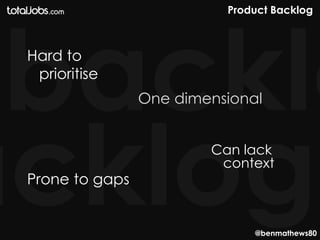
Product Backlog


Hard to
 prioritise
                One dimensional


                        Can lack
                         context
Prone to gaps


                              @benmathews80
Story maps


What are those then?


                       @benmathews80
@benmathews80
Story maps

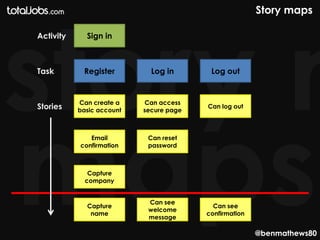
Activity     Sign in


Task        Register         Log in       Log out


           Can create a    Can access
Stories    basic account   secure page
                                         Can log out


              Email         Can reset
           confirmation     password


              Capture
             company


                            Can see
             Capture                       Can see
                            welcome
              name                       confirmation
                            message

                                                        @benmathews80
Story maps


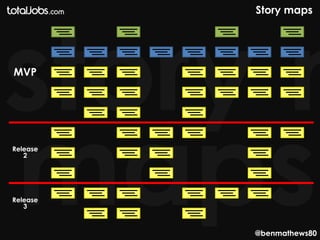
MVP


Release
   2


Release
   3


          @benmathews80
Story maps


@benmathews80
Story maps


@benmathews80
Story maps


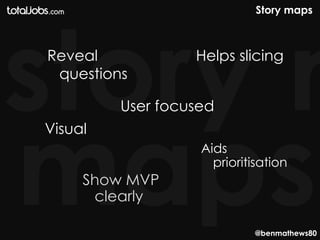
Reveal            Helps slicing
 questions

         User focused
Visual
                   Aids
                     prioritisation
     Show MVP
      clearly

                             @benmathews80
Story maps


Get the activity
 and task level
 right
                   Explain to the team


      Work from the map


                                @benmathews80
Just in time analysis


(or how we’re coping with a big team)


                               @benmathews80
JIT analysis


      I try to do no work…
      (but fail!)

                      Team pulls
                        analysis
Simple artefacts
  are better

                    A conversation
                     is better still

                                @benmathews80
JIT analysis


     Daily stand up
                            Story
PO catch                      huddles
 up
            Ad-hoc
             conversation


 Retrospective        Backlog
                       sessions

                                @benmathews80
JIT analysis


Lo-fi artefacts


                  @benmathews80
JIT analysis


@benmathews80
@benmathews80

Story Mapping and JIT Analysis

Editor's Notes

  • #3 Huge array of stories of different sizesLittle traceability of stories that have been decomposedToo detailed to get an overview – lacks context - Hard to see gapsHard to prioritise “log in is just as important as register new user”
  • #4 Asking a product owner to prioritise some stories is meaningless to them. E.g. register vs log inAs we break large stories down, the resulting workable stories can lose context and obscure the bigger picture (smell – lots of stories with the same value statement)Hard to spot gaps where the stories meet, assumptions about where one story ends and another begins
  • #6 Tolkien produced a detailed map of Middle Earth to give readers context and to help visualise the journey the fellowship took.Story maps aim to do something similar for a project.Jeff Patton (circa 2005 although used before)
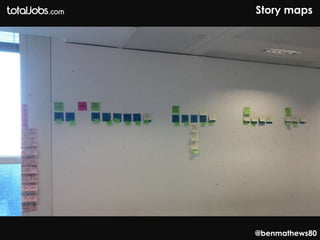
  • #7 Start with main activities – do this for all the activities in the systemIdentify the tasks the user does as part of that activityGenerate stories for those activitiesIdentify what stories are releasable and those that aren’tI’m never asking my PO to prioritise log in vs log out.
  • #9 Produced high level estimates based on the tasksStarted to build up a list of questions and risks
  • #10 Started to get estimates on the first release of storiesQuestions answered visibleString indicates MVP
  • #13 Our usual team size is 4 devs plus QA, PO, BA, SMThis project has 8 devs, bigger than recommended scrum size (12 people)Several apps, CRM, eCommerce, Fulfilment, Job Management, FinanceAcceptance criteria usually created in backlog session, too many people to manage that effectivelyProblems to solveHow do I know what people need to know? How do we share that information without making peoples heads explode?When do we capture acceptance criteria and who needs to know them?
  • #14 Touch points previously mentioned are opportunities to request informationFocus on simple documentation at the point at which it’s neededSpend more time making sure we have conversations. My mornings blocked out for huddles and sitting with pairs to see if they need anything.
  • #15 Backlog sessions now just about high level understanding of scope and sizing. Some technical discussion.PO catch ups make sure I’m in sync with the PORetrospectives (I didn’t understand…)Conversation during the day (co-location for the win)Story huddles – as story starts, dev pair, QA and BA discuss and write acceptance criteria.