DESIGN RECOMMENDATION FOR
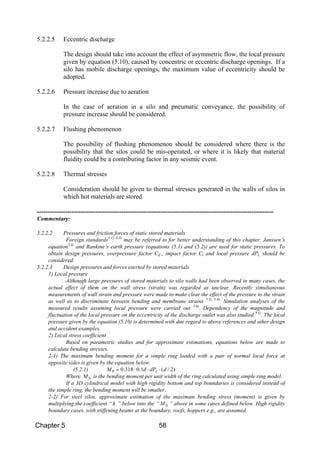
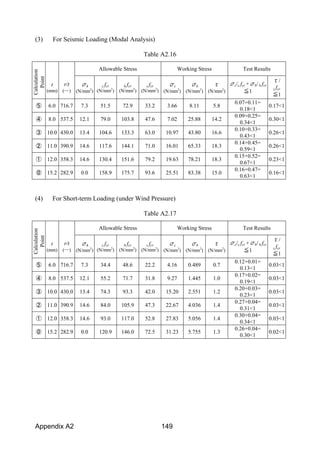
STORAGE TANKS AND THEIR SUPPORTS
WITH EMPHASIS ON SEISMIC DESIGN
(2010 EDITION)
ARCHITECTURAL INSTITUTE OF JAPAN
i
Foreword
The Architectural Institute of Japan set up a “Sub-Committee for Design of Storage Tanks” to
provide a recommendation of the seismic design for the various types of storage tanks in
common use throughout Japan. The Sub-Committee first published “Design Recommendation
for Storage Tanks and Their Supports” in 1984, and amended it in the 1990, 1996 and 2010
publications. This current revised recommendation provides bulk material pressures for silos
and further guidance on seismic design methods for storage tanks based on the horizontal load-
carrying capacity in the structure.
It is envisaged by publishing the English version of “Design Recommendation for Storage
Tanks and Their Supports” that the above unique design recommendation will be promoted to
the overseas countries who are concerned on the design of storage tanks and the activities of
the Architectural Institute of Japan will be introduced them too. It is addressed how this
recommendation is in an advanced standard in terms of the theory of the restoring force
characteristics of the structure considering the Elephant Foot Bulge (EFB), the effect of the
uplifting tank and the plastic deformation of the bottom plate at the shell-to-bottom juncture in
the event of earthquake, the design spectrum for sloshing in tanks, the design pressure for silos,
and the design methods for the under-ground storage tanks as well. The body of the
recommendation was completely translated into English but the translation of the commentary
was limited to the minimum necessary parts for understanding and utilising the theories and
equations in the body. The sections 2.7 Timbers and 4.9 Wooden Storage Tanks are omitted as
they are not common in overseas countries. Listing of some Japanese references are omitted
and some new references are added in this English version.
It is worthy of note that the contents of this recommendation have been verified and their
efficacy confirmed by reference to data obtained from the tanks and silos damaged during
recent earthquakes in Japan, including the Hanshin-Awaji Great Earthquake in 1995 and the
Niigataken Chuetu-oki Earthquake in 2007.
ii
Introduction
There are several types of storage tanks, e.g., above-ground, flat-bottomed, cylindrical tanks for
the storage of refrigerated liquefied gases, petroleum, etc., steel or concrete silos for the storage
of coke, coal, grains, etc., steel, aluminium, concrete or FRP tanks including elevated tanks for
the storage of water, spherical tanks (pressure vessels) for the storage of high pressure liquefied
gases, and under-ground tanks for the storage of water and oil. The trend in recent years is for
larger tanks, and as such the seismic design for these larger storage tanks has become more
important in terms of safety and the environmental impact on society as a whole.
The failure mode of the storage tank subjected to a seismic force varies in each structural type,
with the structural characteristic coefficient (Ds) being derived from the relationship between
the failure mode and the seismic energy transferred to, and accumulated in the structure. A
cylindrical steel tank is the most common form of storage tank and its normal failure mode is a
buckling of the cylindrical shell, either in the so called Elephant Foot Bulge (EFB), or as
Diamond Pattern Buckling (DPB). The Ds value was originally calculated with reference to
experimental data obtained from cylindrical shell buckling, but was later re-assessed and
modified based on the restoring force characteristics of the structure after buckling. Those
phenomena at the Hanshin-Awaji Great Earthquake and the Niigataken Chuetu-oki Earthquake
were the live data to let us review the Ds value. For the EFB, which is the typical buckling
mode of a cylindrical shell storage tank for petroleum, liquefied hydrocarbon gases, etc., it
became possible to ascertain the buckling strength by experiments on a cylindrical shell by
applying an internal hydrodynamic pressure, an axial compressive force, and a shear force
simultaneously. Details of these experiments are given in Chapter 3.
The seismic design calculations for other types of storage tanks have been similarly reviewed
and amended to take into account data obtained from recent experience and experiments.
Design recommendation for sloshing phenomena in tanks has been added in this publication.
Design spectra for sloshing, spectra for long period range in other words, damping ratios for
the sloshing phenomena and pressures by the sloshing on the tank roof have been presented.
For above-ground vertical cylindrical storage tanks without any restraining element, such as
anchor bolts or straps, to prevent any overturning moment, only the bending resistance due to
the uplift of the rim of bottom plate exists. This recommendation shows how to evaluate the
energy absorption value given by plasticity of the uplifted bottom plate for unanchored tanks,
as well as the Ds value of an anchored cylindrical steel-wall tank.
As the number of smaller under-ground tanks used for the storage of water and fuel is
increasing in Japan, the Sub-committee has added them in the scope of the recommendation
and provided a framework for the seismic design of under-ground tanks. The recommendation
has accordingly included a new response displacement method and a new earth pressure
calculation method, taking into account the design methods adopted by the civil engineering
fraternity.
For silo design, additional local pressure which depends on eccentricity of discharge outlet, and
equations which give approximate stress produced by this pressure are given in this 2010 publication.
August 2011
Sub-committee for Design of Storage Tanks
The Architectural Institute of Japan
iii
COMMITTEE FOR STRUCTURES (2010)
Chairman Masayoshi NAKASHIMA
Secretaries Hiroshi OHMORI Hiroshi KURAMOTO Kenji MIURA
Members (Omitted)
SUB-COMMITTEE FOR DESIG OF STORAGE TA KS (2010)
Chairman Yukio NAITO
Secretaries Nobuyuki KOBAYASHI Hitoshi HIROSE
Members Hiroshi AKIYAMA Yasushi UEMATSU Toshio OKOSHI
Hitoshi KUWAMURA Minoru KOYAMA Kouichi SHIBATA
Hideo NISHIGUCHI Katsu-ichiro HIJIKATA Hiroaki MORI
Yutaka YAMANAKA Jun YOSHIDA
WORKI G GROUP FOR SEISMIC LOAD A D RESPO SE
ESTIMATIO OF STORAGE TA KS (2008)
Chairman Yukio NAITO
Secretary Nobuyuki KOBAYASHI Hitoshi HIROSE
Members Tokio ISHIKAWA Shinsaku ZAMA Hitoshi SEYA
Nobuo NAKAI Hideo NISHIGUCHI
Katsu-ichiro HIJIKATA Tetsuya MATSUI
iv
Table of Contents
1 General ---------------------------------------------------------------------------------1
1.1 Scope -----------------------------------------------------------------------------------1
1.2 Notations-------------------------------------------------------------------------------1
2 Materials -------------------------------------------------------------------------------3
2.1 Scope -----------------------------------------------------------------------------------3
2.2 Steels -----------------------------------------------------------------------------------3
2.3 Stainless Steels------------------------------------------------------------------------4
2.4 Concrete--------------------------------------------------------------------------------4
2.5 Aluminium Alloys--------------------------------------------------------------------4
2.6 FRP -------------------------------------------------------------------------------------5
2.7 Timber----------------------------------------------------------------------------------6
3 Design Loads--------------------------------------------------------------------------9
3.1 General ---------------------------------------------------------------------------------9
3.2 Dead Loads ----------------------------------------------------------------------------9
3.3 Live Loads-----------------------------------------------------------------------------9
3.4 Snow Loads----------------------------------------------------------------------------9
3.5 Wind Loads-------------------------------------------------------------------------- 10
3.6 Seismic Loads----------------------------------------------------------------------- 10
3.7 Design of Cylindrical Metal Shell Wall Against Buckling ------------------- 23
3.8 Earth Pressures---------------------------------------------------------------------- 41
4 Water Tanks ------------------------------------------------------------------------- 44
4.1 Scope --------------------------------------------------------------------------------- 44
4.2 Structural Design ------------------------------------------------------------------- 44
4.3 Reinforced Concrete Water Tanks ----------------------------------------------- 46
4.4 Pre-stressed Concrete Water Tanks ---------------------------------------------- 47
4.5 Steel Water Tanks ------------------------------------------------------------------ 47
4.6 Stainless Steel Water Tanks------------------------------------------------------- 47
4.7 Aluminium Alloy Water Tanks--------------------------------------------------- 48
4.8 FRP Water Tanks ------------------------------------------------------------------- 48
4.9 Wooden Water Tanks -------------------------------------------------------------- 49
5 Silos----------------------------------------------------------------------------------- 51
5.1 Scope --------------------------------------------------------------------------------- 51
5.2 Structural Design ------------------------------------------------------------------- 52
5.3 Reinforced Concrete Silos--------------------------------------------------------- 60
5.4 Steel Silos---------------------------------------------------------------------------- 60
6 Seismic Design of Supporting Structures for Spherical Tanks --------------------62
6.1 Scope --------------------------------------------------------------------------------- 62
6.2 Physical Properties and Allowable Stresses------------------------------------- 63
6.3 Seismic Design---------------------------------------------------------------------- 64
v
7 Seismic Design of Above-ground, Vertical, Cylindrical Storage Tanks----------76
7.1 Scope --------------------------------------------------------------------------------- 76
7.2 Seismic Loads----------------------------------------------------------------------- 80
7.3 Evaluation of Seismic Capacity--------------------------------------------------- 95
8 Seismic Design of Under-ground Storage Tanks ---------------------------------- 100
8.1 Scope --------------------------------------------------------------------------------100
8.2 Seismic Design---------------------------------------------------------------------100
8.3 Evaluation of Seismic Capacity--------------------------------------------------104
AppendixA Design and Calculation Examples -----------------------------------106
A1 Steel Water Tower Tanks ---------------------------------------------106
A2 Steel Silo ----------------------------------------------------------------120
A3 Supporting Structures for Spherical Tanks ----------------------------- 149
A4 Above-ground, Vertical, Cylindrical Storage Tanks ------------------ 154
AppendixB Assessment of Seismic Designs for Under-ground
Storage Tanks-----------------------------------------------------------160
Chapter2 1
1. General
1.1 Scope
This Design Recommendation is applied to the structural design of water storage
tanks, silos, spherical storage tanks (pressure vessels), flat-bottomed, cylindrical
above-ground storage tanks and under-ground storage tanks.
--------------------------------------------------------------------------------------------------
Commentary:
This Design Recommendation is applied to the structural design, mainly the seismic design, of
water storage tanks, silos, spherical storage tanks (pressure vessels), flat-bottomed, cylindrical,
above-ground storage tanks and under-ground storage tanks. As common requirements chapter 2
calls for material specifications which are applicable to the above -mentioned tanks, and chapter 3
calls for loads and buckling designs. Chapter 3 especially highlights the modified seismic
coefficient method and the modal analysis as approved evaluation methods of seismic design based
on the reference design acceleration response spectrum and the structural characteristic coefficient
Ds. The seismic design method adopted in the Recommendation is the allowable stress method
modified with B, the ratio of the horizontal load-carrying capacity in the structure to the short-term
allowable yield strength. The design for each tank is described in chapter 4 and onwards. Chapters
4 and 5 call for general requirements of structural design of tanks and their supporting structures
for water storage tanks and silos, respectively. Chapters 6 calls for requirements of seismic design
only for supporting structures of spherical storage tanks. Chapters 7 and 8 calls for requirements
of flat-bottomed, cylindrical above-ground storage tanks and under-ground storage tanks,
respectively.
Examples of design procedure for each type of tanks in chapters 4 through 8 are included in
appendices.
1.2 otations
The following notations are applicable as common notations through the chapters in
this Recommendation, and each chapter includes some additional notations to be
specifically used in the chapter.
B ratio of the horizontal load-carrying capacity in the structure to the short-term
allowable yield strength
C design yield shear force coefficient
Cj design yield shear force coefficient at the j-th natural mode
Ds structural characteristic coefficient ηDDh ×
Dh coefficient determined by the damping of the structure
Dη
coefficient determined by the ductility of the structure
E Young’s modulus (N/mm2
)
F yield strength (N/ mm2
)
b fcr allowable bending stress in the cylindrical wall (N/mm2
)
c fcr allowable compressive stress in the cylindrical wall (N/mm2
)
s fcr allowable shear stress in the cylindrical wall (N/mm2
)
g acceleration of gravity (= 9.8m/s2
)
h damping ratio
I importance factor
j order of natural frequency
K lateral design seismic coefficient
Chapter2 2
KH lateral design seismic coefficient in the ground
KV vertical design seismic coefficient in the ground
KHS lateral design seismic coefficient at the ground surface
KHB lateral design seismic coefficient at the bedrock surface
k the maximum number of vibration modes which largely influence to seismic
responses
n total number of mass points
Qd design yield shear force at the base of the structure (N)
Qdi design shear force imposed just below the i-th mass in case that the structure is
assumed the n-th lumped mass vibration system (N)
RG ground amplification factor
r radius of cylindrical tank (mm)
Sv design velocity response spectrum (m/s)
Sa design acceleration response spectrum (m/s2
)
Sa1 acceleration response at the first natural period (m/s2
)
Saj acceleration response at the j-th natural period (m/s2
)
Sv1 design velocity response at the first natural period in the sloshing mode (m/s)
T the first natural period of the structure (s)
Tj j-th natural period of the structure (s)
TG critical period determined by the ground classification (s)
UH(z) horizontal displacement at the depth z from the ground surface (m)
UV(z) vertical displacement at the depth z from the ground surface (m)
uij j-th natural mode at the i-th mass
W design weight imposed on the base of the structure (N)
Wi weight of the i-th mass (N)
Zs seismic zoning factor
σb bending stress in the cylindrical wall (N/mm2
)
σc average compressive stress in the cylindrical wall (N/mm2
)
σh average hoop tensile stress in the cylindrical wall (N/mm2
)
τ shear stress in the cylindrical wall (N/mm2
)
Chapter2 3
2. Materials
2.1 Scope
This chapter calls for the recommended materials used in the tanks and their supports.
Allowable stresses of the materials are determined in accordance with the
recommended method set up in each chapter for each type of storage tank.
2.2 Steels
Steel materials listed in Table 2.1 should apply for.
Table 2.1 Specifications for Steels
Specification Type of steel Grades
JIS G 3136
JIS G 3101
JIS G 3106
JIS G 3444
JIS G 3466
JIS G 5101
JIS G 3201
JIS G 3115
JIS G 3120
JIS G 3126
JIS B 1186
JIS Z 3211
JIS Z 3212
JIS Z 3351
JIS Z 3352
Rolled Steels for Building Structure; SN400A/B/C, SN490B/C
Rolled Steels for General Structure; SS400, SS490, SS540
Rolled Steels for Welded Structure; SM400A/B/C, SM490A/B/C,
SM490YA/YB, SM520B/C, SM570
Carbon Steel Tubes for General Structural Purposes; STK400,
STK490
Carbon Steel Square Pipes for General Structural Purposes;
STKR400, STKR490
Carbon Steel Castings
Carbon Steel Forgings for General Use
Steel Plates for Pressure Vessels for Intermediate Temperature
Service; SPV235, SPV315, SPV355, SPV450, SPV490
Manganese-Molybdenum and Manganese-Molybdenum-Nickel
Alloy Steel Plates Quenched and Tempered for Pressure Vessels;
SQV1A/1B, SQV 2A/2B, SQV 3A/3B
Carbon Steel Plates for Pressure Vessels for Low Temperature
Service; SLA235A/B, SLA325A/B, SLA365
Sets of High Strength Hexagon Bolt, Hexagon Nut and Plain
Washers for Friction Grip Joints
Covered Electrodes for Mild Steel
Covered Electrodes for High Tensile Strength Steel
Submerged Arc Welding Solid Wires for Carbon Steel and Low
Alloy Steel
Submerged Arc Welding Fluxes for Carbon Steel and Low Alloy
Steel
JIS G 3112
JIS G 3117
JIS G 3551
Steel Bars for Concrete Reinforcement
Rerolled Steel Bars for Concrete Reinforcement
Welded Steel Wires and Bar Fabrics
JIS G 3536
JIS G 3538
JIS G 3109
Uncoated Stress-Relieved Steel Wires and Strands for
Prestressed Concrete
Hard Drawn Steel Wires for Prestressed Concrete
Steel Bars for Prestressed Concrete
JIS : Japanese Industrial Standards
Chapter2 4
2.3 Stainless Steels
Stainless steel materials listed in Table 2.2 should apply for.
Table 2.2 Specifications for Stainless Steels
Specification Type of steel Grades
JIS G 4304
JIS G 4305
Hot Rolled Stainless Steel Plates, Sheets and Strips; SUS304,
SUS304L, SUS316, SUS316L, SUS444, SUS329 J 4 L
Cold Rolled Stainless Steel Plates, Sheets and Strips; SUS304,
SUS304L, SUS316, SUS316L, SUS444, SUS329 J 4 L
JIS G 3601
Stainless Clad Steels; SUS304, SUS304L, SUS316, SUS316L,
SUS444
JIS G 3459
Stainless Steel Pipes; SUS304TP, SUS304LTP, SUS316TP,
SUS316LTP, SUS444TP, SUS329 J 4 LTP
JIS Z 3221
JIS Z 3321
Stainless Steel Covered Electrodes
Stainless Steel, Wire Rods and Solid Wires
2.4 Concrete
2.4.1 Concrete materials should comply with JASS 5 (Japanese Architectural Standard
Specifications and Commentary for Reinforced Concrete Works (2003)) 5.4
“Concrete Materials” except that par. 5N.13.3 “Pre-stressed Concrete” of JASS 5N
“Reinforced Concrete Work at Nuclear Power Plants (2001)” should apply for pre-
stressed concrete.
2.4.2 Quality of concrete materials should comply with Table 2.3 and below.
- JASS 5.5 “Mixing Proportion”
- JASS 5.6 “Production of Concrete”
- JASS 5.7 “Transportation and Placement”
- JASS 5.8 “Curing” etc.
JASS 5N.13.3 “Pre-stressed Concrete” should apply for pre-stressed concrete.
Table 2.3 Specifications for Concrete Materials
Specification
Minimum Value of Fc
(N/mm2
)
Aggregate
Coarse Fine
Normal Weight
Concrete
18
Gravel or Crushed
Stone
Sand or Crushed
Sand
2.5 Aluminium Alloys
Aluminium alloys used for structural members should be selected from those
Chapter2 5
designated in Table 2.5 which are in accordance with the specifications of Japanese
Industrial Standards in Table 2.4.
Table 2.4 Aluminium and Aluminium Alloy Materials
Specification Title
JIS H 4000
JIS H 4040
JIS H 4080
JIS H 4090
JIS H 4100
JIS H 4140
JIS H 5202
JIS Z 3232
Aluminium and Aluminium Alloy Sheets and Plates, Strips and
Coiled Sheets
Aluminium and Aluminium Alloy Rods, Bars and Wires
Aluminium and Aluminium Alloy Extruded Tubes and Cold-
drawn Tubes
Aluminium and Aluminium Alloy Welded Pipes and Tubes
Aluminium and Aluminium Alloy Extruded Shape
Aluminium and Aluminium Alloy Forgings
Aluminium Alloy Castings
Aluminium and Aluminium Alloy Welding Rods and Wires
Table 2.5 Grades of Aluminium Alloy Materials
A 1060 A 5052
A 1070 A 5056
A 1080 A 5083
A 1100 A 5086
A 1200 A 5154
A 3003 A 5254
A 3203 A 5454
A 5652
A 6061-T4
A 6061-T6
A 6063-T5
A 6063-T6
A 7 N 01-T4
A 7 N 01-T6
A 7003-T5
2.6 FRP
2.6.1 Resins used for FRP (Fibre Reinforced Plastics) materials should be equal to or
better than the quality of the UP-G (Unsaturated Polyester Resin-Gneral) specified in
the Japanese Industrial Standard JIS K 6919 (Liquid unsaturated polyester resins for
fibre reinforced plastics), and should have excellent weather and water resistant
properties.
2.6.2 Glass fibre used for FRP materials should be of the no alkali glass type in accordance
with the Japanese Industrial Standards indicated in Table 2.6. Any additional
processed glass fibres should also be manufactured using these fibres as raw
materials.
Table 2.6 Types of glass fibre for FRP
Specification Type
JIS R 3411
JIS R 3412
JIS R 3413
JIS R 3415
JIS R 3416
JIS R 3417
Textile glass chopped strand mats
Textile glass rovings
Textile glass yarns
Textile glass tapes
Finished textile glass fabrics
Woven roving glass fabrics
Chapter2 6
2.6.3 FRP materials should be processed using the resins and glass fibres specified above,
and by adding any necessary fillers, coloring agents, artificial fibres, etc., as required
to ensure that the performance requirements stipulated in Table 2.7 are satisfied.
Table 2.7 Physical Properties of FRP Materials
Property Performance Testing Method
Tensile strength
Flexural strength
Flexural modulus
Glass content
Barcol hardness
Water absorption
> 59N/mm2
> 78N/mm2
> 5.9×10³
N/mm2
> 25wt%
> 30
< 1.0%
JIS K 7054
JIS K 7055
JIS K 7055
JIS K 7052
JIS K 7060
JIS K 6919
2.7 Timber
This section is omitted in this English version.
Commentary
1. Component Materials of FRP
FRP basically consists of a fibre reinforcement in a resin matrix. FRP used for water tanks, use a
compound resin consisting of hardening agents, colouring agents, mineral fillers, etc., in an
unsaturated polyester resin. The fibre reinforcement is generally glass fibre of the no alkali glass type
bundled from 50 ~ 2000 filaments of 8 ~ 13μm in diameter in a processed mat, cloth or roving state
depending upon the intended use. The resin, glass fibre, additional fillers, and other materials should
be equal to or better than the requirements specified in the relevant Japanese Industrial Standards
indicated in sections 2.6.1, 2.6.2 and 2.6.3 above. Additional consideration should be given to the
hygiene requirements for materials used in drinking water tanks.
2. Performance and Allowable Stress of FRP
The performance of FRP may be changed by varying the combinations of the resin, glass fibre, and
other agents to meet the requirements indicated. For water tanks, the combinations should be such
that the mechanical and physical performance criteria specified in 2.6.3 are satisfied.
An approximation of the relationship of tensile stress and strain of FRP is shown in Fig. 2.6.1. FRP
material with a tensile strength greater than 59 /mm2
is used provided the material characteristics
satisfy the minimum requirements noted in 2.6.3. The strain at break point is between 2% ~ 3%.
Allowable stress of FRP is determined for the static properties at normal temperature, taking into
account degradation within the durable period, material deviations, etc. Tables 2.6.1, 2.6.2, and
2.6.3 show the current method used to determine the allowable stresses in the design of FRP water
tanks. In this illustration, the static properties of FRP at normal temperature are determined as the
standard value, the limited value - considering the degradation within durable period (15years) - is
then calculated, and finally the allowable stress is calculated by dividing the limited value by a safety
factor (See Table 2.6.3.).
Chapter2 7
Fig. 2.6.1 Characteristics of tensile stress and strain of FRP and an example of allowable
stress determination. In this case, S1=2.2 (Mat hand-lay-up material).
Table 2.6.1 Allowable stress based on fracture strength
Fracture Strength Standard Value *1
Limited Value
Allowable Stress
Short Term*2
Long Term*3
Tensile strength Ft 0.7 Ft 0.7 Ft / S1
*4
0.7 Ft / 1.5S1
Flexural strength Fb 0.6 Fb 0.6 Fb / S1 0.6 Fb / 1.5S1
In-plane shear strength Fs 0.7 Fs 0.7 Fs / S1 0.7 Fs / 1.5S1
Interlaminar shear strength FIS 0.7 FIS 0.7 FIS / S1 0.7 FIS / 1.5S1
Transverse shear strength FT 0.6 FT 0.6 FT / S1 0.6 FT / 1.5S1
Compressive strength FB 0.7 FB 0.7 FB / S1 0.7 FB / 1.5S1
*1
Standard value -static properties at normal temperature
*2
Short-term - considering short-term loading
*3
Long-term - considering long-term loading
*4
The definition of S1 is given in Table 2.6.3.
For long-term loading, hydrostatic pressure, dead loads, etc., should be divided by 1.5 to take into
account creep phenomena.
Stress
Ft
0.7 Ft
0.318 Ft
0.212Ft
Strain %
Limited value (15 years)
Static properties at normal temperature
Allowable stress - short term loading (0.7 Ft / S1)
Allowable stress - long term loading (0.7 Ft /1.5 S1)
0
Chapter2 8
Table 2.6.2 Allowable Properties of Modulus
Modulus Standard Value Limited Value
Allowable
Properties
Tensile Modulus Et 0.8 Et 0.8 Et / S2
*
Flexural Modulus Eb 0.8 Eb 0.8 Eb / S2
In-Plane Shear Modulus G 0.8 G 0.8 G / S2
* The definition of S2 is given in Table 2.6.3.
Table 2.6.3 Safety factor of FRP (S1, S2)
Strength Criteria of Material (S1) Stiffness Criteria of Structure (S2)
1.72 LS 1.58 LS
LS is the coefficient of dispersion for material properties of FRP.
(In the case of fracture strength, tensile strength and flexural strength; in the case of stiffness,
tensile modulus and flexural modulus.)
LS is determined by the following equation, based on material properties obtained from more than
10 test pieces.
LS = )}x/(./{ σ09311 −
where: x = average of material properties
σ = standard deviation.
The allowable properties to be determined depends on the criteria of fracture strength or stiffness;
i.e., if the criteria is based on strength of material, the allowable stress should be determined on the
base of strength, and if the criteria is based on stiffness of structure, the allowable properties
should be determined on the base of stiffness. The safety factor should be the value considering the
effect of circumstance temperature of water tanks used, and deviation of material properties.
The material properties of FRP should be determined by the following test methods.
JIS K 7051: General rules for testing methods of glass fibre reinforced plastics.
JIS K 7054: Testing method for tensile properties of glass fibre reinforced plastics.
JIS K 7055: Testing method for flexural properties of glass fibre reinforced plastics.
JIS K 7056: Testing method for compressive properties of glass fibre reinforced plastic.
JIS K 7057: Fibre-reinforced plastic composites - Determination of apparent interlaminar
shear strength by short-beam method.
JIS K 7059: Testing method for in-plane shear properties of glass fibre reinforced plastics.
Chapter3 9
3 Design Loads
3.1 General
3.1.1 Loads should be applied to the structural design of a tank according to its intended
use, size, structure type, materials, design lifetime, location and environment, in
order to assure life safety and to maintain its essential functions.
3.1.2 The applied loads should be as follows, and their combinations should be defined
considering the actual probability of occurrence.
(i) Dead loads
(ii) Live loads
(iii) Snow loads
(iv) Wind loads
(v) Seismic loads
(vi) Impulse and suction due to content sloshing, and pressure due to content
(vii) Thermal stresses
(viii) Shock, e. g., by crane
(ix) Fatigue loads
(x) Soil and water pressures
(xi) Others. e.g., load from mechanical device.
3.2 Dead Loads
Dead loads are the sum of the weights of the tank, its associated piping and
equipment and other fixed appurtenances.
3.3 Live Loads
3.3.1 Live loads should be considered to be the contents of the tank, the temporary weight
of personnel, and the weight of other temporary equipment not normally fixed to the
tank. If such loads involve a impulsive force, they should be increased by a suitable
impulse factor.
3.3.2 Temporary live loads may be discounted if they have been taken into consideration
with other load combinations.
3.3.3 For seismic designs, the weight of the tank contents should be considered as being
divided into fixed weight (impulsive mass) and free weight (convective mass).
3.4 Snow Loads
Snow loads should be defined by considering the location, topography, environment,
density of the snow, snow accumulating period, and the shape and temperature of the
tank, as defined in “Recommendations for Loads on Buildings” (AIJ- 2004).
Chapter3 10
3.5 Wind loads
Wind loads should be defined by considering the shape of the tank, its structural
characteristics, the location, and environment, as defined in “Recommendations for
Loads on Buildings” (AIJ - 2004).
3.6 Seismic Loads
3.6.1 Seismic Loads for Above-ground Storage Tanks
3.6.1.1 Design for Impulsive Mass
Design seismic loads for above-ground storage tanks should be calculated by either
one of the following methods:
(i) Modified Seismic Coefficient Method, or
(ii) Modal Analysis
The Modified Seismic Coefficient Method should be used for the design seismic
loads of tank foundations.
3.6.1.2 Modified Seismic Coefficient Analysis
Design yield shear force, Qd, should be calculated using equations (3.1) and (3.2).
(3.1) Qd = CW
(3.2)
g
S
IDZC a
ss
1
=
where:
C ≥ 0.3ZsI
Notations:
Qd design yield shear force (N)
C design yield shear force coefficient
W design weight imposed on the base of the structure, which is
equal to the sum of dead weight of structure and weight of
impulsive mass of liquid content (N)
Sa1 design acceleration response spectrum corresponding to the
first natural period, given in par. 3.6.1.6 (m/s2
)
g acceleration of gravity = 9.8 (m/s2
)
Zs seismic zone factor, which is the value stipulated in the
Building Standards Law and the local government
I importance factor, given in par. 3.6.1.7
Ds structural characteristic coefficient, which is the value
calculated in equation (3.3) and as further detailed in
Chapters 4, 5, 6, and 7.
(3.3) Ds = DhDη
Chapter3 11
where:
Dh is the coefficient determined by the damping of the structure
Dη is the coefficient determined by the ductility of the structure
When the structure is assumed to have the n mass vibration system, the design shear
force imposed just below the i-th mass, Qdi, should be calculated using equation (3.4).
(3.4)
∑
∑
=
=
= n
m
mm
n
im
mm
ddi
hW
hW
QQ
1
where:
Qdi is the vertical distribution of the design shear force imposed
just below the i-th mass (N)
Notations:
n total number of masses
hi height at the i-th mass from the ground level (m)
Wi weight of the i-th mass (N)
3.6.1.3 Modal Analysis
When the structure is considered as the vibration of an n mass-system, the design
yield shear force imposed just below the i-th mass, Qdi, should be calculated using
equation (3.5).
(3.5)
2
1
1
2














= ∑ ∑= =
k
j
mj
n
im
jmjdi uWCQ β
(3.6)
g
S
IDZC
aj
ssj =
where:
Qd1 ≥ 0.3ZsIW
Notations:
j order of natural frequency
k the maximum number of vibration modes which largely
influences seismic responses
n total number of masses
Wi weight of the i-th mass (N)
βj participation factor of the j-th natural mode
uij j-th natural mode at the i-th mass
Cj design yield shear force coefficient at the j-th natural mode
Saj design acceleration response spectrum at the j-th natural
period, given in par. 3.6.1.6 (m/s2
)
Chapter3 12
3.6.1.4 Design Seismic Loads of Weight of Convective Mass
When the stored content is liquid, the design seismic loads of the weight of
convective mass should be obtained from the design velocity response spectrum, Sv1,
corresponding to the first natural period of the convective mass. See also chapter 7.
3.6.1.5 Design Seismic Loads of Tank Foundation
The sum of the lateral force, which is obtained from the dead weight multiplied by
the horizontal design seismic coefficient, K, as shown in (3.7), and the shear force
transmitted from the upper structure should be the design seismic load acting on the
tank foundation.
(3.7) K ≥ 0.15
3.6.1.6 Design Response Spectra
Design velocity response spectrum, Svj, and design acceleration response spectrum,
Saj, should be obtained from the equation (3.8) or (3.9).
(3.8) when Tj < TG Svj = 1.56 Tj
Saj = 9.8
(3.9) when Tj ≥ TG Svj = 1.56 TG
Saj = 9.8 TG / Tj
Notations:
Tj j-th natural period of the structure (s)
TG critical period determined by the ground classification shown in Table 3.1
below (s).
Table 3.1 Critical Period, TG (s)
Classification
of Ground
Ground Conditions TG (s)
Type 1
(1) the ground before the Tertiary (hereinafter
called bedrock)
(2) diluviums
(3) alluviums which are less than 10m in
thickness to bedrock
0.64
Type 2
alluviums which are less than 25 m in thickness
to bedrock and of which the soft layer is less than
5 m in thickness
0.96
Type 3
(1) the ground other than the above
(2) the ground which is unknown in properties
1.28
Chapter3 13
3.6.1.7 Importance Factor
An importance factor is determined corresponding to the classification of the seismic
design I, II, III, or IV given in Table 3.2 in consideration of significance of
earthquake damages and consequence to environment.
Table 3.2 Importance Factor, I
Classification
of Seismic
Design
Description I
I
Storage tanks which have small capacities and do
not contain hazardous materials
0.6 and greater
II
Storage tanks which have medium to large
capacities, do not contain hazardous materials, and
will not have any significant consequential effect in
the event of earthquake damage.
0.8 and greater
III
Storage tanks to which the significance of
earthquake damages is equivalent to common use
buildings
1.0 and greater
IV
Storage tanks which contain hazardous materials and
the failure of which will constitute a secondary
disaster
1.2 and greater
3.6.1.8 Design Seismic Loads for Allowable Stress Design
The allowable design stress for storage tanks should be obtained from the design
story shear force, Qei, given in equation (3.10).
(3.10)
B
Q
Q di
ei =
Notations:
Qei design story shear force for allowable stress design (N)
B ratio of horizontal load-carrying capacity in the structure to
short-term allowable yield strength, the value of which
should be between 1.0 ~ 1.5 and should be determined for
each type of structure specified in the commentary to chapter
3 and the body of chapter 4 onwards.
3.6.1.9 Horizontal Load-carrying Capacity
Horizontal load-carrying capacity of storage tanks should be obtained from the
allowable stresses given in par. 3.7.4.
Chapter3 14
-------------------------------------------------------------------------------------------------------------------
Commentary:
Essentially seismic design as applied to storage tanks follows the requirements prescribed by the Building
Standard Law where the importance of structures is not explicitly considered. However, as storage tanks are
more versatile than normal building structures in that they include a range of structures covering silo
containing forages and tanks for toxic materials, an importance factor, I, is introduced to accommodate these
differences. Whilst this chapter summarises the common features of seismic design for above-ground storage
tanks, specific design considerations - including the importance factor, is given in the chapters dedicated to
each principal tank design type.
1. Seismic Input
The seismic energy input, ED , the principal cause for a structure’s elasto-plastic deformation, is
approximately expressed as shown in equation (3.6.1) as follows[3.13]:
(3.6.1)
2
2
v
D
MS
E =
otations:
M total mass of a structure
Sv velocity response spectrum
The acceleration response spectrum, Sa, prescribed by the Building Standard Law, is obtained from
equation (3.6.2):
(3.6.2) gRCS ta 0=
otations:
C0 standard design shear force coefficient
Rt vibration characteristic coefficient
g acceleration of gravity
Sa and Sv are related to each other as shown in the following equation (3.6.3).
(3.6.3) va S
T
S
π2
=
otations:
T natural period for the 1st mode of a structure
Sa and Sv are indicated by broken lines in the curves shown in Figure 3.6.1, whilst the solid lines
represent the simplified curves expressed in equations (3.8) and (3.9).
Fig.3.6.1 Design Response Spectra
9.8010
2.0
1.5
1.0
0.5
Sa(m/s2
)
Sv(m/s)
5
Chapter3 15
2. Seismic Design Loads
For the sake of determining seismic design loads, storage tanks can be simplified to a single mass
system, the restoring force characteristics of which are assumed to be of the elasto-plastic type with
yield shear force Qy.
It is also assumed that the structure develops cumulative plastic deformation, 0δ , in both positive
and negative directions under severe earthquake conditions as shown in Figure 3.6.2.
The relationship between the total energy input exerted by an earthquake and the damage of a
structure is expressed by equation (3.6.4) as follows:
(3.6.4)
( )2
2131 h.h
E
WEWW hep
++
=−=+
otations:
E total energy input
Wp damage to a structure (cumulative plastic strain energy)
We elastic vibrational energy
Wh energy absorbed by damping
h damping ratio
E - Wh can be approximately expressed by the following equation (3.6.5):
(3.6.5)
2
2
v
h
MS
WE =−
otations:
M mass of a single-mass system
The spectra shown in Figure 3.6.1 are given for h = 0.05. E may then be expressed by equation
(3.6.6):
(3.6.6)
2
421
22
vMS.
E =
Wp and We are expressed by equations (3.6.7) and (3.6.8) respectively:
(3.6.7) 02 δyp QW =
Fig.3.6.2 Damage and Cumulative Plastic Deformation
Chapter3 16
(3.6.8)
2
yy
e
Q
W
δ
=
Where the yield deformation, δy, and the yield shear force, Qy, are determined by equations (3.6.9)
and (3.6.10) respectively.
(3.6.9) δ y
k
Qy
=
(3.6.10) Qy = MgC
otations:
Qy yield shear force
δy yield deformation
k spring constant of a singl-mass system
C yield shear coefficient
The natural period of a single-mass system, T, is expressed by equation (3.6.11).
(3.6.11)
21
2 





=
k
M
T π
C is obtained by substituting (3.6.7) and (3.6.8) into (3.6.4) and using (3.6.9) - (3.6.11) as shown in
equation (3.6.12) as follows:
(3.6.12)
g
S
Th.h
.
C vπ
η
2
2131
421
41
1
+++
=
(3.6.13)
yδ
δ
η 0
=
otations:
η averaged cumulative plastic deformation ratio as shown in
equation (3.6.13).
Knowing that Sa = 2πSv /T , and applying Zs = I = 1.0, Ds in (3.3) is determined by comparing
(3.2) and (3.6.12) using equations (3.6.14) and (3.6.15) as follows:
(3.6.14)
hh
Dh
2.131
42.1
++
=
(3.6.15)
η
η
41
1
+
=D
(1) Value of Dh
Large diameter storage tanks, such as oil storage tanks, are subject to an interaction between the
soil and the structure. Assuming that a structure in direct contact with the ground is a continuous
shear stratum, the one dimensional wave propagation theory yields an estimate of damping ratio,
h, due to energy dissipation through the soil - structure interaction as illustrated in equation
(3.6.16).
(3.6.16)
11
002
V
V
h
ρ
ρ
π
=
otations:
Chapter3 17
10 ρρ , densities of structure and the ground, respectively (kg/m3
)
V0 , V1 shear wave velocities of structure and the ground,
respectively (m/s)
0ρ and V0 are expressed by equations. (3.6.17) and (3.6.18).
(3.6.17)
0
0
HA
M
=ρ
(3.6.18)
T
H
V
4
0 =
otations:
M mass of structure (kg)
H height of structure (m)
A0 bottom area of structure (m2
)
T fundamental period of structure (s)
00Vρ is approximately expressed by equation (3.6.19).
(3.6.19)
TA
M
V
0
00
4
=ρ
Assuming 3
1 104.2 ×=ρ kg/m3
and 1501 =V m/s for Type 3 Classification of Ground with some
margin, 11Vρ is expressed by equation (3.6.20).
(3.6.20) 3
11 10
360
⋅=
ha
Vρ
Where ha is shown in Table 3.6.1.
Damping ratio, h, is then expressed by equation (3.6.21) by substituting equations (3.6.19) and
(3.6.20) into equation (3.6.16).
(3.6.21) 6
0
10
7 −
⋅=
TA
Ma
h h
If a large –scale cylindrical LPG storage tank on soft soil (Type 3) is given for an example, and
assuming the diameter of the tank D=60m, liquid height H=25m, T=0.32s, A0=3,120m2
and
M=2.12×10⁷
kg, 00Vρ is estimated as )/(105.8 24
00 mskgV ⋅×=ρ . The damping ratio is then
determined as, h=0.15, from equation (3.6.21).
These values are consistent with the damage noted after the Miyagiken-oki and other earthquakes,
and are confirmed by the analytical results of a three-dimensional thin-layer element model.
Equation (3.6.21) is applicable to flat tanks such as large-scale cylindrical oil storage tanks build
on soft ground. For non-flat tanks, the damping ratio is smaller.
The 1ρ and 1V for equation (3.6.16) can also be directly measured by velocity logging etc., if
necessary.
Table.3.6.1 Value of hα
Classification of Ground
Type 1 0.6
Type 2 0.75
Type 3 1.0
hα
* The classification, Type 1~3, is defined in Table 3.1.
Chapter3 18
(2) Value of ηD
As there are many variations in the design of storage tanks, estimating approximate values of η is
accordingly dependent on the information provided. It is therefore essential that sufficient details
are provided about the structural design to enable a reasonable estimation to be made. As a
tentative measure, the minimum value of η , and ηD as obtained from equation (3.6.15) should be
used (see Table 3.6.2).
3. Relationship between modified seismic coefficient method and modal analysis
A seismic load can be obtained by the modified seismic coefficient method or by modal analysis.
The advantage of the modified seismic coefficient method lies in its simplicity of application,
whereas modal analysis is a little bit more complicated, as indicated by equations (3.5) and (3.6),
and can result in a smaller seismic load than the modified seismic coefficient method.
When comparison of the design yield shear force at the base of structure is made using the modal
analysis and the modified seismic coefficient method for structures in which shear deformation is
dominant, the ratio of the design yield shear force given by the modal analysis, Qd1, to the design
yield shear force given by the modified seismic coefficient method, Qd, lies between 1.0 and 0.8.
When flexural deformation is added, the ratio may be further decreased. Provided that structural
parameters can be adequately estimated, the lower seismic loads given by modal analysis may be
applied. However, in view of the uncertainty in estimating structural parameters, it is preferable
that Qd1 is limited to ensure that,
(3.6.22) Qd1 ≥ 0.7 Qd
4 Design seismic load applied to liquid sloshing
The sloshing oscillation of a contained liquid is obtained from the velocity response spectrum.
Although the velocity response spectra in the range of longer periods are not yet fully clarified,
equation(7.7) is considered to be a valid conservative estimate.
5. Evaluation of seismic resistance
The seismic resistance of structures can be evaluated by the following alternative methods:
(1) Horizontal load-carrying capacity design
Horizontal load-carrying capacity in each part of a structure is checked to ensure that the criteria
contained in equation (3.6.23) are satisfied.
(3.6.23) Qyi ≥ Qdi
otations:
Qyi horizontal load-carrying capacity in the i-th mass
Qdi design yield shear force in the i-th mass
Table.3.6.2 Value of ηD
1.3 0.40
RC 1.0 0.45
S 0.75~0.25 0.5~0.7
Wall Structure
Structural Type
Frame Structure
η ηD
RC : reinforced concrete
S : steel
Chapter3 19
(2) Allowable stress design
Similarly, the design shear force in each storey, Qei, is checked to confirm that the stresses caused
by this force and the vertical loads are less than the allowable stresses.
Qei is obtained using equation (3.6.24).
(3.6.24)
B
Q
Q di
ei =
otations:
Qei design story shear force in the i-th mass point
B the ratio of the horizontal load-carrying capacity to the
short-term allowable horizontal strength ( ≥ 1.0)
The first method corresponds to the ultimate strength design, whilst the second method corresponds
to the conventional allowable stress design. The second method is needed, because the first one is
not established yet for some types of storage tanks. Generally B is greater than unity, and when
applied to ordinary building structures, the following values can be taken:
For frame structures B = 1.2 ~1.5
For wall structures B = 1.0
3.6.2 Seismic Load for Under-ground Storage Tanks
3.6.2.1 General
The following paragraphs give details of under-ground seismic intensity and under-
ground soil displacement as applicable to the seismic intensity and the response
displacement methods. Further details of their application can be found in Chapter 8
Seismic Design of under-ground Tanks, and Appendix B.
3.6.2.2 Under-ground seismic intensity
Horizontal seismic intensity, KH, is based on the linear relation to the depth, and
should be determined according to equation (3.11) below.
(3.11)
H
z
)KK(KK HBHSHSH −−=
where:
KHS horizontal seismic intensity at the ground surface as
calculated by equation (3.12) below,
KHB horizontal seismic intensity at the bedrock surface as
calculated by equation (3.13) below,
z depth from the ground surface (m),
H depth from the ground surface to the bedrock surface.
(3.12) 0KRZK GSHS =
(3.13) 0
4
3
KZK SHB =
where:
ZS seismic zone factor,
RG soil amplification factor given in Table 3.3 below,
Chapter3 20
K0 standard seismic intensity obtained from equation (3.14).
(3.14) 200 .K =
Vertical seismic intensity KV should be determined by equation (3.15).
(3.15) HV KK
2
1
=
Table 3.3 Soil Amplification Factor RG
Ground Type Soil Amplification Factor - RG
Type 1 Ground (diluvial deposit) 1.0
Type 2 Ground (alluvium) 1.1
Type 3 Ground (soft ground) 1.2
Note: 1) RG may be 0.9 for bedrock.
2) The classification, Type 1~3, is defined in Table 3.1.
3.6.2.3 Under-ground soil displacement
Horizontal and vertical displacements UH and UV of under-ground soil should be
determined in accordance with equations (3.16) and (3.17).
(3.16)
H
zH
TKSU SHBVH
−
= 2
2
π
(3.17) HV UU
2
1
=
where:
UH horizontal displacement of under-ground soil at the depth z
from the ground surface (m),
UV vertical displacement of under-ground soil at the depth z
from the ground surface (m),
SV design velocity response spectrum for a unit seismic
intensity determined according to the surface soil natural
period TS (m/s),
TS natural period of the ground surface layer which is
determined by equation (3.18), taking into account the shear
strain level of the surface soil (s)
(3.18) 0251 T.TS =
(3.19) ∑=
=
n
i si
i
V
H
T
1
0
4
where:
Hi thickness of the stratum at the i-th layer (m),
Vsi mean shear wave velocity at the i-th layer (m/s),
Chapter3 21
n total number of the layers.
However, when the bedrock surface level is close to the tank bottom level, UH may
be determined by equation (3.20)
(3.20) )
H
z
cos(TKSU SHBVH
2
2
2
π
π
=
-------------------------------------------------------------------------------------------------------------------
Commentary:
1. Under-ground seismic intensity
Under-ground seismic intensity may be calculated as a linear function of the depth using the
seismic intensities at the ground and the bedrock surfaces provided the surface layers around the
tank are nearly uniform. The term “bedrock” here is defined as 25 or more -value for clay, 50 or
more -value for sand, or 300m/sec. or more shear wave velocity .
2. Under-ground soil displacement
Because under-ground tanks are bound by the surrounding soil, the seismic response is influenced
more by the deformation of the soil than that of their structural characteristics. Therefore,
regarding the soil deformation as forced displacement, as well as inertia force of the structure, is
consistent with actual condition.
The recommendation published in 1990 adopted a sine curve distribution for under-ground soil
displacement, where a dynamic shear deformation equation for homogeneous one-layer soil was
used with a sine curve assumption for shear wave form in the soil. Later FEM simulations
confirmed that assumed sine curve distribution gives a smaller relative displacement (deformation)
than the FEM results to tanks in deep bedrock cases, because a relatively soft soil rigidity gives
larger relative displacement in the surface region. Accordingly, it is recommended that linear
distribution of soil displacement for deep bedrock cases and sine curve distribution for shallow
bedrock cases are used in the seismic design for under-ground tanks.
Appendix B examines the seismic design of Under-ground storage tanks and gives the basis for
deep bedrock cases, whereas the basis for shallow bedrock cases is given in the following
paragraphs.
Although soil displacements during earthquakes are very complicated with the actual conditions
depending on the propagating earthquake, for design purposes it is assumed that all movements
are in shear wave. Sine wave motion and cosine ( H/z 2π ) distribution in depth are assumed as
in Figure 3.6.3.
Figure 3.6.3 Under-ground soil displacement
ground surface
bedrock
thickness,H,ofthe
surfacestratum
Chapter3 22
If a homogeneous one-layer soil is assumed, the vibration equation for shear waves is as given in
equation (3.6.25).
(3.6.25) 2
2
2
2
)(
t
u
z
u
G
zt
u
C
t
u B
tt
∂
∂
−=
∂
∂
∂
∂
−
∂
∂
+
∂
∂
γγ
where:
tγ unit soil mass
u horizontal displacement at depth z from the ground surface
uB horizontal displacement of the bedrock
C damping factor
G soil shear modulus
Bedrock and the ground surface are assumed to be fixed and free respectively. Spectrum modal
analysis was performed for the first eigenvalue, assuming C = 0, then the maximum horizontal
displacement at ground surface umax is given in equation (3.6.26).
(3.6.26) sdmax TSSu υ
ππ 2
24
==
where:
umax maximum horizontal displacement at the ground surface by
shear wave
Ts the first natural period at the ground surface
dS displacement spectrum at the bedrock
υS velocity spectrum at the bedrock ( sd T/Sπ2= )
Equation (3.6.26) is the basis for the displacement from equation (3.20) in chapter 3.6.2.3.
Ts is given by the equation Ts=1.25T0 - see equations. (3.18) and (3.19), where a reduction in the
rigidity according to the strain level during earthquake is considered.
υS is evaluated as design velocity spectrum υS at bedrock surface multiplied by horizontal
seismic intensity KHB at bedrock surface. υS is calculated for 1g seismic intensity at bedrock
surface (see Fig. 3.6.4).
(3.6.27) HBKSS υυ =
Fig. 3.6.4 is obtained as an envelope of sixteen velocity response spectra, with soil damping ratio
0.2, of strong motion records at the second class (Type 2) grounds (alluvium) normalized to 1g
level.
Figure 3.6.4 Velocity spectrum for 1g level
natural period of ground surface layer (s)
1.0
0.5
0.1
(m/s)
responsevelocityfor
1gseismicintensity
(0.6, 1.5)
(0.1, 0.25)
Chapter3 23
3.7 Design of Cylindrical Metal Shell Wall Against Buckling
3.7.1 Design Stress Criterion
The allowable stress design for both the elastic design and the ultimate strength
design is applied. The general design format for the design criterion is given by the
following two conditions, eqs. (3.21) and (3.22).
(3.21)
crb
b
crc
c
ff
σσ
+ ≦1
(3.22)
crs f
τ
≦1
where:
cσ average axial compressive stress = W/A(N/mm2
)
bσ maximum axial compressive stress caused by the over-
turning moment=M/Z(N/mm2
)
τ maximum shear stress caused by the lateral shear force =
2Q/A(N/mm2
)
W axial compressive force(N)
M overturning moment(Nmm)
Q lateral shear force(N)
A sectional area(mm2
)
Z elastic section modulus(mm3
)
crc f allowable axial compressive stress(N/mm2
)
crb f allowable bending stress(N/mm2
)
crs f allowable shear stress(N/mm2
)
The allowable stresses defined above are composed of ones against the long-term
load, ones against the short-term load exclusive of the seismic load, and ones against
the seismic load exclusively.
3.7.2 Allowable Stresses Against the Long-Term Load
The allowable stresses against the long-term axial compressive force, overturning
moment and lateral shear force are given by the following three terms (1), (2) and (3),
respectively, which all depend on both F/hσ , the ratio of the average
circumferential tensile stress caused by the internal pressure hσ to the basic value for
determining the yield stress F, and r/t, the ratio of the cylinder’s inside radius of
curvature r to the cylinder’s wall thickness t.
(1) Allowable axial compressive stress crc f against the long-term vertical force
(3.23) for 0≦
F
hσ
≦0.3 )
F
(
.
ff.
ff hcrccr
crccrc
σ
30
70 0 −
+=
(3.24) for
F
hσ
≧0.3 )
F
(ff h
crcrc
σ
−= 10
where:
Chapter3 24
hσ average circumferential tensile stress caused by the internal
pressure (N/mm2
)
F basic value for determining the yield stress (N/mm2
)
crc f allowable axial compressive stress against the long-term load
exclusive of internal pressure (N/mm2
)
0crf basic value for determining the strength of elephant-foot
bulge (N/mm2
)
The value of 0crf is given by the following equations according to the value of r/t.
(3.25) for
t
r
≦0.069
F
E
51
0
.
F
fcr =
(3.26) for 0.069
F
E
≦
t
r
≦0.807
F
E












−
+=
7380
8070
4026700
.
E
F
t
r
.
F.F.fcr
(3.27) for 0.807
F
E
≦
t
r
e,crcr
.
f 00
252
1
σ=
where:
r cylinder’s inside radius of curvature (mm)
t cylinder’s wall thickness (mm)
E Young’s modulus (N/mm2
)
F basic value for determining the yield stresses (N/mm2
)
e,cr0σ axially symmetric elastic buckling stress (N/mm2
)
The value of ecr ,0σ is given by the following equation.
(3.28)
r
t
E
)(
.
e,cr
2
0
13
80
ν
σ
−
=
where:
ν Poisson’s ratio
The value of crc f is given by the following equations according to the value of r/t.
(3.29) for
t
r
≦ 0.377
720.
F
E






crc f =
51.
F
(3.30) for
720
3770
.
F
E
. 




 ≦
t
r
≦
720
5672
.
F
E
. 

























−
+=
1902
5672
402670
720
.
E
F
t
r
.
F.F.f
.
crc
Chapter3 25
(3.31) for
720
5672
.
F
E
. 




 ≦
t
r
e,crccrc
.
f σ
252
1
=
where:
e,crcσ the elastic axially asymmetric buckling stress, based on
lower bound formula proposed by NASA[3.1].
The value of ecrc ,σ is given by the following equation.
(3.32)






























−−−=
21
16
1
19010160
/
e,crc
t
r
exp.
r
t
E.σ
(2) Allowable bending stress crb f against the long –term overturning moment
(3.33) for 0≦
F
hσ
≦0.3 




−
+=
F.
ff.
ff hcrbcr
crbcrb
σ
30
70 0
(3.34) for
F
hσ
≧0.3 





−=
F
ff h
crcrb
σ
10
where:
crb f allowable bending stress against the long-time overturning
moment exclusive of internal pressure (N/mm2
)
0crf value given by eq. (3.25), (3.26) or (3.27) (N/mm2
)
The value of crb f is given by the following equations according to the value of r/t.
(3.35) for
t
r
≦
780
2740
.
F
E
. 





5.1
F
fcrb =
(3.36) for
780
2740
.
F
E
. 




 ≦
t
r
≦
780
1062
.
F
E
. 

























−
+=
832.1
106.2
4.0267.0
78.0
E
F
t
r
FFfcrb
(3.37) for
780
1062
.
F
E
. 




 ≦
t
r
ecrbcrb f ,
25.2
1
σ=
where:
e,crbσ the elastic bending buckling stress, based on lower bound
formula proposed by NASA[3.1].
The value of e,crbσ is given by the following equation
Chapter3 26
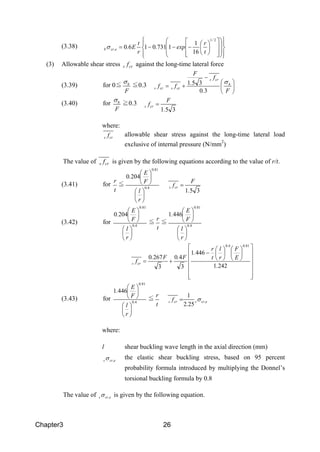
(3.38)






























−−−=
21
16
1
17310160
/
e,crb
t
r
exp.
r
t
E.σ
(3) Allowable shear stress crs f against the long-time lateral force
(3.39) for 0≦
F
hσ
≦0.3 





−
+=
F.
f
.
F
ff h
crs
crscrs
σ
30
351
(3.40) for
F
hσ
≧0.3
351.
F
fcrs =
where:
crs f allowable shear stress against the long-time lateral load
exclusive of internal pressure (N/mm2
)
The value of crs f is given by the following equations according to the value of r/t.
(3.41) for
t
r
≦ 40
810
2040
.
.
r
l
F
E
.












351.
F
fcrs =
(3.42) for 40
810
2040
.
.
r
l
F
E
.












≦
t
r
≦ 40
810
4461
.
.
r
l
F
E
.






































−
+=
2421
4461
3
40
3
2670
81040
.
E
F
r
l
t
r
.
F.F.
f
..
crs
(3.43) for 40
810
4461
.
.
r
l
F
E
.












≦
t
r
e,crscrs
.
f σ
252
1
=
where:
l shear buckling wave length in the axial direction (mm)
e,crsσ the elastic shear buckling stress, based on 95 percent
probability formula introduced by multiplying the Donnel’s
torsional buckling formula by 0.8
The value of e,crsσ is given by the following equation.
Chapter3 27
(3.44)
2/1
3
2/1
2
2/1
, 0239.01
83.4
8.0






















+














=
t
r
r
l
r
t
t
r
r
l
E
ecrsσ
3.7.3 Allowable Stresses against the Short-Term Load
The allowable stresses against the short-term load exclusive of the seismic load
should be the values given by multiplying the allowable stresses against the long-
term load shown in 3.7.2 by 1.5.
3.7.4 Allowable Stress against the Seismic Load
The allowable axial compressive, bending and shear stresses against the seismic
load are given by the following three terms (1), (2) and (3), respectively, which are
also depend on both hσ /F and r/t, and which should be applied to the ultimate
strength design.
(1) Allowable axial compressive stress against the seismic load
(3.45) for 0≦
F
hσ
≦0.3 




−
+=
F.
ff.
ff hcrccrs
crccrc
σ
30
70
(3.46) for
F
hσ
≧0.3 





−=
F
ff h
crscrc
σ
1
where:
crc f allowable seismic axial compressive stress exclusive of
internal pressure (N/mm2
)
crsf basic value for determining the strength of elephant-foot
bulge (N/mm2
)
The value of crsf is given by the following equations according to the value of r/t.
(3.47) for
t
r
≦0.069
F
E
Ffcrs =
(3.48) for 0.069
F
E
≦
t
r
≦0.807
F
E












−
+=
738.0
807.0
4.06.0 E
F
t
r
FFfcrs
(3.49) for 0.807
F
E
≦
t
r
ecrcrsf ,0σ=
where:
ecr ,0σ value given by eq. (3.28)
Chapter3 28
The value of crc f is given by the following equations according to the value of r/t.
(3.50) for
t
r
≦0.377
720.
F
E






Ffcrc =
(3.51) for 0.377
720.
F
E





 ≦
t
r
≦2.567
720.
F
E


























−
+=
1902
5672
4060
720
.
E
F
t
r
.
F.F.f
.
crc
(3.52) for 2.567
720.
F
E





 ≦
t
r
e,crccrc f σ=
where:
e,crcσ value given by eq. (3.32)
(2) Allowable bending stress against the seismic overturning moment
(3.53) for 0≦
F
hσ
≦0.3 




−
+=
F.
ff.
ff hcrbcrs
crbcrb
σ
30
70
(3.54) for
F
hσ
≧0.3 





−=
F
ff h
crscrb
σ
1
where:
crb f allowable seismic bending stress exclusive of internal
pressure (N/mm2
)
crsf value given by the eq. (3.47), (3.48) or (3.49). (N/mm2
)
The value of crb f is given by the following equations according to the value of r/t.
(3.55) for
t
r
≦0.274
780.
F
E






Ffcrb =
(3.56) for 0.274
780.
F
E





 ≦
t
r
≦2.106
780.
F
E


























−
+=
832.1
106.2
4.06.0
78.0
E
F
t
r
FFfcrb
(3.57) for 2.106
780.
F
E





 ≦
t
r
ecrbcrb f ,σ=
where:
ecrb ,σ value given by eq. (3.38)
Chapter3 29
(3) Allowable shear stress against the seismic lateral force
(3.58) for 0≦
F
hσ
≦0.3 





−
+=
F.
f
F
ff h
crs
crscrs
σ
30
3
(3.59) for
F
hσ
≧0.3
3
F
fcrs =
where:
crs f allowable seismic shear stress exclusive of internal pressure
(N/mm2
)
The value of crs f is given by the following equations according to the value of r/t.
(3.60) for
t
r
≦ 40
810
2040
.
.
r
l
F
E
.












3
F
fcrs =
(3.61) For 40
810
2040
.
.
r
l
F
E
.












≦
t
r
≦ 40
810
4461
.
.
r
l
F
E
.






































−
+=
2421
4461
3
40
3
60
81040
.
E
F
r
l
t
r
.
F.F.
f
..
crs
(3.62) for 40
810
4461
.
.
r
l
F
E
.












≦
t
r
e,crscrs f σ=
where:
l shear buckling wave length in the axial direction (mm)
e,crsσ value given by eq. (3.44)
3.7.5 Remarks on the Evaluation of the Design Shear Stress
(1) The design shear stress can be evaluated by the mean value within the range of the
shear bucking wave length in the axial direction.
(2) The cylinder’s inside radius of curvature r and wall thickness t can be defined by
their mean values within the range of the shear bucking wave length in the axial
direction.
Chapter3 30
(3) In the design of silos containing granular materials, the allowable shear stress can be
calculated by setting l/r =1 and hσ =0.
Commentary:
1. Empirical formula for buckling stresses
1.1 Case without internal pressure
The lower bound values of elastic buckling stresses which apply to cylindrical shells without
internal pressures are given by the following empirical formula.
(a) elastic axial compressive buckling stresses (empirical formula by ASA[3.1])
(3.7.1) 

























−−=
−
t
r
eE t
r
ecrc /1901.016.0 16
1
,σ
(b) elastic flexural buckling stresses (empirical formula by ASA[3.1])
(3.7.2) 

























−−=
−
t
r
eE t
r
ecrb /1731.016.0 16
1
,σ
(c) elastic shear buckling stresses [3.2] [3.3]
(3.7.3) 













+








×
=
t
r
t
r
r
l
t
r
r
l
E
ecr /0239.01
8.083.4
3
2,τ
Eq.(3.7.3) is given by the torsional buckling stress derived by Donnell multiplied by the reduction
factor of 0.8. These formula correspond to the 95% reliability limit of experimental data.
Based on the elastic buckling stresses, the nonlinearity of material is introduced. In the region
where the elastic buckling stresses exceeds 60% of the yield point stress of material ( yσ or yτ ),
the buckling mode is identified to be nonlinear. In Fig.3.7.1, the relationship between the buckling
stress and the r/t ratio (the buckling curve) is shown. The buckling curve in the nonlinear range is
modified as shown in Fig.3.7.1. (r/t)I is the (r/t) ratio at which the elastic buckling stress ecr,σ
reaches 60% of the yield stress. (r/t)II denotes the (r/t) ratio at which the buckling stress exceeds
the yield point stress. In the region of (r/t) ratios less than (r/t)II, the buckling stresses are assumed
to be equal to the yield point stress. In the region of (r/t) ratios between (r/t)II and (r/t)I, the
buckling stresses are assumed to be on a line as shown in the figure. (r/t)II was determined on the
condition that the elastic buckling stress at (r/t)II reaches 6.5 times to 7.5 times as large as the yield
point stress.
Fig.3.7.1 Buckling curve
Chapter3 31
(r/t)I and (r/t)II are determined according to the stress conditions as shown in Table 3.7.1.
The occurrence of buckling under combined stresses can be checked by the following criteria
(3.7.4)







=
=+
1
or
1
cr
crb
b
crc
c
τ
τ
σ
σ
σ
σ
otations:
cσ mean axial compressive stress
bσ compressive stress due to bending moment
τ shear stress
Eq.(3.7.4) implies that the axial buckling and the flexural buckling are interactive, while the shear
buckling is independent of any other buckling modes. The experimental data are shown in
Fig.3.7.2 . Figure (a) shows the data obtained by Lundquist on cylindrical shells made of
duralumin all of which buckled in the elastic range[3.4]. Figure (b) indicates the test results on
steel cylindrical shells[3.3]. The ordinate indicates crbbcrcc σσσσ // + and the abscissa indicates
crττ / . The buckling criteria which correspond to Eq.(3.7.4) is shown by the solid lines. Although
a few data can not be covered by Eq.(3.7.4), Eq.(3.7.4) should be applied as a buckling criterion
under the seismic loading considering that the estimate of Ds-values are made conservatively. For
short-term loadings other than the seismic loading, the safety factor of 1.5 is introduced in the
estimate of the elastic buckling stresses to meet the scatter of the experimental data.
Table 3.7.1 Limit r/t ratios
Stress Condition
Axial
Compression
Bending
Shearing
Chapter3 32
(a) Duralumin cylindrical shell (b) Steel cylindrical shell
Fig.3.7.2 Comparison between test results and predictions
1.2 Case with internal pressure
The effects of the internal pressure on the buckling of cylindrical shells are twofold :
・The internal pressure constrains the occurrence of buckling.
・The internal pressure accelerates the yielding of shell walls and causes the elephant foot bulge.
The effect of the internal pressure is represented by the ratio of the tensile hoop stress, hσ , to the
yield point stress, )/(, yhy σσσ [3.5].
Referring to experimental data, it was made clear that the buckling stresses under axial
compression and bending moment can be expressed by the following empirical formula[3.6] [3.7]:
(3.7.5)








−=
>
−
+=
≤
y
h
crcr
yh
yhcrcr
crcr
yh
for
for
σ
σ
σσ
σσ
σσσσ
σσ
σσ
1
,3.0/
3.0
)/)(7.0(
,3.0/
0
0










otations:
crσ buckling stress in case without internal pressure
0crσ compressive buckling stress in axi-symmetric mode
Fig.3.7.3 Influence of internal pressure on buckling stress
Chapter3 33
Eq.(3.7.5) is shown in Fig.(3.7.3). In the region below 3.0/ =yh σσ , the buckling occurs in
inextensional mode, whereas beyond 3.0/ =yh σσ , the buckling occurs in elephant foot bulge mode.
0crσ for cylinders which buckle elastically was found to be expressed by
(3.7.6) 





−
=
r
tE
ecr
)1(3
8.0
2
,0
ν
σ
otations:
ν Poisson's ratio
Eq.(3.7.6) is the theoretical buckling stress of axially compressed cylinders multiplied by a
empirical reduction factor of 0.8. The buckling stress in the inelastic range, 0crσ , can be related
to e,cr0σ , similarly to ecrc ,σ and ecrb ,σ as follows:
for 





≤
F
E
t
r
069.0
(3.7.7) ycr σσ =0
for
t
r
F
E
≤





807.0
(3.7.8) ecrcr ,00 σσ =
for 





<<





F
E
t
r
F
E
807.0069.0
0crσ is linearly interpolated between the values given by Eq.(3.7.7) and Eq.(3.7.8)
Fig.3.7.4 Comparison between test results and predictions for axial loading
Chapter3 34
The applicability of Eq.(3.7.5) is demonstrated in the following:
i) Axially compressed cylinders experimental data and the results of analysis are shown in
Fig.3.7.4, together with Eq.(3.7.5) [3.7]. The abscissa indicates the hoop stress ratio, yh σσ / , and
the ordinate indicate the ratio of the buckling stress to the classical theoretical buckling stress, 1cσ .
Shell walls were perfectly clamped at both ends. Test data are indicated by the symbols of ◆ that
indicates the buckling under diamond pattern, ● that indicates the buckling under elephant foot
bulge mode and ▲ that is the case of simultaneous occurrence of diamond pattern and elephant
foot bulge mode.
Curves with a specific value of ∆ are theoretical values for elephant foot bulge mode. ∆ is the
initial imperfection divided by the thickness of wall. The chained line going up right-handedly is
the theoretical curve of diamond pattern of buckling derived by Almroth[3.8]. The polygonal line A
is the design curve for seismic loading given by Eq.(3.7.5). The polygonal line B is the design
curve for loading other than the seismic loading.
ii) Cylinders subjected to shear and bending[3.6]
Referring to experimental results on cylindrical shells subjected to shear and bending, it was made
clear that the shear buckling pattern becomes easily localized with a faint presence of the internal
pressure.
In Fig.3.7.5, a shear buckling pattern under 05.0/ =yh σσ is shown. Thus, it is understood that
the internal pressure makes the substantial aspect ratio, r/l in Eq.(3.7.3), reduced drastically.
At 3.0/ =yh σσ , the shear buckling disappears.
Considering these facts, the shear buckling stress under the internal pressure can be summarized as
follows:
(3.7.9) for 3.0/ ≤yh σσ ,
( )( )
3.0
/ yhcry
crcr
σσττ
ττ
−
+=
for 3.0/ >yh σσ , ycr ττ =
otations:
yτ shear yield-point stress
Fig.3.7.5 Buckling wave pattern of shear buckling
2
/3.32,0.1/,477/,05.0/ cmkrtr yyh ==== σσσ l
Chapter3 35
(t/cm2
=9.8kN/cm2
)(t/cm2
=9.8kN/cm2
)
Fig.3.7.6 Influence of internal pressure on buckling
(in case of small internal pressure)
Fig.3.7.7 Buckling strength under combined internal pressure and flexural-shear loading
bσm(t/cm2
=9.8kN/cm2
)
bσm(t/cm2
=9.8kN/cm2
)
bσm(t/cm2
=9.8kN/cm2
)
bσm(t/cm2
=9.8kN/cm2
)
bσm(t/cm2
=9.8kN/cm2
)
Chapter3 36
In Fig.3.7.6, test results in the range of small values of yh σσ / are compared with the estimate
made by Eq.(3.7.5) and Eq.(3.7.9). The ordinate indicates the bending stress at the lower edge of
cylinder. Therefore, the shear buckling stress is converted to the equivalent bending stress by the
following equation.
(3.7.10)
r
h
crcr τσ =
otations:
h distance between the lower edge of shell and the point where
horizontal load is applied
Eq.(3.7.5) is shown by solid lines and Eq.(3.7.9) is shown by broken lines. As shown in the figure,
cylindrical shells subjected to internal pressures are hardly influenced by shear buckling.
In Fig.3.7.7, test data under wider range of parameters are shown, predictions made by Eq.(3.7.5)
and Eq.(3.7.9) are shown by solid lines. The point shown by ○ indicates the inextentional mode of
buckling, and the point shown by ● indicates the elephant foot bulge mode of buckling.
2. Safety factor on buckling stresses
Safety factors for various loading conditions are set up as shown in Table 3.7.2. The level of safety
factor depends on the probability of occurrence of the specified design loading.
Table 3.7.2 Safety factor for buckling
3. Supplementary comment on shear buckling
When geometrical parameters and structural parameters change within a range of shear buckling
length, the mean values of them can be taken according to the usual practice of engineering.
Generally, the buckling strengths of silos containing granular contents are influenced by the
internal pressure and stiffness associated with the properties of contents, and the shear buckling
length, r/l is considered to be less than unity. Still, the exact estimate of internal pressure under
seismic loading is difficult. As a tentative measure of compromise, the constraining effect of
internal pressure is to be disregarded on the condition that r/l is fixed to be unity.
4. Deformation characteristics after buckling
The general load-deformation curve of cylindrical shells subjected to the monotonic horizontal
force is schematically shown in Fig.3.7.8. The ordinate indicates the maximum bending stress, σb .
The abscissa indicates the mean inclination angle, θ . In the post-buckling range, the deformation
develops with a gradual decrease of resistant force, finally approaching a horizontal asymptote.
The level of the asymptote depends on the level of the axial stress, 0σ . When crc σσ /0 becomes
larger than 0.2, the asymptote disappears, and the resistant force decreases monotonously as the
deformation increases.
When crc σσ /0 remains less than 0.2, cylindrical shells exhibit a stable energy absorption capacity
Safety factor for buckling
Loading
condition
Long term
condition
Short term
(except
earthquake)
Linear interpolation
Earthquake
condition
Linear interpolation
Chapter3 37
[3.3] [3.6] [3.10] [3.11].
The hysteretic behavior of cylindrical shells under repeated horizontal forces is shown in
Fig.(3.7.9).
The basic rule which governs the hysteretic behavior is described as follows.
・ Definitions to describe the hysteretic rule:
a) The loading path is defined by 0>θσdb .
b) The unloading path is defined by 0<θσdb .
・ The θσ −b relationship under the monotonic loading is defined to be the skeleton curve.
・ The unloading point is defined to be the point which rests on the skeleton curve and
terminates the loading path.
・ The initial unloading point is defined to be the point at which the buckling starts.
・ The intermediate unloading point is defined to be the point which does not rest on the
skeleton curve and terminates the loading path.
On the assumption that the loading which reaches the initial loading point has been already made
in both positive and negative directions, the hysteretic rule is described as follows.
a) The loading path points the previous unloading point in the same loading domain. After
reaching the previous unloading point, the loading path traces the skeleton curve.
b) The unloading path from the unloading point points the initial unloading point in the
opposite side of loading domain. The unloading path from the intermediate unloading point
has a slope same as that of the unloading path from the previous unloading point in the same
loading domain.
These hysteretic rule has been ascertained to apply even for the case of 0/ ≠yh σσ .
Fig.3.7.8 Load-deformation relationship under monotonic loading
Fig.3.7.9 Hysteretic rule
skeleton curve
loading path
unloading path
initial unloading point
unloading point
intermediate unloading point
parallel
Chapter3 38
5. ηD -values for cylindrical structures
ηD -values for structures with short natural periods which has been obtained analytically using
the load-deformation characteristics shown in Fig.3.7.9 are shown in Fig.3.7.10[3.12].
Essential points in the analysis are summarized as follows.
5.1 ηD -values in case that uplift of the bottom of the structure is not allowed by restraint of an
anchoring system:
1) Assuming that the structure is one-mass system and equating the structural energy
absorption capacity to the energy input exerted by the earthquake, the maximum deformation
of the structure is obtained.
2) The energy input to the structure is obtained by considering the elongation of the vibrational
period of structure.
3) The ηD -values is defined by
(3.7.11)
cr
cr
D
δµ
δ
η
)1(ofndeformatiomaximumthecauseswhichearthquakeoflevelthe
n,deformatiobucklingthecauseswhichearthquakeoflevelthe
+
=
otations:
1−=
cr
m
δ
δ
µ nondimensionalized maximum deformation
crδ buckling deformation
4) The assumed load-deformation curve in monotonic loading is one that exhibits a
conspicuous degrading in strength in the post-buckling range as shown in Fig.3.7.10. q in
the figure denotes the nondimensionalized level of the stationary strength in the post buckling
range.
When we select the value of ηD to be 0.5, the pairs of values of ( µ,q ) are read from
Fig.3.7.10 as follows : (0.6, 1.0), (0.5, 2.0), and (0.4, 4.0). See Table 3.7.3.
These µ−q relationships which corresponds to 5.0=ηD are compared with the
nondimentionalized load-deformation curves obtained experimentally in Fig.3.7.11 and
Fig.3.7.12. The µ−q relations are written as white circles in these figures. The
experimental curves lie almost above the µ−q relations for 5.0=ηD (see Table 3.7.3). It
implies that the actual structures are more abundant in energy absorption capacity than the
analytical model equipped with the load-deformation characteristics shown in Fig.3.7.10.
Thus, to apply the value of 0.5 for ηD -values of cylindrical structures influenced by buckling
seems reasonable. When the axial compressive stress becomes large, however, the ηD -
values should be kept larger than 0.5 since the strength decreases drastically in the post
buckling range.
Consequently, the value of ηD is determined as follows:
Chapter3 39
Fig.3.7.10 ηD -values
for crcσσ /0 ≦0.2,
(3.7.12) 5.0=ηD
for crcσσ /0 >0.2,
(3.7.13) 7.0=ηD
Table 3.7.3 q(=Q/Qcr) and )/][( crcr δδδµ −= relationship (in case of 2.0/0 ≦crδδ , 5.0=ηD )
q µ
0.6 1.0
0.5 2.0
0.4 4.0
Fig.3.7.11 Load-deformation relationship
which corresponds to 5.0=ηD
( 0/ =yh σσ )
Chapter3 40
Fig.3.7.12 Load-deformation relationship
which corresponds to 5.0=ηD
( 0/ ≠yh σσ )
5.2 ηD -values in case that uplift of the bottom of the structure is allowed without an anchoring
system:
The ηD -value defined in Eq. (3.6.15) of sec. 3.6 should be expressed as follows:
(3.7.14)








+
=
e
p
W
W
D
1
1
η
The cumulative plastic strain energy Wp induced by buckling of the shell plate is as indicated
in Eq. (3.6.7). However, the elastic vibration energy We should be of the strain energy of the
cylindrical shell added by the strain energy due to the uplift of the bottom of the shell. In case
that uplift of the bottom of the structure is not allowed, replacing ηD and We with fDη
and Wef,
respectively, Eq. (3.7.14) should be expressed as follows:
(3.7.15)








+
=
ef
p
f
W
W
D
1
1
η
In case that uplift of the bottom of the structure is considered, Eq. (3.6.8) should be expressed as
follows:
(3.7.16)
2
yy
e
Q
W
δ
=
Whilst in case that uplift of the bottom of the structure is not considered, Wef should be expressed
as follows:
(3.7.17) efW =
2
2 







e
fyy
T
TQ δ
From (3.7.14) to (3.7.17) ηD value, in case that uplift of the bottom of the structure is allowed,
should be given in Eq. (3.7.18).
(3.7.18) ηD =
2
1
2
2
1
1
1
1
























−+
e
f
f
T
T
Dη
Chapter3 41
otations:
eff WD ,η eWD ,η
in case that uplift of the bottom of the structure is
not allowed.
Tf natural period in case that uplift of the bottom of the
structure is not allowed.
Te natural period in case that uplift of the bottom of the
structure is considered.
In general as Te > Tf , ηD > fDη .
6. B-value for cylindrical structures
In thin steel cylindrical structures, the buckling starts when the maximum stress reaches the
buckling stress, crσ .
Therefore, the stress redistribution due to yielding is hardly considered. Thus, the value of B for
steel cylindrical shells should be set as follow:.
for tr / ≧( tr / )II ,
(3.7.19) B=1.0
otations:
( tr / )II :refer to Table 3.7.1
3.8 Earth Pressures
3.8.1 Earth Pressure in Normal Condition
Earth pressure in normal condition should be determined according to
“Recommendations for Design of Building Foundations, 2001 - Architectural
Institute of Japan ”.
-------------------------------------------------------------------------------------------------------------------
Commentary:
Earth pressures in the normal condition for sand and clay shall be calculated in accordance with
the “Recommendations for design of building foundations (2001)” compiled by the Architectural
Institute of Japan (AIJ).
3.8.2 Earth Pressure during Earthquakes
Earth pressures which act on the underground walls of tanks during earthquakes
may be considered to be either active or passive and should be calculated in
accordance with equations (3.63) and (3.64) for active earth pressures, and (3.65)
and (3.66) for passive earth pressures.
(a) Active earth pressure
(3.63) EAVEA K)
cos
z)(K(P
θ
ω
γ +−= 1
(3.64) 2
21
2
1














+
−+
++
−
=
/
EA
)cos(
)sin()sin(
)cos(cos
)(cos
K
θδ
θφδφ
θδθ
θφ
Chapter3 42
(b) Passive earth pressure
(3.65) EPVEP K)
cos
z)(K(P
θ
ω
γ +−= 1
(3.66) 2
21
2
1














+
−+
−+
−
=
/
EP
)cos(
)sin()sin(
)cos(cos
)(cos
K
θδ
θφδφ
θδθ
θφ
where:
PEA horizontal active earth pressure during earthquakes acting
on vertical wall at depth z (N/mm2
) - refer also to Figure 3.1,
KV vertical underground seismic intensity given in chapter
3.6.2.2,
γ unit weight of soil (N/mm3
),
z depth from the ground surface (mm),
ω load pressure (N/mm2
), - refer also to Figure 3.1,
θ tan-1
K,
K combined seismic coefficient, see equation (3.67)
(3.67) K=
V
H
K
K
−1
KH horizontal underground seismic intensity given in chapter
3.6.2.2,
KEA coefficient of active earth pressure during earthquakes,
φ internal friction angle of soil,
δ wall friction angle,
PEP horizontal passive earth pressure during earthquakes acting
on vertical wall at depth z (N/mm2
), - refer also to figure 3.1
KEP coefficient of passive earth pressure during earthquakes.
Fig.3.1 Definition of symbols
-------------------------------------------------------------------------------------------------------------------
Commentary:
Although the actual mechanism of soil pressure during earthquakes is complicated and unknown to some
extent, Mononobe and Okabe presented their formula for earth pressure during earthquakes using
seismic intensity and Coulomb’s earth pressure theory of ultimate slip. Vertical tank wall and horizontal
ground surface are assumed in equations (3.8.1) and (3.8.2) for simplicity.
ω (N / mm2
)
tank PEA , PEP (N / mm2
)
Chapter3 43
(a) Seismic active earth pressure resultant
(3.8.1) 2
)
cos2
)(1(' HK
H
KP EAVEA
θ
ωγ
+−=
(b) Seismic passive earth pressure resultant
(3.8.2) 2
)
cos2
)(1(' HK
H
KP EPVEP
θ
ωγ
+−=
where:
'EAP seismic active earth pressure resultant acting on the wall
with depth H ( /mm)
EAK see eq. (3.64) in chap. 3.8.2
VK see eq. (3.15) in chap. 3.6.2.2
γ unit weight of soil ( /mm3
)
H depth from the ground surface to the tank bottom (mm)
ω imposed loads ( /mm2
)
θ seismic composite angle (=tan-1
K)
'EPP seismic passive earth pressure resultant acting on the wall
with depth H ( /mm)
EPK see equation (3.66) in chap. 3.8.2
As shown above, Mononobe and Okabe’s formula gives the resultant acting on the tank wall for a
unit width soil wedge above the slip surface. For convenience, this recommendation transforms
equations (3.8.1) and (3.8.2) to pressures per unit area of the tank wall as in equations (3.63) and
(3.65). If these equations are integrated in the interval z = 0~H, equations (3.8.1) and (3.8.2) will
be obtained.
Equations (3.63) ~ (3.66) give pressures acting in the inclined direction with angle δ from the
horizontal plane. But the angle of friction between the wall and the soil may be neglected, and the
pressures may be regarded as acting in the normal direction to the wall.
The equations in this chapter give ultimate earth pressure, but they have limitations in that their
basis is static equilibrium and they depend on assumed seismic intensity. Therefore additional
methods, such as response displacement, seismic intensity, or dynamic analysis methods should
also be used in the design for seismic loads.
References:
[3.1] ASA SP-8007: Buckling of Thin-walled Circular Cylinders, Aug. 1968
[3.2] Donnell, L. H.: Stability of Thin-walled Tubes under Torsion, ACA, T 479, 1933
[3.3] Akiyama, H., Takahashi, M., Hashimoto, S.: Buckling Tests of Steel Cylindrical Shells Subjected to
Combined Shear and Bending, Trans. of Architectural Institute of Japan, Vol. 371, 1987
[3.4] Lundquist, E. E.: Strength Test of Thin-walled Duralumin Cylinders in Combined Transverse Shear and
Bending, ACA, T 523, 1935
[3.5] Yamada, M.: Elephant's Foot Bulge of Cylindrical Steel Tank Shells JHPI, Vol. 18, o. 6, 1980
[3.6] Akiyama, H., Takahashi, M., omura, S.: Buckling Tests of Steel Cylindrical Shells Subjected to
Combined Bending, Shear and Internal Pressure, Trans. of Architectural Institute of Japan, Vol. 400,
1989
[3.7] Yamada, M., Tsuji, T.: Large Deflection Behavior after Elephant's Foot Bulge of Circular Cylindrical
Shells under Axial Compression and Internal Pressure
Summaries of Technical Papers of Annual Meeting, AIJ, Structure-B, pp. 1295-1296, 1988
[3.8] Almroth Bo O., Brush D. O.: Postbuckling Behavior of Pressure Core-Stabilized Cylinders under Axial
Compression. AIAA J., Vol. 1, pp.2338-2441, 1963
Chapter3 44
[3.9] Yamada, M.: Elephant's Foot Bulge of Circular Cylindrical Shells
The Architectural Reports of the Tohoku University, Vol. 20, pp. 105-120, 1980
[3.10] Shibata, K., Kitagawa, H., Sampei, T. Misaji, K: The Vibration Characteristics and Analysis of After
Buckling in Metal Silos, Trans. of Architectural Institute of Japan, Vol. 367, 1986
[3.11] Kitagawa, H., Shibata, K.: Studies on Comparison of Earthquake - Proof of Metal and FRP Silos,
Summaries of Technical Papers of Annual Meeting, AIJ, Structure - B, 1988
[3.12] Akiyama, H.: Post Buckling Behavior of Cylindrical Structures Subjected to Earthquakes, 9th SMiRT,
Lausanne, 1987
[3.13] Kato, B., Akiyama, H.: Energy Input and Damages in Structures Subjected to Severe Earthquakes,
Trans. of Architectural Institute of Japan, Vol. 235, 1975
Chapter 4 45
4 Water Tanks
4.1 Scope
4.1.1 General
This chapter is applicable to the design of potable water storage tanks and their
supports.
4.1.2 Materials
Potable water storage tanks are normally constructed using reinforced concrete, pre-
stressed concrete, carbon steel, stainless steel, aluminium, FRP, timber, or any
combination of these materials.
4.1.3 Notations
B ratio of the horizontal load-carrying capacity to the short term allowable
strength.
hi height of the i-th mass from ground level (m).
Qei design storey shear force for designing allowable stresses (N).
W design weight imposed on the base of the structure exclusive of
convective mass (N). See chap. 4.2.4.4.
4.2 Structural Design
4.2.1 Design Principles
4.2.1.1 Potable water storage tanks should be located such that the contents are not subject
to insanitary pollution. They should also be located to enable easy access for
inspection, maintenance, and repair.
4.2.1.2 The shape of a water tank should be as simple as possible, be symmetrical about its
axis, and mechanically clear of any unnecessary obstructions.
4.2.1.3 Due consideration should be given to stress concentrations at openings or
penetrations for pipework.
4.2.1.4 Suitable measures should be taken to prevent a sudden internal pressure drop caused
by any uncontrolled release of water.
4.2.1.5 The foundations for water tanks should be designed such that the total forces of the
overall structure are transferred to the ground as smoothly as possible.
4.2.2 Allowable Stresses and Material Constants
Allowable stresses and material constants used in the construction of water tanks
and their support structures should be in accordance with the applicable codes and
standards, and as indicated below.
Chapter 4 46
(1) Long term allowable stresses of reinforcing bars in a reinforced concrete structure
should be properly defined after taking into account the allowable cracking width.
(2) Allowable stresses of stainless steel should be defined in accordance with the
“Design Standard for Steel Structures – Based on Allowable Stress Concept -” - AIJ
2005. The standard F value should be taken as 0.2% strength as stipulated by JIS.
(3) The standard value F, which defines yielding stress of all welded aluminium alloy
structure, should be defined in accordance with the “Aluminum Handbook – Japan
Aluminium Association (2001)” etc.
(4) Allowable stresses and constants of FRP structures should be defined by reference to
the material characteristics obtained from tensile and flexural strength tests,
(“Method of tension test for FRP” - JIS K 7054, and “Method of flexural test of
FRP” - JIS K 7055), after taking into account degradation due to aging, etc.
4.2.3 Loads
4.2.3.1 Loads for structural design should be as shown in chapter 3 in addition to the
provisions of 4.2.3.2 below and so on.
4.2.3.2 Water tanks should be considered as being full for the design calculations. However,
a partial load for the tank contents may be considered when there is a dangerous
combination of loads that would increase the overall loading.
4.2.4 Seismic Design
4.2.4.1 Seismic design of water tanks should be classified below in accordance with 3.6.1.7:
- Small water tanks used at private houses Ⅰ
- Essential water tanks for public use Ⅲ
- Others Ⅱ
4.2.4.2 Design seismic loads should be obtained from the simplified seismic coefficient
method or the modal analysis which are shown in 3.6.1.2, 3.6.1.3 and 4.2.4.5 except
for 4.2.4.3.
4.2.4.3 Design yield shear forces should be determined based on the horizontal seismic
coefficient of 1.5 for the water tanks placed on the roof.
4.2.4.4 Contents in the water tank should be considered in two different masses, i.e. the
impulsive mass of the tank contents that moves in unison with the tank and the other
convective mass of the tank contents that acts as sloshing liquid. See the commentary
of chap. 7.1 and 7.2 for more information.
4.2.4.5 Calculation of design shear forces based on Simplified Seismic Coefficient Method:
Chapter 4 47
(1) The design yield shear force, Qd, at the ground base of the water tank should be
calculated by the equations (3.1) by use of the simplified seismic coefficient
method.
Where:
W = design weight imposed on the base of the structure exclusive of convective
mass (N)
Ds = structural characteristic coefficient, as is given on Table 4.1
Table 4.1 Ds Value
(a) Elevated Water Tanks
Structure Type of Structure Ds
Metallic Structure
Moment Frame 0.40
Truss/Bracing 0.40
Plate/Shell 0.5~0.7
Reinforced Concrete Structure
Steel Reinforced Concrete Structure
Pre-stressed Concrete Structure
Moment Frame 0.40
Plate 0.45
(b) Water Tanks Installed Directly on the Foundation or Ground
Structure Ds
Other than below 0.55
Reinforced Concrete Structure
Pre-stressed Concrete Structure
0.45
4.3 Reinforced Concrete Water Tanks
The design of reinforced concrete water tanks should be as indicated in 2.2, 2.3, 2.4
and 4.2, and the “Standard for Structural Calculation of Reinforced Concrete
Structures” - AIJ 2010. However, the following provisions should also be taken into
consideration.
(1) Concrete for water tanks should be as specified in Chapter 23: Watertight Concrete -
JASS 5, AIJ 2009.
(2) The minimum ratio of reinforcing bars of side walls and bottom slab should be more
than 0.3% in both orthogonal directions.
(3) The minimum concrete covering of reinforcing bars should be as given in Chapter
3.11: Cover - JASS 5, AIJ 2009.
(4) Any required water proofing should be applied to the surface that is in contact with
the stored water.
Chapter 4 48
(5) The minimum concrete covering of reinforcing bars to the surface in contact with
stored water should be 30mm, and in the case of light duty water proof finishing,
e.g., mortar, or in cases where no water proof finishing is applied, the minimum
cover of reinforcing bars should be 40mm and 50mm respectively.
4.4 Pre-stressed Concrete Water Tanks
Pre-stressed concrete water tanks should be as stipulated in 2.2, 2.4, and 4.2 of this
document, and the “Standard for Structural Design and Construction of Pre-stressed
Concrete Structures” - AIJ 1998. Reinforced concrete components should be as
noted in 4.3. In addition, the following provisions should be taken into
consideration.
(1) For usual use conditions, cross sections of members should be designed in full pre-
stressing condition. Stresses from water pressure should be considered as live loads.
(2) The additional loads and stresses caused by pre-stressing should also be taken into
consideration.
(3) Thermal stresses and additional stresses caused by dry shrink strain should be
considered.
4.5 Steel Water Tanks
The design of steel water tanks should conform to the “Design Standard for Steel
Structures - Based on Allowable Stress Concept - ” 2005 edited by the Institute, and
the following items.
(1) Cylindrical shell design of the water tanks should give investigation on the buckling
of the cylindrical shell conforming to section 3.7.
(2) The water tanks and pipeline design should give full preventative measures to
corrosion.
4.6 Stainless Steel Water Tanks
The design of stainless steel water tanks should conform to the “Guideline of Anti-
Seismic Design and Construction of Building Equipments (2005)” edited by the
Building Center of Japan (BCJ) etc. The design of stainless steel water tanks support
section should conform to the “Design and Construction Standard on the Stainless
Steel Building Structure, and the Explanation (2001)” edited by the Stainless Steel
Japanese Society of Steel Construction, and the following items.
(1) Cylindrical shell design of the water tanks should give investigation on buckling of
the cylindrical shell conforming to section 3.7
Chapter 4 49
(2) The water tanks and pipeline design should give full preventative measures to
corrosion.
4.7 Aluminium Alloy Water Tanks
The design of aluminium alloy structure should conform to section 2.5, 4.2 and the
“Commentary, Design and Calculation Examples of Technical Standard on the
Aluminium Alloy Building Structure (2003) by BCJ etc.”, and to the following
items.
(1) Cylindrical shell design of the water tanks should give investigation on buckling of
the cylindrical shell conforming to section 3.7
(2) The water tanks and pipeline design should give full preventative measures to
corrosion.
(3) When the stored water is potable water, adequate lining should be applied to the
inner wall surface of the tank.
4.8 FRP Water Tanks
The acceleration response of the story at which FRP water tanks is installed should
be taken into consideration on the seismic design of the tank. They are usually
installed at a higher elevation.
The pipe connections and the anchoring system should be designed with carefulness.
Both of them are known to be relatively easily suffered damages during earthquakes.
Consideration should also be given to the sloshing response of the water during
earthquake which may cause to damage the ceiling panels.
Materials used in the manufacture of FRP water tanks should meet the requirements
of paragraphs, 2.6 and 4.2, and should be designed in accordance with a recognised
code, e.g., the Japan Reinforced Plastics Society “Structural Calculation Method for
FRP Water Tanks (1996)”.
However, the following precautions should be always considered.
(1) The wall thickness of the tank should be more than 3mm except for the manhole
cover plate.
(2) The design should give consideration to the anisotropic physical properties of the
proposed FRP materials.
(3) The design should give consideration to the thermal properties of the proposed
materials in case the tank contains the hot water.
(4) The design should give consideration to the corrosion prevention in case the tank is
reinforced with metals.
Chapter 4 50
(5) The design should give consideration to the measure to prevent formation of algae
due to the transmission of light.
(6) Materials selected for potable water tanks should be of the ones not impair the
quality of the stored water, and should be resistant to the chemicals used for
cleaning the tank.
(7) The structural design should give consideration to the expected loads and the
physical characteristics of the proposed FRP materials.
4.9 Wooden Water Tanks
This section is omitted in this English version.
-------------------------------------------------------------------------------------------------------------
Commentary:
In addition to designing for structural integrity, the design of FRP water tanks should include
all hygiene requirements for potable water.
The following points should be given due consideration in the design of FRP water tanks:
(1) With disregard to the calculated strength requirements and the derived wall thickness
requirements, a minimum wall thickness of 3mm should be applied to all FRP water
tank designs.
(2) The orientation of glass fibre has a significant effect on the strength and stiffness of
FRP. Therefore, due consideration should be given to the anisotropy of the glass fibre
reinforcement in the design of FRP water tanks.
(3) The effect of temperatures between - 40°C and + 40°C on the material characteristics
of FRP is minimal. As the normal temperature range of potable water is + 4°C to +
30°C the effect of temperature on FRP materials is therefore insignificant. However,
at temperatures above + 60°C the strength and stiffness of FRP is impaired, therefore
the design of water tanks for use at high temperatures should take into account this
loss of strength and stiffness.
(4) In cases where a combination of FRP and other materials is necessary, e.g.,
galvanised steel or stainless steel reinforcement, preventative measures should be
taken to prevent corrosion of the non FRP reinforcement by contaminants or other
chemicals, e.g., chlorine, in the water .
(5) In order to prevent the formation of algae inside water tanks, and therefore to
maintain water quality, the intensity ratio of illumination (the ratio of intensity of light
between the inside and outside of the water tank), should not exceed 0.1%. Care
should therefore be taken in the design and placement of manholes, air vents, roof
panels, etc., which may provide points of ingress for light.
(6) Materials used in the construction of potable water tanks should meet the relevant
hygiene standards. Particular attention should be paid to the prevention of materials
being used in the manufacturing process which may be soluble in water and which can
affect the quality of potable water. As the inside of water tanks are washed with an
Chapter 4 51
aqueous solution of sodium hypochlorite, only materials which are known to be
resistant to this cleansing agent should be selected for water tanks.
(7) FRP does not have the distinct yield point, and neither does it have the ductility
similar to metallic materials. Therefore the structural design should take into account
this deformation and strength characteristics of the FRP structure.
Chapter 5 52
5. Silos
5.1 Scope
5.1.1 This chapter covers the structural design of upright containers and their supports
(silos) for storing granular materials.
5.1.2 Definitions
silos the generic name for upright containers used for storing granular
materials and their supports.
containers tanks for storing granular materials.
silo wall the upright wall of the containers.
hopper the inclined wall of the containers.
Note: The term granular materials is taken to include “fine particles”.
5.1.3 The structural materials of the silos which are considered in this chapter are
reinforced concrete and steel.
5.1.4 Notations
A horizontal area of the silo (m2
)
B ratio of the horizontal load-carrying capacity of the structure to the short-
term allowable yield strength
C design yield shear force coefficient at the
base of silo
Cd overpressure factor, used to consider
increases of pressure occurring during
discharge, converting from static pressure to
design pressure
Cf safety factor of friction force, used to long
term design friction force between silo wall
and granular materials
Ci impact factor, used to consider pressure
increase due to sudden filling, converting
from static pressure to design pressure
CL ratio of the local pressure to the design
horizontal pressure
d diameter (inside) of silo (see Fig.5.1) (m)
H height of the silo (see Fig.5.1) (m)
hm effective height of material above bottom of
hopper assuming top of stored material is
levelled (see Fig.5.1) (m)
Ks ratio of Ph to Pv
lc perimeter of horizontal inside cross section of
container (or hopper) (m, cm)
d m vertical design force per unit length of silo
wall horizontal section (N/mm)
Pf friction force of unit area of silo wall surface
Fig.5.1 Silo Section
assumed free
surface
skirtsilowall
Chapter 5 53
at depth x (N/mm2
)
Ph horizontal pressure of unit area at depth x due to stored material (N/mm2
)
Pv vertical pressure of unit area at depth x due to stored material (N/mm2
)
Pa pressure normal to the surface of inclined hopper wall (N/mm2
)
dPh design horizontal pressure of unit area (N/mm2
)
dPL design local horizontal pressure of unit area (N/mm2
)
dPv design vertical pressure of unit area (N/mm2
)
dPa design normal pressure of unit area to hopper wall (N/mm2
)
rw hydraulic radius of horizontal cross section of storage space (m)
x depth from surface of stored material to point in question (m)
α angle of hopper from horizontal (°)
γ weight per unit volume for stored material (N/mm3
)
µf coefficient of friction between stored material and wall or hopper surface
φi internal friction angle of stored material ( ° )
φr repose angle of stored material ( ° )
5.2 Structural Design
5.2.1 General
5.2.1.1 Silos and their supports should be designed to contain all applicable loads taking
into account the properties of stored materials, the shape of the silos, methods of
material handling, etc.
5.2.1.2 The shape of the silo should be as simple as possible, be symmetrical about its axis,
and should have structural members which are proportioned to provide adequate
strength.
5.2.1.3 The foundations for silos should be designed to support stresses from the upper
structural members of the silos and their supports.
5.2.1.4 The design should include measures to prevent dust or gas explosions and
exothermic reaction of stored materials.
5.2.1.5 In the event that fumigation with insecticides is required, the silo should be air tight
in accordance with the applicable regulations.
5.2.1.6 The internal surfaces of silos which are used for storing food materials or feed stock
should meet the relevant food safety and sanitary regulations.
5.2.1.7 Physical property tests using actual granular materials are expected to find weight
per unit volume γ , internal friction angle iφ ; and deformation characteristics
(dependency of rigidity and damping ratio on strain level)
Chapter 5 54
5.2.2 Loads
5.2.2.1 General
With the exception of loads for structural design shown in this chapter, all other
loadings should, in principle, be based on chapter 3.
(1) Silos, hopper walls, and bottom slabs should be designed to resist all applicable
loads, and should include forces from stored materials, static pressures, dynamic
over-pressure and under-pressure during charge and discharge, arch, collapse of arch,
aeration and eccentric discharge.
(2) Design for group silos should take into account the varying operational scenarios.
e.g., some silos are full, others are empty, and some are in the process of being filled
or emptied.
(3) In the case that the characteristics of the stored material may be subject to change
during storage, the design should consider the most severe load conditions.
(4) The designer may use an alternative method for calculating pressures if it can be
verified by experiments etc.
5.2.2.2 Pressures and friction forces of static stored materials
Static pressures exerted by stored material at rest should be calculated using the
following methods.
(1) The vertical pressure, Pv, at depth x below the surface of the stored material is
calculated using equation (5.1).
(5.1) 






 ⋅⋅−
−⋅
⋅
⋅
= wsf
sf
w
v
rxK
e
K
r
P
/
1
µ
µ
γ
in which Ks and rw are obtained from equations (5.2) and (5.3).
(5.2)
i
i
sK
φ
φ
sin1
sin1
+
−
= where : 3.0≧sK
(5.3) rw = A/lc
(2) The horizontal pressure, Ph, of a unit area at depth x from the free surface is obtained
from equation (5.4).
(5.4) vsh PKP ⋅=
(3) The friction force, Pf, of a unit area of silo wall at depth x from the assumed free
surface should be computed from equation (5.5).
(5.5) hff PP ⋅= µ
Chapter 5 55
(4) The static unit pressure Pa normal to the surface inclined at angle α to the
horizontal at depth x below the surface of stored material is obtained form equation
(5.6).
(5.6) αα ν
22
cossin ⋅+⋅= PPP ha
5.2.2.3 Design pressures and forces exerted by stored materials
(1) Design pressures should be obtained by multiplying the static pressures by the
overpressure correction factor Cd or impact factor Ci in accordance with the
appropriate equations (5.7), (5.8), or (5.9).
(5.7) νν PCdP i ⋅= for silo wall.



⋅=
⋅=
νν
νν
PCdP
PCdP
d
i
for hopper, whichever is greater.
(5.8) hdh PCdP ⋅=
(5.9)



⋅=
⋅=
ada
aia
PCdP
PCdP
whichever is greater.
(2) The impact factor, Ci, should be used to consider the material properties, the
charging method and the charging rates, and should be taken a value between the 1.0
and 2.0.
(3) The minimum required values of overpressure factor Cd are given in Figure 5.2.
Fig.5.2 Minimum Required Values of Overpressure Factor dC
(4) For small scale and 1.5≧hm/ d silos, minimum required factor may be Cd =1.0,
however Pv is taken as xP ⋅= γν .
(5) The long - term local pressure shown below should be taken into account, as well as
above discussed Ci and Cd , to consider the increase and decrease of pressure by
arching and collapse of the arch etc. in stored materials.
d
Cd
Cd
1.2×Cd
1.0
for hm/d≧4.0
Cd=2.0
for 4.0>hm/d>1.0
Cd=4/3+hm/6d
for 1.0≧hm/d
Cd=1.5
h0 : hopper height
hm
h0hm-h0
hm
hm-h0h0
Chapter 5 56
1) The design pressure hd PC ⋅ is multiplied by CL, which ranges from 0.15 to 0.4
and depends on eccentricity of the discharge outlet, and this local pressure dPL (=
hdL PCC ⋅⋅ ) is applied to the partial area of the silo wall of 0.1d width. A set of
pressures, compressive directions or tensile ones both, is applied to any point -
symmetric locations of silo wall, as shown in Figure 5.4. The eccentricity “e” is
defined in Figure 5.3.
2) CL=0.15 when e=0, and CL=0.4 when e=0.5d, the case where the outlet is just on
the wall. For other values of “e”, CL is given by CL=0.15+0.5 (e/d).
3) For cases where “e” is less than or equal to 0.1d, the local pressure for the upper
part of the silo wall may be reduced. The CL is given by CL=0.15+0.5(e/d) if the
height of the location from the bottom end of the silo walls is less than 1.5d, and
takes zero at the top. Between the 1.5d height and the top, a linear function of height
gives the CL value. See equation (5.10) and Figure 5.5.
Fig.5.3 Definition of Eccentricity
e
e : eccentricity
discharge outlet dPL
tensile
compressive
compressive
0.1d
Fig.5.4 Local Pressure
tensile
dPL
(5.10)



+=
⋅⋅=
)/(5.015.0 deC
PCCdP
L
hdLL
(6) Vertical long-term design force d m per unit length of silo wall horizontal section, at
depth x from free surface, should be computed as shown in equation (5.11).
(5.11) fwm Cr)Px(d ⋅⋅−⋅= νγ
where Cf is taken both 1.0 and more than 1.5, because either case may generate the
larger stress.
(7) Vertical short-term design force d m by the seismic force should be calculated by
equation.5.12
(5.12) wm r)Px(d ⋅−⋅= νγ
(8) The axial force in the direction of generator on the hopper wall horizontal section per
unit length, φ , and the tensile force in the circumferential direction, θ , are
calculated using equations (5.13) and (5.14) respectively. See Figure 5.6.
(5.13)
αα
φ
sin4
'
sin
)(
⋅
⋅
+
⋅
+
=
ddP
l
WW v
c
sh
Chapter 5 57
(5.14)
α
θ
sin2
'
⋅
⋅
=
ddPa
Where :
hW weight of the contents of the hopper beneath the section (N)
sW weight of the hopper beneath the section (N)
cl perimeter of the hopper at the section level (mm)
'd diameter of the hopper at the section level (mm)
α slope of the hopper ( o
)
vdP design vertical pressure of unit area at the section level (N/mm2
)
adP design normal pressure of unit area to hopper wall at the section level
(N/mm2
)
For design of the connection of the hopper and the silo wall, however, an additional
case where φ is assumed to be zero should be considered.
5.2.2.4 Mixing by Stirring and Rotation
The effect of mixing materials by stirring and rotation, in which stored materials are
discharged to other silos and simultaneously charged from other silos, should be
considered for both dynamic overpressure and impact pressure.
Fig.5.6 Force Acting on the Hopper
adPvdP
α
'd
generator direction generator direction
section level
circumferential direction
1.5d
0 0.15~0.4
e/d>0.1
e/d≦0.1
d
Fig.5.5 Local Pressure Factor CL
Chapter 5 58
5.2.2.5 Eccentric discharge
The design should take into account the effect of asymmetric flow, the local pressure
given by equation (5.10), caused by concentric or eccentric discharge openings. If a
silo has mobile discharge openings, the maximum value of eccentricity should be
adopted.
5.2.2.6 Pressure increase due to aeration
In the case of aeration in a silo and pneumatic conveyance, the possibility of
pressure increase should be considered.
5.2.2.7 Flushing phenomenon
The possibility of flushing phenomenon should be considered where there is the
possibility that the silos could be mis-operated, or where it is likely that material
fluidity could be a contributing factor in any seismic event.
5.2.2.8 Thermal stresses
Consideration should be given to thermal stresses generated in the walls of silos in
which hot materials are stored.
-------------------------------------------------------------------------------------------------------------
Commentary:
5.2.2.2 Pressures and friction forces of static stored materials
Foreign standards5.1)~5.3)
may be referred to for better understanding of this chapter. Janssen’s
equation5.4)
and Rankine’s earth pressure (equations (5.1) and (5.2)) are used for static pressures. To
obtain design pressures, overpressure factor Cd , impact factor Ci and local pressure dPL should be
considered.
5.2.2.3 Design pressures and forces exerted by stored materials
1) Local pressure
Although large pressures of stored materials to silo walls had been observed in many cases, the
actual effect of them on the wall stress (strain) was regarded as unclear. Recently simultaneous
measurements of wall strain and pressure were made to make clear the effect of the pressure to the strain
as well as to discriminate between bending and membrane strains 5.5), 5.6)
. Simulation analyses of the
measured results assuming local pressure were carried out 5.6)
. Dependency of the magnitude and
fluctuation of the local pressure on the eccentricity of the discharge outlet was also studied 5.5)
. The local
pressure given by the equation (5.10) is determined with due regard to above references and other design
and accident examples.
2) Local stress coefficient
Based on parametric studies and for approximate estimations, equations below are made to
calculate bending stresses.
2-1) The maximum bending moment for a simple ring loaded with a pair of normal local force at
opposite sides is given by the equation below.
(5.2.1) )2/(1.0318.00 ddPdM L ⋅⋅⋅=
Where 0M is the bending moment per unit width of the ring calculated using simple ring model.
If a 3D cylindrical model with high rigidity bottom and top boundaries is considered instead of
the simple ring, the bending moment will be smaller.
2-2) For steel silos, approximate estimation of the maximum bending stress (moment) is given by
multiplying the coefficient “ k ” below into the “ 0M ” above in some cases defined below. High rigidity
boundary cases, with stiffening beams at the boundary, roofs, hoppers e.g., are assumed.
Chapter 5 59
i) The local stress coefficient “ k ” is applicable when 5/ ≦dhm , md 10≦ and mmt 20≦
ii) For each plate thickness of the silo wall, the location (height) where the bending stress is maximum
should be checked.
iii) The local stress coefficient “ k ” is given by the equation below.
(5.2.2) )2/(05.01.0 −+= dhk m
2-3) The bending moment bM is given by the equation below.
(5.2.3) 0kMMb =
where bM is the bending moment per unit width of the silo wall for which the effect of rigid boundaries
is approximately considered.
2-4) For reinforced concrete silos, another local stress coefficient is defined below, similarly to steel
silos. High rigidity boundary cases are assumed.
(5.2.4) )1/(2.025.0 −+= dhk m
In case dhm / is smaller than 1, k is fixed at 0.25. In many cases, the rigidity of the top end is
not sufficient to ensure the accuracy of the equation (5.2.4). Therefore, the bending moment for the silo
wall near the top end is modified. From the top surface of the stored material to 0.2 mh depth, the
bending moment at the 0.2 mh depth is fixed for this region.
3) In silos with mobile discharge openings or a large number of discharge outlets, the bottom region is
flat compared to single hopper cases. Therefore, large pressure to the bottom region is probable and
should be designed with due regard.
4) Large pressure and stress are expected at the connection of the silo wall and the hopper because of the
hopper weight, the pressure and the frictional force on the hopper, etc. Sufficient margin is necessary in
structural design.
5) Equations (5.13) and (5.14) are derived from the membrane shell theory 5.7)
, and the equation (5.13)
can also be derived from equilibrium of forces. In the equation (5.14), only the normal pressure is
considered and the effect of the frictional force is neglected.
5.2.3 Seismic Design
5.2.3.1 The importance factor is determined in accordance with the classification of the
seismic design I, II and IV given in Table 5.1 below.
Table 5.1 Classification of Seismic Design and Essential Facility Factor
Seismic Design
Classification
Silos
Importance
Factor I
I
Small silos - the height of which is
below 8.0m
0.6 and over
II
Other silos not included in
Classification I and IV
0.8 and over
IV
Silos used for the storage of hazardous
or explosive materials
1.2 and over
5.2.3.2 The design seismic loads are obtained from the modified seismic coefficient analysis
or the modal analysis which are shown in 3.6.1.2 and 3.6.1.3.
5.2.3.3 In case that the first natural period, T, is unknown, T should be taken as 0.6s for the
purposes of the silo design. In this case, the modified seismic coefficient analysis
should be used.
Chapter 5 60
5.2.3.4 Using the modified seismic coefficient analysis, the design yield shear force of the
silo at the ground base of the silo Qd should be taken from equations (3.1).
Notations:
C design yield shear force coefficient at the base of the silo
W design weight imposed on the base of silo
I importance factor, given in Table 5.1
ηD a value obtained from the plastic deformation property of the structure,
given in Table 5.2
hD a value obtained from the radiation damping of the silo basement, given
in Table 5.3
Table 5.2 ηD Value
Structure ηD
Reinforced concrete 0.45
Steel or aluminium alloy 0.5 ~ 0.7
Table 5.3 Dh Value
Short length of silo foundation Area of silo foundation Dh
≦25m ≦2000m2
1.0
25m ~ 50m 2000m2
~ 4000m2
1.0 ~ 0.9
≧50m ≧4000m2
0.9
5.2.3.5 Assessment of Seismic Capacity
The seismic capacity of the silo design should be assessed using equation.(3.10)
given in paragraph 3.6.1.8. The acceptable ratios of the horizontal load-carrying
capacity of the silo structure to the short-term allowable yield strength are:
Reinforced concrete silos: B =1.5.
Metal silos: B =1.0.
5.2.3.6 When calculating seismic forces on silos by the modified seismic coefficient or
modal analysis, the lateral forces can be reduced due to, other than the radiation
Chapter 5 61
damping of silo structures, energy loss caused by the internal friction between the
stored materials or between the materials and the silo walls. The weight of the stored
material can be reduced for this purpose. Similarly, when calculating seismic forces
for group silos which are not always fully loaded, a reduction of material weight can
be considered. But in neither case should the reduced weight of stored material be
less than 80% of the maximum stored material weight.
5.2.3.7 Dynamic analysis considering the deformation characteristics of the stored material
In case large ground motion of the design earthquake is assumed, or for some kinds
of stored material and silo configuration, effect of the deformation characteristics of
the stored material is very large. In such cases, dynamic response analysis for
seismic design has an advantage because the energy absorption by the stored
material friction and slip can be taken into consideration when the silo response and
load are estimated.
5.2.3.8 Group silo
Due consideration should be given to group silo design because loads and stresses
are different from single silo cases.
5.3 Reinforced Concrete Silos
The design of reinforced concrete silos should conform to the requirements of the
“Standard for Structural Calculation of Reinforced Concrete Structures (2010) -
Architectural Institute of Japan”, together with the provisions of the following
paragraphs.
5.3.1 Both the membrane stress and the out-of-plane stress should be given due
consideration in the design of silo walls and hoppers. Incidental stress and stress
transmission at connection of shells and plates should be taken into consideration
especially of group silos and silos with unusual configurations.
5.3.2 Design allowable crack width should be appropriately determined considering
necessary margin against deterioration of reinforcing bars and leakage.
5.3.3 The cross-sectional shape and the quality of the concrete parts and the arrangements
of steel bars should be carefully considered when using the slip form construction
method.
5.4 Steel Silos
The design of steel silos should conform to section 2.2, the “Design Standard for
Steel Structure – Based on Allowable Stress Concept - (2005) - Architectural
Institute of Japan” and the recommendations given below.
5.4.1 Design of Cylindrical Walls
The guidelines given in section 3.7.1 should be followed when examining the
buckling stress of cylindrical walls.
Chapter 5 62
The calculation of stresses on the parts of the silo during earthquakes should be
based on the requirements of section 3.7.4.
The calculation of short-term stresses on parts caused by other than earthquakes
should be based on section 3.7.3.
5.4.2 Design of Hopper Walls
The axial stress on the section of the hopper wall in the direction of generator, σφ ,
and the tensile stress in the circumferential direction, σθ , are calculated using
equations (5.15) and (5.16) respectively.
(5.15)
( )
t
v
c
sh
f
sint
ddP
sintl
WW
≤
⋅⋅
′⋅
+
⋅⋅
+
=
αα
σφ
22 4
(5.16) t
a
f
sint
ddP
≤
⋅⋅
′⋅
=
α
σθ
22
where:
Wh weight of the contents of the hopper beneath the section (N)
Ws weight of the hopper beneath the section (N)
t2 wall thickness of the hopper (mm)
lc perimeter of the hopper at the section level (mm)
d’ diameter of the hopper wall at the section level (mm)
α inclination of the hopper wall (degree)
dPv vertical design pressure per unit area at the section level (N/mm2
)
dPa perpendicular design pressure per unit area on the hopper wall at the
section level (N/mm2
)
ft allowable tensile stress (N/mm2
)
5.4.3 Design of Supports
Local bending stresses should be considered in design procedure that may act on the
connections between the hopper or machines and their supports or other similar parts.
References:
[5.1] International Standard : ISO 11697, Bases for Design of Structures – Loads due to Bulk Materials,
1995.6
[5.2] American Concrete Institute : Standard Practice for Design and Construction of Concrete Silos and
Stacking Tubes for Storing Granular Materials (ACI 313-97) and Commentary—ACI 313R-97,
1997.1
[5.3] Australian Standard : Loads on Bulk Solids Containers (AS 3774-1996), 1996.10
[5.4] Janssen, H.A. : Versuche berU&& Getreidedruck in Silozellen : VID Zeitschrift (Dusseldorf) V. 39, pp.
1047~1049, 1885.8
[5.5] aito, Y., Miyazumi, K., Ogawa, K., akai, . : Overpressure Factor Based on a Measurement of a
Large - scale Coal Silo during Filling and Discharge, Proceedings of the 8th International
Conference on Bulk Materials Storage, Handling and Transportation (ICBMH’04), pp. 429 – 435,
2004.7
[5.6] Ishikawa, T., Yoshida, J. : Load Evaluation Based on the Stress Measurement in a Huge Coal Silo (in
Japanese), Journal of Structural and Construction Engineering (Transactions of AIJ), o.560, pp.
221 – 228, 2002.10
Chapter 5 63
[5.7] S.P. Timoshenko and S.W. Kreiger : Theory of Plates and Shells, McGraw-Hill, 1959
[5.8] G.E. Blight : A Comparison of Measured Pressures in Silos with Code Recommendations, Bulk
Solids Handling Vol. 8, o. 2, pp. 145~153, 1988.4
[5.9] J.E. Sadler, F. T. Johnston, M. H. Mahmoud : Designing Silo Walls for Flow Patterns, ACI
Structral Journal, March-April 1995, pp. 219~228 (Title o. 92-S21), 1995
[5.10] A.W. Jenike: Storage and Flow of Solid, Bulletin o. 123 of the Utah Engineering Experiment
Station, University of Utah, 1964.11
Chapter 6 64
6. Seismic Design of Supporting Structures for Spherical Tanks
6.1 Scope
6.1.1 This chapter is applicable to the seismic design of supporting structures for spherical
steel tanks. Other general requirements for designing structures should be in
accordance with the applicable codes and standards.
6.1.2 In general, the supporting structures should be composed of steel pipe columns with
bracings made of steel pipes or solid round bars. However, other steel sections may
be used and designed in accordance with this chapter.
6.1.3 Notations
d external diameter of the supporting pipe column (mm)
f(ξ) weight ratio of the effective mass of the tank contents
Fy short-term allowable lateral force of the supporting structure (kN)
C short-term allowable compressive strength of bracings (kN)
T short-term allowable tensile strength of the bracings (kN)
t1 wall thickness of the supporting pipe column (mm)
VI usable liquid volume (m3
)
VD volume of the spherical tank (m3
)
W design weight imposed on the base of structure (kN)
WD dead weight of the structure (kN)
WI weight of the stored contents (kN)
δm horizontal displacement of the column head when a supporting column
reaches the short-term allowable strength (m)
δy horizontal displacement of the column head when a bracing reaches the
short-term allowable strength (m)
ξ ratio of the usable liquid volume to the volume of spherical tank = VI /VD
η mean cumulative plastic deformation rate of the supporting structure
-------------------------------------------------------------------------------------------------------------
Commentary:
bracing
supporting pipe column
Fig.6.1.1 General View of Spherical Tank
Chapter 6 65
Steel spherical tanks are usually supported on steel pipe columns where steel pipe bracings
reinforce the column structures as illustrated in Figure 6.1.1. The intention of this chapter is
to provide seismic design recommendations for this type of structure.
6.2 Material Properties and Allowable Stresses
6.2.1 Materials for the structures should be in accordance with section 2.2 of this
recommendation.
6.2.2 Table 6.1 gives the physical properties of steel materials.
Table 6.1 Physical Properties of Steel Materials
Materials
Young’s Modulus
(N/mm2
)
Shear Modulus
(N/mm2
)
Poisson’s Ratio
Expansion
Coefficient
(1/°C)
Steel Plates, Pipe
and Cast Steel
2.05 x 10⁵
7.9 x 10⁴
0.3 12 x 10-6
6.2.3 Allowable stresses should be determined as follows:
(1) Allowable stresses for steel materials should be determined by use of the F value and
in accordance with Chapter 5, Design Standard for Steel Structures – Based on
Allowable Stress Concept – (2005), Architectural Institute of Japan.
(2) F values of steel plates and pipe should be as shown in Table 6.2. F values for hard
steel wires should be taken to be the value either 70% of tensile strength or yield
strength whichever is lesser.
Table 6.2 F-Values
Type of steel Grade
F(N/mm2
)
≦40mm thick > 40mm thick
and ≦ 75mm
thick
> 75mm thick
and ≦ 100mm
thick
Rolled Steels for
General Structure (JIS
G 3101), Rolled Steels
for Welded Structure;
(JIS G 3106), Rolled
Steel for Building
Structure; (JIS G
3136)
SS400, SM400, SN400 235 215
SM490 315 295
SN490 325 295
SM490Y 343 335 325
SM520 355 335 325
SM570 399 339
Carbon Steel Tubes for
General Structural
Purposes; (JIS G 3444)
STK400 235 215
STK490 315 295
Chapter 6 66
Carbon Steel Square
Pipes for General
Structural Purposes;
(JIS G 3466)
STKR400 245 215
STKR490 325 295
> 6mm thick and≦
50mm thick
> 50mm thick and
≦100mm thick
> 100mm thick
and ≦200mm
thick
Steel Plates for
Pressure Vessels for
Intermediate
Temperature Service;
(JIS G 3115)
SPV235 235 215 195
SPV315 315 295 275
SPV355 355 335 315
SPV450 399 399 399
SPV490 427 427 427
Mn-Mo and Mn-Mo-
Nickel Alloy Steel
Plates Quenched and
Tempered for Pressure
Vessels; (JIS G 3120)
SQV1A, 2A, 3A 345
SQV1B, 2B, 3B 434
Carbon Steel Plates for
Pressure Vessels for
Low Temperature
Service; (JIS G 3126)
SLA235
≦40mm thick
235
> 40mm thick
215
SLA325 308
SLA365 343
6.3 Seismic Design
6.3.1 Seismic Loads
6.3.1.1 Seismic loads should be determined in accordance with section 3.6 of chapter 3.
6.3.1.2 Design seismic loads should be determined by the modified seismic coefficient
method in par. 3.6.1.2.
(1) Design yield shear force, Qd, should be calculated by the equations (6.1) and (6.2)
below.
(6.1) Qd = WC ⋅
(6.2)
g
S
DIZC a
ss
1
⋅⋅⋅=
Where : IZC s ⋅3.0≧
Notations:
Qd design yield shear force (kN)
C design yield shear force coefficient
W design load imposed on the base of the structure, (kN), which
is equal to the sum of dead weight of structure and weight of
impulsive mass of liquid content = WD + f(ξ) WI (kN)
WD dead weight of the structure (kN)
Chapter 6 67
WI weight of the stored contents (kN)
f(ξ) weight ratio of the impulsive mass of the tank contents – refer
to Fig. 6.1 below.
ξ ratio of the usable liquid volume to the volume of spherical
tank i.e., VI /VD
VI usable liquid volume (m3
)
VD volume of the spherical tank (m3
)
Sa1 design acceleration response spectrum, (m/s2
), corresponding
to the first natural period, given in par. 3.6.1.6
g acceleration of gravity (9.8m/s2
)
Zs seismic zone factor, which is the value as per the Building
Standards Law, or the local government
I importance factor, given in par. 3.6.1.7
Ds structural characteristic coefficient, which is the value
specified in par. 6.3.1.2.(2)
Fig.6.1 Weight Rtio of the Impulsive Mass of the Tank Contents
(2) The structural characteristic coefficient, Ds, should be calculated using equations (6.3)
and (6.4) below.
(6.3)
ηa
Ds
41
1
+
=
(6.4)
y
ym
δ
δδ
η
−
=
where: aη ≤ 3.0
Notations:
η mean cumulative plastic deformation ratio of the supporting
structure
a correction factor for η considered the reduction of the
strength of the bracings
a=1.0 for CT 2≧
a=0.75 for CT 2<
C short-term allowable compressive strength of bracings (kN)
Chapter 6 68
T short-term allowable tensile strength of the bracings (kN)
mδ horizontal displacement of the column head when a
supporting column reaches the short-term allowable strength
(m)
yδ horizontal displacement of the column head when a bracing
reaches the short-term allowable strength (m)
6.3.2 Evaluation for Seismic Resistance of Supporting Structures
Evaluation for seismic resistance of supporting structures should be calculated by
using equation (6.5).
(6.5) Fy ≥ Qd
where:
Fy short-term allowable lateral force of the supporting structures
(kN), provided that the lateral force of the compressive
bracings should be ignored where T ≥ 2 C
6.3.3 Design of Supporting Structure Components
Design of supporting structure components and bases should be performed in
accordance with “Design Standard for Steel Structures – Based on Allowable Stress
Concept – (2005) ” and “Recommendations for Design of Building Foundations
(2001)” both published by Architectural Institute of Japan. In addition, the following
requirements should be satisfied.
(1) The slenderness ratio of the supporting columns, should be, ≦ 60. The ratio of
diameter to thickness of the steel supporting columns is determined in accordance with
equation (6.6) using F value (N/mm2
).
(6.6)
Ft
d 600,19
1
1
≤
where:
d1 external diameter of the pipe supporting column (mm)
t1 thickness of the pipe supporting column (mm).
(2) The ratio of diameter to thickness of the steel pipe bracings, should be, ≤ 40.
(3) The strength of the joints in the bracings should be greater than the tensile yield force
of the bracing members.
(4) Bracings should be installed without slackness.
--------------------------------------------------------------------------------------------------------------
Commentary:
As the structure discussed in this chapter is considered to be the vibration system of a mass, the
seismic force is obtained by the modified seismic coefficient method given in 3.6.1.2. The design
Chapter 6 69
weight imposed on the base of the structure W is calculated as the sum of WD , and f(ξ) WI . The
weight ratio of the impulsive mass of the tank contents, f(ξ), is determined with reference to
experimental data of the vibration of a real scale structure [6.1] [6.2].
The structural characteristic coefficient, Ds , is obtained from equation (6.3) which is based on the
mean cumulative plastic deformation ratio of the supporting structure, η, (see Commentary 3.6.1),
which is obtained from equation (6.4). This equation assumes that δm is the horizontal
displacement of the column head when a supporting column reaches the short-term allowable
strength, that δy is the horizontal displacement of the column head when a bracing reaches the
short-term allowable strength, and δm - δy is the mean cumulative plastic deformation. When the
allowable strength of the bracing is governed by a buckling, i.e., when T < 2 C , the energy
absorption capacity (deformation capacity) is lowered due to the lower strength of the structure
after the structure becomes plastic. Considering this lowering, equation (6.3) adopts “a” value for
lowering the deformation capacity by 25%. Seismic design is evaluated by reference to equation
(6.5) assuming that the short-term allowable strength Fy is considered to be the lateral retaining
strength [6.3].
1. The calculation method of η and the design method to obtain the plastic deformation
capacity of bracings is given in the following paragraphs.
1.1 Elastic analysis of the structure (when T < 2 C)
When the horizontal section of the supporting structure is a regular polygon with n equal sides as
shown in Figure 6.3.1, the maximum stress takes place in the side which is parallel (or is the
closest to parallel) to the direction of the force. The shearing force in the side is obtained from
equation (6.3.1).
(6.3.1)
n
F
Q
2
=
where:
F is the lateral force imposed on the supporting structure,
n is the number of columns = the number of the sides.
Fig.6.3.1 Modelling
Chapter 6 70
Although it should be sufficient that an analysis of the side which receives the in-plane shear force
is carried out, and as such can be considered to represent the total design, it should be noted that
the adjacent bracings to the sides at point “b” have both a tensile force and a compressive force
respectively. The compressive strength of the bracing is generally smaller than the short-term
allowable tensile strength, and the compressive force due to the adjacent bracing is generally
smaller than the force in the bracing being analysed as the compressive force is not in the analysed
plane. To simplify the analysis, the design force acting at point “b” is considered as being twice
the horizontal component of the tensile bracing force at point “b”
The analysis should proceed under the following conditions:
i) In Figure 6.1.1, h = ho – lr/2 as demonstrated by experimental data and where lr is obtained
from equation (6.3.2).
(6.3.2) lr =
2
Dd
where:
D diameter of spherical tank
d diameter of supporting column
ii) An elastic deformation and a local deformation of the sphere can be neglected as the rigidity
of the sphere is relatively large.
iii) To simplify the analysis, the conservative assumption is made that the sphere-to-column joint
is considered to be a fixed joint in the plane tangent to the sphere, and a pinned joint in the
plane perpendicular to the tangential plane and including the column axis.
iv) The column foot is considered to be a pinned joint.
v) Column sections are considered uniform along their entire length.
vi) Column deformation in the axial direction is neglected.
The column head “a”, shown in Figure 6.3.2 (a), displaces with δ, [as shown in equation (6.3.3)]
due to the lateral force Q.
(6.3.3) δ = δ1 + δ2 + δ3
where:
δ1 displacement due to an elongation of the bracing
δ2 column displacement at b-point due to the horizontal component 2S of
the bracing
δ3 relative displacement between “a”point and b-point when the joint
translations angle of the column is assumed
Chapter 6 71
From the elasticity theory of bars, δ, δ1, and δ2 may be calculated in accordance with equations
(6.3.4), (6.3.5), and (6.3.6).
(6.3.4) )(
3
2
213
11
2
3
δδδ +
−
=
hhh
h
(6.3.5)
θθ
δ
sincos2
1
1
⋅
=
EA
Sh
b
(6.3.6) 3
21
3
2
2
1
2
6
)34(
EIh
hhhSh +
=δ
Equation (6.3.7) is obtained from the above three equations:
(6.3.7) S
EA
h
EIh
hhhh
hhh
h
b 







⋅
+
+
−
=
θθ
δ
sincos6
)34(
)(3
2
2
1
3
21
3
2
2
1
3
11
2
3
where:
Ab cross sectional area of the bracing
I moment of inertia of the supporting column
E Young’s modulus of the steel
Figure 6.3.2 (b) shows a stress diagram of a supporting column with a force of 2S exerted by the
bracing when the column head “a” does not displace. The reacting forces and moments at points
“a”, “b”, and “c” are obtained from the following equation (6.3.8).
(6.3.8)













+−=
+=
++=
+=
)23(
)2(
)362(
)23(
213
2
21
1
212
21
1
2
221
2
13
1
213
2
2
hh
h
hSh
M
hh
h
hSh
M
hhhh
h
Sh
R
hh
h
Sh
R
b
a
a
c
ba MM > when 12 2hh <
Fig.6.3.2 Stresses in Supporting Column
Chapter 6 72
Figure 6.3.2 (c) shows a stress diagram of the supporting column when the column head “a”
displaces by δ. The reacting forces and moments at points, “a”, “b”, and “c”, are obtained
from the following equation (6.3.9).
(6.3.9)



















⋅
+
+
−
=








⋅
+
+
−
==
=′=′
S
A
Ih
h
hhhh
hh
M
S
A
Ihh
h
hhhh
hhhh
EI
M
h
M
R
h
M
R
b
b
b
a
aa
θθ
θθ
δ
sincos
6)34(
)(3
1
sincos
6)34(
)(3
13
2
1
3
21
3
2
2
1
2
1
22
2
1
2
21
3
2
2
1
3
11
222
22
The lateral force Q is calculated using equation (6.3.10).
(6.3.10) 'RRQ a +=
The reacting force at the supporting column foot, R, is calculated using equation (6.3.11).
(6.3.11) cRRR −= '
The bending moments at points a, and b, Ma and Mb, are given in equations (6.3.12), and (6..3.13)
respectively.
(6.3.12) Ma = Ma1 + Ma2
(6.3.13) Mb = Mb1 + Mb2
1.2 Elastic analysis of the structure (when CT 2≧ )
In this case, the compressive force due to the bracing is neglected. Therefore, the horizontal force
2S acting at point “b” shown in Figure 6.3.2 is converted to S, and equations (6.3.14) ~ (6.3.17)
are given instead of equations (6.3.6) ~ (6.3.9). Equations (6.3.1) ~ (6.3.5) and equations (6.3.10)
~ (6.3.13) have no modification except the definition of 2δ , the displacement due to S in this case
instead of 2S.
(6.3.14) 3
21
3
2
2
1
2
12
)34(
EIh
hhhSh +
=δ
(6.3.15) S
EA
h
EIh
hhhh
hhh
h
b 







⋅
+
+
−
=
θθ
δ
sincos12
)34(
)3(
2
2
1
3
21
3
2
2
1
3
11
2
3
(6.3.16)











+−=
+=
++=
+=
)23(
2
)2(
2
)362(
2
)23(
2
213
2
21
1
212
21
1
2
221
2
13
1
213
2
2
hh
h
hSh
M
hh
h
hSh
M
hhhh
h
Sh
R
hh
h
Sh
R
b
a
a
c
Chapter 6 73
(6.3.17)











=








⋅
+
+
−
=








⋅
+
+
−
==
h
M
R
S
A
Ih
h
hhhh
hh
M
S
A
Ihh
h
hhhh
hhhh
EI
M
a
b
b
b
a
2
2
1
3
21
3
2
2
1
2
1
22
2
1
2
21
3
2
2
1
3
11
222
'
sincos
6
2
)34(
)3(
1
sincos
6
2
)34(
)3(
13
θθ
θθ
δ
1.3 Yield strength Fy and yield deformation yδ of supporting structures
When CT 2< , the yield strength of supporting structures should be equal to the strength of
which the maximum stress element of a bracing in compression becomes yielding, i.e., S = Sy =
1.5Ab fc cosθ (where fc is the allowable compressive stress) is input into equation Ra of (6.3.8), and
in the equation 'R of equation (6.3.9). Qy is obtained as Q = Qy=Ra+R’ in (6.3.10) and the yield
strength (short-term allowable strength) of the supporting structure Fy is obtained from (6.3.1).
The yield deformation yδ is similarly obtained by inputting S = Sy = 1.5 Ab fc cosθ into (6.3.7).
On the other hand, when T≧2 C, the yield strength of supporting structures should be equal to
the strength of which the maximum stress element of a bracing in tension becomes yielding, i. e.,
S=Sy=1.5 Ab ft cosθ (where ft is the allowable tensile stress) is input into equation Ra of (6.3.16),
and in the equation R’ of (6.3.17). Qy is obtained as Q=Qy=Ra+R’ in (6.3.10) and the yield strength
(short- term allowable strength) of the supporting structure Fy is obtained from (6.3.1).
The yield deformation yδ is similarly obtained by inputting S=Sy=1.5 Ab ft cosθ into (6.3.15).
The spring constant k can be calculated from equation (6.3.18) as follows:
(6.3.18)
y
yF
k
δ
=
1.4 Critical deformation of a frame mδ
When the lateral displacement of the column head increases after the bracing reaches its elastic
limit, points “a” and “b” reach their yield point. In this situation, Ma1 and Mb1 do not increase as
the bracing is already in yielding condition, but Ma2 and Mb2 increase so that eventually the column
reaches its yield point. It is noted that point “a” at the column head reaches its yield point first as
long as h2 is relatively short as shown in equation (6.3.8).
Because the rigidity of the sphere-to-column joint, 2/rl± distance region from point “a”, is large,
the bending moment diagram of the column at this joint is not linear function of the height as
shown in Figure 6.3.3. Figure 6.3.3 shows that the critical bending moment, eMa, should be
calculated by the Equation (6.3.19) at a distance of lr/4 below point “a”.
Chapter 6 74
(6.3.19)
4
Ql
MM r
aae −=
Values for the lateral force Q, and the bending moment eMa are obtained from equations (6.3.10),
and (6.3.12) respectively.
The yielding moment of the column My is calculated using equation (6.3.20) as follows:
(6.3.20) 





−=
A
ZM yy σ
( ) nWW ID /+=
otations:
Z section modulus of the column
axial compressive force in the column
A sectional area of the column
yσ short-term allowable tensile stress (yield stress)
n number of columns
The surplus in the critical bending at the 4/rl− distant location from point “a”, ∆M, is obtained
from equation (6.3.21) as follows:
(6.3.21) ∆M = My - (eMa)y
where: (eMa)y is equal to eMa when the supporting structure reaches the yield strength Fy
The increment in the virtual bending moment at point “a” is shown in equation (6.3.22).
(6.3.22) ΔMa = ΔM










−
4
rl
h
h
This equation is necessary to obtain the increment in displacement at point “a”.
The increment in displacement, ∆δ, at point “a” is given in equation (6.3.23).
(6.3.23) Δδ = δm -δy =
EI
hMa
3
2
∆
η is obtained from (6.4) by use of (6.3.23) andδy , as follows.
(6.3.24) η = (δm -δy ) /δy
Fig.6.3.3 Modelling of the Top Part of Supporting Column
Chapter 6 75
ote that buckling is not considered in equation (6.3.20) in the evaluation of a supporting column.
The overall length of the supporting column, h, should be considered in assessing out-of-plane
buckling as no restraint is provided at joint “b” of the bracings in terms of out-of-plane
deformation. On the other hand, in-plane buckling between points “a” and “b” need not be
considered as the length is relatively short, and if the effect of buckling is considered between
points “b” and “c”, the evaluation at point “a” by (6.3.20) governs. Out-of-plane buckling may be
considered as Euler Buckling, and as such a suitable evaluation method is given in equation
(6.3.25).
(6.3.25) 1≤+
t
bc
c
c
ff
σσ
However, steel pipe columns need not checking of flexural-torsional buckling, no out-of-plane
secondary moments due to deflection and axial forces. Therefore, equation (6.3.25) has little
meaning for pipe columns. As the equation (6.3.25) is based on a pipe column, it is assumed that fb
= ft .
Taking the above observations into consideration, equation (6.3.20) is adopted as an acceptable
evaluation method on condition that the slenderness ratio is less than 60 and on the assumption
that the buckling length is h. The effective slenderness ratio is approximately 42 (0.7×60) for out-
of-plane buckling and the column will never buckle before yielding at the extremity of point “a”.
Although the above summary assumes that the bracing yields first, such design that point “a” of
the column yields first is allowable. However, this is not a practical solution in anti-seismic design,
as the energy absorption by the plastic elongation of the bracing cannot be utilised. As the
supporting ability against lateral seismic load decreases when the bracing which is in compression
stress buckles, the yield strength of the frame will be reduced, and the restoring force
characteristics after yielding will become inferior. However, experimental data[6.4] show that in
supporting structures which use pipe bracings, the lateral retaining strength is reduced by
approximately 25% of the yield strength even when a comparatively large plastic deformation takes
place in the bracing.
Typical examples of the joint design between the pipe column and bracing are shown in Figures
6.3.4 to 6.3.7 [6.5].
In Figure 6.3.4 the design force at the joint should be determined by the 130% of the yield strength
of the bracing [6.6].
In Figure 6.3.5(b) the short-term allowable force Pa1 at the bracing cross is obtained in equation
(6.3.26);
(6.3.26) Pa1 =
θϕ 2
2929
2
1
1
2
1
sin
Ft
sin
Ft
= ( )
Where Pa1 > AρF (where Aρis the sectional area of pipe bracing), equation (6.3.27) is used.
(6.3.27) t1 >
55
1
.
sinA ϕρ
(mm)
In case the requirements of the above equation cannot be satisfied, either the thickness of the pipe
wall should be increased at the joint, refer to Figure 6.3.6(a), or the joint should be reinforced with
a rib as indicated in Figure 6.3.6(b).
In Figure 6.3.5(c) the short-term allowable force, Pa2, at the joint between the column and bracing
is obtained from equation (6.3.28) below:
Chapter 6 76
(6.3.28) Pa2 =
( ) Ft
sin
nf
d
d
..
2
2
2
2
2
1
641355 ⋅
















+
ϕ
( )
where:
θϕ cossin =2
f(n) = 1.0 (when n ≧-0.44)
f(n) = 1.22 – 0.5 n (when n < -0.44)
n = /AcF = ratio of the axial force in the column to the yielding force.
otations:
F yield strength of column (refer to Table 6.2 for appropriate
value)
axial force in the column (compression is expressed with minus
(-))
Ac sectional area of the column
Pa2 should satisfy the condition given below.
(6.3.29) Pa2 > 1FAρ
where: F1 is the yield strength of the bracings, (refer to Table 6.2 for the appropriate value)
In case the requirements of equation (6.3.29) cannot be satisfied, either the thickness of the column
wall should be increased at the joint, or the joint should be reinforced with a rib, refer to Figure
6.3.7.
gusset plate
rib
Fig.6.3.4 Reinforcement at the Column to Bracing Joint (Solid round bar)
Fig.6.3.5 Joint Detail of Steel Pipe Bracings
Chapter 6 77
References:
[6.1] Akiyama, H. et al.: Report on Shaking Table Test of Spherical Tank, LP Gas Plant, Japan LP
Gas Plant Association, Vol. 10, (1973) (in Japanese )
[6.2] Akiyama, H.: Limit State Design of Spherical Tanks for LPG Storage, High Pressure Gas,
The High Pressure Gas Safety Institute of Japan , Vol.13, o.10 (1976), ( in Japanese )
[6.3] Architectural Institute of Japan: Lateral Retaining Strength and Deformation Characteristics
on Structures Seismic Design, Ch. 2 Steel Structures (1981), ( in Japanese )
[6.4] Kato, B. & Akiyama, H: Restoring Force Characteristics of Steel Frames Equipped with
Diagonal Bracings, Transactions of AIJ o.260, AIJ (1977), ( in Japanese )
[6.5] Architectural Institute of Japan: Recommendation for the Design and Fabrication of Tubular
Structures in Steel, (2002), ( in Japanese )
[6.6] Plastic Design in Steel, A Guide and Commentary, 2nd
ed. ASCE, 1971
Fig.6.3.6 Reinforcement at the Bracing Joint (Steel pipe)
ring stiffener
rib
Fig.6.3.7 Reinforcement at the Column to Bracing Joint (Steel pipe)
Chapter 7 78
7. Seismic Design of Above-ground, Vertical, Cylindrical Storage Tanks
7.1 Scope
7.1.1 This chapter covers the seismic design of above-ground vertical cylindrical tanks for
liquid storage. General structural design are regulated by the relevant standards.
7.1.2 Notations
Ce design shear force coefficient
D diameter of the cylindrical tank (m)
Hl depth of the stored liquid (m)
Ps design dynamic pressure of the convective mass - the sloshing mass
(N/mm2
)
Pso reference dynamic pressure of the convective mass - the sloshing mass
(N/mm2
)
Pw design dynamic pressure of the impulsive mass - the effective mass of the
tank contents that moves in unison with the tank shell (N/mm2
)
Pwo reference dynamic pressure of the impulsive mass - the effective mass of
the tank contents that moves in unison with the tank shell (N/mm2
)
sη height of sloshing wave (m)
Qy design yield shear force of the storage tank (kN)
Qdw design shear force of the impulsive mass vibration - the effective mass of
the tank contents that moves in unison with the tank shell (kN)
Qds design shear force of the convective mass vibration - the effective mass of
the first mode sloshing contents of the tank (kN)
Commentary:
There are two main types of above-ground cylindrical tanks for liquid storage; one is for oil
storage and the other is for liquefied gas. Many oil storage tanks are generally placed on
earth foundations with a concrete ring at periphery. They are usually not equipped with
anchoring devices. In case of oil storage tanks having floating roofs, the roof moves up and
down following the movements of the oil surface. (See Fig.7.1.1) Whilst, liquefied gas storage
tanks is usually a double container type tank which consists of an inner tank having a fixed-
dome roof and an outer tank also having a domed roof. They are usually placed on concrete
slab foundations. The gas pressure in the inner tank, in which the liquefied gas is contained, is
resisted by the inner dome roof and with anchoring devices provided at the bottom of the
inner shell not to lift up the bottom plate (See Fig.7.1.2).
foundation
bottom plate
wall
floating roof
foundation
bottom plate
wall
floating roof
Fig.7.1.1 Oil storage tank
Chapter 7 79
These two different structures give different seismic response characteristics.
The rocking motion, accompanied by an uplifting of the rim of the annular plate or the bottom
plate, is induced in oil storage tanks by the overturning moment due to the horizontal inertia
force. In this case, particular attention should be paid to the design of the bottom corner(ⓐ)
of the tank as shown in Fig.7.1.3, because this corner is a structural weak point of vertical
cylindrical storage tanks.
foundation
annular plate
bottom plate
wall
a
circumferential RC ring
Fig.7.1.3 Bottom corner of tank
On the other hand the rocking motion in the liquefied gas storage tank caused by the
overturning moment induces pulling forces in anchor straps or anchor bolts in place of
uplifting the annular plate. In this case, the stretch of the anchor straps or anchor bolts which
are provided at the bottom course of the tank, should be the subject of careful design.
Figure 7.1.4 shows several examples of tank damages observed after the Hanshin-Awaji
Great Earthquake in Japan in 1995 [7.1]. Figure 7.1.4(a) shows an anchor bolt that was
pulled from its concrete foundation. Figure 7.1.4(b) shows an anchor bolt whose head was
cut off. Figure 7.1.4(c) shows the bulge type buckling at the bottom course of tank wall plate,
(Elephant’s Foot Bulge - E.F.B.). Figure 7.1.4(d) shows diamond pattern buckling at the
second course of tank wall plate. Figure 7.1.4(e) shows an earthing wire that has been pulled
out when the tank bottom was lifted due to the rocking motion.
The type and extent of this damage shows the importance of seismic design for storage tanks.
Especially the rocking motion which lifts up the rim of the tank bottom plate, buckles the
lower courses of tank wall, and the pulls out the anchor bolts or straps from their foundations.
The contained liquid, which exerts hydrodynamic pressure against the tank wall, is modelled
into two kinds of equivalent concentrated masses: the impulsive mass m1 that represents
impulsive dynamic pressure, and the convective mass ms that represents convective dynamic
pressure, (Housner) [7.2].
Fig.7.1.2 Liquefied gas storage tank
outer wall
inner wall
foundation
inner wall
outer wall
N2gas
breathing tank
Chapter 7 80
(b) Cut off of anchor bolt
(a) Pulled out of anchor bolt
(c) Elephant foot bulge type buckling of tank wall (d) Diamond pattern buckling of tank wall
(e) Pulled out of earthing wire
Fig.7.1.4 Tank damage mode at Hanshin-Awaji Earthquake
Chapter 7 81
The short-period ground motion of earthquakes induce impulsive dynamic pressure. Impulsive
dynamic pressure is composed of two kinds of dynamic pressures (Velestos)[7.3], as shown in
Fig.7.1.5. That is, the impulsive dynamic pressure in rigid tanks, pr , and the impulsive
dynamic pressure in flexible tanks, pf . The ordinates are for the height in the liquid with
z/Hl=1.0 for the surface, and D/Hl is the ratio of the tank diameter to the liquid depth. The
long-period ground motion of earthquakes induce convective dynamic pressure to tank walls
as the result of the sloshing response of the contained liquid in the tank. Moreover, the
sloshing response causes large loads to both floating and fixed roofs.
The effect of long-period ground motion of earthquakes has been noticed since the 1964
iigata Earthquake. As well as this earthquake, the 1983 ihonkai-chubu earthquake and the
2003 Tokachioki Earthquake caused large sloshing motion and damage to oil storage tanks.
Particularly, the Tokachioki Earthquake (M8.0) caused damage to oil storage tanks at
Tomakomai about 225km distant from the source region. Two tanks fired (One was a ring fire
and the other was a full surface fire.) and many floating roofs submerged. Heavy damage of
floating roofs was restricted to single-deck type floating roofs. o heavy damage was found in
the double-deck type floating roofs.
These two kinds of dynamic pressures, impulsive and convective, to the tank wall cause a
rocking motion which accompanies a lifting of the rim of the annular plate or bottom plate by
their overturning moments for unanchored tanks. Wozniak [7.5] presented the criteria for
buckling design of tanks introducing the increment of compressive force due to the rocking
motion with uplifting in API 650 App.E [7.6] . Kobayashi et al. [7.7] presented a mass-spring
model for calculating the seismic response analysis shown as Fig.7.1.6. The Disaster
Prevention Committee for Keihin Petrochemical Complex established, A Guide for Seismic
Design of Oil Storage Tanks which includes references to the rocking motion and bottom plate
lifting [7.8].
(a) Distribution in flexible tank (b) Distribution in rigid tank
Fig.7.1.5 Impulsive pressure distribution along tank wall
prpf prpf
(a) Uplift region (b) Rocking model (c) Spring mass system
Fig.7.1.6 Rocking model of tank
a
Chapter 7 82
This recommendation presents the seismic design criteria that takes into account both the
rocking motion with uplifting of bottom plate for unanchored tanks, and the elasto-plastic
stretch behaviour of anchor bolts or anchor straps for anchored tanks.
7.2 Seismic Loads
7.2.1 Seismic loads for vertical cylindrical tanks used for liquid storage should be
calculated using the procedure described in section 3.6.1. However, in case sloshing
response is taken into consideration, the velocity response spectrum shown in section
7.2.3. should be used.
7.2.2 Design dynamic pressure of the impulsive mass should be calculated using the
modified seismic coefficient method in 3.6.1.2.
(1) Design dynamic pressure of the impulsive mass Pw is calculated using equations (7.1)
and (7.2). Design shear force of the impulsive mass vibration Qdw is obtained by
integrating the component in seismic force direction of Pw around the inside of tank
shell.
(7.1) Pw = Ce ·Pwo
(7.2) Ce = Zs·I·Ds·Sa1/g
where,
Ce ≧ 0.3Zs·I
Notations:
Ce design shear force coefficient
Pwo reference dynamic pressure of the impulsive mass (the
effective mass of the tank contents that moves in unison with
the tank shell) (N/mm2
)
Zs seismic zone factor
I importance factor
Ds structural characteristic coefficient
Sa1 acceleration response spectrum of the first natural period
obtained from equations (3.8) or (3.9) (m/s2
)
g acceleration of gravity; 9.8 m/s2
(2) Structural characteristic coefficient, Ds , should be calculated using one of the
following two methods:
a) For unanchored tanks, Ds is obtained from equations (7.3), (7.4) and (7.6),
In the case that the yield ratio of the annular plate, Yr , is smaller than 0.8, Ds is:
(7.3)
2
1
841
1
2.131
42.1






+
⋅
++
=
e
s
T
Thh
D
In the case that Yr is greater than 0.8, Ds is:
Chapter 7 83
(7.4)
2
1
241
1
2.131
42.1








+
⋅
++
=
e
s
T
Thh
D
b) For anchored tanks, Ds is obtained from equations.(7.5) and (7.6).
(7.5)
2
1
2
3.3
1
1
2.131
42.1






+
⋅
++
=
eyaa
y
s
T
T
pl
thh
D
σ
σ
c) Buckling of tank wall plate should be examined with Ds in equation (7.6).
(7.6)
2
31
1
2.131
42.1








+
⋅
++
=
e
f
s
T
Thh
D
Notations:
h damping ratio
T1 natural period of the storage tank when only the bottom plate
and anchor bolts (or anchor straps) deform (s)
Te modified natural period of the storage tank considering
deformation of the wall plate as well as the bottom plate and
anchorage (s)
yσ yield stress of the bottom plate (N/mm2
)
yaσ yield stress of anchor bolt or anchor strap (N/mm2
)
la effective length of anchor bolt or anchor strap (mm)
t thickness of the bottom plate (mm)
p static pressure imposed on the bottom plate (N/mm2
)
Yr the ratio of yield stress to ultimate tensile strength of annular
plate
Tf fundamental natural period related to tank wall deformation
without uplifting of bottom plate.
7.2.3 Design seismic loads of the convective mass should be calculated using the
procedure described in section 3.6.1.
However, in case sloshing response by long-period ground motion of earthquakes is taken
into account, the velocity response spectrum shown in equation (7.7) in item (1) should be
used for periods longer than 1.28s. This spectrum depends on the damping ratio of
sloshing response shown in item (2).
(1) Velocity response spectrum for the first mode of sloshing is obtained from equation
(7.7) in case the damping ratio is 0.5%.
(7.7)




=
=
)/(
22
)/(2
sm
T
IS
smIS
v
v
Ts
Ts
≦
s≦≦
11
1128.1
Notations : T period (s)
Chapter 7 84
For cases of other damping ratio than 0.5%, the velocity response is varied according to
the damping ratio. However, when the sloshing response of higher mode, higher than the
1st, is calculated, 2m/s should be adopted at the minimum for the velocity response even if
less velocity is obtained in accordance with the larger damping ratio. This velocity
response includes an importance factor, I, and therefore means vIS .
The seismic zone factor, Z, should be 1.0 except there is special reason and basis. The
velocity response spectrum for cases of Z=1.0 are shown in figure 7.2.7 in commentary.
(2) The damping ratio for the 1st mode sloshing should be less than 0.1% for fixed roof
tanks, 0.5% for single-deck type floating roof tanks and 1% for double-deck type floating
roof tanks. For the higher modes, the damping ratio should be less than the 1st mode
damping ratio multiplied by the frequency ratio, the ratio of the frequency of the mode to
the 1st mode frequency. The 1st mode damping ratios are shown in table 7.2.1 and the
damping ratios for higher modes are shown in figure 7.2.8 in commentary.
(3) Predicted strong motions considering precisely the source characteristics and path
effects can be used as design seismic ground motions according to the judgment of the
designer instead of the velocity response spectrum shown in equation (7.7).
(4) Design dynamic pressure of the convective mass Ps is calculated by using equation
(7.8). Design shear force of the convective mass vibration Qds for sloshing is obtained by
integrating Ps around the inside of tank shell.
(7.8)
D
P
P sos
s
⋅
=
η
(5) Height of sloshing wave sη is calculated by using equation.(7.9).
(7.9) 





⋅⋅⋅=
D
H
g
D
SIZ l
vss
682.3
tanh802.0 1η
Notations:
sη height of sloshing wave (m)
D diameter of the cylindrical tank (m)
Pso reference dynamic pressure of the convective mass (N/mm2
)
Hl depth of the stored liquid (m)
Sv1 design velocity response spectrum of the first natural period
in the sloshing mode as calculated by equations (7.7) (m/s)
7.2.4 Stress and Response of Floating Roofs
Concerning floating roof type tanks, overflow of contained liquid and damage of
floating roofs by sloshing should be checked at design stage. When stresses in floating
roofs by sloshing response are calculated, higher modes response as well as the 1st mode
response should be taken into consideration.
7.2.5 Sloshing Pressure on Fixed Roofs
Impulsive pressure and hydrodynamic pressure by sloshing on fixed roofs should be taken
into consideration for the seismic design of fixed roof tanks.
Commentary:
7.2.2 1. Design dynamic pressure
Chapter 7 85
The response magnification factor of tanks is approximately 2, when the equivalent damping ratio
of a tank is estimated to be 10% [7.9]. The reference dynamic pressure of the impulsive mass Pwo
is calculated as follows:
The impulsive mass mf is obtained by integrating equation (7.2.1) over the whole tank wall.
(7.2.1) ( ) ϕcos
4
1 22
frfwo pppP −+=
Base shear SB is obtained from equations (7.2.2) and (7.2.3).
(7.2.2) ( ) lfwof mfdzrdgPm ⋅== ∫∫ ϕϕcos/
where, ml is total mass of contained liquid, and ff is given in Fig.7.2.1.
(7.2.3) feB mgCS ⋅⋅=
Reference dynamic pressure of the convective mass Pso and natural period of sloshing response Ts
are calculated as shown in equations (7.2.4) and (7.2.5).
(7.2.4) 











⋅⋅=
D
H
D
Z
DgP l
so 682.3coshcos682.3cosh ϕγ
(7.2.5)
( )DHg
D
T
l
s
682.3tanh682.3
2π=
where:
D diameter of the cylindrical tank
Hl depth of the stored liquid
γ density of the contained liquid.
2. Coefficient determined by the ductility of tank ηD
2.1 Unanchored tank
As the failure modes of the unanchored tank are the yielding of the bottom corner due to uplifting,
and the elephant foot bulge type buckling on the tank wall, ηD can be obtained from equation (7.6)
applying fDη = 0.5 in equation (3.7.18) .
The following paragraphs show how to derive ηD for the uplifting tank.
The elastic strain energy We stored in the uplifting tank is as shown in equation (7.2.6),
(7.2.6)
2
2
ee
e
k
W
δ
=
where, ke is the spring constant of tank wall - including the effect of uplifting tank, and eδ is the
elastic deformation limit of uplifting tank.
The relation of the uplifting resistance force, q, and the uplifting displacement, δ , per unit
circumferential length of tank wall in the response similar to that shown in Fig.7.1.6(b) is given as
the solid line in Fig.7.2.2.
Chapter 7 86
The rigid plastic relation as shown by the dotted line is introduced for simplifying, the plastic
work Wp1 for one cycle of horizontal force is as shown in equation (7.2.7)
(7.2.7) Byp rqW δπ21 =
where:
r radius of the cylindrical tank
qy yield force of the bottom plate
Bδ the maximum uplifting deformation,
Cumulative plastic strain energy Wp is given as twice Wp1 (Akiyama [7.10]) as shown in equation
(7.2.8).
(7.2.8) Bypp rqWW δπ42 1 ==
When the bottom plate deforms with the uplifting resistance force, q, and liquid pressure, p, as
shown in Fig.7.2.3, the equilibrium of the bottom plate, as the beam, is given in (7.2.9)
(7.2.9) 0=+′′′′ pyEI
Deformation y is resolved in equation (7.2.10) under boundary conditions 0=′= yy at x=0,
0=′′=′ yy at x=l.
(7.2.10) ( )12924
1 2234
xplplxpx
EI
y −+−=
where, EI is bending stiffness.
The uplifting resistance force q, the bending moment at the fixed end Mc and the relationship
between q and δ are obtained as follows:
q = 2pl/3
Mc = pl2
/6
δ = 9q4
/128EI p3
.
When Mc comes to the perfect plastic moment, Mc is equal to yσ t2
/4. In this condition, the yielding
force of the bottom plate qy , the uplifting deformation for the yielding force yδ , and the radius
direction uplifting length of bottom plate ly are obtained from equations (7.2.11).
(7.2.11)
ptl
Ept
ptq
yy
yy
yy
23
83
35.12
2
σ
σδ
σ
=
=
=
Fig.7.2.1 Effective mass ratio Fig.7.2.2 q vs δ relation
Chapter 7 87
When the relationship between the bending moment Mc and the curvature ϕ of elasto-plastic beam
is as indicated in Fig.7.2.4, the relationship between q and δ , and Mc and δ are obtained by
numerical calculation, refer to Fig.7.2.5. In these figures, β denotes the ratio of the curvature at
the beginning of strain hardening to that at the elastic limit, and est denotes the ratio of the stiffness
at the beginning of strain hardening to that at the elastic limit.
The values β = 1.0 and est = 0.005 are applied for high tensile steel, and β = 1.0 to 11.0, and est
= 0.03 are applied for mild steel. Equation.7.2.12 is a reasonable approximation of the
relationship between Mc and δ , which is shown with dot-dash line in Fig.7.2.5(b).
(7.2.12)








−+= 1321
y
c
y M
M
δ
δ
As the bottom plate failure is considered to be caused when Mc reaches the fully plastic moment
My , which is obtained from the tensile strength of bottom plate material, the maximum value of
Mc / My is given as
(7.2.13) (Mc / My)max = yB / σσ
where, Bσ is the tensile strength of bottom plate material and is defined as )/( yB σσ being equal
to 1.45 for materials of which the ratio of yield stress to ultimate tensile strength of annular plate
Yr is smaller than 80%, or 1.10 for materials of which Yr is greater than 80%.
By substituting the relationships in equation (7.2.12), the limit uplift displacement Bδ is obtained
as shown in equation (7.2.14).
Fig.7.2.3 Bottom plate deformation
McMc
Fig.7.2.5 Wall reaction and bending moment at bottom corner
(a) q vs δ relation (b) Mc vs δ relation
Mc/My
Fig.7.2.4 Mc vs φ relation in bottom plate
βφyβφy
Mc
Chapter 7 88
(7.2.14)




≥=
≤=
80%4
80%14
ryB
ryB
Yfor
Yfor
σδ
σδ
The spring constant of unit circumferential length for uplifting resistance k1 is defined as the
tangential stiffness at the yield point of q-δ relation, and is shown in equation (7.2.15).
(7.2.15)
yyy
y ppEq
k
σσδ
5.1
9
16
1 ==
The overturning moment M can be derived as the function of the rocking angle of tank θ as shown
in equation (7.2.16),
(7.2.16)
( ) ( )
3
1
2
0
22
1
2
0
1
3sin3
cos1cos1
rkrdrkK
KrdrrkM
M
M
πϕϕ
θϕϕϕθ
π
π
==
=++=
∫
∫
where, KM is the spring constant that represents the rocking motion of tank. The spring constant K1
as the one degree of freedom system that represents the horizontal directional motion of tank is
given as,
(7.2.17) ( ) 2
1
32
1 7.4844.0 ll HkrHMK == θ
where 0.44Hl is the gravity centre height of impulsive mass.
Then the natural period of the storage tank when only the bottom plates deform, T1 , is derived form
equation (7.2.18).
(7.2.18) 11 2 KmT tπ=
where, mt is the effective mass which is composed of the roof mass mr , mf and the mass of wall
plate mw.
The modified natural period of the storage tank considering deformation of both the wall plate and
the bottom plate, Te , can be written as equation (7.2.19).
(7.2.19) 2
1
2
TTT fe +=
In this equation, Tf is the fundamental natural period related to tank wall deformation without
uplifting of bottom plate (JIS B8501[7.4] , MITI [7.9]), and is given as
(7.2.20) 3/10
2
tEmTf π
λ
=
where, t1/3 is the wall thickness at Hl/3 height from the bottom, m0 is the total mass of tank which is
composed of ml , mw and the mass of roof structure mr , and λ is given as following equation,
( ) ( ) 46.030.0067.0
2
+−= DHDH llλ .
As the equivalent spring constant considering deformation of both the wall plate and the bottom
plate, ke , can be derived from equation (7.2.21),
(7.2.21) Ke = K1(T1/ Te)2
the elastic deformation of the centre of gravity of the tank, eδ , is determined by using the design
yield shear force of the storage tank, Qy , which is further described in section 7.3 below, and
equation (7.2.22).
(7.2.22) eδ = Q y / ke
Chapter 7 89
By substituting equations (7.2.21) and (7.2.22) into equation (7.2.6), We can be calculated, and
from equation (7.2.14), Wp can be calculated.
ηD , in equation (3.6.15), can then be written as equation (7.2.23).
(7.2.23)
ep WW
D
+
=
1
1
η
Then, the coefficient determined by the ductility of the bottom plate uplifting, ηD , is obtained in
accordance with the equations (7.2.24).
(7.2.24)
( )
( ) 






≥
+
=
≤
+
=
80%
241
1
80%
841
1
2
1
2
1
r
e
r
e
Yfor
TT
D
Yfor
TT
D
η
η
Finally, the structural characteristic coefficient Ds is determined as shown in equations (7.3) and
(7.4) by multiplying Dh and ηD .
2.2 Anchored tank
The yield force of anchor straps for unit circumferential length aqy is given as equation (7.2.25)
(7.2.25)
r
PrA
q
iyaa
ya
π
πσ
2
2
−⋅
=
where:
yaσ yield stress of anchor straps
Aa sectional area of anchor straps
Pi internal pressure of tank.
From Hook’s low, the anchor strap deformation for yield point, ya δ , and the spring constant of
anchor straps for unit circumferential length, ak1 , are calculated in accordance with equations
(7.2.26) and (7.2.27).
(7.2.26) El yaaya σδ ⋅=
(7.2.27)
a
ae
ya
ya
a
rl
EAq
k
πδ 2
1
⋅
==
where:
la is the effective length of anchor bolt or anchor strap,
and )/1( 2
yaaiaae APrAA σπ ⋅−= .
When the deformation limit of the anchor is set to be Bδ , the mean deformation of anchor strap Bδ
is calculated as ( ) πδπδ 2/2 BB += . By referring to Fig.7.2.6, Bδ is determined as one half of the
bottom plate displacement at which point the second plastic hinge occurs in the bottom plate. The
white circles in Fig.7.2.5 show the second plastic hinge, and δ is approximately yδ7 . Then Bδ
can be rewritten as equation (7.2.28).
Chapter 7 90
(7.2.28)
( )
yaa
yayyB
B
pl
t
Ep
t
σ
δσσ
π
δπ
δ
⋅
⋅
==
+
=
22
08.108.1
2
2
By referring to equation(7.2.7), the plastic work Wp becomes
Byap qrW δπ ⋅⋅= 2 .
Then, the coefficient determined by the ductility of the anchor strap elongation, ηD , and the spring
constant K1 are determined in accordance with equations (7.2.29) and (7.2.30) respectively.
(7.2.29)














=
+=








⋅
+
=
1
1
2
1
2
2
1
2
2
3.3
1
1
K
m
T
TTT
T
T
pl
t
D
t
fe
eyaa
y
π
σ
σ
η
(7.2.30) 2
1
3
1 7.48 la HkrK =
Finally, the structural characteristic coefficient, Ds , is determined as equation (7.5) by multiplying
Dh and ηD .
2.3 Elephant foot type buckling of wall (E.F.B.)
When the uplifting of bottom plate is caused due to the overturning moment, the coefficient
determined by the ductility of the wall plate of the cylindrical tank, ηD is given as equation (7.2.31)
from equation (3.7.18).
(7.2.31)
( )2
31
1
ef TT
D
+
=η
Then, the structural characteristic coefficient, Ds , is determined as equation (7.6) multiplying Dh
and ηD .
7.2.3
1. Damping ratio of sloshing
Concerning the damping ratios of sloshing for oil storage tanks, experimental data with actual and
model tanks are obtained and published 7.12), 7.13)
. Damping ratios for the 1st mode are determined based
on mainly earthquake observations and forced vibration tests. Although there are few questions to
support the 0.1% or less damping ratio for fixed roof tanks (free surface), neither experimental nor
observational data is sufficient to support the 0.5% damping ratio for single-deck type floating roofs and
the 1.0% damping ratio for double-deck type.
Fig.7.2.6 Average elongation of anchor strap
Chapter 7 91
Table7.2.1 Damping Ratio for the 1st Mode Sloshing
Surface (Roof) Condition Damping Ratio
Free Surface (Fixed Roof) 0.1%
Single-deck (Floating Roof) 0.5%
Double- Deck (Floating Roof) 1.0%
Concerning the damping ratios for higher modes, some data for actual and model tanks show 5%
or more damping ratio on the one hand, but other data show that the same damping ratio as the 1st mode
gives the best simulation of the earthquake response of actual tanks.
Therefore, the damping ratios given for the higher modes have not much safety margin, and enough
margin for the 1st mode seismic design is recommended. Figure 7.2.8 shows the upper limits of the
higher mode damping ratios.
2. Velocity response spectrum for sloshing response
Simple spectrum is regarded as preferable. Therefore, 1.0m/s uniform velocity spectrum for
engineering bedrock is assumed for 5% damping response with coefficient 1.2 for importance factor,
modification coefficient 1.29 for 0.5% damping response and 1.29 for large scale wave propagation and
bi-directional wave input effects. For damping ratios other them 0.5%, )2.131/(10.1 hh ++ should be
multiplied as below and Figure 7.2.7.
(7.2.32)
hh
ISv
2.131
10.1
2
++
⋅= [m/s]
Bi-directional effect is considered because tank structures are usually axisymmetric and the
maximum response in some direction usually different from given X-Y direction occurs without fail. If
the earthquake waves for X and Y directions are identical, the coefficient for this effect is 2 , but
usually it ranges from 1.1 to 1.2.
As explained above, importance factor, 1.2, is already considered. Seismic zone factor Zs is fixed
at 1.0 with the exception of particular basis because there are insufficient data for long-period ground
motion.
In case velocity response spectrum for periods shorter than 1.28s is necessary, to obtain higher
mode sloshing response, the velocity response spectrum is calculated from the 9.8m/s2
uniform
acceleration response spectrum if the damping ratio is 0.5% or more. In case the damping ratio is less
than 0.5%, the same modification as equation (7.2.32) is necessary.
Fig.7.2.7 Velocity Response Spectrum for the 1st
Mode Sloshing
Fig.7.2.8 Upper Limits for the Higher Mode
Damping Ratios
damping ratio
(%)
double-deck
single-deck
free surface
1.0
0.5
0.1
0 1.0 frequency ratio to
the 1st frequency
free surface
single-deck
double-deck
2.2
2.0
1.8
1.6
1.4
ZsISv (m/s)
T(s)
0 1.28 11 13 15
reciprocally proportional
to period above 11s
2.11
2.00
1.91
Figure 7.2.9 shows the spectrum with typical observed and predicted long period earthquake
ground motions 7.13)
. Compared with the observed earthquakes and considering the bi-directional effect,
the proposed spectrum shows appropriate relations in magnitude to the observed. On the other hand,
some of the predicted earthquake spectra exceed the 2.0m/s level in magnitude.
Chapter 7 92
3. atural period of higher mode sloshing
The i-th natural period of free liquid surface sloshing in cylindrical tank is calculated by the
equation below.
(7.2.33)
)2tanh(2
2
D
H
g
D
T
l
ii
i
εε
π
=
Where :
Ti i-th natural period of sloshing (s)
g acceleration of gravity (m/s2
)
D diameter of the cylindrical tank (m)
iε i-th positive root of the equation, 0)('1 =iJ ε .
J1 is Bessel function of the first kind. 841.11 =ε , 33.52 =ε , 54.83 =ε
In case the tank has a single-deck type floating roof, the natural sloshing periods are calculated by
equation (7.2.33), in other words, the effect of the roof is negligible. In double-deck type floating roof
cases, only the effect to the 1st mode is negligible.
7.2.4. Response and Stress Analysis of sloshing in a tank with a floating roof
Stress in peripheral pontoon and roof is calculated by recently proposed analysis methods and
simplified approximate calculation methods. In these analysis methods, nonlinear FEM for liquid and
elastic body, velocity potential theory, calculus of variation, boundary integral, and Bessel function
expansion of the roof modes are used.
Chapter 7 93
Fig.7.2.9 Comparison of the Velocity Response Spectrum with Typical Observed and
Predicted Long Period Earthquakes
comparison with predicted earthquakes for Tokyo and Yokohama region
comparison with observed earthquakes (26 Sep. 2003 Tokachi-oki (Tomakomai)
and 16 Jul. 2007 iigataken Chuetsu-oki (Kashiwazaki))
comparison with predicted earthquakes for agoya and Osaka
0
1
2
3
4
5
0 5 10 15
K-NET Tomakomai・NS
K-NET Tomakomai・EW
near Kashiwazaki NPP Unit-1・NS
near Kashiwazaki NPP Unit-1・EW
pSv(m/s)
T(s)
0
1
2
3
4
5
0 5 10 15
TS・TOK・NS
TS・YKL・NS
KH・SNJ・NS
KH・STY・NS
KH・YKH・NS
pSv(m/s)
T(s)
0
1
2
3
4
5
0 5 10 15
C・SAN・EW
A・NST・EW
A・SJB・EW
KK・OSA・NS
KK・WOS・EW
HS6・FKS・NS
HS6・OSK005・EW
HS6・OSKH02・NS
pSv(m/s)
T(s)
Chapter 7 94
7.2.5 Sloshing force acting on the fixed roof of the tank
When the sloshing is excited in the tank with the fixed roof subjected to the earthquake motion, the
contained liquid hits the fixed roof as shown in Fig.7.2.10 in the case that the static liquid surface is close to
the fixed roof. Figure 7.2.11 sketches the typical time evolution of the dynamic pressure acting on the point A of
the fixed roof 7.14)
. The impulsive pressure Pi acts on the fixed roof at the moment that the sloshing liquid hits it,
and the duration of acting of the impulsive pressure is very short 7.14), 7.15)
. The hydrodynamic pressure Ph acts
on the fixed roof after impulsive pressure diminishes as the sloshed contained liquid runs along the fixed roof
7.14)
. Since the duration of acting of the hydrodynamic pressure is long, the hydrodynamic pressure can be
regarded as the quasi static pressure.
ζR
h
r
R
ϕ
Fixed roof
Liquid surface
Sloshing surface
A ζr
ζR
h
r
R
ϕ
Fixed roof
Liquid surface
Sloshing surface
A ζr
Fig.7.2.10 Fixed roof and sloshing configuration
Impulsive pressure
hydrodynamic pressure
Pi
Ph
time
Impulsive pressure
hydrodynamic pressure
Pi
Ph
time
Fig.7.2.11 Impulsive and hydrodynamic pressure
The behavior of the sloshed liquid depends on the shape of the fixed roof. When the roof angle ϕ is large,
the restraint effect from the roof on sloshing is small as shown in Fig. 7.2.12. Then the sloshed liquid elevates
along the roof with small resistance from the fixed roof, and yields the hydrodynamic pressure Ph . When the
roof angle ϕ is small, the restraint effect on sloshing is large and the sloshing liquid hardly increases it’s
elevation at all as shown in Fig. 7.2.13. Then small hydrodynamic pressure Ph yields on the fixed roof of which
angle ϕ is small 7.14), 7.16), 7.17)
.
The impulsive pressure Pi acting on the point A of a cone roof tank is given by Yamamoto [7.15] as
(7.2.34) ( )2
cot
2
A
riP ςϕρ
π &= [ /m2
],
where
A
rς& is the sloshing velocity at the point A. rς is the sloshing height at the radial distance r from
the center of the tank 7.15)
. The first sloshing mode is enough to evaluate the sloshing velocity and the magnitude
of the impulsive pressure. According to Yamamoto [7.15], Eq. (7.2.34) is applicable to the roof angle
o
5≥ϕ .
Chapter 7 95
Fig.7.2.12 Sloshing at cone roof with 25deg slope 7.17)
Fig.7.2.13 Sloshing at plate roof 7.17)
Kobayashi [7.14] presented that the impulsive pressure Pi acting on the dome and cone roof tank can be
estimated by Eq. (7.2.34), using the maximum sloshing velocity response without the fixed roof subjected to the
sinusoidal input of which the period coincides with the sloshing natural period and three waves repeat.
Transforming the impulsive pressure shown in the literature [7.14] represented by the gravimetric unit to SI
unit, the following relation is obtained;
(7.2.35) ( ) 6.1
97.34 A
riP ςρ &= [ /m2
].
Since the sloshing response is sinusoidal, the sloshing velocity
A
rς& at the point A is approximately given
as Eq. (7.2.36) using the distance h from the static liquid surface to the fixed roof;
(7.2.36) 







= −
r
sr
A
r
h
ς
ωςς 1
sincos& [m/s]
where ωs is the circular natural frequency of the sloshing.
From these discussions, the impulsive pressure and the hydrodynamic pressure at a point oriented an
angle θ to the exciting direction is given as follows;
1. in the case of o
5≥ϕ
Impulsive pressure:
(7.2.37) ( )2
coscot
2
θςϕρ
π A
riP &= [ /m2
]
Chapter 7 96
hydrodynamic pressure:
(7.2.38) ( ) θςρ coshgP rh −= [ /m2
]
2. in the case of o
5<ϕ
Impulsive pressure:
(7.2.39) ( ) 6.1
cos97.34 θςρ A
riP &= [ /m2
]
hydrodynamic pressure: excluded
Since the hydrodynamic pressure varies slowly according to the natural period of the sloshing, the
earthquake resistance of the fixed roof can be examined by integrating the hydrodynamic pressure along the
wetted surface of the roof statically.
Since the magnitude of the impulsive pressure is high and the duration of action is very short, the
earthquake resistance examination of the fixed roof by the impulsive pressure should take the dynamic response
of the fixed roof into account 7.17)
. For example, if the fixed roof is assumed to be a single degree of freedom
system and the impulsive pressure is approximated as the half-triangle pulse shown in Fig.7.2.14, the transient
response of the system is obtained from the response to the half-triangle pulse load in the very short period ∆t.
Thus the impulse response of the fixed roof can be calculated using the load fs which is obtained by integrating
the impulsive pressure along the wetted surface of the roof.
When the equation of motion of a single degree of freedom system is given as Eq. (7.2.40);
(7.2.40) )(tfxkxcxm rrr =++ &&& ,
where mr, cr and kr are the equivalent mass, the equivalent damping coefficient and the equivalent stiffness of
the fixed roof, the response x to the half-triangle pulse under the initial conditions 0,0 == xx & is obtained as
following using the Duhamel integral;
(7.2.41) ( )






−∆−−




 ∆
−
∆
= ttt
t
t
tk
I
tx nnn
nr
ωωω
ω
sinsin
2
sin2
4
)( 2
,
Fig.7.2.14 Pressure shape of half-triangle pulse
where ωn is the natural circular frequency of the fixed roof, I=(1/2)fs∆t is the magnitude of the impulse during
the small time interval ∆t and t>0.
In the case that ωn is sufficiently smaller than 2π /∆t, the impulse is assumed to be a delta function of
magnitude I=(1/2)fs∆t and Eq. (7.2.41) is simplified into Eq. (7.2.42).
(7.2.42) t
k
f
ttx n
r
s
n ωω sin
2
1
)( ⋅∆= .
From Eq. (7.2.42), multiplying the magnitude of response ntω∆)2/1( by pressure given as Eqs. (7.2.37) and
(7.2.39) gives the equivalent pressure. The resultant force yielded by the equivalent pressure is obtained from
f
Itfs =∆
2
1
sf
0
t
t∆
Chapter 7 97
integrating along the wetted surface of the fixed roof. Stresses in the fixed roof due to the resultant force can
be obtained using the resultant force as the static force.
Since the rising time of impulsive pressure is commonly shorter than 0.01s 7.17)
, it is recommended to set ∆t
as 0.02s on the safe side. ωn should be calculated according to the actual structural characteristics of the fixed
roof. For example, if ∆t is 0.02s and ωn is 12rad/s, the magnitude of response is reduced to 12% of that
obtained on the assumption of static fs itself acting. This result is obtained, from Eq. (7.2.42), on the assumption
that the envelope of the maximum value of the impulsive pressure obtained by Eqs. (7.2.37) or (7.2.39) acts
simultaneously over the wetted surface of the fixed roof.
The maximum impulsive pressures, actually, never act simultaneously all over the fixed roof, because the
contact point, where the impulsive pressure yields, moves as the cap of the sloshing wave moves. Though this
assumption seems too safe side to design, it is recommended to keep a margin of an unpredictable response
magnification due to such as the moving force effect.
A guide to estimate the resultant force by applying Eq. (7.2.42) is that the natural frequency of the fixed
roof is less than 15Hz when ∆t is 0.02s. When the natural frequency of the fixed roof is more than 15Hz, the
maximum response during tt ∆≤≤0 can be estimated using Eq. (7.2.41) and the magnitude of response to the
static force can be obtained. Alternatively, the magnitude of response can be estimated by interpolating linearly
between 15Hz to 45Hz of the natural frequency of the fixed roof, assuming the magnitude of response
ntω∆)2/1( is 1.0 in the case of 15Hz and ntω∆)2/1( is 1.5 in the case of 45Hz.
7.3 Evaluation of Seismic Capacity
7.3.1 Checking of Seismic Capacity of Whole Tank
Design shear force of the impulsive mass vibration should satisfy equation (7.10).
(7.10) fQy ≧ Qdw
Design shear force of the convective mass vibration should satisfy equation (7.11).
(7.11) sQy ≧ Qds
Notations:
fQy yield shear force of the storage tank at the impulsive mass vibration (kN)
sQy yield shear force of the storage tank at the convective mass vibration (kN)
Qdw design shear force of the impulsive mass vibration (kN)
Qds design shear force of the convective mass vibration (kN)
7.3.2 Checking of Seismic Capacity for Tank
Checking of seismic capacity for tank parts should be conducted by comparing
working stresses and strains at corresponding parts in the storage tank with the
allowable values. Working stresses and strains should be obtained by combining
seismic load and ordinary operation load.
------------------------------------------------------------------------------------------------------
Commentary:
1 Design shear force
The design shear force of the impulsive mass vibration Qdw is given by the equation (7.3.1)
(7.3.1) Qdw= Ds·SB=Zs·I·Ds·Sa1·mf
The design hoop stress at the bottom course of tank wall Qσhd is given by the equation (7.3.2)
(7.3.2) 005.2 rtgmtHQ lldwhdQ πσ +=
Chapter 7 98
where, t0 is the wall thickness at the bottom.
The design shear force of the convective mass vibration Qds is given by the equation (7.3.3)
(7.3.3) Qds=Zs·I·Sa1·ms
The yield shear force of the storage tank at the convective mass vibration, sQy , is approximately
given as shown in equation (7.3.4)
(7.3.4) sQy =0.44 fQy .
2 Design yield shear force
The design yield shear force of the storage tank, Qy , is determined in accordance with equation
(7.3.5).
(7.3.5) lyy HqrQ 44.02 2
π=
This formula is modified as shown in equation (7.3.6), when elephant’s foot bulge type buckling is
evaluated,
(7.3.6) lcreye HtrQ 44.00
2
σπ ⋅=
where, creσ is the critical stress for the elephant foot bulge type buckling.
It can be further modified as shown in equation (7.3.7), when the yield of the anchor strap is
evaluated,
(7.3.7) lyaya HqrQ 44.02 2
⋅= π
3 Evaluation flow
Figures 7.3.1 and 7.3.2 summarise the evaluation procedure for anchored and unanchored tanks
respectively.
References:
[7.1] Kobayashi, . and Hirose, H.: Structural Damage to Storage Tanks and Their Supports, Report on
the Hanshin-Awaji Earthquake Disaster, Chp.2, Maruzen (1997) pp353-378, ( in Japanese )
[7.2] Housner, G.W.: Dynamic Pressures on Accelerated Containers, Bull. Seism. Soc. Amer., Vol47,
(1957) pp15-35
[7.3] Velestos, A. S.: Seismic Effects in Flexible Liquid Storage Tanks, Proc. 5th World Conf. on
Earthquake Engineering, Session 2B (1976)
[7.4] Japanese Industrial Standards Committee: Welded Steel Tanks for Oil Storage, JIS B8501, (1985),
( in Japanese )
[7.5] Wozniak, R. S. and Mitchel, W. W.: Basis of Seismic Design Provisions for Welded Steel Storage
Tanks, API Refinery Department 43rd
Midyear Meeting, (1978)
[7.6] API: Welded Steel Tanks for Oil Storage, App.E, API Standard 650, (1979)
[7.7] Ishida, K and Kobayashi, .: An Effective Method of Analyzing Rocking Motion for Unanchored
Cylindrical Tanks Including Uplift, Trans., ASME, J. Pressure Vessel Technology, Vol.110 o.1
(1988) pp76-87
[7.8] The Disaster Prevention Committee for Keihin Petrochemical Complex, A Guide for Seismic
Design of Oil Storage Tank, (1984), ( in Japanese )
[7.9] Anti-Earthquake Design Code for High Pressure Gas Manufacturing Facilities, MITI (1981), ( in
Japanese )
[7.10] Akiyama, H.: o.400, AIJ (1989), ( in Japanese )
[7.11] Akiyama, H. et al.: Report on Shaking Table Test of Steel Cylindrical Storage Tank, 1st to 3rd
report, J. of the High Pressure Gas Safety Institute of Japan, Vol.21, o.7 to 9 (1984) (in
Japanese )
Chapter 7 99
[7.12] H. ishi, M. Yamada, S. Zama, K. Hatayama, K. Sekine : Experimental Study on the Sloshing
Behaviour of the Floating Roof using a Real Tank, JHPI Vol. 46 o.1, 2008
[7.13] AIJ (Architectural Institute of Japan) : Structural Response and Performance for Long Period
Seismic Ground Motions, 2007.12, (in Japanese)
[7.14] obuyuki Kobayashi: Impulsive Pressure Acting on The Tank Roofs Caused by Sloshing Liquid,
Proceedings of 7th World Conference on Earthquake Engineering, Vol.5, 1980, pp. 315-322
[7.15] Yoshiyuki Yamamoto: in Japanese, Journal of High Pressure Institute of Japan, Vol.3, o.1, 1965,
pp. 370-376
[7.16] Chikahiro Minowa: Sloshing Impact of a Rectangular Water Tank : Water Tank Damage Caused
by the Kobe Earthquake, Transaction of JSME, Ser. C, Vol.63, o. 612, 1997, pp. 2643-2649, in
Japanese
[7.17] Yoshio Ochi and obuyuki Kobayashi: Sloshing Experiment of a Cylindrical Storage Tank,
Ishikawajima-Harima Engineering Review, Vol.17, o. 6, 1977, pp. 607-615
Chapter 7 100
1 Design Spec.
Checking for impulsive mass
Checking of buckling capacity
Calculate K1 by Eq. (7.2.17)
Calculate Te by Eq. (7.2.19)
Calculate Ds of buckling by Eq. (7.6)
Calculate Qdw by Eqs. (7.3.1)
Calculate creσ and hdQσ by Eqs. (3.54) and (7.3.2)
Calculate yeQ by Eq. (7.3.6)
dwye QQ >
Checking of bottom plate capacity
Calculate Ds of bottom plate by Eq. (7.3) or (7.4) Calculate qy by Eq. (7.2.11)
Calculate Qdw by Eq. (7.3.1) Calculate Qy by Eq. (7.3.5)
1
1 dwy QQ >
Checking for convective mass
Calculate Qds by Eq. (7.3.3) Calculate ys Q by Eq. (7.3.4) Pressure to fixed roof
by Eq.7.2.37 ~ 39
dsys QQ >1
Finish
No
Yes
Yes
No
Yes
No
Fig.7.3.1 Evaluation flow for unanchored tanks
Chapter 7 101
1 Design Spec.
Checking for impulsive mass
Checking of buckling capacity
dwye QQ >
Checking of anchor strap capacity
Calculate Ds of buckling by Eq. (7.6) Calculate creσ and hdQσ by Eqs. (3.54) and (7.3.2)
Calculate Qdw by Eqs. (7.3.1) Calculate yeQ by Eq. (7.3.6)
1
1
Checking for convective mass
Calculate Qds by Eq. (7.3.3) Calculate ys Q by Eq. (7.3.4) Pressure to fixed roof
by Eq.7.2.37 ~ 39
1
Finish
No
Yes
Yes
No
Yes
No
Fig.7.3.2 Evaluation flow for anchored tanks
Calculate K1 by Eq. (7.2.30)
Calculate Te by Eq. (7.2.29)
Calculate Ds of anchor strap by Eq. (7.5)
Calculate Qdw by Eq. (7.3.1)
Calculate ya q by Eq. (7.2.25)
Calculate ya Q by Eq. (7.3.7)
dwya QQ >
dsys QQ >
Chapter 8 102
8 Seismic Design of Under-ground Storage Tanks
8.1 Scope
This chapter covers the seismic design of water tanks, cylindrical tanks, etc., which
are either completely buried, or have a considerable part of the outside surface
below ground level. For the purposes of this recommendation, the general structural
design is assumed to be regulated by the relevant codes and standards.
-------------------------------------------------------------------------------------------------------------------------------
Commentary:
1. General
The seismic advantage of under-ground tanks is that they are not subjected to the same
vibration amplification as above-ground structures. However, as the surrounding soil has a
significant influence on the seismic behaviour, this, together with the inertia force of the
stored material, should be taken into account when designing for seismic loads.
2. Definition of an under-ground tank
For the purposes of this recommendation, an under-ground storage tank may be defined as a
storage tank which is for the most part covered by earth or similar materials and whose
seismic response depends on the surrounding soil. Figure 8.1.1 illustrate the general
concept of under-ground tanks.
Figure 8.1.1 Conceptual examples of under-ground tanks
Although under-ground tanks may be constructed from steel, concrete, wood, FRP, or other
combinations of materials, the outer part of them which is in contact with soil is generally of
concrete, e.g., under-ground steel tanks usually have outer under-ground containers of
concrete. In view of this generally accepted method of construction, only concrete and pre-
stressed concrete structures are considered in this chapter.
8.2 Seismic Design
8.2.1 Under-ground tanks should be constructed in satisfactory and stable ground. Soft
ground, or inclined ground which is subject to sliding and slope failure should be
avoided, as should ground with abrupt changes in contours or materials, or at
connecting sections with different structures where significant deformation and
stress can be expected. However, when construction on unstable ground is
unavoidable, it is preferable that suitable soil improvement measures, piled
foundations, or other methods are adopted for higher seismic safety.
Chapter 8 103
8.2.2 The seismic intensity method, response displacement method or a dynamic analysis
may be used in the seismic design of under-ground tanks. A dynamic analysis is
preferable when the tank has an interface with other structures or is constructed in
soil with abrupt changes of soil properties.
The design should fully consider the seismic loads resulting from the deformation of
the surrounding soil, from the inertia force of tanks and contained materials, and
from the seismic earth pressure in the ultimate state for out-of plane stress of under-
ground walls.
8.2.3 Soil properties for the seismic design model should include the effect of soil strain
level during earthquakes.
8.2.4 Buoyancy should be taken into account if there is the possibility of surrounding soil
liquefaction.
-------------------------------------------------------------------------------------------------------------------------------
Commentary:
1. Seismic performance of under-ground tanks depend upon seismic stability and the response
of surrounding soil. Examples from recent earthquakes show that the following conditions
contributed significantly to the resulting damage of under-ground tanks:
- under-ground structures built in soft ground,
- under-ground structures built in ground with abrupt changes in profile or materials,
- connecting section with different type of structures or incidental equipment.
Sinking, lifting, inclination and translation of under-ground structures may take place during
earthquakes in soft ground because of significant soil deformation or liquefaction. It is
therefore recommended that under-ground tanks should be constructed in stable ground.
Soft ground, or inclined ground which is subject to sliding and slope failure should be
avoided, as should ground with abrupt changes in contours or materials, or at connecting
sections with different structures where significant deformation and stress can be expected.
However, when construction on unstable ground is unavoidable, it is preferable that a
comprehensive geological survey is performed, and soil improvement, piled foundations, or
other measures are adopted for better seismic safety, (refer to the “Recommendation for the
design of building foundations” - Architectural Institute of Japan).
2. Under-ground seismic intensity and soil displacement for the response displacement method
may be calculated using the guidelines and formulae contained in Chapter 3.6.2. Similarly,
seismic earth pressures may be calculated using the guidance and formulae given in Chapter
3.8.2.
As under-ground tanks are bounded by soil, their seismic behaviour will depend mainly on
the displacement and deformation of the surrounding soil. Whilst the dynamic
characteristics of the structures themselves have less influence on their seismic response than
above-ground tanks, the properties of the stored materials and their inertia force need to be
taken into account.
The response displacement method, seismic intensity method and dynamic analysis are the
recommended evaluation methods and as such are explained in the following paragraphs. In
these methods, both the surrounding soil and the structure are analysed and their
displacement, deformation, and inertia forces are taken into account simultaneously.
Chapter 8 104
It must be noted that utility tunnels, under-ground pipes and linear sealed tunnels etc., or
horizontally long structures are excluded in this chapter. However, such kind of structures,
when associated with under-ground storage tanks, should be examined for deformation in
horizontal section, and reference should be made to the relevant standards and
recommendations.
Figure 8.2.1 below is a flow chart for the three methods,
- the response displacement method uses soil springs for the ground model where
ground displacement, circumferential shear force, and inertia force are taken into
consideration,
- the seismic intensity method, which normally uses a two dimensional FEM model for
the ground and gives the static under-ground seismic intensity,
- and the dynamic analysis which also uses an FEM model for the ground and gives the
dynamic load (earthquake motion).
Response Displacement Method
Ground
Deformation
Surround
Shear
Force
Inertia
Force
Calculation of Seismic Stress
Seismic Intensity Method
Ground Intensity
Calculation of Seismic Stress
Dynamic Analysis
Input Seismic Wave
Calculation of Seismic Stress
Modeling of Tank and Contents
Modeling of Soil (GroundSpring)
Modeling of Tank and Contents
Modeling of Soil (FEMand so on)
Modeling of Tank and Contents
Modeling of Soil (FEM and so on)
Fig. 8.2.1 Method flow chart for seismic analysis methods
The following paragraphs give a conceptual outline of the three evaluation methods.
a) Response displacement
Figure 8.2.2 shows a model for applying the response displacement method to an under-
ground tank where the predominant consideration is the shear deformation in the cross
section of the structure due to shear wave seismic motion of the ground.
The first step involves the calculation of the shear deformation for the free field using
equation (3.16) or the1-D wave propagation theory. The second step involves calculating the
relative displacement of the free field to the tank bottom level soil and through to the top of
the tank level soil.
The relative displacement of the free field is applied to the soil springs around the tank
structure as shown in Fig. 8.2.2.
Circumferential shear forces are applied to the outside under-ground walls, and inertia
forces for under-ground seismic intensity, (refer to Chapter 3.6.2.2), are applied to the tank
structure and stored material.
Chapter 8 105
Refer also to Chapters 4, 5, and 7 for details of the inertia force of stored materials.
The response displacement method has a clear logical basis. The soil springs should
preferably be calculated using FEM model of the ground, but may also be calculated using
simpler methods. Appendix B shows dependence of the stress on soil springs, soil
deformation, circumferential shear force and inertia force.
Fig. 8.2.2 Structural model and forces for the response displacement method
b) Dynamic analysis
Dynamic analysis gives the most reliable result because both the under-ground tank and the
surrounding soil are analysed using an FEM model and the earthquake motion is given as a
dynamic load. However, it is important that the modeling region, boundary conditions, and
the input earthquake motions should carefully be chosen to ensure that the most reliable
results are obtained. (Refer to Appendix B.)
c) Seismic intensity method
The seismic intensity method is similar to the dynamic analysis in that the under-ground tank
and the surrounding soil are analysed using an FEM model, but the seismic intensity is given
as static load. Because the method involves a static analysis, the modeling region and the
boundary conditions may be different from the dynamic analysis. (Refer to Appendix B.)
Evidence taken from seismic damage shows that the most critical parts for under-ground
structures are where there are abrupt changes in the soil conditions, structural properties, or
sections connecting different types of structures. In such cases it is preferable that a detailed
analysis, such as a dynamic analysis, is performed to ensure seismic safety.
3. In general, the seismic response of the ground is non-linear. Therefore, the soil strain level
should be taken into consideration together with the appropriate equivalent soil stiffness
when the soil spring constants are evaluated. The equivalent soil stiffness may be calculated
using the1-D wave propagation theory with the equivalent linear method etc. (Refer to
Appendix B). Some references give a simple estimation of the modification factor for grounds
with a shear wave velocity of less than 300m/sec. But as an excessive reduction of soil
stiffness reduces the safety margin, a careful estimation of the stiffness reduction is essential.
4. Because the unit weight of the surrounding soil is greater than that of under-ground tanks or
other under-ground structures, they may be subject to lifting when liquefaction of the
surrounding soil occurs. This was evident during the iigata earthquake in 1964, and the
ihon-Kai-Chubu earthquake in 1983, when underpasses, under-ground oil tanks, water
tanks and manholes to under-ground piping were damaged when they were pushed towards
shear
deformation
of free field
shear
deformation
of free field
circumferential shear force
inertia force
circumferential shear force
Chapter 8 106
the surface due to the liquefaction of the surrounding soil. Therefore, due consideration
should be given to this phenomenon when there is a possibility of liquefaction. It must be
noted however, that stored materials should not be taken into consideration when evaluating
these conditions. Figure 8.2.3 below shows the forces acting on under-ground tanks during
liquefaction.
Figure 8.2.3 Forces acting on under-ground tanks during liquefaction.
In the event that liquefaction is possible, QS and QB are neglected. The forces shown are for
unit thickness of the under-ground tank.
The safety factor FS for lifting due to liquefaction is calculated using equation (8.2.1) below.
(8.2.1)
DS
BSBS
S
UU
QQWW
F
+
+++
=
where:
SW weight of the overburden (water included) ( /m)
BW weight of the under-ground tank (stored material and levelling
concrete included) ( /m)
SQ shear strength of the overburden ( /m)
BQ frictional strength of the side walls and soil( /m)
SU buoyancy on tank bottom caused by hydrostatic pressure ( /m)
DU buoyancy caused by excess pore water pressure ( /m)
8.3 Checking of Seismic Capacity
Stresses in the structure are compared with the design limits. However, sufficient
ductility is necessary in the structure because the surrounding soil acts to deform all
the members.
ground surface
Chapter 8 107
-------------------------------------------------------------------------------------------------------------------------------
Commentary:
1. Working stresses in under-ground tanks are calculated assuming the most severe combination
of seismic loads, the dead load, stored material properties, static earth pressure, hydrostatic
pressure, etc., these are then compared with allowable stresses. Stresses that fall within the
elastic range of the materials are recommended. The surrounding soil acts to deform the
structural members and therefore no reduction of seismic loads due to any plastic
deformation of the structure can be expected. It is therefore recommended that seismic
designs should have enough ductility to withstand all the stresses indicated above, and should
take into account the lessons learned from the seismic damage caused to under-ground
structures with insufficient ductility.
Appendix A1 108
APPE DIX A
DESIG A D CALCULATIO EXAMPLES
APPE DIX A1 STEEL WATER TOWER TA KS
A1.1 Description of water tower tank
A1.1.1 Outline
The structural outline and design conditions are shown in Table A1.1.
Table A1.1 Design Conditions
Description
Usage
Structural type
Shape
Tower for water supply
Steel plate tower
Vessel – Cylindrical shell
Tower – Cylindrical column
Outline of structure
Height
Vessel diameter
Diameter of tower
GL + 35.35m
6.8m
1.6~3.4m
Outline of vessel
H.W.L
L.W.L
Water capacity
Total volume
GL + 34.35m
GL + 32.0m
80m3
93.4m3
Design Conditions Standards and codes
a. Building Standard Law
b. Design Recommendation for Storage
Tanks and Their Supports (AIJ)
c. Design Standard for Steel Structures
(AIJ)
d. Standard for Structural
Calculation of RC Structures (AIJ)
e. Japanese Industrial Standards (JIS)
Steel – JIS G 3136 SN400B
Concrete – Fc = 21N/mm2
Reinforced bars – SD295
Allowable stress Refer to b. and c.
A1.2 Calculation of Tube Tower
A1.2.1 Assumed section of tube tower
The natural period of the tower is calculated with the thickness without reducing the
1 mm of corrosion allowance. The outline of the water tower tanks is shown in
Figure A1.1.
Appendix A1 109
Fig. A1.1 Outline of Water Tower Tank
A1.2.2 Assumed loads
(1) Vertical Load
The total vertical load upon its base plate: mass
Water 915.32k N (93,400 kg)
Vessel 107.80 kN (11,000 kg)
Pipe (1.47kN/m) 47.04 kN (4,800 kg)
Deck (26.46kN for each) 105.84 kN (10,800 kg)
Tube weight 107.80 kN (11,000 kg)
1,283.80 kN (131,000 kg)
Appendix A1 110
The sectional dimensions and modeling of the tower are shown in Table A1.2 and
Figrure A1.2, respectively.
Table A1.2 Sections of Tower
A1.2.3 Stress Calculation
(1) Modified Seismic Coefficient Method
The flexibility matrix and the mass matrix are obtained from the following equation:
Flexibility matrix,
[ ] 





=
0903112280
1228003430
..
..
F
Mass matrix,






=
2
1
0
0
m
m
]M[
Fig.A1.2 Modeling of Tower
Appendix A1 111
572.11 =∴T s
106.02 =T s
,96.0,5.0,0.1,0.1,0.1 ===== gss TDIZB
gTT >1
From (3.2)
1T
T
DIZC
g
ss ⋅⋅⋅=∴ IZ.. s303050 >=
5268321 .WWW =+= kN
47208.WCQd =⋅= kN
B/QQ diei =
From (3.4)
∑
∑
=
=
⋅
⋅
= n
m
mm
n
im
mm
ddi
hW
hW
Qf
1
Fig.A1.3 Lumped Mass Model
56,121 kg
13,626 kg
34,673 kg
Appendix A1 112
(2) Modal Analysis
The flexibility matrix and the mass matrix are obtained from the model shown in Fig.
A1.3(b) as follows:
[ ]










=
240471415112650
141510903112280
126501228003430
...
...
...
F
δ’33=1/K2 is added to δ33 from stiffness coefficient, where K2 is the spring
constant for the convective mass.
[ ]










=
3
2
1
00
00
00
m
m
m
M
1dQ =157.09 kN < 0.3ZsIW =205.02 kN
Stresses in modal analysis are obtained by multiplying with
1
30
d
s
Q
IWZ.
as follows:
1
30
d
sdi
ei
Q
IWZ.
B
Q
Q ⋅=
Table.A1.3 Qei Obtained by Calculations
Table.A1.4 Natural Periods, u, β and C
47
th
Appendix A1 113
Table A1.6 Calculation of Qei and Mei
modified lateral force
mode method
story shear Overturning
A1.3 Water Pressure Imposed on the Tank
Impulsive mass (water),
39.69
21.56
)( 12 =−= d
ee
W
QQQ kN dyRdP ⋅⋅= ∫∫ ϕ
Table.A1.5 Qei Obtained by calculation
Table.A1.6 Calculation of Qei and Mei
Fig.A1.4 Comparision of Stresses obtained using the Modified
Seismic Coefficient Method and the Modal Analysis
modified seismic coefficient method
modal analysis method
shear force bending moment
mass
Appendix A1 114
Convective mass (water),
77.89'=Q kN dyRdP ⋅= ∫∫ ϕ
Height of wave due to sloshing; from (7.9),
=




⋅⋅⋅
=
D
h
g
D
B
SIZs
s
682.3
tanh
802.0 1ν
η 1.104 m
m/s758.1
2.1
1
11.21 =×=νS
A1.4 Wind Loads
(1) Wind loads
Wind loads are obtained from chapter 6 “Wind Loads” of Recommendations for
Loads on Buildings (2004), AIJ.
a) Design wind speed
Basic wind speed 360 =U (m/s)
Height Coefficient
205.10.1205.1 =×=⋅= grH EEE
From exposure II,
5=bZ m, 350=GZ m, 15.0=α
Fig.A1.5 Water Pressure due to Sloshing
Appendix A1 115
205.1
350
35.35
7.1
15.0
=





×=rE
Return period conversion coefficient
952.09.39.2)1(63.0 =+−−= unrurw Ik λλ
Return period 50=r years, 111.1/ 0500 == UUuλ
Design wind speed at standard height
29.41952.0205.100.1360 =×××=⋅⋅⋅= rwHDH kEkUU (m/s)
b) Design velocity pressure
040,129.4122.1
2
1
2
1 22
=××=××= HH Uq ρ (N/m2
)
Air Density 22.1=ρ (kg/m3
)
c) Pressure coefficient
From 68.76.4/35.35/ ==DH
Z ≦ 5m,
α214.0
21 75.06.02.12.1 





××





××=⋅⋅×=
H
Z
D
H
kkkC b
ZD
400.0
35.35
0.5
75.07.76.02.1
15.02
14.0
=





×××=
×
28.28m > Z > 5m,
3.0
3.0
14.0
21 247.0
35.35
75.07.76.02.12.1 Z
Z
kkkC ZD ×=





××××=⋅⋅×=
Z≧28.28m,
672.08.075.07.76.02.12.1 3.014.0
21 =××××=⋅⋅×= ZD kkkC
d) Gust effect factor
exponent for mode shape β 2.500
total building mass M 104420kg
generalized building mass MD 84644kg
λ 0.633
mode correction factor Dφ 0.174
turbulence scale at reference height LH 108.6m
turbulence intensity at reference height IrH 0.158
Appendix A1 116
topography factor for the standard deviation
of fluctuating wind speed EI 1.000
topography factor for turbulence intensity EgI 1.000
gIHH EIrI ⋅= 0.158
gust effect factor
natural frequency for the first mode in
along-wind direction fD 0.713Hz
damping ratio for the first mode in
along-wind direction Dζ 0.010
Cg 0.457
k 0.070
C’g 0.127
R 0.386
F 0.075
SD 0.404
FD 0.033
RD 2.593
vD 0.606
gD 3.604
gust effect factor GD 2.044
e) Wind load
AGCqW DDHD ⋅⋅⋅=
Z≦5m
AAWD ×=×××= 850044.2400.0040,1
28.28m>Z>5m
AZAZWD ××=××××= 3.03.0
525.0044.2247.0040,1
Z≧28.28m
AAWD ×=×××= 429,1044.2672.0040,1
(2) Wind load for vortex oscillation
a) Calculation model
In this example, the calculation model is assumed to have the shape shown in
Fig. A1.6, and the water content is assumed to be empty.
Appendix A1 117
Natural period T1,
From [ ] 





=
7952011110
1111003430
..
..
F
72601 .T = s
[ ] 





=
2
1
'0
0
m
m
M
b) Calculation of wind load for vortex oscillation
The possibility of vortex oscillation is checked according to Chapter 6 “Wind
Load” of the “Recommendations for Loads on Buildings (2004)”, AIJ as follows.
Fig.A1.6 Calculation Model
16,156 kg
13,626 kg
Table.A1.7 Sectional Forces by Wind Load in the Along Direction
DDH GCq ⋅⋅
1.429
1.429
1.429
1.428
1.371
1.307
1.235
1.151
1.022
0.850
0.850
33.04
35.87
39.21
44.35
52.25
59.78
66.89
74.74
84.86
95.57
101.78
72.79
137.35
172.64
332.30
520.40
735.61
976.41
1312.74
1694.61
2124.68
Appendix A1 118
A
H
Z
CUW rrr
2
8.0 ρ⋅=
in which,
18.152.238.155 =××=⋅⋅= mLr DfU (m/s) : resonance wind speed
where,
38.1=Lf : natural frequency of water tower tank (Hz)
22.1=ρ (kg/m3
) : air density
3.35=H (m) : tower height
20.2=mD (m) : diameter at the level 2/3 H
03.4=rC : pressure coefficient in resonance



>=×=
>=×=⋅
0.51.2002.0142
0.64.332.218.15
Ls
mr DU
ζρ
then, 03.4
57.0
==
L
rC
ζ
02.0=Lζ : damping ratio of water tower tank
142
4.32.23.35
600,37
=
××
=
⋅⋅
=
Bm
s
DDH
M
ρ (kg/m3
)
600,37=M (kg)
Then,
AZA
Z
A
H
Z
CUW rrr ××=×××××== 7.25
3.35
03.418.1522.18.08.0 22
ρ (N)
The cross section of the tower should be designed with the composite force of
obtained from the wind load itself and the wind load for vortex oscillation
Appendix A1 119
Table.A1.8 Forces Caused by Wind Load Vortex Oscillation
Section forces in wind
along direction
Composite forces
Table.A1.9 Forces List
Axial
force
Seismic
(modified seismic
coefficient)
Seismic
(modal analysis)
Wind in
along dir.
Wind for vortex
oscillation
Full Empty
H
C
U r
r
2
8.0 ρ
0.0257
0.0257
0.0257
0.0257
0.0257
0.0257
0.0257
0.0257
0.0257
0.0257
0.0257
19.61
1.57
1.74
1.88
3.63
3.09
2.56
2.40
2.34
1.52
0.04
19.61
21.18
22.92
24.80
28.43
31.52
34.08
36.48
38.82
40.34
40.38
2.203
1.80
0.90
3.60
3.60
3.60
3.60
4.50
4.50
4.50
0
43.20
81.32
101.95
191.23
293.58
407.05
529.74
693.90
868.59
1050.12
33.04
35.87
39.21
44.35
52.25
59.78
66.89
74.74
84.86
95.57
101.78
72.79
137.35
172.64
332.30
520.40
735.61
976.41
1312.74
1694.61
2124.68
39.41
41.66
45.42
50.81
59.48
67.58
75.07
83.17
93.32
103.73
109.50
84.64
159.62
200.50
383.40
597.50
840.72
1110.86
1484.85
1904.25
2370.02
35.87
39.21
44.35
52.25
59.78
66.89
74.74
84.86
95.57
101.78
72.79
137.35
172.64
332.30
520.40
735.61
976.41
1312.74
1694.61
2124.68
21.18
22.92
24.80
28.43
31.52
34.08
36.48
38.82
40.34
40.38
43.20
81.32
101.95
191.23
293.58
407.05
529.74
693.90
868.59
1050.12
Appendix A1 120
Table.A1.11 Design of Section
Table.A1.10 Section Properties and Allowable Stresses
Long term Seismic
Full water tank (modified seismic coefficient method)
Full water tank (modal analysis)
Appendix A1 121
72.79
137.35
172.64
332.30
520.40
735.61
976.41
1312.74
1694.61
2124.68
35.87
39.21
44.35
52.25
59.78
66.89
74.74
84.86
95.57
101.78
0.203
0.869
1.092
1.538
2.045
2.891
3.338
2.709
2.150
1.823
0.010
0.040
0.050
0.067
0.088
0.124
0.142
0.121
0.100
0.089
0.102
0.163
0.173
0.153
0.161
0.199
0.207
0.182
0.153
0.137
0.119
0.196
0.222
0.191
0.185
0.207
0.200
0.190
0.168
0.147
0.025
0.024
0.027
0.019
0.017
0.019
0.018
0.021
0.022
0.024
84.64
159.62
200.50
383.40
597.50
840.72
1110.86
1484.85
1904.25
2370.02
41.66
45.42
50.81
59.48
67.58
75.07
83.17
93.32
103.73
109.50
0.237
1.010
1.269
1.774
2.348
3.304
3.798
3.064
2.416
2.034
0.012
0.046
0.058
0.078
0.101
0.142
0.161
0.137
0.113
0.099
0.032
0.090
0.108
0.135
0.168
0.233
0.261
0.227
0.189
0.170
0.139
0.227
0.254
0.217
0.209
0.232
0.223
0.209
0.182
0.158
0.029
0.028
0.031
0.021
0.019
0.022
0.020
0.023
0.024
0.026
0.043
0.042
0.047
0.032
0.029
0.032
0.030
0.034
0.036
0.039
Wind with full water tank (in along direction)
Wind with empty water tank (for vortex osc.)
OK
OK
Appendix A2 122
APPE DIX A 2
DESIG EXAMPLE
STEEL SILO
The equations referred in this chapter correspond to those given in chapters 3 and 5 of the main
body of this Recommendation.
A2.1 Specifications
Table A2.1 Specifications
Application Silo for storing grain
Type Welded steel silo
Configuration A single free-standing, cylindrical shape
Height 34,500 mm
Diameter 8,600 mm
Angle of hopper :α 45°
Thicknesses of wall, skirt and hopper t1 = 6~15.2 mm, t2 = 6~8mm
Stored product Grain
Storage weight 1176 × 104
N
Density
For long-term design 7.35 × 10⁻⁶
N/mm3
For seismic design 80% of the above
Angle of repose: 30°
Internal friction angle: 25°
Friction coefficient of tank wall: 0.3
Impact pressure coefficient: 1.5
Dynamic pressure
coefficient:
Wall 1.92
Hopper 2.30(top), 1.0(bottom)
Safety factor of friction force: 1.5
Design codes
- Design Recommendation for Storage Tanks and
Their Supports, AIJ
- Design Standard for Steel Structures
- Japanese Industrial Standards
Material SS400(JIS G 3101)
Allowable stress F=235N/mm2
Appendix A2 123
Fig. A2.1 Specifications of Calculated Silo (Unit:mm)
6,0006,0006,0006,0004,3006,200
15.2
12.0
11.010.08.06.0
26,1112,1894,3001,900
8,600
hm=30,411
H=34,500
Appendix A2 124
A2.2 Stress Calculation
(1) Pressures and Forces Caused by the Stored Material
a) Internal pressure in silo and axial force on tank wall:
Vertical pressure: υP
From (5.1), 




 −
−⋅
⋅
⋅
= wsf
sf
w rxK
e
K
r
P
/
1
・・µ
µ
γ
υ
where:
bulk density of the stored material, γ , = 6
1035.7 −
× (N/mm3
)
internal friction angle of the stored material, iϕ , = 25 (°)
radius of water pressure, rw , [as determined from (5.3)] = 2,150 (mm)
From (5.3), rw = A/lc = d/4 = 8,600/4 = 2,150mm
depth from the free surface of the stored material, x , (mm)
friction coefficient of the tank wall, μf ,= 0.3
From (5.2), 400
251
251
1
1
.
sin
sin
sin
sin
K
i
i
s =
°+
°−
=
+
−
=
ϕ
ϕ
∴ ( )xeP 000558.0
113169.0 −
−=υ
∴ υυυ PPCdP i ⋅=⋅= 5.1
where:
υdP = design vertical pressure per unit area
Ci = impact pressure factor when filling the silo with grain = 1.5
Horizontal pressure: Ph (N/mm2
)
From (5.4), υυ P.PKP sh ⋅=⋅= 400
Fig.A2.2 Minimum Value of dC and dC'
92.1=dC
o
45=α
x
hm=30,411
hi=26,111h0=4,300
x=0
=3,811
=9,811
=15,811
=21,811
=26,111
=27,611
=29,111
1.92
1.92
1.92
2.30
1.00
d=8,600
d2
600,8
411,30
/ =dhm
54.3=
↓
92.1=dC
30.22.1' == dd CC (hopper top)
0.1' =dC (hopper bottom)
⑤
④
③
②
①
ⓐ
ⓑ
Appendix A2 125
∴ hhdh PPCdP ⋅=⋅= 92.1
for hopper 30.22.1' =×= dd CC (top)
00.1' =dC (bottom)
where:
dPh design horizontal pressure per unit area on the tank wall (N/mm2
)
dC , dC' dynamic pressure coefficient when discharging grain from the silo 1.00 ~
2.3 (defined by Fig. A2.2)
Friction force per unit area on the tank wall: Pf (N/mm2
)
From (5.5), hhff P.PP ⋅=⋅= 30µ
b) Normal pressure on hopper wall: Pa (N/mm2
)
From (5.6), αα υ
22
cosPsinPP ha ⋅+⋅=
where:
α incline of the hopper wall to the horizontal plane 45 (°)
∴ υPPa 7.0=
From (5.9),
)00.1~30.2'(7.0~61.1' ==⋅= dada CPPPCdP Qυυ
( )5.105.1 =⋅=⋅= iaia CPPCdP Qυ
where:
dPa design vertical pressure per unit area on the hopper wall (N/mm2
)
Table A2.2(a) Internal Pressure in Silo and Axial Force on Tank Wall
Calculation
Point
Dept
h
Vertical
Pressure
(N/mm2
)
Horizontal Pressure (N/mm2
)
Axial Force on Tank
Wall (N/mm)
x
(mm) υP υdP Ph Cd dPh
Long
Term
d m
During
Earthquakes
d m
⑤ 3,811 0.025 0.038 0.010 1.92 0.020 9.1 6.1
④ 9,811 0.055 0.083 0.022 1.92 0.043 54.1 36.1
③ 15,811 0.077 0.115 0.031 1.92 0.060 127.2 84.8
② 21,811 0.092 0.138 0.037 1.92 0.072 220.2 146.8
① 26,111 0.100 0.150 0.041 1.92 0.078 295.8 197.2
Appendix A2 126
(b) Internal Pressure and Axial Force in Hopper
Calculation
Point Depth Pressure Pressure Factor Design Pressure
x
(mm)
υP
(N/mm2
)
Ph
(N/mm2
)
Pa
(N/mm2
)
Ci
(-)
C’d
(-)
dPa
(N/mm)
υdP
(N/mm)
top 26,111 0.100 0.041 0.071 1.50 2.30 0.163 0.150
middle 27,544 0.102 0.041 0.072 1.50 1.87 0.135 0.153
bottom 28,977 0.105 0.042 0.074 1.50 1.44 0.111 0.158
c) Design generator force acting on cross section of tank wall caused by wall friction
force: d m (N/mm)
Long-term design generator force per unit length of the circumference of the tank
wall, d m (N/mm).
Safety factor of the friction force between the tank wall and the granular material
(long term), Cf , = 1.5 or 1.0. Then, from equation (5.11),
( ) fwm CrPd ⋅⋅−⋅= υχγ = ( ) )5.1(21501035.7 6
⋅⋅−× −
υχ P
Design generator force per unit length of the circumference of the tank wall during
earthquakes, 'md (N/mm)
( ) wm rPd ⋅−⋅= υχγ' = ( ) 21501035.7 6
⋅−× −
υχ P
Appendix A2 127
(2) Calculation of Design Axial Force and Weight
a) Design axial force = (empty-weight) + (axial force of stored material caused by
wall friction force)
Table A2.3 Design Axial Force
Calculation
Point
Empty-weight (N/mm)
Axial Force of Stored Material Caused
by Wall Friction Force: d m (N/mm)
Design Axial Force d m
(N/mm)
Empty-weight
Cumulated
Weight
Long Term
During
Earthquakes
Long Term
During
Earthquakes
⑥ 12.7 12.7 - - 12.7 12.7
⑤ 3.2 15.9 9.1 6.1 25.0 22.0
④ 4.2 20.1 54.1 36.1 74.2 56.2
③ 4.9 25.0 127.2 84.8 152.2 109.8
② 4.5 29.5 220.2 146.8 249.7 176.3
① 9.2 38.7 295.8 197.2 334.5 235.9
⓪ 1.5 40.2 - - 475.5 388.4
b) Calculation of Weight
Table A2.4 Basic Design Weight and Weight for Calculating Seismic Force
Calculation
Point
Empty-weight
(kN)
Weight of Stored Material
(kN)
Basic Design Weight
W (kN)
Weight for Calculating
Seismic Force
Wt (kN)
γ= 0.735 x 10⁻² γ = 0.735 x
10-2
x 0.8
Section Cumulation Section Cumulation
⑥ 344.0 346.2 277.0 690.2 690.2 621.0 621.0
⑤ 87.4 2,561.8 2,049.4 2,649.2 3,339.4 2,136.8 2,757.8
④ 112.4 2,561.8 2,049.4 2,674.2 6,013.6 2,161.8 4,919.6
③ 131.1 2,561.8 2,049.4 2,692.9 8,706.5 2,180.5 7,100.1
② 122.4 2,198.9 1,759.1 2,321.3 11,027.8 1,881.5 8,981.6
① 290.9 1,529.9 1,223.9 1,820.8 12,848.6 1,514.8 10,496.4
(See Fig. A2.5)
Appendix A2 128
(3) Evaluation of Wall Stress in Circumferential Direction
a) Fumigation Pressure with Long Term Design Pressure
t
i
ih
f
t
dPdP
≦
⋅
⋅+
=
2
)(
θσ
where :
θσ : silo wall tensile stress in circumferential Direction (N/mm2
)
hdP : horizontal pressure on tank wall (N/mm2
)
iP : pressure other than hdP (e. g., fumigation pressure) =500(mmAq)
=0.0049(N/mm2
)
it : thickness of tank wall (mm)
tf : allowable tensile stress = 157 (N/mm2
)
Table A2.5 Evaluation of Wall Stress in Circumferential Direction
(fumigation pressure considered)
Calculation
Point
it
(mm)
d
(mm)
hdP
(N/mm2
)
iP
(N/mm2
)
θσ
(N/mm2
)
tf
(N/mm2
) tf
θσ Test
Result
6 6.0 8,600 0.020 0.0049 17.8 157 0.11 ≦1.0
5 8.0 8,600 0.043 0.0049 25.7 157 0.16 ≦1.0
4 10.0 8,600 0.060 0.0049 27.9 157 0.18 ≦1.0
3 11.0 8,600 0.072 0.0049 30.1 157 0.19 ≦1.0
2 12.0 8,600 0.078 0.0049 29.7 157 0.19 ≦1.0
1 15.2 8,600 0.000 0.0000 0.0 157 0.00 ≦1.0
b) Local Pressure with hdP
Fig. A2.3 Local Pressure
dPL
P
P
0.1d
P
Appendix A2 129
tbt f≦σσ +
i
h
t
t
ddP
⋅
⋅
=
2
σ
Z
Mb
b =σ
mm/mm)(N)2/(318.00 ⋅⋅⋅= dPM
mm/mm)(N0 ⋅⋅= MkMb
)2/(05.01.0 −⋅+= dhk m , however, if 2/ <dhm , )(1.0 −=k
=0.177
)N/mm(1.0 LdPdP ⋅⋅=
)N/mm( 2
hdLL PCCdP ⋅⋅=
)()/(5.015.0 −⋅+= deCL See Fig. A2.4
d
⑥  C L  = 0.04
⑤  C L  = 0.11
④
 C L  = 0.15
hm
1.5d ③  C L  = 0.15
②  C L  = 0.15
Fig. A2.4 LC Value
where :
tσ : tensile stress (N/mm2
)
bσ : bending stress by the local pressure (N/mm2
)
bM : design bending moment by the local pressure )mm/mmN( ⋅
0M : maximum bending moment for ring model )mm/mmN( ⋅
k : local stress coefficient (-)
hm
d
Appendix A2 130
mh : effective height of material = 30,411 (mm)
P : local load (N/mm)
LdP : design local horizontal pressure per unit area (N/mm2
)
hdLL PCCdP ⋅⋅= (N/mm2
)
LC : ratio of the local pressure to the design horizontal pressure (-)
e : eccentricity = 0 (mm)
Table A2.6 Evaluation of Wall Stress in Circumferential Direction
(local pressure considered)
Calculation
Point
it
(mm)
d
(mm)
hdP
(N/mm2
)
tσ
(N/mm2
)
tf
(N/mm2
)
6 6.0 8,600 0.020 14.3 157
5 8.0 8,600 0.043 23.1 157
4 10.0 8,600 0.060 25.8 157
3 11.0 8,600 0.072 28.1 157
2 12.0 8,600 0.078 28.0 157
1 15.2 8,600 0.0 0.0 157
Table A2.7-1 Evaluation of Wall Stress in Circumferential Direction
(local pressure considered)
Calculation
Point
it
(mm)
d
(mm)
hdP
(N/mm2
)
LC LdP
(N/mm2
)
P
(kN/m)
6 6.0 8,600 0.020 0.04 0.0008 0.69
5 8.0 8,600 0.043 0.11 0.0047 4.04
4 10.0 8,600 0.060 0.15 0.0090 7.74
3 11.0 8,600 0.072 0.15 0.0108 9.29
2 12.0 8,600 0.078 0.15 0.0117 10.06
1 15.2 8,600 0.0
Appendix A2 131
Table A2.7-2 Evaluation of Wall Stress in Circumferential Direction
(local pressure considered)
Calculation
Point
bM
(kNm/m)
Z
(mm3
/m)
bσ
(N/mm2
)
tσ
(N/mm2
) t
bt
f
σσ + Test
Result
6 0.17 6,000.0 28.3 14.3 0.27 ≦1.0
5 0.98 10,666.7 91.9 23.1 0.73 ≦1.0
4 1.87 16,666.7 112.2 25.8 0.88 ≦1.0
3 2.25 20,166.7 111.6 28.1 0.89 ≦1.0
2 2.43 24,000.0 101.3 28.0 0.83 ≦1.0
1 0.0 38,506.7 0.0 0.0 0.00 ≦1.0
(4) Calculation of Stress during Earthquakes
a) Modified Sesmic Intensity Method
・Design shear force at the silo base: Qd (N)
Qd=C・Wt
g
S
DIZC a
ss
1
⋅⋅⋅=
where C ≧ 0.3・Zs・I
Symbols C : design yield shear force coefficient at the silo base
Wt : design weight imposed on the silo base = 10,496.4 × 103
(N)
Zs : seismic zone factor = 1.0 (Kanto area)
I : importance factor = 0.8
Ds : = DηDh = (0.5~0.7)・1.0 = 0.5~0.7
Dη : a constant determined by the plastic deformation of the silo = 0.5~0.7
(steel structure)
Dh : a constant determined by the damping capacity of the silo = 1.0 (area of
silo basement S < 2,000 m2
)
Sa1 : acceleration response spectrum of the first natural period = 9.80 (m/s2
)
g = 9.80 (m/ s2
)
C=1.0・0.8・(0.5~0.7)・9.80/9.80=(0.4~0.56)>0.3・Zs・I=0.3・1.0・0.8=0.24
( ) ( ) 33
1098.587756.4198104.1049656.04.0 ×=×⋅= ~~dQ (N)
・ Design yield shear force at each part of the structure: Qdi (N)
∑
∑
=
=
⋅
⋅
⋅= n
m
mm
n
im
mm
ddi
hW
hW
QQ
1
Appendix A2 132
Symbols Qdi : design horizontal yield shear force at the i-th mass when the structure is
assumed to be a vibration system with n masses (N)
Wi : weight of the i-th mass (N)
hi : height of the i-th mass from the ground (m)
n : total number of masses
Fig. A2.5
・ Design shear force: Qei (N)
Qei=Qdi / B
Symbol B : ratio of the horizontal load-carrying capacity of the structure to the
allowable strength during earthquakes 1.0
Table A2.8 was the calculated results of Qei.
Table A2.8 Design Shear Force/Bending Moment during Earthquakes Calculated by
Modified Seismic Intensity Method
Calculation
Point
Height
from the
Ground
h
(m)
Mass
Point
Number
i
Section
Length
hs
(m)
Height of
the i-th
Point
hi
(m)
Weight of
the i-th
Point
Wi
(kN)
∑= iWW
(kN)
ii hW ×
(kN-m)
∑ × ii hW
(kN-m) ∑
∑
=
=
⋅
⋅
n
m
mm
m
n
im
m
hW
hW
1
(-)
Qd
(kN)
Qdi
(kN)
Qei
(kN)
Pi
(kN)
Me
)mN(105
⋅×
⑥ 34.50 6 34.50 621.0 621.0 21,424.5 21,424.5 0.11 461.8 -
⑤ 28.50 5 6.00 28.50 2,136.8 2,757.8 60,898.8 82,323.3 0.42 1,763.4 461.8 461.8 27.7
④ 22.50 4 6.00 22.50 2,161.8 4,919.6 48,640.5 130,963.8 0.67 2,813.1 1,763.4 1,301.6 133.5
③ 16.50 3 6.00 16.50 2,180.5 7,100.1 35,978.3 166,942.1 0.85 3,568.8 2,813.1 1,049.7 302.3
② 10.50 2 6.00 10.50 1,881.5 8,981.6 19,755.8 186,697.9 0.95 3,988.7 3,568.8 755.7 516.4
① 6.20 1 4.30 6.20 1,514.8 10,496.4 9,391.8 196,089.7 1.00 4,198.6 4,198.6 3,988.7 419.9 687.9
⓪ 0.00 6.20 4,198.6 209.9 948.3
* The axial compressive stress ratio for equations (3.7.12) and (3.7.13) is σc /cfcr < 0.2, which gives 0.5 to Ds.
Therefore, Qd = 4,198.6 x 10
3
(N) is used.
Appendix A2 133
・ Bending Moment: Mei (N・m)
When we use the model shown in Fig. A 2.5 the bending moment can be calculated as follows:
The seismic force Pi acting on each part of the structure (each mass point) is calculated from
the following equation using the design seismic-story shear force Qei described above:
( )niQQP ieeii ~11, =−= −
The moment of each story(calculation point) can be calculated as follows:
( ) ( )niHPM
n
im
mmie ~11, =⋅= ∑
=
−
where the subscripts m of P, H and i of Qei, Mei mean the mass and the calculation point,
respectively. Hm shows the height from the calculation point to each mass.
b) Modal Analysis
・ Design yield shear force at each part of the structure: Qdi (N)
2
1
∑ ∑
= =








⋅⋅⋅=
k
j
n
im
mjjmjdi uWCQ β
Cj=Zs・I・Ds・Saj /g
where Qdi ≧ 0.3・Zs・I・W
Symbols βj : participation factor of the j-th natural vibration
∑
∑
=
=
⋅
⋅
= n
i
iji
n
i
iji
j
uW
uW
1
2
1
β
Symbols uij : the j-th eigenfunction of the i-th mass
k : maximum number of vibration mode having a significant effect on
the seismic response = 3
j : order of natural frequency
Cj : design yield shear force coefficient for the j-th natural mode
Saj : design acceleration response spectrum for the j-th natural period
defined in 3.6.1.6. (m/s2
)
Zs : seismic zone factor = 1.0 (Kanto area)
I : essential facility factor = 0.8
Ds = Dη・Dh
Symbols Dη : a constant determined by the ductility of the structure = 0.5~0.7
(steel structure)
Appendix A2 134
Dh : a constant determined by the damping of the structure = 1.0 (area
of silo foundation S < 2,000 m2
)
∴ Ds=(0.5~0・7)・1.0=0.5~0.7
Tj(max)=0.559<TG=1.28s
Symbols Tj : the j-th natural period (s)
TG : critical period determined by the ground class (s)
Saj = 9.80 m/s2
( ) ( ) 24.08.00.13.056.04.0
80.9
80.9
7.05.08.00.1 =⋅⋅>=⋅⋅⋅=⋅⋅⋅= ~~
g
S
DIZC
aj
ssj
・ Design shear force: Qei (N)
Qei=Qdi /B
・ Bending Moment: Mei (N・m)
Pi=Qei- Qe,i-1 (i =1~n)
( ) ( )niHPM
n
im
mmie ~11, =⋅= ∑
=
−
Table A2.9 Natural Period, Mode, and Participation Factor
j i
Wi
(kN)
Cj Tj βj umj βj・ umj
Cj・Wi・βj・umj
(kN)
Qij
(kN)
(Qij)2
(109
N2
)
1
6 621.0
0.40 0.511 1.606
1.0000 1.6060 398.93 398.93 159.1
5 2,136.8 0.7776 1.2488 1,067.37 1,466.30 2,150.0
4 2,161.8 0.5473 0.8790 760.09 2,226.39 4,956.8
3 2,180.5 0.3335 0.5356 467.15 2,693.54 7,255.2
2 1,881.5 0.1564 0.2512 189.05 2,882.59 8,309.3
1 1,514.8 0.0651 0.1046 63.38 2,945.97 8,678.7
2
6 621.0
0.40 0.125 0.894
-1.0000 -0.8940 -222.07 -222.07 49.3
5 2,136.8 -0.3007 -0.2688 -229.75 -451.82 204.1
4 2,161.8 0.3694 0.3302 285.53 -166.29 27.7
3 2,180.5 0.6711 0.6000 532.32 357.03 127.5
2 1,881.5 0.5588 0.4996 376.00 733.03 537.3
1 1,514.8 0.3171 0.2835 171.78 904.81 818.7
3
6 621.0
0.40 0.064 0.464
1.0000 0.4640 115.26 115.26 13.3
5 2,136.8 -0.1279 -0.0593 -50.68 64.58 4.2
4 2,161.8 -0.5866 -0.2722 -235.38 -170.80 29.2
3 2,180.5 0.0670 0.0311 27.13 -143.67 20.6
2 1,881.5 0.6349 0.2946 221.72 78.05 6.1
1 1,514.8 0.5039 0.2338 141.66 219.71 48.3
* The axial compressive stress ratio for equations (3.7.12) and (3.7.13) is σc /c fcr< 0.2, which gives Ds= 0.5 and Cj = 0.4.
Appendix A2 135
Table A2.10 Design Shear Force/Bending Moment during Earthquakes Calculated by
Modal Analysis
hi (m) i Qdi (kN) B Qei (kN) Pi (kN) hs (m)
Mei
)mN(105
⋅×
⑥ 34.5 6 470.9
1.0
⑤ 28.5 5 1,535.7 470.9 470.9 6.00 28.3
④ 22.5 4 2,239.1 1,535.7 1,064.8 6.00 120.4
③ 16.5 3 2,720.9 2,239.1 703.4 6.00 254.7
② 10.5 2 2,975.3 2,720.9 481.8 6.00 418.0
① 6.2 1 3,089.6 2,975.3 254.4 4.30 545.9
⓪ 0.00 0 3,089.6 114.3 6.20 737.5
(5) Calculation of Stress under Wind Pressure
The construction site is assumed to be Tsurumi Port in the City of Yokohama. Considering the
ground surface conditions of the surrounding area ( inland port where mid-rise buildings lie
scattered ), the roughness of the ground surface is estimated to be class II.
For load calculation, we calculate the horizontal load for the structural frame. The design return
period (r) is assumed to be 50 years.
i) Calculation of Design Wind Velocity UH
・ Basic wind velocity U0 = 38 m/s (Tsurumi Port, Yokohama City)
・ Vertical distribution coefficient of wind velocity E = Er・Eg
Zb = 5 m, ZG= 350 m, α= 0.15 (because the roughness of the ground surface is classII)
Er = 1.7(Z/ZG)α
= 1.7 x (34.5/350)0.15
=1.20
Eg = 1.0 (topography factor)
∴ E = 1.20 x 1.0 = 1.20
・ Return period conversion factor of the wind velocity krw
9.39.2ln)1(63.0 +−−= UUrw rk λλ
0
500
U
U
U =λ
Appendix A2 136
U500 : 500 - year - recurrence 10 - minute mean wind speed at 10m above ground over a flat
and open terrain = 44 (m/s)
∴ 93.0=rwk
Therefore, design wind velocity UH and design velocity pressure qH are
UH = rwHD kEKU0
= 42.4 (m/s)
qH = 2
5.0 HUρ
= 1,096.6 (N/m2
)
Wind force coefficient for circular-planned structures CD
ZD kkkC 212.1=
1k : factor for aspect ratio
01.4=
D
H
∴ 73.01 =k
2k : factor for surface roughness = 0.75
Zk : factor for vertical profile
α2
)/( HZk bZ = bZZ ≦
α2
)/( HZ= HZZb 8.0≦<
α2
8.0= ZH ≦8.0
Table A2.11 Calculation of Wind Force Coefficient
Calculation
Point
Height from the
Ground (m)
1k
(―)
2k
(―)
Zk
(―)
Wind Force
Coefficient
CD
(―)
6 34.5
0.73 0.75
1.00 0.66
5 28.5 0.94 0.62
4 22.5 0.88 0.58
3 16.5 0.80 0.53
2 10.5 0.70 0.46
1 6.2 0.60 0.39
Gust Effect Factor GD
DD
g
g
DD R
C
C
gG 2
1
'
1 φ++=
2.1)600(n12 += DDg ν
457.0
6
1
33
1
=+
+
=
α
gC
Appendix A2 137






+
−
=
)/(
)/(63.0
1
14.049.0
2' 56.0
BH
LBH
IC
H
Hg
α



=
1/15.0
1/07.0
< 
≧ 
BH
BH
k
φD =1.1-0.1β
β:exponent for mode = 1
∴ φD =1.0
D
D
DD
R
R
f
+
=
1
ν
D
D
D
F
R
ζ
π
4
=
2
2
'
042.0053.0235.057.0(
g
DH
D
C
RFSI
F
αα ++−
=
H
D
U
Bf
R
201
1
+
=
6/5
2
711
4














+
=
H
HD
H
HD
U
Lf
U
Lf
F






+
















+
=
H
DD
D
U
Bf
U
Hf
S
H
3161
9.0
5.0
2
Dφ : mode correction factor (-)
Df : natural frequency for the first mode in along-wind direction = 1.1 (Hz)
Dζ : damping ratio for the first mode in along wind direction = 0.01 (-)
H : reference height =34.5 (m)
B : width of building =8.60 (m)
HU : design wind speed =38.0 (m/s)
HI : turbulence intensity at reference height (-)
HL : turbulence scale at reference height (-)
α : exponent of power law in wind speed profile = 0.15 (-)
Appendix A2 138
195.0
38
6.81.1
31
38
5.341.1
61
9.0
5.0
2
=





 ×
×+













 ×
+
=∴ DS
)(0.115
30
100 −=





×=∴
H
LH
051.0
0.38
0.1151.1
711
0.38
0.1151.14
6/5
2
=













 ×
+
××
=∴F
167.0
0.38
6.81.1
201
1
=
×
+
=∴R
( )
2
2
'
042.0053.0235.057.0
g
DH
D
C
RFSI
F
αα ++−
=
1grzH EII =
rzI : turbulence intensity at height H on the flat terrain categories
gIE : topography factor



















−−
−−
05.0
05.0
1.0
1.0
α
α
G
b
G
rz
Z
Z
Z
H
I
b
Gb
ZH
ZHZ
≦
≦<
159.0=∴ rzI
g
I
gI
E
E
E =
IE : topography factor for the standard deviation of fluctuating wind speed = 1
gE : topography factor for mean wind speed = 1
1=∴ gIE
159.0=∴ HI
0756.0
)/(
)/(63.0
1
14.049.0
2' 56.0
=






+
−
=
k
H
Hg
BH
LBH
IC
α
( ) 026.0
'
042.0053.0235.057.0
2
2
=
++−
=∴
g
DH
D
C
RFSI
F
αα
082.2
4
==∴
D
D
D
F
R
ζ
π
Appendix A2 139
903.0
1
=
+
=∴
D
D
DD
R
R
fν
71.32.1)600ln(2 =+= DDg ν
Therefore, gust effect factor DG is defined as follows.
08.21
'
1 2
=++= DD
g
g
DD R
C
C
gG φ
Along-wind Load WD
Table A2.12 Calculation of Along-wind Load WD
Calculation
Point
Height
from the
Ground
Surface
(m)
Design
Velocity
Pressure
qH
(N/m2
)
Wind
Force
Coefficient
CD
(-)
Gust
Effect
Factor
GD
(-)
Projected
Area
A
(m2
)
Along-Wind
Load
WD
(kN)
Wind
Shear-Force
Q
(kN)
6 34.5
1,096.6
0.66
1.52
51.67 56.84 56.84
5 28.5 0.62 51.70 53.43 110.27
4 22.5 0.58 51.72 50.00 160.27
3 16.5 0.53 51.73 45.70 205.97
2 10.5 0.46 37.08 28.43 234.40
1 6.2 0.39 53.51 34.78 269.18
Table A2.13 Calculation of Overturning Moment (Mw)i
Calculation
Point
Height from the
Ground Surface
hi
(m)
Section Length
hr
(m)
Projected Area
Aw
(m2
)
Along-Wind
Load
WD
(kN)
Moment
(Mw)i
(kN・m)
⑥ 34.5
⑤ 28.5 6.0 51.67 56.84 170.50
④ 22.5 6.0 51.70 53.43 671.90
③ 16.5 6.0 51.72 50.00 1,483.50
② 10.5 6.0 51.73 45.70 2,582.20
① 6.2 4.3 37.08 28.43 3,529.00
⓪ 0.0 6.2 53.51 34.78 5,090.10
Appendix A2 140
A2.3 Evaluation
A2.3.1 Evaluation of cylindrical buckling is made by the following equations:
From (3.21) 1≤+
crb
b
crc
c
ff
σσ
and
(3.22) 1≤
crs f
τ
Notations :
σc average compressive stress = W / A (N/mm2
)
σb compressive bending stress = M / Z (N/ mm2
)
τ shear stress = 2 Q / A (N/ mm2
)
W compressive force (N)
M bending moment (N・mm)
Q shear force (N)
A cross section (mm2
)
Z section modulus (mm3
)
c fcr allowable compressive stress (N/mm2
)
b fcr allowable bending stress (N/mm2
)
s fcr allowable shear stress (N/mm2
)
where:
r = d/2 = 4,300 (mm)
t = 6.0 ~ 15.2 (mm)
v = 0.3
E = 2,058 x 102
(N/mm2
) SS 400
F = 2.35 x 10²
(N/mm2
)
r/t = 282.9 ~ 716.7
t
P
t
dP hh
h ⋅=
⋅
⋅
= 300,4
2
σ (N/mm2
)
For the calculation of the shear stress the following values are used:
l/r = 1.0
σh = 0
A2.3.1.1 The allowable long-term stress is given by the following equations:
(1) Allowable compressive stress, c fcr (N/mm2
)
- In the case of 5.7003.00 ≤≤→≤≤ h
h
F
σ
σ
From (3.23), 




−⋅
+=
F
ff
ff hcrccr
crccrc
σ
・ 
3.0
7.0 0
Appendix A2 141
- In the case of 5.703.0 >→> h
h
F
σ
σ
From (3.24), 





−⋅=
F
ff h
crcrc
σ
10
where,
average tensile hoop stress caused by the internal pressure, σh , (N/mm2
)
standard compressive buckling stress, fcro , (N/mm2
)
c fcr is equal to crc f (N/mm2
), when no internal pressure exists
- In the case of 43600690 .
t
r
F
E
.
t
r
≤→





⋅≤
From (3.25), 2
0 10567.1
5.1
×==
F
fcr
- In the case of 7706436080700690 .
t
r
.
F
E
.
t
r
F
E
. ≤≤→





⋅≤≤





⋅
From (3.26),






−×=


















⋅





−
⋅⋅+⋅=
t
rE
F
t
r
FFfcr 145.010655.1
738.0
807.0
4.0267.0 2
0
- In the case of
t
r
.
t
r
F
E
. ≤→≤





⋅ 77068070
From (3.27),
( )






×=





−⋅
⋅
=
t
r
t
rE
fcr
4
2
0 10429.4
1325.2
8.0
ν
- In the case of 53493770
720
.
t
r
F
E
.
t
r
.
≤→





⋅≤
From (3.29), 2
10567.1
5.1
×==
F
fcrc
- In the case of 3337534956723770
720720
.
t
r
.
F
E
.
t
r
F
E
.
..
≤≤→





⋅≤≤





⋅
From (3.30),




















⋅





−
⋅⋅+⋅=
1902
5672
402670
720
.
E
F
t
r
.
F.F.f
.
crc
( )tr326.010729.1 2
−×=
Appendix A2 142
- In the case of
t
r
.
t
r
F
E
.
.
≤→≤





⋅ 33375672
720
From (3.31),






























⋅−−⋅−⋅
⋅
=
t
r
t
r
exp.
.
E.
fcrc
16
1
190101
252
60






























⋅−−⋅−×=
t
r
t
r
16
1
exp1901.0110488.5 4
(2) Allowable bending stress, b fcr , (N/mm2
)
- In the case of 2
10705.003.00 ×≤≤→≤≤ h
h
F
σ
σ
From (3.33), 





⋅
−⋅
+=
F
ff
ff hcrbcr
crbcrb
σ
3.0
7.0 0
- In the case of h
h
F
σ
σ
<×→> 2
10705.03.0
From (3.34), 





−⋅=
F
ff h
crcrb
σ
10
crb f is equal to b crf when no internal pressure exists (N/mm2
)
crb f is given by the following equations:
- In the case of 05542740
780
.
t
r
F
E
.
t
r
.
≤→





⋅≤
From (3.35), 2
10567.1
5.1
×==
F
fcrb
- In the case of 4415055410622740
780780
.
t
r
.
F
E
.
t
r
F
E
.
..
≤≤→





⋅≤≤





⋅
From (3.36),


























−
⋅⋅+⋅=
8321
1062
402670
780
.
E
F
t
r
.
F.F.f
.
crb






−×=
t
r
260.010708.1 2
Appendix A2 143
e) In the case of
t
r
.
t
r
F
E
.
.
≤→≤





⋅ 44151062
780
From (3.37), 





























⋅−−⋅−⋅
⋅
=
t
r
t
r
exp.
.
E.
fcrb
16
1
173101
252
60






























⋅−−⋅−⋅×=
t
r
t
r
16
1
exp1731.0110488.5 4
(3) Allowable shear stress, s fcr , (N/mm2
)
From (3.39), 





⋅
−
+=
F
f
F
ff h
crs
crscrs
σ
3.0
35.1
( )0== hcrs f σQ
crs f is given by the following equations:
- In the case of 3149
2040
40
810
.
t
r
r
l
F
E
.
t
r
.
.
≤→












⋅
≤
From (3.41), 2
10905.0
35.1
⋅=
⋅
=
F
fcrs
- In the case of 543493149
44612040
40
810
40
810
.
t
r
.
r
l
F
E
.
t
r
r
l
F
E
.
.
.
.
.
≤≤→












⋅
≤≤












⋅
From (3.42),




















⋅





⋅





−
⋅
⋅
+
⋅
=
2421
4461
3
40
3
2670
81040
.
E
F
r
l
t
r
.
F.F.
f
..
crs






−×=
t
r
182.010994.0 2
Appendix A2 144
- In the case of
t
r
.
t
r
r
l
F
E
.
.
.
≤→≤












⋅
54349
4461
40
810
From (3.43),  ⋅








⋅⋅
⋅⋅
= 2
252
80834
t
r
r
l
.
.E.
fcrs 













⋅⋅+
t
r
t
r
r
l
.
3
023901
2
2
3
5
0239.0110534.3 











⋅+⋅×=
t
r
t
r
where: l is the section length of the buckling (mm).
A2.3.1.2 The values of allowable short-term stresses in normal times are assumed to be
1.5 times those of allowable long-term stresses.
A2.3.1.3 Allowable stress during earthquakes is given by the following equations:
(1) Allowable compressive stress, c fcr, (N/mm2
)
2
10705.003.00 ×<≤→≤≤ h
h
F
σ
σ
From (3.45), 




−⋅
+=
F.
ff.
ff hcrccrs
crccrc
σ
30
70
h
h
F
σ
σ
<×→> 2
10705.03.0
From (3.46), 





−⋅=
F
ff h
crscrc
σ
1
Symbols: crc f : crc f when no internal pressure exists (N/mm2
)
crsf : basic compressive buckling stress under earthquakes
(N/mm2
)
・ In the case of 43600690 .
t
r
F
E
.
t
r
≤→





⋅≤
From (3.47), 2
1035.2 ×== Ffcrs
・ In the case of 7706436080700690 .
t
r
.
F
E
.
t
r
F
E
. ≤≤→





⋅≤≤





⋅
From (3.48),
Appendix A2 145






−×=


















⋅





−
⋅⋅+⋅=
t
rE
F
t
r
FFfcrs 145.010438.2
738.0
807.0
4.06.0 2
・ In the case of
t
r
.
t
r
F
E
. ≤→≤





⋅ 77068070
From (3.49),
( )






=





−⋅
⋅
=
t
r
t
rE
fcrs /965.9
13
8.0
2
ν
crc f is given by the following equations:
・ In the case of 53493770
720
.
t
r
F
E
.
t
r
.
≤→





⋅≤
From (3.50), 2
1035.2 ×== Ffcrc
・ In the case of 2337534956720377
720720
.
t
r
.
F
E
.
t
r
F
E
..
≤≤→





⋅≤≤





⋅
From (3.51),




















⋅





−
⋅⋅+⋅=
1902
5672
4060
720
.
E
F
t
r
.
F.F.f
.
crc






−×=
t
r
327.010511.2 2
・ In the case of
t
r
t
r
F
E
≤→≤





⋅ 2.337567.2
72.0
From (3.52), 





























⋅−−⋅−⋅⋅=
t
r
t
r
exp.E.fcrc
16
1
19010160






























⋅−−⋅−⋅×=
t
r
t
r
16
1
exp1901.0110235.1 5
(2) Allowable bending stress, crb f , (N/mm2
)
2
10705.003.00 ×≤≤→≤≤ h
h
F
σ
σ
From (3.53), 




−⋅
+=
F.
ff.
ff hcrbcrs
crbcrb
σ
30
70
Appendix A2 146
・ In the case of h
h
F
σ
σ
<×→> 2
10705.03.0
From (3.54), 





−⋅=
F
ff h
crscrb
σ
1
Symbols: crb f : crb f when no internal pressure exists (N/mm2
)
・ In the case of 05542740
780
.
t
r
F
E
.
t
r
.
≤→





⋅≤
From (3.55), 2
1035.2 ×== Ffcrb
・ In the case of 4415055410622740
780780
.
t
r
.
F
E
.
t
r
F
E
.
..
≤≤→





⋅≤≤





⋅
From (3.56),


























−
⋅⋅+⋅=
8321
1062
4060
780
.
E
F
t
r
.
F.F.f
.
crb






−×=
t
r
260.01049.2 2
・ In the case of
t
r
.
t
r
F
E
.
.
≤→≤





⋅ 44151602
780
From (3.57), 





























⋅−−⋅−⋅⋅=
t
r
t
r
exp.E.fcrb
16
1
17310160






























⋅−−⋅−⋅×=
t
r
t
r
16
1
exp1731.0110235.1 5
(3) Allowable shear stress, crs f , (N/mm2
)
From (3.58), 





⋅
−
+=
F.
f
F
ff h
crs
crscrs
σ
30
3
( )0== hcrs f σQ
・ In the case of 3149
2040
40
810
.
t
r
r
l
F
E
.
t
r
.
.
≤→












⋅
≤
Appendix A2 147
From (3.60), 2
10357.1
3
×==
F
fcrs
・ In the case of 543493149
44612040
40
810
40
810
.
t
r
.
r
l
F
E
.
t
r
r
l
F
E
.
.
.
.
.
≤≤→












⋅
≤≤












⋅
From (3.61),




















⋅





⋅





−
⋅
⋅
+
⋅
=
40810
2421
4461
3
40
3
60
..
crs
.
r
l
E
F
t
r
.
F.F.
f






−×=
t
r
181.010446.1 2
・ In the case of
t
r
.
t
r
r
l
F
E
.
.
.
≤→≤












⋅
54349
4461
40
810
From (3.62), 













⋅⋅+⋅








⋅
⋅⋅
=
t
r
t
r
r
l
.
t
r
r
l
E..
fcrs
3
2
023901
83480
22/3
5
0239.0110952.7 











⋅+×=
t
r
t
r
Appendix A2 148
A2.3.1.4 Evaluation Results
(1) For Long-term Loading
Table A2.14
Calculation
Point
Allowable Stress Working Stress Test Results
t
(mm)
r/t
(-)
σh
(N/mm2
)
c fcr
(N/mm2
)
b fcr
(N/mm2
)
s fcr
(N/mm2
)
σc
(N/mm2
)
σb
(N/mm2
)
τ
(N/mm2
)
σc/c fcr +σb/ b fcr
≦1
τ/
s fcr
≦1
⑤ 6.0 716.7 7.3 22.9 32.4 14.8 4.16 0.0 0.0
0.18+0.0=0.18
<1
0<1
④ 8.0 537.5 12.1 36.8 47.8 21.2 9.27 0.0 0.0
0.25+0.0=0.25
<1
0<1
③ 10.0 430.0 13.4 49.5 62.2 28.0 15.20 0.0 0.0
0.31+0.0=0.31
<1
0<1
② 11.0 390.9 14.6 56.0 70.6 31.5 22.67 0.0 0.0
0.40+0.0=0.40
<1
0<1
① 12.0 358.3 14.6 62.0 78.0 35.2 27.83 0.0 0.0
0.45+0.0=0.45
<1
0<1
⓪ 15.2 282.9 0.0 80.6 97.3 48.3 31.23 0.0 0.0
0.39+0.0=0.39
<1
0<1
(2) For Seismic Loading (Modified Seismic Coefficient Method)
Table A2.15
Calculation
Point
Allowable Stress Working Stress Test Results
t
(mm)
r/t
(―)
σh
(N/mm2
)
c fcr
(N/mm2
)
b fcr
(N/mm2
)
s fcr
(N/mm2
)
σc
(N/mm2
)
σb
(N/mm2
)
τ
(N/mm2
)
σc/c fcr +σb/ b fcr
≦1
τ/
s fcr
≦1
⑤ 6.0 716.7 7.3 51.5 72.9 33.2 3.66 7.94 5.7
0.07+0.11=
0.18<1
0.17<1
④ 8.0 537.5 12.1 79.0 103.8 47.6 7.02 28.70 16.3
0.09+0.28=
0.37<1
0.34<1
③ 10.0 430.0 13.4 104.6 133.3 63.0 10.97 51.98 20.8
0.10+0.39=
0.49<1
0.33<1
② 11.0 390.9 14.6 117.6 144.1 71.0 16.01 80.71 24.0
0.14+0.56=
0.70<1
0.34<1
① 12.0 358.3 14.6 130.4 151.6 79.2 19.63 98.55 24.6
0.15+0.65=
0.80<1
0.31<1
⓪ 15.2 282.9 0.0 158.9 175.7 93.6 25.51 107.21 20.4
0.16+0.61=
0.77<1
0.22<1
Appendix A2 149
(3) For Seismic Loading (Modal Analysis)
Table A2.16
Calculation
Point
Allowable Stress Working Stress Test Results
t
(mm)
r/t
(―)
σh
(N/mm2
)
c fcr
(N/mm2
)
b fcr
(N/mm2
)
s fcr
(N/mm2
)
σc
(N/mm2
)
σb
(N/mm2
)
τ
(N/mm2
)
σc/c fcr +σb/ b fcr
≦1
τ/
s fcr
≦1
⑤ 6.0 716.7 7.3 51.5 72.9 33.2 3.66 8.11 5.8
0.07+0.11=
0.18<1
0.17<1
④ 8.0 537.5 12.1 79.0 103.8 47.6 7.02 25.88 14.2
0.09+0.25=
0.34<1
0.30<1
③ 10.0 430.0 13.4 104.6 133.3 63.0 10.97 43.80 16.6
0.10+0.33=
0.43<1
0.26<1
② 11.0 390.9 14.6 117.6 144.1 71.0 16.01 65.33 18.3
0.14+0.45=
0.59<1
0.26<1
① 12.0 358.3 14.6 130.4 151.6 79.2 19.63 78.21 18.3
0.15+0.52=
0.67<1
0.23<1
⓪ 15.2 282.9 0.0 158.9 175.7 93.6 25.51 83.38 15.0
0.16+0.47=
0.63<1
0.16<1
(4) For Short-term Loading (under Wind Pressure)
Table A2.17
Calculation
Point
Allowable Stress Working Stress Test Results
t
(mm)
r/t
(―)
σh
(N/mm2
)
c fcr
(N/mm2
)
b fcr
(N/mm2
)
s fcr
(N/mm2
)
σc
(N/mm2
)
σb
(N/mm2
)
τ
(N/mm2
)
σc/c fcr +σb/ b fcr
≦1
τ/
s fcr
≦1
⑤ 6.0 716.7 7.3 34.4 48.6 22.2 4.16 0.489 0.7
0.12+0.01=
0.13<1
0.03<1
④ 8.0 537.5 12.1 55.2 71.7 31.8 9.27 1.445 1.0
0.17+0.02=
0.19<1
0.03<1
③ 10.0 430.0 13.4 74.3 93.3 42.0 15.20 2.551 1.2
0.20+0.03=
0.23<1
0.03<1
② 11.0 390.9 14.6 84.0 105.9 47.3 22.67 4.036 1.4
0.27+0.04=
0.31<1
0.03<1
① 12.0 358.3 14.6 93.0 117.0 52.8 27.83 5.056 1.4
0.30+0.04=
0.34<1
0.03<1
⓪ 15.2 282.9 0.0 120.9 146.0 72.5 31.23 5.755 1.3
0.26+0.04=
0.30<1
0.02<1
Appendix A2 150
A2.3.2 Evaluation of Stresses in Hopper Wall
The axial stress σΦ in the longitudinal direction and the circumferential tensile
stressσθ in the hopper wall are evaluated by the following equations:
From (5.15),
( ) t
v
c
sh
f
sint
'ddP
sintl
WW
≤
⋅⋅
⋅
+
⋅⋅
+
=
αα
σφ
22 4
From (5.16) σθ t
a
f
t
ddP
≤
⋅⋅
⋅
=
αsin2
'
2
Symbols: Wh : weight of stored material in the hopper (N)
Ws : weight of the hopper beneath the section (N)
t2 : thickness of the hopper wall (mm)
lc : perimeter of the hopper wall (mm)
d’ : diameter of the hopper wall (mm)
dPν : design vertical pressure (N/mm2
)
α : inclination of the hopper wall (°)
dPa : perpendicular design pressure of the hopper wall (N/mm2
)
Table A2.18 Stresses in Hopper Wall
t2
(mm)
d'
(mm)
Wh
(kN)
Ws
(kN)
lc
(m)
νdP
(N/mm2
)
αsin2t
(mm)
Cd’
(―)
adP
(N/mm2
)
ft
(N/mm2
)
φσ
(N/mm2
)
θσ
(N/mm2
)
8.0 8,600 612.00 50.60 27.02 0.150 5.657 2.30 0.163 157 61.3 123.9
6.0 5,733 181.50 16.90 18.01 0.153 4.243 1.87 0.135 157 54.3 91.2
6.0 2,867 22.60 4.20 9.01 0.158 4.243 1.44 0.111 157 27.4 37.5
Appendix A3 151
APPE DIX A3
DESIG EXAMPLE
SUPPORTI G STRUCTURES FOR SPHERICAL TA KS
Specifications:
- Classification of ground: Type 3
- Importance factor, I = 1.5 (Classification of seismic design IV)
- Structural type: pipe columns and pipe bracings
- Stored contents: liquefied butane (specific gravity 0.587)
- Sphere: D = 1 790 cm, t = 12.0~15.0 mm, material SPV 490 (F = 42.7 kN/ cm2
)
- Columns: dc =φ
609.6 , tc = 14, n = 12, material SPV 490
- Bracings: db =φ
267.4, tb = 7, L = 1 012, material STK 400 (F = 23.5 kN/ cm2
)
- ho = 1 136.4 cm
- h1 = 900 cm
- l = 463 cm
Fig.A3.1 General View of Spherical Tank
inside diameter
top landing manhole
staircase
bracing
12~supporting
columns
staircase
Appendix A3 152
- θ = 1.096 rad
The dead weight of the structure WD and weight of the stored contents WI are calculated as
follows:
WD = 1 980 kN
WI = 15 550 kN
As f(ξ) is obtained as 0.7 from Figure 6.1, the design weight imposed on the base of structure
W is calculated at;
W = WD + f(ξ) WI = 12 865 kN
Those basic values to assess the retaining strength and elastic modulus of the structure are
obtained as follows:
lr =
2
cDd
= 233.5 cm
h = h0 –
2
rl
= 1019.7cm
h2 = h – h1 = 119.7 cm
Axial force in the column: =
n
WW ID +
= 1 461 kN
Sectional properties of the column:
Ac = 262 cm2
Zc = 3 810 cm3
Ic = 1.160×10⁵
cm4
ic = 21.1 cm
λc = cih = 48.3 < 60
Sectional properties of the bracing:
Ac = 57.3 cm2
ib = 9.21 cm
Short-term allowable bending moment of the column:
My = FZc






−
cFA
1 = 42.7×3 810× 





×
−
262742
1461
1
.
= 1 414 kN・m
Short-term allowable shear force of the column:
Appendix A3 153
Qca = ×
3
F
2
cA
= 3 230 kN
Short-term allowable compressive force of the bracing:
λb = ( )biL ×
2
1
= 54.9
1.5fc = 19.7 kN/cm2
, ∴ c = 1.5fcAb = 1 129 kN
Sy = c cosθ= 516 kN
Stresses in the column in Figure 6.3.2 of the Commentary are calculated as follows:
From Eq. (6.3.8),
Ma1 = 198.9S
Mb1 = – 35.7S
( ) S.h/MMR baa 9601211 =−=
From Eq. (6.3.9),
Ma2 = 31.4S
Mb2 = 27.7S
ShMR a 031.0/ 22 ==′
SRRQ a 99.1=′+=
From Eq. (6.3.12) and (6.3.13),
Ma =230.3S
Mb = -8.0S
From Eq. (6.3.7),
δ = 0.00458S
The yield shear force Qy in the plain where the maximum shear stress takes place is given
as follows:
Qy =1.99Sy = 1,027 kN
From Eq. (6.3.1), the yield shear force Fy of the supporting structure is given as follows:
Appendix A3 154
6
2
==
y
y
nQ
F 161kN
The yield deformation yδ is given as follows:
yδ = 0.00458S = 2.363 cm
The spring constant k is obtained from Eq. (6.3.18).
2==
y
yF
k
δ
607kN/cm
The natural period: s446.02 ==
gk
W
T π
The yield shear force coefficient: 479.0==
W
Fy
α
The bending moment eMa in Figure 6.3.3 of the Commentary is calculated as per Eq.
(6.3.19):
S
Ql
MM r
aae 1.114
4
=−=
∴ ( ) 5891.114 == yyae SM mkN ⋅
From Eq. (6.3.21),
∆ M = My – (eMa)y = 1414 – 589 = 825 mkN ⋅
From Eq. (6.3.22),
∆ Ma = ∆ M 875
4
=
−
×
rlh
h
mkN ⋅
From Eq. (6.3.23), (6.3.24),
397.5/
3
2
=
∆
= y
a
EI
hM
δη
∴ 048.4397.575.0 =×=ηa > 3.0 → 3.0
From Eq. (6.3),
Appendix A3 155
2780
41
1
.
a
Ds =
+
=
η
From Eq. (6.2),
417001278051011
.....
g
S
DIZC a
ss =×××=⋅⋅⋅=
Evaluation of anti-seismic characteristics is made in accordance with Eq. (6.5).
Fy = 6,161 kN
Qd = CW = 0.417×12,865 = 5,365 kN
Fy ≥ Qd
Appendix A4 156
APPE DIX A4
DESIG EXAMPL
ABOVE-GROU D, VERTICAL, CYLI DRICAL STORAGE TA KS
A seismic capacity evaluation is conducted for a small tank which suffered elephant foot bulge
type damage during the Hanshin-Awaji Great Earthquake in Japan. The evaluation is
performed according to the flow scheme shown in Fig. 7.3.1.
A4.1 Tank size
Diameter of the cylindrical tank D = 13.54 m
Weight of the stored contents Wl = 1.905 x 10⁴
kN
Depth of the stored liquid Hl = 13.5 m
Static pressure imposed on the bottom plate p = 0.0132 kN/cm2
Slope angle of the conical roof 15 o
(estimated)
Wall thickness of the cylindrical tank
- bottom course t0 = 8 mm
- one-third height above the bottom t1/3 = 6 mm
- thickness of the bottom annular plate t = 6 mm
Anchor unanchored
A4.2 Design specification:
Yield point of bottom plate and wall plate yσ = 23.5 kN/cm2
Young’s modulus of bottom plate and wall plate: E = 2.06 x 10⁴
kN/cm2
Poisson’s ratio v = 0.3
Ratio of yield stress to ultimate tensile strength Yr below 0.8 (estimated)
Seismic zone factor Zs = 1.0
Importance factor I = 1.2
Damping ratio h = 0.1
(for impulsive mass)
= 0.001
(for convective mass)
Critical period TG = 0.96 sec.
- (determined by the ground classification)
A4.3 Evaluation for the mass of impulsive pressure
Natural period Tf is obtained using Eq. (7.2.20):
sec196.0
6.01006.2980
10905.1
23.0
2
2
4
4
3/1
=
××××
×
=
=
π
πλ gEt
W
T l
f
Weight percent of the effective mass of the tank contents is given by Fig.7.2.1.
Appendix A4 157
ff (D/Hl) = ff (1.00) = 0.77
1) Evaluation for buckling
Substituting values into Eq. (7.6):
642.0
5.0/76.0423.0
397.0
196.0
315.0
1
1.02.11.031
71.0
315.0
1
2.131
71.0
2
2
=
×=






+
⋅
+×+
=








+
⋅
++
=
e
f
s
T
Thh
D
Design shear force of the impulsive mass vibration, Qdw, is given by Eq. (7.3.1) as:
Qdw = Zs . I . Ds . Sa1 . ff . Wl / g
= 1.0×1.2×0.642×980×0.77×1.905×104
/980
= 1.130×10⁴
kN.
Mean hoop tensile stress in the cylindrical wall, hdQσ , is calculated by Eq. (7.3.2)
as:
2
44
00
kN/cm38.15
20.11185.4
8.0677
10905.1
8.013505.2
1013.1
5.2
=
+=
××
×
+
××
×
=
+=
π
π
σ
rt
W
tH
Q l
l
dw
hdQ
Allowable bending stress in the cylindrical wall, b fcr, and basic axial compressive
buckling stress fcrs are calculated by Eqs. (3.54) and (3.28) as:
b fcr = fcrs (1-σhd / Qy)
= 11.79(1-15.38/23.5)
= 4.072 kN/cm2
( )
( )
2
4
0
2
kN/cm79.11
)8.0/677(09.013
1006.28.0
13
8.0
=
×−
××
=








−
=
t
r
E
fcrs
ν
Appendix A4 158
Yield shear force of the storage tank for buckling as shown in Eq. (7.3.6) is:
( )
kN10896.7
135044.0
8.0072.4677
44.0
3
2
0
2
×=
×
××
=
⋅⋅⋅
=
π
π
l
crb
ye
H
tfr
Q
It can be concluded that the buckling strength is insufficient as eQy < Qdw.
2) Evaluation for bottom plate
The yielding force of the bottom plate qy, the uplifting deformation for the yielding
force δy, the spring constant of unit circumferential length for uplifting resistance k1,
the spring constant K1 as the one degree of freedom system that represents the
horizontal directional motion of tank and the natural period of the storage tank
when only the bottom plate deforms, T1, are calculated from Eqs. (7.2.11), (7.2.15),
(7.2.17) and (7.2.18), respectively, as:
kN/cm273.0
3
5.230132.05.16.02
3
5.12
=
××××
=
=
y
y
Pt
q
σ
δy = ( 3tσy
2
) / (8Ep)
= (3×0.6×23.52
) / (8×2.06×104
×0.0132)
= 0.457 cm
k1 = qy /σy
= 0.273 / 0.457
= 0.597 kN / cm2
K1 = 48.7r3
k1 / Hl
2
= 48.7×(677)3
×0.597 / 13502
= 4950 kN / cm
sec345.0
4950980
10905.177.0
2
2
4
1
1
=
×
××
=
=
π
π
gK
Wf
T
lf
Appendix A4 159
The modified natural period of the storage tank considering deformation of both the
wall plate and the bottom plate, Te, the coefficient determined by the ductility of the
bottom plate uplifting, Dη, and the structural characteristic coefficients, Ds are
calculated from Eqs. (7.2.19), (7.2.24) and (7.3), respectively, as
sec397.0
345.0196.0 22
2
1
2
=
+=
+= TTT fe
( )
( )
125.0
397.0/345.0841
1
/841
1
2
2
1
=
+
=
+
=
eTT
Dη
105.0
125.0846.0
2.131
42.1
=
×=
⋅
++
= ηD
hh
Ds
Design shear force of the impulsive mass vibration, Qdw, and the design yield shear
force of the storage tank, Qy, are obtained from Eqs. (7.3.1) and (7.3.5) as:
Qdw = g/WfSDIZ lfass ⋅⋅⋅⋅⋅ 1
= 1.0×1.2×0.105×1.0×0.77×1.905×104
= 1848 kN
Qy = (2π r2
qy) / (0.44Hl)
= (2π×(677)2
×0.273) / (0.44×1350)
= 1324 kN.
Therefore it can be concluded that the uplifting strength is insufficient because eQy
< Qdw.
A4.4 Evaluation for the mass of convective pressure
As ff is obtained from Fig.7.2.1, fs, the natural period of sloshing response Ts, and
acceleration response spectrum of the first natural period Sa1 are calculated by
Eqs.(7.2.5) and (7.2.32) as
fs = 1 - ff
= 1 - 0.77
Appendix A4 160
= 0.23
( )
( )
sec85.3
1354/1350682.3tanh980682.3
13542
/682.3tanh682.3
2
=
××
=
=
π
π
DHg
D
T
l
s
       2
1
m/s45.3
2
m/s11.2
2.131
10.1
2
=
×=∴
=
++
⋅=
s
va
v
T
ISIS
hh
IS
π
Design shear force of the convective mass vibration Qds is obtained from Eq. (7.3.3)
as:
Qds = g/WfSIZ lsas ⋅⋅⋅⋅ 1
= 1.0×345×0.23×1.905×104
/ 980
= 1542 kN.
The design yield shear force for buckling, sQy is obtained by Eq. (7.3.4) as
sQy = 0.44 eQy
= 0.44×7.896×103
= 3474 kN
and the design yield shear force for uplifting, sQy is obtained from Eq. (7.3.4) as:
sQy = 0.44Qy
= 0.44×1324
= 583 kN.
From these results, it can be concluded that buckling strength is sufficient as sQy >
Qds, and uplifting strength is insufficient because sQy < Qds.
In conclusion, this tank has insufficient capacity for impulsive mass vibration
concerning both buckling and uplifting strength, and for convective mass vibration
concerning uplifting strength. This therefore, explains the actual seismic damage,
namely buckling type damage, to the subject tank.
A4.5 Sloshing force acting on the fixed roof
Appendix A4 161
When only the 1st mode is considered, sloshing height Rζ is equal to sη .
Therefore,
m
D
H
g
D
SIZ i
vsR
99.1
54.13
5.13682.3
tanh
8.9
54.13
11.20.1802.0
682.3
tanh802.0 1
=





 ⋅
⋅⋅⋅=






⋅⋅=ζ
Since the roof angle 262.0=ϕ rad., the impulsive pressure Pi is, from equation
(7.2.37),
24
232
N/m1017.6
)63.199.1(
180
15
cot10
2
)cos(cot
2
×=
⋅⋅





⋅⋅==
ππ
θζϕρ
π A
riP &
The hydrodynamic pressure Ph at the connection of the roof and wall is, from
equation (7.2.38),
24
N/m1095.1
)099.1(8.91000cos)(
×=
−⋅⋅=−= θζρ rrh hgP
Appendix B 162
APPE DIX B
ASSESSME T OF SEISMIC DESIG S
FOR
U DER-GROU D STORAGE TA KS
B.1 Introduction
This chapter addresses that the seismic design for under-ground tanks has been revised
in the response displacement method. Some sample calculations are provided to
evaluate the response displacement method comparing with other analytical methods.
B.2 Analytical Methods
The recommended analytical methods are; the response intensity method and dynamic
analysis using an FEM model other than the response displacement method. The main
change in the response displacement method from the 1990 version [B.1] is to consider
an inertia force and surrounding shear forces in the new version. The five analytical
methods shown in Figure B.1 are assessed in the following sections whereas Figure B.2
compares the new preferred analytical methods with the one in the previous (1990)
version of the Design Recommendation.
Dynamic Analysis
Response Displacement Method
Response Intensity Method
Simplified Response Displacement Method
Precise Response Displacement Method
Precise Response Intensity Method
Simplified Response Intensity Method
SHAKE
SHAKE
Recommendation
Recommendation
Reference [B.2]
Figure B.1
The Previous Version
Response Displacement Method
Modeling of Structure
Calculation of
Ground Spring
Calculation of
Ground Deformation
Calculation of Seismic Stress
Recommending Method in the New Version
Response Displacement Method
Ground
Deformation
Surrounding
Shear
Force
Inertia
Force
Calculation of Seismic Stress
Response Intensity Method
G round Int ens i ty
Calculation of Seismic Stress
Dynamic Ana lys is
Calculation of Seismic Stress
Seismic Soil Pressure
Modeling of Tank and Contents
Modeling of Soil (Ground Spring)
Modeling of Tank and Contents
Model i ng of S oi l (FE M et c.)
Modeling of Tank and Contents
Mode li ng of Soi l (F EM et c.)
Input Seis mic Wave
Figure B.2
Appendix B 163
Par.3.6.2.3 generally recommends the use of a reverse triangle distribution for
calculating ground displacement by the simplified response displacement method.
However, it recommends that a cosine-curve distribution is used where the bedrock is
located at the base of the under-ground tank. This appendix reports the assessment result
of the ground displacement with an assumption of a cosine-curve distribution used in the
1990 version of the Design Recommendation and compares to the one with an
assumption of a reverse triangle distribution (see Figure B.2).
B.3 Assessment of Structure with Ground
Figure B.3 illustrates the model of an under-ground water tank with a flat slab structure,
which is to be analysed. Table B.1 shows the physical properties of the ground which,
for the purposes of this example, is assumed as sandy ground.
4,000 ” ” ” ” ” ” ” 4,000
Column
Outer Wall
36,000
4,0004,000”””””
28,000
2,0006,000
4005,100500
GL
Water Level
500
4,000
4,000 4,000
Underground
Water Level
500
Figure B.3
Table B.1
Soil Thickness
(m)
N
Value
Vs
(m/s)
ρ
(kN/m3)
G0
(kN/㎡)
ν E0
(kN/㎡)
P
(N/c ㎡)
Reclaimed
Clay
2.0 5 100 15.68 15,680 0.33 42,140 0.98
3.0 10 170 16.66 49,000 0.33 127,400 3.92Grain
Sand 3.0 15 200 16.66 67,620 0.33 176,400 6.86
Sand ~
Gravel
12.0 30 250 16.66 107,800 0.49 323,400 11.76
20.0 50 300 18.62 166,600 0.49 499,800 20.58Sand
30.0 >50 400 18.62 303,800 0.49 901,600 35.28
Bed Rock >50 500 18.62 470,400 0.49 - -
Grand Water Level : GL-8m
Vs : S-Wave Velocity = 80.6 N0.331
ρ : Unit Volume Weight
G0 : Shear Modulus of Elastic Ground
ν : Poisson’s Ratio
E0 : Young's Modulus of Elastic Ground
P : Restraint Pressure = (1+2K0)/3×σv
K0 : Static Soil Pressure Coefficient = 0.5
σv : Imposed Load
Appendix B 164
B.4 Outline of Analytical Method
Figure B.4 shows a model of dynamic analysis and its assessment flow. The structure
with the surrounding ground is modeled with a two dimensional FEM model on the
assumption that an energy transmission boundary is provided at the side of the model,
and there is a viscous boundary at the bottom of the model. The frequency response
analysis is adopted by use of the EL CENTRO seismic wave as an input, and the
convergence stiffness is adopted as a stiffness of the ground as the result of SHAKE
[B.2].
Figure B.5 illustrates the structure’s model so that the outer wall in the model plane is
modeled as plane elements, and the outer wall perpendicular to the plane, columns,
bottom slab and top slab as beam elements.
36m 18m
70m
EnergyTransmissionBoundary
Viscose Boundary
StructureGround
Assessment Flow
It uses the convergence stiffness by
the result of SHAKE for the stiffness
of the ground.
It defines El Centro Earthquake as
2E wave at the bedrock.
It adjusts for the maximum
acceleration to become 25cm/s at the
surface.
It sets based on the result of SHAKE.
Input Wave
Stiffness of Ground
Figure B.4
Columns:BeamElements
Top and Bottom Slabs:Beam Elements
Outer Wall (perpendicular to the plane):BeamElement
OuterWall (in the model plane):Plane Element
Figure B.5
Appendix B 165
Figure B.6 shows a design flow of the response intensity method and Figure B.7 shows
its analytical model. The structure, together with the surrounding ground, is modeled
with a two dimensional FEM model on the assumption that a ground seismic coefficient
is provided in the ground, and there is a static inertia force in the structure. An
assessment of the ground stiffness and the seismic ground coefficient, (the inertia force),
is made by means of both the simplified calculation based on the 1990 version of the
Design Recommendation and the precise calculation based on the result of SHAKE.
SimplifiedCalculation Precise Calculation
Method
Analysis Flow
GroundStiffnessSeismicGroundCoefficient
Modeling of Structure
Modeling of Ground
Calculating Stiffness
of Ground
Calculating Inertia Force
Horizontal Coefficient
(Seismic Ground Coefficient)
Response Intensity Method
The initial stiffness is calculated considering the
non-linear characteristics of soil.
・to calculate the ground deformation in
accordance with the previous recommendation.
・to calculate the ground stiffeness considering the
degradation of rigidity due to the shear strain.
The Design Recommendation calls for;
Khs = ZS・RG・K0
It is provided by the result of SHAKE.
・ The ground stiffeness is considered as the
convergence stiffness based on the result of
one-dimensional equivalent linear analysis.
It is provided by the result of SHAKE.
・It is calculated from the maximum shear force
of one-dimensional equivalent linear analysis.
Kh =
2(|τimax|-|τi-1max|)
hi-1・ρi-1 + hi・ρi
Figure B.6
Boundary Condition (Fix)
90m 36m 90m
70m
Structure
Ground
Seismic Ground Coefficient
Boundary Condition
(Horizontal direction is free.)
Inertia Force
Figure B.7
Figure B.8 shows the design flow of the response displacement method, and Figure B.9
shows its analytical model. The structure, together with the surrounding ground, is
modeled with a two dimensional FEM model on the assumption that the ground springs,
(the axial and shear springs), are provided to the structure and the under-ground
deformation, ground seismic coefficient (inertia force) and the boundary shear forces are
provided statically. An assessment of the springs, seismic coefficient and shear forces is
made by means of both the simplified calculation based on the Specifications for
Highway Bridges [B.3], the 1990 version of the Design Recommendation, and the
precise calculation based on the result of SHAKE (Refer to Figure B.10).
Appendix B 166
Precise CalculationSimplified Calculation
Analytical Method
Analysis Flow
GroundStiffnessSeismicGroundCoefficient
Modeling of Structure
Modeling of Ground
Calculating Stiffness
of Ground
Calculating Inertia Force
Horizontal Coefficient
(Seismic Ground Coefficient)
Specifications for Highway Bridges
Kv=12.8Kvo・Bv-3/4
Kh=12.8Kho・Bh-3/4
Kvo=Kho=1/30・α・Eo
Eo=28N
α=2.0
The Design Recommendation calls for;
Khs = ZS・RG・K0 ,etc.
It is provided by the result of the Static FEM
analysis.
・ The ground stiffeness is considered as the
convergence stiffness based on the result of
one-dimensional equivalent linear analysis.
It is provided by the result of SHAKE.
・It is calculated from the maximum shear force
of one-dimensional equivalent linear analysis.
Kh =
2(|τimax|-|τi-1max|)
hi-1・ρi-1 + hi・ρi
The Design Recommendation calls for;
GroundDeformation
It is provided by the result of SHAKE.
・ Maximum ground deformation of
one-dimensional equivalent linear analysis.
SurroundShearForce
τ= G × γ It is provided by the result of SHAKE.
・ Maximum ground Shear Force of
one-dimensional equivalent linear analysis.
・ It calculates the shear strain γ from the
ground deformation in accordance with
the Design Recommendation.
・ It calculates the ground stiffness G
considering the degradation of the
stiffeness due to the shear strain.
π2
UH(Z)= ・Sv・Khb・Ts・
2
( )2H
πZ
cos
Calculating Surrounding
Shear Force
Maximum Seismic
Ground Shear Force
Response Displacement Method
Figure B.8
36m
6m
Structure
Inertia Force
Surrounding
Shear Force
Shear Spring
Axis Spring
Under-ground
Deformation
Shear Spring
Axis Spring
Figure B.9
Deformation δ
70m
Unit of Force P
Boundary Condition (Fix)
90m 36m 90m
Value of Ground Spring =
P
δ
Figure B.10
Appendix B 167
B.5 One-dimensional Seismic Motion Analysis (SHAKE)
The outline of one dimensional seismic motion analysis is shown in Figure B.11. The
stiffness and damping of the ground have strain dependent and restraint pressure
dependent characteristics [B.4]. The non-linear characteristic shown in Figure B.12 is
assumed as a sandy ground.
The EL CENTRO seismic wave is adopted as the design seismic wave as being the 2E
wave at -70 m level from G.L. (Ground Level), and the maximum seismic velocity of
approximately 25 cm/s at the ground surface.
Figure B.13 shows the result of SHAKE. The maximum seismic acceleration at the
ground surface is approximately 220cm/s2
, the maximum relative displacement at the
ground surface is approximately 2.6 cm to -70 m level from G.L., the maximum ground
shear strain near the ground surface is approximately 4 - 6×10⁻⁴
and the ratio of the
convergence stiffness to the initial stiffness (the degradation percentage of the ground
stiffness) is 0.4 - 0.8.
Non-linear Characteristic of Soil
・Considering Strain Dependence of
Ground stiffness and Ground Damping
・One-dimensional Equivalent Linear Analysis
Input Wave
・Design Seismic Wave (EL CENTRO)
as being 2E Wave of -70 m Level from GL
・Maximum Seismic Velocity
at Ground Surface about 25 cm/s.
GL0m
GL–70m
E’ F’
E F
One Dimensional
Ground Model
(Multiple
Reflection Theory)
Figure B.11
Appendix B 168
DeclineRatioof
GroundStiffnessG/G0DampingRatioh
P : Restraint Pressure(N/c ㎡)
Shear Strain
Shear Strain
10-6 10-5 10-4 10-3 10-2 10-1
1.0
0.8
0.6
0.4
0.0
0.2
P=9.8
P=4.9
P=0.98
P=49.0
P=29.4
P=19.6
P=9.8
P=4.9
P=0.98
P=49.0
P=29.4
P=19.6
10-6 10-5 10-4 10-3 10-2 10-1
0.5
0.4
0.3
0.2
0.0
0.1
Figure B.12
Velocity (cm/sec)Acceleration (cm/sec2)
Maximum Response
Velocity
Maximum Response
Acceleration
Depth(m)
Depth(m)
Depth(m)
Depth(m)
Depth(m)
Depth(m)
Maximum Relative
Displacement
Maximum
Shear Stress
Maximum
Shear Strain
Decline Ratio
Displacement (cm) Shear Stress (KN/cm2) Shear Strain (×10-3) Decline Ratio
0
-20
-40
-60
0 100 200 300
0
-20
-40
-60
0 10 20 30
0
-20
-40
-60
0
-20
-40
-60
0
-20
-40
-60
0
-20
-40
-60
0 1 2 3 0 50 100 0.0 1.0 1.5 0.0 0.5 1.0
Figure B.13
Appendix B 169
B.6 Results of Analyses
1) Ground Stiffness and Seismic Ground Coefficient
Figure B.14 shows a comparison of the ground stiffness and seismic ground coefficient
between the simplified calculation and the precise calculation. The seismic coefficient of
the precise calculation was calculated by the maximum ground shear stress of SHAKE,
and the ground stiffness was the convergence stiffness of SHAKE.
The seismic ground coefficient of the simplified calculation is based on the current
version of the Design Recommendation whilst the ground stiffness was calculated by the
ground deformation based on the 1990 version considering the strain dependent
characteristic of the ground stiffness (the effective strain is 65 % of the maximum
strain).
Structure
Ground Stiffness E
Seismic Ground Coefficient K
Reclaimed Clay
Grain Sand
Sand
Gravel
Sand
Sand
Bed Rock
Seismic Ground
Coefficient
:Simplifed Calculation
:Precise Calculation
( )mm2
N
2 4 6 8 10(×105)
0.05 0.10 0.15 0.20 0.25
2.0m
12.0m
(20m)
20.0m
(40m)
30.0m
(70m)
6.0m
(8m)
Seismic Ground
Coefficient
Seismic Ground Stiffness
Seismic Ground
Stiffness
(14.2)
(20.5)
Figure B.14
Appendix B 170
2) Ground Displacement, Surrounding Shear Force, Ground Spring.
Figure B.15 shows a comparison of the ground displacement, the surrounding shear
force and the ground springs (the axis springs) between the simplified calculation and
the precise calculation.
As the ground displacement obtained from the simplified calculation based on the 1990
version is given in the cosine-curve distribution, the magnitude of the ground
displacement is relatively big near the bedrock, but smaller near the structure at the
ground surface layer, therefore the ground displacement obtained from the response
displacement method and the surrounding shear force calculated by this ground
displacement are small.
The ground springs calculated by the N values obtained from the simplified calculation
following the Specifications for Highway Bridges are bigger than the ones calculated by
the convergence stiffness of SHAKE obtained from the static FEM analysis.
Structure
Ground
Deformation (cm)
Simple
Simple
Precise
Surrounding Shear
Force (KN)
Ground Spring
(KN/mm)
▽
GL-2.0m
0.0 0.1 0.2 0.3
▽
GL-8.0m
▽
GL-2.0m
▽
GL-8.0m
▽
GL-8.0m
▽
GL-2.0m
Structure
0 500 1000 1500 0 500 1000 1500
Precise
Structure
Precise
Simple
Figure B.15
Appendix B 171
3) Comparison of the Stresses Shared in the Supporting Structure
Figure B.16 shows a comparison of the stresses shared in the frame components (i.e. the
outer wall perpendicular to the model plane, columns, bottom slab and top slab) and the
wall component (i.e. the outer wall in the model plane) in the supporting structure for the
various analyses. The figure shown at the bottom of each rectangular bar indicates the
ratio for each analysis compared to 1.0 for the dynamic analysis.
It is noted that the stress shared in the frame is extremely small in that all analysis cases
show values of only a few percent. The total stresses obtained from the response
intensity method and the response displacement method (except for the simplified
calculation of the latter), indicate a relatively larger value which is 1.1 - 1.4 times the
total stress of the dynamic analysis.
LoadShearForceofLowestLayer
Precise Calculation
Response Intensity Response IntensityResponse Deformation Response Deformation
Simple Calculation
Load Force of Frame
Wall
Ground Deformation
Seismic Ground Coefficient
Surround Shear Force
Inertia Force of Structure
F.E.M Dynamic
Analysis Model
The value in ( ) shows the ratio of the load stress of the frame to the wall.
25
20
15
10
5
0
(1.7%)
1.00
(2.4%)
1.13
(1.9%)
1.18
(2.4%)
1.43
(-0.9%)
0.51
(kN×103)
15%
68%
17%
33%
67%
9%
64%
27%32%
68%
100%
Figure B.16
4) Examination about the Simplified Calculation in the Response Displacement Method.
As the total stress obtained from the simplified calculation of the response displacement
method is smaller compared to the other analysis result, an examination is carried out
with three cases in Table B.2. CASE 1 is of an examination to see the effect of the
ground spring, and CASE 2 and CASE 3 are examinations to see the effect of the ground
displacement.
Figure B.17 shows the ground displacements and the surrounding shear forces of the
simplified response displacement method, the precise response displacement method and
the three cases. The analysis results of the sheared stresses at the lowest layer of the
structure are shown in Figure B.18. Although the total stress for CASE 1 indicates
approximately 1.4 times of the simplified calculation due to the different ground spring,
it is still smaller than that of the dynamic analysis. The total stresses for CASE 2 and
Appendix B 172
CASE 3 indicate 1.0 - 1.4 times of the dynamic analysis due to the increased
surrounding shear force.
Figure B.19 shows the analysis result in the case that a fall of the ground stiffness is not
considered to calculate the surrounding shear force. All cases indicate the bigger total
stress due to the increase of the surround shear force. It is noted that the total stresses for
CASE 2 and CASE 3 indicate considerably larger when compared with the dynamic
analysis.
From the above, and with the consideration that the selected structure is a proper
example for the examination, the ground displacement of CASE2 (see Figure B.18) is
recommended as for the simplified calculation of the response displacement method.
Table B.2
CASE-1 It uses the ground spring calculated by the precise analysis.
CASE-2 The ground deformation is an opposite triangle
distribution setting the same deformation at the ground
surface.
CASE-3 It changes the position of the bedrock into GL-40m from
GL-70m.
Structure Structure
Precise
Precise
Surrounding Shear Force (KN)Ground Deformation to GL-8.0m (cm)
▽GL-8.0m
▽GL-2.0m
Simple、CASE-1
CASE-3
CASE-2
0.0 0.1 0.2 0.3 0.4 0.5 ▽GL-2.0m
▽GL-8.0m
0 250 500 750 1000 1250
CASE-3
CASE-2
Simple、CASE-1
Figure B.17
Appendix B 173
LoadShearForceofLowestLayer
Response Deformation
Method
Simple CalculationF.E.M Dynamic
Analysis Model
The value in ( ) shows the ratio of the load stress of the frame to the wall.
Simple Calculation in Response Deformation Method
Load Force of Frame
Wall
Ground Deformation
Surround Shear Force
Inertia Force of Structure
(1.7%)
(kN×103)
0
5
10
15
20
25
(-0.9%)
1.00 0.51
(1.4%)
6%
0.70
CASE-1 CASE-2
(2.0%)
1.43
(-0.1%)
CASE-3
1.07
26%
68%
34%
58%
8%6%
60%
34%15%
68%
17%
100%
Figure B.18
LoadShearForceofLowestLayer
Response Deformation
Method
Simple Calculation
Load Force of Frame
Wall
Ground Deformation
Surround Shear Force
Inertia Force of Structure
F.E.M Dynamic
Analysis Model
The value in ( ) shows the ratio of the load stress of the frame to the wall.
Simple Calculation in Response Deformation Method
(kN×103)
1.00 0.66 0.80 2.88 1.52
30
25
20
15
10
5
0
CASE-1 CASE-2 CASE-3
(1.7%)
13%
84%
3%
56180(1.0%)
(-0.1%)
24%
70%
6%
(1.2%)
5%
42%
53%
(-0.7%)
11%
76%
13%
100%
Figure B.19
References
[B.1] The Architectural Institute of Japan: Design Recommendation for Storage Tanks and
Their Supports, 1990
[B.2] Per B.Schnabel, John Lysmer and H.Bolton Seed : SHAKE-A Computer Program for
Earthquake Response Analysis of Horizontally Layered Sites. EERC 72-12(University of
California Berkeley), December.1972
[B.3] Japan Road Associations:Specifications for Highway Bridges Part Ⅴ Seismic Design.
February.1990 and march. 2002
[B.4] Experimental Study on Dynamic Deformation Characteristics of Soils (Ⅱ) Toshio
Iwasaki, Fumio Tatsuoka, Yoshikazu Takagi. Public Works Research Institute Report
No.153 March.1980

Storagetanks2010edition

  • 1.
    DESIGN RECOMMENDATION FOR STORAGETANKS AND THEIR SUPPORTS WITH EMPHASIS ON SEISMIC DESIGN (2010 EDITION) ARCHITECTURAL INSTITUTE OF JAPAN
  • 2.
    i Foreword The Architectural Instituteof Japan set up a “Sub-Committee for Design of Storage Tanks” to provide a recommendation of the seismic design for the various types of storage tanks in common use throughout Japan. The Sub-Committee first published “Design Recommendation for Storage Tanks and Their Supports” in 1984, and amended it in the 1990, 1996 and 2010 publications. This current revised recommendation provides bulk material pressures for silos and further guidance on seismic design methods for storage tanks based on the horizontal load- carrying capacity in the structure. It is envisaged by publishing the English version of “Design Recommendation for Storage Tanks and Their Supports” that the above unique design recommendation will be promoted to the overseas countries who are concerned on the design of storage tanks and the activities of the Architectural Institute of Japan will be introduced them too. It is addressed how this recommendation is in an advanced standard in terms of the theory of the restoring force characteristics of the structure considering the Elephant Foot Bulge (EFB), the effect of the uplifting tank and the plastic deformation of the bottom plate at the shell-to-bottom juncture in the event of earthquake, the design spectrum for sloshing in tanks, the design pressure for silos, and the design methods for the under-ground storage tanks as well. The body of the recommendation was completely translated into English but the translation of the commentary was limited to the minimum necessary parts for understanding and utilising the theories and equations in the body. The sections 2.7 Timbers and 4.9 Wooden Storage Tanks are omitted as they are not common in overseas countries. Listing of some Japanese references are omitted and some new references are added in this English version. It is worthy of note that the contents of this recommendation have been verified and their efficacy confirmed by reference to data obtained from the tanks and silos damaged during recent earthquakes in Japan, including the Hanshin-Awaji Great Earthquake in 1995 and the Niigataken Chuetu-oki Earthquake in 2007.
  • 3.
    ii Introduction There are severaltypes of storage tanks, e.g., above-ground, flat-bottomed, cylindrical tanks for the storage of refrigerated liquefied gases, petroleum, etc., steel or concrete silos for the storage of coke, coal, grains, etc., steel, aluminium, concrete or FRP tanks including elevated tanks for the storage of water, spherical tanks (pressure vessels) for the storage of high pressure liquefied gases, and under-ground tanks for the storage of water and oil. The trend in recent years is for larger tanks, and as such the seismic design for these larger storage tanks has become more important in terms of safety and the environmental impact on society as a whole. The failure mode of the storage tank subjected to a seismic force varies in each structural type, with the structural characteristic coefficient (Ds) being derived from the relationship between the failure mode and the seismic energy transferred to, and accumulated in the structure. A cylindrical steel tank is the most common form of storage tank and its normal failure mode is a buckling of the cylindrical shell, either in the so called Elephant Foot Bulge (EFB), or as Diamond Pattern Buckling (DPB). The Ds value was originally calculated with reference to experimental data obtained from cylindrical shell buckling, but was later re-assessed and modified based on the restoring force characteristics of the structure after buckling. Those phenomena at the Hanshin-Awaji Great Earthquake and the Niigataken Chuetu-oki Earthquake were the live data to let us review the Ds value. For the EFB, which is the typical buckling mode of a cylindrical shell storage tank for petroleum, liquefied hydrocarbon gases, etc., it became possible to ascertain the buckling strength by experiments on a cylindrical shell by applying an internal hydrodynamic pressure, an axial compressive force, and a shear force simultaneously. Details of these experiments are given in Chapter 3. The seismic design calculations for other types of storage tanks have been similarly reviewed and amended to take into account data obtained from recent experience and experiments. Design recommendation for sloshing phenomena in tanks has been added in this publication. Design spectra for sloshing, spectra for long period range in other words, damping ratios for the sloshing phenomena and pressures by the sloshing on the tank roof have been presented. For above-ground vertical cylindrical storage tanks without any restraining element, such as anchor bolts or straps, to prevent any overturning moment, only the bending resistance due to the uplift of the rim of bottom plate exists. This recommendation shows how to evaluate the energy absorption value given by plasticity of the uplifted bottom plate for unanchored tanks, as well as the Ds value of an anchored cylindrical steel-wall tank. As the number of smaller under-ground tanks used for the storage of water and fuel is increasing in Japan, the Sub-committee has added them in the scope of the recommendation and provided a framework for the seismic design of under-ground tanks. The recommendation has accordingly included a new response displacement method and a new earth pressure calculation method, taking into account the design methods adopted by the civil engineering fraternity. For silo design, additional local pressure which depends on eccentricity of discharge outlet, and equations which give approximate stress produced by this pressure are given in this 2010 publication. August 2011 Sub-committee for Design of Storage Tanks The Architectural Institute of Japan
  • 4.
    iii COMMITTEE FOR STRUCTURES(2010) Chairman Masayoshi NAKASHIMA Secretaries Hiroshi OHMORI Hiroshi KURAMOTO Kenji MIURA Members (Omitted) SUB-COMMITTEE FOR DESIG OF STORAGE TA KS (2010) Chairman Yukio NAITO Secretaries Nobuyuki KOBAYASHI Hitoshi HIROSE Members Hiroshi AKIYAMA Yasushi UEMATSU Toshio OKOSHI Hitoshi KUWAMURA Minoru KOYAMA Kouichi SHIBATA Hideo NISHIGUCHI Katsu-ichiro HIJIKATA Hiroaki MORI Yutaka YAMANAKA Jun YOSHIDA WORKI G GROUP FOR SEISMIC LOAD A D RESPO SE ESTIMATIO OF STORAGE TA KS (2008) Chairman Yukio NAITO Secretary Nobuyuki KOBAYASHI Hitoshi HIROSE Members Tokio ISHIKAWA Shinsaku ZAMA Hitoshi SEYA Nobuo NAKAI Hideo NISHIGUCHI Katsu-ichiro HIJIKATA Tetsuya MATSUI
  • 5.
    iv Table of Contents 1General ---------------------------------------------------------------------------------1 1.1 Scope -----------------------------------------------------------------------------------1 1.2 Notations-------------------------------------------------------------------------------1 2 Materials -------------------------------------------------------------------------------3 2.1 Scope -----------------------------------------------------------------------------------3 2.2 Steels -----------------------------------------------------------------------------------3 2.3 Stainless Steels------------------------------------------------------------------------4 2.4 Concrete--------------------------------------------------------------------------------4 2.5 Aluminium Alloys--------------------------------------------------------------------4 2.6 FRP -------------------------------------------------------------------------------------5 2.7 Timber----------------------------------------------------------------------------------6 3 Design Loads--------------------------------------------------------------------------9 3.1 General ---------------------------------------------------------------------------------9 3.2 Dead Loads ----------------------------------------------------------------------------9 3.3 Live Loads-----------------------------------------------------------------------------9 3.4 Snow Loads----------------------------------------------------------------------------9 3.5 Wind Loads-------------------------------------------------------------------------- 10 3.6 Seismic Loads----------------------------------------------------------------------- 10 3.7 Design of Cylindrical Metal Shell Wall Against Buckling ------------------- 23 3.8 Earth Pressures---------------------------------------------------------------------- 41 4 Water Tanks ------------------------------------------------------------------------- 44 4.1 Scope --------------------------------------------------------------------------------- 44 4.2 Structural Design ------------------------------------------------------------------- 44 4.3 Reinforced Concrete Water Tanks ----------------------------------------------- 46 4.4 Pre-stressed Concrete Water Tanks ---------------------------------------------- 47 4.5 Steel Water Tanks ------------------------------------------------------------------ 47 4.6 Stainless Steel Water Tanks------------------------------------------------------- 47 4.7 Aluminium Alloy Water Tanks--------------------------------------------------- 48 4.8 FRP Water Tanks ------------------------------------------------------------------- 48 4.9 Wooden Water Tanks -------------------------------------------------------------- 49 5 Silos----------------------------------------------------------------------------------- 51 5.1 Scope --------------------------------------------------------------------------------- 51 5.2 Structural Design ------------------------------------------------------------------- 52 5.3 Reinforced Concrete Silos--------------------------------------------------------- 60 5.4 Steel Silos---------------------------------------------------------------------------- 60 6 Seismic Design of Supporting Structures for Spherical Tanks --------------------62 6.1 Scope --------------------------------------------------------------------------------- 62 6.2 Physical Properties and Allowable Stresses------------------------------------- 63 6.3 Seismic Design---------------------------------------------------------------------- 64
  • 6.
    v 7 Seismic Designof Above-ground, Vertical, Cylindrical Storage Tanks----------76 7.1 Scope --------------------------------------------------------------------------------- 76 7.2 Seismic Loads----------------------------------------------------------------------- 80 7.3 Evaluation of Seismic Capacity--------------------------------------------------- 95 8 Seismic Design of Under-ground Storage Tanks ---------------------------------- 100 8.1 Scope --------------------------------------------------------------------------------100 8.2 Seismic Design---------------------------------------------------------------------100 8.3 Evaluation of Seismic Capacity--------------------------------------------------104 AppendixA Design and Calculation Examples -----------------------------------106 A1 Steel Water Tower Tanks ---------------------------------------------106 A2 Steel Silo ----------------------------------------------------------------120 A3 Supporting Structures for Spherical Tanks ----------------------------- 149 A4 Above-ground, Vertical, Cylindrical Storage Tanks ------------------ 154 AppendixB Assessment of Seismic Designs for Under-ground Storage Tanks-----------------------------------------------------------160
  • 7.
    Chapter2 1 1. General 1.1Scope This Design Recommendation is applied to the structural design of water storage tanks, silos, spherical storage tanks (pressure vessels), flat-bottomed, cylindrical above-ground storage tanks and under-ground storage tanks. -------------------------------------------------------------------------------------------------- Commentary: This Design Recommendation is applied to the structural design, mainly the seismic design, of water storage tanks, silos, spherical storage tanks (pressure vessels), flat-bottomed, cylindrical, above-ground storage tanks and under-ground storage tanks. As common requirements chapter 2 calls for material specifications which are applicable to the above -mentioned tanks, and chapter 3 calls for loads and buckling designs. Chapter 3 especially highlights the modified seismic coefficient method and the modal analysis as approved evaluation methods of seismic design based on the reference design acceleration response spectrum and the structural characteristic coefficient Ds. The seismic design method adopted in the Recommendation is the allowable stress method modified with B, the ratio of the horizontal load-carrying capacity in the structure to the short-term allowable yield strength. The design for each tank is described in chapter 4 and onwards. Chapters 4 and 5 call for general requirements of structural design of tanks and their supporting structures for water storage tanks and silos, respectively. Chapters 6 calls for requirements of seismic design only for supporting structures of spherical storage tanks. Chapters 7 and 8 calls for requirements of flat-bottomed, cylindrical above-ground storage tanks and under-ground storage tanks, respectively. Examples of design procedure for each type of tanks in chapters 4 through 8 are included in appendices. 1.2 otations The following notations are applicable as common notations through the chapters in this Recommendation, and each chapter includes some additional notations to be specifically used in the chapter. B ratio of the horizontal load-carrying capacity in the structure to the short-term allowable yield strength C design yield shear force coefficient Cj design yield shear force coefficient at the j-th natural mode Ds structural characteristic coefficient ηDDh × Dh coefficient determined by the damping of the structure Dη coefficient determined by the ductility of the structure E Young’s modulus (N/mm2 ) F yield strength (N/ mm2 ) b fcr allowable bending stress in the cylindrical wall (N/mm2 ) c fcr allowable compressive stress in the cylindrical wall (N/mm2 ) s fcr allowable shear stress in the cylindrical wall (N/mm2 ) g acceleration of gravity (= 9.8m/s2 ) h damping ratio I importance factor j order of natural frequency K lateral design seismic coefficient
  • 8.
    Chapter2 2 KH lateraldesign seismic coefficient in the ground KV vertical design seismic coefficient in the ground KHS lateral design seismic coefficient at the ground surface KHB lateral design seismic coefficient at the bedrock surface k the maximum number of vibration modes which largely influence to seismic responses n total number of mass points Qd design yield shear force at the base of the structure (N) Qdi design shear force imposed just below the i-th mass in case that the structure is assumed the n-th lumped mass vibration system (N) RG ground amplification factor r radius of cylindrical tank (mm) Sv design velocity response spectrum (m/s) Sa design acceleration response spectrum (m/s2 ) Sa1 acceleration response at the first natural period (m/s2 ) Saj acceleration response at the j-th natural period (m/s2 ) Sv1 design velocity response at the first natural period in the sloshing mode (m/s) T the first natural period of the structure (s) Tj j-th natural period of the structure (s) TG critical period determined by the ground classification (s) UH(z) horizontal displacement at the depth z from the ground surface (m) UV(z) vertical displacement at the depth z from the ground surface (m) uij j-th natural mode at the i-th mass W design weight imposed on the base of the structure (N) Wi weight of the i-th mass (N) Zs seismic zoning factor σb bending stress in the cylindrical wall (N/mm2 ) σc average compressive stress in the cylindrical wall (N/mm2 ) σh average hoop tensile stress in the cylindrical wall (N/mm2 ) τ shear stress in the cylindrical wall (N/mm2 )
  • 9.
    Chapter2 3 2. Materials 2.1Scope This chapter calls for the recommended materials used in the tanks and their supports. Allowable stresses of the materials are determined in accordance with the recommended method set up in each chapter for each type of storage tank. 2.2 Steels Steel materials listed in Table 2.1 should apply for. Table 2.1 Specifications for Steels Specification Type of steel Grades JIS G 3136 JIS G 3101 JIS G 3106 JIS G 3444 JIS G 3466 JIS G 5101 JIS G 3201 JIS G 3115 JIS G 3120 JIS G 3126 JIS B 1186 JIS Z 3211 JIS Z 3212 JIS Z 3351 JIS Z 3352 Rolled Steels for Building Structure; SN400A/B/C, SN490B/C Rolled Steels for General Structure; SS400, SS490, SS540 Rolled Steels for Welded Structure; SM400A/B/C, SM490A/B/C, SM490YA/YB, SM520B/C, SM570 Carbon Steel Tubes for General Structural Purposes; STK400, STK490 Carbon Steel Square Pipes for General Structural Purposes; STKR400, STKR490 Carbon Steel Castings Carbon Steel Forgings for General Use Steel Plates for Pressure Vessels for Intermediate Temperature Service; SPV235, SPV315, SPV355, SPV450, SPV490 Manganese-Molybdenum and Manganese-Molybdenum-Nickel Alloy Steel Plates Quenched and Tempered for Pressure Vessels; SQV1A/1B, SQV 2A/2B, SQV 3A/3B Carbon Steel Plates for Pressure Vessels for Low Temperature Service; SLA235A/B, SLA325A/B, SLA365 Sets of High Strength Hexagon Bolt, Hexagon Nut and Plain Washers for Friction Grip Joints Covered Electrodes for Mild Steel Covered Electrodes for High Tensile Strength Steel Submerged Arc Welding Solid Wires for Carbon Steel and Low Alloy Steel Submerged Arc Welding Fluxes for Carbon Steel and Low Alloy Steel JIS G 3112 JIS G 3117 JIS G 3551 Steel Bars for Concrete Reinforcement Rerolled Steel Bars for Concrete Reinforcement Welded Steel Wires and Bar Fabrics JIS G 3536 JIS G 3538 JIS G 3109 Uncoated Stress-Relieved Steel Wires and Strands for Prestressed Concrete Hard Drawn Steel Wires for Prestressed Concrete Steel Bars for Prestressed Concrete JIS : Japanese Industrial Standards
  • 10.
    Chapter2 4 2.3 StainlessSteels Stainless steel materials listed in Table 2.2 should apply for. Table 2.2 Specifications for Stainless Steels Specification Type of steel Grades JIS G 4304 JIS G 4305 Hot Rolled Stainless Steel Plates, Sheets and Strips; SUS304, SUS304L, SUS316, SUS316L, SUS444, SUS329 J 4 L Cold Rolled Stainless Steel Plates, Sheets and Strips; SUS304, SUS304L, SUS316, SUS316L, SUS444, SUS329 J 4 L JIS G 3601 Stainless Clad Steels; SUS304, SUS304L, SUS316, SUS316L, SUS444 JIS G 3459 Stainless Steel Pipes; SUS304TP, SUS304LTP, SUS316TP, SUS316LTP, SUS444TP, SUS329 J 4 LTP JIS Z 3221 JIS Z 3321 Stainless Steel Covered Electrodes Stainless Steel, Wire Rods and Solid Wires 2.4 Concrete 2.4.1 Concrete materials should comply with JASS 5 (Japanese Architectural Standard Specifications and Commentary for Reinforced Concrete Works (2003)) 5.4 “Concrete Materials” except that par. 5N.13.3 “Pre-stressed Concrete” of JASS 5N “Reinforced Concrete Work at Nuclear Power Plants (2001)” should apply for pre- stressed concrete. 2.4.2 Quality of concrete materials should comply with Table 2.3 and below. - JASS 5.5 “Mixing Proportion” - JASS 5.6 “Production of Concrete” - JASS 5.7 “Transportation and Placement” - JASS 5.8 “Curing” etc. JASS 5N.13.3 “Pre-stressed Concrete” should apply for pre-stressed concrete. Table 2.3 Specifications for Concrete Materials Specification Minimum Value of Fc (N/mm2 ) Aggregate Coarse Fine Normal Weight Concrete 18 Gravel or Crushed Stone Sand or Crushed Sand 2.5 Aluminium Alloys Aluminium alloys used for structural members should be selected from those
  • 11.
    Chapter2 5 designated inTable 2.5 which are in accordance with the specifications of Japanese Industrial Standards in Table 2.4. Table 2.4 Aluminium and Aluminium Alloy Materials Specification Title JIS H 4000 JIS H 4040 JIS H 4080 JIS H 4090 JIS H 4100 JIS H 4140 JIS H 5202 JIS Z 3232 Aluminium and Aluminium Alloy Sheets and Plates, Strips and Coiled Sheets Aluminium and Aluminium Alloy Rods, Bars and Wires Aluminium and Aluminium Alloy Extruded Tubes and Cold- drawn Tubes Aluminium and Aluminium Alloy Welded Pipes and Tubes Aluminium and Aluminium Alloy Extruded Shape Aluminium and Aluminium Alloy Forgings Aluminium Alloy Castings Aluminium and Aluminium Alloy Welding Rods and Wires Table 2.5 Grades of Aluminium Alloy Materials A 1060 A 5052 A 1070 A 5056 A 1080 A 5083 A 1100 A 5086 A 1200 A 5154 A 3003 A 5254 A 3203 A 5454 A 5652 A 6061-T4 A 6061-T6 A 6063-T5 A 6063-T6 A 7 N 01-T4 A 7 N 01-T6 A 7003-T5 2.6 FRP 2.6.1 Resins used for FRP (Fibre Reinforced Plastics) materials should be equal to or better than the quality of the UP-G (Unsaturated Polyester Resin-Gneral) specified in the Japanese Industrial Standard JIS K 6919 (Liquid unsaturated polyester resins for fibre reinforced plastics), and should have excellent weather and water resistant properties. 2.6.2 Glass fibre used for FRP materials should be of the no alkali glass type in accordance with the Japanese Industrial Standards indicated in Table 2.6. Any additional processed glass fibres should also be manufactured using these fibres as raw materials. Table 2.6 Types of glass fibre for FRP Specification Type JIS R 3411 JIS R 3412 JIS R 3413 JIS R 3415 JIS R 3416 JIS R 3417 Textile glass chopped strand mats Textile glass rovings Textile glass yarns Textile glass tapes Finished textile glass fabrics Woven roving glass fabrics
  • 12.
    Chapter2 6 2.6.3 FRPmaterials should be processed using the resins and glass fibres specified above, and by adding any necessary fillers, coloring agents, artificial fibres, etc., as required to ensure that the performance requirements stipulated in Table 2.7 are satisfied. Table 2.7 Physical Properties of FRP Materials Property Performance Testing Method Tensile strength Flexural strength Flexural modulus Glass content Barcol hardness Water absorption > 59N/mm2 > 78N/mm2 > 5.9×10³ N/mm2 > 25wt% > 30 < 1.0% JIS K 7054 JIS K 7055 JIS K 7055 JIS K 7052 JIS K 7060 JIS K 6919 2.7 Timber This section is omitted in this English version. Commentary 1. Component Materials of FRP FRP basically consists of a fibre reinforcement in a resin matrix. FRP used for water tanks, use a compound resin consisting of hardening agents, colouring agents, mineral fillers, etc., in an unsaturated polyester resin. The fibre reinforcement is generally glass fibre of the no alkali glass type bundled from 50 ~ 2000 filaments of 8 ~ 13μm in diameter in a processed mat, cloth or roving state depending upon the intended use. The resin, glass fibre, additional fillers, and other materials should be equal to or better than the requirements specified in the relevant Japanese Industrial Standards indicated in sections 2.6.1, 2.6.2 and 2.6.3 above. Additional consideration should be given to the hygiene requirements for materials used in drinking water tanks. 2. Performance and Allowable Stress of FRP The performance of FRP may be changed by varying the combinations of the resin, glass fibre, and other agents to meet the requirements indicated. For water tanks, the combinations should be such that the mechanical and physical performance criteria specified in 2.6.3 are satisfied. An approximation of the relationship of tensile stress and strain of FRP is shown in Fig. 2.6.1. FRP material with a tensile strength greater than 59 /mm2 is used provided the material characteristics satisfy the minimum requirements noted in 2.6.3. The strain at break point is between 2% ~ 3%. Allowable stress of FRP is determined for the static properties at normal temperature, taking into account degradation within the durable period, material deviations, etc. Tables 2.6.1, 2.6.2, and 2.6.3 show the current method used to determine the allowable stresses in the design of FRP water tanks. In this illustration, the static properties of FRP at normal temperature are determined as the standard value, the limited value - considering the degradation within durable period (15years) - is then calculated, and finally the allowable stress is calculated by dividing the limited value by a safety factor (See Table 2.6.3.).
  • 13.
    Chapter2 7 Fig. 2.6.1Characteristics of tensile stress and strain of FRP and an example of allowable stress determination. In this case, S1=2.2 (Mat hand-lay-up material). Table 2.6.1 Allowable stress based on fracture strength Fracture Strength Standard Value *1 Limited Value Allowable Stress Short Term*2 Long Term*3 Tensile strength Ft 0.7 Ft 0.7 Ft / S1 *4 0.7 Ft / 1.5S1 Flexural strength Fb 0.6 Fb 0.6 Fb / S1 0.6 Fb / 1.5S1 In-plane shear strength Fs 0.7 Fs 0.7 Fs / S1 0.7 Fs / 1.5S1 Interlaminar shear strength FIS 0.7 FIS 0.7 FIS / S1 0.7 FIS / 1.5S1 Transverse shear strength FT 0.6 FT 0.6 FT / S1 0.6 FT / 1.5S1 Compressive strength FB 0.7 FB 0.7 FB / S1 0.7 FB / 1.5S1 *1 Standard value -static properties at normal temperature *2 Short-term - considering short-term loading *3 Long-term - considering long-term loading *4 The definition of S1 is given in Table 2.6.3. For long-term loading, hydrostatic pressure, dead loads, etc., should be divided by 1.5 to take into account creep phenomena. Stress Ft 0.7 Ft 0.318 Ft 0.212Ft Strain % Limited value (15 years) Static properties at normal temperature Allowable stress - short term loading (0.7 Ft / S1) Allowable stress - long term loading (0.7 Ft /1.5 S1) 0
  • 14.
    Chapter2 8 Table 2.6.2Allowable Properties of Modulus Modulus Standard Value Limited Value Allowable Properties Tensile Modulus Et 0.8 Et 0.8 Et / S2 * Flexural Modulus Eb 0.8 Eb 0.8 Eb / S2 In-Plane Shear Modulus G 0.8 G 0.8 G / S2 * The definition of S2 is given in Table 2.6.3. Table 2.6.3 Safety factor of FRP (S1, S2) Strength Criteria of Material (S1) Stiffness Criteria of Structure (S2) 1.72 LS 1.58 LS LS is the coefficient of dispersion for material properties of FRP. (In the case of fracture strength, tensile strength and flexural strength; in the case of stiffness, tensile modulus and flexural modulus.) LS is determined by the following equation, based on material properties obtained from more than 10 test pieces. LS = )}x/(./{ σ09311 − where: x = average of material properties σ = standard deviation. The allowable properties to be determined depends on the criteria of fracture strength or stiffness; i.e., if the criteria is based on strength of material, the allowable stress should be determined on the base of strength, and if the criteria is based on stiffness of structure, the allowable properties should be determined on the base of stiffness. The safety factor should be the value considering the effect of circumstance temperature of water tanks used, and deviation of material properties. The material properties of FRP should be determined by the following test methods. JIS K 7051: General rules for testing methods of glass fibre reinforced plastics. JIS K 7054: Testing method for tensile properties of glass fibre reinforced plastics. JIS K 7055: Testing method for flexural properties of glass fibre reinforced plastics. JIS K 7056: Testing method for compressive properties of glass fibre reinforced plastic. JIS K 7057: Fibre-reinforced plastic composites - Determination of apparent interlaminar shear strength by short-beam method. JIS K 7059: Testing method for in-plane shear properties of glass fibre reinforced plastics.
  • 15.
    Chapter3 9 3 DesignLoads 3.1 General 3.1.1 Loads should be applied to the structural design of a tank according to its intended use, size, structure type, materials, design lifetime, location and environment, in order to assure life safety and to maintain its essential functions. 3.1.2 The applied loads should be as follows, and their combinations should be defined considering the actual probability of occurrence. (i) Dead loads (ii) Live loads (iii) Snow loads (iv) Wind loads (v) Seismic loads (vi) Impulse and suction due to content sloshing, and pressure due to content (vii) Thermal stresses (viii) Shock, e. g., by crane (ix) Fatigue loads (x) Soil and water pressures (xi) Others. e.g., load from mechanical device. 3.2 Dead Loads Dead loads are the sum of the weights of the tank, its associated piping and equipment and other fixed appurtenances. 3.3 Live Loads 3.3.1 Live loads should be considered to be the contents of the tank, the temporary weight of personnel, and the weight of other temporary equipment not normally fixed to the tank. If such loads involve a impulsive force, they should be increased by a suitable impulse factor. 3.3.2 Temporary live loads may be discounted if they have been taken into consideration with other load combinations. 3.3.3 For seismic designs, the weight of the tank contents should be considered as being divided into fixed weight (impulsive mass) and free weight (convective mass). 3.4 Snow Loads Snow loads should be defined by considering the location, topography, environment, density of the snow, snow accumulating period, and the shape and temperature of the tank, as defined in “Recommendations for Loads on Buildings” (AIJ- 2004).
  • 16.
    Chapter3 10 3.5 Windloads Wind loads should be defined by considering the shape of the tank, its structural characteristics, the location, and environment, as defined in “Recommendations for Loads on Buildings” (AIJ - 2004). 3.6 Seismic Loads 3.6.1 Seismic Loads for Above-ground Storage Tanks 3.6.1.1 Design for Impulsive Mass Design seismic loads for above-ground storage tanks should be calculated by either one of the following methods: (i) Modified Seismic Coefficient Method, or (ii) Modal Analysis The Modified Seismic Coefficient Method should be used for the design seismic loads of tank foundations. 3.6.1.2 Modified Seismic Coefficient Analysis Design yield shear force, Qd, should be calculated using equations (3.1) and (3.2). (3.1) Qd = CW (3.2) g S IDZC a ss 1 = where: C ≥ 0.3ZsI Notations: Qd design yield shear force (N) C design yield shear force coefficient W design weight imposed on the base of the structure, which is equal to the sum of dead weight of structure and weight of impulsive mass of liquid content (N) Sa1 design acceleration response spectrum corresponding to the first natural period, given in par. 3.6.1.6 (m/s2 ) g acceleration of gravity = 9.8 (m/s2 ) Zs seismic zone factor, which is the value stipulated in the Building Standards Law and the local government I importance factor, given in par. 3.6.1.7 Ds structural characteristic coefficient, which is the value calculated in equation (3.3) and as further detailed in Chapters 4, 5, 6, and 7. (3.3) Ds = DhDη
  • 17.
    Chapter3 11 where: Dh isthe coefficient determined by the damping of the structure Dη is the coefficient determined by the ductility of the structure When the structure is assumed to have the n mass vibration system, the design shear force imposed just below the i-th mass, Qdi, should be calculated using equation (3.4). (3.4) ∑ ∑ = = = n m mm n im mm ddi hW hW QQ 1 where: Qdi is the vertical distribution of the design shear force imposed just below the i-th mass (N) Notations: n total number of masses hi height at the i-th mass from the ground level (m) Wi weight of the i-th mass (N) 3.6.1.3 Modal Analysis When the structure is considered as the vibration of an n mass-system, the design yield shear force imposed just below the i-th mass, Qdi, should be calculated using equation (3.5). (3.5) 2 1 1 2               = ∑ ∑= = k j mj n im jmjdi uWCQ β (3.6) g S IDZC aj ssj = where: Qd1 ≥ 0.3ZsIW Notations: j order of natural frequency k the maximum number of vibration modes which largely influences seismic responses n total number of masses Wi weight of the i-th mass (N) βj participation factor of the j-th natural mode uij j-th natural mode at the i-th mass Cj design yield shear force coefficient at the j-th natural mode Saj design acceleration response spectrum at the j-th natural period, given in par. 3.6.1.6 (m/s2 )
  • 18.
    Chapter3 12 3.6.1.4 DesignSeismic Loads of Weight of Convective Mass When the stored content is liquid, the design seismic loads of the weight of convective mass should be obtained from the design velocity response spectrum, Sv1, corresponding to the first natural period of the convective mass. See also chapter 7. 3.6.1.5 Design Seismic Loads of Tank Foundation The sum of the lateral force, which is obtained from the dead weight multiplied by the horizontal design seismic coefficient, K, as shown in (3.7), and the shear force transmitted from the upper structure should be the design seismic load acting on the tank foundation. (3.7) K ≥ 0.15 3.6.1.6 Design Response Spectra Design velocity response spectrum, Svj, and design acceleration response spectrum, Saj, should be obtained from the equation (3.8) or (3.9). (3.8) when Tj < TG Svj = 1.56 Tj Saj = 9.8 (3.9) when Tj ≥ TG Svj = 1.56 TG Saj = 9.8 TG / Tj Notations: Tj j-th natural period of the structure (s) TG critical period determined by the ground classification shown in Table 3.1 below (s). Table 3.1 Critical Period, TG (s) Classification of Ground Ground Conditions TG (s) Type 1 (1) the ground before the Tertiary (hereinafter called bedrock) (2) diluviums (3) alluviums which are less than 10m in thickness to bedrock 0.64 Type 2 alluviums which are less than 25 m in thickness to bedrock and of which the soft layer is less than 5 m in thickness 0.96 Type 3 (1) the ground other than the above (2) the ground which is unknown in properties 1.28
  • 19.
    Chapter3 13 3.6.1.7 ImportanceFactor An importance factor is determined corresponding to the classification of the seismic design I, II, III, or IV given in Table 3.2 in consideration of significance of earthquake damages and consequence to environment. Table 3.2 Importance Factor, I Classification of Seismic Design Description I I Storage tanks which have small capacities and do not contain hazardous materials 0.6 and greater II Storage tanks which have medium to large capacities, do not contain hazardous materials, and will not have any significant consequential effect in the event of earthquake damage. 0.8 and greater III Storage tanks to which the significance of earthquake damages is equivalent to common use buildings 1.0 and greater IV Storage tanks which contain hazardous materials and the failure of which will constitute a secondary disaster 1.2 and greater 3.6.1.8 Design Seismic Loads for Allowable Stress Design The allowable design stress for storage tanks should be obtained from the design story shear force, Qei, given in equation (3.10). (3.10) B Q Q di ei = Notations: Qei design story shear force for allowable stress design (N) B ratio of horizontal load-carrying capacity in the structure to short-term allowable yield strength, the value of which should be between 1.0 ~ 1.5 and should be determined for each type of structure specified in the commentary to chapter 3 and the body of chapter 4 onwards. 3.6.1.9 Horizontal Load-carrying Capacity Horizontal load-carrying capacity of storage tanks should be obtained from the allowable stresses given in par. 3.7.4.
  • 20.
    Chapter3 14 ------------------------------------------------------------------------------------------------------------------- Commentary: Essentially seismicdesign as applied to storage tanks follows the requirements prescribed by the Building Standard Law where the importance of structures is not explicitly considered. However, as storage tanks are more versatile than normal building structures in that they include a range of structures covering silo containing forages and tanks for toxic materials, an importance factor, I, is introduced to accommodate these differences. Whilst this chapter summarises the common features of seismic design for above-ground storage tanks, specific design considerations - including the importance factor, is given in the chapters dedicated to each principal tank design type. 1. Seismic Input The seismic energy input, ED , the principal cause for a structure’s elasto-plastic deformation, is approximately expressed as shown in equation (3.6.1) as follows[3.13]: (3.6.1) 2 2 v D MS E = otations: M total mass of a structure Sv velocity response spectrum The acceleration response spectrum, Sa, prescribed by the Building Standard Law, is obtained from equation (3.6.2): (3.6.2) gRCS ta 0= otations: C0 standard design shear force coefficient Rt vibration characteristic coefficient g acceleration of gravity Sa and Sv are related to each other as shown in the following equation (3.6.3). (3.6.3) va S T S π2 = otations: T natural period for the 1st mode of a structure Sa and Sv are indicated by broken lines in the curves shown in Figure 3.6.1, whilst the solid lines represent the simplified curves expressed in equations (3.8) and (3.9). Fig.3.6.1 Design Response Spectra 9.8010 2.0 1.5 1.0 0.5 Sa(m/s2 ) Sv(m/s) 5
  • 21.
    Chapter3 15 2. SeismicDesign Loads For the sake of determining seismic design loads, storage tanks can be simplified to a single mass system, the restoring force characteristics of which are assumed to be of the elasto-plastic type with yield shear force Qy. It is also assumed that the structure develops cumulative plastic deformation, 0δ , in both positive and negative directions under severe earthquake conditions as shown in Figure 3.6.2. The relationship between the total energy input exerted by an earthquake and the damage of a structure is expressed by equation (3.6.4) as follows: (3.6.4) ( )2 2131 h.h E WEWW hep ++ =−=+ otations: E total energy input Wp damage to a structure (cumulative plastic strain energy) We elastic vibrational energy Wh energy absorbed by damping h damping ratio E - Wh can be approximately expressed by the following equation (3.6.5): (3.6.5) 2 2 v h MS WE =− otations: M mass of a single-mass system The spectra shown in Figure 3.6.1 are given for h = 0.05. E may then be expressed by equation (3.6.6): (3.6.6) 2 421 22 vMS. E = Wp and We are expressed by equations (3.6.7) and (3.6.8) respectively: (3.6.7) 02 δyp QW = Fig.3.6.2 Damage and Cumulative Plastic Deformation
  • 22.
    Chapter3 16 (3.6.8) 2 yy e Q W δ = Where theyield deformation, δy, and the yield shear force, Qy, are determined by equations (3.6.9) and (3.6.10) respectively. (3.6.9) δ y k Qy = (3.6.10) Qy = MgC otations: Qy yield shear force δy yield deformation k spring constant of a singl-mass system C yield shear coefficient The natural period of a single-mass system, T, is expressed by equation (3.6.11). (3.6.11) 21 2       = k M T π C is obtained by substituting (3.6.7) and (3.6.8) into (3.6.4) and using (3.6.9) - (3.6.11) as shown in equation (3.6.12) as follows: (3.6.12) g S Th.h . C vπ η 2 2131 421 41 1 +++ = (3.6.13) yδ δ η 0 = otations: η averaged cumulative plastic deformation ratio as shown in equation (3.6.13). Knowing that Sa = 2πSv /T , and applying Zs = I = 1.0, Ds in (3.3) is determined by comparing (3.2) and (3.6.12) using equations (3.6.14) and (3.6.15) as follows: (3.6.14) hh Dh 2.131 42.1 ++ = (3.6.15) η η 41 1 + =D (1) Value of Dh Large diameter storage tanks, such as oil storage tanks, are subject to an interaction between the soil and the structure. Assuming that a structure in direct contact with the ground is a continuous shear stratum, the one dimensional wave propagation theory yields an estimate of damping ratio, h, due to energy dissipation through the soil - structure interaction as illustrated in equation (3.6.16). (3.6.16) 11 002 V V h ρ ρ π = otations:
  • 23.
    Chapter3 17 10 ρρ, densities of structure and the ground, respectively (kg/m3 ) V0 , V1 shear wave velocities of structure and the ground, respectively (m/s) 0ρ and V0 are expressed by equations. (3.6.17) and (3.6.18). (3.6.17) 0 0 HA M =ρ (3.6.18) T H V 4 0 = otations: M mass of structure (kg) H height of structure (m) A0 bottom area of structure (m2 ) T fundamental period of structure (s) 00Vρ is approximately expressed by equation (3.6.19). (3.6.19) TA M V 0 00 4 =ρ Assuming 3 1 104.2 ×=ρ kg/m3 and 1501 =V m/s for Type 3 Classification of Ground with some margin, 11Vρ is expressed by equation (3.6.20). (3.6.20) 3 11 10 360 ⋅= ha Vρ Where ha is shown in Table 3.6.1. Damping ratio, h, is then expressed by equation (3.6.21) by substituting equations (3.6.19) and (3.6.20) into equation (3.6.16). (3.6.21) 6 0 10 7 − ⋅= TA Ma h h If a large –scale cylindrical LPG storage tank on soft soil (Type 3) is given for an example, and assuming the diameter of the tank D=60m, liquid height H=25m, T=0.32s, A0=3,120m2 and M=2.12×10⁷ kg, 00Vρ is estimated as )/(105.8 24 00 mskgV ⋅×=ρ . The damping ratio is then determined as, h=0.15, from equation (3.6.21). These values are consistent with the damage noted after the Miyagiken-oki and other earthquakes, and are confirmed by the analytical results of a three-dimensional thin-layer element model. Equation (3.6.21) is applicable to flat tanks such as large-scale cylindrical oil storage tanks build on soft ground. For non-flat tanks, the damping ratio is smaller. The 1ρ and 1V for equation (3.6.16) can also be directly measured by velocity logging etc., if necessary. Table.3.6.1 Value of hα Classification of Ground Type 1 0.6 Type 2 0.75 Type 3 1.0 hα * The classification, Type 1~3, is defined in Table 3.1.
  • 24.
    Chapter3 18 (2) Valueof ηD As there are many variations in the design of storage tanks, estimating approximate values of η is accordingly dependent on the information provided. It is therefore essential that sufficient details are provided about the structural design to enable a reasonable estimation to be made. As a tentative measure, the minimum value of η , and ηD as obtained from equation (3.6.15) should be used (see Table 3.6.2). 3. Relationship between modified seismic coefficient method and modal analysis A seismic load can be obtained by the modified seismic coefficient method or by modal analysis. The advantage of the modified seismic coefficient method lies in its simplicity of application, whereas modal analysis is a little bit more complicated, as indicated by equations (3.5) and (3.6), and can result in a smaller seismic load than the modified seismic coefficient method. When comparison of the design yield shear force at the base of structure is made using the modal analysis and the modified seismic coefficient method for structures in which shear deformation is dominant, the ratio of the design yield shear force given by the modal analysis, Qd1, to the design yield shear force given by the modified seismic coefficient method, Qd, lies between 1.0 and 0.8. When flexural deformation is added, the ratio may be further decreased. Provided that structural parameters can be adequately estimated, the lower seismic loads given by modal analysis may be applied. However, in view of the uncertainty in estimating structural parameters, it is preferable that Qd1 is limited to ensure that, (3.6.22) Qd1 ≥ 0.7 Qd 4 Design seismic load applied to liquid sloshing The sloshing oscillation of a contained liquid is obtained from the velocity response spectrum. Although the velocity response spectra in the range of longer periods are not yet fully clarified, equation(7.7) is considered to be a valid conservative estimate. 5. Evaluation of seismic resistance The seismic resistance of structures can be evaluated by the following alternative methods: (1) Horizontal load-carrying capacity design Horizontal load-carrying capacity in each part of a structure is checked to ensure that the criteria contained in equation (3.6.23) are satisfied. (3.6.23) Qyi ≥ Qdi otations: Qyi horizontal load-carrying capacity in the i-th mass Qdi design yield shear force in the i-th mass Table.3.6.2 Value of ηD 1.3 0.40 RC 1.0 0.45 S 0.75~0.25 0.5~0.7 Wall Structure Structural Type Frame Structure η ηD RC : reinforced concrete S : steel
  • 25.
    Chapter3 19 (2) Allowablestress design Similarly, the design shear force in each storey, Qei, is checked to confirm that the stresses caused by this force and the vertical loads are less than the allowable stresses. Qei is obtained using equation (3.6.24). (3.6.24) B Q Q di ei = otations: Qei design story shear force in the i-th mass point B the ratio of the horizontal load-carrying capacity to the short-term allowable horizontal strength ( ≥ 1.0) The first method corresponds to the ultimate strength design, whilst the second method corresponds to the conventional allowable stress design. The second method is needed, because the first one is not established yet for some types of storage tanks. Generally B is greater than unity, and when applied to ordinary building structures, the following values can be taken: For frame structures B = 1.2 ~1.5 For wall structures B = 1.0 3.6.2 Seismic Load for Under-ground Storage Tanks 3.6.2.1 General The following paragraphs give details of under-ground seismic intensity and under- ground soil displacement as applicable to the seismic intensity and the response displacement methods. Further details of their application can be found in Chapter 8 Seismic Design of under-ground Tanks, and Appendix B. 3.6.2.2 Under-ground seismic intensity Horizontal seismic intensity, KH, is based on the linear relation to the depth, and should be determined according to equation (3.11) below. (3.11) H z )KK(KK HBHSHSH −−= where: KHS horizontal seismic intensity at the ground surface as calculated by equation (3.12) below, KHB horizontal seismic intensity at the bedrock surface as calculated by equation (3.13) below, z depth from the ground surface (m), H depth from the ground surface to the bedrock surface. (3.12) 0KRZK GSHS = (3.13) 0 4 3 KZK SHB = where: ZS seismic zone factor, RG soil amplification factor given in Table 3.3 below,
  • 26.
    Chapter3 20 K0 standardseismic intensity obtained from equation (3.14). (3.14) 200 .K = Vertical seismic intensity KV should be determined by equation (3.15). (3.15) HV KK 2 1 = Table 3.3 Soil Amplification Factor RG Ground Type Soil Amplification Factor - RG Type 1 Ground (diluvial deposit) 1.0 Type 2 Ground (alluvium) 1.1 Type 3 Ground (soft ground) 1.2 Note: 1) RG may be 0.9 for bedrock. 2) The classification, Type 1~3, is defined in Table 3.1. 3.6.2.3 Under-ground soil displacement Horizontal and vertical displacements UH and UV of under-ground soil should be determined in accordance with equations (3.16) and (3.17). (3.16) H zH TKSU SHBVH − = 2 2 π (3.17) HV UU 2 1 = where: UH horizontal displacement of under-ground soil at the depth z from the ground surface (m), UV vertical displacement of under-ground soil at the depth z from the ground surface (m), SV design velocity response spectrum for a unit seismic intensity determined according to the surface soil natural period TS (m/s), TS natural period of the ground surface layer which is determined by equation (3.18), taking into account the shear strain level of the surface soil (s) (3.18) 0251 T.TS = (3.19) ∑= = n i si i V H T 1 0 4 where: Hi thickness of the stratum at the i-th layer (m), Vsi mean shear wave velocity at the i-th layer (m/s),
  • 27.
    Chapter3 21 n totalnumber of the layers. However, when the bedrock surface level is close to the tank bottom level, UH may be determined by equation (3.20) (3.20) ) H z cos(TKSU SHBVH 2 2 2 π π = ------------------------------------------------------------------------------------------------------------------- Commentary: 1. Under-ground seismic intensity Under-ground seismic intensity may be calculated as a linear function of the depth using the seismic intensities at the ground and the bedrock surfaces provided the surface layers around the tank are nearly uniform. The term “bedrock” here is defined as 25 or more -value for clay, 50 or more -value for sand, or 300m/sec. or more shear wave velocity . 2. Under-ground soil displacement Because under-ground tanks are bound by the surrounding soil, the seismic response is influenced more by the deformation of the soil than that of their structural characteristics. Therefore, regarding the soil deformation as forced displacement, as well as inertia force of the structure, is consistent with actual condition. The recommendation published in 1990 adopted a sine curve distribution for under-ground soil displacement, where a dynamic shear deformation equation for homogeneous one-layer soil was used with a sine curve assumption for shear wave form in the soil. Later FEM simulations confirmed that assumed sine curve distribution gives a smaller relative displacement (deformation) than the FEM results to tanks in deep bedrock cases, because a relatively soft soil rigidity gives larger relative displacement in the surface region. Accordingly, it is recommended that linear distribution of soil displacement for deep bedrock cases and sine curve distribution for shallow bedrock cases are used in the seismic design for under-ground tanks. Appendix B examines the seismic design of Under-ground storage tanks and gives the basis for deep bedrock cases, whereas the basis for shallow bedrock cases is given in the following paragraphs. Although soil displacements during earthquakes are very complicated with the actual conditions depending on the propagating earthquake, for design purposes it is assumed that all movements are in shear wave. Sine wave motion and cosine ( H/z 2π ) distribution in depth are assumed as in Figure 3.6.3. Figure 3.6.3 Under-ground soil displacement ground surface bedrock thickness,H,ofthe surfacestratum
  • 28.
    Chapter3 22 If ahomogeneous one-layer soil is assumed, the vibration equation for shear waves is as given in equation (3.6.25). (3.6.25) 2 2 2 2 )( t u z u G zt u C t u B tt ∂ ∂ −= ∂ ∂ ∂ ∂ − ∂ ∂ + ∂ ∂ γγ where: tγ unit soil mass u horizontal displacement at depth z from the ground surface uB horizontal displacement of the bedrock C damping factor G soil shear modulus Bedrock and the ground surface are assumed to be fixed and free respectively. Spectrum modal analysis was performed for the first eigenvalue, assuming C = 0, then the maximum horizontal displacement at ground surface umax is given in equation (3.6.26). (3.6.26) sdmax TSSu υ ππ 2 24 == where: umax maximum horizontal displacement at the ground surface by shear wave Ts the first natural period at the ground surface dS displacement spectrum at the bedrock υS velocity spectrum at the bedrock ( sd T/Sπ2= ) Equation (3.6.26) is the basis for the displacement from equation (3.20) in chapter 3.6.2.3. Ts is given by the equation Ts=1.25T0 - see equations. (3.18) and (3.19), where a reduction in the rigidity according to the strain level during earthquake is considered. υS is evaluated as design velocity spectrum υS at bedrock surface multiplied by horizontal seismic intensity KHB at bedrock surface. υS is calculated for 1g seismic intensity at bedrock surface (see Fig. 3.6.4). (3.6.27) HBKSS υυ = Fig. 3.6.4 is obtained as an envelope of sixteen velocity response spectra, with soil damping ratio 0.2, of strong motion records at the second class (Type 2) grounds (alluvium) normalized to 1g level. Figure 3.6.4 Velocity spectrum for 1g level natural period of ground surface layer (s) 1.0 0.5 0.1 (m/s) responsevelocityfor 1gseismicintensity (0.6, 1.5) (0.1, 0.25)
  • 29.
    Chapter3 23 3.7 Designof Cylindrical Metal Shell Wall Against Buckling 3.7.1 Design Stress Criterion The allowable stress design for both the elastic design and the ultimate strength design is applied. The general design format for the design criterion is given by the following two conditions, eqs. (3.21) and (3.22). (3.21) crb b crc c ff σσ + ≦1 (3.22) crs f τ ≦1 where: cσ average axial compressive stress = W/A(N/mm2 ) bσ maximum axial compressive stress caused by the over- turning moment=M/Z(N/mm2 ) τ maximum shear stress caused by the lateral shear force = 2Q/A(N/mm2 ) W axial compressive force(N) M overturning moment(Nmm) Q lateral shear force(N) A sectional area(mm2 ) Z elastic section modulus(mm3 ) crc f allowable axial compressive stress(N/mm2 ) crb f allowable bending stress(N/mm2 ) crs f allowable shear stress(N/mm2 ) The allowable stresses defined above are composed of ones against the long-term load, ones against the short-term load exclusive of the seismic load, and ones against the seismic load exclusively. 3.7.2 Allowable Stresses Against the Long-Term Load The allowable stresses against the long-term axial compressive force, overturning moment and lateral shear force are given by the following three terms (1), (2) and (3), respectively, which all depend on both F/hσ , the ratio of the average circumferential tensile stress caused by the internal pressure hσ to the basic value for determining the yield stress F, and r/t, the ratio of the cylinder’s inside radius of curvature r to the cylinder’s wall thickness t. (1) Allowable axial compressive stress crc f against the long-term vertical force (3.23) for 0≦ F hσ ≦0.3 ) F ( . ff. ff hcrccr crccrc σ 30 70 0 − += (3.24) for F hσ ≧0.3 ) F (ff h crcrc σ −= 10 where:
  • 30.
    Chapter3 24 hσ averagecircumferential tensile stress caused by the internal pressure (N/mm2 ) F basic value for determining the yield stress (N/mm2 ) crc f allowable axial compressive stress against the long-term load exclusive of internal pressure (N/mm2 ) 0crf basic value for determining the strength of elephant-foot bulge (N/mm2 ) The value of 0crf is given by the following equations according to the value of r/t. (3.25) for t r ≦0.069 F E 51 0 . F fcr = (3.26) for 0.069 F E ≦ t r ≦0.807 F E             − += 7380 8070 4026700 . E F t r . F.F.fcr (3.27) for 0.807 F E ≦ t r e,crcr . f 00 252 1 σ= where: r cylinder’s inside radius of curvature (mm) t cylinder’s wall thickness (mm) E Young’s modulus (N/mm2 ) F basic value for determining the yield stresses (N/mm2 ) e,cr0σ axially symmetric elastic buckling stress (N/mm2 ) The value of ecr ,0σ is given by the following equation. (3.28) r t E )( . e,cr 2 0 13 80 ν σ − = where: ν Poisson’s ratio The value of crc f is given by the following equations according to the value of r/t. (3.29) for t r ≦ 0.377 720. F E       crc f = 51. F (3.30) for 720 3770 . F E .       ≦ t r ≦ 720 5672 . F E .                           − += 1902 5672 402670 720 . E F t r . F.F.f . crc
  • 31.
    Chapter3 25 (3.31) for 720 5672 . F E .      ≦ t r e,crccrc . f σ 252 1 = where: e,crcσ the elastic axially asymmetric buckling stress, based on lower bound formula proposed by NASA[3.1]. The value of ecrc ,σ is given by the following equation. (3.32)                               −−−= 21 16 1 19010160 / e,crc t r exp. r t E.σ (2) Allowable bending stress crb f against the long –term overturning moment (3.33) for 0≦ F hσ ≦0.3      − += F. ff. ff hcrbcr crbcrb σ 30 70 0 (3.34) for F hσ ≧0.3       −= F ff h crcrb σ 10 where: crb f allowable bending stress against the long-time overturning moment exclusive of internal pressure (N/mm2 ) 0crf value given by eq. (3.25), (3.26) or (3.27) (N/mm2 ) The value of crb f is given by the following equations according to the value of r/t. (3.35) for t r ≦ 780 2740 . F E .       5.1 F fcrb = (3.36) for 780 2740 . F E .       ≦ t r ≦ 780 1062 . F E .                           − += 832.1 106.2 4.0267.0 78.0 E F t r FFfcrb (3.37) for 780 1062 . F E .       ≦ t r ecrbcrb f , 25.2 1 σ= where: e,crbσ the elastic bending buckling stress, based on lower bound formula proposed by NASA[3.1]. The value of e,crbσ is given by the following equation
  • 32.
    Chapter3 26 (3.38)                               −−−= 21 16 1 17310160 / e,crb t r exp. r t E.σ (3) Allowableshear stress crs f against the long-time lateral force (3.39) for 0≦ F hσ ≦0.3       − += F. f . F ff h crs crscrs σ 30 351 (3.40) for F hσ ≧0.3 351. F fcrs = where: crs f allowable shear stress against the long-time lateral load exclusive of internal pressure (N/mm2 ) The value of crs f is given by the following equations according to the value of r/t. (3.41) for t r ≦ 40 810 2040 . . r l F E .             351. F fcrs = (3.42) for 40 810 2040 . . r l F E .             ≦ t r ≦ 40 810 4461 . . r l F E .                                       − += 2421 4461 3 40 3 2670 81040 . E F r l t r . F.F. f .. crs (3.43) for 40 810 4461 . . r l F E .             ≦ t r e,crscrs . f σ 252 1 = where: l shear buckling wave length in the axial direction (mm) e,crsσ the elastic shear buckling stress, based on 95 percent probability formula introduced by multiplying the Donnel’s torsional buckling formula by 0.8 The value of e,crsσ is given by the following equation.
  • 33.
    Chapter3 27 (3.44) 2/1 3 2/1 2 2/1 , 0239.01 83.4 8.0                       +               = t r r l r t t r r l E ecrsσ 3.7.3Allowable Stresses against the Short-Term Load The allowable stresses against the short-term load exclusive of the seismic load should be the values given by multiplying the allowable stresses against the long- term load shown in 3.7.2 by 1.5. 3.7.4 Allowable Stress against the Seismic Load The allowable axial compressive, bending and shear stresses against the seismic load are given by the following three terms (1), (2) and (3), respectively, which are also depend on both hσ /F and r/t, and which should be applied to the ultimate strength design. (1) Allowable axial compressive stress against the seismic load (3.45) for 0≦ F hσ ≦0.3      − += F. ff. ff hcrccrs crccrc σ 30 70 (3.46) for F hσ ≧0.3       −= F ff h crscrc σ 1 where: crc f allowable seismic axial compressive stress exclusive of internal pressure (N/mm2 ) crsf basic value for determining the strength of elephant-foot bulge (N/mm2 ) The value of crsf is given by the following equations according to the value of r/t. (3.47) for t r ≦0.069 F E Ffcrs = (3.48) for 0.069 F E ≦ t r ≦0.807 F E             − += 738.0 807.0 4.06.0 E F t r FFfcrs (3.49) for 0.807 F E ≦ t r ecrcrsf ,0σ= where: ecr ,0σ value given by eq. (3.28)
  • 34.
    Chapter3 28 The valueof crc f is given by the following equations according to the value of r/t. (3.50) for t r ≦0.377 720. F E       Ffcrc = (3.51) for 0.377 720. F E       ≦ t r ≦2.567 720. F E                           − += 1902 5672 4060 720 . E F t r . F.F.f . crc (3.52) for 2.567 720. F E       ≦ t r e,crccrc f σ= where: e,crcσ value given by eq. (3.32) (2) Allowable bending stress against the seismic overturning moment (3.53) for 0≦ F hσ ≦0.3      − += F. ff. ff hcrbcrs crbcrb σ 30 70 (3.54) for F hσ ≧0.3       −= F ff h crscrb σ 1 where: crb f allowable seismic bending stress exclusive of internal pressure (N/mm2 ) crsf value given by the eq. (3.47), (3.48) or (3.49). (N/mm2 ) The value of crb f is given by the following equations according to the value of r/t. (3.55) for t r ≦0.274 780. F E       Ffcrb = (3.56) for 0.274 780. F E       ≦ t r ≦2.106 780. F E                           − += 832.1 106.2 4.06.0 78.0 E F t r FFfcrb (3.57) for 2.106 780. F E       ≦ t r ecrbcrb f ,σ= where: ecrb ,σ value given by eq. (3.38)
  • 35.
    Chapter3 29 (3) Allowableshear stress against the seismic lateral force (3.58) for 0≦ F hσ ≦0.3       − += F. f F ff h crs crscrs σ 30 3 (3.59) for F hσ ≧0.3 3 F fcrs = where: crs f allowable seismic shear stress exclusive of internal pressure (N/mm2 ) The value of crs f is given by the following equations according to the value of r/t. (3.60) for t r ≦ 40 810 2040 . . r l F E .             3 F fcrs = (3.61) For 40 810 2040 . . r l F E .             ≦ t r ≦ 40 810 4461 . . r l F E .                                       − += 2421 4461 3 40 3 60 81040 . E F r l t r . F.F. f .. crs (3.62) for 40 810 4461 . . r l F E .             ≦ t r e,crscrs f σ= where: l shear buckling wave length in the axial direction (mm) e,crsσ value given by eq. (3.44) 3.7.5 Remarks on the Evaluation of the Design Shear Stress (1) The design shear stress can be evaluated by the mean value within the range of the shear bucking wave length in the axial direction. (2) The cylinder’s inside radius of curvature r and wall thickness t can be defined by their mean values within the range of the shear bucking wave length in the axial direction.
  • 36.
    Chapter3 30 (3) Inthe design of silos containing granular materials, the allowable shear stress can be calculated by setting l/r =1 and hσ =0. Commentary: 1. Empirical formula for buckling stresses 1.1 Case without internal pressure The lower bound values of elastic buckling stresses which apply to cylindrical shells without internal pressures are given by the following empirical formula. (a) elastic axial compressive buckling stresses (empirical formula by ASA[3.1]) (3.7.1)                           −−= − t r eE t r ecrc /1901.016.0 16 1 ,σ (b) elastic flexural buckling stresses (empirical formula by ASA[3.1]) (3.7.2)                           −−= − t r eE t r ecrb /1731.016.0 16 1 ,σ (c) elastic shear buckling stresses [3.2] [3.3] (3.7.3)               +         × = t r t r r l t r r l E ecr /0239.01 8.083.4 3 2,τ Eq.(3.7.3) is given by the torsional buckling stress derived by Donnell multiplied by the reduction factor of 0.8. These formula correspond to the 95% reliability limit of experimental data. Based on the elastic buckling stresses, the nonlinearity of material is introduced. In the region where the elastic buckling stresses exceeds 60% of the yield point stress of material ( yσ or yτ ), the buckling mode is identified to be nonlinear. In Fig.3.7.1, the relationship between the buckling stress and the r/t ratio (the buckling curve) is shown. The buckling curve in the nonlinear range is modified as shown in Fig.3.7.1. (r/t)I is the (r/t) ratio at which the elastic buckling stress ecr,σ reaches 60% of the yield stress. (r/t)II denotes the (r/t) ratio at which the buckling stress exceeds the yield point stress. In the region of (r/t) ratios less than (r/t)II, the buckling stresses are assumed to be equal to the yield point stress. In the region of (r/t) ratios between (r/t)II and (r/t)I, the buckling stresses are assumed to be on a line as shown in the figure. (r/t)II was determined on the condition that the elastic buckling stress at (r/t)II reaches 6.5 times to 7.5 times as large as the yield point stress. Fig.3.7.1 Buckling curve
  • 37.
    Chapter3 31 (r/t)I and(r/t)II are determined according to the stress conditions as shown in Table 3.7.1. The occurrence of buckling under combined stresses can be checked by the following criteria (3.7.4)        = =+ 1 or 1 cr crb b crc c τ τ σ σ σ σ otations: cσ mean axial compressive stress bσ compressive stress due to bending moment τ shear stress Eq.(3.7.4) implies that the axial buckling and the flexural buckling are interactive, while the shear buckling is independent of any other buckling modes. The experimental data are shown in Fig.3.7.2 . Figure (a) shows the data obtained by Lundquist on cylindrical shells made of duralumin all of which buckled in the elastic range[3.4]. Figure (b) indicates the test results on steel cylindrical shells[3.3]. The ordinate indicates crbbcrcc σσσσ // + and the abscissa indicates crττ / . The buckling criteria which correspond to Eq.(3.7.4) is shown by the solid lines. Although a few data can not be covered by Eq.(3.7.4), Eq.(3.7.4) should be applied as a buckling criterion under the seismic loading considering that the estimate of Ds-values are made conservatively. For short-term loadings other than the seismic loading, the safety factor of 1.5 is introduced in the estimate of the elastic buckling stresses to meet the scatter of the experimental data. Table 3.7.1 Limit r/t ratios Stress Condition Axial Compression Bending Shearing
  • 38.
    Chapter3 32 (a) Duralumincylindrical shell (b) Steel cylindrical shell Fig.3.7.2 Comparison between test results and predictions 1.2 Case with internal pressure The effects of the internal pressure on the buckling of cylindrical shells are twofold : ・The internal pressure constrains the occurrence of buckling. ・The internal pressure accelerates the yielding of shell walls and causes the elephant foot bulge. The effect of the internal pressure is represented by the ratio of the tensile hoop stress, hσ , to the yield point stress, )/(, yhy σσσ [3.5]. Referring to experimental data, it was made clear that the buckling stresses under axial compression and bending moment can be expressed by the following empirical formula[3.6] [3.7]: (3.7.5)         −= > − += ≤ y h crcr yh yhcrcr crcr yh for for σ σ σσ σσ σσσσ σσ σσ 1 ,3.0/ 3.0 )/)(7.0( ,3.0/ 0 0           otations: crσ buckling stress in case without internal pressure 0crσ compressive buckling stress in axi-symmetric mode Fig.3.7.3 Influence of internal pressure on buckling stress
  • 39.
    Chapter3 33 Eq.(3.7.5) isshown in Fig.(3.7.3). In the region below 3.0/ =yh σσ , the buckling occurs in inextensional mode, whereas beyond 3.0/ =yh σσ , the buckling occurs in elephant foot bulge mode. 0crσ for cylinders which buckle elastically was found to be expressed by (3.7.6)       − = r tE ecr )1(3 8.0 2 ,0 ν σ otations: ν Poisson's ratio Eq.(3.7.6) is the theoretical buckling stress of axially compressed cylinders multiplied by a empirical reduction factor of 0.8. The buckling stress in the inelastic range, 0crσ , can be related to e,cr0σ , similarly to ecrc ,σ and ecrb ,σ as follows: for       ≤ F E t r 069.0 (3.7.7) ycr σσ =0 for t r F E ≤      807.0 (3.7.8) ecrcr ,00 σσ = for       <<      F E t r F E 807.0069.0 0crσ is linearly interpolated between the values given by Eq.(3.7.7) and Eq.(3.7.8) Fig.3.7.4 Comparison between test results and predictions for axial loading
  • 40.
    Chapter3 34 The applicabilityof Eq.(3.7.5) is demonstrated in the following: i) Axially compressed cylinders experimental data and the results of analysis are shown in Fig.3.7.4, together with Eq.(3.7.5) [3.7]. The abscissa indicates the hoop stress ratio, yh σσ / , and the ordinate indicate the ratio of the buckling stress to the classical theoretical buckling stress, 1cσ . Shell walls were perfectly clamped at both ends. Test data are indicated by the symbols of ◆ that indicates the buckling under diamond pattern, ● that indicates the buckling under elephant foot bulge mode and ▲ that is the case of simultaneous occurrence of diamond pattern and elephant foot bulge mode. Curves with a specific value of ∆ are theoretical values for elephant foot bulge mode. ∆ is the initial imperfection divided by the thickness of wall. The chained line going up right-handedly is the theoretical curve of diamond pattern of buckling derived by Almroth[3.8]. The polygonal line A is the design curve for seismic loading given by Eq.(3.7.5). The polygonal line B is the design curve for loading other than the seismic loading. ii) Cylinders subjected to shear and bending[3.6] Referring to experimental results on cylindrical shells subjected to shear and bending, it was made clear that the shear buckling pattern becomes easily localized with a faint presence of the internal pressure. In Fig.3.7.5, a shear buckling pattern under 05.0/ =yh σσ is shown. Thus, it is understood that the internal pressure makes the substantial aspect ratio, r/l in Eq.(3.7.3), reduced drastically. At 3.0/ =yh σσ , the shear buckling disappears. Considering these facts, the shear buckling stress under the internal pressure can be summarized as follows: (3.7.9) for 3.0/ ≤yh σσ , ( )( ) 3.0 / yhcry crcr σσττ ττ − += for 3.0/ >yh σσ , ycr ττ = otations: yτ shear yield-point stress Fig.3.7.5 Buckling wave pattern of shear buckling 2 /3.32,0.1/,477/,05.0/ cmkrtr yyh ==== σσσ l
  • 41.
    Chapter3 35 (t/cm2 =9.8kN/cm2 )(t/cm2 =9.8kN/cm2 ) Fig.3.7.6 Influenceof internal pressure on buckling (in case of small internal pressure) Fig.3.7.7 Buckling strength under combined internal pressure and flexural-shear loading bσm(t/cm2 =9.8kN/cm2 ) bσm(t/cm2 =9.8kN/cm2 ) bσm(t/cm2 =9.8kN/cm2 ) bσm(t/cm2 =9.8kN/cm2 ) bσm(t/cm2 =9.8kN/cm2 )
  • 42.
    Chapter3 36 In Fig.3.7.6,test results in the range of small values of yh σσ / are compared with the estimate made by Eq.(3.7.5) and Eq.(3.7.9). The ordinate indicates the bending stress at the lower edge of cylinder. Therefore, the shear buckling stress is converted to the equivalent bending stress by the following equation. (3.7.10) r h crcr τσ = otations: h distance between the lower edge of shell and the point where horizontal load is applied Eq.(3.7.5) is shown by solid lines and Eq.(3.7.9) is shown by broken lines. As shown in the figure, cylindrical shells subjected to internal pressures are hardly influenced by shear buckling. In Fig.3.7.7, test data under wider range of parameters are shown, predictions made by Eq.(3.7.5) and Eq.(3.7.9) are shown by solid lines. The point shown by ○ indicates the inextentional mode of buckling, and the point shown by ● indicates the elephant foot bulge mode of buckling. 2. Safety factor on buckling stresses Safety factors for various loading conditions are set up as shown in Table 3.7.2. The level of safety factor depends on the probability of occurrence of the specified design loading. Table 3.7.2 Safety factor for buckling 3. Supplementary comment on shear buckling When geometrical parameters and structural parameters change within a range of shear buckling length, the mean values of them can be taken according to the usual practice of engineering. Generally, the buckling strengths of silos containing granular contents are influenced by the internal pressure and stiffness associated with the properties of contents, and the shear buckling length, r/l is considered to be less than unity. Still, the exact estimate of internal pressure under seismic loading is difficult. As a tentative measure of compromise, the constraining effect of internal pressure is to be disregarded on the condition that r/l is fixed to be unity. 4. Deformation characteristics after buckling The general load-deformation curve of cylindrical shells subjected to the monotonic horizontal force is schematically shown in Fig.3.7.8. The ordinate indicates the maximum bending stress, σb . The abscissa indicates the mean inclination angle, θ . In the post-buckling range, the deformation develops with a gradual decrease of resistant force, finally approaching a horizontal asymptote. The level of the asymptote depends on the level of the axial stress, 0σ . When crc σσ /0 becomes larger than 0.2, the asymptote disappears, and the resistant force decreases monotonously as the deformation increases. When crc σσ /0 remains less than 0.2, cylindrical shells exhibit a stable energy absorption capacity Safety factor for buckling Loading condition Long term condition Short term (except earthquake) Linear interpolation Earthquake condition Linear interpolation
  • 43.
    Chapter3 37 [3.3] [3.6][3.10] [3.11]. The hysteretic behavior of cylindrical shells under repeated horizontal forces is shown in Fig.(3.7.9). The basic rule which governs the hysteretic behavior is described as follows. ・ Definitions to describe the hysteretic rule: a) The loading path is defined by 0>θσdb . b) The unloading path is defined by 0<θσdb . ・ The θσ −b relationship under the monotonic loading is defined to be the skeleton curve. ・ The unloading point is defined to be the point which rests on the skeleton curve and terminates the loading path. ・ The initial unloading point is defined to be the point at which the buckling starts. ・ The intermediate unloading point is defined to be the point which does not rest on the skeleton curve and terminates the loading path. On the assumption that the loading which reaches the initial loading point has been already made in both positive and negative directions, the hysteretic rule is described as follows. a) The loading path points the previous unloading point in the same loading domain. After reaching the previous unloading point, the loading path traces the skeleton curve. b) The unloading path from the unloading point points the initial unloading point in the opposite side of loading domain. The unloading path from the intermediate unloading point has a slope same as that of the unloading path from the previous unloading point in the same loading domain. These hysteretic rule has been ascertained to apply even for the case of 0/ ≠yh σσ . Fig.3.7.8 Load-deformation relationship under monotonic loading Fig.3.7.9 Hysteretic rule skeleton curve loading path unloading path initial unloading point unloading point intermediate unloading point parallel
  • 44.
    Chapter3 38 5. ηD-values for cylindrical structures ηD -values for structures with short natural periods which has been obtained analytically using the load-deformation characteristics shown in Fig.3.7.9 are shown in Fig.3.7.10[3.12]. Essential points in the analysis are summarized as follows. 5.1 ηD -values in case that uplift of the bottom of the structure is not allowed by restraint of an anchoring system: 1) Assuming that the structure is one-mass system and equating the structural energy absorption capacity to the energy input exerted by the earthquake, the maximum deformation of the structure is obtained. 2) The energy input to the structure is obtained by considering the elongation of the vibrational period of structure. 3) The ηD -values is defined by (3.7.11) cr cr D δµ δ η )1(ofndeformatiomaximumthecauseswhichearthquakeoflevelthe n,deformatiobucklingthecauseswhichearthquakeoflevelthe + = otations: 1−= cr m δ δ µ nondimensionalized maximum deformation crδ buckling deformation 4) The assumed load-deformation curve in monotonic loading is one that exhibits a conspicuous degrading in strength in the post-buckling range as shown in Fig.3.7.10. q in the figure denotes the nondimensionalized level of the stationary strength in the post buckling range. When we select the value of ηD to be 0.5, the pairs of values of ( µ,q ) are read from Fig.3.7.10 as follows : (0.6, 1.0), (0.5, 2.0), and (0.4, 4.0). See Table 3.7.3. These µ−q relationships which corresponds to 5.0=ηD are compared with the nondimentionalized load-deformation curves obtained experimentally in Fig.3.7.11 and Fig.3.7.12. The µ−q relations are written as white circles in these figures. The experimental curves lie almost above the µ−q relations for 5.0=ηD (see Table 3.7.3). It implies that the actual structures are more abundant in energy absorption capacity than the analytical model equipped with the load-deformation characteristics shown in Fig.3.7.10. Thus, to apply the value of 0.5 for ηD -values of cylindrical structures influenced by buckling seems reasonable. When the axial compressive stress becomes large, however, the ηD - values should be kept larger than 0.5 since the strength decreases drastically in the post buckling range. Consequently, the value of ηD is determined as follows:
  • 45.
    Chapter3 39 Fig.3.7.10 ηD-values for crcσσ /0 ≦0.2, (3.7.12) 5.0=ηD for crcσσ /0 >0.2, (3.7.13) 7.0=ηD Table 3.7.3 q(=Q/Qcr) and )/][( crcr δδδµ −= relationship (in case of 2.0/0 ≦crδδ , 5.0=ηD ) q µ 0.6 1.0 0.5 2.0 0.4 4.0 Fig.3.7.11 Load-deformation relationship which corresponds to 5.0=ηD ( 0/ =yh σσ )
  • 46.
    Chapter3 40 Fig.3.7.12 Load-deformationrelationship which corresponds to 5.0=ηD ( 0/ ≠yh σσ ) 5.2 ηD -values in case that uplift of the bottom of the structure is allowed without an anchoring system: The ηD -value defined in Eq. (3.6.15) of sec. 3.6 should be expressed as follows: (3.7.14)         + = e p W W D 1 1 η The cumulative plastic strain energy Wp induced by buckling of the shell plate is as indicated in Eq. (3.6.7). However, the elastic vibration energy We should be of the strain energy of the cylindrical shell added by the strain energy due to the uplift of the bottom of the shell. In case that uplift of the bottom of the structure is not allowed, replacing ηD and We with fDη and Wef, respectively, Eq. (3.7.14) should be expressed as follows: (3.7.15)         + = ef p f W W D 1 1 η In case that uplift of the bottom of the structure is considered, Eq. (3.6.8) should be expressed as follows: (3.7.16) 2 yy e Q W δ = Whilst in case that uplift of the bottom of the structure is not considered, Wef should be expressed as follows: (3.7.17) efW = 2 2         e fyy T TQ δ From (3.7.14) to (3.7.17) ηD value, in case that uplift of the bottom of the structure is allowed, should be given in Eq. (3.7.18). (3.7.18) ηD = 2 1 2 2 1 1 1 1                         −+ e f f T T Dη
  • 47.
    Chapter3 41 otations: eff WD,η eWD ,η in case that uplift of the bottom of the structure is not allowed. Tf natural period in case that uplift of the bottom of the structure is not allowed. Te natural period in case that uplift of the bottom of the structure is considered. In general as Te > Tf , ηD > fDη . 6. B-value for cylindrical structures In thin steel cylindrical structures, the buckling starts when the maximum stress reaches the buckling stress, crσ . Therefore, the stress redistribution due to yielding is hardly considered. Thus, the value of B for steel cylindrical shells should be set as follow:. for tr / ≧( tr / )II , (3.7.19) B=1.0 otations: ( tr / )II :refer to Table 3.7.1 3.8 Earth Pressures 3.8.1 Earth Pressure in Normal Condition Earth pressure in normal condition should be determined according to “Recommendations for Design of Building Foundations, 2001 - Architectural Institute of Japan ”. ------------------------------------------------------------------------------------------------------------------- Commentary: Earth pressures in the normal condition for sand and clay shall be calculated in accordance with the “Recommendations for design of building foundations (2001)” compiled by the Architectural Institute of Japan (AIJ). 3.8.2 Earth Pressure during Earthquakes Earth pressures which act on the underground walls of tanks during earthquakes may be considered to be either active or passive and should be calculated in accordance with equations (3.63) and (3.64) for active earth pressures, and (3.65) and (3.66) for passive earth pressures. (a) Active earth pressure (3.63) EAVEA K) cos z)(K(P θ ω γ +−= 1 (3.64) 2 21 2 1               + −+ ++ − = / EA )cos( )sin()sin( )cos(cos )(cos K θδ θφδφ θδθ θφ
  • 48.
    Chapter3 42 (b) Passiveearth pressure (3.65) EPVEP K) cos z)(K(P θ ω γ +−= 1 (3.66) 2 21 2 1               + −+ −+ − = / EP )cos( )sin()sin( )cos(cos )(cos K θδ θφδφ θδθ θφ where: PEA horizontal active earth pressure during earthquakes acting on vertical wall at depth z (N/mm2 ) - refer also to Figure 3.1, KV vertical underground seismic intensity given in chapter 3.6.2.2, γ unit weight of soil (N/mm3 ), z depth from the ground surface (mm), ω load pressure (N/mm2 ), - refer also to Figure 3.1, θ tan-1 K, K combined seismic coefficient, see equation (3.67) (3.67) K= V H K K −1 KH horizontal underground seismic intensity given in chapter 3.6.2.2, KEA coefficient of active earth pressure during earthquakes, φ internal friction angle of soil, δ wall friction angle, PEP horizontal passive earth pressure during earthquakes acting on vertical wall at depth z (N/mm2 ), - refer also to figure 3.1 KEP coefficient of passive earth pressure during earthquakes. Fig.3.1 Definition of symbols ------------------------------------------------------------------------------------------------------------------- Commentary: Although the actual mechanism of soil pressure during earthquakes is complicated and unknown to some extent, Mononobe and Okabe presented their formula for earth pressure during earthquakes using seismic intensity and Coulomb’s earth pressure theory of ultimate slip. Vertical tank wall and horizontal ground surface are assumed in equations (3.8.1) and (3.8.2) for simplicity. ω (N / mm2 ) tank PEA , PEP (N / mm2 )
  • 49.
    Chapter3 43 (a) Seismicactive earth pressure resultant (3.8.1) 2 ) cos2 )(1(' HK H KP EAVEA θ ωγ +−= (b) Seismic passive earth pressure resultant (3.8.2) 2 ) cos2 )(1(' HK H KP EPVEP θ ωγ +−= where: 'EAP seismic active earth pressure resultant acting on the wall with depth H ( /mm) EAK see eq. (3.64) in chap. 3.8.2 VK see eq. (3.15) in chap. 3.6.2.2 γ unit weight of soil ( /mm3 ) H depth from the ground surface to the tank bottom (mm) ω imposed loads ( /mm2 ) θ seismic composite angle (=tan-1 K) 'EPP seismic passive earth pressure resultant acting on the wall with depth H ( /mm) EPK see equation (3.66) in chap. 3.8.2 As shown above, Mononobe and Okabe’s formula gives the resultant acting on the tank wall for a unit width soil wedge above the slip surface. For convenience, this recommendation transforms equations (3.8.1) and (3.8.2) to pressures per unit area of the tank wall as in equations (3.63) and (3.65). If these equations are integrated in the interval z = 0~H, equations (3.8.1) and (3.8.2) will be obtained. Equations (3.63) ~ (3.66) give pressures acting in the inclined direction with angle δ from the horizontal plane. But the angle of friction between the wall and the soil may be neglected, and the pressures may be regarded as acting in the normal direction to the wall. The equations in this chapter give ultimate earth pressure, but they have limitations in that their basis is static equilibrium and they depend on assumed seismic intensity. Therefore additional methods, such as response displacement, seismic intensity, or dynamic analysis methods should also be used in the design for seismic loads. References: [3.1] ASA SP-8007: Buckling of Thin-walled Circular Cylinders, Aug. 1968 [3.2] Donnell, L. H.: Stability of Thin-walled Tubes under Torsion, ACA, T 479, 1933 [3.3] Akiyama, H., Takahashi, M., Hashimoto, S.: Buckling Tests of Steel Cylindrical Shells Subjected to Combined Shear and Bending, Trans. of Architectural Institute of Japan, Vol. 371, 1987 [3.4] Lundquist, E. E.: Strength Test of Thin-walled Duralumin Cylinders in Combined Transverse Shear and Bending, ACA, T 523, 1935 [3.5] Yamada, M.: Elephant's Foot Bulge of Cylindrical Steel Tank Shells JHPI, Vol. 18, o. 6, 1980 [3.6] Akiyama, H., Takahashi, M., omura, S.: Buckling Tests of Steel Cylindrical Shells Subjected to Combined Bending, Shear and Internal Pressure, Trans. of Architectural Institute of Japan, Vol. 400, 1989 [3.7] Yamada, M., Tsuji, T.: Large Deflection Behavior after Elephant's Foot Bulge of Circular Cylindrical Shells under Axial Compression and Internal Pressure Summaries of Technical Papers of Annual Meeting, AIJ, Structure-B, pp. 1295-1296, 1988 [3.8] Almroth Bo O., Brush D. O.: Postbuckling Behavior of Pressure Core-Stabilized Cylinders under Axial Compression. AIAA J., Vol. 1, pp.2338-2441, 1963
  • 50.
    Chapter3 44 [3.9] Yamada,M.: Elephant's Foot Bulge of Circular Cylindrical Shells The Architectural Reports of the Tohoku University, Vol. 20, pp. 105-120, 1980 [3.10] Shibata, K., Kitagawa, H., Sampei, T. Misaji, K: The Vibration Characteristics and Analysis of After Buckling in Metal Silos, Trans. of Architectural Institute of Japan, Vol. 367, 1986 [3.11] Kitagawa, H., Shibata, K.: Studies on Comparison of Earthquake - Proof of Metal and FRP Silos, Summaries of Technical Papers of Annual Meeting, AIJ, Structure - B, 1988 [3.12] Akiyama, H.: Post Buckling Behavior of Cylindrical Structures Subjected to Earthquakes, 9th SMiRT, Lausanne, 1987 [3.13] Kato, B., Akiyama, H.: Energy Input and Damages in Structures Subjected to Severe Earthquakes, Trans. of Architectural Institute of Japan, Vol. 235, 1975
  • 51.
    Chapter 4 45 4Water Tanks 4.1 Scope 4.1.1 General This chapter is applicable to the design of potable water storage tanks and their supports. 4.1.2 Materials Potable water storage tanks are normally constructed using reinforced concrete, pre- stressed concrete, carbon steel, stainless steel, aluminium, FRP, timber, or any combination of these materials. 4.1.3 Notations B ratio of the horizontal load-carrying capacity to the short term allowable strength. hi height of the i-th mass from ground level (m). Qei design storey shear force for designing allowable stresses (N). W design weight imposed on the base of the structure exclusive of convective mass (N). See chap. 4.2.4.4. 4.2 Structural Design 4.2.1 Design Principles 4.2.1.1 Potable water storage tanks should be located such that the contents are not subject to insanitary pollution. They should also be located to enable easy access for inspection, maintenance, and repair. 4.2.1.2 The shape of a water tank should be as simple as possible, be symmetrical about its axis, and mechanically clear of any unnecessary obstructions. 4.2.1.3 Due consideration should be given to stress concentrations at openings or penetrations for pipework. 4.2.1.4 Suitable measures should be taken to prevent a sudden internal pressure drop caused by any uncontrolled release of water. 4.2.1.5 The foundations for water tanks should be designed such that the total forces of the overall structure are transferred to the ground as smoothly as possible. 4.2.2 Allowable Stresses and Material Constants Allowable stresses and material constants used in the construction of water tanks and their support structures should be in accordance with the applicable codes and standards, and as indicated below.
  • 52.
    Chapter 4 46 (1)Long term allowable stresses of reinforcing bars in a reinforced concrete structure should be properly defined after taking into account the allowable cracking width. (2) Allowable stresses of stainless steel should be defined in accordance with the “Design Standard for Steel Structures – Based on Allowable Stress Concept -” - AIJ 2005. The standard F value should be taken as 0.2% strength as stipulated by JIS. (3) The standard value F, which defines yielding stress of all welded aluminium alloy structure, should be defined in accordance with the “Aluminum Handbook – Japan Aluminium Association (2001)” etc. (4) Allowable stresses and constants of FRP structures should be defined by reference to the material characteristics obtained from tensile and flexural strength tests, (“Method of tension test for FRP” - JIS K 7054, and “Method of flexural test of FRP” - JIS K 7055), after taking into account degradation due to aging, etc. 4.2.3 Loads 4.2.3.1 Loads for structural design should be as shown in chapter 3 in addition to the provisions of 4.2.3.2 below and so on. 4.2.3.2 Water tanks should be considered as being full for the design calculations. However, a partial load for the tank contents may be considered when there is a dangerous combination of loads that would increase the overall loading. 4.2.4 Seismic Design 4.2.4.1 Seismic design of water tanks should be classified below in accordance with 3.6.1.7: - Small water tanks used at private houses Ⅰ - Essential water tanks for public use Ⅲ - Others Ⅱ 4.2.4.2 Design seismic loads should be obtained from the simplified seismic coefficient method or the modal analysis which are shown in 3.6.1.2, 3.6.1.3 and 4.2.4.5 except for 4.2.4.3. 4.2.4.3 Design yield shear forces should be determined based on the horizontal seismic coefficient of 1.5 for the water tanks placed on the roof. 4.2.4.4 Contents in the water tank should be considered in two different masses, i.e. the impulsive mass of the tank contents that moves in unison with the tank and the other convective mass of the tank contents that acts as sloshing liquid. See the commentary of chap. 7.1 and 7.2 for more information. 4.2.4.5 Calculation of design shear forces based on Simplified Seismic Coefficient Method:
  • 53.
    Chapter 4 47 (1)The design yield shear force, Qd, at the ground base of the water tank should be calculated by the equations (3.1) by use of the simplified seismic coefficient method. Where: W = design weight imposed on the base of the structure exclusive of convective mass (N) Ds = structural characteristic coefficient, as is given on Table 4.1 Table 4.1 Ds Value (a) Elevated Water Tanks Structure Type of Structure Ds Metallic Structure Moment Frame 0.40 Truss/Bracing 0.40 Plate/Shell 0.5~0.7 Reinforced Concrete Structure Steel Reinforced Concrete Structure Pre-stressed Concrete Structure Moment Frame 0.40 Plate 0.45 (b) Water Tanks Installed Directly on the Foundation or Ground Structure Ds Other than below 0.55 Reinforced Concrete Structure Pre-stressed Concrete Structure 0.45 4.3 Reinforced Concrete Water Tanks The design of reinforced concrete water tanks should be as indicated in 2.2, 2.3, 2.4 and 4.2, and the “Standard for Structural Calculation of Reinforced Concrete Structures” - AIJ 2010. However, the following provisions should also be taken into consideration. (1) Concrete for water tanks should be as specified in Chapter 23: Watertight Concrete - JASS 5, AIJ 2009. (2) The minimum ratio of reinforcing bars of side walls and bottom slab should be more than 0.3% in both orthogonal directions. (3) The minimum concrete covering of reinforcing bars should be as given in Chapter 3.11: Cover - JASS 5, AIJ 2009. (4) Any required water proofing should be applied to the surface that is in contact with the stored water.
  • 54.
    Chapter 4 48 (5)The minimum concrete covering of reinforcing bars to the surface in contact with stored water should be 30mm, and in the case of light duty water proof finishing, e.g., mortar, or in cases where no water proof finishing is applied, the minimum cover of reinforcing bars should be 40mm and 50mm respectively. 4.4 Pre-stressed Concrete Water Tanks Pre-stressed concrete water tanks should be as stipulated in 2.2, 2.4, and 4.2 of this document, and the “Standard for Structural Design and Construction of Pre-stressed Concrete Structures” - AIJ 1998. Reinforced concrete components should be as noted in 4.3. In addition, the following provisions should be taken into consideration. (1) For usual use conditions, cross sections of members should be designed in full pre- stressing condition. Stresses from water pressure should be considered as live loads. (2) The additional loads and stresses caused by pre-stressing should also be taken into consideration. (3) Thermal stresses and additional stresses caused by dry shrink strain should be considered. 4.5 Steel Water Tanks The design of steel water tanks should conform to the “Design Standard for Steel Structures - Based on Allowable Stress Concept - ” 2005 edited by the Institute, and the following items. (1) Cylindrical shell design of the water tanks should give investigation on the buckling of the cylindrical shell conforming to section 3.7. (2) The water tanks and pipeline design should give full preventative measures to corrosion. 4.6 Stainless Steel Water Tanks The design of stainless steel water tanks should conform to the “Guideline of Anti- Seismic Design and Construction of Building Equipments (2005)” edited by the Building Center of Japan (BCJ) etc. The design of stainless steel water tanks support section should conform to the “Design and Construction Standard on the Stainless Steel Building Structure, and the Explanation (2001)” edited by the Stainless Steel Japanese Society of Steel Construction, and the following items. (1) Cylindrical shell design of the water tanks should give investigation on buckling of the cylindrical shell conforming to section 3.7
  • 55.
    Chapter 4 49 (2)The water tanks and pipeline design should give full preventative measures to corrosion. 4.7 Aluminium Alloy Water Tanks The design of aluminium alloy structure should conform to section 2.5, 4.2 and the “Commentary, Design and Calculation Examples of Technical Standard on the Aluminium Alloy Building Structure (2003) by BCJ etc.”, and to the following items. (1) Cylindrical shell design of the water tanks should give investigation on buckling of the cylindrical shell conforming to section 3.7 (2) The water tanks and pipeline design should give full preventative measures to corrosion. (3) When the stored water is potable water, adequate lining should be applied to the inner wall surface of the tank. 4.8 FRP Water Tanks The acceleration response of the story at which FRP water tanks is installed should be taken into consideration on the seismic design of the tank. They are usually installed at a higher elevation. The pipe connections and the anchoring system should be designed with carefulness. Both of them are known to be relatively easily suffered damages during earthquakes. Consideration should also be given to the sloshing response of the water during earthquake which may cause to damage the ceiling panels. Materials used in the manufacture of FRP water tanks should meet the requirements of paragraphs, 2.6 and 4.2, and should be designed in accordance with a recognised code, e.g., the Japan Reinforced Plastics Society “Structural Calculation Method for FRP Water Tanks (1996)”. However, the following precautions should be always considered. (1) The wall thickness of the tank should be more than 3mm except for the manhole cover plate. (2) The design should give consideration to the anisotropic physical properties of the proposed FRP materials. (3) The design should give consideration to the thermal properties of the proposed materials in case the tank contains the hot water. (4) The design should give consideration to the corrosion prevention in case the tank is reinforced with metals.
  • 56.
    Chapter 4 50 (5)The design should give consideration to the measure to prevent formation of algae due to the transmission of light. (6) Materials selected for potable water tanks should be of the ones not impair the quality of the stored water, and should be resistant to the chemicals used for cleaning the tank. (7) The structural design should give consideration to the expected loads and the physical characteristics of the proposed FRP materials. 4.9 Wooden Water Tanks This section is omitted in this English version. ------------------------------------------------------------------------------------------------------------- Commentary: In addition to designing for structural integrity, the design of FRP water tanks should include all hygiene requirements for potable water. The following points should be given due consideration in the design of FRP water tanks: (1) With disregard to the calculated strength requirements and the derived wall thickness requirements, a minimum wall thickness of 3mm should be applied to all FRP water tank designs. (2) The orientation of glass fibre has a significant effect on the strength and stiffness of FRP. Therefore, due consideration should be given to the anisotropy of the glass fibre reinforcement in the design of FRP water tanks. (3) The effect of temperatures between - 40°C and + 40°C on the material characteristics of FRP is minimal. As the normal temperature range of potable water is + 4°C to + 30°C the effect of temperature on FRP materials is therefore insignificant. However, at temperatures above + 60°C the strength and stiffness of FRP is impaired, therefore the design of water tanks for use at high temperatures should take into account this loss of strength and stiffness. (4) In cases where a combination of FRP and other materials is necessary, e.g., galvanised steel or stainless steel reinforcement, preventative measures should be taken to prevent corrosion of the non FRP reinforcement by contaminants or other chemicals, e.g., chlorine, in the water . (5) In order to prevent the formation of algae inside water tanks, and therefore to maintain water quality, the intensity ratio of illumination (the ratio of intensity of light between the inside and outside of the water tank), should not exceed 0.1%. Care should therefore be taken in the design and placement of manholes, air vents, roof panels, etc., which may provide points of ingress for light. (6) Materials used in the construction of potable water tanks should meet the relevant hygiene standards. Particular attention should be paid to the prevention of materials being used in the manufacturing process which may be soluble in water and which can affect the quality of potable water. As the inside of water tanks are washed with an
  • 57.
    Chapter 4 51 aqueoussolution of sodium hypochlorite, only materials which are known to be resistant to this cleansing agent should be selected for water tanks. (7) FRP does not have the distinct yield point, and neither does it have the ductility similar to metallic materials. Therefore the structural design should take into account this deformation and strength characteristics of the FRP structure.
  • 58.
    Chapter 5 52 5.Silos 5.1 Scope 5.1.1 This chapter covers the structural design of upright containers and their supports (silos) for storing granular materials. 5.1.2 Definitions silos the generic name for upright containers used for storing granular materials and their supports. containers tanks for storing granular materials. silo wall the upright wall of the containers. hopper the inclined wall of the containers. Note: The term granular materials is taken to include “fine particles”. 5.1.3 The structural materials of the silos which are considered in this chapter are reinforced concrete and steel. 5.1.4 Notations A horizontal area of the silo (m2 ) B ratio of the horizontal load-carrying capacity of the structure to the short- term allowable yield strength C design yield shear force coefficient at the base of silo Cd overpressure factor, used to consider increases of pressure occurring during discharge, converting from static pressure to design pressure Cf safety factor of friction force, used to long term design friction force between silo wall and granular materials Ci impact factor, used to consider pressure increase due to sudden filling, converting from static pressure to design pressure CL ratio of the local pressure to the design horizontal pressure d diameter (inside) of silo (see Fig.5.1) (m) H height of the silo (see Fig.5.1) (m) hm effective height of material above bottom of hopper assuming top of stored material is levelled (see Fig.5.1) (m) Ks ratio of Ph to Pv lc perimeter of horizontal inside cross section of container (or hopper) (m, cm) d m vertical design force per unit length of silo wall horizontal section (N/mm) Pf friction force of unit area of silo wall surface Fig.5.1 Silo Section assumed free surface skirtsilowall
  • 59.
    Chapter 5 53 atdepth x (N/mm2 ) Ph horizontal pressure of unit area at depth x due to stored material (N/mm2 ) Pv vertical pressure of unit area at depth x due to stored material (N/mm2 ) Pa pressure normal to the surface of inclined hopper wall (N/mm2 ) dPh design horizontal pressure of unit area (N/mm2 ) dPL design local horizontal pressure of unit area (N/mm2 ) dPv design vertical pressure of unit area (N/mm2 ) dPa design normal pressure of unit area to hopper wall (N/mm2 ) rw hydraulic radius of horizontal cross section of storage space (m) x depth from surface of stored material to point in question (m) α angle of hopper from horizontal (°) γ weight per unit volume for stored material (N/mm3 ) µf coefficient of friction between stored material and wall or hopper surface φi internal friction angle of stored material ( ° ) φr repose angle of stored material ( ° ) 5.2 Structural Design 5.2.1 General 5.2.1.1 Silos and their supports should be designed to contain all applicable loads taking into account the properties of stored materials, the shape of the silos, methods of material handling, etc. 5.2.1.2 The shape of the silo should be as simple as possible, be symmetrical about its axis, and should have structural members which are proportioned to provide adequate strength. 5.2.1.3 The foundations for silos should be designed to support stresses from the upper structural members of the silos and their supports. 5.2.1.4 The design should include measures to prevent dust or gas explosions and exothermic reaction of stored materials. 5.2.1.5 In the event that fumigation with insecticides is required, the silo should be air tight in accordance with the applicable regulations. 5.2.1.6 The internal surfaces of silos which are used for storing food materials or feed stock should meet the relevant food safety and sanitary regulations. 5.2.1.7 Physical property tests using actual granular materials are expected to find weight per unit volume γ , internal friction angle iφ ; and deformation characteristics (dependency of rigidity and damping ratio on strain level)
  • 60.
    Chapter 5 54 5.2.2Loads 5.2.2.1 General With the exception of loads for structural design shown in this chapter, all other loadings should, in principle, be based on chapter 3. (1) Silos, hopper walls, and bottom slabs should be designed to resist all applicable loads, and should include forces from stored materials, static pressures, dynamic over-pressure and under-pressure during charge and discharge, arch, collapse of arch, aeration and eccentric discharge. (2) Design for group silos should take into account the varying operational scenarios. e.g., some silos are full, others are empty, and some are in the process of being filled or emptied. (3) In the case that the characteristics of the stored material may be subject to change during storage, the design should consider the most severe load conditions. (4) The designer may use an alternative method for calculating pressures if it can be verified by experiments etc. 5.2.2.2 Pressures and friction forces of static stored materials Static pressures exerted by stored material at rest should be calculated using the following methods. (1) The vertical pressure, Pv, at depth x below the surface of the stored material is calculated using equation (5.1). (5.1)         ⋅⋅− −⋅ ⋅ ⋅ = wsf sf w v rxK e K r P / 1 µ µ γ in which Ks and rw are obtained from equations (5.2) and (5.3). (5.2) i i sK φ φ sin1 sin1 + − = where : 3.0≧sK (5.3) rw = A/lc (2) The horizontal pressure, Ph, of a unit area at depth x from the free surface is obtained from equation (5.4). (5.4) vsh PKP ⋅= (3) The friction force, Pf, of a unit area of silo wall at depth x from the assumed free surface should be computed from equation (5.5). (5.5) hff PP ⋅= µ
  • 61.
    Chapter 5 55 (4)The static unit pressure Pa normal to the surface inclined at angle α to the horizontal at depth x below the surface of stored material is obtained form equation (5.6). (5.6) αα ν 22 cossin ⋅+⋅= PPP ha 5.2.2.3 Design pressures and forces exerted by stored materials (1) Design pressures should be obtained by multiplying the static pressures by the overpressure correction factor Cd or impact factor Ci in accordance with the appropriate equations (5.7), (5.8), or (5.9). (5.7) νν PCdP i ⋅= for silo wall.    ⋅= ⋅= νν νν PCdP PCdP d i for hopper, whichever is greater. (5.8) hdh PCdP ⋅= (5.9)    ⋅= ⋅= ada aia PCdP PCdP whichever is greater. (2) The impact factor, Ci, should be used to consider the material properties, the charging method and the charging rates, and should be taken a value between the 1.0 and 2.0. (3) The minimum required values of overpressure factor Cd are given in Figure 5.2. Fig.5.2 Minimum Required Values of Overpressure Factor dC (4) For small scale and 1.5≧hm/ d silos, minimum required factor may be Cd =1.0, however Pv is taken as xP ⋅= γν . (5) The long - term local pressure shown below should be taken into account, as well as above discussed Ci and Cd , to consider the increase and decrease of pressure by arching and collapse of the arch etc. in stored materials. d Cd Cd 1.2×Cd 1.0 for hm/d≧4.0 Cd=2.0 for 4.0>hm/d>1.0 Cd=4/3+hm/6d for 1.0≧hm/d Cd=1.5 h0 : hopper height hm h0hm-h0 hm hm-h0h0
  • 62.
    Chapter 5 56 1)The design pressure hd PC ⋅ is multiplied by CL, which ranges from 0.15 to 0.4 and depends on eccentricity of the discharge outlet, and this local pressure dPL (= hdL PCC ⋅⋅ ) is applied to the partial area of the silo wall of 0.1d width. A set of pressures, compressive directions or tensile ones both, is applied to any point - symmetric locations of silo wall, as shown in Figure 5.4. The eccentricity “e” is defined in Figure 5.3. 2) CL=0.15 when e=0, and CL=0.4 when e=0.5d, the case where the outlet is just on the wall. For other values of “e”, CL is given by CL=0.15+0.5 (e/d). 3) For cases where “e” is less than or equal to 0.1d, the local pressure for the upper part of the silo wall may be reduced. The CL is given by CL=0.15+0.5(e/d) if the height of the location from the bottom end of the silo walls is less than 1.5d, and takes zero at the top. Between the 1.5d height and the top, a linear function of height gives the CL value. See equation (5.10) and Figure 5.5. Fig.5.3 Definition of Eccentricity e e : eccentricity discharge outlet dPL tensile compressive compressive 0.1d Fig.5.4 Local Pressure tensile dPL (5.10)    += ⋅⋅= )/(5.015.0 deC PCCdP L hdLL (6) Vertical long-term design force d m per unit length of silo wall horizontal section, at depth x from free surface, should be computed as shown in equation (5.11). (5.11) fwm Cr)Px(d ⋅⋅−⋅= νγ where Cf is taken both 1.0 and more than 1.5, because either case may generate the larger stress. (7) Vertical short-term design force d m by the seismic force should be calculated by equation.5.12 (5.12) wm r)Px(d ⋅−⋅= νγ (8) The axial force in the direction of generator on the hopper wall horizontal section per unit length, φ , and the tensile force in the circumferential direction, θ , are calculated using equations (5.13) and (5.14) respectively. See Figure 5.6. (5.13) αα φ sin4 ' sin )( ⋅ ⋅ + ⋅ + = ddP l WW v c sh
  • 63.
    Chapter 5 57 (5.14) α θ sin2 ' ⋅ ⋅ = ddPa Where: hW weight of the contents of the hopper beneath the section (N) sW weight of the hopper beneath the section (N) cl perimeter of the hopper at the section level (mm) 'd diameter of the hopper at the section level (mm) α slope of the hopper ( o ) vdP design vertical pressure of unit area at the section level (N/mm2 ) adP design normal pressure of unit area to hopper wall at the section level (N/mm2 ) For design of the connection of the hopper and the silo wall, however, an additional case where φ is assumed to be zero should be considered. 5.2.2.4 Mixing by Stirring and Rotation The effect of mixing materials by stirring and rotation, in which stored materials are discharged to other silos and simultaneously charged from other silos, should be considered for both dynamic overpressure and impact pressure. Fig.5.6 Force Acting on the Hopper adPvdP α 'd generator direction generator direction section level circumferential direction 1.5d 0 0.15~0.4 e/d>0.1 e/d≦0.1 d Fig.5.5 Local Pressure Factor CL
  • 64.
    Chapter 5 58 5.2.2.5Eccentric discharge The design should take into account the effect of asymmetric flow, the local pressure given by equation (5.10), caused by concentric or eccentric discharge openings. If a silo has mobile discharge openings, the maximum value of eccentricity should be adopted. 5.2.2.6 Pressure increase due to aeration In the case of aeration in a silo and pneumatic conveyance, the possibility of pressure increase should be considered. 5.2.2.7 Flushing phenomenon The possibility of flushing phenomenon should be considered where there is the possibility that the silos could be mis-operated, or where it is likely that material fluidity could be a contributing factor in any seismic event. 5.2.2.8 Thermal stresses Consideration should be given to thermal stresses generated in the walls of silos in which hot materials are stored. ------------------------------------------------------------------------------------------------------------- Commentary: 5.2.2.2 Pressures and friction forces of static stored materials Foreign standards5.1)~5.3) may be referred to for better understanding of this chapter. Janssen’s equation5.4) and Rankine’s earth pressure (equations (5.1) and (5.2)) are used for static pressures. To obtain design pressures, overpressure factor Cd , impact factor Ci and local pressure dPL should be considered. 5.2.2.3 Design pressures and forces exerted by stored materials 1) Local pressure Although large pressures of stored materials to silo walls had been observed in many cases, the actual effect of them on the wall stress (strain) was regarded as unclear. Recently simultaneous measurements of wall strain and pressure were made to make clear the effect of the pressure to the strain as well as to discriminate between bending and membrane strains 5.5), 5.6) . Simulation analyses of the measured results assuming local pressure were carried out 5.6) . Dependency of the magnitude and fluctuation of the local pressure on the eccentricity of the discharge outlet was also studied 5.5) . The local pressure given by the equation (5.10) is determined with due regard to above references and other design and accident examples. 2) Local stress coefficient Based on parametric studies and for approximate estimations, equations below are made to calculate bending stresses. 2-1) The maximum bending moment for a simple ring loaded with a pair of normal local force at opposite sides is given by the equation below. (5.2.1) )2/(1.0318.00 ddPdM L ⋅⋅⋅= Where 0M is the bending moment per unit width of the ring calculated using simple ring model. If a 3D cylindrical model with high rigidity bottom and top boundaries is considered instead of the simple ring, the bending moment will be smaller. 2-2) For steel silos, approximate estimation of the maximum bending stress (moment) is given by multiplying the coefficient “ k ” below into the “ 0M ” above in some cases defined below. High rigidity boundary cases, with stiffening beams at the boundary, roofs, hoppers e.g., are assumed.
  • 65.
    Chapter 5 59 i)The local stress coefficient “ k ” is applicable when 5/ ≦dhm , md 10≦ and mmt 20≦ ii) For each plate thickness of the silo wall, the location (height) where the bending stress is maximum should be checked. iii) The local stress coefficient “ k ” is given by the equation below. (5.2.2) )2/(05.01.0 −+= dhk m 2-3) The bending moment bM is given by the equation below. (5.2.3) 0kMMb = where bM is the bending moment per unit width of the silo wall for which the effect of rigid boundaries is approximately considered. 2-4) For reinforced concrete silos, another local stress coefficient is defined below, similarly to steel silos. High rigidity boundary cases are assumed. (5.2.4) )1/(2.025.0 −+= dhk m In case dhm / is smaller than 1, k is fixed at 0.25. In many cases, the rigidity of the top end is not sufficient to ensure the accuracy of the equation (5.2.4). Therefore, the bending moment for the silo wall near the top end is modified. From the top surface of the stored material to 0.2 mh depth, the bending moment at the 0.2 mh depth is fixed for this region. 3) In silos with mobile discharge openings or a large number of discharge outlets, the bottom region is flat compared to single hopper cases. Therefore, large pressure to the bottom region is probable and should be designed with due regard. 4) Large pressure and stress are expected at the connection of the silo wall and the hopper because of the hopper weight, the pressure and the frictional force on the hopper, etc. Sufficient margin is necessary in structural design. 5) Equations (5.13) and (5.14) are derived from the membrane shell theory 5.7) , and the equation (5.13) can also be derived from equilibrium of forces. In the equation (5.14), only the normal pressure is considered and the effect of the frictional force is neglected. 5.2.3 Seismic Design 5.2.3.1 The importance factor is determined in accordance with the classification of the seismic design I, II and IV given in Table 5.1 below. Table 5.1 Classification of Seismic Design and Essential Facility Factor Seismic Design Classification Silos Importance Factor I I Small silos - the height of which is below 8.0m 0.6 and over II Other silos not included in Classification I and IV 0.8 and over IV Silos used for the storage of hazardous or explosive materials 1.2 and over 5.2.3.2 The design seismic loads are obtained from the modified seismic coefficient analysis or the modal analysis which are shown in 3.6.1.2 and 3.6.1.3. 5.2.3.3 In case that the first natural period, T, is unknown, T should be taken as 0.6s for the purposes of the silo design. In this case, the modified seismic coefficient analysis should be used.
  • 66.
    Chapter 5 60 5.2.3.4Using the modified seismic coefficient analysis, the design yield shear force of the silo at the ground base of the silo Qd should be taken from equations (3.1). Notations: C design yield shear force coefficient at the base of the silo W design weight imposed on the base of silo I importance factor, given in Table 5.1 ηD a value obtained from the plastic deformation property of the structure, given in Table 5.2 hD a value obtained from the radiation damping of the silo basement, given in Table 5.3 Table 5.2 ηD Value Structure ηD Reinforced concrete 0.45 Steel or aluminium alloy 0.5 ~ 0.7 Table 5.3 Dh Value Short length of silo foundation Area of silo foundation Dh ≦25m ≦2000m2 1.0 25m ~ 50m 2000m2 ~ 4000m2 1.0 ~ 0.9 ≧50m ≧4000m2 0.9 5.2.3.5 Assessment of Seismic Capacity The seismic capacity of the silo design should be assessed using equation.(3.10) given in paragraph 3.6.1.8. The acceptable ratios of the horizontal load-carrying capacity of the silo structure to the short-term allowable yield strength are: Reinforced concrete silos: B =1.5. Metal silos: B =1.0. 5.2.3.6 When calculating seismic forces on silos by the modified seismic coefficient or modal analysis, the lateral forces can be reduced due to, other than the radiation
  • 67.
    Chapter 5 61 dampingof silo structures, energy loss caused by the internal friction between the stored materials or between the materials and the silo walls. The weight of the stored material can be reduced for this purpose. Similarly, when calculating seismic forces for group silos which are not always fully loaded, a reduction of material weight can be considered. But in neither case should the reduced weight of stored material be less than 80% of the maximum stored material weight. 5.2.3.7 Dynamic analysis considering the deformation characteristics of the stored material In case large ground motion of the design earthquake is assumed, or for some kinds of stored material and silo configuration, effect of the deformation characteristics of the stored material is very large. In such cases, dynamic response analysis for seismic design has an advantage because the energy absorption by the stored material friction and slip can be taken into consideration when the silo response and load are estimated. 5.2.3.8 Group silo Due consideration should be given to group silo design because loads and stresses are different from single silo cases. 5.3 Reinforced Concrete Silos The design of reinforced concrete silos should conform to the requirements of the “Standard for Structural Calculation of Reinforced Concrete Structures (2010) - Architectural Institute of Japan”, together with the provisions of the following paragraphs. 5.3.1 Both the membrane stress and the out-of-plane stress should be given due consideration in the design of silo walls and hoppers. Incidental stress and stress transmission at connection of shells and plates should be taken into consideration especially of group silos and silos with unusual configurations. 5.3.2 Design allowable crack width should be appropriately determined considering necessary margin against deterioration of reinforcing bars and leakage. 5.3.3 The cross-sectional shape and the quality of the concrete parts and the arrangements of steel bars should be carefully considered when using the slip form construction method. 5.4 Steel Silos The design of steel silos should conform to section 2.2, the “Design Standard for Steel Structure – Based on Allowable Stress Concept - (2005) - Architectural Institute of Japan” and the recommendations given below. 5.4.1 Design of Cylindrical Walls The guidelines given in section 3.7.1 should be followed when examining the buckling stress of cylindrical walls.
  • 68.
    Chapter 5 62 Thecalculation of stresses on the parts of the silo during earthquakes should be based on the requirements of section 3.7.4. The calculation of short-term stresses on parts caused by other than earthquakes should be based on section 3.7.3. 5.4.2 Design of Hopper Walls The axial stress on the section of the hopper wall in the direction of generator, σφ , and the tensile stress in the circumferential direction, σθ , are calculated using equations (5.15) and (5.16) respectively. (5.15) ( ) t v c sh f sint ddP sintl WW ≤ ⋅⋅ ′⋅ + ⋅⋅ + = αα σφ 22 4 (5.16) t a f sint ddP ≤ ⋅⋅ ′⋅ = α σθ 22 where: Wh weight of the contents of the hopper beneath the section (N) Ws weight of the hopper beneath the section (N) t2 wall thickness of the hopper (mm) lc perimeter of the hopper at the section level (mm) d’ diameter of the hopper wall at the section level (mm) α inclination of the hopper wall (degree) dPv vertical design pressure per unit area at the section level (N/mm2 ) dPa perpendicular design pressure per unit area on the hopper wall at the section level (N/mm2 ) ft allowable tensile stress (N/mm2 ) 5.4.3 Design of Supports Local bending stresses should be considered in design procedure that may act on the connections between the hopper or machines and their supports or other similar parts. References: [5.1] International Standard : ISO 11697, Bases for Design of Structures – Loads due to Bulk Materials, 1995.6 [5.2] American Concrete Institute : Standard Practice for Design and Construction of Concrete Silos and Stacking Tubes for Storing Granular Materials (ACI 313-97) and Commentary—ACI 313R-97, 1997.1 [5.3] Australian Standard : Loads on Bulk Solids Containers (AS 3774-1996), 1996.10 [5.4] Janssen, H.A. : Versuche berU&& Getreidedruck in Silozellen : VID Zeitschrift (Dusseldorf) V. 39, pp. 1047~1049, 1885.8 [5.5] aito, Y., Miyazumi, K., Ogawa, K., akai, . : Overpressure Factor Based on a Measurement of a Large - scale Coal Silo during Filling and Discharge, Proceedings of the 8th International Conference on Bulk Materials Storage, Handling and Transportation (ICBMH’04), pp. 429 – 435, 2004.7 [5.6] Ishikawa, T., Yoshida, J. : Load Evaluation Based on the Stress Measurement in a Huge Coal Silo (in Japanese), Journal of Structural and Construction Engineering (Transactions of AIJ), o.560, pp. 221 – 228, 2002.10
  • 69.
    Chapter 5 63 [5.7]S.P. Timoshenko and S.W. Kreiger : Theory of Plates and Shells, McGraw-Hill, 1959 [5.8] G.E. Blight : A Comparison of Measured Pressures in Silos with Code Recommendations, Bulk Solids Handling Vol. 8, o. 2, pp. 145~153, 1988.4 [5.9] J.E. Sadler, F. T. Johnston, M. H. Mahmoud : Designing Silo Walls for Flow Patterns, ACI Structral Journal, March-April 1995, pp. 219~228 (Title o. 92-S21), 1995 [5.10] A.W. Jenike: Storage and Flow of Solid, Bulletin o. 123 of the Utah Engineering Experiment Station, University of Utah, 1964.11
  • 70.
    Chapter 6 64 6.Seismic Design of Supporting Structures for Spherical Tanks 6.1 Scope 6.1.1 This chapter is applicable to the seismic design of supporting structures for spherical steel tanks. Other general requirements for designing structures should be in accordance with the applicable codes and standards. 6.1.2 In general, the supporting structures should be composed of steel pipe columns with bracings made of steel pipes or solid round bars. However, other steel sections may be used and designed in accordance with this chapter. 6.1.3 Notations d external diameter of the supporting pipe column (mm) f(ξ) weight ratio of the effective mass of the tank contents Fy short-term allowable lateral force of the supporting structure (kN) C short-term allowable compressive strength of bracings (kN) T short-term allowable tensile strength of the bracings (kN) t1 wall thickness of the supporting pipe column (mm) VI usable liquid volume (m3 ) VD volume of the spherical tank (m3 ) W design weight imposed on the base of structure (kN) WD dead weight of the structure (kN) WI weight of the stored contents (kN) δm horizontal displacement of the column head when a supporting column reaches the short-term allowable strength (m) δy horizontal displacement of the column head when a bracing reaches the short-term allowable strength (m) ξ ratio of the usable liquid volume to the volume of spherical tank = VI /VD η mean cumulative plastic deformation rate of the supporting structure ------------------------------------------------------------------------------------------------------------- Commentary: bracing supporting pipe column Fig.6.1.1 General View of Spherical Tank
  • 71.
    Chapter 6 65 Steelspherical tanks are usually supported on steel pipe columns where steel pipe bracings reinforce the column structures as illustrated in Figure 6.1.1. The intention of this chapter is to provide seismic design recommendations for this type of structure. 6.2 Material Properties and Allowable Stresses 6.2.1 Materials for the structures should be in accordance with section 2.2 of this recommendation. 6.2.2 Table 6.1 gives the physical properties of steel materials. Table 6.1 Physical Properties of Steel Materials Materials Young’s Modulus (N/mm2 ) Shear Modulus (N/mm2 ) Poisson’s Ratio Expansion Coefficient (1/°C) Steel Plates, Pipe and Cast Steel 2.05 x 10⁵ 7.9 x 10⁴ 0.3 12 x 10-6 6.2.3 Allowable stresses should be determined as follows: (1) Allowable stresses for steel materials should be determined by use of the F value and in accordance with Chapter 5, Design Standard for Steel Structures – Based on Allowable Stress Concept – (2005), Architectural Institute of Japan. (2) F values of steel plates and pipe should be as shown in Table 6.2. F values for hard steel wires should be taken to be the value either 70% of tensile strength or yield strength whichever is lesser. Table 6.2 F-Values Type of steel Grade F(N/mm2 ) ≦40mm thick > 40mm thick and ≦ 75mm thick > 75mm thick and ≦ 100mm thick Rolled Steels for General Structure (JIS G 3101), Rolled Steels for Welded Structure; (JIS G 3106), Rolled Steel for Building Structure; (JIS G 3136) SS400, SM400, SN400 235 215 SM490 315 295 SN490 325 295 SM490Y 343 335 325 SM520 355 335 325 SM570 399 339 Carbon Steel Tubes for General Structural Purposes; (JIS G 3444) STK400 235 215 STK490 315 295
  • 72.
    Chapter 6 66 CarbonSteel Square Pipes for General Structural Purposes; (JIS G 3466) STKR400 245 215 STKR490 325 295 > 6mm thick and≦ 50mm thick > 50mm thick and ≦100mm thick > 100mm thick and ≦200mm thick Steel Plates for Pressure Vessels for Intermediate Temperature Service; (JIS G 3115) SPV235 235 215 195 SPV315 315 295 275 SPV355 355 335 315 SPV450 399 399 399 SPV490 427 427 427 Mn-Mo and Mn-Mo- Nickel Alloy Steel Plates Quenched and Tempered for Pressure Vessels; (JIS G 3120) SQV1A, 2A, 3A 345 SQV1B, 2B, 3B 434 Carbon Steel Plates for Pressure Vessels for Low Temperature Service; (JIS G 3126) SLA235 ≦40mm thick 235 > 40mm thick 215 SLA325 308 SLA365 343 6.3 Seismic Design 6.3.1 Seismic Loads 6.3.1.1 Seismic loads should be determined in accordance with section 3.6 of chapter 3. 6.3.1.2 Design seismic loads should be determined by the modified seismic coefficient method in par. 3.6.1.2. (1) Design yield shear force, Qd, should be calculated by the equations (6.1) and (6.2) below. (6.1) Qd = WC ⋅ (6.2) g S DIZC a ss 1 ⋅⋅⋅= Where : IZC s ⋅3.0≧ Notations: Qd design yield shear force (kN) C design yield shear force coefficient W design load imposed on the base of the structure, (kN), which is equal to the sum of dead weight of structure and weight of impulsive mass of liquid content = WD + f(ξ) WI (kN) WD dead weight of the structure (kN)
  • 73.
    Chapter 6 67 WIweight of the stored contents (kN) f(ξ) weight ratio of the impulsive mass of the tank contents – refer to Fig. 6.1 below. ξ ratio of the usable liquid volume to the volume of spherical tank i.e., VI /VD VI usable liquid volume (m3 ) VD volume of the spherical tank (m3 ) Sa1 design acceleration response spectrum, (m/s2 ), corresponding to the first natural period, given in par. 3.6.1.6 g acceleration of gravity (9.8m/s2 ) Zs seismic zone factor, which is the value as per the Building Standards Law, or the local government I importance factor, given in par. 3.6.1.7 Ds structural characteristic coefficient, which is the value specified in par. 6.3.1.2.(2) Fig.6.1 Weight Rtio of the Impulsive Mass of the Tank Contents (2) The structural characteristic coefficient, Ds, should be calculated using equations (6.3) and (6.4) below. (6.3) ηa Ds 41 1 + = (6.4) y ym δ δδ η − = where: aη ≤ 3.0 Notations: η mean cumulative plastic deformation ratio of the supporting structure a correction factor for η considered the reduction of the strength of the bracings a=1.0 for CT 2≧ a=0.75 for CT 2< C short-term allowable compressive strength of bracings (kN)
  • 74.
    Chapter 6 68 Tshort-term allowable tensile strength of the bracings (kN) mδ horizontal displacement of the column head when a supporting column reaches the short-term allowable strength (m) yδ horizontal displacement of the column head when a bracing reaches the short-term allowable strength (m) 6.3.2 Evaluation for Seismic Resistance of Supporting Structures Evaluation for seismic resistance of supporting structures should be calculated by using equation (6.5). (6.5) Fy ≥ Qd where: Fy short-term allowable lateral force of the supporting structures (kN), provided that the lateral force of the compressive bracings should be ignored where T ≥ 2 C 6.3.3 Design of Supporting Structure Components Design of supporting structure components and bases should be performed in accordance with “Design Standard for Steel Structures – Based on Allowable Stress Concept – (2005) ” and “Recommendations for Design of Building Foundations (2001)” both published by Architectural Institute of Japan. In addition, the following requirements should be satisfied. (1) The slenderness ratio of the supporting columns, should be, ≦ 60. The ratio of diameter to thickness of the steel supporting columns is determined in accordance with equation (6.6) using F value (N/mm2 ). (6.6) Ft d 600,19 1 1 ≤ where: d1 external diameter of the pipe supporting column (mm) t1 thickness of the pipe supporting column (mm). (2) The ratio of diameter to thickness of the steel pipe bracings, should be, ≤ 40. (3) The strength of the joints in the bracings should be greater than the tensile yield force of the bracing members. (4) Bracings should be installed without slackness. -------------------------------------------------------------------------------------------------------------- Commentary: As the structure discussed in this chapter is considered to be the vibration system of a mass, the seismic force is obtained by the modified seismic coefficient method given in 3.6.1.2. The design
  • 75.
    Chapter 6 69 weightimposed on the base of the structure W is calculated as the sum of WD , and f(ξ) WI . The weight ratio of the impulsive mass of the tank contents, f(ξ), is determined with reference to experimental data of the vibration of a real scale structure [6.1] [6.2]. The structural characteristic coefficient, Ds , is obtained from equation (6.3) which is based on the mean cumulative plastic deformation ratio of the supporting structure, η, (see Commentary 3.6.1), which is obtained from equation (6.4). This equation assumes that δm is the horizontal displacement of the column head when a supporting column reaches the short-term allowable strength, that δy is the horizontal displacement of the column head when a bracing reaches the short-term allowable strength, and δm - δy is the mean cumulative plastic deformation. When the allowable strength of the bracing is governed by a buckling, i.e., when T < 2 C , the energy absorption capacity (deformation capacity) is lowered due to the lower strength of the structure after the structure becomes plastic. Considering this lowering, equation (6.3) adopts “a” value for lowering the deformation capacity by 25%. Seismic design is evaluated by reference to equation (6.5) assuming that the short-term allowable strength Fy is considered to be the lateral retaining strength [6.3]. 1. The calculation method of η and the design method to obtain the plastic deformation capacity of bracings is given in the following paragraphs. 1.1 Elastic analysis of the structure (when T < 2 C) When the horizontal section of the supporting structure is a regular polygon with n equal sides as shown in Figure 6.3.1, the maximum stress takes place in the side which is parallel (or is the closest to parallel) to the direction of the force. The shearing force in the side is obtained from equation (6.3.1). (6.3.1) n F Q 2 = where: F is the lateral force imposed on the supporting structure, n is the number of columns = the number of the sides. Fig.6.3.1 Modelling
  • 76.
    Chapter 6 70 Althoughit should be sufficient that an analysis of the side which receives the in-plane shear force is carried out, and as such can be considered to represent the total design, it should be noted that the adjacent bracings to the sides at point “b” have both a tensile force and a compressive force respectively. The compressive strength of the bracing is generally smaller than the short-term allowable tensile strength, and the compressive force due to the adjacent bracing is generally smaller than the force in the bracing being analysed as the compressive force is not in the analysed plane. To simplify the analysis, the design force acting at point “b” is considered as being twice the horizontal component of the tensile bracing force at point “b” The analysis should proceed under the following conditions: i) In Figure 6.1.1, h = ho – lr/2 as demonstrated by experimental data and where lr is obtained from equation (6.3.2). (6.3.2) lr = 2 Dd where: D diameter of spherical tank d diameter of supporting column ii) An elastic deformation and a local deformation of the sphere can be neglected as the rigidity of the sphere is relatively large. iii) To simplify the analysis, the conservative assumption is made that the sphere-to-column joint is considered to be a fixed joint in the plane tangent to the sphere, and a pinned joint in the plane perpendicular to the tangential plane and including the column axis. iv) The column foot is considered to be a pinned joint. v) Column sections are considered uniform along their entire length. vi) Column deformation in the axial direction is neglected. The column head “a”, shown in Figure 6.3.2 (a), displaces with δ, [as shown in equation (6.3.3)] due to the lateral force Q. (6.3.3) δ = δ1 + δ2 + δ3 where: δ1 displacement due to an elongation of the bracing δ2 column displacement at b-point due to the horizontal component 2S of the bracing δ3 relative displacement between “a”point and b-point when the joint translations angle of the column is assumed
  • 77.
    Chapter 6 71 Fromthe elasticity theory of bars, δ, δ1, and δ2 may be calculated in accordance with equations (6.3.4), (6.3.5), and (6.3.6). (6.3.4) )( 3 2 213 11 2 3 δδδ + − = hhh h (6.3.5) θθ δ sincos2 1 1 ⋅ = EA Sh b (6.3.6) 3 21 3 2 2 1 2 6 )34( EIh hhhSh + =δ Equation (6.3.7) is obtained from the above three equations: (6.3.7) S EA h EIh hhhh hhh h b         ⋅ + + − = θθ δ sincos6 )34( )(3 2 2 1 3 21 3 2 2 1 3 11 2 3 where: Ab cross sectional area of the bracing I moment of inertia of the supporting column E Young’s modulus of the steel Figure 6.3.2 (b) shows a stress diagram of a supporting column with a force of 2S exerted by the bracing when the column head “a” does not displace. The reacting forces and moments at points “a”, “b”, and “c” are obtained from the following equation (6.3.8). (6.3.8)              +−= += ++= += )23( )2( )362( )23( 213 2 21 1 212 21 1 2 221 2 13 1 213 2 2 hh h hSh M hh h hSh M hhhh h Sh R hh h Sh R b a a c ba MM > when 12 2hh < Fig.6.3.2 Stresses in Supporting Column
  • 78.
    Chapter 6 72 Figure6.3.2 (c) shows a stress diagram of the supporting column when the column head “a” displaces by δ. The reacting forces and moments at points, “a”, “b”, and “c”, are obtained from the following equation (6.3.9). (6.3.9)                    ⋅ + + − =         ⋅ + + − == =′=′ S A Ih h hhhh hh M S A Ihh h hhhh hhhh EI M h M R h M R b b b a aa θθ θθ δ sincos 6)34( )(3 1 sincos 6)34( )(3 13 2 1 3 21 3 2 2 1 2 1 22 2 1 2 21 3 2 2 1 3 11 222 22 The lateral force Q is calculated using equation (6.3.10). (6.3.10) 'RRQ a += The reacting force at the supporting column foot, R, is calculated using equation (6.3.11). (6.3.11) cRRR −= ' The bending moments at points a, and b, Ma and Mb, are given in equations (6.3.12), and (6..3.13) respectively. (6.3.12) Ma = Ma1 + Ma2 (6.3.13) Mb = Mb1 + Mb2 1.2 Elastic analysis of the structure (when CT 2≧ ) In this case, the compressive force due to the bracing is neglected. Therefore, the horizontal force 2S acting at point “b” shown in Figure 6.3.2 is converted to S, and equations (6.3.14) ~ (6.3.17) are given instead of equations (6.3.6) ~ (6.3.9). Equations (6.3.1) ~ (6.3.5) and equations (6.3.10) ~ (6.3.13) have no modification except the definition of 2δ , the displacement due to S in this case instead of 2S. (6.3.14) 3 21 3 2 2 1 2 12 )34( EIh hhhSh + =δ (6.3.15) S EA h EIh hhhh hhh h b         ⋅ + + − = θθ δ sincos12 )34( )3( 2 2 1 3 21 3 2 2 1 3 11 2 3 (6.3.16)            +−= += ++= += )23( 2 )2( 2 )362( 2 )23( 2 213 2 21 1 212 21 1 2 221 2 13 1 213 2 2 hh h hSh M hh h hSh M hhhh h Sh R hh h Sh R b a a c
  • 79.
    Chapter 6 73 (6.3.17)            =         ⋅ + + − =         ⋅ + + − == h M R S A Ih h hhhh hh M S A Ihh h hhhh hhhh EI M a b b b a 2 2 1 3 21 3 2 2 1 2 1 22 2 1 2 21 3 2 2 1 3 11 222 ' sincos 6 2 )34( )3( 1 sincos 6 2 )34( )3( 13 θθ θθ δ 1.3Yield strength Fy and yield deformation yδ of supporting structures When CT 2< , the yield strength of supporting structures should be equal to the strength of which the maximum stress element of a bracing in compression becomes yielding, i.e., S = Sy = 1.5Ab fc cosθ (where fc is the allowable compressive stress) is input into equation Ra of (6.3.8), and in the equation 'R of equation (6.3.9). Qy is obtained as Q = Qy=Ra+R’ in (6.3.10) and the yield strength (short-term allowable strength) of the supporting structure Fy is obtained from (6.3.1). The yield deformation yδ is similarly obtained by inputting S = Sy = 1.5 Ab fc cosθ into (6.3.7). On the other hand, when T≧2 C, the yield strength of supporting structures should be equal to the strength of which the maximum stress element of a bracing in tension becomes yielding, i. e., S=Sy=1.5 Ab ft cosθ (where ft is the allowable tensile stress) is input into equation Ra of (6.3.16), and in the equation R’ of (6.3.17). Qy is obtained as Q=Qy=Ra+R’ in (6.3.10) and the yield strength (short- term allowable strength) of the supporting structure Fy is obtained from (6.3.1). The yield deformation yδ is similarly obtained by inputting S=Sy=1.5 Ab ft cosθ into (6.3.15). The spring constant k can be calculated from equation (6.3.18) as follows: (6.3.18) y yF k δ = 1.4 Critical deformation of a frame mδ When the lateral displacement of the column head increases after the bracing reaches its elastic limit, points “a” and “b” reach their yield point. In this situation, Ma1 and Mb1 do not increase as the bracing is already in yielding condition, but Ma2 and Mb2 increase so that eventually the column reaches its yield point. It is noted that point “a” at the column head reaches its yield point first as long as h2 is relatively short as shown in equation (6.3.8). Because the rigidity of the sphere-to-column joint, 2/rl± distance region from point “a”, is large, the bending moment diagram of the column at this joint is not linear function of the height as shown in Figure 6.3.3. Figure 6.3.3 shows that the critical bending moment, eMa, should be calculated by the Equation (6.3.19) at a distance of lr/4 below point “a”.
  • 80.
    Chapter 6 74 (6.3.19) 4 Ql MMr aae −= Values for the lateral force Q, and the bending moment eMa are obtained from equations (6.3.10), and (6.3.12) respectively. The yielding moment of the column My is calculated using equation (6.3.20) as follows: (6.3.20)       −= A ZM yy σ ( ) nWW ID /+= otations: Z section modulus of the column axial compressive force in the column A sectional area of the column yσ short-term allowable tensile stress (yield stress) n number of columns The surplus in the critical bending at the 4/rl− distant location from point “a”, ∆M, is obtained from equation (6.3.21) as follows: (6.3.21) ∆M = My - (eMa)y where: (eMa)y is equal to eMa when the supporting structure reaches the yield strength Fy The increment in the virtual bending moment at point “a” is shown in equation (6.3.22). (6.3.22) ΔMa = ΔM           − 4 rl h h This equation is necessary to obtain the increment in displacement at point “a”. The increment in displacement, ∆δ, at point “a” is given in equation (6.3.23). (6.3.23) Δδ = δm -δy = EI hMa 3 2 ∆ η is obtained from (6.4) by use of (6.3.23) andδy , as follows. (6.3.24) η = (δm -δy ) /δy Fig.6.3.3 Modelling of the Top Part of Supporting Column
  • 81.
    Chapter 6 75 otethat buckling is not considered in equation (6.3.20) in the evaluation of a supporting column. The overall length of the supporting column, h, should be considered in assessing out-of-plane buckling as no restraint is provided at joint “b” of the bracings in terms of out-of-plane deformation. On the other hand, in-plane buckling between points “a” and “b” need not be considered as the length is relatively short, and if the effect of buckling is considered between points “b” and “c”, the evaluation at point “a” by (6.3.20) governs. Out-of-plane buckling may be considered as Euler Buckling, and as such a suitable evaluation method is given in equation (6.3.25). (6.3.25) 1≤+ t bc c c ff σσ However, steel pipe columns need not checking of flexural-torsional buckling, no out-of-plane secondary moments due to deflection and axial forces. Therefore, equation (6.3.25) has little meaning for pipe columns. As the equation (6.3.25) is based on a pipe column, it is assumed that fb = ft . Taking the above observations into consideration, equation (6.3.20) is adopted as an acceptable evaluation method on condition that the slenderness ratio is less than 60 and on the assumption that the buckling length is h. The effective slenderness ratio is approximately 42 (0.7×60) for out- of-plane buckling and the column will never buckle before yielding at the extremity of point “a”. Although the above summary assumes that the bracing yields first, such design that point “a” of the column yields first is allowable. However, this is not a practical solution in anti-seismic design, as the energy absorption by the plastic elongation of the bracing cannot be utilised. As the supporting ability against lateral seismic load decreases when the bracing which is in compression stress buckles, the yield strength of the frame will be reduced, and the restoring force characteristics after yielding will become inferior. However, experimental data[6.4] show that in supporting structures which use pipe bracings, the lateral retaining strength is reduced by approximately 25% of the yield strength even when a comparatively large plastic deformation takes place in the bracing. Typical examples of the joint design between the pipe column and bracing are shown in Figures 6.3.4 to 6.3.7 [6.5]. In Figure 6.3.4 the design force at the joint should be determined by the 130% of the yield strength of the bracing [6.6]. In Figure 6.3.5(b) the short-term allowable force Pa1 at the bracing cross is obtained in equation (6.3.26); (6.3.26) Pa1 = θϕ 2 2929 2 1 1 2 1 sin Ft sin Ft = ( ) Where Pa1 > AρF (where Aρis the sectional area of pipe bracing), equation (6.3.27) is used. (6.3.27) t1 > 55 1 . sinA ϕρ (mm) In case the requirements of the above equation cannot be satisfied, either the thickness of the pipe wall should be increased at the joint, refer to Figure 6.3.6(a), or the joint should be reinforced with a rib as indicated in Figure 6.3.6(b). In Figure 6.3.5(c) the short-term allowable force, Pa2, at the joint between the column and bracing is obtained from equation (6.3.28) below:
  • 82.
    Chapter 6 76 (6.3.28)Pa2 = ( ) Ft sin nf d d .. 2 2 2 2 2 1 641355 ⋅                 + ϕ ( ) where: θϕ cossin =2 f(n) = 1.0 (when n ≧-0.44) f(n) = 1.22 – 0.5 n (when n < -0.44) n = /AcF = ratio of the axial force in the column to the yielding force. otations: F yield strength of column (refer to Table 6.2 for appropriate value) axial force in the column (compression is expressed with minus (-)) Ac sectional area of the column Pa2 should satisfy the condition given below. (6.3.29) Pa2 > 1FAρ where: F1 is the yield strength of the bracings, (refer to Table 6.2 for the appropriate value) In case the requirements of equation (6.3.29) cannot be satisfied, either the thickness of the column wall should be increased at the joint, or the joint should be reinforced with a rib, refer to Figure 6.3.7. gusset plate rib Fig.6.3.4 Reinforcement at the Column to Bracing Joint (Solid round bar) Fig.6.3.5 Joint Detail of Steel Pipe Bracings
  • 83.
    Chapter 6 77 References: [6.1]Akiyama, H. et al.: Report on Shaking Table Test of Spherical Tank, LP Gas Plant, Japan LP Gas Plant Association, Vol. 10, (1973) (in Japanese ) [6.2] Akiyama, H.: Limit State Design of Spherical Tanks for LPG Storage, High Pressure Gas, The High Pressure Gas Safety Institute of Japan , Vol.13, o.10 (1976), ( in Japanese ) [6.3] Architectural Institute of Japan: Lateral Retaining Strength and Deformation Characteristics on Structures Seismic Design, Ch. 2 Steel Structures (1981), ( in Japanese ) [6.4] Kato, B. & Akiyama, H: Restoring Force Characteristics of Steel Frames Equipped with Diagonal Bracings, Transactions of AIJ o.260, AIJ (1977), ( in Japanese ) [6.5] Architectural Institute of Japan: Recommendation for the Design and Fabrication of Tubular Structures in Steel, (2002), ( in Japanese ) [6.6] Plastic Design in Steel, A Guide and Commentary, 2nd ed. ASCE, 1971 Fig.6.3.6 Reinforcement at the Bracing Joint (Steel pipe) ring stiffener rib Fig.6.3.7 Reinforcement at the Column to Bracing Joint (Steel pipe)
  • 84.
    Chapter 7 78 7.Seismic Design of Above-ground, Vertical, Cylindrical Storage Tanks 7.1 Scope 7.1.1 This chapter covers the seismic design of above-ground vertical cylindrical tanks for liquid storage. General structural design are regulated by the relevant standards. 7.1.2 Notations Ce design shear force coefficient D diameter of the cylindrical tank (m) Hl depth of the stored liquid (m) Ps design dynamic pressure of the convective mass - the sloshing mass (N/mm2 ) Pso reference dynamic pressure of the convective mass - the sloshing mass (N/mm2 ) Pw design dynamic pressure of the impulsive mass - the effective mass of the tank contents that moves in unison with the tank shell (N/mm2 ) Pwo reference dynamic pressure of the impulsive mass - the effective mass of the tank contents that moves in unison with the tank shell (N/mm2 ) sη height of sloshing wave (m) Qy design yield shear force of the storage tank (kN) Qdw design shear force of the impulsive mass vibration - the effective mass of the tank contents that moves in unison with the tank shell (kN) Qds design shear force of the convective mass vibration - the effective mass of the first mode sloshing contents of the tank (kN) Commentary: There are two main types of above-ground cylindrical tanks for liquid storage; one is for oil storage and the other is for liquefied gas. Many oil storage tanks are generally placed on earth foundations with a concrete ring at periphery. They are usually not equipped with anchoring devices. In case of oil storage tanks having floating roofs, the roof moves up and down following the movements of the oil surface. (See Fig.7.1.1) Whilst, liquefied gas storage tanks is usually a double container type tank which consists of an inner tank having a fixed- dome roof and an outer tank also having a domed roof. They are usually placed on concrete slab foundations. The gas pressure in the inner tank, in which the liquefied gas is contained, is resisted by the inner dome roof and with anchoring devices provided at the bottom of the inner shell not to lift up the bottom plate (See Fig.7.1.2). foundation bottom plate wall floating roof foundation bottom plate wall floating roof Fig.7.1.1 Oil storage tank
  • 85.
    Chapter 7 79 Thesetwo different structures give different seismic response characteristics. The rocking motion, accompanied by an uplifting of the rim of the annular plate or the bottom plate, is induced in oil storage tanks by the overturning moment due to the horizontal inertia force. In this case, particular attention should be paid to the design of the bottom corner(ⓐ) of the tank as shown in Fig.7.1.3, because this corner is a structural weak point of vertical cylindrical storage tanks. foundation annular plate bottom plate wall a circumferential RC ring Fig.7.1.3 Bottom corner of tank On the other hand the rocking motion in the liquefied gas storage tank caused by the overturning moment induces pulling forces in anchor straps or anchor bolts in place of uplifting the annular plate. In this case, the stretch of the anchor straps or anchor bolts which are provided at the bottom course of the tank, should be the subject of careful design. Figure 7.1.4 shows several examples of tank damages observed after the Hanshin-Awaji Great Earthquake in Japan in 1995 [7.1]. Figure 7.1.4(a) shows an anchor bolt that was pulled from its concrete foundation. Figure 7.1.4(b) shows an anchor bolt whose head was cut off. Figure 7.1.4(c) shows the bulge type buckling at the bottom course of tank wall plate, (Elephant’s Foot Bulge - E.F.B.). Figure 7.1.4(d) shows diamond pattern buckling at the second course of tank wall plate. Figure 7.1.4(e) shows an earthing wire that has been pulled out when the tank bottom was lifted due to the rocking motion. The type and extent of this damage shows the importance of seismic design for storage tanks. Especially the rocking motion which lifts up the rim of the tank bottom plate, buckles the lower courses of tank wall, and the pulls out the anchor bolts or straps from their foundations. The contained liquid, which exerts hydrodynamic pressure against the tank wall, is modelled into two kinds of equivalent concentrated masses: the impulsive mass m1 that represents impulsive dynamic pressure, and the convective mass ms that represents convective dynamic pressure, (Housner) [7.2]. Fig.7.1.2 Liquefied gas storage tank outer wall inner wall foundation inner wall outer wall N2gas breathing tank
  • 86.
    Chapter 7 80 (b)Cut off of anchor bolt (a) Pulled out of anchor bolt (c) Elephant foot bulge type buckling of tank wall (d) Diamond pattern buckling of tank wall (e) Pulled out of earthing wire Fig.7.1.4 Tank damage mode at Hanshin-Awaji Earthquake
  • 87.
    Chapter 7 81 Theshort-period ground motion of earthquakes induce impulsive dynamic pressure. Impulsive dynamic pressure is composed of two kinds of dynamic pressures (Velestos)[7.3], as shown in Fig.7.1.5. That is, the impulsive dynamic pressure in rigid tanks, pr , and the impulsive dynamic pressure in flexible tanks, pf . The ordinates are for the height in the liquid with z/Hl=1.0 for the surface, and D/Hl is the ratio of the tank diameter to the liquid depth. The long-period ground motion of earthquakes induce convective dynamic pressure to tank walls as the result of the sloshing response of the contained liquid in the tank. Moreover, the sloshing response causes large loads to both floating and fixed roofs. The effect of long-period ground motion of earthquakes has been noticed since the 1964 iigata Earthquake. As well as this earthquake, the 1983 ihonkai-chubu earthquake and the 2003 Tokachioki Earthquake caused large sloshing motion and damage to oil storage tanks. Particularly, the Tokachioki Earthquake (M8.0) caused damage to oil storage tanks at Tomakomai about 225km distant from the source region. Two tanks fired (One was a ring fire and the other was a full surface fire.) and many floating roofs submerged. Heavy damage of floating roofs was restricted to single-deck type floating roofs. o heavy damage was found in the double-deck type floating roofs. These two kinds of dynamic pressures, impulsive and convective, to the tank wall cause a rocking motion which accompanies a lifting of the rim of the annular plate or bottom plate by their overturning moments for unanchored tanks. Wozniak [7.5] presented the criteria for buckling design of tanks introducing the increment of compressive force due to the rocking motion with uplifting in API 650 App.E [7.6] . Kobayashi et al. [7.7] presented a mass-spring model for calculating the seismic response analysis shown as Fig.7.1.6. The Disaster Prevention Committee for Keihin Petrochemical Complex established, A Guide for Seismic Design of Oil Storage Tanks which includes references to the rocking motion and bottom plate lifting [7.8]. (a) Distribution in flexible tank (b) Distribution in rigid tank Fig.7.1.5 Impulsive pressure distribution along tank wall prpf prpf (a) Uplift region (b) Rocking model (c) Spring mass system Fig.7.1.6 Rocking model of tank a
  • 88.
    Chapter 7 82 Thisrecommendation presents the seismic design criteria that takes into account both the rocking motion with uplifting of bottom plate for unanchored tanks, and the elasto-plastic stretch behaviour of anchor bolts or anchor straps for anchored tanks. 7.2 Seismic Loads 7.2.1 Seismic loads for vertical cylindrical tanks used for liquid storage should be calculated using the procedure described in section 3.6.1. However, in case sloshing response is taken into consideration, the velocity response spectrum shown in section 7.2.3. should be used. 7.2.2 Design dynamic pressure of the impulsive mass should be calculated using the modified seismic coefficient method in 3.6.1.2. (1) Design dynamic pressure of the impulsive mass Pw is calculated using equations (7.1) and (7.2). Design shear force of the impulsive mass vibration Qdw is obtained by integrating the component in seismic force direction of Pw around the inside of tank shell. (7.1) Pw = Ce ·Pwo (7.2) Ce = Zs·I·Ds·Sa1/g where, Ce ≧ 0.3Zs·I Notations: Ce design shear force coefficient Pwo reference dynamic pressure of the impulsive mass (the effective mass of the tank contents that moves in unison with the tank shell) (N/mm2 ) Zs seismic zone factor I importance factor Ds structural characteristic coefficient Sa1 acceleration response spectrum of the first natural period obtained from equations (3.8) or (3.9) (m/s2 ) g acceleration of gravity; 9.8 m/s2 (2) Structural characteristic coefficient, Ds , should be calculated using one of the following two methods: a) For unanchored tanks, Ds is obtained from equations (7.3), (7.4) and (7.6), In the case that the yield ratio of the annular plate, Yr , is smaller than 0.8, Ds is: (7.3) 2 1 841 1 2.131 42.1       + ⋅ ++ = e s T Thh D In the case that Yr is greater than 0.8, Ds is:
  • 89.
    Chapter 7 83 (7.4) 2 1 241 1 2.131 42.1         + ⋅ ++ = e s T Thh D b)For anchored tanks, Ds is obtained from equations.(7.5) and (7.6). (7.5) 2 1 2 3.3 1 1 2.131 42.1       + ⋅ ++ = eyaa y s T T pl thh D σ σ c) Buckling of tank wall plate should be examined with Ds in equation (7.6). (7.6) 2 31 1 2.131 42.1         + ⋅ ++ = e f s T Thh D Notations: h damping ratio T1 natural period of the storage tank when only the bottom plate and anchor bolts (or anchor straps) deform (s) Te modified natural period of the storage tank considering deformation of the wall plate as well as the bottom plate and anchorage (s) yσ yield stress of the bottom plate (N/mm2 ) yaσ yield stress of anchor bolt or anchor strap (N/mm2 ) la effective length of anchor bolt or anchor strap (mm) t thickness of the bottom plate (mm) p static pressure imposed on the bottom plate (N/mm2 ) Yr the ratio of yield stress to ultimate tensile strength of annular plate Tf fundamental natural period related to tank wall deformation without uplifting of bottom plate. 7.2.3 Design seismic loads of the convective mass should be calculated using the procedure described in section 3.6.1. However, in case sloshing response by long-period ground motion of earthquakes is taken into account, the velocity response spectrum shown in equation (7.7) in item (1) should be used for periods longer than 1.28s. This spectrum depends on the damping ratio of sloshing response shown in item (2). (1) Velocity response spectrum for the first mode of sloshing is obtained from equation (7.7) in case the damping ratio is 0.5%. (7.7)     = = )/( 22 )/(2 sm T IS smIS v v Ts Ts ≦ s≦≦ 11 1128.1 Notations : T period (s)
  • 90.
    Chapter 7 84 Forcases of other damping ratio than 0.5%, the velocity response is varied according to the damping ratio. However, when the sloshing response of higher mode, higher than the 1st, is calculated, 2m/s should be adopted at the minimum for the velocity response even if less velocity is obtained in accordance with the larger damping ratio. This velocity response includes an importance factor, I, and therefore means vIS . The seismic zone factor, Z, should be 1.0 except there is special reason and basis. The velocity response spectrum for cases of Z=1.0 are shown in figure 7.2.7 in commentary. (2) The damping ratio for the 1st mode sloshing should be less than 0.1% for fixed roof tanks, 0.5% for single-deck type floating roof tanks and 1% for double-deck type floating roof tanks. For the higher modes, the damping ratio should be less than the 1st mode damping ratio multiplied by the frequency ratio, the ratio of the frequency of the mode to the 1st mode frequency. The 1st mode damping ratios are shown in table 7.2.1 and the damping ratios for higher modes are shown in figure 7.2.8 in commentary. (3) Predicted strong motions considering precisely the source characteristics and path effects can be used as design seismic ground motions according to the judgment of the designer instead of the velocity response spectrum shown in equation (7.7). (4) Design dynamic pressure of the convective mass Ps is calculated by using equation (7.8). Design shear force of the convective mass vibration Qds for sloshing is obtained by integrating Ps around the inside of tank shell. (7.8) D P P sos s ⋅ = η (5) Height of sloshing wave sη is calculated by using equation.(7.9). (7.9)       ⋅⋅⋅= D H g D SIZ l vss 682.3 tanh802.0 1η Notations: sη height of sloshing wave (m) D diameter of the cylindrical tank (m) Pso reference dynamic pressure of the convective mass (N/mm2 ) Hl depth of the stored liquid (m) Sv1 design velocity response spectrum of the first natural period in the sloshing mode as calculated by equations (7.7) (m/s) 7.2.4 Stress and Response of Floating Roofs Concerning floating roof type tanks, overflow of contained liquid and damage of floating roofs by sloshing should be checked at design stage. When stresses in floating roofs by sloshing response are calculated, higher modes response as well as the 1st mode response should be taken into consideration. 7.2.5 Sloshing Pressure on Fixed Roofs Impulsive pressure and hydrodynamic pressure by sloshing on fixed roofs should be taken into consideration for the seismic design of fixed roof tanks. Commentary: 7.2.2 1. Design dynamic pressure
  • 91.
    Chapter 7 85 Theresponse magnification factor of tanks is approximately 2, when the equivalent damping ratio of a tank is estimated to be 10% [7.9]. The reference dynamic pressure of the impulsive mass Pwo is calculated as follows: The impulsive mass mf is obtained by integrating equation (7.2.1) over the whole tank wall. (7.2.1) ( ) ϕcos 4 1 22 frfwo pppP −+= Base shear SB is obtained from equations (7.2.2) and (7.2.3). (7.2.2) ( ) lfwof mfdzrdgPm ⋅== ∫∫ ϕϕcos/ where, ml is total mass of contained liquid, and ff is given in Fig.7.2.1. (7.2.3) feB mgCS ⋅⋅= Reference dynamic pressure of the convective mass Pso and natural period of sloshing response Ts are calculated as shown in equations (7.2.4) and (7.2.5). (7.2.4)             ⋅⋅= D H D Z DgP l so 682.3coshcos682.3cosh ϕγ (7.2.5) ( )DHg D T l s 682.3tanh682.3 2π= where: D diameter of the cylindrical tank Hl depth of the stored liquid γ density of the contained liquid. 2. Coefficient determined by the ductility of tank ηD 2.1 Unanchored tank As the failure modes of the unanchored tank are the yielding of the bottom corner due to uplifting, and the elephant foot bulge type buckling on the tank wall, ηD can be obtained from equation (7.6) applying fDη = 0.5 in equation (3.7.18) . The following paragraphs show how to derive ηD for the uplifting tank. The elastic strain energy We stored in the uplifting tank is as shown in equation (7.2.6), (7.2.6) 2 2 ee e k W δ = where, ke is the spring constant of tank wall - including the effect of uplifting tank, and eδ is the elastic deformation limit of uplifting tank. The relation of the uplifting resistance force, q, and the uplifting displacement, δ , per unit circumferential length of tank wall in the response similar to that shown in Fig.7.1.6(b) is given as the solid line in Fig.7.2.2.
  • 92.
    Chapter 7 86 Therigid plastic relation as shown by the dotted line is introduced for simplifying, the plastic work Wp1 for one cycle of horizontal force is as shown in equation (7.2.7) (7.2.7) Byp rqW δπ21 = where: r radius of the cylindrical tank qy yield force of the bottom plate Bδ the maximum uplifting deformation, Cumulative plastic strain energy Wp is given as twice Wp1 (Akiyama [7.10]) as shown in equation (7.2.8). (7.2.8) Bypp rqWW δπ42 1 == When the bottom plate deforms with the uplifting resistance force, q, and liquid pressure, p, as shown in Fig.7.2.3, the equilibrium of the bottom plate, as the beam, is given in (7.2.9) (7.2.9) 0=+′′′′ pyEI Deformation y is resolved in equation (7.2.10) under boundary conditions 0=′= yy at x=0, 0=′′=′ yy at x=l. (7.2.10) ( )12924 1 2234 xplplxpx EI y −+−= where, EI is bending stiffness. The uplifting resistance force q, the bending moment at the fixed end Mc and the relationship between q and δ are obtained as follows: q = 2pl/3 Mc = pl2 /6 δ = 9q4 /128EI p3 . When Mc comes to the perfect plastic moment, Mc is equal to yσ t2 /4. In this condition, the yielding force of the bottom plate qy , the uplifting deformation for the yielding force yδ , and the radius direction uplifting length of bottom plate ly are obtained from equations (7.2.11). (7.2.11) ptl Ept ptq yy yy yy 23 83 35.12 2 σ σδ σ = = = Fig.7.2.1 Effective mass ratio Fig.7.2.2 q vs δ relation
  • 93.
    Chapter 7 87 Whenthe relationship between the bending moment Mc and the curvature ϕ of elasto-plastic beam is as indicated in Fig.7.2.4, the relationship between q and δ , and Mc and δ are obtained by numerical calculation, refer to Fig.7.2.5. In these figures, β denotes the ratio of the curvature at the beginning of strain hardening to that at the elastic limit, and est denotes the ratio of the stiffness at the beginning of strain hardening to that at the elastic limit. The values β = 1.0 and est = 0.005 are applied for high tensile steel, and β = 1.0 to 11.0, and est = 0.03 are applied for mild steel. Equation.7.2.12 is a reasonable approximation of the relationship between Mc and δ , which is shown with dot-dash line in Fig.7.2.5(b). (7.2.12)         −+= 1321 y c y M M δ δ As the bottom plate failure is considered to be caused when Mc reaches the fully plastic moment My , which is obtained from the tensile strength of bottom plate material, the maximum value of Mc / My is given as (7.2.13) (Mc / My)max = yB / σσ where, Bσ is the tensile strength of bottom plate material and is defined as )/( yB σσ being equal to 1.45 for materials of which the ratio of yield stress to ultimate tensile strength of annular plate Yr is smaller than 80%, or 1.10 for materials of which Yr is greater than 80%. By substituting the relationships in equation (7.2.12), the limit uplift displacement Bδ is obtained as shown in equation (7.2.14). Fig.7.2.3 Bottom plate deformation McMc Fig.7.2.5 Wall reaction and bending moment at bottom corner (a) q vs δ relation (b) Mc vs δ relation Mc/My Fig.7.2.4 Mc vs φ relation in bottom plate βφyβφy Mc
  • 94.
    Chapter 7 88 (7.2.14)     ≥= ≤= 80%4 80%14 ryB ryB Yfor Yfor σδ σδ Thespring constant of unit circumferential length for uplifting resistance k1 is defined as the tangential stiffness at the yield point of q-δ relation, and is shown in equation (7.2.15). (7.2.15) yyy y ppEq k σσδ 5.1 9 16 1 == The overturning moment M can be derived as the function of the rocking angle of tank θ as shown in equation (7.2.16), (7.2.16) ( ) ( ) 3 1 2 0 22 1 2 0 1 3sin3 cos1cos1 rkrdrkK KrdrrkM M M πϕϕ θϕϕϕθ π π == =++= ∫ ∫ where, KM is the spring constant that represents the rocking motion of tank. The spring constant K1 as the one degree of freedom system that represents the horizontal directional motion of tank is given as, (7.2.17) ( ) 2 1 32 1 7.4844.0 ll HkrHMK == θ where 0.44Hl is the gravity centre height of impulsive mass. Then the natural period of the storage tank when only the bottom plates deform, T1 , is derived form equation (7.2.18). (7.2.18) 11 2 KmT tπ= where, mt is the effective mass which is composed of the roof mass mr , mf and the mass of wall plate mw. The modified natural period of the storage tank considering deformation of both the wall plate and the bottom plate, Te , can be written as equation (7.2.19). (7.2.19) 2 1 2 TTT fe += In this equation, Tf is the fundamental natural period related to tank wall deformation without uplifting of bottom plate (JIS B8501[7.4] , MITI [7.9]), and is given as (7.2.20) 3/10 2 tEmTf π λ = where, t1/3 is the wall thickness at Hl/3 height from the bottom, m0 is the total mass of tank which is composed of ml , mw and the mass of roof structure mr , and λ is given as following equation, ( ) ( ) 46.030.0067.0 2 +−= DHDH llλ . As the equivalent spring constant considering deformation of both the wall plate and the bottom plate, ke , can be derived from equation (7.2.21), (7.2.21) Ke = K1(T1/ Te)2 the elastic deformation of the centre of gravity of the tank, eδ , is determined by using the design yield shear force of the storage tank, Qy , which is further described in section 7.3 below, and equation (7.2.22). (7.2.22) eδ = Q y / ke
  • 95.
    Chapter 7 89 Bysubstituting equations (7.2.21) and (7.2.22) into equation (7.2.6), We can be calculated, and from equation (7.2.14), Wp can be calculated. ηD , in equation (3.6.15), can then be written as equation (7.2.23). (7.2.23) ep WW D + = 1 1 η Then, the coefficient determined by the ductility of the bottom plate uplifting, ηD , is obtained in accordance with the equations (7.2.24). (7.2.24) ( ) ( )        ≥ + = ≤ + = 80% 241 1 80% 841 1 2 1 2 1 r e r e Yfor TT D Yfor TT D η η Finally, the structural characteristic coefficient Ds is determined as shown in equations (7.3) and (7.4) by multiplying Dh and ηD . 2.2 Anchored tank The yield force of anchor straps for unit circumferential length aqy is given as equation (7.2.25) (7.2.25) r PrA q iyaa ya π πσ 2 2 −⋅ = where: yaσ yield stress of anchor straps Aa sectional area of anchor straps Pi internal pressure of tank. From Hook’s low, the anchor strap deformation for yield point, ya δ , and the spring constant of anchor straps for unit circumferential length, ak1 , are calculated in accordance with equations (7.2.26) and (7.2.27). (7.2.26) El yaaya σδ ⋅= (7.2.27) a ae ya ya a rl EAq k πδ 2 1 ⋅ == where: la is the effective length of anchor bolt or anchor strap, and )/1( 2 yaaiaae APrAA σπ ⋅−= . When the deformation limit of the anchor is set to be Bδ , the mean deformation of anchor strap Bδ is calculated as ( ) πδπδ 2/2 BB += . By referring to Fig.7.2.6, Bδ is determined as one half of the bottom plate displacement at which point the second plastic hinge occurs in the bottom plate. The white circles in Fig.7.2.5 show the second plastic hinge, and δ is approximately yδ7 . Then Bδ can be rewritten as equation (7.2.28).
  • 96.
    Chapter 7 90 (7.2.28) () yaa yayyB B pl t Ep t σ δσσ π δπ δ ⋅ ⋅ == + = 22 08.108.1 2 2 By referring to equation(7.2.7), the plastic work Wp becomes Byap qrW δπ ⋅⋅= 2 . Then, the coefficient determined by the ductility of the anchor strap elongation, ηD , and the spring constant K1 are determined in accordance with equations (7.2.29) and (7.2.30) respectively. (7.2.29)               = +=         ⋅ + = 1 1 2 1 2 2 1 2 2 3.3 1 1 K m T TTT T T pl t D t fe eyaa y π σ σ η (7.2.30) 2 1 3 1 7.48 la HkrK = Finally, the structural characteristic coefficient, Ds , is determined as equation (7.5) by multiplying Dh and ηD . 2.3 Elephant foot type buckling of wall (E.F.B.) When the uplifting of bottom plate is caused due to the overturning moment, the coefficient determined by the ductility of the wall plate of the cylindrical tank, ηD is given as equation (7.2.31) from equation (3.7.18). (7.2.31) ( )2 31 1 ef TT D + =η Then, the structural characteristic coefficient, Ds , is determined as equation (7.6) multiplying Dh and ηD . 7.2.3 1. Damping ratio of sloshing Concerning the damping ratios of sloshing for oil storage tanks, experimental data with actual and model tanks are obtained and published 7.12), 7.13) . Damping ratios for the 1st mode are determined based on mainly earthquake observations and forced vibration tests. Although there are few questions to support the 0.1% or less damping ratio for fixed roof tanks (free surface), neither experimental nor observational data is sufficient to support the 0.5% damping ratio for single-deck type floating roofs and the 1.0% damping ratio for double-deck type. Fig.7.2.6 Average elongation of anchor strap
  • 97.
    Chapter 7 91 Table7.2.1Damping Ratio for the 1st Mode Sloshing Surface (Roof) Condition Damping Ratio Free Surface (Fixed Roof) 0.1% Single-deck (Floating Roof) 0.5% Double- Deck (Floating Roof) 1.0% Concerning the damping ratios for higher modes, some data for actual and model tanks show 5% or more damping ratio on the one hand, but other data show that the same damping ratio as the 1st mode gives the best simulation of the earthquake response of actual tanks. Therefore, the damping ratios given for the higher modes have not much safety margin, and enough margin for the 1st mode seismic design is recommended. Figure 7.2.8 shows the upper limits of the higher mode damping ratios. 2. Velocity response spectrum for sloshing response Simple spectrum is regarded as preferable. Therefore, 1.0m/s uniform velocity spectrum for engineering bedrock is assumed for 5% damping response with coefficient 1.2 for importance factor, modification coefficient 1.29 for 0.5% damping response and 1.29 for large scale wave propagation and bi-directional wave input effects. For damping ratios other them 0.5%, )2.131/(10.1 hh ++ should be multiplied as below and Figure 7.2.7. (7.2.32) hh ISv 2.131 10.1 2 ++ ⋅= [m/s] Bi-directional effect is considered because tank structures are usually axisymmetric and the maximum response in some direction usually different from given X-Y direction occurs without fail. If the earthquake waves for X and Y directions are identical, the coefficient for this effect is 2 , but usually it ranges from 1.1 to 1.2. As explained above, importance factor, 1.2, is already considered. Seismic zone factor Zs is fixed at 1.0 with the exception of particular basis because there are insufficient data for long-period ground motion. In case velocity response spectrum for periods shorter than 1.28s is necessary, to obtain higher mode sloshing response, the velocity response spectrum is calculated from the 9.8m/s2 uniform acceleration response spectrum if the damping ratio is 0.5% or more. In case the damping ratio is less than 0.5%, the same modification as equation (7.2.32) is necessary. Fig.7.2.7 Velocity Response Spectrum for the 1st Mode Sloshing Fig.7.2.8 Upper Limits for the Higher Mode Damping Ratios damping ratio (%) double-deck single-deck free surface 1.0 0.5 0.1 0 1.0 frequency ratio to the 1st frequency free surface single-deck double-deck 2.2 2.0 1.8 1.6 1.4 ZsISv (m/s) T(s) 0 1.28 11 13 15 reciprocally proportional to period above 11s 2.11 2.00 1.91 Figure 7.2.9 shows the spectrum with typical observed and predicted long period earthquake ground motions 7.13) . Compared with the observed earthquakes and considering the bi-directional effect, the proposed spectrum shows appropriate relations in magnitude to the observed. On the other hand, some of the predicted earthquake spectra exceed the 2.0m/s level in magnitude.
  • 98.
    Chapter 7 92 3.atural period of higher mode sloshing The i-th natural period of free liquid surface sloshing in cylindrical tank is calculated by the equation below. (7.2.33) )2tanh(2 2 D H g D T l ii i εε π = Where : Ti i-th natural period of sloshing (s) g acceleration of gravity (m/s2 ) D diameter of the cylindrical tank (m) iε i-th positive root of the equation, 0)('1 =iJ ε . J1 is Bessel function of the first kind. 841.11 =ε , 33.52 =ε , 54.83 =ε In case the tank has a single-deck type floating roof, the natural sloshing periods are calculated by equation (7.2.33), in other words, the effect of the roof is negligible. In double-deck type floating roof cases, only the effect to the 1st mode is negligible. 7.2.4. Response and Stress Analysis of sloshing in a tank with a floating roof Stress in peripheral pontoon and roof is calculated by recently proposed analysis methods and simplified approximate calculation methods. In these analysis methods, nonlinear FEM for liquid and elastic body, velocity potential theory, calculus of variation, boundary integral, and Bessel function expansion of the roof modes are used.
  • 99.
    Chapter 7 93 Fig.7.2.9Comparison of the Velocity Response Spectrum with Typical Observed and Predicted Long Period Earthquakes comparison with predicted earthquakes for Tokyo and Yokohama region comparison with observed earthquakes (26 Sep. 2003 Tokachi-oki (Tomakomai) and 16 Jul. 2007 iigataken Chuetsu-oki (Kashiwazaki)) comparison with predicted earthquakes for agoya and Osaka 0 1 2 3 4 5 0 5 10 15 K-NET Tomakomai・NS K-NET Tomakomai・EW near Kashiwazaki NPP Unit-1・NS near Kashiwazaki NPP Unit-1・EW pSv(m/s) T(s) 0 1 2 3 4 5 0 5 10 15 TS・TOK・NS TS・YKL・NS KH・SNJ・NS KH・STY・NS KH・YKH・NS pSv(m/s) T(s) 0 1 2 3 4 5 0 5 10 15 C・SAN・EW A・NST・EW A・SJB・EW KK・OSA・NS KK・WOS・EW HS6・FKS・NS HS6・OSK005・EW HS6・OSKH02・NS pSv(m/s) T(s)
  • 100.
    Chapter 7 94 7.2.5Sloshing force acting on the fixed roof of the tank When the sloshing is excited in the tank with the fixed roof subjected to the earthquake motion, the contained liquid hits the fixed roof as shown in Fig.7.2.10 in the case that the static liquid surface is close to the fixed roof. Figure 7.2.11 sketches the typical time evolution of the dynamic pressure acting on the point A of the fixed roof 7.14) . The impulsive pressure Pi acts on the fixed roof at the moment that the sloshing liquid hits it, and the duration of acting of the impulsive pressure is very short 7.14), 7.15) . The hydrodynamic pressure Ph acts on the fixed roof after impulsive pressure diminishes as the sloshed contained liquid runs along the fixed roof 7.14) . Since the duration of acting of the hydrodynamic pressure is long, the hydrodynamic pressure can be regarded as the quasi static pressure. ζR h r R ϕ Fixed roof Liquid surface Sloshing surface A ζr ζR h r R ϕ Fixed roof Liquid surface Sloshing surface A ζr Fig.7.2.10 Fixed roof and sloshing configuration Impulsive pressure hydrodynamic pressure Pi Ph time Impulsive pressure hydrodynamic pressure Pi Ph time Fig.7.2.11 Impulsive and hydrodynamic pressure The behavior of the sloshed liquid depends on the shape of the fixed roof. When the roof angle ϕ is large, the restraint effect from the roof on sloshing is small as shown in Fig. 7.2.12. Then the sloshed liquid elevates along the roof with small resistance from the fixed roof, and yields the hydrodynamic pressure Ph . When the roof angle ϕ is small, the restraint effect on sloshing is large and the sloshing liquid hardly increases it’s elevation at all as shown in Fig. 7.2.13. Then small hydrodynamic pressure Ph yields on the fixed roof of which angle ϕ is small 7.14), 7.16), 7.17) . The impulsive pressure Pi acting on the point A of a cone roof tank is given by Yamamoto [7.15] as (7.2.34) ( )2 cot 2 A riP ςϕρ π &= [ /m2 ], where A rς& is the sloshing velocity at the point A. rς is the sloshing height at the radial distance r from the center of the tank 7.15) . The first sloshing mode is enough to evaluate the sloshing velocity and the magnitude of the impulsive pressure. According to Yamamoto [7.15], Eq. (7.2.34) is applicable to the roof angle o 5≥ϕ .
  • 101.
    Chapter 7 95 Fig.7.2.12Sloshing at cone roof with 25deg slope 7.17) Fig.7.2.13 Sloshing at plate roof 7.17) Kobayashi [7.14] presented that the impulsive pressure Pi acting on the dome and cone roof tank can be estimated by Eq. (7.2.34), using the maximum sloshing velocity response without the fixed roof subjected to the sinusoidal input of which the period coincides with the sloshing natural period and three waves repeat. Transforming the impulsive pressure shown in the literature [7.14] represented by the gravimetric unit to SI unit, the following relation is obtained; (7.2.35) ( ) 6.1 97.34 A riP ςρ &= [ /m2 ]. Since the sloshing response is sinusoidal, the sloshing velocity A rς& at the point A is approximately given as Eq. (7.2.36) using the distance h from the static liquid surface to the fixed roof; (7.2.36)         = − r sr A r h ς ωςς 1 sincos& [m/s] where ωs is the circular natural frequency of the sloshing. From these discussions, the impulsive pressure and the hydrodynamic pressure at a point oriented an angle θ to the exciting direction is given as follows; 1. in the case of o 5≥ϕ Impulsive pressure: (7.2.37) ( )2 coscot 2 θςϕρ π A riP &= [ /m2 ]
  • 102.
    Chapter 7 96 hydrodynamicpressure: (7.2.38) ( ) θςρ coshgP rh −= [ /m2 ] 2. in the case of o 5<ϕ Impulsive pressure: (7.2.39) ( ) 6.1 cos97.34 θςρ A riP &= [ /m2 ] hydrodynamic pressure: excluded Since the hydrodynamic pressure varies slowly according to the natural period of the sloshing, the earthquake resistance of the fixed roof can be examined by integrating the hydrodynamic pressure along the wetted surface of the roof statically. Since the magnitude of the impulsive pressure is high and the duration of action is very short, the earthquake resistance examination of the fixed roof by the impulsive pressure should take the dynamic response of the fixed roof into account 7.17) . For example, if the fixed roof is assumed to be a single degree of freedom system and the impulsive pressure is approximated as the half-triangle pulse shown in Fig.7.2.14, the transient response of the system is obtained from the response to the half-triangle pulse load in the very short period ∆t. Thus the impulse response of the fixed roof can be calculated using the load fs which is obtained by integrating the impulsive pressure along the wetted surface of the roof. When the equation of motion of a single degree of freedom system is given as Eq. (7.2.40); (7.2.40) )(tfxkxcxm rrr =++ &&& , where mr, cr and kr are the equivalent mass, the equivalent damping coefficient and the equivalent stiffness of the fixed roof, the response x to the half-triangle pulse under the initial conditions 0,0 == xx & is obtained as following using the Duhamel integral; (7.2.41) ( )       −∆−−      ∆ − ∆ = ttt t t tk I tx nnn nr ωωω ω sinsin 2 sin2 4 )( 2 , Fig.7.2.14 Pressure shape of half-triangle pulse where ωn is the natural circular frequency of the fixed roof, I=(1/2)fs∆t is the magnitude of the impulse during the small time interval ∆t and t>0. In the case that ωn is sufficiently smaller than 2π /∆t, the impulse is assumed to be a delta function of magnitude I=(1/2)fs∆t and Eq. (7.2.41) is simplified into Eq. (7.2.42). (7.2.42) t k f ttx n r s n ωω sin 2 1 )( ⋅∆= . From Eq. (7.2.42), multiplying the magnitude of response ntω∆)2/1( by pressure given as Eqs. (7.2.37) and (7.2.39) gives the equivalent pressure. The resultant force yielded by the equivalent pressure is obtained from f Itfs =∆ 2 1 sf 0 t t∆
  • 103.
    Chapter 7 97 integratingalong the wetted surface of the fixed roof. Stresses in the fixed roof due to the resultant force can be obtained using the resultant force as the static force. Since the rising time of impulsive pressure is commonly shorter than 0.01s 7.17) , it is recommended to set ∆t as 0.02s on the safe side. ωn should be calculated according to the actual structural characteristics of the fixed roof. For example, if ∆t is 0.02s and ωn is 12rad/s, the magnitude of response is reduced to 12% of that obtained on the assumption of static fs itself acting. This result is obtained, from Eq. (7.2.42), on the assumption that the envelope of the maximum value of the impulsive pressure obtained by Eqs. (7.2.37) or (7.2.39) acts simultaneously over the wetted surface of the fixed roof. The maximum impulsive pressures, actually, never act simultaneously all over the fixed roof, because the contact point, where the impulsive pressure yields, moves as the cap of the sloshing wave moves. Though this assumption seems too safe side to design, it is recommended to keep a margin of an unpredictable response magnification due to such as the moving force effect. A guide to estimate the resultant force by applying Eq. (7.2.42) is that the natural frequency of the fixed roof is less than 15Hz when ∆t is 0.02s. When the natural frequency of the fixed roof is more than 15Hz, the maximum response during tt ∆≤≤0 can be estimated using Eq. (7.2.41) and the magnitude of response to the static force can be obtained. Alternatively, the magnitude of response can be estimated by interpolating linearly between 15Hz to 45Hz of the natural frequency of the fixed roof, assuming the magnitude of response ntω∆)2/1( is 1.0 in the case of 15Hz and ntω∆)2/1( is 1.5 in the case of 45Hz. 7.3 Evaluation of Seismic Capacity 7.3.1 Checking of Seismic Capacity of Whole Tank Design shear force of the impulsive mass vibration should satisfy equation (7.10). (7.10) fQy ≧ Qdw Design shear force of the convective mass vibration should satisfy equation (7.11). (7.11) sQy ≧ Qds Notations: fQy yield shear force of the storage tank at the impulsive mass vibration (kN) sQy yield shear force of the storage tank at the convective mass vibration (kN) Qdw design shear force of the impulsive mass vibration (kN) Qds design shear force of the convective mass vibration (kN) 7.3.2 Checking of Seismic Capacity for Tank Checking of seismic capacity for tank parts should be conducted by comparing working stresses and strains at corresponding parts in the storage tank with the allowable values. Working stresses and strains should be obtained by combining seismic load and ordinary operation load. ------------------------------------------------------------------------------------------------------ Commentary: 1 Design shear force The design shear force of the impulsive mass vibration Qdw is given by the equation (7.3.1) (7.3.1) Qdw= Ds·SB=Zs·I·Ds·Sa1·mf The design hoop stress at the bottom course of tank wall Qσhd is given by the equation (7.3.2) (7.3.2) 005.2 rtgmtHQ lldwhdQ πσ +=
  • 104.
    Chapter 7 98 where,t0 is the wall thickness at the bottom. The design shear force of the convective mass vibration Qds is given by the equation (7.3.3) (7.3.3) Qds=Zs·I·Sa1·ms The yield shear force of the storage tank at the convective mass vibration, sQy , is approximately given as shown in equation (7.3.4) (7.3.4) sQy =0.44 fQy . 2 Design yield shear force The design yield shear force of the storage tank, Qy , is determined in accordance with equation (7.3.5). (7.3.5) lyy HqrQ 44.02 2 π= This formula is modified as shown in equation (7.3.6), when elephant’s foot bulge type buckling is evaluated, (7.3.6) lcreye HtrQ 44.00 2 σπ ⋅= where, creσ is the critical stress for the elephant foot bulge type buckling. It can be further modified as shown in equation (7.3.7), when the yield of the anchor strap is evaluated, (7.3.7) lyaya HqrQ 44.02 2 ⋅= π 3 Evaluation flow Figures 7.3.1 and 7.3.2 summarise the evaluation procedure for anchored and unanchored tanks respectively. References: [7.1] Kobayashi, . and Hirose, H.: Structural Damage to Storage Tanks and Their Supports, Report on the Hanshin-Awaji Earthquake Disaster, Chp.2, Maruzen (1997) pp353-378, ( in Japanese ) [7.2] Housner, G.W.: Dynamic Pressures on Accelerated Containers, Bull. Seism. Soc. Amer., Vol47, (1957) pp15-35 [7.3] Velestos, A. S.: Seismic Effects in Flexible Liquid Storage Tanks, Proc. 5th World Conf. on Earthquake Engineering, Session 2B (1976) [7.4] Japanese Industrial Standards Committee: Welded Steel Tanks for Oil Storage, JIS B8501, (1985), ( in Japanese ) [7.5] Wozniak, R. S. and Mitchel, W. W.: Basis of Seismic Design Provisions for Welded Steel Storage Tanks, API Refinery Department 43rd Midyear Meeting, (1978) [7.6] API: Welded Steel Tanks for Oil Storage, App.E, API Standard 650, (1979) [7.7] Ishida, K and Kobayashi, .: An Effective Method of Analyzing Rocking Motion for Unanchored Cylindrical Tanks Including Uplift, Trans., ASME, J. Pressure Vessel Technology, Vol.110 o.1 (1988) pp76-87 [7.8] The Disaster Prevention Committee for Keihin Petrochemical Complex, A Guide for Seismic Design of Oil Storage Tank, (1984), ( in Japanese ) [7.9] Anti-Earthquake Design Code for High Pressure Gas Manufacturing Facilities, MITI (1981), ( in Japanese ) [7.10] Akiyama, H.: o.400, AIJ (1989), ( in Japanese ) [7.11] Akiyama, H. et al.: Report on Shaking Table Test of Steel Cylindrical Storage Tank, 1st to 3rd report, J. of the High Pressure Gas Safety Institute of Japan, Vol.21, o.7 to 9 (1984) (in Japanese )
  • 105.
    Chapter 7 99 [7.12]H. ishi, M. Yamada, S. Zama, K. Hatayama, K. Sekine : Experimental Study on the Sloshing Behaviour of the Floating Roof using a Real Tank, JHPI Vol. 46 o.1, 2008 [7.13] AIJ (Architectural Institute of Japan) : Structural Response and Performance for Long Period Seismic Ground Motions, 2007.12, (in Japanese) [7.14] obuyuki Kobayashi: Impulsive Pressure Acting on The Tank Roofs Caused by Sloshing Liquid, Proceedings of 7th World Conference on Earthquake Engineering, Vol.5, 1980, pp. 315-322 [7.15] Yoshiyuki Yamamoto: in Japanese, Journal of High Pressure Institute of Japan, Vol.3, o.1, 1965, pp. 370-376 [7.16] Chikahiro Minowa: Sloshing Impact of a Rectangular Water Tank : Water Tank Damage Caused by the Kobe Earthquake, Transaction of JSME, Ser. C, Vol.63, o. 612, 1997, pp. 2643-2649, in Japanese [7.17] Yoshio Ochi and obuyuki Kobayashi: Sloshing Experiment of a Cylindrical Storage Tank, Ishikawajima-Harima Engineering Review, Vol.17, o. 6, 1977, pp. 607-615
  • 106.
    Chapter 7 100 1Design Spec. Checking for impulsive mass Checking of buckling capacity Calculate K1 by Eq. (7.2.17) Calculate Te by Eq. (7.2.19) Calculate Ds of buckling by Eq. (7.6) Calculate Qdw by Eqs. (7.3.1) Calculate creσ and hdQσ by Eqs. (3.54) and (7.3.2) Calculate yeQ by Eq. (7.3.6) dwye QQ > Checking of bottom plate capacity Calculate Ds of bottom plate by Eq. (7.3) or (7.4) Calculate qy by Eq. (7.2.11) Calculate Qdw by Eq. (7.3.1) Calculate Qy by Eq. (7.3.5) 1 1 dwy QQ > Checking for convective mass Calculate Qds by Eq. (7.3.3) Calculate ys Q by Eq. (7.3.4) Pressure to fixed roof by Eq.7.2.37 ~ 39 dsys QQ >1 Finish No Yes Yes No Yes No Fig.7.3.1 Evaluation flow for unanchored tanks
  • 107.
    Chapter 7 101 1Design Spec. Checking for impulsive mass Checking of buckling capacity dwye QQ > Checking of anchor strap capacity Calculate Ds of buckling by Eq. (7.6) Calculate creσ and hdQσ by Eqs. (3.54) and (7.3.2) Calculate Qdw by Eqs. (7.3.1) Calculate yeQ by Eq. (7.3.6) 1 1 Checking for convective mass Calculate Qds by Eq. (7.3.3) Calculate ys Q by Eq. (7.3.4) Pressure to fixed roof by Eq.7.2.37 ~ 39 1 Finish No Yes Yes No Yes No Fig.7.3.2 Evaluation flow for anchored tanks Calculate K1 by Eq. (7.2.30) Calculate Te by Eq. (7.2.29) Calculate Ds of anchor strap by Eq. (7.5) Calculate Qdw by Eq. (7.3.1) Calculate ya q by Eq. (7.2.25) Calculate ya Q by Eq. (7.3.7) dwya QQ > dsys QQ >
  • 108.
    Chapter 8 102 8Seismic Design of Under-ground Storage Tanks 8.1 Scope This chapter covers the seismic design of water tanks, cylindrical tanks, etc., which are either completely buried, or have a considerable part of the outside surface below ground level. For the purposes of this recommendation, the general structural design is assumed to be regulated by the relevant codes and standards. ------------------------------------------------------------------------------------------------------------------------------- Commentary: 1. General The seismic advantage of under-ground tanks is that they are not subjected to the same vibration amplification as above-ground structures. However, as the surrounding soil has a significant influence on the seismic behaviour, this, together with the inertia force of the stored material, should be taken into account when designing for seismic loads. 2. Definition of an under-ground tank For the purposes of this recommendation, an under-ground storage tank may be defined as a storage tank which is for the most part covered by earth or similar materials and whose seismic response depends on the surrounding soil. Figure 8.1.1 illustrate the general concept of under-ground tanks. Figure 8.1.1 Conceptual examples of under-ground tanks Although under-ground tanks may be constructed from steel, concrete, wood, FRP, or other combinations of materials, the outer part of them which is in contact with soil is generally of concrete, e.g., under-ground steel tanks usually have outer under-ground containers of concrete. In view of this generally accepted method of construction, only concrete and pre- stressed concrete structures are considered in this chapter. 8.2 Seismic Design 8.2.1 Under-ground tanks should be constructed in satisfactory and stable ground. Soft ground, or inclined ground which is subject to sliding and slope failure should be avoided, as should ground with abrupt changes in contours or materials, or at connecting sections with different structures where significant deformation and stress can be expected. However, when construction on unstable ground is unavoidable, it is preferable that suitable soil improvement measures, piled foundations, or other methods are adopted for higher seismic safety.
  • 109.
    Chapter 8 103 8.2.2The seismic intensity method, response displacement method or a dynamic analysis may be used in the seismic design of under-ground tanks. A dynamic analysis is preferable when the tank has an interface with other structures or is constructed in soil with abrupt changes of soil properties. The design should fully consider the seismic loads resulting from the deformation of the surrounding soil, from the inertia force of tanks and contained materials, and from the seismic earth pressure in the ultimate state for out-of plane stress of under- ground walls. 8.2.3 Soil properties for the seismic design model should include the effect of soil strain level during earthquakes. 8.2.4 Buoyancy should be taken into account if there is the possibility of surrounding soil liquefaction. ------------------------------------------------------------------------------------------------------------------------------- Commentary: 1. Seismic performance of under-ground tanks depend upon seismic stability and the response of surrounding soil. Examples from recent earthquakes show that the following conditions contributed significantly to the resulting damage of under-ground tanks: - under-ground structures built in soft ground, - under-ground structures built in ground with abrupt changes in profile or materials, - connecting section with different type of structures or incidental equipment. Sinking, lifting, inclination and translation of under-ground structures may take place during earthquakes in soft ground because of significant soil deformation or liquefaction. It is therefore recommended that under-ground tanks should be constructed in stable ground. Soft ground, or inclined ground which is subject to sliding and slope failure should be avoided, as should ground with abrupt changes in contours or materials, or at connecting sections with different structures where significant deformation and stress can be expected. However, when construction on unstable ground is unavoidable, it is preferable that a comprehensive geological survey is performed, and soil improvement, piled foundations, or other measures are adopted for better seismic safety, (refer to the “Recommendation for the design of building foundations” - Architectural Institute of Japan). 2. Under-ground seismic intensity and soil displacement for the response displacement method may be calculated using the guidelines and formulae contained in Chapter 3.6.2. Similarly, seismic earth pressures may be calculated using the guidance and formulae given in Chapter 3.8.2. As under-ground tanks are bounded by soil, their seismic behaviour will depend mainly on the displacement and deformation of the surrounding soil. Whilst the dynamic characteristics of the structures themselves have less influence on their seismic response than above-ground tanks, the properties of the stored materials and their inertia force need to be taken into account. The response displacement method, seismic intensity method and dynamic analysis are the recommended evaluation methods and as such are explained in the following paragraphs. In these methods, both the surrounding soil and the structure are analysed and their displacement, deformation, and inertia forces are taken into account simultaneously.
  • 110.
    Chapter 8 104 Itmust be noted that utility tunnels, under-ground pipes and linear sealed tunnels etc., or horizontally long structures are excluded in this chapter. However, such kind of structures, when associated with under-ground storage tanks, should be examined for deformation in horizontal section, and reference should be made to the relevant standards and recommendations. Figure 8.2.1 below is a flow chart for the three methods, - the response displacement method uses soil springs for the ground model where ground displacement, circumferential shear force, and inertia force are taken into consideration, - the seismic intensity method, which normally uses a two dimensional FEM model for the ground and gives the static under-ground seismic intensity, - and the dynamic analysis which also uses an FEM model for the ground and gives the dynamic load (earthquake motion). Response Displacement Method Ground Deformation Surround Shear Force Inertia Force Calculation of Seismic Stress Seismic Intensity Method Ground Intensity Calculation of Seismic Stress Dynamic Analysis Input Seismic Wave Calculation of Seismic Stress Modeling of Tank and Contents Modeling of Soil (GroundSpring) Modeling of Tank and Contents Modeling of Soil (FEMand so on) Modeling of Tank and Contents Modeling of Soil (FEM and so on) Fig. 8.2.1 Method flow chart for seismic analysis methods The following paragraphs give a conceptual outline of the three evaluation methods. a) Response displacement Figure 8.2.2 shows a model for applying the response displacement method to an under- ground tank where the predominant consideration is the shear deformation in the cross section of the structure due to shear wave seismic motion of the ground. The first step involves the calculation of the shear deformation for the free field using equation (3.16) or the1-D wave propagation theory. The second step involves calculating the relative displacement of the free field to the tank bottom level soil and through to the top of the tank level soil. The relative displacement of the free field is applied to the soil springs around the tank structure as shown in Fig. 8.2.2. Circumferential shear forces are applied to the outside under-ground walls, and inertia forces for under-ground seismic intensity, (refer to Chapter 3.6.2.2), are applied to the tank structure and stored material.
  • 111.
    Chapter 8 105 Referalso to Chapters 4, 5, and 7 for details of the inertia force of stored materials. The response displacement method has a clear logical basis. The soil springs should preferably be calculated using FEM model of the ground, but may also be calculated using simpler methods. Appendix B shows dependence of the stress on soil springs, soil deformation, circumferential shear force and inertia force. Fig. 8.2.2 Structural model and forces for the response displacement method b) Dynamic analysis Dynamic analysis gives the most reliable result because both the under-ground tank and the surrounding soil are analysed using an FEM model and the earthquake motion is given as a dynamic load. However, it is important that the modeling region, boundary conditions, and the input earthquake motions should carefully be chosen to ensure that the most reliable results are obtained. (Refer to Appendix B.) c) Seismic intensity method The seismic intensity method is similar to the dynamic analysis in that the under-ground tank and the surrounding soil are analysed using an FEM model, but the seismic intensity is given as static load. Because the method involves a static analysis, the modeling region and the boundary conditions may be different from the dynamic analysis. (Refer to Appendix B.) Evidence taken from seismic damage shows that the most critical parts for under-ground structures are where there are abrupt changes in the soil conditions, structural properties, or sections connecting different types of structures. In such cases it is preferable that a detailed analysis, such as a dynamic analysis, is performed to ensure seismic safety. 3. In general, the seismic response of the ground is non-linear. Therefore, the soil strain level should be taken into consideration together with the appropriate equivalent soil stiffness when the soil spring constants are evaluated. The equivalent soil stiffness may be calculated using the1-D wave propagation theory with the equivalent linear method etc. (Refer to Appendix B). Some references give a simple estimation of the modification factor for grounds with a shear wave velocity of less than 300m/sec. But as an excessive reduction of soil stiffness reduces the safety margin, a careful estimation of the stiffness reduction is essential. 4. Because the unit weight of the surrounding soil is greater than that of under-ground tanks or other under-ground structures, they may be subject to lifting when liquefaction of the surrounding soil occurs. This was evident during the iigata earthquake in 1964, and the ihon-Kai-Chubu earthquake in 1983, when underpasses, under-ground oil tanks, water tanks and manholes to under-ground piping were damaged when they were pushed towards shear deformation of free field shear deformation of free field circumferential shear force inertia force circumferential shear force
  • 112.
    Chapter 8 106 thesurface due to the liquefaction of the surrounding soil. Therefore, due consideration should be given to this phenomenon when there is a possibility of liquefaction. It must be noted however, that stored materials should not be taken into consideration when evaluating these conditions. Figure 8.2.3 below shows the forces acting on under-ground tanks during liquefaction. Figure 8.2.3 Forces acting on under-ground tanks during liquefaction. In the event that liquefaction is possible, QS and QB are neglected. The forces shown are for unit thickness of the under-ground tank. The safety factor FS for lifting due to liquefaction is calculated using equation (8.2.1) below. (8.2.1) DS BSBS S UU QQWW F + +++ = where: SW weight of the overburden (water included) ( /m) BW weight of the under-ground tank (stored material and levelling concrete included) ( /m) SQ shear strength of the overburden ( /m) BQ frictional strength of the side walls and soil( /m) SU buoyancy on tank bottom caused by hydrostatic pressure ( /m) DU buoyancy caused by excess pore water pressure ( /m) 8.3 Checking of Seismic Capacity Stresses in the structure are compared with the design limits. However, sufficient ductility is necessary in the structure because the surrounding soil acts to deform all the members. ground surface
  • 113.
    Chapter 8 107 ------------------------------------------------------------------------------------------------------------------------------- Commentary: 1.Working stresses in under-ground tanks are calculated assuming the most severe combination of seismic loads, the dead load, stored material properties, static earth pressure, hydrostatic pressure, etc., these are then compared with allowable stresses. Stresses that fall within the elastic range of the materials are recommended. The surrounding soil acts to deform the structural members and therefore no reduction of seismic loads due to any plastic deformation of the structure can be expected. It is therefore recommended that seismic designs should have enough ductility to withstand all the stresses indicated above, and should take into account the lessons learned from the seismic damage caused to under-ground structures with insufficient ductility.
  • 114.
    Appendix A1 108 APPEDIX A DESIG A D CALCULATIO EXAMPLES APPE DIX A1 STEEL WATER TOWER TA KS A1.1 Description of water tower tank A1.1.1 Outline The structural outline and design conditions are shown in Table A1.1. Table A1.1 Design Conditions Description Usage Structural type Shape Tower for water supply Steel plate tower Vessel – Cylindrical shell Tower – Cylindrical column Outline of structure Height Vessel diameter Diameter of tower GL + 35.35m 6.8m 1.6~3.4m Outline of vessel H.W.L L.W.L Water capacity Total volume GL + 34.35m GL + 32.0m 80m3 93.4m3 Design Conditions Standards and codes a. Building Standard Law b. Design Recommendation for Storage Tanks and Their Supports (AIJ) c. Design Standard for Steel Structures (AIJ) d. Standard for Structural Calculation of RC Structures (AIJ) e. Japanese Industrial Standards (JIS) Steel – JIS G 3136 SN400B Concrete – Fc = 21N/mm2 Reinforced bars – SD295 Allowable stress Refer to b. and c. A1.2 Calculation of Tube Tower A1.2.1 Assumed section of tube tower The natural period of the tower is calculated with the thickness without reducing the 1 mm of corrosion allowance. The outline of the water tower tanks is shown in Figure A1.1.
  • 115.
    Appendix A1 109 Fig.A1.1 Outline of Water Tower Tank A1.2.2 Assumed loads (1) Vertical Load The total vertical load upon its base plate: mass Water 915.32k N (93,400 kg) Vessel 107.80 kN (11,000 kg) Pipe (1.47kN/m) 47.04 kN (4,800 kg) Deck (26.46kN for each) 105.84 kN (10,800 kg) Tube weight 107.80 kN (11,000 kg) 1,283.80 kN (131,000 kg)
  • 116.
    Appendix A1 110 Thesectional dimensions and modeling of the tower are shown in Table A1.2 and Figrure A1.2, respectively. Table A1.2 Sections of Tower A1.2.3 Stress Calculation (1) Modified Seismic Coefficient Method The flexibility matrix and the mass matrix are obtained from the following equation: Flexibility matrix, [ ]       = 0903112280 1228003430 .. .. F Mass matrix,       = 2 1 0 0 m m ]M[ Fig.A1.2 Modeling of Tower
  • 117.
    Appendix A1 111 572.11=∴T s 106.02 =T s ,96.0,5.0,0.1,0.1,0.1 ===== gss TDIZB gTT >1 From (3.2) 1T T DIZC g ss ⋅⋅⋅=∴ IZ.. s303050 >= 5268321 .WWW =+= kN 47208.WCQd =⋅= kN B/QQ diei = From (3.4) ∑ ∑ = = ⋅ ⋅ = n m mm n im mm ddi hW hW Qf 1 Fig.A1.3 Lumped Mass Model 56,121 kg 13,626 kg 34,673 kg
  • 118.
    Appendix A1 112 (2)Modal Analysis The flexibility matrix and the mass matrix are obtained from the model shown in Fig. A1.3(b) as follows: [ ]           = 240471415112650 141510903112280 126501228003430 ... ... ... F δ’33=1/K2 is added to δ33 from stiffness coefficient, where K2 is the spring constant for the convective mass. [ ]           = 3 2 1 00 00 00 m m m M 1dQ =157.09 kN < 0.3ZsIW =205.02 kN Stresses in modal analysis are obtained by multiplying with 1 30 d s Q IWZ. as follows: 1 30 d sdi ei Q IWZ. B Q Q ⋅= Table.A1.3 Qei Obtained by Calculations Table.A1.4 Natural Periods, u, β and C 47 th
  • 119.
    Appendix A1 113 TableA1.6 Calculation of Qei and Mei modified lateral force mode method story shear Overturning A1.3 Water Pressure Imposed on the Tank Impulsive mass (water), 39.69 21.56 )( 12 =−= d ee W QQQ kN dyRdP ⋅⋅= ∫∫ ϕ Table.A1.5 Qei Obtained by calculation Table.A1.6 Calculation of Qei and Mei Fig.A1.4 Comparision of Stresses obtained using the Modified Seismic Coefficient Method and the Modal Analysis modified seismic coefficient method modal analysis method shear force bending moment mass
  • 120.
    Appendix A1 114 Convectivemass (water), 77.89'=Q kN dyRdP ⋅= ∫∫ ϕ Height of wave due to sloshing; from (7.9), =     ⋅⋅⋅ = D h g D B SIZs s 682.3 tanh 802.0 1ν η 1.104 m m/s758.1 2.1 1 11.21 =×=νS A1.4 Wind Loads (1) Wind loads Wind loads are obtained from chapter 6 “Wind Loads” of Recommendations for Loads on Buildings (2004), AIJ. a) Design wind speed Basic wind speed 360 =U (m/s) Height Coefficient 205.10.1205.1 =×=⋅= grH EEE From exposure II, 5=bZ m, 350=GZ m, 15.0=α Fig.A1.5 Water Pressure due to Sloshing
  • 121.
    Appendix A1 115 205.1 350 35.35 7.1 15.0 =      ×=rE Returnperiod conversion coefficient 952.09.39.2)1(63.0 =+−−= unrurw Ik λλ Return period 50=r years, 111.1/ 0500 == UUuλ Design wind speed at standard height 29.41952.0205.100.1360 =×××=⋅⋅⋅= rwHDH kEkUU (m/s) b) Design velocity pressure 040,129.4122.1 2 1 2 1 22 =××=××= HH Uq ρ (N/m2 ) Air Density 22.1=ρ (kg/m3 ) c) Pressure coefficient From 68.76.4/35.35/ ==DH Z ≦ 5m, α214.0 21 75.06.02.12.1       ××      ××=⋅⋅×= H Z D H kkkC b ZD 400.0 35.35 0.5 75.07.76.02.1 15.02 14.0 =      ×××= × 28.28m > Z > 5m, 3.0 3.0 14.0 21 247.0 35.35 75.07.76.02.12.1 Z Z kkkC ZD ×=      ××××=⋅⋅×= Z≧28.28m, 672.08.075.07.76.02.12.1 3.014.0 21 =××××=⋅⋅×= ZD kkkC d) Gust effect factor exponent for mode shape β 2.500 total building mass M 104420kg generalized building mass MD 84644kg λ 0.633 mode correction factor Dφ 0.174 turbulence scale at reference height LH 108.6m turbulence intensity at reference height IrH 0.158
  • 122.
    Appendix A1 116 topographyfactor for the standard deviation of fluctuating wind speed EI 1.000 topography factor for turbulence intensity EgI 1.000 gIHH EIrI ⋅= 0.158 gust effect factor natural frequency for the first mode in along-wind direction fD 0.713Hz damping ratio for the first mode in along-wind direction Dζ 0.010 Cg 0.457 k 0.070 C’g 0.127 R 0.386 F 0.075 SD 0.404 FD 0.033 RD 2.593 vD 0.606 gD 3.604 gust effect factor GD 2.044 e) Wind load AGCqW DDHD ⋅⋅⋅= Z≦5m AAWD ×=×××= 850044.2400.0040,1 28.28m>Z>5m AZAZWD ××=××××= 3.03.0 525.0044.2247.0040,1 Z≧28.28m AAWD ×=×××= 429,1044.2672.0040,1 (2) Wind load for vortex oscillation a) Calculation model In this example, the calculation model is assumed to have the shape shown in Fig. A1.6, and the water content is assumed to be empty.
  • 123.
    Appendix A1 117 Naturalperiod T1, From [ ]       = 7952011110 1111003430 .. .. F 72601 .T = s [ ]       = 2 1 '0 0 m m M b) Calculation of wind load for vortex oscillation The possibility of vortex oscillation is checked according to Chapter 6 “Wind Load” of the “Recommendations for Loads on Buildings (2004)”, AIJ as follows. Fig.A1.6 Calculation Model 16,156 kg 13,626 kg Table.A1.7 Sectional Forces by Wind Load in the Along Direction DDH GCq ⋅⋅ 1.429 1.429 1.429 1.428 1.371 1.307 1.235 1.151 1.022 0.850 0.850 33.04 35.87 39.21 44.35 52.25 59.78 66.89 74.74 84.86 95.57 101.78 72.79 137.35 172.64 332.30 520.40 735.61 976.41 1312.74 1694.61 2124.68
  • 124.
    Appendix A1 118 A H Z CUWrrr 2 8.0 ρ⋅= in which, 18.152.238.155 =××=⋅⋅= mLr DfU (m/s) : resonance wind speed where, 38.1=Lf : natural frequency of water tower tank (Hz) 22.1=ρ (kg/m3 ) : air density 3.35=H (m) : tower height 20.2=mD (m) : diameter at the level 2/3 H 03.4=rC : pressure coefficient in resonance    >=×= >=×=⋅ 0.51.2002.0142 0.64.332.218.15 Ls mr DU ζρ then, 03.4 57.0 == L rC ζ 02.0=Lζ : damping ratio of water tower tank 142 4.32.23.35 600,37 = ×× = ⋅⋅ = Bm s DDH M ρ (kg/m3 ) 600,37=M (kg) Then, AZA Z A H Z CUW rrr ××=×××××== 7.25 3.35 03.418.1522.18.08.0 22 ρ (N) The cross section of the tower should be designed with the composite force of obtained from the wind load itself and the wind load for vortex oscillation
  • 125.
    Appendix A1 119 Table.A1.8Forces Caused by Wind Load Vortex Oscillation Section forces in wind along direction Composite forces Table.A1.9 Forces List Axial force Seismic (modified seismic coefficient) Seismic (modal analysis) Wind in along dir. Wind for vortex oscillation Full Empty H C U r r 2 8.0 ρ 0.0257 0.0257 0.0257 0.0257 0.0257 0.0257 0.0257 0.0257 0.0257 0.0257 0.0257 19.61 1.57 1.74 1.88 3.63 3.09 2.56 2.40 2.34 1.52 0.04 19.61 21.18 22.92 24.80 28.43 31.52 34.08 36.48 38.82 40.34 40.38 2.203 1.80 0.90 3.60 3.60 3.60 3.60 4.50 4.50 4.50 0 43.20 81.32 101.95 191.23 293.58 407.05 529.74 693.90 868.59 1050.12 33.04 35.87 39.21 44.35 52.25 59.78 66.89 74.74 84.86 95.57 101.78 72.79 137.35 172.64 332.30 520.40 735.61 976.41 1312.74 1694.61 2124.68 39.41 41.66 45.42 50.81 59.48 67.58 75.07 83.17 93.32 103.73 109.50 84.64 159.62 200.50 383.40 597.50 840.72 1110.86 1484.85 1904.25 2370.02 35.87 39.21 44.35 52.25 59.78 66.89 74.74 84.86 95.57 101.78 72.79 137.35 172.64 332.30 520.40 735.61 976.41 1312.74 1694.61 2124.68 21.18 22.92 24.80 28.43 31.52 34.08 36.48 38.82 40.34 40.38 43.20 81.32 101.95 191.23 293.58 407.05 529.74 693.90 868.59 1050.12
  • 126.
    Appendix A1 120 Table.A1.11Design of Section Table.A1.10 Section Properties and Allowable Stresses Long term Seismic Full water tank (modified seismic coefficient method) Full water tank (modal analysis)
  • 127.
    Appendix A1 121 72.79 137.35 172.64 332.30 520.40 735.61 976.41 1312.74 1694.61 2124.68 35.87 39.21 44.35 52.25 59.78 66.89 74.74 84.86 95.57 101.78 0.203 0.869 1.092 1.538 2.045 2.891 3.338 2.709 2.150 1.823 0.010 0.040 0.050 0.067 0.088 0.124 0.142 0.121 0.100 0.089 0.102 0.163 0.173 0.153 0.161 0.199 0.207 0.182 0.153 0.137 0.119 0.196 0.222 0.191 0.185 0.207 0.200 0.190 0.168 0.147 0.025 0.024 0.027 0.019 0.017 0.019 0.018 0.021 0.022 0.024 84.64 159.62 200.50 383.40 597.50 840.72 1110.86 1484.85 1904.25 2370.02 41.66 45.42 50.81 59.48 67.58 75.07 83.17 93.32 103.73 109.50 0.237 1.010 1.269 1.774 2.348 3.304 3.798 3.064 2.416 2.034 0.012 0.046 0.058 0.078 0.101 0.142 0.161 0.137 0.113 0.099 0.032 0.090 0.108 0.135 0.168 0.233 0.261 0.227 0.189 0.170 0.139 0.227 0.254 0.217 0.209 0.232 0.223 0.209 0.182 0.158 0.029 0.028 0.031 0.021 0.019 0.022 0.020 0.023 0.024 0.026 0.043 0.042 0.047 0.032 0.029 0.032 0.030 0.034 0.036 0.039 Windwith full water tank (in along direction) Wind with empty water tank (for vortex osc.) OK OK
  • 128.
    Appendix A2 122 APPEDIX A 2 DESIG EXAMPLE STEEL SILO The equations referred in this chapter correspond to those given in chapters 3 and 5 of the main body of this Recommendation. A2.1 Specifications Table A2.1 Specifications Application Silo for storing grain Type Welded steel silo Configuration A single free-standing, cylindrical shape Height 34,500 mm Diameter 8,600 mm Angle of hopper :α 45° Thicknesses of wall, skirt and hopper t1 = 6~15.2 mm, t2 = 6~8mm Stored product Grain Storage weight 1176 × 104 N Density For long-term design 7.35 × 10⁻⁶ N/mm3 For seismic design 80% of the above Angle of repose: 30° Internal friction angle: 25° Friction coefficient of tank wall: 0.3 Impact pressure coefficient: 1.5 Dynamic pressure coefficient: Wall 1.92 Hopper 2.30(top), 1.0(bottom) Safety factor of friction force: 1.5 Design codes - Design Recommendation for Storage Tanks and Their Supports, AIJ - Design Standard for Steel Structures - Japanese Industrial Standards Material SS400(JIS G 3101) Allowable stress F=235N/mm2
  • 129.
    Appendix A2 123 Fig.A2.1 Specifications of Calculated Silo (Unit:mm) 6,0006,0006,0006,0004,3006,200 15.2 12.0 11.010.08.06.0 26,1112,1894,3001,900 8,600 hm=30,411 H=34,500
  • 130.
    Appendix A2 124 A2.2Stress Calculation (1) Pressures and Forces Caused by the Stored Material a) Internal pressure in silo and axial force on tank wall: Vertical pressure: υP From (5.1),       − −⋅ ⋅ ⋅ = wsf sf w rxK e K r P / 1 ・・µ µ γ υ where: bulk density of the stored material, γ , = 6 1035.7 − × (N/mm3 ) internal friction angle of the stored material, iϕ , = 25 (°) radius of water pressure, rw , [as determined from (5.3)] = 2,150 (mm) From (5.3), rw = A/lc = d/4 = 8,600/4 = 2,150mm depth from the free surface of the stored material, x , (mm) friction coefficient of the tank wall, μf ,= 0.3 From (5.2), 400 251 251 1 1 . sin sin sin sin K i i s = °+ °− = + − = ϕ ϕ ∴ ( )xeP 000558.0 113169.0 − −=υ ∴ υυυ PPCdP i ⋅=⋅= 5.1 where: υdP = design vertical pressure per unit area Ci = impact pressure factor when filling the silo with grain = 1.5 Horizontal pressure: Ph (N/mm2 ) From (5.4), υυ P.PKP sh ⋅=⋅= 400 Fig.A2.2 Minimum Value of dC and dC' 92.1=dC o 45=α x hm=30,411 hi=26,111h0=4,300 x=0 =3,811 =9,811 =15,811 =21,811 =26,111 =27,611 =29,111 1.92 1.92 1.92 2.30 1.00 d=8,600 d2 600,8 411,30 / =dhm 54.3= ↓ 92.1=dC 30.22.1' == dd CC (hopper top) 0.1' =dC (hopper bottom) ⑤ ④ ③ ② ① ⓐ ⓑ
  • 131.
    Appendix A2 125 ∴hhdh PPCdP ⋅=⋅= 92.1 for hopper 30.22.1' =×= dd CC (top) 00.1' =dC (bottom) where: dPh design horizontal pressure per unit area on the tank wall (N/mm2 ) dC , dC' dynamic pressure coefficient when discharging grain from the silo 1.00 ~ 2.3 (defined by Fig. A2.2) Friction force per unit area on the tank wall: Pf (N/mm2 ) From (5.5), hhff P.PP ⋅=⋅= 30µ b) Normal pressure on hopper wall: Pa (N/mm2 ) From (5.6), αα υ 22 cosPsinPP ha ⋅+⋅= where: α incline of the hopper wall to the horizontal plane 45 (°) ∴ υPPa 7.0= From (5.9), )00.1~30.2'(7.0~61.1' ==⋅= dada CPPPCdP Qυυ ( )5.105.1 =⋅=⋅= iaia CPPCdP Qυ where: dPa design vertical pressure per unit area on the hopper wall (N/mm2 ) Table A2.2(a) Internal Pressure in Silo and Axial Force on Tank Wall Calculation Point Dept h Vertical Pressure (N/mm2 ) Horizontal Pressure (N/mm2 ) Axial Force on Tank Wall (N/mm) x (mm) υP υdP Ph Cd dPh Long Term d m During Earthquakes d m ⑤ 3,811 0.025 0.038 0.010 1.92 0.020 9.1 6.1 ④ 9,811 0.055 0.083 0.022 1.92 0.043 54.1 36.1 ③ 15,811 0.077 0.115 0.031 1.92 0.060 127.2 84.8 ② 21,811 0.092 0.138 0.037 1.92 0.072 220.2 146.8 ① 26,111 0.100 0.150 0.041 1.92 0.078 295.8 197.2
  • 132.
    Appendix A2 126 (b)Internal Pressure and Axial Force in Hopper Calculation Point Depth Pressure Pressure Factor Design Pressure x (mm) υP (N/mm2 ) Ph (N/mm2 ) Pa (N/mm2 ) Ci (-) C’d (-) dPa (N/mm) υdP (N/mm) top 26,111 0.100 0.041 0.071 1.50 2.30 0.163 0.150 middle 27,544 0.102 0.041 0.072 1.50 1.87 0.135 0.153 bottom 28,977 0.105 0.042 0.074 1.50 1.44 0.111 0.158 c) Design generator force acting on cross section of tank wall caused by wall friction force: d m (N/mm) Long-term design generator force per unit length of the circumference of the tank wall, d m (N/mm). Safety factor of the friction force between the tank wall and the granular material (long term), Cf , = 1.5 or 1.0. Then, from equation (5.11), ( ) fwm CrPd ⋅⋅−⋅= υχγ = ( ) )5.1(21501035.7 6 ⋅⋅−× − υχ P Design generator force per unit length of the circumference of the tank wall during earthquakes, 'md (N/mm) ( ) wm rPd ⋅−⋅= υχγ' = ( ) 21501035.7 6 ⋅−× − υχ P
  • 133.
    Appendix A2 127 (2)Calculation of Design Axial Force and Weight a) Design axial force = (empty-weight) + (axial force of stored material caused by wall friction force) Table A2.3 Design Axial Force Calculation Point Empty-weight (N/mm) Axial Force of Stored Material Caused by Wall Friction Force: d m (N/mm) Design Axial Force d m (N/mm) Empty-weight Cumulated Weight Long Term During Earthquakes Long Term During Earthquakes ⑥ 12.7 12.7 - - 12.7 12.7 ⑤ 3.2 15.9 9.1 6.1 25.0 22.0 ④ 4.2 20.1 54.1 36.1 74.2 56.2 ③ 4.9 25.0 127.2 84.8 152.2 109.8 ② 4.5 29.5 220.2 146.8 249.7 176.3 ① 9.2 38.7 295.8 197.2 334.5 235.9 ⓪ 1.5 40.2 - - 475.5 388.4 b) Calculation of Weight Table A2.4 Basic Design Weight and Weight for Calculating Seismic Force Calculation Point Empty-weight (kN) Weight of Stored Material (kN) Basic Design Weight W (kN) Weight for Calculating Seismic Force Wt (kN) γ= 0.735 x 10⁻² γ = 0.735 x 10-2 x 0.8 Section Cumulation Section Cumulation ⑥ 344.0 346.2 277.0 690.2 690.2 621.0 621.0 ⑤ 87.4 2,561.8 2,049.4 2,649.2 3,339.4 2,136.8 2,757.8 ④ 112.4 2,561.8 2,049.4 2,674.2 6,013.6 2,161.8 4,919.6 ③ 131.1 2,561.8 2,049.4 2,692.9 8,706.5 2,180.5 7,100.1 ② 122.4 2,198.9 1,759.1 2,321.3 11,027.8 1,881.5 8,981.6 ① 290.9 1,529.9 1,223.9 1,820.8 12,848.6 1,514.8 10,496.4 (See Fig. A2.5)
  • 134.
    Appendix A2 128 (3)Evaluation of Wall Stress in Circumferential Direction a) Fumigation Pressure with Long Term Design Pressure t i ih f t dPdP ≦ ⋅ ⋅+ = 2 )( θσ where : θσ : silo wall tensile stress in circumferential Direction (N/mm2 ) hdP : horizontal pressure on tank wall (N/mm2 ) iP : pressure other than hdP (e. g., fumigation pressure) =500(mmAq) =0.0049(N/mm2 ) it : thickness of tank wall (mm) tf : allowable tensile stress = 157 (N/mm2 ) Table A2.5 Evaluation of Wall Stress in Circumferential Direction (fumigation pressure considered) Calculation Point it (mm) d (mm) hdP (N/mm2 ) iP (N/mm2 ) θσ (N/mm2 ) tf (N/mm2 ) tf θσ Test Result 6 6.0 8,600 0.020 0.0049 17.8 157 0.11 ≦1.0 5 8.0 8,600 0.043 0.0049 25.7 157 0.16 ≦1.0 4 10.0 8,600 0.060 0.0049 27.9 157 0.18 ≦1.0 3 11.0 8,600 0.072 0.0049 30.1 157 0.19 ≦1.0 2 12.0 8,600 0.078 0.0049 29.7 157 0.19 ≦1.0 1 15.2 8,600 0.000 0.0000 0.0 157 0.00 ≦1.0 b) Local Pressure with hdP Fig. A2.3 Local Pressure dPL P P 0.1d P
  • 135.
    Appendix A2 129 tbtf≦σσ + i h t t ddP ⋅ ⋅ = 2 σ Z Mb b =σ mm/mm)(N)2/(318.00 ⋅⋅⋅= dPM mm/mm)(N0 ⋅⋅= MkMb )2/(05.01.0 −⋅+= dhk m , however, if 2/ <dhm , )(1.0 −=k =0.177 )N/mm(1.0 LdPdP ⋅⋅= )N/mm( 2 hdLL PCCdP ⋅⋅= )()/(5.015.0 −⋅+= deCL See Fig. A2.4 d ⑥  C L  = 0.04 ⑤  C L  = 0.11 ④  C L  = 0.15 hm 1.5d ③  C L  = 0.15 ②  C L  = 0.15 Fig. A2.4 LC Value where : tσ : tensile stress (N/mm2 ) bσ : bending stress by the local pressure (N/mm2 ) bM : design bending moment by the local pressure )mm/mmN( ⋅ 0M : maximum bending moment for ring model )mm/mmN( ⋅ k : local stress coefficient (-) hm d
  • 136.
    Appendix A2 130 mh: effective height of material = 30,411 (mm) P : local load (N/mm) LdP : design local horizontal pressure per unit area (N/mm2 ) hdLL PCCdP ⋅⋅= (N/mm2 ) LC : ratio of the local pressure to the design horizontal pressure (-) e : eccentricity = 0 (mm) Table A2.6 Evaluation of Wall Stress in Circumferential Direction (local pressure considered) Calculation Point it (mm) d (mm) hdP (N/mm2 ) tσ (N/mm2 ) tf (N/mm2 ) 6 6.0 8,600 0.020 14.3 157 5 8.0 8,600 0.043 23.1 157 4 10.0 8,600 0.060 25.8 157 3 11.0 8,600 0.072 28.1 157 2 12.0 8,600 0.078 28.0 157 1 15.2 8,600 0.0 0.0 157 Table A2.7-1 Evaluation of Wall Stress in Circumferential Direction (local pressure considered) Calculation Point it (mm) d (mm) hdP (N/mm2 ) LC LdP (N/mm2 ) P (kN/m) 6 6.0 8,600 0.020 0.04 0.0008 0.69 5 8.0 8,600 0.043 0.11 0.0047 4.04 4 10.0 8,600 0.060 0.15 0.0090 7.74 3 11.0 8,600 0.072 0.15 0.0108 9.29 2 12.0 8,600 0.078 0.15 0.0117 10.06 1 15.2 8,600 0.0
  • 137.
    Appendix A2 131 TableA2.7-2 Evaluation of Wall Stress in Circumferential Direction (local pressure considered) Calculation Point bM (kNm/m) Z (mm3 /m) bσ (N/mm2 ) tσ (N/mm2 ) t bt f σσ + Test Result 6 0.17 6,000.0 28.3 14.3 0.27 ≦1.0 5 0.98 10,666.7 91.9 23.1 0.73 ≦1.0 4 1.87 16,666.7 112.2 25.8 0.88 ≦1.0 3 2.25 20,166.7 111.6 28.1 0.89 ≦1.0 2 2.43 24,000.0 101.3 28.0 0.83 ≦1.0 1 0.0 38,506.7 0.0 0.0 0.00 ≦1.0 (4) Calculation of Stress during Earthquakes a) Modified Sesmic Intensity Method ・Design shear force at the silo base: Qd (N) Qd=C・Wt g S DIZC a ss 1 ⋅⋅⋅= where C ≧ 0.3・Zs・I Symbols C : design yield shear force coefficient at the silo base Wt : design weight imposed on the silo base = 10,496.4 × 103 (N) Zs : seismic zone factor = 1.0 (Kanto area) I : importance factor = 0.8 Ds : = DηDh = (0.5~0.7)・1.0 = 0.5~0.7 Dη : a constant determined by the plastic deformation of the silo = 0.5~0.7 (steel structure) Dh : a constant determined by the damping capacity of the silo = 1.0 (area of silo basement S < 2,000 m2 ) Sa1 : acceleration response spectrum of the first natural period = 9.80 (m/s2 ) g = 9.80 (m/ s2 ) C=1.0・0.8・(0.5~0.7)・9.80/9.80=(0.4~0.56)>0.3・Zs・I=0.3・1.0・0.8=0.24 ( ) ( ) 33 1098.587756.4198104.1049656.04.0 ×=×⋅= ~~dQ (N) ・ Design yield shear force at each part of the structure: Qdi (N) ∑ ∑ = = ⋅ ⋅ ⋅= n m mm n im mm ddi hW hW QQ 1
  • 138.
    Appendix A2 132 SymbolsQdi : design horizontal yield shear force at the i-th mass when the structure is assumed to be a vibration system with n masses (N) Wi : weight of the i-th mass (N) hi : height of the i-th mass from the ground (m) n : total number of masses Fig. A2.5 ・ Design shear force: Qei (N) Qei=Qdi / B Symbol B : ratio of the horizontal load-carrying capacity of the structure to the allowable strength during earthquakes 1.0 Table A2.8 was the calculated results of Qei. Table A2.8 Design Shear Force/Bending Moment during Earthquakes Calculated by Modified Seismic Intensity Method Calculation Point Height from the Ground h (m) Mass Point Number i Section Length hs (m) Height of the i-th Point hi (m) Weight of the i-th Point Wi (kN) ∑= iWW (kN) ii hW × (kN-m) ∑ × ii hW (kN-m) ∑ ∑ = = ⋅ ⋅ n m mm m n im m hW hW 1 (-) Qd (kN) Qdi (kN) Qei (kN) Pi (kN) Me )mN(105 ⋅× ⑥ 34.50 6 34.50 621.0 621.0 21,424.5 21,424.5 0.11 461.8 - ⑤ 28.50 5 6.00 28.50 2,136.8 2,757.8 60,898.8 82,323.3 0.42 1,763.4 461.8 461.8 27.7 ④ 22.50 4 6.00 22.50 2,161.8 4,919.6 48,640.5 130,963.8 0.67 2,813.1 1,763.4 1,301.6 133.5 ③ 16.50 3 6.00 16.50 2,180.5 7,100.1 35,978.3 166,942.1 0.85 3,568.8 2,813.1 1,049.7 302.3 ② 10.50 2 6.00 10.50 1,881.5 8,981.6 19,755.8 186,697.9 0.95 3,988.7 3,568.8 755.7 516.4 ① 6.20 1 4.30 6.20 1,514.8 10,496.4 9,391.8 196,089.7 1.00 4,198.6 4,198.6 3,988.7 419.9 687.9 ⓪ 0.00 6.20 4,198.6 209.9 948.3 * The axial compressive stress ratio for equations (3.7.12) and (3.7.13) is σc /cfcr < 0.2, which gives 0.5 to Ds. Therefore, Qd = 4,198.6 x 10 3 (N) is used.
  • 139.
    Appendix A2 133 ・Bending Moment: Mei (N・m) When we use the model shown in Fig. A 2.5 the bending moment can be calculated as follows: The seismic force Pi acting on each part of the structure (each mass point) is calculated from the following equation using the design seismic-story shear force Qei described above: ( )niQQP ieeii ~11, =−= − The moment of each story(calculation point) can be calculated as follows: ( ) ( )niHPM n im mmie ~11, =⋅= ∑ = − where the subscripts m of P, H and i of Qei, Mei mean the mass and the calculation point, respectively. Hm shows the height from the calculation point to each mass. b) Modal Analysis ・ Design yield shear force at each part of the structure: Qdi (N) 2 1 ∑ ∑ = =         ⋅⋅⋅= k j n im mjjmjdi uWCQ β Cj=Zs・I・Ds・Saj /g where Qdi ≧ 0.3・Zs・I・W Symbols βj : participation factor of the j-th natural vibration ∑ ∑ = = ⋅ ⋅ = n i iji n i iji j uW uW 1 2 1 β Symbols uij : the j-th eigenfunction of the i-th mass k : maximum number of vibration mode having a significant effect on the seismic response = 3 j : order of natural frequency Cj : design yield shear force coefficient for the j-th natural mode Saj : design acceleration response spectrum for the j-th natural period defined in 3.6.1.6. (m/s2 ) Zs : seismic zone factor = 1.0 (Kanto area) I : essential facility factor = 0.8 Ds = Dη・Dh Symbols Dη : a constant determined by the ductility of the structure = 0.5~0.7 (steel structure)
  • 140.
    Appendix A2 134 Dh: a constant determined by the damping of the structure = 1.0 (area of silo foundation S < 2,000 m2 ) ∴ Ds=(0.5~0・7)・1.0=0.5~0.7 Tj(max)=0.559<TG=1.28s Symbols Tj : the j-th natural period (s) TG : critical period determined by the ground class (s) Saj = 9.80 m/s2 ( ) ( ) 24.08.00.13.056.04.0 80.9 80.9 7.05.08.00.1 =⋅⋅>=⋅⋅⋅=⋅⋅⋅= ~~ g S DIZC aj ssj ・ Design shear force: Qei (N) Qei=Qdi /B ・ Bending Moment: Mei (N・m) Pi=Qei- Qe,i-1 (i =1~n) ( ) ( )niHPM n im mmie ~11, =⋅= ∑ = − Table A2.9 Natural Period, Mode, and Participation Factor j i Wi (kN) Cj Tj βj umj βj・ umj Cj・Wi・βj・umj (kN) Qij (kN) (Qij)2 (109 N2 ) 1 6 621.0 0.40 0.511 1.606 1.0000 1.6060 398.93 398.93 159.1 5 2,136.8 0.7776 1.2488 1,067.37 1,466.30 2,150.0 4 2,161.8 0.5473 0.8790 760.09 2,226.39 4,956.8 3 2,180.5 0.3335 0.5356 467.15 2,693.54 7,255.2 2 1,881.5 0.1564 0.2512 189.05 2,882.59 8,309.3 1 1,514.8 0.0651 0.1046 63.38 2,945.97 8,678.7 2 6 621.0 0.40 0.125 0.894 -1.0000 -0.8940 -222.07 -222.07 49.3 5 2,136.8 -0.3007 -0.2688 -229.75 -451.82 204.1 4 2,161.8 0.3694 0.3302 285.53 -166.29 27.7 3 2,180.5 0.6711 0.6000 532.32 357.03 127.5 2 1,881.5 0.5588 0.4996 376.00 733.03 537.3 1 1,514.8 0.3171 0.2835 171.78 904.81 818.7 3 6 621.0 0.40 0.064 0.464 1.0000 0.4640 115.26 115.26 13.3 5 2,136.8 -0.1279 -0.0593 -50.68 64.58 4.2 4 2,161.8 -0.5866 -0.2722 -235.38 -170.80 29.2 3 2,180.5 0.0670 0.0311 27.13 -143.67 20.6 2 1,881.5 0.6349 0.2946 221.72 78.05 6.1 1 1,514.8 0.5039 0.2338 141.66 219.71 48.3 * The axial compressive stress ratio for equations (3.7.12) and (3.7.13) is σc /c fcr< 0.2, which gives Ds= 0.5 and Cj = 0.4.
  • 141.
    Appendix A2 135 TableA2.10 Design Shear Force/Bending Moment during Earthquakes Calculated by Modal Analysis hi (m) i Qdi (kN) B Qei (kN) Pi (kN) hs (m) Mei )mN(105 ⋅× ⑥ 34.5 6 470.9 1.0 ⑤ 28.5 5 1,535.7 470.9 470.9 6.00 28.3 ④ 22.5 4 2,239.1 1,535.7 1,064.8 6.00 120.4 ③ 16.5 3 2,720.9 2,239.1 703.4 6.00 254.7 ② 10.5 2 2,975.3 2,720.9 481.8 6.00 418.0 ① 6.2 1 3,089.6 2,975.3 254.4 4.30 545.9 ⓪ 0.00 0 3,089.6 114.3 6.20 737.5 (5) Calculation of Stress under Wind Pressure The construction site is assumed to be Tsurumi Port in the City of Yokohama. Considering the ground surface conditions of the surrounding area ( inland port where mid-rise buildings lie scattered ), the roughness of the ground surface is estimated to be class II. For load calculation, we calculate the horizontal load for the structural frame. The design return period (r) is assumed to be 50 years. i) Calculation of Design Wind Velocity UH ・ Basic wind velocity U0 = 38 m/s (Tsurumi Port, Yokohama City) ・ Vertical distribution coefficient of wind velocity E = Er・Eg Zb = 5 m, ZG= 350 m, α= 0.15 (because the roughness of the ground surface is classII) Er = 1.7(Z/ZG)α = 1.7 x (34.5/350)0.15 =1.20 Eg = 1.0 (topography factor) ∴ E = 1.20 x 1.0 = 1.20 ・ Return period conversion factor of the wind velocity krw 9.39.2ln)1(63.0 +−−= UUrw rk λλ 0 500 U U U =λ
  • 142.
    Appendix A2 136 U500: 500 - year - recurrence 10 - minute mean wind speed at 10m above ground over a flat and open terrain = 44 (m/s) ∴ 93.0=rwk Therefore, design wind velocity UH and design velocity pressure qH are UH = rwHD kEKU0 = 42.4 (m/s) qH = 2 5.0 HUρ = 1,096.6 (N/m2 ) Wind force coefficient for circular-planned structures CD ZD kkkC 212.1= 1k : factor for aspect ratio 01.4= D H ∴ 73.01 =k 2k : factor for surface roughness = 0.75 Zk : factor for vertical profile α2 )/( HZk bZ = bZZ ≦ α2 )/( HZ= HZZb 8.0≦< α2 8.0= ZH ≦8.0 Table A2.11 Calculation of Wind Force Coefficient Calculation Point Height from the Ground (m) 1k (―) 2k (―) Zk (―) Wind Force Coefficient CD (―) 6 34.5 0.73 0.75 1.00 0.66 5 28.5 0.94 0.62 4 22.5 0.88 0.58 3 16.5 0.80 0.53 2 10.5 0.70 0.46 1 6.2 0.60 0.39 Gust Effect Factor GD DD g g DD R C C gG 2 1 ' 1 φ++= 2.1)600(n12 += DDg ν 457.0 6 1 33 1 =+ + = α gC
  • 143.
    Appendix A2 137       + − = )/( )/(63.0 1 14.049.0 2'56.0 BH LBH IC H Hg α    = 1/15.0 1/07.0 <  ≧  BH BH k φD =1.1-0.1β β:exponent for mode = 1 ∴ φD =1.0 D D DD R R f + = 1 ν D D D F R ζ π 4 = 2 2 ' 042.0053.0235.057.0( g DH D C RFSI F αα ++− = H D U Bf R 201 1 + = 6/5 2 711 4               + = H HD H HD U Lf U Lf F       +                 + = H DD D U Bf U Hf S H 3161 9.0 5.0 2 Dφ : mode correction factor (-) Df : natural frequency for the first mode in along-wind direction = 1.1 (Hz) Dζ : damping ratio for the first mode in along wind direction = 0.01 (-) H : reference height =34.5 (m) B : width of building =8.60 (m) HU : design wind speed =38.0 (m/s) HI : turbulence intensity at reference height (-) HL : turbulence scale at reference height (-) α : exponent of power law in wind speed profile = 0.15 (-)
  • 144.
    Appendix A2 138 195.0 38 6.81.1 31 38 5.341.1 61 9.0 5.0 2 =      × ×+               × + =∴ DS )(0.115 30 100 −=      ×=∴ H LH 051.0 0.38 0.1151.1 711 0.38 0.1151.14 6/5 2 =               × + ×× =∴F 167.0 0.38 6.81.1 201 1 = × + =∴R ( ) 2 2 ' 042.0053.0235.057.0 g DH D C RFSI F αα ++− = 1grzH EII = rzI : turbulence intensity at height H on the flat terrain categories gIE : topography factor                    −− −− 05.0 05.0 1.0 1.0 α α G b G rz Z Z Z H I b Gb ZH ZHZ ≦ ≦< 159.0=∴ rzI g I gI E E E = IE : topography factor for the standard deviation of fluctuating wind speed = 1 gE : topography factor for mean wind speed = 1 1=∴ gIE 159.0=∴ HI 0756.0 )/( )/(63.0 1 14.049.0 2' 56.0 =       + − = k H Hg BH LBH IC α ( ) 026.0 ' 042.0053.0235.057.0 2 2 = ++− =∴ g DH D C RFSI F αα 082.2 4 ==∴ D D D F R ζ π
  • 145.
    Appendix A2 139 903.0 1 = + =∴ D D DD R R fν 71.32.1)600ln(2=+= DDg ν Therefore, gust effect factor DG is defined as follows. 08.21 ' 1 2 =++= DD g g DD R C C gG φ Along-wind Load WD Table A2.12 Calculation of Along-wind Load WD Calculation Point Height from the Ground Surface (m) Design Velocity Pressure qH (N/m2 ) Wind Force Coefficient CD (-) Gust Effect Factor GD (-) Projected Area A (m2 ) Along-Wind Load WD (kN) Wind Shear-Force Q (kN) 6 34.5 1,096.6 0.66 1.52 51.67 56.84 56.84 5 28.5 0.62 51.70 53.43 110.27 4 22.5 0.58 51.72 50.00 160.27 3 16.5 0.53 51.73 45.70 205.97 2 10.5 0.46 37.08 28.43 234.40 1 6.2 0.39 53.51 34.78 269.18 Table A2.13 Calculation of Overturning Moment (Mw)i Calculation Point Height from the Ground Surface hi (m) Section Length hr (m) Projected Area Aw (m2 ) Along-Wind Load WD (kN) Moment (Mw)i (kN・m) ⑥ 34.5 ⑤ 28.5 6.0 51.67 56.84 170.50 ④ 22.5 6.0 51.70 53.43 671.90 ③ 16.5 6.0 51.72 50.00 1,483.50 ② 10.5 6.0 51.73 45.70 2,582.20 ① 6.2 4.3 37.08 28.43 3,529.00 ⓪ 0.0 6.2 53.51 34.78 5,090.10
  • 146.
    Appendix A2 140 A2.3Evaluation A2.3.1 Evaluation of cylindrical buckling is made by the following equations: From (3.21) 1≤+ crb b crc c ff σσ and (3.22) 1≤ crs f τ Notations : σc average compressive stress = W / A (N/mm2 ) σb compressive bending stress = M / Z (N/ mm2 ) τ shear stress = 2 Q / A (N/ mm2 ) W compressive force (N) M bending moment (N・mm) Q shear force (N) A cross section (mm2 ) Z section modulus (mm3 ) c fcr allowable compressive stress (N/mm2 ) b fcr allowable bending stress (N/mm2 ) s fcr allowable shear stress (N/mm2 ) where: r = d/2 = 4,300 (mm) t = 6.0 ~ 15.2 (mm) v = 0.3 E = 2,058 x 102 (N/mm2 ) SS 400 F = 2.35 x 10² (N/mm2 ) r/t = 282.9 ~ 716.7 t P t dP hh h ⋅= ⋅ ⋅ = 300,4 2 σ (N/mm2 ) For the calculation of the shear stress the following values are used: l/r = 1.0 σh = 0 A2.3.1.1 The allowable long-term stress is given by the following equations: (1) Allowable compressive stress, c fcr (N/mm2 ) - In the case of 5.7003.00 ≤≤→≤≤ h h F σ σ From (3.23),      −⋅ += F ff ff hcrccr crccrc σ ・  3.0 7.0 0
  • 147.
    Appendix A2 141 -In the case of 5.703.0 >→> h h F σ σ From (3.24),       −⋅= F ff h crcrc σ 10 where, average tensile hoop stress caused by the internal pressure, σh , (N/mm2 ) standard compressive buckling stress, fcro , (N/mm2 ) c fcr is equal to crc f (N/mm2 ), when no internal pressure exists - In the case of 43600690 . t r F E . t r ≤→      ⋅≤ From (3.25), 2 0 10567.1 5.1 ×== F fcr - In the case of 7706436080700690 . t r . F E . t r F E . ≤≤→      ⋅≤≤      ⋅ From (3.26),       −×=                   ⋅      − ⋅⋅+⋅= t rE F t r FFfcr 145.010655.1 738.0 807.0 4.0267.0 2 0 - In the case of t r . t r F E . ≤→≤      ⋅ 77068070 From (3.27), ( )       ×=      −⋅ ⋅ = t r t rE fcr 4 2 0 10429.4 1325.2 8.0 ν - In the case of 53493770 720 . t r F E . t r . ≤→      ⋅≤ From (3.29), 2 10567.1 5.1 ×== F fcrc - In the case of 3337534956723770 720720 . t r . F E . t r F E . .. ≤≤→      ⋅≤≤      ⋅ From (3.30),                     ⋅      − ⋅⋅+⋅= 1902 5672 402670 720 . E F t r . F.F.f . crc ( )tr326.010729.1 2 −×=
  • 148.
    Appendix A2 142 -In the case of t r . t r F E . . ≤→≤      ⋅ 33375672 720 From (3.31),                               ⋅−−⋅−⋅ ⋅ = t r t r exp. . E. fcrc 16 1 190101 252 60                               ⋅−−⋅−×= t r t r 16 1 exp1901.0110488.5 4 (2) Allowable bending stress, b fcr , (N/mm2 ) - In the case of 2 10705.003.00 ×≤≤→≤≤ h h F σ σ From (3.33),       ⋅ −⋅ += F ff ff hcrbcr crbcrb σ 3.0 7.0 0 - In the case of h h F σ σ <×→> 2 10705.03.0 From (3.34),       −⋅= F ff h crcrb σ 10 crb f is equal to b crf when no internal pressure exists (N/mm2 ) crb f is given by the following equations: - In the case of 05542740 780 . t r F E . t r . ≤→      ⋅≤ From (3.35), 2 10567.1 5.1 ×== F fcrb - In the case of 4415055410622740 780780 . t r . F E . t r F E . .. ≤≤→      ⋅≤≤      ⋅ From (3.36),                           − ⋅⋅+⋅= 8321 1062 402670 780 . E F t r . F.F.f . crb       −×= t r 260.010708.1 2
  • 149.
    Appendix A2 143 e)In the case of t r . t r F E . . ≤→≤      ⋅ 44151062 780 From (3.37),                               ⋅−−⋅−⋅ ⋅ = t r t r exp. . E. fcrb 16 1 173101 252 60                               ⋅−−⋅−⋅×= t r t r 16 1 exp1731.0110488.5 4 (3) Allowable shear stress, s fcr , (N/mm2 ) From (3.39),       ⋅ − += F f F ff h crs crscrs σ 3.0 35.1 ( )0== hcrs f σQ crs f is given by the following equations: - In the case of 3149 2040 40 810 . t r r l F E . t r . . ≤→             ⋅ ≤ From (3.41), 2 10905.0 35.1 ⋅= ⋅ = F fcrs - In the case of 543493149 44612040 40 810 40 810 . t r . r l F E . t r r l F E . . . . . ≤≤→             ⋅ ≤≤             ⋅ From (3.42),                     ⋅      ⋅      − ⋅ ⋅ + ⋅ = 2421 4461 3 40 3 2670 81040 . E F r l t r . F.F. f .. crs       −×= t r 182.010994.0 2
  • 150.
    Appendix A2 144 -In the case of t r . t r r l F E . . . ≤→≤             ⋅ 54349 4461 40 810 From (3.43),  ⋅         ⋅⋅ ⋅⋅ = 2 252 80834 t r r l . .E. fcrs               ⋅⋅+ t r t r r l . 3 023901 2 2 3 5 0239.0110534.3             ⋅+⋅×= t r t r where: l is the section length of the buckling (mm). A2.3.1.2 The values of allowable short-term stresses in normal times are assumed to be 1.5 times those of allowable long-term stresses. A2.3.1.3 Allowable stress during earthquakes is given by the following equations: (1) Allowable compressive stress, c fcr, (N/mm2 ) 2 10705.003.00 ×<≤→≤≤ h h F σ σ From (3.45),      −⋅ += F. ff. ff hcrccrs crccrc σ 30 70 h h F σ σ <×→> 2 10705.03.0 From (3.46),       −⋅= F ff h crscrc σ 1 Symbols: crc f : crc f when no internal pressure exists (N/mm2 ) crsf : basic compressive buckling stress under earthquakes (N/mm2 ) ・ In the case of 43600690 . t r F E . t r ≤→      ⋅≤ From (3.47), 2 1035.2 ×== Ffcrs ・ In the case of 7706436080700690 . t r . F E . t r F E . ≤≤→      ⋅≤≤      ⋅ From (3.48),
  • 151.
    Appendix A2 145       −×=                   ⋅      − ⋅⋅+⋅= t rE F t r FFfcrs145.010438.2 738.0 807.0 4.06.0 2 ・ In the case of t r . t r F E . ≤→≤      ⋅ 77068070 From (3.49), ( )       =      −⋅ ⋅ = t r t rE fcrs /965.9 13 8.0 2 ν crc f is given by the following equations: ・ In the case of 53493770 720 . t r F E . t r . ≤→      ⋅≤ From (3.50), 2 1035.2 ×== Ffcrc ・ In the case of 2337534956720377 720720 . t r . F E . t r F E .. ≤≤→      ⋅≤≤      ⋅ From (3.51),                     ⋅      − ⋅⋅+⋅= 1902 5672 4060 720 . E F t r . F.F.f . crc       −×= t r 327.010511.2 2 ・ In the case of t r t r F E ≤→≤      ⋅ 2.337567.2 72.0 From (3.52),                               ⋅−−⋅−⋅⋅= t r t r exp.E.fcrc 16 1 19010160                               ⋅−−⋅−⋅×= t r t r 16 1 exp1901.0110235.1 5 (2) Allowable bending stress, crb f , (N/mm2 ) 2 10705.003.00 ×≤≤→≤≤ h h F σ σ From (3.53),      −⋅ += F. ff. ff hcrbcrs crbcrb σ 30 70
  • 152.
    Appendix A2 146 ・In the case of h h F σ σ <×→> 2 10705.03.0 From (3.54),       −⋅= F ff h crscrb σ 1 Symbols: crb f : crb f when no internal pressure exists (N/mm2 ) ・ In the case of 05542740 780 . t r F E . t r . ≤→      ⋅≤ From (3.55), 2 1035.2 ×== Ffcrb ・ In the case of 4415055410622740 780780 . t r . F E . t r F E . .. ≤≤→      ⋅≤≤      ⋅ From (3.56),                           − ⋅⋅+⋅= 8321 1062 4060 780 . E F t r . F.F.f . crb       −×= t r 260.01049.2 2 ・ In the case of t r . t r F E . . ≤→≤      ⋅ 44151602 780 From (3.57),                               ⋅−−⋅−⋅⋅= t r t r exp.E.fcrb 16 1 17310160                               ⋅−−⋅−⋅×= t r t r 16 1 exp1731.0110235.1 5 (3) Allowable shear stress, crs f , (N/mm2 ) From (3.58),       ⋅ − += F. f F ff h crs crscrs σ 30 3 ( )0== hcrs f σQ ・ In the case of 3149 2040 40 810 . t r r l F E . t r . . ≤→             ⋅ ≤
  • 153.
    Appendix A2 147 From(3.60), 2 10357.1 3 ×== F fcrs ・ In the case of 543493149 44612040 40 810 40 810 . t r . r l F E . t r r l F E . . . . . ≤≤→             ⋅ ≤≤             ⋅ From (3.61),                     ⋅      ⋅      − ⋅ ⋅ + ⋅ = 40810 2421 4461 3 40 3 60 .. crs . r l E F t r . F.F. f       −×= t r 181.010446.1 2 ・ In the case of t r . t r r l F E . . . ≤→≤             ⋅ 54349 4461 40 810 From (3.62),               ⋅⋅+⋅         ⋅ ⋅⋅ = t r t r r l . t r r l E.. fcrs 3 2 023901 83480 22/3 5 0239.0110952.7             ⋅+×= t r t r
  • 154.
    Appendix A2 148 A2.3.1.4Evaluation Results (1) For Long-term Loading Table A2.14 Calculation Point Allowable Stress Working Stress Test Results t (mm) r/t (-) σh (N/mm2 ) c fcr (N/mm2 ) b fcr (N/mm2 ) s fcr (N/mm2 ) σc (N/mm2 ) σb (N/mm2 ) τ (N/mm2 ) σc/c fcr +σb/ b fcr ≦1 τ/ s fcr ≦1 ⑤ 6.0 716.7 7.3 22.9 32.4 14.8 4.16 0.0 0.0 0.18+0.0=0.18 <1 0<1 ④ 8.0 537.5 12.1 36.8 47.8 21.2 9.27 0.0 0.0 0.25+0.0=0.25 <1 0<1 ③ 10.0 430.0 13.4 49.5 62.2 28.0 15.20 0.0 0.0 0.31+0.0=0.31 <1 0<1 ② 11.0 390.9 14.6 56.0 70.6 31.5 22.67 0.0 0.0 0.40+0.0=0.40 <1 0<1 ① 12.0 358.3 14.6 62.0 78.0 35.2 27.83 0.0 0.0 0.45+0.0=0.45 <1 0<1 ⓪ 15.2 282.9 0.0 80.6 97.3 48.3 31.23 0.0 0.0 0.39+0.0=0.39 <1 0<1 (2) For Seismic Loading (Modified Seismic Coefficient Method) Table A2.15 Calculation Point Allowable Stress Working Stress Test Results t (mm) r/t (―) σh (N/mm2 ) c fcr (N/mm2 ) b fcr (N/mm2 ) s fcr (N/mm2 ) σc (N/mm2 ) σb (N/mm2 ) τ (N/mm2 ) σc/c fcr +σb/ b fcr ≦1 τ/ s fcr ≦1 ⑤ 6.0 716.7 7.3 51.5 72.9 33.2 3.66 7.94 5.7 0.07+0.11= 0.18<1 0.17<1 ④ 8.0 537.5 12.1 79.0 103.8 47.6 7.02 28.70 16.3 0.09+0.28= 0.37<1 0.34<1 ③ 10.0 430.0 13.4 104.6 133.3 63.0 10.97 51.98 20.8 0.10+0.39= 0.49<1 0.33<1 ② 11.0 390.9 14.6 117.6 144.1 71.0 16.01 80.71 24.0 0.14+0.56= 0.70<1 0.34<1 ① 12.0 358.3 14.6 130.4 151.6 79.2 19.63 98.55 24.6 0.15+0.65= 0.80<1 0.31<1 ⓪ 15.2 282.9 0.0 158.9 175.7 93.6 25.51 107.21 20.4 0.16+0.61= 0.77<1 0.22<1
  • 155.
    Appendix A2 149 (3)For Seismic Loading (Modal Analysis) Table A2.16 Calculation Point Allowable Stress Working Stress Test Results t (mm) r/t (―) σh (N/mm2 ) c fcr (N/mm2 ) b fcr (N/mm2 ) s fcr (N/mm2 ) σc (N/mm2 ) σb (N/mm2 ) τ (N/mm2 ) σc/c fcr +σb/ b fcr ≦1 τ/ s fcr ≦1 ⑤ 6.0 716.7 7.3 51.5 72.9 33.2 3.66 8.11 5.8 0.07+0.11= 0.18<1 0.17<1 ④ 8.0 537.5 12.1 79.0 103.8 47.6 7.02 25.88 14.2 0.09+0.25= 0.34<1 0.30<1 ③ 10.0 430.0 13.4 104.6 133.3 63.0 10.97 43.80 16.6 0.10+0.33= 0.43<1 0.26<1 ② 11.0 390.9 14.6 117.6 144.1 71.0 16.01 65.33 18.3 0.14+0.45= 0.59<1 0.26<1 ① 12.0 358.3 14.6 130.4 151.6 79.2 19.63 78.21 18.3 0.15+0.52= 0.67<1 0.23<1 ⓪ 15.2 282.9 0.0 158.9 175.7 93.6 25.51 83.38 15.0 0.16+0.47= 0.63<1 0.16<1 (4) For Short-term Loading (under Wind Pressure) Table A2.17 Calculation Point Allowable Stress Working Stress Test Results t (mm) r/t (―) σh (N/mm2 ) c fcr (N/mm2 ) b fcr (N/mm2 ) s fcr (N/mm2 ) σc (N/mm2 ) σb (N/mm2 ) τ (N/mm2 ) σc/c fcr +σb/ b fcr ≦1 τ/ s fcr ≦1 ⑤ 6.0 716.7 7.3 34.4 48.6 22.2 4.16 0.489 0.7 0.12+0.01= 0.13<1 0.03<1 ④ 8.0 537.5 12.1 55.2 71.7 31.8 9.27 1.445 1.0 0.17+0.02= 0.19<1 0.03<1 ③ 10.0 430.0 13.4 74.3 93.3 42.0 15.20 2.551 1.2 0.20+0.03= 0.23<1 0.03<1 ② 11.0 390.9 14.6 84.0 105.9 47.3 22.67 4.036 1.4 0.27+0.04= 0.31<1 0.03<1 ① 12.0 358.3 14.6 93.0 117.0 52.8 27.83 5.056 1.4 0.30+0.04= 0.34<1 0.03<1 ⓪ 15.2 282.9 0.0 120.9 146.0 72.5 31.23 5.755 1.3 0.26+0.04= 0.30<1 0.02<1
  • 156.
    Appendix A2 150 A2.3.2Evaluation of Stresses in Hopper Wall The axial stress σΦ in the longitudinal direction and the circumferential tensile stressσθ in the hopper wall are evaluated by the following equations: From (5.15), ( ) t v c sh f sint 'ddP sintl WW ≤ ⋅⋅ ⋅ + ⋅⋅ + = αα σφ 22 4 From (5.16) σθ t a f t ddP ≤ ⋅⋅ ⋅ = αsin2 ' 2 Symbols: Wh : weight of stored material in the hopper (N) Ws : weight of the hopper beneath the section (N) t2 : thickness of the hopper wall (mm) lc : perimeter of the hopper wall (mm) d’ : diameter of the hopper wall (mm) dPν : design vertical pressure (N/mm2 ) α : inclination of the hopper wall (°) dPa : perpendicular design pressure of the hopper wall (N/mm2 ) Table A2.18 Stresses in Hopper Wall t2 (mm) d' (mm) Wh (kN) Ws (kN) lc (m) νdP (N/mm2 ) αsin2t (mm) Cd’ (―) adP (N/mm2 ) ft (N/mm2 ) φσ (N/mm2 ) θσ (N/mm2 ) 8.0 8,600 612.00 50.60 27.02 0.150 5.657 2.30 0.163 157 61.3 123.9 6.0 5,733 181.50 16.90 18.01 0.153 4.243 1.87 0.135 157 54.3 91.2 6.0 2,867 22.60 4.20 9.01 0.158 4.243 1.44 0.111 157 27.4 37.5
  • 157.
    Appendix A3 151 APPEDIX A3 DESIG EXAMPLE SUPPORTI G STRUCTURES FOR SPHERICAL TA KS Specifications: - Classification of ground: Type 3 - Importance factor, I = 1.5 (Classification of seismic design IV) - Structural type: pipe columns and pipe bracings - Stored contents: liquefied butane (specific gravity 0.587) - Sphere: D = 1 790 cm, t = 12.0~15.0 mm, material SPV 490 (F = 42.7 kN/ cm2 ) - Columns: dc =φ 609.6 , tc = 14, n = 12, material SPV 490 - Bracings: db =φ 267.4, tb = 7, L = 1 012, material STK 400 (F = 23.5 kN/ cm2 ) - ho = 1 136.4 cm - h1 = 900 cm - l = 463 cm Fig.A3.1 General View of Spherical Tank inside diameter top landing manhole staircase bracing 12~supporting columns staircase
  • 158.
    Appendix A3 152 -θ = 1.096 rad The dead weight of the structure WD and weight of the stored contents WI are calculated as follows: WD = 1 980 kN WI = 15 550 kN As f(ξ) is obtained as 0.7 from Figure 6.1, the design weight imposed on the base of structure W is calculated at; W = WD + f(ξ) WI = 12 865 kN Those basic values to assess the retaining strength and elastic modulus of the structure are obtained as follows: lr = 2 cDd = 233.5 cm h = h0 – 2 rl = 1019.7cm h2 = h – h1 = 119.7 cm Axial force in the column: = n WW ID + = 1 461 kN Sectional properties of the column: Ac = 262 cm2 Zc = 3 810 cm3 Ic = 1.160×105 cm4 ic = 21.1 cm λc = cih = 48.3 < 60 Sectional properties of the bracing: Ac = 57.3 cm2 ib = 9.21 cm Short-term allowable bending moment of the column: My = FZc       − cFA 1 = 42.7×3 810×       × − 262742 1461 1 . = 1 414 kN・m Short-term allowable shear force of the column:
  • 159.
    Appendix A3 153 Qca= × 3 F 2 cA = 3 230 kN Short-term allowable compressive force of the bracing: λb = ( )biL × 2 1 = 54.9 1.5fc = 19.7 kN/cm2 , ∴ c = 1.5fcAb = 1 129 kN Sy = c cosθ= 516 kN Stresses in the column in Figure 6.3.2 of the Commentary are calculated as follows: From Eq. (6.3.8), Ma1 = 198.9S Mb1 = – 35.7S ( ) S.h/MMR baa 9601211 =−= From Eq. (6.3.9), Ma2 = 31.4S Mb2 = 27.7S ShMR a 031.0/ 22 ==′ SRRQ a 99.1=′+= From Eq. (6.3.12) and (6.3.13), Ma =230.3S Mb = -8.0S From Eq. (6.3.7), δ = 0.00458S The yield shear force Qy in the plain where the maximum shear stress takes place is given as follows: Qy =1.99Sy = 1,027 kN From Eq. (6.3.1), the yield shear force Fy of the supporting structure is given as follows:
  • 160.
    Appendix A3 154 6 2 == y y nQ F161kN The yield deformation yδ is given as follows: yδ = 0.00458S = 2.363 cm The spring constant k is obtained from Eq. (6.3.18). 2== y yF k δ 607kN/cm The natural period: s446.02 == gk W T π The yield shear force coefficient: 479.0== W Fy α The bending moment eMa in Figure 6.3.3 of the Commentary is calculated as per Eq. (6.3.19): S Ql MM r aae 1.114 4 =−= ∴ ( ) 5891.114 == yyae SM mkN ⋅ From Eq. (6.3.21), ∆ M = My – (eMa)y = 1414 – 589 = 825 mkN ⋅ From Eq. (6.3.22), ∆ Ma = ∆ M 875 4 = − × rlh h mkN ⋅ From Eq. (6.3.23), (6.3.24), 397.5/ 3 2 = ∆ = y a EI hM δη ∴ 048.4397.575.0 =×=ηa > 3.0 → 3.0 From Eq. (6.3),
  • 161.
    Appendix A3 155 2780 41 1 . a Ds= + = η From Eq. (6.2), 417001278051011 ..... g S DIZC a ss =×××=⋅⋅⋅= Evaluation of anti-seismic characteristics is made in accordance with Eq. (6.5). Fy = 6,161 kN Qd = CW = 0.417×12,865 = 5,365 kN Fy ≥ Qd
  • 162.
    Appendix A4 156 APPEDIX A4 DESIG EXAMPL ABOVE-GROU D, VERTICAL, CYLI DRICAL STORAGE TA KS A seismic capacity evaluation is conducted for a small tank which suffered elephant foot bulge type damage during the Hanshin-Awaji Great Earthquake in Japan. The evaluation is performed according to the flow scheme shown in Fig. 7.3.1. A4.1 Tank size Diameter of the cylindrical tank D = 13.54 m Weight of the stored contents Wl = 1.905 x 10⁴ kN Depth of the stored liquid Hl = 13.5 m Static pressure imposed on the bottom plate p = 0.0132 kN/cm2 Slope angle of the conical roof 15 o (estimated) Wall thickness of the cylindrical tank - bottom course t0 = 8 mm - one-third height above the bottom t1/3 = 6 mm - thickness of the bottom annular plate t = 6 mm Anchor unanchored A4.2 Design specification: Yield point of bottom plate and wall plate yσ = 23.5 kN/cm2 Young’s modulus of bottom plate and wall plate: E = 2.06 x 10⁴ kN/cm2 Poisson’s ratio v = 0.3 Ratio of yield stress to ultimate tensile strength Yr below 0.8 (estimated) Seismic zone factor Zs = 1.0 Importance factor I = 1.2 Damping ratio h = 0.1 (for impulsive mass) = 0.001 (for convective mass) Critical period TG = 0.96 sec. - (determined by the ground classification) A4.3 Evaluation for the mass of impulsive pressure Natural period Tf is obtained using Eq. (7.2.20): sec196.0 6.01006.2980 10905.1 23.0 2 2 4 4 3/1 = ×××× × = = π πλ gEt W T l f Weight percent of the effective mass of the tank contents is given by Fig.7.2.1.
  • 163.
    Appendix A4 157 ff(D/Hl) = ff (1.00) = 0.77 1) Evaluation for buckling Substituting values into Eq. (7.6): 642.0 5.0/76.0423.0 397.0 196.0 315.0 1 1.02.11.031 71.0 315.0 1 2.131 71.0 2 2 = ×=       + ⋅ +×+ =         + ⋅ ++ = e f s T Thh D Design shear force of the impulsive mass vibration, Qdw, is given by Eq. (7.3.1) as: Qdw = Zs . I . Ds . Sa1 . ff . Wl / g = 1.0×1.2×0.642×980×0.77×1.905×104 /980 = 1.130×10⁴ kN. Mean hoop tensile stress in the cylindrical wall, hdQσ , is calculated by Eq. (7.3.2) as: 2 44 00 kN/cm38.15 20.11185.4 8.0677 10905.1 8.013505.2 1013.1 5.2 = += ×× × + ×× × = += π π σ rt W tH Q l l dw hdQ Allowable bending stress in the cylindrical wall, b fcr, and basic axial compressive buckling stress fcrs are calculated by Eqs. (3.54) and (3.28) as: b fcr = fcrs (1-σhd / Qy) = 11.79(1-15.38/23.5) = 4.072 kN/cm2 ( ) ( ) 2 4 0 2 kN/cm79.11 )8.0/677(09.013 1006.28.0 13 8.0 = ×− ×× =         − = t r E fcrs ν
  • 164.
    Appendix A4 158 Yieldshear force of the storage tank for buckling as shown in Eq. (7.3.6) is: ( ) kN10896.7 135044.0 8.0072.4677 44.0 3 2 0 2 ×= × ×× = ⋅⋅⋅ = π π l crb ye H tfr Q It can be concluded that the buckling strength is insufficient as eQy < Qdw. 2) Evaluation for bottom plate The yielding force of the bottom plate qy, the uplifting deformation for the yielding force δy, the spring constant of unit circumferential length for uplifting resistance k1, the spring constant K1 as the one degree of freedom system that represents the horizontal directional motion of tank and the natural period of the storage tank when only the bottom plate deforms, T1, are calculated from Eqs. (7.2.11), (7.2.15), (7.2.17) and (7.2.18), respectively, as: kN/cm273.0 3 5.230132.05.16.02 3 5.12 = ×××× = = y y Pt q σ δy = ( 3tσy 2 ) / (8Ep) = (3×0.6×23.52 ) / (8×2.06×104 ×0.0132) = 0.457 cm k1 = qy /σy = 0.273 / 0.457 = 0.597 kN / cm2 K1 = 48.7r3 k1 / Hl 2 = 48.7×(677)3 ×0.597 / 13502 = 4950 kN / cm sec345.0 4950980 10905.177.0 2 2 4 1 1 = × ×× = = π π gK Wf T lf
  • 165.
    Appendix A4 159 Themodified natural period of the storage tank considering deformation of both the wall plate and the bottom plate, Te, the coefficient determined by the ductility of the bottom plate uplifting, Dη, and the structural characteristic coefficients, Ds are calculated from Eqs. (7.2.19), (7.2.24) and (7.3), respectively, as sec397.0 345.0196.0 22 2 1 2 = += += TTT fe ( ) ( ) 125.0 397.0/345.0841 1 /841 1 2 2 1 = + = + = eTT Dη 105.0 125.0846.0 2.131 42.1 = ×= ⋅ ++ = ηD hh Ds Design shear force of the impulsive mass vibration, Qdw, and the design yield shear force of the storage tank, Qy, are obtained from Eqs. (7.3.1) and (7.3.5) as: Qdw = g/WfSDIZ lfass ⋅⋅⋅⋅⋅ 1 = 1.0×1.2×0.105×1.0×0.77×1.905×104 = 1848 kN Qy = (2π r2 qy) / (0.44Hl) = (2π×(677)2 ×0.273) / (0.44×1350) = 1324 kN. Therefore it can be concluded that the uplifting strength is insufficient because eQy < Qdw. A4.4 Evaluation for the mass of convective pressure As ff is obtained from Fig.7.2.1, fs, the natural period of sloshing response Ts, and acceleration response spectrum of the first natural period Sa1 are calculated by Eqs.(7.2.5) and (7.2.32) as fs = 1 - ff = 1 - 0.77
  • 166.
    Appendix A4 160 =0.23 ( ) ( ) sec85.3 1354/1350682.3tanh980682.3 13542 /682.3tanh682.3 2 = ×× = = π π DHg D T l s        2 1 m/s45.3 2 m/s11.2 2.131 10.1 2 = ×=∴ = ++ ⋅= s va v T ISIS hh IS π Design shear force of the convective mass vibration Qds is obtained from Eq. (7.3.3) as: Qds = g/WfSIZ lsas ⋅⋅⋅⋅ 1 = 1.0×345×0.23×1.905×104 / 980 = 1542 kN. The design yield shear force for buckling, sQy is obtained by Eq. (7.3.4) as sQy = 0.44 eQy = 0.44×7.896×103 = 3474 kN and the design yield shear force for uplifting, sQy is obtained from Eq. (7.3.4) as: sQy = 0.44Qy = 0.44×1324 = 583 kN. From these results, it can be concluded that buckling strength is sufficient as sQy > Qds, and uplifting strength is insufficient because sQy < Qds. In conclusion, this tank has insufficient capacity for impulsive mass vibration concerning both buckling and uplifting strength, and for convective mass vibration concerning uplifting strength. This therefore, explains the actual seismic damage, namely buckling type damage, to the subject tank. A4.5 Sloshing force acting on the fixed roof
  • 167.
    Appendix A4 161 Whenonly the 1st mode is considered, sloshing height Rζ is equal to sη . Therefore, m D H g D SIZ i vsR 99.1 54.13 5.13682.3 tanh 8.9 54.13 11.20.1802.0 682.3 tanh802.0 1 =       ⋅ ⋅⋅⋅=       ⋅⋅=ζ Since the roof angle 262.0=ϕ rad., the impulsive pressure Pi is, from equation (7.2.37), 24 232 N/m1017.6 )63.199.1( 180 15 cot10 2 )cos(cot 2 ×= ⋅⋅      ⋅⋅== ππ θζϕρ π A riP & The hydrodynamic pressure Ph at the connection of the roof and wall is, from equation (7.2.38), 24 N/m1095.1 )099.1(8.91000cos)( ×= −⋅⋅=−= θζρ rrh hgP
  • 168.
    Appendix B 162 APPEDIX B ASSESSME T OF SEISMIC DESIG S FOR U DER-GROU D STORAGE TA KS B.1 Introduction This chapter addresses that the seismic design for under-ground tanks has been revised in the response displacement method. Some sample calculations are provided to evaluate the response displacement method comparing with other analytical methods. B.2 Analytical Methods The recommended analytical methods are; the response intensity method and dynamic analysis using an FEM model other than the response displacement method. The main change in the response displacement method from the 1990 version [B.1] is to consider an inertia force and surrounding shear forces in the new version. The five analytical methods shown in Figure B.1 are assessed in the following sections whereas Figure B.2 compares the new preferred analytical methods with the one in the previous (1990) version of the Design Recommendation. Dynamic Analysis Response Displacement Method Response Intensity Method Simplified Response Displacement Method Precise Response Displacement Method Precise Response Intensity Method Simplified Response Intensity Method SHAKE SHAKE Recommendation Recommendation Reference [B.2] Figure B.1 The Previous Version Response Displacement Method Modeling of Structure Calculation of Ground Spring Calculation of Ground Deformation Calculation of Seismic Stress Recommending Method in the New Version Response Displacement Method Ground Deformation Surrounding Shear Force Inertia Force Calculation of Seismic Stress Response Intensity Method G round Int ens i ty Calculation of Seismic Stress Dynamic Ana lys is Calculation of Seismic Stress Seismic Soil Pressure Modeling of Tank and Contents Modeling of Soil (Ground Spring) Modeling of Tank and Contents Model i ng of S oi l (FE M et c.) Modeling of Tank and Contents Mode li ng of Soi l (F EM et c.) Input Seis mic Wave Figure B.2
  • 169.
    Appendix B 163 Par.3.6.2.3generally recommends the use of a reverse triangle distribution for calculating ground displacement by the simplified response displacement method. However, it recommends that a cosine-curve distribution is used where the bedrock is located at the base of the under-ground tank. This appendix reports the assessment result of the ground displacement with an assumption of a cosine-curve distribution used in the 1990 version of the Design Recommendation and compares to the one with an assumption of a reverse triangle distribution (see Figure B.2). B.3 Assessment of Structure with Ground Figure B.3 illustrates the model of an under-ground water tank with a flat slab structure, which is to be analysed. Table B.1 shows the physical properties of the ground which, for the purposes of this example, is assumed as sandy ground. 4,000 ” ” ” ” ” ” ” 4,000 Column Outer Wall 36,000 4,0004,000””””” 28,000 2,0006,000 4005,100500 GL Water Level 500 4,000 4,000 4,000 Underground Water Level 500 Figure B.3 Table B.1 Soil Thickness (m) N Value Vs (m/s) ρ (kN/m3) G0 (kN/㎡) ν E0 (kN/㎡) P (N/c ㎡) Reclaimed Clay 2.0 5 100 15.68 15,680 0.33 42,140 0.98 3.0 10 170 16.66 49,000 0.33 127,400 3.92Grain Sand 3.0 15 200 16.66 67,620 0.33 176,400 6.86 Sand ~ Gravel 12.0 30 250 16.66 107,800 0.49 323,400 11.76 20.0 50 300 18.62 166,600 0.49 499,800 20.58Sand 30.0 >50 400 18.62 303,800 0.49 901,600 35.28 Bed Rock >50 500 18.62 470,400 0.49 - - Grand Water Level : GL-8m Vs : S-Wave Velocity = 80.6 N0.331 ρ : Unit Volume Weight G0 : Shear Modulus of Elastic Ground ν : Poisson’s Ratio E0 : Young's Modulus of Elastic Ground P : Restraint Pressure = (1+2K0)/3×σv K0 : Static Soil Pressure Coefficient = 0.5 σv : Imposed Load
  • 170.
    Appendix B 164 B.4Outline of Analytical Method Figure B.4 shows a model of dynamic analysis and its assessment flow. The structure with the surrounding ground is modeled with a two dimensional FEM model on the assumption that an energy transmission boundary is provided at the side of the model, and there is a viscous boundary at the bottom of the model. The frequency response analysis is adopted by use of the EL CENTRO seismic wave as an input, and the convergence stiffness is adopted as a stiffness of the ground as the result of SHAKE [B.2]. Figure B.5 illustrates the structure’s model so that the outer wall in the model plane is modeled as plane elements, and the outer wall perpendicular to the plane, columns, bottom slab and top slab as beam elements. 36m 18m 70m EnergyTransmissionBoundary Viscose Boundary StructureGround Assessment Flow It uses the convergence stiffness by the result of SHAKE for the stiffness of the ground. It defines El Centro Earthquake as 2E wave at the bedrock. It adjusts for the maximum acceleration to become 25cm/s at the surface. It sets based on the result of SHAKE. Input Wave Stiffness of Ground Figure B.4 Columns:BeamElements Top and Bottom Slabs:Beam Elements Outer Wall (perpendicular to the plane):BeamElement OuterWall (in the model plane):Plane Element Figure B.5
  • 171.
    Appendix B 165 FigureB.6 shows a design flow of the response intensity method and Figure B.7 shows its analytical model. The structure, together with the surrounding ground, is modeled with a two dimensional FEM model on the assumption that a ground seismic coefficient is provided in the ground, and there is a static inertia force in the structure. An assessment of the ground stiffness and the seismic ground coefficient, (the inertia force), is made by means of both the simplified calculation based on the 1990 version of the Design Recommendation and the precise calculation based on the result of SHAKE. SimplifiedCalculation Precise Calculation Method Analysis Flow GroundStiffnessSeismicGroundCoefficient Modeling of Structure Modeling of Ground Calculating Stiffness of Ground Calculating Inertia Force Horizontal Coefficient (Seismic Ground Coefficient) Response Intensity Method The initial stiffness is calculated considering the non-linear characteristics of soil. ・to calculate the ground deformation in accordance with the previous recommendation. ・to calculate the ground stiffeness considering the degradation of rigidity due to the shear strain. The Design Recommendation calls for; Khs = ZS・RG・K0 It is provided by the result of SHAKE. ・ The ground stiffeness is considered as the convergence stiffness based on the result of one-dimensional equivalent linear analysis. It is provided by the result of SHAKE. ・It is calculated from the maximum shear force of one-dimensional equivalent linear analysis. Kh = 2(|τimax|-|τi-1max|) hi-1・ρi-1 + hi・ρi Figure B.6 Boundary Condition (Fix) 90m 36m 90m 70m Structure Ground Seismic Ground Coefficient Boundary Condition (Horizontal direction is free.) Inertia Force Figure B.7 Figure B.8 shows the design flow of the response displacement method, and Figure B.9 shows its analytical model. The structure, together with the surrounding ground, is modeled with a two dimensional FEM model on the assumption that the ground springs, (the axial and shear springs), are provided to the structure and the under-ground deformation, ground seismic coefficient (inertia force) and the boundary shear forces are provided statically. An assessment of the springs, seismic coefficient and shear forces is made by means of both the simplified calculation based on the Specifications for Highway Bridges [B.3], the 1990 version of the Design Recommendation, and the precise calculation based on the result of SHAKE (Refer to Figure B.10).
  • 172.
    Appendix B 166 PreciseCalculationSimplified Calculation Analytical Method Analysis Flow GroundStiffnessSeismicGroundCoefficient Modeling of Structure Modeling of Ground Calculating Stiffness of Ground Calculating Inertia Force Horizontal Coefficient (Seismic Ground Coefficient) Specifications for Highway Bridges Kv=12.8Kvo・Bv-3/4 Kh=12.8Kho・Bh-3/4 Kvo=Kho=1/30・α・Eo Eo=28N α=2.0 The Design Recommendation calls for; Khs = ZS・RG・K0 ,etc. It is provided by the result of the Static FEM analysis. ・ The ground stiffeness is considered as the convergence stiffness based on the result of one-dimensional equivalent linear analysis. It is provided by the result of SHAKE. ・It is calculated from the maximum shear force of one-dimensional equivalent linear analysis. Kh = 2(|τimax|-|τi-1max|) hi-1・ρi-1 + hi・ρi The Design Recommendation calls for; GroundDeformation It is provided by the result of SHAKE. ・ Maximum ground deformation of one-dimensional equivalent linear analysis. SurroundShearForce τ= G × γ It is provided by the result of SHAKE. ・ Maximum ground Shear Force of one-dimensional equivalent linear analysis. ・ It calculates the shear strain γ from the ground deformation in accordance with the Design Recommendation. ・ It calculates the ground stiffness G considering the degradation of the stiffeness due to the shear strain. π2 UH(Z)= ・Sv・Khb・Ts・ 2 ( )2H πZ cos Calculating Surrounding Shear Force Maximum Seismic Ground Shear Force Response Displacement Method Figure B.8 36m 6m Structure Inertia Force Surrounding Shear Force Shear Spring Axis Spring Under-ground Deformation Shear Spring Axis Spring Figure B.9 Deformation δ 70m Unit of Force P Boundary Condition (Fix) 90m 36m 90m Value of Ground Spring = P δ Figure B.10
  • 173.
    Appendix B 167 B.5One-dimensional Seismic Motion Analysis (SHAKE) The outline of one dimensional seismic motion analysis is shown in Figure B.11. The stiffness and damping of the ground have strain dependent and restraint pressure dependent characteristics [B.4]. The non-linear characteristic shown in Figure B.12 is assumed as a sandy ground. The EL CENTRO seismic wave is adopted as the design seismic wave as being the 2E wave at -70 m level from G.L. (Ground Level), and the maximum seismic velocity of approximately 25 cm/s at the ground surface. Figure B.13 shows the result of SHAKE. The maximum seismic acceleration at the ground surface is approximately 220cm/s2 , the maximum relative displacement at the ground surface is approximately 2.6 cm to -70 m level from G.L., the maximum ground shear strain near the ground surface is approximately 4 - 6×10⁻⁴ and the ratio of the convergence stiffness to the initial stiffness (the degradation percentage of the ground stiffness) is 0.4 - 0.8. Non-linear Characteristic of Soil ・Considering Strain Dependence of Ground stiffness and Ground Damping ・One-dimensional Equivalent Linear Analysis Input Wave ・Design Seismic Wave (EL CENTRO) as being 2E Wave of -70 m Level from GL ・Maximum Seismic Velocity at Ground Surface about 25 cm/s. GL0m GL–70m E’ F’ E F One Dimensional Ground Model (Multiple Reflection Theory) Figure B.11
  • 174.
    Appendix B 168 DeclineRatioof GroundStiffnessG/G0DampingRatioh P: Restraint Pressure(N/c ㎡) P : Restraint Pressure(N/c ㎡) Shear Strain Shear Strain 10-6 10-5 10-4 10-3 10-2 10-1 1.0 0.8 0.6 0.4 0.0 0.2 P=9.8 P=4.9 P=0.98 P=49.0 P=29.4 P=19.6 P=9.8 P=4.9 P=0.98 P=49.0 P=29.4 P=19.6 10-6 10-5 10-4 10-3 10-2 10-1 0.5 0.4 0.3 0.2 0.0 0.1 Figure B.12 Velocity (cm/sec)Acceleration (cm/sec2) Maximum Response Velocity Maximum Response Acceleration Depth(m) Depth(m) Depth(m) Depth(m) Depth(m) Depth(m) Maximum Relative Displacement Maximum Shear Stress Maximum Shear Strain Decline Ratio Displacement (cm) Shear Stress (KN/cm2) Shear Strain (×10-3) Decline Ratio 0 -20 -40 -60 0 100 200 300 0 -20 -40 -60 0 10 20 30 0 -20 -40 -60 0 -20 -40 -60 0 -20 -40 -60 0 -20 -40 -60 0 1 2 3 0 50 100 0.0 1.0 1.5 0.0 0.5 1.0 Figure B.13
  • 175.
    Appendix B 169 B.6Results of Analyses 1) Ground Stiffness and Seismic Ground Coefficient Figure B.14 shows a comparison of the ground stiffness and seismic ground coefficient between the simplified calculation and the precise calculation. The seismic coefficient of the precise calculation was calculated by the maximum ground shear stress of SHAKE, and the ground stiffness was the convergence stiffness of SHAKE. The seismic ground coefficient of the simplified calculation is based on the current version of the Design Recommendation whilst the ground stiffness was calculated by the ground deformation based on the 1990 version considering the strain dependent characteristic of the ground stiffness (the effective strain is 65 % of the maximum strain). Structure Ground Stiffness E Seismic Ground Coefficient K Reclaimed Clay Grain Sand Sand Gravel Sand Sand Bed Rock Seismic Ground Coefficient :Simplifed Calculation :Precise Calculation ( )mm2 N 2 4 6 8 10(×105) 0.05 0.10 0.15 0.20 0.25 2.0m 12.0m (20m) 20.0m (40m) 30.0m (70m) 6.0m (8m) Seismic Ground Coefficient Seismic Ground Stiffness Seismic Ground Stiffness (14.2) (20.5) Figure B.14
  • 176.
    Appendix B 170 2)Ground Displacement, Surrounding Shear Force, Ground Spring. Figure B.15 shows a comparison of the ground displacement, the surrounding shear force and the ground springs (the axis springs) between the simplified calculation and the precise calculation. As the ground displacement obtained from the simplified calculation based on the 1990 version is given in the cosine-curve distribution, the magnitude of the ground displacement is relatively big near the bedrock, but smaller near the structure at the ground surface layer, therefore the ground displacement obtained from the response displacement method and the surrounding shear force calculated by this ground displacement are small. The ground springs calculated by the N values obtained from the simplified calculation following the Specifications for Highway Bridges are bigger than the ones calculated by the convergence stiffness of SHAKE obtained from the static FEM analysis. Structure Ground Deformation (cm) Simple Simple Precise Surrounding Shear Force (KN) Ground Spring (KN/mm) ▽ GL-2.0m 0.0 0.1 0.2 0.3 ▽ GL-8.0m ▽ GL-2.0m ▽ GL-8.0m ▽ GL-8.0m ▽ GL-2.0m Structure 0 500 1000 1500 0 500 1000 1500 Precise Structure Precise Simple Figure B.15
  • 177.
    Appendix B 171 3)Comparison of the Stresses Shared in the Supporting Structure Figure B.16 shows a comparison of the stresses shared in the frame components (i.e. the outer wall perpendicular to the model plane, columns, bottom slab and top slab) and the wall component (i.e. the outer wall in the model plane) in the supporting structure for the various analyses. The figure shown at the bottom of each rectangular bar indicates the ratio for each analysis compared to 1.0 for the dynamic analysis. It is noted that the stress shared in the frame is extremely small in that all analysis cases show values of only a few percent. The total stresses obtained from the response intensity method and the response displacement method (except for the simplified calculation of the latter), indicate a relatively larger value which is 1.1 - 1.4 times the total stress of the dynamic analysis. LoadShearForceofLowestLayer Precise Calculation Response Intensity Response IntensityResponse Deformation Response Deformation Simple Calculation Load Force of Frame Wall Ground Deformation Seismic Ground Coefficient Surround Shear Force Inertia Force of Structure F.E.M Dynamic Analysis Model The value in ( ) shows the ratio of the load stress of the frame to the wall. 25 20 15 10 5 0 (1.7%) 1.00 (2.4%) 1.13 (1.9%) 1.18 (2.4%) 1.43 (-0.9%) 0.51 (kN×103) 15% 68% 17% 33% 67% 9% 64% 27%32% 68% 100% Figure B.16 4) Examination about the Simplified Calculation in the Response Displacement Method. As the total stress obtained from the simplified calculation of the response displacement method is smaller compared to the other analysis result, an examination is carried out with three cases in Table B.2. CASE 1 is of an examination to see the effect of the ground spring, and CASE 2 and CASE 3 are examinations to see the effect of the ground displacement. Figure B.17 shows the ground displacements and the surrounding shear forces of the simplified response displacement method, the precise response displacement method and the three cases. The analysis results of the sheared stresses at the lowest layer of the structure are shown in Figure B.18. Although the total stress for CASE 1 indicates approximately 1.4 times of the simplified calculation due to the different ground spring, it is still smaller than that of the dynamic analysis. The total stresses for CASE 2 and
  • 178.
    Appendix B 172 CASE3 indicate 1.0 - 1.4 times of the dynamic analysis due to the increased surrounding shear force. Figure B.19 shows the analysis result in the case that a fall of the ground stiffness is not considered to calculate the surrounding shear force. All cases indicate the bigger total stress due to the increase of the surround shear force. It is noted that the total stresses for CASE 2 and CASE 3 indicate considerably larger when compared with the dynamic analysis. From the above, and with the consideration that the selected structure is a proper example for the examination, the ground displacement of CASE2 (see Figure B.18) is recommended as for the simplified calculation of the response displacement method. Table B.2 CASE-1 It uses the ground spring calculated by the precise analysis. CASE-2 The ground deformation is an opposite triangle distribution setting the same deformation at the ground surface. CASE-3 It changes the position of the bedrock into GL-40m from GL-70m. Structure Structure Precise Precise Surrounding Shear Force (KN)Ground Deformation to GL-8.0m (cm) ▽GL-8.0m ▽GL-2.0m Simple、CASE-1 CASE-3 CASE-2 0.0 0.1 0.2 0.3 0.4 0.5 ▽GL-2.0m ▽GL-8.0m 0 250 500 750 1000 1250 CASE-3 CASE-2 Simple、CASE-1 Figure B.17
  • 179.
    Appendix B 173 LoadShearForceofLowestLayer ResponseDeformation Method Simple CalculationF.E.M Dynamic Analysis Model The value in ( ) shows the ratio of the load stress of the frame to the wall. Simple Calculation in Response Deformation Method Load Force of Frame Wall Ground Deformation Surround Shear Force Inertia Force of Structure (1.7%) (kN×103) 0 5 10 15 20 25 (-0.9%) 1.00 0.51 (1.4%) 6% 0.70 CASE-1 CASE-2 (2.0%) 1.43 (-0.1%) CASE-3 1.07 26% 68% 34% 58% 8%6% 60% 34%15% 68% 17% 100% Figure B.18 LoadShearForceofLowestLayer Response Deformation Method Simple Calculation Load Force of Frame Wall Ground Deformation Surround Shear Force Inertia Force of Structure F.E.M Dynamic Analysis Model The value in ( ) shows the ratio of the load stress of the frame to the wall. Simple Calculation in Response Deformation Method (kN×103) 1.00 0.66 0.80 2.88 1.52 30 25 20 15 10 5 0 CASE-1 CASE-2 CASE-3 (1.7%) 13% 84% 3% 56180(1.0%) (-0.1%) 24% 70% 6% (1.2%) 5% 42% 53% (-0.7%) 11% 76% 13% 100% Figure B.19 References [B.1] The Architectural Institute of Japan: Design Recommendation for Storage Tanks and Their Supports, 1990 [B.2] Per B.Schnabel, John Lysmer and H.Bolton Seed : SHAKE-A Computer Program for Earthquake Response Analysis of Horizontally Layered Sites. EERC 72-12(University of California Berkeley), December.1972 [B.3] Japan Road Associations:Specifications for Highway Bridges Part Ⅴ Seismic Design. February.1990 and march. 2002 [B.4] Experimental Study on Dynamic Deformation Characteristics of Soils (Ⅱ) Toshio Iwasaki, Fumio Tatsuoka, Yoshikazu Takagi. Public Works Research Institute Report No.153 March.1980