Volumen 45, Nº 1, 2013. Páginas 105-129
Chungara, Revista de Antropología Chilena
PRECOLUMBIAN RAW-MATERIAL EXPLOITATION IN
SOUTHERN PERU-STRUCTURES AND PERSPECTIVES*
EXPLOTACIÓN DE MATERIAS PRIMAS PRECOLOMBINAS
EN EL SUR DE PERÚ-ESTRUCTURAS Y PERSPECTIVAS
Thomas Stöllner1, Markus Reindel2, Guntram Gassman3,
Benedikt Gräfingholt4 and Johny Isla Cuadrado5
The article deals with the exploitation of raw materials during pre-colonial times in Southern Peru especially pre-Columbian
mining and quarrying activities in the valleys of Palpa and Nasca. Between 2006 and 2009 the Peruvian-German Palpa-project has
discovered several places related to the extraction and the processing of lithic material, ores and minerals. All places detected so
far are locations with traces of small scale mining. The available evidence demonstrates that production of raw materials has been
carried out since the earliest periods of pre-Columbian occupation of the region. Obsidian was transported to the coast since the
archaic period and can be considered as evidence of the mobility of the earliest settlers. Gold processing is present in the region at
least since the Early Paracas period: Its regional usage increased during the late Paracas and the Nasca-period: many small scale
mining operations could be found that provide insight into the organisational level. In nearly all cases the Paracas and Nasca-
populations have used and processed the rich mineral occurrences nearby the settlement areas. There are arguments either to relate
metal objects with the coastal Nasca-Ocoña belt or with the large central Andean silver bearing deposits around the Lake Titicaca.
	 Key words: Pre-colonial mining, technology, provenance studies.
En este artículo se describe la explotación de materias primas durante los periodos precoloniales en el sur del Perú. El enfoque
principal está en las investigaciones sobre minería en los valles de Palpa y Nasca entre 2006 y 2009 (cooperación peruano-
alemana en los valles de Palpa). Todos los sitios descubiertos hasta el momento presentan evidencias de minería a escala pequeña.
La evidencia disponible demuestra que la extracción de materias primas se practicaba desde los periodos más tempranos de
la ocupación de la región. Obsidiana fue transportada hacia la costa desde el periodo Arcaico y puede ser considerado, por lo
tanto, como evidencia de la movilidad de las culturas tempranas. La minería está presente en la región por lo menos desde el
periodo Paracas Temprano. Su uso regional se incrementó desde la fase tardía del periodo Paracas y desde el periodo Nasca. Se
encontraron muchos sitios de actividad minera a pequeña escala que proporcionan datos sobre el nivel de organización de los
trabajos mineros. En casi todos los casos los ricos minerales fueron procesados dentro de asentamientos grandes. Hay argumentos
para relacionar los objetos metalles con la formación Nasca-Ocoña o bien con los ricos depósitos de plata alrededor del
lago Titicaca.
	 Palabras claves: minería precolonial, tecnología, estudios de procedencia.
*	 Artículo seleccionado del conjunto de ponencias presentadas en la Primera Reunión Internacional sobre Minería Prehispánica
en América (PRIMPA), realizada en San Pedro de Atacama, Chile, diciembre 2010. Este manuscrito fue evaluado por
investigadores externos y editado por Diego Salazar y Valentina Figueroa, en su calidad de editores invitados de la Revista.
1	 Deutsches Bergbau-Museum Bochum, ForschungsstelleArchäologie und Materialwissenschaften, Fachbereich Montanarchäologie,
Herner Straße 45, 44787 Bochum, Germany.thomas.stoellner@bergbaumuseum.de and Institut fürArchäologischeWissenschaften,
chair of Pre- and Protohistory, Universitätsstr. 150, 44780 Bochum, Germany. thomas.stoellner@ruhr-uni-bochum.de
2	 German Archaeological Institute, Commission for Archaeology of Non-European Cultures, Dürenstr. 35-37, 53173 Bonn,
Germany, Reindel@kaak.dainst.de
3	 Kastellweg 10, 72072 Tübingen, argus.gassmann@t-online.de
4	 Institut für Archäologische Wissenschaften, Fach Ur- und Frühgeschichte, Universitätsstr. 150, 44780 Bochum, Germany.
Benedikt.Graefingholt@ruhr-uni-bochum.de
5	 Instituto Andino de Estudios Arqueológicos (INDEA), Lima, Av. Mariátegui 155, Dpt. 111, Jesús María, Lima 11, Perú.
isla-nasca@amauta.rep.net.pe
Recibido: noviembre 2011 Aceptado: agosto 2012.
Since 1997 the GermanArchaeological Institute
has engaged in archaeological investigations in the
northern Nasca region, on the south coast of Peru
(Reindel and Wagner 2009). In addition to the
documentation and archaeological investigations
of the Nasca geoglyphs, settlement patterns have
been the main focus of the project. During our
surveys and investigations the discovery of metal
Thomas Stöllner, Markus Reindel, Guntram Gassman, Benedikt Gräfingholt and Johny Isla Cuadrado106
artifacts, mineral products, mines and quarries, as
well as places for the processing of mining products
indicated the importance of mining activities in
the region. Still today, gold and copper mining
is a major income source in the region, which is
characterized by a geological belt of rich ore and
mineral deposits (Schulz 2007).
In 2006 the Palpa-project began to cooperate
closely with the German Mining Museum in
Bochum that specializes in the investigation of
mining activities of ancient cultures worldwide
(e.g. Stöllner et al. 2003, 2008). During the
first phase of initial studies we obtained a first
overview of precolonial mining in Southern
Peru (Stöllner 2009, 2011; Stöllner and Reindel
2007). The research area comprises the valleys
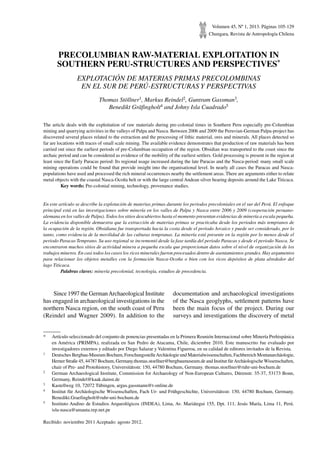
of Palpa, in the northern Nasca region (Figure 1).
In the first phase of the Nasca-Palpa project we
concentrated on the coastal region at the foothills
of the Andes. Beginning in 2008 we expanded
our research area to the highlands and to the
Pacific shore and defined a transect line through
the different ecological zones between the desert
coast and the highest peaks of the western slope
of Andean highlands, which we call the “Andean
Transect”. Therefore it was self-evident to expand
our interest also to the exchange of raw materials
and technical innovations between the coastal
areas and the highlands.
Along thisAndean Transect we have registered
about 1600 archaeological sites so far, most of them
settlements. These sites span duration from the first
occupation of the region in the paleoindian period
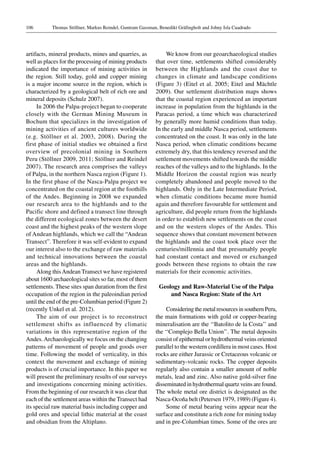
until the end of the pre-Columbian period (Figure 2)
(recently Unkel et al. 2012).
The aim of our project is to reconstruct
settlement shifts as influenced by climatic
variations in this representative region of the
Andes.Archaeologically we focus on the changing
patterns of movement of people and goods over
time. Following the model of verticality, in this
context the movement and exchange of mining
products is of crucial importance. In this paper we
will present the preliminary results of our surveys
and investigations concerning mining activities.
From the beginning of our research it was clear that
each of the settlement areas within the Transect had
its special raw material basis including copper and
gold ores and special lithic material at the coast
and obsidian from the Altiplano.
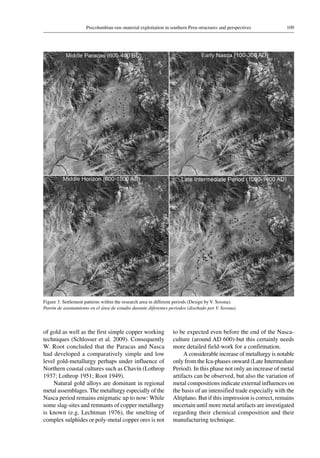
We know from our geoarchaeological studies
that over time, settlements shifted considerably
between the Highlands and the coast due to
changes in climate and landscape conditions
(Figure 3) (Eitel et al. 2005; Eitel and Mächtle
2009). Our settlement distribution maps shows
that the coastal region experienced an important
increase in population from the highlands in the
Paracas period, a time which was characterized
by generally more humid conditions than today.
In the early and middle Nasca period, settlements
concentrated on the coast. It was only in the late
Nasca period, when climatic conditions became
extremely dry, that this tendency reversed and the
settlement movements shifted towards the middle
reaches of the valleys and to the highlands. In the
Middle Horizon the coastal region was nearly
completely abandoned and people moved to the
highlands. Only in the Late Intermediate Period,
when climatic conditions became more humid
again and therefore favourable for settlement and
agriculture, did people return from the highlands
in order to establish new settlements on the coast
and on the western slopes of the Andes. This
sequence shows that constant movement between
the highlands and the coast took place over the
centuries/millennia and that presumably people
had constant contact and moved or exchanged
goods between these regions to obtain the raw
materials for their economic activities.
Geology and Raw-Material Use of the Palpa
and Nasca Region: State of the Art
Considering the metalresources insouthern Peru,
the main formations with gold or copper-bearing
mineralisation are the ‘‘Batolito de la Costa’’ and
the ‘‘Complejo Bella Union’’. The metal deposits
consist of epithermal or hydrothermal veins oriented
parallel to the western cordillera in most cases. Host
rocks are either Jurassic or Cretaceous volcanic or
sedimentary-volcanic rocks. The copper deposits
regularly also contain a smaller amount of noble
metals, lead and zinc. Also native gold-silver fine
disseminated in hydrothermal quartz veins are found.
The whole metal ore district is designated as the
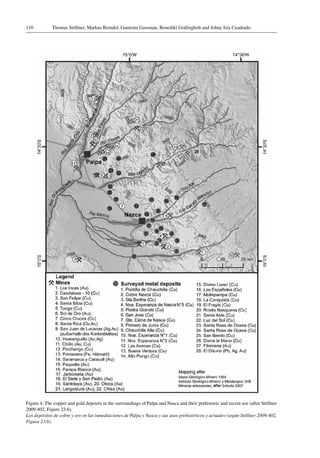
Nasca-Ocoña belt (Petersen 1979, 1989) (Figure 4).
Some of metal bearing veins appear near the
surface and constitute a rich zone for mining today
and in pre-Columbian times. Some of the ores are
107Precolumbian raw-material exploitation in southern Peru-structures and perspectives
Figure 1.ResearchareaoftheAndeanTransectprojectindicatingpre-hispanicsettlementsandimportantlocationsmentionedinthetext(DesignbyV.Sossna).
ÁreadeestudiodelproyectoAndeanTransectindicandolosasentamientosprehispánicosylasprincipaleslocalidadesmencionadaseneltexto(diseñadoporV.Sossna).
Thomas Stöllner, Markus Reindel, Guntram Gassman, Benedikt Gräfingholt and Johny Isla Cuadrado108
Figure 2. Precolumbian chronology of South Peru (Design by M. Reindel, Bonn).
Cronología precolombina del sur de Perú (diseñado por M. Reindel).
extremely rich in gold and copper, sometimes iron
oxide is present.
In contrast to the northern coast of Peru (see e.g.
the article of Shimada and Craig in this volume) and
also to the centralAndeanAltiplano, southern Peru
never was a focal area of metallurgical inventions or
innovations.Archaeologicalinvestigationsconcerning
mining in southern Peru were intensified in recent
years by American and German research groups,
which focused on the use of pigments and metal
ores by the ancient inhabitants of the Nasca-Palpa
region (Eerkens et al.2009; Schlosser et al. 2009;
Stöllner 2009; Stöllner and Reindel 2007; Vaughn
et al. 2007). Root and Lechtman started to review
this situation and asserted that extensive use of
copper objects can be observed mainly in the late
periods of the south coast of Peru (Root 1949;
Lechtman 1976). This more or less coincides with
northern Chile assisted by investigations (e.g. Núñez
Atencio 1999) conducted in the copper mining
districts around Chuquicamata and El Abra; these
results also made apparent the considerable late
use of copper in these regions basically within the
later Formative (Figueroa et al. 2010; González y
Westfall 2005, 2008; Salazar 2008).
In the south coast of Peru gold was the first metal
that came into use during the Paracas culture (Tello
1959; Tello and Mejía Xesspe 1979; Uhle 1913).
And also during the Nasca period the metallurgy
principally remained on a basic level of cold working
109Precolumbian raw-material exploitation in southern Peru-structures and perspectives
Figure 3. Settlement patterns within the research area in different periods (Design by V. Sossna).
Patrón de asentamiento en el área de estudio durante diferentes periodos (diseñado por V. Sossna).
of gold as well as the first simple copper working
techniques (Schlosser et al. 2009). Consequently
W. Root concluded that the Paracas and Nasca
had developed a comparatively simple and low
level gold-metallurgy perhaps under influence of
Northern coastal cultures such as Chavín (Lothrop
1937; Lothrop 1951; Root 1949).
Natural gold alloys are dominant in regional
metal assemblages. The metallurgy especially of the
Nasca period remains enigmatic up to now: While
some slag-sites and remnants of copper metallurgy
is known (e.g. Lechtman 1976), the smelting of
complex sulphides or poly-metal copper ores is not
to be expected even before the end of the Nasca-
culture (around AD 600)-but this certainly needs
more detailed field-work for a confirmation.
A considerable increase of metallurgy is notable
only from the Ica-phases onward (Late Intermediate
Period). In this phase not only an increase of metal
artifacts can be observed, but also the variation of
metal compositions indicate external influences on
the basis of an intensified trade especially with the
Altiplano. But if this impression is correct, remains
uncertain until more metal artifacts are investigated
regarding their chemical composition and their
manufacturing technique.
Thomas Stöllner, Markus Reindel, Guntram Gassman, Benedikt Gräfingholt and Johny Isla Cuadrado110
Figure 4. The copper and gold deposits in the surroundings of Palpa and Nasca and their prehistoric and recent use (after Stöllner
2009:402, Figure 23.6).
Los depósitos de cobre y oro en las inmediaciones de Palpa y Nasca y sus usos prehistóricos y actuales (según Stöllner 2009:402,
Figura 23.6).
111Precolumbian raw-material exploitation in southern Peru-structures and perspectives
Beside metals also other minerals stood in
discussion: After studying and analysing artifacts
from museums and excavations, H. Ruppert
postulated in 1982 that turquoise deposits existed in
southern Peru (Ruppert 1982, 1983; Petersen 1970).
So far no major deposits have been located. Many
sources of turquoise, however, have been located in
northern Chile and their pre-colonial exploitation
recently has been investigated (González and
Westfall 2005, 2008).
Finally also Obsidian needs careful discussion: In
the south of Peru and the north of Chile and Bolivia
many obsidian sources have been investigated and
geochemically characterized. Of these, however,
there were major sources that have played an
important role in the long-distance trade networks
such as Quispisisa and Jampatilla in the highlands
ofAyacucho (Burger andAsaro 1979; Burger et al.
2000; Tripcevich y Contreras 2011).
Stone, mineral and metal artifacts through the
pre-Columbian history of Palpa and Nasca
One of the most common products that were
brought from the highlands to the coast from the
earliest to the latest periods was obsidian. We
found obsidian flakes and artifacts for example
in all layers of a test excavation in a rock shelter
at an altitude of 4300 m, near the Cerro Llamoca,
where the lower levels dated to 8,000 BC. In
the oldest levels we found the obsidian artifacts
mixed with other lithic materials like silex and
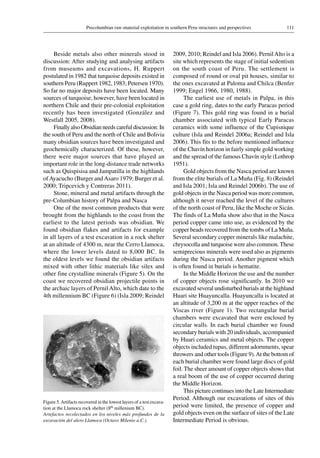
other fine crystalline minerals (Figure 5). On the
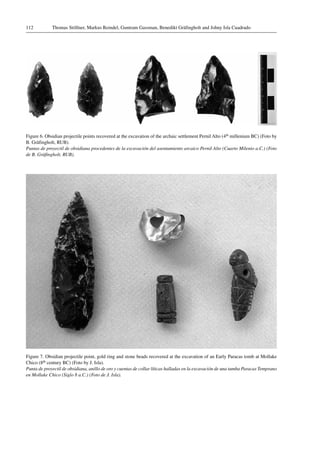
coast we recovered obsidian projectile points in
the archaic layers of Pernil Alto, which date to the
4th millennium BC (Figure 6) (Isla 2009; Reindel
2009, 2010; Reindel and Isla 2006). PernilAlto is a
site which represents the stage of initial sedentism
on the south coast of Peru. The settlement is
composed of round or oval pit houses, similar to
the ones excavated at Paloma and Chilca (Benfer
1999; Engel 1966, 1980, 1988).
The earliest use of metals in Palpa, in this
case a gold ring, dates to the early Paracas period
(Figure 7). This gold ring was found in a burial
chamber associated with typical Early Paracas
ceramics with some influence of the Cupisnique
culture (Isla and Reindel 2006a; Reindel and Isla
2006). This fits to the before mentioned influence
of the Chavín horizon in fairly simple gold working
and the spread of the famous Chavín style (Lothrop
1951).
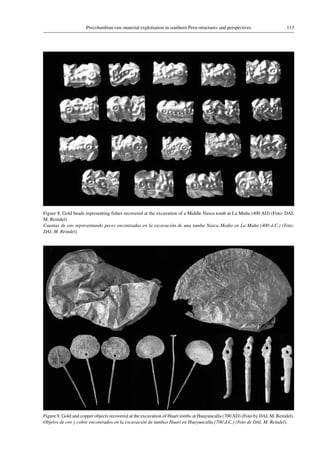
Gold objects from the Nasca period are known
from the elite burials of La Muña (Fig. 8) (Reindel
and Isla 2001; Isla and Reindel 2006b). The use of
gold objects in the Nasca period was more common,
although it never reached the level of the cultures
of the north coast of Peru, like the Moche or Sicán.
The finds of La Muña show also that in the Nasca
period copper came into use, as evidenced by the
copper beads recovered from the tombs of La Muña.
Several secondary copper minerals like malachite,
chrysocolla and turquoise were also common. These
semiprecious minerals were used also as pigments
during the Nasca period. Another pigment which
is often found in burials is hematite.
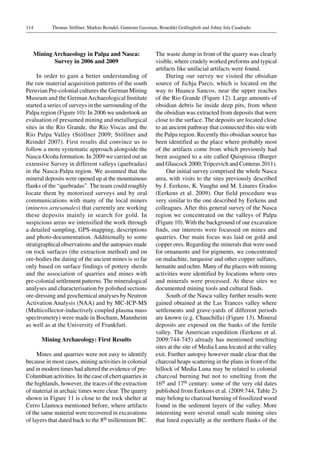
In the Middle Horizon the use and the number
of copper objects rose significantly. In 2010 we
excavated several undisturbed burials at the highland
Huari site Huayuncalla. Huayuncalla is located at
an altitude of 3,200 m at the upper reaches of the
Viscas river (Figure 1). Two rectangular burial
chambers were excavated that were enclosed by
circular walls. In each burial chamber we found
secondary burials with 20 individuals, accompanied
by Huari ceramics and metal objects. The copper
objects included tupus, different adornments, spear
throwers and other tools (Figure 9).At the bottom of
each burial chamber were found large discs of gold
foil. The sheer amount of copper objects shows that
a real boom of the use of copper occurred during
the Middle Horizon.
This picture continues into the Late Intermediate
Period. Although our excavations of sites of this
period were limited, the presence of copper and
gold objects even on the surface of sites of the Late
Intermediate Period is obvious.
Figure 5.Artifacts recovered in the lowest layers of a test excava-
tion at the Llamoca rock shelter (8th millenium BC).
Artefactos recolectados en los niveles más profundos de la
excavación del alero Llamoca (Octavo Milenio a.C.).
Thomas Stöllner, Markus Reindel, Guntram Gassman, Benedikt Gräfingholt and Johny Isla Cuadrado112
Figure 6. Obsidian projectile points recovered at the excavation of the archaic settlement Pernil Alto (4th millenium BC) (Foto by
B. Gräfingholt, RUB).
Puntas de proyectil de obsidiana procedentes de la excavación del asentamiento arcaico Pernil Alto (Cuarto Milenio a.C.) (Foto
de B. Gräfingholt, RUB).
Figure 7. Obsidian projectile point, gold ring and stone beads recovered at the excavation of an Early Paracas tomb at Mollake
Chico (8th century BC) (Foto by J. Isla).
Punta de proyectil de obsidiana, anillo de oro y cuentas de collar líticas halladas en la excavación de una tumba Paracas Temprano
en Mollake Chico (Siglo 8 a.C.) (Foto de J. Isla).
113Precolumbian raw-material exploitation in southern Peru-structures and perspectives
Figure 8. Gold beads representing fishes recovered at the excavation of a Middle Nasca tomb at La Muña (400 AD) (Foto: DAI,
M. Reindel)
Cuentas de oro representando peces encontradas en la excavación de una tumba Nasca Medio en La Muña (400 d.C.) (Foto:
DAI, M. Reindel).
Figure 9. Gold and copper objects recovered at the excavation of Huari tombs at Huayuncalla (700AD) (Foto by DAI, M. Reindel).
Objetos de oro y cobre encontrados en la excavación de tumbas Huari en Huayuncalla (700 d.C.) (Foto de DAI, M. Reindel).
Thomas Stöllner, Markus Reindel, Guntram Gassman, Benedikt Gräfingholt and Johny Isla Cuadrado114
Mining Archaeology in Palpa and Nasca:
Survey in 2006 and 2009
In order to gain a better understanding of
the raw material acquisition patterns of the south
Peruvian Pre-colonial cultures the German Mining
Museum and the German Archaeological Institute
started a series of surveys in the surrounding of the
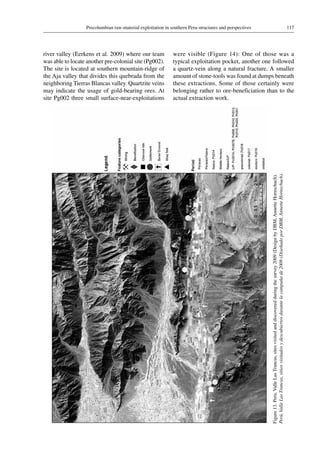
Palpa region (Figure 10): In 2006 we undertook an
evaluation of presumed mining and metallurgical
sites in the Rio Grande, the Rio Viscas and the
Rio Palpa Valley (Stöllner 2009; Stöllner and
Reindel 2007). First results did convince us to
follow a more systematic approach alongside the
Nasca-Ocoña formation. In 2009 we carried out an
extensive Survey in different valleys (quebradas)
in the Nasca-Palpa region. We assumed that the
mineral deposits were opened up at the mountainous
flanks of the “quebradas”. The team could roughly
locate them by motorized surveys and by oral
communications with many of the local miners
(mineros artesanales) that currently are working
these deposits mainly in search for gold. In
suspicious areas we intensified the work through
a detailed sampling, GPS-mapping, descriptions
and photo-documentation. Additionally to some
stratigraphical observations and the autopsies made
on rock surfaces (the extraction method) and on
ore-bodies the dating of the ancient mines is so far
only based on surface findings of pottery sherds
and the association of quarries and mines with
pre-colonial settlement patterns. The mineralogical
analyses and characterisation by polished sections
ore-dressing and geochemical analyses by Neutron
Activation Analysis (NAA) and by MC-ICP-MS
(Multicollector-inductively coupled plasma mass
spectrometry) were made in Bochum, Mannheim
as well as at the University of Frankfurt.
Mining Archaeology: First Results
Mines and quarries were not easy to identify
because in most cases, mining activities in colonial
and in modern times had altered the evidence of pre-
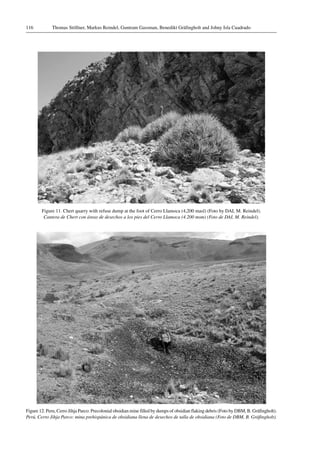
Columbian activities. In the case of chert quarries in
the highlands, however, the traces of the extraction
of material in archaic times were clear. The quarry
shown in Figure 11 is close to the rock shelter at
Cerro Llamoca mentioned before, where artifacts
of the same material were recovered in excavations
of layers that dated back to the 8th millennium BC.
The waste dump in front of the quarry was clearly
visible, where crudely worked preforms and typical
artifacts like unifacial artifacts were found.
During our survey we visited the obsidian
source of Jichja Parco, which is located on the
way to Huanca Sancos, near the upper reaches
of the Rio Grande (Figure 12). Large amounts of
obsidian debris lie inside deep pits, from where
the obsidian was extracted from deposits that were
close to the surface. The deposits are located close
to an ancient pathway that connected this site with
the Palpa region. Recently this obsidian source has
been identified as the place where probably most
of the artifacts come from which previously had
been assigned to a site called Quispisisa (Burger
and Glascock 2000; Tripcevich and Conteras 2011).
Our initial survey comprised the whole Nasca
area, with visits to the sites previously described
by J. Eerkens, K. Vaughn and M. Linares Grados
(Eerkens et al. 2009). Our field procedure was
very similar to the one described by Eerkens and
colleagues. After this general survey of the Nasca
region we concentrated on the valleys of Palpa
(Figure 10). With the background of our excavation
finds, our interests were focussed on mines and
quarries. Our main focus was laid on gold and
copper ores. Regarding the minerals that were used
for ornaments and for pigments, we concentrated
on malachite, turquoise and other copper sulfates,
hematite and ochre. Many of the places with mining
activities were identified by locations where ores
and minerals were processed. At these sites we
documented mining tools and cultural finds.
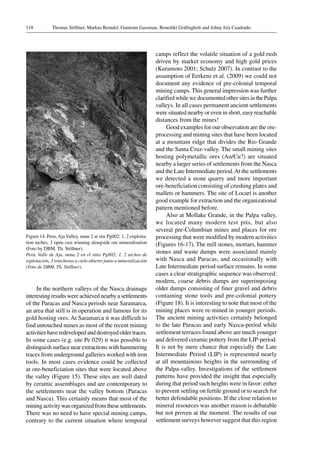
South of the Nasca valley further results were
gained obtained at the Las Trances valley where
settlements and grave-yards of different periods
are known (e.g. Chauchilla) (Figure 13). Mineral
deposits are exposed on the banks of the fertile
valley. The American expedition (Eerkens et al.
2009:744-745) already has mentioned smelting
sites at the site of Media Luna located at the valley
exit. Further autopsy however made clear that the
charcoal heaps scattering in the plans in front of the
hillock of Media Luna may be related to colonial
charcoal burning but not to smelting from the
16th and 17th century: some of the very old dates
published from Eerkens et al. (2009:744, Table 2)
may belong to charcoal burning of fossilized wood
found in the sediment layers of the valley. More
interesting were several small scale mining sites
that lined especially at the northern flanks of the
115Precolumbian raw-material exploitation in southern Peru-structures and perspectives
Figure 10.ResearchareasinSouthPeru:Visitedsitesbetween2006and2009(DesignbyDBM,AnnetteHornschuch).
ÁreasdeestudioenelSurdePerú:sitiosvisitadosentre2006y2009(DiseñadoporDBM,AnnetteHornschuch).
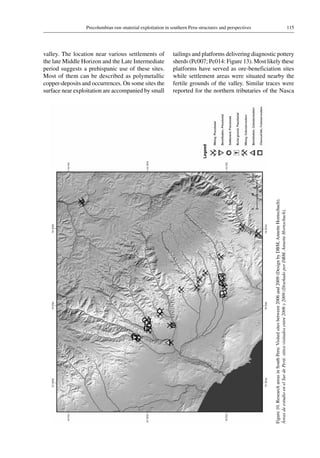
valley. The location near various settlements of
the late Middle Horizon and the Late Intermediate
period suggests a prehispanic use of these sites.
Most of them can be described as polymetallic
copper-deposits and occurrences. On some sites the
surface near exploitation are accompanied by small
tailings and platforms delivering diagnostic pottery
sherds (Pc007; Pc014: Figure 13). Most likely these
platforms have served as ore-beneficiation sites
while settlement areas were situated nearby the
fertile grounds of the valley. Similar traces were
reported for the northern tributaries of the Nasca
Thomas Stöllner, Markus Reindel, Guntram Gassman, Benedikt Gräfingholt and Johny Isla Cuadrado116
Figure 11. Chert quarry with refuse dump at the foot of Cerro Llamoca (4,200 masl) (Foto by DAI, M. Reindel).
Cantera de Chert con áreas de desechos a los pies del Cerro Llamoca (4.200 msm) (Foto de DAI, M. Reindel).
Figure 12. Peru, Cerro Jihja Parco: Precolonial obsidian mine filled by dumps of obsidian flaking debris (Foto by DBM, B. Gräfingholt).
Perú, Cerro Jihja Parco: mina prehispánica de obsidiana llena de desechos de talla de obsidiana (Foto de DBM, B. Gräfingholt).
117Precolumbian raw-material exploitation in southern Peru-structures and perspectives
Figure 13.Peru,ValleLasTrancas,sitesvisitedanddiscoveredduringthesurvey2009(DesignbyDBM,AnnetteHornschuch).
Perú,ValleLasTrancas,sitiosvisitadosydescubiertosdurantelacampañade2009(DiseñadoporDBM,AnnetteHornschuch).
river valley (Eerkens et al. 2009) where our team
was able to locate another pre-colonial site (Pg002).
The site is located at southern mountain-ridge of
the Aja valley that divides this quebrada from the
neighboring Tierras Blancas valley. Quartzite veins
may indicate the usage of gold-bearing ores. At
site Pg002 three small surface-near-exploitations
were visible (Figure 14): One of those was a
typical exploitation pocket, another one followed
a quartz-vein along a natural fracture. A smaller
amount of stone-tools was found at dumps beneath
these extractions. Some of those certainly were
belonging rather to ore-beneficiation than to the
actual extraction work.
Thomas Stöllner, Markus Reindel, Guntram Gassman, Benedikt Gräfingholt and Johny Isla Cuadrado118
Figure 14. Peru, Aja Valley, mine 2 at site Pg002; 1, 2 exploita-
tion niches, 3 open cast winning alongside ore mineralisation
(Foto by DBM, Th. Stöllner).
Perú, Valle de Aja, mina 2 en el sitio Pg002; 1, 2 nichos de
explotación, 3 trincheras a cielo abierto junto a mineralización
(Foto de DBM, Th. Stöllner).
In the northern valleys of the Nasca drainage
interesting results were achieved nearby a settlements
of the Paracas and Nasca periods near Saramarca,
an area that still is in operation and famous for its
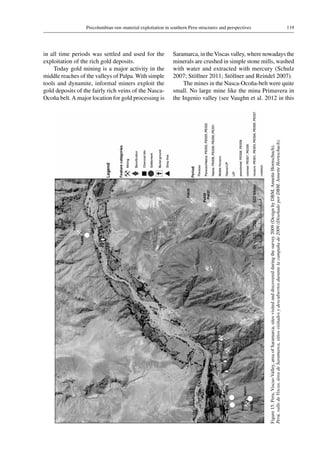
gold hosting ores. At Saramarca it was difficult to
find untouched mines as most of the recent mining
activities have redeveloped and destroyed older traces.
In some cases (e.g. site Pe 029) it was possible to
distinguish surface near extractions with hammering
traces from underground galleries worked with iron
tools. In most cases evidence could be collected
at ore-beneficiation sites that were located above
the valley (Figure 15). These sites are well dated
by ceramic assemblages and are contemporary to
the settlements near the valley bottom (Paracas
and Nasca). This certainly means that most of the
mining activity was organized from these settlements.
There was no need to have special mining camps,
contrary to the current situation where temporal
camps reflect the volatile situation of a gold rush
driven by market economy and high gold prices
(Kuramoto 2001; Schulz 2007). In contrast to the
assumption of Eerkens et al. (2009) we could not
document any evidence of pre-colonial temporal
mining camps. This general impression was further
clarified while we documented other sites in the Palpa
valleys. In all cases permanent ancient settlements
were situated nearby or even in short, easy reachable
distances from the mines!
Good examples for our observation are the ore-
processing and mining sites that have been located
at a mountain ridge that divides the Rio Grande
and the Santa Cruz-valley. The small mining sites
hosting polymetallic ores (Au/Cu?) are situated
nearby a larger series of settlements from the Nasca
and the Late Intermediate period.At the settlements
we detected a stone quarry and more important
ore-beneficiation consisting of crushing plates and
mallets or hammers. The site of Locarí is another
good example for extraction and the organizational
pattern mentioned before.
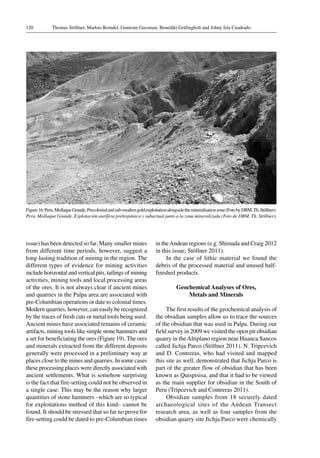
Also at Mollake Grande, in the Palpa valley,
we located many modern test pits, but also
several pre-Columbian mines and places for ore
processing that were modified by modern activities
(Figures 16-17). The mill stones, mortars, hammer
stones and waste dumps were associated mainly
with Nasca and Paracas, and occasionally with
Late Intermediate period surface remains. In some
cases a clear stratigraphic sequence was observed:
modern, coarse debris dumps are superimposing
older dumps consisting of finer gravel and debris
containing stone tools and pre-colonial pottery
(Figure 18). It is interesting to note that most of the
mining places were re-mined in younger periods.
The ancient mining activities certainly belonged
to the late Paracas and early Nazca-period while
settlement terraces found above are much younger
and delivered ceramic pottery from the LIP-period.
It is not by mere chance that especially the Late
Intermediate Period (LIP) is represented nearly
at all mountainous heights in the surrounding of
the Palpa-valley. Investigations of the settlement
patterns have provided the insight that especially
during that period such heights were in favor: either
to prevent settling on fertile ground or to search for
better defendable positions. If the close relation to
mineral resources was another reason is debatable
but not proven at the moment. The results of our
settlement surveys however suggest that this region
119Precolumbian raw-material exploitation in southern Peru-structures and perspectives
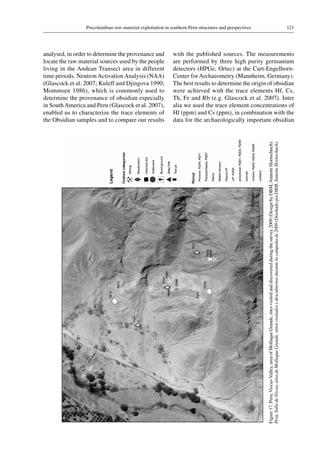
Figure 15.Peru,Viscas-Valley,areaofSaramarca,sitesvisitedanddiscoveredduringthesurvey2009(DesignbyDBM,AnnetteHornschuch).
Perú,valledeViscas,áreadeSaramarca,sitiosvisitadosydescubiertosdurantelacampañade2009(DiseñadoporDBM,AnnetteHornschuch).
in all time periods was settled and used for the
exploitation of the rich gold deposits.
Today gold mining is a major activity in the
middle reaches of the valleys of Palpa. With simple
tools and dynamite, informal miners exploit the
gold deposits of the fairly rich veins of the Nasca-
Ocoña belt.A major location for gold processing is
Saramarca, in theViscas valley, where nowadays the
minerals are crushed in simple stone mills, washed
with water and extracted with mercury (Schulz
2007; Stöllner 2011; Stöllner and Reindel 2007).
The mines in the Nasca-Ocoña-belt were quite
small. No large mine like the mina Primavera in
the Ingenio valley (see Vaughn et al. 2012 in this
Thomas Stöllner, Markus Reindel, Guntram Gassman, Benedikt Gräfingholt and Johny Isla Cuadrado120
Figure 16.Peru,MollaqueGrande,Precolonialandsub-moderngoldexploitationalongsidethemineralisationzone(FotobyDBM,Th.Stöllner).
Perú, Mollaque Grande, Explotación aurífera prehispánica y subactual junto a la zona mineralizada (Foto de DBM, Th. Stöllner).
issue) has been detected so far. Many smaller mines
from different time periods, however, suggest a
long-lasting tradition of mining in the region. The
different types of evidence for mining activities
include horizontal and vertical pits, tailings of mining
activities, mining tools and local processing areas
of the ores. It is not always clear if ancient mines
and quarries in the Palpa area are associated with
pre-Columbian operations or date to colonial times.
Modern quarries, however, can easily be recognized
by the traces of fresh cuts or metal tools being used.
Ancient mines have associated remains of ceramic
artifacts, mining tools like simple stone hammers and
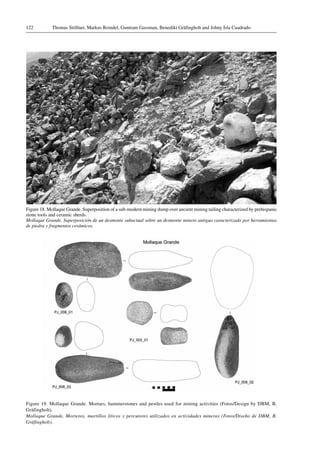
a set for beneficiating the ores (Figure 19). The ores
and minerals extracted from the different deposits
generally were processed in a preliminary way at
places close to the mines and quarries. In some cases
these processing places were directly associated with
ancient settlements. What is somehow surprising
is the fact that fire-setting could not be observed in
a single case: This may be the reason why larger
quantities of stone hammers –which are so typical
for exploitations method of this kind– cannot be
found. It should be stressed that so far no prove for
fire-setting could be dated to pre-Columbian times
in theAndean regions (e.g. Shimada and Craig 2012
in this issue; Stöllner 2011).
In the case of lithic material we found the
debris of the processed material and unused half-
finished products.
Geochemical Analyses of Ores,
Metals and Minerals
The first results of the geochemical analysis of
the obsidian samples allow us to trace the sources
of the obsidian that was used in Palpa. During our
field survey in 2009 we visited the open pit obsidian
quarry in theAltiplano region near Huanca Sancos
called Jichja Parco (Stöllner 2011). N. Tripcevich
and D. Contreras, who had visited and mapped
this site as well, demonstrated that Jichja Parco is
part of the greater flow of obsidian that has been
known as Quispisisa, and that it had to be viewed
as the main supplier for obsidian in the South of
Peru (Tripcevich and Contreras 2011).
Obsidian samples from 18 securely dated
archaeological sites of the Andean Transect
research area, as well as four samples from the
obsidian quarry site Jichja Parco were chemically
121Precolumbian raw-material exploitation in southern Peru-structures and perspectives
Figure 17.Peru,Viscas-Valley,areaofMollaqueGrande,sitesvisitedanddiscoveredduringthesurvey2009(DesignbyDBM,AnnetteHornschuch).
Perú,ValledeViscas,áreadeMollaqueGrande,sitiosvisitadosydescubiertosdurantelacampañade2009(DiseñadopotDBM,AnnetteHornschuch).
analysed, in order to determine the provenance and
locate the raw material sources used by the people
living in the Andean Transect area in different
time periods. Neutron Activation Analysis (NAA)
(Glascock et al. 2007; Kuleff and Djingova 1990;
Mommsen 1986), which is commonly used to
determine the provenance of obsidian especially
in South America and Peru (Glascock et al. 2007),
enabled us to characterize the trace elements of
the Obsidian samples and to compare our results
with the published sources. The measurements
are performed by three high purity germanium
detectors (HPGe, Ortec) at the Curt-Engelhorn-
Center for Archaeometry (Mannheim, Germany).
The best results to determine the origin of obsidian
were achieved with the trace elements Hf, Cs,
Th, Fe and Rb (e.g. Glascock et al. 2007). Inter
alia we used the trace element concentrations of
Hf (ppm) and Cs (ppm), in combination with the
data for the archaeologically important obsidian
Thomas Stöllner, Markus Reindel, Guntram Gassman, Benedikt Gräfingholt and Johny Isla Cuadrado122
Figure 18. Mollaque Grande. Superposition of a sub-modern mining dump over ancient mining tailing characterized by prehispanic
stone tools and ceramic sherds.
Mollaque Grande. Superposición de un desmonte subactual sobre un desmonte minero antiguo caracterizado por herramientas
de piedra y fragmentos cerámicos.
Figure 19. Mollaque Grande. Mortars, hammerstones and pestles used for mining activities (Fotos/Design by DBM, B.
Gräfingholt).
Mollaque Grande. Morteros, martillos líticos y percutores utilizados en actividades mineras (Fotos/Diseño de DBM, B.
Gräfingholt).
123Precolumbian raw-material exploitation in southern Peru-structures and perspectives
quarries in southern Peru provided by Glascock
et al. (2007) to pinpoint the origin of our obsidian
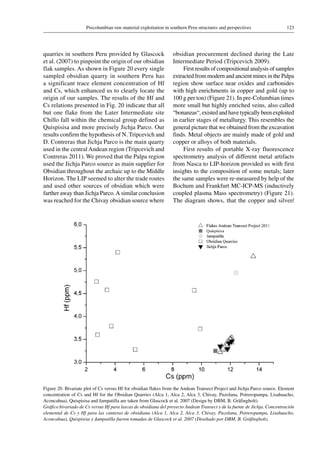
flak samples. As shown in Figure 20 every single
sampled obsidian quarry in southern Peru has
a significant trace element concentration of Hf
and Cs, which enhanced us to clearly locate the
origin of our samples. The results of the Hf and
Cs relations presented in Fig. 20 indicate that all
but one flake from the Later Intermediate site
Chillo fall within the chemical group defined as
Quispisisa and more precisely Jichja Parco. Our
results confirm the hypothesis of N. Tripcevich and
D. Contreras that Jichja Parco is the main quarry
used in the central Andean region (Tripcevich and
Contreras 2011). We proved that the Palpa region
used the Jichja Parco source as main supplier for
Obsidian throughout the archaic up to the Middle
Horizon. The LIP seemed to alter the trade routes
and used other sources of obsidian which were
farther away than Jichja Parco.A similar conclusion
was reached for the Chivay obsidian source where
obsidian procurement declined during the Late
Intermediate Period (Tripcevich 2009).
First results of compositional analysis of samples
extracted from modern and ancient mines in the Palpa
region show surface near oxides and carbonides
with high enrichments in copper and gold (up to
100 g per ton) (Figure 21). In pre-Columbian times
more small but highly enriched veins, also called
“bonanzas“, existed and have typically been exploited
in earlier stages of metallurgy. This resembles the
general picture that we obtained from the excavation
finds. Metal objects are mainly made of gold and
copper or alloys of both materials.
First results of portable X-ray fluorescence
spectrometry analysis of different metal artifacts
from Nasca to LIP-horizon provided us with first
insights to the composition of some metals; later
the same samples were re-measured by help of the
Bochum and Frankfurt MC-ICP-MS (inductively
coupled plasma Mass spectrometry) (Figure 21).
The diagram shows, that the copper and silver/
Figure 20. Bivariate plot of Cs versus Hf for obsidian flakes from the Andean Transect Project and Jichja Parco source. Element
concentration of Cs and Hf for the Obsidian Quarries (Alca 1, Alca 2, Alca 3, Chivay, Puzolana, Potreropampa, Lisahuacho,
Aconcahua), Quispisisa and Jampatilla are taken from Glascock et al. 2007 (Design by DBM, B. Gräfingholt).
Gráfico bivariado de Cs versus Hf para lascas de obsidiana del proyecto Andean Transect y de la fuente de Jichja. Concentración
elemental de Cs y Hf para las canteras de obsidiana (Alca 1, Alca 2, Alca 3, Chivay, Puzolana, Potreropampa, Lisahuacho,
Aconcahua), Quispisisa y Jampatilla fueron tomadas de Glascock et al. 2007 (Diseñado por DBM, B. Gräfingholt).
Thomas Stöllner, Markus Reindel, Guntram Gassman, Benedikt Gräfingholt and Johny Isla Cuadrado124
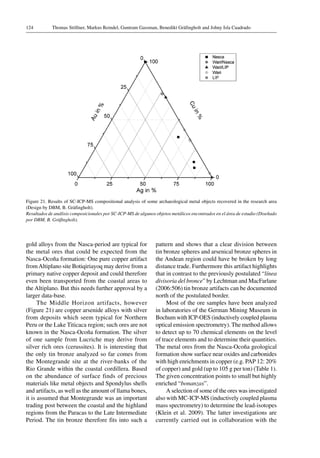
Figure 21. Results of SC-ICP-MS compositional analysis of some archaeological metal objects recovered in the research area
(Design by DBM, B. Gräfingholt).
Resultados de análisis composicionales por SC-ICP-MS de algunos objetos metálicos encontrados en el área de estudio (Diseñado
por DBM, B. Gräfingholt).
gold alloys from the Nasca-period are typical for
the metal ores that could be expected from the
Nasca-Ocoña formation: One pure copper artifact
fromAltiplano site Botiqiriayoq may derive from a
primary native copper deposit and could therefore
even been transported from the coastal areas to
the Altiplano. But this needs further approval by a
larger data-base.
The Middle Horizon artifacts, however
(Figure 21) are copper arsenide alloys with silver
from deposits which seem typical for Northern
Peru or the Lake Titicaca region; such ores are not
known in the Nasca-Ocoña formation. The silver
of one sample from Lucriche may derive from
silver rich ores (cerussites). It is interesting that
the only tin bronze analyzed so far comes from
the Montegrande site at the river-banks of the
Rio Grande within the coastal cordillera. Based
on the abundance of surface finds of precious
materials like metal objects and Spondylus shells
and artifacts, as well as the amount of llama bones,
it is assumed that Montegrande was an important
trading post between the coastal and the highland
regions from the Paracas to the Late Intermediate
Period. The tin bronze therefore fits into such a
pattern and shows that a clear division between
tin bronze spheres and arsenical bronze spheres in
the Andean region could have be broken by long
distance trade. Furthermore this artifact highlights
that in contrast to the previously postulated “línea
divisoria del bronce” by Lechtman and MacFarlane
(2006:506) tin bronze artifacts can be documented
north of the postulated border.
Most of the ore samples have been analyzed
in laboratories of the German Mining Museum in
Bochum with ICP-OES (inductively coupled plasma
optical emission spectrometry). The method allows
to detect up to 70 chemical elements on the level
of trace elements and to determine their quantities.
The metal ores from the Nasca-Ocoña geological
formation show surface near oxides and carbonides
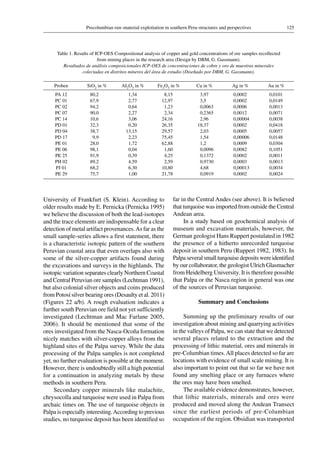
with high enrichments in copper (e.g. PAP 12: 20%
of copper) and gold (up to 105 g per ton) (Table 1).
The given concentration points to small but highly
enriched “bonanzas”.
A selection of some of the ores was investigated
also with MC-ICP-MS (inductively coupled plasma
mass spectrometry) to determine the lead-isotopes
(Klein et al. 2009). The latter investigations are
currently carried out in collaboration with the
125Precolumbian raw-material exploitation in southern Peru-structures and perspectives
University of Frankfurt (S. Klein). According to
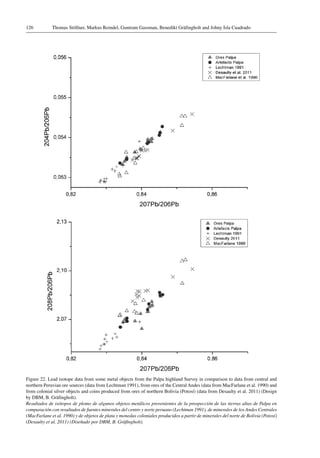
older results made by E. Pernicka (Pernicka 1995)
we believe the discussion of both the lead-isotopes
and the trace elements are indispensable for a clear
detection of metal artifact provenances.As far as the
small sample-series allows a first statement, there
is a characteristic isotopic pattern of the southern
Peruvian coastal area that even overlaps also with
some of the silver-copper artifacts found during
the excavations and surveys in the highlands. The
isotopic variation separates clearly Northern Coastal
and Central Peruvian ore samples (Lechtman 1991),
but also colonial silver objects and coins produced
from Potosí silver bearing ores (Desaulty et al. 2011)
(Figures 22 a/b). A rough evaluation indicates a
further south Peruvian ore field not yet sufficiently
investigated (Lechtman and Mac Farlane 2005,
2006). It should be mentioned that some of the
ores investigated from the Nasca-Ocoña formation
nicely matches with silver-copper alloys from the
highland sites of the Palpa survey. While the data
processing of the Palpa samples is not completed
yet, no further evaluation is possible at the moment.
However, there is undoubtedly still a high potential
for a continuation in analyzing metals by these
methods in southern Peru.
Secondary copper minerals like malachite,
chrysocolla and turquoise were used in Palpa from
archaic times on. The use of turquoise objects in
Palpa is especially interesting.According to previous
studies, no turquoise deposit has been identified so
far in the Central Andes (see above). It is believed
that turquoise was imported from outside the Central
Andean area.
In a study based on geochemical analysis of
museum and excavation materials, however, the
German geologist Hans Ruppert postulated in 1982
the presence of a hitherto unrecorded turquoise
deposit in southern Peru (Ruppert 1982, 1983). In
Palpa several small turqouise deposits were identified
by our collaborator, the geologist Ulrich Glasmacher
from Heidelberg University. It is therefore possible
that Palpa or the Nasca region in general was one
of the sources of Peruvian turquoise.
Summary and Conclusions
Summing up the preliminary results of our
investigation about mining and quarrying activities
in the valleys of Palpa, we can state that we detected
several places related to the extraction and the
processing of lithic material, ores and minerals in
pre-Columbian times.All places detected so far are
locations with evidence of small scale mining. It is
also important to point out that so far we have not
found any smelting place or any furnaces where
the ores may have been smelted.
The available evidence demonstrates, however,
that lithic materials, minerals and ores were
produced and moved along the Andean Transect
since the earliest periods of pre-Columbian
occupation of the region. Obsidian was transported
Table 1. Results of ICP-OES Compositional analysis of copper and gold concentrations of ore samples recollected
from mining places in the research area (Design by DBM, G. Gassmann).
Resultados de análisis composicionales ICP-OES de concentraciones de cobre y oro de muestras minerales
colectadas en distritos mineros del área de estudio (Diseñado por DBM, G. Gassmann).
Proben SiO2 in % AI2O3 in % Fe2O3 in % Cu in % Ag in % Au in %
PA 12 80,2 1,34 8,15 3,97 0,0002 0,0101
PC 01 67,9 2,77 12,97 3,5 0,0002 0,0149
PC 02 94,2 0,64 1,23 0,0063 0,0006 0,0013
PC 07 90,0 2,27 2,34 0,2365 0,0012 0,0071
PC 14 10,6 3,06 24,16 2,96 0,00004 0,0038
PD 01 32,3 0,20 26,35 18,37 0,0002 0,0418
PD 04 38,7 13,15 29,57 2,03 0,0005 0,0057
PD 17 9,9 2,23 75,45 1,54 0,00006 0,0148
PE 01 28,0 1,72 62,88 1,2 0,0009 0,0304
PE 06 98,1 0,04 1,60 0,0096 0,0082 0,1051
PE 25 91,9 0,39 4,25 0,1372 0,0002 0,0011
PH 02 89,2 4,59 2,59 0,9730 0,0003 0,0013
PJ 01 68,2 6,30 10,80 4,68 0,00013 0,0034
PE 29 75,7 1,00 21,78 0,0919 0,0002 0,0024
Thomas Stöllner, Markus Reindel, Guntram Gassman, Benedikt Gräfingholt and Johny Isla Cuadrado126
Figure 22. Lead isotope data from some metal objects from the Palpa highland Survey in comparison to data from central and
northern Peruvian ore sources (data from Lechtman 1991), from ores of the Central Andes (data from MacFarlane et al. 1990) and
from colonial silver objects and coins produced from ores of northern Bolivia (Potosí) (data from Desaulty et al. 2011) (Design
by DBM, B. Gräfingholt).
Resultados de isótopos de plomo de algunos objetos metálicos provenientes de la prospección de las tierras altas de Palpa en
comparación con resultados de fuentes minerales del centro y norte peruano (Lechtman 1991), de minerales de los Andes Centrales
(MacFarlane et al. 1990) y de objetos de plata y monedas coloniales producidos a partir de minerales del norte de Bolivia (Potosí)
(Desaulty et al. 2011) (Diseñado por DBM, B. Gräfingholt).
127Precolumbian raw-material exploitation in southern Peru-structures and perspectives
to the coast since the archaic period and can be
considered as an evidence of the mobility of the
earliest settlers. Gold is present in the region at
least since the Early Paracas period. In part, the
gold was produced locally, but some of the gold
was also imported from the north (Schlosser et al.
2009). The small number of known Paracas gold
objects shows that these were rare and precious
items, just as in other regions of the CentralAndean
Area in the Early Horizon.
This situation changed obviously in late Paracas
and Nasca times. It is clear that many of the gold-
and copper extraction sites have been used for
the first time during this period. This speaks for
a considerable increase in metal use in general.
Nasca Gold objects are present in many museum
and private collections. The objects found in the
elite tombs of La Muña show that gold played an
integral role in the upper class of Nasca society. In
the Nasca period the use of copper also begins. The
associated Nasca ceramic sherds at nearly every
pre-Columbian mining place that we identified
during our surveys may indicate increased mining
activities in the Nasca period.
WhileinNascatimesclearlygoldwasthefavoured
ore to be mined, in the Middle Horizon mining and
metallurgy of copper ores dominated. Copper objects
were found particularly in the highlands. Due to the
presence of rich deposits of copper in the Nasca-
Ocoña belt, however, it is possible that the mines in
this region constituted part of the sources from where
the raw material was transported to the highlands.
Copper and gold production continued into the
Late Intermediate Period, a period when the whole
research area of theAndeanTransect was repopulated
after a time of nearly complete abandonment.
Acknowledgements: Funding for this research
has been provided by the Federal German Ministry
for Education and Research (BMBF) and the German
ResearchFoundation(DFG).Theminingsurveystook
placeinMarchandApril2009andwereaccompanied
bytheauthorsandDr.Ch.Dekant(Munich),P.Segura
(Palpa) and Prof. Dr. G.A. Wagner (Heidelberg).
Thanks to Johny Isla Cuadrado the ceramic finds
were dated according to the detailed chronology
of the Palpa-project; additional thanks to Annette
Hornschuch and Stefanie Menic for their assistance
in preparing the maps. Thanks to the laboratory of
the DBM, especially Dr. Michael Bode, Dipl. Min.
Dirk Kirchner, and Dr. Michael Prange as well as
PD Dr. Sabine Klein at the University of Frankfurt
and the Laboratories of the CEZ Mannheim (Prof.
Dr. E. Pernicka, Dr. J. Lutz).
References Cited
Benfer, R. 1999. Proyecto de excavaciones en Paloma, Valle de
Chilca, Perú. Boletín de Arqueología PUCP 3:213-237.
Burger, R.L. and F. Asaro 1979. Análisis de los rasgos
significativos en la obsidiana de los Andes. Revista del Museo
Nacional 43:281-326.
Burger, R.L. and M.D. Glascock 2000. Locating the Quispisisa
Obsidian source in the Department of Ayacucho, Peru. Latin
American Antiquity 11:258-268.
Burger, R.L, K.L. Mohr Chavez and S.J. Chavez 2000. Through
the glass darkly: Pre-Columbian obsidian procurement and
exchange in southern Peru and Northern Bolivia. Journal of
World Prehistory 14:267-362.
Desaulty, A.-M., Ph. Telouk, E. Albalat and F. Albarède 2011.
IsotopicAg-Cu_Pb resord of silver circulation through 16th-18th
century Spain. Proceedings of the National Academy Sciences
108/22:9002-9007.
Eerkens, J.W., K.J.Vaughn and M. Linares Grados 2009. Pre-Inca
mining in the Southern Nasca Region, Peru. Antiquity 83:738-750.
Eitel, B. and B. Mächtle 2009. Man and Environment in the
Eastern Atacama Desert (Southern Peru): Holocene Climate
Changes and Their Impact on Pre-Columbian Cultures. In New
Technologies in Archaeology. Multidisciplinary Investigations in
Nasca and Palpa, Peru, edited by M. Reindel and G.A. Wagner,
G. A. Springer, pp. 17-37. Heidelberg, Berlin.
Eitel, B., S. Hecht, B. Mächtle, G. Schukraft, A. Kadereit,
G.A. Wagner, B. Kromer, U. Unkel, and M. Reindel 2005.
Geoarchaeological evidence from desert loess in the Nazca-Palpa
region, southern Peru: Palaeoenvironmental changes and their
impact on Pre-Columbian cultures. Archaeometry 47(1):137-158.
Engel, F.A. 1966. Geografía Humana Prehistórica y Agricultura
Precolombina de la Quebrada de Chilca. Departamento de
Publicaciones, Universidad Agraria, Lima.
 1980. Paloma village 613: A 6000 year old “fog oasis”
village in the Lower Central Andes of Peru. In: Prehistoric
Andean Ecology. Man, Settlement and Environment in the Andes,
edited by F.A. Engel, pp. 103-135. Papers of the Department of
Anthropology, Hunter College of the City University of New
York, New York.
 1988. Ecología prehistórica andina. El hombre, su
establecimiento y el ambiente de los Andes. In La Vida en
Tierras Áridas y Semiáridas. Chilca, Pueblo 1. Implementos
de Hueso, C.I.Z.A., Lima.
Thomas Stöllner, Markus Reindel, Guntram Gassman, Benedikt Gräfingholt and Johny Isla Cuadrado128
Figueroa, V., H. Salinas, D. Salazar, G. Manriquez and P.
Nuñez-Regueiro 2010. Prehispanic hammerstones from the
Atacama Desert:Antofagasta Region, North of Chile. In Mining
in European History and its Impact on Environment and Human
Societies. Proceed, edited by P. Anreiter, P., G. Goldenberg, K.
Hanke, R. Krause, W. Leitner, F. Mathis,K. Nicolussi, K. Oeggl,
E. Pernicka, M. Prast, J. Schibler, I. Schneider, H. Stadler, Th.
Stöllner, G. Tomedi, P. Tropper (Hrsg.), pp. 335-338. Innsbruck
University Press, Innsbruck.
Glascock, M.D., R.J. Speakman, and R.L. Burger 2007.
Sources of Archaeological Obsidian in Peru. Descriptions
and Geochemistry. In Archaeological Chemistry. Analytical
Techniques and Archaeological Interpretation, edited by
M. Glascock, pp. 522-552. ACS symposium series 968,
Washington, DC.
González, C. and C. Westfall 2005. Consideraciones
sobre la prehistoria de Atacama: El Salvador y sus aportes
locales e interregionales. Boletín de la Sociedad Chilena de
Arqueología 38:53-70.
 2008. Atacameños en El Salvador: Nuevas apreciaciones
sobre un fardo funerario del Cementerio Las Turquesas. Estudios
Atacameños 35:49-73.
Isla Cuadrado, J. 2009. From hunters to regional lords: Funerary
practices in Palpa, Peru. In New Technologies in Archaeology.
Multidisciplinary Investigations in Nasca and Palpa, edited
by M. Reindel and G.A. Wagner, pp. 119-139. G. A. Springer,
Heidelberg, Berlin.
Isla Cuadrado, J. and M. Reindel 2006a. Una tumba Paracas
Temprano en Mollake Chico, valle de Palpa, costa sur del Perú
/ Ein Grab der frühen Paracas-Zeit in Mollake Chico, Palpa-Tel,
Südküste Perus. Zeitschrift für Archäologie Außereuropäischer
Kulturen 1:153-181.
Isla Cuadrado, J. and M. Reindel 2006b. Burial patterns and
sociopolitical organization in Nasca 5 society. In Andean
Archaeology III: North and South, edited by W. Isbell and H.
Silverman, pp. 374-400. Blackwell, Malden, MA.
Klein, S., C. Domergue, Y. Lahaye, G.P. Brey and H.-M. von
Kaenel 2009. The lead and copper isotopic composition of
copper ores from the Sierra Morena (Spain). Journal of Iberian
Geology 35: 59-68.
Kuleff, I. and R. Djingova 1990.Activation analysis in archaeology.
In Activation Analysis 2, edited by Z. Alfassi, pp. 427-489.
CRC-Press Inc., Boca Raton, Florida.
Kuramoto, J. 2001. La Minería artesanal e informal en el
Perú. In: Minerals and Sustainable Development 82, pp. 1-53.
International Institute for Environment and Development, Lima.
Lechtman, H. 1976.A metallurgical site survey in the Peruvian
Andes. Journal of Field Archaeology 3:1-42.
 1991. The production of copper-arsenic alloys in the
Central Andes: Highland ores and coastal smelters. Journal of
Field Archaeology 18:43-76.
Lechtman, H. and A.W. Macfarlane 2005. La metalurgia del
bronce en los Andes Sur Centrales: Tiwanaku y San Pedro de
Atacama. Estudios atacameños 30:7-27.
 2006. Bronce y redes de Intercambio andino durante el
Horizonte Medio: Tiwanaku y San Pedro deAtacama. In Esferas
de interacción prehistóricas y fronteras nacionales modernas,
Institute of Andean Research, Lima, pp. 503-539.
Lothrop, S. K. 1937. Gold and silver from southern Peru and
Bolivia. Journal of the Royal Anthropological Institute of Great
Britain and Ireland 67: 305-325.
 1951. Gold artifacts of Chavin style. American Antiquity
3:226-240.
MacFarlane, A. W., P. Marcet, A. P. LeHuray, and U. Petersen.
1990. Lead Isotope provinces of the Central Andes inferred
from ores and crustal rock. Economic Geology 85: 1857-1880.
Mommsen, H. 1986. Archäometrie. Neuere naturwissenschaftliche
Methoden und Erfolge in der Archäologie. Teubner, Stuttgart
Núñez Atencio, L. 1999. Valoración minero-metalúrgica
circumpuneña: Menas y Mineros para el lnka rey. Estudios
Atacameños 18:177-221.
Pernicka, E. 1995. Gewinnung und Verbreitung der Metalle in
prähistorischer Zeit. Jahrbuch des RGZM 37(1): 21-129.
Petersen, G. 1970. Minería y Metalurgia en el Antiguo
Perú. Arqueológicas 12. Museo Nacional de Antropología y
Arqueología, Lima.
Petersen, U. 1979. Metallogenesis in South America: Progress
and Problems. Episodes 4:3-11.
 1989. Geological Framework ofAndean Mineral Resources.
In Geology of the Andes and its Relation to Hydrocarbon and
Mineral Resources, edited by G. E. Ericksen.
M.T. Cañas Pinochet and J.A. Reinemund, pp. 213-232. Tulsa,
Oklahoma.
Reindel, M. 2009. Life at the edge of the desert.Archaeological
reconstruction of the settlement history in the valleys of Palpa,
Peru. In: New Technologies in Archaeology. Multidisciplinary
Investigations in Nasca and Palpa, edited by M. Reindel and
G.A. Wagner, pp. 439-462. G.A. Springer, Heidelberg, Berlin.
 2010. Archäologische Forschungen der Jahre 2007 und
2008 imAnden-Transsekt, Süd-Peru. Zeitschrift für Archäologie
Außereuropäischer Kulturen 3:207-224.
Reindel, M. and J. Isla 2001. Los Molinos und La Muña. Zwei
siedlungszentren der Nasca-Kultur in Palpa, Südperu. Beiträge
zur Allgemeinen und Vergleichenden Archäologie 21:241-319.
 2006. Culturas tempranas de la costa sur del Perú: sus
evidencias en los valles de Palpa. Boletín de Arqueología PUCP
10:237-284.
Reindel, M. and G.A. Wagner 2009. New Technologies in
Archaeology. Multidisciplinary Investigations in Nasca and
Palpa, edited by G.A. Springer, Heidelberg, Berlin.
Root, W. 1949. The metallurgy of the Southern Coast of Peru.
American Antiquity 15:10-37.
Ruppert, H. 1982. Zur verbreitung und herkunft von türkis und
sodalith in präkolumbischen kulturen der kordilleren. Baessler
Archiv 30:69-124.
Root, W. 1983. Geochemische untersuchungen an türkis und
sodalith aus lagerstätten und präkolumbischen kulturen der
kordilleren. Berliner Beiträge zur Archäometrie 8: 101-210.
Salazar,D.2008.LaproducciónmineraenSanJosédelAbradurante
el Periodo Tardío atacameño. Estudios Atacameños 36:43-72.
129Precolumbian raw-material exploitation in southern Peru-structures and perspectives
Schlosser, S., R. Kovacs, E. Pernicka, D. Günther and M.
Tellenbach 2009. Fingerprints in gold. In New Technologies
in Archaeology. Multidisciplinary Investigations in Nasca and
Palpa, edited by M. Reindel and G.A. Wagner, pp. 409-436. G.
A. Springer, Heidelberg, Berlin.
Schulz, G. 2007. Kleinstbergbau auf gold im gebiet von Palpa/
Peru. World of Mining 1:41-47.
Stöllner, T. 2009. Gold in southern Peru? Perspectives of research
into mining archaeology. In New Technologies in Archaeology.
Multidisciplinary Investigations in Nasca and Palpa, edited
by M. Reindel and G.A. Wagner, pp. 393-407. G. A. Springer,
Heidelberg, Berlin.
 2011. Präkolumbischer bergbau in den Anden. In Schätze
der Anden-Chiles Kupfer für die Welt, edited by R. Slotta,
pp. 181-212. Exhibition catalogue, Bochum.
Stöllner, T. and M. Reindel 2007.Vorspanische goldgewinnung
im bereich von Palpa-Nasca? Bericht über eine einwöchige
prospektionskampagne an der Südküste Perus. Der Anschnitt
59(1): 2-12.
Stöllner, T., G. Körlin, G. Steffens and J. Cierny (eds.). 2003.
Man and Mining. Studies in honour of Gerd Weisgerber. Der
Anschnitt, Beiheft 16, Bochum.
Stöllner, T., I. Gambaschidze and A. Hauptmann 2008. The
earliest gold mining of the ancient world? research on an Early
Bronze Age gold mine in Georgia. In Ancient Mining in Turkey
and the Eastern Mediterranean, edited by Ü.Yalcin, H. Özbal,
A.G. Pasamehmetoglu, pp. 271-288. AMITEM, Ankara.
Tello, J.C. 1959. Paracas-primera parte. Institute of Andean
Research, Lima.
Tello, J.C. and T. Mejía Xesspe 1979. Paracas, segunda parte:
Cavernas y Necrópolis. Universidad Nacional Mayor de San
Marcos, Lima.
Tripcevich, N. 2009. Exotic goods, chivay obsidian, and
sociopolitical change in the South-CentralAndes. In Trade and
Exchange. Archaeological Studies from History and Prehistory,
edited by C.D. Dillian, C.L.White, pp. 59-74. Springer, NewYork.
Tripcevich, N. and D.A. Contreras 2011. Quarrying evidence at
the Quispisisa Obsidian source,Ayacucho, Peru. Latin American
Antiquity 22: 121-136.
Uhle, M. 1913. Zur chronologie der alten kulturen von Ica. Journal
de la Société des Américanistes de Paris 10 :341-367.
Unkel, I., M. Reindel, H. Gorbahn, J. Isla Cuadrado, B. Kromer
andV. Sossna 2012.A comprehensive numerical chronology for
the pre-Columbian cultures of the Palpa valleys, south coast of
Peru. Journal of Archaeological Science 39: 2294-2303.
Vaughn, K. J., J. W. Eerkens, M. Linares Grados and M.J.
Edwards 2007. Hematite mining in the ancientAmericas: Mina
Primavera, a 2,000 year old Peruvian mine. JOM: The Journal
of The Minerals, Metals & Materials Society 59:21-25.
Stollner et al_45-1-2013

Stollner et al_45-1-2013

  • 1.
    Volumen 45, Nº 1,2013. Páginas 105-129 Chungara, Revista de Antropología Chilena PRECOLUMBIAN RAW-MATERIAL EXPLOITATION IN SOUTHERN PERU-STRUCTURES AND PERSPECTIVES* EXPLOTACIÓN DE MATERIAS PRIMAS PRECOLOMBINAS EN EL SUR DE PERÚ-ESTRUCTURAS Y PERSPECTIVAS Thomas Stöllner1, Markus Reindel2, Guntram Gassman3, Benedikt Gräfingholt4 and Johny Isla Cuadrado5 The article deals with the exploitation of raw materials during pre-colonial times in Southern Peru especially pre-Columbian mining and quarrying activities in the valleys of Palpa and Nasca. Between 2006 and 2009 the Peruvian-German Palpa-project has discovered several places related to the extraction and the processing of lithic material, ores and minerals. All places detected so far are locations with traces of small scale mining. The available evidence demonstrates that production of raw materials has been carried out since the earliest periods of pre-Columbian occupation of the region. Obsidian was transported to the coast since the archaic period and can be considered as evidence of the mobility of the earliest settlers. Gold processing is present in the region at least since the Early Paracas period: Its regional usage increased during the late Paracas and the Nasca-period: many small scale mining operations could be found that provide insight into the organisational level. In nearly all cases the Paracas and Nasca- populations have used and processed the rich mineral occurrences nearby the settlement areas. There are arguments either to relate metal objects with the coastal Nasca-Ocoña belt or with the large central Andean silver bearing deposits around the Lake Titicaca. Key words: Pre-colonial mining, technology, provenance studies. En este artículo se describe la explotación de materias primas durante los periodos precoloniales en el sur del Perú. El enfoque principal está en las investigaciones sobre minería en los valles de Palpa y Nasca entre 2006 y 2009 (cooperación peruano- alemana en los valles de Palpa). Todos los sitios descubiertos hasta el momento presentan evidencias de minería a escala pequeña. La evidencia disponible demuestra que la extracción de materias primas se practicaba desde los periodos más tempranos de la ocupación de la región. Obsidiana fue transportada hacia la costa desde el periodo Arcaico y puede ser considerado, por lo tanto, como evidencia de la movilidad de las culturas tempranas. La minería está presente en la región por lo menos desde el periodo Paracas Temprano. Su uso regional se incrementó desde la fase tardía del periodo Paracas y desde el periodo Nasca. Se encontraron muchos sitios de actividad minera a pequeña escala que proporcionan datos sobre el nivel de organización de los trabajos mineros. En casi todos los casos los ricos minerales fueron procesados dentro de asentamientos grandes. Hay argumentos para relacionar los objetos metalles con la formación Nasca-Ocoña o bien con los ricos depósitos de plata alrededor del lago Titicaca. Palabras claves: minería precolonial, tecnología, estudios de procedencia. * Artículo seleccionado del conjunto de ponencias presentadas en la Primera Reunión Internacional sobre Minería Prehispánica en América (PRIMPA), realizada en San Pedro de Atacama, Chile, diciembre 2010. Este manuscrito fue evaluado por investigadores externos y editado por Diego Salazar y Valentina Figueroa, en su calidad de editores invitados de la Revista. 1 Deutsches Bergbau-Museum Bochum, ForschungsstelleArchäologie und Materialwissenschaften, Fachbereich Montanarchäologie, Herner Straße 45, 44787 Bochum, Germany.thomas.stoellner@bergbaumuseum.de and Institut fürArchäologischeWissenschaften, chair of Pre- and Protohistory, Universitätsstr. 150, 44780 Bochum, Germany. thomas.stoellner@ruhr-uni-bochum.de 2 German Archaeological Institute, Commission for Archaeology of Non-European Cultures, Dürenstr. 35-37, 53173 Bonn, Germany, Reindel@kaak.dainst.de 3 Kastellweg 10, 72072 Tübingen, argus.gassmann@t-online.de 4 Institut für Archäologische Wissenschaften, Fach Ur- und Frühgeschichte, Universitätsstr. 150, 44780 Bochum, Germany. Benedikt.Graefingholt@ruhr-uni-bochum.de 5 Instituto Andino de Estudios Arqueológicos (INDEA), Lima, Av. Mariátegui 155, Dpt. 111, Jesús María, Lima 11, Perú. isla-nasca@amauta.rep.net.pe Recibido: noviembre 2011 Aceptado: agosto 2012. Since 1997 the GermanArchaeological Institute has engaged in archaeological investigations in the northern Nasca region, on the south coast of Peru (Reindel and Wagner 2009). In addition to the documentation and archaeological investigations of the Nasca geoglyphs, settlement patterns have been the main focus of the project. During our surveys and investigations the discovery of metal
  • 2.
    Thomas Stöllner, MarkusReindel, Guntram Gassman, Benedikt Gräfingholt and Johny Isla Cuadrado106 artifacts, mineral products, mines and quarries, as well as places for the processing of mining products indicated the importance of mining activities in the region. Still today, gold and copper mining is a major income source in the region, which is characterized by a geological belt of rich ore and mineral deposits (Schulz 2007). In 2006 the Palpa-project began to cooperate closely with the German Mining Museum in Bochum that specializes in the investigation of mining activities of ancient cultures worldwide (e.g. Stöllner et al. 2003, 2008). During the first phase of initial studies we obtained a first overview of precolonial mining in Southern Peru (Stöllner 2009, 2011; Stöllner and Reindel 2007). The research area comprises the valleys of Palpa, in the northern Nasca region (Figure 1). In the first phase of the Nasca-Palpa project we concentrated on the coastal region at the foothills of the Andes. Beginning in 2008 we expanded our research area to the highlands and to the Pacific shore and defined a transect line through the different ecological zones between the desert coast and the highest peaks of the western slope of Andean highlands, which we call the “Andean Transect”. Therefore it was self-evident to expand our interest also to the exchange of raw materials and technical innovations between the coastal areas and the highlands. Along thisAndean Transect we have registered about 1600 archaeological sites so far, most of them settlements. These sites span duration from the first occupation of the region in the paleoindian period until the end of the pre-Columbian period (Figure 2) (recently Unkel et al. 2012). The aim of our project is to reconstruct settlement shifts as influenced by climatic variations in this representative region of the Andes.Archaeologically we focus on the changing patterns of movement of people and goods over time. Following the model of verticality, in this context the movement and exchange of mining products is of crucial importance. In this paper we will present the preliminary results of our surveys and investigations concerning mining activities. From the beginning of our research it was clear that each of the settlement areas within the Transect had its special raw material basis including copper and gold ores and special lithic material at the coast and obsidian from the Altiplano. We know from our geoarchaeological studies that over time, settlements shifted considerably between the Highlands and the coast due to changes in climate and landscape conditions (Figure 3) (Eitel et al. 2005; Eitel and Mächtle 2009). Our settlement distribution maps shows that the coastal region experienced an important increase in population from the highlands in the Paracas period, a time which was characterized by generally more humid conditions than today. In the early and middle Nasca period, settlements concentrated on the coast. It was only in the late Nasca period, when climatic conditions became extremely dry, that this tendency reversed and the settlement movements shifted towards the middle reaches of the valleys and to the highlands. In the Middle Horizon the coastal region was nearly completely abandoned and people moved to the highlands. Only in the Late Intermediate Period, when climatic conditions became more humid again and therefore favourable for settlement and agriculture, did people return from the highlands in order to establish new settlements on the coast and on the western slopes of the Andes. This sequence shows that constant movement between the highlands and the coast took place over the centuries/millennia and that presumably people had constant contact and moved or exchanged goods between these regions to obtain the raw materials for their economic activities. Geology and Raw-Material Use of the Palpa and Nasca Region: State of the Art Considering the metalresources insouthern Peru, the main formations with gold or copper-bearing mineralisation are the ‘‘Batolito de la Costa’’ and the ‘‘Complejo Bella Union’’. The metal deposits consist of epithermal or hydrothermal veins oriented parallel to the western cordillera in most cases. Host rocks are either Jurassic or Cretaceous volcanic or sedimentary-volcanic rocks. The copper deposits regularly also contain a smaller amount of noble metals, lead and zinc. Also native gold-silver fine disseminated in hydrothermal quartz veins are found. The whole metal ore district is designated as the Nasca-Ocoña belt (Petersen 1979, 1989) (Figure 4). Some of metal bearing veins appear near the surface and constitute a rich zone for mining today and in pre-Columbian times. Some of the ores are
  • 3.
    107Precolumbian raw-material exploitationin southern Peru-structures and perspectives Figure 1.ResearchareaoftheAndeanTransectprojectindicatingpre-hispanicsettlementsandimportantlocationsmentionedinthetext(DesignbyV.Sossna). ÁreadeestudiodelproyectoAndeanTransectindicandolosasentamientosprehispánicosylasprincipaleslocalidadesmencionadaseneltexto(diseñadoporV.Sossna).
  • 4.
    Thomas Stöllner, MarkusReindel, Guntram Gassman, Benedikt Gräfingholt and Johny Isla Cuadrado108 Figure 2. Precolumbian chronology of South Peru (Design by M. Reindel, Bonn). Cronología precolombina del sur de Perú (diseñado por M. Reindel). extremely rich in gold and copper, sometimes iron oxide is present. In contrast to the northern coast of Peru (see e.g. the article of Shimada and Craig in this volume) and also to the centralAndeanAltiplano, southern Peru never was a focal area of metallurgical inventions or innovations.Archaeologicalinvestigationsconcerning mining in southern Peru were intensified in recent years by American and German research groups, which focused on the use of pigments and metal ores by the ancient inhabitants of the Nasca-Palpa region (Eerkens et al.2009; Schlosser et al. 2009; Stöllner 2009; Stöllner and Reindel 2007; Vaughn et al. 2007). Root and Lechtman started to review this situation and asserted that extensive use of copper objects can be observed mainly in the late periods of the south coast of Peru (Root 1949; Lechtman 1976). This more or less coincides with northern Chile assisted by investigations (e.g. Núñez Atencio 1999) conducted in the copper mining districts around Chuquicamata and El Abra; these results also made apparent the considerable late use of copper in these regions basically within the later Formative (Figueroa et al. 2010; González y Westfall 2005, 2008; Salazar 2008). In the south coast of Peru gold was the first metal that came into use during the Paracas culture (Tello 1959; Tello and Mejía Xesspe 1979; Uhle 1913). And also during the Nasca period the metallurgy principally remained on a basic level of cold working
  • 5.
    109Precolumbian raw-material exploitationin southern Peru-structures and perspectives Figure 3. Settlement patterns within the research area in different periods (Design by V. Sossna). Patrón de asentamiento en el área de estudio durante diferentes periodos (diseñado por V. Sossna). of gold as well as the first simple copper working techniques (Schlosser et al. 2009). Consequently W. Root concluded that the Paracas and Nasca had developed a comparatively simple and low level gold-metallurgy perhaps under influence of Northern coastal cultures such as Chavín (Lothrop 1937; Lothrop 1951; Root 1949). Natural gold alloys are dominant in regional metal assemblages. The metallurgy especially of the Nasca period remains enigmatic up to now: While some slag-sites and remnants of copper metallurgy is known (e.g. Lechtman 1976), the smelting of complex sulphides or poly-metal copper ores is not to be expected even before the end of the Nasca- culture (around AD 600)-but this certainly needs more detailed field-work for a confirmation. A considerable increase of metallurgy is notable only from the Ica-phases onward (Late Intermediate Period). In this phase not only an increase of metal artifacts can be observed, but also the variation of metal compositions indicate external influences on the basis of an intensified trade especially with the Altiplano. But if this impression is correct, remains uncertain until more metal artifacts are investigated regarding their chemical composition and their manufacturing technique.
  • 6.
    Thomas Stöllner, MarkusReindel, Guntram Gassman, Benedikt Gräfingholt and Johny Isla Cuadrado110 Figure 4. The copper and gold deposits in the surroundings of Palpa and Nasca and their prehistoric and recent use (after Stöllner 2009:402, Figure 23.6). Los depósitos de cobre y oro en las inmediaciones de Palpa y Nasca y sus usos prehistóricos y actuales (según Stöllner 2009:402, Figura 23.6).
  • 7.
    111Precolumbian raw-material exploitationin southern Peru-structures and perspectives Beside metals also other minerals stood in discussion: After studying and analysing artifacts from museums and excavations, H. Ruppert postulated in 1982 that turquoise deposits existed in southern Peru (Ruppert 1982, 1983; Petersen 1970). So far no major deposits have been located. Many sources of turquoise, however, have been located in northern Chile and their pre-colonial exploitation recently has been investigated (González and Westfall 2005, 2008). Finally also Obsidian needs careful discussion: In the south of Peru and the north of Chile and Bolivia many obsidian sources have been investigated and geochemically characterized. Of these, however, there were major sources that have played an important role in the long-distance trade networks such as Quispisisa and Jampatilla in the highlands ofAyacucho (Burger andAsaro 1979; Burger et al. 2000; Tripcevich y Contreras 2011). Stone, mineral and metal artifacts through the pre-Columbian history of Palpa and Nasca One of the most common products that were brought from the highlands to the coast from the earliest to the latest periods was obsidian. We found obsidian flakes and artifacts for example in all layers of a test excavation in a rock shelter at an altitude of 4300 m, near the Cerro Llamoca, where the lower levels dated to 8,000 BC. In the oldest levels we found the obsidian artifacts mixed with other lithic materials like silex and other fine crystalline minerals (Figure 5). On the coast we recovered obsidian projectile points in the archaic layers of Pernil Alto, which date to the 4th millennium BC (Figure 6) (Isla 2009; Reindel 2009, 2010; Reindel and Isla 2006). PernilAlto is a site which represents the stage of initial sedentism on the south coast of Peru. The settlement is composed of round or oval pit houses, similar to the ones excavated at Paloma and Chilca (Benfer 1999; Engel 1966, 1980, 1988). The earliest use of metals in Palpa, in this case a gold ring, dates to the early Paracas period (Figure 7). This gold ring was found in a burial chamber associated with typical Early Paracas ceramics with some influence of the Cupisnique culture (Isla and Reindel 2006a; Reindel and Isla 2006). This fits to the before mentioned influence of the Chavín horizon in fairly simple gold working and the spread of the famous Chavín style (Lothrop 1951). Gold objects from the Nasca period are known from the elite burials of La Muña (Fig. 8) (Reindel and Isla 2001; Isla and Reindel 2006b). The use of gold objects in the Nasca period was more common, although it never reached the level of the cultures of the north coast of Peru, like the Moche or Sicán. The finds of La Muña show also that in the Nasca period copper came into use, as evidenced by the copper beads recovered from the tombs of La Muña. Several secondary copper minerals like malachite, chrysocolla and turquoise were also common. These semiprecious minerals were used also as pigments during the Nasca period. Another pigment which is often found in burials is hematite. In the Middle Horizon the use and the number of copper objects rose significantly. In 2010 we excavated several undisturbed burials at the highland Huari site Huayuncalla. Huayuncalla is located at an altitude of 3,200 m at the upper reaches of the Viscas river (Figure 1). Two rectangular burial chambers were excavated that were enclosed by circular walls. In each burial chamber we found secondary burials with 20 individuals, accompanied by Huari ceramics and metal objects. The copper objects included tupus, different adornments, spear throwers and other tools (Figure 9).At the bottom of each burial chamber were found large discs of gold foil. The sheer amount of copper objects shows that a real boom of the use of copper occurred during the Middle Horizon. This picture continues into the Late Intermediate Period. Although our excavations of sites of this period were limited, the presence of copper and gold objects even on the surface of sites of the Late Intermediate Period is obvious. Figure 5.Artifacts recovered in the lowest layers of a test excava- tion at the Llamoca rock shelter (8th millenium BC). Artefactos recolectados en los niveles más profundos de la excavación del alero Llamoca (Octavo Milenio a.C.).
  • 8.
    Thomas Stöllner, MarkusReindel, Guntram Gassman, Benedikt Gräfingholt and Johny Isla Cuadrado112 Figure 6. Obsidian projectile points recovered at the excavation of the archaic settlement Pernil Alto (4th millenium BC) (Foto by B. Gräfingholt, RUB). Puntas de proyectil de obsidiana procedentes de la excavación del asentamiento arcaico Pernil Alto (Cuarto Milenio a.C.) (Foto de B. Gräfingholt, RUB). Figure 7. Obsidian projectile point, gold ring and stone beads recovered at the excavation of an Early Paracas tomb at Mollake Chico (8th century BC) (Foto by J. Isla). Punta de proyectil de obsidiana, anillo de oro y cuentas de collar líticas halladas en la excavación de una tumba Paracas Temprano en Mollake Chico (Siglo 8 a.C.) (Foto de J. Isla).
  • 9.
    113Precolumbian raw-material exploitationin southern Peru-structures and perspectives Figure 8. Gold beads representing fishes recovered at the excavation of a Middle Nasca tomb at La Muña (400 AD) (Foto: DAI, M. Reindel) Cuentas de oro representando peces encontradas en la excavación de una tumba Nasca Medio en La Muña (400 d.C.) (Foto: DAI, M. Reindel). Figure 9. Gold and copper objects recovered at the excavation of Huari tombs at Huayuncalla (700AD) (Foto by DAI, M. Reindel). Objetos de oro y cobre encontrados en la excavación de tumbas Huari en Huayuncalla (700 d.C.) (Foto de DAI, M. Reindel).
  • 10.
    Thomas Stöllner, MarkusReindel, Guntram Gassman, Benedikt Gräfingholt and Johny Isla Cuadrado114 Mining Archaeology in Palpa and Nasca: Survey in 2006 and 2009 In order to gain a better understanding of the raw material acquisition patterns of the south Peruvian Pre-colonial cultures the German Mining Museum and the German Archaeological Institute started a series of surveys in the surrounding of the Palpa region (Figure 10): In 2006 we undertook an evaluation of presumed mining and metallurgical sites in the Rio Grande, the Rio Viscas and the Rio Palpa Valley (Stöllner 2009; Stöllner and Reindel 2007). First results did convince us to follow a more systematic approach alongside the Nasca-Ocoña formation. In 2009 we carried out an extensive Survey in different valleys (quebradas) in the Nasca-Palpa region. We assumed that the mineral deposits were opened up at the mountainous flanks of the “quebradas”. The team could roughly locate them by motorized surveys and by oral communications with many of the local miners (mineros artesanales) that currently are working these deposits mainly in search for gold. In suspicious areas we intensified the work through a detailed sampling, GPS-mapping, descriptions and photo-documentation. Additionally to some stratigraphical observations and the autopsies made on rock surfaces (the extraction method) and on ore-bodies the dating of the ancient mines is so far only based on surface findings of pottery sherds and the association of quarries and mines with pre-colonial settlement patterns. The mineralogical analyses and characterisation by polished sections ore-dressing and geochemical analyses by Neutron Activation Analysis (NAA) and by MC-ICP-MS (Multicollector-inductively coupled plasma mass spectrometry) were made in Bochum, Mannheim as well as at the University of Frankfurt. Mining Archaeology: First Results Mines and quarries were not easy to identify because in most cases, mining activities in colonial and in modern times had altered the evidence of pre- Columbian activities. In the case of chert quarries in the highlands, however, the traces of the extraction of material in archaic times were clear. The quarry shown in Figure 11 is close to the rock shelter at Cerro Llamoca mentioned before, where artifacts of the same material were recovered in excavations of layers that dated back to the 8th millennium BC. The waste dump in front of the quarry was clearly visible, where crudely worked preforms and typical artifacts like unifacial artifacts were found. During our survey we visited the obsidian source of Jichja Parco, which is located on the way to Huanca Sancos, near the upper reaches of the Rio Grande (Figure 12). Large amounts of obsidian debris lie inside deep pits, from where the obsidian was extracted from deposits that were close to the surface. The deposits are located close to an ancient pathway that connected this site with the Palpa region. Recently this obsidian source has been identified as the place where probably most of the artifacts come from which previously had been assigned to a site called Quispisisa (Burger and Glascock 2000; Tripcevich and Conteras 2011). Our initial survey comprised the whole Nasca area, with visits to the sites previously described by J. Eerkens, K. Vaughn and M. Linares Grados (Eerkens et al. 2009). Our field procedure was very similar to the one described by Eerkens and colleagues. After this general survey of the Nasca region we concentrated on the valleys of Palpa (Figure 10). With the background of our excavation finds, our interests were focussed on mines and quarries. Our main focus was laid on gold and copper ores. Regarding the minerals that were used for ornaments and for pigments, we concentrated on malachite, turquoise and other copper sulfates, hematite and ochre. Many of the places with mining activities were identified by locations where ores and minerals were processed. At these sites we documented mining tools and cultural finds. South of the Nasca valley further results were gained obtained at the Las Trances valley where settlements and grave-yards of different periods are known (e.g. Chauchilla) (Figure 13). Mineral deposits are exposed on the banks of the fertile valley. The American expedition (Eerkens et al. 2009:744-745) already has mentioned smelting sites at the site of Media Luna located at the valley exit. Further autopsy however made clear that the charcoal heaps scattering in the plans in front of the hillock of Media Luna may be related to colonial charcoal burning but not to smelting from the 16th and 17th century: some of the very old dates published from Eerkens et al. (2009:744, Table 2) may belong to charcoal burning of fossilized wood found in the sediment layers of the valley. More interesting were several small scale mining sites that lined especially at the northern flanks of the
  • 11.
    115Precolumbian raw-material exploitationin southern Peru-structures and perspectives Figure 10.ResearchareasinSouthPeru:Visitedsitesbetween2006and2009(DesignbyDBM,AnnetteHornschuch). ÁreasdeestudioenelSurdePerú:sitiosvisitadosentre2006y2009(DiseñadoporDBM,AnnetteHornschuch). valley. The location near various settlements of the late Middle Horizon and the Late Intermediate period suggests a prehispanic use of these sites. Most of them can be described as polymetallic copper-deposits and occurrences. On some sites the surface near exploitation are accompanied by small tailings and platforms delivering diagnostic pottery sherds (Pc007; Pc014: Figure 13). Most likely these platforms have served as ore-beneficiation sites while settlement areas were situated nearby the fertile grounds of the valley. Similar traces were reported for the northern tributaries of the Nasca
  • 12.
    Thomas Stöllner, MarkusReindel, Guntram Gassman, Benedikt Gräfingholt and Johny Isla Cuadrado116 Figure 11. Chert quarry with refuse dump at the foot of Cerro Llamoca (4,200 masl) (Foto by DAI, M. Reindel). Cantera de Chert con áreas de desechos a los pies del Cerro Llamoca (4.200 msm) (Foto de DAI, M. Reindel). Figure 12. Peru, Cerro Jihja Parco: Precolonial obsidian mine filled by dumps of obsidian flaking debris (Foto by DBM, B. Gräfingholt). Perú, Cerro Jihja Parco: mina prehispánica de obsidiana llena de desechos de talla de obsidiana (Foto de DBM, B. Gräfingholt).
  • 13.
    117Precolumbian raw-material exploitationin southern Peru-structures and perspectives Figure 13.Peru,ValleLasTrancas,sitesvisitedanddiscoveredduringthesurvey2009(DesignbyDBM,AnnetteHornschuch). Perú,ValleLasTrancas,sitiosvisitadosydescubiertosdurantelacampañade2009(DiseñadoporDBM,AnnetteHornschuch). river valley (Eerkens et al. 2009) where our team was able to locate another pre-colonial site (Pg002). The site is located at southern mountain-ridge of the Aja valley that divides this quebrada from the neighboring Tierras Blancas valley. Quartzite veins may indicate the usage of gold-bearing ores. At site Pg002 three small surface-near-exploitations were visible (Figure 14): One of those was a typical exploitation pocket, another one followed a quartz-vein along a natural fracture. A smaller amount of stone-tools was found at dumps beneath these extractions. Some of those certainly were belonging rather to ore-beneficiation than to the actual extraction work.
  • 14.
    Thomas Stöllner, MarkusReindel, Guntram Gassman, Benedikt Gräfingholt and Johny Isla Cuadrado118 Figure 14. Peru, Aja Valley, mine 2 at site Pg002; 1, 2 exploita- tion niches, 3 open cast winning alongside ore mineralisation (Foto by DBM, Th. Stöllner). Perú, Valle de Aja, mina 2 en el sitio Pg002; 1, 2 nichos de explotación, 3 trincheras a cielo abierto junto a mineralización (Foto de DBM, Th. Stöllner). In the northern valleys of the Nasca drainage interesting results were achieved nearby a settlements of the Paracas and Nasca periods near Saramarca, an area that still is in operation and famous for its gold hosting ores. At Saramarca it was difficult to find untouched mines as most of the recent mining activities have redeveloped and destroyed older traces. In some cases (e.g. site Pe 029) it was possible to distinguish surface near extractions with hammering traces from underground galleries worked with iron tools. In most cases evidence could be collected at ore-beneficiation sites that were located above the valley (Figure 15). These sites are well dated by ceramic assemblages and are contemporary to the settlements near the valley bottom (Paracas and Nasca). This certainly means that most of the mining activity was organized from these settlements. There was no need to have special mining camps, contrary to the current situation where temporal camps reflect the volatile situation of a gold rush driven by market economy and high gold prices (Kuramoto 2001; Schulz 2007). In contrast to the assumption of Eerkens et al. (2009) we could not document any evidence of pre-colonial temporal mining camps. This general impression was further clarified while we documented other sites in the Palpa valleys. In all cases permanent ancient settlements were situated nearby or even in short, easy reachable distances from the mines! Good examples for our observation are the ore- processing and mining sites that have been located at a mountain ridge that divides the Rio Grande and the Santa Cruz-valley. The small mining sites hosting polymetallic ores (Au/Cu?) are situated nearby a larger series of settlements from the Nasca and the Late Intermediate period.At the settlements we detected a stone quarry and more important ore-beneficiation consisting of crushing plates and mallets or hammers. The site of Locarí is another good example for extraction and the organizational pattern mentioned before. Also at Mollake Grande, in the Palpa valley, we located many modern test pits, but also several pre-Columbian mines and places for ore processing that were modified by modern activities (Figures 16-17). The mill stones, mortars, hammer stones and waste dumps were associated mainly with Nasca and Paracas, and occasionally with Late Intermediate period surface remains. In some cases a clear stratigraphic sequence was observed: modern, coarse debris dumps are superimposing older dumps consisting of finer gravel and debris containing stone tools and pre-colonial pottery (Figure 18). It is interesting to note that most of the mining places were re-mined in younger periods. The ancient mining activities certainly belonged to the late Paracas and early Nazca-period while settlement terraces found above are much younger and delivered ceramic pottery from the LIP-period. It is not by mere chance that especially the Late Intermediate Period (LIP) is represented nearly at all mountainous heights in the surrounding of the Palpa-valley. Investigations of the settlement patterns have provided the insight that especially during that period such heights were in favor: either to prevent settling on fertile ground or to search for better defendable positions. If the close relation to mineral resources was another reason is debatable but not proven at the moment. The results of our settlement surveys however suggest that this region
  • 15.
    119Precolumbian raw-material exploitationin southern Peru-structures and perspectives Figure 15.Peru,Viscas-Valley,areaofSaramarca,sitesvisitedanddiscoveredduringthesurvey2009(DesignbyDBM,AnnetteHornschuch). Perú,valledeViscas,áreadeSaramarca,sitiosvisitadosydescubiertosdurantelacampañade2009(DiseñadoporDBM,AnnetteHornschuch). in all time periods was settled and used for the exploitation of the rich gold deposits. Today gold mining is a major activity in the middle reaches of the valleys of Palpa. With simple tools and dynamite, informal miners exploit the gold deposits of the fairly rich veins of the Nasca- Ocoña belt.A major location for gold processing is Saramarca, in theViscas valley, where nowadays the minerals are crushed in simple stone mills, washed with water and extracted with mercury (Schulz 2007; Stöllner 2011; Stöllner and Reindel 2007). The mines in the Nasca-Ocoña-belt were quite small. No large mine like the mina Primavera in the Ingenio valley (see Vaughn et al. 2012 in this
  • 16.
    Thomas Stöllner, MarkusReindel, Guntram Gassman, Benedikt Gräfingholt and Johny Isla Cuadrado120 Figure 16.Peru,MollaqueGrande,Precolonialandsub-moderngoldexploitationalongsidethemineralisationzone(FotobyDBM,Th.Stöllner). Perú, Mollaque Grande, Explotación aurífera prehispánica y subactual junto a la zona mineralizada (Foto de DBM, Th. Stöllner). issue) has been detected so far. Many smaller mines from different time periods, however, suggest a long-lasting tradition of mining in the region. The different types of evidence for mining activities include horizontal and vertical pits, tailings of mining activities, mining tools and local processing areas of the ores. It is not always clear if ancient mines and quarries in the Palpa area are associated with pre-Columbian operations or date to colonial times. Modern quarries, however, can easily be recognized by the traces of fresh cuts or metal tools being used. Ancient mines have associated remains of ceramic artifacts, mining tools like simple stone hammers and a set for beneficiating the ores (Figure 19). The ores and minerals extracted from the different deposits generally were processed in a preliminary way at places close to the mines and quarries. In some cases these processing places were directly associated with ancient settlements. What is somehow surprising is the fact that fire-setting could not be observed in a single case: This may be the reason why larger quantities of stone hammers –which are so typical for exploitations method of this kind– cannot be found. It should be stressed that so far no prove for fire-setting could be dated to pre-Columbian times in theAndean regions (e.g. Shimada and Craig 2012 in this issue; Stöllner 2011). In the case of lithic material we found the debris of the processed material and unused half- finished products. Geochemical Analyses of Ores, Metals and Minerals The first results of the geochemical analysis of the obsidian samples allow us to trace the sources of the obsidian that was used in Palpa. During our field survey in 2009 we visited the open pit obsidian quarry in theAltiplano region near Huanca Sancos called Jichja Parco (Stöllner 2011). N. Tripcevich and D. Contreras, who had visited and mapped this site as well, demonstrated that Jichja Parco is part of the greater flow of obsidian that has been known as Quispisisa, and that it had to be viewed as the main supplier for obsidian in the South of Peru (Tripcevich and Contreras 2011). Obsidian samples from 18 securely dated archaeological sites of the Andean Transect research area, as well as four samples from the obsidian quarry site Jichja Parco were chemically
  • 17.
    121Precolumbian raw-material exploitationin southern Peru-structures and perspectives Figure 17.Peru,Viscas-Valley,areaofMollaqueGrande,sitesvisitedanddiscoveredduringthesurvey2009(DesignbyDBM,AnnetteHornschuch). Perú,ValledeViscas,áreadeMollaqueGrande,sitiosvisitadosydescubiertosdurantelacampañade2009(DiseñadopotDBM,AnnetteHornschuch). analysed, in order to determine the provenance and locate the raw material sources used by the people living in the Andean Transect area in different time periods. Neutron Activation Analysis (NAA) (Glascock et al. 2007; Kuleff and Djingova 1990; Mommsen 1986), which is commonly used to determine the provenance of obsidian especially in South America and Peru (Glascock et al. 2007), enabled us to characterize the trace elements of the Obsidian samples and to compare our results with the published sources. The measurements are performed by three high purity germanium detectors (HPGe, Ortec) at the Curt-Engelhorn- Center for Archaeometry (Mannheim, Germany). The best results to determine the origin of obsidian were achieved with the trace elements Hf, Cs, Th, Fe and Rb (e.g. Glascock et al. 2007). Inter alia we used the trace element concentrations of Hf (ppm) and Cs (ppm), in combination with the data for the archaeologically important obsidian
  • 18.
    Thomas Stöllner, MarkusReindel, Guntram Gassman, Benedikt Gräfingholt and Johny Isla Cuadrado122 Figure 18. Mollaque Grande. Superposition of a sub-modern mining dump over ancient mining tailing characterized by prehispanic stone tools and ceramic sherds. Mollaque Grande. Superposición de un desmonte subactual sobre un desmonte minero antiguo caracterizado por herramientas de piedra y fragmentos cerámicos. Figure 19. Mollaque Grande. Mortars, hammerstones and pestles used for mining activities (Fotos/Design by DBM, B. Gräfingholt). Mollaque Grande. Morteros, martillos líticos y percutores utilizados en actividades mineras (Fotos/Diseño de DBM, B. Gräfingholt).
  • 19.
    123Precolumbian raw-material exploitationin southern Peru-structures and perspectives quarries in southern Peru provided by Glascock et al. (2007) to pinpoint the origin of our obsidian flak samples. As shown in Figure 20 every single sampled obsidian quarry in southern Peru has a significant trace element concentration of Hf and Cs, which enhanced us to clearly locate the origin of our samples. The results of the Hf and Cs relations presented in Fig. 20 indicate that all but one flake from the Later Intermediate site Chillo fall within the chemical group defined as Quispisisa and more precisely Jichja Parco. Our results confirm the hypothesis of N. Tripcevich and D. Contreras that Jichja Parco is the main quarry used in the central Andean region (Tripcevich and Contreras 2011). We proved that the Palpa region used the Jichja Parco source as main supplier for Obsidian throughout the archaic up to the Middle Horizon. The LIP seemed to alter the trade routes and used other sources of obsidian which were farther away than Jichja Parco.A similar conclusion was reached for the Chivay obsidian source where obsidian procurement declined during the Late Intermediate Period (Tripcevich 2009). First results of compositional analysis of samples extracted from modern and ancient mines in the Palpa region show surface near oxides and carbonides with high enrichments in copper and gold (up to 100 g per ton) (Figure 21). In pre-Columbian times more small but highly enriched veins, also called “bonanzas“, existed and have typically been exploited in earlier stages of metallurgy. This resembles the general picture that we obtained from the excavation finds. Metal objects are mainly made of gold and copper or alloys of both materials. First results of portable X-ray fluorescence spectrometry analysis of different metal artifacts from Nasca to LIP-horizon provided us with first insights to the composition of some metals; later the same samples were re-measured by help of the Bochum and Frankfurt MC-ICP-MS (inductively coupled plasma Mass spectrometry) (Figure 21). The diagram shows, that the copper and silver/ Figure 20. Bivariate plot of Cs versus Hf for obsidian flakes from the Andean Transect Project and Jichja Parco source. Element concentration of Cs and Hf for the Obsidian Quarries (Alca 1, Alca 2, Alca 3, Chivay, Puzolana, Potreropampa, Lisahuacho, Aconcahua), Quispisisa and Jampatilla are taken from Glascock et al. 2007 (Design by DBM, B. Gräfingholt). Gráfico bivariado de Cs versus Hf para lascas de obsidiana del proyecto Andean Transect y de la fuente de Jichja. Concentración elemental de Cs y Hf para las canteras de obsidiana (Alca 1, Alca 2, Alca 3, Chivay, Puzolana, Potreropampa, Lisahuacho, Aconcahua), Quispisisa y Jampatilla fueron tomadas de Glascock et al. 2007 (Diseñado por DBM, B. Gräfingholt).
  • 20.
    Thomas Stöllner, MarkusReindel, Guntram Gassman, Benedikt Gräfingholt and Johny Isla Cuadrado124 Figure 21. Results of SC-ICP-MS compositional analysis of some archaeological metal objects recovered in the research area (Design by DBM, B. Gräfingholt). Resultados de análisis composicionales por SC-ICP-MS de algunos objetos metálicos encontrados en el área de estudio (Diseñado por DBM, B. Gräfingholt). gold alloys from the Nasca-period are typical for the metal ores that could be expected from the Nasca-Ocoña formation: One pure copper artifact fromAltiplano site Botiqiriayoq may derive from a primary native copper deposit and could therefore even been transported from the coastal areas to the Altiplano. But this needs further approval by a larger data-base. The Middle Horizon artifacts, however (Figure 21) are copper arsenide alloys with silver from deposits which seem typical for Northern Peru or the Lake Titicaca region; such ores are not known in the Nasca-Ocoña formation. The silver of one sample from Lucriche may derive from silver rich ores (cerussites). It is interesting that the only tin bronze analyzed so far comes from the Montegrande site at the river-banks of the Rio Grande within the coastal cordillera. Based on the abundance of surface finds of precious materials like metal objects and Spondylus shells and artifacts, as well as the amount of llama bones, it is assumed that Montegrande was an important trading post between the coastal and the highland regions from the Paracas to the Late Intermediate Period. The tin bronze therefore fits into such a pattern and shows that a clear division between tin bronze spheres and arsenical bronze spheres in the Andean region could have be broken by long distance trade. Furthermore this artifact highlights that in contrast to the previously postulated “línea divisoria del bronce” by Lechtman and MacFarlane (2006:506) tin bronze artifacts can be documented north of the postulated border. Most of the ore samples have been analyzed in laboratories of the German Mining Museum in Bochum with ICP-OES (inductively coupled plasma optical emission spectrometry). The method allows to detect up to 70 chemical elements on the level of trace elements and to determine their quantities. The metal ores from the Nasca-Ocoña geological formation show surface near oxides and carbonides with high enrichments in copper (e.g. PAP 12: 20% of copper) and gold (up to 105 g per ton) (Table 1). The given concentration points to small but highly enriched “bonanzas”. A selection of some of the ores was investigated also with MC-ICP-MS (inductively coupled plasma mass spectrometry) to determine the lead-isotopes (Klein et al. 2009). The latter investigations are currently carried out in collaboration with the
  • 21.
    125Precolumbian raw-material exploitationin southern Peru-structures and perspectives University of Frankfurt (S. Klein). According to older results made by E. Pernicka (Pernicka 1995) we believe the discussion of both the lead-isotopes and the trace elements are indispensable for a clear detection of metal artifact provenances.As far as the small sample-series allows a first statement, there is a characteristic isotopic pattern of the southern Peruvian coastal area that even overlaps also with some of the silver-copper artifacts found during the excavations and surveys in the highlands. The isotopic variation separates clearly Northern Coastal and Central Peruvian ore samples (Lechtman 1991), but also colonial silver objects and coins produced from Potosí silver bearing ores (Desaulty et al. 2011) (Figures 22 a/b). A rough evaluation indicates a further south Peruvian ore field not yet sufficiently investigated (Lechtman and Mac Farlane 2005, 2006). It should be mentioned that some of the ores investigated from the Nasca-Ocoña formation nicely matches with silver-copper alloys from the highland sites of the Palpa survey. While the data processing of the Palpa samples is not completed yet, no further evaluation is possible at the moment. However, there is undoubtedly still a high potential for a continuation in analyzing metals by these methods in southern Peru. Secondary copper minerals like malachite, chrysocolla and turquoise were used in Palpa from archaic times on. The use of turquoise objects in Palpa is especially interesting.According to previous studies, no turquoise deposit has been identified so far in the Central Andes (see above). It is believed that turquoise was imported from outside the Central Andean area. In a study based on geochemical analysis of museum and excavation materials, however, the German geologist Hans Ruppert postulated in 1982 the presence of a hitherto unrecorded turquoise deposit in southern Peru (Ruppert 1982, 1983). In Palpa several small turqouise deposits were identified by our collaborator, the geologist Ulrich Glasmacher from Heidelberg University. It is therefore possible that Palpa or the Nasca region in general was one of the sources of Peruvian turquoise. Summary and Conclusions Summing up the preliminary results of our investigation about mining and quarrying activities in the valleys of Palpa, we can state that we detected several places related to the extraction and the processing of lithic material, ores and minerals in pre-Columbian times.All places detected so far are locations with evidence of small scale mining. It is also important to point out that so far we have not found any smelting place or any furnaces where the ores may have been smelted. The available evidence demonstrates, however, that lithic materials, minerals and ores were produced and moved along the Andean Transect since the earliest periods of pre-Columbian occupation of the region. Obsidian was transported Table 1. Results of ICP-OES Compositional analysis of copper and gold concentrations of ore samples recollected from mining places in the research area (Design by DBM, G. Gassmann). Resultados de análisis composicionales ICP-OES de concentraciones de cobre y oro de muestras minerales colectadas en distritos mineros del área de estudio (Diseñado por DBM, G. Gassmann). Proben SiO2 in % AI2O3 in % Fe2O3 in % Cu in % Ag in % Au in % PA 12 80,2 1,34 8,15 3,97 0,0002 0,0101 PC 01 67,9 2,77 12,97 3,5 0,0002 0,0149 PC 02 94,2 0,64 1,23 0,0063 0,0006 0,0013 PC 07 90,0 2,27 2,34 0,2365 0,0012 0,0071 PC 14 10,6 3,06 24,16 2,96 0,00004 0,0038 PD 01 32,3 0,20 26,35 18,37 0,0002 0,0418 PD 04 38,7 13,15 29,57 2,03 0,0005 0,0057 PD 17 9,9 2,23 75,45 1,54 0,00006 0,0148 PE 01 28,0 1,72 62,88 1,2 0,0009 0,0304 PE 06 98,1 0,04 1,60 0,0096 0,0082 0,1051 PE 25 91,9 0,39 4,25 0,1372 0,0002 0,0011 PH 02 89,2 4,59 2,59 0,9730 0,0003 0,0013 PJ 01 68,2 6,30 10,80 4,68 0,00013 0,0034 PE 29 75,7 1,00 21,78 0,0919 0,0002 0,0024
  • 22.
    Thomas Stöllner, MarkusReindel, Guntram Gassman, Benedikt Gräfingholt and Johny Isla Cuadrado126 Figure 22. Lead isotope data from some metal objects from the Palpa highland Survey in comparison to data from central and northern Peruvian ore sources (data from Lechtman 1991), from ores of the Central Andes (data from MacFarlane et al. 1990) and from colonial silver objects and coins produced from ores of northern Bolivia (Potosí) (data from Desaulty et al. 2011) (Design by DBM, B. Gräfingholt). Resultados de isótopos de plomo de algunos objetos metálicos provenientes de la prospección de las tierras altas de Palpa en comparación con resultados de fuentes minerales del centro y norte peruano (Lechtman 1991), de minerales de los Andes Centrales (MacFarlane et al. 1990) y de objetos de plata y monedas coloniales producidos a partir de minerales del norte de Bolivia (Potosí) (Desaulty et al. 2011) (Diseñado por DBM, B. Gräfingholt).
  • 23.
    127Precolumbian raw-material exploitationin southern Peru-structures and perspectives to the coast since the archaic period and can be considered as an evidence of the mobility of the earliest settlers. Gold is present in the region at least since the Early Paracas period. In part, the gold was produced locally, but some of the gold was also imported from the north (Schlosser et al. 2009). The small number of known Paracas gold objects shows that these were rare and precious items, just as in other regions of the CentralAndean Area in the Early Horizon. This situation changed obviously in late Paracas and Nasca times. It is clear that many of the gold- and copper extraction sites have been used for the first time during this period. This speaks for a considerable increase in metal use in general. Nasca Gold objects are present in many museum and private collections. The objects found in the elite tombs of La Muña show that gold played an integral role in the upper class of Nasca society. In the Nasca period the use of copper also begins. The associated Nasca ceramic sherds at nearly every pre-Columbian mining place that we identified during our surveys may indicate increased mining activities in the Nasca period. WhileinNascatimesclearlygoldwasthefavoured ore to be mined, in the Middle Horizon mining and metallurgy of copper ores dominated. Copper objects were found particularly in the highlands. Due to the presence of rich deposits of copper in the Nasca- Ocoña belt, however, it is possible that the mines in this region constituted part of the sources from where the raw material was transported to the highlands. Copper and gold production continued into the Late Intermediate Period, a period when the whole research area of theAndeanTransect was repopulated after a time of nearly complete abandonment. Acknowledgements: Funding for this research has been provided by the Federal German Ministry for Education and Research (BMBF) and the German ResearchFoundation(DFG).Theminingsurveystook placeinMarchandApril2009andwereaccompanied bytheauthorsandDr.Ch.Dekant(Munich),P.Segura (Palpa) and Prof. Dr. G.A. Wagner (Heidelberg). Thanks to Johny Isla Cuadrado the ceramic finds were dated according to the detailed chronology of the Palpa-project; additional thanks to Annette Hornschuch and Stefanie Menic for their assistance in preparing the maps. Thanks to the laboratory of the DBM, especially Dr. Michael Bode, Dipl. Min. Dirk Kirchner, and Dr. Michael Prange as well as PD Dr. Sabine Klein at the University of Frankfurt and the Laboratories of the CEZ Mannheim (Prof. Dr. E. Pernicka, Dr. J. Lutz). References Cited Benfer, R. 1999. Proyecto de excavaciones en Paloma, Valle de Chilca, Perú. Boletín de Arqueología PUCP 3:213-237. Burger, R.L. and F. Asaro 1979. Análisis de los rasgos significativos en la obsidiana de los Andes. Revista del Museo Nacional 43:281-326. Burger, R.L. and M.D. Glascock 2000. Locating the Quispisisa Obsidian source in the Department of Ayacucho, Peru. Latin American Antiquity 11:258-268. Burger, R.L, K.L. Mohr Chavez and S.J. Chavez 2000. Through the glass darkly: Pre-Columbian obsidian procurement and exchange in southern Peru and Northern Bolivia. Journal of World Prehistory 14:267-362. Desaulty, A.-M., Ph. Telouk, E. Albalat and F. Albarède 2011. IsotopicAg-Cu_Pb resord of silver circulation through 16th-18th century Spain. Proceedings of the National Academy Sciences 108/22:9002-9007. Eerkens, J.W., K.J.Vaughn and M. Linares Grados 2009. Pre-Inca mining in the Southern Nasca Region, Peru. Antiquity 83:738-750. Eitel, B. and B. Mächtle 2009. Man and Environment in the Eastern Atacama Desert (Southern Peru): Holocene Climate Changes and Their Impact on Pre-Columbian Cultures. In New Technologies in Archaeology. Multidisciplinary Investigations in Nasca and Palpa, Peru, edited by M. Reindel and G.A. Wagner, G. A. Springer, pp. 17-37. Heidelberg, Berlin. Eitel, B., S. Hecht, B. Mächtle, G. Schukraft, A. Kadereit, G.A. Wagner, B. Kromer, U. Unkel, and M. Reindel 2005. Geoarchaeological evidence from desert loess in the Nazca-Palpa region, southern Peru: Palaeoenvironmental changes and their impact on Pre-Columbian cultures. Archaeometry 47(1):137-158. Engel, F.A. 1966. Geografía Humana Prehistórica y Agricultura Precolombina de la Quebrada de Chilca. Departamento de Publicaciones, Universidad Agraria, Lima.  1980. Paloma village 613: A 6000 year old “fog oasis” village in the Lower Central Andes of Peru. In: Prehistoric Andean Ecology. Man, Settlement and Environment in the Andes, edited by F.A. Engel, pp. 103-135. Papers of the Department of Anthropology, Hunter College of the City University of New York, New York.  1988. Ecología prehistórica andina. El hombre, su establecimiento y el ambiente de los Andes. In La Vida en Tierras Áridas y Semiáridas. Chilca, Pueblo 1. Implementos de Hueso, C.I.Z.A., Lima.
  • 24.
    Thomas Stöllner, MarkusReindel, Guntram Gassman, Benedikt Gräfingholt and Johny Isla Cuadrado128 Figueroa, V., H. Salinas, D. Salazar, G. Manriquez and P. Nuñez-Regueiro 2010. Prehispanic hammerstones from the Atacama Desert:Antofagasta Region, North of Chile. In Mining in European History and its Impact on Environment and Human Societies. Proceed, edited by P. Anreiter, P., G. Goldenberg, K. Hanke, R. Krause, W. Leitner, F. Mathis,K. Nicolussi, K. Oeggl, E. Pernicka, M. Prast, J. Schibler, I. Schneider, H. Stadler, Th. Stöllner, G. Tomedi, P. Tropper (Hrsg.), pp. 335-338. Innsbruck University Press, Innsbruck. Glascock, M.D., R.J. Speakman, and R.L. Burger 2007. Sources of Archaeological Obsidian in Peru. Descriptions and Geochemistry. In Archaeological Chemistry. Analytical Techniques and Archaeological Interpretation, edited by M. Glascock, pp. 522-552. ACS symposium series 968, Washington, DC. González, C. and C. Westfall 2005. Consideraciones sobre la prehistoria de Atacama: El Salvador y sus aportes locales e interregionales. Boletín de la Sociedad Chilena de Arqueología 38:53-70.  2008. Atacameños en El Salvador: Nuevas apreciaciones sobre un fardo funerario del Cementerio Las Turquesas. Estudios Atacameños 35:49-73. Isla Cuadrado, J. 2009. From hunters to regional lords: Funerary practices in Palpa, Peru. In New Technologies in Archaeology. Multidisciplinary Investigations in Nasca and Palpa, edited by M. Reindel and G.A. Wagner, pp. 119-139. G. A. Springer, Heidelberg, Berlin. Isla Cuadrado, J. and M. Reindel 2006a. Una tumba Paracas Temprano en Mollake Chico, valle de Palpa, costa sur del Perú / Ein Grab der frühen Paracas-Zeit in Mollake Chico, Palpa-Tel, Südküste Perus. Zeitschrift für Archäologie Außereuropäischer Kulturen 1:153-181. Isla Cuadrado, J. and M. Reindel 2006b. Burial patterns and sociopolitical organization in Nasca 5 society. In Andean Archaeology III: North and South, edited by W. Isbell and H. Silverman, pp. 374-400. Blackwell, Malden, MA. Klein, S., C. Domergue, Y. Lahaye, G.P. Brey and H.-M. von Kaenel 2009. The lead and copper isotopic composition of copper ores from the Sierra Morena (Spain). Journal of Iberian Geology 35: 59-68. Kuleff, I. and R. Djingova 1990.Activation analysis in archaeology. In Activation Analysis 2, edited by Z. Alfassi, pp. 427-489. CRC-Press Inc., Boca Raton, Florida. Kuramoto, J. 2001. La Minería artesanal e informal en el Perú. In: Minerals and Sustainable Development 82, pp. 1-53. International Institute for Environment and Development, Lima. Lechtman, H. 1976.A metallurgical site survey in the Peruvian Andes. Journal of Field Archaeology 3:1-42.  1991. The production of copper-arsenic alloys in the Central Andes: Highland ores and coastal smelters. Journal of Field Archaeology 18:43-76. Lechtman, H. and A.W. Macfarlane 2005. La metalurgia del bronce en los Andes Sur Centrales: Tiwanaku y San Pedro de Atacama. Estudios atacameños 30:7-27.  2006. Bronce y redes de Intercambio andino durante el Horizonte Medio: Tiwanaku y San Pedro deAtacama. In Esferas de interacción prehistóricas y fronteras nacionales modernas, Institute of Andean Research, Lima, pp. 503-539. Lothrop, S. K. 1937. Gold and silver from southern Peru and Bolivia. Journal of the Royal Anthropological Institute of Great Britain and Ireland 67: 305-325.  1951. Gold artifacts of Chavin style. American Antiquity 3:226-240. MacFarlane, A. W., P. Marcet, A. P. LeHuray, and U. Petersen. 1990. Lead Isotope provinces of the Central Andes inferred from ores and crustal rock. Economic Geology 85: 1857-1880. Mommsen, H. 1986. Archäometrie. Neuere naturwissenschaftliche Methoden und Erfolge in der Archäologie. Teubner, Stuttgart Núñez Atencio, L. 1999. Valoración minero-metalúrgica circumpuneña: Menas y Mineros para el lnka rey. Estudios Atacameños 18:177-221. Pernicka, E. 1995. Gewinnung und Verbreitung der Metalle in prähistorischer Zeit. Jahrbuch des RGZM 37(1): 21-129. Petersen, G. 1970. Minería y Metalurgia en el Antiguo Perú. Arqueológicas 12. Museo Nacional de Antropología y Arqueología, Lima. Petersen, U. 1979. Metallogenesis in South America: Progress and Problems. Episodes 4:3-11.  1989. Geological Framework ofAndean Mineral Resources. In Geology of the Andes and its Relation to Hydrocarbon and Mineral Resources, edited by G. E. Ericksen. M.T. Cañas Pinochet and J.A. Reinemund, pp. 213-232. Tulsa, Oklahoma. Reindel, M. 2009. Life at the edge of the desert.Archaeological reconstruction of the settlement history in the valleys of Palpa, Peru. In: New Technologies in Archaeology. Multidisciplinary Investigations in Nasca and Palpa, edited by M. Reindel and G.A. Wagner, pp. 439-462. G.A. Springer, Heidelberg, Berlin.  2010. Archäologische Forschungen der Jahre 2007 und 2008 imAnden-Transsekt, Süd-Peru. Zeitschrift für Archäologie Außereuropäischer Kulturen 3:207-224. Reindel, M. and J. Isla 2001. Los Molinos und La Muña. Zwei siedlungszentren der Nasca-Kultur in Palpa, Südperu. Beiträge zur Allgemeinen und Vergleichenden Archäologie 21:241-319.  2006. Culturas tempranas de la costa sur del Perú: sus evidencias en los valles de Palpa. Boletín de Arqueología PUCP 10:237-284. Reindel, M. and G.A. Wagner 2009. New Technologies in Archaeology. Multidisciplinary Investigations in Nasca and Palpa, edited by G.A. Springer, Heidelberg, Berlin. Root, W. 1949. The metallurgy of the Southern Coast of Peru. American Antiquity 15:10-37. Ruppert, H. 1982. Zur verbreitung und herkunft von türkis und sodalith in präkolumbischen kulturen der kordilleren. Baessler Archiv 30:69-124. Root, W. 1983. Geochemische untersuchungen an türkis und sodalith aus lagerstätten und präkolumbischen kulturen der kordilleren. Berliner Beiträge zur Archäometrie 8: 101-210. Salazar,D.2008.LaproducciónmineraenSanJosédelAbradurante el Periodo Tardío atacameño. Estudios Atacameños 36:43-72.
  • 25.
    129Precolumbian raw-material exploitationin southern Peru-structures and perspectives Schlosser, S., R. Kovacs, E. Pernicka, D. Günther and M. Tellenbach 2009. Fingerprints in gold. In New Technologies in Archaeology. Multidisciplinary Investigations in Nasca and Palpa, edited by M. Reindel and G.A. Wagner, pp. 409-436. G. A. Springer, Heidelberg, Berlin. Schulz, G. 2007. Kleinstbergbau auf gold im gebiet von Palpa/ Peru. World of Mining 1:41-47. Stöllner, T. 2009. Gold in southern Peru? Perspectives of research into mining archaeology. In New Technologies in Archaeology. Multidisciplinary Investigations in Nasca and Palpa, edited by M. Reindel and G.A. Wagner, pp. 393-407. G. A. Springer, Heidelberg, Berlin.  2011. Präkolumbischer bergbau in den Anden. In Schätze der Anden-Chiles Kupfer für die Welt, edited by R. Slotta, pp. 181-212. Exhibition catalogue, Bochum. Stöllner, T. and M. Reindel 2007.Vorspanische goldgewinnung im bereich von Palpa-Nasca? Bericht über eine einwöchige prospektionskampagne an der Südküste Perus. Der Anschnitt 59(1): 2-12. Stöllner, T., G. Körlin, G. Steffens and J. Cierny (eds.). 2003. Man and Mining. Studies in honour of Gerd Weisgerber. Der Anschnitt, Beiheft 16, Bochum. Stöllner, T., I. Gambaschidze and A. Hauptmann 2008. The earliest gold mining of the ancient world? research on an Early Bronze Age gold mine in Georgia. In Ancient Mining in Turkey and the Eastern Mediterranean, edited by Ü.Yalcin, H. Özbal, A.G. Pasamehmetoglu, pp. 271-288. AMITEM, Ankara. Tello, J.C. 1959. Paracas-primera parte. Institute of Andean Research, Lima. Tello, J.C. and T. Mejía Xesspe 1979. Paracas, segunda parte: Cavernas y Necrópolis. Universidad Nacional Mayor de San Marcos, Lima. Tripcevich, N. 2009. Exotic goods, chivay obsidian, and sociopolitical change in the South-CentralAndes. In Trade and Exchange. Archaeological Studies from History and Prehistory, edited by C.D. Dillian, C.L.White, pp. 59-74. Springer, NewYork. Tripcevich, N. and D.A. Contreras 2011. Quarrying evidence at the Quispisisa Obsidian source,Ayacucho, Peru. Latin American Antiquity 22: 121-136. Uhle, M. 1913. Zur chronologie der alten kulturen von Ica. Journal de la Société des Américanistes de Paris 10 :341-367. Unkel, I., M. Reindel, H. Gorbahn, J. Isla Cuadrado, B. Kromer andV. Sossna 2012.A comprehensive numerical chronology for the pre-Columbian cultures of the Palpa valleys, south coast of Peru. Journal of Archaeological Science 39: 2294-2303. Vaughn, K. J., J. W. Eerkens, M. Linares Grados and M.J. Edwards 2007. Hematite mining in the ancientAmericas: Mina Primavera, a 2,000 year old Peruvian mine. JOM: The Journal of The Minerals, Metals & Materials Society 59:21-25.