Download to read offline
![31The El Palto Phase of northern Perú: cultural diversity in the Late Pleistocene-Early Holocene
Only a limited amount of faunal material was
recovered from the Fishtail levels at sites Je 996
and 1002. The few identifiable specimens included
Pseudalopex sp. (South American fox), Lacertilia
(lizard), Decapoda (crab claw fragment), and
Rajiformes (rays and skates). Interestingly, these
species are suggestive of exploitation of both
terrestrial and marine/coastal resources. Lithic
raw materials are dominated by non-local stone
resources –particularly cherts and chalcedonies
from the neighboring highlands– although local
quartz crystal was also used.
Whenconsideredwiththeothersitesdocumented
in the north coast, the data from the four QBT
Fishtail sites are suggestive of a regional settlement
pattern that likely involved only short-term use of a
given location. Fishtail groups probably relocated
relatively frequently between short-term camps.
Subsistence information is limited, but suggests a
relatively large foraging range that likely included
portions of the coast, interior, and highlands. The
frequent presence of non-local raw materials used
in the manufacture of Fishtail lithic tools, combined
with the presence of a few Fishtail sites in upland
settings (León et al. 2004), is minimally suggestive
of relatively long distance forays to the Andean
highlands. Although the bulk of Fishtail sites have
been found in the lower Andean foothills, the
emerging pattern is one of relatively high mobility
and seasonal transhumance across vertically
distributed ecological zones (including the coast,
dry forest, humid forest, and possibly the paramo),
which is similar to the pattern suggested for Fishtail
and other early sites in southern Perú (Aldenderfer
1998; Sandweiss and Rademaker 2013).
Fishtail points from South America generally
date to ca. 13,300-11,300 cal BP (Borerro 2006;
Dillehay 2000; Nami 2007). AMS dates from two
of the sites in the Quebrada Batán (Je 996 [12,822-
12,413 cal BP] and 1002 [13,073-12,860 cal BP])
correspond well with the continental dates, but
suggest a somewhat more restricted time frame
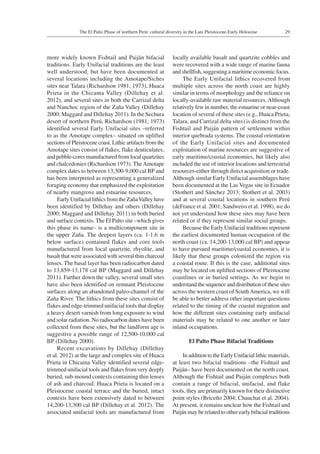
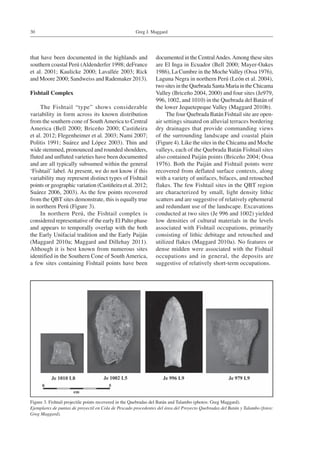
Figure 4. Site Je 996 in the Quebrada del Batán (photo: Greg Maggard).
Sitio Je 996, situado en la Quebrada del Batán (foto: Greg Maggard).](https://image.slidesharecdn.com/03-maggard47-150629164445-lva1-app6891/85/Chungara-Vol-47-1-p-25-7-320.jpg)
![33The El Palto Phase of northern Perú: cultural diversity in the Late Pleistocene-Early Holocene
changes within the broad Paiján complex, as well as
our understanding of interaction between neighboring
coastal and highland populations.
Paiján settlement on the north coast contrasts
sharply with that of the Fishtail. Unlike Fishtail
sites, which are represented only by short-term
camps, Paiján sites are more numerous, encompass
a range of types and functions, and are more widely
spread across different kinds of landforms along the
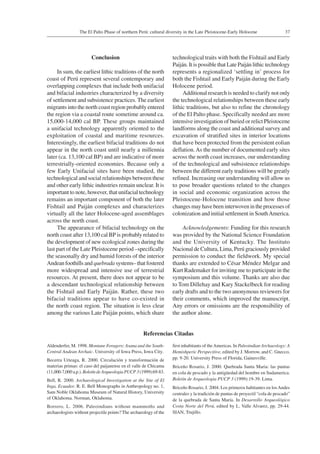
Andean flanks. Paiján sites in the QBT included
basecamps, field camps, transitory stations, and
quarries/workshops that appear to have had different
functional roles within a more logistically-organized
settlement system (Maggard 2010a).
One of the characteristic features of excavated
Paiján sites is the similarity in use of a broad spectrum
of subsistence resources. Combinations of various
terrestrial mammals, lizards, birds, and terrestrial
snails, along with several marine and freshwater
resources (including several fish species) characterize
the subsistence remains reported from sites across the
north coast (Briceño 2000; Chauchat 1998; Chauchat
et al. 2006; Dillehay et al. 2003; Gálvez 2004, 2000,
1992; Malpass 1983). Paiján sites excavated in the
QBT yielded a similar diversity of faunal resources
(Maggard 2010a). Paiján faunal materials recovered
in the QBT encompassed a range of terrestrial
mammals, including Cervidae (deer), Tayassuidae
(peccary), Pseudalopex sp. (South American fox),
Mustelidae (weasels, skunks, and otters), Sciurus
sp. (tree squirrel), and Sigmodontinae (New World
rats and mice). Reptiles (Teiidae [whiptails and
tegus] and Dicrodon sp. [desert tegu]) and birds
(Passeriformes [perching birds] and Columbidae
[doves and pigeons]) were also recovered. Marine
resources included Micropogonias sp. (croaker),
Mugil sp. (mullet), Calamus brachysomus (probably
Pacific porgy), Haemulidae (grunts), Ariidae (sea
catfish), and Osteichthyes (indeterminate bony fish).
In addition to the faunal resources, plant
resources were probably equally important
components of Paiján subsistence (Dillehay and
Rossen 2002; Piperno 2011; Piperno and Dillehay
2008). Direct evidence for plant use (i.e., carbonized
floral remains, phytoliths, pollen) from Paiján
contexts is rare, but can be inferred based on corollary
evidence like the presence of groundstone tools
(Dillehay and Rossen 2002; Stackelbeck 2008).
Groundstone tools, including both manos and
batanes, were identified at nine sites in the QBT and
are suggestive of the importance of plant resources
within the broad spectrum subsistence strategy of
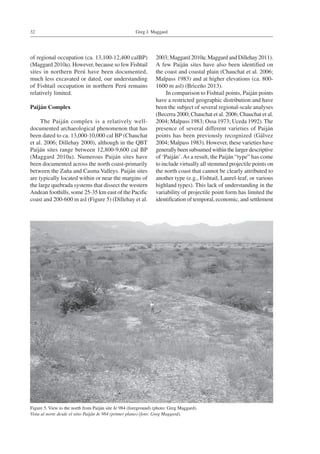
the Paiján. One site (Je 439) contained evidence of
a specialized activity area where multiple manos
and batanes were identified in close proximity to
a Paiján structure (Figure 6) (Maggard 2010a).
Paiján resource use is indicative of a broad
spectrum pattern and basecamps were likely
intentionally situated to provide access to a wide
diversity of resources. The density of Paiján sites
within the large quebrada systems of the western
Andean foothills suggests that these areas were
important in structuring Paiján settlement (Maggard
and Dillehay 2011). As discussed previously, the
paleoenvironment of the western Andean foothills
was dominated by a dry forest association that
incorporated varied potential plant and animal
resources. The quebrada systems act as natural
corridors into the low Andean flanks and likely
provided the easiest access to desired resources
and locations.
The density of Paiján settlement along the
western Andean flanks (Chauchat et al. 2006;
Maggard and Dillehay 2011) suggests that the
seasonal movement of basecamps may have
occurred in a linear fashion within the dry forest belt
(Netherly 2011).A linear or back-and-forth pattern
of movement between quebrada systems located in
the dry forest belt is distinct from the transhumant
pattern of the Fishtail, which emphasized vertical
mobility across different ecological zones.Although
the Paiján appear to have predominantly focused
their movement along the Andean foothills in a
logistical manner, this strategy also included forays
to the coast and humid forests of the highlands
(Briceño 2013).
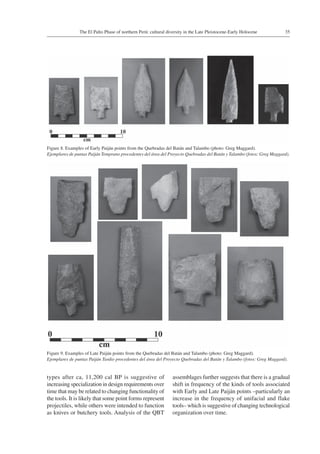
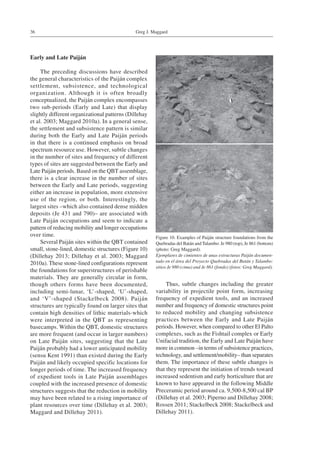
As noted previously, a wide range of
morphological variability has largely been
subsumed within term ‘Paiján’. Analysis of Paiján
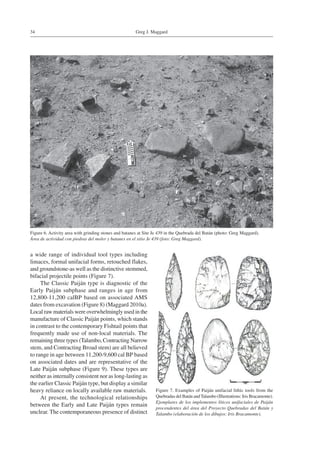
lithic assemblages from the QBT resulted in the
identification of four distinct types of stemmed
points that exist within the broader Paiján “type”
and correspond to early and late subphases of the
Paiján complex (Maggard 2010a). The recognition
of these different stemmed point types indicates
that the Paiján, rather than an single cultural
phenomenon, is more likely a complex set of
interrelated cultural expressions that reflect the
economic and technological changes that occurred
during the Pleistocene-Holocene transition (Maggard
2010a).The toolkit of the Paiján complex, as a whole,
reflects broad-spectrum resource use and contains](https://image.slidesharecdn.com/03-maggard47-150629164445-lva1-app6891/85/Chungara-Vol-47-1-p-25-9-320.jpg)

The El Palto phase (ca. 14,200-9,600 cal BP) on Peru's north coast reflects significant cultural diversity during the late Pleistocene to early Holocene, marked by various lithic traditions including early unifacial assemblages and the fishtail and Paiján complexes. Recent studies highlight the relationships between these technological traditions and the populations that created them, aiding in the understanding of early settlement patterns and technological changes in the region. The paleoenvironment and diverse ecological settings of northern Peru heavily influenced the settlement strategies and subsistence practices of the inhabitants during this period.


![Cindy[1]](https://cdn.slidesharecdn.com/ss_thumbnails/cindy1-100513205728-phpapp02-thumbnail.jpg?width=640&height=640&fit=bounds)


