PRESENTED BY:
ALI NASIR 28706
M UMAIR 28707
ANSA SHAFIQ 28708
STOCK EXCHANGE
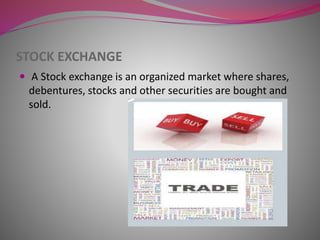
 A Stock exchange is an organized market where shares,
debentures, stocks and other securities are bought and
sold.
FEATURES OF STOCK EXCHANGE
 It is an organized market
 It is a securities market
 It is an important constituent of capital market i.e., market for
long term finance
 It is a voluntary association of persons desirous of dealing in
securities
 Stock exchange is a voluntary association, its membership is
not open to everybody
 In a stock exchange, only the members can deal in i.e., buy &
sell securities
 The members of a stock exchange can buy and sell securities
either as brokers for & on behalf of their clients
 The dealings in a stock exchange are under certain accepted
code of conduct i.e., rules and regulations
IMPORTANT FUNCTION OF STOCK EXCHANGE
 Provide central and convenient meeting places for sellers and
buyer of securities
 Increase the marketability and liquidity of securities
 Contribute to stability of prices of securities
 Equalization of price of securities
 Smoothen price movement
 Help the investors to know the worth of their holdings
 Promote the habit of saving and investment
 Help capital formation
 Help companies and government to raise funds from the
investors
 Provide forecasting service
STOCK EXCHANGE IN PAKISTAN
 KRACHI STOCK EXCHANGE (KSE)
 LAHORE STOCK EXCHANGE (LHE)
 ISLAMABAD STOCK EXCHANGE (ISE)
KSE INTRODUCTION
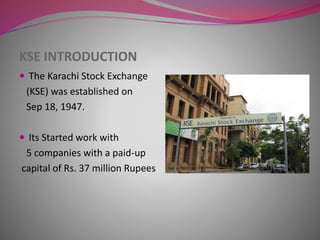
 The Karachi Stock Exchange
(KSE) was established on
Sep 18, 1947.
 Its Started work with
5 companies with a paid-up
capital of Rs. 37 million Rupees
 The Karachi Stock Exchange (KSE), Pakistan's largest Stock
Exchange.
 The Karachi Stock Exchange (KSE) is the premier stock
exchange of the country. There are 580 companies listed in
KSE.
 The total market capital is US$73.1 billion - (22.01.2015).
Current Managing Director is Nadeem Naqvi.
LAHORE STOCK EXCHANGE
 It is Pakistan's second largest
stock exchange in the country.
 There are 671 companies is
enlisted in LSE.
 The market capitalization
stood at $ 36.44 billion
ISLAMABAD STOCK EXCHANGE
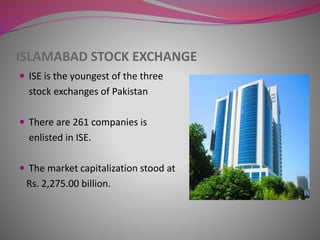
 ISE is the youngest of the three
stock exchanges of Pakistan
 There are 261 companies is
enlisted in ISE.
 The market capitalization stood at
Rs. 2,275.00 billion.
BROKER AND JOBBER
 BROKER:
He is one acts as a intermediary on behalf of others. A broker
in a stock exchange ,is a commission agent who transacts
business in securities on behalf of non members.
 JOBBER:
He is not allowed to deal with the public directly .He deals with
brokers who are engaged with the investors . Thus, the
securities is bought by the jobber from members and sells to
members who are operating on the stock exchange as broker.
SPECULATION AND SPECULATOR
 SPECULATION :
It is the transaction of members to buy or sell securities on
stock exchange with a view to make profits to anticipated raise
or fall in price of securities.
 SPECULATOR :
The dealer in stock exchange who indulge in speculation are
called speculator . They do not take delivery of securities
purchased or sold by them , but only pay or rescue the
difference between the purchase price and sale price . The
different types of speculators are
DIFFERENT TERMS USED IN STOCK EXCHANGE
 Bull
 Bear
 Stage (Deer)
 Lame Duck
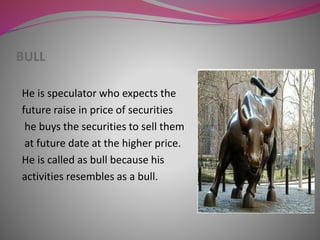
BULL
He is speculator who expects the
future raise in price of securities
he buys the securities to sell them
at future date at the higher price.
He is called as bull because his
activities resembles as a bull.
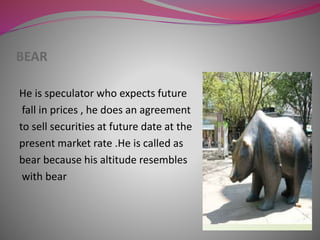
BEAR
He is speculator who expects future
fall in prices , he does an agreement
to sell securities at future date at the
present market rate .He is called as
bear because his altitude resembles
with bear
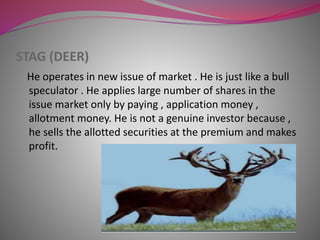
STAG (DEER)
He operates in new issue of market . He is just like a bull
speculator . He applies large number of shares in the
issue market only by paying , application money ,
allotment money. He is not a genuine investor because ,
he sells the allotted securities at the premium and makes
profit.
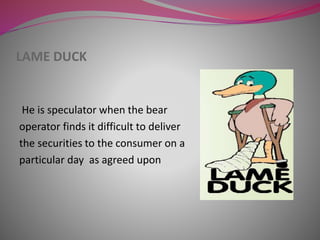
LAME DUCK
He is speculator when the bear
operator finds it difficult to deliver
the securities to the consumer on a
particular day as agreed upon
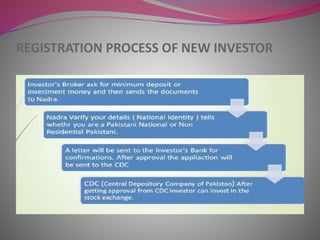
REGISTRATION PROCESS OF NEW INVESTOR
REGULATING THE STOCK MARKET
 The regulatory authority for the securities market and
corporate sector in Pakistan is the Securities and Exchange
Commission of Pakistan (SECP).

 The SECP administers the compliance of the corporate laws in
the country and is run by commissioners under a chairman.
 The SECP,provides an accountability mechanism through
establishment of a Securities and Exchange Policy Board.
MARKET
 A public place where buyers and sellers make transactions,
directly or via intermediaries. Also sometimes means the stock
market.
 A market is a public place where provision and object are
exposed for sale.
Types of Market
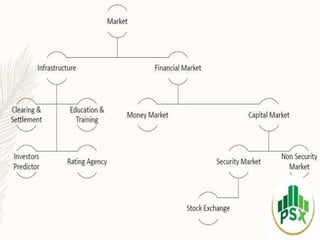
 There are two types of Market as following :
 Money Market
 Capital Market
 Primary Market
 Secondary Market
MONEY MMARKET
 In finance, the money market is the global financial market for
short term borrowing and lending.
 It provides short-term liquidity funding for the global financial
system.
 The money market is where short term obligations such as
Treasury bills, commercial paper and bankers‘ acceptances are
bought and sold.
CAPITAL MARKET
 The market for relatively long-term (greater than one year
original maturity) financial instruments.
 For example, shares and bonds issued by business entities
(companies) which are traded at a Stock Exchange
Types of Capital Markets
 PRIMARY MARKET
A market where shares or TFCs are bought and sold for the first
time (a “new issues” market).
 SECONDARY MARKET
“Secondary markets are those where already issued shares are
bought and sold”
FACTORS AFFECTING STOCK EXCHANGE
 Economic Factors
Inflation And Deflation
Interest Rates
Foreign Markets
 Market Factor
Demand AND SUPPLY
Market Cap
News
Earning/Price Ratio

Stock exchange

  • 1.
    PRESENTED BY: ALI NASIR28706 M UMAIR 28707 ANSA SHAFIQ 28708
  • 2.
    STOCK EXCHANGE  AStock exchange is an organized market where shares, debentures, stocks and other securities are bought and sold.
  • 4.
    FEATURES OF STOCKEXCHANGE  It is an organized market  It is a securities market  It is an important constituent of capital market i.e., market for long term finance  It is a voluntary association of persons desirous of dealing in securities
  • 5.
     Stock exchangeis a voluntary association, its membership is not open to everybody  In a stock exchange, only the members can deal in i.e., buy & sell securities  The members of a stock exchange can buy and sell securities either as brokers for & on behalf of their clients  The dealings in a stock exchange are under certain accepted code of conduct i.e., rules and regulations
  • 6.
    IMPORTANT FUNCTION OFSTOCK EXCHANGE  Provide central and convenient meeting places for sellers and buyer of securities  Increase the marketability and liquidity of securities  Contribute to stability of prices of securities  Equalization of price of securities
  • 7.
     Smoothen pricemovement  Help the investors to know the worth of their holdings  Promote the habit of saving and investment  Help capital formation  Help companies and government to raise funds from the investors  Provide forecasting service
  • 8.
    STOCK EXCHANGE INPAKISTAN  KRACHI STOCK EXCHANGE (KSE)  LAHORE STOCK EXCHANGE (LHE)  ISLAMABAD STOCK EXCHANGE (ISE)
  • 9.
    KSE INTRODUCTION  TheKarachi Stock Exchange (KSE) was established on Sep 18, 1947.  Its Started work with 5 companies with a paid-up capital of Rs. 37 million Rupees
  • 10.
     The KarachiStock Exchange (KSE), Pakistan's largest Stock Exchange.  The Karachi Stock Exchange (KSE) is the premier stock exchange of the country. There are 580 companies listed in KSE.  The total market capital is US$73.1 billion - (22.01.2015). Current Managing Director is Nadeem Naqvi.
  • 11.
    LAHORE STOCK EXCHANGE It is Pakistan's second largest stock exchange in the country.  There are 671 companies is enlisted in LSE.  The market capitalization stood at $ 36.44 billion
  • 12.
    ISLAMABAD STOCK EXCHANGE ISE is the youngest of the three stock exchanges of Pakistan  There are 261 companies is enlisted in ISE.  The market capitalization stood at Rs. 2,275.00 billion.
  • 13.
    BROKER AND JOBBER BROKER: He is one acts as a intermediary on behalf of others. A broker in a stock exchange ,is a commission agent who transacts business in securities on behalf of non members.  JOBBER: He is not allowed to deal with the public directly .He deals with brokers who are engaged with the investors . Thus, the securities is bought by the jobber from members and sells to members who are operating on the stock exchange as broker.
  • 14.
    SPECULATION AND SPECULATOR SPECULATION : It is the transaction of members to buy or sell securities on stock exchange with a view to make profits to anticipated raise or fall in price of securities.  SPECULATOR : The dealer in stock exchange who indulge in speculation are called speculator . They do not take delivery of securities purchased or sold by them , but only pay or rescue the difference between the purchase price and sale price . The different types of speculators are
  • 15.
    DIFFERENT TERMS USEDIN STOCK EXCHANGE  Bull  Bear  Stage (Deer)  Lame Duck
  • 16.
    BULL He is speculatorwho expects the future raise in price of securities he buys the securities to sell them at future date at the higher price. He is called as bull because his activities resembles as a bull.
  • 17.
    BEAR He is speculatorwho expects future fall in prices , he does an agreement to sell securities at future date at the present market rate .He is called as bear because his altitude resembles with bear
  • 18.
    STAG (DEER) He operatesin new issue of market . He is just like a bull speculator . He applies large number of shares in the issue market only by paying , application money , allotment money. He is not a genuine investor because , he sells the allotted securities at the premium and makes profit.
  • 19.
    LAME DUCK He isspeculator when the bear operator finds it difficult to deliver the securities to the consumer on a particular day as agreed upon
  • 20.
  • 21.
    REGULATING THE STOCKMARKET  The regulatory authority for the securities market and corporate sector in Pakistan is the Securities and Exchange Commission of Pakistan (SECP).   The SECP administers the compliance of the corporate laws in the country and is run by commissioners under a chairman.  The SECP,provides an accountability mechanism through establishment of a Securities and Exchange Policy Board.
  • 22.
    MARKET  A publicplace where buyers and sellers make transactions, directly or via intermediaries. Also sometimes means the stock market.  A market is a public place where provision and object are exposed for sale.
  • 23.
    Types of Market There are two types of Market as following :  Money Market  Capital Market  Primary Market  Secondary Market
  • 24.
    MONEY MMARKET  Infinance, the money market is the global financial market for short term borrowing and lending.  It provides short-term liquidity funding for the global financial system.  The money market is where short term obligations such as Treasury bills, commercial paper and bankers‘ acceptances are bought and sold.
  • 25.
    CAPITAL MARKET  Themarket for relatively long-term (greater than one year original maturity) financial instruments.  For example, shares and bonds issued by business entities (companies) which are traded at a Stock Exchange
  • 26.
    Types of CapitalMarkets  PRIMARY MARKET A market where shares or TFCs are bought and sold for the first time (a “new issues” market).  SECONDARY MARKET “Secondary markets are those where already issued shares are bought and sold”
  • 27.
    FACTORS AFFECTING STOCKEXCHANGE  Economic Factors Inflation And Deflation Interest Rates Foreign Markets  Market Factor Demand AND SUPPLY Market Cap News Earning/Price Ratio