Stereotypes
and
Bias.
Models of stereotyping
Bakhadirova M
*What is a Stereotype?
2
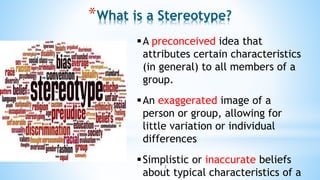
A preconceived idea that
attributes certain characteristics
(in general) to all members of a
group.
An exaggerated image of a
person or group, allowing for
little variation or individual
differences
Simplistic or inaccurate beliefs
about typical characteristics of a
*What is Bias?
3
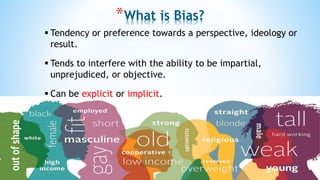
 Tendency or preference towards a perspective, ideology or
result.
 Tends to interfere with the ability to be impartial,
unprejudiced, or objective.
 Can be explicit or implicit.
WHERE DO
STEREOTYPES AND
BIAS COME FROM?
*Friends
*Family
*Television
*Community
*Politics
*Cultural Differences
*Personal Experiences
*Human Nature
4
5
*
Staff:
*Unlawful discrimination
*Others losing their sense of
“belonging”
*Low employee morale
*Negative community image
Students:
*Low student achievement
*Disproportionate discipline
*Increased absenteeism
*Widen achievement gap
*Compound bad behaviors
HOW DOES IT AFFECT US?
PERCEPTION – HOW WE SEE PEOPLE AND PERCEIVE REALITY.
ATTITUDE – HOW WE REACT TOWARDS CERTAIN PEOPLE.
BEHAVIORS – HOW RECEPTIVE/FRIENDLY WE ARE TOWARDS CERTAIN PEOPLE.
ATTENTION – WHICH ASPECTS OF A PERSON WE PAY MOST ATTENTION TO.
LISTENING SKILLS – HOW MUCH WE ACTIVELY LISTEN TO WHAT CERTAIN PEOPLE SAY.
MICRO-AFFIRMATIONS – HOW MUCH OR HOW LITTLE WE COMFORT CERTAIN PEOPLE IN
CERTAIN SITUATIONS.
HOW DO WE RECOGNIZE IT?
*Stereotypes and Bias
6
*Common Stereotypes
7
1. Gender
2. Age
3. Socio-economic
4. Race
8
*
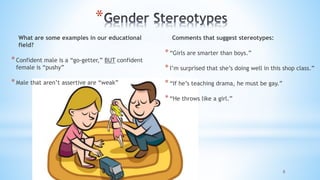
What are some examples in our educational
field?
*Confident male is a “go-getter,” BUT confident
female is “pushy”
*Male that aren’t assertive are “weak”
Comments that suggest stereotypes:
*“Girls are smarter than boys.”
*I’m surprised that she’s doing well in this shop class.”
*“If he’s teaching drama, he must be gay.”
*“He throws like a girl.”
9
*
What are some examples in our
educational field?
*Younger people are “lazy” or have
“weak work ethic.”
*Older people are “tired” or “old
fashioned.”
*Older people are stuck in their
ways.
*Younger people don’t listen.
Comments that could suggest
stereotypes:
* “We need ‘energetic people’,
fresh blood.”
* “He needs to drop his prehistoric
ways.”
* “They usually don’t stick around
beyond 2 years.”
What are some examples
in educational field?
*Person not respected
because no steady work
history.
*Person excluded because
they don’t dress nicely.
Comments that suggest
stereotype:
*“Your neighborhood doesn’t
have an HOA?”
*“He’s rough-looking…”
*“Did you see that wreck
she’s driving.”
10
*
11
*
What are some examples
in the educational field?
*Some receive jobs due to
knowing the Superintendent
but aren’t qualified
*A person received a job
because they speaks
Spanish
Comments that suggest
stereotype:
*“Be careful. ‘Those’
people…”
*He’s just not a “good
fit.”
Bias
*Where Bias Lives in Our Brain
13
*Bias Can Be Conscious or Unconscious
14
*Types of Unconscious Bias
15
1. Conformity Bias
2. Beauty Bias
3. Halo/Horns Effect
4. Similarity/ Contrast Effect
5. Affinity Bias
6. Attribution Bias
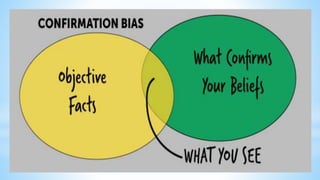
7. Confirmation Bias
*Conformity Bias
16
*Beauty Bias
17
Ask yourself:
• Am I basing my decision on
judgments about how the
person looks (dress, hair, etc.)?
• Is that impacting how I interpret
and value this person?
*Halo/Horns Effect
18
Ask yourself:
• Is the fact that this person is really good (or not good) at one
thing impacting how I feel about other things they do?
• How can I separate the two?
• Might I get perspective from a peer?
*Similarity/ Contrast Effect
19
Ask yourself:
• Is this person’s style similar
or different to my own?
• Is that impacting how I
interpret and value this
person?
*Affinity Bias
20
Ask yourself:
• Does this person remind me of someone or something I like / don’t like?
• Is that impacting how I interpret and value this person?
*Attribution Bias
21
22

Stereotypes.pptx

  • 1.
  • 2.
    *What is aStereotype? 2 A preconceived idea that attributes certain characteristics (in general) to all members of a group. An exaggerated image of a person or group, allowing for little variation or individual differences Simplistic or inaccurate beliefs about typical characteristics of a
  • 3.
    *What is Bias? 3 Tendency or preference towards a perspective, ideology or result.  Tends to interfere with the ability to be impartial, unprejudiced, or objective.  Can be explicit or implicit.
  • 4.
    WHERE DO STEREOTYPES AND BIASCOME FROM? *Friends *Family *Television *Community *Politics *Cultural Differences *Personal Experiences *Human Nature 4
  • 5.
    5 * Staff: *Unlawful discrimination *Others losingtheir sense of “belonging” *Low employee morale *Negative community image Students: *Low student achievement *Disproportionate discipline *Increased absenteeism *Widen achievement gap *Compound bad behaviors
  • 6.
    HOW DOES ITAFFECT US? PERCEPTION – HOW WE SEE PEOPLE AND PERCEIVE REALITY. ATTITUDE – HOW WE REACT TOWARDS CERTAIN PEOPLE. BEHAVIORS – HOW RECEPTIVE/FRIENDLY WE ARE TOWARDS CERTAIN PEOPLE. ATTENTION – WHICH ASPECTS OF A PERSON WE PAY MOST ATTENTION TO. LISTENING SKILLS – HOW MUCH WE ACTIVELY LISTEN TO WHAT CERTAIN PEOPLE SAY. MICRO-AFFIRMATIONS – HOW MUCH OR HOW LITTLE WE COMFORT CERTAIN PEOPLE IN CERTAIN SITUATIONS. HOW DO WE RECOGNIZE IT? *Stereotypes and Bias 6
  • 7.
    *Common Stereotypes 7 1. Gender 2.Age 3. Socio-economic 4. Race
  • 8.
    8 * What are someexamples in our educational field? *Confident male is a “go-getter,” BUT confident female is “pushy” *Male that aren’t assertive are “weak” Comments that suggest stereotypes: *“Girls are smarter than boys.” *I’m surprised that she’s doing well in this shop class.” *“If he’s teaching drama, he must be gay.” *“He throws like a girl.”
  • 9.
    9 * What are someexamples in our educational field? *Younger people are “lazy” or have “weak work ethic.” *Older people are “tired” or “old fashioned.” *Older people are stuck in their ways. *Younger people don’t listen. Comments that could suggest stereotypes: * “We need ‘energetic people’, fresh blood.” * “He needs to drop his prehistoric ways.” * “They usually don’t stick around beyond 2 years.”
  • 10.
    What are someexamples in educational field? *Person not respected because no steady work history. *Person excluded because they don’t dress nicely. Comments that suggest stereotype: *“Your neighborhood doesn’t have an HOA?” *“He’s rough-looking…” *“Did you see that wreck she’s driving.” 10 *
  • 11.
    11 * What are someexamples in the educational field? *Some receive jobs due to knowing the Superintendent but aren’t qualified *A person received a job because they speaks Spanish Comments that suggest stereotype: *“Be careful. ‘Those’ people…” *He’s just not a “good fit.”
  • 12.
  • 13.
    *Where Bias Livesin Our Brain 13
  • 14.
    *Bias Can BeConscious or Unconscious 14
  • 15.
    *Types of UnconsciousBias 15 1. Conformity Bias 2. Beauty Bias 3. Halo/Horns Effect 4. Similarity/ Contrast Effect 5. Affinity Bias 6. Attribution Bias 7. Confirmation Bias
  • 16.
  • 17.
    *Beauty Bias 17 Ask yourself: •Am I basing my decision on judgments about how the person looks (dress, hair, etc.)? • Is that impacting how I interpret and value this person?
  • 18.
    *Halo/Horns Effect 18 Ask yourself: •Is the fact that this person is really good (or not good) at one thing impacting how I feel about other things they do? • How can I separate the two? • Might I get perspective from a peer?
  • 19.
    *Similarity/ Contrast Effect 19 Askyourself: • Is this person’s style similar or different to my own? • Is that impacting how I interpret and value this person?
  • 20.
    *Affinity Bias 20 Ask yourself: •Does this person remind me of someone or something I like / don’t like? • Is that impacting how I interpret and value this person?
  • 21.
  • 22.