Solution Manual for Diversity in Organizations, 2nd Edition
Solution Manual for Diversity in Organizations, 2nd Edition
Solution Manual for Diversity in Organizations, 2nd Edition
Solution Manual for Diversity in Organizations, 2nd Edition
Solution Manual for Diversity in Organizations, 2nd Edition
1.
Download the fullversion and explore a variety of test banks
or solution manuals at https://testbankbell.com
Solution Manual for Diversity in Organizations,
2nd Edition
_____ Tap the link below to start your download _____
http://testbankbell.com/product/solution-manual-for-
diversity-in-organizations-2nd-edition/
Find test banks or solution manuals at testbankbell.com today!
2.
We believe theseproducts will be a great fit for you. Click
the link to download now, or visit testbankbell.com
to discover even more!
Test Bank for Diversity in Organizations, 2nd Edition
http://testbankbell.com/product/test-bank-for-diversity-in-
organizations-2nd-edition/
Test Bank for Diversity in Organizations 3rd Edition Bell
http://testbankbell.com/product/test-bank-for-diversity-in-
organizations-3rd-edition-bell/
Solution Manual for Information Systems in Organizations
by Wallace
http://testbankbell.com/product/solution-manual-for-information-
systems-in-organizations-by-wallace/
Test Bank for Core Concepts of Accounting Information
Systems 14th by Simkin
http://testbankbell.com/product/test-bank-for-core-concepts-of-
accounting-information-systems-14th-by-simkin/
3.
Accounting Theory ConceptualIssues in a Political and
Economic Environment 9th Edition Wolk Solutions Manual
http://testbankbell.com/product/accounting-theory-conceptual-issues-
in-a-political-and-economic-environment-9th-edition-wolk-solutions-
manual/
Test Bank for Organic Chemistry – Standalone10th Edition
http://testbankbell.com/product/test-bank-for-organic-chemistry-
standalone-book-10th-edition/
Test Bank For Physical Examination and Health Assessment,
7th Edition by Carolyn Jarvis -Test Bank
http://testbankbell.com/product/test-bank-for-physical-examination-
and-health-assessment-7th-edition-by-carolyn-jarvis-test-bank/
Test Bank for Intermediate Algebra, 12th Edition, Marvin
L. Bittinger
http://testbankbell.com/product/test-bank-for-intermediate-
algebra-12th-edition-marvin-l-bittinger/
Test Bank for Police Supervision and Management, 3/E, Ken
Peak Larry K. Gaines Ronald W. Glensor
http://testbankbell.com/product/test-bank-for-police-supervision-and-
management-3-e-ken-peak-larry-k-gaines-ronald-w-glensor/
4.
Solution Manual forFinance for Non-Financial Managers :
Fourth Canadian Edition
http://testbankbell.com/product/solution-manual-for-finance-for-non-
financial-managers-fourth-canadian-edition/
5.
Solution Manual forDiversity in
Organizations, 2nd Edition
Download full chapter at: https://testbankbell.com/product/solution-
manual-for-diversity-in-organizations-2nd-edition/
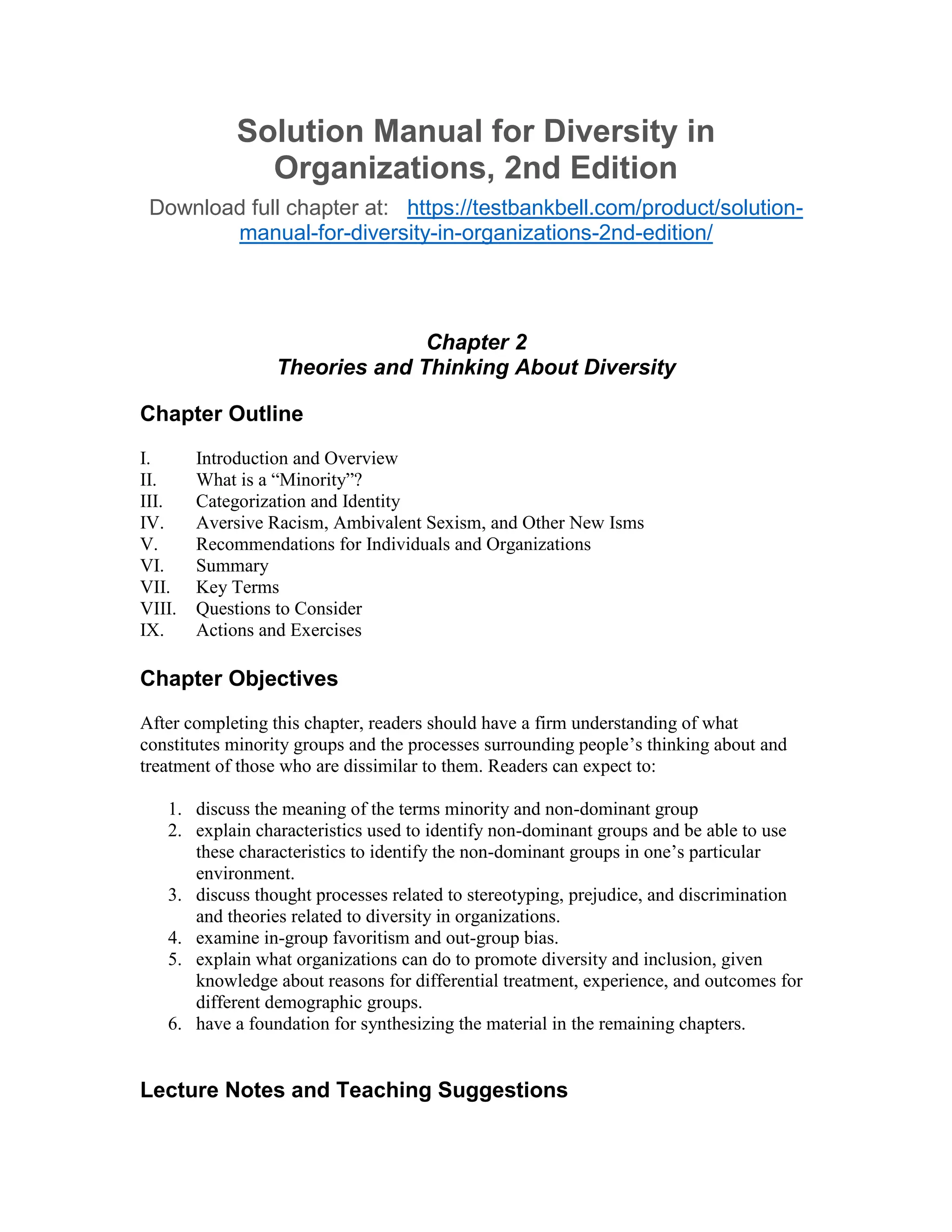
Chapter 2
Theories and Thinking About Diversity
Chapter Outline
I. Introduction and Overview
II. What is a “Minority”?
III. Categorization and Identity
IV. Aversive Racism, Ambivalent Sexism, and Other New Isms
V. Recommendations for Individuals and Organizations
VI. Summary
VII. Key Terms
VIII. Questions to Consider
IX. Actions and Exercises
Chapter Objectives
After completing this chapter, readers should have a firm understanding of what
constitutes minority groups and the processes surrounding people’s thinking about and
treatment of those who are dissimilar to them. Readers can expect to:
1. discuss the meaning of the terms minority and non-dominant group
2. explain characteristics used to identify non-dominant groups and be able to use
these characteristics to identify the non-dominant groups in one’s particular
environment.
3. discuss thought processes related to stereotyping, prejudice, and discrimination
and theories related to diversity in organizations.
4. examine in-group favoritism and out-group bias.
5. explain what organizations can do to promote diversity and inclusion, given
knowledge about reasons for differential treatment, experience, and outcomes for
different demographic groups.
6. have a foundation for synthesizing the material in the remaining chapters.
Lecture Notes and Teaching Suggestions
6.
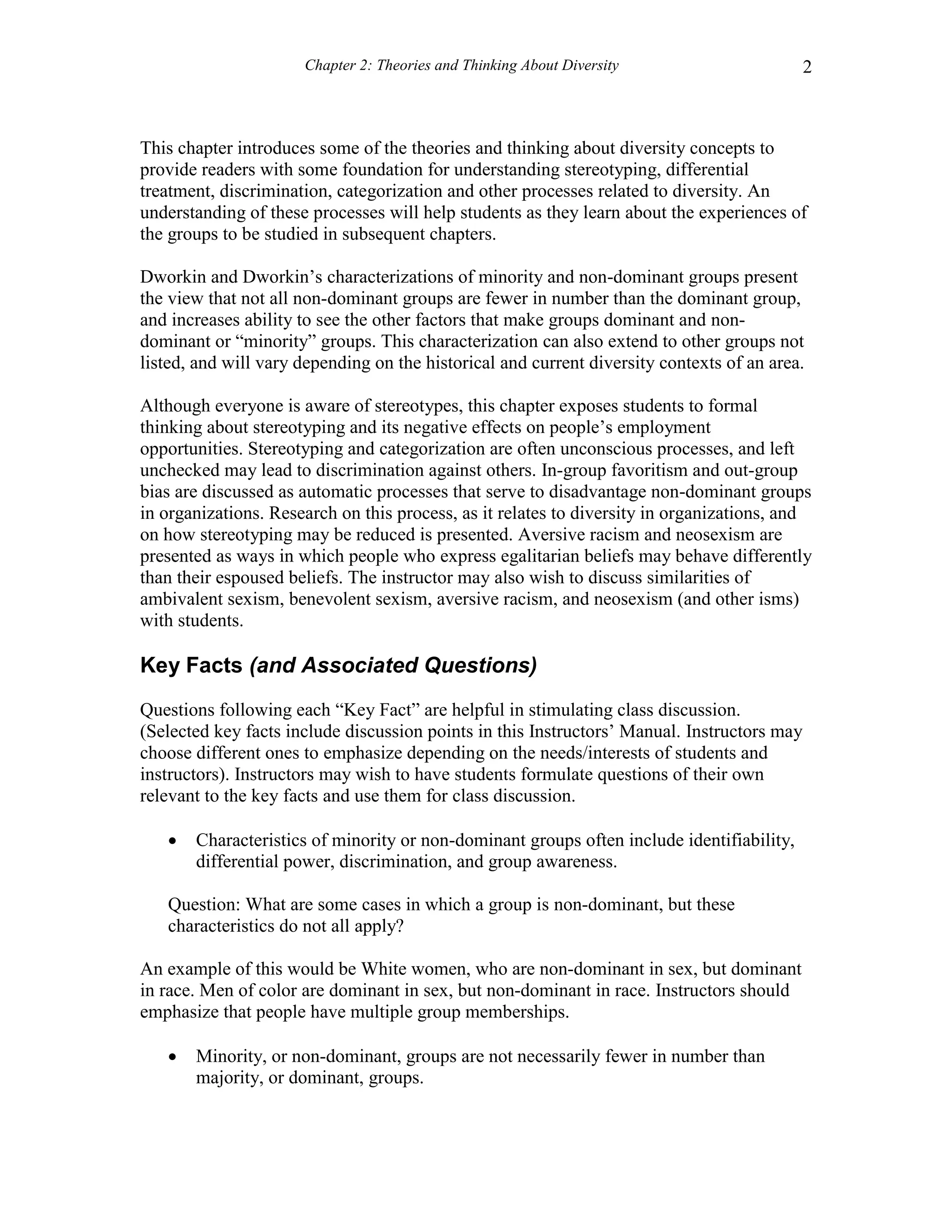
Chapter 2: Theoriesand Thinking About Diversity 2
This chapter introduces some of the theories and thinking about diversity concepts to
provide readers with some foundation for understanding stereotyping, differential
treatment, discrimination, categorization and other processes related to diversity. An
understanding of these processes will help students as they learn about the experiences of
the groups to be studied in subsequent chapters.
Dworkin and Dworkin’s characterizations of minority and non-dominant groups present
the view that not all non-dominant groups are fewer in number than the dominant group,
and increases ability to see the other factors that make groups dominant and non-
dominant or “minority” groups. This characterization can also extend to other groups not
listed, and will vary depending on the historical and current diversity contexts of an area.
Although everyone is aware of stereotypes, this chapter exposes students to formal
thinking about stereotyping and its negative effects on people’s employment
opportunities. Stereotyping and categorization are often unconscious processes, and left
unchecked may lead to discrimination against others. In-group favoritism and out-group
bias are discussed as automatic processes that serve to disadvantage non-dominant groups
in organizations. Research on this process, as it relates to diversity in organizations, and
on how stereotyping may be reduced is presented. Aversive racism and neosexism are
presented as ways in which people who express egalitarian beliefs may behave differently
than their espoused beliefs. The instructor may also wish to discuss similarities of
ambivalent sexism, benevolent sexism, aversive racism, and neosexism (and other isms)
with students.
Key Facts (and Associated Questions)
Questions following each “Key Fact” are helpful in stimulating class discussion.
(Selected key facts include discussion points in this Instructors’ Manual. Instructors may
choose different ones to emphasize depending on the needs/interests of students and
instructors). Instructors may wish to have students formulate questions of their own
relevant to the key facts and use them for class discussion.
Characteristics of minority or non-dominant groups often include identifiability,
differential power, discrimination, and group awareness.
Question: What are some cases in which a group is non-dominant, but these
characteristics do not all apply?
An example of this would be White women, who are non-dominant in sex, but dominant
in race. Men of color are dominant in sex, but non-dominant in race. Instructors should
emphasize that people have multiple group memberships.
Minority, or non-dominant, groups are not necessarily fewer in number than
majority, or dominant, groups.
7.
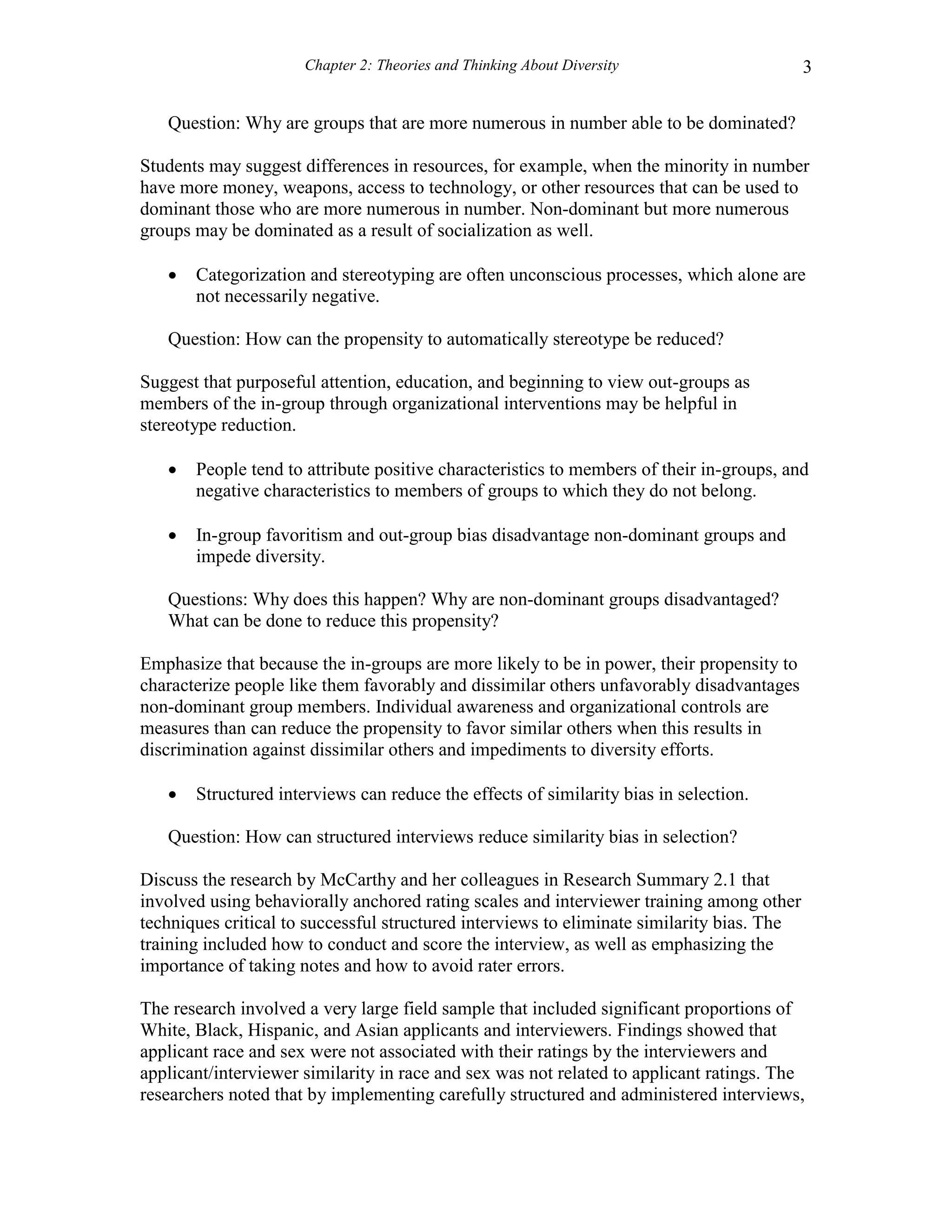
Chapter 2: Theoriesand Thinking About Diversity 3
Question: Why are groups that are more numerous in number able to be dominated?
Students may suggest differences in resources, for example, when the minority in number
have more money, weapons, access to technology, or other resources that can be used to
dominant those who are more numerous in number. Non-dominant but more numerous
groups may be dominated as a result of socialization as well.
Categorization and stereotyping are often unconscious processes, which alone are
not necessarily negative.
Question: How can the propensity to automatically stereotype be reduced?
Suggest that purposeful attention, education, and beginning to view out-groups as
members of the in-group through organizational interventions may be helpful in
stereotype reduction.
People tend to attribute positive characteristics to members of their in-groups, and
negative characteristics to members of groups to which they do not belong.
In-group favoritism and out-group bias disadvantage non-dominant groups and
impede diversity.
Questions: Why does this happen? Why are non-dominant groups disadvantaged?
What can be done to reduce this propensity?
Emphasize that because the in-groups are more likely to be in power, their propensity to
characterize people like them favorably and dissimilar others unfavorably disadvantages
non-dominant group members. Individual awareness and organizational controls are
measures than can reduce the propensity to favor similar others when this results in
discrimination against dissimilar others and impediments to diversity efforts.
Structured interviews can reduce the effects of similarity bias in selection.
Question: How can structured interviews reduce similarity bias in selection?
Discuss the research by McCarthy and her colleagues in Research Summary 2.1 that
involved using behaviorally anchored rating scales and interviewer training among other
techniques critical to successful structured interviews to eliminate similarity bias. The
training included how to conduct and score the interview, as well as emphasizing the
importance of taking notes and how to avoid rater errors.
The research involved a very large field sample that included significant proportions of
White, Black, Hispanic, and Asian applicants and interviewers. Findings showed that
applicant race and sex were not associated with their ratings by the interviewers and
applicant/interviewer similarity in race and sex was not related to applicant ratings. The
researchers noted that by implementing carefully structured and administered interviews,
8.
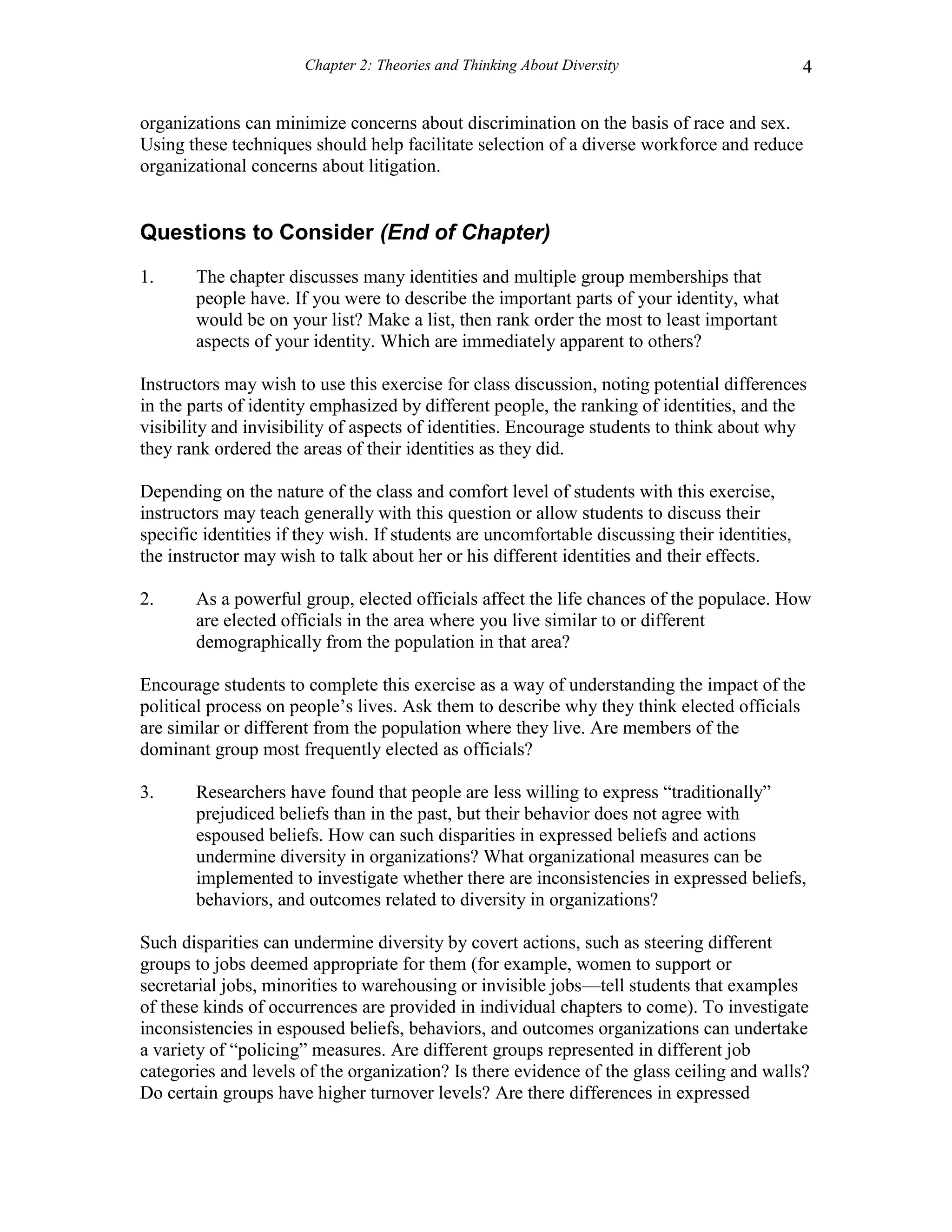
Chapter 2: Theoriesand Thinking About Diversity 4
organizations can minimize concerns about discrimination on the basis of race and sex.
Using these techniques should help facilitate selection of a diverse workforce and reduce
organizational concerns about litigation.
Questions to Consider (End of Chapter)
1. The chapter discusses many identities and multiple group memberships that
people have. If you were to describe the important parts of your identity, what
would be on your list? Make a list, then rank order the most to least important
aspects of your identity. Which are immediately apparent to others?
Instructors may wish to use this exercise for class discussion, noting potential differences
in the parts of identity emphasized by different people, the ranking of identities, and the
visibility and invisibility of aspects of identities. Encourage students to think about why
they rank ordered the areas of their identities as they did.
Depending on the nature of the class and comfort level of students with this exercise,
instructors may teach generally with this question or allow students to discuss their
specific identities if they wish. If students are uncomfortable discussing their identities,
the instructor may wish to talk about her or his different identities and their effects.
2. As a powerful group, elected officials affect the life chances of the populace. How
are elected officials in the area where you live similar to or different
demographically from the population in that area?
Encourage students to complete this exercise as a way of understanding the impact of the
political process on people’s lives. Ask them to describe why they think elected officials
are similar or different from the population where they live. Are members of the
dominant group most frequently elected as officials?
3. Researchers have found that people are less willing to express “traditionally”
prejudiced beliefs than in the past, but their behavior does not agree with
espoused beliefs. How can such disparities in expressed beliefs and actions
undermine diversity in organizations? What organizational measures can be
implemented to investigate whether there are inconsistencies in expressed beliefs,
behaviors, and outcomes related to diversity in organizations?
Such disparities can undermine diversity by covert actions, such as steering different
groups to jobs deemed appropriate for them (for example, women to support or
secretarial jobs, minorities to warehousing or invisible jobs—tell students that examples
of these kinds of occurrences are provided in individual chapters to come). To investigate
inconsistencies in espoused beliefs, behaviors, and outcomes organizations can undertake
a variety of “policing” measures. Are different groups represented in different job
categories and levels of the organization? Is there evidence of the glass ceiling and walls?
Do certain groups have higher turnover levels? Are there differences in expressed
9.
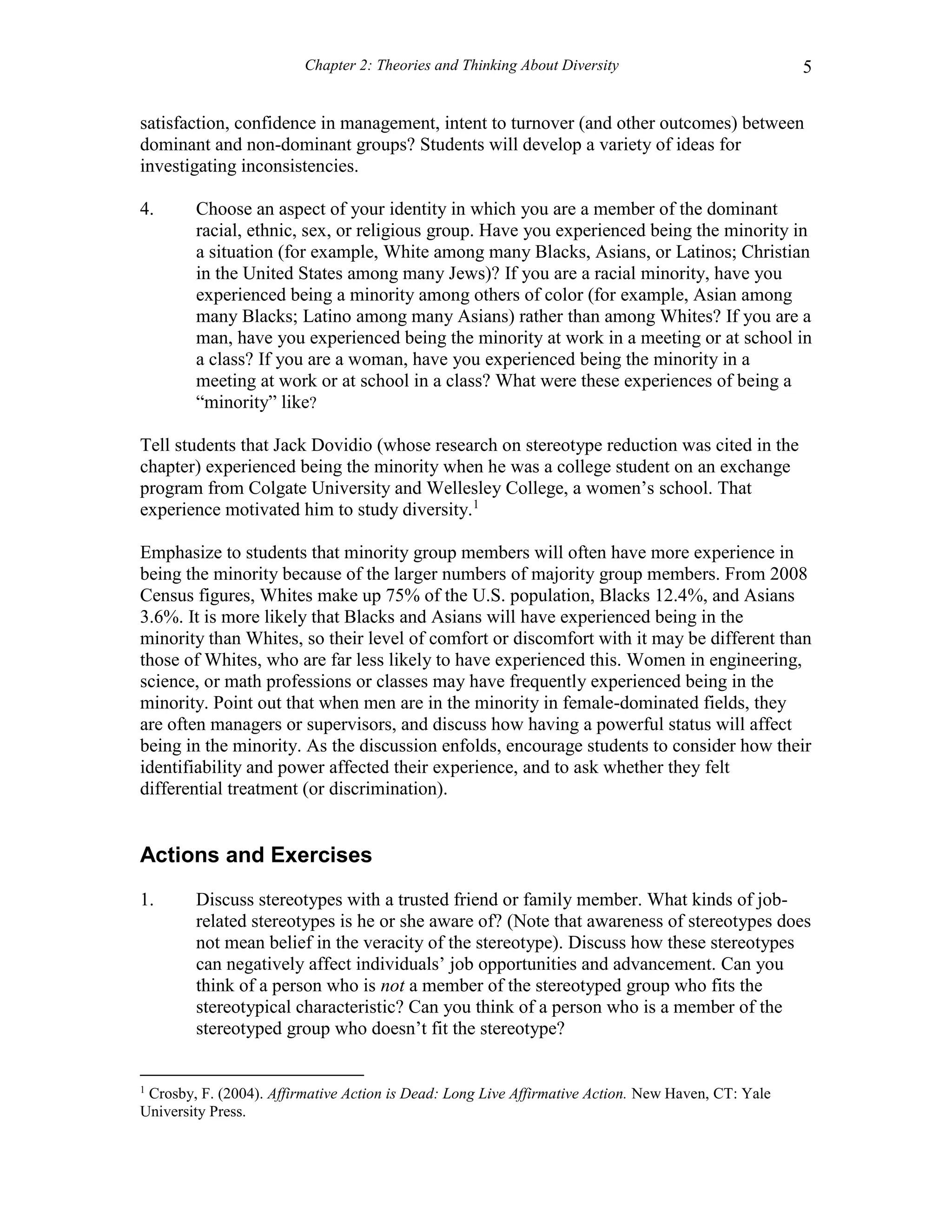
Chapter 2: Theoriesand Thinking About Diversity 5
satisfaction, confidence in management, intent to turnover (and other outcomes) between
dominant and non-dominant groups? Students will develop a variety of ideas for
investigating inconsistencies.
4. Choose an aspect of your identity in which you are a member of the dominant
racial, ethnic, sex, or religious group. Have you experienced being the minority in
a situation (for example, White among many Blacks, Asians, or Latinos; Christian
in the United States among many Jews)? If you are a racial minority, have you
experienced being a minority among others of color (for example, Asian among
many Blacks; Latino among many Asians) rather than among Whites? If you are a
man, have you experienced being the minority at work in a meeting or at school in
a class? If you are a woman, have you experienced being the minority in a
meeting at work or at school in a class? What were these experiences of being a
“minority” like?
Tell students that Jack Dovidio (whose research on stereotype reduction was cited in the
chapter) experienced being the minority when he was a college student on an exchange
program from Colgate University and Wellesley College, a women’s school. That
experience motivated him to study diversity.1
Emphasize to students that minority group members will often have more experience in
being the minority because of the larger numbers of majority group members. From 2008
Census figures, Whites make up 75% of the U.S. population, Blacks 12.4%, and Asians
3.6%. It is more likely that Blacks and Asians will have experienced being in the
minority than Whites, so their level of comfort or discomfort with it may be different than
those of Whites, who are far less likely to have experienced this. Women in engineering,
science, or math professions or classes may have frequently experienced being in the
minority. Point out that when men are in the minority in female-dominated fields, they
are often managers or supervisors, and discuss how having a powerful status will affect
being in the minority. As the discussion enfolds, encourage students to consider how their
identifiability and power affected their experience, and to ask whether they felt
differential treatment (or discrimination).
Actions and Exercises
1. Discuss stereotypes with a trusted friend or family member. What kinds of job-
related stereotypes is he or she aware of? (Note that awareness of stereotypes does
not mean belief in the veracity of the stereotype). Discuss how these stereotypes
can negatively affect individuals’ job opportunities and advancement. Can you
think of a person who is not a member of the stereotyped group who fits the
stereotypical characteristic? Can you think of a person who is a member of the
stereotyped group who doesn’t fit the stereotype?
1
Crosby, F. (2004). Affirmative Action is Dead: Long Live Affirmative Action. New Haven, CT: Yale
University Press.
10.
Chapter 2: Theoriesand Thinking About Diversity 6
This exercise helps students see the pervasiveness of stereotypes among people from
various walks of life, education levels, and from different racial and ethnic backgrounds.
Older students report having this conversation with their children, and even children are
aware of stereotypes and can offer suggestions of how these stereotypes can disadvantage
people in job-related contexts, simply because of their group memberships.
2. Using a local newspaper (San Francisco Chronicle, Chicago Tribune, Dallas
Morning News, etc.), a campus or university newspaper, and a community or city
newspaper, locate stories that include photos of people in the story. Make a table
of the type of story (human interest, business news, crime, etc.), race, ethnicity,
sex, and estimated age of the subject. What diversity-related observations can be
made from the table?
Engage students in thinking about which groups appear to be well-represented, under-
represented, or invisible. [Are minorities more likely to be represented in crime stories?
How are women shown? How are older people shown—as the frail and elderly or as
people still employed? Are any people with disabilities or gays or lesbians represented?
How would one know?]. Point out that with invisible group statuses, such as many
disabilities, sexual orientation, and religion, often the stories (in which people belonging
to such categories appear) focus on something related to the group membership, such as a
story about disabilities at work or partner benefits. Instructors may wish to begin
compiling a file of newspapers that are particularly interesting to use in classes.
Be sure to emphasize that this analysis of a few newspapers or media items is limited and
may or may not support what large scale studies and more data show. Anecdotal evidence
versus data can also be pointed out in any individual stories one may have that seem to
conflict with data.
3. Locate a newspaper that has an executive or business section that includes
“promotions,” “executive changes,” or other career moves. If there are photos of
the people involved, list their race, ethnicity, and sex. If names only are provided,
determine the sex of the person, where possible. What observations can you make
from your list?
Engage students in thinking about which groups appear to be well-represented, under-
represented, or invisible in this section of the paper. [Are minorities more likely to be
represented in line or staff positions? How many of the stories involve women? Mention
that minorities and women often occupy human resources or community relations
positions, which are less likely to result in promotions to executive jobs—“glass walls”.]
When non-dominant group members are represented, discussion may focus on the
companies involved. In what companies does there appear to be more diversity?
Instructors may wish to begin compiling a file of newspapers that are particularly
interesting to use in classes.
Suggested Readings
11.
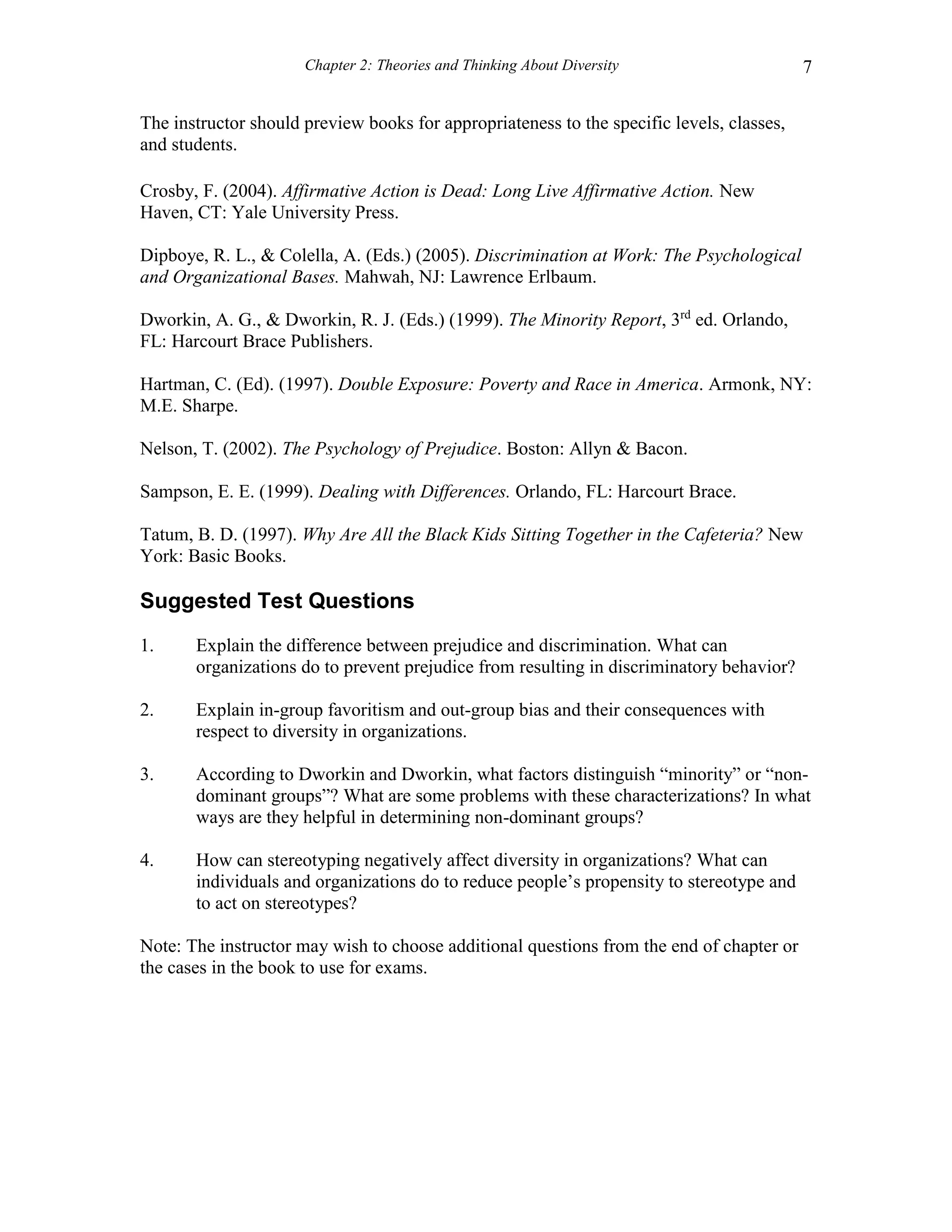
Chapter 2: Theoriesand Thinking About Diversity 7
The instructor should preview books for appropriateness to the specific levels, classes,
and students.
Crosby, F. (2004). Affirmative Action is Dead: Long Live Affirmative Action. New
Haven, CT: Yale University Press.
Dipboye, R. L., & Colella, A. (Eds.) (2005). Discrimination at Work: The Psychological
and Organizational Bases. Mahwah, NJ: Lawrence Erlbaum.
Dworkin, A. G., & Dworkin, R. J. (Eds.) (1999). The Minority Report, 3rd
ed. Orlando,
FL: Harcourt Brace Publishers.
Hartman, C. (Ed). (1997). Double Exposure: Poverty and Race in America. Armonk, NY:
M.E. Sharpe.
Nelson, T. (2002). The Psychology of Prejudice. Boston: Allyn & Bacon.
Sampson, E. E. (1999). Dealing with Differences. Orlando, FL: Harcourt Brace.
Tatum, B. D. (1997). Why Are All the Black Kids Sitting Together in the Cafeteria? New
York: Basic Books.
Suggested Test Questions
1. Explain the difference between prejudice and discrimination. What can
organizations do to prevent prejudice from resulting in discriminatory behavior?
2. Explain in-group favoritism and out-group bias and their consequences with
respect to diversity in organizations.
3. According to Dworkin and Dworkin, what factors distinguish “minority” or “non-
dominant groups”? What are some problems with these characterizations? In what
ways are they helpful in determining non-dominant groups?
4. How can stereotyping negatively affect diversity in organizations? What can
individuals and organizations do to reduce people’s propensity to stereotype and
to act on stereotypes?
Note: The instructor may wish to choose additional questions from the end of chapter or
the cases in the book to use for exams.
This ebook isfor the use of anyone anywhere in the United
States and most other parts of the world at no cost and with
almost no restrictions whatsoever. You may copy it, give it away
or re-use it under the terms of the Project Gutenberg License
included with this ebook or online at www.gutenberg.org. If you
are not located in the United States, you will have to check the
laws of the country where you are located before using this
eBook.
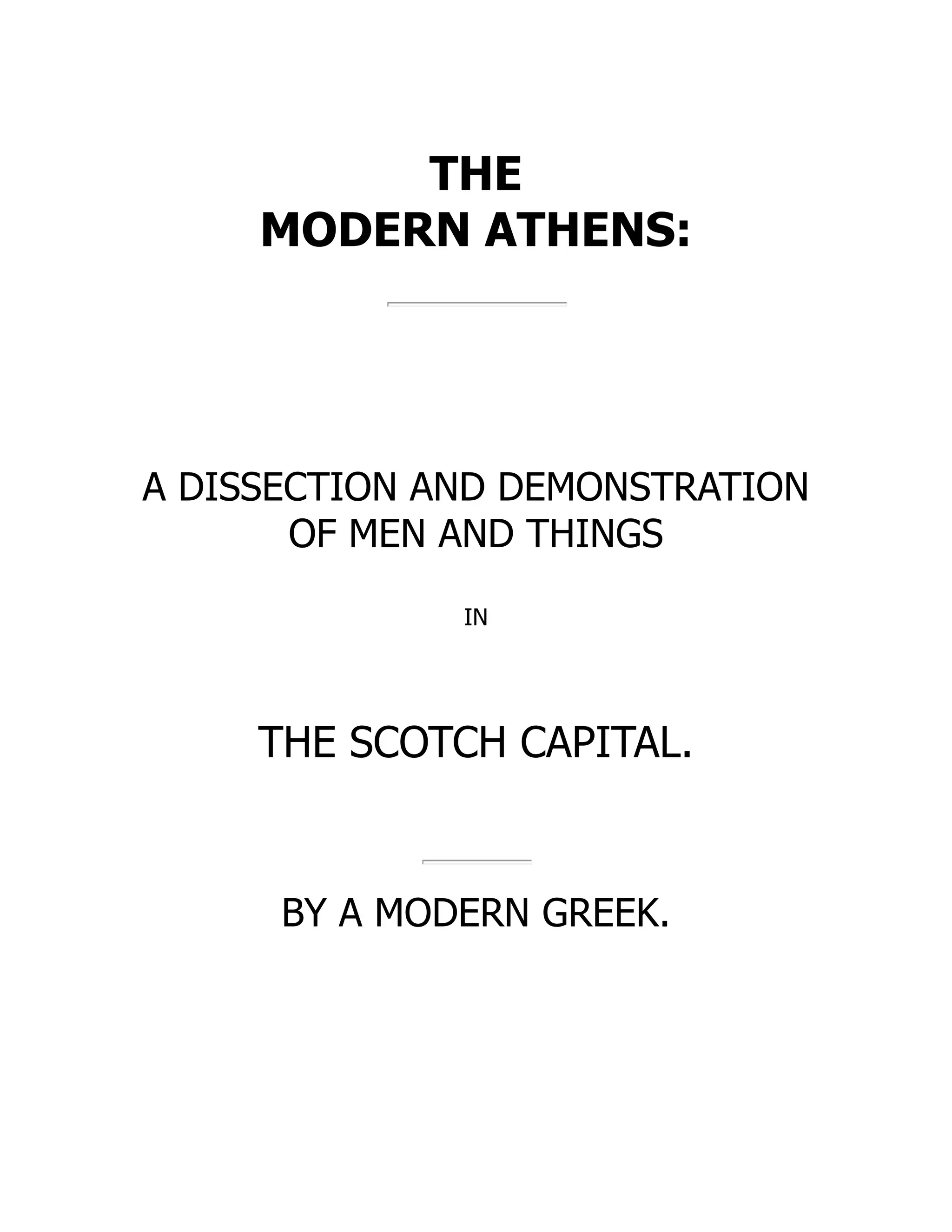
Title: The Modern Athens
Author: Robert Mudie
Release date: February 17, 2016 [eBook #51239]
Most recently updated: October 23, 2024
Language: English
Credits: Produced by Giovanni Fini, deaurider and the Online
Distributed Proofreading Team at http://www.pgdp.net
(This
file was produced from images generously made
available
by The Internet Archive)
*** START OF THE PROJECT GUTENBERG EBOOK THE MODERN
ATHENS ***
19.
TRANSCRIBER’S NOTES:
—Obvious printand punctuation errors were corrected.
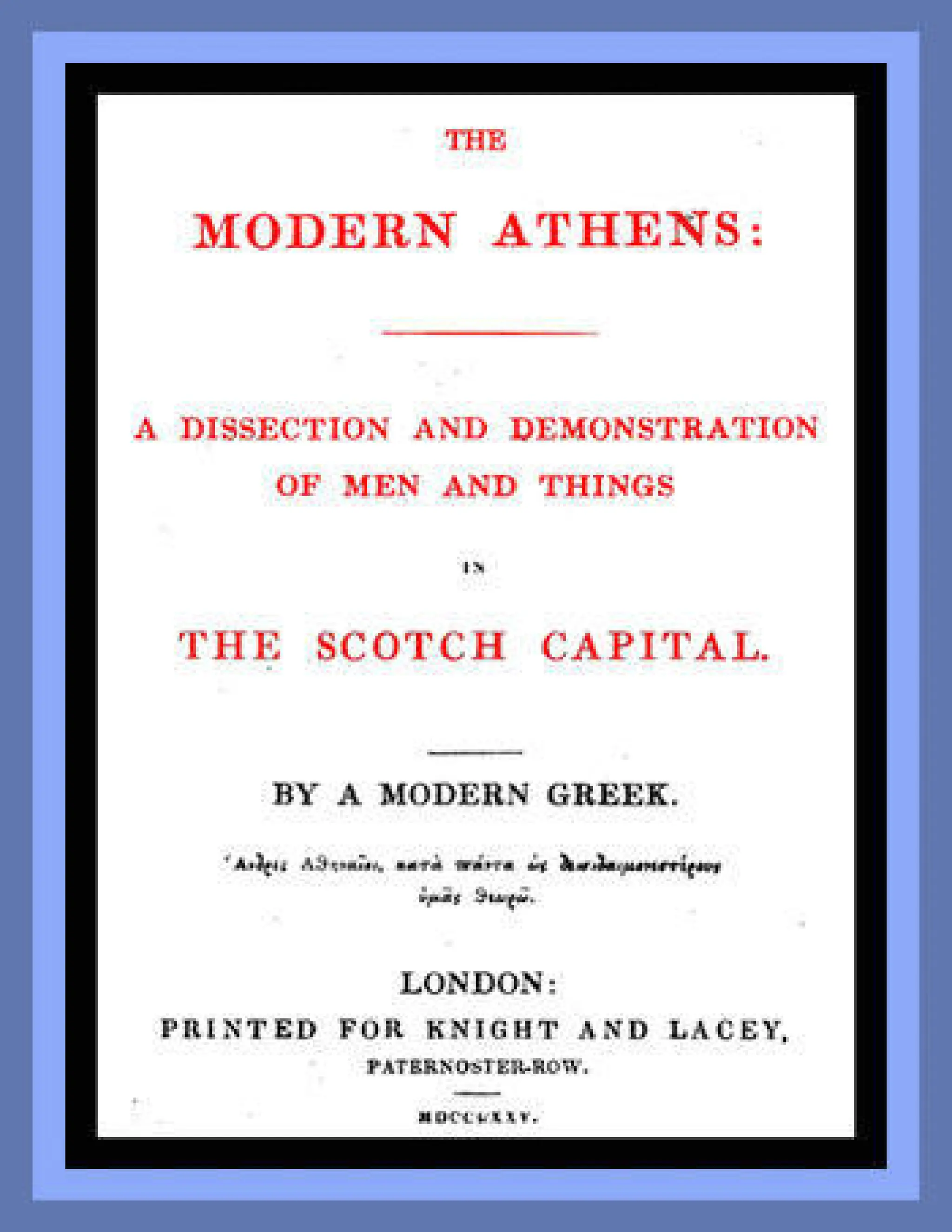
—The transcriber of this project created the book cover image using the title page of the
original book. The image is placed in the public domain.
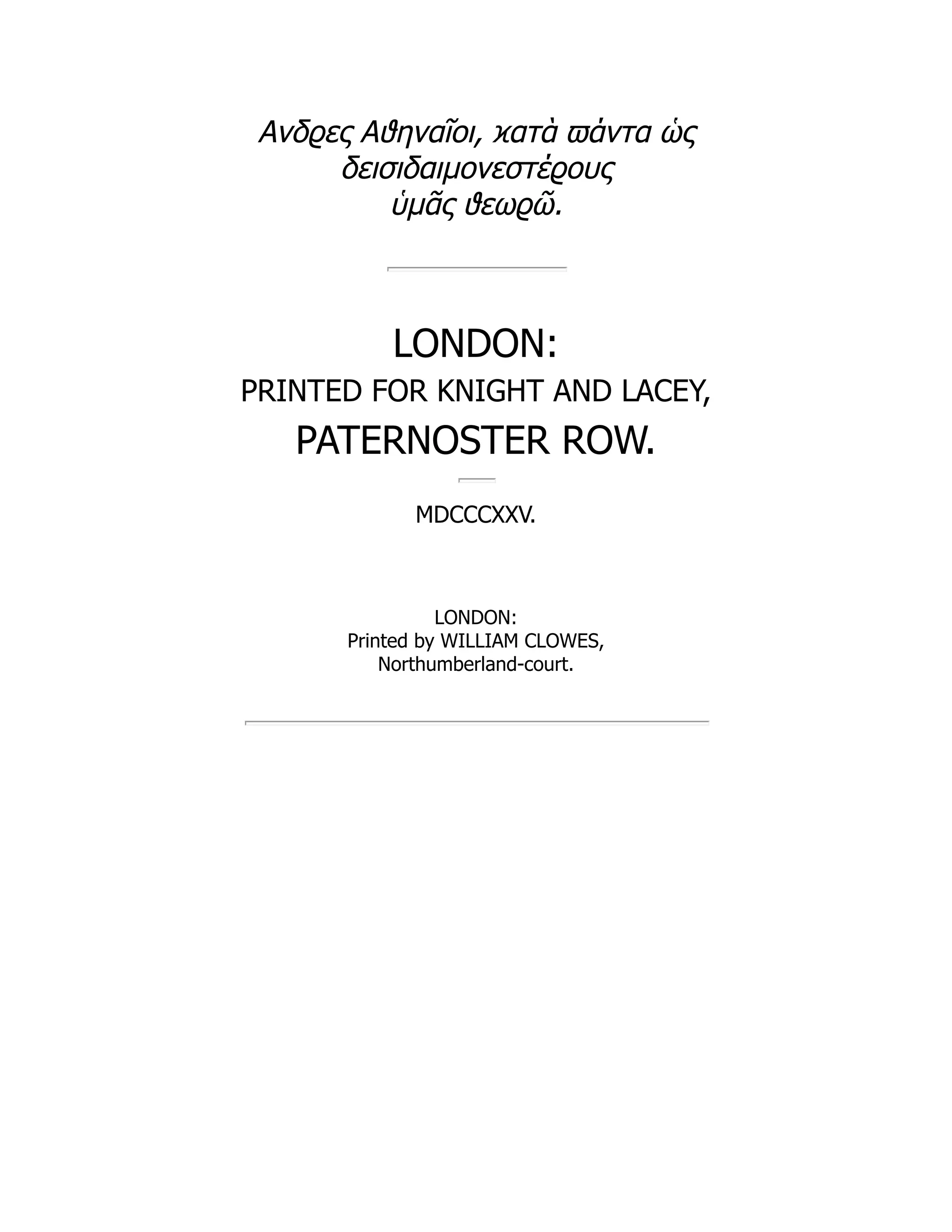
Ανδϱες Αϑηναῖοι, ϰατὰϖάντα ὡς
δεισιδαιμονεστέϱους
ὑμᾶς ϑεωϱῶ.
LONDON:
PRINTED FOR KNIGHT AND LACEY,
PATERNOSTER ROW.
MDCCCXXV.
LONDON:
Printed by WILLIAM CLOWES,
Northumberland-court.
22.
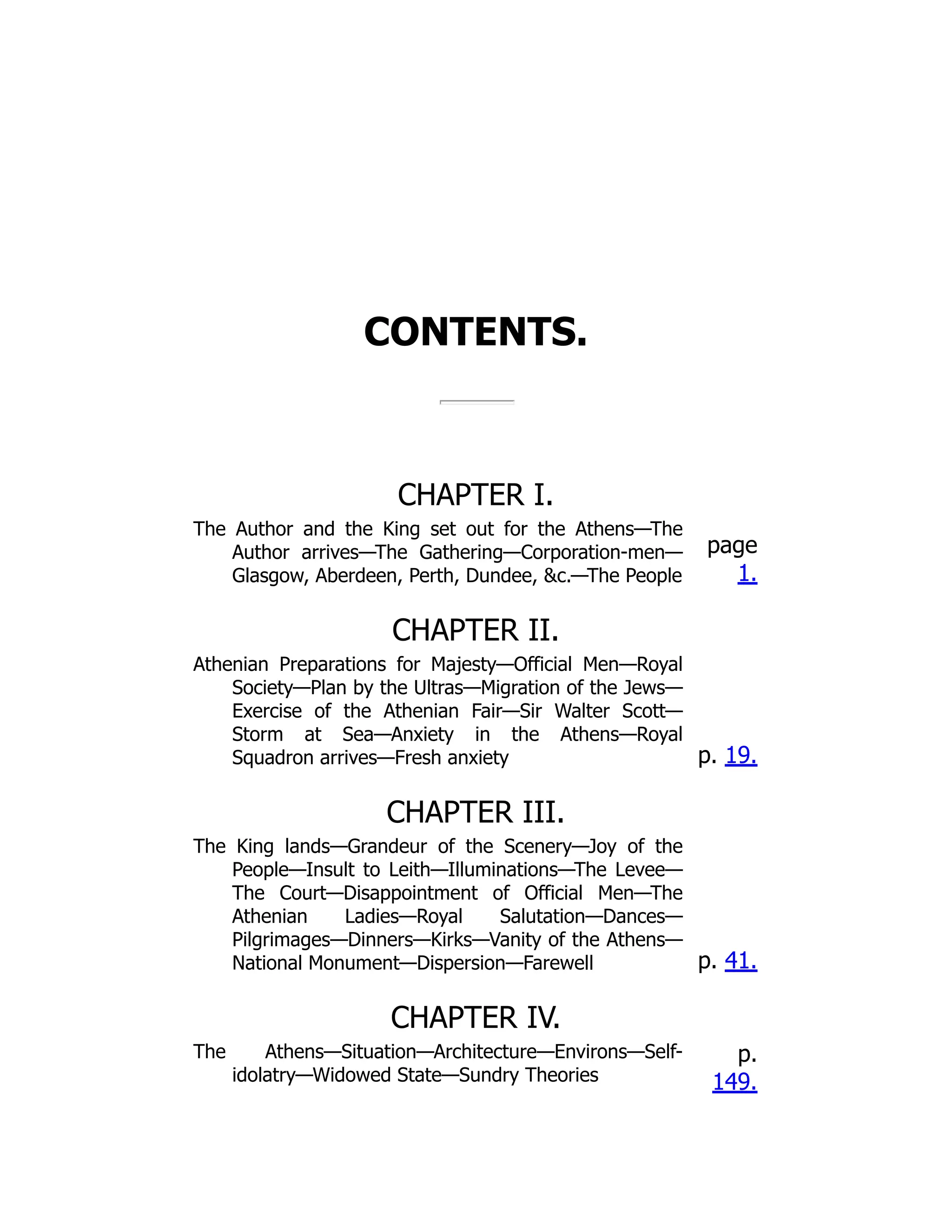
CONTENTS.
CHAPTER I.
The Authorand the King set out for the Athens—The
Author arrives—The Gathering—Corporation-men—
Glasgow, Aberdeen, Perth, Dundee, &c.—The People
page
1.
CHAPTER II.
Athenian Preparations for Majesty—Official Men—Royal
Society—Plan by the Ultras—Migration of the Jews—
Exercise of the Athenian Fair—Sir Walter Scott—
Storm at Sea—Anxiety in the Athens—Royal
Squadron arrives—Fresh anxiety p. 19.
CHAPTER III.
The King lands—Grandeur of the Scenery—Joy of the
People—Insult to Leith—Illuminations—The Levee—
The Court—Disappointment of Official Men—The
Athenian Ladies—Royal Salutation—Dances—
Pilgrimages—Dinners—Kirks—Vanity of the Athens—
National Monument—Dispersion—Farewell p. 41.
CHAPTER IV.
The Athens—Situation—Architecture—Environs—Self-
idolatry—Widowed State—Sundry Theories
p.
149.
23.
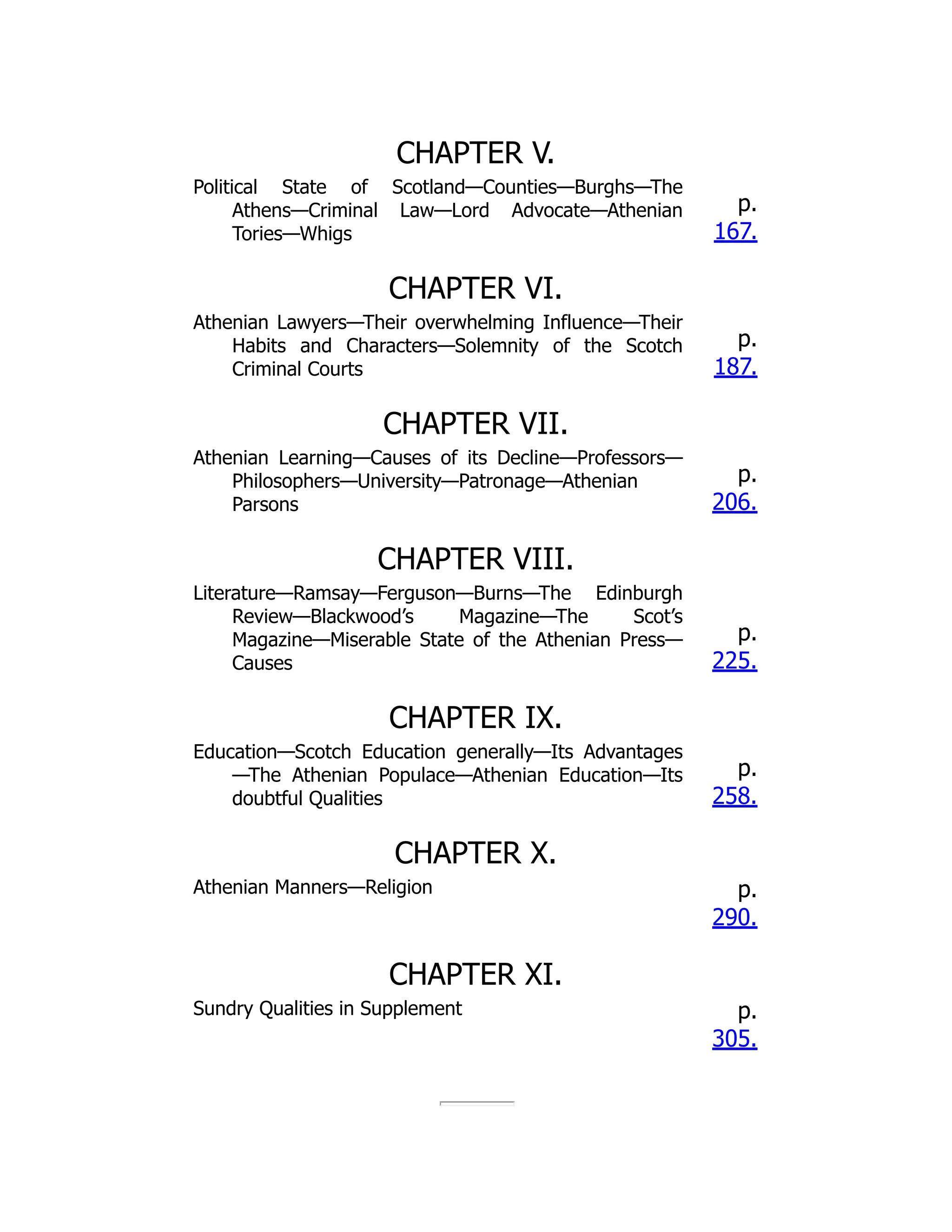
CHAPTER V.
Political Stateof Scotland—Counties—Burghs—The
Athens—Criminal Law—Lord Advocate—Athenian
Tories—Whigs
p.
167.
CHAPTER VI.
Athenian Lawyers—Their overwhelming Influence—Their
Habits and Characters—Solemnity of the Scotch
Criminal Courts
p.
187.
CHAPTER VII.
Athenian Learning—Causes of its Decline—Professors—
Philosophers—University—Patronage—Athenian
Parsons
p.
206.
CHAPTER VIII.
Literature—Ramsay—Ferguson—Burns—The Edinburgh
Review—Blackwood’s Magazine—The Scot’s
Magazine—Miserable State of the Athenian Press—
Causes
p.
225.
CHAPTER IX.
Education—Scotch Education generally—Its Advantages
—The Athenian Populace—Athenian Education—Its
doubtful Qualities
p.
258.
CHAPTER X.
Athenian Manners—Religion p.
290.
CHAPTER XI.
Sundry Qualities in Supplement p.
305.
24.
Throughout the Volume,there will be found attic touches of real
character, in illustration of the general and local truths.
CHAPTER I.
THE AUTHORAND THE KING ARE INDUCED TO VISIT THE MODERN
ATHENS.
“Ego et Rex meus.”—Wolsey.
The renown of the Scottish Metropolis,—that city of wonders and
of wisdom, of palaces and of philosophy, of learned men and of
lovely women, had sounded so long and so loudly in their ears, that
toward the close of summer 1822, the Author of these pages and
the Sovereign of these realms, were induced to pay it a visit, each in
that state and with that pomp and circumstance which was
becoming his station in the world. The one, in that unmarked guise
which is fitting for one who lives more for the glory of others than of
himself, and who sets more value upon the single sentence which
preserves his memory when he is no more, than upon all that he can
possess or enjoy in this world. The other, in that glow and grandeur,
which gains in intensity what it stands some chance of losing in
duration,—which is the grand idol of its day; and which, when that
day has closed, is gathered to the sepulchre of its fathers, to make
room for another—and the same.
The Author of these pages must not be blamed, or deemed
disloyal, for having given his own name the precedence of that of his
27.
Sovereign. Every manin reality prefers himself before all the
sovereigns in the world; and wherefore should not one man state
this preference in words? The courtier declares that all his services
are devoted to his king,—but he devotes them no longer than that
king can afford to pay for them: the soldier swears that he will die in
defence of the crown,—but he never dies till he is compelled by the
superior strength or skill of another. Even upon general grounds,
therefore, there is candour if not courtesy in this order of
precedence.
But, when the specialities of the case are considered,—when it is
borne in mind that the monarch, all-gracious and polite as he is,
visited the Athens, as well to dazzle the Athenians by his grandeur,
as to delight them by his bounty,—that the native luminaries of that
centre of many twinkling lights were shorn of their beams by his
overwhelming radiance,—that this instance of kingly condescension
taught the ΔΕΜΟΣ of Athena to regard as haply something less even
than men, those whom they had formerly looked upon as possessing
some of the attributes of divinity; and when, on the other hand, it is
taken into the account that the author of these pages made his visit
solely with a view of seeing with his own eyes, hearing with his own
ears, and proclaiming with his own lips, the truth of those reports
which had come to him through so many channels, and of which the
fruition had proved so much more delectable than the foretaste:
then, assuredly, ought Athena herself, from all the castles of her
strength, the halls of her wisdom, the drawing-rooms of her beauty,
and the alleys of her retirement, to confess that she owes to the
author of these pages more than kingly gratitude.—The King noticed
but a few of her people, enriched not many, and ennobled almost
none: those pages are intended to enwrap the whole in one pure
and perennial blaze of glory.
It was on the evening of the same day that the Monarch took
shipping at Greenwich amid the shouts of assembled multitudes, and
the Author took his seat on the top of the Edinburgh mail, amid piles
of tailors’ boxes, each containing a courtier’s habit, in which some
fond, and fawning, and fortune-desiring son of Caledonia was to
28.
bend the suppleknee in the presence of Majesty, within the ancient
palace of the Holyrood. The voyages of kings, and the velocity of
mail-coaches, are already known and appreciated; and thus there
needs no more to be said, than that here also the Author had by
several days the precedence of the King.
The jolting of the wooden cases of my courtly neighbours,
together with forty-eight hours’ exposure to drought by day and
damp by night, prepared me, in spite of all my burning anxiety to
see the far-famed city, for the enjoyment of several hours of repose;
and, as Athena was at this time too much excited for permitting me
to enjoy this till towards morning, the sun had risen high before I
left my chamber.
Upon hurrying into the street,—into that Princes’ street, which, as
I afterwards learned, is at certain seasons of the year the favourite
lounge of the Athenian dandies, and at certain hours of the day the
favourite haunt of the Athenian fair, who resort thither as the clock
strikes four, to feast their fair and anxious eyes upon the self-
important forms of dashing advocates, the more dapper and pursey
ones of pawkie writers to his Majesty’s signet, or the attenuated
striplings of the quill—the future Clerks and Jefferys, who at that
hour are returning from the harvest of law and profits to such feast
as awaits them in ample hall or elevated cock-loft, according to their
talents, their connexions, or their purses;—upon hurrying into that
street, in the expectation of feasting my eyes upon the natural and
architectural glories of the city, I found that those glories were in the
mean time veiled in the maddening preparations of a whole people,
who had come from every portion of the main land, and from the
remotest isle of Thulè, to wonder at and to admire that mightiest
marvel of human nature—a king.
So novel and so varied were the costumes, so unexpected and so
singular were the features and expressions, and so uncouth and
Babylonish were the voices, that the eye and the ear were
confounded, the judgment could not understand, and the memory
could preserve no record. Here you might see some brawny and
briefless barrister—the younger son of a loyal family, with a pedigree
29.
at least twiceas long as its rental, with trowsers and jacket à la
Robin Hood, and huge blue bonnet adorned with the St. Andrew’s
cross and a turkey-cock’s feather—looking for all the world like a
chimney-sweep’s Jack-o’-the-Green, or a calf dressed entire and
garnished with cabbage-leaves; while close by him trotted a loyal
toast-composing crown-lawyer, with his hinder end cased in a
phillibeg, a feathered bonnet, at least a third of his own height, an
iron-hilted sword somewhat more than the whole, and a dirk that
might have served for a plough-share, puffing and blowing under the
weight of his own importance, and the accoutrements of the Celtic
society. In close juxtaposition with these was a genuine Glhuine dhu,
plaided, plumed, and whiskered, and looking as if all the kings of the
earth were nothing to that swaggering chieftain, of whose tail he
formed no inconsiderable portion. In another place you could catch
the broad face and broader bonnet of a lowland farmer of the old
school, cased in one uniform garb of home-made blue, with brass
buckles to his shoes, a brass key suspended to his watch by a tough
thong of black leather, greasy enough,—holding solemn colloquy
with that reverend member of the Scottish Kirk, to whom he acted in
the capacity of ruling elder, about the danger of compromising the
interests of the Whig or high-flying part of that establishment,
during the avatar of so many Tories. The reverend gentleman
himself was no bad sight. His general-assembly coat and et cetera’s
were duly kept at home,—that is to say, in his two-shillings-a-week
apartments, up seven pair of stairs, in College-street, or haply in the
house of that town acquaintance with whom he had found cheaper
board,—till the eventful days should arrive. Thus he was habited in
his parson’s grey, the breast of which, where it projected beyond the
perpendicular, bore testimony to the fall, both of broth and of punch,
while his inferior regions were shaded and shielded by dark-olive
velveteens, a little tarnished, worsted hose furrowed as neatly as the
turnip-division of his glebe, and cow-skin shoes of the most damp-
defying power, which borrowed no part of their lustre from Mr.
Robert Warren. Still the good man was clean in his linen; his chin
was shorn like a new-mowed field; his visage beamed forth gratitude
for “a competent portion of the good things of this life;” and his
30.
plump and ruddyhands slumbered with much orthodox ease in the
capacious pockets of the velveteens. Anon, a highland laird, whose
tail comprised only his lady and half a dozen of daughters, and who
seemed to be meditating upon the roofless castle and ill-stored
larder, to which the expense of parading full thirty-six feet of female
charms before the King would subject him, during the weary moons
of the Highland winter, hurried past, not at all at his ease.
But, to describe the individuals, strongly marked as they were,
would be altogether out of the question; and, indeed, to give any
thing like even a sketch of the groups and classes and knots of men,
women, and children, in all habits, of all ages, and in almost every
variety of shape, would bankrupt even a German vocabulary,
although in that language one be allowed, for clearness sake, to
lump a score of sentences into a single epithet. The cry was still
“they come,” and Caledonia, from fertile plain and far mountain,—
from toiling city and tiresome wilderness,—from rock, and glen, and
river,—upon the wings of the wind, urged on by steam, drawn in
coach, chaise, waggon, cart, and hurdle, riding upon horses, mules,
and donkeys, and running upon feet, shod and unshod,—came
scudding and smoking, and creaking and crashing, and reeking and
panting, in one conglomerating cloud, and one commingling din, to
distract the attention from the attic glories of Edinburgh, and for a
time drown her classic sounds in the discordant and untunable din of
all the provinces. Here you had the broad shoulders and bold
bearing of the borderer, delving an elbow, of the size and substance
of a sirloin of beef, into the skinny ribs of an Aberdonian professor of
humanity, who all the time kept squeaking like a sick fiddle, in
response to the bellow of the other, which reminded you of a bull
confined in the vaulted hall of an old castle. There grinned the fat
face of an East Lothian farmer, between a Perth baillie on the one
hand, and a Stonehaven scribe on the other, like a ram’s tail
between the blades of a shepherd’s sheers. And, yonder gaped and
wondered the great face of a Glasgow negro-driver, like a Gorgon’s
head—not upon the shield of Minerva. Still there was something
interesting in the mighty and motley throng: it put one in mind of
31.
Noah’s ark, whichcontained “clean beasts, and beasts that are not
clean, and fowls, and every thing that creepeth upon the earth.”
The most delectable part of the gathering was the combined
clans and the burgh corporations. The former belted like warriors
and bellied like weasels, and tricked out for the occasion in their
respective tartans of their names, each bearing a sprig of the
symbolic tree in his bonnet, a huge claymore in the one hand, and a
relay of brogues and stockings in the other, with a great horn snuff-
mull thrust into his sporran—open and ready for action—hurried
along at the pas de charge to their headquarters for the time-being,
where they were instantly dispersed into the crowd, thence to
reassemble when the bagpipe should frighten the last shadow of
night.
The corporation-men came in less military but more important
guise. Glasgow, the queen of the west, Aberdeen, the glory of the
north, Dundee and Perth, the rival empresses of the centre, with
Cupar-Fife, Crail, and a hundred others, each charged with a loyal
and dutiful address, which had been composed by the town-clerk,
revised in the spelling by the schoolmaster, and was to be
discharged at the King, in a manner so powerful and point-blank, as
to procure knighthood if not earldom for such candle-selling provost,
breeches-manufacturing baillie, or other chief magistrate “after his
kind,” came on with a splendour and an importance that Scotland
never before witnessed.
Glasgow, as became her purse and her pride, came blazing like
the western star—or rather like a comet whose tail would have
girdled half the signs of the zodiac. The van was led by the
magistrates, in a coach which previously knew every street and lane
of the city, but which was relackered for the occasion, had the city
arms emblazoned upon it as large as a pullicate handkerchief, and
was drawn by eight grey horses of the genuine Lanarkshire breed,—
the thunder of whose feet as they dashed along shook the kirk of
Shotts, and had nearly laid Airdrie and Bathgate in ruins. The clatter
which they made along Princes’ Street was astounding; the crowd
collected in thousands at the din; some cried it was the king himself;
32.
but the finalopinion was, that it was “naebody but the magestrates
o’ Glasgow.”
In the train of this goodly leading, there followed full fifty
thousand,—or to speak by measure, as number was quite out of the
question, full forty-four miles of merchants and makers of muslin;
and the vehicles which carried the car-borne part of them were more
strange and varied than ever appeared at the triumph of a Roman
emperor upon his return from smiting the barbarous nations, and
carrying themselves and all their utensils captive. Here you would
see the equipage of a rich dealer in turmeric or tobacco, fashionable
enough except in its contents; there you were presented with a
Glasgow Noddy, squeezing forward its lank form like a tile, and
dragged by a steed with three serviceable legs, and one eye the
worse for the wear; in another place you would meet with a hearse,
with a tarpaulin over it to hide the death’s head and the bones, and
crammed full of the saints of the Salt-market laid lengthways for the
convenience of stowage; while the rear was brought up by an
enormous tilted waggon, which, though it was at first conjectured to
contain Polito’s collection of wild beasts, was, upon examination,
found to be charged very abundantly with that more important and
polished matter—the ladies and gentlemen of Paisley and Greenock.
The pride of the north had been more than usually upon the qui
vive. The Provost had been attitudenizing before a great mirror for a
week, and getting his pronunciation translated into English by Mr.
Megget, of the Academy, for at least a fortnight; the town-clerk had
been drudging at “steps” in private with Mr. Corbyn for a month, and
the learned Mr. Innes had been applied to, to cast the nativity of the
city; and, from the horoscope—Saturn in conjunction with Mars, and
Venus lady of the ascendant, it was sagely inferred by the clubbed
wisdoms of King’s and Mareschal that the Provost “wad get a gryte
mickle purse o’ siller, for the gueed o’ the ceety, forby a triffle to
himsel’;” and that, if not a duke, the town-clerk would be a goose at
any rate, if both eschewed during their sojourn that hankering after
the sex which was portended by the lady Venus being in the middle
house. Those polite and philosophic preparations having been made,
33.
the state coach,with two cats (the emblems of bon accord) the size
of a couple of yeanling lambs, gilt with Dutch fulzie, and spotted
with coffin black, “all for the sparin’ o’ the cost,” rattled along the
bridge of Dee at the tail of six hardy shelties from the Cabrach,
“which could mak’ a shift to live upo’ thristles, or fool strae, or ony
thing that they cou’d pyke up at a dykeside.” Still, however, this
mighty magisterial meteor streamed across Drumthwackit, along the
“how o’ the Mearns,” and adoun Strathmore, like an aurora borealis
flashing from the pole to the zenith, flickering and crackling, and
smelling of brimstone. While its tail drew the third part of the wilie
natives of the city; the other two-thirds took their way in barks and
steam-boats, because it was “cheaper by the tae half.”
But what words can describe the grand array of the municipal
authorities of Perth: Perth, the centre and heart of Scotland—the
capital of the Picts, the delight of the Romans, who tumbled down in
ecstasy when they first beheld it from the summit of Moncrief Hill,
and, fancying that they saw in its green inches, its sweeping river,
and its ample size, the Campagna, the Tiber, and the Eternal city,
shouted in one voice “Ecce Tiber! Ecce Campus Martius!”—Perth,
which looks upon Aberdeen as dry stubble, and Glasgow as the dust
of the earth; and which has received within its halls and palaces
more kings and mighty men, than the compass of these pages could
hold, or the sages of its own Antiquarian society could number.
To pay due honour to the decorum, the sagacity, and the
harmony of such a city, it is worth while to pause and learn a little,
before speaking of the equipage. Well, what, gentle reader, shall we
learn? Why that the same gentleman who sat in that splendid
equipage as chief ruler of the city, put to the proof, as touching his
Celtic or Sarmatian origin, no less a personage than the Grand Duke
Nicholas, brother to the autocrat of all the Russias—the arbiter for
the time being of all the legitimate monarchs upon the continent of
Europe. The fame of the city of Perth being, of course, well known
upon the banks of the Neva, and the Kremlin at Moscow having
been burnt as the first portion of the funeral pile of Buonaparte,
there was no place where the magnanimous Alexander could find a
34.
fit pattern afterwhich to build the restored Kremlin, except this fine
and far-famed city of Perth. The Grand Duke Nicholas, from his well-
known architectural and other tastes, was deputed upon this
important mission; and, having taken London, the Athens, and a few
such places of inferior note in his way, he arrived at the city of all
beauty; and was received by a bowing magistracy, and a gaping
populace. During his stay at the George Inn, the superiority of the
Tay salmon and “Athol brose,” over the caviere and quass of his own
country, worked the imperial clay to the temperature of a very
Vesuvius. He applied to the Lord Provost in his need. The Lord
Provost convened his council. Their words were wise, and their faces
were wiser; but they could determine nothing; and so they handed
the case over to the ministers and elders of the kirk. These shut
their eyes and opened their mouths; and having done so for a due
season, they found that as the Grand Duke Nicholas was not in
communion with their church, the Grand Duke Nicholas might, in all
matters bodily or ghostly, do as the said Grand Duke Nicholas felt
inclined. This response delighted the municipal authorities, and they
hurried to the inn to communicate with their own lips this plenary
indulgence. Provost Robertson hemmed, stroked his beard, and led
off in words wherein the Saxon and the Celtic so perfectly
neutralized each other, that the whole was as smooth as oil. But,
though the Grand Duke Nicholas understood many single languages,
the mouth even of a magistrate delivered of twins, was as new to
him as it was incomprehensible. It was clear, from his lack-lustre
eye, that he did not understand one word of what was said; and he
tried to convey as much in Latin, French, German, Russ, and no one
knows how many other outlandish tongues; but as the Grand Duke
Nicholas could not ascend to a double language, so neither could the
Provost of Perth descend to a single one; wherefore the mighty
mountaineer, who during the Athenian display acted Perth, brushed
up to him, tumbling down half a dozen of splay-foot councillors and
ricketty deacons, and exclaiming, “Try her o’ the Gaelic, my Lord
Provost! try her o’ the Gaelic!”
35.
A person ofthis calibre, and having buttoned within his waistcoat
the chief honour of a town of this fame, could not choose but exhibit
a corresponding exterior. Accordingly, the coach was the size of a fly
van; the horses would have done credit to Whitbread’s heaviest
dray; and, in very deed, had a sportsman of the land of Cockaigne
seen the emblazoned arms, pop would have gone Joseph Manton
right and left at the displayed eagle of silver-white, as at a goose of
kindred obesity, and fit for the Michaelmas board.
Of those civic exhibiters, Dundee must close the muster: Dundee,
after these, was “filthy Dowlas.” The wig of her chief magistrate,
(which seemed as though he had exchanged it with the Perth
coachman, as they had been taking a groats-worth of swipes and
thrippeny blue at Luckey Maccarracher’s Hotel, down three flights of
stairs, in Shakspeare’s Square,) did not contain as much sand-
coloured hair as would have stuffed a pincushion; and, as for the
poll itself, not a barber in Petticoat-lane would have shown it in his
window. Their equipage, which had once belonged to a celebrated
radical, was whitewashed for the occasion, had two green
salamanders marked upon it, as lank as though they had fed upon
smoke—as much as to say that the lading within was proof against
fire and brimstone. Four experienced cattle, which had been rescued
or borrowed from the dogs’ meat-man, dragged forward the heavy
and heartless array; and the brawling burghers took shipping at their
new harbour; but Æolus was adverse, and so they who had hoped
to see George the Fourth saw Holland, got fuddled with Scheidam
gin, bought a cargo of flax, and returned, not much the wiser—that
had been impossible.
This, and much more after the same fashion, was enough and
more than enough to distract the attention from all the Athenses
that ever were built or blazoned in story. But this, and much more
like this, was not all: there was also much very unlike it,—so unlike,
that when you turned from the one to the other, you felt as if seas
had been crossed; ay, as if the very poles of the earth had been
reversed, or as if you had passed from the depth of folly to the
height of wisdom in the twinkling of an eye. There were the whole
36.
assembled people ofScotland,—of that people who, girt with no ill-
suited authority, and tricked out with no incongruous and tawdry
pomp, had come in the fullness of their hearts and the abundance of
their curiosity, to look upon their liege lord the King. The magistrates
in their coaches were senseless pomp; the Highland chiefs with their
tartans and their tails, were a useless, and, in many instances where
they had commanded the small farmers to leave their scanty crops
to be scattered by the winds or rotted by the rains, a cruel parade;
but the people,—the free and independent people who assembled of
their own will, at their own cost, and for their own pleasure, formed
a solemnity at which the eye could not fail to be delighted, and over
which the heart could not fail to exult with the most ample and the
most exquisite joy. To the hundred thousand inhabitants of Athens,
there were added full twice as many strangers, all in their best
array; and yet, among the whole there was nothing taking place at
which either law or delicacy could be offended. Religious and
political animosity had been laid aside, oppression had been
forgiven, and meanness forgotten; the people seemed to compose
but one family, and they spoke as if animated with only one wish,—
namely, that the King should come: or if they had another, it was
that his coming might be speedy and safe. Whatever other men may
think of Edinburgh—of Scotland, as a place to be visited, it is a
glorious place for being visited by a king; and, it will be no proof of
wisdom in the future monarchs of Britain, if they allow the crown to
pass to a successor without paying it a visit. Kings reign the more
happily and the more secure, the more freely and frequently that
they show themselves to their subjects.
37.
CHAPTER II.
THE MODERNATHENS, HAVING ALREADY RECEIVED
THE AUTHOR, MAKES PREPARATIONS FOR
RECEIVING THE KING.
“The young gudewife o’ Auchinblae,
She was a cannie woman;
She wiped her wi’ a wisp o’ strae,
When her gudeman was comin.”—Old Ballad.
The movements of a people of so much gusto, and grace, and
gravity, as those who had interposed their thickening clouds between
my vision and those municipal and mental glories which I had come
to see, could not choose but do every thing according to the most
approved canons of philosophy; and thus the mighty matter of the
royal visitation had to be received in its beginning, its middle, and its
end, before I could proceed in my legitimate and laudatory vocation.
Besides the people who came, there were the preparations made
and the deeds done,—each of which is well worthy of a chapter.
The rumour of the high honour came upon the Athens like the
light of the morning,—beaming upon the most elevated points, while
yet the general mass remained in shadow. The Lord President of the
38.
Court of Session,the Lord Provost of the City of Edinburgh, the Lord
Advocate, Lady Macconochie, the very Reverend, and (by office and
intuition,) very learned Principal Baird, the Sheriff of the County,
Deacon Knox, of Radical-threshing renown, Mr. Archibald Campbell,
and that fair dame who watches and wipes in Queen Mary’s
apartments at the Holyrood, were the first upon whom the radiance
broke; and, the summit of Ben Nevis gilded by the morning sun,
looks not more proudly down upon the mists of Lochiel or the
melancholy waste of Rannoch, than each and all of those high
personages did upon the ungifted sons and daughters of Edinburgh.
They were in a fidget of the first magnitude, as to what was to be
done, and who was to do it. Long and deep were their deliberations;
but, like the Areopagites of the Elder Athens, themselves and their
deliberations were in the dark. Hence, as hope is the grand resource
in such cases, they deputed the Lord President to seek aid from the
Royal Society of Edinburgh,—a society which, composed of the
wisest heads, and prosecuting the wisest subjects, always says and
does the very wisest things in the very wisest manner.
Fortunately the Society was sitting,—doing its incubation, upon a
refutation of Aristotle’s poetics by Sir George M’Kenzie, of Coul, Bart.,
and a proposal for lighting all the roads in Scotland with putrid fish-
heads, by Sir John Sinclair. The Lord President opened his mouth
and his case; and each learned head nodded with the solemnity of
that of a Jupiter. The trumpet-call, blown through the nose by a
bandana handkerchief, summoned to the charge the commodity of
brains that each possessed; and each having returned the bandana
to its place, looked as wise as the goddess of the Elder Athens, or
even as her sacred bird. The general question propounded to them
ran thus,—“What was to be done, and by whom?” and the
deliverance of their wisdoms was, that “Every thing ought to be
done, and every body ought to do it”—a response surpassing in
profoundity any thing ever uttered by the Pythoness herself. The
countenance of the dignified delegate was brought parallel to the
ceiling; his eyes and mouth had a contest as to which could become
the wider; and, he Macadamized the question by breaking it into
39.
smaller pieces: “Whatshould they say to the King; what should they
give him to eat; and how should they demean themselves?” It was
resolved, as touching the first, that they should say very little, for
fear of errors in propriety or in grammar; but that they should put in
motion the addressing-machinery, of which official men in Scotland
had so often felt the benefit, and give, in “change for a Sovereign”
as it were, two hundred and forty of those copper coins, for their
own benefit, and that of the royal closet. The second point was more
puzzling: A king would not care for sheep’s-head or haggis, and as
for French cookery, that would be no rarity. Some lamented that the
Airthrie whale was petrified, and that Dr. Barclay’s elephant was
nothing but bones; and Sir John Sinclair recommended three
mermaids dressed entire,—of which he assured them there were
plenty on the coast of Caithness. Upon this point there was a
difference of opinion; and they resolved to board the King upon the
enemy, by getting ten fat bucks from that notorious Whig the
Honourable W. Maule, as his Grace of Montrose had only one to
spare. Upon the third point their decision was equally summary and
clear, “Every one was to do the best that he could.”
Those sage counsels having been given and received, the loyalty
of Athens was set fire to in a number of places, and anon the whole
city was in a blaze. Lords of session, spies, men who had eaten flesh
and drank wine for the glory of the throne, excisemen, crown-
lawyers, holders and expectants of crown-patronages, address-
grinders, beaconeers, and all the interminable file of that which had
supported the loyalty and existence of Scotland in the worst of
times, shone forth with first and fiercest lustre. In that great tattle-
market (hereafter to be described,) the Parliament-house, you would
have found the Tory barristers—the current of whose loyalty is
seldom much broken by briefs, clubbing together, cackling as though
they had been the sole geese of salvation to the capitol, and
stretching their mandibles, and showing their feathers at the more-
employed and laborious Whigs, as a race soon to be exterminated.
The disposal of majesty himself was committed to the Great
Unknown, who sagely counselled that they should make a still
40.
greater unknown ofthe King, by mewing him up in Dalkeith-house,
where he could commune only with a few of the chosen; and, that
they should bring him before the public only once or twice, to be
worshipped and wondered at, more as a favour of their procuring,
than of his own Royal pleasure. How little they knew of his Majesty,
and how much they had overrated their own importance occurred
not to them at the time, but they found it out afterwards.
The next weighty question was what the city should do in her
municipal capacity; and, it was ordered in limine that the nightly
tattoo of “The Flowers of Edinburgh,” which from time immemorial
had been played in the streets, should be suspended during the
solemnity, under pain of escheat of the instruments, allenarly for the
private benefit and use of the Lord Provost and magistrates. Every
one who has seen Edinburgh must know the perfect resemblance
which her High-street—that street in which magistracy is pre-
eminently dominant, and where shows are wont to be exhibited—
bears to the back-bone of a red-herring. Westward you have the
castle in form, in elevation, and in grandeur, the very type of the
head; eastward, at the further extremity, you have the palace of
Holyrood, which from its lowly situation among cesspools and
bankrupts, and its usual gloomy and forlorn condition, may very
properly be likened to the tail; the intermediate street is the spine;
while the wynds and closes which stretch to the North Loch on the
one side, and the Cow-gate on the other, are the perfect counterpart
of the ribs. This High-street was cleared of some old incumbrances,
had exhibition-booths erected along its whole extent; and it was
expressly ordered that, as the King passed along, no frippery or foul
linen should be exhibited from even the third garret windows; and,
that during the whole sojourn of royalty, no man should enter the
rendezvouses in the closes by the street end, but come in by the
back stairs; more clerici, in the same fashion as during the sittings of
the General Assembly. But, it would be endless to notice all the
sagacious orders and prompt actings: suffice it to say, that every
thing which could be thought of was ordered, and every thing
ordered was done.
41.
The people ofthe Athens are, even upon ordinary occasions,
much more attentive to their dress than to their address; and,
therefore, it was to be expected that they should be so upon so
momentous an occasion. Besides the tailors’ boxes of which I had
felt a specimen on my journey, there was work for every pair of
sheers and needle in the city. Webs of tartan, wigs, pieces of muslin,
paste diamonds, ostrich feathers, combs as well for use as for
ornament, were driving over the whole place like snow-flakes at
Christmas. But, the hurry and harvest were by no means confined to
the Caledonian shop-keepers. The rumour had reached the purlieus
of Leicester-square, and had been heard in the fashionable
repositories of Holywell. The remnant of Jacob gathered themselves
together, resolving to come in for their share of the milk and honey
which was flowing in the new-made Canaan of Scotland; while the
daughters of Judah put tires upon their heads, and thronged away
to spoil the Amorites northward of the Tweed. It were impossible to
describe the wares brought by the sons of Jacob,—it were needless
to tell of those brought by the daughters of Israel. The plume which
had nodded upon the brows of fifty queens at Old Drury, was
refurbished to adorn some proud and pedigreed dame of the north;
swords of most harmless beauty—having nothing of steel about
them but the hilts, were crossed most bewitchingly in every
thoroughfare, accompanied by old opera-hats, bag-wigs, buttons,
and every thing which could give the outward man the guise and
bearing of a courtier. Before these elegant repositories slender clerks
and sallow misses might be seen ogling for the live-long day, and
departing in sorrow at nightfall, because the small tinkle in their
pockets was unable to procure for them even one morning or
evening’s use of that garb, the fee simple of which had cost Moses
seven shillings and sixpence, and the translation and transmission a
crown-piece. Moses indeed found that he had something else than
Ludgate-hill and Regent-street to contend with; for, every ribbon-
vending son of the North had garnished his windows with trinkets
and ornaments which, in appearance, in quality, and in price, would
have done honour to Solomon himself.
42.
Welcome to ourwebsite – the perfect destination for book lovers and
knowledge seekers. We believe that every book holds a new world,
offering opportunities for learning, discovery, and personal growth.
That’s why we are dedicated to bringing you a diverse collection of
books, ranging from classic literature and specialized publications to
self-development guides and children's books.
More than just a book-buying platform, we strive to be a bridge
connecting you with timeless cultural and intellectual values. With an
elegant, user-friendly interface and a smart search system, you can
quickly find the books that best suit your interests. Additionally,
our special promotions and home delivery services help you save time
and fully enjoy the joy of reading.
Join us on a journey of knowledge exploration, passion nurturing, and
personal growth every day!
testbankbell.com




![Chapter 2: Theories and Thinking About Diversity 6
This exercise helps students see the pervasiveness of stereotypes among people from
various walks of life, education levels, and from different racial and ethnic backgrounds.
Older students report having this conversation with their children, and even children are
aware of stereotypes and can offer suggestions of how these stereotypes can disadvantage
people in job-related contexts, simply because of their group memberships.
2. Using a local newspaper (San Francisco Chronicle, Chicago Tribune, Dallas
Morning News, etc.), a campus or university newspaper, and a community or city
newspaper, locate stories that include photos of people in the story. Make a table
of the type of story (human interest, business news, crime, etc.), race, ethnicity,
sex, and estimated age of the subject. What diversity-related observations can be
made from the table?
Engage students in thinking about which groups appear to be well-represented, under-
represented, or invisible. [Are minorities more likely to be represented in crime stories?
How are women shown? How are older people shown—as the frail and elderly or as
people still employed? Are any people with disabilities or gays or lesbians represented?
How would one know?]. Point out that with invisible group statuses, such as many
disabilities, sexual orientation, and religion, often the stories (in which people belonging
to such categories appear) focus on something related to the group membership, such as a
story about disabilities at work or partner benefits. Instructors may wish to begin
compiling a file of newspapers that are particularly interesting to use in classes.
Be sure to emphasize that this analysis of a few newspapers or media items is limited and
may or may not support what large scale studies and more data show. Anecdotal evidence
versus data can also be pointed out in any individual stories one may have that seem to
conflict with data.
3. Locate a newspaper that has an executive or business section that includes
“promotions,” “executive changes,” or other career moves. If there are photos of
the people involved, list their race, ethnicity, and sex. If names only are provided,
determine the sex of the person, where possible. What observations can you make
from your list?
Engage students in thinking about which groups appear to be well-represented, under-
represented, or invisible in this section of the paper. [Are minorities more likely to be
represented in line or staff positions? How many of the stories involve women? Mention
that minorities and women often occupy human resources or community relations
positions, which are less likely to result in promotions to executive jobs—“glass walls”.]
When non-dominant group members are represented, discussion may focus on the
companies involved. In what companies does there appear to be more diversity?
Instructors may wish to begin compiling a file of newspapers that are particularly
interesting to use in classes.
Suggested Readings](https://image.slidesharecdn.com/7750-250322053304-a2855e6d/75/Solution-Manual-for-Diversity-in-Organizations-2nd-Edition-10-2048.jpg)



![This ebook is for the use of anyone anywhere in the United
States and most other parts of the world at no cost and with
almost no restrictions whatsoever. You may copy it, give it away
or re-use it under the terms of the Project Gutenberg License
included with this ebook or online at www.gutenberg.org. If you
are not located in the United States, you will have to check the
laws of the country where you are located before using this
eBook.
Title: The Modern Athens
Author: Robert Mudie
Release date: February 17, 2016 [eBook #51239]
Most recently updated: October 23, 2024
Language: English
Credits: Produced by Giovanni Fini, deaurider and the Online
Distributed Proofreading Team at http://www.pgdp.net
(This
file was produced from images generously made
available
by The Internet Archive)
*** START OF THE PROJECT GUTENBERG EBOOK THE MODERN
ATHENS ***](https://image.slidesharecdn.com/7750-250322053304-a2855e6d/75/Solution-Manual-for-Diversity-in-Organizations-2nd-Edition-17-2048.jpg)