GOOD AFTERNOON

WELCOM
        PRESENTED BY
                       BIBIN   THOMAS
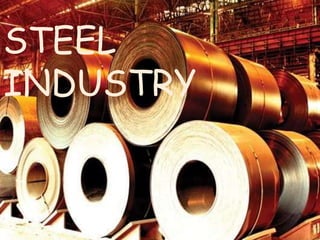
STEEL
INDUSTRY
Steel
 Steel is an alloy made by combining iron and
other elements, the most common of these being
carbon.

Carbon and other elements act as a hardening
agent, preventing dislocations in the iron atom
crystal lattice from sliding past one another.

Steel with increased carbon content can be
made harder and stronger than iron, but such
steel is also less ductile than iron.
World Steel Industry
Steel, the recycled material is one of the top
products in the manufacturing sector of the
world.

After the adoption of the liberalization policies
all over the world, the World steel industry is
growing very fast.
HISTORY OF STEEL
Steel was discovered by the Chinese in 202
BC.


Around 9th century AD, the smiths in the
Middle East developed techniques top
produce sharp and flexible steel blades.


In the 17th century, smiths in Europe came
to know about a new process of cementation
to produce steel.
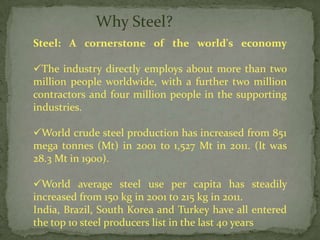
Why Steel?
Steel: A cornerstone of the world's economy

The industry directly employs about more than two
million people worldwide, with a further two million
contractors and four million people in the supporting
industries.

World crude steel production has increased from 851
mega tonnes (Mt) in 2001 to 1,527 Mt in 2011. (It was
28.3 Mt in 1900).

World average steel use per capita has steadily
increased from 150 kg in 2001 to 215 kg in 2011.
India, Brazil, South Korea and Turkey have all entered
the top 10 steel producers list in the last 40 years
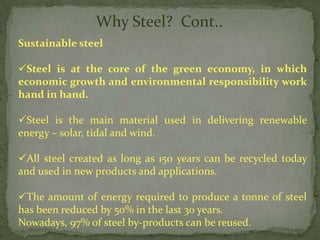
Why Steel? Cont..
Sustainable steel

Steel is at the core of the green economy, in which
economic growth and environmental responsibility work
hand in hand.

Steel is the main material used in delivering renewable
energy – solar, tidal and wind.

All steel created as long as 150 years can be recycled today
and used in new products and applications.

The amount of energy required to produce a tonne of steel
has been reduced by 50% in the last 30 years.
Nowadays, 97% of steel by-products can be reused.
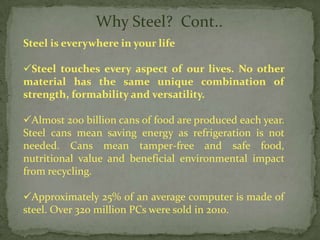
Why Steel? Cont..
Steel is everywhere in your life

Steel touches every aspect of our lives. No other
material has the same unique combination of
strength, formability and versatility.

Almost 200 billion cans of food are produced each year.
Steel cans mean saving energy as refrigeration is not
needed. Cans mean tamper-free and safe food,
nutritional value and beneficial environmental impact
from recycling.

Approximately 25% of an average computer is made of
steel. Over 320 million PCs were sold in 2010.
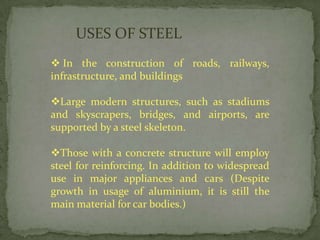
USES OF STEEL
 In the construction of roads, railways,
infrastructure, and buildings

Large modern structures, such as stadiums
and skyscrapers, bridges, and airports, are
supported by a steel skeleton.

Those with a concrete structure will employ
steel for reinforcing. In addition to widespread
use in major appliances and cars (Despite
growth in usage of aluminium, it is still the
main material for car bodies.)
USES OF STEEL
                     Cont…
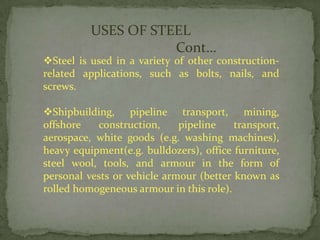
Steel is used in a variety of other construction-
related applications, such as bolts, nails, and
screws.

Shipbuilding, pipeline transport, mining,
offshore   construction,     pipeline    transport,
aerospace, white goods (e.g. washing machines),
heavy equipment(e.g. bulldozers), office furniture,
steel wool, tools, and armour in the form of
personal vests or vehicle armour (better known as
rolled homogeneous armour in this role).
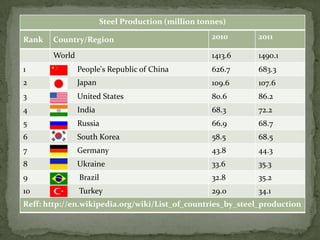
Steel Production (million tonnes)

Rank   Country/Region                                2010     2011

       World                                         1413.6   1490.1
1              People's Republic of China            626.7    683.3
2              Japan                                 109.6    107.6
3              United States                         80.6     86.2
4              India                                 68.3     72.2
5              Russia                                66.9     68.7
6              South Korea                           58.5     68.5
7              Germany                               43.8     44.3
8              Ukraine                               33.6     35.3
9              Brazil                                32.8     35.2
10             Turkey                                29.0     34.1
Reff: http://en.wikipedia.org/wiki/List_of_countries_by_steel_production
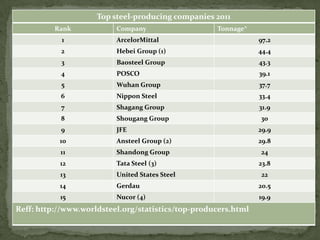
Top steel-producing companies 2011
          Rank            Company                   Tonnage*
            1             ArcelorMittal                         97.2
           2              Hebei Group (1)                       44.4
           3              Baosteel Group                        43.3
           4              POSCO                                 39.1
           5              Wuhan Group                           37.7
           6              Nippon Steel                          33.4
           7              Shagang Group                         31.9
           8              Shougang Group                        30
           9              JFE                                   29.9
           10             Ansteel Group (2)                     29.8
           11             Shandong Group                        24
           12             Tata Steel (3)                        23.8
           13             United States Steel                   22
           14             Gerdau                                20.5
           15             Nucor (4)                             19.9
Reff: http://www.worldsteel.org/statistics/top-producers.html
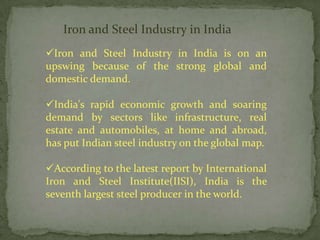
Iron and Steel Industry in India
Iron and Steel Industry in India is on an
upswing because of the strong global and
domestic demand.

India's rapid economic growth and soaring
demand by sectors like infrastructure, real
estate and automobiles, at home and abroad,
has put Indian steel industry on the global map.

According to the latest report by International
Iron and Steel Institute(IISI), India is the
seventh largest steel producer in the world.
Industry Structure


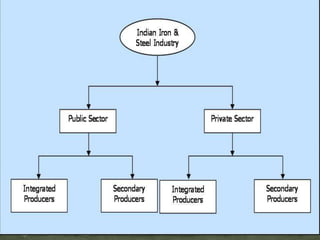
Indian Iron and steel Industry can be divided into two
main sectors Public sector and
Private sector.


Further on the basis of routes of production, the
Indian steel industry can be
divided into two types of producers.
Industry Structure
                               Cont…
Integrated producers

Those that convert iron ore into steel. There are three
major integrated steel players in India, namely Steel
Authority of India Limited (SAIL), Tata Iron and Steel
Company Limited (TISCO) and Rashtriya Ispat Nigam
Limited (RINL).

Secondary producers

These are the mini steel plants (MSPs), which make steel
by melting scrap or sponge iron or a mixture of the two.
Essar Steel, Ispat Industries and Lloyds steel are the
largest producers of steel through the secondary route.
History of Iron and Steel Industry in India

Iron and Steel industry in the country has
experienced a sustainable growth since the
independence of the country.

 1870 -A humble beginning of the modern steel
industry was reached in India at Kulti in West
Bengal.

1907 -The out set of bigger production starts only
with the establishment of a steel plant in
Jamshedpur in Bihar.

1912-It started production
History of Iron and Steel Industry in India
                                    Cont…

After Independence that the steel industry was able to find a
strong foot hold in the country.


Excluding the Jamshedpur plant of the Tata’s, all are in the
public sector and looked after by Steel Authority of India
Ltd.(SAIL).
Challenges Facing Steel Industry
 First one
The safety and health of people working in the steel
industry has been one of the top challenges for years.

 Historically, steelmaking has been considered a
dangerous process and accidents were thought to be
inevitable.

The situation today remains that people are still being
killed in steel plants and these accidents are preventable
Second one
The business profitability which is moving
away from a tonnage mentality to even
sharper focus on value and value creation.

Sustainable steel contributing to a sustainable
world is about value creation, innovation and
using less volume of steel to achieve superior
performance.

Increase R&D expenditure.
Third one

To create a level playing field for competition around
the world.

There are still too many subsidies and state aid used
in the industry, which distort competition and there
are too many artificial barriers to competition
internationally.
Future Growth
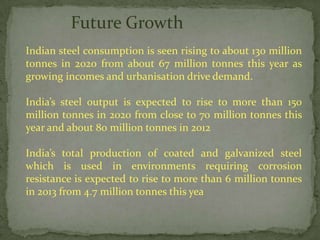
Indian steel consumption is seen rising to about 130 million
tonnes in 2020 from about 67 million tonnes this year as
growing incomes and urbanisation drive demand.

India’s steel output is expected to rise to more than 150
million tonnes in 2020 from close to 70 million tonnes this
year and about 80 million tonnes in 2012

India’s total production of coated and galvanized steel
which is used in environments requiring corrosion
resistance is expected to rise to more than 6 million tonnes
in 2013 from 4.7 million tonnes this yea
Recommendations
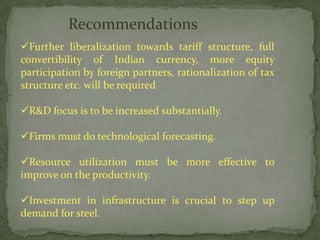
Further liberalization towards tariff structure, full
convertibility of Indian currency, more equity
participation by foreign partners, rationalization of tax
structure etc. will be required

R&D focus is to be increased substantially.

Firms must do technological forecasting.

Resource utilization must be more effective to
improve on the productivity.

Investment in infrastructure is crucial to step up
demand for steel.
Questions?

Thank You

Steel

  • 1.
    GOOD AFTERNOON WELCOM PRESENTED BY BIBIN THOMAS
  • 2.
  • 3.
    Steel  Steel isan alloy made by combining iron and other elements, the most common of these being carbon. Carbon and other elements act as a hardening agent, preventing dislocations in the iron atom crystal lattice from sliding past one another. Steel with increased carbon content can be made harder and stronger than iron, but such steel is also less ductile than iron.
  • 4.
    World Steel Industry Steel,the recycled material is one of the top products in the manufacturing sector of the world. After the adoption of the liberalization policies all over the world, the World steel industry is growing very fast.
  • 5.
    HISTORY OF STEEL Steelwas discovered by the Chinese in 202 BC. Around 9th century AD, the smiths in the Middle East developed techniques top produce sharp and flexible steel blades. In the 17th century, smiths in Europe came to know about a new process of cementation to produce steel.
  • 6.
    Why Steel? Steel: Acornerstone of the world's economy The industry directly employs about more than two million people worldwide, with a further two million contractors and four million people in the supporting industries. World crude steel production has increased from 851 mega tonnes (Mt) in 2001 to 1,527 Mt in 2011. (It was 28.3 Mt in 1900). World average steel use per capita has steadily increased from 150 kg in 2001 to 215 kg in 2011. India, Brazil, South Korea and Turkey have all entered the top 10 steel producers list in the last 40 years
  • 7.
    Why Steel? Cont.. Sustainablesteel Steel is at the core of the green economy, in which economic growth and environmental responsibility work hand in hand. Steel is the main material used in delivering renewable energy – solar, tidal and wind. All steel created as long as 150 years can be recycled today and used in new products and applications. The amount of energy required to produce a tonne of steel has been reduced by 50% in the last 30 years. Nowadays, 97% of steel by-products can be reused.
  • 8.
    Why Steel? Cont.. Steelis everywhere in your life Steel touches every aspect of our lives. No other material has the same unique combination of strength, formability and versatility. Almost 200 billion cans of food are produced each year. Steel cans mean saving energy as refrigeration is not needed. Cans mean tamper-free and safe food, nutritional value and beneficial environmental impact from recycling. Approximately 25% of an average computer is made of steel. Over 320 million PCs were sold in 2010.
  • 9.
    USES OF STEEL In the construction of roads, railways, infrastructure, and buildings Large modern structures, such as stadiums and skyscrapers, bridges, and airports, are supported by a steel skeleton. Those with a concrete structure will employ steel for reinforcing. In addition to widespread use in major appliances and cars (Despite growth in usage of aluminium, it is still the main material for car bodies.)
  • 10.
    USES OF STEEL Cont… Steel is used in a variety of other construction- related applications, such as bolts, nails, and screws. Shipbuilding, pipeline transport, mining, offshore construction, pipeline transport, aerospace, white goods (e.g. washing machines), heavy equipment(e.g. bulldozers), office furniture, steel wool, tools, and armour in the form of personal vests or vehicle armour (better known as rolled homogeneous armour in this role).
  • 11.
    Steel Production (milliontonnes) Rank Country/Region 2010 2011 World 1413.6 1490.1 1 People's Republic of China 626.7 683.3 2 Japan 109.6 107.6 3 United States 80.6 86.2 4 India 68.3 72.2 5 Russia 66.9 68.7 6 South Korea 58.5 68.5 7 Germany 43.8 44.3 8 Ukraine 33.6 35.3 9 Brazil 32.8 35.2 10 Turkey 29.0 34.1 Reff: http://en.wikipedia.org/wiki/List_of_countries_by_steel_production
  • 12.
    Top steel-producing companies2011 Rank Company Tonnage* 1 ArcelorMittal 97.2 2 Hebei Group (1) 44.4 3 Baosteel Group 43.3 4 POSCO 39.1 5 Wuhan Group 37.7 6 Nippon Steel 33.4 7 Shagang Group 31.9 8 Shougang Group 30 9 JFE 29.9 10 Ansteel Group (2) 29.8 11 Shandong Group 24 12 Tata Steel (3) 23.8 13 United States Steel 22 14 Gerdau 20.5 15 Nucor (4) 19.9 Reff: http://www.worldsteel.org/statistics/top-producers.html
  • 13.
    Iron and SteelIndustry in India Iron and Steel Industry in India is on an upswing because of the strong global and domestic demand. India's rapid economic growth and soaring demand by sectors like infrastructure, real estate and automobiles, at home and abroad, has put Indian steel industry on the global map. According to the latest report by International Iron and Steel Institute(IISI), India is the seventh largest steel producer in the world.
  • 15.
    Industry Structure Indian Ironand steel Industry can be divided into two main sectors Public sector and Private sector. Further on the basis of routes of production, the Indian steel industry can be divided into two types of producers.
  • 16.
    Industry Structure Cont… Integrated producers Those that convert iron ore into steel. There are three major integrated steel players in India, namely Steel Authority of India Limited (SAIL), Tata Iron and Steel Company Limited (TISCO) and Rashtriya Ispat Nigam Limited (RINL). Secondary producers These are the mini steel plants (MSPs), which make steel by melting scrap or sponge iron or a mixture of the two. Essar Steel, Ispat Industries and Lloyds steel are the largest producers of steel through the secondary route.
  • 17.
    History of Ironand Steel Industry in India Iron and Steel industry in the country has experienced a sustainable growth since the independence of the country.  1870 -A humble beginning of the modern steel industry was reached in India at Kulti in West Bengal. 1907 -The out set of bigger production starts only with the establishment of a steel plant in Jamshedpur in Bihar. 1912-It started production
  • 18.
    History of Ironand Steel Industry in India Cont… After Independence that the steel industry was able to find a strong foot hold in the country. Excluding the Jamshedpur plant of the Tata’s, all are in the public sector and looked after by Steel Authority of India Ltd.(SAIL).
  • 19.
    Challenges Facing SteelIndustry First one The safety and health of people working in the steel industry has been one of the top challenges for years. Historically, steelmaking has been considered a dangerous process and accidents were thought to be inevitable. The situation today remains that people are still being killed in steel plants and these accidents are preventable
  • 20.
    Second one The businessprofitability which is moving away from a tonnage mentality to even sharper focus on value and value creation. Sustainable steel contributing to a sustainable world is about value creation, innovation and using less volume of steel to achieve superior performance. Increase R&D expenditure.
  • 21.
    Third one To createa level playing field for competition around the world. There are still too many subsidies and state aid used in the industry, which distort competition and there are too many artificial barriers to competition internationally.
  • 22.
    Future Growth Indian steelconsumption is seen rising to about 130 million tonnes in 2020 from about 67 million tonnes this year as growing incomes and urbanisation drive demand. India’s steel output is expected to rise to more than 150 million tonnes in 2020 from close to 70 million tonnes this year and about 80 million tonnes in 2012 India’s total production of coated and galvanized steel which is used in environments requiring corrosion resistance is expected to rise to more than 6 million tonnes in 2013 from 4.7 million tonnes this yea
  • 23.
    Recommendations Further liberalization towardstariff structure, full convertibility of Indian currency, more equity participation by foreign partners, rationalization of tax structure etc. will be required R&D focus is to be increased substantially. Firms must do technological forecasting. Resource utilization must be more effective to improve on the productivity. Investment in infrastructure is crucial to step up demand for steel.
  • 24.