Uncertain Elements of Structure in the U.S. Medical Device Industry FDA’s stance on approval process of new medical devices, specifically for screening, early detection, diagnostics – double edged sword, might increase threat of new entrants or add significant barrier to new entrants depending on position New medical device innovations increase threat of entrants, which increases buyer power (more products to choose from, potentially lower prices) which might fragment industry New endoscopic medical devices for early cancer detection may not integrate into existing diagnostic/imaging platforms increases learning curve, reduces overall industry profitability
Component manufacturers   (U.S. & foreign) Start-ups Cross over from manufacturers of non-endoscopic medical devices Electronics manufacturers Information technology Hospitals Group Purchasing Organizations Specialty clinics Outpatient surgery centers Medical equipment  distributors Drug therapies Preventative healthcare Pathological study of samples Genetic screening Medical Device Industry Power to influence the  entire industry Potential Entrants Buyers Substitutes Suppliers Industry Competitors Olympus, Pentax, Storz, Smith & Nephew, Resellers Sixth Force - Government Sixth Force FDA
Medical Device Industry Force Level Bargaining Power of Suppliers Low Bargaining Power of Buyers Medium Threat of Substitutes Medium Intensity of Rivalry Among Competitors Medium Threat of New Entrants Low Sixth Force – US Government, FDA High Industry Attractiveness: Attractive
Industry Situation Certainties of this Industry Competitors Endoscopic medical devices used in the healthcare industry are sold through medical device suppliers to certified medical professionals Buyers include hospitals, surgeons and specialists (GI, ENT, OB/GYN), outpatient surgery clinics, and imaging/diagnostic service providers The FDA determines what medical devices can enter the market (PMN 501(k) and PMA)  Karl Storz Imaging Olympus  Americas Pentax Medical Smith and Nephew Siemens Medical Imaging BD Ventures Tripath Imaging * Cambridge Research & Instrumentation , Inc. * Lucid Inc. * TeraRecon *
Economics and Demographics Cancer is detected more frequently than in the past due to medical innovations Significant increase in funding for research to cure, prevent, and detect cancer through government, NGOs and non-profits Healthcare private insurers, Medicare and Medicaid evaluating policy on reimbursement of medical diagnostic procedures (cancer screening and early detection) to reduce total cost of healthcare Medical  devices for cancer screening, early detection and diagnosis create economies of scale and scope for medical device manufacturers AND healthcare industry Medical device industry trending towards early detection and diagnostics through nanotechnology, miniaturization, and in-vivo imaging combined with Information Technology (computation data sets) to yield real-time results
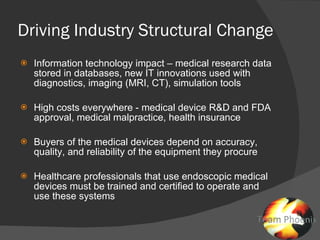
Driving Industry Structural Change Information technology impact – medical research data stored in databases, new IT innovations used with diagnostics, imaging (MRI, CT), simulation tools High costs everywhere - medical device R&D and FDA approval, medical malpractice, health insurance Buyers of the medical devices depend on accuracy, quality, and reliability of the equipment they procure Healthcare professionals that use endoscopic medical devices must be trained and certified to operate and use these systems
Uncertain Elements of Structure New Entrants – questions to ask… Will the FDA change stance on approval process of class II and III medical devices?  Will medical device innovations fragment the industry? Will the perception of endoscopic diagnostic procedures continue to be viewed as invasive?
Uncertain Elements of Structure Buyer Power – questions to ask… Will buyers prefer certain medical device brands that already dominate the market? Will fiber optic technology be the perceived as enhanced means of collecting information versus ultrasound technology? Will healthcare insurance reimbursement changes increase buyer demand for screening and diagnostic medical devices/solutions? Will distribution be regulated through the government or a new healthcare institution?
Uncertain Elements of Structure Supplier Power – questions to ask… Will the supplier base be willing to acquire new skills for manufacture and assembly of new fiber optic technology in existing endoscopic medical devices already sold through narrow channels? Will US companies outsource or require custom in-house assembly/testing/validation to ensure accuracy and reliability? How will these medical devices by sold from supplier to any buyer or strictly specialized buyers?
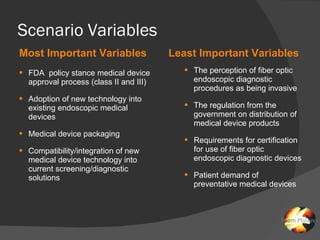
Scenario Variables Most Important Variables Least Important Variables FDA  policy stance medical device approval process (class II and III) Adoption of new technology into existing endoscopic medical devices Medical device packaging Compatibility/integration of new medical device technology into current screening/diagnostic solutions The perception of fiber optic endoscopic diagnostic procedures as being invasive The regulation from the government on distribution of medical device products Requirements for certification for use of fiber optic endoscopic diagnostic devices Patient demand of preventative medical devices
Causal Factors Determining Uncertainty Scenario Variable Causal Factors Demand shift caused by FDA change in medical device approval process Adoption rate of new technology into existing endoscopic medical devices Medical device packaging Compatibility of medical device technologies which can easily integrate into current user IT systems External: The threat of new entrants may be increased by FDA process change Internal: Limited number of product options  External: Prices of medical devices may drop Internal: Cost of marketing preventative devices External: Main competitors dominate through brand recognition, reliability, accuracy Internal: Alliances, marketing and advertising costs External: integration with buyer IT systems Internal: R&D costs to develop platforms that can vertically integrate into current IT systems
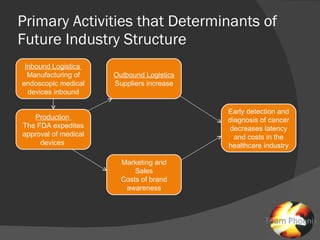
Primary Activities that Determinants of Future Industry Structure Inbound Logistics  Manufacturing of endoscopic medical devices inbound Production  The FDA expedites approval of medical devices  Outbound Logistics Suppliers increase Marketing and Sales Costs of brand awareness Early detection and diagnosis of cancer decreases latency and costs in the healthcare industry
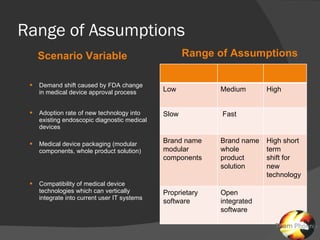
Range of Assumptions Scenario Variable Range of Assumptions Demand shift caused by FDA change in medical device approval process Adoption rate of new technology into existing endoscopic diagnostic medical devices Medical device packaging (modular components, whole product solution) Compatibility of medical device technologies which can vertically integrate into current user IT systems Low Medium High Slow Fast Brand name modular components Brand name whole product solution High short term shift for new technology Proprietary software Open integrated software
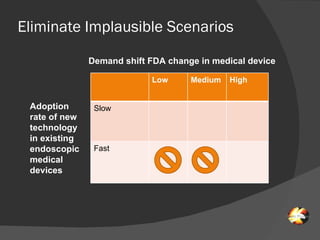
Eliminate Implausible Scenarios Adoption  rate of new technology in existing endoscopic  medical devices Demand shift FDA change in medical device Low Medium High Slow Fast
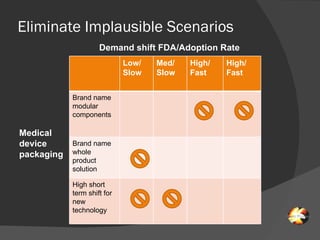
Eliminate Implausible Scenarios Medical device packaging Demand shift FDA/Adoption Rate Low/ Slow Med/ Slow High/ Fast High/ Fast Brand name modular components Brand name whole product solution High short term shift for new technology
Consistency Brand name modular components Brand name whole product solution High short term shift for new technology Demand shift FDA/Adoption Rate Product Set Low/ Slow Med/ Slow High/ Fast High/ Fast 1 2 Proprietary  software 3 4 5 Open  Integrated software 6 7 8 Proprietary  software 9 Open  Integrated software 10
Analysis of Scenarios Scenario 7 Scenario 2  Future Industry  Structure Structural  Attractiveness Sources of  Competitive  Advantage
Competitive Behavior Scenario 7 FDA fast tracks, rapid demand, brand name whole product integrated solutions Scenario 2  FDA no change status quo Key Uncertainty in Competitive Behavior Alternative Competitive Behavior
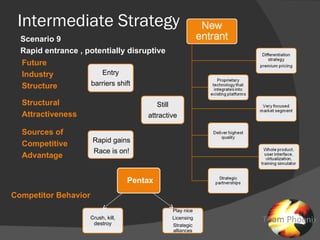
Intermediate Strategy Scenario 9 Rapid entrance , potentially disruptive Future Industry  Structure Structural  Attractiveness Competitor Behavior Sources of  Competitive  Advantage Pentax Still attractive Entry barriers shift Rapid gains Race is on! Crush, kill, destroy Play nice Licensing Strategic alliances
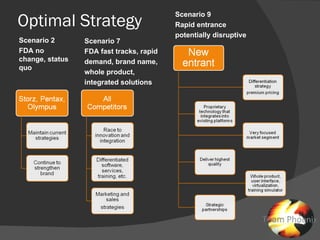
Optimal Strategy Scenario 9 Rapid entrance  potentially disruptive  Scenario 7 FDA fast tracks, rapid demand, brand name, whole product, integrated solutions Scenario 2  FDA no change, status quo
Today  vs.  Future

Stc384 team phoenix scenario analysis

  • 1.
  • 2.
    Uncertain Elements ofStructure in the U.S. Medical Device Industry FDA’s stance on approval process of new medical devices, specifically for screening, early detection, diagnostics – double edged sword, might increase threat of new entrants or add significant barrier to new entrants depending on position New medical device innovations increase threat of entrants, which increases buyer power (more products to choose from, potentially lower prices) which might fragment industry New endoscopic medical devices for early cancer detection may not integrate into existing diagnostic/imaging platforms increases learning curve, reduces overall industry profitability
  • 3.
    Component manufacturers (U.S. & foreign) Start-ups Cross over from manufacturers of non-endoscopic medical devices Electronics manufacturers Information technology Hospitals Group Purchasing Organizations Specialty clinics Outpatient surgery centers Medical equipment distributors Drug therapies Preventative healthcare Pathological study of samples Genetic screening Medical Device Industry Power to influence the entire industry Potential Entrants Buyers Substitutes Suppliers Industry Competitors Olympus, Pentax, Storz, Smith & Nephew, Resellers Sixth Force - Government Sixth Force FDA
  • 4.
    Medical Device IndustryForce Level Bargaining Power of Suppliers Low Bargaining Power of Buyers Medium Threat of Substitutes Medium Intensity of Rivalry Among Competitors Medium Threat of New Entrants Low Sixth Force – US Government, FDA High Industry Attractiveness: Attractive
  • 5.
    Industry Situation Certaintiesof this Industry Competitors Endoscopic medical devices used in the healthcare industry are sold through medical device suppliers to certified medical professionals Buyers include hospitals, surgeons and specialists (GI, ENT, OB/GYN), outpatient surgery clinics, and imaging/diagnostic service providers The FDA determines what medical devices can enter the market (PMN 501(k) and PMA) Karl Storz Imaging Olympus Americas Pentax Medical Smith and Nephew Siemens Medical Imaging BD Ventures Tripath Imaging * Cambridge Research & Instrumentation , Inc. * Lucid Inc. * TeraRecon *
  • 6.
    Economics and DemographicsCancer is detected more frequently than in the past due to medical innovations Significant increase in funding for research to cure, prevent, and detect cancer through government, NGOs and non-profits Healthcare private insurers, Medicare and Medicaid evaluating policy on reimbursement of medical diagnostic procedures (cancer screening and early detection) to reduce total cost of healthcare Medical devices for cancer screening, early detection and diagnosis create economies of scale and scope for medical device manufacturers AND healthcare industry Medical device industry trending towards early detection and diagnostics through nanotechnology, miniaturization, and in-vivo imaging combined with Information Technology (computation data sets) to yield real-time results
  • 7.
    Driving Industry StructuralChange Information technology impact – medical research data stored in databases, new IT innovations used with diagnostics, imaging (MRI, CT), simulation tools High costs everywhere - medical device R&D and FDA approval, medical malpractice, health insurance Buyers of the medical devices depend on accuracy, quality, and reliability of the equipment they procure Healthcare professionals that use endoscopic medical devices must be trained and certified to operate and use these systems
  • 8.
    Uncertain Elements ofStructure New Entrants – questions to ask… Will the FDA change stance on approval process of class II and III medical devices? Will medical device innovations fragment the industry? Will the perception of endoscopic diagnostic procedures continue to be viewed as invasive?
  • 9.
    Uncertain Elements ofStructure Buyer Power – questions to ask… Will buyers prefer certain medical device brands that already dominate the market? Will fiber optic technology be the perceived as enhanced means of collecting information versus ultrasound technology? Will healthcare insurance reimbursement changes increase buyer demand for screening and diagnostic medical devices/solutions? Will distribution be regulated through the government or a new healthcare institution?
  • 10.
    Uncertain Elements ofStructure Supplier Power – questions to ask… Will the supplier base be willing to acquire new skills for manufacture and assembly of new fiber optic technology in existing endoscopic medical devices already sold through narrow channels? Will US companies outsource or require custom in-house assembly/testing/validation to ensure accuracy and reliability? How will these medical devices by sold from supplier to any buyer or strictly specialized buyers?
  • 11.
    Scenario Variables MostImportant Variables Least Important Variables FDA policy stance medical device approval process (class II and III) Adoption of new technology into existing endoscopic medical devices Medical device packaging Compatibility/integration of new medical device technology into current screening/diagnostic solutions The perception of fiber optic endoscopic diagnostic procedures as being invasive The regulation from the government on distribution of medical device products Requirements for certification for use of fiber optic endoscopic diagnostic devices Patient demand of preventative medical devices
  • 12.
    Causal Factors DeterminingUncertainty Scenario Variable Causal Factors Demand shift caused by FDA change in medical device approval process Adoption rate of new technology into existing endoscopic medical devices Medical device packaging Compatibility of medical device technologies which can easily integrate into current user IT systems External: The threat of new entrants may be increased by FDA process change Internal: Limited number of product options External: Prices of medical devices may drop Internal: Cost of marketing preventative devices External: Main competitors dominate through brand recognition, reliability, accuracy Internal: Alliances, marketing and advertising costs External: integration with buyer IT systems Internal: R&D costs to develop platforms that can vertically integrate into current IT systems
  • 13.
    Primary Activities thatDeterminants of Future Industry Structure Inbound Logistics Manufacturing of endoscopic medical devices inbound Production The FDA expedites approval of medical devices Outbound Logistics Suppliers increase Marketing and Sales Costs of brand awareness Early detection and diagnosis of cancer decreases latency and costs in the healthcare industry
  • 14.
    Range of AssumptionsScenario Variable Range of Assumptions Demand shift caused by FDA change in medical device approval process Adoption rate of new technology into existing endoscopic diagnostic medical devices Medical device packaging (modular components, whole product solution) Compatibility of medical device technologies which can vertically integrate into current user IT systems Low Medium High Slow Fast Brand name modular components Brand name whole product solution High short term shift for new technology Proprietary software Open integrated software
  • 15.
    Eliminate Implausible ScenariosAdoption rate of new technology in existing endoscopic medical devices Demand shift FDA change in medical device Low Medium High Slow Fast
  • 16.
    Eliminate Implausible ScenariosMedical device packaging Demand shift FDA/Adoption Rate Low/ Slow Med/ Slow High/ Fast High/ Fast Brand name modular components Brand name whole product solution High short term shift for new technology
  • 17.
    Consistency Brand namemodular components Brand name whole product solution High short term shift for new technology Demand shift FDA/Adoption Rate Product Set Low/ Slow Med/ Slow High/ Fast High/ Fast 1 2 Proprietary software 3 4 5 Open Integrated software 6 7 8 Proprietary software 9 Open Integrated software 10
  • 18.
    Analysis of ScenariosScenario 7 Scenario 2 Future Industry Structure Structural Attractiveness Sources of Competitive Advantage
  • 19.
    Competitive Behavior Scenario7 FDA fast tracks, rapid demand, brand name whole product integrated solutions Scenario 2 FDA no change status quo Key Uncertainty in Competitive Behavior Alternative Competitive Behavior
  • 20.
    Intermediate Strategy Scenario9 Rapid entrance , potentially disruptive Future Industry Structure Structural Attractiveness Competitor Behavior Sources of Competitive Advantage Pentax Still attractive Entry barriers shift Rapid gains Race is on! Crush, kill, destroy Play nice Licensing Strategic alliances
  • 21.
    Optimal Strategy Scenario9 Rapid entrance potentially disruptive Scenario 7 FDA fast tracks, rapid demand, brand name, whole product, integrated solutions Scenario 2 FDA no change, status quo
  • 22.
    Today vs. Future

Editor's Notes

  • #2 Notes: Select 3 to 4 variables (min 3) 3 assumptions at most Select 2 or 3 scenarios for discussion and highlight most probable, most favorable for entrance
  • #3 The threat of new entrants could be high if the FDA fast tracks approval of new medical devices used for diagnostic procedures/services (healthcare policy shift to early detection and diagnosis)
  • #6 Premarket Notification 510(k) - 21 CFR Part 807 Subpart E If your device requires the submission of a Premarket Notification 510(k), you cannot commercially distribute the device until you receive a letter of substantial equivalence from FDA authorizing you to do so. A 510(k) must demonstrate that the device is substantially equivalent to one legally in commercial distribution in the United States: (1) before May 28, 1976; or (2) to a device that has been determined by FDA to be substantially equivalent. Premarket Notification 510(k) On October 26, 2002 the Medical Device User Fee and Modernization Act of 2002 became law. It authorizes FDA to charge a fee for medical device Premarket Notifcation 510(k) reviews. A small business may pay a reduced fee. The application fee applies to Traditional, Abbreviated, and Special 510(k)s. The payment of a premarket review fee is not related in any way to FDA's final decision on a submission. 510(k) Review Fees Most Class I devices and some Class II devices are exempt from the Premarket Notification 510(k) submission. A list of exempt devices is located at: 510(k) Exempt Devices If you plan to send a 510(k) application to FDA for a Class I or Class II device, you may find 510(k) review by an Accredited Persons beneficial. FDA accredited 12 organizations to conduct a primary review of 670 types of devices. By law, FDA must issue a final determination within 30 days after receiving a recommendation from an Accredited Person. Please note that 510(k) review by an Accredited Person is exempt from any FDA fee; however, the third-party may charge a fee for its review. Third Party Review   Premarket Approval (PMA) - 21 CFR Part 814 Product requiring PMAs are Class III devices are high risk devices that pose a significant risk of illness or injury, or devices found not substantially equivalent to Class I and II predicate through the 510(k) process. The PMA process is more involved and includes the submission of clinical data to support claims made for the device. Premarket Approval Beginning fiscal year 2003 (October 1, 2002 through September 30, 2003), medical device user fees apply to original PMAs and certain types of PMA supplements. Small businesses are eligible for reduced or waived fees.
  • #7 Wiley Science online doi.wiley.com/10.1002/cncr.24637 Keywords mammography • access to healthcare • health policy • Medicaid • Medicare • health insurance reimbursement Abstract BACKGROUND: Women of low socioeconomic status are at risk for delayed evaluation of abnormal mammograms and later stage presentations of breast cancer. Medicaid reimbursement for clinical services is lower than Medicare reimbursement, yet it is unclear whether low Medicaid reimbursement is a barrier to accessing mammography. The objective of the current study was to determine the association between reported insurance type (Medicaid vs Medicare), Medicaid reimbursement rate, and access to diagnostic mammography (DM). METHODS: Standardized patients (SPs) called 521 mammography facilities in defined geographic regions of 11 states in 2005. Facilities were divided between high, middle, and low reimbursing states based on the state's relative Medicaid-to-Medicare reimbursement rate for DM. SPs contacted each facility twice to schedule a DM using the same clinical vignette but switching insurance status (Medicaid vs Medicare). The authors measured the proportion of SPs who were offered 1) any appointment and 2) a timely appointment, defined as a third available appointment within 20 business days. RESULTS: SPs with Medicaid were less likely to receive an appointment than SPs with Medicare (91% vs 99.1%; difference, 8.1%; 95% confidence interval, 5.3%-10.9% [ P < .001]). Among facilities that offered appointments to both callers, the proportion of timely appointments did not differ between Medicaid (93.7%) and Medicare (92.9%; P = .51). States' Medicaid reimbursement rates for DM were not associated with the percentage of SPs with Medicaid who were offered any appointment ( P = .50) or a timely appointment ( P = .69). CONCLUSIONS: Callers with Medicaid were offered appointments for DM less frequently than callers with Medicare, although both were widely accepted. State Medicaid reimbursement rates did not affect access to mammography. Cancer 2009. © 2009 American Cancer Society. http://www.gehealthcare.com/usen/community/reimbursement/docs/mammography_cust_advisory_22609edit.pdf MEDICARE REIMBURSEMENT FOR MAMMOGRAPHY SERVICES1 This advisory discusses coding, coverage, and payment for mammography services provided in the hospital outpatient, independent diagnostic testing facility (IDTF), and physician office settings2,3 While it focuses on Medicare program policies, these policies may be applicable to selected private payers throughout the country. For purposes of this advisory, diagnostic mammography refers to a radiologic procedure furnished to a man or woman with signs or symptoms of breast disease, a personal history of breast cancer or a personal history of biopsy-proven benign breast disease. Screening mammography refers to a radiologic procedure furnished to a woman without signs or symptoms of breast disease, for the purpose of early detection of breast cancer. 4 Coding Medicare’s reimbursement system relies mostly on Current Procedural Terminology (CPT) codes to consistently identify some mammography services provided to Medicare patients. 5 The CPT coding system was developed and is maintained by the American Medical Association (AMA) and the codes are updated annually. In addition to the use of CPT codes, Medicare utilizes Healthcare Common Procedure Coding System (HCPCS) Level II (national) codes to report digital mammography services. The agency developed the alphanumeric HCPCS level II coding system to describe and identify many supplies and services that are not included in the CPT coding system. Table 1 lists the CPT codes and HCPCS Level II codes that should be reported for mammography services. Medicare also reimburses for computer-aided detection (CAD) as a separate, add-on payment when used with either film-based or digital mammography. The CPT codes for CAD, listed in Table 1, distinguish between diagnostic and screening mammography applications. For diagnostic services, it should be noted that the CAD CPT code 77051 can be reported in conjunction with the primary service mammography CPT codes 77055 or 77056, as well as HCPCS codes G0204 or G0206. For screening services, CAD CPT code 77052 can be reported in conjunction with the primary service mammography code, CPT code 77057 or HCPCS code G0202. [Refer to the Medicare Claims Processing Manual at http://www.cms.hhs.gov/manuals/downloads/clm104c18.pdf (scroll to section 20.2.1).] Medicare will reimburse providers for medically necessary screening and diagnostic mammography procedures performed on the same patient on the same day. The modifier –GG “Performance and payment of a screening mammogram and diagnostic mammogram on the same patient, same day,” must be attached to the appropriate diagnostic mammography procedure code. In a scenario where a patient has a screening mammogram performed on one day and returns on another day for the additional