Case Study - Statue Of Unity
Presented by:
Bhagyshree kandoi
M.tech - Structural Engineer
Enrollment no: 20030329008
INTRODUCTION
• Narendra Modi first announced the project to Sardar Vallabhbhai Patel on
7 October 2010 at a press conference.
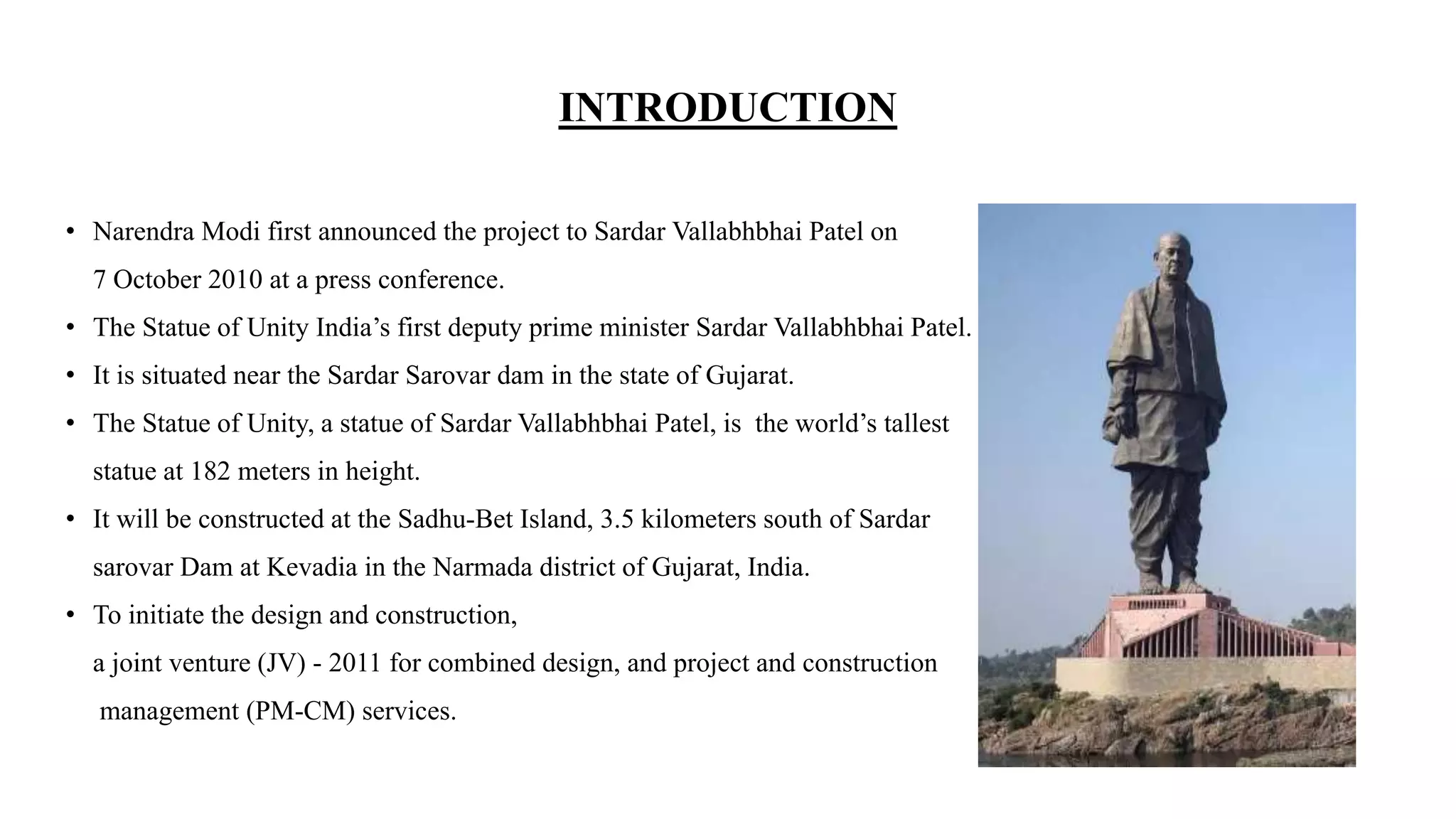
• The Statue of Unity India’s first deputy prime minister Sardar Vallabhbhai Patel.
• It is situated near the Sardar Sarovar dam in the state of Gujarat.
• The Statue of Unity, a statue of Sardar Vallabhbhai Patel, is the world’s tallest
statue at 182 meters in height.
• It will be constructed at the Sadhu-Bet Island, 3.5 kilometers south of Sardar
sarovar Dam at Kevadia in the Narmada district of Gujarat, India.
• To initiate the design and construction,
a joint venture (JV) - 2011 for combined design, and project and construction
management (PM-CM) services.
• The main contractor bid process was completed on October 27, 2014, contract was awarded to L&T Ltd.
Chennai.
• As of the writing of this paper, additional geotechnical testing of the hillock has been completed and the
leveling of the hillock has started in March of 2015.
• The construction of the Statue of Unity was completed in 2018.
• The structure has an irregular curved form that is larger at the top than at the base, requiring a unique but
simple and constructible structural system.
• The statue is a structural system comprising of two semi-elliptical reinforced concrete cores.
• It also has a reinforced concrete podium that acts as a base for the statue clad in bronze, supported by
structural steelwork fixed on to the concrete cores.
The Tallest statue in the World:
• Sculptor Ram Suthar, made a few replicas of the Sardar Vallabhbhai Patel statue and created a 30-feet bronze
one that was scanned into electronic data to make the 59.7-feet (182 meters) Sardar Patel statue.
• Statue of Unity’ (SOU) is dedicated to the Iron Man of India, Sardar Vallabhbhai Patel. Sardar Patel is widely
considered to be the architect of modern India.
• The SoU will stand tall as an inspiration to future generations, a reminder of Sardar Patel’s sterling
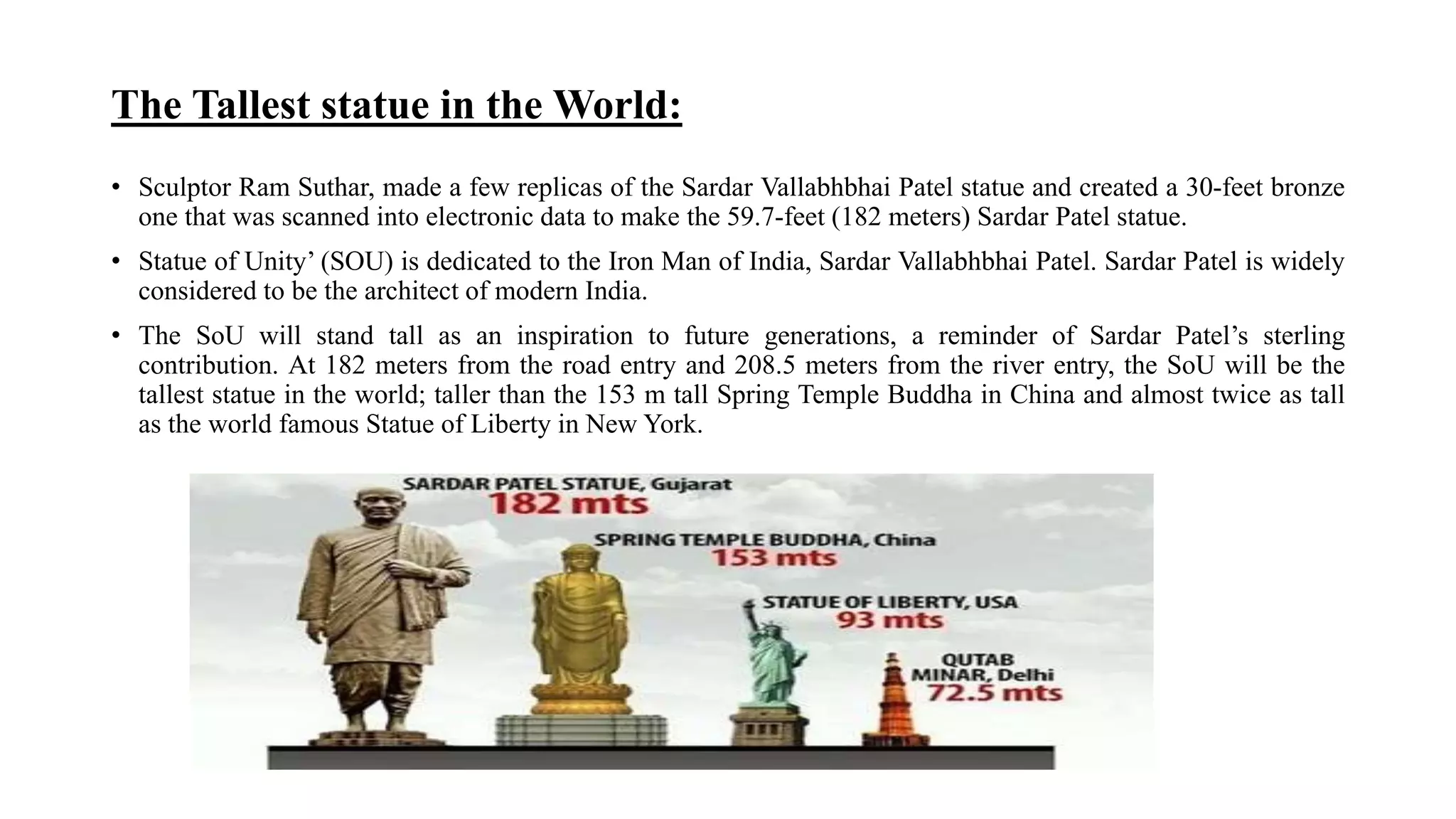
contribution. At 182 meters from the road entry and 208.5 meters from the river entry, the SoU will be the
tallest statue in the world; taller than the 153 m tall Spring Temple Buddha in China and almost twice as tall
as the world famous Statue of Liberty in New York.
1. Site Location:
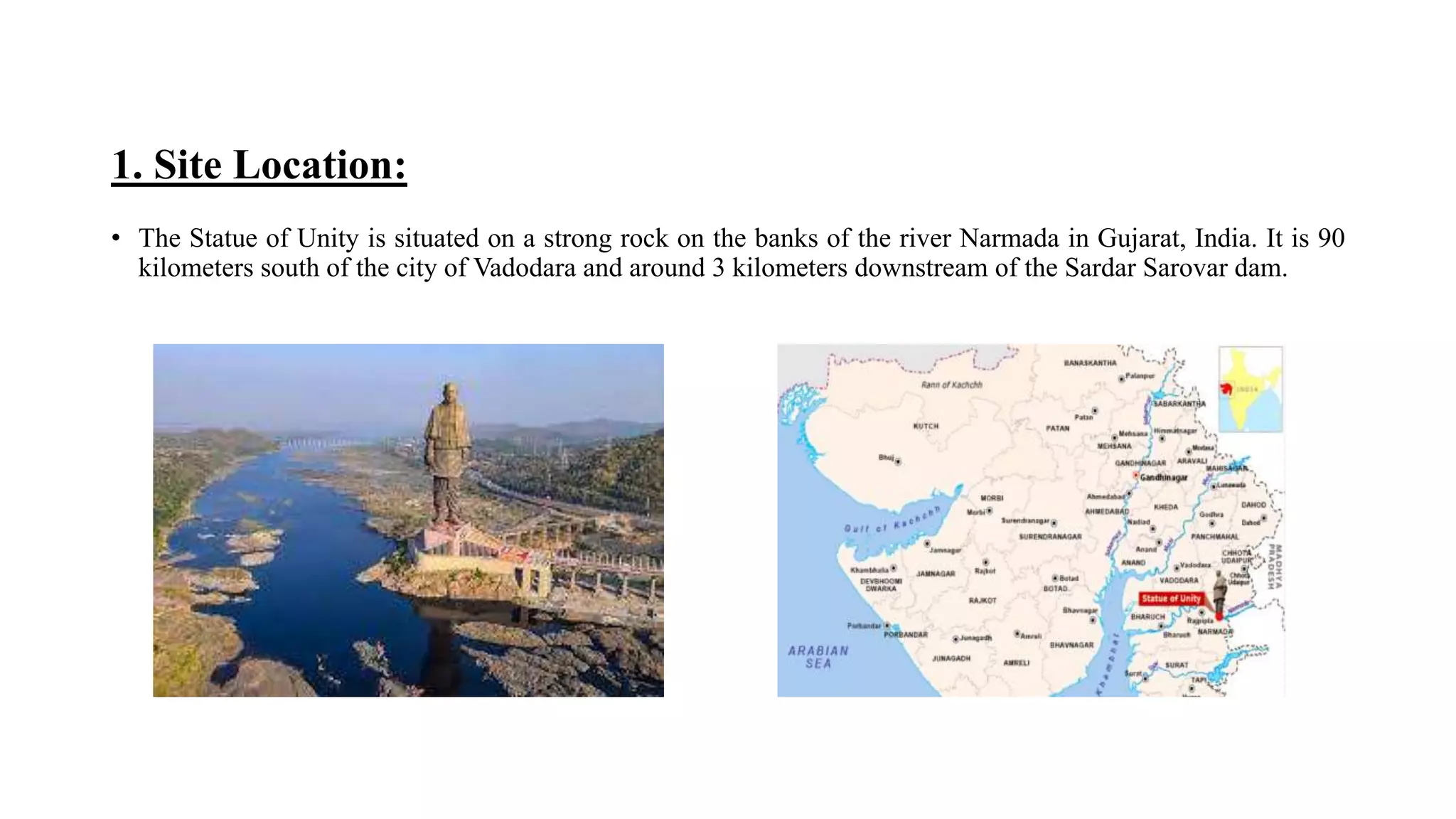
• The Statue of Unity is situated on a strong rock on the banks of the river Narmada in Gujarat, India. It is 90
kilometers south of the city of Vadodara and around 3 kilometers downstream of the Sardar Sarovar dam.
Features of Sardar Patel Statue:
• A 320 m long designer bridge connecting Sadhu Hill to the mainland
• A memorial and visitors’ centre
• 4-lane approach road
• An administrative complex, 3-star hotel and conference centre
• A 40-m suspended fabric roof structure for the visitors’ centre
• Shrestha Bharat bhavan – conference centre
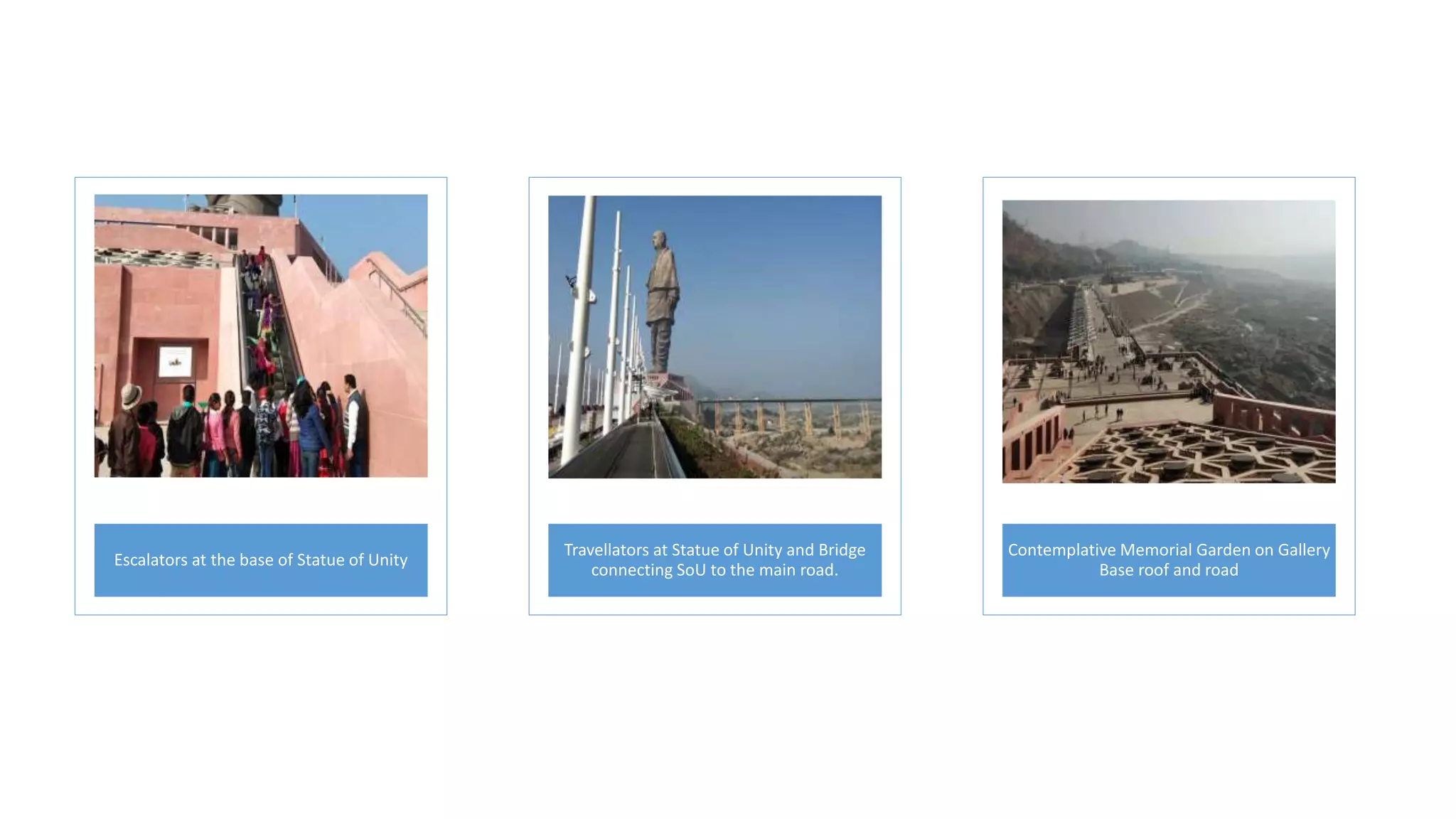
Escalators at the base of Statue of Unity
Travellators at Statue of Unity and Bridge
connecting SoU to the main road.
Contemplative Memorial Garden on Gallery
Base roof and road
Sardar’s sculpture at SoU Exhibition
Gallery
Viewing gallery and road from
Kevadiya.
Main bridge connecting Memorial &
Visiting Centre and Sadhu Bet Island
Engineering Challenges:
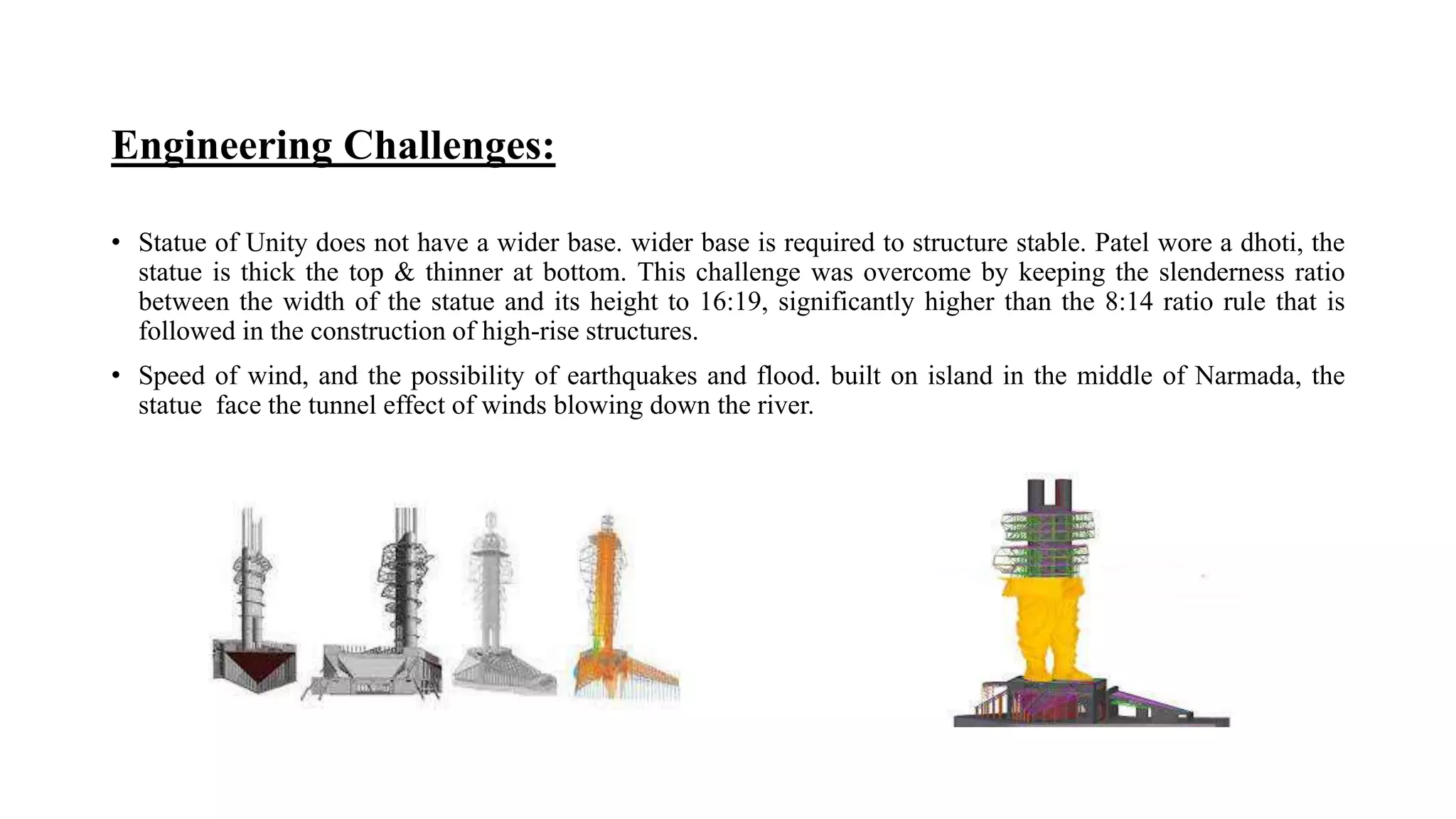
• Statue of Unity does not have a wider base. wider base is required to structure stable. Patel wore a dhoti, the
statue is thick the top & thinner at bottom. This challenge was overcome by keeping the slenderness ratio
between the width of the statue and its height to 16:19, significantly higher than the 8:14 ratio rule that is
followed in the construction of high-rise structures.
• Speed of wind, and the possibility of earthquakes and flood. built on island in the middle of Narmada, the
statue face the tunnel effect of winds blowing down the river.
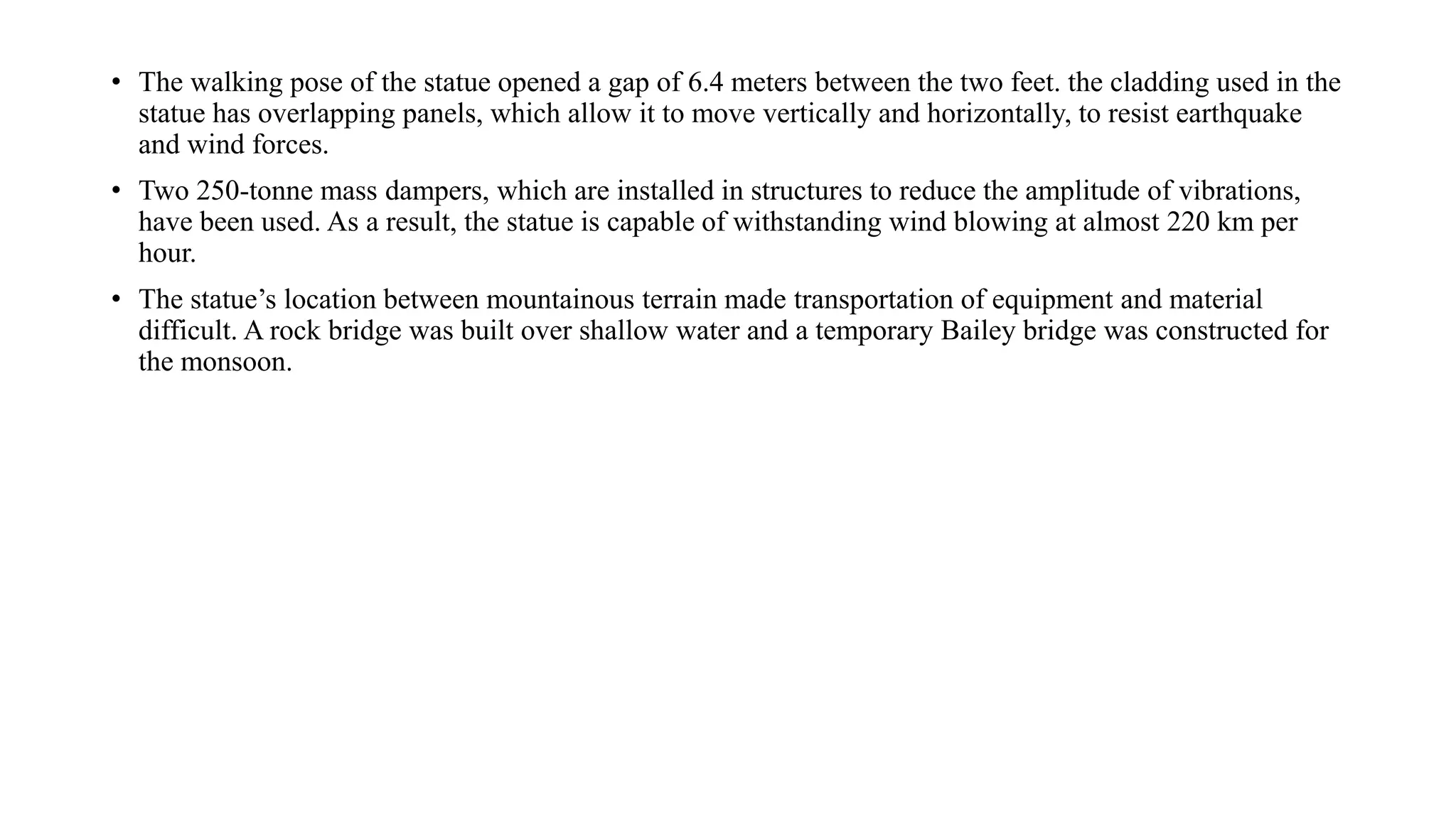
• The walking pose of the statue opened a gap of 6.4 meters between the two feet. the cladding used in the
statue has overlapping panels, which allow it to move vertically and horizontally, to resist earthquake
and wind forces.
• Two 250-tonne mass dampers, which are installed in structures to reduce the amplitude of vibrations,
have been used. As a result, the statue is capable of withstanding wind blowing at almost 220 km per
hour.
• The statue’s location between mountainous terrain made transportation of equipment and material
difficult. A rock bridge was built over shallow water and a temporary Bailey bridge was constructed for
the monsoon.
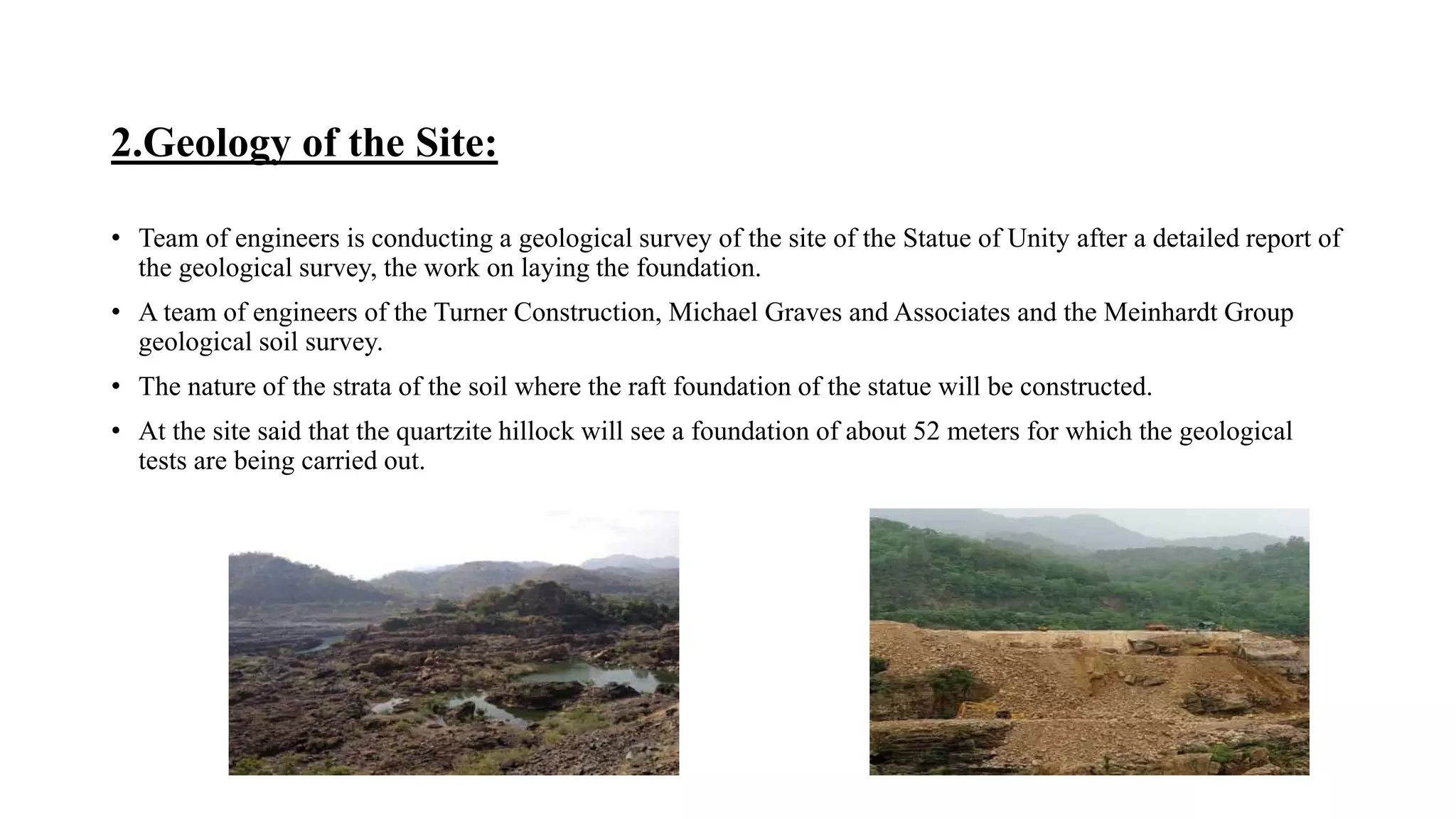
2.Geology of the Site:
• Team of engineers is conducting a geological survey of the site of the Statue of Unity after a detailed report of
the geological survey, the work on laying the foundation.
• A team of engineers of the Turner Construction, Michael Graves and Associates and the Meinhardt Group
geological soil survey.
• The nature of the strata of the soil where the raft foundation of the statue will be constructed.
• At the site said that the quartzite hillock will see a foundation of about 52 meters for which the geological
tests are being carried out.
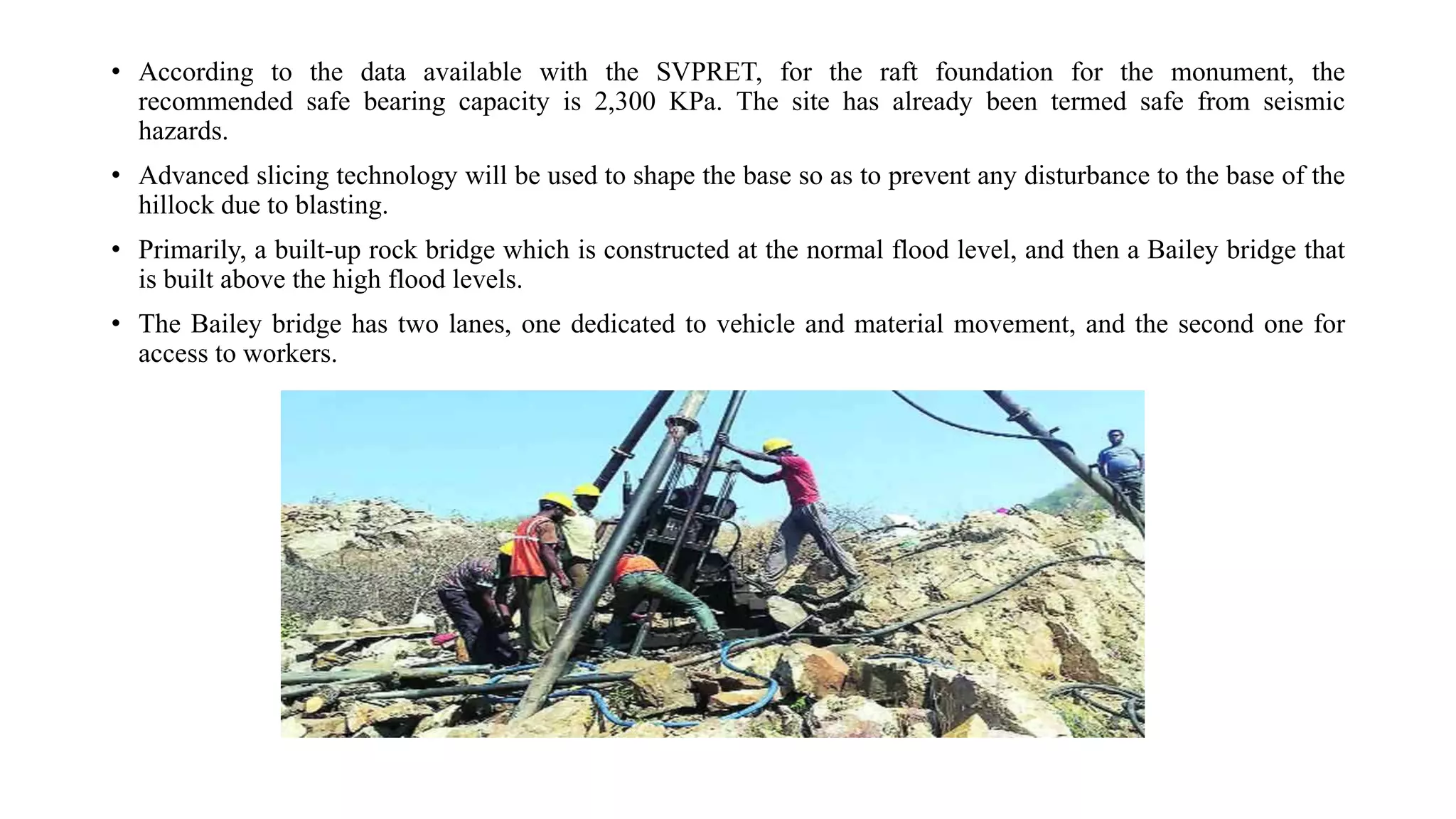
• According to the data available with the SVPRET, for the raft foundation for the monument, the
recommended safe bearing capacity is 2,300 KPa. The site has already been termed safe from seismic
hazards.
• Advanced slicing technology will be used to shape the base so as to prevent any disturbance to the base of the
hillock due to blasting.
• Primarily, a built-up rock bridge which is constructed at the normal flood level, and then a Bailey bridge that
is built above the high flood levels.
• The Bailey bridge has two lanes, one dedicated to vehicle and material movement, and the second one for
access to workers.
3.Material required for construction:
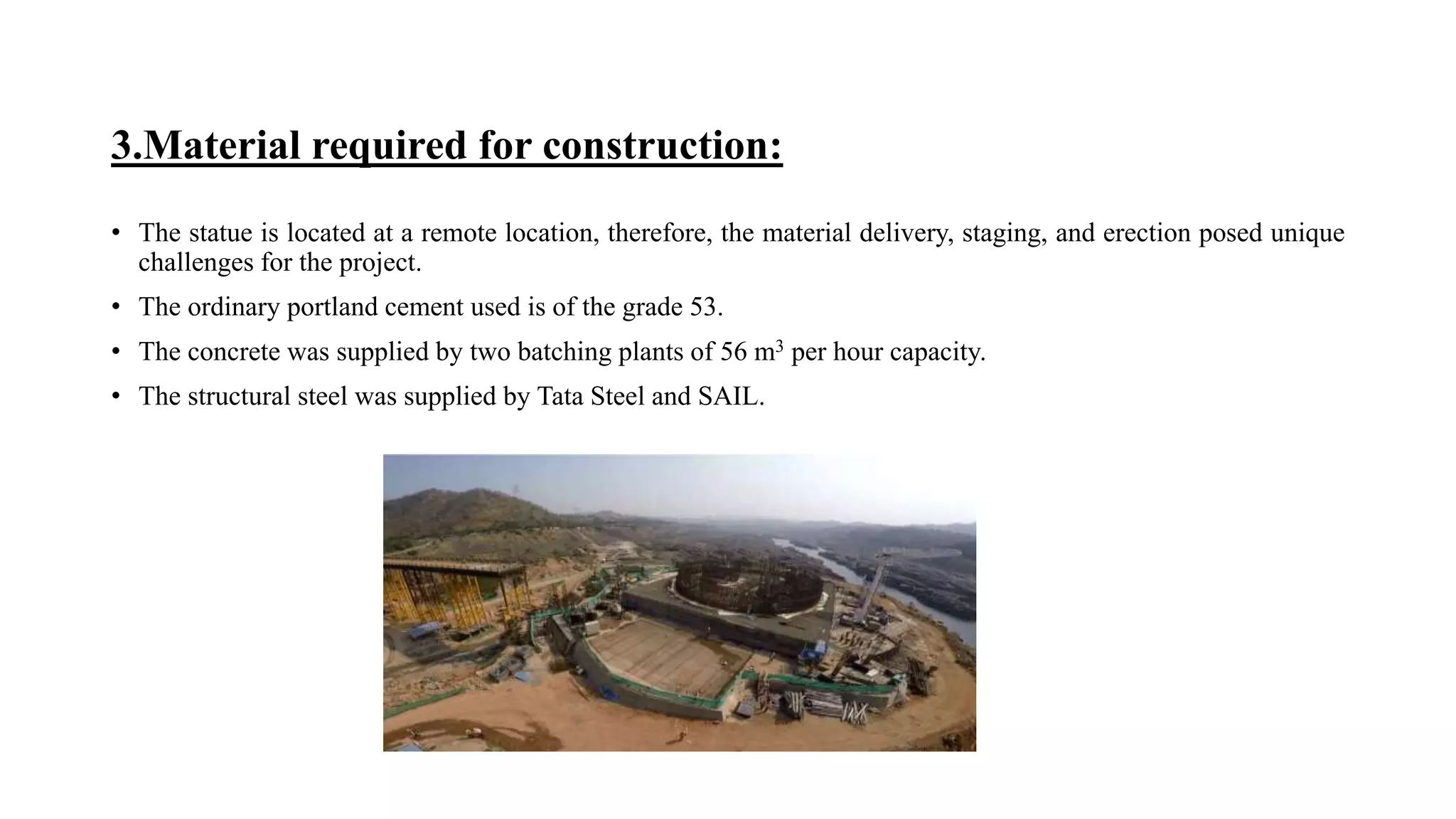
• The statue is located at a remote location, therefore, the material delivery, staging, and erection posed unique
challenges for the project.
• The ordinary portland cement used is of the grade 53.
• The concrete was supplied by two batching plants of 56 m3 per hour capacity.
• The structural steel was supplied by Tata Steel and SAIL.
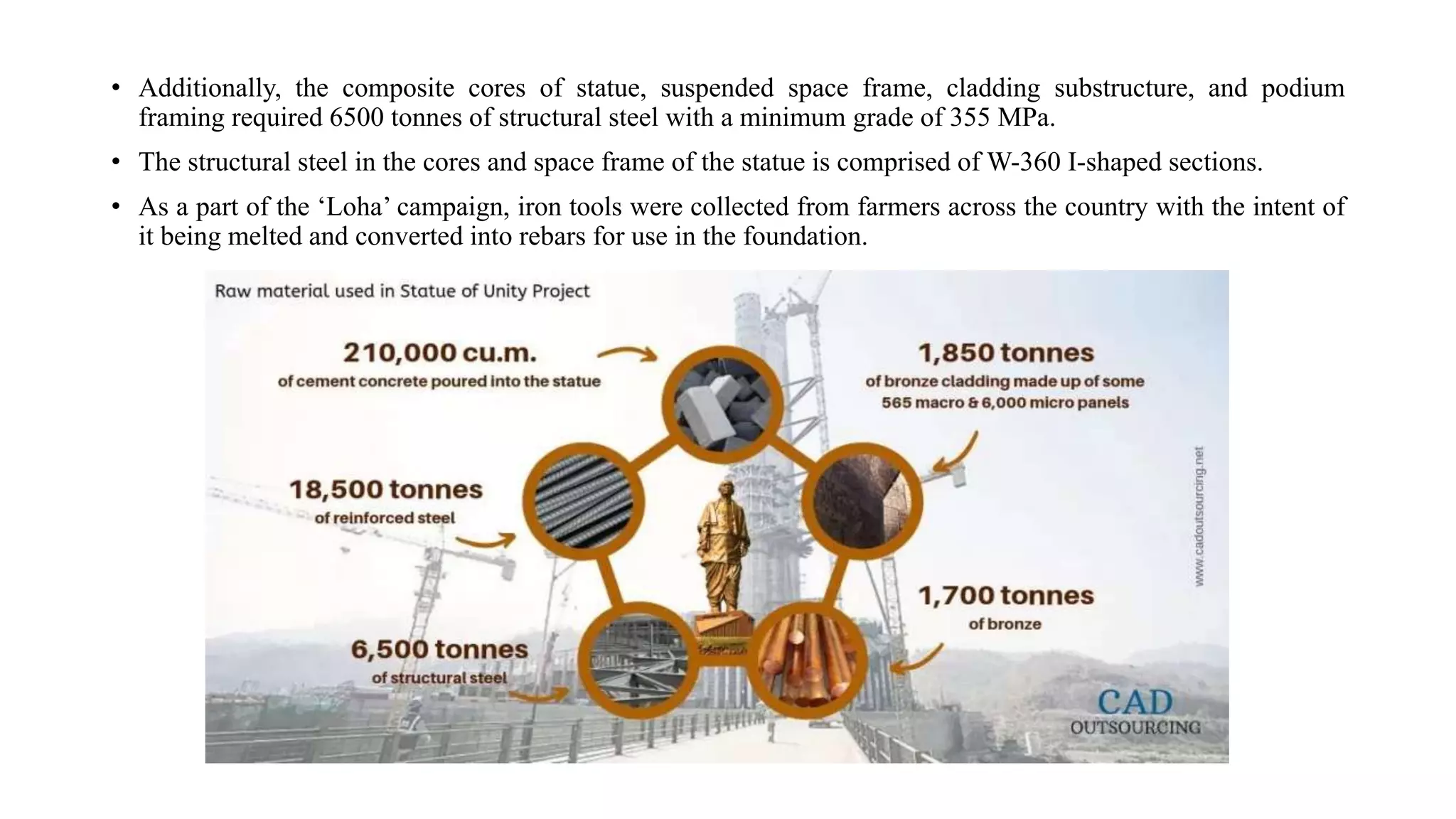
• Additionally, the composite cores of statue, suspended space frame, cladding substructure, and podium
framing required 6500 tonnes of structural steel with a minimum grade of 355 MPa.
• The structural steel in the cores and space frame of the statue is comprised of W-360 I-shaped sections.
• As a part of the ‘Loha’ campaign, iron tools were collected from farmers across the country with the intent of
it being melted and converted into rebars for use in the foundation.
4. Structural system of statue of unity:-
The main structural components of the statue of unity consist of the base and the core walls.
 Base Of The Statue:-
• The base of the statue was constructed on shallow foundation(i.e. raft foundation) supported over a strong
rock.
• The level of base differs from +45 m to +52.5 m.
• The ground floor is at +58 m level.it is made of structural slabs supported by columns and walls.
• Both concrete and steel were used thoroughly from +58 m level to +83 m level.
• The slab at +78 m, +83 m and inclined roofings are made of composite deck slab resting on structural beam
and trusses.
 Core Walls:
• Two primary vertical core walls of the statue are elliptical in shape. The dimension
of the core walls are 11.30 x 8.40 m .
• The elliptical core walls basically starts from +56.575 m level and continues up to
+209.50 m level.
• The coupling wall is linked to the core walls from +115 m level to +193 m level.
• Core walls confined by an external oval concrete wall up to the podium level +83 m.
• Above the podium level, where the faced geometry statue appears, the core are
coupled together with two R.C wall known as coupling wall up to the entire heights of
core walls.
• The thickness of core wall is continuous throughout the height , the thickness of
the coupling wall waries from 0.55 m and 1.33 m.
5. construction:
• A Consortium comprising Turner Construction, Michael Graves and Associates and the Meinhardt Group
supervised the project. It took 56 months to complete – 15 months for planning, 40 months for construction
and two months for handing over by the consortium.
• The total cost of the project was estimated to be about 20.63 billion (US$290 million) by the government. The
tender bids for the first phase were invited in October 2013 and were closed in November 2013.
• Indian infrastructure company Larsen & Toubro won the contract on 27 October 2014 for its lowest bid of
29.89 billion (US$420 million) for the design, construction and maintenance. They commenced the
construction on 31 October 2014.
• In the first phase of the project, 13.47 billion were for the main statue, 2.35 billion for the exhibition hall and
convention centre, 830 million for the bridge connecting the memorial to the mainland and 6.57 billion for the
maintenance of the structure for 15 years after its completion.
• The bronze panels were cast in Jiangxi Tongqing Metal Handicrafts Co. Ltd (the TQ Art foundry) in China as
suitable facilities were unavailable in India.
• The bronze panels were transported over sea and then by road to the workshop near the construction site
where they were assembled.
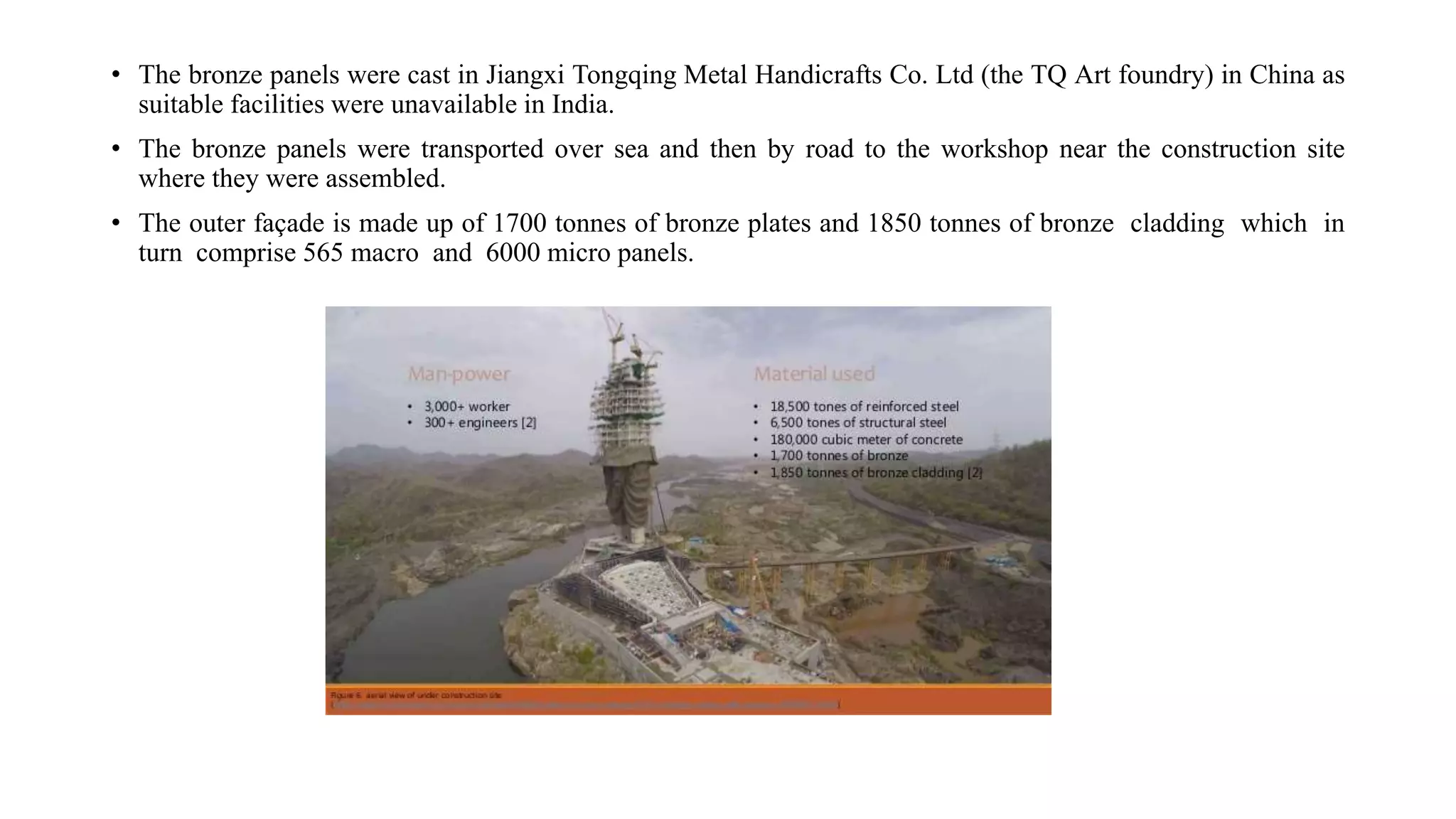
• The outer façade is made up of 1700 tonnes of bronze plates and 1850 tonnes of bronze cladding which in
turn comprise 565 macro and 6000 micro panels.
THANK YOU

Statue of unity case study

  • 1.
    Case Study -Statue Of Unity Presented by: Bhagyshree kandoi M.tech - Structural Engineer Enrollment no: 20030329008
  • 2.
    INTRODUCTION • Narendra Modifirst announced the project to Sardar Vallabhbhai Patel on 7 October 2010 at a press conference. • The Statue of Unity India’s first deputy prime minister Sardar Vallabhbhai Patel. • It is situated near the Sardar Sarovar dam in the state of Gujarat. • The Statue of Unity, a statue of Sardar Vallabhbhai Patel, is the world’s tallest statue at 182 meters in height. • It will be constructed at the Sadhu-Bet Island, 3.5 kilometers south of Sardar sarovar Dam at Kevadia in the Narmada district of Gujarat, India. • To initiate the design and construction, a joint venture (JV) - 2011 for combined design, and project and construction management (PM-CM) services.
  • 3.
    • The maincontractor bid process was completed on October 27, 2014, contract was awarded to L&T Ltd. Chennai. • As of the writing of this paper, additional geotechnical testing of the hillock has been completed and the leveling of the hillock has started in March of 2015. • The construction of the Statue of Unity was completed in 2018. • The structure has an irregular curved form that is larger at the top than at the base, requiring a unique but simple and constructible structural system. • The statue is a structural system comprising of two semi-elliptical reinforced concrete cores. • It also has a reinforced concrete podium that acts as a base for the statue clad in bronze, supported by structural steelwork fixed on to the concrete cores.
  • 4.
    The Tallest statuein the World: • Sculptor Ram Suthar, made a few replicas of the Sardar Vallabhbhai Patel statue and created a 30-feet bronze one that was scanned into electronic data to make the 59.7-feet (182 meters) Sardar Patel statue. • Statue of Unity’ (SOU) is dedicated to the Iron Man of India, Sardar Vallabhbhai Patel. Sardar Patel is widely considered to be the architect of modern India. • The SoU will stand tall as an inspiration to future generations, a reminder of Sardar Patel’s sterling contribution. At 182 meters from the road entry and 208.5 meters from the river entry, the SoU will be the tallest statue in the world; taller than the 153 m tall Spring Temple Buddha in China and almost twice as tall as the world famous Statue of Liberty in New York.
  • 5.
    1. Site Location: •The Statue of Unity is situated on a strong rock on the banks of the river Narmada in Gujarat, India. It is 90 kilometers south of the city of Vadodara and around 3 kilometers downstream of the Sardar Sarovar dam.
  • 6.
    Features of SardarPatel Statue: • A 320 m long designer bridge connecting Sadhu Hill to the mainland • A memorial and visitors’ centre • 4-lane approach road • An administrative complex, 3-star hotel and conference centre • A 40-m suspended fabric roof structure for the visitors’ centre • Shrestha Bharat bhavan – conference centre
  • 7.
    Escalators at thebase of Statue of Unity Travellators at Statue of Unity and Bridge connecting SoU to the main road. Contemplative Memorial Garden on Gallery Base roof and road
  • 8.
    Sardar’s sculpture atSoU Exhibition Gallery Viewing gallery and road from Kevadiya. Main bridge connecting Memorial & Visiting Centre and Sadhu Bet Island
  • 9.
    Engineering Challenges: • Statueof Unity does not have a wider base. wider base is required to structure stable. Patel wore a dhoti, the statue is thick the top & thinner at bottom. This challenge was overcome by keeping the slenderness ratio between the width of the statue and its height to 16:19, significantly higher than the 8:14 ratio rule that is followed in the construction of high-rise structures. • Speed of wind, and the possibility of earthquakes and flood. built on island in the middle of Narmada, the statue face the tunnel effect of winds blowing down the river.
  • 10.
    • The walkingpose of the statue opened a gap of 6.4 meters between the two feet. the cladding used in the statue has overlapping panels, which allow it to move vertically and horizontally, to resist earthquake and wind forces. • Two 250-tonne mass dampers, which are installed in structures to reduce the amplitude of vibrations, have been used. As a result, the statue is capable of withstanding wind blowing at almost 220 km per hour. • The statue’s location between mountainous terrain made transportation of equipment and material difficult. A rock bridge was built over shallow water and a temporary Bailey bridge was constructed for the monsoon.
  • 11.
    2.Geology of theSite: • Team of engineers is conducting a geological survey of the site of the Statue of Unity after a detailed report of the geological survey, the work on laying the foundation. • A team of engineers of the Turner Construction, Michael Graves and Associates and the Meinhardt Group geological soil survey. • The nature of the strata of the soil where the raft foundation of the statue will be constructed. • At the site said that the quartzite hillock will see a foundation of about 52 meters for which the geological tests are being carried out.
  • 12.
    • According tothe data available with the SVPRET, for the raft foundation for the monument, the recommended safe bearing capacity is 2,300 KPa. The site has already been termed safe from seismic hazards. • Advanced slicing technology will be used to shape the base so as to prevent any disturbance to the base of the hillock due to blasting. • Primarily, a built-up rock bridge which is constructed at the normal flood level, and then a Bailey bridge that is built above the high flood levels. • The Bailey bridge has two lanes, one dedicated to vehicle and material movement, and the second one for access to workers.
  • 13.
    3.Material required forconstruction: • The statue is located at a remote location, therefore, the material delivery, staging, and erection posed unique challenges for the project. • The ordinary portland cement used is of the grade 53. • The concrete was supplied by two batching plants of 56 m3 per hour capacity. • The structural steel was supplied by Tata Steel and SAIL.
  • 14.
    • Additionally, thecomposite cores of statue, suspended space frame, cladding substructure, and podium framing required 6500 tonnes of structural steel with a minimum grade of 355 MPa. • The structural steel in the cores and space frame of the statue is comprised of W-360 I-shaped sections. • As a part of the ‘Loha’ campaign, iron tools were collected from farmers across the country with the intent of it being melted and converted into rebars for use in the foundation.
  • 15.
    4. Structural systemof statue of unity:- The main structural components of the statue of unity consist of the base and the core walls.  Base Of The Statue:- • The base of the statue was constructed on shallow foundation(i.e. raft foundation) supported over a strong rock. • The level of base differs from +45 m to +52.5 m. • The ground floor is at +58 m level.it is made of structural slabs supported by columns and walls. • Both concrete and steel were used thoroughly from +58 m level to +83 m level. • The slab at +78 m, +83 m and inclined roofings are made of composite deck slab resting on structural beam and trusses.
  • 16.
     Core Walls: •Two primary vertical core walls of the statue are elliptical in shape. The dimension of the core walls are 11.30 x 8.40 m . • The elliptical core walls basically starts from +56.575 m level and continues up to +209.50 m level. • The coupling wall is linked to the core walls from +115 m level to +193 m level. • Core walls confined by an external oval concrete wall up to the podium level +83 m. • Above the podium level, where the faced geometry statue appears, the core are coupled together with two R.C wall known as coupling wall up to the entire heights of core walls. • The thickness of core wall is continuous throughout the height , the thickness of the coupling wall waries from 0.55 m and 1.33 m.
  • 17.
    5. construction: • AConsortium comprising Turner Construction, Michael Graves and Associates and the Meinhardt Group supervised the project. It took 56 months to complete – 15 months for planning, 40 months for construction and two months for handing over by the consortium. • The total cost of the project was estimated to be about 20.63 billion (US$290 million) by the government. The tender bids for the first phase were invited in October 2013 and were closed in November 2013. • Indian infrastructure company Larsen & Toubro won the contract on 27 October 2014 for its lowest bid of 29.89 billion (US$420 million) for the design, construction and maintenance. They commenced the construction on 31 October 2014. • In the first phase of the project, 13.47 billion were for the main statue, 2.35 billion for the exhibition hall and convention centre, 830 million for the bridge connecting the memorial to the mainland and 6.57 billion for the maintenance of the structure for 15 years after its completion.
  • 18.
    • The bronzepanels were cast in Jiangxi Tongqing Metal Handicrafts Co. Ltd (the TQ Art foundry) in China as suitable facilities were unavailable in India. • The bronze panels were transported over sea and then by road to the workshop near the construction site where they were assembled. • The outer façade is made up of 1700 tonnes of bronze plates and 1850 tonnes of bronze cladding which in turn comprise 565 macro and 6000 micro panels.
  • 19.