Chapter 1 1
Statistics:
AGentle Introduction
By Frederick L. Coolidge, Ph.D.
Sage Publications
Chapter 1
A Gentle Introduction
2.
Chapter 1 2
Overview
What is statistics?
What is a statistician?
All statistics are not alike
On the science of science
Why do we need it?
Good vs. shady science
Learning a new language
3.
Chapter 1 3
Whatis statistics?
Statistics:
A way to organize information to make it
easier to understand what the
information might mean.
4.
Chapter 1 4
Whatis statistics?
Provides a conceptual understanding so
results can be communicated to others
in a clear and accurate way.
5.
Chapter 1 5
Whatis a statistician?
The Curious Detective
The Curious Detective:
Examines the crime scene
The crime scene is the experiment.
Looks for clues
Data from experiments are the clues.
6.
Chapter 1 6
Whatis a statistician?
The Curious Detective
Develops suspicions about the culprit
Questions (hypotheses) from the crimes
scene (experiment) determine how to
answer the questions.
Remains skeptical
Relies on sound clues (good statistics), and
information from the crime scene
(experiment), not the “fad” of the day.
7.
Chapter 1 7
Whatis a statistician?
The Honest Attorney
The Honest Attorney:
Examine the facts of the case
Examines the data.
Is the data sound?
What might the data mean?
8.
Chapter 1 8
Whatis a statistician?
The Honest Attorney
Creates a legal argument using the facts
Tries to come up with a reasonable
explanation for what happened.
Is there another possible explanation?
Do the data support the argument
(hypotheses)?
9.
Chapter 1 9
Whatis a statistician?
The Honest Attorney
The unscrupulous or naive attorney
Either by choice or lack of experience,
the data are manipulated or forced to
support the hypothesis.
Worst case:
Ignore disconfirming data or make up the
data.
10.
Chapter 1 10
Whatis a statistician?
A Good Storyteller
A Good Storyteller:
In order for the findings to be published,
they must be put together in a clear,
coherent manner that relates:
What happened?
What was found?
Why it is important?
What does it mean for the future?
11.
Chapter 1 11
Allstatistics are not alike
Conservative vs. Liberal statisticians
Conservative
Use the tried and true methods
Prefer conventional rules & common practices
Advantages:
More accepted by peers and journal editors
Guard against chance influencing the findings
Disadvantages:
New statistical methods are avoided
12.
Chapter 1 12
Allstatistics are not alike
Conservative vs. Liberal statisticians
Liberal
More likely to use new statistical methods
Willing to question convention
Advantages
May be more likely to discover previously
undetected changes/causes/relationships
Disadvantages
More difficulty in having findings accepted
by publishers and peers
13.
Chapter 1 13
Allstatistics are not alike
Types of statistics
Descriptive:
Describing the information (parameters)
How many (frequency)
What does it look like (graphing)
What types (tables)
14.
Chapter 1 14
Allstatistics are not alike
Types of statistics
Inferential:
Making educated guesses (inferences)
about a large group (population) based
on what we know about a smaller group
(sample).
15.
Chapter 1 15
Onthe science of science
The role of science
Science helps to build explanations of
what we experience that are consistent
and predictive, rather than changing,
reactive, and biased.
16.
Chapter 1 16
Onthe science of science
The need for scientific investigation
Scientific investigation provides a set of
tools to explore in a way that provides
consistent building blocks of information
so that we can better understand what
we experience and predict future events.
17.
Chapter 1 17
Onthe science of science
The scientific method
The scientific method is a repetitive
process that:
Uses observations to generate theories
Uses theories to generate hypotheses
Uses research methods to test
hypotheses, which generate new
observations and/or theories
18.
Chapter 1 18
Onthe science of science
The scientific method: Theories
Theories
What are they?
An idea or set of ideas that attempt to
explain an important phenomenon.
Theories of behavior
Theory of relativity
19.
Chapter 1 19
Onthe science of science
The scientific method: Theories
Where do they come from?
They are generated from observations about
the phenomenon.
Why might this happen?
Is there something that consistently happens
given a set of initial conditions?
20.
Chapter 1 20
Onthe science of science
The scientific method: Theories
How do we know if they are any good?
Theories lead to guesses about why might
happen if . . . (hypotheses).
If the hypotheses are supported through
experiments, then we put more belief that
the theory is useful.
21.
Chapter 1 21
Onthe science of science
The scientific method: Hypotheses
Hypotheses:
Usually generated by a theory.
States what is predicted to happen as a
result of an experiment/event.
I think “X” will happen as a result of “Y.”
If “Y” occurs, then “X” will result.
22.
Chapter 1 22
Onthe science of science
The scientific method: Research
Research:
Provides the investigator with an
opportunity to examine an area of
interest and/or manipulate
circumstances to observe the outcome.
Test a theory/hypotheses.
23.
Chapter 1 23
Onthe science of science
The scientific method: Observations
Observations:
The results of an experiment.
Observations can:
Support or detract from a theory
Suggest revision of a theory
Generate a new theory
24.
Chapter 1 24
Whydo we need it?
Statistics help us to:
Understand what was observed.
Communicate what was found.
Make an argument.
Answer a question.
Be better consumers of information.
25.
Chapter 1 25
Whydo we need it?
Better consumers of information
To be better consumer of information,
we need to ask:
Who was surveyed or studied?
Are the participants like me or my interest
group?
All men
All European American
All twenty-something in age
If not, might the information still be important?
26.
Chapter 1 26
Whydo we need it?
Better consumers of information
Why did the people participate in the
study?
Was it just for the money?
If they were paid a lot, how might that influence
their performance/rating/reports?
Were they desperate for a cure/treatment?
Did the participants have something to
prove?
27.
Chapter 1 27
Whydo we need it?
Better consumers of information
Was there a control group and did the
control group receive a placebo?
If not, how do I know it worked?
Did the participant know she or he received
the treatment?
Was it the placebo effect (the belief in the
treatment) that caused the change?
28.
Chapter 1 28
Whydo we need it?
Better consumers of information
How many people participated in the
study?
Were there enough to detect a difference?
Too few participants might result in not finding a
difference when there is one.
Were there so many that any minor difference
would be detected?
Too many participants will result in detecting
almost any tiny difference— even if it isn’t
meaningful.
29.
Chapter 1 29
Whydo we need it?
Better consumers of information
How were the questions worded to the
participants in the study?
Does the wording indicate the “expected”
answer?
Does the wording accurately reflect what is
being studied?
The rape survey
Was the wording at the appropriate level for
the participant?
30.
Chapter 1 30
Whydo we need it?
Better consumers of information
Was causation assumed from a
correlational study?
Many of the studies we hear about from the
media are correlational studies
(relationships only),
But the results are reported as though they
were from an experiment (causation).
31.
Chapter 1 31
Whydo we need it?
Better consumers of information
Who paid for the study?
Does the funding source have a reason for
an expected result of the study?
Pharmaceutical companies
Political party
A specific interest group
32.
Chapter 1 32
Whydo we need it?
Better consumers of information
Was the study published in a peer-
reviewed journal?
Peer-reviewed journals tend to be more
rigorous in the examination of the
submission.
Was it published in:
Journal of Consulting and Clinical Psychology
New England Journal of Medicine
National Enquirer
33.
Chapter 1 33
Goodvs. Shady science
Good science
To make sure what we get is useful:
The sample of participants should be
randomly drawn from the population.
Everyone has an equal chance of being selected.
The sample should be relatively large.
Able to detect differences
Representative of the population
34.
Chapter 1 34
Goodvs. Shady science
Good science
Random sample
Random assignment
Placebo studies
Double-blind studies
Control group studies
Minimizing confounding variables
35.
Chapter 1 35
Goodvs. Shady science
Shady science
10% of the brain is used
News surveys
Does American Idol really pick America’s
favorite?
Got any examples?
36.
Chapter 1 36
Learninga new language
The words sound the same, but it is a
whole new game.
The end of significance as you know it.
Variable now means something more
stable.
37.
Chapter 1 37
Learninga new language
Who is in control?
Experimental control
Statistical control
The fly in the ointment
Confounding variables
38.
Chapter 1 38
Learninga new language
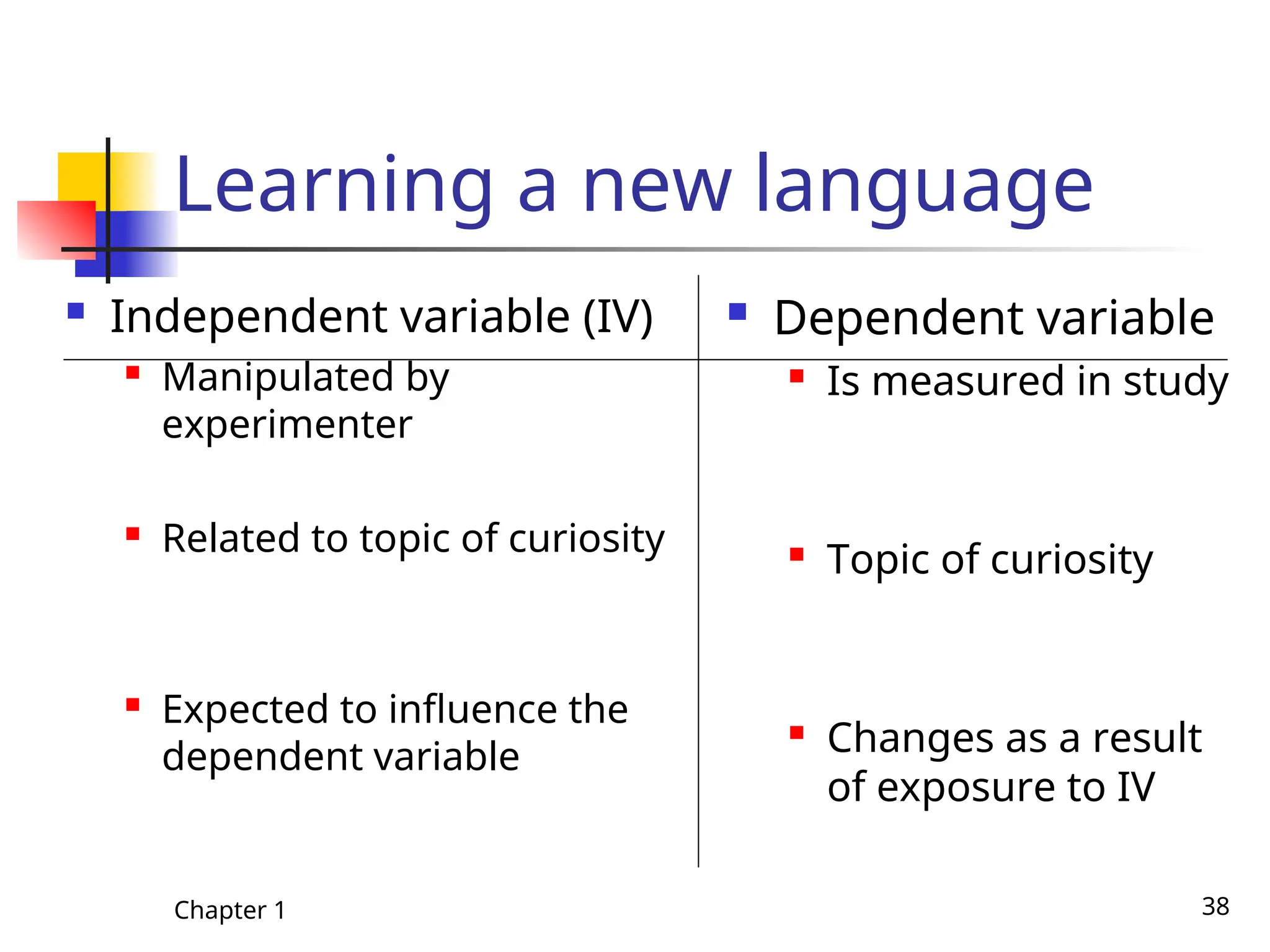
Independent variable (IV)
Manipulated by
experimenter
Related to topic of curiosity
Expected to influence the
dependent variable
Dependent variable
Is measured in study
Topic of curiosity
Changes as a result
of exposure to IV
39.
Chapter 1 39
Learninga new language
What are you talking about?
Operational definition
Error is not a mistake
Recognition of measurement imperfection
Sources
Participant
Study conditions
Quantitative Data-DataValues that are
Numeric; Ex- math anxiety score
Qualitative Data- Data values that can be
placed into distinct categories according
to some characteristic; Ex-eye color, hair
color, gender, types of foods, drinks;
typically either/or
Explanation of Terms
42.
Chapter 1 42
Learninga new language
Types of variables
How it can be measured matters
Discrete variables
What is measured belongs to unique and
separate categories
Pets: dog, cat, goldfish, rats
If there are only two categories, then it is
called a dichotomous variable
Open or closed; male or female
43.
Chapter 1 43
Learninga new language
Types of variables
Continuous variables
What is measured varies along a line scale
and can have small or large units of measure
assume values that can take on all values
between any two given values;
Length
Temperature
Age
Distance
Time
44.
Levels of Measurement
NominalLevel
Ordinal Level
Symbols are assigned
to a set of categories
for purpose of naming,
labeling, or classifying
observations. Ex-
Gender; Other
examples include
political party, religion,
and race; Numbering is
arbitrary;
Numbers are assigned
to rank-ordered
categories ranging from
low to high; Example:
Social Class- “upper
class” “middle class”
Middle class is higher
than lower class but we
don’t know magnitude
of this difference.
45.
Chapter 1 45
Learninga new language
Measurement scales: Nominal
Measurement scales
Nominal scales
Separated into different categories
All categories are equal
Cats, dogs, rats
NOT: 1st
, 2nd
, 3rd
There is no magnitude within a category
One dog is not more dog than another.
46.
Chapter 1 46
Learninga new language
Measurement scales: Nominal
No intermittent categories
No dog/cat or cat/fish categories
Membership in only one category, not both
47.
Chapter 1 47
Learninga new language
Measurement scales: Ordinal
Ordinal scales
What is measured is placed in groups by a
ranking
1st
, 2nd
, 3rd
48.
Chapter 1 48
Learninga new language
Measurement scales: Ordinal
Although there is a ranking difference
between the groups, the actual difference
between the group may vary.
Marathon runners classified by finish order
The times for each group will be different
Top ten 4- to 5-hour times
Bottom ten 4- to 5-week times
1st
place 2nd
place 3rd
place
Time
49.
When categoriescan be rank ordered, and
if measurements for all cases expressed in
same units; Examples include age,
income, and SAT scores; Not only can we
rank order as in ordinal level
measurements, but also how much larger
or smaller one is compared with another.
Variables with a natural zero point are
called ratio variables (e.g. income, # of
friends) If it is meaningful to say “twice as
Much” then it’s a ratio variable.
Interval-Ratio Level
50.
Chapter 1 50
Learninga new language
Measurement scales: Interval
Interval scales
Someone or thing is measured on a scale in
which interpretations can be made by
knowing the resulting measure.
The difference between units of measure is
consistent.
Height
Speed
Length
51.
Chapter 1 51
Learninga new language
Measurement scales
Ratio scale
Just like an interval scale, and there is a
definable and reasonable zero point.
Time, weight, length
Seldom used in social sciences
All ratio scales are also interval scales, but
not all interval scales are ratio scales
0 +10 +20
-20 -10
52.
Chapter 1 52
Gettingour toes wet
Rounding numbers
Less than 5, go down
Greater than 5, go up
6.60 15.7351.356
2.41 9.1233.842
22.49 11.06 7.667
78.55 32.9043.115
53.
Chapter 1 53
Gettingour toes wet
Σ (sigma)
Useful symbols
Σ (sigma): used to indicate that the
group of numbers will be added
together
x is 3, 78, 32, 15
Σx = 3 + 78 + 32 + 15
Σx = 128
54.
Chapter 1 54
Gettingour toes wet
Σ (sigma)
Let’s try it
x = 7, 33, 10, 19
Σx =
x = 62, 21, 73, 4
Σx =
55.
Chapter 1 55
Gettingour toes wet
(‘x’ bar)
(‘x’ bar): the mean or average
Add all the data points together (Σx)
Divide by the number of data points (N)
N
x
x
x
56.
Chapter 1 56
Gettingour toes wet
(‘x’ bar)
Where: x = 3, 12, 6, 5, 11, 15, 1, 7
Σx = 60
N = 8
5
.
7
8
60
x
x
57.
Chapter 1 57
Gettingour toes wet
(‘x’ bar)
Let’s try it
x = 3, 7, 1, 4, 4, 2
x = 28, 36, 22, 40, 34, 29
x
x
58.
Chapter 1 58
Gettingour toes wet
Σx2
(Sigma x squared)
Σx2
(Sigma x squared)
Square each number, then
Add them together
x = 2, 4, 6, 8
Σx2
= (2)2
+ (4)2
+ (6)2
+ (8)2
Σx2
= 4 + 16 + 36 + 64
Σx2
= 120
59.
Chapter 1 59
Gettingour toes wet
Σx2
(Sigma x squared)
Let’s try it
x = 1, 3, 5, 7
Σx2
=
x = 4, 3, 9, 1
Σx2
=
60.
Chapter 1 60
Gettingour toes wet
(Σx)2
(The square of Sigma x)
(Σx)2
(The square of Sigma x)
Sum all the numbers, then
Square the sum
x = 5, 7, 2, 3
(Σx)2
= (5 + 7 + 2 + 3)2
(Σx)2
= (17)2
(Σx)2
= 289
61.
Chapter 1 61
Gettingour toes wet
(Σx)2
(The square of Sigma x)
Let’s try it
x = 7, 7, 3, 2, 5
(Σx)2
=
x = 3, 8, 1, 2
(Σx)2
=
62.
Chapter 1 62
Gettingour toes wet
Σx2
versus (Σx)2
Σx2
versus (Σx)2
: not the same
X = 4, 3, 2, 1
Σx2
= (4)2
+ (3)2
+ (2)2
+ (1)2
Σx2
= (16) + (9) + (4) + (1)
Σx2
= 30
(Σx)2
= (4 + 3 + 2 + 1)2
(Σx)2
= (10)2
(Σx)2 = 100
63.
Chapter 1 63
Statistics:
AGentle Introduction
By Frederick L. Coolidge, Ph.D.
Sage Publications
Chapter 1
A Gentle Introduction
Editor's Notes
#18 What are they?
An explanation using an integrated set of principles that organizes and predicts observations. P.24
Where do they come from?
Oftentimes, observations. Sometimes, what seems to be true.
How do we know if they are any good?
1. Organizes and links observed facts.
2. Generate hypotheses that are testable and sometimes provide practical solutions.
3. Provide better predictions about future events/behaviors.
#21 Hypothesis: A testable prediction, often implied by a theory. P.24
#41 What types of variables are: years of education, #of SJSU events you attend each month, weight, favorite shampoo, # of people who voted for Obama, percentage of people who voted for Obama, 31 flavors at Baskin Robbins, # of times Dr. House insults someone,