By: J. Balcacer
December2025
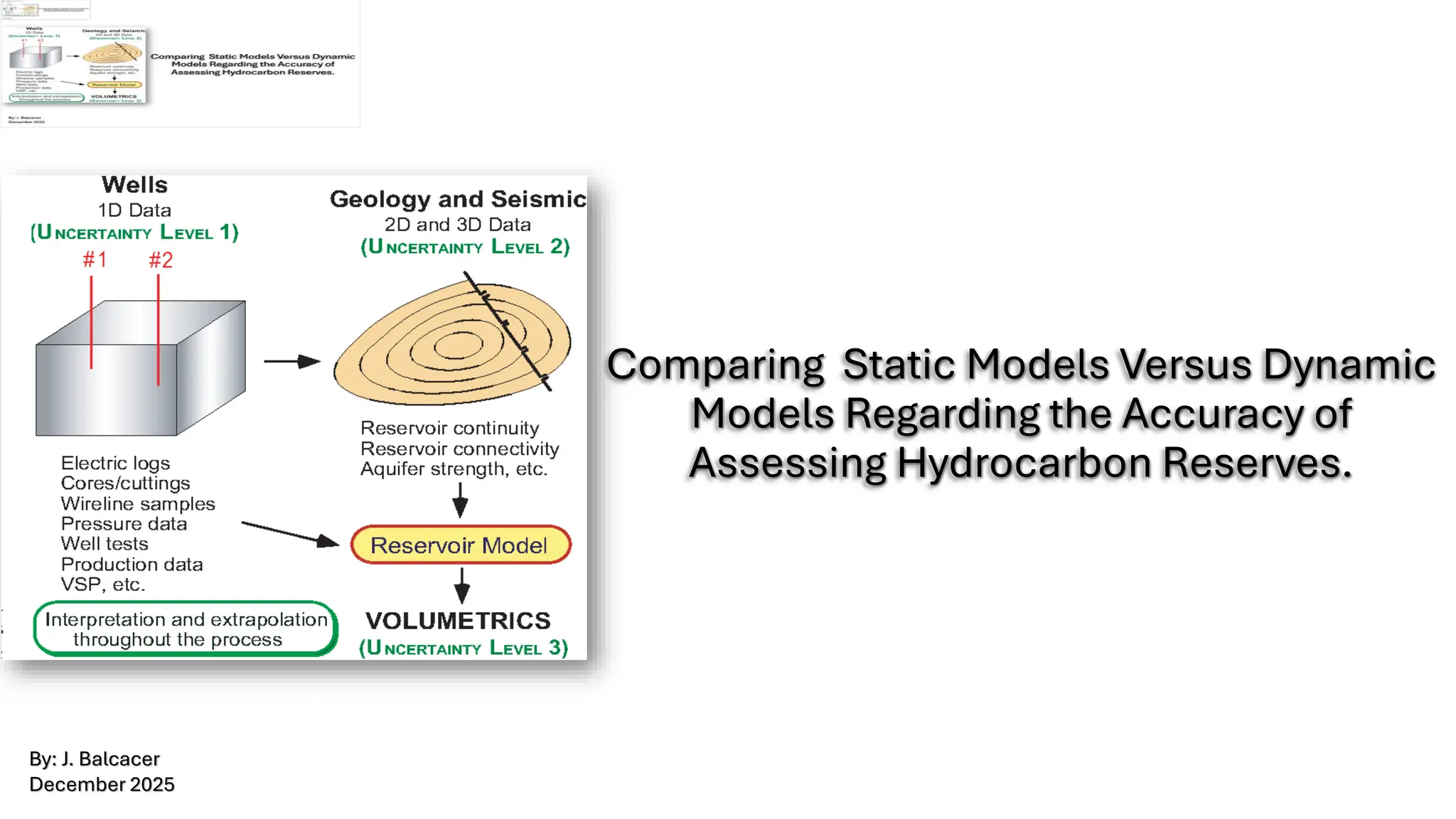
Comparing Static Models Versus Dynamic
Models Regarding the Accuracy of
Assessing Hydrocarbon Reserves.
Slide 1
2.
Slide 1
Static vsDynamic Models
o Introduction
• Static (geological) models generally carry more volumetric uncertainty than mature,
well-calibrated dynamic (flow-simulation) models, but dynamic models can be equally
wrong if they sit on a poor static description or are loosely constrained by data.
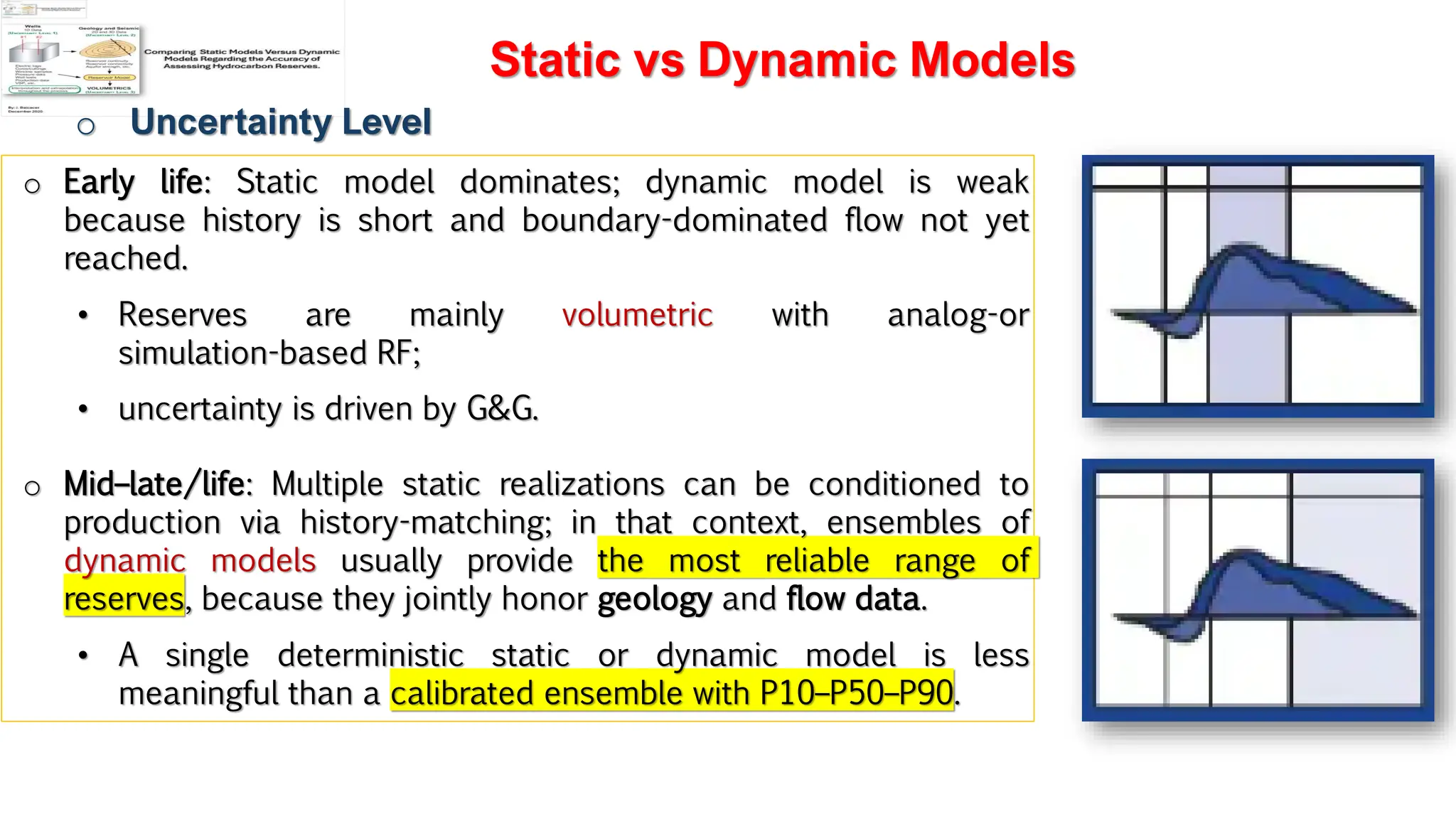
• Accuracy is maximized when static and dynamic models are built and updated in an
integrated, iterative workflow with explicit uncertainty quantification rather than treating
one as “right” and the other as “wrong.”
▪ Uncertainty Analysis: Static vs. Dynamic Models
The static model is a 3D representation of the reservoir's architecture and inventory.
▪ Sources of High Uncertainty:
• Data Sparsity & Scale Discrepancy: interpolation/extrapolation between widely spaced
well logs (decimeter scale) and seismic data (tens of meters vertical resolution).
• The rock and fluid properties in 99%+ of the model volume are estimated, not measured.
3.
Slide 1
Static vsDynamic Models
o Geomodelling
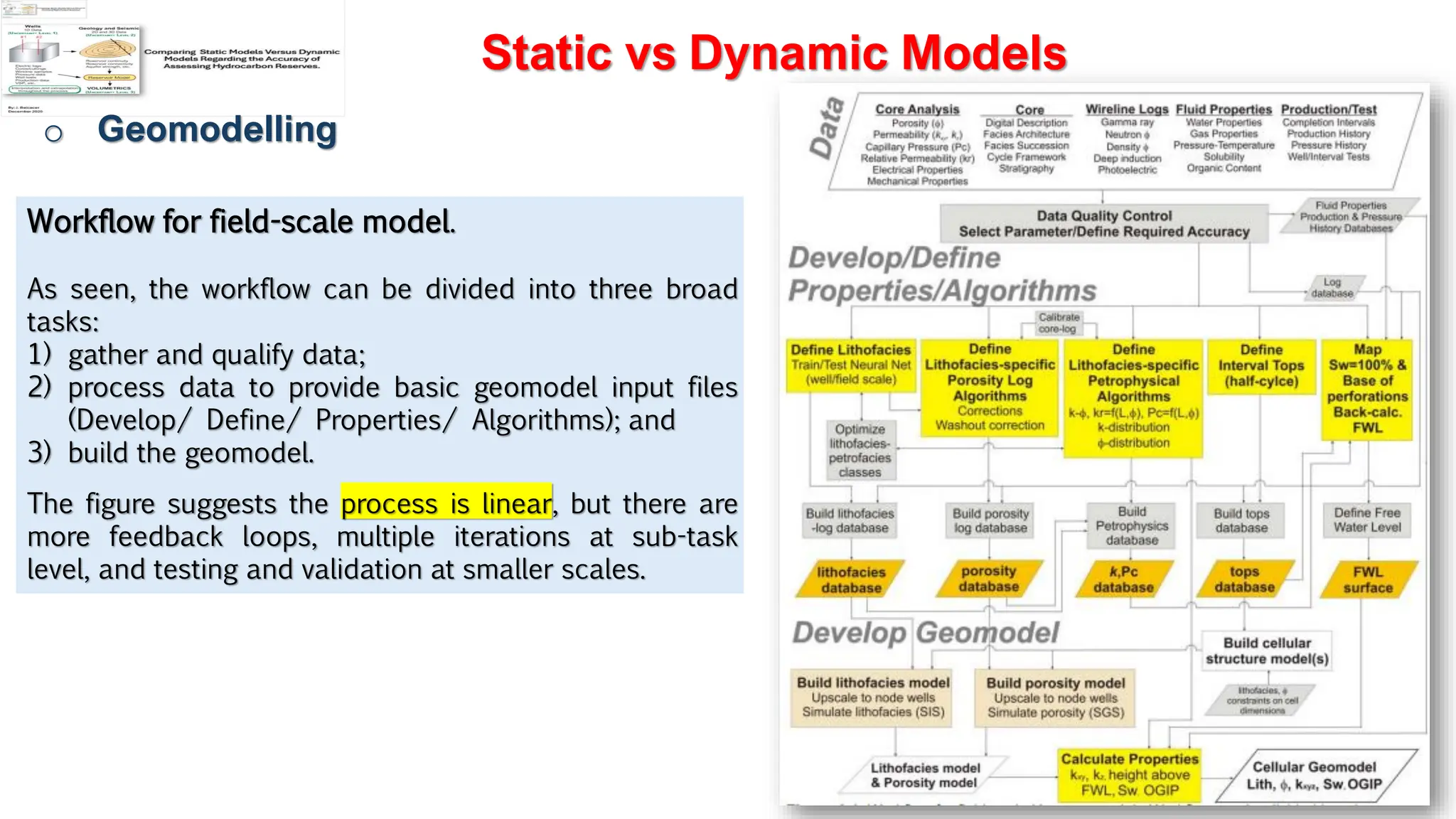
Workflow for field-scale model.
As seen, the workflow can be divided into three broad
tasks:
1) gather and qualify data;
2) process data to provide basic geomodel input files
(Develop/ Define/ Properties/ Algorithms); and
3) build the geomodel.
The figure suggests the process is linear, but there are
more feedback loops, multiple iterations at sub-task
level, and testing and validation at smaller scales.
4.
Slide 1
Static vsDynamic Models
o Sources of High Uncertainty
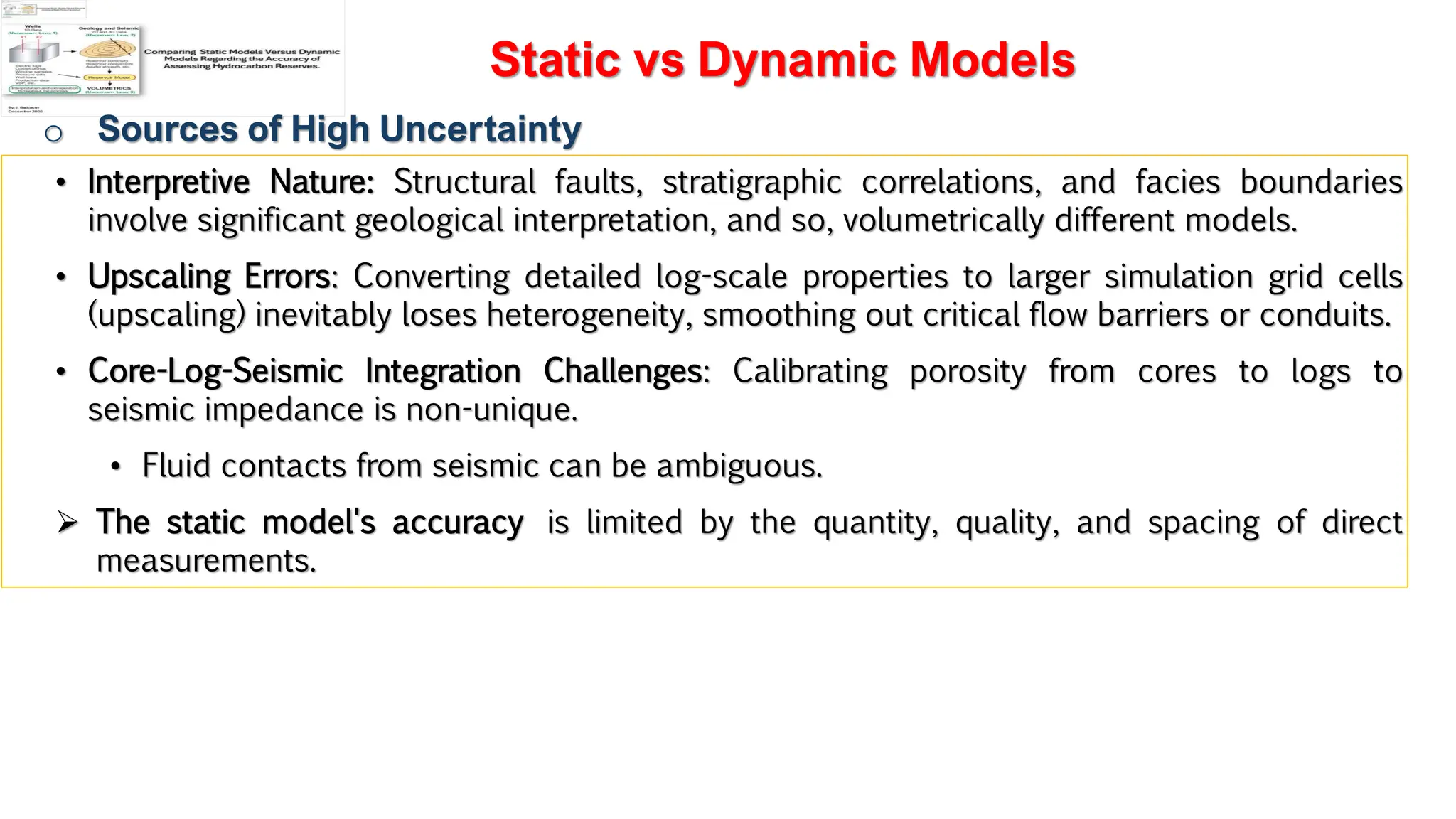
• Interpretive Nature: Structural faults, stratigraphic correlations, and facies boundaries
involve significant geological interpretation, and so, volumetrically different models.
• Upscaling Errors: Converting detailed log-scale properties to larger simulation grid cells
(upscaling) inevitably loses heterogeneity, smoothing out critical flow barriers or conduits.
• Core-Log-Seismic Integration Challenges: Calibrating porosity from cores to logs to
seismic impedance is non-unique.
• Fluid contacts from seismic can be ambiguous.
➢ The static model's accuracy is limited by the quantity, quality, and spacing of direct
measurements.
5.
Slide 1
Static vsDynamic Models
o Dynamic Simulation Model
• The dynamic model simulates fluid flow through
time under production/injection processes.
• It is initialized using the static model but is
then calibrated (history-matched) to real
production data.
▪ Accuracy During Reserve Assessment:
• Dynamic Data Constrain: History matching forces
the model to adhere to the reservoir's integrated,
time-series response – the ultimate test of how the
rock and fluids really behave.
• This process often reveals that many static model
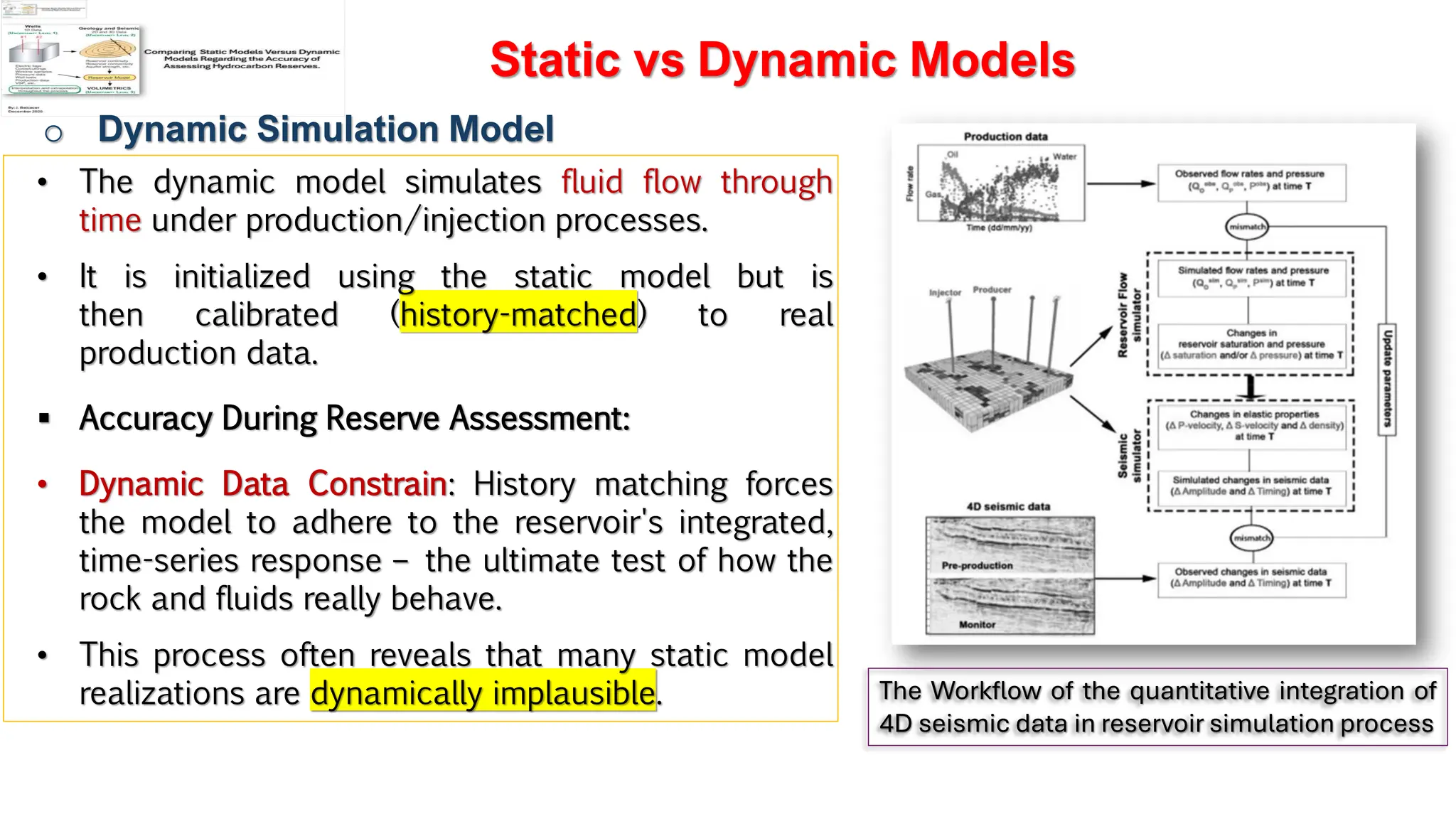
realizations are dynamically implausible. The Workflow of the quantitative integration of
4D seismic data in reservoir simulation process
6.
Slide 1
Static vsDynamic Models
o Dynamic Simulation Model
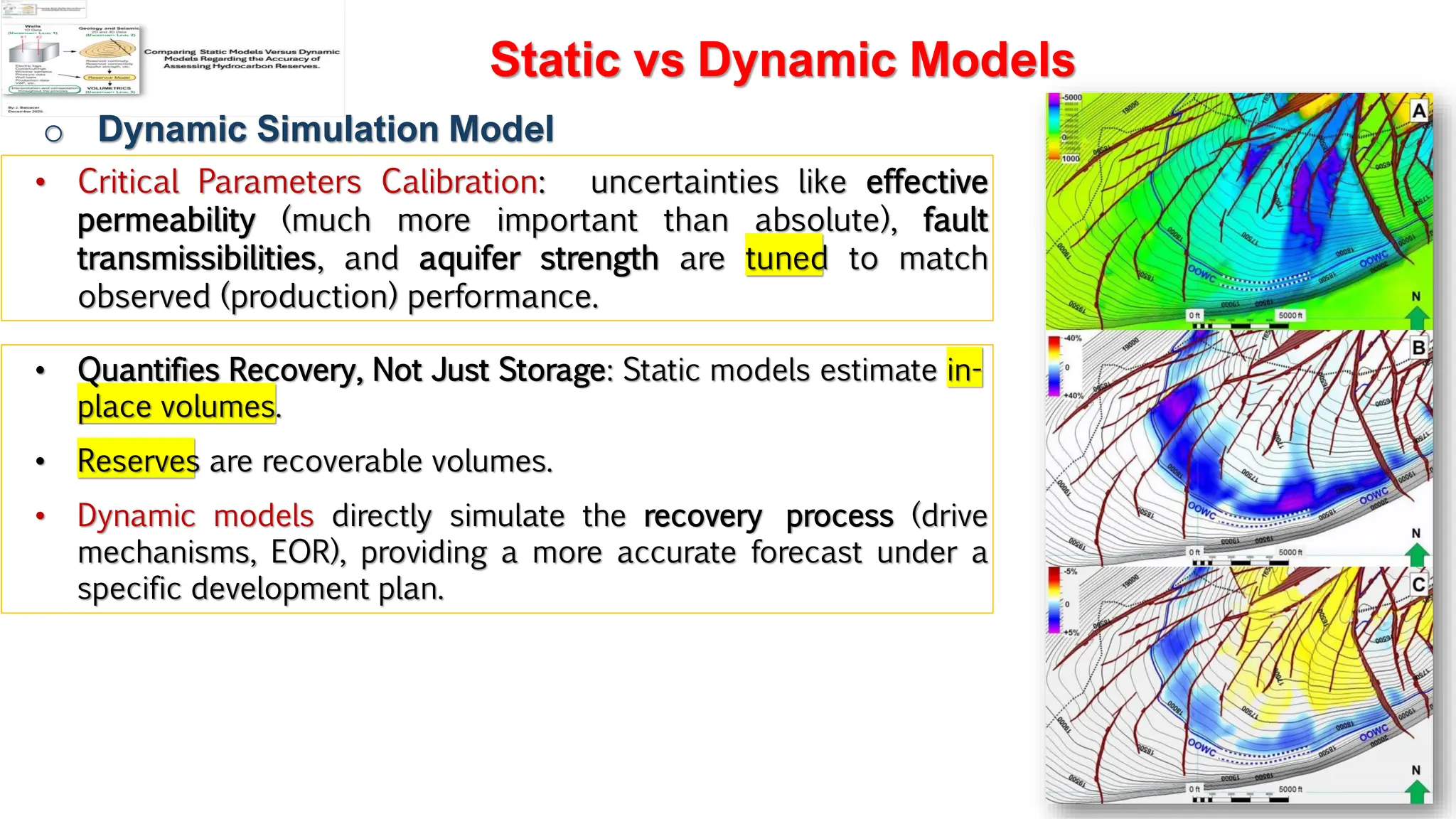
• Critical Parameters Calibration: uncertainties like effective
permeability (much more important than absolute), fault
transmissibilities, and aquifer strength are tuned to match
observed (production) performance.
• Quantifies Recovery, Not Just Storage: Static models estimate in-
place volumes.
• Reserves are recoverable volumes.
• Dynamic models directly simulate the recovery process (drive
mechanisms, EOR), providing a more accurate forecast under a
specific development plan.
7.
Slide 1
Static vsDynamic Models
o Dynamic Models Inherit and Transform Uncertainty:
They start with all the static model's uncertainties.:
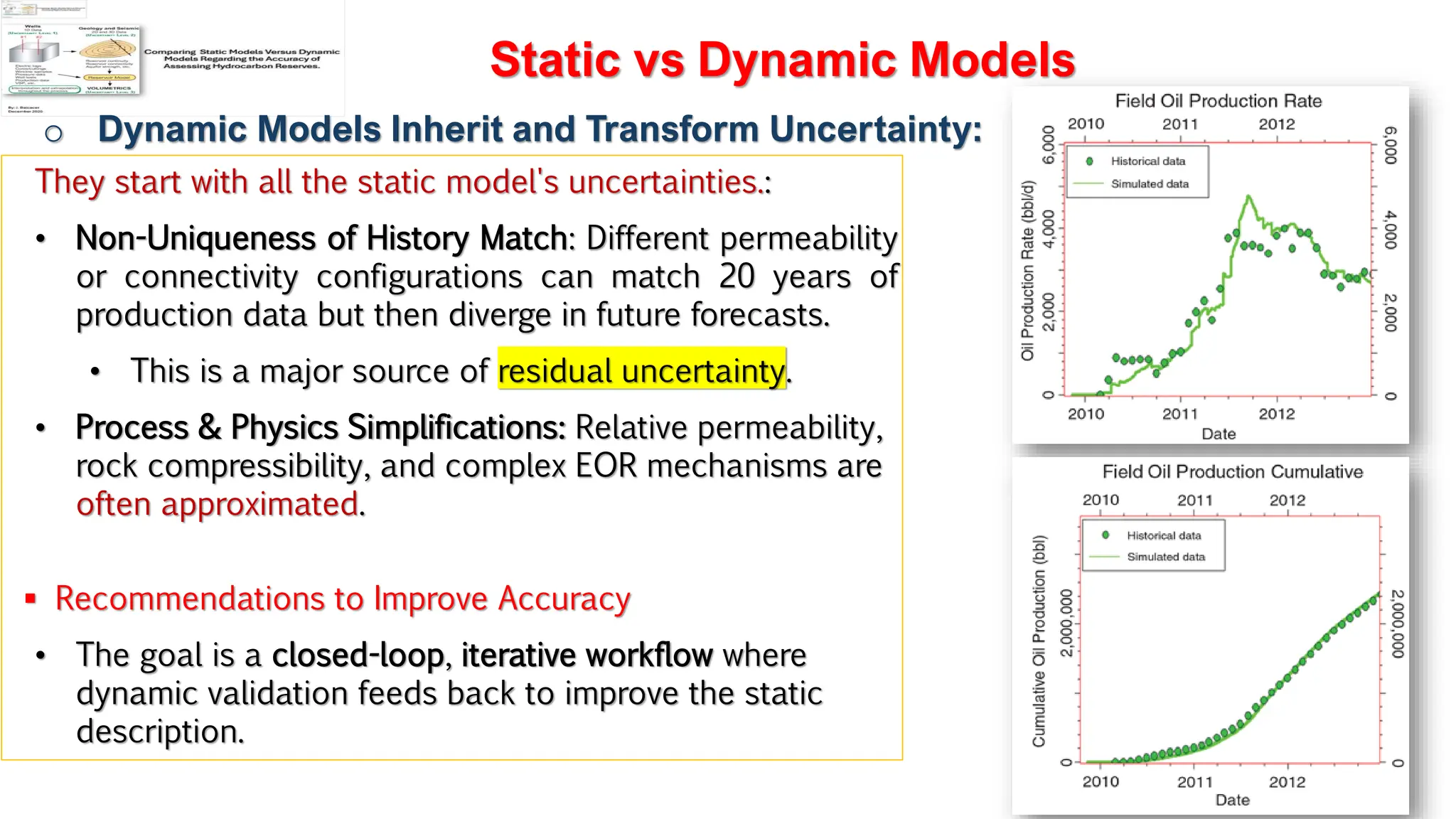
• Non-Uniqueness of History Match: Different permeability
or connectivity configurations can match 20 years of
production data but then diverge in future forecasts.
• This is a major source of residual uncertainty.
• Process & Physics Simplifications: Relative permeability,
rock compressibility, and complex EOR mechanisms are
often approximated.
▪ Recommendations to Improve Accuracy
• The goal is a closed-loop, iterative workflow where
dynamic validation feeds back to improve the static
description.
8.
Slide 1
Static vsDynamic Models
o Dynamic Models Inherit and Transform Uncertainty:
➢ For Both Static and Dynamic Modeling Teams:
1. Adopt an Integrated Uncertainty Workflow (IUW):
• Use experimental design to create multiple static realizations (capturing structural, facies,
Φ/K uncertainty).
• Flow-simulate these realizations through simple "tank" models or full simulations to identify
which geologic parameters most impact recovery (Dynamic Sensitivity Analysis).
• This focuses data acquisition and modeling effort on the biggest dynamic drivers.
2. Implement Early & Continuous Dynamic Feedback:
• Dynamic modelers should be involved during static model building to advise on which
uncertainties matter most for flow (e.g., continuity of a specific shale barrier, not the
average porosity).
• Use early production data (e.g., from exploration/appraisal well tests, initial production) to
constrain the static model before finalization.
9.
Slide 1
Static vsDynamic Models
o Dynamic Models Inherit and Transform Uncertainty:
1. Value of Information (VOI) Analysis for Data Acquisition:
• Before drilling a new well or acquiring new seismic, model how the new data would
narrow the uncertainty range in reserves.
• Quantify if the cost is justified by the reduction in financial/development risk.
Specific Recommendations for Static Modelers:
• Focus on Connectivity: Model geologic features that impact connectivity (faults, baffles,
facies boundaries) with multiple scenarios. Focus on the connected spaces.
• Advanced Seismic Integration: Use seismic inversion attributes (e.g., Acoustic Impedance)
not just for structure, but in geostatistical co-simulation to guide inter-well property
distribution.
• Preserve Heterogeneity in Upscaling: Use flow-based upscaling techniques that preserve the
effective dynamic properties of fine-scale geologic models when scaling up to the
simulation grid.
10.
Slide 1
Static vsDynamic Models
o Dynamic Models Inherit and Transform Uncertainty:
Specific Recommendations for Dynamic Modelers:
• Move Beyond Manual History Matching: Use assisted history matching (AHM) and
ensemble-based methods (e.g., Ensemble Smoother) to explore the space of non-unique
solutions and generate a set of calibrated models that capture the uncertainty.
• Forecast with an Ensemble: Provide reserves forecasts as a probability distribution (from the
ensemble of history-matched models), not a single number.
• This quantifies remaining uncertainty.
• Incorporate Long-Term Surveillance Data: Use 4D (time-lapse) seismic to map flood fronts
and water influx directly, providing a powerful dynamic constraint far beyond well data.
• Challenge Physics Simplifications: Critically review relative permeability curves (from SCAL),
incorporate rock compaction effects, and consider complex fluid physics if present (e.g.,
near-critical fluids).
11.
Slide 1
Static vsDynamic Models
o The Main Goal:
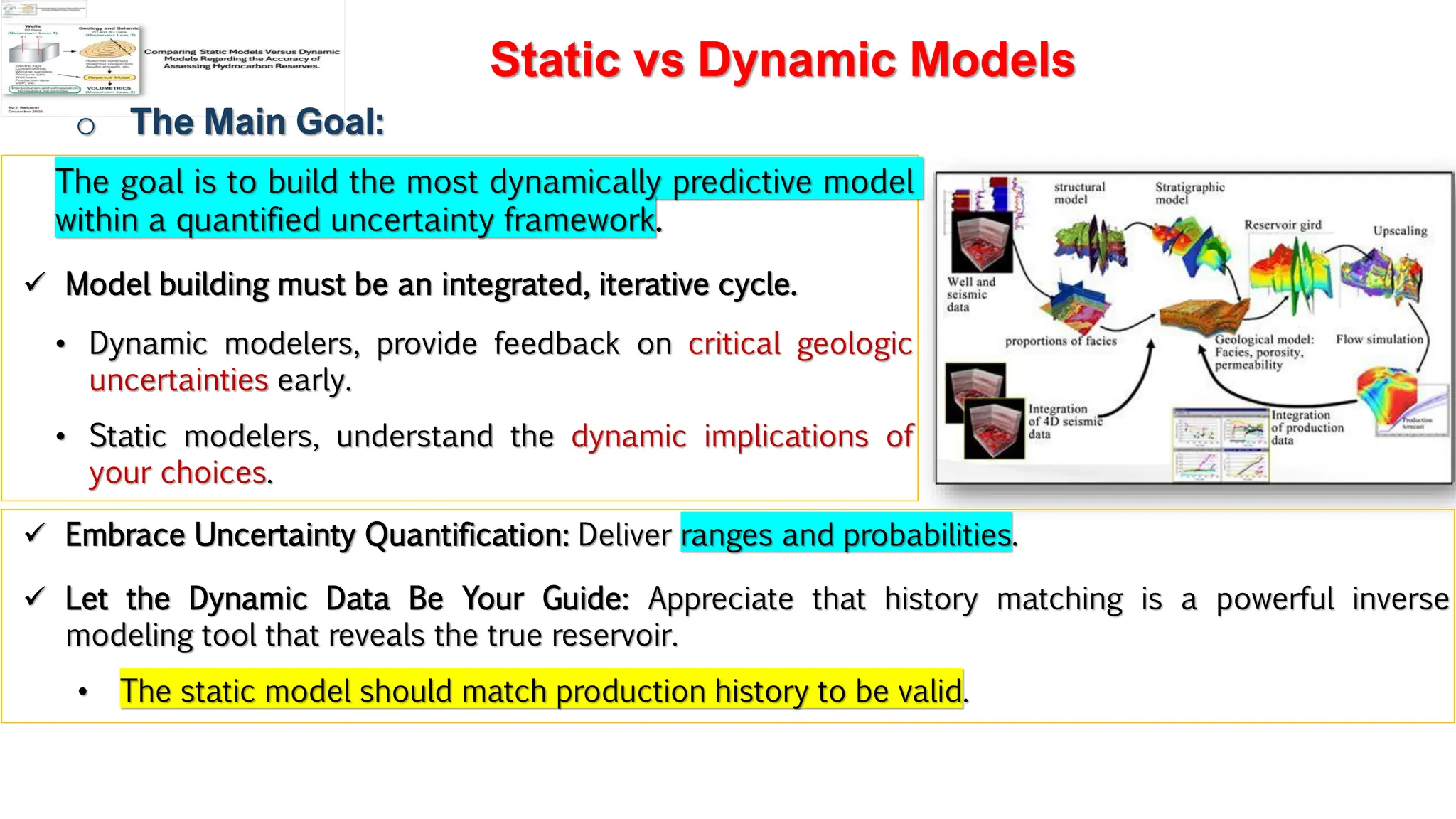
The goal is to build the most dynamically predictive model
within a quantified uncertainty framework.
✓ Model building must be an integrated, iterative cycle.
• Dynamic modelers, provide feedback on critical geologic
uncertainties early.
• Static modelers, understand the dynamic implications of
your choices.
✓ Embrace Uncertainty Quantification: Deliver ranges and probabilities.
✓ Let the Dynamic Data Be Your Guide: Appreciate that history matching is a powerful inverse
modeling tool that reveals the true reservoir.
• The static model should match production history to be valid.
12.
Slide 1
Static vsDynamic Models
o The Main Goal:
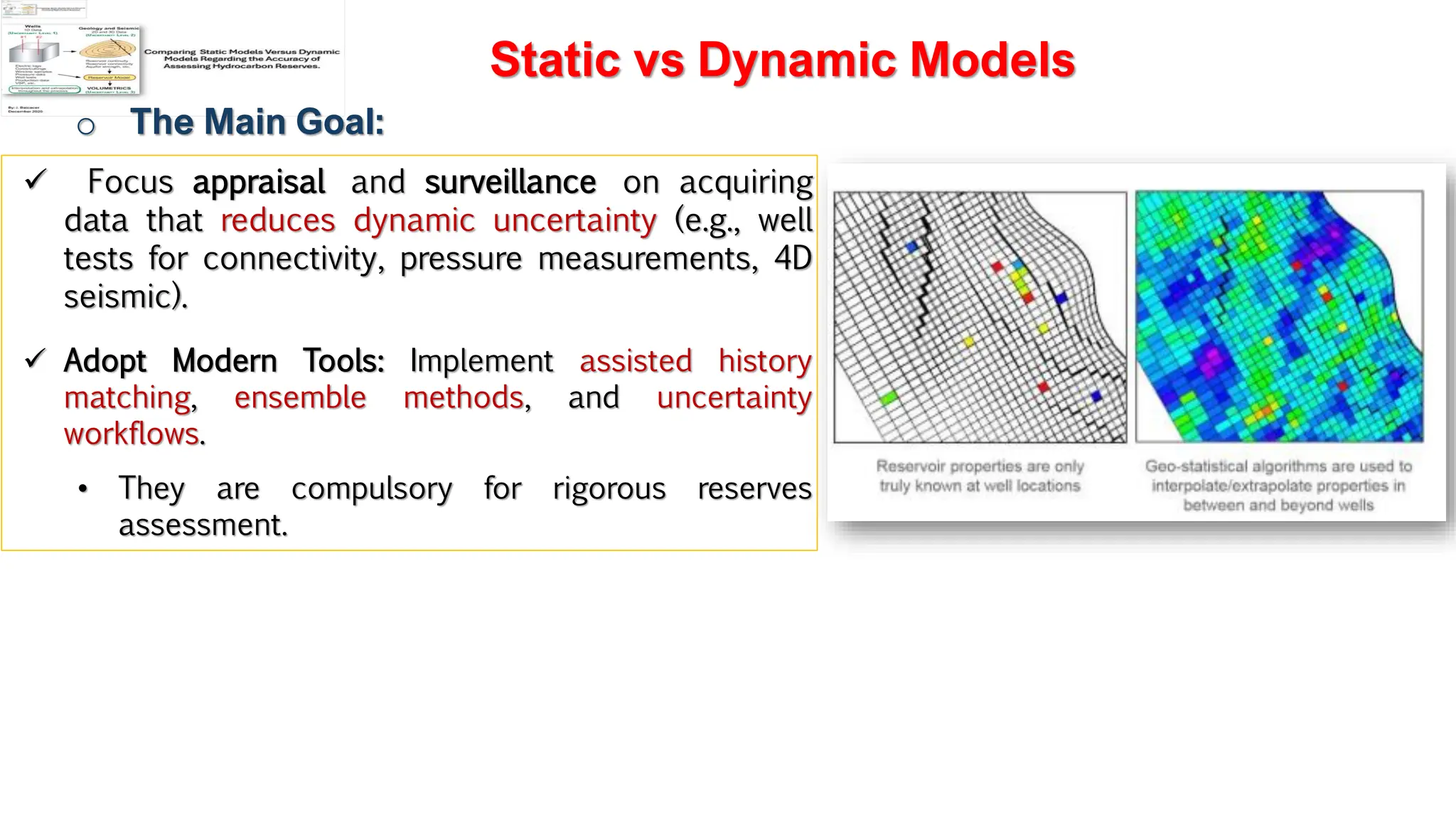
✓ Focus appraisal and surveillance on acquiring
data that reduces dynamic uncertainty (e.g., well
tests for connectivity, pressure measurements, 4D
seismic).
✓ Adopt Modern Tools: Implement assisted history
matching, ensemble methods, and uncertainty
workflows.
• They are compulsory for rigorous reserves
assessment.
13.
Slide 1
Static vsDynamic Models
o Uncertainty Level
o Early life: Static model dominates; dynamic model is weak
because history is short and boundary-dominated flow not yet
reached.
• Reserves are mainly volumetric with analog-or
simulation-based RF;
• uncertainty is driven by G&G.
o Mid–late/life: Multiple static realizations can be conditioned to
production via history-matching; in that context, ensembles of
dynamic models usually provide the most reliable range of
reserves, because they jointly honor geology and flow data.
• A single deterministic static or dynamic model is less
meaningful than a calibrated ensemble with P10–P50–P90.
14.
Slide 1
Static vsDynamic Models
o Uncertainty Level
o Neither model is intrinsically “more accurate”; uncertainty is lower where:
(a) the underlying data density is high and multi-disciplinary, and
(b) the workflow explicitly propagates and conditions static uncertainties into dynamic
forecasts
In general, the lowest reserve uncertainty is achieved not by choosing static or dynamic,
but by tightly integrating both in a probabilistic, data-driven workflow with continuous
cross-discipline iteration.


![[DSC Europe 25] Debmalya Biswas - Agentification: the art of transforming man...](https://cdn.slidesharecdn.com/ss_thumbnails/r5azlggvtqiaiiusrqdr-4-251212103249-5a12c89b-thumbnail.jpg?width=640&height=640&fit=bounds)
![[DSC Europe 25] Milan Zdravkovic - The road less traveled in District Heating...](https://cdn.slidesharecdn.com/ss_thumbnails/nfaboniqwsz4ucyctnmy-2-milan-zdravkovic-dsc2025-the-road-less-traveled-in-district-heating-operation-251208151905-f56388a5-thumbnail.jpg?width=640&height=640&fit=bounds)


![[DSC Europe 25] Kaja Kandare - LLM as a judge.pptx](https://cdn.slidesharecdn.com/ss_thumbnails/arxyccaxsdsd1ba99wjw-7-251212104007-2b4e3f64-thumbnail.jpg?width=640&height=640&fit=bounds)

![[DSC Europe 25] Dunja Adzic Jovanovic - AI and Cybersecurity: Defending Data ...](https://cdn.slidesharecdn.com/ss_thumbnails/o1zylpbhrtwnixxq2xj8-7-251211083048-185086f6-thumbnail.jpg?width=640&height=640&fit=bounds)

![[DSC Europe 25] Jon Dajci - Bridging TradFi and DeFi: Building the Future of ...](https://cdn.slidesharecdn.com/ss_thumbnails/fqmhfvlbqhkihjvqvhmu-7-251211083849-6af7e325-thumbnail.jpg?width=640&height=640&fit=bounds)
![[DSC Europe 25] Bassam Maharmeh - Artificial Intelligence: Opportunities and ...](https://cdn.slidesharecdn.com/ss_thumbnails/thhfmr2fqpawzj7hsjpg-5-251211083048-2c23204f-thumbnail.jpg?width=640&height=640&fit=bounds)

![[DSC Europe 25] Milan Sekuloski - Data, Defence, and Development: Cybersecuri...](https://cdn.slidesharecdn.com/ss_thumbnails/dfrkwwx4qly6atqpbl4z-4-251209104645-c3d4b0ca-thumbnail.jpg?width=640&height=640&fit=bounds)
![[DSC Europe 25] Marija Vlajkovic & Andrea Radonjanin - Integration of AI tool...](https://cdn.slidesharecdn.com/ss_thumbnails/qf1jrglttoc3bm8s3aop-final-integration-of-ai-tools-251208151905-394f3a6a-thumbnail.jpg?width=640&height=640&fit=bounds)
![[DSC Europe 25] Hans Kleinsman - The Compliance Gearbox: How Tax Tech Mediate...](https://cdn.slidesharecdn.com/ss_thumbnails/dxdytie1toel0hr90bjs-2-251212103250-174fdbe7-thumbnail.jpg?width=640&height=640&fit=bounds)


![[DSC Europe 25] Sara Polak - The Archaeology of Innovation: AI as the Next Cr...](https://cdn.slidesharecdn.com/ss_thumbnails/7ecbscdnt8mlcuqbd2ln-2-sara-polak-ai-creative-industries-251208152533-aa1fcf54-thumbnail.jpg?width=640&height=640&fit=bounds)