Static Electricity
Static electricity is an imbalance of electric charges within
or on the surface of a material or between
materials. Static electricity is named in contrast
with current electricity, where the electric charge flows
through an electrical conductor or space, and
transmits energy.
Charged & Uncharged Body
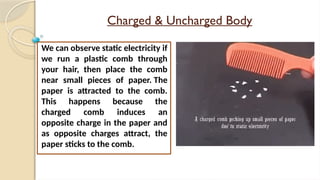
We can observe static electricity if
we run a plastic comb through
your hair, then place the comb
near small pieces of paper. The
paper is attracted to the comb.
This happens because the
charged comb induces an
opposite charge in the paper and
as opposite charges attract, the
paper sticks to the comb.
Charged & Uncharged Body
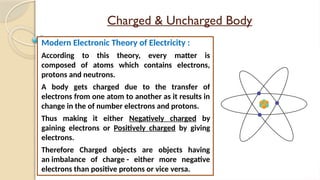
Modern Electronic Theory of Electricity :
According to this theory, every matter is
composed of atoms which contains electrons,
protons and neutrons.
A body gets charged due to the transfer of
electrons from one atom to another as it results in
change in the of number electrons and protons.
Thus making it either Negatively charged by
gaining electrons or Positively charged by giving
electrons.
Therefore Charged objects are objects having
an imbalance of charge - either more negative
electrons than positive protons or vice versa.
Law of Conservation of Charges
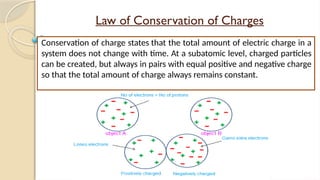
Conservation of charge states that the total amount of electric charge in a
system does not change with time. At a subatomic level, charged particles
can be created, but always in pairs with equal positive and negative charge
so that the total amount of charge always remains constant.
Different Ways of Charging Bodies
There are three methods to charge a body,
namely, charging by :-
Friction
Conduction
Induction
Different Ways of Charging Bodies
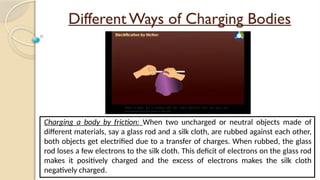
Charging a body by friction: When two uncharged or neutral objects made of
different materials, say a glass rod and a silk cloth, are rubbed against each other,
both objects get electrified due to a transfer of charges. When rubbed, the glass
rod loses a few electrons to the silk cloth. This deficit of electrons on the glass rod
makes it positively charged and the excess of electrons makes the silk cloth
negatively charged.
Different Ways of Charging Bodies
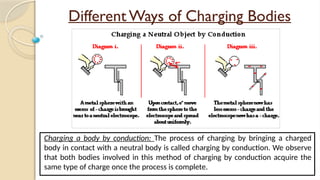
Charging a body by conduction: The process of charging by bringing a charged
body in contact with a neutral body is called charging by conduction. We observe
that both bodies involved in this method of charging by conduction acquire the
same type of charge once the process is complete.
Different Ways of Charging Bodies
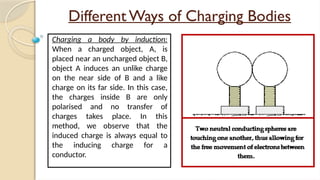
Charging a body by induction:
When a charged object, A, is
placed near an uncharged object B,
object A induces an unlike charge
on the near side of B and a like
charge on its far side. In this case,
the charges inside B are only
polarised and no transfer of
charges takes place. In this
method, we observe that the
induced charge is always equal to
the inducing charge for a
conductor.
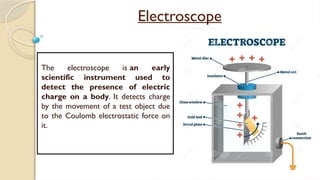
Electroscope
The electroscope is an early
scientific instrument used to
detect the presence of electric
charge on a body. It detects charge
by the movement of a test object due
to the Coulomb electrostatic force on
it.
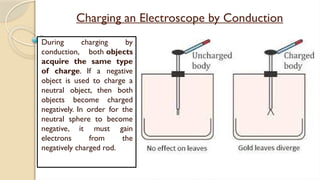
Charging an Electroscope by Conduction
During charging by
conduction, both objects
acquire the same type
of charge. If a negative
object is used to charge a
neutral object, then both
objects become charged
negatively. In order for the
neutral sphere to become
negative, it must gain
electrons from the
negatively charged rod.
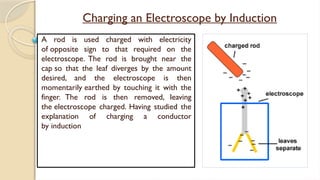
Charging an Electroscope by Induction
A rod is used charged with electricity
of opposite sign to that required on the
electroscope. The rod is brought near the
cap so that the leaf diverges by the amount
desired, and the electroscope is then
momentarily earthed by touching it with the
finger. The rod is then removed, leaving
the electroscope charged. Having studied the
explanation of charging a conductor
by induction

Static Electricity details electrostatic force

  • 1.
    Static Electricity Static electricityis an imbalance of electric charges within or on the surface of a material or between materials. Static electricity is named in contrast with current electricity, where the electric charge flows through an electrical conductor or space, and transmits energy.
  • 2.
    Charged & UnchargedBody We can observe static electricity if we run a plastic comb through your hair, then place the comb near small pieces of paper. The paper is attracted to the comb. This happens because the charged comb induces an opposite charge in the paper and as opposite charges attract, the paper sticks to the comb.
  • 3.
    Charged & UnchargedBody Modern Electronic Theory of Electricity : According to this theory, every matter is composed of atoms which contains electrons, protons and neutrons. A body gets charged due to the transfer of electrons from one atom to another as it results in change in the of number electrons and protons. Thus making it either Negatively charged by gaining electrons or Positively charged by giving electrons. Therefore Charged objects are objects having an imbalance of charge - either more negative electrons than positive protons or vice versa.
  • 4.
    Law of Conservationof Charges Conservation of charge states that the total amount of electric charge in a system does not change with time. At a subatomic level, charged particles can be created, but always in pairs with equal positive and negative charge so that the total amount of charge always remains constant.
  • 5.
    Different Ways ofCharging Bodies There are three methods to charge a body, namely, charging by :- Friction Conduction Induction
  • 6.
    Different Ways ofCharging Bodies Charging a body by friction: When two uncharged or neutral objects made of different materials, say a glass rod and a silk cloth, are rubbed against each other, both objects get electrified due to a transfer of charges. When rubbed, the glass rod loses a few electrons to the silk cloth. This deficit of electrons on the glass rod makes it positively charged and the excess of electrons makes the silk cloth negatively charged.
  • 7.
    Different Ways ofCharging Bodies Charging a body by conduction: The process of charging by bringing a charged body in contact with a neutral body is called charging by conduction. We observe that both bodies involved in this method of charging by conduction acquire the same type of charge once the process is complete.
  • 8.
    Different Ways ofCharging Bodies Charging a body by induction: When a charged object, A, is placed near an uncharged object B, object A induces an unlike charge on the near side of B and a like charge on its far side. In this case, the charges inside B are only polarised and no transfer of charges takes place. In this method, we observe that the induced charge is always equal to the inducing charge for a conductor.
  • 9.
    Electroscope The electroscope isan early scientific instrument used to detect the presence of electric charge on a body. It detects charge by the movement of a test object due to the Coulomb electrostatic force on it.
  • 10.
    Charging an Electroscopeby Conduction During charging by conduction, both objects acquire the same type of charge. If a negative object is used to charge a neutral object, then both objects become charged negatively. In order for the neutral sphere to become negative, it must gain electrons from the negatively charged rod.
  • 11.
    Charging an Electroscopeby Induction A rod is used charged with electricity of opposite sign to that required on the electroscope. The rod is brought near the cap so that the leaf diverges by the amount desired, and the electroscope is then momentarily earthed by touching it with the finger. The rod is then removed, leaving the electroscope charged. Having studied the explanation of charging a conductor by induction