stateofworldpopulation2009Facingachangingworld:women,populationandclimate
state of world population 2009
Facing a changing world:
women, population and climate
United Nations Population Fund
220 East 42nd Street
New York, NY 10017 USA
www.unfpa.org
USD $17.50
ISBN 978-0-89714-958-7
sales no. E.09.III.H.1
E/27,000/2009
Printed on recycled paper.
Seal the Deal! is a United Nations-led
campaign to promote a fair, balanced
and effective agreement on climate
change when governments meet in
Copenhagen in December 2009.
UNFPA, the United Nations Population Fund, is an international development agency that
promotes the right of every woman, man and child to enjoy a life of health and equal
opportunity. UNFPA supports countries in using population data for policies and programmes
to reduce poverty and to ensure that every pregnancy is wanted, every birth is safe, every
young person is free of HIV, and every girl and woman is treated with dignity and respect.
UNFPA—because everyone counts.
Lead Author and Researcher: Robert Engelman, Worldwatch Institute
Chapter 1 contributors: Janet Macharia, Kaveh Zahedi and Bubu Jallow of
the United Nations Environment Programme
Chapter 3 contributors: Philippe Boncour of the International Organization
for Migration and José Riera of the Office of the United Nations High
Commissioner for Refugees
Editor: Richard Kollodge
Editorial Associate: Triana D’Orazio
Editorial and Administrative Associate: Mirey Chaljub
Acknowledgements
The editorial team is especially grateful to UNFPA’s Technical Division for
contributing to the development of the report and reviewing drafts: Pamela
DeLargy, José Miguel Guzmán, Werner Haug, Steve Kraus, Daniel Schensul
and Aminata Touré.
Invaluable insights and feedback were provided by Ann Erb-Leoncavallo,
Bettina Maas and Sherin Saadallah of UNFPA’s Office of the Executive
Director; Safiye Çag˘ar, Director of the Information and External Relations
Division; and Neil Ford, Chief of the Media and Communications Branch.
The editorial team also acknowledges the contributions of feature stories
by other UNFPA staff: Trygve Olfarnes of the Media and Communications
Branch (in the Latin America and Caribbean Regional Office), Eduard
Jongstra and Reethu Arjun of the Pacific Sub-Regional Office, and Omar
Gharzeddine of the Media and Communications Branch.
Many others wrote sidebars and feature stories or carried out indispensable
research: Renato Busquets, Juliane Diamond, Ioan Ifrim, Rachel Lander,
Mia MacDonald, Elena Marszalek, Laurie Ann Mazur, Danielle Nierenberg,
Victoria Okoye, Kimberly Rogovin, Scott Williamson and June Zeitlin.
The United Nations Environment Programme contributed the foundation
for Chapter 1, “Elements of climate change.” The International Organization
for Migration and the Office of the United Nations High Commissioner for
Refugees jointly drafted Chapter 3, “On the move.”
The editorial team also thanks the Inter Press News Agency and the
Integrated Regional Information Networks for permission to reprint stories
from their news services.
The indicators in the report were generously contributed by the Population
Division of the United Nations Department of Economic and Social Affairs,
UNESCO Institute for Statistics, the World Health Organization, the Food
and Agriculture Organization of the United Nations, the World Bank, the
UNFPA/NIDI Resource Flows Project and the Population Reference Bureau.
External advisors
Lorena Aguilar and Adél Sasvári, International Union for
Conservation and Nature.
Alex Ezeh, Executive Director, African Population and Health
Research Center.
Michelle Leighton, Director, Human Rights Programs, Center for Law and
Global Justice, University of San Francisco School of Law.
Brian O’Neill, Climate and Global Dynamics Division and Integrated Science
Program, National Center for Atmospheric Research.
Thanh Xuan Nguyen, Executive Director, Women’s Environment
and Development Organization.
Editorial team
The State of World Population 2009
Copyright © UNFPA 2009
United Nations Population Fund
Thoraya Ahmed Obaid, Executive Director
Facing a changing world:
women, population and climate
state of world population 2009
­	
Foreword	 iv
From the Executive Director
Overview	 1
As greenhouse gases
accumulate in the
atmosphere, droughts, severe
storms and rising seas
threaten to take an especially
heavy toll on women, who
make up a large share of the
world’s poor.
1
Elements of
climate change 	 11
The warming of the earth’s
atmosphere is triggering
extreme weather, melting
polar ice caps and acidifying
the oceans at a much faster
pace than scientists had
previously expected. What will
happen when the Arctic ice is
gone and coral reefs are dead?
2
At the brink	 19
Climate is already changing.
Is it too late to do anything
about it? Is humanity on
an irreversible trajectory
toward disaster?
© Joerg Boethling/Still Pictures
Background image: © Ed Darack/Science Faction/Corbis
How do population
dynamics affect green-
house gases and climate
change? Will urbanization
and an ageing popula-
tion help or hinder efforts
to adapt to a warming
world? What’s the best
way to protect humanity
from extreme weather
and rising seas? And
could better access to
reproductive health care
and improved relations
between men and women
make a critical difference
in addressing the chal-
lenge of climate change?
The answers to these
questions are found in
The State of World
Population 2009.
state of world population 2009
ii CONTENTS
Facing a changing world:
women, population and climate
3
On the move 	 29
Environmental degradation
and climate-related disasters
will drive people from their
homes. But how many people
will relocate? Where will they
go? Are men or women more
likely to migrate?
4
Building resilience 	39
Millions of people will
have to adapt to the
impacts of climate change.
But will women bear a
disproportionate share of
the burden?
5
Mobilizing
for change 	 53
Governments and individuals
alike must take action
now to slow greenhouse-
gas emissions and prevent
catastrophe. Who is taking the
lead? What influence does
gender have on the outcome?
6
Five steps back
from the brink 	 65
What can be done to rein
in the runaway greenhouse
effect and stabilize the
planet’s climate?
Notes	 74
Indicators	 80
iv FOREWORD
When climate negotiators gather in Copenhagen in
December for the 15th Conference of Parties to the
United Nations Framework Convention on Climate
Change, they will be setting a course that will move the
world’s governments either forward or merely sideways
in tackling one of the most challenging problems human
beings have ever faced: how to manage our influence on
climate and how to adapt to climate change now and well
into the future.
Many of the discussions in the lead-up to
Copenhagen revolved around the relative responsibilities
of countries for limiting the growth of greenhouse-gas
emissions and for funding efforts to shift to low-carbon
energy and other technologies.
What’s the best approach for reducing carbon emis-
sions? Who should shoulder the financial responsibility
for addressing current and future climate change?
These questions are critically important. But also
important are fundamental questions about how climate
change will affect women, men, boys and girls around the
world, and indeed within nations, and how individual
behaviour can undermine or contribute to the global
effort to address climate change. The poor, particularly
in developing countries, are likely to face the worst effects
of a changing climate. The poor are more likely to live
in areas vulnerable to floods, storms and rising seas. And
they are more likely to depend on agriculture and fishing
for a living and therefore risk going hungry or losing their
livelihoods when droughts strike, rains become unpredict-
able and hurricanes move with unprecedented force. And
among the poor, women are especially vulnerable.
In addition to the ongoing discussion on technical
and financial aspects, the climate debate of the future
must be further enriched by taking into account the
human dimensions, including gender, that suffuse every
facet of the problem. A Copenhagen agreement that helps
people to reduce greenhouse-gas emissions and adapt to
climate change by harnessing the insight and creativity of
Foreword
vTHE STATE OF WORLD POPULATION 2009
women and men would launch a genuinely effective long-
term global strategy to deal with climate change.
UNFPA, the United Nations Population Fund, is
a development agency that promotes the right of every
woman, man and child to enjoy a life of health and equal
opportunity and helps reduce poverty. UNFPA helps
ensure that every pregnancy is wanted, every birth is safe,
every young person is free of HIV and AIDS and every
girl and woman is treated with dignity and respect. The
causes we champion are also causes that are relevant to
climate change.
This 2009 edition of The State of World Population
shows that climate change is more than an issue of energy
efficiency or industrial carbon emissions; it is also an issue
of population dynamics, poverty and gender equity.
Over the years, the international community’s
approach to population policies has evolved from a top-
down focus on demographic change to a people-centred
approach based on human rights and informed choice.
Voices that invoke “population control” as a response to
climate change fail to grasp the complexity of the issue
and ignore international consensus. Governments agreed
at the 1994 International Conference on Population
and Development that human rights and gender equal-
ity should guide all population and development-related
programmes, including those aimed at protecting the
environment. This begins with upholding the right of
women and couples to determine the number and spacing
of their children, and creating or expanding opportunities
and choices for women and girls, allowing them to fully
participate in their societies and contribute to economic
growth and development.
Climate change is partly the result of an approach
to development and economic growth that has proven
to be unsustainable. Halting climate change requires a
fresh, more equitable and sustainable approach to the
way we live, produce and consume. Reining in the run-
away greenhouse effect responsible for extreme weather
and rising seas may therefore require a new definition of
“progress” and a new development paradigm.
The complexity of the challenge of reducing green-
house-gas emissions and adapting to climate change
requires us to look beyond the obvious and to marshal
innovative strategies. The most effective solutions to cli-
mate change, however, will be those that come from the
bottom up, that are based on communities’ knowledge
of their immediate environment, that empower—not
victimize or overburden—those who must adapt to a
new world, and that do not create a new dependency
relationship between developed and developing countries.
The only lasting solution will be one that puts people at
its centre.
This report shows that women have the power to
mobilize against climate change, but this potential can
be realized only through policies that empower them. It
also shows the required support that would allow women
to fully contribute to adaptation, mitigation and building
resilience to climate change.
By taking a broader, more nuanced approach to cli-
mate change that factors in gender and population, the
governments of the world, and indeed civil society and
we ourselves in the United Nations, will make a valuable
contribution to the Copenhagen conference and mean-
ingful action in addressing this long-term challenge.
Thoraya Ahmed Obaid
Executive Director, UNFPA
1THE STATE OF WORLD POPULATION 2009
Overview
Climate—the average of weather over time—is always
changing, but never in known human experience more dra-
matically than it is likely to change in the coming century.
For millennia, since civilizations arose from ancient farm-
ing societies, the earth’s climate as a whole was relatively
stable, with temperatures and patterns of rainfall that have
supported human life and its expansion around the globe.
A growing body of evidence shows that recent climate
change is primarily the result of human activity. The
influence of human activity on climate change is com-
plex. It is about what we consume, the types of energy we
produce and use, whether we live in a city or on a farm,
whether we live in a rich or poor country, whether we are
young or old, what we eat, and even the extent to which
women and men enjoy equal rights and opportunities.
It is also about our growing numbers—approaching
7 billion. As the growth of population, economies and
consumption outpaces the earth’s capacity to adjust,
climate change could become much more extreme—and
conceivably catastrophic. Population dynamics tell one
part of a larger, more intricate story about the way some
countries and people have pursued development and
defined progress and about how others have had little
say in the decisions that affect their lives.
Climate change’s influence on people is also complex,
spurring migration, destroying livelihoods, disrupting
economies, undermining development and exacerbating
inequities between the sexes.
Digging for snails in a dried lake bed in Thailand.
© Werachai Wansamngan/UNEP/Still Pictures
t
Climate change is about people.
People cause climate change. People are affected by
it. People need to adapt to it. And only people have the
power to stop it.
Not all people or countries, however, are created equal
when it comes to the greenhouse-gas emissions that are
warming our atmosphere. Until now, the industrialized
countries generated the lion’s share of climate-altering car-
bon and other gases but have been relatively immune to
the effects of climate change. The developing world has
been responsible for a smaller share of greenhouse-gas emis-
sions yet is already having to shoulder more of the burden
for coping with and adapting to extreme weather events,
rising sea levels, floods and drought. The industrialized
countries created most of the problem, but the world’s poor
will face the biggest problems in adapting to it. And, if
the world is to avoid dangerous climate change, there may
be little room left in the atmosphere for poor countries to
develop economically through the same carbon-intensive
energy patterns the industrialized countries relied upon in
their own development over the last two centuries.
What is climate change?
The earth’s surface is warming. The temperature increase
since the late 1800s may seem small—0.74 degrees
Celsius—but the impact on people is likely to be pro-
found. The impact will be even greater as temperatures
continue rising, by as much as 6.4 degrees Celsius by 2100.
“We have read the science. Global warming is real, and we are a prime cause. . . .
We must set an agenda—create a roadmap to the future, coupled with a timeline that produces
a deal by 2009. In this, it helps to have a vision of how the future might look if we succeed.”
—BAN Ki-moon
1
2 overview
As temperatures rise, weather patterns shift with potentially
catastrophic consequences, especially for the world’s poor.
A rapid and large build-up of greenhouse gases in the
earth’s atmosphere is almost certainly to blame for most
or all the temperature increase. The most common green-
house gas is carbon dioxide, with methane a close second.
Such greenhouse gases occur naturally and serve to retain
some of the sun’s warmth. Without a “greenhouse effect,”
the earth’s surface would be too cold to sustain life. But
because the greenhouse gases that are naturally in the
atmosphere have been augmented by those resulting from
human activity, the equilibrium that keeps the earth at
a relatively constant temperature has been disrupted.
Since the Industrial Revolution, intense burning of wood,
charcoal, coal, oil, and gas has resulted in increased
concentrations of carbon dioxide in the atmosphere.
Rice-growing, livestock-raising, and burning organic
wastes have more than doubled methane concentrations.
The use of artificial fertilizers, made possible by tech-
niques developed in the early 20th century, has released
large amounts of another greenhouse gas, nitrous oxide,
into air and water. And since the 1920s, industry has used
a number of man-made carbon compounds for refrigera-
tion and fire suppression. Some of these compounds have
been found to be very powerful greenhouse gases.
Future climate change will depend largely on how
fast greenhouse gases accumulate in the atmosphere. That
in turn will depend on how much is emitted and on how
much nature is able to absorb. Since 2000, “anthropogenic”
or human-caused carbon-dioxide emissions have been
On the icy slopes and plains lead-
ing down from the Huayna Potosi and
Chacaltaya mountains lies a string of
tiny communities that eke out a living by
keeping llamas, sheep and chickens and
growing small crops of potatoes and oca,
a perennial plant grown in the central
and southern Andes. In some parts, the
slopes they cultivate are so steep that
farming seems like a gravity-defying act.
The glaciers that used to provide
generous amounts of crystal clear water
to the communities have shrunk dra-
matically over the past 15 to 20 years,
affecting people in large and small
ways—from the disruption of water sup-
plies for urban centres like the sprawling
and poor city of El Alto and Bolivia’s capi-
tal, La Paz, to the closure of the ski slopes
of Chacaltaya, a glacier now reduced to a
small chunk of snow and ice nestled just
below the 18,000-foot summit.
Nearly all of the world’s so-called
tropical glaciers are located in the
Andes. About 20 per cent of them are
in Bolivia.
According to Bolivia’s Ministry of
Water and the Environment, glaciers in
the country’s Cordillera Real diminished
by 84 square kilometres, or 24 per cent,
between 1987 and 2004, and the disin-
tegration continues.
Leucadia Quispe, born and raised in
the Botijlaca community in the foothills
of both Chacaltaya and Huayna Potosi,
is just one of many Bolivians affected
by this environmental crisis. Leucadia
grows potatoes and oca in what must
be one of the harshest climates in
South America. She is 60 years old and
has eight children, only one of whom
remains in Botijlaca. The other seven
have migrated to other parts of the
country, “because there is no way to
make a living here.”
Every day she wakes up at 4 a.m.
and boils water to make chamomile tea.
Breakfast is caya—oca that has been
soaked in water wells for two months.
For lunch, the family eats oca, potatoes
and sometimes llama meat or mutton.
She says the family has to carry
water from the river for their own use
as well as for irrigation of their crops.
“There is less water now,” she says. “We
used to be able to get water for irriga-
tion from the streams that came down
from the Huayna Potosi glacier, but the
streams are no longer there, so now we
have to collect water from a river farther
up in the valley.”
She now spends hours hauling water
in five-litre containers, one in each hand.
The dwindling water supply also results
in less fodder for her llamas and sheep,
and some of her llamas have already
starved to death, she says.
1 Melting glaciers jeopardize water supply for subsistence farmers and mega-cities
Leucadia Quispe harvests oca on her tiny plot
in rural Botijlaca, Bolivia. She says there is less
water for irrigation every year.
© Trygve Olfarnes/UNFPA
increasing four times faster than in the previous decade.
Most of the emissions came from burning fossil fuels.2
At the same time, natural carbon “sinks” that absorb
some of our emissions are unable to perform this function
with their former efficiency. The main carbon sinks are
the oceans, frozen tracts in the Arctic, and forests, all of
which are losing their capacity to absorb greenhouse gases
from the atmosphere.
Impact
Climate change has the potential to reverse the hard-
earned development gains of the past decades and the
progress toward achieving the Millennium Development
Goals, according to the World Bank.3
Setbacks will result
from water scarcities, intense tropical storms and storm
surges, floods, loss of glacial meltwater for irrigated agri-
culture, food shortages and health crises.
Climate change threatens to worsen poverty or bur-
den marginalized and vulnerable groups with additional
3THE STATE OF WORLD POPULATION 2009
hardships. In Southeast Asia, for example, about 221
million people already live below the $2-a-day poverty
line.4
Many of the region’s poor live in coastal areas and
in low-lying deltas, and many of these poor people are
smallholder farmers or people who earn their living from
the seas. Poor households are especially vulnerable to
climate change because their marginal income provides
little or no access to health services or other safety nets to
protect against the threats from changing conditions and
because they lack the resources to relocate when crises
strike. Some of the possible direct threats that climate
change could pose on the region’s poor include death and
illness resulting from extreme heat, unusual cold, infec-
tious diseases and malnutrition.
Also as a result of climate change, sea levels will rise,
threatening low-lying, densely populated coastal areas
and small island states. Indonesia, for example, could
lose as many as 2,000 small islands by 2030 as a result
of rising seas.5
Filipina farmer Trinidad Domingo
views the coming rice harvest season
with trepidation. A typhoon destroyed
much of her crop, and Domingo esti-
mates that her two-hectare plot will
produce less than the usual 200 sacks
of rice.
Typhoons are a part of life for most
Filipino farmers but they know how to
minimize losses brought on by heavy
rains. Domingo starts tilling rice as
early as June and July—the start of the
wet season. By planting early, she can
avoid most rain damage. But this year,
Domingo couldn’t plant until August, as
the wet season started late.
“This is really a problem for me as
I invested a lot of money, about PhP
60,000 ($1,250), for this cropping sea-
son. I may not be able to repay my loan
and my family may really need to tight-
en belts,” she said. Domingo heads an
extended family that includes siblings
and their numerous children.
A lean rice harvest threatens her
family’s food security. She is also hard
pressed to find the money to repay
loans and buy other necessities.
Erratic weather events are causing
problems for farmers like Domingo.
The increased frequency of heat waves,
floods and drought are believed to have
drastically reduced both agricultural and
fishery output, and raised food prices.
This, in turn, increases the burden for
women and girls, as they are the ones
expected to ensure that there is enough
food for the family, according to Ines
Smyth, Gender Advisor of Oxfam in the
United Kingdom.
Speaking at a conference in Manila in
October on gender and climate change,
Smyth noted that owing to higher food
prices, “women substitute time for
cash. They take on extra work, even if
they’re poorly paid.” The four-day con-
ference was organized by the Centre for
Asia-Pacific Women in Politics and the
United Nations International Strategy
for Disaster Risk Reduction.
In coastal areas, among the fish-
ing communities of the Philippines,
women are now grappling with the
harsh impact of climate change,
according to a report presented by the
Centre for Empowerment and Resource
Development, Inc. (CERD), a Manila-
based non-governmental organization
that implements community-based
coastal resource management.
“The decline in fish catch puts addi-
tional burden on the women. Aside from
their household chores and participation
in fishing activity, they have to find addi-
tional sources of income like working
as domestic helpers for more affluent
families,” CERD’s project development
officer, Marita P. Rodriguez, said.
By Prime Sarmiento. Excerpts reprinted
with permission from the Inter Press News
Agency, October 2008.
2 Women take the brunt of climate change
4 overview
Climate change will not only endanger lives and
undermine livelihoods, but it threatens to exacerbate the
gaps between rich and poor and amplify the inequities
between women and men.
Women—particularly those in poor countries—will be
affected differently than men. They are among the most
vulnerable to climate change, partly because in many coun-
tries they make up the larger share of the agricultural work
force and partly because they tend to have access to fewer
income-earning opportunities. Women manage house-
holds and care for family members, which often limits
their mobility and increases their vulnerability to sudden
weather-related natural disasters. Drought and erratic
rainfall force women to work harder to secure food, water
and energy for their homes. Girls drop out of school to
help their mothers with these tasks. This cycle of depriva-
tion, poverty and inequality undermines the social capital
needed to deal effectively with climate change.
Health effects
In May 2009, The Lancet medical journal called climate
change “the biggest global health threat of the 21st
century.”6
The “epidemiological outcome of climate change
on disease patterns worldwide will be profound, especially
Adaptation refers to preparing for
and coping with the impacts of cli-
mate change. According to the
Intergovernmental Panel on Climate
Change, this term refers to changes in
processes, practices, and structures to
moderate potential damages or to ben-
efit from opportunities associated with
climate change.
Climate is the average of weather over time.
Climate change, for the purposes of this
report, refers to the alteration of the
earth’s climate caused by the atmo-
spheric accumulation of greenhouse
gases, such as carbon dioxide, as a result
of human activity. Greenhouse gases
absorb solar heat and warm the earth’s
surface. The terms “anthropogenic,”
“human-induced” and “human-caused”
sometimes precede “climate change,”
as a reminder that almost all the cli-
mate change discussed in this report
is occurring or is considered likely to
occur beyond natural oscillations.
Gender refers to the array of socially
conditioned expectations and learned
roles of how females and males in any
society interact, live their lives and work.
Gender extends beyond women and
girls and includes men and boys and
the relationships between the sexes.
Gender determines what is expected,
permitted and valued in a woman or a
man in a determined context.
Gender equality is the concept that all
humans—men and women—are free
to develop their personal abilities and
make choices without the limitations
set by stereotypes, rigid gender roles
or prejudices. Gender equality means
that the different behaviours, aspira-
tions and needs of women and men are
considered, valued and favoured equal-
ly. It does not mean that women and
men are the same, but rather, that their
rights, responsibilities and opportuni-
ties will not depend on whether they are
born male or female.
7
Mitigation refers to tackling the causes
of climate change through actions that
reduce greenhouse-gas emissions or
help remove gases from the atmosphere
through, for example, carbon sequestra-
tion by trees and soils.
Population dynamics are the changing
characteristics of the number of human
beings worldwide or in any specified
geographic area, including size, rate of
growth, density, geographic distribu-
tion (including flows of people within
countries and across borders), and age
structure (relative proportions of a pop-
ulation in specified age groups).
Reproductive health has been defined
by the World Health Organization as
a state of physical, mental and social
well-being in all matters relating to the
reproductive system at all stages of life.
Reproductive health implies that people
are able to have a satisfying and safe
sex life and that they have the capability
to reproduce and the freedom to decide
if, when and how often to do so. Implicit
in this are the right of men and women
to be informed and to have access to
safe, effective, affordable and accept-
able methods of family planning of their
choice, and the right to appropriate
health-care services that enable women
to safely go through pregnancy and
childbirth. Reproductive health care is
defined as the constellation of methods,
techniques, and services that contribute
to reproductive health and well-being
by preventing and solving reproductive
health problems.
8
Weather refers to meteorological condi-
tions in any one place at any one time.
3 Glossary
in developing countries, where existing vulnerabilities to
poor health remain.” The incidence of vector-borne diseases,
for example, will increase. Millions of additional people may
be affected by malaria, as rising temperatures allow disease-
carrying mosquitoes to live in higher altitudes. In addition,
rising temperatures are likely to generate heat-related stress,
increasing short-term mortality rates from heatstroke. Also,
changing rainfall and temperature over the next decades are
likely to make provision of clean water and good sanitation
“more complicated than it is now.”
But The Lancet also notes that climate change will
interact with population growth in ways that put “addi-
tional stress on already-weak health systems” and will
exacerbate vulnerability to the adverse health effects of
climate change. “The damage done to the environment
by modern society is perhaps one of the most inequitable
health risks of our time,” The Lancet explains, noting that
the “carbon footprint” of the poorest 1 billion people is
about 3 per cent of the world’s total footprint. Still, it
is the poor who bear the disproportionate brunt of our
changing climate.9
“Loss of healthy life years as a result
of global environmental change—including climate
change—is predicted to be 500 times greater in poor
African populations than in European populations.”
The World Health Organization estimates that in 2000
some 150,000 excess deaths were occurring annually—in
extreme heat waves, storms, or similar events—as a result
of climate change that had occurred since the 1970s.10
Migration
“Large-scale population movement is likely to intensify
as changing climate leads to the abandonment of flooded
or arid and inhospitable environments,” according to The
Lancet. “The resulting mass migration will lead to many
serious health problems both directly, from the various
stresses of the migration process, and indirectly, from the
possible civil strife that could be caused by chaotic move-
ment of people.”
Millions of people now living in low-lying coastal
areas may need to leave their homes if sea levels rise as
predicted by most climate-change experts. Protracted and
severe droughts may drive more farmers from rural areas
to cities to seek new livelihoods. Residents of urban slums
in flood-prone areas may migrate to rural areas to escape
5THE STATE OF WORLD POPULATION 2009
danger. And in some instances, gradual environmental
degradation may erase income-earning opportunities,
driving some across national boundaries.
The reasons for which people migrate or seek refuge
are complex, making it hard to forecast how climate
change will affect the future of migration. Climate change
nonetheless seems likely to become a major force for
future population movement, probably mostly through
internal displacement but also to some extent through
international migration.
People and climate change
The Intergovernmental Panel on Climate Change has
supported the scientific conclusion that human-caused
increases in concentrations of greenhouse gases in the atmo-
sphere are very likely the cause of most of the temperature
increases the world has experienced since the middle of
the 20th century. The Panel consists of more than 2,000
scientists and other experts from around the world and is
sponsored by the United Nations Environment Programme
(UNEP) and the World Meteorological Organization.
Greenhouse gases would not be accumulating so
hazardously had the number of earth’s inhabitants not
increased so rapidly, but remained at 300 million people,
the world population of 1,000 years ago, compared with
6.8 billion today.11
The connection between population
growth and the accumulation of greenhouse gases has
barely featured in the scientific and diplomatic discus-
sions so far. One reason for this is that population growth
and what, if anything, should be done about it, have
long been difficult, controversial and divisive topics.
The dominant responsibility for the current build-up
of greenhouse gases lies with developed countries whose
population growth and fertility rates, while fairly high in
earlier centuries, have now mostly subsided to the point
where family sizes of two or fewer children are the norm.
The vast majority of the world’s population growth today
occurs in developing countries, whose contribution to
global greenhouse-gas emissions is historically far less than
those of the developed countries. However, emissions
from some large developing countries are now growing
rapidly as a result of their carbon-intensive industrializa-
tion and changing patterns of consumption, as well as
their current demographic growth.12
6 overview
Beyond the projections of computerized climate
models and the scenarios of the future presented by the
Intergovernmental Panel on Climate Change, common
sense alone suggests that a continually shifting climate will
stress societies and individuals, especially those already
most at risk, and will exacerbate existing inequalities.
The importance of the speed and magnitude of recent
population growth in boosting future greenhouse-gas
emissions is well recognized among scientists, including
the authors of the Intergovernmental Panel on Climate
Change’s reports. Slower population growth in both devel-
oped and developing countries may help ease the task of
bringing global emissions into balance with the atmosphere
in the long run and enabling more immediate adapta-
tion to change already under way. The extent to which
slower population growth will matter, however, depends
on the future of world economic, technological and con-
sumption trends. The role of population growth in the
growth of greenhouse-gas emissions is far from the only
demographic linkage salient to climate change. Household
composition is one such variable that affects the amount of
greenhouse gases thrust into the atmosphere. At least one
study has shown that per capita energy consumption of
smaller households is significantly higher than that of larger
households.13
Some evidence suggests that changes in age
structure and geographic distribution—the trend toward
living in cities, for example—may affect emissions growth.
Population dynamics are likely to influence greenhouse-gas
emissions in the long run. In the immediate future, popu-
lation dynamics will affect countries’ capacities to adapt to
the impacts of climate change.
Current regimes of consumption, especially in
industrialized countries, already stretch the limits of
sustainability. Legitimate development aspirations in
less-developed regions, which already make up more
than four-fifths of the world’s current population, com-
plicate this conundrum. Improved access to sexual and
reproductive health, including voluntary family plan-
ning, is essential for individual welfare and accelerates
the stabilization of population, according to a group of
climate-change and population experts in London in June
2009.14
Major achievements in family planning have in
the past had significant impacts on slowing population
growth, and slower population growth in some countries
has bought more time to prepare adaptation plans for the
coming impacts of climate change.
Gender: the underrepresented variable
Relations between the sexes and attention to the specific
needs of each have until recently gained little attention by
those charged with addressing global climate change. The
word “gender” found no mention in the United Nations
Framework Convention on Climate Change (UNFCCC).
However, after generally omitting gender in treaty language
and international deliberations, the UNFCCC’s secre-
tariat in December 2008 formally recognized at the 14th
Conference of the Parties in Poznan´, Poland: “the gender
dimension of climate change and its impacts are likely to
affect men and women differently.” The secretariat urged
formulation of “gender inclusive policy measures to address
climate change” and stressed that women “are important
actors” and “agents of change” in coping and adaptation.
The secretariat also named a gender coordinator and a
group of “gender focal points” assigned to assure gender is
brought into three of the UNFCCC programme areas.15
Gender refers to the differences in socially constructed
roles and opportunities associated with being a man or a
woman and the interactions and social relations between
men and women. Gender is not only about women.
Policies that aim to address any aspect of climate change
Drought-stricken area of Kenya. Changes in rainfall patterns threaten food pro-
duction in many parts of Africa and other regions.
© AFP/Getty Images
t
will be less effective if they fail to take into account the
differences between men, women, boys and girls. Gender-
blind policies may exacerbate the problems associated
with climate change by widening inequalities between the
sexes.16
Special attention may be required to compensate
for inequalities that women currently face.
Given women’s significant engagement in food pro-
duction and preparation and the potential for land use to
contribute to climate-change solutions in developing coun-
tries, the close connection between gender, farming and
climate change deserves far more analysis than it currently
receives. Because of greater poverty, lesser power over their
own lives, less recognition of their economic productivity
and their disproportionate burden in reproduction and
child-raising, women face additional challenges as climate
changes. The recent experiences of natural disasters—
some logically related to climate change, others clearly not
(See Box 4: What do tsunamis have to do with climate
change?)—indicate that women are more likely to lose
their lives and otherwise fare worse than men in extreme
events from heat waves to hurricanes and tsunamis.
In Bonn in June 2009, a negotiating text drafted by
the Ad Hoc Working Group on Long-Term Cooperative
Action under the UNFCCC reflected the growing recog-
nition of the importance of gender in the climate-change
debate. The text included 13 references to gender, 17 ref-
erences to women, and one reference to the Convention
on the Eradication of All Forms of Discrimination
Against Women. Greater participation of women in the
climate issue—whether as scientists, community activists,
or negotiators at conferences of the Intergovernmental
Panel on Climate Change parties—can only benefit soci-
ety’s response to climate change by adding to the diversity
of perspectives on how to address the challenge of cli-
mate change. This participation, in turn, can be aided by
improving women’s legal and social equality with men
and their equal enjoyment of human rights, including the
right to sexual and reproductive health and the determi-
nation of whether and when to bear children.
The Intergovernmental Panel on Climate Change,
among the thousands of pages of its assessment reports,
devoted one half page of text in 2007 to the issue of “gender
aspects of vulnerability and adaptive capacity” in response to
climate change and comparable natural disasters. Women,
7THE STATE OF WORLD POPULATION 2009
the box noted, “are disproportionately involved in natural
resource-dependent activities, such as agriculture, compared
to salaried occupations.” Moreover, the “disproportionate
amount of the burden endured by women during rehabili-
tation [from weather-related disasters] has been related to
their roles in the reproductive sphere.” The text concluded
that the influence of gender in resilience to climate change
impacts is “an important consideration” in developing
interventions for adaptation, that gender differences related
to adaptation “reflect wider patterns of structural gender
inequality,” and that a policy shift toward “more proactive
capacity-building” was needed to reduce gender inequality.17
Women, in fact, rarely make up more than about 15
per cent of the authors of the Panel’s assessment reports.
Recent action
To arrive collectively at a set of agreements to accomplish
the goals of climate change mitigation (reducing emis-
sions or otherwise lowering atmospheric concentrations
of greenhouse gases) and adaptation (minimizing social
and economic disruption from climate change impacts),
most of the world’s nations have ratified the UNFCCC.
The treaty, which entered into force in 1994, calls on the
world’s nations to “achieve stabilization of greenhouse-gas
concentrations in the atmosphere at a level that would
prevent dangerous anthropogenic interference with the
climate system. Such a level should be achieved within a
4	What do tsunamis have to do with
climate change?
Because there is so little current or reliable research on
many aspects of climate change, scientists must some-
times look at climate-change proxies for insights into how
climate change affects women, men, boys and girls dif-
ferently, or how each sex responds or adapts to natural
disasters. Proxies are events that resemble climate change
in some details.
Periodically, this report uses extreme events of many
kinds as proxies. It considers the impacts of storms (which
may be related to climate change), tsunamis (which
clearly are not) and comparable natural disasters as one
method of envisioning how climate change may affect
migration, health, income-earning opportunities and gen-
der relations in the coming years.
8 OVERVIEW
time-frame sufficient to allow ecosystems to adapt natu-
rally to climate change, to ensure that food production is
not threatened and to enable economic development to
proceed in a sustainable manner.”
The treaty recognizes the obligations countries have,
not just to their own citizens but to future generations,
and acknowledges the obligation of protecting the climate
system “on the basis of equity and in accordance with their
common but differentiated responsibilities and respective
capabilities. Accordingly, the developed-country parties
should take the lead in combating climate change and
the adverse effects thereof.”18
It was to act on these prin-
ciples that most nations ratified the 1997 Kyoto Protocol,
designed to cap greenhouse-gas emissions by developed
nations through 2012. The UNFCCC encouraged industri-
alized countries to stabilize greenhouse-gas emissions, while
the Kyoto Protocol committed them to do so.
Agenda for positive change
Climate experts and Government officials from all over
the world will converge in Copenhagen in December
2009 for the 15th Conference of Parties to the UNFCCC
to hammer out a new international agreement that could
lead to a cooler planet in the long run. Such an agreement
would reduce emissions globally and equitably, build
resilience to a changing climate, especially in those coun-
tries that have contributed the least to climate change but
are most vulnerable to its impacts, and mobilize public
and political will to accomplish these tasks in ways that
all nations can support in the long run. Negotiations will
also address the need for financing and technology trans-
fer to developing countries.
But what Governments must anticipate and prepare
for today are the stresses climate change is likely to add
to the already-challenging business of advancing develop-
ment, alleviating poverty, assuring access to education
and health care, and moving toward gender equality.
Successful approaches to climate change are much more
likely to emerge in the context of sustainable economic
and social development, respect for human rights and cul-
tural diversity, the empowerment of women and access to
reproductive health for all.
Specific measures to address the problem must, how-
ever, be based on fact, not frenzy. Gaps in research on
many of the effects of—and solutions to—climate change
must be filled before it is too late.
The complex nature and momentum of human-
induced climate change suggest three areas of action needed
now, with immediate, near-term and long-term benefits.
Adaptation, now and for the duration: Some climate
change has already taken place, and global temperatures
are rising, so we have no choice but to adapt to the
changes we face now and to anticipate those we can
expect in the future. As temperatures are projected to rise
for decades, and sea levels perhaps for centuries, learning
to adapt and become more resilient to ongoing changes
in climate is both an immediate and a long-term task.
Adaptation, however, is not something that donor coun-
tries, banks or corporations can somehow bequeath to
developing countries. Although financing and the transfer
of technology and knowledge are essential to the effort,
successful and lasting adaptation must arise from the
lives, experience and wisdom of those who are themselves
adapting. In the words of Byllye Avery, founder and for-
mer executive director of the National Black Women’s
Health Imperative in the United States, “When you are
lifting a heavy basket, you must lift from the bottom.”
Immediate mitigation: Without halting the rise in
global emissions of greenhouse gases and then rapidly
reducing them, adaptation to climate change will become
an endless—and perhaps impossible—challenge. The
push to build our resilience to climate change cannot
5	Population and adaptation
Thirty-seven of the 41 National Adaptation Programmes of
Action, or NAPAs, that developing-country Governments
had submitted to the UNFCCC by May 2009 explicitly
link climate change and population and identify rapid pop-
ulation growth as a problem that either exacerbates the
effects of climate change or hinders the ability of countries
to adapt to it.
19
Through the preparation of NAPAs, the
least developed countries state their priorities and needs
for adapting to climate change. The growth of population
can contribute to freshwater scarcity or degradation of
cropland, which may in turn exacerbate the impacts of cli-
mate change. So too can population growth make it more
difficult for Governments to alleviate poverty and achieve
the Millennium Development Goals.
9THE STATE OF WORLD POPULATION 2009
distract from the need to reduce emissions as rapidly as
possible, starting now.
Long-term mitigation: Critically needed early successes
in reducing emissions will be a prelude to a task likely to
preoccupy people for decades, even centuries: prospering
globally while keeping human activities from sending
the global atmosphere and climate outside the range of
human habitability.
The 1994 International Conference on Population
and Development, or ICPD, was a milestone in the his-
tory of population and development. At the conference,
the world agreed that population is not about numbers,
but about people. The conference’s 20-year Programme
of Action, adopted by 179 countries, argues that if needs
for family planning and reproductive health care are met,
along with other basic health and education services, then
population stabilization will occur naturally, not as a mat-
ter of coercion or control.
There is good reason to believe that achievement of
the ICPD’s goal of universal access to reproductive health,
in combination with improved education of girls and
gender equality, would help achieve health and develop-
ment objectives while also contributing to declines in
fertility, which would in turn help reduce greenhouse-gas
emissions in the long run. These fertility declines would
by themselves—even in combination with increased
maternal and child survival, to which reproductive health,
education and gender equality also powerfully contribute—
lead to population levels below those foreseen in most
greenhouse-gas emission scenarios developed for the
Intergovernmental Panel on Climate Change. A growing
body of research indicates that stabilization of population
will help reduce greenhouse-gas emissions in the long
run. Universal access to voluntary family planning is
one intervention that will help hasten this stabilization.
The representatives of Governments and non-
governmental organizations who crafted the ICPD’s
Programme of Action achieved two remarkable advances
that may offer lessons to those who are grappling with treaty
and protocol language on climate change in Copenhagen
in December 2009. One, they completed the transforma-
tion of population growth as a matter of human rights and
the right of all people to make their own decisions regard-
ing reproductive health. And two, they envisioned a means
by which personal self-fulfilment would contribute to the
well-being of families, communities, nations and ultimately
to the environmental sustainability of the world as a whole.
The Programme of Action is a model of what success
could look like in the climate arena. In particular the
world’s nations may eventually conclude that a recogni-
tion of the right to development and to equal use of the
global atmosphere and environment—coupled with the
equal enjoyment of these and all rights by women, men,
girls and boys, young and old—will cement an agreement
by which all nations can abide.
The linkages between population and climate change
are in most cases complex and indirect. But the nature of
these linkages is becoming clear enough to arrive at the
key recommendations of this report for mitigating climate
change and aiding adaptation to it: elicit a new level of
engagement by Governments in the areas of population
and development, provide access to reproductive health
and actively support gender equality.
6	“Climate change,” the ICPD
Programme of Action and the
Millennium Development Goals
The 1994 ICPD Programme of Action mentions “cli-
mate change” twice, first in its preamble as an ecological
problem “largely driven by unsustainable patterns of pro-
duction and consumption [and] adding to the threats
to the well-being of future generations.” The document
calls for “increased international cooperation in regard to
population in the context of sustainable development” but
offers no specifics about how to marshal and apply this
cooperation or the specifics of population’s role in sustain-
able development. A second mention of climate change
encourages Governments to “consider requests for migra-
tion from countries whose existence...is imminently
threatened by global warming and climate change.”
20
Global concern about climate change grew in the
years between the 1994 ICPD and the 2000 Millennium
Development Goals. Ending the growth of greenhouse-
gas emissions by 2015 is one of the targets for Millennium
Development Goal 7, which aims at ensuring environmen-
tal sustainability. A 2008 report on the Goals mentions
population growth in passing three times but does not
explore population dynamics or their relationship with
environmental sustainability or the other Goals.
11The STATE OF WORLD POPULATION 2009
The temperature of the earth’s surface has risen 0.74
degrees Celsius in the past 100 years. This increase may
not seem much, but this warming has been sufficient to
disrupt many of the planet’s ecosystems to pose significant
risks to human well-being. More importantly, if recent
trends continue or accelerate as many climate scientists
predict, the earth’s temperature may rise another four to
six degrees by 2100, with likely catastrophic effect on the
environment, habitats, economies and people.1
With growing confidence, climate scientists around
the world attribute the bulk of recent warming to the
greenhouse gases injected into the atmosphere as a
result of the activities of an increasingly wealthy human
population, particularly in the industrialized countries.
Natural climate variation may explain some of the
increase in temperatures since 1900. But scientists have
so far found no natural causes—not changing solar con-
ditions or an ongoing recovery from past ice ages—that
can fully explain such a dramatic rise in temperatures.
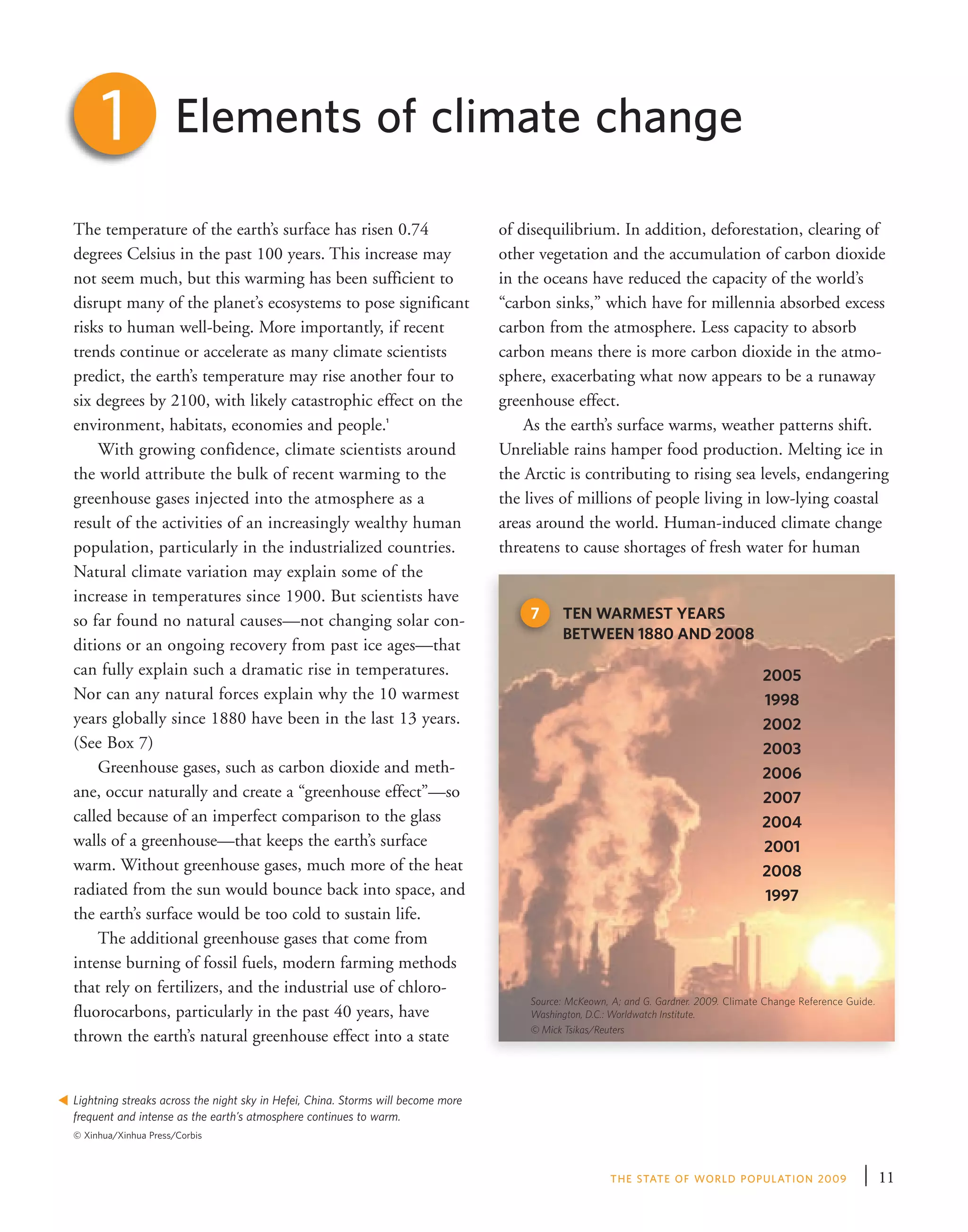
Nor can any natural forces explain why the 10 warmest
years globally since 1880 have been in the last 13 years.
(See Box 7)
Greenhouse gases, such as carbon dioxide and meth-
ane, occur naturally and create a “greenhouse effect”—so
called because of an imperfect comparison to the glass
walls of a greenhouse—that keeps the earth’s surface
warm. Without greenhouse gases, much more of the heat
radiated from the sun would bounce back into space, and
the earth’s surface would be too cold to sustain life.
The additional greenhouse gases that come from
intense burning of fossil fuels, modern farming methods
that rely on fertilizers, and the industrial use of chloro­
fluorocarbons, particularly in the past 40 years, have
thrown the earth’s natural greenhouse effect into a state
Elements of climate change
11
Lightning streaks across the night sky in Hefei, China. Storms will become more
frequent and intense as the earth’s atmosphere continues to warm.
© Xinhua/Xinhua Press/Corbis
t
1
of disequilibrium. In addition, deforestation, clearing of
other vegetation and the accumulation of carbon dioxide
in the oceans have reduced the capacity of the world’s
“carbon sinks,” which have for millennia absorbed excess
carbon from the atmosphere. Less capacity to absorb
carbon means there is more carbon dioxide in the atmo-
sphere, exacerbating what now appears to be a runaway
greenhouse effect.
As the earth’s surface warms, weather patterns shift.
Unreliable rains hamper food production. Melting ice in
the Arctic is contributing to rising sea levels, endangering
the lives of millions of people living in low-lying coastal
areas around the world. Human-induced climate change
threatens to cause shortages of fresh water for human
7	Ten warmest years
between 1880 and 2008
Source: McKeown, A; and G. Gardner. 2009. Climate Change Reference Guide.
Washington, D.C.: Worldwatch Institute.
© Mick Tsikas/Reuters
2005
1998
2002
2003
2006
2007
2004
2001
2008
1997
consumption and agriculture. More frequent and severe
storms are likely, leading to devastating floods. And the
warming atmosphere may be allowing diseases and pests
once confined to tropical areas to
spread north and south towards
the poles.
There is alarming evidence
that important “tipping points,”
leading to irreversible changes in
climate or other earth systems,
may already have been reached—
or passed. Ecosystems as diverse
as the Amazon rainforest and the
Arctic tundra may be approaching
thresholds of dramatic change
through warming and drying.
Mountain glaciers are in retreat,
and the downstream effects of reduced water supply in
the driest months will have repercussions that transcend
generations.
In 2008, researchers using data from four different
climate models found that changes in Arctic and Antarctic
temperatures are not consistent with natural variability
and are directly attributable to human influence.2
Evidence grew in 2008 that the Arctic sea ice is disap-
pearing more rapidly than previously expected because of
higher air and ocean temperatures.
For the second year in a row,
there has been an ice-free channel in
the Northwest Passage through the
islands of northern Canada. This year
also saw the opening of the Northern
Sea Route along the Arctic Siberian
coast. The two passages have prob-
ably not been open simultaneously
in about 100,000 years, before the
last ice age.
The overall declining trend of
sea-ice in the Arctic has lasted at least
three decades. The loss is greatest in
summer, but is also evident in the reduced thickness of
the winter ice packs. With less ice surviving the summer,
the amount of thick ice that has built up over several
years is decreasing. This leaves the whole sea-ice system
more vulnerable to future warming and brings closer the
prospect of an ice-free Arctic.3
The primary human-generated green-
house gases are carbon dioxide,
methane, fluorinated gases (including
chlorofluorocarbons, infamous for their
depletion of the upper atmosphere’s
protective ozone layer), and nitrous
oxide. Greenhouse gases are the most
important source of climate change.
“Black carbon”—essentially soot and
other small carbon particles from com-
bustion—and changes in the reflectivity
of the earth’s surface (as when reflective
sea ice melts and is replaced by heat
absorbing ocean water) also contribute
to warming.
4
8 Greenhouse gases
Greenhouse gas Generated by
Carbon dioxide Fossil-fuel combustion,
land-clearing for agriculture,
cement production
Methane Livestock production, extraction
of fossil fuels, rice cultivation,
landfills, sewage
Nitrous oxide Industrial processes, fertilizer use
Fluorinated gases
• Hydrofluorocarbons
• Perfluorocarbons
• Sulphur hexafluoride
Leakage from refrigerators,
aerosols, air conditioners
Aluminum production,
semiconductor industry
Electrical insulation,
magnesium smelting
Ecosystems as diverse as the Amazon
rainforest and the Arctic tundra may
be approaching thresholds of dramatic
change through warming and drying.
Mountain glaciers are in retreat, and
the downstream effects of reduced water
supply in the driest months will have
repercussions that transcend generations.
12 CHAPTER 1: elements of climate change
In the Arctic the atmosphere is warming twice as fast
as in most other parts of the world. In the far north,
warming is amplified by a decrease in the reflectivity
of the Earth’s surface as ice and snow melt. Ice and
snow reflect solar energy back into space, while darker
surfaces like bare tundra and open ocean absorb more
solar energy and then radiate it to heat the air above. So
as the reflective surfaces disappear, the darker surfaces
release heat into the immediate environment that results
in more melt.
However, there may be other factors contributing to
accelerated warming in the Arctic Ocean. In 2007, there
was an especially large loss of ice in the Beaufort Sea, north
of Canada and Alaska. This was due to incursions of warm
water from the south that melted the ice from beneath.
5
Also,
local atmospheric conditions amplified ice loss. Unnaturally
clear, sunny skies in 2007, for example, increased melting in
the 24-hour sun part of the year, and strong winds during
the early part of the summer drove ice into seasonal packs,
creating enlarged patches of open ocean.
6
The largest mass of ice in the Arctic covers the island
of Greenland. In places, the ice sheet is three kilometres
thick. If all of it melts, it will raise sea levels by an esti-
mated six metres. Until recently, glaciologists presumed
that the ice would thaw slowly over millennia, as warm-
ing at the surface of the ice sheet permeates downward
and gradually melts the ice. But the ice sheet is losing
mass much faster than would be expected if normal melt-
ing alone was to blame. Current losses are more than 100
cubic kilometres a year. New findings in 2008 revealed
that the flow into the ocean of the Jakobshavn Isbrae
glacier in western Greenland, one of the most important
routes for ice loss, has doubled since 1997.7
A recent
analysis of historical data on the extent of the Greenland
ice sheet shows that total meltdown is quite possible as a
result of warming on the scale that is being forecast for
the next few decades.8
Antarctica is losing ice, too, particularly from the West
Antarctic ice sheet. This sheet contains enough ice to raise
sea levels by about five metres. Researchers estimated in 2008
that loss of ice from the West Antarctic ice sheet increased by
60 per cent from 1996 to 2006.9
Ice loss from the Antarctic
Peninsula, which extends from West Antarctica toward
South America, increased by 140 per cent.
The most recent assessment by the Intergovernmental
Panel on Climate Change forecast that global sea levels
Scientists believe that several tipping
elements could destabilize the planet’s
climate by setting off chain reactions—
positive feedbacks—that accelerate
other climate changes. Once a tipping
element is triggered by crossing a
threshold or tipping point, there is no
turning back, even if all greenhouse-gas
emissions were to end. Some tipping
elements, such as the loss of Arctic sum-
mer sea ice, may be triggered within the
next decade if climate change continues
at the same rate. Others, such as the
collapse of the Atlantic Ocean current,
are thought to be many decades away,
while the loss of Antarctic ice is unlikely
to be complete for several centuries.
4
9 Climate tipping elements
Tipping element Expected consequences
Loss of Arctic summer sea ice Higher average global tempera-
tures and changes to ecosystems
Melting of Greenland ice sheet Global sea level rise up to six metres
Collapse of West Antarctic ice sheet Global sea level rise up to five metres
Increase in El Niño events Changes to weather patterns,
including increased droughts,
especially in Southeast Asia
Destruction of Amazon forests Massive extinctions and
decreased rainfall
Changes to India’s summer monsoon Widespread drought and changes
in weather patterns
Changes to the Sahara/Sahel and
the West African monsoon
Changes to weather patterns,
including potential greening of
the Sahara/Sahel—one of the few
positive tipping elements
13THE STATE OF WORLD POPULATION 2009
would rise by between 18 and 59 centimetres in the com-
ing century—just from the thermal expansion of warmer
oceans and the melting of mountain glaciers. But since
the report was completed, many researchers involved in
that assessment have predicted that a much larger rise
is possible or probable. The new prediction—of a one-
metre rise by 2100—originates in part from reassessments
of the potential for physical breakup of the ice sheets of
Greenland and Antarctica.10
A 2008 study on the dynamics of ice-sheet loss
argued that sea levels could rise by as much as two
metres in the coming century as a result of outflows of
ice from Greenland, Antarctica and other glaciers and
ice caps.11
Such a rise would be far beyond anything seen
in the recent past. Sea levels rose 2 centimetres in the
18th century, 6 centimetres in the 19th century, and
19 centimetres in the 20th century; a rise equivalent to
30 centimetres is projected for the 21st century based
on rates observed in the century’s first few years.12
The
magnitude of scale for sea-level rise now being forecast
would be in line with what happened at the end of the
last ice age. Then, as ice sheets disintegrated, sea levels
rose by between 70 and 130 centimetres per century.13
Given current population densities of the areas affected,
a one-metre rise in sea levels worldwide would displace
around 100 million people in Asia, mostly eastern China,
Bangladesh, and Vietnam; 14 million in Europe; and
8 million each in Africa and South America.14
Research in 2008 indicates that sea-level rise—from
thermal expansion, mountain glacier retreat, and ice sheet
melt—is likely to be much greater and to arrive much
sooner than believed even two years ago. No matter how
The lake is all that remains of a glacier near the rural town of Botijlaca, Bolivia. Bolivia’s glaciers are melting rapidly,
jeopardizing water supplies to rural and urban communities.
© Andi Gitow/UNTV
t
14 CHAPTER 1: elements of climate change
quickly climate change is mitigated, sea levels will rise. So,
efforts to adapt to rising seas are more urgent than ever.
The Arctic contains very large stores of greenhouse
gases in the form of methane locked in ice lattices in per-
mafrost or beneath the bed of the Arctic Ocean, methane
that may be released as the planet warms. Large-scale
methane releases would exacerbate global warming and
could turn natural ecosystems from carbon sinks to
carbon sources, triggering a rapid and uncontrollable
temperature increase.
Climate scientists are concerned that methane hydrates
could escape into the atmosphere either as permafrost
melts or as warmer waters destabilize frozen offshore
deposits. In 2008, a study of
the Siberian Shelf reported ele-
vated methane concentrations
offshore from the Lena River
Delta.15
Meanwhile, researchers
showed that, once under way,
thawing of east Siberian perma-
frost—thought to contain 500
billion tons of carbon—would
be irreversible; 250 billion tons
could be released in a century.16
Northern peatland soils that
are not frozen also contain
large amounts of carbon and
are vulnerable to warming.
The peat’s ability to store car-
bon is highly dependent on its
moisture content. Warming will dry out the peat, lower-
ing water tables. A new modelling study showed that this
would lead to massive loss of organic carbon in the soil. In
northern Manitoba, Canada, a 4-degree Celsius warming
would release 86 per cent of the carbon that is sequestered,
or stored away, in deep peat.17
One reason for fears about the ability of forests to
soak up carbon dioxide is that forest cover itself is declin-
ing and is now contributing to emissions—1.5 billion
tons of carbon a year enter the atmosphere from changes
in land use, almost entirely from deforestation in the
tropics.18
Another reason is that even intact forests may
be in trouble; the ability of forests to store carbon may
have peaked, and rising temperatures may already be
decreasing carbon uptake by vegetation in the northern
hemisphere. Higher temperatures impose significant stress
on trees during the summer season, and photosynthesis
halts sooner. Once photosynthesis halts, carbon is no
longer sequestered, and stressed forests are vulnerable to
damage from pollution, fires, pests and disease that can
turn them into carbon sources.19
The other carbon sink—the oceans—is also in
jeopardy. Oceans absorb carbon, helping maintain
equilibrium in the earth’s atmosphere. Over the past
150 years, the oceans have absorbed between one-third
and one-half of the atmosphere’s added carbon dioxide.
As the absorbed gas combines with carbonate ions in
seawater and forms carbonic acid,
the oceans have become 30 per cent
more acidic. The acidification inhibits
marine life’s ability to calcify, threat-
ening shellfish and coral, which are an
important source of food and incomes
for many of the world’s people.
There are other important
human-induced influences on climate
besides greenhouse gases. Evidence
is mounting for significant conse-
quences to climate variability from
soot, or black carbon, that originates
from fires, coal plants, diesel engines
and burning by households. Dark
particles that remain suspended in
the atmosphere absorb radiant energy
and warm the air they occupy. Global emissions of black
carbon are rising fast, and Chinese emissions may have
doubled since 2000. The warming influence of black
carbon could be three times greater than estimates from
the Intergovernmental Panel on Climate Change’s latest
report, making it the second-most important climatic
agent after carbon dioxide.20
These findings remain con-
troversial because black soot can cool as well as warm.
But when black carbon falls onto ice it darkens the
surface, absorbing more of the sun’s energy which leads
to local warming and melting. Soot may be a contribu-
tor to the disappearance of glaciers in some regions and
could even explain the accelerated rates of melt in the
Himalaya-Hindu Kush.21
Evidence is mounting for significant
consequences to climate variability
from soot, or black carbon that
originates from fires, coal plants, diesel
engines and burning by households.
Dark particles that remain suspended
in the atmosphere absorb radiant
energy and warm the air they occupy.
Global emissions of black carbon
are rising fast.
15THE STATE OF WORLD POPULATION 2009
New research demonstrates that winds in the strong­
est cyclones have become more intense in all oceans.22
The increase has been greatest in relatively cool ocean
basins that have seen the largest increases in sea temper-
atures, notably the North Atlantic, but also the eastern
North Pacific and southern Indian oceans. Tropical
cyclones form only when ocean temperatures exceed
about 26 degrees Celsius. Therefore it is possible that
warmer oceans may generate more frequent and more
intense tropical cyclones.
Growing concern about world water shortages highlight
new findings on the possible impacts that climate change
will have on the earth’s hydrologic cycle, including rain-
fall, soil evaporation, and loss of glacial meltwater flows
in rivers. New findings predict empty reservoirs in the
Mediterranean and American Midwest, dry rivers in China
and the Middle East, and less predictable river flows char-
acterized by flash floods in a glacier-free South Asia.23
The Intergovernmental Panel on Climate Change laid
out a range of possible increases in global temperatures
and possible impacts on society and the environment,
ranging from modest and manageable to ones that can
only be described as catastrophic. Unless action is taken
Figure 1.1: Extreme weather events, 1970-2005
Source: United Nations International Strategy for Disaster Reduction. 2009.
10	Climate change risks
The average global temperature could rise by as much as
6.4 degrees Celsius by the end of this century.
24
As much as 30 per cent of plant and animal species could
become extinct if the global temperature increase exceeds
2.5 degrees Celsius.
One-third of the reef-building corals around the world
could become extinct because of warming and acidifying
waters.
Global average sea levels could rise by as much as 43
centimetres by the end of this century.
Arctic ice could disappear altogether during the summer
by the second half of this century.
One in six countries could face food shortages each year
because of severe droughts.
By 2075, between 3 billion and 7 billion people could face
chronic water shortages.
200
150
100
50
0
1970
Numberofdisastersintheworld
1975 1980 1985 1990 1995 2000 2005
Flood
Wind storm
Drought and
related disasters
Slides
16 CHAPTER 1: elements of climate change
soon to stabilize and then decrease concentrations of
greenhouse gases in the atmosphere, there is a great risk
that temperature increases could cause widespread damage
to ecosystems, natural resources, human populations and
disrupt economic activities. Such damage could certainly
end prosperity in developed countries and threaten basic
human livelihoods in developing countries.
Uncertainties remain in climate-change science. Still,
the evidence available so far suggests that we may be
within a few years of crossing tipping points, with poten-
tial to permanently disrupt seasonal weather patterns that
have supported agricultural activities of half the human
population, sustained carbon sinks, and prevented major
ice sheets from melting.
Anita Cano, a 20-year-old woman with
a quick smile, works the front desk at
the Ambergris Diving Company in San
Pedro, Belize. But she says she may
not stay there for long. “It’s not stable,
because of the economy,” she says.
Under normal circumstances, San
Pedro is one of Belize’s more vibrant
tourism spots, bustling with foreign-
ers in search of diving and snorkeling
adventures on the nearby reef.
Tourism has taken a nosedive this
year—most people say because of
the global economic crisis. But there
is also concern that dying coral reefs
will make tourist destinations like Belize
less attractive for the masses of visitors
that each year help inject cash into the
Belizean economy.
The tourism industry in Belize
employs 15,000 people—about one in
four jobs. Tourism is the country’s larg-
est employer of women, many of them
single heads of households.
Scientists say that the corals off the
coast of Belize and neighbouring coun-
tries are gradually dying due to effects
of the climate change, such as higher
water temperatures, stronger and more
frequent hurricanes, as well as acidifica-
tion of the ocean as it absorbs more and
more carbon dioxide from the air.
If there is a dramatic reduction of
live corals along the Caribbean coast,
tourism will not be the only sector to
suffer. The country’s 2,200 fishermen
could find their livelihoods in peril. The
fishing industry generates between 6
per cent and 8 per cent of Belize’s gross
domestic product. In addition, the likeli-
hood of catastrophic consequences of
stronger and more frequent hurricanes
would increase as the protection the
coral reefs provide would literally erode.
Anita says she doesn’t know much
about the dying coral reef and other
possible effects of climate change, but
“90 per cent of people here depend on
the ocean for their living, so of course
it’s important,” she acknowledges.
“Business is down this year by 60 per
cent compared to three to five years ago,”
says Andre Paz, a tour guide at Amigos del
Mar Dive Shop in San Pedro, Belize. He,
too, attributes the current decline in busi-
ness to the global financial crisis, but also
to the dying reef. “We see less fish, less
coral and fewer colors out there,” he says.
Andre and his colleague Robert Zelaya
believe climate change is the culprit.
Scientists say that corals are dying
due to higher water temperatures,
acidification of the ocean—a result
of increased carbon-dioxide being
absorbed into the water—and stronger
and more frequent hurricanes.
As a result of the decline in business,
Amigos del Mar has laid off four people
and sold one of its 10 boats. “On an
average day, we used to get 30 people
going out diving, fishing or snorkeling.
Now we get about 15,” Paz says.
11 Belizean livelihoods threatened by warming waters
Anita Cano.
© Trygve Olfarnes/UNFPA
17THE STATE OF WORLD POPULATION 2009
19THE STATE OF WORLD POPULATION 2009
The first order of business in dealing with human-
induced climate change is to stop making it worse.
Actions now to reduce greenhouse-gas emissions in the
future will help humanity avert disaster in the long run.
There is no time for delay; we are already at the
precipice. The Intergovernmental Panel on Climate
Change concluded in 2007 that even current concentra-
tions of greenhouse gases could send temperatures past
a 2-degree cumulative increase above the earth’s average
temperature before the Industrial Revolution began.1
Based on assessments by the Panel and others of the prob-
able impacts of various increases in global temperatures,
many Governments and non-governmental organizations
have accepted this 2-degree mark as the upper limit that
should be respected to avoid potentially catastrophic
human-caused climate change.2
The large volume of greenhouse gases already put into
the atmosphere by human activity since the Industrial
Revolution—but especially in the past 40 years—has
given climate change so much momentum that only a
concerted, comprehensive push by all nations and people
stands a chance of slowing down or reversing the warm-
ing of the earth’s surface.
All nations and all human beings have contributed in
varying amounts to the atmosphere’s heat-trapping bur-
den, not just through emissions of carbon-dioxide from
burning fossil fuels, but also through carbon dioxide relat-
ed to land-use changes, from methane (more than half of
it rising from farm fields), from nitrous oxide (more than
four-fifths of these emissions are from agriculture), and
from every other gas whose molecules hold more than
two atoms together.3
From 1850 to 2002, countries we now call developed
accounted for an estimated 76 per cent of cumulative
A hotel in Taiwan Province of China toppled into the sea
after Typhoon Morakot lashed the shoreline in August 2009.
© Associated Press
t
At the brink2
carbon-dioxide emissions from fossil-fuel combustion,
while the countries we now call developing accounted for
an estimated 24 per cent, according to the World Resources
Institute. The Institute’s analysis of cumulative emissions,
however, does not take into account emissions related to
land-use changes or recent deforestation, much of which
occurred in developing countries. Boosted by growing
populations and rising affluence, the sum total of all devel-
oping countries’ emissions began exceeding the totals of all
those of developed countries in 2005 and now make up 54
per cent of the total, according to the Intergovernmental
Panel on Climate Change. In 2007, China is believed to
have overtaken the United States in total carbon-dioxide
emissions resulting from fossil-fuel combustion.4
While developed countries contributed the major-
ity of the increment in fossil-fuel carbon dioxide that
has accumulated in the atmosphere since the Industrial
Revolution began, the International Energy Agency
projects that developing countries will account for the
majority of the growth in total volume of carbon-dioxide
emissions related to fossil fuels from 2008 through 2030.5
With some exceptions, per capita emissions remain gener-
ally higher—and in many cases significantly higher—in
developed than in developing countries.6
Although its role is difficult to quantify amidst the
many factors contributing to emissions growth, popu-
lation growth is among the factors influencing total
emissions in industrialized as well as developing countries.
Each additional person in a population will consume food
and require housing, and ideally most will take advantage
of transportation, which consumes energy, and may use
fuel to heat homes and have access to electricity. The
influence of additional population on increasing emis-
sions is logically greatest where average per capita energy
and material consumption levels are highest—that is, in
developed countries. And although correlation does not
prove causation, the International Energy Agency projects
emissions to be lower in 2030 than today only in Europe
and Japan, where population is now approaching or
already in decline.7
The harsh realities of high per capita emissions among
industrialized countries and swiftly rising ones among
developing countries highlight the urgency of mobiliz-
ing all of humanity to stop collectively at the brink of
this possible climate disaster zone. Climate scientists such
as James Hansen of NASA, the United States National
Atmospheric and Space Administration, and researchers at
the Potsdam Institute for Climate Impact Research have
suggested that the world should aim to stabilize carbon-
dioxide concentrations below current levels of more than
380 parts per million. In effect, these scientists are saying,
we should retreat from the brink by returning the atmo-
sphere to the same state it was in around 1990.8
A critical
question for climate negotiators, Governments and the
people of all countries is how responsibility for achieving
such a retreat will be equitably allocated in a world in
which some populations have contributed disproportion-
ately more to climate change.
Population change and emissions
The climate-science community generally points to the
changing size and the pace and structure of population
growth as integral to understanding climate change.
This view is reflected in the Intergovernmental Panel
on Climate Change’s 2007 Fourth Assessment Report,
which states that “gross domestic product per capita and
population growth were the main drivers of the increase
in global emissions during the last three decades of the
20th century.”9
Research published by the International Energy
Agency in 2006 tracked four major factors contributing
to greenhouse-gas emissions from 1970 through 2000
and projected how these same four factors might lead to
more or fewer emissions between 2000 and 2030. The
research showed that rising per capita incomes have been
and will be responsible for the largest share of emissions.
Improvements in “energy intensity”—the amount of
energy needed to generate a given amount of economic
product—is accounting for a larger reduction in green-
house-gas emissions over time. Meanwhile, population
growth has been a smaller but consistent contributor to
growth in energy-related carbon-dioxide emissions.10
Climate negotiators are beginning to raise popu-
lation issues as part of the process leading to a new
climate agreement in Copenhagen in December 2009.
No Government or United Nations entity is suggest-
ing to “control” population. Indeed, fear of appearing
supportive of population control has until recently held
back any mention of “population” in the climate debate.
Nonetheless, some participants in the debate are tenta-
tively suggesting the need at least to consider the impacts
of population growth. The European Union has tabled
a proposal that population trends be among the factors
that should be taken into consideration when setting
greenhouse-gas mitigation targets. The other factors are
gross domestic product per capita, the “greenhouse-gas
intensity” of countries’ gross domestic product and past
emission trends.11
Greenhouse-gas intensity reflects how a specific
amount of greenhouse gases, measured in a uniform
Figure 2.1: Top 15 sources of cumulative carbon-dioxide
emissions from fossil fuels, 1850-2002
	 % of emissions
Country	 worldwide
United States	 29.3
EU-25	 26.5
Russia	 8.1
China	 7.6
Germany	 7.3
United Kingdom	 6.3
Japan	 4.1
France	 2.9
India	 2.2
Ukraine	 2.2
Canada	 2.1
Poland	 2.1
Italy	 1.6
South Africa	 1.2
Australia	 1.1
20 CHAPTER 2: At the brink
Source: Baumert, K., T. Herzog and J. Pershing. 2005. Navigating the Numbers: Greenhouse
Gas Data and International Climate Policy. World Resources Institute.
way based on each gas’ warming potential relative to
carbon dioxide, is emitted with each currency unit (such
as a dollar or euro) of economic activity. So if global
greenhouse-gas intensity declines fast enough, the global
economy can grow even while emissions shrink—the
principal objective of climate policy, since most decision
makers want economic growth but also want to reduce
greenhouse-gas emissions. Some argue that patterns and
levels of consumption are a more important influence
on climate change than population growth. In the early
1990s, when a debate on this question was especially
active among some researchers in both industrialized and
developing countries, environment and development
specialist Atiq Rahman of Bangladesh noted what he
called the “extreme disparity” in per capita emissions and
labelled consumption, rather than population, the “climate
bomb.” “Climate change is far more sensitive to con-
sumption patterns than to demographic considerations,”
Rahman wrote, since “demographic dynamics are subject
to greater inertial forces than consumption and produc-
tion patterns…. [T]ackling consumption not only has
sounder ethical foundations, but it also has greater scope
for rapid action.”12
The defense of consumption as the main arena for
action on emissions reduction has faded little in the last two
decades, perhaps in part because it shifts most of the blame
for climate change to wealthier countries with patterns of
higher consumption. “[T]he world’s richest half-billion
people—that’s about 7 per cent of the global population—
are responsible for 50 per cent of the world’s carbon dioxide
emissions,” wrote environmental journalist Fred Pearce in
2009. “Meanwhile, the poorest 50 per cent are responsible
for just 7 per cent of emissions.”13
Still, calculations of the contribution of population
growth to emissions growth globally produce a consistent
finding that most of past population growth has been
responsible for between 40 per cent and 60 per cent
of emissions growth. Indian researchers Jyoti Parikh
and J. P. Painuly noted during the early 1990s debate
mentioned above that falling birthrates in the 1990s
“could mean significant reductions in greenhouse-gas
emissions [over what would otherwise occur] by 2100.”
Each birth results not only in the emissions attributable
to that person in his or her lifetime, but also the
emissions of all his or her descendents. Hence, the
emissions savings from intended or planned births
Figure 2.2: Per capita greenhouse-gas emissions and cumulative population of regions
“Annex I” countries are those that UNFCCC considers developed. “Non-Annex I” countries are those that are developing. The chart reflects all cases for which data are available to the Intergovernmental
Panel on Climate Change and reflects each group’s equivalent global-warming potential in carbon dioxide. The percentages indicated for each country group refer to the proportion of global energy-
related carbon-dioxide emissions. The figure shows that the average person in South Asia emits about three tons of carbon dioxide per year, while the average person in the United States and Canada
emits more than 25 tons of carbon dioxide annually. JANZ: Japan, Australia, New Zealand. EIT: economies in transition.
Source: Rogner, H.-H. and others. 2007. “Introduction.” Climate Change 2007: Mitigation. Contribution of Working Group III to the Fourth Assessment Report of the Intergovernmental Panel
on Climate Change. Cambridge: Cambridge University Press.
25
30
35
20
15
10
5
0
0 1,000 2,000 3,000 4,000 5,000 6,000 7,000
Cumulative population in millions
Tonsofcarbondioxideequivalentpercapita
USACanada:19.4%
Other non-Annex I: 2.0%
Non-Annex I
East Asia: 17.3%
Europe
AnnexI:
11.4%
Middle East: 3.8%
Africa: 7.8%
EITAnnexI:9.7%
Latin
America

Carribean:
10.3%
JANZ:5.2%
South Asia: 13.1%
21THE STATE OF WORLD POPULATION 2009
multiply with time. One reason for this assessment of
population growth and greenhouse-gas emissions is the
large influence of population increases on total emis-
sions in some developed countries. In the United States,
for example, per capita emissions of fossil fuel-generated
carbon dioxide remained essentially unchanged even
during the generally economically healthy years from
1990 to 2004. For the United States as a whole, the
country’s total emissions rose in parallel with its popu-
lation, at 18 per cent a year. This relationship varied,
however, across each of the country’s 50 states. In some
states, per capita emissions went down as populations
rose, and vice versa.
In 1991, physicist John P. Holdren, now chief sci-
ence advisor to U.S. President Barack Obama, noted
that “changes in settlement patterns necessitated by pop-
ulation growth result in more transport, per person, of
resources, goods, and people,” making a case that popu-
lation growth directly stimulates consumption growth.
Other increases in energy consumption, he suggested,
might result in more use of air conditioning if densely
populated urban areas create “heat islands” or “if
population density and distribution create demands for
energy-intensive services not required when population
was smaller.”14
The effect Holdren identified now challenges some
efforts in the United States to shift to renewable energy.
By one estimate, a given amount of renewable energy
may require 300 times as much land as the same energy
produced by fossil fuels. The reason for this is that the
extraction of fossil fuels generally requires only a limited
amount of land, where mines or drilling wells transfer
them from the earth’s crust to the surface. Solar power,
by contrast, is based on large areas of photovoltaic cells
or mirrors capturing and concentrating the power of
sunlight over large land areas. Wind power generally
requires large fields on which many giant turbines may
be placed. Environmentalists and U.S. Government
officials alike worry the land hunger of renewable energy
projects will add to already stiff competition between
The Population Division of the United
Nations Department of Economic and
Social Affairs has projected various
scenarios for world population size in
2050, based on a variety of assump-
tions about fertility rates and other
factors that influence growth. In the
“low-variant” scenario, for example,
nearly 8 billion people will inhabit the
earth by 2050. This scenario assumes
a fertility rate of 1.54, well under the 2.1
“replacement fertility” rate. Total fertility
worldwide today is 2.56.
In its medium-variant scenario,
the Population Division projects fertil-
ity in the less-developed regions as a
whole to drop from 2.73 children per
woman in 2005-2010 to 2.05 in 2045-
2050. To achieve such reductions, the
Population Division states, it is essential
that access to voluntary family plan-
ning expands, particularly in the least
developed countries. Around 2005, the
use of modern contraceptive methods
in the least developed countries was 24
per cent among women of reproduc-
tive age who were married or in a union.
Another 23 per cent of such women
were not using contraception, despite
a wish not to become pregnant now or
within the next two years—the defini-
tion of “unmet need.”
18
According to
the United Nations Secretary-General,
in a report on world population and the
ICPD Programme of Action, there are an
estimated 106 million married women
in developing countries who have an
unmet need for family planning.
19
12 Population growth scenarios
World population scenarios, 2050
Low Medium High
7.959 billion 9.150 billion 10.461 billion
World fertility rates, 2045 to 2050, by population growth scenario
Low Medium High
1.54 2.02 2.51
22 CHAPTER 2: At the brink
Population and climate change: a closer look
A report of the Secretary-General to the United Nations
Commission on Population and Development’s 42nd
session in early 2009 takes a more nuanced view of the
relationship between population, development, green-
house-gas emissions and climate change. The report,
prepared by the Population Division, linked the rapid
growth of world population in the 20th century with
even more rapid growth of urban population, production,
land in cultivation, water use and energy consumption.
“Together,” the report suggested, these trends “are having
unprecedented impacts on the environment, causing
climate change, land degradation and loss of biodiversity.”
The influence of population growth on emissions,
however, is complicated by the other forces. According to
the Population Division, “The relation between popula-
tion growth and increasing greenhouse-gas emissions is
not straightforward, and the scenarios of future emission
trends do not permit assessing the effects of population
human and ecosystem needs, especially in the western
United States.15
The approach to population dynamics endorsed in
the Programme of Action of the International Conference
on Population and Development (ICPD) for developing
countries—respecting reproductive rights and providing
universal access to sexual and reproductive health services,
including voluntary family planning—is appropriate to
developed countries as well. Rates of unintended preg-
nancies are actually higher in the industrialized countries
than in the developing ones, according to the Guttmacher
Institute, which studies the phenomenon in both blocs. In
Europe, Australia, Canada, Japan, New Zealand and the
United States, an average of 41 per cent of all pregnancies
are unintended.16
In the developing countries, an estimated
35 per cent of pregnancies are unintended. Preventing
unintended pregnancies could contribute to population
stabilization in the long run and may in turn contribute
to a reduction in greenhouse-gas emissions in the future.17
Zimbabwean farmer Mabel Zevezanayi holds a dried corn cob in Bikita District, affected by drought.
© AFP/Getty Images
t
23THE STATE OF WORLD POPULATION 2009
dynamics net of economic and technological changes.
Furthermore, changing population age structures, increas-
ing urbanization and changes in household size interact in
affecting emissions.”20
Researchers began dissecting the impacts of popula-
tion change on emissions only in the mid-1990s. Among
the early findings was one in 1995 that reductions in
household size, which often accompany lower fertility
and higher economic growth, could significantly increase
total greenhouse-gas emissions. These researchers found
that homes are basic units of energy consumption and
tend to be heated or cooled whether occupied by a fam-
ily of seven or by a single person. Indeed, so strongly did
the reduction in household size appear to boost emis-
sions that demographers in the International Institute
of Applied Systems Analysis’ World Population Program
stated, “A divorce may cause more carbon dioxide emis-
sions than an additional birth.”21
The importance of smaller households in elevating
emissions, affirmed by a 2004 study quantifying such
impacts, underlines the fact that population growth
occurs in specific contexts that can enhance or dampen
its influence on the environment.22
Even the demographic
unit—an individual or household, for example—might
significantly alter the outcome of emissions models.
The effect of smaller households on emissions led some
If greenhouse-gas emissions begin with
individual human activities, might those
of women somehow be different from
those of men? There is little research
that aims to answer this question, par-
ticularly in developing countries. And
in the developed countries, there have
been only a handful of public opinion
surveys on climate change or other
environmental issues that disaggregate
results by sex.
According to research published
by the Organization for Economic
Cooperation and Development in 2008,
women in industrialized countries are
more likely to be “sustainable consum-
ers,” meaning, for example, that they
tend to buy ecologically friendly and
organic foods, are more likely to recy-
cle and are more interested in efficient
energy use. Women in these countries
account for as much as 80 per cent
of consumer decisions, the research
shows.
26
It is unclear, however, whether
consumption patterns that contribute
less to the warming of the atmosphere
are the result of women’s environ-
mentally conscious decisions at the
household level or the result of chronic
economic and social inequalities that
prevent women from benefiting from
and contributing to their countries’ and
communities’ development. Several
gender-specific studies of attitudes
about the environment or climate
change in the United States generally
support the view that women are more
likely than men to buy “green” products,
which are advertised as less detrimental
to the environment. Women were also
generally less likely than men to trust
Governments and corporations to solve
environmental problems and somewhat
more likely to want to take action per-
sonally on them. These gender-based
differences were more pronounced at
higher incomes.
27
In one study conduct-
ed in 22 countries, researchers found
women were somewhat more likely to
care about environmental problems
such as climate change and to change
their behaviour as a result.
28
In Sydney, Australia, a 2008 survey
of suburban residents about environ-
mental sustainability found women and
girls easier to attract to cooperative
initiatives, more socially focused, and
more concerned about the impacts of
climate change. Men and boys were
less likely to get involved in sustain-
ability and more drawn to technology,
governance issues and business in dis-
cussing environmental issues.
29
Nordic researchers have probed the
implications of differences in emissions
and found women in developed—and
developing—countries to have less
impact on the atmosphere overall. The
chief reason seems to be that the two
sexes move differently from place to
place, with men more likely than women
to drive a car (75 per cent more likely in
Sweden
30
) and to fly in airplanes. This
difference, however, appears to stem
more from unequal access to econom-
ic resources and less influence over
decision-making than from behaviour
or attitudes regarding the environment
or transportation generally. The study
also quantified another differential in
greenhouse-gas-related consumption:
men in developed countries eat more
meat—139 grams daily in Denmark
on average, compared to 81 grams for
Danish women. Not only do women
eat less in proportion to their body size,
but at least in some countries they con-
sume a more vegetable-oriented and
less meat-based diet.
13 Women, men and greenhouse-gas emissions
24 CHAPTER 2: At the brink
researchers to speculate that population ageing, the
increase in the average age of a population as life expec-
tancy increases and fertility declines, might lead to rising
emissions—at least partially offsetting emissions savings
resulting from the slowdown in growth itself. Studies
of ageing itself have, however, produced conflicting
findings. A group of researchers associated with United
States and European research institutions found ageing
to reduce emissions significantly in the United States
and somewhat less significantly in India and China.23
Although older people are likely to live in smaller house-
holds than younger people, the researchers found, the
impact will be more than offset by the slower economic
growth and reduced consumption presumed to accom-
pany an ageing population.
Urbanization works in the opposite direction, some of
these same researchers found. A shift of population from
rural areas to cities appears likely to boost emissions sub-
stantially. This is not necessarily because people who live
in cities contribute more on a per capita basis to green-
house-gas emissions than those who live in rural areas.
Other researchers, however, have argued that this is a myth
and that urban areas now contribute much less than half
the world’s greenhouse-gas emissions despite being home
to more than half the world’s people.24
The economic
growth stimulated in cities tends to have a ripple effect
throughout a country, helping boost economic growth in
rural areas as well. In turn, greater economic growth may
therefore boost greenhouse-gas emissions throughout a
whole country.25
In general, economic change continually
reveals itself as the more immediate influence on green-
house-gas emissions than population change.
Population and future emissions
No human is genuinely “carbon neutral,” especially when all
greenhouse gases are figured into the equation. Therefore,
everyone is part of the problem, so everyone must be part
of the solution in some way. The world’s Governments and
peoples will need to work together on every aspect of the fac-
tors that increase greenhouse-gas emissions. One such factor
is the earth’s growing population.
If the United Nations Population Division’s low
population growth scenario—about 8 billion people by
the year 2050—materializes, it might result in 1 billion
to 2 billion fewer tons of carbon emissions than if the
medium-growth scenario—a little more than 9 billion
people by 2050—materializes, according to climate scien-
tist Brian O’Neill of the National Center for Atmospheric
Research.31
Others have estimated comparable emissions
savings by 2050 through the application of known energy-
efficiency techniques in all new buildings worldwide or by
erecting 2 million 1-megawatt wind turbines to displace
coal-fired power plants currently in use.32
Moreover, the
annual emissions savings would continue to grow substan-
tially after the middle of the century as world population
peaked and began declining, compared to continued
population growth assumed in the medium-growth
projection. This means that the net emissions savings
achieved through a low population growth scenario
would be equivalent to the net emissions savings achieved
A woman works in her cornfield near a coking factory in Changzhi, Shanxi
Province, China.
© Reuters
t
25THE STATE OF WORLD POPULATION 2009
through major investments in energy technologies in a
medium population growth scenario.
British economist Nicholas Stern estimated that in
order to keep global temperatures from crossing into a
potentially catastrophic zone, “global average per capita
[greenhouse-gas] emissions...will—as a matter of basic
arithmetic—need to be around two tons by 2050,”
assuming a world population of 9 billion people and
speaking in terms of carbon dioxide equivalents. “This
figure is so low that there is little scope for any large
group to depart significantly above or below it.”33
If the world followed the trajectory of the United
Nations Population Division’s low-variant projection of
8 billion people, the earth’s atmosphere would be able to
tolerate higher per-capita emissions, since fewer people
would be emitting greenhouse gases.34
The low-variant pro-
jection assumes lower fertility rates that might result from
increased access to reproductive-health services, including
family planning, and other actions to increase opportuni-
ties and freedoms for women and girls. One study of the
cost of averting a fixed amount of fossil-fuel carbon-dioxide
emissions found that dollar-for-dollar, investments in
voluntary family planning and girls’ education would also
in the long run reduce greenhouse-gas emissions at least as
much as the same investments in nuclear or wind energy.35
According to a 1992 report by a committee of the
United States National Academy of Sciences, “family
planning impacts on greenhouse-gas emissions are
important at all levels of development.” The committee
concluded, “The reduced population growth associated
with higher income growth…offsets in large part the
higher greenhouse-gas emissions associated with faster
economic growth. The family planning effects indicate
that, as of 2020, carbon emissions will be about 15 per
cent lower for the lower-, middle- and upper-middle-
income countries than they would be without family
© Amanda Koster/Corbis
26 CHAPTER 2: At the brink
27THE STATE OF WORLD POPULATION 2009
planning. Strong family planning programmes are in the
interests of all countries for greenhouse-gas concerns as
well as for broader welfare concerns.”36
Investing in women and girls in ways that improve
their health, well-being and status in their societies leads
to reductions in fertility rates and will thus contribute to
a reduction in greenhouse-gas emissions in the long run.
Women and emissions reduction
There may be opportunities to tailor efforts to reduce
emissions and to pull carbon out of the atmosphere more
effectively by considering gender differences in any dis-
cussion about consumption.
Women produce roughly half the world’s food,
according to the Food and Agriculture Organization
of the United Nations, and anywhere from 60 per cent
to 80 per cent of food in most developing countries.37
Natural land-based carbon sequestration—the potential
of farm and forest soils, trees, perennial crops and other
plants to absorb carbon and keep it out of the atmo-
sphere for decades—is attracting increasing interest as
every possibility for holding down greenhouse-gas con-
centrations is pursued. If financial instruments could be
devised to encourage such practices—as seems likely to
occur as climate change impacts become more obvious
and damaging—women farmers could be at the forefront
of mitigation efforts.38
This could have a substantial
impact on women’s livelihoods as well, assuming laws are
restructured and cultural norms shift as needed in some
countries so that women can own the land they farm and
control the income they earn.
Already, the world has witnessed the power of women
to take actions that contribute to lower levels of atmo-
spheric carbon dioxide. Wangari Maathai won the Nobel
Peace Prize for a lifetime of environmental activism that
began by mobilizing women to plant tens of thousands
of trees in deforested and degraded soils of Kenya. In
India, the Chipko movement drew women, the original
“tree huggers,” as early as the 1970s to protect forests
and their own forestry rights by linking hands and arms
around trees to dissuade the loggers assigned to fell them.
The movement led to major reforms in Indian forestry
laws that resulted in greater forest cover today (and hence
more carbon in trees and less in the atmosphere) than
would otherwise be the case. One study of deforesta-
tion, an activity performed overwhelmingly by men and
responsible for a substantial proportion of all carbon-
dioxide emissions, found that a high presence of women’s
non-governmental organizations in low-income countries
may help protect forests against destruction.39
The relative dearth of research on
gender aspects of deforestation is sur-
prising, given the strong connection
between fuelwood and activities such
as cooking and the firing of ceramics.
Research shows that in many develop-
ing countries, women must walk farther
and farther to gather fuel. In one rural
community in Sudan, for example, the
time required quadrupled over a single
decade. Moreover, the livelihoods of
women in rural areas often depend on
forest resources. Loss of forests may
therefore undermine income-earning
opportunities. Finally, loss of forests
often affects women’s health: carry-
ing heavy loads of fuelwood over long
distances can result in spinal damage,
complicate pregnancies and increase
the risk of maternal mortality.
In recent decades, however, such
women-focused non-governmental
organizations as the Green Belt
Movement in Kenya and the Women’s
Environment and Development
Organization in the United States have
mobilized to protect and even expand
forested lands. Many such groups also
advocate for or help ensure compliance
with environmental treaties.
Sociologists at three United States
universities—the State University of
New York at Stony Brook, Brown, and
Clark—recently examined deforestation
in 61 nations between 1990 and 2005
and found that countries with large or
numerous women’s and environmen-
tal non-governmental organizations
showed significantly lower levels of
forest loss. The researchers suggested
that women’s non-governmental orga-
nizations achieved what theory might
predict: they advocated successfully
for forest protection and mobilized
activity that had a net positive effect
on forest conservation.
40
14 Women and reforestation
29THE STATE OF WORLD POPULATION 2009
The environment has always shaped the movement of peo-
ple and the distribution of the human population across
the planet. Throughout history, people have left places with
harsh or deteriorating conditions, and nomadic peoples
have traditionally opted for seasonal migration to maintain
their livelihoods in sensitive ecosystems. The droughts
between 1930 and 1936 in the American “Dust Bowl” dis-
placed hundreds of thousands of people, and the droughts
that struck Africa’s Sahelian region in the 1970s forced mil-
lions of farmers and nomads towards cities.1
But over the last two decades, the nature and scale
of environmentally induced population movements have
begun to change. While no reliable figures exist, the
growing certainty about the impacts of climate change
suggest that an increasing number of people will migrate
mainly for environmental reasons in the future. Although
the geography and scale of future movements of people
is less easy to predict than the details of climate change
itself, the probability is high that changes in sea levels, cli-
mate and other environmental conditions will spur major
increases in movement in the coming decades. Societies
would do well to consider now how to address environ-
mentally influenced movements of people.
The relationship between environmental factors and
human mobility is complex: on the one hand, environ-
mental change triggers human movement. On the other
hand, migration and displacement may take a toll on the
environment—in areas of origin, areas of destination and
the travel routes in between. Such a two-way connection
between migration and the environment can result in a
vicious circle: population movement contributes to envi-
ronmental degradation in the area of destination, which
may in turn provoke further migration and displacement.
Environmental degradation refers to processes, such as
On the move3
rising sea levels, which can be caused or exacerbated by
climate as well as by human activity through, for example,
land degradation resulting from overly intensive farming.
In most cases, it is difficult to establish a simple and
direct causal relation between the movement of people
and environmental degradation. The links between the
two are often complicated by other factors, such as
conflict, governance and levels of development.
Climate change and human mobility
As early as 1990, the Intergovernmental Panel on Climate
Change stated that “one of the gravest effects of climate
change may be those on human migration.”2
This statement
was substantiated by the Panel’s 2007 Fourth Assessment
Report, which showed that climate change is likely to raise
the risk of humanitarian emergencies and trigger population
movements as a result of increasingly intense weather events,
sea-level rise and accelerated environmental degradation.3
Climate change and its adverse consequences for
livelihoods, public health, food security, and water avail-
ability will have a major impact on human mobility,
likely leading to a substantial rise in the scale of migration
and displacement. Such environmentally induced move-
ments are likely to take place mostly within countries but
also to a lesser extent across national borders.4
The effects
of climate change may also render some people stateless.
The numbers gap
While many experts agree that climate change is expected
to become one of the key factors prompting population
movement in the next decades, there is still uncertainty
about the scale and nature of the impacts of climate change
and about the best policies and strategies for addressing
the problem. One reason for the uncertainty is the dearth
An Indian villager carries her belongings through flood waters in the village
of Sandeshkhali, 100 kilometres southeast of Kolkata.
© AFP/Getty Images
t
of reliable data. But despite the shortage of hard data, it is
evident that environmental changes are already resulting in
substantial human migration and displacement.
Recorded natural disasters5
have doubled from approxi-
mately 200 a year to over 400 a year over the past two
decades, with seven out of every 10 disasters recorded as
“climate-related.”6
The total number of people suffering
the impacts of these natural disasters has tripled over the
past decade, with an average of 211 million people directly
affected each year.7
The annual average “humanitarian toll”
of climate-related disasters was an estimated 165 million
people in the 30 years between 1973 and 2003, amounting
to a staggering 98 per cent of all persons killed or affected
by natural disasters within that period.8
There are also indi-
cations that this figure is on the rise: from 1998 to 2007,
2.2 billion people were affected by climate disasters com-
pared to 1.8 billion in the 10 previous years.9
There are various estimates for the number of people
already displaced by environmental changes, with 25 million
being the most widely quoted figure.10
This figure does not
include a potentially greater number of people who moved
as a result of gradual environmental changes, such as drought
or soil erosion. The figure also does not take into account
those who have been displaced by other adverse consequenc-
es of climate change, such as diminished food security.
Estimating future climate change-related population
flows presents an even greater challenge, with figures
ranging wildly from 50 million to 1 billion people by the
middle of the century, either within their countries or
across borders, on a permanent or temporary basis.11
The
most widely used estimate of people to be displaced by
environmental factors by 2050 is 200 million.12
Large discrepancies among the various estimates raises
important questions not only about the reliability and
These days, when Oreba Obiin takes a
step out of her home, she steps into the
sea. Oreba and her husband Titera live
in an auti, or open hut, with their two
sons, a few chickens, three piglets and
a dog, part of the Tebike Inano commu-
nity on low-lying coastal Tarawa, in their
atoll nation of Kiribati.
Oreba, 51, has seen the sea change,
especially in the past decade. The water
is rising, she says, explaining that she
and her husband have already had to
add sand to their home’s floor several
times to keep it dry. “In the beginning
our roof was very high. Now the roof
is getting really close to us. If we keep
adding sand to the floor, my head will
soon touch the ceiling.”
Many inhabitants of Tarawa have built
sea walls along the shoreline to protect
their land, but if the sea continues to rise,
the sea walls won’t suffice. “We want to
stay here…but if we have to move, then
we have no choice,” Oreba says.
But where will Oreba and thousands
like her go?
Kiribati consists of 33 atolls, tiny
specks of narrow land made of coral,
sand and limestone, barely three metres
above sea level, in the middle of the vast
Pacific Ocean. These islets are especial-
ly vulnerable to the impacts of global
warming, ranging from rising seas, more
violent storms, coastal erosion and the
intrusion of salt into fresh-water tables.
On some of the outer atolls, entire vil-
lages have already been washed away.
Unlike other low-lying countries, how-
ever, the people of Kiribati have no
higher ground to retreat to.
“Adaptation has very severe limita-
tions for us,” explains Kiribati’s President
Anote Tong. “If we move away from the
shoreline we are already on the other
shoreline, on the other side of the island.”
Tong has set a clear course for dealing
with short-term adaptation measures on
the one hand and finding long-term solu-
tions, on the other. “We will continue to
live here for as long as we are able to live
and will continue to need what we have
needed over the years, so investments
in infrastructure will have to carry on,”
Tong says. “But what options do we have
if we don’t relocate? We drown, don’t
we? We have to relocate. If we relocate
to another country, of course we would
lose some of the culture. But if we don’t,
we would lose the entire nation and our
people. It’s not a choice, it’s a necessity.”
15 No place left to go
Oreba Obiin, 51, combats coastal erosion in
Kiribati by planting mangrove seedlings.
© Reethu Arjun/UNPFA
30 CHAPTER 3: On the move
availability of data, but also about the methodologies and
definitions used to collect and analyse the information and
about underlying assumptions made by the people looking
at the numbers. Developing reliable estimates of climate
change-related population flows is fraught with challenges,
including the complex relationship between environmental
factors and human mobility, uncertainty about climate-
change impacts and scenarios, and the need to account for
other variables, such as demographic trends and projections.13
In addition, environmental processes and migration respons-
es vary in time and space, further complicating the analysis.
The absence of generally agreed terminology is
another challenge. The popular terms “climate refugee” or
“environmental refugee” have no basis in existing inter-
national refugee law. Often those persons referred to as
“climate refugees” have not actually crossed an interna-
tional border. The use of such terminology can exacerbate
confusion regarding the link between climate change,
environmental degradation and migration.
Substantial environmentally induced population
flows are likely in the future, and these flows will have
implications for humanitarian relief and migration
management. Even low-end estimates of slow or sudden
population movements would pose enormous global
challenges. Meeting the needs of additional millions
leaving home as a result of climate change-related factors
would severely test the efficacy and sustainability of
humanitarian response models currently employed by
the United Nations and international relief organizations.
Myths vs. reality
Suggestions that millions of environmental migrants are
poised to flee developing countries to permanently seek safety
and new lives in industrialized countries are misleading.
There is no international consensus on
terminology about people who move
in response to climate-related factors.
The International Organization for
Migration has proposed a working def-
inition of “environmental migrants” as
“persons or groups of persons who, for
compelling reasons of sudden or pro-
gressive changes in the environment
that adversely affect their lives or living
conditions, are obliged to leave their
habitual homes, or choose to do so,
either temporarily or permanently, and
who move either within their country
or abroad.”
14
Internally displaced persons
The currently accepted definition of
internally displaced persons is “persons
or groups of persons who have been
forced or obliged to flee or to leave their
homes or places of habitual residence,
in particular as a result of or in order
to avoid the effects of armed conflict,
situations of generalized violence, vio-
lations of human rights or natural or
human-made disasters, and who have
not crossed an internationally recog-
nized State border.” This definition
includes all those forcibly displaced
within their country due to the effects
of climate change.
Refugees
Under international law, a refugee is
a person who “owing to well-founded
fear of persecution for reasons of race,
religion, nationality, membership of
a particular social group or politi-
cal opinions, is outside the country of
his nationality and is unable or, owing
to such fear, is unwilling to avail him-
self of the protection of that country,
or who, not having a nationality and
being outside of the country of his
former habitual residence as a result
of such events, is unable or, owing to
such fear, is unwilling to return to it.”
The United Nations High Commissioner
for Refugees has a mandate to protect,
as refugees, persons who fear serious
and indiscriminate threats to life, physi-
cal integrity or freedom resulting from
generalized violence or events seriously
disturbing public order, in addition to
persons falling within the 1951 Refugee
Convention (1951 Convention Relating
to the Status of Refugees) definition.
These definitions exclude anyone who
crosses borders solely because of envi-
ronmental degradation in their nations
of origin.
Stateless persons
A stateless person is defined as “a per-
son who is not considered as a national
by any state under the operation of its
law. Persons who possess a nationality
in formal terms but whose nationality is
ineffective are generally referred to as “de
facto stateless persons.” Additionally, a
“stateless refugee” is defined in the 1951
Refugee Convention as a person “who,
not having a nationality and being out-
side the country of his former habitual
residence as a result of such events, is
unable or, owing to such fear, is unwill-
ing to return to it.”
16 Definitions of people who are on the move
31THE STATE OF WORLD POPULATION 2009
Overall, environmental migration is—and is likely to
continue to be—mainly an internal phenomenon, with
a smaller proportion of movement taking place between
neighbouring countries, and even smaller numbers
migrating long distances beyond the region of origin.
Furthermore, a number of studies, such as one in rural
Mali during the 1983 to 1985 drought, revealed that
environmental degradation may actually contribute to a
decline in the rates of international, long-distance moves.15
This is likely due to the relatively high cost of long-
distance migration, which fewer households can afford in
drought years. When long-distance migration does take
place, the destination is usually based on the location
of existing support networks, established or traditional
migration routes and, in many cases, the historical ties
between the country of origin and the country of des-
tination. Many environmentally induced population
movements are temporary; many people prefer to return
home as soon as it’s safe and feasible.
The majority of environmental migrants have so
far come from rural areas within the least developed
countries. But in the future, there may indeed be unprec-
edented levels of environmentally induced migration out
of urban areas, as rising seas threaten to inundate densely
populated coastal areas, where 60 per cent of the world’s
39 largest metropolises are located, including 12 cities
with populations of more than 10 million.16
Environmental drivers
In some cases, extreme weather events, such as cyclones,
drive people from their homes, but in many more cases,
insidious environmental degradation provides the impetus
for leaving. Not all environmental degradation is related
to climate change, and therefore not all movements in
response to environmental degradation are related to
climate change.
It is likely that both extreme weather events and
changes in mean temperatures, precipitation and sea
levels will in many cases contribute to increasing levels
of mobility. But there are inherent difficulties in predict-
ing with any precision how climate change will impact
on population distribution and movement. This is partly
because of the relatively high levels of uncertainty about
the specific effects of climate change, and partly because
of the lack of comprehensive data on migration flows,
especially movements within national boundaries and in
particular for low-income countries that are likely to be
most affected by climate change.17
According to the Intergovernmental Panel
on Climate Change’s Fourth Assessment
Report, population movements may be
triggered by increases in the areas affect-
ed by droughts, increased tropical cyclone
activity, increased incidence of extreme
high sea-level rise (excluding tsuna-
mis) and increased climate variability.
18
Meanwhile, Walter Kälin, Representative
of the United Nations Secretary-General
on the Human Rights of Internally
Displaced Persons, has identified five cli-
mate change scenarios, each of which
has a different impact on the pace or scale
of migration or displacement:
•	 Hydro-meteorologicaldisasters,includ-
ing extreme weather events such as
hurricanes, flooding and mudslides,
which may lead to sudden-onset
displacement.
•	 Environmental degradation, including
desertification, water scarcity and
soil exhaustion, which may result in
gradual migration or displacement.
•	 Losses in state territory, including ero-
sion and coastal flooding resulting
from rising sea levels. Persons living
in low-lying coastal areas and the
so-called “sinking” small island devel-
oping states, such as the Maldives,
Tuvalu and Vanuatu, will be most
affected by this scenario. It may lead to
gradual migration and displacement,
and possibly even to statelessness.
•	 Designation of “high risk” areas by
national authorities, including ter-
ritories that are prone to disasters
and that are designated as unsafe,
leading to the forced relocation of
its inhabitants. This scenario may
cause gradual migration, relocation
and displacement, most often within
the same state.
•	 Violence and armed conflict over scarce
and diminishing natural resources,
including conflict arising from food
and water insecurity and lack of ara-
ble land. This scenario may cause
both gradual and sudden migration
and displacement.
17 Climate-change scenarios and their impact on population movements
32 CHAPTER 3: On the move
For a clearer picture of human mobility and environ­
mental change, it is useful to distinguish between the
effects of sudden events or natural disasters and slow-
onset processes. Both influence population mobility
patterns but in different ways.
Natural disasters, including those related to climate
change, may destroy basic infrastructure, disrupt services
and undermine livelihoods, often resulting in sudden,
large-scale movements of people. For instance, Hurricane
Katrina, which hit the United States in August 2005, dis-
placed about 1 million people.
Many people who leave their homes in the wake of
natural disasters eventually return. But the ability to leave
disaster-stricken areas and return to them is influenced by
factors such as perceived risk, socio-economic status and
mitigation through aid and subsidies.
While major natural disasters, such as Cyclone Nargis
in Myanmar, claim most of the world’s headlines, the less-
dramatic but equally devastating gradual environmental
changes go largely unnoticed by the international media.
Yet it is these gradual changes, including desertification,
water scarcity and coastal and soil erosion, that are
responsible for the majority of environmentally induced
population movements.
In Africa, for instance, an estimated 10 million people
are likely to have migrated or been displaced over the last
two decades mainly in response to environmental degra-
dation and desertification.19
Gradual environmental changes can produce a vari-
ety of migration flows, with the majority likely to occur
internally or across borders into neighbouring countries.
Different stages of environmental degradation can be
expected to have different outcomes for the movement of
people. At early and intermediate stages of environmental
degradation, migratory responses are often temporary in
nature and are more likely to be non-forced. When environ-
mental degradation becomes severe or irreversible, as in cases
of sea-level rise, resulting displacement can become perma-
nent and requires resettlement of affected populations.
Some areas may be exposed to a combination of
gradual environmental degradation and natural disasters.
In such cases, degradation can substantially increase the
vulnerability of the area to the effects of natural disasters.
Compounding factors
The relationship between environmental factors and the
movement of people can both affect and be affected by
conflict. Changes in population distribution associated
Repeated flooding in eastern and western
Nepal in August 2008 affected more than
250,000 people, many of whom were
living in poverty and had already endured
floods and landslides a year earlier.
Floods and landslides are season-
al disasters in Nepal and are linked to
the clearing of the forests, particu-
larly in hilly areas. Climate change is
expected to further exacerbate the
frequency and intensity of flooding, as
rains spread westward across the coun-
try and melting snow and glaciers cause
already-swollen rivers to overflow their
banks in the rainy season.
Nepal ranks among countries with a
low “human development index,” with
over 80 per cent of the population sur-
viving on less than $2 per day.
Gender is one of the factors influ-
encing vulnerability to natural disasters
in Nepal. As more and more males
migrate from mountainous regions and
rural areas to newly developed cities,
more and more women are becoming
heads of households, remaining in areas
prone to flooding and are therefore most
vulnerable to climate-related disasters.
In eastern Nepal in 2008, a retaining
wall along the Koshi River collapsed,
washing away whole villages in the
Sunsari and Saptari districts and affect-
ing about 70,000 people. The force of
the water was so strong that the river’s
course changed almost completely,
blocking access to some flooded areas
and stranding tens of thousands of
people in makeshift camps. In response
to the catastrophe, the International
Organization for Migration led the
coordination of the international human-
itarian response of the United Nations,
the Red Cross and Red Crescent, non-
governmental organizations and other
actors to assist the Government of
Nepal in addressing urgent humanitar-
ian needs while laying the foundation
for more durable solutions and build-
ing national capacities for disaster-risk
reduction, paving the way for safe, vol-
untary and orderly returns.
18 Managing climate-induced population movements in Nepal
33THE STATE OF WORLD POPULATION 2009
capacity refers to the particular characteristics of an eco-
system that affect how it sustains human activity or how
it becomes vulnerable to the negative effects of climate
change. Caring capacity describes the social, developmen-
tal and institutional variables that underpin the ability
of institutions to cope with environmental stresses.21
The
potential adverse effects of climate change are likely to be
especially severe in countries that have both limited carry-
ing and caring capacities.22
Move or stay?
The decision to move or stay is usually made at the
individual or household levels, especially when gradual
environmental degradation is the problem. Therefore,
an analysis of how individuals, households and, in some
cases, communities respond to environmental change pro-
vides insights into when migration is likely, who is likely
to migrate and why.
Decisions to migrate are complex and depend on
many considerations, including the interplay between
with environmental degradation and climate change can
lead to increased resource inequality and competition over
resources such as water or land, potentially resulting in
conflict. In Darfur, for example, desertification, land deg-
radation and deforestation have exacerbated the effects of
recurrent droughts on communities and have contributed
to tensions between nomadic pastoralists and farmers over
increasingly scarce pastures, arable soil and fresh water.20
Current research, however, suggests that although envi-
ronmental stresses or unmanaged movement of people
may contribute to and exacerbate pre-existing tensions,
it is not a simple cause-and-effect relationship. Empirical
evidence does not support the view that environmen-
tal change automatically creates mass migration, which
would in turn spur violent conflicts. Much depends on
the local context.
Population growth, poverty and systems of governance
also influence how environmental change affects people’s
lives and livelihoods. The twin concepts of “carrying
capacity” and “caring capacity” are relevant too. Carrying
Man runs for shelter from storm near Niamey, Niger.
© AFP/Getty Images
t
34 CHAPTER 3: On the move
stay behind, while younger male members are more likely
to leave home. Remaining members of the household,
particularly women, may therefore become even more
vulnerable since they may have to shoulder the burden
of caring for the household while having access to fewer
income-earning opportunities. In Senegal’s Tambacounda
region, for example, 90 per cent of the men between the
ages of 30 and 60 have migrated at least once in their life-
time. This migration has increased the economic burden
on the remaining women and children.23
In some cases, out-migration of males may also
increase women’s vulnerability to the effects of natural
disasters, and there is evidence that
vulnerability to such disasters dif-
fers between men and women.
Statistically, natural disasters kill more
women than men, or kill women at
a younger age than men. In 1991,
for example, a cyclone in Bangladesh
resulted in five times more deaths of
women than men.24
The differences in
death rates between men and women
in natural disasters are directly linked
to the differences in socio-economic
status between the sexes and the
degree to which women enjoy eco-
nomic and social rights. Low socio-economic status of
women correlates with larger differences in death rates.
Restrictions on behaviour and limited access to informa-
tion and resources can directly reduce women’s chances
of survival during a natural disaster or in its aftermath. In
addition, because women are the main care givers in many
societies, they tend to look after their children’s safety at
the expense of their own in a crisis.
In addition, because women are disproportionately
involved in subsistence farming, natural-resource manage-
ment and water collection in developing countries, they
are more likely to be affected than men by the effects of
soil erosion, desertification, droughts, water shortages,
floods and other environmental changes.25
Both in gradual and sudden migration and displace-
ment scenarios, pre-existing patterns of discrimination
and abuse are often aggravated. Women and girls are at risk
to sexual and gender-based violence, human trafficking,
carrying and caring capacities. Isolating environmental
and especially climate change-related factors from other
reasons for migration is therefore difficult in theory and
practice. Within any given set of social and environmen-
tal circumstances, decisions to move or stay depend on
incomes, social networks, local patterns of gender rela-
tions and the perceived alternatives to moving. Therefore,
just as the environment is only one among many factors
that drive migration, migration is only one among many
possible responses to environmental change.
Meanwhile, the distinction between voluntary and
forced migration is sometimes blurred, further complicat-
ing efforts to determine whether
or when people will leave their
homes because of climate-related
circumstances. With the excep-
tion of natural disasters that
provoke flight in the moment
of occurrence, it is usually an
accumulation of economic, social
and political factors that leads an
individual to a decision to move.
Through a progressive worsen-
ing of conditions, a tipping point
may be reached: the decision to
move may not be forced, but may
also no longer be voluntary. On one end of the continu-
um are clear cases of forced migration. On the other are
clear cases of voluntary migration. A large grey area exists
in between the two.
Unequal impacts
Climate change tends to exacerbate differences among
various groups, in terms of vulnerability and ability to
cope with the effects. In general, vulnerable and socially
marginalized groups, such as the poor, children, women,
the elderly, and indigenous peoples, tend to bear the
brunt of environmental change. It is therefore essential
to mainstream considerations of gender, age and diversity
into the analysis of climate-change consequences and to
focus policy responses on these groups.
Because migration requires economic and other
resources, it is a coping strategy not available to everyone.
Women, children and the elderly are usually the ones who
Climate change tends to exacerbate
differences among various groups, in
terms of vulnerability and ability to cope
with the effects. In general, vulnerable
and socially marginalized groups, such
as the poor, children, women, the elderly,
and indigenous peoples, tend to bear the
brunt of environmental change.
35THE STATE OF WORLD POPULATION 2009
conditions. Dhaka, Bangladesh’s capital, on the banks
of the Buriganga River, is the world’s fastest-growing
mega-city with a population of more than 12 million
people—double the number of a decade ago—and is
projected to grow to 20 million by 2020.27
Dhaka’s slum
population, estimated at 3.4 million, is also expected to
grow,with as many as 400,000 migrants, most of them
poor, arriving each year from rural and coastal areas where
environmental hardship is increasingly common.28
Because of inadequate absorptive capacity of many
of the world’s cities and the lack of planning for future
growth, rural-to-urban migrants often have no choice but
to overexploit or pollute natural resources to meet basic
needs. In the absence of affordable housing, migrants may
resort to unregulated construction, as well as unsustain-
able livelihoods and unsanitary practices leading to serious
public health risks and degraded land, which exacerbates
the effects of and vulnerability to mudslides and floods.29
The other side of environmental migration
Not all the news about environmentally induced migra-
tion is bad. In some cases, environmentally induced
population movements have benefited individuals and
communities. Returning migrants may bring with them
child abuse and alcohol-related abuse. Displaced and refu-
gee women and girls face more dangers in conventional
camp and urban settings when gathering firewood, water
and seeking livelihoods. In many societies, women are at
a further disadvantage when trying to obtain documenta-
tion or regain ownership of property.
Furthermore in the context of forced displacement,
disasters and crisis, the capacities of health-care systems
to respond to increased needs of affected populations are
often disrupted or weakened. Because there may be mul-
tiple competing health priorities during an emergency,
there is a danger that the supply of reproductive health
services for women and girls may not meet demand.26
In
general, population displacements increase the health risks
for the most vulnerable populations, including pregnant
women, the elderly and people with disabilities.
The poor, other marginalized groups and people living
in densely populated cities in deltas around the world are
particularly vulnerable to climate disasters and slow-onset
environmental degradation. The poor often live in slums
and in the outskirts of these cities, with limited access to
infrastructure, health care and other services. Migration to
cities from environmentally degraded rural areas or from
areas stricken by natural disasters may exacerbate slum
Many areas of Colombia are vulnerable
to seasonal environmental risks, includ-
ing water scarcities, floods and soil
erosion. In February 2009, for example,
the Mira River overflowed its banks,
affecting more than 30,000 people.
Environmental vulnerabilities
aggravated by climate change are also
exacerbated by poverty. These fac-
tors, along with conflict and security
issues, drive internal and international
population movements. An estimated
3.3 million Colombians have moved to
other countries, and their remittances
to Colombia totalled $4.6 billion in
2007 alone.
Recognizing the potential contribu-
tion of migration to development and
adaptation to climate change, Colombia
established a programme in 2006 that
facilitates temporary, seasonal migra-
tion to Spain. Originally, the programme
aimed to help households whose liveli-
hoods were lost after a volcano erupted
in the Galeras region. Since then, how­
ever, the programme has been expanded
to include people in rural communities
where crops and land are vulnerable to
floods and other natural disasters.
In Spain, migrants earn an income,
mostly through agricultural work, which
helps them cover family health-care
costs, children’s education and housing,
and enables women and men to invest
in projects for the benefit of their home
communities. Migrants also acquire
new skills, which can help them diver-
sify their incomes when they return to
Colombia.
The programme, supported by the
European Union, allows Colombians
to increase their resilience to environ-
mental challenges and offers them an
alternative to permanent relocation. The
recurring six-month placements provide
ample time for ecologically fragile land
to recover so that marketable crops may
again be grown on them.
19 Temporary migration programme benefits environmentally vulnerable
communities in Colombia
36 CHAPTER 3: On the move
newly acquired skills and know-how, creating new oppor-
tunities for livelihoods and potentially boosting the local
economy.30
Mobility may therefore contribute to the
adaptation of people affected by environmental change.
Conversely, immobility may increase people’s vulnerability
to environmental pressures.
According to Cecilia Tacoli of the International
Institute for Environment and Development, underly-
ing many of the predictions of hundreds of millions of
“climate refugees” and “climate migrants” are the views
that migration reflects a failure to adapt to changes in
the physical environment and that migrants are a rela-
tively undifferentiated group, all responding similarly to
emergencies and moving to unspecified destinations. This
view is at odds with a more nuanced and realistic view
that migration is an adaptive response to socio-economic,
cultural and environmental change. There is growing
evidence that mobility, in conjunction with income diver-
sification, is an important strategy to reduce vulnerability
to environmental and other risks. In many cases, mobil-
ity not only increases resilience to climate change but
also enables individuals and households to accumulate
assets. Policies that support and accommodate mobility
and migration are important for both adaptation and the
achievement of broader development goals.31
The way forward
No one knows for sure how many people will be on the
move as a result of insidious environmental decline or
hurricanes, cyclones and other climate-related natural
disasters in the decades ahead. Whether the total is 50
million or 1 billion, the international community must be
prepared for an increasing number of people temporarily
or permanently leaving their homes.
Relief organizations, policymakers, donors, host nations
and affected countries themselves are ill-equipped for
environmentally induced population movements, partly
because of a shortage of credible data and forecasts, which
are essential for raising awareness and mobilizing the
political will and resources needed to tackle emerging chal-
lenges. Furthermore, a better understanding of the impact
of environmental factors on population movements and
distribution, as well as more detailed and gender-sensitive
information on which areas and populations will be
affected most, are urgently needed to effectively plan for,
adapt to and mitigate the impacts of climate change on
human mobility.32
This will require not only interdisciplin-
ary research but also multi-stakeholder collaboration in the
development of comprehensive approaches.
National and international policies are needed to
address environmentally induced population movements.
National Adaptation Programmes of Action do not yet
include provisions for migration, and national migration
management policies do not yet incorporate environment
and climate-change considerations. Similarly, the United
Nations Framework Convention for Climate Change does
not yet consider the implications for climate change on
human mobility.
The effectiveness of efforts to mitigate and adapt
to the impacts of climate change will depend on the
full participation and contribution of women and girls.
Improving women’s engagement is not only instrumental
to reducing their vulnerability but may also significantly
contribute to whole communities’ survival. The success of
adaptation strategies will also depend on the participation
of indigenous peoples. Learning from the rich experience
of the indigenous peoples, building on the local resources
and knowledge to design the appropriate adaptation
solutions, has often proved to be the most successful
way to increase the resilience of affected populations.
Engagement of indigenous people in decision-making
about adaptation strategies is also important because these
communities are among those most profoundly affected
by climate change: their identities are closely linked to
their traditional territories and livelihoods, both of which
may be threatened by the impact of climate change,
which could drive them from their homes.
Migration can be an effective way to adapt to the
effects of climate change. Unplanned, sudden migration
in response to a natural disaster, however, is likely to set
in motion a chain of events which may result in new
or additional hardships, including conflict, poverty and
further environmental decline. Comprehensive research—
including mapping and geographic information system
surveys—could provide some of the tools needed to avert
or reduce the likelihood of catastrophic upheavals of
vulnerable communities, leaving migration a matter of
choice rather than necessity and survival itself.
37THE STATE OF WORLD POPULATION 2009
39THE STATE OF WORLD POPULATION 2009
Farmers in Malawi used to be able to predict the coming
of the rains, but no longer. So Mazoe Gondwe, the food
provider for her family, diversifies production by dividing
her plot of land among rain-fed and irrigated crops, hop-
ing for the best.
“But irrigation is back-breaking and can take four
hours a day,” she told a reporter in late December 2008.
Invited by a European non-governmental organization
to tell her story at the 14th Conference of the Parties to
the United Nations Framework Convention on Climate
Change, held in Poznan´, Poland, Ms. Gondwe said she
needed better irrigation technology to cut the time she
spends watering crops. Improved storage facilities and bet-
ter seed varieties, she added, would be welcome as well.
“As a local farmer, I know what I need and I know
what works,” she said. “I grew up in the area and I know
how the system is changing.”2
Unfortunately for Ms. Gondwe—and for the rest of
us—the climate system will keep changing. Four decades
from now, average temperatures in Malawi probably
will have risen by at least a full degree Celsius, and agri-
cultural yields will have fallen significantly. Meanwhile,
Malawi’s population is projected to grow from today’s 15
million to as many as 41.5 million in 2050.3
The adaptation imperative
Unless some counterbalancing force beyond any current
scientific understanding intervenes, the built-in momen-
Building resilience4
tum of the climate system means that temperatures are
likely to rise for decades. The world needs to prepare
now for a warming world, even if we cannot predict
with any confidence how fast it will heat up—or when
and where the heating will end. And while no scientist
can assure us that any particular extreme weather event
“Adaptation is more than a destination; it is a journey, dynamic and continuous, and non-linear.
In many countries, populations are coping with climate change, but they are not adapting.”
—Sumaya Zakieldeen, Sudanese Environmental Conservation Society
1
Two women negotiate flood water in the Moroccan town of Souk Larbaa.
© AFP
t
20	Extreme weather, poor responses
According to a report published in 2009 by Oxfam
International, the year 2007 “saw floods in 23 African and
11 Asian countries that were the worst in decades. Two
hurricanes and heavy rains hit much of Central America;
almost half the state of Tabasco in Mexico was flooded.
As the United Nations Emergency Relief Coordinator John
Holmes put it: ‘…all these events on their own didn’t have
massive death tolls, but if you add [them] together you
get a mega-disaster.’ But 2008 offered no let-up in the
barrage of climatic disasters, as Cyclone Nargis devastat-
ed large parts of Myanmar, and a particularly destructive
Atlantic hurricane season caused hundreds of deaths and
massive economic damage across Cuba, the Dominican
Republic, Haiti, and the United States. In many cases, fail-
ures in environmental management increased the impact
of these climate hazards. In India, the 2008 rains caused
serious flooding, not because they were particularly heavy,
but because of the failure of poorly maintained dams and
river banks. A breach in the Kosi river embankment in
August 2008 led to one of the worst floods in the history
of Bihar, the poorest state in India.”
4
Figure 4.1: Impact of climate change and the Millennium Development Goals
Source: United Nations Framework Convention on Climate Change. 2007. Climate Change: Impacts, Vulnerabilities and Adaptation in Developing Countries. Bonn: United Nations Framework
Convention on Climate Change Secretariat. United Nations Development Programme. 2009. Climate Change Affects All the MDGs. At undp.org/climatechange/about.htm.
Millennium Development Goal Potential impacts of climate change
Goal 1
Eradicate extreme poverty
and hunger
• Damage to livelihood assets, including homes, water supply, health and infrastructure, can under-
mine peoples’ ability to earn a living;
• Reduction of crop yields affects food security;
• Changes in natural systems and resources, infrastructure and labour productivity may reduce income
opportunities and affect economic growth;
• Social tensions over resource use can lead to conflict, destablishing lives and livelihoods and forcing
communities to migrate.
Goal 2
Achieve universal primary
education
• Loss of livelihood assets and natural disasters reduce opportunities for full time education, more chil-
dren (especially girls) are likely to be taken out of school to help fetch water, earn an income or care
for ill family members;
• Malnourishment and illness reduces school attendance and the ability of children to learn when they
are in class;
• Displacement and migration can reduce access to education.
Goal 3
Promote gender equality
and empower women
• Exacerbation of gender inequality as women depend more on the natural environment for their liveli-
hoods, including agricultural production. This may lead to increasingly poor health and less time to
engage in decision making and earning additional income;
• Women and girls are typically the ones to care for the home and fetch water, fodder, firewood, and often
food. During times of climate stress, they must cope with fewer resources and a greater workload;
• Female headed households with few assets are particularly affected by climate related disasters.
Goal 4
Reduce child mortality
• Deaths and illness due to heatwaves, floods, droughts and hurricanes;
• Children and pregnant women are particularly susceptible to vector-borne diseases (e.g., malaria
and dengue fever) and water-borne diseases (e.g., cholera and dysentery) which may increase and/
or spread to new areas;
• Reduced water and food security negatively affect child health.
Goal 5
Improve maternal health
• Reduction in the quality and quantity of drinking water has negative effects on maternal health;
• Food insecurity leads to increased malnutrition;
• Floods and droughts spread water-borne illnes, impacting maternal health.
Goal 6
Combat HIV/AIDS, malaria
and other diseases
• Water stress and warmer conditions increase vulnerability to disease;
• Households affected by AIDS have lower livelihood assets, and malnutrition accelerates the negative
effects of the disease.
Goal 7
Ensure environmental
sustainability
• Alterations and possible irreversible damage in the quality and productivity of ecosystems and
natural resources;
• Decrease in biodiversity and worsening of existing environmental degradation;
• Alterations in ecosystem-human interfaces and interactions lead to loss of biodiversity and loss of
basic support systems for the livelihood of many people, particularly in Africa.
Goal 8
Develop a global partnership
for development
• Climate change is a global issue and a global challenge: responses require global cooperation,
especially to help developing countries adapt to the adverse effects of climate change;
• International relations may be strained by climate impacts.
40 CHAPTER 4: Building resilience
is the direct result of human-induced climate change,
the pattern of such events suggests a trend and resembles
what scientists are expecting for the coming decades.
Because the atmosphere has already changed, any
weather we experience today has some element, however
indiscernible, of human influence.
The “central” range of likely temperature increases in
the coming century—2 degrees or 4.5 degrees Celsius—is
worrisome enough.5
More troubling still is the possibility
of truly catastrophic temperature increases and climate
impacts, especially if Governments do not act decisively
and soon to limit emissions. The sea level could rise over
the long term by one metre and perhaps significantly
more, swamping portions of cities located close to current
sea levels along seacoasts and tidal rivers. A 2007 study
showed that low-elevation coastal zones—those that are
less than 10 metres above sea level—are home to 13 per
cent of the world’s urban population.6
Among the world’s
large cities at risk are Dhaka, Jakarta, Mumbai, New York,
Shanghai and Tokyo.7
Region-wide heat waves unlike any
that human beings have ever known could bake cities
already turned into “urban heat islands” by massed pave-
ment and concrete. Considering the setbacks to health,
development and human life itself that such changes
imply, Governments and societies need urgently to
plan now for how civilization can withstand such changes
and survive.
Until recently the science of climate change has been
mostly that: science. We are only beginning to think
about the human impacts and the full implications of
the various scenarios of climate change promulgated by
the Intergovernmental Panel on Climate Change and
other scientific bodies. One message, however, emerges
from history and recent experience: when conditions are
harsh and resources scarce, the poor and groups margin-
alized by more than poverty—women, the young, the
elderly, indigenous peoples and other minorities—are
most vulnerable. They are also least often supported and
often excluded from participating in societies’ collective
responses to adversity.
The United Nations and the world’s Governments
have prioritized a set of goals to be achieved by 2015—
the Millennium Development Goals, or MDGs—that, if
achieved, would contribute significantly to climate resil-
ience. In an illustration of cycles of causality that can be
either virtuous or vicious, however, the MDGs themselves
are undermined by early impacts of climate change as well
as by population dynamics and consumption patterns.
Integration of the MDGs with concerns about climate
change, and with efforts to improve access to reproduc-
Each of the MDGs has demographic
components or implications related
to the human scale of the problems to
be addressed and, in many cases, the
steps that can be taken to resolve them.
The goals cannot be achieved, former
United Nations Secretary-General Kofi
Annan noted in 2002, “if questions of
population and reproductive health are
not squarely addressed. And that means
stronger efforts to promote women’s
rights, and greater investment in educa-
tion and health, including reproductive
health and family planning.”
8
In brief, when women can manage
the size of their families and the timing
of their own childbearing, they are more
likely to move toward gender equality,
and gender equality itself supports their
capacity to manage their reproduction
(MDG 3). The use of voluntary family
planning directly decreases child mor-
tality (MDG 4) and improves maternal
health (MDG 5). The slower popula-
tion growth that results from access to
reproductive health contributes to the
eradication of hunger (MDG 1) and
makes it less likely that sheer numbers
will undermine improvement in school
enrollment and the quality of educa-
tion (MDG 2). Prevention of sexually
transmitted infections is a core com-
ponent of reproductive health, directly
contributing to efforts to reduce HIV
transmission, while family planning can
help HIV-positive women decide for
themselves when and whether to bear
children, hence reducing mother-to-
child transmission (MDG 6).
From the standpoint of MDG 7 on
ensuring environmental sustainability,
slower population growth operates on
multiple fronts—easing increases in water
shortages; slowing loss of forests, fisher-
ies and biodiversity; and helping to brake
the rise of greenhouse-gas emissions and
to build the resilience of countries as they
adapt to climate change.
21 Reproductive health, population and the Millennium Development Goals
41THE STATE OF WORLD POPULATION 2009
tive health and to achieve gender equality, is all the more
vital because progress toward most of the MDGs has been
slow. MDG 5—to improve maternal health—is especially
behind schedule, with maternal mortality at the same
high rate today as two decades ago.9
Not all that changes is climate
It is no accident that the developed countries are consid-
ered most able to adapt to the impacts of climate change.
Societies’ resilience—the assets, capacity and flexibility
that enable them to withstand and adapt to rapid change
of all kinds without significant loss of life, health and
well-being—in many ways resembles the economic and
social endpoint toward which development itself points.
This resemblance has actually complicated climate nego-
tiations, with some non-governmental organizations and
developing-country Governments worrying that new
financing for climate-change adaptation might simply
result in reductions in development assistance, trading a
shift in nomenclature for real increases in financial flows.
“Additionality” for such funds—that they supplement
rather than replace development assistance—is a key
requirement for equity in any final climate agreement.
The uncertainty about what is climate-change
adaptation and what is development is mirrored in
the uncertainty about which changes are the impact
of climate change and which are environmental phe-
nomena that might well occur even if greenhouse
gases had no effect on climate or ecosystems. The
distinction is especially important because the United
Nations Framework Convention on Climate Change
requires those countries most responsible for caus-
ing climate change to take the greatest responsibility,
subject to their capacity, for addressing the impacts of
the problem. Those countries most responsible for the
accumulation of excess greenhouse gases in the atmo-
sphere will probably be least devastated by the impacts
of climate change, and vice versa.
Given the imbalance between causes and effects and
their origins in wealthier and poorer countries, a major
objective of an equitable climate agreement to supple-
ment the United Nations Framework Convention on
Climate Change and the Kyoto Protocol is to establish
new and additional funding mechanisms to help devel-
oping nations address the burden placed on them by
climate change.
Responsibility for our actions as nations and indi-
viduals matters. But trying to assess blame in each case
for interconnected environmental, social and economic
problems can turn into a limitless distraction from
The distinction between the effects of
climate change and symptoms of envi-
ronmental decline may be blurred.
There has always been natural vari-
ability in weather. Droughts, storms and
heat waves, for example, have occurred
with some regularity in many parts of
the world over the millennia.
But because of climate change,
many of these common weather events
are occurring more frequently and with
greater severity. Climate change is also
melting the polar ice caps, causing sea
levels to rise, and bringing protracted
drought to parts of the world where dry
periods are uncommon.
Recent climate change is primarily
the result of the ever-increasing amount
of greenhouse gases thrust into the
atmosphere, and most of these emis-
sions stem from the burning of fossil
fuels. Another major contributor has
been deforestation. With fewer and
fewer forests, the earth’s capacity to
absorb excess carbon from the atmo-
sphere is diminished.
Someenvironmentalproblemsmaybe
mistaken for climate change. For example,
farm land sometimes becomes unusable
because of salinization that is occasionally
the result of rising seas. But salinization of
soil is more likely to be the result of irriga-
tion systems that draw the earth’s natural
salt to the surface. Drying lakes and rivers
may be the result of drought, but they
may also be the result of excessive use of
water for agriculture, industry and people
living in nearby metropolises.
Loss of biodiversity is an environ-
mental problem that is in some cases
related to climate change, but in other
cases is the effect of changing land-
use patterns, the demise of forests or
pollution. Climate change warms and
acidifies the earth’s seas, contributing to
the death of marine life. But overfishing
and pollution also play a role in decline
of fish populations in many areas.
22 Climate change or environmental decline?
42 CHAPTER 4: Building resilience
the essential task: rapidly evolving effective coopera-
tive and cross-cultural responses to the predicaments of
a populous, inequitable, gender-divided and generally
human-stressed world.
Consideration of population and its interactions
with development and the environment is important to
the process, not just because of population’s long-term
contribution to the scale of greenhouse-gas emissions,
but because population dynamics interact with and con-
tribute to many of the same environmental changes often
seen as impacts of climate change. Areas with high rates
of population growth are likely to face particular chal-
lenges in overcoming food insecurity, Intergovernmental
Panel on Climate Change authors have noted, while
changes in climate “will add to the dual challenge of
meeting food (cereal) demand while at the same time
protecting natural resources and improving environmen-
tal quality in these regions.”10
The availability of renewable fresh water (critical to
achievement of MDG 1) is one area that is acutely sensi-
tive to population size and growth, as well to levels of
economic development. Researchers with the United
Nations Department of Economic and Social Affairs
recently examined projected trends in rainfall and popu-
lation density in Africa between 2000 and 2050 and
concluded that demographic change will likely matter
Source: Patz, J. and others. 2007. “Climate Change and Global Health: Quantifying a Growing Ethical Crisis.” Ecohealth 4:397-405; World Health Organization. 2008. Protecting Health from
Climate Change: World Health Day 2008. Geneva: World Health Organization.
Figure 4.2: The unequal burden
While the developed countries have contributed the most to human-induced climate change up to now (upper world map scaled to fossil-
fuel carbon-dioxide emissions in 2002), people in poor countries—most dramatically in Africa—already are much more likely to die as a
result of the climate change that occurred up to 2000 (lower world map scaled by the World Health Organization’s regional estimates of
per capita mortality from late 20th century climate change).
43THE STATE OF WORLD POPULATION 2009
more than climate change in determining future water
availability. Moreover, they noted, slowing popula-
tion growth can directly contribute to adaptation. “In
Southern Africa,” the researchers noted, “demographic
stagnation [i.e. slow or no population growth], is likely to
mitigate significantly the impact of climate change.”11
Such conclusions do not suggest any nullifica-
tion of developed countries’ obligations under the
United Nations Framework Convention on Climate
Change. These obligations include reducing their own
greenhouse-gas emissions and providing needed financ-
ing and technology transfer to developing countries
that are additional to existing development assistance.
Similarly, any demographic contributions to social resil-
ience do not suggest any departure from the rights-based
approach to population on which the world’s nations
agreed at the International Conference on Population
and Development (ICPD). What they do suggest is the
need for a more holistic view, which includes access to
reproductive health and gender equality, not only for the
long-term reduction of greenhouse-gas emissions but also
for the capacity of all nations to adapt to climate change.
Even experts sometimes fail to distinguish between the
effects of climate change, global in its origins, and envi-
ronmental degradation, which may be more the product
of local human demand, arising from economic develop-
ment and population growth.
At the level of communities and the people who live
in them, however, the distinction is frequently understood
and expressed. Rural women—closer than men to natu-
ral resources in direct proportion to their poverty—are
often well aware that the actions of their own community
or even their own actions can cause local environmental
degradation.12
In Dakar in 2008, women participating in
a workshop on climate change and gender from Senegal
and Ghana remarked on visible environmental damage
stemming from overfishing, illegal net use and, in one
case, the collection of seashells by women for microfi-
nance livelihood projects. The participants assessed these
points positively, as opportunities for self-education and
building awareness of the environmental implications
of everyday behaviour.13
Gender equality and access to
reproductive health are central to building and sustain-
ing societies’ resilience to the stresses of a warming world.
Standing shoulder-to-shoulder with men in all spheres of
life and having freedom and power to make reproductive
A Bangladeshi woman plants gourds on the roof of her home. The rooftop garden provides food during floods, when waters destroy field crops.
© GMB Akash/Panos Pictures
t
44 CHAPTER 4: Building resilience
decisions increase women’s resilience and help unleash
social and economic potential. Equal rights and oppor-
tunities for women also usually result in smaller families,
thus contributing to long-term population stabilization.
Social and cultural aspects of
vulnerability and adaptation
Marginalization of and discrimination against women
and the lack of attention to the ways gender inequality
hampers development, health, equity and overall human
well-being all undermine countries’ resilience to climate
change. Resilience is most likely to bloom and grow in
societies in which all people can go to school, access
health services, enjoy equal protection of law, and partici-
pate fully in directing their own lives and the destinies of
their communities and nations. Often, as well, resilience
has its own roots in culture, as
in the many cases of traditions
of generosity to those in need
and cooperative work in the face
of calamity.
By their numbers and the
inequality of gender relations
worldwide, women are most at
a disadvantage in navigating and
surviving the sorts of stresses—
from chronic food insecurity
and water scarcity to natural
disasters and violent conflict—
likely to increase as the planet
heats up. While women represent half the world’s adult
population, by general consensus they constitute a much
larger proportion of its poor. Differential gender poverty
is not yet fully understood, but there appear to be several
factors driving it. In most societies, women work less
often for pay than men and receive, on average, less pay
for comparable work. In addition, many women in mar-
riages or other unions with men who have low incomes
experience “secondary poverty”: their partners devote high
proportions of their limited income to personal expen-
ditures such as alcohol, drugs and gambling rather than
on the family. Finally, single-parent households are far
more likely to be headed by women than by men, and
the majority of these female-headed households tend to
be poor. In Bangladesh, for example, as many as three in
10 households are headed by females, and 95 per cent of
these female-headed households are below the poverty
line.14
The impacts of women’s higher poverty rates and
social expectations about their behaviour are especially
obvious in the recent history of the onset and aftermath
of natural disasters. While many disasters are unrelated
to climate change (See Box 4: What do tsunamis have
to do with climate change?), the behaviour patterns and
outcomes that these disasters manifest may predict pat-
terns and outcomes likely to emerge from climate change
to come—unless, that is, we act immediately to create
new patterns of inclusion, equity and gender equality.
Women die in greater numbers in disasters than
men, and they tend to die at younger ages, but there are
few reliable data to document these phenomena, largely
because there has so far been little
focus by the international community
on the gender impact of natural disas-
ters. Localized case studies associated
with a devastating 1991 cyclone in
Bangladesh, the 2003 European heat
wave, and the 2004 Asian tsunami
nonetheless affirm the greater vulner-
ability of women. Sampling data from
natural disasters in 141 countries
between 1981 and 2002, economists
Eric Neumayer and Thomas Plümper
confirmed that “natural disasters (and
their subsequent impact) on average
kill more women than men or kill women at an earlier
age than men.” Moreover, the researchers found that the
more severe the disaster and the lower the socioeconomic
status of the population affected, the greater the gap
between women’s and men’s death rates in such disasters
as cyclones, earthquakes and tsunamis.
Why are women more vulnerable? No doubt some
vulnerability stems from biological differences. A propor-
tion of women in any population will be pregnant, for
example, and less able to tolerate the exertion required
to escape or survive disasters. Men’s greater upper-body
muscular mass, on average, may confer advantages in such
circumstances. But most of women’s heightened vulner-
ability, Neumayer and Plümper concluded, stemmed not
Women die in greater numbers in
disasters than men, and they tend
to die at younger ages, but there are
few reliable data to document these
phenomena, largely because there has so
far been little focus by the international
community on the gender impact of
natural disasters.
45THE STATE OF WORLD POPULATION 2009
from biology but from society. “Our results show,” they
wrote, “that it is the socially constructed gender-specific
vulnerability of females built into everyday socioeconomic
patterns that lead to the relatively higher female disaster
mortality rates compared to men.”15
The accounts of recent disasters, such as the 2004
tsunami, are filled with examples. Many women perished
because they were in their homes, unaware of the fateful
oncoming wave, while the crest buoyed the boats of their
fisherman husbands, who survived. Some women were
weighed down by their saris and drowned. And still others
had never been encouraged to learn to swim despite living
all their lives next to water. Girls drowned because they
never learned to climb trees as their brothers had. One
girl was released into a tidal surge by her father because
he could not hold on both to her and to her brother, and,
as he said later, the “son has to carry on the family line.”16
The social vulnerability of women scarcely recedes
with the floodwaters. The tensions associated with dealing
with catastrophe often exacerbate the risk of gender-based
violence that was already present before disaster struck.17
Around the world, with most Government offices staffed
by men and the entrenched assumption that households
have male heads, women often miss out on recovery
payments and other assistance. With weaker social
networks in the world outside their homes, information
essential to survival may pass right by them.
While such post-disaster gendered exclusion has pro-
liferated, awareness of the needs of women has improved
among many governmental agencies and non-governmen-
tal organizations. At the grass roots, women have simply
stepped forward in some cases to insist on participating
in disaster management and reconstruction planning. As
early as a disastrous 1992 flood in the Sarghoda district
of Pakistan, women helped design new housing for their
families and became joint owners of the resulting homes,
promoting their empowerment. After a 1999 cyclone in
Orissa, India, most relief efforts were channeled through
women, who received relief supplies, loans and house-
building grants, with documented improvement in
self-esteem and social status.18
Non-governmental organizations have documented
inspiring models of women and men working against
stereotype. Widower fathers in the wake of disasters
sometimes become active caretakers of their children
and even move their homes to be close to the children’s
In the year that followed the deadly
tsunami of 2004, UNFPA offices in
Indonesia, Sri Lanka, Maldives and
Thailand coordinated with other United
Nations agencies to help in post-disas-
ter reconstruction. UNFPA staff made
sure the reproductive and maternal
health needs of women and adolescents
were not lost amidst the rebuilding and
that recovery plans included steps to
prevent sexual violence.
In tsunami-affected provinces of
Indonesia, primary health centres gained
ambulances and instruments for emer-
gency obstetric care, a particular need for
pregnant women in communities made
even more remote by the aftermath of
disaster. Working with the Indonesian
Psychologists Association, UNFPA facili-
tated outreach at community centres and
trained counsellors in how to respond to
gender-based and sexual violence.
Throughout the affected region,
UNFPA distributed hundreds of
thousands of personal hygiene kits
containing—in addition to such basic
items as soap, toilet paper, toothbrush-
es and sanitary napkins—condoms for
the prevention of HIV and other sex-
ually transmitted infection as well as
unwanted pregnancy. Other reproduc-
tive health equipment and supplies used
in the post-tsunami response included
emergency contraception, safe delivery
materials and drugs for the treatment of
sexually transmitted diseases.
20
Over the past decade UNFPA has
developed an emergency-response
capacity to deliver essential repro-
ductive health services to those
recovering from disasters or living in
refugee camps. Such interventions
produce long-term benefits for affect-
ed populations. One study found that
reproductive health indicators such as
maternal and infant mortality rates and
levels of contraceptive prevalence were
higher among refugee populations in
Africa than among surrounding popu-
lations.
21
There may be a lesson here
applicable to the changes expected in a
warming world. With sufficient funding
and political commitment, such inter-
ventions could be universal rather than
targeted, helping populations around
the world reduce their vulnerability to
the impacts of climate change.
23 After disaster, hygiene kits and counselling on sexual violence
46 CHAPTER 4: Building resilience
schools. Some compensation programmes reward men
financially for abstaining from alcohol during post-
disaster recovery, successfully easing women’s secondary
poverty and their vulnerability to spousal abuse.19
Climate change and conflict
An emerging fear within the United Nations and among
Governments is the possibility that climate change will
add to the factors already spur-
ring violent civil conflicts in
weaker states around the world.
(These are variously categorized
in research literature as “fragile”
or “failed” states, defined as those
whose Governments are unable to
guarantee security outside of capi-
tal cities, and sometimes not even
there.) Such states comprise 9 per
cent of world population but more
than a quarter of the world’s poor,
exacerbating the likelihood and
impact of both gender discrimina-
tion and inadequate access to reproductive health.22
Although the links between environmental deteriora-
tion and civil conflict are debated, security experts agree
that scarcities of fresh water and fertile cropland can
exacerbate pre-existing tensions. Under the influence of
weak economies, inequities of wealth and power, and
ineffective Governments, these can break into violence,
often fissuring along ethnic lines. The prospect of popula-
tion movements in response to sea-level rises may increase
the risk of conflict. The conflict in the Darfur region of
Sudan may be one example of violence worsened by the
impacts of climate change. Visiting the region in 2007,
United Nations Secretary-General Ban Ki-moon called
attention to a pattern of declining rainfall in recent years,
arguing that climate change was already exacerbating
desertification and contributing to tension in the region.23
The women of Darfur have paid a high price for the vio-
lence that has surrounded their villages: rape, other forms
of sexual violence, with the risks increasing as they forage
for water and fuelwood in this resource-poor region.
In part because of the uncertainties of both how
climate change will unfold and how much of current
conflict relates to climate or environmental change, some
experts have urged caution about attributing too strong
a connection between climate change and conflict.24
But
the point still holds: conflict and its ancillary impacts
are among those impacts of climate change to which
we should apply the precautionary principle and antici-
pate even if we cannot predict. Given a long history of
disproportionate suffering by women and children, the
intersection of gender equality,
population and the impacts of
climate change deserve further
research on these linkages and
targeted constructive interventions
in areas increasingly prone to
violent civil conflict.
Rising seas and the challenge
of urbanization
Among the more prominent
population dynamics of our era is
urbanization, the increase in the
proportion of a population liv-
ing in cities. Once portrayed as all but hopeless cases of
overcrowding and ungovernability, even the largest of
the world’s cities have come to be seen more recently as
centres of creativity and innovation, with the poorest
inhabitants often the most innovative—in part, perhaps,
because of the necessity of surviving in makeshift housing
with poor municipal services, as described in UNFPA’s
State of World Population 2007: Unleashing the Potential
of Urban Growth.
In the face of ongoing climate change, such innovation
will be increasingly needed. Already one in 10 people lives
in a coastal city within a few metres of existing sea levels.
Estimates of the population at serious risk of displacement
from a metre or two in sea-level rise vary from 384 million
to 643 million.25
Almost all net future population growth
is projected to occur in or to gravitate toward cities, imply-
ing more than a doubling of urban population and an
even greater increase in the number of slum-dwellers by
the middle of the century. Under such circumstances,
impoverished populations tend to be forced to settle on
the only land available—sloping hazardously or barely
above normal water level—leaving the poor perpetually
Given a long history of disproportionate
suffering by women and children,
the intersection of gender equality,
population and the impacts of climate
change deserve further research on
these linkages and targeted constructive
interventions in areas increasingly prone
to violent civil conflict.
47THE STATE OF WORLD POPULATION 2009
vulnerable to torrential downpours, sliding soils, and
flooding. Most of the world’s biggest cities sit on or near
seacoasts or at the mouths of major rivers, amplifying the
likelihood that rising waters will become a damaging fact
of life as the century progresses. To varying degrees, cities
are beginning to anticipate the likely impacts of climate
change, applying geographic information systems and simi-
lar technologies to their long-range planning.
The spread of disease
Poor health status can also discriminate against women,
who are now more likely than men worldwide to be
infected by HIV and are disproportionately affected by
malaria. Indeed, malaria—among the infectious diseases
considered mostly likely to become more prevalent with
global warming, given the likely expansion of tempera-
tures conducive to mosquitoes—is now the biggest killer
of pregnant women in sub-Saharan Africa.26
Dengue fever
and various tick-borne diseases are also considered likely
either to increase generally or at least shift in prevalence
among regions, as temperatures rise and rainfall patterns
change. Research cited in the Intergovernmental Panel on
Climate Change’s Fourth Assessment Report projects diar-
rheal disease, a scourge among the children of the world’s
poor, to increase by up to 5 per cent from current levels
as early as 2020. As the primary caretakers of children,
women will feel the burden of these additions to existing
infectious disease.
The health impacts of climate change are particularly
uncertain, however. Panel authors assign lower confidence
levels to predictions of health impacts than they do to
those of sea level rise or more intense storms. One reason
is that health and disease respond to so many human
factors: nutritional status, the safety of water supplies
and sanitation, the quality and extent of health facilities,
and the balance of preventive and curative services they
offer. Among the largest factors in the spread of infectious
diseases such as H1N1, or swine flu, are the rising density
of human populations and the ease of air travel in a
globalized economy.
Figure 4.3: Cities at low-elevation coastal zones (LECZs)
Source: UN Habitat.
% of national urban population in LECZs
City size
Intermediate
Small
Big
Population of cities
Small: 100,000 - 500,000
Intermediate: 500,000 - 1 million
Big: More than 1 million
Non LECZ
0.0 - 5.0
5.1 - 10.0
10.1 - 15.0
15.1 - 20.0
20.1 - 25.0
 25.0
The designations employed and the presentation of material on the map do not
imply the expression of any opinion whatsoever on the part of UNFPA concerning the
legal status of any country, territory, city or area or its authorities, or concerning the
delimitation of its frontiers or boundaries. The dotted line represents approximately
the Line of Control in Jammu and Kashmir agreed upon by India and Pakistan. The
final status of Jammu and Kashmir has not yet been agreed upon by the parties.
48 CHAPTER 4: Building resilience
Health concerns stem not only from the impacts of
climate change but its causes as well. Pollution from the
same fossil fuels that cause climate change may dam-
age reproduction itself. The Government of China, for
example, recently acknowledged increases in birth defects
related to pollution, especially the surging combustion
of coal powering the country’s strong economic growth.27
A world that shifts from carbon-based to renewable
energy sources will undoubtedly experience improved
public health.
The rising insecurity of food
Agriculture may be the arena where the well-being of
women and their relative invisibility in official statistics
are most at odds with the need to build social resilience to
climate change. Women produce far more of the world’s
food than they are given credit for—especially in develop-
ing countries—and even today the gap is wide between
the resources available to women farmers and their
contribution to global food security. Moreover, women
farmers are far less likely to own the land they cultivate.
Worldwide, according to the International Center for
Research on Women, less than 15 per cent of land is
owned by women. The world is learning how precarious
food security can be even when the impacts of climate
change are only beginning to be seen. The prospects for
food production are especially worrisome in southern
Africa, where the most recent Intergovernmental Panel on
Climate Change’s assessment projects devastating losses in
yields, especially for small farmers, absent effective adap-
tation efforts.29
In food as in health, the connections between wom-
en’s lives, economic development, population and climate
run in multiple directions. Among the biggest impacts of
climate change on agriculture so far has been the sudden
replacement of food crops with crops such as sugarcane
and sweet corn, to produce bio-fuels as developed-
country Governments mandated partial replacement of
petroleum-based vehicle fuels with bio-fuels. At the same
time, the forces of economic and demographic growth
and global trade have led to a significant increase in the
scale of food production, with agribusinesses frequently
replacing independent farmers, many of them women.
This has been accentuated as most developing countries
have invested in the production of cash crops and irri-
gated farming at the expense of subsistence farming on
24	HIV, AIDS and climate change
The future course of HIV and AIDS will hinge upon societ-
ies’ capacities to adapt to increases not only in infectious
diseases but also food and water shortages, more intense
storms, and other climate-change impacts.
28
The suc-
cess and extent of HIV prevention and AIDS treatment
can thus contribute to social resilience against the more
diverse threats on the way.
UNAIDS—theJointUnitedNationsProgrammeonHIV/
AIDS—and the United Nations Environment Programme
recently considered how society’s approach to the pan-
demic is likely to influence adaptation to climate change.
The two organizations identified main areas of concern:
global and regional food security, the distribution of infec-
tious diseases, the influence of governance on conflict and
poverty, and the disproportionate impact of HIV and AIDS
on young and poor women. Of particular concern was the
possibility that climate change could reduce income from
such natural resource-intensive activities as farming and
fishing, possibly driving some women into sex work and
thereby increasing HIV infection rates.
Source: United Nations Environment Programme/GRID Arendal. 2008. Website: http://maps.
grida.no/go/graphic/the-percentage-of-agricultural-work-carried-out-by-women-compared-with-
the-percentage-of-female-exte, accessed 27 July 2009.
Figure 4.4: The percentage of agricultural work carried
out by women in selected countries
0 10 20 30 40 50 60 70
Benin
Congo
Morocco
Namibia
Sudan
Tunisia
United Rep.
Tanzania
Zimbabwe
49THE STATE OF WORLD POPULATION 2009
rain-fed lands. Finally, farmers the world over are facing
new and stiff competition for finite freshwater supplies
from growing urban areas and the water needs of indus-
try. Shifts in precipitation patterns can only exacerbate
stresses on the world’s food supply that would be wor-
risome enough without additional and hard-to-predict
threats from climate change.30
A world that takes seriously the need to rid the atmo-
sphere of excess carbon dioxide, however, is likely to
rediscover the value of farmers who work directly with
their soil and crops on land they own and can keep.
The world’s farmers will need to transform themselves
from net emitters of greenhouse gases to net absorbers
of carbon dioxide to slow and perhaps reverse the rise
of concentrations in the atmosphere. That process will
require different agricultural production systems based on
boosting the carbon content of soils while reducing the
need for chemical fertilizers. Women as well as men who
own and improve their own land and food production as
climate changes can become the models of the resilience
humanity needs. This can be one part of the broader
social transition toward health and equality and the envi-
ronmental transition towards sustainable use of resources
and balance with the global atmosphere and climate.
Women and resilience
Ultimately, the elements likely to make societies resilient
to climate change are probably the same ones that lead
to equitable development, full exercise of human rights,
social and environmental justice, and an environmentally
sustainable world.
Women are doubly limited in their efforts to con-
tribute fully to the societies in which they live. Without
adequate social support, reproductive and family roles can
limit women’s participation in economic, civic and politi-
cal life. In the Kyrgyz Republic, one-quarter of all women
surveyed said their domestic work made it impossible for
them to work outside the home. A negligible proportion
of men cited such reasons for not working. In rural sub-
Saharan Africa, women typically spend from two to six
hours per week carrying water from a source within 400
metres of their household.31
It is not surprising that eco-
nomic and broader social opportunities are limited under
such circumstances.
Bangladeshi women now earn a living from salt-water fishing in areas that have become permanently flooded as a result of rising seas.
© GMB Akash/Panos Pictures
t
50 CHAPTER 4: Building resilience
51THE STATE OF WORLD POPULATION 2009
On top of these constraints, socially conditioned
gender roles—the roles of women and men—place
limits on what women may pursue and achieve. In a
world whose changing climate must be simultaneously
combated and adapted to, shackles on half the world’s
population are unsupportable. A positive develop-
ment amidst these constraints is that many women
are moving forward despite these constraints. They are
modelling new ways of operating in society and relating
to one another in ways that could make a difference—
not just to climate but to sustainable social relations and
a sustainable environment overall.
Indigenous peoples—especially
indigenous women—remain under-
represented in global talks on climate
change. But they have a vital contribu-
tion to make, says Victoria Tauli-Corpuz.
The sustainable, low-carbon lifestyle?
Indigenous peoples have lived it for mil-
lennia. “Many of the solutions that are
being discussed now have always been
a way of life for our ancestors and pres-
ent generations,” says Tauli-Corpuz.
A member of the Kankana-ey Igorat
peoples of the Philippines, Victoria Tauli-
Corpuz is chairperson of the United
Nations Permanent Forum on Indigenous
Issues and founder and director of
Tebtebba, an indigenous people’s policy
research centre. Tauli-Corpuz fought for—
and, ultimately, helped win—the United
Nations Declaration on the Rights of
Indigenous Peoples, which was adopted
by the General Assembly in 2007.
Raised in a village in the Cordillera
region of the Phillipines, Tauli-Corpuz
came to Manila on a scholarship in the
early 1970s and soon became involved
in demonstrations against the Vietnam
War. She returned home to find that her
ancestral lands were threatened by a
huge hydroelectric dam project. “We
had to organize ourselves to protest the
dam project,” she says. “So, that’s how I
started, and I never stopped.”
Now Tauli-Corpuz is turning to the
issue of climate change, which she sees,
fundamentally, as an issue of social
justice. Reducing greenhouse-gas emis-
sions is only half the battle; the other
half, often neglected, is about promot-
ing sustainable, equitable development.
Here, indigenous women can play a
central role, as they often have respon-
sibility for—and valuable knowledge
about—sustainable agriculture, forestry,
watershed management and more.
Indigenous women are also taking
an active role in adapting to climate
change—by developing crops that are
flood- and drought-resistant, protect-
ing water resources, and taking care of
those sickened by water- and vector-
borne diseases that are more prevalent
in a warming world.
Different responsibilities mean that
indigenous women—and women gen-
erally—are affected by climate change
in different ways than men. It’s impor-
tant to understand those differential
impacts, says Tauli-Corpuz, because, “if
you are not aware of them, the solutions
you bring about might not necessarily
solve the problems of women.”
Tauli-Corpuz learned much about
the problems women face while work-
ing in indigenous communities in the
Philippines. Trained as a nurse, she saw
that reproductive health is a critical
component of women’s well-being. In
indigenous communities where infant
and child mortality rates are high,
women will often have many children to
ensure that some survive. Also, where
many hands are needed for subsis-
tence farming, indigenous women face
great pressure to bear many children.
In some cases, women who attempt to
control their own fertility are subjected
to domestic violence. At the other end
of the spectrum, indigenous women in
some countries have faced forced steril-
ization at the hands of the Government.
That’s why Tauli-Corpuz has long advo-
cated for appropriate family planning
services for indigenous women. “It is a
problem if you lack family planning ser-
vices,” she says, “and it is also a problem
if they are not the right services.”
Tauli-Corpuz believes that reproduc-
tive health care is crucial for women,
and she believes that it is important to
stabilize population. But she disagrees
with those who see population growth
as a major cause of climate change. “I
don’t think that’s really the main thing,”
she says. “The main thing is really the
lifestyles—the economic development
model that’s being pushed.” Moreover, “if
you think population is the problem, and
undertake centralized ways of controlling
population growth, we will be in an even
greater mess.” Ultimately, says Tauli-
Corpuz, “women have to be the ones to
decide how many children they have.”
25 Indigenous women adapting to climate change
© UN Photo/Paulo Filgueiras
53THE STATE OF WORLD POPULATION 2009
Working with farming communities along the flood-rav-
aged coast of southwestern Bangladesh, the humanitarian
organization CARE has maximized its employment of
women, trained all staff in gender relations, and priori-
tized work with female-headed households. Some time
ago women farmers lamented that their chickens, a profit-
able source of livelihood when the weather was fair, were
drowning when the monsoon season drove floodwaters
over the land. The farmers and the non-governmental
organization identified a strategy that effectively solved
the problem: Give up on chickens. Raise ducks.2
This strategy could serve as an epigram for one of the
essential tasks the whole world faces—adjusting to and
thriving amidst the changes on the way. Successfully carry-
ing out this task will require mobilizing public opinion and
political will for mitigating and adapting to climate change.
Women in poor and wealthy countries alike are increasing-
ly working either directly on climate change, on the global
stage or in their own communities, or they are struggling
and strategizing to prevail amid deteriorating environmen-
tal conditions. Often men are involved along with women
in propelling this work. Those who work on climate
change and those who work on reproductive health and
rights have much in common and much to learn from each
other. To paraphrase Nobel Peace Prize laureate Wangari
Maathai of Kenya, there is unlikely to be climate equity
without gender equity. And as the world’s Governments
noted at the International Conference on Population and
Mobilizing for change5
Women in a flood-prone community in Gaibandha, Bangladesh, gather once a
week to share ideas about how to adapt to worsening climate and rising seas.
© GMB Akash/Panos Pictures
t
“Women are important actors in ensuring their communities’ ability to cope with and adapt
to climate change. They can be effective agents of change and are often the ones turned to
in times of need and can play a role in crisis situations.”
—The United Nations Framework Convention on Climate Change Secretariat
1
Development (ICPD), there is unlikely to be gender equity
until all women, men and young people have access to a
full range of reproductive health services, from voluntary
family planning to safe motherhood and the prevention
of HIV and other sexually transmitted infections.
The front lines of climate change
Women the world over tend to be more involved in man-
aging energy within the household, while men manage
energy at the level of cities and nations. Men often claim
technology as their realm. In the early 1990s, solar cook-
ers (stoves using mirrors to concentrate the sun’s energy
for heating food) failed to catch on in Zimbabwe, for
example, in large part because men objected to women
learning how to use new devices the men knew nothing
about; so, using their power as heads of households, the
men refused to buy them.3
Yet women overcome such obstacles every day, espe-
cially when they work together—and sometimes with men
as well as women—toward collective objectives. The fact
that women are far more likely than men to repay loans for
small-scale entrepreneurial activities is the basis of a global
microfinance industry for women’s initiatives. The micro-
finance idea began in Bangladesh with the Grameen Bank
and is now an important part of lending at the World Bank
and other multilateral finance institutions.
In India, an organization called the Self-Employed
Women’s Association has 500,000 members in western
Gujarat state alone. Its bank boasts 350,000 deposi-
tors, and the repayment rate for its loans has been as
high as 97 per cent. “We don’t have a liquidity prob-
lem,” bank manager Jayshree Vyas told a reporter.
“Women save.”4
Many gender discrepancies cross cultures, but at least
those related to energy and technology management
grow less acute as incomes rise with development, and
as women become mass consumers and, often, business
managers.5
As they make this transition, women bring
with them perspectives that come in large part from their
roles as child-bearers and primary care-givers of new gen-
erations. Although gender differences are hotly debated,
in recent years there has been intriguing evidence about
the practical benefit of involving women much more
fully in enterprises at all levels. The question isn’t whether
women or men are more resourceful, only whether they
bring different perspectives, contributions, and qualities
to the table.
“First we thought it would waste our time, because
women wouldn’t know how to run a village,” said a Tanzanian
village councilman, asked in 2002 about recent legal changes
that brought women into his council. “But we were surprised.
The women on the council see things in different ways and
come up with ideas none of the rest of us would have thought
of. We wouldn’t want to lose them now.”6
“When we started [planting trees]
we were not thinking about climate
change,” Nobel Peace Prize laureate and
Green Belt Movement founder Wangari
Maathai says, “but it now happens that
this work is also extremely important as
a way of dealing with the issue.”
In the mid-1970s, Maathai part-
nered with rural women (and some
men) around Kenya to rejuvenate the
environment by planting trees—more
than 40 million to date (the Green Belt
Movement has also supported commu-
nity-based tree-planting efforts in other
African countries as well as Haiti.) As
landscapes are transformed, so are lives
and minds.
Today, the Green Belt Movement is
exploring partnerships with the World
Bank to plant trees as a way of mitigating
the greenhouse-gas emissions fueling
climate change. “We want to learn the
ropes,” Maathai says. “Carbon credits
and carbon trading present a new oppor-
tunity for the Green Belt Movement
to do what it’s always done, but now
in partnership with organizations and
Governments that are now addressing
this issue of climate change.”
Maathai’s biggest concern related to
global warming is that poor regions and
communities won’t be able to adapt fast
enough, in part because they don’t have
the capital to afford greener, more effi-
cient technologies. What, she asks, “will
Governments in Africa or elsewhere do
if, for example, the seas rise and people
move from coastal areas to the hinter-
lands in large masses? What will happen
in Africa if the desertification process
is so enhanced that a huge number of
people will have to move to areas where
there are greener pastures?”
Why haven’t more women been
involved to date in global warming
negotiations and policy development?
Climate change is a “science-based
subject,” Maathai answers, and con-
tinuing gender inequities in women’s
access to education are the main rea-
son. If women “are not getting adequate
education, are not well represented in
the sciences, not well represented in
decision-making, that will be reflected
at the negotiating table,” she says.
In developing and implementing cli-
mate policy, Maathai sees gender as
essential. “Quite obviously, when we
talk about reducing emissions from
deforestation and degradation, we
need to focus on women and we need
to focus on communities, particularly
communities that live near forests,” she
says, ensuring that they understand
the impacts of climate change and
the effects it will have on their liveli-
hoods. Such inclusion is also integral,
in Maathai’s view, to changing behav-
iours at the grass roots that can build
resilience to global warming, such as
reducing forest clearing or degradation,
and improving agricultural practices.
“That’s one level,” Maathai says. “The
other is the decision-making level that
must allocate resources that will ensure
that these women and these communi-
ties are educated, engaged and guided
so they do the right things.”
26 Wangari Maathai: women hold the keys to climate’s future
© Mainichi Corporation
54 CHAPTER 5: Mobilizing for change
Women marketers of smokeless stoves in India won
over women consumers by customizing each unit with
special artwork.7
In the developed world, a 2007 Danish
study found companies with a roughly equal balance of
women were significantly more innovative and better at
developing new products and services as companies with-
out such gender balance.8
Women, men and the management of risk
A considerable body of research supports claims that,
on average, men and women approach financial and
other risks differently: men are somewhat more likely to
accept large risks for potentially large gains, while women
tend more to eschew extreme risks for lesser ones, even
though they typically yield more modest gains.9
A study
in France, for example, concluded that companies that
most successfully weathered the 2008 global financial
crisis were those with the highest proportion of women
in management.10
The women managers approached risk
more conservatively, thus helping avert the large losses
experienced by their male counterparts.
Might men’s and women’s different approaches to risk
in general also apply specifically to climate change?
The past few years have seen an upsurge of collective
women’s enterprises in developed and developing coun-
tries alike. And much of that has grown in response either
to the challenge of limiting the risks from climate change,
or to the need to adapt to hardships stemming at least in
part from a changing climate. Women farmers in Malawi
are joining together in “farmers’ clubs” to share the lat-
est information about seeds and cultivation techniques
that can take advantage of poor soils and erratic rainfall.11
In peri-urban areas of Mali, they form associations and
pool resources to purchase or rent small plots of land for
gardening.12
In Bangladesh, some of the poorest and most
marginalized women living along rivers opportunistically
build temporary dwellings and harvest resources on chars,
silt islands unburdened by property titles that appear
Women near Hyderabad plant crops adaptable to climate change in the bed of a dried-up lake as part of a national rural employment project that
will benefit India’s environment.
© Reuters
t
55THE STATE OF WORLD POPULATION 2009
In the global fight against climate
change, says Monique Barbut, one pow-
erful weapon has not been adequately
deployed: “the good sense that most
women have.”
Barbut should know. As the
Chief Executive Officer of the Global
Environment Facility (GEF), Barbut has
brought her trademark good sense to
an institution that is now the world’s
largest funder of efforts to protect the
global environment. From that position,
Barbut is working to make sure that
women play a larger role in efforts to
mitigate and adapt to climate change.
Supported by donor countries, the
GEF has provided or leveraged more
than $40 billion in funding for environ-
mental projects in the developing world
since 1991. But, by the time Barbut took
its helm in 2006, the GEF had grown
into an unwieldy bureaucracy, where
projects typically took 66 months to
move from conception to implementa-
tion. Barbut set out to change that, and
succeeded: today, the process takes just
22 months. The transformation was not
easy, she says. “When you talk about
reforms, everybody applauds you. But
when you start to implement them,
everybody insults you.”
Barbut attributes her success to a
certain fearlessness, acquired over years
of working in the male-dominated fields
of finance and development. Trained as
an economist, Barbut began her career
at France’s economic development
bank, la Caisse centrale de coopération
économique, before moving to the for-
eign aid agency, Agence française de
développement, and then to the United
Nations Environment Programme.
Working among men has given
Barbut an appreciation for the particular
contributions women bring to the table.
Like pragmatism, for example. “Women
are very concrete, very pragmatic—they
move quickly to solutions, while men
take more time to discuss around the
issue,” Barbut says. And farsighted-
ness: the experience of mothering, she
believes, gives women a special invest-
ment in the future.
Women’s pragmatism and farsight-
edness are much needed in the effort
to address climate change. At the same
time, women in developing countries
who live close to nature are often the
keepers of ancestral knowledge that
may hold solutions to climate challeng-
es. “Not everything has to be high-tech
to be good,” says Barbut.
To engage women more fully in the
effort to address climate change and
other environmental problems, Barbut is
working to incorporate a gender perspec-
tive in all of the GEF’s work. In practical
terms, that means analysing the needs of
women and men to ensure that women
benefit equitably from GEF investments.
It also means involving women—consis-
tently—throughout the life of the project.
“You don’t just have a stakeholder meet-
ing where you invite five women on the
first day of the conception of the project,
and then forget them,” says Barbut.
The best projects tackle environmen-
tal problems while markedly improving
the lives of women and girls. For example,
investments in public transportation are
important—not just to reduce emissions
from vehicles—but to connect women
to educational, commercial and politi-
cal opportunities. In many developing
countries, where women are not taught
to drive, “you need the right transporta-
tion if you want them to be part of the
society,” says Barbut. Similarly, intro-
ducing photovoltaics in areas that are
not connected to the grid can free up
women’s time and connect them to the
larger world—benefits that Barbut says
“go way beyond light and electricity.”
Barbut believes that women have
much to contribute to solving climate
change and other environmental issues,
yet she herself came to this field by
accident: when she was given the task
of representing the Government of
France at an international conference on
the environment. Barbut decided that
her practical experience in finance could
make a needed contribution to the field.
But her colleagues were mystified: “At
that time, it was not very good for your
career in finance to say, ‘I want to take
care of environmental problems.’”
Barbut urges other women to con-
tribute their experience, their expertise
and their wisdom to fighting climate
change. Although women are appearing
in larger numbers at climate negotia-
tions and in other forums, “the number
does not make the voice,” she says; the
conversation is still dominated by men.
Her advice to women climate activists:
“We should not be afraid to raise good
sense propositions, even if they don’t
look clever. It is much more important
to have two feet on the ground.”
27 Monique Barbut: deploying women’s good sense
© Global Environment Facility
56 CHAPTER 5: Mobilizing for change
and just as quickly disappear with shifts in water levels.
Perhaps the most vulnerable denizens in that climate-
threatened country, these women demonstrate the value
of traditional knowledge by managing a changing envi-
ronment with little or no support from their societies.13
Rural women in west-central Nepal are reaching in
another direction: toward video technology that can teach
them how to communicate their adaptation needs in
ways that make a difference. In the aftermath of deadly
monsoon floods of 2007, the United Kingdom-based
non-governmental organization ActionAid and research-
ers at Sussex University visited communities lacking basic
services and struggling to maintain their agricultural live-
lihoods despite changes in monsoon and other weather
patterns. Dealing mostly with women (because many of
the men had migrated from the area to seek other work),
ActionAid staff and researchers helped the communities
prioritize their needs. Soon the idea emerged to use video
cameras to help women dramatize their circumstances and
needs and effectively visualize how they could ask local
officials for needed resources to better their lives. By the
assessments of the British organizations, the exercise has
not only improved women’s empowerment in the districts
but helped the women go beyond adaptation and reach for
influence on policy in their communities and beyond.14
Policy support, women and climate change
After years of negligible awareness of women in the
context of climate change, the international policy com-
munity appears to be increasing efforts to acknowledge
the influence of gender and to overcome obstacles that
hamper women’s mitigation and adaptation efforts. The
Secretariat of the United Nations Framework Convention
on Climate Change is newly committed to taking gender
into consideration in its deliberations, and the Global
Environment Facility is now committed to assessing the
impacts of its investments on women.
Both the science and the policy of climate change
have long been and remain dominated by men. Just 16
per cent of the scientists contributing to the work of
the Intergovernmental Panel on Climate Change are
women, including Susan Solomon of the United States,
co-chair of Working Group I, which deals with the sci-
ence of climate change and is one of three such groups.
Women fare no better among heads of Government
climate delegations, however, than they do as contribu-
tors to the Intergovernmental Panel on Climate Change’s
work, with proportions varying from 8 per cent to 18 per
cent. The percentage of women at the negotiating tables
of the Conferences of the Parties to the United Nations
Framework Convention on Climate Change appears to
be improving slightly. According to the non-governmental
organization GenderCC, it varied from 15 per cent to 23
per cent in the 1990s and in recent years has been around
28 per cent.
These proportions are actually little different than
those of women in key decision-making positions gener-
ally around the world. Only seven of the world’s 150
elected national leaders are women.15
In national assem-
blies, women hold just 18.4 per cent of the seats, and
only in 22 countries can they claim more than 30 per
cent. Progress is detectable, but it is slow. At the current
rate of increase, by one calculation, it will be 2045 in
most developing countries before neither sex holds more
than 60 per cent of parliamentary seats.16
In some cases, the best progress in women’s participa-
tion in climate negotiations can be found in developing
countries. Bernaditas Muller is lead climate negotiator
of the Philippines and coordinator for the delegations at
United Nations climate negotiations of the Group of 77
and China.
Still, strong involvement of or participation by women
remains the exception in the climate-change field, and it may
continue to be the exception without stronger commitment
by Governments and the publics they serve. Indeed, given
the universality of the issue and the challenges it presents,
climate change science and policy work will benefit from
diversity not only in gender but also from diversity in age
and income and from the inclusion of indigenous people.
Women and civil society:
lessons for climate change
The history of environmental, population and devel-
opment negotiations outside the climate sphere
demonstrates that women’s participation can be substan-
tial and influential. The last two decades in particular
have seen dramatic growth in “global civil society”—
international networks of activists working to protect the
57THE STATE OF WORLD POPULATION 2009
environment, secure women’s rights, promote sustainable
development and more. Fuelled by new awareness that
these issues transcend national boundaries—and by the
diffusion of low-cost communication technologies and
travel—global civil society played a significant part in the
major United Nations conferences of the 1990s, especially
those on environment (1992), human rights (1993),
population (1994) and women (1995).
The growing influence of global civil society has
enabled women to play a much larger role in United
Nations decision-making, by creating alternative chan-
nels to male-dominated national delegations. (In 2000,
more than 40 per cent of United Nations delegations
consisted of only men, according to the Commission
on Sustainable Development Non-governmental
Organization Women’s Caucus.18
) Through these new
channels, women activists have applied a gender lens to
some of the most urgent issues of our time—bringing
their perspective and life experiences to bear on the way
these issues are understood and addressed.
For example, in the run-up to the 1992 United
Nations Conference on Environment and Development
(UNCED), women from 83 countries assembled in
Miami for the first World Women’s Congress for a
Healthy Planet, sponsored by the Women’s Environment
and Development Organization.19
At that meeting,
women from many nations and diverse backgrounds
shared life stories of environmental challenges and
Climate negotiator Bernaditas Muller
is accustomed to being outnumbered
by men. A career diplomat, Muller
now serves as lead negotiator for the
Philippines and as coordinator of del-
egations from the developing nations’
Group of 77 (which now includes many
more than 77 countries) and China.
But Muller does not see gender as a
constraint in the mostly male world of
climate negotiations. “If anything,” she
says, her fellow negotiators are “more
polite because I’m a woman.”
The big divide on climate change, says
Muller, is between the affluent nations of
the North and the developing nations of
theSouth.Theaffluentcountries,shesays,
have not met their legally binding com-
mitments to provide financial resources
and technology transfers to developing
nations. Moreover, when resources are
provided, they are treated by the affluent
countries as “development assistance,”
with many strings attached.
The failure to meet those com-
mitments is symptomatic of a larger
unwillingness to accept responsibility
for climate change, says Muller. Until
2004, she says, some 75 per cent of
the greenhouse gases accumulating
above natural levels in the atmosphere
were emitted by developed countries,
which account for only 20 per cent of
the world’s population. So, historically,
the 80 per cent of the population that
lives in developing countries has con-
tributed just a quarter of all emissions.
That lopsided responsibility for creating
the problem means that developed and
developing countries have differentiated
responsibilities for solving it.
Fundamentally, Muller argues,
it’s about reducing consumption and
changing lifestyles that are unsustain-
able—a responsibility that belongs
mostly to the developed countries.
“One must bite the bullet,” she says.
That means, for example, building cities
around viable public transportation sys-
tems, with neighbourhood schools and
shops. It also means rethinking what we
buy, wear and eat. “Do we actually need
strawberries in winter?”
The importance of changing life-
styles points to a key role for women,
says Muller, because—like it or not—
women are usually responsible for
household work. (Muller is quick to
point out that her husband, who enjoys
baking cakes, defies the stereotypical
gendered division of labour.) Women
in affluent countries have substantial
power to reduce their families’ carbon
footprint and environmental impact. At
the same time, women in developing
countries have the power to reject the
consumption pattern modelled on more
affluent countries and to craft their
own alternatives. And women every-
where have the power to teach the next
generation about the importance of
sustainability.
For sustainable development to suc-
ceed, says Muller, “women must be
empowered.”
28 Bernaditas Muller: women must be empowered
© Climate Change Coordination Centre
58 CHAPTER 5: Mobilizing for change
solutions, and produced the Women’s Action Agenda 21,
a blueprint for incorporating women’s concerns into envi-
ronmental decision-making. At the UNCED conference
itself in Rio de Janeiro, the “women’s tent”—the largest
in the Non-governmental Organization Forum—offered a
focal point for networking and strategizing.
The success of these efforts is reflected in the confer-
ence document, Agenda 21, which includes more than
145 references to the roles and positions of women in
environment and sustainable development, as well as
a separate chapter entitled “Global Action for Women
towards Sustainable Development.”20
Agenda 21 identifies
women as one of the nine “major groups” for implement-
ing its broad programme of action.
Paradigm shifts
The women who took part in UNCED prompted a
seismic shift in thinking about environmental policy.
They demonstrated that effective policy cannot be “gen-
der neutral.” Instead, they showed that it is essential to
acknowledge the role of women as stewards of natural
29	Canada and China, cooperating to
engage women
The Canadian International Development Agency is
working with the Government of China to reduce carbon
emissions in China’s paper and pulp, fertilizer, and plastics
industries—but with a gender twist to the work. Funded
through the Canada Climate Change Development
Fund, the Canada-China Cooperation Project in Cleaner
Production aims for at least 30 per cent participation of
women in the project and to greatly expand their repre-
sentation among managers, technicians and workers in
the industries. Baseline research disaggregated by sex
informs the work, and gender equality awareness sessions
are designed to develop and incorporate participants’
gender analysis into project activities. Women received
training in process improvement, auditing practices, mon-
itoring of equipment and computer use. A key objective is
to increase women’s awareness, abilities, self-confidence
and motivation to address the issue of climate change. So
enthusiastically have women taken to the project’s objec-
tives that they have taken on their own environmental
initiatives off the job.
17
Source: Lebelo, D. and G. Alber. 2008. “Gender in the Future Climate Regime.” Berlin: GenderCC—Women for Climate Justice.
Figure 5.1: Women’s share in delegations to Conferences of the Parties to the United Nations Framework Convention on Climate Change
COP2
1996
COP3
1997
COP4
1998
COP5
1999
COP6
2000
COP7
2001
COP8
2002
COP9
2003
COP10
2004
COP11
2005
COP12
2006
COP13
2007
30
25
20
15
10
5
0
Heads of delegation
Members in delegations
59THE STATE OF WORLD POPULATION 2009
resources, because “no one knows the realities of the over-
exploitation of the land more intimately than the women
who till it, draw and carry its water, use its trees for fuel,
harvest forests for healing herbs and medicinal plants,
and use their traditional knowledge for the benefit of the
community…”21
These roles and responsibilities render
women disproportionately vulnerable to the impacts of
environmental degradation, and they also place women
at the centre of any meaningful effort to implement
solutions. Empowering women, by ensuring access to
the resources and information they need to make sound
decisions about resource management, is therefore key to
sustainable development.
The 1994 ICPD marked another paradigm shift. The
Programme of Action that emerged from the event was
the culmination of a worldwide effort to shift population
policies and programmes from an emphasis on achieving
demographic targets for reduced population growth to a
focus on improving the reproductive health of popula-
tions. Women, together with men, achieved an approach
to population policy that is built on a foundation of
respect for rights and human development. “All couples
and individuals have the basic right to decide freely and
responsibly the number and spacing of their children and
to have the information, education and means to do so,”
participating Governments agreed.22
Empowering women
is key: where women have access to education, liveli-
hoods, family planning and other health services, they
have healthier—and smaller—families, on average later in
their own lives than would otherwise be the case.
Since the ICPD, national population policies have
evolved in line with the ICPD’s Programme of Action. In
India, for example, the state family planning programme
has abandoned demographic “targets” in favour of free
and informed choice in reproductive health services.23
Many aspects of the ambitious Programme of Action
have been hampered by funding constraints. Since the mid-
1990s, funding for reproductive health services, including
family planning, has declined as a percentage of health
spending and in many cases in real terms as well. As a
result, some 200 million women in developing countries
have unmet need, lacking access to family planning services
and thus unable to exercise their right to make decisions
about the number and spacing of their children.24
The larg-
est amount earmarked for family planning since the ICPD
was in 1995, with $723 million committed, remaining
above $600 million for all but one year to 1999. The latest
estimate, for 2007, is about $338 million.25
The same kind of paradigm shift that culminated in
the ICPD is also needed in the latest international efforts
to address climate change. A gender-sensitive approach
must replace one where questions of equality between
women and men have largely been ignored and where
women have been mostly excluded from the debate.
Over the years, efforts to “mainstream” a gender
perspective in environmental policy have met with
mixed success. In preparation for the World Summit
on Sustainable Development in 2002, women’s groups
reviewed progress towards implementing the gender-
specific recommendations in Agenda 21. They concluded
that important steps had been taken at international,
national and local levels, but these efforts were scattered
and most were ad hoc. They found no real integration of
gender issues into global environment and sustainable
development policies and activities, let alone a thorough
mainstreaming of gender concerns in these areas.
A woman prepares to plant a seedling during the Feast of the Forest in Puerto
Princesa, the Philippines. Participants attend the annual event to plant trees in
deforested areas to help stem global warming.
© Reuters/John Javellana
t
60 CHAPTER 5: Mobilizing for change
United Nations Framework Convention on Climate
Change in Bali in 2007 and Poznan´ in 2008. Women-
led and women-staffed non-governmental organizations,
such as the Women’s Environment and Development
Organization and GenderCC, worked together with
the United Nations Environment Programme and the
Global Gender and Climate Alliance, an alliance of
civil society and United Nations agencies, to advance a
gender agenda in the talks. Climate non-governmental
organizations based in developing countries, including
The United Nations meetings of the 1990s offer
important lessons for efforts to incorporate a gender
perspective in climate change. First, active involvement
by women advocates is essential to produce a gender-
sensitive agreement. But, while many organizations
are now working to bring a gender perspective to
climate issues, women remain underrepresented in
the negotiating process.
Women were, however, an increasingly forceful
presence at recent Conferences of the Parties to the
When political scientist Malini Mehra
looks around during climate conferences
in India and in developed countries, she
finds “a paucity of women among the
bureaucrats and politicians tasked with
climate policy.” But her message that pos-
itive action is needed to prevent climate
change—even within developing coun-
tries—finds receptive listeners among
women at every level in her own country.
“In traditional societies, women
still do care for their families and their
children,” Ms. Mehra says. “India is no
different. Women can see the impact of
polluted air and water on their children
and this is how the environmental mes-
sage first reaches them.”
A gender specialist by training,
Malini Mehra has worked on sustain-
ability, development and human rights
issues for more than 20 years. For
much of that time she has worked to
convince the Government of India to
shift from a policy of blame—criticizing
developed countries for their historic
role in causing climate change—to pre-
vention—working to minimize the lead
role her rapidly developing and demo-
graphically growing country (currently
1.2 billion people) could play in future
greenhouse-gas emissions.
Leveraging such a shift is also the
goal of her organization, the Centre for
Social Markets, a non-governmental
organization straddling bases in India
and the United Kingdom and dedicat-
ed to making markets work for what
she calls the “triple bottom line”: peo-
ple, planet and profit. “Our goal is to
reframe the debate from a victim-led
‘can't-do-won't-do’ mentality to a ‘can-
do-must-do’ debate based on hope and
good propositions,” Ms. Mehra says.
In collaboration with an international
network of partners and associates, the
Centre for Social Markets leads many
major public engagement initiatives,
including Climate Challenge India to
promote a proactive domestic response
to climate change in India. This multi-
year campaign strives to build a
communication platform on climate
change by using the media and focusing
on city leadership, professional bodies
and the business community. In a global
competition hosted by the Consultative
Group on International Agricultural
Research, Climate Challenge India was
selected as one of the world’s top-five
climate campaigns in 2007 and profiled
at the United Nations’ Climate Change
Conference in Bali in December 2007.
The Centre for Social Markets is
actively working to engage popu-
lar women’s media in the country to
help reach women in their homes and
workplaces and mobilize them to act
on climate change. “Women are a key
constituency for us,” Ms. Mehra says.
“They are the real movers and shakers on
this issue in India. Through them we will
make the change we are committed to.”
Ms. Mehra says climate change will
be felt differently by men and women—
not because of inherent differences
between the sexes—but because we
continue to lead gendered lives, play
different roles, and have different pres-
sures and expectations. “In their roles as
managers of the household economy,
women—especially poor and marginal-
ized women—will suffer from resource
scarcity, disease and poor health,
extreme weather events and displace-
ment,” she says. “We can anticipate the
deprivations of the future because we
can see them around us now. Hunger,
malnutrition, conflict, these will all
intensify as people’s access to the
basics in life—clean air, water, food and
shelter—become compromised.”
30 Malini Mehra: aiming for the triple bottom line
© Courtesy of Centre for Social Markets (CSM)
61THE STATE OF WORLD POPULATION 2009
women-led organizations, are also beginning to appear
in negotiating conferences.
Achieving greater representation of women in formal
negotiations, as well as in the sectors of “global civil soci-
ety” represented at climate meetings, is a critical first step
toward gender equality in climate change work. Crucially,
women must be involved not only in negotiations and
planning but in implementation, which will involve
a vast array of institutions. Given the complexity of
human-climate interactions, a diversity of Government,
intergovernmental and private entities
will need to be engaged for decades
in efforts to mitigate and adapt to
climate change. Ensuring a gender
perspective requires scrutiny of policy-
making on energy, agriculture, health,
disaster preparedness, and more.
Women’s voices will need to be force-
ful and heard, from tribal councils to
national energy ministries to the halls
of the United Nations.
Building mobilization capacity
It is not enough, however, simply to call for greater involve-
ment of women. Governments sensitized by gender-aware
publics and voters should remove obstacles to women’s
participation in the climate change debate. Gender equality
will come closer to reality when Governments change laws
and societies let go of the adverse norms and expectations
that isolate women in the narrow confines of secondary
citizenship and sexual and maternal roles defined by others.
When societies expect legislative bodies to have at least 40
per cent women’s participation, women are likely to step
forward to fill the seats. But the other side of this coin is
that life conditions—especially those relating to education,
health and opportunity—must support women in reaching
for and achieving personal and collective goals. It’s worth
asking what society can do, beyond the necessary task of
changing laws and expectations, to make this transforma-
tion possible.
The concept of “human capital” may lend itself to a
greater understanding about the roots of overall develop-
ment, of gender equality and of the future of population
growth. Wolfgang Lutz, leader of the World Population
Program of the International Institute of Applied Systems
Analysis in Austria, defines human capital as simply
the combination of education and health in societies.
“Human capital formation may even be the key for soci-
eties’ adaptive capacity to climate change,” Lutz suggests.26
Higher levels of educational attainment and their
impact on reducing fertility are directly proportional to
the number of years of schooling completed. Based on
the experience of countries with more than 90 per cent
of the world’s population, according to the International
Institute of Applied Systems Analysis,
women who have never gone to school
average 4.5 children each, while those
who have completed a few years of
primary school have just three. Women
who complete one or two years of
secondary school have an average of
1.9 children each, while those who
complete one or two years of college
have an average of just 1.7 children.27
Lower fertility rates would contribute
to slower population growth and in turn contribute to
the reduction of future emissions and make it easier for
Governments to keep pace with the need for adaptation
to climate change.
As impressive as its impact on fertility, higher educa-
tional attainment—especially completion of several years
of secondary school—also increases women’s earnings,
improves their life expectancy and the health outcomes
of pregnancy and childbirth, and reduces infant mortal-
ity.28
Each of these benefits is a mark of societies that are
likely to be resilient in general, but specifically resilient
to climate change. Moreover, going to school builds
familiarity with wider circles of people and with cultural
and social diversity, and it brings awareness of the world
beyond one’s doorstep. Women in many societies are still
far more likely to spend most of their lives in and close
to their homes. For them in particular, education facili-
tates the skills and confidence that can build capacity for
mobilization for action, whether on climate change or
other social concerns.
The other side of human capital—health—is at least
as important as schooling to social resilience and mobiliz-
ing capacity. Societies can hardly be prosperous, dynamic
The concept of “human capital”
may lend itself to a greater
understanding about the roots of
overall development, of gender
equality, and the future of
population growth.
62 CHAPTER 5: Mobilizing for change
63THE STATE OF WORLD POPULATION 2009
and adaptive if mortality and morbidity rates are high.
Health may be even more important to women’s capacity
to mobilize for change, since their reproductive roles and
the expectations of their caregiving and other domestic
responsibilities already force upon them high opportunity
costs for outwardly directed social action.
Reproductive health is especially catalytic for
women. From difficult pregnancies and childbirths to
HIV and other sexually transmitted infections, repro-
ductive health problems comprise the leading causes
of death and disability among women worldwide.29
Moreover, the lack of access to reproductive health ser-
vices undermines achievement of most if not all of the
Millennium Development Goals. That undoubtedly
constitutes a further hindrance to social resilience and
mobilization capacity.
A collective of 5,000 women spread
across 75 villages in the arid interior
of Andhra Pradesh is now offering
chemical-free, non-irrigated, organic
agriculture as one method of combating
global warming.
Agriculture accounts for 28 per cent
of Indian greenhouse-gas emissions,
mainly methane emission from paddy
fields and cattle and nitrous oxides
from fertilizers. A 2007 report by the
Intergovernmental Panel on Climate
Change says India’s rainfall pattern will
be changing disproportionately, with
intense rain occurring over fewer days,
leading directly to confusion in the agri-
cultural scenario.
Decreased rain in December, January
and February implies lesser storage and
greater water stress, says the report,
while more frequent and prolonged
droughts are predicted. The report cites,
as an example of impacts, that a rise
in temperature of 0.5 degrees Celsius
will reduce wheat production in India
by 0.45 tons per hectare. Research at
the School of Environmental Sciences
in New Delhi projects crop losses of 10
per cent to 40 per cent by 2100 despite
the beneficial effects of higher carbon
dioxide on growth, with the dynamics of
pests and diseases significantly altered.
In the village of Zaheerabad, dalit (the
broken) women, forming the lowest rung
of India’s stratified society, now demon-
strate adaptation to climate change by
following a system of interspersing crops
that do not need extra water, chemical
inputs or pesticides for production.
The women grow as many as 19
types of indigenous crops to an acre,
on arid, degraded lands that they have
regenerated with help from an organi-
zation called the Deccan Development
Society (DDS).
DDS, working in this area of India
for the last 25 years, has helped
these women acquire land through
Government schemes for dalits, and
form sanghas or local self-help groups
that convene regularly and decide their
own courses.
The women plant mostly in October-
November, calling up the family’s help
for seven days for weeding and 15 to 20
days for harvesting. Farmyard manure
is applied once in two or three years
depending on soil conditions.
In Bidakanne village, 50-year-
old Samamma, standing in her field,
points out the various crops, all without
water and chemical inputs, growing in
between the rows of sunflowers: lin-
seed, green pea, chickpea, various types
of millet, wheat, safflower and legumes.
The sunflower leaves attract pests and
its soil depletion is compensated by the
legumes which are nitrogen-fixing.
“In my type of cropping, one absorbs
and one gives to the soil, while I get all
my food requirements of oils, cereals
and vegetable greens,” says Samamma.
Samamma’s under-one-acre plot
produces, among other crops, 150
kilogrammes of red “horsegram,” 200
kilogrammes of millet and 50 kilo-
grammes of linseed. She keeps 50
kilogrammes of grains and sells the rest
in the open market.
The 5,000 women in 75 villages are
now in various stages of adopting this
method of agriculture.
“In the climate change framework,
this system of dryland agriculture has
the resilience to withstand all the fall-
outs of elevated temperatures,” says
P.V. Satheesh, the director of DDS.
The women now run a uniquely
evolved system of “crop financing”
and food-distribution that they have
mapped out themselves. The money
collected from open market sales every
year is deposited in regular banks and
the interest earned from them is used
to finance loans for members who again
complete the cycle by paying back their
loan in grain over five years.
DDS has now involved the women
in a monitored system of organic pro-
duce that is certified by the global
ParticipatoryGuaranteeScheme(PGS)’s
Organic India Council. In Zaheerabad,
the organically certified staples and
grains are packed and labelled with
the PGS certification, and taken by a
mobile van to be sold retail to consum-
ers in Hyderabad city. Satheesh says the
women are swamped with orders.
By Keya Acharya. Excerpted with
permission from Inter Press News Agency.
31 India’s women farmers tackling climate change
Global climate is changing. And it is we ourselves—
in our lifestyles, our rapidly increasing numbers and
the massive scale of our consumption and production—
who are changing it.
Technology, especially the combustion of carbon-
based fossil fuels that arose with the Industrial
Revolution, has everything to do with this problem.
Newer, cleaner technologies will be important to miti-
gating and adapting to climate change, but it is not
technology that will save us. We will have to save our-
selves. And to do this, we need to act on several fronts.
Some of our actions will yield immediate benefits. Others
only our children and grandchildren will appreciate. And
yet we need to start all these actions at the same time.
That time is now.
Climate change is often seen as a scientific issue, but
its human dimensions are at last moving to the forefront.
They will do so even more as the impacts of climate
change unfold and societies respond to them. These
impacts are likely to exacerbate gender and other social
inequalities that are already acute today. Working now to
reduce or eliminate such inequalities is thus a key antici-
patory strategy for addressing climate change as well as
contributing to development and the fullest exercise of
human rights.
The complex nature and momentum of human-
induced climate change suggest three areas of work needed
now, with immediate, near term and long-term benefits.
Five steps back from the brink6
Because it is already too late to prevent some amount
of climate change, humanity must immediately learn to
adapt to it and become more resilient to ongoing changes
in the long run. Without halting the rise in global emis-
sions of greenhouse gases and then rapidly reducing them,
adaptation to climate change will become an endless—and
maybe an impossible—challenge. The push to build our
resilience to climate change cannot distract from the need
to reduce emissions as rapidly as possible, starting now. But
this requires a shift in human behaviour and a new mindset
about the way we deal with our environment individually,
collectively, locally, regionally and globally. Even the criti-
cally needed early successes in reducing emissions will be a
prelude to a task likely to preoccupy humanity for decades,
even centuries: prospering globally while keeping human
activities from sending the global atmosphere and climate
outside the range of human habitability.
In considering how such an ambitious task might
be undertaken, there can be no escaping a difference
among countries identified in the United Nations
Framework Convention on Climate Change (UNFCCC)
itself. As a group, developed countries have contrib-
uted a much greater load of greenhouse-gas emissions
to the atmosphere—and hence to the currently elevated
concentrations of these heat-trapping gases in the atmo-
sphere—than developing countries. This is especially
evident when these emissions are calculated as per capita
emissions based on these countries’ past and present
“Today we are faced with a challenge that calls for a shift in our thinking, so that humanity stops
threatening its life-support system. We are called to assist the earth to heal her wounds and in the
process heal our own—indeed, to embrace the whole creation in all its diversity, beauty and wonder.”
—Wangari Maathai
1
Children attend primary school in Gaibandha, Bangladesh, where the community built the school in
an elevated area of the village so that the children could continue their studies even during flooding.
Actions that empower girls and women may help limit climate change in the long run.
© GMB Akash/Panos Pictures
t
65THE STATE OF WORLD POPULATION 2009
populations. For the most part the industrialized coun-
tries also have a greater economic and institutional
capacity than developing ones to respond to climate
change and its impacts. And this greater capacity stems in
part from the fact that in emitting greenhouse gases over
many decades they have developed economically. Their
per capita incomes are high by global standards. If devel-
oped countries decline to make early and proportionally
greater efforts to address climate change, it is very diffi-
cult to see which other countries could take the lead.
The world needs innovative ideas on how to bring
both high-emitting and low-emitting countries to an
agreement that can reduce emissions and provide the
financing and technology needed to enable all countries
and all people to adapt and build resilience to climate
change. A group of authors at Princeton University in the
United States recently suggested that countries’ obliga-
tions to reduce emissions should be based on the share
of the world’s 1 billion wealthiest people living within
their borders. Since low-income countries too are home
to wealthy individuals—who are also high emitters of
greenhouse gases—a formula based on each population
of these individuals might have some potential to break
the impasse between developed and developing coun-
tries over responsibility and capacity to address climate
change.2
Whether this specific idea (based in part on a
long-standing concept known as greenhouse development
rights) moves forward or not, a global conversation is
increasingly needed to generate workable ideas to address
climate-change mitigation and adaptation on the basis of
equity and human rights.
Societies’ adaptation and resilience to climate change
can benefit from greater gender equality and access to
reproductive health care. Both facilitate women’s full
participation in their communities’ and societies’ develop-
ment and climate change resilience. And both encourage
positive demographic trends that arise from women exer-
cising choice over childbearing that also yields benefits
in poverty alleviation and the management of natural
resources and the environment.
Immediate mitigation—rapid reductions in emis-
sions—is a complex and politically sensitive challenge. It
is the major topic before the negotiators in Copenhagen
in December 2009. It is possible that population growth
in developed countries, and conceivably in some large and
rapidly developing ones, will arise as among the factors
to be considered in setting goals for emissions reductions.
The long-term effort to maintain population-wide human
well-being in balance with atmosphere and climate will
ultimately require sustainable patterns of consumption
and production that can only be achieved and maintained
in the context of a sustainable world population. Over
decades and centuries the trajectory that world popula-
tion follows will help determine the levels of per capita
emissions of greenhouse gases that will be consistent with
a stable atmosphere and climate.
Since the 1994 International Conference on
Population and Development (ICPD), however, the
world has learned that trying to “control” human popula-
tion risks depriving women of their right to determine
how many children to have and when to have them.
What we can work toward instead is environmentally
sustainable population dynamics that are characterized by
safe childbearing, long life expectancies and freedom for
individuals to make their own reproductive health deci-
sions. We can also step up our efforts to support young
people so they may live productive lives and fully realize
their rights to education and health.
Five steps suggest themselves for action as negotiators
gather in Copenhagen in December 2009, and may there-
fore help humanity retreat from the brink.
1: Bring a better understanding of population dynamics,
gender and reproductive health to climate change and
environmental discussions at all levels
A lack of awareness of the rights-based population policy
agenda forged at the ICPD continues to plague climate
negotiators’ discussions. The Intergovernmental Panel on
Climate Change’s 2007 report on mitigation, for exam-
ple, suggested that the international community would
have to restrict its policy options for limiting future emis-
sions to those leading to reductions in energy use and
carbon intensities, rather than any that might help slow
population growth, because the “scope and legitimacy of
population control” was still “subject to ongoing debate.”3
Since the ICPD, the international community was
thought to have abandoned misguided discussions about
66 CHAPTER 6: Five steps back from the brink
the “scope and legitimacy of population control.” Control
of population, in the sense of Government edicts and tar-
gets on fertility levels, has no ethical place in contemporary
rights-based policymaking. What is ethical—and in the
long run far more effective than governmental controls—
are policies that enable women and their partners to decide
for themselves if and when to have children and to do so in
good health, and actions that promote equality between the
sexes in all aspects of economic and social life.
Demographic research has demonstrated for decades
that when women and their partners can take advantage
of client-focused family planning services, fertility falls.
Particularly when combined with education for girls and
economic opportunities for women, family planning
services and supplies are especially powerful in delaying
the age of first pregnancies and reducing the size of com-
pleted families.4
Even in the absence of strong initiatives
in other areas, family planning almost universally proves
popular, and its availability quickly influences childbear-
ing patterns. As Governments have expanded health
services that allow women and their partners to plan their
families, contraceptive prevalence has become the norm in
developing as well as developed countries, and family size
has fallen by 50 per cent. Today, the global total fertility
rate stands at 2.5 children—not far above the replacement
fertility rate of 2.1 children that would prevail worldwide
if there were no significant infant and child mortality.5
Outmoded attitudes about “population control” have
been replaced by more holistic, rights- and health-based
views about population dynamics and their relationship
to climate change. In December 2008, the Asian Forum
of Parliamentarians for Population and Development
stated, “There are strong linkages and correlation between
population growth and emission of greenhouse gases that
cause climate change, and … communities experiencing
high population growth are also most vulnerable to the
negative effects of climate change, such as water scarcity,
failed crops, rise in sea level, and the spread of infectious
diseases.” The parliamentarians—representing 20 coun-
tries—called for efforts to “support and empower poor
and marginalized people” in combating climate change,
and the integration of “gender perspectives into climate
policymaking to ensure outcomes benefit both women
and men equally and equitably.”6
Research has shown for more than 15 years that mere-
ly satisfying unmet demand for family planning services
would enable developing countries to meet their targets
for lower fertility rates.7
And every nation that offers
© Doug Murray/Reuters/Corbis
67THE STATE OF WORLD POPULATION 2009
women a full range of options for their own management
of the timing of childbearing has fertility rates that are
at replacement level or lower.8
These low rates are not
restricted to developed countries. They also characterize
developing countries—including Iran, Thailand, Tunisia,
Cuba and Mauritius—in which reproductive health care
and contraceptive choices are readily available. The route
to a climate-sustainable human population therefore lies
in the removal of barriers to the use of family planning
and the rights-based population policies envisioned by
conferees in Cairo in 1994.
2: Fully fund family planning services and contracep-
tive supplies within the framework of reproductive
health and rights, and assure that low income is no
barrier to access
One of the achievements of the ICPD Programme of
Action was the elaboration of the holistic concept of
reproductive health. This term embraces the full spectrum
of sexual and reproductive well-being and autonomy of
women, men and young people. A positive outcome of
this elaboration was a significant increase in international
spending on aspects of reproductive health beyond the
family planning activities that had long been the founda-
tion of population policies and programmes. Starting in
1986, global spending on prevention and treatment of
HIV and AIDS was about $1 billion annually until the
start of the new millennium, when the amount began ris-
ing rapidly and is now about $10 billion.9
That amount is less than the need, but as HIV
and AIDS and other health issues have preoccupied
Governments, and as fertility rates have generally con-
tinued their long-term decline from peaks in the middle
of the 20th century, spending on family planning has
fallen significantly. In the meantime, declines in fertil-
ity noted in most developing countries over the past
few decades have stalled in some countries at levels well
above replacement levels, and fertility has actually risen
in some developed countries, such as the United States.
The United Nations Population Division’s projections on
which development experts and climate scientists now
rely suggest that there will be between 8 billion and 10.5
billion people by 2050. Even the Population Division’s
A family receives family planning advice at Kivunge Hospital, Zanzibar.
© Sala Lewis/UNFPA
t
68 CHAPTER 6: Five steps back from the brink
high-growth scenario is based on the assumption of
continuing declines of fertility.10
“No official projection
considers the alarming implications if global contraceptive
use declines—as it could without greater investment in
family planning programmes,” note five former directors
of the population and reproductive health programme of
the United States Agency for International Development.11
Research and experience suggest that individual inter-
est in family planning may be heightened by the impacts
of climate change, as natural resource scarcity and eco-
nomic stress have done in the past. In South Africa, for
example, hard economic times and the depletion of farm-
land encouraged more women to take up contraception
from the 1970s through the early 1990s. “Black women
assumed management of their fertility because they
found themselves in precarious circumstances,” explained
Population Council researcher Carol Kaufman, who stud-
ied the history of South African contraceptive use in this
period. “The fear and economic desperation stirred by the
thought of another child should not be underestimated.”12
Other examples around the world demonstrate that
women who have access to the right resources and equal
opportunities are even more likely to choose family
planning and have later and safer pregnancies and the
smaller families that it facilitates. Each year of completed
schooling contributes as well, as do increases in child
survival that offer parents confidence their children will
outlive them. The key point is that women and men
themselves, not Governments or any other institutions,
make the decisions on childbearing that contribute to an
environmentally sustainable human population. “Even
in the poorest part of the Third World,” Nobel laure-
ate economist Amartya Sen wrote of the combination of
empowered women, family planning access and low fertil-
ity rates in Kerala, India, “the solution to the population
problem may be reconciled with reproductive freedom.”13
3: Prioritize research and data collection to improve
the understanding of gender and population dynamics
in climate change mitigation and adaptation
Although population data are generally regarded as among
the success stories of social science, their integration with the
developing science of climate change and its human dimen-
sions remains poor. This applies not only to the influence of
population growth on greenhouse-gas emissions and climate
change adaptation, but also to the interactions with climate
change of such other population dynamics as migration,
urbanization and changing age structures.
More work is also required to understand the
interactions between gender and climate change. Few
data sets related to natural disasters or other potential
climate change impacts have been disaggregated by
sex. Quantifications of differential gender impacts are
common in the literature on disasters, but the original
authoritative sources of commonly cited facts and figures
are typically elusive. Similarly, common assessments of
32	 Funding for family planning falls
Overall spending by donor countries for all population-
related activities (those laid out in the ICPD Programme of
Action) in developing countries has been rising steadily in
recent years, reaching $7.4 billion in 2006 and estimated
to have surpassed $8 billion in 2007. But as noted in
Chapter 5, donor assistance for one of those activities—
provision of family planning services—fell from $723
million in 1995 to $338 million in 2007. That decline
means that funding for family planning, as a share of total
funding for all population-related activities, fell from about
55 per cent in 1995 to about 5 per cent in 2007.
14
Yet,
unmet need for these services remains high.
15
Unmet need
correlates strongly with poverty, with the poorest women
and couples least likely to have access to family planning
services and least likely to be using contraception despite
the intention to avoid pregnancy.
16
Since the development
of the Programme of Action, most growth in spending
on family planning has occurred in a handful of large
developing countries, while spending in most developing
countries has been relatively stable at low levels.
17
Low levels of funding for family planning undermine
efforts to achieve the Millennium Development Goals,
including those related to gender equality, education, and
environmental sustainability. While climate change miti-
gation and adaptation are not among these goals, efforts
at the community and global levels to address climate
change and its impacts will meet greater challenges in
the face of the high fertility that results from poor access
to voluntary family planning. In the words of Thoraya
Ahmed Obaid, Executive Director of UNFPA, “There is no
investment in development that costs so little and brings
benefits that are so far-reaching and enormous.”
18
69THE STATE OF WORLD POPULATION 2009
women’s representation in occupations, their ownership
of land, or their use of natural resources are often based
on a single estimate or extrapolated from a handful of
local case studies. Although half the world’s population
now lives in cities or other urban areas, climate-relevant
research on women and population has focused mostly on
the rural experience. Research can be improved through
greater participation of women and marginalized groups
themselves. This idea, developed by women participating
in a conference on climate change and gender in Dakar in
2008, could shed light on differences between consump-
tion generated by males and females, paving the way for
a better understanding of gender connections to climate
change mitigation.19
Mapping gender, population and
climate change can vary in its technological sophistication
from the use of Geographic Information Systems software
to rapid appraisals based on the knowledge and experi-
ence of members of neighbourhoods and communities.
Climate-related proposals of all kinds, from community
initiatives to the work of the UNFCCC, can benefit from
“gender-impact assessments” that consider differential
effects on women and men. Budgets and spending in cli-
mate funds administered by the World Bank and others
should be scrutinized through a gender lens.
Some of this is an issue of greater resource investment,
but much of it is a matter of political will and a greater
sensitivity to the importance of population and gender by
researchers, data collectors and programme developers.
In 2010, many countries will carry out censuses,
which will present an opportunity to gather data about
individuals and households that may help shape policies
to mitigate greenhouse-gas emissions and aid adaptation
to the effects of climate change. Ideally, climate-change
specialists would be involved in the design of national
censuses. The outputs of these censuses could then
inform future projections of greenhouse-gas emissions
and climate-change impacts, as well as policymaking and
planning for mitigation and adaptation.
4: Improve the sex-disaggregation of data related to
migration flows that are influenced by environmental
factors and prepare now for increases in population
movements resulting from climate change
The environmental factors that induce people to look
for new homes may be related to causes other than cli-
mate change and may be only part of the cause of any
particular movement of people. Much more research is
A woman boils water in kettles heated by solar energy panels in Pengyang County, China.
© Reuters
t
70 CHAPTER 6: Five steps back from the brink
needed on the reasons for migration, which will differ
from place to place according to specifics of culture
and circumstance.
Awareness-raising and proactive intervention require
better understanding of the links between the move-
ment of people and various environmental factors. There
is a need for innovative research methods and multi-
disciplinary approaches to generate credible quantitative
estimates and forecasts of the affected populations and
to identify “hotspot” countries for targeted assistance.
Multi-stakeholder involvement in the research process
is essential. It is equally important to enhance the data
collection capacities of those countries most likely to be
affected by environmental migration. This can ensure
they have an adequate research base in order to inform
policy and programmes.
Since women and men may
move for different reasons and face
different situations in migration—
different livelihoods, resources,
opportunities and vulnerabilities—
gender considerations are paramount
in formulating polices related to
migration.
On the operational side, it is
also important to build the capacity
of Governments and other relevant
stakeholders to respond to the chal-
lenges presented by the intersection
of climate change, environment and
migration. Addressing such challenges
requires a holistic operational approach that covers all
types of environmentally induced population movements.
Strengthening the humanitarian response in order to
provide effective assistance and protection to populations
displaced by a disaster is the first step.
Humanitarian and development institutions need to
be sensitive to the human-rights challenges that displace-
ment creates. Climate change is projected to affect the
most vulnerable in society: female-headed households,
children, marginalized minorities, indigenous peoples, the
disabled, the ill, the elderly and the poor. In displacement
scenarios, this vulnerability will take the form of unequal
access to food, water, shelter, medical attention, educa-
tion, transportation and other basic necessities. When
designing programmes to respond to the humanitarian
and social impacts of climate change, it is essential to
devise strategies that are gender sensitive and uphold the
human rights of those affected. Migration and resettle-
ment policies should take gender into account so they
have a positive impact on both women and men.
It is also important to look beyond humanitarian relief
and move toward more proactive measures, increasing
efforts to integrate disaster-risk reduction, including pre-
paredness, early warning and prevention, into operational
activities in disaster-prone areas. Following the emergency
phase, efforts should also be made to ensure effective
recovery. Actors on the ground should rapidly turn their
efforts to finding durable solutions for displaced popula-
tions and possibly facilitating their
voluntary return. Community-
stabilization programmes can be
used to support this objective and to
link recovery efforts with sustainable
development by providing affected
families an opportunity to engage
in productive activities. Ensuring
better management and planning
for environmentally induced popula-
tion flows is also needed. This may
include factoring such movements
into urban planning.
In negotiating responsibili-
ties and capacities relating to the
UNFCCC, Governments should
consider establishing obligations to address the migration
or forced displacement of peoples resulting from sea-level
rise or other environmental conditions that can be clearly
linked to climate change. Those countries with largest
historical responsibility for loading the atmosphere with
heat-trapping gases also bear the largest obligation to
help, and indeed accommodate, those made destitute by
the consequences of global atmospheric change for which
they themselves bear little responsibility. Where return
to degraded areas is possible, circular migration that con-
tributes to the development of sending countries can be
integrated into adaptation efforts financed by new fund-
ing mechanisms that emerge for this purpose. Migration
Those countries with largest
historical responsibility for loading
the atmosphere with heat-trapping
gases also bear the largest obligation
to help, and indeed accommodate,
those made destitute by the
consequences of global atmospheric
change for which they themselves
bear little responsibility.
71THE STATE OF WORLD POPULATION 2009
itself should be seen as a mechanism for adaptation,
and the capacity to migrate and to accommodate and
integrate migrants should be recognized as an important
aspect of climate change resilience.
All the above will only be possible with regional,
international, and global collaboration and coordina-
tion reaching not only across countries, but also across
disciplines, incorporating climate science, geography,
migration, development studies and health. Also critical
will be collaboration involving Governments, interna-
tional organizations, civil society, local communities and
the private sector.
Censuses to be carried out by many countries in 2010
should gather information that may result in insights
into the extent to which people have already migrated
in response to environmental or climate change and that
may result in better projections of population movements.
Equipped with complete and accurate information, poli-
cymakers, Governments and international organizations
may then help anticipate migration as a part of adapta-
tion to climate change.
5: Integrate gender considerations into global efforts
to mitigate and adapt to climate change
The mandates of Governments and other institutions
to consider women’s circumstances and gender relations
have been established in declarations of rights and other
agreements predating the world’s current focus on cli-
mate change.20
The Programme of Action placed sexual
and reproductive health at the centre of women’s equal-
ity with men and their dignity and capacities as human
beings. The Platform of Action agreed to at the Fourth
World Conference on Women in Beijing in 1995 called
for gender mainstreaming in development and human
affairs generally, meaning a fundamental consideration
of differential impacts of policies and programmes on
women and men as the rule rather than the exception.
The Convention on the Elimination of All Forms of
Discrimination against Women, which went into force
in 1981, commits ratifying nations to conform their
legislation and legal system with gender equality and to
eliminate all distinctions, exclusions or restrictions made
on the basis of sex.
The Copenhagen climate change summit in 2009
and the processes that will follow it offer opportuni-
ties to bring gender considerations to this critical global
discussion. The integration of gender should begin with
the participation of women, men and gender experts in
national delegations and in the negotiations themselves.
Gender considerations should also be mainstreamed into
climate-related research on livelihoods, resources use, vul-
nerability and impact. Natural disasters, likely to increase
as the global climate changes, point to a compelling and
urgent need to understand how gender affects people’s
responses to crises. The time to do that, however, is well
before disaster strikes. The concept of disaster-risk reduc-
tion is based on the recognition that disasters will occur
but that informed and committed societies can anticipate
them and their effects and thereby minimize loss of life
and property and accelerate recovery efforts. In this work
it is critical to consider the kinds of gender differences
that make women disproportionately vulnerable in disas-
ters and that sometimes discriminates against them in
the recovery process. Women and their children must be
visible to responders to ensure the success of post-disaster
recovery and have a say in the formulation of disaster
risk-reduction plans.
None of these are steps to be taken in isolation from
broader social efforts to achieve gender equality. Action is
critically needed to increase women’s ownership of land
and legal control of the critical natural resources on which
many of their lives depend. Assuring equal protection of
the law, opportunities to engage in the formal economic
sector, and access to reproductive health not only build
gender equality but contribute to societies’ resilience in
the face of all kinds of rapid change, of which climate
change is perhaps the most hazardous.
There is still time for the negotiators about to gath-
er in Copenhagen to think creatively about population,
reproductive health and gender equality, and how these
may contribute to a just and environmentally sustain-
able world. These linkages may indeed offer an arena
where the universal exercise of human rights would
help us resolve what today seems an almost insoluble
challenge: managing human-induced climate change
and improving human lives and livelihoods even as
it occurs.21
72 CHAPTER 6: Five steps back from the brink
Notes and indicators
Notes	 74
Indicators
Monitoring ICPD goals: selected indicators	 80
Demographic, social and economic indicators	 86
Notes for indicators	 92
Technical notes	 92
73THE STATE OF WORLD POPULATION 2009
OVERVIEW
1	 Ban, K. 2007. “A New Green
Economics.” The Washington Post,
3 December, p. A17.
2	 United Nations Environment
Programme. 2009. UNEP Yearbook
2009. Nairobi: United Nations
Environment Programme.
3	 World Bank. 2008. Development
and Climate Change: A Strategic
Framework for the World Bank
Group. Washington, D.C.:
World Bank.
4	 Asian Development Bank. 2009.
The Economics of Climate Change in
Southeast Asia: A Regional Review.
Manila: Asian Development Bank.
5	 Ibid.
6	 Costello, A. and others. 2009.
“Managing the Health Effects of
Climate Change.” The Lancet 373
(9676): 1693-1733.
7	 Aguilar, L., M. Blanco and
I. Dankelman. 2006. “The
Absence of Gender Equity in the
Discussions on the International
Regime on Access and Benefit
Sharing.” Discussion document
for the Eighth Meeting of the
Conference of the Parties to the
Convention on Biological Diversity.
Gland: International Union for
Conservation and Nature.
8	 World Health Organization. 2009.
Reproductive Health. Geneva:
website: http://www.who.int/
topics/reproductive_health/en/,
accessed 23 July 2009.
9	 Patz, J. A. and others. 2005.
“Impact of Regional Climate
Change on Human Health.”
Nature 438: 310-317.
10	 World Health Organization. 2005.
“Climate and Health Fact Sheet.”
July. Geneva: World Health
Organization. Website:
http://www.who.int/globalchange/
news/fsclimandhealth/en/index.
html, accessed 24 July 2009.
11	 United Nations Department of
Economic and Social Affairs.
1999. The World at Six Billion
(Document ESA/P/WP.154).
12 October 1999. New York:
United Nations. Website: http://
www.un.org/esa/population/
publications/sixbillion/sixbilpart1.
pdf, accessed 28 July 2009.
United Nations Department of
Economic and Social Affairs,
Population Division. 2009. World
Population Prospects:
The 2008 Revision. New York:
United Nations. Website:
http://esa.un.org/unpp,
accessed 28 July 2009.
12	 Bongaarts, J., B.C. O’Neill and S.R.
Gaffin. 1997. “Global Warming
Policy: Population Left Out in the
Cold.” Environment 39 (9): 40-41.
13	 Jiang, L. and K. Hardee. 2009.
“How Do Recent Population
Trends Matter to Climate
Change?” Working Paper.
Washington, D.C.: Population
Action International.
14	 UNFPA and the International
Institute for Environment and
Development, in collaboration
with the Population Division
of the United Nations and
UN-HABITAT, brought together
40 demographers, scientists, and
experts in population, gender and
development in London in June
2009 to share the latest thinking
and research on mitigating cli-
mate change through reductions
in greenhouse-gas emissions and
on adapting to the effects of cur-
rent and future climate change.
For a complete list of conclusions
from the event, visit the UNFPA
website at www.unfpa.org/
public/News/events/ccpd.
15	 Oldrup, H. and M. H. Breengaard.
2009. “Gender and Climate
Changes Report.” Nordic Summit
Declaration, Abstract—Desk
Study on Gender Equality and
Climate Changes. Nordic Council
of Ministers. Website: http://
www.norden.org/gender/doks/sk/
Gender_and_climate_changes_
Rapport.pdf, accessed 12 April
2009.
16	 United Nations Development
Programme. 2009. “Resource
Guide on Gender and Climate
Change.” New York: United
Nations Development
Programme.
17	 Parry, M.L. and others. 2007.
“Summary for Policymakers.”
Climate Change 2007: Impacts,
Adaptation and Vulnerability.
Contribution of Working Group II to
the Fourth Assessment Report of the
Intergovernmental Panel on Climate
Change. Cambridge: Cambridge
University Press.
18	 United Nations Framework
Convention on Climate Change.
2009. Website: http://unfccc.int/
essential_background/convention/
background/items/1349.php,
accessed 23 July 2009.
19	 Mutunga, C. and K. Hardee.
2009. “Population and
Reproductive Health in National
Adaptation Programmes of Action
(NAPAs) for Climate Change”
(draft). Washington, D.C.:
Population Action International.
20	 International Conference on
Population and Development.
1994. Programme of Action, para-
graphs 1.2 and 10.7. Website:
http://www.unfpa.org/icpd/
icpd-programme.cfm, accessed
23 July 2009.
CHAPTER 1
1	 This chapter has been adapted
from the United Nations
Environment Programme’s UNEP
Yearbook 2009 but draws on other
sources, such as the Worldwatch
Institute.
2	 Gillet, N.P. and others. 2008.
“Attribution of Polar Warming
to Human Influence.” Nature
Geoscience (1): 750-754.
3	 Kay, J., T. l’Ecuyer, A. Gettelman,
G. Stephens and C. O’Dell.
2008. “The Contribution of
Cloud and Radiation Anomalies
to the 2007 Arctic Sea Ice
Extent Minimum.” Geophysical
Research Letter, 35, L08503,
doi:10.1029/2008GL033451;
National Snow and Ice Data
Center. 2008. “Arctic Sea Ice
News and Analysis.” Website:
http://nsidc.org/arcticseaice-
news/, accessed 23 July 2009.
4	 McKeown, A. and G. Gardner.
2009. Climate Change Reference
Guide. Washington, D.C.:
Worldwatch Institute.
5	 Perovich, D.K., J.A. Richter-
Menge, K.F. Jones and B.
Light. 2008. “Sunlight, Water
and Ice: Extreme Arctic
Sea Ice Melt During the
Summer of 2007. Geophysical
Research Letter, 35, L11501,
doi:10.1029/2008GL034007.
6	 Kay, J., T. l’Ecuyer, A. Gettelman,
G. Stephens and C. O’Dell.
2008. “The Contribution of
Cloud and Radiation Anomalies
to the 2007 Arctic Sea Ice
Extent Minimum. Geophysical
Research Letter, 35, L08503,
doi:10.1029/2008GL033451.
7	 Holland, D.M. and others. 2008.
“Acceleration of Jakobshavn
Isbrae Triggered by Warm
Subsurface Ocean Waters.”
Nature Geoscience 1(10): 659-664.
8	 Charbit, S., D. Paillard and
G. Ramstein. 2008. “Amount
of Carbon Dioxide Emissions
Irreversibly Leading to
the Total of Melting of
Greenland.” Geophysical
Research Letter, 35, L12503,
doi:10.1029/2008GL033472.
9	 Rignot, E. and others. 2008.
“Recent Antarctic Ice Mass Loss
from Radar Interferometry and
Regional Climate Modelling.”
Nature Geoscience 1(2): 106-110.
10	 Dahl-Jensen, D. 2009. “Greenland
Ice Sheet in a Changing Climate,”
cited in Climate Change: Global
Risks, Challenges and Decisions.
Copenhagen, University of
Copenhagen, 10-12 March, p. 9.
11	 Pfeffer, W.T., J.T. Harper and
S. O’Neel. 2008. “Kinematic
Constraints on Glacier
Contributions to 21st Century
Sea-level Rise.” Science
321(5894): 1340-1343.
12	 Jevrejeva, S. and others. 2008.
“Recent Global Sea Level
Acceleration Started over
200 Years Ago?” Geophysical
Research Letter, 35, L08715,
doi:10.1029/2008GL033611.
13	 Carlson, A.E. and others.
2008. “Rapid Early Holocene
Deglaciation of the Laurentide Ice
Sheet.” Nature Geoscience, 1 (9):
620–624.
14	 UN-HABITAT. 2008. State of the
World’s Cities 2008/9: Harmonious
Cities. London: Earthscan.
15	 Semiletov, I. 2008. International
Siberian Shelf Study 2008.
International Arctic Research
Center, ISS08-Update, 15
September 2008. Website:
http://www.iarc.uaf.edu/
expeditions/?cat=8, accessed
23 July 2009; Shaw, J. 2002.
“The Meltwater Hypothesis for
Subglacial Bedforms.” Quaternary
International 90 (2002): 5–22.
16	 Khvorostyanov, D.V. and oth-
ers. 2008. “Vulnerability of East
Siberia’s Frozen Carbon Stores
to Future Warming.” Geophysical
Research Letter, 35, L10703,
doi:10.1029/2008GL033639.
17	 Ise, T. and others. 2008. “High
Sensitivity of Peat Decomposition
to Climate Change through
Notes
74 NOTES
Water-Table Feedback.” Nature
Geoscience, doi: 10.1038/ngeo331.
18	 Global Carbon Project 2008.
“Carbon Budget and Trends 2007.”
Website: www.globalcarbon-
project.org; Canadell, J.G. and
M.R. Raupach. 2008. “Managing
Forest for Climate Change
Mitigation.” Science 320 (5882):
1456-1457.
19	 Piao, S. and others. 2008.
“Net Carbon Dioxide Losses of
Northern Ecosystems in Response
to Autumn Warming.” Nature 451
(7174): 49-53.
20	 Ramanathan, V. and G.
Carmichael. 2008. “Global and
Regional Climate Changes Due to
Black Carbon.” Nature Geoscience
1(4): 221-226.
21	 Ibid.
22	 Elsner, J.B., J.P. Kossin and T.H.
Jagger. 2008. “The Increasing
Intensity of the Strongest Tropical
Cyclones.” Nature 455 (7209):
92-94.
23	 Barnett, T.P. and D.W. Pierce.
2008. “When Will Lake Mead
Go Dry?” Water Resources
Research 44, W03201,
doi:10.1029/2007WR006704.
24	 All items in box from the
International Union for
Conservation and Nature, the
United Nations Development
Programme, the Stockholm
International Water Institute,
the Organization for Economic
Cooperation and Development
or the United Nations.
Chapter 2
1	 Bernstein, L. and others. 2007.
Climate Change 2007: Synthesis
Report. Fourth Assessment Report
of the Intergovernmental Panel
on Climate Change, Table 5.1, p.
67. Website: http://www.ipcc.
ch/index.htm, accessed 23 July
2009; For 2-degree threshold,
see Watkins, K. and others.
2007. “Fighting Climate Change:
Human Solidarity in a Divided
World,” Human Development
Report 2007/2008. New York:
United Nations Development
Programme. Website: http://
hdr.undp.org/en/reports/global/
hdr2007-2008/, accessed
23 July 2009.
2	 Hare, W.L. 2008. “A Safe Landing
for Climate,” in Engelman, R., M.
Renner and J. Sawin, eds., State of
the World 2009: Into a Warming
World. New York: Norton; Lynas,
M. 2009. “Preventing Dangerous
Climate Change,” in Six Degrees:
Our Future on a Hotter Planet.
Washington, D.C.: National
Geographic.
3	 Smith, P. (author), and M.
Bertaglia (editor). 2007.
“Greenhouse Gas Mitigation
in Agriculture.” Encyclopedia of
Earth. Cleveland,: C. J., editor.
Washington, D.C.: Environmental
Information Coalition, National
Council for Science and the
Environment. Website: http://
www.eoearth.org/article/
Greenhouse_gas_mitigation_
in_agriculture, accessed
23 July 2009.
4	 British Petroleum. 2008.
Statistical Review of World Energy.
London: British Petroleum;
Marland, G. and others. 2007.
“Global, Regional, and National
Fossil Fuel CO2 Emissions,” Trends:
A Compendium of Data on Global
Change. Oak Ridge: Carbon
Dioxide International Analysis
Center, Oak Ridge National
Laboratory, U.S. Department
of Energy.
5	 International Energy Agency.
2008. International Energy Outlook
2008. Paris: International
Energy Agency.
6	 Carbon Dioxide International
Analysis Center. 2009. National
CO2 Emissions from Fossil-Fuel
Burning, Cement Manufacture,
and Gas Flaring: 1751-2006.
Oak Ridge: Carbon Dioxide
International Analysis Center,
Oak Ridge National Laboratory,
U.S. Department of Energy.
7	 Ibid.
8	 Hansen, J. and others. 2008.
“Target Atmospheric CO2:
Where Should Humanity
Aim?” New York: Columbia
University. Website: http://
www.columbia.edu/~jeh1/2008/
TargetCO2_20080407.
pdf, accessed 2 July 2009;
Meinshausen, M. and others.
2009. “Greenhouse-gas Emission
Targets for Limiting Global
Warming to 2C.” Nature 458
(7242): 1158.
9	 Rogner, H.-H. and others. 2007.
“Introduction.” Climate Change
2007: Mitigation, Contribution
of Working Group III to the
Fourth Assessment Report of the
Intergovernmental Panel on Climate
Change. Cambridge: Cambridge
University Press.
10	 International Energy Agency.
2006. World Energy Outlook
2006. Paris: International
Energy Agency.
11	 World Resources Institute. 2009.
Summary of UNFCCC Submissions
(Working Paper, June). Website:
http://pdf.wri.org/working_
papers/unfccc_wri_submissions.
pdf, accessed 21 July 2009.
12	 Rahman, A., N. Robins and A.
Roncerel. 1993. Consumption
versus Population: Which Is the
Climate Bomb? Exploding the
Population Myth. Brussels:
Climate Network Europe.
13	 Pearce, F. 2009. “Consumption
Dwarfs Population as Main
Environmental Threat.” Yale
Environment 360/Guardian
Environmental Network. Website:
http://www.guardian.co.uk/
environment/2009/apr/15/
consumption-versus-population-
environmental-impact, accessed
20 April 2009.
14	 Holdren, J. P. 1991. “Population
and the Energy Problem.”
Population and Environment
12 (3): 231-255.
15	 Eilperin, J. and S. Mufson.
2009. “Renewable Energy’s
Environmental Paradox.” The
Washington Post. 16 April, p. A1.
16	 Sedgh, G. and others. 2007.
“Induced Abortion: Rates and
Trends Worldwide.” The Lancet,
370 (9595): 1338–1345; Alan
Guttmacher Institute. 1999.
Sharing Responsibility: Women,
Society and Abortion Worldwide.
New York: Alan Guttmacher
Institute; United Nations
Department of Economic and
Social Affairs, Population Division.
2005. World Population Prospects:
The 2004 Revision. New York:
United Nations; Leridon, H.
1977. Human Fertility: The Basic
Components. Chicago: University
of Chicago Press, 1977. All cited
in Guttmacher Institute. 2007.
“Abortion: Worldwide Levels and
Trends” (PowerPoint presentation).
17	 Alan Guttmacher Institute.
October 2007. New York.
“Abortion: Worldwide Levels and
Trends.”(PowerPoint presenta-
tion). Website: http://www.
guttmacher.org/presentations/
AWWtrends.html, accessed 9
July 2009.
18	 United Nations Department of
Economic and Social Affairs,
Population Division. 2009:
World Population Prospects:
The 2008 Revision. New York:
United Nations.
19	 United Nations Economic and
Social Council. 2009. “World
Population Monitoring, Focusing
on the Contribution of the
Programme of Action of the
International Conference on
Population and Development
to the Internationally Agreed
Development Goals, Including the
Millennium Development Goals.”
Document E/CN.9/2009/3.
Website: http://daccessdds.
un.org/doc/UNDOC/GEN/
N09/212/29/PDF/N0921229.
pdf?OpenElement, accessed
21 April 2009.
20	 Ibid.
21	 MacKellar, F. L. and others.
1995. “Population, Number
of Households, and Global
Warming.” Popnet (27): 1-3.
22	 Cole, M.A. and E. Neumayer.
2004. “Examining the Impact
of Demographic Factors on
Air Pollution.” Population and
Environment 26 (1): 5-21.
23	 Dalton, M. and others. 2008.
“Population Aging and Future
Carbon Emissions in the United
States.” Energy Economics 30
(2008): 642-675. Website:
http://www.iiasa.ac.at/Research/
PCC/pubs/Dalton_etal_EE2008.
pdf, accessed 22 April 2009;
Dalton, M., L. Jiang, S. Pachauri
and B. C. O’Neill. 2008.
“Demographic Change and Future
Carbon Emissions in China and
India.” Paper presented at the
Annual Meeting of the Population
Association of America, 28-31
March 2007, New York.
Revised 2008. Website:
http://www.iiasa.ac.at/Research/
PCC/pubs/dem-emiss/Daltonetal_
PAA2007.pdf, accessed
22 April 2009.
24	 Satterthwaite, D. and D. Dodman.
2009. “The Role of Cities in
Climate Change,” in State of the
World 2009: Into a Warming
World. (Engelman, R., M.
Renner and J. Sawin, eds.)
New York: Norton.
25	 Ibid.
75THE STATE OF WORLD POPULATION 2009
Reduction and the Human Cost
of Disaster,” pp. 3 and 7. Website:
http://www.irinnews.org/
IndepthMain.aspx?IndepthId=
14ReportId=62446, accessed
23 July 2009.
8	 Estimates based on Emergency
Events Database figures given
in Guha-Sapir, D., D. Hargitt and
P. Hoyois. 2004. Thirty Years
of Natural Disasters 1974-2003:
The Numbers. Louvain: Presses
Universitaires de Louvain.
Website: http://www.emdat.be/
Documents/Publications/
publication_2004_emdat.pdf,
accessed 23 July 2009.
9	 http://ochaonline.un.org/News/
InFocus/ClimateChange
HumanitarianImpact/
ClimateChangeIntroduction/
VideoSlideshow/tabid/5100/
language/en-US/Default.aspx,
accessed 15 May 2009.
10	 International Federation of Red
Cross and Red Crescent Societies
(2001). World Disasters Report,
http://www.ifrc.org/publicat/
wdr2001/, accessed 15 April,
2009; Conisbee, M. and Simms,
A. (2003) Environmental Refugees:
The Case for Recognition. London:
New Economics Foundation.
11	 Myers, N. 1993. “Environmental
Refugees in a Globally Warmed
World.” BioScience, 43 (11): 757-
761; Christian Aid. 2007. “Human
Tide: The Real Migration Crisis.”
12	 Stern, N. 2006. “Part II: Impacts
of Climate Change on Growth and
Development.” The Economics of
Climate Change: the Stern Review.
Cambridge: Cambridge University
Press. Website: http://www.
hm-treasury.gov.uk/d/Part_II_
Introduction_group.pdf, accessed
27 July 2009.
13	 Parry, M.L. and others. 2007.
“Summary for Policymakers.”
Climate Change 2007: Impacts,
Adaptation and Vulnerability.
Contribution of Working Group II to
the Fourth Assessment Report of the
Intergovernmental Panel on Climate
Change. Cambridge: Cambridge
University Press.
14	 International Organization for
Migration. 2007. “Migration and
the Environment.” Discussion note
MC/INF/288. Website: http://
www.iom.int/jahia/webdav/site/
myjahiasite/shared/shared/
mainsite/microsites/IDM/
workshops/evolving_global_
economy_2728112007/MC_
INF_288_EN.pdf, accessed
27 July 2009.
26	 Organization for Economic
Cooperation and Development.
2008. “Promoting Sustainable
Consumption: Good Practices
in OECD Countries” and
“Environmental Policy and
Household Behaviour: Evidence
in the Areas of Energy, Food,
Transport, Waste and Water.”
Paris: Organization for Economic
Cooperation and Development.
27	 Caiazzo, A. and A. Barrett.
2003. “Engaging Women
in Environmental Activism:
Recommendations for Rachel’s
Network.” Washington, D.C.:
Institute for Women’s Policy
Research. Website: http://www.
iwpr.org/pdf/I913.pdf, accessed
9 April 2009; Bord, R. and R.
O’Connor. 1997. “The Gender Gap
in Environmental Attitudes: The
Case of Perceived Vulnerability to
Risk.” Social Science Quarterly 78
(December):830-40; Brunette,
D. 2008. “NPD Reports Women
Are More Keen on ‘Green’” (press
release). Port Washington: The
NPD Group.
28	 European Commission and the
European Parliament. 2008.
Europeans’ Attitudes Towards
Climate Change. Website: http://
ec.europa.eu/public_opinion/
archives/ebs/ebs_300_full_
en.pdf, accessed 23 July 2009;
Central Office of Information
2005. “Attitudes to Climate
Change—Wave 1: Top Line
Summary.” London: Department
of Environment, Food and
Rural Affairs (UK). Website:
http://www.defra.gov.uk/
ENVIRONMENT/climatechange/
uk/individual/attitudes/pdf/
ccresearch-toplines1-0503.pdf,
accessed 23 July 2009; Hunter, L.,
A. Hatch and A. Johnson. 2004.
“Cross-National Gender Variation
in Environmental Behaviors.”
Boulder: University of Colorado.
29	 Davies, K. 2008. “Alive:
Culture, Sustainability and
Intergenerational Democracy.”
UNESCO E-journal. Edition 2. ISSN:
1835 – 2776. Website: http://
www.abp.unimelb.edu.au/unesco/
ejournal/pdf/kirsten-davies.pdf,
accessed 23 July 2009.
30	 Johnsson-Latham, G. 2007.
A Study on Gender Equality as
a Prerequisite for Sustainable
Development. Report to the
Environment Advisory Council,
Sweden. Stockholm: Ministry of
the Environment (Sweden).
31	 O’Neill, B.C. 2009 (in press:
tentative publication date
October 2009). “Climate
Change and Population Growth,”
in Mazur, L. 2009. A Pivotal
Moment: Population, Justice and
the Environmental Challenge.
Island Press, Washington, D.C.;
Pacala, S. and R. Socolow. 2007.
“Stabilization Wedges: Solving the
Climate Problem for the Next 50
Years with Current Technologies.”
Science 305: 968-972.
32	 Pacala, S. and R. Socolow. 2007.
“Stabilization Wedges: Solving the
Climate Problem for the Next 50
Years with Current Technologies.”
Science 305: 968-972.
33	 Jowitt, J. and P. Wintour. 2008.
“Cost of Tackling Climate Change
Has Doubled, Warns Stern.”
The Guardian 26 June.
34	 United Nations Department of
Economic and Social Affairs,
Population Division. 2009.
Website: http://esa.un.org/unpp/
index.asp, accessed 23 July 2009.
35	 Wheeler, D. and D. Hammer.
(Forthcoming in 2009.) “The
Economics of Population Policy
for Carbon Emissions Reduction.”
Working Paper. Washington, D.C.:
Center for Global Development.
36	 Panel on Policy Implications of
Greenhouse Warming. 1992.
Policy Implications of Greenhouse
Warming: Mitigation, Adaptation,
and the Science Base. Washington,
D.C.: National Academies Press,
p. 811. Website: http://books.
nap.edu/openbook.php?record_
id=1605page=809, accessed
21 April 2009.
37	 United Nations Food and
Agriculture Organization. “Gender
and Food Security, Agriculture.”
Website: http://www.fao.org/
gender/en/agri-e.htm, accessed
23 July 2009.
38	 Scherr, S. J. and S. Sthapit. 2009.
Capturing Carbon on the Land:
Food, Land Use and Climate
Change. Washington, D.C.:
Worldwatch Institute.
39	 Shandra, J. M., C. Shandra and B.
London. 2008. “Women, Non-
Governmental Organizations, and
Deforestation: A Cross-National
Study.” Population and Environment
30: 48-72.
40	 Ibid.
Chapter 3
1	 Piguet, E. 2008. “Climate Change
and Forced Migration,” UNHCR
Research Paper 153. Geneva.
2	 Intergovernmental Panel
on Climate Change. 1990.
“Policy Maker Summary of
Working Group II (Potential
Impacts of Climate Change),”
First Assessment Report of the
Intergovernmental Panel on Climate
Change. p. 103, para. 5.0.10.
3	 Parry, M.L. and others. 2007.
“Summary for Policymakers.”
Climate Change 2007: Impacts,
Adaptation and Vulnerability.
Contribution of Working Group II to
the Fourth Assessment Report of the
Intergovernmental Panel on Climate
Change. Cambridge: Cambridge
University Press.
4	 Tacoli, C. 2009. “Crisis or
Adaptation? Migration and
Climate Change in a Context of
High Mobility.” Environment and
Urbanization 21: 2.
5	 Emergency Events Database
(http://www.emdat.be) distin-
guishes between two categories
of disasters: hydrometeorological
disasters (avalanches/landslides,
droughts/famines, extreme
temperatures, floods, forest/
scrub fires, windstorms and
other disasters, such as insect
infestations and wave surges)
and geophysical disasters (earth-
quakes, tsunamis and volcanic
eruptions). While there is no
strict scientific definition of cli-
matic disasters, the World Disaster
Report 2008 notes that climatic
disasters are weather-related and
include most of the hydrometeo-
rological disasters, such as floods,
cyclones, storms, extreme tem-
peratures, drought, and wildfires,
while avalanches, landslides and
mudslides may be related to a
mixture of climatic and geological
factors. Geophysical disasters are
generally not considered to be
climate-related. Website: http://
www.emdat.be, accessed 23 July
2009; International Federation
of Red Cross and Red Crescent
Societies. 2008. “World Disaster
Report: Focus on HIV and AIDS,”
p.144. Website: http://www.
preventionweb.net/files/2928_
WDR2008full20reportLR.pdf,
accessed 23 July 2009.
6	 United Nations Office for the
Coordination of Humanitarian
Affairs. 2008. “Climate Change
Risks Overwhelming Current
Global Humanitarian Capacity,”
http://www.reliefweb.int/
rw/rwb.nsf/db900sid/
EDIS-7LYLUA?OpenDocument,
accessed 23 July 2009.
7	 Integrated Regional Information
Networks. 2005. “Disaster
76 NOTES
15	 Kniveton, D. and others. 2008.
Climate Change and Migration:
Improving Methodologies to
Estimate Flows. Migration
Research Series No. 33.
Geneva: International
Organization for Migration.
16	 Nicholls, R.J. and others. 2007.
“Coastal Systems and Low-
lying Areas—Climate Change
2007: Impacts, Adaptation
and Vulnerability.” Contribution
of Working Group II to the
Fourth Assessment Report of the
Intergovernmental Panel on Climate
Change. Cambridge: Cambridge
University Press.
17	 Cecilia Tacoli. 2009. “Crisis
or Adaptation? Migration and
Climate Change in a Context of
High Mobility.” Environment and
Urbanization 21 (2): October.
18	 Parry, M.L. and others. 2007.
“Summary for Policymakers.”
Climate Change 2007: Impacts,
Adaptation and Vulnerability.
Contribution of Working Group II to
the Fourth Assessment Report of the
Intergovernmental Panel on Climate
Change. Cambridge: Cambridge
University Press.
19	 de Kalbermatten, Grégoire G.
2008. “Desertification, Land
Degradation and Drought as Push
Factors of Forced Migrations”,
address to the United Nations
Convention to Combat
Desertification. http://www.iom.int/
jahia/webdav/shared/shared/
mainsite/events/docs/hsn/
hsn_address_kalbermatten.pdf,
accessed 27 July 2009.
20	 International Organization
for Migration. 2008. “Expert
Seminar: Migration and the
Environment.” International
Dialogue on Migration No.
10. Geneva: International
Organization for Migration.
21	 Ibid.
22	 Permanent Mission of Greece
to the United Nations Office in
Geneva and the International
Organization for Migration, 2007.
“Climate Change, Environmental
Degradation and Migration:
Addressing Vulnerabilities and
Harnessing Opportunities.”
Background Paper. Website:
http://www.iom.int/jahia/web-
dav/shared/shared/mainsite/
events/docs/hsn_background_
paper.pdf, accessed 27 July 2009.
23	 Seck, E. 1996. “Désertification:
effets, lutte et convention.”
Dossier documentaire. Dakar:
ENDA-Tiers Monde.
24	 Ibid. p.7.
25	 Brody, A., J. Demetriades, and
E. Esplen, 2008. “Gender and
Climate Change: Mapping the
Linkages.” A Scoping Study on
Knowledge and Gaps, Sussex:
BRIDGE, Institute of Development
Studies, University of Sussex.
26	 Women’s Commission for
Refugee Women and Children.
2006. “Minimum Initial Service
Package for Reproductive Health
in Crisis Situations.” Website:
http://misp.rhrc.org, accessed
27 July 2009.
27	 World Bank. 2007. “Dhaka:
Improving Living Conditions
for the Urban Poor.” Bangladesh
Development Series. Paper No. 17,
Dhaka: World Bank
28	 World Bank. 2009. “Urban
Growth: A Challenge and an
Opportunity.” http://web.world-
bank.org/WBSITE/EXTERNAL/
COUNTRIES/SOUTHASIAEXT/
0,,contentMDK:21393869~
pagePK:146736~piPK:146830~the
SitePK:223547,00.html#example,
accessed 27 July 2009.
29	 International Organization
for Migration. 2008. “Expert
Seminar: Migration and the
Environment.” International
Dialogue on Migration No. 10.
Geneva: International
Organization for Migration.
30	 International Organization for
Migration. 2009. “Return of
Skills.” Website: http://www.iom.
int/jahia/Jahia/about-migration/
developing-migration-policy/
migration-dvlpment/return-skills/
cache/offonce%3Bjsessionid=
EA68730B19165D5668FC979
7E19FB275.worker02, accessed
27 July 2009; Development
Research Centre on Migration,
Globalisation and Poverty. 2005.
“Report on the International
Workshop on Sustainable Return
of Professional and Skilled
Migrants,” 7-8 March.
31	 Cecilia Tacoli. 2009. “Crisis
or Adaptation? Migration and
Climate Change in a Context of
High Mobility.” Environment and
Urbanization 21 (2): October.
32	 International Organization for
Migration. 2007. “Migration,
Development and Natural
Disasters: Insights from the
Indian Ocean Tsunami.” Migration
Research Series: 30; International
Organization for Migration. 2008.
“Migration and Climate Change.”
Migration Research Series:
31. Geneva.
Chapter 4
1	 Women’s Environment and
Development Organization.
2008. “Final Report: Gender
and Climate Change Workshop,”
2-3 June. Website: http://www.
wedo.org/wp-content/uploads/
finalreport-dakar-workshop-
2008.pdf, accessed 27 July 2009.
2	 Rowling, M. 2008. “Women
Farmers Toil to Expand
Africa’s Food Supply.” Reuters.
26 December. Website:
http://in.reuters.com/
article/worldNews/
idINIndia-37187320081226,
accessed 27 July 2009.
3	 United Nations Department of
Economic and Social Affairs,
Population Division. 2009.
World Population Prospects:
2008 Revision. New York:
United Nations.
4	 Schuemer-Cross, T. and B. H.
Taylor. 2009. The Right to Survive:
The Humanitarian Challenge for the
21st Century. Oxford: Oxfam.
5	 Alley, R.B., et al. 2007. “Summary
for Policymakers.” Climate
Change 2007: The Physical
Science Basis. Contribution of
Working Group I to the Fourth
Assessment Report of the
Intergovernmental Panel on
Climate Change. Cambridge:
Cambridge University Press.
Website: http://www.ipcc.ch/pdf/
assessment-report/ar4/wg1/
ar4-wg1-spm.pdf, accessed
27 July 2009.
6	 McGranahan, G. and others.
2007. “The Rising Tide: Assessing
the Risks of Climate Change
and Human Settlements in
Low-Elevation Coastal Zones.”
Environment and Urbanization,
19 (1): April.
7	 Gray, D. 2007. “Cities at Risk of
Rising Sea Levels.” Associated
Press, 30 October.
8	 United Nations. 2005. Seminar
on the Relevance of Population
Aspects for the Achievement of the
Millennium Development Goals.
New York: United Nations.
p. XII-1.
9	 Cometto, G. 2009. “A Global
Fund for the Health MDGs?” The
Lancet 373 (9674): 1500-1502.
10	 Parry, M.L. and others. 2007.
“Summary for Policymakers.”
Climate Change 2007: Impacts,
Adaptation and Vulnerability.
Contribution of Working Group II to
the Fourth Assessment Report of the
Intergovernmental Panel on Climate
Change. Cambridge: Cambridge
University Press.
11	 Le Blank, D. and R. Perez. 2008.
“The Relationship Between
Rainfall and Human Density and
Its Implications for Future Water
Stress in Sub-Saharan Africa.”
Ecological Economics 66: 319-336.
12	 Paolisso, M. and S. Gammage.
1996. Population, Poverty,
and Women’s Responses to
Environmental Degradation:
Case Studies from Latin America.
Washington, D.C.: International
Center for Research on Women.
13	 Women’s Environment and
Development Organization.
2008. “Final Report: Gender
and Climate Change Workshop,”
2-3 June. Website: http://
www.wedo.org/wp-content/
uploads/finalreport-dakar-work-
shop-2008.pdf, accessed
27 July 2009.
14	 Asian Development Bank. 2001.
“Country Briefing Paper: Women
in Bangladesh.” Manila: Asian
Development Bank. Cited in
Cannon, T. “Gender and Climate
Hazards in Bangladesh.” In
Masika, R. (ed.). 2002. Gender,
Development, and Climate Change.
Oxford: Oxfam.
15	 Neumayer, E., and T. Plümper.
2007. “The Gendered Nature
of Natural Disasters: The
Impact of Catastrophic Events
on the Gender Gap in Life
Expectancy, 1981–2002.” Annals
of the Association of American
Geographers 97(3): 551–566.
16	 Haider, R., A. A. Rahman and
S. Huq. 1993. Cyclone ’91: An
Environmental and Perceptional
Study. Dhaka: Bangladesh Centre
for Advanced Studies.
17	 Fothergill, A. “The Neglect of
Gender in Disaster Work: An
Overview of the Literature.” In
Enarson, E. and B. Hearn Morrow.
1998. The Gendered Terrain of
Disaster: Through Woman’s Eyes.
Westport: Praeger.
18	 Confalonieri, U. and B. Menne.
2007. “Human Health.” In
Parry, M.L. and others. 2007.
“Summary for Policymakers—
Climate Change 2007: Impacts,
Adaptation and Vulnerability.”
Contribution of Working Group
II to the Fourth Assessment Report
of the Intergovernmental Panel
on Climate Change, Cambridge:
Cambridge University Press.
77THE STATE OF WORLD POPULATION 2009
19	 Pincha, C. Undated. Understanding
Gender Differential Impacts of
Tsunami  Gender Mainstreaming
Strategies in Tsunami Response in
Tamilnadu, India. Oxfam. Website:
http://www.gdnonline.org/
resources/Gender_mainstreaming_
Pincha_etal.pdf, accessed
2 May 2009.
20	 United Nations Population
Fund. 2005. “Reproductive
Health Care Being Restored
in Tsunami-Hit Areas.” Press
release. 22 December; Caribbean
Red Cross Societies. 2008.
“Jamaica Red Cross, UNFPA
Address Hygiene Needs After
Gustav.” Press release. Website:
http://www.reliefweb.int/
rw/rwb.nsf/db900sid/EDIS-
7JRLDG?OpenDocument,
accessed 27 July 2009. Regional
Office of the Western Pacific.
Undated. “Reproductive Health
Kit for Emergency Situations.”
World Health Organization.
Website: http://www.wpro.
who.int/NR/rdonlyres/
C90B674C-DD8E-4DAD-8248-
E255D309C864/0/RHkit.pdf,
accessed 2 May 2009.
21	 Hynes, M. and others. 2002.
“Reproductive Health Indicators
and Outcomes Among Refugees
and Internally Displaced Persons
in Postemergency Phase Camps.”
Journal of the American Medical
Association 288(5): 595-603.
22	 World Bank. 2007. Global
Monitoring Report 2007:
Confronting the Challenges of
Gender Equality and Fragile
States. Washington, D.C.:
The World Bank.
23	 Ban, K. 2007. “A Climate Culprit
in Darfur.” The Washington Post.
16 June, p. A15. Website: http://
www.washingtonpost.com/
wp-dyn/content/article/2007/
06/15/AR2007061501857.html,
accessed 27 July 2009.
24	 Dabelko, G. D. 2008.
“Environmental Security Heats
Up.” ECSP Report 13:viii-x.
25	 UN Habitat. 2009. “Cities and
Climate Change Initiative.”
PowerPoint presentation, Bonn
climate change conference, April
2009; Center for International
Earth Sciences Information
Network, Columbia University,
and the Institute for Environment
and Development. 2007. In
Roy, S. 2007. “Climate Change:
Coastal Mega-Cities in for a
Bumpy Ride.” 28 March. Inter
Press News Service.
26	 Epstein, P. R., and E. Mills
(eds). 2005 (2nd printing
2006). Climate Change Futures:
Health, Ecological and Economic
Dimensions. Cambridge: Center
for Health and the Global
Environment, Harvard Medical
School. p. 6.
27	 Demick, B. 2009. “China Blames
Pollution for Surge of Birth
Defects.” Los Angeles Times. 2
February; BBC. 2009. “China Birth
Defects ‘Up Sharply’.”1 February.
28	 Confaloniere, U. and Menne,
B. 2007. “Impacts, Adaptation
and Vulnerability.” Contribution
of Working Group II to the
Fourth Assessment Report of the
Intergovernmental Panel on Climate
Change. Cambridge: Cambridge
University Press.
29	 Parry, M.L. and others. 2007.
“Summary for Policymakers.”
Climate Change 2007: Impacts,
Adaptation and Vulnerability.
Contribution of Working Group II to
the Fourth Assessment Report of the
Intergovernmental Panel on Climate
Change. Cambridge: Cambridge
University Press.
30	 Molden, D. and others. “Trends
in Water and Agricultural
Development.” In International
Water Management Institute.
2007. Water for Food, Water
for Life. London: Earthscan and
Colombo: International Water
Management Institute.
31	 World Bank. 2007. Global
Monitoring Report 2007:
Confronting the Challenges of
Gender Equality and Fragile
States. Washington, D.C.:
The World Bank.
Chapter 5
1	 Sen, A. 1993. “Capability and
Oldrup, H. and M. H. Breengaard.
2009. “Gender and Climate
Changes Report.” Nordic Summit
Declaration, Abstract—Desk
Study on Gender Equality, and
Climate Changes. Nordic Council
of Ministers.
2	 Raworth, K. 2008. “Coping With
Climate Change: What Works
for Women?” Factsheet. Oxfam
GB. June. Website: http://
www.oxfam.org.uk/resources/
policy/climate_change/climate_
change_women.html, accessed
5 May 2009; Awuor, C. B. 2009.
“Impacts of and Adaptation to
Climate Change.” Presentation at
congressional briefing “Disaster
and Displacement: The Human
Face of Climate Change.” CARE
and Population Resource Center.
11 February. Washington, D.C.
3	 Nyoni, S. 1993. Women and
Energy: Lessons from the Zimbabwe
Experience. Working Paper 22.
Harare: Zimbabwe Environment
Research Organization. Cited
in Clancy J., M. Skutch and S.
Batchelor. 2003. The Gender-
Energy-Poverty Nexus. London:
United Kingdom: Department for
International Development. Cited
in Brody, A., J. Demetriades and
E. Esplen. 2008. Gender and
Climate Change: Mapping the
Linkages, a Scoping Study on
Knowledge and Gaps. London:
United Kingdom: Department
for International Development.
4	 Sengupta, S. 2009. “An Empire for
Poor Working Women, Guided by
a Gandhian Approach.” The New
York Times. 7 March. p. A6.
5	 Wamukonya, N. and M. Skutsch.
2001. “Is There a Gender
Angle to the Climate Change
Negotiations?” Paper prepared
for ENERGIA for the Commission
on Sustainable Development,
Session 9. New York, 16-27 April.
Cited in Dankelman, I. 2002.
“Climate Change: Learning from
Gender Analysis and Women’s
Experiences of Organising for
Sustainable Development.” In
Masika, R. (ed.). 2002. Gender,
Development, and Climate Change.
Oxford: Oxfam.
6	 Engelman, R. 2008. More:
Population, Nature, and What
Women Want. Washington, D.C.:
Island Press.
7	 Byravan, S. 2008. Gender
and Innovation in South Asia.
International Development
Research Centre. Website:
http://www.idrc.ca/uploads/
user-S/12215918981Byravan.pdf ,
accessed 5 May 2009.
8	 Danish Agency for Science,
Technology and Innovation. 2007.
Innovation og mangfoldighed –
Ny viden og erfaringer med medar-
bejderdreven innovation. Cited in
Oldrup, H. and M. H. Breengaard.
2009. “Gender and Climate
Changes Report.” Nordic Summit
Declaration, Abstract—Desk
Study on Gender Equality, and
Climate Changes. Nordic Council
of Ministers.
9	 Terry, G. 2009. “No Climate
Justice Without Gender Justice:
An Overview of the Issues.”
Gender  Development 17(1):
5-18; Rosenwald, M.S. 2008.
“Why He Jumps In and She Tests
the Water.” The Washington Post.
17 August. p. F1.
10	 Sullivan, K., and M. Jordan. 2009.
“In Banking Crisis, Guys Get the
Blame.” The Washington Post.
11 February. p. A10.
11	 ActionAid. 2008. “Women
in Malawi Adapt to Climate
Change.” Website: http://
us.oneworld.net/article/
357923-women%E2%80%99s-
network-malawi-adapts-climate-
change, accessed 23 July 2009.
12	 International Strategy for
Disaster Reduction. 2008. Gender
Perspectives: Integrating Disaster
Risk Reduction into Climate Change
Adaptation, Good Practices and
Lessons Learned. Geneva: United
Nations International Strategy
for Disaster Reduction.
13	 Anam, T. 2008. “Losing the
Ground Beneath Their Feet.”
The Guardian. 4 September,p. 6;
Dankelman, I. 2002. “Climate
Change: Learning from Gender
Analysis and Women’s
Experiences of Organizing for
Sustainable Development.”
Gender and Development
10(2) July.
14	 International Strategy for
Disaster Reduction. 2008. Gender
Perspectives: Integrating Disaster
Risk Reduction into Climate Change
Adaptation, Good Practices and
Lessons Learned. Geneva: United
Nations International Strategy for
Disaster Reduction.
15	 United Nations. 2008. The
Millennium Development Goals
Report 2008. New York: United
Nations Department of Economic
and Social Affairs, p. 19.
16	 Goetz, A. M. and others. Progress
of the World’s Women 2008/2009:
Who Answers to Women? Gender
and Accountability. New York:
United Nations Development
Fund for Women (UNIFEM), p. 17.
17	 Brody, A., Demetriades, J. and
Esplen E. 2008. “Gender and
Climate Change: Mapping the
Linkages.” A Scoping Study on
Knowledge and Gaps, Sussex:
BRIDGE, Institute of Development
Studies, University of Sussex,
p. 17.
18	 Commission on Sustainable
Development NGO Women’s
Caucus. Undated. Website :
http://www.earthsummit2002.
org/wcaucus/delegations.html,
accessed 7 May 2009.
78 NOTES
19	 Dankelman, I. 2002. “Climate
Change: Learning from Gender
Analysis and Women’s
Experiences of Organizing for
Sustainable Development.” Gender
and Development 10(2) July.
20	 United Nations. 1992. Agenda 21.
Website: http://www.un.org/esa/
sustdev/documents/agenda21/
english/agenda21toc.htm,
accessed 7 May 2009.
21	 World Women's Congress for a
Healthy Planet. 1991. “Women’s
Action Agenda 21.” Website:
http://www.iisd.org/women/
action21.htm, accessed
27 July 2009.
22	 United Nations. 1994. “Report of
the International Conference on
Population and Development.”
Document A/CONF.171/13.
Website: http://www.un.org/
popin/icpd/conference/offeng/
poa.html, accessed 27 July 2009.
23	 United Nations Population Fund.
2004. Investing in People: National
Progress in Implementing the ICPD
Programme of Action 1994-2004.
New York: UNFPA.
24	 Guttmacher Institute. 2003.
Adding It Up: The Benefits of
Investing in Sexual and Reproductive
Health Care. New York:
Guttmacher Institute. Website:
http://www.unfpa.org/upload/
lib_pub_file/240_filename_
addingitup.pdf, accessed
29 July 2009.
25	 Obaid, T.A. 2009. “ICPD at 15:
Putting People First. Statement to
the United Nations Commission
on Population and Development,
New York, March 30.
26	 Lutz, W. 2008. “It’s Human
Capital, Stupid!” Popnet 40: 1.
27	 Engelman, R. 2009. “Population
 Sustainability.” Scientific
American Earth 3.0 (Summer)
19(2): 22-29.
28	 Cohen, J. E. 2008. “Make
Secondary Education Universal.”
Nature 456(4): 572-573.
29	 United Nations Population Fund.
2005. State of World Population
2005: The Promise of Equality.
New York: United Nations
Population Fund.
Chapter 6
1	 Beller, K. and H. Chase. 2008.
Great Peacemakers: True Stories
from Around the World. Sedona,
Ariz.: LTS Press. p. 169.
2	 Chakravartya, S. and others.
2009. “Sharing Global CO2
Emission Reductions Among
One Billion High Emitters.”
Proceedings of the National
Academy of Sciences (PNAS
Early Edition): Website: http://
www.pnas.org_cgi_doi_10.1073_
pnas.0905232106, accessed
July 9, 2009; Baer, P. and
others. 2008. The Greenhouse
Development Rights Framework:
The Right to Development in a
Climate Constrained World
(Second Edition). Berlin:
Heinrich Bőll Stiftung.
3	 Rogner, H-H. and others. 2007.
Climate Change 2007: Mitigation.
Contribution of Working Group III to
the Fourth Assessment Report of the
Intergovernmental Panel on Climate
Change. (Metz, B. and others,
eds.) Cambridge: Cambridge
University Press. p. 109.
4	 Speidel, J.J. and others. 2009.
Making the Case for U.S.
International Family Planning
Assistance. Baltimore: Gates
Institute, Johns Hopkins School
of Public Health.
5	 United Nations Department of
Economic and Social Affairs,
Population Division. 2009.
World Population Prospects:
the 2008 Revision. New York:
United Nations.
6	 Asian Forum of Parliamentarians
for Population and Development.
2008. “Hanoi Statement of
Commitment.” Arising from the
9th AFPPD General Assembly on
Addressing Climate Change and
Food Security: Linking Population
as a Factor, 13-14 December
2008.
7	 Sinding, S.W., J.A. Ross and
A. Rosenfield. 1994. “Seeking
Common Ground: Unmet Need
and Demographic Goals.”
International Family Planning
Perspectives 20: 23-27, 32.
8	 Potts, M. 1997. “Sex and the
Birth Rate: Human Biology,
Demographic Change, and
Access to Fertility-Regulation
Methods.” Population and
Development Review 23(1): 1-39.
9	 UNAIDS. 2008. Report on the
Global HIV/AIDS Pandemic 2008
(Chapter 7, figure 7.1). Geneva:
UNAIDS.
10	 United Nations Department of
Economic and Social Affairs,
Population Division. 2009.
World Population Prospects:
the 2008 Revision. New York:
United Nations.
11	 Speidel, J.J. and others. 2009.
Making the Case for U.S.
International Family Planning
Assistance. Baltimore: Gates
Institute, Johns Hopkins School
of Public Health.
12	 Population Council. 1997. “South
African Apartheid Spurred
Women to Adopt Contraception.”
Press release. December. New
York: The Population Council.
13	 Sen, A. 1994. “Indian State Cuts
Population without Coercion.”
Letter to The New York Times.
4 January.
14	 United Nations Population
Fund. 2009. “Flow of Financial
Resources for Assisting in
the Implementation of the
Programme of Action of the
International Conference on
Population and Development.”
Report to the Commission on
Population and Development,
Forty-second Session, 30
March-3 April. E/CN.9/2009/5.
New York: United Nations.
15	 Guttmacher Institute. 2003.
Adding It Up: The Benefits of
Investing in Sexual and Reproductive
Health Care. New York:
Guttmacher Institute. Website:
http://www.unfpa.org/upload/
lib_pub_file/240_filename_
addingitup.pdf, accessed
3 April 2009.
16	 Lakshminarayanan, R. and others.
2007. Population Issues in the
21st Century: The Role of the
World Bank. Washington, D.C.:
World Bank.
17	 Sadik, N. 2009. Address at United
Nations Foundation, 23 April,
Washington, D.C.
18	 Deen, T. 2009. “Population:
Global Financial Crisis Threatens
Family Planning.” 1 April. Inter
Press News Service.
19	 Women’s Environment and
Development Organization.
2008. “Final Report: Gender
and Climate Change Workshop,”
2-3 June. Website: http://
www.wedo.org/wp-content/
uploads/finalreport-dakar-work-
shop-2008.pdf, accessed
27 July 2009.
20	 This section draws significantly
from recommendations of the
Women’s Environment and
Development Organization,
GenderCC and the Global
Gender and Climate Change
Alliance, a consortium of
WEDO, the International
Union for the Conservation
of Nature, the United Nations
Environment Programme and
the United Nations Development
Programme.
21	 Office of the United Nations
High Commissioner for Human
Rights. 2009. Report of the
Office of the United Nations High
Commissioner for Human Rights
on the Relationship Between
Climate Change and Human Rights
(advance unedited version).
New York: United Nations.
A/HRC/10/61. 15 January.
79THE STATE OF WORLD POPULATION 2009
Monitoring ICPD goals:
selected indicators
Country,
territory or
other area
Afghanistan	 154 	 44.3 / 44.3	 1,800 	 125 / 78		 39 / 15		 121 	 19 	 16
Albania	 15 	 73.7 / 80.0	 92 	 106 / 105		 78 / 75	 .7 / 1.2	 14 	 60 	 22
Algeria	 29 	 71.2 / 74.1	 180 	 113 / 106	 95 / 98	 80 / 86	 15.7 / 33.6	 7 	 61 	 52 	 0.1
Angola	 114 	 45.6 / 49.6	 1,400 	 207 / 191				 124 	 6 	 5 	 2.1
Argentina	 13 	 71.8 / 79.4	 77 	 115 / 113	 95 / 97	 79 / 89	 2.4 / 2.3	 57 	 65 	 64 	 0.5
Armenia	 24 	 70.6 / 77.1	 76 	 108 / 111		 87 / 92	 .3 / .7	 36 	 53 	 19 	 0.1
Australia 1
	 4 	 79.4 / 84.0	 4 	 108 / 107		 152 / 145		 15 	 71 	 71 	 0.2
Austria	 4 	 77.5 / 82.8	 4 	 102 / 101		 103 / 100	 	 13 	 51 	 47 	 0.2
Azerbaijan	 42 	 68.2 / 72.8	 82 	 116 / 115		 91 / 87	 .2 / .8	 34 	 51 	 13 	 0.2
Bahamas	 9 	 71.2 / 76.7	 16 	 103 / 103	 96 / 100	 92 / 96		 53
Bahrain	 10 	 74.5 / 77.7	 32 	 120 / 119	 100 / 98	 100 / 104	 9.6 / 13.6	 17 	 62 	 31
Bangladesh	 42 	 65.5 / 67.7	 570 	 88 / 95	 52 / 58	 42 / 45	 41.3 / 52	 72 	 56 	 48
Barbados	 10 	 74.6 / 80.0	 16 	 105 / 105	 94 / 95	 102 / 105		 43
Belarus	 9 	 63.6 / 75.5	 18 	 98 / 96		 94 / 97	 .2 / .3	 21 	 73 	 56 	 0.2
Belgium	 4 	 77.0 / 83.0	 8 	 103 / 103	 96 / 97	 112 / 108		 8 	 75 	 73 	 0.2
Belize	 16 	 74.7 / 78.6	 52 	 124 / 122	 87 / 88	 76 / 82		 79 	 34 	 31
Benin	 82 	 60.7 / 63.0	 840 	 105 / 87	 72 / 71	 41 / 23	 46.9 / 72.1	 112 	 17 	 6 	 1.2
Bhutan	 42 	 64.7 / 68.4	 440 	 103 / 101	 91 / 95	 51 / 46	 35 / 61.3	 38 	 31 	 31
Bolivia (Plurinational State of)	 43 	 63.9 / 68.2	 290 	 108 / 108	 83 / 83	 83 / 81 	 4 / 14	 78 	 61 	 34 	 0.2
Bosnia and Herzegovina	 13 	 72.7 / 77.9	 3 	 101 / 94		 84 / 87		 16 	 36 	 11 	 0.1
Botswana	 34 	 55.1 / 54.8	 380 	 108 / 106	 80 / 85	 75 / 78	 17.2 / 17.1	 52 	 44 	 42 	 23.9
Brazil	 22 	 69.1 / 76.4	 110 	 134 / 125		 95 / 105	 10.2 / 9.8	 76 	 77 	 70 	 0.6
Brunei Darussalam	 5 	 75.2 / 80.0	 13 	 106 / 105	 99 / 100	 96 / 99	 3.5 / 6.9	 25 			
Bulgaria	 11 	 70.1 / 77.1	 11 	 102 / 100		 108 / 103	 1.4 / 2.1	 42 	 63 	 40 	
Burkina Faso	 79 	 52.0 / 54.7	 700 	 71 / 60	 78 / 82	 18 / 13	 63.3 / 78.4	 131 	 17 	 13 	 1.6
Burundi	 96 	 49.4 / 52.4	 1,100 	 119 / 110	 65 / 68	 18 / 13		 19 	 20 	 9 	 2.0
Cambodia	 59 	 59.7 / 63.4	 540 	 124 / 115	 61 / 64	 44 / 32	 14.2 / 32.3	 39 	 40 	 27 	 0.8
Cameroon	 85 	 50.8 / 51.9	 1,000 	 118 / 101	 64 / 64	 28 / 22		 128 	 29 	 12 	 5.1
Canada	 5 	 78.6 / 83.1	 7 	 99 / 99		 103 / 100		 13 	 74 	 74 	 0.4
Cape Verde	 24 	 68.7 / 74.1	 210 	 105 / 98	 89 / 94	 73 / 86	 10.6 / 21.2	 95 	 61 		
Central African Republic	 103 	 45.9 / 48.8	 980 	 84 / 58	 61 / 57			 107 	 19 	 9 	 6.3
Chad	 128 	 47.7 / 50.3	 1,500 	 87 / 61	 41 / 34	 26 / 12	 57 / 79.2	 164 	 3 	 2 	 3.5
Chile	 7 	 75.7 / 81.9	 16 	 108 / 103	 98 / 98	 90 / 92	 3.4 / 3.5	 60 	 64 		 0.3
China	 22 	 71.6 / 75.1	 45 	 113 / 112		 77 / 78	 3.5 / 10	 10 	 87 	 86 	 0.1
Colombia	 18 	 69.6 / 77.0	 130 	 117 / 116	 85 / 92	 81 / 90	 7.6 / 7.2	 74 	 78 	 68 	 0.6
Comoros	 46 	 63.6 / 68.1	 400 	 91 / 80	 80 / 81	 40 / 30	 19.7 / 30.2	 46 	 26 	 19 	
Infant
mortality
Total per
1,000 live
births
Life expectancy
M/F
Maternal
mortality
ratio
Primary enrolment
(gross) M/F
Proportion
reaching grade 5
M/F
Secondary
enrolment
(gross) M/F
% Illiterate
(15 years)
M/F
Births per
1,000
women
ages
15-19
Any
method
Modern
methods
HIV
prevalence
rate (%)
ages 15-49
Contraceptive
Prevalence
Mortality Education Reproductive health
80 INDICATORS
Monitoring ICPD goals: selected indicators
Congo, Democratic
Republic of the 2
	 115 	 46.2 / 49.4	 1,100 	 94 / 76		 44 / 23		 201 	 21 	 6
Congo, Republic of	 79 	 52.8 / 54.7	 740 	 110 / 102	 65 / 67	 46 / 39		 113 	 44 	 13 	 3.5
Costa Rica	 10 	 76.7 / 81.5	 30 	 111 / 110	 86 / 89	 85 / 90	 4.3 / 3.8	 67 	 80 	 72 	 0.4
Côte d’Ivoire	 85 	 56.7 / 59.3	 810 	 81 / 64	 83 / 73	 32 / 18		 130 	 13 	 8 	 3.9
Croatia	 6 	 73.1 / 79.8	 7 	 99 / 99		 90 / 93	 .5 / 2	 14 			 0.1
Cuba	 5 	 76.9 / 81.0	 45 	 103 / 100	 97 / 97	 93 / 93	 .2 / .2	 45 	 73 	 72 	 0.1
Cyprus	 5 	 77.5 / 82.2	 10 	 103 / 102	 100 / 100	 97 / 99	 1 / 3.4	 6 			
Czech Republic	 4 	 73.7 / 79.8	 4 	 101 / 100	 98 / 99	 95 / 96		 11 	 72 	 63 	
Denmark	 4 	 76.3 / 80.9	 3 	 99 / 99	 100 / 100	 118 / 121		 6 			 0.2
Djibouti	 82 	 54.4 / 57.2	 650 	 50 / 43	 93 / 87	 30 / 21		 23 	 18 	 17 	
Dominican Republic	 28 	 70.0 / 75.6	 150 	 110 / 103	 66 / 71	 72 / 87	 11.2 / 10.5	 109 	 73 	 70 	 1.1
Ecuador	 20 	 72.4 / 78.3	 210 	 119 / 118	 80 / 83	 69 / 70	 12.7 / 18.3	 83 	 73 	 58 	 0.3
Egypt	 33 	 68.6 / 72.2	 130 	 108 / 102	 96 / 97	 91 / 85	 25.4 / 42.2	 39 	 60 	 58 	
El Salvador	 20 	 66.8 / 76.3	 170 	 118 / 118	 72 / 76	 63 / 66	 15.1 / 20.3	 83 	 73 	 66 	 0.8
Equatorial Guinea	 97 	 49.5 / 51.8	 680 	 128 / 121	 34 / 31	 41 / 23		 123 	 10 	 6 	
Eritrea	 52 	 57.6 / 62.2	 450 	 60 / 50	 59 / 61	 34 / 24	 23.8 / 47	 67 	 8 	 5 	 1.3
Estonia	 7 	 68.0 / 78.7	 25 	 100 / 98	 97 / 97	 99 / 101	 .2 / .2	 21 	 70 	 56 	 1.3
Ethiopia	 77 	 54.3 / 57.1	 720 	 97 / 85	 64 / 65	 37 / 24		 104 	 15 	 14 	 2.1
Fiji	 19 	 66.8 / 71.4	 210 	 96 / 93	 85 / 87	 78 / 87		 32 			
Finland	 3 	 76.5 / 83.2	 7 	 98 / 97	 100 / 100	 109 / 114		 11 			 0.1
France	 4 	 78.0 / 84.9	 8 	 111 / 110	 98 / 98	 113 / 114		 7 	 71 		 0.4
French Polynesia	 8 	 72.3 / 77.2						 52 			
Gabon	 49 	 59.7 / 62.2	 520 	 153 / 152	 68 / 71	 53 / 46	 9.8 / 17.8	 90 	 33 	 12 	 5.9
Gambia	 75 	 54.6 / 58.0	 690 	 84 / 89	 77 / 75	 51 / 46		 88 	 18 	 13 	 0.9
Georgia	 33 	 68.3 / 75.2	 66 	 100 / 98	 86 / 90	 90 / 90		 45 	 47 	 27 	 0.1
Germany	 4 	 77.4 / 82.6	 4 	 104 / 104		 101 / 99		 8 	 70 	 66 	 0.1
Ghana	 72 	 55.9 / 57.7	 560 	 98 / 97	 62 / 65	 52 / 46	 28.3 / 41.7	 64 	 24 	 17 	 1.9
Greece	 4 	 77.3 / 81.7	 3 	 101 / 101	 99 / 98	 105 / 99	 1.8 / 4	 9 	 76 	 42 	 0.2
Guadeloupe	 7 	 76.2 / 82.4					 5 / 4.6	 19 			
Guam	 9 	 73.5 / 78.2						 52 	 67 	 58 	
Guatemala	 28 	 67.1 / 74.2	 290 	 117 / 110	 69 / 68	 58 / 53	 21 / 32	 107 	 43 	 34 	 0.8
Guinea	 95 	 56.4 / 60.4	 910 	 98 / 84	 87 / 79	 48 / 27		 152 	 9 	 4 	 1.6
Guinea-Bissau	 111 	 46.7 / 49.8	 1,100 			 23 / 13		 129 	 10 	 6 	 1.8
Guyana	 41 	 64.8 / 70.6	 470 	 113 / 111	 64 / 65	 111 / 103		 63 	 34 	 33 	
Haiti	 62 	 59.7 / 63.2	 670 				 39.9 / 36	 46 	 32 	 24 	 2.2
Honduras	 27 	 70.1 / 74.9	 280 	 120 / 119	 81 / 87	 57 / 71	 16.3 / 16.5	 93 	 65 	 56 	 0.7
Hong Kong SAR, China 3
	 4 	 79.6 / 85.3		 100 / 96	 99 / 100	 86 / 86		 6 	 84 	 80 	
Hungary	 7 	 69.6 / 77.7	 6 	 97 / 95		 96 / 95	 1 / 1.2	 20 	 77 	 68 	 0.1
Iceland	 3 	 80.4 / 83.5	 4 	 97 / 98	 98 / 100	 108 / 114		 15 			
India	 53 	 62.6 / 65.6	 450 	 114 / 109	 66 / 65	 59 / 49	 23.1 / 45.5	 68 	 56 	 49 	 0.3
Country, territory
or other area
Infant
mortality
Total per
1,000 live
births
Life expectancy
M/F
Maternal
mortality
ratio
Primary enrolment
(gross) M/F
Proportion
reaching grade 5
M/F
Secondary
enrolment
(gross) M/F
% Illiterate
(15 years)
M/F
Births per
1,000
women
ages
15-19
Any
method
Modern
methods
HIV
prevalence
rate (%)
ages 15-49
Contraceptive
Prevalence
Mortality Education Reproductive health
81THE STATE OF WORLD POPULATION 2009
Indonesia	 25 	 69.2 / 73.2	 420 	 120 / 115	 92 / 94	 73 / 74	 4.8 / 11.2	 40 	 61 	 57 	 0.2
Iran (Islamic Republic of)	 28 	 70.3 / 73.1	 140 	 106 / 137	 88 / 88	 83 / 78	 12.7 / 22.8	 18 	 73 	 59 	 0.2
Iraq	 32 	 64.6 / 71.9	 300 	 109 / 90	 87 / 73	 54 / 36		 86 	 50 	 33 	
Ireland	 4 	 77.8 / 82.5	 1 	 105 / 104	 97 / 100	 110 / 118		 16 	 89 	 89 	 0.2
Israel	 5 	 78.8 / 83.0	 4 	 110 / 112	 100 / 99	 91 / 92		 14 			 0.1
Italy	 4 	 78.3 / 84.3	 3 	 105 / 104	 99 / 100	 102 / 100	 .9 / 1.4	 5 	 60 	 39 	 0.4
Jamaica	 23 	 68.8 / 75.5	 170 	 91 / 92	 88 / 93	 87 / 92	 19.5 / 8.9	 77 	 69 	 66 	 1.6
Japan	 3 	 79.4 / 86.5	 6 	 100 / 100		 101 / 101		 5 	 54 	 44 	
Jordan	 18 	 71.1 / 74.9	 62 	 95 / 97	 97 / 96	 88 / 91	 4.8 / 13	 25 	 57 	 41 	
Kazakhstan	 25 	 59.2 / 71.5	 140 	 105 / 106		 93 / 92	 .2 / .5	 31 	 51 	 49 	 0.1
Kenya	 62 	 54.5 / 55.3	 560 	 114 / 112	 81 / 85	 56 / 49		 104 	 39 	 32 	
Korea, Democratic People’s											
Republic of 	 47 	 65.3 / 69.5	 370 					 0 	 69 	 58 	
Korea, Republic of 	 4 	 76.2 / 82.8	 14 	 108 / 105	 98 / 98	 102 / 95		 6 	 80 		 0.1
Kuwait	 9 	 76.2 / 80.1	 4 	 100 / 97	 100 / 99	 90 / 92	 4.8 / 6.9	 13 	 52 	 39 	
Kyrgyzstan	 36 	 64.5 / 71.9	 150 	 96 / 95		 86 / 87	 .5 / .9	 32 	 48 	 46 	 0.1
Lao People’s Democratic Republic	 47 	 64.0 / 66.9	 660 	 124 / 111	 62 / 61	 49 / 39	 17.5 / 36.8	 37 	 32 	 29 	 0.2
Latvia	 9 	 67.8 / 77.5	 10 	 96 / 93		 98 / 99	 .2 / .2	 15 	 48 	 39 	 0.8
Lebanon	 21 	 70.1 / 74.4	 150 	 97 / 94	 90 / 95	 77 / 86	 6.6 / 14	 16 	 58 	 34 	 0.1
Lesotho	 67 	 45.0 / 45.7	 960 	 115 / 114	 68 / 80	 33 / 42		 74 	 37 	 35 	 23.2
Liberia	 93 	 57.3 / 60.1	 1,200 	 96 / 87		 37 / 27	 39.8 / 49.1	 142 	 11 	 10 	 1.7
Libyan Arab Jamahiriya	 17 	 72.0 / 77.2	 97 	 113 / 108		 86 / 101	 5.5 / 21.6	 3 	 45 	 26 	
Lithuania	 9 	 66.1 / 77.9	 11 	 96 / 95		 98 / 98	 .3 / .3	 22 	 47 	 31 	 0.1
Luxembourg	 4 	 77.1 / 82.3	 12 	 102 / 103	 98 / 100	 96 / 99		 12 			
Madagascar	 63 	 59.2 / 62.5	 510 	 144 / 139	 42 / 43	 27 / 26		 133 	 27 	 17 	 0.1
Malawi	 80 	 52.9 / 54.7	 1,100 	 114 / 119	 44 / 43	 31 / 26	 20.8 / 35.4	 135 	 41 	 38 	 11.9
Malaysia	 9 	 72.3 / 77.0	 62 	 98 / 98	 92 / 92	 66 / 72	 5.8 / 10.4	 13 	 55 	 30 	 0.5
Maldives	 22 	 70.4 / 73.6	 120 	 112 / 109	 89 / 96	 80 / 86	 3 / 2.9	 13 	 39 	 34 	
Mali	 104 	 48.1 / 49.2	 970 	 92 / 74	 83 / 80	 39 / 25	 65.1 / 81.8	 163 	 8 	 6 	 1.5
Malta	 6 	 78.0 / 81.6	 8 	 101 / 99	 99 / 100	 99 / 100	 8.8 / 6.5	 12 	 86 	 46 	
Martinique	 7 	 76.8 / 82.5					 3.1 / 4.7	 30 			
Mauritania	 72 	 55.0 / 59.0	 820 	 100 /106	 63 / 65	 27 / 24	 36.7 / 51.7	 90 	 9 	 8 	 0.8
Mauritius 4
	 14 	 68.5 / 75.8	 15 	 101 / 101	 99 / 99	 89 / 88	 9.8 / 15.3	 39 	 76 	 39 	 1.7
Melanesia 5
	 45 	 61.0 / 65.4						 51 			
Mexico	 16 	 74.1 / 79.0	 60 	 116 / 112	 94 / 96	 88 / 90	 5.6 / 8.6	 65 	 71 	 67 	 0.3
Micronesia 6
	 24 	 70.3 / 74.5						 37 			
Moldova, Republic of	 18 	 64.9 / 72.5	 22 	 95 / 94		 87 / 90		 34 	 68 	 43 	 0.4
Mongolia	 41 	 63.8 / 70.2	 46 	 99 / 101	 86 / 83	 87 / 97	 3.2 / 2.3	 17 	 66 	 61 	 0.1
Montenegro	 8 	 72.0 / 76.7						 15 	 39 	 17 	
Morocco	 29 	 69.4 / 73.9	 240 	 113 / 101	 85 / 83	 60 / 51	 31.3 / 56.8	 19 	 63 	 52 	 0.1
Mozambique	 86 	 47.4 / 48.8	 520 	 119 / 103	 68 / 60	 21 / 16	 42.8 / 67	 149 	 17 	 12 	 12.5
Monitoring ICPD goals: selected indicators
Country, territory
or other area
Infant
mortality
Total per
1,000 live
births
Life expectancy
M/F
Maternal
mortality
ratio
Primary enrolment
(gross) M/F
Proportion
reaching grade 5
M/F
Secondary
enrolment
(gross) M/F
% Illiterate
(15 years)
M/F
Births per
1,000
women
ages
15-19
Any
method
Modern
methods
HIV
prevalence
rate (%)
ages 15-49
Contraceptive
Prevalence
Mortality Education Reproductive health
82 INDICATORS
Myanmar	 72 	 59.9 / 64.4	 380 		 68 / 72			 18 	 37 	 33 	 0.7
Namibia	 32 	 60.8 / 62.4	 210 	 110 / 109	 97 / 99	 54 / 64	 11.4 / 12.6	 74 	 55 	 54 	 15.3
Nepal	 40 	 66.4 / 67.8	 830 	 127 / 126	 60 / 64	 45 / 41	 29.7 / 56.4	 101 	 48 	 44 	 0.5
Netherlands	 4 	 78.0 / 82.2	 6 	 108 / 106	 99 / 100	 121 / 118		 4 	 67 	 65 	 0.2
Netherlands Antilles	 12 	 72.9 / 79.6		 125 / 123	 80 / 88	 87 / 95	 3.7 / 3.6	 32 			
New Caledonia	 6 	 73.1 / 80.0					 3.7 / 4.8	 26 			
New Zealand	 4 	 78.5 / 82.4	 9 	 101 / 102		 119 / 123		 23 	 74 	 71 	 0.1
Nicaragua	 20 	 70.5 / 76.7	 170 	 117 / 115	 43 / 51	 65 / 73	 21.9 / 22.1	 113 	 72 	 69 	 0.2
Niger	 85 	 51.1 / 52.9	 1,800 	 61 / 46	 74 / 69	 13 / 8	 57.1 / 84.9	 157 	 11 	 5 	 0.8
Nigeria	 108 	 47.6 / 48.7	 1,100 	 105 / 89	 82 / 84	 35 / 28	 19.9 / 35.9	 127 	 15 	 9 	 3.1
Norway	 3 	 78.7 / 83.0	 7 	 99 / 99	 100 / 99	 114 / 112		 9 	 88 	 82 	 0.1
Occupied Palestinian
Territory	 17 	 72.1 / 75.3		 80 / 80		 90 / 95	 2.8 / 9.7	 79 	 50 	 39 	
Oman	 12 	 74.6 / 77.8	 64 	 80 / 81	 98 / 99	 92 / 88	 10.6 / 22.5	 10 	 24 	 18 	
Pakistan	 62 	 66.5 / 67.2	 320 	 101 / 83	 68 / 72	 37 / 28	 32.3 / 60.4	 46 	 30 	 22 	 0.1
Panama	 17 	 73.3 / 78.5	 130 	 114 / 111	 90 / 91	 68 / 73	 6 / 7.2	 83 			 1.0
Papua New Guinea	 49 	 59.3 / 63.6	 470 	 60 / 50			 37.9 / 46.6	 55 	 26 	 20 	 1.5
Paraguay	 31 	 70.0 / 74.2	 150 	 113 / 110	 86 / 90	 66 / 67	 4.3 / 6.5	 72 	 79 	 70 	 0.6
Peru	 20 	 70.9 / 76.2	 240 	 117 / 118	 93 / 93	 96 / 100	 5.1 / 15.4	 55 	 71 	 47 	 0.5
Philippines	 22 	 69.9 / 74.4	 230 	 110 / 109	 73 / 81	 79 / 87	 6.9 / 6.3	 45 	 51 	 36 	
Poland	 7 	 71.6 / 80.0	 8 	 97 / 97		 100 / 99	 .4 / 1	 14 	 49 	 19 	 0.1
Polynesia 7
	 17 	 70.6 / 76.0						 38 			
Portugal	 4 	 75.7 / 82.2	 11 	 118 / 112		 98 / 105	 3.4 / 6.7	 17 	 67 	 63 	 0.5
Puerto Rico	 7 	 75.0 / 82.9	 18 					 54 	 84 	 72 	
Qatar	 8 	 75.1 / 77.2	 12 	 110 / 109	 87 / 87	 105 / 102	 6.2 / 9.6	 16 	 43 	 32 	
Réunion	 7 	 72.5 / 80.7					 9.9 / 8.2	 34 	 67 	 64 	
Romania	 14 	 69.5 / 76.5	 24 	 105 / 104		 88 / 87	 1.7 / 3.1	 31 	 70 	 38 	 0.1
Russian Federation	 11 	 60.7 / 73.4	 28 	 96 / 96		 85 / 83	 .3 / .6	 25 	 73 	 53 	 1.1
Rwanda	 97 	 48.8 / 52.5	 1,300 	 146 / 149	 43 / 49	 19 / 17		 37 	 36 	 26 	 2.8
Samoa	 21 	 69.0 / 75.2		 96 / 95	 96 / 92	 76 / 86	 1.1 / 1.6	 28 	 25 	 23 	
Saudi Arabia	 18 	 71.2 / 75.6	 18 	 100 / 96		 94 / 86	 10.9 / 20.6	 26 	 24 		
Senegal	 58 	 54.4 / 57.5	 980 	 84 / 84	 65 / 65	 30 / 23	 47.7 / 67	 104 	 12 	 10 	 1.0
Serbia 	 11 	 71.9 / 76.6		 97 / 97 		 87 / 89		 22 	 41 	 19 	 0.1
Sierra Leone	 102 	 46.7 / 49.2	 2,100 	 155 / 139		 38 / 26	 50 / 73.2	 126 	 8 	 6 	 1.7
Singapore	 3 	 78.1 / 83.1	 14 				 2.7 / 8.4	 5 	 62 	 53 	 0.2
Slovakia	 7 	 71.1 / 78.8	 6 	 103 / 101		 93 / 94		 21 	 80 	 66 	 0.1
Slovenia	 4 	 74.9 / 82.2	 6 	 104 / 103		 94 / 94	 .3 / .4	 5 	 74 	 59 	 0.1
Solomon Islands	 42 	 65.7 / 68.0	 220 			 33 / 27		 42 			
Somalia	 107 	 48.7 / 51.5	 1,400 	 16 / 9				 70 	 15 	 1 	 0.5
South Africa	 45 	 50.3 / 53.1	 400 	 104 / 101	 82 / 83	 95 / 99	 11.1 / 12.8	 59 	 60 	 60 	 18.1
Spain	 4 	 77.9 / 84.3	 4 	 106 / 105	 100 / 100	 116 / 124	 1.4 / 2.7	 12 	 66 	 62 	 0.5
Monitoring ICPD goals: selected indicators
Country, territory
or other area
Infant
mortality
Total per
1,000 live
births
Life expectancy
M/F
Maternal
mortality
ratio
Primary enrolment
(gross) M/F
Proportion
reaching grade 5
M/F
Secondary
enrolment
(gross) M/F
% Illiterate
(15 years)
M/F
Births per
1,000
women
ages
15-19
Any
method
Modern
methods
HIV
prevalence
rate (%)
ages 15-49
Contraceptive
Prevalence
Mortality Education Reproductive health
83THE STATE OF WORLD POPULATION 2009
Sri Lanka	 15 	 70.6 / 78.1	 58 	 108 / 108	 93 / 94	 86 / 88	 7.3 / 10.9	 30 	 68 	 53 	
Sudan	 67 	 57.0 / 60.1	 450 	 71 / 61	 72 / 69	 35 / 32		 57 	 8 	 6 	 1.4
Suriname	 22 	 65.7 / 72.9	 72 	 120 / 118	 78 / 81	 67 / 93	 7.3 / 11.9	 40 	 42 	 41 	
Swaziland	 62 	 47.1 / 45.5	 390 	 118 / 109	 76 / 88	 58 / 51		 84 	 51 	 47 	 26.1
Sweden	 3 	 79.0 / 83.2	 3 	 95 / 94	 100 / 100	 104 / 103		 8 	 75 	 65 	 0.1
Switzerland	 4 	 79.6 / 84.3	 5 	 98 / 97		 95 / 91		 6 	 82 	 78 	 0.6
Syrian Arab Republic	 15 	 72.5 / 76.4	 130 	 129 / 123	 93 / 92	 73 / 71	 10.3 / 23.5	 61 	 58 	 43 	
Tajikistan	 59 	 64.5 / 69.7	 170 	 102 / 98		 91 / 76	 .2 / .5	 28 	 38 	 33 	 0.3
Tanzania, United Republic of	 62 	 55.5 / 57.1	 950 	 113 / 111	 85 / 89		 21 / 34.1	 130 	 26 	 20 	 6.2
Thailand	 7 	 66.1 / 72.2	 110 	 106 / 106		 79 / 88	 4.1 / 7.4	 37 	 81 	 80 	 1.4
The former Yugoslav
Republic of Macedonia	 14 	 72.0 / 76.8	 10 	 95 / 95		 85 / 83		 22 	 14 	 10 	 0.1
Timor-Leste,
Democratic Republic of	 63 	 60.7 / 62.5	 380 	 94 / 88		 53 / 54		 54 	 10 	 7 	
Togo	 70 	 61.2 / 64.6	 510 	 104 / 90	 58 / 51	 52 / 27		 65 	 17 	 11 	 3.3
Trinidad and Tobago	 25 	 66.1 / 73.2	 45 	 101 / 99	 90 / 92	 83 / 89	 .9 / 1.7	 35 	 43 	 38 	 1.5
Tunisia	 19 	 72.1 / 76.4	 100 	 106 / 103	 96 / 96	 81 / 89	 13.6 / 31	 7 	 60 	 52 	 0.1
Turkey 	 26 	 69.7 / 74.6	 44 	 99 / 93	 100 / 94	 88 / 72	 3.8 / 18.7	 39 	 71 	 43 	
Turkmenistan	 49 	 61.1 / 69.2	 130 				 .3 / .7	 20 	 62 	 45 	 0.1
Uganda	 72 	 52.8 / 54.1	 550 	 116 / 117	 49 / 49	 25 / 20	 18.2 / 34.5	 150 	 24 	 18 	 5.4
Ukraine	 12 	 63.0 / 73.9	 18 	 100 / 100		 94 / 94	 .2 / .4	 28 	 67 	 48 	 1.6
United Arab Emirates	 9 	 76.9 / 79.0	 37 	 107 / 106	 100 / 100	 91 / 94	 10.5 / 8.5	 16 	 28 	 24 	
United Kingdom	 5 	 77.4 / 81.8	 8 	 104 / 104		 96 / 99		 24 	 82 	 82 	 0.2
United States of America	 6 	 77.1 / 81.6	 11 	 99 / 99	 96 / 98	 94 / 95		 36 	 73 	 68 	 0.6
Uruguay	 13 	 73.1 / 80.1	 20 	 116 / 113	 93 / 96	 93 / 92	 2.6 / 1.8	 61 	 77 	 75 	 0.6
Uzbekistan	 47 	 64.9 / 71.2	 24 	 97 / 94		 103 / 102		 13 	 65 	 59 	 0.1
Vanuatu	 27 	 68.7 / 72.6		 110 / 106	 72 / 72		 20 / 23.9	 47 	 39 	 32 	
Venezuela (Bolivarian Republic of)	 17 	 71.1 / 77.1	 57 	 107 / 105	 96 / 100	 75 / 84	 4.6 / 5.1	 90 	 70 	 62 	
Viet Nam	 19 	 72.7 / 76.6	 150 		 87 / 87	 69 / 64		 17 	 79 	 68 	 0.5
Yemen	 56 	 61.8 / 65.1	 430 	 100 / 74	 67 / 65	 61 / 30	 23 / 59.5	 68 	 28 	 19 	
Zambia	 90 	 45.8 / 46.9	 830 	 121 / 117	 94 / 84	 46 / 41	 19.2 / 39.3	 142 	 41 	 27 	 15.2
Zimbabwe	 54 	 45.3 / 45.6	 880 	 102 / 101	 68 / 71	 42 / 39	 5.9 / 11.7	 65 	 60 	 58 	 15.3
Monitoring ICPD goals: selected indicators
Country, territory
or other area
Infant
mortality
Total per
1,000 live
births
Life expectancy
M/F
Maternal
mortality
ratio
Primary enrolment
(gross) M/F
Proportion
reaching grade 5
M/F
Secondary
enrolment
(gross) M/F
% Illiterate
(15 years)
M/F
Births per
1,000
women
ages
15-19
Any
method
Modern
methods
HIV
prevalence
rate (%)
ages 15-49
Contraceptive
Prevalence
Mortality Education Reproductive health
84 INDICATORS
Monitoring ICPD goals: selected indicators
World Total	 46 	 65.8 / 70.2	 400	 109 / 104	 	 68 / 65	 11.6 / 20.6	 52 	 62	 55	 0.8
More developed regions *
	 6 	 73.9 / 80.8	 9	 101 / 101		 98 / 98	 0.5 / 0.8	 21 	 69	 58	 0.5
Less developed regions +
	 51 	 64.3 / 67.8		 110 / 104		 63 / 60	 14.4 / 26.2	 57 	 61	 55	 1
Least developed countries ‡
	 80 	 55.3 / 57.8						 103 	 27	 21	 3
Africa 8
	 80 	 53.5 / 55.8	 820	 104 / 94		 43 / 36	 27.6 / 45.3	 103 	 28	 22	 4
Eastern Africa 	 74 	 53.0 / 55.0		 108 / 103		 33 / 27	 31.1 / 48.9	 111 	 26	 20	 5.8
Middle Africa 9
	 110 	 47.2 / 50.1		 110 / 92		 35 / 22	 23 / 47.4	 167 	 19	 7	 2.5
Northern Africa 10
	 40 	 66.6 / 70.2	 160	 101 / 93		 65 / 63	 23.8 / 42.9	 32 	 50	 44	 0.3
Southern Africa 	 46 	 50.5 / 53.0	 900	 105 / 102		 89 / 93	 11.9 / 12.9	 61 	 58	 58	 18.5
Western Africa 11
	 96 	 50.7 / 52.3		 97 / 84		 36 / 27	 32.4 / 50.2	 123 	 13	 8	 2.5
Arab States 12
	 39	 67.1 / 70.8	 240	 99.8 / 90.2		 71.6 / 65.2	 18.9 / 37.4	 42	 46	 40	 0.5
Asia 	 40 	 67.5 / 71.2	 330	 110 / 106		 67 / 62	 12.2 / 23.7	 40	 67	 61	 0.2
Eastern Asia 13
	 21 	 72.4 / 76.6	 50	 111 / 111		 79 / 80	 3.2 / 8.7	 9 	 86	 85	 0.1
South Central Asia 	 55 	 63.1 / 66.0		 110 / 105		 60 / 49	 24.7 / 45	 63 	 54	 46	 0.3
South-Eastern Asia 	 27 	 68.3 / 72.8	 300	 111 / 109		 71 / 73	 5.8 / 11.3	 33 	 60	 54	 0.5
Western Asia	 29 	 69.2 / 74.0	 160	 104 / 94		 78 / 66	 8.2 / 22	 48
Europe 	 7 	 71.5 / 79.4		 103 / 102		 98 / 98	 0.6 / 1	 17 	 69	 56	 0.5
Eastern Europe 	 11 	 64.2 / 75.0		 98 / 98		 90 / 89	 0.4 / 0.8	 24 	 64	 44	 0.9
Northern Europe 14
	 5 	 76.7 / 81.7		 102 / 102		 100 / 102	 0.2 / 0.3	 19 	 81	 75	 0.2
Southern Europe 15
	 5 	 76.9 / 82.9		 106 / 104		 102 / 103	 1.3 / 2.6	 11 	 63	 46	 0.4
Western Europe 16
	 4 	 77.7 / 83.4		 107 / 106		 107 / 105	 0.4 / 0.4	 7 	 77	 74	 0.2
Latin America  Caribbean 	 21 	 70.6 / 77.0	 130	 119 / 115		 85 / 92	 8.3 / 9.7	 72 	 71	 64	 0.5
Caribbean 17
	 34 	 69.4 / 74.5		 107 / 104		 68 / 73	 13.3 / 11.8	 65 	 62	 55	 1.1
Central America 	 18 	 72.9 / 78.2		 116 / 113		 81 / 84	 8.2 / 11.6	 74 	 68	 63	 0.4
South America 18
	 20 	 69.9 / 76.9		 122 / 117		 89 / 97	 7.8 / 8.7	 73 	 73	 66	 0.6
Northern America 19
	 6 	 77.3 / 81.7		 99 / 99		 95 / 95	 0.2 / 0.2	 34 	 73	 69	 0.6
Oceania 	 22 	 74.4 / 79.1	 430	 93 / 90		 145 / 141	 6.4 / 7.6	 28 		 59	 0.4
Australia-New Zealand	 4 	 79.3 / 83.7		 107 / 106		 145 / 141	 0 / 0	 16
Infant
mortality
Total
per
1,000 live
births
Life
expectancy
M/F
Maternal
mortality
ratio
Primary
enrolment
(gross)
M/F
Proportion
reaching
grade 5
M/F
Secondary
enrolment
(gross)
M/F
% Illiterate
(15 years)
M/F
Births
per
1,000
women
ages
15-19
Any
method
Modern
methods
HIV
prevalence
rate (%)
ages 15-49
Contraceptive
Prevalence
Mortality Education Reproductive health
85THE STATE OF WORLD POPULATION 2009
World and
regional data
Afghanistan	 28.2	 73.9	 3.4	 24	 5.2	 2.0	 6.51	 14				 48,360	 233 / 238		 22
Albania	 3.2	 3.3	 0.4	 47	 1.8	 2.0	 1.85	 100	 7,240		 2.4	 4,062	 18 / 17	 715	 97
Algeria	 34.9	 49.6	 1.5	 66	 2.5	 0.9	 2.34	 95	 7,640		 3.4	 1,811	 35 / 31	 1,100	 85
Angola	 18.5	 42.3	 2.7	 58	 4.4	 3.2	 5.64	 47	 4,270	 3.7	 2.3	 25,739	 220 / 189	 620	 51
Argentina	 40.3	 50.9	 1.0	 92	 1.2	 0.1	 2.22	 99	 12,970	 12.0	 4.6	 7,176	 17 / 14	 1,766	 96
Armenia	 3.1	 3.0	 0.2	 64	 0.1	 0.7	 1.75	 98	 5,870		 1.9	 5,344	 29 / 25	 859	 98
Australia 1
	 21.3	 28.7	 1.1	 89	 1.3	 0.0	 1.84	 99	 33,400	 17.3	 5.9	 (99,319)	 6 / 5	 5,917	 100
Austria	 8.4	 8.5	 0.4	 67	 0.7	 0.2	 1.39	 100	 36,750	 23.5	 7.7	 (7,996)	 6 / 5	 4,132	 100
Azerbaijan	 8.8	 10.6	 1.1	 52	 1.4	 1.0	 2.15	 89	 6,570		 1.1	 4,090	 54 / 52	 1,659	 78
Bahamas	 0.3	 0.5	 1.2	 84	 1.5	 0.8	 2.00	 99			 3.6	 0	 14 / 12		 97
Bahrain	 0.8	 1.3	 2.1	 89	 2.1	 1.0	 2.23	 99			 2.5	 0	 13 / 13	 11,874	
Bangladesh	 162.2	 222.5	 1.4	 28	 3.3	 9.2	 2.29	 18	 1,330		 1.0	 79,053	 58 / 56	 161	 80
Barbados	 0.3	 0.2	 0.3	 40	 1.5	 0.6	 1.54	 100			 4.2	 362	 12 / 10		 100
Belarus	 9.6	 7.3	 -0.5	 74	 0.1	 0.2	 1.28	 100	 10,750	 14.4	 4.8	 3,898	 14 / 9	 2,939	 100
Belgium	 10.6	 11.5	 0.5	 97	 0.6	 0.2	 1.78	 99	 35,320	 20.2	 7.2	 (55,963)	 6 / 5	 5,782	
Belize	 0.3	 0.5	 2.1	 52	 3.1	 0.8	 2.84	 96	 6,080		 2.6	 527	 23 / 19		 91
Benin	 8.9	 22.0	 3.2	 42	 4.2	 1.4	 5.38	 78	 1,310	 13.4	 2.4	 13,329	 123 / 118	 321	 65
Bhutan	 0.7	 1.0	 1.7	 36	 5.3	 2.8	 2.56	 51	 4,980		 2.5	 2,530	 69 / 59		 81
Bolivia (Plurinational State of)	 9.9	 14.9	 1.8	 66	 2.5	 0.7	 3.37	 66	 4,150		 4.0	 15,447	 65 / 56	 625	 86
Bosnia and Herzegovina	 3.8	 3.0	 -0.1	 48	 1.1	 0.1	 1.21	 100	 8,020		 5.2	 4,946	 17 / 12	 1,427	 99
Botswana	 2.0	 2.8	 1.5	 60	 2.8	 2.6	 2.82	 94	 12,880	 16.1	 5.4	 45,435	 60 / 47	 1,054	 96
Brazil	 193.7	 218.5	 1.0	 86	 1.5	 0.4	 1.83	 97	 9,270	 15.4	 3.6	 7,718	 33 / 25	 1,184	 91
Brunei Darussalam	 0.4	 0.7	 1.9	 75	 2.5	 0.3	 2.05	 100	 50,200		 1.5		 7 / 6	 7,346	
Bulgaria	 7.5	 5.4	 -0.6	 71	 -0.2	 0.1	 1.44	 99	 11,100	 24.5	 4.1	 3,355	 17 / 13	 2,688	 99
Burkina Faso	 15.8	 40.8	 3.4	 20	 5.7	 2.2	 5.84	 54	 1,120	 36.0	 3.6	 34,995	 160 / 154		 72
Burundi	 8.3	 14.8	 2.9	 11	 5.9	 5.5	 4.45	 34	 330	 19.9	 0.7	 10,494	 177 / 155		 71
Cambodia	 14.8	 23.8	 1.6	 22	 4.6	 2.4	 2.86	 44	 1,720		 1.5	 54,407	 92 / 85	 351	 65
Cameroon	 19.5	 36.7	 2.3	 58	 3.8	 1.2	 4.54	 63	 2,120	 7.6	 1.0	 35,825	 151 / 136	 390	 70
Canada	 33.6	 44.4	 1.0	 81	 1.1	 0.0	 1.58	 100	 35,500		 7.0	 (231,143)	 6 / 6	 8,262	 100
Cape Verde	 0.5	 0.7	 1.4	 60	 2.7	 1.9	 2.66	 78	 2,940		 3.8	 953	 38 / 23		 80
Central African Republic	 4.4	 7.6	 1.9	 39	 2.4	 1.4	 4.70	 54	 710	 7.5	 1.5	 1,133	 196 / 163		 66
Chad	 11.2	 27.8	 2.8	 27	 4.7	 1.3	 6.08	 14	 1,280	 7.1	 2.6	 3,935	 220 / 201		 48
Chile	 17.0	 20.7	 1.0	 89	 1.3	 1.3	 1.93	 100	 12,300	 11.1	 2.8	 5,218	 10 / 8	 1,812	 95
China	 1,345.8	 1,417.0	 0.6	 44	 2.8	 5.6	 1.77	 98	 5,420		 1.9	 78,604	 25 / 35	 1,433	 88
Colombia	 45.7	 62.9	 1.5	 75	 1.9	 2.4	 2.40	 96	 8,260	 15.6	 6.2	 3,773	 30 / 22	 695	 93
Comoros	 0.7	 1.2	 2.3	 28	 2.5	 4.3	 3.89	 62	 1,150		 1.8	 25,172	 71 / 54		 85
Demographic, social and
economic indicators
Total
population
(millions)
(2009)
Projected
population
(millions)
(2050)
Ave. pop.
growth
rate (%)
(2005-
2010)
%
urban
(2009)
Urban
growth
rate
(2005-
2010)
Total
fertility
rate
(2009)
% births
with
skilled
atten-
dants
GNI per
capita
PPP$
(2007)
Expen­
ditures/
primary
student
(% of
GDP per
­capita)
Health
expendi-
tures,
public
(% of
GDP)
External
population
assistance
(US$,000)
Under-5
mortality M/F
estimates
(2005-2010)
Per capita
energy
consump-
tion
Access
to
im­proved
drinking
water
sources
Population/
ha arable
‑perm.
crop land
Country,
territory or
other area
86 INDICATORS
Demographic, social and economic indicators
Congo, Democratic
Republic of the 2
	 66.0	 147.5	 2.8	 35	 4.7	 4.8	 5.91	 74	 290		 1.3	 47,699	 209 / 187	 289	 46
Congo, Republic of	 3.7	 6.9	 1.9	 62	 2.6	 2.4	 4.27	 86	 2,750	 3.0	 1.5	 3,648	 135 / 122	 327	 71
Costa Rica	 4.6	 6.4	 1.4	 64	 2.3	 1.6	 1.94	 94	 10,510		 5.3	 1,456	 13 / 10	 1,040	 98
Côte d’Ivoire	 21.1	 43.4	 2.3	 50	 3.7	 1.2	 4.51	 57	 1,620		 0.9	 45,687	 129 / 117	 385	 81
Croatia	 4.4	 3.8	 -0.2	 58	 0.3	 0.3	 1.44	 100	 15,540		 7.1	 237	 8 / 7	 2,017	 99
Cuba	 11.2	 9.7	 0.0	 76	 0.1	 0.4	 1.51	 100		 51.1	 7.1	 12,059	 9 / 6	 944	 91
Cyprus	 0.9	 1.2	 1.0	 70	 1.3	 0.4	 1.52	 100	 24,040		 2.8	 0	 7 / 6	 3,094	 100
Czech Republic	 10.4	 10.3	 0.4	 74	 0.4	 0.2	 1.45	 100	 22,690	 12.6	 6.1	 75	 5 / 4	 4,485	 100
Denmark	 5.5	 5.6	 0.2	 87	 0.6	 0.1	 1.85		 36,800	 25.1	 9.3	 (138,992)	 6 / 6	 3,850	 100
Djibouti	 0.9	 1.5	 1.8	 88	 2.3	 479.2	 3.79	 93	 2,260		 5.0	 4,607	 134 / 116		 92
Dominican Republic	 10.1	 13.4	 1.4	 70	 2.5	 1.0	 2.61	 98	 6,350	 10.3	 2.1	 16,224	 37 / 29	 816	 95
Ecuador	 13.6	 18.0	 1.1	 66	 2.1	 1.3	 2.51	 99	 7,110		 2.3	 11,694	 29 / 22	 851	 95
Egypt	 83.0	 129.5	 1.8	 43	 1.9	 6.8	 2.82	 79	 5,370		 2.6	 48,792	 42 / 39	 843	 98
El Salvador	 6.2	 7.9	 0.4	 61	 1.0	 2.2	 2.30	 84	 5,640	 9.0	 4.1	 6,814	 29 / 23	 697	 84
Equatorial Guinea	 0.7	 1.4	 2.6	 40	 3.0	 1.5	 5.28	 63	 21,220		 1.7	 1,157	 177 / 160		 43
Eritrea	 5.1	 10.8	 3.1	 21	 5.4	 5.5	 4.53	 28	 620	 9.6	 1.7	 10,061	 78 / 71	 150	 60
Estonia	 1.3	 1.2	 -0.1	 70	 -0.1	 0.2	 1.69	 100	 18,830	 19.4	 3.8	 2,836	 11 / 8	 3,638	 100
Ethiopia	 82.8	 173.8	 2.6	 17	 4.5	 4.5	 5.21	 6	 780	 12.5	 2.3	 334,223	 138 / 124	 289	 42
Fiji	 0.8	 0.9	 0.6	 53	 1.6	 1.2	 2.69	 99	 4,240		 2.6	 719	 25 / 24		 47
Finland	 5.3	 5.4	 0.4	 64	 0.9	 0.1	 1.84	 100	 34,760	 18.0	 6.2	 (38,829)	 5 / 4	 7,108	 100
France	 62.3	 67.7	 0.5	 78	 0.8	 0.1	 1.88	 99	 33,850	 17.4	 8.8	 (307,194)	 5 / 4	 4,444	 100
French Polynesia	 0.3	 0.4	 1.3	 52	 1.3	 3.1	 2.18	 100				 0	 10 / 10
Gabon	 1.5	 2.5	 1.8	 86	 2.4	 0.8	 3.24	 86	 13,410		 3.3	 3,069	 85 / 75	 1,391	 87
Gambia	 1.7	 3.8	 2.7	 57	 4.4	 3.6	 4.97	 57	 1,140		 2.8	 3,404	 123 / 109		 86
Georgia	 4.3	 3.3	 -1.1	 53	 -1.0	 1.3	 1.58	 98	 4,760		 1.8	 10,716	 39 / 33	 754	 99
Germany	 82.2	 70.5	 -0.1	 74	 0.1	 0.1	 1.32	 100	 34,740	 16.3	 8.2	 (193,151)	 5 / 5	 4,231	 100
Ghana	 23.8	 45.2	 2.1	 51	 3.7	 1.9	 4.22	 50	 1,320	 18.4	 1.7	 70,247	 119 / 115	 413	 80
Greece	 11.2	 10.9	 0.2	 61	 0.6	 0.3	 1.39		 27,830	 14.1	 5.9	 (12,188)	 5 / 4	 2,792	 100
Guadeloupe	 0.5	 0.5	 0.5	 98	 0.5	 0.4	 2.10	 99					 10 / 8
Guam	 0.2	 0.2	 1.3	 93	 1.3	 3.8	 2.49	 87					 11 / 10
Guatemala	 14.0	 27.5	 2.5	 49	 3.5	 2.5	 4.02	 41	 4,520	 10.5	 1.7	 18,159	 45 / 34	 628	 96
Guinea	 10.1	 24.0	 2.3	 35	 3.7	 2.7	 5.33	 38	 1,120		 0.8	 5,846	 157 / 138		 70
Guinea-Bissau	 1.6	 3.6	 2.2	 30	 2.5	 2.4	 5.66	 39	 470		 1.5	 2,516	 207 / 186		 57
Guyana	 0.8	 0.6	 -0.1	 28	 0.1	 0.3	 2.30	 83	 2,580		 5.1	 19,462	 66 / 47		 93
Haiti	 10.0	 15.5	 1.6	 48	 4.7	 4.6	 3.42	 26	 1,050		 5.7	 116,948	 90 / 80	 272	 58
Honduras	 7.5	 12.4	 2.0	 48	 3.0	 1.4	 3.19	 67	 3,610		 3.1	 19,061	 44 / 35	 621	 84
Hong Kong SAR, China 3
	 7.0	 8.6	 0.5	 100	 0.5		 1.01	 100	 43,940	 12.5			 5 / 4	 2,653	
Hungary	 10.0	 8.9	 -0.2	 68	 0.4	 0.2	 1.37	 100	 17,470	 25.7	 5.9	 0	 9 / 8	 2,740	 100
Iceland	 0.3	 0.4	 2.1	 92	 2.2	 3.0	 2.09		 34,070		 7.5		 4 / 4	 14,237	 100
India	 1,198.0	 1,613.8	 1.4	 30	 2.4	 3.5	 2.68	 47	 2,740	 8.9	 0.9	 139,007	 77 / 86	 510	 89
Total
population
(millions)
(2009)
Projected
population
(millions)
(2050)
Ave. pop.
growth
rate (%)
(2005-
2010)
%
urban
(2009)
Urban
growth
rate
(2005-
2010)
Total
fertility
rate
(2009)
% births
with
skilled
atten-
dants
GNI per
capita
PPP$
(2007)
Expen­
ditures/
primary
student
(% of
GDP per
­capita)
Health
expendi-
tures,
public
(% of
GDP)
External
population
assistance
(US$,000)
Under-5
mortality M/F
estimates
(2005-2010)
Per capita
energy
consump-
tion
Access
to
im­proved
drinking
water
sources
Population/
ha arable
‑perm.
crop land
Country, territory
or other area
87THE STATE OF WORLD POPULATION 2009
Indonesia	 230.0	 288.1	 1.2	 53	 3.4	 2.5	 2.13	 73	 3,570		 1.3	 43,821	 37 / 27	 803	 80
Iran (Islamic Republic of)	 74.2	 97.0	 1.2	 69	 2.0	 0.9	 1.78	 97	 10,840	 15.4	 3.4	 2,325	 33 / 35	 2,438	 94
Iraq	 30.7	 64.0	 2.2	 66	 2.0	 0.4	 3.96	 89			 2.7	 44,197	 43 / 38		 77
Ireland	 4.5	 6.3	 1.8	 62	 2.3	 0.3	 1.95	 100	 37,700	 14.7	 5.9	 (121,018)	 6 / 6	 3,628	
Israel	 7.2	 10.6	 1.7	 92	 1.7	 0.4	 2.75		 26,310	 20.7	 4.5	 78	 6 / 5	 3,017	 100
Italy	 59.9	 57.1	 0.5	 68	 0.7	 0.2	 1.39	 99	 30,190	 23.1	 6.9	 (38,317)	 5 / 4	 3,125	
Jamaica	 2.7	 2.7	 0.5	 54	 0.9	 1.8	 2.36	 97	 5,300	 14.6	 2.5	 7,021	 28 / 28	 1,724	 93
Japan	 127.2	 101.7	 -0.1	 67	 0.2	 0.7	 1.26	 100	 34,750	 22.2	 6.6	 (313,695)	 5 / 4	 4,129	 100
Jordan	 6.3	 10.2	 3.0	 79	 3.1	 2.0	 3.02	 99	 5,150	 15.4	 4.2	 4,361	 24 / 19	 1,294	 98
Kazakhstan	 15.6	 17.8	 0.7	 58	 1.2	 0.1	 2.29	 100	 9,600		 2.3	 4,232	 34 / 26	 4,012	 96
Kenya	 39.8	 85.4	 2.6	 22	 4.1	 4.6	 4.86	 42	 1,550	 22.4	 2.2	 239,215	 112 / 95	 491	 57
Korea, Democratic People’s
Republic of	 23.9	 24.6	 0.4	 63	 1.0	 2.1	 1.85	 97			 3.0	 330	 63 / 63	 913	 100
Korea, Republic of 	 48.3	 44.1	 0.4	 82	 0.7	 1.6	 1.22	 100	 24,840	 18.8	 3.6	 0	 6 / 6	 4,483	 92
Kuwait	 3.0	 5.2	 2.4	 98	 2.5	 1.6	 2.15	 100		 9.2	 1.7	 0	 11 / 9	 9,729	
Kyrgyzstan	 5.5	 6.9	 1.2	 36	 1.7	 0.9	 2.52	 98	 1,980		 2.8	 8,466	 49 / 42	 542	 89
Lao People’s Democratic Republic	 6.3	 10.7	 1.8	 32	 5.8	 3.5	 3.42	 20	 2,080	 9.1	 0.7	 7,364	 68 / 61		 60
Latvia	 2.2	 1.9	 -0.5	 68	 -0.4	 0.2	 1.43	 100	 15,790		 3.9	 7	 12 / 10	 2,017	 99
Lebanon	 4.2	 5.0	 0.8	 87	 1.0	 0.4	 1.84	 98	 10,040	 8.3	 3.9	 4,179	 31 / 21	 1,173	 100
Lesotho	 2.1	 2.5	 0.9	 26	 3.8	 2.5	 3.26	 55	 1,940	 25.0	 4.0	 20,814	 112 / 96		 78
Liberia	 4.0	 8.8	 4.1	 61	 5.4	 3.8	 5.01	 46	 280	 6.0	 1.2	 10,544	 144 / 136		 64
Libyan Arab Jamahiriya	 6.4	 9.8	 2.0	 78	 2.3	 0.1	 2.64	 100	 14,710		 1.6	 1,539	 20 / 19	 2,943	 71
Lithuania	 3.3	 2.6	 -1.0	 67	 -0.8	 0.2	 1.37	 100	 16,830	 15.9	 4.3	 0	 14 / 9	 2,517	
Luxembourg	 0.5	 0.7	 1.2	 82	 1.0	 0.1	 1.67	 100			 6.6	 (28,896)	 6 / 6	 9,972	 100
Madagascar	 19.6	 42.7	 2.7	 30	 3.9	 3.9	 4.62	 51	 930	 9.5	 2.0	 14,475	 105 / 95		 47
Malawi	 15.3	 36.6	 2.8	 19	 5.6	 3.2	 5.46	 54	 760		 8.9	 119,991	 125 / 117		 76
Malaysia	 27.5	 39.7	 1.7	 71	 3.1	 0.5	 2.51	 100	 13,230		 1.9	 98	 12 / 10	 2,617	 99
Maldives	 0.3	 0.5	 1.4	 39	 5.1	 5.4	 2.00	 84	 4,910		 6.5	 1,454	 31 / 26		 83
Mali	 13.0	 28.3	 2.4	 33	 4.3	 1.3	 5.41	 49	 1,040	 21.3	 2.9	 39,870	 193 / 188		 60
Malta	 0.4	 0.4	 0.4	 95	 0.6	 0.5	 1.25	 100	 22,460		 6.5		 7 / 7	 2,153	 100
Martinique	 0.4	 0.4	 0.4	 98	 0.4	 0.7	 1.89	 100					 8 / 8
Mauritania	 3.3	 6.1	 2.4	 41	 3.0	 3.2	 4.39	 61	 2,000	 9.6	 1.5	 4,621	 128 / 112		 60
Mauritius 4
	 1.3	 1.4	 0.7	 43	 0.8	 1.2	 1.79	 99	 11,410	 10.3	 2.0	 1,197	 20 / 15		 100
Melanesia 5
	 8.6	 15.6	 2.2	 19	 2.4		 3.80	 46					 64 / 62
Mexico	 109.6	 129.0	 1.0	 78	 1.4	 0.8	 2.16	 94	 13,910	 15.1	 2.9	 7,654	 22 / 18	 1,702	 95
Micronesia 6
	 0.6	 0.8	 1.3	 68	 1.6		 2.47	 87					 33 / 26
Moldova, Republic of	 3.6	 2.7	 -1.0	 41	 -1.6	 0.3	 1.50	 100	 2,800	 33.6	 4.4	 6,781	 26 / 21	 884	 90
Mongolia	 2.7	 3.4	 1.2	 57	 1.4	 0.6	 1.99	 99	 3,170	 14.9	 4.2	 4,822	 49 / 40	 1,080	 72
Montenegro	 0.6	 0.6	 0.0	 60	 -0.5	 0.5	 1.64	 99	 11,780		 6.0	 2,163	 11 / 9		 98
Morocco	 32.0	 42.6	 1.2	 56	 1.9	 1.1	 2.33	 63	 4,050	 14.6	 1.4	 17,323	 43 / 29	 458	 83
Mozambique	 22.9	 44.1	 2.3	 38	 4.6	 3.2	 4.97	 48	 730	 15.1	 3.5	 199,056	 162 / 144	 420	 42
Demographic, social and economic indicators
Total
population
(millions)
(2009)
Projected
population
(millions)
(2050)
Ave. pop.
growth
rate (%)
(2005-
2010)
%
urban
(2009)
Urban
growth
rate
(2005-
2010)
Total
fertility
rate
(2009)
% births
with
skilled
atten-
dants
GNI per
capita
PPP$
(2007)
Expen­
ditures/
primary
student
(% of
GDP per
­capita)
Health
expendi-
tures,
public
(% of
GDP)
External
population
assistance
(US$,000)
Under-5
mortality M/F
estimates
(2005-2010)
Per capita
energy
consump-
tion
Access
to
im­proved
drinking
water
sources
Population/
ha arable
‑perm.
crop land
Country, territory
or other area
88 INDICATORS
Myanmar	 50.0	 63.4	 0.9	 33	 2.9	 2.9	 2.28	 57			 0.3	 8,085	 120 / 102	 295	 80
Namibia	 2.2	 3.6	 1.9	 37	 3.6	 1.1	 3.29	 81	 5,100	 21.4	 3.8	 85,019	 58 / 45	 721	 93
Nepal	 29.3	 49.0	 1.8	 18	 4.9	 9.0	 2.82	 19	 1,060	 15.3	 1.6	 24,483	 52 / 55	 340	 89
Netherlands	 16.6	 17.4	 0.4	 82	 1.1	 0.4	 1.75	 100	 39,470	 17.7	 7.5	 (552,546)	 6 / 5	 4,901	 100
Netherlands Antilles	 0.2	 0.2	 1.5	 93	 1.8	 0.1	 1.96					 0	 16 / 12	 9,161	
New Caledonia	 0.3	 0.4	 1.5	 65	 2.1	 6.5	 2.06	 92					 9 / 8
New Zealand	 4.3	 5.3	 0.9	 87	 1.1	 0.3	 2.03	 94	 25,380	 17.8	 7.2	 (13,848)	 6 / 5	 4,192	 97
Nicaragua	 5.7	 8.1	 1.3	 57	 1.8	 0.4	 2.68	 74	 2,510	 9.8	 4.6	 36,732	 29 / 22	 624	 79
Niger	 15.3	 58.2	 3.9	 17	 4.4	 0.7	 7.07	 18	 630	 28.7	 3.2	 18,167	 171 / 173		 42
Nigeria	 154.7	 289.1	 2.3	 49	 3.9	 1.0	 5.17	 35	 1,760		 1.1	 236,978	 190 / 184	 726	 47
Norway	 4.8	 5.9	 0.9	 78	 1.0	 0.2	 1.89		 53,650	 18.9	 7.3	 (264,920)	 5 / 4	 5,598	 100
Occupied Palestinian
Territory	 4.3	 10.3	 3.2	 72	 3.4	 1.7	 4.92	 97				 11,237	 23 / 18
Oman	 2.8	 4.9	 2.1	 72	 2.2	 8.3	 2.98	 98		 15.1	 1.9	 30	 14 / 13	 6,057	 82
Pakistan	 180.8	 335.2	 2.2	 37	 3.4	 3.5	 3.87	 39	 2,540		 0.3	 75,584	 85 / 94	 499	 90
Panama	 3.5	 5.1	 1.6	 74	 2.8	 0.9	 2.52	 91	 10,610	 12.4	 5.0	 341	 27 / 20	 845	 92
Papua New Guinea	 6.7	 12.9	 2.4	 13	 2.3	 5.4	 4.01	 39	 1,870		 2.6	 42,741	 70 / 68		 40
Paraguay	 6.3	 9.9	 1.8	 61	 2.8	 0.5	 2.98	 77	 4,520		 2.9	 5,340	 44 / 32	 660	 77
Peru	 29.2	 39.8	 1.2	 72	 1.3	 1.7	 2.53	 73	 7,200	 7.0	 2.6	 24,499	 38 / 27	 491	 84
Philippines	 92.0	 146.2	 1.8	 66	 3.0	 3.1	 3.03	 60	 3,710	 8.6	 1.3	 43,396	 32 / 21	 498	 93
Poland	 38.1	 32.0	 -0.1	 61	 -0.2	 0.5	 1.27	 100	 15,500	 23.7	 4.3	 10	 9 / 7	 2,562	
Polynesia 7
	 0.7	 0.8	 0.8	 43	 1.4		 2.93	 100					 22 / 19
Portugal	 10.7	 10.0	 0.3	 60	 1.4	 0.7	 1.38	 100	 21,790	 23.2	 7.2	 (5,778)	 6 / 5	 2,402	 99
Puerto Rico	 4.0	 4.1	 0.4	 99	 0.7	 0.8	 1.83	 100				 8	 9 / 8
Qatar	 1.4	 2.3	 10.7	 96	 11.3	 0.3	 2.36	 100			 3.4	 0	 10 / 10	 22,057	 100
Réunion	 0.8	 1.1	 1.3	 94	 1.7	 0.5	 2.41						 10 / 8
Romania	 21.3	 17.3	 -0.4	 54	 -0.1	 0.2	 1.33	 99	 12,350	 10.7	 3.5	 6,101	 20 / 15	 1,860	 88
Russian Federation	 140.9	 116.1	 -0.4	 73	 -0.4	 0.1	 1.39	 100	 14,330		 3.3	 49,460	 18 / 14	 4,745	 97
Rwanda	 10.0	 22.1	 2.7	 19	 4.2	 4.9	 5.33	 52	 860	 10.2	 4.6	 105,790	 167 / 143		 65
Samoa	 0.2	 0.2	 -0.0	 23	 0.9	 0.7	 3.85	 100	 4,350		 4.2	 334	 28 / 25		 88
Saudi Arabia	 25.7	 43.7	 2.1	 82	 2.4	 0.4	 3.04	 96	 22,950	 18.5	 2.5	 386	 26 / 17	 6,170	 89
Senegal	 12.5	 26.1	 2.6	 43	 3.3	 2.9	 4.89	 52	 1,650	 17.9	 3.3	 23,125	 125 / 114	 250	 77
Serbia	 9.9	 9.2	 0.0	 52	 0.4	 0.4	 1.61	 99	 9,830		 5.7	 2,163	 15 / 13	 2,303	 99
Sierra Leone	 5.7	 12.4	 2.7	 38	 3.6	 3.5	 5.17	 42	 660		 1.5	 8,591	 160 / 136		 53
Singapore	 4.7	 5.2	 2.5	 100	 2.5	 5.0	 1.26	 100	 47,950	 9.3	 1.1	 0	 4 / 4	 6,968	
Slovakia	 5.4	 4.9	 0.1	 57	 0.3	 0.3	 1.30	 100	 19,220	 14.8	 5.0	 0	 9 / 8	 3,465	 100
Slovenia	 2.0	 2.0	 0.2	 48	 -0.4	 0.1	 1.39	 100	 26,230	 25.1	 6.1	 40	 5 / 4	 3,618	
Solomon Islands	 0.5	 1.0	 2.5	 18	 4.3	 4.6	 3.78	 43	 1,710		 4.7	 1,923	 56 / 57		 70
Somalia	 9.1	 23.5	 2.3	 37	 3.6	 5.0	 6.35	 33			 0.0	 8,747	 186 / 174		 29
South Africa	 50.1	 56.8	 1.0	 61	 1.8	 0.4	 2.51	 91	 9,450	 15.6	 3.0	 284,019	 79 / 64	 2,739	 93
Spain	 44.9	 51.3	 1.0	 77	 1.2	 0.1	 1.47		 30,750	 19.1	 6.0	 (139,496)	 5 / 5	 3,277	 100
Demographic, social and economic indicators
Country, territory
or other area
Total
population
(millions)
(2009)
Projected
population
(millions)
(2050)
Ave. pop.
growth
rate (%)
(2005-
2010)
%
urban
(2009)
Urban
growth
rate
(2005-
2010)
Total
fertility
rate
(2009)
% births
with
skilled
atten-
dants
GNI per
capita
PPP$
(2007)
Expen­
ditures/
primary
student
(% of
GDP per
­capita)
Health
expendi-
tures,
public
(% of
GDP)
External
population
assistance
(US$,000)
Under-5
mortality M/F
estimates
(2005-2010)
Per capita
energy
consump-
tion
Access
to
im­proved
drinking
water
sources
Population/
ha arable
‑perm.
crop land
89THE STATE OF WORLD POPULATION 2009
Sri Lanka	 20.2	 21.7	 0.9	 15	 0.9	 4.4	 2.31	 99	 4,200		 2.0	 2,354	 21 / 18	 472	 82
Sudan	 42.3	 75.9	 2.2	 44	 4.4	 1.1	 4.06	 49	 1,880		 1.4	 22,058	 117 / 104	 470	 70
Suriname	 0.5	 0.6	 1.0	 75	 1.4	 1.3	 2.37	 90	 7,640		 2.6	 4,725	 35 / 26		 92
Swaziland	 1.2	 1.7	 1.3	 25	 2.5	 1.8	 3.45	 74	 4,890	 15.4	 4.1	 20,019	 111 / 92		 60
Sweden	 9.2	 10.6	 0.5	 85	 0.6	 0.1	 1.87		 37,490	 25.7	 7.5	 (366,182)	 4 / 4	 5,650	 100
Switzerland	 7.6	 8.5	 0.4	 74	 0.5	 1.0	 1.46	 100	 44,410	 24.5	 6.4	 (36,974)	 6 / 5	 3,770	 100
Syrian Arab Republic	 21.9	 36.9	 3.3	 55	 4.0	 0.9	 3.17	 93	 4,430	 20.3	 1.9	 2,257	 21 / 16	 975	 89
Tajikistan	 7.0	 11.1	 1.6	 27	 1.7	 2.3	 3.35	 83	 1,710	 9.4	 1.1	 8,704	 83 / 74	 548	 67
Tanzania, United Republic of	 43.7	 109.5	 2.9	 26	 4.7	 2.8	 5.52	 46	 1,200		 3.7	 223,909	 112 / 100	 527	 55
Thailand	 67.8	 73.4	 0.7	 34	 1.7	 1.5	 1.82	 97	 7,880		 2.3	 45,477	 13 / 8	 1,630	 98
The former Yugoslav
Republic of Macedonia	 2.0	 1.9	 0.1	 67	 0.8	 0.4	 1.44	 98	 9,050		 5.6	 2,535	 17 / 16	 1,355	 100
Timor-Leste,
Democratic Republic of	 1.1	 3.2	 3.3	 28	 5.0	 3.8	 6.38	 19	 3,090	 27.6	 15.2	 3,611	 92 / 91		 62
Togo	 6.6	 13.2	 2.5	 43	 4.2	 1.4	 4.17	 62	 770	 9.8	 1.3	 12,703	 105 / 91	 375	 59
Trinidad and Tobago	 1.3	 1.3	 0.4	 14	 3.0	 2.1	 1.65	 98	 22,420		 2.5	 1,253	 37 / 28	 10,768	 94
Tunisia	 10.3	 12.7	 1.0	 67	 1.6	 0.5	 1.84	 90	 7,140	 20.9	 2.3	 7,030	 24 / 21	 863	 94
Turkey 	 74.8	 97.4	 1.2	 69	 2.0	 0.8	 2.10	 83	 12,810		 3.5	 29,925	 36 / 27	 1,288	 97
Turkmenistan	 5.1	 6.8	 1.3	 49	 2.3	 0.8	 2.43	 100			 2.5	 156	 72 / 56	 3,524	
Uganda	 32.7	 91.3	 3.3	 13	 4.5	 3.0	 6.25	 42	 1,040		 1.8	 251,540	 129 / 116		 64
Ukraine	 45.7	 35.0	 -0.7	 68	 -0.6	 0.2	 1.36	 99	 6,810	 15.8	 3.8	 39,200	 18 / 13	 2,937	 97
United Arab Emirates	 4.6	 8.3	 2.8	 78	 2.9	 0.5	 1.90	 100		 4.4	 1.8	 0	 10 / 12	 11,036	 100
United Kingdom	 61.6	 72.4	 0.5	 90	 0.6	 0.2	 1.85	 99		 18.9	 7.2	 (1,137,342)	 6 / 6	 3,814	 100
United States of America	 314.7	 403.9	 1.0	 82	 1.3	 0.0	 2.08	 99	 45,840	 22.2	 7.0	 (3,065,842)	 7 / 8	 7,768	 99
Uruguay	 3.4	 3.6	 0.3	 92	 0.4	 0.3	 2.09	 99	 11,020	 8.8	 3.6	 437	 18 / 15	 962	 100
Uzbekistan	 27.5	 36.4	 1.1	 37	 1.2	 1.4	 2.25	 100	 2,430		 2.4	 8,646	 63 / 53	 1,829	 88
Vanuatu	 0.2	 0.5	 2.5	 25	 4.4	 0.7	 3.88	 93	 3,410		 2.7	 698	 39 / 29		 59
Venezuela (Bolivarian Republic of)	 28.6	 42.0	 1.7	 94	 2.1	 0.6	 2.50	 95	 12,290	 9.1	 2.4	 677	 24 / 19	 2,302	 89
Viet Nam	 88.1	 111.7	 1.1	 28	 2.9	 5.9	 2.03	 88	 2,530		 2.1	 60,877	 27 / 20	 621	 92
Yemen	 23.6	 53.7	 2.9	 31	 4.9	 5.9	 5.10	 36	 2,200		 2.1	 27,065	 84 / 73	 326	 66
Zambia	 12.9	 29.0	 2.4	 36	 2.9	 0.9	 5.74	 47	 1,190	 2.3	 3.8	 166,147	 169 / 152	 625	 58
Zimbabwe	 12.5	 22.2	 0.3	 38	 1.6	 2.3	 3.36	 69			 4.5	 75,608	 100 / 88	 724	 81
Demographic, social and economic indicators
Country, territory
or other area
Total
population
(millions)
(2009)
Projected
population
(millions)
(2050)
Ave. pop.
growth
rate (%)
(2005-
2010)
%
urban
(2009)
Urban
growth
rate
(2005-
2010)
Total
fertility
rate
(2009)
% births
with
skilled
atten-
dants
GNI per
capita
PPP$
(2007)
Expen­
ditures/
primary
student
(% of
GDP per
­capita)
Health
expendi-
tures,
public
(% of
GDP)
External
population
assistance
(US$,000)
Under-5
mortality M/F
estimates
(2005-2010)
Per capita
energy
consump-
tion
Access
to
im­proved
drinking
water
sources
Population/
ha arable
‑perm.
crop land
90 INDICATORS
Demographic, social and economic indicators
World Total 	 6,829.4	 9,150.0	 1.2	 50	 2.0		 2.54	 66	 9,947			 8,766,710	 71 / 71	 1,820
More developed regions *
	 1,233.3	 1,275.2	 0.3	 75	 0.6		 1.64	 99					 8 / 7	
Less developed regions +
	 5,596.1	 7,875.0	 1.4	 45	 2.6		 2.70	 62					 78 / 78
Least developed countries ‡
	 835.5	 1,672.4	 2.3	 29	 4.1		 4.29	 38	 1,171				 138 / 126	 309	
Africa 8
	 1,009.9	 1,998.5	 2.3	 40	 3.4		 4.52	 49				 3,179,335	 142 / 130
Eastern Africa 	 318.8	 711.4	 2.6	 23	 4.1		 5.17	 35				 1,790,256	 131 / 117	
Middle Africa 9
	 125.7	 273.0	 2.6	 42	 4.2		 5.53	 63				 122,771	 200 / 178
Northern Africa 10
	 209.4	 321.1	 1.7	 52	 2.5		 2.84	 73				 98,552	 60 / 52
Southern Africa 	 57.5	 67.4	 1.0	 58	 1.9		 2.59	 89				 455,307	 80 / 65
Western Africa 11
	 298.6	 625.6	 2.5	 44	 3.9		 5.14	 42				 531,575	 169 / 162
Arab States 12
	 352.2	 598.2	 2.1	 56	 2.5		 3.30	 73				 235,412	 57.8 / 50.7	
Asia	 4,121.1	 5,231.5	 1.1	 42	 2.5		 2.32	 65				 971,340	 56 / 61
Eastern Asia 13
	 1,555.4	 1,600.0	 0.6	 48	 2.3		 1.73	 98				 83,756	 24 / 33
South Central Asia 	 1,754.6	 2,493.7	 1.5	 32	 2.5		 2.74	 45				 405,355	 78 / 85
South-Eastern Asia 	 582.7	 766.0	 1.2	 47	 3.1		 2.28	 73				 267,137	 41 / 32
Western Asia	 228.4	 371.8	 1.9	 66	 2.4		 2.89	 81				 143,866	 40 / 33
Europe 	 732.2	 691.1	 0.1	 72	 0.3		 1.51	 99					 10 / 8
Eastern Europe 	 292.5	 240.0	 -0.4	 68	 -0.3		 1.37	 99				 108,880	 16 / 12
Northern Europe 14
	 98.4	 112.5	 0.5	 84	 0.6		 1.83	 99					 6 / 6
Southern Europe 15
	 153.1	 153.7	 0.5	 67	 0.9		 1.46	 99				 19,019	 7 / 6
Western Europe 16
	 188.2	 184.9	 0.2	 77	 0.5		 1.59	 100					 5 / 5
Latin America  Caribbean 	 582.4	 729.2	 1.1	 79	 1.6		 2.21	 90				 394,650	 31 / 24
Caribbean 17
	 42.0	 49.5	 0.8	 66	 1.6		 2.35	 73				 154,273	 48 / 41
Central America 	 151.3	 196.8	 1.2	 71	 1.6		 2.39	 83				 90,745	 27 / 21
South America 18
	 389.1	 482.9	 1.1	 83	 1.6		 2.12	 94				 106,168	 31 / 24
Northern America 19
	 348.4	 448.5	 1.0	 82	 1.3		 2.03	 99					 7 / 7
Oceania 	 35.4	 51.3	 1.3	 71	 1.4		 2.43	 77				 50,249	 31 / 30
Australia-New Zealand	 25.6	 34.1	 1.0	 89	 1.2		 1.87	 98					 6 / 5
Total
population
(millions)
(2009)
Projected
population
(millions) (2050)
Ave.
pop.
growth
rate
(%)
(2005-
2010)
%
urban
(2009)
Urban
growth
rate
(2005-
2010)
Total
fertility
rate
(2009)
% births
with
skilled
atten-
dants
GNI per
capita
PPP$
(2007)
Expen­
ditures/
primary
student
(% of
GDP per
­capita)
Health
expendi-
tures,
public (%
of GDP)
External
population
assistance
(US$,000)
Under-5
mortality
M/F
estimates
(2005-
2010)
Per
capita
energy
consump-
tion
Access
to
im­proved
drinking
water
sources
Popula-
tion/
ha arable
‑perm.
crop
land
World and
regional data
91THE STATE OF WORLD POPULATION 2009
The designations employed in this publication
do not imply the expression of any opinion on
the part of UNFPA (United Nations Population
Fund) concerning the legal status of any country,
territory or area or of its authorities, or concerning
the delimitation of its frontiers or boundaries.
*	 More-developed regions comprise North
America, Japan, Europe and Australia-New
Zealand.
+	 Less-developed regions comprise all regions
of Africa, Latin America and Caribbean, Asia
(excluding Japan), and Melanesia, Micronesia
and Polynesia.
‡	 Least-developed countries according to
standard United Nations designation.
1	 Including Christmas Island, Cocos (Keeling)
Islands and Norfolk Island.
2	 Formerly Zaire.
3	 On 1 July 1997, Hong Kong became a Special
Administrative Region (SAR) of China.
4	 Including Agalesa, Rodrigues and St. Brandon.
5	 Including New Caledonia and Vanuatu.
6	 Comprising Federated States of Micronesia,
Guam, Kiribati, Marshall Islands, Nauru,
Northern Mariana Islands, and Pacific
Islands (Palau).
7 	 Comprising American Samoa, Cook Islands,
Johnston Island, Pitcairn, Samoa, Tokelau,
Tonga, Midway Islands, Tuvalu, and Wallis
and Futuna Islands.
8	 Including British Indian Ocean Territory and
Seychelles.
9	 Including Sao Tome and Principe.
10	Including Western Sahara.
11	 Including St. Helena, Ascension and Tristan
da Cunha.
12	 Comprising Algeria, Bahrain, Comoros,
Djibouti, Egypt, Iraq, Jordan, Kuwait, Lebanon,
Libyan Arab Jamahiriya, Mauritania, Morocco,
Occupied Palestinian Territory, Oman, Qatar,
Saudi Arabia, Somalia, Sudan, Syria, Tunisia,
United Arab Emirates and Yemen. Regional
aggregation for demographic indicators provid-
ed by the UN Population Division. Aggregations
for other indicators are weighted averages
based on countries with available data.
13	 Including Macau.
14	Including Channel Islands, Faeroe Islands
and Isle of Man.
15	 Including Andorra, Gibraltar, Holy See and
San Marino.
16	Including Leichtenstein and Monaco.
17	 Including Anguilla, Antigua and Barbuda,
Aruba, British Virgin Islands, Cayman Islands,
Dominica, Grenada, Montserrat, Netherlands
Antilles, Saint Kitts and Nevis, Saint Lucia,
Saint Vincent and the Grenadines, Turks and
Caicos Islands, and United States
Virgin Islands.
18	Including Falkland Islands (Malvinas) and
French Guiana.
19	Including Bermuda, Greenland, and St. Pierre
and Miquelon.
Notes for indicators
The statistical tables in The State of World Population give special
attention to indicators that can help track progress in meet-
ing the quantitative and qualitative goals of the International
Conference on Population and Development (ICPD) and the
Millennium Development Goals (MDGs) in the areas of mortal-
ity reduction, access to education, access to reproductive health
services including family planning, and HIV and AIDS prevalence
among young people. The sources for the indicators and their
rationale for selection follow, by category.
Monitoring ICPD goals
Indicators of mortality
Infant mortality, male and female life expectancy at birth.
Source: United Nations, Department of Economic and Social
Affairs, Population Division (United Nations Population
Division). These indicators are measures of mortality levels,
respectively, in the first year of life (which is most sensitive to
development levels) per 1,000 live births and over the entire
lifespan. Data estimates are for 2009.
Technical notes
Maternal mortality ratio. Source: World Health Organization
(WHO), UNICEF, UNFPA and World Bank. 2007. Maternal
Mortality in 2005: Estimates Developed by WHO, UNICEF, UNFPA
and The World Bank. Geneva: WHO. This indicator presents the
estimated number of deaths to women per 100,000 live births
which result from conditions related to pregnancy, delivery,
the postpartum period, and related complications. Estimates
between 100-999 are rounded to the nearest 10; and above
1,000 to the nearest 100. Several of the estimates differ from
official government figures. The estimates are based on report-
ed figures wherever possible, using approaches that improve
the comparability of information from different sources. See
the source for details on the origin of particular national esti-
mates. Estimates and methodologies are reviewed regularly
by WHO, UNICEF, UNFPA, academic institutions and other
agencies and are revised where necessary, as part of the ongo-
ing process of improving maternal mortality data.  Because of
changes in methods, prior estimates for 1995 and 2000 may
not be strictly comparable with these estimates. Maternal mor-
tality estimates reported here are based on the global database
92 NOTES FOR INDICATORS
on  maternal mortality, which is updated every 5 years. The
last update for 2005, reported here, was published in 2007.
Indicators of education
Male and female gross primary enrolment ratios, male and
female gross secondary enrolment ratios. Source: UNESCO
Institute for Statistics, April 2009. Population data are
based on: United Nations Population Division. 2009. World
Population Prospects: The 2008 Revision. New York: United
Nations. Gross enrolment ratios indicate the number of
students enrolled in a level in the education system per 100
individuals in the appropriate age group. They do not correct
for individuals who are older than the level-appropriate age
due to late starts, interrupted schooling or grade repetition.
Data are for the most recent year estimates available for the
1999-2007 period.
Male and female adult illiteracy. Source: See gross enrol-
ment ratios above for source; data adjusted to illiteracy from
literacy. Illiteracy definitions are subject to variation in different
countries; three widely accepted definitions are in use. Insofar
as possible, data refer to the proportion who cannot, with
understanding, both read and write a short simple statement
on everyday life. Adult illiteracy (rates for persons above 15
years of age) reflects both recent levels of educational enrol-
ment and past educational attainment. The above education
indicators have been updated using estimates from: United
Nations Population Division. 2009. World Population Prospects:
The 2008 Revision. New York: United Nations. Data are for the
most recent year estimates available for the 1995-2007 period.
Proportion reaching grade 5 of primary education. Source:
See gross enrolment ratios above for source. Data are most
recent within the school years 1999-2007.
Indicators of reproductive health
Births per 1,000 women aged 15-19. Source: United Nations
Population Division. This is an indicator of the burden of fer-
tility on young women. Since it is an annual level summed
over all women in the age cohort, it does not reflect fully the
level of fertility for women during their youth. Since it indi-
cates the annual average number of births per woman per
year, one could multiply it by five to approximate the number
of births to 1,000 young women during their late teen years.
The measure does not indicate the full dimensions of teen
pregnancy as only live births are included in the numera-
tor. Stillbirths and spontaneous or induced abortions are not
reflected. Estimates are for the 2005-2010 period.
Contraceptive prevalence. Source: United Nations Population
Division. World Contraceptive Use 2009. These data are
derived from sample survey reports and estimate the pro-
portion of married women (including women in consensual
unions) currently using, respectively, any method or mod-
ern methods of contraception. Modern or clinic and supply
methods include male and female sterilization, IUD, the pill,
injectables, hormonal implants, condoms and female bar-
rier methods. These numbers are roughly but not completely
comparable across countries due to variation in the timing
of the surveys and in the details of the questions. All coun-
try and regional data refer to women ages 15-49. The most
recent survey data available are cited, ranging from 1986-
2008. Indicators in World and Regional Listing section pro-
vided by Population Reference Bureau 2008 World Population
Data Sheet.
HIV prevalence rate, ages 15-49. Source: The World Bank.
World Development Indicators 2009. These data derive from
surveillance system reports and model estimates. Data pro-
vided for population aged 15-49 are point estimates for each
country. The reference year is 2007. Indicators in World and
Regional Listing section provided by Population Reference
Bureau 2008 World Population Data Sheet.
Demographic, social and economic indicators
Total population 2009, projected population 2050,
average annual population growth rate for 2005-2010.
Source: United Nations Population Division. These indicators
present the size, projected future size (based on the United
Nation's Population Division's medium-variant growth scenar-
io) and current period annual growth of national populations.
Per cent urban, urban growth rates. Source: United Nations
Population Division. These indicators reflect the proportion of
the national population living in urban areas and the growth
rate in urban areas projected.
Agricultural population per hectare of arable and perma-
nent crop land. Source: Food and Agriculture Organization,
Statistics Division, using population data based on the total
populations from: United Nations Population Division. 2009.
World Population Prospects: The 2008 Revision. New York:
United Nations; and activity rates of economically active
population from: International Labour Organization (ILO).
1996. Economically Active Population, 1950-2010, 4th Edition.
Geneva: ILO. This indicator relates the size of the agricultural
population to the land suitable for agricultural production.
It is responsive to changes in both the structure of national
economies (proportions of the workforce in agriculture) and
in technologies for land development. The measure of the
indicator is also responsive to different development levels
and land use policies. Data refer to 2006.
Total fertility rate (2009). Source: United Nations Population
Division. The measure indicates the number of children a
93THE STATE OF WORLD POPULATION 2009
woman would have during her reproductive years if she bore
children at the rate estimated for different age groups in the
specified time period. Countries may reach the projected level
at different points within the period.
Births with skilled attendants. Source: WHO Database
on proportion of birth by a skilled worker. Department of
Reproductive Health and Research. Geneva: WHO. 2009. This
indicator is based on national reports of the proportion of
births attended by “skilled health personnel or skilled attend-
ant: doctors (specialist or non-specialist) and/or persons with
midwifery skills who can diagnose and manage obstetrical
complications as well as normal deliveries.” Data for more
developed countries reflect their higher levels of skilled deliv-
ery attendance. Because of assumptions of full coverage,
data (and coverage) deficits of marginalized populations and
the impacts of chance and transport delays may not be fully
reflected in official statistics. Data estimates are the most
recent available for 2007.
Gross national income per capita. Source: Most recent (2007)
figures from: The World Bank. World Development Indicators
Online. Web site: http://devdata.worldbank.org/dataonline/
(by subscription). This indicator (formerly referred to as gross
national product [GNP] per capita) measures the total output
of goods and services for final use produced by residents and
non-residents, regardless of allocation to domestic and for-
eign claims, in relation to the size of the population. As such,
it is an indicator of the economic productivity of a nation. It
differs from gross domestic product (GDP) by further adjust-
ing for income received from abroad for labour and capital by
residents, for similar payments to non-residents, and by incor-
porating various technical adjustments including those related
to exchange rate changes over time. This measure also takes
into account the differing purchasing power of currencies by
including purchasing power parity (PPP) adjustments of “real
GNP.” Some PPP figures are based on regression models; oth-
ers are extrapolated from the latest International Comparison
Programme benchmark estimates.
Central government expenditures on education and health.
Source: The World Bank. World Development Indicators 2009
and World Development Indicators Online respectively. Web
site: http://devdata.worldbank.org/dataonline/ (by subscrip-
tion). These indicators reflect the priority afforded to educa-
tion and health sectors by a country through the government
expenditures dedicated to them. They are not sensitive to dif-
ferences in allocations within sectors, e.g., primary education
or health services in relation to other levels, which vary con-
siderably. Direct comparability is complicated by the different
administrative and budgetary responsibilities allocated to cen-
tral governments in relation to local governments, and to the
varying roles of the private and public sectors. Reported esti-
mates are presented as shares of GDP per capita (for educa-
tion) or total GDP (for health). Great caution is also advised
about cross-country comparisons because of varying costs of
inputs in different settings and sectors. Provisional data are
for the most recent year estimates available for 2007 for edu-
cation and 2006 for health.
External assistance for population. Source: UNFPA. 2009.
Financial Resource Flows for Population Activities in 2007. New
York: UNFPA. These data provide the amount of external
assistance expended in 2007 for population activities in
each country. External funds are disbursed through multilateral
and bilateral assistance agencies and by non-governmental
organizations. Donor countries are indicated by their contri-
butions being placed in parentheses. Regional totals include
both country-level projects and regional activities (not other-
wise reported in the table).
Under-5 mortality male/female. Source: United Nations
Population Division. This indicator relates to the incidence of
mortality to infants and young children. It reflects, therefore,
the impact of diseases and other causes of death on infants,
toddlers and young children. More standard demographic
measures are infant mortality and mortality rates for 1 to 4
years of age, which reflect differing causes of and frequency
of mortality in these ages. The measure is more sensitive than
infant mortality to the burden of childhood diseases, including
those preventable by improved nutrition and by immunization
programmes. Under-5 mortality is here expressed as deaths
to children under the age of 5 per 1,000 live births in a given
year. Estimates are for the 2005-2010 period.
Per capita energy consumption. Source: The World Bank.
World Development Indicators Online. Web site: http://devdata.
worldbank.org/dataonline/ (by subscription). This indicator
reflects annual consumption of commercial primary energy
(coal, lignite, petroleum, natural gas and hydro, nuclear and
geothermal electricity) in kilograms of oil equivalent per capi-
ta. It reflects the level of industrial development, the structure
of the economy and patterns of consumption. Changes over
time can reflect changes in the level and balance of various
economic activities and changes in the efficiency of energy
use (including decreases or increases in wasteful consump-
tion). Data estimates are for 2006.
Access to improved drinking water sources. Source:
WHO. 2009. Web site: http://www.who.int/whosis/
indicators/compendium/2008/2wst/(by subscription).
Meeting the MDG Drinking Water and Sanitation Target:
The Urban and Rural Challenge of the Decade. Geneva: World
Health Organization. This indicator reports the percentage
of the population with access to an improved source of drink-
ing water providing an adequate amount of safe water located
within a convenient distance from the user’s dwelling. The
italicized words use country-level definitions. The indicator is
related to exposure to health risks, including those resulting
from improper sanitation. Data are estimates for the
year 2006.
94 TECHNICAL NOTES
UNFPA, the United Nations Population Fund, is an international development agency that
promotes the right of every woman, man and child to enjoy a life of health and equal
opportunity. UNFPA supports countries in using population data for policies and programmes
to reduce poverty and to ensure that every pregnancy is wanted, every birth is safe, every
young person is free of HIV, and every girl and woman is treated with dignity and respect.
UNFPA—because everyone counts.
Lead Author and Researcher: Robert Engelman, Worldwatch Institute
Chapter 1 contributors: Janet Macharia, Kaveh Zahedi and Bubu Jallow of
the United Nations Environment Programme
Chapter 3 contributors: Philippe Boncour of the International Organization
for Migration and José Riera of the Office of the United Nations High
Commissioner for Refugees
Editor: Richard Kollodge
Editorial Associate: Triana D’Orazio
Editorial and Administrative Associate: Mirey Chaljub
Acknowledgements
The editorial team is especially grateful to UNFPA’s Technical Division for
contributing to the development of the report and reviewing drafts: Pamela
DeLargy, José Miguel Guzmán, Werner Haug, Steve Kraus, Daniel Schensul
and Aminata Touré.
Invaluable insights and feedback were provided by Ann Erb-Leoncavallo,
Bettina Maas and Sherin Saadallah of UNFPA’s Office of the Executive
Director; Safiye Çag˘ar, Director of the Information and External Relations
Division; and Neil Ford, Chief of the Media and Communications Branch.
The editorial team also acknowledges the contributions of feature stories
by other UNFPA staff: Trygve Olfarnes of the Media and Communications
Branch (in the Latin America and Caribbean Regional Office), Eduard
Jongstra and Reethu Arjun of the Pacific Sub-Regional Office, and Omar
Gharzeddine of the Media and Communications Branch.
Many others wrote sidebars and feature stories or carried out indispensable
research: Renato Busquets, Juliane Diamond, Ioan Ifrim, Rachel Lander,
Mia MacDonald, Elena Marszalek, Laurie Ann Mazur, Danielle Nierenberg,
Victoria Okoye, Kimberly Rogovin, Scott Williamson and June Zeitlin.
The United Nations Environment Programme contributed the foundation
for Chapter 1, “Elements of climate change.” The International Organization
for Migration and the Office of the United Nations High Commissioner for
Refugees jointly drafted Chapter 3, “On the move.”
The editorial team also thanks the Inter Press News Agency and the
Integrated Regional Information Networks for permission to reprint stories
from their news services.
The indicators in the report were generously contributed by the Population
Division of the United Nations Department of Economic and Social Affairs,
UNESCO Institute for Statistics, the World Health Organization, the Food
and Agriculture Organization of the United Nations, the World Bank, the
UNFPA/NIDI Resource Flows Project and the Population Reference Bureau.
External advisors
Lorena Aguilar and Adél Sasvári, International Union for
Conservation and Nature.
Alex Ezeh, Executive Director, African Population and Health
Research Center.
Michelle Leighton, Director, Human Rights Programs, Center for Law and
Global Justice, University of San Francisco School of Law.
Brian O’Neill, Climate and Global Dynamics Division and Integrated Science
Program, National Center for Atmospheric Research.
Thanh Xuan Nguyen, Executive Director, Women’s Environment
and Development Organization.
Editorial team
The State of World Population 2009
stateofworldpopulation2009Facingachangingworld:women,populationandclimate
state of world population 2009
Facing a changing world:
women, population and climate
United Nations Population Fund
220 East 42nd Street
New York, NY 10017 USA
www.unfpa.org
USD $17.50
ISBN 978-0-89714-958-7
sales no. E.09.III.H.1
E/27,000/2009
Printed on recycled paper.
Seal the Deal! is a United Nations-led
campaign to promote a fair, balanced
and effective agreement on climate
change when governments meet in
Copenhagen in December 2009.

State of World Population 2009

  • 1.
    stateofworldpopulation2009Facingachangingworld:women,populationandclimate state of worldpopulation 2009 Facing a changing world: women, population and climate United Nations Population Fund 220 East 42nd Street New York, NY 10017 USA www.unfpa.org USD $17.50 ISBN 978-0-89714-958-7 sales no. E.09.III.H.1 E/27,000/2009 Printed on recycled paper. Seal the Deal! is a United Nations-led campaign to promote a fair, balanced and effective agreement on climate change when governments meet in Copenhagen in December 2009.
  • 2.
    UNFPA, the UnitedNations Population Fund, is an international development agency that promotes the right of every woman, man and child to enjoy a life of health and equal opportunity. UNFPA supports countries in using population data for policies and programmes to reduce poverty and to ensure that every pregnancy is wanted, every birth is safe, every young person is free of HIV, and every girl and woman is treated with dignity and respect. UNFPA—because everyone counts. Lead Author and Researcher: Robert Engelman, Worldwatch Institute Chapter 1 contributors: Janet Macharia, Kaveh Zahedi and Bubu Jallow of the United Nations Environment Programme Chapter 3 contributors: Philippe Boncour of the International Organization for Migration and José Riera of the Office of the United Nations High Commissioner for Refugees Editor: Richard Kollodge Editorial Associate: Triana D’Orazio Editorial and Administrative Associate: Mirey Chaljub Acknowledgements The editorial team is especially grateful to UNFPA’s Technical Division for contributing to the development of the report and reviewing drafts: Pamela DeLargy, José Miguel Guzmán, Werner Haug, Steve Kraus, Daniel Schensul and Aminata Touré. Invaluable insights and feedback were provided by Ann Erb-Leoncavallo, Bettina Maas and Sherin Saadallah of UNFPA’s Office of the Executive Director; Safiye Çag˘ar, Director of the Information and External Relations Division; and Neil Ford, Chief of the Media and Communications Branch. The editorial team also acknowledges the contributions of feature stories by other UNFPA staff: Trygve Olfarnes of the Media and Communications Branch (in the Latin America and Caribbean Regional Office), Eduard Jongstra and Reethu Arjun of the Pacific Sub-Regional Office, and Omar Gharzeddine of the Media and Communications Branch. Many others wrote sidebars and feature stories or carried out indispensable research: Renato Busquets, Juliane Diamond, Ioan Ifrim, Rachel Lander, Mia MacDonald, Elena Marszalek, Laurie Ann Mazur, Danielle Nierenberg, Victoria Okoye, Kimberly Rogovin, Scott Williamson and June Zeitlin. The United Nations Environment Programme contributed the foundation for Chapter 1, “Elements of climate change.” The International Organization for Migration and the Office of the United Nations High Commissioner for Refugees jointly drafted Chapter 3, “On the move.” The editorial team also thanks the Inter Press News Agency and the Integrated Regional Information Networks for permission to reprint stories from their news services. The indicators in the report were generously contributed by the Population Division of the United Nations Department of Economic and Social Affairs, UNESCO Institute for Statistics, the World Health Organization, the Food and Agriculture Organization of the United Nations, the World Bank, the UNFPA/NIDI Resource Flows Project and the Population Reference Bureau. External advisors Lorena Aguilar and Adél Sasvári, International Union for Conservation and Nature. Alex Ezeh, Executive Director, African Population and Health Research Center. Michelle Leighton, Director, Human Rights Programs, Center for Law and Global Justice, University of San Francisco School of Law. Brian O’Neill, Climate and Global Dynamics Division and Integrated Science Program, National Center for Atmospheric Research. Thanh Xuan Nguyen, Executive Director, Women’s Environment and Development Organization. Editorial team The State of World Population 2009
  • 3.
    Copyright © UNFPA2009 United Nations Population Fund Thoraya Ahmed Obaid, Executive Director Facing a changing world: women, population and climate state of world population 2009
  • 4.
    ­ Foreword iv From theExecutive Director Overview 1 As greenhouse gases accumulate in the atmosphere, droughts, severe storms and rising seas threaten to take an especially heavy toll on women, who make up a large share of the world’s poor. 1 Elements of climate change 11 The warming of the earth’s atmosphere is triggering extreme weather, melting polar ice caps and acidifying the oceans at a much faster pace than scientists had previously expected. What will happen when the Arctic ice is gone and coral reefs are dead? 2 At the brink 19 Climate is already changing. Is it too late to do anything about it? Is humanity on an irreversible trajectory toward disaster? © Joerg Boethling/Still Pictures Background image: © Ed Darack/Science Faction/Corbis How do population dynamics affect green- house gases and climate change? Will urbanization and an ageing popula- tion help or hinder efforts to adapt to a warming world? What’s the best way to protect humanity from extreme weather and rising seas? And could better access to reproductive health care and improved relations between men and women make a critical difference in addressing the chal- lenge of climate change? The answers to these questions are found in The State of World Population 2009. state of world population 2009 ii CONTENTS
  • 5.
    Facing a changingworld: women, population and climate 3 On the move 29 Environmental degradation and climate-related disasters will drive people from their homes. But how many people will relocate? Where will they go? Are men or women more likely to migrate? 4 Building resilience 39 Millions of people will have to adapt to the impacts of climate change. But will women bear a disproportionate share of the burden? 5 Mobilizing for change 53 Governments and individuals alike must take action now to slow greenhouse- gas emissions and prevent catastrophe. Who is taking the lead? What influence does gender have on the outcome? 6 Five steps back from the brink 65 What can be done to rein in the runaway greenhouse effect and stabilize the planet’s climate? Notes 74 Indicators 80
  • 6.
    iv FOREWORD When climatenegotiators gather in Copenhagen in December for the 15th Conference of Parties to the United Nations Framework Convention on Climate Change, they will be setting a course that will move the world’s governments either forward or merely sideways in tackling one of the most challenging problems human beings have ever faced: how to manage our influence on climate and how to adapt to climate change now and well into the future. Many of the discussions in the lead-up to Copenhagen revolved around the relative responsibilities of countries for limiting the growth of greenhouse-gas emissions and for funding efforts to shift to low-carbon energy and other technologies. What’s the best approach for reducing carbon emis- sions? Who should shoulder the financial responsibility for addressing current and future climate change? These questions are critically important. But also important are fundamental questions about how climate change will affect women, men, boys and girls around the world, and indeed within nations, and how individual behaviour can undermine or contribute to the global effort to address climate change. The poor, particularly in developing countries, are likely to face the worst effects of a changing climate. The poor are more likely to live in areas vulnerable to floods, storms and rising seas. And they are more likely to depend on agriculture and fishing for a living and therefore risk going hungry or losing their livelihoods when droughts strike, rains become unpredict- able and hurricanes move with unprecedented force. And among the poor, women are especially vulnerable. In addition to the ongoing discussion on technical and financial aspects, the climate debate of the future must be further enriched by taking into account the human dimensions, including gender, that suffuse every facet of the problem. A Copenhagen agreement that helps people to reduce greenhouse-gas emissions and adapt to climate change by harnessing the insight and creativity of Foreword
  • 7.
    vTHE STATE OFWORLD POPULATION 2009 women and men would launch a genuinely effective long- term global strategy to deal with climate change. UNFPA, the United Nations Population Fund, is a development agency that promotes the right of every woman, man and child to enjoy a life of health and equal opportunity and helps reduce poverty. UNFPA helps ensure that every pregnancy is wanted, every birth is safe, every young person is free of HIV and AIDS and every girl and woman is treated with dignity and respect. The causes we champion are also causes that are relevant to climate change. This 2009 edition of The State of World Population shows that climate change is more than an issue of energy efficiency or industrial carbon emissions; it is also an issue of population dynamics, poverty and gender equity. Over the years, the international community’s approach to population policies has evolved from a top- down focus on demographic change to a people-centred approach based on human rights and informed choice. Voices that invoke “population control” as a response to climate change fail to grasp the complexity of the issue and ignore international consensus. Governments agreed at the 1994 International Conference on Population and Development that human rights and gender equal- ity should guide all population and development-related programmes, including those aimed at protecting the environment. This begins with upholding the right of women and couples to determine the number and spacing of their children, and creating or expanding opportunities and choices for women and girls, allowing them to fully participate in their societies and contribute to economic growth and development. Climate change is partly the result of an approach to development and economic growth that has proven to be unsustainable. Halting climate change requires a fresh, more equitable and sustainable approach to the way we live, produce and consume. Reining in the run- away greenhouse effect responsible for extreme weather and rising seas may therefore require a new definition of “progress” and a new development paradigm. The complexity of the challenge of reducing green- house-gas emissions and adapting to climate change requires us to look beyond the obvious and to marshal innovative strategies. The most effective solutions to cli- mate change, however, will be those that come from the bottom up, that are based on communities’ knowledge of their immediate environment, that empower—not victimize or overburden—those who must adapt to a new world, and that do not create a new dependency relationship between developed and developing countries. The only lasting solution will be one that puts people at its centre. This report shows that women have the power to mobilize against climate change, but this potential can be realized only through policies that empower them. It also shows the required support that would allow women to fully contribute to adaptation, mitigation and building resilience to climate change. By taking a broader, more nuanced approach to cli- mate change that factors in gender and population, the governments of the world, and indeed civil society and we ourselves in the United Nations, will make a valuable contribution to the Copenhagen conference and mean- ingful action in addressing this long-term challenge. Thoraya Ahmed Obaid Executive Director, UNFPA
  • 9.
    1THE STATE OFWORLD POPULATION 2009 Overview Climate—the average of weather over time—is always changing, but never in known human experience more dra- matically than it is likely to change in the coming century. For millennia, since civilizations arose from ancient farm- ing societies, the earth’s climate as a whole was relatively stable, with temperatures and patterns of rainfall that have supported human life and its expansion around the globe. A growing body of evidence shows that recent climate change is primarily the result of human activity. The influence of human activity on climate change is com- plex. It is about what we consume, the types of energy we produce and use, whether we live in a city or on a farm, whether we live in a rich or poor country, whether we are young or old, what we eat, and even the extent to which women and men enjoy equal rights and opportunities. It is also about our growing numbers—approaching 7 billion. As the growth of population, economies and consumption outpaces the earth’s capacity to adjust, climate change could become much more extreme—and conceivably catastrophic. Population dynamics tell one part of a larger, more intricate story about the way some countries and people have pursued development and defined progress and about how others have had little say in the decisions that affect their lives. Climate change’s influence on people is also complex, spurring migration, destroying livelihoods, disrupting economies, undermining development and exacerbating inequities between the sexes. Digging for snails in a dried lake bed in Thailand. © Werachai Wansamngan/UNEP/Still Pictures t Climate change is about people. People cause climate change. People are affected by it. People need to adapt to it. And only people have the power to stop it. Not all people or countries, however, are created equal when it comes to the greenhouse-gas emissions that are warming our atmosphere. Until now, the industrialized countries generated the lion’s share of climate-altering car- bon and other gases but have been relatively immune to the effects of climate change. The developing world has been responsible for a smaller share of greenhouse-gas emis- sions yet is already having to shoulder more of the burden for coping with and adapting to extreme weather events, rising sea levels, floods and drought. The industrialized countries created most of the problem, but the world’s poor will face the biggest problems in adapting to it. And, if the world is to avoid dangerous climate change, there may be little room left in the atmosphere for poor countries to develop economically through the same carbon-intensive energy patterns the industrialized countries relied upon in their own development over the last two centuries. What is climate change? The earth’s surface is warming. The temperature increase since the late 1800s may seem small—0.74 degrees Celsius—but the impact on people is likely to be pro- found. The impact will be even greater as temperatures continue rising, by as much as 6.4 degrees Celsius by 2100. “We have read the science. Global warming is real, and we are a prime cause. . . . We must set an agenda—create a roadmap to the future, coupled with a timeline that produces a deal by 2009. In this, it helps to have a vision of how the future might look if we succeed.” —BAN Ki-moon 1
  • 10.
    2 overview As temperaturesrise, weather patterns shift with potentially catastrophic consequences, especially for the world’s poor. A rapid and large build-up of greenhouse gases in the earth’s atmosphere is almost certainly to blame for most or all the temperature increase. The most common green- house gas is carbon dioxide, with methane a close second. Such greenhouse gases occur naturally and serve to retain some of the sun’s warmth. Without a “greenhouse effect,” the earth’s surface would be too cold to sustain life. But because the greenhouse gases that are naturally in the atmosphere have been augmented by those resulting from human activity, the equilibrium that keeps the earth at a relatively constant temperature has been disrupted. Since the Industrial Revolution, intense burning of wood, charcoal, coal, oil, and gas has resulted in increased concentrations of carbon dioxide in the atmosphere. Rice-growing, livestock-raising, and burning organic wastes have more than doubled methane concentrations. The use of artificial fertilizers, made possible by tech- niques developed in the early 20th century, has released large amounts of another greenhouse gas, nitrous oxide, into air and water. And since the 1920s, industry has used a number of man-made carbon compounds for refrigera- tion and fire suppression. Some of these compounds have been found to be very powerful greenhouse gases. Future climate change will depend largely on how fast greenhouse gases accumulate in the atmosphere. That in turn will depend on how much is emitted and on how much nature is able to absorb. Since 2000, “anthropogenic” or human-caused carbon-dioxide emissions have been On the icy slopes and plains lead- ing down from the Huayna Potosi and Chacaltaya mountains lies a string of tiny communities that eke out a living by keeping llamas, sheep and chickens and growing small crops of potatoes and oca, a perennial plant grown in the central and southern Andes. In some parts, the slopes they cultivate are so steep that farming seems like a gravity-defying act. The glaciers that used to provide generous amounts of crystal clear water to the communities have shrunk dra- matically over the past 15 to 20 years, affecting people in large and small ways—from the disruption of water sup- plies for urban centres like the sprawling and poor city of El Alto and Bolivia’s capi- tal, La Paz, to the closure of the ski slopes of Chacaltaya, a glacier now reduced to a small chunk of snow and ice nestled just below the 18,000-foot summit. Nearly all of the world’s so-called tropical glaciers are located in the Andes. About 20 per cent of them are in Bolivia. According to Bolivia’s Ministry of Water and the Environment, glaciers in the country’s Cordillera Real diminished by 84 square kilometres, or 24 per cent, between 1987 and 2004, and the disin- tegration continues. Leucadia Quispe, born and raised in the Botijlaca community in the foothills of both Chacaltaya and Huayna Potosi, is just one of many Bolivians affected by this environmental crisis. Leucadia grows potatoes and oca in what must be one of the harshest climates in South America. She is 60 years old and has eight children, only one of whom remains in Botijlaca. The other seven have migrated to other parts of the country, “because there is no way to make a living here.” Every day she wakes up at 4 a.m. and boils water to make chamomile tea. Breakfast is caya—oca that has been soaked in water wells for two months. For lunch, the family eats oca, potatoes and sometimes llama meat or mutton. She says the family has to carry water from the river for their own use as well as for irrigation of their crops. “There is less water now,” she says. “We used to be able to get water for irriga- tion from the streams that came down from the Huayna Potosi glacier, but the streams are no longer there, so now we have to collect water from a river farther up in the valley.” She now spends hours hauling water in five-litre containers, one in each hand. The dwindling water supply also results in less fodder for her llamas and sheep, and some of her llamas have already starved to death, she says. 1 Melting glaciers jeopardize water supply for subsistence farmers and mega-cities Leucadia Quispe harvests oca on her tiny plot in rural Botijlaca, Bolivia. She says there is less water for irrigation every year. © Trygve Olfarnes/UNFPA
  • 11.
    increasing four timesfaster than in the previous decade. Most of the emissions came from burning fossil fuels.2 At the same time, natural carbon “sinks” that absorb some of our emissions are unable to perform this function with their former efficiency. The main carbon sinks are the oceans, frozen tracts in the Arctic, and forests, all of which are losing their capacity to absorb greenhouse gases from the atmosphere. Impact Climate change has the potential to reverse the hard- earned development gains of the past decades and the progress toward achieving the Millennium Development Goals, according to the World Bank.3 Setbacks will result from water scarcities, intense tropical storms and storm surges, floods, loss of glacial meltwater for irrigated agri- culture, food shortages and health crises. Climate change threatens to worsen poverty or bur- den marginalized and vulnerable groups with additional 3THE STATE OF WORLD POPULATION 2009 hardships. In Southeast Asia, for example, about 221 million people already live below the $2-a-day poverty line.4 Many of the region’s poor live in coastal areas and in low-lying deltas, and many of these poor people are smallholder farmers or people who earn their living from the seas. Poor households are especially vulnerable to climate change because their marginal income provides little or no access to health services or other safety nets to protect against the threats from changing conditions and because they lack the resources to relocate when crises strike. Some of the possible direct threats that climate change could pose on the region’s poor include death and illness resulting from extreme heat, unusual cold, infec- tious diseases and malnutrition. Also as a result of climate change, sea levels will rise, threatening low-lying, densely populated coastal areas and small island states. Indonesia, for example, could lose as many as 2,000 small islands by 2030 as a result of rising seas.5 Filipina farmer Trinidad Domingo views the coming rice harvest season with trepidation. A typhoon destroyed much of her crop, and Domingo esti- mates that her two-hectare plot will produce less than the usual 200 sacks of rice. Typhoons are a part of life for most Filipino farmers but they know how to minimize losses brought on by heavy rains. Domingo starts tilling rice as early as June and July—the start of the wet season. By planting early, she can avoid most rain damage. But this year, Domingo couldn’t plant until August, as the wet season started late. “This is really a problem for me as I invested a lot of money, about PhP 60,000 ($1,250), for this cropping sea- son. I may not be able to repay my loan and my family may really need to tight- en belts,” she said. Domingo heads an extended family that includes siblings and their numerous children. A lean rice harvest threatens her family’s food security. She is also hard pressed to find the money to repay loans and buy other necessities. Erratic weather events are causing problems for farmers like Domingo. The increased frequency of heat waves, floods and drought are believed to have drastically reduced both agricultural and fishery output, and raised food prices. This, in turn, increases the burden for women and girls, as they are the ones expected to ensure that there is enough food for the family, according to Ines Smyth, Gender Advisor of Oxfam in the United Kingdom. Speaking at a conference in Manila in October on gender and climate change, Smyth noted that owing to higher food prices, “women substitute time for cash. They take on extra work, even if they’re poorly paid.” The four-day con- ference was organized by the Centre for Asia-Pacific Women in Politics and the United Nations International Strategy for Disaster Risk Reduction. In coastal areas, among the fish- ing communities of the Philippines, women are now grappling with the harsh impact of climate change, according to a report presented by the Centre for Empowerment and Resource Development, Inc. (CERD), a Manila- based non-governmental organization that implements community-based coastal resource management. “The decline in fish catch puts addi- tional burden on the women. Aside from their household chores and participation in fishing activity, they have to find addi- tional sources of income like working as domestic helpers for more affluent families,” CERD’s project development officer, Marita P. Rodriguez, said. By Prime Sarmiento. Excerpts reprinted with permission from the Inter Press News Agency, October 2008. 2 Women take the brunt of climate change
  • 12.
    4 overview Climate changewill not only endanger lives and undermine livelihoods, but it threatens to exacerbate the gaps between rich and poor and amplify the inequities between women and men. Women—particularly those in poor countries—will be affected differently than men. They are among the most vulnerable to climate change, partly because in many coun- tries they make up the larger share of the agricultural work force and partly because they tend to have access to fewer income-earning opportunities. Women manage house- holds and care for family members, which often limits their mobility and increases their vulnerability to sudden weather-related natural disasters. Drought and erratic rainfall force women to work harder to secure food, water and energy for their homes. Girls drop out of school to help their mothers with these tasks. This cycle of depriva- tion, poverty and inequality undermines the social capital needed to deal effectively with climate change. Health effects In May 2009, The Lancet medical journal called climate change “the biggest global health threat of the 21st century.”6 The “epidemiological outcome of climate change on disease patterns worldwide will be profound, especially Adaptation refers to preparing for and coping with the impacts of cli- mate change. According to the Intergovernmental Panel on Climate Change, this term refers to changes in processes, practices, and structures to moderate potential damages or to ben- efit from opportunities associated with climate change. Climate is the average of weather over time. Climate change, for the purposes of this report, refers to the alteration of the earth’s climate caused by the atmo- spheric accumulation of greenhouse gases, such as carbon dioxide, as a result of human activity. Greenhouse gases absorb solar heat and warm the earth’s surface. The terms “anthropogenic,” “human-induced” and “human-caused” sometimes precede “climate change,” as a reminder that almost all the cli- mate change discussed in this report is occurring or is considered likely to occur beyond natural oscillations. Gender refers to the array of socially conditioned expectations and learned roles of how females and males in any society interact, live their lives and work. Gender extends beyond women and girls and includes men and boys and the relationships between the sexes. Gender determines what is expected, permitted and valued in a woman or a man in a determined context. Gender equality is the concept that all humans—men and women—are free to develop their personal abilities and make choices without the limitations set by stereotypes, rigid gender roles or prejudices. Gender equality means that the different behaviours, aspira- tions and needs of women and men are considered, valued and favoured equal- ly. It does not mean that women and men are the same, but rather, that their rights, responsibilities and opportuni- ties will not depend on whether they are born male or female. 7 Mitigation refers to tackling the causes of climate change through actions that reduce greenhouse-gas emissions or help remove gases from the atmosphere through, for example, carbon sequestra- tion by trees and soils. Population dynamics are the changing characteristics of the number of human beings worldwide or in any specified geographic area, including size, rate of growth, density, geographic distribu- tion (including flows of people within countries and across borders), and age structure (relative proportions of a pop- ulation in specified age groups). Reproductive health has been defined by the World Health Organization as a state of physical, mental and social well-being in all matters relating to the reproductive system at all stages of life. Reproductive health implies that people are able to have a satisfying and safe sex life and that they have the capability to reproduce and the freedom to decide if, when and how often to do so. Implicit in this are the right of men and women to be informed and to have access to safe, effective, affordable and accept- able methods of family planning of their choice, and the right to appropriate health-care services that enable women to safely go through pregnancy and childbirth. Reproductive health care is defined as the constellation of methods, techniques, and services that contribute to reproductive health and well-being by preventing and solving reproductive health problems. 8 Weather refers to meteorological condi- tions in any one place at any one time. 3 Glossary
  • 13.
    in developing countries,where existing vulnerabilities to poor health remain.” The incidence of vector-borne diseases, for example, will increase. Millions of additional people may be affected by malaria, as rising temperatures allow disease- carrying mosquitoes to live in higher altitudes. In addition, rising temperatures are likely to generate heat-related stress, increasing short-term mortality rates from heatstroke. Also, changing rainfall and temperature over the next decades are likely to make provision of clean water and good sanitation “more complicated than it is now.” But The Lancet also notes that climate change will interact with population growth in ways that put “addi- tional stress on already-weak health systems” and will exacerbate vulnerability to the adverse health effects of climate change. “The damage done to the environment by modern society is perhaps one of the most inequitable health risks of our time,” The Lancet explains, noting that the “carbon footprint” of the poorest 1 billion people is about 3 per cent of the world’s total footprint. Still, it is the poor who bear the disproportionate brunt of our changing climate.9 “Loss of healthy life years as a result of global environmental change—including climate change—is predicted to be 500 times greater in poor African populations than in European populations.” The World Health Organization estimates that in 2000 some 150,000 excess deaths were occurring annually—in extreme heat waves, storms, or similar events—as a result of climate change that had occurred since the 1970s.10 Migration “Large-scale population movement is likely to intensify as changing climate leads to the abandonment of flooded or arid and inhospitable environments,” according to The Lancet. “The resulting mass migration will lead to many serious health problems both directly, from the various stresses of the migration process, and indirectly, from the possible civil strife that could be caused by chaotic move- ment of people.” Millions of people now living in low-lying coastal areas may need to leave their homes if sea levels rise as predicted by most climate-change experts. Protracted and severe droughts may drive more farmers from rural areas to cities to seek new livelihoods. Residents of urban slums in flood-prone areas may migrate to rural areas to escape 5THE STATE OF WORLD POPULATION 2009 danger. And in some instances, gradual environmental degradation may erase income-earning opportunities, driving some across national boundaries. The reasons for which people migrate or seek refuge are complex, making it hard to forecast how climate change will affect the future of migration. Climate change nonetheless seems likely to become a major force for future population movement, probably mostly through internal displacement but also to some extent through international migration. People and climate change The Intergovernmental Panel on Climate Change has supported the scientific conclusion that human-caused increases in concentrations of greenhouse gases in the atmo- sphere are very likely the cause of most of the temperature increases the world has experienced since the middle of the 20th century. The Panel consists of more than 2,000 scientists and other experts from around the world and is sponsored by the United Nations Environment Programme (UNEP) and the World Meteorological Organization. Greenhouse gases would not be accumulating so hazardously had the number of earth’s inhabitants not increased so rapidly, but remained at 300 million people, the world population of 1,000 years ago, compared with 6.8 billion today.11 The connection between population growth and the accumulation of greenhouse gases has barely featured in the scientific and diplomatic discus- sions so far. One reason for this is that population growth and what, if anything, should be done about it, have long been difficult, controversial and divisive topics. The dominant responsibility for the current build-up of greenhouse gases lies with developed countries whose population growth and fertility rates, while fairly high in earlier centuries, have now mostly subsided to the point where family sizes of two or fewer children are the norm. The vast majority of the world’s population growth today occurs in developing countries, whose contribution to global greenhouse-gas emissions is historically far less than those of the developed countries. However, emissions from some large developing countries are now growing rapidly as a result of their carbon-intensive industrializa- tion and changing patterns of consumption, as well as their current demographic growth.12
  • 14.
    6 overview Beyond theprojections of computerized climate models and the scenarios of the future presented by the Intergovernmental Panel on Climate Change, common sense alone suggests that a continually shifting climate will stress societies and individuals, especially those already most at risk, and will exacerbate existing inequalities. The importance of the speed and magnitude of recent population growth in boosting future greenhouse-gas emissions is well recognized among scientists, including the authors of the Intergovernmental Panel on Climate Change’s reports. Slower population growth in both devel- oped and developing countries may help ease the task of bringing global emissions into balance with the atmosphere in the long run and enabling more immediate adapta- tion to change already under way. The extent to which slower population growth will matter, however, depends on the future of world economic, technological and con- sumption trends. The role of population growth in the growth of greenhouse-gas emissions is far from the only demographic linkage salient to climate change. Household composition is one such variable that affects the amount of greenhouse gases thrust into the atmosphere. At least one study has shown that per capita energy consumption of smaller households is significantly higher than that of larger households.13 Some evidence suggests that changes in age structure and geographic distribution—the trend toward living in cities, for example—may affect emissions growth. Population dynamics are likely to influence greenhouse-gas emissions in the long run. In the immediate future, popu- lation dynamics will affect countries’ capacities to adapt to the impacts of climate change. Current regimes of consumption, especially in industrialized countries, already stretch the limits of sustainability. Legitimate development aspirations in less-developed regions, which already make up more than four-fifths of the world’s current population, com- plicate this conundrum. Improved access to sexual and reproductive health, including voluntary family plan- ning, is essential for individual welfare and accelerates the stabilization of population, according to a group of climate-change and population experts in London in June 2009.14 Major achievements in family planning have in the past had significant impacts on slowing population growth, and slower population growth in some countries has bought more time to prepare adaptation plans for the coming impacts of climate change. Gender: the underrepresented variable Relations between the sexes and attention to the specific needs of each have until recently gained little attention by those charged with addressing global climate change. The word “gender” found no mention in the United Nations Framework Convention on Climate Change (UNFCCC). However, after generally omitting gender in treaty language and international deliberations, the UNFCCC’s secre- tariat in December 2008 formally recognized at the 14th Conference of the Parties in Poznan´, Poland: “the gender dimension of climate change and its impacts are likely to affect men and women differently.” The secretariat urged formulation of “gender inclusive policy measures to address climate change” and stressed that women “are important actors” and “agents of change” in coping and adaptation. The secretariat also named a gender coordinator and a group of “gender focal points” assigned to assure gender is brought into three of the UNFCCC programme areas.15 Gender refers to the differences in socially constructed roles and opportunities associated with being a man or a woman and the interactions and social relations between men and women. Gender is not only about women. Policies that aim to address any aspect of climate change Drought-stricken area of Kenya. Changes in rainfall patterns threaten food pro- duction in many parts of Africa and other regions. © AFP/Getty Images t
  • 15.
    will be lesseffective if they fail to take into account the differences between men, women, boys and girls. Gender- blind policies may exacerbate the problems associated with climate change by widening inequalities between the sexes.16 Special attention may be required to compensate for inequalities that women currently face. Given women’s significant engagement in food pro- duction and preparation and the potential for land use to contribute to climate-change solutions in developing coun- tries, the close connection between gender, farming and climate change deserves far more analysis than it currently receives. Because of greater poverty, lesser power over their own lives, less recognition of their economic productivity and their disproportionate burden in reproduction and child-raising, women face additional challenges as climate changes. The recent experiences of natural disasters— some logically related to climate change, others clearly not (See Box 4: What do tsunamis have to do with climate change?)—indicate that women are more likely to lose their lives and otherwise fare worse than men in extreme events from heat waves to hurricanes and tsunamis. In Bonn in June 2009, a negotiating text drafted by the Ad Hoc Working Group on Long-Term Cooperative Action under the UNFCCC reflected the growing recog- nition of the importance of gender in the climate-change debate. The text included 13 references to gender, 17 ref- erences to women, and one reference to the Convention on the Eradication of All Forms of Discrimination Against Women. Greater participation of women in the climate issue—whether as scientists, community activists, or negotiators at conferences of the Intergovernmental Panel on Climate Change parties—can only benefit soci- ety’s response to climate change by adding to the diversity of perspectives on how to address the challenge of cli- mate change. This participation, in turn, can be aided by improving women’s legal and social equality with men and their equal enjoyment of human rights, including the right to sexual and reproductive health and the determi- nation of whether and when to bear children. The Intergovernmental Panel on Climate Change, among the thousands of pages of its assessment reports, devoted one half page of text in 2007 to the issue of “gender aspects of vulnerability and adaptive capacity” in response to climate change and comparable natural disasters. Women, 7THE STATE OF WORLD POPULATION 2009 the box noted, “are disproportionately involved in natural resource-dependent activities, such as agriculture, compared to salaried occupations.” Moreover, the “disproportionate amount of the burden endured by women during rehabili- tation [from weather-related disasters] has been related to their roles in the reproductive sphere.” The text concluded that the influence of gender in resilience to climate change impacts is “an important consideration” in developing interventions for adaptation, that gender differences related to adaptation “reflect wider patterns of structural gender inequality,” and that a policy shift toward “more proactive capacity-building” was needed to reduce gender inequality.17 Women, in fact, rarely make up more than about 15 per cent of the authors of the Panel’s assessment reports. Recent action To arrive collectively at a set of agreements to accomplish the goals of climate change mitigation (reducing emis- sions or otherwise lowering atmospheric concentrations of greenhouse gases) and adaptation (minimizing social and economic disruption from climate change impacts), most of the world’s nations have ratified the UNFCCC. The treaty, which entered into force in 1994, calls on the world’s nations to “achieve stabilization of greenhouse-gas concentrations in the atmosphere at a level that would prevent dangerous anthropogenic interference with the climate system. Such a level should be achieved within a 4 What do tsunamis have to do with climate change? Because there is so little current or reliable research on many aspects of climate change, scientists must some- times look at climate-change proxies for insights into how climate change affects women, men, boys and girls dif- ferently, or how each sex responds or adapts to natural disasters. Proxies are events that resemble climate change in some details. Periodically, this report uses extreme events of many kinds as proxies. It considers the impacts of storms (which may be related to climate change), tsunamis (which clearly are not) and comparable natural disasters as one method of envisioning how climate change may affect migration, health, income-earning opportunities and gen- der relations in the coming years.
  • 16.
    8 OVERVIEW time-frame sufficientto allow ecosystems to adapt natu- rally to climate change, to ensure that food production is not threatened and to enable economic development to proceed in a sustainable manner.” The treaty recognizes the obligations countries have, not just to their own citizens but to future generations, and acknowledges the obligation of protecting the climate system “on the basis of equity and in accordance with their common but differentiated responsibilities and respective capabilities. Accordingly, the developed-country parties should take the lead in combating climate change and the adverse effects thereof.”18 It was to act on these prin- ciples that most nations ratified the 1997 Kyoto Protocol, designed to cap greenhouse-gas emissions by developed nations through 2012. The UNFCCC encouraged industri- alized countries to stabilize greenhouse-gas emissions, while the Kyoto Protocol committed them to do so. Agenda for positive change Climate experts and Government officials from all over the world will converge in Copenhagen in December 2009 for the 15th Conference of Parties to the UNFCCC to hammer out a new international agreement that could lead to a cooler planet in the long run. Such an agreement would reduce emissions globally and equitably, build resilience to a changing climate, especially in those coun- tries that have contributed the least to climate change but are most vulnerable to its impacts, and mobilize public and political will to accomplish these tasks in ways that all nations can support in the long run. Negotiations will also address the need for financing and technology trans- fer to developing countries. But what Governments must anticipate and prepare for today are the stresses climate change is likely to add to the already-challenging business of advancing develop- ment, alleviating poverty, assuring access to education and health care, and moving toward gender equality. Successful approaches to climate change are much more likely to emerge in the context of sustainable economic and social development, respect for human rights and cul- tural diversity, the empowerment of women and access to reproductive health for all. Specific measures to address the problem must, how- ever, be based on fact, not frenzy. Gaps in research on many of the effects of—and solutions to—climate change must be filled before it is too late. The complex nature and momentum of human- induced climate change suggest three areas of action needed now, with immediate, near-term and long-term benefits. Adaptation, now and for the duration: Some climate change has already taken place, and global temperatures are rising, so we have no choice but to adapt to the changes we face now and to anticipate those we can expect in the future. As temperatures are projected to rise for decades, and sea levels perhaps for centuries, learning to adapt and become more resilient to ongoing changes in climate is both an immediate and a long-term task. Adaptation, however, is not something that donor coun- tries, banks or corporations can somehow bequeath to developing countries. Although financing and the transfer of technology and knowledge are essential to the effort, successful and lasting adaptation must arise from the lives, experience and wisdom of those who are themselves adapting. In the words of Byllye Avery, founder and for- mer executive director of the National Black Women’s Health Imperative in the United States, “When you are lifting a heavy basket, you must lift from the bottom.” Immediate mitigation: Without halting the rise in global emissions of greenhouse gases and then rapidly reducing them, adaptation to climate change will become an endless—and perhaps impossible—challenge. The push to build our resilience to climate change cannot 5 Population and adaptation Thirty-seven of the 41 National Adaptation Programmes of Action, or NAPAs, that developing-country Governments had submitted to the UNFCCC by May 2009 explicitly link climate change and population and identify rapid pop- ulation growth as a problem that either exacerbates the effects of climate change or hinders the ability of countries to adapt to it. 19 Through the preparation of NAPAs, the least developed countries state their priorities and needs for adapting to climate change. The growth of population can contribute to freshwater scarcity or degradation of cropland, which may in turn exacerbate the impacts of cli- mate change. So too can population growth make it more difficult for Governments to alleviate poverty and achieve the Millennium Development Goals.
  • 17.
    9THE STATE OFWORLD POPULATION 2009 distract from the need to reduce emissions as rapidly as possible, starting now. Long-term mitigation: Critically needed early successes in reducing emissions will be a prelude to a task likely to preoccupy people for decades, even centuries: prospering globally while keeping human activities from sending the global atmosphere and climate outside the range of human habitability. The 1994 International Conference on Population and Development, or ICPD, was a milestone in the his- tory of population and development. At the conference, the world agreed that population is not about numbers, but about people. The conference’s 20-year Programme of Action, adopted by 179 countries, argues that if needs for family planning and reproductive health care are met, along with other basic health and education services, then population stabilization will occur naturally, not as a mat- ter of coercion or control. There is good reason to believe that achievement of the ICPD’s goal of universal access to reproductive health, in combination with improved education of girls and gender equality, would help achieve health and develop- ment objectives while also contributing to declines in fertility, which would in turn help reduce greenhouse-gas emissions in the long run. These fertility declines would by themselves—even in combination with increased maternal and child survival, to which reproductive health, education and gender equality also powerfully contribute— lead to population levels below those foreseen in most greenhouse-gas emission scenarios developed for the Intergovernmental Panel on Climate Change. A growing body of research indicates that stabilization of population will help reduce greenhouse-gas emissions in the long run. Universal access to voluntary family planning is one intervention that will help hasten this stabilization. The representatives of Governments and non- governmental organizations who crafted the ICPD’s Programme of Action achieved two remarkable advances that may offer lessons to those who are grappling with treaty and protocol language on climate change in Copenhagen in December 2009. One, they completed the transforma- tion of population growth as a matter of human rights and the right of all people to make their own decisions regard- ing reproductive health. And two, they envisioned a means by which personal self-fulfilment would contribute to the well-being of families, communities, nations and ultimately to the environmental sustainability of the world as a whole. The Programme of Action is a model of what success could look like in the climate arena. In particular the world’s nations may eventually conclude that a recogni- tion of the right to development and to equal use of the global atmosphere and environment—coupled with the equal enjoyment of these and all rights by women, men, girls and boys, young and old—will cement an agreement by which all nations can abide. The linkages between population and climate change are in most cases complex and indirect. But the nature of these linkages is becoming clear enough to arrive at the key recommendations of this report for mitigating climate change and aiding adaptation to it: elicit a new level of engagement by Governments in the areas of population and development, provide access to reproductive health and actively support gender equality. 6 “Climate change,” the ICPD Programme of Action and the Millennium Development Goals The 1994 ICPD Programme of Action mentions “cli- mate change” twice, first in its preamble as an ecological problem “largely driven by unsustainable patterns of pro- duction and consumption [and] adding to the threats to the well-being of future generations.” The document calls for “increased international cooperation in regard to population in the context of sustainable development” but offers no specifics about how to marshal and apply this cooperation or the specifics of population’s role in sustain- able development. A second mention of climate change encourages Governments to “consider requests for migra- tion from countries whose existence...is imminently threatened by global warming and climate change.” 20 Global concern about climate change grew in the years between the 1994 ICPD and the 2000 Millennium Development Goals. Ending the growth of greenhouse- gas emissions by 2015 is one of the targets for Millennium Development Goal 7, which aims at ensuring environmen- tal sustainability. A 2008 report on the Goals mentions population growth in passing three times but does not explore population dynamics or their relationship with environmental sustainability or the other Goals.
  • 19.
    11The STATE OFWORLD POPULATION 2009 The temperature of the earth’s surface has risen 0.74 degrees Celsius in the past 100 years. This increase may not seem much, but this warming has been sufficient to disrupt many of the planet’s ecosystems to pose significant risks to human well-being. More importantly, if recent trends continue or accelerate as many climate scientists predict, the earth’s temperature may rise another four to six degrees by 2100, with likely catastrophic effect on the environment, habitats, economies and people.1 With growing confidence, climate scientists around the world attribute the bulk of recent warming to the greenhouse gases injected into the atmosphere as a result of the activities of an increasingly wealthy human population, particularly in the industrialized countries. Natural climate variation may explain some of the increase in temperatures since 1900. But scientists have so far found no natural causes—not changing solar con- ditions or an ongoing recovery from past ice ages—that can fully explain such a dramatic rise in temperatures. Nor can any natural forces explain why the 10 warmest years globally since 1880 have been in the last 13 years. (See Box 7) Greenhouse gases, such as carbon dioxide and meth- ane, occur naturally and create a “greenhouse effect”—so called because of an imperfect comparison to the glass walls of a greenhouse—that keeps the earth’s surface warm. Without greenhouse gases, much more of the heat radiated from the sun would bounce back into space, and the earth’s surface would be too cold to sustain life. The additional greenhouse gases that come from intense burning of fossil fuels, modern farming methods that rely on fertilizers, and the industrial use of chloro­ fluorocarbons, particularly in the past 40 years, have thrown the earth’s natural greenhouse effect into a state Elements of climate change 11 Lightning streaks across the night sky in Hefei, China. Storms will become more frequent and intense as the earth’s atmosphere continues to warm. © Xinhua/Xinhua Press/Corbis t 1 of disequilibrium. In addition, deforestation, clearing of other vegetation and the accumulation of carbon dioxide in the oceans have reduced the capacity of the world’s “carbon sinks,” which have for millennia absorbed excess carbon from the atmosphere. Less capacity to absorb carbon means there is more carbon dioxide in the atmo- sphere, exacerbating what now appears to be a runaway greenhouse effect. As the earth’s surface warms, weather patterns shift. Unreliable rains hamper food production. Melting ice in the Arctic is contributing to rising sea levels, endangering the lives of millions of people living in low-lying coastal areas around the world. Human-induced climate change threatens to cause shortages of fresh water for human 7 Ten warmest years between 1880 and 2008 Source: McKeown, A; and G. Gardner. 2009. Climate Change Reference Guide. Washington, D.C.: Worldwatch Institute. © Mick Tsikas/Reuters 2005 1998 2002 2003 2006 2007 2004 2001 2008 1997
  • 20.
    consumption and agriculture.More frequent and severe storms are likely, leading to devastating floods. And the warming atmosphere may be allowing diseases and pests once confined to tropical areas to spread north and south towards the poles. There is alarming evidence that important “tipping points,” leading to irreversible changes in climate or other earth systems, may already have been reached— or passed. Ecosystems as diverse as the Amazon rainforest and the Arctic tundra may be approaching thresholds of dramatic change through warming and drying. Mountain glaciers are in retreat, and the downstream effects of reduced water supply in the driest months will have repercussions that transcend generations. In 2008, researchers using data from four different climate models found that changes in Arctic and Antarctic temperatures are not consistent with natural variability and are directly attributable to human influence.2 Evidence grew in 2008 that the Arctic sea ice is disap- pearing more rapidly than previously expected because of higher air and ocean temperatures. For the second year in a row, there has been an ice-free channel in the Northwest Passage through the islands of northern Canada. This year also saw the opening of the Northern Sea Route along the Arctic Siberian coast. The two passages have prob- ably not been open simultaneously in about 100,000 years, before the last ice age. The overall declining trend of sea-ice in the Arctic has lasted at least three decades. The loss is greatest in summer, but is also evident in the reduced thickness of the winter ice packs. With less ice surviving the summer, the amount of thick ice that has built up over several years is decreasing. This leaves the whole sea-ice system more vulnerable to future warming and brings closer the prospect of an ice-free Arctic.3 The primary human-generated green- house gases are carbon dioxide, methane, fluorinated gases (including chlorofluorocarbons, infamous for their depletion of the upper atmosphere’s protective ozone layer), and nitrous oxide. Greenhouse gases are the most important source of climate change. “Black carbon”—essentially soot and other small carbon particles from com- bustion—and changes in the reflectivity of the earth’s surface (as when reflective sea ice melts and is replaced by heat absorbing ocean water) also contribute to warming. 4 8 Greenhouse gases Greenhouse gas Generated by Carbon dioxide Fossil-fuel combustion, land-clearing for agriculture, cement production Methane Livestock production, extraction of fossil fuels, rice cultivation, landfills, sewage Nitrous oxide Industrial processes, fertilizer use Fluorinated gases • Hydrofluorocarbons • Perfluorocarbons • Sulphur hexafluoride Leakage from refrigerators, aerosols, air conditioners Aluminum production, semiconductor industry Electrical insulation, magnesium smelting Ecosystems as diverse as the Amazon rainforest and the Arctic tundra may be approaching thresholds of dramatic change through warming and drying. Mountain glaciers are in retreat, and the downstream effects of reduced water supply in the driest months will have repercussions that transcend generations. 12 CHAPTER 1: elements of climate change
  • 21.
    In the Arcticthe atmosphere is warming twice as fast as in most other parts of the world. In the far north, warming is amplified by a decrease in the reflectivity of the Earth’s surface as ice and snow melt. Ice and snow reflect solar energy back into space, while darker surfaces like bare tundra and open ocean absorb more solar energy and then radiate it to heat the air above. So as the reflective surfaces disappear, the darker surfaces release heat into the immediate environment that results in more melt. However, there may be other factors contributing to accelerated warming in the Arctic Ocean. In 2007, there was an especially large loss of ice in the Beaufort Sea, north of Canada and Alaska. This was due to incursions of warm water from the south that melted the ice from beneath. 5 Also, local atmospheric conditions amplified ice loss. Unnaturally clear, sunny skies in 2007, for example, increased melting in the 24-hour sun part of the year, and strong winds during the early part of the summer drove ice into seasonal packs, creating enlarged patches of open ocean. 6 The largest mass of ice in the Arctic covers the island of Greenland. In places, the ice sheet is three kilometres thick. If all of it melts, it will raise sea levels by an esti- mated six metres. Until recently, glaciologists presumed that the ice would thaw slowly over millennia, as warm- ing at the surface of the ice sheet permeates downward and gradually melts the ice. But the ice sheet is losing mass much faster than would be expected if normal melt- ing alone was to blame. Current losses are more than 100 cubic kilometres a year. New findings in 2008 revealed that the flow into the ocean of the Jakobshavn Isbrae glacier in western Greenland, one of the most important routes for ice loss, has doubled since 1997.7 A recent analysis of historical data on the extent of the Greenland ice sheet shows that total meltdown is quite possible as a result of warming on the scale that is being forecast for the next few decades.8 Antarctica is losing ice, too, particularly from the West Antarctic ice sheet. This sheet contains enough ice to raise sea levels by about five metres. Researchers estimated in 2008 that loss of ice from the West Antarctic ice sheet increased by 60 per cent from 1996 to 2006.9 Ice loss from the Antarctic Peninsula, which extends from West Antarctica toward South America, increased by 140 per cent. The most recent assessment by the Intergovernmental Panel on Climate Change forecast that global sea levels Scientists believe that several tipping elements could destabilize the planet’s climate by setting off chain reactions— positive feedbacks—that accelerate other climate changes. Once a tipping element is triggered by crossing a threshold or tipping point, there is no turning back, even if all greenhouse-gas emissions were to end. Some tipping elements, such as the loss of Arctic sum- mer sea ice, may be triggered within the next decade if climate change continues at the same rate. Others, such as the collapse of the Atlantic Ocean current, are thought to be many decades away, while the loss of Antarctic ice is unlikely to be complete for several centuries. 4 9 Climate tipping elements Tipping element Expected consequences Loss of Arctic summer sea ice Higher average global tempera- tures and changes to ecosystems Melting of Greenland ice sheet Global sea level rise up to six metres Collapse of West Antarctic ice sheet Global sea level rise up to five metres Increase in El Niño events Changes to weather patterns, including increased droughts, especially in Southeast Asia Destruction of Amazon forests Massive extinctions and decreased rainfall Changes to India’s summer monsoon Widespread drought and changes in weather patterns Changes to the Sahara/Sahel and the West African monsoon Changes to weather patterns, including potential greening of the Sahara/Sahel—one of the few positive tipping elements 13THE STATE OF WORLD POPULATION 2009
  • 22.
    would rise bybetween 18 and 59 centimetres in the com- ing century—just from the thermal expansion of warmer oceans and the melting of mountain glaciers. But since the report was completed, many researchers involved in that assessment have predicted that a much larger rise is possible or probable. The new prediction—of a one- metre rise by 2100—originates in part from reassessments of the potential for physical breakup of the ice sheets of Greenland and Antarctica.10 A 2008 study on the dynamics of ice-sheet loss argued that sea levels could rise by as much as two metres in the coming century as a result of outflows of ice from Greenland, Antarctica and other glaciers and ice caps.11 Such a rise would be far beyond anything seen in the recent past. Sea levels rose 2 centimetres in the 18th century, 6 centimetres in the 19th century, and 19 centimetres in the 20th century; a rise equivalent to 30 centimetres is projected for the 21st century based on rates observed in the century’s first few years.12 The magnitude of scale for sea-level rise now being forecast would be in line with what happened at the end of the last ice age. Then, as ice sheets disintegrated, sea levels rose by between 70 and 130 centimetres per century.13 Given current population densities of the areas affected, a one-metre rise in sea levels worldwide would displace around 100 million people in Asia, mostly eastern China, Bangladesh, and Vietnam; 14 million in Europe; and 8 million each in Africa and South America.14 Research in 2008 indicates that sea-level rise—from thermal expansion, mountain glacier retreat, and ice sheet melt—is likely to be much greater and to arrive much sooner than believed even two years ago. No matter how The lake is all that remains of a glacier near the rural town of Botijlaca, Bolivia. Bolivia’s glaciers are melting rapidly, jeopardizing water supplies to rural and urban communities. © Andi Gitow/UNTV t 14 CHAPTER 1: elements of climate change
  • 23.
    quickly climate changeis mitigated, sea levels will rise. So, efforts to adapt to rising seas are more urgent than ever. The Arctic contains very large stores of greenhouse gases in the form of methane locked in ice lattices in per- mafrost or beneath the bed of the Arctic Ocean, methane that may be released as the planet warms. Large-scale methane releases would exacerbate global warming and could turn natural ecosystems from carbon sinks to carbon sources, triggering a rapid and uncontrollable temperature increase. Climate scientists are concerned that methane hydrates could escape into the atmosphere either as permafrost melts or as warmer waters destabilize frozen offshore deposits. In 2008, a study of the Siberian Shelf reported ele- vated methane concentrations offshore from the Lena River Delta.15 Meanwhile, researchers showed that, once under way, thawing of east Siberian perma- frost—thought to contain 500 billion tons of carbon—would be irreversible; 250 billion tons could be released in a century.16 Northern peatland soils that are not frozen also contain large amounts of carbon and are vulnerable to warming. The peat’s ability to store car- bon is highly dependent on its moisture content. Warming will dry out the peat, lower- ing water tables. A new modelling study showed that this would lead to massive loss of organic carbon in the soil. In northern Manitoba, Canada, a 4-degree Celsius warming would release 86 per cent of the carbon that is sequestered, or stored away, in deep peat.17 One reason for fears about the ability of forests to soak up carbon dioxide is that forest cover itself is declin- ing and is now contributing to emissions—1.5 billion tons of carbon a year enter the atmosphere from changes in land use, almost entirely from deforestation in the tropics.18 Another reason is that even intact forests may be in trouble; the ability of forests to store carbon may have peaked, and rising temperatures may already be decreasing carbon uptake by vegetation in the northern hemisphere. Higher temperatures impose significant stress on trees during the summer season, and photosynthesis halts sooner. Once photosynthesis halts, carbon is no longer sequestered, and stressed forests are vulnerable to damage from pollution, fires, pests and disease that can turn them into carbon sources.19 The other carbon sink—the oceans—is also in jeopardy. Oceans absorb carbon, helping maintain equilibrium in the earth’s atmosphere. Over the past 150 years, the oceans have absorbed between one-third and one-half of the atmosphere’s added carbon dioxide. As the absorbed gas combines with carbonate ions in seawater and forms carbonic acid, the oceans have become 30 per cent more acidic. The acidification inhibits marine life’s ability to calcify, threat- ening shellfish and coral, which are an important source of food and incomes for many of the world’s people. There are other important human-induced influences on climate besides greenhouse gases. Evidence is mounting for significant conse- quences to climate variability from soot, or black carbon, that originates from fires, coal plants, diesel engines and burning by households. Dark particles that remain suspended in the atmosphere absorb radiant energy and warm the air they occupy. Global emissions of black carbon are rising fast, and Chinese emissions may have doubled since 2000. The warming influence of black carbon could be three times greater than estimates from the Intergovernmental Panel on Climate Change’s latest report, making it the second-most important climatic agent after carbon dioxide.20 These findings remain con- troversial because black soot can cool as well as warm. But when black carbon falls onto ice it darkens the surface, absorbing more of the sun’s energy which leads to local warming and melting. Soot may be a contribu- tor to the disappearance of glaciers in some regions and could even explain the accelerated rates of melt in the Himalaya-Hindu Kush.21 Evidence is mounting for significant consequences to climate variability from soot, or black carbon that originates from fires, coal plants, diesel engines and burning by households. Dark particles that remain suspended in the atmosphere absorb radiant energy and warm the air they occupy. Global emissions of black carbon are rising fast. 15THE STATE OF WORLD POPULATION 2009
  • 24.
    New research demonstratesthat winds in the strong­ est cyclones have become more intense in all oceans.22 The increase has been greatest in relatively cool ocean basins that have seen the largest increases in sea temper- atures, notably the North Atlantic, but also the eastern North Pacific and southern Indian oceans. Tropical cyclones form only when ocean temperatures exceed about 26 degrees Celsius. Therefore it is possible that warmer oceans may generate more frequent and more intense tropical cyclones. Growing concern about world water shortages highlight new findings on the possible impacts that climate change will have on the earth’s hydrologic cycle, including rain- fall, soil evaporation, and loss of glacial meltwater flows in rivers. New findings predict empty reservoirs in the Mediterranean and American Midwest, dry rivers in China and the Middle East, and less predictable river flows char- acterized by flash floods in a glacier-free South Asia.23 The Intergovernmental Panel on Climate Change laid out a range of possible increases in global temperatures and possible impacts on society and the environment, ranging from modest and manageable to ones that can only be described as catastrophic. Unless action is taken Figure 1.1: Extreme weather events, 1970-2005 Source: United Nations International Strategy for Disaster Reduction. 2009. 10 Climate change risks The average global temperature could rise by as much as 6.4 degrees Celsius by the end of this century. 24 As much as 30 per cent of plant and animal species could become extinct if the global temperature increase exceeds 2.5 degrees Celsius. One-third of the reef-building corals around the world could become extinct because of warming and acidifying waters. Global average sea levels could rise by as much as 43 centimetres by the end of this century. Arctic ice could disappear altogether during the summer by the second half of this century. One in six countries could face food shortages each year because of severe droughts. By 2075, between 3 billion and 7 billion people could face chronic water shortages. 200 150 100 50 0 1970 Numberofdisastersintheworld 1975 1980 1985 1990 1995 2000 2005 Flood Wind storm Drought and related disasters Slides 16 CHAPTER 1: elements of climate change
  • 25.
    soon to stabilizeand then decrease concentrations of greenhouse gases in the atmosphere, there is a great risk that temperature increases could cause widespread damage to ecosystems, natural resources, human populations and disrupt economic activities. Such damage could certainly end prosperity in developed countries and threaten basic human livelihoods in developing countries. Uncertainties remain in climate-change science. Still, the evidence available so far suggests that we may be within a few years of crossing tipping points, with poten- tial to permanently disrupt seasonal weather patterns that have supported agricultural activities of half the human population, sustained carbon sinks, and prevented major ice sheets from melting. Anita Cano, a 20-year-old woman with a quick smile, works the front desk at the Ambergris Diving Company in San Pedro, Belize. But she says she may not stay there for long. “It’s not stable, because of the economy,” she says. Under normal circumstances, San Pedro is one of Belize’s more vibrant tourism spots, bustling with foreign- ers in search of diving and snorkeling adventures on the nearby reef. Tourism has taken a nosedive this year—most people say because of the global economic crisis. But there is also concern that dying coral reefs will make tourist destinations like Belize less attractive for the masses of visitors that each year help inject cash into the Belizean economy. The tourism industry in Belize employs 15,000 people—about one in four jobs. Tourism is the country’s larg- est employer of women, many of them single heads of households. Scientists say that the corals off the coast of Belize and neighbouring coun- tries are gradually dying due to effects of the climate change, such as higher water temperatures, stronger and more frequent hurricanes, as well as acidifica- tion of the ocean as it absorbs more and more carbon dioxide from the air. If there is a dramatic reduction of live corals along the Caribbean coast, tourism will not be the only sector to suffer. The country’s 2,200 fishermen could find their livelihoods in peril. The fishing industry generates between 6 per cent and 8 per cent of Belize’s gross domestic product. In addition, the likeli- hood of catastrophic consequences of stronger and more frequent hurricanes would increase as the protection the coral reefs provide would literally erode. Anita says she doesn’t know much about the dying coral reef and other possible effects of climate change, but “90 per cent of people here depend on the ocean for their living, so of course it’s important,” she acknowledges. “Business is down this year by 60 per cent compared to three to five years ago,” says Andre Paz, a tour guide at Amigos del Mar Dive Shop in San Pedro, Belize. He, too, attributes the current decline in busi- ness to the global financial crisis, but also to the dying reef. “We see less fish, less coral and fewer colors out there,” he says. Andre and his colleague Robert Zelaya believe climate change is the culprit. Scientists say that corals are dying due to higher water temperatures, acidification of the ocean—a result of increased carbon-dioxide being absorbed into the water—and stronger and more frequent hurricanes. As a result of the decline in business, Amigos del Mar has laid off four people and sold one of its 10 boats. “On an average day, we used to get 30 people going out diving, fishing or snorkeling. Now we get about 15,” Paz says. 11 Belizean livelihoods threatened by warming waters Anita Cano. © Trygve Olfarnes/UNFPA 17THE STATE OF WORLD POPULATION 2009
  • 27.
    19THE STATE OFWORLD POPULATION 2009 The first order of business in dealing with human- induced climate change is to stop making it worse. Actions now to reduce greenhouse-gas emissions in the future will help humanity avert disaster in the long run. There is no time for delay; we are already at the precipice. The Intergovernmental Panel on Climate Change concluded in 2007 that even current concentra- tions of greenhouse gases could send temperatures past a 2-degree cumulative increase above the earth’s average temperature before the Industrial Revolution began.1 Based on assessments by the Panel and others of the prob- able impacts of various increases in global temperatures, many Governments and non-governmental organizations have accepted this 2-degree mark as the upper limit that should be respected to avoid potentially catastrophic human-caused climate change.2 The large volume of greenhouse gases already put into the atmosphere by human activity since the Industrial Revolution—but especially in the past 40 years—has given climate change so much momentum that only a concerted, comprehensive push by all nations and people stands a chance of slowing down or reversing the warm- ing of the earth’s surface. All nations and all human beings have contributed in varying amounts to the atmosphere’s heat-trapping bur- den, not just through emissions of carbon-dioxide from burning fossil fuels, but also through carbon dioxide relat- ed to land-use changes, from methane (more than half of it rising from farm fields), from nitrous oxide (more than four-fifths of these emissions are from agriculture), and from every other gas whose molecules hold more than two atoms together.3 From 1850 to 2002, countries we now call developed accounted for an estimated 76 per cent of cumulative A hotel in Taiwan Province of China toppled into the sea after Typhoon Morakot lashed the shoreline in August 2009. © Associated Press t At the brink2 carbon-dioxide emissions from fossil-fuel combustion, while the countries we now call developing accounted for an estimated 24 per cent, according to the World Resources Institute. The Institute’s analysis of cumulative emissions, however, does not take into account emissions related to land-use changes or recent deforestation, much of which occurred in developing countries. Boosted by growing populations and rising affluence, the sum total of all devel- oping countries’ emissions began exceeding the totals of all those of developed countries in 2005 and now make up 54 per cent of the total, according to the Intergovernmental Panel on Climate Change. In 2007, China is believed to have overtaken the United States in total carbon-dioxide emissions resulting from fossil-fuel combustion.4 While developed countries contributed the major- ity of the increment in fossil-fuel carbon dioxide that has accumulated in the atmosphere since the Industrial Revolution began, the International Energy Agency projects that developing countries will account for the majority of the growth in total volume of carbon-dioxide emissions related to fossil fuels from 2008 through 2030.5 With some exceptions, per capita emissions remain gener- ally higher—and in many cases significantly higher—in developed than in developing countries.6 Although its role is difficult to quantify amidst the many factors contributing to emissions growth, popu- lation growth is among the factors influencing total emissions in industrialized as well as developing countries. Each additional person in a population will consume food and require housing, and ideally most will take advantage of transportation, which consumes energy, and may use fuel to heat homes and have access to electricity. The influence of additional population on increasing emis- sions is logically greatest where average per capita energy
  • 28.
    and material consumptionlevels are highest—that is, in developed countries. And although correlation does not prove causation, the International Energy Agency projects emissions to be lower in 2030 than today only in Europe and Japan, where population is now approaching or already in decline.7 The harsh realities of high per capita emissions among industrialized countries and swiftly rising ones among developing countries highlight the urgency of mobiliz- ing all of humanity to stop collectively at the brink of this possible climate disaster zone. Climate scientists such as James Hansen of NASA, the United States National Atmospheric and Space Administration, and researchers at the Potsdam Institute for Climate Impact Research have suggested that the world should aim to stabilize carbon- dioxide concentrations below current levels of more than 380 parts per million. In effect, these scientists are saying, we should retreat from the brink by returning the atmo- sphere to the same state it was in around 1990.8 A critical question for climate negotiators, Governments and the people of all countries is how responsibility for achieving such a retreat will be equitably allocated in a world in which some populations have contributed disproportion- ately more to climate change. Population change and emissions The climate-science community generally points to the changing size and the pace and structure of population growth as integral to understanding climate change. This view is reflected in the Intergovernmental Panel on Climate Change’s 2007 Fourth Assessment Report, which states that “gross domestic product per capita and population growth were the main drivers of the increase in global emissions during the last three decades of the 20th century.”9 Research published by the International Energy Agency in 2006 tracked four major factors contributing to greenhouse-gas emissions from 1970 through 2000 and projected how these same four factors might lead to more or fewer emissions between 2000 and 2030. The research showed that rising per capita incomes have been and will be responsible for the largest share of emissions. Improvements in “energy intensity”—the amount of energy needed to generate a given amount of economic product—is accounting for a larger reduction in green- house-gas emissions over time. Meanwhile, population growth has been a smaller but consistent contributor to growth in energy-related carbon-dioxide emissions.10 Climate negotiators are beginning to raise popu- lation issues as part of the process leading to a new climate agreement in Copenhagen in December 2009. No Government or United Nations entity is suggest- ing to “control” population. Indeed, fear of appearing supportive of population control has until recently held back any mention of “population” in the climate debate. Nonetheless, some participants in the debate are tenta- tively suggesting the need at least to consider the impacts of population growth. The European Union has tabled a proposal that population trends be among the factors that should be taken into consideration when setting greenhouse-gas mitigation targets. The other factors are gross domestic product per capita, the “greenhouse-gas intensity” of countries’ gross domestic product and past emission trends.11 Greenhouse-gas intensity reflects how a specific amount of greenhouse gases, measured in a uniform Figure 2.1: Top 15 sources of cumulative carbon-dioxide emissions from fossil fuels, 1850-2002 % of emissions Country worldwide United States 29.3 EU-25 26.5 Russia 8.1 China 7.6 Germany 7.3 United Kingdom 6.3 Japan 4.1 France 2.9 India 2.2 Ukraine 2.2 Canada 2.1 Poland 2.1 Italy 1.6 South Africa 1.2 Australia 1.1 20 CHAPTER 2: At the brink Source: Baumert, K., T. Herzog and J. Pershing. 2005. Navigating the Numbers: Greenhouse Gas Data and International Climate Policy. World Resources Institute.
  • 29.
    way based oneach gas’ warming potential relative to carbon dioxide, is emitted with each currency unit (such as a dollar or euro) of economic activity. So if global greenhouse-gas intensity declines fast enough, the global economy can grow even while emissions shrink—the principal objective of climate policy, since most decision makers want economic growth but also want to reduce greenhouse-gas emissions. Some argue that patterns and levels of consumption are a more important influence on climate change than population growth. In the early 1990s, when a debate on this question was especially active among some researchers in both industrialized and developing countries, environment and development specialist Atiq Rahman of Bangladesh noted what he called the “extreme disparity” in per capita emissions and labelled consumption, rather than population, the “climate bomb.” “Climate change is far more sensitive to con- sumption patterns than to demographic considerations,” Rahman wrote, since “demographic dynamics are subject to greater inertial forces than consumption and produc- tion patterns…. [T]ackling consumption not only has sounder ethical foundations, but it also has greater scope for rapid action.”12 The defense of consumption as the main arena for action on emissions reduction has faded little in the last two decades, perhaps in part because it shifts most of the blame for climate change to wealthier countries with patterns of higher consumption. “[T]he world’s richest half-billion people—that’s about 7 per cent of the global population— are responsible for 50 per cent of the world’s carbon dioxide emissions,” wrote environmental journalist Fred Pearce in 2009. “Meanwhile, the poorest 50 per cent are responsible for just 7 per cent of emissions.”13 Still, calculations of the contribution of population growth to emissions growth globally produce a consistent finding that most of past population growth has been responsible for between 40 per cent and 60 per cent of emissions growth. Indian researchers Jyoti Parikh and J. P. Painuly noted during the early 1990s debate mentioned above that falling birthrates in the 1990s “could mean significant reductions in greenhouse-gas emissions [over what would otherwise occur] by 2100.” Each birth results not only in the emissions attributable to that person in his or her lifetime, but also the emissions of all his or her descendents. Hence, the emissions savings from intended or planned births Figure 2.2: Per capita greenhouse-gas emissions and cumulative population of regions “Annex I” countries are those that UNFCCC considers developed. “Non-Annex I” countries are those that are developing. The chart reflects all cases for which data are available to the Intergovernmental Panel on Climate Change and reflects each group’s equivalent global-warming potential in carbon dioxide. The percentages indicated for each country group refer to the proportion of global energy- related carbon-dioxide emissions. The figure shows that the average person in South Asia emits about three tons of carbon dioxide per year, while the average person in the United States and Canada emits more than 25 tons of carbon dioxide annually. JANZ: Japan, Australia, New Zealand. EIT: economies in transition. Source: Rogner, H.-H. and others. 2007. “Introduction.” Climate Change 2007: Mitigation. Contribution of Working Group III to the Fourth Assessment Report of the Intergovernmental Panel on Climate Change. Cambridge: Cambridge University Press. 25 30 35 20 15 10 5 0 0 1,000 2,000 3,000 4,000 5,000 6,000 7,000 Cumulative population in millions Tonsofcarbondioxideequivalentpercapita USACanada:19.4% Other non-Annex I: 2.0% Non-Annex I East Asia: 17.3% Europe AnnexI: 11.4% Middle East: 3.8% Africa: 7.8% EITAnnexI:9.7% Latin America Carribean: 10.3% JANZ:5.2% South Asia: 13.1% 21THE STATE OF WORLD POPULATION 2009
  • 30.
    multiply with time.One reason for this assessment of population growth and greenhouse-gas emissions is the large influence of population increases on total emis- sions in some developed countries. In the United States, for example, per capita emissions of fossil fuel-generated carbon dioxide remained essentially unchanged even during the generally economically healthy years from 1990 to 2004. For the United States as a whole, the country’s total emissions rose in parallel with its popu- lation, at 18 per cent a year. This relationship varied, however, across each of the country’s 50 states. In some states, per capita emissions went down as populations rose, and vice versa. In 1991, physicist John P. Holdren, now chief sci- ence advisor to U.S. President Barack Obama, noted that “changes in settlement patterns necessitated by pop- ulation growth result in more transport, per person, of resources, goods, and people,” making a case that popu- lation growth directly stimulates consumption growth. Other increases in energy consumption, he suggested, might result in more use of air conditioning if densely populated urban areas create “heat islands” or “if population density and distribution create demands for energy-intensive services not required when population was smaller.”14 The effect Holdren identified now challenges some efforts in the United States to shift to renewable energy. By one estimate, a given amount of renewable energy may require 300 times as much land as the same energy produced by fossil fuels. The reason for this is that the extraction of fossil fuels generally requires only a limited amount of land, where mines or drilling wells transfer them from the earth’s crust to the surface. Solar power, by contrast, is based on large areas of photovoltaic cells or mirrors capturing and concentrating the power of sunlight over large land areas. Wind power generally requires large fields on which many giant turbines may be placed. Environmentalists and U.S. Government officials alike worry the land hunger of renewable energy projects will add to already stiff competition between The Population Division of the United Nations Department of Economic and Social Affairs has projected various scenarios for world population size in 2050, based on a variety of assump- tions about fertility rates and other factors that influence growth. In the “low-variant” scenario, for example, nearly 8 billion people will inhabit the earth by 2050. This scenario assumes a fertility rate of 1.54, well under the 2.1 “replacement fertility” rate. Total fertility worldwide today is 2.56. In its medium-variant scenario, the Population Division projects fertil- ity in the less-developed regions as a whole to drop from 2.73 children per woman in 2005-2010 to 2.05 in 2045- 2050. To achieve such reductions, the Population Division states, it is essential that access to voluntary family plan- ning expands, particularly in the least developed countries. Around 2005, the use of modern contraceptive methods in the least developed countries was 24 per cent among women of reproduc- tive age who were married or in a union. Another 23 per cent of such women were not using contraception, despite a wish not to become pregnant now or within the next two years—the defini- tion of “unmet need.” 18 According to the United Nations Secretary-General, in a report on world population and the ICPD Programme of Action, there are an estimated 106 million married women in developing countries who have an unmet need for family planning. 19 12 Population growth scenarios World population scenarios, 2050 Low Medium High 7.959 billion 9.150 billion 10.461 billion World fertility rates, 2045 to 2050, by population growth scenario Low Medium High 1.54 2.02 2.51 22 CHAPTER 2: At the brink
  • 31.
    Population and climatechange: a closer look A report of the Secretary-General to the United Nations Commission on Population and Development’s 42nd session in early 2009 takes a more nuanced view of the relationship between population, development, green- house-gas emissions and climate change. The report, prepared by the Population Division, linked the rapid growth of world population in the 20th century with even more rapid growth of urban population, production, land in cultivation, water use and energy consumption. “Together,” the report suggested, these trends “are having unprecedented impacts on the environment, causing climate change, land degradation and loss of biodiversity.” The influence of population growth on emissions, however, is complicated by the other forces. According to the Population Division, “The relation between popula- tion growth and increasing greenhouse-gas emissions is not straightforward, and the scenarios of future emission trends do not permit assessing the effects of population human and ecosystem needs, especially in the western United States.15 The approach to population dynamics endorsed in the Programme of Action of the International Conference on Population and Development (ICPD) for developing countries—respecting reproductive rights and providing universal access to sexual and reproductive health services, including voluntary family planning—is appropriate to developed countries as well. Rates of unintended preg- nancies are actually higher in the industrialized countries than in the developing ones, according to the Guttmacher Institute, which studies the phenomenon in both blocs. In Europe, Australia, Canada, Japan, New Zealand and the United States, an average of 41 per cent of all pregnancies are unintended.16 In the developing countries, an estimated 35 per cent of pregnancies are unintended. Preventing unintended pregnancies could contribute to population stabilization in the long run and may in turn contribute to a reduction in greenhouse-gas emissions in the future.17 Zimbabwean farmer Mabel Zevezanayi holds a dried corn cob in Bikita District, affected by drought. © AFP/Getty Images t 23THE STATE OF WORLD POPULATION 2009
  • 32.
    dynamics net ofeconomic and technological changes. Furthermore, changing population age structures, increas- ing urbanization and changes in household size interact in affecting emissions.”20 Researchers began dissecting the impacts of popula- tion change on emissions only in the mid-1990s. Among the early findings was one in 1995 that reductions in household size, which often accompany lower fertility and higher economic growth, could significantly increase total greenhouse-gas emissions. These researchers found that homes are basic units of energy consumption and tend to be heated or cooled whether occupied by a fam- ily of seven or by a single person. Indeed, so strongly did the reduction in household size appear to boost emis- sions that demographers in the International Institute of Applied Systems Analysis’ World Population Program stated, “A divorce may cause more carbon dioxide emis- sions than an additional birth.”21 The importance of smaller households in elevating emissions, affirmed by a 2004 study quantifying such impacts, underlines the fact that population growth occurs in specific contexts that can enhance or dampen its influence on the environment.22 Even the demographic unit—an individual or household, for example—might significantly alter the outcome of emissions models. The effect of smaller households on emissions led some If greenhouse-gas emissions begin with individual human activities, might those of women somehow be different from those of men? There is little research that aims to answer this question, par- ticularly in developing countries. And in the developed countries, there have been only a handful of public opinion surveys on climate change or other environmental issues that disaggregate results by sex. According to research published by the Organization for Economic Cooperation and Development in 2008, women in industrialized countries are more likely to be “sustainable consum- ers,” meaning, for example, that they tend to buy ecologically friendly and organic foods, are more likely to recy- cle and are more interested in efficient energy use. Women in these countries account for as much as 80 per cent of consumer decisions, the research shows. 26 It is unclear, however, whether consumption patterns that contribute less to the warming of the atmosphere are the result of women’s environ- mentally conscious decisions at the household level or the result of chronic economic and social inequalities that prevent women from benefiting from and contributing to their countries’ and communities’ development. Several gender-specific studies of attitudes about the environment or climate change in the United States generally support the view that women are more likely than men to buy “green” products, which are advertised as less detrimental to the environment. Women were also generally less likely than men to trust Governments and corporations to solve environmental problems and somewhat more likely to want to take action per- sonally on them. These gender-based differences were more pronounced at higher incomes. 27 In one study conduct- ed in 22 countries, researchers found women were somewhat more likely to care about environmental problems such as climate change and to change their behaviour as a result. 28 In Sydney, Australia, a 2008 survey of suburban residents about environ- mental sustainability found women and girls easier to attract to cooperative initiatives, more socially focused, and more concerned about the impacts of climate change. Men and boys were less likely to get involved in sustain- ability and more drawn to technology, governance issues and business in dis- cussing environmental issues. 29 Nordic researchers have probed the implications of differences in emissions and found women in developed—and developing—countries to have less impact on the atmosphere overall. The chief reason seems to be that the two sexes move differently from place to place, with men more likely than women to drive a car (75 per cent more likely in Sweden 30 ) and to fly in airplanes. This difference, however, appears to stem more from unequal access to econom- ic resources and less influence over decision-making than from behaviour or attitudes regarding the environment or transportation generally. The study also quantified another differential in greenhouse-gas-related consumption: men in developed countries eat more meat—139 grams daily in Denmark on average, compared to 81 grams for Danish women. Not only do women eat less in proportion to their body size, but at least in some countries they con- sume a more vegetable-oriented and less meat-based diet. 13 Women, men and greenhouse-gas emissions 24 CHAPTER 2: At the brink
  • 33.
    researchers to speculatethat population ageing, the increase in the average age of a population as life expec- tancy increases and fertility declines, might lead to rising emissions—at least partially offsetting emissions savings resulting from the slowdown in growth itself. Studies of ageing itself have, however, produced conflicting findings. A group of researchers associated with United States and European research institutions found ageing to reduce emissions significantly in the United States and somewhat less significantly in India and China.23 Although older people are likely to live in smaller house- holds than younger people, the researchers found, the impact will be more than offset by the slower economic growth and reduced consumption presumed to accom- pany an ageing population. Urbanization works in the opposite direction, some of these same researchers found. A shift of population from rural areas to cities appears likely to boost emissions sub- stantially. This is not necessarily because people who live in cities contribute more on a per capita basis to green- house-gas emissions than those who live in rural areas. Other researchers, however, have argued that this is a myth and that urban areas now contribute much less than half the world’s greenhouse-gas emissions despite being home to more than half the world’s people.24 The economic growth stimulated in cities tends to have a ripple effect throughout a country, helping boost economic growth in rural areas as well. In turn, greater economic growth may therefore boost greenhouse-gas emissions throughout a whole country.25 In general, economic change continually reveals itself as the more immediate influence on green- house-gas emissions than population change. Population and future emissions No human is genuinely “carbon neutral,” especially when all greenhouse gases are figured into the equation. Therefore, everyone is part of the problem, so everyone must be part of the solution in some way. The world’s Governments and peoples will need to work together on every aspect of the fac- tors that increase greenhouse-gas emissions. One such factor is the earth’s growing population. If the United Nations Population Division’s low population growth scenario—about 8 billion people by the year 2050—materializes, it might result in 1 billion to 2 billion fewer tons of carbon emissions than if the medium-growth scenario—a little more than 9 billion people by 2050—materializes, according to climate scien- tist Brian O’Neill of the National Center for Atmospheric Research.31 Others have estimated comparable emissions savings by 2050 through the application of known energy- efficiency techniques in all new buildings worldwide or by erecting 2 million 1-megawatt wind turbines to displace coal-fired power plants currently in use.32 Moreover, the annual emissions savings would continue to grow substan- tially after the middle of the century as world population peaked and began declining, compared to continued population growth assumed in the medium-growth projection. This means that the net emissions savings achieved through a low population growth scenario would be equivalent to the net emissions savings achieved A woman works in her cornfield near a coking factory in Changzhi, Shanxi Province, China. © Reuters t 25THE STATE OF WORLD POPULATION 2009
  • 34.
    through major investmentsin energy technologies in a medium population growth scenario. British economist Nicholas Stern estimated that in order to keep global temperatures from crossing into a potentially catastrophic zone, “global average per capita [greenhouse-gas] emissions...will—as a matter of basic arithmetic—need to be around two tons by 2050,” assuming a world population of 9 billion people and speaking in terms of carbon dioxide equivalents. “This figure is so low that there is little scope for any large group to depart significantly above or below it.”33 If the world followed the trajectory of the United Nations Population Division’s low-variant projection of 8 billion people, the earth’s atmosphere would be able to tolerate higher per-capita emissions, since fewer people would be emitting greenhouse gases.34 The low-variant pro- jection assumes lower fertility rates that might result from increased access to reproductive-health services, including family planning, and other actions to increase opportuni- ties and freedoms for women and girls. One study of the cost of averting a fixed amount of fossil-fuel carbon-dioxide emissions found that dollar-for-dollar, investments in voluntary family planning and girls’ education would also in the long run reduce greenhouse-gas emissions at least as much as the same investments in nuclear or wind energy.35 According to a 1992 report by a committee of the United States National Academy of Sciences, “family planning impacts on greenhouse-gas emissions are important at all levels of development.” The committee concluded, “The reduced population growth associated with higher income growth…offsets in large part the higher greenhouse-gas emissions associated with faster economic growth. The family planning effects indicate that, as of 2020, carbon emissions will be about 15 per cent lower for the lower-, middle- and upper-middle- income countries than they would be without family © Amanda Koster/Corbis 26 CHAPTER 2: At the brink
  • 35.
    27THE STATE OFWORLD POPULATION 2009 planning. Strong family planning programmes are in the interests of all countries for greenhouse-gas concerns as well as for broader welfare concerns.”36 Investing in women and girls in ways that improve their health, well-being and status in their societies leads to reductions in fertility rates and will thus contribute to a reduction in greenhouse-gas emissions in the long run. Women and emissions reduction There may be opportunities to tailor efforts to reduce emissions and to pull carbon out of the atmosphere more effectively by considering gender differences in any dis- cussion about consumption. Women produce roughly half the world’s food, according to the Food and Agriculture Organization of the United Nations, and anywhere from 60 per cent to 80 per cent of food in most developing countries.37 Natural land-based carbon sequestration—the potential of farm and forest soils, trees, perennial crops and other plants to absorb carbon and keep it out of the atmo- sphere for decades—is attracting increasing interest as every possibility for holding down greenhouse-gas con- centrations is pursued. If financial instruments could be devised to encourage such practices—as seems likely to occur as climate change impacts become more obvious and damaging—women farmers could be at the forefront of mitigation efforts.38 This could have a substantial impact on women’s livelihoods as well, assuming laws are restructured and cultural norms shift as needed in some countries so that women can own the land they farm and control the income they earn. Already, the world has witnessed the power of women to take actions that contribute to lower levels of atmo- spheric carbon dioxide. Wangari Maathai won the Nobel Peace Prize for a lifetime of environmental activism that began by mobilizing women to plant tens of thousands of trees in deforested and degraded soils of Kenya. In India, the Chipko movement drew women, the original “tree huggers,” as early as the 1970s to protect forests and their own forestry rights by linking hands and arms around trees to dissuade the loggers assigned to fell them. The movement led to major reforms in Indian forestry laws that resulted in greater forest cover today (and hence more carbon in trees and less in the atmosphere) than would otherwise be the case. One study of deforesta- tion, an activity performed overwhelmingly by men and responsible for a substantial proportion of all carbon- dioxide emissions, found that a high presence of women’s non-governmental organizations in low-income countries may help protect forests against destruction.39 The relative dearth of research on gender aspects of deforestation is sur- prising, given the strong connection between fuelwood and activities such as cooking and the firing of ceramics. Research shows that in many develop- ing countries, women must walk farther and farther to gather fuel. In one rural community in Sudan, for example, the time required quadrupled over a single decade. Moreover, the livelihoods of women in rural areas often depend on forest resources. Loss of forests may therefore undermine income-earning opportunities. Finally, loss of forests often affects women’s health: carry- ing heavy loads of fuelwood over long distances can result in spinal damage, complicate pregnancies and increase the risk of maternal mortality. In recent decades, however, such women-focused non-governmental organizations as the Green Belt Movement in Kenya and the Women’s Environment and Development Organization in the United States have mobilized to protect and even expand forested lands. Many such groups also advocate for or help ensure compliance with environmental treaties. Sociologists at three United States universities—the State University of New York at Stony Brook, Brown, and Clark—recently examined deforestation in 61 nations between 1990 and 2005 and found that countries with large or numerous women’s and environmen- tal non-governmental organizations showed significantly lower levels of forest loss. The researchers suggested that women’s non-governmental orga- nizations achieved what theory might predict: they advocated successfully for forest protection and mobilized activity that had a net positive effect on forest conservation. 40 14 Women and reforestation
  • 37.
    29THE STATE OFWORLD POPULATION 2009 The environment has always shaped the movement of peo- ple and the distribution of the human population across the planet. Throughout history, people have left places with harsh or deteriorating conditions, and nomadic peoples have traditionally opted for seasonal migration to maintain their livelihoods in sensitive ecosystems. The droughts between 1930 and 1936 in the American “Dust Bowl” dis- placed hundreds of thousands of people, and the droughts that struck Africa’s Sahelian region in the 1970s forced mil- lions of farmers and nomads towards cities.1 But over the last two decades, the nature and scale of environmentally induced population movements have begun to change. While no reliable figures exist, the growing certainty about the impacts of climate change suggest that an increasing number of people will migrate mainly for environmental reasons in the future. Although the geography and scale of future movements of people is less easy to predict than the details of climate change itself, the probability is high that changes in sea levels, cli- mate and other environmental conditions will spur major increases in movement in the coming decades. Societies would do well to consider now how to address environ- mentally influenced movements of people. The relationship between environmental factors and human mobility is complex: on the one hand, environ- mental change triggers human movement. On the other hand, migration and displacement may take a toll on the environment—in areas of origin, areas of destination and the travel routes in between. Such a two-way connection between migration and the environment can result in a vicious circle: population movement contributes to envi- ronmental degradation in the area of destination, which may in turn provoke further migration and displacement. Environmental degradation refers to processes, such as On the move3 rising sea levels, which can be caused or exacerbated by climate as well as by human activity through, for example, land degradation resulting from overly intensive farming. In most cases, it is difficult to establish a simple and direct causal relation between the movement of people and environmental degradation. The links between the two are often complicated by other factors, such as conflict, governance and levels of development. Climate change and human mobility As early as 1990, the Intergovernmental Panel on Climate Change stated that “one of the gravest effects of climate change may be those on human migration.”2 This statement was substantiated by the Panel’s 2007 Fourth Assessment Report, which showed that climate change is likely to raise the risk of humanitarian emergencies and trigger population movements as a result of increasingly intense weather events, sea-level rise and accelerated environmental degradation.3 Climate change and its adverse consequences for livelihoods, public health, food security, and water avail- ability will have a major impact on human mobility, likely leading to a substantial rise in the scale of migration and displacement. Such environmentally induced move- ments are likely to take place mostly within countries but also to a lesser extent across national borders.4 The effects of climate change may also render some people stateless. The numbers gap While many experts agree that climate change is expected to become one of the key factors prompting population movement in the next decades, there is still uncertainty about the scale and nature of the impacts of climate change and about the best policies and strategies for addressing the problem. One reason for the uncertainty is the dearth An Indian villager carries her belongings through flood waters in the village of Sandeshkhali, 100 kilometres southeast of Kolkata. © AFP/Getty Images t
  • 38.
    of reliable data.But despite the shortage of hard data, it is evident that environmental changes are already resulting in substantial human migration and displacement. Recorded natural disasters5 have doubled from approxi- mately 200 a year to over 400 a year over the past two decades, with seven out of every 10 disasters recorded as “climate-related.”6 The total number of people suffering the impacts of these natural disasters has tripled over the past decade, with an average of 211 million people directly affected each year.7 The annual average “humanitarian toll” of climate-related disasters was an estimated 165 million people in the 30 years between 1973 and 2003, amounting to a staggering 98 per cent of all persons killed or affected by natural disasters within that period.8 There are also indi- cations that this figure is on the rise: from 1998 to 2007, 2.2 billion people were affected by climate disasters com- pared to 1.8 billion in the 10 previous years.9 There are various estimates for the number of people already displaced by environmental changes, with 25 million being the most widely quoted figure.10 This figure does not include a potentially greater number of people who moved as a result of gradual environmental changes, such as drought or soil erosion. The figure also does not take into account those who have been displaced by other adverse consequenc- es of climate change, such as diminished food security. Estimating future climate change-related population flows presents an even greater challenge, with figures ranging wildly from 50 million to 1 billion people by the middle of the century, either within their countries or across borders, on a permanent or temporary basis.11 The most widely used estimate of people to be displaced by environmental factors by 2050 is 200 million.12 Large discrepancies among the various estimates raises important questions not only about the reliability and These days, when Oreba Obiin takes a step out of her home, she steps into the sea. Oreba and her husband Titera live in an auti, or open hut, with their two sons, a few chickens, three piglets and a dog, part of the Tebike Inano commu- nity on low-lying coastal Tarawa, in their atoll nation of Kiribati. Oreba, 51, has seen the sea change, especially in the past decade. The water is rising, she says, explaining that she and her husband have already had to add sand to their home’s floor several times to keep it dry. “In the beginning our roof was very high. Now the roof is getting really close to us. If we keep adding sand to the floor, my head will soon touch the ceiling.” Many inhabitants of Tarawa have built sea walls along the shoreline to protect their land, but if the sea continues to rise, the sea walls won’t suffice. “We want to stay here…but if we have to move, then we have no choice,” Oreba says. But where will Oreba and thousands like her go? Kiribati consists of 33 atolls, tiny specks of narrow land made of coral, sand and limestone, barely three metres above sea level, in the middle of the vast Pacific Ocean. These islets are especial- ly vulnerable to the impacts of global warming, ranging from rising seas, more violent storms, coastal erosion and the intrusion of salt into fresh-water tables. On some of the outer atolls, entire vil- lages have already been washed away. Unlike other low-lying countries, how- ever, the people of Kiribati have no higher ground to retreat to. “Adaptation has very severe limita- tions for us,” explains Kiribati’s President Anote Tong. “If we move away from the shoreline we are already on the other shoreline, on the other side of the island.” Tong has set a clear course for dealing with short-term adaptation measures on the one hand and finding long-term solu- tions, on the other. “We will continue to live here for as long as we are able to live and will continue to need what we have needed over the years, so investments in infrastructure will have to carry on,” Tong says. “But what options do we have if we don’t relocate? We drown, don’t we? We have to relocate. If we relocate to another country, of course we would lose some of the culture. But if we don’t, we would lose the entire nation and our people. It’s not a choice, it’s a necessity.” 15 No place left to go Oreba Obiin, 51, combats coastal erosion in Kiribati by planting mangrove seedlings. © Reethu Arjun/UNPFA 30 CHAPTER 3: On the move
  • 39.
    availability of data,but also about the methodologies and definitions used to collect and analyse the information and about underlying assumptions made by the people looking at the numbers. Developing reliable estimates of climate change-related population flows is fraught with challenges, including the complex relationship between environmental factors and human mobility, uncertainty about climate- change impacts and scenarios, and the need to account for other variables, such as demographic trends and projections.13 In addition, environmental processes and migration respons- es vary in time and space, further complicating the analysis. The absence of generally agreed terminology is another challenge. The popular terms “climate refugee” or “environmental refugee” have no basis in existing inter- national refugee law. Often those persons referred to as “climate refugees” have not actually crossed an interna- tional border. The use of such terminology can exacerbate confusion regarding the link between climate change, environmental degradation and migration. Substantial environmentally induced population flows are likely in the future, and these flows will have implications for humanitarian relief and migration management. Even low-end estimates of slow or sudden population movements would pose enormous global challenges. Meeting the needs of additional millions leaving home as a result of climate change-related factors would severely test the efficacy and sustainability of humanitarian response models currently employed by the United Nations and international relief organizations. Myths vs. reality Suggestions that millions of environmental migrants are poised to flee developing countries to permanently seek safety and new lives in industrialized countries are misleading. There is no international consensus on terminology about people who move in response to climate-related factors. The International Organization for Migration has proposed a working def- inition of “environmental migrants” as “persons or groups of persons who, for compelling reasons of sudden or pro- gressive changes in the environment that adversely affect their lives or living conditions, are obliged to leave their habitual homes, or choose to do so, either temporarily or permanently, and who move either within their country or abroad.” 14 Internally displaced persons The currently accepted definition of internally displaced persons is “persons or groups of persons who have been forced or obliged to flee or to leave their homes or places of habitual residence, in particular as a result of or in order to avoid the effects of armed conflict, situations of generalized violence, vio- lations of human rights or natural or human-made disasters, and who have not crossed an internationally recog- nized State border.” This definition includes all those forcibly displaced within their country due to the effects of climate change. Refugees Under international law, a refugee is a person who “owing to well-founded fear of persecution for reasons of race, religion, nationality, membership of a particular social group or politi- cal opinions, is outside the country of his nationality and is unable or, owing to such fear, is unwilling to avail him- self of the protection of that country, or who, not having a nationality and being outside of the country of his former habitual residence as a result of such events, is unable or, owing to such fear, is unwilling to return to it.” The United Nations High Commissioner for Refugees has a mandate to protect, as refugees, persons who fear serious and indiscriminate threats to life, physi- cal integrity or freedom resulting from generalized violence or events seriously disturbing public order, in addition to persons falling within the 1951 Refugee Convention (1951 Convention Relating to the Status of Refugees) definition. These definitions exclude anyone who crosses borders solely because of envi- ronmental degradation in their nations of origin. Stateless persons A stateless person is defined as “a per- son who is not considered as a national by any state under the operation of its law. Persons who possess a nationality in formal terms but whose nationality is ineffective are generally referred to as “de facto stateless persons.” Additionally, a “stateless refugee” is defined in the 1951 Refugee Convention as a person “who, not having a nationality and being out- side the country of his former habitual residence as a result of such events, is unable or, owing to such fear, is unwill- ing to return to it.” 16 Definitions of people who are on the move 31THE STATE OF WORLD POPULATION 2009
  • 40.
    Overall, environmental migrationis—and is likely to continue to be—mainly an internal phenomenon, with a smaller proportion of movement taking place between neighbouring countries, and even smaller numbers migrating long distances beyond the region of origin. Furthermore, a number of studies, such as one in rural Mali during the 1983 to 1985 drought, revealed that environmental degradation may actually contribute to a decline in the rates of international, long-distance moves.15 This is likely due to the relatively high cost of long- distance migration, which fewer households can afford in drought years. When long-distance migration does take place, the destination is usually based on the location of existing support networks, established or traditional migration routes and, in many cases, the historical ties between the country of origin and the country of des- tination. Many environmentally induced population movements are temporary; many people prefer to return home as soon as it’s safe and feasible. The majority of environmental migrants have so far come from rural areas within the least developed countries. But in the future, there may indeed be unprec- edented levels of environmentally induced migration out of urban areas, as rising seas threaten to inundate densely populated coastal areas, where 60 per cent of the world’s 39 largest metropolises are located, including 12 cities with populations of more than 10 million.16 Environmental drivers In some cases, extreme weather events, such as cyclones, drive people from their homes, but in many more cases, insidious environmental degradation provides the impetus for leaving. Not all environmental degradation is related to climate change, and therefore not all movements in response to environmental degradation are related to climate change. It is likely that both extreme weather events and changes in mean temperatures, precipitation and sea levels will in many cases contribute to increasing levels of mobility. But there are inherent difficulties in predict- ing with any precision how climate change will impact on population distribution and movement. This is partly because of the relatively high levels of uncertainty about the specific effects of climate change, and partly because of the lack of comprehensive data on migration flows, especially movements within national boundaries and in particular for low-income countries that are likely to be most affected by climate change.17 According to the Intergovernmental Panel on Climate Change’s Fourth Assessment Report, population movements may be triggered by increases in the areas affect- ed by droughts, increased tropical cyclone activity, increased incidence of extreme high sea-level rise (excluding tsuna- mis) and increased climate variability. 18 Meanwhile, Walter Kälin, Representative of the United Nations Secretary-General on the Human Rights of Internally Displaced Persons, has identified five cli- mate change scenarios, each of which has a different impact on the pace or scale of migration or displacement: • Hydro-meteorologicaldisasters,includ- ing extreme weather events such as hurricanes, flooding and mudslides, which may lead to sudden-onset displacement. • Environmental degradation, including desertification, water scarcity and soil exhaustion, which may result in gradual migration or displacement. • Losses in state territory, including ero- sion and coastal flooding resulting from rising sea levels. Persons living in low-lying coastal areas and the so-called “sinking” small island devel- oping states, such as the Maldives, Tuvalu and Vanuatu, will be most affected by this scenario. It may lead to gradual migration and displacement, and possibly even to statelessness. • Designation of “high risk” areas by national authorities, including ter- ritories that are prone to disasters and that are designated as unsafe, leading to the forced relocation of its inhabitants. This scenario may cause gradual migration, relocation and displacement, most often within the same state. • Violence and armed conflict over scarce and diminishing natural resources, including conflict arising from food and water insecurity and lack of ara- ble land. This scenario may cause both gradual and sudden migration and displacement. 17 Climate-change scenarios and their impact on population movements 32 CHAPTER 3: On the move
  • 41.
    For a clearerpicture of human mobility and environ­ mental change, it is useful to distinguish between the effects of sudden events or natural disasters and slow- onset processes. Both influence population mobility patterns but in different ways. Natural disasters, including those related to climate change, may destroy basic infrastructure, disrupt services and undermine livelihoods, often resulting in sudden, large-scale movements of people. For instance, Hurricane Katrina, which hit the United States in August 2005, dis- placed about 1 million people. Many people who leave their homes in the wake of natural disasters eventually return. But the ability to leave disaster-stricken areas and return to them is influenced by factors such as perceived risk, socio-economic status and mitigation through aid and subsidies. While major natural disasters, such as Cyclone Nargis in Myanmar, claim most of the world’s headlines, the less- dramatic but equally devastating gradual environmental changes go largely unnoticed by the international media. Yet it is these gradual changes, including desertification, water scarcity and coastal and soil erosion, that are responsible for the majority of environmentally induced population movements. In Africa, for instance, an estimated 10 million people are likely to have migrated or been displaced over the last two decades mainly in response to environmental degra- dation and desertification.19 Gradual environmental changes can produce a vari- ety of migration flows, with the majority likely to occur internally or across borders into neighbouring countries. Different stages of environmental degradation can be expected to have different outcomes for the movement of people. At early and intermediate stages of environmental degradation, migratory responses are often temporary in nature and are more likely to be non-forced. When environ- mental degradation becomes severe or irreversible, as in cases of sea-level rise, resulting displacement can become perma- nent and requires resettlement of affected populations. Some areas may be exposed to a combination of gradual environmental degradation and natural disasters. In such cases, degradation can substantially increase the vulnerability of the area to the effects of natural disasters. Compounding factors The relationship between environmental factors and the movement of people can both affect and be affected by conflict. Changes in population distribution associated Repeated flooding in eastern and western Nepal in August 2008 affected more than 250,000 people, many of whom were living in poverty and had already endured floods and landslides a year earlier. Floods and landslides are season- al disasters in Nepal and are linked to the clearing of the forests, particu- larly in hilly areas. Climate change is expected to further exacerbate the frequency and intensity of flooding, as rains spread westward across the coun- try and melting snow and glaciers cause already-swollen rivers to overflow their banks in the rainy season. Nepal ranks among countries with a low “human development index,” with over 80 per cent of the population sur- viving on less than $2 per day. Gender is one of the factors influ- encing vulnerability to natural disasters in Nepal. As more and more males migrate from mountainous regions and rural areas to newly developed cities, more and more women are becoming heads of households, remaining in areas prone to flooding and are therefore most vulnerable to climate-related disasters. In eastern Nepal in 2008, a retaining wall along the Koshi River collapsed, washing away whole villages in the Sunsari and Saptari districts and affect- ing about 70,000 people. The force of the water was so strong that the river’s course changed almost completely, blocking access to some flooded areas and stranding tens of thousands of people in makeshift camps. In response to the catastrophe, the International Organization for Migration led the coordination of the international human- itarian response of the United Nations, the Red Cross and Red Crescent, non- governmental organizations and other actors to assist the Government of Nepal in addressing urgent humanitar- ian needs while laying the foundation for more durable solutions and build- ing national capacities for disaster-risk reduction, paving the way for safe, vol- untary and orderly returns. 18 Managing climate-induced population movements in Nepal 33THE STATE OF WORLD POPULATION 2009
  • 42.
    capacity refers tothe particular characteristics of an eco- system that affect how it sustains human activity or how it becomes vulnerable to the negative effects of climate change. Caring capacity describes the social, developmen- tal and institutional variables that underpin the ability of institutions to cope with environmental stresses.21 The potential adverse effects of climate change are likely to be especially severe in countries that have both limited carry- ing and caring capacities.22 Move or stay? The decision to move or stay is usually made at the individual or household levels, especially when gradual environmental degradation is the problem. Therefore, an analysis of how individuals, households and, in some cases, communities respond to environmental change pro- vides insights into when migration is likely, who is likely to migrate and why. Decisions to migrate are complex and depend on many considerations, including the interplay between with environmental degradation and climate change can lead to increased resource inequality and competition over resources such as water or land, potentially resulting in conflict. In Darfur, for example, desertification, land deg- radation and deforestation have exacerbated the effects of recurrent droughts on communities and have contributed to tensions between nomadic pastoralists and farmers over increasingly scarce pastures, arable soil and fresh water.20 Current research, however, suggests that although envi- ronmental stresses or unmanaged movement of people may contribute to and exacerbate pre-existing tensions, it is not a simple cause-and-effect relationship. Empirical evidence does not support the view that environmen- tal change automatically creates mass migration, which would in turn spur violent conflicts. Much depends on the local context. Population growth, poverty and systems of governance also influence how environmental change affects people’s lives and livelihoods. The twin concepts of “carrying capacity” and “caring capacity” are relevant too. Carrying Man runs for shelter from storm near Niamey, Niger. © AFP/Getty Images t 34 CHAPTER 3: On the move
  • 43.
    stay behind, whileyounger male members are more likely to leave home. Remaining members of the household, particularly women, may therefore become even more vulnerable since they may have to shoulder the burden of caring for the household while having access to fewer income-earning opportunities. In Senegal’s Tambacounda region, for example, 90 per cent of the men between the ages of 30 and 60 have migrated at least once in their life- time. This migration has increased the economic burden on the remaining women and children.23 In some cases, out-migration of males may also increase women’s vulnerability to the effects of natural disasters, and there is evidence that vulnerability to such disasters dif- fers between men and women. Statistically, natural disasters kill more women than men, or kill women at a younger age than men. In 1991, for example, a cyclone in Bangladesh resulted in five times more deaths of women than men.24 The differences in death rates between men and women in natural disasters are directly linked to the differences in socio-economic status between the sexes and the degree to which women enjoy eco- nomic and social rights. Low socio-economic status of women correlates with larger differences in death rates. Restrictions on behaviour and limited access to informa- tion and resources can directly reduce women’s chances of survival during a natural disaster or in its aftermath. In addition, because women are the main care givers in many societies, they tend to look after their children’s safety at the expense of their own in a crisis. In addition, because women are disproportionately involved in subsistence farming, natural-resource manage- ment and water collection in developing countries, they are more likely to be affected than men by the effects of soil erosion, desertification, droughts, water shortages, floods and other environmental changes.25 Both in gradual and sudden migration and displace- ment scenarios, pre-existing patterns of discrimination and abuse are often aggravated. Women and girls are at risk to sexual and gender-based violence, human trafficking, carrying and caring capacities. Isolating environmental and especially climate change-related factors from other reasons for migration is therefore difficult in theory and practice. Within any given set of social and environmen- tal circumstances, decisions to move or stay depend on incomes, social networks, local patterns of gender rela- tions and the perceived alternatives to moving. Therefore, just as the environment is only one among many factors that drive migration, migration is only one among many possible responses to environmental change. Meanwhile, the distinction between voluntary and forced migration is sometimes blurred, further complicat- ing efforts to determine whether or when people will leave their homes because of climate-related circumstances. With the excep- tion of natural disasters that provoke flight in the moment of occurrence, it is usually an accumulation of economic, social and political factors that leads an individual to a decision to move. Through a progressive worsen- ing of conditions, a tipping point may be reached: the decision to move may not be forced, but may also no longer be voluntary. On one end of the continu- um are clear cases of forced migration. On the other are clear cases of voluntary migration. A large grey area exists in between the two. Unequal impacts Climate change tends to exacerbate differences among various groups, in terms of vulnerability and ability to cope with the effects. In general, vulnerable and socially marginalized groups, such as the poor, children, women, the elderly, and indigenous peoples, tend to bear the brunt of environmental change. It is therefore essential to mainstream considerations of gender, age and diversity into the analysis of climate-change consequences and to focus policy responses on these groups. Because migration requires economic and other resources, it is a coping strategy not available to everyone. Women, children and the elderly are usually the ones who Climate change tends to exacerbate differences among various groups, in terms of vulnerability and ability to cope with the effects. In general, vulnerable and socially marginalized groups, such as the poor, children, women, the elderly, and indigenous peoples, tend to bear the brunt of environmental change. 35THE STATE OF WORLD POPULATION 2009
  • 44.
    conditions. Dhaka, Bangladesh’scapital, on the banks of the Buriganga River, is the world’s fastest-growing mega-city with a population of more than 12 million people—double the number of a decade ago—and is projected to grow to 20 million by 2020.27 Dhaka’s slum population, estimated at 3.4 million, is also expected to grow,with as many as 400,000 migrants, most of them poor, arriving each year from rural and coastal areas where environmental hardship is increasingly common.28 Because of inadequate absorptive capacity of many of the world’s cities and the lack of planning for future growth, rural-to-urban migrants often have no choice but to overexploit or pollute natural resources to meet basic needs. In the absence of affordable housing, migrants may resort to unregulated construction, as well as unsustain- able livelihoods and unsanitary practices leading to serious public health risks and degraded land, which exacerbates the effects of and vulnerability to mudslides and floods.29 The other side of environmental migration Not all the news about environmentally induced migra- tion is bad. In some cases, environmentally induced population movements have benefited individuals and communities. Returning migrants may bring with them child abuse and alcohol-related abuse. Displaced and refu- gee women and girls face more dangers in conventional camp and urban settings when gathering firewood, water and seeking livelihoods. In many societies, women are at a further disadvantage when trying to obtain documenta- tion or regain ownership of property. Furthermore in the context of forced displacement, disasters and crisis, the capacities of health-care systems to respond to increased needs of affected populations are often disrupted or weakened. Because there may be mul- tiple competing health priorities during an emergency, there is a danger that the supply of reproductive health services for women and girls may not meet demand.26 In general, population displacements increase the health risks for the most vulnerable populations, including pregnant women, the elderly and people with disabilities. The poor, other marginalized groups and people living in densely populated cities in deltas around the world are particularly vulnerable to climate disasters and slow-onset environmental degradation. The poor often live in slums and in the outskirts of these cities, with limited access to infrastructure, health care and other services. Migration to cities from environmentally degraded rural areas or from areas stricken by natural disasters may exacerbate slum Many areas of Colombia are vulnerable to seasonal environmental risks, includ- ing water scarcities, floods and soil erosion. In February 2009, for example, the Mira River overflowed its banks, affecting more than 30,000 people. Environmental vulnerabilities aggravated by climate change are also exacerbated by poverty. These fac- tors, along with conflict and security issues, drive internal and international population movements. An estimated 3.3 million Colombians have moved to other countries, and their remittances to Colombia totalled $4.6 billion in 2007 alone. Recognizing the potential contribu- tion of migration to development and adaptation to climate change, Colombia established a programme in 2006 that facilitates temporary, seasonal migra- tion to Spain. Originally, the programme aimed to help households whose liveli- hoods were lost after a volcano erupted in the Galeras region. Since then, how­ ever, the programme has been expanded to include people in rural communities where crops and land are vulnerable to floods and other natural disasters. In Spain, migrants earn an income, mostly through agricultural work, which helps them cover family health-care costs, children’s education and housing, and enables women and men to invest in projects for the benefit of their home communities. Migrants also acquire new skills, which can help them diver- sify their incomes when they return to Colombia. The programme, supported by the European Union, allows Colombians to increase their resilience to environ- mental challenges and offers them an alternative to permanent relocation. The recurring six-month placements provide ample time for ecologically fragile land to recover so that marketable crops may again be grown on them. 19 Temporary migration programme benefits environmentally vulnerable communities in Colombia 36 CHAPTER 3: On the move
  • 45.
    newly acquired skillsand know-how, creating new oppor- tunities for livelihoods and potentially boosting the local economy.30 Mobility may therefore contribute to the adaptation of people affected by environmental change. Conversely, immobility may increase people’s vulnerability to environmental pressures. According to Cecilia Tacoli of the International Institute for Environment and Development, underly- ing many of the predictions of hundreds of millions of “climate refugees” and “climate migrants” are the views that migration reflects a failure to adapt to changes in the physical environment and that migrants are a rela- tively undifferentiated group, all responding similarly to emergencies and moving to unspecified destinations. This view is at odds with a more nuanced and realistic view that migration is an adaptive response to socio-economic, cultural and environmental change. There is growing evidence that mobility, in conjunction with income diver- sification, is an important strategy to reduce vulnerability to environmental and other risks. In many cases, mobil- ity not only increases resilience to climate change but also enables individuals and households to accumulate assets. Policies that support and accommodate mobility and migration are important for both adaptation and the achievement of broader development goals.31 The way forward No one knows for sure how many people will be on the move as a result of insidious environmental decline or hurricanes, cyclones and other climate-related natural disasters in the decades ahead. Whether the total is 50 million or 1 billion, the international community must be prepared for an increasing number of people temporarily or permanently leaving their homes. Relief organizations, policymakers, donors, host nations and affected countries themselves are ill-equipped for environmentally induced population movements, partly because of a shortage of credible data and forecasts, which are essential for raising awareness and mobilizing the political will and resources needed to tackle emerging chal- lenges. Furthermore, a better understanding of the impact of environmental factors on population movements and distribution, as well as more detailed and gender-sensitive information on which areas and populations will be affected most, are urgently needed to effectively plan for, adapt to and mitigate the impacts of climate change on human mobility.32 This will require not only interdisciplin- ary research but also multi-stakeholder collaboration in the development of comprehensive approaches. National and international policies are needed to address environmentally induced population movements. National Adaptation Programmes of Action do not yet include provisions for migration, and national migration management policies do not yet incorporate environment and climate-change considerations. Similarly, the United Nations Framework Convention for Climate Change does not yet consider the implications for climate change on human mobility. The effectiveness of efforts to mitigate and adapt to the impacts of climate change will depend on the full participation and contribution of women and girls. Improving women’s engagement is not only instrumental to reducing their vulnerability but may also significantly contribute to whole communities’ survival. The success of adaptation strategies will also depend on the participation of indigenous peoples. Learning from the rich experience of the indigenous peoples, building on the local resources and knowledge to design the appropriate adaptation solutions, has often proved to be the most successful way to increase the resilience of affected populations. Engagement of indigenous people in decision-making about adaptation strategies is also important because these communities are among those most profoundly affected by climate change: their identities are closely linked to their traditional territories and livelihoods, both of which may be threatened by the impact of climate change, which could drive them from their homes. Migration can be an effective way to adapt to the effects of climate change. Unplanned, sudden migration in response to a natural disaster, however, is likely to set in motion a chain of events which may result in new or additional hardships, including conflict, poverty and further environmental decline. Comprehensive research— including mapping and geographic information system surveys—could provide some of the tools needed to avert or reduce the likelihood of catastrophic upheavals of vulnerable communities, leaving migration a matter of choice rather than necessity and survival itself. 37THE STATE OF WORLD POPULATION 2009
  • 47.
    39THE STATE OFWORLD POPULATION 2009 Farmers in Malawi used to be able to predict the coming of the rains, but no longer. So Mazoe Gondwe, the food provider for her family, diversifies production by dividing her plot of land among rain-fed and irrigated crops, hop- ing for the best. “But irrigation is back-breaking and can take four hours a day,” she told a reporter in late December 2008. Invited by a European non-governmental organization to tell her story at the 14th Conference of the Parties to the United Nations Framework Convention on Climate Change, held in Poznan´, Poland, Ms. Gondwe said she needed better irrigation technology to cut the time she spends watering crops. Improved storage facilities and bet- ter seed varieties, she added, would be welcome as well. “As a local farmer, I know what I need and I know what works,” she said. “I grew up in the area and I know how the system is changing.”2 Unfortunately for Ms. Gondwe—and for the rest of us—the climate system will keep changing. Four decades from now, average temperatures in Malawi probably will have risen by at least a full degree Celsius, and agri- cultural yields will have fallen significantly. Meanwhile, Malawi’s population is projected to grow from today’s 15 million to as many as 41.5 million in 2050.3 The adaptation imperative Unless some counterbalancing force beyond any current scientific understanding intervenes, the built-in momen- Building resilience4 tum of the climate system means that temperatures are likely to rise for decades. The world needs to prepare now for a warming world, even if we cannot predict with any confidence how fast it will heat up—or when and where the heating will end. And while no scientist can assure us that any particular extreme weather event “Adaptation is more than a destination; it is a journey, dynamic and continuous, and non-linear. In many countries, populations are coping with climate change, but they are not adapting.” —Sumaya Zakieldeen, Sudanese Environmental Conservation Society 1 Two women negotiate flood water in the Moroccan town of Souk Larbaa. © AFP t 20 Extreme weather, poor responses According to a report published in 2009 by Oxfam International, the year 2007 “saw floods in 23 African and 11 Asian countries that were the worst in decades. Two hurricanes and heavy rains hit much of Central America; almost half the state of Tabasco in Mexico was flooded. As the United Nations Emergency Relief Coordinator John Holmes put it: ‘…all these events on their own didn’t have massive death tolls, but if you add [them] together you get a mega-disaster.’ But 2008 offered no let-up in the barrage of climatic disasters, as Cyclone Nargis devastat- ed large parts of Myanmar, and a particularly destructive Atlantic hurricane season caused hundreds of deaths and massive economic damage across Cuba, the Dominican Republic, Haiti, and the United States. In many cases, fail- ures in environmental management increased the impact of these climate hazards. In India, the 2008 rains caused serious flooding, not because they were particularly heavy, but because of the failure of poorly maintained dams and river banks. A breach in the Kosi river embankment in August 2008 led to one of the worst floods in the history of Bihar, the poorest state in India.” 4
  • 48.
    Figure 4.1: Impactof climate change and the Millennium Development Goals Source: United Nations Framework Convention on Climate Change. 2007. Climate Change: Impacts, Vulnerabilities and Adaptation in Developing Countries. Bonn: United Nations Framework Convention on Climate Change Secretariat. United Nations Development Programme. 2009. Climate Change Affects All the MDGs. At undp.org/climatechange/about.htm. Millennium Development Goal Potential impacts of climate change Goal 1 Eradicate extreme poverty and hunger • Damage to livelihood assets, including homes, water supply, health and infrastructure, can under- mine peoples’ ability to earn a living; • Reduction of crop yields affects food security; • Changes in natural systems and resources, infrastructure and labour productivity may reduce income opportunities and affect economic growth; • Social tensions over resource use can lead to conflict, destablishing lives and livelihoods and forcing communities to migrate. Goal 2 Achieve universal primary education • Loss of livelihood assets and natural disasters reduce opportunities for full time education, more chil- dren (especially girls) are likely to be taken out of school to help fetch water, earn an income or care for ill family members; • Malnourishment and illness reduces school attendance and the ability of children to learn when they are in class; • Displacement and migration can reduce access to education. Goal 3 Promote gender equality and empower women • Exacerbation of gender inequality as women depend more on the natural environment for their liveli- hoods, including agricultural production. This may lead to increasingly poor health and less time to engage in decision making and earning additional income; • Women and girls are typically the ones to care for the home and fetch water, fodder, firewood, and often food. During times of climate stress, they must cope with fewer resources and a greater workload; • Female headed households with few assets are particularly affected by climate related disasters. Goal 4 Reduce child mortality • Deaths and illness due to heatwaves, floods, droughts and hurricanes; • Children and pregnant women are particularly susceptible to vector-borne diseases (e.g., malaria and dengue fever) and water-borne diseases (e.g., cholera and dysentery) which may increase and/ or spread to new areas; • Reduced water and food security negatively affect child health. Goal 5 Improve maternal health • Reduction in the quality and quantity of drinking water has negative effects on maternal health; • Food insecurity leads to increased malnutrition; • Floods and droughts spread water-borne illnes, impacting maternal health. Goal 6 Combat HIV/AIDS, malaria and other diseases • Water stress and warmer conditions increase vulnerability to disease; • Households affected by AIDS have lower livelihood assets, and malnutrition accelerates the negative effects of the disease. Goal 7 Ensure environmental sustainability • Alterations and possible irreversible damage in the quality and productivity of ecosystems and natural resources; • Decrease in biodiversity and worsening of existing environmental degradation; • Alterations in ecosystem-human interfaces and interactions lead to loss of biodiversity and loss of basic support systems for the livelihood of many people, particularly in Africa. Goal 8 Develop a global partnership for development • Climate change is a global issue and a global challenge: responses require global cooperation, especially to help developing countries adapt to the adverse effects of climate change; • International relations may be strained by climate impacts. 40 CHAPTER 4: Building resilience
  • 49.
    is the directresult of human-induced climate change, the pattern of such events suggests a trend and resembles what scientists are expecting for the coming decades. Because the atmosphere has already changed, any weather we experience today has some element, however indiscernible, of human influence. The “central” range of likely temperature increases in the coming century—2 degrees or 4.5 degrees Celsius—is worrisome enough.5 More troubling still is the possibility of truly catastrophic temperature increases and climate impacts, especially if Governments do not act decisively and soon to limit emissions. The sea level could rise over the long term by one metre and perhaps significantly more, swamping portions of cities located close to current sea levels along seacoasts and tidal rivers. A 2007 study showed that low-elevation coastal zones—those that are less than 10 metres above sea level—are home to 13 per cent of the world’s urban population.6 Among the world’s large cities at risk are Dhaka, Jakarta, Mumbai, New York, Shanghai and Tokyo.7 Region-wide heat waves unlike any that human beings have ever known could bake cities already turned into “urban heat islands” by massed pave- ment and concrete. Considering the setbacks to health, development and human life itself that such changes imply, Governments and societies need urgently to plan now for how civilization can withstand such changes and survive. Until recently the science of climate change has been mostly that: science. We are only beginning to think about the human impacts and the full implications of the various scenarios of climate change promulgated by the Intergovernmental Panel on Climate Change and other scientific bodies. One message, however, emerges from history and recent experience: when conditions are harsh and resources scarce, the poor and groups margin- alized by more than poverty—women, the young, the elderly, indigenous peoples and other minorities—are most vulnerable. They are also least often supported and often excluded from participating in societies’ collective responses to adversity. The United Nations and the world’s Governments have prioritized a set of goals to be achieved by 2015— the Millennium Development Goals, or MDGs—that, if achieved, would contribute significantly to climate resil- ience. In an illustration of cycles of causality that can be either virtuous or vicious, however, the MDGs themselves are undermined by early impacts of climate change as well as by population dynamics and consumption patterns. Integration of the MDGs with concerns about climate change, and with efforts to improve access to reproduc- Each of the MDGs has demographic components or implications related to the human scale of the problems to be addressed and, in many cases, the steps that can be taken to resolve them. The goals cannot be achieved, former United Nations Secretary-General Kofi Annan noted in 2002, “if questions of population and reproductive health are not squarely addressed. And that means stronger efforts to promote women’s rights, and greater investment in educa- tion and health, including reproductive health and family planning.” 8 In brief, when women can manage the size of their families and the timing of their own childbearing, they are more likely to move toward gender equality, and gender equality itself supports their capacity to manage their reproduction (MDG 3). The use of voluntary family planning directly decreases child mor- tality (MDG 4) and improves maternal health (MDG 5). The slower popula- tion growth that results from access to reproductive health contributes to the eradication of hunger (MDG 1) and makes it less likely that sheer numbers will undermine improvement in school enrollment and the quality of educa- tion (MDG 2). Prevention of sexually transmitted infections is a core com- ponent of reproductive health, directly contributing to efforts to reduce HIV transmission, while family planning can help HIV-positive women decide for themselves when and whether to bear children, hence reducing mother-to- child transmission (MDG 6). From the standpoint of MDG 7 on ensuring environmental sustainability, slower population growth operates on multiple fronts—easing increases in water shortages; slowing loss of forests, fisher- ies and biodiversity; and helping to brake the rise of greenhouse-gas emissions and to build the resilience of countries as they adapt to climate change. 21 Reproductive health, population and the Millennium Development Goals 41THE STATE OF WORLD POPULATION 2009
  • 50.
    tive health andto achieve gender equality, is all the more vital because progress toward most of the MDGs has been slow. MDG 5—to improve maternal health—is especially behind schedule, with maternal mortality at the same high rate today as two decades ago.9 Not all that changes is climate It is no accident that the developed countries are consid- ered most able to adapt to the impacts of climate change. Societies’ resilience—the assets, capacity and flexibility that enable them to withstand and adapt to rapid change of all kinds without significant loss of life, health and well-being—in many ways resembles the economic and social endpoint toward which development itself points. This resemblance has actually complicated climate nego- tiations, with some non-governmental organizations and developing-country Governments worrying that new financing for climate-change adaptation might simply result in reductions in development assistance, trading a shift in nomenclature for real increases in financial flows. “Additionality” for such funds—that they supplement rather than replace development assistance—is a key requirement for equity in any final climate agreement. The uncertainty about what is climate-change adaptation and what is development is mirrored in the uncertainty about which changes are the impact of climate change and which are environmental phe- nomena that might well occur even if greenhouse gases had no effect on climate or ecosystems. The distinction is especially important because the United Nations Framework Convention on Climate Change requires those countries most responsible for caus- ing climate change to take the greatest responsibility, subject to their capacity, for addressing the impacts of the problem. Those countries most responsible for the accumulation of excess greenhouse gases in the atmo- sphere will probably be least devastated by the impacts of climate change, and vice versa. Given the imbalance between causes and effects and their origins in wealthier and poorer countries, a major objective of an equitable climate agreement to supple- ment the United Nations Framework Convention on Climate Change and the Kyoto Protocol is to establish new and additional funding mechanisms to help devel- oping nations address the burden placed on them by climate change. Responsibility for our actions as nations and indi- viduals matters. But trying to assess blame in each case for interconnected environmental, social and economic problems can turn into a limitless distraction from The distinction between the effects of climate change and symptoms of envi- ronmental decline may be blurred. There has always been natural vari- ability in weather. Droughts, storms and heat waves, for example, have occurred with some regularity in many parts of the world over the millennia. But because of climate change, many of these common weather events are occurring more frequently and with greater severity. Climate change is also melting the polar ice caps, causing sea levels to rise, and bringing protracted drought to parts of the world where dry periods are uncommon. Recent climate change is primarily the result of the ever-increasing amount of greenhouse gases thrust into the atmosphere, and most of these emis- sions stem from the burning of fossil fuels. Another major contributor has been deforestation. With fewer and fewer forests, the earth’s capacity to absorb excess carbon from the atmo- sphere is diminished. Someenvironmentalproblemsmaybe mistaken for climate change. For example, farm land sometimes becomes unusable because of salinization that is occasionally the result of rising seas. But salinization of soil is more likely to be the result of irriga- tion systems that draw the earth’s natural salt to the surface. Drying lakes and rivers may be the result of drought, but they may also be the result of excessive use of water for agriculture, industry and people living in nearby metropolises. Loss of biodiversity is an environ- mental problem that is in some cases related to climate change, but in other cases is the effect of changing land- use patterns, the demise of forests or pollution. Climate change warms and acidifies the earth’s seas, contributing to the death of marine life. But overfishing and pollution also play a role in decline of fish populations in many areas. 22 Climate change or environmental decline? 42 CHAPTER 4: Building resilience
  • 51.
    the essential task:rapidly evolving effective coopera- tive and cross-cultural responses to the predicaments of a populous, inequitable, gender-divided and generally human-stressed world. Consideration of population and its interactions with development and the environment is important to the process, not just because of population’s long-term contribution to the scale of greenhouse-gas emissions, but because population dynamics interact with and con- tribute to many of the same environmental changes often seen as impacts of climate change. Areas with high rates of population growth are likely to face particular chal- lenges in overcoming food insecurity, Intergovernmental Panel on Climate Change authors have noted, while changes in climate “will add to the dual challenge of meeting food (cereal) demand while at the same time protecting natural resources and improving environmen- tal quality in these regions.”10 The availability of renewable fresh water (critical to achievement of MDG 1) is one area that is acutely sensi- tive to population size and growth, as well to levels of economic development. Researchers with the United Nations Department of Economic and Social Affairs recently examined projected trends in rainfall and popu- lation density in Africa between 2000 and 2050 and concluded that demographic change will likely matter Source: Patz, J. and others. 2007. “Climate Change and Global Health: Quantifying a Growing Ethical Crisis.” Ecohealth 4:397-405; World Health Organization. 2008. Protecting Health from Climate Change: World Health Day 2008. Geneva: World Health Organization. Figure 4.2: The unequal burden While the developed countries have contributed the most to human-induced climate change up to now (upper world map scaled to fossil- fuel carbon-dioxide emissions in 2002), people in poor countries—most dramatically in Africa—already are much more likely to die as a result of the climate change that occurred up to 2000 (lower world map scaled by the World Health Organization’s regional estimates of per capita mortality from late 20th century climate change). 43THE STATE OF WORLD POPULATION 2009
  • 52.
    more than climatechange in determining future water availability. Moreover, they noted, slowing popula- tion growth can directly contribute to adaptation. “In Southern Africa,” the researchers noted, “demographic stagnation [i.e. slow or no population growth], is likely to mitigate significantly the impact of climate change.”11 Such conclusions do not suggest any nullifica- tion of developed countries’ obligations under the United Nations Framework Convention on Climate Change. These obligations include reducing their own greenhouse-gas emissions and providing needed financ- ing and technology transfer to developing countries that are additional to existing development assistance. Similarly, any demographic contributions to social resil- ience do not suggest any departure from the rights-based approach to population on which the world’s nations agreed at the International Conference on Population and Development (ICPD). What they do suggest is the need for a more holistic view, which includes access to reproductive health and gender equality, not only for the long-term reduction of greenhouse-gas emissions but also for the capacity of all nations to adapt to climate change. Even experts sometimes fail to distinguish between the effects of climate change, global in its origins, and envi- ronmental degradation, which may be more the product of local human demand, arising from economic develop- ment and population growth. At the level of communities and the people who live in them, however, the distinction is frequently understood and expressed. Rural women—closer than men to natu- ral resources in direct proportion to their poverty—are often well aware that the actions of their own community or even their own actions can cause local environmental degradation.12 In Dakar in 2008, women participating in a workshop on climate change and gender from Senegal and Ghana remarked on visible environmental damage stemming from overfishing, illegal net use and, in one case, the collection of seashells by women for microfi- nance livelihood projects. The participants assessed these points positively, as opportunities for self-education and building awareness of the environmental implications of everyday behaviour.13 Gender equality and access to reproductive health are central to building and sustain- ing societies’ resilience to the stresses of a warming world. Standing shoulder-to-shoulder with men in all spheres of life and having freedom and power to make reproductive A Bangladeshi woman plants gourds on the roof of her home. The rooftop garden provides food during floods, when waters destroy field crops. © GMB Akash/Panos Pictures t 44 CHAPTER 4: Building resilience
  • 53.
    decisions increase women’sresilience and help unleash social and economic potential. Equal rights and oppor- tunities for women also usually result in smaller families, thus contributing to long-term population stabilization. Social and cultural aspects of vulnerability and adaptation Marginalization of and discrimination against women and the lack of attention to the ways gender inequality hampers development, health, equity and overall human well-being all undermine countries’ resilience to climate change. Resilience is most likely to bloom and grow in societies in which all people can go to school, access health services, enjoy equal protection of law, and partici- pate fully in directing their own lives and the destinies of their communities and nations. Often, as well, resilience has its own roots in culture, as in the many cases of traditions of generosity to those in need and cooperative work in the face of calamity. By their numbers and the inequality of gender relations worldwide, women are most at a disadvantage in navigating and surviving the sorts of stresses— from chronic food insecurity and water scarcity to natural disasters and violent conflict— likely to increase as the planet heats up. While women represent half the world’s adult population, by general consensus they constitute a much larger proportion of its poor. Differential gender poverty is not yet fully understood, but there appear to be several factors driving it. In most societies, women work less often for pay than men and receive, on average, less pay for comparable work. In addition, many women in mar- riages or other unions with men who have low incomes experience “secondary poverty”: their partners devote high proportions of their limited income to personal expen- ditures such as alcohol, drugs and gambling rather than on the family. Finally, single-parent households are far more likely to be headed by women than by men, and the majority of these female-headed households tend to be poor. In Bangladesh, for example, as many as three in 10 households are headed by females, and 95 per cent of these female-headed households are below the poverty line.14 The impacts of women’s higher poverty rates and social expectations about their behaviour are especially obvious in the recent history of the onset and aftermath of natural disasters. While many disasters are unrelated to climate change (See Box 4: What do tsunamis have to do with climate change?), the behaviour patterns and outcomes that these disasters manifest may predict pat- terns and outcomes likely to emerge from climate change to come—unless, that is, we act immediately to create new patterns of inclusion, equity and gender equality. Women die in greater numbers in disasters than men, and they tend to die at younger ages, but there are few reliable data to document these phenomena, largely because there has so far been little focus by the international community on the gender impact of natural disas- ters. Localized case studies associated with a devastating 1991 cyclone in Bangladesh, the 2003 European heat wave, and the 2004 Asian tsunami nonetheless affirm the greater vulner- ability of women. Sampling data from natural disasters in 141 countries between 1981 and 2002, economists Eric Neumayer and Thomas Plümper confirmed that “natural disasters (and their subsequent impact) on average kill more women than men or kill women at an earlier age than men.” Moreover, the researchers found that the more severe the disaster and the lower the socioeconomic status of the population affected, the greater the gap between women’s and men’s death rates in such disasters as cyclones, earthquakes and tsunamis. Why are women more vulnerable? No doubt some vulnerability stems from biological differences. A propor- tion of women in any population will be pregnant, for example, and less able to tolerate the exertion required to escape or survive disasters. Men’s greater upper-body muscular mass, on average, may confer advantages in such circumstances. But most of women’s heightened vulner- ability, Neumayer and Plümper concluded, stemmed not Women die in greater numbers in disasters than men, and they tend to die at younger ages, but there are few reliable data to document these phenomena, largely because there has so far been little focus by the international community on the gender impact of natural disasters. 45THE STATE OF WORLD POPULATION 2009
  • 54.
    from biology butfrom society. “Our results show,” they wrote, “that it is the socially constructed gender-specific vulnerability of females built into everyday socioeconomic patterns that lead to the relatively higher female disaster mortality rates compared to men.”15 The accounts of recent disasters, such as the 2004 tsunami, are filled with examples. Many women perished because they were in their homes, unaware of the fateful oncoming wave, while the crest buoyed the boats of their fisherman husbands, who survived. Some women were weighed down by their saris and drowned. And still others had never been encouraged to learn to swim despite living all their lives next to water. Girls drowned because they never learned to climb trees as their brothers had. One girl was released into a tidal surge by her father because he could not hold on both to her and to her brother, and, as he said later, the “son has to carry on the family line.”16 The social vulnerability of women scarcely recedes with the floodwaters. The tensions associated with dealing with catastrophe often exacerbate the risk of gender-based violence that was already present before disaster struck.17 Around the world, with most Government offices staffed by men and the entrenched assumption that households have male heads, women often miss out on recovery payments and other assistance. With weaker social networks in the world outside their homes, information essential to survival may pass right by them. While such post-disaster gendered exclusion has pro- liferated, awareness of the needs of women has improved among many governmental agencies and non-governmen- tal organizations. At the grass roots, women have simply stepped forward in some cases to insist on participating in disaster management and reconstruction planning. As early as a disastrous 1992 flood in the Sarghoda district of Pakistan, women helped design new housing for their families and became joint owners of the resulting homes, promoting their empowerment. After a 1999 cyclone in Orissa, India, most relief efforts were channeled through women, who received relief supplies, loans and house- building grants, with documented improvement in self-esteem and social status.18 Non-governmental organizations have documented inspiring models of women and men working against stereotype. Widower fathers in the wake of disasters sometimes become active caretakers of their children and even move their homes to be close to the children’s In the year that followed the deadly tsunami of 2004, UNFPA offices in Indonesia, Sri Lanka, Maldives and Thailand coordinated with other United Nations agencies to help in post-disas- ter reconstruction. UNFPA staff made sure the reproductive and maternal health needs of women and adolescents were not lost amidst the rebuilding and that recovery plans included steps to prevent sexual violence. In tsunami-affected provinces of Indonesia, primary health centres gained ambulances and instruments for emer- gency obstetric care, a particular need for pregnant women in communities made even more remote by the aftermath of disaster. Working with the Indonesian Psychologists Association, UNFPA facili- tated outreach at community centres and trained counsellors in how to respond to gender-based and sexual violence. Throughout the affected region, UNFPA distributed hundreds of thousands of personal hygiene kits containing—in addition to such basic items as soap, toilet paper, toothbrush- es and sanitary napkins—condoms for the prevention of HIV and other sex- ually transmitted infection as well as unwanted pregnancy. Other reproduc- tive health equipment and supplies used in the post-tsunami response included emergency contraception, safe delivery materials and drugs for the treatment of sexually transmitted diseases. 20 Over the past decade UNFPA has developed an emergency-response capacity to deliver essential repro- ductive health services to those recovering from disasters or living in refugee camps. Such interventions produce long-term benefits for affect- ed populations. One study found that reproductive health indicators such as maternal and infant mortality rates and levels of contraceptive prevalence were higher among refugee populations in Africa than among surrounding popu- lations. 21 There may be a lesson here applicable to the changes expected in a warming world. With sufficient funding and political commitment, such inter- ventions could be universal rather than targeted, helping populations around the world reduce their vulnerability to the impacts of climate change. 23 After disaster, hygiene kits and counselling on sexual violence 46 CHAPTER 4: Building resilience
  • 55.
    schools. Some compensationprogrammes reward men financially for abstaining from alcohol during post- disaster recovery, successfully easing women’s secondary poverty and their vulnerability to spousal abuse.19 Climate change and conflict An emerging fear within the United Nations and among Governments is the possibility that climate change will add to the factors already spur- ring violent civil conflicts in weaker states around the world. (These are variously categorized in research literature as “fragile” or “failed” states, defined as those whose Governments are unable to guarantee security outside of capi- tal cities, and sometimes not even there.) Such states comprise 9 per cent of world population but more than a quarter of the world’s poor, exacerbating the likelihood and impact of both gender discrimina- tion and inadequate access to reproductive health.22 Although the links between environmental deteriora- tion and civil conflict are debated, security experts agree that scarcities of fresh water and fertile cropland can exacerbate pre-existing tensions. Under the influence of weak economies, inequities of wealth and power, and ineffective Governments, these can break into violence, often fissuring along ethnic lines. The prospect of popula- tion movements in response to sea-level rises may increase the risk of conflict. The conflict in the Darfur region of Sudan may be one example of violence worsened by the impacts of climate change. Visiting the region in 2007, United Nations Secretary-General Ban Ki-moon called attention to a pattern of declining rainfall in recent years, arguing that climate change was already exacerbating desertification and contributing to tension in the region.23 The women of Darfur have paid a high price for the vio- lence that has surrounded their villages: rape, other forms of sexual violence, with the risks increasing as they forage for water and fuelwood in this resource-poor region. In part because of the uncertainties of both how climate change will unfold and how much of current conflict relates to climate or environmental change, some experts have urged caution about attributing too strong a connection between climate change and conflict.24 But the point still holds: conflict and its ancillary impacts are among those impacts of climate change to which we should apply the precautionary principle and antici- pate even if we cannot predict. Given a long history of disproportionate suffering by women and children, the intersection of gender equality, population and the impacts of climate change deserve further research on these linkages and targeted constructive interventions in areas increasingly prone to violent civil conflict. Rising seas and the challenge of urbanization Among the more prominent population dynamics of our era is urbanization, the increase in the proportion of a population liv- ing in cities. Once portrayed as all but hopeless cases of overcrowding and ungovernability, even the largest of the world’s cities have come to be seen more recently as centres of creativity and innovation, with the poorest inhabitants often the most innovative—in part, perhaps, because of the necessity of surviving in makeshift housing with poor municipal services, as described in UNFPA’s State of World Population 2007: Unleashing the Potential of Urban Growth. In the face of ongoing climate change, such innovation will be increasingly needed. Already one in 10 people lives in a coastal city within a few metres of existing sea levels. Estimates of the population at serious risk of displacement from a metre or two in sea-level rise vary from 384 million to 643 million.25 Almost all net future population growth is projected to occur in or to gravitate toward cities, imply- ing more than a doubling of urban population and an even greater increase in the number of slum-dwellers by the middle of the century. Under such circumstances, impoverished populations tend to be forced to settle on the only land available—sloping hazardously or barely above normal water level—leaving the poor perpetually Given a long history of disproportionate suffering by women and children, the intersection of gender equality, population and the impacts of climate change deserve further research on these linkages and targeted constructive interventions in areas increasingly prone to violent civil conflict. 47THE STATE OF WORLD POPULATION 2009
  • 56.
    vulnerable to torrentialdownpours, sliding soils, and flooding. Most of the world’s biggest cities sit on or near seacoasts or at the mouths of major rivers, amplifying the likelihood that rising waters will become a damaging fact of life as the century progresses. To varying degrees, cities are beginning to anticipate the likely impacts of climate change, applying geographic information systems and simi- lar technologies to their long-range planning. The spread of disease Poor health status can also discriminate against women, who are now more likely than men worldwide to be infected by HIV and are disproportionately affected by malaria. Indeed, malaria—among the infectious diseases considered mostly likely to become more prevalent with global warming, given the likely expansion of tempera- tures conducive to mosquitoes—is now the biggest killer of pregnant women in sub-Saharan Africa.26 Dengue fever and various tick-borne diseases are also considered likely either to increase generally or at least shift in prevalence among regions, as temperatures rise and rainfall patterns change. Research cited in the Intergovernmental Panel on Climate Change’s Fourth Assessment Report projects diar- rheal disease, a scourge among the children of the world’s poor, to increase by up to 5 per cent from current levels as early as 2020. As the primary caretakers of children, women will feel the burden of these additions to existing infectious disease. The health impacts of climate change are particularly uncertain, however. Panel authors assign lower confidence levels to predictions of health impacts than they do to those of sea level rise or more intense storms. One reason is that health and disease respond to so many human factors: nutritional status, the safety of water supplies and sanitation, the quality and extent of health facilities, and the balance of preventive and curative services they offer. Among the largest factors in the spread of infectious diseases such as H1N1, or swine flu, are the rising density of human populations and the ease of air travel in a globalized economy. Figure 4.3: Cities at low-elevation coastal zones (LECZs) Source: UN Habitat. % of national urban population in LECZs City size Intermediate Small Big Population of cities Small: 100,000 - 500,000 Intermediate: 500,000 - 1 million Big: More than 1 million Non LECZ 0.0 - 5.0 5.1 - 10.0 10.1 - 15.0 15.1 - 20.0 20.1 - 25.0 25.0 The designations employed and the presentation of material on the map do not imply the expression of any opinion whatsoever on the part of UNFPA concerning the legal status of any country, territory, city or area or its authorities, or concerning the delimitation of its frontiers or boundaries. The dotted line represents approximately the Line of Control in Jammu and Kashmir agreed upon by India and Pakistan. The final status of Jammu and Kashmir has not yet been agreed upon by the parties. 48 CHAPTER 4: Building resilience
  • 57.
    Health concerns stemnot only from the impacts of climate change but its causes as well. Pollution from the same fossil fuels that cause climate change may dam- age reproduction itself. The Government of China, for example, recently acknowledged increases in birth defects related to pollution, especially the surging combustion of coal powering the country’s strong economic growth.27 A world that shifts from carbon-based to renewable energy sources will undoubtedly experience improved public health. The rising insecurity of food Agriculture may be the arena where the well-being of women and their relative invisibility in official statistics are most at odds with the need to build social resilience to climate change. Women produce far more of the world’s food than they are given credit for—especially in develop- ing countries—and even today the gap is wide between the resources available to women farmers and their contribution to global food security. Moreover, women farmers are far less likely to own the land they cultivate. Worldwide, according to the International Center for Research on Women, less than 15 per cent of land is owned by women. The world is learning how precarious food security can be even when the impacts of climate change are only beginning to be seen. The prospects for food production are especially worrisome in southern Africa, where the most recent Intergovernmental Panel on Climate Change’s assessment projects devastating losses in yields, especially for small farmers, absent effective adap- tation efforts.29 In food as in health, the connections between wom- en’s lives, economic development, population and climate run in multiple directions. Among the biggest impacts of climate change on agriculture so far has been the sudden replacement of food crops with crops such as sugarcane and sweet corn, to produce bio-fuels as developed- country Governments mandated partial replacement of petroleum-based vehicle fuels with bio-fuels. At the same time, the forces of economic and demographic growth and global trade have led to a significant increase in the scale of food production, with agribusinesses frequently replacing independent farmers, many of them women. This has been accentuated as most developing countries have invested in the production of cash crops and irri- gated farming at the expense of subsistence farming on 24 HIV, AIDS and climate change The future course of HIV and AIDS will hinge upon societ- ies’ capacities to adapt to increases not only in infectious diseases but also food and water shortages, more intense storms, and other climate-change impacts. 28 The suc- cess and extent of HIV prevention and AIDS treatment can thus contribute to social resilience against the more diverse threats on the way. UNAIDS—theJointUnitedNationsProgrammeonHIV/ AIDS—and the United Nations Environment Programme recently considered how society’s approach to the pan- demic is likely to influence adaptation to climate change. The two organizations identified main areas of concern: global and regional food security, the distribution of infec- tious diseases, the influence of governance on conflict and poverty, and the disproportionate impact of HIV and AIDS on young and poor women. Of particular concern was the possibility that climate change could reduce income from such natural resource-intensive activities as farming and fishing, possibly driving some women into sex work and thereby increasing HIV infection rates. Source: United Nations Environment Programme/GRID Arendal. 2008. Website: http://maps. grida.no/go/graphic/the-percentage-of-agricultural-work-carried-out-by-women-compared-with- the-percentage-of-female-exte, accessed 27 July 2009. Figure 4.4: The percentage of agricultural work carried out by women in selected countries 0 10 20 30 40 50 60 70 Benin Congo Morocco Namibia Sudan Tunisia United Rep. Tanzania Zimbabwe 49THE STATE OF WORLD POPULATION 2009
  • 58.
    rain-fed lands. Finally,farmers the world over are facing new and stiff competition for finite freshwater supplies from growing urban areas and the water needs of indus- try. Shifts in precipitation patterns can only exacerbate stresses on the world’s food supply that would be wor- risome enough without additional and hard-to-predict threats from climate change.30 A world that takes seriously the need to rid the atmo- sphere of excess carbon dioxide, however, is likely to rediscover the value of farmers who work directly with their soil and crops on land they own and can keep. The world’s farmers will need to transform themselves from net emitters of greenhouse gases to net absorbers of carbon dioxide to slow and perhaps reverse the rise of concentrations in the atmosphere. That process will require different agricultural production systems based on boosting the carbon content of soils while reducing the need for chemical fertilizers. Women as well as men who own and improve their own land and food production as climate changes can become the models of the resilience humanity needs. This can be one part of the broader social transition toward health and equality and the envi- ronmental transition towards sustainable use of resources and balance with the global atmosphere and climate. Women and resilience Ultimately, the elements likely to make societies resilient to climate change are probably the same ones that lead to equitable development, full exercise of human rights, social and environmental justice, and an environmentally sustainable world. Women are doubly limited in their efforts to con- tribute fully to the societies in which they live. Without adequate social support, reproductive and family roles can limit women’s participation in economic, civic and politi- cal life. In the Kyrgyz Republic, one-quarter of all women surveyed said their domestic work made it impossible for them to work outside the home. A negligible proportion of men cited such reasons for not working. In rural sub- Saharan Africa, women typically spend from two to six hours per week carrying water from a source within 400 metres of their household.31 It is not surprising that eco- nomic and broader social opportunities are limited under such circumstances. Bangladeshi women now earn a living from salt-water fishing in areas that have become permanently flooded as a result of rising seas. © GMB Akash/Panos Pictures t 50 CHAPTER 4: Building resilience
  • 59.
    51THE STATE OFWORLD POPULATION 2009 On top of these constraints, socially conditioned gender roles—the roles of women and men—place limits on what women may pursue and achieve. In a world whose changing climate must be simultaneously combated and adapted to, shackles on half the world’s population are unsupportable. A positive develop- ment amidst these constraints is that many women are moving forward despite these constraints. They are modelling new ways of operating in society and relating to one another in ways that could make a difference— not just to climate but to sustainable social relations and a sustainable environment overall. Indigenous peoples—especially indigenous women—remain under- represented in global talks on climate change. But they have a vital contribu- tion to make, says Victoria Tauli-Corpuz. The sustainable, low-carbon lifestyle? Indigenous peoples have lived it for mil- lennia. “Many of the solutions that are being discussed now have always been a way of life for our ancestors and pres- ent generations,” says Tauli-Corpuz. A member of the Kankana-ey Igorat peoples of the Philippines, Victoria Tauli- Corpuz is chairperson of the United Nations Permanent Forum on Indigenous Issues and founder and director of Tebtebba, an indigenous people’s policy research centre. Tauli-Corpuz fought for— and, ultimately, helped win—the United Nations Declaration on the Rights of Indigenous Peoples, which was adopted by the General Assembly in 2007. Raised in a village in the Cordillera region of the Phillipines, Tauli-Corpuz came to Manila on a scholarship in the early 1970s and soon became involved in demonstrations against the Vietnam War. She returned home to find that her ancestral lands were threatened by a huge hydroelectric dam project. “We had to organize ourselves to protest the dam project,” she says. “So, that’s how I started, and I never stopped.” Now Tauli-Corpuz is turning to the issue of climate change, which she sees, fundamentally, as an issue of social justice. Reducing greenhouse-gas emis- sions is only half the battle; the other half, often neglected, is about promot- ing sustainable, equitable development. Here, indigenous women can play a central role, as they often have respon- sibility for—and valuable knowledge about—sustainable agriculture, forestry, watershed management and more. Indigenous women are also taking an active role in adapting to climate change—by developing crops that are flood- and drought-resistant, protect- ing water resources, and taking care of those sickened by water- and vector- borne diseases that are more prevalent in a warming world. Different responsibilities mean that indigenous women—and women gen- erally—are affected by climate change in different ways than men. It’s impor- tant to understand those differential impacts, says Tauli-Corpuz, because, “if you are not aware of them, the solutions you bring about might not necessarily solve the problems of women.” Tauli-Corpuz learned much about the problems women face while work- ing in indigenous communities in the Philippines. Trained as a nurse, she saw that reproductive health is a critical component of women’s well-being. In indigenous communities where infant and child mortality rates are high, women will often have many children to ensure that some survive. Also, where many hands are needed for subsis- tence farming, indigenous women face great pressure to bear many children. In some cases, women who attempt to control their own fertility are subjected to domestic violence. At the other end of the spectrum, indigenous women in some countries have faced forced steril- ization at the hands of the Government. That’s why Tauli-Corpuz has long advo- cated for appropriate family planning services for indigenous women. “It is a problem if you lack family planning ser- vices,” she says, “and it is also a problem if they are not the right services.” Tauli-Corpuz believes that reproduc- tive health care is crucial for women, and she believes that it is important to stabilize population. But she disagrees with those who see population growth as a major cause of climate change. “I don’t think that’s really the main thing,” she says. “The main thing is really the lifestyles—the economic development model that’s being pushed.” Moreover, “if you think population is the problem, and undertake centralized ways of controlling population growth, we will be in an even greater mess.” Ultimately, says Tauli- Corpuz, “women have to be the ones to decide how many children they have.” 25 Indigenous women adapting to climate change © UN Photo/Paulo Filgueiras
  • 61.
    53THE STATE OFWORLD POPULATION 2009 Working with farming communities along the flood-rav- aged coast of southwestern Bangladesh, the humanitarian organization CARE has maximized its employment of women, trained all staff in gender relations, and priori- tized work with female-headed households. Some time ago women farmers lamented that their chickens, a profit- able source of livelihood when the weather was fair, were drowning when the monsoon season drove floodwaters over the land. The farmers and the non-governmental organization identified a strategy that effectively solved the problem: Give up on chickens. Raise ducks.2 This strategy could serve as an epigram for one of the essential tasks the whole world faces—adjusting to and thriving amidst the changes on the way. Successfully carry- ing out this task will require mobilizing public opinion and political will for mitigating and adapting to climate change. Women in poor and wealthy countries alike are increasing- ly working either directly on climate change, on the global stage or in their own communities, or they are struggling and strategizing to prevail amid deteriorating environmen- tal conditions. Often men are involved along with women in propelling this work. Those who work on climate change and those who work on reproductive health and rights have much in common and much to learn from each other. To paraphrase Nobel Peace Prize laureate Wangari Maathai of Kenya, there is unlikely to be climate equity without gender equity. And as the world’s Governments noted at the International Conference on Population and Mobilizing for change5 Women in a flood-prone community in Gaibandha, Bangladesh, gather once a week to share ideas about how to adapt to worsening climate and rising seas. © GMB Akash/Panos Pictures t “Women are important actors in ensuring their communities’ ability to cope with and adapt to climate change. They can be effective agents of change and are often the ones turned to in times of need and can play a role in crisis situations.” —The United Nations Framework Convention on Climate Change Secretariat 1 Development (ICPD), there is unlikely to be gender equity until all women, men and young people have access to a full range of reproductive health services, from voluntary family planning to safe motherhood and the prevention of HIV and other sexually transmitted infections. The front lines of climate change Women the world over tend to be more involved in man- aging energy within the household, while men manage energy at the level of cities and nations. Men often claim technology as their realm. In the early 1990s, solar cook- ers (stoves using mirrors to concentrate the sun’s energy for heating food) failed to catch on in Zimbabwe, for example, in large part because men objected to women learning how to use new devices the men knew nothing about; so, using their power as heads of households, the men refused to buy them.3 Yet women overcome such obstacles every day, espe- cially when they work together—and sometimes with men as well as women—toward collective objectives. The fact that women are far more likely than men to repay loans for small-scale entrepreneurial activities is the basis of a global microfinance industry for women’s initiatives. The micro- finance idea began in Bangladesh with the Grameen Bank and is now an important part of lending at the World Bank and other multilateral finance institutions. In India, an organization called the Self-Employed Women’s Association has 500,000 members in western
  • 62.
    Gujarat state alone.Its bank boasts 350,000 deposi- tors, and the repayment rate for its loans has been as high as 97 per cent. “We don’t have a liquidity prob- lem,” bank manager Jayshree Vyas told a reporter. “Women save.”4 Many gender discrepancies cross cultures, but at least those related to energy and technology management grow less acute as incomes rise with development, and as women become mass consumers and, often, business managers.5 As they make this transition, women bring with them perspectives that come in large part from their roles as child-bearers and primary care-givers of new gen- erations. Although gender differences are hotly debated, in recent years there has been intriguing evidence about the practical benefit of involving women much more fully in enterprises at all levels. The question isn’t whether women or men are more resourceful, only whether they bring different perspectives, contributions, and qualities to the table. “First we thought it would waste our time, because women wouldn’t know how to run a village,” said a Tanzanian village councilman, asked in 2002 about recent legal changes that brought women into his council. “But we were surprised. The women on the council see things in different ways and come up with ideas none of the rest of us would have thought of. We wouldn’t want to lose them now.”6 “When we started [planting trees] we were not thinking about climate change,” Nobel Peace Prize laureate and Green Belt Movement founder Wangari Maathai says, “but it now happens that this work is also extremely important as a way of dealing with the issue.” In the mid-1970s, Maathai part- nered with rural women (and some men) around Kenya to rejuvenate the environment by planting trees—more than 40 million to date (the Green Belt Movement has also supported commu- nity-based tree-planting efforts in other African countries as well as Haiti.) As landscapes are transformed, so are lives and minds. Today, the Green Belt Movement is exploring partnerships with the World Bank to plant trees as a way of mitigating the greenhouse-gas emissions fueling climate change. “We want to learn the ropes,” Maathai says. “Carbon credits and carbon trading present a new oppor- tunity for the Green Belt Movement to do what it’s always done, but now in partnership with organizations and Governments that are now addressing this issue of climate change.” Maathai’s biggest concern related to global warming is that poor regions and communities won’t be able to adapt fast enough, in part because they don’t have the capital to afford greener, more effi- cient technologies. What, she asks, “will Governments in Africa or elsewhere do if, for example, the seas rise and people move from coastal areas to the hinter- lands in large masses? What will happen in Africa if the desertification process is so enhanced that a huge number of people will have to move to areas where there are greener pastures?” Why haven’t more women been involved to date in global warming negotiations and policy development? Climate change is a “science-based subject,” Maathai answers, and con- tinuing gender inequities in women’s access to education are the main rea- son. If women “are not getting adequate education, are not well represented in the sciences, not well represented in decision-making, that will be reflected at the negotiating table,” she says. In developing and implementing cli- mate policy, Maathai sees gender as essential. “Quite obviously, when we talk about reducing emissions from deforestation and degradation, we need to focus on women and we need to focus on communities, particularly communities that live near forests,” she says, ensuring that they understand the impacts of climate change and the effects it will have on their liveli- hoods. Such inclusion is also integral, in Maathai’s view, to changing behav- iours at the grass roots that can build resilience to global warming, such as reducing forest clearing or degradation, and improving agricultural practices. “That’s one level,” Maathai says. “The other is the decision-making level that must allocate resources that will ensure that these women and these communi- ties are educated, engaged and guided so they do the right things.” 26 Wangari Maathai: women hold the keys to climate’s future © Mainichi Corporation 54 CHAPTER 5: Mobilizing for change
  • 63.
    Women marketers ofsmokeless stoves in India won over women consumers by customizing each unit with special artwork.7 In the developed world, a 2007 Danish study found companies with a roughly equal balance of women were significantly more innovative and better at developing new products and services as companies with- out such gender balance.8 Women, men and the management of risk A considerable body of research supports claims that, on average, men and women approach financial and other risks differently: men are somewhat more likely to accept large risks for potentially large gains, while women tend more to eschew extreme risks for lesser ones, even though they typically yield more modest gains.9 A study in France, for example, concluded that companies that most successfully weathered the 2008 global financial crisis were those with the highest proportion of women in management.10 The women managers approached risk more conservatively, thus helping avert the large losses experienced by their male counterparts. Might men’s and women’s different approaches to risk in general also apply specifically to climate change? The past few years have seen an upsurge of collective women’s enterprises in developed and developing coun- tries alike. And much of that has grown in response either to the challenge of limiting the risks from climate change, or to the need to adapt to hardships stemming at least in part from a changing climate. Women farmers in Malawi are joining together in “farmers’ clubs” to share the lat- est information about seeds and cultivation techniques that can take advantage of poor soils and erratic rainfall.11 In peri-urban areas of Mali, they form associations and pool resources to purchase or rent small plots of land for gardening.12 In Bangladesh, some of the poorest and most marginalized women living along rivers opportunistically build temporary dwellings and harvest resources on chars, silt islands unburdened by property titles that appear Women near Hyderabad plant crops adaptable to climate change in the bed of a dried-up lake as part of a national rural employment project that will benefit India’s environment. © Reuters t 55THE STATE OF WORLD POPULATION 2009
  • 64.
    In the globalfight against climate change, says Monique Barbut, one pow- erful weapon has not been adequately deployed: “the good sense that most women have.” Barbut should know. As the Chief Executive Officer of the Global Environment Facility (GEF), Barbut has brought her trademark good sense to an institution that is now the world’s largest funder of efforts to protect the global environment. From that position, Barbut is working to make sure that women play a larger role in efforts to mitigate and adapt to climate change. Supported by donor countries, the GEF has provided or leveraged more than $40 billion in funding for environ- mental projects in the developing world since 1991. But, by the time Barbut took its helm in 2006, the GEF had grown into an unwieldy bureaucracy, where projects typically took 66 months to move from conception to implementa- tion. Barbut set out to change that, and succeeded: today, the process takes just 22 months. The transformation was not easy, she says. “When you talk about reforms, everybody applauds you. But when you start to implement them, everybody insults you.” Barbut attributes her success to a certain fearlessness, acquired over years of working in the male-dominated fields of finance and development. Trained as an economist, Barbut began her career at France’s economic development bank, la Caisse centrale de coopération économique, before moving to the for- eign aid agency, Agence française de développement, and then to the United Nations Environment Programme. Working among men has given Barbut an appreciation for the particular contributions women bring to the table. Like pragmatism, for example. “Women are very concrete, very pragmatic—they move quickly to solutions, while men take more time to discuss around the issue,” Barbut says. And farsighted- ness: the experience of mothering, she believes, gives women a special invest- ment in the future. Women’s pragmatism and farsight- edness are much needed in the effort to address climate change. At the same time, women in developing countries who live close to nature are often the keepers of ancestral knowledge that may hold solutions to climate challeng- es. “Not everything has to be high-tech to be good,” says Barbut. To engage women more fully in the effort to address climate change and other environmental problems, Barbut is working to incorporate a gender perspec- tive in all of the GEF’s work. In practical terms, that means analysing the needs of women and men to ensure that women benefit equitably from GEF investments. It also means involving women—consis- tently—throughout the life of the project. “You don’t just have a stakeholder meet- ing where you invite five women on the first day of the conception of the project, and then forget them,” says Barbut. The best projects tackle environmen- tal problems while markedly improving the lives of women and girls. For example, investments in public transportation are important—not just to reduce emissions from vehicles—but to connect women to educational, commercial and politi- cal opportunities. In many developing countries, where women are not taught to drive, “you need the right transporta- tion if you want them to be part of the society,” says Barbut. Similarly, intro- ducing photovoltaics in areas that are not connected to the grid can free up women’s time and connect them to the larger world—benefits that Barbut says “go way beyond light and electricity.” Barbut believes that women have much to contribute to solving climate change and other environmental issues, yet she herself came to this field by accident: when she was given the task of representing the Government of France at an international conference on the environment. Barbut decided that her practical experience in finance could make a needed contribution to the field. But her colleagues were mystified: “At that time, it was not very good for your career in finance to say, ‘I want to take care of environmental problems.’” Barbut urges other women to con- tribute their experience, their expertise and their wisdom to fighting climate change. Although women are appearing in larger numbers at climate negotia- tions and in other forums, “the number does not make the voice,” she says; the conversation is still dominated by men. Her advice to women climate activists: “We should not be afraid to raise good sense propositions, even if they don’t look clever. It is much more important to have two feet on the ground.” 27 Monique Barbut: deploying women’s good sense © Global Environment Facility 56 CHAPTER 5: Mobilizing for change
  • 65.
    and just asquickly disappear with shifts in water levels. Perhaps the most vulnerable denizens in that climate- threatened country, these women demonstrate the value of traditional knowledge by managing a changing envi- ronment with little or no support from their societies.13 Rural women in west-central Nepal are reaching in another direction: toward video technology that can teach them how to communicate their adaptation needs in ways that make a difference. In the aftermath of deadly monsoon floods of 2007, the United Kingdom-based non-governmental organization ActionAid and research- ers at Sussex University visited communities lacking basic services and struggling to maintain their agricultural live- lihoods despite changes in monsoon and other weather patterns. Dealing mostly with women (because many of the men had migrated from the area to seek other work), ActionAid staff and researchers helped the communities prioritize their needs. Soon the idea emerged to use video cameras to help women dramatize their circumstances and needs and effectively visualize how they could ask local officials for needed resources to better their lives. By the assessments of the British organizations, the exercise has not only improved women’s empowerment in the districts but helped the women go beyond adaptation and reach for influence on policy in their communities and beyond.14 Policy support, women and climate change After years of negligible awareness of women in the context of climate change, the international policy com- munity appears to be increasing efforts to acknowledge the influence of gender and to overcome obstacles that hamper women’s mitigation and adaptation efforts. The Secretariat of the United Nations Framework Convention on Climate Change is newly committed to taking gender into consideration in its deliberations, and the Global Environment Facility is now committed to assessing the impacts of its investments on women. Both the science and the policy of climate change have long been and remain dominated by men. Just 16 per cent of the scientists contributing to the work of the Intergovernmental Panel on Climate Change are women, including Susan Solomon of the United States, co-chair of Working Group I, which deals with the sci- ence of climate change and is one of three such groups. Women fare no better among heads of Government climate delegations, however, than they do as contribu- tors to the Intergovernmental Panel on Climate Change’s work, with proportions varying from 8 per cent to 18 per cent. The percentage of women at the negotiating tables of the Conferences of the Parties to the United Nations Framework Convention on Climate Change appears to be improving slightly. According to the non-governmental organization GenderCC, it varied from 15 per cent to 23 per cent in the 1990s and in recent years has been around 28 per cent. These proportions are actually little different than those of women in key decision-making positions gener- ally around the world. Only seven of the world’s 150 elected national leaders are women.15 In national assem- blies, women hold just 18.4 per cent of the seats, and only in 22 countries can they claim more than 30 per cent. Progress is detectable, but it is slow. At the current rate of increase, by one calculation, it will be 2045 in most developing countries before neither sex holds more than 60 per cent of parliamentary seats.16 In some cases, the best progress in women’s participa- tion in climate negotiations can be found in developing countries. Bernaditas Muller is lead climate negotiator of the Philippines and coordinator for the delegations at United Nations climate negotiations of the Group of 77 and China. Still, strong involvement of or participation by women remains the exception in the climate-change field, and it may continue to be the exception without stronger commitment by Governments and the publics they serve. Indeed, given the universality of the issue and the challenges it presents, climate change science and policy work will benefit from diversity not only in gender but also from diversity in age and income and from the inclusion of indigenous people. Women and civil society: lessons for climate change The history of environmental, population and devel- opment negotiations outside the climate sphere demonstrates that women’s participation can be substan- tial and influential. The last two decades in particular have seen dramatic growth in “global civil society”— international networks of activists working to protect the 57THE STATE OF WORLD POPULATION 2009
  • 66.
    environment, secure women’srights, promote sustainable development and more. Fuelled by new awareness that these issues transcend national boundaries—and by the diffusion of low-cost communication technologies and travel—global civil society played a significant part in the major United Nations conferences of the 1990s, especially those on environment (1992), human rights (1993), population (1994) and women (1995). The growing influence of global civil society has enabled women to play a much larger role in United Nations decision-making, by creating alternative chan- nels to male-dominated national delegations. (In 2000, more than 40 per cent of United Nations delegations consisted of only men, according to the Commission on Sustainable Development Non-governmental Organization Women’s Caucus.18 ) Through these new channels, women activists have applied a gender lens to some of the most urgent issues of our time—bringing their perspective and life experiences to bear on the way these issues are understood and addressed. For example, in the run-up to the 1992 United Nations Conference on Environment and Development (UNCED), women from 83 countries assembled in Miami for the first World Women’s Congress for a Healthy Planet, sponsored by the Women’s Environment and Development Organization.19 At that meeting, women from many nations and diverse backgrounds shared life stories of environmental challenges and Climate negotiator Bernaditas Muller is accustomed to being outnumbered by men. A career diplomat, Muller now serves as lead negotiator for the Philippines and as coordinator of del- egations from the developing nations’ Group of 77 (which now includes many more than 77 countries) and China. But Muller does not see gender as a constraint in the mostly male world of climate negotiations. “If anything,” she says, her fellow negotiators are “more polite because I’m a woman.” The big divide on climate change, says Muller, is between the affluent nations of the North and the developing nations of theSouth.Theaffluentcountries,shesays, have not met their legally binding com- mitments to provide financial resources and technology transfers to developing nations. Moreover, when resources are provided, they are treated by the affluent countries as “development assistance,” with many strings attached. The failure to meet those com- mitments is symptomatic of a larger unwillingness to accept responsibility for climate change, says Muller. Until 2004, she says, some 75 per cent of the greenhouse gases accumulating above natural levels in the atmosphere were emitted by developed countries, which account for only 20 per cent of the world’s population. So, historically, the 80 per cent of the population that lives in developing countries has con- tributed just a quarter of all emissions. That lopsided responsibility for creating the problem means that developed and developing countries have differentiated responsibilities for solving it. Fundamentally, Muller argues, it’s about reducing consumption and changing lifestyles that are unsustain- able—a responsibility that belongs mostly to the developed countries. “One must bite the bullet,” she says. That means, for example, building cities around viable public transportation sys- tems, with neighbourhood schools and shops. It also means rethinking what we buy, wear and eat. “Do we actually need strawberries in winter?” The importance of changing life- styles points to a key role for women, says Muller, because—like it or not— women are usually responsible for household work. (Muller is quick to point out that her husband, who enjoys baking cakes, defies the stereotypical gendered division of labour.) Women in affluent countries have substantial power to reduce their families’ carbon footprint and environmental impact. At the same time, women in developing countries have the power to reject the consumption pattern modelled on more affluent countries and to craft their own alternatives. And women every- where have the power to teach the next generation about the importance of sustainability. For sustainable development to suc- ceed, says Muller, “women must be empowered.” 28 Bernaditas Muller: women must be empowered © Climate Change Coordination Centre 58 CHAPTER 5: Mobilizing for change
  • 67.
    solutions, and producedthe Women’s Action Agenda 21, a blueprint for incorporating women’s concerns into envi- ronmental decision-making. At the UNCED conference itself in Rio de Janeiro, the “women’s tent”—the largest in the Non-governmental Organization Forum—offered a focal point for networking and strategizing. The success of these efforts is reflected in the confer- ence document, Agenda 21, which includes more than 145 references to the roles and positions of women in environment and sustainable development, as well as a separate chapter entitled “Global Action for Women towards Sustainable Development.”20 Agenda 21 identifies women as one of the nine “major groups” for implement- ing its broad programme of action. Paradigm shifts The women who took part in UNCED prompted a seismic shift in thinking about environmental policy. They demonstrated that effective policy cannot be “gen- der neutral.” Instead, they showed that it is essential to acknowledge the role of women as stewards of natural 29 Canada and China, cooperating to engage women The Canadian International Development Agency is working with the Government of China to reduce carbon emissions in China’s paper and pulp, fertilizer, and plastics industries—but with a gender twist to the work. Funded through the Canada Climate Change Development Fund, the Canada-China Cooperation Project in Cleaner Production aims for at least 30 per cent participation of women in the project and to greatly expand their repre- sentation among managers, technicians and workers in the industries. Baseline research disaggregated by sex informs the work, and gender equality awareness sessions are designed to develop and incorporate participants’ gender analysis into project activities. Women received training in process improvement, auditing practices, mon- itoring of equipment and computer use. A key objective is to increase women’s awareness, abilities, self-confidence and motivation to address the issue of climate change. So enthusiastically have women taken to the project’s objec- tives that they have taken on their own environmental initiatives off the job. 17 Source: Lebelo, D. and G. Alber. 2008. “Gender in the Future Climate Regime.” Berlin: GenderCC—Women for Climate Justice. Figure 5.1: Women’s share in delegations to Conferences of the Parties to the United Nations Framework Convention on Climate Change COP2 1996 COP3 1997 COP4 1998 COP5 1999 COP6 2000 COP7 2001 COP8 2002 COP9 2003 COP10 2004 COP11 2005 COP12 2006 COP13 2007 30 25 20 15 10 5 0 Heads of delegation Members in delegations 59THE STATE OF WORLD POPULATION 2009
  • 68.
    resources, because “noone knows the realities of the over- exploitation of the land more intimately than the women who till it, draw and carry its water, use its trees for fuel, harvest forests for healing herbs and medicinal plants, and use their traditional knowledge for the benefit of the community…”21 These roles and responsibilities render women disproportionately vulnerable to the impacts of environmental degradation, and they also place women at the centre of any meaningful effort to implement solutions. Empowering women, by ensuring access to the resources and information they need to make sound decisions about resource management, is therefore key to sustainable development. The 1994 ICPD marked another paradigm shift. The Programme of Action that emerged from the event was the culmination of a worldwide effort to shift population policies and programmes from an emphasis on achieving demographic targets for reduced population growth to a focus on improving the reproductive health of popula- tions. Women, together with men, achieved an approach to population policy that is built on a foundation of respect for rights and human development. “All couples and individuals have the basic right to decide freely and responsibly the number and spacing of their children and to have the information, education and means to do so,” participating Governments agreed.22 Empowering women is key: where women have access to education, liveli- hoods, family planning and other health services, they have healthier—and smaller—families, on average later in their own lives than would otherwise be the case. Since the ICPD, national population policies have evolved in line with the ICPD’s Programme of Action. In India, for example, the state family planning programme has abandoned demographic “targets” in favour of free and informed choice in reproductive health services.23 Many aspects of the ambitious Programme of Action have been hampered by funding constraints. Since the mid- 1990s, funding for reproductive health services, including family planning, has declined as a percentage of health spending and in many cases in real terms as well. As a result, some 200 million women in developing countries have unmet need, lacking access to family planning services and thus unable to exercise their right to make decisions about the number and spacing of their children.24 The larg- est amount earmarked for family planning since the ICPD was in 1995, with $723 million committed, remaining above $600 million for all but one year to 1999. The latest estimate, for 2007, is about $338 million.25 The same kind of paradigm shift that culminated in the ICPD is also needed in the latest international efforts to address climate change. A gender-sensitive approach must replace one where questions of equality between women and men have largely been ignored and where women have been mostly excluded from the debate. Over the years, efforts to “mainstream” a gender perspective in environmental policy have met with mixed success. In preparation for the World Summit on Sustainable Development in 2002, women’s groups reviewed progress towards implementing the gender- specific recommendations in Agenda 21. They concluded that important steps had been taken at international, national and local levels, but these efforts were scattered and most were ad hoc. They found no real integration of gender issues into global environment and sustainable development policies and activities, let alone a thorough mainstreaming of gender concerns in these areas. A woman prepares to plant a seedling during the Feast of the Forest in Puerto Princesa, the Philippines. Participants attend the annual event to plant trees in deforested areas to help stem global warming. © Reuters/John Javellana t 60 CHAPTER 5: Mobilizing for change
  • 69.
    United Nations FrameworkConvention on Climate Change in Bali in 2007 and Poznan´ in 2008. Women- led and women-staffed non-governmental organizations, such as the Women’s Environment and Development Organization and GenderCC, worked together with the United Nations Environment Programme and the Global Gender and Climate Alliance, an alliance of civil society and United Nations agencies, to advance a gender agenda in the talks. Climate non-governmental organizations based in developing countries, including The United Nations meetings of the 1990s offer important lessons for efforts to incorporate a gender perspective in climate change. First, active involvement by women advocates is essential to produce a gender- sensitive agreement. But, while many organizations are now working to bring a gender perspective to climate issues, women remain underrepresented in the negotiating process. Women were, however, an increasingly forceful presence at recent Conferences of the Parties to the When political scientist Malini Mehra looks around during climate conferences in India and in developed countries, she finds “a paucity of women among the bureaucrats and politicians tasked with climate policy.” But her message that pos- itive action is needed to prevent climate change—even within developing coun- tries—finds receptive listeners among women at every level in her own country. “In traditional societies, women still do care for their families and their children,” Ms. Mehra says. “India is no different. Women can see the impact of polluted air and water on their children and this is how the environmental mes- sage first reaches them.” A gender specialist by training, Malini Mehra has worked on sustain- ability, development and human rights issues for more than 20 years. For much of that time she has worked to convince the Government of India to shift from a policy of blame—criticizing developed countries for their historic role in causing climate change—to pre- vention—working to minimize the lead role her rapidly developing and demo- graphically growing country (currently 1.2 billion people) could play in future greenhouse-gas emissions. Leveraging such a shift is also the goal of her organization, the Centre for Social Markets, a non-governmental organization straddling bases in India and the United Kingdom and dedicat- ed to making markets work for what she calls the “triple bottom line”: peo- ple, planet and profit. “Our goal is to reframe the debate from a victim-led ‘can't-do-won't-do’ mentality to a ‘can- do-must-do’ debate based on hope and good propositions,” Ms. Mehra says. In collaboration with an international network of partners and associates, the Centre for Social Markets leads many major public engagement initiatives, including Climate Challenge India to promote a proactive domestic response to climate change in India. This multi- year campaign strives to build a communication platform on climate change by using the media and focusing on city leadership, professional bodies and the business community. In a global competition hosted by the Consultative Group on International Agricultural Research, Climate Challenge India was selected as one of the world’s top-five climate campaigns in 2007 and profiled at the United Nations’ Climate Change Conference in Bali in December 2007. The Centre for Social Markets is actively working to engage popu- lar women’s media in the country to help reach women in their homes and workplaces and mobilize them to act on climate change. “Women are a key constituency for us,” Ms. Mehra says. “They are the real movers and shakers on this issue in India. Through them we will make the change we are committed to.” Ms. Mehra says climate change will be felt differently by men and women— not because of inherent differences between the sexes—but because we continue to lead gendered lives, play different roles, and have different pres- sures and expectations. “In their roles as managers of the household economy, women—especially poor and marginal- ized women—will suffer from resource scarcity, disease and poor health, extreme weather events and displace- ment,” she says. “We can anticipate the deprivations of the future because we can see them around us now. Hunger, malnutrition, conflict, these will all intensify as people’s access to the basics in life—clean air, water, food and shelter—become compromised.” 30 Malini Mehra: aiming for the triple bottom line © Courtesy of Centre for Social Markets (CSM) 61THE STATE OF WORLD POPULATION 2009
  • 70.
    women-led organizations, arealso beginning to appear in negotiating conferences. Achieving greater representation of women in formal negotiations, as well as in the sectors of “global civil soci- ety” represented at climate meetings, is a critical first step toward gender equality in climate change work. Crucially, women must be involved not only in negotiations and planning but in implementation, which will involve a vast array of institutions. Given the complexity of human-climate interactions, a diversity of Government, intergovernmental and private entities will need to be engaged for decades in efforts to mitigate and adapt to climate change. Ensuring a gender perspective requires scrutiny of policy- making on energy, agriculture, health, disaster preparedness, and more. Women’s voices will need to be force- ful and heard, from tribal councils to national energy ministries to the halls of the United Nations. Building mobilization capacity It is not enough, however, simply to call for greater involve- ment of women. Governments sensitized by gender-aware publics and voters should remove obstacles to women’s participation in the climate change debate. Gender equality will come closer to reality when Governments change laws and societies let go of the adverse norms and expectations that isolate women in the narrow confines of secondary citizenship and sexual and maternal roles defined by others. When societies expect legislative bodies to have at least 40 per cent women’s participation, women are likely to step forward to fill the seats. But the other side of this coin is that life conditions—especially those relating to education, health and opportunity—must support women in reaching for and achieving personal and collective goals. It’s worth asking what society can do, beyond the necessary task of changing laws and expectations, to make this transforma- tion possible. The concept of “human capital” may lend itself to a greater understanding about the roots of overall develop- ment, of gender equality and of the future of population growth. Wolfgang Lutz, leader of the World Population Program of the International Institute of Applied Systems Analysis in Austria, defines human capital as simply the combination of education and health in societies. “Human capital formation may even be the key for soci- eties’ adaptive capacity to climate change,” Lutz suggests.26 Higher levels of educational attainment and their impact on reducing fertility are directly proportional to the number of years of schooling completed. Based on the experience of countries with more than 90 per cent of the world’s population, according to the International Institute of Applied Systems Analysis, women who have never gone to school average 4.5 children each, while those who have completed a few years of primary school have just three. Women who complete one or two years of secondary school have an average of 1.9 children each, while those who complete one or two years of college have an average of just 1.7 children.27 Lower fertility rates would contribute to slower population growth and in turn contribute to the reduction of future emissions and make it easier for Governments to keep pace with the need for adaptation to climate change. As impressive as its impact on fertility, higher educa- tional attainment—especially completion of several years of secondary school—also increases women’s earnings, improves their life expectancy and the health outcomes of pregnancy and childbirth, and reduces infant mortal- ity.28 Each of these benefits is a mark of societies that are likely to be resilient in general, but specifically resilient to climate change. Moreover, going to school builds familiarity with wider circles of people and with cultural and social diversity, and it brings awareness of the world beyond one’s doorstep. Women in many societies are still far more likely to spend most of their lives in and close to their homes. For them in particular, education facili- tates the skills and confidence that can build capacity for mobilization for action, whether on climate change or other social concerns. The other side of human capital—health—is at least as important as schooling to social resilience and mobiliz- ing capacity. Societies can hardly be prosperous, dynamic The concept of “human capital” may lend itself to a greater understanding about the roots of overall development, of gender equality, and the future of population growth. 62 CHAPTER 5: Mobilizing for change
  • 71.
    63THE STATE OFWORLD POPULATION 2009 and adaptive if mortality and morbidity rates are high. Health may be even more important to women’s capacity to mobilize for change, since their reproductive roles and the expectations of their caregiving and other domestic responsibilities already force upon them high opportunity costs for outwardly directed social action. Reproductive health is especially catalytic for women. From difficult pregnancies and childbirths to HIV and other sexually transmitted infections, repro- ductive health problems comprise the leading causes of death and disability among women worldwide.29 Moreover, the lack of access to reproductive health ser- vices undermines achievement of most if not all of the Millennium Development Goals. That undoubtedly constitutes a further hindrance to social resilience and mobilization capacity. A collective of 5,000 women spread across 75 villages in the arid interior of Andhra Pradesh is now offering chemical-free, non-irrigated, organic agriculture as one method of combating global warming. Agriculture accounts for 28 per cent of Indian greenhouse-gas emissions, mainly methane emission from paddy fields and cattle and nitrous oxides from fertilizers. A 2007 report by the Intergovernmental Panel on Climate Change says India’s rainfall pattern will be changing disproportionately, with intense rain occurring over fewer days, leading directly to confusion in the agri- cultural scenario. Decreased rain in December, January and February implies lesser storage and greater water stress, says the report, while more frequent and prolonged droughts are predicted. The report cites, as an example of impacts, that a rise in temperature of 0.5 degrees Celsius will reduce wheat production in India by 0.45 tons per hectare. Research at the School of Environmental Sciences in New Delhi projects crop losses of 10 per cent to 40 per cent by 2100 despite the beneficial effects of higher carbon dioxide on growth, with the dynamics of pests and diseases significantly altered. In the village of Zaheerabad, dalit (the broken) women, forming the lowest rung of India’s stratified society, now demon- strate adaptation to climate change by following a system of interspersing crops that do not need extra water, chemical inputs or pesticides for production. The women grow as many as 19 types of indigenous crops to an acre, on arid, degraded lands that they have regenerated with help from an organi- zation called the Deccan Development Society (DDS). DDS, working in this area of India for the last 25 years, has helped these women acquire land through Government schemes for dalits, and form sanghas or local self-help groups that convene regularly and decide their own courses. The women plant mostly in October- November, calling up the family’s help for seven days for weeding and 15 to 20 days for harvesting. Farmyard manure is applied once in two or three years depending on soil conditions. In Bidakanne village, 50-year- old Samamma, standing in her field, points out the various crops, all without water and chemical inputs, growing in between the rows of sunflowers: lin- seed, green pea, chickpea, various types of millet, wheat, safflower and legumes. The sunflower leaves attract pests and its soil depletion is compensated by the legumes which are nitrogen-fixing. “In my type of cropping, one absorbs and one gives to the soil, while I get all my food requirements of oils, cereals and vegetable greens,” says Samamma. Samamma’s under-one-acre plot produces, among other crops, 150 kilogrammes of red “horsegram,” 200 kilogrammes of millet and 50 kilo- grammes of linseed. She keeps 50 kilogrammes of grains and sells the rest in the open market. The 5,000 women in 75 villages are now in various stages of adopting this method of agriculture. “In the climate change framework, this system of dryland agriculture has the resilience to withstand all the fall- outs of elevated temperatures,” says P.V. Satheesh, the director of DDS. The women now run a uniquely evolved system of “crop financing” and food-distribution that they have mapped out themselves. The money collected from open market sales every year is deposited in regular banks and the interest earned from them is used to finance loans for members who again complete the cycle by paying back their loan in grain over five years. DDS has now involved the women in a monitored system of organic pro- duce that is certified by the global ParticipatoryGuaranteeScheme(PGS)’s Organic India Council. In Zaheerabad, the organically certified staples and grains are packed and labelled with the PGS certification, and taken by a mobile van to be sold retail to consum- ers in Hyderabad city. Satheesh says the women are swamped with orders. By Keya Acharya. Excerpted with permission from Inter Press News Agency. 31 India’s women farmers tackling climate change
  • 73.
    Global climate ischanging. And it is we ourselves— in our lifestyles, our rapidly increasing numbers and the massive scale of our consumption and production— who are changing it. Technology, especially the combustion of carbon- based fossil fuels that arose with the Industrial Revolution, has everything to do with this problem. Newer, cleaner technologies will be important to miti- gating and adapting to climate change, but it is not technology that will save us. We will have to save our- selves. And to do this, we need to act on several fronts. Some of our actions will yield immediate benefits. Others only our children and grandchildren will appreciate. And yet we need to start all these actions at the same time. That time is now. Climate change is often seen as a scientific issue, but its human dimensions are at last moving to the forefront. They will do so even more as the impacts of climate change unfold and societies respond to them. These impacts are likely to exacerbate gender and other social inequalities that are already acute today. Working now to reduce or eliminate such inequalities is thus a key antici- patory strategy for addressing climate change as well as contributing to development and the fullest exercise of human rights. The complex nature and momentum of human- induced climate change suggest three areas of work needed now, with immediate, near term and long-term benefits. Five steps back from the brink6 Because it is already too late to prevent some amount of climate change, humanity must immediately learn to adapt to it and become more resilient to ongoing changes in the long run. Without halting the rise in global emis- sions of greenhouse gases and then rapidly reducing them, adaptation to climate change will become an endless—and maybe an impossible—challenge. The push to build our resilience to climate change cannot distract from the need to reduce emissions as rapidly as possible, starting now. But this requires a shift in human behaviour and a new mindset about the way we deal with our environment individually, collectively, locally, regionally and globally. Even the criti- cally needed early successes in reducing emissions will be a prelude to a task likely to preoccupy humanity for decades, even centuries: prospering globally while keeping human activities from sending the global atmosphere and climate outside the range of human habitability. In considering how such an ambitious task might be undertaken, there can be no escaping a difference among countries identified in the United Nations Framework Convention on Climate Change (UNFCCC) itself. As a group, developed countries have contrib- uted a much greater load of greenhouse-gas emissions to the atmosphere—and hence to the currently elevated concentrations of these heat-trapping gases in the atmo- sphere—than developing countries. This is especially evident when these emissions are calculated as per capita emissions based on these countries’ past and present “Today we are faced with a challenge that calls for a shift in our thinking, so that humanity stops threatening its life-support system. We are called to assist the earth to heal her wounds and in the process heal our own—indeed, to embrace the whole creation in all its diversity, beauty and wonder.” —Wangari Maathai 1 Children attend primary school in Gaibandha, Bangladesh, where the community built the school in an elevated area of the village so that the children could continue their studies even during flooding. Actions that empower girls and women may help limit climate change in the long run. © GMB Akash/Panos Pictures t 65THE STATE OF WORLD POPULATION 2009
  • 74.
    populations. For themost part the industrialized coun- tries also have a greater economic and institutional capacity than developing ones to respond to climate change and its impacts. And this greater capacity stems in part from the fact that in emitting greenhouse gases over many decades they have developed economically. Their per capita incomes are high by global standards. If devel- oped countries decline to make early and proportionally greater efforts to address climate change, it is very diffi- cult to see which other countries could take the lead. The world needs innovative ideas on how to bring both high-emitting and low-emitting countries to an agreement that can reduce emissions and provide the financing and technology needed to enable all countries and all people to adapt and build resilience to climate change. A group of authors at Princeton University in the United States recently suggested that countries’ obliga- tions to reduce emissions should be based on the share of the world’s 1 billion wealthiest people living within their borders. Since low-income countries too are home to wealthy individuals—who are also high emitters of greenhouse gases—a formula based on each population of these individuals might have some potential to break the impasse between developed and developing coun- tries over responsibility and capacity to address climate change.2 Whether this specific idea (based in part on a long-standing concept known as greenhouse development rights) moves forward or not, a global conversation is increasingly needed to generate workable ideas to address climate-change mitigation and adaptation on the basis of equity and human rights. Societies’ adaptation and resilience to climate change can benefit from greater gender equality and access to reproductive health care. Both facilitate women’s full participation in their communities’ and societies’ develop- ment and climate change resilience. And both encourage positive demographic trends that arise from women exer- cising choice over childbearing that also yields benefits in poverty alleviation and the management of natural resources and the environment. Immediate mitigation—rapid reductions in emis- sions—is a complex and politically sensitive challenge. It is the major topic before the negotiators in Copenhagen in December 2009. It is possible that population growth in developed countries, and conceivably in some large and rapidly developing ones, will arise as among the factors to be considered in setting goals for emissions reductions. The long-term effort to maintain population-wide human well-being in balance with atmosphere and climate will ultimately require sustainable patterns of consumption and production that can only be achieved and maintained in the context of a sustainable world population. Over decades and centuries the trajectory that world popula- tion follows will help determine the levels of per capita emissions of greenhouse gases that will be consistent with a stable atmosphere and climate. Since the 1994 International Conference on Population and Development (ICPD), however, the world has learned that trying to “control” human popula- tion risks depriving women of their right to determine how many children to have and when to have them. What we can work toward instead is environmentally sustainable population dynamics that are characterized by safe childbearing, long life expectancies and freedom for individuals to make their own reproductive health deci- sions. We can also step up our efforts to support young people so they may live productive lives and fully realize their rights to education and health. Five steps suggest themselves for action as negotiators gather in Copenhagen in December 2009, and may there- fore help humanity retreat from the brink. 1: Bring a better understanding of population dynamics, gender and reproductive health to climate change and environmental discussions at all levels A lack of awareness of the rights-based population policy agenda forged at the ICPD continues to plague climate negotiators’ discussions. The Intergovernmental Panel on Climate Change’s 2007 report on mitigation, for exam- ple, suggested that the international community would have to restrict its policy options for limiting future emis- sions to those leading to reductions in energy use and carbon intensities, rather than any that might help slow population growth, because the “scope and legitimacy of population control” was still “subject to ongoing debate.”3 Since the ICPD, the international community was thought to have abandoned misguided discussions about 66 CHAPTER 6: Five steps back from the brink
  • 75.
    the “scope andlegitimacy of population control.” Control of population, in the sense of Government edicts and tar- gets on fertility levels, has no ethical place in contemporary rights-based policymaking. What is ethical—and in the long run far more effective than governmental controls— are policies that enable women and their partners to decide for themselves if and when to have children and to do so in good health, and actions that promote equality between the sexes in all aspects of economic and social life. Demographic research has demonstrated for decades that when women and their partners can take advantage of client-focused family planning services, fertility falls. Particularly when combined with education for girls and economic opportunities for women, family planning services and supplies are especially powerful in delaying the age of first pregnancies and reducing the size of com- pleted families.4 Even in the absence of strong initiatives in other areas, family planning almost universally proves popular, and its availability quickly influences childbear- ing patterns. As Governments have expanded health services that allow women and their partners to plan their families, contraceptive prevalence has become the norm in developing as well as developed countries, and family size has fallen by 50 per cent. Today, the global total fertility rate stands at 2.5 children—not far above the replacement fertility rate of 2.1 children that would prevail worldwide if there were no significant infant and child mortality.5 Outmoded attitudes about “population control” have been replaced by more holistic, rights- and health-based views about population dynamics and their relationship to climate change. In December 2008, the Asian Forum of Parliamentarians for Population and Development stated, “There are strong linkages and correlation between population growth and emission of greenhouse gases that cause climate change, and … communities experiencing high population growth are also most vulnerable to the negative effects of climate change, such as water scarcity, failed crops, rise in sea level, and the spread of infectious diseases.” The parliamentarians—representing 20 coun- tries—called for efforts to “support and empower poor and marginalized people” in combating climate change, and the integration of “gender perspectives into climate policymaking to ensure outcomes benefit both women and men equally and equitably.”6 Research has shown for more than 15 years that mere- ly satisfying unmet demand for family planning services would enable developing countries to meet their targets for lower fertility rates.7 And every nation that offers © Doug Murray/Reuters/Corbis 67THE STATE OF WORLD POPULATION 2009
  • 76.
    women a fullrange of options for their own management of the timing of childbearing has fertility rates that are at replacement level or lower.8 These low rates are not restricted to developed countries. They also characterize developing countries—including Iran, Thailand, Tunisia, Cuba and Mauritius—in which reproductive health care and contraceptive choices are readily available. The route to a climate-sustainable human population therefore lies in the removal of barriers to the use of family planning and the rights-based population policies envisioned by conferees in Cairo in 1994. 2: Fully fund family planning services and contracep- tive supplies within the framework of reproductive health and rights, and assure that low income is no barrier to access One of the achievements of the ICPD Programme of Action was the elaboration of the holistic concept of reproductive health. This term embraces the full spectrum of sexual and reproductive well-being and autonomy of women, men and young people. A positive outcome of this elaboration was a significant increase in international spending on aspects of reproductive health beyond the family planning activities that had long been the founda- tion of population policies and programmes. Starting in 1986, global spending on prevention and treatment of HIV and AIDS was about $1 billion annually until the start of the new millennium, when the amount began ris- ing rapidly and is now about $10 billion.9 That amount is less than the need, but as HIV and AIDS and other health issues have preoccupied Governments, and as fertility rates have generally con- tinued their long-term decline from peaks in the middle of the 20th century, spending on family planning has fallen significantly. In the meantime, declines in fertil- ity noted in most developing countries over the past few decades have stalled in some countries at levels well above replacement levels, and fertility has actually risen in some developed countries, such as the United States. The United Nations Population Division’s projections on which development experts and climate scientists now rely suggest that there will be between 8 billion and 10.5 billion people by 2050. Even the Population Division’s A family receives family planning advice at Kivunge Hospital, Zanzibar. © Sala Lewis/UNFPA t 68 CHAPTER 6: Five steps back from the brink
  • 77.
    high-growth scenario isbased on the assumption of continuing declines of fertility.10 “No official projection considers the alarming implications if global contraceptive use declines—as it could without greater investment in family planning programmes,” note five former directors of the population and reproductive health programme of the United States Agency for International Development.11 Research and experience suggest that individual inter- est in family planning may be heightened by the impacts of climate change, as natural resource scarcity and eco- nomic stress have done in the past. In South Africa, for example, hard economic times and the depletion of farm- land encouraged more women to take up contraception from the 1970s through the early 1990s. “Black women assumed management of their fertility because they found themselves in precarious circumstances,” explained Population Council researcher Carol Kaufman, who stud- ied the history of South African contraceptive use in this period. “The fear and economic desperation stirred by the thought of another child should not be underestimated.”12 Other examples around the world demonstrate that women who have access to the right resources and equal opportunities are even more likely to choose family planning and have later and safer pregnancies and the smaller families that it facilitates. Each year of completed schooling contributes as well, as do increases in child survival that offer parents confidence their children will outlive them. The key point is that women and men themselves, not Governments or any other institutions, make the decisions on childbearing that contribute to an environmentally sustainable human population. “Even in the poorest part of the Third World,” Nobel laure- ate economist Amartya Sen wrote of the combination of empowered women, family planning access and low fertil- ity rates in Kerala, India, “the solution to the population problem may be reconciled with reproductive freedom.”13 3: Prioritize research and data collection to improve the understanding of gender and population dynamics in climate change mitigation and adaptation Although population data are generally regarded as among the success stories of social science, their integration with the developing science of climate change and its human dimen- sions remains poor. This applies not only to the influence of population growth on greenhouse-gas emissions and climate change adaptation, but also to the interactions with climate change of such other population dynamics as migration, urbanization and changing age structures. More work is also required to understand the interactions between gender and climate change. Few data sets related to natural disasters or other potential climate change impacts have been disaggregated by sex. Quantifications of differential gender impacts are common in the literature on disasters, but the original authoritative sources of commonly cited facts and figures are typically elusive. Similarly, common assessments of 32 Funding for family planning falls Overall spending by donor countries for all population- related activities (those laid out in the ICPD Programme of Action) in developing countries has been rising steadily in recent years, reaching $7.4 billion in 2006 and estimated to have surpassed $8 billion in 2007. But as noted in Chapter 5, donor assistance for one of those activities— provision of family planning services—fell from $723 million in 1995 to $338 million in 2007. That decline means that funding for family planning, as a share of total funding for all population-related activities, fell from about 55 per cent in 1995 to about 5 per cent in 2007. 14 Yet, unmet need for these services remains high. 15 Unmet need correlates strongly with poverty, with the poorest women and couples least likely to have access to family planning services and least likely to be using contraception despite the intention to avoid pregnancy. 16 Since the development of the Programme of Action, most growth in spending on family planning has occurred in a handful of large developing countries, while spending in most developing countries has been relatively stable at low levels. 17 Low levels of funding for family planning undermine efforts to achieve the Millennium Development Goals, including those related to gender equality, education, and environmental sustainability. While climate change miti- gation and adaptation are not among these goals, efforts at the community and global levels to address climate change and its impacts will meet greater challenges in the face of the high fertility that results from poor access to voluntary family planning. In the words of Thoraya Ahmed Obaid, Executive Director of UNFPA, “There is no investment in development that costs so little and brings benefits that are so far-reaching and enormous.” 18 69THE STATE OF WORLD POPULATION 2009
  • 78.
    women’s representation inoccupations, their ownership of land, or their use of natural resources are often based on a single estimate or extrapolated from a handful of local case studies. Although half the world’s population now lives in cities or other urban areas, climate-relevant research on women and population has focused mostly on the rural experience. Research can be improved through greater participation of women and marginalized groups themselves. This idea, developed by women participating in a conference on climate change and gender in Dakar in 2008, could shed light on differences between consump- tion generated by males and females, paving the way for a better understanding of gender connections to climate change mitigation.19 Mapping gender, population and climate change can vary in its technological sophistication from the use of Geographic Information Systems software to rapid appraisals based on the knowledge and experi- ence of members of neighbourhoods and communities. Climate-related proposals of all kinds, from community initiatives to the work of the UNFCCC, can benefit from “gender-impact assessments” that consider differential effects on women and men. Budgets and spending in cli- mate funds administered by the World Bank and others should be scrutinized through a gender lens. Some of this is an issue of greater resource investment, but much of it is a matter of political will and a greater sensitivity to the importance of population and gender by researchers, data collectors and programme developers. In 2010, many countries will carry out censuses, which will present an opportunity to gather data about individuals and households that may help shape policies to mitigate greenhouse-gas emissions and aid adaptation to the effects of climate change. Ideally, climate-change specialists would be involved in the design of national censuses. The outputs of these censuses could then inform future projections of greenhouse-gas emissions and climate-change impacts, as well as policymaking and planning for mitigation and adaptation. 4: Improve the sex-disaggregation of data related to migration flows that are influenced by environmental factors and prepare now for increases in population movements resulting from climate change The environmental factors that induce people to look for new homes may be related to causes other than cli- mate change and may be only part of the cause of any particular movement of people. Much more research is A woman boils water in kettles heated by solar energy panels in Pengyang County, China. © Reuters t 70 CHAPTER 6: Five steps back from the brink
  • 79.
    needed on thereasons for migration, which will differ from place to place according to specifics of culture and circumstance. Awareness-raising and proactive intervention require better understanding of the links between the move- ment of people and various environmental factors. There is a need for innovative research methods and multi- disciplinary approaches to generate credible quantitative estimates and forecasts of the affected populations and to identify “hotspot” countries for targeted assistance. Multi-stakeholder involvement in the research process is essential. It is equally important to enhance the data collection capacities of those countries most likely to be affected by environmental migration. This can ensure they have an adequate research base in order to inform policy and programmes. Since women and men may move for different reasons and face different situations in migration— different livelihoods, resources, opportunities and vulnerabilities— gender considerations are paramount in formulating polices related to migration. On the operational side, it is also important to build the capacity of Governments and other relevant stakeholders to respond to the chal- lenges presented by the intersection of climate change, environment and migration. Addressing such challenges requires a holistic operational approach that covers all types of environmentally induced population movements. Strengthening the humanitarian response in order to provide effective assistance and protection to populations displaced by a disaster is the first step. Humanitarian and development institutions need to be sensitive to the human-rights challenges that displace- ment creates. Climate change is projected to affect the most vulnerable in society: female-headed households, children, marginalized minorities, indigenous peoples, the disabled, the ill, the elderly and the poor. In displacement scenarios, this vulnerability will take the form of unequal access to food, water, shelter, medical attention, educa- tion, transportation and other basic necessities. When designing programmes to respond to the humanitarian and social impacts of climate change, it is essential to devise strategies that are gender sensitive and uphold the human rights of those affected. Migration and resettle- ment policies should take gender into account so they have a positive impact on both women and men. It is also important to look beyond humanitarian relief and move toward more proactive measures, increasing efforts to integrate disaster-risk reduction, including pre- paredness, early warning and prevention, into operational activities in disaster-prone areas. Following the emergency phase, efforts should also be made to ensure effective recovery. Actors on the ground should rapidly turn their efforts to finding durable solutions for displaced popula- tions and possibly facilitating their voluntary return. Community- stabilization programmes can be used to support this objective and to link recovery efforts with sustainable development by providing affected families an opportunity to engage in productive activities. Ensuring better management and planning for environmentally induced popula- tion flows is also needed. This may include factoring such movements into urban planning. In negotiating responsibili- ties and capacities relating to the UNFCCC, Governments should consider establishing obligations to address the migration or forced displacement of peoples resulting from sea-level rise or other environmental conditions that can be clearly linked to climate change. Those countries with largest historical responsibility for loading the atmosphere with heat-trapping gases also bear the largest obligation to help, and indeed accommodate, those made destitute by the consequences of global atmospheric change for which they themselves bear little responsibility. Where return to degraded areas is possible, circular migration that con- tributes to the development of sending countries can be integrated into adaptation efforts financed by new fund- ing mechanisms that emerge for this purpose. Migration Those countries with largest historical responsibility for loading the atmosphere with heat-trapping gases also bear the largest obligation to help, and indeed accommodate, those made destitute by the consequences of global atmospheric change for which they themselves bear little responsibility. 71THE STATE OF WORLD POPULATION 2009
  • 80.
    itself should beseen as a mechanism for adaptation, and the capacity to migrate and to accommodate and integrate migrants should be recognized as an important aspect of climate change resilience. All the above will only be possible with regional, international, and global collaboration and coordina- tion reaching not only across countries, but also across disciplines, incorporating climate science, geography, migration, development studies and health. Also critical will be collaboration involving Governments, interna- tional organizations, civil society, local communities and the private sector. Censuses to be carried out by many countries in 2010 should gather information that may result in insights into the extent to which people have already migrated in response to environmental or climate change and that may result in better projections of population movements. Equipped with complete and accurate information, poli- cymakers, Governments and international organizations may then help anticipate migration as a part of adapta- tion to climate change. 5: Integrate gender considerations into global efforts to mitigate and adapt to climate change The mandates of Governments and other institutions to consider women’s circumstances and gender relations have been established in declarations of rights and other agreements predating the world’s current focus on cli- mate change.20 The Programme of Action placed sexual and reproductive health at the centre of women’s equal- ity with men and their dignity and capacities as human beings. The Platform of Action agreed to at the Fourth World Conference on Women in Beijing in 1995 called for gender mainstreaming in development and human affairs generally, meaning a fundamental consideration of differential impacts of policies and programmes on women and men as the rule rather than the exception. The Convention on the Elimination of All Forms of Discrimination against Women, which went into force in 1981, commits ratifying nations to conform their legislation and legal system with gender equality and to eliminate all distinctions, exclusions or restrictions made on the basis of sex. The Copenhagen climate change summit in 2009 and the processes that will follow it offer opportuni- ties to bring gender considerations to this critical global discussion. The integration of gender should begin with the participation of women, men and gender experts in national delegations and in the negotiations themselves. Gender considerations should also be mainstreamed into climate-related research on livelihoods, resources use, vul- nerability and impact. Natural disasters, likely to increase as the global climate changes, point to a compelling and urgent need to understand how gender affects people’s responses to crises. The time to do that, however, is well before disaster strikes. The concept of disaster-risk reduc- tion is based on the recognition that disasters will occur but that informed and committed societies can anticipate them and their effects and thereby minimize loss of life and property and accelerate recovery efforts. In this work it is critical to consider the kinds of gender differences that make women disproportionately vulnerable in disas- ters and that sometimes discriminates against them in the recovery process. Women and their children must be visible to responders to ensure the success of post-disaster recovery and have a say in the formulation of disaster risk-reduction plans. None of these are steps to be taken in isolation from broader social efforts to achieve gender equality. Action is critically needed to increase women’s ownership of land and legal control of the critical natural resources on which many of their lives depend. Assuring equal protection of the law, opportunities to engage in the formal economic sector, and access to reproductive health not only build gender equality but contribute to societies’ resilience in the face of all kinds of rapid change, of which climate change is perhaps the most hazardous. There is still time for the negotiators about to gath- er in Copenhagen to think creatively about population, reproductive health and gender equality, and how these may contribute to a just and environmentally sustain- able world. These linkages may indeed offer an arena where the universal exercise of human rights would help us resolve what today seems an almost insoluble challenge: managing human-induced climate change and improving human lives and livelihoods even as it occurs.21 72 CHAPTER 6: Five steps back from the brink
  • 81.
    Notes and indicators Notes 74 Indicators Monitoring ICPD goals: selected indicators 80 Demographic, social and economic indicators 86 Notes for indicators 92 Technical notes 92 73THE STATE OF WORLD POPULATION 2009
  • 82.
    OVERVIEW 1 Ban, K.2007. “A New Green Economics.” The Washington Post, 3 December, p. A17. 2 United Nations Environment Programme. 2009. UNEP Yearbook 2009. Nairobi: United Nations Environment Programme. 3 World Bank. 2008. Development and Climate Change: A Strategic Framework for the World Bank Group. Washington, D.C.: World Bank. 4 Asian Development Bank. 2009. The Economics of Climate Change in Southeast Asia: A Regional Review. Manila: Asian Development Bank. 5 Ibid. 6 Costello, A. and others. 2009. “Managing the Health Effects of Climate Change.” The Lancet 373 (9676): 1693-1733. 7 Aguilar, L., M. Blanco and I. Dankelman. 2006. “The Absence of Gender Equity in the Discussions on the International Regime on Access and Benefit Sharing.” Discussion document for the Eighth Meeting of the Conference of the Parties to the Convention on Biological Diversity. Gland: International Union for Conservation and Nature. 8 World Health Organization. 2009. Reproductive Health. Geneva: website: http://www.who.int/ topics/reproductive_health/en/, accessed 23 July 2009. 9 Patz, J. A. and others. 2005. “Impact of Regional Climate Change on Human Health.” Nature 438: 310-317. 10 World Health Organization. 2005. “Climate and Health Fact Sheet.” July. Geneva: World Health Organization. Website: http://www.who.int/globalchange/ news/fsclimandhealth/en/index. html, accessed 24 July 2009. 11 United Nations Department of Economic and Social Affairs. 1999. The World at Six Billion (Document ESA/P/WP.154). 12 October 1999. New York: United Nations. Website: http:// www.un.org/esa/population/ publications/sixbillion/sixbilpart1. pdf, accessed 28 July 2009. United Nations Department of Economic and Social Affairs, Population Division. 2009. World Population Prospects: The 2008 Revision. New York: United Nations. Website: http://esa.un.org/unpp, accessed 28 July 2009. 12 Bongaarts, J., B.C. O’Neill and S.R. Gaffin. 1997. “Global Warming Policy: Population Left Out in the Cold.” Environment 39 (9): 40-41. 13 Jiang, L. and K. Hardee. 2009. “How Do Recent Population Trends Matter to Climate Change?” Working Paper. Washington, D.C.: Population Action International. 14 UNFPA and the International Institute for Environment and Development, in collaboration with the Population Division of the United Nations and UN-HABITAT, brought together 40 demographers, scientists, and experts in population, gender and development in London in June 2009 to share the latest thinking and research on mitigating cli- mate change through reductions in greenhouse-gas emissions and on adapting to the effects of cur- rent and future climate change. For a complete list of conclusions from the event, visit the UNFPA website at www.unfpa.org/ public/News/events/ccpd. 15 Oldrup, H. and M. H. Breengaard. 2009. “Gender and Climate Changes Report.” Nordic Summit Declaration, Abstract—Desk Study on Gender Equality and Climate Changes. Nordic Council of Ministers. Website: http:// www.norden.org/gender/doks/sk/ Gender_and_climate_changes_ Rapport.pdf, accessed 12 April 2009. 16 United Nations Development Programme. 2009. “Resource Guide on Gender and Climate Change.” New York: United Nations Development Programme. 17 Parry, M.L. and others. 2007. “Summary for Policymakers.” Climate Change 2007: Impacts, Adaptation and Vulnerability. Contribution of Working Group II to the Fourth Assessment Report of the Intergovernmental Panel on Climate Change. Cambridge: Cambridge University Press. 18 United Nations Framework Convention on Climate Change. 2009. Website: http://unfccc.int/ essential_background/convention/ background/items/1349.php, accessed 23 July 2009. 19 Mutunga, C. and K. Hardee. 2009. “Population and Reproductive Health in National Adaptation Programmes of Action (NAPAs) for Climate Change” (draft). Washington, D.C.: Population Action International. 20 International Conference on Population and Development. 1994. Programme of Action, para- graphs 1.2 and 10.7. Website: http://www.unfpa.org/icpd/ icpd-programme.cfm, accessed 23 July 2009. CHAPTER 1 1 This chapter has been adapted from the United Nations Environment Programme’s UNEP Yearbook 2009 but draws on other sources, such as the Worldwatch Institute. 2 Gillet, N.P. and others. 2008. “Attribution of Polar Warming to Human Influence.” Nature Geoscience (1): 750-754. 3 Kay, J., T. l’Ecuyer, A. Gettelman, G. Stephens and C. O’Dell. 2008. “The Contribution of Cloud and Radiation Anomalies to the 2007 Arctic Sea Ice Extent Minimum.” Geophysical Research Letter, 35, L08503, doi:10.1029/2008GL033451; National Snow and Ice Data Center. 2008. “Arctic Sea Ice News and Analysis.” Website: http://nsidc.org/arcticseaice- news/, accessed 23 July 2009. 4 McKeown, A. and G. Gardner. 2009. Climate Change Reference Guide. Washington, D.C.: Worldwatch Institute. 5 Perovich, D.K., J.A. Richter- Menge, K.F. Jones and B. Light. 2008. “Sunlight, Water and Ice: Extreme Arctic Sea Ice Melt During the Summer of 2007. Geophysical Research Letter, 35, L11501, doi:10.1029/2008GL034007. 6 Kay, J., T. l’Ecuyer, A. Gettelman, G. Stephens and C. O’Dell. 2008. “The Contribution of Cloud and Radiation Anomalies to the 2007 Arctic Sea Ice Extent Minimum. Geophysical Research Letter, 35, L08503, doi:10.1029/2008GL033451. 7 Holland, D.M. and others. 2008. “Acceleration of Jakobshavn Isbrae Triggered by Warm Subsurface Ocean Waters.” Nature Geoscience 1(10): 659-664. 8 Charbit, S., D. Paillard and G. Ramstein. 2008. “Amount of Carbon Dioxide Emissions Irreversibly Leading to the Total of Melting of Greenland.” Geophysical Research Letter, 35, L12503, doi:10.1029/2008GL033472. 9 Rignot, E. and others. 2008. “Recent Antarctic Ice Mass Loss from Radar Interferometry and Regional Climate Modelling.” Nature Geoscience 1(2): 106-110. 10 Dahl-Jensen, D. 2009. “Greenland Ice Sheet in a Changing Climate,” cited in Climate Change: Global Risks, Challenges and Decisions. Copenhagen, University of Copenhagen, 10-12 March, p. 9. 11 Pfeffer, W.T., J.T. Harper and S. O’Neel. 2008. “Kinematic Constraints on Glacier Contributions to 21st Century Sea-level Rise.” Science 321(5894): 1340-1343. 12 Jevrejeva, S. and others. 2008. “Recent Global Sea Level Acceleration Started over 200 Years Ago?” Geophysical Research Letter, 35, L08715, doi:10.1029/2008GL033611. 13 Carlson, A.E. and others. 2008. “Rapid Early Holocene Deglaciation of the Laurentide Ice Sheet.” Nature Geoscience, 1 (9): 620–624. 14 UN-HABITAT. 2008. State of the World’s Cities 2008/9: Harmonious Cities. London: Earthscan. 15 Semiletov, I. 2008. International Siberian Shelf Study 2008. International Arctic Research Center, ISS08-Update, 15 September 2008. Website: http://www.iarc.uaf.edu/ expeditions/?cat=8, accessed 23 July 2009; Shaw, J. 2002. “The Meltwater Hypothesis for Subglacial Bedforms.” Quaternary International 90 (2002): 5–22. 16 Khvorostyanov, D.V. and oth- ers. 2008. “Vulnerability of East Siberia’s Frozen Carbon Stores to Future Warming.” Geophysical Research Letter, 35, L10703, doi:10.1029/2008GL033639. 17 Ise, T. and others. 2008. “High Sensitivity of Peat Decomposition to Climate Change through Notes 74 NOTES
  • 83.
    Water-Table Feedback.” Nature Geoscience,doi: 10.1038/ngeo331. 18 Global Carbon Project 2008. “Carbon Budget and Trends 2007.” Website: www.globalcarbon- project.org; Canadell, J.G. and M.R. Raupach. 2008. “Managing Forest for Climate Change Mitigation.” Science 320 (5882): 1456-1457. 19 Piao, S. and others. 2008. “Net Carbon Dioxide Losses of Northern Ecosystems in Response to Autumn Warming.” Nature 451 (7174): 49-53. 20 Ramanathan, V. and G. Carmichael. 2008. “Global and Regional Climate Changes Due to Black Carbon.” Nature Geoscience 1(4): 221-226. 21 Ibid. 22 Elsner, J.B., J.P. Kossin and T.H. Jagger. 2008. “The Increasing Intensity of the Strongest Tropical Cyclones.” Nature 455 (7209): 92-94. 23 Barnett, T.P. and D.W. Pierce. 2008. “When Will Lake Mead Go Dry?” Water Resources Research 44, W03201, doi:10.1029/2007WR006704. 24 All items in box from the International Union for Conservation and Nature, the United Nations Development Programme, the Stockholm International Water Institute, the Organization for Economic Cooperation and Development or the United Nations. Chapter 2 1 Bernstein, L. and others. 2007. Climate Change 2007: Synthesis Report. Fourth Assessment Report of the Intergovernmental Panel on Climate Change, Table 5.1, p. 67. Website: http://www.ipcc. ch/index.htm, accessed 23 July 2009; For 2-degree threshold, see Watkins, K. and others. 2007. “Fighting Climate Change: Human Solidarity in a Divided World,” Human Development Report 2007/2008. New York: United Nations Development Programme. Website: http:// hdr.undp.org/en/reports/global/ hdr2007-2008/, accessed 23 July 2009. 2 Hare, W.L. 2008. “A Safe Landing for Climate,” in Engelman, R., M. Renner and J. Sawin, eds., State of the World 2009: Into a Warming World. New York: Norton; Lynas, M. 2009. “Preventing Dangerous Climate Change,” in Six Degrees: Our Future on a Hotter Planet. Washington, D.C.: National Geographic. 3 Smith, P. (author), and M. Bertaglia (editor). 2007. “Greenhouse Gas Mitigation in Agriculture.” Encyclopedia of Earth. Cleveland,: C. J., editor. Washington, D.C.: Environmental Information Coalition, National Council for Science and the Environment. Website: http:// www.eoearth.org/article/ Greenhouse_gas_mitigation_ in_agriculture, accessed 23 July 2009. 4 British Petroleum. 2008. Statistical Review of World Energy. London: British Petroleum; Marland, G. and others. 2007. “Global, Regional, and National Fossil Fuel CO2 Emissions,” Trends: A Compendium of Data on Global Change. Oak Ridge: Carbon Dioxide International Analysis Center, Oak Ridge National Laboratory, U.S. Department of Energy. 5 International Energy Agency. 2008. International Energy Outlook 2008. Paris: International Energy Agency. 6 Carbon Dioxide International Analysis Center. 2009. National CO2 Emissions from Fossil-Fuel Burning, Cement Manufacture, and Gas Flaring: 1751-2006. Oak Ridge: Carbon Dioxide International Analysis Center, Oak Ridge National Laboratory, U.S. Department of Energy. 7 Ibid. 8 Hansen, J. and others. 2008. “Target Atmospheric CO2: Where Should Humanity Aim?” New York: Columbia University. Website: http:// www.columbia.edu/~jeh1/2008/ TargetCO2_20080407. pdf, accessed 2 July 2009; Meinshausen, M. and others. 2009. “Greenhouse-gas Emission Targets for Limiting Global Warming to 2C.” Nature 458 (7242): 1158. 9 Rogner, H.-H. and others. 2007. “Introduction.” Climate Change 2007: Mitigation, Contribution of Working Group III to the Fourth Assessment Report of the Intergovernmental Panel on Climate Change. Cambridge: Cambridge University Press. 10 International Energy Agency. 2006. World Energy Outlook 2006. Paris: International Energy Agency. 11 World Resources Institute. 2009. Summary of UNFCCC Submissions (Working Paper, June). Website: http://pdf.wri.org/working_ papers/unfccc_wri_submissions. pdf, accessed 21 July 2009. 12 Rahman, A., N. Robins and A. Roncerel. 1993. Consumption versus Population: Which Is the Climate Bomb? Exploding the Population Myth. Brussels: Climate Network Europe. 13 Pearce, F. 2009. “Consumption Dwarfs Population as Main Environmental Threat.” Yale Environment 360/Guardian Environmental Network. Website: http://www.guardian.co.uk/ environment/2009/apr/15/ consumption-versus-population- environmental-impact, accessed 20 April 2009. 14 Holdren, J. P. 1991. “Population and the Energy Problem.” Population and Environment 12 (3): 231-255. 15 Eilperin, J. and S. Mufson. 2009. “Renewable Energy’s Environmental Paradox.” The Washington Post. 16 April, p. A1. 16 Sedgh, G. and others. 2007. “Induced Abortion: Rates and Trends Worldwide.” The Lancet, 370 (9595): 1338–1345; Alan Guttmacher Institute. 1999. Sharing Responsibility: Women, Society and Abortion Worldwide. New York: Alan Guttmacher Institute; United Nations Department of Economic and Social Affairs, Population Division. 2005. World Population Prospects: The 2004 Revision. New York: United Nations; Leridon, H. 1977. Human Fertility: The Basic Components. Chicago: University of Chicago Press, 1977. All cited in Guttmacher Institute. 2007. “Abortion: Worldwide Levels and Trends” (PowerPoint presentation). 17 Alan Guttmacher Institute. October 2007. New York. “Abortion: Worldwide Levels and Trends.”(PowerPoint presenta- tion). Website: http://www. guttmacher.org/presentations/ AWWtrends.html, accessed 9 July 2009. 18 United Nations Department of Economic and Social Affairs, Population Division. 2009: World Population Prospects: The 2008 Revision. New York: United Nations. 19 United Nations Economic and Social Council. 2009. “World Population Monitoring, Focusing on the Contribution of the Programme of Action of the International Conference on Population and Development to the Internationally Agreed Development Goals, Including the Millennium Development Goals.” Document E/CN.9/2009/3. Website: http://daccessdds. un.org/doc/UNDOC/GEN/ N09/212/29/PDF/N0921229. pdf?OpenElement, accessed 21 April 2009. 20 Ibid. 21 MacKellar, F. L. and others. 1995. “Population, Number of Households, and Global Warming.” Popnet (27): 1-3. 22 Cole, M.A. and E. Neumayer. 2004. “Examining the Impact of Demographic Factors on Air Pollution.” Population and Environment 26 (1): 5-21. 23 Dalton, M. and others. 2008. “Population Aging and Future Carbon Emissions in the United States.” Energy Economics 30 (2008): 642-675. Website: http://www.iiasa.ac.at/Research/ PCC/pubs/Dalton_etal_EE2008. pdf, accessed 22 April 2009; Dalton, M., L. Jiang, S. Pachauri and B. C. O’Neill. 2008. “Demographic Change and Future Carbon Emissions in China and India.” Paper presented at the Annual Meeting of the Population Association of America, 28-31 March 2007, New York. Revised 2008. Website: http://www.iiasa.ac.at/Research/ PCC/pubs/dem-emiss/Daltonetal_ PAA2007.pdf, accessed 22 April 2009. 24 Satterthwaite, D. and D. Dodman. 2009. “The Role of Cities in Climate Change,” in State of the World 2009: Into a Warming World. (Engelman, R., M. Renner and J. Sawin, eds.) New York: Norton. 25 Ibid. 75THE STATE OF WORLD POPULATION 2009
  • 84.
    Reduction and theHuman Cost of Disaster,” pp. 3 and 7. Website: http://www.irinnews.org/ IndepthMain.aspx?IndepthId= 14ReportId=62446, accessed 23 July 2009. 8 Estimates based on Emergency Events Database figures given in Guha-Sapir, D., D. Hargitt and P. Hoyois. 2004. Thirty Years of Natural Disasters 1974-2003: The Numbers. Louvain: Presses Universitaires de Louvain. Website: http://www.emdat.be/ Documents/Publications/ publication_2004_emdat.pdf, accessed 23 July 2009. 9 http://ochaonline.un.org/News/ InFocus/ClimateChange HumanitarianImpact/ ClimateChangeIntroduction/ VideoSlideshow/tabid/5100/ language/en-US/Default.aspx, accessed 15 May 2009. 10 International Federation of Red Cross and Red Crescent Societies (2001). World Disasters Report, http://www.ifrc.org/publicat/ wdr2001/, accessed 15 April, 2009; Conisbee, M. and Simms, A. (2003) Environmental Refugees: The Case for Recognition. London: New Economics Foundation. 11 Myers, N. 1993. “Environmental Refugees in a Globally Warmed World.” BioScience, 43 (11): 757- 761; Christian Aid. 2007. “Human Tide: The Real Migration Crisis.” 12 Stern, N. 2006. “Part II: Impacts of Climate Change on Growth and Development.” The Economics of Climate Change: the Stern Review. Cambridge: Cambridge University Press. Website: http://www. hm-treasury.gov.uk/d/Part_II_ Introduction_group.pdf, accessed 27 July 2009. 13 Parry, M.L. and others. 2007. “Summary for Policymakers.” Climate Change 2007: Impacts, Adaptation and Vulnerability. Contribution of Working Group II to the Fourth Assessment Report of the Intergovernmental Panel on Climate Change. Cambridge: Cambridge University Press. 14 International Organization for Migration. 2007. “Migration and the Environment.” Discussion note MC/INF/288. Website: http:// www.iom.int/jahia/webdav/site/ myjahiasite/shared/shared/ mainsite/microsites/IDM/ workshops/evolving_global_ economy_2728112007/MC_ INF_288_EN.pdf, accessed 27 July 2009. 26 Organization for Economic Cooperation and Development. 2008. “Promoting Sustainable Consumption: Good Practices in OECD Countries” and “Environmental Policy and Household Behaviour: Evidence in the Areas of Energy, Food, Transport, Waste and Water.” Paris: Organization for Economic Cooperation and Development. 27 Caiazzo, A. and A. Barrett. 2003. “Engaging Women in Environmental Activism: Recommendations for Rachel’s Network.” Washington, D.C.: Institute for Women’s Policy Research. Website: http://www. iwpr.org/pdf/I913.pdf, accessed 9 April 2009; Bord, R. and R. O’Connor. 1997. “The Gender Gap in Environmental Attitudes: The Case of Perceived Vulnerability to Risk.” Social Science Quarterly 78 (December):830-40; Brunette, D. 2008. “NPD Reports Women Are More Keen on ‘Green’” (press release). Port Washington: The NPD Group. 28 European Commission and the European Parliament. 2008. Europeans’ Attitudes Towards Climate Change. Website: http:// ec.europa.eu/public_opinion/ archives/ebs/ebs_300_full_ en.pdf, accessed 23 July 2009; Central Office of Information 2005. “Attitudes to Climate Change—Wave 1: Top Line Summary.” London: Department of Environment, Food and Rural Affairs (UK). Website: http://www.defra.gov.uk/ ENVIRONMENT/climatechange/ uk/individual/attitudes/pdf/ ccresearch-toplines1-0503.pdf, accessed 23 July 2009; Hunter, L., A. Hatch and A. Johnson. 2004. “Cross-National Gender Variation in Environmental Behaviors.” Boulder: University of Colorado. 29 Davies, K. 2008. “Alive: Culture, Sustainability and Intergenerational Democracy.” UNESCO E-journal. Edition 2. ISSN: 1835 – 2776. Website: http:// www.abp.unimelb.edu.au/unesco/ ejournal/pdf/kirsten-davies.pdf, accessed 23 July 2009. 30 Johnsson-Latham, G. 2007. A Study on Gender Equality as a Prerequisite for Sustainable Development. Report to the Environment Advisory Council, Sweden. Stockholm: Ministry of the Environment (Sweden). 31 O’Neill, B.C. 2009 (in press: tentative publication date October 2009). “Climate Change and Population Growth,” in Mazur, L. 2009. A Pivotal Moment: Population, Justice and the Environmental Challenge. Island Press, Washington, D.C.; Pacala, S. and R. Socolow. 2007. “Stabilization Wedges: Solving the Climate Problem for the Next 50 Years with Current Technologies.” Science 305: 968-972. 32 Pacala, S. and R. Socolow. 2007. “Stabilization Wedges: Solving the Climate Problem for the Next 50 Years with Current Technologies.” Science 305: 968-972. 33 Jowitt, J. and P. Wintour. 2008. “Cost of Tackling Climate Change Has Doubled, Warns Stern.” The Guardian 26 June. 34 United Nations Department of Economic and Social Affairs, Population Division. 2009. Website: http://esa.un.org/unpp/ index.asp, accessed 23 July 2009. 35 Wheeler, D. and D. Hammer. (Forthcoming in 2009.) “The Economics of Population Policy for Carbon Emissions Reduction.” Working Paper. Washington, D.C.: Center for Global Development. 36 Panel on Policy Implications of Greenhouse Warming. 1992. Policy Implications of Greenhouse Warming: Mitigation, Adaptation, and the Science Base. Washington, D.C.: National Academies Press, p. 811. Website: http://books. nap.edu/openbook.php?record_ id=1605page=809, accessed 21 April 2009. 37 United Nations Food and Agriculture Organization. “Gender and Food Security, Agriculture.” Website: http://www.fao.org/ gender/en/agri-e.htm, accessed 23 July 2009. 38 Scherr, S. J. and S. Sthapit. 2009. Capturing Carbon on the Land: Food, Land Use and Climate Change. Washington, D.C.: Worldwatch Institute. 39 Shandra, J. M., C. Shandra and B. London. 2008. “Women, Non- Governmental Organizations, and Deforestation: A Cross-National Study.” Population and Environment 30: 48-72. 40 Ibid. Chapter 3 1 Piguet, E. 2008. “Climate Change and Forced Migration,” UNHCR Research Paper 153. Geneva. 2 Intergovernmental Panel on Climate Change. 1990. “Policy Maker Summary of Working Group II (Potential Impacts of Climate Change),” First Assessment Report of the Intergovernmental Panel on Climate Change. p. 103, para. 5.0.10. 3 Parry, M.L. and others. 2007. “Summary for Policymakers.” Climate Change 2007: Impacts, Adaptation and Vulnerability. Contribution of Working Group II to the Fourth Assessment Report of the Intergovernmental Panel on Climate Change. Cambridge: Cambridge University Press. 4 Tacoli, C. 2009. “Crisis or Adaptation? Migration and Climate Change in a Context of High Mobility.” Environment and Urbanization 21: 2. 5 Emergency Events Database (http://www.emdat.be) distin- guishes between two categories of disasters: hydrometeorological disasters (avalanches/landslides, droughts/famines, extreme temperatures, floods, forest/ scrub fires, windstorms and other disasters, such as insect infestations and wave surges) and geophysical disasters (earth- quakes, tsunamis and volcanic eruptions). While there is no strict scientific definition of cli- matic disasters, the World Disaster Report 2008 notes that climatic disasters are weather-related and include most of the hydrometeo- rological disasters, such as floods, cyclones, storms, extreme tem- peratures, drought, and wildfires, while avalanches, landslides and mudslides may be related to a mixture of climatic and geological factors. Geophysical disasters are generally not considered to be climate-related. Website: http:// www.emdat.be, accessed 23 July 2009; International Federation of Red Cross and Red Crescent Societies. 2008. “World Disaster Report: Focus on HIV and AIDS,” p.144. Website: http://www. preventionweb.net/files/2928_ WDR2008full20reportLR.pdf, accessed 23 July 2009. 6 United Nations Office for the Coordination of Humanitarian Affairs. 2008. “Climate Change Risks Overwhelming Current Global Humanitarian Capacity,” http://www.reliefweb.int/ rw/rwb.nsf/db900sid/ EDIS-7LYLUA?OpenDocument, accessed 23 July 2009. 7 Integrated Regional Information Networks. 2005. “Disaster 76 NOTES
  • 85.
    15 Kniveton, D.and others. 2008. Climate Change and Migration: Improving Methodologies to Estimate Flows. Migration Research Series No. 33. Geneva: International Organization for Migration. 16 Nicholls, R.J. and others. 2007. “Coastal Systems and Low- lying Areas—Climate Change 2007: Impacts, Adaptation and Vulnerability.” Contribution of Working Group II to the Fourth Assessment Report of the Intergovernmental Panel on Climate Change. Cambridge: Cambridge University Press. 17 Cecilia Tacoli. 2009. “Crisis or Adaptation? Migration and Climate Change in a Context of High Mobility.” Environment and Urbanization 21 (2): October. 18 Parry, M.L. and others. 2007. “Summary for Policymakers.” Climate Change 2007: Impacts, Adaptation and Vulnerability. Contribution of Working Group II to the Fourth Assessment Report of the Intergovernmental Panel on Climate Change. Cambridge: Cambridge University Press. 19 de Kalbermatten, Grégoire G. 2008. “Desertification, Land Degradation and Drought as Push Factors of Forced Migrations”, address to the United Nations Convention to Combat Desertification. http://www.iom.int/ jahia/webdav/shared/shared/ mainsite/events/docs/hsn/ hsn_address_kalbermatten.pdf, accessed 27 July 2009. 20 International Organization for Migration. 2008. “Expert Seminar: Migration and the Environment.” International Dialogue on Migration No. 10. Geneva: International Organization for Migration. 21 Ibid. 22 Permanent Mission of Greece to the United Nations Office in Geneva and the International Organization for Migration, 2007. “Climate Change, Environmental Degradation and Migration: Addressing Vulnerabilities and Harnessing Opportunities.” Background Paper. Website: http://www.iom.int/jahia/web- dav/shared/shared/mainsite/ events/docs/hsn_background_ paper.pdf, accessed 27 July 2009. 23 Seck, E. 1996. “Désertification: effets, lutte et convention.” Dossier documentaire. Dakar: ENDA-Tiers Monde. 24 Ibid. p.7. 25 Brody, A., J. Demetriades, and E. Esplen, 2008. “Gender and Climate Change: Mapping the Linkages.” A Scoping Study on Knowledge and Gaps, Sussex: BRIDGE, Institute of Development Studies, University of Sussex. 26 Women’s Commission for Refugee Women and Children. 2006. “Minimum Initial Service Package for Reproductive Health in Crisis Situations.” Website: http://misp.rhrc.org, accessed 27 July 2009. 27 World Bank. 2007. “Dhaka: Improving Living Conditions for the Urban Poor.” Bangladesh Development Series. Paper No. 17, Dhaka: World Bank 28 World Bank. 2009. “Urban Growth: A Challenge and an Opportunity.” http://web.world- bank.org/WBSITE/EXTERNAL/ COUNTRIES/SOUTHASIAEXT/ 0,,contentMDK:21393869~ pagePK:146736~piPK:146830~the SitePK:223547,00.html#example, accessed 27 July 2009. 29 International Organization for Migration. 2008. “Expert Seminar: Migration and the Environment.” International Dialogue on Migration No. 10. Geneva: International Organization for Migration. 30 International Organization for Migration. 2009. “Return of Skills.” Website: http://www.iom. int/jahia/Jahia/about-migration/ developing-migration-policy/ migration-dvlpment/return-skills/ cache/offonce%3Bjsessionid= EA68730B19165D5668FC979 7E19FB275.worker02, accessed 27 July 2009; Development Research Centre on Migration, Globalisation and Poverty. 2005. “Report on the International Workshop on Sustainable Return of Professional and Skilled Migrants,” 7-8 March. 31 Cecilia Tacoli. 2009. “Crisis or Adaptation? Migration and Climate Change in a Context of High Mobility.” Environment and Urbanization 21 (2): October. 32 International Organization for Migration. 2007. “Migration, Development and Natural Disasters: Insights from the Indian Ocean Tsunami.” Migration Research Series: 30; International Organization for Migration. 2008. “Migration and Climate Change.” Migration Research Series: 31. Geneva. Chapter 4 1 Women’s Environment and Development Organization. 2008. “Final Report: Gender and Climate Change Workshop,” 2-3 June. Website: http://www. wedo.org/wp-content/uploads/ finalreport-dakar-workshop- 2008.pdf, accessed 27 July 2009. 2 Rowling, M. 2008. “Women Farmers Toil to Expand Africa’s Food Supply.” Reuters. 26 December. Website: http://in.reuters.com/ article/worldNews/ idINIndia-37187320081226, accessed 27 July 2009. 3 United Nations Department of Economic and Social Affairs, Population Division. 2009. World Population Prospects: 2008 Revision. New York: United Nations. 4 Schuemer-Cross, T. and B. H. Taylor. 2009. The Right to Survive: The Humanitarian Challenge for the 21st Century. Oxford: Oxfam. 5 Alley, R.B., et al. 2007. “Summary for Policymakers.” Climate Change 2007: The Physical Science Basis. Contribution of Working Group I to the Fourth Assessment Report of the Intergovernmental Panel on Climate Change. Cambridge: Cambridge University Press. Website: http://www.ipcc.ch/pdf/ assessment-report/ar4/wg1/ ar4-wg1-spm.pdf, accessed 27 July 2009. 6 McGranahan, G. and others. 2007. “The Rising Tide: Assessing the Risks of Climate Change and Human Settlements in Low-Elevation Coastal Zones.” Environment and Urbanization, 19 (1): April. 7 Gray, D. 2007. “Cities at Risk of Rising Sea Levels.” Associated Press, 30 October. 8 United Nations. 2005. Seminar on the Relevance of Population Aspects for the Achievement of the Millennium Development Goals. New York: United Nations. p. XII-1. 9 Cometto, G. 2009. “A Global Fund for the Health MDGs?” The Lancet 373 (9674): 1500-1502. 10 Parry, M.L. and others. 2007. “Summary for Policymakers.” Climate Change 2007: Impacts, Adaptation and Vulnerability. Contribution of Working Group II to the Fourth Assessment Report of the Intergovernmental Panel on Climate Change. Cambridge: Cambridge University Press. 11 Le Blank, D. and R. Perez. 2008. “The Relationship Between Rainfall and Human Density and Its Implications for Future Water Stress in Sub-Saharan Africa.” Ecological Economics 66: 319-336. 12 Paolisso, M. and S. Gammage. 1996. Population, Poverty, and Women’s Responses to Environmental Degradation: Case Studies from Latin America. Washington, D.C.: International Center for Research on Women. 13 Women’s Environment and Development Organization. 2008. “Final Report: Gender and Climate Change Workshop,” 2-3 June. Website: http:// www.wedo.org/wp-content/ uploads/finalreport-dakar-work- shop-2008.pdf, accessed 27 July 2009. 14 Asian Development Bank. 2001. “Country Briefing Paper: Women in Bangladesh.” Manila: Asian Development Bank. Cited in Cannon, T. “Gender and Climate Hazards in Bangladesh.” In Masika, R. (ed.). 2002. Gender, Development, and Climate Change. Oxford: Oxfam. 15 Neumayer, E., and T. Plümper. 2007. “The Gendered Nature of Natural Disasters: The Impact of Catastrophic Events on the Gender Gap in Life Expectancy, 1981–2002.” Annals of the Association of American Geographers 97(3): 551–566. 16 Haider, R., A. A. Rahman and S. Huq. 1993. Cyclone ’91: An Environmental and Perceptional Study. Dhaka: Bangladesh Centre for Advanced Studies. 17 Fothergill, A. “The Neglect of Gender in Disaster Work: An Overview of the Literature.” In Enarson, E. and B. Hearn Morrow. 1998. The Gendered Terrain of Disaster: Through Woman’s Eyes. Westport: Praeger. 18 Confalonieri, U. and B. Menne. 2007. “Human Health.” In Parry, M.L. and others. 2007. “Summary for Policymakers— Climate Change 2007: Impacts, Adaptation and Vulnerability.” Contribution of Working Group II to the Fourth Assessment Report of the Intergovernmental Panel on Climate Change, Cambridge: Cambridge University Press. 77THE STATE OF WORLD POPULATION 2009
  • 86.
    19 Pincha, C.Undated. Understanding Gender Differential Impacts of Tsunami Gender Mainstreaming Strategies in Tsunami Response in Tamilnadu, India. Oxfam. Website: http://www.gdnonline.org/ resources/Gender_mainstreaming_ Pincha_etal.pdf, accessed 2 May 2009. 20 United Nations Population Fund. 2005. “Reproductive Health Care Being Restored in Tsunami-Hit Areas.” Press release. 22 December; Caribbean Red Cross Societies. 2008. “Jamaica Red Cross, UNFPA Address Hygiene Needs After Gustav.” Press release. Website: http://www.reliefweb.int/ rw/rwb.nsf/db900sid/EDIS- 7JRLDG?OpenDocument, accessed 27 July 2009. Regional Office of the Western Pacific. Undated. “Reproductive Health Kit for Emergency Situations.” World Health Organization. Website: http://www.wpro. who.int/NR/rdonlyres/ C90B674C-DD8E-4DAD-8248- E255D309C864/0/RHkit.pdf, accessed 2 May 2009. 21 Hynes, M. and others. 2002. “Reproductive Health Indicators and Outcomes Among Refugees and Internally Displaced Persons in Postemergency Phase Camps.” Journal of the American Medical Association 288(5): 595-603. 22 World Bank. 2007. Global Monitoring Report 2007: Confronting the Challenges of Gender Equality and Fragile States. Washington, D.C.: The World Bank. 23 Ban, K. 2007. “A Climate Culprit in Darfur.” The Washington Post. 16 June, p. A15. Website: http:// www.washingtonpost.com/ wp-dyn/content/article/2007/ 06/15/AR2007061501857.html, accessed 27 July 2009. 24 Dabelko, G. D. 2008. “Environmental Security Heats Up.” ECSP Report 13:viii-x. 25 UN Habitat. 2009. “Cities and Climate Change Initiative.” PowerPoint presentation, Bonn climate change conference, April 2009; Center for International Earth Sciences Information Network, Columbia University, and the Institute for Environment and Development. 2007. In Roy, S. 2007. “Climate Change: Coastal Mega-Cities in for a Bumpy Ride.” 28 March. Inter Press News Service. 26 Epstein, P. R., and E. Mills (eds). 2005 (2nd printing 2006). Climate Change Futures: Health, Ecological and Economic Dimensions. Cambridge: Center for Health and the Global Environment, Harvard Medical School. p. 6. 27 Demick, B. 2009. “China Blames Pollution for Surge of Birth Defects.” Los Angeles Times. 2 February; BBC. 2009. “China Birth Defects ‘Up Sharply’.”1 February. 28 Confaloniere, U. and Menne, B. 2007. “Impacts, Adaptation and Vulnerability.” Contribution of Working Group II to the Fourth Assessment Report of the Intergovernmental Panel on Climate Change. Cambridge: Cambridge University Press. 29 Parry, M.L. and others. 2007. “Summary for Policymakers.” Climate Change 2007: Impacts, Adaptation and Vulnerability. Contribution of Working Group II to the Fourth Assessment Report of the Intergovernmental Panel on Climate Change. Cambridge: Cambridge University Press. 30 Molden, D. and others. “Trends in Water and Agricultural Development.” In International Water Management Institute. 2007. Water for Food, Water for Life. London: Earthscan and Colombo: International Water Management Institute. 31 World Bank. 2007. Global Monitoring Report 2007: Confronting the Challenges of Gender Equality and Fragile States. Washington, D.C.: The World Bank. Chapter 5 1 Sen, A. 1993. “Capability and Oldrup, H. and M. H. Breengaard. 2009. “Gender and Climate Changes Report.” Nordic Summit Declaration, Abstract—Desk Study on Gender Equality, and Climate Changes. Nordic Council of Ministers. 2 Raworth, K. 2008. “Coping With Climate Change: What Works for Women?” Factsheet. Oxfam GB. June. Website: http:// www.oxfam.org.uk/resources/ policy/climate_change/climate_ change_women.html, accessed 5 May 2009; Awuor, C. B. 2009. “Impacts of and Adaptation to Climate Change.” Presentation at congressional briefing “Disaster and Displacement: The Human Face of Climate Change.” CARE and Population Resource Center. 11 February. Washington, D.C. 3 Nyoni, S. 1993. Women and Energy: Lessons from the Zimbabwe Experience. Working Paper 22. Harare: Zimbabwe Environment Research Organization. Cited in Clancy J., M. Skutch and S. Batchelor. 2003. The Gender- Energy-Poverty Nexus. London: United Kingdom: Department for International Development. Cited in Brody, A., J. Demetriades and E. Esplen. 2008. Gender and Climate Change: Mapping the Linkages, a Scoping Study on Knowledge and Gaps. London: United Kingdom: Department for International Development. 4 Sengupta, S. 2009. “An Empire for Poor Working Women, Guided by a Gandhian Approach.” The New York Times. 7 March. p. A6. 5 Wamukonya, N. and M. Skutsch. 2001. “Is There a Gender Angle to the Climate Change Negotiations?” Paper prepared for ENERGIA for the Commission on Sustainable Development, Session 9. New York, 16-27 April. Cited in Dankelman, I. 2002. “Climate Change: Learning from Gender Analysis and Women’s Experiences of Organising for Sustainable Development.” In Masika, R. (ed.). 2002. Gender, Development, and Climate Change. Oxford: Oxfam. 6 Engelman, R. 2008. More: Population, Nature, and What Women Want. Washington, D.C.: Island Press. 7 Byravan, S. 2008. Gender and Innovation in South Asia. International Development Research Centre. Website: http://www.idrc.ca/uploads/ user-S/12215918981Byravan.pdf , accessed 5 May 2009. 8 Danish Agency for Science, Technology and Innovation. 2007. Innovation og mangfoldighed – Ny viden og erfaringer med medar- bejderdreven innovation. Cited in Oldrup, H. and M. H. Breengaard. 2009. “Gender and Climate Changes Report.” Nordic Summit Declaration, Abstract—Desk Study on Gender Equality, and Climate Changes. Nordic Council of Ministers. 9 Terry, G. 2009. “No Climate Justice Without Gender Justice: An Overview of the Issues.” Gender Development 17(1): 5-18; Rosenwald, M.S. 2008. “Why He Jumps In and She Tests the Water.” The Washington Post. 17 August. p. F1. 10 Sullivan, K., and M. Jordan. 2009. “In Banking Crisis, Guys Get the Blame.” The Washington Post. 11 February. p. A10. 11 ActionAid. 2008. “Women in Malawi Adapt to Climate Change.” Website: http:// us.oneworld.net/article/ 357923-women%E2%80%99s- network-malawi-adapts-climate- change, accessed 23 July 2009. 12 International Strategy for Disaster Reduction. 2008. Gender Perspectives: Integrating Disaster Risk Reduction into Climate Change Adaptation, Good Practices and Lessons Learned. Geneva: United Nations International Strategy for Disaster Reduction. 13 Anam, T. 2008. “Losing the Ground Beneath Their Feet.” The Guardian. 4 September,p. 6; Dankelman, I. 2002. “Climate Change: Learning from Gender Analysis and Women’s Experiences of Organizing for Sustainable Development.” Gender and Development 10(2) July. 14 International Strategy for Disaster Reduction. 2008. Gender Perspectives: Integrating Disaster Risk Reduction into Climate Change Adaptation, Good Practices and Lessons Learned. Geneva: United Nations International Strategy for Disaster Reduction. 15 United Nations. 2008. The Millennium Development Goals Report 2008. New York: United Nations Department of Economic and Social Affairs, p. 19. 16 Goetz, A. M. and others. Progress of the World’s Women 2008/2009: Who Answers to Women? Gender and Accountability. New York: United Nations Development Fund for Women (UNIFEM), p. 17. 17 Brody, A., Demetriades, J. and Esplen E. 2008. “Gender and Climate Change: Mapping the Linkages.” A Scoping Study on Knowledge and Gaps, Sussex: BRIDGE, Institute of Development Studies, University of Sussex, p. 17. 18 Commission on Sustainable Development NGO Women’s Caucus. Undated. Website : http://www.earthsummit2002. org/wcaucus/delegations.html, accessed 7 May 2009. 78 NOTES
  • 87.
    19 Dankelman, I.2002. “Climate Change: Learning from Gender Analysis and Women’s Experiences of Organizing for Sustainable Development.” Gender and Development 10(2) July. 20 United Nations. 1992. Agenda 21. Website: http://www.un.org/esa/ sustdev/documents/agenda21/ english/agenda21toc.htm, accessed 7 May 2009. 21 World Women's Congress for a Healthy Planet. 1991. “Women’s Action Agenda 21.” Website: http://www.iisd.org/women/ action21.htm, accessed 27 July 2009. 22 United Nations. 1994. “Report of the International Conference on Population and Development.” Document A/CONF.171/13. Website: http://www.un.org/ popin/icpd/conference/offeng/ poa.html, accessed 27 July 2009. 23 United Nations Population Fund. 2004. Investing in People: National Progress in Implementing the ICPD Programme of Action 1994-2004. New York: UNFPA. 24 Guttmacher Institute. 2003. Adding It Up: The Benefits of Investing in Sexual and Reproductive Health Care. New York: Guttmacher Institute. Website: http://www.unfpa.org/upload/ lib_pub_file/240_filename_ addingitup.pdf, accessed 29 July 2009. 25 Obaid, T.A. 2009. “ICPD at 15: Putting People First. Statement to the United Nations Commission on Population and Development, New York, March 30. 26 Lutz, W. 2008. “It’s Human Capital, Stupid!” Popnet 40: 1. 27 Engelman, R. 2009. “Population Sustainability.” Scientific American Earth 3.0 (Summer) 19(2): 22-29. 28 Cohen, J. E. 2008. “Make Secondary Education Universal.” Nature 456(4): 572-573. 29 United Nations Population Fund. 2005. State of World Population 2005: The Promise of Equality. New York: United Nations Population Fund. Chapter 6 1 Beller, K. and H. Chase. 2008. Great Peacemakers: True Stories from Around the World. Sedona, Ariz.: LTS Press. p. 169. 2 Chakravartya, S. and others. 2009. “Sharing Global CO2 Emission Reductions Among One Billion High Emitters.” Proceedings of the National Academy of Sciences (PNAS Early Edition): Website: http:// www.pnas.org_cgi_doi_10.1073_ pnas.0905232106, accessed July 9, 2009; Baer, P. and others. 2008. The Greenhouse Development Rights Framework: The Right to Development in a Climate Constrained World (Second Edition). Berlin: Heinrich Bőll Stiftung. 3 Rogner, H-H. and others. 2007. Climate Change 2007: Mitigation. Contribution of Working Group III to the Fourth Assessment Report of the Intergovernmental Panel on Climate Change. (Metz, B. and others, eds.) Cambridge: Cambridge University Press. p. 109. 4 Speidel, J.J. and others. 2009. Making the Case for U.S. International Family Planning Assistance. Baltimore: Gates Institute, Johns Hopkins School of Public Health. 5 United Nations Department of Economic and Social Affairs, Population Division. 2009. World Population Prospects: the 2008 Revision. New York: United Nations. 6 Asian Forum of Parliamentarians for Population and Development. 2008. “Hanoi Statement of Commitment.” Arising from the 9th AFPPD General Assembly on Addressing Climate Change and Food Security: Linking Population as a Factor, 13-14 December 2008. 7 Sinding, S.W., J.A. Ross and A. Rosenfield. 1994. “Seeking Common Ground: Unmet Need and Demographic Goals.” International Family Planning Perspectives 20: 23-27, 32. 8 Potts, M. 1997. “Sex and the Birth Rate: Human Biology, Demographic Change, and Access to Fertility-Regulation Methods.” Population and Development Review 23(1): 1-39. 9 UNAIDS. 2008. Report on the Global HIV/AIDS Pandemic 2008 (Chapter 7, figure 7.1). Geneva: UNAIDS. 10 United Nations Department of Economic and Social Affairs, Population Division. 2009. World Population Prospects: the 2008 Revision. New York: United Nations. 11 Speidel, J.J. and others. 2009. Making the Case for U.S. International Family Planning Assistance. Baltimore: Gates Institute, Johns Hopkins School of Public Health. 12 Population Council. 1997. “South African Apartheid Spurred Women to Adopt Contraception.” Press release. December. New York: The Population Council. 13 Sen, A. 1994. “Indian State Cuts Population without Coercion.” Letter to The New York Times. 4 January. 14 United Nations Population Fund. 2009. “Flow of Financial Resources for Assisting in the Implementation of the Programme of Action of the International Conference on Population and Development.” Report to the Commission on Population and Development, Forty-second Session, 30 March-3 April. E/CN.9/2009/5. New York: United Nations. 15 Guttmacher Institute. 2003. Adding It Up: The Benefits of Investing in Sexual and Reproductive Health Care. New York: Guttmacher Institute. Website: http://www.unfpa.org/upload/ lib_pub_file/240_filename_ addingitup.pdf, accessed 3 April 2009. 16 Lakshminarayanan, R. and others. 2007. Population Issues in the 21st Century: The Role of the World Bank. Washington, D.C.: World Bank. 17 Sadik, N. 2009. Address at United Nations Foundation, 23 April, Washington, D.C. 18 Deen, T. 2009. “Population: Global Financial Crisis Threatens Family Planning.” 1 April. Inter Press News Service. 19 Women’s Environment and Development Organization. 2008. “Final Report: Gender and Climate Change Workshop,” 2-3 June. Website: http:// www.wedo.org/wp-content/ uploads/finalreport-dakar-work- shop-2008.pdf, accessed 27 July 2009. 20 This section draws significantly from recommendations of the Women’s Environment and Development Organization, GenderCC and the Global Gender and Climate Change Alliance, a consortium of WEDO, the International Union for the Conservation of Nature, the United Nations Environment Programme and the United Nations Development Programme. 21 Office of the United Nations High Commissioner for Human Rights. 2009. Report of the Office of the United Nations High Commissioner for Human Rights on the Relationship Between Climate Change and Human Rights (advance unedited version). New York: United Nations. A/HRC/10/61. 15 January. 79THE STATE OF WORLD POPULATION 2009
  • 88.
    Monitoring ICPD goals: selectedindicators Country, territory or other area Afghanistan 154 44.3 / 44.3 1,800 125 / 78 39 / 15 121 19 16 Albania 15 73.7 / 80.0 92 106 / 105 78 / 75 .7 / 1.2 14 60 22 Algeria 29 71.2 / 74.1 180 113 / 106 95 / 98 80 / 86 15.7 / 33.6 7 61 52 0.1 Angola 114 45.6 / 49.6 1,400 207 / 191 124 6 5 2.1 Argentina 13 71.8 / 79.4 77 115 / 113 95 / 97 79 / 89 2.4 / 2.3 57 65 64 0.5 Armenia 24 70.6 / 77.1 76 108 / 111 87 / 92 .3 / .7 36 53 19 0.1 Australia 1 4 79.4 / 84.0 4 108 / 107 152 / 145 15 71 71 0.2 Austria 4 77.5 / 82.8 4 102 / 101 103 / 100 13 51 47 0.2 Azerbaijan 42 68.2 / 72.8 82 116 / 115 91 / 87 .2 / .8 34 51 13 0.2 Bahamas 9 71.2 / 76.7 16 103 / 103 96 / 100 92 / 96 53 Bahrain 10 74.5 / 77.7 32 120 / 119 100 / 98 100 / 104 9.6 / 13.6 17 62 31 Bangladesh 42 65.5 / 67.7 570 88 / 95 52 / 58 42 / 45 41.3 / 52 72 56 48 Barbados 10 74.6 / 80.0 16 105 / 105 94 / 95 102 / 105 43 Belarus 9 63.6 / 75.5 18 98 / 96 94 / 97 .2 / .3 21 73 56 0.2 Belgium 4 77.0 / 83.0 8 103 / 103 96 / 97 112 / 108 8 75 73 0.2 Belize 16 74.7 / 78.6 52 124 / 122 87 / 88 76 / 82 79 34 31 Benin 82 60.7 / 63.0 840 105 / 87 72 / 71 41 / 23 46.9 / 72.1 112 17 6 1.2 Bhutan 42 64.7 / 68.4 440 103 / 101 91 / 95 51 / 46 35 / 61.3 38 31 31 Bolivia (Plurinational State of) 43 63.9 / 68.2 290 108 / 108 83 / 83 83 / 81 4 / 14 78 61 34 0.2 Bosnia and Herzegovina 13 72.7 / 77.9 3 101 / 94 84 / 87 16 36 11 0.1 Botswana 34 55.1 / 54.8 380 108 / 106 80 / 85 75 / 78 17.2 / 17.1 52 44 42 23.9 Brazil 22 69.1 / 76.4 110 134 / 125 95 / 105 10.2 / 9.8 76 77 70 0.6 Brunei Darussalam 5 75.2 / 80.0 13 106 / 105 99 / 100 96 / 99 3.5 / 6.9 25 Bulgaria 11 70.1 / 77.1 11 102 / 100 108 / 103 1.4 / 2.1 42 63 40 Burkina Faso 79 52.0 / 54.7 700 71 / 60 78 / 82 18 / 13 63.3 / 78.4 131 17 13 1.6 Burundi 96 49.4 / 52.4 1,100 119 / 110 65 / 68 18 / 13 19 20 9 2.0 Cambodia 59 59.7 / 63.4 540 124 / 115 61 / 64 44 / 32 14.2 / 32.3 39 40 27 0.8 Cameroon 85 50.8 / 51.9 1,000 118 / 101 64 / 64 28 / 22 128 29 12 5.1 Canada 5 78.6 / 83.1 7 99 / 99 103 / 100 13 74 74 0.4 Cape Verde 24 68.7 / 74.1 210 105 / 98 89 / 94 73 / 86 10.6 / 21.2 95 61 Central African Republic 103 45.9 / 48.8 980 84 / 58 61 / 57 107 19 9 6.3 Chad 128 47.7 / 50.3 1,500 87 / 61 41 / 34 26 / 12 57 / 79.2 164 3 2 3.5 Chile 7 75.7 / 81.9 16 108 / 103 98 / 98 90 / 92 3.4 / 3.5 60 64 0.3 China 22 71.6 / 75.1 45 113 / 112 77 / 78 3.5 / 10 10 87 86 0.1 Colombia 18 69.6 / 77.0 130 117 / 116 85 / 92 81 / 90 7.6 / 7.2 74 78 68 0.6 Comoros 46 63.6 / 68.1 400 91 / 80 80 / 81 40 / 30 19.7 / 30.2 46 26 19 Infant mortality Total per 1,000 live births Life expectancy M/F Maternal mortality ratio Primary enrolment (gross) M/F Proportion reaching grade 5 M/F Secondary enrolment (gross) M/F % Illiterate (15 years) M/F Births per 1,000 women ages 15-19 Any method Modern methods HIV prevalence rate (%) ages 15-49 Contraceptive Prevalence Mortality Education Reproductive health 80 INDICATORS
  • 89.
    Monitoring ICPD goals:selected indicators Congo, Democratic Republic of the 2 115 46.2 / 49.4 1,100 94 / 76 44 / 23 201 21 6 Congo, Republic of 79 52.8 / 54.7 740 110 / 102 65 / 67 46 / 39 113 44 13 3.5 Costa Rica 10 76.7 / 81.5 30 111 / 110 86 / 89 85 / 90 4.3 / 3.8 67 80 72 0.4 Côte d’Ivoire 85 56.7 / 59.3 810 81 / 64 83 / 73 32 / 18 130 13 8 3.9 Croatia 6 73.1 / 79.8 7 99 / 99 90 / 93 .5 / 2 14 0.1 Cuba 5 76.9 / 81.0 45 103 / 100 97 / 97 93 / 93 .2 / .2 45 73 72 0.1 Cyprus 5 77.5 / 82.2 10 103 / 102 100 / 100 97 / 99 1 / 3.4 6 Czech Republic 4 73.7 / 79.8 4 101 / 100 98 / 99 95 / 96 11 72 63 Denmark 4 76.3 / 80.9 3 99 / 99 100 / 100 118 / 121 6 0.2 Djibouti 82 54.4 / 57.2 650 50 / 43 93 / 87 30 / 21 23 18 17 Dominican Republic 28 70.0 / 75.6 150 110 / 103 66 / 71 72 / 87 11.2 / 10.5 109 73 70 1.1 Ecuador 20 72.4 / 78.3 210 119 / 118 80 / 83 69 / 70 12.7 / 18.3 83 73 58 0.3 Egypt 33 68.6 / 72.2 130 108 / 102 96 / 97 91 / 85 25.4 / 42.2 39 60 58 El Salvador 20 66.8 / 76.3 170 118 / 118 72 / 76 63 / 66 15.1 / 20.3 83 73 66 0.8 Equatorial Guinea 97 49.5 / 51.8 680 128 / 121 34 / 31 41 / 23 123 10 6 Eritrea 52 57.6 / 62.2 450 60 / 50 59 / 61 34 / 24 23.8 / 47 67 8 5 1.3 Estonia 7 68.0 / 78.7 25 100 / 98 97 / 97 99 / 101 .2 / .2 21 70 56 1.3 Ethiopia 77 54.3 / 57.1 720 97 / 85 64 / 65 37 / 24 104 15 14 2.1 Fiji 19 66.8 / 71.4 210 96 / 93 85 / 87 78 / 87 32 Finland 3 76.5 / 83.2 7 98 / 97 100 / 100 109 / 114 11 0.1 France 4 78.0 / 84.9 8 111 / 110 98 / 98 113 / 114 7 71 0.4 French Polynesia 8 72.3 / 77.2 52 Gabon 49 59.7 / 62.2 520 153 / 152 68 / 71 53 / 46 9.8 / 17.8 90 33 12 5.9 Gambia 75 54.6 / 58.0 690 84 / 89 77 / 75 51 / 46 88 18 13 0.9 Georgia 33 68.3 / 75.2 66 100 / 98 86 / 90 90 / 90 45 47 27 0.1 Germany 4 77.4 / 82.6 4 104 / 104 101 / 99 8 70 66 0.1 Ghana 72 55.9 / 57.7 560 98 / 97 62 / 65 52 / 46 28.3 / 41.7 64 24 17 1.9 Greece 4 77.3 / 81.7 3 101 / 101 99 / 98 105 / 99 1.8 / 4 9 76 42 0.2 Guadeloupe 7 76.2 / 82.4 5 / 4.6 19 Guam 9 73.5 / 78.2 52 67 58 Guatemala 28 67.1 / 74.2 290 117 / 110 69 / 68 58 / 53 21 / 32 107 43 34 0.8 Guinea 95 56.4 / 60.4 910 98 / 84 87 / 79 48 / 27 152 9 4 1.6 Guinea-Bissau 111 46.7 / 49.8 1,100 23 / 13 129 10 6 1.8 Guyana 41 64.8 / 70.6 470 113 / 111 64 / 65 111 / 103 63 34 33 Haiti 62 59.7 / 63.2 670 39.9 / 36 46 32 24 2.2 Honduras 27 70.1 / 74.9 280 120 / 119 81 / 87 57 / 71 16.3 / 16.5 93 65 56 0.7 Hong Kong SAR, China 3 4 79.6 / 85.3 100 / 96 99 / 100 86 / 86 6 84 80 Hungary 7 69.6 / 77.7 6 97 / 95 96 / 95 1 / 1.2 20 77 68 0.1 Iceland 3 80.4 / 83.5 4 97 / 98 98 / 100 108 / 114 15 India 53 62.6 / 65.6 450 114 / 109 66 / 65 59 / 49 23.1 / 45.5 68 56 49 0.3 Country, territory or other area Infant mortality Total per 1,000 live births Life expectancy M/F Maternal mortality ratio Primary enrolment (gross) M/F Proportion reaching grade 5 M/F Secondary enrolment (gross) M/F % Illiterate (15 years) M/F Births per 1,000 women ages 15-19 Any method Modern methods HIV prevalence rate (%) ages 15-49 Contraceptive Prevalence Mortality Education Reproductive health 81THE STATE OF WORLD POPULATION 2009
  • 90.
    Indonesia 25 69.2 / 73.2 420 120 / 115 92 / 94 73 / 74 4.8 / 11.2 40 61 57 0.2 Iran (Islamic Republic of) 28 70.3 / 73.1 140 106 / 137 88 / 88 83 / 78 12.7 / 22.8 18 73 59 0.2 Iraq 32 64.6 / 71.9 300 109 / 90 87 / 73 54 / 36 86 50 33 Ireland 4 77.8 / 82.5 1 105 / 104 97 / 100 110 / 118 16 89 89 0.2 Israel 5 78.8 / 83.0 4 110 / 112 100 / 99 91 / 92 14 0.1 Italy 4 78.3 / 84.3 3 105 / 104 99 / 100 102 / 100 .9 / 1.4 5 60 39 0.4 Jamaica 23 68.8 / 75.5 170 91 / 92 88 / 93 87 / 92 19.5 / 8.9 77 69 66 1.6 Japan 3 79.4 / 86.5 6 100 / 100 101 / 101 5 54 44 Jordan 18 71.1 / 74.9 62 95 / 97 97 / 96 88 / 91 4.8 / 13 25 57 41 Kazakhstan 25 59.2 / 71.5 140 105 / 106 93 / 92 .2 / .5 31 51 49 0.1 Kenya 62 54.5 / 55.3 560 114 / 112 81 / 85 56 / 49 104 39 32 Korea, Democratic People’s Republic of 47 65.3 / 69.5 370 0 69 58 Korea, Republic of 4 76.2 / 82.8 14 108 / 105 98 / 98 102 / 95 6 80 0.1 Kuwait 9 76.2 / 80.1 4 100 / 97 100 / 99 90 / 92 4.8 / 6.9 13 52 39 Kyrgyzstan 36 64.5 / 71.9 150 96 / 95 86 / 87 .5 / .9 32 48 46 0.1 Lao People’s Democratic Republic 47 64.0 / 66.9 660 124 / 111 62 / 61 49 / 39 17.5 / 36.8 37 32 29 0.2 Latvia 9 67.8 / 77.5 10 96 / 93 98 / 99 .2 / .2 15 48 39 0.8 Lebanon 21 70.1 / 74.4 150 97 / 94 90 / 95 77 / 86 6.6 / 14 16 58 34 0.1 Lesotho 67 45.0 / 45.7 960 115 / 114 68 / 80 33 / 42 74 37 35 23.2 Liberia 93 57.3 / 60.1 1,200 96 / 87 37 / 27 39.8 / 49.1 142 11 10 1.7 Libyan Arab Jamahiriya 17 72.0 / 77.2 97 113 / 108 86 / 101 5.5 / 21.6 3 45 26 Lithuania 9 66.1 / 77.9 11 96 / 95 98 / 98 .3 / .3 22 47 31 0.1 Luxembourg 4 77.1 / 82.3 12 102 / 103 98 / 100 96 / 99 12 Madagascar 63 59.2 / 62.5 510 144 / 139 42 / 43 27 / 26 133 27 17 0.1 Malawi 80 52.9 / 54.7 1,100 114 / 119 44 / 43 31 / 26 20.8 / 35.4 135 41 38 11.9 Malaysia 9 72.3 / 77.0 62 98 / 98 92 / 92 66 / 72 5.8 / 10.4 13 55 30 0.5 Maldives 22 70.4 / 73.6 120 112 / 109 89 / 96 80 / 86 3 / 2.9 13 39 34 Mali 104 48.1 / 49.2 970 92 / 74 83 / 80 39 / 25 65.1 / 81.8 163 8 6 1.5 Malta 6 78.0 / 81.6 8 101 / 99 99 / 100 99 / 100 8.8 / 6.5 12 86 46 Martinique 7 76.8 / 82.5 3.1 / 4.7 30 Mauritania 72 55.0 / 59.0 820 100 /106 63 / 65 27 / 24 36.7 / 51.7 90 9 8 0.8 Mauritius 4 14 68.5 / 75.8 15 101 / 101 99 / 99 89 / 88 9.8 / 15.3 39 76 39 1.7 Melanesia 5 45 61.0 / 65.4 51 Mexico 16 74.1 / 79.0 60 116 / 112 94 / 96 88 / 90 5.6 / 8.6 65 71 67 0.3 Micronesia 6 24 70.3 / 74.5 37 Moldova, Republic of 18 64.9 / 72.5 22 95 / 94 87 / 90 34 68 43 0.4 Mongolia 41 63.8 / 70.2 46 99 / 101 86 / 83 87 / 97 3.2 / 2.3 17 66 61 0.1 Montenegro 8 72.0 / 76.7 15 39 17 Morocco 29 69.4 / 73.9 240 113 / 101 85 / 83 60 / 51 31.3 / 56.8 19 63 52 0.1 Mozambique 86 47.4 / 48.8 520 119 / 103 68 / 60 21 / 16 42.8 / 67 149 17 12 12.5 Monitoring ICPD goals: selected indicators Country, territory or other area Infant mortality Total per 1,000 live births Life expectancy M/F Maternal mortality ratio Primary enrolment (gross) M/F Proportion reaching grade 5 M/F Secondary enrolment (gross) M/F % Illiterate (15 years) M/F Births per 1,000 women ages 15-19 Any method Modern methods HIV prevalence rate (%) ages 15-49 Contraceptive Prevalence Mortality Education Reproductive health 82 INDICATORS
  • 91.
    Myanmar 72 59.9 / 64.4 380 68 / 72 18 37 33 0.7 Namibia 32 60.8 / 62.4 210 110 / 109 97 / 99 54 / 64 11.4 / 12.6 74 55 54 15.3 Nepal 40 66.4 / 67.8 830 127 / 126 60 / 64 45 / 41 29.7 / 56.4 101 48 44 0.5 Netherlands 4 78.0 / 82.2 6 108 / 106 99 / 100 121 / 118 4 67 65 0.2 Netherlands Antilles 12 72.9 / 79.6 125 / 123 80 / 88 87 / 95 3.7 / 3.6 32 New Caledonia 6 73.1 / 80.0 3.7 / 4.8 26 New Zealand 4 78.5 / 82.4 9 101 / 102 119 / 123 23 74 71 0.1 Nicaragua 20 70.5 / 76.7 170 117 / 115 43 / 51 65 / 73 21.9 / 22.1 113 72 69 0.2 Niger 85 51.1 / 52.9 1,800 61 / 46 74 / 69 13 / 8 57.1 / 84.9 157 11 5 0.8 Nigeria 108 47.6 / 48.7 1,100 105 / 89 82 / 84 35 / 28 19.9 / 35.9 127 15 9 3.1 Norway 3 78.7 / 83.0 7 99 / 99 100 / 99 114 / 112 9 88 82 0.1 Occupied Palestinian Territory 17 72.1 / 75.3 80 / 80 90 / 95 2.8 / 9.7 79 50 39 Oman 12 74.6 / 77.8 64 80 / 81 98 / 99 92 / 88 10.6 / 22.5 10 24 18 Pakistan 62 66.5 / 67.2 320 101 / 83 68 / 72 37 / 28 32.3 / 60.4 46 30 22 0.1 Panama 17 73.3 / 78.5 130 114 / 111 90 / 91 68 / 73 6 / 7.2 83 1.0 Papua New Guinea 49 59.3 / 63.6 470 60 / 50 37.9 / 46.6 55 26 20 1.5 Paraguay 31 70.0 / 74.2 150 113 / 110 86 / 90 66 / 67 4.3 / 6.5 72 79 70 0.6 Peru 20 70.9 / 76.2 240 117 / 118 93 / 93 96 / 100 5.1 / 15.4 55 71 47 0.5 Philippines 22 69.9 / 74.4 230 110 / 109 73 / 81 79 / 87 6.9 / 6.3 45 51 36 Poland 7 71.6 / 80.0 8 97 / 97 100 / 99 .4 / 1 14 49 19 0.1 Polynesia 7 17 70.6 / 76.0 38 Portugal 4 75.7 / 82.2 11 118 / 112 98 / 105 3.4 / 6.7 17 67 63 0.5 Puerto Rico 7 75.0 / 82.9 18 54 84 72 Qatar 8 75.1 / 77.2 12 110 / 109 87 / 87 105 / 102 6.2 / 9.6 16 43 32 Réunion 7 72.5 / 80.7 9.9 / 8.2 34 67 64 Romania 14 69.5 / 76.5 24 105 / 104 88 / 87 1.7 / 3.1 31 70 38 0.1 Russian Federation 11 60.7 / 73.4 28 96 / 96 85 / 83 .3 / .6 25 73 53 1.1 Rwanda 97 48.8 / 52.5 1,300 146 / 149 43 / 49 19 / 17 37 36 26 2.8 Samoa 21 69.0 / 75.2 96 / 95 96 / 92 76 / 86 1.1 / 1.6 28 25 23 Saudi Arabia 18 71.2 / 75.6 18 100 / 96 94 / 86 10.9 / 20.6 26 24 Senegal 58 54.4 / 57.5 980 84 / 84 65 / 65 30 / 23 47.7 / 67 104 12 10 1.0 Serbia 11 71.9 / 76.6 97 / 97 87 / 89 22 41 19 0.1 Sierra Leone 102 46.7 / 49.2 2,100 155 / 139 38 / 26 50 / 73.2 126 8 6 1.7 Singapore 3 78.1 / 83.1 14 2.7 / 8.4 5 62 53 0.2 Slovakia 7 71.1 / 78.8 6 103 / 101 93 / 94 21 80 66 0.1 Slovenia 4 74.9 / 82.2 6 104 / 103 94 / 94 .3 / .4 5 74 59 0.1 Solomon Islands 42 65.7 / 68.0 220 33 / 27 42 Somalia 107 48.7 / 51.5 1,400 16 / 9 70 15 1 0.5 South Africa 45 50.3 / 53.1 400 104 / 101 82 / 83 95 / 99 11.1 / 12.8 59 60 60 18.1 Spain 4 77.9 / 84.3 4 106 / 105 100 / 100 116 / 124 1.4 / 2.7 12 66 62 0.5 Monitoring ICPD goals: selected indicators Country, territory or other area Infant mortality Total per 1,000 live births Life expectancy M/F Maternal mortality ratio Primary enrolment (gross) M/F Proportion reaching grade 5 M/F Secondary enrolment (gross) M/F % Illiterate (15 years) M/F Births per 1,000 women ages 15-19 Any method Modern methods HIV prevalence rate (%) ages 15-49 Contraceptive Prevalence Mortality Education Reproductive health 83THE STATE OF WORLD POPULATION 2009
  • 92.
    Sri Lanka 15 70.6 / 78.1 58 108 / 108 93 / 94 86 / 88 7.3 / 10.9 30 68 53 Sudan 67 57.0 / 60.1 450 71 / 61 72 / 69 35 / 32 57 8 6 1.4 Suriname 22 65.7 / 72.9 72 120 / 118 78 / 81 67 / 93 7.3 / 11.9 40 42 41 Swaziland 62 47.1 / 45.5 390 118 / 109 76 / 88 58 / 51 84 51 47 26.1 Sweden 3 79.0 / 83.2 3 95 / 94 100 / 100 104 / 103 8 75 65 0.1 Switzerland 4 79.6 / 84.3 5 98 / 97 95 / 91 6 82 78 0.6 Syrian Arab Republic 15 72.5 / 76.4 130 129 / 123 93 / 92 73 / 71 10.3 / 23.5 61 58 43 Tajikistan 59 64.5 / 69.7 170 102 / 98 91 / 76 .2 / .5 28 38 33 0.3 Tanzania, United Republic of 62 55.5 / 57.1 950 113 / 111 85 / 89 21 / 34.1 130 26 20 6.2 Thailand 7 66.1 / 72.2 110 106 / 106 79 / 88 4.1 / 7.4 37 81 80 1.4 The former Yugoslav Republic of Macedonia 14 72.0 / 76.8 10 95 / 95 85 / 83 22 14 10 0.1 Timor-Leste, Democratic Republic of 63 60.7 / 62.5 380 94 / 88 53 / 54 54 10 7 Togo 70 61.2 / 64.6 510 104 / 90 58 / 51 52 / 27 65 17 11 3.3 Trinidad and Tobago 25 66.1 / 73.2 45 101 / 99 90 / 92 83 / 89 .9 / 1.7 35 43 38 1.5 Tunisia 19 72.1 / 76.4 100 106 / 103 96 / 96 81 / 89 13.6 / 31 7 60 52 0.1 Turkey 26 69.7 / 74.6 44 99 / 93 100 / 94 88 / 72 3.8 / 18.7 39 71 43 Turkmenistan 49 61.1 / 69.2 130 .3 / .7 20 62 45 0.1 Uganda 72 52.8 / 54.1 550 116 / 117 49 / 49 25 / 20 18.2 / 34.5 150 24 18 5.4 Ukraine 12 63.0 / 73.9 18 100 / 100 94 / 94 .2 / .4 28 67 48 1.6 United Arab Emirates 9 76.9 / 79.0 37 107 / 106 100 / 100 91 / 94 10.5 / 8.5 16 28 24 United Kingdom 5 77.4 / 81.8 8 104 / 104 96 / 99 24 82 82 0.2 United States of America 6 77.1 / 81.6 11 99 / 99 96 / 98 94 / 95 36 73 68 0.6 Uruguay 13 73.1 / 80.1 20 116 / 113 93 / 96 93 / 92 2.6 / 1.8 61 77 75 0.6 Uzbekistan 47 64.9 / 71.2 24 97 / 94 103 / 102 13 65 59 0.1 Vanuatu 27 68.7 / 72.6 110 / 106 72 / 72 20 / 23.9 47 39 32 Venezuela (Bolivarian Republic of) 17 71.1 / 77.1 57 107 / 105 96 / 100 75 / 84 4.6 / 5.1 90 70 62 Viet Nam 19 72.7 / 76.6 150 87 / 87 69 / 64 17 79 68 0.5 Yemen 56 61.8 / 65.1 430 100 / 74 67 / 65 61 / 30 23 / 59.5 68 28 19 Zambia 90 45.8 / 46.9 830 121 / 117 94 / 84 46 / 41 19.2 / 39.3 142 41 27 15.2 Zimbabwe 54 45.3 / 45.6 880 102 / 101 68 / 71 42 / 39 5.9 / 11.7 65 60 58 15.3 Monitoring ICPD goals: selected indicators Country, territory or other area Infant mortality Total per 1,000 live births Life expectancy M/F Maternal mortality ratio Primary enrolment (gross) M/F Proportion reaching grade 5 M/F Secondary enrolment (gross) M/F % Illiterate (15 years) M/F Births per 1,000 women ages 15-19 Any method Modern methods HIV prevalence rate (%) ages 15-49 Contraceptive Prevalence Mortality Education Reproductive health 84 INDICATORS
  • 93.
    Monitoring ICPD goals:selected indicators World Total 46 65.8 / 70.2 400 109 / 104 68 / 65 11.6 / 20.6 52 62 55 0.8 More developed regions * 6 73.9 / 80.8 9 101 / 101 98 / 98 0.5 / 0.8 21 69 58 0.5 Less developed regions + 51 64.3 / 67.8 110 / 104 63 / 60 14.4 / 26.2 57 61 55 1 Least developed countries ‡ 80 55.3 / 57.8 103 27 21 3 Africa 8 80 53.5 / 55.8 820 104 / 94 43 / 36 27.6 / 45.3 103 28 22 4 Eastern Africa 74 53.0 / 55.0 108 / 103 33 / 27 31.1 / 48.9 111 26 20 5.8 Middle Africa 9 110 47.2 / 50.1 110 / 92 35 / 22 23 / 47.4 167 19 7 2.5 Northern Africa 10 40 66.6 / 70.2 160 101 / 93 65 / 63 23.8 / 42.9 32 50 44 0.3 Southern Africa 46 50.5 / 53.0 900 105 / 102 89 / 93 11.9 / 12.9 61 58 58 18.5 Western Africa 11 96 50.7 / 52.3 97 / 84 36 / 27 32.4 / 50.2 123 13 8 2.5 Arab States 12 39 67.1 / 70.8 240 99.8 / 90.2 71.6 / 65.2 18.9 / 37.4 42 46 40 0.5 Asia 40 67.5 / 71.2 330 110 / 106 67 / 62 12.2 / 23.7 40 67 61 0.2 Eastern Asia 13 21 72.4 / 76.6 50 111 / 111 79 / 80 3.2 / 8.7 9 86 85 0.1 South Central Asia 55 63.1 / 66.0 110 / 105 60 / 49 24.7 / 45 63 54 46 0.3 South-Eastern Asia 27 68.3 / 72.8 300 111 / 109 71 / 73 5.8 / 11.3 33 60 54 0.5 Western Asia 29 69.2 / 74.0 160 104 / 94 78 / 66 8.2 / 22 48 Europe 7 71.5 / 79.4 103 / 102 98 / 98 0.6 / 1 17 69 56 0.5 Eastern Europe 11 64.2 / 75.0 98 / 98 90 / 89 0.4 / 0.8 24 64 44 0.9 Northern Europe 14 5 76.7 / 81.7 102 / 102 100 / 102 0.2 / 0.3 19 81 75 0.2 Southern Europe 15 5 76.9 / 82.9 106 / 104 102 / 103 1.3 / 2.6 11 63 46 0.4 Western Europe 16 4 77.7 / 83.4 107 / 106 107 / 105 0.4 / 0.4 7 77 74 0.2 Latin America Caribbean 21 70.6 / 77.0 130 119 / 115 85 / 92 8.3 / 9.7 72 71 64 0.5 Caribbean 17 34 69.4 / 74.5 107 / 104 68 / 73 13.3 / 11.8 65 62 55 1.1 Central America 18 72.9 / 78.2 116 / 113 81 / 84 8.2 / 11.6 74 68 63 0.4 South America 18 20 69.9 / 76.9 122 / 117 89 / 97 7.8 / 8.7 73 73 66 0.6 Northern America 19 6 77.3 / 81.7 99 / 99 95 / 95 0.2 / 0.2 34 73 69 0.6 Oceania 22 74.4 / 79.1 430 93 / 90 145 / 141 6.4 / 7.6 28 59 0.4 Australia-New Zealand 4 79.3 / 83.7 107 / 106 145 / 141 0 / 0 16 Infant mortality Total per 1,000 live births Life expectancy M/F Maternal mortality ratio Primary enrolment (gross) M/F Proportion reaching grade 5 M/F Secondary enrolment (gross) M/F % Illiterate (15 years) M/F Births per 1,000 women ages 15-19 Any method Modern methods HIV prevalence rate (%) ages 15-49 Contraceptive Prevalence Mortality Education Reproductive health 85THE STATE OF WORLD POPULATION 2009 World and regional data
  • 94.
    Afghanistan 28.2 73.9 3.4 24 5.2 2.0 6.51 14 48,360 233 / 238 22 Albania 3.2 3.3 0.4 47 1.8 2.0 1.85 100 7,240 2.4 4,062 18 / 17 715 97 Algeria 34.9 49.6 1.5 66 2.5 0.9 2.34 95 7,640 3.4 1,811 35 / 31 1,100 85 Angola 18.5 42.3 2.7 58 4.4 3.2 5.64 47 4,270 3.7 2.3 25,739 220 / 189 620 51 Argentina 40.3 50.9 1.0 92 1.2 0.1 2.22 99 12,970 12.0 4.6 7,176 17 / 14 1,766 96 Armenia 3.1 3.0 0.2 64 0.1 0.7 1.75 98 5,870 1.9 5,344 29 / 25 859 98 Australia 1 21.3 28.7 1.1 89 1.3 0.0 1.84 99 33,400 17.3 5.9 (99,319) 6 / 5 5,917 100 Austria 8.4 8.5 0.4 67 0.7 0.2 1.39 100 36,750 23.5 7.7 (7,996) 6 / 5 4,132 100 Azerbaijan 8.8 10.6 1.1 52 1.4 1.0 2.15 89 6,570 1.1 4,090 54 / 52 1,659 78 Bahamas 0.3 0.5 1.2 84 1.5 0.8 2.00 99 3.6 0 14 / 12 97 Bahrain 0.8 1.3 2.1 89 2.1 1.0 2.23 99 2.5 0 13 / 13 11,874 Bangladesh 162.2 222.5 1.4 28 3.3 9.2 2.29 18 1,330 1.0 79,053 58 / 56 161 80 Barbados 0.3 0.2 0.3 40 1.5 0.6 1.54 100 4.2 362 12 / 10 100 Belarus 9.6 7.3 -0.5 74 0.1 0.2 1.28 100 10,750 14.4 4.8 3,898 14 / 9 2,939 100 Belgium 10.6 11.5 0.5 97 0.6 0.2 1.78 99 35,320 20.2 7.2 (55,963) 6 / 5 5,782 Belize 0.3 0.5 2.1 52 3.1 0.8 2.84 96 6,080 2.6 527 23 / 19 91 Benin 8.9 22.0 3.2 42 4.2 1.4 5.38 78 1,310 13.4 2.4 13,329 123 / 118 321 65 Bhutan 0.7 1.0 1.7 36 5.3 2.8 2.56 51 4,980 2.5 2,530 69 / 59 81 Bolivia (Plurinational State of) 9.9 14.9 1.8 66 2.5 0.7 3.37 66 4,150 4.0 15,447 65 / 56 625 86 Bosnia and Herzegovina 3.8 3.0 -0.1 48 1.1 0.1 1.21 100 8,020 5.2 4,946 17 / 12 1,427 99 Botswana 2.0 2.8 1.5 60 2.8 2.6 2.82 94 12,880 16.1 5.4 45,435 60 / 47 1,054 96 Brazil 193.7 218.5 1.0 86 1.5 0.4 1.83 97 9,270 15.4 3.6 7,718 33 / 25 1,184 91 Brunei Darussalam 0.4 0.7 1.9 75 2.5 0.3 2.05 100 50,200 1.5 7 / 6 7,346 Bulgaria 7.5 5.4 -0.6 71 -0.2 0.1 1.44 99 11,100 24.5 4.1 3,355 17 / 13 2,688 99 Burkina Faso 15.8 40.8 3.4 20 5.7 2.2 5.84 54 1,120 36.0 3.6 34,995 160 / 154 72 Burundi 8.3 14.8 2.9 11 5.9 5.5 4.45 34 330 19.9 0.7 10,494 177 / 155 71 Cambodia 14.8 23.8 1.6 22 4.6 2.4 2.86 44 1,720 1.5 54,407 92 / 85 351 65 Cameroon 19.5 36.7 2.3 58 3.8 1.2 4.54 63 2,120 7.6 1.0 35,825 151 / 136 390 70 Canada 33.6 44.4 1.0 81 1.1 0.0 1.58 100 35,500 7.0 (231,143) 6 / 6 8,262 100 Cape Verde 0.5 0.7 1.4 60 2.7 1.9 2.66 78 2,940 3.8 953 38 / 23 80 Central African Republic 4.4 7.6 1.9 39 2.4 1.4 4.70 54 710 7.5 1.5 1,133 196 / 163 66 Chad 11.2 27.8 2.8 27 4.7 1.3 6.08 14 1,280 7.1 2.6 3,935 220 / 201 48 Chile 17.0 20.7 1.0 89 1.3 1.3 1.93 100 12,300 11.1 2.8 5,218 10 / 8 1,812 95 China 1,345.8 1,417.0 0.6 44 2.8 5.6 1.77 98 5,420 1.9 78,604 25 / 35 1,433 88 Colombia 45.7 62.9 1.5 75 1.9 2.4 2.40 96 8,260 15.6 6.2 3,773 30 / 22 695 93 Comoros 0.7 1.2 2.3 28 2.5 4.3 3.89 62 1,150 1.8 25,172 71 / 54 85 Demographic, social and economic indicators Total population (millions) (2009) Projected population (millions) (2050) Ave. pop. growth rate (%) (2005- 2010) % urban (2009) Urban growth rate (2005- 2010) Total fertility rate (2009) % births with skilled atten- dants GNI per capita PPP$ (2007) Expen­ ditures/ primary student (% of GDP per ­capita) Health expendi- tures, public (% of GDP) External population assistance (US$,000) Under-5 mortality M/F estimates (2005-2010) Per capita energy consump- tion Access to im­proved drinking water sources Population/ ha arable ‑perm. crop land Country, territory or other area 86 INDICATORS
  • 95.
    Demographic, social andeconomic indicators Congo, Democratic Republic of the 2 66.0 147.5 2.8 35 4.7 4.8 5.91 74 290 1.3 47,699 209 / 187 289 46 Congo, Republic of 3.7 6.9 1.9 62 2.6 2.4 4.27 86 2,750 3.0 1.5 3,648 135 / 122 327 71 Costa Rica 4.6 6.4 1.4 64 2.3 1.6 1.94 94 10,510 5.3 1,456 13 / 10 1,040 98 Côte d’Ivoire 21.1 43.4 2.3 50 3.7 1.2 4.51 57 1,620 0.9 45,687 129 / 117 385 81 Croatia 4.4 3.8 -0.2 58 0.3 0.3 1.44 100 15,540 7.1 237 8 / 7 2,017 99 Cuba 11.2 9.7 0.0 76 0.1 0.4 1.51 100 51.1 7.1 12,059 9 / 6 944 91 Cyprus 0.9 1.2 1.0 70 1.3 0.4 1.52 100 24,040 2.8 0 7 / 6 3,094 100 Czech Republic 10.4 10.3 0.4 74 0.4 0.2 1.45 100 22,690 12.6 6.1 75 5 / 4 4,485 100 Denmark 5.5 5.6 0.2 87 0.6 0.1 1.85 36,800 25.1 9.3 (138,992) 6 / 6 3,850 100 Djibouti 0.9 1.5 1.8 88 2.3 479.2 3.79 93 2,260 5.0 4,607 134 / 116 92 Dominican Republic 10.1 13.4 1.4 70 2.5 1.0 2.61 98 6,350 10.3 2.1 16,224 37 / 29 816 95 Ecuador 13.6 18.0 1.1 66 2.1 1.3 2.51 99 7,110 2.3 11,694 29 / 22 851 95 Egypt 83.0 129.5 1.8 43 1.9 6.8 2.82 79 5,370 2.6 48,792 42 / 39 843 98 El Salvador 6.2 7.9 0.4 61 1.0 2.2 2.30 84 5,640 9.0 4.1 6,814 29 / 23 697 84 Equatorial Guinea 0.7 1.4 2.6 40 3.0 1.5 5.28 63 21,220 1.7 1,157 177 / 160 43 Eritrea 5.1 10.8 3.1 21 5.4 5.5 4.53 28 620 9.6 1.7 10,061 78 / 71 150 60 Estonia 1.3 1.2 -0.1 70 -0.1 0.2 1.69 100 18,830 19.4 3.8 2,836 11 / 8 3,638 100 Ethiopia 82.8 173.8 2.6 17 4.5 4.5 5.21 6 780 12.5 2.3 334,223 138 / 124 289 42 Fiji 0.8 0.9 0.6 53 1.6 1.2 2.69 99 4,240 2.6 719 25 / 24 47 Finland 5.3 5.4 0.4 64 0.9 0.1 1.84 100 34,760 18.0 6.2 (38,829) 5 / 4 7,108 100 France 62.3 67.7 0.5 78 0.8 0.1 1.88 99 33,850 17.4 8.8 (307,194) 5 / 4 4,444 100 French Polynesia 0.3 0.4 1.3 52 1.3 3.1 2.18 100 0 10 / 10 Gabon 1.5 2.5 1.8 86 2.4 0.8 3.24 86 13,410 3.3 3,069 85 / 75 1,391 87 Gambia 1.7 3.8 2.7 57 4.4 3.6 4.97 57 1,140 2.8 3,404 123 / 109 86 Georgia 4.3 3.3 -1.1 53 -1.0 1.3 1.58 98 4,760 1.8 10,716 39 / 33 754 99 Germany 82.2 70.5 -0.1 74 0.1 0.1 1.32 100 34,740 16.3 8.2 (193,151) 5 / 5 4,231 100 Ghana 23.8 45.2 2.1 51 3.7 1.9 4.22 50 1,320 18.4 1.7 70,247 119 / 115 413 80 Greece 11.2 10.9 0.2 61 0.6 0.3 1.39 27,830 14.1 5.9 (12,188) 5 / 4 2,792 100 Guadeloupe 0.5 0.5 0.5 98 0.5 0.4 2.10 99 10 / 8 Guam 0.2 0.2 1.3 93 1.3 3.8 2.49 87 11 / 10 Guatemala 14.0 27.5 2.5 49 3.5 2.5 4.02 41 4,520 10.5 1.7 18,159 45 / 34 628 96 Guinea 10.1 24.0 2.3 35 3.7 2.7 5.33 38 1,120 0.8 5,846 157 / 138 70 Guinea-Bissau 1.6 3.6 2.2 30 2.5 2.4 5.66 39 470 1.5 2,516 207 / 186 57 Guyana 0.8 0.6 -0.1 28 0.1 0.3 2.30 83 2,580 5.1 19,462 66 / 47 93 Haiti 10.0 15.5 1.6 48 4.7 4.6 3.42 26 1,050 5.7 116,948 90 / 80 272 58 Honduras 7.5 12.4 2.0 48 3.0 1.4 3.19 67 3,610 3.1 19,061 44 / 35 621 84 Hong Kong SAR, China 3 7.0 8.6 0.5 100 0.5 1.01 100 43,940 12.5 5 / 4 2,653 Hungary 10.0 8.9 -0.2 68 0.4 0.2 1.37 100 17,470 25.7 5.9 0 9 / 8 2,740 100 Iceland 0.3 0.4 2.1 92 2.2 3.0 2.09 34,070 7.5 4 / 4 14,237 100 India 1,198.0 1,613.8 1.4 30 2.4 3.5 2.68 47 2,740 8.9 0.9 139,007 77 / 86 510 89 Total population (millions) (2009) Projected population (millions) (2050) Ave. pop. growth rate (%) (2005- 2010) % urban (2009) Urban growth rate (2005- 2010) Total fertility rate (2009) % births with skilled atten- dants GNI per capita PPP$ (2007) Expen­ ditures/ primary student (% of GDP per ­capita) Health expendi- tures, public (% of GDP) External population assistance (US$,000) Under-5 mortality M/F estimates (2005-2010) Per capita energy consump- tion Access to im­proved drinking water sources Population/ ha arable ‑perm. crop land Country, territory or other area 87THE STATE OF WORLD POPULATION 2009
  • 96.
    Indonesia 230.0 288.1 1.2 53 3.4 2.5 2.13 73 3,570 1.3 43,821 37 / 27 803 80 Iran (Islamic Republic of) 74.2 97.0 1.2 69 2.0 0.9 1.78 97 10,840 15.4 3.4 2,325 33 / 35 2,438 94 Iraq 30.7 64.0 2.2 66 2.0 0.4 3.96 89 2.7 44,197 43 / 38 77 Ireland 4.5 6.3 1.8 62 2.3 0.3 1.95 100 37,700 14.7 5.9 (121,018) 6 / 6 3,628 Israel 7.2 10.6 1.7 92 1.7 0.4 2.75 26,310 20.7 4.5 78 6 / 5 3,017 100 Italy 59.9 57.1 0.5 68 0.7 0.2 1.39 99 30,190 23.1 6.9 (38,317) 5 / 4 3,125 Jamaica 2.7 2.7 0.5 54 0.9 1.8 2.36 97 5,300 14.6 2.5 7,021 28 / 28 1,724 93 Japan 127.2 101.7 -0.1 67 0.2 0.7 1.26 100 34,750 22.2 6.6 (313,695) 5 / 4 4,129 100 Jordan 6.3 10.2 3.0 79 3.1 2.0 3.02 99 5,150 15.4 4.2 4,361 24 / 19 1,294 98 Kazakhstan 15.6 17.8 0.7 58 1.2 0.1 2.29 100 9,600 2.3 4,232 34 / 26 4,012 96 Kenya 39.8 85.4 2.6 22 4.1 4.6 4.86 42 1,550 22.4 2.2 239,215 112 / 95 491 57 Korea, Democratic People’s Republic of 23.9 24.6 0.4 63 1.0 2.1 1.85 97 3.0 330 63 / 63 913 100 Korea, Republic of 48.3 44.1 0.4 82 0.7 1.6 1.22 100 24,840 18.8 3.6 0 6 / 6 4,483 92 Kuwait 3.0 5.2 2.4 98 2.5 1.6 2.15 100 9.2 1.7 0 11 / 9 9,729 Kyrgyzstan 5.5 6.9 1.2 36 1.7 0.9 2.52 98 1,980 2.8 8,466 49 / 42 542 89 Lao People’s Democratic Republic 6.3 10.7 1.8 32 5.8 3.5 3.42 20 2,080 9.1 0.7 7,364 68 / 61 60 Latvia 2.2 1.9 -0.5 68 -0.4 0.2 1.43 100 15,790 3.9 7 12 / 10 2,017 99 Lebanon 4.2 5.0 0.8 87 1.0 0.4 1.84 98 10,040 8.3 3.9 4,179 31 / 21 1,173 100 Lesotho 2.1 2.5 0.9 26 3.8 2.5 3.26 55 1,940 25.0 4.0 20,814 112 / 96 78 Liberia 4.0 8.8 4.1 61 5.4 3.8 5.01 46 280 6.0 1.2 10,544 144 / 136 64 Libyan Arab Jamahiriya 6.4 9.8 2.0 78 2.3 0.1 2.64 100 14,710 1.6 1,539 20 / 19 2,943 71 Lithuania 3.3 2.6 -1.0 67 -0.8 0.2 1.37 100 16,830 15.9 4.3 0 14 / 9 2,517 Luxembourg 0.5 0.7 1.2 82 1.0 0.1 1.67 100 6.6 (28,896) 6 / 6 9,972 100 Madagascar 19.6 42.7 2.7 30 3.9 3.9 4.62 51 930 9.5 2.0 14,475 105 / 95 47 Malawi 15.3 36.6 2.8 19 5.6 3.2 5.46 54 760 8.9 119,991 125 / 117 76 Malaysia 27.5 39.7 1.7 71 3.1 0.5 2.51 100 13,230 1.9 98 12 / 10 2,617 99 Maldives 0.3 0.5 1.4 39 5.1 5.4 2.00 84 4,910 6.5 1,454 31 / 26 83 Mali 13.0 28.3 2.4 33 4.3 1.3 5.41 49 1,040 21.3 2.9 39,870 193 / 188 60 Malta 0.4 0.4 0.4 95 0.6 0.5 1.25 100 22,460 6.5 7 / 7 2,153 100 Martinique 0.4 0.4 0.4 98 0.4 0.7 1.89 100 8 / 8 Mauritania 3.3 6.1 2.4 41 3.0 3.2 4.39 61 2,000 9.6 1.5 4,621 128 / 112 60 Mauritius 4 1.3 1.4 0.7 43 0.8 1.2 1.79 99 11,410 10.3 2.0 1,197 20 / 15 100 Melanesia 5 8.6 15.6 2.2 19 2.4 3.80 46 64 / 62 Mexico 109.6 129.0 1.0 78 1.4 0.8 2.16 94 13,910 15.1 2.9 7,654 22 / 18 1,702 95 Micronesia 6 0.6 0.8 1.3 68 1.6 2.47 87 33 / 26 Moldova, Republic of 3.6 2.7 -1.0 41 -1.6 0.3 1.50 100 2,800 33.6 4.4 6,781 26 / 21 884 90 Mongolia 2.7 3.4 1.2 57 1.4 0.6 1.99 99 3,170 14.9 4.2 4,822 49 / 40 1,080 72 Montenegro 0.6 0.6 0.0 60 -0.5 0.5 1.64 99 11,780 6.0 2,163 11 / 9 98 Morocco 32.0 42.6 1.2 56 1.9 1.1 2.33 63 4,050 14.6 1.4 17,323 43 / 29 458 83 Mozambique 22.9 44.1 2.3 38 4.6 3.2 4.97 48 730 15.1 3.5 199,056 162 / 144 420 42 Demographic, social and economic indicators Total population (millions) (2009) Projected population (millions) (2050) Ave. pop. growth rate (%) (2005- 2010) % urban (2009) Urban growth rate (2005- 2010) Total fertility rate (2009) % births with skilled atten- dants GNI per capita PPP$ (2007) Expen­ ditures/ primary student (% of GDP per ­capita) Health expendi- tures, public (% of GDP) External population assistance (US$,000) Under-5 mortality M/F estimates (2005-2010) Per capita energy consump- tion Access to im­proved drinking water sources Population/ ha arable ‑perm. crop land Country, territory or other area 88 INDICATORS
  • 97.
    Myanmar 50.0 63.4 0.9 33 2.9 2.9 2.28 57 0.3 8,085 120 / 102 295 80 Namibia 2.2 3.6 1.9 37 3.6 1.1 3.29 81 5,100 21.4 3.8 85,019 58 / 45 721 93 Nepal 29.3 49.0 1.8 18 4.9 9.0 2.82 19 1,060 15.3 1.6 24,483 52 / 55 340 89 Netherlands 16.6 17.4 0.4 82 1.1 0.4 1.75 100 39,470 17.7 7.5 (552,546) 6 / 5 4,901 100 Netherlands Antilles 0.2 0.2 1.5 93 1.8 0.1 1.96 0 16 / 12 9,161 New Caledonia 0.3 0.4 1.5 65 2.1 6.5 2.06 92 9 / 8 New Zealand 4.3 5.3 0.9 87 1.1 0.3 2.03 94 25,380 17.8 7.2 (13,848) 6 / 5 4,192 97 Nicaragua 5.7 8.1 1.3 57 1.8 0.4 2.68 74 2,510 9.8 4.6 36,732 29 / 22 624 79 Niger 15.3 58.2 3.9 17 4.4 0.7 7.07 18 630 28.7 3.2 18,167 171 / 173 42 Nigeria 154.7 289.1 2.3 49 3.9 1.0 5.17 35 1,760 1.1 236,978 190 / 184 726 47 Norway 4.8 5.9 0.9 78 1.0 0.2 1.89 53,650 18.9 7.3 (264,920) 5 / 4 5,598 100 Occupied Palestinian Territory 4.3 10.3 3.2 72 3.4 1.7 4.92 97 11,237 23 / 18 Oman 2.8 4.9 2.1 72 2.2 8.3 2.98 98 15.1 1.9 30 14 / 13 6,057 82 Pakistan 180.8 335.2 2.2 37 3.4 3.5 3.87 39 2,540 0.3 75,584 85 / 94 499 90 Panama 3.5 5.1 1.6 74 2.8 0.9 2.52 91 10,610 12.4 5.0 341 27 / 20 845 92 Papua New Guinea 6.7 12.9 2.4 13 2.3 5.4 4.01 39 1,870 2.6 42,741 70 / 68 40 Paraguay 6.3 9.9 1.8 61 2.8 0.5 2.98 77 4,520 2.9 5,340 44 / 32 660 77 Peru 29.2 39.8 1.2 72 1.3 1.7 2.53 73 7,200 7.0 2.6 24,499 38 / 27 491 84 Philippines 92.0 146.2 1.8 66 3.0 3.1 3.03 60 3,710 8.6 1.3 43,396 32 / 21 498 93 Poland 38.1 32.0 -0.1 61 -0.2 0.5 1.27 100 15,500 23.7 4.3 10 9 / 7 2,562 Polynesia 7 0.7 0.8 0.8 43 1.4 2.93 100 22 / 19 Portugal 10.7 10.0 0.3 60 1.4 0.7 1.38 100 21,790 23.2 7.2 (5,778) 6 / 5 2,402 99 Puerto Rico 4.0 4.1 0.4 99 0.7 0.8 1.83 100 8 9 / 8 Qatar 1.4 2.3 10.7 96 11.3 0.3 2.36 100 3.4 0 10 / 10 22,057 100 Réunion 0.8 1.1 1.3 94 1.7 0.5 2.41 10 / 8 Romania 21.3 17.3 -0.4 54 -0.1 0.2 1.33 99 12,350 10.7 3.5 6,101 20 / 15 1,860 88 Russian Federation 140.9 116.1 -0.4 73 -0.4 0.1 1.39 100 14,330 3.3 49,460 18 / 14 4,745 97 Rwanda 10.0 22.1 2.7 19 4.2 4.9 5.33 52 860 10.2 4.6 105,790 167 / 143 65 Samoa 0.2 0.2 -0.0 23 0.9 0.7 3.85 100 4,350 4.2 334 28 / 25 88 Saudi Arabia 25.7 43.7 2.1 82 2.4 0.4 3.04 96 22,950 18.5 2.5 386 26 / 17 6,170 89 Senegal 12.5 26.1 2.6 43 3.3 2.9 4.89 52 1,650 17.9 3.3 23,125 125 / 114 250 77 Serbia 9.9 9.2 0.0 52 0.4 0.4 1.61 99 9,830 5.7 2,163 15 / 13 2,303 99 Sierra Leone 5.7 12.4 2.7 38 3.6 3.5 5.17 42 660 1.5 8,591 160 / 136 53 Singapore 4.7 5.2 2.5 100 2.5 5.0 1.26 100 47,950 9.3 1.1 0 4 / 4 6,968 Slovakia 5.4 4.9 0.1 57 0.3 0.3 1.30 100 19,220 14.8 5.0 0 9 / 8 3,465 100 Slovenia 2.0 2.0 0.2 48 -0.4 0.1 1.39 100 26,230 25.1 6.1 40 5 / 4 3,618 Solomon Islands 0.5 1.0 2.5 18 4.3 4.6 3.78 43 1,710 4.7 1,923 56 / 57 70 Somalia 9.1 23.5 2.3 37 3.6 5.0 6.35 33 0.0 8,747 186 / 174 29 South Africa 50.1 56.8 1.0 61 1.8 0.4 2.51 91 9,450 15.6 3.0 284,019 79 / 64 2,739 93 Spain 44.9 51.3 1.0 77 1.2 0.1 1.47 30,750 19.1 6.0 (139,496) 5 / 5 3,277 100 Demographic, social and economic indicators Country, territory or other area Total population (millions) (2009) Projected population (millions) (2050) Ave. pop. growth rate (%) (2005- 2010) % urban (2009) Urban growth rate (2005- 2010) Total fertility rate (2009) % births with skilled atten- dants GNI per capita PPP$ (2007) Expen­ ditures/ primary student (% of GDP per ­capita) Health expendi- tures, public (% of GDP) External population assistance (US$,000) Under-5 mortality M/F estimates (2005-2010) Per capita energy consump- tion Access to im­proved drinking water sources Population/ ha arable ‑perm. crop land 89THE STATE OF WORLD POPULATION 2009
  • 98.
    Sri Lanka 20.2 21.7 0.9 15 0.9 4.4 2.31 99 4,200 2.0 2,354 21 / 18 472 82 Sudan 42.3 75.9 2.2 44 4.4 1.1 4.06 49 1,880 1.4 22,058 117 / 104 470 70 Suriname 0.5 0.6 1.0 75 1.4 1.3 2.37 90 7,640 2.6 4,725 35 / 26 92 Swaziland 1.2 1.7 1.3 25 2.5 1.8 3.45 74 4,890 15.4 4.1 20,019 111 / 92 60 Sweden 9.2 10.6 0.5 85 0.6 0.1 1.87 37,490 25.7 7.5 (366,182) 4 / 4 5,650 100 Switzerland 7.6 8.5 0.4 74 0.5 1.0 1.46 100 44,410 24.5 6.4 (36,974) 6 / 5 3,770 100 Syrian Arab Republic 21.9 36.9 3.3 55 4.0 0.9 3.17 93 4,430 20.3 1.9 2,257 21 / 16 975 89 Tajikistan 7.0 11.1 1.6 27 1.7 2.3 3.35 83 1,710 9.4 1.1 8,704 83 / 74 548 67 Tanzania, United Republic of 43.7 109.5 2.9 26 4.7 2.8 5.52 46 1,200 3.7 223,909 112 / 100 527 55 Thailand 67.8 73.4 0.7 34 1.7 1.5 1.82 97 7,880 2.3 45,477 13 / 8 1,630 98 The former Yugoslav Republic of Macedonia 2.0 1.9 0.1 67 0.8 0.4 1.44 98 9,050 5.6 2,535 17 / 16 1,355 100 Timor-Leste, Democratic Republic of 1.1 3.2 3.3 28 5.0 3.8 6.38 19 3,090 27.6 15.2 3,611 92 / 91 62 Togo 6.6 13.2 2.5 43 4.2 1.4 4.17 62 770 9.8 1.3 12,703 105 / 91 375 59 Trinidad and Tobago 1.3 1.3 0.4 14 3.0 2.1 1.65 98 22,420 2.5 1,253 37 / 28 10,768 94 Tunisia 10.3 12.7 1.0 67 1.6 0.5 1.84 90 7,140 20.9 2.3 7,030 24 / 21 863 94 Turkey 74.8 97.4 1.2 69 2.0 0.8 2.10 83 12,810 3.5 29,925 36 / 27 1,288 97 Turkmenistan 5.1 6.8 1.3 49 2.3 0.8 2.43 100 2.5 156 72 / 56 3,524 Uganda 32.7 91.3 3.3 13 4.5 3.0 6.25 42 1,040 1.8 251,540 129 / 116 64 Ukraine 45.7 35.0 -0.7 68 -0.6 0.2 1.36 99 6,810 15.8 3.8 39,200 18 / 13 2,937 97 United Arab Emirates 4.6 8.3 2.8 78 2.9 0.5 1.90 100 4.4 1.8 0 10 / 12 11,036 100 United Kingdom 61.6 72.4 0.5 90 0.6 0.2 1.85 99 18.9 7.2 (1,137,342) 6 / 6 3,814 100 United States of America 314.7 403.9 1.0 82 1.3 0.0 2.08 99 45,840 22.2 7.0 (3,065,842) 7 / 8 7,768 99 Uruguay 3.4 3.6 0.3 92 0.4 0.3 2.09 99 11,020 8.8 3.6 437 18 / 15 962 100 Uzbekistan 27.5 36.4 1.1 37 1.2 1.4 2.25 100 2,430 2.4 8,646 63 / 53 1,829 88 Vanuatu 0.2 0.5 2.5 25 4.4 0.7 3.88 93 3,410 2.7 698 39 / 29 59 Venezuela (Bolivarian Republic of) 28.6 42.0 1.7 94 2.1 0.6 2.50 95 12,290 9.1 2.4 677 24 / 19 2,302 89 Viet Nam 88.1 111.7 1.1 28 2.9 5.9 2.03 88 2,530 2.1 60,877 27 / 20 621 92 Yemen 23.6 53.7 2.9 31 4.9 5.9 5.10 36 2,200 2.1 27,065 84 / 73 326 66 Zambia 12.9 29.0 2.4 36 2.9 0.9 5.74 47 1,190 2.3 3.8 166,147 169 / 152 625 58 Zimbabwe 12.5 22.2 0.3 38 1.6 2.3 3.36 69 4.5 75,608 100 / 88 724 81 Demographic, social and economic indicators Country, territory or other area Total population (millions) (2009) Projected population (millions) (2050) Ave. pop. growth rate (%) (2005- 2010) % urban (2009) Urban growth rate (2005- 2010) Total fertility rate (2009) % births with skilled atten- dants GNI per capita PPP$ (2007) Expen­ ditures/ primary student (% of GDP per ­capita) Health expendi- tures, public (% of GDP) External population assistance (US$,000) Under-5 mortality M/F estimates (2005-2010) Per capita energy consump- tion Access to im­proved drinking water sources Population/ ha arable ‑perm. crop land 90 INDICATORS
  • 99.
    Demographic, social andeconomic indicators World Total 6,829.4 9,150.0 1.2 50 2.0 2.54 66 9,947 8,766,710 71 / 71 1,820 More developed regions * 1,233.3 1,275.2 0.3 75 0.6 1.64 99 8 / 7 Less developed regions + 5,596.1 7,875.0 1.4 45 2.6 2.70 62 78 / 78 Least developed countries ‡ 835.5 1,672.4 2.3 29 4.1 4.29 38 1,171 138 / 126 309 Africa 8 1,009.9 1,998.5 2.3 40 3.4 4.52 49 3,179,335 142 / 130 Eastern Africa 318.8 711.4 2.6 23 4.1 5.17 35 1,790,256 131 / 117 Middle Africa 9 125.7 273.0 2.6 42 4.2 5.53 63 122,771 200 / 178 Northern Africa 10 209.4 321.1 1.7 52 2.5 2.84 73 98,552 60 / 52 Southern Africa 57.5 67.4 1.0 58 1.9 2.59 89 455,307 80 / 65 Western Africa 11 298.6 625.6 2.5 44 3.9 5.14 42 531,575 169 / 162 Arab States 12 352.2 598.2 2.1 56 2.5 3.30 73 235,412 57.8 / 50.7 Asia 4,121.1 5,231.5 1.1 42 2.5 2.32 65 971,340 56 / 61 Eastern Asia 13 1,555.4 1,600.0 0.6 48 2.3 1.73 98 83,756 24 / 33 South Central Asia 1,754.6 2,493.7 1.5 32 2.5 2.74 45 405,355 78 / 85 South-Eastern Asia 582.7 766.0 1.2 47 3.1 2.28 73 267,137 41 / 32 Western Asia 228.4 371.8 1.9 66 2.4 2.89 81 143,866 40 / 33 Europe 732.2 691.1 0.1 72 0.3 1.51 99 10 / 8 Eastern Europe 292.5 240.0 -0.4 68 -0.3 1.37 99 108,880 16 / 12 Northern Europe 14 98.4 112.5 0.5 84 0.6 1.83 99 6 / 6 Southern Europe 15 153.1 153.7 0.5 67 0.9 1.46 99 19,019 7 / 6 Western Europe 16 188.2 184.9 0.2 77 0.5 1.59 100 5 / 5 Latin America Caribbean 582.4 729.2 1.1 79 1.6 2.21 90 394,650 31 / 24 Caribbean 17 42.0 49.5 0.8 66 1.6 2.35 73 154,273 48 / 41 Central America 151.3 196.8 1.2 71 1.6 2.39 83 90,745 27 / 21 South America 18 389.1 482.9 1.1 83 1.6 2.12 94 106,168 31 / 24 Northern America 19 348.4 448.5 1.0 82 1.3 2.03 99 7 / 7 Oceania 35.4 51.3 1.3 71 1.4 2.43 77 50,249 31 / 30 Australia-New Zealand 25.6 34.1 1.0 89 1.2 1.87 98 6 / 5 Total population (millions) (2009) Projected population (millions) (2050) Ave. pop. growth rate (%) (2005- 2010) % urban (2009) Urban growth rate (2005- 2010) Total fertility rate (2009) % births with skilled atten- dants GNI per capita PPP$ (2007) Expen­ ditures/ primary student (% of GDP per ­capita) Health expendi- tures, public (% of GDP) External population assistance (US$,000) Under-5 mortality M/F estimates (2005- 2010) Per capita energy consump- tion Access to im­proved drinking water sources Popula- tion/ ha arable ‑perm. crop land World and regional data 91THE STATE OF WORLD POPULATION 2009
  • 100.
    The designations employedin this publication do not imply the expression of any opinion on the part of UNFPA (United Nations Population Fund) concerning the legal status of any country, territory or area or of its authorities, or concerning the delimitation of its frontiers or boundaries. * More-developed regions comprise North America, Japan, Europe and Australia-New Zealand. + Less-developed regions comprise all regions of Africa, Latin America and Caribbean, Asia (excluding Japan), and Melanesia, Micronesia and Polynesia. ‡ Least-developed countries according to standard United Nations designation. 1 Including Christmas Island, Cocos (Keeling) Islands and Norfolk Island. 2 Formerly Zaire. 3 On 1 July 1997, Hong Kong became a Special Administrative Region (SAR) of China. 4 Including Agalesa, Rodrigues and St. Brandon. 5 Including New Caledonia and Vanuatu. 6 Comprising Federated States of Micronesia, Guam, Kiribati, Marshall Islands, Nauru, Northern Mariana Islands, and Pacific Islands (Palau). 7 Comprising American Samoa, Cook Islands, Johnston Island, Pitcairn, Samoa, Tokelau, Tonga, Midway Islands, Tuvalu, and Wallis and Futuna Islands. 8 Including British Indian Ocean Territory and Seychelles. 9 Including Sao Tome and Principe. 10 Including Western Sahara. 11 Including St. Helena, Ascension and Tristan da Cunha. 12 Comprising Algeria, Bahrain, Comoros, Djibouti, Egypt, Iraq, Jordan, Kuwait, Lebanon, Libyan Arab Jamahiriya, Mauritania, Morocco, Occupied Palestinian Territory, Oman, Qatar, Saudi Arabia, Somalia, Sudan, Syria, Tunisia, United Arab Emirates and Yemen. Regional aggregation for demographic indicators provid- ed by the UN Population Division. Aggregations for other indicators are weighted averages based on countries with available data. 13 Including Macau. 14 Including Channel Islands, Faeroe Islands and Isle of Man. 15 Including Andorra, Gibraltar, Holy See and San Marino. 16 Including Leichtenstein and Monaco. 17 Including Anguilla, Antigua and Barbuda, Aruba, British Virgin Islands, Cayman Islands, Dominica, Grenada, Montserrat, Netherlands Antilles, Saint Kitts and Nevis, Saint Lucia, Saint Vincent and the Grenadines, Turks and Caicos Islands, and United States Virgin Islands. 18 Including Falkland Islands (Malvinas) and French Guiana. 19 Including Bermuda, Greenland, and St. Pierre and Miquelon. Notes for indicators The statistical tables in The State of World Population give special attention to indicators that can help track progress in meet- ing the quantitative and qualitative goals of the International Conference on Population and Development (ICPD) and the Millennium Development Goals (MDGs) in the areas of mortal- ity reduction, access to education, access to reproductive health services including family planning, and HIV and AIDS prevalence among young people. The sources for the indicators and their rationale for selection follow, by category. Monitoring ICPD goals Indicators of mortality Infant mortality, male and female life expectancy at birth. Source: United Nations, Department of Economic and Social Affairs, Population Division (United Nations Population Division). These indicators are measures of mortality levels, respectively, in the first year of life (which is most sensitive to development levels) per 1,000 live births and over the entire lifespan. Data estimates are for 2009. Technical notes Maternal mortality ratio. Source: World Health Organization (WHO), UNICEF, UNFPA and World Bank. 2007. Maternal Mortality in 2005: Estimates Developed by WHO, UNICEF, UNFPA and The World Bank. Geneva: WHO. This indicator presents the estimated number of deaths to women per 100,000 live births which result from conditions related to pregnancy, delivery, the postpartum period, and related complications. Estimates between 100-999 are rounded to the nearest 10; and above 1,000 to the nearest 100. Several of the estimates differ from official government figures. The estimates are based on report- ed figures wherever possible, using approaches that improve the comparability of information from different sources. See the source for details on the origin of particular national esti- mates. Estimates and methodologies are reviewed regularly by WHO, UNICEF, UNFPA, academic institutions and other agencies and are revised where necessary, as part of the ongo- ing process of improving maternal mortality data.  Because of changes in methods, prior estimates for 1995 and 2000 may not be strictly comparable with these estimates. Maternal mor- tality estimates reported here are based on the global database 92 NOTES FOR INDICATORS
  • 101.
    on  maternal mortality,which is updated every 5 years. The last update for 2005, reported here, was published in 2007. Indicators of education Male and female gross primary enrolment ratios, male and female gross secondary enrolment ratios. Source: UNESCO Institute for Statistics, April 2009. Population data are based on: United Nations Population Division. 2009. World Population Prospects: The 2008 Revision. New York: United Nations. Gross enrolment ratios indicate the number of students enrolled in a level in the education system per 100 individuals in the appropriate age group. They do not correct for individuals who are older than the level-appropriate age due to late starts, interrupted schooling or grade repetition. Data are for the most recent year estimates available for the 1999-2007 period. Male and female adult illiteracy. Source: See gross enrol- ment ratios above for source; data adjusted to illiteracy from literacy. Illiteracy definitions are subject to variation in different countries; three widely accepted definitions are in use. Insofar as possible, data refer to the proportion who cannot, with understanding, both read and write a short simple statement on everyday life. Adult illiteracy (rates for persons above 15 years of age) reflects both recent levels of educational enrol- ment and past educational attainment. The above education indicators have been updated using estimates from: United Nations Population Division. 2009. World Population Prospects: The 2008 Revision. New York: United Nations. Data are for the most recent year estimates available for the 1995-2007 period. Proportion reaching grade 5 of primary education. Source: See gross enrolment ratios above for source. Data are most recent within the school years 1999-2007. Indicators of reproductive health Births per 1,000 women aged 15-19. Source: United Nations Population Division. This is an indicator of the burden of fer- tility on young women. Since it is an annual level summed over all women in the age cohort, it does not reflect fully the level of fertility for women during their youth. Since it indi- cates the annual average number of births per woman per year, one could multiply it by five to approximate the number of births to 1,000 young women during their late teen years. The measure does not indicate the full dimensions of teen pregnancy as only live births are included in the numera- tor. Stillbirths and spontaneous or induced abortions are not reflected. Estimates are for the 2005-2010 period. Contraceptive prevalence. Source: United Nations Population Division. World Contraceptive Use 2009. These data are derived from sample survey reports and estimate the pro- portion of married women (including women in consensual unions) currently using, respectively, any method or mod- ern methods of contraception. Modern or clinic and supply methods include male and female sterilization, IUD, the pill, injectables, hormonal implants, condoms and female bar- rier methods. These numbers are roughly but not completely comparable across countries due to variation in the timing of the surveys and in the details of the questions. All coun- try and regional data refer to women ages 15-49. The most recent survey data available are cited, ranging from 1986- 2008. Indicators in World and Regional Listing section pro- vided by Population Reference Bureau 2008 World Population Data Sheet. HIV prevalence rate, ages 15-49. Source: The World Bank. World Development Indicators 2009. These data derive from surveillance system reports and model estimates. Data pro- vided for population aged 15-49 are point estimates for each country. The reference year is 2007. Indicators in World and Regional Listing section provided by Population Reference Bureau 2008 World Population Data Sheet. Demographic, social and economic indicators Total population 2009, projected population 2050, average annual population growth rate for 2005-2010. Source: United Nations Population Division. These indicators present the size, projected future size (based on the United Nation's Population Division's medium-variant growth scenar- io) and current period annual growth of national populations. Per cent urban, urban growth rates. Source: United Nations Population Division. These indicators reflect the proportion of the national population living in urban areas and the growth rate in urban areas projected. Agricultural population per hectare of arable and perma- nent crop land. Source: Food and Agriculture Organization, Statistics Division, using population data based on the total populations from: United Nations Population Division. 2009. World Population Prospects: The 2008 Revision. New York: United Nations; and activity rates of economically active population from: International Labour Organization (ILO). 1996. Economically Active Population, 1950-2010, 4th Edition. Geneva: ILO. This indicator relates the size of the agricultural population to the land suitable for agricultural production. It is responsive to changes in both the structure of national economies (proportions of the workforce in agriculture) and in technologies for land development. The measure of the indicator is also responsive to different development levels and land use policies. Data refer to 2006. Total fertility rate (2009). Source: United Nations Population Division. The measure indicates the number of children a 93THE STATE OF WORLD POPULATION 2009
  • 102.
    woman would haveduring her reproductive years if she bore children at the rate estimated for different age groups in the specified time period. Countries may reach the projected level at different points within the period. Births with skilled attendants. Source: WHO Database on proportion of birth by a skilled worker. Department of Reproductive Health and Research. Geneva: WHO. 2009. This indicator is based on national reports of the proportion of births attended by “skilled health personnel or skilled attend- ant: doctors (specialist or non-specialist) and/or persons with midwifery skills who can diagnose and manage obstetrical complications as well as normal deliveries.” Data for more developed countries reflect their higher levels of skilled deliv- ery attendance. Because of assumptions of full coverage, data (and coverage) deficits of marginalized populations and the impacts of chance and transport delays may not be fully reflected in official statistics. Data estimates are the most recent available for 2007. Gross national income per capita. Source: Most recent (2007) figures from: The World Bank. World Development Indicators Online. Web site: http://devdata.worldbank.org/dataonline/ (by subscription). This indicator (formerly referred to as gross national product [GNP] per capita) measures the total output of goods and services for final use produced by residents and non-residents, regardless of allocation to domestic and for- eign claims, in relation to the size of the population. As such, it is an indicator of the economic productivity of a nation. It differs from gross domestic product (GDP) by further adjust- ing for income received from abroad for labour and capital by residents, for similar payments to non-residents, and by incor- porating various technical adjustments including those related to exchange rate changes over time. This measure also takes into account the differing purchasing power of currencies by including purchasing power parity (PPP) adjustments of “real GNP.” Some PPP figures are based on regression models; oth- ers are extrapolated from the latest International Comparison Programme benchmark estimates. Central government expenditures on education and health. Source: The World Bank. World Development Indicators 2009 and World Development Indicators Online respectively. Web site: http://devdata.worldbank.org/dataonline/ (by subscrip- tion). These indicators reflect the priority afforded to educa- tion and health sectors by a country through the government expenditures dedicated to them. They are not sensitive to dif- ferences in allocations within sectors, e.g., primary education or health services in relation to other levels, which vary con- siderably. Direct comparability is complicated by the different administrative and budgetary responsibilities allocated to cen- tral governments in relation to local governments, and to the varying roles of the private and public sectors. Reported esti- mates are presented as shares of GDP per capita (for educa- tion) or total GDP (for health). Great caution is also advised about cross-country comparisons because of varying costs of inputs in different settings and sectors. Provisional data are for the most recent year estimates available for 2007 for edu- cation and 2006 for health. External assistance for population. Source: UNFPA. 2009. Financial Resource Flows for Population Activities in 2007. New York: UNFPA. These data provide the amount of external assistance expended in 2007 for population activities in each country. External funds are disbursed through multilateral and bilateral assistance agencies and by non-governmental organizations. Donor countries are indicated by their contri- butions being placed in parentheses. Regional totals include both country-level projects and regional activities (not other- wise reported in the table). Under-5 mortality male/female. Source: United Nations Population Division. This indicator relates to the incidence of mortality to infants and young children. It reflects, therefore, the impact of diseases and other causes of death on infants, toddlers and young children. More standard demographic measures are infant mortality and mortality rates for 1 to 4 years of age, which reflect differing causes of and frequency of mortality in these ages. The measure is more sensitive than infant mortality to the burden of childhood diseases, including those preventable by improved nutrition and by immunization programmes. Under-5 mortality is here expressed as deaths to children under the age of 5 per 1,000 live births in a given year. Estimates are for the 2005-2010 period. Per capita energy consumption. Source: The World Bank. World Development Indicators Online. Web site: http://devdata. worldbank.org/dataonline/ (by subscription). This indicator reflects annual consumption of commercial primary energy (coal, lignite, petroleum, natural gas and hydro, nuclear and geothermal electricity) in kilograms of oil equivalent per capi- ta. It reflects the level of industrial development, the structure of the economy and patterns of consumption. Changes over time can reflect changes in the level and balance of various economic activities and changes in the efficiency of energy use (including decreases or increases in wasteful consump- tion). Data estimates are for 2006. Access to improved drinking water sources. Source: WHO. 2009. Web site: http://www.who.int/whosis/ indicators/compendium/2008/2wst/(by subscription). Meeting the MDG Drinking Water and Sanitation Target: The Urban and Rural Challenge of the Decade. Geneva: World Health Organization. This indicator reports the percentage of the population with access to an improved source of drink- ing water providing an adequate amount of safe water located within a convenient distance from the user’s dwelling. The italicized words use country-level definitions. The indicator is related to exposure to health risks, including those resulting from improper sanitation. Data are estimates for the year 2006. 94 TECHNICAL NOTES
  • 103.
    UNFPA, the UnitedNations Population Fund, is an international development agency that promotes the right of every woman, man and child to enjoy a life of health and equal opportunity. UNFPA supports countries in using population data for policies and programmes to reduce poverty and to ensure that every pregnancy is wanted, every birth is safe, every young person is free of HIV, and every girl and woman is treated with dignity and respect. UNFPA—because everyone counts. Lead Author and Researcher: Robert Engelman, Worldwatch Institute Chapter 1 contributors: Janet Macharia, Kaveh Zahedi and Bubu Jallow of the United Nations Environment Programme Chapter 3 contributors: Philippe Boncour of the International Organization for Migration and José Riera of the Office of the United Nations High Commissioner for Refugees Editor: Richard Kollodge Editorial Associate: Triana D’Orazio Editorial and Administrative Associate: Mirey Chaljub Acknowledgements The editorial team is especially grateful to UNFPA’s Technical Division for contributing to the development of the report and reviewing drafts: Pamela DeLargy, José Miguel Guzmán, Werner Haug, Steve Kraus, Daniel Schensul and Aminata Touré. Invaluable insights and feedback were provided by Ann Erb-Leoncavallo, Bettina Maas and Sherin Saadallah of UNFPA’s Office of the Executive Director; Safiye Çag˘ar, Director of the Information and External Relations Division; and Neil Ford, Chief of the Media and Communications Branch. The editorial team also acknowledges the contributions of feature stories by other UNFPA staff: Trygve Olfarnes of the Media and Communications Branch (in the Latin America and Caribbean Regional Office), Eduard Jongstra and Reethu Arjun of the Pacific Sub-Regional Office, and Omar Gharzeddine of the Media and Communications Branch. Many others wrote sidebars and feature stories or carried out indispensable research: Renato Busquets, Juliane Diamond, Ioan Ifrim, Rachel Lander, Mia MacDonald, Elena Marszalek, Laurie Ann Mazur, Danielle Nierenberg, Victoria Okoye, Kimberly Rogovin, Scott Williamson and June Zeitlin. The United Nations Environment Programme contributed the foundation for Chapter 1, “Elements of climate change.” The International Organization for Migration and the Office of the United Nations High Commissioner for Refugees jointly drafted Chapter 3, “On the move.” The editorial team also thanks the Inter Press News Agency and the Integrated Regional Information Networks for permission to reprint stories from their news services. The indicators in the report were generously contributed by the Population Division of the United Nations Department of Economic and Social Affairs, UNESCO Institute for Statistics, the World Health Organization, the Food and Agriculture Organization of the United Nations, the World Bank, the UNFPA/NIDI Resource Flows Project and the Population Reference Bureau. External advisors Lorena Aguilar and Adél Sasvári, International Union for Conservation and Nature. Alex Ezeh, Executive Director, African Population and Health Research Center. Michelle Leighton, Director, Human Rights Programs, Center for Law and Global Justice, University of San Francisco School of Law. Brian O’Neill, Climate and Global Dynamics Division and Integrated Science Program, National Center for Atmospheric Research. Thanh Xuan Nguyen, Executive Director, Women’s Environment and Development Organization. Editorial team The State of World Population 2009
  • 104.
    stateofworldpopulation2009Facingachangingworld:women,populationandclimate state of worldpopulation 2009 Facing a changing world: women, population and climate United Nations Population Fund 220 East 42nd Street New York, NY 10017 USA www.unfpa.org USD $17.50 ISBN 978-0-89714-958-7 sales no. E.09.III.H.1 E/27,000/2009 Printed on recycled paper. Seal the Deal! is a United Nations-led campaign to promote a fair, balanced and effective agreement on climate change when governments meet in Copenhagen in December 2009.