

StatDCAT-AP
A Common Layer for the Exchange of Statistical Metadata
in Open Data Portals
Semstats 2016, October 18
Makx Dekkers, Stefanos Kotoglou, Chris Nelson,
Norbert Hohn, Marco Pellegrino, Vassilios Peristeras
What StatDCAT-AP is
Current status
Using StatDCAT-AP
StatDCAT-AP and SDMX
Future steps
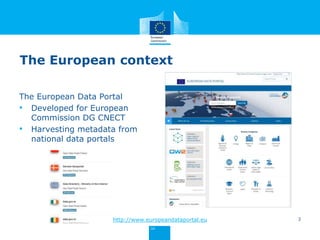
The European Data Portal
• Developed for European
Commission DG CNECT
• Harvesting metadata from
national data portals
3http://www.europeandataportal.eu
The European context
The challenge: data silos
• The data landscape consists of many data silos:
o Statistical data, geospatial data, legal data, research data, archival data, etc.
• Many of these silos build portals with metadata:
o http://ec.europa.eu/eurostat/data/database, http://stats.oecd.org (stats)
o http://inspire-geoportal.ec.europa.eu/ (geo)
o https://www.openaire.eu/ (research)
• These portals serve their goal for specific audiences, and the data
set could be in a variety of formats, not necessarily RDF
• The metadata describing these datasets may be curated according
to a variety of standards (DDI, SDMX, ISO 11179 etc.)
• But: No easy way to discover data across domains
4
• Bringing together metadata from a multitude of domains in one
'general data portal' to expose domain-specific data
• Using a cross-domain description standard that is able to capture
a core set of characteristics across domains:
DCAT Application Profile for data portals in Europe
• Extending cross-domain standard with additional features of
domain-specific data: GeoDCAT-AP, StatDCAT-AP
• Enabling creation of high-level index for the purpose of discovery
across domains
• NB: Local systems and domain-specific portals continue to use
specific standards: approach based on the export of metadata
according to a cross-domain standard
5
A cross-domain standard
• Application Profile of the DCAT W3C Recommendation for the
exchange of descriptions of datasets between (open) data portals
• DCAT-AP was developed for specific use in Europe, among others
to support the European Data Portal
• StatDCAT-AP: extension of DCAT-AP enabling cross-portal search
for statistical data sets
• Extend DCAT-AP by adding:
o Metadata elements from statistical standards (e.g. SDMX)
o Recommendations for use of specific controlled vocabularies
6
What is StatDCAT-AP
StatDCAT-AP Working Group
• Chair: Eurostat and EU Publications Office
• Stakeholders
The ISA and ISA² Programme of the European Commission, other Directorates
General (DGs) of the European Commission, other European Union institutions,
representatives of NSIs, int. agencies, experts in the domain of publishing statistical
data, representatives of consumers such as Digital Agenda Scoreboard,
representatives of the European Data Portal.
• Meetings
o Five meetings took place so far, including one face to face meeting. The next
meeting will take place on 14 November 2016.
o Presentations and minutes-discussions from the meetings are available on
Joinup: https://joinup.ec.europa.eu/node/152858.
7
What StatDCAT-AP is
Current status
Using StatDCAT-AP
StatDCAT-AP and SDMX
Future steps
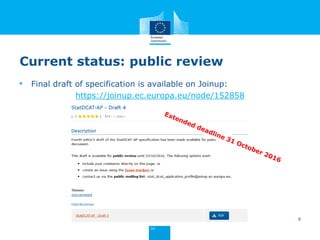
Current status: public review
• Final draft of specification is available on Joinup:
https://joinup.ec.europa.eu/node/152858
9
What StatDCAT-AP is
Current status
Using StatDCAT-AP
StatDCAT-AP and SDMX
Future steps
Using StatDCAT-AP in practice
• Many statistical datasets are of interest to the general data portals
and their users. Using StatDCAT-AP helps general data portals to
provide enhanced services for collections of statistical data.
• Statistical data providers (e.g. organisations, Member States) can
increase the discoverability of their statistical datasets by
including descriptions of the datasets in data portals.
• Statistical data users (e.g. national statistic officers) can explore,
find, identify and select statistical datasets coming from
different portals.
• StatDCAT-AP facilitates a better integration of existing
statistical data portals with the open data portals, improving the
discoverability of statistical datasets.
11
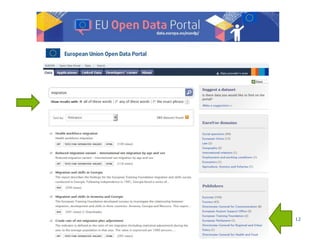
12
EU Data Portal – supports DCAT-AP
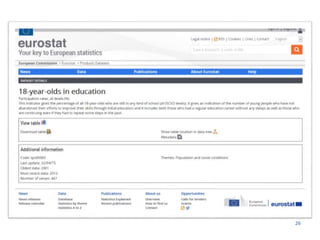
Overview of StatDCAT-AP – improvements to the data
discovery experience
15
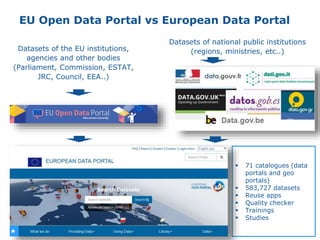
Datasets of national public institutions
(regions, ministries, etc..)Datasets of the EU institutions,
agencies and other bodies
(Parliament, Commission, ESTAT,
JRC, Council, EEA..)
 71 catalogues (data
portals and geo
portals)
 583,727 datasets
 Reuse apps
 Quality checker
 Trainings
 Studies
EU Open Data Portal vs European Data Portal
17
18
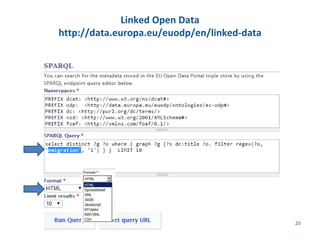
Linked Open Data
http://data.europa.eu/euodp/en/linked-data
19
20
21
22
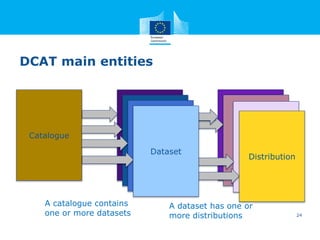
DCAT main entities
Catalogue Dataset Distribution
Dataset
Dataset
Distribution
Distribution
A catalogue contains
one or more datasets
A dataset has one or
more distributions
Dataset
Distribution
23
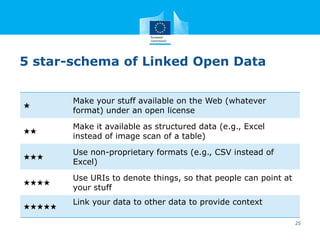
5 star-schema of Linked Open Data
★
Make your stuff available on the Web (whatever
format) under an open license
★★
Make it available as structured data (e.g., Excel
instead of image scan of a table)
★★★
Use non-proprietary formats (e.g., CSV instead of
Excel)
★★★★
Use URIs to denote things, so that people can point at
your stuff
★★★★★
Link your data to other data to provide context
24
25
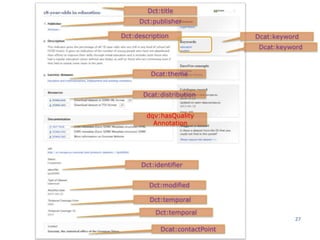
Dct:description
Dcat:theme
dqv:hasQuality
Annotation
Dct:identifier
Dct:modified
Dct:temporal
Dct:temporal
Dcat:contactPoint
Dct:title
Dct:publisher
Dcat:distribution
Dcat:keyword
Dcat:keyword
26
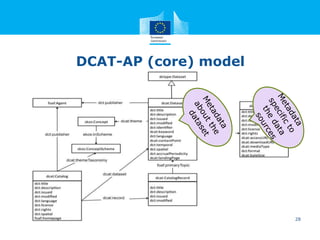
DCAT-AP (core) model
27
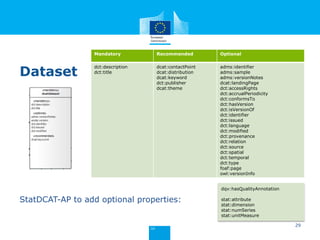
Dataset
Mandatory Recommended Optional
dct:description
dct:title
dcat:contactPoint
dcat:distribution
dcat:keyword
dct:publisher
dcat:theme
adms:identifier
adms:sample
adms:versionNotes
dcat:landingPage
dct:accessRights
dct:accrualPeriodicity
dct:conformsTo
dct:hasVersion
dct:isVersionOf
dct:identifier
dct:issued
dct:language
dct:modified
dct:provenance
dct:relation
dct:source
dct:spatial
dct:temporal
dct:type
foaf:page
owl:versionInfo
StatDCAT-AP to add optional properties:
dqv:hasQualityAnnotation
stat:attribute
stat:dimension
stat:numSeries
stat:unitMeasure
28
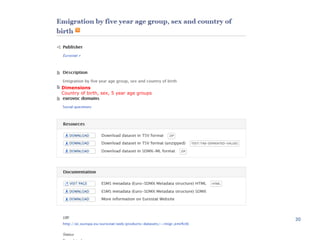
Dimensions
Country of birth, sex, 5 year age groups
29
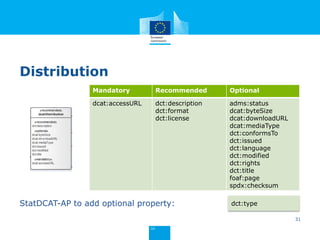
Distribution
Mandatory Recommended Optional
dcat:accessURL dct:description
dct:format
dct:license
adms:status
dcat:byteSize
dcat:downloadURL
dcat:mediaType
dct:conformsTo
dct:issued
dct:language
dct:modified
dct:rights
dct:title
foaf:page
spdx:checksum
StatDCAT-AP to add optional property: dct:type
30
What StatDCAT-AP is
Current status
Using StatDCAT-AP
StatDCAT-AP and SDMX
Future steps
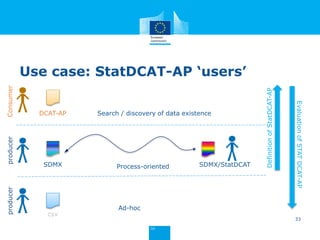
Use case: StatDCAT-AP ‘users’
Process-oriented
Ad-hoc
SDMX SDMX/StatDCAT
csv
DCAT-AP Search / discovery of data existence
Consumerproducerproducer
DefinitionofStatDCAT-AP
EvaluationofSTATDCAT-AP
32
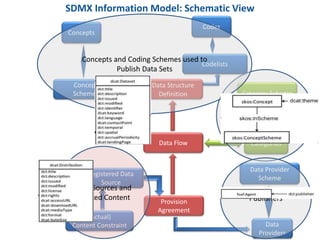
Data Flow
Data
Providers
Data Provider
Scheme
Provision
Agreement
Registered Data
Source
Data Structure
Definition Category Scheme
Categories
(Actual)
Content Constraint
Concepts
Concept
Schemes
Codes
Codelists
Data Sources and
Indexed Content
Topics
Publishers
Concepts and Coding Schemes used to
Publish Data Sets
SDMX Information Model: Schematic View
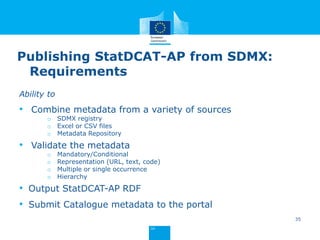
Publishing StatDCAT-AP from SDMX:
Requirements
Ability to
• Combine metadata from a variety of sources
o SDMX registry
o Excel or CSV files
o Metadata Repository
• Validate the metadata
o Mandatory/Conditional
o Representation (URL, text, code)
o Multiple or single occurrence
o Hierarchy
• Output StatDCAT-AP RDF
• Submit Catalogue metadata to the portal
34
StatDCAT-AP
A New Dawn in Statistical Data
Discovery
What StatDCAT-AP is
Current status
Using StatDCAT-AP
StatDCAT-AP and SDMX
Future steps
Future work: Quality
• Quality aspects are very important for datasets in
general and statistical datasets in particular
• Due to time and resource constraints, current version
of StatDCAT-AP does not fully address the issue
o Short-term: provide mechanism to link to existing quality
information in StatDCAT-AP, version 1
o Longer-term: consider integrated quality framework as basis
for extensions to StatDCAT-AP, version 2
37
Quality, longer-term: SIMS
• Eurostat's Single Integrated Metadata Structure
includes specific quality aspects:
o e.g. Accessibility and clarity; Quality management; Relevance;
Accuracy and reliability; Timeliness and punctuality;
Coherence and comparability
• This set of aspects can form the basis for future
extensions to StatDCAT-AP, or even to DCAT-AP
38
Future steps
• Publication of final version after comments received
during public review (end of 2016)
• Full support of StatDCAT-AP from EU and European
Open Data Portals
• Piloting
• Building experiences
• Revising standard taking into account lessons learnt,
quality aspects,…
39
Joinup: https://joinup.ec.europa.eu/asset/stat_dcat_application_profile/description
Visit ISA initiatives
Get involved
mail@makxdekkers.com
stefanos.kotoglou@be.pwc.com
chris.nelson@metadatatechnology.com
marco.pellegrino@ec.europa.eu
norbert.hohn@publications.europa.eu
vassilios.peristeras@ec.europa.eu

StatDCAT-Application Profile: presentation

  • 1.
    StatDCAT-AP A Common Layerfor the Exchange of Statistical Metadata in Open Data Portals Semstats 2016, October 18 Makx Dekkers, Stefanos Kotoglou, Chris Nelson, Norbert Hohn, Marco Pellegrino, Vassilios Peristeras
  • 2.
    What StatDCAT-AP is Currentstatus Using StatDCAT-AP StatDCAT-AP and SDMX Future steps
  • 3.
    The European DataPortal • Developed for European Commission DG CNECT • Harvesting metadata from national data portals 3http://www.europeandataportal.eu The European context
  • 4.
    The challenge: datasilos • The data landscape consists of many data silos: o Statistical data, geospatial data, legal data, research data, archival data, etc. • Many of these silos build portals with metadata: o http://ec.europa.eu/eurostat/data/database, http://stats.oecd.org (stats) o http://inspire-geoportal.ec.europa.eu/ (geo) o https://www.openaire.eu/ (research) • These portals serve their goal for specific audiences, and the data set could be in a variety of formats, not necessarily RDF • The metadata describing these datasets may be curated according to a variety of standards (DDI, SDMX, ISO 11179 etc.) • But: No easy way to discover data across domains 4
  • 5.
    • Bringing togethermetadata from a multitude of domains in one 'general data portal' to expose domain-specific data • Using a cross-domain description standard that is able to capture a core set of characteristics across domains: DCAT Application Profile for data portals in Europe • Extending cross-domain standard with additional features of domain-specific data: GeoDCAT-AP, StatDCAT-AP • Enabling creation of high-level index for the purpose of discovery across domains • NB: Local systems and domain-specific portals continue to use specific standards: approach based on the export of metadata according to a cross-domain standard 5 A cross-domain standard
  • 6.
    • Application Profileof the DCAT W3C Recommendation for the exchange of descriptions of datasets between (open) data portals • DCAT-AP was developed for specific use in Europe, among others to support the European Data Portal • StatDCAT-AP: extension of DCAT-AP enabling cross-portal search for statistical data sets • Extend DCAT-AP by adding: o Metadata elements from statistical standards (e.g. SDMX) o Recommendations for use of specific controlled vocabularies 6 What is StatDCAT-AP
  • 7.
    StatDCAT-AP Working Group •Chair: Eurostat and EU Publications Office • Stakeholders The ISA and ISA² Programme of the European Commission, other Directorates General (DGs) of the European Commission, other European Union institutions, representatives of NSIs, int. agencies, experts in the domain of publishing statistical data, representatives of consumers such as Digital Agenda Scoreboard, representatives of the European Data Portal. • Meetings o Five meetings took place so far, including one face to face meeting. The next meeting will take place on 14 November 2016. o Presentations and minutes-discussions from the meetings are available on Joinup: https://joinup.ec.europa.eu/node/152858. 7
  • 8.
    What StatDCAT-AP is Currentstatus Using StatDCAT-AP StatDCAT-AP and SDMX Future steps
  • 9.
    Current status: publicreview • Final draft of specification is available on Joinup: https://joinup.ec.europa.eu/node/152858 9
  • 10.
    What StatDCAT-AP is Currentstatus Using StatDCAT-AP StatDCAT-AP and SDMX Future steps
  • 11.
    Using StatDCAT-AP inpractice • Many statistical datasets are of interest to the general data portals and their users. Using StatDCAT-AP helps general data portals to provide enhanced services for collections of statistical data. • Statistical data providers (e.g. organisations, Member States) can increase the discoverability of their statistical datasets by including descriptions of the datasets in data portals. • Statistical data users (e.g. national statistic officers) can explore, find, identify and select statistical datasets coming from different portals. • StatDCAT-AP facilitates a better integration of existing statistical data portals with the open data portals, improving the discoverability of statistical datasets. 11
  • 12.
  • 13.
    EU Data Portal– supports DCAT-AP Overview of StatDCAT-AP – improvements to the data discovery experience
  • 15.
  • 16.
    Datasets of nationalpublic institutions (regions, ministries, etc..)Datasets of the EU institutions, agencies and other bodies (Parliament, Commission, ESTAT, JRC, Council, EEA..)  71 catalogues (data portals and geo portals)  583,727 datasets  Reuse apps  Quality checker  Trainings  Studies EU Open Data Portal vs European Data Portal
  • 17.
  • 18.
  • 19.
  • 20.
  • 21.
  • 22.
  • 23.
    DCAT main entities CatalogueDataset Distribution Dataset Dataset Distribution Distribution A catalogue contains one or more datasets A dataset has one or more distributions Dataset Distribution 23
  • 24.
    5 star-schema ofLinked Open Data ★ Make your stuff available on the Web (whatever format) under an open license ★★ Make it available as structured data (e.g., Excel instead of image scan of a table) ★★★ Use non-proprietary formats (e.g., CSV instead of Excel) ★★★★ Use URIs to denote things, so that people can point at your stuff ★★★★★ Link your data to other data to provide context 24
  • 25.
  • 26.
  • 27.
  • 28.
  • 29.
    Dimensions Country of birth,sex, 5 year age groups 29
  • 30.
    Distribution Mandatory Recommended Optional dcat:accessURLdct:description dct:format dct:license adms:status dcat:byteSize dcat:downloadURL dcat:mediaType dct:conformsTo dct:issued dct:language dct:modified dct:rights dct:title foaf:page spdx:checksum StatDCAT-AP to add optional property: dct:type 30
  • 31.
    What StatDCAT-AP is Currentstatus Using StatDCAT-AP StatDCAT-AP and SDMX Future steps
  • 32.
    Use case: StatDCAT-AP‘users’ Process-oriented Ad-hoc SDMX SDMX/StatDCAT csv DCAT-AP Search / discovery of data existence Consumerproducerproducer DefinitionofStatDCAT-AP EvaluationofSTATDCAT-AP 32
  • 33.
    Data Flow Data Providers Data Provider Scheme Provision Agreement RegisteredData Source Data Structure Definition Category Scheme Categories (Actual) Content Constraint Concepts Concept Schemes Codes Codelists Data Sources and Indexed Content Topics Publishers Concepts and Coding Schemes used to Publish Data Sets SDMX Information Model: Schematic View
  • 34.
    Publishing StatDCAT-AP fromSDMX: Requirements Ability to • Combine metadata from a variety of sources o SDMX registry o Excel or CSV files o Metadata Repository • Validate the metadata o Mandatory/Conditional o Representation (URL, text, code) o Multiple or single occurrence o Hierarchy • Output StatDCAT-AP RDF • Submit Catalogue metadata to the portal 34
  • 35.
    StatDCAT-AP A New Dawnin Statistical Data Discovery
  • 36.
    What StatDCAT-AP is Currentstatus Using StatDCAT-AP StatDCAT-AP and SDMX Future steps
  • 37.
    Future work: Quality •Quality aspects are very important for datasets in general and statistical datasets in particular • Due to time and resource constraints, current version of StatDCAT-AP does not fully address the issue o Short-term: provide mechanism to link to existing quality information in StatDCAT-AP, version 1 o Longer-term: consider integrated quality framework as basis for extensions to StatDCAT-AP, version 2 37
  • 38.
    Quality, longer-term: SIMS •Eurostat's Single Integrated Metadata Structure includes specific quality aspects: o e.g. Accessibility and clarity; Quality management; Relevance; Accuracy and reliability; Timeliness and punctuality; Coherence and comparability • This set of aspects can form the basis for future extensions to StatDCAT-AP, or even to DCAT-AP 38
  • 39.
    Future steps • Publicationof final version after comments received during public review (end of 2016) • Full support of StatDCAT-AP from EU and European Open Data Portals • Piloting • Building experiences • Revising standard taking into account lessons learnt, quality aspects,… 39
  • 40.
    Joinup: https://joinup.ec.europa.eu/asset/stat_dcat_application_profile/description Visit ISAinitiatives Get involved mail@makxdekkers.com stefanos.kotoglou@be.pwc.com chris.nelson@metadatatechnology.com marco.pellegrino@ec.europa.eu norbert.hohn@publications.europa.eu vassilios.peristeras@ec.europa.eu

Editor's Notes

  • #4 When we say “data”, in the statistical community, we are referring to numeric data of a very specific type: statistics! The LOD definition is much broader! When we say “raw data”, in the statistical community, we mean confidential responses from individuals to surveys It is illegal to put this directly on the Web, and for good reasons!
  • #7 Focus on use cases: Improving discovery of statistical data sets in open data portals Facilitating integration of statistical data sets with open data from other domains
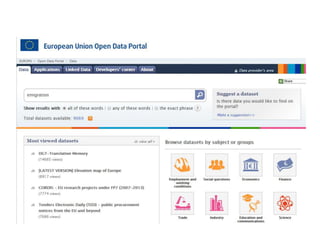
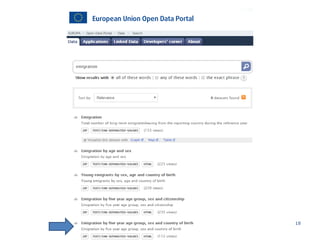
  • #13 EU Open Data Portal is a single point of access to the data from EU institutions. For example the user can find data on migration coming from Eurostat, other European Commission DGs, the EU agencies working on this topic like FRONTEX or Asylum Support Office
  • #15 EU Open Data Portal is a single point of access to the data from EU institutions. For example the user can find data on migration coming from Eurostat, other European Commission DGs, the EU agencies working on this topic like FRONTEX or Asylum Support Office
  • #17 Datasets of national public institutions (regions, ministries, etc..) National open data portals (managed by each State)
  • #18 EU Open Data Portal is a single point of access to the data from EU institutions. For example the user can find data on migration coming from Eurostat, other European Commission DGs, the EU agencies working on this topic like FRONTEX or Asylum Support Office
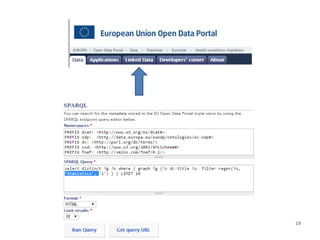
  • #20  The metadata on migration can be also retrieved from RDF triple store using SPARQL query SELECT distinct ?graphURL ?title WHERE{ graph ?graphURL {?s dc:title ?title. filter REGEX(?title, 'migration', 'i') } } LIMIT 100 The result can be obtained in various formats: html, spreadsheet, xml, json, javascript, ntriples, RDF/XML, CSV
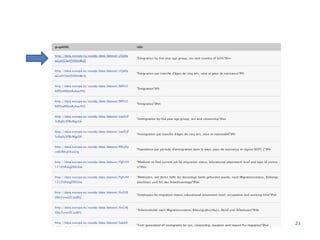
  • #21  An example of the result in html format. When the user clicks on the URL he can see more metadata on this dataset
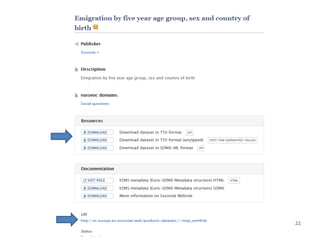
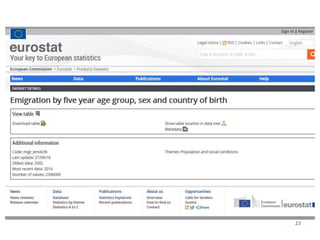
  • #22 The user can download the files with data or go to the source: EUROSTAT
  • #30  The user can download the files with data or go to the source: EUROSTAT
  • #34  This is a schematic view of the constructs in the SDMX Information Model that can be used to aid data discovery In the SDMX Information Model the construct that is the target of the search is the Dataflow. The Dataflow is a conceptual data set. It links to the data structure and the data provider(s), and is, essentially, a specification of data that can be collected or disseminated. The actual existence of data for either collection or dissemination is determined by the Registered Data Source which identifies the location of the data set and how it can be accessed. Data can be discovered either via a topic scheme (e.g. statistical themes – these can be hierarchical), by data provider (i.e. the publisher), or via the Concepts or the Codes used in the data structure.
  • #35 Focus on use cases: Improving discovery of statistical data sets in open data portals Facilitating integration of statistical data sets with open data from other domains