Ontology Engineering at Scale for
Open City Data Sharing
School of Informatics, The University of Edinburgh
13/05/2019
With contributions from María Poveda, Raúl García-Castro
and Paola Espinoza
Oscar Corcho
ocorcho@fi.upm.es
@ocorcho, @opencitydata_es
https://www.slideshare.com/ocorcho
License
• This work is licensed under the license
CC BY-NC-SA 4.0 International
• http://purl.org/NET/rdflicense/cc-by-nc-sa4.0
• You are free:
• to Share — to copy, distribute and transmit the work
• to Remix — to adapt the work
• Under the following conditions
• Attribution — You must attribute the work by inserting
• “[source Oscar Corcho]” at the footer of each reused slide
• a credits slide stating: “These slides are partially based on
“Ontology Engineering at Scale for Open City Data Sharing”
by O. Corcho”
• Non-commercial
• Share-Alike
Talk Objectives
• Share some experiences in the application of Open
Data principles for cities (in Spain)
• Technical challenges and opportunities
• Barriers for adoption
• Required organisational changes for successful Open Data
strategies
• With a special focus on how ontologies (aka agreed
vocabularies and shared data structures) can make a
difference
• Small bias towards how we are doing it in Spain
• And how we are adapting existing ontology
engineering practices to achieve this goal
Ontology Engineering at Scale for
Open City Data Sharing
Building Agreed Vocabularies and
Data Structures for Successful
Open City Data Sharing
Building Agreed Vocabularies and
Data Structures for Successful
Open City Data Sharing
What is Open Data?
• Open data is data that can be freely used, re-used
and redistributed by anyone - subject only, at most, to
the requirement to attribute and sharealike
• Key aspects:
• Availability and access: the data must be available as a
whole and at no more than a reasonable reproduction cost,
preferably by downloading over the Internet. The data must
also be available in a convenient and modifiable form.
• Re-use and redistribution: the data must be provided
under terms that permit re-use and redistribution including
the intermixing with other datasets.
• Universal participation: everyone must be able to use, re-
use and redistribute - there should be no discrimination
against fields of endeavour or against persons or groups
[source: Open Data Handbook, http://opendatahandbook.org/en/what-is-open-data/ ]
Relevant Legislation. Europe and Spain
• Open Access Initiative (2001). Scientific information; > 510 orgs
• Aarhus Convention (1998). Right to participate and access; 41
countries and the EU
• Convention on official documentation access (2009). 12 countries
• PSI-reuse Directives. (2003/98/EC, 2013/37/UE and upcoming one
based on agreement on 22/01/2019)
• https://ec.europa.eu/digital-single-market/en/european-legislation-reuse-public-sector-information
• Law 37/2007. PSI reuse (transposition of directive 2003/98/EC)
• Modified in law 18/2015 (BOE 10/07/2015, directive 2013/37/UE)
• Law 11/2007. Citizen access to public services, and rights to good
quality services
• RD 4/2010 Esquema Nacional de Interoperabilidad
• Open standards, technology neutral, open source
• RD 1495/2011 It develops Law 37/2007 for national agencies
• Norma Técnica de Interoperabilidad (19/02/2013, BOE 4/3/2013)
[source: based on material from Antonio Rodríguez Pascual (CNIG)]
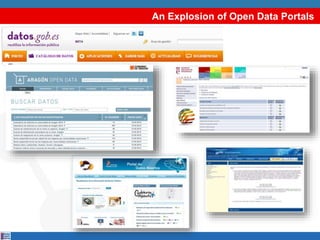
An Explosion of Open Data Portals
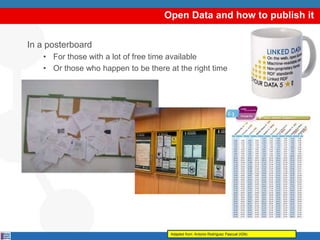
Open Data and how to publish it
In a posterboard
• For those with a lot of free time available
• Or those who happen to be there at the right time
Adapted from: Antonio Rodríguez Pascual (IGN)
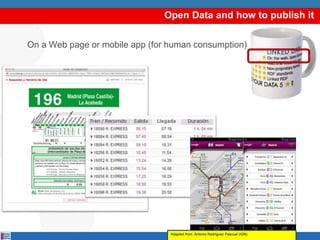
Open Data and how to publish it
On a Web page or mobile app (for human consumption)
Adapted from: Antonio Rodríguez Pascual (IGN)
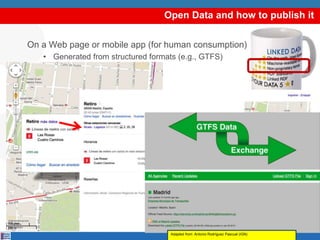
Open Data and how to publish it
On a Web page or mobile app (for human consumption)
• Generated from structured formats (e.g., GTFS)
Adapted from: Antonio Rodríguez Pascual (IGN)
Open Data and how to publish it
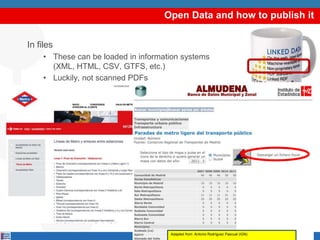
In files
• These can be loaded in information systems
(XML, HTML, CSV, GTFS, etc.)
• Luckily, not scanned PDFs
Adapted from: Antonio Rodríguez Pascual (IGN)
Open Data and how to publish it
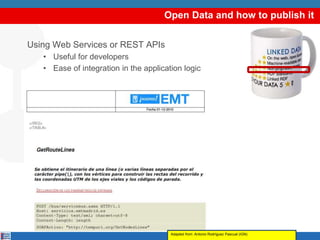
Using Web Services or REST APIs
• Useful for developers
• Ease of integration in the application logic
Adapted from: Antonio Rodríguez Pascual (IGN)
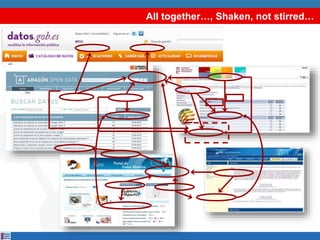
All together…, Shaken, not stirred…
Open Data and how to publish it
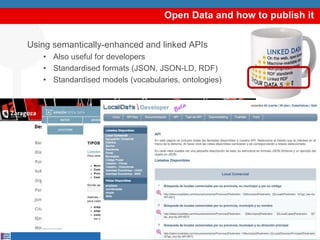
Using semantically-enhanced and linked APIs
• Also useful for developers
• Standardised formats (JSON, JSON-LD, RDF)
• Standardised models (vocabularies, ontologies)
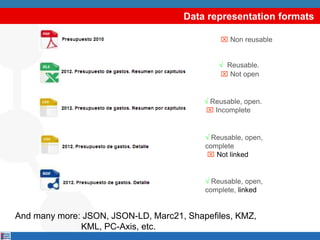
 Non reusable
√ Reusable.
 Not open
√ Reusable, open.
 Incomplete
√ Reusable, open,
complete
 Not linked
√ Reusable, open,
complete, linked
Data representation formats
And many more: JSON, JSON-LD, Marc21, Shapefiles, KMZ,
KML, PC-Axis, etc.
Building Agreed Vocabularies and
Data Structures for Successful
Open City Data Sharing
Why our interest in cities
• Regional and national datasets are useful to provide
indicators, comparisons across countries, etc.
• However, local datasets are usually better for the
generation of economical and/or social value
• Closer to people
• Closer to businesses
• Closer to developers
Why our interest in cities
• Node of the Open Data Institute for Madrid
• Spin-off focused on providing open data support to
municipalities
• Involved in:
• Leaders of the Spanish thematic network on Open Data for
Smart Cities
• Leaders of the UNE178301:2015 technical norm on Open
Data for Smart Cities
• Core team members of the FEMP (Spanish Federation of
Municipalities and Provinces) working group on Open Data
• Technical and innovation support for local open data
initiatives (Zaragoza, Madrid, Alcobendas, Rivas-
Vaciamadrid, Arganda del Rey)
• Also national (http://datos.gob.es/) and regional (Aragón,
Comunidad de Madrid, CRTM)
Project Ciudades Abiertas (funded by red.es)
INICIATIVA PLATAFORMA DE GOBIERNO ABIERTO,
COLABORATIVA E INTEROPERABLE (121/17-SP)
July 2018 – June 2020
More details at http://www.ciudadesabiertas.es/ (Spanish)
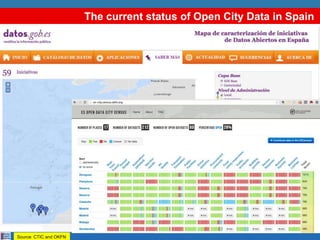
The current status of Open City Data in Spain
Source: CTIC and OKFN
Open Data Portals in Spain
• Around 60 open data portals for Spanish cities (and
growing)
• Gijón, Santander, Bilbao, Azkoitia, Azpeitia, San Sebastián,
Pamplona, Zaragoza, Lleida, Manresa, Barcelona,
Badalona, El Prat, Cornellá, Viladecans, Gavá (and a few
more in Barcelona’s province), Tarragona, Valladolid,
Alcobendas, Madrid, Cáceres, Valencia, Lorca, Málaga,
Arona, etc.
• Also regional open data portals
• Many of which aggregate local data
• Cabildo de Tenerife, Diputación de Málaga, Gobierno de
Aragón, etc.
• And national institutions, public companies, etc.
Relevant legislation for cities
• City Ordinances on Transparency, Access and
Reuse of Information
• Zaragoza: http://www.zaragoza.es/ciudadania/gobierno-
abierto/participar/detalle_Normativa?id=3983
• Initial draft (25/06/2012)
• Final approval (01/04/2014)
• Template from the Spanish Federation of Municipalities and
Provinces - FEMP (may 2014)
• http://www.femp.es/files/11-5133-
fichero/Ordenanza%20Transparencia,%20Acceso%20y
%20Reutilizaci%C3%B3n%20de%20la%20informaci%C
3%B3n.pdf
• 2015. UNE 178301. Ciudades Inteligentes. Datos
abiertos (Open Data). MINETUR Y AENOR
• More about this to come later in this presentation
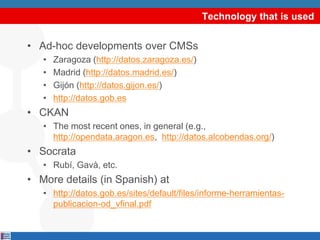
Technology that is used
• Ad-hoc developments over CMSs
• Zaragoza (http://datos.zaragoza.es/)
• Madrid (http://datos.madrid.es/)
• Gijón (http://datos.gijon.es/)
• http://datos.gob.es
• CKAN
• The most recent ones, in general (e.g.,
http://opendata.aragon.es, http://datos.alcobendas.org/)
• Socrata
• Rubí, Gavà, etc.
• More details (in Spanish) at
• http://datos.gob.es/sites/default/files/informe-herramientas-
publicacion-od_vfinal.pdf
Building Agreed Vocabularies and
Data Structures for Successful
Open City Data Sharing
Building Agreed Vocabularies and
Data Structures for Successful
Open City Data Sharing
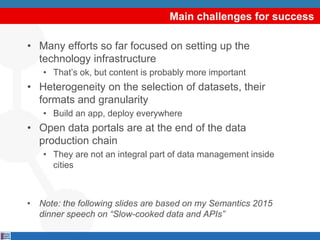
Main challenges for success
• Many efforts so far focused on setting up the
technology infrastructure
• That’s ok, but content is probably more important
• Heterogeneity on the selection of datasets, their
formats and granularity
• Build an app, deploy everywhere
• Open data portals are at the end of the data
production chain
• They are not an integral part of data management inside
cities
• Note: the following slides are based on my Semantics 2015
dinner speech on “Slow-cooked data and APIs”
Rule 1.
Chop your onions
appropriately
Rule 1. Chop your onions appropriately
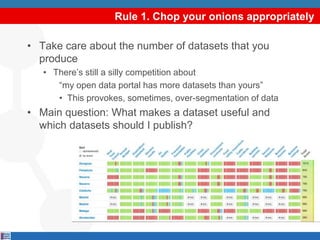
• Take care about the number of datasets that you
produce
• There’s still a silly competition about
“my open data portal has more datasets than yours”
• This provokes, sometimes, over-segmentation of data
• Main question: What makes a dataset useful and
which datasets should I publish?
Rule 1. Chop your onions appropriately
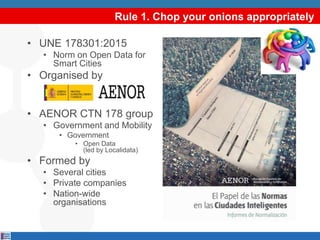
• UNE 178301:2015
• Norm on Open Data for
Smart Cities
• Organised by
• AENOR CTN 178 group
• Government and Mobility
• Government
• Open Data
(led by Localidata)
• Formed by
• Several cities
• Private companies
• Nation-wide
organisations
Rule 1. Chop your onions appropriately
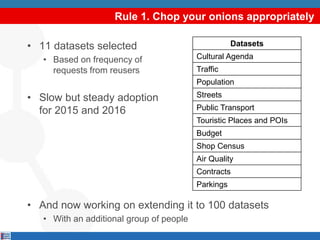
• 11 datasets selected
• Based on frequency of
requests from reusers
• Slow but steady adoption
for 2015 and 2016
• And now working on extending it to 100 datasets
• With an additional group of people
Datasets
Cultural Agenda
Traffic
Population
Streets
Public Transport
Touristic Places and POIs
Budget
Shop Census
Air Quality
Contracts
Parkings
Rule 2.
Add some spices,
but not too many
Rule 2. Add some spices, but not too many
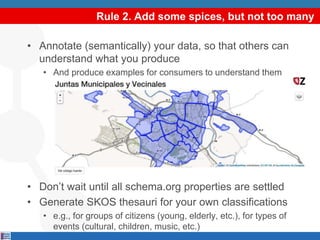
• Annotate (semantically) your data, so that others can
understand what you produce
• And produce examples for consumers to understand them
• Don’t wait until all schema.org properties are settled
• Generate SKOS thesauri for your own classifications
• e.g., for groups of citizens (young, elderly, etc.), for types of
events (cultural, children, music, etc.)
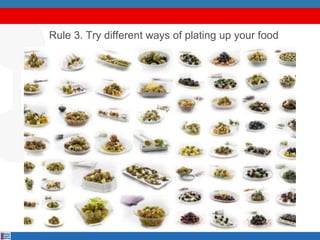
Rule 3. Try different ways of plating up your food
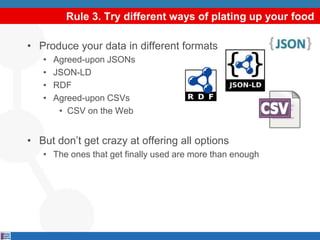
• Produce your data in different formats
• Agreed-upon JSONs
• JSON-LD
• RDF
• Agreed-upon CSVs
• CSV on the Web
• But don’t get crazy at offering all options
• The ones that get finally used are more than enough
Rule 4.
Let children appreciate (and cook) open data
Rule 4. Let children appreciate (and cook) open data
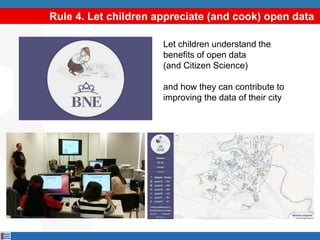
Let children understand the
benefits of open data
(and Citizen Science)
and how they can contribute to
improving the data of their city
Rule 5….
Eat your own dog food
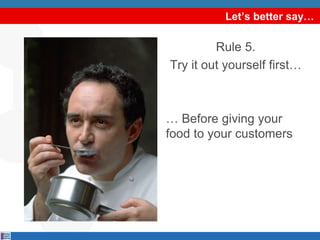
Let’s better say…
Rule 5.
Try it out yourself first…
… Before giving your
food to your customers
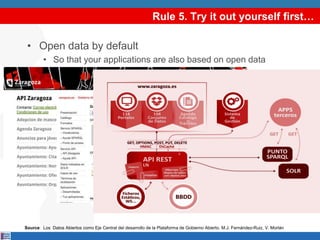
Rule 5. Try it out yourself first…
• Open data by default
• So that your applications are also based on open data
Source: Los Datos Abiertos como Eje Central del desarrollo de la Plataforma de Gobierno Abierto. M.J. Fernández-Ruiz, V. Morlán
Building Agreed Vocabularies and
Data Structures for Successful
Open City Data Sharing
Building Agreed Vocabularies and
Data Structures for Successful
Open City Data Sharing
Whom of you has never ever eaten a burger in his/her life?
If you are vegetarian or vegan, we can think of something else
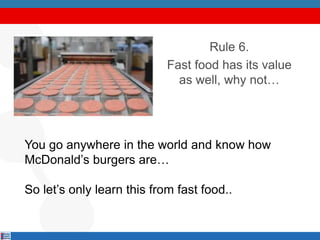
Rule 6.
Fast food has its value
as well, why not…
You go anywhere in the world and know how
McDonald’s burgers are…
So let’s only learn this from fast food..
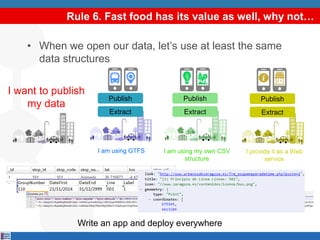
Rule 6. Fast food has its value as well, why not…
• When we open our data, let’s use at least the same
data structures
Publish
Extract
Publish
Extract
Publish
Extract
I want to publish
my data
I am using GTFS I am using my own CSV
structure
I provide it as a Web
service
Write an app and deploy everywhere
Rule 6. Fast food has its value as well, why not…
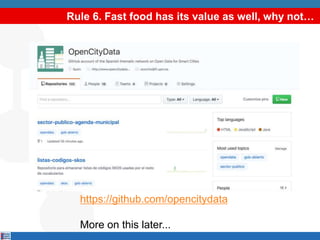
https://github.com/opencitydata
More on this later...
So, are we ready to start cooking our open data better?
Open Data as a socio-technical problem
• As you may have seen already, it is not all about
technology, but mostly a socio-technical challenge
The path towards establishing these agreements...
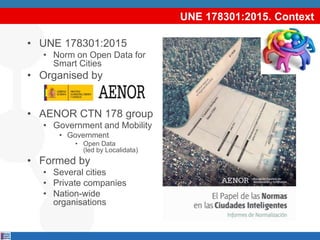
UNE 178301:2015. Context
• UNE 178301:2015
• Norm on Open Data for
Smart Cities
• Organised by
• AENOR CTN 178 group
• Government and Mobility
• Government
• Open Data
(led by Localidata)
• Formed by
• Several cities
• Private companies
• Nation-wide
organisations
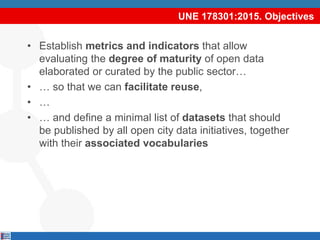
UNE 178301:2015. Objectives
• Establish metrics and indicators that allow
evaluating the degree of maturity of open data
elaborated or curated by the public sector…
• … so that we can facilitate reuse,
• …
• … and define a minimal list of datasets that should
be published by all open city data initiatives, together
with their associated vocabularies
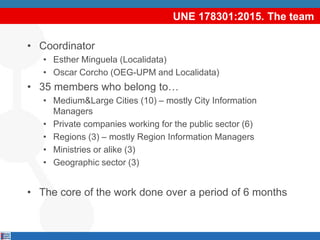
UNE 178301:2015. The team
• Coordinator
• Esther Minguela (Localidata)
• Oscar Corcho (OEG-UPM and Localidata)
• 35 members who belong to…
• Medium&Large Cities (10) – mostly City Information
Managers
• Private companies working for the public sector (6)
• Regions (3) – mostly Region Information Managers
• Ministries or alike (3)
• Geographic sector (3)
• The core of the work done over a period of 6 months
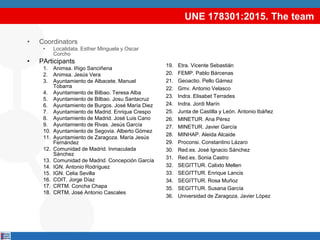
UNE 178301:2015. The team
• Coordinators
• Localidata. Esther Minguela y Oscar
Corcho
• PArticipants
1. Animsa. Iñigo Sanciñena
2. Animsa. Jesús Vera
3. Ayuntamiento de Albacete. Manuel
Tobarra
4. Ayuntamiento de Bilbao. Teresa Alba
5. Ayuntamiento de Bilbao. Josu Santacruz
6. Ayuntamiento de Burgos. José María Diez
7. Ayuntamiento de Madrid. Enrique Crespo
8. Ayuntamiento de Madrid. José Luis Cano
9. Ayuntamiento de Rivas. Jesús García
10. Ayuntamiento de Segovia. Alberto Gómez
11. Ayuntamiento de Zaragoza. María Jesús
Fernández
12. Comunidad de Madrid. Inmaculada
Sánchez
13. Comunidad de Madrid. Concepción García
14. IGN. Antonio Rodríguez
15. IGN. Celia Sevilla
16. COIT. Jorge Díaz
17. CRTM. Concha Chapa
18. CRTM. José Antonio Cascales
19. Etra. Vicente Sebastián
20. FEMP. Pablo Bárcenas
21. Geoactio. Pello Gámez
22. Gmv. Antonio Velasco
23. Indra. Elisabet Terrades
24. Indra. Jordi Marín
25. Junta de Castilla y León. Antonio Ibáñez
26. MINETUR. Ana Pérez
27. MINETUR. Javier García
28. MINHAP. Aleida Alcaide
29. Proconsi. Constantino Lázaro
30. Red.es. José Ignacio Sánchez
31. Red.es. Sonia Castro
32. SEGITTUR. Calixto Mellen
33. SEGITTUR. Enrique Lancis
34. SEGITTUR. Rosa Muñoz
35. SEGITTUR. Susana García
36. Universidad de Zaragoza. Javier López
Strategy
Strategy
Legal
Legal
Organisational
Organisation
Measurements
Technical
Availability
Access
Data Quality
Update
Socio-economic
Reuse
Participation and Collaboration
UNE178301:2015. Metrics
Domains
Dimensions
Raw data
Completeness
Documentation
Correctness
Geo-referencing
Linked Data
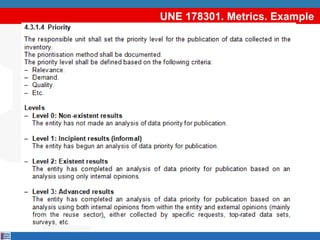
UNE 178301. Metrics. Example
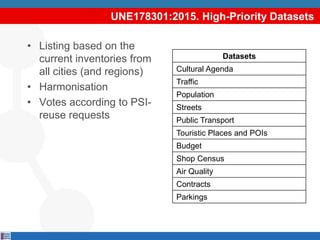
UNE178301:2015. High-Priority Datasets
• Listing based on the
current inventories from
all cities (and regions)
• Harmonisation
• Votes according to PSI-
reuse requests
Datasets
Cultural Agenda
Traffic
Population
Streets
Public Transport
Touristic Places and POIs
Budget
Shop Census
Air Quality
Contracts
Parkings
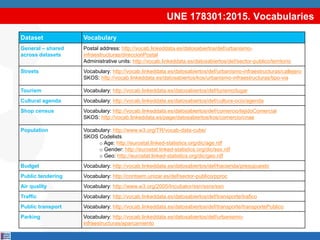
Dataset Vocabulary
General – shared
across datasets
Postal address: http://vocab.linkeddata.es/datosabiertos/def/urbanismo-
infraestructuras/direccionPostal
Administrative units: http://vocab.linkeddata.es/datosabiertos/def/sector-publico/territorio
Streets Vocabulary: http://vocab.linkeddata.es/datosabiertos/def/urbanismo-infraestructuras/callejero
SKOS: http://vocab.linkeddata.es/datosabiertos/kos/urbanismo-infraestructuras/tipo-via
Tourism Vocabulary: http://vocab.linkeddata.es/datosabiertos/def/turismo/lugar
Cultural agenda Vocabulary: http://vocab.linkeddata.es/datosabiertos/def/cultura-ocio/agenda
Shop census Vocabulary: http://vocab.linkeddata.es/datosabiertos/def/comercio/tejidoComercial
SKOS: http://vocab.linkeddata.es/page/datosabiertos/kos/comercio/cnae
Population Vocabulary: http://www.w3.org/TR/vocab-data-cube/
SKOS Codelists
o Age: http://eurostat.linked-statistics.org/dic/age.rdf
o Gender: http://eurostat.linked-statistics.org/dic/sex.rdf
o Geo: http://eurostat.linked-statistics.org/dic/geo.rdf
Budget Vocabulary: http://vocab.linkeddata.es/datosabiertos/def/hacienda/presupuesto
Public tendering Vocabulary: http://contsem.unizar.es/def/sector-publico/pproc
Air quality Vocabulary: http://www.w3.org/2005/Incubator/ssn/ssnx/ssn
Traffic Vocabulary: http://vocab.linkeddata.es/datosabiertos/def/transporte/trafico
Public transport Vocabulary: http://vocab.linkeddata.es/datosabiertos/def/transporte/transportePublico
Parking Vocabulary: http://vocab.linkeddata.es/datosabiertos/def/urbanismo-
infraestructuras/aparcamiento
UNE 178301:2015. Vocabularies
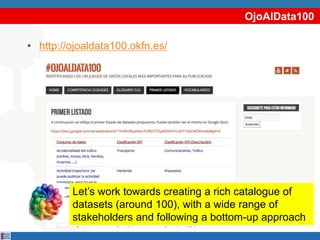
OjoAlData100
• http://ojoaldata100.okfn.es/
Let’s work towards creating a rich catalogue of
datasets (around 100), with a wide range of
stakeholders and following a bottom-up approach
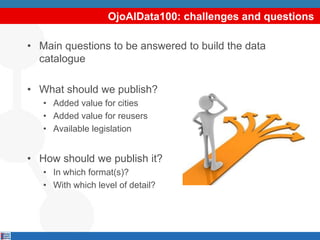
OjoAlData100: challenges and questions
• Main questions to be answered to build the data
catalogue
• What should we publish?
• Added value for cities
• Added value for reusers
• Available legislation
• How should we publish it?
• In which format(s)?
• With which level of detail?
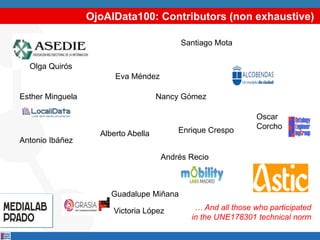
Alberto Abella
Oscar
Corcho
Esther Minguela
Victoria López
Andrés Recio
Guadalupe Miñana
Antonio Ibáñez
Eva Méndez
Nancy Gómez
Santiago Mota
Enrique Crespo
… And all those who participated
in the UNE178301 technical norm
Olga Quirós
OjoAlData100: Contributors (non exhaustive)
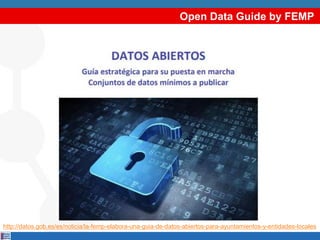
Open Data Guide by FEMP
http://datos.gob.es/es/noticia/la-femp-elabora-una-guia-de-datos-abiertos-para-ayuntamientos-y-entidades-locales
Building Agreed Vocabularies and
Data Structures for Successful
Open City Data Sharing
The need to scale up...
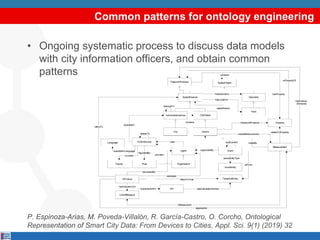
Common patterns for ontology engineering
• Ongoing systematic process to discuss data models
with city information officers, and obtain common
patterns
P. Espinoza-Arias, M. Poveda-Villalón, R. García-Castro, O. Corcho, Ontological
Representation of Smart City Data: From Devices to Cities, Appl. Sci. 9(1) (2019) 32
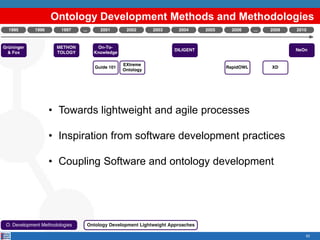
Ontology Development Methods and Methodologies
62
• Towards lightweight and agile processes
• Inspiration from software development practices
• Coupling Software and ontology development
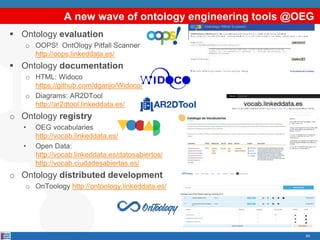
A new wave of ontology engineering tools @OEG
63
 Ontology evaluation
o OOPS! OntOlogy Pitfall Scanner
http://oops.linkeddata.es/
 Ontology documentation
o HTML: Widoco
https://github.com/dgarijo/Widoco/
o Diagrams: AR2DTool
http://ar2dtool.linkeddata.es/
o Ontology registry
• OEG vocabularies
http://vocab.linkeddata.es/
• Open Data:
http://vocab.linkeddata.es/datosabiertos/
http://vocab.ciudadesabiertas.es/
o Ontology distributed development
o OnToology http://ontoology.linkeddata.es/
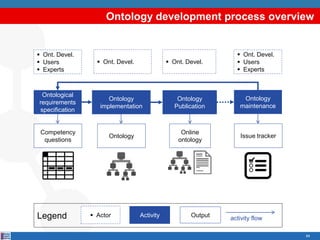
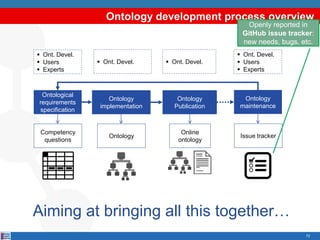
Ontology development process overview
64
Legend Activity Actor Output activity flow
Ontological
requirements
specification
Ontology
implementation
Competency
questions
 Ont. Devel.
 Ont. Devel.
 Users
 Experts
Ontology
maintenance
Issue tracker
 Ont. Devel.
 Users
 Experts
Ontology
Ontology
Publication
Online
ontology
 Ont. Devel.
Requirement specification
65
Requirement specification
Ontologica l
req uirements
comp letion
Comp etency
q uestions
(verified )
§ Ont. Devel.
§ Users
§ Exp erts
Use ca se
sp ecifica tion
Use ca ses
§ Ont. Devel.
§ Users
§ Exp erts
Da ta
excha nge
id entifica tion
Doma in
d ocumenta tion
Purp ose a nd
scop e
id entifica tion
Ontologica l
req uirements
p rop osa l
ORSD
forma liza tion
Ontology
p urp ose a nd
scop e
Comp etency
q uestions
(ea rly sta ge)
ORSD
d ocument
§ Ont. Devel.
§ Users
§ Exp erts
§ Ont. Devel.
§ [Users]
§ Ont. Devel.
✓
✓
✓
§ Users
§ Exp erts
Ontology
imp lementa tion
§ Ont. Devel.
Ontology
ma intena nce
Cha nge
req uests
§ Ont. Devel.
§ Users
§ Exp erts
Ontology
Ontology
Pub lica tion
Online
ontology
§ Ont.
Devel.
https://lists.w3.org/Archives/Public/public-wot-ig/2016Dec/0016.html
http://w3c.github.io/wot/current-practices/wot-practices
Requirement specification
66
Requirement specification
Ontologica l
req uirements
comp letion
Comp etency
q uestions
(verified )
§ Ont. Devel.
§ Users
§ Exp erts
Use ca se
sp ecifica tion
Use ca ses
§ Ont. Devel.
§ Users
§ Exp erts
Da ta
excha nge
id entifica tion
Doma in
d ocumenta tion
Purp ose a nd
scop e
id entifica tion
Ontologica l
req uirements
p rop osa l
ORSD
forma liza tion
Ontology
p urp ose a nd
scop e
Comp etency
q uestions
(ea rly sta ge)
ORSD
d ocument
§ Ont. Devel.
§ Users
§ Exp erts
§ Ont. Devel.
§ [Users]
§ Ont. Devel.
✓
✓
✓
§ Users
§ Exp erts
Ontology
imp lementa tion
§ Ont. Devel.
Ontology
ma intena nce
Cha nge
req uests
§ Ont. Devel.
§ Users
§ Exp erts
Ontology
Ontology
Pub lica tion
Online
ontology
§ Ont.
Devel.
Shared in
online
spreadsheets
snapshot in
documentation
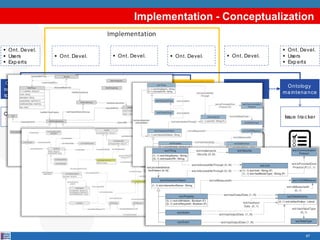
Implementation - Conceptualization
67
Implementation
Ontologica l
req uirements
sp ecifica tion
Encod ing
Comp etency
q uestions
§ Ont. Devel.
§ Ont. Devel.
§ Users
§ Exp erts
Ontology
ma intena nce
Issue tra cker
§ Ont. Devel.
§ Users
§ Exp erts
Ontology
cod e
Ontology
Pub lica tion
Online
ontology
§ Ont. Devel.
Ontology
concep tua liza tion
Ontology
mod el
§ Ont. Devel.
Eva lua tion
§ Ont. Devel.
Va lid a ted
ontology
✓
✓
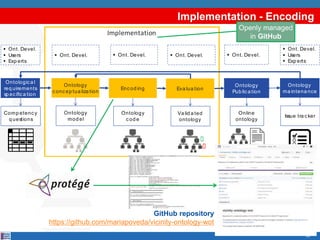
Implementation - Encoding
68
Implementation
Ontologica l
req uirements
sp ecifica tion
Encod ing
Comp etency
q uestions
§ Ont. Devel.
§ Ont. Devel.
§ Users
§ Exp erts
Ontology
ma intena nce
Issue tra cker
§ Ont. Devel.
§ Users
§ Exp erts
Ontology
cod e
Ontology
Pub lica tion
Online
ontology
§ Ont. Devel.
Ontology
concep tua liza tion
Ontology
mod el
§ Ont. Devel.
Eva lua tion
§ Ont. Devel.
Va lid a ted
ontology
✓
✓
GitHub repository
https://github.com/mariapoveda/vicinity-ontology-wot
Openly managed
in GitHub
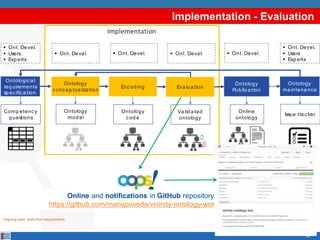
Implementation - Evaluation
69
Implementation
Ontologica l
req uirements
sp ecifica tion
Encod ing
Comp etency
q uestions
§ Ont. Devel.
§ Ont. Devel.
§ Users
§ Exp erts
Ontology
ma intena nce
Issue tra cker
§ Ont. Devel.
§ Users
§ Exp erts
Ontology
cod e
Ontology
Pub lica tion
Online
ontology
§ Ont. Devel.
Ontology
concep tua liza tion
Ontology
mod el
§ Ont. Devel.
Eva lua tion
§ Ont. Devel.
Va lid a ted
ontology
✓
✓
Online and notifications in GitHub repository
https://github.com/mariapoveda/vicinity-ontology-wot
Ongoing work: tests from requirements
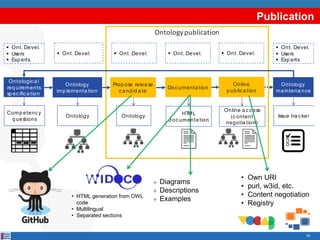
Publication
70
Ontologypublication
Ontologica l
req uirements
sp ecifica tion
Ontology
imp lementa tion
Comp etency
q uestions
§ Ont. Devel.
§ Ont. Devel.
§ Users
§ Exp erts
Ontology
ma intena nce
Issue tra cker
§ Ont. Devel.
§ Users
§ Exp erts
Ontology
Prop ose relea se
ca nd id a te
Ontology
§ Ont. Devel.
Documenta tion
HTML
d ocumenta tion
§ Ont. Devel.
Online
p ub lica tion
Online a c cess
(content
negotia tion)
§ Ont. Devel.
• HTML generation from OWL
code
• Multilingual
• Separated sections
+ Diagrams
+ Descriptions
+ Examples
• Own URI
• purl, w3id, etc.
• Content negotiation
• Registry
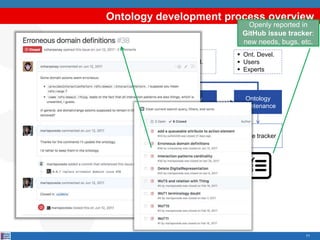
Ontology development process overview
71
Ontological
requirements
specification
Ontology
implementation
Competency
questions
 Ont. Devel.
 Ont. Devel.
 Users
 Experts
Ontology
maintenance
Issue tracker
 Ont. Devel.
 Users
 Experts
Ontology
Ontology
Publication
Online
ontology
 Ont. Devel.
Openly reported in
GitHub issue tracker:
new needs, bugs, etc.
Ontology development process overview
72
Ontological
requirements
specification
Ontology
implementation
Competency
questions
 Ont. Devel.
 Ont. Devel.
 Users
 Experts
Ontology
maintenance
Issue tracker
 Ont. Devel.
 Users
 Experts
Ontology
Ontology
Publication
Online
ontology
 Ont. Devel.
Openly reported in
GitHub issue tracker:
new needs, bugs, etc.
Aiming at bringing all this together…
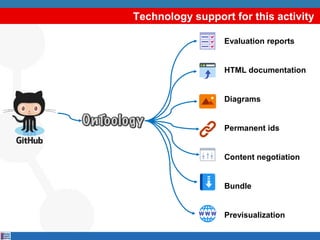
Technology support for this activity
Evaluation reports
HTML documentation
Diagrams
Permanent ids
Content negotiation
Bundle
Previsualization
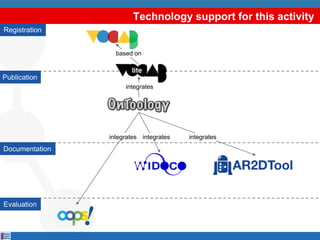
Technology support for this activity
based on
Evaluation
Documentation
Publication
Registration
integrates
integrates integratesintegrates
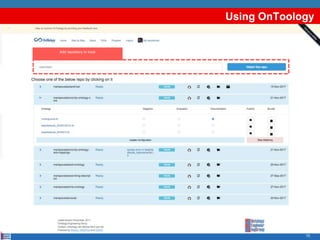
Using OnToology
75
Add repository to track
Using OnToology
76
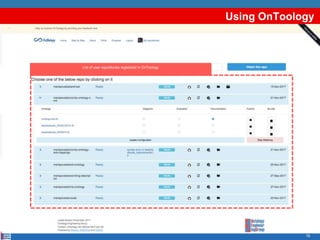
List of user repositories registered in OnToology
Using OnToology
77
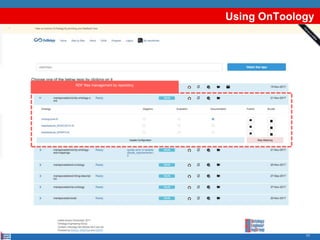
RDF files management by repository
Using OnToology
78
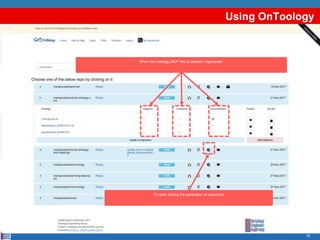
When the ontology (RDF file) is updated, regenerate:
Or when forcing the generation of resources
Using OnToology
79
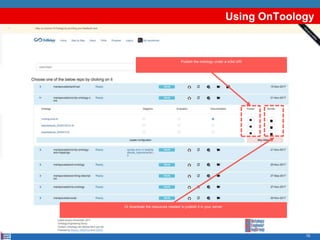
Publish the ontology under a w3id URI
Or download the resources needed to publish it in your server
In summary…
• Open data offers good opportunities to cities
• For 3rd party reusers
• For city officers
• But these efforts need to be taken seriously in order
to make the most of it
• We need a principled approach to publish and exploit
open data more effectively
• Not only based on open formats and 5-star classifications
• Not only based on technology for open data publication
• But also on shared vocabularies and data structures
• Develop once, deploy everywhere
Next steps
• Continue improving technical infrastructure
• Much of it available at https://github.com/oeg-upm/
• Create approx. 30 ontologies in the context of the
“Ciudades Abiertas” (Open Cities) project
• Create working groups for specific datasets with
domain experts, users and ontology engineers
• Similarly to what is being done with OpenContracting,
Open311, etc.
Ontology Engineering at Scale for
Open City Data Sharing
School of Informatics, The University of Edinburgh
13/05/2019
With contributions from María Poveda, Raúl García-Castro
and Paola Espinoza
Oscar Corcho
ocorcho@fi.upm.es
@ocorcho, @opencitydata_es
https://www.slideshare.com/ocorcho

Ontology Engineering at Scale for Open City Data Sharing

  • 1.
    Ontology Engineering atScale for Open City Data Sharing School of Informatics, The University of Edinburgh 13/05/2019 With contributions from María Poveda, Raúl García-Castro and Paola Espinoza Oscar Corcho ocorcho@fi.upm.es @ocorcho, @opencitydata_es https://www.slideshare.com/ocorcho
  • 2.
    License • This workis licensed under the license CC BY-NC-SA 4.0 International • http://purl.org/NET/rdflicense/cc-by-nc-sa4.0 • You are free: • to Share — to copy, distribute and transmit the work • to Remix — to adapt the work • Under the following conditions • Attribution — You must attribute the work by inserting • “[source Oscar Corcho]” at the footer of each reused slide • a credits slide stating: “These slides are partially based on “Ontology Engineering at Scale for Open City Data Sharing” by O. Corcho” • Non-commercial • Share-Alike
  • 3.
    Talk Objectives • Sharesome experiences in the application of Open Data principles for cities (in Spain) • Technical challenges and opportunities • Barriers for adoption • Required organisational changes for successful Open Data strategies • With a special focus on how ontologies (aka agreed vocabularies and shared data structures) can make a difference • Small bias towards how we are doing it in Spain • And how we are adapting existing ontology engineering practices to achieve this goal
  • 4.
    Ontology Engineering atScale for Open City Data Sharing Building Agreed Vocabularies and Data Structures for Successful Open City Data Sharing
  • 5.
    Building Agreed Vocabulariesand Data Structures for Successful Open City Data Sharing
  • 6.
    What is OpenData? • Open data is data that can be freely used, re-used and redistributed by anyone - subject only, at most, to the requirement to attribute and sharealike • Key aspects: • Availability and access: the data must be available as a whole and at no more than a reasonable reproduction cost, preferably by downloading over the Internet. The data must also be available in a convenient and modifiable form. • Re-use and redistribution: the data must be provided under terms that permit re-use and redistribution including the intermixing with other datasets. • Universal participation: everyone must be able to use, re- use and redistribute - there should be no discrimination against fields of endeavour or against persons or groups [source: Open Data Handbook, http://opendatahandbook.org/en/what-is-open-data/ ]
  • 7.
    Relevant Legislation. Europeand Spain • Open Access Initiative (2001). Scientific information; > 510 orgs • Aarhus Convention (1998). Right to participate and access; 41 countries and the EU • Convention on official documentation access (2009). 12 countries • PSI-reuse Directives. (2003/98/EC, 2013/37/UE and upcoming one based on agreement on 22/01/2019) • https://ec.europa.eu/digital-single-market/en/european-legislation-reuse-public-sector-information • Law 37/2007. PSI reuse (transposition of directive 2003/98/EC) • Modified in law 18/2015 (BOE 10/07/2015, directive 2013/37/UE) • Law 11/2007. Citizen access to public services, and rights to good quality services • RD 4/2010 Esquema Nacional de Interoperabilidad • Open standards, technology neutral, open source • RD 1495/2011 It develops Law 37/2007 for national agencies • Norma Técnica de Interoperabilidad (19/02/2013, BOE 4/3/2013) [source: based on material from Antonio Rodríguez Pascual (CNIG)]
  • 8.
    An Explosion ofOpen Data Portals
  • 9.
    Open Data andhow to publish it In a posterboard • For those with a lot of free time available • Or those who happen to be there at the right time Adapted from: Antonio Rodríguez Pascual (IGN)
  • 10.
    Open Data andhow to publish it On a Web page or mobile app (for human consumption) Adapted from: Antonio Rodríguez Pascual (IGN)
  • 11.
    Open Data andhow to publish it On a Web page or mobile app (for human consumption) • Generated from structured formats (e.g., GTFS) Adapted from: Antonio Rodríguez Pascual (IGN)
  • 12.
    Open Data andhow to publish it In files • These can be loaded in information systems (XML, HTML, CSV, GTFS, etc.) • Luckily, not scanned PDFs Adapted from: Antonio Rodríguez Pascual (IGN)
  • 13.
    Open Data andhow to publish it Using Web Services or REST APIs • Useful for developers • Ease of integration in the application logic Adapted from: Antonio Rodríguez Pascual (IGN)
  • 14.
  • 15.
    Open Data andhow to publish it Using semantically-enhanced and linked APIs • Also useful for developers • Standardised formats (JSON, JSON-LD, RDF) • Standardised models (vocabularies, ontologies)
  • 16.
     Non reusable √Reusable.  Not open √ Reusable, open.  Incomplete √ Reusable, open, complete  Not linked √ Reusable, open, complete, linked Data representation formats And many more: JSON, JSON-LD, Marc21, Shapefiles, KMZ, KML, PC-Axis, etc.
  • 17.
    Building Agreed Vocabulariesand Data Structures for Successful Open City Data Sharing
  • 18.
    Why our interestin cities • Regional and national datasets are useful to provide indicators, comparisons across countries, etc. • However, local datasets are usually better for the generation of economical and/or social value • Closer to people • Closer to businesses • Closer to developers
  • 19.
    Why our interestin cities • Node of the Open Data Institute for Madrid • Spin-off focused on providing open data support to municipalities • Involved in: • Leaders of the Spanish thematic network on Open Data for Smart Cities • Leaders of the UNE178301:2015 technical norm on Open Data for Smart Cities • Core team members of the FEMP (Spanish Federation of Municipalities and Provinces) working group on Open Data • Technical and innovation support for local open data initiatives (Zaragoza, Madrid, Alcobendas, Rivas- Vaciamadrid, Arganda del Rey) • Also national (http://datos.gob.es/) and regional (Aragón, Comunidad de Madrid, CRTM)
  • 20.
    Project Ciudades Abiertas(funded by red.es) INICIATIVA PLATAFORMA DE GOBIERNO ABIERTO, COLABORATIVA E INTEROPERABLE (121/17-SP) July 2018 – June 2020 More details at http://www.ciudadesabiertas.es/ (Spanish)
  • 21.
    The current statusof Open City Data in Spain Source: CTIC and OKFN
  • 22.
    Open Data Portalsin Spain • Around 60 open data portals for Spanish cities (and growing) • Gijón, Santander, Bilbao, Azkoitia, Azpeitia, San Sebastián, Pamplona, Zaragoza, Lleida, Manresa, Barcelona, Badalona, El Prat, Cornellá, Viladecans, Gavá (and a few more in Barcelona’s province), Tarragona, Valladolid, Alcobendas, Madrid, Cáceres, Valencia, Lorca, Málaga, Arona, etc. • Also regional open data portals • Many of which aggregate local data • Cabildo de Tenerife, Diputación de Málaga, Gobierno de Aragón, etc. • And national institutions, public companies, etc.
  • 23.
    Relevant legislation forcities • City Ordinances on Transparency, Access and Reuse of Information • Zaragoza: http://www.zaragoza.es/ciudadania/gobierno- abierto/participar/detalle_Normativa?id=3983 • Initial draft (25/06/2012) • Final approval (01/04/2014) • Template from the Spanish Federation of Municipalities and Provinces - FEMP (may 2014) • http://www.femp.es/files/11-5133- fichero/Ordenanza%20Transparencia,%20Acceso%20y %20Reutilizaci%C3%B3n%20de%20la%20informaci%C 3%B3n.pdf • 2015. UNE 178301. Ciudades Inteligentes. Datos abiertos (Open Data). MINETUR Y AENOR • More about this to come later in this presentation
  • 24.
    Technology that isused • Ad-hoc developments over CMSs • Zaragoza (http://datos.zaragoza.es/) • Madrid (http://datos.madrid.es/) • Gijón (http://datos.gijon.es/) • http://datos.gob.es • CKAN • The most recent ones, in general (e.g., http://opendata.aragon.es, http://datos.alcobendas.org/) • Socrata • Rubí, Gavà, etc. • More details (in Spanish) at • http://datos.gob.es/sites/default/files/informe-herramientas- publicacion-od_vfinal.pdf
  • 25.
    Building Agreed Vocabulariesand Data Structures for Successful Open City Data Sharing
  • 26.
    Building Agreed Vocabulariesand Data Structures for Successful Open City Data Sharing
  • 27.
    Main challenges forsuccess • Many efforts so far focused on setting up the technology infrastructure • That’s ok, but content is probably more important • Heterogeneity on the selection of datasets, their formats and granularity • Build an app, deploy everywhere • Open data portals are at the end of the data production chain • They are not an integral part of data management inside cities • Note: the following slides are based on my Semantics 2015 dinner speech on “Slow-cooked data and APIs”
  • 28.
    Rule 1. Chop youronions appropriately
  • 29.
    Rule 1. Chopyour onions appropriately • Take care about the number of datasets that you produce • There’s still a silly competition about “my open data portal has more datasets than yours” • This provokes, sometimes, over-segmentation of data • Main question: What makes a dataset useful and which datasets should I publish?
  • 30.
    Rule 1. Chopyour onions appropriately • UNE 178301:2015 • Norm on Open Data for Smart Cities • Organised by • AENOR CTN 178 group • Government and Mobility • Government • Open Data (led by Localidata) • Formed by • Several cities • Private companies • Nation-wide organisations
  • 31.
    Rule 1. Chopyour onions appropriately • 11 datasets selected • Based on frequency of requests from reusers • Slow but steady adoption for 2015 and 2016 • And now working on extending it to 100 datasets • With an additional group of people Datasets Cultural Agenda Traffic Population Streets Public Transport Touristic Places and POIs Budget Shop Census Air Quality Contracts Parkings
  • 32.
    Rule 2. Add somespices, but not too many
  • 33.
    Rule 2. Addsome spices, but not too many • Annotate (semantically) your data, so that others can understand what you produce • And produce examples for consumers to understand them • Don’t wait until all schema.org properties are settled • Generate SKOS thesauri for your own classifications • e.g., for groups of citizens (young, elderly, etc.), for types of events (cultural, children, music, etc.)
  • 34.
    Rule 3. Trydifferent ways of plating up your food
  • 35.
    Rule 3. Trydifferent ways of plating up your food • Produce your data in different formats • Agreed-upon JSONs • JSON-LD • RDF • Agreed-upon CSVs • CSV on the Web • But don’t get crazy at offering all options • The ones that get finally used are more than enough
  • 36.
    Rule 4. Let childrenappreciate (and cook) open data
  • 37.
    Rule 4. Letchildren appreciate (and cook) open data Let children understand the benefits of open data (and Citizen Science) and how they can contribute to improving the data of their city
  • 38.
    Rule 5…. Eat yourown dog food
  • 39.
    Let’s better say… Rule5. Try it out yourself first… … Before giving your food to your customers
  • 40.
    Rule 5. Tryit out yourself first… • Open data by default • So that your applications are also based on open data Source: Los Datos Abiertos como Eje Central del desarrollo de la Plataforma de Gobierno Abierto. M.J. Fernández-Ruiz, V. Morlán
  • 41.
    Building Agreed Vocabulariesand Data Structures for Successful Open City Data Sharing
  • 42.
    Building Agreed Vocabulariesand Data Structures for Successful Open City Data Sharing Whom of you has never ever eaten a burger in his/her life? If you are vegetarian or vegan, we can think of something else
  • 43.
    Rule 6. Fast foodhas its value as well, why not… You go anywhere in the world and know how McDonald’s burgers are… So let’s only learn this from fast food..
  • 44.
    Rule 6. Fastfood has its value as well, why not… • When we open our data, let’s use at least the same data structures Publish Extract Publish Extract Publish Extract I want to publish my data I am using GTFS I am using my own CSV structure I provide it as a Web service Write an app and deploy everywhere
  • 45.
    Rule 6. Fastfood has its value as well, why not… https://github.com/opencitydata More on this later...
  • 46.
    So, are weready to start cooking our open data better?
  • 47.
    Open Data asa socio-technical problem • As you may have seen already, it is not all about technology, but mostly a socio-technical challenge The path towards establishing these agreements...
  • 48.
    UNE 178301:2015. Context •UNE 178301:2015 • Norm on Open Data for Smart Cities • Organised by • AENOR CTN 178 group • Government and Mobility • Government • Open Data (led by Localidata) • Formed by • Several cities • Private companies • Nation-wide organisations
  • 49.
    UNE 178301:2015. Objectives •Establish metrics and indicators that allow evaluating the degree of maturity of open data elaborated or curated by the public sector… • … so that we can facilitate reuse, • … • … and define a minimal list of datasets that should be published by all open city data initiatives, together with their associated vocabularies
  • 50.
    UNE 178301:2015. Theteam • Coordinator • Esther Minguela (Localidata) • Oscar Corcho (OEG-UPM and Localidata) • 35 members who belong to… • Medium&Large Cities (10) – mostly City Information Managers • Private companies working for the public sector (6) • Regions (3) – mostly Region Information Managers • Ministries or alike (3) • Geographic sector (3) • The core of the work done over a period of 6 months
  • 51.
    UNE 178301:2015. Theteam • Coordinators • Localidata. Esther Minguela y Oscar Corcho • PArticipants 1. Animsa. Iñigo Sanciñena 2. Animsa. Jesús Vera 3. Ayuntamiento de Albacete. Manuel Tobarra 4. Ayuntamiento de Bilbao. Teresa Alba 5. Ayuntamiento de Bilbao. Josu Santacruz 6. Ayuntamiento de Burgos. José María Diez 7. Ayuntamiento de Madrid. Enrique Crespo 8. Ayuntamiento de Madrid. José Luis Cano 9. Ayuntamiento de Rivas. Jesús García 10. Ayuntamiento de Segovia. Alberto Gómez 11. Ayuntamiento de Zaragoza. María Jesús Fernández 12. Comunidad de Madrid. Inmaculada Sánchez 13. Comunidad de Madrid. Concepción García 14. IGN. Antonio Rodríguez 15. IGN. Celia Sevilla 16. COIT. Jorge Díaz 17. CRTM. Concha Chapa 18. CRTM. José Antonio Cascales 19. Etra. Vicente Sebastián 20. FEMP. Pablo Bárcenas 21. Geoactio. Pello Gámez 22. Gmv. Antonio Velasco 23. Indra. Elisabet Terrades 24. Indra. Jordi Marín 25. Junta de Castilla y León. Antonio Ibáñez 26. MINETUR. Ana Pérez 27. MINETUR. Javier García 28. MINHAP. Aleida Alcaide 29. Proconsi. Constantino Lázaro 30. Red.es. José Ignacio Sánchez 31. Red.es. Sonia Castro 32. SEGITTUR. Calixto Mellen 33. SEGITTUR. Enrique Lancis 34. SEGITTUR. Rosa Muñoz 35. SEGITTUR. Susana García 36. Universidad de Zaragoza. Javier López
  • 52.
    Strategy Strategy Legal Legal Organisational Organisation Measurements Technical Availability Access Data Quality Update Socio-economic Reuse Participation andCollaboration UNE178301:2015. Metrics Domains Dimensions Raw data Completeness Documentation Correctness Geo-referencing Linked Data
  • 53.
  • 54.
    UNE178301:2015. High-Priority Datasets •Listing based on the current inventories from all cities (and regions) • Harmonisation • Votes according to PSI- reuse requests Datasets Cultural Agenda Traffic Population Streets Public Transport Touristic Places and POIs Budget Shop Census Air Quality Contracts Parkings
  • 55.
    Dataset Vocabulary General –shared across datasets Postal address: http://vocab.linkeddata.es/datosabiertos/def/urbanismo- infraestructuras/direccionPostal Administrative units: http://vocab.linkeddata.es/datosabiertos/def/sector-publico/territorio Streets Vocabulary: http://vocab.linkeddata.es/datosabiertos/def/urbanismo-infraestructuras/callejero SKOS: http://vocab.linkeddata.es/datosabiertos/kos/urbanismo-infraestructuras/tipo-via Tourism Vocabulary: http://vocab.linkeddata.es/datosabiertos/def/turismo/lugar Cultural agenda Vocabulary: http://vocab.linkeddata.es/datosabiertos/def/cultura-ocio/agenda Shop census Vocabulary: http://vocab.linkeddata.es/datosabiertos/def/comercio/tejidoComercial SKOS: http://vocab.linkeddata.es/page/datosabiertos/kos/comercio/cnae Population Vocabulary: http://www.w3.org/TR/vocab-data-cube/ SKOS Codelists o Age: http://eurostat.linked-statistics.org/dic/age.rdf o Gender: http://eurostat.linked-statistics.org/dic/sex.rdf o Geo: http://eurostat.linked-statistics.org/dic/geo.rdf Budget Vocabulary: http://vocab.linkeddata.es/datosabiertos/def/hacienda/presupuesto Public tendering Vocabulary: http://contsem.unizar.es/def/sector-publico/pproc Air quality Vocabulary: http://www.w3.org/2005/Incubator/ssn/ssnx/ssn Traffic Vocabulary: http://vocab.linkeddata.es/datosabiertos/def/transporte/trafico Public transport Vocabulary: http://vocab.linkeddata.es/datosabiertos/def/transporte/transportePublico Parking Vocabulary: http://vocab.linkeddata.es/datosabiertos/def/urbanismo- infraestructuras/aparcamiento UNE 178301:2015. Vocabularies
  • 56.
    OjoAlData100 • http://ojoaldata100.okfn.es/ Let’s worktowards creating a rich catalogue of datasets (around 100), with a wide range of stakeholders and following a bottom-up approach
  • 57.
    OjoAlData100: challenges andquestions • Main questions to be answered to build the data catalogue • What should we publish? • Added value for cities • Added value for reusers • Available legislation • How should we publish it? • In which format(s)? • With which level of detail?
  • 58.
    Alberto Abella Oscar Corcho Esther Minguela VictoriaLópez Andrés Recio Guadalupe Miñana Antonio Ibáñez Eva Méndez Nancy Gómez Santiago Mota Enrique Crespo … And all those who participated in the UNE178301 technical norm Olga Quirós OjoAlData100: Contributors (non exhaustive)
  • 59.
    Open Data Guideby FEMP http://datos.gob.es/es/noticia/la-femp-elabora-una-guia-de-datos-abiertos-para-ayuntamientos-y-entidades-locales
  • 60.
    Building Agreed Vocabulariesand Data Structures for Successful Open City Data Sharing The need to scale up...
  • 61.
    Common patterns forontology engineering • Ongoing systematic process to discuss data models with city information officers, and obtain common patterns P. Espinoza-Arias, M. Poveda-Villalón, R. García-Castro, O. Corcho, Ontological Representation of Smart City Data: From Devices to Cities, Appl. Sci. 9(1) (2019) 32
  • 62.
    Ontology Development Methodsand Methodologies 62 • Towards lightweight and agile processes • Inspiration from software development practices • Coupling Software and ontology development
  • 63.
    A new waveof ontology engineering tools @OEG 63  Ontology evaluation o OOPS! OntOlogy Pitfall Scanner http://oops.linkeddata.es/  Ontology documentation o HTML: Widoco https://github.com/dgarijo/Widoco/ o Diagrams: AR2DTool http://ar2dtool.linkeddata.es/ o Ontology registry • OEG vocabularies http://vocab.linkeddata.es/ • Open Data: http://vocab.linkeddata.es/datosabiertos/ http://vocab.ciudadesabiertas.es/ o Ontology distributed development o OnToology http://ontoology.linkeddata.es/
  • 64.
    Ontology development processoverview 64 Legend Activity Actor Output activity flow Ontological requirements specification Ontology implementation Competency questions  Ont. Devel.  Ont. Devel.  Users  Experts Ontology maintenance Issue tracker  Ont. Devel.  Users  Experts Ontology Ontology Publication Online ontology  Ont. Devel.
  • 65.
    Requirement specification 65 Requirement specification Ontological req uirements comp letion Comp etency q uestions (verified ) § Ont. Devel. § Users § Exp erts Use ca se sp ecifica tion Use ca ses § Ont. Devel. § Users § Exp erts Da ta excha nge id entifica tion Doma in d ocumenta tion Purp ose a nd scop e id entifica tion Ontologica l req uirements p rop osa l ORSD forma liza tion Ontology p urp ose a nd scop e Comp etency q uestions (ea rly sta ge) ORSD d ocument § Ont. Devel. § Users § Exp erts § Ont. Devel. § [Users] § Ont. Devel. ✓ ✓ ✓ § Users § Exp erts Ontology imp lementa tion § Ont. Devel. Ontology ma intena nce Cha nge req uests § Ont. Devel. § Users § Exp erts Ontology Ontology Pub lica tion Online ontology § Ont. Devel. https://lists.w3.org/Archives/Public/public-wot-ig/2016Dec/0016.html http://w3c.github.io/wot/current-practices/wot-practices
  • 66.
    Requirement specification 66 Requirement specification Ontological req uirements comp letion Comp etency q uestions (verified ) § Ont. Devel. § Users § Exp erts Use ca se sp ecifica tion Use ca ses § Ont. Devel. § Users § Exp erts Da ta excha nge id entifica tion Doma in d ocumenta tion Purp ose a nd scop e id entifica tion Ontologica l req uirements p rop osa l ORSD forma liza tion Ontology p urp ose a nd scop e Comp etency q uestions (ea rly sta ge) ORSD d ocument § Ont. Devel. § Users § Exp erts § Ont. Devel. § [Users] § Ont. Devel. ✓ ✓ ✓ § Users § Exp erts Ontology imp lementa tion § Ont. Devel. Ontology ma intena nce Cha nge req uests § Ont. Devel. § Users § Exp erts Ontology Ontology Pub lica tion Online ontology § Ont. Devel. Shared in online spreadsheets snapshot in documentation
  • 67.
    Implementation - Conceptualization 67 Implementation Ontological req uirements sp ecifica tion Encod ing Comp etency q uestions § Ont. Devel. § Ont. Devel. § Users § Exp erts Ontology ma intena nce Issue tra cker § Ont. Devel. § Users § Exp erts Ontology cod e Ontology Pub lica tion Online ontology § Ont. Devel. Ontology concep tua liza tion Ontology mod el § Ont. Devel. Eva lua tion § Ont. Devel. Va lid a ted ontology ✓ ✓
  • 68.
    Implementation - Encoding 68 Implementation Ontological req uirements sp ecifica tion Encod ing Comp etency q uestions § Ont. Devel. § Ont. Devel. § Users § Exp erts Ontology ma intena nce Issue tra cker § Ont. Devel. § Users § Exp erts Ontology cod e Ontology Pub lica tion Online ontology § Ont. Devel. Ontology concep tua liza tion Ontology mod el § Ont. Devel. Eva lua tion § Ont. Devel. Va lid a ted ontology ✓ ✓ GitHub repository https://github.com/mariapoveda/vicinity-ontology-wot Openly managed in GitHub
  • 69.
    Implementation - Evaluation 69 Implementation Ontological req uirements sp ecifica tion Encod ing Comp etency q uestions § Ont. Devel. § Ont. Devel. § Users § Exp erts Ontology ma intena nce Issue tra cker § Ont. Devel. § Users § Exp erts Ontology cod e Ontology Pub lica tion Online ontology § Ont. Devel. Ontology concep tua liza tion Ontology mod el § Ont. Devel. Eva lua tion § Ont. Devel. Va lid a ted ontology ✓ ✓ Online and notifications in GitHub repository https://github.com/mariapoveda/vicinity-ontology-wot Ongoing work: tests from requirements
  • 70.
    Publication 70 Ontologypublication Ontologica l req uirements specifica tion Ontology imp lementa tion Comp etency q uestions § Ont. Devel. § Ont. Devel. § Users § Exp erts Ontology ma intena nce Issue tra cker § Ont. Devel. § Users § Exp erts Ontology Prop ose relea se ca nd id a te Ontology § Ont. Devel. Documenta tion HTML d ocumenta tion § Ont. Devel. Online p ub lica tion Online a c cess (content negotia tion) § Ont. Devel. • HTML generation from OWL code • Multilingual • Separated sections + Diagrams + Descriptions + Examples • Own URI • purl, w3id, etc. • Content negotiation • Registry
  • 71.
    Ontology development processoverview 71 Ontological requirements specification Ontology implementation Competency questions  Ont. Devel.  Ont. Devel.  Users  Experts Ontology maintenance Issue tracker  Ont. Devel.  Users  Experts Ontology Ontology Publication Online ontology  Ont. Devel. Openly reported in GitHub issue tracker: new needs, bugs, etc.
  • 72.
    Ontology development processoverview 72 Ontological requirements specification Ontology implementation Competency questions  Ont. Devel.  Ont. Devel.  Users  Experts Ontology maintenance Issue tracker  Ont. Devel.  Users  Experts Ontology Ontology Publication Online ontology  Ont. Devel. Openly reported in GitHub issue tracker: new needs, bugs, etc. Aiming at bringing all this together…
  • 73.
    Technology support forthis activity Evaluation reports HTML documentation Diagrams Permanent ids Content negotiation Bundle Previsualization
  • 74.
    Technology support forthis activity based on Evaluation Documentation Publication Registration integrates integrates integratesintegrates
  • 75.
  • 76.
    Using OnToology 76 List ofuser repositories registered in OnToology
  • 77.
    Using OnToology 77 RDF filesmanagement by repository
  • 78.
    Using OnToology 78 When theontology (RDF file) is updated, regenerate: Or when forcing the generation of resources
  • 79.
    Using OnToology 79 Publish theontology under a w3id URI Or download the resources needed to publish it in your server
  • 80.
    In summary… • Opendata offers good opportunities to cities • For 3rd party reusers • For city officers • But these efforts need to be taken seriously in order to make the most of it • We need a principled approach to publish and exploit open data more effectively • Not only based on open formats and 5-star classifications • Not only based on technology for open data publication • But also on shared vocabularies and data structures • Develop once, deploy everywhere
  • 81.
    Next steps • Continueimproving technical infrastructure • Much of it available at https://github.com/oeg-upm/ • Create approx. 30 ontologies in the context of the “Ciudades Abiertas” (Open Cities) project • Create working groups for specific datasets with domain experts, users and ontology engineers • Similarly to what is being done with OpenContracting, Open311, etc.
  • 82.
    Ontology Engineering atScale for Open City Data Sharing School of Informatics, The University of Edinburgh 13/05/2019 With contributions from María Poveda, Raúl García-Castro and Paola Espinoza Oscar Corcho ocorcho@fi.upm.es @ocorcho, @opencitydata_es https://www.slideshare.com/ocorcho

Editor's Notes

  • #12 http://www.gtfs-data-exchange.com/agency/madrid/