In Start with Why by Simon Sinek Book Summary we'll explores the power of leading with
purpose. He introduces the "Golden Circle" model, which emphasizes that successful leaders
and organizations start with a clear sense of "Why" — their core purpose or belief.
Sinek argues that by defining and communicating their "Why," these leaders inspire and
motivate others more effectively than those who focus solely on "What" they do or "How"
they do it. Through compelling examples like Apple and the Wright brothers, Sinek illustrates
how starting with Why can drive exceptional success and influence.
Start with Why by Simon Sinek Table Of Contents
Introduction: Why Start with Why?
PART 1: A WORLD THAT DOESN'T START WITH WHY
1. Assume You Know
2. Carrots and Sticks
PART 2: AN ALTERNATIVE PERSPECTIVE
3. The Golden Circle
4. This Is Not Opinion, This Is Biology
5. Clarity, Discipline, and Consistency
PART 3: LEADERS NEED A FOLLOWING
6. The Emergence of Trust
7. How a Tipping Point Tips
PART 4: HOW TO RALLY THOSE WHO BELIEVE
8. Start with Why, but Know How
9. Know Why, Know How, Then What?
10. Communication Is Not About Speaking, It's About Listening
PART 5: THE BIGGEST CHALLENGE IS SUCCESS
11. Why Goes Fuzzy
12. Split Happens
PART 6: DISCOVER WHY
13. The Origins of a Why
14. The New Competition
Acknowledgments
Notes
Start with Why by Simon Sinek Book Summary
How Great Leaders Inspire Everyone to Take Action Introduction
This book explores a naturally occurring pattern—a way of thinking, acting, and
communicating that enables some leaders to inspire those around them. Although "natural-
born leaders" may have a predisposition to inspire, this ability is not exclusive to them. We
can all learn this pattern. With a bit of discipline, any leader or organization can inspire
others, both within and outside their organization, to advance their ideas and vision. We can
all learn to lead.
The goal of this book is not simply to fix what isn't working. Instead, I wrote this book as a
guide to focus on and amplify what does work. I do not aim to undermine the solutions
offered by others. Most of the answers we receive when based on sound evidence, are
perfectly valid. However, if we're starting with the wrong questions or if we don't understand
the root cause, even the right answers will eventually lead us astray. The truth, you see, is
always revealed... eventually.
Start with Why by Simon Sinek Book Summary by Chapter
PART 1: A WORLD THAT DOESN'T START WITH WHY
Assume You Know
On January 30, 1933, Adolf Hitler was sworn in as Germany’s chief executive, not John F.
Kennedy as one might assume from the description provided. This example illustrates how
our assumptions can lead us astray. Just as many believed the world was flat based on
incomplete information, our assumptions influence our decisions and perceptions. This can
lead to incorrect choices if the underlying facts are flawed or incomplete. Recognizing and
correcting these assumptions, much like discovering the Earth is round, can lead to significant
advancements and better decision-making. Understanding why some organizations succeed
while others fail often involves questioning our assumptions about success and failure.
Carrots and Sticks
In today’s competitive market, most businesses struggle to understand why their customers
choose them over competitors. Many companies focus on manipulation—such as price drops
or promotions—rather than inspiration to drive behavior. While manipulation can be
effective, it is often a short-term strategy that may damage a company’s reputation and
profitability. Manipulative tactics, such as lowering prices to attract customers, can create a
dangerous cycle of diminishing returns. This is seen in industries where price wars lead to
increasingly slim profit margins. True success comes from understanding and inspiring
customers, rather than just manipulating them with superficial tactics.
PART 2: AN ALTERNATIVE PERSPECTIVE
The Golden Circle
Some leaders inspire rather than manipulate to motivate people. These leaders follow a
pattern I call The Golden Circle, which is the opposite of how most people and organizations
operate.
The Golden Circle concept is inspired by the golden ratio. This mathematical formula has
fascinated many throughout history due to its application in various fields and its reflection of
order in nature. Similarly, The Golden Circle reveals how human behavior can be predictable
and how understanding "Why" we do what we do can lead to greater achievement.
The Golden Circle provides insight into why some leaders and organizations achieve
exceptional influence. It explains how Apple innovates continuously, why people are loyal to
Harley-Davidson, and how movements like those led by Dr. Martin Luther King Jr. gain
momentum. It shows how inspiring action is more effective than manipulation.
This perspective is useful not just for changing the world but also for improving leadership,
corporate culture, hiring, product development, and marketing. It starts with asking "Why."
The Golden Circle Explained:
 WHAT: Every organization knows WHAT they do—products, services, or job functions.
 HOW: Some know HOW they do WHAT they do, like unique processes or selling points.
 WHY: Few clearly articulate WHY they do WHAT they do. WHY represents purpose, cause, or
belief.
Inspired leaders and organizations think, act, and communicate from the inside out, starting
with WHY. For example, Apple doesn’t just promote WHAT they do; they focus on WHY
they do it, which is why their marketing stands out.
Instead of starting with WHAT and moving to HOW and WHY, inspired companies like
Apple communicate from the inside out. This approach leads to more compelling and
influential messaging, contrasting with the common practice of starting with WHAT and
moving outward.
This Is Not Opinion, This Is Biology
In Dr. Seuss's story about the Sneetches, two groups of Sneetches, one with stars on their
bellies and one without, highlight a basic human need: the need to belong. The Sneetches'
desperate desire to fit in, despite the irrational lengths they go to, underscores this universal
craving.
Our need to belong is not rational but a fundamental aspect of human behavior. It is felt when
we connect with others who share our values and beliefs, making us feel safe and included.
This sense of belonging can occur spontaneously, such as when meeting someone from your
hometown while traveling, or more deeply, like forming connections with fellow Americans
abroad.
This need drives us to make irrational decisions and spend money to feel part of something
bigger. We are drawn to companies and brands that reflect our beliefs. When a company
communicates its WHY—the purpose or belief behind its products—we are more likely to go
to great lengths to support it. This is because such brands represent our values and help us feel
connected to a community of like-minded individuals.
We also have an innate ability to detect when something doesn't align with our values. For
example, Dell selling MP3 players feels off because it doesn’t match their identity as a
computer company. In contrast, Apple’s partnership with U2 makes sense because both share
a commitment to pushing boundaries. Apple’s marketing, such as the "I'm a Mac, I'm a PC"
ads, illustrates this perfectly by contrasting the values and identities of Mac and PC users.
Leaders and organizations that effectively communicate their beliefs create a sense of
belonging among their followers. This ability to make people feel special and included is what
inspires loyalty and creates strong bonds within their communities. Whether it’s Apple users,
Harley riders, or those inspired by Dr. Martin Luther King Jr., this shared sense of belonging
forms a powerful connection among individuals.
Clarity, Discipline, and Consistency
1. Clarity of WHY:
 The core of starting with WHY is understanding and articulating the fundamental purpose or
belief driving your actions.
 If you don’t know WHY you do what you do, it’s challenging to communicate this to others.
Leaders need to articulate a purpose beyond products or services to inspire employees and
followers. This clarity helps in aligning everyone’s efforts towards a common cause.
**2. Discipline of HOW:
 Knowing WHY informs HOW you operate. HOW represents the values or principles guiding
your actions. Discipline is needed to maintain these guiding principles consistently.
 Effective HOWs are actionable and not just abstract nouns. Values should be expressed as
verbs (e.g., “always do the right thing” instead of “integrity”) to be actionable and
measurable.
 Consistency in HOW enhances an organization’s strength and enables effective hiring and
partnerships.
**3. Consistency of WHAT:
 WHAT represents the tangible proof of WHY, including products, services, and actions.
Consistency between WHAT you say and do ensures authenticity.
 Authenticity is not just about being true to oneself but about ensuring everything you do
aligns with your WHY. Inconsistent actions lead to a lack of trust and can result in
manipulative tactics.
**4. The Right Order:
 To inspire and lead effectively, start with WHY, followed by HOW, and then WHAT. This order
ensures that the purpose (WHY) provides context for actions (HOW) and results (WHAT).
 The Golden Circle framework underscores that long-term success requires a balance among
these elements. Companies like Southwest Airlines succeed because their WHY is clear, and
their HOW and WHAT consistently reflect that purpose.
**5. Manipulation vs. Inspiration:
 Manipulation and inspiration both appeal to emotions but differ significantly. Manipulation
involves tactics like fear or peer pressure to achieve short-term results, while inspiration
connects deeper with people’s beliefs and values, leading to lasting loyalty and commitment.
This approach emphasizes that long-term success and authentic leadership come from a clear
understanding of and commitment to your core purpose (WHY), disciplined adherence to
your guiding principles (HOW), and consistent actions that align with your purpose (WHAT).
PART 3: LEADERS NEED A FOLLOWING
The Emergence of Trust
In Chapter 3, Part 3 of "The Emergence of Trust," the narrative focuses on the significant
transformation at Continental Airlines under CEO Gordon Bethune, who took over in 1994.
Before Bethune's arrival, Continental Airlines was notorious for its poor work environment
and low employee morale, which significantly impacted customer service. The airline was
struggling financially and had a reputation as the worst in the industry.
Bethune quickly recognized that the company's biggest problem was its toxic culture. He
realized that to improve the airline's performance, he needed to first address the underlying
issues of trust and employee satisfaction. Following the philosophy of Herb Kelleher, former
head of Southwest Airlines, Bethune believed that a company should prioritize its employees'
well-being to ensure better customer service and, ultimately, shareholder satisfaction.
Continental had faced significant financial difficulties, including two bankruptcies and
multiple leadership changes, which contributed to its culture of mistrust. Employees felt
mistreated and unappreciated, and this negative environment was reflected in their
interactions with customers. Bethune understood that rebuilding trust was essential for any
meaningful turnaround.
Instead of focusing solely on operational metrics, Bethune emphasized the importance of
creating a positive work environment where employees felt valued and respected. He
dismantled the physical and symbolic barriers between executives and staff, introducing an
open-door policy and engaging directly with employees. He removed security measures that
had created an atmosphere of distrust and made himself accessible to all levels of the
company.
How a Tipping Point Tips
The concept of a tipping point, popularized by Malcolm Gladwell, explains how ideas, trends,
or technologies reach widespread adoption. Gladwell identifies key groups that contribute to
tipping points: connectors and influencers. However, for a tipping point to occur intentionally,
it’s crucial to understand the Law of Diffusion of Innovations.
Everett M. Rogers, in his 1962 book Diffusion of Innovations, describes how innovations
spread through society. Geoffrey Moore expanded this concept in Crossing the Chasm,
focusing on high-tech products. According to Rogers, society is divided into five segments on
a bell curve:
1. Innovators (2.5%): These early adopters are enthusiastic about new ideas and technologies.
2. Early Adopters (13.5%): They see the potential in innovations and are willing to take risks,
though they are less pioneering than innovators.
3. Early Majority (34%): More practical, they adopt new ideas after seeing evidence of their
benefits.
4. Late Majority (34%): Skeptical and more resistant, they adopt innovations only when they
become mainstream.
5. Laggards (16%): These individuals are the last to adopt new ideas, often only doing so out of
necessity.
For an innovation to achieve mass-market success, it must first gain traction among
innovators and early adopters. Attempting to target the broader market without this initial
adoption can be costly and ineffective. Success requires understanding these segments and
appealing to the right ones at the right time.
Give the People Something to Believe In
On August 28, 1963, 250,000 people gathered on the National Mall to hear Dr. Martin Luther
King Jr.'s iconic "I Have a Dream" speech. Despite the lack of modern communication tools,
this massive turnout was driven by a shared belief in a common cause rather than logistical
planning or invitations.
During the early 1960s, America was fraught with racial tensions and riots. Dr. King’s
leadership in the civil rights movement was rooted in a deep sense of purpose, or "WHY,"
which inspired and mobilized people despite ongoing struggles and opposition. Unlike others
who focused on "WHAT" needed to change, King’s clarity of "WHY" provided the strength
and motivation to rally people toward his vision.
Dr. King’s powerful rhetoric wasn't about detailed plans but about articulating a vision of
equality and justice. His speech connected on an emotional level, fostering a collective belief
that transcended individual differences. The rally and his speech were not just about civil
rights but about a larger belief in a more just and inclusive America.
Ultimately, people showed up not just for Dr. King but for themselves and their vision of a
better nation. His message was a call to action based on shared values, drawing in diverse
groups and turning a grand ideal into a movement embraced by many, regardless of race.
PART 4: HOW TO RALLY THOSE WHO BELIEVE
Start with Why, but Know How
Energy vs. Charisma
Steve Ballmer, known for his high-energy speeches, can excite audiences but struggles to
maintain long-term motivation. In contrast, Bill Gates’s reserved demeanor inspires through
his deep commitment to solving complex problems, such as his vision for widespread PC use
and philanthropic efforts. Gates’s influence comes from a clear sense of purpose, embodying
charisma built on a profound belief in a greater cause, unlike Ballmer's temporary excitement.
The Chosen Path
Neil Armstrong’s career as an astronaut stemmed from his early passion for flying, while Jeff
Sumpter’s banking career was driven by a broader purpose rather than a specific passion. Our
careers may not always align perfectly with our passions, but having a driving "WHY"
provides meaning and direction, whether it's about inspiring others or solving problems.
Amplify the Source of Inspiration
The Golden Circle concept illustrates the hierarchical nature of organizations: the "WHY" at
the top represents core beliefs, the "HOW" involves implementing strategies, and the
"WHAT" encompasses tangible outcomes. Effective organizations align these levels,
integrating strong beliefs with strategic execution and functional infrastructure. Without this
alignment, even the most inspiring leader may face inefficiencies.
I Have a Dream (and He’s Got the Plan)
Dr. Martin Luther King Jr. inspired people with his vision of equality, but real change
required practical steps, provided by Ralph Abernathy. Abernathy, who helped make Dr.
King's dream actionable, showed the importance of pairing visionary leadership with practical
implementation. Effective leaders inspire, but successful change requires a team of HOW-
types who translate vision into reality.
Those Who Know WHY Need Those Who Know HOW
Visionaries like Bill Gates and the Wright brothers have transformed industries through their
imagination and optimism. However, they needed HOW-types—practical individuals who
build structures and processes. Walt Disney's creativity was complemented by his brother
Roy's business acumen, highlighting the need for both visionaries and practical implementers
to achieve significant goals. A successful partnership between WHY-types and HOW-types is
essential for bringing dreams to life.
Know Why, Know How, Then What?
They marched in uniform, heads shaved, in a gray, cavernous room, watching a projection of
a leader proclaiming their perfect control.
A lone woman in bright red burst in, challenging the conformity with a sledgehammer.
On January 22, 1984, Apple’s famous ad portrayed an Orwellian regime and promised: "1984
won’t be like 1984." More than an ad, it was a manifesto reflecting Apple’s core belief in
challenging the status quo and empowering individuals. This message remains relevant
because Apple’s WHY—its fundamental purpose—never changes. Their advertising and
campaigns consistently emphasize individualism and rebellion, aligning with their enduring
WHY.
Communication Is Not About Speaking, It's About Listening
Martin Luther King Jr., a central figure in the civil rights movement, chose the Lincoln
Memorial for his iconic "I Have a Dream" speech. Both King and Lincoln symbolize
American values of freedom. Symbols like these are vital for reinforcing values, making the
intangible tangible. Dictators also use symbols, but they often reflect their own power rather
than a collective belief.
Symbols gain meaning from the significance we assign to them. For example, the American
flag, with its design intentionally backward on soldiers' arms, symbolizes bravery in battle
rather than retreat. Efforts to protect the flag from desecration through laws aim to safeguard
the values it represents, not just the fabric itself. This has led to debates between freedom of
expression and the protection of symbols.
Ronald Reagan, known for his communication skills, understood the power of symbols. In
1982, he invited Lenny Skutnik, a hero who saved lives during an Air Florida crash, to the
State of the Union address. Skutnik became a symbol of American courage and optimism,
demonstrating the power of embodying values rather than just discussing them.
Most companies have logos, but few turn them into meaningful symbols. Without a clear
WHY, a logo is merely an identifier. Many companies focus on their interests, failing to
inspire loyalty through shared values. For a logo to become a symbol, it must represent
something meaningful and inspiring.
Harley-Davidson is a notable example. People tattoo the Harley-Davidson logo on their
bodies, not just as a brand mark but as a symbol of personal identity and values. This deep
connection reflects Harley-Davidson's clarity, discipline, and consistency in communicating
its beliefs.
PART 5: THE BIGGEST CHALLENGE IS SUCCESS
Why Goes Fuzzy
“A lot of what goes on these days with high-flying companies and overpaid CEOs, who are
really just looting from the top and aren’t watching out for anyone but themselves, really
upsets me. It’s one of the main issues with American business today.” This sentiment reflects
the frustration of Sam Walton, the founder of Walmart, who built the company into a retail
giant with $544 billion in annual sales and 40 million weekly shoppers.
Raised during the Great Depression, Walton’s frugal upbringing and strong work ethic shaped
his approach. Despite his small stature and modest beginnings, he achieved success through
hard work and optimism, leading his high school football team to state championships.
Walton's paper route during the Depression earned him a decent wage, showcasing his ability
to thrive even in tough times.
However, success is not solely about a competitive nature or optimism. While many small
business owners dream of reaching the billion-dollar mark, only a fraction achieve this. Out of
27.7 million registered businesses in the U.S., only about a thousand make it to the Fortune
1000, which requires around $1.5 billion in annual revenue. To achieve such success, more is
needed than just vision and hard work.
Split Happens
Many successful organizations, such as Wal-Mart, Apple, General Electric, and Ford, began
with a single idea driven by passion. This initial passion is what propels founders and early
employees to make significant personal sacrifices, leaving stable jobs and enduring long hours
to build something greater than themselves. This passion not only fuels their commitment but
also inspires others to join them, often at considerable personal risk.
However, passion alone is not sufficient for sustained success. While it can be a powerful
motivator in the early stages, it needs to be supported by structure and systems to survive and
grow. Many small businesses fail because they rely solely on passion without establishing the
necessary infrastructure. The dot-com boom is a prime example of this, where numerous
companies failed despite their initial enthusiasm due to lack of structural planning.
As organizations expand, they face the challenge of maintaining their founding passion while
integrating effective systems and processes. Successful entrepreneurs often start by focusing
on their vision and passion. Still, as the organization grows, they need to delegate decision-
making to others. This shift can lead to a dilution of the original "WHY" as the focus moves
from the inspiring purpose to achieving measurable results.
The concept of the "School Bus Test" illustrates this challenge: if a founder were to leave
unexpectedly, would the organization continue to thrive? Many companies are so closely tied
to their founder's vision that their departure can cause significant disruption. To pass this test,
organizations must embed the founder’s vision into their culture and ensure that future leaders
are motivated by this vision, not just by personal advancement.
Microsoft’s experience demonstrates the impact of losing focus on "WHY." Once known for
its mission to revolutionize personal computing, Microsoft’s focus has shifted, and their
original purpose has become less clear. This shift illustrates the risk of losing inspiration and
clarity as an organization grows.
PART 6: DISCOVER WHY
The Origins of a Why
In the Vietnam War-era Northern California, a strong anti-government and anti-corporate
sentiment fueled a desire for individual empowerment. Amid this revolutionary spirit, Steve
Wozniak and Steve Jobs emerged as key figures, driven by the belief that technology could
challenge and transform existing power structures.
Wozniak and Jobs, both products of this countercultural era, saw the potential of computers
not merely as tools but as vehicles for individual empowerment. They envisioned a world
where technology could democratize power, allowing individuals to stand up to large
institutions. This vision materialized with the founding of Apple Computer.
Their journey began with the creation of the Blue Box in 1971, a device that allowed users to
bypass long-distance phone charges. Although the Blue Box was technically illegal, it
symbolized their rebellion against monopolistic powers like Ma Bell. This early innovation
highlighted their commitment to challenging established norms without breaking laws
directly.
On April 1, 1976, Apple Computer was launched, marking a bold challenge to the computing
industry dominated by giants like IBM. While IBM targeted corporations, Apple aimed to
democratize computing, making it accessible to individuals. The company's clear purpose and
disciplined approach led to rapid success, achieving billion-dollar status within six years.
Apple's revolutionary approach continued with the launch of the Macintosh in 1984,
accompanied by the famous "1984" Super Bowl commercial directed by Ridley Scott. The
Macintosh, with its graphical user interface and mouse, revolutionized personal computing by
making it user-friendly and accessible. This move disrupted the prevailing command-line
systems and set new standards for computing and advertising.
Apple's innovation extended to products like the iPod, iTunes, and iPhone, each challenging
and redefining industry standards. For instance, iTunes transformed the music industry by
disrupting outdated business models, while the iPhone revolutionized the mobile phone
industry by shifting control from service providers to manufacturers.
The success of Apple lies not only in its technological advancements but in its unwavering
commitment to its founding purpose. The company's philosophy, rooted in Steve Jobs's vision
of making a significant impact, has remained consistent. Apple's success story underscores the
power of staying true to one's core beliefs and using technology to challenge and reshape
established norms.
The New Competition
In a cross-country race, runners set off with a shared goal of maximizing their energy for the
entire distance. Among them is Ben Comen, who has cerebral palsy, a condition that severely
impairs his movement and balance. While the other runners swiftly form a pack and pull
ahead, Ben struggles behind. He falls repeatedly, gets up, and keeps running despite his
exhaustion and pain. His race typically takes much longer than his peers, who finish in about
twenty-five minutes, while Ben often takes over forty-five.
Ben’s persistence is notable, but the real lesson goes deeper. Once the other runners finish,
they return to run alongside Ben, helping him when he falls and cheering him on. Ben’s race
highlights a profound truth: when you compete against yourself rather than others, you inspire
those around you to support and help you. This is in stark contrast to the competitive nature of
most races, where the focus is on outperforming others.
In the business world, organizations often fixate on outperforming competitors, aiming to be
better in terms of quality, features, and service. This mindset can lead to isolation and a lack
of cooperation. However, if businesses focused on improving their own performance—
striving to do better than they did before—rather than just outdoing competitors, the dynamics
would change. The goal would shift from beating others to continually bettering oneself.
Great organizations understand and maintain a clear sense of their "WHY"—their core
purpose and cause. When organizations lose sight of their WHY, they often become
preoccupied with surpassing competitors, which can lead to a less meaningful pursuit. Instead,
if businesses concentrated on their internal growth and improvement, they would naturally
inspire others and foster a more supportive environment.
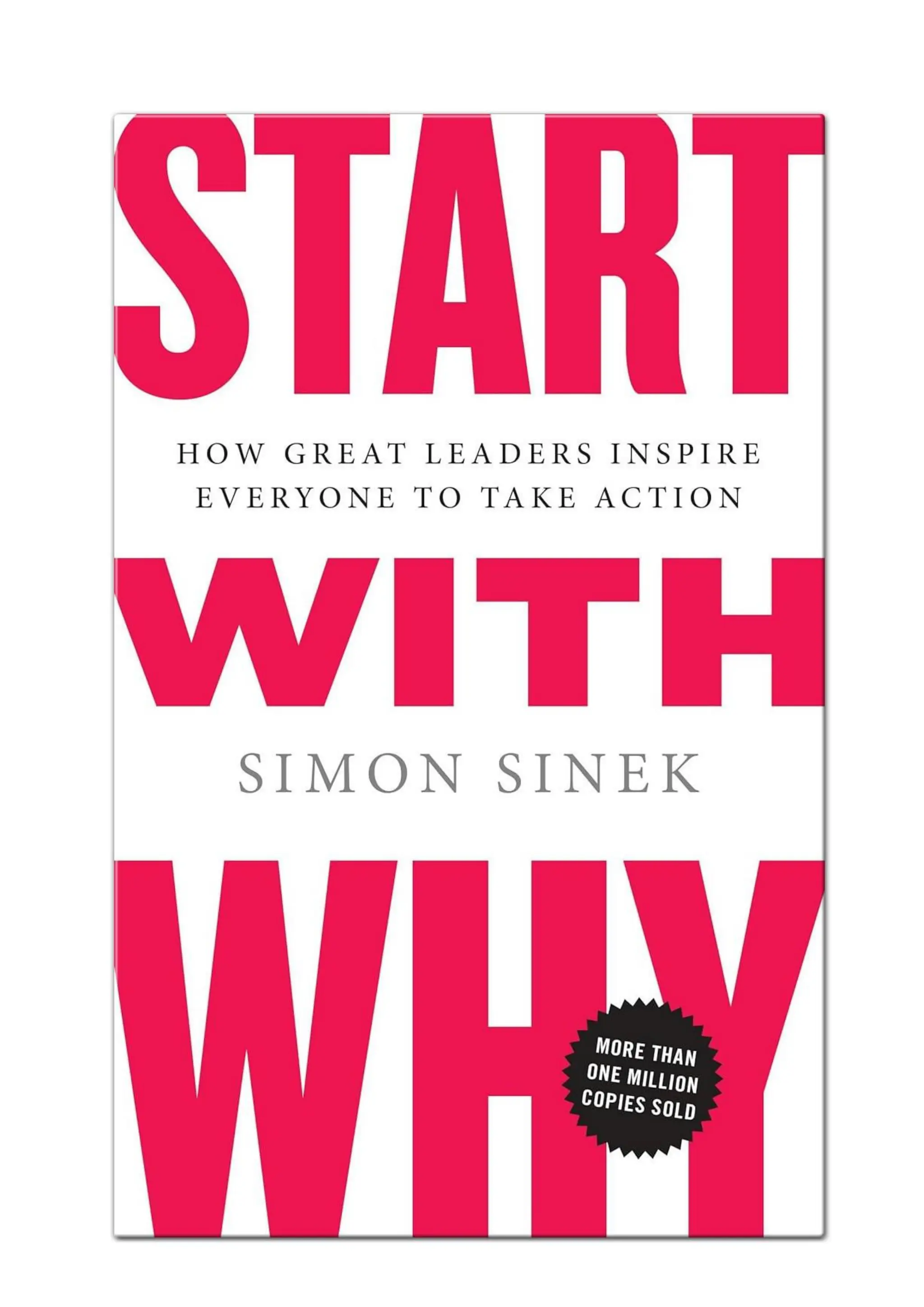
Start with Why: How Great Leaders Inspire Everyone to Take Action by Simon Sinek.
The Book details
Publisher Language Hardcover ISBN-10 ISBN-13
Reading
Age
Portfolio; 44329th edition (October
29, 2009)
English 256 pages 1591842808
978-
1591842804
1 year and
up
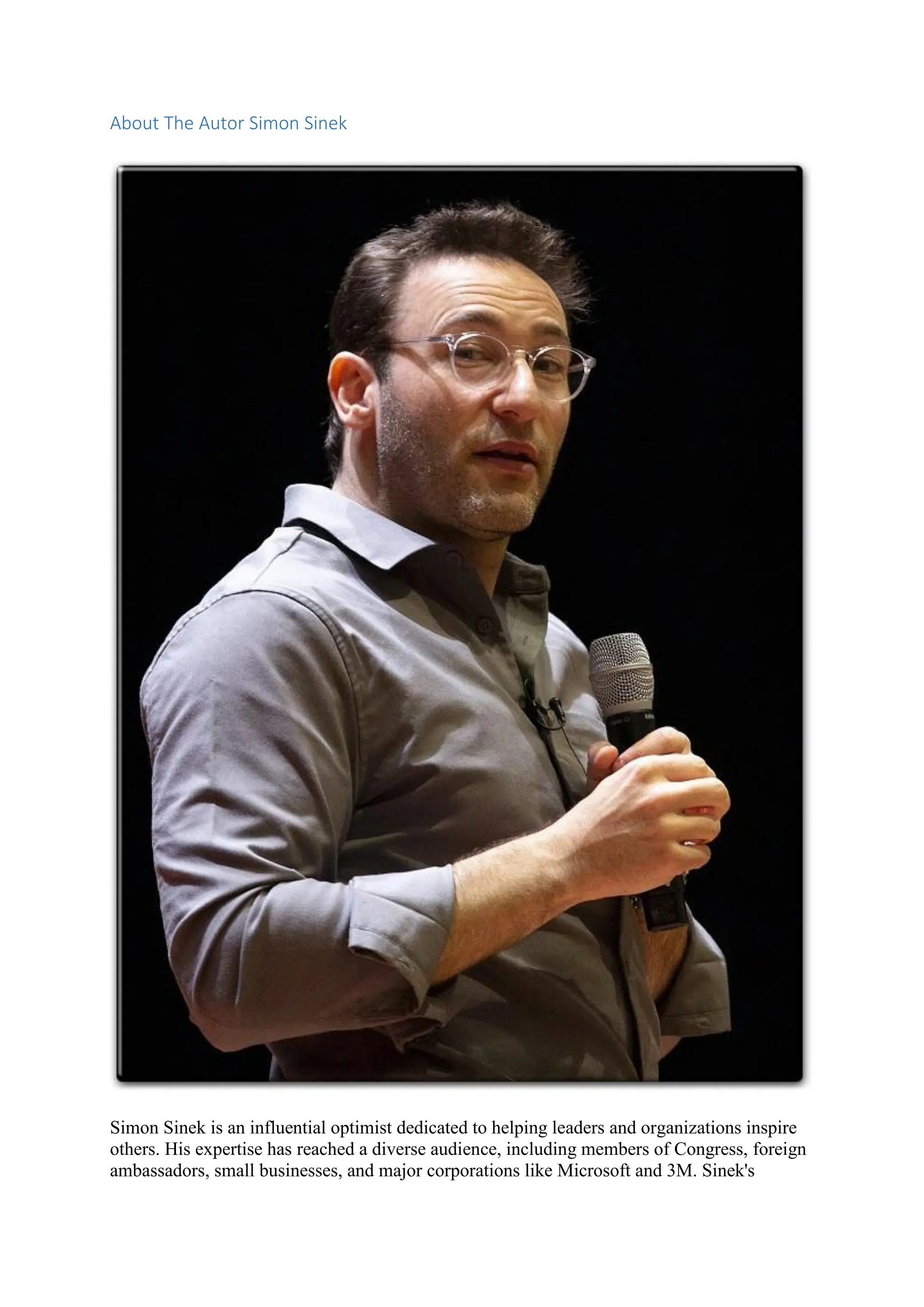
About The Autor Simon Sinek
Simon Sinek is an influential optimist dedicated to helping leaders and organizations inspire
others. His expertise has reached a diverse audience, including members of Congress, foreign
ambassadors, small businesses, and major corporations like Microsoft and 3M. Sinek's
insights extend across various fields, from Hollywood to the Pentagon, where he advocates
for the transformative power of understanding "why."
He is the author of two notable books: Start With Why and Leaders Eat Last. Frequently cited
by national media, Sinek also shares brief bursts of inspiration on Twitter (@simonsinek),
where he continues to engage and motivate his audience with his vision for effective
leadership and organizational success.
Get Your Copy Of The Book Start with Why by Simon Sinek

Start with Why Book Summary by Simon Sinek

  • 2.
    In Start withWhy by Simon Sinek Book Summary we'll explores the power of leading with purpose. He introduces the "Golden Circle" model, which emphasizes that successful leaders and organizations start with a clear sense of "Why" — their core purpose or belief. Sinek argues that by defining and communicating their "Why," these leaders inspire and motivate others more effectively than those who focus solely on "What" they do or "How" they do it. Through compelling examples like Apple and the Wright brothers, Sinek illustrates how starting with Why can drive exceptional success and influence. Start with Why by Simon Sinek Table Of Contents Introduction: Why Start with Why? PART 1: A WORLD THAT DOESN'T START WITH WHY 1. Assume You Know 2. Carrots and Sticks PART 2: AN ALTERNATIVE PERSPECTIVE 3. The Golden Circle 4. This Is Not Opinion, This Is Biology 5. Clarity, Discipline, and Consistency PART 3: LEADERS NEED A FOLLOWING 6. The Emergence of Trust 7. How a Tipping Point Tips PART 4: HOW TO RALLY THOSE WHO BELIEVE 8. Start with Why, but Know How 9. Know Why, Know How, Then What? 10. Communication Is Not About Speaking, It's About Listening PART 5: THE BIGGEST CHALLENGE IS SUCCESS 11. Why Goes Fuzzy 12. Split Happens PART 6: DISCOVER WHY 13. The Origins of a Why 14. The New Competition Acknowledgments Notes Start with Why by Simon Sinek Book Summary How Great Leaders Inspire Everyone to Take Action Introduction This book explores a naturally occurring pattern—a way of thinking, acting, and communicating that enables some leaders to inspire those around them. Although "natural-
  • 3.
    born leaders" mayhave a predisposition to inspire, this ability is not exclusive to them. We can all learn this pattern. With a bit of discipline, any leader or organization can inspire others, both within and outside their organization, to advance their ideas and vision. We can all learn to lead. The goal of this book is not simply to fix what isn't working. Instead, I wrote this book as a guide to focus on and amplify what does work. I do not aim to undermine the solutions offered by others. Most of the answers we receive when based on sound evidence, are perfectly valid. However, if we're starting with the wrong questions or if we don't understand the root cause, even the right answers will eventually lead us astray. The truth, you see, is always revealed... eventually. Start with Why by Simon Sinek Book Summary by Chapter PART 1: A WORLD THAT DOESN'T START WITH WHY Assume You Know On January 30, 1933, Adolf Hitler was sworn in as Germany’s chief executive, not John F. Kennedy as one might assume from the description provided. This example illustrates how our assumptions can lead us astray. Just as many believed the world was flat based on incomplete information, our assumptions influence our decisions and perceptions. This can lead to incorrect choices if the underlying facts are flawed or incomplete. Recognizing and correcting these assumptions, much like discovering the Earth is round, can lead to significant advancements and better decision-making. Understanding why some organizations succeed while others fail often involves questioning our assumptions about success and failure. Carrots and Sticks In today’s competitive market, most businesses struggle to understand why their customers choose them over competitors. Many companies focus on manipulation—such as price drops or promotions—rather than inspiration to drive behavior. While manipulation can be effective, it is often a short-term strategy that may damage a company’s reputation and profitability. Manipulative tactics, such as lowering prices to attract customers, can create a dangerous cycle of diminishing returns. This is seen in industries where price wars lead to increasingly slim profit margins. True success comes from understanding and inspiring customers, rather than just manipulating them with superficial tactics. PART 2: AN ALTERNATIVE PERSPECTIVE The Golden Circle Some leaders inspire rather than manipulate to motivate people. These leaders follow a pattern I call The Golden Circle, which is the opposite of how most people and organizations operate. The Golden Circle concept is inspired by the golden ratio. This mathematical formula has fascinated many throughout history due to its application in various fields and its reflection of
  • 4.
    order in nature.Similarly, The Golden Circle reveals how human behavior can be predictable and how understanding "Why" we do what we do can lead to greater achievement. The Golden Circle provides insight into why some leaders and organizations achieve exceptional influence. It explains how Apple innovates continuously, why people are loyal to Harley-Davidson, and how movements like those led by Dr. Martin Luther King Jr. gain momentum. It shows how inspiring action is more effective than manipulation. This perspective is useful not just for changing the world but also for improving leadership, corporate culture, hiring, product development, and marketing. It starts with asking "Why." The Golden Circle Explained:  WHAT: Every organization knows WHAT they do—products, services, or job functions.  HOW: Some know HOW they do WHAT they do, like unique processes or selling points.  WHY: Few clearly articulate WHY they do WHAT they do. WHY represents purpose, cause, or belief. Inspired leaders and organizations think, act, and communicate from the inside out, starting with WHY. For example, Apple doesn’t just promote WHAT they do; they focus on WHY they do it, which is why their marketing stands out. Instead of starting with WHAT and moving to HOW and WHY, inspired companies like Apple communicate from the inside out. This approach leads to more compelling and influential messaging, contrasting with the common practice of starting with WHAT and moving outward. This Is Not Opinion, This Is Biology In Dr. Seuss's story about the Sneetches, two groups of Sneetches, one with stars on their bellies and one without, highlight a basic human need: the need to belong. The Sneetches' desperate desire to fit in, despite the irrational lengths they go to, underscores this universal craving. Our need to belong is not rational but a fundamental aspect of human behavior. It is felt when we connect with others who share our values and beliefs, making us feel safe and included. This sense of belonging can occur spontaneously, such as when meeting someone from your hometown while traveling, or more deeply, like forming connections with fellow Americans abroad. This need drives us to make irrational decisions and spend money to feel part of something bigger. We are drawn to companies and brands that reflect our beliefs. When a company communicates its WHY—the purpose or belief behind its products—we are more likely to go to great lengths to support it. This is because such brands represent our values and help us feel connected to a community of like-minded individuals. We also have an innate ability to detect when something doesn't align with our values. For example, Dell selling MP3 players feels off because it doesn’t match their identity as a computer company. In contrast, Apple’s partnership with U2 makes sense because both share
  • 5.
    a commitment topushing boundaries. Apple’s marketing, such as the "I'm a Mac, I'm a PC" ads, illustrates this perfectly by contrasting the values and identities of Mac and PC users. Leaders and organizations that effectively communicate their beliefs create a sense of belonging among their followers. This ability to make people feel special and included is what inspires loyalty and creates strong bonds within their communities. Whether it’s Apple users, Harley riders, or those inspired by Dr. Martin Luther King Jr., this shared sense of belonging forms a powerful connection among individuals. Clarity, Discipline, and Consistency 1. Clarity of WHY:  The core of starting with WHY is understanding and articulating the fundamental purpose or belief driving your actions.  If you don’t know WHY you do what you do, it’s challenging to communicate this to others. Leaders need to articulate a purpose beyond products or services to inspire employees and followers. This clarity helps in aligning everyone’s efforts towards a common cause. **2. Discipline of HOW:  Knowing WHY informs HOW you operate. HOW represents the values or principles guiding your actions. Discipline is needed to maintain these guiding principles consistently.  Effective HOWs are actionable and not just abstract nouns. Values should be expressed as verbs (e.g., “always do the right thing” instead of “integrity”) to be actionable and measurable.  Consistency in HOW enhances an organization’s strength and enables effective hiring and partnerships. **3. Consistency of WHAT:  WHAT represents the tangible proof of WHY, including products, services, and actions. Consistency between WHAT you say and do ensures authenticity.  Authenticity is not just about being true to oneself but about ensuring everything you do aligns with your WHY. Inconsistent actions lead to a lack of trust and can result in manipulative tactics. **4. The Right Order:  To inspire and lead effectively, start with WHY, followed by HOW, and then WHAT. This order ensures that the purpose (WHY) provides context for actions (HOW) and results (WHAT).  The Golden Circle framework underscores that long-term success requires a balance among these elements. Companies like Southwest Airlines succeed because their WHY is clear, and their HOW and WHAT consistently reflect that purpose. **5. Manipulation vs. Inspiration:  Manipulation and inspiration both appeal to emotions but differ significantly. Manipulation involves tactics like fear or peer pressure to achieve short-term results, while inspiration connects deeper with people’s beliefs and values, leading to lasting loyalty and commitment.
  • 6.
    This approach emphasizesthat long-term success and authentic leadership come from a clear understanding of and commitment to your core purpose (WHY), disciplined adherence to your guiding principles (HOW), and consistent actions that align with your purpose (WHAT). PART 3: LEADERS NEED A FOLLOWING The Emergence of Trust In Chapter 3, Part 3 of "The Emergence of Trust," the narrative focuses on the significant transformation at Continental Airlines under CEO Gordon Bethune, who took over in 1994. Before Bethune's arrival, Continental Airlines was notorious for its poor work environment and low employee morale, which significantly impacted customer service. The airline was struggling financially and had a reputation as the worst in the industry. Bethune quickly recognized that the company's biggest problem was its toxic culture. He realized that to improve the airline's performance, he needed to first address the underlying issues of trust and employee satisfaction. Following the philosophy of Herb Kelleher, former head of Southwest Airlines, Bethune believed that a company should prioritize its employees' well-being to ensure better customer service and, ultimately, shareholder satisfaction. Continental had faced significant financial difficulties, including two bankruptcies and multiple leadership changes, which contributed to its culture of mistrust. Employees felt mistreated and unappreciated, and this negative environment was reflected in their interactions with customers. Bethune understood that rebuilding trust was essential for any meaningful turnaround. Instead of focusing solely on operational metrics, Bethune emphasized the importance of creating a positive work environment where employees felt valued and respected. He dismantled the physical and symbolic barriers between executives and staff, introducing an open-door policy and engaging directly with employees. He removed security measures that had created an atmosphere of distrust and made himself accessible to all levels of the company. How a Tipping Point Tips The concept of a tipping point, popularized by Malcolm Gladwell, explains how ideas, trends, or technologies reach widespread adoption. Gladwell identifies key groups that contribute to tipping points: connectors and influencers. However, for a tipping point to occur intentionally, it’s crucial to understand the Law of Diffusion of Innovations. Everett M. Rogers, in his 1962 book Diffusion of Innovations, describes how innovations spread through society. Geoffrey Moore expanded this concept in Crossing the Chasm, focusing on high-tech products. According to Rogers, society is divided into five segments on a bell curve: 1. Innovators (2.5%): These early adopters are enthusiastic about new ideas and technologies. 2. Early Adopters (13.5%): They see the potential in innovations and are willing to take risks, though they are less pioneering than innovators.
  • 7.
    3. Early Majority(34%): More practical, they adopt new ideas after seeing evidence of their benefits. 4. Late Majority (34%): Skeptical and more resistant, they adopt innovations only when they become mainstream. 5. Laggards (16%): These individuals are the last to adopt new ideas, often only doing so out of necessity. For an innovation to achieve mass-market success, it must first gain traction among innovators and early adopters. Attempting to target the broader market without this initial adoption can be costly and ineffective. Success requires understanding these segments and appealing to the right ones at the right time. Give the People Something to Believe In On August 28, 1963, 250,000 people gathered on the National Mall to hear Dr. Martin Luther King Jr.'s iconic "I Have a Dream" speech. Despite the lack of modern communication tools, this massive turnout was driven by a shared belief in a common cause rather than logistical planning or invitations. During the early 1960s, America was fraught with racial tensions and riots. Dr. King’s leadership in the civil rights movement was rooted in a deep sense of purpose, or "WHY," which inspired and mobilized people despite ongoing struggles and opposition. Unlike others who focused on "WHAT" needed to change, King’s clarity of "WHY" provided the strength and motivation to rally people toward his vision. Dr. King’s powerful rhetoric wasn't about detailed plans but about articulating a vision of equality and justice. His speech connected on an emotional level, fostering a collective belief that transcended individual differences. The rally and his speech were not just about civil rights but about a larger belief in a more just and inclusive America. Ultimately, people showed up not just for Dr. King but for themselves and their vision of a better nation. His message was a call to action based on shared values, drawing in diverse groups and turning a grand ideal into a movement embraced by many, regardless of race. PART 4: HOW TO RALLY THOSE WHO BELIEVE Start with Why, but Know How Energy vs. Charisma Steve Ballmer, known for his high-energy speeches, can excite audiences but struggles to maintain long-term motivation. In contrast, Bill Gates’s reserved demeanor inspires through his deep commitment to solving complex problems, such as his vision for widespread PC use and philanthropic efforts. Gates’s influence comes from a clear sense of purpose, embodying charisma built on a profound belief in a greater cause, unlike Ballmer's temporary excitement. The Chosen Path
  • 8.
    Neil Armstrong’s careeras an astronaut stemmed from his early passion for flying, while Jeff Sumpter’s banking career was driven by a broader purpose rather than a specific passion. Our careers may not always align perfectly with our passions, but having a driving "WHY" provides meaning and direction, whether it's about inspiring others or solving problems. Amplify the Source of Inspiration The Golden Circle concept illustrates the hierarchical nature of organizations: the "WHY" at the top represents core beliefs, the "HOW" involves implementing strategies, and the "WHAT" encompasses tangible outcomes. Effective organizations align these levels, integrating strong beliefs with strategic execution and functional infrastructure. Without this alignment, even the most inspiring leader may face inefficiencies. I Have a Dream (and He’s Got the Plan) Dr. Martin Luther King Jr. inspired people with his vision of equality, but real change required practical steps, provided by Ralph Abernathy. Abernathy, who helped make Dr. King's dream actionable, showed the importance of pairing visionary leadership with practical implementation. Effective leaders inspire, but successful change requires a team of HOW- types who translate vision into reality. Those Who Know WHY Need Those Who Know HOW Visionaries like Bill Gates and the Wright brothers have transformed industries through their imagination and optimism. However, they needed HOW-types—practical individuals who build structures and processes. Walt Disney's creativity was complemented by his brother Roy's business acumen, highlighting the need for both visionaries and practical implementers to achieve significant goals. A successful partnership between WHY-types and HOW-types is essential for bringing dreams to life. Know Why, Know How, Then What? They marched in uniform, heads shaved, in a gray, cavernous room, watching a projection of a leader proclaiming their perfect control. A lone woman in bright red burst in, challenging the conformity with a sledgehammer. On January 22, 1984, Apple’s famous ad portrayed an Orwellian regime and promised: "1984 won’t be like 1984." More than an ad, it was a manifesto reflecting Apple’s core belief in challenging the status quo and empowering individuals. This message remains relevant because Apple’s WHY—its fundamental purpose—never changes. Their advertising and campaigns consistently emphasize individualism and rebellion, aligning with their enduring WHY. Communication Is Not About Speaking, It's About Listening Martin Luther King Jr., a central figure in the civil rights movement, chose the Lincoln Memorial for his iconic "I Have a Dream" speech. Both King and Lincoln symbolize American values of freedom. Symbols like these are vital for reinforcing values, making the
  • 9.
    intangible tangible. Dictatorsalso use symbols, but they often reflect their own power rather than a collective belief. Symbols gain meaning from the significance we assign to them. For example, the American flag, with its design intentionally backward on soldiers' arms, symbolizes bravery in battle rather than retreat. Efforts to protect the flag from desecration through laws aim to safeguard the values it represents, not just the fabric itself. This has led to debates between freedom of expression and the protection of symbols. Ronald Reagan, known for his communication skills, understood the power of symbols. In 1982, he invited Lenny Skutnik, a hero who saved lives during an Air Florida crash, to the State of the Union address. Skutnik became a symbol of American courage and optimism, demonstrating the power of embodying values rather than just discussing them. Most companies have logos, but few turn them into meaningful symbols. Without a clear WHY, a logo is merely an identifier. Many companies focus on their interests, failing to inspire loyalty through shared values. For a logo to become a symbol, it must represent something meaningful and inspiring. Harley-Davidson is a notable example. People tattoo the Harley-Davidson logo on their bodies, not just as a brand mark but as a symbol of personal identity and values. This deep connection reflects Harley-Davidson's clarity, discipline, and consistency in communicating its beliefs. PART 5: THE BIGGEST CHALLENGE IS SUCCESS Why Goes Fuzzy “A lot of what goes on these days with high-flying companies and overpaid CEOs, who are really just looting from the top and aren’t watching out for anyone but themselves, really upsets me. It’s one of the main issues with American business today.” This sentiment reflects the frustration of Sam Walton, the founder of Walmart, who built the company into a retail giant with $544 billion in annual sales and 40 million weekly shoppers. Raised during the Great Depression, Walton’s frugal upbringing and strong work ethic shaped his approach. Despite his small stature and modest beginnings, he achieved success through hard work and optimism, leading his high school football team to state championships. Walton's paper route during the Depression earned him a decent wage, showcasing his ability to thrive even in tough times. However, success is not solely about a competitive nature or optimism. While many small business owners dream of reaching the billion-dollar mark, only a fraction achieve this. Out of 27.7 million registered businesses in the U.S., only about a thousand make it to the Fortune 1000, which requires around $1.5 billion in annual revenue. To achieve such success, more is needed than just vision and hard work. Split Happens
  • 10.
    Many successful organizations,such as Wal-Mart, Apple, General Electric, and Ford, began with a single idea driven by passion. This initial passion is what propels founders and early employees to make significant personal sacrifices, leaving stable jobs and enduring long hours to build something greater than themselves. This passion not only fuels their commitment but also inspires others to join them, often at considerable personal risk. However, passion alone is not sufficient for sustained success. While it can be a powerful motivator in the early stages, it needs to be supported by structure and systems to survive and grow. Many small businesses fail because they rely solely on passion without establishing the necessary infrastructure. The dot-com boom is a prime example of this, where numerous companies failed despite their initial enthusiasm due to lack of structural planning. As organizations expand, they face the challenge of maintaining their founding passion while integrating effective systems and processes. Successful entrepreneurs often start by focusing on their vision and passion. Still, as the organization grows, they need to delegate decision- making to others. This shift can lead to a dilution of the original "WHY" as the focus moves from the inspiring purpose to achieving measurable results. The concept of the "School Bus Test" illustrates this challenge: if a founder were to leave unexpectedly, would the organization continue to thrive? Many companies are so closely tied to their founder's vision that their departure can cause significant disruption. To pass this test, organizations must embed the founder’s vision into their culture and ensure that future leaders are motivated by this vision, not just by personal advancement. Microsoft’s experience demonstrates the impact of losing focus on "WHY." Once known for its mission to revolutionize personal computing, Microsoft’s focus has shifted, and their original purpose has become less clear. This shift illustrates the risk of losing inspiration and clarity as an organization grows. PART 6: DISCOVER WHY The Origins of a Why In the Vietnam War-era Northern California, a strong anti-government and anti-corporate sentiment fueled a desire for individual empowerment. Amid this revolutionary spirit, Steve Wozniak and Steve Jobs emerged as key figures, driven by the belief that technology could challenge and transform existing power structures. Wozniak and Jobs, both products of this countercultural era, saw the potential of computers not merely as tools but as vehicles for individual empowerment. They envisioned a world where technology could democratize power, allowing individuals to stand up to large institutions. This vision materialized with the founding of Apple Computer. Their journey began with the creation of the Blue Box in 1971, a device that allowed users to bypass long-distance phone charges. Although the Blue Box was technically illegal, it symbolized their rebellion against monopolistic powers like Ma Bell. This early innovation highlighted their commitment to challenging established norms without breaking laws directly.
  • 11.
    On April 1,1976, Apple Computer was launched, marking a bold challenge to the computing industry dominated by giants like IBM. While IBM targeted corporations, Apple aimed to democratize computing, making it accessible to individuals. The company's clear purpose and disciplined approach led to rapid success, achieving billion-dollar status within six years. Apple's revolutionary approach continued with the launch of the Macintosh in 1984, accompanied by the famous "1984" Super Bowl commercial directed by Ridley Scott. The Macintosh, with its graphical user interface and mouse, revolutionized personal computing by making it user-friendly and accessible. This move disrupted the prevailing command-line systems and set new standards for computing and advertising. Apple's innovation extended to products like the iPod, iTunes, and iPhone, each challenging and redefining industry standards. For instance, iTunes transformed the music industry by disrupting outdated business models, while the iPhone revolutionized the mobile phone industry by shifting control from service providers to manufacturers. The success of Apple lies not only in its technological advancements but in its unwavering commitment to its founding purpose. The company's philosophy, rooted in Steve Jobs's vision of making a significant impact, has remained consistent. Apple's success story underscores the power of staying true to one's core beliefs and using technology to challenge and reshape established norms. The New Competition In a cross-country race, runners set off with a shared goal of maximizing their energy for the entire distance. Among them is Ben Comen, who has cerebral palsy, a condition that severely impairs his movement and balance. While the other runners swiftly form a pack and pull ahead, Ben struggles behind. He falls repeatedly, gets up, and keeps running despite his exhaustion and pain. His race typically takes much longer than his peers, who finish in about twenty-five minutes, while Ben often takes over forty-five. Ben’s persistence is notable, but the real lesson goes deeper. Once the other runners finish, they return to run alongside Ben, helping him when he falls and cheering him on. Ben’s race highlights a profound truth: when you compete against yourself rather than others, you inspire those around you to support and help you. This is in stark contrast to the competitive nature of most races, where the focus is on outperforming others. In the business world, organizations often fixate on outperforming competitors, aiming to be better in terms of quality, features, and service. This mindset can lead to isolation and a lack of cooperation. However, if businesses focused on improving their own performance— striving to do better than they did before—rather than just outdoing competitors, the dynamics would change. The goal would shift from beating others to continually bettering oneself. Great organizations understand and maintain a clear sense of their "WHY"—their core purpose and cause. When organizations lose sight of their WHY, they often become preoccupied with surpassing competitors, which can lead to a less meaningful pursuit. Instead, if businesses concentrated on their internal growth and improvement, they would naturally inspire others and foster a more supportive environment.
  • 12.
    Start with Why:How Great Leaders Inspire Everyone to Take Action by Simon Sinek. The Book details Publisher Language Hardcover ISBN-10 ISBN-13 Reading Age Portfolio; 44329th edition (October 29, 2009) English 256 pages 1591842808 978- 1591842804 1 year and up
  • 13.
    About The AutorSimon Sinek Simon Sinek is an influential optimist dedicated to helping leaders and organizations inspire others. His expertise has reached a diverse audience, including members of Congress, foreign ambassadors, small businesses, and major corporations like Microsoft and 3M. Sinek's
  • 14.
    insights extend acrossvarious fields, from Hollywood to the Pentagon, where he advocates for the transformative power of understanding "why." He is the author of two notable books: Start With Why and Leaders Eat Last. Frequently cited by national media, Sinek also shares brief bursts of inspiration on Twitter (@simonsinek), where he continues to engage and motivate his audience with his vision for effective leadership and organizational success. Get Your Copy Of The Book Start with Why by Simon Sinek