START NOW
RIGHT HERE
www.christoph-burkhardt.com
Not getting things done the way you could?
And less stressed?
Want to be more productive?
Here is what you can do,
how you get it to work
and why it works this way!
My name is Chris, I'm a corporate
psychologist. My job is to help people to live
up to their potential. This is what my clients
found the most helpful advice to get
organized.
10 stages. Let's go...
Gain control over
the different
domains in your life! WHAT?
1 2 3 4 5 6 7 8 9 10
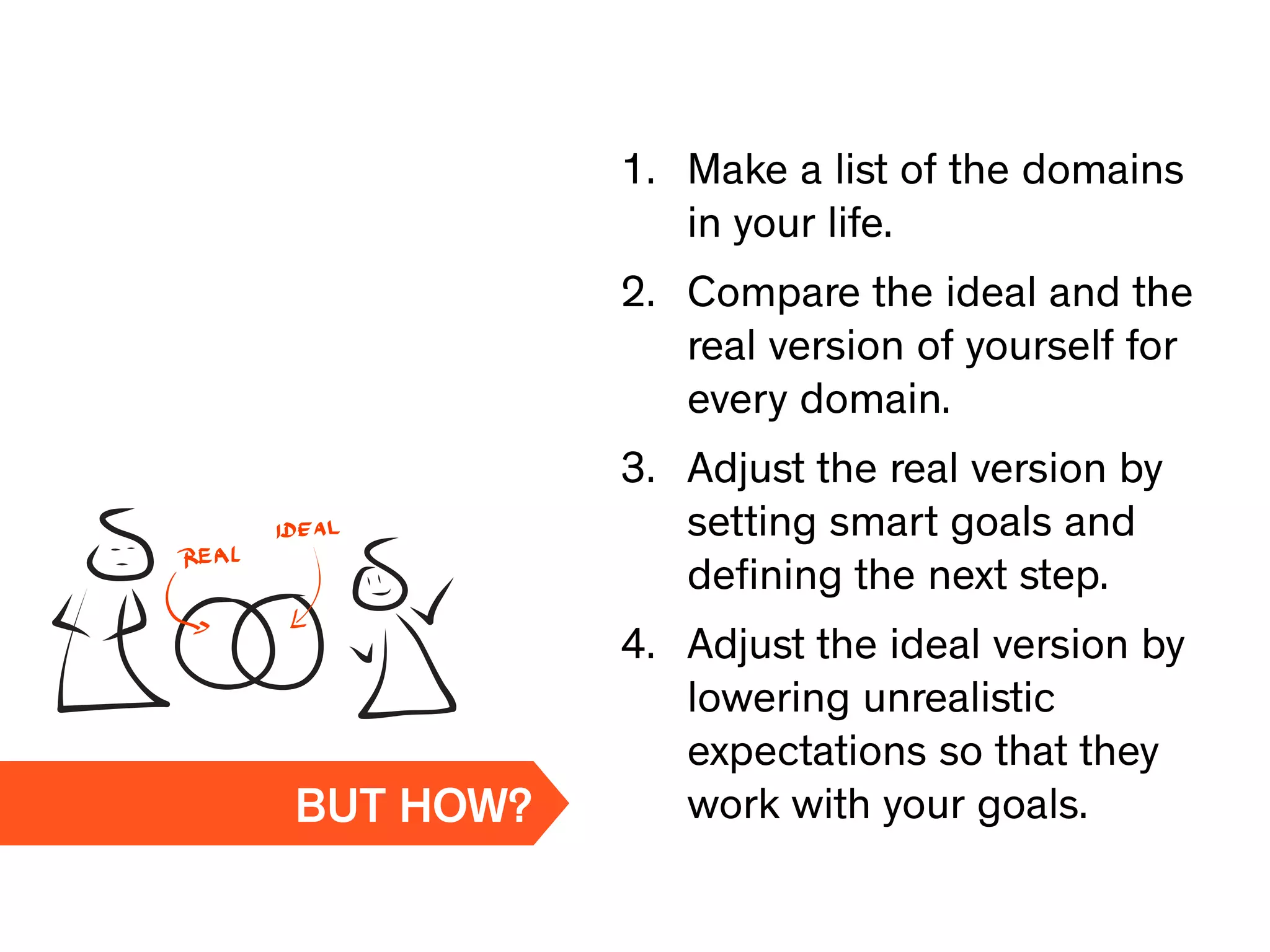
1. Make a list of the domains
in your life.
2. Compare the ideal and the
real version of yourself for
every domain.
3. Adjust the real version by
setting smart goals and
defining the next step.
4. Adjust the ideal version by
lowering unrealistic
expectations so that they
work with your goals.BUT HOW?
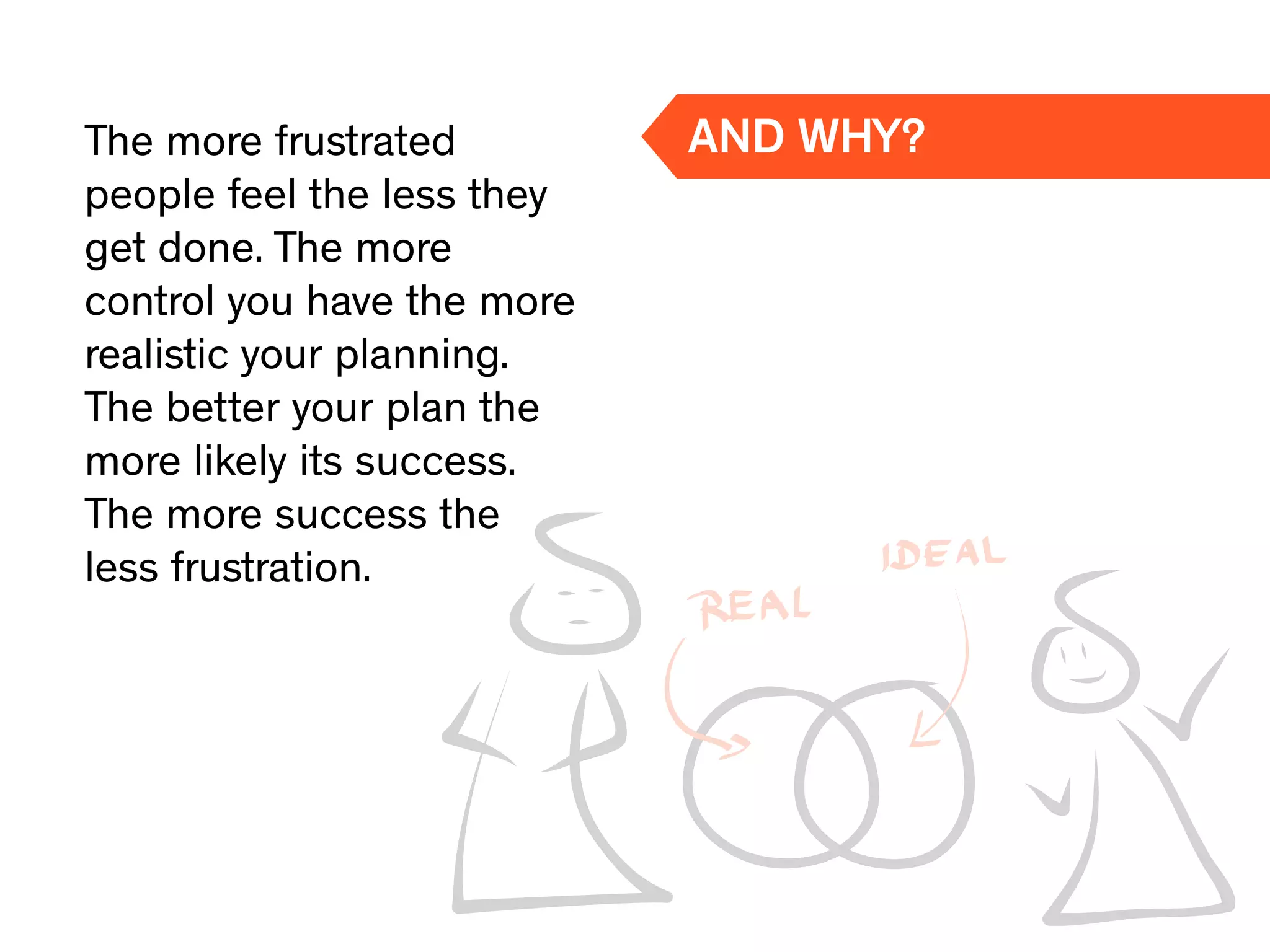
The more frustrated
people feel the less they
get done. The more
control you have the more
realistic your planning.
The better your plan the
more likely its success.
The more success the
less frustration.
AND WHY?
Establish a sense
of achievement
by keeping track
of your activities! WHAT?
1 2 3 4 5 6 7 8 9 10
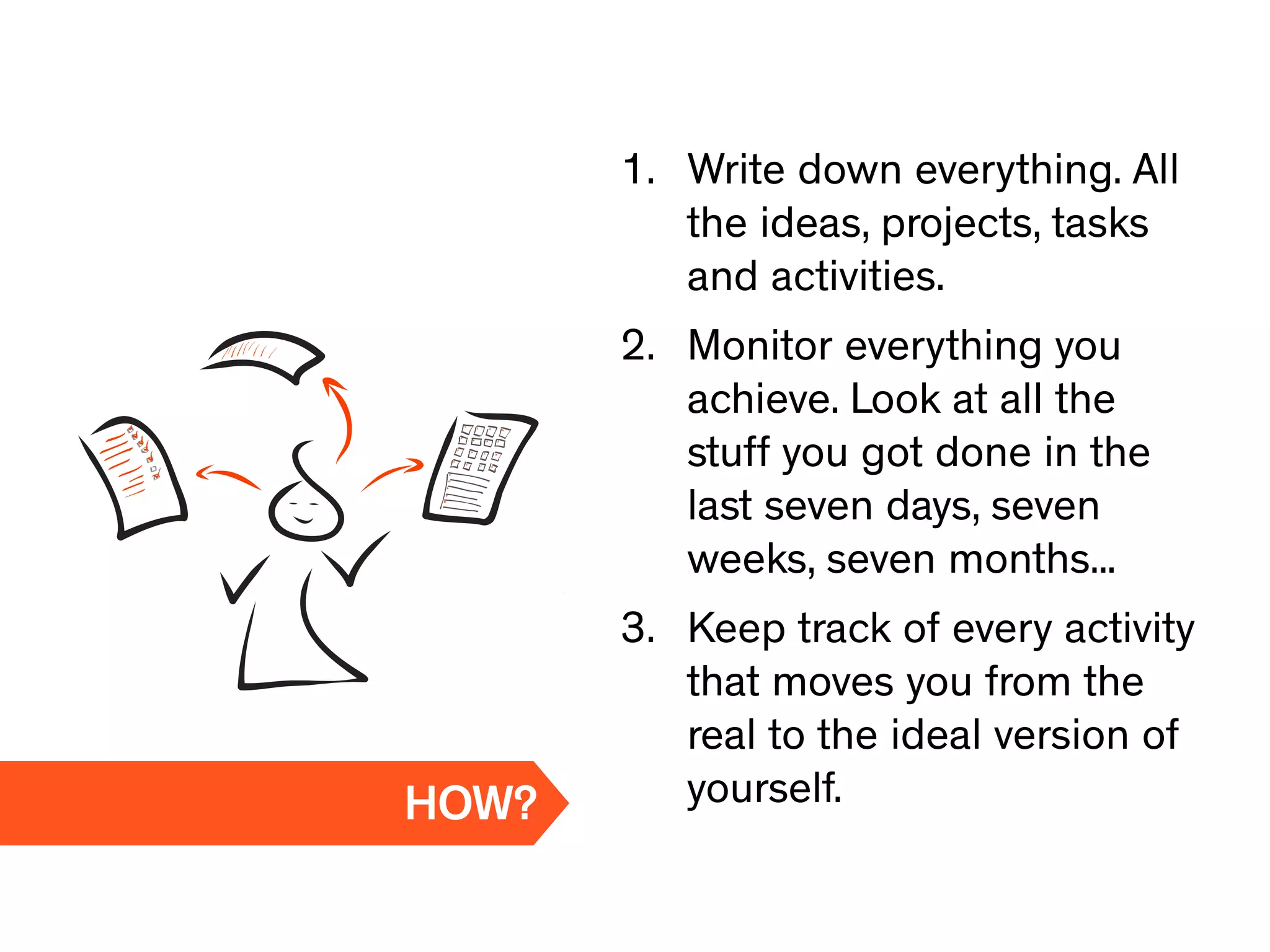
1. Write down everything. All
the ideas, projects, tasks
and activities.
2. Monitor everything you
achieve. Look at all the
stuff you got done in the
last seven days, seven
weeks, seven months...
3. Keep track of every activity
that moves you from the
real to the ideal version of
yourself.HOW?
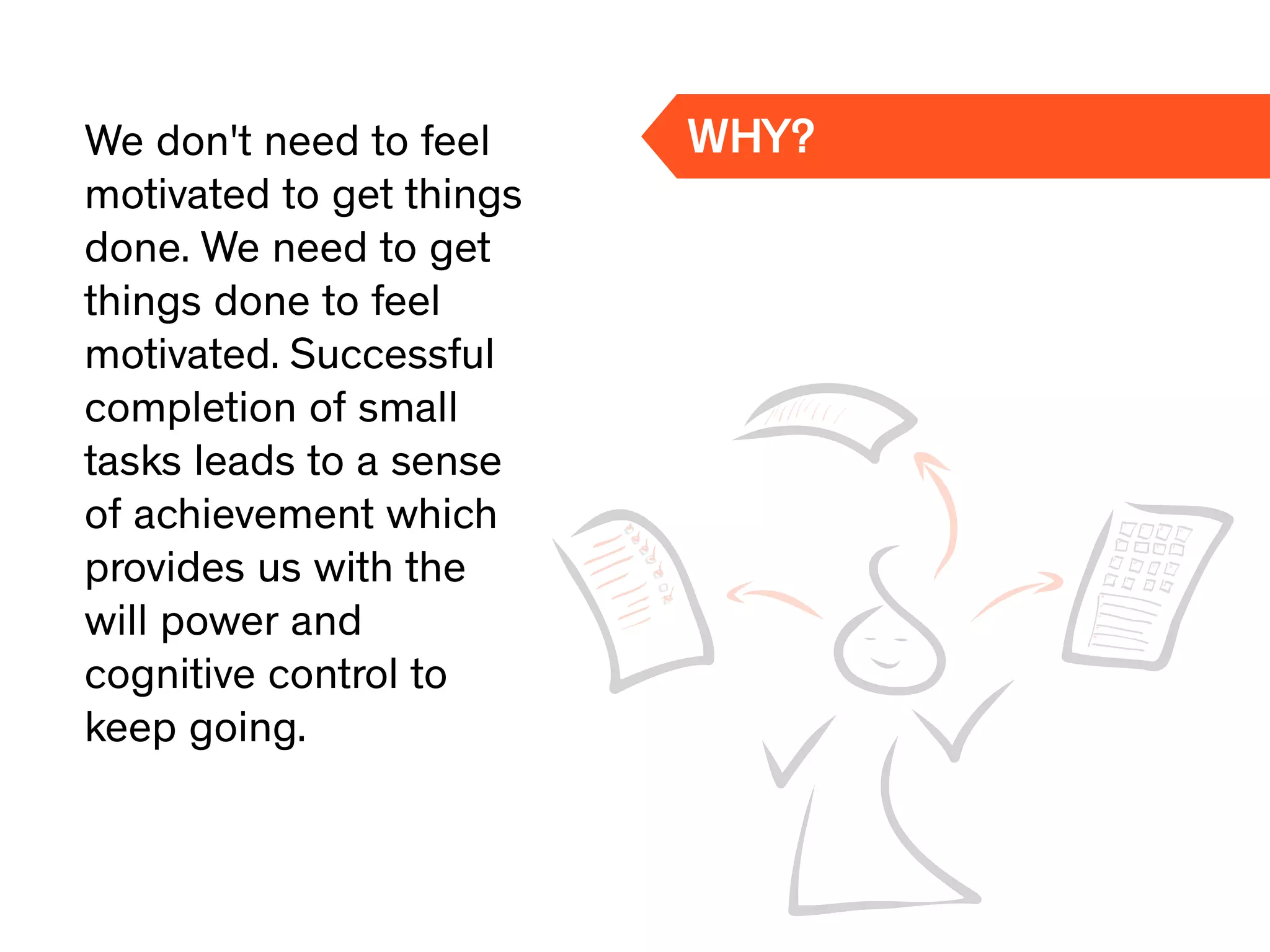
We don't need to feel
motivated to get things
done. We need to get
things done to feel
motivated. Successful
completion of small
tasks leads to a sense
of achievement which
provides us with the
will power and
cognitive control to
keep going.
WHY?
Celebrate your
success and reward
your achievements! WHAT?
1 2 3 4 5 6 7 8 9 10
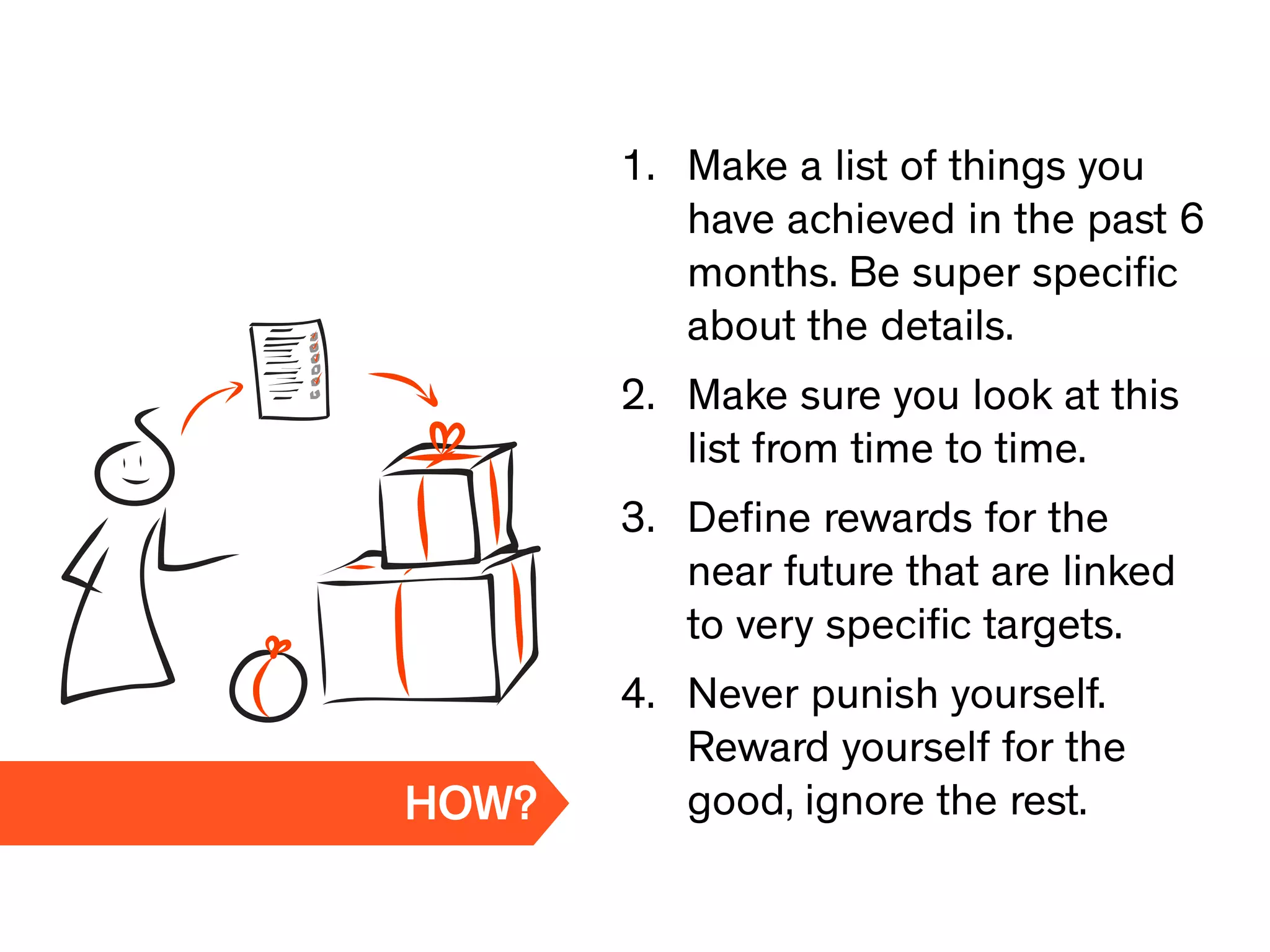
1. Make a list of things you
have achieved in the past 6
months. Be super specific
about the details.
2. Make sure you look at this
list from time to time.
3. Define rewards for the
near future that are linked
to very specific targets.
4. Never punish yourself.
Reward yourself for the
good, ignore the rest.HOW?
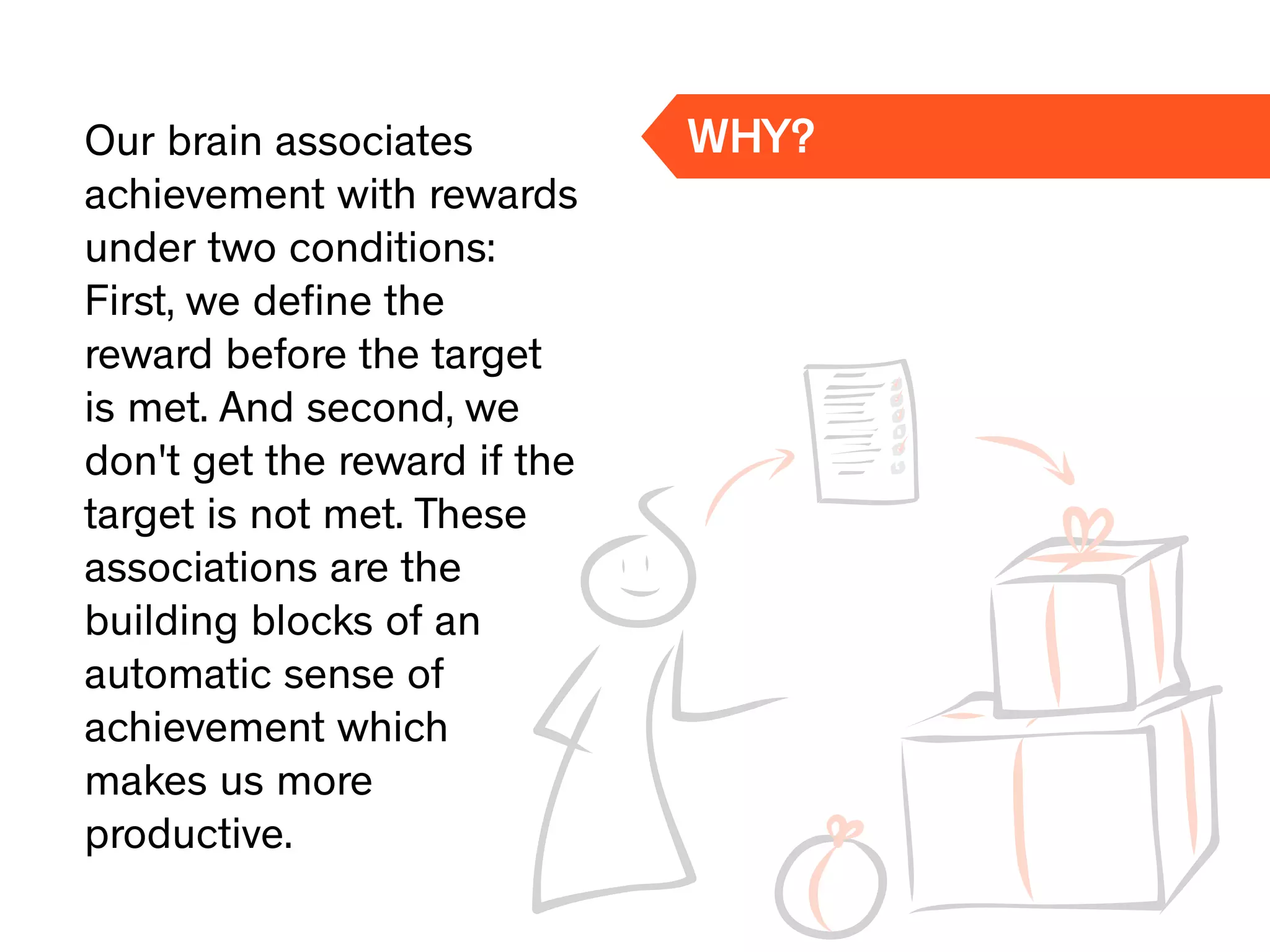
Our brain associates
achievement with rewards
under two conditions:
First, we define the
reward before the target
is met. And second, we
don't get the reward if the
target is not met. These
associations are the
building blocks of an
automatic sense of
achievement which
makes us more
productive.
WHY?
Think in action.
Start now.
Right here! WHAT?
1 2 3 4 5 6 7 8 9 10
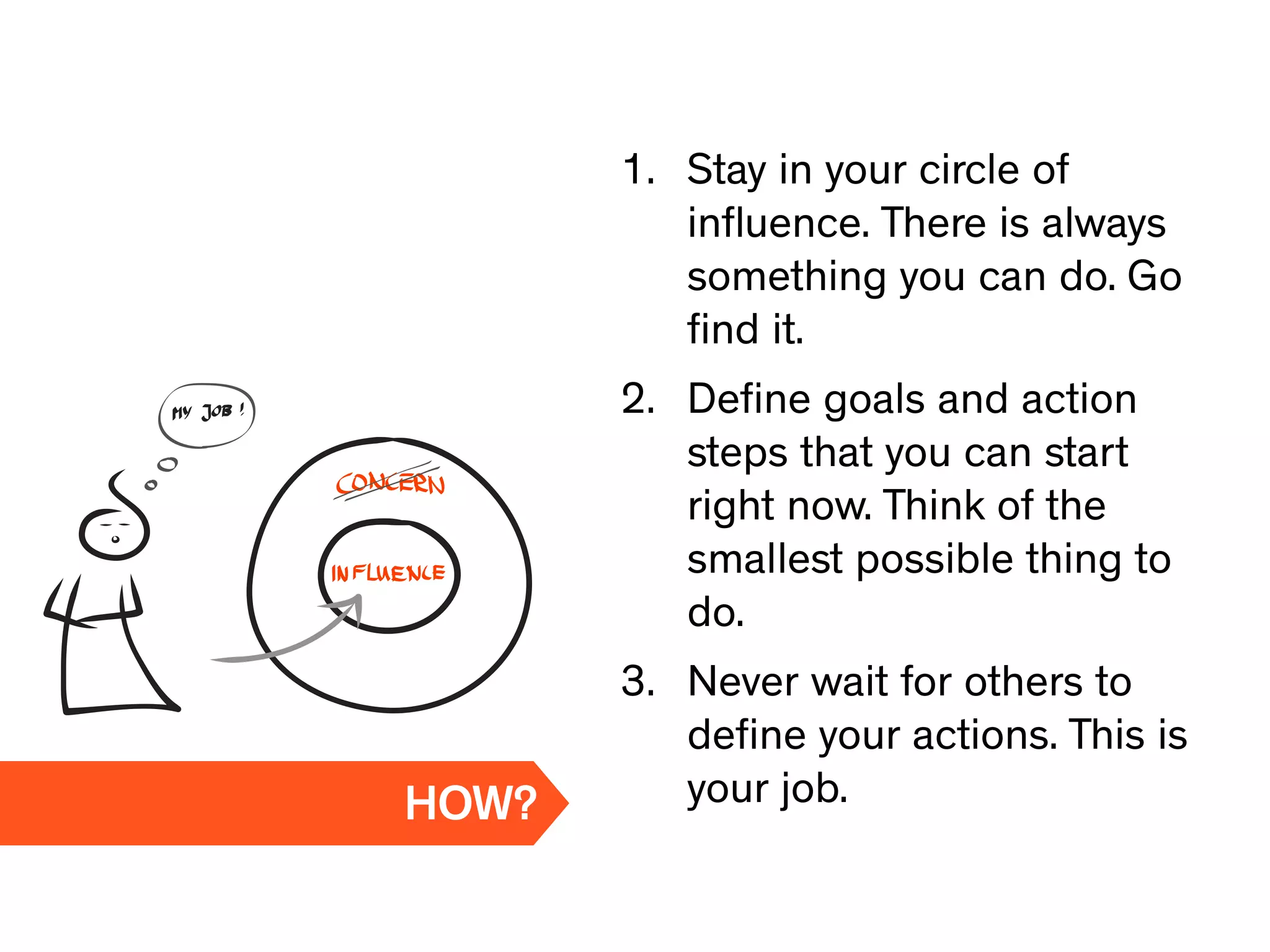
1. Stay in your circle of
influence. There is always
something you can do. Go
find it.
2. Define goals and action
steps that you can start
right now. Think of the
smallest possible thing to
do.
3. Never wait for others to
define your actions. This is
your job.HOW?
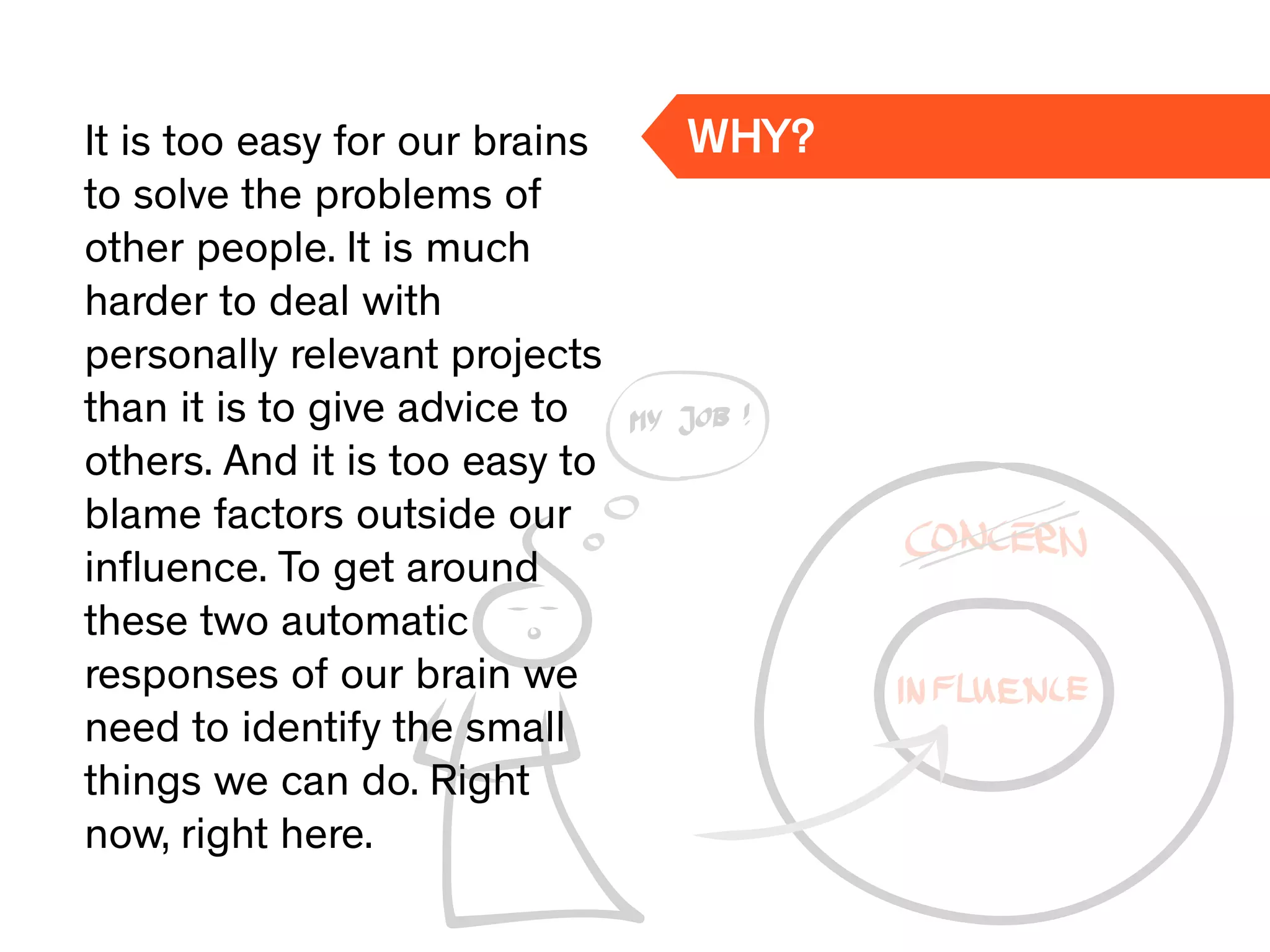
It is too easy for our brains
to solve the problems of
other people. It is much
harder to deal with
personally relevant projects
than it is to give advice to
others. And it is too easy to
blame factors outside our
influence. To get around
these two automatic
responses of our brain we
need to identify the small
things we can do. Right
now, right here.
WHY?
Don't get
overwhelmed by the
movie of your life.
Break it down! WHAT?
1 2 3 4 5 6 7 8 9 10
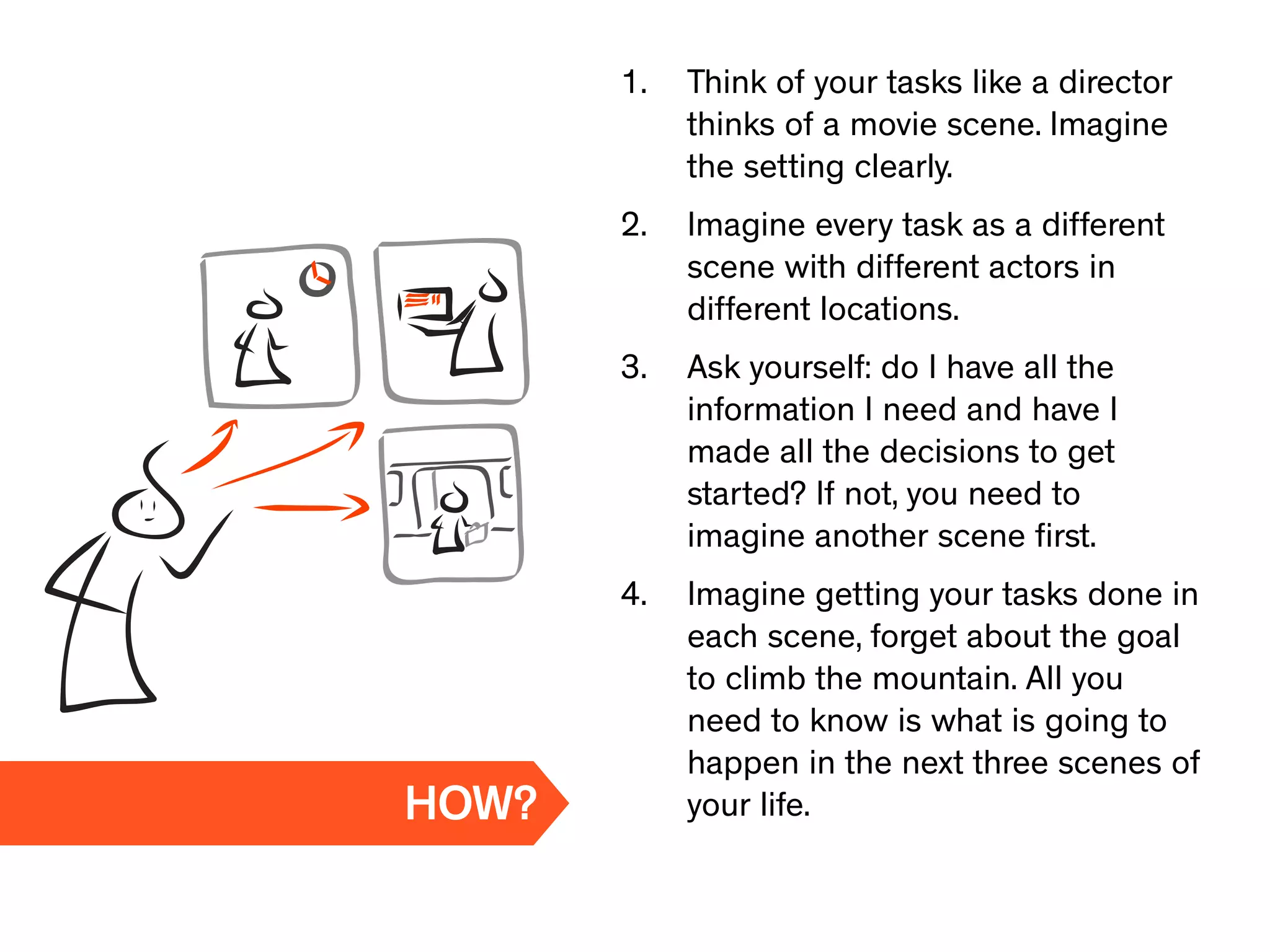
1. Think of your tasks like a director
thinks of a movie scene. Imagine
the setting clearly.
2. Imagine every task as a different
scene with different actors in
different locations.
3. Ask yourself: do I have all the
information I need and have I
made all the decisions to get
started? If not, you need to
imagine another scene first.
4. Imagine getting your tasks done in
each scene, forget about the goal
to climb the mountain. All you
need to know is what is going to
happen in the next three scenes of
your life.HOW?
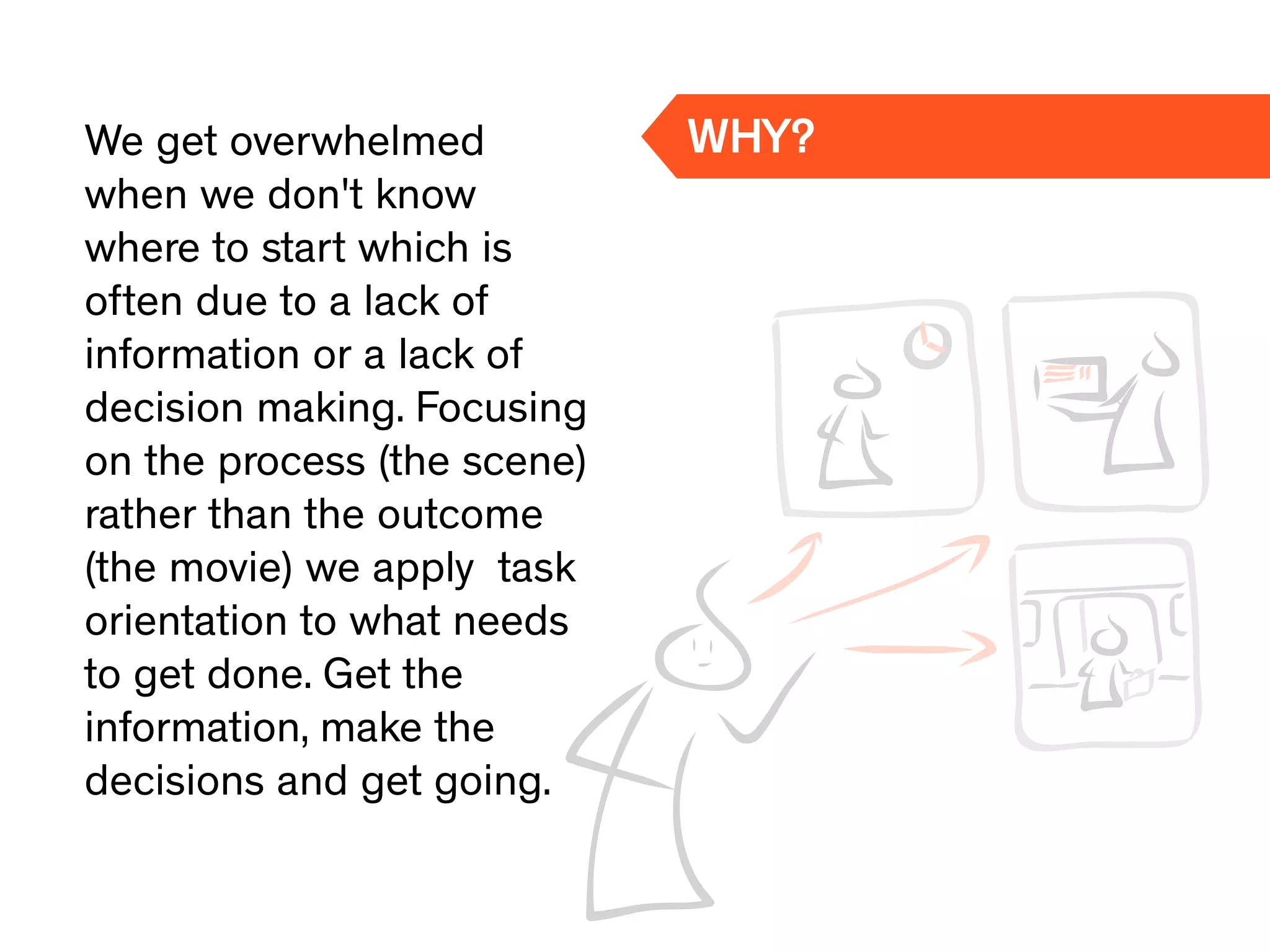
We get overwhelmed
when we don't know
where to start which is
often due to a lack of
information or a lack of
decision making. Focusing
on the process (the scene)
rather than the outcome
(the movie) we apply task
orientation to what needs
to get done. Get the
information, make the
decisions and get going.
WHY?
To get organized
you need to
prioritize,
prepare,
keep track
and learn! WHAT?
1 2 3 4 5 6 7 8 9 10
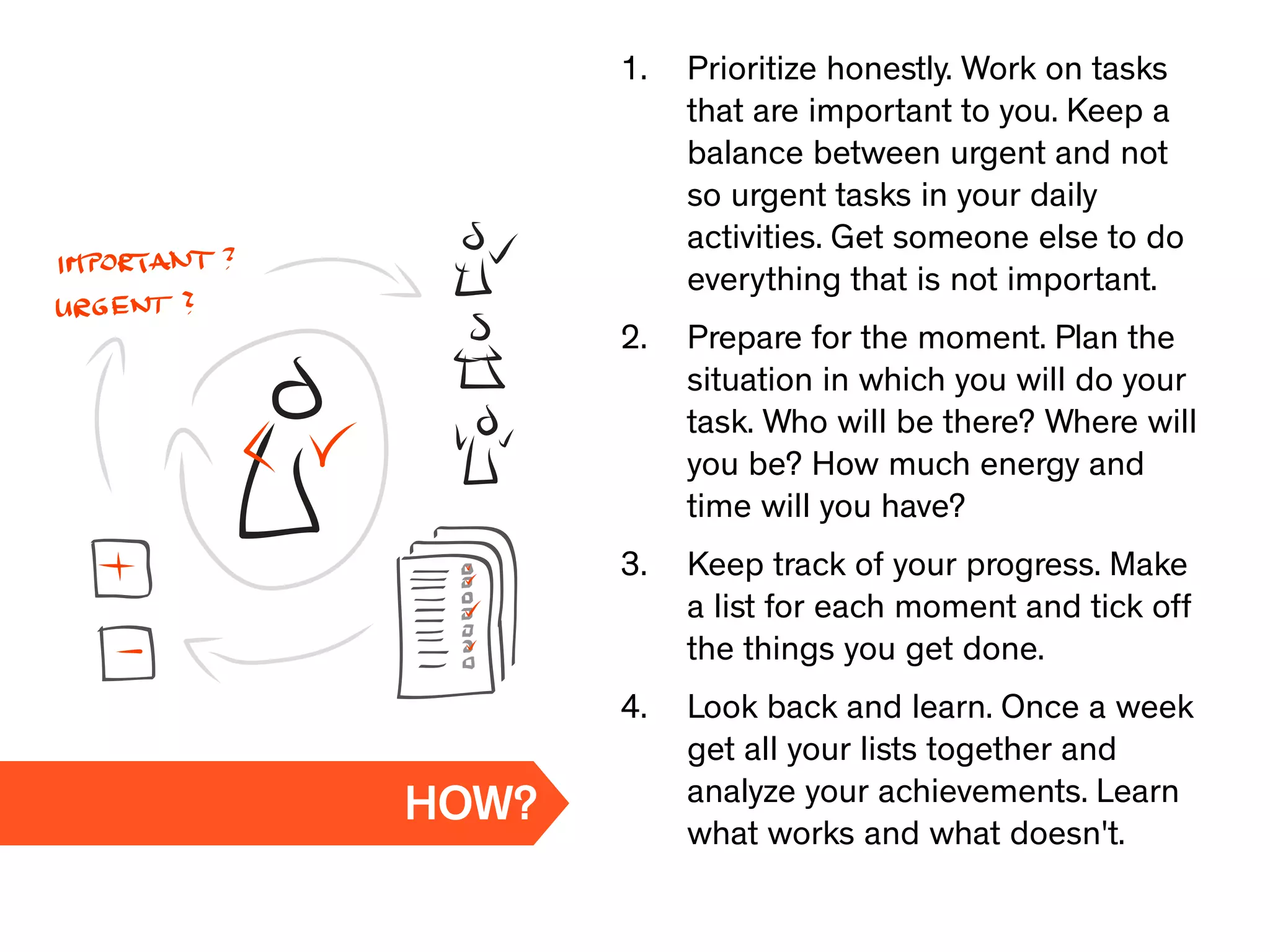
1. Prioritize honestly. Work on tasks
that are important to you. Keep a
balance between urgent and not
so urgent tasks in your daily
activities. Get someone else to do
everything that is not important.
2. Prepare for the moment. Plan the
situation in which you will do your
task. Who will be there? Where will
you be? How much energy and
time will you have?
3. Keep track of your progress. Make
a list for each moment and tick off
the things you get done.
4. Look back and learn. Once a week
get all your lists together and
analyze your achievements. Learn
what works and what doesn't.
HOW?
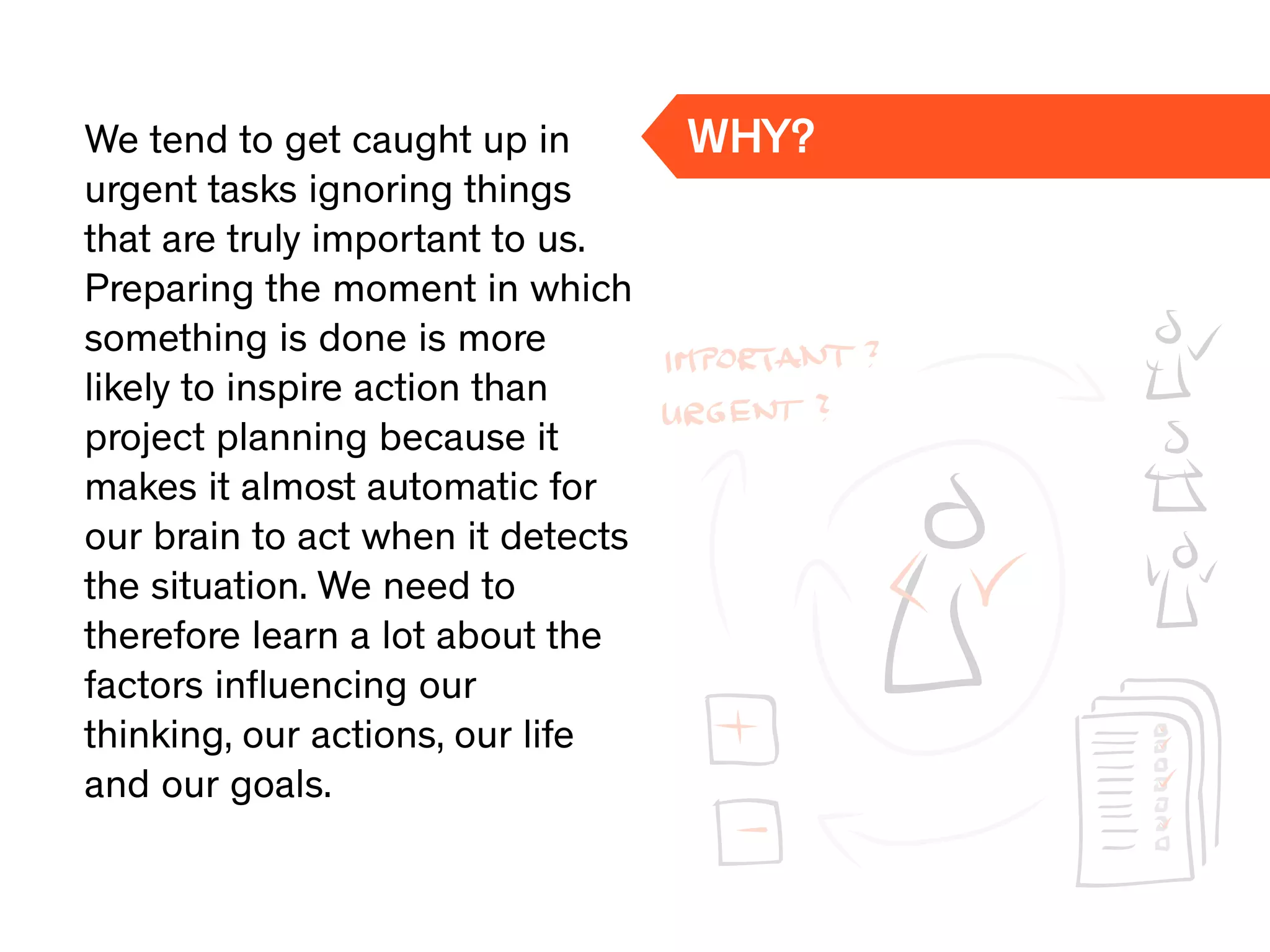
We tend to get caught up in
urgent tasks ignoring things
that are truly important to us.
Preparing the moment in which
something is done is more
likely to inspire action than
project planning because it
makes it almost automatic for
our brain to act when it detects
the situation. We need to
therefore learn a lot about the
factors influencing our
thinking, our actions, our life
and our goals.
WHY?
Overcome
procrastination! WHAT?
1 2 3 4 5 6 7 8 9 10
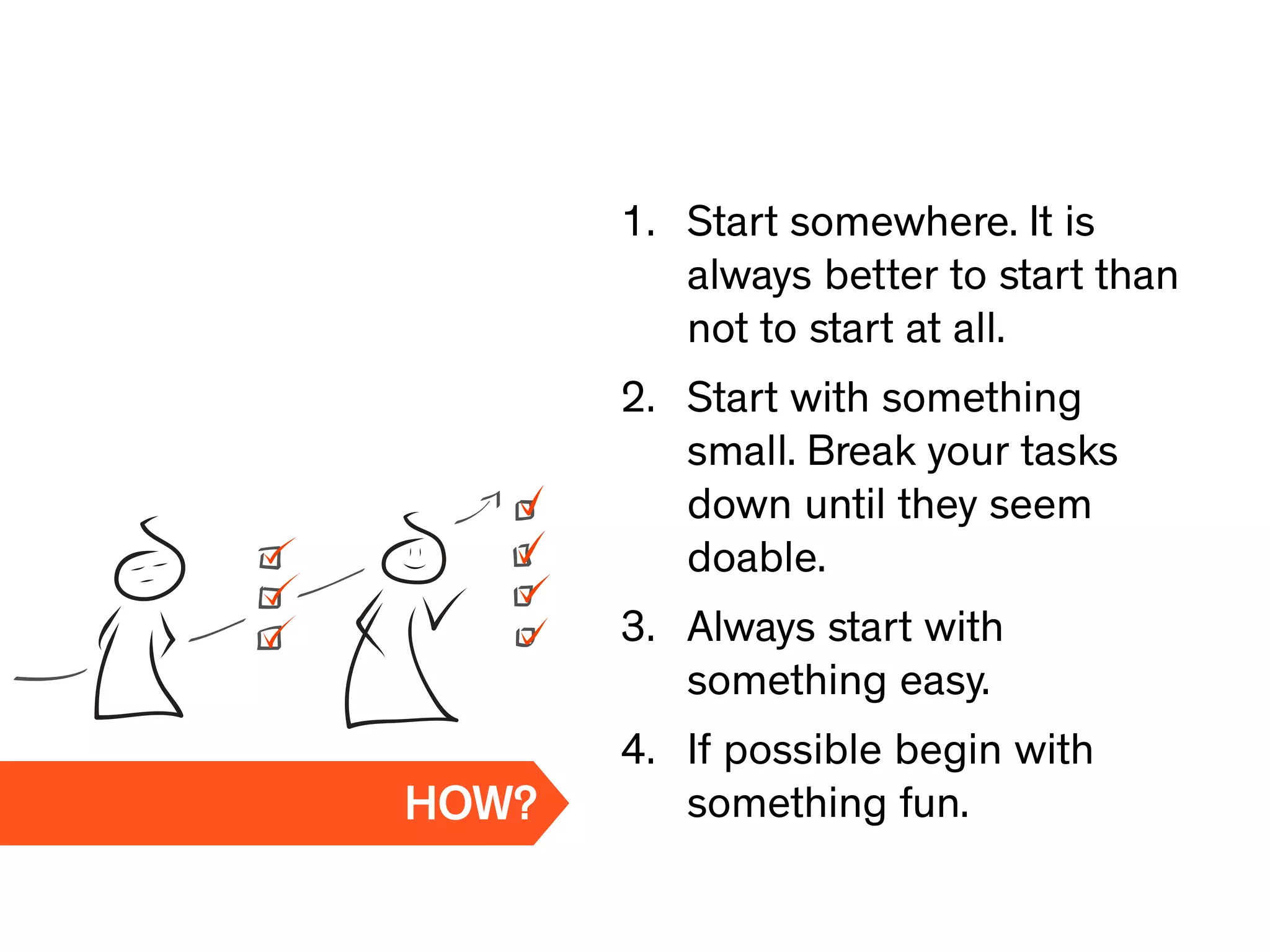
1. Start somewhere. It is
always better to start than
not to start at all.
2. Start with something
small. Break your tasks
down until they seem
doable.
3. Always start with
something easy.
4. If possible begin with
something fun.HOW?
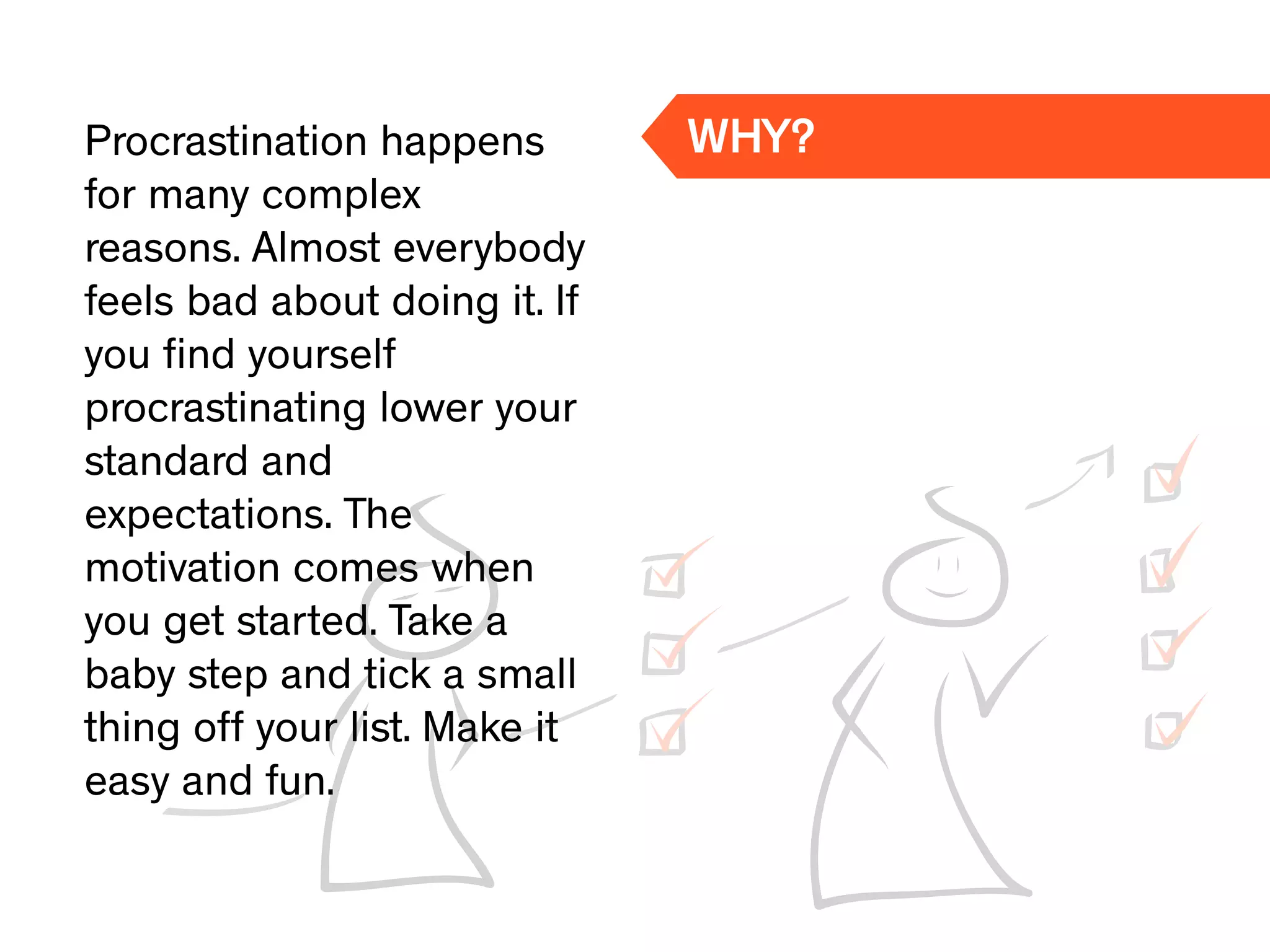
Procrastination happens
for many complex
reasons. Almost everybody
feels bad about doing it. If
you find yourself
procrastinating lower your
standard and
expectations. The
motivation comes when
you get started. Take a
baby step and tick a small
thing off your list. Make it
easy and fun.
WHY?
Stop multitasking.
Focus, focus, focus! WHAT?
1 2 3 4 5 6 7 8 9 10
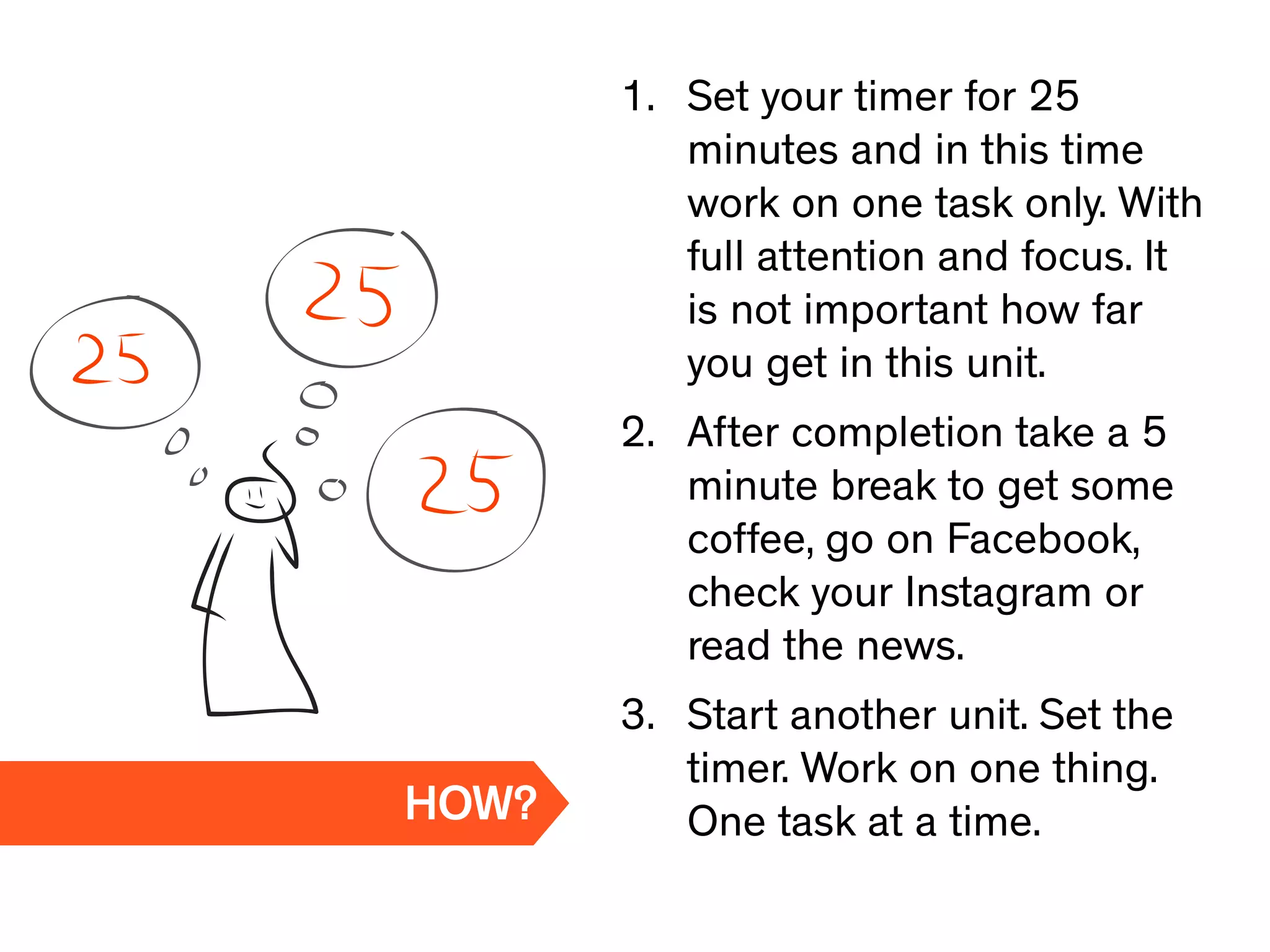
1. Set your timer for 25
minutes and in this time
work on one task only. With
full attention and focus. It
is not important how far
you get in this unit.
2. After completion take a 5
minute break to get some
coffee, go on Facebook,
check your Instagram or
read the news.
3. Start another unit. Set the
timer. Work on one thing.
One task at a time.HOW?
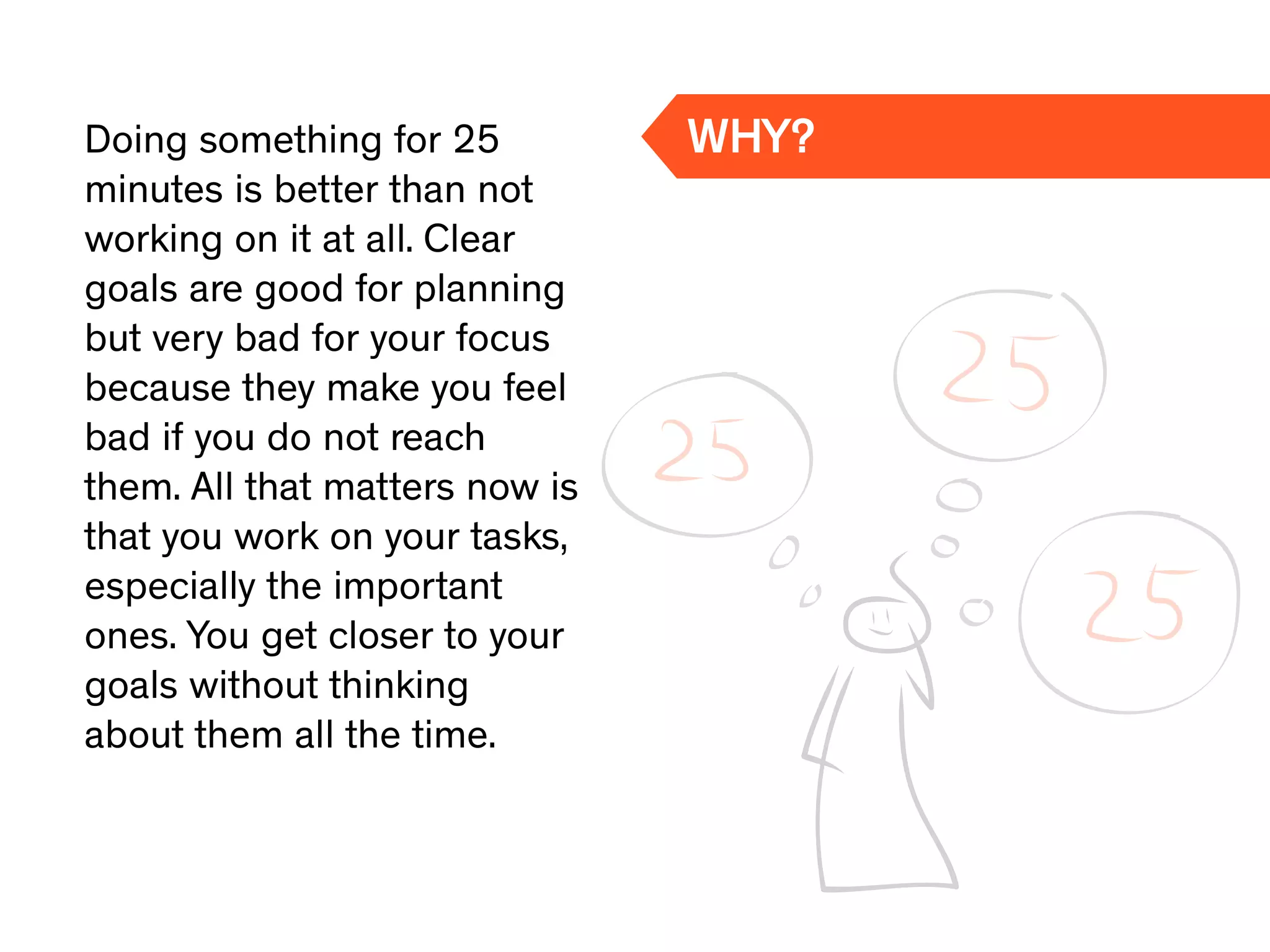
Doing something for 25
minutes is better than not
working on it at all. Clear
goals are good for planning
but very bad for your focus
because they make you feel
bad if you do not reach
them. All that matters now is
that you work on your tasks,
especially the important
ones. You get closer to your
goals without thinking
about them all the time.
WHY?
Be realistic.
Set up a plan,
define action steps
and go! WHAT?
1 2 3 4 5 6 7 8 9 10
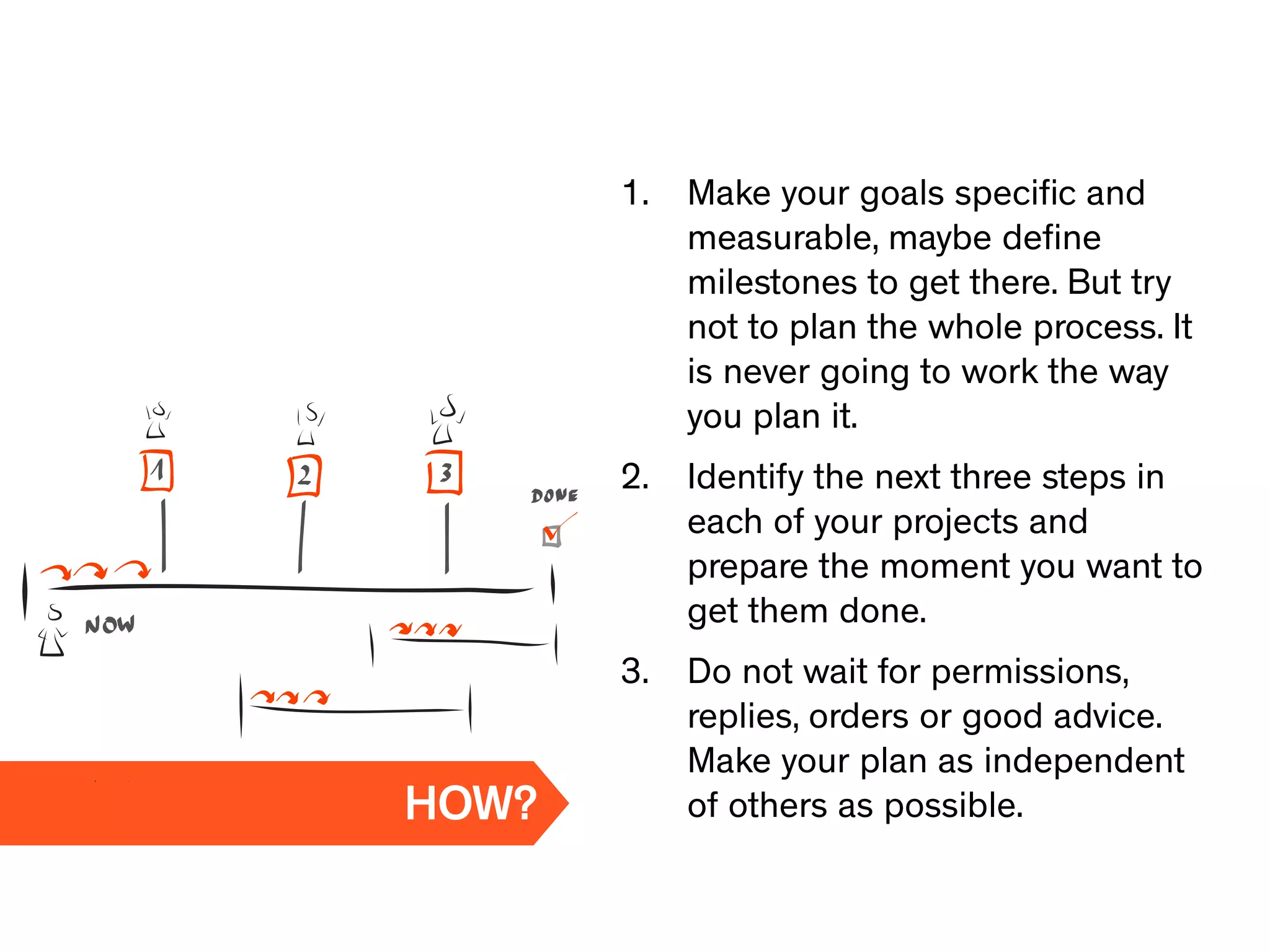
1. Make your goals specific and
measurable, maybe define
milestones to get there. But try
not to plan the whole process. It
is never going to work the way
you plan it.
2. Identify the next three steps in
each of your projects and
prepare the moment you want to
get them done.
3. Do not wait for permissions,
replies, orders or good advice.
Make your plan as independent
of others as possible.HOW?
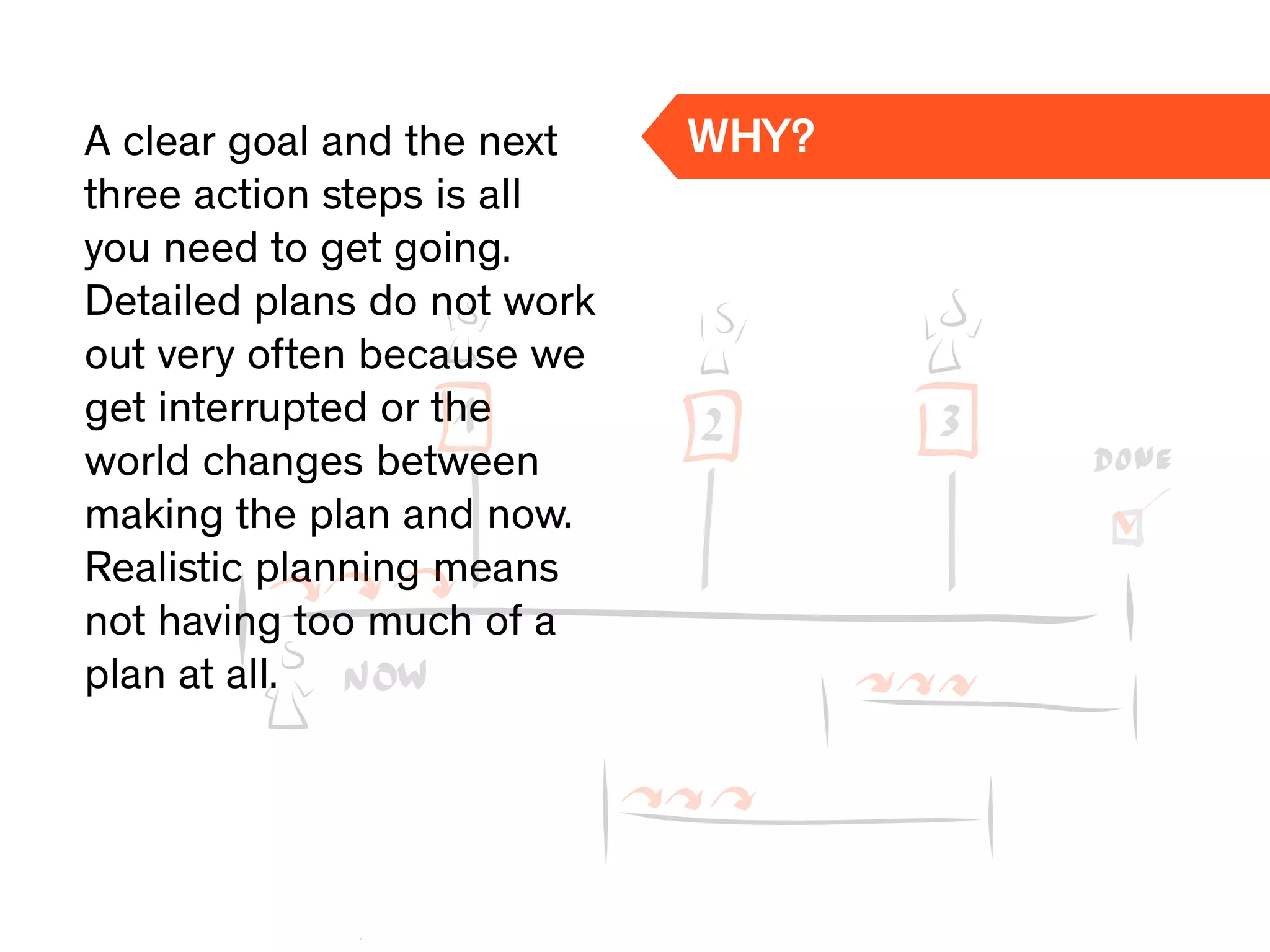
A clear goal and the next
three action steps is all
you need to get going.
Detailed plans do not work
out very often because we
get interrupted or the
world changes between
making the plan and now.
Realistic planning means
not having too much of a
plan at all.
WHY?
Build good habits,
one after the other! WHAT?
1 2 3 4 5 6 7 8 9 10
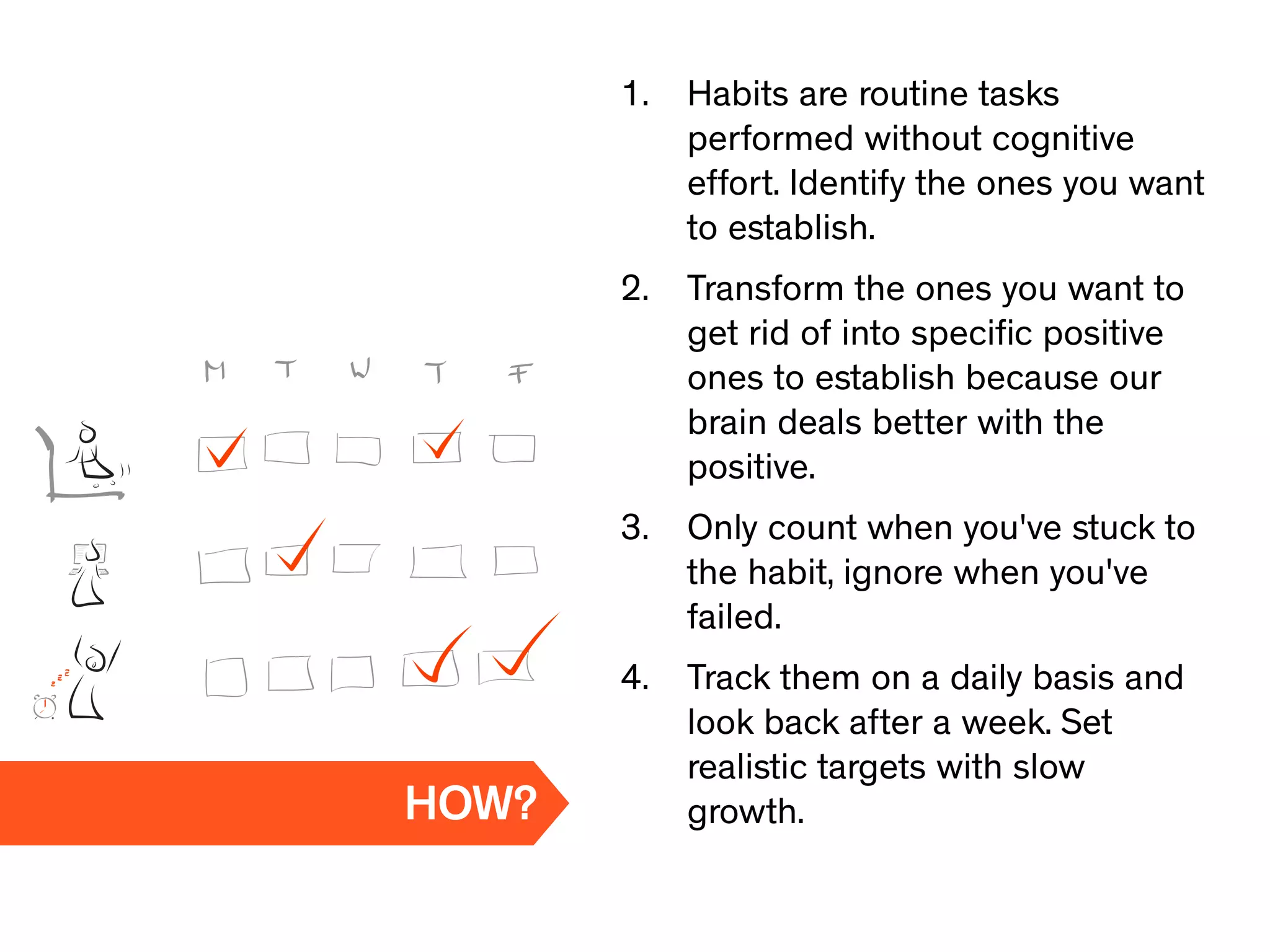
1. Habits are routine tasks
performed without cognitive
effort. Identify the ones you want
to establish.
2. Transform the ones you want to
get rid of into specific positive
ones to establish because our
brain deals better with the
positive.
3. Only count when you've stuck to
the habit, ignore when you've
failed.
4. Track them on a daily basis and
look back after a week. Set
realistic targets with slow
growth.HOW?
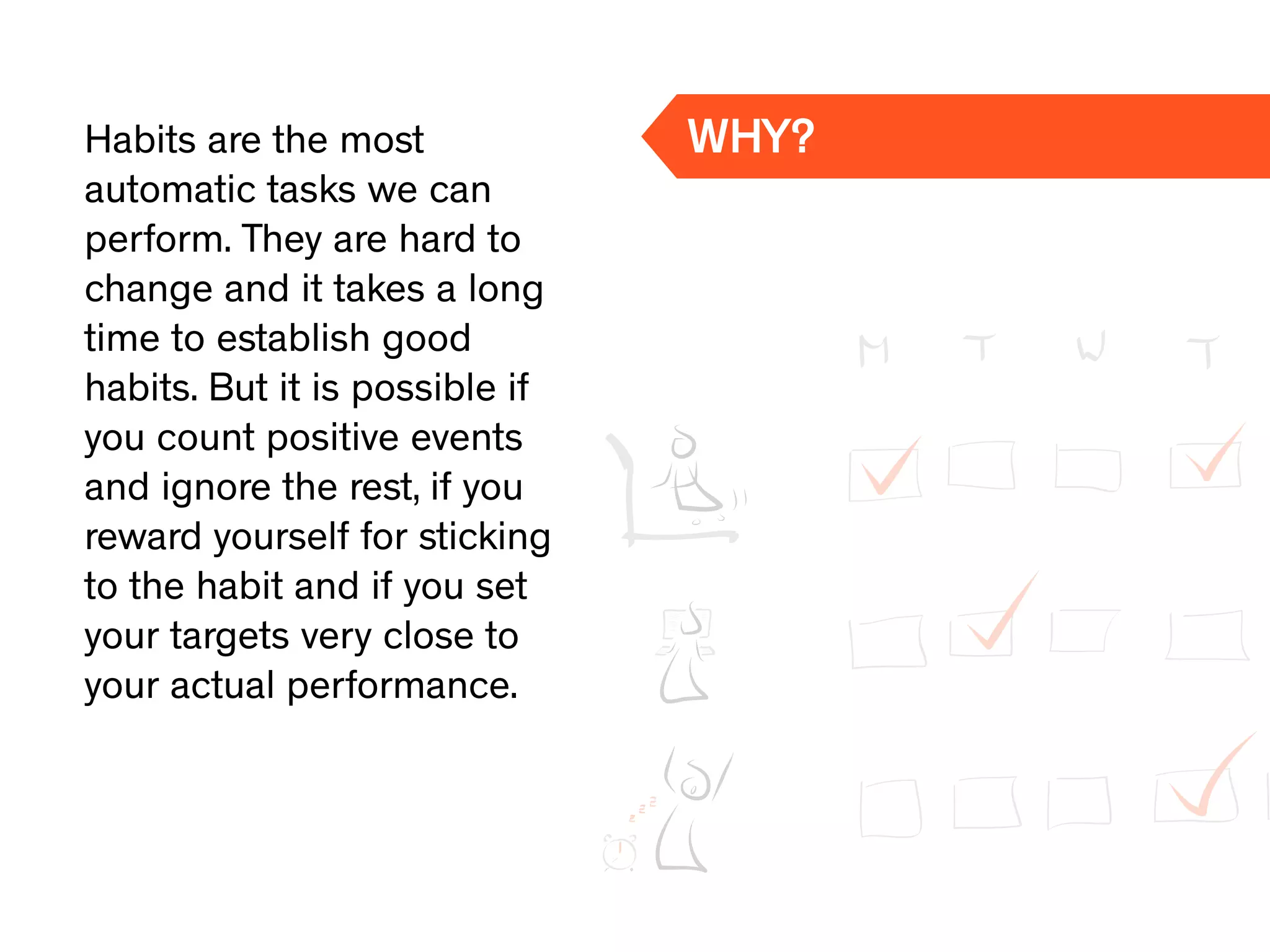
Habits are the most
automatic tasks we can
perform. They are hard to
change and it takes a long
time to establish good
habits. But it is possible if
you count positive events
and ignore the rest, if you
reward yourself for sticking
to the habit and if you set
your targets very close to
your actual performance.
WHY?
Be the white rabbit.™
www.christoph-burkhardt.com
facebook.com/ponderplatz
twitter.com/chburkhardt
de.linkedin.com/in/chburkhardt
Christoph
Burkhardt
Corporate
Psychologist
www.christoph-burkhardt.com
mail@christoph-burkhardt.com
DE +49 (176) 201 55 392
US +1 (415) 315 9662

Start Now Right Here - 10 stages of productivity

  • 1.
  • 2.
    Not getting thingsdone the way you could? And less stressed? Want to be more productive? Here is what you can do, how you get it to work and why it works this way!
  • 3.
    My name isChris, I'm a corporate psychologist. My job is to help people to live up to their potential. This is what my clients found the most helpful advice to get organized. 10 stages. Let's go...
  • 4.
    Gain control over thedifferent domains in your life! WHAT? 1 2 3 4 5 6 7 8 9 10
  • 5.
    1. Make alist of the domains in your life. 2. Compare the ideal and the real version of yourself for every domain. 3. Adjust the real version by setting smart goals and defining the next step. 4. Adjust the ideal version by lowering unrealistic expectations so that they work with your goals.BUT HOW?
  • 6.
    The more frustrated peoplefeel the less they get done. The more control you have the more realistic your planning. The better your plan the more likely its success. The more success the less frustration. AND WHY?
  • 7.
    Establish a sense ofachievement by keeping track of your activities! WHAT? 1 2 3 4 5 6 7 8 9 10
  • 8.
    1. Write downeverything. All the ideas, projects, tasks and activities. 2. Monitor everything you achieve. Look at all the stuff you got done in the last seven days, seven weeks, seven months... 3. Keep track of every activity that moves you from the real to the ideal version of yourself.HOW?
  • 9.
    We don't needto feel motivated to get things done. We need to get things done to feel motivated. Successful completion of small tasks leads to a sense of achievement which provides us with the will power and cognitive control to keep going. WHY?
  • 10.
    Celebrate your success andreward your achievements! WHAT? 1 2 3 4 5 6 7 8 9 10
  • 11.
    1. Make alist of things you have achieved in the past 6 months. Be super specific about the details. 2. Make sure you look at this list from time to time. 3. Define rewards for the near future that are linked to very specific targets. 4. Never punish yourself. Reward yourself for the good, ignore the rest.HOW?
  • 12.
    Our brain associates achievementwith rewards under two conditions: First, we define the reward before the target is met. And second, we don't get the reward if the target is not met. These associations are the building blocks of an automatic sense of achievement which makes us more productive. WHY?
  • 13.
    Think in action. Startnow. Right here! WHAT? 1 2 3 4 5 6 7 8 9 10
  • 14.
    1. Stay inyour circle of influence. There is always something you can do. Go find it. 2. Define goals and action steps that you can start right now. Think of the smallest possible thing to do. 3. Never wait for others to define your actions. This is your job.HOW?
  • 15.
    It is tooeasy for our brains to solve the problems of other people. It is much harder to deal with personally relevant projects than it is to give advice to others. And it is too easy to blame factors outside our influence. To get around these two automatic responses of our brain we need to identify the small things we can do. Right now, right here. WHY?
  • 16.
    Don't get overwhelmed bythe movie of your life. Break it down! WHAT? 1 2 3 4 5 6 7 8 9 10
  • 17.
    1. Think ofyour tasks like a director thinks of a movie scene. Imagine the setting clearly. 2. Imagine every task as a different scene with different actors in different locations. 3. Ask yourself: do I have all the information I need and have I made all the decisions to get started? If not, you need to imagine another scene first. 4. Imagine getting your tasks done in each scene, forget about the goal to climb the mountain. All you need to know is what is going to happen in the next three scenes of your life.HOW?
  • 18.
    We get overwhelmed whenwe don't know where to start which is often due to a lack of information or a lack of decision making. Focusing on the process (the scene) rather than the outcome (the movie) we apply task orientation to what needs to get done. Get the information, make the decisions and get going. WHY?
  • 19.
    To get organized youneed to prioritize, prepare, keep track and learn! WHAT? 1 2 3 4 5 6 7 8 9 10
  • 20.
    1. Prioritize honestly.Work on tasks that are important to you. Keep a balance between urgent and not so urgent tasks in your daily activities. Get someone else to do everything that is not important. 2. Prepare for the moment. Plan the situation in which you will do your task. Who will be there? Where will you be? How much energy and time will you have? 3. Keep track of your progress. Make a list for each moment and tick off the things you get done. 4. Look back and learn. Once a week get all your lists together and analyze your achievements. Learn what works and what doesn't. HOW?
  • 21.
    We tend toget caught up in urgent tasks ignoring things that are truly important to us. Preparing the moment in which something is done is more likely to inspire action than project planning because it makes it almost automatic for our brain to act when it detects the situation. We need to therefore learn a lot about the factors influencing our thinking, our actions, our life and our goals. WHY?
  • 22.
  • 23.
    1. Start somewhere.It is always better to start than not to start at all. 2. Start with something small. Break your tasks down until they seem doable. 3. Always start with something easy. 4. If possible begin with something fun.HOW?
  • 24.
    Procrastination happens for manycomplex reasons. Almost everybody feels bad about doing it. If you find yourself procrastinating lower your standard and expectations. The motivation comes when you get started. Take a baby step and tick a small thing off your list. Make it easy and fun. WHY?
  • 25.
    Stop multitasking. Focus, focus,focus! WHAT? 1 2 3 4 5 6 7 8 9 10
  • 26.
    1. Set yourtimer for 25 minutes and in this time work on one task only. With full attention and focus. It is not important how far you get in this unit. 2. After completion take a 5 minute break to get some coffee, go on Facebook, check your Instagram or read the news. 3. Start another unit. Set the timer. Work on one thing. One task at a time.HOW?
  • 27.
    Doing something for25 minutes is better than not working on it at all. Clear goals are good for planning but very bad for your focus because they make you feel bad if you do not reach them. All that matters now is that you work on your tasks, especially the important ones. You get closer to your goals without thinking about them all the time. WHY?
  • 28.
    Be realistic. Set upa plan, define action steps and go! WHAT? 1 2 3 4 5 6 7 8 9 10
  • 29.
    1. Make yourgoals specific and measurable, maybe define milestones to get there. But try not to plan the whole process. It is never going to work the way you plan it. 2. Identify the next three steps in each of your projects and prepare the moment you want to get them done. 3. Do not wait for permissions, replies, orders or good advice. Make your plan as independent of others as possible.HOW?
  • 30.
    A clear goaland the next three action steps is all you need to get going. Detailed plans do not work out very often because we get interrupted or the world changes between making the plan and now. Realistic planning means not having too much of a plan at all. WHY?
  • 31.
    Build good habits, oneafter the other! WHAT? 1 2 3 4 5 6 7 8 9 10
  • 32.
    1. Habits areroutine tasks performed without cognitive effort. Identify the ones you want to establish. 2. Transform the ones you want to get rid of into specific positive ones to establish because our brain deals better with the positive. 3. Only count when you've stuck to the habit, ignore when you've failed. 4. Track them on a daily basis and look back after a week. Set realistic targets with slow growth.HOW?
  • 33.
    Habits are themost automatic tasks we can perform. They are hard to change and it takes a long time to establish good habits. But it is possible if you count positive events and ignore the rest, if you reward yourself for sticking to the habit and if you set your targets very close to your actual performance. WHY?
  • 34.
    Be the whiterabbit.™ www.christoph-burkhardt.com facebook.com/ponderplatz twitter.com/chburkhardt de.linkedin.com/in/chburkhardt
  • 35.